EP4119360B1 - Tire - Google Patents
Tire Download PDFInfo
- Publication number
- EP4119360B1 EP4119360B1 EP21767689.9A EP21767689A EP4119360B1 EP 4119360 B1 EP4119360 B1 EP 4119360B1 EP 21767689 A EP21767689 A EP 21767689A EP 4119360 B1 EP4119360 B1 EP 4119360B1
- Authority
- EP
- European Patent Office
- Prior art keywords
- tire
- reinforcement layer
- cords
- belt reinforcement
- rubber
- Prior art date
- Legal status (The legal status is an assumption and is not a legal conclusion. Google has not performed a legal analysis and makes no representation as to the accuracy of the status listed.)
- Active
Links
Images
Classifications
-
- D—TEXTILES; PAPER
- D06—TREATMENT OF TEXTILES OR THE LIKE; LAUNDERING; FLEXIBLE MATERIALS NOT OTHERWISE PROVIDED FOR
- D06M—TREATMENT, NOT PROVIDED FOR ELSEWHERE IN CLASS D06, OF FIBRES, THREADS, YARNS, FABRICS, FEATHERS OR FIBROUS GOODS MADE FROM SUCH MATERIALS
- D06M13/00—Treating fibres, threads, yarns, fabrics or fibrous goods made from such materials, with non-macromolecular organic compounds; Such treatment combined with mechanical treatment
- D06M13/322—Treating fibres, threads, yarns, fabrics or fibrous goods made from such materials, with non-macromolecular organic compounds; Such treatment combined with mechanical treatment with compounds containing nitrogen
- D06M13/395—Isocyanates
-
- B—PERFORMING OPERATIONS; TRANSPORTING
- B60—VEHICLES IN GENERAL
- B60C—VEHICLE TYRES; TYRE INFLATION; TYRE CHANGING; CONNECTING VALVES TO INFLATABLE ELASTIC BODIES IN GENERAL; DEVICES OR ARRANGEMENTS RELATED TO TYRES
- B60C9/00—Reinforcements or ply arrangement of pneumatic tyres
- B60C9/0042—Reinforcements made of synthetic materials
-
- B—PERFORMING OPERATIONS; TRANSPORTING
- B60—VEHICLES IN GENERAL
- B60C—VEHICLE TYRES; TYRE INFLATION; TYRE CHANGING; CONNECTING VALVES TO INFLATABLE ELASTIC BODIES IN GENERAL; DEVICES OR ARRANGEMENTS RELATED TO TYRES
- B60C9/00—Reinforcements or ply arrangement of pneumatic tyres
- B60C9/005—Reinforcements made of different materials, e.g. hybrid or composite cords
-
- B—PERFORMING OPERATIONS; TRANSPORTING
- B60—VEHICLES IN GENERAL
- B60C—VEHICLE TYRES; TYRE INFLATION; TYRE CHANGING; CONNECTING VALVES TO INFLATABLE ELASTIC BODIES IN GENERAL; DEVICES OR ARRANGEMENTS RELATED TO TYRES
- B60C9/00—Reinforcements or ply arrangement of pneumatic tyres
- B60C9/18—Structure or arrangement of belts or breakers, crown-reinforcing or cushioning layers
- B60C9/20—Structure or arrangement of belts or breakers, crown-reinforcing or cushioning layers built-up from rubberised plies each having all cords arranged substantially parallel
- B60C9/2003—Structure or arrangement of belts or breakers, crown-reinforcing or cushioning layers built-up from rubberised plies each having all cords arranged substantially parallel characterised by the materials of the belt cords
- B60C9/2009—Structure or arrangement of belts or breakers, crown-reinforcing or cushioning layers built-up from rubberised plies each having all cords arranged substantially parallel characterised by the materials of the belt cords comprising plies of different materials
-
- D—TEXTILES; PAPER
- D06—TREATMENT OF TEXTILES OR THE LIKE; LAUNDERING; FLEXIBLE MATERIALS NOT OTHERWISE PROVIDED FOR
- D06M—TREATMENT, NOT PROVIDED FOR ELSEWHERE IN CLASS D06, OF FIBRES, THREADS, YARNS, FABRICS, FEATHERS OR FIBROUS GOODS MADE FROM SUCH MATERIALS
- D06M15/00—Treating fibres, threads, yarns, fabrics, or fibrous goods made from such materials, with macromolecular compounds; Such treatment combined with mechanical treatment
- D06M15/19—Treating fibres, threads, yarns, fabrics, or fibrous goods made from such materials, with macromolecular compounds; Such treatment combined with mechanical treatment with synthetic macromolecular compounds
- D06M15/37—Macromolecular compounds obtained otherwise than by reactions only involving carbon-to-carbon unsaturated bonds
- D06M15/39—Aldehyde resins; Ketone resins; Polyacetals
- D06M15/41—Phenol-aldehyde or phenol-ketone resins
-
- D—TEXTILES; PAPER
- D06—TREATMENT OF TEXTILES OR THE LIKE; LAUNDERING; FLEXIBLE MATERIALS NOT OTHERWISE PROVIDED FOR
- D06M—TREATMENT, NOT PROVIDED FOR ELSEWHERE IN CLASS D06, OF FIBRES, THREADS, YARNS, FABRICS, FEATHERS OR FIBROUS GOODS MADE FROM SUCH MATERIALS
- D06M15/00—Treating fibres, threads, yarns, fabrics, or fibrous goods made from such materials, with macromolecular compounds; Such treatment combined with mechanical treatment
- D06M15/693—Treating fibres, threads, yarns, fabrics, or fibrous goods made from such materials, with macromolecular compounds; Such treatment combined with mechanical treatment with natural or synthetic rubber, or derivatives thereof
-
- B—PERFORMING OPERATIONS; TRANSPORTING
- B60—VEHICLES IN GENERAL
- B60C—VEHICLE TYRES; TYRE INFLATION; TYRE CHANGING; CONNECTING VALVES TO INFLATABLE ELASTIC BODIES IN GENERAL; DEVICES OR ARRANGEMENTS RELATED TO TYRES
- B60C1/00—Tyres characterised by the chemical composition or the physical arrangement or mixture of the composition
- B60C2001/0066—Compositions of the belt layers
-
- B—PERFORMING OPERATIONS; TRANSPORTING
- B60—VEHICLES IN GENERAL
- B60C—VEHICLE TYRES; TYRE INFLATION; TYRE CHANGING; CONNECTING VALVES TO INFLATABLE ELASTIC BODIES IN GENERAL; DEVICES OR ARRANGEMENTS RELATED TO TYRES
- B60C9/00—Reinforcements or ply arrangement of pneumatic tyres
- B60C9/18—Structure or arrangement of belts or breakers, crown-reinforcing or cushioning layers
- B60C9/20—Structure or arrangement of belts or breakers, crown-reinforcing or cushioning layers built-up from rubberised plies each having all cords arranged substantially parallel
- B60C2009/2048—Structure or arrangement of belts or breakers, crown-reinforcing or cushioning layers built-up from rubberised plies each having all cords arranged substantially parallel characterised by special physical properties of the belt plies
- B60C2009/2051—Modulus of the ply
- B60C2009/2054—Modulus of the ply being different within the same ply
-
- B—PERFORMING OPERATIONS; TRANSPORTING
- B60—VEHICLES IN GENERAL
- B60C—VEHICLE TYRES; TYRE INFLATION; TYRE CHANGING; CONNECTING VALVES TO INFLATABLE ELASTIC BODIES IN GENERAL; DEVICES OR ARRANGEMENTS RELATED TO TYRES
- B60C9/00—Reinforcements or ply arrangement of pneumatic tyres
- B60C9/18—Structure or arrangement of belts or breakers, crown-reinforcing or cushioning layers
- B60C9/20—Structure or arrangement of belts or breakers, crown-reinforcing or cushioning layers built-up from rubberised plies each having all cords arranged substantially parallel
- B60C9/22—Structure or arrangement of belts or breakers, crown-reinforcing or cushioning layers built-up from rubberised plies each having all cords arranged substantially parallel the plies being arranged with all cords disposed along the circumference of the tyre
- B60C9/2204—Structure or arrangement of belts or breakers, crown-reinforcing or cushioning layers built-up from rubberised plies each having all cords arranged substantially parallel the plies being arranged with all cords disposed along the circumference of the tyre obtained by circumferentially narrow strip winding
- B60C2009/2209—Structure or arrangement of belts or breakers, crown-reinforcing or cushioning layers built-up from rubberised plies each having all cords arranged substantially parallel the plies being arranged with all cords disposed along the circumference of the tyre obtained by circumferentially narrow strip winding characterised by tension of the cord during winding
-
- B—PERFORMING OPERATIONS; TRANSPORTING
- B60—VEHICLES IN GENERAL
- B60C—VEHICLE TYRES; TYRE INFLATION; TYRE CHANGING; CONNECTING VALVES TO INFLATABLE ELASTIC BODIES IN GENERAL; DEVICES OR ARRANGEMENTS RELATED TO TYRES
- B60C9/00—Reinforcements or ply arrangement of pneumatic tyres
- B60C9/18—Structure or arrangement of belts or breakers, crown-reinforcing or cushioning layers
- B60C9/20—Structure or arrangement of belts or breakers, crown-reinforcing or cushioning layers built-up from rubberised plies each having all cords arranged substantially parallel
- B60C9/22—Structure or arrangement of belts or breakers, crown-reinforcing or cushioning layers built-up from rubberised plies each having all cords arranged substantially parallel the plies being arranged with all cords disposed along the circumference of the tyre
- B60C2009/2214—Structure or arrangement of belts or breakers, crown-reinforcing or cushioning layers built-up from rubberised plies each having all cords arranged substantially parallel the plies being arranged with all cords disposed along the circumference of the tyre characterised by the materials of the zero degree ply cords
-
- B—PERFORMING OPERATIONS; TRANSPORTING
- B60—VEHICLES IN GENERAL
- B60C—VEHICLE TYRES; TYRE INFLATION; TYRE CHANGING; CONNECTING VALVES TO INFLATABLE ELASTIC BODIES IN GENERAL; DEVICES OR ARRANGEMENTS RELATED TO TYRES
- B60C9/00—Reinforcements or ply arrangement of pneumatic tyres
- B60C9/18—Structure or arrangement of belts or breakers, crown-reinforcing or cushioning layers
- B60C9/20—Structure or arrangement of belts or breakers, crown-reinforcing or cushioning layers built-up from rubberised plies each having all cords arranged substantially parallel
- B60C9/22—Structure or arrangement of belts or breakers, crown-reinforcing or cushioning layers built-up from rubberised plies each having all cords arranged substantially parallel the plies being arranged with all cords disposed along the circumference of the tyre
- B60C2009/2228—Structure or arrangement of belts or breakers, crown-reinforcing or cushioning layers built-up from rubberised plies each having all cords arranged substantially parallel the plies being arranged with all cords disposed along the circumference of the tyre characterised by special physical properties of the zero degree plies
- B60C2009/2233—Modulus of the zero degree ply
-
- B—PERFORMING OPERATIONS; TRANSPORTING
- B60—VEHICLES IN GENERAL
- B60C—VEHICLE TYRES; TYRE INFLATION; TYRE CHANGING; CONNECTING VALVES TO INFLATABLE ELASTIC BODIES IN GENERAL; DEVICES OR ARRANGEMENTS RELATED TO TYRES
- B60C9/00—Reinforcements or ply arrangement of pneumatic tyres
- B60C9/18—Structure or arrangement of belts or breakers, crown-reinforcing or cushioning layers
- B60C9/20—Structure or arrangement of belts or breakers, crown-reinforcing or cushioning layers built-up from rubberised plies each having all cords arranged substantially parallel
- B60C9/22—Structure or arrangement of belts or breakers, crown-reinforcing or cushioning layers built-up from rubberised plies each having all cords arranged substantially parallel the plies being arranged with all cords disposed along the circumference of the tyre
- B60C2009/2252—Physical properties or dimension of the zero degree ply cords
-
- B—PERFORMING OPERATIONS; TRANSPORTING
- B60—VEHICLES IN GENERAL
- B60C—VEHICLE TYRES; TYRE INFLATION; TYRE CHANGING; CONNECTING VALVES TO INFLATABLE ELASTIC BODIES IN GENERAL; DEVICES OR ARRANGEMENTS RELATED TO TYRES
- B60C9/00—Reinforcements or ply arrangement of pneumatic tyres
- B60C9/18—Structure or arrangement of belts or breakers, crown-reinforcing or cushioning layers
- B60C9/20—Structure or arrangement of belts or breakers, crown-reinforcing or cushioning layers built-up from rubberised plies each having all cords arranged substantially parallel
- B60C9/22—Structure or arrangement of belts or breakers, crown-reinforcing or cushioning layers built-up from rubberised plies each having all cords arranged substantially parallel the plies being arranged with all cords disposed along the circumference of the tyre
- B60C2009/2252—Physical properties or dimension of the zero degree ply cords
- B60C2009/2266—Density of the cords in width direction
- B60C2009/2271—Density of the cords in width direction with variable density
Definitions
- a tire with both reduced environmental impact and improved tire performance can be provided.
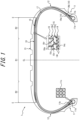
- FIG. 1 is a cross-sectional view in the tire width direction of a tire according to an embodiment of the invention.
- the "applicable rim” refers to a rim whose width corresponds to the bead width of the tire.
- the “applicable rim” includes sizes that could be included in the future in the above-described industrial standards, in addition to current sizes. Examples of the "sizes that could be described in the future” include the sizes described under " FUTURE DEVELOPMENTS” in the ETRTO STANDARDS MANUAL 2013 .
- the "prescribed internal pressure” refers to the air pressure (maximum air pressure) corresponding to the maximum load capability of a single wheel for the applicable size/ply rating in industrial standards, such as the aforementioned JATMA YEAR BOOK.
- the “prescribed internal pressure” refers to the air pressure (maximum air pressure) corresponding to the maximum load capability prescribed for each vehicle on which the tire is mounted.
- the “maximum load” refers to the load corresponding to the maximum load capability for a tire of the applicable size described in the aforementioned industrial standards.
- the “maximum load” refers to the load corresponding to the maximum load capability prescribed for each vehicle on which the tire is mounted.
- the side closer to the axis of rotation of the tire 1 along the tire radial direction is referred to as the "tire radial inner side”
- the side farther from the axis of rotation of the tire 1 along the tire radial direction is referred to as the “tire radial outer side”.
- the side closer to the tire equatorial plane CL along the tire width direction is referred to as the “tire widthwise inner side”
- the side farther from the tire equatorial plane CL along the tire width direction is referred to as the "tire widthwise outer side”.
- the tire 1 has a pair of bead portions 11, a pair of sidewall portions 12, and a tread portion 13.
- the sidewall portions 12 extend between the tread portion 13 and the bead portions 11.
- the sidewall portions 12 are positioned on the tire radial outer side of the bead portions 11.
- the two bead portions 11 each include a bead core 11a and a bead filler 11b. As illustrated in the partial enlargement in FIG. 1 , the bead core 11a is provided with a plurality of bead wires 11c surrounded by a rubber coating.
- the bead wires 11c are, for example, configured by steel cords. However, the bead wires 11c may also be configured by organic fiber cords coated with an adhesive composition containing polyphenols and aldehydes. The adhesive composition and the organic fiber cords used in the present embodiment are described in detail below.
- the cords forming the bead wires 11c can, for example, be formed from monofilaments or twisted wires.
- the bead fillers 11b are formed from rubber or the like and are positioned farther outward in the tire radial direction than the bead cores 11a. In the present embodiment, the thickness of the bead fillers 11b decreases outward in the tire radial direction. However, the tire 1 may be structured without the bead fillers 11b.
- the bead portion 11 is configured to contact the rim on the inner side in the tire radial direction and the outer side in the tire width direction when the tire 1 is mounted on the rim.
- the tire 1 includes a carcass 14.
- the carcass 14 extends in a toroidal shape between a pair of bead portions (the bead cores 11a in the illustrated example) and forms the framework of the tire.
- the end sides of the carcass 14 are engaged with the bead cores 11a.
- the carcass 14 has a carcass body portion 14a disposed between the bead cores 11a and carcass folded-up portions 14b that are folded up from the tire widthwise inner side towards the tire widthwise outer side around the bead cores 11a.
- the length of the carcass folded-up portion 14b can be freely set.
- the carcass 14 can have a structure without the carcass folded-up portions 14b, or a structure in which the carcass folded-up portions 14b are wrapped around the bead cores 11a.
- the carcass 14 is configured by one or more carcass layers.
- the carcass 14 is configured by one carcass layer, but the carcass 14 may be configured by two or more carcass layers stacked in the tire radial direction at the tire equatorial plane CL.
- the carcass layer includes one or more carcass cords 14c and a coating rubber 14r that coats the carcass cords 14c.
- the carcass cords 14c are arranged to extend in the tire width direction in the tread portion 13. That is, in the present embodiment, the carcass 14 has a radial structure. However, the carcass 14 may instead have a bias structure.
- the belt cords 15c configuring the belt layers 15a, 15b of the belt 15 are configured by steel cords, for example, in the present embodiment.
- the belt cords 15c may also be configured by organic fiber cords coated with an adhesive composition containing polyphenols and aldehydes.
- the adhesive composition and the organic fiber cords used in the present embodiment are described in detail below.
- the belt cords 15c can, for example, be formed from monofilaments or twisted wires.
- the tire 1 has one or more belt reinforcement layers 16 that reinforce the belt 15.
- the belt reinforcement layer 16 is disposed on the tire radial outer side of the belt 15.
- the belt reinforcement layer 16 is configured to cover the full width of the belt 15 in the tread portion 13 in the tire width direction.
- the belt reinforcement layer 16 may be provided across the tread portion 13 and a portion of the sidewall portions 12.
- the edges of the belt reinforcement layer 16 in the tire width direction are at substantially the same position in the tire width direction as the ground contact edges E, but the edges can be on the inside or outside in the tire width direction.
- the tire 1 has one belt reinforcement layer 16.
- the tire 1 may have two or more belt reinforcement layers 16 stacked in the tire radial direction at the tire equatorial plane CL.
- the tensile elastic modulus E1 of the belt reinforcement layer 16 in the center region R1 is not particularly limited but is preferably 0.3 to 10 (GPa/mm), for example.
- the tensile elastic modulus E2 of the belt reinforcement layer 16 in the shoulder regions R2 is not particularly limited, but within a range larger than the tensile elastic modulus E1, is preferably 0.5 to 13 (GPa/mm), for example.
- the ratio of the tensile elastic modulus E1 of the belt reinforcement layer 16 in the center region R1 to the tensile elastic modulus E2 of the belt reinforcement layer 16 in the shoulder regions R2 (tensile elastic modulus E1 / tensile elastic modulus E2) may be any appropriate value less than 1.
- the straight-line stability and high-speed durability of the tire 1 improve.
- an increase in the ratio of the tensile elastic modulus E1 to the tensile elastic modulus E2 improves the fuel efficiency of the tire 1.
- the ratio of the tensile elastic modulus E1 to the tensile elastic modulus E2 is between 1/1.5 and 1/5.0, preferably between 1/2.0 and 1/3.0.
- the elastic modulus of a cord pulled out from a freely chosen location in the belt reinforcement layer 16 in the center region R1 is multiplied by the number of cords in the protective layer in the center region R1 and divided by the width of the center region R1.
- the resulting value is taken as the tensile elastic modulus in the center region R1 (GPa/mm).
- the elastic modulus of a cord pulled out from a freely chosen location in the belt reinforcement layer 16 in the shoulder region R2 is multiplied by the number of cords in the protective layer in the shoulder region R2 and divided by the width of the shoulder region R2.
- the resulting value is taken as the tensile elastic modulus (GPa/mm).
- the belt reinforcement layer 16 may be configured as follows.
- the winding tension of the belt reinforcing layer 16 in the center region R1 may be smaller than the winding tension of the belt reinforcing layer 16 in the shoulder regions R2.
- the winding tension T1 of the belt reinforcement layer 16 in the center region R1 is not particularly limited but is preferably 3 to 7 N/cord, for example.
- the winding tension T2 of the belt reinforcement layer 16 in the shoulder regions R2 is not particularly limited, but within a range larger than the winding tension T1, is preferably 10 to 20 N/cord, for example.
- the ratio of the winding tension T1 of the belt reinforcement layer 16 in the center region R1 to the winding tension T2 of the belt reinforcement layer 16 in the shoulder regions R2 (winding tension T1 / winding tension T2) may be any appropriate value less than 1.
- the tensile elastic modulus E1 of the belt reinforcement layer 16 in the center region R1 can be made smaller than the tensile elastic modulus E2 of the belt reinforcement layer 16 in the shoulder regions R2.
- the winding tension of the belt reinforcement layer 16 is measured by, for example, converting a measurement made with a commercially available tension meter into a number per cord.
- the number of cords 16a implanted in the belt reinforcement layer 16 in the center region R1 may be smaller than the number of cords 16a implanted in the belt reinforcement layer 16 in the shoulder regions R2.
- the number N1 of cords 16a implanted in the belt reinforcement layer 16 in the center region R1 is not particularly limited but is preferably 25 to 50 cords/50 mm, for example.
- the number N2 of cords 16a implanted in the belt reinforcement layer 16 in the shoulder regions R2 is not particularly limited, but within a range larger than the number N1 of cords, is preferably 50 to 100 cords/50 mm, for example.
- the ratio of the number N1 of cords 16a implanted in the belt reinforcement layer 16 in the center region R1 to the number N2 of cords 16a implanted in the belt reinforcement layer 16 in the shoulder regions R2 (number N1 of cords / number N2 of cords) may be any appropriate value less than 1.
- the ratio of the number N1 of cords to the number N2 of cords is, for example, preferably 0.3 to 0.8, more preferably 0.5 to 0.6.
- the thermal shrinkage of the cords 16a in the belt reinforcement layer 16 in the center region R1 may be smaller than the thermal shrinkage of the cords 16a in the belt reinforcement layer 16 in the shoulder regions R2.
- the thermal shrinkage H1 of the cords 16a of the belt reinforcement layer 16 in the center region R1 is not particularly limited but is preferably 2% to 5%, for example.
- the thermal shrinkage H2 of the cords 16a of the belt reinforcement layer 16 in the shoulder regions R2 is not particularly limited, but within a range larger than the thermal shrinkage H1, is preferably 3% to 8%, for example.
- the ratio of the thermal shrinkage H1 of the cords 16a in the belt reinforcement layer 16 in the center region R1 to the thermal shrinkage H2 of the cords 16a in the belt reinforcement layer 16 in the shoulder regions R2 (thermal shrinkage H1 / thermal shrinkage H2) may be any appropriate value less than 1.
- the ratio of the thermal shrinkage H1 to the thermal shrinkage H2 is, for example, preferably 0.5 to 0.8.
- the thermal shrinkage of the cords 16a is determined by, for example, taking a dip roll of cords 16a after dip treatment, and in accordance with JIS L1017 (B method), applying a load of 50 g, performing dry heat treatment in an oven at 177°C for two minutes, and measuring the cord length before and after heat treatment.
- the configuration for making the tensile elastic modulus E1 of the belt reinforcement layer 16 in the center region R1 smaller than the tensile elastic modulus E2 of the belt reinforcement layer 16 in the shoulder regions R2 is not limited to the examples described above.
- the cord diameter, Young's modulus, and/or the material and the like may differ between the cords 16a of the belt reinforcement layer 16 in the center region R1 and the cords 16a of the belt reinforcement layer 16 in the shoulder regions R2 in order for the tensile elastic modulus E1 to be smaller than the tensile elastic modulus E2.
- the winding tension, number of cords implanted, thermal shrinkage, number of layers, cord diameter, Young's modulus, and/or material and the like may be adjusted in order for the tensile elastic modulus E1 of the belt reinforcement layer 16 in the center region R1 to be smaller than the tensile elastic modulus E2 of the belt reinforcement layer 16 in the shoulder regions R2.
- the tire widthwise edges of the belt reinforcement layer 16 may therefore be on the tire widthwise inner side of the ground contact edges E.
- the ground contact length of the center region R1 of the tire 1 during vehicle travel is increased, thereby improving the straight-line stability of the tire 1. Furthermore, the ground contact length of the shoulder regions R2 of the tire 1 during vehicle travel is shorter, and the shoulder portions protrude less at high speeds, thereby improving the high-speed durability of the tire 1.
- the tire 1 includes an inner liner 17.
- the inner liner 17 is disposed to cover the inner wall surface of the tire 1.
- the inner liner 17 can be configured by a plurality of inner liner layers stacked in the tire radial direction at the tire equatorial plane CL.
- the inner liner 17 is, for example, configured by a butyl-based rubber having low air permeability.
- the inner liner 17 is not limited to butyl-based rubber and may be configured by other rubber compositions, resins, or elastomers.
- the carcass cords 14c, the belt cords 15c, and the cords 16a of the belt reinforcement layer 16a have been described as organic fiber cords coated with an adhesive composition containing polyphenols and aldehydes.
- the tire 1 is not limited to the above-described configuration, but may be configured to have the aforementioned organic fiber cord as any one or more of the cords of the tire members.
- the tire 1 may be configured to have the organic fiber cords as the carcass cords 14c, the belt cords 15c, the cords 16a of the belt reinforcement layer 16a, and/or the cords of other tire members. Even in a case in which the above-described organic fiber cords are used as any of the tire members, the environmental impact of the tire 1 can be reduced, since the organic fiber cords do not contain resorcinol.
- the adhesive composition that is used in the tire 1 is coated on the cords, such as the organic fiber cords, is described below.
- the adhesive composition includes polyphenols and aldehydes.
- the adhesive composition that coats the cords used in the carcass 14, the belt 15, or the belt reinforcement layer 16 or the like is configured to include specific polyphenols and aldehydes, so that good adhesive properties can be achieved even when resorcinol is not used out of consideration for the impact on the environment.
- the adhesive composition contains polyphenols as a resin component.
- polyphenols are watersoluble polyphenols and may be any polyphenols other than resorcinol.
- the number of aromatic rings or the number of hydroxyl groups in the polyphenols may be selected as necessary.
- the polyphenols preferably have two or more hydroxyl groups, more preferably three or more hydroxyl groups.
- the polyphenols or polyphenol condensate is water soluble in an adhesive composition liquid that contains water. This enables the polyphenols to be distributed uniformly in the adhesive composition, thereby achieving better adhesive properties.
- the polyphenols are polyphenols containing a plurality (two or more) of aromatic rings, each of those aromatic rings has two or three hydroxyl groups in the ortho, meta, or para positions.
- polyphenols having three or more hydroxyl groups examples include the polyphenols listed below.
- Aldehydes include, for example, monoaldehydes such as formaldehyde, acetaldehyde, butyraldehyde, acrolein, propionaldehyde, chloral, butyraldehyde, caproaldehyde, and allylaldehyde, or aliphatic dialdehydes such as glyoxal, malonaldehyde, succinaldehyde, glutaraldehyde, and adipoaldehyde, aldehydes with aromatic rings, dialdehyde starch, and the like. These aldehydes may be used alone, or a mixture of a plurality thereof may be used.
- aldehydes examples include 1,2-benzenedicarboxaldehyde, 1,3-benzenedicarboxaldehyde, 1,4-benzenedicarboaldehyde 1,4-benzenedicarboaldehyde, 2-hydroxybenzene-1,3,5-tricarbaldehyde, or a mixture of these compounds.
- Aldehydes with aromatic rings include not only those with benzene rings but also heteroaromatic compounds.
- Aldehydes that are heteroaromatic compounds include, for example, aldehydes having a furan ring, such as those illustrated below. (where X includes O; and R represents -H or -CHO)
- the adhesive composition preferably further contains an isocyanate compound.
- the synergistic effect between polyphenols and aldehydes can greatly enhance the adhesive properties of the adhesive composition.
- the isocyanate compound is a compound that promotes adhesion to the resin material (for example, phenol/aldehyde resin yielded by condensing polyphenols and aldehydes), i.e., the adherend of the adhesive composition, and has isocyanate groups as polar functional groups.
- the adhesive composition preferably includes rubber latex. According to such a configuration, the adhesive properties of the rubber member of the adhesive composition included in the tire 1 can be improved.
- the tire 1 has been described as being filled with air in the present description.
- the tire 1 can, for example, be filled with a gas such as nitrogen.
- the tire 1 is not limited to being filled with gas and may be filled with any fluid, including a liquid, a gel-like substance, or a granular material.
Landscapes
- Engineering & Computer Science (AREA)
- Textile Engineering (AREA)
- Mechanical Engineering (AREA)
- Chemical & Material Sciences (AREA)
- Chemical Kinetics & Catalysis (AREA)
- Tires In General (AREA)
- Treatments For Attaching Organic Compounds To Fibrous Goods (AREA)
Description
- The invention relates to a tire.
- In recent years, adhesive compositions not containing resorcinol and formalin have been used in tires out of consideration for the environmental impact. For example, see Patent Literature (PTL) 1.
-
- PTL 1:
JP 2010-255153 A - PTL 2:
JP 2009-102019 A - PTL 3:
US 2014/235125 A1 discloses an aqueous adhesive composition including: a phenol/aldehyde resin; and an unsaturated elastomer latex. The phenol/aldehyde resin is based on at least: an aromatic polyaldehyde bearing at least two aldehyde functional groups and including at least one aromatic nucleus; and phloroglucinol. The adhesive composition is useable to make a textile material adhere to a crosslinkable rubber composition, and may be used as an advantageous alternative to a formaldehyde-based RFL adhesive. - PTL 4:
US 2016/251550 A1 discloses an aqueous adhesive composition comprising an unsaturated elastomer latex and a phenol/aldehyde resin based on an aldehyde of formula (I): in which X comprises N, S or O and R represents -CHO, and based on a polyphenol comprising one or more aromatic nucleus/nuclei. When there is just one aromatic nucleus, the latter bears two or three hydroxyl functional groups in the meta position with respect to each other, the remainder of the aromatic nucleus being unsubstituted. When there are several aromatic nuclei, at least two of them each bear two or three hydroxyl functional groups in the meta position with respect to each other, the two positions ortho to at least one of these hydroxyl functional groups being unsubstituted. - PTL 5:
JP 2009-174105 A - PTL 6:
US 2019/119535 A1 discloses an aqueous adhesive composition comprising A) a thermosetting resin and B) an unsaturated elastomer latex. The thermosetting resin is based on: at least one aromatic compound bearing at least two functions, one of these functions being a hydroxymethyl function and the other being an aldehyde function or a hydroxymethyl function, the aromatic compound comprising at least one aromatic ring; and at least aromatic polyphenol comprising at least one aromatic ring bearing at least two hydroxyl functions in the meta position relative to one another, the two positions ortho to at least one of the hydroxyl functions being unsubstituted; and/or at least one aromatic monophenol comprising at least one six-membered aromatic ring bearing a single hydroxyl function, the two positions ortho to the hydroxyl function being unsubstituted, or at least one position ortho to and the position para to the hydroxyl function being unsubstituted. - On the other hand, demand still exists for further improvement of tire performance, such as high-speed durability and straight-line stability. Therefore, there is room for further improvement in tire performance even in tires for which the environmental impact is taken into consideration, such as the tire disclosed in PTL 1.
- In view of these circumstances, it is an aim of the invention to provide a tire with both reduced environmental impact and improved tire performance.
- A tire includes a carcass extending toroidally between a pair of bead portions; a belt layer provided on a tire radial outer side of a crown portion of the carcass; and a belt reinforcement layer provided on the tire radial outer side of the belt layer, wherein the tire includes an organic fiber cord coated with an adhesive composition that includes polyphenols and aldehydes, and when a tire widthwise region centered on a tire equatorial plane and having a width in a tire width direction of 2/3 of the length between ground contact edges is a center region, and tire widthwise regions between the ground contact edges and tire widthwise outer sides of the center region are shoulder regions, a tensile elastic modulus of the belt reinforcement layer in the center region is smaller than the tensile elastic modulus of the belt reinforcement layer in the shoulder regions.
- A tire with both reduced environmental impact and improved tire performance can be provided.
- In the accompanying drawings:
FIG. 1 is a cross-sectional view in the tire width direction of a tire according to an embodiment of the invention. - A tire according to an embodiment of the invention is described below with reference to the drawings. Members and components that are common across drawings are labeled with the same reference signs.
- Unless otherwise specified, the positional relationships and the like of elements are assumed below to be measured in a reference state in which the tire is mounted on the rim, which is an applicable rim, of a wheel and filled to a prescribed internal pressure, with no load applied. The width in the tire width direction of the contact patch in contact with the road surface when the tire is mounted on the rim, which is an applicable rim, of the wheel and filled to the prescribed internal pressure, with the maximum load applied, is referred to as the ground contact width of the tire, and the edges in the tire width direction of the contact patch are referred to as the ground contact edges. The tire is described below as being filled with air in the inner cavity and being mounted on a vehicle such as an automobile.
- In the present specification, the "applicable rim" refers to a standard rim of an applicable size, such as the Measuring Rim in the STANDARDS MANUAL of the European Tyre and Rim Technological Organisation (ETRTO) in Europe or the Design Rim in the YEAR BOOK of the Tire and Rim Association, Inc. (TRA) in the USA, that is described, or will be described in the future, in industrial standards effective in the region where the tire is manufactured and used, such as the YEAR BOOK published by the Japan Automobile Tyre Manufacturers Association (JATMA) in Japan, the STANDARDS MANUAL of the ETRTO, and the YEAR BOOK of the TRA. In the case of a size not listed in these industrial standards, the "applicable rim" refers to a rim whose width corresponds to the bead width of the tire. The "applicable rim" includes sizes that could be included in the future in the above-described industrial standards, in addition to current sizes. Examples of the "sizes that could be described in the future" include the sizes described under "FUTURE DEVELOPMENTS" in the ETRTO STANDARDS MANUAL 2013.
- In the present specification, the "prescribed internal pressure" refers to the air pressure (maximum air pressure) corresponding to the maximum load capability of a single wheel for the applicable size/ply rating in industrial standards, such as the aforementioned JATMA YEAR BOOK. In the case of a size not described in the aforementioned industrial standards, the "prescribed internal pressure" refers to the air pressure (maximum air pressure) corresponding to the maximum load capability prescribed for each vehicle on which the tire is mounted. In the present specification, the "maximum load" refers to the load corresponding to the maximum load capability for a tire of the applicable size described in the aforementioned industrial standards. In the case of a size not described in the aforementioned industrial standards, the "maximum load" refers to the load corresponding to the maximum load capability prescribed for each vehicle on which the tire is mounted.
-
FIG. 1 is a cross-sectional view, in the tire width direction, of a tire 1 according to the present embodiment cut along the tire width direction. In the present description, the tire width direction refers to a direction parallel to the axis of rotation of the tire 1. The tire radial direction refers to a direction orthogonal to the axis of rotation of the tire 1. The tire circumferential direction refers to the direction of rotation of the tire about the rotation axis of the tire 1. In the present embodiment, the tire 1 is described as having a symmetrical configuration with respect to the tire equatorial plane CL. However, the tire 1 may have an asymmetrical configuration with respect to the tire equatorial plane CL. - In the present description, the side closer to the axis of rotation of the tire 1 along the tire radial direction is referred to as the "tire radial inner side", and the side farther from the axis of rotation of the tire 1 along the tire radial direction is referred to as the "tire radial outer side". The side closer to the tire equatorial plane CL along the tire width direction is referred to as the "tire widthwise inner side", and the side farther from the tire equatorial plane CL along the tire width direction is referred to as the "tire widthwise outer side".
- As illustrated in
FIG. 1 , the tire 1 has a pair ofbead portions 11, a pair ofsidewall portions 12, and atread portion 13. Thesidewall portions 12 extend between thetread portion 13 and thebead portions 11. Thesidewall portions 12 are positioned on the tire radial outer side of thebead portions 11. - In the present description, the
tread portion 13 has a tread surface that comes into contact with the road surface. In the contact patch of the tread surface of thetread portion 13, the tire widthwise region centered on the tire equatorial plane CL and having a width in the tire width direction of 2/3 of the length between the ground contact edges E is referred to as a center region R1, and tire widthwise regions between the ground contact edges E and the tire widthwise outer sides of the center region R1 are referred to as shoulder regions R2. - The two
bead portions 11 each include abead core 11a and abead filler 11b. As illustrated in the partial enlargement inFIG. 1 , thebead core 11a is provided with a plurality ofbead wires 11c surrounded by a rubber coating. In the present embodiment, thebead wires 11c are, for example, configured by steel cords. However, thebead wires 11c may also be configured by organic fiber cords coated with an adhesive composition containing polyphenols and aldehydes. The adhesive composition and the organic fiber cords used in the present embodiment are described in detail below. The cords forming thebead wires 11c can, for example, be formed from monofilaments or twisted wires. Thebead fillers 11b are formed from rubber or the like and are positioned farther outward in the tire radial direction than thebead cores 11a. In the present embodiment, the thickness of thebead fillers 11b decreases outward in the tire radial direction. However, the tire 1 may be structured without thebead fillers 11b. Thebead portion 11 is configured to contact the rim on the inner side in the tire radial direction and the outer side in the tire width direction when the tire 1 is mounted on the rim. - The tire 1 includes a
carcass 14. Thecarcass 14 extends in a toroidal shape between a pair of bead portions (thebead cores 11a in the illustrated example) and forms the framework of the tire. The end sides of thecarcass 14 are engaged with thebead cores 11a. Specifically, thecarcass 14 has acarcass body portion 14a disposed between thebead cores 11a and carcass folded-upportions 14b that are folded up from the tire widthwise inner side towards the tire widthwise outer side around thebead cores 11a. The length of the carcass folded-upportion 14b can be freely set. Thecarcass 14 can have a structure without the carcass folded-upportions 14b, or a structure in which the carcass folded-upportions 14b are wrapped around thebead cores 11a. - The
carcass 14 is configured by one or more carcass layers. In the present embodiment, thecarcass 14 is configured by one carcass layer, but thecarcass 14 may be configured by two or more carcass layers stacked in the tire radial direction at the tire equatorial plane CL. As illustrated in the partial enlargement inFIG. 1 , the carcass layer includes one ormore carcass cords 14c and acoating rubber 14r that coats thecarcass cords 14c. In the present embodiment, thecarcass cords 14c are arranged to extend in the tire width direction in thetread portion 13. That is, in the present embodiment, thecarcass 14 has a radial structure. However, thecarcass 14 may instead have a bias structure. - The
carcass cords 14c that configure the carcass layer of thecarcass 14 are organic fiber cords coated with an adhesive composition containing polyphenols and aldehydes. The adhesive composition and the organic fiber cords used in the present embodiment are described in detail below. Thecarcass cords 14c can, for example, be formed from monofilaments or twisted wires. - The tire 1 has a
belt 15 reinforcing thetread portion 13. Thebelt 15 is disposed on the tire radial outer side of the crown region of thecarcass 14. In the present embodiment, thebelt 15 is provided in thetread portion 13 so as to cover thecarcass 14. However, thebelt 15 may be provided across thetread portion 13 and a portion of thesidewall portions 12. - The
belt 15 is configured by one or more belt layers stacked in the tire radial direction at the tire equatorial plane CL. In the present embodiment, thebelt 15 is configured by twobelt layers belt 15 may be configured by one belt layer or by three or more belt layers. - As illustrated in the partial enlargement in
FIG. 1 , each of the belt layers 15a, 15b includes one ormore belt cords 15c and acoating rubber 15r that coats thebelt cords 15c. In the present embodiment, in each of the belt layers 15a, 15b, the plurality ofbelt cords 15c are arranged to form a predetermined angle with respect to the tire circumferential direction. Thebelt 15 is an intersecting belt in which thebelt cords 15c of thebelt layer 15a and thebelt cords 15c of thebelt layer 15b are stacked so as to intersect across the tire equatorial plane CL. - The
belt cords 15c configuring the belt layers 15a, 15b of thebelt 15 are configured by steel cords, for example, in the present embodiment. However, thebelt cords 15c may also be configured by organic fiber cords coated with an adhesive composition containing polyphenols and aldehydes. The adhesive composition and the organic fiber cords used in the present embodiment are described in detail below. Thebelt cords 15c can, for example, be formed from monofilaments or twisted wires. - The tire 1 has one or more belt reinforcement layers 16 that reinforce the
belt 15. Thebelt reinforcement layer 16 is disposed on the tire radial outer side of thebelt 15. In the present embodiment, thebelt reinforcement layer 16 is configured to cover the full width of thebelt 15 in thetread portion 13 in the tire width direction. However, thebelt reinforcement layer 16 may be provided across thetread portion 13 and a portion of thesidewall portions 12. In the illustrated example, the edges of thebelt reinforcement layer 16 in the tire width direction are at substantially the same position in the tire width direction as the ground contact edges E, but the edges can be on the inside or outside in the tire width direction. In the present embodiment, the tire 1 has onebelt reinforcement layer 16. However, the tire 1 may have two or more belt reinforcement layers 16 stacked in the tire radial direction at the tire equatorial plane CL. - As illustrated in the partial enlargement in
FIG. 1 , thebelt reinforcement layer 16 includes one ormore cords 16a and acoating rubber 16r that covers thecords 16a. In thebelt reinforcement layer 16 of the present embodiment, the plurality ofcords 16a are arranged in an array substantially parallel to the tire circumferential direction. - The
cords 16a that configure thebelt reinforcement layer 16 are organic fiber cords coated with an adhesive composition containing polyphenols and aldehydes. The adhesive composition and the organic fiber cords used in the present embodiment are described in detail below. Thecords 16a can, for example, be formed from monofilaments or twisted wires. - The tensile elastic modulus of the
belt reinforcement layer 16 in the center region R1 is smaller than the tensile elastic modulus of thebelt reinforcement layer 16 in the shoulder regions R2. - In the present embodiment, the tensile elastic modulus E1 of the
belt reinforcement layer 16 in the center region R1 is not particularly limited but is preferably 0.3 to 10 (GPa/mm), for example. The tensile elastic modulus E2 of thebelt reinforcement layer 16 in the shoulder regions R2 is not particularly limited, but within a range larger than the tensile elastic modulus E1, is preferably 0.5 to 13 (GPa/mm), for example. The ratio of the tensile elastic modulus E1 of thebelt reinforcement layer 16 in the center region R1 to the tensile elastic modulus E2 of thebelt reinforcement layer 16 in the shoulder regions R2 (tensile elastic modulus E1 / tensile elastic modulus E2) may be any appropriate value less than 1. By a reduction in the ratio of the tensile elastic modulus E1 to the tensile elastic modulus E2, the straight-line stability and high-speed durability of the tire 1 improve. On the other hand, an increase in the ratio of the tensile elastic modulus E1 to the tensile elastic modulus E2 improves the fuel efficiency of the tire 1. From the viewpoint of improving the fuel efficiency of the tire 1 in addition to improving the straight-line stability and high-speed durability of the tire 1, the ratio of the tensile elastic modulus E1 to the tensile elastic modulus E2 is between 1/1.5 and 1/5.0, preferably between 1/2.0 and 1/3.0. - The tensile elastic modulus of the
belt reinforcement layer 16 is measured, for example, by the following method. First, the belt reinforcement layer is removed from a new, unused pneumatic tire without damaging the cords. At this time, excess rubber adhered to the cords of the belt reinforcement layer is carefully removed with scissors or the like. A tensile load-elongation curve is then drawn by an autograph (Shimadzu Corporation) at room temperature (25°C ± 2°C) in accordance with JIS (L1017). The curve is redrawn as a stress-elongation curve by converting the load axis of the load-elongation curve to a value yielded by dividing by the total dtex number (dtex) of the cords before tension. Subsequently, a tangent is drawn at the 7.94 mN/dtex (0.9 g/d) load point on this curve, and the slope of the tangent is determined. The resulting value (the aforementioned slope) is multiplied by (0.981 × specific gravity of the organic fiber) to obtain the tensile elastic modulus of the cord as referred to herein. - The elastic modulus of a cord pulled out from a freely chosen location in the
belt reinforcement layer 16 in the center region R1 is multiplied by the number of cords in the protective layer in the center region R1 and divided by the width of the center region R1. The resulting value is taken as the tensile elastic modulus in the center region R1 (GPa/mm). Similarly, the elastic modulus of a cord pulled out from a freely chosen location in thebelt reinforcement layer 16 in the shoulder region R2 is multiplied by the number of cords in the protective layer in the shoulder region R2 and divided by the width of the shoulder region R2. The resulting value is taken as the tensile elastic modulus (GPa/mm). - To make the tensile elastic modulus of the center region R1 of the
belt reinforcement layer 16 smaller than the tensile elastic modulus of the shoulder regions R2, thebelt reinforcement layer 16 may be configured as follows. - For example, the winding tension of the
belt reinforcing layer 16 in the center region R1 may be smaller than the winding tension of thebelt reinforcing layer 16 in the shoulder regions R2. - In the present embodiment, the winding tension T1 of the
belt reinforcement layer 16 in the center region R1 is not particularly limited but is preferably 3 to 7 N/cord, for example. The winding tension T2 of thebelt reinforcement layer 16 in the shoulder regions R2 is not particularly limited, but within a range larger than the winding tension T1, is preferably 10 to 20 N/cord, for example. The ratio of the winding tension T1 of thebelt reinforcement layer 16 in the center region R1 to the winding tension T2 of thebelt reinforcement layer 16 in the shoulder regions R2 (winding tension T1 / winding tension T2) may be any appropriate value less than 1. By the winding tension of thebelt reinforcement layer 16 being smaller in some or all of the center region R1 than in all or some of the shoulder regions R2, the tensile elastic modulus E1 of thebelt reinforcement layer 16 in the center region R1 can be made smaller than the tensile elastic modulus E2 of thebelt reinforcement layer 16 in the shoulder regions R2. - The winding tension of the
belt reinforcement layer 16 is measured by, for example, converting a measurement made with a commercially available tension meter into a number per cord. - The number of
cords 16a implanted in thebelt reinforcement layer 16 in the center region R1 may be smaller than the number ofcords 16a implanted in thebelt reinforcement layer 16 in the shoulder regions R2. - In the present embodiment, the number N1 of
cords 16a implanted in thebelt reinforcement layer 16 in the center region R1 is not particularly limited but is preferably 25 to 50 cords/50 mm, for example. The number N2 ofcords 16a implanted in thebelt reinforcement layer 16 in the shoulder regions R2 is not particularly limited, but within a range larger than the number N1 of cords, is preferably 50 to 100 cords/50 mm, for example. The ratio of the number N1 ofcords 16a implanted in thebelt reinforcement layer 16 in the center region R1 to the number N2 ofcords 16a implanted in thebelt reinforcement layer 16 in the shoulder regions R2 (number N1 of cords / number N2 of cords) may be any appropriate value less than 1. The ratio of the number N1 of cords to the number N2 of cords is, for example, preferably 0.3 to 0.8, more preferably 0.5 to 0.6. By the number ofcords 16a of thebelt reinforcement layer 16 being smaller in some or all of the center region R1 than in all or some of the shoulder regions R2, the tensile elastic modulus E1 of thebelt reinforcement layer 16 in the center region R1 can be made smaller than the tensile elastic modulus E2 of thebelt reinforcement layer 16 in the shoulder regions R2. - The thermal shrinkage of the
cords 16a in thebelt reinforcement layer 16 in the center region R1 may be smaller than the thermal shrinkage of thecords 16a in thebelt reinforcement layer 16 in the shoulder regions R2. - In the present embodiment, the thermal shrinkage H1 of the
cords 16a of thebelt reinforcement layer 16 in the center region R1 is not particularly limited but is preferably 2% to 5%, for example. The thermal shrinkage H2 of thecords 16a of thebelt reinforcement layer 16 in the shoulder regions R2 is not particularly limited, but within a range larger than the thermal shrinkage H1, is preferably 3% to 8%, for example. The ratio of the thermal shrinkage H1 of thecords 16a in thebelt reinforcement layer 16 in the center region R1 to the thermal shrinkage H2 of thecords 16a in thebelt reinforcement layer 16 in the shoulder regions R2 (thermal shrinkage H1 / thermal shrinkage H2) may be any appropriate value less than 1. The ratio of the thermal shrinkage H1 to the thermal shrinkage H2 is, for example, preferably 0.5 to 0.8. By the thermal shrinkage of thecords 16a of thebelt reinforcement layer 16 being smaller in some or all of the center region R1 than in all or some of the shoulder regions R2, the tensile elastic modulus E1 of thebelt reinforcement layer 16 in the center region R1 can be made smaller than the tensile elastic modulus E2 of thebelt reinforcement layer 16 in the shoulder regions R2. - The thermal shrinkage of the
cords 16a is determined by, for example, taking a dip roll ofcords 16a after dip treatment, and in accordance with JIS L1017 (B method), applying a load of 50 g, performing dry heat treatment in an oven at 177°C for two minutes, and measuring the cord length before and after heat treatment. - The number of layers in the
belt reinforcement layer 16 in the shoulder regions R2 may be greater than the number of layers in thebelt reinforcement layer 16 in the center region R1. In this case, the number of layers in thebelt reinforcement layer 16 throughout the shoulder regions R2 can be greater than the number of layers in thebelt reinforcement layer 16 in the center region R1, or the number of layers in thebelt reinforcement layer 16 in a portion of the shoulder regions R2 can be greater than the number of layers in thebelt reinforcement layer 16 in the center region R1. - The configuration for making the tensile elastic modulus E1 of the
belt reinforcement layer 16 in the center region R1 smaller than the tensile elastic modulus E2 of thebelt reinforcement layer 16 in the shoulder regions R2 is not limited to the examples described above. For example, the cord diameter, Young's modulus, and/or the material and the like may differ between thecords 16a of thebelt reinforcement layer 16 in the center region R1 and thecords 16a of thebelt reinforcement layer 16 in the shoulder regions R2 in order for the tensile elastic modulus E1 to be smaller than the tensile elastic modulus E2. In other words, the winding tension, number of cords implanted, thermal shrinkage, number of layers, cord diameter, Young's modulus, and/or material and the like may be adjusted in order for the tensile elastic modulus E1 of thebelt reinforcement layer 16 in the center region R1 to be smaller than the tensile elastic modulus E2 of thebelt reinforcement layer 16 in the shoulder regions R2. By adjusting these factors, it is fully possible to make the tensile elastic modulus throughout the center region R1 smaller than the tensile elastic modulus throughout the shoulder regions R2. The tire widthwise edges of thebelt reinforcement layer 16 may therefore be on the tire widthwise inner side of the ground contact edges E. - As described above, by making the tensile elastic modulus E1 of the
belt reinforcement layer 16 in the center region R1 smaller than the tensile elastic modulus E2 of thebelt reinforcement layer 16 in the shoulder regions R2, the ground contact length of the center region R1 of the tire 1 during vehicle travel is increased, thereby improving the straight-line stability of the tire 1. Furthermore, the ground contact length of the shoulder regions R2 of the tire 1 during vehicle travel is shorter, and the shoulder portions protrude less at high speeds, thereby improving the high-speed durability of the tire 1. - The tire 1 includes an
inner liner 17. Theinner liner 17 is disposed to cover the inner wall surface of the tire 1. Theinner liner 17 can be configured by a plurality of inner liner layers stacked in the tire radial direction at the tire equatorial plane CL. In the present embodiment, theinner liner 17 is, for example, configured by a butyl-based rubber having low air permeability. However, theinner liner 17 is not limited to butyl-based rubber and may be configured by other rubber compositions, resins, or elastomers. - In the above-described configuration of the tire 1, the
carcass cords 14c, thebelt cords 15c, and thecords 16a of thebelt reinforcement layer 16a have been described as organic fiber cords coated with an adhesive composition containing polyphenols and aldehydes. However, the tire 1 is not limited to the above-described configuration, but may be configured to have the aforementioned organic fiber cord as any one or more of the cords of the tire members. For example, the tire 1 may be configured to have the organic fiber cords as thecarcass cords 14c, thebelt cords 15c, thecords 16a of thebelt reinforcement layer 16a, and/or the cords of other tire members. Even in a case in which the above-described organic fiber cords are used as any of the tire members, the environmental impact of the tire 1 can be reduced, since the organic fiber cords do not contain resorcinol. - The adhesive composition that is used in the tire 1 is coated on the cords, such as the organic fiber cords, is described below. The adhesive composition includes polyphenols and aldehydes. In the tire 1, the adhesive composition that coats the cords used in the
carcass 14, thebelt 15, or thebelt reinforcement layer 16 or the like is configured to include specific polyphenols and aldehydes, so that good adhesive properties can be achieved even when resorcinol is not used out of consideration for the impact on the environment. - The adhesive composition contains polyphenols as a resin component. The inclusion of polyphenols in the adhesive composition enhances the adhesive properties of the resin composition. Here, the polyphenols are watersoluble polyphenols and may be any polyphenols other than resorcinol. The number of aromatic rings or the number of hydroxyl groups in the polyphenols may be selected as necessary.
- From the viewpoint of achieving better adhesive properties, the polyphenols preferably have two or more hydroxyl groups, more preferably three or more hydroxyl groups. By containing three or more hydroxyl groups, the polyphenols or polyphenol condensate is water soluble in an adhesive composition liquid that contains water. This enables the polyphenols to be distributed uniformly in the adhesive composition, thereby achieving better adhesive properties. Furthermore, in a case in which the polyphenols are polyphenols containing a plurality (two or more) of aromatic rings, each of those aromatic rings has two or three hydroxyl groups in the ortho, meta, or para positions.
- Examples of the above-described polyphenols having three or more hydroxyl groups include the polyphenols listed below.
- Phloroglucinol:

- Morin(2',4',3,5,7-pentahydroxy flavone):

- Phloroglucide(2,4,6,3,' 5 '-biphenylpentol):

- In addition to the above-described polyphenols, the adhesive composition includes aldehydes as resin components. The inclusion of aldehydes in the adhesive composition can achieve high adhesive properties together with the above-described polyphenols. Here, the aldehydes are not particularly limited and may be selected as necessary according to the required performance. The aldehydes also include aldehyde derivatives that are derived from aldehydes.
- Aldehydes include, for example, monoaldehydes such as formaldehyde, acetaldehyde, butyraldehyde, acrolein, propionaldehyde, chloral, butyraldehyde, caproaldehyde, and allylaldehyde, or aliphatic dialdehydes such as glyoxal, malonaldehyde, succinaldehyde, glutaraldehyde, and adipoaldehyde, aldehydes with aromatic rings, dialdehyde starch, and the like. These aldehydes may be used alone, or a mixture of a plurality thereof may be used.
- The aldehydes preferably contain aldehydes with aromatic rings. The reason is that better adhesive properties can be obtained. The aldehydes are preferably free of formaldehyde. Being free of formaldehyde refers, for example, to the mass content of formaldehyde based on the total mass of the aldehydes being less than 0.5 mass%.
- Aldehydes that have aromatic rings are aromatic aldehydes that contain at least one aromatic ring and at least one aldehyde group in one molecule. Aromatic aldehydes can be used to form relatively inexpensive resins with low environmental impact and excellent mechanical strength, electrical insulation, acid resistance, water resistance, heat resistance, and the like.
- From the viewpoint of achieving better adhesive properties, the aldehydes having aromatic rings preferably have two or more aldehyde groups. By cross-linking a plurality of aldehyde groups and condensing, the degree of cross-linking of the thermosetting resin can be increased, thereby further enhancing the adhesive properties. Furthermore, in a case in which the aldehydes have two or more aldehyde groups, two or more aldehyde groups are more preferably present in one aromatic ring. Each aldehyde group can be present in ortho, meta or para position in one aromatic ring.
- Examples of such aldehydes include 1,2-benzenedicarboxaldehyde, 1,3-benzenedicarboxaldehyde, 1,4-benzenedicarboaldehyde 1,4-benzenedicarboaldehyde, 2-hydroxybenzene-1,3,5-tricarbaldehyde, or a mixture of these compounds.
- Among these, at least 1,4-benzenedicarboaldehyde is preferably used as an aldehyde with aromatic rings from the viewpoint of achieving better adhesive properties.

- Aldehydes with aromatic rings include not only those with benzene rings but also heteroaromatic compounds. Aldehydes that are heteroaromatic compounds include, for example, aldehydes having a furan ring, such as those illustrated below.

- The aldehydes with furan rings mentioned above include, for example, the following compounds.


- In the adhesive composition, the polyphenols and aldehydes are preferably in a condensed state, and the mass ratio of the aldehydes having aromatic rings to the polyphenols (content of aldehydes having aromatic rings / content of polyphenols) is preferably 0.1 or more and 3 or less, more preferably 0.25 or more and 2.5 or less. This is because the hardness and adhesive properties of the resin, which is the product of the condensation reaction between the polyphenols and the aldehydes having aromatic rings, are more suitable.
- The total content of polyphenols and aldehydes having aromatic rings in the adhesive composition is preferably 3 mass% to 30 mass%, more preferably 5 mass% to 25 mass%. This is because better adhesive properties can be secured without deteriorating workability and the like. The mass ratio and total content of polyphenols and aldehydes having aromatic rings are the mass (solid content ratio) of the dried product.
- In addition to the polyphenols and aldehydes described above, the adhesive composition preferably further contains an isocyanate compound. The synergistic effect between polyphenols and aldehydes can greatly enhance the adhesive properties of the adhesive composition.
- Here, the isocyanate compound is a compound that promotes adhesion to the resin material (for example, phenol/aldehyde resin yielded by condensing polyphenols and aldehydes), i.e., the adherend of the adhesive composition, and has isocyanate groups as polar functional groups.
- The isocyanate compound is not particularly limited but is preferably a (blocked) isocyanate group-containing aromatic compound from the viewpoint that adhesive properties can be further improved. By including the isocyanate compound in the adhesive composition, the (blocked) isocyanate group-containing aromatics are distributed at a position near the interface between the adherend fiber and the adhesive composition, and an adhesion promoting effect is obtained. This effect can further enhance the adhesion of the adhesive composition to the organic cords.
- The (blocked) isocyanate group-containing aromatic compound is an aromatic compound that has a (blocked) isocyanate group. A "(blocked) isocyanate group" refers to a blocked isocyanate group or an isocyanate group, and in addition to isocyanate groups, this includes blocked isocyanate groups produced by reacting isocyanate groups with a blocking agent, isocyanate groups such that isocyanate groups are unreacted with blocking agents, isocyanate groups produced by dissociation of blocking agents from blocked isocyanate groups, and the like.
- Furthermore, the (blocked) isocyanate group-containing aromatic compound preferably contains a molecular structure in which aromatics are bonded with an alkylene chain and more preferably contains a molecular structure in which aromatics are methylene bonded. A molecular structure in which aromatics are bonded with an alkylene chain can, for example, be found in diphenylmethane diisocyanate, polyphenylene polymethylene polyisocyanate, or condensation products of phenols and formaldehyde.
- Examples of (blocked) isocyanate group-containing aromatic compounds include compounds containing aromatic polyisocyanate and thermally dissociable blocking agents, water-dispersible compounds containing a component of diphenylmethane diisocyanate or aromatic polyisocyanate blocked with a thermally dissociable blocking agent, aqueous urethane compounds, and the like.
- Suitable examples of compounds containing aromatic polyisocyanate and a thermally dissociable blocking agent include blocked isocyanate compounds containing diphenylmethane diisocyanate and known isocyanate blocking agents. Examples of water-dispersible compounds containing a component of diphenylmethane diisocyanate or aromatic polyisocyanate blocked with a thermally dissociable blocking agent include reaction products of diphenylmethane diisocyanate or polymethylene polyphenyl polyisocyanate blocked with a known blocking agent that blocks isocyanate groups. Specifically, commercially available blocked polyisocyanate compounds such as ELASTRON BN69 (manufactured by DKS Co., Ltd.), ELASTRON BN77 (manufactured by DKS Co., Ltd.), or MEIKANATE TP-10 (manufactured by Meisei Chemical Works Co., Ltd.) can be used.
- Aqueous urethane compounds can be obtained by reacting an organic polyisocyanate compound (α) containing a molecular structure in which aromatics are joined by an alkylene chain, preferably a molecular structure in which aromatics are methylene bonded, with a compound (β) having a plurality of active hydrogens and a blocking agent (γ) that is thermally dissociable with respect to isocyanate groups. An aqueous urethane compound (F) acts not only as an adhesion modifier by virtue of its flexible molecular structure but also as a flexible crosslinking agent that prevents the adhesive from flowing at high temperatures. "Aqueous" refers to being water soluble or water dispersible. "Water soluble" does not necessarily mean completely water soluble but also means partially water soluble or not undergoing phase separation in an aqueous solution of the adhesive composition.
- Here, the aqueous urethane compounds represented by the following general formula (I), for example, are preferable as the aqueous urethane compound (F):

- Examples of organic polyisocyanate compounds (α) containing a molecular structure in which aromatics are linked by an alkylene chain include methylene diphenyl polyisocyanate and polymethylene polyphenyl polyisocyanate. Compounds (β) having a plurality of active hydrogens are preferably compounds having 2 to 4 active hydrogens and an average molecular weight of 5,000 or less. Examples of such compounds (β) include (i) polyhydric alcohols having 2 to 4 hydroxyl groups, (ii) polyvalent amines having 2 to 4 primary and/or secondary amino groups, (iii) amino alcohols having 2 to 4 primary and/or secondary amino groups and a hydroxyl group, (iv) polyester polyols having 2 to 4 hydroxyl groups, (v) polybutadiene polyols having 2 to 4 hydroxyl groups and copolymers of these with other vinyl monomers, (vi) polychloroprene polyols having 2 to 4 hydroxyl groups and copolymers of these with other vinyl monomers, and (vii) C2-C4 alkylene oxide polyadducts of polyhydric amines, polyhydric phenols, and aminoalcohols, C2-C4 alkylene oxide polyadducts of C3 or higher polyhydric alcohols, C2-C4 alkylene oxide copolymers, C3-C4 alkylene oxide polymers, and the like that are polyether polyols having 2 to 4 hydroxyl groups.
- Blocking agents (γ) that are thermally dissociable with respect to isocyanate groups are compounds capable of releasing isocyanate groups by heat treatment. Examples include known isocyanate blocking agents.
- The compound (δ) is a compound having at least one active hydrogen and an anionic and/or nonionic hydrophilic group. Examples of compounds having at least one active hydrogen and an anionic hydrophilic group include, for example, taurine, N-methyltaurine, N-butyltaurine, aminosulfonic acids such as sulfanilic acid, glycine, and aminocarboxylic acids such as alanine. On the other hand, examples of compounds having at least one active hydrogen and a nonionic hydrophilic group include compounds having a hydrophilic polyether chain.
- Although the content of the isocyanate compound in the adhesive composition is not particularly limited, the content is preferably in a range of 5 mass% to 65 mass%, more preferably 10 mass% to 45 mass%, from the viewpoint of ensuring excellent adhesive properties more reliably. The content of the isocyanate compound is the mass (solid content ratio) of the dried product.
- In addition to the above-described polyphenols, aldehydes, and isocyanate compounds, the adhesive composition can substantially further contain rubber latex. This can further enhance the adhesive properties of the adhesive composition to rubber members.
- The rubber latex is not particularly limited, and in addition to natural rubber (NR), examples thereof include synthetic rubbers such as polyisoprene rubber (IR), styrene-butadiene copolymer rubber (SBR), polybutadiene rubber (BR), ethylene-propylene-diene rubber (EPDM), chloroprene rubber (CR), halogenated butyl rubber, acrylonitrile-butadiene rubber (NBR), and vinylpyridine-styrene-butadiene copolymer rubber (Vp). These rubber components may be used alone, or a plurality of types may be blended and used.
- The rubber latex is preferably mixed with phenols and aldehydes prior to blending with isocyanate compounds. The total content of the rubber latex in the adhesive composition is preferably 20 mass% to 70 mass%, more preferably 25 mass% to 60 mass%.
- The method of manufacturing the adhesive composition for organic fiber cords is not particularly limited, but examples thereof include mixing and aging raw materials such as polyphenols, aldehydes, and rubber latex, and mixing and aging polyphenols and aldehydes and then further adding rubber latex and aging. In a case in which isocyanate compounds are added to the raw materials, the method of manufacturing may be a method in which isocyanate compounds are added after rubber latex is added and aged. The composition and content of polycyclic aromatic hydrocarbons, aldehydes, rubber latex, and isocyanate compounds are the same as those described above in the adhesive compositions.
- The tire 1 has an organic fiber cord coated with the adhesive composition. The organic fiber cord coated with the adhesive composition is bonded to a rubber member such as coating rubber to form a rubber-organic fiber cord composite. The resulting rubber-organic fiber cord composite has a low environmental impact by virtue of using the adhesive composition.
- Here, in the tire, the rubber-organic fiber cord composite can, for example, be used as the
carcass 14, thebelt 15, thebelt reinforcement layer 16, and the like. Among these, the rubber-organic fiber cord composite is preferably used in thecarcass 14 and/or thebelt reinforcement layer 16. This is because the reduction in the environmental impact of the organic fiber cord coated with the adhesive composition, the excellent adhesive properties between the organic fiber and the rubber member, and the like can be more effectively achieved. - In the rubber-organic fiber cord composite, it suffices for the adhesive composition to cover at least a portion of the organic fiber cord, but from the perspective of further improving the adhesive properties between the rubber and the organic fiber cord, the entire surface of the organic fiber cord is preferably coated with the adhesive composition.
- The material of the organic fiber cord is not particularly limited and may be selected appropriately according to the application. As the material of the organic fiber cord, synthetic resin fiber material may be used, representative examples of which include polyester, aliphatic polyamide fiber cords such as 6-nylon, 6,6-nylon, or 4,6-nylon, polyketone fiber cords, or aromatic polyamide fiber cords such as para-phenylene terephthalamide.
- The form of the organic fiber cord is not particularly limited, and monofilaments or an organic fiber cord formed by twisting together a plurality of monofilaments may be used. In this case, the average diameter of the monofilament is preferably 2 µm or more, more preferably 15 µm or more, from the viewpoint of providing sufficiently high reinforcement to rubber articles, and is preferably 50 µm or less. The organic fiber cord may be in the form of a screen.
- From the viewpoint of achieving a high level of both low-speed and high-temperature steering stability and high-speed durability, the organic fiber cord may be a hybrid cord formed by twisting together filaments of two types of organic fibers.
- Furthermore, from the viewpoint of further improving high-speed durability, the hybrid cord preferably has a thermal shrinkage stress (cN/dtex) at 177 °C of 0.20 cN/dtex or more, more preferably in the range of 0.25 cN/dtex to 0.40 cN/dtex.
- Furthermore, from the viewpoint of further improving the low-speed and high-temperature steering stability, the hybrid cord preferably has a tensile elastic modulus under 1% strain at 25°C of 60 cN/dtex or less, particularly from 35 to 50 cN/dtex, and preferably has a tensile elastic modulus under 3% strain at 25°C of 30 cN/dtex or more, particularly from 45 to 70 cN/dtex.
- The two types of organic fibers used in the hybrid cord are not particularly limited. Examples of organic fibers with high rigidity include rayon and lyocell, and examples of organic fibers with high thermal shrinkage include polyester, such as polyethylene terephthalate (PET), polyethylene naphthalate (PEN), polytrimethylene terephthalate (PTT), and the like, nylon, and polyketone (PK). More suitably, a combination of rayon or lyocell with nylon can be used as the two types of organic fibers used in the hybrid cord.
- Examples of methods of adjusting the thermal shrinkage stress and tensile elastic modulus of the hybrid cords that use the above-described organic fibers include a method of controlling the tension during dip treatment. For example, the value of the thermal shrinkage stress of the cords can be increased by performing dip treatment while applying high tension. In other words, although each organic fiber has a unique range of values of physical properties, the dip treatment conditions can be controlled to adjust the values of the physical properties within that range so as to obtain a hybrid cord with the desired physical properties.
- The organic fiber cord can, for example, be formed by monofilaments or twisted wires. In a case in which the organic fiber cord is a twisted wire, the organic fiber cord is preferably configured only by warp yarns, i.e., yarns that are substantially parallel to the extending direction of the cord. This configuration can suppress a reduction in the fatigue resistance due to the fiber friction that would occur between warp and weft yarns in a case in which organic fiber cord is configured by warp and weft yarns.
- As described above, the tire 1 according to an embodiment of the invention includes a
carcass 14 extending toroidally between a pair ofbead portions 11, abelt layer carcass 14, and abelt reinforcement layer 16 provided on the tire radial outer side of thebelt layer belt reinforcement layer 16 in the center region R1 is smaller than the tensile elastic modulus of thebelt reinforcement layer 16 in the shoulder regions R2. According to the tire 1 having such a configuration, the adhesive composition does not contain resorcinol and formalin, thereby reducing the environmental impact, and improves tire performance such as high-speed durability and straight-line stability. - In the tire 1 according to an embodiment of the invention, the winding tension of the
belt reinforcement layer 16 in the center region R1 is preferably smaller than the winding tension of thebelt reinforcement layer 16 in the shoulder regions R2. According to such a configuration, tire performance such as high-speed durability and straight-line stability of the tire 1 can be easily improved. - In the tire 1 according to an embodiment of the invention, the number of
cords 16a implanted in thebelt reinforcement layer 16 in the center region R1 is preferably smaller than the number ofcords 16a implanted in thebelt reinforcement layer 16 in the shoulder regions R2. According to such a configuration, tire performance such as high-speed durability and straight-line stability of the tire 1 can be easily improved. - In the tire 1 according to an embodiment of the invention, the thermal shrinkage of the
cords 16a in thebelt reinforcement layer 16 in the center region R1 is preferably smaller than the thermal shrinkage of thecords 16a in thebelt reinforcement layer 16 in the shoulder regions R2. According to such a configuration, tire performance such as high-speed durability and straight-line stability of the tire 1 can be easily improved. - In the tire 1 according to an embodiment of the invention, the
belt reinforcement layer 16 preferably includes the organic fiber cord. According to such a configuration, the environmental impact of the tire 1 can be easily reduced. - In the tire 1 according to an embodiment of the invention, the polyphenols preferably include three or more hydroxyl groups. According to such a configuration, the adhesive properties of the adhesive composition included in the tire 1 can be improved.
- In the tire 1 according to an embodiment of the invention, the aldehydes are preferably aldehydes that include an aromatic ring. According to such a configuration, the adhesive properties of the adhesive composition included in the tire 1 can be improved.
- In the tire 1 according to an embodiment of the invention, the aldehydes preferably include two or more aldehyde groups. According to such a configuration, the adhesive properties of the adhesive composition included in the tire 1 can be improved.
- In the tire 1 according to an embodiment of the invention, the total content of the polyphenols and the aldehydes is preferably 3 mass% to 30 mass%. According to such a configuration, the adhesive properties of the adhesive composition included in the tire 1 can be improved.
- In the tire 1 according to an embodiment of the invention, the adhesive composition preferably includes an isocyanate compound. According to such a configuration, the adhesive properties of the adhesive composition included in the tire 1 can be improved.
- In the tire 1 according to an embodiment of the invention, the isocyanate compound is preferably a (blocked) isocyanate group-containing aromatic compound. According to such a configuration, the adhesive properties of the adhesive composition included in the tire 1 can be improved.
- In the tire 1 according to an embodiment of the invention, the adhesive composition preferably includes rubber latex. According to such a configuration, the adhesive properties of the rubber member of the adhesive composition included in the tire 1 can be improved.
- In the tire 1 according to an embodiment of the invention, the rubber latex is preferably at least one selected from the group consisting of natural rubber (NR), polyisoprene rubber (IR), styrene-butadiene copolymer rubber (SBR), polybutadiene rubber (BR), ethylene-propylene-diene rubber (EPDM), chloroprene rubber (CR), halogenated butyl rubber, acrylonitrile-butadiene rubber (NBR), and vinylpyridine-styrene-butadiene copolymer rubber (Vp). According to such a configuration, the adhesive properties of the rubber member of the adhesive composition included in the tire 1 can be improved.
- Although the present disclosure is based on drawings and embodiments, it is to be noted that various changes and modifications could be made by those skilled in the art based on the present disclosure. Therefore, such changes and modifications are to be understood as included within the scope of the present disclosure. For example, the configurations, functions, and the like included in each embodiment or example may be reordered in any logically consistent way. Furthermore, the configurations, functions, and the like included in each embodiment can be used in combination with other embodiments or other examples. A plurality of configurations, functions, or the like can also be combined into one or divided, or a portion thereof can be omitted.
- For example, the vehicle has been described as being an automobile in the present description. In addition to automobiles such as passenger vehicles, trucks, buses, and motorcycles, the vehicle may be any vehicle capable of movement with the tire 1, such as tractors and other agricultural vehicles, dump trucks and other construction or building vehicles, bicycles, and wheelchairs.
- For example, the tire 1 has been described as being filled with air in the present description. The tire 1 can, for example, be filled with a gas such as nitrogen. The tire 1 is not limited to being filled with gas and may be filled with any fluid, including a liquid, a gel-like substance, or a granular material.
- In the present description, the tire 1 has been described as being a tubeless tire provided with the
inner liner 17. However, the tire 1 may, for example, be a tube-type tire provided with a tube. - For example, although the method of vulcanizing the tire 1 is not disclosed in the present description, the tire 1 may be produced by vulcanizing an unvulcanized tire by filling a vulcanizing bladder with a high temperature and pressure medium, such as steam, or may be produced by vulcanizing an unvulcanized tire by heating a vulcanizing medium in a vulcanizing bladder with an electric heater.
-
- 1
- Tire
- 11
- Bead portion
- 11a
- Bead core
- 11b
- Bead filler
- 11c
- Bead wire
- 12
- Sidewall portion
- 13
- Tread portion
- 14
- Carcass
- 14a
- Carcass body portion
- 14b
- Carcass folded-up portion
- 14c
- Carcass cord
- 14r
- Coating rubber
- 15
- Belt
- 15a, 15b
- Belt layer
- 15c
- Belt cord
- 15r
- Coating rubber
- 16
- Belt reinforcement layer
- 16a
- Cord
- 16r
- Coating rubber
- 17
- Inner liner
- CL
- Tire equatorial plane
- E
- Ground contact edge
- R1
- Center region
- R2
- Shoulder region
Claims (13)
- A tire (1) comprising:a carcass (14) extending toroidally between a pair of bead portions (11);a belt layer (15a, 15b) provided on a tire radial outer side of a crown portion of the carcass (14); anda belt reinforcement layer (16) provided on the tire radial outer side of the belt layer (15a, 15b), whereinthe tire (1) comprises an organic fiber cord coated with an adhesive composition that includes polyphenols and aldehydes,when a tire widthwise region centered on a tire equatorial plane (CL) and having a width in a tire width direction of 2/3 of the length between ground contact edges (E) is a center region (R1), and tire widthwise regions between the ground contact edges (E) and tire widthwise outer sides of the center region are shoulder regions (R2),a first tensile elastic modulus (E1) of the belt reinforcement layer in the center region is smaller than a second tensile elastic modulus (E2) of the belt reinforcement layer in the shoulder regions, anda ratio of the first tensile elastic modulus (E1) to the second tensile elastic modulus (E2) is between 1/1.5 and 1/5.0.
- The tire (1) according to claim 1, wherein a winding tension of the belt reinforcement layer (16) in the center region (R1) is smaller than the winding tension of the belt reinforcement layer (16) in the shoulder regions (R2).
- The tire (1) according to claim 1 or 2, wherein the number of cords (16a) implanted in the belt reinforcement layer (16) in the center region (R1) is smaller than the number of cords (16a) implanted in the belt reinforcement layer (16) in the shoulder regions (R2).
- The tire (1) according to any one of claims 1 to 3, wherein a thermal shrinkage of cords (16a) in the belt reinforcement layer (16) in the center region (R1) is smaller than the thermal shrinkage of cords (16a) in the belt reinforcement layer (16) in the shoulder regions (R2).
- The tire (1) according to any one of claims 1 to 4, wherein the belt reinforcement layer (16) includes the organic fiber cord.
- The tire (1) according to any one of claims 1 to 5, wherein the polyphenols include three or more hydroxyl groups.
- The tire (1) according to any one of claims 1 to 6, wherein the aldehydes are aldehydes that include an aromatic ring.
- The tire (1) according to claim 7, wherein the aldehydes include two or more aldehyde groups.
- The tire (1) according to any one of claims 1 to 8, wherein a total content of the polyphenols and the aldehydes is 3 mass% to 30 mass%.
- The tire (1) according to any one of claims 1 to 9, wherein the adhesive composition includes an isocyanate compound.
- The tire (1) according to claim 10, wherein the isocyanate compound is a (blocked) isocyanate group-containing aromatic compound.
- The tire (1) according to any one of claims 1 to 11, wherein the adhesive composition includes rubber latex.
- The tire (1) according to claim 12, wherein the rubber latex is at least one selected from the group consisting of natural rubber (NR), polyisoprene rubber (IR), styrene-butadiene copolymer rubber (SBR), polybutadiene rubber (BR), ethylene-propylene-diene rubber (EPDM), chloroprene rubber (CR), halogenated butyl rubber, acrylonitrile-butadiene rubber (NBR), and vinylpyridine-styrene-butadiene copolymer rubber (Vp).
Applications Claiming Priority (2)
| Application Number | Priority Date | Filing Date | Title |
|---|---|---|---|
| JP2020042215A JP7421962B2 (en) | 2020-03-11 | 2020-03-11 | tire |
| PCT/JP2021/009654 WO2021182543A1 (en) | 2020-03-11 | 2021-03-10 | Tire |
Publications (3)
| Publication Number | Publication Date |
|---|---|
| EP4119360A1 EP4119360A1 (en) | 2023-01-18 |
| EP4119360A4 EP4119360A4 (en) | 2023-09-06 |
| EP4119360B1 true EP4119360B1 (en) | 2024-07-03 |
Family
ID=77670653
Family Applications (1)
| Application Number | Title | Priority Date | Filing Date |
|---|---|---|---|
| EP21767689.9A Active EP4119360B1 (en) | 2020-03-11 | 2021-03-10 | Tire |
Country Status (3)
| Country | Link |
|---|---|
| EP (1) | EP4119360B1 (en) |
| JP (1) | JP7421962B2 (en) |
| WO (1) | WO2021182543A1 (en) |
Family Cites Families (18)
| Publication number | Priority date | Publication date | Assignee | Title |
|---|---|---|---|---|
| JPS6411825A (en) * | 1987-07-03 | 1989-01-17 | Sumitomo Rubber Ind | Manufacture of radial tire |
| JP3397375B2 (en) * | 1993-06-04 | 2003-04-14 | 株式会社ブリヂストン | Pneumatic radial tire |
| JPH07215010A (en) * | 1994-01-31 | 1995-08-15 | Bridgestone Corp | Pneumatic radial tire |
| JP4264154B2 (en) | 1999-01-12 | 2009-05-13 | 株式会社ブリヂストン | Radial tire |
| JP2001322405A (en) | 2000-05-12 | 2001-11-20 | Bridgestone Corp | Pneumatic radial tire |
| JP2002370507A (en) | 2001-06-18 | 2002-12-24 | Bridgestone Corp | Pneumatic radial tire |
| JP2007137199A (en) | 2005-11-16 | 2007-06-07 | Bridgestone Corp | Pneumatic radial tire |
| JP2008273454A (en) | 2007-05-02 | 2008-11-13 | Toyo Tire & Rubber Co Ltd | Pneumatic radial tire |
| JP4891208B2 (en) | 2007-12-10 | 2012-03-07 | キヤノン株式会社 | Image reading apparatus and method for controlling image reading apparatus |
| JP2009161872A (en) * | 2007-12-28 | 2009-07-23 | Bridgestone Corp | Adhesive composition for organic fiber cord, and method for producing rubber product using the adhesive composition |
| JP2009174105A (en) | 2007-12-25 | 2009-08-06 | Bridgestone Corp | Method for producing adhesive composition for organic fiber cord, adhesive composition for organic fiber cord and method for producing rubber product |
| JP4837054B2 (en) * | 2009-02-16 | 2011-12-14 | 株式会社ブリヂストン | Pneumatic tire |
| JP2010189492A (en) | 2009-02-17 | 2010-09-02 | Bridgestone Corp | Adhesive composition for organic fiber cord and rubber reinforcing material using the same, tire, and adhesion method |
| FR2978769B1 (en) | 2011-08-04 | 2013-09-27 | Michelin Soc Tech | AQUEOUS ADHESIVE COMPOSITION BASED ON POLYALDEHYDE AND POLYPHENOL |
| FR2978770B1 (en) | 2011-08-04 | 2013-09-27 | Michelin Soc Tech | AQUEOUS ADHESIVE COMPOSITION BASED ON POLYALDEHYDE AND PHLOROGLUCINOL |
| FR3008707B1 (en) * | 2013-07-16 | 2017-11-10 | Michelin & Cie | AQUEOUS ADHESIVE COMPOSITION BASED ON BIOSOURCE ALDEHYDE AND POLYPHENOL |
| JP6092061B2 (en) * | 2013-09-20 | 2017-03-08 | 東洋ゴム工業株式会社 | Pneumatic tire |
| FR3049610A1 (en) * | 2016-04-01 | 2017-10-06 | Michelin & Cie | AQUEOUS ADHESIVE COMPOSITION COMPRISING A THERMOSETTING RESIN AND A LATEX |
-
2020
- 2020-03-11 JP JP2020042215A patent/JP7421962B2/en active Active
-
2021
- 2021-03-10 WO PCT/JP2021/009654 patent/WO2021182543A1/en not_active Ceased
- 2021-03-10 EP EP21767689.9A patent/EP4119360B1/en active Active
Also Published As
| Publication number | Publication date |
|---|---|
| EP4119360A1 (en) | 2023-01-18 |
| EP4119360A4 (en) | 2023-09-06 |
| WO2021182543A1 (en) | 2021-09-16 |
| JP7421962B2 (en) | 2024-01-25 |
| JP2021142846A (en) | 2021-09-24 |
Similar Documents
| Publication | Publication Date | Title |
|---|---|---|
| CN107207833B (en) | High Rigid Rubber Composition | |
| US10544292B2 (en) | High-rigidity rubber composition | |
| US20040182486A1 (en) | Agricultural or industrial tire with reinforced rubber composition | |
| US20020017351A1 (en) | Pneumatic tire | |
| AU2004202650B2 (en) | Polyester Cords and Their Use in Runflat Tires | |
| CN105189149B (en) | Pneumatic run-flat tire | |
| KR20150009932A (en) | Pneumatic tire having a single carcass ply reinforced with polyester cords | |
| EP2123481B1 (en) | High twist polyester carcass ply for a pneumatic tire | |
| KR20140126706A (en) | Radial tyre with lightened belt structure | |
| KR20140126705A (en) | Radial tyre with lightened belt structure | |
| US20180022160A1 (en) | Radial tire having an improved belt structure | |
| JP2020525344A (en) | Method for manufacturing lightweight rubber reinforcing material | |
| US20100051157A1 (en) | Insert and belt overlay containing chopped carbon fibers | |
| JP2010023834A (en) | Pneumatic tire having polyketone chipper and/or flipper | |
| EP3795349B1 (en) | Tire cord having high adhesion and method of preparing the same | |
| EP4119360B1 (en) | Tire | |
| JP7502052B2 (en) | tire | |
| JP7372857B2 (en) | pneumatic tires | |
| KR102716327B1 (en) | Rubber reinforcing material with reduced weight, method of preparing the same and tire comprising the same | |
| JP2021142848A (en) | Pneumatic tire, and pneumatic tire manufacturing method | |
| US12427739B2 (en) | Rubber reinforcing material with reduced weight, method of preparing the same and tire comprising the same | |
| JP2021142850A (en) | Pneumatic tire | |
| JP2021142849A (en) | Pneumatic tire and tire rim assembly | |
| US20130118670A1 (en) | Pneumatic tire with tackified wrapped reinforcement |
Legal Events
| Date | Code | Title | Description |
|---|---|---|---|
| STAA | Information on the status of an ep patent application or granted ep patent |
Free format text: STATUS: THE INTERNATIONAL PUBLICATION HAS BEEN MADE |
|
| PUAI | Public reference made under article 153(3) epc to a published international application that has entered the european phase |
Free format text: ORIGINAL CODE: 0009012 |
|
| STAA | Information on the status of an ep patent application or granted ep patent |
Free format text: STATUS: REQUEST FOR EXAMINATION WAS MADE |
|
| 17P | Request for examination filed |
Effective date: 20220908 |
|
| AK | Designated contracting states |
Kind code of ref document: A1 Designated state(s): AL AT BE BG CH CY CZ DE DK EE ES FI FR GB GR HR HU IE IS IT LI LT LU LV MC MK MT NL NO PL PT RO RS SE SI SK SM TR |
|
| DAV | Request for validation of the european patent (deleted) | ||
| DAX | Request for extension of the european patent (deleted) | ||
| A4 | Supplementary search report drawn up and despatched |
Effective date: 20230804 |
|
| RIC1 | Information provided on ipc code assigned before grant |
Ipc: B60C 9/20 20060101ALI20230731BHEP Ipc: D06M 15/693 20060101ALI20230731BHEP Ipc: D06M 15/41 20060101ALI20230731BHEP Ipc: D06M 13/395 20060101ALI20230731BHEP Ipc: B60C 9/00 20060101ALI20230731BHEP Ipc: B60C 1/00 20060101ALI20230731BHEP Ipc: B60C 9/22 20060101AFI20230731BHEP |
|
| GRAP | Despatch of communication of intention to grant a patent |
Free format text: ORIGINAL CODE: EPIDOSNIGR1 |
|
| STAA | Information on the status of an ep patent application or granted ep patent |
Free format text: STATUS: GRANT OF PATENT IS INTENDED |
|
| INTG | Intention to grant announced |
Effective date: 20240201 |
|
| RIC1 | Information provided on ipc code assigned before grant |
Ipc: B60C 9/20 20060101ALI20240119BHEP Ipc: D06M 15/693 20060101ALI20240119BHEP Ipc: D06M 15/41 20060101ALI20240119BHEP Ipc: D06M 13/395 20060101ALI20240119BHEP Ipc: B60C 9/00 20060101ALI20240119BHEP Ipc: B60C 1/00 20060101ALI20240119BHEP Ipc: B60C 9/22 20060101AFI20240119BHEP |
|
| P01 | Opt-out of the competence of the unified patent court (upc) registered |
Effective date: 20240305 |
|
| GRAS | Grant fee paid |
Free format text: ORIGINAL CODE: EPIDOSNIGR3 |
|
| GRAA | (expected) grant |
Free format text: ORIGINAL CODE: 0009210 |
|
| STAA | Information on the status of an ep patent application or granted ep patent |
Free format text: STATUS: THE PATENT HAS BEEN GRANTED |
|
| AK | Designated contracting states |
Kind code of ref document: B1 Designated state(s): AL AT BE BG CH CY CZ DE DK EE ES FI FR GB GR HR HU IE IS IT LI LT LU LV MC MK MT NL NO PL PT RO RS SE SI SK SM TR |
|
| REG | Reference to a national code |
Ref country code: CH Ref legal event code: EP |
|
| REG | Reference to a national code |
Ref country code: DE Ref legal event code: R096 Ref document number: 602021015247 Country of ref document: DE |
|
| REG | Reference to a national code |
Ref country code: LT Ref legal event code: MG9D |
|
| REG | Reference to a national code |
Ref country code: NL Ref legal event code: MP Effective date: 20240703 |
|
| PG25 | Lapsed in a contracting state [announced via postgrant information from national office to epo] |
Ref country code: PT Free format text: LAPSE BECAUSE OF FAILURE TO SUBMIT A TRANSLATION OF THE DESCRIPTION OR TO PAY THE FEE WITHIN THE PRESCRIBED TIME-LIMIT Effective date: 20241104 |
|
| REG | Reference to a national code |
Ref country code: AT Ref legal event code: MK05 Ref document number: 1699462 Country of ref document: AT Kind code of ref document: T Effective date: 20240703 |
|
| PG25 | Lapsed in a contracting state [announced via postgrant information from national office to epo] |
Ref country code: NL Free format text: LAPSE BECAUSE OF FAILURE TO SUBMIT A TRANSLATION OF THE DESCRIPTION OR TO PAY THE FEE WITHIN THE PRESCRIBED TIME-LIMIT Effective date: 20240703 |
|
| PG25 | Lapsed in a contracting state [announced via postgrant information from national office to epo] |
Ref country code: PT Free format text: LAPSE BECAUSE OF FAILURE TO SUBMIT A TRANSLATION OF THE DESCRIPTION OR TO PAY THE FEE WITHIN THE PRESCRIBED TIME-LIMIT Effective date: 20241104 Ref country code: NL Free format text: LAPSE BECAUSE OF FAILURE TO SUBMIT A TRANSLATION OF THE DESCRIPTION OR TO PAY THE FEE WITHIN THE PRESCRIBED TIME-LIMIT Effective date: 20240703 |
|
| PG25 | Lapsed in a contracting state [announced via postgrant information from national office to epo] |
Ref country code: NO Free format text: LAPSE BECAUSE OF FAILURE TO SUBMIT A TRANSLATION OF THE DESCRIPTION OR TO PAY THE FEE WITHIN THE PRESCRIBED TIME-LIMIT Effective date: 20241003 |
|
| PG25 | Lapsed in a contracting state [announced via postgrant information from national office to epo] |
Ref country code: GR Free format text: LAPSE BECAUSE OF FAILURE TO SUBMIT A TRANSLATION OF THE DESCRIPTION OR TO PAY THE FEE WITHIN THE PRESCRIBED TIME-LIMIT Effective date: 20241004 Ref country code: FI Free format text: LAPSE BECAUSE OF FAILURE TO SUBMIT A TRANSLATION OF THE DESCRIPTION OR TO PAY THE FEE WITHIN THE PRESCRIBED TIME-LIMIT Effective date: 20240703 Ref country code: PL Free format text: LAPSE BECAUSE OF FAILURE TO SUBMIT A TRANSLATION OF THE DESCRIPTION OR TO PAY THE FEE WITHIN THE PRESCRIBED TIME-LIMIT Effective date: 20240703 |
|
| PG25 | Lapsed in a contracting state [announced via postgrant information from national office to epo] |
Ref country code: BG Free format text: LAPSE BECAUSE OF FAILURE TO SUBMIT A TRANSLATION OF THE DESCRIPTION OR TO PAY THE FEE WITHIN THE PRESCRIBED TIME-LIMIT Effective date: 20240703 |
|
| PG25 | Lapsed in a contracting state [announced via postgrant information from national office to epo] |
Ref country code: LV Free format text: LAPSE BECAUSE OF FAILURE TO SUBMIT A TRANSLATION OF THE DESCRIPTION OR TO PAY THE FEE WITHIN THE PRESCRIBED TIME-LIMIT Effective date: 20240703 |
|
| PG25 | Lapsed in a contracting state [announced via postgrant information from national office to epo] |
Ref country code: AT Free format text: LAPSE BECAUSE OF FAILURE TO SUBMIT A TRANSLATION OF THE DESCRIPTION OR TO PAY THE FEE WITHIN THE PRESCRIBED TIME-LIMIT Effective date: 20240703 Ref country code: IS Free format text: LAPSE BECAUSE OF FAILURE TO SUBMIT A TRANSLATION OF THE DESCRIPTION OR TO PAY THE FEE WITHIN THE PRESCRIBED TIME-LIMIT Effective date: 20241103 |
|
| PG25 | Lapsed in a contracting state [announced via postgrant information from national office to epo] |
Ref country code: CZ Free format text: LAPSE BECAUSE OF FAILURE TO SUBMIT A TRANSLATION OF THE DESCRIPTION OR TO PAY THE FEE WITHIN THE PRESCRIBED TIME-LIMIT Effective date: 20240703 Ref country code: HR Free format text: LAPSE BECAUSE OF FAILURE TO SUBMIT A TRANSLATION OF THE DESCRIPTION OR TO PAY THE FEE WITHIN THE PRESCRIBED TIME-LIMIT Effective date: 20240703 |
|
| PG25 | Lapsed in a contracting state [announced via postgrant information from national office to epo] |
Ref country code: RS Free format text: LAPSE BECAUSE OF FAILURE TO SUBMIT A TRANSLATION OF THE DESCRIPTION OR TO PAY THE FEE WITHIN THE PRESCRIBED TIME-LIMIT Effective date: 20241003 Ref country code: ES Free format text: LAPSE BECAUSE OF FAILURE TO SUBMIT A TRANSLATION OF THE DESCRIPTION OR TO PAY THE FEE WITHIN THE PRESCRIBED TIME-LIMIT Effective date: 20240703 |
|
| PG25 | Lapsed in a contracting state [announced via postgrant information from national office to epo] |
Ref country code: RS Free format text: LAPSE BECAUSE OF FAILURE TO SUBMIT A TRANSLATION OF THE DESCRIPTION OR TO PAY THE FEE WITHIN THE PRESCRIBED TIME-LIMIT Effective date: 20241003 Ref country code: PL Free format text: LAPSE BECAUSE OF FAILURE TO SUBMIT A TRANSLATION OF THE DESCRIPTION OR TO PAY THE FEE WITHIN THE PRESCRIBED TIME-LIMIT Effective date: 20240703 Ref country code: NO Free format text: LAPSE BECAUSE OF FAILURE TO SUBMIT A TRANSLATION OF THE DESCRIPTION OR TO PAY THE FEE WITHIN THE PRESCRIBED TIME-LIMIT Effective date: 20241003 Ref country code: LV Free format text: LAPSE BECAUSE OF FAILURE TO SUBMIT A TRANSLATION OF THE DESCRIPTION OR TO PAY THE FEE WITHIN THE PRESCRIBED TIME-LIMIT Effective date: 20240703 Ref country code: IS Free format text: LAPSE BECAUSE OF FAILURE TO SUBMIT A TRANSLATION OF THE DESCRIPTION OR TO PAY THE FEE WITHIN THE PRESCRIBED TIME-LIMIT Effective date: 20241103 Ref country code: HR Free format text: LAPSE BECAUSE OF FAILURE TO SUBMIT A TRANSLATION OF THE DESCRIPTION OR TO PAY THE FEE WITHIN THE PRESCRIBED TIME-LIMIT Effective date: 20240703 Ref country code: GR Free format text: LAPSE BECAUSE OF FAILURE TO SUBMIT A TRANSLATION OF THE DESCRIPTION OR TO PAY THE FEE WITHIN THE PRESCRIBED TIME-LIMIT Effective date: 20241004 Ref country code: FI Free format text: LAPSE BECAUSE OF FAILURE TO SUBMIT A TRANSLATION OF THE DESCRIPTION OR TO PAY THE FEE WITHIN THE PRESCRIBED TIME-LIMIT Effective date: 20240703 Ref country code: ES Free format text: LAPSE BECAUSE OF FAILURE TO SUBMIT A TRANSLATION OF THE DESCRIPTION OR TO PAY THE FEE WITHIN THE PRESCRIBED TIME-LIMIT Effective date: 20240703 Ref country code: CZ Free format text: LAPSE BECAUSE OF FAILURE TO SUBMIT A TRANSLATION OF THE DESCRIPTION OR TO PAY THE FEE WITHIN THE PRESCRIBED TIME-LIMIT Effective date: 20240703 Ref country code: BG Free format text: LAPSE BECAUSE OF FAILURE TO SUBMIT A TRANSLATION OF THE DESCRIPTION OR TO PAY THE FEE WITHIN THE PRESCRIBED TIME-LIMIT Effective date: 20240703 Ref country code: AT Free format text: LAPSE BECAUSE OF FAILURE TO SUBMIT A TRANSLATION OF THE DESCRIPTION OR TO PAY THE FEE WITHIN THE PRESCRIBED TIME-LIMIT Effective date: 20240703 |
|
| REG | Reference to a national code |
Ref country code: DE Ref legal event code: R097 Ref document number: 602021015247 Country of ref document: DE |
|
| PG25 | Lapsed in a contracting state [announced via postgrant information from national office to epo] |
Ref country code: DK Free format text: LAPSE BECAUSE OF FAILURE TO SUBMIT A TRANSLATION OF THE DESCRIPTION OR TO PAY THE FEE WITHIN THE PRESCRIBED TIME-LIMIT Effective date: 20240703 Ref country code: RO Free format text: LAPSE BECAUSE OF FAILURE TO SUBMIT A TRANSLATION OF THE DESCRIPTION OR TO PAY THE FEE WITHIN THE PRESCRIBED TIME-LIMIT Effective date: 20240703 Ref country code: SM Free format text: LAPSE BECAUSE OF FAILURE TO SUBMIT A TRANSLATION OF THE DESCRIPTION OR TO PAY THE FEE WITHIN THE PRESCRIBED TIME-LIMIT Effective date: 20240703 |
|
| PG25 | Lapsed in a contracting state [announced via postgrant information from national office to epo] |
Ref country code: EE Free format text: LAPSE BECAUSE OF FAILURE TO SUBMIT A TRANSLATION OF THE DESCRIPTION OR TO PAY THE FEE WITHIN THE PRESCRIBED TIME-LIMIT Effective date: 20240703 |
|
| PG25 | Lapsed in a contracting state [announced via postgrant information from national office to epo] |
Ref country code: IT Free format text: LAPSE BECAUSE OF FAILURE TO SUBMIT A TRANSLATION OF THE DESCRIPTION OR TO PAY THE FEE WITHIN THE PRESCRIBED TIME-LIMIT Effective date: 20240703 Ref country code: SK Free format text: LAPSE BECAUSE OF FAILURE TO SUBMIT A TRANSLATION OF THE DESCRIPTION OR TO PAY THE FEE WITHIN THE PRESCRIBED TIME-LIMIT Effective date: 20240703 |
|
| PLBE | No opposition filed within time limit |
Free format text: ORIGINAL CODE: 0009261 |
|
| STAA | Information on the status of an ep patent application or granted ep patent |
Free format text: STATUS: NO OPPOSITION FILED WITHIN TIME LIMIT |
|
| 26N | No opposition filed |
Effective date: 20250404 |
|
| PG25 | Lapsed in a contracting state [announced via postgrant information from national office to epo] |
Ref country code: SE Free format text: LAPSE BECAUSE OF FAILURE TO SUBMIT A TRANSLATION OF THE DESCRIPTION OR TO PAY THE FEE WITHIN THE PRESCRIBED TIME-LIMIT Effective date: 20240703 |
|
| PG25 | Lapsed in a contracting state [announced via postgrant information from national office to epo] |
Ref country code: MC Free format text: LAPSE BECAUSE OF FAILURE TO SUBMIT A TRANSLATION OF THE DESCRIPTION OR TO PAY THE FEE WITHIN THE PRESCRIBED TIME-LIMIT Effective date: 20240703 |
|
| REG | Reference to a national code |
Ref country code: CH Ref legal event code: H13 Free format text: ST27 STATUS EVENT CODE: U-0-0-H10-H13 (AS PROVIDED BY THE NATIONAL OFFICE) Effective date: 20251023 |
|
| PG25 | Lapsed in a contracting state [announced via postgrant information from national office to epo] |
Ref country code: LU Free format text: LAPSE BECAUSE OF NON-PAYMENT OF DUE FEES Effective date: 20250310 |
|
| GBPC | Gb: european patent ceased through non-payment of renewal fee |
Effective date: 20250310 |
|
| REG | Reference to a national code |
Ref country code: BE Ref legal event code: MM Effective date: 20250331 |
|
| PG25 | Lapsed in a contracting state [announced via postgrant information from national office to epo] |
Ref country code: GB Free format text: LAPSE BECAUSE OF NON-PAYMENT OF DUE FEES Effective date: 20250310 |
|
| PG25 | Lapsed in a contracting state [announced via postgrant information from national office to epo] |
Ref country code: BE Free format text: LAPSE BECAUSE OF NON-PAYMENT OF DUE FEES Effective date: 20250331 |
|
| PG25 | Lapsed in a contracting state [announced via postgrant information from national office to epo] |
Ref country code: CH Free format text: LAPSE BECAUSE OF NON-PAYMENT OF DUE FEES Effective date: 20250331 |
|
| PG25 | Lapsed in a contracting state [announced via postgrant information from national office to epo] |
Ref country code: IE Free format text: LAPSE BECAUSE OF NON-PAYMENT OF DUE FEES Effective date: 20250310 |
|
| PGFP | Annual fee paid to national office [announced via postgrant information from national office to epo] |
Ref country code: DE Payment date: 20260319 Year of fee payment: 6 |
|
| PGFP | Annual fee paid to national office [announced via postgrant information from national office to epo] |
Ref country code: FR Payment date: 20260323 Year of fee payment: 6 |