EP4118039B1 - System zur analyse von wasser - Google Patents
System zur analyse von wasser Download PDFInfo
- Publication number
- EP4118039B1 EP4118039B1 EP21711497.4A EP21711497A EP4118039B1 EP 4118039 B1 EP4118039 B1 EP 4118039B1 EP 21711497 A EP21711497 A EP 21711497A EP 4118039 B1 EP4118039 B1 EP 4118039B1
- Authority
- EP
- European Patent Office
- Prior art keywords
- water
- filter
- retentate
- analysis
- measuring
- Prior art date
- Legal status (The legal status is an assumption and is not a legal conclusion. Google has not performed a legal analysis and makes no representation as to the accuracy of the status listed.)
- Active
Links
Images
Classifications
-
- C—CHEMISTRY; METALLURGY
- C02—TREATMENT OF WATER, WASTE WATER, SEWAGE, OR SLUDGE
- C02F—TREATMENT OF WATER, WASTE WATER, SEWAGE, OR SLUDGE
- C02F1/00—Treatment of water, waste water, or sewage
- C02F1/008—Control or steering systems not provided for elsewhere in subclass C02F
-
- G—PHYSICS
- G01—MEASURING; TESTING
- G01N—INVESTIGATING OR ANALYSING MATERIALS BY DETERMINING THEIR CHEMICAL OR PHYSICAL PROPERTIES
- G01N33/00—Investigating or analysing materials by specific methods not covered by groups G01N1/00 - G01N31/00
- G01N33/18—Water
-
- B—PERFORMING OPERATIONS; TRANSPORTING
- B01—PHYSICAL OR CHEMICAL PROCESSES OR APPARATUS IN GENERAL
- B01D—SEPARATION
- B01D61/00—Processes of separation using semi-permeable membranes, e.g. dialysis, osmosis or ultrafiltration; Apparatus, accessories or auxiliary operations specially adapted therefor
- B01D61/36—Pervaporation; Membrane distillation; Liquid permeation
- B01D61/364—Membrane distillation
-
- B—PERFORMING OPERATIONS; TRANSPORTING
- B01—PHYSICAL OR CHEMICAL PROCESSES OR APPARATUS IN GENERAL
- B01D—SEPARATION
- B01D61/00—Processes of separation using semi-permeable membranes, e.g. dialysis, osmosis or ultrafiltration; Apparatus, accessories or auxiliary operations specially adapted therefor
- B01D61/36—Pervaporation; Membrane distillation; Liquid permeation
- B01D61/366—Apparatus therefor
-
- C—CHEMISTRY; METALLURGY
- C02—TREATMENT OF WATER, WASTE WATER, SEWAGE, OR SLUDGE
- C02F—TREATMENT OF WATER, WASTE WATER, SEWAGE, OR SLUDGE
- C02F1/00—Treatment of water, waste water, or sewage
- C02F1/001—Processes for the treatment of water whereby the filtration technique is of importance
-
- G—PHYSICS
- G01—MEASURING; TESTING
- G01N—INVESTIGATING OR ANALYSING MATERIALS BY DETERMINING THEIR CHEMICAL OR PHYSICAL PROPERTIES
- G01N21/00—Investigating or analysing materials by the use of optical means, i.e. using sub-millimetre waves, infrared, visible or ultraviolet light
- G01N21/17—Systems in which incident light is modified in accordance with the properties of the material investigated
- G01N21/25—Colour; Spectral properties, i.e. comparison of effect of material on the light at two or more different wavelengths or wavelength bands
- G01N21/31—Investigating relative effect of material at wavelengths characteristic of specific elements or molecules, e.g. atomic absorption spectrometry
-
- B—PERFORMING OPERATIONS; TRANSPORTING
- B01—PHYSICAL OR CHEMICAL PROCESSES OR APPARATUS IN GENERAL
- B01D—SEPARATION
- B01D2311/00—Details relating to membrane separation process operations and control
- B01D2311/24—Quality control
- B01D2311/246—Concentration control
-
- C—CHEMISTRY; METALLURGY
- C02—TREATMENT OF WATER, WASTE WATER, SEWAGE, OR SLUDGE
- C02F—TREATMENT OF WATER, WASTE WATER, SEWAGE, OR SLUDGE
- C02F1/00—Treatment of water, waste water, or sewage
- C02F1/44—Treatment of water, waste water, or sewage by dialysis, osmosis or reverse osmosis
- C02F1/444—Treatment of water, waste water, or sewage by dialysis, osmosis or reverse osmosis by ultrafiltration or microfiltration
-
- C—CHEMISTRY; METALLURGY
- C02—TREATMENT OF WATER, WASTE WATER, SEWAGE, OR SLUDGE
- C02F—TREATMENT OF WATER, WASTE WATER, SEWAGE, OR SLUDGE
- C02F2101/00—Nature of the contaminant
- C02F2101/10—Inorganic compounds
- C02F2101/20—Heavy metals or heavy metal compounds
-
- C—CHEMISTRY; METALLURGY
- C02—TREATMENT OF WATER, WASTE WATER, SEWAGE, OR SLUDGE
- C02F—TREATMENT OF WATER, WASTE WATER, SEWAGE, OR SLUDGE
- C02F2303/00—Specific treatment goals
- C02F2303/04—Disinfection
-
- C—CHEMISTRY; METALLURGY
- C02—TREATMENT OF WATER, WASTE WATER, SEWAGE, OR SLUDGE
- C02F—TREATMENT OF WATER, WASTE WATER, SEWAGE, OR SLUDGE
- C02F2303/00—Specific treatment goals
- C02F2303/16—Regeneration of sorbents, filters
Definitions
- the present invention relates to a system for determining the necessity of a measure and/or the success of a measure for water, in particular drinking water, process water or waste water, in a pipe.
- the water can be located in a pipe or in a container, for example.
- the container has a supply and/or discharge line for filling/emptying the container.
- TOC value total organic carbon
- Nanoparticles like pathogens, are very diverse in their structure and composition, which also determines their pathogenic effect. It is therefore increasingly urgent to determine the proportion and composition of low concentrations of particulate substances in water.
- the present invention is therefore based on the task of providing a method for reliable and comprehensive analysis or testing of water that can be used universally and can detect even small amounts of contamination.
- Water filters are often installed in the area of water pipes, serve to filter certain substances from the water and retain particles according to a predetermined pore size.
- the term retentate or filter cake refers to the substance that is retained during the separation process caused by the filter.
- the retentate from water filters is usually discarded or disposed of.
- this retentate normally contains concentrated particulate contamination of the water (microorganisms, nanoparticles, etc.).
- the retentate is ideal for quantitative and qualitative analysis, and in particular, even low-concentration contamination can be detected using the retentate.
- An examination of the retentate which is available in large quantities in existing public and private infrastructures, therefore offers a previously untapped, significant information potential.
- the present invention advantageously enables particulate contamination present in the retentates to be detected comprehensively, decentrally and promptly.
- a measuring/analysis device in particular a measuring/analysis device for analyzing at least one dissolved and particulate substance, preferably a mass spectrometer, an atomic absorption spectrometer, an atomic emission spectrometer, a Raman spectrometer and/or a hyperspectral microscope, in particular in the visible light range or in the near infrared range, is used to analyze the retentate.
- a mass spectrometer preferably a mass spectrometer, an atomic absorption spectrometer, an atomic emission spectrometer, a Raman spectrometer and/or a hyperspectral microscope, in particular in the visible light range or in the near infrared range
- the combination and/or use of different measuring/analysis devices ensures that the diverse possible contaminations can all be detected.
- One or more different measuring/analysis devices can be used for the analysis to be carried out simultaneously or one after the other. The targeted selection or combination of the different methods takes place depending on the information to be expected.
- Mass spectrometry is particularly suitable for determining the elemental composition, while Raman spectroscopy provides information on the molecular composition of the respective sample and for the phenotypic determination of bacteria, for example.
- Hyperspectral microscopy in the VIS and NIR range can provide information about chemical-structural and physical information, and also enable phenotypic identification of bacteria.
- a combination of different detection technologies allows a wide range of information about the measured particulate contamination to be recorded. This information, both about the elemental and molecular composition of the particles and about their structure and shape, enables a better identification of the respective particulate contaminations.
- the measuring/analysis devices and their respective options given here as examples are by no means exhaustive. Rather, a suitable method can be selected depending on the application, for example depending on the contamination to be determined.
- the water filters are each self-cleaning filters.
- Self-cleaning filters are well known in the art and are characterized by the fact that they can filter large volumes of water at high throughput and retain particles with a diameter of up to 0.2 ⁇ m and smaller.
- the filters are regularly rinsed for cleaning.
- the particles bound to the filter are released from the filter again.
- the retentate is removed during a cleaning process of the water filter.
- the rinsing water used to clean the filter, which contains the retentate can be removed from the respective filter.
- the particle size of the filtrate contained in the rinse water can also be appropriately limited. This allows, for example, filtration down to a particle size of 0.2 ⁇ m, which is directly in the size range of bacterial pathogens.
- the final filtrate can in this case be limited to a size range of, for example, 0.2 to 10 ⁇ m and fed into the analysis as rinse water.
- the retentate can be directly removed without further preparation steps.
- pathogenic bacteria can be identified and differentiated by means of mass spectrometric analysis, in particular by means of an inductively coupled plasma mass spectrometer, based on the quantitative analysis of their elemental composition.
- One embodiment involves examining the water for the presence of particulate contamination, particularly in the form of microorganisms and/or nanoparticles.
- a further embodiment includes examining the water for the presence, nature and/or environment of bacteria and/or pathogens, in particular a concentration and/or spatial distribution of the bacteria.
- Another design provides for the determination of a total bacterial count in the water.
- one embodiment involves testing the water for the presence of noxious substances, such as lead or arsenic.
- the system line can be, for example, a pipe in which the water filters are located.
- the water can also be in a standing reservoir, for example in a container. In the latter case, it is advantageous if the container has a supply and/or discharge line in which the water filters are located.
- the device for Providing the retentate comprises the water filters, which in turn comprise in particular a filter unit, for example in the form of a membrane.
- the water filters are self-cleaning filters
- the device comprises means for reversing a flow direction of the water through the water filters in the form of suction scanners.
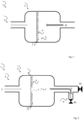
- Fig. 1 shows a first embodiment of a system 1 not according to the invention.
- a pipeline 2 is shown with a device 3 for providing the retentate from the water filter 4, in which a filter unit 5 is detachably integrated into the pipeline 2.
- the water W flows through the filter 4 in the flow direction indicated by the two arrows.
- the retentate 6 collects on the filter unit 5, which is held back by the filter 4.
- the retentate 6 can be removed and analyzed with a measuring/analysis device 7 (not shown here).
- System 1 shown is the device 3 and the Measuring/analysis device arranged separately from each other. In other embodiments, however, the system can also be designed in a more compact manner, such that the measuring/analysis device 7 is arranged together with the device 3.
- the system 1 shown is a system 1 with a self-cleaning filter 4 in the form of a backwash filter.
- water W flows through the pipe 2 similar to Fig. 1 .
- a cleaning process of the filter 4 is now illustrated.
- the device 3 comprises two valves 8a, 8b.
- the first valve 8a is a changeover valve, by means of which the flow direction of the water can be reversed.
- rinsing water S flows through the pipe 2 in the flow direction indicated by the arrows.
- the second valve 8b is also opened so that the rinsing water S containing the retentate 6 reaches the additional line 9, through which it can, for example, be fed directly to a measuring/analysis device (again not shown).
- a measuring/analysis device 7 is connected directly to the line 9, or the rinsing water S containing the retentate 6 can be removed via the line 9 and fed to a measuring/analysis device arranged separately from the device 3.
- FIG. 3 An embodiment of a system 1 not according to the invention with a self-cleaning filter 4 is the subject of Fig. 3
- This is a filter 4 with a suction scanner 10, by means of which the retentate 6 can be removed from the filter unit 5 during a cleaning process.
- the suction scanner 10 has a valve 11, via which the retentate 6 can be removed.
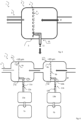
- FIG. 4 An embodiment of a system 1 according to the invention is the subject of Fig. 4
- the system 1 comprises two devices 3a, 3b for providing a retentate 6a, 6b with two different filters 4a, 4b.
- the first filter 4 is used to filter larger particles in the water, the second filter 4b to filter smaller particles.
- the two filter units 5a, 5b used therefore have different pore sizes, with the pore size of the first filter unit 5a being larger than the pore size of the second filter unit 5b.
- the first filter unit 5a is designed to filter particles with diameters >10 ⁇ m
- the second filter unit 5b is designed to filter particles with diameters ⁇ 10 ⁇ m.
- Both filters 4a, 4b are self-cleaning filters, each with a suction scanner 10a, 10b, which is connected to a unit 13a, 13b for preparing the sample and a measuring/analysis device 7a, 7b via a valve 11a, 11b and a supply line 12a, 12b.
- the units 13a, 13b for sample preparation are optional. For example, they can be used to cultivate a sample of the retentate 6.
- the two measuring/analysis devices 7 can be the same or different measuring/analysis devices.
- the retentate 6 can be influenced in a targeted manner by suitably limiting the particle size.
Landscapes
- Engineering & Computer Science (AREA)
- Chemical & Material Sciences (AREA)
- Water Supply & Treatment (AREA)
- Life Sciences & Earth Sciences (AREA)
- Physics & Mathematics (AREA)
- Health & Medical Sciences (AREA)
- Chemical Kinetics & Catalysis (AREA)
- Pathology (AREA)
- Spectroscopy & Molecular Physics (AREA)
- Biochemistry (AREA)
- General Health & Medical Sciences (AREA)
- Analytical Chemistry (AREA)
- General Physics & Mathematics (AREA)
- Immunology (AREA)
- Organic Chemistry (AREA)
- Hydrology & Water Resources (AREA)
- Environmental & Geological Engineering (AREA)
- Medicinal Chemistry (AREA)
- Food Science & Technology (AREA)
- Sampling And Sample Adjustment (AREA)
- Measuring Or Testing Involving Enzymes Or Micro-Organisms (AREA)
- Investigating, Analyzing Materials By Fluorescence Or Luminescence (AREA)
Description
- Die vorliegende Erfindung betrifft ein System zum Feststellen der Notwendigkeit einer Maßnahme und/oder eines Erfolgs einer Maßnahme bei Wasser, insbesondere Trinkwasser, Prozesswasser oder Abwasser, in einer Leitung. Das Wasser kann sich dabei beispielsweise in einer Rohrleitung oder in einem Behälter befinden. Im Falle eines Behälters weist der Behälter eine Zu- und/oder Ableitung zum Befüllen/Entleeren des Behälters auf.
- Zur Überprüfung der Qualität von Wasser sind zahlreiche Verfahren bekannt, mit welchen sich unterschiedliche chemische, physikalische oder auch mikrobiologische Parameter der jeweiligen Proben bestimmen lassen. Je nach der untersuchten Eigenschaft erfolgt entweder zunächst eine Probennahme mit anschließender Analyse im Labor oder es wird in manchen Fällen auch eine Feldanalyse direkt vor Ort durchgeführt.
- Insbesondere bei Trinkwasser müssen bereits geringste Kontaminationen früh und zuverlässig festgestellt werden. Ein besonders Problem stellen in diesem Zusammenhang bakterielle Pathogene, beispielsweise L. pneumophila oder P. aeruginosa, aber auch andere Kontaminationen des Trinkwassers durch Nanopartikel und weitere Giftstoffe dar. Viele solche Kontaminationen können mit üblichen Analysemethoden oft erst mit einer Verzögerung von mehreren Tagen nachgewiesen werden können. Zudem können geforderte Grenzwerte für bestimmte Kontaminationen - in Deutschland wird z. B. gemäß der Trinkwasserverordnung ein Grenzwert von weniger als einem E.coli auf 100ml Wasser gefordert - mit gängigen Analysegeräten, welche in der Wasseranalytik eingesetzt werden, nicht immer regulär erfasst werden. Messmethoden, die dazu in der Lage sind, wie beispielsweise eine kontinuierliche PCR-Messung, sind dagegen wirtschaftlich teuer und aufwendig.
- Ein weiteres Beispiel für die Grenzen bisheriger Analysemethoden stellt die Ermittlung des TOC Wertes (total organic carbon) dar, welche oftmals zu undifferenziert ist, um eine verlässliche Aussage zur biologischen Qualität des Wassers zu ermöglichen. Bisherige Verfahren anhand biologischer Tests sind aufwendig und erlauben eine oftmals um Tage verzögerte Kontrolle des Trinkwassers.
- Auch die zunehmende Verschmutzung der Umwelt mit industriell hergestellten Nano-Partikeln ist problematisch. Diese gelangen vermehrt in die Umwelt und somit auch in Abwässer und Trinkwasser, wo sie von Menschen und Tieren aufgenommen werden. Nano-Partikel sind genau wie auch Pathogene sehr vielfältig in ihrem Aufbau und ihrer Zusammensetzung, wovon auch ihre jeweilige pathogene Wirkung abhängt. Es ist somit von zunehmender Dringlichkeit, den Anteil und die Zusammensetzung von gering konzentrierten partikulären Substanzen im Wasser zu erfassen.
- Anordnungen, welche der Filterung von Flüssigkeiten - z. B. Wasser - und der Überprüfung der Filterung dienen, sind z. B. offenbart in der
US 2013/075331 A1 , derUS 2019/209968 A1 , derUS 2016/340204 A1 oder derUS 2019/039022 A1 . DerUS 2014/342397 A1 lässt sich entnehmen, wie aus einem Filter mögliche Parasiten entfernt und das so entnommene Retentat konzentriert und untersucht wird. Die Analyse eines Rententats, um Aussagen über das Filtersystem zu erhalten, beschreibt dieUS 2016/0109425 A1 . - Eine kontinuierliche und zeitnahe Überwachung dieser vielfältigen Parameter scheitert derzeit daran, dass die verfügbaren Mess- und Analyseverfahren zeit- und arbeitsaufwendig sind oder in manchen Fällen eine zuverlässige Analytik fehlt. Somit liegt der vorliegenden Erfindung die Aufgabe zugrunde, eine Möglichkeit zur zuverlässigen und umfassenden Analyse bzw. Untersuchung von Wasser anzugeben, welche universell einsetzbar ist und bereits geringe Mengen an Kontaminationen detektieren kann.
- Diese Aufgabe wird gelöst durch das System nach Anspruch 1.
- Wasserfilter werden vielfach im Bereich von wasserführenden Leitungen verbaut, dienen der Filterung bestimmter Substanzen aus dem Wasser und bewirken eine Zurückhaltung von Partikeln entsprechend einer vorgegebenen Porengröße. Als Retentat bzw. Filterkuchen wird im Zusammenhang mit Filtern die Substanz bezeichnet, welche bei dem durch den Filter bewirkten Trennprozess zurückgehalten wird. Das Retentat von Wasserfiltern wird üblicherweise verworfen bzw. entsorgt. In diesem Retentat liegen normalerweise partikuläre Kontaminationen (Mikroorganismen, Nanopartikel etc.) des Wassers jedoch aufkonzentriert vor. Demzufolge eignet sich das Retentat bestens für eine quantitative und qualitative Analyse, insbesondere können auch gering konzentrierte Kontaminationen anhand des Retentats nachgewiesen werden. Eine Untersuchung des Retentats, welches in großen Mengen in bestehenden öffentlichen und privaten Infrastrukturen verfügbar ist, bietet folglich ein bislang ungenutztes, erhebliches Informationspotential.
- Die vorliegende Erfindung ermöglicht vorteilhaft, partikuläre Kontaminationen, welche in den Retentaten vorhanden sind, umfassend, dezentral und zeitnah festzustellen.
- In einer Ausgestaltung wird zum Analysieren des Retentats eine Mess-/Analyseeinrichtung, insbesondere ein Mess-/Analysegerät zur Analyse zumindest eines gelösten und partikulären Stoffes, vorzugsweise ein Massenspektrometer, ein Atomabsorptionsspektrometer ein Atomemissionsspektrometer, ein Raman-Spektrometer und/oder ein hyperspektrales Mikroskop, insbesondere im Bereich von sichtbarem Licht oder im nahen Infrarotbereich, verwendet. Die Kombination und/oder Verwendung verschiedener Mess-/Analyseeinrichtungen stellt sicher, dass die vielfältigen möglichen Kontaminationen alle nachgewiesen werden können. Es können jeweils ein oder mehrere unterschiedliche Mess-/Analyseeinrichtungen für die durchzuführende Analyse zeitgleich oder nacheinander durchgeführt werden. Dabei erfolgt die gezielte Auswahl oder Kombination der unterschiedlichen Methoden je nach zu erwartenden Informationen. Die Massenspektrometrie eignet sich insbesondere zur Feststellung der elementaren Zusammensetzung, die Raman-Spektroskopie liefert beispielsweise Informationen zur molekularen Zusammensetzung der jeweiligen Probe und zur phänotypischen Bestimmung von Bakterien. Eine hyperspektrale Mikroskopie im VIS und NIR-Bereich wiederum kann Aufschluss über chemisch-strukturelle sowie physikalische Informationen geben, und auch eine phänotypische Bestimmung von Bakterien ermöglichen. Durch eine Kombination verschiedener Nachweistechnologien werden verschiedenste Informationen der vermessenen partikulären Kontaminationen erfasst. Diese Informationen, sowohl zur elementaren und molekularen Zusammensetzung der Partikel als auch zur Struktur und Form, ermöglichen in ihrer Kombination eine bessere Identifikation der jeweiligen partikulären Kontaminationen. Es sei darauf verwiesen, dass die hier beispielhaft angegebenen Mess-/Analyseeinrichtungen und deren jeweilige Möglichkeiten keineswegs abschließend sind. Vielmehr kann je nach Anwendung, beispielswiese je nach festzustellender Kontamination, jeweils ein geeignetes Verfahren gewählt werden.
- Es ist von Vorteil, wenn die Analyse im Single-Particle- oder im Single-Cell-Modus durchgeführt wird. In einem derartigen Betriebsmodus wird anstelle eines kontinuierlichen Signals jeweils ein kurzes, starkes Signal von einem definierten Partikel oder einer definierten Zelle empfangen. Beispiele für Vorrichtungen und Verfahren dieser Betriebsmoden in der Spektroskopie sind beispielsweise in der
US 7479,630 B2 beschrieben. - Bei den Wasserfiltern handelt es sich jeweils um einen selbstreinigenden Filter. Selbstreinigende Filter sind an sich aus dem Stand der Technik bekannt und zeichnen sich dadurch aus, dass sie in hohem Durchsatz große Volumina an Wasser filtern und Partikel bis zu einem Durchmesser von 0,2 µm und kleiner zurückhalten können.
- Zur Reinigung werden die Filter regelmäßig gespült. Dabei werden die auf dem Filter gebundene Partikel wieder vom Filter gelöst. So wird in einer vorteilhaften Ausgestaltung das Retentat während eines Reinigungsprozesses des Wasserfilters entnommen. Beispielsweise kann das zur Reinigung des Filters verwendete Spülwasser, welches das Retentat enthält, dem jeweiligen Filter entnommen werden.
- Durch geeignete Wahl des jeweiligen Filters kann darüber hinaus die Partikelgröße des im Spülwasser enthaltenen Filtrats geeignet eingeschränkt werden. Dies erlaubt beispielsweise eine Filtrierung bis hin zu einer Partikelgröße von 0,2 µm, welche direkt im Größenbereich bakterieller Pathogene liegt. Mittels Vorfilterung kann somit das finale Filtrat in diesem Fall auf einen Größenbereich von beispielsweise 0,2 bis 10 µm eingeschränkt und als Spülwasser der Analyse zugeführt werden
- Da die jeweiligen Kontaminationen in dem Retentat von einem Filter bereits aufkonzentriert vorliegen, kann das Retentat in vielen Anwendungsfällen direkt ohne weitere Vorbereitungsschritte analysiert werden. Es ist aber gemäß einer Ausgestaltung des Verfahrens ebenfalls möglich, dass das Retentat zur Vorbereitung der Analyse vorab kultiviert wird.
- Vorteilhaft lassen sich mittels einer massenspektrometrischen Analyse, insbesondere mittels eines Massenspektrometers mit induktiv gekoppeltem Plasma pathogene Bakterien anhand der quantitativen Analyse ihrer elementaren Zusammensetzung identifizieren und differenzieren.
- Eine Ausgestaltung beinhaltet, dass das Wasser auf das Vorliegen einer partikulären Kontamination, insbesondere in Form von Mikroorganismen und/oder Nanopartikeln, untersucht wird.
- Eine weitere Ausgestaltung beinhaltet, dass das Wasser auf das Vorhandensein, die Beschaffenheit und/oder die Umgebung von Bakterien und/oder Pathogenen, insbesondere eine Konzentration und/oder räumliche Verteilung der Bakterien, untersucht wird.
- Noch eine Ausgestaltung sieht vor, dass eine Gesamtkeimzahl im Wasser ermittelt wird.
- Schließlich beinhaltet eine Ausgestaltung, dass das Wasser auf das Vorhandensein von Noxen, beispielsweise Blei oder Arsen, untersucht wird.
- Die hier genannten Beispiele für unterschiedliche Kontaminationen, welche im Rahmen des erfindungsgemäßen Systems erfassbar sind, sind jedoch keineswegs abschließend. Vielmehr können zahlreiche weitere Eigenschaften von Wasser in Abhängigkeit der jeweils verwendeten Mess- und Analysemethoden untersucht werden.
- Bei der Leitung des Systems kann es sich beispielsweise um eine Rohrleitung handeln, in welcher sich die Wasserfilter befinden. Das Wasser kann sich aber ebenfalls in einem stehenden Reservoir befinden, beispielsweise in einem Behälter. In letzterem Falle ist es von Vorteil, wenn das Behältnis über eine Zu- und/oder Ableitung verfügt, in welcher die Wasserfilter angeordnet sind. Die Einrichtung zum Bereitstellen des Retentats umfasst die Wasserfilter, welche wiederum insbesondere eine Filtereinheit, beispielsweise in Form einer Membran, umfassen.
- Erfindungsgemäß handelt es sich bei den Wasserfiltern um selbstreinigende Filter, wobei die Einrichtung Mittel zur Umkehrung einer Flussrichtung des Wassers durch die Wasserfilter in Form der Saugscanner umfasst.
- Die Erfindung wird anhand der nachfolgenden Figuren näher erläutert. Es zeigt:
-
Fig.1 eine erste Ausgestaltung für ein nicht erfindungsgemäßes System zum Feststellen der Notwendigkeit einer Maßnahme und/oder eines Erfolgs einer Maßnahme bei Wasser in einer Leitung mit einem lösbar in eine Rohrleitung integrierten Wasserfilter, -
Fig. 2 eine zweite Ausgestaltung für ein nicht erfindungsgemäßes System mit einem selbstreinigenden Filtern mit Mittel zur Umkehrung der Flussrichtung des Mediums durch den Filter; -
Fig. 3 eine dritte Ausgestaltung für ein nicht erfindungsgemäßes System mit einem selbstreinigenden Filter und einem Saugscanner, und -
Fig.4 eine Ausgestaltung für ein erfindungsgemäßes System mit zwei Wasserfiltern und zwei integrierten Mess-/Analyseeinrichtungen. - In den Figuren sind gleiche Elemente mit demselben Bezugszeichen versehen.
-
Fig. 1 zeigt eine erste Ausgestaltung eines nicht erfindungsgemäßen Systems 1. Dargestellt ist eine Rohrleitung 2 mit einer Einrichtung 3 zum Bereitstellen des Retentats von dem Wasserfilter 4, bei welchem eine Filtereinheit 5 lösbar in die Rohrleitung 2 integriert ist. Das Wasser W fließt in der durch die beiden Pfeile angegebenen Flussrichtung durch den Filter 4. Dabei sammelt sich das Retentat 6 an der Filtereinheit 5, welches durch den Filter 4 zurückgehalten wird. Bei einem Ausbau der Filtereinheit 5 aus der Rohrleitung 2 kann das Retentat 6 entnommen werden und mit einer hier nicht dargestellten Mess-/Analyseeinrichtung 7 analysiert werden. Bei der inFig. 1 dargestellten System 1 sind die Einrichtung 3 und die Mess-/Analyseeinrichtung getrennt voneinander angeordnet. In anderen Ausgestaltungen kann das System aber auch in einer kompakteren Bauweise ausgebildet sein, derart dass die Mess-/Analyseeinrichtung 7 gemeinsam mit der Einrichtung 3 angeordnet ist. - Bei dem in
Fig. 2 dargestellten System 1 handelt es sich um ein System 1 mit einem selbstreinigenden Filter 4 in Form eines Rückspülfilters. Im Normalbetrieb wird die Rohrleitung 2 von Wasser W durchströmt ähnlich wie inFig. 1 . InFig. 2 ist nun ein Reinigungsprozess des Filters 4 illustriert. Die Einrichtung 3 umfasst zwei Ventile 8a,8b. Bei dem ersten Ventil 8a handelt es sich um ein Umschaltventil, mittels welchem die Strömungsrichtung des Wassers umgekehrt werden kann. Während des Reinigungsprozesses durchströmt demnach Spülwasser S die Rohrleitung 2 in der durch die Pfeile gekennzeichneten Flussrichtung. Während des Reinigungsprozesses wird ferner das zweite Ventil 8b geöffnet, sodass das das Retentat 6 enthaltende Spülwasser S in die zusätzliche Leitung 9 gelangt, durch welche es beispielsweise direkt eine wieder nicht dargestellten Mess-/Analyseeinrichtung zugeführt werden kann. Entweder die Mess-/Analyseeinrichtung 7 ist direkt an die Leitung 9 angeschlossen, oder das Retentat 6 enthaltene Spülwasser S kann mittels der Leitung 9 entnommen und eine separat von der Einrichtung 3 angeordneten Mess-/Analyseeinrichtung zugeführt werden. - Eine Ausgestaltung eines nicht erfindungsgemäßen Systems 1 mit einem selbstreinigenden Filter 4 ist Gegenstand von
Fig. 3 . Hierbei handelt es sich um einen Filter 4 mit einem Saugscanner 10, mittels welchem das Retentat 6 von der Filtereinheit 5 während eines Reinigungsprozesses entfernt werden kann. Der Saugscanner 10 weist ein Ventil 11 auf, über welches das Retentat 6 entnommen werden kann. - Eine Ausgestaltung für ein erfindungsgemäßes System 1 ist Gegenstand von
Fig. 4 . Das System 1 umfasst zwei Einrichtungen 3a,3b zur Bereitstellung jeweils eines Retentats 6a,6b mit zwei unterschiedlichen Filtern 4a,4b. Der erste Filter 4 dient zur Filterung größerer Partikel im Wasser, der zweite Filter 4b zur Filterung kleinerer Partikel. Die beiden verwendeten Filtereinheiten 5a,5b weisen demnach unterschiedliche Porengrößen auf, wobei die Porengröße der ersten Filtereinheit 5a größer ist als die Porengröße der zweiten Filtereinheit 5b. Für die hier gezeigte Ausgestaltung sei angenommen, dass die erste Filtereinheit 5a dazu ausgebildet ist, Partikel mit Durchmessern >10 µm und die zwei Filtereinheit 5b Partikel mit Durchmessern < 10 µm zu filtern. - Bei beiden Filtern 4a, 4b handelt es sich um selbstreinigende Filter mit jeweils einem Saugscanner 10a, 10b, welcher jeweils über ein Ventil 11a,11b und eine Zuleitung 12a,12b mit einer Einheit 13a, 13b zur Aufbereitung der Probe und einer Mess-/Analyseeinrichtung 7a,7b verbunden ist. Die Einheiten 13a, 13b zur Probenaufbereitung sind jeweils optional. Beispielsweise können diese zur Kultivierung einer Probe des Retentats 6 dienen. Bei den beiden Mess-/Analyseeinrichtungen 7 kann es sich um gleiche oder unterschiedliche Mess- /Analysegeräte handeln. Durch geeignete Wahl der Filtereinheiten 5a,5b kann das Retentat 6 gezielt beeinflusst werden, indem die Partikelgröße geeignet eingeschränkt wird.
-
- 1
- System
- 2
- Rohrleitung
- 3,3a,3b
- Einrichtung zur Bereitstellung eines Retentats
- 4,4a,4b
- Wasserfilter
- 5,5a,5b
- Filtereinheit
- 6,6a,6b
- Retentat
- 7,7a,7b
- Mess-/Analyseeinrichtung
- 8a,8b
- Ventile
- 9,
- Leitung
- 10a,10b
- Saugscanner
- 11a,11b
- Ventil
- 12a,12b
- Leitung
- 13a,13b
- Einrichtungen zur Probenvorbereitung
- W
- Wasser
- S
- Spülwasser
Claims (1)
- System (1) zum Feststellen der Notwendigkeit einer Maßnahme und/oder eines Erfolgs einer Maßnahme bei Wasser (W),
umfassendeine Einrichtung zum Bereitstellen des Retentats (6), welches ein Filterkuchen ist, von einem ersten Wasserfilter (4a) und einem zweiten Wasserfilter (4b) in einer Leitung (2); undzwei Mess-/Analyseeinrichtungen (7a, 7b) zur Untersuchung und/oder Analyse des Retentats (6) bezüglich zumindest einer Eigenschaft oder seiner chemischen Zusammensetzung,wobei der erste Wasserfilter (4a) zur Filterung größerer Partikel und der zweite Wasserfilter (4b) zur Filterung kleinerer Partikel im Wasser (W) dient,wobei der erste Wasserfilter (4a) und der zweite Wasserfilter (4b) jeweils ein selbstreinigender Filter mit jeweils einem Saugscanner (10a, 10b) ist, undwobei die Saugscanner (10a, 10b)jeweils über ein Ventil (11a, 11b) und eine Zuleitung (12a, 12b) mit einer Mess-/Analyseeinrichtung (7a, 7b) verbunden sind.
Applications Claiming Priority (2)
| Application Number | Priority Date | Filing Date | Title |
|---|---|---|---|
| DE102020106340.7A DE102020106340A1 (de) | 2020-03-09 | 2020-03-09 | Verfahren zur Analyse von Wasser |
| PCT/EP2021/055726 WO2021180620A1 (de) | 2020-03-09 | 2021-03-08 | Verfahren zur analyse von wasser |
Publications (3)
| Publication Number | Publication Date |
|---|---|
| EP4118039A1 EP4118039A1 (de) | 2023-01-18 |
| EP4118039C0 EP4118039C0 (de) | 2025-02-19 |
| EP4118039B1 true EP4118039B1 (de) | 2025-02-19 |
Family
ID=74871364
Family Applications (1)
| Application Number | Title | Priority Date | Filing Date |
|---|---|---|---|
| EP21711497.4A Active EP4118039B1 (de) | 2020-03-09 | 2021-03-08 | System zur analyse von wasser |
Country Status (5)
| Country | Link |
|---|---|
| US (1) | US12228558B2 (de) |
| EP (1) | EP4118039B1 (de) |
| CN (1) | CN115244009A (de) |
| DE (1) | DE102020106340A1 (de) |
| WO (1) | WO2021180620A1 (de) |
Families Citing this family (3)
| Publication number | Priority date | Publication date | Assignee | Title |
|---|---|---|---|---|
| DE102022114873A1 (de) | 2022-06-13 | 2023-12-14 | Analytik Jena Gmbh+Co. Kg | System zum Analysieren eines Analyten in einer Probe |
| CN119551878B (zh) * | 2025-01-24 | 2025-04-18 | 上海瀚广科技(集团)有限公司 | 一种实验室高浓度综合废水处理一体机 |
| CN120177397B (zh) * | 2025-05-20 | 2025-09-05 | 凯铭科技(杭州)有限公司 | 一种用于水中微量元素浓度检测的方法及系统 |
Citations (2)
| Publication number | Priority date | Publication date | Assignee | Title |
|---|---|---|---|---|
| US20140342397A1 (en) * | 2011-12-21 | 2014-11-20 | Grundfos Holding A/S | Particle Detection Device and Method |
| US20160109425A1 (en) * | 2014-10-20 | 2016-04-21 | Filter Sensing Technologies, Inc. | Filter Retentate Analysis And Diagnostics |
Family Cites Families (7)
| Publication number | Priority date | Publication date | Assignee | Title |
|---|---|---|---|---|
| US7479630B2 (en) | 2004-03-25 | 2009-01-20 | Bandura Dmitry R | Method and apparatus for flow cytometry linked with elemental analysis |
| US20130075331A1 (en) * | 2010-06-10 | 2013-03-28 | Ramila Hishantha Peiris | Method for fluorescence-based fouling forecasting and optimization in membrane filtration operations |
| DE102011088235A1 (de) | 2011-12-12 | 2013-06-13 | Endress + Hauser Conducta Gesellschaft für Mess- und Regeltechnik mbH + Co. KG | Probenvorbereitungseinrichtung für eine Analyseeinrichtung zur Bestimmung einer Messgröße einer flüssigen Probe |
| SE1450114A1 (sv) * | 2014-02-03 | 2015-05-19 | Metod och anordning för online-monitorering av vattenkvalitet | |
| JP6142937B1 (ja) * | 2016-03-18 | 2017-06-07 | 栗田工業株式会社 | 逆浸透膜装置の運転管理方法および逆浸透膜処理システム |
| IL247687B (en) * | 2016-09-07 | 2018-06-28 | Israel Aerospace Ind Ltd | Method and system for liquid treatment |
| US10585024B1 (en) | 2018-08-21 | 2020-03-10 | Battelle Memorial Institute | Extraction of materials from liquids |
-
2020
- 2020-03-09 DE DE102020106340.7A patent/DE102020106340A1/de active Pending
-
2021
- 2021-03-08 WO PCT/EP2021/055726 patent/WO2021180620A1/de not_active Ceased
- 2021-03-08 US US17/905,805 patent/US12228558B2/en active Active
- 2021-03-08 CN CN202180019806.3A patent/CN115244009A/zh active Pending
- 2021-03-08 EP EP21711497.4A patent/EP4118039B1/de active Active
Patent Citations (2)
| Publication number | Priority date | Publication date | Assignee | Title |
|---|---|---|---|---|
| US20140342397A1 (en) * | 2011-12-21 | 2014-11-20 | Grundfos Holding A/S | Particle Detection Device and Method |
| US20160109425A1 (en) * | 2014-10-20 | 2016-04-21 | Filter Sensing Technologies, Inc. | Filter Retentate Analysis And Diagnostics |
Also Published As
| Publication number | Publication date |
|---|---|
| EP4118039C0 (de) | 2025-02-19 |
| WO2021180620A1 (de) | 2021-09-16 |
| EP4118039A1 (de) | 2023-01-18 |
| DE102020106340A1 (de) | 2021-09-09 |
| CN115244009A (zh) | 2022-10-25 |
| US20230296578A1 (en) | 2023-09-21 |
| US12228558B2 (en) | 2025-02-18 |
Similar Documents
| Publication | Publication Date | Title |
|---|---|---|
| EP4118039B1 (de) | System zur analyse von wasser | |
| DE102012108989B3 (de) | Detektionsvorrichtung sowie Verfahren zur automatischen Detektion von Partikeln | |
| EP2013328A2 (de) | Prozessanalysensystem mit steriler probenahme von mechanisch empfindlichem material aus einem bioreaktor | |
| EP1354189A2 (de) | Schnelltest für biologische substanzen mittels ftir | |
| DE102007021387A1 (de) | Detektionsvorrichtung zur Detektion von biologischen Mikropartikeln wie Bakterien, Viren, Sporen, Pollen oder biologische Toxine, sowie Detektionsverfahren | |
| DE102014215735A1 (de) | Verfahren zum Betreiben einer raumlufttechnischen Anlage, Sensor und raum-lufttechnische Anlage | |
| DE102005049227B4 (de) | Vorrichtung und Verfahren zur Überwachung der Partikelfracht eines Fluids | |
| AT508806B1 (de) | Analysegerät und verfahren | |
| DE102013216934A1 (de) | Verfahren und Vorrichtung zur Erhöhung der optischen Transparenz von Bereichen einer Gewebeprobe | |
| EP2649432A1 (de) | Vorrichtung zum identifizieren biotischer partikel | |
| EP1573051A1 (de) | Verfahren und vorrichtung zur bestimmung von keimen | |
| EP3719476B1 (de) | Rohrleitung mit einer messvorrichtung zur erfassung von partikeln und vorrichtung zur übermittlung von daten aus einer rohrleitung | |
| DE102020100237A1 (de) | Verfahren zur qualitätskontrolle an in einer fluidleitung strömendem fluid | |
| WO2021228499A1 (de) | Automatische probennahmevorrichtung und verfahren zum automatisierten bereitstellen einer probe für eine qualitative und/oder quantitative bestimmung eines analyten | |
| DE202013102057U1 (de) | Vorrichtung zur Extraktion von Nukleinsäuren mittels magnetischer Beads | |
| WO2017125521A1 (de) | Vorrichtung und verfahren zum detektieren zellulärer bestandteile einer potenziell zellen enthaltenden probe | |
| EP3338093B1 (de) | Bakterien-schnelltest | |
| EP3047899B1 (de) | Verfahren zur überprüfung der funktionsfähigkeit eines membranfiltrationsmoduls und filtrationsanlage zum durchführen des verfahrens | |
| DE102010064463B4 (de) | Vorrichtung zum Identifizieren biotischer Partikel | |
| EP2511689A2 (de) | Verfahren und Vorrichtung zur Verschmutzungs- und Reinigungsvalidierung einer Anlage | |
| EP2135072B1 (de) | Vorrichtung und verfahren zur online-kontrolle von trinkwasser auf humanverträglichkeit innerhalb eines trinkwasserversorgungsnetzes | |
| WO2001006003A2 (de) | Verfahren und kit zur bestimmung von dna-doppel-/einzelstrangbrüchen und vorrichtung zum kontrollierten filtrieren von insbesondere dna-molekülen mit well-filterplatten | |
| DE102015121034B4 (de) | Verfahren und Vorrichtung zur Anreicherung von biologischen Partikeln | |
| DE102022114873A1 (de) | System zum Analysieren eines Analyten in einer Probe | |
| DE102022134828A1 (de) | Verfahren zur Detektion von Erregern, Analyseeinrichtung, Verwendung der Analyseeinrichtung und Verwendung eines selbstlernenden Netzwerks zur Auswertung von optischen Messspektren |
Legal Events
| Date | Code | Title | Description |
|---|---|---|---|
| STAA | Information on the status of an ep patent application or granted ep patent |
Free format text: STATUS: UNKNOWN |
|
| STAA | Information on the status of an ep patent application or granted ep patent |
Free format text: STATUS: THE INTERNATIONAL PUBLICATION HAS BEEN MADE |
|
| PUAI | Public reference made under article 153(3) epc to a published international application that has entered the european phase |
Free format text: ORIGINAL CODE: 0009012 |
|
| STAA | Information on the status of an ep patent application or granted ep patent |
Free format text: STATUS: REQUEST FOR EXAMINATION WAS MADE |
|
| 17P | Request for examination filed |
Effective date: 20220817 |
|
| AK | Designated contracting states |
Kind code of ref document: A1 Designated state(s): AL AT BE BG CH CY CZ DE DK EE ES FI FR GB GR HR HU IE IS IT LI LT LU LV MC MK MT NL NO PL PT RO RS SE SI SK SM TR |
|
| DAV | Request for validation of the european patent (deleted) | ||
| DAX | Request for extension of the european patent (deleted) | ||
| RAP3 | Party data changed (applicant data changed or rights of an application transferred) |
Owner name: ANALYTIK JENA GMBH+CO. KG |
|
| STAA | Information on the status of an ep patent application or granted ep patent |
Free format text: STATUS: EXAMINATION IS IN PROGRESS |
|
| 17Q | First examination report despatched |
Effective date: 20241008 |
|
| GRAP | Despatch of communication of intention to grant a patent |
Free format text: ORIGINAL CODE: EPIDOSNIGR1 |
|
| STAA | Information on the status of an ep patent application or granted ep patent |
Free format text: STATUS: GRANT OF PATENT IS INTENDED |
|
| GRAS | Grant fee paid |
Free format text: ORIGINAL CODE: EPIDOSNIGR3 |
|
| INTG | Intention to grant announced |
Effective date: 20241211 |
|
| GRAA | (expected) grant |
Free format text: ORIGINAL CODE: 0009210 |
|
| STAA | Information on the status of an ep patent application or granted ep patent |
Free format text: STATUS: THE PATENT HAS BEEN GRANTED |
|
| AK | Designated contracting states |
Kind code of ref document: B1 Designated state(s): AL AT BE BG CH CY CZ DE DK EE ES FI FR GB GR HR HU IE IS IT LI LT LU LV MC MK MT NL NO PL PT RO RS SE SI SK SM TR |
|
| REG | Reference to a national code |
Ref country code: GB Ref legal event code: FG4D Free format text: NOT ENGLISH |
|
| REG | Reference to a national code |
Ref country code: CH Ref legal event code: EP |
|
| REG | Reference to a national code |
Ref country code: IE Ref legal event code: FG4D Free format text: LANGUAGE OF EP DOCUMENT: GERMAN |
|
| REG | Reference to a national code |
Ref country code: DE Ref legal event code: R096 Ref document number: 502021006695 Country of ref document: DE |
|
| U01 | Request for unitary effect filed |
Effective date: 20250319 |
|
| PGFP | Annual fee paid to national office [announced via postgrant information from national office to epo] |
Ref country code: AT Payment date: 20250417 Year of fee payment: 5 |
|
| U07 | Unitary effect registered |
Designated state(s): AT BE BG DE DK EE FI FR IT LT LU LV MT NL PT RO SE SI Effective date: 20250409 |
|
| RAP2 | Party data changed (patent owner data changed or rights of a patent transferred) |
Owner name: ENDRESS+HAUSER CONDUCTA GMBH+CO. KG |
|
| U1K | Transfer of rights of the unitary patent after the registration of the unitary effect |
Owner name: ENDRESS+HAUSER CONDUCTA GMBH+CO. KG; DE |
|
| PG25 | Lapsed in a contracting state [announced via postgrant information from national office to epo] |
Ref country code: RS Free format text: LAPSE BECAUSE OF FAILURE TO SUBMIT A TRANSLATION OF THE DESCRIPTION OR TO PAY THE FEE WITHIN THE PRESCRIBED TIME-LIMIT Effective date: 20250519 |
|
| PG25 | Lapsed in a contracting state [announced via postgrant information from national office to epo] |
Ref country code: PL Free format text: LAPSE BECAUSE OF FAILURE TO SUBMIT A TRANSLATION OF THE DESCRIPTION OR TO PAY THE FEE WITHIN THE PRESCRIBED TIME-LIMIT Effective date: 20250219 |
|
| PG25 | Lapsed in a contracting state [announced via postgrant information from national office to epo] |
Ref country code: ES Free format text: LAPSE BECAUSE OF FAILURE TO SUBMIT A TRANSLATION OF THE DESCRIPTION OR TO PAY THE FEE WITHIN THE PRESCRIBED TIME-LIMIT Effective date: 20250219 |
|
| PG25 | Lapsed in a contracting state [announced via postgrant information from national office to epo] |
Ref country code: IS Free format text: LAPSE BECAUSE OF FAILURE TO SUBMIT A TRANSLATION OF THE DESCRIPTION OR TO PAY THE FEE WITHIN THE PRESCRIBED TIME-LIMIT Effective date: 20250619 Ref country code: NO Free format text: LAPSE BECAUSE OF FAILURE TO SUBMIT A TRANSLATION OF THE DESCRIPTION OR TO PAY THE FEE WITHIN THE PRESCRIBED TIME-LIMIT Effective date: 20250519 |
|
| PG25 | Lapsed in a contracting state [announced via postgrant information from national office to epo] |
Ref country code: HR Free format text: LAPSE BECAUSE OF FAILURE TO SUBMIT A TRANSLATION OF THE DESCRIPTION OR TO PAY THE FEE WITHIN THE PRESCRIBED TIME-LIMIT Effective date: 20250219 |
|
| PG25 | Lapsed in a contracting state [announced via postgrant information from national office to epo] |
Ref country code: GR Free format text: LAPSE BECAUSE OF FAILURE TO SUBMIT A TRANSLATION OF THE DESCRIPTION OR TO PAY THE FEE WITHIN THE PRESCRIBED TIME-LIMIT Effective date: 20250520 |
|
| PGFP | Annual fee paid to national office [announced via postgrant information from national office to epo] |
Ref country code: CH Payment date: 20250606 Year of fee payment: 5 |
|
| U21 | Renewal fee for the european patent with unitary effect paid with additional fee |
Year of fee payment: 5 Effective date: 20250827 |
|
| PG25 | Lapsed in a contracting state [announced via postgrant information from national office to epo] |
Ref country code: SM Free format text: LAPSE BECAUSE OF FAILURE TO SUBMIT A TRANSLATION OF THE DESCRIPTION OR TO PAY THE FEE WITHIN THE PRESCRIBED TIME-LIMIT Effective date: 20250219 |
|
| PG25 | Lapsed in a contracting state [announced via postgrant information from national office to epo] |
Ref country code: CZ Free format text: LAPSE BECAUSE OF FAILURE TO SUBMIT A TRANSLATION OF THE DESCRIPTION OR TO PAY THE FEE WITHIN THE PRESCRIBED TIME-LIMIT Effective date: 20250219 |
|
| PG25 | Lapsed in a contracting state [announced via postgrant information from national office to epo] |
Ref country code: SK Free format text: LAPSE BECAUSE OF FAILURE TO SUBMIT A TRANSLATION OF THE DESCRIPTION OR TO PAY THE FEE WITHIN THE PRESCRIBED TIME-LIMIT Effective date: 20250219 |
|
| PG25 | Lapsed in a contracting state [announced via postgrant information from national office to epo] |
Ref country code: MC Free format text: LAPSE BECAUSE OF FAILURE TO SUBMIT A TRANSLATION OF THE DESCRIPTION OR TO PAY THE FEE WITHIN THE PRESCRIBED TIME-LIMIT Effective date: 20250219 |
|
| PLBE | No opposition filed within time limit |
Free format text: ORIGINAL CODE: 0009261 |
|
| STAA | Information on the status of an ep patent application or granted ep patent |
Free format text: STATUS: NO OPPOSITION FILED WITHIN TIME LIMIT |
|
| REG | Reference to a national code |
Ref country code: CH Ref legal event code: L10 Free format text: ST27 STATUS EVENT CODE: U-0-0-L10-L00 (AS PROVIDED BY THE NATIONAL OFFICE) Effective date: 20251231 |
|
| PG25 | Lapsed in a contracting state [announced via postgrant information from national office to epo] |
Ref country code: IE Free format text: LAPSE BECAUSE OF NON-PAYMENT OF DUE FEES Effective date: 20250308 |
|
| 26N | No opposition filed |
Effective date: 20251120 |
|
| GBPC | Gb: european patent ceased through non-payment of renewal fee |
Effective date: 20250519 |
|
| REG | Reference to a national code |
Ref country code: CH Ref legal event code: U11 Free format text: ST27 STATUS EVENT CODE: U-0-0-U10-U11 (AS PROVIDED BY THE NATIONAL OFFICE) Effective date: 20260401 |
|
| PG25 | Lapsed in a contracting state [announced via postgrant information from national office to epo] |
Ref country code: GB Free format text: LAPSE BECAUSE OF NON-PAYMENT OF DUE FEES Effective date: 20250519 |