EP4114734B1 - Fluggastsitz und sitzreihe - Google Patents
Fluggastsitz und sitzreihe Download PDFInfo
- Publication number
- EP4114734B1 EP4114734B1 EP21714099.5A EP21714099A EP4114734B1 EP 4114734 B1 EP4114734 B1 EP 4114734B1 EP 21714099 A EP21714099 A EP 21714099A EP 4114734 B1 EP4114734 B1 EP 4114734B1
- Authority
- EP
- European Patent Office
- Prior art keywords
- table top
- passenger seat
- aircraft
- articulation
- damping device
- Prior art date
- Legal status (The legal status is an assumption and is not a legal conclusion. Google has not performed a legal analysis and makes no representation as to the accuracy of the status listed.)
- Active
Links
Images



Classifications
-
- B—PERFORMING OPERATIONS; TRANSPORTING
- B64—AIRCRAFT; AVIATION; COSMONAUTICS
- B64D—EQUIPMENT FOR FITTING IN OR TO AIRCRAFT; FLIGHT SUITS; PARACHUTES; ARRANGEMENT OR MOUNTING OF POWER PLANTS OR PROPULSION TRANSMISSIONS IN AIRCRAFT
- B64D11/00—Passenger or crew accommodation; Flight-deck installations not otherwise provided for
- B64D11/06—Arrangements of seats, or adaptations or details specially adapted for aircraft seats
- B64D11/0638—Arrangements of seats, or adaptations or details specially adapted for aircraft seats with foldable tables, trays or cup holders
-
- B—PERFORMING OPERATIONS; TRANSPORTING
- B60—VEHICLES IN GENERAL
- B60N—SEATS SPECIALLY ADAPTED FOR VEHICLES; VEHICLE PASSENGER ACCOMMODATION NOT OTHERWISE PROVIDED FOR
- B60N3/00—Arrangements or adaptations of other passenger fittings, not otherwise provided for
- B60N3/001—Arrangements or adaptations of other passenger fittings, not otherwise provided for of tables or trays
- B60N3/002—Arrangements or adaptations of other passenger fittings, not otherwise provided for of tables or trays of trays
- B60N3/004—Arrangements or adaptations of other passenger fittings, not otherwise provided for of tables or trays of trays of foldable trays mounted on the back-rest
Definitions
- passenger seats in several rows of seats are known in a variety of configurations.
- two or more passenger seats are aligned next to each other in the aircraft per row of seats.
- a seat formed by the passenger seat has padding with a seat bottom padding and a backrest padding.
- adjustable additional functions are implemented on the passenger seat, such as a foldable table top.
- the object of the present invention is to provide an improved passenger seat, which is particularly advantageous in terms of usability and operating comfort.
- the invention is based on a passenger seat comprising a structural component, on which a table top of the passenger seat is pivotally mounted via a joint arrangement about a pivot axis of the joint arrangement, so that the table top can be moved from an upright position of the table top folded onto the structural component into a position protruding from the structural component Usage position of the table top and back from the usage position into the upright position can be pivoted.
- the structural component for example or preferably a rear housing of the passenger seat or a row of seats, is, when the passenger seat is installed in a flight cabin, an upright seat component, preferably fixed or immovable or stationary in the passenger compartment or in the flight cabin of the passenger aircraft on the Floor space available.
- the structural component for example shell-shaped or preferably having surface sections, preferably extends in relation to a seating direction of the passenger seat behind a backrest of the passenger seat and covers it on the back side and, if necessary, above.
- the table top can therefore be used by a person who is sitting in a passenger seat that belongs to a row of seats behind the passenger seat according to the invention.
- the joint arrangement comprises a damping device which is designed to dampen the pivoting movement of the table top between the upright position of the table top and the use position of the table top.
- the damping device serves to dampen or slow down the pivoting or folding down movement of the table top.
- the damping device is, for example, as Friction damper with a friction element and/or designed as a braking device or as a rotary damper.
- the movement damping of the pivoting movement is preferably provided at least on a section of the pivoting movement from the folded up upright position of the table top into the horizontally oriented use position.
- the folded up upright position of the table top means a position that is recessed into the structural component or pivoted towards it without any disruptive contour, which is secured.
- the table top does not extend into a free usable space behind the structural component, which is available between two rows of seats.
- the folded-up table top is preferably sunk flush with a rear side of the structural component or in a recess that is lower than the adjacent area of the rear side of the structural component.
- the depth of the depression preferably corresponds approximately to a thickness dimension of the table top.
- the joint arrangement is present or effective between the table top and the structural component, for example as a joint arrangement or as a fitting with, for example, two identically acting fitting parts for pivoting about a horizontal by approximately 90 degrees.
- the table top of the passenger seat can be used on the back of the structural component in the folded-down, particularly horizontally oriented position, by a person sitting behind the passenger seat in another passenger seat.
- a fitting preferably has two joint parts that can be rotated relative to one another or that are rotatably connected to one another.
- the structural component has, for example, horizontally spaced and opposite and vertically aligned edge sections and a vertical flat section provided between them, on which the table top can be retracted into a recess by folding upwards.
- the table top is then upright or z. above the joint arrangement.
- the table top can be folded down from the upright non-use position into the backwards-projecting use position with the joint arrangement.
- the damping device is preferably tailored to the total weight of the table top, so that it can be pivoted into the use position in a controlled or even and damped manner.
- the damping device only acts when folding down from the upright position into the use position, but not or only imperceptibly when folding up from the use position back into the upright position, for example with a freewheel.
- the damping device when the table top is mounted on the passenger seat, the damping device is housed in an interior area of the joint arrangement that is separated from the outside in such a way that the damping device on the joint arrangement is not visible from the outside.
- the joint arrangement is preferably hidden from an outside or from outer sections of the joint arrangement and is therefore not visible.
- the concealment is advantageous in all pivoting positions of the table top.
- the damping device is tuned in such a way that the movement damping of the pivoting movement of the table top takes place over a partial pivoting range of a possible overall pivoting range of the pivoting movement of the table top, the overall pivoting range covering the pivoting range over which the table top is moved from the upright position into the Use position pivoted.
- the damping device is preferably designed in such a way that after a non-damped first pivoting range when the table top is pivoted downwards from the upright position into the use position, the non-damped pivoting range corresponding to approximately a pivoting range of 45 angular degrees, the damping or braking effect begins or .begins and continues until the end of the pivoting movement when the table top reaches the useful position.
- the arrangement according to the invention shortens the total duration of the partly undamped and partly damped pivoting movement from the folded up upright position into the use position of the table top to a tolerable or minimum amount of time.
- the damping device is tuned in such a way that the movement damping of the pivoting movement of the table top takes place over a partial pivoting range of the pivoting movement of the table top, the damped partial pivoting range affecting the pivoting movement of the table top before reaching the use position of the table top.
- the table top when the table top is folded down, the table top is on a final or lower partial swivel range before reaching the resting use position in the z.
- the damping device is coordinated in such a way that the movement damping of the pivoting movement of the table top takes place over a partial pivoting range of the pivoting movement of the table top, the partial pivoting range covering a pivoting range which is at least 50% of the total pivoting range of the pivoting movement of the Table top is over which the table top pivots from the upright position of the table top into the use position of the table top. This limits the pivoting speed of the table top to an acceptable level.
- the damped partial pivoting range is preferably at least 40%, preferably at least 30%, preferably at least 20% of the total pivoting range of the pivoting movement of the table top between the upright position and the use position of the table top.
- an advantage is that the damping device is tuned in such a way that the movement damping of the pivoting movement of the table top takes place over a partial pivoting range of a possible overall pivoting range of the pivoting movement of the table top, the overall pivoting range covering the pivoting range which the table top pivots from the upright position into the use position, the damped partial pivoting range, the pivoting movement of the table top being at least 30 angular degrees, preferably at least 40 angular degrees, preferably at least 50 angular degrees of the pivoting movement of the table top.
- the damped pivoting range is preferably the pivoting range that results from the upright position of the table top before reaching the use position when folding down.
- the table top is connected to the joint arrangement on one cheek of the structural component, preferably articulated with two joint arrangements on opposite cheeks of the structural component.
- the opposite two cheeks on the passenger seat form rearwardly projecting, horizontally spaced or opposite, separate sections on the structural component such as the housing.
- the cheeks for example, limit the recess on the back of the passenger seat in which the folded-up table top is recessed in the upright position.
- the joint arrangement in the area of the pivot axis comprises a first joint part and a second joint part, which are rotatably connected to one another relative to one another, the first joint part being connected to the table top and the second joint part being connected to the structural component, a bearing pin being attached a joint part engages in a bearing holder matched to the bearing journal on the other joint part.
- the joint arrangement is also easy to manufacture and easy to assemble.
- the bearing journal and the bearing receptacle preferably form friction partners of a damping device designed as a friction damping device.
- the damping device has a friction damper element which is present between a first joint part of the joint arrangement and a second joint part of the joint arrangement, with the friction damper element providing a friction effect during a relative movement between the first joint part and the second joint part.
- the friction damper element advantageously comprises, for. B. an elastic friction element made of z. B. an elastomer or rubber material.
- a friction damper element can be replaced easily and quickly.
- the friction damper element can be present, for example, integrally on one joint part or on both joint parts.
- the damping device advantageously comprises a fluid-dynamic damper. This enables reliable and evenly effective damping.
- the fluid dynamic damper is preferably a fluid damper such as. B. a viscous, oil or air damper, for example in the manner of a viscous or oil damper or a gas pressure spring.
- the damping device prefferably has adjustment means for adjusting the damping effect that can be provided by the damping device.
- the damping effect can be adapted to different damping characteristics and/or to different sized masses to be damped.
- the adjustment means for example, an adjustment can be made to a mass actually acted upon by the damping device or to table tops of different weights, which have a different mass depending on the table top material. With a comparatively higher mass of the table top, the damping effect can be increased accordingly compared to a setting for damping the pivoting movement for a lower mass of the table top.
- the additional plate being articulated on the table top, with a further damping device being designed for the movement damping of the pivoting movement of the additional plate relative to the table top.
- the additional plate With the additional plate, the total usable area of the table can be increased in a space-saving manner, including the table top and the additional plate Table top additional or second plate or additional plate can be achieved.
- the additional plate is accordingly pivoted by 180 degrees from a position placed on the table top and parallel to this position into a position aligned with the table top.
- the pivoting movement of the additional plate relative to the table top can also be advantageously dampened by the further damping device.
- the invention advantageously extends to a row of seats comprising several adjacent passenger seats according to one of the previously described embodiments. This means that the advantages discussed can be achieved on a row of seats with passenger seats. As a rule, there is a table top for a person on the back of each individual passenger seat, who sits behind the passenger seat in question in another passenger seat in the row of seats behind it.
- Figure 1 shows a seat row 1 with a seating direction 2 with two passenger seats 3 and 4.
- position and direction information such as front, back, top and bottom refer to the seat direction 2 and the usable state of seat row 1.
- the passenger seat 3 has a seat base 5, a backrest 6 and a structural component 7 on the back of the backrest 6, which z. B. is designed as an enclosure. Following a front end region of the seat base 5, there is a preferably foldable leg rest 8, which can be folded about a horizontal axis.
- the passenger seat 4 includes a seat base 9, a backrest 10, a structural component 11 or an enclosure and a leg rest 12.
- the seat bottom 5, 9, the backrests 6, 10 and the leg rests 8, 12 include preferably ergonomically shaped padding.
- the passenger seats 3 and 4 can be mounted on a cabin floor of a flight cabin of an associated aircraft via two support legs 13 and 14.
- the support leg 13 has a mounting point 17 on a lower end region 16 of a front strut 15 and a further mounting point 20 on a lower end region 19 of a rear strut 18.
- a strut element 21 is provided between the end regions 16 and 19.
- the support leg 14 has a mounting point 24 on a lower end region 23 of a front strut 22 and a further mounting point 27 on a lower end region 26 of a rear strut 25.
- a strut element 28 is provided between the end regions 23 and 26.
- the row of seats 1 also has an outer armrest 29 on the side of the passenger seat 3 and an outer armrest 30 on the side of the passenger seat 4. Between the two passenger seats 3 and 4 there is preferably a console 31 at the level of the two outer armrests 29 and 30, which can also be used by a passenger as an armrest.
- the structural components 7 and 11 are provided with further elements, e.g. B. each with additional functions on the back.
- a multimedia unit 32 for digital media is provided, for example with an electronic input and output device or with a touchscreen.
- Fig. 2 the table tops 33 are shown in a folded-up, vertical and secured non-use position or upright position.
- a storage compartment 34 for example for storing magazines or brochures or other objects.
- the table top 33 is explained in more detail below with reference to the passenger seat 3, the table top 33 on the passenger seat 4 being constructed identically.
- the table top 33 with a flat covering 33a on the outside, such as a thin cover element, comprises two articulated plate components with a first plate component 35 and a second plate component 36, which is designed as an additional plate.
- a joint arrangement 37 is provided, which includes a fitting 38 and a further fitting 39. The joint arrangement 37 acts between the plate component 35 and the structural component 7.
- Fig. 3 are the table tops 33 with the respective additional plate or the plate component 36 in one opposite Fig. 2 folded down position shown.
- the plate component 36 is folded above the plate component 35 and rests on it.
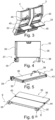
- Fig. 4 shows the upright position of the table top 33 with the plate components 35 and 36 lying flat against each other the plate component 35 is articulated to the structural component 7 via the joint arrangement 37.
- the joint arrangement 37 includes a damping device 40.
- the damping device 40 is preferably provided in exactly one fitting of the two fittings 38 or 39 or is integrated in both fittings 38 and 39.
- a friction element 41 and a damping element 42 which interacts with the friction element 41 and which come into contact with one another when the table top 33 or the table top component 35 rotates about the table top rotation axis S and thus result in a movement damping of the pivoting movement the table top 33 or the plate component 35 leads.
- the damping or braking effect preferably begins after the plate component 35 has been pivoted from the upright position after approximately 45 degrees. This corresponds to an undamped first pivoting range and a damped subsequent or second pivoting range of approximately 50% with a total pivoting range of the table top 33 or the plate component 35 of approximately 90 degrees.
- the plate component 36 is articulated to the plate component 35 via further joints 43 and 44.
- a damping device is provided in each of the two joints 43 and 44 to dampen the pivoting movement of the plate component 36 relative to the plate component 35.
Landscapes
- Engineering & Computer Science (AREA)
- Aviation & Aerospace Engineering (AREA)
- Transportation (AREA)
- Mechanical Engineering (AREA)
- Passenger Equipment (AREA)
Description
- Für die Innen-Ausstattung von Kabinen von Passagierflugzeugen sind Fluggastsitze in mehreren Sitzreihen mit üblicherweise jeweils mehreren Fluggastsitzen in einer Vielzahl von Ausgestaltungen bekannt. In der Regel sind pro Sitzreihe zwei oder mehr Fluggastsitze fluchtend nebeneinander im Flugzeug aufgestellt. Zum bequemen Sitzen weist ein vom Fluggastsitz gebildeter Sitzplatz Polsterungen mit einer Sitzboden-Polsterung und einer Rückenlehnen-Polsterung auf. Außerdem sind verstellbare Zusatzfunktionen am Fluggastsitz realisiert wie eine klappbare Tischplatte.
- Bei der Konzeption eines Fluggastsitzes ist zu beachten, dass auf engstem Raum ein hoher Nutz- und Bedienkomfort gegeben ist. Zum Stand der Technik werden die
WO 2012/118096 A1 ,
US 2015/0267757 A1 ,FR 2999394 A1 EP 3594067 A1 genannt - Aufgabe der vorliegenden Erfindung ist es, einen verbesserten Fluggastsitz bereitzustellen, welcher insbesondere im Hinblick auf den Nutz- und Bedienkomfort vorteilhaft ist.
- Diese Aufgabe wird durch die Merkmale der Ansprüche 1 und 12 gelöst.
- Weiterbildungen der Erfindung sind in den abhängigen Ansprüchen dargelegt.
- Die Erfindung geht aus von einem Fluggastsitz umfassend ein Strukturbauteil, an welchem eine Tischplatte des Fluggastsitzes über eine Gelenkanordnung um eine Schwenkachse der Gelenkanordnung schwenkbar aufgenommen ist, so dass die Tischplatte aus einer an dem Strukturbauteil herangeklappten Aufrecht-Stellung der Tischplatte in eine an dem Strukturbauteil vorstehende Nutzstellung der Tischplatte und zurück aus der Nutzstellung in die Aufrecht-Stellung schwenkbar ist.
- Das Strukturbauteil, zum Beispiel bzw. vorzugsweise eine rückwärtige Umhausung des Fluggastsitzes bzw. einer Sitzreihe, ist im in einer Flugkabine eingebauten Zustand des Fluggastsitzes ein aufrecht ausgerichtetes Sitzbauteil vorzugsweise feststehend bzw. unbeweglich bzw. stationär im Fluggastraum bzw. in der Flugkabine des Passagierflugzeuges auf der Bodenfläche vorhanden. Das zum Beispiel schalenförmige bzw. vorzugsweise Flächenabschnitte aufweisende Strukturbauteil erstreckt sich vorzugsweise auf eine Sitzrichtung des Fluggastsitzes bezogen hinter einer Rückenlehne des Fluggastsitzes und deckt diese rückseitig seitlich und gegebenenfalls oberhalb ab. Eine Rückseite des Strukturbauteils, an welcher die Tischplatte vorzugsweise aufgenommen ist, zum Beispiel in einem vertieften Bereich des Strukturbauteils, ist demgemäß der dahinter vorhandenen Sitzreihe bzw. deren Fluggastsitzen zugewandt. Die Tischplatte ist damit von einer Person nutzbar, die in einem Fluggastsitz sitzt, der hinter dem erfindungsgemäßen Fluggastsitz zu einer dort vorhandenen Sitzreihe gehört.
- Der Kern der Erfindung liegt darin, dass die Gelenkanordnung eine Dämpfungsvorrichtung umfasst, welche zur Bewegungsdämpfung der Schwenkbewegung der Tischplatte zwischen der Aufrecht-Stellung der Tischplatte und der Nutzstellung der Tischplatte ausgebildet ist. Die Dämpfungsvorrichtung dient zum Dämpfen bzw. zum Abbremsen der Schwenk- bzw. Herunterklapp-Bewegung der Tischplatte. Die Dämpfungsvorrichtung ist zum Beispiel als Reibdämpfer mit einem Reibelement und/oder als Bremsvorrichtung bzw. als Drehdämpfer ausgebildet.
- Dies erhöht den Nutzkomfort des Fluggastsitzes für einen Fluggast, der die Tischplatte nutzt. Ein unerwünschtes Aufschlagen der Tischplatte an einem Anschlag der Gelenkanordnung beim Erreichen der Nutzstellung wird vermieden.
- Mit der Dämpfungsvorrichtung wird vorzugsweise zumindest auf einem Abschnitt der Schwenkbewegung aus der hochgeklappten Aufrecht-Stellung der Tischplatte in die horizontal ausgerichtete Nutzstellung die Bewegungsdämpfung der Schwenkbewegung bereitgestellt. Die hochgeklappte Aufrecht-Stellung der Tischplatte bedeutet eine an dem Strukturbauteil versenkte bzw. ohne Störkontur herangeschwenkte Stellung, die gesichert ist. Die Tischplatte steht dabei nicht in einen freien Nutzraum hinter dem Strukturbauteil hinein, der zwischen zwei Sitzreihen vorhanden ist. Die hochgeklappte Tischplatte ist vorzugsweise bündig versenkt zu einer Rückseite des Strukturbauteils bzw. in einer Vertiefung, die tiefer liegt als benachbarten Bereich der Rückseite des Strukturbauteils. Die Tiefe der Vertiefung entspricht vorzugsweise in etwa einer Dickenabmessung der Tischplatte.
- Die Gelenkanordnung ist zwischen der Tischplatte und dem Strukturbauteil vorhanden bzw. wirksam, zum Beispiel als eine Gelenkanordnung bzw. als ein Beschlag mit zum Beispiel zwei identisch wirkenden Beschlagteilen zum Verschwenken um eine Horizontale um circa 90 Winkelgrade. Die Tischplatte des Fluggastsitzes ist rückseitig an dem Strukturbauteil in der herabgeklappten insbesondere horizontal ausgerichteten Stellung nutzbar für eine Person, die hinter dem Fluggastsitz in einem weiteren Fluggastsitz sitzt. Ein Beschlag weist vorzugsweise zwei relativ zueinander drehbare bzw. miteinander drehbar verbundene Gelenkteile auf.
- Das Strukturbauteil weist beispielsweise horizontal beabstandete und gegenüberliegende und vertikal ausgerichtete Randabschnitte und einen dazwischen vorgesehenen vertikalen Flachabschnitt auf, an dem die Tischplatte durch Heranklappen nach oben in einer Vertiefung versenkbar ist. Die Tischplatte ist dann oberhalb der Gelenkanordnung aufrecht bzw. z. B. senkrecht oder leicht geneigt ausgerichtet angeklappt positioniert.
- Am Strukturbauteil ist die Tischplatte nach einem Aufheben einer Sicherung bzw. eines Haltemechanismus zum Halten der hochgeklappten Tischplatte, aus der aufrechten Nicht-Nutzungsstellung in die nach hinten vorstehende Nutzstellung herabklappbar mit der Gelenkanordnung.
- Die Dämpfungsvorrichtung ist vorzugsweise abgestimmt auf das Gesamtgewicht der Tischplatte, so dass diese kontrolliert bzw. gleichmäßig und gedämpft in die Nutzstellung schwenkbar ist.
- Vorzugsweise wirkt die Dämpfungsvorrichtung nur beim Herunterklappen aus der Aufrecht-Stellung in die Nutzstellung, jedoch nicht oder nur unmerklich beim Hochklappen aus der Nutzstellung zurück in die Aufrecht-Stellung, zum Beispiel mit einem Freilauf.
- Von Vorteil ist es, wenn im montierten Zustand der Tischplatte an dem Fluggastsitz die Dämpfungsvorrichtung in einem nach außen getrennten Innenbereich der Gelenkanordnung derart untergebracht vorhanden ist, dass die Dämpfungsvorrichtung an der Gelenkanordnung von außen nicht sichtbar ist.
- Dies ist zum Beispiel aus optischen Gründen vorteilhaft. Vorzugsweise ist die Gelenkanordnung von einer Außenseite bzw. von Außenabschnitten der Gelenkanordnung verdeckt bzw. daher nicht sichtbar. Die Verdeckung ist vorteilhaft in sämtlichen Schwenkstellungen der Tischplatte gegeben.
- Weiter ist die Dämpfungsvorrichtung derart abgestimmt, dass die Bewegungsdämpfung der Schwenkbewegung der Tischplatte über einen Teil-Schwenkbereich eines möglichen Gesamt-Schwenkbereichs der Schwenkbewegung der Tischplatte erfolgt, wobei der Gesamt-Schwenkbereich den Schwenkbereich abdeckt, über welchen die Tischplatte aus der Aufrecht-Stellung in die Nutzstellung verschwenkt. Vorzugsweise ist die Dämpfungsvorrichtung so ausgebildet, dass nach einem nicht gedämpften ersten Schwenkbereich beim nach unten Verschwenken der Tischplatte aus der Aufrecht-Stellung in die Nutzstellung, wobei der nicht gedämpfte Schwenkbereich circa einem Schwenkbereich von 45 Winkelgraden entspricht, die Dämpfungs- bzw. Abbremswirkung einsetzt bzw. beginnt und anhält bis zum Ende der Schwenkbewegung mit Erreichen der Nutzstellung der Tischplatte.
- Die erfindungsgemäße Anordnung verkürzt die Gesamtdauer der teils ungedämpften und teils gedämpften Schwenkbewegung aus der hochgeklappten Aufrecht-Stellung in die Nutzstellung der Tischplatte auf ein tolerierbares bzw. minimales Zeitmaß. Vorteilhafterweise ist die Dämpfungsvorrichtung derart abgestimmt, dass die Bewegungsdämpfung der Schwenkbewegung der Tischplatte über einen Teil-Schwenkbereich der Schwenkbewegung der Tischplatte erfolgt, wobei der gedämpfte Teil-Schwenkbereich die Schwenkbewegung der Tischplatte vor Erreichen der Nutzstellung der Tischplatte betrifft.
- Vorzugsweise wird beim Abklappen der Tischplatte nach unten die Tischplatte auf einem letzten bzw. unteren Teil-Schwenkbereich vor Erreichen der ruhenden Nutzstellung in der z. B. Horizontalen gedämpft von der Dämpfungsvorrichtung. Eine kurzzeitige mechanische Anschlagbelastung der Gelenkanordnung mit Erreichen der End- bzw. Nutzstellung wird durch das Dämpfen bzw. Abbremsen der Tischplatte vor Erreichen der Nutzstellung sichergestellt. Dies erhöht die Lebensdauer der Gelenkanordnung bzw. beugt Beschädigungen der Gelenkanordnung vor. Darüber hinaus werden Aufschlaggeräusche vermieden.
- Überdies ist es vorteilhaft, dass die Dämpfungsvorrichtung derart abgestimmt ist, dass die Bewegungsdämpfung der Schwenkbewegung der Tischplatte über einen Teil-Schwenkbereich der Schwenkbewegung der Tischplatte erfolgt, wobei der Teil-Schwenkbereich einen Schwenkbereich abdeckt, welcher mindestens 50 % des Gesamt-Schwenkbereichs der Schwenkbewegung der Tischplatte beträgt, über welchen die Tischplatte aus der Aufrecht-Stellung der Tischplatte in die Nutzstellung der Tischplatte verschwenkt. Damit wird eine Schwenkgeschwindigkeit der Tischplatte auf ein akzeptables Maß begrenzt.
- Vorzugsweise beträgt der gedämpfte Teil-Schwenkbereich mindestens 40 %, vorzugsweise mindestens 30 %, vorzugsweise mindestens 20 % des Gesamt-Schwenkbereichs der Schwenkbewegung der Tischplatte zwischen der Aufrecht-Stellung und der Nutzstellung der Tischplatte.
- Nach einer Abwandlung der Erfindung liegt ein Vorteil darin, dass die Dämpfungsvorrichtung derart abgestimmt ist, dass die Bewegungsdämpfung der Schwenkbewegung der Tischplatte über einen Teil-Schwenkbereich eines möglichen Gesamt-Schwenkbereichs der Schwenkbewegung der Tischplatte erfolgt, wobei der Gesamt-Schwenkbereich den Schwenkbereich abdeckt, über welchen die Tischplatte aus der Aufrecht-Stellung in die Nutzstellung verschwenkt, wobei der gedämpfte Teil-Schwenkbereich die Schwenkbewegung der Tischplatte mindestens 30 Winkelgrade, vorzugsweise mindestens 40 Winkelgrade, vorzugsweise mindestens 50 Winkelgrade der Schwenkbewegung der Tischplatte beträgt.
- Damit kann gezielt ein Teil-Schwenkbereich vorgegeben werden, der gedämpft erfolgt, im Unterschied zu einem nicht gedämpften und damit schneller überbrückbaren Schwenkbereich der Tischplatte. Der gedämpfte Schwenkbereich ist vorzugsweise der Schwenkbereich, der sich vor Erreichen der Nutzstellung beim Herunterklappen aus der Aufrecht-Stellung der Tischplatte ergibt.
- Vorteilhafterweise ist die Tischplatte an einer Wange des Strukturbauteils mit der Gelenkanordnung verbunden, vorzugsweise mit zwei Gelenkanordnungen an gegenüberliegenden Wangen des Strukturbauteils angelenkt. Die gegenüberliegenden beiden Wangen an dem Fluggastsitz bilden nach hinten vorstehende, horizontal beabstandete bzw. gegenüberliegende voneinander getrennte Abschnitte am Strukturbauteil wie der Umhausung. Die Wangen begrenzen zum Beispiel die Vertiefung auf der Rückseite des Fluggastsitzes in welcher die hochgeklappte Tischplatte sich in der Aufrecht-Stellung versenkt untergebracht befindet.
- Gemäß einer vorteilhaften Modifikation umfasst die Gelenkanordnung im Bereich der Schwenkachse ein erstes Gelenkteil und ein zweites Gelenkteil, die relativ zueinander drehbar miteinander verbunden sind, wobei das erste Gelenkteil mit der Tischplatte verbunden ist und das zweite Gelenkteil mit dem Strukturbauteil verbunden ist, wobei ein Lagerzapfen an einem Gelenkteil in eine auf den Lagerzapfen abgestimmte Lageraufnahme an dem anderen Gelenkteil eingreift.
- Dies ermöglicht eine kompakte und stabile Gelenkanordnung. Die Gelenkanordnung ist zudem einfach herstellbar und unkompliziert zusammenbaubar. Der Lagerzapfen und die Lageraufnahme bilden vorzugsweise Reibpartner einer als Reibungs-Dämpfungsvorrichtung ausgestalteten Dämpfungsvorrichtung.
- Ein Vorteil leitet sich daraus ab, dass die Dämpfungsvorrichtung ein Reibdämpferorgan aufweist, das zwischen einem ersten Gelenkteil der Gelenkanordnung und einem zweiten Gelenkteil der Gelenkanordnung vorhanden ist, wobei mit dem Reibdämpferorgan eine Reibwirkung bei einer Relativbewegung zwischen dem ersten Gelenkteil und dem zweiten Gelenkteil bereitgestellt ist.
- Dies ist hinsichtlich einer einfachen und zuverlässigen Dämpfungsvorrichtung vorteilhaft. Das Reibdämpferorgan umfasst vorteilhaft z. B. ein elastisches Reibungsorgan aus z. B. einem Elastomer- bzw. Gummi-Material.
- Außerdem kann ein Reibungsdämpferorgan einfach und schnell ausgetauscht werden.
- Alternativ kann das Reibungsdämpferorgan an einem Gelenkteil oder an beiden Gelenkteilen zum Beispiel integral vorhanden sein.
- Vorteilhaft umfasst die Dämpfungsvorrichtung einen fluiddynamischen Dämpfer. Damit kann eine zuverlässige und gleichmäßig wirkende Dämpfung ermöglicht werden.
- Der fluiddynamischen Dämpfer ist vorzugsweise ein Fluiddämpfer wie z. B. ein Viskose-, Öl- oder Luftdämpfer zum Beispiel in der Art eines Viskose- oder Öldämpfers oder einer Gasdruckfeder.
- Weiter ist es vorteilhaft, dass die Dämpfungsvorrichtung Einstellmittel zur Einstellung der mit der Dämpfungsvorrichtung bereitstellbaren Dämpfwirkung aufweist. Damit kann die Dämpfwirkung angepasst werden an unterschiedliche Dämpfcharakteristika und/oder an jeweils unterschiedlich große zu dämpfende Massen. Mit den Einstellmitteln kann zum Beispiel eine Anpassung an eine mit der Dämpfungsvorrichtung tatsächlich beaufschlagte Masse erfolgen bzw. an unterschiedlich schwere Tischplatten, die je nach Tischplattenmaterial eine andere Masse aufweisen. Bei einer vergleichsweise höheren Masse der Tischplatte kann die Dämpfwirkung entsprechend erhöht werden gegenüber einer Einstellung für eine Dämpfung der Schwenkbewegung für eine geringere Masse der Tischplatte.
- Von Vorteil ist es, wenn an der Tischplatte eine gelenkig verbundene Zusatzplatte vorhanden ist, wobei die Zusatzplatte an der Tischplatte gelenkig aufgenommen ist, wobei eine weitere Dämpfungsvorrichtung für die Bewegungsdämpfung der Schwenkbewegung der Zusatzplatte relativ zur Tischplatte ausgebildet ist. Mit der Zusatzplatte kann platzsparend eine Flächenvergrößerung der gesamten nutzbaren Fläche des Tisches umfassend die Tischplatte und die Zusatzplatte durch die zur Tischplatte weitere bzw. zweite Platte bzw. Zusatzplatte erreicht werden. Die Zusatzplatte ist demgemäß aus einer auf der Tischplatte aufgelegten und zu dieser parallelen Position in eine mit der Tischplatte fluchtenden Position um 180 Winkelgrade verschwenkt. Bei der mit der Tischplatte gelenkig verbundenen Zusatzplatte kann durch die weitere Dämpfungsvorrichtung auch die Schwenkbewegung der Zusatzplatte relativ zur Tischplatte vorteilhaft gedämpft erfolgen.
- Die Erfindung erstreckt sich vorteilhaft auf eine Sitzreihe umfassend mehrere nebeneinander vorhandene Fluggastsitze gemäß einem der vorhergehend beschriebenen Ausgestaltungen. Damit lassen sich an einer Sitzreihe mit den Fluggastsitzen die diskutierten Vorteil erzielen. In aller Regel ist an jedem einzelnen Fluggastsitz rückseitig eine Tischplatte für eine Person vorhanden, welche hinter dem betreffenden Fluggastsitz in einem weiteren Fluggastsitz der dahinter vorhandenen Sitzreihe sitzt.
- Nachfolgend sind weitere Merkmale und Vorteile der Erfindung anhand eines schematisch dargestellten Ausführungsbeispiels näher erläutert.
- Im Einzelnen zeigt:
- Fig. 1
- in einer perspektivischen Ansicht schräg von vorne eine Sitzreihe mit zwei Fluggastsitzen jeweils umfassend einen Sitzboden, eine Rückenlehne samt rückseitigem Strukturbauteil und eine Beinauflage,
- Fig. 2
- die Sitzreihe gemäß
Figur 1 in einer perspektivischen Ansicht von schräg hinten, - Fig. 3
- einen Ausschnitt einer Sitzreihe mit zwei Fluggastsitzen von hinten gemäß
Fig. 2 mit zwei Tischplatten in Nutzstellung, - Fig. 4
- eine der Tischplatten gemäß
Fig. 3 in einer Aufrecht-Stellung mit Gelenkanordnung, umfassend eine Zusatzplatte in Alleindarstellung, - Fig. 5
- die Anordnung gemäß
Fig. 4 in einer Nutzstellung der Tischplatte, - Fig. 6
- die Tischplatte gemäß
Fig. 5 in einer aufgeklappten Stellung der Zusatzplatte in perspektivischer Ansicht, - Fig. 7
- die Schnittdarstellung gemäß Linie A-A in
Fig. 4 und - Fig. 8
- die Schnittdarstellung gemäß Linie B-B in
Fig. 5 . -
Figur 1 zeigt eine Sitzreihe 1 mit einer Sitzrichtung 2 mit zwei Fluggastsitzen 3 und 4. Nachfolgend beziehen sich Positions- und Richtungsangaben wie vorne, hinten, oben und unten auf die Sitzrichtung 2 und den Nutzzustand der Sitzreihe 1. - Beide Fluggastsitze 3 und 4 sind entsprechend aufgebaut. Der Fluggastsitz 3 weist einen Sitzboden 5, eine Rückenlehne 6 und ein zur Rückenlehne 6 rückseitiges Strukturbauteil 7 auf, das z. B. als Umhausung ausgebildet ist. Im Anschluss an einen vorne liegenden Endbereich des Sitzbodens 5 ist eine vorzugsweise klappbare Beinauflage 8 vorhanden, die um eine horizontale Achse klappbar ist.
- Dementsprechend umfasst der Fluggastsitz 4 einen Sitzboden 9, eine Rückenlehne 10, ein Strukturbauteil 11 bzw. eine Umhausung und eine Beinauflage 12.
- Die Sitzboden 5, 9, die Rückenlehnen 6, 10 und die Beinauflagen 8, 12 umfassen eine vorzugsweise ergonomisch geformte Polsterung.
- Die Fluggastsitze 3 und 4 sind über zwei Stützbeine 13 und 14 an einem Kabinenboden einer Flugkabine eines dazugehörigen Flugzeuges montierbar.
- Das Stützbein 13 weist hierfür an einem unteren Endbereich 16 einer vorderen Strebe 15 eine Montagestelle 17 und eine weitere Montagestelle 20 an einem unteren Endbereich 19 einer hinteren Strebe 18 auf. Zwischen den Endbereichen 16 und 19 ist ein Verstrebungselement 21 vorgesehen.
- Das Stützbein 14 weist an einem unteren Endbereich 23 einer vorderen Strebe 22 eine Montagestelle 24 und eine weitere Montagestelle 27 an einem unteren Endbereich 26 einer hinteren Strebe 25 auf. Zwischen den Endbereichen 23 und 26 ist ein Verstrebungselement 28 vorgesehen.
- Die Sitzreihe 1 weist zudem eine äußere Armlehne 29 seitlich am Fluggastsitz 3 und eine äußere Armlehne 30 seitlich am Fluggastsitz 4 auf. Zwischen den beiden Fluggastsitzen 3 und 4 ist vorzugsweise auf Höhe der beiden äußeren Armlehnen 29 und 30 eine Konsole 31 vorhanden, welche von einem Fluggast ebenfalls als Armauflage genutzt werden kann.
- Die Strukturbauteile 7 und 11 sind mit weiteren Elementen versehen, z. B. rückseitig jeweils mit Zusatzfunktionen versehen. In einem oberen rückseitigen Bereich der Strukturbauteile 7, 11 ist beispielsweise jeweils eine Multimedia-Einheit 32 für digitale Medien vorgesehen, zum Beispiel mit einem elektronischen Ein- und Ausgabegerät bzw. mit einem Touchscreen.
- In einem unterhalb an die Multimedia-Einheit 32 anschließenden bzw. mittleren Bereich ist zum Beispiel jeweils eine klappbare Tischplatte 33 für den jeweiligen Fluggastsitz 3 und 4 wie ein Tablett-Tisch ausgebildet.
- In
Fig. 2 sind die Tischplatten 33 in einer nach oben herangeklappten, vertikal stehenden und gesicherten Nichtnutzungs-Stellung bzw. Aufrecht-Stellung dargestellt. - Unterhalb der jeweiligen klappbaren Tischplatte 33 ist ein Staufach 34 beispielswiese zur Unterbringung von Zeitschriften bzw. Prospekten oder anderen Gegenständen vorhanden.
- Nachfolgend wird die Tischplatte 33 mit Bezug auf den Fluggastsitz 3 näher erläutert, wobei die Tischplatte 33 am Fluggastsitz 4 identisch aufgebaut ist.
- Die Tischplatte 33 mit einer außenseitig vorhandene flächige Überdeckung 33a wie zum Beispiel ein dünnes Abdeckelement, umfasst zwei gelenkig verbundene Plattenbauteile mit einem ersten Plattenbauteil 35 und einem zweiten Plattenbauteil 36, das als Zusatzplatte ausgebildet ist. Zur klappbaren Anordnung der Tischplatte 33 an dem Strukturbauteil 7 bzw. an gegenüberliegenden Wangen 45 ist eine Gelenkanordnung 37 vorgesehen, welche einen Beschlag38 und einen weiteren Beschlag 39 umfasst. Die Gelenkanordnung 37 wirkt zwischen dem Plattenbauteil 35 und dem Strukturbauteil 7.
- Gemäß
Fig. 3 sind die Tischplatten 33 mit der jeweiligen Zusatzplatte bzw. dem Plattenbauteil 36 in einer gegenüberFig. 2 herabgeklappten Nutzstellung dargestellt. Das Plattenbauteil 36 ist angeklappt oberhalb des Plattenbauteils 35 auf diesem aufliegend vorhanden. - Die Tischplatte 33 mit der Gelenkanordnung 37 bzw. den Beschlägen 38 und 39 ist in
Fig. 4 in Alleindarstellung gezeigt.Fig. 4 zeigt die Aufrecht-Stellung der Tischplatte 33 mit den aneinander flächig anliegenden Plattenbauteilen 35 und 36. Dabei ist das Plattenbauteil 35 über die Gelenkanordnung 37 gelenkig an dem Strukturbauteil 7 vorhanden. - Die Gelenkanordnung 37 umfasst eine Dämpfungsvorrichtung 40. Vorzugsweise ist die Dämpfungsvorrichtung 40 in genau einem Beschlag der beiden Beschläge 38 oder 39 vorgesehen oder in beiden Beschlägen 38 und 39 integriert.
- Anhand dem Beschlag 38 ist in den Schnittansichten gemäß der
Fig. 7 und 8 die Dämpfungsvorrichtung 40 erläutert. - An bzw. auf einer Tischplattendrehachse S ist ein Reibungselement 41 und ein mit dem Reibungselement 41 zusammenwirkendes Dämpfungselement 42 vorhanden, die bei einer Drehung der Tischplatte 33 bzw. des Plattenbauteils 35 um die Tischplattendrehachse S aneinander reibend in Anlage gelangen und so zu einer Bewegungsdämpfung der Schwenkbewegung der Tischplatte 33 bzw. des Plattenbauteils 35 führt. Die Dämpf- bzw. Bremswirkung beginnt vorzugsweise nach einem Verschwenken des Plattenbauteils 35 aus der Aufrecht-Stellung nach circa 45 Winkelgraden. Dies entspricht einem ungedämpften ersten Schwenkbereich und einem gedämpften anschließenden bzw. zweiten Schwenkbereich von etwa 50 % bei einem Gesamtschwenkbereich der Tischplatte 33 bzw. des Plattenbauteils 35 von circa 90 Winkelgraden.
- Das Plattenbauteil 36 ist über weitere Gelenke 43 und 44 mit dem Plattenbauteil 35 gelenkig verbunden. Vorzugsweise ist jeweils eine Dämpfungsvorrichtung in den beiden Gelenke 43 und 44 vorgesehen zur Bewegungsdämpfung der Schwenkbewegung des Plattenbauteils 36 gegenüber dem Plattenbauteil 35.
-
- 1
- Sitzreihe
- 2
- Sitzrichtung
- 3
- Fluggastsitz
- 4
- Fluggastsitz
- 5
- Sitzboden
- 6
- Rückenlehne
- 7
- Strukturbauteil
- 8
- Beinauflage
- 9
- Sitzboden
- 10
- Rückenlehne
- 11
- Strukturbauteil
- 12
- Beinauflage
- 13
- Stützbein
- 14
- Stützbein
- 15
- Strebe
- 16
- Endbereich
- 17
- Montagestelle
- 18
- Strebe
- 19
- Endbereich
- 20
- Montagestelle
- 21
- Verstrebungselement
- 22
- Strebe
- 23
- Endbereich
- 24
- Montagestelle
- 25
- Strebe
- 26
- Endbereich
- 27
- Montagestelle
- 28
- Verstrebungselement
- 29
- Armlehne
- 30
- Armlehne
- 31
- Konsole
- 32
- Multimedia-Einheit
- 33
- Tischplatte
- 33a
- Überdeckung
- 34
- Staufach
- 35
- Plattenbauteil
- 36
- Plattenbauteil
- 37
- Gelenkanordnung
- 38
- Beschlag
- 39
- Beschlag
- 40
- Dämpfungsvorrichtung
- 41
- Reibungselement
- 42
- Dämpfungselement
- 43
- Gelenk
- 44
- Gelenk
- 45
- Wange
Claims (12)
- Fluggastsitz (3, 4) umfassend ein Strukturbauteil (7, 11), an welchem eine Tischplatte (33) des Fluggastsitzes (3, 4) über eine Gelenkanordnung (37) um eine Schwenkachse der Gelenkanordnung (37) schwenkbar aufgenommen ist, so dass die Tischplatte (33) aus einer an dem Strukturbauteil (7, 11) herangeklappten Aufrecht-Stellung der Tischplatte (33) in eine an dem Strukturbauteil (7, 11) vorstehende Nutzstellung der Tischplatte (33) und zurück aus der Nutzstellung in die Aufrecht-Stellung schwenkbar ist, wobei die Gelenkanordnung (37) eine Dämpfungsvorrichtung (40) umfasst, welche zur Bewegungsdämpfung der Schwenkbewegung der Tischplatte (33) zwischen der Aufrecht-Stellung der Tischplatte (33) und der Nutzstellung der Tischplatte (33) ausgebildet ist, dadurch gekennzeichnet, dass die Dämpfungsvorrichtung (40) derart abgestimmt ist, dass die Bewegungsdämpfung der Schwenkbewegung der Tischplatte (33) über einen Teil-Schwenkbereich eines möglichen Gesamt-Schwenkbereichs der Schwenkbewegung der Tischplatte (33) erfolgt, wobei der Gesamt-Schwenkbereich den Schwenkbereich abdeckt, über welchen die Tischplatte (33) aus der Aufrecht-Stellung in die Nutzstellung verschwenkt.
- Fluggastsitz nach Anspruch 1, dadurch gekennzeichnet, dass im montierten Zustand der Tischplatte (33) an dem Fluggastsitz (3, 4) die Dämpfungsvorrichtung (40) in einem nach außen getrennten Innenbereich der Gelenkanordnung (37) derart untergebracht vorhanden ist, dass die Dämpfungsvorrichtung (40) an der Gelenkanordnung (37) von außen nicht sichtbar ist.
- Fluggastsitz nach einem der vorhergehenden Ansprüche, dadurch gekennzeichnet, dass der gedämpfte Teil-Schwenkbereich die Schwenkbewegung der Tischplatte (33) vor Erreichen der Nutzstellung der Tischplatte (33) betrifft.
- Fluggastsitz nach einem der vorhergehenden Ansprüche, dadurch gekennzeichnet, dass der Teil-Schwenkbereich einen Schwenkbereich abdeckt, welcher mindestens 50 % des Gesamt-Schwenkbereichs der Schwenkbewegung der Tischplatte (33) beträgt, über welchen die Tischplatte (33) aus der Aufrecht-Stellung der Tischplatte (33) in die Nutzstellung der Tischplatte (33) verschwenkt.
- Fluggastsitz nach einem der vorhergehenden Ansprüche, dadurch gekennzeichnet, dass der gedämpfte Teil-Schwenkbereich die Schwenkbewegung der Tischplatte (33) mindestens 30 Winkelgrade, vorzugsweise mindestens 40 Winkelgrade, vorzugsweise mindestens 50 Winkelgrade der Schwenkbewegung der Tischplatte (33) beträgt.
- Fluggastsitz nach einem der vorhergehenden Ansprüche, dadurch gekennzeichnet, dass die Tischplatte (33) an einer Wange (45) des Strukturbauteils (7, 11) mit der Gelenkanordnung (37) verbunden ist, vorzugsweise mit zwei Beschlägen (38, 39) der Gelenkanordnung (37) an gegenüberliegenden Wangen (45) des Strukturbauteils (7, 11) angelenkt ist.
- Fluggastsitz nach einem der vorhergehenden Ansprüche, dadurch gekennzeichnet, dass die Gelenkanordnung (37) im Bereich der Schwenkachse ein erstes Gelenkteil und ein zweites Gelenkteil umfasst, die relativ zueinander drehbar miteinander verbunden sind, wobei das erste Gelenkteil mit der Tischplatte (33) verbunden ist und das zweite Gelenkteil mit dem Strukturbauteil (7, 11) verbunden ist, wobei ein Lagerzapfen an einem Gelenkteil in eine auf den Lagerzapfen abgestimmte Lageraufnahme an dem anderen Gelenkteil eingreift.
- Fluggastsitz nach einem der vorhergehenden Ansprüche, dadurch gekennzeichnet, dass die Dämpfungsvorrichtung (40) ein Reibdämpferorgan wie ein Reibungselement (41) aufweist, das zwischen einem ersten Gelenkteil der Gelenkanordnung (37) und einem zweiten Gelenkteil der Gelenkanordnung (37) vorhanden ist, wobei mit dem Reibdämpferorgan eine Reibwirkung bei einer Relativbewegung zwischen dem ersten Gelenkteil und dem zweiten Gelenkteil bereitgestellt ist.
- Fluggastsitz nach einem der vorhergehenden Ansprüche, dadurch gekennzeichnet, dass die Dämpfungsvorrichtung einen fluiddynamischen Dämpfer umfasst.
- Fluggastsitz nach einem der vorhergehenden Ansprüche, dadurch gekennzeichnet, dass die Dämpfungsvorrichtung (40) Einstellmittel zur Einstellung der mit der Dämpfungsvorrichtung bereitstellbaren Dämpfwirkung aufweist.
- Fluggastsitz nach einem der vorhergehenden Ansprüche, dadurch gekennzeichnet, dass an einem Plattenbauteil (35) der Tischplatte (33) ein gelenkig verbundenes Plattenbauteil (36) vorhanden ist, wobei das Plattenbauteil (36) an dem Plattenbauteil (35) gelenkig aufgenommen ist, wobei eine weitere Dämpfungsvorrichtung für die Bewegungsdämpfung der Schwenkbewegung des Plattenbauteils (36) relativ zum Plattenbauteil (35) ausgebildet ist.
- Sitzreihe (1) umfassend mehrere nebeneinander vorhandene Fluggastsitze (3, 4) gemäß einem der vorhergehenden Ansprüche.
Applications Claiming Priority (2)
| Application Number | Priority Date | Filing Date | Title |
|---|---|---|---|
| DE102020106029.7A DE102020106029A1 (de) | 2020-03-05 | 2020-03-05 | Fluggastsitz und Sitzreihe |
| PCT/EP2021/055457 WO2021175988A1 (de) | 2020-03-05 | 2021-03-04 | Fluggastsitz und sitzreihe |
Publications (2)
| Publication Number | Publication Date |
|---|---|
| EP4114734A1 EP4114734A1 (de) | 2023-01-11 |
| EP4114734B1 true EP4114734B1 (de) | 2024-01-31 |
Family
ID=75203255
Family Applications (1)
| Application Number | Title | Priority Date | Filing Date |
|---|---|---|---|
| EP21714099.5A Active EP4114734B1 (de) | 2020-03-05 | 2021-03-04 | Fluggastsitz und sitzreihe |
Country Status (5)
| Country | Link |
|---|---|
| US (1) | US11780588B2 (de) |
| EP (1) | EP4114734B1 (de) |
| CN (1) | CN115210141B (de) |
| DE (1) | DE102020106029A1 (de) |
| WO (1) | WO2021175988A1 (de) |
Families Citing this family (4)
| Publication number | Priority date | Publication date | Assignee | Title |
|---|---|---|---|---|
| WO2024181977A1 (en) * | 2023-03-01 | 2024-09-06 | Safran Seats US LLC | Soft-opening tray table for vehicle passenger seats |
| IT202300006606A1 (it) * | 2023-04-04 | 2024-10-04 | Goood S R L | Parete per schienali di sedute per aerei |
| US12565318B2 (en) * | 2024-01-25 | 2026-03-03 | B/E Aerospace, Inc. | Passenger seating unit with half shell surround |
| CN119261715A (zh) * | 2024-10-22 | 2025-01-07 | 中国船舶集团有限公司第七〇七研究所 | 一种特种作业车辆车载折叠桌装置 |
Family Cites Families (31)
| Publication number | Priority date | Publication date | Assignee | Title |
|---|---|---|---|---|
| CA2165504C (en) * | 1995-01-13 | 1999-09-28 | Stephen J. Bauman | Tablet assembly for a seating system |
| US5765911A (en) * | 1996-03-12 | 1998-06-16 | Sorenson; Thomas | Adjustable positioned system for chair-mounted tables |
| US6220658B1 (en) * | 1998-10-16 | 2001-04-24 | Johnson Controls Technology Company | Retractable tray table |
| US6761398B2 (en) * | 2001-05-25 | 2004-07-13 | Weber Aircraft Lp | Stowable tables |
| US6601523B2 (en) * | 2001-12-12 | 2003-08-05 | The Boeing Company | Easy cleanable food tray |
| US7004430B2 (en) * | 2002-06-12 | 2006-02-28 | Weekly Roy L | Threat-resistant aircraft tray |
| US7500716B2 (en) * | 2002-06-14 | 2009-03-10 | The Boeing Company | Multi-function tray table |
| ES1056004Y (es) * | 2003-11-05 | 2004-06-01 | Figueras Int Seating Sa | Articulacion de pala de atril en butacas. |
| US7798072B2 (en) * | 2005-03-31 | 2010-09-21 | Becker Automotive Design, Inc. | Stowable table assembly with a tabletop locking mechanism |
| US20080073946A1 (en) * | 2006-09-21 | 2008-03-27 | Kathie Maione | Adjusting mechanism for a chair mounted keyboard and mouse platform |
| FR2915960B1 (fr) * | 2007-05-11 | 2009-07-03 | Thales Sa | Siege equipe d'un ecran de visualisation escamotable |
| US8205563B2 (en) * | 2009-06-29 | 2012-06-26 | St. Louis Designs, Inc. | Aircraft table system with rolling sled member |
| JP5702190B2 (ja) * | 2011-03-03 | 2015-04-15 | 株式会社ニフコ | 座席用テーブルの支持構造 |
| US8997660B2 (en) * | 2012-03-23 | 2015-04-07 | Johnny A. Satterfield | Deployable table assembly |
| WO2014006422A2 (en) * | 2012-07-06 | 2014-01-09 | Paul Harkin | Adjustable structures |
| TW201410509A (zh) * | 2012-09-14 | 2014-03-16 | Superalloy Ind Co Ltd | 椅背餐桌裝置 |
| US8979190B2 (en) * | 2012-10-19 | 2015-03-17 | Demetrius Madrigal | Tray with armrest clamp |
| FR2999394B1 (fr) * | 2012-12-13 | 2015-08-07 | Ceit Entpr S | Table pliante a plusieurs tablettes repliables |
| CN106740348A (zh) * | 2013-04-04 | 2017-05-31 | B/E航空公司 | 能够平移运动的竖直收放的盘桌组件 |
| EP3024727A1 (de) | 2013-07-24 | 2016-06-01 | Zodiac Seats US LLC | Tabletttischanordnung |
| DE102013014226A1 (de) * | 2013-08-28 | 2015-03-05 | Zim Flugsitz Gmbh | "Fluggastsitz" |
| US9995336B2 (en) * | 2014-03-18 | 2018-06-12 | B/E Aerospace, Inc. | Friction bushing |
| US9937841B2 (en) * | 2014-03-18 | 2018-04-10 | B/E Aerospace, Inc. | Friction bushing |
| EP3303133B1 (de) | 2015-06-04 | 2019-02-20 | B/E Aerospace, Inc. | Entfaltbare rückenlehnenhalterung für tragbare elektronische vorrichtungen |
| WO2017147620A1 (en) | 2016-02-29 | 2017-08-31 | B/E Aerospace, Inc. | Tray table with adjustable media support surface |
| US10875652B2 (en) | 2017-04-03 | 2020-12-29 | Rockwell Collins, Inc. | Passenger tray table |
| US10172467B1 (en) * | 2017-11-02 | 2019-01-08 | Gauss Furniture Co., Ltd. | Pivotable top board device for a chair |
| US11305876B2 (en) | 2018-07-10 | 2022-04-19 | Rockwell Collins, Inc. | Aircraft cabin apparatus including personal electronic device holder |
| DE102019103813A1 (de) | 2019-02-14 | 2020-08-20 | Recaro Aircraft Seating Gmbh & Co. Kg | Flugzeugsitzvorrichtung |
| US11589679B2 (en) * | 2019-07-09 | 2023-02-28 | Toyota Motor North America, Inc. | Retractable storage devices |
| DE102020106031A1 (de) * | 2020-03-05 | 2021-09-09 | Zim Flugsitz Gmbh | Fluggastsitz und Sitzreihe |
-
2020
- 2020-03-05 DE DE102020106029.7A patent/DE102020106029A1/de not_active Withdrawn
-
2021
- 2021-03-04 CN CN202180017930.6A patent/CN115210141B/zh active Active
- 2021-03-04 WO PCT/EP2021/055457 patent/WO2021175988A1/de not_active Ceased
- 2021-03-04 EP EP21714099.5A patent/EP4114734B1/de active Active
-
2022
- 2022-08-24 US US17/821,899 patent/US11780588B2/en active Active
Also Published As
| Publication number | Publication date |
|---|---|
| CN115210141B (zh) | 2024-03-08 |
| WO2021175988A1 (de) | 2021-09-10 |
| US20220402613A1 (en) | 2022-12-22 |
| US11780588B2 (en) | 2023-10-10 |
| CN115210141A (zh) | 2022-10-18 |
| EP4114734A1 (de) | 2023-01-11 |
| DE102020106029A1 (de) | 2021-09-09 |
Similar Documents
| Publication | Publication Date | Title |
|---|---|---|
| EP4114734B1 (de) | Fluggastsitz und sitzreihe | |
| DE102008003649B4 (de) | Haltemechanismus für eine klappbare Kopfstütze | |
| EP1637451B1 (de) | Fahrzeugsitz, insbesondere Fluggastsitz | |
| EP0349762B1 (de) | Sitz, insbesondere für einen Flugbegleiter | |
| EP2052906B1 (de) | Sitz mit ausfahrbarem Tisch | |
| DE102007014656B4 (de) | Kissenplattenstruktur eines Beifahrersitzes eines Fahrzeuges | |
| DE69502220T2 (de) | Sitz mit umklappbarer Armlehne | |
| DE29619478U1 (de) | Fahrzeugsitzbank mit Mittelarmlehne und Kopfstütze | |
| DE3019040A1 (de) | Fahrzeugsitz | |
| DE10247131A1 (de) | Fahrzeugsitz | |
| DE102018114084A1 (de) | Sitzbaugruppe mit einer armlehne, die einen armlehnendeckel und eine gelenkanordnung aufweist | |
| DE19954930C1 (de) | Kraftfahrzeugsitzbank | |
| DE10029624A1 (de) | Rückenlehne und Kopfstütze eines Fahrzeugsitzes | |
| DE10105589C1 (de) | Umklappbare Rückenlehne für einen Fahrzeugsitz | |
| EP4114731B1 (de) | Fluggastsitz mit umhausung | |
| DE10212548A1 (de) | Hintersitzanordnung für einen Kraftfahrzeugsitz | |
| EP4045356B1 (de) | Fluggastsitz und sitzreihe | |
| DE10000622A1 (de) | Flurförderzeug mit einem Klappsitz | |
| DE102022123436B4 (de) | Heckklappe mit integriertem Klappsitz | |
| DE102020106034A1 (de) | Scharnier | |
| DE102015005669A1 (de) | Fondsitz mit einer Armlehne für ein Fahrzeug | |
| DE102021213154B3 (de) | Sitzanordnung für ein Fahrzeug | |
| DE10306423A1 (de) | Ablagetisch, insbesondere in Kraftfahrzeugen | |
| DE10048143B4 (de) | Fahrersitz für ein Fahrzeug | |
| DE102023000468A1 (de) | Fahrzeugsitz für einen Kraftwagen sowie Verfahren |
Legal Events
| Date | Code | Title | Description |
|---|---|---|---|
| STAA | Information on the status of an ep patent application or granted ep patent |
Free format text: STATUS: UNKNOWN |
|
| STAA | Information on the status of an ep patent application or granted ep patent |
Free format text: STATUS: THE INTERNATIONAL PUBLICATION HAS BEEN MADE |
|
| PUAI | Public reference made under article 153(3) epc to a published international application that has entered the european phase |
Free format text: ORIGINAL CODE: 0009012 |
|
| STAA | Information on the status of an ep patent application or granted ep patent |
Free format text: STATUS: REQUEST FOR EXAMINATION WAS MADE |
|
| 17P | Request for examination filed |
Effective date: 20220704 |
|
| AK | Designated contracting states |
Kind code of ref document: A1 Designated state(s): AL AT BE BG CH CY CZ DE DK EE ES FI FR GB GR HR HU IE IS IT LI LT LU LV MC MK MT NL NO PL PT RO RS SE SI SK SM TR |
|
| DAV | Request for validation of the european patent (deleted) | ||
| DAX | Request for extension of the european patent (deleted) | ||
| GRAP | Despatch of communication of intention to grant a patent |
Free format text: ORIGINAL CODE: EPIDOSNIGR1 |
|
| STAA | Information on the status of an ep patent application or granted ep patent |
Free format text: STATUS: GRANT OF PATENT IS INTENDED |
|
| INTG | Intention to grant announced |
Effective date: 20231108 |
|
| GRAS | Grant fee paid |
Free format text: ORIGINAL CODE: EPIDOSNIGR3 |
|
| GRAA | (expected) grant |
Free format text: ORIGINAL CODE: 0009210 |
|
| STAA | Information on the status of an ep patent application or granted ep patent |
Free format text: STATUS: THE PATENT HAS BEEN GRANTED |
|
| AK | Designated contracting states |
Kind code of ref document: B1 Designated state(s): AL AT BE BG CH CY CZ DE DK EE ES FI FR GB GR HR HU IE IS IT LI LT LU LV MC MK MT NL NO PL PT RO RS SE SI SK SM TR |
|
| REG | Reference to a national code |
Ref country code: GB Ref legal event code: FG4D Free format text: NOT ENGLISH Ref country code: CH Ref legal event code: EP |
|
| REG | Reference to a national code |
Ref country code: DE Ref legal event code: R096 Ref document number: 502021002600 Country of ref document: DE |
|
| REG | Reference to a national code |
Ref country code: IE Ref legal event code: FG4D Free format text: LANGUAGE OF EP DOCUMENT: GERMAN |
|
| REG | Reference to a national code |
Ref country code: LT Ref legal event code: MG9D |
|
| REG | Reference to a national code |
Ref country code: NL Ref legal event code: MP Effective date: 20240131 |
|
| PG25 | Lapsed in a contracting state [announced via postgrant information from national office to epo] |
Ref country code: IS Free format text: LAPSE BECAUSE OF FAILURE TO SUBMIT A TRANSLATION OF THE DESCRIPTION OR TO PAY THE FEE WITHIN THE PRESCRIBED TIME-LIMIT Effective date: 20240531 |
|
| PG25 | Lapsed in a contracting state [announced via postgrant information from national office to epo] |
Ref country code: LT Free format text: LAPSE BECAUSE OF FAILURE TO SUBMIT A TRANSLATION OF THE DESCRIPTION OR TO PAY THE FEE WITHIN THE PRESCRIBED TIME-LIMIT Effective date: 20240131 |
|
| PG25 | Lapsed in a contracting state [announced via postgrant information from national office to epo] |
Ref country code: GR Free format text: LAPSE BECAUSE OF FAILURE TO SUBMIT A TRANSLATION OF THE DESCRIPTION OR TO PAY THE FEE WITHIN THE PRESCRIBED TIME-LIMIT Effective date: 20240501 |
|
| PG25 | Lapsed in a contracting state [announced via postgrant information from national office to epo] |
Ref country code: HR Free format text: LAPSE BECAUSE OF FAILURE TO SUBMIT A TRANSLATION OF THE DESCRIPTION OR TO PAY THE FEE WITHIN THE PRESCRIBED TIME-LIMIT Effective date: 20240131 Ref country code: NL Free format text: LAPSE BECAUSE OF FAILURE TO SUBMIT A TRANSLATION OF THE DESCRIPTION OR TO PAY THE FEE WITHIN THE PRESCRIBED TIME-LIMIT Effective date: 20240131 Ref country code: RS Free format text: LAPSE BECAUSE OF FAILURE TO SUBMIT A TRANSLATION OF THE DESCRIPTION OR TO PAY THE FEE WITHIN THE PRESCRIBED TIME-LIMIT Effective date: 20240430 |
|
| PG25 | Lapsed in a contracting state [announced via postgrant information from national office to epo] |
Ref country code: ES Free format text: LAPSE BECAUSE OF FAILURE TO SUBMIT A TRANSLATION OF THE DESCRIPTION OR TO PAY THE FEE WITHIN THE PRESCRIBED TIME-LIMIT Effective date: 20240131 |
|
| PG25 | Lapsed in a contracting state [announced via postgrant information from national office to epo] |
Ref country code: RS Free format text: LAPSE BECAUSE OF FAILURE TO SUBMIT A TRANSLATION OF THE DESCRIPTION OR TO PAY THE FEE WITHIN THE PRESCRIBED TIME-LIMIT Effective date: 20240430 Ref country code: NO Free format text: LAPSE BECAUSE OF FAILURE TO SUBMIT A TRANSLATION OF THE DESCRIPTION OR TO PAY THE FEE WITHIN THE PRESCRIBED TIME-LIMIT Effective date: 20240430 Ref country code: NL Free format text: LAPSE BECAUSE OF FAILURE TO SUBMIT A TRANSLATION OF THE DESCRIPTION OR TO PAY THE FEE WITHIN THE PRESCRIBED TIME-LIMIT Effective date: 20240131 Ref country code: LT Free format text: LAPSE BECAUSE OF FAILURE TO SUBMIT A TRANSLATION OF THE DESCRIPTION OR TO PAY THE FEE WITHIN THE PRESCRIBED TIME-LIMIT Effective date: 20240131 Ref country code: IS Free format text: LAPSE BECAUSE OF FAILURE TO SUBMIT A TRANSLATION OF THE DESCRIPTION OR TO PAY THE FEE WITHIN THE PRESCRIBED TIME-LIMIT Effective date: 20240531 Ref country code: HR Free format text: LAPSE BECAUSE OF FAILURE TO SUBMIT A TRANSLATION OF THE DESCRIPTION OR TO PAY THE FEE WITHIN THE PRESCRIBED TIME-LIMIT Effective date: 20240131 Ref country code: GR Free format text: LAPSE BECAUSE OF FAILURE TO SUBMIT A TRANSLATION OF THE DESCRIPTION OR TO PAY THE FEE WITHIN THE PRESCRIBED TIME-LIMIT Effective date: 20240501 Ref country code: FI Free format text: LAPSE BECAUSE OF FAILURE TO SUBMIT A TRANSLATION OF THE DESCRIPTION OR TO PAY THE FEE WITHIN THE PRESCRIBED TIME-LIMIT Effective date: 20240131 Ref country code: ES Free format text: LAPSE BECAUSE OF FAILURE TO SUBMIT A TRANSLATION OF THE DESCRIPTION OR TO PAY THE FEE WITHIN THE PRESCRIBED TIME-LIMIT Effective date: 20240131 Ref country code: BG Free format text: LAPSE BECAUSE OF FAILURE TO SUBMIT A TRANSLATION OF THE DESCRIPTION OR TO PAY THE FEE WITHIN THE PRESCRIBED TIME-LIMIT Effective date: 20240131 |
|
| PG25 | Lapsed in a contracting state [announced via postgrant information from national office to epo] |
Ref country code: PT Free format text: LAPSE BECAUSE OF FAILURE TO SUBMIT A TRANSLATION OF THE DESCRIPTION OR TO PAY THE FEE WITHIN THE PRESCRIBED TIME-LIMIT Effective date: 20240531 Ref country code: PL Free format text: LAPSE BECAUSE OF FAILURE TO SUBMIT A TRANSLATION OF THE DESCRIPTION OR TO PAY THE FEE WITHIN THE PRESCRIBED TIME-LIMIT Effective date: 20240131 |
|
| PG25 | Lapsed in a contracting state [announced via postgrant information from national office to epo] |
Ref country code: SE Free format text: LAPSE BECAUSE OF FAILURE TO SUBMIT A TRANSLATION OF THE DESCRIPTION OR TO PAY THE FEE WITHIN THE PRESCRIBED TIME-LIMIT Effective date: 20240131 Ref country code: PT Free format text: LAPSE BECAUSE OF FAILURE TO SUBMIT A TRANSLATION OF THE DESCRIPTION OR TO PAY THE FEE WITHIN THE PRESCRIBED TIME-LIMIT Effective date: 20240531 Ref country code: PL Free format text: LAPSE BECAUSE OF FAILURE TO SUBMIT A TRANSLATION OF THE DESCRIPTION OR TO PAY THE FEE WITHIN THE PRESCRIBED TIME-LIMIT Effective date: 20240131 Ref country code: LV Free format text: LAPSE BECAUSE OF FAILURE TO SUBMIT A TRANSLATION OF THE DESCRIPTION OR TO PAY THE FEE WITHIN THE PRESCRIBED TIME-LIMIT Effective date: 20240131 |
|
| PG25 | Lapsed in a contracting state [announced via postgrant information from national office to epo] |
Ref country code: DK Free format text: LAPSE BECAUSE OF FAILURE TO SUBMIT A TRANSLATION OF THE DESCRIPTION OR TO PAY THE FEE WITHIN THE PRESCRIBED TIME-LIMIT Effective date: 20240131 |
|
| PG25 | Lapsed in a contracting state [announced via postgrant information from national office to epo] |
Ref country code: SM Free format text: LAPSE BECAUSE OF FAILURE TO SUBMIT A TRANSLATION OF THE DESCRIPTION OR TO PAY THE FEE WITHIN THE PRESCRIBED TIME-LIMIT Effective date: 20240131 |
|
| PG25 | Lapsed in a contracting state [announced via postgrant information from national office to epo] |
Ref country code: EE Free format text: LAPSE BECAUSE OF FAILURE TO SUBMIT A TRANSLATION OF THE DESCRIPTION OR TO PAY THE FEE WITHIN THE PRESCRIBED TIME-LIMIT Effective date: 20240131 Ref country code: CZ Free format text: LAPSE BECAUSE OF FAILURE TO SUBMIT A TRANSLATION OF THE DESCRIPTION OR TO PAY THE FEE WITHIN THE PRESCRIBED TIME-LIMIT Effective date: 20240131 |
|
| PG25 | Lapsed in a contracting state [announced via postgrant information from national office to epo] |
Ref country code: SK Free format text: LAPSE BECAUSE OF FAILURE TO SUBMIT A TRANSLATION OF THE DESCRIPTION OR TO PAY THE FEE WITHIN THE PRESCRIBED TIME-LIMIT Effective date: 20240131 |
|
| PG25 | Lapsed in a contracting state [announced via postgrant information from national office to epo] |
Ref country code: SM Free format text: LAPSE BECAUSE OF FAILURE TO SUBMIT A TRANSLATION OF THE DESCRIPTION OR TO PAY THE FEE WITHIN THE PRESCRIBED TIME-LIMIT Effective date: 20240131 Ref country code: SK Free format text: LAPSE BECAUSE OF FAILURE TO SUBMIT A TRANSLATION OF THE DESCRIPTION OR TO PAY THE FEE WITHIN THE PRESCRIBED TIME-LIMIT Effective date: 20240131 Ref country code: RO Free format text: LAPSE BECAUSE OF FAILURE TO SUBMIT A TRANSLATION OF THE DESCRIPTION OR TO PAY THE FEE WITHIN THE PRESCRIBED TIME-LIMIT Effective date: 20240131 Ref country code: EE Free format text: LAPSE BECAUSE OF FAILURE TO SUBMIT A TRANSLATION OF THE DESCRIPTION OR TO PAY THE FEE WITHIN THE PRESCRIBED TIME-LIMIT Effective date: 20240131 Ref country code: DK Free format text: LAPSE BECAUSE OF FAILURE TO SUBMIT A TRANSLATION OF THE DESCRIPTION OR TO PAY THE FEE WITHIN THE PRESCRIBED TIME-LIMIT Effective date: 20240131 Ref country code: CZ Free format text: LAPSE BECAUSE OF FAILURE TO SUBMIT A TRANSLATION OF THE DESCRIPTION OR TO PAY THE FEE WITHIN THE PRESCRIBED TIME-LIMIT Effective date: 20240131 |
|
| REG | Reference to a national code |
Ref country code: CH Ref legal event code: PL |
|
| REG | Reference to a national code |
Ref country code: DE Ref legal event code: R097 Ref document number: 502021002600 Country of ref document: DE |
|
| PG25 | Lapsed in a contracting state [announced via postgrant information from national office to epo] |
Ref country code: LU Free format text: LAPSE BECAUSE OF NON-PAYMENT OF DUE FEES Effective date: 20240304 |
|
| PG25 | Lapsed in a contracting state [announced via postgrant information from national office to epo] |
Ref country code: MC Free format text: LAPSE BECAUSE OF FAILURE TO SUBMIT A TRANSLATION OF THE DESCRIPTION OR TO PAY THE FEE WITHIN THE PRESCRIBED TIME-LIMIT Effective date: 20240131 |
|
| PG25 | Lapsed in a contracting state [announced via postgrant information from national office to epo] |
Ref country code: MC Free format text: LAPSE BECAUSE OF FAILURE TO SUBMIT A TRANSLATION OF THE DESCRIPTION OR TO PAY THE FEE WITHIN THE PRESCRIBED TIME-LIMIT Effective date: 20240131 Ref country code: LU Free format text: LAPSE BECAUSE OF NON-PAYMENT OF DUE FEES Effective date: 20240304 |
|
| PLBE | No opposition filed within time limit |
Free format text: ORIGINAL CODE: 0009261 |
|
| STAA | Information on the status of an ep patent application or granted ep patent |
Free format text: STATUS: NO OPPOSITION FILED WITHIN TIME LIMIT |
|
| REG | Reference to a national code |
Ref country code: BE Ref legal event code: MM Effective date: 20240331 |
|
| 26N | No opposition filed |
Effective date: 20241101 |
|
| PG25 | Lapsed in a contracting state [announced via postgrant information from national office to epo] |
Ref country code: BE Free format text: LAPSE BECAUSE OF NON-PAYMENT OF DUE FEES Effective date: 20240331 |
|
| PG25 | Lapsed in a contracting state [announced via postgrant information from national office to epo] |
Ref country code: IE Free format text: LAPSE BECAUSE OF NON-PAYMENT OF DUE FEES Effective date: 20240304 |
|
| PG25 | Lapsed in a contracting state [announced via postgrant information from national office to epo] |
Ref country code: IE Free format text: LAPSE BECAUSE OF NON-PAYMENT OF DUE FEES Effective date: 20240304 Ref country code: BE Free format text: LAPSE BECAUSE OF NON-PAYMENT OF DUE FEES Effective date: 20240331 Ref country code: CH Free format text: LAPSE BECAUSE OF NON-PAYMENT OF DUE FEES Effective date: 20240331 |
|
| REG | Reference to a national code |
Ref country code: DE Ref legal event code: R082 Ref document number: 502021002600 Country of ref document: DE Representative=s name: RAVENSPAT PATENTANWAELTE PARTNERSCHAFT MBB, DE |
|
| PGFP | Annual fee paid to national office [announced via postgrant information from national office to epo] |
Ref country code: DE Payment date: 20250319 Year of fee payment: 5 |
|
| PG25 | Lapsed in a contracting state [announced via postgrant information from national office to epo] |
Ref country code: SI Free format text: LAPSE BECAUSE OF FAILURE TO SUBMIT A TRANSLATION OF THE DESCRIPTION OR TO PAY THE FEE WITHIN THE PRESCRIBED TIME-LIMIT Effective date: 20240131 |
|
| PGFP | Annual fee paid to national office [announced via postgrant information from national office to epo] |
Ref country code: AT Payment date: 20250417 Year of fee payment: 5 |
|
| PGFP | Annual fee paid to national office [announced via postgrant information from national office to epo] |
Ref country code: GB Payment date: 20250324 Year of fee payment: 5 |
|
| PGFP | Annual fee paid to national office [announced via postgrant information from national office to epo] |
Ref country code: IT Payment date: 20250331 Year of fee payment: 5 |
|
| PG25 | Lapsed in a contracting state [announced via postgrant information from national office to epo] |
Ref country code: CY Free format text: LAPSE BECAUSE OF FAILURE TO SUBMIT A TRANSLATION OF THE DESCRIPTION OR TO PAY THE FEE WITHIN THE PRESCRIBED TIME-LIMIT; INVALID AB INITIO Effective date: 20210304 |
|
| PG25 | Lapsed in a contracting state [announced via postgrant information from national office to epo] |
Ref country code: HU Free format text: LAPSE BECAUSE OF FAILURE TO SUBMIT A TRANSLATION OF THE DESCRIPTION OR TO PAY THE FEE WITHIN THE PRESCRIBED TIME-LIMIT; INVALID AB INITIO Effective date: 20210304 |
|
| PG25 | Lapsed in a contracting state [announced via postgrant information from national office to epo] |
Ref country code: TR Free format text: LAPSE BECAUSE OF FAILURE TO SUBMIT A TRANSLATION OF THE DESCRIPTION OR TO PAY THE FEE WITHIN THE PRESCRIBED TIME-LIMIT Effective date: 20240131 |
|
| PGFP | Annual fee paid to national office [announced via postgrant information from national office to epo] |
Ref country code: FR Payment date: 20260325 Year of fee payment: 6 |