EP4113261B1 - Anzeigebildschirmsteuerungsverfahren und elektronische vorrichtung - Google Patents
Anzeigebildschirmsteuerungsverfahren und elektronische vorrichtung Download PDFInfo
- Publication number
- EP4113261B1 EP4113261B1 EP22735282.0A EP22735282A EP4113261B1 EP 4113261 B1 EP4113261 B1 EP 4113261B1 EP 22735282 A EP22735282 A EP 22735282A EP 4113261 B1 EP4113261 B1 EP 4113261B1
- Authority
- EP
- European Patent Office
- Prior art keywords
- display
- region
- notebook computer
- capacitance value
- capacitance
- Prior art date
- Legal status (The legal status is an assumption and is not a legal conclusion. Google has not performed a legal analysis and makes no representation as to the accuracy of the status listed.)
- Active
Links
Images




Classifications
-
- G—PHYSICS
- G06—COMPUTING OR CALCULATING; COUNTING
- G06F—ELECTRIC DIGITAL DATA PROCESSING
- G06F3/00—Input arrangements for transferring data to be processed into a form capable of being handled by the computer; Output arrangements for transferring data from processing unit to output unit, e.g. interface arrangements
- G06F3/01—Input arrangements or combined input and output arrangements for interaction between user and computer
- G06F3/03—Arrangements for converting the position or the displacement of a member into a coded form
- G06F3/041—Digitisers, e.g. for touch screens or touch pads, characterised by the transducing means
- G06F3/0416—Control or interface arrangements specially adapted for digitisers
-
- G—PHYSICS
- G06—COMPUTING OR CALCULATING; COUNTING
- G06F—ELECTRIC DIGITAL DATA PROCESSING
- G06F3/00—Input arrangements for transferring data to be processed into a form capable of being handled by the computer; Output arrangements for transferring data from processing unit to output unit, e.g. interface arrangements
- G06F3/01—Input arrangements or combined input and output arrangements for interaction between user and computer
- G06F3/03—Arrangements for converting the position or the displacement of a member into a coded form
- G06F3/041—Digitisers, e.g. for touch screens or touch pads, characterised by the transducing means
-
- G—PHYSICS
- G06—COMPUTING OR CALCULATING; COUNTING
- G06F—ELECTRIC DIGITAL DATA PROCESSING
- G06F1/00—Details not covered by groups G06F3/00 - G06F13/00 and G06F21/00
- G06F1/16—Constructional details or arrangements
- G06F1/1613—Constructional details or arrangements for portable computers
- G06F1/1615—Constructional details or arrangements for portable computers with several enclosures having relative motions, each enclosure supporting at least one I/O or computing function
- G06F1/1616—Constructional details or arrangements for portable computers with several enclosures having relative motions, each enclosure supporting at least one I/O or computing function with folding flat displays, e.g. laptop computers or notebooks having a clamshell configuration, with body parts pivoting to an open position around an axis parallel to the plane they define in closed position
-
- G—PHYSICS
- G06—COMPUTING OR CALCULATING; COUNTING
- G06F—ELECTRIC DIGITAL DATA PROCESSING
- G06F1/00—Details not covered by groups G06F3/00 - G06F13/00 and G06F21/00
- G06F1/16—Constructional details or arrangements
- G06F1/1613—Constructional details or arrangements for portable computers
- G06F1/1633—Constructional details or arrangements of portable computers not specific to the type of enclosures covered by groups G06F1/1615 - G06F1/1626
- G06F1/1637—Details related to the display arrangement, including those related to the mounting of the display in the housing
- G06F1/1643—Details related to the display arrangement, including those related to the mounting of the display in the housing the display being associated to a digitizer, e.g. laptops that can be used as penpads
-
- G—PHYSICS
- G06—COMPUTING OR CALCULATING; COUNTING
- G06F—ELECTRIC DIGITAL DATA PROCESSING
- G06F1/00—Details not covered by groups G06F3/00 - G06F13/00 and G06F21/00
- G06F1/16—Constructional details or arrangements
- G06F1/1613—Constructional details or arrangements for portable computers
- G06F1/1633—Constructional details or arrangements of portable computers not specific to the type of enclosures covered by groups G06F1/1615 - G06F1/1626
- G06F1/1675—Miscellaneous details related to the relative movement between the different enclosures or enclosure parts
- G06F1/1677—Miscellaneous details related to the relative movement between the different enclosures or enclosure parts for detecting open or closed state or particular intermediate positions assumed by movable parts of the enclosure, e.g. detection of display lid position with respect to main body in a laptop, detection of opening of the cover of battery compartment
-
- G—PHYSICS
- G06—COMPUTING OR CALCULATING; COUNTING
- G06F—ELECTRIC DIGITAL DATA PROCESSING
- G06F1/00—Details not covered by groups G06F3/00 - G06F13/00 and G06F21/00
- G06F1/16—Constructional details or arrangements
- G06F1/1613—Constructional details or arrangements for portable computers
- G06F1/1633—Constructional details or arrangements of portable computers not specific to the type of enclosures covered by groups G06F1/1615 - G06F1/1626
- G06F1/1684—Constructional details or arrangements related to integrated I/O peripherals not covered by groups G06F1/1635 - G06F1/1675
-
- G—PHYSICS
- G06—COMPUTING OR CALCULATING; COUNTING
- G06F—ELECTRIC DIGITAL DATA PROCESSING
- G06F1/00—Details not covered by groups G06F3/00 - G06F13/00 and G06F21/00
- G06F1/16—Constructional details or arrangements
- G06F1/1613—Constructional details or arrangements for portable computers
- G06F1/1633—Constructional details or arrangements of portable computers not specific to the type of enclosures covered by groups G06F1/1615 - G06F1/1626
- G06F1/1684—Constructional details or arrangements related to integrated I/O peripherals not covered by groups G06F1/1635 - G06F1/1675
- G06F1/1694—Constructional details or arrangements related to integrated I/O peripherals not covered by groups G06F1/1635 - G06F1/1675 the I/O peripheral being a single or a set of motion sensors for pointer control or gesture input obtained by sensing movements of the portable computer
-
- G—PHYSICS
- G06—COMPUTING OR CALCULATING; COUNTING
- G06F—ELECTRIC DIGITAL DATA PROCESSING
- G06F1/00—Details not covered by groups G06F3/00 - G06F13/00 and G06F21/00
- G06F1/26—Power supply means, e.g. regulation thereof
- G06F1/32—Means for saving power
- G06F1/3203—Power management, i.e. event-based initiation of a power-saving mode
- G06F1/3206—Monitoring of events, devices or parameters that trigger a change in power modality
- G06F1/3215—Monitoring of peripheral devices
-
- G—PHYSICS
- G06—COMPUTING OR CALCULATING; COUNTING
- G06F—ELECTRIC DIGITAL DATA PROCESSING
- G06F1/00—Details not covered by groups G06F3/00 - G06F13/00 and G06F21/00
- G06F1/26—Power supply means, e.g. regulation thereof
- G06F1/32—Means for saving power
- G06F1/3203—Power management, i.e. event-based initiation of a power-saving mode
- G06F1/3206—Monitoring of events, devices or parameters that trigger a change in power modality
- G06F1/3231—Monitoring the presence, absence or movement of users
-
- G—PHYSICS
- G06—COMPUTING OR CALCULATING; COUNTING
- G06F—ELECTRIC DIGITAL DATA PROCESSING
- G06F1/00—Details not covered by groups G06F3/00 - G06F13/00 and G06F21/00
- G06F1/26—Power supply means, e.g. regulation thereof
- G06F1/32—Means for saving power
- G06F1/3203—Power management, i.e. event-based initiation of a power-saving mode
- G06F1/3234—Power saving characterised by the action undertaken
- G06F1/325—Power saving in peripheral device
- G06F1/3262—Power saving in digitizer or tablet
-
- G—PHYSICS
- G06—COMPUTING OR CALCULATING; COUNTING
- G06F—ELECTRIC DIGITAL DATA PROCESSING
- G06F1/00—Details not covered by groups G06F3/00 - G06F13/00 and G06F21/00
- G06F1/26—Power supply means, e.g. regulation thereof
- G06F1/32—Means for saving power
- G06F1/3203—Power management, i.e. event-based initiation of a power-saving mode
- G06F1/3234—Power saving characterised by the action undertaken
- G06F1/325—Power saving in peripheral device
- G06F1/3265—Power saving in display device
-
- G—PHYSICS
- G06—COMPUTING OR CALCULATING; COUNTING
- G06F—ELECTRIC DIGITAL DATA PROCESSING
- G06F3/00—Input arrangements for transferring data to be processed into a form capable of being handled by the computer; Output arrangements for transferring data from processing unit to output unit, e.g. interface arrangements
- G06F3/01—Input arrangements or combined input and output arrangements for interaction between user and computer
- G06F3/03—Arrangements for converting the position or the displacement of a member into a coded form
- G06F3/041—Digitisers, e.g. for touch screens or touch pads, characterised by the transducing means
- G06F3/044—Digitisers, e.g. for touch screens or touch pads, characterised by the transducing means by capacitive means
-
- G—PHYSICS
- G06—COMPUTING OR CALCULATING; COUNTING
- G06F—ELECTRIC DIGITAL DATA PROCESSING
- G06F3/00—Input arrangements for transferring data to be processed into a form capable of being handled by the computer; Output arrangements for transferring data from processing unit to output unit, e.g. interface arrangements
- G06F3/01—Input arrangements or combined input and output arrangements for interaction between user and computer
- G06F3/048—Interaction techniques based on graphical user interfaces [GUI]
- G06F3/0484—Interaction techniques based on graphical user interfaces [GUI] for the control of specific functions or operations, e.g. selecting or manipulating an object, an image or a displayed text element, setting a parameter value or selecting a range
-
- G—PHYSICS
- G06—COMPUTING OR CALCULATING; COUNTING
- G06F—ELECTRIC DIGITAL DATA PROCESSING
- G06F3/00—Input arrangements for transferring data to be processed into a form capable of being handled by the computer; Output arrangements for transferring data from processing unit to output unit, e.g. interface arrangements
- G06F3/01—Input arrangements or combined input and output arrangements for interaction between user and computer
- G06F3/048—Interaction techniques based on graphical user interfaces [GUI]
- G06F3/0487—Interaction techniques based on graphical user interfaces [GUI] using specific features provided by the input device, e.g. functions controlled by the rotation of a mouse with dual sensing arrangements, or of the nature of the input device, e.g. tap gestures based on pressure sensed by a digitiser
- G06F3/0488—Interaction techniques based on graphical user interfaces [GUI] using specific features provided by the input device, e.g. functions controlled by the rotation of a mouse with dual sensing arrangements, or of the nature of the input device, e.g. tap gestures based on pressure sensed by a digitiser using a touch-screen or digitiser, e.g. input of commands through traced gestures
-
- G—PHYSICS
- G06—COMPUTING OR CALCULATING; COUNTING
- G06F—ELECTRIC DIGITAL DATA PROCESSING
- G06F9/00—Arrangements for program control, e.g. control units
- G06F9/06—Arrangements for program control, e.g. control units using stored programs, i.e. using an internal store of processing equipment to receive or retain programs
- G06F9/44—Arrangements for executing specific programs
- G06F9/451—Execution arrangements for user interfaces
-
- G—PHYSICS
- G06—COMPUTING OR CALCULATING; COUNTING
- G06F—ELECTRIC DIGITAL DATA PROCESSING
- G06F2203/00—Indexing scheme relating to G06F3/00 - G06F3/048
- G06F2203/041—Indexing scheme relating to G06F3/041 - G06F3/045
- G06F2203/04108—Touchless 2D- digitiser, i.e. digitiser detecting the X/Y position of the input means, finger or stylus, also when it does not touch, but is proximate to the digitiser's interaction surface without distance measurement in the Z direction
Definitions
- Embodiments of this application relate to the field of electronic technologies, and in particular, to a display control method and a notebook computer.
- the display becomes a main energy consumption component on the terminal device.
- a terminal device with a shielding cover it is an ideal screen control effect to implement screen on upon opening of the shielding cover and screen off upon closing of the shielding cover.
- a Hall effect sensor is usually used to detect whether a display is fastened to a shielding cover, and control the screen to be turned on/off based on a detection result.
- the Hall effect sensor is prone to failure, thereby causing failure of screen on/off control.
- CN 108 304 061 A discloses a method for controlling a foldable display screen state of a terminal, the method involves determining an area covered by a first display area when a first one of two display areas is covered by other one of the display areas. Determination is made to check whether a foldable display screen, i.e. capacitive touch screen, controls a display state or a non-display state according to an area covered by the first display area. A capacitance value of a touch sensor is detected on the first display area and/or the other display area. Determination is made to check whether the first display area is covered by the other display area according to amount of change of the capacitance value when detected that the capacitance value of the touch sensor is changed.
- a foldable display screen i.e. capacitive touch screen
- US 2021/132769 A1 discloses a notebook computer with a touch display in which the refresh rate of the touch display is reduced when the display is closed.
- US 2019/278339 A1 discloses a notebook computer with different microphones located on both sides of the lid of the notebook computer to enable audio monitoring whether the lid is opened or closed.
- WO 2020/155876 A1 discloses an electronic device with a foldable screen and a gyroscope sensor for detecting the folding process.
- CN 107 046 601 A discloses a display control method in which turning on and off of the display is controlled based on a signal output from a touch panel of the display, wherein the display is turned off when the signal indicates capacitance on the touch panel that is greater than the preset threshold for a certain period of time.
- an embodiment of this application provides a display control method as defined in enclosed independent claim 1.
- the first predetermined condition includes an existence duration of the contact region exceeding a preset duration.
- the first predetermined condition further includes one or a combination of more of the following:
- the first predetermined condition may be that the area ratio of the contact region to the detection region exceeds the first ratio.
- a large-area floating contact and a single-point floating contact are distinguished by using the first predetermined condition. This avoids false control of the display when a hand touches the display.
- the first predetermined condition may be that the capacitance value corresponding to the contact region is not less than the capacitance threshold.
- the first predetermined condition is that the existence duration of the contact region exceeds the preset duration.
- the second predetermined condition includes: an area ratio of the contactless region to the detection region does not exceed a first ratio.
- the detection region is a part of the touch panel.
- the method further includes: obtaining a capacitance value of the detection region by using a first frame rate, where the first frame rate is lower than a second frame rate, and the second frame rate is a refresh frame rate of the touch panel when the display is on. Therefore, energy consumption of the electronic device is reduced.
- the method further includes: suspending detection of a capacitance value of the touch panel within a first time period, where the first time period is a time period between a moment at which the display turns off and a moment of receiving a first operation of a user. Therefore, it can be identified, in a timely manner, that the user expects the display to be on, and energy consumption of the electronic device is reduced.
- the electronic device includes a microphone.
- the method includes: collecting ambient sound data by using the microphone; when the ambient sound data is a cover opening sound of the electronic device, determining that the first operation is received; and when it is determined that the first operation is received, continuing to detect a capacitance value of the detection region.
- the method includes: when the display is on, controlling the microphone to stop collecting the ambient sound data; and when the display changes from on to off, controlling the microphone to continue to collect the ambient sound data. Therefore, energy consumption of the electronic device is reduced.
- the electronic device includes an upper cover and an acceleration sensor.
- the acceleration sensor is disposed on the upper cover.
- the method includes: collecting a real-time acceleration value of the upper cover by using the acceleration sensor; when the real-time acceleration value indicates that a motion track of the upper cover conforms to a circumferential motion, determining that the first operation is received; and when it is determined that the first operation is received, continuing to detect a capacitance value of the detection region.
- the method includes: when the display is on, controlling the acceleration sensor to stop collecting the real-time acceleration value; and when the display changes from on to off, controlling the acceleration sensor to continue to collect the real-time acceleration value.
- the electronic device includes an upper cover and a vibration sensor.
- the vibration sensor is disposed on the upper cover.
- the method includes: collecting vibration information of the upper cover by using the vibration sensor; when the vibration information indicates that the upper cover meets a vibration condition, determining that the first operation is received; and when it is determined that the first operation is received, continuing to detect a capacitance value of the detection region.
- the method includes: when the display is on, controlling the vibration sensor to stop collecting the vibration information; and when the display changes from on to off, controlling the vibration sensor to continue to collect the vibration information.
- the electronic device includes a time of flight TOF sensor.
- the method includes: detecting ambient light information by using the TOF sensor; when the ambient light information indicates that an installation position of the TOF sensor is not blocked, determining that the first operation is received; and when it is determined that the first operation is received, continuing to detect a capacitance value of the touch panel.
- the electronic device is a notebook computer.
- an embodiment of this application provides a notebook computer as defined in enclosed independent claim 13.
- FIG. 1 , 4 , 6 , 9-12 The embodiments covered by the claims correspond to FIG. 1 , 4 , 6 , 9-12 , whereas the embodiments of FIG.3 and 13 are not covered by the claimed invention.
- the embodiments of the remaining figures are examples useful for understanding the invention.
- Embodiments of this application provide a display control method, which is applied to a screen display control process of a terminal device.
- the terminal device includes a display.
- the display includes a touch panel (touch panel, TP), or may be referred to as a panel.
- the the touch panel is a capacitive touch panel.
- the foregoing display is fastened to a shielding surface, which is, for example, referred to as a first surface. In a state of being fastened to the display, the first surface covers the display.
- the foregoing first surface may be a surface provided by a structure of the terminal device.
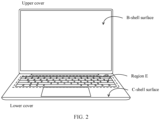
- the terminal device is a notebook computer, as shown in FIG. 1 .
- the notebook computer is divided into an upper cover and a lower cover.
- the upper cover includes a display
- the lower cover includes a keyboard.
- the upper cover includes a shell A and a shell B.
- the shell A and the shell B are fastened, and the display is embedded between the shell A and the shell B.
- the lower cover includes a shell C and a shell D.
- the shell C and the shell D are fastened, and the keyboard is embedded between the shell C and the shell D.
- a surface provided by the shell B and the touch panel of the display may be referred to as a B-shell surface.
- a surface provided by the shell C and the keyboard may be referred to as a C-shell surface.
- the terminal device when the terminal device is a tablet computer (or a mobile phone) with a foldable display, as shown in FIG. 3 , after the foldable display is folded along a folding edge, a screen A and a screen B are formed. After the screen A and the screen B are fastened, the screen A and the screen B can block each other. Therefore, in the fastened state, the screen A is the first surface relative to the screen B, and the screen B is also the first surface relative to the screen A.
- the foregoing first surface may be a surface provided by an external structure independent of the terminal device.
- the terminal device is a tablet computer
- a protective shell installed on the tablet computer has a rotatable shield.
- the shield rotates to be fastened with the display of the tablet computer, the shield can block the display of the tablet computer. That is, in the fastened state, a surface that is of the shield and that faces the display is the first surface.
- the terminal device when the terminal device is a tablet computer, and the display of the tablet computer is attached to a desktop, the desktop is the first surface.
- an optimal screen display control effect is as follows: When the display is fastened to the first surface, the display is controlled to turn off. When the display and the first surface change from the fastened state to a detached state, the display is controlled to turn on. In this way, the terminal device can not only implement energy saving, but also provide a service for a user in a timely manner.
- that the foregoing display turns on may be that the display is restored to a normal working state.
- a black screen is visually lit.
- the display may be restored from a low energy consumption state to a normal energy consumption state.
- that the display turns off may be that the display enters a sleep mode or a power saving mode.
- the lit display is visually changed to a black screen.
- the display enters a low energy consumption state from a normal energy consumption state.
- the terminal device detects, by using a Hall effect sensor, whether the display and the first surface are in a fastened state, so as to implement a control policy such as turning off in a fastened state and turning on in a detached state.
- the Hall effect sensor is a magnetic field sensor produced according to the Hall effect. This also means that the Hall effect sensor is susceptible to external magnetic field interference during operation. For example, in a strong magnetic field environment, a Hall effect sensor may fail. This causes a screen display control failure. For example, the display and the first surface change from a fastened state to a detached state. Because a strong magnetic field exists, it may be misjudged that the display and the first surface are still in a fastened state, and consequently an expected effect of turning on in a detached state cannot be achieved.
- the Hall effect sensor starts to work once a magnetic field is detected. Therefore, even in a normal environment, because the Hall effect sensor is excessively sensitive to a magnetic field, it is easy to misjudge that the display is fastened to the first surface when the display is relatively close to but not in contact with the first surface, and then the display is erroneously controlled to be off.
- an embodiment of this application provides a display control method.
- a capacitance detection mechanism of a touch panel is used to detect a contact area between the display and the first surface, and to determine, based on the contact area, whether the display is fastened to the first surface, so as to control an on/off state of the display.
- the display may be detected whether there is a large area in which the display and the first surface are in contact. For example, when it is detected that a contact area between the display and the first surface is greater than a threshold, it is considered that the display is in contact with the first surface in a large area. When it is detected that the display is in contact with the first surface in a large area, it is determined that the display is fastened to the first surface. When it is detected that the display is not in contact with the first surface in a large area, it is determined that the display is not fastened to the first surface. In this way, the display may be controlled to be on/off according to whether the display and the first surface are in a fastened state.
- the foregoing capacitance detection mechanism is as follows: When a conductor contacts at any position on the touch panel of the display, a capacitance value of the contact position increases accordingly.
- the foregoing contact of the conductor means that a distance between the conductor and the touch panel is not zero and does not exceed a sensing distance of the panel. That is, the conductor is actually in floating contact with the touch panel. For example, in a scenario in which a hand contacts the display, actual contact is generated between the hand and a glass surface of the display. Because the glass surface is covered on the touch panel, floating contact is also generated between the hand and the touch panel.
- using the capacitance detection mechanism is not affected by an electromagnetic environment, which avoids a problem of a screen control failure.
- the touch panel is a main part of the display, and occupies a majority of areas on the display. Therefore, large-area contact detection can be implemented. In addition, a large area of contact needs to be detected before it is determined that the display is fastened to the first surface. This reduces the possibility of misjudging the fastening state and improves the accuracy of screen display control compared with the Hall effect sensor, which can only detect a single point.
- the first surface needs to have a conductive capability.
- the first surface may be a surface provided by a structure made of conductive metal.
- the lower cover when the terminal device is a notebook computer, the lower cover may be made of conductive metal.
- the C-shell surface has a conductive capability.
- the first surface may be a surface provided by a conductive coating on a structure (or an external structure) of the terminal device.
- a conductive coating is disposed on the outside of the lower cover. In this way, the C-shell surface has a conductive capability.
- the foregoing first surface may alternatively have a conductive capability in some regions.
- the keyboard part is made of plastic. That is, a region E in the C-shell surface shown in FIG. 2 does not have a conductive capability.
- Other parts of the lower cover except the keyboard are made of conductive metal. That is, in the C-shell surface shown in FIG. 2 , other regions except the region E have a conductive capability. In this way, while ensuring recognition, weight of the C-shell surface is reduced and costs are reduced.
- the terminal device in embodiments of this application is a smartphone.
- the terminal device in embodiments of this application is a smartphone.
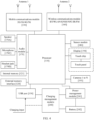
- FIG. 4 shows a schematic diagram of a structure of a notebook computer.
- the notebook computer includes a processor 110, an external memory interface 120, an internal memory 121 a display 194 and a keyboard.
- the notebook computer may include a universal serial bus (universal serial bus, USB) port 130, an antenna 1, an antenna 2, a mobile communications module 150, a wireless communications module 160, an audio module 170, a speaker 170A, a microphone 170C, a headset jack 170D, a sensor module 180, and the like.
- USB universal serial bus
- the structure shown in this embodiment of the present invention does not constitute a specific limitation on the notebook computer.
- the notebook computer may include more or fewer components than those shown in the figure, or some components may be combined, or some components may be split, or components are arranged in different manners.
- the illustrated components may be implemented by hardware, software, or a combination of software and hardware.
- the processor 110 may include one or more processing units.
- the processor 110 may include an application processor (application processor, AP), a modem processor, a graphics processing unit (graphics processing unit, GPU), an image signal processor (image signal processor, ISP), a controller, a memory, a video codec, a digital signal processor (digital signal processor, DSP), a baseband processor, and/or a neural-network processing unit (neural-network processing unit, NPU).
- application processor application processor, AP
- modem processor graphics processing unit
- ISP image signal processor
- controller a memory
- video codec digital signal processor
- DSP digital signal processor
- baseband processor baseband processor
- neural-network processing unit neural-network processing unit
- Different processing units may be independent components, or may be integrated into one or more processors.
- a memory may be disposed in the processor 110, and is configured to store an instruction and data.
- the memory in the processor 110 is a cache memory.
- the memory may store an instruction or data that has just been used or is cyclically used by the processor 110. If the processor 110 needs to use the instruction or data again, the instruction or data may be directly invoked from the memory. Therefore, repeated access is avoided, a waiting time of the processor 110 is reduced, and system efficiency is improved.
- a wireless communication function of the notebook computer may be implemented through the antenna 1, the antenna 2, the mobile communications module 150, the wireless communications module 160, the modem processor, the baseband processor, and the like.
- the antenna 1 and the antenna 2 are configured to transmit and receive electromagnetic wave signals.
- Each antenna in the notebook computer may be configured to cover a single or a plurality of communication frequency bands. Different antennas may be multiplexed to improve antenna utilization.
- the antenna 1 may be multiplexed into a diversity antenna of a wireless local area network.
- the antenna may be used in combination with a tuning switch.
- the mobile communications module 150 may provide a wireless communication solution, including 2G/3G/4G/5G or the like, that is applied to the notebook computer.
- the mobile communications module 150 may include at least one filter, a switch, a power amplifier, a low noise amplifier (low noise amplifier, LNA), and the like.
- the mobile communications module 150 may receive an electromagnetic wave through the antenna 1, perform processing such as filtering and amplification on the received electromagnetic wave, and transmit a processed electromagnetic wave to the modem processor for demodulation.
- the mobile communications module 150 may further amplify a signal obtained after modulation by the modem processor, and convert the signal into an electromagnetic wave through the antenna 1 for radiation.
- at least a part of the functional modules of the mobile communications module 150 may be disposed in the processor 110.
- at least a part of the functional modules of the mobile communications module 150 may be disposed in the same device as at least a part of the modules of the processor 110.
- the wireless communications module 160 may provide a solution to wireless communication applied to the notebook computer, for example, a wireless local area network (wireless local area networks, WLAN) (for example, a wireless fidelity (wireless fidelity, Wi-Fi) network), Bluetooth (bluetooth, BT), a global navigation satellite system (global navigation satellite system, GNSS), frequency modulation (frequency modulation, FM), near field communication (near field communication, NFC), and an infrared (infrared, IR) technology.
- the wireless communications module 160 may be one or more components that integrate at least one communication processing module.
- the wireless communications module 160 receives an electromagnetic wave over the antenna 2, performs frequency modulation and filtering processing on an electromagnetic wave signal, and sends a processed signal to the processor 110.
- the wireless communications module 160 may further receive a to-be-sent signal from the processor 110, perform frequency modulation and amplification on the signal, and convert the signal into an electromagnetic wave for radiation over the antenna 2.
- the antenna 1 of the notebook computer is coupled to the mobile communications module 150, and the antenna 2 is coupled to the wireless communications module 160, so that the notebook computer can communicate with a network and another device by using a wireless communications technology.
- the wireless communications technology may include a global system for mobile communications (global system for mobile communications, GSM), a general packet radio service (general packet radio service, GPRS), code division multiple access (code division multiple access, CDMA), wideband code division multiple access (wideband code division multiple access, WCDMA), time-division code division multiple access (time-division code division multiple access, TD-SCDMA), long term evolution (long term evolution, LTE), BT, a GNSS, a WLAN, NFC, FM, an IR technology, and/or the like.
- GSM global system for mobile communications
- GPRS general packet radio service
- code division multiple access code division multiple access
- CDMA wideband code division multiple access
- WCDMA wideband code division multiple access
- time-division code division multiple access time-d
- the GNSS may include a global positioning system (global positioning system, GPS), a global navigation satellite system (global navigation satellite system, GLONASS), a beidou navigation satellite system (beidou navigation satellite system, BDS), a quasi-zenith satellite system (quasi-zenith satellite system, QZSS), and/or a satellite based augmentation system (satellite based augmentation systems, SBAS).
- GPS global positioning system
- GLONASS global navigation satellite system
- BDS Bertdou navigation satellite system
- BDS quasi-zenith satellite system
- QZSS quasi-zenith satellite system
- SBAS satellite based augmentation system
- the notebook computer implements a display function by using the GPU, the display 194, the application processor, and the like.
- the GPU is a microprocessor for image processing, and is connected to the display 194 and the application processor.
- the GPU is configured to perform mathematical and geometrical calculation, and is configured to perform graphics rendering.
- the processor 110 may include one or more GPUs that execute program instructions to generate or change display information.
- the display 194 is configured to display an image, a video, and the like.
- the display 194 includes a display panel.
- the display panel may use a liquid crystal display (liquid crystal display, LCD), an organic light-emitting diode (organic light-emitting diode, OLED), an active-matrix organic light emitting diode (active-matrix organic light emitting diode, AMOLED), a flexible light-emitting diode (flex light-emitting diode, FLED), a Miniled, a MicroLed, a Micro-oLed, a quantum dot light emitting diode (quantum dot light emitting diodes, QLED), and the like.
- LCD liquid crystal display
- OLED organic light-emitting diode
- AMOLED active-matrix organic light emitting diode
- FLED flexible light-emitting diode
- Miniled a MicroLed, a Micro-oLed, a quantum dot light emit
- the foregoing display includes a touch panel.
- the display further includes a touch chip corresponding to the touch panel. That is, as shown in FIG. 4 , the touch panel is electrically connected to the touch chip.
- the touch chip is electrically connected to the processor 110. Therefore, a location of the display that is operated by the user is determined through collecting by the touch panel and processing by the touch chip.
- the notebook computer includes one display 194.
- the notebook computer may implement a photographing function by using the ISP, the camera 193, the video codec, the GPU, the display 194, the application processor, and the like.
- the ISP is configured to process data fed back by the camera 193. For example, during photographing, a shutter is pressed, a ray of light is transmitted to a light-sensitive element of the camera through a lens, an optical signal is converted into an electrical signal, and the light-sensitive element of the camera transmits the electrical signal to the ISP for processing, and converts the electrical signal into an image that can be seen.
- the ISP may further perform algorithm optimization on noise, luminance, and complexion of the image.
- the ISP may further optimize parameters such as exposure and a color temperature of a photographing scenario.
- the ISP may be disposed in the camera 193.
- the camera 193 is configured to capture a still image or a video. An optical image of an object is generated through the lens, and the image is projected to the light-sensitive element.
- the light-sensitive element may be a charge coupled device (charge coupled device, CCD) or a complementary metal-oxide-semiconductor (complementary metal-oxide-semiconductor, CMOS) phototransistor.
- CCD charge coupled device
- CMOS complementary metal-oxide-semiconductor
- the light-sensitive element converts an optical signal into an electrical signal, and then transmits the electrical signal to the ISP, so that the ISP converts the electrical signal into a digital image signal.
- the ISP outputs the digital image signal to the DSP for processing.
- the DSP converts the digital image signal into an image signal in a standard format such as RGB or YUV.
- the notebook computer may include one or N cameras 193, where N is a positive integer greater than 1.
- the digital signal processor is configured to process a digital signal, and in addition to a digital image signal, may further process another digital signal.
- the digital signal processor is configured to perform Fourier transform and the like on frequency energy.
- the video codec is configured to compress or decompress a digital video.
- the notebook computer may support one or more video codecs. In this way, the notebook computer may play or record videos in a plurality of coding formats, for example, moving picture experts group (moving picture experts group MPEG) 1, MPEG 2, MPEG 3, and MPEG 4.
- moving picture experts group MPEG moving picture experts group
- MPEG 2 moving picture experts group
- MPEG 3 moving picture experts group
- the external memory interface 120 may be configured to connect to an external memory card, for example, a micro SD card, to extend a storage capability of the notebook computer.
- the external storage card communicates with the processor 110 through the external memory interface 120, to implement a data storage function. For example, files such as music and a video are stored in the external memory card.
- the internal memory 121 is configured to store computer-executable program code, where the computer-executable program code includes instructions.
- the processor 110 executes various functional applications of the notebook computer and data processing by running instructions stored in the internal memory 121.
- the internal storage 121 may include a program storage area and a data storage area.
- the program storage area may store an operating system, an application program (for example, a sound playback function or an image playback function) required by at least one function, and the like.
- the data storage region may store data (for example, audio data and screen recording data) and the like created when the notebook computer is used.
- the internal memory 121 may include a high-speed random access memory, or may include a non-volatile memory such as at least one magnetic disk memory, a flash memory, or a universal flash storage (universal flash storage, UFS).
- the notebook computer may implement audio functions by using the audio module 170, the speaker 170A, the microphone 170C, the headset jack 170D, the application processor, and the like.
- the audio functions are, for example, music playback and recording.
- the audio module 170 is configured to convert digital audio information into an analog audio signal for output, and is also configured to convert an analog audio input into a digital audio signal.
- the audio module 170 may be further configured to encode and decode an audio signal.
- the audio module 170 may be disposed in the processor 110, or some functional modules of the audio module 170 may be disposed in the processor 110.
- the speaker 170A also referred to as a "loudspeaker" is configured to convert an audio electrical signal into a sound signal.
- the notebook computer can be used to listen to music through the speaker 170A.
- the microphone 170C also referred to as a "mike” or a “mic”, is configured to convert a sound signal into an electrical signal.
- the notebook computer may be provided with at least one microphone 170C. In other embodiments, the notebook computer may be provided with two microphones 170C, and in addition to collecting a sound signal, a noise reduction function may be implemented. In some other embodiments, the notebook computer may be provided with three, four, or more microphones 170C, so as to collect a sound signal, reduce noise, identify a sound source, implement a directional recording function, and the like.
- the headset jack 170D is configured to connect to a wired headset.
- the headset jack 170D may be the USB port 130, or may be a 3.5 mm open mobile terminal platform (open mobile terminal platform, OMTP) standard interface or a cellular telecommunications industry association of the USA (cellular telecommunications industry association of the USA, CTIA) standard interface.
- the sensor module 180 may include a pressure sensor, a gyroscope sensor, a barometric pressure sensor, a magnetic sensor, an acceleration sensor, a distance sensor, an optical proximity sensor, a fingerprint sensor, a temperature sensor, a touch sensor, an ambient light sensor, a bone conduction sensor, a vibration sensor, a time of flight (time of flight, TOF) sensor, and the like.
- the notebook computer may further include a charging management module 240, a power management module 241, a battery 242, a keyboard, an indicator, one or more SIM card interfaces, and the like. This is not limited in this embodiment of this application.
- the display control method provided in this embodiment of this application is implemented by the notebook computer shown in FIG. 4 .
- the foregoing display control method is applied to a process of turning off a screen upon closing of a cover of the notebook computer. That is, in a case in which a display (the B-shell surface) of the notebook computer is separated from a first surface (the C-shell surface) (that is, the notebook computer is in an open-cover state) and the display is on, as shown in FIG. 5 , the foregoing display control method may include the following steps.
- S101 Obtain a first region when it is detected that a capacitance value of the display changes.
- the detection of the change in the capacitance value of the display is actually detection performed on a touch panel of the display.
- the touch panel may also be referred to as a panel.
- a capacitance value of the panel may be obtained by using a touch chip corresponding to the touch panel.
- the touch chip may collect a current change status of the panel.
- a capacitance value corresponding to a current change location may be determined based on the collected current change status.
- the current on the panel may be kept at a relatively stable value.
- the current at the contact position on the panel changes.
- a capacitance value of the contact position also changes. For example, when the touch panel is in floating contact with a conductor, a capacitance value of a contact position increases. When the touch panel is in actual contact with the conductor, a capacitance value of a contact position changes to zero. When there is no contact between the touch panel and the conductor, the capacitance value of the touch panel remains stable.
- a principle of detecting a capacitance value by the touch chip may change with iteration of the touch chip. What does not change is that when the touch panel is in actual or floating contact with a conductor, the capacitance value of the contact position also changes.
- the C-shell surface of the notebook computer has a conductive capability
- the touch panel is in floating contact with the C-shell surface, and this inevitably causes a change in a capacitance value of the panel.
- the panel occupies a majority of areas on the B-shell surface. Therefore, when the B-shell surface is fastened to the C-shell surface, the C-shell surface is in contact with the panel in a large area. Further, a capacitance value of the contact part on the panel increases.
- the C-shell surface can cause the capacitance value of the panel to change, but floating contact between other conductors and the touch panel can also cause the corresponding capacitance value to change.
- floating contact between other conductors and the touch panel can also cause the corresponding capacitance value to change.
- the hand is in contact with the glass surface, because the glass surface is covered on the touch panel, the hand is in floating contact with the touch panel. This will cause the capacitance value of the contact position on the panel to change.
- the first region also referred to as a contact region, is obtained based on an increase in the capacitance value of the touch panel. Whether the C-shell surface of the notebook computer is in contact with the B-shell surface is detected through analysis of the first region.
- the foregoing first region includes all location points whose capacitance values exceed a normal value (which may also be referred to as a first value) on the lower panel at a same moment.
- the foregoing normal value is an average capacitance value on the touch panel when the touch panel is not touched.
- the normal value may be pre-tested. Then, a capacitance value on the panel is compared with the normal value. If a difference between the capacitance value and the normal value exceeds a preset threshold 1, it is determined that the capacitance value of the display increases, that is, the capacitance value changes. Then, all capacitance values whose differences between the capacitance values on the panel and the normal value exceed the preset threshold 1 at a same moment and location points corresponding to the capacitance values are obtained. In this way, the first region, that is, a region formed by the location points on the panel at which differences between the capacitance values and the normal value exceed the preset threshold 1, is obtained.
- the foregoing preset threshold 1 may be a fluctuation amplitude of a capacitance on the touch panel when the touch panel is not contacted. The foregoing preset threshold 1 may be obtained through testing in advance.
- the first region in a process of turning off the screen upon closing of the cover, the first region (that is, the contact region) may be further determined based on a location point at which a capacitance value changes on the touch panel. That is, in this embodiment, the first region includes all location points at which capacitance values are increased on the lower panel at a same moment.
- capacitance information of the panel may be obtained by using the touch chip on a frame-by-frame basis.
- Capacitance information of each frame includes capacitance values of all location points on the lower panel at the same moment. Therefore, the collected capacitance information of the current frame may be compared with capacitance information of a previous adjacent frame. For example, first, a first location point is determined on the panel based on the capacitance information of the current frame and the capacitance information of the previous adjacent frame, that is, a location point at which a capacitance value changes is determined.
- a current capacitance value corresponding to the first location point is obtained from the capacitance information of the current frame, and a capacitance value corresponding to the first location point at a previous adjacent moment is obtained from the capacitance information of the previous adjacent frame. Then, a capacitance difference 1 between the current capacitance value and the capacitance value at the previous adjacent moment is determined. If the capacitance difference 1 exceeds the preset threshold 1, it is determined that the capacitance value on the panel increases, that is, the capacitance value of the display changes. Finally, the first region is obtained based on all the first location points at which the capacitance values increase, that is, a region that includes the first location points at which the capacitance values increase.
- the entire touch panel is in floating contact with the C-shell surface.
- the contact between the hand and the touch panel is usually a small range of floating contact. Therefore, in some embodiments, whether capacitance values in the entire panel change may be monitored, and the first region may be determined from the entire touch panel. Therefore, accuracy of determining whether the B-shell surface and the C-shell surface are fastened is improved.
- a region M in the B-shell surface is used as a selected local region.
- the first region is determined from the region M.
- the whole panel When the capacitance values of the whole panel are monitored, the whole panel can be considered as the detection region.
- the local region in the monitoring panel In the embodiment covered by the claims in which capacitance values of a local region in the monitoring panel change, the local region in the panel is considered as the detection region. Then, capacitance values of all the location points in the detection region may be obtained by using the touch chip.
- all the C-shell surface of the notebook computer may have a conductive characteristic.
- a region opposite to the detection region has a conductive characteristic in the C-shell surface of the notebook computer as shown in FIG. 6 .
- a region N in the C-shell surface has a conductive characteristic, but other regions do not.
- the region M and the region N are in floating contact, and a shape and a size of the region M is the same as those of the region N. In this way, when the B-shell surface is actually fastened to the C-shell surface, capacitor values corresponding to the entire panel are not triggered to be obtained, thereby reducing processing energy consumption.
- the capacitance values of the panel are directly obtained from the touch chip, and then the first region is determined based on the capacitance values of the panel.
- the first region may be directly determined based on a current value collected by the panel.
- all current values collected at the same time on the panel may be compared with a conventional current value, and a current value 1 whose difference exceeds a preset current threshold is obtained. Then, a collection location corresponding to the current value 1 is determined. Then, it is determined, based on the obtained collection location, that a floating contact point exists on the panel. Finally, the first region is obtained based on the location point at which the floating contact exists.
- S102 Determine, based on the first region, whether the B-shell surface is fastened to the C-shell surface.
- the attribute information of the first region includes existence duration of the first region and may further include one or more items such as an area and a capacitance value.
- the foregoing first ratio may be a preset empirical value.
- the first ratio may be set to a value greater than 60%.
- the foregoing first ratio may also be a ratio obtained by the notebook computer by means of testing. For example, an area of the first region is measured for a plurality of times when the B-shell surface and the C-shell surface are actually fastened, and ratios of the areas of the first region to the area of the detection region are determined. Then, an average value of the ratios determined for a plurality of times is used as the first ratio.
- a large-area contact may occur when the B-shell surface and the C-shell surface are fastened, and there is usually a small-area contact when another conductor (for example, a hand) is in contact with the panel, to distinguish the two common cases of "the B-shell surface and the C-shell surface are fastened" and "another conductor is in contact with the panel".
- another conductor for example, a hand
- capacitance value changes caused by floating contact between different conductor media and the panel are different.
- a capacitance at the contact position is a capacitance value 1.
- a capacitance at the contact position is a capacitance value 2.
- the capacitance value 1 is obviously less than the capacitance value 2.
- a capacitance value of a point at which the panel is in contact with the C-shell surface may be tested in advance as a capacitance threshold.
- the foregoing capacitance threshold may also be an average value of multiple contact locations when the panel is in floating contact with the C-shell surface.
- the foregoing capacitance threshold may be a lowest value of capacitance values corresponding to multiple contact location points when the panel is in floating contact with the C-shell surface.
- the capacitance values of all the location points in the first region are not less than the capacitance threshold, it is determined that the B-shell surface is fastened to the C-shell surface.
- the B-shell surface is fastened to the C-shell surface if an average value of the capacitance values corresponding to the first region is not less than the capacitance threshold.
- the average capacitance value is an average value of the capacitance values of all location points in the first region.
- whether the B-shell surface is fastened to the C-shell surface is determined based on existence duration of the first region.
- the foregoing existence duration may be understood as duration of continuous existence of the first region.
- the existence duration of the first region exceeds preset duration, it is determined that the B-shell surface is fastened to the C-shell surface.
- the preset duration is 30 seconds. If the existence duration of the first region exceeds 30 seconds, it is determined that the B-shell surface is fastened to the C-shell surface.
- capacitance values corresponding to the location points in the first region need to be relatively stable. Therefore, whether the first region exists may be determined with reference to a capacitance value of each location point in the first region.
- the first region in a case in which a difference between a capacitance value corresponding to the first region and a normal value is not less than the preset threshold 1, it is determined that the first region is in an existed state.
- the capacitance value corresponding to each location point in the first region may be periodically detected.
- a capacitance value detected at a current moment is compared with a capacitance value detected at a previous moment adjacent to the current moment. If a difference between a capacitance value of each location point in the first region at the current moment and a capacitance value of each location point at the previous adjacent moment does not exceed a preset threshold 2, it is determined that the first region is in an existed state.
- a preset threshold 2 is a fluctuation amplitude of the capacitance on the panel when the touch panel is in floating contact with the C-shell surface.
- the preset threshold 2 may alternatively be obtained by means of testing in advance.
- existence duration of the first region may be counted based on capacitance values corresponding to the first region at different moments.
- existence duration of the first region may alternatively be counted based on an area of the first region. For example, if the area ratio of the first region to the detection region is not less than the first ratio, it is determined that the first region exists. When the area ratio of the first region to the detection region is less than the first ratio, it is determined that the first region disappears. In this way, the existence duration of the first region may be counted based on areas corresponding to the first region at different moments.
- attribute information based on existence duration of the first region is described to determine whether the B-shell surface and the C-shell surface are fastened.
- a plurality of pieces of attribute information of the first region may be further combined, to determine whether the B-shell surface and the C-shell surface are fastened.
- a ratio of the area of the first region to the area of the detection region is obtained. It is determined whether the area ratio is not less than the first ratio. When the area ratio is not less than the first ratio, a capacitance value of each location point in the first region is obtained. It is determined whether the capacitance value of each location point in the first region is not less than a capacitance threshold. When the capacitance value of each location point in the first region is not less than the capacitance threshold, the existence duration of the first region is obtained. It is determined whether the existence duration of the first region exceeds preset duration. When the existence duration of the first region exceeds the preset duration, it is determined that the B-shell surface is fastened to the C-shell surface.
- the procedure may enter S103.
- the display in a case in which it is determined that the B-shell surface and the C-shell surface are not fastened, the display may be controlled to be on.
- the display is controlled to change from on to off.
- the screen turning off upon closing of the cover of the notebook computer is implemented.
- the notebook computer can be further controlled to enter a sleep state.
- S102 may be understood as determining whether the first region meets a first predetermined condition, and when it is determined that the first region meets the first predetermined condition, the display is controlled to turn off.
- the first predetermined condition may include one or a combination of more of the following determining conditions: "an area ratio of the first region to the detection region exceeds a first ratio", "a capacitance value corresponding to the first region is not less than a capacitance threshold", and "existence duration of the first region exceeds preset duration”.
- the first predetermined condition is a combination of at least two determining conditions, it is determined, if corresponding determining conditions are met, that the first region meets the first predetermined condition.
- whether to control the display to turn off is determined based on the first region.
- whether to control the display to turn off may also be determined by using another region (that is, a contactless region) other than the first region.
- the contactless region includes a location point at which a difference between a capacitance value in the detection region and a normal value does not exceed a preset threshold 1.
- the contactless region meets a second predetermined condition.
- the display is controlled to turn off.
- the second predetermined condition may be that an area ratio of the contactless region to the detection region does not exceed the first ratio.
- the foregoing display control method may be further applied to a process of turning on the screen upon opening of the cover of the notebook computer. That is, in a case in which the display (the B-shell surface) of the notebook computer is fastened to the first surface (the C-case surface) and the display is off, as shown in FIG. 8 , the display control method may include the following steps.
- S201 Obtain a second region when it is detected that a capacitance value of the display changes.
- the second region is a contact region in a closed-cover state.
- capacitance information of the detection region may be obtained frame by frame based on a frame rate 1 (that is, a second frame rate).
- the capacitance information of the detection region includes a capacitance value corresponding to each location point in the detection region.
- the second frame rate is a refresh frame rate of the touch panel when the display is on.
- the capacitance information of the detection region may be obtained by using the touch chip. That is, the touch chip refreshes the capacitance value of each location point on the panel based on the frame rate 1, and obtains, from the capacitance values obtained through refreshing, a capacitance value that belongs to the detection region.
- the second region may be further determined from the detection region.
- the foregoing second region may include location points at which capacitance values exceed a normal value at the same time in the detection region, that is, a location point at which a difference between a capacitance value and a normal value in the detection region exceeds the preset threshold 1.
- location points at which capacitance values exceed a normal value at the same time in the detection region that is, a location point at which a difference between a capacitance value and a normal value in the detection region exceeds the preset threshold 1.
- the capacitance information of the detection region may also be obtained frame by frame based on the frame rate 2 (that is, the first frame rate).
- the frame rate 1 is greater than the frame rate 2.
- the frame rate 1 and the frame rate 2 are used to obtain the capacitance information of the detection region.
- Each of the two has an advantage.
- a person skilled in the art may flexibly configure a frame rate for obtaining the capacitance information of the detection region.
- a fixed frame rate actually used is configured, so that the capacitance information of the detection region is obtained based on the fixed frame rate.
- the frame rate 1 is configured as the fixed frame rate.
- the frame rate 2 is configured as the fixed frame rate.
- the capacitance information of the detection region may be dynamically obtained by using the frame rate 1 or the frame rate 2 based on a power status of the notebook computer.
- the foregoing power status may include information indicating whether the notebook computer is being charged.
- the capacitance information of the detection region may be obtained by using the frame rate 1. That is, a relatively high refresh frame rate is used to ensure detection sensitivity.
- the capacitance information of the detection region is obtained by using the frame rate 2. That is, a low refresh frame rate is used to implement energy saving.
- the foregoing power status may further include remaining power information of the notebook computer.
- the capacitance information of the detection region is obtained by using the frame rate 1. That is, a relatively high refresh frame rate is used to ensure detection sensitivity.
- the capacitance information of the detection region is obtained by using the frame rate 2. That is, a low refresh frame rate is used to implement energy saving.
- the capacitance refresh range is a range in which a capacitance value monitored by the touch chip changes. It may be understood that, in some embodiments, the detection region is a local region on the touch panel. In this way, in a case in which the B-shell surface is fastened to the C-shell surface, the touch chip may also refresh only a capacitance value of each point in the detection region. Therefore, calculation energy consumption of the touch chip is effectively reduced.
- S202 Determine, based on the second region, whether the B-shell surface is separated from the C-shell surface.
- S202 is used to determine whether the B-shell surface is separated from the C-shell surface
- S102 is used to determine whether the B-shell surface is fastened to the C-shell surface.
- a determining logic corresponding to S202 and a determining logic corresponding to S102 are exactly the opposite.
- the second region is determined from the detection region. Whether the B-shell surface is separated from the C-shell surface may be analyzed with reference to attribute information of the second region.
- whether the B-shell surface is separated from the C-shell surface may be determined based on an area ratio of the second region to the detection region. For example, in a case in which the area ratio of the second region to the detection region does not exceed a first ratio, it is determined that the B-shell surface is separated from the C-shell surface.
- it may be further determined, based on a capacitance value of each location point in the second region, whether the B-shell surface is separated from the C-shell surface.
- the capacitance value of each location point in the second region is compared with a capacitance threshold, and it is determined, based on a comparison result, whether the B-shell surface is separated from the C-shell surface. In some embodiments, if the capacitance values of all the location points in the second region are below the capacitance threshold, it is determined that the B-shell surface is separated from the C-shell surface. In other embodiments, it is determined that the B-shell surface is separated from the C-shell surface if an average value of the capacitance values of all the location points in the second region is less than the capacitance threshold.
- whether the B-shell surface is separated from the C-shell surface is determined based on existence duration of the second region. In a case in which the existence duration of the second region does not exceed the preset duration, it is determined that the B-shell surface is separated from the C-shell surface.
- whether the B-shell surface and the C-shell surface are separated is determined based on any attribute information of the second region.
- a plurality of pieces of attribute information of the second region may be combined, to determine whether the B-shell surface and the C-shell surface are separated.
- the display is controlled to change from off to on. In this way, turning on the screen upon opening of the cover of the notebook computer is implemented. Experience of interaction between the notebook computer and the user is enhanced.
- S202 and S203 may also be understood as determining whether the second region meets the first predetermined condition. When it is determined that the second region does not meet the first predetermined condition, the display is controlled to be on.
- the first predetermined condition may include one or a combination of more of the following determining conditions: "an area ratio of the second region to the detection region exceeds a first ratio", "a capacitance value corresponding to the second region is not less than a capacitance threshold", and "existence duration of the second region exceeds preset duration”.
- the first predetermined condition is a combination of at least two determining conditions, it is determined, if any determining condition is not met, that the second region does not meet the first predetermined condition. When all corresponding determining conditions are met, it is determined that the second region meets the first predetermined condition.
- whether to control the display to be on is determined based on the first region or the second region.
- whether to control the display to turn on may also be determined by using another region (that is, a contactless region) other than the first region.
- the contactless region includes a location point at which a difference between a capacitance value in the detection region and a normal value does not exceed a preset threshold 1.
- the contactless region in a process of turning on the screen upon opening of the cover, may be further determined based on a location point at which a capacitance value changes on the touch panel. That is, in this embodiment, the contactless region includes all location points at which capacitance values on the lower panel are reduced at the same time.
- capacitance information of the panel may be obtained by using the touch chip on a frame-by-frame basis.
- Capacitance information of each frame includes capacitance values of all location points on the lower panel at the same moment. Therefore, the collected capacitance information of the current frame may be compared with capacitance information of a previous adjacent frame. For example, first, a second location point is determined on the panel based on the capacitance information of the current frame and the capacitance information of the previous adjacent frame, that is, a location point at which a capacitance value changes is determined.
- a current capacitance value corresponding to the second location point is obtained from the capacitance information of the current frame, and a capacitance value corresponding to the second location point at a previous adjacent moment is obtained from the capacitance information of the previous adjacent frame. Then, a capacitance difference 2 between the current capacitance value and the capacitance value at the previous adjacent moment is determined. If the capacitance difference 2 exceeds the preset threshold 2, it is determined that the capacitance value on the panel decreases, that is, the capacitance value of the display changes. Finally, the contactless region is obtained based on all the first location points at which the capacitance values decrease, that is, a region that includes the first location points at which the capacitance values decrease.
- the contactless region meets a second predetermined condition.
- the display is controlled to turn on.
- the second predetermined condition may be that an area ratio of the contactless region to the detection region does not exceed the first ratio.
- the touch chip suspends refreshing of the capacitance value on the panel, that is, pauses to obtain the capacitance information of the detection region.
- the touch chip restarts to refresh the capacitance information of the detection region, that is, restarts to obtain the capacitance information of the detection region when a cover opening operation (that is, a first operation) of the user is received.
- the touch chip stops refreshing capacitance information of the panel, so as to avoid unnecessary energy consumption when the notebook computer is in the closed-cover state for a long time.
- the foregoing cover opening operation is an operation in which the user intends to separate the B-shell surface and the C-shell surface of the notebook computer.
- the notebook computer when the user separates the B-shell surface from the C-shell surface of the notebook computer, a structure of the notebook computer sounds, which is also referred to as a cover opening sound.
- the notebook computer has a locking part.
- the locking part is configured to keep the upper cover (on the side on which the B-shell surface is disposed) and the lower cover (on the side on which the C-shell surface is disposed) of the notebook computer in a fastened state. If the user wants to separate the upper cover and the lower cover, the locking part needs to be opened first to release locking of the fastened state between the upper cover and the lower cover. When the locking part is opened, the locking part makes a sound, and the sound may be considered as a cover opening sound.
- the upper cover and the lower cover of the notebook computer are connected by using a spindle.
- the upper cover and the lower cover need to rotate around the spindle.
- a sound is also generated, and the sound may also be considered as a cover opening sound.
- the foregoing display control method when the foregoing display control method is applied to a notebook computer in a closed-cover state, on the basis of FIG. 8 , as shown in FIG. 9 , the foregoing display control method further includes the following steps.
- S301 Collect ambient sound data.
- the notebook computer has a microphone, which can collect ambient sound data in real time.
- the microphone when the notebook computer is in an open-cover state, the microphone is in a low energy consumption mode (for example, stops collecting ambient sound data). After it is recognized that the notebook computer is in the closed-cover state, the microphone automatically enters a working mode of collecting ambient sound data in real time. Therefore, an energy saving effect is achieved.
- a low energy consumption mode for example, stops collecting ambient sound data.
- S302 Determine whether the ambient sound data belongs to a cover opening sound.
- the ambient sound data is complex, and the collected ambient sound data may be identified by using a sound recognition model, so as to determine whether the ambient sound data belongs to a cover opening sound.
- the voice recognition model may be obtained through pre-training.
- a process of pre-training a sound recognition model is as follows:
- the sound training samples include a cover open sound sample and a non-cover-open sound sample.
- Each sound training sample has a sample label, and the sample label is used to distinguish whether the sound training sample belongs to a cover open sound sample or belongs to a non-cover-open sound sample.
- the sound training sample is input into a pre-selected neural network model.
- the neural network model is iterated by using a classification result of a sound training sample and a sample label of the sound training sample to obtain a sound recognition model.
- the ambient sound data collected by the notebook computer may be identified by using the sound recognition model, so as to determine whether the collected ambient sound data is a cover opening sound.
- pre-training has limited recognition accuracy improvement on the sound recognition model.
- the actual open cover sound of the notebook computer may be collected to continue to iteratively update the sound recognition model.
- any ambient sound data collected by the notebook computer triggers restart to obtain, based on the first frame rate, a capacitance value change in the detection region. If it is determined, based on the capacitance value in the detection region, that the B-shell surface and the C-shell surface are not separated, a sample label 1 is assigned to the ambient sound data, and the sample label 1 is used to indicate that the ambient sound data does not belong to the cover opening sound.
- a sample label 2 is assigned to the ambient sound data, and the sample label 2 is used to indicate that the ambient sound data belongs to the cover opening sound.
- the voice recognition model is further iterated by using the new training sample to enhance a recognition capability of the iterated voice recognition model.
- each piece of collected ambient sound data is input into the sound recognition model, to determine whether the ambient sound data is a cover opening sound.
- the foregoing method may further include: stopping obtaining a capacitance value in the detection region. Therefore, invalid panel capacitance detection is avoided, and energy consumption is reduced. For example, within preset duration (for example, one minute) after capacitance value detection is restarted, a capacitance value change in the detection region is not detected, and the capacitance value in the detection region is stopped to continue to be obtained.
- preset duration for example, one minute
- a cover opening sound is used as a trigger condition, and by determining the cover opening sound, a capacitance value of the detection region is triggered to be obtained.
- the capacitance value change in the detection region is prevent from being continuously monitored after the cover of the notebook computer is closed, so as to reduce energy consumption.
- another trigger condition may be used to trigger starting to obtain a capacitance value of the detection region.
- the upper cover of the notebook rotates relative to the lower cover.
- the upper cover is circumferentially moved around the spindle. Therefore, a circumferential motion of the upper cover may be used as a trigger condition.
- the restart is triggered to obtain, based on the first frame rate, a capacitance value change in the detection region.
- an acceleration sensor is disposed on the upper cover of the notebook computer.
- the foregoing display control method is applied to the notebook computer in a closed-cover state, on the basis of FIG. 8 , as shown in FIG. 10 , the foregoing display control method further includes the following steps.
- S401 Collect a real-time acceleration value of the upper cover.
- acceleration collection may be performed in real time by using the acceleration sensor to obtain a real-time acceleration value.
- the acceleration sensor may be disposed on a side that is of the upper cover and away from the spindle.
- the acceleration sensor when the notebook computer is in an open-cover state, the acceleration sensor is in a low energy consumption mode (for example, stops collecting a real-time acceleration value). After it is recognized that the notebook computer is in the closed-cover state, the acceleration sensor automatically enters a working mode of real-time collection. Therefore, an energy saving effect is achieved.
- a low energy consumption mode for example, stops collecting a real-time acceleration value.
- S402 Determine, based on the real-time acceleration value, whether a motion track of the upper cover meets a circumferential motion.
- the procedure may enter S201. However, after the procedure enters S201, if it is determined, by using S201 and S202, that the C-shell surface is not separated from the B-shell surface, the capacitive value in the detection region stops to continue to be obtained, so as to wait for a next restart detection to be triggered.
- the foregoing method may further include: stopping continuing to obtain a capacitance value in the detection region, so as to wait for next restart detection to be triggered.
- a sway frequency and amplitude of the upper cover of the notebook computer may be further used as a trigger condition to determine whether the user performs the cover opening operation. Therefore, when determining that the user performs the cover opening operation, obtaining a capacitance value change in the detection region based on the first frame rate is restarted.
- a vibration sensor is disposed on the upper cover of the notebook computer.
- the foregoing display control method is applied to the notebook computer in a closed-cover state, on the basis of FIG. 8 , as shown in FIG. 11 , the foregoing display control method further includes the following steps.
- S501 Collect vibration information of the upper cover of the notebook computer, for example, a vibration frequency and a vibration amplitude.
- the vibration frequency and vibration amplitude of the upper cover may be collected in real time by using the vibration sensor.
- the foregoing vibration sensor when the notebook computer is in an open-cover state, the foregoing vibration sensor is in a low energy consumption mode (for example, stops collecting vibration information). After it is recognized that the notebook computer is in the closed-cover state, the vibration sensor automatically enters a working mode of real-time collection. Therefore, an energy saving effect is achieved.
- a low energy consumption mode for example, stops collecting vibration information.
- S502 Determine, based on the collected vibration frequency and amplitude, whether the vibration condition is met.
- the above-mentioned vibration conditions include a vibration frequency threshold and a vibration amplitude threshold.
- the collected vibration frequency reaches the vibration frequency threshold and/or the collected vibration amplitude reaches the vibration amplitude threshold, it is determined that the vibration condition is met.
- the procedure may enter S201. However, if it is determined, by using S201 and S202, that the C-shell surface is not separated from the B-shell surface, obtaining of the capacitance value in the detection region is also stopped.
- the foregoing method may further include: stopping continuing to obtain a capacitance value in the detection region.
- separation of the B-shell surface and the C-shell surface also means that the shielded content detected by a TOF sensor is eliminated for the notebook computer with the TOF sensor.
- it may be determined, based on a detection result of the TOF sensor, whether the user performs the cover opening operation. Therefore, when determining that the user performs the cover opening operation, obtaining a capacitance value change in the detection region based on the first frame rate is restarted.
- the foregoing display control method when the foregoing display control method is applied to a notebook computer in a closed-cover state, on the basis of FIG. 8 , as shown in FIG. 12 , the foregoing display control method further includes the following steps.
- a TOF sensor may be disposed on the B-shell surface.
- the TOF sensor detects ambient light, it is determined that the B-shell surface is not shielded, that is, the touch panel is not shielded.
- the TOF sensor detects no ambient light, it is determined that the B-shell surface is shielded, that is, the touch panel is shielded.
- the above-mentioned absence of blocking means that an installation position of the TOF sensor is not blocked from light.
- the collected ambient light information exceeds a light threshold, it indicates that no block exists.
- the procedure can enter S201. However, if it is determined, by using S201 and S202, that the C-shell surface is not separated from the B-shell surface, obtaining of the capacitance value in the detection region is also stopped.
- the foregoing method may further include: stopping continuing to obtain a capacitance value in the detection region.
- a sound, a motion track of the upper cover, a vibration condition of the upper cover, or a light shielding condition is separately used to determine whether to enable obtaining a capacitance value change in the detection region based on the first frame rate.
- it may also be determined, with reference to at least two of a sound, a motion track of the upper cover, a vibration condition of the upper cover, and a light shielding condition, whether to start to obtain a capacitance value change in the detection region based on the first frame rate.
- the acceleration sensor may be started to perform acceleration collection in real time. It is determined, based on the collected real-time acceleration value, whether a motion track of the upper cover meets a circumferential motion. When it is determined that the motion track of the upper cover matches the circumferential motion, the vibration sensor is started to collect a vibration frequency and a vibration amplitude of the upper cover in real time. It is determined whether the vibration condition is met based on the collected vibration frequency and amplitude. When it is determined that the vibration condition is met, the TOF sensor is triggered to collect ambient light. When the TOF sensor detects ambient light, it is determined that the B surface is not shielded. When it is determined that the B-shell surface is not shielded, obtaining a capacitance value change in the detection region based on the first frame rate is started.
- the TOF sensor may be triggered to collect ambient light.
- the acceleration sensor is started to collect acceleration in real time.
- the vibration sensor is started to collect a vibration frequency and a vibration amplitude of the upper cover in real time. It is determined whether the vibration condition is met based on the collected vibration frequency and amplitude.
- obtaining a capacitance value change in the detection region based on the first frame rate is started.
- a working mode of each component (for example, the display, the microphone, and the acceleration sensor) in the notebook computer may be flexibly adjusted in different scenarios.
- the frame rate of the display is adjusted based on a scenario (that is, a frame rate at which the display detects a capacitance change condition on the panel).
- the microphone, the acceleration sensor, and the like are enabled to work in a period in which the cover of the notebook computer is closed. When the cover of the notebook computer is opened, the microphone, the acceleration sensor, and the like are controlled to enter a sleep mode. Therefore, energy saving is achieved.
- an embodiment not covered by the claims provides an electronic device, and the electronic device may include a display, a memory, and one or more processors.
- the display, the memory, and the processor are coupled.
- the electronic device includes but is not limited to the foregoing display, memory, and one or more processors.
- a structure of the electronic device refer to the structure of the mobile phone shown in FIG. 4 .
- the memory is configured to store computer program code, and the computer program code includes computer instructions. When the instructions are executed by the processor, the electronic device can perform steps executed by the mobile phone in the foregoing embodiments.
- a working mode of each component (for example, the display, the microphone, and the acceleration sensor) in the electronic device may be flexibly adjusted in different scenarios.
- the frame rate of the display is adjusted based on a scenario (that is, a frame rate at which the display detects a capacitance change condition on the panel).
- the microphone, the acceleration sensor, and the like are enabled to work in a period in which the cover of the electronic device is closed. When the cover of the electronic device is opened, the microphone, the acceleration sensor, and the like are controlled to enter a sleep mode. Therefore, energy saving is achieved.
- the chip system includes at least one processor 2201 and at least one interface circuit 2202.
- the processor 2201 may be the processor in the foregoing electronic device.
- the processor 2201 and the interface circuit 2202 may be interconnected through a line.
- the processor 2201 may receive and execute a computer instruction from the memory of the foregoing electronic device by using the interface circuit 2202.
- the electronic device can perform steps executed by the mobile phone in the foregoing embodiments.
- the chip system may further include another discrete component. This is not specifically limited in this embodiment of this application.
- Functional units in the embodiments of this application may be integrated into one processing unit, each of the units may exist alone physically, or two or more units are integrated into one unit.
- the foregoing integrated unit may be implemented in a form of hardware, or may be implemented in a form of a software functional unit.
- the integrated unit When an integrated unit is implemented in a form of a software functional unit and sold or used as an independent product, the integrated unit may be stored in a computer-readable storage medium.
- the computer software product is stored in a storage medium, and includes several instructions for instructing a computer device (which may be a personal computer, a server, a network device, or the like) or a processor to perform all or some of the steps of the methods described in the embodiments of this application.
- the foregoing storage medium includes any medium that can store program code, such as a flash memory, a removable hard disk, a read-only memory, a random access memory, a magnetic disk, or an optical disc.
- first and second are merely used for description purposes, and shall not be understood as an indication or implication of relative importance or implicitly indicate the number of indicated technical features. Therefore, a feature defined as “first” or “second” may explicitly or implicitly include one or more of the features. In the description of the embodiments, unless otherwise stated, "a plurality of" means two or more.
Landscapes
- Engineering & Computer Science (AREA)
- Theoretical Computer Science (AREA)
- General Engineering & Computer Science (AREA)
- Physics & Mathematics (AREA)
- General Physics & Mathematics (AREA)
- Human Computer Interaction (AREA)
- Computer Hardware Design (AREA)
- Software Systems (AREA)
- Mathematical Physics (AREA)
- User Interface Of Digital Computer (AREA)
- Position Input By Displaying (AREA)
Claims (13)
- Anzeigesteuerungsverfahren, das auf einen Notebook-Computer angewendet wird, umfassend eine Anzeige (194) und eine Tastatur, wobei der Notebook-Computer in eine obere Abdeckung, die die Anzeige (194) einschließt, und eine untere Abdeckung, die die Tastatur einschließt, unterteilt ist, eine Abschirmoberfläche der unteren Abdeckung konfiguriert ist, um die Anzeige (194) in einem Zustand mit geschlossener Abdeckung zu blockieren, eine Region (N) der Abschirmoberfläche eine Leitfähigkeit aufweist, andere Regionen der Abschirmoberfläche jedoch keine Leitfähigkeit aufweisen, die Anzeige (194) ein Berührpaneel umfasst, ein Teil des Berührpaneels eine Erkennungsregion (M) ist, Form und Größe der Erkennungsregion (M) und Form und Größe der Region (N) der Abschirmoberfläche gleich sind, die Erkennungsregion (M) und die Region (N) der Abschirmoberfläche in dem Zustand mit geschlossener Abdeckung in schwebendem Kontakt stehen, und das Verfahren umfasst:Erhalten (S101, S102) von Kapazitätswerten nur der Erkennungsregion, wobei ein Ortspunkt, an dem eine Differenz zwischen einem Kapazitätswert in der Erkennungsregion und einem ersten Wert einen ersten voreingestellten Schwellenwert überschreitet, eine Kontaktregion ist, und ein Ortspunkt, an dem eine Differenz zwischen einem Kapazitätswert in der Erkennungsregion und dem ersten Wert den ersten voreingestellten Schwellenwert nicht überschreitet, eine kontaktlose Region ist; undwenn die Kontaktregion eine erste vorgegebene Bedingung erfüllt oder die kontaktlose Region eine zweite vorgegebene Bedingung erfüllt, Steuern (S103) der Anzeige (194), um sie auszuschalten; oder wenn die kontaktlose Region die zweite vorgegebene Bedingung nicht erfüllt oder die Kontaktregion die erste vorgegebene Bedingung nicht erfüllt, Steuern der Anzeige (194), um sie einzuschalten, wobeidie erste vorgegebene Bedingung umfasst, dass eine Existenzdauer der Kontaktregion eine voreingestellte Dauer überschreitet.
- Verfahren nach Anspruch 1, wobei die erste vorgegebene Bedingung ferner eines oder eine Kombination mehrerer der Folgenden umfasst:ein Flächenverhältnis der Kontaktregion zu der Erkennungsregion überschreitet ein erstes Verhältnis; undein Kapazitätswert, der der Kontaktregion entspricht, ist nicht weniger als ein Kapazitätsschwellenwert.
- Verfahren nach Anspruch 1 oder 2, wobei die zweite vorgegebene Bedingung umfasst:
ein Flächenverhältnis der kontaktlosen Region zu der Erkennungsregion überschreitet ein erstes Verhältnis nicht. - Verfahren nach einem der Ansprüche 1 bis 3, wobei nach dem Steuern (S103) der Anzeige (194), um sie auszuschalten, das Verfahren ferner umfasst:
Erhalten eines Kapazitätswerts der Erkennungsregion durch Verwenden einer ersten Bildrate, wobei die erste Bildrate niedriger als eine zweite Bildrate ist und die zweite Bildrate eine Bildwiederholrate des Berührpaneels ist, wenn die Anzeige (194) ein ist. - Verfahren nach einem der Ansprüche 1 bis 4, wobei nach dem Steuern (S103) der Anzeige (194), um sie auszuschalten, das Verfahren ferner umfasst:
Aussetzen einer Erkennung eines Kapazitätswerts des Berührpaneels innerhalb eines ersten Zeitraums, wobei der erste Zeitraum ein Zeitraum zwischen einem Moment, in dem die Anzeige (194) ausgeschaltet wird, und einem Moment eines Empfangens einer ersten Bedienung eines Benutzers ist. - Verfahren nach Anspruch 5, wobei der Notebook-Computer ein Mikrofon (170) umfasst und das Verfahren umfasst:Erfassen von Umgebungsgeräuschdaten durch Verwenden des Mikrofons (107);wenn die Umgebungsgeräuschdaten ein Abdeckungsöffnungsgeräusch der elektronischen Vorrichtung sind, Bestimmen, dass die erste Bedienung empfangen ist; undwenn bestimmt wird, dass die erste Bedienung empfangen ist, weiterhin Erkennen eines Kapazitätswerts der Erkennungsregion.
- Verfahren nach Anspruch 6, wobei das Verfahren umfasst:wenn die Anzeige (194) ein ist, Steuern des Mikrofons (107), um das Erfassen der Umgebungsgeräuschdaten zu beenden; undwenn die Anzeige (194) von ein auf aus wechselt, Steuern des Mikrofons (107), um weiterhin die Umgebungsgeräuschdaten zu erfassen.
- Verfahren nach Anspruch 5, wobei der Notebook-Computer einen Beschleunigungssensor (180) umfasst, der Beschleunigungssensor (180) auf der oberen Abdeckung angeordnet ist und das Verfahren umfasst:Erfassen (S401) eines Echtzeit-Beschleunigungswerts der oberen Abdeckung durch Verwenden des Beschleunigungssensors (180);wenn der Echtzeit-Beschleunigungswert angibt, dass eine Bewegungsbahn der oberen Abdeckung mit einer Umfangsbewegung übereinstimmt, Bestimmen (S402), dass die erste Bedienung empfangen ist; undwenn bestimmt wird, dass die erste Bedienung empfangen ist, weiterhin (S403) Erkennen eines Kapazitätswerts der Erkennungsregion.
- Verfahren nach Anspruch 8, wobei das Verfahren umfasst:wenn die Anzeige (194) ein ist, Steuern des Beschleunigungssensors (180), um das Erfassen des Echtzeit-Beschleunigungswerts zu beenden; undwenn die Anzeige (194) von ein auf aus wechselt, Steuern des Beschleunigungssensors (180), um weiterhin den Echtzeit-Beschleunigungswert zu erfassen.
- Verfahren nach Anspruch 5, wobei der Notebook-Computer einen Vibrationssensor umfasst, der Vibrationssensor auf der oberen Abdeckung angeordnet ist und das Verfahren umfasst:Erfassen (S501) von Vibrationsinformationen der oberen Abdeckung durch Verwenden des Vibrationssensors;wenn die Vibrationsinformationen angeben, dass die obere Abdeckung eine Vibrationsbedingung erfüllt, Bestimmen (S502), dass die erste Bedienung empfangen ist; undwenn bestimmt wird, dass die erste Bedienung empfangen ist, weiterhin (S503) Erkennen eines Kapazitätswerts der Erkennungsregion.
- Verfahren nach Anspruch 10, wobei das Verfahren umfasst:wenn die Anzeige (194) ein ist, Steuern des Vibrationssensors, um das Erfassen der Vibrationsinformationen zu beenden; undwenn die Anzeige (194) von ein auf aus wechselt, Steuern des Vibrationssensors, um weiterhin die Vibrationsinformationen zu erfassen.
- Verfahren nach Anspruch 5, wobei der Notebook-Computer einen Time-of-Flight-Sensor, TOF-Sensor, umfasst, und das Verfahren umfasst:Erkennen (S601) von Umgebungslichtinformationen durch Verwenden des TOF-Sensors;wenn die Umgebungslichtinformationen angeben, dass eine Einbauposition des TOF-Sensors nicht blockiert ist, Bestimmen (S602), dass die erste Bedienung empfangen ist; undwenn bestimmt wird, dass die erste Bedienung empfangen ist, weiterhin Erkennen eines Kapazitätswerts des Berührpaneels.
- Notebook-Computer, wobei der Notebook-Computer einen oder mehrere Prozessoren (110), einen oder mehrere Speicher (120, 121), eine Anzeige (194) und eine Tastatur umfasst, wobei der Notebook-Computer in eine obere Abdeckung, die die Anzeige (194) einschließt, und eine untere Abdeckung, die die Tastatur einschließt, unterteilt ist, eine Abschirmoberfläche der unteren Abdeckung konfiguriert ist, um die Anzeige (194) in einem Zustand mit geschlossener Abdeckung zu blockieren, wobei eine Region (N) der Abschirmoberfläche eine Leitfähigkeit aufweist, andere Regionen der Abschirmoberfläche jedoch keine Leitfähigkeit aufweisen, die Anzeige (194) ein Berührpaneel umfasst, ein Teil des Berührpaneels eine Erkennungsregion (M) ist, Form und Größe der Erkennungsregion (M) und Form und Größe der Region (N) der Abschirmoberfläche gleich sind, die Erkennungsregion (M) und die Region (N) der Abschirmoberfläche in dem Zustand mit geschlossener Abdeckung in schwebendem Kontakt stehen, der eine oder die mehreren Speicher (120, 121) und die Anzeige (194) mit dem einen oder den mehreren Prozessoren (110) gekoppelt sind, der eine oder die mehreren Speicher (120, 121) konfiguriert sind, um Computerprogrammcode zu speichern, der Computerprogrammcode Computeranweisungen umfasst, und wenn der eine oder die mehreren Prozessoren (110) die Computeranweisungen ausführen, das Verfahren nach einem der Ansprüche 1 bis 12 implementiert wird.
Applications Claiming Priority (2)
| Application Number | Priority Date | Filing Date | Title |
|---|---|---|---|
| CN202110560597.5A CN115390687A (zh) | 2021-05-21 | 2021-05-21 | 一种显示屏控制方法及电子设备 |
| PCT/CN2022/072601 WO2022242211A1 (zh) | 2021-05-21 | 2022-01-18 | 一种显示屏控制方法及电子设备 |
Publications (3)
| Publication Number | Publication Date |
|---|---|
| EP4113261A1 EP4113261A1 (de) | 2023-01-04 |
| EP4113261A4 EP4113261A4 (de) | 2023-08-23 |
| EP4113261B1 true EP4113261B1 (de) | 2024-12-11 |
Family
ID=83558234
Family Applications (1)
| Application Number | Title | Priority Date | Filing Date |
|---|---|---|---|
| EP22735282.0A Active EP4113261B1 (de) | 2021-05-21 | 2022-01-18 | Anzeigebildschirmsteuerungsverfahren und elektronische vorrichtung |
Country Status (4)
| Country | Link |
|---|---|
| US (1) | US12498813B2 (de) |
| EP (1) | EP4113261B1 (de) |
| CN (1) | CN115390687A (de) |
| WO (1) | WO2022242211A1 (de) |
Families Citing this family (2)
| Publication number | Priority date | Publication date | Assignee | Title |
|---|---|---|---|---|
| CN118131856A (zh) * | 2022-12-01 | 2024-06-04 | 荣耀终端有限公司 | 一种电子设备及其控制方法 |
| JP2024123997A (ja) * | 2023-03-02 | 2024-09-12 | キヤノン株式会社 | 電子機器、電子機器の制御方法、およびプログラム |
Family Cites Families (18)
| Publication number | Priority date | Publication date | Assignee | Title |
|---|---|---|---|---|
| US8681124B2 (en) * | 2009-09-22 | 2014-03-25 | Microsoft Corporation | Method and system for recognition of user gesture interaction with passive surface video displays |
| US8478306B2 (en) * | 2010-11-10 | 2013-07-02 | Google Inc. | Self-aware profile switching on a mobile computing device |
| US9159293B2 (en) * | 2011-03-16 | 2015-10-13 | Kyocera Corporation | Electronic device, control method, and storage medium storing control program |
| US9652091B1 (en) * | 2013-03-15 | 2017-05-16 | Amazon Technologies, Inc. | Touch sensitive display utilizing mutual capacitance and self capacitance |
| KR20150077667A (ko) * | 2013-12-30 | 2015-07-08 | 삼성전자주식회사 | 전자 장치, 그 제어 방법 및 컴퓨터 판독가능 기록매체 |
| RU2016135018A (ru) | 2014-01-28 | 2018-03-02 | Хуавей Дивайс (Дунгуань) Ко., Лтд | Способ обработки устройства терминала и устройство терминала |
| KR20160033507A (ko) * | 2014-09-18 | 2016-03-28 | 엘지전자 주식회사 | 이동 단말기 및 그 제어 방법 |
| CN107046601A (zh) | 2017-03-24 | 2017-08-15 | 努比亚技术有限公司 | 一种移动终端及屏幕控制方法 |
| CN114710585B (zh) * | 2017-11-23 | 2023-10-13 | 华为技术有限公司 | 一种拍照方法、终端及存储介质 |
| JP2019145997A (ja) * | 2018-02-20 | 2019-08-29 | オンキヨー株式会社 | 携帯端末 |
| CN108304061A (zh) | 2018-04-16 | 2018-07-20 | 维沃移动通信有限公司 | 一种显示控制方法及终端 |
| US10725595B2 (en) * | 2018-04-24 | 2020-07-28 | Apple Inc. | Electronic devices with covers |
| CN109257505B (zh) | 2018-11-07 | 2021-06-29 | 维沃移动通信有限公司 | 一种屏幕控制方法及移动终端 |
| CN109840061A (zh) | 2019-01-31 | 2019-06-04 | 华为技术有限公司 | 控制屏幕显示的方法及电子设备 |
| US11379016B2 (en) | 2019-05-23 | 2022-07-05 | Intel Corporation | Methods and apparatus to operate closed-lid portable computers |
| CN110660329B (zh) | 2019-09-29 | 2021-12-14 | 武汉天马微电子有限公司 | 一种柔性显示模组及柔性显示装置 |
| CN118426615A (zh) | 2019-11-18 | 2024-08-02 | 荣耀终端有限公司 | 一种防误触方法、移动设备及计算机可读存储介质 |
| US11789565B2 (en) | 2020-08-18 | 2023-10-17 | Intel Corporation | Lid controller hub architecture for improved touch experiences |
-
2021
- 2021-05-21 CN CN202110560597.5A patent/CN115390687A/zh active Pending
-
2022
- 2022-01-18 WO PCT/CN2022/072601 patent/WO2022242211A1/zh not_active Ceased
- 2022-01-18 EP EP22735282.0A patent/EP4113261B1/de active Active
- 2022-01-18 US US17/790,733 patent/US12498813B2/en active Active
Also Published As
| Publication number | Publication date |
|---|---|
| US20240168582A1 (en) | 2024-05-23 |
| EP4113261A4 (de) | 2023-08-23 |
| CN115390687A (zh) | 2022-11-25 |
| WO2022242211A1 (zh) | 2022-11-24 |
| EP4113261A1 (de) | 2023-01-04 |
| US12498813B2 (en) | 2025-12-16 |
Similar Documents
| Publication | Publication Date | Title |
|---|---|---|
| EP4221164B1 (de) | Anzeigeverfahren für eine elektronische vorrichtung mit flexibler anzeige und elektronische vorrichtung | |
| US12160536B2 (en) | Touchscreen, electronic device, and display control method | |
| US11994918B2 (en) | Electronic device control method and electronic device | |
| US20220124597A1 (en) | Method for Identifying Specific Position on Specific Route and Electronic Device | |
| JP7280005B2 (ja) | 無線充電方法および電子デバイス | |
| US11907526B2 (en) | Touch region adjustment method and apparatus for determining a grasping gesture of a user on an electronic device | |
| US12341923B2 (en) | Sensor adjustment method and apparatus, and electronic device | |
| WO2020073288A1 (zh) | 一种触发电子设备执行功能的方法及电子设备 | |
| EP4113261B1 (de) | Anzeigebildschirmsteuerungsverfahren und elektronische vorrichtung | |
| CN114375027B (zh) | 降低功耗的方法和装置 | |
| KR20160105245A (ko) | 터치 패널의 입력을 감지하는 전자 장치 및 방법 | |
| CN116027919B (zh) | 触摸屏的控制方法、电子设备、芯片及存储介质 | |
| CN110058729B (zh) | 调节触摸检测的灵敏度的方法和电子设备 | |
| WO2023202525A1 (zh) | 功能启动方法、用户界面及电子设备 | |
| CN117130701B (zh) | 一种应用程序的图标显示方法及电子设备 | |
| HK40079053A (en) | Display controlling method and electronic device | |
| CN116048196A (zh) | 开合盖检测方法及相关装置 | |
| CN116954727A (zh) | 一种设备唤醒方法、电子设备及可读存储介质 | |
| CN116048772A (zh) | 中央处理单元频率的调整方法、装置和终端设备 | |
| CN114115513B (zh) | 一种按键控制方法和一种按键装置 | |
| CN110096151B (zh) | 一种手势识别方法、设备及计算机可读存储介质 | |
| WO2025130040A1 (zh) | 一种触控识别方法及电子设备 | |
| HK40071466B (en) | Method and device for screech processing in terminal device, and terminal | |
| HK40071116B (en) | Touch screen, electronic device, and display control method | |
| HK40071116A (en) | Touch screen, electronic device, and display control method |
Legal Events
| Date | Code | Title | Description |
|---|---|---|---|
| STAA | Information on the status of an ep patent application or granted ep patent |
Free format text: STATUS: UNKNOWN |
|
| STAA | Information on the status of an ep patent application or granted ep patent |
Free format text: STATUS: THE INTERNATIONAL PUBLICATION HAS BEEN MADE |
|
| PUAI | Public reference made under article 153(3) epc to a published international application that has entered the european phase |
Free format text: ORIGINAL CODE: 0009012 |
|
| STAA | Information on the status of an ep patent application or granted ep patent |
Free format text: STATUS: REQUEST FOR EXAMINATION WAS MADE |
|
| 17P | Request for examination filed |
Effective date: 20220713 |
|
| AK | Designated contracting states |
Kind code of ref document: A1 Designated state(s): AL AT BE BG CH CY CZ DE DK EE ES FI FR GB GR HR HU IE IS IT LI LT LU LV MC MK MT NL NO PL PT RO RS SE SI SK SM TR |
|
| A4 | Supplementary search report drawn up and despatched |
Effective date: 20230721 |
|
| RIC1 | Information provided on ipc code assigned before grant |
Ipc: G06F 1/3215 20190101ALI20230717BHEP Ipc: G06F 1/3234 20190101ALI20230717BHEP Ipc: G06F 1/16 20060101ALI20230717BHEP Ipc: G06F 3/041 20060101AFI20230717BHEP |
|
| STAA | Information on the status of an ep patent application or granted ep patent |
Free format text: STATUS: EXAMINATION IS IN PROGRESS |
|
| 17Q | First examination report despatched |
Effective date: 20240214 |
|
| GRAP | Despatch of communication of intention to grant a patent |
Free format text: ORIGINAL CODE: EPIDOSNIGR1 |
|
| STAA | Information on the status of an ep patent application or granted ep patent |
Free format text: STATUS: GRANT OF PATENT IS INTENDED |
|
| INTG | Intention to grant announced |
Effective date: 20240710 |
|
| DAV | Request for validation of the european patent (deleted) | ||
| DAX | Request for extension of the european patent (deleted) | ||
| GRAS | Grant fee paid |
Free format text: ORIGINAL CODE: EPIDOSNIGR3 |
|
| GRAA | (expected) grant |
Free format text: ORIGINAL CODE: 0009210 |
|
| STAA | Information on the status of an ep patent application or granted ep patent |
Free format text: STATUS: THE PATENT HAS BEEN GRANTED |
|
| AK | Designated contracting states |
Kind code of ref document: B1 Designated state(s): AL AT BE BG CH CY CZ DE DK EE ES FI FR GB GR HR HU IE IS IT LI LT LU LV MC MK MT NL NO PL PT RO RS SE SI SK SM TR |
|
| REG | Reference to a national code |
Ref country code: GB Ref legal event code: FG4D |
|
| REG | Reference to a national code |
Ref country code: CH Ref legal event code: EP |
|
| REG | Reference to a national code |
Ref country code: DE Ref legal event code: R096 Ref document number: 602022008661 Country of ref document: DE |
|
| REG | Reference to a national code |
Ref country code: IE Ref legal event code: FG4D |
|
| REG | Reference to a national code |
Ref country code: NL Ref legal event code: FP |
|
| REG | Reference to a national code |
Ref country code: LT Ref legal event code: MG9D |
|
| PG25 | Lapsed in a contracting state [announced via postgrant information from national office to epo] |
Ref country code: HR Free format text: LAPSE BECAUSE OF FAILURE TO SUBMIT A TRANSLATION OF THE DESCRIPTION OR TO PAY THE FEE WITHIN THE PRESCRIBED TIME-LIMIT Effective date: 20241211 |
|
| PGFP | Annual fee paid to national office [announced via postgrant information from national office to epo] |
Ref country code: DE Payment date: 20241217 Year of fee payment: 4 |
|
| PG25 | Lapsed in a contracting state [announced via postgrant information from national office to epo] |
Ref country code: FI Free format text: LAPSE BECAUSE OF FAILURE TO SUBMIT A TRANSLATION OF THE DESCRIPTION OR TO PAY THE FEE WITHIN THE PRESCRIBED TIME-LIMIT Effective date: 20241211 |
|
| PG25 | Lapsed in a contracting state [announced via postgrant information from national office to epo] |
Ref country code: BG Free format text: LAPSE BECAUSE OF FAILURE TO SUBMIT A TRANSLATION OF THE DESCRIPTION OR TO PAY THE FEE WITHIN THE PRESCRIBED TIME-LIMIT Effective date: 20241211 |
|
| PG25 | Lapsed in a contracting state [announced via postgrant information from national office to epo] |
Ref country code: ES Free format text: LAPSE BECAUSE OF FAILURE TO SUBMIT A TRANSLATION OF THE DESCRIPTION OR TO PAY THE FEE WITHIN THE PRESCRIBED TIME-LIMIT Effective date: 20241211 |
|
| PG25 | Lapsed in a contracting state [announced via postgrant information from national office to epo] |
Ref country code: NO Free format text: LAPSE BECAUSE OF FAILURE TO SUBMIT A TRANSLATION OF THE DESCRIPTION OR TO PAY THE FEE WITHIN THE PRESCRIBED TIME-LIMIT Effective date: 20250311 |
|
| PG25 | Lapsed in a contracting state [announced via postgrant information from national office to epo] |
Ref country code: GR Free format text: LAPSE BECAUSE OF FAILURE TO SUBMIT A TRANSLATION OF THE DESCRIPTION OR TO PAY THE FEE WITHIN THE PRESCRIBED TIME-LIMIT Effective date: 20250312 Ref country code: LV Free format text: LAPSE BECAUSE OF FAILURE TO SUBMIT A TRANSLATION OF THE DESCRIPTION OR TO PAY THE FEE WITHIN THE PRESCRIBED TIME-LIMIT Effective date: 20241211 |
|
| PG25 | Lapsed in a contracting state [announced via postgrant information from national office to epo] |
Ref country code: RS Free format text: LAPSE BECAUSE OF FAILURE TO SUBMIT A TRANSLATION OF THE DESCRIPTION OR TO PAY THE FEE WITHIN THE PRESCRIBED TIME-LIMIT Effective date: 20250311 |
|
| REG | Reference to a national code |
Ref country code: AT Ref legal event code: MK05 Ref document number: 1750909 Country of ref document: AT Kind code of ref document: T Effective date: 20241211 |
|
| PG25 | Lapsed in a contracting state [announced via postgrant information from national office to epo] |
Ref country code: SM Free format text: LAPSE BECAUSE OF FAILURE TO SUBMIT A TRANSLATION OF THE DESCRIPTION OR TO PAY THE FEE WITHIN THE PRESCRIBED TIME-LIMIT Effective date: 20241211 |
|
| PG25 | Lapsed in a contracting state [announced via postgrant information from national office to epo] |
Ref country code: PL Free format text: LAPSE BECAUSE OF FAILURE TO SUBMIT A TRANSLATION OF THE DESCRIPTION OR TO PAY THE FEE WITHIN THE PRESCRIBED TIME-LIMIT Effective date: 20241211 |
|
| PG25 | Lapsed in a contracting state [announced via postgrant information from national office to epo] |
Ref country code: IS Free format text: LAPSE BECAUSE OF FAILURE TO SUBMIT A TRANSLATION OF THE DESCRIPTION OR TO PAY THE FEE WITHIN THE PRESCRIBED TIME-LIMIT Effective date: 20250411 |
|
| PG25 | Lapsed in a contracting state [announced via postgrant information from national office to epo] |
Ref country code: PT Free format text: LAPSE BECAUSE OF FAILURE TO SUBMIT A TRANSLATION OF THE DESCRIPTION OR TO PAY THE FEE WITHIN THE PRESCRIBED TIME-LIMIT Effective date: 20250411 |
|
| PG25 | Lapsed in a contracting state [announced via postgrant information from national office to epo] |
Ref country code: EE Free format text: LAPSE BECAUSE OF FAILURE TO SUBMIT A TRANSLATION OF THE DESCRIPTION OR TO PAY THE FEE WITHIN THE PRESCRIBED TIME-LIMIT Effective date: 20241211 |
|
| PG25 | Lapsed in a contracting state [announced via postgrant information from national office to epo] |
Ref country code: RO Free format text: LAPSE BECAUSE OF FAILURE TO SUBMIT A TRANSLATION OF THE DESCRIPTION OR TO PAY THE FEE WITHIN THE PRESCRIBED TIME-LIMIT Effective date: 20241211 Ref country code: AT Free format text: LAPSE BECAUSE OF FAILURE TO SUBMIT A TRANSLATION OF THE DESCRIPTION OR TO PAY THE FEE WITHIN THE PRESCRIBED TIME-LIMIT Effective date: 20241211 |
|
| PG25 | Lapsed in a contracting state [announced via postgrant information from national office to epo] |
Ref country code: SK Free format text: LAPSE BECAUSE OF FAILURE TO SUBMIT A TRANSLATION OF THE DESCRIPTION OR TO PAY THE FEE WITHIN THE PRESCRIBED TIME-LIMIT Effective date: 20241211 |
|
| PG25 | Lapsed in a contracting state [announced via postgrant information from national office to epo] |
Ref country code: CZ Free format text: LAPSE BECAUSE OF FAILURE TO SUBMIT A TRANSLATION OF THE DESCRIPTION OR TO PAY THE FEE WITHIN THE PRESCRIBED TIME-LIMIT Effective date: 20241211 |
|
| PG25 | Lapsed in a contracting state [announced via postgrant information from national office to epo] |
Ref country code: IT Free format text: LAPSE BECAUSE OF FAILURE TO SUBMIT A TRANSLATION OF THE DESCRIPTION OR TO PAY THE FEE WITHIN THE PRESCRIBED TIME-LIMIT Effective date: 20241211 |
|
| REG | Reference to a national code |
Ref country code: CH Ref legal event code: PL |
|
| PG25 | Lapsed in a contracting state [announced via postgrant information from national office to epo] |
Ref country code: SE Free format text: LAPSE BECAUSE OF FAILURE TO SUBMIT A TRANSLATION OF THE DESCRIPTION OR TO PAY THE FEE WITHIN THE PRESCRIBED TIME-LIMIT Effective date: 20241211 |
|
| REG | Reference to a national code |
Ref country code: DE Ref legal event code: R097 Ref document number: 602022008661 Country of ref document: DE |
|
| PG25 | Lapsed in a contracting state [announced via postgrant information from national office to epo] |
Ref country code: LU Free format text: LAPSE BECAUSE OF NON-PAYMENT OF DUE FEES Effective date: 20250118 Ref country code: MC Free format text: LAPSE BECAUSE OF FAILURE TO SUBMIT A TRANSLATION OF THE DESCRIPTION OR TO PAY THE FEE WITHIN THE PRESCRIBED TIME-LIMIT Effective date: 20241211 |
|
| PG25 | Lapsed in a contracting state [announced via postgrant information from national office to epo] |
Ref country code: DK Free format text: LAPSE BECAUSE OF FAILURE TO SUBMIT A TRANSLATION OF THE DESCRIPTION OR TO PAY THE FEE WITHIN THE PRESCRIBED TIME-LIMIT Effective date: 20241211 |
|
| PG25 | Lapsed in a contracting state [announced via postgrant information from national office to epo] |
Ref country code: BE Free format text: LAPSE BECAUSE OF NON-PAYMENT OF DUE FEES Effective date: 20250131 |
|
| PLBE | No opposition filed within time limit |
Free format text: ORIGINAL CODE: 0009261 |
|
| STAA | Information on the status of an ep patent application or granted ep patent |
Free format text: STATUS: NO OPPOSITION FILED WITHIN TIME LIMIT |
|
| PG25 | Lapsed in a contracting state [announced via postgrant information from national office to epo] |
Ref country code: CH Free format text: LAPSE BECAUSE OF NON-PAYMENT OF DUE FEES Effective date: 20250131 |
|
| REG | Reference to a national code |
Ref country code: BE Ref legal event code: MM Effective date: 20250131 |
|
| 26N | No opposition filed |
Effective date: 20250912 |
|
| PGFP | Annual fee paid to national office [announced via postgrant information from national office to epo] |
Ref country code: GB Payment date: 20251204 Year of fee payment: 5 |
|
| PG25 | Lapsed in a contracting state [announced via postgrant information from national office to epo] |
Ref country code: FR Free format text: LAPSE BECAUSE OF NON-PAYMENT OF DUE FEES Effective date: 20250211 |
|
| PGFP | Annual fee paid to national office [announced via postgrant information from national office to epo] |
Ref country code: NL Payment date: 20251215 Year of fee payment: 5 |
|
| PG25 | Lapsed in a contracting state [announced via postgrant information from national office to epo] |
Ref country code: IE Free format text: LAPSE BECAUSE OF NON-PAYMENT OF DUE FEES Effective date: 20250118 |