EP4112759A1 - Oxiddispersionsgehärtete hitzebeständige legierung - Google Patents
Oxiddispersionsgehärtete hitzebeständige legierung Download PDFInfo
- Publication number
- EP4112759A1 EP4112759A1 EP22160084.4A EP22160084A EP4112759A1 EP 4112759 A1 EP4112759 A1 EP 4112759A1 EP 22160084 A EP22160084 A EP 22160084A EP 4112759 A1 EP4112759 A1 EP 4112759A1
- Authority
- EP
- European Patent Office
- Prior art keywords
- refractory
- oxide
- rare earth
- based alloy
- dispersion strengthened
- Prior art date
- Legal status (The legal status is an assumption and is not a legal conclusion. Google has not performed a legal analysis and makes no representation as to the accuracy of the status listed.)
- Pending
Links
Images

Classifications
-
- C—CHEMISTRY; METALLURGY
- C22—METALLURGY; FERROUS OR NON-FERROUS ALLOYS; TREATMENT OF ALLOYS OR NON-FERROUS METALS
- C22C—ALLOYS
- C22C1/00—Making non-ferrous alloys
- C22C1/04—Making non-ferrous alloys by powder metallurgy
- C22C1/05—Mixtures of metal powder with non-metallic powder
- C22C1/051—Making hard metals based on borides, carbides, nitrides, oxides or silicides; Preparation of the powder mixture used as the starting material therefor
- C22C1/053—Making hard metals based on borides, carbides, nitrides, oxides or silicides; Preparation of the powder mixture used as the starting material therefor with in situ formation of hard compounds
-
- C—CHEMISTRY; METALLURGY
- C22—METALLURGY; FERROUS OR NON-FERROUS ALLOYS; TREATMENT OF ALLOYS OR NON-FERROUS METALS
- C22C—ALLOYS
- C22C27/00—Alloys based on rhenium or a refractory metal not mentioned in groups C22C14/00 or C22C16/00
-
- B—PERFORMING OPERATIONS; TRANSPORTING
- B22—CASTING; POWDER METALLURGY
- B22F—WORKING METALLIC POWDER; MANUFACTURE OF ARTICLES FROM METALLIC POWDER; MAKING METALLIC POWDER; APPARATUS OR DEVICES SPECIALLY ADAPTED FOR METALLIC POWDER
- B22F9/00—Making metallic powder or suspensions thereof
- B22F9/02—Making metallic powder or suspensions thereof using physical processes
- B22F9/04—Making metallic powder or suspensions thereof using physical processes starting from solid material, e.g. by crushing, grinding or milling
-
- B—PERFORMING OPERATIONS; TRANSPORTING
- B64—AIRCRAFT; AVIATION; COSMONAUTICS
- B64C—AEROPLANES; HELICOPTERS
- B64C1/00—Fuselages; Constructional features common to fuselages, wings, stabilising surfaces or the like
- B64C1/06—Frames; Stringers; Longerons ; Fuselage sections
- B64C1/068—Fuselage sections
- B64C1/0683—Nose cones
-
- B—PERFORMING OPERATIONS; TRANSPORTING
- B64—AIRCRAFT; AVIATION; COSMONAUTICS
- B64C—AEROPLANES; HELICOPTERS
- B64C1/00—Fuselages; Constructional features common to fuselages, wings, stabilising surfaces or the like
- B64C1/38—Constructions adapted to reduce effects of aerodynamic or other external heating
-
- B—PERFORMING OPERATIONS; TRANSPORTING
- B64—AIRCRAFT; AVIATION; COSMONAUTICS
- B64C—AEROPLANES; HELICOPTERS
- B64C30/00—Supersonic type aircraft
-
- C—CHEMISTRY; METALLURGY
- C22—METALLURGY; FERROUS OR NON-FERROUS ALLOYS; TREATMENT OF ALLOYS OR NON-FERROUS METALS
- C22C—ALLOYS
- C22C1/00—Making non-ferrous alloys
- C22C1/10—Alloys containing non-metals
- C22C1/1084—Alloys containing non-metals by mechanical alloying (blending, milling)
-
- C—CHEMISTRY; METALLURGY
- C22—METALLURGY; FERROUS OR NON-FERROUS ALLOYS; TREATMENT OF ALLOYS OR NON-FERROUS METALS
- C22C—ALLOYS
- C22C30/00—Alloys containing less than 50% by weight of each constituent
-
- C—CHEMISTRY; METALLURGY
- C22—METALLURGY; FERROUS OR NON-FERROUS ALLOYS; TREATMENT OF ALLOYS OR NON-FERROUS METALS
- C22C—ALLOYS
- C22C32/00—Non-ferrous alloys containing at least 5% by weight but less than 50% by weight of oxides, carbides, borides, nitrides, silicides or other metal compounds, e.g. oxynitrides, sulfides, whether added as such or formed in situ
- C22C32/001—Non-ferrous alloys containing at least 5% by weight but less than 50% by weight of oxides, carbides, borides, nitrides, silicides or other metal compounds, e.g. oxynitrides, sulfides, whether added as such or formed in situ with only oxides
-
- B—PERFORMING OPERATIONS; TRANSPORTING
- B64—AIRCRAFT; AVIATION; COSMONAUTICS
- B64C—AEROPLANES; HELICOPTERS
- B64C1/00—Fuselages; Constructional features common to fuselages, wings, stabilising surfaces or the like
- B64C2001/0054—Fuselage structures substantially made from particular materials
- B64C2001/0081—Fuselage structures substantially made from particular materials from metallic materials
Definitions
- the present subject matter generally relates to oxide dispersion strengthened refractory-based alloys.
- the oxide dispersion strengthened refractory-based alloys may have improved properties that may be particularly useful in high temperature structural applications.
- Oxide dispersion strengthened refractory-based alloys can be used in high temperature structural applications.
- leading edge surfaces e.g., the nose, engine cowls, and the leading edges of wings and stabilizers
- the hypersonic speed range e.g. Mach 5 or greater
- the incident airflow passes through a bow shock and comes to rest at the vehicle surface, which converts the kinetic energy of the gas to internal energy and greatly increasing its temperature.
- Improvements in materials and manufacturing techniques have enabled hypersonic aircraft to operate at higher speeds and temperatures.
- materials have been developed to increase the temperatures that a component can withstand while maintaining its structural integrity.
- nickel-based superalloys might be used to 800°C
- single-crystal materials might be used to 1200°C
- refractory metals may be required for even higher temperatures.
- various cooling technologies have been developed to provide cooling to the leading edges of hypersonic vehicles.
- corresponding advancements in vehicle speed and duration of high-speed flight times have created the need for further improvement in the high temperature durability of the leading edges of high- speed vehicles.
- improved oxide dispersion strengthened refractory-based alloys are desired in the art for high temperature structural applications, including but not limited to improvements to hypersonic aircraft and propulsion technologies (e.g., improvements in materials of leading edges for hypersonic vehicles).
- a method of forming an oxide dispersion strengthened refractory-based alloy may include forming a physical powder mixture from a refractory powder and a rare earth oxide powder; mechanically alloying the physical powder mixture to form an alloyed mixture having the rare earth oxide at least partially dissolved therein; and thereafter, consolidating the alloyed mixture to form the oxide dispersion strengthened refractory-based alloy.
- the refractory powder comprises at least two refractory elements, and the rare earth oxide powder comprises a rare earth oxide.
- the consolidating reacts the dissolved rare earth oxide with at least one of the at least two refractory elements to precipitate dispersed discrete particles therein to form the oxide dispersion strengthened refractory-based alloy.
- the continuous phase includes the two or more refractory elements, and the discrete precipitated particles comprise a rare earth refractory oxide.
- Ln refers to a rare earth element or a mixture of rare earth elements. More specifically, the “Ln” refers to the rare earth elements of scandium (Sc), yttrium (Y), lanthanum (La), cerium (Ce), praseodymium (Pr), neodymium (Nd), promethium (Pm), samarium (Sm), europium (Eu), gadolinium (Gd), terbium (Tb), dysprosium (Dy), holmium (Ho), erbium (Er), thulium (Tm), ytterbium (Yb), lutetium (Lu), or mixtures thereof.
- refractory elements refers to a refractory element or a mixture of refractory elements. More specifically, “refractory elements” refers to the elements of niobium (Nb), molybdenum (Mo), tantalum (Ta), tungsten (W), rhenium (Re), titanium (Ti), vanadium (V), chromium (Cr), zirconium (Zr), hafnium (Hf), ruthenium (Ru), rhodium (Rh), osmium (Os), iridium (Ir), or a mixture thereof.
- a "refractory-based alloy” refers to an alloy that includes 50 atomic percent or greater of a refractory element or a mixture of refractory elements.
- hypersonic refers generally to air speeds of about Mach 4 up to about Mach 10 or greater, such as Mach 5 and up.
- aspects of the present subject matter are not limited only to hypersonic flight, but may instead apply to applications involving other high speed vehicles, projectiles, objects, etc.
- leading edges herein with respect to use on a hypersonic aircraft are only examples intended to facilitate the explanation of aspects of the present subject matter, and may include leading edge assemblies and other components. The present subject matter is not limited to such exemplary embodiments and applications.
- An oxide dispersion strengthened refractory-based alloy is generally provided, along with methods of its formation.
- the refractory-based alloy is a refractory-based, high entropy alloy.
- the oxide dispersions strengthening drives an increase in strength over the base metal solid solution strengthening whereby an initial rare earth oxide is added to a refractory metal matrix and is at least partially dissolved during a mechanical alloying process (e.g., a milling process).
- the mixture of the initial rare earth oxide and the refractory metal matrix is milled until mostly all of the initial rare earth oxide is dissolved therein (e.g., greater than 75% by weight, such as greater than 85% by weight) or until substantially all of the initial rare earth oxide is dissolved therein (e.g., greater than 99% by weight).
- the milled product may be subjected to a hot consolidation into an oxide dispersion strengthened refractory-based alloy and/or an oxide dispersion strengthened refractory-based alloy component. During the hot consolidation, a new rare earth refractory oxide precipitates within the metal matrix.
- the new rare earth refractory oxide is chemically different from the starting rare earth oxide and includes those elements from the starting oxide plus at least one additional refractory element from the refractory metal matrix.
- the rare earth refractory oxides have a pyrochlore structure, such as having a chemical formula: Ln 2 A 2 O 7 where Ln is at least one rare earth element and A is at least one refractory element.
- This dispersion of these highly stable precipitated rare earth refractory oxides provides the mechanism for improved strength of the resulting alloy. Without wishing to be bound by any particular theory, it is believed that the rare earth refractory oxides act as hard pinning particles and reduce the mobility of grain boundaries and dislocations. Thus, the presence of the rare earth refractory oxide results in both grain boundary strengthening (Hall-Petch strengthening) as well as direct dispersion strengthening.
- the alloying strategy for the formation of the oxide dispersion strengthened refractory-based alloys may provide a high temperature stable way to increase the strength of the alloy while preserving the required ductility.
- the oxide dispersion strengthened refractory-based alloy may be utilized as a hypersonic vehicle leading edge. By utilizing a metal leading edge, a cost reduction over the currently used composites could be achieved, along with an increase in the geometric stability.
- the refractory-based alloy includes two or more refractory elements (e.g., two or more of niobium, molybdenum, tantalum, tungsten, rhenium, titanium, vanadium, chromium, zirconium, hafnium, ruthenium, rhodium, osmium, or iridium).
- hafnium is included in the refractory-based alloy.
- tantalum is included in the refractory-based alloy.
- the refractory-based alloy may include a single phase or multiple phases.
- the refractory-based alloy may form a single phase, such as a high entropy alloy (HEA) having a single phase crystal structure that is face-centered cubic (FCC), body-centered cubic (BCC), hexagonal close-packed (HCP), or orthorhombic.
- HAA high entropy alloy
- the refractory elements may be provided as individual refractory element powders formed from substantially pure refractory elements (e.g., greater than 99% purity by weight, such as greater than 99.9% purity by weight). That is, each refractory element may be provided as its own refractory element powder. In such an embodiment, the relative amounts of each refractory element may be more easily controlled in the resulting refractory-based alloy. However, in other embodiments, the refractory elements may be provided as an alloy powder.
- the relative amounts of refractory elements in the refractory-based alloy may vary depending on the application of the resulting component. However, the refractory-based alloy has 50 atomic % or greater in most embodiments so as to ensure the desired high temperature properties.
- the refractory-based alloy may have greater than 50 atomic % of the mixture of refractory elements (e.g., 50 atomic % to 99.9 atomic %), such as 75 atomic % of refractory elements or greater (e.g., 75 atomic % to 99 atomic %).
- the amount of refractory elements is 90 atomic % or greater to ensure the desired properties in the refractory-based alloy.
- the refractory-based alloy is formed from 90 atomic % of refractory elements or greater (e.g., 90 atomic % to 99.9 atomic %), such as 95 atomic % of refractory elements or greater (e.g., 95 atomic % to 99 atomic %).
- the oxide dispersion strengthened refractory-based alloy may be formed of two or more refractory elements, the rare earth element(s) and oxygen, without any other elements present other than unavoidable impurities. That is, the oxide dispersion strengthened refractory-based alloy may consist essentially of two or more refractory elements, the rare earth element(s), and oxygen. In these embodiments, the characteristics of the oxide dispersion strengthened refractory-based alloy may be fully realized.
- non-refractory metal elements may be added to the refractory-based alloy, either intentionally or as an accounted for contaminate that may be introduced during processing.
- non-refractory metal elements may include iron, cobalt, nickel, aluminum, or mixtures thereof.
- the non-refractory metal elements may be included in an amount of 25 atomic % or less (e.g., in an amount of 10 atomic % or less, such as in an amount of 0.1 atomic % to 5 atomic %).
- such non-refractory metal elements may be introduced during processing via the milling process due to the use of steel components therein, particularly iron.
- non-metal alloying elements may be included in the refractory-based alloy.
- non-metal alloying elements may include carbon, nitrogen, boron, or mixtures thereof.
- the non-metal alloying elements may be included in an amount of 5 atomic % or less (e.g., in an amount of 2 atomic % or less, such as 0.1 atomic % to 2 atomic %).
- a rare earth refractory oxide is present in the oxide dispersion strengthened refractory-based alloy.
- the rare earth refractory oxide is initially provided as a rare earth oxide in a powder form (i.e., a rare earth oxide powder).
- the rare earth oxide powder may include the rare earth element and oxygen (e.g., only the rare earth element and oxygen), such as in the form of Ln x O y where x is the number of atoms of Ln in the rare earth oxide (e.g., 1, 2, 4, or 6) and y is the number of atoms of oxygen in the rare earth oxide (e.g., 2, 3, 7, 11).
- the rare earth oxide powder may include, but is not limited to, scandium oxide (Sc 2 O 3 ), yttrium oxide (Y 2 O 3 ), lanthanum oxide (La 2 O 3 ), cerium oxide (CeO 2 ), praseodymium oxide (Pr 6 O 11 ), neodymium oxide (Nd 2 O 3 ), samarium oxide (Sm 2 O 3 ), europium oxide (Eu 2 O 3 ), gadolinium oxide (Gd 2 O 3 ), terbium oxide (Tb 4 O 7 ), dysprosium oxide (Dy 2 O 3 ), holmium oxide (Ho 2 O 3 ), erbium oxide (Er 2 O 3 ), thulium oxide (Tm 2 O 3 ), ytterbium oxide (Yb 2 O 3 ), lutetium oxide (Lu 2 O 3 ), or mixtures thereof.
- Sc 2 O 3 scandium oxide
- Y 2 O 3 yttrium oxide
- La 2 O 3 ce
- the relative amount of rare earth refractory oxide may be controlled as desired with the amount of rare earth oxide powder added to the powder mixture.
- the rare earth oxide powder may be included in the oxide dispersion strengthened refractory-based alloy in an amount of 0.1% by volume to 5% by volume, such as 0.5% by volume to 4.5% by volume (e.g., 0.5% by volume to 2.5% by volume).
- 0.1% by volume to 5% by volume such as 0.5% by volume to 4.5% by volume (e.g., 0.5% by volume to 2.5% by volume).
- the rare earth refractory oxide in the oxide dispersion strengthened refractory-based alloy may begin to change other properties of the oxide dispersion strengthened refractory-based alloy.
- adding too much of the rare earth refractory oxide in the oxide dispersion strengthened refractory-based alloy may be undesirable.
- the powder mixture is mechanically alloyed to form an alloyed mixture.
- Mechanical alloying may, in one particular embodiment, be a milling process, such as milling with the use of the powder mixture and milling media to enhance the transfer of kinetic energy to the powder mixture.
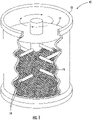
- a powder mixing system 10 is provided as shown in FIG. 1 .
- the powder mixing system 10 may be any powder mixing, or powder processing equipment.
- the powder mixing system 10 used herein is a mechanical alloying equipment, such as a mill. Non-limiting examples of the mill will include an attritor mill and ball-mill.
- the powder mixing system 10 is a high-energy attritor mill.
- Mechanical alloying is a solid-state powder processing technique involving the repeated working of powder particles in a high-energy mill.
- the powder particles may be ground, cold-welded, and fractured during the mechanical alloying process.
- a high-energy ball mill may be used for processing powder particles that may have to undergo the mechanical alloying process.
- the powder mixing system 10 may include a cylindrical or spherical container 12 having a processing volume 14 that is used for milling powder materials such as for example metallic particles, and ceramic materials.
- the container In a normal milling process, the container is partially filled with the materials to be milled and some milling medium and normally rotated in one, two, three, or more axes. The milling process results in the repeated cold welding and fracturing of powder particles.
- different milling media 16 may be used.
- the "milling media” as used herein is a plurality of media, such as balls, rods, or beads that can be used to mill and cold-weld the particles.
- the milling media 16 may include ceramic balls, flint pebbles and metallic balls. Key properties of milling media 16 include its size, density, hardness, and composition.
- feedstock 18 The materials to be processed inside the processing volume 14 of the container are referred to as "feedstock" 18, which is provided in the form of the powders as discussed above. That is, the feedstock 18 used herein includes a powder mixture formed from the refractory powder (e.g., two or more elemental refractory powders and/or a refractory alloy powder) and the rare earth oxide powder(s).
- the processing volume 14 is the total volume available for milling enclosed by the container 12 walls.
- the mill In the mechanical alloying process, the mill is used for fracturing and cold welding of the materials, thereby producing an alloyed powder from the starting powder mixture.
- the feedstock 18 in the processing volume of the container may have to be milled with high speed and energy to get the desired result after milling.
- Different factors that may influence the milling energy and the final milled materials include strength, hardness, size, speed, and ratio of the milling media 16 with respect to the feedstock 18 material, and overall time and temperature of milling.
- the milling media 16 may be desired to have higher strength and hardness than the overall feedstock 18 material.
- the feedstock 18 may mechanically milled at a milling temperature of 20 °C to 150 °C, such as 20 °C to 50 °C.
- the container 12 may be cooled to keep the milling temperature relatively low.
- the container 12 may have cooled walls.
- the milling media 16 may comprise balls, beads, or rods.
- the milling media 16 may have an interior portion and a surface portion with the same or different compositions.
- the surface portion of the milling media 16 has a refractory alloy composition, such a refractory alloy composition similar to that of the refractory powder of the feedstock 18.
- the elemental composition can be more precisely controlled in the resulting refractory alloy, since impurities from the milling media may be minimized.
- Mechanical alloying is generally performed in an inert environment (e.g., comprising argon, nitrogen, etc.) and/or under a vacuum to avoid introduction of unwanted impurities.
- an inert environment e.g., comprising argon, nitrogen, etc.
- the environmental gas may become incorporated and trapped in the milled material as an impurity.
- these gas bubbles expand, causing a porous structure.
- This thermally induced porosity may reduce the mechanical properties of the material. Therefore, in one embodiment, the feedstock 18 is milled under a rough vacuum, rather than in an inert gas environment (e.g., after purging with an inert gas environment).
- a “rough vacuum” as used herein indicates an environmental pressure less than the atmospheric pressure in the process volume of the container. In one embodiment, the pressure inside the container in the processing volume is less than 10 -4 atmosphere. In one embodiment, the pressure is less than 10 -5 atmosphere. This low pressure is maintained in the process volume throughout the milling process.
- the resulting alloyed mixture may be consolidated to form the oxide dispersion strengthened refractory-based alloy.
- the alloyed mixture may be subjected to a high temperature consolidation resulting in an alloy matrix having some dispersed microfeatures.
- microfeatures means discrete particles of matter having a largest diameter of 10 micrometers ( ⁇ m) or less, such as 0.001 ⁇ m to 5 ⁇ m (e.g., 0.001 ⁇ m to 2 ⁇ m, such as 0.001 ⁇ m to 1 ⁇ m).
- microfeatures used herein are typically in-situ formed by the dissolution of the starting rare earth oxide and precipitation of the rare earth refractory oxide as micrometer-sized clusters that can serve to pin the alloy structure, thus providing enhanced mechanical properties (e.g., strength).
- Consolidation may be performed by heating the alloyed mixture at a consolidation temperature that is 50% of the melting point of the refractory-based alloy or greater (e.g., a consolidation temperature that is 50% to 90% of the melting point of the refractory-based alloy).
- consolidation of the alloyed mixture reacts the rare earth oxide with at least one of the at least two refractory elements to form a rare earth refractory oxide as discrete particles (e.g., the microparticles) within the refractory-based alloy matrix, such as within a continuous phase of the refractory-based alloy.
- the rare earth refractory oxide includes, in most embodiments, a pyrochlore structure.
- the rare earth refractory oxide having a pyrochlore structure may have a chemical formula of Ln 2 A 2 O 7 where Ln is the at least one rare earth element and A is at least one refractory element.
- the at least one rare earth element may include scandium, yttrium, lanthanum, cerium, praseodymium, neodymium, promethium, samarium, europium, gadolinium, terbium, dysprosium, holmium, erbium, thulium, ytterbium, lutetium, or mixtures thereof.
- hafnium is included in the two or more refractory elements such that the rare earth refractory oxide having a pyrochlore structure has a chemical formula of Ln 2 Hf 2 O 7 where Ln is the at least one rare earth element, such as Y 2 Hf 2 O 7 .
- tantalum is included in the two or more refractory elements.
- the oxide dispersion strengthened refractory-based alloy is particularly useful as a high strength component, such as a leading edge of a hypersonic aircraft.
- high speed vehicles such as a hypersonic aircraft
- high speed vehicles typically experience extremely high temperatures and thermal gradients during high speed or hypersonic operation.
- the temperature gradients that are caused by the high heat flux are often a more severe problem than the temperature itself.
- the thermal conductivity of the structural material in combination with the heat flux, sets the temperature gradient within the material, and at high heat loads this gradient leads to mechanical stresses that cause plastic deformation or fracture of the material.
- the heat load to the structural material should be reduced to maintain the structural integrity of the components.
- FIG. 2 shows an exemplary component 300 of a hypersonic vehicle with a leading edge 302.
- the component 300 may be a single component or may include a plurality of leading edge assemblies (e.g., identified generally herein by component 300) which experience high thermal loads during hypersonic flight.
- the leading edge 302 may be provided on a forward end of the aircraft wings, the nose cone, the vertical stabilizer, the engine cowls of the propulsion engines, or other leading edges or surfaces of the hypersonic aircraft.
- leading edge 302 of the component 300 it is typically desirable to for the leading edge 302 of the component 300 to have a contoured point 304 in order to reduce drag on the hypersonic vehicle.
- leading edge 302 illustrated herein is a simplified cross section illustration of exemplary leading edges. The size, configuration, geometry, and application of such leading edge technologies may vary while remaining within the scope of the present subject matter. At least a portion, if not its entirety, of the component 300 may be formed from oxide dispersion strengthened refractory-based alloy discussed herein.
- FIG. 3 shows an exemplary method 310 of forming a oxide dispersion strengthened refractory-based alloy.
- the method 310 may include any of the features described above.
- a physical powder mixture may optionally be formed at 312, such as from at least two individual refractory element powders and a rare earth oxide powder(s).
- the physical powder mixture may be mechanically alloyed to form an alloyed mixture at 314 (e.g., such that dissolution of the starting oxide may occur), such as utilizing the system 10 described above.
- the alloyed mixture may be consolidated to form the oxide dispersion strengthened refractory-based alloy at 316 (e.g., such that reaction and precipitation may occur), such as described above, which includes the pyrochlore oxide.
- a refractory metal matrix having a composition of 76.3 Hf 26.7 Ta (at%) was mechanically alloyed with Y 2 O 3 under an inert atmosphere of argon. These alloy constituents were provided in the form of three powders: a first powder of Hf, a second powder of Ta, and a third powder of Y 2 O 3 . These powders were added in the relative atomic amounts to form the desired alloy.
- the Y 2 O 3 was varied from 0.5 wt% to 4.8 wt% to form multiple alloys having varied amounts of rare earth oxides added (0% as a comparative example, 0.5 wt%, 1.0 wt, 2.0 wt%, and 4.8 wt%).
- XRD showed the presence of Y 2 O 3 in the physical mixture (above 1% by weight) and the absence of Y 2 O 3 after mechanical alloying suggesting the Y 2 O 3 was dissolved during mechanical alloying.
- the microhardness (HRC) improved significantly with the addition of the rare earth refractory oxide when compared to the comparative example and increased in hardness with higher relative amounts of the rare earth refractory oxide.
- a refractory metal matrix having a composition of HfNbTaTiZr (equal at% for each constituent) was mechanically alloyed with 2 wt% Y 2 O 3 under an inert atmosphere of argon.
- These alloy constituents were provided in the form of six powders: a first powder of Hf, a second powder of Nb, a third powder of Ta, a fourth powder of Ti, and a fifth powder of Zr, and a sixth powder of Y 2 O 3 . These powders were added in the relative atomic amounts to form the desired alloy.
- XRD showed the presence of Y 2 O 3 in the physical mixture and the absence of Y 2 O 3 after mechanical alloying suggesting the Y 2 O 3 was dissolved during mechanical alloying.
- the microhardness (HRC) improved significantly with the precipitation of the rare earth refractory oxide when compared to the comparative example.
Landscapes
- Chemical & Material Sciences (AREA)
- Engineering & Computer Science (AREA)
- Mechanical Engineering (AREA)
- Materials Engineering (AREA)
- Metallurgy (AREA)
- Organic Chemistry (AREA)
- Aviation & Aerospace Engineering (AREA)
- Physics & Mathematics (AREA)
- Fluid Mechanics (AREA)
- Powder Metallurgy (AREA)
Applications Claiming Priority (1)
| Application Number | Priority Date | Filing Date | Title |
|---|---|---|---|
| US17/361,961 US20220411901A1 (en) | 2021-06-29 | 2021-06-29 | Oxide dispersion strengthened refractory based alloy |
Publications (1)
| Publication Number | Publication Date |
|---|---|
| EP4112759A1 true EP4112759A1 (de) | 2023-01-04 |
Family
ID=80628487
Family Applications (1)
| Application Number | Title | Priority Date | Filing Date |
|---|---|---|---|
| EP22160084.4A Pending EP4112759A1 (de) | 2021-06-29 | 2022-03-03 | Oxiddispersionsgehärtete hitzebeständige legierung |
Country Status (3)
| Country | Link |
|---|---|
| US (2) | US20220411901A1 (de) |
| EP (1) | EP4112759A1 (de) |
| CN (1) | CN115537625A (de) |
Cited By (1)
| Publication number | Priority date | Publication date | Assignee | Title |
|---|---|---|---|---|
| CN116254433A (zh) * | 2023-03-17 | 2023-06-13 | 哈尔滨工业大学 | 一种低密度高强韧AlMoNbTaTiZr系难熔高熵合金的制备方法 |
Families Citing this family (2)
| Publication number | Priority date | Publication date | Assignee | Title |
|---|---|---|---|---|
| CN116217230B (zh) * | 2023-03-15 | 2024-05-07 | 沈阳大学 | 一种低热导率宽中红外波段透过高熵纳米复合陶瓷的制备方法 |
| CN120443018B (zh) * | 2025-07-09 | 2025-09-19 | 江西省钨与稀土产品质量监督检验中心(江西省钨与稀土研究院) | 一种掺稀土钴铼超高温校温合金及其制备方法和应用 |
Citations (3)
| Publication number | Priority date | Publication date | Assignee | Title |
|---|---|---|---|---|
| US20110142711A1 (en) * | 2008-08-20 | 2011-06-16 | National University Corporation Hokkaido University | Oxide-dispersion-strengthened alloy |
| CN103060586A (zh) * | 2013-01-15 | 2013-04-24 | 北京科技大学 | 一种复杂形状铌基ods合金的制备方法 |
| US20150033912A1 (en) * | 2013-07-30 | 2015-02-05 | General Electric Company | System and method of forming nanostructured ferritic alloy |
Family Cites Families (7)
| Publication number | Priority date | Publication date | Assignee | Title |
|---|---|---|---|---|
| CN1711366A (zh) * | 2002-11-11 | 2005-12-21 | 住友电气工业株式会社 | 电火花加工用电极材料及其制造方法 |
| CN101948970A (zh) * | 2010-10-13 | 2011-01-19 | 北京科技大学 | 一种机械合金化制备镍基氧化物弥散强化合金的方法 |
| CN101956093B (zh) * | 2010-11-03 | 2012-05-30 | 重庆国际复合材料有限公司 | 氧化物弥散强化铂基合金及其制备方法 |
| WO2016061721A1 (zh) * | 2014-10-20 | 2016-04-28 | 中南大学 | 一种稀土氧化物弥散强化细晶钨材料的制备方法 |
| CN106435323B (zh) * | 2016-08-23 | 2017-12-12 | 北京科技大学 | 一种氧化物弥散强化ods高熵合金及其制备方法 |
| US12012647B2 (en) * | 2019-06-21 | 2024-06-18 | United States Government Administrator Of Nasa | Additively manufactured oxide dispersion strengthened medium entropy alloys for high temperature applications |
| US11260953B2 (en) * | 2019-11-15 | 2022-03-01 | General Electric Company | System and method for cooling a leading edge of a high speed vehicle |
-
2021
- 2021-06-29 US US17/361,961 patent/US20220411901A1/en not_active Abandoned
-
2022
- 2022-03-03 EP EP22160084.4A patent/EP4112759A1/de active Pending
- 2022-04-26 CN CN202210448116.6A patent/CN115537625A/zh active Pending
-
2024
- 2024-07-19 US US18/777,659 patent/US20250277290A1/en active Pending
Patent Citations (3)
| Publication number | Priority date | Publication date | Assignee | Title |
|---|---|---|---|---|
| US20110142711A1 (en) * | 2008-08-20 | 2011-06-16 | National University Corporation Hokkaido University | Oxide-dispersion-strengthened alloy |
| CN103060586A (zh) * | 2013-01-15 | 2013-04-24 | 北京科技大学 | 一种复杂形状铌基ods合金的制备方法 |
| US20150033912A1 (en) * | 2013-07-30 | 2015-02-05 | General Electric Company | System and method of forming nanostructured ferritic alloy |
Cited By (2)
| Publication number | Priority date | Publication date | Assignee | Title |
|---|---|---|---|---|
| CN116254433A (zh) * | 2023-03-17 | 2023-06-13 | 哈尔滨工业大学 | 一种低密度高强韧AlMoNbTaTiZr系难熔高熵合金的制备方法 |
| CN116254433B (zh) * | 2023-03-17 | 2023-07-21 | 哈尔滨工业大学 | 一种低密度高强韧AlMoNbTaTiZr系难熔高熵合金的制备方法 |
Also Published As
| Publication number | Publication date |
|---|---|
| US20250277290A1 (en) | 2025-09-04 |
| CN115537625A (zh) | 2022-12-30 |
| US20220411901A1 (en) | 2022-12-29 |
Similar Documents
| Publication | Publication Date | Title |
|---|---|---|
| US20250277290A1 (en) | Oxide dispersion strengthened refractory based alloy | |
| Alshataif et al. | Manufacturing methods, microstructural and mechanical properties evolutions of high-entropy alloys: a review | |
| US10676805B2 (en) | Atomized picoscale composition aluminum alloy and method thereof | |
| Chen et al. | Fabrication and mechanical properties of AlCoNiCrFe high-entropy alloy particle reinforced Cu matrix composites | |
| CA3017191C (en) | Titanium-based alloy and method for manufacturing a titanium-based alloy component by an additive manufacturing process | |
| Gessinger et al. | Powder metallurgy of superalloys | |
| Liu et al. | High-density deformation nanotwin induced significant improvement in the plasticity of polycrystalline γ-TiAl-based intermetallic alloys | |
| Wang et al. | Microstructure and mechanical properties of a Ti− 22Al− 25Nb alloy fabricated from elemental powders by mechanical alloying and spark plasma sintering | |
| Xia et al. | Dispersoids and γ′ precipitates in an ultrafine grained René 88DT–5vol.% Y2O3 alloy with outstanding thermal stability | |
| CN106906379A (zh) | 基于原位晶须强韧化的双尺度结构钛合金及制备与应用 | |
| CN101381104A (zh) | 一种制备NbAl3金属间化合物的方法 | |
| Suryanarayana | Mechanical alloying of nanocrystalline materials and nanocomposites | |
| EP3031939B1 (de) | Durch oxidpartikeldispersion verstärkte ni-gruppen-superlegierung | |
| CN115673327B (zh) | 一种高强韧钨合金及其制备方法 | |
| CN116121669B (zh) | 一种竹笋结构W-Zr基非晶合金复合材料及其制备方法与应用 | |
| RU2852866C1 (ru) | Способ получения изделий из порошка титанового сплава методом 3D-печати | |
| Gordillo et al. | Effect of heat-treatment on phase stability and grain coarsening in a powder-processed Al–Ni–Co–Zr–Y alloy | |
| US20250084519A1 (en) | Strong-yet-ductile chemically complex alloy over a wide temperature range and its preparation method | |
| Baldenebro-López et al. | Synthesis, Microstructural Characterization and Microhardness of AlCoNi-SiC Composite Prepared by Mechanical Alloying | |
| Suryanarayana et al. | Alloyed steels: mechanically | |
| Wang et al. | Sintering Behavior of Tungsten Heavy Alloy Products Made by Plasma Spray Forming | |
| Chen et al. | Development of the NASA HR-2 Superalloy for Hydrogen-Sensitive Liquid Rocket Engines Via Laser Powder Bed Fusion | |
| Li et al. | In-situ generation of lanthanum oxide for carbide purification in binder jetting W-Ni-Fe alloys | |
| CN120920722A (zh) | 基于镍钴基金属间化合物的增材制造合金粉末及其制备方法、打印件 | |
| Gaikwad et al. | High Temperature Oxidation Behaviour of Powder Forged In718 Oxide Dispersion Strengthened (Ods) Superalloy |
Legal Events
| Date | Code | Title | Description |
|---|---|---|---|
| PUAI | Public reference made under article 153(3) epc to a published international application that has entered the european phase |
Free format text: ORIGINAL CODE: 0009012 |
|
| STAA | Information on the status of an ep patent application or granted ep patent |
Free format text: STATUS: THE APPLICATION HAS BEEN PUBLISHED |
|
| AK | Designated contracting states |
Kind code of ref document: A1 Designated state(s): AL AT BE BG CH CY CZ DE DK EE ES FI FR GB GR HR HU IE IS IT LI LT LU LV MC MK MT NL NO PL PT RO RS SE SI SK SM TR |
|
| STAA | Information on the status of an ep patent application or granted ep patent |
Free format text: STATUS: REQUEST FOR EXAMINATION WAS MADE |
|
| 17P | Request for examination filed |
Effective date: 20230510 |
|
| RBV | Designated contracting states (corrected) |
Designated state(s): AL AT BE BG CH CY CZ DE DK EE ES FI FR GB GR HR HU IE IS IT LI LT LU LV MC MK MT NL NO PL PT RO RS SE SI SK SM TR |