EP4112373B1 - Seat rail locking device for vehicle - Google Patents
Seat rail locking device for vehicle Download PDFInfo
- Publication number
- EP4112373B1 EP4112373B1 EP22179170.0A EP22179170A EP4112373B1 EP 4112373 B1 EP4112373 B1 EP 4112373B1 EP 22179170 A EP22179170 A EP 22179170A EP 4112373 B1 EP4112373 B1 EP 4112373B1
- Authority
- EP
- European Patent Office
- Prior art keywords
- lock pin
- rail
- locking
- fastened
- locking device
- Prior art date
- Legal status (The legal status is an assumption and is not a legal conclusion. Google has not performed a legal analysis and makes no representation as to the accuracy of the status listed.)
- Active
Links
Images




Classifications
-
- B—PERFORMING OPERATIONS; TRANSPORTING
- B60—VEHICLES IN GENERAL
- B60N—SEATS SPECIALLY ADAPTED FOR VEHICLES; VEHICLE PASSENGER ACCOMMODATION NOT OTHERWISE PROVIDED FOR
- B60N2/00—Seats specially adapted for vehicles; Arrangement or mounting of seats in vehicles
- B60N2/02—Seats specially adapted for vehicles; Arrangement or mounting of seats in vehicles the seat or part thereof being movable, e.g. adjustable
- B60N2/04—Seats specially adapted for vehicles; Arrangement or mounting of seats in vehicles the seat or part thereof being movable, e.g. adjustable the whole seat being movable
- B60N2/06—Seats specially adapted for vehicles; Arrangement or mounting of seats in vehicles the seat or part thereof being movable, e.g. adjustable the whole seat being movable slidable
- B60N2/07—Slide construction
- B60N2/0722—Constructive details
- B60N2/0732—Attachment of seat frame to the slide, e.g. eyelets
-
- B—PERFORMING OPERATIONS; TRANSPORTING
- B60—VEHICLES IN GENERAL
- B60N—SEATS SPECIALLY ADAPTED FOR VEHICLES; VEHICLE PASSENGER ACCOMMODATION NOT OTHERWISE PROVIDED FOR
- B60N2/00—Seats specially adapted for vehicles; Arrangement or mounting of seats in vehicles
- B60N2/02—Seats specially adapted for vehicles; Arrangement or mounting of seats in vehicles the seat or part thereof being movable, e.g. adjustable
- B60N2/04—Seats specially adapted for vehicles; Arrangement or mounting of seats in vehicles the seat or part thereof being movable, e.g. adjustable the whole seat being movable
- B60N2/06—Seats specially adapted for vehicles; Arrangement or mounting of seats in vehicles the seat or part thereof being movable, e.g. adjustable the whole seat being movable slidable
- B60N2/08—Seats specially adapted for vehicles; Arrangement or mounting of seats in vehicles the seat or part thereof being movable, e.g. adjustable the whole seat being movable slidable characterised by the locking device
- B60N2/0806—Seats specially adapted for vehicles; Arrangement or mounting of seats in vehicles the seat or part thereof being movable, e.g. adjustable the whole seat being movable slidable characterised by the locking device with pin alignment systems, e.g. with at least one of a plurality of locking pins always aligned w.r.t. at least one of a plurality of pin-receiving elements
-
- B—PERFORMING OPERATIONS; TRANSPORTING
- B60—VEHICLES IN GENERAL
- B60N—SEATS SPECIALLY ADAPTED FOR VEHICLES; VEHICLE PASSENGER ACCOMMODATION NOT OTHERWISE PROVIDED FOR
- B60N2/00—Seats specially adapted for vehicles; Arrangement or mounting of seats in vehicles
- B60N2/02—Seats specially adapted for vehicles; Arrangement or mounting of seats in vehicles the seat or part thereof being movable, e.g. adjustable
- B60N2/04—Seats specially adapted for vehicles; Arrangement or mounting of seats in vehicles the seat or part thereof being movable, e.g. adjustable the whole seat being movable
- B60N2/06—Seats specially adapted for vehicles; Arrangement or mounting of seats in vehicles the seat or part thereof being movable, e.g. adjustable the whole seat being movable slidable
- B60N2/07—Slide construction
- B60N2/0702—Slide construction characterised by its cross-section
- B60N2/0715—C or U-shaped
-
- B—PERFORMING OPERATIONS; TRANSPORTING
- B60—VEHICLES IN GENERAL
- B60N—SEATS SPECIALLY ADAPTED FOR VEHICLES; VEHICLE PASSENGER ACCOMMODATION NOT OTHERWISE PROVIDED FOR
- B60N2/00—Seats specially adapted for vehicles; Arrangement or mounting of seats in vehicles
- B60N2/02—Seats specially adapted for vehicles; Arrangement or mounting of seats in vehicles the seat or part thereof being movable, e.g. adjustable
- B60N2/04—Seats specially adapted for vehicles; Arrangement or mounting of seats in vehicles the seat or part thereof being movable, e.g. adjustable the whole seat being movable
- B60N2/06—Seats specially adapted for vehicles; Arrangement or mounting of seats in vehicles the seat or part thereof being movable, e.g. adjustable the whole seat being movable slidable
- B60N2/08—Seats specially adapted for vehicles; Arrangement or mounting of seats in vehicles the seat or part thereof being movable, e.g. adjustable the whole seat being movable slidable characterised by the locking device
- B60N2/0831—Movement of the latch
- B60N2/0862—Movement of the latch sliding
- B60N2/0875—Movement of the latch sliding in a vertical direction
-
- B—PERFORMING OPERATIONS; TRANSPORTING
- B60—VEHICLES IN GENERAL
- B60N—SEATS SPECIALLY ADAPTED FOR VEHICLES; VEHICLE PASSENGER ACCOMMODATION NOT OTHERWISE PROVIDED FOR
- B60N2/00—Seats specially adapted for vehicles; Arrangement or mounting of seats in vehicles
- B60N2/02—Seats specially adapted for vehicles; Arrangement or mounting of seats in vehicles the seat or part thereof being movable, e.g. adjustable
- B60N2/04—Seats specially adapted for vehicles; Arrangement or mounting of seats in vehicles the seat or part thereof being movable, e.g. adjustable the whole seat being movable
- B60N2/06—Seats specially adapted for vehicles; Arrangement or mounting of seats in vehicles the seat or part thereof being movable, e.g. adjustable the whole seat being movable slidable
- B60N2/08—Seats specially adapted for vehicles; Arrangement or mounting of seats in vehicles the seat or part thereof being movable, e.g. adjustable the whole seat being movable slidable characterised by the locking device
- B60N2/0881—Activation of the latches by the control mechanism
-
- B—PERFORMING OPERATIONS; TRANSPORTING
- B60—VEHICLES IN GENERAL
- B60N—SEATS SPECIALLY ADAPTED FOR VEHICLES; VEHICLE PASSENGER ACCOMMODATION NOT OTHERWISE PROVIDED FOR
- B60N2/00—Seats specially adapted for vehicles; Arrangement or mounting of seats in vehicles
- B60N2/02—Seats specially adapted for vehicles; Arrangement or mounting of seats in vehicles the seat or part thereof being movable, e.g. adjustable
- B60N2/04—Seats specially adapted for vehicles; Arrangement or mounting of seats in vehicles the seat or part thereof being movable, e.g. adjustable the whole seat being movable
- B60N2/06—Seats specially adapted for vehicles; Arrangement or mounting of seats in vehicles the seat or part thereof being movable, e.g. adjustable the whole seat being movable slidable
- B60N2/08—Seats specially adapted for vehicles; Arrangement or mounting of seats in vehicles the seat or part thereof being movable, e.g. adjustable the whole seat being movable slidable characterised by the locking device
- B60N2/0812—Location of the latch
- B60N2/0818—Location of the latch inside the rail
Definitions
- the present invention relates to a seat rail locking device for a vehicle, and more specifically, to a seat rail locking device for a vehicle, which newly improves a conventional seat rail locking method of moving a lock pin in a directly downward direction to pass through a floor panel to a method of locking a seat rail by moving the lock pin in an upward direction.
- seats for a vehicle are basically configured to include a seat cushion on which a passenger's lower body is seated, a seatback on which the passenger's upper body leans, and a headrest for supporting the passenger's neck and head.
- the seats for a vehicle are mounted on a floor panel inside the vehicle by a seat rail including a fixed rail and a movable rail so that the front and rear locations may be adjusted.
- the fixed rail (lower rail) in a configuration of the seat rail is fixedly mounted on the floor panel via a mounting bracket and a bolt, and the movable rail (upper rail) assembled with the seat cushion is fastened to the fixed rail to be movable in forward and backward directions.
- a seat rail locking device for locking and unlocking the movable rail is mounted across the fixed rail and the movable rail.
- FIGS. 1 and 2 show the conventional manual type seat rail locking device, in which FIG. 1 is a cross-sectional diagram showing a locking state of the seat rail, and FIG. 2 is a cross-sectional diagram showing an unlocking state of the seat rail.
- a seat rail 10 is configured to include a fixed rail 12 fixedly mounted on a floor panel 30, and a movable rail 14 fastened to the fixed rail 12 to be movable in forward and backward directions.
- a seat rail locking device for locking and unlocking the movable rail is installed across the fixed rail 12 and the movable rail 14.
- the seat rail locking device is configured to include a support plate 21 having a top connected to a seat cushion frame (not shown), and a bottom coupled to the movable rail 14; a lock pin 22 inserted into the support plate 21 and the movable rail 14 to be movable in upward and downward directions; a spring 23 inserted between a bottom surface of the support plate 21 and a circumferential part 22-1 of the lock pin 22 to be compressible; and a track lever 24, one end of which is formed with a folding part 24-1 for unlocking located at a bottom of the circumferential part 22-1 of the lock pin 22, the other end of which is formed with a handle part 24-2 foldable by a user, and an intermediate portion of which is fastened to the support plate 21 by a hinge 24-3.
- the fixed rail 12 is formed with a locking hole 12-1 into which a lower end of the lock pin 22 is lockably inserted.
- a stopper plate 25 provided in a structure in which the lock pin 22 passes through to be movable in upward and downward directions to limit a descending distance of the lock pin 22 is further disposed between the fixed rail 12 and the movable rail 14, and a circumferential portion of the lock pin 22 is further formed with a stopper part 22-2 caught to the stopper plate 25.
- a structure of the conventional manual rail lock system has a structure in which at least one lock pin is locked using a plurality of lock pins for customer safety.
- the lock pin 22 is pushed in a downward direction again by the elastic restoring force of the spring 23 and at the same time, the lower end of the lock pin 22 moves in a directly downward direction and is locked to and inserted into the locking hole 12-1 of the fixed rail 12, so that the movable rail 14 is in a locking state of not being movable along the fixed rail 12 in the forward and backward directions.
- one lock pin 22 is shown in the cross-sectional diagrams of FIGS. 1 and 2 , but a plurality of lock pins 22 are really arranged in the forward and backward directions, and the movable rail may be locked even when only one of the plurality of lock pins 22 is inserted into and fastened to the locking hole 12-1 of the fixed rail 12.
- the above-described conventional manual type seat rail locking device has the structure in which the lock pin 22 moves in the directly downward direction so that the lower end thereof is inserted into and fastened to the locking hole 12-1 of the fixed rail 12, as shown in FIG. 1 , the lower end of the lock pin 22 may come into contact with the floor panel 30 on which the fixed rail 12 is mounted through the locking hole 12-1 of the fixed rail 12.
- the lower end of the lock pin 22 may be pressed by dispersion of the floor panel 30 and the like, thereby not properly locking the lock pin 22.
- a bottom space of the floor panel 30 and the like may be used as a battery mounting space, and the lower end of the lock pin 22 is pressed by coming into contact with the floor panel 30 through the locking hole 12-1 of the fixed rail 12, which may serve as an interference factor while a battery is packaged on the floor panel.
- KR 101 330 025 B1 discloses a seat track locking device including a locking member which is vertically movable about a movable track to be moved along a fixed track on a vehicle body in order to engage or disengage the fixed track with or from the movable track; a working pin of which one end is joined to the locking member and the other end passes through a through-hole of the movable track; and a return spring of which one end is formed with a small diameter engaging end to be engaged with and supported in a first catching portion on the working pin and the other end is formed with a large diameter engaging end to be engaged with and supported in the through-hole of the movable track in order to press the movable track and the locking member to be closer to each other.
- the present invention has been made in efforts to solve the above general problem, and an object of the present invention is to provide a seat rail locking device for a vehicle, which may apply a method of moving a lock pin in an upward direction to lock a seat rail by moving away from a conventional seat rail locking method of moving the lock pin in a directly downward direction to pass through a floor panel, thereby not causing the interference with the floor panel at all to flexibly apply a battery mounting structure to the floor panel, improving an assembling property as an operator may easily assemble a lock pin guide configured to guide the lock pin to move in upward and downward directions to a movable rail with only one-touch operation, and preventing the lock pin from being damaged or separated by mounting a cap at an upper end of the lock pin.
- the present invention provides a seat rail locking device for a vehicle including a fixed rail adapted to be fixedly mounted to a floor panel; a movable rail fastened to the fixed rail to be movable in forward and backward directions; a support plate mounted on the movable rail for assembling with a seat cushion; a lock pin guide provided in a hollow structure in which a spring backing part is formed, and inserted into and fastened to the movable rail; a lock pin inserted into the lock pin guide to be movable in upward and downward directions; a cap provided in a structure in which a spring support part is formed at a circumferential portion of a lower end, and fastened to an upper end of the lock pin; a spring disposed between the spring support part of the cap and the spring backing part of the lock pin guide to be compressible; a track lever that is hinge-fastened to the support plate and connected to the cap; and a locking plate fastened the lower end of the lock pin, moving in an upward direction when the lock pin moves
- the lock pin guide is composed of a hollow guide pipe in which the spring backing part is formed; a mounting plate integrally formed at a circumference of an upper end of the guide pipe and seated on an outer circumferential surface of an assembling hole formed in the movable rail; a fastening support plate formed to extend from a bottom of the mounting plate in a downward direction; and a locking projection formed to protrude from an outer diameter portion of the fastening support plate, and caught and fastened to an inner circumferential surface of the assembling hole of the movable rail.
- the cap has a structure having an opened bottom, and is provided in a nut cap structure in which a female screw portion for fastening with the lock pin is formed at an inner diameter portion thereof.
- the upper end of the lock pin is formed with a male screw portion that is screw-coupled to a female screw portion formed at the inner diameter portion of the cap.
- the locking plate is composed of a body plate fastened to the lower end of the lock pin; and a plurality of locking parts formed to protrude from both side ends of the body plate, and separably inserted into and fastened to the locking groove of the fixed rail through the movable rail.
- the movable rail is formed with a plurality of guide holes through which the locking part of the locking plate passes and moves in upward and downward directions.
- the track lever is composed of a handle part for a user's folding operation; a connection bar extending from both side ends of the handle part in a backward direction; and a lever bracket having a front end connected to the connection bar, a pressing part connected to the cap formed to be bent on a rear end, and an intermediate portion that is hinge-fastened to an inner surface of the support plate.
- a coil portion of a return spring is wound around and fixed to the hinge of the lever bracket, but one end of the return spring is connected and fixed to a spring fixed part of the movable rail, and the other end of the return spring is connected and fixed to the pressing part of the lever bracket.
- the support plate is formed with a pressing part guide hole guiding the pressing part of the lever bracket to be bent to a location on the lock pin and located thereto.
- the present invention provides the following effects through the above configuration.
- autonomous or “vehicular” or other similar term as used herein is inclusive of motor automotives in general such as passenger automobiles including sports utility automotives (operation SUV), buses, trucks, various commercial automotives, watercraft including a variety of boats and ships, aircraft, and the like, and includes hybrid automotives, electric automotives, plug-in hybrid electric automotives, hydrogen-powered automotives and other alternative fuel automotives (e.g., fuels derived from resources other than petroleum).
- a hybrid automotive is an automotive that has two or more sources of power, for example both gasoline-powered and electric-powered automotives.
- a seat rail 100 for a vehicle is basically configured to include a fixed rail 110 fixedly mounted on a floor panel 130 via a mounting bracket, a bolt, etc., and a movable rail 120 fastened to the fixed rail 110 to be slidably moved in forward and backward directions.
- the fixed rail 110 is manufactured in a structure that has a "U"-shaped cross section and at the same time, has both side ends bent in a downward direction to form an inverted "U”-shaped cross section
- the movable rail 120 is manufactured in a structure that has the inverted "U"-shaped cross section and at the same time, has both side ends bent in an upward direction to form the "U"-shaped cross section.
- a support plate 140 is mounted on the movable rail 120 for assembling with a seat cushion frame.
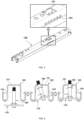
- FIGS. 3 and 4 are diagrams showing an assembling structure between a lock pin and a locking plate in a configuration of a seat rail locking device for a vehicle according to the present invention
- FIG. 5 is a perspective diagram showing a movable rail in the configuration of the seat rail locking device for a vehicle according to the present invention.
- the lock pin 160 has a circular rod shape of a predetermined length elongated vertically, and is provided in a structure in which an upper end thereof is formed with a male screw portion 161 for fastening with a cap, and a lower end thereof is formed with a riveting part 162 for fastening with a locking plate 170.
- the locking plate 170 is provided in a structure that is fastened to the lock pin 160 to move in an upward direction together when the lock pin 160 moves in the upward direction and inserted into and locked to a locking groove 111 having an opened lower portion formed in an inner end of the fixed rail 110, and move in a downward direction together when the lock pin 160 moves in the downward direction and separated and unlocked from the locking groove 111 of the fixed rail 110.
- the locking plate 170 is composed of a body plate 171 fastened to the riveting part 162 formed at the lower end of the lock pin 160 by riveting, and a plurality of locking parts 172 formed to protrude from both side ends of the body plate 171 and separably inserted into and fastened to the locking groove 111 having the opened lower portion of the fixed rail 110 through the movable rail 120.
- a rectangular assembling hole 121 into which the lock pin 160 enters to be movable laterally is formed in an upper portion of the movable rail, and a plurality of guide holes 124 through which the locking part 172 of the locking plate 170 passes and flows vertically are formed in both side surfaces of the movable rail 120.
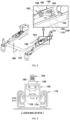
- FIG. 6 is a cross-sectional diagram showing a process of assembling the lock pin and the locking plate fastened to each other to the movable rail in the configuration of the seat rail locking device for a vehicle according to the present invention.
- the lock pin 160 and the locking plate 170 integrated by the riveting as described above are located at the bottom of the movable rail 120, and then enter inside the movable rail 120, an upper end of the lock pin 160 is in a state of being disposed within the assembling hole 121 of the movable rail 120 to be movable laterally.
- the lock pin 160 and the locking plate 170 are tilted to one side to insert and mount the locking part 172 of one side of the locking plate 170 into and in the guide hole 124 of one side of the movable rail 120, and then the lock pin 160 and the locking plate 170 are tilted in an opposite direction to insert and mount the locking part 172 of the other side of the locking plate 170 into and in the guide hole 124 of the other side of the movable rail 120, so that the lock pin 160 and the locking plate 170 integrated by the riveting as described above are in a state of being first completely assembled to the movable rail 120.
- FIG. 7 is a diagram sequentially showing a process of assembling a lock pin guide and a cap in the configuration of the seat rail locking device for a vehicle according to the present invention.
- the lock pin guide 150 is provided in a hollow structure in which a spring backing part 151 is formed, and provided in a structure that is inserted into and fastened to the assembling hole 121 of the movable rail 120 in a one-touch manner.
- the lock pin guide 150 is configured to include a hollow guide pipe 152 in which the spring backing part 151 is formed, a mounting plate 153 integrally formed at a circumferential portion of an upper end of the guide pipe 152 and seated on an outer circumferential surface of the assembling hole 121 of the movable rail 120, a fastening support plate 154 formed to extend from a bottom of the mounting plate 153 in a downward direction, and a locking projection 155 formed to protrude from an outer diameter portion of the fastening support plate 154, and caught and fastened to an inner circumferential surface of the assembling hole 121 of the movable rail 120.
- the fastening support plate 154 of the lock pin guide 150 is inserted into the assembling hole 121 of the movable rail 120 as the lock pin 160 coupled to the locking plate 170 is inserted into the guide pipe 152 of the lock pin guide 150 to be movable in the upward and downward directions, the locking projection 155 formed on the fastening support plate 154 is caught to the inner circumferential surface of the assembling hole 121 of the movable rail 120, so that the lock pin guide 150 is in a state of being easily assembled and fixed to the assembling hole 121 of the movable rail 120 in a one-touch manner.
- a spring 166 is inserted into the lock pin 160 inserted into the guide pipe 152 of the lock pin guide 150, and then the cap 163 is fastened to the upper end of the lock pin 160.
- the cap 163 has a structure having an opened bottom, and is provided in a nut cap structure in which a female screw portion 164 for fastening with the lock pin 160 is formed at an inner diameter portion thereof.
- the male screw portion 161 that is screw-fastened to the female screw portion 164 formed at the inner diameter portion of the cap 163 is formed at the upper end of the lock pin 160, and a spring support part 165 is further formed to protrude from a circumferential portion of a lower end of the cap 163.
- the spring 166 is inserted into the lock pin 160 inserted into the guide pipe 152 of the lock pin guide 150, and then the cap 163 is rotated so that the female screw portion 164 of the cap 163 is screw-fastened to the male screw portion 161 of the lock pin 160, so that the cap 163 is in a state of being assembled and fixed to the lock pin 160.
- the spring 166 is in a state of being disposed between the spring support part 165 of the cap 163 and the spring backing part 151 within the guide pipe 152 of the lock pin guide 150 to be compressible.
- the locking part 172 of the locking plate 170 passing through the guide hole 124 of the movable rail 120 is in a state of being separably inserted into the locking groove 111 having the opened lower portion formed in the inner end of the fixed rail 110.
- FIG. 8 is a perspective diagram showing a connection structure between a track lever and the cap in the configuration of the seat rail locking device for a vehicle according to the present invention.
- the track lever 180 operated by a user is connected to an upper surface of the cap 163 in order to press the cap 163 fastened to the upper end of the lock pin 160 in an unlocking direction (downward direction).
- the track lever 180 is hinge-fastened to the support plate 140 mounted on the movable rail 120 and connected to the upper surface of the cap 163.
- the track lever 180 is composed of a handle part 181 for a user's folding operation, a connection bar 182 extending from both side ends of the handle part 181 in a backward direction, and a lever bracket 183 that is hinge-fastened to the inner surface of the support plate 140 and connected to the connection bar 182.
- a front end of the lever bracket 183 is connected to the connection bar 182, a pressing part 184 connected to the upper surface of the cap 163 is formed to be bent at a rear end thereof, and an intermediate portion thereof is fastened to the support plate 140 by a hinge 185.
- a coil portion of a return spring 186 is wound around and fixed to the hinge 185 of the lever bracket 182, but one end of the return spring 186 is fixedly connected to a spring fixed part 125 of the movable rail 120, and the other end of the return spring 186 is fixedly connected to the pressing part 184 of the lever bracket 183.
- a pressing part guide hole 141 that guides the pressing part 184 of the lever bracket 183 to be bent to a location on the lock pin 160 and located is formed to pass through across horizontal and vertical plate portions of the support plate 140.
- the lever bracket 183 is in a state of being rotatably that is hinge-fastened to an inner surface of the vertical plate portion of the support plate 140, but the pressing part 184 of the lever bracket 183 may be easily located on the cap 163 by passing through the pressing part guide hole 141 to be pressable.
- FIG. 9 is a cross-sectional diagram showing a state in which the movable rail is locked as a state in which the seat rail locking device for a vehicle according to the present invention is completely assembled
- FIG. 10 is a cross-sectional diagram showing a state in which the movable rail is unlocked as the state in which the seat rail locking device for a vehicle according to the present invention is completely assembled.
- the spring 166 disposed between the spring support part 165 of the cap 163 and the spring backing part 151 of the lock pin guide 150 to be compressible exerts an elastic restoring force of pushing up the lock pin 160.
- the cap 163 maintains the state of protruding in the upward direction from the lock pin guide 150 without being pressed, and the locking plate 170 fastened to the lower end of the lock pin 160 also maintains the state of moving in the upward direction.
- the locking part 172 of the locking plate 170 passing through the guide hole 124 of the movable rail 120 is inserted into the locking groove 111 having the opened lower portion formed in the inner end of the fixed rail 110, so that the movable rail 120 maintains the state of being locked not to move in the forward and backward directions.
- the lever bracket 183 connected to the connection bar 182 of the track lever 180 is rotated around the hinge 185 and at the same time, the pressing part 184 of the lever bracket 183 is rotated in a downward direction to press the cap 163.
- the cap 163 is pressed and the lock pin 160 moves in the downward direction, and the locking plate 170 fastened to the lock pin 160 also moves in the downward direction together.
- the locking part 172 of the locking plate 170 escapes and is separated from the locking groove 111 having the opened lower portion formed in the inner end of the fixed rail 110, so that the movable rail 120 is in a state of being movable along the fixed rail 110 in the forward and backward directions.
- the movable rail 120 connected to the seat cushion frame is slid along the fixed rail 110 in the forward and backward direction, so that the user may adjust the desired front and rear locations of the seat.
- the lock pin 160 moves in a upward direction that is a locking direction by the elastic restoring force of the spring 166, and the locking part 172 of the locking plate 170 is inserted into the locking groove 111 having the opened lower portion formed in the inner end of the fixed rail 110 again, so that the movable rail 120 is in a locking state of not being moved in the forward and backward directions again.
Landscapes
- Engineering & Computer Science (AREA)
- Aviation & Aerospace Engineering (AREA)
- Transportation (AREA)
- Mechanical Engineering (AREA)
- Seats For Vehicles (AREA)
Description
- The present invention relates to a seat rail locking device for a vehicle, and more specifically, to a seat rail locking device for a vehicle, which newly improves a conventional seat rail locking method of moving a lock pin in a directly downward direction to pass through a floor panel to a method of locking a seat rail by moving the lock pin in an upward direction.
- As is well known, seats for a vehicle are basically configured to include a seat cushion on which a passenger's lower body is seated, a seatback on which the passenger's upper body leans, and a headrest for supporting the passenger's neck and head.
- The seats for a vehicle are mounted on a floor panel inside the vehicle by a seat rail including a fixed rail and a movable rail so that the front and rear locations may be adjusted.
- To this end, the fixed rail (lower rail) in a configuration of the seat rail is fixedly mounted on the floor panel via a mounting bracket and a bolt, and the movable rail (upper rail) assembled with the seat cushion is fastened to the fixed rail to be movable in forward and backward directions.
- In addition, a seat rail locking device for locking and unlocking the movable rail is mounted across the fixed rail and the movable rail.
- Here, a conventional manual type seat rail locking device will be described as follows.
-
FIGS. 1 and 2 show the conventional manual type seat rail locking device, in whichFIG. 1 is a cross-sectional diagram showing a locking state of the seat rail, andFIG. 2 is a cross-sectional diagram showing an unlocking state of the seat rail. - As shown in
FIGS. 1 and 2 , aseat rail 10 is configured to include a fixedrail 12 fixedly mounted on afloor panel 30, and amovable rail 14 fastened to the fixedrail 12 to be movable in forward and backward directions. - In addition, a seat rail locking device for locking and unlocking the movable rail is installed across the
fixed rail 12 and themovable rail 14. - The seat rail locking device is configured to include a
support plate 21 having a top connected to a seat cushion frame (not shown), and a bottom coupled to themovable rail 14; alock pin 22 inserted into thesupport plate 21 and themovable rail 14 to be movable in upward and downward directions; aspring 23 inserted between a bottom surface of thesupport plate 21 and a circumferential part 22-1 of thelock pin 22 to be compressible; and atrack lever 24, one end of which is formed with a folding part 24-1 for unlocking located at a bottom of the circumferential part 22-1 of thelock pin 22, the other end of which is formed with a handle part 24-2 foldable by a user, and an intermediate portion of which is fastened to thesupport plate 21 by a hinge 24-3. - At this time, the fixed
rail 12 is formed with a locking hole 12-1 into which a lower end of thelock pin 22 is lockably inserted. - In addition, a
stopper plate 25 provided in a structure in which thelock pin 22 passes through to be movable in upward and downward directions to limit a descending distance of thelock pin 22 is further disposed between thefixed rail 12 and themovable rail 14, and a circumferential portion of thelock pin 22 is further formed with a stopper part 22-2 caught to thestopper plate 25. - A structure of the conventional manual rail lock system has a structure in which at least one lock pin is locked using a plurality of lock pins for customer safety.
- Accordingly, when the lower end of the
lock pin 22 is locked to and inserted into the locking hole 12-1 of the fixedrail 12 passing through thestopper plate 24 as thelock pin 22 is pushed in a downward direction by an elastic restoring force of thespring 23, as shown inFIG. 1 , thelock pin 22 is in a state of being restricted in forward and backward directions, and an upper end of thelock pin 22 is in a state of passing through and being inserted into thesupport plate 21 and themovable rail 14, and as a result, themovable rail 14 is in a locking state of not being movable along the fixedrail 12 in forward and backward directions. - On the other hand, when a user holds and folds the handle part 24-2 of the
track lever 24 in an unlocking direction, thetrack lever 24 is rotated in the unlocking direction around the hinge 24-3 and at the same time, the folding part 24-1 for unlocking of thetrack lever 24 pushes the bottom of the circumferential part 22-1 of thelock pin 22 in an upward direction, so that as shown inFIG. 2 , thelock pin 22 moves in the upward direction and at the same time, the lower end of thelock pin 22 escapes from the locking hole 12-1 of the fixedrail 12, and as a result, themovable rail 14 is in an unlocking state of being movable along thefixed rail 12 in forward and backward directions. - At this time, when the user releases the handle part 24-2 of the
track lever 24, thelock pin 22 is pushed in a downward direction again by the elastic restoring force of thespring 23 and at the same time, the lower end of thelock pin 22 moves in a directly downward direction and is locked to and inserted into the locking hole 12-1 of the fixedrail 12, so that themovable rail 14 is in a locking state of not being movable along thefixed rail 12 in the forward and backward directions. - For reference, one
lock pin 22 is shown in the cross-sectional diagrams ofFIGS. 1 and 2 , but a plurality oflock pins 22 are really arranged in the forward and backward directions, and the movable rail may be locked even when only one of the plurality oflock pins 22 is inserted into and fastened to the locking hole 12-1 of thefixed rail 12. - Since the above-described conventional manual type seat rail locking device has the structure in which the
lock pin 22 moves in the directly downward direction so that the lower end thereof is inserted into and fastened to the locking hole 12-1 of thefixed rail 12, as shown inFIG. 1 , the lower end of thelock pin 22 may come into contact with thefloor panel 30 on which thefixed rail 12 is mounted through the locking hole 12-1 of the fixedrail 12. - Accordingly, the lower end of the
lock pin 22 may be pressed by dispersion of thefloor panel 30 and the like, thereby not properly locking thelock pin 22. - In addition, as the release of electric vehicles is generalized, a bottom space of the
floor panel 30 and the like may be used as a battery mounting space, and the lower end of thelock pin 22 is pressed by coming into contact with thefloor panel 30 through the locking hole 12-1 of the fixedrail 12, which may serve as an interference factor while a battery is packaged on the floor panel. - Accordingly, there is a need for the method of moving and locking the lock pin in an upward direction to not only reduce the number of parts and improve an assembling property, but also prevent the interference with the floor panel by moving away from the method of moving and locking the lock pin in the directly downward direction.
KR 101 330 025 B1 - The present invention has been made in efforts to solve the above general problem, and an object of the present invention is to provide a seat rail locking device for a vehicle, which may apply a method of moving a lock pin in an upward direction to lock a seat rail by moving away from a conventional seat rail locking method of moving the lock pin in a directly downward direction to pass through a floor panel, thereby not causing the interference with the floor panel at all to flexibly apply a battery mounting structure to the floor panel, improving an assembling property as an operator may easily assemble a lock pin guide configured to guide the lock pin to move in upward and downward directions to a movable rail with only one-touch operation, and preventing the lock pin from being damaged or separated by mounting a cap at an upper end of the lock pin.
- In order to achieve the object, the present invention provides a seat rail locking device for a vehicle including a fixed rail adapted to be fixedly mounted to a floor panel; a movable rail fastened to the fixed rail to be movable in forward and backward directions; a support plate mounted on the movable rail for assembling with a seat cushion; a lock pin guide provided in a hollow structure in which a spring backing part is formed, and inserted into and fastened to the movable rail; a lock pin inserted into the lock pin guide to be movable in upward and downward directions; a cap provided in a structure in which a spring support part is formed at a circumferential portion of a lower end, and fastened to an upper end of the lock pin; a spring disposed between the spring support part of the cap and the spring backing part of the lock pin guide to be compressible; a track lever that is hinge-fastened to the support plate and connected to the cap; and a locking plate fastened the lower end of the lock pin, moving in an upward direction when the lock pin moves in the upward direction to be inserted into and locked to a locking groove having an opened lower portion formed at an inner end of the fixed rail, and moving in a downward direction together when the lock pin moves in the downward direction to be separated and unlocked from the locking groove of the fixed rail.
- The lock pin guide is composed of a hollow guide pipe in which the spring backing part is formed; a mounting plate integrally formed at a circumference of an upper end of the guide pipe and seated on an outer circumferential surface of an assembling hole formed in the movable rail; a fastening support plate formed to extend from a bottom of the mounting plate in a downward direction; and a locking projection formed to protrude from an outer diameter portion of the fastening support plate, and caught and fastened to an inner circumferential surface of the assembling hole of the movable rail.
- Preferably, the cap has a structure having an opened bottom, and is provided in a nut cap structure in which a female screw portion for fastening with the lock pin is formed at an inner diameter portion thereof.
- Preferably, the upper end of the lock pin is formed with a male screw portion that is screw-coupled to a female screw portion formed at the inner diameter portion of the cap.
- The locking plate is composed of a body plate fastened to the lower end of the lock pin; and a plurality of locking parts formed to protrude from both side ends of the body plate, and separably inserted into and fastened to the locking groove of the fixed rail through the movable rail.
- Preferably, the movable rail is formed with a plurality of guide holes through which the locking part of the locking plate passes and moves in upward and downward directions.
- The track lever is composed of a handle part for a user's folding operation; a connection bar extending from both side ends of the handle part in a backward direction; and a lever bracket having a front end connected to the connection bar, a pressing part connected to the cap formed to be bent on a rear end, and an intermediate portion that is hinge-fastened to an inner surface of the support plate.
- Preferably, a coil portion of a return spring is wound around and fixed to the hinge of the lever bracket, but one end of the return spring is connected and fixed to a spring fixed part of the movable rail, and the other end of the return spring is connected and fixed to the pressing part of the lever bracket.
- In addition, the support plate is formed with a pressing part guide hole guiding the pressing part of the lever bracket to be bent to a location on the lock pin and located thereto.
- The present invention provides the following effects through the above configuration.
- First, it is possible to apply the method of moving and locking the lock pin in the upward direction by moving away from the conventional seat rail locking method of moving the lock pin in the directly downward direction to pass through the floor panel, thereby not causing the interference with the floor panel at all to flexibly apply the battery mounting structure to the floor panel, and easily providing the battery mounting space in the floor panel.
- Second, it is possible to improve the assembling property as the operator may easily assemble the lock pin guide configured to guide the lock pin to move in the upward and downward directions to the movable rail with only one-touch operation.
- Third, it is possible to mount the cap at the upper end of the lock pin to protect the lock pin, thereby preventing the lock pin from being damaged or separated.
- It is understood that the term "automotive" or "vehicular" or other similar term as used herein is inclusive of motor automotives in general such as passenger automobiles including sports utility automotives (operation SUV), buses, trucks, various commercial automotives, watercraft including a variety of boats and ships, aircraft, and the like, and includes hybrid automotives, electric automotives, plug-in hybrid electric automotives, hydrogen-powered automotives and other alternative fuel automotives (e.g., fuels derived from resources other than petroleum). As referred to herein, a hybrid automotive is an automotive that has two or more sources of power, for example both gasoline-powered and electric-powered automotives.
- The above and other features of the invention are discussed infra.
- The above and other features of the present invention will now be described in detail with reference to certain exemplary examples thereof illustrated in the accompanying drawings which are given herein below by way of illustration only, and thus are not limitative of the present invention, and wherein:
-
FIG. 1 is a cross-sectional diagram showing a locking state of a seat rail as a conventional manual type seat rail locking device. -
FIG. 2 is a cross-sectional diagram showing the locking state of the seat rail as the conventional manual type seat rail locking device. -
FIGS. 3 and 4 are diagrams showing an assembling structure between a lock pin and a locking plate in a configuration of a seat rail locking device for a vehicle according to the present invention. -
FIG. 5 is a perspective diagram showing a movable rail in the configuration of the seat rail locking device for a vehicle according to the present invention. -
FIG. 6 is a cross-sectional diagram showing a process of assembling the lock pin and the locking plate fastened to each other to the movable rail in the configuration of the seat rail locking device for a vehicle according to the present invention. -
FIG. 7 is a diagram sequentially showing a process of assembling a lock pin guide and a cap in the configuration of the seat rail locking device for a vehicle according to the present invention. -
FIG. 8 is a perspective diagram showing a connection structure between a track lever and the cap in the configuration of the seat rail locking device for a vehicle according to the present invention. -
FIG. 9 is a cross-sectional diagram showing a state in which the movable rail is locked as a state in which the seat rail locking device for a vehicle according to the present invention is completely assembled. -
FIG. 10 is a cross-sectional diagram showing a state in which the movable rail is unlocked as the state in which the seat rail locking device for a vehicle according to the present invention is completely assembled. - It should be understood that the appended drawings are not necessarily to scale, presenting a somewhat simplified representation of various preferred features illustrative of the basic principles of the invention. The specific design features of the present invention as disclosed herein, including, for example, specific dimensions, orientations, locations, and shapes will be determined in section by the particular intended application and use environment.
- In the figures, reference numbers refer to the same or equivalent sections of the present invention throughout the several figures of the drawing.
- Hereinafter, preferred embodiments of the present invention will be described in detail with reference to the accompanying drawings.
- First, referring to
FIGS. 8, 9 , and10 , aseat rail 100 for a vehicle is basically configured to include a fixedrail 110 fixedly mounted on afloor panel 130 via a mounting bracket, a bolt, etc., and amovable rail 120 fastened to the fixedrail 110 to be slidably moved in forward and backward directions. - According to the present invention, in order to maximize a space used for a floor panel of electric vehicles and the like and structurally simplify the seat rail, the fixed
rail 110 is manufactured in a structure that has a "U"-shaped cross section and at the same time, has both side ends bent in a downward direction to form an inverted "U"-shaped cross section, and themovable rail 120 is manufactured in a structure that has the inverted "U"-shaped cross section and at the same time, has both side ends bent in an upward direction to form the "U"-shaped cross section. - Accordingly, when the
movable rail 120 is fastened to thefixed rail 110 to be slidably movable in the forward and backward directions, the arrangement in which both side ends having the inverted "U"-shaped cross section of thefixed rail 110 and both side ends having the "U"-shaped cross section of themovable rail 120 intersect and overlap with each other is formed. - In addition, a
support plate 140 is mounted on themovable rail 120 for assembling with a seat cushion frame. - Here, each component of the seat rail locking device for a vehicle according to the present invention will be described as follows.
-
FIGS. 3 and 4 are diagrams showing an assembling structure between a lock pin and a locking plate in a configuration of a seat rail locking device for a vehicle according to the present invention, andFIG. 5 is a perspective diagram showing a movable rail in the configuration of the seat rail locking device for a vehicle according to the present invention. - As shown in
FIGS. 3 and 4 , thelock pin 160 has a circular rod shape of a predetermined length elongated vertically, and is provided in a structure in which an upper end thereof is formed with amale screw portion 161 for fastening with a cap, and a lower end thereof is formed with ariveting part 162 for fastening with alocking plate 170. - In addition, the locking
plate 170 is provided in a structure that is fastened to thelock pin 160 to move in an upward direction together when thelock pin 160 moves in the upward direction and inserted into and locked to a lockinggroove 111 having an opened lower portion formed in an inner end of the fixedrail 110, and move in a downward direction together when thelock pin 160 moves in the downward direction and separated and unlocked from the lockinggroove 111 of the fixedrail 110. - To this end, the locking
plate 170 is composed of abody plate 171 fastened to theriveting part 162 formed at the lower end of thelock pin 160 by riveting, and a plurality of lockingparts 172 formed to protrude from both side ends of thebody plate 171 and separably inserted into and fastened to the lockinggroove 111 having the opened lower portion of the fixedrail 110 through themovable rail 120. - At this time, the
lock pin 160 and thelocking plate 170 integrated by the riveting as described above are first assembled to themovable rail 120. - To this end, as shown in
FIG. 5 , arectangular assembling hole 121 into which thelock pin 160 enters to be movable laterally is formed in an upper portion of the movable rail, and a plurality of guide holes 124 through which thelocking part 172 of thelocking plate 170 passes and flows vertically are formed in both side surfaces of themovable rail 120. -
FIG. 6 is a cross-sectional diagram showing a process of assembling the lock pin and the locking plate fastened to each other to the movable rail in the configuration of the seat rail locking device for a vehicle according to the present invention. - Referring to
FIG. 6 , thelock pin 160 and thelocking plate 170 integrated by the riveting as described above are located at the bottom of themovable rail 120, and then enter inside themovable rail 120, an upper end of thelock pin 160 is in a state of being disposed within the assemblinghole 121 of themovable rail 120 to be movable laterally. - Subsequently, the
lock pin 160 and thelocking plate 170 are tilted to one side to insert and mount the lockingpart 172 of one side of thelocking plate 170 into and in theguide hole 124 of one side of themovable rail 120, and then thelock pin 160 and thelocking plate 170 are tilted in an opposite direction to insert and mount the lockingpart 172 of the other side of thelocking plate 170 into and in theguide hole 124 of the other side of themovable rail 120, so that thelock pin 160 and thelocking plate 170 integrated by the riveting as described above are in a state of being first completely assembled to themovable rail 120. - Next, a process of assembling a
lock pin guide 150 to themovable rail 120 and a process of assembling acap 163 to thelock pin 160 in the configuration of the seat rail locking device for a vehicle according to the present invention are performed. -
FIG. 7 is a diagram sequentially showing a process of assembling a lock pin guide and a cap in the configuration of the seat rail locking device for a vehicle according to the present invention. - The
lock pin guide 150 is provided in a hollow structure in which aspring backing part 151 is formed, and provided in a structure that is inserted into and fastened to the assemblinghole 121 of themovable rail 120 in a one-touch manner. - To this end, the
lock pin guide 150 is configured to include ahollow guide pipe 152 in which thespring backing part 151 is formed, a mountingplate 153 integrally formed at a circumferential portion of an upper end of theguide pipe 152 and seated on an outer circumferential surface of the assemblinghole 121 of themovable rail 120, afastening support plate 154 formed to extend from a bottom of the mountingplate 153 in a downward direction, and a lockingprojection 155 formed to protrude from an outer diameter portion of thefastening support plate 154, and caught and fastened to an inner circumferential surface of the assemblinghole 121 of themovable rail 120. - Accordingly, when the
fastening support plate 154 of thelock pin guide 150 is inserted into the assemblinghole 121 of themovable rail 120 as thelock pin 160 coupled to thelocking plate 170 is inserted into theguide pipe 152 of thelock pin guide 150 to be movable in the upward and downward directions, the lockingprojection 155 formed on thefastening support plate 154 is caught to the inner circumferential surface of the assemblinghole 121 of themovable rail 120, so that thelock pin guide 150 is in a state of being easily assembled and fixed to the assemblinghole 121 of themovable rail 120 in a one-touch manner. - Subsequently, a
spring 166 is inserted into thelock pin 160 inserted into theguide pipe 152 of thelock pin guide 150, and then thecap 163 is fastened to the upper end of thelock pin 160. - Preferably, the
cap 163 has a structure having an opened bottom, and is provided in a nut cap structure in which afemale screw portion 164 for fastening with thelock pin 160 is formed at an inner diameter portion thereof. - To this end, the
male screw portion 161 that is screw-fastened to thefemale screw portion 164 formed at the inner diameter portion of thecap 163 is formed at the upper end of thelock pin 160, and aspring support part 165 is further formed to protrude from a circumferential portion of a lower end of thecap 163. - Accordingly, the
spring 166 is inserted into thelock pin 160 inserted into theguide pipe 152 of thelock pin guide 150, and then thecap 163 is rotated so that thefemale screw portion 164 of thecap 163 is screw-fastened to themale screw portion 161 of thelock pin 160, so that thecap 163 is in a state of being assembled and fixed to thelock pin 160. - In addition, the
spring 166 is in a state of being disposed between thespring support part 165 of thecap 163 and thespring backing part 151 within theguide pipe 152 of thelock pin guide 150 to be compressible. - Meanwhile, when the
movable rail 120 is fastened to the fixedrail 110 to be slidably movable in the forward and backward directions, as shown inFIGS. 9 and10 , the lockingpart 172 of thelocking plate 170 passing through theguide hole 124 of themovable rail 120 is in a state of being separably inserted into the lockinggroove 111 having the opened lower portion formed in the inner end of the fixedrail 110. -
FIG. 8 is a perspective diagram showing a connection structure between a track lever and the cap in the configuration of the seat rail locking device for a vehicle according to the present invention. - The
track lever 180 operated by a user is connected to an upper surface of thecap 163 in order to press thecap 163 fastened to the upper end of thelock pin 160 in an unlocking direction (downward direction). - Referring to
FIG. 8 , thetrack lever 180 is hinge-fastened to thesupport plate 140 mounted on themovable rail 120 and connected to the upper surface of thecap 163. - To this end, the
track lever 180 is composed of ahandle part 181 for a user's folding operation, aconnection bar 182 extending from both side ends of thehandle part 181 in a backward direction, and alever bracket 183 that is hinge-fastened to the inner surface of thesupport plate 140 and connected to theconnection bar 182. - At this time, a front end of the
lever bracket 183 is connected to theconnection bar 182, apressing part 184 connected to the upper surface of thecap 163 is formed to be bent at a rear end thereof, and an intermediate portion thereof is fastened to thesupport plate 140 by ahinge 185. - In addition, a coil portion of a
return spring 186 is wound around and fixed to thehinge 185 of thelever bracket 182, but one end of thereturn spring 186 is fixedly connected to a spring fixed part 125 of themovable rail 120, and the other end of thereturn spring 186 is fixedly connected to thepressing part 184 of thelever bracket 183. - Preferably, a pressing
part guide hole 141 that guides thepressing part 184 of thelever bracket 183 to be bent to a location on thelock pin 160 and located is formed to pass through across horizontal and vertical plate portions of thesupport plate 140. - Accordingly, the
lever bracket 183 is in a state of being rotatably that is hinge-fastened to an inner surface of the vertical plate portion of thesupport plate 140, but thepressing part 184 of thelever bracket 183 may be easily located on thecap 163 by passing through the pressingpart guide hole 141 to be pressable. - Here, an operation flow of the seat rail locking device according to the present invention having the above configuration will be described as follows.
-
FIG. 9 is a cross-sectional diagram showing a state in which the movable rail is locked as a state in which the seat rail locking device for a vehicle according to the present invention is completely assembled, andFIG. 10 is a cross-sectional diagram showing a state in which the movable rail is unlocked as the state in which the seat rail locking device for a vehicle according to the present invention is completely assembled. - In the locking state of the
movable rail 120, thespring 166 disposed between thespring support part 165 of thecap 163 and thespring backing part 151 of thelock pin guide 150 to be compressible exerts an elastic restoring force of pushing up thelock pin 160. - Substantially, even when the elastic restoring force of the
spring 166 is applied to thespring support part 165 of thecap 163, thecap 163 is in a state of being fastened to thelock pin 160 by the screw, so that the elastic restoring force of thespring 166 serves as a force of pushing thelock pin 160 in the upward direction. - Accordingly, as shown in
FIG. 9 , thecap 163 maintains the state of protruding in the upward direction from thelock pin guide 150 without being pressed, and thelocking plate 170 fastened to the lower end of thelock pin 160 also maintains the state of moving in the upward direction. - In addition, the locking
part 172 of thelocking plate 170 passing through theguide hole 124 of themovable rail 120 is inserted into the lockinggroove 111 having the opened lower portion formed in the inner end of the fixedrail 110, so that themovable rail 120 maintains the state of being locked not to move in the forward and backward directions. - On the other hand, when the user holds and folds the
handle 181 of thetrack lever 180 in the upward direction in order to adjust the front and rear locations of the seat, thelever bracket 183 connected to theconnection bar 182 of thetrack lever 180 is rotated around thehinge 185 and at the same time, thepressing part 184 of thelever bracket 183 is rotated in a downward direction to press thecap 163. - Accordingly, the
cap 163 is pressed and thelock pin 160 moves in the downward direction, and thelocking plate 170 fastened to thelock pin 160 also moves in the downward direction together. - At this time, as shown in
FIG. 10 , the lockingpart 172 of thelocking plate 170 escapes and is separated from the lockinggroove 111 having the opened lower portion formed in the inner end of the fixedrail 110, so that themovable rail 120 is in a state of being movable along the fixedrail 110 in the forward and backward directions. - Accordingly, when the seat moves in the forward and backward directions, the
movable rail 120 connected to the seat cushion frame is slid along the fixedrail 110 in the forward and backward direction, so that the user may adjust the desired front and rear locations of the seat. - Of course, when the user completes the adjustment of the front and rear locations of the seat and then releases the
handle part 181 of thetrack lever 180 as it is, thelock pin 160 moves in a upward direction that is a locking direction by the elastic restoring force of thespring 166, and the lockingpart 172 of thelocking plate 170 is inserted into the lockinggroove 111 having the opened lower portion formed in the inner end of the fixedrail 110 again, so that themovable rail 120 is in a locking state of not being moved in the forward and backward directions again. - As described above, according to the present invention, it is possible to apply the method of moving and locking the
lock pin 160 in the upward direction by moving away from the conventional seat rail locking method of moving the lock pin in the directly downward direction to pass through the floor panel, thereby not causing the interference with thefloor panel 130 at all to flexibly apply the battery mounting structure to the floor panel, and easily providing the battery mounting space in the floor panel. - In addition, it is possible to easily assemble the
lock pin guide 150 for guiding thelock pin 160 substantially locking themovable rail 120 to the fixedrail 110 to move in the upward and downward directions to the assemblinghole 121 of themovable rail 120 in the one-touch fastening manner, thereby improving the assembling property. - In addition, it is possible to mount the
cap 163 at the upper end of thelock pin 160 to protect thelock pin 160, thereby preventing thelock pin 160 from being damaged or separated. - While one embodiment of the present invention has been described above in detail, the scope of the present invention is not limited to the above-described one embodiment, and various modifications and improvements by those skilled in the art may be applied thereto, as long as the resulting device belongs to the scope defined by the appended claims.
Claims (9)
- A seat rail locking device for a vehicle, the seat rail locking device comprising:a fixed rail (100) adapted to be fixedly mounted to a floor panel (130);a movable rail (120) fastened to the fixed rail (100) to be movable in forward and backward directions;a support plate (140) mounted on the movable rail (120) for assembling with a seat cushion;a lock pin guide (150) provided in a hollow structure in which a spring backing part (151) is formed, and inserted into and fastened to the movable rail (120);a lock pin (160) inserted into the lock pin guide (150) to be movable in upward and downward directions;a cap (163) provided in a structure in which a spring support part (165) is formed at a circumferential portion of a lower end, and fastened to an upper end of the lock pin (160);a spring (166) disposed between the spring support part (165) of the cap (163) and the spring backing part (151) of the lock pin guide (150) to be compressible;a track lever (180) fastened to the support plate (140) by a hinge (185) and connected to the cap (163); anda locking plate (170) fastened the lower end of the lock pin (160), moving in an upward direction when the lock pin (160) moves in the upward direction to be inserted into and locked to a locking groove (111) having an opened lower portion formed at an inner end of the fixed rail (100), and moving in a downward direction together when the lock pin (160) moves in the downward direction to be separated and unlocked from the locking groove (111) of the fixed rail (100).
- The seat rail locking device of claim 1,
wherein the lock pin guide (150) includes:a hollow guide pipe (152) in which the spring backing part (151) is formed;a mounting plate (153) integrally formed at a circumference of an upper end of the guide pipe (152) and seated on an outer circumferential surface of an assembling hole (121) formed in the movable rail (120);a fastening support plate (154) formed to extend from a bottom of the mounting plate (153) in a downward direction; anda locking projection (155) formed to protrude from an outer diameter portion of the fastening support plate (154), and caught and fastened to an inner circumferential surface of the assembling hole (121) of the movable rail (120). - The seat rail locking device of claim 1,
wherein the cap (163) has a structure having an opened bottom, and is provided in a nut cap structure in which a female screw portion (164) for fastening with the lock pin (160) is formed at an inner diameter portion thereof. - The seat rail locking device of claim 3,
wherein the upper end of the lock pin (160) is formed with a male screw portion (161) that is screw-coupled to a female screw portion (164) formed at the inner diameter portion of the cap (163). - The seat rail locking device of claim 1,
wherein the locking plate (170) includes:a body plate (171) fastened to the lower end of the lock pin; anda plurality of locking parts (172) formed to protrude from both side ends of the body plate (171), and separably inserted into and fastened to the locking groove (111) of the fixed rail through the movable rail (120). - The seat rail locking device of claim 5,
wherein the movable rail (120) is formed with a plurality of guide holes (124) through which the locking part (172) of the locking plate (170) passes and moves in upward and downward directions. - The seat rail locking device of claim 1,
wherein the track lever (180) includes:a handle part (181) for a user's folding operation;a connection bar (182) extending from both side ends of the handle part (182) in a backward direction; anda lever bracket (183) having a front end connected to the connection bar (182), a pressing part (184) connected to the cap (163) formed to be bent on a rear end, and an intermediate portion fastened to an inner surface of the support plate (140) by a hinge (185). - The seat rail locking device of claim 7,
wherein a coil portion of a return spring (186) is wound around and fixed to the hinge (185) of the lever bracket (183), but one end of the return spring (186) is connected and fixed to a spring fixed part (125) of the movable rail (120), and the other end of the return spring (186) is connected and fixed to the pressing part (184) of the lever bracket (183). - The seat rail locking device of claim 7,
wherein the support plate (140) is formed with a pressing part guide hole (141) guiding the pressing part (184) of the lever bracket (183) to be bent to a location on the cap (163) and located thereto.
Applications Claiming Priority (1)
| Application Number | Priority Date | Filing Date | Title |
|---|---|---|---|
| KR1020210086539A KR102446337B1 (en) | 2021-07-01 | 2021-07-01 | Seat rail locking device for automobiles |
Publications (2)
| Publication Number | Publication Date |
|---|---|
| EP4112373A1 EP4112373A1 (en) | 2023-01-04 |
| EP4112373B1 true EP4112373B1 (en) | 2025-05-14 |
Family
ID=82067608
Family Applications (1)
| Application Number | Title | Priority Date | Filing Date |
|---|---|---|---|
| EP22179170.0A Active EP4112373B1 (en) | 2021-07-01 | 2022-06-15 | Seat rail locking device for vehicle |
Country Status (3)
| Country | Link |
|---|---|
| US (1) | US12145479B2 (en) |
| EP (1) | EP4112373B1 (en) |
| KR (1) | KR102446337B1 (en) |
Families Citing this family (6)
| Publication number | Priority date | Publication date | Assignee | Title |
|---|---|---|---|---|
| KR102446337B1 (en) * | 2021-07-01 | 2022-09-22 | 현대트랜시스 주식회사 | Seat rail locking device for automobiles |
| CN114619929A (en) * | 2022-03-25 | 2022-06-14 | 延锋国际汽车技术有限公司 | Roller and sliding column composite sliding rail bearing system |
| KR102729601B1 (en) * | 2022-06-15 | 2024-11-14 | 주식회사 다스 | Locking device for seat rail |
| KR102825241B1 (en) * | 2023-09-13 | 2025-06-24 | 현대트랜시스 주식회사 | Vehicle seat for walk in device |
| KR102841565B1 (en) * | 2023-09-14 | 2025-07-31 | 현대트랜시스 주식회사 | Vehicle seat for walk in device |
| KR102832791B1 (en) * | 2023-10-17 | 2025-07-09 | 현대트랜시스 주식회사 | Vehicle seat for walk in device |
Family Cites Families (21)
| Publication number | Priority date | Publication date | Assignee | Title |
|---|---|---|---|---|
| FR2759330B1 (en) * | 1997-02-13 | 1999-04-30 | Faure Bertrand Equipements Sa | MOTOR VEHICLE SEAT SLIDE |
| FR2852896B1 (en) * | 2003-03-24 | 2006-05-05 | Faurecia Sieges Automobile | SLIDER FOR SEAT OF MOTOR VEHICLE |
| FR2910392B1 (en) * | 2006-12-20 | 2009-08-28 | Faurecia Sieges Automobile | ADJUSTING MECHANISM FOR A MOTOR VEHICLE AND SYSTEM COMPRISING SUCH A MECHANISM |
| US8215602B2 (en) * | 2008-05-23 | 2012-07-10 | Lear Corporation | Longitudinal adjustment apparatus for a vehicle seat |
| JP5659974B2 (en) * | 2011-07-12 | 2015-01-28 | アイシン精機株式会社 | Vehicle seat slide device |
| CA3077833C (en) * | 2011-10-17 | 2023-01-03 | Fisher & Company, Incorporated | Seat-track assembly |
| KR101330025B1 (en) * | 2013-05-23 | 2013-11-18 | 대원정밀공업(주) | Seat track locking device with improved assembly structure |
| KR20150077702A (en) * | 2013-12-30 | 2015-07-08 | 현대다이모스(주) | Apparatus for locking seat-rail in vehicle |
| DE102016212168B4 (en) * | 2016-07-04 | 2020-08-06 | Adient Luxembourg Holding S.À R.L. | LENGTH ADJUSTER AND VEHICLE SEAT |
| EP3678895B1 (en) * | 2017-09-06 | 2023-04-19 | KEIPER Seating Mechanisms Co., Ltd. | Actuation mechanism for a longitudinal adjuster, longitudinal adjuster for a vehicle seat, and vehicle seat |
| KR102001504B1 (en) * | 2017-12-26 | 2019-07-18 | 현대트랜시스(주) | Locking apparatus of seat rail for vehicle |
| KR102001503B1 (en) * | 2017-12-26 | 2019-07-18 | 현대트랜시스(주) | Locking apparatus of seat rail for vehicle |
| JP7110009B2 (en) * | 2018-06-29 | 2022-08-01 | トヨタ車体精工株式会社 | Manufacturing method of seat slide device |
| KR102071504B1 (en) * | 2018-06-29 | 2020-01-30 | 주식회사 다스 | Locking device for seat rail |
| CN110789410B (en) * | 2018-08-02 | 2022-03-18 | 安道拓工程技术知识产权有限公司 | Longitudinal seat adjusting device |
| US11225173B2 (en) * | 2020-02-12 | 2022-01-18 | Fisher & Company, Incorporated | Seat-track assembly |
| KR102368352B1 (en) * | 2020-09-02 | 2022-02-28 | 현대트랜시스 주식회사 | Apparatus for Sliding of the Seat of the Vehicle |
| KR102477235B1 (en) * | 2021-03-31 | 2022-12-13 | 현대트랜시스 주식회사 | Locking apparatus of seat rail for vehicle |
| KR102446336B1 (en) * | 2021-06-25 | 2022-09-22 | 현대트랜시스 주식회사 | Seat rail locking device for automobiles |
| KR102446337B1 (en) * | 2021-07-01 | 2022-09-22 | 현대트랜시스 주식회사 | Seat rail locking device for automobiles |
| KR102793019B1 (en) * | 2022-09-29 | 2025-04-07 | 현대트랜시스 주식회사 | Seat rail locking device for vehicle |
-
2021
- 2021-07-01 KR KR1020210086539A patent/KR102446337B1/en active Active
-
2022
- 2022-06-15 EP EP22179170.0A patent/EP4112373B1/en active Active
- 2022-06-23 US US17/808,433 patent/US12145479B2/en active Active
Also Published As
| Publication number | Publication date |
|---|---|
| KR102446337B1 (en) | 2022-09-22 |
| US20230001827A1 (en) | 2023-01-05 |
| US12145479B2 (en) | 2024-11-19 |
| EP4112373A1 (en) | 2023-01-04 |
Similar Documents
| Publication | Publication Date | Title |
|---|---|---|
| EP4108516B1 (en) | Seat rail locking device for vehicle | |
| EP4112373A1 (en) | Seat rail locking device for vehicle | |
| KR100982796B1 (en) | Headrest for cars | |
| US7967375B2 (en) | Headrest apparatus moveable in cooperation with seat back | |
| CN106164506B (en) | Vehicle seats, especially motor vehicle seats | |
| US8303038B2 (en) | Adjustable vehicle head restraint assembly | |
| US8714650B2 (en) | Seat assembly having a moveable head restraint assembly | |
| JP2007513817A (en) | Memory device for rail longitudinal guide for automobile seat | |
| US7506936B2 (en) | Moveable headrest assembly for a vehicle seat | |
| EP3747694A1 (en) | Latch device and vehicle seat | |
| CN116729213B (en) | Vehicle seats | |
| US11046213B2 (en) | Seating assembly bracket | |
| KR102813307B1 (en) | Seat rail for vehicle | |
| US20040026969A1 (en) | Apparatus for locking a recliner of a front seat in an automobile | |
| CN108382279B (en) | Four-way adjusting mechanism of plug-pin type seat headrest | |
| KR101916916B1 (en) | The folding device of the headrest | |
| CN207683382U (en) | Unlocking mechanism of resting the head on and automotive seat | |
| US11192482B2 (en) | Headrest assembly including locking arrangement reducing BSR | |
| JP5079358B2 (en) | Headrest | |
| US20260048692A1 (en) | Manual four-way headrest | |
| CN212921224U (en) | Seat adjusting component | |
| CN223520687U (en) | Two-way adjusting seat headrest and automobile seat | |
| CN219446798U (en) | Automobile headrest | |
| CN216761551U (en) | Headrest release mechanism and car seat | |
| KR20260009199A (en) | Headrest adjustment device for integral vehicle seat |
Legal Events
| Date | Code | Title | Description |
|---|---|---|---|
| PUAI | Public reference made under article 153(3) epc to a published international application that has entered the european phase |
Free format text: ORIGINAL CODE: 0009012 |
|
| STAA | Information on the status of an ep patent application or granted ep patent |
Free format text: STATUS: REQUEST FOR EXAMINATION WAS MADE |
|
| 17P | Request for examination filed |
Effective date: 20220615 |
|
| AK | Designated contracting states |
Kind code of ref document: A1 Designated state(s): AL AT BE BG CH CY CZ DE DK EE ES FI FR GB GR HR HU IE IS IT LI LT LU LV MC MK MT NL NO PL PT RO RS SE SI SK SM TR |
|
| RBV | Designated contracting states (corrected) |
Designated state(s): AL AT BE BG CH CY CZ DE DK EE ES FI FR GB GR HR HU IE IS IT LI LT LU LV MC MK MT NL NO PL PT RO RS SE SI SK SM TR |
|
| STAA | Information on the status of an ep patent application or granted ep patent |
Free format text: STATUS: EXAMINATION IS IN PROGRESS |
|
| 17Q | First examination report despatched |
Effective date: 20231123 |
|
| P01 | Opt-out of the competence of the unified patent court (upc) registered |
Free format text: CASE NUMBER: APP_47742/2024 Effective date: 20240820 |
|
| GRAP | Despatch of communication of intention to grant a patent |
Free format text: ORIGINAL CODE: EPIDOSNIGR1 |
|
| STAA | Information on the status of an ep patent application or granted ep patent |
Free format text: STATUS: GRANT OF PATENT IS INTENDED |
|
| INTG | Intention to grant announced |
Effective date: 20250109 |
|
| GRAS | Grant fee paid |
Free format text: ORIGINAL CODE: EPIDOSNIGR3 |
|
| GRAA | (expected) grant |
Free format text: ORIGINAL CODE: 0009210 |
|
| STAA | Information on the status of an ep patent application or granted ep patent |
Free format text: STATUS: THE PATENT HAS BEEN GRANTED |
|
| AK | Designated contracting states |
Kind code of ref document: B1 Designated state(s): AL AT BE BG CH CY CZ DE DK EE ES FI FR GB GR HR HU IE IS IT LI LT LU LV MC MK MT NL NO PL PT RO RS SE SI SK SM TR |
|
| REG | Reference to a national code |
Ref country code: GB Ref legal event code: FG4D |
|
| REG | Reference to a national code |
Ref country code: CH Ref legal event code: EP |
|
| REG | Reference to a national code |
Ref country code: DE Ref legal event code: R096 Ref document number: 602022014537 Country of ref document: DE |
|
| REG | Reference to a national code |
Ref country code: IE Ref legal event code: FG4D |
|
| PGFP | Annual fee paid to national office [announced via postgrant information from national office to epo] |
Ref country code: DE Payment date: 20250618 Year of fee payment: 4 |
|
| PGFP | Annual fee paid to national office [announced via postgrant information from national office to epo] |
Ref country code: AT Payment date: 20250721 Year of fee payment: 4 |
|
| REG | Reference to a national code |
Ref country code: NL Ref legal event code: MP Effective date: 20250514 |
|
| PG25 | Lapsed in a contracting state [announced via postgrant information from national office to epo] |
Ref country code: PT Free format text: LAPSE BECAUSE OF FAILURE TO SUBMIT A TRANSLATION OF THE DESCRIPTION OR TO PAY THE FEE WITHIN THE PRESCRIBED TIME-LIMIT Effective date: 20250915 Ref country code: FI Free format text: LAPSE BECAUSE OF FAILURE TO SUBMIT A TRANSLATION OF THE DESCRIPTION OR TO PAY THE FEE WITHIN THE PRESCRIBED TIME-LIMIT Effective date: 20250514 Ref country code: ES Free format text: LAPSE BECAUSE OF FAILURE TO SUBMIT A TRANSLATION OF THE DESCRIPTION OR TO PAY THE FEE WITHIN THE PRESCRIBED TIME-LIMIT Effective date: 20250514 |
|
| REG | Reference to a national code |
Ref country code: LT Ref legal event code: MG9D |
|
| PG25 | Lapsed in a contracting state [announced via postgrant information from national office to epo] |
Ref country code: NO Free format text: LAPSE BECAUSE OF FAILURE TO SUBMIT A TRANSLATION OF THE DESCRIPTION OR TO PAY THE FEE WITHIN THE PRESCRIBED TIME-LIMIT Effective date: 20250814 Ref country code: GR Free format text: LAPSE BECAUSE OF FAILURE TO SUBMIT A TRANSLATION OF THE DESCRIPTION OR TO PAY THE FEE WITHIN THE PRESCRIBED TIME-LIMIT Effective date: 20250815 |
|
| PG25 | Lapsed in a contracting state [announced via postgrant information from national office to epo] |
Ref country code: NL Free format text: LAPSE BECAUSE OF FAILURE TO SUBMIT A TRANSLATION OF THE DESCRIPTION OR TO PAY THE FEE WITHIN THE PRESCRIBED TIME-LIMIT Effective date: 20250514 Ref country code: PL Free format text: LAPSE BECAUSE OF FAILURE TO SUBMIT A TRANSLATION OF THE DESCRIPTION OR TO PAY THE FEE WITHIN THE PRESCRIBED TIME-LIMIT Effective date: 20250514 |
|
| REG | Reference to a national code |
Ref country code: AT Ref legal event code: MK05 Ref document number: 1794530 Country of ref document: AT Kind code of ref document: T Effective date: 20250514 |
|
| PG25 | Lapsed in a contracting state [announced via postgrant information from national office to epo] |
Ref country code: BG Free format text: LAPSE BECAUSE OF FAILURE TO SUBMIT A TRANSLATION OF THE DESCRIPTION OR TO PAY THE FEE WITHIN THE PRESCRIBED TIME-LIMIT Effective date: 20250514 |
|
| PG25 | Lapsed in a contracting state [announced via postgrant information from national office to epo] |
Ref country code: AT Free format text: LAPSE BECAUSE OF FAILURE TO SUBMIT A TRANSLATION OF THE DESCRIPTION OR TO PAY THE FEE WITHIN THE PRESCRIBED TIME-LIMIT Effective date: 20250514 Ref country code: HR Free format text: LAPSE BECAUSE OF FAILURE TO SUBMIT A TRANSLATION OF THE DESCRIPTION OR TO PAY THE FEE WITHIN THE PRESCRIBED TIME-LIMIT Effective date: 20250514 |
|
| PGFP | Annual fee paid to national office [announced via postgrant information from national office to epo] |
Ref country code: FR Payment date: 20250703 Year of fee payment: 4 |
|
| PG25 | Lapsed in a contracting state [announced via postgrant information from national office to epo] |
Ref country code: RS Free format text: LAPSE BECAUSE OF FAILURE TO SUBMIT A TRANSLATION OF THE DESCRIPTION OR TO PAY THE FEE WITHIN THE PRESCRIBED TIME-LIMIT Effective date: 20250814 |
|
| PG25 | Lapsed in a contracting state [announced via postgrant information from national office to epo] |
Ref country code: IS Free format text: LAPSE BECAUSE OF FAILURE TO SUBMIT A TRANSLATION OF THE DESCRIPTION OR TO PAY THE FEE WITHIN THE PRESCRIBED TIME-LIMIT Effective date: 20250914 |
|
| PG25 | Lapsed in a contracting state [announced via postgrant information from national office to epo] |
Ref country code: LV Free format text: LAPSE BECAUSE OF FAILURE TO SUBMIT A TRANSLATION OF THE DESCRIPTION OR TO PAY THE FEE WITHIN THE PRESCRIBED TIME-LIMIT Effective date: 20250514 |
|
| PG25 | Lapsed in a contracting state [announced via postgrant information from national office to epo] |
Ref country code: DK Free format text: LAPSE BECAUSE OF FAILURE TO SUBMIT A TRANSLATION OF THE DESCRIPTION OR TO PAY THE FEE WITHIN THE PRESCRIBED TIME-LIMIT Effective date: 20250514 Ref country code: SM Free format text: LAPSE BECAUSE OF FAILURE TO SUBMIT A TRANSLATION OF THE DESCRIPTION OR TO PAY THE FEE WITHIN THE PRESCRIBED TIME-LIMIT Effective date: 20250514 |
|
| PG25 | Lapsed in a contracting state [announced via postgrant information from national office to epo] |
Ref country code: CZ Free format text: LAPSE BECAUSE OF FAILURE TO SUBMIT A TRANSLATION OF THE DESCRIPTION OR TO PAY THE FEE WITHIN THE PRESCRIBED TIME-LIMIT Effective date: 20250514 |
|
| PG25 | Lapsed in a contracting state [announced via postgrant information from national office to epo] |
Ref country code: EE Free format text: LAPSE BECAUSE OF FAILURE TO SUBMIT A TRANSLATION OF THE DESCRIPTION OR TO PAY THE FEE WITHIN THE PRESCRIBED TIME-LIMIT Effective date: 20250514 |
|
| PG25 | Lapsed in a contracting state [announced via postgrant information from national office to epo] |
Ref country code: SK Free format text: LAPSE BECAUSE OF FAILURE TO SUBMIT A TRANSLATION OF THE DESCRIPTION OR TO PAY THE FEE WITHIN THE PRESCRIBED TIME-LIMIT Effective date: 20250514 |
|
| REG | Reference to a national code |
Ref country code: CH Ref legal event code: H13 Free format text: ST27 STATUS EVENT CODE: U-0-0-H10-H13 (AS PROVIDED BY THE NATIONAL OFFICE) Effective date: 20260127 |
|
| PG25 | Lapsed in a contracting state [announced via postgrant information from national office to epo] |
Ref country code: IT Free format text: LAPSE BECAUSE OF FAILURE TO SUBMIT A TRANSLATION OF THE DESCRIPTION OR TO PAY THE FEE WITHIN THE PRESCRIBED TIME-LIMIT Effective date: 20250514 |
|
| PG25 | Lapsed in a contracting state [announced via postgrant information from national office to epo] |
Ref country code: RO Free format text: LAPSE BECAUSE OF FAILURE TO SUBMIT A TRANSLATION OF THE DESCRIPTION OR TO PAY THE FEE WITHIN THE PRESCRIBED TIME-LIMIT Effective date: 20250514 |
|
| PG25 | Lapsed in a contracting state [announced via postgrant information from national office to epo] |
Ref country code: LU Free format text: LAPSE BECAUSE OF NON-PAYMENT OF DUE FEES Effective date: 20250615 |
|
| REG | Reference to a national code |
Ref country code: DE Ref legal event code: R097 Ref document number: 602022014537 Country of ref document: DE |
|
| PG25 | Lapsed in a contracting state [announced via postgrant information from national office to epo] |
Ref country code: MC Free format text: LAPSE BECAUSE OF FAILURE TO SUBMIT A TRANSLATION OF THE DESCRIPTION OR TO PAY THE FEE WITHIN THE PRESCRIBED TIME-LIMIT Effective date: 20250514 |
|
| REG | Reference to a national code |
Ref country code: BE Ref legal event code: MM Effective date: 20250630 |
|
| PLBE | No opposition filed within time limit |
Free format text: ORIGINAL CODE: 0009261 |
|
| STAA | Information on the status of an ep patent application or granted ep patent |
Free format text: STATUS: NO OPPOSITION FILED WITHIN TIME LIMIT |
|
| REG | Reference to a national code |
Ref country code: CH Ref legal event code: L10 Free format text: ST27 STATUS EVENT CODE: U-0-0-L10-L00 (AS PROVIDED BY THE NATIONAL OFFICE) Effective date: 20260325 |
|
| PG25 | Lapsed in a contracting state [announced via postgrant information from national office to epo] |
Ref country code: IE Free format text: LAPSE BECAUSE OF NON-PAYMENT OF DUE FEES Effective date: 20250615 |
|
| PG25 | Lapsed in a contracting state [announced via postgrant information from national office to epo] |
Ref country code: BE Free format text: LAPSE BECAUSE OF NON-PAYMENT OF DUE FEES Effective date: 20250630 |
|
| 26N | No opposition filed |
Effective date: 20260217 |
|
| PG25 | Lapsed in a contracting state [announced via postgrant information from national office to epo] |
Ref country code: CH Free format text: LAPSE BECAUSE OF NON-PAYMENT OF DUE FEES Effective date: 20250630 |