EP4112310A1 - Printer, control method, and control program - Google Patents
Printer, control method, and control program Download PDFInfo
- Publication number
- EP4112310A1 EP4112310A1 EP21760297.8A EP21760297A EP4112310A1 EP 4112310 A1 EP4112310 A1 EP 4112310A1 EP 21760297 A EP21760297 A EP 21760297A EP 4112310 A1 EP4112310 A1 EP 4112310A1
- Authority
- EP
- European Patent Office
- Prior art keywords
- printing
- wet
- processing
- ink
- print medium
- Prior art date
- Legal status (The legal status is an assumption and is not a legal conclusion. Google has not performed a legal analysis and makes no representation as to the accuracy of the status listed.)
- Granted
Links
Images




Classifications
-
- B—PERFORMING OPERATIONS; TRANSPORTING
- B41—PRINTING; LINING MACHINES; TYPEWRITERS; STAMPS
- B41J—TYPEWRITERS; SELECTIVE PRINTING MECHANISMS, i.e. MECHANISMS PRINTING OTHERWISE THAN FROM A FORME; CORRECTION OF TYPOGRAPHICAL ERRORS
- B41J11/00—Devices or arrangements of selective printing mechanisms, e.g. ink-jet printers or thermal printers, for supporting or handling copy material in sheet or web form
- B41J11/0015—Devices or arrangements of selective printing mechanisms, e.g. ink-jet printers or thermal printers, for supporting or handling copy material in sheet or web form for treating before, during or after printing or for uniform coating or laminating the copy material before or after printing
-
- B—PERFORMING OPERATIONS; TRANSPORTING
- B41—PRINTING; LINING MACHINES; TYPEWRITERS; STAMPS
- B41M—PRINTING, DUPLICATING, MARKING, OR COPYING PROCESSES; COLOUR PRINTING
- B41M5/00—Duplicating or marking methods; Sheet materials for use therein
- B41M5/0011—Pre-treatment or treatment during printing of the recording material, e.g. heating, irradiating
-
- B—PERFORMING OPERATIONS; TRANSPORTING
- B41—PRINTING; LINING MACHINES; TYPEWRITERS; STAMPS
- B41J—TYPEWRITERS; SELECTIVE PRINTING MECHANISMS, i.e. MECHANISMS PRINTING OTHERWISE THAN FROM A FORME; CORRECTION OF TYPOGRAPHICAL ERRORS
- B41J2/00—Typewriters or selective printing mechanisms characterised by the printing or marking process for which they are designed
- B41J2/005—Typewriters or selective printing mechanisms characterised by the printing or marking process for which they are designed characterised by bringing liquid or particles selectively into contact with a printing material
- B41J2/01—Ink jet
- B41J2/07—Ink jet characterised by jet control
- B41J2/11—Ink jet characterised by jet control for ink spray
-
- B—PERFORMING OPERATIONS; TRANSPORTING
- B41—PRINTING; LINING MACHINES; TYPEWRITERS; STAMPS
- B41J—TYPEWRITERS; SELECTIVE PRINTING MECHANISMS, i.e. MECHANISMS PRINTING OTHERWISE THAN FROM A FORME; CORRECTION OF TYPOGRAPHICAL ERRORS
- B41J2/00—Typewriters or selective printing mechanisms characterised by the printing or marking process for which they are designed
- B41J2/005—Typewriters or selective printing mechanisms characterised by the printing or marking process for which they are designed characterised by bringing liquid or particles selectively into contact with a printing material
- B41J2/01—Ink jet
- B41J2/07—Ink jet characterised by jet control
- B41J2/125—Sensors, e.g. deflection sensors
-
- B—PERFORMING OPERATIONS; TRANSPORTING
- B41—PRINTING; LINING MACHINES; TYPEWRITERS; STAMPS
- B41J—TYPEWRITERS; SELECTIVE PRINTING MECHANISMS, i.e. MECHANISMS PRINTING OTHERWISE THAN FROM A FORME; CORRECTION OF TYPOGRAPHICAL ERRORS
- B41J2/00—Typewriters or selective printing mechanisms characterised by the printing or marking process for which they are designed
- B41J2/005—Typewriters or selective printing mechanisms characterised by the printing or marking process for which they are designed characterised by bringing liquid or particles selectively into contact with a printing material
- B41J2/01—Ink jet
- B41J2/21—Ink jet for multi-colour printing
-
- B—PERFORMING OPERATIONS; TRANSPORTING
- B41—PRINTING; LINING MACHINES; TYPEWRITERS; STAMPS
- B41J—TYPEWRITERS; SELECTIVE PRINTING MECHANISMS, i.e. MECHANISMS PRINTING OTHERWISE THAN FROM A FORME; CORRECTION OF TYPOGRAPHICAL ERRORS
- B41J2/00—Typewriters or selective printing mechanisms characterised by the printing or marking process for which they are designed
- B41J2/005—Typewriters or selective printing mechanisms characterised by the printing or marking process for which they are designed characterised by bringing liquid or particles selectively into contact with a printing material
- B41J2/01—Ink jet
- B41J2/21—Ink jet for multi-colour printing
- B41J2/2107—Ink jet for multi-colour printing characterised by the ink properties
- B41J2/2114—Ejecting specialized liquids, e.g. transparent or processing liquids
-
- B—PERFORMING OPERATIONS; TRANSPORTING
- B41—PRINTING; LINING MACHINES; TYPEWRITERS; STAMPS
- B41J—TYPEWRITERS; SELECTIVE PRINTING MECHANISMS, i.e. MECHANISMS PRINTING OTHERWISE THAN FROM A FORME; CORRECTION OF TYPOGRAPHICAL ERRORS
- B41J29/00—Details of, or accessories for, typewriters or selective printing mechanisms not otherwise provided for
- B41J29/38—Drives, motors, controls or automatic cut-off devices for the entire printing mechanism
- B41J29/393—Devices for controlling or analysing the entire machine ; Controlling or analysing mechanical parameters involving printing of test patterns
-
- B—PERFORMING OPERATIONS; TRANSPORTING
- B41—PRINTING; LINING MACHINES; TYPEWRITERS; STAMPS
- B41J—TYPEWRITERS; SELECTIVE PRINTING MECHANISMS, i.e. MECHANISMS PRINTING OTHERWISE THAN FROM A FORME; CORRECTION OF TYPOGRAPHICAL ERRORS
- B41J2/00—Typewriters or selective printing mechanisms characterised by the printing or marking process for which they are designed
- B41J2/005—Typewriters or selective printing mechanisms characterised by the printing or marking process for which they are designed characterised by bringing liquid or particles selectively into contact with a printing material
- B41J2/01—Ink jet
- B41J2/21—Ink jet for multi-colour printing
- B41J2/2107—Ink jet for multi-colour printing characterised by the ink properties
- B41J2/2114—Ejecting specialized liquids, e.g. transparent or processing liquids
- B41J2/2117—Ejecting white liquids
Definitions
- the present disclosure relates to a printer, a control method, and a control program.
- a printer that applies a pretreatment agent to a print medium before discharging ink in order to improve the fixing of ink discharged onto the print medium is known.
- the printer disclosed in Patent Literature 1 applies a pretreatment agent to fabric, and then discharges ink onto the fabric that is wet with the applied pretreatment agent. As such, wet-on-wet printing is performed.
- Patent Literature 1 Japanese Laid-Open Patent Publication No.2009-299240
- the pretreatment agent applied to the fabric may evaporate or soak into the fabric over time.
- the printer described above if printing with ink is prohibited due to maintenance or the like when the application of the pretreatment agent is completed, for example, the time from the completion of the application of the pretreatment until the start of printing becomes longer. Also, if the area of the region where ink is to be discharged is large, the time required for printing will be longer. In these cases, the time from the completion of the application of the pretreatment agent until the completion of execution of printing will be longer, so the evaporation amount and the penetration amount into the fabric of the applied pretreatment agent will increase. As a result, there was a possibility that the printer described above would not be able to complete the execution of wet-on-wet printing.
- the object of the present disclosure is to provide a printer, a control method, and a control program that easily completes the execution of wet-on-wet printing.
- a first aspect of the present disclosure relates to a printer comprising a print head configured to discharge ink onto a print medium, and a control portion configured to control the print head, wherein the control portion performs determination processing of determining whether execution of wet-on-wet printing, which is printing wet-on-wet with the ink onto the print medium to which a pretreatment agent has been applied by a pretreatment portion applying the pretreatment agent to the print medium, is able to be completed, performs first processing of printing with the ink by discharging the ink from the print head onto the pretreatment agent that has been applied to the print medium, when it has been determined by the determination processing that execution of the wet-on-wet printing is able to be completed, and performs second processing differing from the first processing, when it has been determined by the determination processing that execution of the wet-on-wet printing is unable to be completed.
- printing in the first processing is executed when it is determined that execution of wet-on-wet printing is able to be completed.
- the second processing will be executed, so printing in the first processing will not be executed. Therefore, the printer easily completes the execution of wet-on-wet printing.
- the control portion may determine, in the determination processing, that execution of the wet-on-wet printing is unable to be completed when printing with the ink is prohibited. In this case, printing in the first processing will not be executed when printing with ink is prohibited. Therefore, the time from the end of the application of the pretreatment agent until the start of printing in the first processing is inhibited from becoming long. Therefore, the time from the end of the application of the pretreatment agent until the end of the printing in the first processing is inhibited from becoming long. Thus, the printer can inhibit incomplete execution of wet-on-wet printing.
- the control portion may prohibit, in the second processing, execution of the first processing until printing with the ink becomes possible. In this case, printing in the first processing will not be executed unless printing with the ink is possible. Therefore, the printer is further able to inhibit incomplete execution of wet-on-wet printing.
- the control portion may determine, in the determination processing, that execution of the wet-on-wet printing is unable to be completed when an area of a region to be printed by the first processing is larger than a predetermined area. For example, when the area of the region where printing is performed by the first processing is larger than the predetermined area, the time required for printing will be longer, so the evaporation amount and the penetration amount of the pretreatment agent applied to that region will be greater. In this case, printing in the first processing will not be executed. Therefore, the printer is able to inhibit the incomplete execution of wet-on-wet printing.
- the control portion may perform printing onto the print medium at a first resolution in the first processing; and perform printing onto the print medium at a second resolution which is lower than the first resolution in the second processing.
- the resolution of printing in the second processing is lower than the resolution of printing in the first processing, so with the printer, the time required for printing in the second processing can be made shorter than the time required for printing in the first processing. Therefore, even if the area of the region to be printed in the first processing is larger than the predetermined area, the time required for printing can be inhibited from becoming long. Therefore, the printer is able to inhibit incomplete execution of wet-on-wet printing.
- the control portion may discharge the ink from the print head onto the pretreatment agent applied to the print medium while thinning out discharging of the ink from the print head, in the second processing.
- the number of times ink is discharged in printing in the second processing is less than it is in printing in the first processing, so with the printer, the time required for printing in the second processing can be made shorter than the time required for printing in the first processing.
- the printer is able to inhibit incomplete wet-on-wet printing.
- a second aspect of the present disclosure relates to a control method of a printer provided with a print head configured to discharge ink onto a print medium, and a control portion configured to control the print head, the control method comprising performing determination processing of determining whether execution of wet-on-wet printing, which is printing wet-on-wet with the ink onto the print medium to which a pretreatment agent has been applied by a pretreatment portion applying the pretreatment agent to the print medium, is able to be completed, performing first processing of printing with the ink by discharging the ink from the print head onto the pretreatment agent that has been applied to the print medium, when it has been determined by the determination processing that execution of the wet-on-wet printing is able to be completed, and performing second processing differing from the first processing, when it has been determined by the determination processing that execution of the wet-on-wet printing is unable to be completed.
- the second aspect can achieve the same effects as those of the first aspect.
- a third aspect of the present disclosure relates to a control program causing a computer of a printer provided with a print head configured to discharge ink onto a print medium, and the computer configured to control the print head, to perform determination processing of determining whether execution of wet-on-wet printing, which is printing wet-on-wet with the ink onto the print medium to which a pretreatment agent has been applied by a pretreatment portion applying the pretreatment agent to the print medium, is able to be completed, perform first processing of printing with the ink by discharging the ink from the print head onto the pretreatment agent that has been applied to the print medium, when it has been determined by the determination processing that execution of the wet-on-wet printing is able be completed; and perform second processing differing from the first processing, when it has been determined by the determination processing that execution of the wet-on-wet printing is unable to be completed.
- the third aspect can achieve the same effects as those of the first aspect.
- the first processing may also include processing to perform printing with the ink after applying the pretreatment agent to the pretreatment portion.
- the printer 1 shown in FIG. 1 is an inkjet printer, and performs printing by discharging ink onto a print medium 2 of cloth or paper or the like.
- the printer 1 can print a color image on the print medium 2 using five colors of ink, i.e., white (W), black (K), yellow (Y), cyan I, and magenta (M).
- the white-colored ink will be referred to as “white ink”
- the other four colors of ink i.e., black, cyan, yellow, and magenta
- color ink When collectively referring to the white ink and the color ink, or when neither is specified, they will simply be referred to as “ink”.
- the white ink is used for printing a base (hereinafter, referred to as “base printing”) in order to improve the coloring of the color ink.
- base printing a base
- the color ink is discharged on the white ink and is used to print a color image (hereinafter, referred to as "color printing").
- the printer 1 includes a platen 3, a carriage 4, a first print head 5, a second print head 6, and a pretreatment head 7.
- the platen 3 can move in a sub-scanning direction and supports the print medium 2.
- the sub-scanning direction in the present embodiment is the front-rear direction of the printer 1.
- the carriage 4 is provided above the platen 3, and can move in a main scanning direction.
- the main scanning direction of the present embodiment is the left-right direction of the printer 1.
- the first print head 5, the second print head 6, and the pretreatment head 7 are mounted to the carriage 4.
- a discharge port 50 is provided on a lower surface of the first print head 5.
- the discharge port 50 is configured such that a plurality of rows of a plurality of holes lined up in the sub-scanning direction are lined up in the main scanning direction.
- the first print head 5 discharges the white ink from the discharge port 50 toward the print medium 2 (refer to Fig. 2 ) on the platen 3. As a result, base printing is performed on the print medium 2.
- a discharge port 60 is provided in a lower surface of the second print head 6.
- the discharge port 60 is configured such that a plurality of rows of a plurality of holes lined up in the sub-scanning direction are lined up in the main scanning direction. Each row of holes of the discharge port 60 corresponds to a different one color of the color ink.
- the second print head 6 discharges the color ink from the discharge port 60 toward the print medium 2 on the platen 3. As a result, color printing is performed on the print medium 2.
- a discharge port 70 is provided on a lower surface of the pretreatment head 7.
- the discharge port 70 is configured such that a plurality of rows of a plurality of holes lined up in the sub-scanning direction are lined up in the main scanning direction.
- the pretreatment head 7 discharges a pretreatment agent 8 shown in Fig. 2 from the discharge port 70 toward the print medium 2 on the platen 3.
- the pretreatment agent 8 is applied to the print medium 2.
- a pretreatment region 81 that is an application of the pretreatment agent 8 is indicated by hatching.
- the pretreatment agent 8 is a base coat agent to be applied to the print medium 2 before base printing, and improves the fixing of the white ink to the print medium 2 and the coloring of the color ink.
- One example of the pretreatment agent 8 is an aqueous solution that includes multivalent metal salt.
- the printer 1 is provided with a control board 10.
- a CPU 11, a ROM 12, and a RAM 13 are provided at the control board 10.
- the CPU 11 is electrically connected to the ROM 12, and the RAM 13, and controls the printer 1.
- the ROM 12 stores a control program for controlling operations of the printer 1, information necessary for the CPU 11 to execute various programs, and the like.
- the RAM 13 temporarily stores various data used in the control program, print data for performing the printing on the print medium 2, and the like.
- a main scanning driver 21, a sub-scanning driver 22, a head driver 23, a heater 30, a humidity control device 31, a sensor 32, and an input portion 33 are electrically connected to the CPU 11.
- the main scanning driver 21 is formed by a motor or the like, and, when driven, moves the carriage 4 in the main scanning direction.
- the sub-scanning driver 22 is formed by a motor or the like, and, when driven, moves the platen 3 in the sub-scanning direction. As a result, the first print head 5, the second print head 6, and the pretreatment head 7 move relative to the platen 3 in the main scanning direction and the sub-scanning direction.
- the head driver 23 is formed by a pressure element or the like, and, when driven, causes the first print head 5 to discharge the white ink from the discharge port 50, causes the second print head 6 to discharge the color ink from the discharge port 60, or causes the pretreatment head 7 to discharge the pretreatment agent 8 from the discharge port 70.
- the heater 30 and the humidity control device 31 are each provided inside the printer 1, and control the temperature and humidity, respectively, of a printing atmosphere.
- the printing atmosphere is the atmosphere of the space where printing is performed on the print medium 2.
- the sensor 32 is provided inside the printer 1 and includes a temperature sensor and a humidity sensor. The sensor 32 detects the temperature and humidity of the printing atmosphere, and outputs the detection results to the CPU 11. The CPU 11 can identify whether the each of the temperature and humidity are within a predetermined printing possible range based on the detection results from the sensor 32.
- the input portion 33 is operated by an operator and outputs a signal according to an operation to the CPU 11. The operator can input a print command to start printing, for example, to the printer 1 by operating the input portion 33.
- the printer 1 performs a pretreatment before base printing.
- the printer 1 performs the pretreatment by discharging and applying the pretreatment agent 8 to the pretreatment region 81 from the discharge port 70 with the pretreatment head 7.
- the printer 1 performs base printing by discharging white ink from the discharge port 50 of the first print head 5 onto a base region 91 and printing a base.
- the white ink is discharged on top of the pretreatment agent 8, so the size of the base region 91 is the same or smaller than the size of the pretreatment region 81.
- the printer 1 performs color printing after base printing, by discharging color ink from the discharge port 60 with the second print head 6 and printing a color image.
- the color ink is discharged on top of the white ink and the white ink is used as the base, so the size of the color region is the same or larger than the size of the base region 91.
- the first print head 5, the second print head 6, and the pretreatment head 7 will be collectively referred to as "heads”.
- the discharge ports 50, 60, and 70 will be collectively referred to as “discharge ports”.
- the ink and the pretreatment agent 8 will be collectively referred to as "droplets”.
- the main scanning processing and sub-scanning processing described below are repeatedly performed.
- the head driver 23 is driven and droplets are discharged from the discharge ports toward the print medium 2 by the heads while the heads are moved, together with the carriage 4, in the main scanning direction with respect to the print medium 2 by the main scanning driver 21 being driven.
- the sub-scanning driver 22 is driven and the print medium 2 on the platen 3 moves in the sub-scanning direction with respect to the heads.
- the pretreatment agent 8 is discharged in the main scanning processing, in the base printing, the white ink is discharged in the main scanning processing, and in the color printing, the color ink is discharged in the main scanning processing, differs depending on the operations of the pretreatment, the base printing, and the color printing.
- the white ink is discharged from the discharge port 50 by the first print head 5 in the base printing, dots 9 from the discharged white ink are formed on the print medium 2, as shown in Fig. 2 .
- printing includes wet-on-wet printing and wet-on-dry printing.
- wet-on-wet printing refers to printing that is performed by white ink being discharged onto the print medium 2 that is wet with the pretreatment agent 8.
- Wet-on-dry printing refers to printing that is performed by white ink being discharged onto the print medium 2 that is not wet with the pretreatment agent 8 due to, for example, heat treatment having been performed or the pretreatment agent 8 having been left for an extended period of time.
- the pretreatment agent 8, the ink, and the print medium 2 of the present embodiment sufficiently display the effect of the pretreatment agent 8 of improving the fixing of the white ink and the coloring of the color ink. Therefore, in the present embodiment, the base printing is performed by wet-on-wet printing.
- the state wet with the pretreatment agent 8 is a state in which the entire surface of the print medium 2 in the base region 91 is covered by the liquid surface of the applied pretreatment agent 8.
- the pretreatment agent 8 applied to the print medium 2 evaporates from the surface of the print medium 2 and penetrates into the print medium 2 from the surface of the print medium 2.
- the surface of the print medium 2 in the base region 91 is exposed from the liquid surface of the pretreatment agent 8.
- the print medium 2 changes from being wet with the pretreatment agent 8 to not being wet. That is, the state not wet with the pretreatment agent 8 is a state in which at least a portion of the surface of the print medium 2 in the base region 91 is essentially exposed from the liquid surface of the applied pretreatment agent 8.
- the printer 1 changes to wet-on-dry printing midway through without completing the execution of wet-on-wet printing.
- “completion of execution of wet-on-wet printing” refers to the execution of the base printing ending while the print medium 2 remains wet from the start to end of the base printing; for example, the white ink may be discharged within a predetermined period of time set beforehand, after the pretreatment agent 8 has been applied.
- the printer 1 inhibits a decrease in print quality by executing main processing described below.
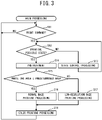
- the main processing will be described with reference to Fig. 3 .
- the CPU 11 executes the main processing by reading out a control program from ROM 12 and operating.
- pretreatment, base printing processing, and color printing processing, and the like, are performed.
- the CPU 11 determines whether a print command has been acquired via the input portion 33 (step S11). If a print command has not been acquired (no at step S11), the CPU 11 returns the processing to the determination at step S11. If a print command has been acquired (yes at step S11), the CPU 11 determines whether the execution of wet-on-wet printing is able to be completed, based on whether the state is a printing possible state or a printing prohibited state (step S12).
- the printing possible state is a state in which the base printing is possible.
- the printing prohibited state is a state in which the base printing is prohibited.
- the state will be the printing prohibited state.
- the maintenance operations include, for example, white ink circulation, ink purging, ink flushing, wiping, ink being empty, or ink heating, or the like.
- White ink circulation is an operation that is performed in order to inhibit the white ink from settling.
- Ink purging is an operation that sucks in ink from outside the discharge ports 50 and 60 in order to remove impurities such as air, sediment, or aggregates from the ink.
- Ink flushing is an operation that discharges ink from the discharge ports 50 and 60 in advance so that ink can be appropriately discharged from the discharge ports 50 and 60 at the time of printing.
- Wiping is an operation that wipes off ink and the like that has adhered to the lower surface of the first print head 5 or the second print head 6 using a wiper (not shown in the drawings). Empty indicates a state in which there is no ink in a reservoir portion such as an ink tank, not shown.
- Ink heating is an operation that is performed by a heater (not shown in the drawings) in order to improve the fluidity of the ink.
- step S12 If the state at the time of the determination at step S12 is the printing prohibited state, there is a possibility that the state will still be the printing prohibited state when the pretreatment (step S14) described later ends. Therefore, there is a possibility that it will take time from the time the pretreatment ends until the base printing processing (step S16 or S17), described later, starts. Therefore, if the state at the time of the determination at step S12 is the printing prohibited state, there is a possibility that execution of the wet-on-wet printing onto the print medium 2 to which the pretreatment agent 8 has been applied will not be able to be completed.
- the determination at step S12 is made based on the state of a maintenance-in-progress flag and the detection results from the sensor 32.
- the maintenance-in-progress flag is stored in the RAM 13, and indicates whether a maintenance operation is being executed.
- the CPU 11 turns on the maintenance-in-progress flag when a maintenance operation starts, and turns off the maintenance-in-progress flag when the maintenance operation ends (not shown in the drawings).
- Information about the printing possible range is stored in the ROM 12.
- the CPU 11 compares the temperature and humidity of the printing atmosphere with the printing possible range based on the detection results from the sensor 32.
- the state will be the printing prohibited state, so the CPU 11 determines that execution of the wet-on-wet printing is unable to be completed (no at step S12). In this case, the CPU 11 executes state control processing in order to place the printer 1 into the printing possible state from the printing prohibited state (step S13). That is, the execution of pretreatment and base printing processing is prohibited until the printing possible state is established.
- the CPU 11 performs control to complete the maintenance operation. If the temperature or the humidity of the printing atmosphere is outside the printing possible range, the CPU 11 brings the temperature and the humidity of the printing atmosphere to within the printing possible range by controlling the heater 30 or the humidity control device 31 and heating, humidifying, or dehumidifying the printing atmosphere.
- the maintenance-in-progress flag will turn off and the temperature and humidity of the printing atmosphere will come within the printing possible range. That is, the printer 1 will change from the printing prohibited state to the printing possible state. The CPU 11 then returns the processing to the determination at step S12.
- the state is the printing possible state, so the CPU 11 determines that the execution of wet-on-wet printing is able to be completed (yes at step S12). In this case, the CPU 11 performs the pretreatment (step S14).
- the CPU 11 identifies the position of the pretreatment region 81 (refer to Fig. 2 ) with respect to the print medium 2, based on printing data.
- the CPU 11 repeats the main scanning processing and the sub-scanning processing.
- the CPU 11 controls the head driver 23 to cause the pretreatment head 7 to discharge the pretreatment agent 8 from the discharge port 70.
- the pretreatment agent 8 is applied to the print medium 2 in the identified pretreatment region 81 (refer to Fig. 2 ).
- the CPU 11 determines whether execution of wet-on-wet printing is able to be completed, based on whether the white ink area is equal to or less than a predetermined area (step S15).
- the white ink area is the area of the base region 91 shown in Fig. 2 , and is identified based on the printing data.
- the time required for base printing i.e., the time that it takes from the start to the end of the discharge of the white ink from the discharge port 50 becomes longer the larger the white ink area is.
- the predetermined area is stored beforehand in the ROM 12, and is designed based on the time that it takes for the print medium 2 to which the pretreatment agent 8 has been applied to change from a wet state to a non-wet state. This period of time is stored in the ROM 12, for example.
- the predetermined area in the present embodiment is equivalent to the maximum area for which execution of wet-on-wet printing is able to be completed; that is, is equivalent to the maximum area for which execution of normal base printing processing (step S16), described later, is able to be completed, within the time that it takes for the print medium 2 to which the pretreatment agent 8 has been applied to change from a wet state to a non-wet state.
- step S16 If the white ink area is larger than the predetermined area, it may take a long time from the start of the normal base printing processing (step S16), described later, until completion. Therefore, if the white ink area is larger than the predetermined area, execution of wet-on-wet printing on the print medium 2 to which the pretreatment agent 8 has been applied may not be able to be completed.
- the CPU 11 determines that the execution of wet-on-wet printing is able to be completed (yes at step S15). In this case, the CPU 11 performs the normal base printing processing (step S16). In normal base printing processing, the CPU 11 identifies the position of the base region 91 on the print medium 2 based on the printing data. The CPU 11 repeats the main scanning processing and the sub-scanning processing. In the main scanning processing of the normal base printing processing, the CPU 11 controls the head driver 23 to cause the first print head 5 to discharge the white ink from the discharge port 50. As a result, a base of a normal resolution is printed in the identified base region 91 (refer to Fig. 2 ). The normal resolution of the present embodiment is 1200 dpi. The CPU 11 then moves the process on to step S18.
- a printing result of the normal base printing processing will be described with reference to Fig. 2 .
- the discharge port 50 is formed by two holes lined up in the sub-scanning direction, and the distance between the centers of these two holes is a distance L.
- the main scanning direction will be the left-right direction
- the sub-scanning direction will be the front-rear direction (the same also applies to Fig. 4 and Fig. 5 described later).
- the pressure applied to the discharged white ink is controlled by the head driver 23, and printing is performed such that the size of the diameter of the dots 9 will be the distance R.
- a row 901 that is the rearmost row, and a row 903 that is two rows in front of the row 901 are printed.
- the print medium 2 moves rearward by a distance L/2 with respect to the first print head 5 (refer to arrow Y1).
- the arrow Y1 indicates the direction of relative movement of the first print head 5 with respect to the print medium 2 (the same also applies to arrows Y2 to Y5 described later).
- a row 902 that is one row in front of the row 901, and a row 904 that is two rows in front of the row 902 are printed.
- a second sub-scanning processing the print medium 2 moves rearward by a distance 3L/2 with respect to the first print head 5 (refer to arrow Y2).
- a row 905 and a row 907 that is two rows in front of the row 905 are printed.
- the print medium 2 moves rearward by the distance L/2 with respect to the first print head 5 (refer to arrow Y3).
- a row 906 that is one row in front of the row 905, and a row 908 that is two rows in front of the row 906 are printed.
- base printing in the base region 91 is performed like the example shown in Fig. 2 .
- the CPU 11 determines that execution of the wet-on-wet printing is unable to be completed (no at step S15). In this case, the CPU 11 performs low-resolution base printing processing (step S17). In the low-resolution base printing processing, the CPU 11 identifies the position of the base region 91 on the print medium 2 based on the printing data. The CPU 11 repeats the main scanning processing and the sub-scanning processing. In the main scanning processing of the low-resolution base printing processing, the CPU 11 controls the head driver 23 to cause the first print head 5 to discharge the white ink from the discharge port 50.
- a low-resolution base is printed in the identified base region 91 (refer to Fig. 4 ).
- the low resolution is lower than the normal resolution, and in the present embodiment, is 600 dpi.
- the CPU 11 moves the processing on to step S18.
- FIG. 4 An example of a printing result of the low-resolution base printing processing will be described with reference to Fig. 4 .
- the area of the base region 91 shown in Fig. 4 is the same as the area of the base region 91 shown in Fig. 2 .
- the pressure applied to the discharged white ink is controlled by the head driver 23, and printing is performed such that the size of the diameter of the dots 9 will be the distance 2R (twice the distance R).
- a row 909 that is the rearmost row, and a row 910 that is one row in front of the row 909 are printed.
- the print medium 2 moves rearward by a distance 2L with respect to the first print head 5 (refer to arrow Y4).
- a row 911 that is one row in front of the row 910, and a row 912 that is one row in front of the row 911 are printed.
- base printing in the base region 91 is performed like the example shown in Fig. 4 .
- the number of times sub-scanning processing is performed decreases as the resolution decreases, even if the area of the base region 91 is the same, such as three in the example shown in Fig. 2 , and one in the example shown in Fig. 4 .
- the time required for base printing is shorter in low-resolution base printing processing than it is in normal base printing processing.
- the CPU 11 performs color printing processing (step S18).
- the CPU 11 identifies the position of a color region (not shown in the drawings) on the print medium 2 based on the printing data.
- the CPU 11 repeats the main scanning processing and the sub-scanning processing.
- the CPU 11 controls the head driver 23 to cause the second print head 6 to discharge color ink from the discharge port 60.
- color printing is performed in the identified color region (not shown in the drawings).
- the CPU 11 returns the processing to the determination at step S11.
- step S12 determines that execution of wet-on-wet printing is able to be completed (yes at step S12 and yes at step S15)
- base printing in the normal base printing processing will be executed.
- step S17 the state control processing
- step S17 the low-resolution base printing processing
- step S16 base printing with normal base printing processing
- the printer 1 it is unlikely that base printing will be performed in a state in which the execution of wet-on-wet printing is unable to be completed. Therefore, it is possible to prevent a print result that is lowquality due to wet-on-wet printing not being executed, for example, from being created. As a result, the printer 1 is able to inhibit a decrease in print quality.
- the CPU 11 determines at step S12 that execution of wet-on-wet printing is unable to be completed when in the printing prohibited state. Therefore, when in the printing prohibited state, base printing with normal base printing processing (step S16) will not be executed. Thus, the time from the end of the application of the pretreatment agent 8 in the pretreatment (step S14) until the start of base printing in the normal base printing processing (step S16) is inhibited from becoming long. Therefore, the time from the end of the application of the pretreatment agent 8 in the pretreatment until the end of the base printing in the normal base printing processing is inhibited from becoming long. Thus, the printer 1 can inhibit incomplete execution of wet-on-wet printing.
- the CPU 11 prohibits, in the processing at step S13, execution of normal base printing processing until the printing possible state is established. Accordingly, unless the state is the printing possible state, base printing in the normal base printing processing will not be executed. Therefore, the printer 1 is further able to inhibit incomplete execution of wet-on-wet printing.
- the printer 1 is able to inhibit the incomplete execution of wet-on-wet printing.
- the CPU 11 performs base printing on the print medium 2 at normal resolution in the normal base printing processing (step S16).
- the CPU 11 performs printing on the print medium 2 at low resolution in the low-resolution base printing processing (step S17).
- the low resolution is lower than the normal resolution, so with the printer 1, the amount of time required for base printing in the low-resolution base printing processing can be made shorter than the amount of time required for printing in the normal base printing processing. Therefore, even if the white ink area is larger than the predetermined area, the time required for base printing can be inhibited from becoming long. Thus, the printer 1 is able to inhibit incomplete execution of wet-on-wet printing.
- the first print head 5 corresponds to the "print head” of the present disclosure.
- the CPU 11 corresponds to the "control portion” of the present disclosure.
- the pretreatment head 7 corresponds to the "pretreatment portion” of the present disclosure.
- the processing at steps S12 and S15 in Fig. 3 correspond to the “determination processing” of the present disclosure.
- the processing at step S16 in Fig. 3 corresponds to the "first processing” of the present disclosure.
- the processing at steps S13 and S17 in Fig. 3 corresponds to the "second processing” of the present disclosure.
- the white ink area corresponds to the "area of the region where printing is performed in the first processing" of the present disclosure.
- the normal resolution corresponds to the "first resolution” of the present disclosure.
- the low resolution corresponds to the "second resolution” of the present disclosure.
- the CPU 11 may execute thinned-out base printing processing instead of the low-resolution base printing processing (step S17).
- the CPU 11 identifies, based on the printing data, the position of the base region 91 with respect to the print medium 2.
- the CPU 11 repeats the main scanning processing and the sub-scanning processing.
- the CPU 11 controls the head driver 23 to cause the first print head 5 to discharge the white ink from the discharge port 50.
- the CPU 11 causes the first print head 5 to discharge the white ink from the discharge port 50, thinning the discharge of white ink from the discharge port 50 by the first print head 5.
- a thinned-out base is printed in the identified base region 91 (refer to Fig. 5 ).
- FIG. 5 An example of a printing result of the thinned-out base printing processing will be described with reference to Fig. 5 .
- the area of the base region 91 shown in Fig. 5 is the same as the area of the base region 91 shown in Fig. 2 .
- the pressure applied to the discharged white ink is controlled by the head driver 23, and printing is performed such that the size of the diameters of the dots 9 will be the distance R.
- a row 913 that is the rearmost row and a row 915 that is two rows in front of the row 913 are printed.
- the print medium 2 moves rearward by the distance 2L with respect to the first print head 5 (refer to arrow Y5).
- a row 917 that is two rows in front of a row 950, and a row 919 that is two rows in front of the row 917 are printed.
- Base printing in the base region 91 is performed like the example shown in Fig. 5 . In this way, printing is performed eliminating a row 914 that is one row in front of the row 913, a row 916 that is one row in front of the row 915, a row 918 that is one row in front of the row 917, and a row 920 that is one row in front of the row 919.
- the number of times sub-scanning processing is performed decreases by the discharge of the white ink being thinned out, even if the area of the base region 91 is the same, such as three in the example shown in Fig. 2 , and one in the example shown in Fig. 5 .
- the time required for base printing is shorter in thinned-out base printing processing than it is in normal base printing processing.
- the number of times white ink is discharged is less in base printing in the thinned-out base printing processing than it is in base printing in the normal base printing processing, so with the printer 1, the time required for base printing in the thinned-out base printing processing can be made shorter than the time required for base printing in the normal base printing processing normal.
- the printer 1 can inhibit incomplete wet-on-wet printing.
- the direction in which discharge of the white ink from the discharge port 50 by the first print head 5 is thinned out in the thinned-out base printing processing is not limited to the sub-scanning direction. That is, the discharge of the white ink from the discharge port 50 by the first print head 5 may be thinned out in the main scanning direction, or it may be thinned out in both the main scanning direction and the sub-scanning direction.
- the CPU 11 may repeatedly execute the thinned-out base printing processing. That is, in the example shown in Fig. 5 , the CPU 11 may print the thinned-out base in the rows 914, 916, 918, and 920 of the base region 91 in the second thinned-out base printing processing, after first printing the thinned-out base in the rows 913, 915, and 917 in the first thinned-out base printing processing.
- the dots 9 formed by the first thinned-out base printing processing spread in the radial direction due to penetration of the white ink, that is, to the region (rows 914, 916, 918, 920) where discharge of the white ink was thinned out.
- the printer 1 can complete wet-on-wet printing while increasing the concentration of white ink of the base, i.e., while improving the print quality, more than when the thinned-out base printing processing is performed only once.
- the predetermined area may be less than the maximum area where execution of the normal base printing processing (step S16) is able to be completed with the white ink, within the period of time from after the print medium 2 to which the pretreatment agent 8 has been applied changes from the wet state to the non-wet state, or may be larger than the maximum area.
- the printer 1 can inhibit incomplete execution of wet-on-wet printing even if variation occurs in the evaporation amount and the penetration amount of the pretreatment agent 8 over time.
- the CPU 11 determined whether a maintenance operation is in progress by the state of the maintenance-in-progress flag.
- the printer 1 may be provided with a sensor (not shown in the drawings) for detecting whether various maintenance operations are in progress, and the CPU 11 may determine whether a maintenance operation is in progress based on a signal from the sensor.
- the pretreatment head 7 is provided on the printer 1.
- a printing system may be formed by the printer 1 and a pretreatment device (not shown in the drawings), and the pretreatment head 7 may be provided on the pretreatment device.
- the platen 3 may be able to move between the printer 1 and the pretreatment device.
- a control board may be provided in both the printer 1 and the pretreatment device, for example.
- Main processing may be distributed processing by the control boards communicating with each other.
- the printing system may further be provided with a server, and the main processing may be executed by the server.
- the server may send commands according to the various processing to the control boards, and the control boards may operate based on commands from the server.
- the processing at step S14 will be processing to convey the platen 3 to the pretreatment device.
- the pretreatment device need only execute pretreatment according to the detection of the platen 3 by a sensor (not shown in the drawings).
- the pretreatment ends the platen 3 is conveyed to the printer 1.
- the pretreatment device and the printer 1 need only be connected by a conveyance device such as a rail which is not shown in the drawings.
- step S16 in the normal base printing processing (step S16) and the low-resolution base printing processing (step S17), color ink may be used instead of white ink, and a color image of a plurality of colors may be printed instead of the base.
- the CPU 11 may omit the determination at step S12 and the processing at step S13, or may omit the determination at step S15 and the processing at step S17.
- the CPU 11 may determine whether the white ink area is larger than the predetermined area before the pretreatment (step S14). If the white ink area is equal to or smaller than the predetermined area (yes at step S15), the CPU 11 may perform the pretreatment (step S14), and the normal base printing processing (step S16) in that order, and if the white ink area is larger than the predetermined area (no at step S15), the CPU 11 may perform the pretreatment (step S14) and the low-resolution base printing processing (step S17) in that order.
- the CPU 11 may execute high-speed base printing processing instead of the low-resolution base printing processing.
- the CPU 11 controls the main scanning driver 21, the sub-scanning driver 22, and the head driver 23, to move the carriage 4 and the platen 3 faster than the movement speed of the carriage 4 and the platen 3 in the normal base printing processing to perform base printing without reducing the resolution. Therefore, with the high-speed base printing processing, the printer 1 can complete the execution of base printing in a shorter period of time than with the normal base printing processing, without reducing the resolution of the base.
- the printer 1 can complete wet-on-wet printing while inhibiting a decrease in print quality of the color image.
- the pretreatment agent 8 is applied to the print medium 2 by being discharged from the discharge port 60 by the pretreatment head 7.
- the pretreatment agent 8 may be applied to the print medium 2 by being sprayed with a spray (not shown in the drawings), or may be applied to the print medium 2 with a spatula (not shown in the drawing) or the like.
- the condition of the first print head 5 changing to the printing prohibited state is not limited to the foregoing embodiment.
- the first print head 5 may change to the printing prohibited state. If the temperature is not used and the humidity is outside the printing possible range, the first print head 5 may be changed to the printing prohibited state. In this case, the heater 30 and the temperature sensor need not be provided. If the humidity is not used and the temperature is outside the printing possible range, the first print head 5 may be changed to the printing prohibited state. In this case, the humidity control device 31 and the humidity sensor need not be provided. The first print head 5 may be changed to the printing prohibited state even if the atmospheric pressure in the printing atmosphere is outside the printing possible range.
- the CPU 11 may determine, in the determination at step S12, whether the printing prohibited state is set, while the pretreatment (step S14) or the base printing processing (step S16 or step S17) is being executed. For example, if an appointment for executing a maintenance operation is set after a predetermined time, the CPU 11 may determine that the printing prohibited state is set.
- the CPU 11 identifies, based on the printing data, the white ink area and position of the pretreatment region 81 with respect to the print medium 2.
- the white ink area and the position of the pretreatment region 81 with respect to the print medium 2 may be stored in the ROM 12 beforehand, or may be input to the printer 1 via the input portion 33 by the operator.
- the CPU 11 need only acquire the white ink area and the position of the pretreatment region 81 with respect to the print medium 2, from the ROM 12 or according to the operation of the input portion 33.
- the CPU 11 may further perform the normal base printing processing or the low-resolution base printing processing.
- a base will be further printed on the printed base with white ink.
- the first layer base is low resolution, so by printing the second layer base, the printer 1 can increase the density of the white ink of the base compared to when the base is only one layer. As a result, the printer 1 can improve the print quality.
- the configurations of the discharge ports 50, 60, and 70 may be different from each other, and are not limited to the foregoing embodiment.
- the discharge ports 50, 60, and 70 may each be formed by a row of holes lined up in the main scanning direction, or may be formed by a row of holes liked up in the sub-scanning direction, like a line head or the like.
- the discharge ports 50, 60, and 70 may each be formed by a single hole.
- the pretreatment agent 8 may display an effect other than improving the fixing of white ink and the coloring of color ink, such as improving fastness with respect to washing or friction or the like, or reducing bleedthrough of the ink or the like.
Landscapes
- Ink Jet (AREA)
Abstract
Description
- The present disclosure relates to a printer, a control method, and a control program.
- A printer that applies a pretreatment agent to a print medium before discharging ink in order to improve the fixing of ink discharged onto the print medium is known. The printer disclosed in Patent Literature 1 applies a pretreatment agent to fabric, and then discharges ink onto the fabric that is wet with the applied pretreatment agent. As such, wet-on-wet printing is performed.
- Patent Literature 1 :
Japanese Laid-Open Patent Publication No.2009-299240 - There is a possibility that the pretreatment agent applied to the fabric may evaporate or soak into the fabric over time. With the printer described above, if printing with ink is prohibited due to maintenance or the like when the application of the pretreatment agent is completed, for example, the time from the completion of the application of the pretreatment until the start of printing becomes longer. Also, if the area of the region where ink is to be discharged is large, the time required for printing will be longer. In these cases, the time from the completion of the application of the pretreatment agent until the completion of execution of printing will be longer, so the evaporation amount and the penetration amount into the fabric of the applied pretreatment agent will increase. As a result, there was a possibility that the printer described above would not be able to complete the execution of wet-on-wet printing.
- The object of the present disclosure is to provide a printer, a control method, and a control program that easily completes the execution of wet-on-wet printing.
- A first aspect of the present disclosure relates to a printer comprising a print head configured to discharge ink onto a print medium, and a control portion configured to control the print head, wherein the control portion performs determination processing of determining whether execution of wet-on-wet printing, which is printing wet-on-wet with the ink onto the print medium to which a pretreatment agent has been applied by a pretreatment portion applying the pretreatment agent to the print medium, is able to be completed, performs first processing of printing with the ink by discharging the ink from the print head onto the pretreatment agent that has been applied to the print medium, when it has been determined by the determination processing that execution of the wet-on-wet printing is able to be completed, and performs second processing differing from the first processing, when it has been determined by the determination processing that execution of the wet-on-wet printing is unable to be completed.
- According to the first aspect, printing in the first processing is executed when it is determined that execution of wet-on-wet printing is able to be completed. On the other hand, when it is determined that execution of wet-on-wet printing is unable to be completed, the second processing will be executed, so printing in the first processing will not be executed. Therefore, the printer easily completes the execution of wet-on-wet printing.
- In the first aspect of the present disclosure relating the printer, the control portion may determine, in the determination processing, that execution of the wet-on-wet printing is unable to be completed when printing with the ink is prohibited. In this case, printing in the first processing will not be executed when printing with ink is prohibited. Therefore, the time from the end of the application of the pretreatment agent until the start of printing in the first processing is inhibited from becoming long. Therefore, the time from the end of the application of the pretreatment agent until the end of the printing in the first processing is inhibited from becoming long. Thus, the printer can inhibit incomplete execution of wet-on-wet printing.
- In the first aspect of the present disclosure relating the printer, the control portion may prohibit, in the second processing, execution of the first processing until printing with the ink becomes possible. In this case, printing in the first processing will not be executed unless printing with the ink is possible. Therefore, the printer is further able to inhibit incomplete execution of wet-on-wet printing.
- In the first aspect of the present disclosure relating the printer, the control portion may determine, in the determination processing, that execution of the wet-on-wet printing is unable to be completed when an area of a region to be printed by the first processing is larger than a predetermined area. For example, when the area of the region where printing is performed by the first processing is larger than the predetermined area, the time required for printing will be longer, so the evaporation amount and the penetration amount of the pretreatment agent applied to that region will be greater. In this case, printing in the first processing will not be executed. Therefore, the printer is able to inhibit the incomplete execution of wet-on-wet printing.
- In the first aspect of the present disclosure relating the printer, the control portion may perform printing onto the print medium at a first resolution in the first processing; and perform printing onto the print medium at a second resolution which is lower than the first resolution in the second processing. In this case, the resolution of printing in the second processing is lower than the resolution of printing in the first processing, so with the printer, the time required for printing in the second processing can be made shorter than the time required for printing in the first processing. Therefore, even if the area of the region to be printed in the first processing is larger than the predetermined area, the time required for printing can be inhibited from becoming long. Therefore, the printer is able to inhibit incomplete execution of wet-on-wet printing.
- In the first aspect of the present disclosure relating the printer, the control portion may discharge the ink from the print head onto the pretreatment agent applied to the print medium while thinning out discharging of the ink from the print head, in the second processing. In this case, the number of times ink is discharged in printing in the second processing is less than it is in printing in the first processing, so with the printer, the time required for printing in the second processing can be made shorter than the time required for printing in the first processing. Thus, even if the area of the region to be printed in the first processing is larger than the predetermined area, the time required for printing is inhibited from becoming longer. Therefore, the printer is able to inhibit incomplete wet-on-wet printing.
- A second aspect of the present disclosure relates to a control method of a printer provided with a print head configured to discharge ink onto a print medium, and a control portion configured to control the print head, the control method comprising performing determination processing of determining whether execution of wet-on-wet printing, which is printing wet-on-wet with the ink onto the print medium to which a pretreatment agent has been applied by a pretreatment portion applying the pretreatment agent to the print medium, is able to be completed, performing first processing of printing with the ink by discharging the ink from the print head onto the pretreatment agent that has been applied to the print medium, when it has been determined by the determination processing that execution of the wet-on-wet printing is able to be completed, and performing second processing differing from the first processing, when it has been determined by the determination processing that execution of the wet-on-wet printing is unable to be completed. The second aspect can achieve the same effects as those of the first aspect.
- A third aspect of the present disclosure relates to a control program causing a computer of a printer provided with a print head configured to discharge ink onto a print medium, and the computer configured to control the print head, to perform determination processing of determining whether execution of wet-on-wet printing, which is printing wet-on-wet with the ink onto the print medium to which a pretreatment agent has been applied by a pretreatment portion applying the pretreatment agent to the print medium, is able to be completed, perform first processing of printing with the ink by discharging the ink from the print head onto the pretreatment agent that has been applied to the print medium, when it has been determined by the determination processing that execution of the wet-on-wet printing is able be completed; and perform second processing differing from the first processing, when it has been determined by the determination processing that execution of the wet-on-wet printing is unable to be completed. The third aspect can achieve the same effects as those of the first aspect.
- Aside from this, in the first aspect to the third aspect of the present disclosure, the first processing may also include processing to perform printing with the ink after applying the pretreatment agent to the pretreatment portion.
-
-
Fig. 1 is a block diagram illustrating an electrical configuration of the printer 1. -
Fig. 2 is a schematic diagram of a printing result when normal base printing processing is performed. -
Fig. 3 is a flowchart of main processing. -
Fig. 4 is a schematic diagram of a printing result when low-resolution base printing processing is performed. -
Fig. 5 is a schematic diagram of a printing result when thinned-out base printing processing is performed. - A printer 1 related to one embodiment of the present disclosure will be described with reference to the drawings. The printer 1 shown in
FIG. 1 is an inkjet printer, and performs printing by discharging ink onto aprint medium 2 of cloth or paper or the like. The printer 1 can print a color image on theprint medium 2 using five colors of ink, i.e., white (W), black (K), yellow (Y), cyan I, and magenta (M). - Hereinafter, of the five colors of ink, the white-colored ink will be referred to as "white ink", and the other four colors of ink, i.e., black, cyan, yellow, and magenta, will collectively be referred to as "color ink". When collectively referring to the white ink and the color ink, or when neither is specified, they will simply be referred to as "ink". The white ink is used for printing a base (hereinafter, referred to as "base printing") in order to improve the coloring of the color ink. The color ink is discharged on the white ink and is used to print a color image (hereinafter, referred to as "color printing").
- The mechanical structure and the electrical structure of the printer 1 will be described with reference to
Fig. 1 . The printer 1 includes aplaten 3, acarriage 4, afirst print head 5, asecond print head 6, and apretreatment head 7. Theplaten 3 can move in a sub-scanning direction and supports theprint medium 2. The sub-scanning direction in the present embodiment is the front-rear direction of the printer 1. Thecarriage 4 is provided above theplaten 3, and can move in a main scanning direction. The main scanning direction of the present embodiment is the left-right direction of the printer 1. Thefirst print head 5, thesecond print head 6, and thepretreatment head 7 are mounted to thecarriage 4. - A
discharge port 50 is provided on a lower surface of thefirst print head 5. Thedischarge port 50 is configured such that a plurality of rows of a plurality of holes lined up in the sub-scanning direction are lined up in the main scanning direction. Thefirst print head 5 discharges the white ink from thedischarge port 50 toward the print medium 2 (refer toFig. 2 ) on theplaten 3. As a result, base printing is performed on theprint medium 2. Adischarge port 60 is provided in a lower surface of thesecond print head 6. Thedischarge port 60 is configured such that a plurality of rows of a plurality of holes lined up in the sub-scanning direction are lined up in the main scanning direction. Each row of holes of thedischarge port 60 corresponds to a different one color of the color ink. Thesecond print head 6 discharges the color ink from thedischarge port 60 toward theprint medium 2 on theplaten 3. As a result, color printing is performed on theprint medium 2. - A
discharge port 70 is provided on a lower surface of thepretreatment head 7. Thedischarge port 70 is configured such that a plurality of rows of a plurality of holes lined up in the sub-scanning direction are lined up in the main scanning direction. Thepretreatment head 7 discharges apretreatment agent 8 shown inFig. 2 from thedischarge port 70 toward theprint medium 2 on theplaten 3. As a result, thepretreatment agent 8 is applied to theprint medium 2. Note that inFig. 2 , apretreatment region 81 that is an application of thepretreatment agent 8 is indicated by hatching. Thepretreatment agent 8 is a base coat agent to be applied to theprint medium 2 before base printing, and improves the fixing of the white ink to theprint medium 2 and the coloring of the color ink. One example of thepretreatment agent 8 is an aqueous solution that includes multivalent metal salt. - As illustrated in
FIG. 1 , the printer 1 is provided with acontrol board 10. ACPU 11, aROM 12, and aRAM 13 are provided at thecontrol board 10. TheCPU 11 is electrically connected to theROM 12, and theRAM 13, and controls the printer 1. TheROM 12 stores a control program for controlling operations of the printer 1, information necessary for theCPU 11 to execute various programs, and the like. TheRAM 13 temporarily stores various data used in the control program, print data for performing the printing on theprint medium 2, and the like. - A
main scanning driver 21, asub-scanning driver 22, ahead driver 23, aheater 30, ahumidity control device 31, asensor 32, and aninput portion 33 are electrically connected to theCPU 11. Themain scanning driver 21 is formed by a motor or the like, and, when driven, moves thecarriage 4 in the main scanning direction. Thesub-scanning driver 22 is formed by a motor or the like, and, when driven, moves theplaten 3 in the sub-scanning direction. As a result, thefirst print head 5, thesecond print head 6, and thepretreatment head 7 move relative to theplaten 3 in the main scanning direction and the sub-scanning direction. Thehead driver 23 is formed by a pressure element or the like, and, when driven, causes thefirst print head 5 to discharge the white ink from thedischarge port 50, causes thesecond print head 6 to discharge the color ink from thedischarge port 60, or causes thepretreatment head 7 to discharge thepretreatment agent 8 from thedischarge port 70. - The
heater 30 and thehumidity control device 31 are each provided inside the printer 1, and control the temperature and humidity, respectively, of a printing atmosphere. The printing atmosphere is the atmosphere of the space where printing is performed on theprint medium 2. Thesensor 32 is provided inside the printer 1 and includes a temperature sensor and a humidity sensor. Thesensor 32 detects the temperature and humidity of the printing atmosphere, and outputs the detection results to theCPU 11. TheCPU 11 can identify whether the each of the temperature and humidity are within a predetermined printing possible range based on the detection results from thesensor 32. Theinput portion 33 is operated by an operator and outputs a signal according to an operation to theCPU 11. The operator can input a print command to start printing, for example, to the printer 1 by operating theinput portion 33. - Pretreatment and base printing will be described with reference to
Fig. 2 . The printer 1 performs a pretreatment before base printing. The printer 1 performs the pretreatment by discharging and applying thepretreatment agent 8 to thepretreatment region 81 from thedischarge port 70 with thepretreatment head 7. - The printer 1 performs base printing by discharging white ink from the
discharge port 50 of thefirst print head 5 onto abase region 91 and printing a base. The white ink is discharged on top of thepretreatment agent 8, so the size of thebase region 91 is the same or smaller than the size of thepretreatment region 81. Note that, although not shown in the drawings, the printer 1 performs color printing after base printing, by discharging color ink from thedischarge port 60 with thesecond print head 6 and printing a color image. The color ink is discharged on top of the white ink and the white ink is used as the base, so the size of the color region is the same or larger than the size of thebase region 91. - An outline of the operation of the printer 1 in the pretreatment, base printing, and color printing will be described. Hereinafter, the
first print head 5, thesecond print head 6, and thepretreatment head 7 will be collectively referred to as "heads". Thedischarge ports pretreatment agent 8 will be collectively referred to as "droplets". - In the pretreatment, base printing, and color printing, the main scanning processing and sub-scanning processing described below are repeatedly performed. In the main scanning processing, the
head driver 23 is driven and droplets are discharged from the discharge ports toward theprint medium 2 by the heads while the heads are moved, together with thecarriage 4, in the main scanning direction with respect to theprint medium 2 by themain scanning driver 21 being driven. In the sub-scanning processing, thesub-scanning driver 22 is driven and theprint medium 2 on theplaten 3 moves in the sub-scanning direction with respect to the heads. - The feature wherein in the pretreatment, the
pretreatment agent 8 is discharged in the main scanning processing, in the base printing, the white ink is discharged in the main scanning processing, and in the color printing, the color ink is discharged in the main scanning processing, differs depending on the operations of the pretreatment, the base printing, and the color printing. As an example, when the white ink is discharged from thedischarge port 50 by thefirst print head 5 in the base printing,dots 9 from the discharged white ink are formed on theprint medium 2, as shown inFig. 2 . - Wet-on-wet printing will be described with reference to
Fig. 2 . In general, printing includes wet-on-wet printing and wet-on-dry printing. In the present embodiment, wet-on-wet printing refers to printing that is performed by white ink being discharged onto theprint medium 2 that is wet with thepretreatment agent 8. Wet-on-dry printing refers to printing that is performed by white ink being discharged onto theprint medium 2 that is not wet with thepretreatment agent 8 due to, for example, heat treatment having been performed or thepretreatment agent 8 having been left for an extended period of time. By performing wet-on-wet printing, thepretreatment agent 8, the ink, and theprint medium 2 of the present embodiment sufficiently display the effect of thepretreatment agent 8 of improving the fixing of the white ink and the coloring of the color ink. Therefore, in the present embodiment, the base printing is performed by wet-on-wet printing. - When the
pretreatment agent 8 is applied to theprint medium 2 in thepretreatment region 81, the surface of theprint medium 2 in thebase region 91 is covered by the liquid surface of the appliedpretreatment agent 8. The state wet with thepretreatment agent 8 is a state in which the entire surface of theprint medium 2 in thebase region 91 is covered by the liquid surface of the appliedpretreatment agent 8. - As time passes, the
pretreatment agent 8 applied to theprint medium 2 evaporates from the surface of theprint medium 2 and penetrates into theprint medium 2 from the surface of theprint medium 2. As time passes and the evaporation amount and penetration amount of thepretreatment agent 8 applied to theprint medium 2 increase, the surface of theprint medium 2 in thebase region 91 is exposed from the liquid surface of thepretreatment agent 8. As a result, theprint medium 2 changes from being wet with thepretreatment agent 8 to not being wet. That is, the state not wet with thepretreatment agent 8 is a state in which at least a portion of the surface of theprint medium 2 in thebase region 91 is essentially exposed from the liquid surface of the appliedpretreatment agent 8. Note that there may be a case in which even if it is not actually wet with thepretreatment agent 8, the fibers of the surface of theprint medium 2 are covered by the liquid surface of thepretreatment agent 8 due to the surface tension of the appliedpretreatment agent 8. However, in any case, if the white ink is discharged after a predetermined period of time, set beforehand, or longer has passed after thepretreatment agent 8 is applied, printing will be performed in a non-wet state, so the effect of thepretreatment agent 8 will be unable to be sufficiently displayed. - If the time from the end of the application of the
pretreatment agent 8 until the completion of the execution of the base printing is long, there may be a case in which, while the base printing is being executed, theprint medium 2 becomes no longer wet with thepretreatment agent 8. In this case, the printer 1 changes to wet-on-dry printing midway through without completing the execution of wet-on-wet printing. Note that "completion of execution of wet-on-wet printing" refers to the execution of the base printing ending while theprint medium 2 remains wet from the start to end of the base printing; for example, the white ink may be discharged within a predetermined period of time set beforehand, after thepretreatment agent 8 has been applied. When the base printing is performed as wet-on-dry printing, at the portion of the surface of theprint medium 2 in thebase region 91 that is exposed from the liquid surface of thepretreatment agent 8, there is a possibility that the effect of thepretreatment agent 8 may not be sufficiently displayed due to the white ink adhering directly to the fibers of the surface of theprint medium 2, or the like, and the print quality will decrease. The printer 1 inhibits a decrease in print quality by executing main processing described below. - The main processing will be described with reference to
Fig. 3 . When the power supply of the printer 1 is turned on, theCPU 11 executes the main processing by reading out a control program fromROM 12 and operating. In the main processing, pretreatment, base printing processing, and color printing processing, and the like, are performed. - When the main processing starts, the
CPU 11 determines whether a print command has been acquired via the input portion 33 (step S11). If a print command has not been acquired (no at step S11), theCPU 11 returns the processing to the determination at step S11. If a print command has been acquired (yes at step S11), theCPU 11 determines whether the execution of wet-on-wet printing is able to be completed, based on whether the state is a printing possible state or a printing prohibited state (step S12). The printing possible state is a state in which the base printing is possible. The printing prohibited state is a state in which the base printing is prohibited. - In the present embodiment, if at least one of either the temperature or the humidity is outside the printing possible range, or a maintenance operation is being performed, the state will be the printing prohibited state. The maintenance operations include, for example, white ink circulation, ink purging, ink flushing, wiping, ink being empty, or ink heating, or the like. White ink circulation is an operation that is performed in order to inhibit the white ink from settling. Ink purging is an operation that sucks in ink from outside the
discharge ports discharge ports discharge ports first print head 5 or thesecond print head 6 using a wiper (not shown in the drawings). Empty indicates a state in which there is no ink in a reservoir portion such as an ink tank, not shown. Ink heating is an operation that is performed by a heater (not shown in the drawings) in order to improve the fluidity of the ink. - If the state at the time of the determination at step S12 is the printing prohibited state, there is a possibility that the state will still be the printing prohibited state when the pretreatment (step S14) described later ends. Therefore, there is a possibility that it will take time from the time the pretreatment ends until the base printing processing (step S16 or S17), described later, starts. Therefore, if the state at the time of the determination at step S12 is the printing prohibited state, there is a possibility that execution of the wet-on-wet printing onto the
print medium 2 to which thepretreatment agent 8 has been applied will not be able to be completed. - In the present embodiment, the determination at step S12 is made based on the state of a maintenance-in-progress flag and the detection results from the
sensor 32. The maintenance-in-progress flag is stored in theRAM 13, and indicates whether a maintenance operation is being executed. TheCPU 11 turns on the maintenance-in-progress flag when a maintenance operation starts, and turns off the maintenance-in-progress flag when the maintenance operation ends (not shown in the drawings). Information about the printing possible range is stored in theROM 12. TheCPU 11 compares the temperature and humidity of the printing atmosphere with the printing possible range based on the detection results from thesensor 32. - If at least one of the cases where the maintenance-in-progress flag is on, or the temperature or the humidity of the printing atmosphere is outside the printing possible range, the state will be the printing prohibited state, so the
CPU 11 determines that execution of the wet-on-wet printing is unable to be completed (no at step S12). In this case, theCPU 11 executes state control processing in order to place the printer 1 into the printing possible state from the printing prohibited state (step S13). That is, the execution of pretreatment and base printing processing is prohibited until the printing possible state is established. - An example of the state control processing will be described. When the maintenance-in-process flag is on, the
CPU 11 performs control to complete the maintenance operation. If the temperature or the humidity of the printing atmosphere is outside the printing possible range, theCPU 11 brings the temperature and the humidity of the printing atmosphere to within the printing possible range by controlling theheater 30 or thehumidity control device 31 and heating, humidifying, or dehumidifying the printing atmosphere. In response to the processing at step S13, the maintenance-in-progress flag will turn off and the temperature and humidity of the printing atmosphere will come within the printing possible range. That is, the printer 1 will change from the printing prohibited state to the printing possible state. TheCPU 11 then returns the processing to the determination at step S12. - When the maintenance-in-progress flag is off and the temperature and humidity of the printing atmosphere is within the printing possible range, the state is the printing possible state, so the
CPU 11 determines that the execution of wet-on-wet printing is able to be completed (yes at step S12). In this case, theCPU 11 performs the pretreatment (step S14). In the pretreatment, theCPU 11 identifies the position of the pretreatment region 81 (refer toFig. 2 ) with respect to theprint medium 2, based on printing data. TheCPU 11 repeats the main scanning processing and the sub-scanning processing. In the main scanning processing of the pretreatment, theCPU 11 controls thehead driver 23 to cause thepretreatment head 7 to discharge thepretreatment agent 8 from thedischarge port 70. As a result, thepretreatment agent 8 is applied to theprint medium 2 in the identified pretreatment region 81 (refer toFig. 2 ). - The
CPU 11 determines whether execution of wet-on-wet printing is able to be completed, based on whether the white ink area is equal to or less than a predetermined area (step S15). The white ink area is the area of thebase region 91 shown inFig. 2 , and is identified based on the printing data. The time required for base printing, i.e., the time that it takes from the start to the end of the discharge of the white ink from thedischarge port 50 becomes longer the larger the white ink area is. - The predetermined area is stored beforehand in the
ROM 12, and is designed based on the time that it takes for theprint medium 2 to which thepretreatment agent 8 has been applied to change from a wet state to a non-wet state. This period of time is stored in theROM 12, for example. The predetermined area in the present embodiment is equivalent to the maximum area for which execution of wet-on-wet printing is able to be completed; that is, is equivalent to the maximum area for which execution of normal base printing processing (step S16), described later, is able to be completed, within the time that it takes for theprint medium 2 to which thepretreatment agent 8 has been applied to change from a wet state to a non-wet state. - If the white ink area is larger than the predetermined area, it may take a long time from the start of the normal base printing processing (step S16), described later, until completion. Therefore, if the white ink area is larger than the predetermined area, execution of wet-on-wet printing on the
print medium 2 to which thepretreatment agent 8 has been applied may not be able to be completed. - If the white ink area is equal to or smaller than the predetermined area, the
CPU 11 determines that the execution of wet-on-wet printing is able to be completed (yes at step S15). In this case, theCPU 11 performs the normal base printing processing (step S16). In normal base printing processing, theCPU 11 identifies the position of thebase region 91 on theprint medium 2 based on the printing data. TheCPU 11 repeats the main scanning processing and the sub-scanning processing. In the main scanning processing of the normal base printing processing, theCPU 11 controls thehead driver 23 to cause thefirst print head 5 to discharge the white ink from thedischarge port 50. As a result, a base of a normal resolution is printed in the identified base region 91 (refer toFig. 2 ). The normal resolution of the present embodiment is 1200 dpi. TheCPU 11 then moves the process on to step S18. - An example of a printing result of the normal base printing processing will be described with reference to
Fig. 2 . Hereinafter, in order to simplify the description, it will be assumed that thedischarge port 50 is formed by two holes lined up in the sub-scanning direction, and the distance between the centers of these two holes is a distance L. InFig. 2 , the main scanning direction will be the left-right direction, and the sub-scanning direction will be the front-rear direction (the same also applies toFig. 4 andFig. 5 described later). - In the example in
Fig. 2 , the pressure applied to the discharged white ink is controlled by thehead driver 23, and printing is performed such that the size of the diameter of thedots 9 will be the distance R. In a first main scanning processing, arow 901 that is the rearmost row, and arow 903 that is two rows in front of therow 901 are printed. In a first sub-scanning processing, theprint medium 2 moves rearward by a distance L/2 with respect to the first print head 5 (refer to arrow Y1). Note that the arrow Y1 indicates the direction of relative movement of thefirst print head 5 with respect to the print medium 2 (the same also applies to arrows Y2 to Y5 described later). In a second main scanning processing, arow 902 that is one row in front of therow 901, and arow 904 that is two rows in front of therow 902 are printed. - In a second sub-scanning processing, the
print medium 2 moves rearward by adistance 3L/2 with respect to the first print head 5 (refer to arrow Y2). In a third main scanning processing, arow 905 and arow 907 that is two rows in front of therow 905 are printed. In a third sub-scanning processing, theprint medium 2 moves rearward by the distance L/2 with respect to the first print head 5 (refer to arrow Y3). In a fourth main scanning processing, arow 906 that is one row in front of therow 905, and arow 908 that is two rows in front of therow 906 are printed. As a result, base printing in thebase region 91 is performed like the example shown inFig. 2 . - As shown in
Fig. 3 , if the white ink area is larger than the predetermined area, theCPU 11 determines that execution of the wet-on-wet printing is unable to be completed (no at step S15). In this case, theCPU 11 performs low-resolution base printing processing (step S17). In the low-resolution base printing processing, theCPU 11 identifies the position of thebase region 91 on theprint medium 2 based on the printing data. TheCPU 11 repeats the main scanning processing and the sub-scanning processing. In the main scanning processing of the low-resolution base printing processing, theCPU 11 controls thehead driver 23 to cause thefirst print head 5 to discharge the white ink from thedischarge port 50. As a result, a low-resolution base is printed in the identified base region 91 (refer toFig. 4 ). The low resolution is lower than the normal resolution, and in the present embodiment, is 600 dpi. TheCPU 11 moves the processing on to step S18. - An example of a printing result of the low-resolution base printing processing will be described with reference to
Fig. 4 . The area of thebase region 91 shown inFig. 4 is the same as the area of thebase region 91 shown inFig. 2 . In the example shown inFig. 4 , the pressure applied to the discharged white ink is controlled by thehead driver 23, and printing is performed such that the size of the diameter of thedots 9 will be thedistance 2R (twice the distance R). In the first main scanning processing, arow 909 that is the rearmost row, and arow 910 that is one row in front of therow 909 are printed. In the first sub-scanning processing, theprint medium 2 moves rearward by adistance 2L with respect to the first print head 5 (refer to arrow Y4). In the second main scanning processing, arow 911 that is one row in front of therow 910, and arow 912 that is one row in front of therow 911 are printed. As a result, base printing in thebase region 91 is performed like the example shown inFig. 4 . - As described above, the number of times sub-scanning processing is performed decreases as the resolution decreases, even if the area of the
base region 91 is the same, such as three in the example shown inFig. 2 , and one in the example shown inFig. 4 . As a result, the time required for base printing is shorter in low-resolution base printing processing than it is in normal base printing processing. - As shown in
Fig. 3 , theCPU 11 performs color printing processing (step S18). In the color printing processing, theCPU 11 identifies the position of a color region (not shown in the drawings) on theprint medium 2 based on the printing data. TheCPU 11 repeats the main scanning processing and the sub-scanning processing. In the main scanning processing of the color printing processing, theCPU 11 controls thehead driver 23 to cause thesecond print head 6 to discharge color ink from thedischarge port 60. As a result, color printing is performed in the identified color region (not shown in the drawings). TheCPU 11 returns the processing to the determination at step S11. - As described above, if it is determined that execution of wet-on-wet printing is able to be completed (yes at step S12 and yes at step S15), base printing in the normal base printing processing will be executed. On the other hand, if it is determined that wet-on-wet printing is unable to be executed (no at step S12 or no at step S15), the state control processing (step S15) or the low-resolution base printing processing (step S17) will be executed, so base printing with normal base printing processing (step S16) will not be executed. Therefore, the printer 1 easily completes execution of wet-on-wet printing. That is, with the printer 1, it is unlikely that base printing will be performed in a state in which the execution of wet-on-wet printing is unable to be completed. Therefore, it is possible to prevent a print result that is lowquality due to wet-on-wet printing not being executed, for example, from being created. As a result, the printer 1 is able to inhibit a decrease in print quality.
- The
CPU 11 determines at step S12 that execution of wet-on-wet printing is unable to be completed when in the printing prohibited state. Therefore, when in the printing prohibited state, base printing with normal base printing processing (step S16) will not be executed. Thus, the time from the end of the application of thepretreatment agent 8 in the pretreatment (step S14) until the start of base printing in the normal base printing processing (step S16) is inhibited from becoming long. Therefore, the time from the end of the application of thepretreatment agent 8 in the pretreatment until the end of the base printing in the normal base printing processing is inhibited from becoming long. Thus, the printer 1 can inhibit incomplete execution of wet-on-wet printing. - The
CPU 11 prohibits, in the processing at step S13, execution of normal base printing processing until the printing possible state is established. Accordingly, unless the state is the printing possible state, base printing in the normal base printing processing will not be executed. Therefore, the printer 1 is further able to inhibit incomplete execution of wet-on-wet printing. - For example, if the white ink area is larger than the predetermined area, the time required for printing will be longer, so the evaporation amount and the penetration amount of the
pretreatment agent 8 applied to thebase region 91 will be greater. If the white ink area is larger than the predetermined area in the determination at step S15, theCPU 11 determines that execution of wet-on-wet printing is unable to be executed. In this case, base printing in the normal base printing processing will not be executed. Therefore, the printer 1 is able to inhibit the incomplete execution of wet-on-wet printing. - The
CPU 11 performs base printing on theprint medium 2 at normal resolution in the normal base printing processing (step S16). TheCPU 11 performs printing on theprint medium 2 at low resolution in the low-resolution base printing processing (step S17). The low resolution is lower than the normal resolution, so with the printer 1, the amount of time required for base printing in the low-resolution base printing processing can be made shorter than the amount of time required for printing in the normal base printing processing. Therefore, even if the white ink area is larger than the predetermined area, the time required for base printing can be inhibited from becoming long. Thus, the printer 1 is able to inhibit incomplete execution of wet-on-wet printing. - Note that in the foregoing embodiment, the
first print head 5 corresponds to the "print head" of the present disclosure. TheCPU 11 corresponds to the "control portion" of the present disclosure. Thepretreatment head 7 corresponds to the "pretreatment portion" of the present disclosure. The processing at steps S12 and S15 inFig. 3 correspond to the "determination processing" of the present disclosure. The processing at step S16 inFig. 3 corresponds to the "first processing" of the present disclosure. The processing at steps S13 and S17 inFig. 3 corresponds to the "second processing" of the present disclosure. The white ink area corresponds to the "area of the region where printing is performed in the first processing" of the present disclosure. The normal resolution corresponds to the "first resolution" of the present disclosure. The low resolution corresponds to the "second resolution" of the present disclosure. - The present disclosure may be modified in various ways from the foregoing embodiment. The various modified examples described below can be combined as long as there are no contradictions. The
CPU 11 may execute thinned-out base printing processing instead of the low-resolution base printing processing (step S17). In the thinned-out base printing processing, theCPU 11 identifies, based on the printing data, the position of thebase region 91 with respect to theprint medium 2. TheCPU 11 repeats the main scanning processing and the sub-scanning processing. In the main scanning processing in the thinned-out base printing processing, theCPU 11 controls thehead driver 23 to cause thefirst print head 5 to discharge the white ink from thedischarge port 50. In this case, theCPU 11 causes thefirst print head 5 to discharge the white ink from thedischarge port 50, thinning the discharge of white ink from thedischarge port 50 by thefirst print head 5. As a result, a thinned-out base is printed in the identified base region 91 (refer toFig. 5 ). - An example of a printing result of the thinned-out base printing processing will be described with reference to
Fig. 5 . The area of thebase region 91 shown inFig. 5 is the same as the area of thebase region 91 shown inFig. 2 . In the example shown inFig. 5 , the pressure applied to the discharged white ink is controlled by thehead driver 23, and printing is performed such that the size of the diameters of thedots 9 will be the distance R. In the first main scanning processing, arow 913 that is the rearmost row and arow 915 that is two rows in front of therow 913 are printed. In the first sub-scanning processing, theprint medium 2 moves rearward by thedistance 2L with respect to the first print head 5 (refer to arrow Y5). - In the second main scanning processing, a
row 917 that is two rows in front of a row 950, and arow 919 that is two rows in front of therow 917 are printed. Base printing in thebase region 91 is performed like the example shown inFig. 5 . In this way, printing is performed eliminating arow 914 that is one row in front of therow 913, arow 916 that is one row in front of therow 915, arow 918 that is one row in front of therow 917, and arow 920 that is one row in front of therow 919. - As described above, the number of times sub-scanning processing is performed decreases by the discharge of the white ink being thinned out, even if the area of the
base region 91 is the same, such as three in the example shown inFig. 2 , and one in the example shown inFig. 5 . As a result, the time required for base printing is shorter in thinned-out base printing processing than it is in normal base printing processing. - According to the foregoing modified example, the number of times white ink is discharged is less in base printing in the thinned-out base printing processing than it is in base printing in the normal base printing processing, so with the printer 1, the time required for base printing in the thinned-out base printing processing can be made shorter than the time required for base printing in the normal base printing processing normal. Thus, even if the white ink area is larger than the predetermined area, the time required for base printing is inhibited from becoming longer. Therefore, the printer 1 can inhibit incomplete wet-on-wet printing.
- Note that the direction in which discharge of the white ink from the
discharge port 50 by thefirst print head 5 is thinned out in the thinned-out base printing processing is not limited to the sub-scanning direction. That is, the discharge of the white ink from thedischarge port 50 by thefirst print head 5 may be thinned out in the main scanning direction, or it may be thinned out in both the main scanning direction and the sub-scanning direction. - The
CPU 11 may repeatedly execute the thinned-out base printing processing. That is, in the example shown inFig. 5 , theCPU 11 may print the thinned-out base in therows base region 91 in the second thinned-out base printing processing, after first printing the thinned-out base in therows dots 9 formed by the first thinned-out base printing processing spread in the radial direction due to penetration of the white ink, that is, to the region (rows entire base region 91 is essentially completed by the first thinned-out base printing processing. Moreover, the amount of white ink that is discharged is compensated for by the second thinned-out base printing processing. Therefore, the printer 1 can complete wet-on-wet printing while increasing the concentration of white ink of the base, i.e., while improving the print quality, more than when the thinned-out base printing processing is performed only once. - In the foregoing embodiment, the predetermined area may be less than the maximum area where execution of the normal base printing processing (step S16) is able to be completed with the white ink, within the period of time from after the
print medium 2 to which thepretreatment agent 8 has been applied changes from the wet state to the non-wet state, or may be larger than the maximum area. For example, if the predetermined area is less than the maximum area, the printer 1 can inhibit incomplete execution of wet-on-wet printing even if variation occurs in the evaporation amount and the penetration amount of thepretreatment agent 8 over time. - In the foregoing embodiment, the
CPU 11 determined whether a maintenance operation is in progress by the state of the maintenance-in-progress flag. In contrast, the printer 1 may be provided with a sensor (not shown in the drawings) for detecting whether various maintenance operations are in progress, and theCPU 11 may determine whether a maintenance operation is in progress based on a signal from the sensor. - In the foregoing embodiment, the
pretreatment head 7 is provided on the printer 1. In contrast, a printing system may be formed by the printer 1 and a pretreatment device (not shown in the drawings), and thepretreatment head 7 may be provided on the pretreatment device. In this case, theplaten 3 may be able to move between the printer 1 and the pretreatment device. In the printing system, a control board may be provided in both the printer 1 and the pretreatment device, for example. Main processing may be distributed processing by the control boards communicating with each other. The printing system may further be provided with a server, and the main processing may be executed by the server. In this case, the server may send commands according to the various processing to the control boards, and the control boards may operate based on commands from the server. In this case, the processing at step S14 will be processing to convey theplaten 3 to the pretreatment device. The pretreatment device need only execute pretreatment according to the detection of theplaten 3 by a sensor (not shown in the drawings). When the pretreatment ends, theplaten 3 is conveyed to the printer 1. The pretreatment device and the printer 1 need only be connected by a conveyance device such as a rail which is not shown in the drawings. - In the foregoing embodiment, in the normal base printing processing (step S16) and the low-resolution base printing processing (step S17), color ink may be used instead of white ink, and a color image of a plurality of colors may be printed instead of the base. The
CPU 11 may omit the determination at step S12 and the processing at step S13, or may omit the determination at step S15 and the processing at step S17. - In the foregoing embodiment, the
CPU 11 may determine whether the white ink area is larger than the predetermined area before the pretreatment (step S14). If the white ink area is equal to or smaller than the predetermined area (yes at step S15), theCPU 11 may perform the pretreatment (step S14), and the normal base printing processing (step S16) in that order, and if the white ink area is larger than the predetermined area (no at step S15), theCPU 11 may perform the pretreatment (step S14) and the low-resolution base printing processing (step S17) in that order. - In the foregoing embodiment, the
CPU 11 may execute high-speed base printing processing instead of the low-resolution base printing processing. In the high-speed base printing processing, theCPU 11 controls themain scanning driver 21, thesub-scanning driver 22, and thehead driver 23, to move thecarriage 4 and theplaten 3 faster than the movement speed of thecarriage 4 and theplaten 3 in the normal base printing processing to perform base printing without reducing the resolution. Therefore, with the high-speed base printing processing, the printer 1 can complete the execution of base printing in a shorter period of time than with the normal base printing processing, without reducing the resolution of the base. Generally, if thecarriage 4 or theplaten 3 is moved at a higher speed than normal, the landing accuracy of the droplets will decrease, but because white ink is used as the base, the landing accuracy does not have to be as high as it does with color ink. Accordingly, the printer 1 can complete wet-on-wet printing while inhibiting a decrease in print quality of the color image. - In the foregoing embodiment, the
pretreatment agent 8 is applied to theprint medium 2 by being discharged from thedischarge port 60 by thepretreatment head 7. In contrast, thepretreatment agent 8 may be applied to theprint medium 2 by being sprayed with a spray (not shown in the drawings), or may be applied to theprint medium 2 with a spatula (not shown in the drawing) or the like. - The condition of the
first print head 5 changing to the printing prohibited state is not limited to the foregoing embodiment. For example, if the relationship of the humidity with respect to the temperature of the printing atmosphere is outside a printing possible range, thefirst print head 5 may change to the printing prohibited state. If the temperature is not used and the humidity is outside the printing possible range, thefirst print head 5 may be changed to the printing prohibited state. In this case, theheater 30 and the temperature sensor need not be provided. If the humidity is not used and the temperature is outside the printing possible range, thefirst print head 5 may be changed to the printing prohibited state. In this case, thehumidity control device 31 and the humidity sensor need not be provided. Thefirst print head 5 may be changed to the printing prohibited state even if the atmospheric pressure in the printing atmosphere is outside the printing possible range. - The
CPU 11 may determine, in the determination at step S12, whether the printing prohibited state is set, while the pretreatment (step S14) or the base printing processing (step S16 or step S17) is being executed. For example, if an appointment for executing a maintenance operation is set after a predetermined time, theCPU 11 may determine that the printing prohibited state is set. - In the foregoing embodiment, the
CPU 11 identifies, based on the printing data, the white ink area and position of thepretreatment region 81 with respect to theprint medium 2. In contrast, the white ink area and the position of thepretreatment region 81 with respect to theprint medium 2 may be stored in theROM 12 beforehand, or may be input to the printer 1 via theinput portion 33 by the operator. In this case, theCPU 11 need only acquire the white ink area and the position of thepretreatment region 81 with respect to theprint medium 2, from theROM 12 or according to the operation of theinput portion 33. - In the foregoing embodiment, after the low-resolution base printing processing (step S17) and before the color printing processing (step S18), the
CPU 11 may further perform the normal base printing processing or the low-resolution base printing processing. In this case, a base will be further printed on the printed base with white ink. The first layer base is low resolution, so by printing the second layer base, the printer 1 can increase the density of the white ink of the base compared to when the base is only one layer. As a result, the printer 1 can improve the print quality. - The configurations of the
discharge ports discharge ports discharge ports - In the foregoing embodiment, the
pretreatment agent 8 may display an effect other than improving the fixing of white ink and the coloring of color ink, such as improving fastness with respect to washing or friction or the like, or reducing bleedthrough of the ink or the like. -
- 1
- Printer
- 5
- First print head
- 7
- Pretreatment head
- 11
- CPU
- 12
- ROM
- 13
- RAM
Claims (8)
- A printer comprising:a print head configured to discharge ink onto a print medium; anda control portion configured to control the print head,wherein the control portionperforms determination processing of determining whether execution of wet-on-wet printing, which is printing wet-on-wet with the ink onto the print medium to which a pretreatment agent has been applied by a pretreatment portion applying the pretreatment agent to the print medium, is able to be completed;performs first processing of printing with the ink by discharging the ink from the print head onto the pretreatment agent that has been applied to the print medium, when it has been determined by the determination processing that execution of the wet-on-wet printing is able to be completed; andperforms second processing differing from the first processing, when it has been determined by the determination processing that execution of the wet-on-wet printing is unable to be completed.
- The printer according to claim 1, wherein
the control portion determines, in the determination processing, that execution of the wet-on-wet printing is unable to be completed when printing with the ink is prohibited. - The printer according to claim 2, wherein
the control portion prohibits, in the second processing, execution of the first processing until printing with the ink becomes possible. - The printer according to claim 1, wherein
the control portion determines, in the determination processing, that execution of the wet-on-wet printing is unable to be completed when an area of a region to be printed by the first processing is larger than a predetermined area. - The printer according to claim 4, whereinthe control portion performs printing onto the print medium at a first resolution in the first processing; andperforms printing onto the print medium at a second resolution which is lower than the first resolution in the second processing.
- The printer according to claim 4, wherein
the control portion discharges the ink from the print head onto the pretreatment agent applied to the print medium while thinning out discharging of the ink from the print head, in the second processing. - A control method of a printer provided with a print head configured to discharge ink onto a print medium, and a control portion configured to control the print head, the control method comprising:performing determination processing of determining whether execution of wet-on-wet printing, which is printing wet-on-wet with the ink onto the print medium to which a pretreatment agent has been applied by a pretreatment portion applying the pretreatment agent to the print medium, is able to be completed;performing first processing of printing with the ink by discharging the ink from the print head onto the pretreatment agent that has been applied to the print medium, when it has been determined by the determination processing that execution of the wet-on-wet printing is able to be completed; andperforming second processing differing from the first processing, when it has been determined by the determination processing that execution of the wet-on-wet printing is unable to be completed.
- A control program causing a computer of a printer provided with a print head configured to discharge ink onto a print medium, and the computer configured to control the print head, to:perform determination processing of determining whether execution of wet-on-wet printing, which is printing wet-on-wet with the ink onto the print medium to which a pretreatment agent has been applied by a pretreatment portion applying the pretreatment agent to the print medium, is able to be completed;perform first processing of printing with the ink by discharging the ink from the print head onto the pretreatment agent that has been applied to the print medium, when it has been determined by the determination processing that execution of the wet-on-wet printing is able be completed; andperform second processing differing from the first processing, when it has been determined by the determination processing that execution of the wet-on-wet printing is unable to be completed.
Applications Claiming Priority (2)
| Application Number | Priority Date | Filing Date | Title |
|---|---|---|---|
| JP2020030772A JP7259781B2 (en) | 2020-02-26 | 2020-02-26 | Printer, control method and control program |
| PCT/JP2021/006324 WO2021172194A1 (en) | 2020-02-26 | 2021-02-19 | Printer, control method, and control program |
Publications (3)
| Publication Number | Publication Date |
|---|---|
| EP4112310A1 true EP4112310A1 (en) | 2023-01-04 |
| EP4112310A4 EP4112310A4 (en) | 2024-03-06 |
| EP4112310B1 EP4112310B1 (en) | 2026-04-08 |
Family
ID=77490067
Family Applications (1)
| Application Number | Title | Priority Date | Filing Date |
|---|---|---|---|
| EP21760297.8A Active EP4112310B1 (en) | 2020-02-26 | 2021-02-19 | Printer, control method, and control program |
Country Status (5)
| Country | Link |
|---|---|
| US (1) | US20220219474A1 (en) |
| EP (1) | EP4112310B1 (en) |
| JP (1) | JP7259781B2 (en) |
| CN (1) | CN114555378B (en) |
| WO (1) | WO2021172194A1 (en) |
Families Citing this family (2)
| Publication number | Priority date | Publication date | Assignee | Title |
|---|---|---|---|---|
| US11926165B2 (en) * | 2021-03-19 | 2024-03-12 | Ricoh Company, Ltd. | Image forming method and image forming apparatus |
| JP2025149157A (en) * | 2024-03-26 | 2025-10-08 | ブラザー工業株式会社 | Printer, control method, and control program |
Family Cites Families (25)
| Publication number | Priority date | Publication date | Assignee | Title |
|---|---|---|---|---|
| JPH07164619A (en) * | 1993-12-17 | 1995-06-27 | Meidensha Corp | Printer control device |
| JP3368194B2 (en) * | 1997-12-24 | 2003-01-20 | キヤノン株式会社 | Recording device |
| DE60326806D1 (en) * | 2002-12-11 | 2009-05-07 | Konica Minolta Holdings Inc | Ink jet printer and image recording method |
| JP2005177998A (en) * | 2003-12-15 | 2005-07-07 | Canon Inc | Printing apparatus, printing system, and printing apparatus control method |
| JP2009137120A (en) * | 2007-12-05 | 2009-06-25 | Canon Inc | Inkjet printing device |
| JP2009299240A (en) | 2008-06-16 | 2009-12-24 | Riso Kagaku Corp | Method for producing print, and ink set for printing |
| AT507641B1 (en) | 2008-11-25 | 2014-01-15 | Durst Phototech Digital Tech | METHOD AND DEVICE FOR COATING AT LEAST ONE PART OF A SUBSTRATE |
| JP5655474B2 (en) * | 2010-09-30 | 2015-01-21 | ブラザー工業株式会社 | Image forming apparatus |
| US8801127B2 (en) * | 2011-01-31 | 2014-08-12 | Kornit Digital Technologies Ltd. | Method and apparatus for safe use of a wet on wet textile printer |
| JP5838593B2 (en) * | 2011-05-25 | 2016-01-06 | セイコーエプソン株式会社 | Printing apparatus and printing method |
| JP5844693B2 (en) | 2012-06-26 | 2016-01-20 | 株式会社Screenホールディングス | Method for producing printed matter and radiation curable ink jet printing apparatus |
| JP6102210B2 (en) * | 2012-11-20 | 2017-03-29 | セイコーエプソン株式会社 | Printing device |
| JP6221509B2 (en) * | 2013-08-26 | 2017-11-01 | 株式会社リコー | Image forming apparatus, image forming method, printed material printed by the image forming method, and printed material production method |
| JP6691733B2 (en) * | 2014-10-30 | 2020-05-13 | セイコーエプソン株式会社 | Inkjet printing method |
| JP2016132204A (en) * | 2015-01-21 | 2016-07-25 | セイコーエプソン株式会社 | Printer |
| JP6584144B2 (en) * | 2015-05-27 | 2019-10-02 | キヤノン株式会社 | Inkjet printing device |
| JP6477523B2 (en) * | 2016-01-26 | 2019-03-06 | ブラザー工業株式会社 | Printing apparatus and computer program |
| JP6651902B2 (en) * | 2016-02-29 | 2020-02-19 | ブラザー工業株式会社 | Printing system, driver program, and printer |
| JP6778490B2 (en) | 2016-02-29 | 2020-11-04 | 株式会社ミマキエンジニアリング | Inkjet recording device and inkjet recording method |
| JP6642210B2 (en) * | 2016-03-31 | 2020-02-05 | ブラザー工業株式会社 | Printing system, driver program, and printer |
| JP6972785B2 (en) | 2017-08-31 | 2021-11-24 | セイコーエプソン株式会社 | Recording method and recording device |
| US10189278B1 (en) * | 2017-09-08 | 2019-01-29 | Kris Otto Friedrich | High-turnaround, closed-loop, direct to garment printing |
| JP7135362B2 (en) | 2018-03-23 | 2022-09-13 | 株式会社リコー | LIQUID EJECTING APPARATUS, LIQUID EJECTING METHOD, AND PROGRAM |
| CN108394185B (en) * | 2018-04-24 | 2019-05-07 | 埃迪基(福建)智能打印技术有限公司 | A digital jet printing device and process |
| CN208376284U (en) * | 2018-04-24 | 2019-01-15 | 埃迪基(福建)智能打印技术有限公司 | A kind of digital jet printing device |
-
2020
- 2020-02-26 JP JP2020030772A patent/JP7259781B2/en active Active
-
2021
- 2021-02-19 EP EP21760297.8A patent/EP4112310B1/en active Active
- 2021-02-19 WO PCT/JP2021/006324 patent/WO2021172194A1/en not_active Ceased
- 2021-02-19 CN CN202180005584.XA patent/CN114555378B/en active Active
-
2022
- 2022-03-28 US US17/705,625 patent/US20220219474A1/en active Pending
Also Published As
| Publication number | Publication date |
|---|---|
| US20220219474A1 (en) | 2022-07-14 |
| EP4112310B1 (en) | 2026-04-08 |
| JP7259781B2 (en) | 2023-04-18 |
| EP4112310A4 (en) | 2024-03-06 |
| CN114555378B (en) | 2024-01-26 |
| JP2021133585A (en) | 2021-09-13 |
| CN114555378A (en) | 2022-05-27 |
| WO2021172194A1 (en) | 2021-09-02 |
Similar Documents
| Publication | Publication Date | Title |
|---|---|---|
| US9302474B2 (en) | Method to control vibration measures and refresh measures in printing operation of an ink printing system with at least one printing apparatus | |
| US20090153613A1 (en) | Image forming method and image forming apparatus | |
| EP4112310B1 (en) | Printer, control method, and control program | |
| US12397565B2 (en) | Printing device and non-transitory computer readable storage medium | |
| JP7600807B2 (en) | Dyeing device, embroidery system, dyeing device control method, and dyeing device control program | |
| US8985721B2 (en) | Printing apparatus and aging method | |
| JP2008290286A (en) | Droplet discharge apparatus and droplet discharge method | |
| US20240359495A1 (en) | Printing apparatus and maintenance method thereof | |
| JP2002144549A (en) | Inkjet printer | |
| US20250236114A1 (en) | Printing apparatus and printing method | |
| EP4101649B1 (en) | Liquid discharge apparatus and linear-medium processing system | |
| US7699426B2 (en) | Image processing method and ink jet printing apparatus | |
| JP2022545551A (en) | textile printing | |
| CN104786659A (en) | Cleaning and maintaining method of ink jet printer | |
| US11198311B2 (en) | Liquid ejection device | |
| JP4337398B2 (en) | Printing apparatus, printing method, and printing system | |
| US7920289B2 (en) | Printing system and method | |
| JP2009137120A (en) | Inkjet printing device | |
| JP2022145021A (en) | LIQUID EJECTING APPARATUS, LIQUID EJECTING METHOD, AND WIRE PROCESSING SYSTEM | |
| JP2025118007A (en) | Printer, control method, and control program | |
| JP2007106041A (en) | Inkjet recording device | |
| US20180029360A1 (en) | Method and controller to stabilize an ink meniscus in an inkjet printing system | |
| JP2010240997A (en) | Liquid ejection device | |
| KR100238051B1 (en) | Method for compensating error nozzle of inkjet printer having scanner | |
| JP2001191504A (en) | Device for controlling printer |
Legal Events
| Date | Code | Title | Description |
|---|---|---|---|
| STAA | Information on the status of an ep patent application or granted ep patent |
Free format text: STATUS: THE INTERNATIONAL PUBLICATION HAS BEEN MADE |
|
| PUAI | Public reference made under article 153(3) epc to a published international application that has entered the european phase |
Free format text: ORIGINAL CODE: 0009012 |
|
| STAA | Information on the status of an ep patent application or granted ep patent |
Free format text: STATUS: REQUEST FOR EXAMINATION WAS MADE |
|
| 17P | Request for examination filed |
Effective date: 20220329 |
|
| AK | Designated contracting states |
Kind code of ref document: A1 Designated state(s): AL AT BE BG CH CY CZ DE DK EE ES FI FR GB GR HR HU IE IS IT LI LT LU LV MC MK MT NL NO PL PT RO RS SE SI SK SM TR |
|
| DAV | Request for validation of the european patent (deleted) | ||
| DAX | Request for extension of the european patent (deleted) | ||
| P01 | Opt-out of the competence of the unified patent court (upc) registered |
Effective date: 20230529 |
|
| A4 | Supplementary search report drawn up and despatched |
Effective date: 20240206 |
|
| RIC1 | Information provided on ipc code assigned before grant |
Ipc: B41J 2/21 20060101ALI20240131BHEP Ipc: B41J 2/01 20060101AFI20240131BHEP |
|
| STAA | Information on the status of an ep patent application or granted ep patent |
Free format text: STATUS: EXAMINATION IS IN PROGRESS |
|
| 17Q | First examination report despatched |
Effective date: 20241212 |
|
| GRAP | Despatch of communication of intention to grant a patent |
Free format text: ORIGINAL CODE: EPIDOSNIGR1 |
|
| STAA | Information on the status of an ep patent application or granted ep patent |
Free format text: STATUS: GRANT OF PATENT IS INTENDED |
|
| INTG | Intention to grant announced |
Effective date: 20251008 |
|
| RIN1 | Information on inventor provided before grant (corrected) |
Inventor name: FUKUI, YUGO |
|
| GRAS | Grant fee paid |
Free format text: ORIGINAL CODE: EPIDOSNIGR3 |
|
| GRAA | (expected) grant |
Free format text: ORIGINAL CODE: 0009210 |
|
| STAA | Information on the status of an ep patent application or granted ep patent |
Free format text: STATUS: THE PATENT HAS BEEN GRANTED |
|
| AK | Designated contracting states |
Kind code of ref document: B1 Designated state(s): AL AT BE BG CH CY CZ DE DK EE ES FI FR GB GR HR HU IE IS IT LI LT LU LV MC MK MT NL NO PL PT RO RS SE SI SK SM TR |
|
| REG | Reference to a national code |
Ref country code: CH Ref legal event code: F10 Free format text: ST27 STATUS EVENT CODE: U-0-0-F10-F00 (AS PROVIDED BY THE NATIONAL OFFICE) Effective date: 20260408 Ref country code: GB Ref legal event code: FG4D |
|
| REG | Reference to a national code |
Ref country code: DE Ref legal event code: R096 Ref document number: 602021051675 Country of ref document: DE |