EP4103111B1 - Vorhersage des einschlagzustandes eines orthopädischen chirurgischen instruments während eines orthopädischen chirurgischen eingriffs - Google Patents
Vorhersage des einschlagzustandes eines orthopädischen chirurgischen instruments während eines orthopädischen chirurgischen eingriffs Download PDFInfo
- Publication number
- EP4103111B1 EP4103111B1 EP21702734.1A EP21702734A EP4103111B1 EP 4103111 B1 EP4103111 B1 EP 4103111B1 EP 21702734 A EP21702734 A EP 21702734A EP 4103111 B1 EP4103111 B1 EP 4103111B1
- Authority
- EP
- European Patent Office
- Prior art keywords
- sensor data
- impaction
- generate
- state
- data
- Prior art date
- Legal status (The legal status is an assumption and is not a legal conclusion. Google has not performed a legal analysis and makes no representation as to the accuracy of the status listed.)
- Active
Links
Images
Classifications
-
- A—HUMAN NECESSITIES
- A61—MEDICAL OR VETERINARY SCIENCE; HYGIENE
- A61B—DIAGNOSIS; SURGERY; IDENTIFICATION
- A61B34/00—Computer-aided surgery; Manipulators or robots specially adapted for use in surgery
- A61B34/25—User interfaces for surgical systems
-
- A—HUMAN NECESSITIES
- A61—MEDICAL OR VETERINARY SCIENCE; HYGIENE
- A61B—DIAGNOSIS; SURGERY; IDENTIFICATION
- A61B17/00—Surgical instruments, devices or methods
- A61B17/16—Instruments for performing osteoclasis; Drills or chisels for bones; Trepans
- A61B17/1613—Component parts
- A61B17/1626—Control means; Display units
-
- A—HUMAN NECESSITIES
- A61—MEDICAL OR VETERINARY SCIENCE; HYGIENE
- A61B—DIAGNOSIS; SURGERY; IDENTIFICATION
- A61B17/00—Surgical instruments, devices or methods
- A61B17/56—Surgical instruments or methods for treatment of bones or joints; Devices specially adapted therefor
- A61B17/58—Surgical instruments or methods for treatment of bones or joints; Devices specially adapted therefor for osteosynthesis, e.g. bone plates, screws or setting implements
- A61B17/88—Osteosynthesis instruments; Methods or means for implanting or extracting internal or external fixation devices
- A61B17/92—Impactors or extractors, e.g. for removing intramedullary devices
-
- A—HUMAN NECESSITIES
- A61—MEDICAL OR VETERINARY SCIENCE; HYGIENE
- A61B—DIAGNOSIS; SURGERY; IDENTIFICATION
- A61B34/00—Computer-aided surgery; Manipulators or robots specially adapted for use in surgery
- A61B34/30—Surgical robots
-
- A—HUMAN NECESSITIES
- A61—MEDICAL OR VETERINARY SCIENCE; HYGIENE
- A61F—FILTERS IMPLANTABLE INTO BLOOD VESSELS; PROSTHESES; DEVICES PROVIDING PATENCY TO, OR PREVENTING COLLAPSING OF, TUBULAR STRUCTURES OF THE BODY, e.g. STENTS; ORTHOPAEDIC, NURSING OR CONTRACEPTIVE DEVICES; FOMENTATION; TREATMENT OR PROTECTION OF EYES OR EARS; BANDAGES, DRESSINGS OR ABSORBENT PADS; FIRST-AID KITS
- A61F2/00—Filters implantable into blood vessels; Prostheses, i.e. artificial substitutes or replacements for parts of the body; Appliances for connecting them with the body; Devices providing patency to, or preventing collapsing of, tubular structures of the body, e.g. stents
- A61F2/02—Prostheses implantable into the body
- A61F2/30—Joints
- A61F2/46—Special tools for implanting artificial joints
- A61F2/4603—Special tools for implanting artificial joints for insertion or extraction of endoprosthetic joints or of accessories thereof
- A61F2/4607—Special tools for implanting artificial joints for insertion or extraction of endoprosthetic joints or of accessories thereof of hip femoral endoprostheses
-
- G—PHYSICS
- G06—COMPUTING OR CALCULATING; COUNTING
- G06N—COMPUTING ARRANGEMENTS BASED ON SPECIFIC COMPUTATIONAL MODELS
- G06N3/00—Computing arrangements based on biological models
- G06N3/02—Neural networks
- G06N3/04—Architecture, e.g. interconnection topology
- G06N3/044—Recurrent networks, e.g. Hopfield networks
- G06N3/0442—Recurrent networks, e.g. Hopfield networks characterised by memory or gating, e.g. long short-term memory [LSTM] or gated recurrent units [GRU]
-
- G—PHYSICS
- G06—COMPUTING OR CALCULATING; COUNTING
- G06N—COMPUTING ARRANGEMENTS BASED ON SPECIFIC COMPUTATIONAL MODELS
- G06N3/00—Computing arrangements based on biological models
- G06N3/02—Neural networks
- G06N3/08—Learning methods
-
- G—PHYSICS
- G06—COMPUTING OR CALCULATING; COUNTING
- G06N—COMPUTING ARRANGEMENTS BASED ON SPECIFIC COMPUTATIONAL MODELS
- G06N3/00—Computing arrangements based on biological models
- G06N3/02—Neural networks
- G06N3/08—Learning methods
- G06N3/09—Supervised learning
-
- A—HUMAN NECESSITIES
- A61—MEDICAL OR VETERINARY SCIENCE; HYGIENE
- A61B—DIAGNOSIS; SURGERY; IDENTIFICATION
- A61B17/00—Surgical instruments, devices or methods
- A61B17/16—Instruments for performing osteoclasis; Drills or chisels for bones; Trepans
- A61B17/1659—Surgical rasps, files, planes, or scrapers
-
- A—HUMAN NECESSITIES
- A61—MEDICAL OR VETERINARY SCIENCE; HYGIENE
- A61B—DIAGNOSIS; SURGERY; IDENTIFICATION
- A61B17/00—Surgical instruments, devices or methods
- A61B17/16—Instruments for performing osteoclasis; Drills or chisels for bones; Trepans
- A61B17/1662—Instruments for performing osteoclasis; Drills or chisels for bones; Trepans for particular parts of the body
- A61B17/1664—Instruments for performing osteoclasis; Drills or chisels for bones; Trepans for particular parts of the body for the hip
- A61B17/1666—Instruments for performing osteoclasis; Drills or chisels for bones; Trepans for particular parts of the body for the hip for the acetabulum
-
- A—HUMAN NECESSITIES
- A61—MEDICAL OR VETERINARY SCIENCE; HYGIENE
- A61B—DIAGNOSIS; SURGERY; IDENTIFICATION
- A61B17/00—Surgical instruments, devices or methods
- A61B17/16—Instruments for performing osteoclasis; Drills or chisels for bones; Trepans
- A61B17/1662—Instruments for performing osteoclasis; Drills or chisels for bones; Trepans for particular parts of the body
- A61B17/1664—Instruments for performing osteoclasis; Drills or chisels for bones; Trepans for particular parts of the body for the hip
- A61B17/1668—Instruments for performing osteoclasis; Drills or chisels for bones; Trepans for particular parts of the body for the hip for the upper femur
-
- A—HUMAN NECESSITIES
- A61—MEDICAL OR VETERINARY SCIENCE; HYGIENE
- A61B—DIAGNOSIS; SURGERY; IDENTIFICATION
- A61B17/00—Surgical instruments, devices or methods
- A61B2017/00017—Electrical control of surgical instruments
- A61B2017/00022—Sensing or detecting at the treatment site
-
- A—HUMAN NECESSITIES
- A61—MEDICAL OR VETERINARY SCIENCE; HYGIENE
- A61B—DIAGNOSIS; SURGERY; IDENTIFICATION
- A61B17/00—Surgical instruments, devices or methods
- A61B2017/0046—Surgical instruments, devices or methods with a releasable handle; with handle and operating part separable
-
- A—HUMAN NECESSITIES
- A61—MEDICAL OR VETERINARY SCIENCE; HYGIENE
- A61B—DIAGNOSIS; SURGERY; IDENTIFICATION
- A61B17/00—Surgical instruments, devices or methods
- A61B17/56—Surgical instruments or methods for treatment of bones or joints; Devices specially adapted therefor
- A61B17/58—Surgical instruments or methods for treatment of bones or joints; Devices specially adapted therefor for osteosynthesis, e.g. bone plates, screws or setting implements
- A61B17/88—Osteosynthesis instruments; Methods or means for implanting or extracting internal or external fixation devices
- A61B17/92—Impactors or extractors, e.g. for removing intramedullary devices
- A61B2017/922—Devices for impaction, impact element
-
- A—HUMAN NECESSITIES
- A61—MEDICAL OR VETERINARY SCIENCE; HYGIENE
- A61B—DIAGNOSIS; SURGERY; IDENTIFICATION
- A61B90/00—Instruments, implements or accessories specially adapted for surgery or diagnosis and not covered by any of the groups A61B1/00 - A61B50/00, e.g. for luxation treatment or for protecting wound edges
- A61B90/06—Measuring instruments not otherwise provided for
- A61B2090/064—Measuring instruments not otherwise provided for for measuring force, pressure or mechanical tension
- A61B2090/065—Measuring instruments not otherwise provided for for measuring force, pressure or mechanical tension for measuring contact or contact pressure
-
- A—HUMAN NECESSITIES
- A61—MEDICAL OR VETERINARY SCIENCE; HYGIENE
- A61B—DIAGNOSIS; SURGERY; IDENTIFICATION
- A61B2562/00—Details of sensors; Constructional details of sensor housings or probes; Accessories for sensors
- A61B2562/02—Details of sensors specially adapted for in-vivo measurements
-
- A—HUMAN NECESSITIES
- A61—MEDICAL OR VETERINARY SCIENCE; HYGIENE
- A61F—FILTERS IMPLANTABLE INTO BLOOD VESSELS; PROSTHESES; DEVICES PROVIDING PATENCY TO, OR PREVENTING COLLAPSING OF, TUBULAR STRUCTURES OF THE BODY, e.g. STENTS; ORTHOPAEDIC, NURSING OR CONTRACEPTIVE DEVICES; FOMENTATION; TREATMENT OR PROTECTION OF EYES OR EARS; BANDAGES, DRESSINGS OR ABSORBENT PADS; FIRST-AID KITS
- A61F2/00—Filters implantable into blood vessels; Prostheses, i.e. artificial substitutes or replacements for parts of the body; Appliances for connecting them with the body; Devices providing patency to, or preventing collapsing of, tubular structures of the body, e.g. stents
- A61F2/02—Prostheses implantable into the body
- A61F2/30—Joints
- A61F2/46—Special tools for implanting artificial joints
- A61F2002/4681—Special tools for implanting artificial joints by applying mechanical shocks, e.g. by hammering
Definitions
- the present disclosure relates generally to orthopaedic surgical tools and systems and, more particularly, to technologies for monitoring and predicting impaction state of an orthopaedic surgical implement during an associated orthopaedic surgical procedure.
- Joint arthroplasty is a well-known surgical procedure by which a diseased and/or damaged natural joint is replaced by a prosthetic joint, which may include one or more orthopaedic implants.
- a prosthetic hip joint includes an acetabular cup component and a femoral head component.
- An acetabular cup component generally includes an outer shell configured to engage the acetabulum of the patient and an inner bearing or liner coupled to the shell and configured to engage the femoral head.
- the femoral head component and inner liner of the acetabular component form a ball and socket joint that approximates the natural hip joint.
- a patient's natural knee joint is partially or totally replaced by a prosthetic knee joint.
- orthopaedic surgeons may use a variety of orthopaedic surgical instruments such as, for example, reamers, broaches, drill guides, drills, positioners, insertion tools and/or other surgical instruments.
- a surgeon may prepare a patient's femur to receive a femoral component by impacting a femoral broach into the patient's surgically prepared femur until the broach is sufficiently impacted or seated into the patient's surrounding bony anatomy.
- cementless orthopaedic implants are implanted into a patient's boney anatomy by impacting the implant into a corresponding bone of the patient.
- a cementless acetabular prosthesis typically includes an acetabular cup outer shell, which is configured to be implanted into a patient's acetabulum. To do so, an orthopaedic surgeon impacts the outer shell into the patient's acetabulum until the outer shell is sufficiently seated into the patient's surrounding bony anatomy.
- an orthopaedic surgeon strives for proper seating of the corresponding orthopaedic implant.
- orthopaedic surgeons rely on experience and tactile and auditory feedback during the surgical procedure to determine when the surgical instrument and/or the orthopaedic implant is sufficiently impacted or seated into the patient's boney anatomy.
- the surgeon may rely on tactile sensations felt through an impactor or inserter tool while the surgeon hammers the surgical tool with an orthopaedic mallet to impact the implant or instrument into the patient's boney anatomy.
- solely relying on such environmental feedback can result in the under or over impaction of the orthopaedic instrument or implant into the patient's bone.
- Over-impaction can result in fracture of the patient's corresponding bone, while under-impaction can result in early loosening of the orthopaedic implant.
- US2018/0185167 provides a system according to the preamble of claim 1.
- a system for predicting impaction state during an orthopaedic surgical procedure includes one or more impaction sensors to generate sensor data indicative of impaction state of an orthopaedic implement relative to a patient's bone, an impaction data collector to collect the sensor data during the orthopaedic surgical procedure from the impaction sensor, an impaction analyzer to generate an impaction state prediction with a machine learning model based on the sensor data, wherein the impaction state prediction includes an unseated state, a seated state, or a fracture state, and an impaction state user interface to output the impaction state prediction.
- the orthopaedic implement includes a femoral broach or a prosthetic component.
- the system further includes a surgical instrument impaction handle.
- the one or more impaction sensors include a vibration sensor coupled to the impaction handle, an inertial measurement unit coupled to the impaction handle, and an external microphone.
- to generate the impaction state prediction with the machine learning model based on the sensor data includes to pre-process the sensor data to generate processed sensor data, and input the processed sensor data to the machine learning model.
- to pre-process the sensor data includes to transform the sensor data to a frequency domain to generate frequency domain sensor data, and reduce dimensionality of the frequency domain sensor data to generate the processed sensor data.
- to generate the impaction state prediction with the machine learning model based on the sensor data includes to input the sensor data to a recurrent neural network to generate anomaly prediction data, and input the anomaly prediction data to a classifier to generate the impaction state prediction.
- the recurrent neural network includes a long short-term memory network
- the classifier includes a random forest predictive model.
- the system further includes a computing device that includes the one or more impaction sensors, the impaction data collector, the impaction analyzer, and the impaction state user interface.
- the one or more impaction sensors includes a microphone of the computing device
- the impaction state user interface includes a display screen of the computing device.
- one or more non-transitory, machine-readable media include a plurality of instructions that, in response to execution, cause one or more processors to collect sensor data during an orthopaedic surgical procedure from an impaction sensor, wherein the sensor data is indicative of impaction state of an orthopaedic implement relative to a patient's bone; generate an impaction state prediction with a machine learning model based on the sensor data, wherein the impaction state prediction includes an unseated state, a seated state, or a fracture state; and output the impaction state prediction.
- to collect the sensor data from the impaction sensor includes to collect vibration data from a vibration sensor coupled to a surgical instrument; collect motion data from an inertial measurement unit coupled to the surgical instrument; and collect audio data from an external microphone.
- to generate the impaction state prediction with the machine learning model based on the sensor data includes to pre-process the sensor data to generate processed sensor data; and input the processed sensor data to the machine learning model.
- to generate the impaction state prediction with the machine learning model based on the sensor data includes to input the sensor data to a recurrent neural network to generate anomaly prediction data; and input the anomaly prediction data to a classifier to generate the impaction state prediction.
- the recurrent neural network includes a long short-term memory network
- the classifier includes a random forest predictive model.
- one or more non-transitory, machine-readable media include a plurality of instructions that, in response to execution, cause one or more processors to collect sensor data from an impaction sensor, wherein the sensor data is indicative of impaction state of an orthopaedic implement relative to a bone or bone analog; label the sensor data with an impaction state label to generate labeled sensor data, wherein the impaction state label includes an unseated state, a seated state, or a fracture state; and train a machine learning model to predict impaction state for input sensor data based on the labeled sensor data.
- to train the machine learning model based on the labeled sensor data includes to pre-process the labeled sensor data to generate processed sensor data; and train the machine learning model based on the processed sensor data.
- to pre-process the labeled sensor data includes to transform the labeled sensor data to a frequency domain to generate frequency domain sensor data; and reduce dimensionality of the frequency domain sensor data to generate the processed sensor data.
- to reduce the dimensionality of the frequency domain sensor data includes to perform principal component analysis of the frequency domain sensor data.
- to train the machine learning model to predict impaction state for input sensor data based on the labeled sensor data includes to train a recurrent neural network with the labeled sensor data to identify anomalies in the labeled sensor data; and train a classifier with the anomalies in the labeled sensor data to predict the impaction state.
- the recurrent neural network includes a long short-term memory network.
- the classifier includes a random forest predictive model.
- anatomical references such as anterior, posterior, medial, lateral, superior, inferior, etcetera
- terms representing anatomical references may be used throughout the specification in reference to the orthopaedic implants or prostheses and surgical instruments described herein as well as in reference to the patient's natural anatomy.
- Such terms have well-understood meanings in both the study of anatomy and the field of orthopaedics. Use of such anatomical reference terms in the written description and claims is intended to be consistent with their well-understood meanings unless noted otherwise.
- references in the specification to "one embodiment,” “an embodiment,” “an illustrative embodiment,” etc., indicate that the embodiment described may include a particular feature, structure, or characteristic, but every embodiment may or may not necessarily include that particular feature, structure, or characteristic. Moreover, such phrases are not necessarily referring to the same embodiment. Further, when a particular feature, structure, or characteristic is described in connection with an embodiment, it is submitted that it is within the knowledge of one skilled in the art to effect such feature, structure, or characteristic in connection with other embodiments whether or not explicitly described.
- items included in a list in the form of "at least one A, B, and C” can mean (A); (B); (C); (A and B); (A and C); (B and C); or (A, B, and C).
- items listed in the form of "at least one of A, B, or C” can mean (A); (B); (C); (A and B); (A and C); (B and C); or (A, B, and C).
- the disclosed embodiments may be implemented, in some cases, in hardware, firmware, software, or any combination thereof.
- the disclosed embodiments may also be implemented as instructions carried by or stored on a transitory or non-transitory machine-readable (e.g., computer-readable) storage medium, which may be read and executed by one or more processors.
- a machine-readable storage medium may be embodied as any storage device, mechanism, or other physical structure for storing or transmitting information in a form readable by a machine (e.g., a volatile or non-volatile memory, a media disc, or other media device).
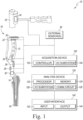
- a surgical instrument system 10 is used during an orthopaedic surgical procedure, which is shown illustratively as a total hip arthroplasty (THA) procedure.
- THA total hip arthroplasty
- an orthopaedic surgeon impacts a surgical broach 14 into a patient's femur 16 by striking an instrument handle 12 that is attached to the broach 14 using an orthopaedic mallet 32 (or other impactor).
- an acquisition device 100 captures sensor data from multiple sensors in the operating environment, including sensors attached to the handle 12 and/or the mallet 32 and/or external sensors.
- the acquisition device 100 provides the sensor data to an analysis device 120, which uses a machine learning model to generate a prediction of the impaction state of the broach 14 based on the sensor data.
- the impaction state is defined as being one of unseated (i.e., the broach 14 is not seated in the femur 16), seated (i.e., the broach 14 is firmly seated in the femur 16), or fracture (i.e., the femur 16 has fractured).
- a user interface 140 outputs the prediction, which provides feedback on the impaction state to the surgeon.
- the system 10 may aid the surgeon in determining when the broach 14 is firmly seated as well as identifying and preventing proximal femoral fractures during THA surgeries.
- Orthopaedic implements may include orthopaedic surgical instruments such as broaches and trial components, as well as prosthetic components.
- the concepts of the present disclosure may also apply to impacting cementless orthopaedic implants such as a cementless acetabular cup outer shell.
- the broach 14 includes an outer surface having a plurality of cutting teeth formed thereon.
- the broach 14 is configured to shape the intramedullary canal of the patient's femur 16 to receive a femoral component (not shown).
- the broach 14 is formed from a metallic material, such as, for example, stainless steel or cobalt chromium.
- a proximal end of the broach 14 includes a mounting post or other mounting bracket that may be attached to the instrument handle 12.
- the instrument handle 12 is also formed from a metallic material, such as, for example, stainless steel or cobalt chromium, and includes an elongated body that extends from a mounting tip to a strike plate.
- the mounting tip is configured to attach to the broach 14, and in some embodiments may also be configured to attach to one or more other surgical instruments and/or orthopaedic implants.
- the instrument handle 12 includes a grip configured to receive the hand of a surgeon or other user to allow the user to manipulate the handle 12.
- the strike plate of the handle 12 includes a durable surface suitable for use with a striking tool such as the orthopaedic mallet 32.
- the instrument handle 12 also includes or is otherwise coupled to a number of impaction sensors 18.
- the impaction sensors 18 are configured to generate sensor data that is indicative of the impaction state of the broach 14 relative to the patient's femur 16.
- the impaction sensors 18 include a force sensing resistor (FSR) and/or load cell 20, a thermometer 22, a vibration sensor 24, a displacement sensor 26, an inertial measurement unit (IMU) sensor 28, and an audio sensor 30.
- FSR force sensing resistor
- IMU inertial measurement unit
- the FSR 20 and/or the load cell 20 measure the force exerted on the strike plate of the instrument handle 12 by the orthopaedic mallet 32.
- An FSR sensor may be embodied as a polymer sheet or film with a resistance that varies based on the applied force or pressure.
- a load cell may be embodied as a transducer that converts force into an electrical output that may be measured.
- the handle 12 may include one or both of an FSR and/or a load cell.
- the thermometer 22 measures temperature of the instrument handle 12 and/or temperature of the surgical environment.
- the thermometer 22 may be embodied as a digital temperature sensor, a thermocouple, or other temperature sensor.
- the vibration sensor 24 measures vibration in the handle 12 during impaction in the form of pressure, acceleration, and force on the handle 12.
- the vibration sensor 24 may be embodied as a piezoelectric vibration sensor or other electronic vibration sensor.
- a piezoelectric sensor uses the piezoelectric effect to measure changes in pressure, acceleration, strain, or force, by converting those quantities to electric charge.
- the displacement sensor 26 measures the position and/or change in position of the broach 14 relative to the femur 16.
- the displacement sensor 26 may be embodied as an optical time-of-flight sensor, which senses distance by measuring the amount of time required for an infrared laser emitted by the sensor 26 to reflect off of a surface back to the displacement sensor 26.
- the displacement sensor 26 may measure the distance moved by the broach 14 into the patient's femur 16 for each strike of the orthopaedic mallet 32.
- the IMU sensor 28 measures and reports motion data associated with the instrument handle 12, including the specific force/acceleration and angular rate of the instrument handle 12, as well as the magnetic field surrounding the instrument handle 12 (which may be indicative of global orientation).
- the IMU sensor 28 may be embodied as or otherwise include a digital accelerometer, gyroscope, and magnetometer per axis of motion.
- the illustrative IMU sensor 28 is embodied as a nine degrees of freedom IMU (e.g., capable of measuring linear acceleration, angular acceleration, and magnetic field in each of three axes).
- the audio sensor 30 measures sound signals generated during impaction of the broach 14.
- the audio sensor 30 may be embodied as a microphone, digital-to-analog converter, or other acoustic to electric transducer or sensor.
- the orthopaedic mallet 32 includes a handle and a mallet head connected to the handle via a shaft. As with a typical hammer or mallet, the orthopaedic surgeon may grasp the mallet 32 by the handle and swing the mallet 32 to cause impaction of the mallet head with the instrument handle 12 (or other structure).
- the orthopaedic mallet 32 further includes an IMU sensor 34, which measures motion data including the acceleration, angular rate, and magnetic field of the mallet 32. Although only one IMU sensor 34 is shown in FIG. 1 , it should be appreciated that the orthopaedic mallet 32 may include additional impaction sensors 18 in other embodiments, similar to the instrument handle 12. In such embodiments, the multiple impaction sensors 18 may be similar or of different types.
- the orthopaedic mallet 32 may be embodied as an automated impactor (not shown), rather than a manual mallet.
- the automated impactor may be embodied as a Kincise TM surgical automated system component commercially available from DePuy Synthes of Warsaw, Indiana.
- the automated impactor may include an IMU sensor 34 and/or other impaction sensors 18.
- the orthopaedic mallet 32 may be embodied as a dynamic impulse hammer that measures force exerted on the handle 12 as the hammer tip strikes the handle 12.
- the system 10 may also include one or more external impaction sensors 36, which are not located on either the instrument handle 12 or the orthopaedic mallet 32.
- the external impaction sensor(s) 36 may be embodied any type of sensor capable of producing sensor data indicative of impaction of the broach 14, even though the sensors 36 are not in physical contact with either the instrument handle 12 or the orthopaedic mallet 32.
- the external impaction sensor 36 includes an audio sensor (e.g., a microphone) capable of generating audio sensor data indicative of impaction between the instrument handle 12 and the orthopaedic mallet 32, an image sensor (e.g., a camera) capable of generating image data indicative of impaction between the instrument handle 12 and the orthopaedic mallet 32, and/or other sensors capable of generating data indicative of impaction between the instrument handle 12 and the orthopaedic mallet 32.
- an audio sensor e.g., a microphone
- an image sensor e.g., a camera
- other sensors capable of generating data indicative of impaction between the instrument handle 12 and the orthopaedic mallet 32.
- the system 10 may include a different number and/or arrangement of sensors 18, 34, 36.
- the system 10 may include a vibration sensor 24 and an IMU sensor 28 coupled to the handle 12 and an external microphone 36.
- one or more components of the system 10 e.g., the orthopaedic mallet 32
- the orthopaedic mallet 32 may be embodied as typical orthopaedical tools and include no electronic components.
- the sensors 18, 34, 36 are coupled to the acquisition device 100, which may be embodied as a single device such as a multi-channel data acquisition system, a circuit board, an integrated circuit, an embedded system, a field-programmable-array (FPGA), a system-on-a-chip (SOC), or other integrated system or device.
- the acquisition device 100 includes a controller 102 and an input/output (I/O) subsystem 104.
- the controller 102 may be embodied as any type of controller or other processor capable of performing the functions described herein.
- the controller 102 may be embodied as a microcontroller, a digital signal processor, a single or multi-core processor(s), discrete compute circuitry, or other processor or processing/controlling circuitry.
- the acquisition device 100 may also include volatile and/or non-volatile memory or data storage capable of storing data, such as the sensor data produced by the impaction sensors 18, 34, 36.
- the acquisition device 100 is communicatively coupled to other components of the system 10 via the I/O subsystem 104, which may be embodied as circuitry and/or components to facilitate input/output operations with the controller 102 and other components of the system 10.
- the I/O subsystem 104 may be embodied as, or otherwise include, memory controller hubs, input/output control hubs, firmware devices, communication links (i.e., point-to-point links, bus links, wires, cables, light guides, printed circuit board traces, etc.) and/or other components and subsystems to facilitate the input/output operations.
- the acquisition device 100 is communicatively coupled to the analysis device 120, which may be embodied as any type of device or collection of devices capable of performing various compute functions and the functions described herein, such as a desktop computer, a workstation, a server, a special-built compute device, a mobile compute device, a laptop computer, a tablet computer, or other computer or compute device.
- the analysis device 120 includes a processor 122, a memory 124, an I/O subsystem 126, and a communication circuit 128.
- the processor 122 may be embodied as any type of processor capable of performing the functions described herein.
- the processor 122 may be embodied as a single or multi-core processor(s), a digital signal processor, a microcontroller, discrete compute circuitry, other processor or processing/ controlling circuitry.
- the memory 124 may be embodied as any type of volatile and/or non-volatile memory or data storage capable of storing data, such as the sensor data received from the acquisition device 100 and/or model data as described further below.
- the analysis device 120 may also include other components commonly found in a compute device, such as a data storage device and various input/output devices (e.g., a keyboard, mouse, display, etc.). Additionally, although illustrated as a single device, it should be understood that in some embodiments, the analysis device 120 may be formed from multiple computing devices distributed across a network, for example operating in a public or private cloud.
- the analysis device 120 is communicatively coupled to other components of the system 10 via the I/O subsystem 126, which may be embodied as circuitry and/or components to facilitate input/output operations with the analysis device 120 (e.g., with the processor 122 and/or the memory 124) and other components of the system 10.
- the I/O subsystem 126 may be embodied as, or otherwise include, memory controller hubs, input/output control hubs, firmware devices, communication links (i.e., point-to-point links, bus links, wires, cables, light guides, printed circuit board traces, etc.) and/or other components and subsystems to facilitate the input/output operations.
- the communication circuit 128 is configured to communicate with external devices such as the acquisition device 100, the user interface 140, other analysis devices 120, and/or other remote devices.
- the communication circuit 128 may be embodied as any type of communication circuits or devices capable of facilitating communications between the analysis device 120 and other devices. To do so, the communication circuit 128 may be configured to use any one or more communication technologies (e.g., wireless or wired communications) and associated protocols (e.g., Ethernet, Bluetooth ® , Wi-Fi ® , WiMAX, LTE, 5G, etc.) to effect such communication.
- communication technologies e.g., wireless or wired communications
- associated protocols e.g., Ethernet, Bluetooth ® , Wi-Fi ® , WiMAX, LTE, 5G, etc.
- the user interface 140 may be embodied as a collection of various output and/or input devices to facilitate communication between the system 10 and a user (e.g., an orthopaedic surgeon).
- the user interface 140 includes one or more output devices 144 and/or one or more input devices 142.
- Each of the output devices 144 may be embodied as any type of output device capable of providing a notification or other information to the orthopaedic surgeon or other user.
- the output devices 144 may be embodied as visual, audible, or tactile output devices.
- the user interface 140 includes one or more visual output devices, such as a light emitting diode (LED), a light, a display screen, or the like.
- LED light emitting diode
- Each of the input devices 142 may be embodied as any type of input device capable of control or activation by the orthopedic surgeon to provide an input, data, or instruction to the system 10.
- the input devices 142 may be embodied as a button (e.g., an on/off button), a switch, a touchscreen display, or the like.
- the functionality of the acquisition device 100 and the analysis device 120 may be combined in a single computing device.
- the functionality of the user interface 140 may also be combined with the analysis device 120.
- the user interface 140 may be combined with otherwise included with one or more surgical instruments, such as the instrument handle 12 and/or the orthopaedic mallet 32.
- the analysis device 120 may be coupled directly to one or more sensors, such as the IMU 34 and/or an external sensor 36, without use of the acquisition device 100.
- a tablet computer may include a microphone or other external sensor 36.
- the tablet computer may capture sensor data from the microphone 36, use the machine learning model to generate a prediction of the impaction state of the broach 14 based on the sensor data, and output the prediction using a display screen of the tablet computer.
- the system 10 establishes an environment 200 during operation.
- the illustrative environment 200 includes sensors 202, an impaction data collector 204, a model trainer 208, an impaction analyzer 212, and an impaction state user interface 218.
- the various components of the environment 200 may be embodied as hardware, firmware, software, or a combination thereof.
- one or more of the components of the environment 200 may be embodied as circuitry or collection of electrical devices (e.g., the sensors 18, 34 36, the acquisition device 100, the analysis device 120, and/or the user interface 140).
- the sensors 202 may be embodied as the sensors 18, 34, 36
- the impaction data collector 204 may be embodied as the acquisition device 100
- the model trainer 208 and the impaction analyzer 212 may be embodied as the analysis device 120
- the impaction state user interface 218 may be embodied as the user interface 140.
- one or more of the illustrative components may form a portion of another component and/or one or more of the illustrative components may be independent of one another.
- the sensors 202 are configured to generate sensor data indicative of impaction state of an orthopaedic implement relative to a patient's bone.
- the sensors 202 may include the vibration sensor 24, the IMU 28, and/or the external microphone 36.
- the impaction data collector 204 is configured to collect the sensor data during the orthopaedic surgical procedure from the impaction sensors 202.
- the impaction data collector 204 provides the collected sensor data 206 to the impaction analyzer 212.
- the impaction analyzer 212 is configured to generate an impaction state prediction with a machine learning model based on the sensor data 206.
- the impaction state prediction includes classifications 216 of the sensor data 206.
- the classifications 216 include an unseated state, a seated state, or a fracture state.
- the impaction state prediction may also include a probability or other relative score.
- the impaction analyzer 212 may store model data 214 related to the machine learning model, including historical data, model weights, decision trees, and other model data 214.
- the impaction state user interface 218 is configured to output the impaction state prediction.
- Outputting the impaction state prediction may include displaying a visual representation of the impaction state prediction, outputting an auditory indication or warning of the impaction state prediction, or otherwise outputting the impaction state prediction.
- the model trainer 208 is configured to label the collected sensor data 206 with an impaction state label to generate labeled sensor data. Similar to the impaction state prediction, the impaction state label includes an unseated state, a seated state, or a fracture state.
- the model trainer 208 is further configured to train the machine learning model of the impaction analyzer 212 to predict impaction state for input sensor data 206 based on the labeled sensor data 206.
- the model trainer 208 may train the machine learning model by providing and/or modifying weights 210 associated with the machine learning model.
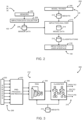
- diagram 300 illustrates one potential embodiment of a machine learning model that may be established by the impaction analyzer 212.
- the sensor data 206 is input to a pre-processing/dimensionality reduction stage 302.
- the pre-processing stage 302 may, for example, transform the sensor data 206 to a frequency domain to generate frequency domain sensor data, and then reduce dimensionality of the frequency domain sensor data to generate the processed sensor data.
- the pre-processing stage 302 may reduce dimensionality using a principal component analysis procedure.
- the processed sensor data is input to a recurrent neural network (RNN) 304.
- the RNN 304 is illustratively a long short-term memory (LSTM) that has been trained to identify anomalies in the processed sensor data.
- LSTM long short-term memory
- Anomaly detection is the identification of data points, items, observations or events that do not conform to the expected pattern of a given group. These anomalies may occur infrequently but may signify a large and/or otherwise significant occurrence.
- the detected anomalies include the broach 14 being in a fully seated condition and a fracture of the femur 16.
- Output from the RNN 304 is passed to a classifier 306.
- the classifier 306 is illustratively a random forest (RF) predictive model.
- the classifier 306 generates the classifications 216 based on the output from the RNN 304.
- the classifications 216 indicate whether the impaction state is predicted to be unseated, seated, or fracture, and in some embodiments may include a probability or other relative score.
- RF random forest
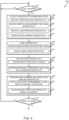
- the instrument system 10 may perform a method 400 for training the machine learning model of the impaction analyzer 212.
- the operations of the method 400 may be performed by one or more components of the environment 200 described above in connection with FIG. 2 .
- the method 400 begins with block 402, in which the system 10 determines whether to start training. For example, a surgeon or other operator may instruct the system 10 to start training using the user interface 140 or other control. If the system 10 determines to start training, the method 400 advances to block 404. If not, the method 400 loops back to block 402.
- the acquisition device 100 collects sensor data from one or more sensors 18, 34, and/or 36 during impaction of the broach 14 into the patient's femur 16.
- the surgeon impacts the broach 14 into the patient's femur 16 by striking the instrument handle 12 attached to the broach 14 using the orthopaedic mallet 32.
- the acquisition device 100 captures sensor signals, including acceleration, vibration, and acoustic signals, as the surgeon impacts the instrument handle 12.
- the sensor data may be captured during an orthopaedic surgical procedure or during a testing procedure or other data gathering operation. In a testing procedure, the surgeon or other operator may impact the broach 14 into a replicate femur or other bone analog.
- the surgeon may strike the instrument handle 12 in different locations on the strike plate and/or at different angles.
- the machine learning model may be trained to recognize sensor data associated with impacts at different locations and/or at different impaction angles. After collecting the sensor data, the acquisition device 100 provides the sensor data to the analysis device 120 for further processing.
- the acquisition device 100 receives vibration and/or audio sensor data.
- the acquisition device 100 receives vibration data from the vibration sensor 24 coupled to the instrument handle 12 and audio data from an external audio sensor 36. Additionally or alternatively, in some embodiments the acquisition device 100 may receive audio data from an audio sensor 30 coupled to the instrument handle 12.
- the acquisition device 100 receives IMU sensor data.
- the acquisition device 100 receives IMU data (indicative of motion, including linear acceleration, angular rate, and magnetic field) from the IMU sensor 28 coupled to the instrument handle 12. Additionally or alternatively, in some embodiments the acquisition device 100 may receive IMU data from an IMU sensor coupled to the orthopaedic mallet 32.
- the acquisition device 100 receives load or pressure data from the FSR/load cell 20 coupled to the instrument handle 12. In some embodiments, in block 412 the acquisition device 100 receives displacement data from the displacement sensor 26 coupled to the instrument handle 12.
- the analysis device 120 (or in some embodiments the acquisition device 100) labels the collected sensor data. Labeling the sensor data allows the received sensor data to be used for training the machine learning model as described further below.
- the sensor data may be labeled by an operator of the system 10, for example by selecting an appropriate label using the user interface 140.
- a label of unseated, seated, or fracture is assigned to each data point or group of data points of the sensor data.
- Unseated indicates that the broach 14 is not fully seated in the femur 16. In the unseated state, the broach 14 is loose inside the femur 16 and has low motion resistance and low rotational stability. In the unseated state, the femur 16 has a low fracture risk. Seated indicates that the broach 14 is firmly seated in the femur 16 and does not progress with impaction. In the seated state, the broach 14 is firmly seated inside the femur 16 and has high motion resistance and high rotational stability. In the seated state, the femur 16 has a high risk of fracture with further impaction.
- Fracture indicates that the femur 16 has a fracture (e.g., a fracture in the calcar and/or proximal femur) in one or more locations.
- a fracture e.g., a fracture in the calcar and/or proximal femur
- the broach 14 may be well seated and resistant to attempted motion. Further impaction in the fracture state may worsen the fracture.
- the label may be assigned to the sensor data during impaction. For example, a surgeon or other operator may input the label using the user interface 140 during the impaction procedure. As another example, the label may be pre-assigned for a series of impactions in a test procedure. Continuing that example, in the test procedure a replicate femur may be pre-fractured prior to performing the test procedure. In that example, all sensor data collected during the test using the pre-fractured replicate femur may be labeled as fracture.
- the analysis device 120 pre-processes the sensor data to prepare for input to the machine learning model.
- the analysis device 120 may perform one or more filtering, normalization, and/or feature extraction processes to prepare the sensor data for processing.
- the analysis device 120 transforms the sensor data (collected as time series data) into frequency domain data using a fast Fourier transform (FFT). Transforming to frequency domain may remove noise and allow for improved identification of peaks in the sensor data.
- FFT fast Fourier transform
- the analysis device 120 performs principal component analysis to reduce dimensionality of the sensor data. Reducing dimensionality may improve processing efficiency by combining and/or eliminating dependent variables in the sensor data. It should be understood that in some embodiments, the system 10 may not reduce dimensionality of the sensor data, and instead, for example, may reduce the volume of input sensor data by removing certain sensors from the system 10.
- the analysis device 120 trains the machine learning model with the labeled data.
- the machine learning model is trained to identify anomalies in the sensor data, including the broach 14 being fully seated in the femur 16 and a fracture of the femur 16.
- the machine learning model is further trained to classify the sensor data, based on any identified anomalies, into the unseated, seated, and fracture states.
- the analysis device 120 may train the machine learning model using any appropriate training algorithm.
- the analysis device 120 trains a long short-term memory (LSTM) recurrent neural network to detect anomalies based on the labeled sensor data.
- the LSTM model may be trained using a gradient descent algorithm or other model training algorithm.
- the LSTM model may be trained to recognize seating of the broach 14 in the bone 16 and fracture of the bone 16 based on sequences of input sensor data. Accordingly, during training the LSTM model may recognize and account for differences in technique between individual strikes on the instrument handle 12, including differences in location of impaction differences in impaction angle, and other differences.
- the analysis device 120 trains a random forest (RF) predictive model/ classifier based on the output from the LSTM model and the labeled sensor data.
- the RF model is trained to classify output from the LSTM model as unseated, seated, or fracture based on the label associated with the sensor data.
- the RF model may be trained using any appropriate decision tree learning algorithm.
- the system 10 determines whether model training is completed. For example, the analysis device 120 may determine whether the machine learning model has reached a certain error threshold or otherwise determine whether the machine learning model is sufficiently trained. If additional training is required, the method 400 loops back to block 402 to continue training the machine learning model. If no further training is required, the method 400 is completed. After training, the machine learning model may be used to perform inferences as described below in connection with FIG. 5 .
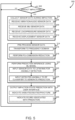
- the instrument system 10 may perform a method 500 for monitoring and predicting impaction state during a surgical procedure.
- the operations of the method 500 may be performed by one or more components of the environment 200 described above in connection with FIG. 2 .
- the method 500 begins with block 502, in which the system 10 determines whether to monitor impaction and predict impaction state. For example, a surgeon or other operator may instruct the system 10 to start monitoring impaction using the user interface 140 or other control. If the system 10 determines to start monitoring impaction and predicting impaction state, the method 500 advances to block 504. If not, the method 500 loops back to block 502.
- the acquisition device 100 collects sensor data from one or more sensors 18, 34, and/or 36 during impaction of the broach 14 into the patient's femur 16.
- the surgeon impacts the broach 14 into the patient's femur 16 by striking the instrument handle 12 attached to the broach 14 using the orthopaedic mallet 32.
- the acquisition device 100 captures sensor signals, including acceleration, vibration, and acoustic signals, as the surgeon impacts the instrument handle 12. After collecting the sensor data, the acquisition device 100 provides the sensor data to the analysis device 120 for further processing.
- the acquisition device 100 receives vibration and/or audio sensor data.
- the acquisition device 100 receives vibration data from the vibration sensor 24 coupled to the instrument handle 12 and audio data from an external audio sensor 36. Additionally or alternatively, in some embodiments the acquisition device 100 may receive audio data from an audio sensor 30 coupled to the instrument handle 12.
- the acquisition device 100 receives IMU sensor data.
- the acquisition device 100 receives IMU data (indicative of motion, including linear acceleration, angular rate, and magnetic field) from the IMU sensor 28 coupled to the instrument handle 12. Additionally or alternatively, in some embodiments the acquisition device 100 may receive IMU data from an IMU sensor coupled to the orthopaedic mallet 32.
- the acquisition device 100 receives load or pressure data from the FSR/load cell 20 coupled to the instrument handle 12. In some embodiments, in block 512 the acquisition device 100 receives displacement data from the displacement sensor 26 coupled to the instrument handle 12.
- the analysis device 120 pre-processes the sensor data to prepare for input to the machine learning model.
- the analysis device 120 may perform one or more filtering, normalization, and/or feature extraction processes to prepare the sensor data for processing. In particular, the analysis device 120 may perform the same pre-processing operations as described above in connection with block 420 of FIG. 4 .
- the analysis device 120 transforms the sensor data (collected as time series data) into frequency domain data using a fast Fourier transform (FFT). Transforming to frequency domain may remove noise and allow for improved identification of peaks in the sensor data.
- FFT fast Fourier transform
- the analysis device 120 performs principal component analysis to reduce dimensionality of the sensor data.
- Reducing dimensionality may improve processing efficiency by combining and/or eliminating dependent variables in the sensor data. It should be understood that in some embodiments, the system 10 may not reduce dimensionality of the sensor data, and instead, for example, may reduce the volume of input sensor data by removing certain sensors from the system 10.
- the analysis device 120 performs a predicted impaction state inference using the trained machine learning model with the pre-processed sensor data.
- the machine learning model is trained to identify anomalies in the sensor data, including the broach 14 being fully seated in the femur 16 and a fracture of the femur 16.
- the machine learning model is further trained to classify the sensor data, based on any identified anomalies, into the unseated, seated, and fracture states.
- the analysis device 120 inputs the pre-processed sensor data to the LSTM model.
- the LSTM model outputs data that is indicative of anomalies detected and/or predicted based on the input sensor data, including seating of the broach 14 in the bone 16 and fracture of the bone 16.
- Output from the LSTM model may recognize anomalies regardless of any differences in technique between individual strikes on the instrument handle 12.
- the analysis device 120 inputs the output from the LSTM model into the RF classifier.
- the RF classifier outputs a classification of the predicted impaction state as unseated, seated, or fracture.
- the analysis device 120 outputs the impaction state prediction using the user interface 140.
- the user interface 140 may output the impaction state using any appropriate output modality.
- the impaction state prediction may be displayed visually using a graphical display, warning lights, or other display.
- the impaction state prediction may be output using an audio device as a warning sound, annunciation, or other sound.
- the user interface 140 may indicate whether the impaction state prediction is unseated, seated, or fracture.
- the user interface 140 may indicate a probability or other relative score associated with the prediction.
- the score may indicate a relative confidence level that the broach 14 is unseated or seated, and/or a relative confidence level that a fracture exists in the femur 16.
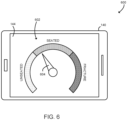
- diagram 600 illustrates one potential embodiment of a user interface 140.
- the illustrative user interface 140 is a tablet computer having a display 144.
- the display 144 shows a graphical representation 602 of the impaction state prediction.
- the illustrative graphical representation 602 includes a pointer 604 that points to the current impaction state prediction.
- Each of the potential impaction states includes a color-coded bar (represented as shading in FIG. 6 ). For example, in an embodiment the unseated state may be color-coded as yellow, the seated state may be color-coded as green, and the fracture state may be color-coded as red.
- the pointer 604 indicates the relative score associated with the impaction state prediction by the relative position pointed to within the associated color-coded bar.
- the graphical representation 602 may include gradations or other indications of the relative score.
- the user interface 140 may be included on the orthopaedic mallet 32.
- the user interface 140 may include a set of LEDs or other indicator lights. One or more of the LEDs may be illuminated based on the predicted impaction state. For example, the user interface 140 may illuminate a yellow LED when the prediction impaction state is unseated, a green LED when the prediction impaction state is seated, and a red LED when the prediction impaction state is fracture.
Landscapes
- Health & Medical Sciences (AREA)
- Engineering & Computer Science (AREA)
- Life Sciences & Earth Sciences (AREA)
- Surgery (AREA)
- General Health & Medical Sciences (AREA)
- Biomedical Technology (AREA)
- Molecular Biology (AREA)
- Orthopedic Medicine & Surgery (AREA)
- Heart & Thoracic Surgery (AREA)
- Animal Behavior & Ethology (AREA)
- Public Health (AREA)
- Veterinary Medicine (AREA)
- Physics & Mathematics (AREA)
- Theoretical Computer Science (AREA)
- Medical Informatics (AREA)
- Nuclear Medicine, Radiotherapy & Molecular Imaging (AREA)
- Computing Systems (AREA)
- General Engineering & Computer Science (AREA)
- Software Systems (AREA)
- Mathematical Physics (AREA)
- General Physics & Mathematics (AREA)
- Artificial Intelligence (AREA)
- Biophysics (AREA)
- Computational Linguistics (AREA)
- Data Mining & Analysis (AREA)
- Evolutionary Computation (AREA)
- Robotics (AREA)
- Transplantation (AREA)
- Oral & Maxillofacial Surgery (AREA)
- Human Computer Interaction (AREA)
- Vascular Medicine (AREA)
- Cardiology (AREA)
- Dentistry (AREA)
- Physical Education & Sports Medicine (AREA)
- Prostheses (AREA)
- Measurement Of The Respiration, Hearing Ability, Form, And Blood Characteristics Of Living Organisms (AREA)
- Surgical Instruments (AREA)
Claims (15)
- System zum Prognostizieren eines Auftreffzustands während eines orthopädischen chirurgischen Eingriffs, wobei das System aufweist:einen oder mehrere Auftreffsensoren zum Erzeugen von Sensordaten, die den Auftreffzustand eines orthopädischen Geräts [14] in Bezug auf den Knochen eines Patienten [16] angeben;einen Auftreffdatensammler [100] zum Sammeln der Sensordaten während des orthopädischen chirurgischen Eingriffs von dem Auftreffsensor;ein Auftreffanalysegerät [120] zum Erzeugen einer Auftreffzustand-Vorhersage anhand der Sensordaten; undeine Auftreffzustand-Benutzerschnittstelle [140] zum Ausgeben der Auftreffzustand-Vorhersage;dadurch gekennzeichnet, dass:die Auftreffzustand-Vorhersage einen Nicht-Sitzzustand, einen Sitzzustand oder einen Bruchzustand aufweist; unddie Auftreffzustand-Vorhersage mit einem Modell des maschinellen Lernens anhand der Sensordaten erzeugt wird.
- System nach Anspruch 1, wobei das orthopädische Gerät eine Oberschenkelraspel [14] oder eine Prothesenkomponente aufweist.
- System nach Anspruch 1, ferner aufweisend einen Auftreffgriff für ein chirurgisches Instrument [12], wobei der eine oder mehrere Auftreffsensoren aufweisen: (i) einen Schwingungssensor [24], der mit dem Auftreffgriff [12] gekoppelt ist, (ii) eine Inertialmesseinheit [28], die mit dem Auftreffgriff [12] gekoppelt ist, und (iii) ein externes Mikrofon [30].
- System nach Anspruch 1, wobei das Erzeugen der Auftreffzustand-Vorhersage mit dem maschinellen Lernmodell anhand der Sensordaten umfasst:Vorverarbeiten der Sensordaten zum Erzeugen von verarbeiteten Sensordaten; undEingeben der verarbeiteten Sensordaten in das maschinelle Lernmodell, wobei optional das Vorverarbeiten der Sensordaten umfasst:Umwandeln der Sensordaten in einen Frequenzbereich zum Erzeugen von Sensordaten in dem Frequenzbereich; undVerringern der Dimensionalität der Sensordaten in dem Frequenzbereich zum Erzeugen der verarbeiteten Sensordaten.
- System nach Anspruch 1, wobei das Erzeugen der Auftreffzustand-Vorhersage mit dem maschinellen Lernmodell anhand der Sensordaten umfasst:Eingeben der Sensordaten in ein rekurrentes neuronales Netzwerk zum Erzeugen von Anomalievorhersagedaten; undEingeben der Anomalievorhersagedaten in einen Klassifikator zum Erzeugen der Auftreffzustand-Vorhersage, wobei optional:das rekurrente neuronale Netzwerk ein Long-Short-Term-Memory-Netzwerk umfasst; undder Klassifikator ein Random-Forest-Vorhersagemodell umfasst.
- System nach Anspruch 1, ferner umfassend eine Rechenvorrichtung, die den einen oder mehrere Auftreffsensoren, den Auftreffdatensammler (100), das Auftreffanalysegerät (120) und die Auftreffzustand-Benutzerschnittstelle (140) aufweist, wobei:der eine oder mehrere Auftreffsensoren ein Mikrofon [30] der Rechenvorrichtung umfassen; unddie Auftreffzustand-Benutzerschnittstelle [140] einen Bildschirm der Rechenvorrichtung umfasst.
- Ein oder mehrere nicht-flüchtige, maschinenlesbare Medien, aufweisend eine Vielzahl von Anweisungen, die als Reaktion auf Ausführung einen oder mehrere Prozessoren veranlassen zum:Sammeln von Sensordaten während eines orthopädischen chirurgischen Eingriffs von einem Auftreffsensor, wobei die Sensordaten den Auftreffzustand eines orthopädischen Geräts relativ zu einem Knochen eines Patienten angeben;Erzeugen einer Auftreffzustand-Vorhersage anhand der Sensordaten;Ausgeben der Auftreffzustand-Vorhersage;dadurch gekennzeichnet, dass:die Auftreffzustand-Vorhersage einen Nicht-Sitzzustand, einen Sitzzustand oder einen Bruchzustand aufweist; unddie Auftreffzustand-Vorhersage mit einem maschinellen Lernmodell anhand der Sensordaten erzeugt wird.
- Ein oder mehrere nicht-flüchtige, maschinenlesbare Medien nach Anspruch 7, wobei das Sammeln der Sensordaten von dem Auftreffsensor umfasst:Sammeln von Schwingungsdaten von einem Schwingungssensor [24], der mit einem chirurgischen Instrument gekoppelt ist [14];Sammeln von Bewegungsdaten von einer Inertialmesseinheit [28], die mit dem chirurgischen Instrument [14] gekoppelt ist; undSammeln von Audiodaten von einem externen Mikrofon [30].
- Ein oder mehrere nicht-flüchtige, maschinenlesbare Medien nach Anspruch 7, wobei das Erzeugen der Auftreffzustand-Vorhersage mit dem maschinellen Lernmodell anhand der Sensordaten umfasst:Vorverarbeiten der Sensordaten zum Erzeugen von verarbeiteten Sensordaten; undEingeben der verarbeiteten Sensordaten in das maschinelle Lernmodell.
- Ein oder mehrere nicht-flüchtige, maschinenlesbare Medien nach Anspruch 7, wobei das Erzeugen der Auftreffzustand-Vorhersage mit dem maschinellen Lernmodell anhand der Sensordaten umfasst:Eingeben der Sensordaten in ein rekurrentes neuronales Netzwerk zum Erzeugen von Anomalievorhersagedaten; undEingeben der Anomalievorhersagedaten in einen Klassifikator [306] zum Erzeugen der Auftreffzustand-Vorhersage, wobei optional das rekurrente neuronale Netzwerk ein Long-Short-Term-Memory-Netzwerk umfasst und wobei der Klassifikator [306] ein Random-Forest-Vorhersagemodell umfasst.
- Ein oder mehrere nicht-flüchtige, maschinenlesbare Medien, umfassend eine Vielzahl von Anweisungen, die als Reaktion auf Ausführung einen oder mehrere Prozessoren veranlassen zum:Sammeln von Sensordaten von einem Auftreffsensor [18], wobei die Sensordaten den Auftreffzustand eines orthopädischen Geräts [14] relativ zu einem Knochen [16] oder einem Knochenanaloga angeben; undKennzeichnen der Sensordaten mit einer Auftreffzustand-Kennzeichnung zum Erzeugen von gekennzeichneten Sensordaten;dadurch gekennzeichnet, dassdie Auftreffzustand-Kennzeichnung einen Nicht-Sitzzustand, einen Sitzzustand oder einen Bruchzustand aufweist; unddadurch gekennzeichnet, dass der eine oder mehrere Prozessoren:
ein maschinelles Lernmodell anhand der gekennzeichneten Sensordaten zum Prognostizieren des Auftreffzustands zum Eingeben der Sensordaten trainiert. - Ein oder mehrere nicht-flüchtige, maschinenlesbare Medien nach Anspruch 11, wobei das Trainieren des maschinellen Lernmodells anhand der gekennzeichneten Sensordaten umfasst:Vorverarbeiten der gekennzeichneten Sensordaten zum Erzeugen von verarbeiteten Sensordaten; undTrainieren des Maschinellen Lernmodells anhand der verarbeiteten Sensordaten.
- Ein oder mehrere nicht-flüchtige, maschinenlesbare Medien nach Anspruch 12, wobei das Vorverarbeiten der gekennzeichneten Sensordaten umfasst:Umwandeln der gekennzeichneten Sensordaten in einen Frequenzbereich zum Erzeugen von Sensordaten im Frequenzbereich; undVerringern der Dimensionalität der Sensordaten im Frequenzbereich zum Erzeugen der verarbeiteten Sensordaten, wobei optional das Verringern der Dimensionalität der Sensordaten im Frequenzbereich das Durchführen einer Hauptkomponentenanalyse der Sensordaten im Frequenzbereich umfasst.
- Ein oder mehrere nicht-flüchtige, maschinenlesbare Medien nach Anspruch 11, wobei das Trainieren des maschinellen Lernmodells zum Prognostizieren des Auftreffzustands zum Eingeben von Sensordaten anhand der gekennzeichneten Sensordaten umfasst:Trainieren eines rekurrenten neuronalen Netzwerks mit den gekennzeichneten Sensordaten zum Identifizieren von Anomalien in den gekennzeichneten Sensordaten; undTrainieren eines Klassifikators mit den Anomalien in den gekennzeichneten Sensordaten zum Prognostizieren des Auftreffzustands.
- Ein oder mehrere nicht-flüchtige, maschinenlesbare Medien nach Anspruch 14, wobei das rekurrente neuronale Netzwerk ein Long-Short-Term-Memory-Netzwerk umfasst, wobei optional der Klassifikator ein Random-Forest-Vorhersagemodell umfasst.
Applications Claiming Priority (2)
| Application Number | Priority Date | Filing Date | Title |
|---|---|---|---|
| US16/788,580 US11426243B2 (en) | 2020-02-12 | 2020-02-12 | Technologies for monitoring and predicting impaction state of an orthopaedic surgical implement during an orthopaedic surgical procedure |
| PCT/IB2021/050632 WO2021161120A1 (en) | 2020-02-12 | 2021-01-27 | Technologies for monitoring and predicting impaction state of an orthopaedic surgical implement during an orthopaedic surgical procedure |
Publications (3)
| Publication Number | Publication Date |
|---|---|
| EP4103111A1 EP4103111A1 (de) | 2022-12-21 |
| EP4103111C0 EP4103111C0 (de) | 2024-02-07 |
| EP4103111B1 true EP4103111B1 (de) | 2024-02-07 |
Family
ID=74494973
Family Applications (1)
| Application Number | Title | Priority Date | Filing Date |
|---|---|---|---|
| EP21702734.1A Active EP4103111B1 (de) | 2020-02-12 | 2021-01-27 | Vorhersage des einschlagzustandes eines orthopädischen chirurgischen instruments während eines orthopädischen chirurgischen eingriffs |
Country Status (6)
| Country | Link |
|---|---|
| US (3) | US11426243B2 (de) |
| EP (1) | EP4103111B1 (de) |
| JP (1) | JP7732166B2 (de) |
| CN (1) | CN115135283A (de) |
| AU (1) | AU2021220693B2 (de) |
| WO (1) | WO2021161120A1 (de) |
Families Citing this family (21)
| Publication number | Priority date | Publication date | Assignee | Title |
|---|---|---|---|---|
| US12023253B2 (en) | 2014-01-24 | 2024-07-02 | Howmedica Osteonics Corp. | Humeral implant anchor system |
| US10456264B2 (en) | 2014-01-24 | 2019-10-29 | Tornier, Inc. | Humeral implant anchor system |
| US10463499B2 (en) | 2016-03-25 | 2019-11-05 | Tornier, Inc. | Stemless shoulder implant with fixation components |
| US11129724B2 (en) | 2016-07-28 | 2021-09-28 | Howmedica Osteonics Corp. | Stemless prosthesis anchor component |
| WO2019060780A2 (en) | 2017-09-25 | 2019-03-28 | Tornier, Inc. | PROSTHESIS ANCHOR COMPONENTS WITHOUT A PATIENT-SPECIFIC ROD |
| FR3071719B1 (fr) * | 2017-09-29 | 2022-06-03 | Centre Nat Rech Scient | Dispositif d'insertion d'un implant chirurgical |
| FR3071718B1 (fr) * | 2017-09-29 | 2021-11-05 | Centre Nat Rech Scient | Dispositif d'insertion d'un implant chirurgical |
| US11399948B2 (en) | 2017-12-11 | 2022-08-02 | Howmedica Osteonics Corp. | Stemless prosthesis anchor components and kits |
| JP7275256B2 (ja) | 2018-10-02 | 2023-05-17 | ハウメディカ オステオニクス コーポレイション | 肩プロテーゼの構成要素及びアセンブリ |
| CN114502106A (zh) | 2019-10-01 | 2022-05-13 | 赫迈迪卡奥斯特尼克斯公司 | 肩假体部件和组件 |
| CN114224426B (zh) * | 2021-12-13 | 2023-11-14 | 大连交通大学 | 一种嵌入式多参数原位测量用骨钻削监测装置 |
| US12514668B2 (en) * | 2022-06-21 | 2026-01-06 | Orthoiq, Llc | Devices and methods for reducing intraoperative bone fractures |
| WO2024023817A1 (en) * | 2022-07-25 | 2024-02-01 | Value Forces Ltd. | Apparatus and methods for orthopedic procedures such as total hip replacement and broach and stem insertion |
| US20240041391A1 (en) * | 2022-08-03 | 2024-02-08 | Kenneth Anderson Stewart | Method and Apparatus for Orthopedic Procedure State Indication |
| US12496160B2 (en) | 2022-09-14 | 2025-12-16 | Auris Health, Inc. | Anomaly detection in instruments in a surgical robotic system |
| US12475978B2 (en) | 2022-12-30 | 2025-11-18 | Cilag GmbH Intenational | Adaptable operation range for a surgical device |
| US12531156B2 (en) | 2022-12-30 | 2026-01-20 | Cilag Gmbh International | Method for advanced algorithm support |
| US12254977B2 (en) | 2022-12-30 | 2025-03-18 | Cilag Gmbh International | Detection of knock-off or counterfeit surgical devices |
| WO2024141971A1 (en) * | 2022-12-30 | 2024-07-04 | Cilag Gmbh International | Surgical computing system with support for interrelated machine learning models |
| DE102023104538A1 (de) * | 2023-02-23 | 2024-08-29 | Olympus Winter & Ibe Gmbh | Medizinisches System und Verfahren zum Betreiben desselben |
| US20240382216A1 (en) * | 2023-05-15 | 2024-11-21 | Medtronic Navigation, Inc. | Systems and methods for monitoring a surgical tool |
Family Cites Families (14)
| Publication number | Priority date | Publication date | Assignee | Title |
|---|---|---|---|---|
| DE3714966A1 (de) | 1987-05-01 | 1988-11-10 | Mecron Med Prod Gmbh | Vorrichtung zum messen der kraftschluessigen verbindung einer zementfrei implantierbaren schaftprothese mit einem knochenschaft |
| US5041118A (en) * | 1989-04-28 | 1991-08-20 | Implant Technology Inc. | Femoral broach |
| WO2003077101A2 (en) * | 2002-03-06 | 2003-09-18 | Z-Kat, Inc. | System and method for using a haptic device in combination with a computer-assisted surgery system |
| DE102006031356B4 (de) | 2006-07-06 | 2012-02-16 | Fraunhofer-Gesellschaft zur Förderung der angewandten Forschung e.V. | Vorrichtung zum lokalen Abtrag von menschlichem oder tierischem Knochenmaterial |
| US7879043B2 (en) | 2006-11-28 | 2011-02-01 | Robert Michael Meneghini | System and method for preventing intraoperative fracture in cementless hip arthroplasty |
| US10426541B2 (en) | 2014-04-02 | 2019-10-01 | Centre National De La Recherche Scientifique (Cnrs) | Device for assisting with the placement of an orthopedic instrument |
| US11298102B2 (en) * | 2016-01-11 | 2022-04-12 | Kambiz Behzadi | Quantitative assessment of prosthesis press-fit fixation |
| US20190350726A1 (en) | 2016-01-11 | 2019-11-21 | Kambiz Behzadi | Bone preparation apparatus and method |
| US10251663B2 (en) * | 2016-01-11 | 2019-04-09 | Kambiz Behzadi | Bone preparation apparatus and method |
| EP3260088B1 (de) | 2016-06-24 | 2020-07-01 | Tornier | System zur überwachung einer by-impaction-anordnung zwischen einer prothesenkomponente und einem stützelement und chirurgische kits mit solch einem system |
| JP2018019813A (ja) * | 2016-08-02 | 2018-02-08 | アルスロデザイン株式会社 | 人工関節設置ナビゲーションシステム及びガイド器具 |
| US20180185167A1 (en) * | 2016-12-30 | 2018-07-05 | Trey Rodgers | Methods and systems to determine proper seating of a first orthopedic component with a second orthopedic component |
| US20190016551A1 (en) | 2017-07-14 | 2019-01-17 | Georgia-Pacific Corrugated, LLC | Reel editor for pre-print paper, sheet, and box manufacturing systems |
| GB201800701D0 (en) | 2018-01-16 | 2018-02-28 | Depuy Ireland Ultd Co | Surgical Impaction apparatus and method |
-
2020
- 2020-02-12 US US16/788,580 patent/US11426243B2/en active Active
-
2021
- 2021-01-27 EP EP21702734.1A patent/EP4103111B1/de active Active
- 2021-01-27 JP JP2022548698A patent/JP7732166B2/ja active Active
- 2021-01-27 AU AU2021220693A patent/AU2021220693B2/en active Active
- 2021-01-27 WO PCT/IB2021/050632 patent/WO2021161120A1/en not_active Ceased
- 2021-01-27 CN CN202180014272.5A patent/CN115135283A/zh active Pending
-
2022
- 2022-07-27 US US17/874,760 patent/US12053250B2/en active Active
-
2024
- 2024-08-05 US US18/794,194 patent/US20240390081A1/en active Pending
Also Published As
| Publication number | Publication date |
|---|---|
| JP7732166B2 (ja) | 2025-09-02 |
| AU2021220693A1 (en) | 2022-10-06 |
| WO2021161120A1 (en) | 2021-08-19 |
| EP4103111A1 (de) | 2022-12-21 |
| US20220354594A1 (en) | 2022-11-10 |
| AU2021220693B2 (en) | 2025-09-25 |
| US12053250B2 (en) | 2024-08-06 |
| JP2023513319A (ja) | 2023-03-30 |
| US11426243B2 (en) | 2022-08-30 |
| US20210244487A1 (en) | 2021-08-12 |
| US20240390081A1 (en) | 2024-11-28 |
| EP4103111C0 (de) | 2024-02-07 |
| CN115135283A (zh) | 2022-09-30 |
Similar Documents
| Publication | Publication Date | Title |
|---|---|---|
| US12053250B2 (en) | Technologies for monitoring and predicting impaction state of an orthopaedic surgical implement during an orthopaedic surgical procedure | |
| US10426541B2 (en) | Device for assisting with the placement of an orthopedic instrument | |
| CN111417365B (zh) | 用于插入外科植入物的装置 | |
| EP1893138B1 (de) | Hüftpfannenpositionierung | |
| US20200069438A1 (en) | Prosthetic placement tool and associated methods | |
| CN113473940A (zh) | 增强现实辅助手术工具对准 | |
| CN112930149B (zh) | 髌骨跟踪方法和系统 | |
| EP3260088B1 (de) | System zur überwachung einer by-impaction-anordnung zwischen einer prothesenkomponente und einem stützelement und chirurgische kits mit solch einem system | |
| US12201533B2 (en) | Technologies for determining seating of an orthopaedic implant during an orthopaedic surgical procedure | |
| CN112867460A (zh) | 用于手术导航的双位置跟踪硬件安装件 | |
| CN114466625A (zh) | 全膝关节置换翻修术期间的髓内管的配准 | |
| CN113573647A (zh) | 使用跟踪系统测量力的方法 | |
| JP2025512399A (ja) | 患者固有の整形外科用インプラント評価 | |
| CN114945330A (zh) | 关节张紧系统 | |
| CN115210821A (zh) | 用于关节镜中的数字标记的用户界面 | |
| AU2018343865B2 (en) | Device for inserting a surgical implant | |
| CN113286548A (zh) | 具有张力反馈的致动牵开器 | |
| CN114929124A (zh) | 用于非骨水泥植入物的多阶段机器人辅助骨制备的方法和系统 | |
| CN114901131A (zh) | 张紧器工具和与其一起使用的具有压力传感器网格的保护套 | |
| CN115298694A (zh) | 互补光学跟踪系统及其方法 | |
| Tang et al. | Acetabular cup seating impact sensing for press-fit acetabular cup fixation |
Legal Events
| Date | Code | Title | Description |
|---|---|---|---|
| STAA | Information on the status of an ep patent application or granted ep patent |
Free format text: STATUS: UNKNOWN |
|
| STAA | Information on the status of an ep patent application or granted ep patent |
Free format text: STATUS: THE INTERNATIONAL PUBLICATION HAS BEEN MADE |
|
| PUAI | Public reference made under article 153(3) epc to a published international application that has entered the european phase |
Free format text: ORIGINAL CODE: 0009012 |
|
| STAA | Information on the status of an ep patent application or granted ep patent |
Free format text: STATUS: REQUEST FOR EXAMINATION WAS MADE |
|
| 17P | Request for examination filed |
Effective date: 20220803 |
|
| AK | Designated contracting states |
Kind code of ref document: A1 Designated state(s): AL AT BE BG CH CY CZ DE DK EE ES FI FR GB GR HR HU IE IS IT LI LT LU LV MC MK MT NL NO PL PT RO RS SE SI SK SM TR |
|
| DAV | Request for validation of the european patent (deleted) | ||
| DAX | Request for extension of the european patent (deleted) | ||
| GRAP | Despatch of communication of intention to grant a patent |
Free format text: ORIGINAL CODE: EPIDOSNIGR1 |
|
| STAA | Information on the status of an ep patent application or granted ep patent |
Free format text: STATUS: GRANT OF PATENT IS INTENDED |
|
| INTG | Intention to grant announced |
Effective date: 20230920 |
|
| RAP3 | Party data changed (applicant data changed or rights of an application transferred) |
Owner name: DEPUY SYNTHES PRODUCTS, INC. |
|
| RIN1 | Information on inventor provided before grant (corrected) |
Inventor name: BECK, CLINTON A. |
|
| GRAS | Grant fee paid |
Free format text: ORIGINAL CODE: EPIDOSNIGR3 |
|
| GRAA | (expected) grant |
Free format text: ORIGINAL CODE: 0009210 |
|
| STAA | Information on the status of an ep patent application or granted ep patent |
Free format text: STATUS: THE PATENT HAS BEEN GRANTED |
|
| AK | Designated contracting states |
Kind code of ref document: B1 Designated state(s): AL AT BE BG CH CY CZ DE DK EE ES FI FR GB GR HR HU IE IS IT LI LT LU LV MC MK MT NL NO PL PT RO RS SE SI SK SM TR |
|
| REG | Reference to a national code |
Ref country code: GB Ref legal event code: FG4D |
|
| REG | Reference to a national code |
Ref country code: CH Ref legal event code: EP |
|
| REG | Reference to a national code |
Ref country code: IE Ref legal event code: FG4D |
|
| REG | Reference to a national code |
Ref country code: DE Ref legal event code: R096 Ref document number: 602021009217 Country of ref document: DE |
|
| U01 | Request for unitary effect filed |
Effective date: 20240219 |
|
| U07 | Unitary effect registered |
Designated state(s): AT BE BG DE DK EE FI FR IT LT LU LV MT NL PT SE SI Effective date: 20240229 |
|
| REG | Reference to a national code |
Ref country code: LT Ref legal event code: MG9D |
|
| PG25 | Lapsed in a contracting state [announced via postgrant information from national office to epo] |
Ref country code: IS Free format text: LAPSE BECAUSE OF FAILURE TO SUBMIT A TRANSLATION OF THE DESCRIPTION OR TO PAY THE FEE WITHIN THE PRESCRIBED TIME-LIMIT Effective date: 20240607 |
|
| PG25 | Lapsed in a contracting state [announced via postgrant information from national office to epo] |
Ref country code: GR Free format text: LAPSE BECAUSE OF FAILURE TO SUBMIT A TRANSLATION OF THE DESCRIPTION OR TO PAY THE FEE WITHIN THE PRESCRIBED TIME-LIMIT Effective date: 20240508 |
|
| PG25 | Lapsed in a contracting state [announced via postgrant information from national office to epo] |
Ref country code: RS Free format text: LAPSE BECAUSE OF FAILURE TO SUBMIT A TRANSLATION OF THE DESCRIPTION OR TO PAY THE FEE WITHIN THE PRESCRIBED TIME-LIMIT Effective date: 20240507 Ref country code: HR Free format text: LAPSE BECAUSE OF FAILURE TO SUBMIT A TRANSLATION OF THE DESCRIPTION OR TO PAY THE FEE WITHIN THE PRESCRIBED TIME-LIMIT Effective date: 20240207 |
|
| PG25 | Lapsed in a contracting state [announced via postgrant information from national office to epo] |
Ref country code: ES Free format text: LAPSE BECAUSE OF FAILURE TO SUBMIT A TRANSLATION OF THE DESCRIPTION OR TO PAY THE FEE WITHIN THE PRESCRIBED TIME-LIMIT Effective date: 20240207 |
|
| PG25 | Lapsed in a contracting state [announced via postgrant information from national office to epo] |
Ref country code: RS Free format text: LAPSE BECAUSE OF FAILURE TO SUBMIT A TRANSLATION OF THE DESCRIPTION OR TO PAY THE FEE WITHIN THE PRESCRIBED TIME-LIMIT Effective date: 20240507 Ref country code: NO Free format text: LAPSE BECAUSE OF FAILURE TO SUBMIT A TRANSLATION OF THE DESCRIPTION OR TO PAY THE FEE WITHIN THE PRESCRIBED TIME-LIMIT Effective date: 20240507 Ref country code: IS Free format text: LAPSE BECAUSE OF FAILURE TO SUBMIT A TRANSLATION OF THE DESCRIPTION OR TO PAY THE FEE WITHIN THE PRESCRIBED TIME-LIMIT Effective date: 20240607 Ref country code: HR Free format text: LAPSE BECAUSE OF FAILURE TO SUBMIT A TRANSLATION OF THE DESCRIPTION OR TO PAY THE FEE WITHIN THE PRESCRIBED TIME-LIMIT Effective date: 20240207 Ref country code: GR Free format text: LAPSE BECAUSE OF FAILURE TO SUBMIT A TRANSLATION OF THE DESCRIPTION OR TO PAY THE FEE WITHIN THE PRESCRIBED TIME-LIMIT Effective date: 20240508 Ref country code: ES Free format text: LAPSE BECAUSE OF FAILURE TO SUBMIT A TRANSLATION OF THE DESCRIPTION OR TO PAY THE FEE WITHIN THE PRESCRIBED TIME-LIMIT Effective date: 20240207 |
|
| PG25 | Lapsed in a contracting state [announced via postgrant information from national office to epo] |
Ref country code: PL Free format text: LAPSE BECAUSE OF FAILURE TO SUBMIT A TRANSLATION OF THE DESCRIPTION OR TO PAY THE FEE WITHIN THE PRESCRIBED TIME-LIMIT Effective date: 20240207 |
|
| PG25 | Lapsed in a contracting state [announced via postgrant information from national office to epo] |
Ref country code: PL Free format text: LAPSE BECAUSE OF FAILURE TO SUBMIT A TRANSLATION OF THE DESCRIPTION OR TO PAY THE FEE WITHIN THE PRESCRIBED TIME-LIMIT Effective date: 20240207 |
|
| PG25 | Lapsed in a contracting state [announced via postgrant information from national office to epo] |
Ref country code: SM Free format text: LAPSE BECAUSE OF FAILURE TO SUBMIT A TRANSLATION OF THE DESCRIPTION OR TO PAY THE FEE WITHIN THE PRESCRIBED TIME-LIMIT Effective date: 20240207 |
|
| PG25 | Lapsed in a contracting state [announced via postgrant information from national office to epo] |
Ref country code: CZ Free format text: LAPSE BECAUSE OF FAILURE TO SUBMIT A TRANSLATION OF THE DESCRIPTION OR TO PAY THE FEE WITHIN THE PRESCRIBED TIME-LIMIT Effective date: 20240207 |
|
| PG25 | Lapsed in a contracting state [announced via postgrant information from national office to epo] |
Ref country code: SK Free format text: LAPSE BECAUSE OF FAILURE TO SUBMIT A TRANSLATION OF THE DESCRIPTION OR TO PAY THE FEE WITHIN THE PRESCRIBED TIME-LIMIT Effective date: 20240207 |
|
| PG25 | Lapsed in a contracting state [announced via postgrant information from national office to epo] |
Ref country code: SM Free format text: LAPSE BECAUSE OF FAILURE TO SUBMIT A TRANSLATION OF THE DESCRIPTION OR TO PAY THE FEE WITHIN THE PRESCRIBED TIME-LIMIT Effective date: 20240207 Ref country code: SK Free format text: LAPSE BECAUSE OF FAILURE TO SUBMIT A TRANSLATION OF THE DESCRIPTION OR TO PAY THE FEE WITHIN THE PRESCRIBED TIME-LIMIT Effective date: 20240207 Ref country code: RO Free format text: LAPSE BECAUSE OF FAILURE TO SUBMIT A TRANSLATION OF THE DESCRIPTION OR TO PAY THE FEE WITHIN THE PRESCRIBED TIME-LIMIT Effective date: 20240207 Ref country code: CZ Free format text: LAPSE BECAUSE OF FAILURE TO SUBMIT A TRANSLATION OF THE DESCRIPTION OR TO PAY THE FEE WITHIN THE PRESCRIBED TIME-LIMIT Effective date: 20240207 |
|
| REG | Reference to a national code |
Ref country code: DE Ref legal event code: R097 Ref document number: 602021009217 Country of ref document: DE |
|
| PLBE | No opposition filed within time limit |
Free format text: ORIGINAL CODE: 0009261 |
|
| STAA | Information on the status of an ep patent application or granted ep patent |
Free format text: STATUS: NO OPPOSITION FILED WITHIN TIME LIMIT |
|
| U20 | Renewal fee for the european patent with unitary effect paid |
Year of fee payment: 5 Effective date: 20241205 |
|
| 26N | No opposition filed |
Effective date: 20241108 |
|
| REG | Reference to a national code |
Ref country code: CH Ref legal event code: PL |
|
| PG25 | Lapsed in a contracting state [announced via postgrant information from national office to epo] |
Ref country code: MC Free format text: LAPSE BECAUSE OF FAILURE TO SUBMIT A TRANSLATION OF THE DESCRIPTION OR TO PAY THE FEE WITHIN THE PRESCRIBED TIME-LIMIT Effective date: 20240207 |
|
| PG25 | Lapsed in a contracting state [announced via postgrant information from national office to epo] |
Ref country code: CH Free format text: LAPSE BECAUSE OF NON-PAYMENT OF DUE FEES Effective date: 20250131 |
|
| PGFP | Annual fee paid to national office [announced via postgrant information from national office to epo] |
Ref country code: GB Payment date: 20251204 Year of fee payment: 6 |
|
| U20 | Renewal fee for the european patent with unitary effect paid |
Year of fee payment: 6 Effective date: 20251205 |
|
| PG25 | Lapsed in a contracting state [announced via postgrant information from national office to epo] |
Ref country code: IE Free format text: LAPSE BECAUSE OF NON-PAYMENT OF DUE FEES Effective date: 20250127 |