EP4101028B1 - Koppelsystem zur herstellung einer elektrischen verbindung - Google Patents
Koppelsystem zur herstellung einer elektrischen verbindung Download PDFInfo
- Publication number
- EP4101028B1 EP4101028B1 EP21702631.9A EP21702631A EP4101028B1 EP 4101028 B1 EP4101028 B1 EP 4101028B1 EP 21702631 A EP21702631 A EP 21702631A EP 4101028 B1 EP4101028 B1 EP 4101028B1
- Authority
- EP
- European Patent Office
- Prior art keywords
- plug insert
- busbar
- insulator part
- housing
- connection
- Prior art date
- Legal status (The legal status is an assumption and is not a legal conclusion. Google has not performed a legal analysis and makes no representation as to the accuracy of the status listed.)
- Active
Links
Images
Classifications
-
- H—ELECTRICITY
- H01—ELECTRIC ELEMENTS
- H01R—ELECTRICALLY-CONDUCTIVE CONNECTIONS; STRUCTURAL ASSOCIATIONS OF A PLURALITY OF MUTUALLY-INSULATED ELECTRICAL CONNECTING ELEMENTS; COUPLING DEVICES; CURRENT COLLECTORS
- H01R4/00—Electrically-conductive connections between two or more conductive members in direct contact, i.e. touching one another; Means for effecting or maintaining such contact; Electrically-conductive connections having two or more spaced connecting locations for conductors and using contact members penetrating insulation
- H01R4/28—Clamped connections, spring connections
- H01R4/30—Clamped connections, spring connections utilising a screw or nut clamping member
- H01R4/301—Clamped connections, spring connections utilising a screw or nut clamping member having means for preventing complete unscrewing of screw or nut
-
- B—PERFORMING OPERATIONS; TRANSPORTING
- B60—VEHICLES IN GENERAL
- B60R—VEHICLES, VEHICLE FITTINGS, OR VEHICLE PARTS, NOT OTHERWISE PROVIDED FOR
- B60R16/00—Electric or fluid circuits specially adapted for vehicles and not otherwise provided for; Arrangement of elements of electric or fluid circuits specially adapted for vehicles and not otherwise provided for
- B60R16/02—Electric or fluid circuits specially adapted for vehicles and not otherwise provided for; Arrangement of elements of electric or fluid circuits specially adapted for vehicles and not otherwise provided for electric constitutive elements
- B60R16/03—Electric or fluid circuits specially adapted for vehicles and not otherwise provided for; Arrangement of elements of electric or fluid circuits specially adapted for vehicles and not otherwise provided for electric constitutive elements for supply of electrical power to vehicle subsystems or for
-
- H—ELECTRICITY
- H01—ELECTRIC ELEMENTS
- H01R—ELECTRICALLY-CONDUCTIVE CONNECTIONS; STRUCTURAL ASSOCIATIONS OF A PLURALITY OF MUTUALLY-INSULATED ELECTRICAL CONNECTING ELEMENTS; COUPLING DEVICES; CURRENT COLLECTORS
- H01R9/00—Structural associations of a plurality of mutually-insulated electrical connecting elements, e.g. terminal strips or terminal blocks; Terminals or binding posts mounted upon a base or in a case; Bases therefor
- H01R9/16—Fastening of connecting parts to base or case; Insulating connecting parts from base or case
-
- H—ELECTRICITY
- H02—GENERATION; CONVERSION OR DISTRIBUTION OF ELECTRIC POWER
- H02K—DYNAMO-ELECTRIC MACHINES
- H02K5/00—Casings; Enclosures; Supports
- H02K5/04—Casings or enclosures characterised by the shape, form or construction thereof
- H02K5/22—Auxiliary parts of casings not covered by groups H02K5/06-H02K5/20, e.g. shaped to form connection boxes or terminal boxes
- H02K5/225—Terminal boxes or connection arrangements
-
- H—ELECTRICITY
- H01—ELECTRIC ELEMENTS
- H01R—ELECTRICALLY-CONDUCTIVE CONNECTIONS; STRUCTURAL ASSOCIATIONS OF A PLURALITY OF MUTUALLY-INSULATED ELECTRICAL CONNECTING ELEMENTS; COUPLING DEVICES; CURRENT COLLECTORS
- H01R11/00—Individual connecting elements providing two or more spaced connecting locations for conductive members which are, or may be, thereby interconnected, e.g. end pieces for wires or cables supported by the wire or cable and having means for facilitating electrical connection to some other wire, terminal, or conductive member, blocks of binding posts
- H01R11/03—Individual connecting elements providing two or more spaced connecting locations for conductive members which are, or may be, thereby interconnected, e.g. end pieces for wires or cables supported by the wire or cable and having means for facilitating electrical connection to some other wire, terminal, or conductive member, blocks of binding posts characterised by the relationship between the connecting locations
- H01R11/09—Individual connecting elements providing two or more spaced connecting locations for conductive members which are, or may be, thereby interconnected, e.g. end pieces for wires or cables supported by the wire or cable and having means for facilitating electrical connection to some other wire, terminal, or conductive member, blocks of binding posts characterised by the relationship between the connecting locations the connecting locations being identical
-
- H—ELECTRICITY
- H01—ELECTRIC ELEMENTS
- H01R—ELECTRICALLY-CONDUCTIVE CONNECTIONS; STRUCTURAL ASSOCIATIONS OF A PLURALITY OF MUTUALLY-INSULATED ELECTRICAL CONNECTING ELEMENTS; COUPLING DEVICES; CURRENT COLLECTORS
- H01R2201/00—Connectors or connections adapted for particular applications
- H01R2201/26—Connectors or connections adapted for particular applications for vehicles
-
- H—ELECTRICITY
- H01—ELECTRIC ELEMENTS
- H01R—ELECTRICALLY-CONDUCTIVE CONNECTIONS; STRUCTURAL ASSOCIATIONS OF A PLURALITY OF MUTUALLY-INSULATED ELECTRICAL CONNECTING ELEMENTS; COUPLING DEVICES; CURRENT COLLECTORS
- H01R4/00—Electrically-conductive connections between two or more conductive members in direct contact, i.e. touching one another; Means for effecting or maintaining such contact; Electrically-conductive connections having two or more spaced connecting locations for conductors and using contact members penetrating insulation
- H01R4/28—Clamped connections, spring connections
- H01R4/30—Clamped connections, spring connections utilising a screw or nut clamping member
- H01R4/34—Conductive members located under head of screw
-
- H—ELECTRICITY
- H01—ELECTRIC ELEMENTS
- H01R—ELECTRICALLY-CONDUCTIVE CONNECTIONS; STRUCTURAL ASSOCIATIONS OF A PLURALITY OF MUTUALLY-INSULATED ELECTRICAL CONNECTING ELEMENTS; COUPLING DEVICES; CURRENT COLLECTORS
- H01R9/00—Structural associations of a plurality of mutually-insulated electrical connecting elements, e.g. terminal strips or terminal blocks; Terminals or binding posts mounted upon a base or in a case; Bases therefor
- H01R9/22—Bases, e.g. strip, block, panel
- H01R9/24—Terminal blocks
Definitions
- the invention relates to a plug insert for a coupling system for establishing an electrical connection between two electrical components.
- Such coupling systems are required, for example, to connect an electrical machine located in a housing to a power supply.
- the stator of such an electric machine usually comprises a plurality of coils that are electrically connected to the power supply or the power supply's converter via individual connections.
- a coupling system is known. This proposes an electrically conductive connection between the electric motor and the control unit, which is made in the region of a wall opening and has at least one insulating component that closes the wall opening and serves to hold the electrical connection part assigned to the electric motor and to hold the electrical connection part assigned to the control unit. To ensure electrical contact, an overlapping area of the connection parts is provided, and the connection parts are fixed to one another by means of a screw connection.
- the object of the invention is to propose a plug insert for a coupling system for establishing an electrical connection that enables reliable and cost-effective current feedthrough through a machine housing and that enables simple and process-reliable assembly.
- the plug-in insert comprises an insulator part in which a sleeve and a washer nut are fixed.
- the insulator part has a recess arranged such that the busbar can be inserted through the recess between the sleeve and the washer nut.
- insertion means that the busbar can be pushed through the recess of the insulator part into a clamping space between the sleeve and the washer nut during assembly.
- the busbar, the power connector, and the sleeve each have a hole through which a screw can be inserted, so that the power connector, the sleeve, and the busbar can be secured to each other between the screw and the washer nut.
- the contact surfaces for power transmission are particularly large if they are ring-shaped.
- an anti-rotation device can be provided on the insulating part. This can be, for example, a stop surface or a formed extension on the collar of the insulating insert that engages positively with the housing.
- the insulating part can have several circumferential sealing lips in addition to the collar, by means of which a sealing of the housing interior against the environment is achieved, whereby the sealing lips allow a tilting of 0 to 5 degrees relative to the central axis.
- the plug insert according to the invention for the described coupling system comprises an insulator part in which a sleeve and a washer nut are fixed.
- the insulator part has a recess arranged such that the busbar can be moved through the recess between the sleeve and the washer nut.
- fixing lugs are provided on the insulator part for fixing the position of the sleeve and the washer nut in the insulator part.
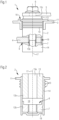
- FIG. 1 shows a coupling system 1 according to the invention for establishing an electrical connection between two electrical components.
- a first component not shown here, e.g. an electric motor of a hybrid drive, is positioned within the housing.
- the power connection of the stator of the electric motor is made via a multi-pole, in particular three-pole connection, wherein each pole can be supplied with electrical power via a respective busbar 4.
- the second component, the converter is arranged outside the housing 3. Coming from the converter, each busbar 5 of the multi-pole connection is connected to the converter via a respective flexible power connection 4.
- the coupling system 1 establishes the electrically conductive connection between a busbar 4 and a power connection 5 by means of the plug-in insert 2 that can be inserted into the housing 3.
- the Figure 2 shows the plug insert 2 in section, so that the individual components are visible.
- the shell is formed by the insulator part 14, which is made of an electrically insulating, flexible and preferably flame-retardant material.
- the insulating part 14 has a collar 11, by means of which a first seal against the housing 3 is achieved. To enable axial mobility of the plug insert 2 along the central axis 17, this can also be designed as a conical sealing lip.
- the disc nut 7 and the sleeve 13, made of a highly electrically conductive material, are positioned in the insulating part 2. Both components 7, 13 are pushed into the insulating part 14 until the respective fixing lugs 15a, b engage in the components.
- the groove 8 is machined into the disc nut 7, which secures the nut against twisting when the busbar 4 engages.
- the base 18 of the insulating part prevents the disc nut 7 from falling out into the housing interior.
- the pre-assembled plug-in insert 2 is inserted into a designated opening in the housing 3.
- three circumferential sealing lips 10 are provided next to the collar 11, which are so flexible that tolerance compensation can be achieved in all three axes.
- a plug-in insert 2 is provided for each busbar 4 of the electric motor. Due to manufacturing tolerances, the busbars 4 in particular exhibit high tolerance fluctuations, and the position of the busbars 4 in space is subject to relatively large fluctuations. The plug-in insert 2 must be able to compensate for these fluctuations without exerting constraining forces on the busbar 4.
- the design of the plug-in insert 2 allows for blind assembly of the electric motor or stator. This is possible despite the spatial fluctuations of the busbars 4 because the distance between the disc nut 7 and the sleeve 13 was chosen to be sufficiently large.
- the screw 6 is inserted through the holes 15 a, b, c of the power connection 5, the sleeve 13 and the busbars 4 and screwed into the disc nut 7, so that the components are clamped together.
- the clamping space 19 is reduced, with the flexibility of the insulating part 14 compensating for the reduction in the distance between the sleeve 13 and the disc nut 7 by the insulating part 14 deforming in the area of the clamping space.
- the contact surfaces on the sleeve 13, busbar 4 and disc nut 7 can adapt perfectly to each other, ensuring reliable power transmission.
Landscapes
- Engineering & Computer Science (AREA)
- Power Engineering (AREA)
- Mechanical Engineering (AREA)
- Connector Housings Or Holding Contact Members (AREA)
- Motor Or Generator Frames (AREA)
Description
- Die Erfindung betrifft einen Steckeinsatz für ein Koppelsystem zur Herstellung einer elektrischen Verbindung zwischen zwei elektrischen Komponenten.
- Derartige Koppelsysteme werden beispielsweise benötigt, um eine elektrische Maschine, die in einem Gehäuse angeordnet ist, an eine Stromversorgung anzuschließen. Der Stator einer derartigen E-Maschine umfasst meist eine Mehrzahl von Spulen, die über einzelne Verbindungen stromleitend mit der Stromversorgung bzw. dem Umrichter der Stromversorgung verbunden sind.
- Aus der
DE 10 2011 117 433 A1 ist ein Koppelsystem bekannt. Hier wird eine elektrisch leitende Verbindung zwischen Elektromotor und Ansteuereinheit vorgeschlagen, die im Bereich einer Wandungsöffnung erfolgt und wenigstens ein die Wandungsöffnung verschließendes, isolierendes Bauteil aufweist, welches zur Halterung des zum Elektromotor zugeordneten elektrischen Anschlussteils und zur Halterung des zur Ansteuereinheit zugeordneten elektrischen Anschlussteils dient. Zur Sicherstellung des elektrischen Kontaktes ist ein Überlappungsbereich der Anschlussteile vorgesehen und die Anschlussteile werden mittels einer Schraubenverbindung zueinander fixiert. - Ein weiteres Koppelsystem ist aus der
DE10 2014 201 190 A1 bekannt. Hier ist für jeden Pol des mehrpoligen startorseitigen Anschlusses eine einzeln ausgebildete Verbindungsbuchse vorgesehen. - Aus der
US 3 850 501 A und derUS 4 690 470 A sind weitere Durchführungsvorrichtungen bekannt, um einen Stromanschluss durch eine Gehäusewand umzusetzen. - Versuche haben allerdings ergeben, dass die bekannten Koppelsysteme oder auch Stromdurchführungen beim Einsatz in Kraftfahrzeugen, insbesondere durch die große Leistungsübertragung und die auftretenden Vibrationen, auf Dauer den Belastungen nicht standhalten.
- Aufgabe der Erfindung ist es, einen Steckeinsatz für ein Koppelsystem zur Herstellung einer elektrischen Verbindung vorzuschlagen, dass eine zuverlässige und kostengünstige Stromdurchführung durch ein Maschinengehäuse ermöglicht, und das eine einfache und prozesssichere Montage ermöglicht.
- Die Aufgabe wird erfindungsgemäß durch eine Ausführung entsprechend Anspruch 1 gelöst. Weitere vorteilhafte Merkmale der erfindungsgemäßen Ausführung finden sich in den Unteransprüchen.
- Es wird ein Koppelsystem zur Herstellung einer elektrischen Verbindung zwischen zwei elektrischen Komponenten, wobei die erste Komponente in einem Gehäuse positioniert ist und zumindest eine Stromschiene und die zweite Komponente außerhalb des Gehäuses angeordnet ist und zumindest einen Stromanschluss umfasst, und wobei mittels dem Koppelsystem eine elektrisch leitende Verbindung zwischen der Stromschiene und dem Stromanschluss herstellbar ist, umfassend einen in das Gehäuse einsteckbaren Steckeinsatz vorgeschlagen.
- Erfindungsgemäß umfasst der Steckeinsatz ein Isolatorteil, in dem eine Hülse und eine Scheibenmutter fixiert sind, wobei das Isolatorteil eine Aussparung aufweist, die derart angeordnet ist, dass die Stromschiene durch die Aussparung zwischen die Hülse und die Scheibenmutter einbringbar ist. Im Sinne der Erfindung wird unter Einbringen verstanden, dass die Stromschiene bei der Montage durch die Aussparung des Isolatorteils in einen Klemmraum zwischen Hülse und Scheibenmutter geschoben werden kann.
- Vorzugsweise besteht das Isolierteil aus einem elastischen Material und kann Dichtlippen sowie einen Bund aufweisen. Das Isolatorteil muss flexibel sein, damit der Steckeinsatz seine Lage im Raum verändern kann, so dass Toleranzschwankungen der starren Stromschiene ausgeglichen werden können.
- Weiterhin ist es vorteilhaft, wenn die Stromschiene, der Stromanschluß und die Hülse jeweils eine Bohrung aufweisen, durch die eine Schraube steckbar ist, so dass der Stromanschluss, die Hülse und die Stromschiene zwischen Schraube und Scheibenmutter zueinander fixierbar sind. Die Kontaktflächen für die Stromübertragung sind besonders groß, wenn diese Ringförmig ausgeführt sind.
- Damit die Aussparung im Isolierteil beim Einstecken des Steckeinsatzes richtig ausgerichtet wird, kann am Isolierteil eine Verdrehsicherung vorgesehen sein. Dies kann beispielsweise eine Anschlagfläche oder ein ausgebildeter Fortsatz am Bund des Isoliereinsatzes sein, die/der formschlüssig in das Gehäuse eingreift.
- Weiterhin kann das Isolierteil derart gestaltet sein, dass dem Steckeinsatz beim Anziehen der Schraube eine Bewegung entlang der Mittelachse ermöglicht wird. Dabei kann eine Bewegung entlang der Mittelachse von bis zu 5mm in Richtung des Gehäuseinnenraums ermöglicht werden, wobei der Bund derart elastisch gestaltet ist, dass in jeder Position eine Abdichtung gegenüber dem Gehäuse gewährleistet ist.
- Weiterhin kann das Isolierteil neben dem Bund mehrere umlaufende Dichtlippen aufweist, mittels denen eine Abdichtung des Gehäuseinnenraums gegenüber der Umwelt erreicht wird, wobei die Dichtlippen ein Kippen von 0 bis 5 Grad gegenüber der Mittelachse ermöglichen.
- Der erfindungsgemäße Steckeinsatz für das beschriebene Koppelsystem umfasst ein Isolatorteil in dem eine Hülse und eine Scheibenmutter fixiert sind, wobei das Isolatorteil eine Aussparung aufweist, die derart angeordnet ist, dass die Stromschiene durch die Aussparung zwischen der Hülse und der Scheibenmutter bewegbar ist. Weiterhin sind am Isolierteil Fixiernasen zur Lagefixierung der Hülse und der Scheibenmutter im Isolierteil vorgesehen.
- Anhand von Ausführungsbeispielen werden weitere vorteilhafte Ausprägungen der Erfindung erläutert.
- Die Figuren zeigen im Einzelnen:
- Fig.1
- ein Koppelsystem
- Fig.2
- einen Steckeinsatz im Schnitt
-
Figur 1 zeigt ein erfindungsgemäßes Koppelsystem 1 zur Herstellung einer elektrischen Verbindung zwischen zwei elektrischen Komponenten. Der hier dargestellte Ausschnitt zeigt allerdings nur die erfindungswesentlichen Details eines einzelnen Koppelsystems. Innerhalb des Gehäuses ist eine hier nicht dargestellte erste Komponente, z.B. eine E-Maschine eines Hybridantriebes, positioniert. Der Leistungsanschluss des Stators der E-Maschine erfolgt über einen mehrpoligen, insbesondere dreipoligen Anschluss, wobei jeder Pol über je eine Stromschienen 4 mit elektrischer Leistung beaufschlagbar ist. Die zweite Komponente, der Umrichter, ist außerhalb des Gehäuses 3 angeordnet. Vom Umrichter kommend ist jede Stromschiene 5 des mehrpoligen Anschlusses über je einen flexiblen Stromanschluss 4 an dem Umrichter angeschlossen. Das Koppelsystem 1 stellt die elektrisch leitende Verbindung zwischen einer Stromschiene 4 und einem Stromanschluss 5, mittels des in das Gehäuse 3 einsteckbaren Steckeinsatzes 2, her. - Die
Figur 2 zeigt den Steckeinsatz 2 im Schnitt, so dass die einzelnen Bauteile sichtbar sind. Die Hülle bildet das Isolatorteil 14, das aus einem elektrisch isolierenden, flexiblen und vorzugsweise flammhemmenden Material besteht. Das Isolierteil 14 hat einen Bund 11, mittels dem eine erste Abdichtung gegenüber dem Gehäuse 3 erreicht wird. Um eine axiale Beweglichkeit des Steckeinsatzes 2 entlang der Mittelachse 17 zu ermöglichen, kann dieser auch als kegelförmige Dichtlippe ausgeführt sein. In dem Isolierteil 2 ist die Scheibenmutter 7 und die, aus sehr gut stromleitendem Material bestehende, Hülse 13 positioniert. Beide Bauteile 7, 13 werden in das Isolierteil 14 eingeschoben, bis die jeweiligen Fixiernasen 15a, b in die Bauteile einrasten. In die Scheibenmutter 7 ist die Nut 8 eingearbeitet, durch die die Mutter gegen Verdrehen gesichert ist, wenn die Stromschiene 4 eingreift. Der Boden 18 des Isolierteils verhindert ein Herausfallen der Scheibenmutter 7 in den Gehäuseinnenraum. Im Bereich der Nut 8 ist eine hier nicht dargestellte Aussparung 9 im Isolierteil 14, durch die die Stromschiene 4 in den Steckeinsatz gesteckt werden kann. - Zur Herstellung des Koppelsystems 1 wird der vormontierte Steckeinsatz 2 in eine dafür vorgesehene Öffnung im Gehäuse 3 eingeschoben. Zur Abdichtung der Öffnung sind neben dem Bund 11 drei umlaufenden Dichtlippen 10 vorgesehen, die derart flexibel sind, dass ein Toleranzausgleich in allen drei Achsen realisiert werden kann.
- Für jede Stromschiene 4 der E-Maschine ist ein Steckeinsatz 2 vorgesehen. Aufgrund der Fertigungstoleranzen weisen insbesondere die Stromschienen 4 eine hohe Toleranzschwankung auf, bzw. die Lage der Stromschienen 4 im Raum unterliegt relativ großen Schwankungen. Diese Schwankungen muss der Steckeinsatz 2 ausgleichen können, ohne dass Zwangskräfte auf die Stromschiene 4 ausgeübt werden.
- Durch den Aufbau des Steckeinsatzes 2 kann eine Blindmontage der E-Maschine oder des Stators erfolgen. Trotz der Lageschwankungen der Stromschienen 4 im Raum kann das realisiert werden, weil der Abstand zwischen Scheibenmutter 7 und Hülse 13 entsprechend groß gewählt wurden. Nach dem Auflegen des flexiblen Stromanschlusses 5 wird die Schraube 6 durch die Bohrungen 15 a, b, c des Stromanschlusses 5, der Hülse 13 und der Stromschienen 4 eingesteckt und in die Scheibenmutter 7 eingeschraubt, so dass die Bauteile zueinander verklemmt werden. Bei der Verklemmung wird der Klemmraum 19 verkleinert, wobei die Flexibilität des Isolierteils 14 die Verkleinerung des Abstandes zwischen Hülse 13 und Scheibenmutter 7 dadurch ausgleicht, dass sich das Isolierteil 14 im Bereich des Klemmraums verformt. Die Kontaktflächen an Hülse 13, Stromschiene 4 und Scheibenmutter 7 können sich ideal anschmiegen, so dass eine betriebssichere Stromübertragung gewährleistet ist.
- Die Flexibilität des Isolierteils 14 ermöglicht es weiterhin, dass der Steckeinsatz 2 insgesamt immer ausgehend von der geklemmten Stromschiene 4 ausgerichtet wird, so dass eine zwangsfreie, prozesssichere und funktionssichere Verbindung hergestellt wird. Anders ausgedrückt bedeutet das, dass sich der Steckeinsatz 2 durch die Flexibilität der Isolierhülse 14 gegenüber dem Gehäuse 3 im Raum ausgerichtet wird, wobei die Richtung der Ausrichtung von der Stromschiene 4 vorgegeben wird.
Claims (10)
- Steckeinsatz (2) für ein Koppelsystem (1) zur Herstellung einer elektrischen Verbindung zwischen zwei elektrischen Komponenten, wobei die erste Komponente in einem Gehäuse (3) positioniert ist und zumindest eine Stromschiene (4) und die zweite Komponente außerhalb des Gehäuses angeordnet ist und zumindest einen Stromanschluss (5) umfasst, und wobei mittels dem Steckeinsatz (2) eine elektrisch leitende Verbindung zwischen der Stromschiene (4) und dem Stromanschluss (5) herstellbar ist, wobei der Steckeinsatz (2) ein Isolierteil (14) umfasst, in dem eine Hülse (13) fixiert ist,
dadurch gekennzeichnet
dass eine Scheibenmutter (7) in dem Isolierteil (14) fixiert ist, wobei das Isolierteil (14) eine Aussparung (9) aufweist, die derart angeordnet ist, dass die Stromschiene (4) durch die Aussparung (9) zwischen die Hülse (13) und die Scheibenmutter (7) einbringbar ist. - Steckeinsatz (2) nach Anspruch 1,
dadurch gekennzeichnet,
dass das Isolierteil (14) aus einem elastischen Material besteht und Dichtlippen (10) sowie einen Bund (11) aufweist. - Steckeinsatz (2) nach Anspruch 1,
dadurch gekennzeichnet,
dass die Hülse (13) eine Bohrung (15a) aufweist, durch die eine Schraube (6) steckbar ist, so dass der Stromanschluss (5), die Hülse (13) und die Stromschiene (4) zwischen Schraube (6) und Scheibenmutter (7) zueinander fixierbar sind. - Steckeinsatz (2) nach Anspruch 1,
dadurch gekennzeichnet,
dass das Isolierteil (2) eine Verdrehsicherung (16) aufweist. - Steckeinsatz (2) nach Anspruch 4,
dadurch gekennzeichnet,
dass die Verdrehsicherung (16) ein an dem Isolierteil (14) ausgebildeter Fortsatz ist. - Steckeinsatz (2) nach Anspruch 3,
dadurch gekennzeichnet,
dass das Isolierteil (14) derart gestaltet ist, dass dem Steckeinsatz (2) beim Anziehen der Schraube (6) eine Bewegung entlang der Mittelachse (17) ermöglicht wird. - Steckeinsatz (2) nach Anspruch 6,
dadurch gekennzeichnet,
dass eine Bewegung entlang der Mittelachse (17) von bis zu 5mm in Richtung des Gehäuseinnenraums ermöglicht wird, wobei der Bund (11) derart elastisch gestaltet ist, dass in jeder Position eine Abdichtung gegenüber dem Gehäuse (3) gewährleistet ist. - Steckeinsatz (2) nach Anspruch 1,
dadurch gekennzeichnet,
dass das Isolierteil (14) mehrere umlaufende Dichtlippen (10) aufweist, mittels denen eine Abdichtung des Gehäuseinnenraums gegenüber der Umwelt erreicht wird, wobei die Dichtlippen ein Kippen von 0 bis 5 Grad gegenüber der Mittelachse (17) ermöglichen. - Steckeinsatz (2) nach Anspruch 8,
dadurch gekennzeichnet,
dass das Isolierteil (14) Fixiernasen (12a, b) zur Lagefixierung der Hülse (13) und der Scheibenmutter (7) im Isolierteil aufweist. - Fahrzeug umfassend einen Hybridantrieb mit einem Koppelsystem (1) zur Herstellung einer elektrischen Verbindung zwischen zwei elektrischen Komponenten, wobei die erste Komponente in einem Gehäuse (3) positioniert ist und zumindest eine Stromschiene (4) und die zweite Komponente außerhalb des Gehäuses angeordnet ist und zumindest einen Stromanschluss (5) umfasst, und wobei mittels dem Koppelsystem (1) eine elektrisch leitende Verbindung zwischen der Stromschiene (4) und dem Stromanschluss (5) herstellbar ist, umfassend einen Steckeinsatz (2) nach Anspruch 1 bis 9 zum Kontaktieren eines Leistungsanschlusses einer elektrischen Maschine des Hybridantriebes.
Applications Claiming Priority (2)
| Application Number | Priority Date | Filing Date | Title |
|---|---|---|---|
| DE102020102839.3A DE102020102839A1 (de) | 2020-02-05 | 2020-02-05 | Koppelsystem zur Herstellung einer elektrischen Verbindung |
| PCT/EP2021/051973 WO2021156134A1 (de) | 2020-02-05 | 2021-01-28 | Koppelsystem zur herstellung einer elektrischen verbindung |
Publications (3)
| Publication Number | Publication Date |
|---|---|
| EP4101028A1 EP4101028A1 (de) | 2022-12-14 |
| EP4101028C0 EP4101028C0 (de) | 2025-07-02 |
| EP4101028B1 true EP4101028B1 (de) | 2025-07-02 |
Family
ID=74494898
Family Applications (1)
| Application Number | Title | Priority Date | Filing Date |
|---|---|---|---|
| EP21702631.9A Active EP4101028B1 (de) | 2020-02-05 | 2021-01-28 | Koppelsystem zur herstellung einer elektrischen verbindung |
Country Status (5)
| Country | Link |
|---|---|
| US (1) | US12355198B2 (de) |
| EP (1) | EP4101028B1 (de) |
| CN (1) | CN219811663U (de) |
| DE (1) | DE102020102839A1 (de) |
| WO (1) | WO2021156134A1 (de) |
Citations (1)
| Publication number | Priority date | Publication date | Assignee | Title |
|---|---|---|---|---|
| US20110070761A1 (en) * | 2009-09-24 | 2011-03-24 | Hitachi Cable, Ltd. | Harness connector |
Family Cites Families (9)
| Publication number | Priority date | Publication date | Assignee | Title |
|---|---|---|---|---|
| US3850501A (en) * | 1973-04-09 | 1974-11-26 | Gen Electric | Feedthrough electrical terminal for hollow liquid cooled shaft of a dynamoelectric machine |
| US4362351A (en) * | 1981-02-06 | 1982-12-07 | Towmotor Corporation | Terminal assembly |
| US4614397A (en) * | 1985-12-16 | 1986-09-30 | Carrier Corporation | Terminal plate assembly |
| US4690470A (en) | 1986-05-12 | 1987-09-01 | Sundstrand Corporation | Rotating shaft electrical connection |
| US4734061A (en) * | 1986-12-31 | 1988-03-29 | Bell Communications Research, Inc. | Telecommunications terminal block |
| JP3944357B2 (ja) * | 2001-02-08 | 2007-07-11 | 三菱電機株式会社 | 車両用交流発電機 |
| DE102011117433A1 (de) | 2011-10-29 | 2013-05-02 | Volkswagen Aktiengesellschaft | Elektrische Anschlussanordnung |
| DE102014201190A1 (de) | 2014-01-23 | 2015-07-23 | Zf Friedrichshafen Ag | Verbindungsanordnung für Leistungsanschluss einer elektrischen Maschine |
| DE202016100256U1 (de) * | 2015-03-31 | 2016-07-04 | Jens Trimborn | Kunststoff-Dichtungshülle für eine Leiterverbindung, Verbindungsteil, Abdeckmutter sowie abgedichtete Verbindung zwischen zwei Leitern |
-
2020
- 2020-02-05 DE DE102020102839.3A patent/DE102020102839A1/de active Pending
-
2021
- 2021-01-28 WO PCT/EP2021/051973 patent/WO2021156134A1/de not_active Ceased
- 2021-01-28 US US17/796,360 patent/US12355198B2/en active Active
- 2021-01-28 EP EP21702631.9A patent/EP4101028B1/de active Active
- 2021-01-28 CN CN202190000296.0U patent/CN219811663U/zh active Active
Patent Citations (1)
| Publication number | Priority date | Publication date | Assignee | Title |
|---|---|---|---|---|
| US20110070761A1 (en) * | 2009-09-24 | 2011-03-24 | Hitachi Cable, Ltd. | Harness connector |
Also Published As
| Publication number | Publication date |
|---|---|
| EP4101028A1 (de) | 2022-12-14 |
| CN219811663U (zh) | 2023-10-10 |
| WO2021156134A1 (de) | 2021-08-12 |
| EP4101028C0 (de) | 2025-07-02 |
| US20230120198A1 (en) | 2023-04-20 |
| DE102020102839A1 (de) | 2021-08-05 |
| US12355198B2 (en) | 2025-07-08 |
Similar Documents
| Publication | Publication Date | Title |
|---|---|---|
| DE102016105497B3 (de) | Elektrischer Steckverbinder | |
| DE112005000372B4 (de) | Verbindungsvorrichtungsbefestigungsaufbau | |
| EP0754357B1 (de) | Verbindungssystem für elektrische leiter | |
| DE102019207647A1 (de) | Klemmvorrichtung und elektrische Maschine mit Klemmvorrichtung | |
| DE29721908U1 (de) | Anordnung betreffend eine elektrische und/oder elektronische Bauelemente tragende Elektrikplatte mit einem elektrischen Steckverbinder und einer Abdeckung | |
| EP2151021A1 (de) | Elektronische baugruppe mit steckverbindung | |
| DE102014200133A1 (de) | Vorrichtung zur Fixierung einer elektrischen Leitung in einem Stecker, Stecker für eine elektrische Leitung sowie elektrisches Kabel | |
| WO1998027618A2 (de) | Elektrische kupplungseinrichtung zwischen schalträumen | |
| DE102020111359A1 (de) | Berührgeschützte Verbindungsanordnung von zwei elektrischen Leitern sowie Kraftfahrzeug mit einer solchen Verbindungsanordnung | |
| EP4150721A1 (de) | Abschirmelement und steckverbinder | |
| DE10140177B4 (de) | Verbindungsvorrichtung | |
| WO2020048776A1 (de) | Koppelsystem zur herstellung einer elektrisch leitenden verbindung | |
| DE102015206800A1 (de) | Elektrischer Zentralausrücker mit in Träger gehaltertem Stecker und Hybridmodul mit solchem Aktor | |
| EP4101028A1 (de) | Koppelsystem zur herstellung einer elektrischen verbindung | |
| DE102004049873B3 (de) | Gehäuse mit einem elektrischen Bauelement | |
| DE102021207895A1 (de) | Bauraumoptimierte Hochvoltkopplung | |
| EP4005031A1 (de) | Adapterstecker mit spielausgleich | |
| DE102011056852B4 (de) | Hochstrom-Leistungseinheit | |
| DE102020209602A1 (de) | EMV-Gehäusedichtungsanordnung und Antriebsaggregat für ein elektrisch antreibbares Fahrzeug mit einer solchen EMV-Gehäusedichtungsanordnung | |
| DE102023115246B3 (de) | Mehrteiliges Kontaktelement sowie flüssigkeitsgekühlter Ladestecker | |
| DE102024202389A1 (de) | Leiterplattenanordnung und Verfahren zur Herstellung einer Leiterplattenanordnung | |
| WO2019105655A1 (de) | Kontaktierungseinrichtung für ein innerhalb eines schwingungsdämpfers angeordnetes elektrisch ansteuerbares ventil | |
| EP4708575A1 (de) | Elektrischer steckverbinder und elektrische steckverbindung | |
| EP4546575A1 (de) | Anbaugehäuse mit dichtung | |
| DE102021207193A1 (de) | Verbindungsvorrichtung zum Verbinden eines ersten elektrischen Kontakts mit einem zweiten elektrischen Kontakt für eine elektrische Maschine |
Legal Events
| Date | Code | Title | Description |
|---|---|---|---|
| STAA | Information on the status of an ep patent application or granted ep patent |
Free format text: STATUS: UNKNOWN |
|
| STAA | Information on the status of an ep patent application or granted ep patent |
Free format text: STATUS: THE INTERNATIONAL PUBLICATION HAS BEEN MADE |
|
| PUAI | Public reference made under article 153(3) epc to a published international application that has entered the european phase |
Free format text: ORIGINAL CODE: 0009012 |
|
| STAA | Information on the status of an ep patent application or granted ep patent |
Free format text: STATUS: REQUEST FOR EXAMINATION WAS MADE |
|
| 17P | Request for examination filed |
Effective date: 20220905 |
|
| AK | Designated contracting states |
Kind code of ref document: A1 Designated state(s): AL AT BE BG CH CY CZ DE DK EE ES FI FR GB GR HR HU IE IS IT LI LT LU LV MC MK MT NL NO PL PT RO RS SE SI SK SM TR |
|
| DAV | Request for validation of the european patent (deleted) | ||
| DAX | Request for extension of the european patent (deleted) | ||
| GRAP | Despatch of communication of intention to grant a patent |
Free format text: ORIGINAL CODE: EPIDOSNIGR1 |
|
| STAA | Information on the status of an ep patent application or granted ep patent |
Free format text: STATUS: GRANT OF PATENT IS INTENDED |
|
| INTG | Intention to grant announced |
Effective date: 20240924 |
|
| GRAJ | Information related to disapproval of communication of intention to grant by the applicant or resumption of examination proceedings by the epo deleted |
Free format text: ORIGINAL CODE: EPIDOSDIGR1 |
|
| STAA | Information on the status of an ep patent application or granted ep patent |
Free format text: STATUS: REQUEST FOR EXAMINATION WAS MADE |
|
| GRAP | Despatch of communication of intention to grant a patent |
Free format text: ORIGINAL CODE: EPIDOSNIGR1 |
|
| STAA | Information on the status of an ep patent application or granted ep patent |
Free format text: STATUS: GRANT OF PATENT IS INTENDED |
|
| INTC | Intention to grant announced (deleted) | ||
| INTG | Intention to grant announced |
Effective date: 20250203 |
|
| GRAS | Grant fee paid |
Free format text: ORIGINAL CODE: EPIDOSNIGR3 |
|
| GRAA | (expected) grant |
Free format text: ORIGINAL CODE: 0009210 |
|
| STAA | Information on the status of an ep patent application or granted ep patent |
Free format text: STATUS: THE PATENT HAS BEEN GRANTED |
|
| AK | Designated contracting states |
Kind code of ref document: B1 Designated state(s): AL AT BE BG CH CY CZ DE DK EE ES FI FR GB GR HR HU IE IS IT LI LT LU LV MC MK MT NL NO PL PT RO RS SE SI SK SM TR |
|
| REG | Reference to a national code |
Ref country code: GB Ref legal event code: FG4D Free format text: NOT ENGLISH |
|
| REG | Reference to a national code |
Ref country code: CH Ref legal event code: EP |
|
| REG | Reference to a national code |
Ref country code: IE Ref legal event code: FG4D Free format text: LANGUAGE OF EP DOCUMENT: GERMAN |
|
| U01 | Request for unitary effect filed |
Effective date: 20250702 |
|
| U07 | Unitary effect registered |
Designated state(s): AT BE BG DE DK EE FI FR IT LT LU LV MT NL PT RO SE SI Effective date: 20250708 |
|
| PG25 | Lapsed in a contracting state [announced via postgrant information from national office to epo] |
Ref country code: IS Free format text: LAPSE BECAUSE OF FAILURE TO SUBMIT A TRANSLATION OF THE DESCRIPTION OR TO PAY THE FEE WITHIN THE PRESCRIBED TIME-LIMIT Effective date: 20251102 |
|
| PG25 | Lapsed in a contracting state [announced via postgrant information from national office to epo] |
Ref country code: NO Free format text: LAPSE BECAUSE OF FAILURE TO SUBMIT A TRANSLATION OF THE DESCRIPTION OR TO PAY THE FEE WITHIN THE PRESCRIBED TIME-LIMIT Effective date: 20251002 |
|
| PG25 | Lapsed in a contracting state [announced via postgrant information from national office to epo] |
Ref country code: HR Free format text: LAPSE BECAUSE OF FAILURE TO SUBMIT A TRANSLATION OF THE DESCRIPTION OR TO PAY THE FEE WITHIN THE PRESCRIBED TIME-LIMIT Effective date: 20250702 |
|
| PG25 | Lapsed in a contracting state [announced via postgrant information from national office to epo] |
Ref country code: GR Free format text: LAPSE BECAUSE OF FAILURE TO SUBMIT A TRANSLATION OF THE DESCRIPTION OR TO PAY THE FEE WITHIN THE PRESCRIBED TIME-LIMIT Effective date: 20251003 |
|
| PG25 | Lapsed in a contracting state [announced via postgrant information from national office to epo] |
Ref country code: CZ Free format text: LAPSE BECAUSE OF FAILURE TO SUBMIT A TRANSLATION OF THE DESCRIPTION OR TO PAY THE FEE WITHIN THE PRESCRIBED TIME-LIMIT Effective date: 20250702 |
|
| PG25 | Lapsed in a contracting state [announced via postgrant information from national office to epo] |
Ref country code: PL Free format text: LAPSE BECAUSE OF FAILURE TO SUBMIT A TRANSLATION OF THE DESCRIPTION OR TO PAY THE FEE WITHIN THE PRESCRIBED TIME-LIMIT Effective date: 20250702 |
|
| PG25 | Lapsed in a contracting state [announced via postgrant information from national office to epo] |
Ref country code: RS Free format text: LAPSE BECAUSE OF FAILURE TO SUBMIT A TRANSLATION OF THE DESCRIPTION OR TO PAY THE FEE WITHIN THE PRESCRIBED TIME-LIMIT Effective date: 20251002 |
|
| PG25 | Lapsed in a contracting state [announced via postgrant information from national office to epo] |
Ref country code: ES Free format text: LAPSE BECAUSE OF FAILURE TO SUBMIT A TRANSLATION OF THE DESCRIPTION OR TO PAY THE FEE WITHIN THE PRESCRIBED TIME-LIMIT Effective date: 20250702 |
|
| U20 | Renewal fee for the european patent with unitary effect paid |
Year of fee payment: 6 Effective date: 20260202 |
|
| PG25 | Lapsed in a contracting state [announced via postgrant information from national office to epo] |
Ref country code: SM Free format text: LAPSE BECAUSE OF FAILURE TO SUBMIT A TRANSLATION OF THE DESCRIPTION OR TO PAY THE FEE WITHIN THE PRESCRIBED TIME-LIMIT Effective date: 20250702 |
|
| PG25 | Lapsed in a contracting state [announced via postgrant information from national office to epo] |
Ref country code: SK Free format text: LAPSE BECAUSE OF FAILURE TO SUBMIT A TRANSLATION OF THE DESCRIPTION OR TO PAY THE FEE WITHIN THE PRESCRIBED TIME-LIMIT Effective date: 20250702 |
|
| REG | Reference to a national code |
Ref country code: CH Ref legal event code: W10 Free format text: ST27 STATUS EVENT CODE: U-0-0-W10-W00 (AS PROVIDED BY THE NATIONAL OFFICE) Effective date: 20260430 |
|
| PLBE | No opposition filed within time limit |
Free format text: ORIGINAL CODE: 0009261 |
|
| STAA | Information on the status of an ep patent application or granted ep patent |
Free format text: STATUS: NO OPPOSITION FILED WITHIN TIME LIMIT |