EP4100629B1 - Verfahren und vorrichtung zur regelung der temperatur in systemen zur selektiven katalytischen reduktion - Google Patents
Verfahren und vorrichtung zur regelung der temperatur in systemen zur selektiven katalytischen reduktion Download PDFInfo
- Publication number
- EP4100629B1 EP4100629B1 EP21704704.2A EP21704704A EP4100629B1 EP 4100629 B1 EP4100629 B1 EP 4100629B1 EP 21704704 A EP21704704 A EP 21704704A EP 4100629 B1 EP4100629 B1 EP 4100629B1
- Authority
- EP
- European Patent Office
- Prior art keywords
- temperature
- combustion
- hydrogen
- exhaust
- sensing device
- Prior art date
- Legal status (The legal status is an assumption and is not a legal conclusion. Google has not performed a legal analysis and makes no representation as to the accuracy of the status listed.)
- Active
Links
Images

Classifications
-
- F—MECHANICAL ENGINEERING; LIGHTING; HEATING; WEAPONS; BLASTING
- F01—MACHINES OR ENGINES IN GENERAL; ENGINE PLANTS IN GENERAL; STEAM ENGINES
- F01N—GAS-FLOW SILENCERS OR EXHAUST APPARATUS FOR MACHINES OR ENGINES IN GENERAL; GAS-FLOW SILENCERS OR EXHAUST APPARATUS FOR INTERNAL-COMBUSTION ENGINES
- F01N3/00—Exhaust or silencing apparatus having means for purifying, rendering innocuous, or otherwise treating exhaust
- F01N3/08—Exhaust or silencing apparatus having means for purifying, rendering innocuous, or otherwise treating exhaust for rendering innocuous
- F01N3/10—Exhaust or silencing apparatus having means for purifying, rendering innocuous, or otherwise treating exhaust for rendering innocuous by thermal or catalytic conversion of noxious components of exhaust
- F01N3/18—Exhaust or silencing apparatus having means for purifying, rendering innocuous, or otherwise treating exhaust for rendering innocuous by thermal or catalytic conversion of noxious components of exhaust characterised by methods of operation; Control
- F01N3/20—Exhaust or silencing apparatus having means for purifying, rendering innocuous, or otherwise treating exhaust for rendering innocuous by thermal or catalytic conversion of noxious components of exhaust characterised by methods of operation; Control specially adapted for catalytic conversion
-
- F—MECHANICAL ENGINEERING; LIGHTING; HEATING; WEAPONS; BLASTING
- F01—MACHINES OR ENGINES IN GENERAL; ENGINE PLANTS IN GENERAL; STEAM ENGINES
- F01N—GAS-FLOW SILENCERS OR EXHAUST APPARATUS FOR MACHINES OR ENGINES IN GENERAL; GAS-FLOW SILENCERS OR EXHAUST APPARATUS FOR INTERNAL-COMBUSTION ENGINES
- F01N3/00—Exhaust or silencing apparatus having means for purifying, rendering innocuous, or otherwise treating exhaust
- F01N3/08—Exhaust or silencing apparatus having means for purifying, rendering innocuous, or otherwise treating exhaust for rendering innocuous
- F01N3/10—Exhaust or silencing apparatus having means for purifying, rendering innocuous, or otherwise treating exhaust for rendering innocuous by thermal or catalytic conversion of noxious components of exhaust
- F01N3/18—Exhaust or silencing apparatus having means for purifying, rendering innocuous, or otherwise treating exhaust for rendering innocuous by thermal or catalytic conversion of noxious components of exhaust characterised by methods of operation; Control
- F01N3/20—Exhaust or silencing apparatus having means for purifying, rendering innocuous, or otherwise treating exhaust for rendering innocuous by thermal or catalytic conversion of noxious components of exhaust characterised by methods of operation; Control specially adapted for catalytic conversion
- F01N3/206—Adding periodically or continuously substances to exhaust gases for promoting purification, e.g. catalytic material in liquid form, NOx reducing agents
- F01N3/208—Control of selective catalytic reduction [SCR], e.g. by adjusting the dosing of reducing agent
-
- F—MECHANICAL ENGINEERING; LIGHTING; HEATING; WEAPONS; BLASTING
- F01—MACHINES OR ENGINES IN GENERAL; ENGINE PLANTS IN GENERAL; STEAM ENGINES
- F01N—GAS-FLOW SILENCERS OR EXHAUST APPARATUS FOR MACHINES OR ENGINES IN GENERAL; GAS-FLOW SILENCERS OR EXHAUST APPARATUS FOR INTERNAL-COMBUSTION ENGINES
- F01N11/00—Monitoring or diagnostic devices for exhaust-gas treatment apparatus
- F01N11/002—Monitoring or diagnostic devices for exhaust-gas treatment apparatus the diagnostic devices measuring or estimating temperature or pressure in, or downstream of the exhaust apparatus
-
- F—MECHANICAL ENGINEERING; LIGHTING; HEATING; WEAPONS; BLASTING
- F01—MACHINES OR ENGINES IN GENERAL; ENGINE PLANTS IN GENERAL; STEAM ENGINES
- F01N—GAS-FLOW SILENCERS OR EXHAUST APPARATUS FOR MACHINES OR ENGINES IN GENERAL; GAS-FLOW SILENCERS OR EXHAUST APPARATUS FOR INTERNAL-COMBUSTION ENGINES
- F01N9/00—Electrical control of exhaust gas treating apparatus
-
- F—MECHANICAL ENGINEERING; LIGHTING; HEATING; WEAPONS; BLASTING
- F02—COMBUSTION ENGINES; HOT-GAS OR COMBUSTION-PRODUCT ENGINE PLANTS
- F02D—CONTROLLING COMBUSTION ENGINES
- F02D19/00—Controlling engines characterised by their use of non-liquid fuels, pluralities of fuels, or non-fuel substances added to the combustible mixtures
- F02D19/06—Controlling engines characterised by their use of non-liquid fuels, pluralities of fuels, or non-fuel substances added to the combustible mixtures peculiar to engines working with pluralities of fuels, e.g. alternatively with light and heavy fuel oil, other than engines indifferent to the fuel consumed
- F02D19/0602—Control of components of the fuel supply system
- F02D19/0607—Control of components of the fuel supply system to adjust the fuel mass or volume flow
- F02D19/061—Control of components of the fuel supply system to adjust the fuel mass or volume flow by controlling fuel injectors
-
- F—MECHANICAL ENGINEERING; LIGHTING; HEATING; WEAPONS; BLASTING
- F02—COMBUSTION ENGINES; HOT-GAS OR COMBUSTION-PRODUCT ENGINE PLANTS
- F02D—CONTROLLING COMBUSTION ENGINES
- F02D19/00—Controlling engines characterised by their use of non-liquid fuels, pluralities of fuels, or non-fuel substances added to the combustible mixtures
- F02D19/06—Controlling engines characterised by their use of non-liquid fuels, pluralities of fuels, or non-fuel substances added to the combustible mixtures peculiar to engines working with pluralities of fuels, e.g. alternatively with light and heavy fuel oil, other than engines indifferent to the fuel consumed
- F02D19/0602—Control of components of the fuel supply system
- F02D19/0613—Switch-over from one fuel to another
- F02D19/0615—Switch-over from one fuel to another being initiated by automatic means, e.g. based on engine or vehicle operating conditions
-
- F—MECHANICAL ENGINEERING; LIGHTING; HEATING; WEAPONS; BLASTING
- F02—COMBUSTION ENGINES; HOT-GAS OR COMBUSTION-PRODUCT ENGINE PLANTS
- F02D—CONTROLLING COMBUSTION ENGINES
- F02D19/00—Controlling engines characterised by their use of non-liquid fuels, pluralities of fuels, or non-fuel substances added to the combustible mixtures
- F02D19/06—Controlling engines characterised by their use of non-liquid fuels, pluralities of fuels, or non-fuel substances added to the combustible mixtures peculiar to engines working with pluralities of fuels, e.g. alternatively with light and heavy fuel oil, other than engines indifferent to the fuel consumed
- F02D19/0639—Controlling engines characterised by their use of non-liquid fuels, pluralities of fuels, or non-fuel substances added to the combustible mixtures peculiar to engines working with pluralities of fuels, e.g. alternatively with light and heavy fuel oil, other than engines indifferent to the fuel consumed characterised by the type of fuels
- F02D19/0642—Controlling engines characterised by their use of non-liquid fuels, pluralities of fuels, or non-fuel substances added to the combustible mixtures peculiar to engines working with pluralities of fuels, e.g. alternatively with light and heavy fuel oil, other than engines indifferent to the fuel consumed characterised by the type of fuels at least one fuel being gaseous, the other fuels being gaseous or liquid at standard conditions
- F02D19/0644—Controlling engines characterised by their use of non-liquid fuels, pluralities of fuels, or non-fuel substances added to the combustible mixtures peculiar to engines working with pluralities of fuels, e.g. alternatively with light and heavy fuel oil, other than engines indifferent to the fuel consumed characterised by the type of fuels at least one fuel being gaseous, the other fuels being gaseous or liquid at standard conditions the gaseous fuel being hydrogen, ammonia or carbon monoxide
-
- F—MECHANICAL ENGINEERING; LIGHTING; HEATING; WEAPONS; BLASTING
- F02—COMBUSTION ENGINES; HOT-GAS OR COMBUSTION-PRODUCT ENGINE PLANTS
- F02D—CONTROLLING COMBUSTION ENGINES
- F02D41/00—Electrical control of supply of combustible mixture or its constituents
- F02D41/0025—Controlling engines characterised by use of non-liquid fuels, pluralities of fuels, or non-fuel substances added to the combustible mixtures
-
- F—MECHANICAL ENGINEERING; LIGHTING; HEATING; WEAPONS; BLASTING
- F02—COMBUSTION ENGINES; HOT-GAS OR COMBUSTION-PRODUCT ENGINE PLANTS
- F02D—CONTROLLING COMBUSTION ENGINES
- F02D41/00—Electrical control of supply of combustible mixture or its constituents
- F02D41/0025—Controlling engines characterised by use of non-liquid fuels, pluralities of fuels, or non-fuel substances added to the combustible mixtures
- F02D41/0027—Controlling engines characterised by use of non-liquid fuels, pluralities of fuels, or non-fuel substances added to the combustible mixtures the fuel being gaseous
-
- F—MECHANICAL ENGINEERING; LIGHTING; HEATING; WEAPONS; BLASTING
- F02—COMBUSTION ENGINES; HOT-GAS OR COMBUSTION-PRODUCT ENGINE PLANTS
- F02D—CONTROLLING COMBUSTION ENGINES
- F02D41/00—Electrical control of supply of combustible mixture or its constituents
- F02D41/02—Circuit arrangements for generating control signals
- F02D41/021—Introducing corrections for particular conditions exterior to the engine
- F02D41/0235—Introducing corrections for particular conditions exterior to the engine in relation with the state of the exhaust gas treating apparatus
- F02D41/024—Introducing corrections for particular conditions exterior to the engine in relation with the state of the exhaust gas treating apparatus to increase temperature of the exhaust gas treating apparatus
-
- F—MECHANICAL ENGINEERING; LIGHTING; HEATING; WEAPONS; BLASTING
- F02—COMBUSTION ENGINES; HOT-GAS OR COMBUSTION-PRODUCT ENGINE PLANTS
- F02D—CONTROLLING COMBUSTION ENGINES
- F02D41/00—Electrical control of supply of combustible mixture or its constituents
- F02D41/02—Circuit arrangements for generating control signals
- F02D41/14—Introducing closed-loop corrections
- F02D41/1438—Introducing closed-loop corrections using means for determining characteristics of the combustion gases; Sensors therefor
- F02D41/1444—Introducing closed-loop corrections using means for determining characteristics of the combustion gases; Sensors therefor characterised by the characteristics of the combustion gases
- F02D41/1446—Introducing closed-loop corrections using means for determining characteristics of the combustion gases; Sensors therefor characterised by the characteristics of the combustion gases the characteristics being exhaust temperatures
-
- F—MECHANICAL ENGINEERING; LIGHTING; HEATING; WEAPONS; BLASTING
- F02—COMBUSTION ENGINES; HOT-GAS OR COMBUSTION-PRODUCT ENGINE PLANTS
- F02M—SUPPLYING COMBUSTION ENGINES IN GENERAL WITH COMBUSTIBLE MIXTURES OR CONSTITUENTS THEREOF
- F02M21/00—Apparatus for supplying engines with non-liquid fuels, e.g. gaseous fuels stored in liquid form
- F02M21/02—Apparatus for supplying engines with non-liquid fuels, e.g. gaseous fuels stored in liquid form for gaseous fuels
- F02M21/0203—Apparatus for supplying engines with non-liquid fuels, e.g. gaseous fuels stored in liquid form for gaseous fuels characterised by the type of gaseous fuel
- F02M21/0206—Non-hydrocarbon fuels, e.g. hydrogen, ammonia or carbon monoxide
-
- F—MECHANICAL ENGINEERING; LIGHTING; HEATING; WEAPONS; BLASTING
- F02—COMBUSTION ENGINES; HOT-GAS OR COMBUSTION-PRODUCT ENGINE PLANTS
- F02M—SUPPLYING COMBUSTION ENGINES IN GENERAL WITH COMBUSTIBLE MIXTURES OR CONSTITUENTS THEREOF
- F02M25/00—Engine-pertinent apparatus for adding non-fuel substances or small quantities of secondary fuel to combustion-air, main fuel or fuel-air mixture
- F02M25/022—Adding fuel and water emulsion, water or steam
- F02M25/0228—Adding fuel and water emulsion
-
- F—MECHANICAL ENGINEERING; LIGHTING; HEATING; WEAPONS; BLASTING
- F02—COMBUSTION ENGINES; HOT-GAS OR COMBUSTION-PRODUCT ENGINE PLANTS
- F02M—SUPPLYING COMBUSTION ENGINES IN GENERAL WITH COMBUSTIBLE MIXTURES OR CONSTITUENTS THEREOF
- F02M25/00—Engine-pertinent apparatus for adding non-fuel substances or small quantities of secondary fuel to combustion-air, main fuel or fuel-air mixture
- F02M25/022—Adding fuel and water emulsion, water or steam
- F02M25/025—Adding water
-
- F—MECHANICAL ENGINEERING; LIGHTING; HEATING; WEAPONS; BLASTING
- F01—MACHINES OR ENGINES IN GENERAL; ENGINE PLANTS IN GENERAL; STEAM ENGINES
- F01N—GAS-FLOW SILENCERS OR EXHAUST APPARATUS FOR MACHINES OR ENGINES IN GENERAL; GAS-FLOW SILENCERS OR EXHAUST APPARATUS FOR INTERNAL-COMBUSTION ENGINES
- F01N2430/00—Influencing exhaust purification, e.g. starting of catalytic reaction, filter regeneration, or the like, by controlling engine operating characteristics
- F01N2430/04—Influencing exhaust purification, e.g. starting of catalytic reaction, filter regeneration, or the like, by controlling engine operating characteristics by adding non-fuel substances to combustion air or fuel, e.g. additives
-
- F—MECHANICAL ENGINEERING; LIGHTING; HEATING; WEAPONS; BLASTING
- F01—MACHINES OR ENGINES IN GENERAL; ENGINE PLANTS IN GENERAL; STEAM ENGINES
- F01N—GAS-FLOW SILENCERS OR EXHAUST APPARATUS FOR MACHINES OR ENGINES IN GENERAL; GAS-FLOW SILENCERS OR EXHAUST APPARATUS FOR INTERNAL-COMBUSTION ENGINES
- F01N2560/00—Exhaust systems with means for detecting or measuring exhaust gas components or characteristics
- F01N2560/06—Exhaust systems with means for detecting or measuring exhaust gas components or characteristics the means being a temperature sensor
-
- F—MECHANICAL ENGINEERING; LIGHTING; HEATING; WEAPONS; BLASTING
- F01—MACHINES OR ENGINES IN GENERAL; ENGINE PLANTS IN GENERAL; STEAM ENGINES
- F01N—GAS-FLOW SILENCERS OR EXHAUST APPARATUS FOR MACHINES OR ENGINES IN GENERAL; GAS-FLOW SILENCERS OR EXHAUST APPARATUS FOR INTERNAL-COMBUSTION ENGINES
- F01N2900/00—Details of electrical control or of the monitoring of the exhaust gas treating apparatus
- F01N2900/06—Parameters used for exhaust control or diagnosing
- F01N2900/08—Parameters used for exhaust control or diagnosing said parameters being related to the engine
-
- F—MECHANICAL ENGINEERING; LIGHTING; HEATING; WEAPONS; BLASTING
- F01—MACHINES OR ENGINES IN GENERAL; ENGINE PLANTS IN GENERAL; STEAM ENGINES
- F01N—GAS-FLOW SILENCERS OR EXHAUST APPARATUS FOR MACHINES OR ENGINES IN GENERAL; GAS-FLOW SILENCERS OR EXHAUST APPARATUS FOR INTERNAL-COMBUSTION ENGINES
- F01N2900/00—Details of electrical control or of the monitoring of the exhaust gas treating apparatus
- F01N2900/06—Parameters used for exhaust control or diagnosing
- F01N2900/14—Parameters used for exhaust control or diagnosing said parameters being related to the exhaust gas
- F01N2900/1404—Exhaust gas temperature
-
- F—MECHANICAL ENGINEERING; LIGHTING; HEATING; WEAPONS; BLASTING
- F01—MACHINES OR ENGINES IN GENERAL; ENGINE PLANTS IN GENERAL; STEAM ENGINES
- F01N—GAS-FLOW SILENCERS OR EXHAUST APPARATUS FOR MACHINES OR ENGINES IN GENERAL; GAS-FLOW SILENCERS OR EXHAUST APPARATUS FOR INTERNAL-COMBUSTION ENGINES
- F01N2900/00—Details of electrical control or of the monitoring of the exhaust gas treating apparatus
- F01N2900/06—Parameters used for exhaust control or diagnosing
- F01N2900/16—Parameters used for exhaust control or diagnosing said parameters being related to the exhaust apparatus, e.g. particulate filter or catalyst
- F01N2900/1626—Catalyst activation temperature
-
- F—MECHANICAL ENGINEERING; LIGHTING; HEATING; WEAPONS; BLASTING
- F02—COMBUSTION ENGINES; HOT-GAS OR COMBUSTION-PRODUCT ENGINE PLANTS
- F02D—CONTROLLING COMBUSTION ENGINES
- F02D19/00—Controlling engines characterised by their use of non-liquid fuels, pluralities of fuels, or non-fuel substances added to the combustible mixtures
- F02D19/06—Controlling engines characterised by their use of non-liquid fuels, pluralities of fuels, or non-fuel substances added to the combustible mixtures peculiar to engines working with pluralities of fuels, e.g. alternatively with light and heavy fuel oil, other than engines indifferent to the fuel consumed
- F02D19/0639—Controlling engines characterised by their use of non-liquid fuels, pluralities of fuels, or non-fuel substances added to the combustible mixtures peculiar to engines working with pluralities of fuels, e.g. alternatively with light and heavy fuel oil, other than engines indifferent to the fuel consumed characterised by the type of fuels
- F02D19/0649—Liquid fuels having different boiling temperatures, volatilities, densities, viscosities, cetane or octane numbers
- F02D19/0652—Biofuels, e.g. plant oils
- F02D19/0655—Biofuels, e.g. plant oils at least one fuel being an alcohol, e.g. ethanol
-
- F—MECHANICAL ENGINEERING; LIGHTING; HEATING; WEAPONS; BLASTING
- F02—COMBUSTION ENGINES; HOT-GAS OR COMBUSTION-PRODUCT ENGINE PLANTS
- F02D—CONTROLLING COMBUSTION ENGINES
- F02D2200/00—Input parameters for engine control
- F02D2200/02—Input parameters for engine control the parameters being related to the engine
- F02D2200/08—Exhaust gas treatment apparatus parameters
- F02D2200/0802—Temperature of the exhaust gas treatment apparatus
-
- F—MECHANICAL ENGINEERING; LIGHTING; HEATING; WEAPONS; BLASTING
- F23—COMBUSTION APPARATUS; COMBUSTION PROCESSES
- F23N—REGULATING OR CONTROLLING COMBUSTION
- F23N2225/00—Measuring
- F23N2225/08—Measuring temperature
- F23N2225/21—Measuring temperature outlet temperature
-
- Y—GENERAL TAGGING OF NEW TECHNOLOGICAL DEVELOPMENTS; GENERAL TAGGING OF CROSS-SECTIONAL TECHNOLOGIES SPANNING OVER SEVERAL SECTIONS OF THE IPC; TECHNICAL SUBJECTS COVERED BY FORMER USPC CROSS-REFERENCE ART COLLECTIONS [XRACs] AND DIGESTS
- Y02—TECHNOLOGIES OR APPLICATIONS FOR MITIGATION OR ADAPTATION AGAINST CLIMATE CHANGE
- Y02T—CLIMATE CHANGE MITIGATION TECHNOLOGIES RELATED TO TRANSPORTATION
- Y02T10/00—Road transport of goods or passengers
- Y02T10/10—Internal combustion engine [ICE] based vehicles
- Y02T10/12—Improving ICE efficiencies
-
- Y—GENERAL TAGGING OF NEW TECHNOLOGICAL DEVELOPMENTS; GENERAL TAGGING OF CROSS-SECTIONAL TECHNOLOGIES SPANNING OVER SEVERAL SECTIONS OF THE IPC; TECHNICAL SUBJECTS COVERED BY FORMER USPC CROSS-REFERENCE ART COLLECTIONS [XRACs] AND DIGESTS
- Y02—TECHNOLOGIES OR APPLICATIONS FOR MITIGATION OR ADAPTATION AGAINST CLIMATE CHANGE
- Y02T—CLIMATE CHANGE MITIGATION TECHNOLOGIES RELATED TO TRANSPORTATION
- Y02T10/00—Road transport of goods or passengers
- Y02T10/10—Internal combustion engine [ICE] based vehicles
- Y02T10/30—Use of alternative fuels, e.g. biofuels
-
- Y—GENERAL TAGGING OF NEW TECHNOLOGICAL DEVELOPMENTS; GENERAL TAGGING OF CROSS-SECTIONAL TECHNOLOGIES SPANNING OVER SEVERAL SECTIONS OF THE IPC; TECHNICAL SUBJECTS COVERED BY FORMER USPC CROSS-REFERENCE ART COLLECTIONS [XRACs] AND DIGESTS
- Y02—TECHNOLOGIES OR APPLICATIONS FOR MITIGATION OR ADAPTATION AGAINST CLIMATE CHANGE
- Y02T—CLIMATE CHANGE MITIGATION TECHNOLOGIES RELATED TO TRANSPORTATION
- Y02T10/00—Road transport of goods or passengers
- Y02T10/10—Internal combustion engine [ICE] based vehicles
- Y02T10/40—Engine management systems
Definitions
- the present invention relates to methods and apparatus for controlling temperature in a Selective Catalytic Reduction ('SCR') system, and in particular, but not exclusively, in an SCR system associated with a combustion apparatus, e.g. with an engine such as a diesel engine.
- 'SCR' Selective Catalytic Reduction
- Internal combustion engines involve the combustion of a fuel with an oxidiser (typically air) in a combustion chamber.
- oxidiser typically air
- Different types of internal combustion engines exist which typically rely on the use of a particular type of fuel.
- petrol engines use petrol as fuel
- gas engines rely on the use of a gaseous fuel
- diesel engines rely on the use of a diesel fuel, although alternative types of fuel such as biodiesel can be used.
- ignition of the fuel is caused by the elevated temperature of the air in the combustion chamber due to mechanical compression during the diesel cycle.
- a problem associated with diesel engines is that, due to often incomplete combustion, the exhaust often contains undesirable substances such as carbon dioxide, diesel particulate matters, and nitrogen oxides (NOx).
- undesirable substances such as carbon dioxide, diesel particulate matters, and nitrogen oxides (NOx).
- the release of nitrogen oxides from a diesel engine exhaust can be reduced by using Selective Catalytic Reduction ('SCR') systems.
- 'SCR' Selective Catalytic Reduction
- an SCR system catalyses the conversion of nitrogen oxides, usually using urea or ammonia as a reductant, into nitrogen (N2) and water (H2O).
- N2O nitrogen
- the operating temperature in the SCR system should reach a minimum temperature, typically at least 280°C - 300°C, e.g. between 280°C and 325°C, for the catalytic process to be effective. If the temperature of the engine exhaust is too low, the reduction of NOx compounds may not occur.
- the following publications are related to engine systems using SCR technology: EP 2 412 962 A1 , JP 4 412201 B2 , EP 3 409 915 A1 , DE 10 2017 205352 A1 or JP 2006 226167 A .
- a method of controlling and/or regulating the temperature of an exhaust from a combustion apparatus comprising controllably feeding or injecting hydrogen to an inlet of the combustion apparatus.
- the combustion apparatus is an engine.
- the engine is an internal combustion engine.
- the engine is a diesel engine.
- the combustion apparatus comprises a fuel inlet configured to receive a feed of fuel, e.g. diesel fuel, to the engine, e.g. to a combustion chamber thereof.
- the method may comprise feeding a fuel to the combustion apparatus, e.g. to a combustion chamber thereof.
- the combustion apparatus comprises an oxidiser inlet configured to receive a feed of an oxidiser, e.g. air, to the engine, e.g. to a combustion chamber thereof.
- the method may comprise feeding an oxidiser, e.g. air, to the combustion apparatus, e.g. to a combustion chamber thereof.
- the method may comprise adding hydrogen to the oxidiser feed.
- the method may comprise feeding or injecting hydrogen during injection of the oxidiser, e.g. air, to the engine.
- the method may comprise feeding an amount of hydrogen to the oxidiser sufficient to reach a temperature in the exhaust, e.g. exhaust gases, above a predetermined value and/or within a predetermined range.
- the method comprises feeding an amount of hydrogen to the oxidiser sufficient to reach a temperature in the exhaust, e.g. exhaust gases, of at least about 270°C, e.g. at least about 280°C, e.g. at least about 290°C, e.g. at least about 300°C.
- the method may comprise feeding an amount of hydrogen to the oxidiser sufficient to reach a temperature in the exhaust, e.g. exhaust gases, within a range of about 270°C to 350°C, e.g. about 280°C to 325°C.
- adding hydrogen to the feed of oxidiser may cause an increase in the temperature of the exhaust compared to the temperature of the exhaust using an oxidiser free of additional hydrogen, e.g., air only.
- oxidiser e.g. air
- the addition of a controlled amount or proportion of hydrogen may quickly or virtually immediately bring the exhaust temperature to a value allowing effective conversion of NOx compounds in the associated SRC system.
- injecting an amount of hydrogen to an/the inlet of the combustion apparatus may also improve the efficiency of the combustion apparatus, e.g. engine, and/or may reduce fuel consumption.
- the method may comprise controllably feeding or injecting methanol and/or water to an inlet of the combustion apparatus.
- the method may comprise controllably feeding or injecting methanol to an inlet of the engine.
- the method may comprise feeding an amount of methanol to an/the inlet of the combustion apparatus.
- adding methanol to the feed of oxidiser e.g. air, may cause a decrease in the temperature of the exhaust compared to the temperature of the exhaust using an oxidiser free of additional methanol, e.g., air only.
- the addition or injection of a controlled amount or proportion of methanol and/or the increase in the proportion of methanol may bring or may maintain the exhaust temperature to an optimum value allowing effective conversion of NOx compounds in the associated SRC system.
- injecting an amount of methanol to an/the inlet of the combustion apparatus may also improve the efficiency of the combustion apparatus, e.g. engine, for example compared to an oxidiser feed comprising air only, thus also reducing fuel consumption.
- the method may comprise controllably feeding or injecting water, e.g. steam, to an inlet of the combustion apparatus.
- the method may comprise feeding an amount of water, e.g. steam, to an/the inlet of the combustion apparatus.
- adding water, e.g. steam, to the feed of oxidiser, e.g. air may cause a decrease in the temperature of the exhaust compared to the temperature of the exhaust using an oxidiser free of additional water or steam, e.g., air only.
- oxidiser e.g. air
- steam and/or the increase in the proportion of water, may bring the exhaust temperature to an optimum value allowing effective conversion of NOx compounds in the associated SRC system.
- Water e.g. steam, may provide a cost effective way of reducing or limiting the increase in temperature in the exhaust.
- the method may comprise controlling and/or regulating the amounts and/or ratios of hydrogen, methanol and water, relative to the feed of the oxidiser, e.g. air.
- the method may improve conversion of nitrogen oxides in an associated SCR apparatus, whilst also improving and/or optimising performance and/or efficiency of the combustion apparatus, thus also reducing fuel consumption.
- the method may comprise adding and/or injecting hydrogen, methanol and water to the oxidiser feed in a ratio of a:b:c, wherein a, b and c are the relative amounts of hydrogen, methanol and water added to the oxidiser feed, and each of a, b and c is ⁇ 0.
- the method may comprise feeding or injecting hydrogen, methanol and/or water during injection of the oxidiser, e.g. air, to the combustion apparatus.
- the temperature of the exhaust may be affected by various parameters including, for example, temperature of the oxidiser feed (e.g. air feed), engine load, and/or sulphur content of the fuel used.
- the amount or ratio of hydrogen, methanol and water to be injected may be influenced by external parameters such as temperature of the oxidiser feed (e.g. air feed), and/or engine load.
- the method may comprise measuring and/or monitoring the temperature of the exhaust.
- the method may comprise intermittently or continuously measuring and/or monitoring the temperature of the exhaust.
- the method may comprise adjusting the amount and/or ratio of hydrogen, methanol and/or water added to the oxidiser feed based on the measured temperature.
- the method may comprise adding or injecting hydrogen, methanol and water to the oxidiser feed in a ratio a:b:c, wherein a, b and c are the relative amounts of hydrogen, methanol and water added to the oxidiser feed.
- the method may comprise adjusting the ratio a:b:c based on the measured temperature.
- the method may comprise adding or injecting hydrogen, methanol and water to the oxidiser feed in an amount, e.g. weight %, of x, y and z, relative to the total amount, e.g. weight of the oxidiser feed, e.g. air, wherein each of x, y and z is ⁇ 0.
- the method may comprise adjusting the values x, y and z based on the measured temperature. In other words, the method may comprise adjusting the amount of hydrogen, methanol and water relative to the total oxidiser feed, based on the measured temperature of the exhaust.
- the method may comprise measuring and/or monitoring the combustion process, e.g. combustion efficiency.
- the method may comprise intermittently or continuously monitoring the combustion process and/or measuring the combustion efficiency.
- the method may comprise measuring the Specific Fuel Oil Consumption ('SFOC') (typically in g/kWh), as an indicator of combustion efficiency.
- the method may comprise measuring combustion efficiency, e.g. SFOC, using high accuracy flowmeters (e.g., at an inlet and/or outlet of a fuel feed).
- the method may comprise measuring combustion efficiency by measuring one or more combustion parameters in the combustion apparatus, e.g. combustion chamber thereof, including pressure and/or temperature.
- the method may comprise adjusting the amount and/or ratio of hydrogen, methanol and/or water added to the oxidiser feed based on the measured combustion efficiency.
- the method may comprise adding or injecting hydrogen, methanol and water to the oxidiser feed in a ratio a:b:c, wherein a, b and c are the relative amounts of hydrogen, methanol and water added to the oxidiser feed.
- the method may comprise adjusting the ratio a:b:c based on the measured combustion efficiency.
- the method may comprise adding or injecting hydrogen, methanol and water to the oxidiser feed in an amount, e.g. weight %, of x, y and z, relative to the total amount, e.g. weight of the oxidiser feed, e.g. air, wherein each of x, y and z is ⁇ 0.
- the method may comprise adjusting the values x, y and z based on the measured combustion efficiency. In other words, the method may comprise adjusting the amount of hydrogen, methanol and water relative to the total oxidiser feed, based on the measured combustion efficiency.
- the method may comprise controllably feeding or injecting hydrogen and/or methanol and/or may comprise increasing the proportion of hydrogen and/or methanol to an inlet of the combustion apparatus.
- the method may comprise controllably feeding or injecting hydrogen and/or increasing the proportion of hydrogen, to an inlet of the combustion apparatus.
- the method may comprise controllably feeding or injecting methanol and/or increasing the proportion of methanol, to an inlet of the combustion apparatus.
- the method may comprise controllably feeding or injecting water and/or increasing the proportion of water, to an inlet of the combustion apparatus.
- increasing the combustion efficiency may help reduce fuel consumption in the combustion apparatus.
- the method may comprise generating and/or producing hydrogen on-demand, for example by electrolysis.
- the method may comprise supplying hydrogen provided in one or more containers or tanks.
- the method may comprise injecting methanol provided in one or more containers or tanks.
- the method may comprise injecting water provided in one or more containers or tanks.
- the method may comprise injecting water provided via a water supply system, e.g. a mains water supply.
- the method may comprise automatically controlling and/or regulating the amount and/or ratio of hydrogen, methanol and/or water, relative to the feed of the oxidiser, e.g. air, based on the measured temperature.
- the oxidiser e.g. air
- the method may comprise increasing the amount or proportion of hydrogen in the feed.
- the method may comprise reducing the amount or proportion of hydrogen in the feed and/or stopping the addition of hydrogen in the feed, and/or the method may comprise increasing the amount or proportion of methanol and/or water in the feed.
- the method may comprise increasing the amount of methanol and/or water in the feed.
- the method may comprise automatically controlling and/or regulating the amount and/or ratio of hydrogen, methanol and/or water, relative to the feed of the oxidiser, e.g. air, based on the measured temperature and/or based on the measured combustion efficiency.
- the oxidiser e.g. air
- the method may comprise manually controlling and/or regulating the amount and/or ratio of hydrogen, methanol and/or water, relative to the feed of the oxidiser, e.g. air, based on the measured temperature and/or based on the measured combustion efficiency.
- the oxidiser e.g. air
- a method of controlling and/or regulating the temperature of an exhaust from an combustion apparatus comprising controllably feeding or injecting a mixture of hydrogen, methanol and water to an inlet of the combustion apparatus, wherein the ratio of hydrogen, methanol and water is a:b:c, each of a, b and c being ⁇ 0, the method comprising controlling and/or regulating the amount of hydrogen, methanol and water, and/or the ratios a:b:c, so as to control and/or regulate the temperature of the exhaust and the efficiency of the combustion apparatus.
- an apparatus for use with a combustion apparatus and an associated Selective Catalytic Reduction ('SCR') device comprising:
- the combustion apparatus is an engine.
- the engine is an internal combustion engine.
- the engine is a diesel engine.
- the combustion apparatus e.g. engine
- the combustion apparatus may comprise a fuel inlet configured to receive a feed of fuel, e.g. diesel fuel, to the engine, e.g. to a combustion chamber thereof.
- fuel e.g. diesel fuel
- the combustion apparatus may comprise an oxidiser inlet configured to receive a feed of an oxidiser, e.g. air, to the engine, e.g. to a combustion chamber thereof.
- the method may comprise feeding an oxidiser, e.g. air, to the combustion apparatus, e.g. to a combustion chamber thereof.
- the apparatus may comprise a combustion sensing device configured to monitor the combustion process and/or configured to measure the efficiency of the combustion apparatus.
- the combustion sensing device may be configured to measure Specific Fuel Oil Consumption ('SFOC'), as an indicator of combustion efficiency.
- the combustion sensing device may comprise high accuracy flowmeters which may be associated with a fuel inlet and/or outlet, e.g. which may measure volume and/or flow rate of fuel to the combustion apparatus.
- the combustion sensing device may comprise one or more temperature sensors configured to measure temperature in the combustion apparatus, e.g. combustion chamber thereof.
- the combustion sensing device may comprise one or more pressure sensors configured to measure pressure in the combustion apparatus, e.g. combustion chamber thereof.
- the apparatus may comprise a control unit configured to control operation of the injection unit.
- the control unit may comprise a user interface which may display information, e.g., exhaust temperature and/or combustion efficiency.
- the user interface may comprise a display, e.g. a screen.
- the user interface may be configured to permit a user to enter a command, and/or may comprise input elements such as one or more buttons, a touchpad screen, or the like.
- the user interface and/or control unit may be connected to and/or may be in communication with one or more of the injection unit, temperature sensing device, and combustion sensing device.
- the user interface and/or control unit may be connected to and/or may be in communication with the injection unit, the temperature sensing device, and the combustion sensing device.
- the control unit may comprise an automated mode in which the control unit may automatically control and/or regulate injection of hydrogen based on an input, e.g. exhaust temperature received from the temperature sensing device and/or combustion efficiency received from the combustion sensing device.
- an input e.g. exhaust temperature received from the temperature sensing device and/or combustion efficiency received from the combustion sensing device.
- control unit may comprise a manual mode in which a user may manually control and/or regulate injection of hydrogen based on an input, e.g. exhaust temperature received from the temperature sensing device and/or combustion efficiency received from the combustion sensing device.
- control unit may be remotely accessible by Bluetooth TM technology, Wi-Fi technology and the like.
- Bluetooth TM technology Wi-Fi technology and the like.
- the injection unit may be configured to inject methanol into the feed of oxidizer to the combustion apparatus.
- the injection unit may be configured to inject water, e.g. steam, into the feed of oxidizer to the combustion apparatus.
- the control unit may be configured to control and/or regulate injection of hydrogen, methanol and/or water based on an input, e.g. exhaust temperature received from the temperature sensor device and combustion efficiency received from the combustion sensing device.
- the control unit may comprise an automated mode in which the control unit may automatically control and/or regulate injection of hydrogen, methanol and/or water based on an input, e.g. exhaust temperature received from the temperature sensor device and combustion efficiency received from the combustion sensing device.
- control unit may comprise a manual mode in which a user may manually control and/or regulate injection of hydrogen, methanol and/or water based on an input, e.g. exhaust temperature received from the temperature sensing device and combustion efficiency received from the combustion sensing device.
- the injection unit may be capable of injecting hydrogen, methanol and water to the oxidiser feed in a ratio a:b:c, wherein a, b and c are the relative amounts of hydrogen, methanol and water added to the oxidiser feed.
- the injection unit may be capable of injecting and/or adding hydrogen, methanol and water to the oxidiser feed in an amount, e.g. weight %, of x, y and z, relative to the total amount, e.g. weight, of the oxidiser feed, e.g. air.
- the control unit may be configured to adjust the values x, y and z based on an input, e.g. exhaust temperature received from the temperature sensing device and/or combustion efficiency received from the combustion sensing device.
- a system comprising:
- the combustion apparatus may comprise or may be an engine.
- the engine may be or may comprise an internal combustion engine.
- the engine may be or may comprise a diesel engine.
- the combustion apparatus may comprise or may form part of a heating apparatus, e.g. a boiler.
- the apparatus may comprise a combustion sensing device configured to monitor the combustion process and/or configured to measure the efficiency of the combustion apparatus.
- the injecting unit may be configured to inject methanol and/or water, e.g. steam, into the feed of oxidizer to the combustion apparatus.
- the apparatus may comprise a control unit configured to control operation of the injection unit.
- the control unit may be configured to control and/or regulate injection of hydrogen, methanol and/or water based on an input, e.g. exhaust temperature received from the temperature sensing device and/or combustion efficiency received from the combustion sensing device.
- the apparatus may be or may comprise an apparatus according to the third aspect, the features of which are not repeated here merely for brevity.
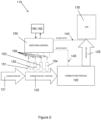
- FIG. 1 there is shown a schematic representation perspective view of an apparatus, generally designated 10, according to a first embodiment.
- the apparatus 10 is associated with a combustion apparatus 20, which in this embodiment is a diesel engine.
- the combustion apparatus 20 is associated with a Selective Catalytic Reduction ('SCR') device 30.
- the SCR device 30 is configured to treat exhaust gases 25 from the combustion apparatus 20, and in particular to catalyse the conversion of nitrogen oxides, using urea or ammonia as a reductant, into nitrogen (N2) and water (H2O).
- the combustion apparatus is fed fuel such as diesel fuel (not shown), and an oxidiser which in this embodiment is an air feed 21.
- the apparatus may be used in combination with other combustion apparatus 20 which may be associated with an SCR device, including for example industrial boilers or the like, and is thus not limited for use with diesel engines specifically.
- the apparatus 10 includes a temperature sensing device 40 configured to measure the temperature of the exhaust 25 from the combustion apparatus 20.
- the apparatus 10 also includes an injection unit 50 configured to inject hydrogen 51 into the air feed 21 which is fed to the combustion apparatus 20. As shown in Figure 1 , the injection of hydrogen is performed before injection of air feed 21 to the combustion apparatus 20, such that, when hydrogen 51 is added and/or injected, it is mixed with the air feed 21 to provide a mixture 22 of air and hydrogen.
- the operating temperature in the SCR device 30 should reach a minimum temperature, typically at least 280°C - 300°C, e.g. between 280°C and 325°C, for the process to work. If the temperature of the exhaust 25 from combustion apparatus 20 is too low, the reduction of NOx compounds may not occur.
- the inventors have discovered that, by adding hydrogen 51 to the feed 22, an increase in the temperature of the exhaust 25 may be obtained compared to the temperature of the exhaust 25 using an air feed 21 free of additional hydrogen.
- the apparatus 10 has a control unit 60 configured to control operation of the injection unit 50 so as to control and/or regulate injection of hydrogen 51.
- the control unit 60 has a user interface 62 which displays information, including for example the temperature of the exhaust 25 measured by the temperature sensing device 40.
- the user interface 62 can also receive a input from a user s as to control the injection unit 50.
- the control unit 60 is in communication with the injection unit 50 and the temperature sensing device 40.
- the control unit has an automated mode in which the control unit 60 automatically controls and/or regulates injection of hydrogen 51 based on an input, e.g. exhaust temperature received from the temperature sensing device 40.
- the control unit 60 also has a manual mode in which a user may manually control and/or regulate injection of hydrogen 51 based on an input, e.g. exhaust temperature received from the temperature sensing device 40.
- the control unit 60 can be switched between a manual mode and an automatic mode.
- the control unit 60 receives a signal indicating that the temperature is below the predetermined or threshold value. This may be done by displaying the temperature on the user interface 62 and/or causing a warning signal such as a warning message, a flashing light or an alarm sound.
- the control unit 60 then sends a command (automatically or manually) to the injection unit 50 causing partial or full opening of valve 56 in the hydrogen supply line 51 and thus injection of hydrogen 51 in the feed 22.
- the hydrogen supply line 51 is connected to a source of hydrogen (not shown) which can be a hydrogens tank or container, or an on-demand hydrogen source such as a hydrolysis unit.
- the control unit 60 receives a signal indicating that the temperature is at or around a/the predetermined value or within a/the predetermined range. This may be done by displaying the temperature on the user interface 62 and/or triggering an associated signal such as a written message, a coloured light or an associated sound.
- the control unit 60 then sends a command (automatically or manually) to the injection unit 50 causing either partial or full closure of the valve 56 in the hydrogen supply line 51 and thus either reduced injection or interruption of the injection of hydrogen 51 in the feed 22.
- the amount of hydrogen injected e.g. the extent/degree of the opening or closure of the valve 56 may be determined and/or may be based on the extent of the variation between the exhaust temperature measured by the sensor 40 and the predetermined target temperature or temperature range for the SCR device 30.
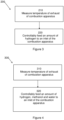
- a method 200 of controlling and/or regulating the temperature of an exhaust from a combustion apparatus comprises measuring and/or monitoring the temperature of the exhaust 210, and controllably feeding 220 an amount of hydrogen to an inlet of the combustion apparatus sufficient to adjust the temperature in the exhaust.
- step 220 comprises feeding an amount of hydrogen to an inlet of the combustion apparatus sufficient to adjust the temperature in the exhaust, above a predetermined value and/or within a predetermined range.
- FIG. 2 there is shown a perspective view of an apparatus, generally designated 110, according to a second embodiment.
- the apparatus is generally similar to the apparatus 10 of Figure 1 , like parts being denoted by like numerals, but incremented by '100'.
- the apparatus 110 also includes a combustion sensing device 145 configured to monitor the efficiency of the combustion apparatus 120.
- the combustion sensing device 145 includes one or more temperature sensors configured to measure temperature in the combustion apparatus, e.g. combustion chamber thereof and one or more pressure sensors configured to measure pressure in the combustion apparatus, e.g. combustion chamber thereof.
- the combustion sensing device 145 may include high accuracy flowmeters associated with a fuel inlet so as to measure volume and/or flow rate of fuel to the combustion apparatus.
- the injection unit 150 is configured to inject hydrogen 151, methanol 152 and/or water 153 into the air feed 121 which is fed to the combustion apparatus 120. As shown in Figure 2 , the injection of hydrogen, methanol and water is performed before injection of air feed 121 to the combustion apparatus 120, such that, when hydrogen 151, methanol 152 and/or water 153 is/are added and/or injected, such is/are mixed with the air feed 121 to provide a mixture 122.
- the apparatus 110 also includes another optional feed 154 which may be arranged to adjust any further specific parameter of the combustion process.
- Each of the hydrogen supply 151, methanol supply 152 and water supply 153 is associated with a valve 156 configured to control and/or regulate the flow of hydrogen, methanol or water in its respective supply line.
- the control unit 160 is configured to control operation of the injection unit 150 so as to control and/or regulate injection of hydrogen 151, methanol 152 and water 153.
- the user interface 162 displays information, including for example the temperature of the exhaust 125 measured by the temperature sensing device 140 and the efficiency of the combustion apparatus 120 measured by the combustion sensing device 145.
- the control unit 160 is in communication with the injection unit 150 and each of the temperature sensing device 140 and combustion sensing device 145.
- the control unit 160 can have an automated mode in which the control unit 160 automatically controls and/or regulates injection of hydrogen 151, methanol 152 and water 153 based on an input, e.g. exhaust temperature received from the temperature sensing device 140 and the efficiency of the combustion apparatus 120 measured by the combustion sensing device 145.
- the control unit 160 can also have a manual mode in which a user may manually control and/or regulate injection of hydrogen 151, methanol 152 and water 153 based on an input, e.g. exhaust temperature received from the temperature sensing device 140 and the efficiency of the combustion apparatus 120 measured by the combustion sensing device 145.
- the control unit 160 can be switched between a manual mode and an automatic mode.
- control unit 160 controls operation of the injection unit 150 such that hydrogen, methanol and water are injected or added in a ratio a:b:c, wherein a, b and c are the relative amounts of hydrogen, methanol and water added to the air feed 121 to create feed mixture 122.
- the injection unit 150 injects and/or adds hydrogen, methanol and water to the feed 121 in an amount, e.g. weight %, of x, y and z, relative to the total amount, e.g. weight, of the air feed 121, to create feed mixture 122.
- control unit 160 is configured to control and/or regulate injection of hydrogen 151, methanol 152 and/or water 153, for example by adjusting the values x, y and z, based on an input, e.g. exhaust temperature received from the temperature sensing device 140 and/or combustion efficiency received from the combustion sensing device 145.
- the control unit 160 when the temperature of the exhaust 125 is below a predetermined value (which may depend on the particular type of combustion apparatus 120 and/or on the SCR device 130), the control unit 160 receives a signal indicating that the temperature is below the predetermined or threshold value. This may be done by displaying the temperature on the user interface 162 and/or causing a warning signal such as a warning message, a flashing light or an alarm sound. The control unit 160 then sends a command (automatically or manually) to the injection unit 150 causing partial or full opening of valve 156 in the hydrogen supply line 151 and thus injection of hydrogen 151 in the feed 122.
- the hydrogen supply line 151 is connected to a source of hydrogen (not shown) which can be a hydrogen tank or container, or an on-demand hydrogen source such as a hydrolysis unit.
- the control unit 160 receives a signal indicating that the temperature is at or around a/the predetermined value or within a/the predetermined range. This may be done by displaying the temperature on the user interface 162 and/or triggering an associated signal such as a written message, a coloured light or an associated sound.
- the control unit 160 then sends a command (automatically or manually) to the injection unit 150 causing either partial or full closure of the valve 156 in the hydrogen supply line 151 and thus either reduced injection or interruption of the injection of hydrogen 151 in the feed 122.
- the amount of hydrogen injected e.g. the extent/degree of the opening or closure of the valve 156 may be determined and/or may be based on the extent of the variation between the exhaust temperature measured by the sensor 140, and the predetermined target temperature or temperature range for the SCR device 130.
- the control unit 160 When the combustion efficiency measured by the combustion sensor device 145 is relatively low, e.g. below a predetermined threshold, the control unit 160 receives a signal indicating that the efficiency is below the predetermined or threshold value. This may be done by displaying the efficiency on the user interface 162 and/or causing a warning signal such as a warning message, a flashing light or an alarm sound. The control unit 160 then sends a command (automatically or manually) to the injection unit 150 causing partial or full opening of valve 156 in the hydrogen supply line 151 and/or in the methanol supply line 152 and thus injection of hydrogen 151 and/or methanol 152 in the feed 122.
- the methanol supply line 152 is connected to a source of methanol (not shown) which can be typically a methanol tank or container. This causes an increase in the amount and/or proportion of hydrogen and/or methanol in the feed 122 of the combustion apparatus 120.
- control unit 160 sends a command (automatically or manually) to the injection unit 150 causing partial or full opening of valve 156 in the hydrogen supply line 151.
- control unit 160 sends a command (automatically or manually) to the injection unit 150 causing partial or full opening of valve 156 in the methanol supply line 152.
- control unit 160 sends a command (automatically or manually) to the injection unit 150 causing partial or full opening of valve 156 in the water supply line 153.
- control unit 160 controls the injection of each of hydrogen 151, methanol 152 and water 153, so as to control the amounts and/or ratios of hydrogen, methanol and water in the feed 122, in order to control the temperature of the exhaust 125 to optimise the SCR process in the SCR apparatus 130, and to improve or optimise efficiency in the combustion apparatus 120.
- a method 300 of controlling and/or regulating the temperature of an exhaust from a combustion apparatus comprises measuring and/or monitoring the temperature of the exhaust 310, and controllably feeding 320 an amount of hydrogen, methanol and water to an inlet of the combustion apparatus sufficient to adjust the temperature in the exhaust.
- step 320 comprises feeding an amount of hydrogen, methanol and water to an inlet of the combustion apparatus sufficient to adjust the temperature in the exhaust, above a predetermined value and/or within a predetermined range.
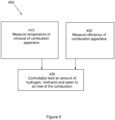
- the method 400 comprises measuring and/or monitoring the temperature of the exhaust 410.
- the method also comprises measuring the combustion efficiency of the combustion process 420.
- the method then comprises controllably feeding 430 an amount of hydrogen, methanol and water to an inlet of the combustion apparatus sufficient to adjust the temperature in the exhaust and optimise combustion efficiency.
- step 420 comprises feeding an amount of hydrogen, methanol and water to an inlet of the combustion apparatus sufficient to adjust the temperature in the exhaust, above a predetermined value and/or within a predetermined range, and to adjust the combustion efficiency in the combustion apparatus above a predetermined value and/or within a predetermined range.
Landscapes
- Engineering & Computer Science (AREA)
- Chemical & Material Sciences (AREA)
- Combustion & Propulsion (AREA)
- Mechanical Engineering (AREA)
- General Engineering & Computer Science (AREA)
- Chemical Kinetics & Catalysis (AREA)
- Oil, Petroleum & Natural Gas (AREA)
- General Chemical & Material Sciences (AREA)
- Health & Medical Sciences (AREA)
- Toxicology (AREA)
- Exhaust Gas After Treatment (AREA)
Claims (13)
- System, umfassend:- eine Verbrennungsvorrichtung (20, 120), die einen Dieselmotor, einen Kraftstoffeinlass, der zum Aufnehmen einer Kraftstoffzufuhr zu dem Motor konfiguriert ist, und einen Oxidationsmitteleinlass (21, 121), der zum Aufnehmen einer Zufuhr von Oxidationsmittel zu dem Motor konfiguriert ist, umfasst,- eine Einrichtung zur selektiven katalytischen Reduktion ('SCR') (30, 130), die mit der Verbrennungsvorrichtung (20, 120) verbunden ist und zum Katalysieren einer Umwandlung von Stickoxiden in einem Abgas (25, 125) des Motors in Stickstoff und Wasser konfiguriert ist, und- eine Vorrichtung (10, 110), die Folgendes aufweist:∘ eine Temperaturerfassungseinrichtung (40, 140), die dazu konfiguriert ist, die Temperatur des Abgases zu messen,∘ eine Einspritzeinheit (50, 150), die dazu konfiguriert ist, Wasserstoff (51, 151) in die Zufuhr von Oxidationsmittel (21, 121) zu dem Motor einzuspritzen; und∘ eine Steuereinheit (60, 160), die dazu konfiguriert ist, einen Betrieb der Einspritzeinheit (50, 150) zu steuern,- wobei die Steuereinheit dazu konfiguriert ist, die Einspritzung von Wasserstoff über die Einspritzeinheit in einer Menge von Wasserstoff zu der Oxidationsmittelzufuhr basierend auf einer von der Temperaturerfassungseinrichtung empfangenen Abgastemperatur zu steuern und/oder zu regeln, so dass eine gemessene Temperatur in dem Abgas mindestens 270 °C beträgt; unddas System dadurch gekennzeichnet ist, dassdie Einspritzeinheit (50, 150) dazu konfiguriert ist, Wasserstoff (51, 151) und Luft vor der Einspritzung der Zufuhr von Oxidationsmittel (21, 121) in den Motor zu mischen.
- System nach Anspruch 1, wobei die Einspritzeinheit dazu konfiguriert ist, Methanol und/oder Wasser steuerbar in den Oxidationsmitteleinlass der Verbrennungsvorrichtung einzuspritzen.
- System nach Anspruch 1 oder Anspruch 2, wobei der Kraftstoff Dieselkraftstoff ist und wobei das Oxidationsmittel Luft ist.
- System nach einem der Ansprüche 1 bis 3, ferner eine Verbrennungserfassungseinrichtung (145) umfassend, die dazu konfiguriert ist, die Effizienz der Verbrennungsvorrichtung zu messen, und wobei die Steuereinheit (160) dazu konfiguriert ist, einen Betrieb der Einspritzeinheit (150) basierend auf einer von der Verbrennungserfassungseinrichtung (145) empfangenen Eingabe zu steuern.
- System nach Anspruch 4,wobei die Steuereinheit (160) eine Benutzerschnittstelle (162) umfasst, die zum Anzeigen von Informationen konfiguriert ist, wobei die Informationen die durch die Temperaturerfassungseinrichtung (120) gemessene Temperatur des Abgases und die durch die Verbrennungserfassungseinrichtung (145) gemessene Effizienz der Verbrennungsvorrichtung umfassen, undwobei die Steuereinheit (160) in Kommunikation mit Folgendem steht:∘ der Einspritzeinheit (150),∘ der Temperaturerfassungseinrichtung (140) und∘ der Verbrennungserfassungseinrichtung (145).
- System nach Anspruch 5, wobei, wenn die Temperatur des Abgases unter einem vorbestimmten Wert liegt, die Steuereinheit (60, 160) dazu konfiguriert ist, die Abgastemperatur auf der Benutzerschnittstelle (62, 162) anzuzeigen und ein Warnsignal auszulösen.
- System nach Anspruch 6, wobei das Warnsignal eine Warnmeldung, ein Blinklicht oder einen Alarmton umfasst.
- System nach Anspruch 2, wobei die Steuereinheit (60, 160) dazu konfiguriert ist, eine Einspritzung von Wasserstoff, Methanol und Wasser basierend auf einer durch die Temperaturerfassungseinrichtung (40, 140) gemessenen Abgastemperatur und/oder basierend auf einer durch die Verbrennungserfassungseinrichtung (145) gemessenen Verbrennungseffizienz zu steuern und/oder zu regeln.
- System nach Anspruch 8, wobei die Steuereinheit Folgendes aufweist:einen automatisierten Modus, in dem die Steuereinheit (60, 160) eine Einspritzung von Wasserstoff, Methanol und Wasser basierend auf einer Eingabe automatisch steuert und/oder regelt, die eine von der Temperatursensoreinrichtung empfangene Abgastemperatur und/oder eine von der Verbrennungserfassungseinrichtung empfangene Verbrennungseffizienz enthält; undeinen manuellen Modus, in dem ein Benutzer eine Einspritzung von Wasserstoff basierend auf einer Eingabe manuell steuert und/oder regelt, die eine von der Temperaturerfassungseinrichtung (40, 140) empfangene Abgastemperatur und/oder eine von der Verbrennungserfassungseinrichtung (145) empfangene Verbrennungseffizienz enthält.
- Verfahren (200) zum Steuern der Temperatur eines Abgases (25, 125) aus einem System nach Anspruch 1, wobei die Verbrennungsvorrichtung (20, 120) den Dieselmotor umfasst, wobei die Verbrennungsvorrichtung (20, 120) mit der Einrichtung zur selektiven katalytischen Reduktion (SCR) (30, 130) verbunden ist, die zum Katalysieren einer Umwandlung von Stickoxiden in dem Abgas (25, 125) des Dieselmotors in Stickstoff und Wasser konfiguriert ist, wobei das Verfahren Folgendes umfasst:Zuführen des Oxidationsmittels (21, 121) zu dem Dieselmotor,Messen der Temperatur des Abgases (210, 310, 410);Steuern der Einspritzung von Wasserstoff (220, 320, 430) in die Zufuhr von Oxidationsmittel (21, 121) zu dem Motor;wobei die Einspritzung von Wasserstoff in die Zufuhr von Oxidationsmittel so gesteuert wird, dass in dem Abgas eine Temperatur von mindestens 270 °C erreicht wird, undwobei das Verfahren dadurch gekennzeichnet ist, dassWasserstoff (220, 320, 430) und Luft gemischt werden, bevor das Oxidationsmittel (21, 121) dem Dieselmotor zugeführt wird.
- Verfahren nach Anspruch 10, ferner umfassend:Messen einer Verbrennungseffizienz in der Verbrennungsvorrichtung; undAnpassen der Menge und/oder des Verhältnisses von Wasserstoff, Methanol und Wasser, die der Zufuhr von Oxidationsmittel hinzugefügt werden, basierend auf der gemessenen Verbrennungseffizienz.
- Verfahren nach Anspruch 11, wobei das Anpassen der Menge und/oder des Verhältnisses von Wasserstoff, Methanol und Wasser, die der Zufuhr von Oxidationsmittel hinzugefügt werden, auf der gemessenen Temperatur und der gemessenen Verbrennungseffizienz basiert.
- Verfahren nach Anspruch 12, wobei das Verhältnis von Wasserstoff, Methanol und Wasser durch a:b:c dargestellt wird, wobei a, b und c jeweils größer oder gleich null sind, wobei das Verfahren ferner Steuern und/oder Regeln der Menge an Wasserstoff, Methanol und Wasser und/oder der Verhältnisse a:b:c umfasst, um die Temperatur des Abgases und die Effizienz der Verbrennungsvorrichtung zu steuern und/oder zu regeln.
Applications Claiming Priority (2)
| Application Number | Priority Date | Filing Date | Title |
|---|---|---|---|
| DKPA202000153A DK202000153A1 (en) | 2020-02-06 | 2020-02-06 | Method and Apparatus for Controlling Temperature in Selective Catalytic Reduction Systems |
| PCT/DK2021/050024 WO2021155895A1 (en) | 2020-02-06 | 2021-01-25 | Method and apparatus for controlling temperature in selective catalytic reduction systems |
Publications (2)
| Publication Number | Publication Date |
|---|---|
| EP4100629A1 EP4100629A1 (de) | 2022-12-14 |
| EP4100629B1 true EP4100629B1 (de) | 2024-08-07 |
Family
ID=74591718
Family Applications (1)
| Application Number | Title | Priority Date | Filing Date |
|---|---|---|---|
| EP21704704.2A Active EP4100629B1 (de) | 2020-02-06 | 2021-01-25 | Verfahren und vorrichtung zur regelung der temperatur in systemen zur selektiven katalytischen reduktion |
Country Status (5)
| Country | Link |
|---|---|
| US (1) | US11873749B2 (de) |
| EP (1) | EP4100629B1 (de) |
| DK (2) | DK202000153A1 (de) |
| ES (1) | ES2994860T3 (de) |
| WO (1) | WO2021155895A1 (de) |
Families Citing this family (3)
| Publication number | Priority date | Publication date | Assignee | Title |
|---|---|---|---|---|
| DE102021121214B4 (de) * | 2021-08-16 | 2024-12-12 | Keyou GmbH | Verfahren zum Betrieb einer fremdzündenden Verbrennungskraftmaschine und Steuereinrichtung zur Durchführung des Verfahrens |
| JP2025018642A (ja) * | 2023-07-27 | 2025-02-06 | ヤンマーホールディングス株式会社 | エンジン装置 |
| JP2025018643A (ja) * | 2023-07-27 | 2025-02-06 | ヤンマーホールディングス株式会社 | エンジン装置及びエンジン装置の制御方法 |
Family Cites Families (21)
| Publication number | Priority date | Publication date | Assignee | Title |
|---|---|---|---|---|
| DE10211122A1 (de) * | 2002-03-14 | 2003-09-25 | Bosch Gmbh Robert | Verfahren und Vorrichtung zum Betreiben einer Brennkraftmaschine mit mehreren Kraftstoffen |
| JP4527375B2 (ja) | 2003-09-09 | 2010-08-18 | トヨタ自動車株式会社 | 内燃機関の制御装置 |
| JP4321306B2 (ja) | 2004-02-26 | 2009-08-26 | マツダ株式会社 | 水素エンジンの制御装置 |
| JP2006226167A (ja) | 2005-02-16 | 2006-08-31 | Toyota Motor Corp | 水素利用内燃機関 |
| JP4412201B2 (ja) | 2005-03-02 | 2010-02-10 | トヨタ自動車株式会社 | 水素利用内燃機関の制御装置 |
| DE102006043087A1 (de) * | 2005-11-14 | 2007-06-28 | Robert Bosch Gmbh | Verfahren und Vorrichtung zur Aufheizung eines Reduktionsmittel-Generierungssystems |
| WO2010109601A1 (ja) | 2009-03-25 | 2010-09-30 | トヨタ自動車株式会社 | 内燃機関の制御装置 |
| KR20130096158A (ko) * | 2010-04-13 | 2013-08-29 | 쉬어 테크놀로지 인코포레이티드 | 디젤 엔진 연소 제어 방법 및 시스템 |
| WO2013021434A1 (ja) | 2011-08-05 | 2013-02-14 | トヨタ自動車株式会社 | 内燃機関の燃料供給装置 |
| US8815195B2 (en) | 2012-08-09 | 2014-08-26 | Exxonmobil Research And Engineering Company | Catalytic reduction of NOx with high activity catalysts with propylene reductant |
| US9765673B2 (en) * | 2012-11-30 | 2017-09-19 | Johnson Matthey Plc | Soot monitoring method and alert system |
| CA2969673C (en) | 2013-01-09 | 2021-08-10 | Bms-Tek, Llc | System and method for improving performance of combustion engines employing primary and secondary fuels |
| US10273851B2 (en) * | 2014-02-28 | 2019-04-30 | Scania Cv Ab | Exhaust treatment system and method for treatment of an exhaust stream |
| JP2016070244A (ja) | 2014-10-01 | 2016-05-09 | いすゞ自動車株式会社 | 内燃機関及び内燃機関の排気ガス浄化方法 |
| US9890334B2 (en) | 2015-06-09 | 2018-02-13 | Exxonmobil Research And Engineering Company | Fluid catalytic cracking unit with low emissions |
| SE539133C2 (sv) * | 2015-08-27 | 2017-04-11 | Scania Cv Ab | Avgasbehandlingssystem och förfarande för behandling av en avgasström |
| US9739190B2 (en) * | 2015-11-12 | 2017-08-22 | GM Global Technology Operations LLC | Method and apparatus to control reductant injection into an exhaust gas feedstream |
| DE102017205352A1 (de) | 2017-03-29 | 2018-10-04 | Robert Bosch Gmbh | Verfahren zur Regeneration eines Partikelfilters und Computerprogrammprodukt zur Durchführung des Verfahrens |
| WO2018185665A1 (en) | 2017-04-04 | 2018-10-11 | Basf Corporation | Hydrogen-assisted integrated emission control system |
| EP3607182B1 (de) | 2017-04-04 | 2021-10-27 | BASF Corporation | Ammoniak- und wasserstofferzeugung an bord eines fahrzeugs |
| US11598241B2 (en) * | 2021-05-10 | 2023-03-07 | Caterpillar Inc. | Fluid level wake-up functionality |
-
2020
- 2020-02-06 DK DKPA202000153A patent/DK202000153A1/en not_active Application Discontinuation
-
2021
- 2021-01-25 DK DK21704704.2T patent/DK4100629T3/da active
- 2021-01-25 WO PCT/DK2021/050024 patent/WO2021155895A1/en not_active Ceased
- 2021-01-25 ES ES21704704T patent/ES2994860T3/es active Active
- 2021-01-25 US US17/797,890 patent/US11873749B2/en active Active
- 2021-01-25 EP EP21704704.2A patent/EP4100629B1/de active Active
Also Published As
| Publication number | Publication date |
|---|---|
| ES2994860T3 (en) | 2025-02-03 |
| WO2021155895A1 (en) | 2021-08-12 |
| EP4100629A1 (de) | 2022-12-14 |
| US20230081177A1 (en) | 2023-03-16 |
| US11873749B2 (en) | 2024-01-16 |
| DK202000153A1 (en) | 2021-10-07 |
| DK4100629T3 (da) | 2024-10-07 |
Similar Documents
| Publication | Publication Date | Title |
|---|---|---|
| EP4100629B1 (de) | Verfahren und vorrichtung zur regelung der temperatur in systemen zur selektiven katalytischen reduktion | |
| US8061123B2 (en) | Method and system of thermal management in an exhaust system | |
| CA2921267C (en) | Reductant injection control for catalytic engine exhaust treatment system | |
| EP2588218B1 (de) | Steuerverfahren und anordnung für selektive katalytische reduktion | |
| EP2295753B1 (de) | Verfahren zur Harnstoffeinspritzsteuerung | |
| KR102042887B1 (ko) | 선택적 촉매 환원 시스템 및 동력 장치 | |
| CN107448266A (zh) | 船舶废气脱硝尿素自动添加方法及其装置 | |
| WO2017055299A1 (en) | Exhaust gas after treatment system for a dual-fuel internal combustion engine | |
| CN107923292B (zh) | 用于运行具有scr催化器的废气后处理系统的方法 | |
| GB2490522A (en) | Exhaust system for a dual fuel engine | |
| GB2507720A (en) | Exhaust heater upstream of oxidation catalyst | |
| CN115475514B (zh) | 一种利用热值和流量预控煤气锅炉脱硝效率的控制系统 | |
| EP2728135A2 (de) | Ammoniak-Flusssteuerung | |
| JP2002509784A (ja) | 燃焼設備の排気ガス内の有害物質の触媒除去方法と装置 | |
| US20110036279A1 (en) | NOx reduction control system for boilers | |
| WO2023112637A1 (ja) | エンジンの運転方法 | |
| EP3139010B1 (de) | System und verfahren zur adaptiven nox-nachbehandlungssteuerung | |
| CN223530194U (zh) | 一种镀锌线退火炉烟气脱硝装置 | |
| CN116988869B (zh) | 一种气体点燃式发动机燃烧控制系统及控制方法 | |
| CN223036425U (zh) | 一种新型脱硝烟气燃烧加热系统 | |
| JP2007332785A (ja) | 燃焼機器の脱硝装置 | |
| CN110500204A (zh) | 天然气发电机组用自吸式发动机及其低排放控制策略 | |
| US20100186383A1 (en) | Stored reductant state for startup | |
| CN119499837A (zh) | 一种镀锌线退火炉烟气脱硝装置 | |
| JP2025000276A (ja) | 内燃機関システムの制御装置 |
Legal Events
| Date | Code | Title | Description |
|---|---|---|---|
| STAA | Information on the status of an ep patent application or granted ep patent |
Free format text: STATUS: UNKNOWN |
|
| STAA | Information on the status of an ep patent application or granted ep patent |
Free format text: STATUS: THE INTERNATIONAL PUBLICATION HAS BEEN MADE |
|
| PUAI | Public reference made under article 153(3) epc to a published international application that has entered the european phase |
Free format text: ORIGINAL CODE: 0009012 |
|
| STAA | Information on the status of an ep patent application or granted ep patent |
Free format text: STATUS: REQUEST FOR EXAMINATION WAS MADE |
|
| 17P | Request for examination filed |
Effective date: 20220728 |
|
| AK | Designated contracting states |
Kind code of ref document: A1 Designated state(s): AL AT BE BG CH CY CZ DE DK EE ES FI FR GB GR HR HU IE IS IT LI LT LU LV MC MK MT NL NO PL PT RO RS SE SI SK SM TR |
|
| RAP3 | Party data changed (applicant data changed or rights of an application transferred) |
Owner name: NOBLE DRILLING A/S |
|
| DAV | Request for validation of the european patent (deleted) | ||
| DAX | Request for extension of the european patent (deleted) | ||
| P01 | Opt-out of the competence of the unified patent court (upc) registered |
Effective date: 20230525 |
|
| STAA | Information on the status of an ep patent application or granted ep patent |
Free format text: STATUS: EXAMINATION IS IN PROGRESS |
|
| 17Q | First examination report despatched |
Effective date: 20230817 |
|
| RIC1 | Information provided on ipc code assigned before grant |
Ipc: F02M 25/022 20060101ALI20240126BHEP Ipc: F02D 41/14 20060101ALI20240126BHEP Ipc: F02D 41/02 20060101ALI20240126BHEP Ipc: F02D 19/06 20060101ALI20240126BHEP Ipc: F02M 25/025 20060101ALI20240126BHEP Ipc: F02M 21/02 20060101ALI20240126BHEP Ipc: F02D 41/00 20060101ALI20240126BHEP Ipc: F01N 9/00 20060101ALI20240126BHEP Ipc: F01N 3/20 20060101AFI20240126BHEP |
|
| GRAP | Despatch of communication of intention to grant a patent |
Free format text: ORIGINAL CODE: EPIDOSNIGR1 |
|
| STAA | Information on the status of an ep patent application or granted ep patent |
Free format text: STATUS: GRANT OF PATENT IS INTENDED |
|
| INTG | Intention to grant announced |
Effective date: 20240311 |
|
| GRAS | Grant fee paid |
Free format text: ORIGINAL CODE: EPIDOSNIGR3 |
|
| GRAA | (expected) grant |
Free format text: ORIGINAL CODE: 0009210 |
|
| STAA | Information on the status of an ep patent application or granted ep patent |
Free format text: STATUS: THE PATENT HAS BEEN GRANTED |
|
| AK | Designated contracting states |
Kind code of ref document: B1 Designated state(s): AL AT BE BG CH CY CZ DE DK EE ES FI FR GB GR HR HU IE IS IT LI LT LU LV MC MK MT NL NO PL PT RO RS SE SI SK SM TR |
|
| REG | Reference to a national code |
Ref country code: GB Ref legal event code: FG4D |
|
| REG | Reference to a national code |
Ref country code: CH Ref legal event code: EP |
|
| REG | Reference to a national code |
Ref country code: DE Ref legal event code: R096 Ref document number: 602021016802 Country of ref document: DE |
|
| REG | Reference to a national code |
Ref country code: IE Ref legal event code: FG4D |
|
| REG | Reference to a national code |
Ref country code: DK Ref legal event code: T3 Effective date: 20241004 |
|
| REG | Reference to a national code |
Ref country code: NL Ref legal event code: FP |
|
| REG | Reference to a national code |
Ref country code: LT Ref legal event code: MG9D |
|
| REG | Reference to a national code |
Ref country code: AT Ref legal event code: MK05 Ref document number: 1711162 Country of ref document: AT Kind code of ref document: T Effective date: 20240807 |
|
| PG25 | Lapsed in a contracting state [announced via postgrant information from national office to epo] |
Ref country code: PT Free format text: LAPSE BECAUSE OF FAILURE TO SUBMIT A TRANSLATION OF THE DESCRIPTION OR TO PAY THE FEE WITHIN THE PRESCRIBED TIME-LIMIT Effective date: 20241209 Ref country code: PL Free format text: LAPSE BECAUSE OF FAILURE TO SUBMIT A TRANSLATION OF THE DESCRIPTION OR TO PAY THE FEE WITHIN THE PRESCRIBED TIME-LIMIT Effective date: 20240807 Ref country code: FI Free format text: LAPSE BECAUSE OF FAILURE TO SUBMIT A TRANSLATION OF THE DESCRIPTION OR TO PAY THE FEE WITHIN THE PRESCRIBED TIME-LIMIT Effective date: 20240807 Ref country code: GR Free format text: LAPSE BECAUSE OF FAILURE TO SUBMIT A TRANSLATION OF THE DESCRIPTION OR TO PAY THE FEE WITHIN THE PRESCRIBED TIME-LIMIT Effective date: 20241108 |
|
| PG25 | Lapsed in a contracting state [announced via postgrant information from national office to epo] |
Ref country code: BG Free format text: LAPSE BECAUSE OF FAILURE TO SUBMIT A TRANSLATION OF THE DESCRIPTION OR TO PAY THE FEE WITHIN THE PRESCRIBED TIME-LIMIT Effective date: 20240807 |
|
| PG25 | Lapsed in a contracting state [announced via postgrant information from national office to epo] |
Ref country code: LV Free format text: LAPSE BECAUSE OF FAILURE TO SUBMIT A TRANSLATION OF THE DESCRIPTION OR TO PAY THE FEE WITHIN THE PRESCRIBED TIME-LIMIT Effective date: 20240807 |
|
| PG25 | Lapsed in a contracting state [announced via postgrant information from national office to epo] |
Ref country code: IS Free format text: LAPSE BECAUSE OF FAILURE TO SUBMIT A TRANSLATION OF THE DESCRIPTION OR TO PAY THE FEE WITHIN THE PRESCRIBED TIME-LIMIT Effective date: 20241207 Ref country code: AT Free format text: LAPSE BECAUSE OF FAILURE TO SUBMIT A TRANSLATION OF THE DESCRIPTION OR TO PAY THE FEE WITHIN THE PRESCRIBED TIME-LIMIT Effective date: 20240807 |
|
| PG25 | Lapsed in a contracting state [announced via postgrant information from national office to epo] |
Ref country code: HR Free format text: LAPSE BECAUSE OF FAILURE TO SUBMIT A TRANSLATION OF THE DESCRIPTION OR TO PAY THE FEE WITHIN THE PRESCRIBED TIME-LIMIT Effective date: 20240807 |
|
| PG25 | Lapsed in a contracting state [announced via postgrant information from national office to epo] |
Ref country code: RS Free format text: LAPSE BECAUSE OF FAILURE TO SUBMIT A TRANSLATION OF THE DESCRIPTION OR TO PAY THE FEE WITHIN THE PRESCRIBED TIME-LIMIT Effective date: 20241107 |
|
| PG25 | Lapsed in a contracting state [announced via postgrant information from national office to epo] |
Ref country code: RS Free format text: LAPSE BECAUSE OF FAILURE TO SUBMIT A TRANSLATION OF THE DESCRIPTION OR TO PAY THE FEE WITHIN THE PRESCRIBED TIME-LIMIT Effective date: 20241107 Ref country code: PT Free format text: LAPSE BECAUSE OF FAILURE TO SUBMIT A TRANSLATION OF THE DESCRIPTION OR TO PAY THE FEE WITHIN THE PRESCRIBED TIME-LIMIT Effective date: 20241209 Ref country code: PL Free format text: LAPSE BECAUSE OF FAILURE TO SUBMIT A TRANSLATION OF THE DESCRIPTION OR TO PAY THE FEE WITHIN THE PRESCRIBED TIME-LIMIT Effective date: 20240807 Ref country code: LV Free format text: LAPSE BECAUSE OF FAILURE TO SUBMIT A TRANSLATION OF THE DESCRIPTION OR TO PAY THE FEE WITHIN THE PRESCRIBED TIME-LIMIT Effective date: 20240807 Ref country code: IS Free format text: LAPSE BECAUSE OF FAILURE TO SUBMIT A TRANSLATION OF THE DESCRIPTION OR TO PAY THE FEE WITHIN THE PRESCRIBED TIME-LIMIT Effective date: 20241207 Ref country code: HR Free format text: LAPSE BECAUSE OF FAILURE TO SUBMIT A TRANSLATION OF THE DESCRIPTION OR TO PAY THE FEE WITHIN THE PRESCRIBED TIME-LIMIT Effective date: 20240807 Ref country code: GR Free format text: LAPSE BECAUSE OF FAILURE TO SUBMIT A TRANSLATION OF THE DESCRIPTION OR TO PAY THE FEE WITHIN THE PRESCRIBED TIME-LIMIT Effective date: 20241108 Ref country code: FI Free format text: LAPSE BECAUSE OF FAILURE TO SUBMIT A TRANSLATION OF THE DESCRIPTION OR TO PAY THE FEE WITHIN THE PRESCRIBED TIME-LIMIT Effective date: 20240807 Ref country code: BG Free format text: LAPSE BECAUSE OF FAILURE TO SUBMIT A TRANSLATION OF THE DESCRIPTION OR TO PAY THE FEE WITHIN THE PRESCRIBED TIME-LIMIT Effective date: 20240807 Ref country code: AT Free format text: LAPSE BECAUSE OF FAILURE TO SUBMIT A TRANSLATION OF THE DESCRIPTION OR TO PAY THE FEE WITHIN THE PRESCRIBED TIME-LIMIT Effective date: 20240807 |
|
| REG | Reference to a national code |
Ref country code: ES Ref legal event code: FG2A Ref document number: 2994860 Country of ref document: ES Kind code of ref document: T3 Effective date: 20250203 |
|
| PG25 | Lapsed in a contracting state [announced via postgrant information from national office to epo] |
Ref country code: SM Free format text: LAPSE BECAUSE OF FAILURE TO SUBMIT A TRANSLATION OF THE DESCRIPTION OR TO PAY THE FEE WITHIN THE PRESCRIBED TIME-LIMIT Effective date: 20240807 |
|
| PG25 | Lapsed in a contracting state [announced via postgrant information from national office to epo] |
Ref country code: EE Free format text: LAPSE BECAUSE OF FAILURE TO SUBMIT A TRANSLATION OF THE DESCRIPTION OR TO PAY THE FEE WITHIN THE PRESCRIBED TIME-LIMIT Effective date: 20240807 |
|
| PG25 | Lapsed in a contracting state [announced via postgrant information from national office to epo] |
Ref country code: CZ Free format text: LAPSE BECAUSE OF FAILURE TO SUBMIT A TRANSLATION OF THE DESCRIPTION OR TO PAY THE FEE WITHIN THE PRESCRIBED TIME-LIMIT Effective date: 20240807 |
|
| PG25 | Lapsed in a contracting state [announced via postgrant information from national office to epo] |
Ref country code: SK Free format text: LAPSE BECAUSE OF FAILURE TO SUBMIT A TRANSLATION OF THE DESCRIPTION OR TO PAY THE FEE WITHIN THE PRESCRIBED TIME-LIMIT Effective date: 20240807 |
|
| REG | Reference to a national code |
Ref country code: DE Ref legal event code: R097 Ref document number: 602021016802 Country of ref document: DE |
|
| PLBE | No opposition filed within time limit |
Free format text: ORIGINAL CODE: 0009261 |
|
| STAA | Information on the status of an ep patent application or granted ep patent |
Free format text: STATUS: NO OPPOSITION FILED WITHIN TIME LIMIT |
|
| 26N | No opposition filed |
Effective date: 20250508 |
|
| REG | Reference to a national code |
Ref country code: DE Ref legal event code: R119 Ref document number: 602021016802 Country of ref document: DE |
|
| REG | Reference to a national code |
Ref country code: CH Ref legal event code: PL |
|
| PG25 | Lapsed in a contracting state [announced via postgrant information from national office to epo] |
Ref country code: SE Free format text: LAPSE BECAUSE OF FAILURE TO SUBMIT A TRANSLATION OF THE DESCRIPTION OR TO PAY THE FEE WITHIN THE PRESCRIBED TIME-LIMIT Effective date: 20240807 |
|
| PG25 | Lapsed in a contracting state [announced via postgrant information from national office to epo] |
Ref country code: LU Free format text: LAPSE BECAUSE OF NON-PAYMENT OF DUE FEES Effective date: 20250125 Ref country code: MC Free format text: LAPSE BECAUSE OF FAILURE TO SUBMIT A TRANSLATION OF THE DESCRIPTION OR TO PAY THE FEE WITHIN THE PRESCRIBED TIME-LIMIT Effective date: 20240807 |
|
| PG25 | Lapsed in a contracting state [announced via postgrant information from national office to epo] |
Ref country code: DE Free format text: LAPSE BECAUSE OF NON-PAYMENT OF DUE FEES Effective date: 20250801 |
|
| PG25 | Lapsed in a contracting state [announced via postgrant information from national office to epo] |
Ref country code: BE Free format text: LAPSE BECAUSE OF NON-PAYMENT OF DUE FEES Effective date: 20250131 |
|
| PG25 | Lapsed in a contracting state [announced via postgrant information from national office to epo] |
Ref country code: CH Free format text: LAPSE BECAUSE OF NON-PAYMENT OF DUE FEES Effective date: 20250131 |
|
| REG | Reference to a national code |
Ref country code: BE Ref legal event code: MM Effective date: 20250131 |
|
| PGFP | Annual fee paid to national office [announced via postgrant information from national office to epo] |
Ref country code: GB Payment date: 20251204 Year of fee payment: 6 |
|
| PGFP | Annual fee paid to national office [announced via postgrant information from national office to epo] |
Ref country code: FR Payment date: 20251208 Year of fee payment: 6 Ref country code: NL Payment date: 20251215 Year of fee payment: 6 |
|
| PG25 | Lapsed in a contracting state [announced via postgrant information from national office to epo] |
Ref country code: IE Free format text: LAPSE BECAUSE OF NON-PAYMENT OF DUE FEES Effective date: 20250125 |
|
| PG25 | Lapsed in a contracting state [announced via postgrant information from national office to epo] |
Ref country code: IT Free format text: LAPSE BECAUSE OF FAILURE TO SUBMIT A TRANSLATION OF THE DESCRIPTION OR TO PAY THE FEE WITHIN THE PRESCRIBED TIME-LIMIT Effective date: 20240807 |
|
| PGFP | Annual fee paid to national office [announced via postgrant information from national office to epo] |
Ref country code: ES Payment date: 20260209 Year of fee payment: 6 |
|
| PGFP | Annual fee paid to national office [announced via postgrant information from national office to epo] |
Ref country code: NO Payment date: 20260109 Year of fee payment: 6 Ref country code: DK Payment date: 20260113 Year of fee payment: 6 |
|
| PG25 | Lapsed in a contracting state [announced via postgrant information from national office to epo] |
Ref country code: RO Free format text: LAPSE BECAUSE OF FAILURE TO SUBMIT A TRANSLATION OF THE DESCRIPTION OR TO PAY THE FEE WITHIN THE PRESCRIBED TIME-LIMIT Effective date: 20240807 |
|
| PGFP | Annual fee paid to national office [announced via postgrant information from national office to epo] |
Ref country code: MT Payment date: 20260121 Year of fee payment: 6 |