EP4100574B1 - Topisch behandeltes gewebeprodukt - Google Patents
Topisch behandeltes gewebeprodukt Download PDFInfo
- Publication number
- EP4100574B1 EP4100574B1 EP20917519.9A EP20917519A EP4100574B1 EP 4100574 B1 EP4100574 B1 EP 4100574B1 EP 20917519 A EP20917519 A EP 20917519A EP 4100574 B1 EP4100574 B1 EP 4100574B1
- Authority
- EP
- European Patent Office
- Prior art keywords
- lotion
- web
- tissue
- weight percent
- wax
- Prior art date
- Legal status (The legal status is an assumption and is not a legal conclusion. Google has not performed a legal analysis and makes no representation as to the accuracy of the status listed.)
- Active
Links
Images


Classifications
-
- A—HUMAN NECESSITIES
- A47—FURNITURE; DOMESTIC ARTICLES OR APPLIANCES; COFFEE MILLS; SPICE MILLS; SUCTION CLEANERS IN GENERAL
- A47K—SANITARY EQUIPMENT; ACCESSORIES THEREFOR, e.g. TOILET ACCESSORIES
- A47K10/00—Body-drying implements; Toilet paper; Holders therefor
- A47K10/16—Paper towels; Toilet paper; Holders therefor
-
- A—HUMAN NECESSITIES
- A61—MEDICAL OR VETERINARY SCIENCE; HYGIENE
- A61F—FILTERS IMPLANTABLE INTO BLOOD VESSELS; PROSTHESES; DEVICES PROVIDING PATENCY TO, OR PREVENTING COLLAPSING OF, TUBULAR STRUCTURES OF THE BODY, e.g. STENTS; ORTHOPAEDIC, NURSING OR CONTRACEPTIVE DEVICES; FOMENTATION; TREATMENT OR PROTECTION OF EYES OR EARS; BANDAGES, DRESSINGS OR ABSORBENT PADS; FIRST-AID KITS
- A61F13/00—Bandages or dressings; Absorbent pads
- A61F13/15—Absorbent pads, e.g. sanitary towels, swabs or tampons for external or internal application to the body; Supporting or fastening means therefor; Tampon applicators
- A61F13/51—Absorbent pads, e.g. sanitary towels, swabs or tampons for external or internal application to the body; Supporting or fastening means therefor; Tampon applicators characterised by the outer layers of the pads
- A61F13/511—Topsheet, i.e. the permeable cover or layer facing the skin
- A61F13/51113—Topsheet, i.e. the permeable cover or layer facing the skin comprising an additive, e.g. lotion or odour control
-
- A—HUMAN NECESSITIES
- A61—MEDICAL OR VETERINARY SCIENCE; HYGIENE
- A61K—PREPARATIONS FOR MEDICAL, DENTAL OR TOILETRY PURPOSES
- A61K8/00—Cosmetics or similar toiletry preparations
- A61K8/02—Cosmetics or similar toiletry preparations characterised by special physical form
- A61K8/0208—Tissues; Wipes; Patches
-
- A—HUMAN NECESSITIES
- A61—MEDICAL OR VETERINARY SCIENCE; HYGIENE
- A61K—PREPARATIONS FOR MEDICAL, DENTAL OR TOILETRY PURPOSES
- A61K8/00—Cosmetics or similar toiletry preparations
- A61K8/18—Cosmetics or similar toiletry preparations characterised by the composition
- A61K8/30—Cosmetics or similar toiletry preparations characterised by the composition containing organic compounds
- A61K8/31—Hydrocarbons
-
- A—HUMAN NECESSITIES
- A61—MEDICAL OR VETERINARY SCIENCE; HYGIENE
- A61K—PREPARATIONS FOR MEDICAL, DENTAL OR TOILETRY PURPOSES
- A61K8/00—Cosmetics or similar toiletry preparations
- A61K8/18—Cosmetics or similar toiletry preparations characterised by the composition
- A61K8/30—Cosmetics or similar toiletry preparations characterised by the composition containing organic compounds
- A61K8/33—Cosmetics or similar toiletry preparations characterised by the composition containing organic compounds containing oxygen
- A61K8/34—Alcohols
-
- A—HUMAN NECESSITIES
- A61—MEDICAL OR VETERINARY SCIENCE; HYGIENE
- A61K—PREPARATIONS FOR MEDICAL, DENTAL OR TOILETRY PURPOSES
- A61K8/00—Cosmetics or similar toiletry preparations
- A61K8/18—Cosmetics or similar toiletry preparations characterised by the composition
- A61K8/30—Cosmetics or similar toiletry preparations characterised by the composition containing organic compounds
- A61K8/33—Cosmetics or similar toiletry preparations characterised by the composition containing organic compounds containing oxygen
- A61K8/34—Alcohols
- A61K8/342—Alcohols having more than seven atoms in an unbroken chain
-
- A—HUMAN NECESSITIES
- A61—MEDICAL OR VETERINARY SCIENCE; HYGIENE
- A61K—PREPARATIONS FOR MEDICAL, DENTAL OR TOILETRY PURPOSES
- A61K8/00—Cosmetics or similar toiletry preparations
- A61K8/18—Cosmetics or similar toiletry preparations characterised by the composition
- A61K8/30—Cosmetics or similar toiletry preparations characterised by the composition containing organic compounds
- A61K8/33—Cosmetics or similar toiletry preparations characterised by the composition containing organic compounds containing oxygen
- A61K8/34—Alcohols
- A61K8/345—Alcohols containing more than one hydroxy group
-
- A—HUMAN NECESSITIES
- A61—MEDICAL OR VETERINARY SCIENCE; HYGIENE
- A61K—PREPARATIONS FOR MEDICAL, DENTAL OR TOILETRY PURPOSES
- A61K8/00—Cosmetics or similar toiletry preparations
- A61K8/18—Cosmetics or similar toiletry preparations characterised by the composition
- A61K8/72—Cosmetics or similar toiletry preparations characterised by the composition containing organic macromolecular compounds
- A61K8/84—Cosmetics or similar toiletry preparations characterised by the composition containing organic macromolecular compounds obtained by reactions otherwise than those involving only carbon-carbon unsaturated bonds
- A61K8/86—Polyethers
-
- A—HUMAN NECESSITIES
- A61—MEDICAL OR VETERINARY SCIENCE; HYGIENE
- A61K—PREPARATIONS FOR MEDICAL, DENTAL OR TOILETRY PURPOSES
- A61K8/00—Cosmetics or similar toiletry preparations
- A61K8/18—Cosmetics or similar toiletry preparations characterised by the composition
- A61K8/92—Oils, fats or waxes; Derivatives thereof, e.g. hydrogenation products thereof
-
- A—HUMAN NECESSITIES
- A61—MEDICAL OR VETERINARY SCIENCE; HYGIENE
- A61K—PREPARATIONS FOR MEDICAL, DENTAL OR TOILETRY PURPOSES
- A61K8/00—Cosmetics or similar toiletry preparations
- A61K8/18—Cosmetics or similar toiletry preparations characterised by the composition
- A61K8/92—Oils, fats or waxes; Derivatives thereof, e.g. hydrogenation products thereof
- A61K8/922—Oils, fats or waxes; Derivatives thereof, e.g. hydrogenation products thereof of vegetable origin
-
- A—HUMAN NECESSITIES
- A61—MEDICAL OR VETERINARY SCIENCE; HYGIENE
- A61Q—SPECIFIC USE OF COSMETICS OR SIMILAR TOILETRY PREPARATIONS
- A61Q19/00—Preparations for care of the skin
-
- D—TEXTILES; PAPER
- D21—PAPER-MAKING; PRODUCTION OF CELLULOSE
- D21H—PULP COMPOSITIONS; PREPARATION THEREOF NOT COVERED BY SUBCLASSES D21C OR D21D; IMPREGNATING OR COATING OF PAPER; TREATMENT OF FINISHED PAPER NOT COVERED BY CLASS B31 OR SUBCLASS D21G; PAPER NOT OTHERWISE PROVIDED FOR
- D21H27/00—Special paper not otherwise provided for, e.g. made by multi-step processes
- D21H27/002—Tissue paper; Absorbent paper
-
- D—TEXTILES; PAPER
- D21—PAPER-MAKING; PRODUCTION OF CELLULOSE
- D21H—PULP COMPOSITIONS; PREPARATION THEREOF NOT COVERED BY SUBCLASSES D21C OR D21D; IMPREGNATING OR COATING OF PAPER; TREATMENT OF FINISHED PAPER NOT COVERED BY CLASS B31 OR SUBCLASS D21G; PAPER NOT OTHERWISE PROVIDED FOR
- D21H27/00—Special paper not otherwise provided for, e.g. made by multi-step processes
- D21H27/02—Patterned paper
-
- D—TEXTILES; PAPER
- D21—PAPER-MAKING; PRODUCTION OF CELLULOSE
- D21H—PULP COMPOSITIONS; PREPARATION THEREOF NOT COVERED BY SUBCLASSES D21C OR D21D; IMPREGNATING OR COATING OF PAPER; TREATMENT OF FINISHED PAPER NOT COVERED BY CLASS B31 OR SUBCLASS D21G; PAPER NOT OTHERWISE PROVIDED FOR
- D21H27/00—Special paper not otherwise provided for, e.g. made by multi-step processes
- D21H27/30—Multi-ply
-
- D—TEXTILES; PAPER
- D21—PAPER-MAKING; PRODUCTION OF CELLULOSE
- D21H—PULP COMPOSITIONS; PREPARATION THEREOF NOT COVERED BY SUBCLASSES D21C OR D21D; IMPREGNATING OR COATING OF PAPER; TREATMENT OF FINISHED PAPER NOT COVERED BY CLASS B31 OR SUBCLASS D21G; PAPER NOT OTHERWISE PROVIDED FOR
- D21H27/00—Special paper not otherwise provided for, e.g. made by multi-step processes
- D21H27/30—Multi-ply
- D21H27/40—Multi-ply at least one of the sheets being non-planar, e.g. crêped
-
- A—HUMAN NECESSITIES
- A61—MEDICAL OR VETERINARY SCIENCE; HYGIENE
- A61K—PREPARATIONS FOR MEDICAL, DENTAL OR TOILETRY PURPOSES
- A61K2800/00—Properties of cosmetic compositions or active ingredients thereof or formulation aids used therein and process related aspects
- A61K2800/20—Chemical, physico-chemical or functional or structural properties of the composition as a whole
- A61K2800/30—Characterized by the absence of a particular group of ingredients
- A61K2800/31—Anhydrous
Definitions
- Absorbent tissue products such as facial tissue and bath tissue have been used to absorb body fluids and leave the skin dry.
- Absorbent tissue in addition to absorbing fluids, however, also abrade the skin during use and frequently do not leave the skin completely dry and free of the body fluid the tissue is trying to absorb. During frequent nose-blowing or perianal wiping, the skin can become so abraded as to appear red and be sore to the touch.
- tissue additive formulations can be applied to the tissue such that, in use, the additive formulation either provides lubricity causing the tissue to glide across the surface of the skin or leaves the tissue and is deposited on the skin.
- these formulations have been liquids or lipid (lipophilic materials) based semi-solids or lipid-based solids at room temperature.
- the liquid or lipid-based semi-solid type of formulations require a high amount of formulation added to the tissue to deliver the benefit of reduced skin irritation and redness because these formulations absorb into a tissue, leaving less on the surface to provide the benefit.
- the lipid based solid formulations can be heated (slightly above the melting point of the formulation) and applied to the surface of a tissue or towel thereafter re-solidifying the formulation on the surface(s) of the tissue where the formulation is readily available for transfer to the user's skin to protect the skin from or prevent further irritation and redness in an efficient cost-effective manner.
- fibrous structure refers to a structure comprising a plurality of elongated particulate having a length to diameter ratio greater than about 10 such as, for example, papermaking fibers and more particularly pulp fibers, including both wood and non-wood pulp fibers, and synthetic staple fibers.
- a non-limiting example of a fibrous structure is a tissue web comprising pulp fibers.
- tissue product refers to products made from tissue webs and includes, bath tissues, facial tissues, paper towels, industrial wipers, foodservice wipers, napkins, medical pads, and other similar products. Tissue products may comprise one, two, three or more plies.
- textured generally refers the three-dimensional topography of a first or a second side of a fibrous structure.
- a textured structure will have a first side with first and second surfaces lying in first and second surface planes where there is some non-zero z-direction height difference between the first and second surface planes.
- a textured tissue web may comprise a plurality of elevated elements having an upper surface lying in a first surface plane separated from one another by land areas lying in a second surface plane.
- discrete element refers to an element, such as a design element, disposed on a fibrous structure that does not extend continuously in any dimension of the fibrous structure.
- caliper is the representative thickness of a single sheet (caliper of tissue products comprising two or more plies is the thickness of a single sheet of tissue product comprising all plies) measured in accordance with TAPPI test method T402 using an EMVECO 200-A Microgage automated micrometer (EMVECO, Inc., Newberg, OR).
- the micrometer has an anvil diameter of 2.22 inches (56.4 mm) and an anvil pressure of 132 grams per square inch (per 6.45 square centimeters) (2.0 kPa).
- tissue products prepared according to the present invention generally have a caliper greater than about 100 ⁇ m, more preferably greater than about 200 ⁇ m and still more preferably greater than about 300 ⁇ m, such as from about 100 to about 1,500 ⁇ m and more preferably from about 300 to about 1,200 ⁇ m.
- sheet bulk refers to the quotient of the caliper (generally having units of ⁇ m) divided by the bone-dry basis weight (generally having units of gsm). The resulting sheet bulk is expressed in cubic centimeters per gram (cc/g). While sheet bulk may vary depending on any one of a number of factors, tissue products prepared according to the present invention may have a sheet bulk greater than about 5 cc/g, more preferably greater than about 8 cc/g and still more preferably greater than about 10 cc/g, such as from about 5 to about 20 cc/g.
- tissue products prepared according to the present invention may have a GMT greater than about 500 g/3" (g/7.62 cm), more preferably greater than about 700 g/3" (g/7.62 cm) and still more preferably greater than about 1,000 g/3" (g/7.62 cm).
- any fibrous structure may be treated with a lotion according to the present invention
- the first surface plane lies above the second surface plane and forms the upper most structure surface and is selectively treated with lotion.
- the second surface which lies below the first surface, is generally free from lotion.
- the surface of the structure may be selectively treated with lotion such that the surface first brought into contact with the user's skin in-use is selectively treated with lotion.
- the amount of lotion added to the tissue may be reduced without negatively affecting user's perception of softness and comfort.
- other important properties such as absorbency, strength and bulk may be preserved.
- the textured surface may comprise a first side having peaks or ridges lying in a first surface plane and valleys lying in a second surface plane below the first surface plane.
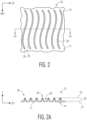
- the first side may comprise a first surface plane and a design element lying in a second surface plane below the first surface plane where the design element provides the fibrous structure with a visually discernable design which users may find aesthetically pleasing.
- the structures of the present invention generally have a first side having at least two different surface planes where the upper most surface is preferentially treated with a lotion.
- Textured fibrous structures useful in the present invention may be created using any number of well-known techniques, such as wet molding or embossing.
- texture is imparted to the fibrous structure during the manufacturing process such as by wet texturing, molding using a drying fabric or by embossing.
- the texture is not the result of printing.
- the fibrous structure is a wet-laid tissue web having a textured surface formed during the manufacturing process by molding the web using an endless belt having a corresponding textured surface.
- the wet-laid tissue web may be manufactured using an endless belt which comprises a continuous three-dimensional element (also referred to herein as a continuous line element) and a reinforcing structure (also referred to herein as a carrier structure or fabric).
- the reinforcing structure comprises a pair of opposed major surfaces - a web contacting surface from which the continuous line elements extend and a machine contacting surface.
- Machinery employed in a typical papermaking operation is well known in the art and may include, for example, vacuum pickup shoes, rollers, and drying cylinders.
- the belt comprises a through-air drying fabric useful for transporting an embryonic tissue web across drying cylinders during the tissue manufacturing process.
- the web contacting surface supports the embryonic tissue web, while the opposite surface, the machine contacting surface, contacts the through-air dryer.
- a plurality of continuous line elements may be disposed on the web-contacting surface for cooperating with, and structuring of, the wet fibrous web during manufacturing.
- the web contacting surface comprises a plurality of spaced apart three-dimensional elements distributed across the web-contacting surface of the carrier structure and together constituting from at least about 15 percent of the web-contacting surface, such as from about 15 to about 35 percent, more preferably from about 18 to about 30 percent, and still more preferably from about 20 to about 25 percent of the web-contacting surface.
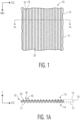
- the fibrous structure 10 has two principle dimensions - a machine direction ("MD"), which is the direction substantially parallel to the principal direction of travel of the tissue web during manufacture and a cross-machine direction ("CD"), which is generally orthogonal to the machine direction.
- MD machine direction
- CD cross-machine direction
- the fibrous structure generally has a textured first side 12 comprising a plurality of continuous elevated line elements 16, also referred to herein as ridges, and a plurality of valleys 18, also referred to herein as land areas, there-between.
- At least one of the calender rolls, particularly the roll to which the lotion is applied is a roll having a metal surface and more preferably a heated steel roll with a substantially smooth surface.
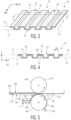
- the lotion 108 which is provided in a solid state and has a penetration hardness greater than about 5.0 mm, such as from about 5.0 to about 30 mm (measured pursuant to the Hardness Method set forth below) is urged against the surface 103 of a second calendering roll 102, which preferably has a metal surface and is heated.
- the calendering-coating apparatus may be provided with an applicator 200 for retaining a solid lotion 108, having a thickness (t), and urging the lotion against the surface 103 of a calender roll 102.
- the lotion thickness (t) may range from about 1 to about 5 cm.
- the lotion thickness (t) may be varied along with one or more process variables to control the amount of lotion added to the web. As the lotion 108 is urged against the calender surface 103 a coating of lotion 110 is applied. The lotion 110 may then be transferred to the surface of a web 100 as it passes through the nip 105.
- the speed of the web 100 as it passes through the nip 105 may be varied to control the amount of lotion added to the web.
- the web speed may range from about 15 to about 300 meters per minute, such as from about 50 to about 250 meters per minute.
- the applicator 200 may comprise a holder 202 and an automatic indexing mechanism 204 for automatically advancing the solid lotion 108 towards the roll surface 103.
- the automatic indexing mechanism may include a pressure sensor for measuring and monitoring the pressure applied to the solid lotion as it is urged against the calender roll surface and a means for advancing the solid lotion towards the roll surface.
- the lotion applicator may comprise a holder and a mechanical means, such as a spring, to maintain the desired pressure against the solid lotion and urge it against the roll surface.
- the automatic indexing mechanism 204 may advance the solid lotion 108 towards the roll surface 103 at a predetermined feed rate (FR) to achieve the desired add-on.
- FR feed rate
- the feed rate may be varied from about 0.05 to about 0.2 mm per second to achieve an add-on from about 0.5 to about 6.0 grams per square meter (gsm) of web.
- the desired add-on (having units of grams per square meter of web) may be achieved by controlling the thickness of the solid lotion (having units of mm or the like), the lotion feed rate (FR, having units of mm per second or the like), the penetration hardness of the lotion (measured as described herein and having units of mm) and the speed of the web (having units of meters per minute or the like) as it passes through the nip.
- the desired lotion add-on may be related to lotion thickness, feed rate, penetration hardness and web speed by Equation 1, below. Lotion Add On ⁇ Thickness ⁇ Feed Rate ⁇ Penetration Hardness Web Speed
- the solid lotion 108 is urged against the second calender roll 102 and a portion of the lotion is transferred to the roll surface 103.
- the lotion coated roll surface 110 is then brought into contact with the first side 122 of the web 100 in the calender nip 105. Within the nip, the lotion is transferred from the roll surface to the upper most surface of the first side 122 of the textured fibrous structure.
- the roll surface may be substantially free from lotion however, in certain instances it is possible that a lotion residue remains on the surface. Lotion residue on the leading rotating sector of the second calender roll 102 may be stripped from the outer surface thereof with the help of a doctor blade (shown in FIG. 6 ) or other stripping device.
- Solid lotions useful in the present invention may be provided with a range of different product forms.
- One of these is a so-called "stick” which is usually a bar of an apparently firm solid material held within an applicator and which retains its structural integrity and shape while being urged against a calender roll.
- a portion of the stick is drawn across the surface of a calender roll a film of the stick composition is transferred to the roll surface.
- the stick has the appearance of a solid article capable of retaining its own shape for a period of time, the material usually has a structured liquid phase so that a film of the composition is readily transferred from the stick to roll surface upon contact.
- Lotion compositions useful in the present invention may be provided as solids that are characterized by their retaining their shape without lateral support under the influence of the Earth's gravity, at temperatures up to at least 50°C.
- the hardness of the solid lotions can be measured in a needle penetration test. Pursuant to this test, as the solid lotions become softer, their needle penetration hardness values increase, with higher hardness values being indicative of a softer lotion composition.
- the lotion compositions have a penetration hardness from 5.0 to 30 mm, more particularly from 7.0 to 25 mm, more particularly from 12 to 22 mm, and still more particularly from 16 to 22 mm measured pursuant to the Hardness Method set forth below. Hardness values within these ranges are indicative of self-supporting solid lotions having a somewhat soft feel but are well suited for indirect application to a tissue web via a conventional calendering apparatus.
- lotions useful in the present invention are formulated as hydrophobic compositions.
- the hydrophobic lotions of the present invention preferably do not comprise added water, which could require an additional drying step. However, minor or trace quantities of water in the lotion that are picked as a result of, for example, ambient humidity can be tolerated without adverse effect.
- hydrophobic lotions useful in the present invention are provided as a solid stick having a penetration hardness ranging from 5.0 to 30 mm and contain about 3 percent or less water, preferably about 1 percent or less water, most preferably about 0.5 percent or less water.
- the solid lotion composition may be hydrophobic and comprise one or more oils.
- the amount of oil in the composition can be from about 30 to about 90 weight percent, more specifically from about 40 to about 70 weight percent, and still more specifically from about 45 to about 60 weight percent.
- Suitable oils include, but are not limited to, the following classes of oils: petroleum or mineral oils, such as mineral oil and petrolatum; or animal oils, such as mink oil and lanolin oil.
- Particularly preferred oils are mineral oils such as petroleum derivatives comprising a mixture of paraffinic and naphthenic (cyclic) hydrocarbons. These include both “light” and “heavy” mineral oils, which are differentiated on the basis of the average molecular weight of the hydrocarbons included.
- the mineral oils useful herein have the following properties: viscosity of from about 5 centistokes (about 5 mm 2 /s) to about 70 centistokes (about 70 mm 2 /s) at 40°C; density between about 0.82 and about 0.89 g/cm 3 at 25°C; flash point between about 138°C and about 216°C; and carbon chain length between about 14 and about 40 carbons.
- lotions useful in the present invention may comprise a wax.
- the amount of wax in the composition can be from about 10 to about 40 weight percent, more specifically from about 10 to about 30 weight percent, and still more specifically from about 15 to about 25 weight percent.
- Suitable waxes include, but are not limited to, the following classes: natural waxes, such as beeswax and carnauba wax; petroleum waxes, such as paraffin and ceresine wax; silicone waxes, such as alkyl methyl siloxanes; or synthetic waxes, such as synthetic beeswax and synthetic sperm wax.
- lotions useful in the present invention may comprise one or more fatty alcohol, which may be present in amounts ranging from about 5 to about 40 weight percent, and more specifically from about 10 to about 30 weight percent.
- Suitable fatty alcohols include alcohols having a carbon chain length of C 14 -C 30 , including acetyl alcohol, stearyl alcohol, behenyl alcohol, and dodecyl alcohol.
- lotions useful in the present invention may be provided as a solid stick having a penetration hardness ranging from 5.0 to 0 mm and comprising from about 30 to about 90 weight percent oil, and from about 10 to about 40 weight percent wax, preferably also containing from about 5 to about 40 weight percent fatty alcohol.
- lotions useful in the present invention may be provided as a solid stick having a penetration hardness ranging from 5.0 to 30 mm and comprising from about 20 to about 50 weight percent mineral oil and from about 10 to about 30 weight percent ceresin wax having a melting point from 64 to 67°C and from about 10 to about 30 weight percent fatty alcohol selected from the group consisting of cetyl alcohol, stearyl alcohol, behenyl alcohol, and dodecyl alcohol.
- additional ingredients may optionally be included in a lotion useful in the present invention.
- Optional ingredients and their corresponding benefits include, without limitation, C 10 or greater fatty alcohols (lubricity, body, opacity), fatty esters (lubricity, feel modification), vitamins (topical medicinal benefits), dimethicone (skin protection), powders (lubricity, oil absorption, skin protection), preservatives and antioxidants (product integrity), ethoxylated fatty alcohols (wetability, process aids), fragrance (consumer appeal), lanolin derivatives (skin moisturization), colorants, optical brighteners, sunscreens, alpha hydroxy acids, natural herbal extracts, and the like.
- the lotion comprises one or more oils selected from the group consisting of plant oils, such as aloe extract, sunflower oil and avocado oil, and silicone oils, such as dimethicone and alkyl methylsilicones.
- lotions useful in the present invention may be provided in hydrophobic forms, the invention is not so limited.
- the lotion may be hydrophilic and comprise water.
- hydrophilic lotions are provided as a solid stick having a penetration hardness ranging from about 5.0 to about 30 mm and comprise from 70 to 99.5 weight percent hydrophilic solvent.
- Tissue webs and products produced according to the present invention not only comprise a lotion that may be readily available for transfer to the user's skin to protect the skin from or prevent further irritation and redness, they may also have favorable physical properties, such as sufficient strength to withstand use without being stiff or rough.
- a tissue product has a basis weight from about 10 to about 80 gsm, and more preferably from about 15 to about 60 gsm and a sheet bulk greater than about 5.0 cc/g, such as from about 5.0 to about 20 cc/g and more preferably greater than about 10 cc/g, such as from about 10 to about 20 cc/g.
- inventive single ply tissue webs may be plied together with other single ply webs prepared according to the present disclosure or with single ply webs of the prior art to form multi-ply tissue products using any ply attachment means known in the art, such as mechanical crimping or adhesive.
- Samples for tensile strength testing are prepared by cutting a 3 inches (76.2 mm) x 5 inches (127 mm) long strip in either the machine direction (MD) or cross-machine direction (CD) orientation using a JDC Precision Sample Cutter (Thwing-Albert Instrument Company, Philadelphia, PA, Model No. JDC 3-10, Ser. No. 37333).
- the instrument used for measuring tensile strengths is an MTS Systems Sintech 11S, Serial No. 6233.
- the data acquisition software is MTS TestWorks TM for Windows Ver. 4 (MTS Systems Corp., Research Triangle Park, NC).
- the load cell is selected from either a 50 or 100 Newton maximum, depending on the strength of the sample being tested, such that the majority of peak load values fall between 10 and 90 percent of the load cell's full-scale value.
- the gauge length between jaws is 4 ⁇ 0.04 inches.
- the jaws are operated using pneumatic-action and are rubber coated.
- the minimum grip face width is 3 inches (76.2 mm), and the approximate height of a jaw is 0.5 inches (12.7 mm).
- the crosshead speed is 10 ⁇ 0.4 inches/min (254 ⁇ 1 mm/min), and the break sensitivity is set at 65 percent.
- the sample is placed in the jaws of the instrument, centered both vertically and horizontally. The test is then started and ends when the specimen breaks.
- the various surface planes and z-directional height differences may be measured using well-known microscopy techniques.
- the cross-section image of a fibrous structure, web or tissue product may be taken using a VHX-1000 Digital Microscope (Keyence Corporation of Osaka, Japan) equipped with VHX-H3M application software.
- a first line may be drawn approximately along the top surface plane of structure with the line tangent to two adjacent elevated elements.
- a second line is drawn approximately along the bottom surface plane of the structure with the line tangent to two adjacent land areas.
- the application software can be instructed to calculate the distances between the planes.
- Tissue basesheets were produced from a furnish comprising northern softwood kraft and eucalyptus kraft using a layered headbox fed by three stock chests such that the webs having three layers (two outer layers and a middle layer) were formed.
- the two outer layers comprised eucalyptus and the middle layer comprised softwood.
- the 3-layered structure had a furnish split of 33% EHWK/34% NBSK/33% EHWK, all on a weight percent basis.
Landscapes
- Health & Medical Sciences (AREA)
- Life Sciences & Earth Sciences (AREA)
- Public Health (AREA)
- Veterinary Medicine (AREA)
- Animal Behavior & Ethology (AREA)
- General Health & Medical Sciences (AREA)
- Epidemiology (AREA)
- Birds (AREA)
- Emergency Medicine (AREA)
- Engineering & Computer Science (AREA)
- Biomedical Technology (AREA)
- Oil, Petroleum & Natural Gas (AREA)
- Chemical & Material Sciences (AREA)
- Heart & Thoracic Surgery (AREA)
- Vascular Medicine (AREA)
- Dermatology (AREA)
- Paper (AREA)
- Medicines Containing Plant Substances (AREA)
- Acyclic And Carbocyclic Compounds In Medicinal Compositions (AREA)
- Medicinal Preparation (AREA)
- Media Introduction/Drainage Providing Device (AREA)
Claims (15)
- Texturierte Faserbahn, aufweisend eine erste Seite, die in Gebrauch von einem Benutzer zu berühren ist, wobei die erste Seite eine oberste Oberfläche, die in einer ersten Oberflächenebene liegt, und eine zweite Oberfläche, die in einer zweiten Oberflächenebene liegt, aufweist, wobei die zweite Oberflächenebene unterhalb der ersten Oberflächenebene liegt, und eine Lotion, die selektiv auf die oberste Oberfläche in einer Menge in einem Bereich von etwa 0,20 bis etwa 3,0 Gramm pro Quadratmeter texturierter Faserbahn aufgetragen ist, wobei die Lotion eine Penetrationshärte, wie gemäß dem vorliegend definierten Verfahren gemessen, in einem Bereich von 5 bis 30 mm aufweist.
- Texturierte Faserbahn nach Anspruch 1, wobei die Lotion etwa 30 bis etwa 90 Gew.-% Öl und etwa 10 bis etwa 40 Gew.-% Wachs umfasst.
- Texturierte Faserbahn nach Anspruch 1, wobei die texturierte Faserbahn eine Gewebebahn ist, die im Wesentlichen aus Holzzellstofffasern besteht und ein Flächengewicht von etwa 10 bis etwa 50 Gramm pro Quadratmeter und eine Blattmasse von mehr als etwa 5,0 g/cm3 aufweist.
- Texturierte Faserbahn nach Anspruch 1, wobei die oberste Oberfläche etwa 70 bis etwa 95 Prozent der Gesamtoberfläche der ersten Seite umfasst.
- Texturierte Faserbahn nach Anspruch 1, wobei der Höhenunterschied in Z-Richtung zwischen der ersten und der zweiten Oberflächenebene von etwa 100 bis etwa 500 µm beträgt.
- Texturierte Faserbahn nach Anspruch 1, wobei die zweite Oberfläche ein Gestaltungselement bildet, wobei das Gestaltungselement vorzugsweise ein kontinuierliches Linienelement oder ein diskretes Linienelement ist.
- Verfahren für ein Herstellen einer mit Lotion behandelten Bahn, umfassend die Schritte:a. Bereitstellen einer Lotionszusammensetzung mit einer Penetrationshärte, wie gemäß dem vorliegend definierten Verfahren gemessen, in einem Bereich von etwa 5 bis etwa 30 mm;b. Bereitstellen eines Spalts zwischen einer Übertragungsoberfläche und einer zweiten Oberfläche;c. Auftragen der Lotion auf die Übertragungsoberfläche;d. Befördern einer Bahn durch den Spalt, wodurch eine nach außen weisende Oberfläche der Bahn von der Übertragungsoberfläche berührt wird, was zu einer Übertragung der Lotion auf die Oberfläche der Bahn führt;und wobei die Bahn eine erste Seite mit einer obersten Oberfläche, die in einer ersten Oberflächenebene liegt, und einer zweiten Oberfläche, die in einer zweiten Oberflächenebene liegt, aufweist, wobei die zweite Oberflächenebene unterhalb der ersten Oberflächenebene liegt, und wobei die Lotion selektiv auf die oberste Oberfläche aufgetragen ist.
- Verfahren nach Anspruch 7, wobei die Übertragungsoberfläche erwärmt wird und eine Oberflächentemperatur in einem Bereich von etwa 70 bis etwa 100 °C aufweist.
- Verfahren nach Anspruch 7, wobei die Übertragungsoberfläche eine Stahlkalanderwalze umfasst und die zweite Oberfläche eine polymerbeschichtete Kalanderwalze umfasst, wobei die Stahlkalanderwalze vorzugsweise erwärmt wird und eine Oberflächentemperatur in einem Bereich von etwa 70 bis etwa 90 °C aufweist.
- Verfahren nach Anspruch 7, wobei die Lotion etwa 30 bis etwa 90 Gew.-% Öl und etwa 10 bis etwa 40 Gew.-% Wachs umfasst.
- Verfahren nach Anspruch 7, wobei die Lotion eine Penetrationshärte von etwa 10 bis etwa 20 mm aufweist und mindestens ein Öl, ausgewählt aus der Gruppe bestehend aus Mineralöl, tierischem Öl, Pflanzenöl und Silikonöl, mindestens ein Wachs, ausgewählt aus der Gruppe bestehend aus natürlichem Wachs, Erdölwachs, Silikonwachs und synthetischem Wachs, und mindestens einen Fettalkohol, ausgewählt aus der Gruppe bestehend aus Cetylalkohol, Stearylalkohol, Behenylalkohol und Dodecylalkohol, umfasst, wobei die Lotion vorzugsweise etwa 30 bis etwa 90 Gew.-% Öl, etwa 10 bis etwa 40 Gew.-% Wachs und etwa 15 bis etwa 25 Gew.-% Fettalkohol umfasst, oder wobei die Lotion ein Polyethylenglykol oder Propylenglykol mit hohem Molekulargewicht umfasst.
- Verfahren nach Anspruch 7, wobei die Bahn eine Stärke aufweist und die Stärke nach Beförderung durch den Spalt reduziert wird.
- Verfahren nach Anspruch 7, wobei die Menge der auf die Oberfläche der Bahn übertragenen Lotion in einem Bereich von etwa 0,20 bis etwa 3,0 Gramm pro Quadratmeter Bahn liegt, oder wobei die Lotion auf etwa 70 bis etwa 95 Prozent der Gesamtoberfläche der Bahn übertragen wird.
- Verfahren nach Anspruch 7, wobei der Schritt des Auftragens der Lotion auf die Übertragungsoberfläche ein Drücken der festen Lotion gegen die Übertragungsoberfläche mit einer Zuführgeschwindigkeit in einem Bereich von etwa 0,05 bis etwa 0,2 mm pro Sekunde umfasst, oder wobei die Bahn mit einer Geschwindigkeit in einem Bereich von etwa 15 bis etwa 300 Meter pro Minute (m/min) durch den Spalt befördert wird.
- Verfahren nach Anspruch 7, ferner umfassend die Schritte des Bereitstellens einer zweiten Lotion mit einer Penetrationshärte in einem Bereich von etwa 5 bis etwa 30 mm und des Auftragens der zweiten festen Lotion auf die Übertragungsoberfläche, wobei die erste und die zweite feste Lotion unterschiedlich sind.
Applications Claiming Priority (1)
| Application Number | Priority Date | Filing Date | Title |
|---|---|---|---|
| PCT/US2020/017008 WO2021158228A1 (en) | 2020-02-06 | 2020-02-06 | Topically treated tissue product |
Publications (3)
| Publication Number | Publication Date |
|---|---|
| EP4100574A1 EP4100574A1 (de) | 2022-12-14 |
| EP4100574A4 EP4100574A4 (de) | 2023-10-11 |
| EP4100574B1 true EP4100574B1 (de) | 2025-04-09 |
Family
ID=77200230
Family Applications (1)
| Application Number | Title | Priority Date | Filing Date |
|---|---|---|---|
| EP20917519.9A Active EP4100574B1 (de) | 2020-02-06 | 2020-02-06 | Topisch behandeltes gewebeprodukt |
Country Status (7)
| Country | Link |
|---|---|
| US (2) | US20230070834A1 (de) |
| EP (1) | EP4100574B1 (de) |
| KR (1) | KR102919568B1 (de) |
| AU (1) | AU2020427100A1 (de) |
| ES (1) | ES3028795T3 (de) |
| MX (1) | MX2022009295A (de) |
| WO (1) | WO2021158228A1 (de) |
Families Citing this family (2)
| Publication number | Priority date | Publication date | Assignee | Title |
|---|---|---|---|---|
| AU2020427100A1 (en) * | 2020-02-06 | 2022-09-22 | Kimberly-Clark Worldwide, Inc. | Topically treated tissue product |
| JP7345449B2 (ja) * | 2020-09-25 | 2023-09-15 | 大王製紙株式会社 | 使い捨て着用物品 |
Family Cites Families (89)
| Publication number | Priority date | Publication date | Assignee | Title |
|---|---|---|---|---|
| NL270757A (de) | 1960-10-31 | |||
| US3337388A (en) | 1964-08-07 | 1967-08-22 | Procter & Gamble | Selective napping of embossed paper toweling and article produced thereby |
| NL6917625A (de) | 1968-12-16 | 1971-05-25 | ||
| JPS5951638B2 (ja) | 1975-09-18 | 1984-12-14 | 神崎製紙 (株) | 均一な透明性を有する粗面化紙の製造法 |
| US4211743A (en) | 1978-05-24 | 1980-07-08 | Nauta Roll Corporation | Apparatus and method for embossing web material |
| US4191609A (en) | 1979-03-09 | 1980-03-04 | The Procter & Gamble Company | Soft absorbent imprinted paper sheet and method of manufacture thereof |
| US4536431A (en) | 1983-08-05 | 1985-08-20 | Wyckoff Robert L | Method of texturing a surface and articles textured by the method |
| US4528239A (en) | 1983-08-23 | 1985-07-09 | The Procter & Gamble Company | Deflection member |
| US5024799A (en) | 1987-09-14 | 1991-06-18 | Tredegar Industries, Inc. | Method for producing an embossed oriented film |
| US5607551A (en) | 1993-06-24 | 1997-03-04 | Kimberly-Clark Corporation | Soft tissue |
| US5643588A (en) | 1994-11-28 | 1997-07-01 | The Procter & Gamble Company | Diaper having a lotioned topsheet |
| US5830487A (en) | 1996-06-05 | 1998-11-03 | The Procter & Gamble Company | Anti-viral, anhydrous, and mild skin lotions for application to tissue paper products |
| US6238682B1 (en) | 1993-12-13 | 2001-05-29 | The Procter & Gamble Company | Anhydrous skin lotions having antimicrobial components for application to tissue paper products which mitigate the potential for skin irritation |
| US5695607A (en) | 1994-04-01 | 1997-12-09 | James River Corporation Of Virginia | Soft-single ply tissue having very low sidedness |
| US5549790A (en) | 1994-06-29 | 1996-08-27 | The Procter & Gamble Company | Multi-region paper structures having a transition region interconnecting relatively thinner regions disposed at different elevations, and apparatus and process for making the same |
| FR2728152B1 (fr) | 1994-12-16 | 1997-01-24 | Kaysersberg Sa | Papier absorbant gaufre a motifs combines |
| CA2208068C (en) | 1994-12-19 | 2000-11-28 | The Procter & Gamble Company | Medicated tissue paper product |
| US5665426A (en) | 1995-02-06 | 1997-09-09 | Kimberly-Clark Corporation | Soft treated tissue |
| US5624676A (en) | 1995-08-03 | 1997-04-29 | The Procter & Gamble Company | Lotioned tissue paper containing an emollient and a polyol polyester immobilizing agent |
| GB9524450D0 (en) | 1995-11-30 | 1996-01-31 | Kaysersberg Sa | Sheet of absorbent paper which includes watermarked patterns,manufacturing process and manufacturing device |
| US5662758A (en) | 1996-01-10 | 1997-09-02 | The Procter & Gamble Company | Composite material releasably sealable to a target surface when pressed thereagainst and method of making |
| US6277226B1 (en) | 1996-03-20 | 2001-08-21 | Fort James Corporation | Method of processing laminated embossed webs having equal embossed definition |
| US6420013B1 (en) | 1996-06-14 | 2002-07-16 | The Procter & Gamble Company | Multiply tissue paper |
| US5840403A (en) * | 1996-06-14 | 1998-11-24 | The Procter & Gamble Company | Multi-elevational tissue paper containing selectively disposed chemical papermaking additive |
| US6277467B1 (en) | 1996-12-23 | 2001-08-21 | Fort James Corporation | Soft, bulky single-ply tissue having a serpentine configuration and low sidedness and method for its manufacture |
| US6217707B1 (en) | 1996-12-31 | 2001-04-17 | Kimberly-Clark Worldwide, Inc. | Controlled coverage additive application |
| US6030690A (en) | 1997-04-23 | 2000-02-29 | The Procter & Gamble Company | High pressure embossing and paper produced thereby |
| US6099940A (en) | 1997-07-16 | 2000-08-08 | The Procter & Gamble Company | Selectively-activatible three-dimensional sheet material having multi-stage progressive activation to deliver a substance to a target surface |
| US5869075A (en) * | 1997-08-15 | 1999-02-09 | Kimberly-Clark Worldwide, Inc. | Soft tissue achieved by applying a solid hydrophilic lotion |
| US6179961B1 (en) | 1997-10-08 | 2001-01-30 | The Procter & Gamble Company | Tissue paper having a substantive anhydrous softening mixture deposited thereon |
| ITFI980031A1 (it) | 1998-02-13 | 1999-08-13 | Perini Fabio Spa | Dispositivo goffratore e laminatore per materiale nastriforme |
| JP4041209B2 (ja) | 1998-05-06 | 2008-01-30 | 小林 昌志 | 肌触りの柔らかなティシューペーパー及びその製造方法、装置 |
| EP1165040B1 (de) * | 1999-03-31 | 2004-10-20 | The Procter & Gamble Company | Befeuchtetes wischtuch mit lotion, welche die abgabe verbessert |
| US6398909B1 (en) | 1999-06-17 | 2002-06-04 | Valmet-Karlstad Aktiebolag | Method and apparatus for imprinting, drying, and reeling a fibrous web |
| US7118796B2 (en) | 1999-11-01 | 2006-10-10 | Fort James Corporation | Multi-ply absorbent paper product having impressed pattern |
| US6455129B1 (en) | 1999-11-12 | 2002-09-24 | Fort James Corporation | Single-ply embossed absorbent paper products |
| US6610173B1 (en) * | 2000-11-03 | 2003-08-26 | Kimberly-Clark Worldwide, Inc. | Three-dimensional tissue and methods for making the same |
| US6547928B2 (en) | 2000-12-15 | 2003-04-15 | The Procter & Gamble Company | Soft tissue paper having a softening composition containing an extensional viscosity modifier deposited thereon |
| US7407560B2 (en) | 2001-02-16 | 2008-08-05 | The Procter & Gamble Company | Lotioned and embossed tissue paper |
| US6582560B2 (en) | 2001-03-07 | 2003-06-24 | Kimberly-Clark Worldwide, Inc. | Method for using water insoluble chemical additives with pulp and products made by said method |
| US6701637B2 (en) | 2001-04-20 | 2004-03-09 | Kimberly-Clark Worldwide, Inc. | Systems for tissue dried with metal bands |
| US6729869B2 (en) | 2001-07-16 | 2004-05-04 | Sca Hygiene Products Gmbh | Device for applying an embossing to a web of tissue paper |
| US6913673B2 (en) | 2001-12-19 | 2005-07-05 | Kimberly-Clark Worldwide, Inc. | Heated embossing and ply attachment |
| US6716309B2 (en) | 2001-12-21 | 2004-04-06 | Kimberly-Clark Worldwide, Inc. | Method for the application of viscous compositions to the surface of a paper web and products made therefrom |
| DE60204120T2 (de) | 2002-05-14 | 2006-02-02 | Georgia-Pacific France | Verfahren zum markieren einer Papierbahn, Papierbahn mit einem Wasserzeichenmuster |
| US7008507B2 (en) | 2002-12-31 | 2006-03-07 | Kimberly-Clark Worldwide, Inc. | Non-impact printing method for applying compositions to webs and products produced therefrom |
| CN1780954B (zh) | 2003-05-01 | 2010-04-28 | 强生有限公司 | 一种多孔或吸收性非织造片材及其制造方法 |
| US7396593B2 (en) | 2003-05-19 | 2008-07-08 | Kimberly-Clark Worldwide, Inc. | Single ply tissue products surface treated with a softening agent |
| US7470345B2 (en) | 2003-12-30 | 2008-12-30 | Kimberly-Clark Worldwide, Inc. | Rolled paper product having high bulk and softness |
| CN1946902A (zh) * | 2004-04-23 | 2007-04-11 | 宝洁公司 | 包含表面处理组合物和洗剂组合物的纤维结构 |
| US20050247416A1 (en) * | 2004-05-06 | 2005-11-10 | Forry Mark E | Patterned fibrous structures |
| US7624765B2 (en) | 2004-12-23 | 2009-12-01 | Kimberly-Clark Worldwide, Inc. | Woven throughdrying fabric having highlighted design elements |
| US7799167B2 (en) | 2005-06-09 | 2010-09-21 | Kawano Paper Co., Ltd. | Embossed crepe paper and its manufacturing method |
| US7527851B2 (en) | 2005-06-21 | 2009-05-05 | Georgia-Pacific Consumer Products Llp | Tissue product with mixed inclination embosses |
| US20070071797A1 (en) * | 2005-09-16 | 2007-03-29 | Hernandez-Munoa Diego A | Lotioned fibrous structures |
| ITFI20050218A1 (it) | 2005-10-20 | 2007-04-21 | Guglielmo Biagiotti | Perfezionamenti ai metodi e dispositivi per la produzione di carte tissue e velo di carta da questi derivante |
| US7820010B2 (en) | 2005-12-15 | 2010-10-26 | Kimberly-Clark Worldwide, Inc. | Treated tissue products having increased strength |
| DE102006010709A1 (de) | 2006-03-08 | 2007-09-13 | Metsä Tissue Oyj | Prägevorrichtung für mindestens zweilagige Flächenprodukte wie Toilettenpapier, Taschentücher o. dgl. |
| US8455077B2 (en) | 2006-05-16 | 2013-06-04 | The Procter & Gamble Company | Fibrous structures comprising a region of auxiliary bonding and methods for making same |
| US7611607B2 (en) | 2006-10-27 | 2009-11-03 | Voith Patent Gmbh | Rippled papermaking fabrics for creped and uncreped tissue manufacturing processes |
| US7942995B2 (en) | 2007-09-05 | 2011-05-17 | The Procter & Gamble Company | Method for converting a multi-ply paper product |
| FR2928383B1 (fr) | 2008-03-06 | 2010-12-31 | Georgia Pacific France | Feuille gaufree comportant un pli en materiau hydrosoluble et procede de realisation d'une telle feuille. |
| NZ568698A (en) | 2008-05-27 | 2010-12-24 | Corcel Ip Ltd | Method and machine for forming single face corrugated board |
| AU2008359630A1 (en) | 2008-07-25 | 2010-01-28 | Sca Hygiene Products Ab | Method and device for producing a multi-ply fibrous product and multi-ply fibrous product |
| DE102008041951A1 (de) | 2008-09-10 | 2010-03-11 | Voith Patent Gmbh | Verfahren zur Vorhersage der Oberflächentopographie von Tissuepapier |
| TWI414425B (zh) | 2009-03-13 | 2013-11-11 | Chan Li Machinery Co Ltd | Multi-layer tissue with pressure-resistant adhesive structure |
| US9243368B2 (en) * | 2009-05-19 | 2016-01-26 | The Procter & Gamble Company | Embossed fibrous structures and methods for making same |
| US20100297402A1 (en) | 2009-05-21 | 2010-11-25 | Donn Nathan Boatman | Paper product produced by a high pressure embossing apparatus |
| US20100297286A1 (en) | 2009-05-21 | 2010-11-25 | Donn Nathan Boatman | High pressure embossing apparatus |
| JP4695728B1 (ja) | 2009-12-28 | 2011-06-08 | 大王製紙株式会社 | ティシュペーパー製品用の二次原反ロールの製造方法 |
| JP5395101B2 (ja) * | 2011-02-28 | 2014-01-22 | 大王製紙株式会社 | トイレットペーパーの製造方法 |
| CA2780735C (en) * | 2011-07-01 | 2018-04-24 | The Procter & Gamble Company | Lotion composition and fibrous structure comprising same |
| US8481133B2 (en) | 2011-09-21 | 2013-07-09 | Kimberly-Clark Worldwide, Inc. | High bulk rolled tissue products |
| CN102555304A (zh) | 2012-01-06 | 2012-07-11 | 金红叶纸业集团有限公司 | 压花辊组及利用压花辊组制备的生活用纸 |
| US20140004307A1 (en) * | 2012-06-29 | 2014-01-02 | The Procter & Gamble Company | Textured Fibrous Webs, Apparatus And Methods For Forming Textured Fibrous Webs |
| EP2692948B2 (de) | 2012-08-03 | 2023-04-19 | Sca Tissue France | Mehrlagiges Tissuepapierprodukt und Verfahren zu dessen Herstellung |
| JP5993031B2 (ja) | 2013-05-07 | 2016-09-14 | 菊夫 山田 | 水解紙の製造方法 |
| US9416496B2 (en) * | 2013-10-16 | 2016-08-16 | Georgia-Pacific Consumer Products Lp | Method for reducing the bulk and increasing the density of a tissue product |
| US10711395B2 (en) * | 2015-07-24 | 2020-07-14 | The Procter & Gamble Company | Textured fibrous structures |
| US10794007B2 (en) * | 2016-03-24 | 2020-10-06 | Kimberly-Clark Worldwide, Inc. | Lotion treated through-air dried tissue |
| KR102374947B1 (ko) * | 2016-05-09 | 2022-03-17 | 킴벌리-클라크 월드와이드, 인크. | 국소 처리된 패턴을 갖는 티슈 제품 |
| WO2017196516A1 (en) * | 2016-05-09 | 2017-11-16 | Kimberly-Clark Worldwide, Inc. | Patterned tissue product |
| GB2564820B (en) | 2016-05-09 | 2021-03-03 | Kimberly Clark Co | Texture subtractive patterning |
| US10422083B2 (en) * | 2016-11-22 | 2019-09-24 | Kimberly-Clark Worldwide, Inc. | Embossed multi-ply tissue product |
| US11466409B2 (en) * | 2018-04-27 | 2022-10-11 | Kimberly-Clark Worldwide, Inc. | Multi-ply tissue product produced from a single ply tissue web |
| CN210657388U (zh) * | 2019-02-25 | 2020-06-02 | 山田菊夫 | 具有非水解性的纤维片材 |
| CN113905716A (zh) * | 2019-06-06 | 2022-01-07 | 宝洁公司 | 衍生自可再生资源的护肤组合物和包含其的吸收制品 |
| AU2020427100A1 (en) * | 2020-02-06 | 2022-09-22 | Kimberly-Clark Worldwide, Inc. | Topically treated tissue product |
| EP4472471A4 (de) * | 2022-02-02 | 2025-11-26 | Kimberly Clark Co | Gekreppte tissuepapierprodukte mit einem in maschinenrichtung ausgerichteten muster |
-
2020
- 2020-02-06 AU AU2020427100A patent/AU2020427100A1/en active Pending
- 2020-02-06 KR KR1020227030309A patent/KR102919568B1/ko active Active
- 2020-02-06 US US17/797,372 patent/US20230070834A1/en not_active Abandoned
- 2020-02-06 MX MX2022009295A patent/MX2022009295A/es unknown
- 2020-02-06 ES ES20917519T patent/ES3028795T3/es active Active
- 2020-02-06 WO PCT/US2020/017008 patent/WO2021158228A1/en not_active Ceased
- 2020-02-06 EP EP20917519.9A patent/EP4100574B1/de active Active
-
2024
- 2024-03-28 US US18/619,776 patent/US12329621B2/en active Active
Also Published As
| Publication number | Publication date |
|---|---|
| ES3028795T3 (en) | 2025-06-20 |
| MX2022009295A (es) | 2022-08-22 |
| AU2020427100A1 (en) | 2022-09-22 |
| KR20220131544A (ko) | 2022-09-28 |
| KR102919568B1 (ko) | 2026-02-02 |
| US12329621B2 (en) | 2025-06-17 |
| US20230070834A1 (en) | 2023-03-09 |
| EP4100574A4 (de) | 2023-10-11 |
| EP4100574A1 (de) | 2022-12-14 |
| WO2021158228A1 (en) | 2021-08-12 |
| US20240238134A1 (en) | 2024-07-18 |
Similar Documents
| Publication | Publication Date | Title |
|---|---|---|
| AU2017264499B2 (en) | Topically treated patterned tissue product | |
| US12329621B2 (en) | Topically treated tissue product | |
| JP5769229B2 (ja) | クレープ紙の加工方法及び加工装置 | |
| AU2014379599B2 (en) | Two sided multi-ply tissue product | |
| KR101899181B1 (ko) | 화장지의 제조 방법 및 화장지 | |
| US7407560B2 (en) | Lotioned and embossed tissue paper | |
| AU2004312505B2 (en) | Rolled paper product having high bulk and softness | |
| KR102509230B1 (ko) | 질감 감산 패터닝 | |
| CA2436521C (en) | Lotioned and embossed tissuepaper | |
| EP3277143B1 (de) | Glatte und voluminöse gerollte tissueprodukte | |
| KR102325693B1 (ko) | 패턴이 있는 티슈 제품 | |
| US11661706B2 (en) | Single ply tissue having improved cross-machine direction properties | |
| JP5118483B2 (ja) | 突起ローション沈積物を有するティッシュ紙 | |
| KR20250073641A (ko) | 티슈 제품 | |
| AU2002240465A1 (en) | Lotioned and embossed tissuepaper |
Legal Events
| Date | Code | Title | Description |
|---|---|---|---|
| STAA | Information on the status of an ep patent application or granted ep patent |
Free format text: STATUS: THE INTERNATIONAL PUBLICATION HAS BEEN MADE |
|
| PUAI | Public reference made under article 153(3) epc to a published international application that has entered the european phase |
Free format text: ORIGINAL CODE: 0009012 |
|
| STAA | Information on the status of an ep patent application or granted ep patent |
Free format text: STATUS: REQUEST FOR EXAMINATION WAS MADE |
|
| 17P | Request for examination filed |
Effective date: 20220831 |
|
| AK | Designated contracting states |
Kind code of ref document: A1 Designated state(s): AL AT BE BG CH CY CZ DE DK EE ES FI FR GB GR HR HU IE IS IT LI LT LU LV MC MK MT NL NO PL PT RO RS SE SI SK SM TR |
|
| DAV | Request for validation of the european patent (deleted) | ||
| DAX | Request for extension of the european patent (deleted) | ||
| A4 | Supplementary search report drawn up and despatched |
Effective date: 20230913 |
|
| RIC1 | Information provided on ipc code assigned before grant |
Ipc: D21H 27/02 20060101ALI20230907BHEP Ipc: D21F 11/12 20060101ALI20230907BHEP Ipc: A61K 8/92 20060101ALI20230907BHEP Ipc: A47K 10/16 20060101ALI20230907BHEP Ipc: D21H 27/40 20060101ALI20230907BHEP Ipc: D21H 23/54 20060101ALI20230907BHEP Ipc: D21H 23/60 20060101AFI20230907BHEP |
|
| STAA | Information on the status of an ep patent application or granted ep patent |
Free format text: STATUS: EXAMINATION IS IN PROGRESS |
|
| 17Q | First examination report despatched |
Effective date: 20240514 |
|
| GRAP | Despatch of communication of intention to grant a patent |
Free format text: ORIGINAL CODE: EPIDOSNIGR1 |
|
| STAA | Information on the status of an ep patent application or granted ep patent |
Free format text: STATUS: GRANT OF PATENT IS INTENDED |
|
| INTG | Intention to grant announced |
Effective date: 20241004 |
|
| GRAS | Grant fee paid |
Free format text: ORIGINAL CODE: EPIDOSNIGR3 |
|
| P01 | Opt-out of the competence of the unified patent court (upc) registered |
Free format text: CASE NUMBER: APP_3988/2025 Effective date: 20250124 |
|
| RAP3 | Party data changed (applicant data changed or rights of an application transferred) |
Owner name: KIMBERLY-CLARK WORLDWIDE, INC. |
|
| GRAA | (expected) grant |
Free format text: ORIGINAL CODE: 0009210 |
|
| STAA | Information on the status of an ep patent application or granted ep patent |
Free format text: STATUS: THE PATENT HAS BEEN GRANTED |
|
| AK | Designated contracting states |
Kind code of ref document: B1 Designated state(s): AL AT BE BG CH CY CZ DE DK EE ES FI FR GB GR HR HU IE IS IT LI LT LU LV MC MK MT NL NO PL PT RO RS SE SI SK SM TR |
|
| REG | Reference to a national code |
Ref country code: GB Ref legal event code: FG4D |
|
| REG | Reference to a national code |
Ref country code: CH Ref legal event code: EP |
|
| REG | Reference to a national code |
Ref country code: DE Ref legal event code: R096 Ref document number: 602020049344 Country of ref document: DE |
|
| REG | Reference to a national code |
Ref country code: IE Ref legal event code: FG4D |
|
| REG | Reference to a national code |
Ref country code: ES Ref legal event code: FG2A Ref document number: 3028795 Country of ref document: ES Kind code of ref document: T3 Effective date: 20250620 |
|
| REG | Reference to a national code |
Ref country code: NL Ref legal event code: MP Effective date: 20250409 |
|
| PG25 | Lapsed in a contracting state [announced via postgrant information from national office to epo] |
Ref country code: NL Free format text: LAPSE BECAUSE OF FAILURE TO SUBMIT A TRANSLATION OF THE DESCRIPTION OR TO PAY THE FEE WITHIN THE PRESCRIBED TIME-LIMIT Effective date: 20250409 |
|
| REG | Reference to a national code |
Ref country code: AT Ref legal event code: MK05 Ref document number: 1783610 Country of ref document: AT Kind code of ref document: T Effective date: 20250409 |
|
| PG25 | Lapsed in a contracting state [announced via postgrant information from national office to epo] |
Ref country code: PT Free format text: LAPSE BECAUSE OF FAILURE TO SUBMIT A TRANSLATION OF THE DESCRIPTION OR TO PAY THE FEE WITHIN THE PRESCRIBED TIME-LIMIT Effective date: 20250811 Ref country code: FI Free format text: LAPSE BECAUSE OF FAILURE TO SUBMIT A TRANSLATION OF THE DESCRIPTION OR TO PAY THE FEE WITHIN THE PRESCRIBED TIME-LIMIT Effective date: 20250409 |
|
| REG | Reference to a national code |
Ref country code: LT Ref legal event code: MG9D |
|
| PG25 | Lapsed in a contracting state [announced via postgrant information from national office to epo] |
Ref country code: NO Free format text: LAPSE BECAUSE OF FAILURE TO SUBMIT A TRANSLATION OF THE DESCRIPTION OR TO PAY THE FEE WITHIN THE PRESCRIBED TIME-LIMIT Effective date: 20250709 Ref country code: GR Free format text: LAPSE BECAUSE OF FAILURE TO SUBMIT A TRANSLATION OF THE DESCRIPTION OR TO PAY THE FEE WITHIN THE PRESCRIBED TIME-LIMIT Effective date: 20250710 |
|
| PG25 | Lapsed in a contracting state [announced via postgrant information from national office to epo] |
Ref country code: PL Free format text: LAPSE BECAUSE OF FAILURE TO SUBMIT A TRANSLATION OF THE DESCRIPTION OR TO PAY THE FEE WITHIN THE PRESCRIBED TIME-LIMIT Effective date: 20250409 |
|
| PG25 | Lapsed in a contracting state [announced via postgrant information from national office to epo] |
Ref country code: BG Free format text: LAPSE BECAUSE OF FAILURE TO SUBMIT A TRANSLATION OF THE DESCRIPTION OR TO PAY THE FEE WITHIN THE PRESCRIBED TIME-LIMIT Effective date: 20250409 |
|
| PG25 | Lapsed in a contracting state [announced via postgrant information from national office to epo] |
Ref country code: HR Free format text: LAPSE BECAUSE OF FAILURE TO SUBMIT A TRANSLATION OF THE DESCRIPTION OR TO PAY THE FEE WITHIN THE PRESCRIBED TIME-LIMIT Effective date: 20250409 |
|
| PG25 | Lapsed in a contracting state [announced via postgrant information from national office to epo] |
Ref country code: AT Free format text: LAPSE BECAUSE OF FAILURE TO SUBMIT A TRANSLATION OF THE DESCRIPTION OR TO PAY THE FEE WITHIN THE PRESCRIBED TIME-LIMIT Effective date: 20250409 |
|
| PG25 | Lapsed in a contracting state [announced via postgrant information from national office to epo] |
Ref country code: RS Free format text: LAPSE BECAUSE OF FAILURE TO SUBMIT A TRANSLATION OF THE DESCRIPTION OR TO PAY THE FEE WITHIN THE PRESCRIBED TIME-LIMIT Effective date: 20250709 |
|
| PG25 | Lapsed in a contracting state [announced via postgrant information from national office to epo] |
Ref country code: IS Free format text: LAPSE BECAUSE OF FAILURE TO SUBMIT A TRANSLATION OF THE DESCRIPTION OR TO PAY THE FEE WITHIN THE PRESCRIBED TIME-LIMIT Effective date: 20250809 |
|
| PG25 | Lapsed in a contracting state [announced via postgrant information from national office to epo] |
Ref country code: LV Free format text: LAPSE BECAUSE OF FAILURE TO SUBMIT A TRANSLATION OF THE DESCRIPTION OR TO PAY THE FEE WITHIN THE PRESCRIBED TIME-LIMIT Effective date: 20250409 |
|
| REG | Reference to a national code |
Ref country code: DE Ref legal event code: R097 Ref document number: 602020049344 Country of ref document: DE |
|
| PG25 | Lapsed in a contracting state [announced via postgrant information from national office to epo] |
Ref country code: SM Free format text: LAPSE BECAUSE OF FAILURE TO SUBMIT A TRANSLATION OF THE DESCRIPTION OR TO PAY THE FEE WITHIN THE PRESCRIBED TIME-LIMIT Effective date: 20250409 Ref country code: DK Free format text: LAPSE BECAUSE OF FAILURE TO SUBMIT A TRANSLATION OF THE DESCRIPTION OR TO PAY THE FEE WITHIN THE PRESCRIBED TIME-LIMIT Effective date: 20250409 |
|
| PG25 | Lapsed in a contracting state [announced via postgrant information from national office to epo] |
Ref country code: CZ Free format text: LAPSE BECAUSE OF FAILURE TO SUBMIT A TRANSLATION OF THE DESCRIPTION OR TO PAY THE FEE WITHIN THE PRESCRIBED TIME-LIMIT Effective date: 20250409 |
|
| PG25 | Lapsed in a contracting state [announced via postgrant information from national office to epo] |
Ref country code: EE Free format text: LAPSE BECAUSE OF FAILURE TO SUBMIT A TRANSLATION OF THE DESCRIPTION OR TO PAY THE FEE WITHIN THE PRESCRIBED TIME-LIMIT Effective date: 20250409 |
|
| PG25 | Lapsed in a contracting state [announced via postgrant information from national office to epo] |
Ref country code: SK Free format text: LAPSE BECAUSE OF FAILURE TO SUBMIT A TRANSLATION OF THE DESCRIPTION OR TO PAY THE FEE WITHIN THE PRESCRIBED TIME-LIMIT Effective date: 20250409 |
|
| PLBE | No opposition filed within time limit |
Free format text: ORIGINAL CODE: 0009261 |
|
| STAA | Information on the status of an ep patent application or granted ep patent |
Free format text: STATUS: NO OPPOSITION FILED WITHIN TIME LIMIT |
|
| REG | Reference to a national code |
Ref country code: CH Ref legal event code: L10 Free format text: ST27 STATUS EVENT CODE: U-0-0-L10-L00 (AS PROVIDED BY THE NATIONAL OFFICE) Effective date: 20260218 |
|
| 26N | No opposition filed |
Effective date: 20260112 |
|
| PGFP | Annual fee paid to national office [announced via postgrant information from national office to epo] |
Ref country code: GB Payment date: 20260227 Year of fee payment: 7 |
|
| PGFP | Annual fee paid to national office [announced via postgrant information from national office to epo] |
Ref country code: ES Payment date: 20260302 Year of fee payment: 7 |
|
| PGFP | Annual fee paid to national office [announced via postgrant information from national office to epo] |
Ref country code: IT Payment date: 20260219 Year of fee payment: 7 |