EP4097993B1 - Virtualisierung einer surround-schallortung - Google Patents
Virtualisierung einer surround-schallortung Download PDFInfo
- Publication number
- EP4097993B1 EP4097993B1 EP21707107.5A EP21707107A EP4097993B1 EP 4097993 B1 EP4097993 B1 EP 4097993B1 EP 21707107 A EP21707107 A EP 21707107A EP 4097993 B1 EP4097993 B1 EP 4097993B1
- Authority
- EP
- European Patent Office
- Prior art keywords
- audio
- field
- occluding
- binaurally
- drivers
- Prior art date
- Legal status (The legal status is an assumption and is not a legal conclusion. Google has not performed a legal analysis and makes no representation as to the accuracy of the status listed.)
- Active
Links
Images



Classifications
-
- H—ELECTRICITY
- H04—ELECTRIC COMMUNICATION TECHNIQUE
- H04S—STEREOPHONIC SYSTEMS
- H04S3/00—Systems employing more than two channels, e.g. quadraphonic
- H04S3/002—Non-adaptive circuits, e.g. manually adjustable or static, for enhancing the sound image or the spatial distribution
- H04S3/004—For headphones
-
- H—ELECTRICITY
- H04—ELECTRIC COMMUNICATION TECHNIQUE
- H04R—LOUDSPEAKERS, MICROPHONES, GRAMOPHONE PICK-UPS OR LIKE ACOUSTIC ELECTROMECHANICAL TRANSDUCERS; ELECTRIC HEARING AIDS; PUBLIC ADDRESS SYSTEMS
- H04R3/00—Circuits for transducers
- H04R3/12—Circuits for transducers for distributing signals to two or more loudspeakers
-
- H—ELECTRICITY
- H04—ELECTRIC COMMUNICATION TECHNIQUE
- H04R—LOUDSPEAKERS, MICROPHONES, GRAMOPHONE PICK-UPS OR LIKE ACOUSTIC ELECTROMECHANICAL TRANSDUCERS; ELECTRIC HEARING AIDS; PUBLIC ADDRESS SYSTEMS
- H04R5/00—Stereophonic arrangements
- H04R5/02—Spatial or constructional arrangements of loudspeakers
-
- H—ELECTRICITY
- H04—ELECTRIC COMMUNICATION TECHNIQUE
- H04R—LOUDSPEAKERS, MICROPHONES, GRAMOPHONE PICK-UPS OR LIKE ACOUSTIC ELECTROMECHANICAL TRANSDUCERS; ELECTRIC HEARING AIDS; PUBLIC ADDRESS SYSTEMS
- H04R5/00—Stereophonic arrangements
- H04R5/033—Headphones for stereophonic communication
-
- H—ELECTRICITY
- H04—ELECTRIC COMMUNICATION TECHNIQUE
- H04R—LOUDSPEAKERS, MICROPHONES, GRAMOPHONE PICK-UPS OR LIKE ACOUSTIC ELECTROMECHANICAL TRANSDUCERS; ELECTRIC HEARING AIDS; PUBLIC ADDRESS SYSTEMS
- H04R5/00—Stereophonic arrangements
- H04R5/04—Circuit arrangements, e.g. for selective connection of amplifier inputs/outputs to loudspeakers, for loudspeaker detection, or for adaptation of settings to personal preferences or hearing impairments
-
- H—ELECTRICITY
- H04—ELECTRIC COMMUNICATION TECHNIQUE
- H04S—STEREOPHONIC SYSTEMS
- H04S3/00—Systems employing more than two channels, e.g. quadraphonic
- H04S3/008—Systems employing more than two channels, e.g. quadraphonic in which the audio signals are in digital form, i.e. employing more than two discrete digital channels
-
- H—ELECTRICITY
- H04—ELECTRIC COMMUNICATION TECHNIQUE
- H04R—LOUDSPEAKERS, MICROPHONES, GRAMOPHONE PICK-UPS OR LIKE ACOUSTIC ELECTROMECHANICAL TRANSDUCERS; ELECTRIC HEARING AIDS; PUBLIC ADDRESS SYSTEMS
- H04R1/00—Details of transducers, loudspeakers or microphones
- H04R1/10—Earpieces; Attachments therefor ; Earphones; Monophonic headphones
- H04R1/1008—Earpieces of the supra-aural or circum-aural type
-
- H—ELECTRICITY
- H04—ELECTRIC COMMUNICATION TECHNIQUE
- H04S—STEREOPHONIC SYSTEMS
- H04S2400/00—Details of stereophonic systems covered by H04S but not provided for in its groups
- H04S2400/01—Multi-channel, i.e. more than two input channels, sound reproduction with two speakers wherein the multi-channel information is substantially preserved
-
- H—ELECTRICITY
- H04—ELECTRIC COMMUNICATION TECHNIQUE
- H04S—STEREOPHONIC SYSTEMS
- H04S2400/00—Details of stereophonic systems covered by H04S but not provided for in its groups
- H04S2400/05—Generation or adaptation of centre channel in multi-channel audio systems
-
- H—ELECTRICITY
- H04—ELECTRIC COMMUNICATION TECHNIQUE
- H04S—STEREOPHONIC SYSTEMS
- H04S2400/00—Details of stereophonic systems covered by H04S but not provided for in its groups
- H04S2400/11—Positioning of individual sound objects, e.g. moving airplane, within a sound field
-
- H—ELECTRICITY
- H04—ELECTRIC COMMUNICATION TECHNIQUE
- H04S—STEREOPHONIC SYSTEMS
- H04S2420/00—Techniques used stereophonic systems covered by H04S but not provided for in its groups
- H04S2420/01—Enhancing the perception of the sound image or of the spatial distribution using head related transfer functions [HRTF's] or equivalents thereof, e.g. interaural time difference [ITD] or interaural level difference [ILD]
-
- H—ELECTRICITY
- H04—ELECTRIC COMMUNICATION TECHNIQUE
- H04S—STEREOPHONIC SYSTEMS
- H04S7/00—Indicating arrangements; Control arrangements, e.g. balance control
- H04S7/30—Control circuits for electronic adaptation of the sound field
- H04S7/302—Electronic adaptation of stereophonic sound system to listener position or orientation
- H04S7/303—Tracking of listener position or orientation
- H04S7/304—For headphones
Definitions
- This disclosure relates to virtually localizing sound in a surround sound audio system.
- Surround sound audio systems can virtualize sound sources in three dimensions using audio drivers located around and above the listener. These audio systems are expensive, and may need to be custom designed for the listening area.
- US 2009/304214 discloses systems and methods for providing surround sound using speakers and headphones.
- the present invention relates to a computer program product and a surround sound audio system according to the independent claims.
- Advantageous embodiments are set forth in the dependent claims.
- a computer program product having a non-transitory computer-readable medium including computer program logic encoded thereon that, when performed on a surround sound audio system that is configured to render left front, right front, and center front audio signals, and also render left and right near-field binaurally-encoded audio signals, causes the surround sound audio system to develop the left and right near-field binaurally-encoded audio signals and provide the left near-field binaurally-encoded audio signal to a left non-occluding near-field driver and provide the right near-field binaurally-encoded audio signal to a right non-occluding near-field driver.
- the left and right near-field binaurally-encoded audio signals are developed from a combination of front left height, front right height, back left height, and back right height audio tracks.
- the left non-occluding near-field driver is part of a first open-audio device that is configured to be worn such that the left non-occluding near-field driver is proximate but not in the left ear canal of a wearer of the first open-audio device
- the right non-occluding near-field driver is part of a second open-audio device that is configured to be worn such that the right non-occluding near-field driver is proximate but not in the right ear canal of a wearer of the second open-audio device.
- the first and second open-audio devices each comprise a housing, an acoustic radiator in the housing, a sound-emitting opening in the housing, and a support structure that is configured to carry the housing on a user's head such that the housing is held proximate an ear of the user with the sound-emitting opening anterior of and proximate the tragus of the ear.
- the first open-audio device comprises a left temple piece of audio eyeglasses and the second open-audio device comprises a right temple piece of the audio eyeglasses.
- the computer program product further causes the left near-field binaurally-encoded audio signal to be wirelessly provided to the left non-occluding near-field driver and the right near-field binaurally-encoded audio signal to be wirelessly provided to the right non-occluding near-field driver.
- the left and right non-occluding near-field drivers are located within one meter of an optimal listening area of the surround sound audio system.
- the left non-occluding near-field driver is located such that a ratio of sound pressure from the left non-occluding near-field driver to sound pressure from other sound sources, including the right non-occluding near-field driver, at a left ear of a listener is at least 15 dB
- the right non-occluding near-field driver is located such that a ratio of sound pressure from the right non-occluding near-field driver to sound pressure from other sound sources, including the left non-occluding near-field driver, at a right ear of a listener is at least 15 dB.
- a surround sound audio system includes multiple drivers configured to reproduce front left, front right, and front center audio signals, left and right non-occluding near-field drivers, and a processor that develops left and right near-field binaurally-encoded audio signals and is configured to provide the left near-field binaurally-encoded audio signal to the left non-occluding near-field driver and provide the right near-field binaurally-encoded audio signal to the right non-occluding near-field driver.
- the left and right near-field binaurally-encoded audio signals are developed from a combination of front left height, front right height, back left height, and back right height audio tracks.
- the multiple drivers are part of a soundbar.
- the processor is further configured to provide the left and right binaurally-encoded audio signals to at least one of the multiple drivers of the soundbar.
- the processor is further configured to accomplish cross-talk cancellation on the left and right binaurally-encoded near-field audio signals before the signals are provided to at least one of the multiple drivers of the soundbar.
- front left audio tracks, front right audio tracks, center audio tracks, left surround audio tracks, and right surround audio tracks are provided to at least one of the multiple drivers of the soundbar.
- the left non-occluding near-field driver is part of a first open-audio device that is configured to be worn such that the left non-occluding near-field driver is proximate but not in the left ear canal of a wearer of the first open-audio device
- the right non-occluding near-field driver is part of a second open-audio device that is configured to be worn such that the right non-occluding near-field driver is proximate but not in the right ear canal of a wearer of the second open-audio device.
- the first and second open-audio devices each comprise a housing, an acoustic radiator in the housing, a sound-emitting opening in the housing, and a support structure that is configured to carry the housing on a user's head such that the housing is held proximate an ear of the user with the sound-emitting opening anterior of and proximate the tragus of the ear.
- the first open-audio device comprises a left temple piece of audio eyeglasses and the second open-audio device comprises a right temple piece of the audio eyeglasses.
- the processor is further configured to cause the left near-field binaurally-encoded audio signal to be wirelessly provided to the left non-occluding near-field driver and the right near-field binaurally-encoded audio signal to be wirelessly provided to the right non-occluding near-field driver.
- the left and right non-occluding near-field drivers are located within one meter of an optimal listening area of the surround sound audio system.
- the left non-occluding near-field driver is located such that a ratio of sound pressure from the left non-occluding near-field driver to sound pressure from other sound sources, including the right non-occluding near-field driver, at a left ear of a listener is at least 15 dB
- the right non-occluding near-field driver is located such that a ratio of sound pressure from the right non-occluding near-field driver to sound pressure from other sound sources, including the left non-occluding near-field driver, at a right ear of a listener is at least 15 dB.
- Virtual localization of multi-channel audio content is typically accomplished using a trans-aural approach that includes cross-talk cancellation coupled with binaural encoding.
- Binaural encoding of audio signals which uses head-related transfer functions, is well known in the field and so is not further described herein.
- such a trans-aural approach may not be effective to virtualize sound locations due to reflections from walls and objects that result in spatial distortion.
- Object-based audio sources can be used in the present audio system to render multi-channel audio content in three dimensions.
- Sources at different locations in 3-D space i.e., at different locations in the horizontal plane and at different heights
- Sources at different locations in 3-D space can be virtualized using two or more distinct audio transducers or drivers, together with left and right near-field non-occluding audio drivers.
- a beamforming approach could be used to create distinct virtual axes. Beamforming is a known audio signal processing technique and so is not further described herein.
- some or all of the two or more distinct drivers are part of a traditional soundbar.
- the soundbar has left, center, and right audio drivers.
- the soundbar has left and right audio drivers.
- Near-field non-occluding drivers generally are configured to provide sound directly to the ear with little reflected sound reaching the ear, while also minimizing cross-talk.
- Non-limiting examples of near-field drivers include non-occluding headsets and open-audio devices that are configured to be worn on the ear, head, neck, shoulders, or upper torso, but wherein the ear canal is not occluded.
- Near-field drivers can also include loudspeakers located close to the expected locations of the left and right ears of a user located at an optimal listening area, such as in the headrest of a seat or other furniture.
- An optimal listening area is a concept well-known in the audio field, and may include, for example, a couch or chair in a home, a seat in a motor vehicle, or a seat in a movie theater.
- Object-based surround sound technologies include a large number of tracks plus associated spatial audio description metadata (e.g., location data). Each audio track can be assigned to an audio channel or to an audio object.
- Surround sound systems for object-based audio may have more channels than a typical residential 5.1 system. For example, object-based systems may have ten channels, including multiple overhead speakers, in order to accomplish 3-D location virtualization.
- the surround-sound system renders the audio objects in real-time such that each sound is coming from its designated spot with respect to the loudspeakers.
- the present audio system can be configured to develop left and right binaurally-encoded audio signals from the input audio signals and metadata.
- the audio system is configured to virtualize any 3-D location that is specified by accompanying spatial metadata, in part by developing left and right binaurally-encoded audio signals from the input channel data.
- the binaurally-encoded audio signals are developed from the front left height, front right height, back left height, and back right height surround sound audio tracks.
- the binaurally-encoded audio signals are in some examples provided to both the two or more distinct drivers and the left and right non-occluding near-field drivers.
- processing that reduces cross-talk is applied to the binaurally-encoded audio signals before the audio signals are provided to the two or more distinct drivers.
- Cross-talk reduction can be effective to reduce spatial distortion that might be introduced from the two or more distinct drivers, which are typically not located in the near-field.
- the processing that modifies cross-talk accomplishes traditional cross-talk cancellation.
- Surround sound audio system 10, Fig. 1 is configured to be used to accomplish virtual localization of audio content provided to system 10 by audio source 24.
- audio source 24 provides object-based surround sound signals that may include a large number of tracks plus associated spatial audio description metadata (e.g., location data).
- audio source 24 comprises Dolby Atmos audio signals or DTS:X audio signals.
- Audio system 10 comprises processor 22 that receives the audio signals, processes them as described elsewhere herein, and distributes processed audio signals to some or all of the audio drivers that are used to reproduce the audio.
- system 10 includes left front driver 12, center driver 14, and right front driver 16 that are typically located in the far field relative to and generally in front of the listener, who is represented by head 30, left ear 32, and right ear 34.
- the far field is considered to be a distance of at least two wavelengths from the source, meaning that the actual distance is frequency dependent. For general listening the far field can be considered to be distances of at least one meter from the source.
- the front drivers 12, 14, and/or 16 are present in audio system 10, the front drivers are part of a soundbar.
- Soundbars are components of surround-sound systems for residential use, and are well known in the field. Soundbars typically have two or more distinct drivers. Soundbars are typically but not necessarily located close to a video monitor or television, where at least some of the audio portion of the audio/visual presentation is played over the soundbar. In some examples soundbars are enabled to reproduce the left, right and center-channel audio of a surround-sound input.
- a common surround sound specification (5.1 surround sound) calls for six drivers (loudspeakers). These include a center driver in front of the listener, left and right drivers also in front of the listener and at an angle on the left and right side of the center, and left surround and right surround drivers that are located behind and to the left and right of the listener, respectively.
- the sixth driver is a subwoofer that plays low-frequency sounds and whose position relative to the listener is not critical to sound localization.
- Audio system 10 can include one, or more than one, driver to accomplish each of the left and right near-field sound transduction.
- left near-field driver 18 and right near-field driver 20 are referred to as such, there could be multiple drivers producing the left near-field audio signal and/or multiple drivers producing the right near-field audio signal, in some implementations.
- drivers 18 and 20 are non-occluding drivers, meaning that the entrance to the ear canal is not blocked.
- each ear to receive audio from the other drivers in the environment (such as drivers 12, 14, and 16 which could be included in a soundbar) and the near-field driver located closest to the particular ear.
- Near-field non-occluding drivers generally are configured to provide sound directly to the closest ear with little reflected sound (from either near-field driver) reaching the opposite/other ear, while also minimizing cross-talk.
- Cross-talk is the leaking of a signal meant for one ear to the other ear.
- cross-talk is the reception by the right ear of output from the left near-field driver, and/or the reception by the left ear of output from the right near-field driver.
- Non-limiting examples of near-field drivers include non-occluding headsets and open-audio devices that are configured to be worn on the ear, head, neck, shoulders, or upper torso, but wherein the ear canal is not occluded.
- Near-field drivers can also include loudspeakers located close to (e.g., within about one meter of) the expected locations of the left and right ears of a user located at an optimal listening area.
- An optimal listening area is a concept well-known in the audio field, and may include, for example, a couch or chair in a home, a seat in a motor vehicle, or a seat in a movie theater.
- near-field drivers are drivers that are located within about one meter of an optimal listening area of the surround sound audio system. Drivers located within about one meter of the optimal listening area will generally provide their sound directly to the closest ear, with little cross-talk and with little chance of reflections from fixtures or walls that might have a detrimental effect on the sound location virtualization accomplished using the left and right near-field drivers.
- the left and right near-field drivers are built into the headrest of the seat of a motor vehicle, or into a seat at a movie theater, or into a seat designed to be used in a home, the drivers will typically be located within substantially less than one meter from the closest ear of a person occupying the seat.
- near-field driver includes, but is not limited to, at least one electro-acoustic transducer that is positioned within one meter of an intended user listening location.
- left and right near-field drivers are worn by a person, such as in non-occluding headphones, earbuds, eyeglasses, headbands, neckband, or other wearable audio form factors, the drivers are typically within 0.1 meters of the user's ears.
- near-field driver as used herein also includes, but is not limited to, at least one electro-acoustic transducer that is intended to be positioned within 0.1 meters of a user's ear.
- having the near-field drivers closer to the user's ears improves one or more aspects of the system variously described herein. For instance, having the near-field drivers closer to the user's ears could help improve 3-D audio virtualization capabilities and/or preventing audio spillage to others nearby, in some examples.
- the left and right non-occluding near-field audio signals could be sent directly to each component of the truly wireless audio device, or the left and right audio signals could be sent to one component of the truly wireless audio device (e.g., the master in a pair of components) and relayed to the other (e.g., the slave in the pair of components).
- a distance-based description of near-field drivers may not in some situations sufficiently account for undesired cross-talk or reflections, at least in part because the particular audio system may not be specifically designed for the particular listening space. For example, most residential surround-sound systems are offered to consumers without specific knowledge of the location in which the system will be used, or the system layout that will be employed by the user. Accordingly, in some examples a near-field driver is described as a driver that accomplishes at least a minimum ratio of sound pressure from the driver closest to a particular ear, to sound pressure from all other audio sources, including but not limited to the other near-field driver (i.e., the driver closest to the other ear) and reverberations, at the particular ear. In some examples this minimum ratio is at least 15 dB.
- the location of the listener relative to the near-field speakers may have an effect on this ratio. For example, if the left ear is closer to the left near-field driver than the right ear is to the right near-field driver, this ratio may differ between the two ears. Accordingly, the ratio may be described as being at an optimal listening area of the surround sound audio system.
- the optimal listening area may be described as a location where the two ears are equidistant from the two drivers, and at approximately a particular height relative to the drivers.
- Processor 22 includes a non-transitory computer-readable medium that has computer program logic encoded thereon that is configured to develop, from audio signals provided by audio source 24, left and right binaurally-encoded audio signals. Processor 22 is also configured to provide the left binaurally-encoded audio signal to the left non-occluding near-field driver 18, and provide the right binaurally-encoded audio signal to the right non-occluding near-field driver 20. In some examples for height location virtualization the binaurally-encoded audio signals are developed from the front left height, front right height, back left height, and back right height surround sound audio tracks.
- the actual audio tracks from which the binaurally-encoded audio signals are developed is arbitrary and an artifact of the consumer grade object-based codec design. In other words, there could be any number of physical height speakers in the audio system.
- the audio objects location is independent of the number of physical speakers. Accordingly, the present techniques can be employed with an object-based audio codec bitstream in order to binaurally encode the actual spatial locations rather than rendering to a set speaker layout.
- processor 22 includes one or more processors. In cases where processor 22 includes multiple processors, those processors need not be included in the same device or housing. For instance, in an example implementation, some of the processing for the techniques described herein could be performed by a processor included in a soundbar while the remainder of the processing could be performed by a processor included in a mobile device. In any such cases, system 10 can perform all the processing for the techniques described herein.
- Surround sound audio system 40 is a non-limiting example of an audio system that uses a soundbar 42 and left and right non-occluding near-field drivers 44 to deliver sound which can include virtual sound sources wherein the height of such virtual sources can be controlled.
- the near-field drivers 44 are configured to be worn on the head or upper torso, including but not limited to non-occluding headsets and open-audio devices that are configured to be worn on the ear, head, neck, shoulders, or upper torso, but wherein the ear canal is not occluded.
- open audio devices include devices that are worn on each ear, for example as disclosed in U.S. Patent Application Publication 2019/0261077 .
- open audio devices include a support structure that is located behind the ear and carries a housing that encloses an acoustic radiator, where the housing is located anteriorly of and close to the tragus of the ear.
- the housing includes a sound outlet opening near the tragus or near but not in the ear canal.
- Another example of an open-audio device includes eyeglasses with audio drivers built into both the left and right temple pieces, for example as disclosed in U.S. Patent Application Publication 2019/0238971 .
- Non-occluding near-field drivers 44 allow a user to hear sound produced therefrom while also hearing sound produced from other sources within the user's environment (e.g., from soundbar 42) with minimal or no blocking effect on the sound from those other sources.
- occluding audio devices such as over-the-ear or on-the-ear headphones, or in-ear earbuds (e.g., that insert into a user's ear canal), block sound from a user's environment based on at least passive noise reduction, and sometimes also based on active noise reduction.
- occluding audio devices typically have a noticeable affect when listening to environmental sound frequencies above the bass spectrum, such as above about 250 hertz (Hz).
- occluding audio devices with, e.g., a subwoofer typically yield suitable results, as the occluding audio device typically does not noticeably alter the user's perception of the bass frequencies produced by the subwoofer, or at least does not alter the perception in an undesirable manner.
- the techniques described herein, that utilize non-occluding audio devices allow a user to experience environmental sound at full or near-full spectrum. Therefore, the techniques described herein that combine out-loud audio sources with non-occluding audio sources are different from, and provide benefits over, systems that combine out-loud audio sources with occluding audio sources.
- surround sound audio source 60 provides linear audio content mixed and packaged using object-based codecs. Examples of such audio sources include Dolby Atmos and DTS:X.
- the tracks provided by audio source 60 include the standard surround sound 5.1 tracks (front left, front right, center, left surround, right surround, and low frequency effects). Audio source 60 also provides tracks that are configured to be provided to overhead speakers in order to render the audio content in three dimensions. These tracks include front left height, front right height, back left height, and back right height tracks.
- Soundbar 42 is used to accomplish traditional cross-talk cancellation-based trans-aural virtualization. This is accomplished by providing to soundbar 42 the traditional 5.1 surround sound channels described above, together with binaurally-encoded left and right height-based signals to which traditional cross-talk cancellation is applied. Note that at least two transducers are necessary to accomplish cross-talk cancellation.
- Binaural encoding function 52 is in this example accomplished on the front left height, front right height, back left height, and back right height tracks using processor 50.
- the resultant left and right binaurally-encoded signals are processed through cross-talk canceler function 54 of processor 50. Binaural encoding and cross-talk canceling are both known in the field and so are not further described herein.
- the left and right binaurally-encoded height-based signals from binaural encoding function 52 are also provided by processor 50 to the left and right non-occluding near-field drivers 44.
- processor 50 is a processor of a soundbar, and the binaural encoding and cross-talk cancelling functions are accomplished with software running on the processor.
- the processed audio signals are wirelessly transmitted from the soundbar to the particular driver(s). For example, when open audio devices are used to deliver the left and right near-field sound, as described above the devices may be carried on the head or torso of the listener. In such cases the processed audio signals can be transmitted to the drivers using any now-known or future-developed wireless signal transmission technology, including but not limited to Bluetooth and WiFi.
- the system is configured to provide rear speaker audio signals from a 5.1 or 7.1 surround sound system to the non-occluding near-field drivers 44, such that a height component of the sound need not be provided.
- a 5.1 surround sound system which is the common name for six-channel surround sound audio systems
- three front speakers front left, front center, and front right
- two rear speakers rear left and rear right
- a subwoofer or bass module
- the front left, front center, and front right speaker audio signals of a 5.1 surround sound system are rendered by a single soundbar that still provides some spatial separation from the horizontal width of the soundbar.
- the bass component that would otherwise be provided by a subwoofer is instead provided by the soundbar.
- the techniques and systems described herein can be used in such 5.1 surround sound systems (or other X.Y surround sound systems where X is greater than 5 and Y is at least 0).
- the non-occluding near-field drivers 44 can be used to render at least the left and right rear speaker audio signals.
- the left near-field driver 18 could be used to render a left rear audio signal from a 5.1 surround sound configuration and the right near-field driver 20 could be used to render a right rear audio signal from the 5.1 surround sound configuration.
- sound from one or more other audio signals of a surround sound system could be mixed with the audio signals provided to the non-occluding near-field drivers.
- sound from the front center audio signal of a surround sound configuration e.g., 5.1 or 7.1
- rear audio signals e.g., 5.1 or 7.1
- left and right non-occluding near-field audio signals could be done, e.g., to help increase speech intelligibility.
- sound from side audio signals of a 7.1 surround sound configuration could be mixed in part or in whole with rear audio signals to create left and right non-occluding near-field audio signals, which could result in not needing side speakers in the 7.1 configuration (as well as not needing conventional rear speakers).
- non-occluding near-field drivers are used in a surround sound system
- their use differs from conventional surround sound systems, as such conventional systems are configured to space the rear speakers in the far-field, such as in the corners of a theater or living room.
- the left and right near-field audio signals could be transmitted via Bluetooth LE Audio.
- the audio signals could be transmitted via the multi-stream topology, where the left signal would be sent to the left driver(s) and the right signal would simultaneously be sent to the right driver(s).
- the audio signals could be sent via the Bluetooth LE broadcast topology, where both the left and right audio signals are broadcast by the audio system (e.g., from the soundbar), for multiple devices to connect to.
- the near-field devices e.g., Bose ® Frames or truly wireless earbuds
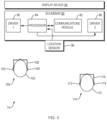
- soundbar 80 includes location sensor 90 that inputs open-audio device location-related information to processor 84 so that such information can be taken into account in the development by the processor of the left and right near-field binaurally-encoded audio signals that are transmitted to each of open audio devices 106 and 116.
- Figure 4 comprises flow-chart 120 that illustrates an operation of a computer program product having a non-transitory computer-readable medium including computer program logic encoded thereon that is performed on a surround sound audio system (such as those detailed in Figures 1-3 ) that is configured to render left front, right front, and center front audio signals, and also render left and right near-field binaurally-encoded audio signals.
- the computer program product causes the surround sound audio system to develop the left and right near-field binaurally-encoded audio signals.
- the computer program product causes the surround sound audio system to provide the left near-field binaurally-encoded audio signal to the left non-occluding near-field driver.
- the computer program product causes the surround sound audio system to provide the right near-field binaurally-encoded audio signal to the right non-occluding near-field driver.
- FIG. 1 Elements of Figs. 1-3 are shown and described as discrete elements in a block diagram. These may be implemented as one or more of analog circuitry or digital circuitry. Alternatively, or additionally, they may be implemented with one or more processors (e.g., microprocessors) executing software instructions.
- the software instructions can include digital signal processing instructions. Operations may be performed by analog circuitry or by a processor executing software that performs the equivalent of the analog operation.
- Signal lines may be implemented as discrete analog or digital signal lines, as a discrete digital signal line with appropriate signal processing that is able to process separate signals, and/or as elements of a wireless communication system (e.g., using WiFi or Bluetooth).
- the steps may be performed by one element or a plurality of elements. The steps may be performed together or at different times.
- the elements that perform the activities may be physically the same or proximate one another, or may be physically separate.
- One element may perform the actions of more than one block.
- Audio signals may be encoded or not, and may be transmitted in either digital or analog form. Conventional audio signal processing equipment and operations are in some cases omitted from the drawings.
- Examples of the systems and methods described herein comprise computer components and computer-implemented steps that will be apparent to those skilled in the art.
- the computer-implemented steps may be stored as computer-executable instructions on a computer-readable medium such as, for example, floppy disks, hard disks, optical disks, Flash ROMS, nonvolatile ROM, and RAM.
- the computer-executable instructions may be executed on a variety of processors such as, for example, microprocessors, digital signal processors, gate arrays, etc.
Landscapes
- Engineering & Computer Science (AREA)
- Physics & Mathematics (AREA)
- Acoustics & Sound (AREA)
- Signal Processing (AREA)
- Multimedia (AREA)
- Health & Medical Sciences (AREA)
- General Health & Medical Sciences (AREA)
- Otolaryngology (AREA)
- Stereophonic System (AREA)
Claims (15)
- Computerprogrammprodukt, auf dem ein nichtflüchtiges, computerlesbares Medium codiert ist, das Computerprogrammlogik beinhaltet, die, wenn sie auf einem Surround-Sound-Audiosystem (10; 40; 70) durchgeführt wird, das dazu konfiguriert ist, Audiosignale für vorne links, vorne rechts und vorne Mitte wiederzugeben und auch binaural codierte Nahfeld-Audiosignale für links und rechts wiederzugeben, bewirkt, dass das Surround-Sound-Audiosystem:die binaural codierten Nahfeld-Audiosignale für links und rechts entwickelt (122);das binaural codierte Nahfeld-Audiosignal für links einem linken nicht okkludierenden Nahfeldtreiber (18; 44) bereitstellt (124) und das binaural codierte Nahfeld-Audiosignal für rechts einem rechten nicht okkludierenden Nahfeldtreiber (20; 44) bereitstellt (126),wobei das Surround-Sound-Audiosystem weiter eine Soundbar (42; 80) umfasst, die mindestens zwei getrennte Treiber (12; 14; 16; 86; 88) umfasst, undwobei das Computerprogrammprodukt weiter bewirkt, dass das Surround-Sound-Audiosystem die binaural codierten Nahfeld-Audiosignale für links und rechts mindestens einem der mindestens zwei getrennten Treiber der Soundbar bereitstellt.
- Computerprogrammprodukt nach Anspruch 1, wobei die binaural codierten Nahfeld-Audiosignale für links und rechts aus einer Kombination von Audiospuren für Höhe vorne links, Höhe vorne rechts, Höhe hinten links und Höhe hinten rechts entwickelt werden.
- Computerprogrammprodukt nach Anspruch 1, wobei das Computerprogrammprodukt weiter bewirkt, dass das Surround-Sound-Audiosystem Unterdrückung von Nebensprechen an den binaural codierten Nahfeld-Audiosignalen für links und rechts bewerkstelligt, bevor die Signale mindestens einem der mindestens zwei getrennten Treiber der Soundbar bereitgestellt werden.
- Computerprogrammprodukt nach Anspruch 1, wobei Audiospuren für vorne links, Audiospuren für vorne rechts, Audiospuren für die Mitte, Surround-Audiospuren für links und Surround-Audiospuren für rechts mindestens einem der mindestens zwei getrennten Treiber der Soundbar bereitgestellt werden.
- Computerprogrammprodukt nach Anspruch 1, wobei der linke nicht okkludierende Nahfeldtreiber Teil einer ersten Open-Audio-Vorrichtung ist, die dazu konfiguriert ist, derart getragen zu werden, dass der linke nicht okkludierende Nahfeldtreiber sich nahe dem, aber nicht in dem linken Gehörgang eines Trägers der ersten Open-Audio-Vorrichtung befindet, und der rechte nicht okkludierende Nahfeldtreiber Teil einer zweiten Open-Audio-Vorrichtung ist, die dazu konfiguriert ist, derart getragen zu werden, dass der rechte nicht okkludierende Nahfeldtreiber sich nahe dem, aber nicht in dem rechten Gehörgang eines Trägers der zweiten Open-Audio-Vorrichtung befindet.
- Computerprogrammprodukt nach Anspruch 5, wobei die erste und die zweite Open-Audio-Vorrichtung jeweils ein Gehäuse, einen akustischen Strahler im Gehäuse, eine schallabstrahlende Öffnung im Gehäuse und eine Trägerstruktur umfassen, die dazu konfiguriert ist, das Gehäuse derart auf dem Kopf eines Benutzers zu tragen, dass das Gehäuse nahe an einem Ohr des Benutzers gehalten wird, wobei sich die schallabstrahlende Öffnung vor und nahe dem Tragus des Ohrs befindet.
- Computerprogrammprodukt nach Anspruch 5, wobei die erste Open-Audio-Vorrichtung ein linkes Bügelstück einer Audiobrille umfasst, und die zweite Open-Audio-Vorrichtung ein rechtes Bügelstück der Audiobrille umfasst.
- Computerprogrammprodukt nach Anspruch 1, wobei das Computerprogrammprodukt weiter bewirkt, dass das binaural codierte Nahfeld-Audiosignal für links drahtlos dem linken nicht okkludierenden Nahfeldtreiber bereitgestellt wird und das binaural codierte Nahfeld-Audiosignal für rechts drahtlos dem rechten nicht okkludierenden Nahfeldtreiber bereitgestellt wird.
- Computerprogrammprodukt nach Anspruch 1, wobei der linke und der rechte nicht okkludierende Nahfeldtreiber innerhalb eines Meters von einem optimalen Hörbereich des Surround-Sound-Audiosystems positioniert sind.
- Computerprogrammprodukt nach Anspruch 1, wobei der linke nicht okkludierende Nahfeldtreiber derart positioniert ist, dass ein Verhältnis des Schalldrucks vom linken nicht okkludierenden Nahfeldtreiber zum Schalldruck anderer Schallquellen, die den rechten nicht okkludierenden Nahfeldtreiber beinhalten, an einem linken Ohr eines Zuhörers mindestens 15 dB beträgt, und wobei der rechte nicht okkludierende Nahfeldtreiber derart positioniert ist, dass ein Verhältnis des Schalldrucks vom rechten nicht okkludierenden Nahfeldtreiber zum Schalldruck von anderen Schallquellen, die den linken nicht okkludierenden Nahfeldtreiber beinhalten, an einem rechten Ohr eines Zuhörers mindestens 15 dB beträgt.
- Surround-Sound-Audiosystem (10; 40; 70), umfassend:mehrere Treiber (12; 14; 16; 86; 88), die dazu konfiguriert sind, Audiosignale für vorne links, vorne rechts und vorne Mitte zu reproduzieren;linke und rechte nicht okkludierende Nahfeldtreiber (18; 20; 44);einen Prozessor (22; 50; 84), der binaural codierte Nahfeld-Audiosignale für links und rechts entwickelt (122) und dazu konfiguriert ist, das binaural codierte Nahfeld-Audiosignal für links dem linken nicht okkludierenden Nahfeldtreiber bereitzustellen (124) und das binaural codierte Nahfeld-Audiosignal für rechts dem rechten nicht okkludierenden Nahfeldtreiber bereitzustellen (126),wobei die mehreren Treiber Teil einer Soundbar sind, undwobei der Prozessor weiter dazu konfiguriert ist, die binaural codierten Audiosignale für links und rechts mindestens einem der mehreren Treiber der Soundbar bereitzustellen.
- Surround-Sound-Audiosystem nach Anspruch 11, wobei die binaural codierten Nahfeld-Audiosignale für links und rechts aus einer Kombination von Audiospuren für Höhe vorne links, Höhe vorne rechts, Höhe hinten links und Höhe hinten rechts entwickelt werden.
- Surround-Sound-Audiosystem nach Anspruch 11, wobei der Prozessor weiter dazu konfiguriert ist, an den binaural codierten Nahfeld-Audiosignalen für links und rechts Unterdrückung von Nebensprechen zu bewerkstelligen, bevor die Signale mindestens einem der mehreren Treiber der Soundbar bereitgestellt werden.
- Surround-Sound-Audiosystem nach Anspruch 11, wobei Audiospuren für vorne links, Audiospuren für vorne rechts, Audiospuren für die Mitte, Surround-Audiospuren für links und Surround-Audiospuren für rechts mindestens einem der mehreren Treiber der Soundbar bereitgestellt werden.
- Surround-Sound-Audiosystem nach Anspruch 11, wobei der linke nicht okkludierende Nahfeldtreiber Teil einer ersten Open-Audio-Vorrichtung ist, die dazu konfiguriert ist, derart getragen zu werden, dass der linke nicht okkludierende Nahfeldtreiber sich nahe dem, aber nicht in dem linken Gehörgang eines Trägers der ersten Open-Audio-Vorrichtung befindet, und der rechte nicht okkludierende Nahfeldtreiber Teil einer zweiten Open-Audio-Vorrichtung ist, die dazu konfiguriert ist, derart getragen zu werden, dass der rechte nicht okkludierende Nahfeldtreiber sich nahe dem, aber nicht in dem rechten Gehörgang eines Trägers der zweiten Open-Audio-Vorrichtung befindet.
Applications Claiming Priority (2)
| Application Number | Priority Date | Filing Date | Title |
|---|---|---|---|
| US16/777,404 US11582572B2 (en) | 2020-01-30 | 2020-01-30 | Surround sound location virtualization |
| PCT/US2021/015492 WO2021154996A1 (en) | 2020-01-30 | 2021-01-28 | Surround sound location virtualization |
Publications (2)
| Publication Number | Publication Date |
|---|---|
| EP4097993A1 EP4097993A1 (de) | 2022-12-07 |
| EP4097993B1 true EP4097993B1 (de) | 2025-02-26 |
Family
ID=74672457
Family Applications (1)
| Application Number | Title | Priority Date | Filing Date |
|---|---|---|---|
| EP21707107.5A Active EP4097993B1 (de) | 2020-01-30 | 2021-01-28 | Virtualisierung einer surround-schallortung |
Country Status (3)
| Country | Link |
|---|---|
| US (3) | US11582572B2 (de) |
| EP (1) | EP4097993B1 (de) |
| WO (1) | WO2021154996A1 (de) |
Families Citing this family (4)
| Publication number | Priority date | Publication date | Assignee | Title |
|---|---|---|---|---|
| US11641945B2 (en) * | 2020-12-28 | 2023-05-09 | Creative Technology Ltd | Chair system with an untethered chair with speakers |
| US11895472B2 (en) | 2022-06-08 | 2024-02-06 | Bose Corporation | Audio system with mixed rendering audio enhancement |
| US12207067B2 (en) | 2022-06-21 | 2025-01-21 | Shih-Chieh Huang | Multi-channel audio playback system |
| US20250071498A1 (en) * | 2023-08-24 | 2025-02-27 | Apple Inc. | Correcting Audio Signals Based on an Orientation of an Eyewear Assembly |
Family Cites Families (23)
| Publication number | Priority date | Publication date | Assignee | Title |
|---|---|---|---|---|
| US4165487A (en) | 1978-04-10 | 1979-08-21 | Corderman Roy C | Low power system and method for communicating audio information to patrons having portable radio receivers |
| USRE38405E1 (en) | 1992-07-30 | 2004-01-27 | Clair Bros. Audio Enterprises, Inc. | Enhanced concert audio system |
| US5619582A (en) | 1996-01-16 | 1997-04-08 | Oltman; Randy | Enhanced concert audio process utilizing a synchronized headgear system |
| US6983054B2 (en) | 2001-12-10 | 2006-01-03 | C-Media Electronics Inc. | Means for compensating rear sound effect |
| JP4081768B2 (ja) | 2004-03-03 | 2008-04-30 | ソニー株式会社 | 複数音声再生装置、複数音声再生方法及び複数音声再生システム |
| US7835535B1 (en) * | 2005-02-28 | 2010-11-16 | Texas Instruments Incorporated | Virtualizer with cross-talk cancellation and reverb |
| JP4304636B2 (ja) | 2006-11-16 | 2009-07-29 | ソニー株式会社 | 音響システム、音響装置及び最適音場生成方法 |
| US7995770B1 (en) | 2007-02-02 | 2011-08-09 | Jeffrey Franklin Simon | Apparatus and method for aligning and controlling reception of sound transmissions at locations distant from the sound source |
| EP2111617B1 (de) * | 2007-02-14 | 2013-09-04 | LG Electronics Inc. | Verfahren zur audiodekodierung und dementsprechende vorrichtung |
| US9445213B2 (en) | 2008-06-10 | 2016-09-13 | Qualcomm Incorporated | Systems and methods for providing surround sound using speakers and headphones |
| EP2405670B1 (de) * | 2010-07-08 | 2012-09-12 | Harman Becker Automotive Systems GmbH | Fahrzeug-Audiosystem mit in der Kopfstütze eingebauten Lautsprechern |
| WO2012048299A1 (en) | 2010-10-07 | 2012-04-12 | Clair Brothers Audio Enterprises, Inc. | Method and system for enhancing sound |
| US9042588B2 (en) * | 2011-09-30 | 2015-05-26 | Apple Inc. | Pressure sensing earbuds and systems and methods for the use thereof |
| US20140376754A1 (en) * | 2013-06-20 | 2014-12-25 | Csr Technology Inc. | Method, apparatus, and manufacture for wireless immersive audio transmission |
| US20160034249A1 (en) * | 2014-07-31 | 2016-02-04 | Microsoft Technology Licensing Llc | Speechless interaction with a speech recognition device |
| JP6414459B2 (ja) * | 2014-12-18 | 2018-10-31 | ヤマハ株式会社 | スピーカアレイ装置 |
| EP3295687B1 (de) | 2015-05-14 | 2019-03-13 | Dolby Laboratories Licensing Corporation | Erzeugung und wiedergabe von nahfeldaudioinhalt |
| GB2540407B (en) | 2015-07-16 | 2020-05-20 | Powerchord Group Ltd | Personal audio mixer |
| US20170351483A1 (en) | 2016-06-03 | 2017-12-07 | Panasonic Automotive Systems Company Of America, Division Of Panasonic Corporation Of North America | Method for enhanced concert audio experience |
| US10524079B2 (en) * | 2017-08-31 | 2019-12-31 | Apple Inc. | Directivity adjustment for reducing early reflections and comb filtering |
| GB2569214B (en) | 2017-10-13 | 2021-11-24 | Dolby Laboratories Licensing Corp | Systems and methods for providing an immersive listening experience in a limited area using a rear sound bar |
| US10555071B2 (en) | 2018-01-31 | 2020-02-04 | Bose Corporation | Eyeglass headphones |
| US10674244B2 (en) | 2018-02-21 | 2020-06-02 | Bose Corporation | Audio device |
-
2020
- 2020-01-30 US US16/777,404 patent/US11582572B2/en active Active
-
2021
- 2021-01-28 EP EP21707107.5A patent/EP4097993B1/de active Active
- 2021-01-28 WO PCT/US2021/015492 patent/WO2021154996A1/en not_active Ceased
-
2023
- 2023-02-14 US US18/109,512 patent/US12418767B2/en active Active
-
2025
- 2025-08-25 US US19/308,711 patent/US20250380106A1/en active Pending
Also Published As
| Publication number | Publication date |
|---|---|
| US11582572B2 (en) | 2023-02-14 |
| WO2021154996A1 (en) | 2021-08-05 |
| US20210243544A1 (en) | 2021-08-05 |
| EP4097993A1 (de) | 2022-12-07 |
| US20230276188A1 (en) | 2023-08-31 |
| US20250380106A1 (en) | 2025-12-11 |
| US12418767B2 (en) | 2025-09-16 |
Similar Documents
| Publication | Publication Date | Title |
|---|---|---|
| US12418767B2 (en) | Surround sound location virtualization | |
| US11902772B1 (en) | Own voice reinforcement using extra-aural speakers | |
| US9357282B2 (en) | Listening device and accompanying signal processing method | |
| US9913037B2 (en) | Acoustic output device | |
| US10880649B2 (en) | System to move sound into and out of a listener's head using a virtual acoustic system | |
| JP7622215B2 (ja) | 増強されたオーディオを提供するためのシステム及び方法 | |
| US11805364B2 (en) | Hearing device providing virtual sound | |
| JP7581509B2 (ja) | 増強されたオーディオを提供するためのシステム及び方法 | |
| CN106664499A (zh) | 音频信号处理装置 | |
| US20240205626A1 (en) | Multi-input push-to-talk switch with binaural spatial audio positioning | |
| US20230379646A1 (en) | Audio playback system | |
| CN119233138A (zh) | 音频换能器实现增强 | |
| EP4677864A1 (de) | Systeme und verfahren für hybrides räumliches audio | |
| CN110620982A (zh) | 用于助听器中的音频播放的方法 | |
| US11812247B2 (en) | System to move sound into and out of a listener's head using a virtual acoustic system | |
| US20260122444A1 (en) | Scene recentering |
Legal Events
| Date | Code | Title | Description |
|---|---|---|---|
| STAA | Information on the status of an ep patent application or granted ep patent |
Free format text: STATUS: UNKNOWN |
|
| STAA | Information on the status of an ep patent application or granted ep patent |
Free format text: STATUS: THE INTERNATIONAL PUBLICATION HAS BEEN MADE |
|
| PUAI | Public reference made under article 153(3) epc to a published international application that has entered the european phase |
Free format text: ORIGINAL CODE: 0009012 |
|
| STAA | Information on the status of an ep patent application or granted ep patent |
Free format text: STATUS: REQUEST FOR EXAMINATION WAS MADE |
|
| 17P | Request for examination filed |
Effective date: 20220725 |
|
| AK | Designated contracting states |
Kind code of ref document: A1 Designated state(s): AL AT BE BG CH CY CZ DE DK EE ES FI FR GB GR HR HU IE IS IT LI LT LU LV MC MK MT NL NO PL PT RO RS SE SI SK SM TR |
|
| DAV | Request for validation of the european patent (deleted) | ||
| DAX | Request for extension of the european patent (deleted) | ||
| P01 | Opt-out of the competence of the unified patent court (upc) registered |
Effective date: 20230414 |
|
| GRAP | Despatch of communication of intention to grant a patent |
Free format text: ORIGINAL CODE: EPIDOSNIGR1 |
|
| STAA | Information on the status of an ep patent application or granted ep patent |
Free format text: STATUS: GRANT OF PATENT IS INTENDED |
|
| INTG | Intention to grant announced |
Effective date: 20241112 |
|
| GRAS | Grant fee paid |
Free format text: ORIGINAL CODE: EPIDOSNIGR3 |
|
| GRAA | (expected) grant |
Free format text: ORIGINAL CODE: 0009210 |
|
| STAA | Information on the status of an ep patent application or granted ep patent |
Free format text: STATUS: THE PATENT HAS BEEN GRANTED |
|
| AK | Designated contracting states |
Kind code of ref document: B1 Designated state(s): AL AT BE BG CH CY CZ DE DK EE ES FI FR GB GR HR HU IE IS IT LI LT LU LV MC MK MT NL NO PL PT RO RS SE SI SK SM TR |
|
| REG | Reference to a national code |
Ref country code: GB Ref legal event code: FG4D |
|
| REG | Reference to a national code |
Ref country code: CH Ref legal event code: EP |
|
| REG | Reference to a national code |
Ref country code: DE Ref legal event code: R096 Ref document number: 602021026748 Country of ref document: DE |
|
| REG | Reference to a national code |
Ref country code: IE Ref legal event code: FG4D |
|
| REG | Reference to a national code |
Ref country code: NL Ref legal event code: MP Effective date: 20250226 |
|
| PG25 | Lapsed in a contracting state [announced via postgrant information from national office to epo] |
Ref country code: RS Free format text: LAPSE BECAUSE OF FAILURE TO SUBMIT A TRANSLATION OF THE DESCRIPTION OR TO PAY THE FEE WITHIN THE PRESCRIBED TIME-LIMIT Effective date: 20250526 |
|
| PG25 | Lapsed in a contracting state [announced via postgrant information from national office to epo] |
Ref country code: FI Free format text: LAPSE BECAUSE OF FAILURE TO SUBMIT A TRANSLATION OF THE DESCRIPTION OR TO PAY THE FEE WITHIN THE PRESCRIBED TIME-LIMIT Effective date: 20250226 |
|
| PG25 | Lapsed in a contracting state [announced via postgrant information from national office to epo] |
Ref country code: PL Free format text: LAPSE BECAUSE OF FAILURE TO SUBMIT A TRANSLATION OF THE DESCRIPTION OR TO PAY THE FEE WITHIN THE PRESCRIBED TIME-LIMIT Effective date: 20250226 |
|
| PG25 | Lapsed in a contracting state [announced via postgrant information from national office to epo] |
Ref country code: ES Free format text: LAPSE BECAUSE OF FAILURE TO SUBMIT A TRANSLATION OF THE DESCRIPTION OR TO PAY THE FEE WITHIN THE PRESCRIBED TIME-LIMIT Effective date: 20250226 |
|
| REG | Reference to a national code |
Ref country code: LT Ref legal event code: MG9D |
|
| PG25 | Lapsed in a contracting state [announced via postgrant information from national office to epo] |
Ref country code: IS Free format text: LAPSE BECAUSE OF FAILURE TO SUBMIT A TRANSLATION OF THE DESCRIPTION OR TO PAY THE FEE WITHIN THE PRESCRIBED TIME-LIMIT Effective date: 20250626 Ref country code: NO Free format text: LAPSE BECAUSE OF FAILURE TO SUBMIT A TRANSLATION OF THE DESCRIPTION OR TO PAY THE FEE WITHIN THE PRESCRIBED TIME-LIMIT Effective date: 20250526 |
|
| PG25 | Lapsed in a contracting state [announced via postgrant information from national office to epo] |
Ref country code: NL Free format text: LAPSE BECAUSE OF FAILURE TO SUBMIT A TRANSLATION OF THE DESCRIPTION OR TO PAY THE FEE WITHIN THE PRESCRIBED TIME-LIMIT Effective date: 20250226 |
|
| PG25 | Lapsed in a contracting state [announced via postgrant information from national office to epo] |
Ref country code: HR Free format text: LAPSE BECAUSE OF FAILURE TO SUBMIT A TRANSLATION OF THE DESCRIPTION OR TO PAY THE FEE WITHIN THE PRESCRIBED TIME-LIMIT Effective date: 20250226 |
|
| PG25 | Lapsed in a contracting state [announced via postgrant information from national office to epo] |
Ref country code: PT Free format text: LAPSE BECAUSE OF FAILURE TO SUBMIT A TRANSLATION OF THE DESCRIPTION OR TO PAY THE FEE WITHIN THE PRESCRIBED TIME-LIMIT Effective date: 20250626 Ref country code: LV Free format text: LAPSE BECAUSE OF FAILURE TO SUBMIT A TRANSLATION OF THE DESCRIPTION OR TO PAY THE FEE WITHIN THE PRESCRIBED TIME-LIMIT Effective date: 20250226 |
|
| PG25 | Lapsed in a contracting state [announced via postgrant information from national office to epo] |
Ref country code: GR Free format text: LAPSE BECAUSE OF FAILURE TO SUBMIT A TRANSLATION OF THE DESCRIPTION OR TO PAY THE FEE WITHIN THE PRESCRIBED TIME-LIMIT Effective date: 20250527 Ref country code: BG Free format text: LAPSE BECAUSE OF FAILURE TO SUBMIT A TRANSLATION OF THE DESCRIPTION OR TO PAY THE FEE WITHIN THE PRESCRIBED TIME-LIMIT Effective date: 20250226 |
|
| REG | Reference to a national code |
Ref country code: AT Ref legal event code: MK05 Ref document number: 1771849 Country of ref document: AT Kind code of ref document: T Effective date: 20250226 |
|
| PG25 | Lapsed in a contracting state [announced via postgrant information from national office to epo] |
Ref country code: SE Free format text: LAPSE BECAUSE OF FAILURE TO SUBMIT A TRANSLATION OF THE DESCRIPTION OR TO PAY THE FEE WITHIN THE PRESCRIBED TIME-LIMIT Effective date: 20250226 |
|
| PG25 | Lapsed in a contracting state [announced via postgrant information from national office to epo] |
Ref country code: SM Free format text: LAPSE BECAUSE OF FAILURE TO SUBMIT A TRANSLATION OF THE DESCRIPTION OR TO PAY THE FEE WITHIN THE PRESCRIBED TIME-LIMIT Effective date: 20250226 |
|
| PG25 | Lapsed in a contracting state [announced via postgrant information from national office to epo] |
Ref country code: DK Free format text: LAPSE BECAUSE OF FAILURE TO SUBMIT A TRANSLATION OF THE DESCRIPTION OR TO PAY THE FEE WITHIN THE PRESCRIBED TIME-LIMIT Effective date: 20250226 |
|
| PG25 | Lapsed in a contracting state [announced via postgrant information from national office to epo] |
Ref country code: IT Free format text: LAPSE BECAUSE OF FAILURE TO SUBMIT A TRANSLATION OF THE DESCRIPTION OR TO PAY THE FEE WITHIN THE PRESCRIBED TIME-LIMIT Effective date: 20250226 |
|
| PG25 | Lapsed in a contracting state [announced via postgrant information from national office to epo] |
Ref country code: AT Free format text: LAPSE BECAUSE OF FAILURE TO SUBMIT A TRANSLATION OF THE DESCRIPTION OR TO PAY THE FEE WITHIN THE PRESCRIBED TIME-LIMIT Effective date: 20250226 |
|
| PG25 | Lapsed in a contracting state [announced via postgrant information from national office to epo] |
Ref country code: EE Free format text: LAPSE BECAUSE OF FAILURE TO SUBMIT A TRANSLATION OF THE DESCRIPTION OR TO PAY THE FEE WITHIN THE PRESCRIBED TIME-LIMIT Effective date: 20250226 Ref country code: CZ Free format text: LAPSE BECAUSE OF FAILURE TO SUBMIT A TRANSLATION OF THE DESCRIPTION OR TO PAY THE FEE WITHIN THE PRESCRIBED TIME-LIMIT Effective date: 20250226 |
|
| PG25 | Lapsed in a contracting state [announced via postgrant information from national office to epo] |
Ref country code: RO Free format text: LAPSE BECAUSE OF FAILURE TO SUBMIT A TRANSLATION OF THE DESCRIPTION OR TO PAY THE FEE WITHIN THE PRESCRIBED TIME-LIMIT Effective date: 20250226 |
|
| PG25 | Lapsed in a contracting state [announced via postgrant information from national office to epo] |
Ref country code: SK Free format text: LAPSE BECAUSE OF FAILURE TO SUBMIT A TRANSLATION OF THE DESCRIPTION OR TO PAY THE FEE WITHIN THE PRESCRIBED TIME-LIMIT Effective date: 20250226 |
|
| REG | Reference to a national code |
Ref country code: DE Ref legal event code: R097 Ref document number: 602021026748 Country of ref document: DE |
|
| PLBE | No opposition filed within time limit |
Free format text: ORIGINAL CODE: 0009261 |
|
| STAA | Information on the status of an ep patent application or granted ep patent |
Free format text: STATUS: NO OPPOSITION FILED WITHIN TIME LIMIT |
|
| PGFP | Annual fee paid to national office [announced via postgrant information from national office to epo] |
Ref country code: GB Payment date: 20251220 Year of fee payment: 6 |
|
| PGFP | Annual fee paid to national office [announced via postgrant information from national office to epo] |
Ref country code: FR Payment date: 20251217 Year of fee payment: 6 |
|
| 26N | No opposition filed |
Effective date: 20251127 |
|
| PGFP | Annual fee paid to national office [announced via postgrant information from national office to epo] |
Ref country code: DE Payment date: 20251217 Year of fee payment: 6 |