EP4094468B1 - Gemeinsame nutzung von ressourceneinheiten - Google Patents
Gemeinsame nutzung von ressourceneinheiten Download PDFInfo
- Publication number
- EP4094468B1 EP4094468B1 EP21707128.1A EP21707128A EP4094468B1 EP 4094468 B1 EP4094468 B1 EP 4094468B1 EP 21707128 A EP21707128 A EP 21707128A EP 4094468 B1 EP4094468 B1 EP 4094468B1
- Authority
- EP
- European Patent Office
- Prior art keywords
- sub
- message
- user device
- time
- during
- Prior art date
- Legal status (The legal status is an assumption and is not a legal conclusion. Google has not performed a legal analysis and makes no representation as to the accuracy of the status listed.)
- Active
Links
Images

Classifications
-
- H—ELECTRICITY
- H04—ELECTRIC COMMUNICATION TECHNIQUE
- H04W—WIRELESS COMMUNICATION NETWORKS
- H04W72/00—Local resource management
- H04W72/20—Control channels or signalling for resource management
-
- H—ELECTRICITY
- H04—ELECTRIC COMMUNICATION TECHNIQUE
- H04W—WIRELESS COMMUNICATION NETWORKS
- H04W28/00—Network traffic management; Network resource management
- H04W28/16—Central resource management; Negotiation of resources or communication parameters, e.g. negotiating bandwidth or QoS [Quality of Service]
- H04W28/26—Resource reservation
-
- H—ELECTRICITY
- H04—ELECTRIC COMMUNICATION TECHNIQUE
- H04L—TRANSMISSION OF DIGITAL INFORMATION, e.g. TELEGRAPHIC COMMUNICATION
- H04L5/00—Arrangements affording multiple use of the transmission path
- H04L5/003—Arrangements for allocating sub-channels of the transmission path
- H04L5/0032—Distributed allocation, i.e. involving a plurality of allocating devices, each making partial allocation
-
- H—ELECTRICITY
- H04—ELECTRIC COMMUNICATION TECHNIQUE
- H04W—WIRELESS COMMUNICATION NETWORKS
- H04W72/00—Local resource management
- H04W72/04—Wireless resource allocation
- H04W72/044—Wireless resource allocation based on the type of the allocated resource
- H04W72/0446—Resources in time domain, e.g. slots or frames
-
- H—ELECTRICITY
- H04—ELECTRIC COMMUNICATION TECHNIQUE
- H04W—WIRELESS COMMUNICATION NETWORKS
- H04W72/00—Local resource management
- H04W72/50—Allocation or scheduling criteria for wireless resources
- H04W72/51—Allocation or scheduling criteria for wireless resources based on terminal or device properties
Definitions
- Embodiments presented in this disclosure generally relate to wireless transmission management. More specifically, embodiments disclosed herein relate to managing the assignment of Resource Units (RU) for unused portions of a reserved RU to be made available for reservation by additional devices.
- RU Resource Unit
- the present disclosure generally provides examples for RUs of an unspecified time length and unspecified number of sub-channels or subcarriers (in which a given RU may be a different length of time or different number of sub-channels than a subsequent RU), the present disclosure is applicable to networking standards or deployments in which a specified time length or a specified number of sub-channels or subcarriers is applied to all or some of the RUs.
- Wireless Access Points operating on the same spectrum reserve blocks of time and spectrum to communicate with user devices so that communications do not overlap and interfere with one another.
- These blocks of time and spectrum are generally referred to as RUs, and a given communications specification can define an RU to include various sub-channels and sub-times for specific communications tasks. For example, two uplink communications may occur at the same time within an RU on separate sub-channels, or on the same sub-channel at different times.
- An AP communicates the assignment of various times and channels to the user devices associated therewith so that the user devices respect the assignments chosen by the AP for a given RU.
- each AP may want to use the same RU.
- RUs may be won via a contestation process or assigned by a central network controller so that two APs do not attempt to use the same portion of spectrum at the same time.
- WO2019/028265A1 discloses methods and apparatus for wireless communication.
- the apparatus includes a processing system configured to generate a first frame including an indication of unused resources in a first basic service set (BSS) available to be shared with one or more wireless nodes in one or more second BSSs.
- the apparatus also includes a first interface configured to output the first frame for transmission to the one or more wireless nodes.
- BSS basic service set
- WO2018/192444A1 discloses an information exchange method.
- a base station determines coordination information and transmits the coordination information to a user equipment, and the user equipment eliminates interference according to the received coordination information.
- the present disclosure provides improvements in channel usage, so that network deployments with more than one AP can more efficiently use the available bandwidth for communications.
- An AP that has won or been assigned an RU informs neighboring APs of any availability within the RU that the AP is willing to share. For example, a first AP can tell a second AP (directly or via a manager application) that an RU occupying channel 1 is reserved from time t 1 to t 3 , but the first AP is only scheduled to use sub-channels 1-4; the second AP may use sub-channels 5-9 despite the first AP having reserved the RU.
- the second AP can then use sub-channels 5-9 from time t 2 to t 3 so that the bandwidth in sub-channels 5-9 does not go to unused.
- a first AP can allow access to the sub-channels for a subset of the reserved time so that a first AP can use the given sub-channel during one time period and a second AP can use that sub-channel for a different time period.
- Wi-Fi e.g., the 802.11 family of standards set out by the IEEE (Institute of Electrical and Electronics Engineers)
- Wi-Fi e.g., the 802.11 family of standards set out by the IEEE (Institute of Electrical and Electronics Engineers)
- each device contends to access the transmission medium.
- the device may schedule transmissions to/from one or more other devices.
- the time period won may be consistent between contentions (e.g., every winning device is assigned X milliseconds (ms) of access to the transmission medium) or may be variable between different contentions.
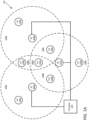
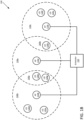
- FIGS 1A and 1B illustrate networking environments 100, according to embodiments of the present disclosure.
- a plurality of APs 110a-c serve various user devices (UD) 120a-g (generally, UD 120) located within the ranges 130a-c (generally, range 130) of the respective APs 110a-c.
- the ranges 130 define several overlapping areas 140a-d (generally, overlapping area 140) in which a UD 120 located in an overlapping area 140 may communicate with more than one AP 110.
- UDs 120 are located within one range 130 (i.e., not in an overlapping area 140), and thus may directly communicate with one AP 110.
- a first UD 120a located in a first overlapping area 140a is located in the first through third ranges 130a-c and may send signals to and receive signals from the first through third APs 110a-c.
- a second UD 120b located in a second overlapping area 140b is located both the first range 130a and the second range 130b (but not the third range 130c) and may send signals to and receive signals from the first AP 110a and the second AP 110b (but not the third AP 110c).
- APs 110 and UDs 120 are illustrated in Figure 1A in various locations relative to the ranges 130 of the APs 110, more or fewer APs 110 and UDs 120 may be present in a networking environment 100 and in different locations than are illustrated in Figure 1A .
- a first AP 110a may have a first range 130a with a first overlapping area 140a shared with a second AP 110b and a second overlapping area 140b shared with a third AP 110c, where the overlapping areas 140 are non-contiguous.
- a UD 120 located in an overlapping area 140 may be associated with any one of the APs 110 whose range 130 forms the overlapping area 140.
- the first UD 120a and the seventh UD 120g in the first overlapping area 140a may both be associated with (and served by) the first AP 110a or the second AP 110b, or one may be associated with the first AP 110a and the other with the second AP 110b.
- a scheduler 150 (e.g., a network controller) is in communication with the APs 110 to manage a shared network offered by the APs 110 within the networking environment.
- the scheduler 150 can be included in an AP 110 or may be provided by a separate computing device.
- the scheduler 150 is in communication with the APs 110 via a wired connection (e.g., via wired network interface) or may be in communication via wireless communications between the APs 110 (e.g., by control frame messages).
- Example hardware as may be included in an scheduler 150 is discussed in greater detail in regard to Figure 6 .
- An AP 110 may include various networking devices configured to provide wireless networks according to various networking standards or Radio Access Technologies (RAT) (e.g., IEEE 802.11 or "WiFi” networks, BLUETOOTH ® networks, "cellular” (including various generations and subtypes thereof, such as Long Term Evolution (LTE) and Fifth Generation New Radio (5G NR)) networks, citizens Broadband Radio Service (CBRS) networks, proprietary networks).
- RAT Radio Access Technologies
- Example hardware as may be included in an AP 110 is discussed in greater detail in regard to Figure 6 .
- a UD 120 may include any computing device that is configured to wirelessly connect to one or more APs 110.
- Example UDs 120 can include, but are not limited to: smart phones, feature phones, tablet computers, laptop computers, desktop computers, Internet of Things (IoT) devices, and the like.
- Example hardware as may be included in a UD 120 is discussed in greater detail in regard to Figure 6 .
- the transmissions between the APs 110 and the UD 120 may be carried in various frequency bands on various channels (and sub-channels) at various times to avoid collisions or interference in the overlapping areas 140.
- a first AP 110a, a second AP 110b, and a third AP 110c may each communicate over a shared channel at different times, or may communicate at the same time (i.e., a shared time) on different channels.
- the devices in a network environment 100 can contend for access (or be scheduled access by a scheduler 150) to various portions of the available transmission medium, including spectrum and time.
- An RU may include various defined portions related to preambles, inter-frame spacing, and various protocol data units defined in various standards. However, for purposes of understanding, the present disclosure focuses on the portions of the RU used for transmitting data (e.g., payloads) between APs 110 and UDs 120, and one of ordinary skill in the art will be able to apply the formatting, error correction/mitigation, and spacing specified by the relevant standards.
- data e.g., payloads
- the present disclosure generally provides examples for RUs of an unspecified time length or unspecified number of sub-channels or subcarriers (in which a given RU may be a different length of time or different number of sub-channels than a subsequent RU), the present disclosure is applicable to networking standards or deployments in which a specified time length or a specified number of sub-channels or subcarriers is applied to all or some of the RUs.
- Some devices in the network environment 100 in response to winning an RU, reserve the RU for individual-access to communicate with a single partner (e.g., a first UD 120a communicating with a first AP 110a). Some other devices in the network environment 100, in response to winning an RU, reserve the RU for multi-access communications. Multi-access communications assign various sub-channels of the RU for transmitting or receiving multiple streams of data to one or more targets during the RU. For example, a first AP 110a can assign a first sub-channel to communicate with a first UD 120a and assign a second and a third sub-channel to communication with a second UD 120b.
- Various devices in the network environment 100 can choose whether to use the transmission medium for individual-access or for multi-access communications, and may change between whether individual-access or multi-access communications are used for a given RU. Additionally, a device may use a given RU for uplink communication, downlink communications, or duplex communications (i.e., both uplink and downlink communications).
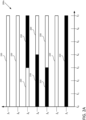
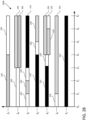
- Figures 2A and 2B illustrate RU assignments 200a and 200b, respectively, for multi-access communications, according to embodiments of the present disclosure.
- the RU includes seven sub-channels J 1 -J 7 , and lasts from a beginning time of t 0 to an end time of t 7 , although in various embodiments more than or fewer than seven sub-channels or a longer or shorter time duration may be included in the RU.
- Figure 2A illustrates a first RU assignment 200a, in which a first AP 110a, having won contention or having been scheduled an RU, assigns traffic for communicating with one or more devices on various sub-channels of the RU.
- the first AP 110a has assigned traffic to sub-channel J 1 from time t 0 to t 7 , to sub-channel J3 from time t 0 to time t 3 , to sub-channel J 4 from time t 0 to time t 4 , and to sub-channel J 5 from time t 3 to time t 7 , which collectively refer to an assigned portion 210 of the RU.
- the unused portion 220 refers to those channels or portions of channels to which the first AP 110a has not assigned traffic.
- the unused portion 220 includes sub-channel J 2 from time t 0 to time t 7 , sub-channel J 3 from time t 3 to time t 7 , sub-channel J 4 from time t 4 to time t 7 , sub-channel J 5 from time t 0 to time ts, sub-channel J 6 from time t 0 to time t 7 , and sub-channel J 7 from time t 0 to time t 7 .
- sub-channels J 2 , J 6 , and J 7 are clear sub-channels, as the first AP 110a has not assigned traffic to these sub-channels.
- sub-channels J 3 , J 4 , and J 5 are partially occupied sub-channels
- sub-channel J 1 is a fully occupied sub-channel based on the assignment of traffic to these channels.
- Both the clear sub-channels and the partially occupied sub-channels represent unused transmission opportunities - either for uplink messages or downlink messages.
- the first AP 110a may leave portions of the RU unused when the first AP 110a and the associated UDs 120 do not enough data to fill all of the sub-channels or when the first AP 110a offers to share RUs with neighboring APs 110 to load balance or prioritize traffic handled by those APs 110.
- Figure 2B illustrates a second RU assignment 200b, in which the first AP 110a has shared access to the RU with other APs 110, and has scheduled when those other APs 110 may send or receive communications.
- those other APs 110 may contend for access to the unused portions 220 from the first RU assignment 200a or may be scheduled by the first AP 110 (or an external scheduler 150) for access to the unused portions 220.
- any unused portions 220 leftover after allowing a second AP 110b to assign traffic to the unused portions 220 may be made available to other APs 110.
- the unused portions 220 may remain available for sharing until the available bandwidth during the RU is fully assigned, until a duration of any remaining bandwidth is too short for an AP 110 to use, or until a request time period closes.
- each of the sub-portions of the RU used by other APs 110 begin after the start time of the RU (e.g., time t 1 or later) and end at or before the end time of the RU (e.g., at or before time t 7 ).
- start time of the RU e.g., time t 1 or later
- end time of the RU e.g., at or before time t 7
- a sub-portion of the RU refers to a portion of the RU that is less than the whole RU.
- Sub-channel J2 illustrates a shared portion 230 using a sub-set of the unused portion 220 from Figure 2A .
- a second AP 110b may use a sub-set of the available time in the clear sub-channel to transmit messages to a UD 120 associated with the second AP 110.
- the other UD 120 may be located in a shared area 140 for the first AP 110a and the second AP 110b, or may be located outside of the shared area 140.
- the assignment of the shared portion 230 may leave some of the sub-channel as an unused portion 220 (e.g., from time t 0 to time t 1 ).
- the remaining unused portion 220 can act as a buffer or give the first AP 110a time to invite the second AP 110b to share sub-channel J2 and give the second AP 110b time to process the availability of the unused portions 220 and respond.
- Sub-channel J3 illustrates a shared portion 230 using a sub-set of the unused portion 220 from Figure 2A in which spatial separation of two APs 110 allows the first AP 110a to share the unused portion of the sub-channel with the two APs 110.
- a second AP 110b attempting to communicate with a second UD 120b and a third AP 110c attempting to communicate with a third UD 120c.
- the third UD 120c and third AP 110c are outside of the range of the second AP 110b, the messages transmitted from the second AP 110b will not interfere (at the intended destination) with messages sent between the third AP 110c and the third UD 120c.
- the first AP 110a may share a sub-set of the RU with more than one other AP 110 at the same time, when the other APs 110 do not interfere with one another or the respective UDs 120. As illustrated, the shared portions 230 for two different APs 110 may last for different amounts of time.
- Sub-channels J4 and J5 illustrate that a shared portion 230 may be scheduled either after the assigned portion 210 occurs (as in sub-channel J4) or before the assigned portion 210 occurs (as in sub-channel J5).
- some of the sub-channel between the shared portion 230 and the assigned portion 210 may be left unassigned (e.g., from time t 2 to time t 3 ) to act as a buffer between the transmissions of the two APs 110.
- Sub-channels J6 and J7 illustrate assisted portions 240, in which the first AP 110a transmits messages to a UD 120 associated with another AP 110.
- a shared portion 230 e.g., transmitted by a second AP 110b
- an assisted portion 240 may coincide with an assisted portion 240 so that both the first AP 110a and a second AP 110b co-transmit the same message to a UD 120 associated with the second AP 110b.
- the first AP 110a may transmit a message on behalf of the second AP 110b to a UD 120 associated with the second AP 110b without the second AP 110b transmitting the message (e.g., when the UD 120 is in an overlapping area 140 for the first and second APs 110).
- the message to be co-transmitted with or transmitted on behalf of the second AP 110b is transmitted to the first AP 110 via a wired connection or wireless connection before the RU begins (e.g., before time t 0 ).
- the message is transmitted over a wireless connection for transmittal in the assisted portion 240, the message is transmitted on a different channel than the RU occupies.
- Each of the subsets of the RU used for handling traffic may handle uplink communications or downlink communications, and the directionality of communication on one sub-channel may be different than the directionality of communication on another sub-channel in the same RU.
- communications from one AP 110 may be addressed to one target device (e.g., a single UD 120 via channels J1, J3, J4, and J5) as different streams on the different sub-channels, or may be addressed to several target devices (e.g., a first UD 120a via channel J1, a second UD 120b via channel J3, J4, and J5).
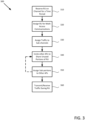
- Figure 3 is a flowchart of a method 300 for RU sharing, according to embodiments of the present disclosure.
- Method 300 begins at block 310 in response to a first AP 110a reserving an RU, thus having priority to a channel or frequency band for a known time period.
- the first AP 110a reserves the RU via a contention process with other APs 110 in the network environment 100, or may be assigned the RU by a scheduler managing the APs 110.
- the first AP 110a requests an RU based on the requirements of the UDs 120 associated with the first AP 10a.
- the controller or scheduler 150 also evaluates the performance parameters of the APs 110 neighboring the first AP 110a when determining whether to assign an RU to the first AP 110a to determine with the neighboring APs 110 are also ready to send/receive data and are capable of sharing the RU with the first AP 110a (e.g., after finishing a current transmission/reception).
- the scheduler 150 can decide to allocate an RU to the first AP 110a that is larger than the first AP 110a initially requested, thus providing additional time and/or bandwidth in the RU to share with the neighboring APs 110 to transmit/receive data during that RU.
- the first AP 110a assigns the RU reserved in block 310 for multi-access communications, in which several sub-channels of the RU may be assigned for communicating with several different devices.
- an AP 110 may also assign an RU for individual-access, in which the RU is used for communicating with one other device (e.g., sending messages to or receiving messages from one UD 120 or another AP 110).
- the first AP 110a assigns traffic to the sub-channels of the multi-access RU.
- the traffic assignments may be for one or both of uplink communications (to the first AP 110a) or downlink communications (from the first AP 110a) and traffic to/from a given target may be assigned to one or more sub-channels in the RU.
- the first AP 110a invites other APs 110 to use the sub-portion of the RU not assigned for handling the traffic of the first AP 110a (i.e., the unused portions 220).
- the first AP 110a invites the other APs 110 to share unused portions 220 via the preamble for the RU, which is broadcast to all devices by the first AP 110a.
- the first AP 110 can broadcast the assigned portions 210 to the target devices in a preamble of the RU, and the other APs 110, having received the RU preamble, interpret the gaps in the assigned portions 210 to be an invitation to contend for or request the use of the unused portions 220.
- the invitation is transmitted to the other APs 110 (wirelessly or via a wired connection) as a specific message that identifies the unused portions 220 to the other APs 110.
- the invitation identifies a beginning time of the RU, an end time of the RU (a duration from the beginning time or a specified time to end) and any available time spans on one or more sub-channels so that the other APs 110 can identify an available sub-channel at an available time that does not precede or extend beyond the RU.
- the shared portions 230 of the RU begin after the RU begins and end when or before the RU ends.
- the invited AP 110 may decide (and indicate to the first AP 110a or a scheduler 150 of the decision) at or before the time when the RU begins, or at a time during the RU.
- a second AP 110b and a third AP 110c may both be invited to share an RU won by a first AP 110a lasting from time t 0 to time t 8 .
- the second AP 110b may indicate at or before time t 0 that the second AP 110b will reserve an unused portion 220 (e.g., from time t 1 to time t 4 ) as a shared portion.
- the third AP 110c may determine after time t 0 to assign traffic to an unused portion 220 of the RU, and may reserve a shared portion 230 at time t 3 for times t 5 -t 8 .
- the third AP 110c in the present example may receive priority traffic after time t 0 , conclude a transmission on a different channel but still have data to send/receive after time t 0 , or take until after time t 0 to process the invitation or win contention for a given unused portion 220.
- the first AP 110a or the scheduler 150 may allow other APs 110 to reserve portions of the RU after the RU begins by leaving the invitation open for a predefined amount of time (e.g., x ms after sending the invitation), allowing reservations until a given time before the end time of the RU (e.g., x ms before the end of the RU), or allowing reservations until a predefined time after the RU begins (e.g., no assignments after time t 0+x ).
- a predefined amount of time e.g., x ms after sending the invitation
- a given time before the end time of the RU e.g., x ms before the end of the RU
- a predefined time after the RU begins e.g., no assignments after time t 0+x .
- invited APs 110 may reserve portions of the RU after the RU begins
- the first AP 110a, the scheduler 150, or other APs 110 having reserved a portion of the shared RU may update the invitation to indicate what portions of the RU remain unused portions 220 and/or what portions are now shared portions 230 or assisted portions 240.
- the first AP 110a may avoid sending a directed invitation to the given AP 110 so that the given AP 110 does not attempt to communicate during the RU.
- the first AP 110a may send a Quiet Time Period command to the given AP 110 (or UD 120) to request that the given AP 110 not communicate on the channels during the time of the RU.
- the first AP 110a assigns available sub-portions of the RU to the other APs 110 to use for multi-access communications.
- the other APs 110 contend for access to the unused portions 220, and the first AP 110a (or a scheduler 150) assigns which sub-portions of the RU are assigned to the other APs 110.
- the scheduler 150 of the first AP 110a (that initially won the RU) can break contention between the other APs 110 seeking to share the RU using various policies including giving preference to higher-priority traffic (e.g., latency sensitive traffic), higher-priority devices (e.g., employees versus guests), or the like.
- the shared portions 230 may occupy clear sub-channels or partially occupied channels (either before or after the assigned portion 210 occurs). In some embodiments, the same unused portion 220 may be assigned to different APs 110 that are serving different UD 120 that are not located within the range 130 of the other AP 110. The shared portions 230 may occur on more or fewer sub-channels than the assigned portions 210, and may last for various durations.
- the unused portions 220 of the RU may be shared until the available bandwidth during the RU is fully assigned, until a duration of any remaining bandwidth is too short for an AP 110 to use, or until a request time period closes.
- the first AP 110a shares some of the RU with a second AP 110b, which then shares any remaining unused portions 220 with the other APs 110.
- the second AP 110b can perform a parallel iteration of method 300 using a subset of the RU used by neither the first AP 110a nor the second AP 110b as the unused portion.
- the first AP 110a retains control of the sub-portions of the RU not used by the first AP 110a or a second AP 110b, and method 300 may return to block 340 from block 350 to invite a third AP 110c (or subsequent AP) to share the RU.
- the first AP 110a transmits and/or receives communications on the assigned portions 210 of the RU.
- the other APs 110 with which the first AP 110a is sharing access to the RU transmit and/or receive communications on the shared portions 230 of the RU at block 360.
- the first AP 110a if a message to co-transmit with a second AP 110b or to transmit on behalf of a second AP 110b has been received, can transmit that message during an assisted portion 240 of the RU during block 360.
- the first AP 110a when co-transmitting with or transmitting on behalf of the second AP 110b, can alter the header of the frames destined for the target device to indicate that the origin of the message is the second AP 110b, despite the first AP 110a transmitting the message.
- one or more of the APs 110 indicate to the target device that data may be received from different or multiple APs 110 when the UD 120 is located in an overlapping area 140, and the header of the frames may remain unmodified (i.e., indicate the actual transmitting AP 110) when the first AP 110a co-transmits with or transmitting on behalf of the second AP 110b.
- Method 300 may then conclude.
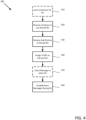
- FIG. 4 is a flowchart of a method 400 for RU sharing, according to embodiments of the present disclosure.
- Method 400 begins at block 420 when a second AP 110b receives an invitation to use a shared RU won by a first AP 110a in a shared network environment 100.
- the invitation is received as a specific message (e.g., in a control frame) that identifies when the RU begins, ends, the sub-channels and when those sub-channels are unoccupied.
- the invitation is received as the preamble to the RU, which identifies when the RU begins, ends, and the assigned portions 210 of the RU.
- method 400 before block 420 occurs, includes block 410, where the second AP 110b loses contention for the channel and time that the shared RU occupies. For example, the second AP 110b may contend to use a given channel for at least some of the time that the RU occupies, but the channel and time are won by the first AP 110a, which then shares any unused portions 220 with the second AP 110b. In other embodiments, the second AP 110b may be invited to use, and then share access to an RU won by a first AP 110a in a time or on a channel that the second AP 110b did not initially contend for, and method 400 may omit block 410.
- the second AP 110b reserves a sub-portion of the shared RU that is unoccupied by other APs 110.
- the second AP 110b may contend for access (whether assigned concurrently or sequentially) to the unused portions 220.
- the second AP 110b is given access to some or all of the unused portions 220 before a third AP 110c is given access to the unused portions 220, after a third AP 110c is given access to the unused portions 220, or concurrently to a third AP 110c being given access to the unused portions 220.
- the second AP 110b requests a sub-portion of the share RU to handle traffic with various UDs 120 associated with the second AP 110b, including uplink, downlink, and/or bi-directional traffic.
- the first AP 110a or a scheduler 150 prevents other APs 110 from also reserving an overlapping sub-portion of the RU (unless those APs 110 are serving UDs 120 in non-overlapping ranges 130).
- the shared portions 230 that the second AP 110 has reserved for handling traffic may occur on a given sub-channel that is clear of assigned portions 210 or is partially clear. On a partially clear sub-channel, a shared portion 230 may occur before an assigned portion 210, after an assigned portion 210, or between two assigned portions 210.
- the second AP 110b assigns traffic to the sub-portion(s) reserved in block 430.
- the second AP 110b prioritizes which traffic is assigned to the reserved sub-portions based on the priority of the traffic, which may include the latency sensitivity of the traffic, how full a buffer for the traffic is, a priority level or guaranteed service level for the connection, etc.
- the second AP 110b transmits the assignments to the various UDs 120 to alert the UDs 120 to be ready to transmit and/or receive messages on the various reserved sub-channels at the various reserved times.
- the assignments are transmitted in a wireless broadcast.
- the second AP 110b shares a message to the first AP 110a to transmit on the reserved sub-portions.
- the shared message is to be transmitted by the first AP 110a (but not the second AP 110b) and the first AP 110a transmits the shared message on behalf of the second AP 110b in a shared portion 240.
- the shared message is to be co-transmitted by the first AP 110a and the second AP 110b at the same time on the reserved sub-channel.
- the second AP 110b wirelessly shares the message to the first AP 110a on a different channel than the RU occupies, and/or by a wired connection.
- the first AP 110a can alter the header of the frames destined for the target device to indicate that the origin of the message is the second AP 110b.
- one or more of the APs 110 indicate to the target device that data may be received from different or multiple APs 110 when the UD 120 is located in an overlapping area 140, and the header of the frames may remain unmodified (i.e., indicate the actual transmitting AP 110) when the first AP 110a co-transmits with or transmitting on behalf of the second AP 110b.
- the second AP 110b transmits and/or receives communications on the shared portions 230 of the RU.
- the other APs 110 with which the first AP 110a is sharing access to the RU transmit and/or receive communications on assigned portions 210 or the shared portions 230 of the RU at block 460.
- the first AP 110a if a message to co-transmit with or to transmit on behalf of a second AP 110b has been received, can transmit that message during an assisted portion 240 of the RU during block 460. Method 400 may then conclude.
- FIG. 5 is a flowchart of a method 500 for RU sharing, according to embodiments of the present disclosure, not falling under the scope of protection of the present claims.
- Method 500 begins at block 510, where a scheduler 150 (or a master AP 110 in the network environment 100) identifies the AP 110 with overlapping ranges 130 and the UDs 120 associated with those APs 110. For example, the scheduler 150 identifies a first AP 110a associated with a first UD 120a, and a second AP 110b associated with a second UD 120b located in an overlapping area 140 for the first and second APs 110.
- the scheduler 150 identifies unused portions 220 of an RU won by the first AP 110a, and at block 530 assigns at least some of those unused portions 220 to the second AP 110b for use as shared portions 230, which the second AP 110b can use to communicate with the second UD 120b.
- the second AP 110b or the scheduler 150 communicates the assignments to the second UD 120b.
- the scheduler 150 may repeat block 520 and block 530 for subsequent APs 110 to assign sub-portions of the RU not used by other APs 110 to the subsequent APs 110 (e.g., a third AP 110c).
- a scheduler 150 may provide a bigger RU to AP 110a than what the AP 110 had asked for after analyzing various performance parameters (such as buffer depths for pending packets for devices that are in the overlapping area 140) and this over-assignment may allow increased opportunities for other neighboring APs 110 that also need to serve packets in the overlapping area 140.
- the scheduler 150 can assign an RU with a longer time duration and/or with a greater number of sub-channels than the first AP 110a that won the RU in contention needs to serve the UDs 120 associated with the first AP 110a, thus providing opportunities to share unused portions 220 of that RU with one or more neighboring APs 110.
- an AP 110 may request an RU for a duration of X ms and/or occupying Y channels, but the scheduler 150 over-assigns the RU to have a duration of X+A ms and/or Y+B channels to provide additional capacity for the AP 110 to share.
- the scheduler 150 transmits a Quiet Time Period command to one or more APs 110 that are not scheduled to communicate during the RU to ensure that those APS 110 do not attempt to communicate on the channel used by the RU for the duration of the RU.
- the scheduler 150 permits the APs 110 to transmit or receive communications over the scheduled sub-channels for the scheduled times. Method 500 may then conclude.
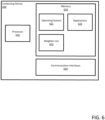
- FIG. 6 illustrates hardware of a computing device 600, as may be used in an AP 110, a UD 120, or scheduler 150 described in the present disclosure.
- the computing device 600 includes a processor 610, a memory 620, and communication interfaces 630.
- the processor 610 may be any processing element capable of performing the functions described herein.
- the processor 610 represents a single processor, multiple processors, a processor with multiple cores, and combinations thereof.
- the communication interfaces 630 facilitate communications between the computing device 600 and other devices.
- the communications interfaces 630 are representative of wireless communications antennas and various wired communication ports.
- the memory 620 may be either volatile or non-volatile memory and may include RAM, flash, cache, disk drives, and other computer readable memory storage devices. Although shown as a single entity, the memory 620 may be divided into different memory storage elements such as RAM and one or more hard disk drives.
- the memory 620 includes various instructions that are executable by the processor 610 to provide an operating system 621 to manage various functions of the computing device 600 and one or more applications 622 to provide various functionalities to users of the computing device 600, which include one or more of the functions and functionalities described in the present disclosure. Additionally, the memory 620 includes one or more of a neighbor list 623 indicating what APs 110 can (or are expected to) may request or offer to share an RU.
- the neighbor list 623 may include details for the neighboring APs 110 such as MAC address, signaling capabilities, extend of an associated range 130, etc., to enable the computing device 600 to determine where an overlapping area 140 exists, whether two APs 110 have contiguous ranges 130, and what information to include in a header or preamble when handling a shared message in an assisted portion 240 of an RU.
- Resource Unit (RU) sharing between Access Points in a wireless network is provided by identifying a first Access Point (AP) associated with a first user device, wherein the first AP has won contention for a RU; identifying a second AP associated with a second user device, wherein the first user device and the second user device are located within an overlapping area served by the first AP and the second AP; identifying an unused portion of the RU to which the first AP has not scheduled traffic between the first AP and the first user device; and assigning the unused portion to the second AP for communication between the second AP and the second user device.
- AP Access Point
- embodiments disclosed herein may be embodied as a system, method or computer program product. Accordingly, embodiments may take the form of an entirely hardware embodiment, an entirely software embodiment (including firmware, resident software, micro-code, etc.) or an embodiment combining software and hardware aspects that may all generally be referred to herein as a "circuit,” “module” or “system.” Furthermore, embodiments may take the form of a computer program product embodied in one or more computer readable medium(s) having computer readable program code embodied thereon.
- Program code embodied on a computer readable medium may be transmitted using any appropriate medium, including but not limited to wireless, wireline, optical fiber cable, RF, etc., or any suitable combination of the foregoing.
- Computer program code for carrying out operations for embodiments of the present disclosure may be written in any combination of one or more programming languages, including an object oriented programming language such as Java, Smalltalk, C++ or the like and conventional procedural programming languages, such as the "C" programming language or similar programming languages.
- the program code may execute entirely on the user's computer, partly on the user's computer, as a stand-alone software package, partly on the user's computer and partly on a remote computer or entirely on the remote computer or server.
- the remote computer may be connected to the user's computer through any type of network, including a local area network (LAN) or a wide area network (WAN), or the connection may be made to an external computer (for example, through the Internet using an Internet Service Provider).
- LAN local area network
- WAN wide area network
- Internet Service Provider for example, AT&T, MCI, Sprint, EarthLink, MSN, GTE, etc.
- These computer program instructions may also be stored in a computer readable medium that can direct a computer, other programmable data processing apparatus, or other device to function in a particular manner, such that the instructions stored in the computer readable medium produce an article of manufacture including instructions which implement the function/act specified in the block(s) of the flowchart illustrations and/or block diagrams.
- the computer program instructions may also be loaded onto a computer, other programmable data processing apparatus, or other device to cause a series of operational steps to be performed on the computer, other programmable apparatus or other device to produce a computer implemented process such that the instructions which execute on the computer, other programmable data processing apparatus, or other device provide processes for implementing the functions/acts specified in the block(s) of the flowchart illustrations and/or block diagrams.
- each block in the flowchart illustrations or block diagrams may represent a module, segment, or portion of code, which comprises one or more executable instructions for implementing the specified logical function(s).
- the functions noted in the block may occur out of the order noted in the Figures. For example, two blocks shown in succession may, in fact, be executed substantially concurrently, or the blocks may sometimes be executed in the reverse order, depending upon the functionality involved.
Landscapes
- Engineering & Computer Science (AREA)
- Signal Processing (AREA)
- Computer Networks & Wireless Communication (AREA)
- Quality & Reliability (AREA)
- Mobile Radio Communication Systems (AREA)
Claims (15)
- Verfahren, das Folgendes umfasst:Reservieren einer Ressourceneinheit (Resource Unit, RU) durch einen ersten Zugangspunkt (Access Point, AP) (130a) zur Verwendung in einer Umgebung, die einen überlappenden Bereich umfasst, der von dem ersten AP (130a) und einem zweiten AP (130b) bedient wird;Zuweisen von Datenverkehr zwischen einer ersten Benutzervorrichtung (120a) und dem ersten AP (130a) in der RU;Senden einer Einladung an den zweiten AP (130b), der einen ungenutzten Teil (220) der RU identifiziert;Zuweisen eines Teilabschnitts (230) des ungenutzten Teils (220) an den zweiten AP (130b);Senden des Datenverkehrs an die erste Benutzervorrichtung (120a) während der RU; undgleichzeitiges Senden einer Nachricht durch den ersten AP (130a) an eine zweite Benutzervorrichtung (120b), die dem zweiten AP (130b) zugeordnet ist, während der zweite AP (130b) die Nachricht an die zweite Benutzervorrichtung (120b) während des Teilabschnitts (230) sendet; oder Empfangen einer Nachricht von dem zweiten AP (130b) zum Senden an die zweite Benutzervorrichtung (120b), die dem zweiten AP (130b) zugeordnet ist, während des Teilabschnitts (230) und Senden der Nachricht durch den ersten AP (130a) an die zweite Benutzervorrichtung (120b) im Auftrag des zweiten AP (130b).
- Verfahren nach Anspruch 1, wobei die Einladung Folgendes identifiziert:eine Anfangszeit der RU;eine Endzeit der RU; undeinen verfügbaren Teilkanal während des ungenutzten Teils (220); undwobei der Teilabschnitt (230) den verfügbaren Teilkanal zu einem Zeitpunkt belegt, der nach der Anfangszeit beginnt und zur oder vor der Endzeit endet.
- Verfahren nach Anspruch 1 oder 2, das ferner umfasst:Zuweisen von Datenverkehr zwischen einer dritten Benutzervorrichtung (120e) und dem ersten AP (130a) in der RU; undwobei erste Nachrichten zwischen dem ersten AP (130a) und der ersten Benutzervorrichtung (120a) und zweite Nachrichten zwischen dem ersten AP (130a) der dritten Benutzervorrichtung (120b) zu einer gemeinsamen Zeit auf unterschiedlichen Teilkanälen gesendet werden.
- Verfahren nach Anspruch 3, wobei die erste Nachricht auf einer anderen Anzahl von Teilkanälen übertragen wird als die zweite Nachricht.
- Verfahren nach Anspruch 3 oder 4, wobei die erste Nachricht für eine andere Zeitdauer gesendet wird als die zweite Nachricht.
- Verfahren nach einem der Ansprüche 1 bis 5, wobei der ungenutzte Teil (220) einen Teil eines Teilkanals umfasst, wobei der Teilkanal einen zugewiesenen Teil (210) umfasst, dem der Datenverkehr in der RU zugewiesen wird, wobei derzugewiesene Teil (210) so geplant ist, dass er vor dem ungenutzten Teil (220) stattfindet.
- Verfahren nach einem der Ansprüche 1 bis 6, wobei der Datenverkehr mindestens eine Uplink-Nachricht und/oder eine Downlink-Nachricht umfasst.
- Verfahren, das Folgendes umfasst:Empfangen einer Einladung von einem ersten AP (130a), der eine Ressourceneinheit (Resource Unit, RU) zur Verwendung in einer Umgebung reserviert hat, die einen überlappenden Bereich umfasst, der von dem ersten AP (130a) und dem zweiten AP (130b) bedient wird, an einem zweiten Zugangspunkt (Access Point, AP) (130b), wobei die Einladung einen ungenutzten Teil (220) der RU identifiziert;Reservieren eines Teilabschnitts (230) während des ungenutzten Teils (220); undZuweisen von dem zweiten AP (130b) zugeordneten Datenverkehr an den Teilabschnitt (230); undgleichzeitiges Senden einer Nachricht durch den zweiten AP (130a) an eine zweite Benutzervorrichtung (120b), die dem zweiten AP (130b) zugeordnet ist, während der erste AP (130a) die Nachricht an die zweite Benutzervorrichtung (120a) während des Teilabschnitts (230) sendet; oder Senden einer Nachricht durch den zweiten AP (130b) an den ersten AP (130a) zum Senden an die zweite Benutzervorrichtung (120b), die dem zweiten AP (130b) zugeordnet ist, während des Teilabschnitts (230), wobei die Nachricht durch den ersten AP (130a) an die zweite Benutzervorrichtung (120b) im Auftrag des zweiten AP (130b) zu senden ist.
- Verfahren nach Anspruch 8, das ferner mindestens eines der folgenden umfasst:Senden einer Downlink-Nachricht durch den zweiten AP (130b) an eine Benutzervorrichtung (120) während des Teilabschnitts (230); undEmpfangen einer Uplink-Nachricht durch den zweiten AP (130b) von der Benutzervorrichtung (120) während des Teilabschnitts (230).
- Verfahren nach Anspruch 8 oder 9, wobei der Teilabschnitt (230) auf einem teilweise belegten Teilkanal reserviert ist, wobei der Teilabschnitt (230) einen Zeitbereich in dem teilweise belegten Teilkanal belegt, außerhalb dessen der zweite AP (130b) dem teilweise belegten Teilkanal Datenverkehr zugewiesen hat.
- Gerät, umfassend:Mittel zum Reservieren einer Ressourceneinheit (Resource Unit, RU) durch einen ersten Zugangspunkt (Access Point, AP) (130a) zur Verwendung in einer Umgebung, die einen überlappenden Bereich umfasst, der von dem ersten AP (130a) und einem zweiten AP (130b) bedient wird;Mittel zum Zuweisen von Datenverkehr zwischen einer ersten Benutzervorrichtung (120a) und dem ersten AP (130a) in der RU;Mittel zum Senden einer Einladung an den zweiten AP (130b), der einen ungenutzten Teil (220) der RU identifiziert;Mittel zum Zuweisen eines Teilabschnitts (230) des ungenutzten Teils (220) an den zweiten AP (130b);Mittel zum Senden des Datenverkehrs an die erste Benutzervorrichtung (120a) während der RU; undMittel zum gleichzeitigen Senden einer Nachricht durch den ersten AP (130a) an eine zweite Benutzervorrichtung (120b), die dem zweiten AP (130b) zugeordnet ist, während der zweite AP (130b) die Nachricht an die zweite Benutzervorrichtung (120b) während des Teilabschnitts (230) sendet; oder Mittel zum Empfangen einer Nachricht von dem zweiten AP (130b) zum Senden an die zweite Benutzervorrichtung (120b), die dem zweiten AP (130b) zugeordnet ist, während des Teilabschnitts (230) und Mittel zum Senden der Nachricht durch den ersten AP (130a) an die zweite Benutzervorrichtung (120b) im Auftrag des zweiten AP (130b).
- Gerät nach Anspruch 11, das ferner Mittel zum Implementieren des Verfahrens nach einem der Ansprüche 2 bis 7 umfasst.
- Gerät, umfassend:Mittel zum Empfangen einer Einladung von einem ersten AP (130a), der eine Ressourceneinheit (Resource Unit, RU) zur Verwendung in einer Umgebung reserviert hat, die einen überlappenden Bereich umfasst, der von dem ersten AP (130a) und dem zweiten AP (130b) bedient wird, an einem zweiten Zugangspunkt (Access Point, AP) (130b), wobei die Einladung einen ungenutzten Teil (220) der RU identifiziert;Mittel zum Reservieren eines Teilabschnitts (230) während des ungenutzten Teils (220); undMittel zum Zuweisen von dem zweiten AP (130b) zugeordneten Datenverkehr an den Teilabschnitt (230); undMittel zum gleichzeitigen Senden einer Nachricht durch den zweiten AP (130a) an eine zweite Benutzervorrichtung (120b), die dem zweiten AP (130b) zugeordnet ist, während der erste AP (130a) die Nachricht an die zweite Benutzervorrichtung (120a) während des Teilabschnitts (230) sendet; oder Mittel zum Senden einer Nachricht durch den zweiten AP (130b) an den ersten AP (130a) zum Senden an die zweite Benutzervorrichtung (120b), die dem zweiten AP (130b) zugeordnet ist, während des Teilabschnitts (230), wobei die Nachricht durch den ersten AP (130a) an die zweite Benutzervorrichtung (120b) im Auftrag des zweiten AP (130b) zu senden ist.
- Gerät nach Anspruch 13, das ferner Mittel zum Implementieren des Verfahrens nach Anspruch 9 oder 10 umfasst.
- Computerprogramm, Computerprogrammprodukt oder computerlesbares Medium, die Anweisungen umfassen, die, wenn sie von einem Computer ausgeführt werden, den Computer veranlassen, die Schritte des Verfahrens nach einem der Ansprüche 1 bis 10 auszuführen.
Priority Applications (1)
| Application Number | Priority Date | Filing Date | Title |
|---|---|---|---|
| EP25150358.7A EP4539527A1 (de) | 2020-01-24 | 2021-01-22 | Gemeinsame nutzung von ressourceneinheiten |
Applications Claiming Priority (2)
| Application Number | Priority Date | Filing Date | Title |
|---|---|---|---|
| US16/752,354 US11375411B2 (en) | 2020-01-24 | 2020-01-24 | Resource unit sharing |
| PCT/US2021/070067 WO2021151116A1 (en) | 2020-01-24 | 2021-01-22 | Resource unit sharing |
Related Child Applications (1)
| Application Number | Title | Priority Date | Filing Date |
|---|---|---|---|
| EP25150358.7A Division EP4539527A1 (de) | 2020-01-24 | 2021-01-22 | Gemeinsame nutzung von ressourceneinheiten |
Publications (2)
| Publication Number | Publication Date |
|---|---|
| EP4094468A1 EP4094468A1 (de) | 2022-11-30 |
| EP4094468B1 true EP4094468B1 (de) | 2025-01-08 |
Family
ID=74672477
Family Applications (2)
| Application Number | Title | Priority Date | Filing Date |
|---|---|---|---|
| EP25150358.7A Pending EP4539527A1 (de) | 2020-01-24 | 2021-01-22 | Gemeinsame nutzung von ressourceneinheiten |
| EP21707128.1A Active EP4094468B1 (de) | 2020-01-24 | 2021-01-22 | Gemeinsame nutzung von ressourceneinheiten |
Family Applications Before (1)
| Application Number | Title | Priority Date | Filing Date |
|---|---|---|---|
| EP25150358.7A Pending EP4539527A1 (de) | 2020-01-24 | 2021-01-22 | Gemeinsame nutzung von ressourceneinheiten |
Country Status (4)
| Country | Link |
|---|---|
| US (1) | US11375411B2 (de) |
| EP (2) | EP4539527A1 (de) |
| CN (1) | CN114930893B (de) |
| WO (1) | WO2021151116A1 (de) |
Families Citing this family (1)
| Publication number | Priority date | Publication date | Assignee | Title |
|---|---|---|---|---|
| WO2025076721A1 (en) * | 2023-10-11 | 2025-04-17 | Qualcomm Incorporated | Techniques for recycling unused transmission opportunities in wireless communications |
Family Cites Families (18)
| Publication number | Priority date | Publication date | Assignee | Title |
|---|---|---|---|---|
| US20090059856A1 (en) * | 2007-08-10 | 2009-03-05 | Nokia Corporation | Spectrum sharing |
| CN104303572A (zh) | 2012-05-04 | 2015-01-21 | 交互数字专利控股公司 | 针对频谱共享的共存管理服务 |
| US9432854B2 (en) | 2013-09-13 | 2016-08-30 | Nokia Corporation | Interference avoidance between overlapping wireless networks |
| WO2015120577A1 (zh) * | 2014-02-11 | 2015-08-20 | 华为技术有限公司 | 数据传输处理方法及装置 |
| EP3175669B1 (de) * | 2014-08-01 | 2019-10-30 | Empire Technology Development LLC | Adaptive kommunikationsressourcenzuweisung in einem drahtlosen netzwerk |
| US10153970B2 (en) * | 2014-11-26 | 2018-12-11 | Qualcomm Incorporated | Partial channel reservation on a shared communication medium |
| US10314066B2 (en) * | 2015-05-05 | 2019-06-04 | Qualcomm Incorporated | Techniques for protecting communications in wireless local area networks |
| ES2714135T3 (es) | 2015-06-30 | 2019-05-27 | Alcatel Lucent | Un nodo de comunicaciones inalámbricas, y método de reserva de un periodo de tiempo para comunicaciones en una banda de espectro compartida entre dos tecnologías de red inalámbrica diferentes |
| US10257848B2 (en) | 2016-10-04 | 2019-04-09 | Qualcomm Incorporated | Directional channel reservation for time-division multiplexing downlink and uplink data burst transmission |
| US10340975B2 (en) | 2016-12-15 | 2019-07-02 | Cisco Technology, Inc. | Filter design for access points |
| CN115102671B (zh) * | 2017-01-03 | 2024-06-21 | 北京三星通信技术研究有限公司 | 数据传输的方法及设备 |
| US10524270B2 (en) * | 2017-03-06 | 2019-12-31 | Hewlett Packard Enterprise Development Lp | Contention-based resource allocation |
| US10555203B2 (en) | 2017-03-22 | 2020-02-04 | Qualcomm Incorporated | Channel reservation techniques for millimeter wave systems |
| CN108737010B (zh) | 2017-04-19 | 2024-04-30 | 中兴通讯股份有限公司 | 一种信息交互的方法及装置 |
| US10721627B2 (en) | 2017-08-04 | 2020-07-21 | Qualcomm Incorporated | Generalized distributed multi-user (MU) transmissions |
| US11711183B2 (en) * | 2018-09-04 | 2023-07-25 | Qualcomm Incorporated | Protocols for multi-access point coordinated multi-user transmissions |
| US11627526B2 (en) * | 2019-12-02 | 2023-04-11 | Qualcomm Incorporated | Coordinated device-to-device communications |
| GB201919090D0 (en) * | 2019-12-20 | 2020-02-05 | Canon Kk | Method and apparatus for coordinating multi-user multi-access point transmissions |
-
2020
- 2020-01-24 US US16/752,354 patent/US11375411B2/en active Active
-
2021
- 2021-01-22 WO PCT/US2021/070067 patent/WO2021151116A1/en not_active Ceased
- 2021-01-22 EP EP25150358.7A patent/EP4539527A1/de active Pending
- 2021-01-22 CN CN202180008128.0A patent/CN114930893B/zh active Active
- 2021-01-22 EP EP21707128.1A patent/EP4094468B1/de active Active
Also Published As
| Publication number | Publication date |
|---|---|
| WO2021151116A1 (en) | 2021-07-29 |
| CN114930893B (zh) | 2025-09-19 |
| CN114930893A (zh) | 2022-08-19 |
| EP4539527A1 (de) | 2025-04-16 |
| EP4094468A1 (de) | 2022-11-30 |
| US11375411B2 (en) | 2022-06-28 |
| US20210235327A1 (en) | 2021-07-29 |
Similar Documents
| Publication | Publication Date | Title |
|---|---|---|
| US11516820B2 (en) | Resource allocation method for sidelink and terminal | |
| EP4007318B1 (de) | Verfahren zur verarbeitung von logikkanalpriorität, speichermedium und endgerät | |
| KR102057949B1 (ko) | 무선 통신 시스템에서 데이터 통신 수행 방법 및 장치 | |
| JP4025777B2 (ja) | 無線個人領域ネットワークにおけるチャネル時間割当て方法 | |
| EP4018755B1 (de) | Bidirektionale und vollduplex-kommunikation | |
| EP3459306B1 (de) | Gerät und verfahren für eine konfigurierbare rahmenstruktur | |
| JP6270148B2 (ja) | 無線通信方法、無線通信システム及び無線通信プログラム | |
| EP4616663A1 (de) | Semipersistente multi-ap-koordination | |
| US11979862B2 (en) | Time-sensitive networking in high density networks | |
| EP4094468B1 (de) | Gemeinsame nutzung von ressourceneinheiten | |
| JP6851537B2 (ja) | サブセット制限を伴う広帯域幅でのueランダム・アクセスのためのシステムおよび方法 | |
| US20250331020A1 (en) | Resource allocation method and apparatus | |
| EP3097715B1 (de) | Verwendung gemeinsamer, durch template-frame angezeigter ressourcen | |
| US10187886B2 (en) | Data transmission method and station | |
| US11368938B2 (en) | Wireless communication system and wireless communication method | |
| JP6270147B2 (ja) | 無線通信方法、無線通信システム及び無線通信プログラム | |
| EP4287581B1 (de) | Vorrichtung und verfahren zur handhabung von echtzeitdatenübertragung | |
| HK1128125A (en) | Data slot allocation method used to transmit uncompressed av data, and method and apparatus for transmitting uncompressed av data |
Legal Events
| Date | Code | Title | Description |
|---|---|---|---|
| STAA | Information on the status of an ep patent application or granted ep patent |
Free format text: STATUS: UNKNOWN |
|
| STAA | Information on the status of an ep patent application or granted ep patent |
Free format text: STATUS: THE INTERNATIONAL PUBLICATION HAS BEEN MADE |
|
| PUAI | Public reference made under article 153(3) epc to a published international application that has entered the european phase |
Free format text: ORIGINAL CODE: 0009012 |
|
| STAA | Information on the status of an ep patent application or granted ep patent |
Free format text: STATUS: REQUEST FOR EXAMINATION WAS MADE |
|
| 17P | Request for examination filed |
Effective date: 20220817 |
|
| AK | Designated contracting states |
Kind code of ref document: A1 Designated state(s): AL AT BE BG CH CY CZ DE DK EE ES FI FR GB GR HR HU IE IS IT LI LT LU LV MC MK MT NL NO PL PT RO RS SE SI SK SM TR |
|
| DAV | Request for validation of the european patent (deleted) | ||
| DAX | Request for extension of the european patent (deleted) | ||
| P01 | Opt-out of the competence of the unified patent court (upc) registered |
Effective date: 20230525 |
|
| REG | Reference to a national code |
Ref country code: DE Ref legal event code: R079 Free format text: PREVIOUS MAIN CLASS: H04W0016140000 Ipc: H04W0072200000 Ref country code: DE Ref legal event code: R079 Ref document number: 602021024649 Country of ref document: DE Free format text: PREVIOUS MAIN CLASS: H04W0016140000 Ipc: H04W0072200000 |
|
| GRAP | Despatch of communication of intention to grant a patent |
Free format text: ORIGINAL CODE: EPIDOSNIGR1 |
|
| STAA | Information on the status of an ep patent application or granted ep patent |
Free format text: STATUS: GRANT OF PATENT IS INTENDED |
|
| RIC1 | Information provided on ipc code assigned before grant |
Ipc: H04W 72/20 20230101AFI20240724BHEP |
|
| INTG | Intention to grant announced |
Effective date: 20240802 |
|
| RAP3 | Party data changed (applicant data changed or rights of an application transferred) |
Owner name: CISCO TECHNOLOGY, INC. |
|
| GRAS | Grant fee paid |
Free format text: ORIGINAL CODE: EPIDOSNIGR3 |
|
| GRAA | (expected) grant |
Free format text: ORIGINAL CODE: 0009210 |
|
| STAA | Information on the status of an ep patent application or granted ep patent |
Free format text: STATUS: THE PATENT HAS BEEN GRANTED |
|
| AK | Designated contracting states |
Kind code of ref document: B1 Designated state(s): AL AT BE BG CH CY CZ DE DK EE ES FI FR GB GR HR HU IE IS IT LI LT LU LV MC MK MT NL NO PL PT RO RS SE SI SK SM TR |
|
| REG | Reference to a national code |
Ref country code: GB Ref legal event code: FG4D |
|
| REG | Reference to a national code |
Ref country code: CH Ref legal event code: EP |
|
| REG | Reference to a national code |
Ref country code: DE Ref legal event code: R096 Ref document number: 602021024649 Country of ref document: DE |
|
| REG | Reference to a national code |
Ref country code: IE Ref legal event code: FG4D |
|
| PGFP | Annual fee paid to national office [announced via postgrant information from national office to epo] |
Ref country code: DE Payment date: 20250128 Year of fee payment: 5 |
|
| PGFP | Annual fee paid to national office [announced via postgrant information from national office to epo] |
Ref country code: AT Payment date: 20250417 Year of fee payment: 5 |
|
| PGFP | Annual fee paid to national office [announced via postgrant information from national office to epo] |
Ref country code: FR Payment date: 20250128 Year of fee payment: 5 |
|
| PGFP | Annual fee paid to national office [announced via postgrant information from national office to epo] |
Ref country code: GB Payment date: 20250128 Year of fee payment: 5 |
|
| REG | Reference to a national code |
Ref country code: LT Ref legal event code: MG9D |
|
| REG | Reference to a national code |
Ref country code: NL Ref legal event code: MP Effective date: 20250108 |
|
| REG | Reference to a national code |
Ref country code: AT Ref legal event code: MK05 Ref document number: 1759144 Country of ref document: AT Kind code of ref document: T Effective date: 20250108 |
|
| PG25 | Lapsed in a contracting state [announced via postgrant information from national office to epo] |
Ref country code: NL Free format text: LAPSE BECAUSE OF FAILURE TO SUBMIT A TRANSLATION OF THE DESCRIPTION OR TO PAY THE FEE WITHIN THE PRESCRIBED TIME-LIMIT Effective date: 20250108 |
|
| PG25 | Lapsed in a contracting state [announced via postgrant information from national office to epo] |
Ref country code: RS Free format text: LAPSE BECAUSE OF FAILURE TO SUBMIT A TRANSLATION OF THE DESCRIPTION OR TO PAY THE FEE WITHIN THE PRESCRIBED TIME-LIMIT Effective date: 20250408 |
|
| PG25 | Lapsed in a contracting state [announced via postgrant information from national office to epo] |
Ref country code: FI Free format text: LAPSE BECAUSE OF FAILURE TO SUBMIT A TRANSLATION OF THE DESCRIPTION OR TO PAY THE FEE WITHIN THE PRESCRIBED TIME-LIMIT Effective date: 20250108 |
|
| PG25 | Lapsed in a contracting state [announced via postgrant information from national office to epo] |
Ref country code: PL Free format text: LAPSE BECAUSE OF FAILURE TO SUBMIT A TRANSLATION OF THE DESCRIPTION OR TO PAY THE FEE WITHIN THE PRESCRIBED TIME-LIMIT Effective date: 20250108 |
|
| PG25 | Lapsed in a contracting state [announced via postgrant information from national office to epo] |
Ref country code: ES Free format text: LAPSE BECAUSE OF FAILURE TO SUBMIT A TRANSLATION OF THE DESCRIPTION OR TO PAY THE FEE WITHIN THE PRESCRIBED TIME-LIMIT Effective date: 20250108 |
|
| PG25 | Lapsed in a contracting state [announced via postgrant information from national office to epo] |
Ref country code: IS Free format text: LAPSE BECAUSE OF FAILURE TO SUBMIT A TRANSLATION OF THE DESCRIPTION OR TO PAY THE FEE WITHIN THE PRESCRIBED TIME-LIMIT Effective date: 20250508 Ref country code: NO Free format text: LAPSE BECAUSE OF FAILURE TO SUBMIT A TRANSLATION OF THE DESCRIPTION OR TO PAY THE FEE WITHIN THE PRESCRIBED TIME-LIMIT Effective date: 20250408 |
|
| PG25 | Lapsed in a contracting state [announced via postgrant information from national office to epo] |
Ref country code: HR Free format text: LAPSE BECAUSE OF FAILURE TO SUBMIT A TRANSLATION OF THE DESCRIPTION OR TO PAY THE FEE WITHIN THE PRESCRIBED TIME-LIMIT Effective date: 20250108 |
|
| PG25 | Lapsed in a contracting state [announced via postgrant information from national office to epo] |
Ref country code: PT Free format text: LAPSE BECAUSE OF FAILURE TO SUBMIT A TRANSLATION OF THE DESCRIPTION OR TO PAY THE FEE WITHIN THE PRESCRIBED TIME-LIMIT Effective date: 20250508 Ref country code: LV Free format text: LAPSE BECAUSE OF FAILURE TO SUBMIT A TRANSLATION OF THE DESCRIPTION OR TO PAY THE FEE WITHIN THE PRESCRIBED TIME-LIMIT Effective date: 20250108 |
|
| PG25 | Lapsed in a contracting state [announced via postgrant information from national office to epo] |
Ref country code: GR Free format text: LAPSE BECAUSE OF FAILURE TO SUBMIT A TRANSLATION OF THE DESCRIPTION OR TO PAY THE FEE WITHIN THE PRESCRIBED TIME-LIMIT Effective date: 20250409 Ref country code: BG Free format text: LAPSE BECAUSE OF FAILURE TO SUBMIT A TRANSLATION OF THE DESCRIPTION OR TO PAY THE FEE WITHIN THE PRESCRIBED TIME-LIMIT Effective date: 20250108 |
|
| PG25 | Lapsed in a contracting state [announced via postgrant information from national office to epo] |
Ref country code: AT Free format text: LAPSE BECAUSE OF FAILURE TO SUBMIT A TRANSLATION OF THE DESCRIPTION OR TO PAY THE FEE WITHIN THE PRESCRIBED TIME-LIMIT Effective date: 20250108 |
|
| REG | Reference to a national code |
Ref country code: CH Ref legal event code: PL |
|
| PG25 | Lapsed in a contracting state [announced via postgrant information from national office to epo] |
Ref country code: SE Free format text: LAPSE BECAUSE OF FAILURE TO SUBMIT A TRANSLATION OF THE DESCRIPTION OR TO PAY THE FEE WITHIN THE PRESCRIBED TIME-LIMIT Effective date: 20250108 |
|
| PG25 | Lapsed in a contracting state [announced via postgrant information from national office to epo] |
Ref country code: LU Free format text: LAPSE BECAUSE OF NON-PAYMENT OF DUE FEES Effective date: 20250122 |
|
| PG25 | Lapsed in a contracting state [announced via postgrant information from national office to epo] |
Ref country code: SM Free format text: LAPSE BECAUSE OF FAILURE TO SUBMIT A TRANSLATION OF THE DESCRIPTION OR TO PAY THE FEE WITHIN THE PRESCRIBED TIME-LIMIT Effective date: 20250108 |
|
| REG | Reference to a national code |
Ref country code: DE Ref legal event code: R097 Ref document number: 602021024649 Country of ref document: DE |
|
| PG25 | Lapsed in a contracting state [announced via postgrant information from national office to epo] |
Ref country code: DK Free format text: LAPSE BECAUSE OF FAILURE TO SUBMIT A TRANSLATION OF THE DESCRIPTION OR TO PAY THE FEE WITHIN THE PRESCRIBED TIME-LIMIT Effective date: 20250108 |
|
| PG25 | Lapsed in a contracting state [announced via postgrant information from national office to epo] |
Ref country code: MC Free format text: LAPSE BECAUSE OF FAILURE TO SUBMIT A TRANSLATION OF THE DESCRIPTION OR TO PAY THE FEE WITHIN THE PRESCRIBED TIME-LIMIT Effective date: 20250108 |
|
| PG25 | Lapsed in a contracting state [announced via postgrant information from national office to epo] |
Ref country code: BE Free format text: LAPSE BECAUSE OF NON-PAYMENT OF DUE FEES Effective date: 20250131 |
|
| PG25 | Lapsed in a contracting state [announced via postgrant information from national office to epo] |
Ref country code: CH Free format text: LAPSE BECAUSE OF NON-PAYMENT OF DUE FEES Effective date: 20250131 |
|
| PG25 | Lapsed in a contracting state [announced via postgrant information from national office to epo] |
Ref country code: EE Free format text: LAPSE BECAUSE OF FAILURE TO SUBMIT A TRANSLATION OF THE DESCRIPTION OR TO PAY THE FEE WITHIN THE PRESCRIBED TIME-LIMIT Effective date: 20250108 Ref country code: CZ Free format text: LAPSE BECAUSE OF FAILURE TO SUBMIT A TRANSLATION OF THE DESCRIPTION OR TO PAY THE FEE WITHIN THE PRESCRIBED TIME-LIMIT Effective date: 20250108 |
|
| REG | Reference to a national code |
Ref country code: BE Ref legal event code: MM Effective date: 20250131 |
|
| PG25 | Lapsed in a contracting state [announced via postgrant information from national office to epo] |
Ref country code: RO Free format text: LAPSE BECAUSE OF FAILURE TO SUBMIT A TRANSLATION OF THE DESCRIPTION OR TO PAY THE FEE WITHIN THE PRESCRIBED TIME-LIMIT Effective date: 20250108 |
|
| PG25 | Lapsed in a contracting state [announced via postgrant information from national office to epo] |
Ref country code: SK Free format text: LAPSE BECAUSE OF FAILURE TO SUBMIT A TRANSLATION OF THE DESCRIPTION OR TO PAY THE FEE WITHIN THE PRESCRIBED TIME-LIMIT Effective date: 20250108 |
|
| PLBE | No opposition filed within time limit |
Free format text: ORIGINAL CODE: 0009261 |
|
| STAA | Information on the status of an ep patent application or granted ep patent |
Free format text: STATUS: NO OPPOSITION FILED WITHIN TIME LIMIT |
|
| 26N | No opposition filed |
Effective date: 20251009 |
|
| PG25 | Lapsed in a contracting state [announced via postgrant information from national office to epo] |
Ref country code: IE Free format text: LAPSE BECAUSE OF NON-PAYMENT OF DUE FEES Effective date: 20250122 |
|
| PG25 | Lapsed in a contracting state [announced via postgrant information from national office to epo] |
Ref country code: IT Free format text: LAPSE BECAUSE OF FAILURE TO SUBMIT A TRANSLATION OF THE DESCRIPTION OR TO PAY THE FEE WITHIN THE PRESCRIBED TIME-LIMIT Effective date: 20250108 |