EP4092294B1 - A method and a system for controlling a hydrostatic transmission of a motor vehicle - Google Patents
A method and a system for controlling a hydrostatic transmission of a motor vehicle Download PDFInfo
- Publication number
- EP4092294B1 EP4092294B1 EP22173251.4A EP22173251A EP4092294B1 EP 4092294 B1 EP4092294 B1 EP 4092294B1 EP 22173251 A EP22173251 A EP 22173251A EP 4092294 B1 EP4092294 B1 EP 4092294B1
- Authority
- EP
- European Patent Office
- Prior art keywords
- motor vehicle
- speed
- limit
- value
- actual torque
- Prior art date
- Legal status (The legal status is an assumption and is not a legal conclusion. Google has not performed a legal analysis and makes no representation as to the accuracy of the status listed.)
- Active
Links
Images



Classifications
-
- F—MECHANICAL ENGINEERING; LIGHTING; HEATING; WEAPONS; BLASTING
- F16—ENGINEERING ELEMENTS AND UNITS; GENERAL MEASURES FOR PRODUCING AND MAINTAINING EFFECTIVE FUNCTIONING OF MACHINES OR INSTALLATIONS; THERMAL INSULATION IN GENERAL
- F16H—GEARING
- F16H61/00—Control functions within control units of change-speed- or reversing-gearings for conveying rotary motion ; Control of exclusively fluid gearing, friction gearing, gearings with endless flexible members or other particular types of gearing
- F16H61/38—Control of exclusively fluid gearing
- F16H61/40—Control of exclusively fluid gearing hydrostatic
- F16H61/46—Automatic regulation in accordance with output requirements
- F16H61/47—Automatic regulation in accordance with output requirements for achieving a target output speed
-
- B—PERFORMING OPERATIONS; TRANSPORTING
- B60—VEHICLES IN GENERAL
- B60Y—INDEXING SCHEME RELATING TO ASPECTS CROSS-CUTTING VEHICLE TECHNOLOGY
- B60Y2200/00—Type of vehicle
- B60Y2200/20—Off-Road Vehicles
- B60Y2200/22—Agricultural vehicles
- B60Y2200/221—Tractors
-
- F—MECHANICAL ENGINEERING; LIGHTING; HEATING; WEAPONS; BLASTING
- F16—ENGINEERING ELEMENTS AND UNITS; GENERAL MEASURES FOR PRODUCING AND MAINTAINING EFFECTIVE FUNCTIONING OF MACHINES OR INSTALLATIONS; THERMAL INSULATION IN GENERAL
- F16H—GEARING
- F16H59/00—Control inputs to control units of change-speed- or reversing-gearings for conveying rotary motion
- F16H59/14—Inputs being a function of torque or torque demand
- F16H2059/148—Transmission output torque, e.g. measured or estimated torque at output drive shaft
-
- F—MECHANICAL ENGINEERING; LIGHTING; HEATING; WEAPONS; BLASTING
- F16—ENGINEERING ELEMENTS AND UNITS; GENERAL MEASURES FOR PRODUCING AND MAINTAINING EFFECTIVE FUNCTIONING OF MACHINES OR INSTALLATIONS; THERMAL INSULATION IN GENERAL
- F16H—GEARING
- F16H2312/00—Driving activities
- F16H2312/02—Driving off
-
- F—MECHANICAL ENGINEERING; LIGHTING; HEATING; WEAPONS; BLASTING
- F16—ENGINEERING ELEMENTS AND UNITS; GENERAL MEASURES FOR PRODUCING AND MAINTAINING EFFECTIVE FUNCTIONING OF MACHINES OR INSTALLATIONS; THERMAL INSULATION IN GENERAL
- F16H—GEARING
- F16H2312/00—Driving activities
- F16H2312/10—Inching
-
- F—MECHANICAL ENGINEERING; LIGHTING; HEATING; WEAPONS; BLASTING
- F16—ENGINEERING ELEMENTS AND UNITS; GENERAL MEASURES FOR PRODUCING AND MAINTAINING EFFECTIVE FUNCTIONING OF MACHINES OR INSTALLATIONS; THERMAL INSULATION IN GENERAL
- F16H—GEARING
- F16H59/00—Control inputs to control units of change-speed- or reversing-gearings for conveying rotary motion
- F16H59/36—Inputs being a function of speed
- F16H59/44—Inputs being a function of speed dependent on machine speed, e.g. the vehicle speed
Definitions
- the invention concerns a method and system for controlling a hydrostatic transmission of a motor vehicle, in particular a work vehicle such as a tractor.
- Motor vehicles like tractors are normally provided with a clutch being drivable by modulating the depression of a clutch pedal.
- Adjusting the position of the clutch pedal causes a gradual advancing of the vehicle.
- This gradual advancing which is obtained by adjusting the position of the clutch pedal, is often defined with the English wording "clutch inching".
- a controlled modulation of the position of the clutch corresponds to the control of the slipping, which allows the vehicle speed being adjusted while maintaining the engine speed stationary.
- the clutch operation in slipping conditions causes a generation of heat and an increased wearing of the clutch itself, especially if the slipping conditions are prolonged in time.
- An object of the invention is to satisfy the need above, preferably in a simple and cost effective manner.
- reference number 1 indicates, as a whole, a motor vehicle, in particular a work vehicle such as a tractor.
- Vehicle 1 comprises an engine 2, a drive axle 3, and a hydrostatic transmission 4 as a continuously variable transmission (CVT).
- CVT continuously variable transmission
- the drive axle 3 can be coupled to the transmission 4, such that the latter can drive the drive axle 3.
- the drive axle 3 carries a pair of wheels 3a.
- the transmission 4 can be coupled to the engine 2, such that the latter can drive the transmission 4 and thus the drive axle 3 accordingly.
- the drive axle 3 can be coupled to the engine 2 via the transmission 4.
- Vehicle 1 further comprises a clutch 5 being configured to connect the engine 2 and the drive axle 3 selectively, such that the engine 2 can drive the drive axle 3 through the transmission 4.
- the clutch 5 is arranged between the transmission 4 and the drive axle 3. More in particular, the clutch 5 is configured to connect the drive axle 3 and the transmission 4 selectively.
- the clutch 5 has two positions, of which one is a fully disengaged position, in which the engine 2 and the drive axle 3 are completely disconnected, and the other one is a fully engaged position, in which the engine 2 can be connected to the drive axle 3.
- the clutch 5 in the fully engaged position connects the drive axle 3 to the transmission 4.
- the transmission 4 drives the drive axle 3 in the fully engaged position.
- the vehicle 1 comprises a damping assembly, in particular including a damper 6, more in particular a dual mass flywheel.
- the damping assembly is arranged between the engine 2 and the transmission 4 and is configured to connect the engine 2 to the transmission 4.
- Control unit 8 is also connected to a command member 9 of vehicle 1.
- Command member 9 is operable by a driver of the vehicle 1.
- command member 9 is configured to emit an input command based on how the driver operates the same command member 9. More precisely, command member 9 can take a plurality of positions; accordingly, the input command depends on the position taken by command member 9, in particular due to the choice of the driver.
- command member 9 is a clutch pedal without any loss of generality; command member 9 may alternatively be a button, a lever, or the like.
- Control unit 8 is configured to detect the input command emitted by command member 9.
- control unit 8 is configured to determine a limit drive torque transmissible to the drive axle 3 as a function of the detected input command through a predetermined mapping.
- the mapping is preferably stored in the control unit 8.
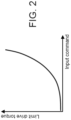
- An example of the mapping is graphically represented in Figure 2 .
- Control unit 8 may store a plurality of different mappings.
- the mapping that is actually used to determine the limit drive torque may depend on one or more operative parameters of the vehicle 1, possibly associated to the transmission 4.
- the used mapping may depend on the travel direction of the vehicle 1 (forward or rearward movement of the vehicle 1).
- the used mapping may depend on one or more parameters of the transmission 4 affecting the promptness thereof, such as the pump displacement of the transmission 4, possibly as a function of other parameters of the vehicle 1, e.g. the torque acting on the drive axle 3 or the speed of engine 2.
- the input command of Figure 2 may be expressed for example by means of a percentage value, where 0% corresponds to the specific position of command member 9 (fully depressed clutch pedal) and 100% corresponds to a non-operated or resting command member 9 (released clutch pedal).
- Control unit 8 is configured to determine a target speed for the vehicle 1 based on the computed desirable speed value. Furthermore, control unit 8 is configured to set the target speed as a set-point for controlling the transmission 4. In other words, the transmission 4 is controlled setting the target speed as a set-point. For example, the transmission 4 is controlled in a closed loop fashion; the output speed of the transmission 4 is the controlled or process variable, whereas the set-point represent the reference variable.
- the system further comprises a transducer T2 configured to detect the output speed of the transmission 4.
- Control unit 8 is configured to acquire the output speed of the transmission 4 and, specifically, to use it as a feedback for the closed-loop control. Alternatively, the transmission 4 is open loop controlled based on the set-point.
- Control unit 8 is configured to determine if the actual torque is positive or negative, in particular through the first quantity, which reveals the direction of the actual torque, and through information about the travel direction of the vehicle. For example, control unit 8 may be configured to extract the information from a switching device, which is operable to switch the travel direction of the vehicle 1. The direction of the torque and the travel direction of the vehicle 1 determine one of the four operative conditions of Figure 3 ; this means that control unit 8 can determine the operative condition too, together with the sign of the actual torque.
- Control unit 8 computes the difference as the limit drive torque minus the modulus of the actual torque when the actual torque is positive. On the contrary, control unit 8 computes the difference as the modulus of the actual torque minus the limit drive torque when the actual torque is negative.
- the acceleration value is, in particular, the ratio of the difference to the quantity representing the mass of the vehicle 1.
- the acceleration value may be negative, which corresponds to a deceleration of the vehicle 1.
- control unit 8 acquires a quantity indicative of the actual current speed of the vehicle 1. For example, control unit 8 acquires the quantity from the transducer T2. Alternatively, control unit 8 may acquire the quantity from different transducers, for example configured to detect a speed of the drive axle 3, or even through estimation based on how control unit 8 controls the speed of the engine 2.
- control unit 8 computes the desirable speed value by summing the actual current speed to the acceleration value multiplied by a proportional gain.
- the proportional gain is a coefficient, which may be differently set by control unit 8 if the acceleration value is positive or negative.
- control unit 8 sets a first and a second coefficient as the proportional gain respectively when the acceleration value is positive and negative.
- the first and the second coefficient may be appropriately tuned experimentally, in order to obtain the most reliable simulation of the slipping of clutch 5.
- Control unit 8 preferably stores the first and the second coefficient. The first and the second coefficient may even be equal to one another.
- the desirable speed value may be computed through a time integration, in particular a numerical time integration of the acceleration value.
- the desirable speed value is not merely an estimation of the future speed of the vehicle 1, but represents a suitable speed of the vehicle 1 in case of a virtual slipping of the clutch 5, in particular the slipping that would have been caused by the relationship between the limit drive torque and the actual torque, in the case of an actual modulation of the clutch 5.
- the computed desirable speed value may coincide with the target speed, in order to obtain a simulation of the slipping of clutch 5, even if the latter is actually in the fully engaged position. However, the computed desirable speed value might also not coincide with the target speed.
- the system preferably comprises a speed control device, such as an accelerator pedal or more preferably a cruise control device.
- the speed control device preferably makes part of the vehicle 1 and is operable by the driver to set a requested speed for the vehicle 1.
- the cruise control device may comprise a command, such as a lever, allowing the driver to select a requested speed to be maintained during the movement of the vehicle 1.
- the target speed may be determined as the computed desirable speed value or the requested speed depending on the operative condition of the vehicle 1.
- control unit 8 is configured to extract the requested speed from the speed control device and to determine the target speed as the result of a comparison between the computed desirable speed value and the requested speed.
- the target speed is determined as the lower one between the computed desirable speed value and the requested speed when the actual torque is positive. This situation is for example depicted in Figure 4 .
- Figure 4 shows two time charts, where the abscissa axes are the same and represent time.
- the ordinate axis of the upper time chart represents the input command increasing stepwise, in particular from a value corresponding to the aforementioned specific position of command member 9 (fully depressed clutch pedal) to a value corresponding to the resting command member 9 (released clutch pedal), specifically passing through a value corresponding to an intermediate position.
- a stepwise curve 10 for the input command is shown in the upper time chart.
- Curve 10 has three portions 10a, 10b, 10c respectively corresponding to the specific position, the intermediate position, and the resting command member 9.
- the ordinate axis of the lower time chart represents the speed of the vehicle 1.
- a curve 11 for the vehicle speed is shown in the lower time chart.
- curve 11 has three portions 11a, 11b, 11c corresponding to portions 10a, 10b, 10c, respectively.
- a horizontal line 12 represents the requested speed during all the movement of the vehicle 1.
- portion 11a is horizontal and corresponds to a zero speed.
- Portion 11b increases from zero to a target speed corresponding to the computed desirable speed value based on the input command of portion 10b. Indeed, the computed desirable speed value is lower than the requested speed.
- Portion 11c increases from the former target speed to a further target speed corresponding to the requested speed. Here, the requested speed cannot be exceeded, even if the desirable speed value is higher than the requested speed.
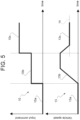
- the target speed is determined as the higher one between the computed speed and the requested speed. This situation is for example depicted in Figure 5 .
- a curve 13 for the vehicle speed is shown in the lower time chart of Figure 5 .
- curve 13 has three portions 13a, 13b, 13c corresponding to portions 10a, 10b, 10c, respectively.
- a horizontal line 14 represents the requested speed during all the movement of vehicle 1.
- the upper limit or the lower limit, based on the sign of the acceleration value, may coincide with the acceleration value.
- the situation is perfectly specular when the actual torque is negative. No slipping is to be simulated when the acceleration value is negative; the deceleration of the vehicle 1 is allowed by the control unit 8. If the acceleration value is positive, an acceleration of the vehicle 1 is requested to simulate the slipping of the clutch 5.
- the upper limit will be the highest between the computed acceleration value and the fixed upper limit; on the other hand, the lower limit will be the lowest, in modulus, between the acceleration value and the fixed lower limit.
- control unit 8 is configured to set a positive (upper) acceleration limit for the vehicle 1 during the control of the transmission 4 with the speed set-point.
- the set positive acceleration limit is the lower one between the computed acceleration value and a predetermined positive limit value (fixed upper limit) when the actual torque is positive. Furthermore, the set positive acceleration limit is the higher one between the computed acceleration value and the positive limit value when the actual torque is negative.
- control unit 8 is further configured to set a speed limit for the vehicle 1 during the control of the transmission 4, such that the vehicle speed does not exceed the speed limit even if the speed set-point is higher than the speed limit itself.
- the clutch 5 is preserved without excluding the slipping feeling to the driver. Indeed, the slipping of the clutch 5 is emulated through the control of the transmission 4, without damaging the clutch 5.
Landscapes
- Engineering & Computer Science (AREA)
- General Engineering & Computer Science (AREA)
- Mechanical Engineering (AREA)
- Hydraulic Clutches, Magnetic Clutches, Fluid Clutches, And Fluid Joints (AREA)
- Control Of Transmission Device (AREA)
- Control Of Fluid Gearings (AREA)
Description
- The invention concerns a method and system for controlling a hydrostatic transmission of a motor vehicle, in particular a work vehicle such as a tractor.
- Motor vehicles like tractors are normally provided with a clutch being drivable by modulating the depression of a clutch pedal.
- Adjusting the position of the clutch pedal, for example at the vehicle start, causes a gradual advancing of the vehicle. This gradual advancing, which is obtained by adjusting the position of the clutch pedal, is often defined with the English wording "clutch inching".
- The above gradual advancing is associated to the occurrence of slipping in the clutch.
- A controlled modulation of the position of the clutch corresponds to the control of the slipping, which allows the vehicle speed being adjusted while maintaining the engine speed stationary.
- However, the clutch operation in slipping conditions causes a generation of heat and an increased wearing of the clutch itself, especially if the slipping conditions are prolonged in time.
- Therefore, the clutch is potentially subject to damages.
- This holds even more in the case of some existing tractors provided with a hydrostatic transmission. Indeed, the clutch of such a kind of tractors is usually simpler and smaller than those of other kinds of work vehicle are. In particular, the lubrication of the clutch is limited, such that the risk of overloading the clutch is higher.
-
US2014/121911A ,US2013/259622A andUS2021/140143 all foresee solutions to this problem but leave room for further improvements. - Therefore, the need is felt to avoid damages to the clutch reliably without impairing the normal functionality of the vehicle.
- An object of the invention is to satisfy the need above, preferably in a simple and cost effective manner.
- According to the invention, the object is reached by a method and a system for controlling a hydrostatic transmission of a motor vehicle as defined in the independent claims.
- Dependent claims set out particular embodiments of the invention.
- For a better understanding of the invention, preferred embodiments are disclosed in the following, by way of a nonlimiting examples, with reference to the attached drawings wherein:
-
Figure 1 is a schematic representation of a motor vehicle comprising a system according to an embodiment of the invention, -
Figure 2 is a graph of a mapping between an input command to the system and a limit drive torque transmissible to a drive axle of the vehicle, -
Figure 3 is an illustrative chart depicting four possible operative configurations of the motor vehicle, and -
Figures 4 and5 illustrate time charts of quantities of the motor vehicle as the result of a method implemented by the system and according to respective different operative configurations of the motor vehicle. - In
Figure 1 , reference number 1 indicates, as a whole, a motor vehicle, in particular a work vehicle such as a tractor. - Vehicle 1 comprises an
engine 2, adrive axle 3, and ahydrostatic transmission 4 as a continuously variable transmission (CVT). - The
drive axle 3 can be coupled to thetransmission 4, such that the latter can drive thedrive axle 3. Thedrive axle 3 carries a pair ofwheels 3a. - Moreover, the
transmission 4 can be coupled to theengine 2, such that the latter can drive thetransmission 4 and thus thedrive axle 3 accordingly. - Therefore, the
drive axle 3 can be coupled to theengine 2 via thetransmission 4. - Vehicle 1 further comprises a
clutch 5 being configured to connect theengine 2 and thedrive axle 3 selectively, such that theengine 2 can drive thedrive axle 3 through thetransmission 4. - In particular, the
clutch 5 is arranged between thetransmission 4 and thedrive axle 3. More in particular, theclutch 5 is configured to connect thedrive axle 3 and thetransmission 4 selectively. - The
clutch 5 has two positions, of which one is a fully disengaged position, in which theengine 2 and thedrive axle 3 are completely disconnected, and the other one is a fully engaged position, in which theengine 2 can be connected to thedrive axle 3. - Specifically, the
clutch 5 in the fully engaged position connects thedrive axle 3 to thetransmission 4. In this case, thetransmission 4 drives thedrive axle 3 in the fully engaged position. - No slipping occurs in the
clutch 5 in the fully engaged position. - Preferably, the vehicle 1 comprises a damping assembly, in particular including a
damper 6, more in particular a dual mass flywheel. The damping assembly is arranged between theengine 2 and thetransmission 4 and is configured to connect theengine 2 to thetransmission 4. - According to a not shown example, the
clutch 5 may be part of the damping assembly. In this case, theclutch 5 would be configured to connect selectively theengine 2 and thetransmission 4. - Vehicle 1 further comprises a system for controlling the
hydrostatic transmission 4 to drive thedrive axle 3. The system comprises acontrol unit 8, which is programmed to implement a method according to the invention.Control unit 8 is connected to thetransmission 4. -
Control unit 8 is also connected to acommand member 9 of vehicle 1.Command member 9 is operable by a driver of the vehicle 1. Moreover,command member 9 is configured to emit an input command based on how the driver operates thesame command member 9. More precisely,command member 9 can take a plurality of positions; accordingly, the input command depends on the position taken bycommand member 9, in particular due to the choice of the driver. Preferably,command member 9 is a clutch pedal without any loss of generality;command member 9 may alternatively be a button, a lever, or the like. -
Control unit 8 controls theclutch 5 in the fully disengaged position only for one specific position ofcommand member 9. In particular, theclutch 5 is moved in the fully disengaged position only when the clutch pedal is fully depressed. - Otherwise,
control unit 8 maintains theclutch 5 in the fully engaged position. - As a possible alternative, the
command member 9 may be also connected to theclutch 5 directly;clutch 5 may be controlled in this case by thecommand member 9 in the fully disengaged position only for the specific position ofcommand member 9 and in the fully engaged position otherwise. -
Control unit 8 is configured to detect the input command emitted bycommand member 9. - Moreover,
control unit 8 is configured to determine a limit drive torque transmissible to thedrive axle 3 as a function of the detected input command through a predetermined mapping. - The mapping is preferably stored in the
control unit 8. An example of the mapping is graphically represented inFigure 2 .Control unit 8 may store a plurality of different mappings. The mapping that is actually used to determine the limit drive torque may depend on one or more operative parameters of the vehicle 1, possibly associated to thetransmission 4. For example, the used mapping may depend on the travel direction of the vehicle 1 (forward or rearward movement of the vehicle 1). Additionally or alternatively, the used mapping may depend on one or more parameters of thetransmission 4 affecting the promptness thereof, such as the pump displacement of thetransmission 4, possibly as a function of other parameters of the vehicle 1, e.g. the torque acting on thedrive axle 3 or the speed ofengine 2. - The input command of
Figure 2 (abscissa axis) may be expressed for example by means of a percentage value, where 0% corresponds to the specific position of command member 9 (fully depressed clutch pedal) and 100% corresponds to a non-operated or resting command member 9 (released clutch pedal). - The limit drive torque of
Figure 2 (ordinate axis) may be expressed for example by means of another percentage value, which represents a fraction of the torque delivered by theengine 2. The same limit drive torque may also be expressed in absolute terms, as well. - The limit drive torque essentially emulates the amount of torque needed to cause the clutch 5 to slip when partially engaged in accordance with the value of input command. However, the
clutch 5 is always maintained in the fully engaged position, unless for the specific position ofcommand member 9. Thus, the limit drive torque determined through the mapping is used to simulate the slipping of the clutch 5 by means of thetransmission 4, which can be controlled appropriately to obtain a corresponding behavior of the vehicle 1 to that caused by the slipping of theclutch 5. -
Control unit 8 is configured to acquire a first quantity indicative of an actual torque acting on thedrive axle 3 and compute a desirable speed value for the vehicle 1 as a function of a relationship between the limit drive torque determined through the mapping and the actual torque indicated by the acquired first quantity. - The desirable speed value is different, in general, from an actual speed of the vehicle 1 and represents the result of a simulation of the slipping according to the above relationship.
- To detect the first quantity, the system may comprise a first transducer T1 connected to control
unit 8. The transducer T1 may comprise a torque sensor coupled to the damping assembly for detecting the torque at thedamper 6 or a pressure sensor coupled to thetransmission 4 for detecting the pressure within thetransmission 4. Clearly, the torque at thedamper 6 and the pressure within thetransmission 4 are indicative of a load and thus of the torque acting on thedrive axle 3. - Alternatively, the first quantity may be directly estimated by the
control unit 8, which is also configured to control theengine 2. In particular, by controlling theengine 2, thecontrol unit 8 may be also configured to determine the load of theengine 2 and to derive the first quantity therefrom. - The desirable speed value is computed to have a correspondence with the result of a dynamic equilibrium between the limit drive torque and the actual torque. In this manner, the speed value represents the speed that the vehicle 1 would have had in case of the clutch 5 being partially engaged and accordingly having the computed limit drive torque.
-
Control unit 8 is configured to determine a target speed for the vehicle 1 based on the computed desirable speed value. Furthermore,control unit 8 is configured to set the target speed as a set-point for controlling thetransmission 4. In other words, thetransmission 4 is controlled setting the target speed as a set-point. For example, thetransmission 4 is controlled in a closed loop fashion; the output speed of thetransmission 4 is the controlled or process variable, whereas the set-point represent the reference variable. The system further comprises a transducer T2 configured to detect the output speed of thetransmission 4.Control unit 8 is configured to acquire the output speed of thetransmission 4 and, specifically, to use it as a feedback for the closed-loop control. Alternatively, thetransmission 4 is open loop controlled based on the set-point. - More in detail, the computation of the desirable speed value comprises the computation of an acceleration value based on a ratio of a difference between the limit drive torque and a modulus of the actual torque to a quantity representing a mass of the vehicle 1.
- The quantity that represents the mass may correspond for example to the gross vehicle weight or may alternatively be an estimate by means of an observer or an estimator programmed in the
control unit 8. Possibly, deterministic observers or stochastic observers, such as Kalman filters, may be used. - The computation of the difference changes based on the operative condition of the vehicle 1. The operative condition is established by the travel direction of the vehicle and by the direction of the actual torque acting on the
drive axle 3. -
Figure 3 is a chart illustrating four operative conditions of the vehicle 1 into respective four quadrants of the chart. The two left quadrants regard the rearward motion of the vehicle 1, whereas the two right quadrants regard the forward motion of the vehicle 1. - The upper left quadrant exemplarily shows an uphill street with respect to the rearward travel direction of the vehicle 1; therefore, the actual torque acting on the
drive axle 3 will oppose to the movement of the vehicle 1. In a similar manner, the upper right quadrant exemplarily shows an uphill street with respect to the forward travel direction of the vehicle 1; therefore, the actual torque will oppose to the movement as well. The actual torques will be regarded as positive, even if having opposite directions, because also the travel directions are opposite. This means that the actual torque is conventionally positive when the direction thereof is such as to oppose to the movement of the vehicle 1, regardless of the actual direction of this movement. - On the contrary, the actual torque is conventionally negative when the direction thereof is such as to favor the movement of the vehicle 1, regardless of the actual direction of the movement. This clearly occurs in the lower quadrants of
Figure 3 , where downhill streets are shown with respect to the respective opposite travel directions of the vehicle 1. -
Control unit 8 is configured to determine if the actual torque is positive or negative, in particular through the first quantity, which reveals the direction of the actual torque, and through information about the travel direction of the vehicle. For example,control unit 8 may be configured to extract the information from a switching device, which is operable to switch the travel direction of the vehicle 1. The direction of the torque and the travel direction of the vehicle 1 determine one of the four operative conditions ofFigure 3 ; this means thatcontrol unit 8 can determine the operative condition too, together with the sign of the actual torque. -
Control unit 8 computes the difference as the limit drive torque minus the modulus of the actual torque when the actual torque is positive. On the contrary,control unit 8 computes the difference as the modulus of the actual torque minus the limit drive torque when the actual torque is negative. - The acceleration value is, in particular, the ratio of the difference to the quantity representing the mass of the vehicle 1. The acceleration value may be negative, which corresponds to a deceleration of the vehicle 1.
- Once the acceleration value is computed, for the computation of the desirable speed value, the
control unit 8 acquires a quantity indicative of the actual current speed of the vehicle 1. For example,control unit 8 acquires the quantity from the transducer T2. Alternatively,control unit 8 may acquire the quantity from different transducers, for example configured to detect a speed of thedrive axle 3, or even through estimation based on howcontrol unit 8 controls the speed of theengine 2. - Then, control
unit 8 computes the desirable speed value by summing the actual current speed to the acceleration value multiplied by a proportional gain. The proportional gain is a coefficient, which may be differently set bycontrol unit 8 if the acceleration value is positive or negative. In other words, controlunit 8 sets a first and a second coefficient as the proportional gain respectively when the acceleration value is positive and negative. The first and the second coefficient may be appropriately tuned experimentally, in order to obtain the most reliable simulation of the slipping ofclutch 5.Control unit 8 preferably stores the first and the second coefficient. The first and the second coefficient may even be equal to one another. - The first and the second coefficient dimensionally represent a sampling time.
- Alternatively, the desirable speed value may be computed through a time integration, in particular a numerical time integration of the acceleration value.
- In any case, the desirable speed value is not merely an estimation of the future speed of the vehicle 1, but represents a suitable speed of the vehicle 1 in case of a virtual slipping of the clutch 5, in particular the slipping that would have been caused by the relationship between the limit drive torque and the actual torque, in the case of an actual modulation of the
clutch 5. - The computed desirable speed value may coincide with the target speed, in order to obtain a simulation of the slipping of
clutch 5, even if the latter is actually in the fully engaged position. However, the computed desirable speed value might also not coincide with the target speed. The reason for this lays in that the system preferably comprises a speed control device, such as an accelerator pedal or more preferably a cruise control device. The speed control device preferably makes part of the vehicle 1 and is operable by the driver to set a requested speed for the vehicle 1. For example, the cruise control device may comprise a command, such as a lever, allowing the driver to select a requested speed to be maintained during the movement of the vehicle 1. - Hence, the target speed may be determined as the computed desirable speed value or the requested speed depending on the operative condition of the vehicle 1.
- In particular, the
control unit 8 is configured to extract the requested speed from the speed control device and to determine the target speed as the result of a comparison between the computed desirable speed value and the requested speed. - More in particular, the target speed is determined as the lower one between the computed desirable speed value and the requested speed when the actual torque is positive. This situation is for example depicted in
Figure 4 . -
Figure 4 shows two time charts, where the abscissa axes are the same and represent time. - The ordinate axis of the upper time chart represents the input command increasing stepwise, in particular from a value corresponding to the aforementioned specific position of command member 9 (fully depressed clutch pedal) to a value corresponding to the resting command member 9 (released clutch pedal), specifically passing through a value corresponding to an intermediate position. Hence, a
stepwise curve 10 for the input command is shown in the upper time chart.Curve 10 has threeportions command member 9. - The ordinate axis of the lower time chart represents the speed of the vehicle 1. Hence, a
curve 11 for the vehicle speed is shown in the lower time chart. In particular,curve 11 has threeportions portions horizontal line 12 represents the requested speed during all the movement of the vehicle 1. - In particular,
portion 11a is horizontal and corresponds to a zero speed.Portion 11b increases from zero to a target speed corresponding to the computed desirable speed value based on the input command ofportion 10b. Indeed, the computed desirable speed value is lower than the requested speed.Portion 11c increases from the former target speed to a further target speed corresponding to the requested speed. Here, the requested speed cannot be exceeded, even if the desirable speed value is higher than the requested speed. - In this manner, the cruise control device and the simulation of the slipping of the clutch 5 can coexist.
- On the other hand, preferably, when the actual torque is negative, the target speed is determined as the higher one between the computed speed and the requested speed. This situation is for example depicted in
Figure 5 . -
Figure 5 is analogous toFigure 4 ; in particular, the upper chart ofFigure 5 is the same of that ofFigure 4 . Moreover, the axes are the same. - A
curve 13 for the vehicle speed is shown in the lower time chart ofFigure 5 . In particular,curve 13 has threeportions portions horizontal line 14 represents the requested speed during all the movement of vehicle 1. - In particular,
portion 13a is horizontal and corresponds to a zero speed.Portion 13b increases from zero to a target speed corresponding to the computed desirable speed value based on the input command ofportion 10b. Here, the computed desirable speed value is allowed to exceed the requested speed. Actually, the target speed is the higher one between the computed desirable speed value and the requested speed. On the other hand,portion 13c decreases from the former target speed to a further target speed corresponding to the requested speed. Here, the target speed cannot decrease more than the requested speed, even if the desirable speed value is lower than the requested speed. - Preferably, the control of the
transmission 4 based on the established set-point further involves the setting of constraints regarding the movement of the vehicle 1. In particular, the acceleration of the vehicle 1 may be actively controlled and/or limited by controlling thetransmission 4. - For example, an acceleration set-point can be set. More in detail,
control unit 8 is configured to control thetransmission 4 based on a constant acceleration set-point, in addition to the speed set-point, or even merely by setting an upper or lower limit for the acceleration of the vehicle 1. Possibly, the constant acceleration set-point coincides with the upper limit, in case the aforementioned computed acceleration value is positive, or else with the lower limit, in case the acceleration value is negative. - Possibly, the upper limit or the lower limit, based on the sign of the acceleration value, may coincide with the acceleration value.
- However, for example, if the actual torque is positive and the acceleration value is higher than a fixed upper limit set and preferably stored in the control unit, the upper limit will be the fixed upper limit. This case is a normal proper operation of the vehicle 1; indeed, there is no slipping of
clutch 5 to be simulated here, because the transmittable torque to the axis is greater than the resistance offered by the actual torque. Hence, a positive acceleration of the vehicle 1 is allowed by thecontrol unit 8 in a normal manner. There is no specific need for forcing a higher acceleration represented by the fixed upper limit. On the other hand, preventing the overcoming of the fixed upper limit is advantageous in terms of a reduced effort of thetransmission 4 andengine 2. - This is shown, for example, in
Figure 4 :portions - According to another example, if the torque is positive and the acceleration value is negative, a slipping of the clutch 5 should be simulated. Hence, the
control unit 8 requests a deceleration of the vehicle 1. Here, the deceleration may conveniently be the highest possible deceleration. A fixed lower limit for the acceleration may be set and preferably stored incontrol unit 8. Then, if the actual torque and the computed acceleration are respectively positive and negative, the lower limit will be the lowest between the fixed lower limit and the computed acceleration value. Thus, the deceleration will be higher than that set by the fixed lower limit only when the computed acceleration value is even lower than the fixed lower limit. - The situation is perfectly specular when the actual torque is negative. No slipping is to be simulated when the acceleration value is negative; the deceleration of the vehicle 1 is allowed by the
control unit 8. If the acceleration value is positive, an acceleration of the vehicle 1 is requested to simulate the slipping of theclutch 5. Thus, the upper limit will be the highest between the computed acceleration value and the fixed upper limit; on the other hand, the lower limit will be the lowest, in modulus, between the acceleration value and the fixed lower limit. - In other words, the
control unit 8 is configured to set a positive (upper) acceleration limit for the vehicle 1 during the control of thetransmission 4 with the speed set-point. The set positive acceleration limit is the lower one between the computed acceleration value and a predetermined positive limit value (fixed upper limit) when the actual torque is positive. Furthermore, the set positive acceleration limit is the higher one between the computed acceleration value and the positive limit value when the actual torque is negative. - Similarly, the
control unit 8 is configured to set a negative acceleration limit (lower limit) during the control of thetransmission 4 with the speed set-point. The set negative acceleration limit is the higher one, in modulus, between the computed acceleration value and a predetermined deceleration limit value (modulus of the fixed lower limit) when the actual torque is positive. Furthermore, the set negative acceleration limit is the lower one, in modulus, between the computed acceleration value and the deceleration limit value when the actual torque is positive. - Clearly, the deceleration limit value is the modulus of the fixed lower limit, which is negative. Hence, the negative acceleration limit is the lower one between the computed acceleration value and the fixed lower limit, when the actual torque is positive. Similarly, the negative acceleration limit is the higher one between the computed acceleration value and the fixed lower limit, when the actual torque is negative.
- In addition, but not necessarily, the
control unit 8 is further configured to set a speed limit for the vehicle 1 during the control of thetransmission 4, such that the vehicle speed does not exceed the speed limit even if the speed set-point is higher than the speed limit itself. - In view of the foregoing, the advantages of the system and the method according to the invention are apparent.
- In particular, the
clutch 5 is preserved without excluding the slipping feeling to the driver. Indeed, the slipping of the clutch 5 is emulated through the control of thetransmission 4, without damaging the clutch 5. - The control of the
transmission 4 is not in conflict with the typical cruise control features of work vehicles. On the contrary, a feature like cruise control perfectly coexists with the simulation of the slipping thanks to the setting of the target speed based on a comparison between the requested speed and the computed desirable speed value. - Eventually, it is clear that modifications can be made to the described method and system, which do not extend beyond the scope of protection defined by the claims.
Claims (11)
- A method for controlling a hydrostatic transmission (4) of a motor vehicle (1) with a drive axle (3) driven by the hydrostatic transmission (4), the method comprising the steps ofa. detecting an input command emitted by a driver operable clutch pedal of the motor vehicle (1),b. determining a limit drive torque transmissible to the drive axle (3) as a function of the detected input command through a predetermined mapping,c. acquiring a first quantity indicative of an actual torque acting on the drive axle (3),d. computing a desirable speed value for the motor vehicle (1) as a function of a relationship between the limit drive torque and the actual torque indicated by the acquired first quantity,e. determining a target speed for the motor vehicle (1) based on the computed desirable speed value, andf. setting the target speed as a set-point for controlling the hydrostatic transmission (4);
the method being characterized in that the step d. comprises the steps ofk. computing an acceleration value based on a ratio of a difference between the limit drive torque and a modulus of the indicated actual torque to a second quantity representing a mass of the motor vehicle (1),l. computing the desirable speed value based on the computed acceleration value and the step k. further comprises the step ofm. computing the difference as the limit drive torque minus the modulus of the indicated actual torque, when the first quantity is indicative that the actual torque is directed to oppose to the movement of the motor vehicle (1),
and/orn. computing the difference as the modulus of the indicated actual torque minus the limit drive torque, when the first quantity is indicative that the actual torque is directed to favor the movement of the motor vehicle (1). - The method of claim 1, wherein the step e. comprises the steps ofg. extracting a requested speed for the motor vehicle (1) from a speed control device of the motor vehicle (1),h. determining the target speed as a result of a comparison between the computed desirable speed value and the requested speed.
- The method of claim 2, wherein the step h. comprises the step ofi. determining the target speed as the lower one between the computed desirable speed value and the requested speed, when the first quantity is indicative that the actual torque is directed to oppose to the movement of the motor vehicle (1), and/or the step ofj. determining the target speed as the higher one between the computed speed and the requested speed, when the first quantity is indicative that the actual torque is directed to favor the movement of the motor vehicle (1).
- The method of the foregoing claims, wherein the step 1. compriseso. acquiring a third quantity indicative of an actual current speed of the motor vehicle (1),p. setting a proportional gain as a first coefficient if the acceleration value is positive or as a second coefficient otherwise,q. computing the desirable speed value based on an algebraic sum of the actual current speed indicated by the third quantity and the acceleration value multiplied by the proportional gain.
- The method of any of the foregoing claims, further comprising the step of
r. setting a positive acceleration limit for the motor vehicle (1) during the control of the hydrostatic transmission (4) with the set-point of step f.,wherein the set positive acceleration limit is the lower one between the computed acceleration value and a predetermined positive limit value, when the first quantity is indicative that the actual torque is directed to oppose to the movement of the motor vehicle (1), andwherein the set positive acceleration limit is the higher one between the computed acceleration value and the positive limit value, when the first quantity is indicative that the actual torque is directed to favor the movement of the motor vehicle (1). - The method of any of the foregoing claims, further comprising the step of
s. setting a negative acceleration limit for the motor vehicle (1) during the control of the hydrostatic transmission (4) with the set-point of step f.,wherein the set negative acceleration limit is the higher one, in modulus, between the computed acceleration value and a predetermined deceleration limit value, when the first quantity is indicative that the actual torque is directed to oppose to the movement of the motor vehicle (1), andwherein the set negative acceleration limit is the lower one, in modulus, between the computed acceleration value and the deceleration limit value, when the first quantity is indicative that the actual torque is directed to favor the movement of the motor vehicle (1). - The method of any of the foregoing claims, further comprising the step of
t. setting a speed limit for the motor vehicle (1) during the control of the hydrostatic transmission (4) with the set-point of step f., such that a speed of the motor vehicle (1) does not exceed the speed limit even if the set-point is higher than the speed limit. - The method of any of the foregoing claims, further comprising the step of
u. controlling a clutch (5) of the motor vehicle (1) in a fully engaged position during the control of the hydrostatic transmission (4) with the set-point of step f.,
wherein the clutch (5) is arranged to selectively connect an engine (2) of the motor vehicle with the drive axle (3). - A system for controlling a hydrostatic transmission of a motor vehicle with a drive axle (3) driven by the hydrostatic transmission (4), the system comprising a control unit (8) programmed to implement the method of any one of the foregoing claims.
- The system of claim 9, further comprising- a first transducer (T1) coupled to the control unit (8) and configured to detect the first quantity,wherein the control unit (8) stores the mapping.
- The system of claim 9 or 10, further comprising a clutch (5) arranged to selectively connect an engine (2) of the motor vehicle (1) with the drive axle (3),
wherein the control unit (8) is further programmed to control the clutch (5) in a fully engaged position, during the implementation of said method.
Applications Claiming Priority (1)
| Application Number | Priority Date | Filing Date | Title |
|---|---|---|---|
| IT102021000013100A IT202100013100A1 (en) | 2021-05-20 | 2021-05-20 | METHOD AND SYSTEM FOR CHECKING A HYDROSTATIC TRANSMISSION OF A MOTOR VEHICLE |
Publications (2)
| Publication Number | Publication Date |
|---|---|
| EP4092294A1 EP4092294A1 (en) | 2022-11-23 |
| EP4092294B1 true EP4092294B1 (en) | 2025-03-12 |
Family
ID=77412097
Family Applications (1)
| Application Number | Title | Priority Date | Filing Date |
|---|---|---|---|
| EP22173251.4A Active EP4092294B1 (en) | 2021-05-20 | 2022-05-13 | A method and a system for controlling a hydrostatic transmission of a motor vehicle |
Country Status (2)
| Country | Link |
|---|---|
| EP (1) | EP4092294B1 (en) |
| IT (1) | IT202100013100A1 (en) |
Family Cites Families (3)
| Publication number | Priority date | Publication date | Assignee | Title |
|---|---|---|---|---|
| US8706364B2 (en) * | 2012-03-30 | 2014-04-22 | Komatsu Ltd. | Wheel loader and method for controlling wheel loader |
| US9002595B2 (en) * | 2012-11-01 | 2015-04-07 | Caterpillar Inc. | Torque and speed control in a machine with continuously variable transmission |
| JP7105771B2 (en) * | 2017-06-27 | 2022-07-25 | 株式会社小松製作所 | WORK VEHICLE AND CONTROL METHOD FOR WORK VEHICLE |
-
2021
- 2021-05-20 IT IT102021000013100A patent/IT202100013100A1/en unknown
-
2022
- 2022-05-13 EP EP22173251.4A patent/EP4092294B1/en active Active
Also Published As
| Publication number | Publication date |
|---|---|
| IT202100013100A1 (en) | 2022-11-20 |
| EP4092294A1 (en) | 2022-11-23 |
Similar Documents
| Publication | Publication Date | Title |
|---|---|---|
| EP0130794B1 (en) | Electronic control method for vehicles | |
| US5993355A (en) | Control system for an automatically actuated clutch | |
| EP0375162B1 (en) | Vehicle clutch control system | |
| EP1740432B1 (en) | Model-based control for torque biasing system | |
| EP0320261B1 (en) | Automatic clutch control apparatus | |
| EP1342607B1 (en) | Method and system for controlling creep in automatic transmission | |
| US8135531B2 (en) | Predictive vehicle controller | |
| US8326499B2 (en) | Retarding control of a machine through power dissipation through power source and parasitic loads | |
| US9199644B2 (en) | Speed ratio control device and method for working vehicle | |
| EP0906526B1 (en) | A system and a method for controlling a servo-controlled motor-vehicle gearbox | |
| EP0205322B1 (en) | Method and apparatus for controlling an automatic clutch | |
| US6358186B1 (en) | Apparatus and method for controlling a torque transmitting system | |
| US8260510B2 (en) | Control apparatus and control method for transmission | |
| EP1411262B1 (en) | Clutch control device | |
| US6019202A (en) | Full throttle directional shift | |
| EP4092294B1 (en) | A method and a system for controlling a hydrostatic transmission of a motor vehicle | |
| JP5247025B2 (en) | Travel control device for hydraulic traveling vehicle | |
| EP2370299B1 (en) | Method for bringing torque regulation back from a limited state to an unlimited state | |
| EP0290202B1 (en) | Device for controlling motor vehicle to run at constant speed | |
| EP1674755B1 (en) | Automatic shift control apparatus | |
| JP4178693B2 (en) | Industrial vehicle cargo handling and travel control device | |
| US10774930B1 (en) | Ratio selection method for a continuously variable transmission during deceleration by braking | |
| JP2504984B2 (en) | Inching control device | |
| KR102410598B1 (en) | Method for controlling hydraulic clutch in automatedtransmission | |
| SE540472C2 (en) | Method and system for controlling a clutch of a vehicle |
Legal Events
| Date | Code | Title | Description |
|---|---|---|---|
| PUAI | Public reference made under article 153(3) epc to a published international application that has entered the european phase |
Free format text: ORIGINAL CODE: 0009012 |
|
| STAA | Information on the status of an ep patent application or granted ep patent |
Free format text: STATUS: THE APPLICATION HAS BEEN PUBLISHED |
|
| AK | Designated contracting states |
Kind code of ref document: A1 Designated state(s): AL AT BE BG CH CY CZ DE DK EE ES FI FR GB GR HR HU IE IS IT LI LT LU LV MC MK MT NL NO PL PT RO RS SE SI SK SM TR |
|
| STAA | Information on the status of an ep patent application or granted ep patent |
Free format text: STATUS: REQUEST FOR EXAMINATION WAS MADE |
|
| 17P | Request for examination filed |
Effective date: 20230523 |
|
| RAP3 | Party data changed (applicant data changed or rights of an application transferred) |
Owner name: CNH INDUSTRIAL ITALIA S.P.A. |
|
| RBV | Designated contracting states (corrected) |
Designated state(s): AL AT BE BG CH CY CZ DE DK EE ES FI FR GB GR HR HU IE IS IT LI LT LU LV MC MK MT NL NO PL PT RO RS SE SI SK SM TR |
|
| GRAP | Despatch of communication of intention to grant a patent |
Free format text: ORIGINAL CODE: EPIDOSNIGR1 |
|
| STAA | Information on the status of an ep patent application or granted ep patent |
Free format text: STATUS: GRANT OF PATENT IS INTENDED |
|
| INTG | Intention to grant announced |
Effective date: 20241002 |
|
| GRAS | Grant fee paid |
Free format text: ORIGINAL CODE: EPIDOSNIGR3 |
|
| GRAA | (expected) grant |
Free format text: ORIGINAL CODE: 0009210 |
|
| STAA | Information on the status of an ep patent application or granted ep patent |
Free format text: STATUS: THE PATENT HAS BEEN GRANTED |
|
| AK | Designated contracting states |
Kind code of ref document: B1 Designated state(s): AL AT BE BG CH CY CZ DE DK EE ES FI FR GB GR HR HU IE IS IT LI LT LU LV MC MK MT NL NO PL PT RO RS SE SI SK SM TR |
|
| REG | Reference to a national code |
Ref country code: GB Ref legal event code: FG4D |
|
| REG | Reference to a national code |
Ref country code: CH Ref legal event code: EP |
|
| REG | Reference to a national code |
Ref country code: DE Ref legal event code: R096 Ref document number: 602022011608 Country of ref document: DE |
|
| REG | Reference to a national code |
Ref country code: IE Ref legal event code: FG4D |
|
| PG25 | Lapsed in a contracting state [announced via postgrant information from national office to epo] |
Ref country code: RS Free format text: LAPSE BECAUSE OF FAILURE TO SUBMIT A TRANSLATION OF THE DESCRIPTION OR TO PAY THE FEE WITHIN THE PRESCRIBED TIME-LIMIT Effective date: 20250612 |
|
| PG25 | Lapsed in a contracting state [announced via postgrant information from national office to epo] |
Ref country code: FI Free format text: LAPSE BECAUSE OF FAILURE TO SUBMIT A TRANSLATION OF THE DESCRIPTION OR TO PAY THE FEE WITHIN THE PRESCRIBED TIME-LIMIT Effective date: 20250312 |
|
| PGFP | Annual fee paid to national office [announced via postgrant information from national office to epo] |
Ref country code: DE Payment date: 20250602 Year of fee payment: 4 |
|
| PG25 | Lapsed in a contracting state [announced via postgrant information from national office to epo] |
Ref country code: ES Free format text: LAPSE BECAUSE OF FAILURE TO SUBMIT A TRANSLATION OF THE DESCRIPTION OR TO PAY THE FEE WITHIN THE PRESCRIBED TIME-LIMIT Effective date: 20250312 |
|
| REG | Reference to a national code |
Ref country code: LT Ref legal event code: MG9D |
|
| PG25 | Lapsed in a contracting state [announced via postgrant information from national office to epo] |
Ref country code: NO Free format text: LAPSE BECAUSE OF FAILURE TO SUBMIT A TRANSLATION OF THE DESCRIPTION OR TO PAY THE FEE WITHIN THE PRESCRIBED TIME-LIMIT Effective date: 20250612 |
|
| PGFP | Annual fee paid to national office [announced via postgrant information from national office to epo] |
Ref country code: IT Payment date: 20250531 Year of fee payment: 4 |
|
| PG25 | Lapsed in a contracting state [announced via postgrant information from national office to epo] |
Ref country code: HR Free format text: LAPSE BECAUSE OF FAILURE TO SUBMIT A TRANSLATION OF THE DESCRIPTION OR TO PAY THE FEE WITHIN THE PRESCRIBED TIME-LIMIT Effective date: 20250312 |
|
| REG | Reference to a national code |
Ref country code: NL Ref legal event code: MP Effective date: 20250312 |
|
| PG25 | Lapsed in a contracting state [announced via postgrant information from national office to epo] |
Ref country code: LV Free format text: LAPSE BECAUSE OF FAILURE TO SUBMIT A TRANSLATION OF THE DESCRIPTION OR TO PAY THE FEE WITHIN THE PRESCRIBED TIME-LIMIT Effective date: 20250312 |
|
| PGFP | Annual fee paid to national office [announced via postgrant information from national office to epo] |
Ref country code: FR Payment date: 20250602 Year of fee payment: 4 |
|
| PG25 | Lapsed in a contracting state [announced via postgrant information from national office to epo] |
Ref country code: GR Free format text: LAPSE BECAUSE OF FAILURE TO SUBMIT A TRANSLATION OF THE DESCRIPTION OR TO PAY THE FEE WITHIN THE PRESCRIBED TIME-LIMIT Effective date: 20250613 Ref country code: BG Free format text: LAPSE BECAUSE OF FAILURE TO SUBMIT A TRANSLATION OF THE DESCRIPTION OR TO PAY THE FEE WITHIN THE PRESCRIBED TIME-LIMIT Effective date: 20250312 |
|
| REG | Reference to a national code |
Ref country code: AT Ref legal event code: MK05 Ref document number: 1775232 Country of ref document: AT Kind code of ref document: T Effective date: 20250312 |
|
| PG25 | Lapsed in a contracting state [announced via postgrant information from national office to epo] |
Ref country code: NL Free format text: LAPSE BECAUSE OF FAILURE TO SUBMIT A TRANSLATION OF THE DESCRIPTION OR TO PAY THE FEE WITHIN THE PRESCRIBED TIME-LIMIT Effective date: 20250312 |
|
| PG25 | Lapsed in a contracting state [announced via postgrant information from national office to epo] |
Ref country code: SE Free format text: LAPSE BECAUSE OF FAILURE TO SUBMIT A TRANSLATION OF THE DESCRIPTION OR TO PAY THE FEE WITHIN THE PRESCRIBED TIME-LIMIT Effective date: 20250312 |
|
| PG25 | Lapsed in a contracting state [announced via postgrant information from national office to epo] |
Ref country code: SM Free format text: LAPSE BECAUSE OF FAILURE TO SUBMIT A TRANSLATION OF THE DESCRIPTION OR TO PAY THE FEE WITHIN THE PRESCRIBED TIME-LIMIT Effective date: 20250312 |
|
| PG25 | Lapsed in a contracting state [announced via postgrant information from national office to epo] |
Ref country code: PT Free format text: LAPSE BECAUSE OF FAILURE TO SUBMIT A TRANSLATION OF THE DESCRIPTION OR TO PAY THE FEE WITHIN THE PRESCRIBED TIME-LIMIT Effective date: 20250714 |
|
| PG25 | Lapsed in a contracting state [announced via postgrant information from national office to epo] |
Ref country code: PL Free format text: LAPSE BECAUSE OF FAILURE TO SUBMIT A TRANSLATION OF THE DESCRIPTION OR TO PAY THE FEE WITHIN THE PRESCRIBED TIME-LIMIT Effective date: 20250312 |
|
| PG25 | Lapsed in a contracting state [announced via postgrant information from national office to epo] |
Ref country code: AT Free format text: LAPSE BECAUSE OF FAILURE TO SUBMIT A TRANSLATION OF THE DESCRIPTION OR TO PAY THE FEE WITHIN THE PRESCRIBED TIME-LIMIT Effective date: 20250312 |
|
| PG25 | Lapsed in a contracting state [announced via postgrant information from national office to epo] |
Ref country code: CZ Free format text: LAPSE BECAUSE OF FAILURE TO SUBMIT A TRANSLATION OF THE DESCRIPTION OR TO PAY THE FEE WITHIN THE PRESCRIBED TIME-LIMIT Effective date: 20250312 Ref country code: EE Free format text: LAPSE BECAUSE OF FAILURE TO SUBMIT A TRANSLATION OF THE DESCRIPTION OR TO PAY THE FEE WITHIN THE PRESCRIBED TIME-LIMIT Effective date: 20250312 |
|
| PG25 | Lapsed in a contracting state [announced via postgrant information from national office to epo] |
Ref country code: RO Free format text: LAPSE BECAUSE OF FAILURE TO SUBMIT A TRANSLATION OF THE DESCRIPTION OR TO PAY THE FEE WITHIN THE PRESCRIBED TIME-LIMIT Effective date: 20250312 |
|
| PG25 | Lapsed in a contracting state [announced via postgrant information from national office to epo] |
Ref country code: SK Free format text: LAPSE BECAUSE OF FAILURE TO SUBMIT A TRANSLATION OF THE DESCRIPTION OR TO PAY THE FEE WITHIN THE PRESCRIBED TIME-LIMIT Effective date: 20250312 |
|
| PG25 | Lapsed in a contracting state [announced via postgrant information from national office to epo] |
Ref country code: IS Free format text: LAPSE BECAUSE OF FAILURE TO SUBMIT A TRANSLATION OF THE DESCRIPTION OR TO PAY THE FEE WITHIN THE PRESCRIBED TIME-LIMIT Effective date: 20250712 |
|
| REG | Reference to a national code |
Ref country code: DE Ref legal event code: R097 Ref document number: 602022011608 Country of ref document: DE |
|
| REG | Reference to a national code |
Ref country code: CH Ref legal event code: H13 Free format text: ST27 STATUS EVENT CODE: U-0-0-H10-H13 (AS PROVIDED BY THE NATIONAL OFFICE) Effective date: 20251223 |
|
| PG25 | Lapsed in a contracting state [announced via postgrant information from national office to epo] |
Ref country code: DK Free format text: LAPSE BECAUSE OF FAILURE TO SUBMIT A TRANSLATION OF THE DESCRIPTION OR TO PAY THE FEE WITHIN THE PRESCRIBED TIME-LIMIT Effective date: 20250312 |
|
| PG25 | Lapsed in a contracting state [announced via postgrant information from national office to epo] |
Ref country code: LU Free format text: LAPSE BECAUSE OF NON-PAYMENT OF DUE FEES Effective date: 20250513 |
|
| PLBE | No opposition filed within time limit |
Free format text: ORIGINAL CODE: 0009261 |
|
| STAA | Information on the status of an ep patent application or granted ep patent |
Free format text: STATUS: NO OPPOSITION FILED WITHIN TIME LIMIT |
|
| PG25 | Lapsed in a contracting state [announced via postgrant information from national office to epo] |
Ref country code: CH Free format text: LAPSE BECAUSE OF NON-PAYMENT OF DUE FEES Effective date: 20250531 |
|
| REG | Reference to a national code |
Ref country code: CH Ref legal event code: L10 Free format text: ST27 STATUS EVENT CODE: U-0-0-L10-L00 (AS PROVIDED BY THE NATIONAL OFFICE) Effective date: 20260121 |
|
| REG | Reference to a national code |
Ref country code: BE Ref legal event code: MM Effective date: 20250531 |
|
| PG25 | Lapsed in a contracting state [announced via postgrant information from national office to epo] |
Ref country code: MC Free format text: LAPSE BECAUSE OF FAILURE TO SUBMIT A TRANSLATION OF THE DESCRIPTION OR TO PAY THE FEE WITHIN THE PRESCRIBED TIME-LIMIT Effective date: 20250312 |
|
| 26N | No opposition filed |
Effective date: 20251215 |
|
| PG25 | Lapsed in a contracting state [announced via postgrant information from national office to epo] |
Ref country code: IE Free format text: LAPSE BECAUSE OF NON-PAYMENT OF DUE FEES Effective date: 20250513 |
|
| PG25 | Lapsed in a contracting state [announced via postgrant information from national office to epo] |
Ref country code: BE Free format text: LAPSE BECAUSE OF NON-PAYMENT OF DUE FEES Effective date: 20250531 |