EP4088996B1 - Mt-type straddled vehicle - Google Patents
Mt-type straddled vehicle Download PDFInfo
- Publication number
- EP4088996B1 EP4088996B1 EP21744056.9A EP21744056A EP4088996B1 EP 4088996 B1 EP4088996 B1 EP 4088996B1 EP 21744056 A EP21744056 A EP 21744056A EP 4088996 B1 EP4088996 B1 EP 4088996B1
- Authority
- EP
- European Patent Office
- Prior art keywords
- straddled vehicle
- motor
- engine
- type
- driver
- Prior art date
- Legal status (The legal status is an assumption and is not a legal conclusion. Google has not performed a legal analysis and makes no representation as to the accuracy of the status listed.)
- Active
Links
Images






Classifications
-
- B—PERFORMING OPERATIONS; TRANSPORTING
- B62—LAND VEHICLES FOR TRAVELLING OTHERWISE THAN ON RAILS
- B62J—CYCLE SADDLES OR SEATS; AUXILIARY DEVICES OR ACCESSORIES SPECIALLY ADAPTED TO CYCLES AND NOT OTHERWISE PROVIDED FOR, e.g. ARTICLE CARRIERS OR CYCLE PROTECTORS
- B62J40/00—Arrangements of air cleaners specially adapted for cycles
-
- B—PERFORMING OPERATIONS; TRANSPORTING
- B62—LAND VEHICLES FOR TRAVELLING OTHERWISE THAN ON RAILS
- B62J—CYCLE SADDLES OR SEATS; AUXILIARY DEVICES OR ACCESSORIES SPECIALLY ADAPTED TO CYCLES AND NOT OTHERWISE PROVIDED FOR, e.g. ARTICLE CARRIERS OR CYCLE PROTECTORS
- B62J43/00—Arrangements of batteries
-
- B—PERFORMING OPERATIONS; TRANSPORTING
- B62—LAND VEHICLES FOR TRAVELLING OTHERWISE THAN ON RAILS
- B62K—CYCLES; CYCLE FRAMES; CYCLE STEERING DEVICES; RIDER-OPERATED TERMINAL CONTROLS SPECIALLY ADAPTED FOR CYCLES; CYCLE AXLE SUSPENSIONS; CYCLE SIDECARS, FORECARS, OR THE LIKE
- B62K11/00—Motorcycles, engine-assisted cycles or motor scooters with one or two wheels
- B62K11/02—Frames
- B62K11/04—Frames characterised by the engine being between front and rear wheels
-
- B—PERFORMING OPERATIONS; TRANSPORTING
- B62—LAND VEHICLES FOR TRAVELLING OTHERWISE THAN ON RAILS
- B62M—RIDER PROPULSION OF WHEELED VEHICLES OR SLEDGES; POWERED PROPULSION OF SLEDGES OR SINGLE-TRACK CYCLES; TRANSMISSIONS SPECIALLY ADAPTED FOR SUCH VEHICLES
- B62M23/00—Transmissions characterised by use of other elements; Other transmissions
- B62M23/02—Transmissions characterised by use of other elements; Other transmissions characterised by the use of two or more dissimilar sources of power, e.g. transmissions for hybrid motorcycles
-
- B—PERFORMING OPERATIONS; TRANSPORTING
- B62—LAND VEHICLES FOR TRAVELLING OTHERWISE THAN ON RAILS
- B62M—RIDER PROPULSION OF WHEELED VEHICLES OR SLEDGES; POWERED PROPULSION OF SLEDGES OR SINGLE-TRACK CYCLES; TRANSMISSIONS SPECIALLY ADAPTED FOR SUCH VEHICLES
- B62M7/00—Motorcycles characterised by position of motor or engine
- B62M7/02—Motorcycles characterised by position of motor or engine with engine between front and rear wheels
- B62M7/04—Motorcycles characterised by position of motor or engine with engine between front and rear wheels below the frame
-
- F—MECHANICAL ENGINEERING; LIGHTING; HEATING; WEAPONS; BLASTING
- F02—COMBUSTION ENGINES; HOT-GAS OR COMBUSTION-PRODUCT ENGINE PLANTS
- F02N—STARTING OF COMBUSTION ENGINES; STARTING AIDS FOR SUCH ENGINES, NOT OTHERWISE PROVIDED FOR
- F02N11/00—Starting of engines by means of electric motors
- F02N11/08—Circuits specially adapted for starting of engines
-
- F—MECHANICAL ENGINEERING; LIGHTING; HEATING; WEAPONS; BLASTING
- F02—COMBUSTION ENGINES; HOT-GAS OR COMBUSTION-PRODUCT ENGINE PLANTS
- F02N—STARTING OF COMBUSTION ENGINES; STARTING AIDS FOR SUCH ENGINES, NOT OTHERWISE PROVIDED FOR
- F02N11/00—Starting of engines by means of electric motors
- F02N11/04—Starting of engines by means of electric motors the motors being associated with current generators
-
- F—MECHANICAL ENGINEERING; LIGHTING; HEATING; WEAPONS; BLASTING
- F02—COMBUSTION ENGINES; HOT-GAS OR COMBUSTION-PRODUCT ENGINE PLANTS
- F02N—STARTING OF COMBUSTION ENGINES; STARTING AIDS FOR SUCH ENGINES, NOT OTHERWISE PROVIDED FOR
- F02N11/00—Starting of engines by means of electric motors
- F02N11/08—Circuits specially adapted for starting of engines
- F02N2011/0881—Components of the circuit not provided for by previous groups
- F02N2011/0896—Inverters for electric machines, e.g. starter-generators
-
- F—MECHANICAL ENGINEERING; LIGHTING; HEATING; WEAPONS; BLASTING
- F02—COMBUSTION ENGINES; HOT-GAS OR COMBUSTION-PRODUCT ENGINE PLANTS
- F02N—STARTING OF COMBUSTION ENGINES; STARTING AIDS FOR SUCH ENGINES, NOT OTHERWISE PROVIDED FOR
- F02N2200/00—Parameters used for control of starting apparatus
- F02N2200/10—Parameters used for control of starting apparatus said parameters being related to driver demands or status
- F02N2200/103—Clutch pedal position
Definitions
- the present teaching relates to an MT (manual transmission)-type straddled vehicle.
- An MT-type straddled vehicle having a manual transmission is disclosed, for example, in the JP 2012-211553 A .
- various components and a frame are arranged in a region higher than a crankcase that houses a crankshaft and a manual transmission. More specifically, components such as a starter motor, a canister, a purge device, and a fresh air filter are arranged higher than the crankcase. The canister, the purge device, and the fresh air filter are arranged higher than the starter motor.
- JP 2019 171995 A discloses a saddle-riding type vehicle capable of completely installing an increasingly enlarged electronic control unit on a main frame.
- a saddle-riding type vehicle includes: a main frame which extends backward of a head pipe and oscillatably supports a swing arm supporting an axle on a rear end; a down frame extending downward of the main frame and downward of the head pipe; an internal combustion engine that is supported on the main frame and the down frame and that is equipped with an AC generator starter for generating electric power according to the rotation of a crank shaft when running and driving the crank shaft according to the supply of an electric current when starting, which is installed on one end of the crank shaft parallel to the axle; an air cleaner that is connected with the main frame backward of the main frame and purifies the outside air supplied to the internal combustion engine; and an electronic control unit that is fixed on an external surface of the air cleaner and controls the operation of the AC generator starter.
- an MT-type straddled vehicle a frame and many components related to functioning of an engine are arranged in a region higher than a crankcase. It is desired that higher flexibility in an arrangement of both the frame and such components be achieved while decline in functions of a starter motor be suppressed. It is an objective of the present teaching to provide an MT-type straddled vehicle where higher flexibility in the arrangement of both the frame and a component in a region higher than the crankcase can be achieved while decline in functions of the starter motor can be suppressed.
- the present inventors have studied the arrangement of components in a region higher than a crankcase.
- a crankshaft and a transmission are housed in a crankcase of a vehicle disclosed in, for example, JP 2012-211553 .
- the size of the crankshaft in the radial direction being housed is likely to be larger compared to, for example, the case where the continuously variable transmission provided at the end part of the crankshaft is housed.
- a starter motor and a chain tensioner are arranged in a region higher than the crankcase.
- a thermostat of a cooling system, a throttle valve, and the like may be arranged in the region described above. Consequently, in the region described above, positions of components are restricted, and there is limited space available for the components.
- the present inventors have further studied the arrangement of components in the region higher than the crankcase.
- the present inventors have studied a function and an arrangement of the starter motor arranged in the region described above.
- the starter motor has a function for driving the crankshaft in order to start an engine.
- a multiphase brushless motor that also serves as a power generator is provided as the starter motor at the end part of the crankshaft, the starter motor can be removed from the region described above while keeping its function. After the removal of the starter motor from the region described above, other components can be arranged in a space where the starter motor was originally arranged. This results in creation of more space in the region higher than the crankcase.
- the air is able to flow around the air cleaner as the air cleaner is to clean the air taken in from the outside, and then supply it to the engine. Therefore, the air is likely to flow inside the side cover that covers the air cleaner.
- the battery is arranged, for example, forward or backward of the air cleaner in the front-back direction of the MT-type straddled vehicle.
- the motor driver is arranged in a space between the side cover, and the air cleaner and the battery so that at least a part of the motor driver overlaps both the air cleaner and the battery in view of the left-right direction.
- This arrangement allows the motor driver and the battery to keep radiating the heat through the air, which can suppress any rise in their temperatures.
- a function for performing switching of the electric current by the motor driver is less likely to be inhibited. Therefore, any decline in functions of the starter motor can be suppressed.
- the MT-type straddled vehicle has the following configuration.
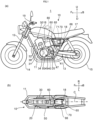
- FIG. 1 is a left side view for describing an MT-type straddled vehicle (straddled vehicle 1) according to an embodiment of the present teaching.
- FIG.1(a) is a left side view of the straddled vehicle 1
- FIG.1(b) is a top view showing the configuration of the frame 11 and the engine unit 20 of the straddled vehicle 1.
- F denotes forward of the straddled vehicle 1.
- B denotes backward of the straddled vehicle 1.
- FB denotes the front-back direction of the straddled vehicle 1.
- U denotes upward of the straddled vehicle 1.
- D denotes downward of the straddled vehicle 1.
- the UD denotes the up-down direction of the straddled vehicle 1.
- L denotes leftward of the straddled vehicle 1.
- R denotes rightward of the straddled vehicle 1.
- LR denotes the left-right direction of the straddled vehicle 1.
- the LR also denotes the vehicle width direction of the straddled vehicle 1. That is, the vehicle width direction LR of the straddled vehicle 1 includes both rightward R and leftward L of the straddled vehicle 1.
- the direction described above is the same as the direction of the engine unit 20 mounted on the straddled vehicle 1.
- the straddled vehicle 1 shown in FIG.1(a) is an MT (manual transmission)-type straddled vehicle having a manual-type multi-stage transmission device.
- the MT-type straddled vehicle of the present embodiments will be referred to simply as a straddled vehicle 1.
- the straddled vehicle 1 includes a vehicle body 10 and an engine unit 20.
- the vehicle body 10 includes a frame 11, a front fork 12, a rear arm 13, a front wheel 14, and a rear wheel 15.
- the frame 11 forms the skeleton of the straddled vehicle 1.
- the front fork 12 is attached to the frame 11 to be able to swivel and rotatably supports the front wheel 14.
- the rear arm 13 is swingably provided to the frame 11 and rotatably supports the rear wheel 15.
- the straddled vehicle 1 includes a fuel tank 16.
- the fuel tank 16 stores fuel supplied to the engine 30 (described later).
- the fuel tank 16 supplies fuel to the engine 30.
- the fuel tank 16 is provided to the frame 11.
- the straddled vehicle 1 includes a seat 17.
- the seat 17 is provided to the frame 11.
- the fuel tank 16 is arranged frontward F of the seat 17 in the front-back direction FB of the straddled vehicle 1.
- the straddled vehicle 1 includes a battery 18.
- the engine unit 20 includes the engine 30, a manual transmission 40, a multiphase brushless motor (starting generator) 50, an intake system 60, and a side cover 66. That is, the straddled vehicle 1 includes the engine 30, the manual transmission 40, the multiphase brushless motor 50, the intake system 60, and the side cover 66.
- the engine 30 includes a cylinder 32, a piston 36, a crankcase 31, and a crankshaft 34.
- a cylinder bore for housing the piston 36 such that the piston is able to move reciprocatably is formed in the cylinder 32.
- the crankcase 31 houses the crankshaft 34 and a manual transmission 40.
- the crankcase 31 is connected to the cylinder 32.
- the engine 30 is provided to the frame 11. The engine 30 outputs the power generated by the combustion functioning through the crankshaft 34 that rotates forward.
- the manual transmission 40 is a manual-type multi-stage transmission device.
- the manual transmission 40 is provided in a power transmission pathway between the engine 30 and the rear wheel 15.
- the manual transmission 40 changes the gear ratio in multiple stages in response to an operation of a driver of the straddled vehicle 1.
- the driver of the straddled vehicle 1 changes the gear ratio of the manual transmission by operating a shift pedal 49. That is, the manual transmission 40 changes the rotational speed of the engine 30 by the operation of the driver of the straddled vehicle 1 and transmits the change to the rear wheel 15, which is the drive wheel.
- the manual transmission 40 has a neutral state and a plurality of non-neutral states.
- the manual transmission 40 includes a manual clutch 41 and an output part 47.
- the manual clutch 41 is provided in a power transmission pathway between the engine 30 and the manual transmission 40.
- a manual clutch lever 19 operates the manual clutch 41 in response to the operation by the driver of the straddled vehicle 1.
- the driver of the straddled vehicle 1 interrupts power transmission between the engine 30 and the manual transmission 40 through the manual clutch 41.
- the multiphase brushless motor 50 is a permanent magnet-type motor.
- the multiphase brushless motor 50 is provided at one end part of the crankshaft 34.
- the multiphase brushless motor 50 functions as a starter motor for starting the engine 30 by driving the crankshaft 34 when the engine 30 is started.
- the multiphase brushless motor 50 is provided so as to be in conjunction with the crankshaft 34.
- the multiphase brushless motor 50 drives the crankshaft 34 using the power that is supplied from the battery 18.
- the multiphase brushless motor 50 also serves as a generator that is driven by the engine 30 to generate electricity during the combustion functioning of the engine 30. Providing the engine unit 20 with the multiphase brushless motor 50 that serves as both a starter motor and a generator can eliminate the need for a starter motor such as a dedicated starter motor that is different from the generator.
- a crankcase 31 of the straddled vehicle 1 houses a manual transmission 40. Accordingly, in the crankcase 31 of the straddled vehicle 1, the crankshaft 34 being housed is likely to be larger in size in the radial direction compared to, for example, the case where the continuously variable transmission device provided at the end part of the crankshaft 34 is housed. As a result, available space higher than the crankcase 31 is likely to be limited.
- a starter motor specialized for the starting function is usually provided higher than the crankcase since it drives the crankshaft.
- providing the engine unit 20 with the multiphase brushless motor 50 that serves as both a starter motor and a generator can eliminate the need for a dedicated starter motor that is different from the generator higher than the crankcase 31.
- a space where a conventional starter motor specialized for the starting function was previously arranged is available for the components related to the functioning of the engine 30 to be arranged.
- the components related to the functioning of the engine 30 include, for example, a chain tensioner, a thermostat, and a throttle valve.
- the intake system 60 passes air taken into the engine 30.
- the intake system 60 is a general term for components protruding from the cylinder 32 of the engine 30.
- the intake system 60 includes an air cleaner 65. That is, the straddled vehicle 1 includes the air cleaner 65.
- the air cleaner 65 cleans the air to be supplied to the engine 30. More specifically, dust, trash, and the like are removed from the air taken into the engine 30.
- the side cover 66 covers at least a part of the intake system 60 in the left-right direction LR.
- the side cover 66 covers at least a part of the air cleaner 65 and at least a part of the battery in view of the left-right direction LR.
- the side cover 66 is provided so as to oppose both the air cleaner 65 and the battery 18.
- the side cover 66 defines the appearance of the straddled vehicle 1.
- the side cover 66 is configured so as to be visible from the outside of the straddled vehicle 1.
- the straddled vehicle 1 includes a motor driver 70.
- the motor driver 70 performs switching of the electric current that is to be supplied to the multiphase brushless motor 50 and the electric current generated by the multiphase brushless motor 50.
- the motor driver 70 has an inverter 71.
- the inverter 71 performs switching of the electric current flowing between the battery 18 and the multiphase brushless motor 50. Heat is generated in the motor driver 70 when the inverter 71 performs switching. In addition, heat is also generated through the input and output of the electric current in the battery that supplies the electric current to the starter motor.
- the air cleaner 65 is to clean the air taken in from the outside, and then supply it to the engine 30.
- the air is likely to flow around the air cleaner 65. Therefore, the air is likely to flow inside the side cover 66 that covers the air cleaner 65.
- the battery 18 is arranged backward B of the air cleaner 65 in the front-back direction FB of the straddled vehicle 1.
- the air cleaner 65 and the battery 18 are arranged next to each other in the front-back direction FB so as to lie over two regions that are defined by division by a center plane C passing through the center of the straddled vehicle 1 and extending in the up-down direction UD and the front-back direction FB.
- the motor driver 70 is arranged in a space between a side cover 66 opposing both of the air cleaner 65 and the battery 18, and the air cleaner 65 and the battery 18 so that at least a part of the motor driver 70 overlaps both the air cleaner 65 and the battery 18 in view of the left-right direction.
- This allows the motor driver 70 and the battery 18 to keep radiating the heat, and any rise in their temperatures can be suppressed.
- a function for performing switching of the electric current by the motor driver 70 is not likely to be inhibited. Therefore, any decline in functions of the multiphase brushless motor 50 can be suppressed.
- higher flexibility can be achieved in the arrangement of components in the region higher than the crankcase 31 while any decline in functions of the multiphase brushless motor 50 can be suppressed.
- the straddled vehicle 1 includes a control device 80.
- the control device 80 controls the rotational power outputted from the engine 30 by controlling the combustion functioning of the engine 30.
- the control device 80 also controls the motor driver 70.
- the control device 80 controls the multiphase brushless motor 50 by controlling the inverter 71 of the motor driver 70.
- FIG.2 is a left side view of the straddled vehicle 1 shown in FIG.1 .
- the straddled vehicle 1 is an MT-type straddled vehicle.
- the straddled vehicle 1 is also a motorcycle. More specifically, the straddled vehicle 1 is an MT-type motorcycle.
- the straddled vehicle 1 includes a vehicle body 10 and an engine unit 20.
- the vehicle body 10 includes a frame 11, a front fork 12, a rear arm 13, front wheel 14, rear wheel 15, a fuel tank 16, a seat 17, and a side cover 66.
- the frame 11 includes a head pipe 111, a main frame 112, a down tube 113, a seat frame 114, and a swing arm pivot 115.
- the head pipe 111 rotatably supports the front fork 12.
- the front fork 12 rotatably supports the front wheel 14.
- a handlebar 121 is fixed to the upper end of the front fork 12 in the up-down direction UD of the straddled vehicle 1.
- the handlebar 121 functions as a steering handle.
- a manual clutch lever 19 is provided on the left part of the handlebar 121 in the left-right direction LR of the straddled vehicle 1.
- An accelerator operator 122, a brake lever 123, and an engine start switch 124 are provided on the right part of the handlebar 121.
- the main frame 112 extends backward B in the front-back direction FB of the straddled vehicle 1 from the head pipe 111.
- the main frame 112 also supports the fuel tank 16.
- the down tube 113 extends backward B and downward D in the front-back direction FB and the up-down direction UD of the straddled vehicle 1 from the head pipe 111.
- the rear end of the main frame 112 and the rear end of the down tube 113 in the front-back direction FB of the straddled vehicle 1 are connected.
- the seat frame 114 is provided at the rear portion of the main frame 112 in the front-back direction FB of the straddled vehicle 1, and extends backward B from the rear portion of the main frame 112.
- a seat 17 is provided to the seat frame 114.
- the seat 17 is a saddle type.
- the fuel tank 16 and the seat 17 form a part of the upper contour line of the vehicle body 10 when the straddled vehicle 1 is viewed in the left-right direction LR.
- the swing arm pivot 115 is provided at a coupling point between the main frame 112 and the down tube 113.
- the swing arm pivot 115 swingably supports the rear arm 13.
- the rear arm 13 rotatably supports the rear wheel 15.
- the rear wheel 15 are drive wheels that receive power outputted from the engine unit 20 and drive the straddled vehicle 1.
- the side cover 66 is provided so as to cover a space downward D of the fuel tank 16 and the seat 17 in the up-down direction UD of the straddled vehicle 1.
- the side cover 66 is provided downward D of the fuel tank 16 and the seat 17 in the up-down direction UD of the straddled vehicle 1.
- the side cover 66 is arranged so as to overlap at least a part of an intake system 60 described later in view of the right-left direction LR.
- the engine unit 20 outputs power from the output part 47 to the rear wheel 15.
- the output part 47 is a sprocket around which the chain 151 is wound.
- the output part 47 is provided outside the casing of the engine unit 20.
- the output part 47 is actually covered with a cover provided on the vehicle body 10 (not shown), but is represented by a solid line in FIG.2 so that it is easily understood that the output part 47 is exposed outside the casing of the engine unit 20.
- the power of the engine unit 20 is transmitted to the rear wheel 15 through a sprocket and a chain 151 as the output part 47.
- the casing of the engine unit 20 is provided with steps 491.
- the driver of the straddled vehicle 1 straddles the seat 17 to sit, and has his or her feet placed on the steps 491 while traveling.
- FIG.3 is an enlarged left side view of the engine unit 20 shown in FIG.1 .
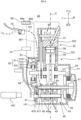
- FIG. 4 is an enlarged cross-sectional view of the engine unit 20 shown in FIG.1 .
- the engine unit 20 includes the engine 30, the manual transmission 40, the multiphase brushless motor 50, and the intake system 60.
- the engine unit 20 also includes a radiator 25 (see FIG.2 ). That is, the engine 30 is a water-cooled engine.
- the engine 30 includes a crankcase 31 and a cylinder 32.
- the engine 30 includes a crankshaft 34, a connecting rod 35, a piston 36, a spark plug 37 (see FIG.4 ), a valve functioning mechanism 38 (see FIG.4 ), and a valve 39.
- the crankcase 31 and the cylinder 32 are included in the casing of the engine unit 20.
- the cylinder 32 includes a cylinder body 321 and a cylinder head 322.
- the piston 36 is reciprocatably provided in the cylinder body 321.
- the crankcase 31 is connected to the cylinder body 321.
- the engine 30 is provided to the frame 11 so that the cylinder 32 has a standing posture.
- the term that the cylinder has a standing posture means that the center line of the cylinder bore extends along the vertical direction.
- the term that the cylinder has a standing posture means that the center line of the cylinder bore extends 'mainly' in the vertical direction.
- the inclination angle of the center line of the cylinder bore in the piston moving direction is between -45 degrees or more and + 45 degrees or less with respect to the vertical.
- the crankshaft 34 is arranged in the crankcase 31 and rotatably supported by the crankcase 31.
- the piston 36 and the crankshaft 34 are connected through the connecting rod 35.
- the valve 39 and the valve functioning mechanism 38 are arranged in the cylinder head 322.
- crankshaft 34, the manual transmission 40, and the multiphase brushless motor 50 are arranged within the crankcase 31.
- the power of the crankshaft 34 is transmitted to the valve functioning mechanism 38 through the cam chain 381.
- the valve functioning mechanism 38 operates the valve 39 in synchronization with the rotation of the crankshaft 34 and the reciprocating motion of the piston 36.
- the slack of the cam chain 381 is adjusted by a chain tensioner 382.
- the engine 30 includes a balancer 301.
- the balancer 301 is arranged, in the front-back direction FB, forward F of the vertical line passing through the crankshaft line in view of the left-right direction LR.
- the crankcase 31 is configured so that the inside thereof is lubricated by the low-viscosity oil OL. That is, the engine 30 has a low-viscosity oil OL.
- the crankshaft 34, the manual transmission 40, and the multiphase brushless motor 50 are lubricated with the same low-viscosity oil OL.
- the low-viscosity oil OL lubricates and cools each part of the engine unit 20.
- the low-viscosity oil OL is pumped by an oil pump (not shown) and circulated in the engine 30. More specifically, the low-viscosity oil OL is accumulated in an oil pan 311 provided at the lower part of the crankcase 31. The low-viscosity oil OL accumulated in the oil pan 311 is pressurized by the oil pump (not shown). The pressurized low-viscosity oil OL is supplied to the piston 36 and the crankshaft 34 through an oil supply passage (not shown). Such an oil supply passage is formed, for example, by a bore provided inside the crankshaft 34, a bore provided inside the cylinder body 321, and a groove formed on a joint surface between the cylinder body 321 and the cylinder head 322.
- the low-viscosity oil OL is also supplied to the manual transmission 40 and the multiphase brushless motor 50. More specifically, the low-viscosity oil OL supplied to the piston 36 also flows to the multiphase brushless motor 50 arranged downward D of the piston 36 in the up-down direction UD.
- the low-viscosity oil OL is accumulated so that a part of the multiphase brushless motor 50 is immersed in the low-viscosity oil OL.
- the low-viscosity oil OL is accumulated in a dam wall (not shown) provided to surround a part of the multiphase brushless motor 50, so that a part of the multiphase brushless motor 50 is immersed in the low-viscosity oil OL.
- the low-viscosity oil OL overflowing from the dam wall flows to the oil pan 311.
- the low-viscosity oil OL adhered to the multiphase brushless motor 50 is diffused into the crankcase 31 by the rotation of the multiphase brushless motor 50.
- a part of the low-viscosity oil OL is also supplied to the valve functioning mechanism 38 through the cam chain 381. In this way, the inside of the engine 30 is lubricated with the low-viscosity oil OL. Therefore, the inside of the crankcase 31 is lubricated with the low-viscosity oil OL.
- the low-viscosity oil OL is a lubricating oil of which low-temperature viscosity grade according to the SAE viscosity classification specified in SAE J300 is lower than 20 W.
- the lower the viscosity grade the lower the viscosity of the oil.
- the high temperature viscosity grade according to the SAE viscosity classification of the lubricating oil is not particularly limited.
- X is an integer that is equal to or greater than 0 and less than 20
- Y is an integer that is equal to or greater than 0
- the SAE viscosity grade of the lubricating oil is represented by XW-Y.
- the lubricating oil is composed of base oil and additives.
- the evaporation temperature of the lubricating oil may be different even if the viscosity of the lubricating oil is the same.
- the evaporation characteristics of the lubricating oil can be obtained, for example, by the boiling point distribution measurement method by gas chromatography-simulated distillation in accordance with ASTM D6352.
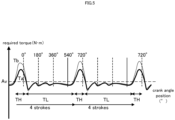
- FIG.5 is an explanatory diagram schematically showing the relationship between the crank angle position and the required torque of the engine 30.
- a solid line Ta in FIG.5 indicates the required torque to rotate the crankshaft 34 in a state where the engine 30 is not performing combustion functioning.
- the engine 30 is a single cylinder engine. During 4 strokes, the engine 30 has a high-load region TH where a load for rotating the crankshaft 34 is high, and a low-load region TL where a load for rotating the crankshaft 34 is lower than the load in the high-load region TH.
- the high-load region refers to a region, in one combustion cycle of the engine 30, in which the load torque is higher than the average value Av of the load torque in one combustion cycle.
- the low-load region TL is wider than the high-load region TH. More specifically, the low-load region TL is wider than the high-load region TH. In other words, the rotation angle region corresponding to the low-load region TL is wider than the rotation angle region corresponding to the high-load region TH.
- the engine 30 rotates while repeating an intake stroke, a compression stroke, an expansion stroke (a combustion stroke), and an exhaust stroke. The compression stroke overlaps the high-load region TH.
- the low-load region TL is located between combustion.
- One combustion cycle of the engine 30 includes one intake stroke, one compression stroke, one expansion stroke, and one exhaust stroke.
- the engine 30 rotates while repeating an intake stroke, a compression stroke, an expansion stroke and an exhaust stroke.
- a mixture of fuel and air is supplied to a combustion chamber defined by a cylinder body 321, a cylinder head 322, and a piston 36 shown in FIGS.3 and 4 .
- the piston 36 compresses the air-fuel mixture in the combustion chamber.
- the mixture ignited by the spark plug 37 burns and pushes the piston 36.
- the gas after combustion is discharged from the combustion chamber as an exhaust gas. Reciprocating motion of the piston 36 is converted into rotation of the crankshaft 34.
- the energy generated by combustion of fuel in engine 30 is outputted to the manual transmission 40 as power of the crankshaft 34.
- the manual transmission 40 converts the rotational speed of the crankshaft 34 according to the gear shift.
- the manual transmission 40 is a stepped transmission having a plurality of gear shifts.
- the manual transmission 40 includes a manual clutch 41, an input shaft 42, an output shaft 43, a drive gear 44, a driven gear 45, a dog ring 45a, a gear shift setting mechanism 46, and an output part 47.
- the manual transmission 40 converts the rotational speed of the crankshaft 34 by a gear ratio corresponding to the operation of the shift pedal 49 and outputs the converted speed.
- the shift pedal 49 is operated by the feet of the driver.
- the manual clutch 41 interrupts the transmission of power between the engine 30 and the rear wheel 15 (see FIG.1 ) in response to the operation of the manual clutch lever 19. More specifically, the manual clutch 41 interrupts the transmission of power between the crankshaft 34 and the input shaft 42. The manual clutch 41 interrupts the transmission of power in response to the operation of the driver to the manual clutch lever 19.
- the manual clutch 41 is connected to the manual clutch lever 19 through a mechanical wire 191. More specifically, the manual clutch 41 is connected to the manual clutch lever 19 through the mechanical wire 191, a clutch arm 416, and a lifter rod 417. When the manual clutch lever 19 is operated, the mechanical wire 191, the clutch arm 416 and the lifter rod 417 are displaced. As a result, power transmission is interrupted.
- the plurality of drive gears 44 are provided on the input shaft 42 and are configured so as to always rotate together with the input shaft 42. Each of the plurality of drive gears 44 corresponds to each gear shift.
- the plurality of driven gears 45 are provided on the output shaft 43 and configured so as to be relatively rotatable with the output shaft 43.
- the dog ring 45a is provided on the output shaft 43 and is configured so as to rotate with the output shaft 43.
- the plurality of driven gears 45 are configured to be meshable with a corresponding drive gear 44. At least one of the plurality of driven gears 45 is always engaged with the drive gear 44.
- the output shaft 43 is in conjunction with an output part 47 of the engine unit 20. More specifically, the output shaft 43 is fixed to the output part 47. The power transmitted to the output shaft 43 is outputted from the output part 47.
- the gear shift setting mechanism 46 is configured to mechanically and selectively effectively set the power transmission from the input shaft 42 to the output shaft 43 through the drive gear 44 and the driven gear 45 related to any one of the gear shifts.
- the gear shift setting mechanism 46 has a shift cam and a shift fork, which are not shown.
- the shift cam rotates in response to the operation of the driver to the shift pedal 49, the shift fork is guided to a cam groove provided in the shift cam to move the dog ring 45a in the axial direction.
- Each of the driven gear 45 and the dog ring 45a is provided with a dog. For example, when the dog ring 45a moves in the axial direction, the dog provided in each of the driven gear 45 and the dog ring 45a is engaged with each other.
- the manual transmission 40 changes the gear ratio in response to the operation of the driver to the shift pedal 49.
- the rotational speed of the crankshaft 34 is converted by a gear ratio in accordance with the operation of the shift pedal 49 and outputted from the output part 47.
- the gear shift setting mechanism 46 effectively sets the power transmission through the drive gear 44 and the driven gear 45 related to one gear shift.
- FIG. 6 is a cross-sectional view showing a cross section perpendicular to the axis of rotation of the multiphase brushless motor 50 shown in FIGS.3 and 4 .
- the multiphase brushless motor 50 will now be described with reference to FIGS.3 to 6 .
- the multiphase brushless motor 50 is provided on the crankshaft 34.
- the multiphase brushless motor 50 is a permanent magnet-type three-phase multiphase brushless motor.
- the multiphase brushless motor 50 functions as a permanent magnet-type three-phase brushless generator.
- the multiphase brushless motor 50 has a rotor 51 and a stator 52.
- the multiphase brushless motor 50 is a radial gap type.
- the multiphase brushless motor 50 is an outer rotor type. That is, the rotor 51 is an outer rotor.
- the stator 52 is an inner stator.
- the rotor 51 has a rotor body part 515.
- the rotor body part 515 is made of, for example, a ferromagnetic material.
- the rotor 51 has a cylindrical shape with a base connected to the crankshaft 34 between the stator 52 and the cylinder 32 of the engine 30 in the axial direction in which the crankshaft 34 extends.
- the rotor body part 515 is fixed to the crankshaft 34.
- the rotor 51 is not provided with a winding to which electric current is supplied.
- the rotor 51 is without a fan or fin that generates airflow for cooling.
- the rotor 51 is positioned so as to be in contact with the low-viscosity oil OL.
- the rotor 51 has a permanent magnet portion 511.
- the permanent magnet portion 511 opposes the stator 52 through a gap.
- the rotor 51 has a plurality of magnetic pole parts 514.
- the plurality of magnetic pole parts 514 are formed of permanent magnet portions 511.
- the plurality of magnetic pole parts 514 are provided on the inner peripheral surface of the rotor body part 515.
- the permanent magnet portion 511 is composed of a plurality of permanent magnets. However, the permanent magnet portion 511 can also be composed of one permanent magnet that is magnetized so as to have a plurality of magnetic pole pairs.
- the plurality of magnetic pole parts 514 are provided so that N poles and S poles are alternately arranged in the circumferential direction of the multiphase brushless motor 50.
- the plurality of magnetic pole parts 514 have a magnetic pole face 516 opposing the stator 52.
- the number of magnetic pole faces of the rotor 51 opposing the stator 52 in the embodiment is twenty-four.
- the number of magnetic pole faces of the rotor 51 refers to the number of magnetic pole faces opposing the stator 52.
- No magnetic body is provided between the magnetic pole part 514 (magnetic pole face 516) and the stator 52.
- the magnetic pole part 514 is provided outside the stator 52 in the radial direction of the multiphase brushless motor 50.
- the stator 52 has a stator core 521 and a plurality of stator windings 522.
- the stator core 521 has a plurality of teeth 523 provided at intervals in the circumferential direction.
- the plurality of teeth 523 extend integrally outward in the radial direction from the stator core 521.
- a total of eighteen teeth 523 are provided at intervals in the circumferential direction.
- the stator core 521 has a total of eighteen slots 524 that are provided at intervals in the circumferential direction.
- the teeth 523 are arranged at equal intervals in the circumferential direction.
- the rotor 51 has more magnetic pole parts 514 than the number of teeth 523. That is, the multiphase brushless motor 50 has more magnetic pole parts 514 than the number of teeth 523.
- the number of magnetic pole faces is more than two-third of the number of slots. More specifically, the number of pole faces is four-third of the number of slots.
- the stator winding 522 is wound around each tooth 523. That is, the multiphase stator windings 522 are provided so as to pass through the slot 524.
- FIG.6 shows the stator winding 522 in the slot 524.
- Each of the multiphase stator windings 522 belongs to any one of a U-phase, a V-phase and a W-phase.
- the stator windings 522 are arranged in the order of, for example, the U-phase, the V-phase, and the W-phase.
- the engine unit 20 is provided with a rotor position detection device 53.
- the rotor position detection device 53 detects the position of the rotor 51.
- the rotor position detection device 53 is provided at a position where the detected portion 517 opposes the rotor as the rotor 51 rotates.
- a coil-type pickup is used for the rotor position detection device 53.
- the rotor position detection device 53 is provided to the crankcase 31 and arranged in a storage space of the multiphase brushless motor 50.
- the rotor 51 is provided to the crankshaft 34 without a power transmission mechanism (for example, belts, chains, gears, speed reducers, speed increasers, etc.).
- the rotor 51 rotates at a speed ratio of 1:1 with respect to the crankshaft 34. More specifically, the rotor 51 is connected to the crankshaft 34 so as to rotate at the same speed as the crankshaft 34.
- the rotational axis of the multiphase brushless motor 50 substantially matches with the rotational axis of the crankshaft 34. More specifically, the rotor 51 is fixed to the crankshaft 34. More specifically, the rotor 51 is directly connected to the crankshaft 34. This allows the rotor 51 to rotate integrally with the crankshaft 34.
- the rotation shaft of the multiphase brushless motor 50 is integrated with the crankshaft 34.
- the multiphase brushless motor 50 receives power even after the engine is started, and drives the crankshaft 34.
- the multiphase brushless motor 50 has a function for assisting the engine output of the straddled vehicle 1.
- the intake system 60 includes intake hoses 61 and 64, a fuel injection device 62, a throttle body 63, and an air cleaner 65 (see FIG.3 ).
- the intake hose 61 connects an inlet of the cylinder 32 of the engine 30 and the throttle body 63.
- the fuel injection device 62 is provided to the intake hose 61 and supplies fuel to air flowing into the engine 30.
- the throttle body 63 adjusts the amount of air flowing into the engine 30.
- the air cleaner 65 removes dust, trash and the like from air taken into the engine 30.
- the intake hose 64 connects the throttle body 63 and the air cleaner 65.
- FIG.7 is an enlarged left side view of the engine unit of the straddled vehicle having a starter motor specialized for a starting function, which is a comparative example of this embodiment.
- the starter motor 501 specialized for a starting function is conventionally provided on the upper edge of the crankcase 31 in the surrounding region X in order to drive the crankshaft.
- a clutch arm 416, a mechanical wire 191, a chain tensioner 382, and the like are arranged in the surrounding region X of the straddled vehicle shown in FIG. 7 , which is a comparative example.
- a radiator hose 251 is also arranged.
- a muffler or the like may be arranged.
- the starter motor 501 can be removed from the surrounding region X.
- higher flexibility in the arrangement of components related to the functioning of the engine 30 can be achieved using a space where the conventional starter motor 501 specialized for the starting function is arranged.
- the components related to the functioning of the engine 30 include, for example, a radiator hose, a canister, a chain tensioner, a thermostat, and a throttle valve. Consequently, the straddled vehicle 1 according to this embodiment can achieve higher flexibility in layout of components arranged in the surrounding region X.
- a balancer 301 is arranged forward F of the vertical line passing through the crankshaft line in view of the left-right direction LR (see FIG.3 ).
- the balancer 301 is provided in an engine 30, a part of the balancer 301 is projected from the engine 30.
- the balancer 301 is arranged forward F of the vertical line passing through the crankshaft line in the front-back direction FB.
- the balancer 301 is arranged to avoid the surrounding region X. Therefore, the space efficiency of the surrounding region X can be improved in the straddled vehicle 1.
- the surrounding region X is, for example, a region surrounded by an upper contour of the crankcase 31, a rear contour of the cylinder 32, and a lower contour of the intake system 60.
- the region corresponds to the surrounding region X.
- each region corresponds to the surrounding region X.
- FIG.8 is a diagram for explaining an example of the surrounding region X shown in FIG.3 .
- the surrounding region X when there are no regions enclosed by the respective contours, there is an opening that partially opens, and therefore the surrounding region can be defined by connecting both ends of the opening with a line Y1. Since the intake system 60 and the cylinder 32 are connected, and since the cylinder 32 and the crankcase 31 are connected, there may be the opening, for example, between the intake system 60 and the crankcase 31.
- one end Y2 of the opening is located on the contour line of the intake system 60, and the other end Y3 of the opening is located on the contour line of the crankcase 31.
- the surrounding region X can be defined by connecting one end Y2 and the other end Y3 of the opening with a line Y1. In this case, both ends of the opening are determined, for example, so that the surrounding region X becomes widest.
- the straddled vehicle 1 includes the motor driver 70 and the control device 80.
- the motor driver 70 performs switching of the electric current that is to be supplied to the multiphase brushless motor 50.
- the motor driver 70 has an inverter 71.
- the inverter 71 controls the electric current flowing between the battery 18 and the multiphase brushless motor 50.
- the control device 80 controls the rotational power outputted from the engine 30 by controlling the combustion functioning of the engine 30.
- the control device 80 also controls the motor driver 70.
- the control device 80 controls the multiphase brushless motor 50 by controlling the inverter 71 of the motor driver 70.
- FIG. 9 is an enlarged left side view of the frame 11 and the engine unit 20 of the vehicle body 10 in FIG.1 .
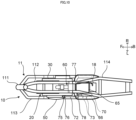
- FIG. 10 is an enlarged top view of the frame 11 and the engine unit 20 of the vehicle body 10 in FIG.1 .
- the motor driver 70 at least a part of the motor driver 70 is covered by the side cover 66 in view of the left-right direction LR.
- the motor driver 70 is arranged so that the outermost end of the motor driver 70 in the left-right direction LR is located outside the outermost end of the air cleaner 65.
- the motor driver 70 is arranged so that at least a part of the motor driver 70 overlaps the air cleaner 65 and the battery 18 in view of the left-right direction LR.
- the motor driver 70 is arranged so that at least a part of the motor driver 70 overlaps the air cleaner 65, the battery 18 and the side cover 66 in view of the left-right direction LR. Accordingly, a part of the motor driver 70 is arranged between the air cleaner 65 and the battery 18, and the side cover 66 in the left-right direction LR.
- the frame 11 extends between the side cover 66 opposing both the air cleaner 65 and the battery 18, and the air cleaner 65 and the battery 18.
- the motor driver 70 at least partially overlaps the frame 11 in view of the up-down direction UD.
- the motor driver 70 is located lower than and/or higher than the frame 11. Thereby, a space is formed between the side cover 66, and the air cleaner 65 and the battery 18, so that the motor driver 70 keeps radiating the heat and any rise in its temperature can be suppressed.
- the multiphase brushless motor 50 has a function as a starter motor in addition to a function as a generator.
- the multiphase brushless motor 50 is directly connected to the crankshaft 34. Therefore, it is required that the multiphase brushless motor 50 generates a torque large enough to rotate the crankshaft 34 at the time of starting.
- the motor driver 70 controls the multiphase brushless motor 50 by performing switching of the electric current that is to be supplied to the multiphase brushless motor 50. Accordingly, the motor driver controlling the multiphase brushless motor 50 generates heat when driving the multiphase brushless motor 50. Therefore, it is required that the motor driver 70 radiates the heat generated during driving.
- the air cleaner 65 is to clean the air taken in from the outside, and then supply it to the engine 30. Consequently, the air is able to flow around the air cleaner 65. Therefore, the air is likely to flow inside the side cover 66 covering the air cleaner 65.
- a part of the motor driver 70 is arranged between the air cleaner 65 and the side cover 66 in the left-right direction LR. When the motor driver 70 is arranged in this manner, the motor driver 70 is more likely to be kept radiating the heat through the air around the air cleaner 65, and any rise in the temperature of the motor driver 70 can be suppressed. Thus, the function for performing switching of the electric current by the motor driver 70 is less likely to be inhibited. Therefore, any decline in functions of the starter motor can be suppressed.
- the multiphase brushless motor 50 of the engine unit 20 and the motor driver 70 are connected by an electric cable 72.
- the electric cable 72 has a core wire formed of a conductor, a coating surrounding the core wire, and a tube further covering the coating. With this configuration of the electric cable 72, the damage of the electric cable 72 can be easily noticed by inspecting the damage of the tube.
- the coating is formed of an achromatic material
- the tube is formed of a chromatic material.
- the tube that is formed of a chromatic material can increase the visibility of the motor driver 70 with respect to the electric cable 72 and facilitates the ability to notice any damage. Further, since the achromatic coating of the electric cable 72 is covered with the chromatic tube, the visibility of damage to the tube is increased. Thus, in the straddled vehicle 1, work can be performed without contacting or damaging the electric cable 72 when, for example, components around the electric cable 72 are replaced. Therefore, maintainability can be improved in the straddled vehicle 1.
- the electric cable 72 intersects the frame 11. More specifically, the electric cable 72 intersects the mainframe 112.
- the electric cable 72 also extends along the frame 11. More specifically, the electric cable 72 extends along the seat frame 114.
- the electric cable 72 connects the multiphase brushless motor 50 and the motor driver 70. Accordingly, a cable thicker than, for example, a communication cable is used as the electric cable 72.
- the electric cable 72 is clamped to the frame 11, more specifically, to the main frame 112 and the seat frame 114 by a fastener 73.
- the electric cable 72 can be arranged without interfering with the components of the straddled vehicle 1, and higher flexibility in the arrangement of other components can be achieved.
- the multiphase brushless motor 50 includes a motor lead-out part 55 through which the electric cable 72 connected to the motor driver 70 is led out from the multiphase brushless motor 50.
- the motor lead-out part 55 is arranged such that the electric cable 72 led out from the motor lead-out part 55 extends in a direction approaching to the frame 11, or more specifically, to the main frame 112 in view of the left-right direction LR. Since the electric cable 72 is formed thickly, it is hard to be bent and the direction in which the electric cable extends is hard to be changed.
- the motor lead-out part 55 By arranging the motor lead-out part 55 so that the electric cable 72 extends in the direction approaching to the main frame 112, the electric cable 72 approaches to the main frame 112 while the electric cable is not bent and the direction in which the electric cable extends is not changed.
- the electric cable 72 extending from the motor lead-out part 55 of the multiphase brushless motor 50 can be avoided from being bent on the way thereof.
- the motor lead-out part 55 is arranged so that the electric cable 72 led out from the motor lead-out part 55 extends backward B.
- the motor lead-out part 55 is also arranged so that the electric cable 72 led out from the motor lead-out part 55 extends upward U.
- the motor driver 70 includes a driver lead-out part 75 through which the electric cable 72 connected to the multiphase brushless motor 50 is led out from the motor driver 70.
- the driver lead-out part 75 is arranged so that the electric cable 72 led out from the driver lead-out part 75 extends downward D.
- the motor lead-out part 55 of a multiphase brushless motor 50 has a grommet 56 through which the electric cable 72 penetrates.
- the driver lead-out part 75 of the motor driver 70 has a grommet 76 through which the electric cable 72 penetrates.
- the motor lead-out part 55 and the driver lead-out part 75 have grommets (56 and 76) through which the electric cable 72 penetrates, so that they are highly waterproof.
- the battery 18 and the motor driver 70 are connected by an electric cable 77.
- the electric cable 77 extends along the main frame 112.
- the electric cable 77 can be arranged so as not to interfere with other components in the straddled vehicle 1 by utilizing the space around the frame 11.
- the electric cable 77 is clamped to the main frame 112 and the seat frame 114 by a fastener 78.
- the electric cable 77 can be arranged without interfering with the components of the straddled vehicle 1, and higher flexibility in the arrangement of other components can be achieved.
- FIG.11 is a block diagram showing an electrical schematic configuration of the engine unit 20 shown in FIGS.3 and 4 .
- FIG.11 also shows a battery 18 and a main switch MS, which are electrically connected to the engine unit 20.
- the multiphase brushless motor 50 and the battery 18 are connected to the motor driver 70.
- the battery 18 supplies power to the multiphase brushless motor 50 when the multiphase brushless motor 50 operates as a motor.
- the motor driver 70 includes the inverter 71.
- the inverter 71 controls the electric current flowing between the battery 18 and the multiphase brushless motor 50.
- the inverter 71 includes a plurality of switching parts 711 to 716.
- the inverter 71 is a three-phase bridge inverter.
- Each of the switching parts 711 to 716 has a switching element.
- the switching element is, for example, a transistor, and more specifically, an FET (Field Effect Transistor).
- the plurality of switching parts 711 to 716 are connected to each phase of the multiphase stator winding 522. More specifically, among the plurality of switching parts 711 to 716, a half bridge is configured by two switching parts connected in series. Half bridges of each phase are connected in parallel to the battery 18. The switching parts 711 to 716 constituting to the half bridge of each phase is connected to each phase of the multiphase stator winding 522.
- the inverter 71 controls the electric current flowing between the battery 18 and the multiphase brushless motor 50. More specifically, the switching parts 711 to 716 of the inverter 71 switches the passage/interruption of the electric current between the battery 18 and the multiphase stator winding 522.
- the multiphase brushless motor 50 When the multiphase brushless motor 50 functions as a generator, the passage/interruption of the electric current between each of the stator windings 522 and the battery 18 is switched by the on-off functioning of the switching parts 711 to 716.
- the switching parts 711 to 716 is sequentially switched on and off to perform rectification and voltage control of the three-phase alternating current outputted from the multiphase brushless motor 50.
- the switching parts 711 to 716 controls the electric current outputted from the multiphase brushless motor 50 to the battery 18.
- the control device 80 includes a combustion control unit 83 and a starting and electricity generation control unit 82.
- the starting and electricity generation control unit 82 of the control device 80 controls the motor driver 70.
- a spark plug 37, a fuel injection device 62, and the battery 18 are connected to the control device 80.
- the rotor position detection device 53 is connected to the control device 80.
- the control device 80 obtains the position of the rotor 51 in the multiphase brushless motor 50 by a signal from the rotor position detection device 53.
- the control device 80 controls the inverter 71 according to the position of the rotor 51.
- the control device 80 includes the starting and electricity generation control unit 82 and the combustion control unit 83.
- the starting and electricity generation control unit 82 and the combustion control unit 83 of the control device 80 control the engine 30 and the multiphase brushless motor 50.
- the starting and electricity generation control unit 82 includes a driving control unit 821 and an electricity generation control unit 822.
- the driving control unit 821 starts the engine 30.
- the driving control unit 821 controls the motor driver 70 so that the multiphase brushless motor 50 rotates the crankshaft 34.
- the multiphase brushless motor 50 rotates the crankshaft 34 to start the engine 30.
- the electricity generation control unit 822 causes the multiphase brushless motor 50 to perform power generation functioning.
- the electricity generation control unit 822 controls the motor driver 70 so that the multiphase brushless motor 50 generates power.
- the multiphase brushless motor 50 generates power to charge the battery 18.
- the driving control unit 821 and the electricity generation control unit 822 i.e., the starting and electricity generation control unit 82, control the functioning of the multiphase brushless motor 50 by controlling the on/off functioning of the switching parts 711 to 716 of the motor driver 70.
- the starting and electricity generation control unit 82 determines the position of the rotor 51 of the multiphase brushless motor 50 by a change in an electric signal outputted from the rotor position detection device 53.
- the starting and electricity generation control unit 82 controls the switching parts 711 to 716 based on the position of the rotor 51. This allows the starting and electricity generation control unit 82 to control the rotation of the multiphase brushless motor 50.
- the starting and electricity generation control unit 82 turns the switching parts 711 to 716 on and off not at a predetermined timing but according to the position of the rotor 51 detected by the rotor position detection device 53. That is, the starting and electricity generation control unit 82 turns the switching parts 711 to 716 on and off by feedback control based on the position of the rotor 51.
- the combustion control unit 83 controls the combustion functioning of the engine 30 by controlling the spark plug 37 and the fuel injection device 62.
- the combustion control device 83 controls the rotational force of the engine 30 by controlling the spark plug 37 and the fuel injection device 62.
- the combustion control unit 83 controls the spark plug 37 and the fuel injection device 62 according to the opening of the throttle valve SV.
- the control device 80 includes a central processing device 80a and a computer having a storage device 80b.
- the central processing device 80a performs arithmetic processing based on the control program.
- the storage device 80b stores data related to programs and operations.
- the starting and electricity generation control unit 82 including the driving control unit 821 and the electricity generation control unit 822 and the combustion control unit 83 are implemented by the central processing device 80a and a control program stored in the storage device 80b and executed by the central processing device 80a. Therefore, the functioning of the starting and electricity generation control unit 82 including the driving control unit 821 and the electricity generation control unit 822 and the functioning of the combustion control unit 83 can be regarded as the functioning of the control device 80. It should be noted that the starting and electricity generation control unit 82 and the combustion control unit 83 may be, for example, configured to be positioned separately from each other as separate devices or may be configured integrally.
- the battery 18 is charged by electric power generated by the multiphase brushless motor 50.
- the main switch MS switches supply or stop of supply of power to the control device 80 in response to the operation of the driver.
- the engine start switch 124 is operated by the driver of the straddled vehicle 1 when the engine 30 is started.
- FIG.12 shows a left side view for describing a variation of the straddled vehicle 1 shown in FIG.1 .
- at least a part of the air cleaner 65 of the intake system 60 is arranged forward F of the vertical line passing through the front end of the cylinder 32 of the engine 30 in the front-back direction FB of the straddled vehicle 1.
- the front fork 12 is rotatably provided to the frame 11 and rotatably supports the front wheel 14.
- the rear arm 13 is swingably provided to the frame 11 and rotatably supports the rear wheel 15.
- the straddled vehicle 1 includes the seat 17.
- the seat 17 is provided to the frame 11.
- the straddled vehicle 1 includes the battery 18.
- the engine unit 20 includes the engine 30, the manual transmission 40, the multiphase brushless motor (starting generator) 50, the intake system 60, and the side cover 66. That is, the straddled vehicle 1 includes the engine 30, the manual transmission 40, the multiphase brushless motor 50, the intake system 60, and the side cover 66.
- the engine 30 includes the cylinder 32, the piston 36, the crankcase 31, and the crankshaft 34.
- the cylinder 32 has a cylinder bore that houses the piston 36 such that the piston is able to move reciprocatably.
- the crankcase 31 houses the crankshaft 34 and the manual transmission 40.
- the crankcase 31 is connected to the cylinder 32.
- the engine 30 is provided to the frame 11. The engine 30 outputs power generated in the combustion functioning through the crankshaft 34 that rotates forward.
- the engine 30 is provided to the frame 11 such that the cylinder 32 has a recumbent position.
- the center line of the cylinder bore extends along the horizontal direction.
- the center line of the cylinder bore extends "primarily" in the horizontal direction. More specifically, the inclination angle of the center line of the cylinder bore in the piston moving direction is -45 degrees or more and + 45 degrees or less with respect to the horizontal.
- the manual transmission 40 is provided in a power transmission pathway between the engine 30 and the rear wheel 15.
- the manual transmission 40 changes the gear ratio in multiple stages in response to the operation of the driver of the straddled vehicle 1.
- the driver of the straddled vehicle 1 changes the gear ratio of the manual transmission by operating the shift pedal 49. That is, the manual transmission 40 changes the rotational speed of the engine 30 by the operation of the driver of the straddled vehicle 1, and then transmits it to the rear wheel 15, which is the driving wheel.
- the manual transmission 40 has a neutral state and a plurality of non-neutral states.
- the manual transmission 40 includes the manual clutch 41 and the output part 47.
- the manual clutch 41 is provided in a power transmission pathway between the engine 30 and the manual transmission 40.
- the manual clutch lever 19 operates the manual clutch 41 according to the operation by the driver of the straddled vehicle 1.
- the driver of the straddled vehicle 1 interrupts power transmission between the engine 30 and the manual transmission 40 through the manual clutch 41.
- the multiphase brushless motor 50 is provided at one end part of the crankshaft 34.
- the multiphase brushless motor 50 functions as a starter motor for starting the engine 30 by driving the crankshaft 34 when the engine 30 is started.
- the multiphase brushless motor 50 is provided so as to be in conjunction with the crankshaft 34.
- the multiphase brushless motor 50 drives the crankshaft 34 using the power that is supplied from the battery 18.
- the multiphase brushless motor 50 also serves as a generator that is driven by the engine 30 to generate electricity during combustion functioning of the engine 30. Providing the engine unit 20 with the multiphase brushless motor 50 that serves as both a starter motor and a generator can eliminate the need for a starter motor such as a dedicated starter motor that is different from the generator.
- the intake system 60 includes the air cleaner 65. That is, the straddled vehicle 1 includes the air cleaner 65.
- the air cleaner 65 cleans the air to be supplied to the engine 30. More specifically, dust, trash, and the like are removed from the air taken into the engine 30.
- the side cover 66 covers at least a part of the intake system 60 in view of the left-right direction LR. More specifically, the side cover 66 covers at least a part of the air cleaner 65 in view of the left-right direction LR.
- the straddled vehicle 1 includes the motor driver 70.
- the motor driver 70 performs switching of the electric current that is to be supplied to the multiphase brushless motor 50.
- the motor driver 70 has the inverter 71.
- the inverter 71 controls the electric current flowing between the battery 18 and the multiphase brushless motor 50.
- the motor driver 70 is arranged so that at least a part of the motor driver 70 is covered with the side cover 66 in view of the left-right direction LR, and the outermost end of the motor driver 70 in the left-right direction LR is positioned outside of the outermost end of the air cleaner 65.
- the straddled vehicle 1 includes the control device 80.
- the control device 80 controls the rotational power outputted from the engine 30 by controlling the combustion functioning of the engine 30.
- the control device 80 controls the motor driver 70.
- the control device 80 controls the multiphase brushless motor 50 by controlling the inverter 71 of the motor driver 70.
- the multiphase brushless motor 50 of the engine unit 20 and the motor driver 70 are connected by the electric cable 72.
- the electric cable 72 has the core wire formed of the conductor, the coating surrounding the core wire, and the tube further covering the coating.
- the coating is formed of an achromatic material, and the tube is formed of a chromatic material.
- the electric cable 72 extends along the seat frame 114. The electric cable 72 is clamped to the frame 11, more specifically, to the main frame 112 and the seat frame 114 by the fastener 73.
- the multiphase brushless motor 50 includes the motor lead-out part 55 through which the electric cable 72 connected to the motor driver 70 is led out from the multiphase brushless motor 50.
- the motor lead-out part 55 is arranged such that the electric cable 72 led out from the motor lead-out part 55 extends in a direction approaching to the frame 11, more specifically, to the main frame 112 in view of the left-right direction LR.
- the motor lead-out part 55 is arranged such that the electric cable 72 led out from the motor lead-out part 55 extends backward B.
- the motor lead-out part 55 is arranged such that the electric cable 72 led out from the motor lead-out part 55 extends upward U.
- the motor driver 70 includes the driver take-out part 75 through which the electric cable 72 connected to the multiphase brushless motor 50 is led out from the motor driver 70.
- the driver lead-out part 75 is arranged such that the electric cable 72 led out from the driver lead-out part 75 extends downward D.
- the motor lead-out part 55 of the multiphase brushless motor 50 has the grommet 56 through which the electric cable 72 penetrates.
- the driver lead-out part 75 of the motor driver 70 has the grommet 76 through which the electric cable 72 penetrates.
- the low-viscosity oil OL may not be supplied to the multiphase brushless motor 50.
- the crankcase 31 is provided with a cooling air inlet and a cooling air outlet for the multiphase brushless motor 50.
- the rotor 51 of the multiphase brushless motor includes a fan or fin for generating airflow for cooling directed from the cooling air inlet to the cooling air outlet.
- the engine 30 may also be a multi-cylinder parallel engine or a multi-cylinder V-type engine.
Landscapes
- Engineering & Computer Science (AREA)
- Mechanical Engineering (AREA)
- Chemical & Material Sciences (AREA)
- Combustion & Propulsion (AREA)
- Transportation (AREA)
- General Engineering & Computer Science (AREA)
- Automatic Cycles, And Cycles In General (AREA)
- Hybrid Electric Vehicles (AREA)
- Motorcycle And Bicycle Frame (AREA)
Description
- The present teaching relates to an MT (manual transmission)-type straddled vehicle.
- An MT-type straddled vehicle having a manual transmission is disclosed, for example, in the
JP 2012-211553 A -
JP 2019 171995 A - In an MT-type straddled vehicle, a frame and many components related to functioning of an engine are arranged in a region higher than a crankcase. It is desired that higher flexibility in an arrangement of both the frame and such components be achieved while decline in functions of a starter motor be suppressed. It is an objective of the present teaching to provide an MT-type straddled vehicle where higher flexibility in the arrangement of both the frame and a component in a region higher than the crankcase can be achieved while decline in functions of the starter motor can be suppressed.
- The present inventors have studied the arrangement of components in a region higher than a crankcase. A crankshaft and a transmission are housed in a crankcase of a vehicle disclosed in, for example,
JP 2012-211553 - Accordingly, the present inventors have further studied the arrangement of components in the region higher than the crankcase. In particular, the present inventors have studied a function and an arrangement of the starter motor arranged in the region described above. The starter motor has a function for driving the crankshaft in order to start an engine. When a multiphase brushless motor that also serves as a power generator is provided as the starter motor at the end part of the crankshaft, the starter motor can be removed from the region described above while keeping its function. After the removal of the starter motor from the region described above, other components can be arranged in a space where the starter motor was originally arranged. This results in creation of more space in the region higher than the crankcase.
- When a multiphase brushless motor that also serves as a power generator is employed as the starter motor, switching of the electric current that is to be supplied to the starter motor is performed by the motor driver. The motor driver also performs switching of the electric current generated by the starter motor. Accordingly, heat is generated in the motor driver while the vehicle is travelling. In addition, heat is also generated through the input and output of the electric current in the battery that supplies the electric current to the starter motor.
- When the MT-type straddled vehicle has an air cleaner and a side cover that covers at least a part of the air cleaner in view of the left-right direction, the air is able to flow around the air cleaner as the air cleaner is to clean the air taken in from the outside, and then supply it to the engine. Therefore, the air is likely to flow inside the side cover that covers the air cleaner. The battery is arranged, for example, forward or backward of the air cleaner in the front-back direction of the MT-type straddled vehicle. The motor driver is arranged in a space between the side cover, and the air cleaner and the battery so that at least a part of the motor driver overlaps both the air cleaner and the battery in view of the left-right direction. This arrangement allows the motor driver and the battery to keep radiating the heat through the air, which can suppress any rise in their temperatures. Thus, a function for performing switching of the electric current by the motor driver is less likely to be inhibited. Therefore, any decline in functions of the starter motor can be suppressed.
- Accordingly, higher flexibility can be achieved in the arrangement of components in the region higher than the crankcase while any decline in functions of the starter motor can be suppressed.
- In order to achieve the above objective, according to one aspect of the present teaching, the MT-type straddled vehicle has the following configuration.
- (1) An MT, manual transmission, type straddled vehicle comprising:
- a frame;
- a seat attached to the frame;
- a multi-stage transmission device configured to change a gear ratio in multiple stages in response to an operation;
- an engine including a crankshaft, a piston, a cylinder, and a crankcase, the crankshaft extending in a left-right direction of the MT type straddled vehicle, the cylinder having a cylinder bore in which the piston is reciprocably accommodated, the crankcase being connected to the cylinder and storing the crankshaft and the multi-stage transmission device, the engine being attached to the frame;
- a starter motor configured to start the engine;
- a battery configured to supply electricity to the starter motor;
- a motor driver configured to perform switching of a current to be supplied to the starter motor;
- an air cleaner configured to clean the air to be supplied to the engine; and
- a side cover configured to cover at least a part of each of the air cleaner and the battery in view of the left-right direction, the side cover being configured to be visible from the outside of the MT type straddled vehicle so as to define the external appearance of the MT type straddled vehicle,
- the starter motor being provided to one end portion of the crankshaft, the starter motor being a multi-phase brushless motor that serves also as a generator that generates electricity by being driven by the engine,
- the air cleaner and the battery being arranged next to each other in a front-back direction so that both of the air cleaner and the battery lie over two regions that are defined by division by a center plane passing through the center of the MT type straddled vehicle and extending both in an up-down direction and the front-back direction of the MT type straddled vehicle,
the motor driver being arranged in a space between the side cover, and the air cleaner and the battery so that the motor driver overlaps both the air cleaner and the battery in view of the left-right direction, wherein the frame has a portion that extends between the side cover, and the air cleaner and the battery, the portion overlapping at least partially the motor driver in view of the up-down direction UD.
- The scope of protection is defined by the appended claims. Effect of the Invention
- According to the MT-type straddled vehicle of the present teaching, higher flexibility in the arrangement of both the frame and components in a region higher than the crankcase can be achieved.
-
-
FIG.1 is a left side view illustrating an MT-type straddled vehicle according to an embodiment of the present teaching. -
FIG.2 is a left side view showing the straddled vehicle ofFIG. 1 . -
FIG.3 is an enlarged left side view of the engine unit of the straddled vehicle ofFIG. 1 . -
FIG.4 is an enlarged cross-sectional view of the engine unit of the straddled vehicle ofFIG.1 . -
FIG.5 is an explanatory diagram schematically showing the relationship between the crank angle position and the required torque of the engine of the straddled vehicle ofFIG. 1 . -
FIG.6 is a cross-sectional view showing a cross section perpendicular to the axis of rotation of the multiphase brushless motor of the straddled vehicle ofFIG. 1 . -
FIG.7 is an enlarged left side view of the engine unit of the straddled vehicle having a starter motor specialized for a starting function, which is a comparative example of the straddled vehicle ofFIG. 1 . -
FIG.8 illustrates an example of the surrounding region X ofFIG.3 . -
FIG.9 is an enlarged left side view of the frame and the engine unit of the straddled vehicle ofFIG. 1 . -
FIG.10 is an enlarged top view of the frame and the engine unit of the straddled vehicle ofFIG. 1 . -
FIG.11 is a block diagram illustrating an electrical schematic configuration of the engine unit of the straddled vehicle ofFIG.1 . -
FIG.12 is a left side view illustrating the MT-type straddled vehicle according to a variation of an embodiment of the present teaching. -
FIG. 1 is a left side view for describing an MT-type straddled vehicle (straddled vehicle 1) according to an embodiment of the present teaching.FIG.1(a) is a left side view of the straddledvehicle 1, andFIG.1(b) is a top view showing the configuration of theframe 11 and theengine unit 20 of the straddledvehicle 1. - In the present specification and drawings, F denotes forward of the straddled
vehicle 1. B denotes backward of the straddledvehicle 1. FB denotes the front-back direction of the straddledvehicle 1. U denotes upward of the straddledvehicle 1. D denotes downward of the straddledvehicle 1. The UD denotes the up-down direction of the straddledvehicle 1. L denotes leftward of the straddledvehicle 1. R denotes rightward of the straddledvehicle 1. LR denotes the left-right direction of the straddledvehicle 1. The LR also denotes the vehicle width direction of the straddledvehicle 1. That is, the vehicle width direction LR of the straddledvehicle 1 includes both rightward R and leftward L of the straddledvehicle 1. The direction described above is the same as the direction of theengine unit 20 mounted on the straddledvehicle 1. - The straddled
vehicle 1 shown inFIG.1(a) is an MT (manual transmission)-type straddled vehicle having a manual-type multi-stage transmission device. Hereinafter, the MT-type straddled vehicle of the present embodiments will be referred to simply as a straddledvehicle 1. The straddledvehicle 1 includes avehicle body 10 and anengine unit 20. Thevehicle body 10 includes aframe 11, afront fork 12, arear arm 13, afront wheel 14, and arear wheel 15. - The
frame 11 forms the skeleton of the straddledvehicle 1. Thefront fork 12 is attached to theframe 11 to be able to swivel and rotatably supports thefront wheel 14. Therear arm 13 is swingably provided to theframe 11 and rotatably supports therear wheel 15. - The straddled
vehicle 1 includes afuel tank 16. Thefuel tank 16 stores fuel supplied to the engine 30 (described later). Thefuel tank 16 supplies fuel to theengine 30. Thefuel tank 16 is provided to theframe 11. The straddledvehicle 1 includes aseat 17. Theseat 17 is provided to theframe 11. Thefuel tank 16 is arranged frontward F of theseat 17 in the front-back direction FB of the straddledvehicle 1. - The straddled
vehicle 1 includes abattery 18. - The
engine unit 20 includes theengine 30, amanual transmission 40, a multiphase brushless motor (starting generator) 50, anintake system 60, and aside cover 66. That is, the straddledvehicle 1 includes theengine 30, themanual transmission 40, themultiphase brushless motor 50, theintake system 60, and theside cover 66. - The
engine 30 includes acylinder 32, apiston 36, acrankcase 31, and acrankshaft 34. A cylinder bore for housing thepiston 36 such that the piston is able to move reciprocatably is formed in thecylinder 32. Thecrankcase 31 houses thecrankshaft 34 and amanual transmission 40. Thecrankcase 31 is connected to thecylinder 32. Theengine 30 is provided to theframe 11. Theengine 30 outputs the power generated by the combustion functioning through thecrankshaft 34 that rotates forward. - The
manual transmission 40 is a manual-type multi-stage transmission device. Themanual transmission 40 is provided in a power transmission pathway between theengine 30 and therear wheel 15. Themanual transmission 40 changes the gear ratio in multiple stages in response to an operation of a driver of the straddledvehicle 1. The driver of the straddledvehicle 1 changes the gear ratio of the manual transmission by operating ashift pedal 49. That is, themanual transmission 40 changes the rotational speed of theengine 30 by the operation of the driver of the straddledvehicle 1 and transmits the change to therear wheel 15, which is the drive wheel. Themanual transmission 40 has a neutral state and a plurality of non-neutral states. - The
manual transmission 40 includes a manual clutch 41 and anoutput part 47. The manual clutch 41 is provided in a power transmission pathway between theengine 30 and themanual transmission 40. A manualclutch lever 19 operates the manual clutch 41 in response to the operation by the driver of the straddledvehicle 1. The driver of the straddledvehicle 1 interrupts power transmission between theengine 30 and themanual transmission 40 through themanual clutch 41. - The
multiphase brushless motor 50 is a permanent magnet-type motor. Themultiphase brushless motor 50 is provided at one end part of thecrankshaft 34. Themultiphase brushless motor 50 functions as a starter motor for starting theengine 30 by driving thecrankshaft 34 when theengine 30 is started. Themultiphase brushless motor 50 is provided so as to be in conjunction with thecrankshaft 34. Themultiphase brushless motor 50 drives thecrankshaft 34 using the power that is supplied from thebattery 18. Themultiphase brushless motor 50 also serves as a generator that is driven by theengine 30 to generate electricity during the combustion functioning of theengine 30. Providing theengine unit 20 with themultiphase brushless motor 50 that serves as both a starter motor and a generator can eliminate the need for a starter motor such as a dedicated starter motor that is different from the generator. - A
crankcase 31 of the straddledvehicle 1 houses amanual transmission 40. Accordingly, in thecrankcase 31 of the straddledvehicle 1, thecrankshaft 34 being housed is likely to be larger in size in the radial direction compared to, for example, the case where the continuously variable transmission device provided at the end part of thecrankshaft 34 is housed. As a result, available space higher than thecrankcase 31 is likely to be limited. In addition, a starter motor specialized for the starting function is usually provided higher than the crankcase since it drives the crankshaft. In this embodiment, providing theengine unit 20 with themultiphase brushless motor 50 that serves as both a starter motor and a generator can eliminate the need for a dedicated starter motor that is different from the generator higher than thecrankcase 31. Thus, in the straddledvehicle 1, a space where a conventional starter motor specialized for the starting function was previously arranged is available for the components related to the functioning of theengine 30 to be arranged. The components related to the functioning of theengine 30 include, for example, a chain tensioner, a thermostat, and a throttle valve. - In the straddled
vehicle 1, a space where a conventional starter motor specialized for the starting function was previously arranged is available for theintake system 60 to be arranged. Theintake system 60 passes air taken into theengine 30. Theintake system 60 is a general term for components protruding from thecylinder 32 of theengine 30. Theintake system 60 includes anair cleaner 65. That is, the straddledvehicle 1 includes theair cleaner 65. Theair cleaner 65 cleans the air to be supplied to theengine 30. More specifically, dust, trash, and the like are removed from the air taken into theengine 30. The side cover 66 covers at least a part of theintake system 60 in the left-right direction LR. More specifically, theside cover 66 covers at least a part of theair cleaner 65 and at least a part of the battery in view of the left-right direction LR. The side cover 66 is provided so as to oppose both theair cleaner 65 and thebattery 18. The side cover 66 defines the appearance of the straddledvehicle 1. The side cover 66 is configured so as to be visible from the outside of the straddledvehicle 1. - The straddled
vehicle 1 includes amotor driver 70. Themotor driver 70 performs switching of the electric current that is to be supplied to themultiphase brushless motor 50 and the electric current generated by themultiphase brushless motor 50. Themotor driver 70 has aninverter 71. Theinverter 71 performs switching of the electric current flowing between thebattery 18 and themultiphase brushless motor 50. Heat is generated in themotor driver 70 when theinverter 71 performs switching. In addition, heat is also generated through the input and output of the electric current in the battery that supplies the electric current to the starter motor. - The
air cleaner 65 is to clean the air taken in from the outside, and then supply it to theengine 30. The air is likely to flow around theair cleaner 65. Therefore, the air is likely to flow inside theside cover 66 that covers theair cleaner 65. Here, as shown inFIG.1(b) , thebattery 18 is arranged backward B of theair cleaner 65 in the front-back direction FB of the straddledvehicle 1. Theair cleaner 65 and thebattery 18 are arranged next to each other in the front-back direction FB so as to lie over two regions that are defined by division by a center plane C passing through the center of the straddledvehicle 1 and extending in the up-down direction UD and the front-back direction FB. Themotor driver 70 is arranged in a space between aside cover 66 opposing both of theair cleaner 65 and thebattery 18, and theair cleaner 65 and thebattery 18 so that at least a part of themotor driver 70 overlaps both theair cleaner 65 and thebattery 18 in view of the left-right direction. This allows themotor driver 70 and thebattery 18 to keep radiating the heat, and any rise in their temperatures can be suppressed. Thus, a function for performing switching of the electric current by themotor driver 70 is not likely to be inhibited. Therefore, any decline in functions of themultiphase brushless motor 50 can be suppressed. Thus, according to the straddledvehicle 1, higher flexibility can be achieved in the arrangement of components in the region higher than thecrankcase 31 while any decline in functions of themultiphase brushless motor 50 can be suppressed. - The straddled
vehicle 1 includes acontrol device 80. Thecontrol device 80 controls the rotational power outputted from theengine 30 by controlling the combustion functioning of theengine 30. Thecontrol device 80 also controls themotor driver 70. Thecontrol device 80 controls themultiphase brushless motor 50 by controlling theinverter 71 of themotor driver 70. - Hereinafter, the straddled
vehicle 1 according to an embodiment of the present teaching will be described in more detail.FIG.2 is a left side view of the straddledvehicle 1 shown inFIG.1 . More specifically, the straddledvehicle 1 is an MT-type straddled vehicle. The straddledvehicle 1 is also a motorcycle. More specifically, the straddledvehicle 1 is an MT-type motorcycle. More specifically, the straddledvehicle 1 includes avehicle body 10 and anengine unit 20. Thevehicle body 10 includes aframe 11, afront fork 12, arear arm 13,front wheel 14,rear wheel 15, afuel tank 16, aseat 17, and aside cover 66. - The
frame 11 includes ahead pipe 111, amain frame 112, adown tube 113, aseat frame 114, and aswing arm pivot 115. - The
head pipe 111 rotatably supports thefront fork 12. Thefront fork 12 rotatably supports thefront wheel 14. Ahandlebar 121 is fixed to the upper end of thefront fork 12 in the up-down direction UD of the straddledvehicle 1. Thehandlebar 121 functions as a steering handle. A manualclutch lever 19 is provided on the left part of thehandlebar 121 in the left-right direction LR of the straddledvehicle 1. Anaccelerator operator 122, abrake lever 123, and anengine start switch 124 are provided on the right part of thehandlebar 121. - The
main frame 112 extends backward B in the front-back direction FB of the straddledvehicle 1 from thehead pipe 111. Themain frame 112, which is a central portion of theframe 11, supports theengine unit 20 together with thedown tube 113. Themain frame 112 also supports thefuel tank 16. The downtube 113 extends backward B and downward D in the front-back direction FB and the up-down direction UD of the straddledvehicle 1 from thehead pipe 111. The rear end of themain frame 112 and the rear end of thedown tube 113 in the front-back direction FB of the straddledvehicle 1 are connected. - The
seat frame 114 is provided at the rear portion of themain frame 112 in the front-back direction FB of the straddledvehicle 1, and extends backward B from the rear portion of themain frame 112. Aseat 17 is provided to theseat frame 114. Theseat 17 is a saddle type. Thefuel tank 16 and theseat 17 form a part of the upper contour line of thevehicle body 10 when the straddledvehicle 1 is viewed in the left-right direction LR. - The
swing arm pivot 115 is provided at a coupling point between themain frame 112 and thedown tube 113. Theswing arm pivot 115 swingably supports therear arm 13. Therear arm 13 rotatably supports therear wheel 15. Therear wheel 15 are drive wheels that receive power outputted from theengine unit 20 and drive the straddledvehicle 1. - The side cover 66 is provided so as to cover a space downward D of the
fuel tank 16 and theseat 17 in the up-down direction UD of the straddledvehicle 1. The side cover 66 is provided downward D of thefuel tank 16 and theseat 17 in the up-down direction UD of the straddledvehicle 1. The side cover 66 is arranged so as to overlap at least a part of anintake system 60 described later in view of the right-left direction LR. - The
engine unit 20 outputs power from theoutput part 47 to therear wheel 15. Theoutput part 47 is a sprocket around which thechain 151 is wound. Theoutput part 47 is provided outside the casing of theengine unit 20. Theoutput part 47 is actually covered with a cover provided on the vehicle body 10 (not shown), but is represented by a solid line inFIG.2 so that it is easily understood that theoutput part 47 is exposed outside the casing of theengine unit 20. The power of theengine unit 20 is transmitted to therear wheel 15 through a sprocket and achain 151 as theoutput part 47. The casing of theengine unit 20 is provided withsteps 491. The driver of the straddledvehicle 1 straddles theseat 17 to sit, and has his or her feet placed on thesteps 491 while traveling. -
FIG.3 is an enlarged left side view of theengine unit 20 shown inFIG.1 .FIG. 4 is an enlarged cross-sectional view of theengine unit 20 shown inFIG.1 . Theengine unit 20 includes theengine 30, themanual transmission 40, themultiphase brushless motor 50, and theintake system 60. Theengine unit 20 also includes a radiator 25 (seeFIG.2 ). That is, theengine 30 is a water-cooled engine. - The
engine 30 includes acrankcase 31 and acylinder 32. Theengine 30 includes acrankshaft 34, a connectingrod 35, apiston 36, a spark plug 37 (seeFIG.4 ), a valve functioning mechanism 38 (seeFIG.4 ), and avalve 39. Thecrankcase 31 and thecylinder 32 are included in the casing of theengine unit 20. Thecylinder 32 includes acylinder body 321 and acylinder head 322. Thepiston 36 is reciprocatably provided in thecylinder body 321. Thecrankcase 31 is connected to thecylinder body 321. - The
engine 30 is provided to theframe 11 so that thecylinder 32 has a standing posture. The term that the cylinder has a standing posture means that the center line of the cylinder bore extends along the vertical direction. The term that the cylinder has a standing posture means that the center line of the cylinder bore extends 'mainly' in the vertical direction. Specifically, the inclination angle of the center line of the cylinder bore in the piston moving direction is between -45 degrees or more and + 45 degrees or less with respect to the vertical. - The
crankshaft 34 is arranged in thecrankcase 31 and rotatably supported by thecrankcase 31. Thepiston 36 and thecrankshaft 34 are connected through the connectingrod 35. Thevalve 39 and thevalve functioning mechanism 38 are arranged in thecylinder head 322. - The
crankshaft 34, themanual transmission 40, and themultiphase brushless motor 50 are arranged within thecrankcase 31. The power of thecrankshaft 34 is transmitted to thevalve functioning mechanism 38 through thecam chain 381. Thevalve functioning mechanism 38 operates thevalve 39 in synchronization with the rotation of thecrankshaft 34 and the reciprocating motion of thepiston 36. The slack of thecam chain 381 is adjusted by achain tensioner 382. - The
engine 30 includes abalancer 301. Thebalancer 301 is arranged, in the front-back direction FB, forward F of the vertical line passing through the crankshaft line in view of the left-right direction LR. - The
crankcase 31 is configured so that the inside thereof is lubricated by the low-viscosity oil OL. That is, theengine 30 has a low-viscosity oil OL. Thecrankshaft 34, themanual transmission 40, and themultiphase brushless motor 50 are lubricated with the same low-viscosity oil OL. The low-viscosity oil OL lubricates and cools each part of theengine unit 20. - The low-viscosity oil OL is pumped by an oil pump (not shown) and circulated in the
engine 30. More specifically, the low-viscosity oil OL is accumulated in anoil pan 311 provided at the lower part of thecrankcase 31. The low-viscosity oil OL accumulated in theoil pan 311 is pressurized by the oil pump (not shown). The pressurized low-viscosity oil OL is supplied to thepiston 36 and thecrankshaft 34 through an oil supply passage (not shown). Such an oil supply passage is formed, for example, by a bore provided inside thecrankshaft 34, a bore provided inside thecylinder body 321, and a groove formed on a joint surface between thecylinder body 321 and thecylinder head 322. - The low-viscosity oil OL is also supplied to the
manual transmission 40 and themultiphase brushless motor 50. More specifically, the low-viscosity oil OL supplied to thepiston 36 also flows to themultiphase brushless motor 50 arranged downward D of thepiston 36 in the up-down direction UD. The low-viscosity oil OL is accumulated so that a part of themultiphase brushless motor 50 is immersed in the low-viscosity oil OL. For example, the low-viscosity oil OL is accumulated in a dam wall (not shown) provided to surround a part of themultiphase brushless motor 50, so that a part of themultiphase brushless motor 50 is immersed in the low-viscosity oil OL. For example, the low-viscosity oil OL overflowing from the dam wall flows to theoil pan 311. The low-viscosity oil OL adhered to themultiphase brushless motor 50 is diffused into thecrankcase 31 by the rotation of themultiphase brushless motor 50. - A part of the low-viscosity oil OL is also supplied to the
valve functioning mechanism 38 through thecam chain 381. In this way, the inside of theengine 30 is lubricated with the low-viscosity oil OL. Therefore, the inside of thecrankcase 31 is lubricated with the low-viscosity oil OL. - The low-viscosity oil OL is a lubricating oil of which low-temperature viscosity grade according to the SAE viscosity classification specified in SAE J300 is lower than 20 W. The lower the viscosity grade, the lower the viscosity of the oil. The high temperature viscosity grade according to the SAE viscosity classification of the lubricating oil is not particularly limited. When X is an integer that is equal to or greater than 0 and less than 20, and Y is an integer that is equal to or greater than 0, the SAE viscosity grade of the lubricating oil is represented by XW-Y. The lubricating oil is composed of base oil and additives. Roughly speaking, the lower the viscosity of the lubricating oil, the lower the evaporation temperature of the lubricating oil, and the more easily the lubricating oil evaporates. Depending on the type of the base oil (e.g. mineral oil or synthetic oil) and additives, the evaporation temperature may be different even if the viscosity of the lubricating oil is the same. The evaporation characteristics of the lubricating oil can be obtained, for example, by the boiling point distribution measurement method by gas chromatography-simulated distillation in accordance with ASTM D6352.
-
FIG.5 is an explanatory diagram schematically showing the relationship between the crank angle position and the required torque of theengine 30. A solid line Ta inFIG.5 indicates the required torque to rotate thecrankshaft 34 in a state where theengine 30 is not performing combustion functioning. Theengine 30 is a single cylinder engine. During 4 strokes, theengine 30 has a high-load region TH where a load for rotating thecrankshaft 34 is high, and a low-load region TL where a load for rotating thecrankshaft 34 is lower than the load in the high-load region TH. - The high-load region refers to a region, in one combustion cycle of the
engine 30, in which the load torque is higher than the average value Av of the load torque in one combustion cycle. When viewed with reference to the rotation angle of thecrankshaft 34, the low-load region TL is wider than the high-load region TH. More specifically, the low-load region TL is wider than the high-load region TH. In other words, the rotation angle region corresponding to the low-load region TL is wider than the rotation angle region corresponding to the high-load region TH. Theengine 30 rotates while repeating an intake stroke, a compression stroke, an expansion stroke (a combustion stroke), and an exhaust stroke. The compression stroke overlaps the high-load region TH. The low-load region TL is located between combustion. - One combustion cycle of the
engine 30 includes one intake stroke, one compression stroke, one expansion stroke, and one exhaust stroke. Theengine 30 rotates while repeating an intake stroke, a compression stroke, an expansion stroke and an exhaust stroke. In the intake stroke, a mixture of fuel and air is supplied to a combustion chamber defined by acylinder body 321, acylinder head 322, and apiston 36 shown inFIGS.3 and4 . In the compression stroke, thepiston 36 compresses the air-fuel mixture in the combustion chamber. In the expansion stroke, the mixture ignited by thespark plug 37 burns and pushes thepiston 36. In the exhaust stroke, the gas after combustion is discharged from the combustion chamber as an exhaust gas. Reciprocating motion of thepiston 36 is converted into rotation of thecrankshaft 34. The energy generated by combustion of fuel inengine 30 is outputted to themanual transmission 40 as power of thecrankshaft 34. - The
manual transmission 40 converts the rotational speed of thecrankshaft 34 according to the gear shift. Themanual transmission 40 is a stepped transmission having a plurality of gear shifts. Themanual transmission 40 includes a manual clutch 41, aninput shaft 42, anoutput shaft 43, adrive gear 44, a drivengear 45, adog ring 45a, a gearshift setting mechanism 46, and anoutput part 47. Themanual transmission 40 converts the rotational speed of thecrankshaft 34 by a gear ratio corresponding to the operation of theshift pedal 49 and outputs the converted speed. Theshift pedal 49 is operated by the feet of the driver. - The manual clutch 41 interrupts the transmission of power between the
engine 30 and the rear wheel 15 (seeFIG.1 ) in response to the operation of the manualclutch lever 19. More specifically, the manual clutch 41 interrupts the transmission of power between thecrankshaft 34 and theinput shaft 42. The manual clutch 41 interrupts the transmission of power in response to the operation of the driver to the manualclutch lever 19.
The manual clutch 41 is connected to the manualclutch lever 19 through amechanical wire 191. More specifically, the manual clutch 41 is connected to the manualclutch lever 19 through themechanical wire 191, aclutch arm 416, and alifter rod 417. When the manualclutch lever 19 is operated, themechanical wire 191, theclutch arm 416 and thelifter rod 417 are displaced. As a result, power transmission is interrupted. - The plurality of drive gears 44 are provided on the
input shaft 42 and are configured so as to always rotate together with theinput shaft 42. Each of the plurality of drive gears 44 corresponds to each gear shift. The plurality of drivengears 45 are provided on theoutput shaft 43 and configured so as to be relatively rotatable with theoutput shaft 43. Thedog ring 45a is provided on theoutput shaft 43 and is configured so as to rotate with theoutput shaft 43. The plurality of drivengears 45 are configured to be meshable with acorresponding drive gear 44. At least one of the plurality of drivengears 45 is always engaged with thedrive gear 44. Theoutput shaft 43 is in conjunction with anoutput part 47 of theengine unit 20. More specifically, theoutput shaft 43 is fixed to theoutput part 47. The power transmitted to theoutput shaft 43 is outputted from theoutput part 47. - The gear
shift setting mechanism 46 is configured to mechanically and selectively effectively set the power transmission from theinput shaft 42 to theoutput shaft 43 through thedrive gear 44 and the drivengear 45 related to any one of the gear shifts. The gearshift setting mechanism 46 has a shift cam and a shift fork, which are not shown. When the shift cam rotates in response to the operation of the driver to theshift pedal 49, the shift fork is guided to a cam groove provided in the shift cam to move thedog ring 45a in the axial direction. Each of the drivengear 45 and thedog ring 45a is provided with a dog. For example, when thedog ring 45a moves in the axial direction, the dog provided in each of the drivengear 45 and thedog ring 45a is engaged with each other. This makes the power transmission related to any of the gear shifts effective. In this manner, themanual transmission 40 changes the gear ratio in response to the operation of the driver to theshift pedal 49. The rotational speed of thecrankshaft 34 is converted by a gear ratio in accordance with the operation of theshift pedal 49 and outputted from theoutput part 47. - When the driver operates the
shift pedal 49 upward U or downward D by the tip of the left foot placed on thestep 491, theshift pedal 49 rotates around the rotation axis. Thus, the gearshift setting mechanism 46 effectively sets the power transmission through thedrive gear 44 and the drivengear 45 related to one gear shift. -
FIG. 6 is a cross-sectional view showing a cross section perpendicular to the axis of rotation of themultiphase brushless motor 50 shown inFIGS.3 and4 . Themultiphase brushless motor 50 will now be described with reference toFIGS.3 to 6 . Themultiphase brushless motor 50 is provided on thecrankshaft 34. Themultiphase brushless motor 50 is a permanent magnet-type three-phase multiphase brushless motor. Themultiphase brushless motor 50 functions as a permanent magnet-type three-phase brushless generator. - The
multiphase brushless motor 50 has arotor 51 and astator 52. Themultiphase brushless motor 50 is a radial gap type. Themultiphase brushless motor 50 is an outer rotor type. That is, therotor 51 is an outer rotor. Thestator 52 is an inner stator. - The
rotor 51 has arotor body part 515. Therotor body part 515 is made of, for example, a ferromagnetic material. Therotor 51 has a cylindrical shape with a base connected to thecrankshaft 34 between thestator 52 and thecylinder 32 of theengine 30 in the axial direction in which thecrankshaft 34 extends. Therotor body part 515 is fixed to thecrankshaft 34. Therotor 51 is not provided with a winding to which electric current is supplied. Therotor 51 is without a fan or fin that generates airflow for cooling. Therotor 51 is positioned so as to be in contact with the low-viscosity oil OL. - The
rotor 51 has apermanent magnet portion 511. Thepermanent magnet portion 511 opposes thestator 52 through a gap. Therotor 51 has a plurality ofmagnetic pole parts 514. The plurality ofmagnetic pole parts 514 are formed ofpermanent magnet portions 511. The plurality ofmagnetic pole parts 514 are provided on the inner peripheral surface of therotor body part 515. Thepermanent magnet portion 511 is composed of a plurality of permanent magnets. However, thepermanent magnet portion 511 can also be composed of one permanent magnet that is magnetized so as to have a plurality of magnetic pole pairs. - The plurality of
magnetic pole parts 514 are provided so that N poles and S poles are alternately arranged in the circumferential direction of themultiphase brushless motor 50. The plurality ofmagnetic pole parts 514 have amagnetic pole face 516 opposing thestator 52. The number of magnetic pole faces of therotor 51 opposing thestator 52 in the embodiment is twenty-four. The number of magnetic pole faces of therotor 51 refers to the number of magnetic pole faces opposing thestator 52. No magnetic body is provided between the magnetic pole part 514 (magnetic pole face 516) and thestator 52. - The
magnetic pole part 514 is provided outside thestator 52 in the radial direction of themultiphase brushless motor 50. - The
stator 52 has astator core 521 and a plurality ofstator windings 522. Thestator core 521 has a plurality ofteeth 523 provided at intervals in the circumferential direction. The plurality ofteeth 523 extend integrally outward in the radial direction from thestator core 521. In this embodiment, a total of eighteenteeth 523 are provided at intervals in the circumferential direction. In other words, thestator core 521 has a total of eighteenslots 524 that are provided at intervals in the circumferential direction. Theteeth 523 are arranged at equal intervals in the circumferential direction. - The
rotor 51 has moremagnetic pole parts 514 than the number ofteeth 523. That is, themultiphase brushless motor 50 has moremagnetic pole parts 514 than the number ofteeth 523. The number of magnetic pole faces is more than two-third of the number of slots. More specifically, the number of pole faces is four-third of the number of slots. - The stator winding 522 is wound around each
tooth 523. That is, themultiphase stator windings 522 are provided so as to pass through theslot 524.FIG.6 shows the stator winding 522 in theslot 524. Each of themultiphase stator windings 522 belongs to any one of a U-phase, a V-phase and a W-phase. Thestator windings 522 are arranged in the order of, for example, the U-phase, the V-phase, and the W-phase. - The
engine unit 20 is provided with a rotorposition detection device 53. The rotorposition detection device 53 detects the position of therotor 51. The rotorposition detection device 53 is provided at a position where the detectedportion 517 opposes the rotor as therotor 51 rotates. A coil-type pickup is used for the rotorposition detection device 53. The rotorposition detection device 53 is provided to thecrankcase 31 and arranged in a storage space of themultiphase brushless motor 50. - The
rotor 51 is provided to thecrankshaft 34 without a power transmission mechanism (for example, belts, chains, gears, speed reducers, speed increasers, etc.). Therotor 51 rotates at a speed ratio of 1:1 with respect to thecrankshaft 34. More specifically, therotor 51 is connected to thecrankshaft 34 so as to rotate at the same speed as thecrankshaft 34. The rotational axis of themultiphase brushless motor 50 substantially matches with the rotational axis of thecrankshaft 34. More specifically, therotor 51 is fixed to thecrankshaft 34. More specifically, therotor 51 is directly connected to thecrankshaft 34. This allows therotor 51 to rotate integrally with thecrankshaft 34. The rotation shaft of themultiphase brushless motor 50 is integrated with thecrankshaft 34. Themultiphase brushless motor 50 receives power even after the engine is started, and drives thecrankshaft 34. In this case, themultiphase brushless motor 50 has a function for assisting the engine output of the straddledvehicle 1. - The
intake system 60 includes intake hoses 61 and 64, afuel injection device 62, athrottle body 63, and an air cleaner 65 (seeFIG.3 ). The intake hose 61 connects an inlet of thecylinder 32 of theengine 30 and thethrottle body 63. Thefuel injection device 62 is provided to the intake hose 61 and supplies fuel to air flowing into theengine 30. Thethrottle body 63 adjusts the amount of air flowing into theengine 30. Theair cleaner 65 removes dust, trash and the like from air taken into theengine 30. The intake hose 64 connects thethrottle body 63 and theair cleaner 65. - The surrounding region X will now be described with reference to
FIGS.3 and7. FIG.7 is an enlarged left side view of the engine unit of the straddled vehicle having a starter motor specialized for a starting function, which is a comparative example of this embodiment. As shown inFIG.7 , which is a comparative example, thestarter motor 501 specialized for a starting function is conventionally provided on the upper edge of thecrankcase 31 in the surrounding region X in order to drive the crankshaft. In addition to thestarter motor 501, aclutch arm 416, amechanical wire 191, achain tensioner 382, and the like are arranged in the surrounding region X of the straddled vehicle shown inFIG. 7 , which is a comparative example. When theengine 30 is a water-cooled engine, aradiator hose 251 is also arranged. Further, a muffler or the like may be arranged. - In the straddled
vehicle 1 of this embodiment, thestarter motor 501 can be removed from the surrounding region X. There can be higher flexibility in the arrangement of other components in the surrounding region X, which is a spare space generated by removing theconventional starter motor 501 from the surrounding region X. Thus, in the straddledvehicle 1 of this embodiment, higher flexibility in the arrangement of components related to the functioning of theengine 30 can be achieved using a space where theconventional starter motor 501 specialized for the starting function is arranged. The components related to the functioning of theengine 30 include, for example, a radiator hose, a canister, a chain tensioner, a thermostat, and a throttle valve. Consequently, the straddledvehicle 1 according to this embodiment can achieve higher flexibility in layout of components arranged in the surrounding region X. - In the
engine 30, abalancer 301 is arranged forward F of the vertical line passing through the crankshaft line in view of the left-right direction LR (seeFIG.3 ). When thebalancer 301 is provided in anengine 30, a part of thebalancer 301 is projected from theengine 30. According to the straddledvehicle 1, thebalancer 301 is arranged forward F of the vertical line passing through the crankshaft line in the front-back direction FB. Thus, thebalancer 301 is arranged to avoid the surrounding region X. Therefore, the space efficiency of the surrounding region X can be improved in the straddledvehicle 1. - More specifically, the surrounding region X is, for example, a region surrounded by an upper contour of the
crankcase 31, a rear contour of thecylinder 32, and a lower contour of theintake system 60. When there is a region enclosed by each contour, the region corresponds to the surrounding region X. When there is a plurality of enclosed regions, each region corresponds to the surrounding region X. -
FIG.8 is a diagram for explaining an example of the surrounding region X shown inFIG.3 . As shown inFIG.8 , with respect to the surrounding region X, when there are no regions enclosed by the respective contours, there is an opening that partially opens, and therefore the surrounding region can be defined by connecting both ends of the opening with a line Y1. Since theintake system 60 and thecylinder 32 are connected, and since thecylinder 32 and thecrankcase 31 are connected, there may be the opening, for example, between theintake system 60 and thecrankcase 31. In this case, one end Y2 of the opening is located on the contour line of theintake system 60, and the other end Y3 of the opening is located on the contour line of thecrankcase 31. The surrounding region X can be defined by connecting one end Y2 and the other end Y3 of the opening with a line Y1. In this case, both ends of the opening are determined, for example, so that the surrounding region X becomes widest. - The straddled
vehicle 1 includes themotor driver 70 and thecontrol device 80. Themotor driver 70 performs switching of the electric current that is to be supplied to themultiphase brushless motor 50. Themotor driver 70 has aninverter 71. Theinverter 71 controls the electric current flowing between thebattery 18 and themultiphase brushless motor 50. Thecontrol device 80 controls the rotational power outputted from theengine 30 by controlling the combustion functioning of theengine 30. Thecontrol device 80 also controls themotor driver 70. Thecontrol device 80 controls themultiphase brushless motor 50 by controlling theinverter 71 of themotor driver 70. -
FIG. 9 is an enlarged left side view of theframe 11 and theengine unit 20 of thevehicle body 10 inFIG.1 .FIG. 10 is an enlarged top view of theframe 11 and theengine unit 20 of thevehicle body 10 inFIG.1 . As shown inFIG.9 , with respect to themotor driver 70, at least a part of themotor driver 70 is covered by theside cover 66 in view of the left-right direction LR. As shown inFIG.10 , themotor driver 70 is arranged so that the outermost end of themotor driver 70 in the left-right direction LR is located outside the outermost end of theair cleaner 65. Themotor driver 70 is arranged so that at least a part of themotor driver 70 overlaps theair cleaner 65 and thebattery 18 in view of the left-right direction LR. Further, themotor driver 70 is arranged so that at least a part of themotor driver 70 overlaps theair cleaner 65, thebattery 18 and theside cover 66 in view of the left-right direction LR. Accordingly, a part of themotor driver 70 is arranged between theair cleaner 65 and thebattery 18, and theside cover 66 in the left-right direction LR. - Here, the
frame 11 extends between theside cover 66 opposing both theair cleaner 65 and thebattery 18, and theair cleaner 65 and thebattery 18. Themotor driver 70 at least partially overlaps theframe 11 in view of the up-down direction UD. Themotor driver 70 is located lower than and/or higher than theframe 11. Thereby, a space is formed between theside cover 66, and theair cleaner 65 and thebattery 18, so that themotor driver 70 keeps radiating the heat and any rise in its temperature can be suppressed. - The
multiphase brushless motor 50 has a function as a starter motor in addition to a function as a generator. Themultiphase brushless motor 50 is directly connected to thecrankshaft 34. Therefore, it is required that themultiphase brushless motor 50 generates a torque large enough to rotate thecrankshaft 34 at the time of starting. Themotor driver 70 controls themultiphase brushless motor 50 by performing switching of the electric current that is to be supplied to themultiphase brushless motor 50. Accordingly, the motor driver controlling themultiphase brushless motor 50 generates heat when driving themultiphase brushless motor 50. Therefore, it is required that themotor driver 70 radiates the heat generated during driving. - The
air cleaner 65 is to clean the air taken in from the outside, and then supply it to theengine 30. Consequently, the air is able to flow around theair cleaner 65. Therefore, the air is likely to flow inside theside cover 66 covering theair cleaner 65. A part of themotor driver 70 is arranged between theair cleaner 65 and theside cover 66 in the left-right direction LR. When themotor driver 70 is arranged in this manner, themotor driver 70 is more likely to be kept radiating the heat through the air around theair cleaner 65, and any rise in the temperature of themotor driver 70 can be suppressed. Thus, the function for performing switching of the electric current by themotor driver 70 is less likely to be inhibited. Therefore, any decline in functions of the starter motor can be suppressed. - The
motor driver 70 has a shape of a hexahedron with the narrowest surfaces, the second narrowest surfaces, and the widest surfaces. In this case, the widest surface of themotor driver 70 is directed to theair cleaner 65, and a part of themotor driver 70 is arranged between theair cleaner 65 and theside cover 66 in the left-right direction LR. Thereby, the space efficiency can be improved in the straddledvehicle 1. Also, themotor driver 70 is arranged downward D of the upper edge of theframe 11 in the up-down direction of the straddledvehicle 1. Accordingly, themotor driver 70 does not interfere with the arrangement of theseat 17 and thefuel tank 16. - The
multiphase brushless motor 50 of theengine unit 20 and themotor driver 70 are connected by anelectric cable 72. Theelectric cable 72 has a core wire formed of a conductor, a coating surrounding the core wire, and a tube further covering the coating. With this configuration of theelectric cable 72, the damage of theelectric cable 72 can be easily noticed by inspecting the damage of the tube. The coating is formed of an achromatic material, and the tube is formed of a chromatic material. The tube that is formed of a chromatic material can increase the visibility of themotor driver 70 with respect to theelectric cable 72 and facilitates the ability to notice any damage. Further, since the achromatic coating of theelectric cable 72 is covered with the chromatic tube, the visibility of damage to the tube is increased. Thus, in the straddledvehicle 1, work can be performed without contacting or damaging theelectric cable 72 when, for example, components around theelectric cable 72 are replaced. Therefore, maintainability can be improved in the straddledvehicle 1. - The
electric cable 72 intersects theframe 11. More specifically, theelectric cable 72 intersects themainframe 112. Theelectric cable 72 also extends along theframe 11. More specifically, theelectric cable 72 extends along theseat frame 114. Theelectric cable 72 connects themultiphase brushless motor 50 and themotor driver 70. Accordingly, a cable thicker than, for example, a communication cable is used as theelectric cable 72. By arranging theelectric cable 72 so as to intersect themain frame 112 and be along theseat frame 114, theelectric cable 72 can be arranged so as not to interfere with other components of the straddledvehicle 1 by utilizing the space around theframe 11. Therefore, higher flexibility in the arrangement of the components can be achieved. Theelectric cable 72 is clamped to theframe 11, more specifically, to themain frame 112 and theseat frame 114 by afastener 73. When theelectric cable 72 is clamped to themain frame 112 and theseat frame 114, theelectric cable 72 can be arranged without interfering with the components of the straddledvehicle 1, and higher flexibility in the arrangement of other components can be achieved. - The
multiphase brushless motor 50 includes a motor lead-outpart 55 through which theelectric cable 72 connected to themotor driver 70 is led out from themultiphase brushless motor 50. The motor lead-outpart 55 is arranged such that theelectric cable 72 led out from the motor lead-outpart 55 extends in a direction approaching to theframe 11, or more specifically, to themain frame 112 in view of the left-right direction LR. Since theelectric cable 72 is formed thickly, it is hard to be bent and the direction in which the electric cable extends is hard to be changed. By arranging the motor lead-outpart 55 so that theelectric cable 72 extends in the direction approaching to themain frame 112, theelectric cable 72 approaches to themain frame 112 while the electric cable is not bent and the direction in which the electric cable extends is not changed. In addition, theelectric cable 72 extending from the motor lead-outpart 55 of themultiphase brushless motor 50 can be avoided from being bent on the way thereof. - The motor lead-out
part 55 is arranged so that theelectric cable 72 led out from the motor lead-outpart 55 extends backward B. The motor lead-outpart 55 is also arranged so that theelectric cable 72 led out from the motor lead-outpart 55 extends upward U. By arranging the motor lead-outpart 55 of themultiphase brushless motor 50 in this manner, the motor lead-outpart 55 is protected from rocks, water, etc. Further, by arranging the motor lead-outpart 55 in this manner, theelectric cable 72 led out from the motor lead-outpart 55 extends upward U toward themotor driver 70 arranged upward U of thecrankcase 31. Thus, the degree of bending of theelectric cable 72 can be reduced. - The
motor driver 70 includes a driver lead-outpart 75 through which theelectric cable 72 connected to themultiphase brushless motor 50 is led out from themotor driver 70. The driver lead-outpart 75 is arranged so that theelectric cable 72 led out from the driver lead-outpart 75 extends downward D. By arranging themotor driver 70 in this manner, themotor driver 70 can suppress the intrusion of liquid. - The motor lead-out
part 55 of amultiphase brushless motor 50 has agrommet 56 through which theelectric cable 72 penetrates. The driver lead-outpart 75 of themotor driver 70 has agrommet 76 through which theelectric cable 72 penetrates. The motor lead-outpart 55 and the driver lead-outpart 75 have grommets (56 and 76) through which theelectric cable 72 penetrates, so that they are highly waterproof. - The
battery 18 and themotor driver 70 are connected by anelectric cable 77. Theelectric cable 77 extends along themain frame 112. By arranging theelectric cable 72 along themain frame 112, theelectric cable 77 can be arranged so as not to interfere with other components in the straddledvehicle 1 by utilizing the space around theframe 11. Theelectric cable 77 is clamped to themain frame 112 and theseat frame 114 by afastener 78. When theelectric cable 72 is clamped to themain frame 112 and theseat frame 114, theelectric cable 77 can be arranged without interfering with the components of the straddledvehicle 1, and higher flexibility in the arrangement of other components can be achieved. -
FIG.11 is a block diagram showing an electrical schematic configuration of theengine unit 20 shown inFIGS.3 and4 .FIG.11 also shows abattery 18 and a main switch MS, which are electrically connected to theengine unit 20. - The
multiphase brushless motor 50 and thebattery 18 are connected to themotor driver 70. Thebattery 18 supplies power to themultiphase brushless motor 50 when themultiphase brushless motor 50 operates as a motor. - The
motor driver 70 includes theinverter 71. Theinverter 71 controls the electric current flowing between thebattery 18 and themultiphase brushless motor 50. Theinverter 71 includes a plurality of switchingparts 711 to 716. Theinverter 71 is a three-phase bridge inverter. Each of the switchingparts 711 to 716 has a switching element. The switching element is, for example, a transistor, and more specifically, an FET (Field Effect Transistor). - The plurality of switching
parts 711 to 716 are connected to each phase of the multiphase stator winding 522. More specifically, among the plurality of switchingparts 711 to 716, a half bridge is configured by two switching parts connected in series. Half bridges of each phase are connected in parallel to thebattery 18. The switchingparts 711 to 716 constituting to the half bridge of each phase is connected to each phase of the multiphase stator winding 522. - The
inverter 71 controls the electric current flowing between thebattery 18 and themultiphase brushless motor 50. More specifically, the switchingparts 711 to 716 of theinverter 71 switches the passage/interruption of the electric current between thebattery 18 and the multiphase stator winding 522. - More specifically, when the
multiphase brushless motor 50 functions as a motor, energization and stop of energization of each of the multiphase stator winding 522 are switched by the on-off functioning of the switchingparts 711 to 716. - When the
multiphase brushless motor 50 functions as a generator, the passage/interruption of the electric current between each of thestator windings 522 and thebattery 18 is switched by the on-off functioning of the switchingparts 711 to 716. The switchingparts 711 to 716 is sequentially switched on and off to perform rectification and voltage control of the three-phase alternating current outputted from themultiphase brushless motor 50. The switchingparts 711 to 716 controls the electric current outputted from themultiphase brushless motor 50 to thebattery 18. - The
control device 80 includes acombustion control unit 83 and a starting and electricitygeneration control unit 82. The starting and electricitygeneration control unit 82 of thecontrol device 80 controls themotor driver 70. Aspark plug 37, afuel injection device 62, and thebattery 18 are connected to thecontrol device 80. The rotorposition detection device 53 is connected to thecontrol device 80. Thecontrol device 80 obtains the position of therotor 51 in themultiphase brushless motor 50 by a signal from the rotorposition detection device 53. Thecontrol device 80 controls theinverter 71 according to the position of therotor 51. - The
control device 80 includes the starting and electricitygeneration control unit 82 and thecombustion control unit 83. The starting and electricitygeneration control unit 82 and thecombustion control unit 83 of thecontrol device 80 control theengine 30 and themultiphase brushless motor 50. - The starting and electricity
generation control unit 82 includes a drivingcontrol unit 821 and an electricitygeneration control unit 822. The drivingcontrol unit 821 starts theengine 30. The drivingcontrol unit 821 controls themotor driver 70 so that themultiphase brushless motor 50 rotates thecrankshaft 34. Themultiphase brushless motor 50 rotates thecrankshaft 34 to start theengine 30. The electricitygeneration control unit 822 causes themultiphase brushless motor 50 to perform power generation functioning. The electricitygeneration control unit 822 controls themotor driver 70 so that themultiphase brushless motor 50 generates power. Themultiphase brushless motor 50 generates power to charge thebattery 18. - The driving
control unit 821 and the electricitygeneration control unit 822, i.e., the starting and electricitygeneration control unit 82, control the functioning of themultiphase brushless motor 50 by controlling the on/off functioning of the switchingparts 711 to 716 of themotor driver 70. The starting and electricitygeneration control unit 82 determines the position of therotor 51 of themultiphase brushless motor 50 by a change in an electric signal outputted from the rotorposition detection device 53. The starting and electricitygeneration control unit 82 controls the switchingparts 711 to 716 based on the position of therotor 51. This allows the starting and electricitygeneration control unit 82 to control the rotation of themultiphase brushless motor 50. The starting and electricitygeneration control unit 82 turns the switchingparts 711 to 716 on and off not at a predetermined timing but according to the position of therotor 51 detected by the rotorposition detection device 53. That is, the starting and electricitygeneration control unit 82 turns the switchingparts 711 to 716 on and off by feedback control based on the position of therotor 51. - The
combustion control unit 83 controls the combustion functioning of theengine 30 by controlling thespark plug 37 and thefuel injection device 62. Thecombustion control device 83 controls the rotational force of theengine 30 by controlling thespark plug 37 and thefuel injection device 62. Thecombustion control unit 83 controls thespark plug 37 and thefuel injection device 62 according to the opening of the throttle valve SV. - As shown in
FIG.4 , thecontrol device 80 includes acentral processing device 80a and a computer having astorage device 80b. Thecentral processing device 80a performs arithmetic processing based on the control program. Thestorage device 80b stores data related to programs and operations. - The starting and electricity
generation control unit 82 including the drivingcontrol unit 821 and the electricitygeneration control unit 822 and thecombustion control unit 83 are implemented by thecentral processing device 80a and a control program stored in thestorage device 80b and executed by thecentral processing device 80a. Therefore, the functioning of the starting and electricitygeneration control unit 82 including the drivingcontrol unit 821 and the electricitygeneration control unit 822 and the functioning of thecombustion control unit 83 can be regarded as the functioning of thecontrol device 80. It should be noted that the starting and electricitygeneration control unit 82 and thecombustion control unit 83 may be, for example, configured to be positioned separately from each other as separate devices or may be configured integrally. - The
battery 18 is charged by electric power generated by themultiphase brushless motor 50. The main switch MS switches supply or stop of supply of power to thecontrol device 80 in response to the operation of the driver. Theengine start switch 124 is operated by the driver of the straddledvehicle 1 when theengine 30 is started. -
FIG.12 shows a left side view for describing a variation of the straddledvehicle 1 shown inFIG.1 . In this variation, at least a part of theair cleaner 65 of theintake system 60 is arranged forward F of the vertical line passing through the front end of thecylinder 32 of theengine 30 in the front-back direction FB of the straddledvehicle 1. - The straddled
vehicle 1 includes thevehicle body 10 and theengine unit 20. Thevehicle body 10 includes theframe 11, thefront fork 12, therear arm 13,front wheel 14, andrear wheel 15. - The
front fork 12 is rotatably provided to theframe 11 and rotatably supports thefront wheel 14. Therear arm 13 is swingably provided to theframe 11 and rotatably supports therear wheel 15. - The straddled
vehicle 1 includes theseat 17. Theseat 17 is provided to theframe 11. The straddledvehicle 1 includes thebattery 18. - The
engine unit 20 includes theengine 30, themanual transmission 40, the multiphase brushless motor (starting generator) 50, theintake system 60, and theside cover 66. That is, the straddledvehicle 1 includes theengine 30, themanual transmission 40, themultiphase brushless motor 50, theintake system 60, and theside cover 66. - The
engine 30 includes thecylinder 32, thepiston 36, thecrankcase 31, and thecrankshaft 34. Thecylinder 32 has a cylinder bore that houses thepiston 36 such that the piston is able to move reciprocatably. Thecrankcase 31 houses thecrankshaft 34 and themanual transmission 40. Thecrankcase 31 is connected to thecylinder 32. Theengine 30 is provided to theframe 11. Theengine 30 outputs power generated in the combustion functioning through thecrankshaft 34 that rotates forward. - The
engine 30 is provided to theframe 11 such that thecylinder 32 has a recumbent position. When the cylinder has the recumbent position, the center line of the cylinder bore extends along the horizontal direction. When the cylinder has the recumbent position, the center line of the cylinder bore extends "primarily" in the horizontal direction. More specifically, the inclination angle of the center line of the cylinder bore in the piston moving direction is -45 degrees or more and + 45 degrees or less with respect to the horizontal. - The
manual transmission 40 is provided in a power transmission pathway between theengine 30 and therear wheel 15. Themanual transmission 40 changes the gear ratio in multiple stages in response to the operation of the driver of the straddledvehicle 1. The driver of the straddledvehicle 1 changes the gear ratio of the manual transmission by operating theshift pedal 49. That is, themanual transmission 40 changes the rotational speed of theengine 30 by the operation of the driver of the straddledvehicle 1, and then transmits it to therear wheel 15, which is the driving wheel. Themanual transmission 40 has a neutral state and a plurality of non-neutral states. - The
manual transmission 40 includes the manual clutch 41 and theoutput part 47. The manual clutch 41 is provided in a power transmission pathway between theengine 30 and themanual transmission 40. The manualclutch lever 19 operates the manual clutch 41 according to the operation by the driver of the straddledvehicle 1. The driver of the straddledvehicle 1 interrupts power transmission between theengine 30 and themanual transmission 40 through themanual clutch 41. - The
multiphase brushless motor 50 is provided at one end part of thecrankshaft 34. Themultiphase brushless motor 50 functions as a starter motor for starting theengine 30 by driving thecrankshaft 34 when theengine 30 is started. Themultiphase brushless motor 50 is provided so as to be in conjunction with thecrankshaft 34. Themultiphase brushless motor 50 drives thecrankshaft 34 using the power that is supplied from thebattery 18. Themultiphase brushless motor 50 also serves as a generator that is driven by theengine 30 to generate electricity during combustion functioning of theengine 30. Providing theengine unit 20 with themultiphase brushless motor 50 that serves as both a starter motor and a generator can eliminate the need for a starter motor such as a dedicated starter motor that is different from the generator. - The
intake system 60 includes theair cleaner 65. That is, the straddledvehicle 1 includes theair cleaner 65. Theair cleaner 65 cleans the air to be supplied to theengine 30. More specifically, dust, trash, and the like are removed from the air taken into theengine 30. The side cover 66 covers at least a part of theintake system 60 in view of the left-right direction LR. More specifically, theside cover 66 covers at least a part of theair cleaner 65 in view of the left-right direction LR. - The straddled
vehicle 1 includes themotor driver 70. Themotor driver 70 performs switching of the electric current that is to be supplied to themultiphase brushless motor 50. Themotor driver 70 has theinverter 71. Theinverter 71 controls the electric current flowing between thebattery 18 and themultiphase brushless motor 50. Themotor driver 70 is arranged so that at least a part of themotor driver 70 is covered with theside cover 66 in view of the left-right direction LR, and the outermost end of themotor driver 70 in the left-right direction LR is positioned outside of the outermost end of theair cleaner 65. - The straddled
vehicle 1 includes thecontrol device 80. Thecontrol device 80 controls the rotational power outputted from theengine 30 by controlling the combustion functioning of theengine 30. Thecontrol device 80 controls themotor driver 70. Thecontrol device 80 controls themultiphase brushless motor 50 by controlling theinverter 71 of themotor driver 70. - The
multiphase brushless motor 50 of theengine unit 20 and themotor driver 70 are connected by theelectric cable 72. Theelectric cable 72 has the core wire formed of the conductor, the coating surrounding the core wire, and the tube further covering the coating. The coating is formed of an achromatic material, and the tube is formed of a chromatic material.
Theelectric cable 72 extends along theseat frame 114. Theelectric cable 72 is clamped to theframe 11, more specifically, to themain frame 112 and theseat frame 114 by thefastener 73. - The
multiphase brushless motor 50 includes the motor lead-outpart 55 through which theelectric cable 72 connected to themotor driver 70 is led out from themultiphase brushless motor 50. The motor lead-outpart 55 is arranged such that theelectric cable 72 led out from the motor lead-outpart 55 extends in a direction approaching to theframe 11, more specifically, to themain frame 112 in view of the left-right direction LR. The motor lead-outpart 55 is arranged such that theelectric cable 72 led out from the motor lead-outpart 55 extends backward B. The motor lead-outpart 55 is arranged such that theelectric cable 72 led out from the motor lead-outpart 55 extends upward U. - The
motor driver 70 includes the driver take-outpart 75 through which theelectric cable 72 connected to themultiphase brushless motor 50 is led out from themotor driver 70. The driver lead-outpart 75 is arranged such that theelectric cable 72 led out from the driver lead-outpart 75 extends downward D. - The motor lead-out
part 55 of themultiphase brushless motor 50 has thegrommet 56 through which theelectric cable 72 penetrates. The driver lead-outpart 75 of themotor driver 70 has thegrommet 76 through which theelectric cable 72 penetrates. - As another variation, the low-viscosity oil OL may not be supplied to the
multiphase brushless motor 50. In this case, thecrankcase 31 is provided with a cooling air inlet and a cooling air outlet for themultiphase brushless motor 50. Therotor 51 of the multiphase brushless motor includes a fan or fin for generating airflow for cooling directed from the cooling air inlet to the cooling air outlet. Theengine 30 may also be a multi-cylinder parallel engine or a multi-cylinder V-type engine. -
- 1
- straddled vehicle
- 10
- vehicle body
- 11
- frame
- 12
- front fork
- 13
- rear arm
- 14
- front wheel
- 15
- rear wheel
- 16
- fuel tank
- 17
- seat
- 18
- battery
- 20
- engine unit
- 25
- radiator
- 30
- engine
- 31
- crankcase
- 32
- cylinder
- 34
- crankshaft
- 36
- piston
- 40
- manual transmission
- 41
- manual clutch
- 42
- input shaft
- 43
- output shaft
- 50
- multiphase brushless motor
- 60
- intake system
- 65
- air cleaner
- 66
- side cover
- 70
- motor driver
- 80
- control device
Claims (20)
- An MT, manual transmission, type straddled vehicle (1) comprising:a frame (11);a seat (17) attached to the frame (11);a multi-stage transmission device (40) configured to change a gear ratio in multiple stages in response to an operation;an engine (30) including a crankshaft (34), a piston (36), a cylinder (32), and a crankcase (31), the crankshaft (34) extending in a left-right direction (LR) of the MT type straddled vehicle (1), the cylinder (32) having a cylinder bore in which the piston (36) is reciprocably accommodated, the crankcase (31) being connected to the cylinder (32) and storing the crankshaft (34) and the multi-stage transmission device (40), the engine (30) being attached to the frame (11);a starter motor (50) configured to start the engine (30);a battery (18) configured to supply electricity to the starter motor (50);a motor driver (70) configured to perform switching of a current to be supplied to the starter motor (50);an air cleaner (65) configured to clean the air to be supplied to the engine (30); anda side cover (66) configured to cover at least a part of each of the air cleaner (65) and the battery (18) in view of the left-right direction (LR), the side cover (66) being configured to be visible from the outside of the MT type straddled vehicle (1) so as to define the external appearance of the MT type straddled vehicle (1),the starter motor (50) being provided to one end portion of the crankshaft (34), the starter motor (50) being a multi-phase brushless motor that serves also as a generator that is configured to generate electricity by being driven by the engine (30),the air cleaner (65) and the battery (18) being arranged next to each other in a front-back direction (FB) so that both of the air cleaner (65) and the battery (18) lie over two regions that are defined by division by a center plane (C) passing through the center of the MT type straddled vehicle (1) and extending both in an up-down direction (UD) and the front-back direction (FB) of the MT type straddled vehicle (1),the motor driver (70) being arranged in a space between the side cover (66), and the air cleaner (65) and the battery (18) so that the motor driver (70) overlaps both the air cleaner (65) and the battery (18) in view of the left-right direction (LR), wherein
the frame (11) has a portion that extends between the side cover (66), and the air cleaner (65) and the battery (18), the portion overlapping at least partially the motor driver (70) in view of the up-down direction (UD). - The MT type straddled vehicle (1) according to claim 1, further comprisingan electric cable (72) configured to connect the starter motor (50) to the motor driver (70), the starter motor (50) being the multi-phase brushless motor,the electric cable (72) either intersecting the frame (11) or extending along the frame (11) in view of the up-down direction (UD) or the left-right direction (LR).
- The MT type straddled vehicle (1) according to claim 2, wherein
the starter motor (50) is provided with a motor lead-out part (55) through which the electric cable (72) connected to the motor driver (70) is led out from the starter motor (50), and the motor lead-out part (55) is arranged such that the electric cable (72) to be led out through the motor lead-out part (55) extends in a direction toward the frame (11) in view of the left-right direction (LR). - The MT type straddled vehicle (1) according to claim 3, wherein
the motor lead-out part (55) is arranged such that the electric cable (72) to be led out through the motor lead-out part (55) extends backward. - The MT type straddled vehicle (1) according to claim 3 or 4, wherein
the motor lead-out part (55) is arranged such that the electric cable (72) to be led out through the motor lead-out part (55) extends upward. - The MT type straddled vehicle (1) according to any one of claims 2 to 5, wherein
the motor driver (70) is provided with a driver lead-out part (75) through which the electric cable (72) connected to the starter motor (50) is led out from the motor driver (70), and the driver lead-out part (75) is arranged such that the electric cable (72) to be led out through the driver lead-out part (75) extends downward. - The MT type straddled vehicle (1) according to any one of claims 3 to 5, wherein
the motor lead-out part (55) of the starter motor (50) has a grommet (56) through which the electric cable (72) passes. - The MT type straddled vehicle (1) according to claim 6, wherein
the driver lead-out part (75) of the motor driver (70) has a grommet (76) through which the electric cable (72) passes. - The MT type straddled vehicle (1) according to any one of claims 2 to 8, wherein
the electric cable (72) is clamped to the frame (11). - The MT type straddled vehicle (1) according to any one of claims 2 to 9, wherein
the electric cable (72) has a core made of a conductor, a coating enveloping the core, and a tube covering the coating. - The MT type straddled vehicle (1) according to claim 10, wherein
the coating is made of a material with an achromatic color, while the tube is made of a material with a chromatic color. - The MT type straddled vehicle (1) according to any one of claims 1 to 11, wherein
the motor driver (70) is arranged lower than the upper edge of the frame (11) in the up-down direction (UD) of the MT type straddled vehicle. - The MT type straddled vehicle (1) according to any one of claims 1 to 10, wherein
the motor driver (70) has a hexahedral shape so as to include a smallest surface, a second smallest surface, and a largest surface, and is arranged with the largest surfaces opposing the air cleaner (65). - The MT type straddled vehicle according to any one of claims 1 to 13, wherein
the starter motor (50) includes a stator (52) and a rotor (51), the stator (52) including a stator core (521) and windings (522) of plural phases, the stator core (521) having plural teeth (523) circumferentially arranged such that the plural teeth (523) and slots locate alternately, the windings (522) being wound on the teeth (523), the rotor (51) including a permanent magnet part (511) with magnetic pole faces (516), the magnetic pole faces (516) being disposed side by side in the circumferential direction so as to oppose the stator (52) with a gap therebetween, the number of the magnetic pole faces (516) being greater than 2/3 of the number of the slots. - The MT type straddled vehicle (1) according to claim 14, whereinthe crankcase (31) is configured such that the inside thereof is lubricated with oil, andthe starter motor (50) includes a rotor (51) without a fan or a fin that produces an air stream for cooling, the starter motor (50) being positioned so as to be in contact with the oil.
- The MT type straddled vehicle (1) according to claim 14, wherein
the starter motor (50) is configured such that:a cooling air inlet and a cooling air outlet are provided; andthe rotor (51) is provided with a fan or a fin that produces an air stream for cooling, the air stream flowing from the cooling air inlet toward the cooling air outlet. - The MT type straddled vehicle (1) according to any one of claims 14 to 16, whereinthe starter motor (50) is a motor of outer rotor type, andthe rotor (51) has a bottomed cylinder shape connected to the crankshaft (34) at a location between the stator (52) and the cylinder (32) in the left-right direction (LR).
- The MT type straddled vehicle (1) according to any one of claims 1 to 17, wherein
the starter motor (50) has a function for assisting an engine output. - The MT type straddled vehicle (1) according to any one of claims 14 to 18, wherein
the starter motor (50) has a rotor position detection device that is a pickup coil. - The MT type straddled vehicle (1) according to any one of claims 1 to 19, wherein
the engine (30) is any one of a single cylinder engine, a parallel multi-cylinder engine, or a V type multi-cylinder engine.
Applications Claiming Priority (2)
| Application Number | Priority Date | Filing Date | Title |
|---|---|---|---|
| PCT/JP2020/001911 WO2021149145A1 (en) | 2020-01-21 | 2020-01-21 | Manual-transmission-type straddled vehicle |
| PCT/JP2021/001813 WO2021149709A1 (en) | 2020-01-21 | 2021-01-20 | Manual-transmission-type straddled vehicle |
Publications (3)
| Publication Number | Publication Date |
|---|---|
| EP4088996A1 EP4088996A1 (en) | 2022-11-16 |
| EP4088996A4 EP4088996A4 (en) | 2023-07-12 |
| EP4088996B1 true EP4088996B1 (en) | 2025-03-05 |
Family
ID=76992231
Family Applications (1)
| Application Number | Title | Priority Date | Filing Date |
|---|---|---|---|
| EP21744056.9A Active EP4088996B1 (en) | 2020-01-21 | 2021-01-20 | Mt-type straddled vehicle |
Country Status (2)
| Country | Link |
|---|---|
| EP (1) | EP4088996B1 (en) |
| WO (2) | WO2021149145A1 (en) |
Families Citing this family (2)
| Publication number | Priority date | Publication date | Assignee | Title |
|---|---|---|---|---|
| JP2023053895A (en) * | 2021-10-01 | 2023-04-13 | カワサキモータース株式会社 | straddle-type vehicle |
| CN116812050B (en) * | 2022-03-22 | 2026-03-27 | 浙江春风动力股份有限公司 | motorcycle |
Family Cites Families (12)
| Publication number | Priority date | Publication date | Assignee | Title |
|---|---|---|---|---|
| JP3685897B2 (en) * | 1996-12-26 | 2005-08-24 | 本田技研工業株式会社 | Motorcycle article storage structure |
| JP2002295349A (en) * | 2001-03-29 | 2002-10-09 | Mitsuba Corp | Vehicle driven by internal combustion engine |
| JP2005104246A (en) * | 2003-09-29 | 2005-04-21 | Honda Motor Co Ltd | Power unit structure in a hybrid vehicle |
| JP5829417B2 (en) | 2011-03-31 | 2015-12-09 | 本田技研工業株式会社 | Motorcycle evaporation system |
| JP6120454B2 (en) * | 2015-05-12 | 2017-04-26 | 本田技研工業株式会社 | Motorcycle |
| JP6561770B2 (en) * | 2015-10-27 | 2019-08-21 | スズキ株式会社 | Electric vehicle structure |
| EP3412530A4 (en) * | 2016-02-04 | 2019-02-13 | Yamaha Hatsudoki Kabushiki Kaisha | TILT VEHICLE |
| JP2017208899A (en) * | 2016-05-17 | 2017-11-24 | 矢崎総業株式会社 | Conductive path protection structure |
| JP6826971B2 (en) * | 2017-11-15 | 2021-02-10 | 本田技研工業株式会社 | Saddle-type vehicle |
| JP2019152146A (en) * | 2018-03-02 | 2019-09-12 | ヤマハ発動機株式会社 | Engine unit for saddle riding-type vehicle, and saddle riding-type vehicle |
| JP6695921B2 (en) * | 2018-03-27 | 2020-05-20 | 本田技研工業株式会社 | Saddle type vehicle |
| JP6724058B2 (en) * | 2018-04-02 | 2020-07-15 | 本田技研工業株式会社 | Saddle type vehicle |
-
2020
- 2020-01-21 WO PCT/JP2020/001911 patent/WO2021149145A1/en not_active Ceased
-
2021
- 2021-01-20 EP EP21744056.9A patent/EP4088996B1/en active Active
- 2021-01-20 WO PCT/JP2021/001813 patent/WO2021149709A1/en not_active Ceased
Also Published As
| Publication number | Publication date |
|---|---|
| EP4088996A1 (en) | 2022-11-16 |
| WO2021149709A1 (en) | 2021-07-29 |
| WO2021149145A1 (en) | 2021-07-29 |
| EP4088996A4 (en) | 2023-07-12 |
Similar Documents
| Publication | Publication Date | Title |
|---|---|---|
| EP4088996B1 (en) | Mt-type straddled vehicle | |
| EP3640079B1 (en) | Vehicle | |
| JP2017031807A (en) | Engine unit and vehicle | |
| EP4088997B1 (en) | Mt type straddled vehicle | |
| EP4088998B1 (en) | Manual-transmission straddled vehicle | |
| JP4851184B2 (en) | Rotating electrical machine system | |
| KR100347859B1 (en) | Automatic two-wheeled vehicle | |
| WO2020141571A1 (en) | 4-stroke engine unit and straddle-type vehicle equipped with said engine unit | |
| EP4095023A1 (en) | Manual-transmission straddled vehicle | |
| JP7391107B2 (en) | straddle vehicle | |
| TWI602739B (en) | Engine equipped with the engine | |
| JP6912678B2 (en) | Engine unit with MT type shift pedal and straddle vehicle equipped with the same engine unit | |
| EP3533993A1 (en) | Method for controlling an engine unit for a straddled vehicle, engine unit and straddled vehicle | |
| TWI764426B (en) | straddle vehicle | |
| CN1353493A (en) | Permanent magnet type rotary electric machine and its driving device | |
| CN100474745C (en) | Brushless multiphase AC electric motor and power on control device thereof | |
| JP4315267B2 (en) | Vehicle power generation control device | |
| WO2021044609A1 (en) | Mt-type straddled vehicle | |
| JP2019161743A (en) | Saddle type vehicle engine unit and saddle type vehicle | |
| GB2612216A (en) | MT-type straddled vehicle | |
| JP2022092220A (en) | engine | |
| WO2019064818A1 (en) | Start control device | |
| JPH11107765A (en) | Outboard engine |
Legal Events
| Date | Code | Title | Description |
|---|---|---|---|
| STAA | Information on the status of an ep patent application or granted ep patent |
Free format text: STATUS: THE INTERNATIONAL PUBLICATION HAS BEEN MADE |
|
| PUAI | Public reference made under article 153(3) epc to a published international application that has entered the european phase |
Free format text: ORIGINAL CODE: 0009012 |
|
| STAA | Information on the status of an ep patent application or granted ep patent |
Free format text: STATUS: REQUEST FOR EXAMINATION WAS MADE |
|
| 17P | Request for examination filed |
Effective date: 20220812 |
|
| AK | Designated contracting states |
Kind code of ref document: A1 Designated state(s): AL AT BE BG CH CY CZ DE DK EE ES FI FR GB GR HR HU IE IS IT LI LT LU LV MC MK MT NL NO PL PT RO RS SE SI SK SM TR |
|
| DAV | Request for validation of the european patent (deleted) | ||
| DAX | Request for extension of the european patent (deleted) | ||
| A4 | Supplementary search report drawn up and despatched |
Effective date: 20230609 |
|
| P01 | Opt-out of the competence of the unified patent court (upc) registered |
Effective date: 20230527 |
|
| RIC1 | Information provided on ipc code assigned before grant |
Ipc: B62J 45/00 20200101ALI20230605BHEP Ipc: B62J 43/00 20200101ALI20230605BHEP Ipc: B62J 40/00 20200101ALI20230605BHEP Ipc: B62J 11/00 20200101ALI20230605BHEP Ipc: B62J 23/00 20060101AFI20230605BHEP |
|
| STAA | Information on the status of an ep patent application or granted ep patent |
Free format text: STATUS: EXAMINATION IS IN PROGRESS |
|
| 17Q | First examination report despatched |
Effective date: 20240305 |
|
| REG | Reference to a national code |
Ref country code: DE Ipc: B62K0011040000 Ref country code: DE Ref legal event code: R079 Ref document number: 602021027184 Country of ref document: DE Free format text: PREVIOUS MAIN CLASS: B62J0023000000 Ipc: B62K0011040000 |
|
| RIC1 | Information provided on ipc code assigned before grant |
Ipc: B62M 7/04 20060101ALI20240801BHEP Ipc: F02N 11/04 20060101ALI20240801BHEP Ipc: F02N 11/08 20060101ALI20240801BHEP Ipc: B62M 23/02 20100101ALI20240801BHEP Ipc: B62J 45/00 20200101ALI20240801BHEP Ipc: B62J 40/00 20200101ALI20240801BHEP Ipc: B62J 23/00 20060101ALI20240801BHEP Ipc: B62J 43/00 20200101ALI20240801BHEP Ipc: B62K 11/04 20060101AFI20240801BHEP |
|
| GRAP | Despatch of communication of intention to grant a patent |
Free format text: ORIGINAL CODE: EPIDOSNIGR1 |
|
| STAA | Information on the status of an ep patent application or granted ep patent |
Free format text: STATUS: GRANT OF PATENT IS INTENDED |
|
| INTG | Intention to grant announced |
Effective date: 20241004 |
|
| GRAS | Grant fee paid |
Free format text: ORIGINAL CODE: EPIDOSNIGR3 |
|
| GRAA | (expected) grant |
Free format text: ORIGINAL CODE: 0009210 |
|
| STAA | Information on the status of an ep patent application or granted ep patent |
Free format text: STATUS: THE PATENT HAS BEEN GRANTED |
|
| AK | Designated contracting states |
Kind code of ref document: B1 Designated state(s): AL AT BE BG CH CY CZ DE DK EE ES FI FR GB GR HR HU IE IS IT LI LT LU LV MC MK MT NL NO PL PT RO RS SE SI SK SM TR |
|
| REG | Reference to a national code |
Ref country code: GB Ref legal event code: FG4D |
|
| REG | Reference to a national code |
Ref country code: CH Ref legal event code: EP |
|
| REG | Reference to a national code |
Ref country code: IE Ref legal event code: FG4D |
|
| REG | Reference to a national code |
Ref country code: DE Ref legal event code: R096 Ref document number: 602021027184 Country of ref document: DE |
|
| PG25 | Lapsed in a contracting state [announced via postgrant information from national office to epo] |
Ref country code: RS Free format text: LAPSE BECAUSE OF FAILURE TO SUBMIT A TRANSLATION OF THE DESCRIPTION OR TO PAY THE FEE WITHIN THE PRESCRIBED TIME-LIMIT Effective date: 20250605 |
|
| PG25 | Lapsed in a contracting state [announced via postgrant information from national office to epo] |
Ref country code: FI Free format text: LAPSE BECAUSE OF FAILURE TO SUBMIT A TRANSLATION OF THE DESCRIPTION OR TO PAY THE FEE WITHIN THE PRESCRIBED TIME-LIMIT Effective date: 20250305 |
|
| REG | Reference to a national code |
Ref country code: NL Ref legal event code: MP Effective date: 20250305 |
|
| PG25 | Lapsed in a contracting state [announced via postgrant information from national office to epo] |
Ref country code: ES Free format text: LAPSE BECAUSE OF FAILURE TO SUBMIT A TRANSLATION OF THE DESCRIPTION OR TO PAY THE FEE WITHIN THE PRESCRIBED TIME-LIMIT Effective date: 20250305 |
|
| REG | Reference to a national code |
Ref country code: LT Ref legal event code: MG9D |
|
| PG25 | Lapsed in a contracting state [announced via postgrant information from national office to epo] |
Ref country code: NO Free format text: LAPSE BECAUSE OF FAILURE TO SUBMIT A TRANSLATION OF THE DESCRIPTION OR TO PAY THE FEE WITHIN THE PRESCRIBED TIME-LIMIT Effective date: 20250605 |
|
| PG25 | Lapsed in a contracting state [announced via postgrant information from national office to epo] |
Ref country code: HR Free format text: LAPSE BECAUSE OF FAILURE TO SUBMIT A TRANSLATION OF THE DESCRIPTION OR TO PAY THE FEE WITHIN THE PRESCRIBED TIME-LIMIT Effective date: 20250305 |
|
| PG25 | Lapsed in a contracting state [announced via postgrant information from national office to epo] |
Ref country code: LV Free format text: LAPSE BECAUSE OF FAILURE TO SUBMIT A TRANSLATION OF THE DESCRIPTION OR TO PAY THE FEE WITHIN THE PRESCRIBED TIME-LIMIT Effective date: 20250305 |
|
| PG25 | Lapsed in a contracting state [announced via postgrant information from national office to epo] |
Ref country code: BG Free format text: LAPSE BECAUSE OF FAILURE TO SUBMIT A TRANSLATION OF THE DESCRIPTION OR TO PAY THE FEE WITHIN THE PRESCRIBED TIME-LIMIT Effective date: 20250305 Ref country code: GR Free format text: LAPSE BECAUSE OF FAILURE TO SUBMIT A TRANSLATION OF THE DESCRIPTION OR TO PAY THE FEE WITHIN THE PRESCRIBED TIME-LIMIT Effective date: 20250606 |
|
| REG | Reference to a national code |
Ref country code: AT Ref legal event code: MK05 Ref document number: 1772738 Country of ref document: AT Kind code of ref document: T Effective date: 20250305 |
|
| PG25 | Lapsed in a contracting state [announced via postgrant information from national office to epo] |
Ref country code: NL Free format text: LAPSE BECAUSE OF FAILURE TO SUBMIT A TRANSLATION OF THE DESCRIPTION OR TO PAY THE FEE WITHIN THE PRESCRIBED TIME-LIMIT Effective date: 20250305 |
|
| PG25 | Lapsed in a contracting state [announced via postgrant information from national office to epo] |
Ref country code: SE Free format text: LAPSE BECAUSE OF FAILURE TO SUBMIT A TRANSLATION OF THE DESCRIPTION OR TO PAY THE FEE WITHIN THE PRESCRIBED TIME-LIMIT Effective date: 20250305 |
|
| PG25 | Lapsed in a contracting state [announced via postgrant information from national office to epo] |
Ref country code: SM Free format text: LAPSE BECAUSE OF FAILURE TO SUBMIT A TRANSLATION OF THE DESCRIPTION OR TO PAY THE FEE WITHIN THE PRESCRIBED TIME-LIMIT Effective date: 20250305 |
|
| PG25 | Lapsed in a contracting state [announced via postgrant information from national office to epo] |
Ref country code: PT Free format text: LAPSE BECAUSE OF FAILURE TO SUBMIT A TRANSLATION OF THE DESCRIPTION OR TO PAY THE FEE WITHIN THE PRESCRIBED TIME-LIMIT Effective date: 20250707 |
|
| PG25 | Lapsed in a contracting state [announced via postgrant information from national office to epo] |
Ref country code: PL Free format text: LAPSE BECAUSE OF FAILURE TO SUBMIT A TRANSLATION OF THE DESCRIPTION OR TO PAY THE FEE WITHIN THE PRESCRIBED TIME-LIMIT Effective date: 20250305 |
|
| PG25 | Lapsed in a contracting state [announced via postgrant information from national office to epo] |
Ref country code: AT Free format text: LAPSE BECAUSE OF FAILURE TO SUBMIT A TRANSLATION OF THE DESCRIPTION OR TO PAY THE FEE WITHIN THE PRESCRIBED TIME-LIMIT Effective date: 20250305 |
|
| PG25 | Lapsed in a contracting state [announced via postgrant information from national office to epo] |
Ref country code: CZ Free format text: LAPSE BECAUSE OF FAILURE TO SUBMIT A TRANSLATION OF THE DESCRIPTION OR TO PAY THE FEE WITHIN THE PRESCRIBED TIME-LIMIT Effective date: 20250305 Ref country code: EE Free format text: LAPSE BECAUSE OF FAILURE TO SUBMIT A TRANSLATION OF THE DESCRIPTION OR TO PAY THE FEE WITHIN THE PRESCRIBED TIME-LIMIT Effective date: 20250305 |
|
| PG25 | Lapsed in a contracting state [announced via postgrant information from national office to epo] |
Ref country code: RO Free format text: LAPSE BECAUSE OF FAILURE TO SUBMIT A TRANSLATION OF THE DESCRIPTION OR TO PAY THE FEE WITHIN THE PRESCRIBED TIME-LIMIT Effective date: 20250305 |
|
| PG25 | Lapsed in a contracting state [announced via postgrant information from national office to epo] |
Ref country code: SK Free format text: LAPSE BECAUSE OF FAILURE TO SUBMIT A TRANSLATION OF THE DESCRIPTION OR TO PAY THE FEE WITHIN THE PRESCRIBED TIME-LIMIT Effective date: 20250305 |
|
| PG25 | Lapsed in a contracting state [announced via postgrant information from national office to epo] |
Ref country code: IS Free format text: LAPSE BECAUSE OF FAILURE TO SUBMIT A TRANSLATION OF THE DESCRIPTION OR TO PAY THE FEE WITHIN THE PRESCRIBED TIME-LIMIT Effective date: 20250705 |
|
| REG | Reference to a national code |
Ref country code: DE Ref legal event code: R097 Ref document number: 602021027184 Country of ref document: DE |
|
| PLBE | No opposition filed within time limit |
Free format text: ORIGINAL CODE: 0009261 |
|
| STAA | Information on the status of an ep patent application or granted ep patent |
Free format text: STATUS: NO OPPOSITION FILED WITHIN TIME LIMIT |
|
| PG25 | Lapsed in a contracting state [announced via postgrant information from national office to epo] |
Ref country code: DK Free format text: LAPSE BECAUSE OF FAILURE TO SUBMIT A TRANSLATION OF THE DESCRIPTION OR TO PAY THE FEE WITHIN THE PRESCRIBED TIME-LIMIT Effective date: 20250305 |
|
| REG | Reference to a national code |
Ref country code: CH Ref legal event code: L10 Free format text: ST27 STATUS EVENT CODE: U-0-0-L10-L00 (AS PROVIDED BY THE NATIONAL OFFICE) Effective date: 20260114 |
|
| 26N | No opposition filed |
Effective date: 20251208 |
|
| PGFP | Annual fee paid to national office [announced via postgrant information from national office to epo] |
Ref country code: DE Payment date: 20260121 Year of fee payment: 6 |
|
| PGFP | Annual fee paid to national office [announced via postgrant information from national office to epo] |
Ref country code: IT Payment date: 20260126 Year of fee payment: 6 |
|
| PGFP | Annual fee paid to national office [announced via postgrant information from national office to epo] |
Ref country code: FR Payment date: 20260123 Year of fee payment: 6 |