EP4087972B1 - Vorrichtung und verfahren zur herstellung und verarbeitung von fasergemischen und zur herstellung von produkten aus diesen - Google Patents
Vorrichtung und verfahren zur herstellung und verarbeitung von fasergemischen und zur herstellung von produkten aus diesen Download PDFInfo
- Publication number
- EP4087972B1 EP4087972B1 EP21701235.0A EP21701235A EP4087972B1 EP 4087972 B1 EP4087972 B1 EP 4087972B1 EP 21701235 A EP21701235 A EP 21701235A EP 4087972 B1 EP4087972 B1 EP 4087972B1
- Authority
- EP
- European Patent Office
- Prior art keywords
- material mixture
- fibres
- fibre
- processing
- along
- Prior art date
- Legal status (The legal status is an assumption and is not a legal conclusion. Google has not performed a legal analysis and makes no representation as to the accuracy of the status listed.)
- Active
Links
Images

Classifications
-
- C—CHEMISTRY; METALLURGY
- C08—ORGANIC MACROMOLECULAR COMPOUNDS; THEIR PREPARATION OR CHEMICAL WORKING-UP; COMPOSITIONS BASED THEREON
- C08L—COMPOSITIONS OF MACROMOLECULAR COMPOUNDS
- C08L97/00—Compositions of lignin-containing materials
- C08L97/02—Lignocellulosic material, e.g. wood, straw or bagasse
-
- D—TEXTILES; PAPER
- D21—PAPER-MAKING; PRODUCTION OF CELLULOSE
- D21C—PRODUCTION OF CELLULOSE BY REMOVING NON-CELLULOSE SUBSTANCES FROM CELLULOSE-CONTAINING MATERIALS; REGENERATION OF PULPING LIQUORS; APPARATUS THEREFOR
- D21C1/00—Pretreatment of the finely-divided materials before digesting
-
- D—TEXTILES; PAPER
- D21—PAPER-MAKING; PRODUCTION OF CELLULOSE
- D21C—PRODUCTION OF CELLULOSE BY REMOVING NON-CELLULOSE SUBSTANCES FROM CELLULOSE-CONTAINING MATERIALS; REGENERATION OF PULPING LIQUORS; APPARATUS THEREFOR
- D21C5/00—Other processes for obtaining cellulose, e.g. cooking cotton linters ; Processes characterised by the choice of cellulose-containing starting materials
- D21C5/02—Working-up waste paper
-
- D—TEXTILES; PAPER
- D21—PAPER-MAKING; PRODUCTION OF CELLULOSE
- D21F—PAPER-MAKING MACHINES; METHODS OF PRODUCING PAPER THEREON
- D21F9/00—Complete machines for making continuous webs of paper
-
- D—TEXTILES; PAPER
- D21—PAPER-MAKING; PRODUCTION OF CELLULOSE
- D21H—PULP COMPOSITIONS; PREPARATION THEREOF NOT COVERED BY SUBCLASSES D21C OR D21D; IMPREGNATING OR COATING OF PAPER; TREATMENT OF FINISHED PAPER NOT COVERED BY CLASS B31 OR SUBCLASS D21G; PAPER NOT OTHERWISE PROVIDED FOR
- D21H11/00—Pulp or paper, comprising cellulose or lignocellulose fibres of natural origin only
- D21H11/12—Pulp from non-woody plants or crops, e.g. cotton, flax, straw, bagasse
Definitions
- the invention to which this application relates is apparatus and a method for use in the preconditioning, processing and post production of materials which include fibres, and particularly, although not necessarily exclusively, cellulose fibres so as to allow end products including the same to be formed.
- WO2007/056839 discloses the preparation of a fibre mixture using a high shear thermokinetic mixer.
- WO2010149711 , WO00/06650 and WO2019/112428 disclose the use of a screw extruder but not the provision of elements with different contact surface patterns so as to define different working zones and contact functions on the fibres along the length of the screw extruder.
- An aim of the current invention is particularly, although not necessarily exclusively, directed to apparatus and a method for providing and forming materials which include semi-dry cellulose fibres in an efficient manner.
- the pre-processing step includes the selection of appropriate source materials which, in one embodiment, comprise short, embodiment, comprise short, medium or long fibre ligno-cellulosic materials.
- these materials include industrially produced cellulose from hard and soft wood sources, fibre crops such as grasses, bagasse, hemp, flax, miscanthus, bamboo, reeds.
- the source materials include recycled and/or residue and/or waste fibres from industrial, consumer and/or domestic sources. In one embodiment, these include all grades of waste and residual paper, cardboard, packaging, pulp, paper based utensils, vessels and the like.
- the source material can be waste and/or residuals from the food and beverage industries, including, but not limited to, pomace, coir, sugar beet residue and sugar cane bagasse.
- the source material may be taken from waste and residuals from textile industries including ginning waste, cotton noils and wool waste.
- the source material may include industrially processed ligno-cellulosic waste/residuals from industries such as furniture manufacture, sawmills, forestry, paper manufacture, packaging, printing and the like.
- the source material may include new recycled waste or residual material streams for use as fillers and/or property enhancing additives.
- the preparation step includes a step of size reduction of the source materials which may be achieved by cutting and/or shredding and/or dispersement and/or division of the source materials.
- a treatment can be performed to "comb out" the fibres into individual fibres.
- the treatment may be performed using pin rollers, textured rollers, carding systems or combinations of the same and can be useful to even out all potential feedstocks by teasing out fibre clumps and thereby enabling more even subsequent processing.
- the additives can also be used to activate any lignin present which will strengthen the bonding within the end products which are formed.
- the preservative addition can also aid in the preservation of the final process material and thereby allow the same to be stored at room temperature for a significant period of time, such as six months, without any significant degradation before the same is then used to form the desired end products.
- the additive will form insoluble compounds with the lignin which will not be washed out during pressing or moulding.
- the prepared material is passed through a pre-processing stage by passing the same into a pressurised or standard atmospheric pressure steaming chamber.
- the steaming chamber is fitted with either a single or double screw or other material transport method with or without the prior addition of softening agents.
- one or a range of synthetic or natural products can be added to the cellulose fibre material during the processing stage.
- the synthetic or natural products may include any, or any combination, of dyes or pigments, retention aids, such as alum polyacrylemides, sizing agents, such as rosin, ketene dimers, strengthening agents, such as starches, and/or lubricants for moulding and extrusion.
- retention aids such as alum polyacrylemides
- sizing agents such as rosin, ketene dimers
- strengthening agents such as starches, and/or lubricants for moulding and extrusion.
- the processing steps include the prepared material being transferred via suitable dosing and/or stuffing apparatus to processing apparatus.
- the processing unit includes a single, twin or multiple screw extruder.
- the material during the processing step, is processed into a pre-determined mixture of millimetre, macro, micro and/or nano dimensioned fibres, preferably, although not necessarily exclusively, using apparatus as defined in the applicant's co-pending patent applications or apparatus as herein defined in this current application which provides improved apparatus.
- the biomass material is manipulated using the purpose designed fibre manipulation components which can commence with the reduction of larger fibre lengths such as 1-50mm fibre length reduction and this can be achieved by passing the material through processing elements formed so as to have processing contact surfaces which perform a tearing action.
- the material is then passed through components in order to achieve the optimum opened fibre structure and this typically allows the fibres to be sequentially reduced and defibrillated using multi planar fibre refining/contact surfaces.
- components with fibre type specific profiles are employed in order to achieve the desired sequencing of the fibre reduction and manipulation.
- this can comprise (separately and/or in combination):
- unprocessed source material can be added and mixed with processed fibres if required.
- further materials can be added via feeding apparatus situated at pre-determined intervals along the length of the screws.
- the materials which are added include any, or any combination, of processed or un-processed fibres, minerals, dyes or pigments, retention aids such as alum and polyacrylamides, sizing agents such as rosin and ketene dimers, strengthening agents such as starches, and/or lubricants to aid in the moulding and extrusion procedures.
- one or more components may be extracted from the material mixture during and/or at the end of the processing step and typically prior to the moulding or forming stage.
- the components which are extracted can be any, or any combination of lignin, hemicellulose, nutrients and/or sourced materials and which material may be extracted to improve the consistency of the material mixture prior to moulding and/or forming and/or to allow the components to be used for separate, further processes and end uses.
- the processed fibre, or fibre and additional materials mix exits from the processing step at a required solid (dry material) content relative to moisture (water or other fluid medium as required) as per the end product and product finishing criteria demands.
- the range is any of 2% to 10%, 10%-30%, 30% to 50%, 50% to 65%, or 65% to 99% and the particular choice of a range of solid content is in one embodiment determined with reference to the perceived usefulness of either inbound (captured water) or surface water to the forming process step.
- the processed material is then further adapted.
- the further adaptation can include a number of steps such as fibre opening, initial drying and/or fibre mat forming, to produce the end product.
- fibre opening and initial drying are performed then, in order to ensure an absence of clumps in the process material and to precipitate fibre networking, the following steps can be performed, alone or in combination; passing the fibre material mix between rotating textured elements, carding apparatus and/or pin rollers, of various grades of fineness, and/or passing the fibre material mix through fibre preparation devices, such as those used in the textile industry, such as serrated rollers.
- air drying of the material can also be performed using blow and air or electro wave technology.
- the fibre or fibre and additional materials mix can be accelerated towards and introduced to a first forming station in which they are arranged in a non-woven mat type formation.
- the methods for achieving this include any or any combination of acceleration of the fibres or fibre material mix from the pin roller or combing devices towards the mat forming area. Further fibres or additives may be included during this step and/or the fibre material mix is airstream directed and/or cyclone mixed with additional fibres and additives if required and then directed to the non-woven type mat forming section.
- the solid content of the mix is 30-45% or 45-65% or, in some cases, where an open structure is required to achieve high end insulation properties, the solid content may be higher such as up to 80%.
- the material in the forming step is passed onto a carrier means which may in one embodiment comprises a relatively flat carrier or base.
- the carrier or base can be formed of any or any combination of cellulose, paper, fabric, plastic, polymer and/or metal or into a mould in preparation for forming or moulding and can be adapted to prevent ingress of contaminant materials.
- the carrier may be provided in a static form or as a continuous band.
- the continuous band may be provided as a conveyor belt or may be formed as a moving sequence of 3 dimensional forms.
- the carrier is provided in a mesh configuration.
- the material is then passed to product forming stages and this can include any or any combination of the following:
- product forming stages can include any or any combination of the following:
- the products are formed using a hot pressing operation, either in a flat form to form boards, or in a mould as part of moulding apparatus to form 3D products.
- the forming can be carried out at moulding stations or in a continuous process using endless carrier apparatus or appropriate substrates or on a moving sequence of forms by pressing.
- the carrier may be heated, tempered or cooled and may pass between successive pairs of pressing rollers at set required widths apart which depend on the characteristics of the product which is to be formed.
- the product can come into direct contact with the rollers for reasons of processing efficiency or surface modification and at any point the rollers may be used to control temperature or cooling of product. Conditioning using convection air systems may also be employed.
- the pressing temperature will range from 25 to 400 and more typically 50°c to 220°c with pressures up to approximately 2000 bar applied and depending upon the final product density which is required.
- the product may be dried to a desired solid content of between 25-40%, 40-50%, 50-80%, or 80-99%.
- the fibre mat is lead into an electro wave drying and /or conditioning step, such as achieved by the imparting of electrostatic to the fibres, either in individual moulds or via a continuous band and based on similar transport systems as described above.
- the products are formed and dried simultaneously using various electro wave systems which may include any, or any combination, of microwave, radio frequency, short wave, infrared.
- Drying may be implemented using convection and/or contact heated surfaces.
- the transport and forming systems are electro wave compatible so that the product undergoing forming and drying is held in place by a compression device and dried through the application of the aforementioned electro wave technologies and supported, where required, by conventional contact or convection heating systems.
- kiln drying may be used.
- products which are formed can include food related products, packaging products, paper products, cardboard type products, low density panel products, mid density panel products, relatively high density panel products, 3D formed packaging products, 3D formed engineering products, 3D formed furniture, 3D medical container/bowl forms, 3D formed building products, and/or 3D formed household consumer goods
- the 3D forming of objects includes the use of Air Laid Technology incorporating the use of 3 dimensionally shaped transport 'wires', heated moulding forms and/or sheets and/or male and female rolls.
- Examples of the products which can be formed include, but are not limited to, Packaging items, Crockery and cutlery; product / point of sale items; trays; clamshell containers; beverage carriers; Furniture, transport and building products panels and/or single use medicine/food containers/dispensers
- Surface treatments may be performed such as to add a range of natural or synthetic materials to protect the surface of the product, to decorate the same and/or improve water resistance and these treatments may be added before or after the forming steps.
- the surface treatment is provided as a final step by, for example, chamber ventilation with or without additional heat and/or cooling and the dehumidification systems and/or radio frequency conditioning with or without an environment which is suitable.
- the semi-dry fibres can be used to form 3 dimensional objects using a technology known as "airlaid” technology which allows 3 dimensionally shaped transport wires to be used in addition to or in combination with heated moulding forms, sheets or rolls.
- Products which can be made in this form can include packaging, crockery, cutlery, product presentation and point of sale materials, trays, clamshell containers, beverage carriers, furniture, transport and building product panels and/or single use medicine food containers and dispensers.
- apparatus for forming and using a material mixture including cellulose fibres by performing pre-processing, processing and forming steps on the material mixture
- said apparatus including mixing means to allow the selected source materials and further selected agents including any or any combination of a liquid, a softener agent, preservative agent, calcium oxide and/or sodium hydroxide, to be combined at the pre-processing step, moulding and/or pressing apparatus to perform part of the processing step and wherein the processing step further includes extrusion apparatus including at least two screw extruders and along which said material mixture is passed, the at least two screw extruders include fibre manipulation elements with contact surfaces to contact the said material mixture as it passes along the longitudinal axes of the at least two screw extruders and said contact surfaces act to tear and defibrillate the fibres of the material mixture characterised in that the contact surface pattern of the elements components change along the length of the said at least two screw extruders so as to form different zones in which differing functions are performed on the fibres of the material mixture
- the fibre manipulation components contact surfaces contact the said material mixture as it passes along the one or more screw extruder longitudinal axes and said contact surfaces act to reshape and/or change the structure of the fibres of the material mixture. In one embodiment the reshaping acts to rekink the fibres.
- the said elements are selectively positioned so as to form a first zone to cause fibre defibrillation, a second zone to cause fibre-to-fibre defibrillation, a third zone to cause high- and low-pressure state changing of the structure of the fibres and a fourth zone to perform a holding action on the material mixture.
- further components are added to the material mixture during the processing step via feeder apparatus situated at predetermined intervals along the length of the screw extruder apparatus.
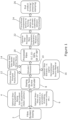
- apparatus which includes a storage area 2 into which selected source material fibres which are to be utilised, are deposited and which may also include the ability to dose the said fibres with further agents and components which are selected as required for the particular process and/or end product type which it is to be formed. It should be appreciated that the particular further components and agents which are dosed, may change depending on the particular requirements for the particular process and end product. These are then combined to form the material mixture which is to be processed and subsequently formed.
- the optional step 4 of mixing the fibres and any agents and component additives, with a quantity of water or other liquid to define the particular solid content (SC) of the mixture is provided.
- the optional step 6 may be performed to reduce the size or dimensions of the fibres and this include the use of the processed of granulation, shredding, hammer milling or other processes which can be utilised to perform the required reduction.
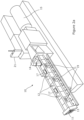
- screw extrusion apparatus 10 one type of which is illustrated in Figure 2 and which in this embodiment includes at least two screw extruders 11,13 which are provided to rotate along respective shafts which are parallel, and driven by a motor 15 and the extruders have extrusion elements mounted along the respective said shaft to form a passage along which the material mixture passes as the spacing between the outer contact surfaces of said elements define the size of the passage 19 through which the mixture is moved along the extrusion apparatus and is processed.
- the particular form of the outer contact surfaces of the screw extruders are selected to suit the particular use of the fibre mixture and typically the contact surface pattern of the elements change along the length of the screws so as to form different zones in which differing functions are performed on the fibres of the material mixture as it passes along the extrusion apparatus.
- the apparatus includes liquid inputs 12 to allow the pumping of additional fluids and/or colour components, and an input 14 for the feeding of components such as the fibres and the material mixture 14 into the extruder. Additional access apertures 17 on the top and side apertures 19 are provided to allow access at spaced intervals to the housing in which the extruders are located.
- the step 16 of extracting material from the extrusion process such as lignin, hemicellulose, nutrients and/or sourced materials so as to remove these from the material mixture during the processing step is also performed and the access apertures 17,19 may be used for this purpose as and when required.
- the apparatus also includes control means and control panel 21 for user interaction to allow the control of the operation of the apparatus to be achieved in a required format. It will therefore be appreciated that each or a combination of these optional steps may be performed with respect to the final use of the material and/or the type of material which is being processed.
- the processed fibres which, typically, although not always, will now be substantially binder free, and may have a solid content in the range of 10-98% and an SR ratio of between 5° and 86° .and the processed material mixture leaves the extrusion apparatus.
- An optional step 22 may then be performed to process the fibre by using any or any combination of singulation, separation and/or moisture conditioning and the fibres are then passed to stage 24 where the fibre and mixed components are delivered to a forming station 26, typically by an airstream or other movement system which allows the fibres which have been processed to reach the end forming/pressing/stamping/moulding apparatus.
- the fibres may be moved to the forming station 26 by being passed onto a carrier which may take several forms and the appropriate form can be selected for the material mixture and subsequent forming procedures such as moulding, pressing or the like, which may be performed to form the desired end product.
- a carrier which may take several forms and the appropriate form can be selected for the material mixture and subsequent forming procedures such as moulding, pressing or the like, which may be performed to form the desired end product.
- the processed material mixture between films and/or sheets so as to define the passage along which the fibres are passed can then be achieved using appropriate forming techniques to define substantially planer and/or three-dimensional items.
Landscapes
- Chemical & Material Sciences (AREA)
- Engineering & Computer Science (AREA)
- Life Sciences & Earth Sciences (AREA)
- Wood Science & Technology (AREA)
- Materials Engineering (AREA)
- Health & Medical Sciences (AREA)
- Chemical Kinetics & Catalysis (AREA)
- Medicinal Chemistry (AREA)
- Polymers & Plastics (AREA)
- Organic Chemistry (AREA)
- Dry Formation Of Fiberboard And The Like (AREA)
Claims (20)
- Verfahren zum Formen eines Endprodukts aus einem Zellulosefasern aufweisenden Ausgangsmaterial, wobei das genannte Verfahren die folgenden Schritte aufweist; Vorverarbeiten der Zellulosefasern zum Formen eines Materialgemischs (14), das die genannten Zellulosefasern und ein oder mehr Mittel mit jedwedem oder jedweder Kombination von einer Flüssigkeit, einem Weichmacher, einem Konservierungsmittel, Calciumoxid und/oder Natriumhydroxid, die zu den Zellulosefasern hinzugefügt werden, um das genannte Materialgemisch zu bilden, aufweist; Verarbeiten des genannten Materialgemischs (14) durch Hindurchführen desselben entlang einer Extrusionsvorrichtung (10), die mindestens zwei Schneckenextruder (11, 13) aufweist, die zum Drehen entlang jeweiliger Wellen bereitgestellt sind, die parallel sind, und Formen des verarbeiteten Materialgemischs, das die Extrusionsvorrichtung verlässt, zu einem Endprodukt mit einer Form, die zur Verwendung für eine vordefinierte Funktion geeignet ist, wobei die genannten mindestens zwei Schneckenextruder (11, 13) Fasermanipulationselemente mit Kontaktflächen für Kontakt mit dem genannten Materialgemisch (14) bei seinem Durchlauf entlang der Längsachse der Extrusionsvorrichtung aufweisen und die genannten Kontaktflächen zum Umformen, Zerreißen und/oder Defibrieren der Fasern des Materialgemischs wirken, und gekennzeichnet durch Bereitstellen der genannten Kontaktflächen an den genannten Elementen, die sich entlang der Längsachsen der genannten mindestens zwei Schneckenextruder (11, 13) befinden, und Ändern des Kontaktflächenmusters entlang der Länge der mindestens zwei Schneckenextruder, um verschiedene Zonen zu bilden, in denen an den Fasern des Materialgemischs bei seinem Durchlauf entlang der Extrusionsvorrichtung unterschiedliche Funktionen durchgeführt werden.
- Verfahren nach Anspruch 1, dadurch gekennzeichnet, dass der Vorverarbeitungsschritt die Auswahl von Ausgangsmaterial aufweist, das jedwedes oder jedwede Kombination von kurz-, mittel- oder langfaserigen lignozellulosehaltigen Materialien umfasst.
- Verfahren nach Anspruch 2, dadurch gekennzeichnet, dass landwirtschaftliche und/oder gartenbauliche Faserquellen verwendet werden und jedwedes oder jedwede Kombination von Stroh, Reisstroh, Weizenstroh, Gerstenstroh, Roggenstroh, Haferstroh, Hanfschäben (Schäben), Baumwolle, Schilfen, Gräsern, Holzspänen, Zuckerrohrblättern, Wasserhyazinthen, Trestem, Kokosbast, Zuckerrübenrückständen und/oder Zuckerrohrbagasse und/oder Pflanzenstängeln, industriell erzeugter Zellulose aus Hart- und/oder Weichholzquellen und/oder Nutzpflanzen, wie etwa Gräsern, Bagasse, Hanf, Flachs, China-Schilf, Bambus und/oder Schilfen, recyclierten und/oder Rückstands- und/oder Abfallfasern, einschließlich von jedwedem oder jedweder Kombination von Abfall- und Restpapier, -pappe, -verpackungen, -pulpe, papierbasierten Utensilien, Behältern, Egrenierabfällen, Kämmlingen und/oder Wollabfällen aufweist.
- Verfahren nach einem der vorhergehenden Ansprüche, dadurch gekennzeichnet, dass ein Vorbereitungsschritt die Zerkleinerung der Fasern der ausgewählten Ausgangsmaterialien durch die Verwendung von jedwedem oder jedweder Kombination von Schneid-, Häcksel-, Zerteilungs-, Trenn- und/oder Mahlvorgängen ist.
- Verfahren nach Anspruch 4, dadurch gekennzeichnet, dass der Vorbereitungsschritt die Verwendung einer Flüssigkeits- und/oder Gasstrahlvorrichtung zum Anwenden der genannten Flüssigkeit und/oder Luft unter Druck auf die Fasern der ausgewählten Ausgangsmaterialien aufweist.
- Verfahren nach einem der vorhergehenden Ansprüche, dadurch gekennzeichnet, dass ein Behandlungsschritt zum Kämmen der Fasern der ausgewählten Ausgangsmaterialien zu einzelnen Fasern durchgeführt wird.
- Verfahren nach einem der vorhergehenden Ansprüche, dadurch gekennzeichnet, dass unverarbeitete Ausgangsmaterialien zu bzw. mit den vorverarbeiteten ausgewählten Ausgangsmaterialien hinzugefügt und vermischt werden.
- Verfahren nach Anspruch 1, dadurch gekennzeichnet, dass die ausgewählten Ausgangsmaterialien vor dem Vorbereitungsschritt unabhängig vorbereitet und vorverarbeitet und miteinander vermengt und vermischt werden.
- Verfahren nach einem der vorhergehenden Ansprüche, dadurch gekennzeichnet, dass das ausgewählte Ausgangsmaterialgemisch durch eine unter Druck oder normalem atmosphärischem Druck stehende Dampfkammer hindurchgeführt wird.
- Verfahren nach einem der vorhergehenden Ansprüche, wobei die genannten Mittel des ausgewählten Ausgangsmaterialgemischs im Bereich von 0,1 - 80 % der Trockenfaser in dem Materialgemisch in der Verarbeitungsstufe zugesetzt werden.
- Verfahren nach Anspruch 10, dadurch gekennzeichnet, dass ein Mittel zum Aktivieren von in dem Materialgemisch vorhandenem Lignin und somit Stärken der Bindung innerhalb der Endprodukte, die geformt werden, zugesetzt wird.
- Verfahren nach einem der vorhergehenden Ansprüche, dadurch gekennzeichnet, dass die dem Materialgemisch zugesetzte Flüssigkeit bewirkt, dass das Material einen Feststoffgehalt von 10 - 90 % aufweist, bevor es in die Verarbeitungsstufe gelangt.
- Verfahren nach Anspruch 1, dadurch gekennzeichnet, dass die genannten Elemente selektiv positioniert werden, um eine erste Zone zum Verursachen von Faserdefibrierung, eine zweite Zone zum Verursachen von Faser-zu-Faser-Defibrierung, eine dritte Zone zum Verursachen einer Änderung des Hoch- und Niedrigdruckzustands der Struktur der Fasern und eine vierte Zone zum Durchführen einer Haltewirkung auf das Materialgemisch zu bilden.
- Verfahren nach einem der vorhergehenden Ansprüche, dadurch gekennzeichnet, dass während der Verarbeitungsstufe dem Materialgemisch weitere Komponenten über Zuführvorrichtungen (12; 14), die in vorbestimmten Abständen entlang der Länge der Schneckenextrudervorrichtung (10) angeordnet sind, dem Materialgemisch zugesetzt werden und/oder während des Verarbeitungsschritts und/oder vor dem Formschritt dem genannten Materialgemisch (14) eine oder mehr Komponenten entzogen werden.
- Verfahren nach einem der vorhergehenden Ansprüche, dadurch gekennzeichnet, dass das verarbeitete Materialgemisch ferner durch Durchführen jedweder oder jedweder Kombination von Vereinzelung, Trennung und/oder Feuchtigkeitsaufbereitung der Fasern angepasst wird.
- Verfahren nach einem der vorhergehenden Ansprüche, dadurch gekennzeichnet, dass das verarbeitete Materialgemisch mittels eines Stroms von Gas, wie etwa Luft, zum Formschritt hindurchgeführt wird.
- Verfahren nach Anspruch 16, dadurch gekennzeichnet, dass der Luftstrom auch eine Trocknungsfunktion an dem Materialgemisch durchführt.
- Verfahren nach einem der vorhergehenden Ansprüche, dadurch gekennzeichnet, dass das Materialgemisch im Formschritt an einen Träger in einen Formabschnitt übergeben wird und dann in einer Form oder anderweitig zu dem Endprodukt geformt wird.
- Vorrichtung zum Formen und Verwenden eines Zellulosefasern aufweisenden Materialgemischs durch Durchführen von Vorverarbeitungs-, Verarbeitungs- und Formschritten an dem Materialgemisch (14), wobei die genannte Vorrichtung aufweist: Mischmittel, um zu ermöglichen, dass die ausgewählten Ausgangsmaterialien und weitere ausgewählte Mittel, einschließlich jedem oder jedweder Kombination von einer Flüssigkeit, einem Weichmacher, einem Konservierungsmittel, Calciumoxid und/oder Natriumhydroxid, im Vorverarbeitungsschritt kombiniert werden, Form- und/oder Pressvorrichtungen zum Durchführen eines Teils des Verarbeitungsschritts, und wobei der Verarbeitungsschritt ferner eine Extrusionsvorrichtung (10) aufweist, die mindestens zwei Schneckenextruder (11, 13) aufweist und an denen entlang das genannte Materialgemisch (14) hindurchgeführt wird, wobei die genannten mindestens zwei Schneckenextruder Fasermanipulationselemente mit Kontaktflächen für Kontakt mit dem genannten Materialgemisch bei seinem Durchlauf an den Längsachsen der mindestens zwei Schneckenextruder entlang aufweisen und die genannten Kontaktflächen zum Zerreißen und/oder Defibrieren der Fasern des Materialgemischs wirken, dadurch gekennzeichnet, dass das Kontaktoberflächenmuster der Elementkomponenten sich entlang der Länge der genannten mindestens zwei Schneckenextruder ändert, um verschiedene Zonen zu bilden, in denen an den Fasern des Materialgemischs bei seinem Durchlauf entlang der Extrusionsvorrichtung unterschiedliche Funktionen durchgeführt werden.
- Vorrichtung nach Anspruch 19, dadurch gekennzeichnet, dass die genannten Elemente selektiv positioniert werden, um eine erste Zone zum Verursachen von Faserdefibrierung, eine zweite Zone zum Verursachen von Faser-zu-Faser-Defibrierung, eine dritte Zone zum Verursachen der Änderung des Hoch- und Niedrigdruckzustands der Struktur der Fasern und eine vierte Zone zum Durchführen einer Haltewirkung auf das Materialgemisch zu bilden.
Applications Claiming Priority (2)
| Application Number | Priority Date | Filing Date | Title |
|---|---|---|---|
| GBGB2000263.0A GB202000263D0 (en) | 2020-01-09 | 2020-01-09 | Apparatus and method for dry or semi dry forming fibres |
| PCT/EP2021/050396 WO2021140249A1 (en) | 2020-01-09 | 2021-01-11 | Apparatus and method for the preparation, processing of fibre mixtures and forming products therefrom |
Publications (3)
| Publication Number | Publication Date |
|---|---|
| EP4087972A1 EP4087972A1 (de) | 2022-11-16 |
| EP4087972C0 EP4087972C0 (de) | 2025-02-26 |
| EP4087972B1 true EP4087972B1 (de) | 2025-02-26 |
Family
ID=69626383
Family Applications (1)
| Application Number | Title | Priority Date | Filing Date |
|---|---|---|---|
| EP21701235.0A Active EP4087972B1 (de) | 2020-01-09 | 2021-01-11 | Vorrichtung und verfahren zur herstellung und verarbeitung von fasergemischen und zur herstellung von produkten aus diesen |
Country Status (4)
| Country | Link |
|---|---|
| US (1) | US12454618B2 (de) |
| EP (1) | EP4087972B1 (de) |
| GB (1) | GB202000263D0 (de) |
| WO (1) | WO2021140249A1 (de) |
Families Citing this family (2)
| Publication number | Priority date | Publication date | Assignee | Title |
|---|---|---|---|---|
| KR102698663B1 (ko) * | 2024-01-02 | 2024-08-26 | 주식회사 그린마이스터 | 워터텍매트를 포함하는 롤스톤구조체 및 이의 제조방법 |
| KR102698664B1 (ko) * | 2024-01-02 | 2024-08-26 | 주식회사 그린마이스터 | 매트리스형 롤스톤구조체 및 이의 제조방법 |
Family Cites Families (17)
| Publication number | Priority date | Publication date | Assignee | Title |
|---|---|---|---|---|
| FR2319737A1 (fr) * | 1975-07-31 | 1977-02-25 | Creusot Loire | Procede et machine de fabrication de pate a papier |
| FR2418295A1 (fr) * | 1978-02-27 | 1979-09-21 | Creusot Loire | Procede et installation de traitement en continu d'une matiere cellulosique |
| AU712027B2 (en) * | 1995-10-27 | 1999-10-28 | Tennessee Valley Authority | Improved concentrated sulfuric acid hydrolysis of lignocellulosics |
| US5716669A (en) * | 1997-03-26 | 1998-02-10 | Avery Dennison Corporation | Process for producing polymer films from aqueous polymer compositions |
| EP0976790A1 (de) * | 1998-07-27 | 2000-02-02 | Cargill BV | Verfahren zur Herstellung von Verbundmaterialien |
| US6283300B1 (en) * | 1998-08-21 | 2001-09-04 | Joseph B. Bielagus | Feed distribution for low velocity air density separation |
| US20030021915A1 (en) * | 2001-06-15 | 2003-01-30 | Vivek Rohatgi | Cellulose - polymer composites and related manufacturing methods |
| GB0325578D0 (en) * | 2003-11-03 | 2003-12-03 | Bioregional Minimills Uk Ltd | Method for treating black liquor |
| CA2527325C (en) * | 2005-11-18 | 2014-05-06 | Mohini M. Sain | Manufacturing process for high performance lignocellulosic fibre composite materials |
| US20080237914A1 (en) * | 2005-12-13 | 2008-10-02 | Arnold Lustiger | Methods for making fiber reinforced polypropylene composites using pre-cut fiber |
| JP2012530857A (ja) | 2009-06-24 | 2012-12-06 | インターフェイス インターナショナル ビー.ヴィ. | セルロースファイバをデフィブリル化する方法及び装置 |
| US20110094691A1 (en) * | 2009-10-25 | 2011-04-28 | Nunn Kayren J | Process for regenerating post-consumer and post-industrial fibers |
| CN102712108A (zh) * | 2009-11-13 | 2012-10-03 | 瑞典树木科技公司 | 制造颗粒的方法 |
| US20120205059A1 (en) * | 2011-01-24 | 2012-08-16 | Semra Senturk-Ozer | Pretreatment method of cellulosic biomass via flowability control and reactive extrusion process |
| EP3013369B1 (de) * | 2013-08-29 | 2017-12-27 | Dow Global Technologies LLC | Verfahren zur herstellung einer wässrigen dispersion |
| NL2020028B1 (en) | 2017-12-06 | 2019-06-18 | Huhtamaki Molded Fiber Tech Bv | Method and system for manufacturing a 3-dimensional food packaging unit from a molded pulp material and such food packaging product |
| CN108824048A (zh) * | 2018-07-04 | 2018-11-16 | 中国林业科学研究院林产化学工业研究所 | 一种新鲜棕榈空果串制浆备料的方法及所用设备 |
-
2020
- 2020-01-09 GB GBGB2000263.0A patent/GB202000263D0/en not_active Ceased
-
2021
- 2021-01-11 US US17/791,592 patent/US12454618B2/en active Active
- 2021-01-11 WO PCT/EP2021/050396 patent/WO2021140249A1/en not_active Ceased
- 2021-01-11 EP EP21701235.0A patent/EP4087972B1/de active Active
Also Published As
| Publication number | Publication date |
|---|---|
| EP4087972A1 (de) | 2022-11-16 |
| GB202000263D0 (en) | 2020-02-26 |
| WO2021140249A1 (en) | 2021-07-15 |
| EP4087972C0 (de) | 2025-02-26 |
| US20230043885A1 (en) | 2023-02-09 |
| US12454618B2 (en) | 2025-10-28 |
Similar Documents
| Publication | Publication Date | Title |
|---|---|---|
| AU2001241055B2 (en) | Woody formed article and method for producing the same | |
| EP4087972B1 (de) | Vorrichtung und verfahren zur herstellung und verarbeitung von fasergemischen und zur herstellung von produkten aus diesen | |
| AU2020243682B2 (en) | Process and system for manufacturing a fibreboard from waste materials | |
| CN110670407B (zh) | 一种纸浆模塑品改性添加剂及制备方法和应用 | |
| Evon et al. | Twin-screw extrusion process to produce renewable fiberboards | |
| US10953568B2 (en) | Method for producing MDF boards with NFC/MFC | |
| CN113580712B (zh) | 一种干法纸浆模塑的成型方法 | |
| MXPA03009775A (es) | Particula de fibra densificada, fluida y medible. | |
| CN1857884A (zh) | 木塑复合材料及其板材的制备方法 | |
| US12552589B2 (en) | Biodegradable pulp packaging products from natural fibers | |
| US20220273124A1 (en) | Method for the manufacture of products made from fibrous material and disposable products manufactured according to the method | |
| JPH0941288A (ja) | 易生分解性複合物とこれを用いた美粧性紙製品 | |
| CN1120487A (zh) | 纤维面刨花板的生产工艺 | |
| CN1030524C (zh) | 干法生产毛竹中密度纤维板 | |
| CA2177984A1 (en) | Processing lignocellulosic agricultural residue | |
| KR100305105B1 (ko) | 볏짚을이용한판상물의제조방법 | |
| WO2010069993A2 (en) | Flexible product and manufacturing method thereof | |
| CN102407555A (zh) | 一种用花生壳压制人造板的技术方法 | |
| CN120418057A (zh) | 制备用于生产材料板的颗粒的方法以及材料板 | |
| Nasution et al. | Physicochemical properties and characteristics of microcrystalline cellulose derived from the cellulose of oil palm empty fruit bunch | |
| Panigrahi et al. | Biodegradable green composite boards for industrial application | |
| JP2005103936A (ja) | 竹繊維物の乾式成形法 | |
| EP3006174B1 (de) | Verfahren und Anlage zur Herstellung einer Holzfaserplatte | |
| CN106479206A (zh) | 一种基于碱木素的三元复合材料制造方法 | |
| NO119170B (de) |
Legal Events
| Date | Code | Title | Description |
|---|---|---|---|
| STAA | Information on the status of an ep patent application or granted ep patent |
Free format text: STATUS: UNKNOWN |
|
| STAA | Information on the status of an ep patent application or granted ep patent |
Free format text: STATUS: THE INTERNATIONAL PUBLICATION HAS BEEN MADE |
|
| PUAI | Public reference made under article 153(3) epc to a published international application that has entered the european phase |
Free format text: ORIGINAL CODE: 0009012 |
|
| STAA | Information on the status of an ep patent application or granted ep patent |
Free format text: STATUS: REQUEST FOR EXAMINATION WAS MADE |
|
| 17P | Request for examination filed |
Effective date: 20220708 |
|
| AK | Designated contracting states |
Kind code of ref document: A1 Designated state(s): AL AT BE BG CH CY CZ DE DK EE ES FI FR GB GR HR HU IE IS IT LI LT LU LV MC MK MT NL NO PL PT RO RS SE SI SK SM TR |
|
| DAV | Request for validation of the european patent (deleted) | ||
| DAX | Request for extension of the european patent (deleted) | ||
| STAA | Information on the status of an ep patent application or granted ep patent |
Free format text: STATUS: EXAMINATION IS IN PROGRESS |
|
| 17Q | First examination report despatched |
Effective date: 20230510 |
|
| GRAP | Despatch of communication of intention to grant a patent |
Free format text: ORIGINAL CODE: EPIDOSNIGR1 |
|
| STAA | Information on the status of an ep patent application or granted ep patent |
Free format text: STATUS: GRANT OF PATENT IS INTENDED |
|
| INTG | Intention to grant announced |
Effective date: 20240731 |
|
| GRAJ | Information related to disapproval of communication of intention to grant by the applicant or resumption of examination proceedings by the epo deleted |
Free format text: ORIGINAL CODE: EPIDOSDIGR1 |
|
| STAA | Information on the status of an ep patent application or granted ep patent |
Free format text: STATUS: EXAMINATION IS IN PROGRESS |
|
| INTC | Intention to grant announced (deleted) | ||
| GRAS | Grant fee paid |
Free format text: ORIGINAL CODE: EPIDOSNIGR3 |
|
| STAA | Information on the status of an ep patent application or granted ep patent |
Free format text: STATUS: GRANT OF PATENT IS INTENDED |
|
| GRAP | Despatch of communication of intention to grant a patent |
Free format text: ORIGINAL CODE: EPIDOSNIGR1 |
|
| GRAA | (expected) grant |
Free format text: ORIGINAL CODE: 0009210 |
|
| STAA | Information on the status of an ep patent application or granted ep patent |
Free format text: STATUS: THE PATENT HAS BEEN GRANTED |
|
| INTG | Intention to grant announced |
Effective date: 20250115 |
|
| AK | Designated contracting states |
Kind code of ref document: B1 Designated state(s): AL AT BE BG CH CY CZ DE DK EE ES FI FR GB GR HR HU IE IS IT LI LT LU LV MC MK MT NL NO PL PT RO RS SE SI SK SM TR |
|
| REG | Reference to a national code |
Ref country code: GB Ref legal event code: FG4D |
|
| REG | Reference to a national code |
Ref country code: CH Ref legal event code: EP |
|
| REG | Reference to a national code |
Ref country code: DE Ref legal event code: R096 Ref document number: 602021026736 Country of ref document: DE |
|
| REG | Reference to a national code |
Ref country code: IE Ref legal event code: FG4D |
|
| U01 | Request for unitary effect filed |
Effective date: 20250304 |
|
| U07 | Unitary effect registered |
Designated state(s): AT BE BG DE DK EE FI FR IT LT LU LV MT NL PT RO SE SI Effective date: 20250311 |
|
| PG25 | Lapsed in a contracting state [announced via postgrant information from national office to epo] |
Ref country code: RS Free format text: LAPSE BECAUSE OF FAILURE TO SUBMIT A TRANSLATION OF THE DESCRIPTION OR TO PAY THE FEE WITHIN THE PRESCRIBED TIME-LIMIT Effective date: 20250526 |
|
| PG25 | Lapsed in a contracting state [announced via postgrant information from national office to epo] |
Ref country code: PL Free format text: LAPSE BECAUSE OF FAILURE TO SUBMIT A TRANSLATION OF THE DESCRIPTION OR TO PAY THE FEE WITHIN THE PRESCRIBED TIME-LIMIT Effective date: 20250226 |
|
| PG25 | Lapsed in a contracting state [announced via postgrant information from national office to epo] |
Ref country code: ES Free format text: LAPSE BECAUSE OF FAILURE TO SUBMIT A TRANSLATION OF THE DESCRIPTION OR TO PAY THE FEE WITHIN THE PRESCRIBED TIME-LIMIT Effective date: 20250226 |
|
| PG25 | Lapsed in a contracting state [announced via postgrant information from national office to epo] |
Ref country code: NO Free format text: LAPSE BECAUSE OF FAILURE TO SUBMIT A TRANSLATION OF THE DESCRIPTION OR TO PAY THE FEE WITHIN THE PRESCRIBED TIME-LIMIT Effective date: 20250526 Ref country code: IS Free format text: LAPSE BECAUSE OF FAILURE TO SUBMIT A TRANSLATION OF THE DESCRIPTION OR TO PAY THE FEE WITHIN THE PRESCRIBED TIME-LIMIT Effective date: 20250626 |
|
| PG25 | Lapsed in a contracting state [announced via postgrant information from national office to epo] |
Ref country code: HR Free format text: LAPSE BECAUSE OF FAILURE TO SUBMIT A TRANSLATION OF THE DESCRIPTION OR TO PAY THE FEE WITHIN THE PRESCRIBED TIME-LIMIT Effective date: 20250226 |
|
| PG25 | Lapsed in a contracting state [announced via postgrant information from national office to epo] |
Ref country code: GR Free format text: LAPSE BECAUSE OF FAILURE TO SUBMIT A TRANSLATION OF THE DESCRIPTION OR TO PAY THE FEE WITHIN THE PRESCRIBED TIME-LIMIT Effective date: 20250527 |
|
| PG25 | Lapsed in a contracting state [announced via postgrant information from national office to epo] |
Ref country code: SM Free format text: LAPSE BECAUSE OF FAILURE TO SUBMIT A TRANSLATION OF THE DESCRIPTION OR TO PAY THE FEE WITHIN THE PRESCRIBED TIME-LIMIT Effective date: 20250226 |
|
| PG25 | Lapsed in a contracting state [announced via postgrant information from national office to epo] |
Ref country code: CZ Free format text: LAPSE BECAUSE OF FAILURE TO SUBMIT A TRANSLATION OF THE DESCRIPTION OR TO PAY THE FEE WITHIN THE PRESCRIBED TIME-LIMIT Effective date: 20250226 |
|
| PG25 | Lapsed in a contracting state [announced via postgrant information from national office to epo] |
Ref country code: SK Free format text: LAPSE BECAUSE OF FAILURE TO SUBMIT A TRANSLATION OF THE DESCRIPTION OR TO PAY THE FEE WITHIN THE PRESCRIBED TIME-LIMIT Effective date: 20250226 |
|
| PLBE | No opposition filed within time limit |
Free format text: ORIGINAL CODE: 0009261 |
|
| STAA | Information on the status of an ep patent application or granted ep patent |
Free format text: STATUS: NO OPPOSITION FILED WITHIN TIME LIMIT |
|
| PGFP | Annual fee paid to national office [announced via postgrant information from national office to epo] |
Ref country code: GB Payment date: 20251216 Year of fee payment: 6 |
|
| 26N | No opposition filed |
Effective date: 20251127 |
|
| U20 | Renewal fee for the european patent with unitary effect paid |
Year of fee payment: 6 Effective date: 20260113 |