EP4085508B1 - Dispositif d'alimentation, système d'alimentation en énergie et procédé d'alimentation en énergie électrique - Google Patents
Dispositif d'alimentation, système d'alimentation en énergie et procédé d'alimentation en énergie électrique Download PDFInfo
- Publication number
- EP4085508B1 EP4085508B1 EP20838551.8A EP20838551A EP4085508B1 EP 4085508 B1 EP4085508 B1 EP 4085508B1 EP 20838551 A EP20838551 A EP 20838551A EP 4085508 B1 EP4085508 B1 EP 4085508B1
- Authority
- EP
- European Patent Office
- Prior art keywords
- supply device
- energy
- supply
- magnetic field
- electrical energy
- Prior art date
- Legal status (The legal status is an assumption and is not a legal conclusion. Google has not performed a legal analysis and makes no representation as to the accuracy of the status listed.)
- Active
Links
Images




Classifications
-
- H—ELECTRICITY
- H02—GENERATION; CONVERSION OR DISTRIBUTION OF ELECTRIC POWER
- H02J—ELECTRIC POWER NETWORKS; CIRCUIT ARRANGEMENTS OR SYSTEMS FOR SUPPLYING OR DISTRIBUTING ELECTRIC POWER; SYSTEMS FOR STORING ELECTRIC ENERGY
- H02J50/00—Circuit arrangements or systems for wireless supply or distribution of electric power
- H02J50/005—Mechanical details of housing or structure aiming to accommodate the power transfer means, e.g. mechanical integration of coils, antennas or transducers into emitting or receiving devices
-
- H—ELECTRICITY
- H02—GENERATION; CONVERSION OR DISTRIBUTION OF ELECTRIC POWER
- H02J—ELECTRIC POWER NETWORKS; CIRCUIT ARRANGEMENTS OR SYSTEMS FOR SUPPLYING OR DISTRIBUTING ELECTRIC POWER; SYSTEMS FOR STORING ELECTRIC ENERGY
- H02J50/00—Circuit arrangements or systems for wireless supply or distribution of electric power
- H02J50/10—Circuit arrangements or systems for wireless supply or distribution of electric power using inductive coupling
-
- H—ELECTRICITY
- H02—GENERATION; CONVERSION OR DISTRIBUTION OF ELECTRIC POWER
- H02J—ELECTRIC POWER NETWORKS; CIRCUIT ARRANGEMENTS OR SYSTEMS FOR SUPPLYING OR DISTRIBUTING ELECTRIC POWER; SYSTEMS FOR STORING ELECTRIC ENERGY
- H02J50/00—Circuit arrangements or systems for wireless supply or distribution of electric power
- H02J50/80—Circuit arrangements or systems for wireless supply or distribution of electric power involving the exchange of data, concerning supply or distribution of electric power, between transmitting devices and receiving devices
-
- H—ELECTRICITY
- H02—GENERATION; CONVERSION OR DISTRIBUTION OF ELECTRIC POWER
- H02J—ELECTRIC POWER NETWORKS; CIRCUIT ARRANGEMENTS OR SYSTEMS FOR SUPPLYING OR DISTRIBUTING ELECTRIC POWER; SYSTEMS FOR STORING ELECTRIC ENERGY
- H02J50/00—Circuit arrangements or systems for wireless supply or distribution of electric power
- H02J50/90—Circuit arrangements or systems for wireless supply or distribution of electric power involving detection or optimisation of position, e.g. alignment
Definitions
- the EN 10 2013 103 144 A1 discloses a charging device for a mobile terminal for charging an energy storage device, in particular an accumulator of the mobile terminal, wherein the charging device has a receiving unit which is adapted to receive magnetic energy and to convert the received magnetic energy into electrical energy, and a cable coupled to the receiving unit, at the free end of which a connector plug is provided for connecting the cable to the mobile terminal in order to transmit the electrical energy to the energy storage device of the mobile terminal.
- EN 10 2013 103 144 A1 a supply device for supplying electrical energy, comprising a support structure and in or on the support structure a receiving device for receiving electrical energy by means of inductive coupling and in or on the support structure a connection device for realizing an electrical connection to the receiving device.
- the WO2009/ 047768 A2 teaches a system for supplying power to a work area by induction, which includes at least one inductive power outlet built into a boundary surface of the work area.
- the inductive outlet includes at least one primary inductor connectable to a power supply via a driver.
- the driver provides an oscillating voltage supply to the primary coil, and the primary coil can inductively couple to a secondary coil wired to an electrical load.
- the invention is therefore based on the object of providing a supply device, an energy supply system and a method for electrical energy supply with which electrical energy can be made available to a user safely and flexibly in an aesthetically pleasing manner.
- a supply device for supplying electrical energy which comprises a support structure and, in or on the support structure, a receiving device for receiving electrical energy by means of inductive coupling.
- the supply device has a connection device for implementing an electrical connection to the receiving device.
- the supply device comprises a detection unit for detecting a defined magnetic field and/or reaching a defined position in relation to the detected magnetic field and/or for activating a supply operation upon detection of the magnetic field or the position.
- the detection unit is designed to visually represent a defined magnetic field and/or a defined position in relation to the magnetic field.
- Such a supply device can also be called a "socket box”.
- connection device can in particular be a conventional, standardized socket.
- several such sockets are arranged on the supply device or integrated in the supply device.
- Such a socket may also be designed as a USB slot.
- the USB slot can be used not only as an interface for data transmission, but also or simultaneously as a power supply interface in the sense of an electrical plug connection.
- the USB slot can be designed according to the USB-C standard.
- connection device is also designed for contactless energy transmission to a terminal device.
- the advantage of the supply device according to the invention is in particular that it can be used wirelessly for energy supply when it is positioned in, on or above an induction field.
- safety requirements can be met in a simple manner, as it is possible, for example, to expose the floor and the lower part of walls to a moist medium.
- the supply device can be part of a frame, such as a crossbar, or also a housing.
- the supply device can also be part of a piece of furniture, for example a lectern or a piece of furniture at a workstation in an office or a factory hall.
- the supply device can have a storage space for storing a cable, and a winding device can be provided in the storage space on which a cable can be wound up or unwound.
- the detection unit can have an infrared device with which an infrared signal can be detected which is generated by a transmitting device in order to initiate the generation of a magnetic field upon detection of a specific signal.
- This display of the defined magnetic field and/or a defined position in relation to the magnetic field can be realized in particular by one or more LEDs with which information regarding optimal positioning can be output.
- the support structure can be a housing.
- at least one socket is arranged on all side surfaces except for the underside of the housing.
- the housing can be round or square.
- a primary side of an energy supply system equipped with the supply device can also have a round or square cross-section.
- the supporting structure can thus form a component of the housing.
- At least one LED or light signal device is designed to emit a corresponding signal when the supply device is not arranged in an optimal position.
- This embodiment makes it easier to position the supply device at a location where it can be exposed to an induced magnetic field without the need for additional display devices.
- a specific light color can provide additional information regarding the operational readiness of the supply device.
- At least one receiving device for receiving electrical energy by means of inductive coupling can be arranged on at least one side of the support structure.
- the side equipped with the receiving device is a side of the support structure that is not designed for installation on a floor.
- At least one secondary coil can be arranged on several essentially rectangular side surfaces of the housing or the support structure. be arranged so that the supply device is designed to receive energy via the respective receiving device both in the case of a magnetic field penetrating a floor and in the case of a magnetic field penetrating a wall.
- the supply device it is provided that it is set up for a transmission power of up to 3000 W.
- the supply device can have at least one electrical energy storage device.
- This energy storage device in the form of a battery, is preferably also arranged inside the housing and can be removed if necessary.
- the storage capacity of such a battery is preferably at least 42,000 mAh. In an advantageous embodiment, the storage capacity of the battery is a maximum of 60,000 mAh.
- the invention is not restricted to an embodiment with an energy storage device.
- the supply device should ideally not have a volume greater than 12000 cm 2 . In order to ensure sufficient mobility of the supply device, it should not weigh more than 4 kg.
- the supply device according to the invention can be designed with a carrying device that allows the supply device to be transported by a person in an ergonomic manner.
- the carrying device can be a handle that is extended upwards, which makes it easier for a person to lift the supply device from the floor and move it without bending down.
- the supply device can be equipped with a rolling device. This can also have a brake to slow down the transport movement of the supply device and thus facilitate positioning.
- support feet can be arranged on the support structure in order to increase the friction on the floor when forces act from the side, in order to counteract unintentional displacement of the supply device. It is advisable to position four feet on the outside of the support structure, for example, or a single, central foot.
- the support feet are designed to be so high that interfaces or connection devices on the underside of the support structure are also accessible, in particular for the introduction of plug connectors.
- the supply device is designed as a receiving part of a WLAN system.
- the supply device can provide a user with Internet or other network access via a plug connection.
- the supply device according to the invention can comprise at least one plug-in data interface for transmitting data.
- the supply device can also have at least one cable connection for a data cable for the purpose of wired transmission of data or information.
- the supply device can include a rectifier for converting alternating voltage into direct voltage.
- Magnetic induction induces an alternating voltage in the receiving device.
- the induced alternating voltage is converted by the rectifier.
- a further aspect of the present invention is an energy supply system according to the invention, which has a supply device according to the invention and a separating element on or in which the supply device is arranged or can be arranged.
- the energy supply system also comprises a transmitting device for generating a magnetic field for the purpose of transmitting electrical energy to the supply device by means of inductive coupling, wherein the transmitting device is arranged on a side of the separating element which is opposite a space-defining side of the separating element.
- the transmitting device and the receiving device of the supply device are designed according to the invention to transmit electrical energy by induction.
- the dividing element delimits a room with a surface, such as a room in a building.
- the dividing element is a room floor.
- the supply device is arranged on the side of the dividing element or an area of the dividing element opposite the room.
- the transmitting device is therefore designed as a flush-mounted or underfloor system, preferably in the form of a so-called pad.
- the separating element can be made of concrete.
- the separating element is a plastic part that can be integrated into a floor or a wall.
- the supply device is only covered with a screed layer, so that the screed layer forms the separating element.
- the separating element is a wall that delimits a room.
- a wall can also have a transmitting device in the form of an induction coil.
- the separating element advantageously has a magnetic permeability with the permeability number ⁇ r, where: 0 ⁇ ⁇ r ⁇ 1.
- the separating element is located above the transmitting device and covers it.
- the separating element is designed to be non-magnetic. The separating element therefore ensures that no or minimal magnetization losses can occur when a magnetic field passes through it. It is also not electrically conductive.
- the device can have the separating element and the transmitting device arranged in different levels below one another, or the transmitting device can be embedded in the separating element.
- the separating element can be made of concrete.
- the concrete of the separating element can contain the components quartz sand with a volume fraction of 28 to 38% and cement with a volume fraction of 23 to 32%.
- the following material mixtures can be used for the separating element:
- the quartz sand preferably has a grain size of 0.125 to 0.5 mm.
- the basalt powder preferably has a grain size of ⁇ 0.09 mm.
- the cement is preferably a CEM III/A 52.5 according to DIN EN 206-1.
- the silica dust preferably complies with the standard DIN EN13263-1.
- the fibers can also be PE fibers or AR glass fibers.
- the fibers can form a three-dimensional fiber fabric such as glass fiber fabric PF-130-40x40.
- the fiber fabric should preferably be formed as a mat.
- the respective flow agent is preferably based on PCE (polycarboxylate ether).
- the quartz sand preferably has a grain size of 0.125 to 0.5 mm.
- the basalt powder preferably has a grain size of ⁇ 0.09 mm.
- the cement is preferably a CEM I 42.5 R according to DIN EN 206-1.
- the silica dust preferably complies with the standard DIN EN13263-1.
- the fibers can also be PE fibers or AR glass fibers.
- the fibers can form a three-dimensional fiber fabric such as glass fiber fabric PF-130-40x40.
- the fiber fabric should preferably be formed as a mat.
- the flow agent may be based on PCE (polycarboxylate ether).
- the quartz sand preferably has a grain size of 0.125 to 0.5 mm.
- the basalt powder preferably has a grain size of ⁇ 0.09 mm.
- the cement is preferably a CEM I 52.5 R according to DIN EN 206-1.
- the silica dust preferably complies with the standard DIN EN13263-1.
- the AR fibers preferably have a diameter of 0.2 ⁇ 0.03 mm and a length of 6.0 ⁇ 1.0 to 12.0 ⁇ 1.0 mm. Alternatively, they are designed as PE fibers.
- the fibers can form a three-dimensional fiber fabric such as glass fiber fabric PF-130-40x40.
- the fiber fabric should preferably be formed as a mat.
- the flow agent may be based on PCE (polycarboxylate ether).
- the quartz sand preferably has a grain size of 0.125 to 0.5 mm.
- the basalt powder preferably has a grain size of ⁇ 0.09 mm.
- the cement is preferably a CEM I 52.5 R according to DIN EN 206-1.
- the silica dust preferably complies with the standard DIN EN13263-1.
- the AR fibers preferably have a diameter of 0.2 ⁇ 0.03 mm and a length of 6.0 ⁇ 1.0 to 12.0 ⁇ 1.0 mm. Alternatively, they are designed as PE fibers.
- the fibers can form a three-dimensional fiber fabric such as glass fiber fabric PF-130-40x40.
- the fiber fabric should preferably be formed as a mat.
- the flow agent may be based on PCE (polycarboxylate ether).
- the quartz sand preferably has a grain size of 0.1 to 0.63 mm.
- the basalt powder preferably has a grain size of ⁇ 0.09 mm.
- the cement is preferably a CEM I 52.5.
- the water should be of drinking water quality.
- the glass fiber reinforced concrete is additionally reinforced by a three-dimensional fiber fabric such as glass fiber fabric PF-130-40x40.
- the fiber fabric should preferably be laid as a mat.
- the cement is preferably defined according to DIN EN 206-1 and is a CEM III 42.5 or a CEM I 52.5R.
- the hard coal fly ash is preferably designed according to DIN EN 450.
- Lightweight aggregates are preferably manufactured in accordance with DIN 4226-2 or DIN EN 13055.
- the fiber fabric is preferably a glass fiber fabric.
- the stabilizer is preferably an underwater compound.
- the mixture recipes for producing the separating element made of concrete differ essentially in the ratio of the mixture components.
- the main components for production are additives such as quartz sand and basalt powder with a maximum grain size of less than 0.5 mm.
- the proportion of fine components is 48 to 55% of the total amount of components.
- Additives such as microsilica or fly ash are also used, which also have very fine components/grains ( ⁇ 0.1 mm). The high number of fine components results in a fine, homogeneous mixture, which in turn, with its very high grain size content, ensures the tightness and robustness of the end product.
- either Portland cement CEMI or blast furnace cement CEM III according to EN 206-1 is used as cement, which contains between 28% and 32% of the total amount and is above average compared to normal concrete, since conventional concrete has a cement content of around 12 to 15%.
- the high cement content enables high compressive strengths to be achieved, which lie outside the standardized range (according to EN 206-1) and can be greater than 100 N/mm 2 .
- a high-performance superplasticizer based on PCE polycarboxylate ether
- PCE polycarboxylate ether
- the low water-cement ratio has the advantage that the mixture recipe and the end product develop high strengths very quickly, as the gaps between the grains, i.e. the distance between the cement grains, remain small, thus creating firmer and stronger CSH compounds (calcium silica hydrate compounds).
- the proportion of PCE superplasticizers is between 5 and 10% by mass of the cement content.
- PP fibers polypropylene fibers
- the proportion of PP fibres in some designs is approximately 2 to 4%.
- Lightweight concrete additives These can be used as an alternative additive, which allows lower thermal conductivities and a greater heat storage capacity of the end product to be achieved.
- the extremely high alkalinity of the mixtures and their basic effect prevent the formation of corrosion.
- a respective mixture mentioned may further comprise, or instead of, the mentioned fibres, randomly present alkali-resistant glass fibres or PP fibres.
- An initial single-layer reinforcement can be supplemented or replaced by the addition of glass fibers.
- This embodiment can therefore have loosely or randomly arranged fibers throughout the entire concrete mixture.
- the separating element has a maximum thickness of 50 mm.
- the separating element can have reinforcement in the form of a two-dimensional grid structure or in the form of a three-dimensional grid structure, whereby individual rods forming the grid structure or reinforcement can be glass fiber rods.
- the reinforcement can also be formed in the form of a layer or a layer of loose glass fibers.
- the structural elements of the lattice structure can comprise plastic fibers. This means that individual rod- or strand-shaped structural elements can have several plastic fibers that are mechanically connected to one another, or can also consist of individual plastic fibers.
- At least one light guide is integrated in the separating element for outputting optically perceptible information.
- This light guide is used in particular to emit light signals or to display text information to support the operation of the energy supply system.
- the light guide leads to the outside of the separating element at least at one point.
- the separating element may have a compressive strength of more than 100 N/ mm2 .
- the distance of the transmitting device to a surface beneath the transmitting device is adjustable.
- the energy supply system according to the invention is designed to transmit electrical energy by means of inductive coupling or by means of resonant inductive coupling.
- inductive coupling the electrical energy is transmitted by means of induction between two coils.
- resonant inductive coupling the alternating voltage is transmitted from a transmitting coil to a first oscillating circuit, which in turn inductively transmits the alternating voltage to a resonantly oscillating second oscillating circuit. From this second oscillating circuit, the alternating voltage is transmitted inductively to a receiving coil.
- At least one transformer and capacitors can be arranged on the primary side for the precise adjustment of the applied alternating voltage.
- the energy supply system comprises, as part of the supply device, the connection device for realizing an electrical connection and/or an electrical storage device in the form of a battery.
- the separating element has a visually perceptible marking with regard to the area in which the transmission of energy from the transmitting device to the receiving device can be carried out inductively.
- the marking defines an area in which such inductive energy transfer can take place with an efficiency of at least 50%.
- An advantageous embodiment of the energy supply system provides that the efficiency is greater than 90%.
- the energy supply system can have a detection device that is set up to detect the supply device in a spatial area in which a defined magnetic field can be generated or is generated by means of the transmitting device.
- This detection device can also be set up to activate a supply operation when information is available regarding the positioning of the supply device in the spatial area.
- the detection device can have an infrared device with which the supply device can be identified.
- the supply device comprises a unit with which a change in emitted light can be implemented at least in some areas in order to enable detection using infrared technology.
- the supply device and/or the energy supply system in the area of the transmitting device can be designed to detect the other unit in a spatially close area.
- the supply device is equipped with the detection unit for this purpose, and the energy supply system comprises the aforementioned detection device for this purpose.
- the detection unit can emit a signal, for example an infrared signal, which is received by the transmitting device, whereby it is provided that a magnetic field is only generated after the signal has been checked and processed by the transmitting device.
- a signal for example an infrared signal
- the detection device can also emit a signal which is received by the receiving device, whereby the magnetic field is only used for the inductive generation of direct current after the signal has been checked and processed.
- the invention can further be designed in such a way that in the event of an interruption of the signal, the generation or utilization of the magnetic field is also terminated.
- the energy supply system can further be designed in such a way that only supply devices and transmission devices that are compatible with one another are activated for operation.
- the energy supply system can comprise a compatibility testing device with which the supply device and/or the transmitting device are tested with regard to their admissibility for interaction with the other unit and inductive transmission is only enabled once compatibility has been established.
- a receiving device with a leveling unit for arrangement in the floor In order to position the transmitting device in or under a floor, a receiving device with a leveling unit for arrangement in the floor is provided.
- This leveling unit is designed to be height-adjustable so that the inclination and/or height position of its upper side can be adjusted in relation to a support surface on the upper side of the floor.
- the receiving device comprises a support device which is mechanically fastened to or in the leveling unit so that the transmitting device is supported by the support device in a vertical direction.
- the vertical direction is defined when the receiving device is arranged as intended in a floor structure, so that the leveling unit is arranged below the transmitting device and the weight of the transmitting device and, if applicable, another acting weight can be supported.
- the transmitting device or its coils rest on the carrier device.
- the transmission device is supported by means of a steel plate lying flat against the underside of the coil in question, or alternatively by a support on a lateral frame area enclosing the transmission device.
- the levelling unit should have adjustable feet which include screw bolts with end areas for support on a subsurface in the ground, whereby external threads of the screw bolts are operatively connected to internal threads on a frame of the levelling unit, so that the distance of the end areas to the support device can be adjusted by screwing the screw bolts.
- This allows the height position and/or the alignment of the transmitter device to be adjusted in relation to the subsurface and consequently also to the surface of a top side of the floor which is fixed to the subsurface.
- the frame of the leveling unit can in particular be designed essentially as a frame made of sheet metal elements.
- the carrier device can also include a cassette that serves to positively hold the transmitter device at least on the side edge of the transmitter device.
- This cassette is preferably made of stainless steel, aluminum or an aluminum alloy or plastic.
- the transmitting device has an essentially two-dimensional extension, it is enclosed by the cassette at its edge area. Furthermore, the transmitting device is protected in this way.
- the carrier device can also comprise a carrier plate that supports the transmitting device in a vertical direction.
- the carrier plate has a central hole or opening for the passage of cables to the transmitting device.
- the carrier device has a frame on the cassette which supports the transmitting device from below, i.e. in a vertical direction, at least in parts.
- the transmitting device or one or more of its coils can be embedded in a material which has a compressive strength of at least 15 N/mm 2 , in particular at least 20 N/mm 2 , preferably more than 25 N/mm 2 .
- This material can also be referred to as high-performance plastic.
- Electrical connections of the coil in question are preferably designed as cables and lead out of the embedding material.
- material embedding communication electronics is also cast into the cassette.
- the transmitting device is an individually handleable unit which can be placed on or in the carrier device.
- the transmitting device is not inserted into a carrier device or cassette with a material already surrounding the transmitting device, but that the transmitting device is inserted into a carrier device or cassette and then cast around and enclosed in flowable material, so that the transmitting device is embedded in the material after hardening or solidification of this material.
- the energy supply system can have a control unit that is mechanically attached to or in the leveling unit.
- the control unit is also embedded in the embedding material.
- a further aspect of the present invention is a method according to the invention for supplying electrical energy, in which an energy supply system according to the invention is provided, a magnetic field is generated by means of the transmitting device and electrical energy is inductively transmitted to the supply device by means of the magnetic field.
- the energy transmission can take place by means of inductive coupling or by means of resonant inductive coupling.
- the electrical energy can be made available to a consumer from the supply device by implementing an electrical plug connection with the supply device or by feeding an energy storage device in the form of a battery and making the energy storage device available to the consumer.
- a receiving device 1 for receiving the transmitting device of the energy supply system comprises a leveling unit 10, which is essentially formed from a frame 11, or frame, at each of whose four corners a foot 20 is arranged.
- Each foot 20 comprises a screw bolt 30 which is arranged in the vertical direction 110.
- the end region 32 of each screw bolt 30 projects downwards away from the frame 11. Accordingly, the leveling unit 10 is designed to be adjusted in its height and/or inclination by turning the screw bolts 30.
- a support device 40 is supported, which in the embodiment shown here comprises a cassette 41.
- the cassette 41 is formed by a frame 44, which serves to laterally enclose and thus accommodate a flat container 45.
- the receiving device 1 shown here is designed in such a way that a carrier plate 42 is arranged in the container 45.
- a transmitting device 50 is arranged on the carrier plate 42 and laterally surrounded by the edge of the container 45, which comprises an induction coil (not shown here).
- the carrier plate 43 has a central opening 43 in its center for the purpose of mechanical access to adjustment devices (not shown here) or for the purpose of passing through electrical lines.
- the weight of the transmitting device 50 as well as a force acting perpendicularly on the transmitting device 50 can thus be directed from the transmitting device 50 to the carrier plate 42 and supported by it. Accordingly, in Bending moments introduced by the transmitting device 50 are absorbed by the carrier plate 42. This prevents an inadmissible deformation of the transmitting device 50.
- the transmitting device 50 is fixed in a form-fitting manner by enclosing the lateral edge 51 of the transmitting device 50 with the edge of the container 45. At the same time, a communication interface 63 arranged on the lateral edge 51 of the transmitting device 50 is mechanically protected.
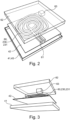
- Figures 2 and 3 show the structure of the transmitter device 50 in different perspective exploded views.
- a carrier plate 42 is accommodated in a flat container 45 of a cassette 41.
- an induction coil 60 which is embedded in an embedding material 62.
- Electrical connections 61 of the induction coil 60 lead out of the embedding material 62.
- a communication interface 63 is also embedded in the embedding material 62.
- the illustrated transmitting device 50 is designed for inductive energy transmission.
- an oscillating circuit would be arranged next to the coil shown.
- the induction coil 60 shown here essentially represents the transmitting device 50 or the secondary side 230 of the energy supply system 200 according to the invention.
- Such a transmitting device 50 can be carried out in such a way that a module comprising the embedding material 62 and embedded therein the induction coil 60 and optionally also the communication interface 63 is inserted or placed into the container 45 of the carrier device 40.
- the container 45 is made available to the carrier device 40, the induction coil 60 and optionally also the communication interface 63 are positioned in the container 45 and then encapsulated with the embedding material 62, which hardens and thus provides a solid unit.
- FIG 4 the receiving device 1 with the transmitting device 50 and the connected, underground cable duct 80 is shown in perspective view. Here it is clearly visible that the transmitting device 50 forms the top of the entirety formed by the receiving device 1 and the transmitting device 50.
- the transmitting device 50 can be supplied with electrical energy and/or control signals through the connected cable duct 80.
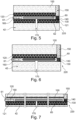
- Figure 5 shows the structure of the primary side of the energy supply system 200 with separating element 210 in a sectional view.
- the carrier plate 42 supporting the induction coil 60 is also made of concrete.
- a lower cable outlet 170 leading downwards is formed in the carrier plate 42.
- a second reinforcement layer 121 rests on this carrier plate 42. This second reinforcement layer 121 is covered by a ferrite layer 130.
- the induction coil 60 is located on this and is embedded in an embedding material 62 (not shown separately here).
- a power electronics unit 160 is arranged to the side of the induction coil 60, essentially on the same level, and an electrical connection 61 is connected to it for control purposes.
- a sensor device 140 is positioned for detecting the presence of the supply device.
- a first reinforcement layer 120 is located above the induction coil 60 or above the embedding material 62.
- the separating element 100 made of concrete is located on top of this.
- a light guide 150 is arranged to the side of the separating element 100 and the first reinforcement layer 120, which leads upwards and thus outwards for the purpose of outputting optically perceptible information.
- LEDs can also be placed for the purpose of outputting optically perceptible information.
- devices can be arranged for outputting infrared light.
- Figure 6 shows an alternative structure of the primary side 220 of the energy supply system 200 with separating element 100 in a sectional view.
- Figure 7 shows the structure of a third embodiment of the primary side 220 of the energy supply system 200 with separating element 100 in sectional view, where in the In contrast to the Figure 5
- the first reinforcement layer 120 is embedded in the separating element 100 and the second reinforcement layer 121 is embedded in the carrier plate 42, which is also made of concrete here.
- This structure has a significantly lower thickness than the variants according to Figures 5 and Figure 6 .
- FIG 8 shows a supply system 200 according to the invention in a perspective view from below.
- This shows an essentially cube-shaped supply device 201, which has a housing as a support structure 202.
- this support structure 202 several connection devices 206 in the form of sockets are arranged in the side walls 204. These sockets can be standardized slots for power supply, or USB sockets.
- the cube-shaped design is shown here only as an example; instead, the supply device 201 can also have a round shape, at least in some areas.
- a receiving device 205 is indicated on the underside 203 of the housing-shaped support structure 202.
- This receiving device 205 is designed in particular as a secondary coil or as a secondary resonant circuit and thus forms the secondary side 230 of the energy supply system 200.
- the primary side 220 of the energy supply system 200 is formed by the transmitting device 50 shown here.
- a separating element 210 only indicated here, such as a floor of a building, can be positioned between the primary side 220 and the secondary side 230.
- electrical energy can be inductively transferred from the primary side 220 through the separating element 210 to the secondary side 230 and made available to users there.
- Figure 9 shows the general structure of the energy supply system 200 in a diagram.
- This comprises at least one connection to an energy source 232.
- this energy source 232 is electrically connected to a power factor correction filter 233.
- This power factor correction filter 233 is electrically connected to a mains rectifier 234.
- the unit consisting of power factor correction filter 233 and mains rectifier 234 is in turn electrically coupled to an intermediate circuit 235. This is electrically connected to an inverter 236.
- the inverter 236 is connected in circuitry to the transmitting device 50, preferably designed as a coil or as an oscillating circuit.
- the transmitting device 50 is designed to transmit electrical energy to the receiving device 205, which is also designed as a coil or resonant circuit, by means of inductive coupling.
- the generated alternating voltage is transmitted from the receiving device 205 to a rectifier 237, which in the embodiment shown here is coupled to a filter 238 in order to provide a consumer 300 connected to the energy supply system with the electrical energy with prescribed or desired parameters.
- Figure10 once again shows the energy supply system 200 in a schematic view.
- the primary side 220 and the secondary side 230 are visible here, separated by an indicated separating element 210.
- a signal transmission 240 is also indicated, from the secondary side 230 to the primary side 220, in order to achieve the authentication of the secondary side 230 in relation to the primary side 220 in an automatic communication before the actual inductive energy transfer process for the purpose of activating the energy supply system.
Landscapes
- Engineering & Computer Science (AREA)
- Computer Networks & Wireless Communication (AREA)
- Power Engineering (AREA)
- Charge And Discharge Circuits For Batteries Or The Like (AREA)
- Near-Field Transmission Systems (AREA)
Claims (13)
- Dispositif d'alimentation (201) pour l'alimentation en énergie électrique, comprenant une structure porteuse (202) ainsi que dans ou sur la structure porteuse (202) un dispositif de réception (205) pour la réception d'énergie électrique au moyen de couplage inductif et dans ou sur la structure porteuse (202) un dispositif de raccord (206) pour la réalisation d'un raccord électrique au dispositif de réception (205), caractérisé en ce que le dispositif d'alimentation (201) comprend un module de détection pour la détection d'un champ magnétique défini et/ou l'atteinte d'une position définie par rapport au champ magnétique détecté et/ou pour l'activation d'un mode d'alimentation en cas de détection du champ magnétique ou de la position, dans lequel le module de détection est configuré pour représenter de manière perceptible visuellement un champ magnétique défini et/ou une position définie par rapport au champ magnétique détecté.
- Dispositif d'alimentation selon la revendication 1, caractérisé en ce que la structure porteuse (202) est un logement.
- Dispositif d'alimentation selon une des revendications précédentes, caractérisé en ce qu'au moins un dispositif de réception (205) est disposé sur au moins un côté de la structure porteuse (202) pour la réception d'énergie électrique au moyen de couplage inductif.
- Dispositif d'alimentation selon une des revendications précédentes, caractérisé en ce que celui-ci est configuré pour une puissance de transmission allant jusqu'à 3000 W.
- Dispositif d'alimentation selon une des revendications précédentes, caractérisé en ce que le dispositif d'alimentation (201) présente au moins un accumulateur d'énergie électrique.
- Dispositif d'alimentation selon une des revendications précédentes, caractérisé en ce que celui-ci comprend au moins une interface de données enfichable pour le transfert de données.
- Dispositif d'alimentation selon une des revendications précédentes, caractérisé en ce que celui-ci comprend au moins une interface radio pour le transfert de données par le biais d'une connexion radio.
- Dispositif d'alimentation selon une des revendications précédentes, caractérisé en ce que le dispositif d'alimentation (201) comprend un redresseur (234) pour la conversion de tension alternative en tension continue.
- Système d'alimentation en énergie (200), comprenant un dispositif d'alimentation (201) selon une des revendications 1 à 8 ainsi qu'un élément de séparation (210) sur ou dans lequel le dispositif d'alimentation (201) est disposé ou peut être disposé, ainsi qu'avec un dispositif d'émission (50) pour la génération d'un champ magnétique dans le but de transmettre de l'énergie électrique au moyen de couplage inductif au dispositif d'alimentation (201), dans lequel le dispositif d'émission (50) est disposé sur un côté de l'élément de séparation (210) qui s'oppose à un côté limitant l'espace de l'élément de séparation (210).
- Système d'alimentation en énergie selon la revendication 9, caractérisé en ce que le système d'alimentation en énergie (200) est configuré pour transmettre de l'énergie électriquei) au moyen de couplage inductif, ouii) au moyen de couplage inductif par résonance.
- Système d'alimentation en énergie selon une des revendications 9 et 10, caractérisé en ce que l'élément de séparation (210) présente un marquage perceptible optiquement concernant la région dans laquelle la transmission d'énergie du dispositif d'émission (50) au dispositif de réception (205) peut être effectuée de manière inductive.
- Système d'alimentation en énergie selon une des revendications 9 à 11, caractérisé en ce que le système d'alimentation en énergie présente un dispositif de détection pour la détection du dispositif d'alimentation dans une région spatiale dans laquelle un champ magnétique défini peut être généré ou est généré au moyen du dispositif d'émission (50) et/ou pour l'activation d'un mode d'alimentation en cas de présence d'une information concernant le positionnement du dispositif d'alimentation (201) dans la région spatiale.
- Procédé d'alimentation en énergie électrique, lors duquel un système d'alimentation en énergie selon une des revendications 9 à 12 est mis à disposition, un champ magnétique est généré au moyen du dispositif d'émission (50) et de l'énergie électrique est transmise de manière inductive au dispositif d'alimentation (201) au moyen du champ magnétique.
Applications Claiming Priority (2)
| Application Number | Priority Date | Filing Date | Title |
|---|---|---|---|
| DE102020100075.8A DE102020100075A1 (de) | 2020-01-03 | 2020-01-03 | Versorgungseinrichtung, Energieversorgungssystem sowie Verfahren zur elektrischen Energieversorgung |
| PCT/EP2020/087668 WO2021136729A1 (fr) | 2020-01-03 | 2020-12-22 | Dispositif d'alimentation, système d'alimentation en énergie et procédé d'alimentation en énergie électrique |
Publications (2)
| Publication Number | Publication Date |
|---|---|
| EP4085508A1 EP4085508A1 (fr) | 2022-11-09 |
| EP4085508B1 true EP4085508B1 (fr) | 2024-06-19 |
Family
ID=74141566
Family Applications (1)
| Application Number | Title | Priority Date | Filing Date |
|---|---|---|---|
| EP20838551.8A Active EP4085508B1 (fr) | 2020-01-03 | 2020-12-22 | Dispositif d'alimentation, système d'alimentation en énergie et procédé d'alimentation en énergie électrique |
Country Status (5)
| Country | Link |
|---|---|
| EP (1) | EP4085508B1 (fr) |
| DE (1) | DE102020100075A1 (fr) |
| DK (1) | DK4085508T3 (fr) |
| ES (1) | ES2987542T3 (fr) |
| WO (1) | WO2021136729A1 (fr) |
Citations (3)
| Publication number | Priority date | Publication date | Assignee | Title |
|---|---|---|---|---|
| US20090127937A1 (en) * | 2007-11-16 | 2009-05-21 | Nigelpower, Llc | Wireless Power Bridge |
| US20100219183A1 (en) * | 2007-11-19 | 2010-09-02 | Powermat Ltd. | System for inductive power provision within a bounding surface |
| DE102011118564A1 (de) * | 2011-11-15 | 2013-05-16 | Grossenbacher System Ag | Kontaktlose Stromversorgung und Signalübertragung durch Verkleidungselement für Gebäudeteile |
Family Cites Families (2)
| Publication number | Priority date | Publication date | Assignee | Title |
|---|---|---|---|---|
| JP2011501633A (ja) * | 2007-10-09 | 2011-01-06 | パワーマット リミテッド | 境界面内の誘導電力提供システム |
| DE102013103144A1 (de) * | 2013-03-27 | 2014-10-02 | Nitz Engineering Gmbh | Ladevorrichtung für ein mobiles Endgerät |
-
2020
- 2020-01-03 DE DE102020100075.8A patent/DE102020100075A1/de active Pending
- 2020-12-22 WO PCT/EP2020/087668 patent/WO2021136729A1/fr not_active Ceased
- 2020-12-22 EP EP20838551.8A patent/EP4085508B1/fr active Active
- 2020-12-22 DK DK20838551.8T patent/DK4085508T3/da active
- 2020-12-22 ES ES20838551T patent/ES2987542T3/es active Active
Patent Citations (3)
| Publication number | Priority date | Publication date | Assignee | Title |
|---|---|---|---|---|
| US20090127937A1 (en) * | 2007-11-16 | 2009-05-21 | Nigelpower, Llc | Wireless Power Bridge |
| US20100219183A1 (en) * | 2007-11-19 | 2010-09-02 | Powermat Ltd. | System for inductive power provision within a bounding surface |
| DE102011118564A1 (de) * | 2011-11-15 | 2013-05-16 | Grossenbacher System Ag | Kontaktlose Stromversorgung und Signalübertragung durch Verkleidungselement für Gebäudeteile |
Also Published As
| Publication number | Publication date |
|---|---|
| DE102020100075A1 (de) | 2021-07-08 |
| EP4085508A1 (fr) | 2022-11-09 |
| DK4085508T3 (da) | 2024-09-16 |
| ES2987542T3 (es) | 2024-11-15 |
| WO2021136729A1 (fr) | 2021-07-08 |
Similar Documents
| Publication | Publication Date | Title |
|---|---|---|
| DE69328754T2 (de) | Kabelverteilungssystem für Fernsehsignale und Anordnung von Elementen um ein solches System zu bauen | |
| EP2430878B2 (fr) | Dispositif de chauffage électrique de grande surface et procédé ainsi que matériau pour sa fabrication | |
| EP3480380A1 (fr) | Cellule préfabriquée destinée à être utilisée pour la construction de bâtiments modulaires | |
| EP2177681A2 (fr) | Matériau de construction en béton, élément de construction pour l'isolation thermique et élément d'isolation thermique en forme de pierre taillée, en utilisant toujours le matériau de construction en béton | |
| EP4085508B1 (fr) | Dispositif d'alimentation, système d'alimentation en énergie et procédé d'alimentation en énergie électrique | |
| WO2017050491A1 (fr) | Unité bobine d'induction à noyau de ferrite renforcé par des fibres | |
| EP3479977A1 (fr) | Procédé de fabrication de composants muraux pour bâtiments | |
| EP1842394B1 (fr) | Dispositif chauffant pour revetements muraux, revetements de plafond et de sol | |
| DE102019128278A1 (de) | Einrichtung sowie Ladesystem und Verfahren zur induktiven Ladung einer Batterie eines elektrisch betreibbaren Kraftfahrzeugs | |
| EP2656461A1 (fr) | Paroi de construction sèche | |
| EP3892794A1 (fr) | Système de revêtement pour un plancher, un mur et/ou un plafond | |
| DE102023132897A1 (de) | Raummodul, insbesondere Fertigbad, zum Einbau in ein Gebäude | |
| DE202015008660U1 (de) | Vorrichtung zum Anschließen eines auskragenden Bauteils, insbesondere eines Balkons oder eines Vordachs, sowie ein diese Vorrichtung verwendendes Bauteils | |
| DE202022106644U1 (de) | Bauteil aus haufwerksporigem Leichtbeton und Transportsystem hierfür | |
| DE3781272T2 (de) | Verfahren zum elektromagnetischen Abschirmen von Gebäuden. | |
| CH711343A2 (de) | Fertigbauteil mit einem Dämmkörper zur Verbindung einer Betonkragplatte mit einem Betonbauwerk. | |
| DE69503577T2 (de) | Betonplatte für einen Billiardtisch | |
| DE102017125870A1 (de) | Verfahren zur Zusammenstellung von Wandbauteilen und Raumzellen zur Errichtung eines mehrgeschossigen Gebäudes | |
| EP0949708B1 (fr) | Module | |
| CN212676836U (zh) | 一种电气工程用防震型预埋套管 | |
| EP4160839A1 (fr) | Élément de couplage et utilisation d'un tel élément de couplage et procédé de réglage de la profondeur de la canette | |
| DE29800253U1 (de) | Transformatoren-Häuschen o.dgl. | |
| DE20121368U1 (de) | Kalksand-Wärmedämmstein | |
| DE102017125873A1 (de) | Schwingbügel zur schallentkoppelnden Montage von Verkleidungen auf einem Wandbauteil | |
| WO2025214558A1 (fr) | Élément modulaire servant à ériger des cellules d'espace |
Legal Events
| Date | Code | Title | Description |
|---|---|---|---|
| STAA | Information on the status of an ep patent application or granted ep patent |
Free format text: STATUS: UNKNOWN |
|
| STAA | Information on the status of an ep patent application or granted ep patent |
Free format text: STATUS: THE INTERNATIONAL PUBLICATION HAS BEEN MADE |
|
| PUAI | Public reference made under article 153(3) epc to a published international application that has entered the european phase |
Free format text: ORIGINAL CODE: 0009012 |
|
| STAA | Information on the status of an ep patent application or granted ep patent |
Free format text: STATUS: REQUEST FOR EXAMINATION WAS MADE |
|
| 17P | Request for examination filed |
Effective date: 20220803 |
|
| AK | Designated contracting states |
Kind code of ref document: A1 Designated state(s): AL AT BE BG CH CY CZ DE DK EE ES FI FR GB GR HR HU IE IS IT LI LT LU LV MC MK MT NL NO PL PT RO RS SE SI SK SM TR |
|
| DAV | Request for validation of the european patent (deleted) | ||
| DAX | Request for extension of the european patent (deleted) | ||
| GRAP | Despatch of communication of intention to grant a patent |
Free format text: ORIGINAL CODE: EPIDOSNIGR1 |
|
| STAA | Information on the status of an ep patent application or granted ep patent |
Free format text: STATUS: GRANT OF PATENT IS INTENDED |
|
| INTG | Intention to grant announced |
Effective date: 20230714 |
|
| GRAJ | Information related to disapproval of communication of intention to grant by the applicant or resumption of examination proceedings by the epo deleted |
Free format text: ORIGINAL CODE: EPIDOSDIGR1 |
|
| STAA | Information on the status of an ep patent application or granted ep patent |
Free format text: STATUS: REQUEST FOR EXAMINATION WAS MADE |
|
| INTC | Intention to grant announced (deleted) | ||
| GRAP | Despatch of communication of intention to grant a patent |
Free format text: ORIGINAL CODE: EPIDOSNIGR1 |
|
| STAA | Information on the status of an ep patent application or granted ep patent |
Free format text: STATUS: GRANT OF PATENT IS INTENDED |
|
| INTG | Intention to grant announced |
Effective date: 20240116 |
|
| RAP1 | Party data changed (applicant data changed or rights of an application transferred) |
Owner name: POHLCON GMBH |
|
| GRAS | Grant fee paid |
Free format text: ORIGINAL CODE: EPIDOSNIGR3 |
|
| GRAA | (expected) grant |
Free format text: ORIGINAL CODE: 0009210 |
|
| STAA | Information on the status of an ep patent application or granted ep patent |
Free format text: STATUS: THE PATENT HAS BEEN GRANTED |
|
| AK | Designated contracting states |
Kind code of ref document: B1 Designated state(s): AL AT BE BG CH CY CZ DE DK EE ES FI FR GB GR HR HU IE IS IT LI LT LU LV MC MK MT NL NO PL PT RO RS SE SI SK SM TR |
|
| REG | Reference to a national code |
Ref country code: GB Ref legal event code: FG4D Free format text: NOT ENGLISH |
|
| REG | Reference to a national code |
Ref country code: CH Ref legal event code: EP |
|
| REG | Reference to a national code |
Ref country code: DE Ref legal event code: R096 Ref document number: 502020008340 Country of ref document: DE |
|
| REG | Reference to a national code |
Ref country code: DK Ref legal event code: T3 Effective date: 20240911 |
|
| REG | Reference to a national code |
Ref country code: NL Ref legal event code: FP |
|
| REG | Reference to a national code |
Ref country code: SE Ref legal event code: TRGR |
|
| PG25 | Lapsed in a contracting state [announced via postgrant information from national office to epo] |
Ref country code: BG Free format text: LAPSE BECAUSE OF FAILURE TO SUBMIT A TRANSLATION OF THE DESCRIPTION OR TO PAY THE FEE WITHIN THE PRESCRIBED TIME-LIMIT Effective date: 20240619 |
|
| PG25 | Lapsed in a contracting state [announced via postgrant information from national office to epo] |
Ref country code: HR Free format text: LAPSE BECAUSE OF FAILURE TO SUBMIT A TRANSLATION OF THE DESCRIPTION OR TO PAY THE FEE WITHIN THE PRESCRIBED TIME-LIMIT Effective date: 20240619 Ref country code: FI Free format text: LAPSE BECAUSE OF FAILURE TO SUBMIT A TRANSLATION OF THE DESCRIPTION OR TO PAY THE FEE WITHIN THE PRESCRIBED TIME-LIMIT Effective date: 20240619 |
|
| REG | Reference to a national code |
Ref country code: LT Ref legal event code: MG9D |
|
| PG25 | Lapsed in a contracting state [announced via postgrant information from national office to epo] |
Ref country code: GR Free format text: LAPSE BECAUSE OF FAILURE TO SUBMIT A TRANSLATION OF THE DESCRIPTION OR TO PAY THE FEE WITHIN THE PRESCRIBED TIME-LIMIT Effective date: 20240920 |
|
| PG25 | Lapsed in a contracting state [announced via postgrant information from national office to epo] |
Ref country code: LV Free format text: LAPSE BECAUSE OF FAILURE TO SUBMIT A TRANSLATION OF THE DESCRIPTION OR TO PAY THE FEE WITHIN THE PRESCRIBED TIME-LIMIT Effective date: 20240619 |
|
| PG25 | Lapsed in a contracting state [announced via postgrant information from national office to epo] |
Ref country code: NO Free format text: LAPSE BECAUSE OF FAILURE TO SUBMIT A TRANSLATION OF THE DESCRIPTION OR TO PAY THE FEE WITHIN THE PRESCRIBED TIME-LIMIT Effective date: 20240919 Ref country code: LV Free format text: LAPSE BECAUSE OF FAILURE TO SUBMIT A TRANSLATION OF THE DESCRIPTION OR TO PAY THE FEE WITHIN THE PRESCRIBED TIME-LIMIT Effective date: 20240619 Ref country code: HR Free format text: LAPSE BECAUSE OF FAILURE TO SUBMIT A TRANSLATION OF THE DESCRIPTION OR TO PAY THE FEE WITHIN THE PRESCRIBED TIME-LIMIT Effective date: 20240619 Ref country code: GR Free format text: LAPSE BECAUSE OF FAILURE TO SUBMIT A TRANSLATION OF THE DESCRIPTION OR TO PAY THE FEE WITHIN THE PRESCRIBED TIME-LIMIT Effective date: 20240920 Ref country code: FI Free format text: LAPSE BECAUSE OF FAILURE TO SUBMIT A TRANSLATION OF THE DESCRIPTION OR TO PAY THE FEE WITHIN THE PRESCRIBED TIME-LIMIT Effective date: 20240619 Ref country code: BG Free format text: LAPSE BECAUSE OF FAILURE TO SUBMIT A TRANSLATION OF THE DESCRIPTION OR TO PAY THE FEE WITHIN THE PRESCRIBED TIME-LIMIT Effective date: 20240619 Ref country code: RS Free format text: LAPSE BECAUSE OF FAILURE TO SUBMIT A TRANSLATION OF THE DESCRIPTION OR TO PAY THE FEE WITHIN THE PRESCRIBED TIME-LIMIT Effective date: 20240919 |
|
| REG | Reference to a national code |
Ref country code: ES Ref legal event code: FG2A Ref document number: 2987542 Country of ref document: ES Kind code of ref document: T3 Effective date: 20241115 |
|
| PG25 | Lapsed in a contracting state [announced via postgrant information from national office to epo] |
Ref country code: PT Free format text: LAPSE BECAUSE OF FAILURE TO SUBMIT A TRANSLATION OF THE DESCRIPTION OR TO PAY THE FEE WITHIN THE PRESCRIBED TIME-LIMIT Effective date: 20241021 |
|
| PG25 | Lapsed in a contracting state [announced via postgrant information from national office to epo] |
Ref country code: PT Free format text: LAPSE BECAUSE OF FAILURE TO SUBMIT A TRANSLATION OF THE DESCRIPTION OR TO PAY THE FEE WITHIN THE PRESCRIBED TIME-LIMIT Effective date: 20241021 |
|
| PG25 | Lapsed in a contracting state [announced via postgrant information from national office to epo] |
Ref country code: EE Free format text: LAPSE BECAUSE OF FAILURE TO SUBMIT A TRANSLATION OF THE DESCRIPTION OR TO PAY THE FEE WITHIN THE PRESCRIBED TIME-LIMIT Effective date: 20240619 |
|
| PG25 | Lapsed in a contracting state [announced via postgrant information from national office to epo] |
Ref country code: IS Free format text: LAPSE BECAUSE OF FAILURE TO SUBMIT A TRANSLATION OF THE DESCRIPTION OR TO PAY THE FEE WITHIN THE PRESCRIBED TIME-LIMIT Effective date: 20241019 |
|
| PG25 | Lapsed in a contracting state [announced via postgrant information from national office to epo] |
Ref country code: SK Free format text: LAPSE BECAUSE OF FAILURE TO SUBMIT A TRANSLATION OF THE DESCRIPTION OR TO PAY THE FEE WITHIN THE PRESCRIBED TIME-LIMIT Effective date: 20240619 Ref country code: RO Free format text: LAPSE BECAUSE OF FAILURE TO SUBMIT A TRANSLATION OF THE DESCRIPTION OR TO PAY THE FEE WITHIN THE PRESCRIBED TIME-LIMIT Effective date: 20240619 |
|
| PG25 | Lapsed in a contracting state [announced via postgrant information from national office to epo] |
Ref country code: SM Free format text: LAPSE BECAUSE OF FAILURE TO SUBMIT A TRANSLATION OF THE DESCRIPTION OR TO PAY THE FEE WITHIN THE PRESCRIBED TIME-LIMIT Effective date: 20240619 |
|
| PG25 | Lapsed in a contracting state [announced via postgrant information from national office to epo] |
Ref country code: SM Free format text: LAPSE BECAUSE OF FAILURE TO SUBMIT A TRANSLATION OF THE DESCRIPTION OR TO PAY THE FEE WITHIN THE PRESCRIBED TIME-LIMIT Effective date: 20240619 Ref country code: SK Free format text: LAPSE BECAUSE OF FAILURE TO SUBMIT A TRANSLATION OF THE DESCRIPTION OR TO PAY THE FEE WITHIN THE PRESCRIBED TIME-LIMIT Effective date: 20240619 Ref country code: RO Free format text: LAPSE BECAUSE OF FAILURE TO SUBMIT A TRANSLATION OF THE DESCRIPTION OR TO PAY THE FEE WITHIN THE PRESCRIBED TIME-LIMIT Effective date: 20240619 Ref country code: IS Free format text: LAPSE BECAUSE OF FAILURE TO SUBMIT A TRANSLATION OF THE DESCRIPTION OR TO PAY THE FEE WITHIN THE PRESCRIBED TIME-LIMIT Effective date: 20241019 Ref country code: EE Free format text: LAPSE BECAUSE OF FAILURE TO SUBMIT A TRANSLATION OF THE DESCRIPTION OR TO PAY THE FEE WITHIN THE PRESCRIBED TIME-LIMIT Effective date: 20240619 |
|
| PG25 | Lapsed in a contracting state [announced via postgrant information from national office to epo] |
Ref country code: IT Free format text: LAPSE BECAUSE OF FAILURE TO SUBMIT A TRANSLATION OF THE DESCRIPTION OR TO PAY THE FEE WITHIN THE PRESCRIBED TIME-LIMIT Effective date: 20240619 |
|
| REG | Reference to a national code |
Ref country code: DE Ref legal event code: R097 Ref document number: 502020008340 Country of ref document: DE |
|
| PLBE | No opposition filed within time limit |
Free format text: ORIGINAL CODE: 0009261 |
|
| STAA | Information on the status of an ep patent application or granted ep patent |
Free format text: STATUS: NO OPPOSITION FILED WITHIN TIME LIMIT |
|
| 26N | No opposition filed |
Effective date: 20250320 |
|
| PG25 | Lapsed in a contracting state [announced via postgrant information from national office to epo] |
Ref country code: MC Free format text: LAPSE BECAUSE OF FAILURE TO SUBMIT A TRANSLATION OF THE DESCRIPTION OR TO PAY THE FEE WITHIN THE PRESCRIBED TIME-LIMIT Effective date: 20240619 |
|
| PG25 | Lapsed in a contracting state [announced via postgrant information from national office to epo] |
Ref country code: LU Free format text: LAPSE BECAUSE OF NON-PAYMENT OF DUE FEES Effective date: 20241222 |
|
| REG | Reference to a national code |
Ref country code: BE Ref legal event code: MM Effective date: 20241231 |
|
| PG25 | Lapsed in a contracting state [announced via postgrant information from national office to epo] |
Ref country code: BE Free format text: LAPSE BECAUSE OF NON-PAYMENT OF DUE FEES Effective date: 20241231 |
|
| PG25 | Lapsed in a contracting state [announced via postgrant information from national office to epo] |
Ref country code: IE Free format text: LAPSE BECAUSE OF NON-PAYMENT OF DUE FEES Effective date: 20241222 |
|
| REG | Reference to a national code |
Ref country code: CH Ref legal event code: U11 Free format text: ST27 STATUS EVENT CODE: U-0-0-U10-U11 (AS PROVIDED BY THE NATIONAL OFFICE) Effective date: 20260101 |
|
| PGFP | Annual fee paid to national office [announced via postgrant information from national office to epo] |
Ref country code: GB Payment date: 20251218 Year of fee payment: 6 |
|
| PGFP | Annual fee paid to national office [announced via postgrant information from national office to epo] |
Ref country code: AT Payment date: 20251215 Year of fee payment: 6 |
|
| PGFP | Annual fee paid to national office [announced via postgrant information from national office to epo] |
Ref country code: DK Payment date: 20251217 Year of fee payment: 6 |
|
| PGFP | Annual fee paid to national office [announced via postgrant information from national office to epo] |
Ref country code: FR Payment date: 20251217 Year of fee payment: 6 Ref country code: NL Payment date: 20251217 Year of fee payment: 6 |
|
| PGFP | Annual fee paid to national office [announced via postgrant information from national office to epo] |
Ref country code: SE Payment date: 20251217 Year of fee payment: 6 |
|
| PGFP | Annual fee paid to national office [announced via postgrant information from national office to epo] |
Ref country code: CZ Payment date: 20251209 Year of fee payment: 6 |
|
| PGFP | Annual fee paid to national office [announced via postgrant information from national office to epo] |
Ref country code: PL Payment date: 20251212 Year of fee payment: 6 |
|
| PGFP | Annual fee paid to national office [announced via postgrant information from national office to epo] |
Ref country code: ES Payment date: 20260119 Year of fee payment: 6 |
|
| PGFP | Annual fee paid to national office [announced via postgrant information from national office to epo] |
Ref country code: DE Payment date: 20251222 Year of fee payment: 6 |
|
| PGFP | Annual fee paid to national office [announced via postgrant information from national office to epo] |
Ref country code: CH Payment date: 20260101 Year of fee payment: 6 |