EP4082586A1 - Method for producing material for local hemostasis, and material for local hemostasis - Google Patents
Method for producing material for local hemostasis, and material for local hemostasis Download PDFInfo
- Publication number
- EP4082586A1 EP4082586A1 EP20906718.0A EP20906718A EP4082586A1 EP 4082586 A1 EP4082586 A1 EP 4082586A1 EP 20906718 A EP20906718 A EP 20906718A EP 4082586 A1 EP4082586 A1 EP 4082586A1
- Authority
- EP
- European Patent Office
- Prior art keywords
- cationized cellulose
- hemostatic
- less
- local hemostasis
- base material
- Prior art date
- Legal status (The legal status is an assumption and is not a legal conclusion. Google has not performed a legal analysis and makes no representation as to the accuracy of the status listed.)
- Granted
Links
Images


Classifications
-
- A—HUMAN NECESSITIES
- A61—MEDICAL OR VETERINARY SCIENCE; HYGIENE
- A61L—METHODS OR APPARATUS FOR STERILISING MATERIALS OR OBJECTS IN GENERAL; DISINFECTION, STERILISATION OR DEODORISATION OF AIR; CHEMICAL ASPECTS OF BANDAGES, DRESSINGS, ABSORBENT PADS OR SURGICAL ARTICLES; MATERIALS FOR BANDAGES, DRESSINGS, ABSORBENT PADS OR SURGICAL ARTICLES
- A61L24/00—Surgical adhesives or cements; Adhesives for colostomy devices
- A61L24/001—Use of materials characterised by their function or physical properties
- A61L24/0015—Medicaments; Biocides
-
- A—HUMAN NECESSITIES
- A61—MEDICAL OR VETERINARY SCIENCE; HYGIENE
- A61L—METHODS OR APPARATUS FOR STERILISING MATERIALS OR OBJECTS IN GENERAL; DISINFECTION, STERILISATION OR DEODORISATION OF AIR; CHEMICAL ASPECTS OF BANDAGES, DRESSINGS, ABSORBENT PADS OR SURGICAL ARTICLES; MATERIALS FOR BANDAGES, DRESSINGS, ABSORBENT PADS OR SURGICAL ARTICLES
- A61L24/00—Surgical adhesives or cements; Adhesives for colostomy devices
- A61L24/04—Surgical adhesives or cements; Adhesives for colostomy devices containing macromolecular materials
- A61L24/043—Mixtures of macromolecular materials
-
- A—HUMAN NECESSITIES
- A61—MEDICAL OR VETERINARY SCIENCE; HYGIENE
- A61L—METHODS OR APPARATUS FOR STERILISING MATERIALS OR OBJECTS IN GENERAL; DISINFECTION, STERILISATION OR DEODORISATION OF AIR; CHEMICAL ASPECTS OF BANDAGES, DRESSINGS, ABSORBENT PADS OR SURGICAL ARTICLES; MATERIALS FOR BANDAGES, DRESSINGS, ABSORBENT PADS OR SURGICAL ARTICLES
- A61L15/00—Chemical aspects of, or use of materials for, bandages, dressings or absorbent pads
- A61L15/16—Bandages, dressings or absorbent pads for physiological fluids such as urine or blood, e.g. sanitary towels, tampons
- A61L15/22—Bandages, dressings or absorbent pads for physiological fluids such as urine or blood, e.g. sanitary towels, tampons containing macromolecular materials
- A61L15/28—Polysaccharides or their derivatives
-
- A—HUMAN NECESSITIES
- A61—MEDICAL OR VETERINARY SCIENCE; HYGIENE
- A61L—METHODS OR APPARATUS FOR STERILISING MATERIALS OR OBJECTS IN GENERAL; DISINFECTION, STERILISATION OR DEODORISATION OF AIR; CHEMICAL ASPECTS OF BANDAGES, DRESSINGS, ABSORBENT PADS OR SURGICAL ARTICLES; MATERIALS FOR BANDAGES, DRESSINGS, ABSORBENT PADS OR SURGICAL ARTICLES
- A61L15/00—Chemical aspects of, or use of materials for, bandages, dressings or absorbent pads
- A61L15/16—Bandages, dressings or absorbent pads for physiological fluids such as urine or blood, e.g. sanitary towels, tampons
- A61L15/42—Use of materials characterised by their function or physical properties
- A61L15/44—Medicaments
-
- A—HUMAN NECESSITIES
- A61—MEDICAL OR VETERINARY SCIENCE; HYGIENE
- A61L—METHODS OR APPARATUS FOR STERILISING MATERIALS OR OBJECTS IN GENERAL; DISINFECTION, STERILISATION OR DEODORISATION OF AIR; CHEMICAL ASPECTS OF BANDAGES, DRESSINGS, ABSORBENT PADS OR SURGICAL ARTICLES; MATERIALS FOR BANDAGES, DRESSINGS, ABSORBENT PADS OR SURGICAL ARTICLES
- A61L24/00—Surgical adhesives or cements; Adhesives for colostomy devices
- A61L24/04—Surgical adhesives or cements; Adhesives for colostomy devices containing macromolecular materials
- A61L24/08—Polysaccharides
-
- C—CHEMISTRY; METALLURGY
- C08—ORGANIC MACROMOLECULAR COMPOUNDS; THEIR PREPARATION OR CHEMICAL WORKING-UP; COMPOSITIONS BASED THEREON
- C08L—COMPOSITIONS OF MACROMOLECULAR COMPOUNDS
- C08L1/00—Compositions of cellulose, modified cellulose or cellulose derivatives
- C08L1/02—Cellulose; Modified cellulose
-
- A—HUMAN NECESSITIES
- A61—MEDICAL OR VETERINARY SCIENCE; HYGIENE
- A61L—METHODS OR APPARATUS FOR STERILISING MATERIALS OR OBJECTS IN GENERAL; DISINFECTION, STERILISATION OR DEODORISATION OF AIR; CHEMICAL ASPECTS OF BANDAGES, DRESSINGS, ABSORBENT PADS OR SURGICAL ARTICLES; MATERIALS FOR BANDAGES, DRESSINGS, ABSORBENT PADS OR SURGICAL ARTICLES
- A61L2300/00—Biologically active materials used in bandages, wound dressings, absorbent pads or medical devices
- A61L2300/20—Biologically active materials used in bandages, wound dressings, absorbent pads or medical devices containing or releasing organic materials
- A61L2300/23—Carbohydrates
- A61L2300/232—Monosaccharides, disaccharides, polysaccharides, lipopolysaccharides
-
- A—HUMAN NECESSITIES
- A61—MEDICAL OR VETERINARY SCIENCE; HYGIENE
- A61L—METHODS OR APPARATUS FOR STERILISING MATERIALS OR OBJECTS IN GENERAL; DISINFECTION, STERILISATION OR DEODORISATION OF AIR; CHEMICAL ASPECTS OF BANDAGES, DRESSINGS, ABSORBENT PADS OR SURGICAL ARTICLES; MATERIALS FOR BANDAGES, DRESSINGS, ABSORBENT PADS OR SURGICAL ARTICLES
- A61L2400/00—Materials characterised by their function or physical properties
- A61L2400/04—Materials for stopping bleeding
Definitions
- This invention relates to a method for producing a local hemostasis material.
- the invention also relates to a local hemostasis material.
- Bleeding is the phenomenon of escaping blood from the inside of blood vessels to the outside. Bleeding is caused by a break in blood vessels for some reason.
- Conventional methods of stopping the bleeding include pressing either the bleeding blood vessels or a part around the blood vessels from outside the body. Compression hemostasis is inconvenient because pressing must keep until bleeding arrests.
- a hemostatic method of burning the surrounding tissue of bleeding blood vessels, cauterization may be used during surgery, which causes a problem of damaging the surrounding tissue.
- Other methods for stopping bleeding include applying compounds such as collagen or oxidized cellulose.
- Chitosan is known to exert a high hemostatic effect (Patent Literature 1) and is used as a local hemostatic agent. Chitosan should be used with caution in people with allergies to crustaceans.
- Cationized cellulose is a water-soluble polymer that has little influence on the human body and is inexpensive and, accordingly, is widely used in daily necessities such as shampoos. Cationized cellulose was found to possess antibacterial activity and exert a hemostatic effect and is expected to be used as a hemostatic agent (Patent Literature 2).
- the present invention was made by finding that a local hemostasis material was produced by applying a cationized cellulose-containing aqueous solution of a predetermined viscosity to at least one surface of a base material and then drying the solution and exerted an excellent hemostatic effect.
- the present invention specifically provides a local hemostasis material, a method for producing the local hemostasis material, and a mixed liquid for producing the local hemostasis material.
- One aspect of the invention provides a method for producing a local hemostasis material, comprising: applying a mixed liquid containing cationized cellulose in solvent to at least one surface of a base material; and removing the solvent, wherein the mixed liquid has a viscosity of no less than 13 mPa ⁇ s.
- Another aspect of the invention provides a local hemostasis material comprising a base material, wherein a mixed liquid containing cationized cellulose in solvent is applied to at least one surface of the base material, and the mixed liquid has a viscosity of no less than 13 mPa ⁇ s.
- a local hemostasis material comprising a base material having a first major surface and a layer including cationized cellulose on the first major surface, wherein the layer including cationized cellulose has a thickness of no less than 6.7 ⁇ m.
- Another aspect of the invention provides a mixed liquid for producing a local hemostasis material, the mixed liquid comprising cationized cellulose in solvent and having a viscosity of no less than 13 mPa ⁇ s, wherein the local hemostasis material comprises a base material and a layer including the cationized cellulose on at least one surface of the base material.
- a “local hemostasis material” in the specification means a material capable of promoting extravascular blood coagulation around a bleeding part, comprising cationized cellulose and base material.
- the local hemostasis material can be produced by applying a mixed liquid containing cationized cellulose in solvent to at least one surface of the base material and removing the solvent.
- a local hemostasis material produced by the producing method comprises, but is not limited to, the base material and a layer including cationized cellulose on at least one surface of the base material.
- a local hemostasis material produced by applying the mixed liquid to at least one surface of an absorbent pad and removing the solvent of the mixed liquid is also referred to as a "hemostatic pad.”
- the local hemostasis material comprising a layer including cationized cellulose comprises a base material having a first major surface and the layer including cationized cellulose disposed on the first major surface, wherein the layer including cationized cellulose is no less than 6.7 ⁇ m in thickness.
- the local hemostasis material comprising a layer including cationized cellulose comprises a base material, which has a first major surface and a second major surface opposite the first major surface; the layer including cationized cellulose disposed on the first major surface of the base material, and a support member disposed on the second major surface of the base material, wherein the layer including cationized cellulose is no less than 6.7 ⁇ m in thickness.
- a "base material” in the specification is any structure capable of holding cationized cellulose on its surface.
- the base material has, for example, a first major surface and a second major surface opposite the first major surface.
- the base material has, for example, a shape appropriate for the site to be applied.
- the base material has, for example, a surface capable of covering a bleeding site.
- the base material may be, for example, in the form of an absorbent pad or film.
- the base material may have a surface of various shapes, such as rectangular, square, elliptical, pentagonal, or other polygonal, circular, oval, ellipse, or the like, which can hold cationized cellulose on its surface.
- the base material can be produced by using, for example, at least one material selected from the group consisting of yarn, weaving yarn, lace, felt, non-woven fabric, natural fiber (e.g., cotton), synthetic fiber (e.g., rayon), synthetic resin (polyethylene terephthalate: PET), and synthetic film.
- Base materials are commercially available and are, for example, tablet-type cotton ball (Fthree Corporation); gauze; bandage; polyester film such as PET and polybutylene terephthalate; polyolefin film such as polyethylene and polypropylene; polyvinyl chloride film; polycarbonate film; polyurethane film such as polyether urethane and polyester urethane; or laminates of two or more thereof.
- an "absorbent pad” in the specification is any structure capable of holding cationized cellulose on its surface and absorbing liquid.
- the absorbing pad may be, for example, a polygonal prism, a rectangular parallelepiped, or a cylinder having a rectangular or elliptical surface, whose the short side is 1 to 3 cm, the long side is 2 cm to 5 cm, and the thickness is 2 to 10 mm.
- the absorbing pad may be, for example, a cylinder having a circular surface whose diameter is 1 to 3 cm and the thickness is 2 to 10 mm.
- the absorbing pad can be produced by, for example, compressing natural fiber such as cotton and silk or synthetic fiber such as polypropylene and/or polyethylene.
- a "support member” in the specification has a second surface facing the skin and a first surface opposite the second surface and facing the direction opposite the skin.
- the support member is not always necessary for practicing the invention.
- the support member may be various shapes, such as rectangular, square, elliptical, circular, oval, ellipse, heart-shaped, or the like.
- the support member is, for example, thin, highly flexible or deformable, and water impermeable.
- the support member may be transparent or opaque.
- the support member has a thickness of, for example, from 0.05 to 0.2 mm.
- the support member may be, for example, polyester film, polyethylene film, stretchable polyurethane elastomer film, or other flexible water-insoluble polymer film known in the art.
- the support member can be produced from polyolefin, vinyl polyethylene acetate, non-woven fabric, rubber, or other materials known in the art.
- a first surface of the support member has an adhesive layer capable of adhering to a hemostatic pad and attaching the local hemostasis material to the skin.
- the adhesive layer includes, but is not limited to, an adhesive biocompatible with the human skin.
- the adhesive may be water-soluble, water-insoluble, or dispersible in aqueous circumstances and may be, for example, any adhesives available in the field.
- the adhesive is, for example, an acrylic adhesive.
- the adhesive layer may have a continuous or discontinuous pattern, such as lines or screens.
- a "release sheet” in the specification is a sheet having a first surface facing the first surface of the support member and a second surface opposite the first surface and facing the direction opposite the first surface of the support member.
- the release sheet covers, for example, the entire first surface of the support member to protect the first surface from contamination during storage or transportation until immediately before the use of the local hemostasis material.
- a first surface of the release sheet may be coated with silicone resin or the like, the first surface facing the hemostatic pad and the first surface of the support member.
- Cationized cellulose in the specification means a cellulose-based polymer with cationic groups.
- Cationized cellulose can be represented, for example, by the following general formula: [wherein,
- the at least one R 1 is -CH 2 CH 2 O-CH 2 CH(OH)CH 2 -N + (R 3 )(R 4 )(R 5 ) ⁇ X-, wherein R 3 , R 4 , and R 5 may be methyl group or ethyl group.
- the at least one R 1 is -CH 2 CH(OH)CH 2 N + (R 3 )(R 4 )(R 5 ) ⁇ X-, wherein R 3 , R 4 , and R 5 may be methyl group or ethyl group.
- the anionic group may be halide ion, phosphate group, carboxyl group, sulfonic acid group, or sulfate group.
- the halide ion may be fluoride ion, chloride ion, bromide ion, or iodide ion.
- Cationized cellulose may be produced according to known methods.
- cationized cellulose can be obtained by chemically bonding glycidyl trimethylammonium chloride or 3-chloro-2-hydroxypropyl trimethylammonium chloride to hydroxyethyl cellulose partially.
- cationized cellulose can be produced according to the method described in Patent Literature 2.
- Cationized cellulose is also commercially available and may be, for example, Poise C-60H (Kao Corporation) or Poise C-150H (Kao Corporation).
- Cationized cellulose dissolved in the solution is positively charged and interacts with red blood cells and platelets, thereby promoting blood coagulation (Patent Literature 2).
- at least one of the other R 1 may be -(CH 2 CH 2 O) m H.
- the cationized cellulose in the example has higher water retention properties and is appropriate for moist wound healing.
- any of the hydroxyl groups at positions 2, 4, and 6 of glucose forming the cellulose are modified with a cationized functional group.
- a "layer including cationized cellulose” is any structure including cationized cellulose.
- the layer including cationized cellulose can be formed, for example, by applying a mixed liquid containing cationized cellulose in solvent to a surface of a structure and then removing the solvent from the mixed liquid.
- the thickness of the cationized cellulose can be measured as a physical distance with a standard measuring instrument such as a micrometer, microscope, caliper, or the like. In specific, the thickness of the cationized cellulose can be measured with a micrometer or microscope.
- the thickness of the layer including cationized cellulose may or may not be uniform.
- the thickness of the layer including cationized cellulose may be an average of thickness values at five points obtained by measuring the thicknesses at seven different points of one product and excluding the measured data of two points being the maximum value and the minimum value.
- the seven points for measuring the thickness may be points equally dividing the circumference of the circle, whose radius is a length half the radius of a circle inscribed in the layer including cationized cellulose in the plane view of the main surface of the layer and the center point is equal to the center of the inscribed circle.
- the plan view is perpendicular to the main surface of the layer including cationized cellulose.
- the thickness of the layer including cationized cellulose may be, for example, no less than 6.7 ⁇ m, no less than 7 ⁇ m, no less than 8 ⁇ m, no less than 9 ⁇ m, no less than 10 ⁇ m, no less than 15 ⁇ m, no less than 16 ⁇ m, no less than 17 ⁇ m, no less than 18 ⁇ m, no less than 19 ⁇ m, no less than 20 ⁇ m, no less than 25 ⁇ m, no less than 30 ⁇ m, no less than 50 ⁇ m, or no less than 75 ⁇ m.
- the thickness of the layer including cationized cellulose is, for example, no more than 150 ⁇ m, no more than 125 ⁇ m, no more than 100 ⁇ m, no more than 90 ⁇ m, or no more than 80 ⁇ m.
- the thickness of the layer including cationized cellulose may be in a range appropriately combining the numerical values described for the layer in the specification, for example, from 6.7 ⁇ m to 150 ⁇ m, from 7 ⁇ m to 150 ⁇ m, from 8 ⁇ m to 150 ⁇ m, from 9 ⁇ m to 150 ⁇ m, from 10 ⁇ m to 150 ⁇ m, from 15 ⁇ m to 150 ⁇ m, from 16 ⁇ m to 150 ⁇ m, from 17 ⁇ m to 150 ⁇ m, from 18 ⁇ m to 150 ⁇ m, from 19 ⁇ m to 150 ⁇ m, from 20 ⁇ m to 150 ⁇ m, from 25 ⁇ m to 150 ⁇ m, from 30 ⁇ m to 150 ⁇ m, from 50 ⁇ m to 150 ⁇ m, or from 75 ⁇
- a "mixed liquid containing cationized cellulose in solvent” in the specification means any liquid comprising cationized cellulose and solvent.
- the mixed liquid can be prepared, for example, by adding cationized cellulose to solvent.
- the mixed liquid can be produced, for example, by adding powdered cationized cellulose to water and continuing to stir until the water becomes clear.
- the mixed liquid can be produced by diluting cationized cellulose in solvent at a high concentration with solvent.
- An embodiment provides a local hemostasis material comprising a base material and a layer including cationized cellulose disposed on at least one surface of the base material.
- Another embodiment provides a mixed liquid for producing the local hemostasis material, the mixed liquid containing cationized cellulose in solvent and having a viscosity of no less than 13 mPa ⁇ s.
- the mixed liquid containing cationized cellulose in solvent may include, but not be limited to, other ingredients.
- the other ingredients may be, for example, antibiotics, analgesics, anti-inflammatory agents, hemostatic agents, skin softeners, hemostatic agents, steroids, softeners, fragrances, coloring agents, cooling agents, warming agents, cellulose or collagen capable of strengthening the layer including cationized cellulose, or a combination thereof.
- the hemostatic agents may be, for example, collagen, oxidized cellulose, gelatin, thrombin, or a combination thereof.
- the layer including cationized cellulose and other ingredients can be formed, for example, by applying a mixed liquid containing cationized cellulose and the other ingredients in solvent to a surface of a structure and then removing the solvent from the mixed liquid.
- a “solvent” may be, but not be limited to, water or alcohol.
- the alcohol may be, for example, methanol, ethanol, propanol, or a mixture thereof.
- the viscosity of the mixed liquid containing cationized cellulose in solvent is measured with a B-type rotational viscometer.
- the mixed liquid containing cationized cellulose in solvent preferably has a viscosity of no less than 13 mPa ⁇ s.
- the mixed liquid has a viscosity of no less than 16 mPa ⁇ s, no less than 25 mPa ⁇ s, no less than 50 mPa ⁇ s, or no less than 100 mPa ⁇ s.
- the mixed liquid has, from the viewpoint of a more preferable hemostatic effect, no less than 0.1 Pa ⁇ s, no less than 0.2 Pa ⁇ s, no less than 0.3 Pa ⁇ s, no less than 0.4 Pa ⁇ s, no less than 1.8 Pa ⁇ s, no less than 2 Pa ⁇ s, no less than 2.2 Pa ⁇ s, no less than 4 Pa ⁇ s, no less than 4.2 Pa ⁇ s, no less than 4.5 Pa ⁇ s, no less than 8 Pa ⁇ s, no less than 9 Pa ⁇ s, no less than 10 Pa ⁇ s, no less than 11 Pa ⁇ s, no less than 50 Pa ⁇ s, no less than 60 Pa ⁇ s, no less than 70 Pa ⁇ s, no less than 80 Pa ⁇ s, no less than 90 Pa ⁇ s, no less than 100 Pa ⁇ s, or no less than 110 Pa ⁇ s.
- the viscosity of the mixed liquid containing cationized cellulose is, for example, no more than 150 Pa ⁇ s, no more than 140 Pa ⁇ s, no more than 130 Pa ⁇ s, no more than 120 Pa ⁇ s, or no more than 115 Pa ⁇ s.
- the viscosity of the mixed liquid containing cationized cellulose may be in a range appropriately combining the values of the viscosity described in the specification, for example, from 13 mPa ⁇ s to 150 Pa ⁇ s, from 16 Pa ⁇ s to 150 mPa ⁇ s, from 25 mPa ⁇ s to 150 Pa ⁇ s, from 50 mPa ⁇ s to 150 Pa ⁇ s, from 0.1 to 150 Pa ⁇ s, from 1 to 150 Pa ⁇ s, from 1.8 to 150 Pa ⁇ s, from 2 to 150 Pa ⁇ s, from 4 to 150Pa-s, from 8 to 150 Pa ⁇ s, from 10 to 1 50 Pa ⁇ s, from 50 to 150 Pa ⁇ s, from 60 to 150 Pa ⁇ s, from 70 to 150 Pa ⁇ s, from 80 to 150 Pa ⁇ s, from 90 to 150 Pa ⁇ s, from 100 to 150 Pa ⁇ s, or from 110 to 150 Pa ⁇ s.
- the molecular weight of cationized cellulose is determined according to the copper ethylenediamine method (JIS 8215).
- a mixed liquid of a predetermined viscosity can be obtained using cationized cellulose having a large molecular weight at a small amount compared to the case where cationized cellulose having a smaller molecular weight is used.
- the molecular weight of cationized cellulose is, for example, no less than 600,000, no less than 800,000, preferably no less than 1,000,000, no less than 1,200,000, no less than 1,400,000, and more preferably no less than 1,500,000.
- Cationized cellulose has a molecular weight of, for example, no more than 3,000,000, no more than 2,500,000, or no more than 2,000,000.
- the molecular weight of cationized cellulose may be in a range appropriately combining the values of the molecular weight described in the specification, for example, from 600,000 to 3,000,000, from 800,000 to 3,000,000, from 1,000,000 to 3,000,000, from 1,200,000 to 3,000,000, from 1,400,000 to 3,000,000, or from 1,500,000 to 3,000,000.
- the mixed liquid containing cationized cellulose can be applied to at least one surface of base material with the use of an instrument, such as a dispensing device, spatula, or the like.
- the mixed liquid containing cationized cellulose in solvent can be applied to the at least one surface of the base material so that the applied area in total can be, for example, no less than 50%, no less than 60%, no less than 70%, no less than 80%, no less than 90%, no less than 95%, no less than 97%, no less than 99%, or 100%.
- the solvent of the mixed liquid applied to the base material is removed, for example, according to known methods for removing solvents such as water or alcohol.
- the solvent of the mixed liquid applied to the base material may be removed, for example, by placing the base material in a sealed container with a drying agent such as silica gel, by heating, or by placing the base material under reduced pressure, or by a combination thereof.
- the solvent of the mixed liquid applied to the base material is not always required to be removed wholly by the removal process described above.
- the solvent in the mixed liquid applied to the base material may be removed by no less than 60%, no less than 70%, no less than 80%, no less than 90%, no less than 95%, or 100%.
- the percentage of solvent removal is obtained, for example, by calculating the weight of the solvent removed from the weights of the base material before and after the removal process and dividing the removed solvent's weight by the weight of the solvent included in the mixed liquid applied to the base material.
- a local hemostasis material comprises, for example, a base material and a layer including cationized cellulose disposed on at least one surface of the base material.
- cationized cellulose included in the layer is positively charged.
- the positive charge facilitates the interaction of negatively charged red blood cells and platelets in the blood with the layer including cationized cellulose, thereby leading to the superior hemostatic effects of the local hemostasis material.
- a hemostatic pad comprises a base material and a layer including cationized cellulose disposed on at least one surface of the base material.
- the layer including cationized cellulose can be prepared by, for example, applying a mixed liquid containing cationized cellulose in the solvent described in the specification to at least one surface of the base material and removing the solvent.
- An embodiment of the invention provides a mixed liquid for producing a local hemostasis material, the mixed liquid comprising cationized cellulose in the solvent and having a viscosity of no less than 13 mPa ⁇ s, wherein the local hemostasis material comprises a base material and a layer including the cationized cellulose disposed on at least one surface of the base material.
- FIG. 1 a local hemostasis material 1 according to an embodiment of the invention is explained.
- the embodiment is a mere example of the invention and does not limit the scope of the invention recited in the accompanying claims in any manner.
- FIG. 1(a) shows a local hemostasis material 1 comprising a hemostatic pad 2.
- the hemostatic pad 2 comprises an absorbent pad and cationized cellulose.
- the hemostatic pad 2 is an absorbent pad comprising a layer including cationized cellulose (not shown).
- the absorbent pad is a cylindrical cotton tablet.
- the hemostatic pad 2 has a first surface 21 facing the skin and a second surface 22 facing the direction opposite the skin.
- the hemostatic pad 2 comprises a layer including cationized cellulose on the first surface 21.
- the local hemostasis material 1 comprises a support member 3.
- the support member 3 has a first surface 31 facing the skin, and a second surface 32 facing the direction opposite the skin.
- the first surface 31 of the support member 3 is adhered to the second surface 22 of the hemostatic pad 2.
- the first surface 31 of the support member 3 comprises an adhesive layer, including a biocompatible acrylic adhesive.
- the local hemostasis material comprises a first release sheet 41 and a second release sheet 42.
- the first release sheet 41 covers the left half of the first surface 21 of the hemostatic pad 2 and the left half of the first surface 31 of the support member 3, as shown in FIG. 1(a) .
- the second release sheet 42 covers the right half of the first surface 31 of the hemostatic pad 2, and the right half of the first surface 31 of the support member 3.
- the release sheet is composed of two sheets in combination, but the number of sheets is not limited to two.
- the release sheet may be one sheet covering the entire first surface of the hemostatic pad 2 and the first surface 31 of the support member 3 or may be three sheets or more sheets covering them.
- FGI. 1(b) shows the local hemostasis material 1, which comprises the hemostatic pad 2 disposed on the center of the support member 3.
- Poise C-60H described below was added to purified water and stirred to prepare 1 w/w%, 2 w/w%, 4 w/w%, 0.2 w/w%, 0.3 w/%, 0.4 w/w%, and 0.5 w/w% cationized cellulose aqueous solutions (referred to as Test solutions 1, 2, 3, 7, 8, 9, and 10, respectively).
- 1 w/w%, 2 w/w%, and 4 w/w% cationized cellulose aqueous solutions were prepared using Poise C-150L (referred to as Test solutions 4, 5, and 6, respectively).
- Test solutions 4 Poise C-150L
- Test solution 1 had a viscosity of 41.9 mPa ⁇ s (measured value), and Test solution 2 had a viscosity of 267 mPa ⁇ s (measured value).
- the molecular weight of the cationized cellulose in Test solution 1 was 600,000, which is equal to that in Test solution 2.
- the concentration of the cationized cellulose in Test solution 1 was 1 w/w%, whereas Test solution 2 was 2 w/w%. The results indicate that solutions containing cationized cellulose at higher concentrations have higher viscosities.
- Test solution 3 which contained an even higher concentration of cationized cellulose (4 w/w%), had a higher viscosity (4,192 mPa-s), even though the solution contained the cationized cellulose of the same molecular weight 600,000 (Table 2).
- Test solution 2 had a viscosity of 267 mPa ⁇ s (measured value), while Test solution 5 had a viscosity of 10,100 mPa ⁇ s (measured value).
- the concentration of the cationized cellulose in Test solution 2 was 2 [w/w%], the same as in Test solution 5, while the molecular weight of the cationized cellulose in Test solution 2 was 600,000, whereas Test solution 5 was 1,500,000. The results indicate that aqueous solutions containing cationized cellulose having higher molecular weights have higher viscosities.
- Test solution 1 of 0.05 g was applied with a dispensing device to one surface of compressed cotton, a disk-shaped (diameter 10 mm ⁇ height 1.5 mm) band-aid (NIPRO Empad S size).
- the compressed cotton was placed in a sealed container with silica gel and dried overnight at room temperature to produce a hemostatic pad 1.
- Hemostatic pads 2-6 were prepared with Test solutions 2-6, respectively, in the same manner as the above in which Test solution 1 was used.
- the local hemostasis materials were pressed against the glass plate for 30 seconds after the local hemostasis materials were placed on the glass plate. After that, the time until the local hemostasis material did not move (adhesion time) was recorded at 30-second intervals. In the hemostasis test, a shorter time (min) for the local hemostasis material to adhere to the glass plate means a higher hemostatic effect.
- the results for each local hemostasis material are summarized below (Table 4 and FIG. 2 ). A two-tailed t-test was performed for Empad S, with correspondence for each test result.
- the protective covering Empad S took 15.6 minutes on average to adhere to the glass plate in the Hemostasis test.
- the hemostatic pads 1-6 all adhered to the glass plate in shorter times (7.4 min to 1.0 min on average). The results indicate that the cationized cellulose-containing hemostatic pads exert a superior hemostatic effect.
- Hemostatic Bond Plus whose alginate may provide stop bleeding, took an average adhesion time of 6.3 minutes, while the hemostatic pads 1-6 took similar or shorter adhesion times (7.4 min to 1.0 min on average). The results indicate that the cationized cellulose-containing hemostatic pads that may provide a hemostatic effect exert similar or better effects than the alginate-containing local hemostasis materials.
- Hemostatic pads 2-6 took significantly shorter adhesion times than the adhesion times with Empad S (Table 4, t-test). The results indicate that cationized cellulose-containing local hemostasis materials that may provide a hemostatic effect exert a superior hemostatic effect.
- Hemostatic pads 2-6 took shorter adhesion times (5.2 min to 1.0 min on average) than the adhesion time with the use of hemostatic pad 1 (7.4 min on average). In comparison to the viscosity of hemostatic pad 1 (60 mPa ⁇ s; estimated value) shown in Table 2, the hemostatic pads 2-6 all had higher viscosities (267 mPa ⁇ s to > 100 mPa ⁇ s) (Table 5). The results indicate that in cationized cellulose-containing local hemostasis materials that may provide hemostatic effects, the viscosities of aqueous solutions used to prepare local hemostasis materials correlate with that of the local hemostasis materials prepared by drying the solutions.
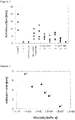
- FIG. 3 shows shorter adhesion times as the viscosities of the local hemostasis materials increased.
- the results indicate that the viscosities of the aqueous solutions used to produce the local hemostasis materials affect the hemostatic effects of the local hemostasis materials and that the higher the viscosities of the solutions, the better the local hemostasis materials exert hemostatic effects.
- Test solution 10 of 0.0637 mg was applied with a dispensing device to one surface of a square PET film of 10 mm.
- the PET film was placed in a sealed container with silica gel and dried overnight at room temperature to produce hemostatic film 1.
- Test films 2, 3, 5, and 6 were prepared using Test solutions 1, 4, 2, and 6 in the same manner as the above.
- An aqueous solution containing cationized cellulose (1.5 w/w%) was prepared by the cationized cellulose (Poise C-60H), whose molecular weight is 600,000, used in EXAMPLE 1.
- Hemostatic film 4 was prepared using the prepared cationized cellulose-containing aqueous solution of 1.5 w/w%, in the same manner as the above. Six sheets of each hemostatic film were prepared.
- the thicknesses of the layer including cationized cellulose disposed on one surface of hemostatic films 1-6 were measured with a micrometer (MITUTOYO Corporation). Specifically, the thicknesses were measured at seven points on each film, and two points being maximum and minimum values were excluded from the seven points to calculate the average thickness of each hemostatic film from the 5 points' thicknesses. By subtracting the thickness [ ⁇ m] of the PET film to which Test solution was not applied (control) from the thickness [ ⁇ m] of each hemostatic film 1-6, the thickness [ ⁇ m] of the layer including cationized cellulose was calculated. The results are summarized below (Table 6).
- the thicknesses and adhesion times of the layers including cationized cellulose demonstrated in EXAMPLE 2 are summarized in FIG. 4 , which shows shorter adhesion times as the thicknesses of the local hemostasis materials increased.
- the results indicate that the thickness of the layer including cationized cellulose of the local hemostasis material affects its hemostatic effect; specifically, the greater the thicknesses, the better the local hemostasis materials exert hemostatic effects.
- Hemostatic films 7-9 were prepared using Test solutions 7-9 in the same manner as in Example 2. The thicknesses [ ⁇ m] of hemostatic films 7-9 were measured in the same manner as in Example 2. The results are summarized below (Table 8). [Table8] The thickness of the layer including cationized cellulose [ ⁇ m] Hemostatic film 7 Hemostatic film 8 Hemostatic film 9 1 1.2 7.2 8.6 2 0.8 6.6 3.4 3 6.0 4.8 6.2 4 0.2 6.4 2.2 5 1.4 8.6 8.4 6 3.6 4.6 11.2 average 2.2 6.4 6.7
- Table 9 shows that the local hemostasis material whose cationized cellulose-containing layer has a thickness of 6.7 ⁇ m exerted a hemostatic effect.
Landscapes
- Health & Medical Sciences (AREA)
- Veterinary Medicine (AREA)
- Epidemiology (AREA)
- Life Sciences & Earth Sciences (AREA)
- Animal Behavior & Ethology (AREA)
- General Health & Medical Sciences (AREA)
- Public Health (AREA)
- Chemical & Material Sciences (AREA)
- Surgery (AREA)
- Engineering & Computer Science (AREA)
- Materials Engineering (AREA)
- Hematology (AREA)
- Chemical Kinetics & Catalysis (AREA)
- Medicinal Chemistry (AREA)
- Polymers & Plastics (AREA)
- Organic Chemistry (AREA)
- Materials For Medical Uses (AREA)
Abstract
Description
- This invention relates to a method for producing a local hemostasis material. The invention also relates to a local hemostasis material.
- Bleeding is the phenomenon of escaping blood from the inside of blood vessels to the outside. Bleeding is caused by a break in blood vessels for some reason. Conventional methods of stopping the bleeding include pressing either the bleeding blood vessels or a part around the blood vessels from outside the body. Compression hemostasis is inconvenient because pressing must keep until bleeding arrests. A hemostatic method of burning the surrounding tissue of bleeding blood vessels, cauterization, may be used during surgery, which causes a problem of damaging the surrounding tissue. Other methods for stopping bleeding include applying compounds such as collagen or oxidized cellulose.
- Chitosan is known to exert a high hemostatic effect (Patent Literature 1) and is used as a local hemostatic agent. Chitosan should be used with caution in people with allergies to crustaceans.
- Cationized cellulose is a water-soluble polymer that has little influence on the human body and is inexpensive and, accordingly, is widely used in daily necessities such as shampoos. Cationized cellulose was found to possess antibacterial activity and exert a hemostatic effect and is expected to be used as a hemostatic agent (Patent Literature 2).
-
- Patent Literature 1:
JP 2016-522208 A - Patent Literature 2:
JP 2017-140231 A - In the field of hemostasis, there is a need to provide a local hemostasis material, which exerts little influence on the human body, is inexpensive, and exerts a good hemostatic effect.
- The present invention was made by finding that a local hemostasis material was produced by applying a cationized cellulose-containing aqueous solution of a predetermined viscosity to at least one surface of a base material and then drying the solution and exerted an excellent hemostatic effect. The present invention specifically provides a local hemostasis material, a method for producing the local hemostasis material, and a mixed liquid for producing the local hemostasis material.
- One aspect of the invention provides a method for producing a local hemostasis material, comprising: applying a mixed liquid containing cationized cellulose in solvent to at least one surface of a base material; and removing the solvent, wherein the mixed liquid has a viscosity of no less than 13 mPa·s.
- Another aspect of the invention provides a local hemostasis material comprising a base material, wherein a mixed liquid containing cationized cellulose in solvent is applied to at least one surface of the base material, and the mixed liquid has a viscosity of no less than 13 mPa·s.
- Another aspect of the invention provides a local hemostasis material, comprising a base material having a first major surface and a layer including cationized cellulose on the first major surface, wherein the layer including cationized cellulose has a thickness of no less than 6.7 µm.
- Another aspect of the invention provides a mixed liquid for producing a local hemostasis material, the mixed liquid comprising cationized cellulose in solvent and having a viscosity of no less than 13 mPa·s, wherein the local hemostasis material comprises a base material and a layer including the cationized cellulose on at least one surface of the base material.
-
-
FIG. 1(a) is an exploded side view of a local hemostasis material according to an embodiment of the invention.FIG. 1(b) is a front view of the local hemostasis material. -
FIG. 2 is a scatter graph showing the adhesion times of several hemostatic pads to a glass plate via blood. -
FIG. 3 is a scatter graph showing a relationship between the viscosities of cationized cellulose aqueous solutions and the times for hemostatic pads produced using the solutions to adhere to a glass plate via blood. -
FIG. 4 is a graph showing a relationship between the thicknesses of layers including cationized cellulose, and the times for hemostatic films to adhere to a glass plate via blood. - A "local hemostasis material" in the specification means a material capable of promoting extravascular blood coagulation around a bleeding part, comprising cationized cellulose and base material. The local hemostasis material can be produced by applying a mixed liquid containing cationized cellulose in solvent to at least one surface of the base material and removing the solvent. A local hemostasis material produced by the producing method comprises, but is not limited to, the base material and a layer including cationized cellulose on at least one surface of the base material. In the specification, a local hemostasis material produced by applying the mixed liquid to at least one surface of an absorbent pad and removing the solvent of the mixed liquid is also referred to as a "hemostatic pad."
- In an embodiment, the local hemostasis material comprising a layer including cationized cellulose comprises a base material having a first major surface and the layer including cationized cellulose disposed on the first major surface, wherein the layer including cationized cellulose is no less than 6.7 µm in thickness. In an embodiment, the local hemostasis material comprising a layer including cationized cellulose comprises a base material, which has a first major surface and a second major surface opposite the first major surface; the layer including cationized cellulose disposed on the first major surface of the base material, and a support member disposed on the second major surface of the base material, wherein the layer including cationized cellulose is no less than 6.7 µm in thickness.
- A "base material" in the specification is any structure capable of holding cationized cellulose on its surface. The base material has, for example, a first major surface and a second major surface opposite the first major surface. The base material has, for example, a shape appropriate for the site to be applied. The base material has, for example, a surface capable of covering a bleeding site. The base material may be, for example, in the form of an absorbent pad or film. The base material may have a surface of various shapes, such as rectangular, square, elliptical, pentagonal, or other polygonal, circular, oval, ellipse, or the like, which can hold cationized cellulose on its surface. The base material can be produced by using, for example, at least one material selected from the group consisting of yarn, weaving yarn, lace, felt, non-woven fabric, natural fiber (e.g., cotton), synthetic fiber (e.g., rayon), synthetic resin (polyethylene terephthalate: PET), and synthetic film. Base materials are commercially available and are, for example, tablet-type cotton ball (Fthree Corporation); gauze; bandage; polyester film such as PET and polybutylene terephthalate; polyolefin film such as polyethylene and polypropylene; polyvinyl chloride film; polycarbonate film; polyurethane film such as polyether urethane and polyester urethane; or laminates of two or more thereof.
- An "absorbent pad" in the specification is any structure capable of holding cationized cellulose on its surface and absorbing liquid. The absorbing pad may be, for example, a polygonal prism, a rectangular parallelepiped, or a cylinder having a rectangular or elliptical surface, whose the short side is 1 to 3 cm, the long side is 2 cm to 5 cm, and the thickness is 2 to 10 mm. The absorbing pad may be, for example, a cylinder having a circular surface whose diameter is 1 to 3 cm and the thickness is 2 to 10 mm. The absorbing pad can be produced by, for example, compressing natural fiber such as cotton and silk or synthetic fiber such as polypropylene and/or polyethylene.
- A "support member" in the specification has a second surface facing the skin and a first surface opposite the second surface and facing the direction opposite the skin. The support member is not always necessary for practicing the invention. The support member may be various shapes, such as rectangular, square, elliptical, circular, oval, ellipse, heart-shaped, or the like. The support member is, for example, thin, highly flexible or deformable, and water impermeable. The support member may be transparent or opaque. The support member has a thickness of, for example, from 0.05 to 0.2 mm.
- The support member may be, for example, polyester film, polyethylene film, stretchable polyurethane elastomer film, or other flexible water-insoluble polymer film known in the art. In other examples, the support member can be produced from polyolefin, vinyl polyethylene acetate, non-woven fabric, rubber, or other materials known in the art.
- A first surface of the support member has an adhesive layer capable of adhering to a hemostatic pad and attaching the local hemostasis material to the skin. The adhesive layer includes, but is not limited to, an adhesive biocompatible with the human skin. The adhesive may be water-soluble, water-insoluble, or dispersible in aqueous circumstances and may be, for example, any adhesives available in the field. The adhesive is, for example, an acrylic adhesive. The adhesive layer may have a continuous or discontinuous pattern, such as lines or screens.
- A "release sheet" in the specification is a sheet having a first surface facing the first surface of the support member and a second surface opposite the first surface and facing the direction opposite the first surface of the support member. The release sheet covers, for example, the entire first surface of the support member to protect the first surface from contamination during storage or transportation until immediately before the use of the local hemostasis material. A first surface of the release sheet may be coated with silicone resin or the like, the first surface facing the hemostatic pad and the first surface of the support member.
- "Cationized cellulose" in the specification means a cellulose-based polymer with cationic groups. Cationized cellulose can be represented, for example, by the following general formula:

- at least one R1 is -R2-N+(R3) (R4) (R5)·X-,
the other R1 of the above R1 is -H, or -(CH2CH2O)m-H, - R2 is C1-6 alkylene, C2-6 hydroxyalkylene, -(CH2CH2O)I-, or a combination thereof,
- I is 1 or 2,
- m is 1 or 2,
- X- is an anionic group,
- R3, R4, and R5 are C1-6 alkyl, C1-6 alkenyl, O-C1-6 alkyl, CaYb heteroalkyl or heteroalkenyl, wherein a + b is 4 to 6, Y is heteroatom, and when bound to nitrogen atom, Y forms a saturated or unsaturated 5- or 6-membered ring containing the nitrogen atom].
- For example, the at least one R1 is -CH2CH2O-CH2CH(OH)CH2-N+(R3)(R4)(R5)·X-, wherein R3, R4, and R5 may be methyl group or ethyl group. In another example, the at least one R1 is -CH2CH(OH)CH2N+ (R3)(R4)(R5)·X-, wherein R3, R4, and R5 may be methyl group or ethyl group. In another example, the anionic group may be halide ion, phosphate group, carboxyl group, sulfonic acid group, or sulfate group. The halide ion may be fluoride ion, chloride ion, bromide ion, or iodide ion.
- Cationized cellulose may be produced according to known methods. In an example, cationized cellulose can be obtained by chemically bonding glycidyl trimethylammonium chloride or 3-chloro-2-hydroxypropyl trimethylammonium chloride to hydroxyethyl cellulose partially. In other methods, cationized cellulose can be produced according to the method described in
Patent Literature 2. Cationized cellulose is also commercially available and may be, for example, Poise C-60H (Kao Corporation) or Poise C-150H (Kao Corporation). - Cationized cellulose dissolved in the solution is positively charged and interacts with red blood cells and platelets, thereby promoting blood coagulation (Patent Literature 2). For example, at least one of the other R1 may be -(CH2CH2O)mH. The cationized cellulose in the example has higher water retention properties and is appropriate for moist wound healing. In another example, any of the hydroxyl groups at
positions - A "layer including cationized cellulose" is any structure including cationized cellulose. The layer including cationized cellulose can be formed, for example, by applying a mixed liquid containing cationized cellulose in solvent to a surface of a structure and then removing the solvent from the mixed liquid. The thickness of the cationized cellulose can be measured as a physical distance with a standard measuring instrument such as a micrometer, microscope, caliper, or the like. In specific, the thickness of the cationized cellulose can be measured with a micrometer or microscope. The thickness of the layer including cationized cellulose, may or may not be uniform. When the layer including cationized cellulose has an ununiform thickness, the thickness of the layer including cationized cellulose may be an average of thickness values at five points obtained by measuring the thicknesses at seven different points of one product and excluding the measured data of two points being the maximum value and the minimum value. The seven points for measuring the thickness may be points equally dividing the circumference of the circle, whose radius is a length half the radius of a circle inscribed in the layer including cationized cellulose in the plane view of the main surface of the layer and the center point is equal to the center of the inscribed circle. The plan view is perpendicular to the main surface of the layer including cationized cellulose.
- The thickness of the layer including cationized cellulose, may be, for example, no less than 6.7 µm, no less than 7 µm, no less than 8 µm, no less than 9 µm, no less than 10 µm, no less than 15 µm, no less than 16 µm, no less than 17 µm, no less than 18 µm, no less than 19 µm, no less than 20 µm, no less than 25 µm, no less than 30 µm, no less than 50 µm, or no less than 75 µm. The thickness of the layer including cationized cellulose is, for example, no more than 150 µm, no more than 125 µm, no more than 100 µm, no more than 90 µm, or no more than 80 µm. The thickness of the layer including cationized cellulose may be in a range appropriately combining the numerical values described for the layer in the specification, for example, from 6.7 µm to 150 µm, from 7 µm to 150 µm, from 8 µm to 150 µm, from 9 µm to 150 µm, from 10 µm to 150 µm, from 15 µm to 150 µm, from 16 µm to 150 µm, from 17 µm to 150 µm, from 18 µm to 150 µm, from 19 µm to 150 µm, from 20 µm to 150 µm, from 25 µm to 150µm, from 30µm to 150 µm, from 50 µm to 150 µm, or from 75 µm to 150 µm.
- A "mixed liquid containing cationized cellulose in solvent" in the specification means any liquid comprising cationized cellulose and solvent. The mixed liquid can be prepared, for example, by adding cationized cellulose to solvent. The mixed liquid can be produced, for example, by adding powdered cationized cellulose to water and continuing to stir until the water becomes clear. In another example, the mixed liquid can be produced by diluting cationized cellulose in solvent at a high concentration with solvent.
- An embodiment provides a local hemostasis material comprising a base material and a layer including cationized cellulose disposed on at least one surface of the base material. Another embodiment provides a mixed liquid for producing the local hemostasis material, the mixed liquid containing cationized cellulose in solvent and having a viscosity of no less than 13 mPa·s.
- The mixed liquid containing cationized cellulose in solvent may include, but not be limited to, other ingredients. The other ingredients may be, for example, antibiotics, analgesics, anti-inflammatory agents, hemostatic agents, skin softeners, hemostatic agents, steroids, softeners, fragrances, coloring agents, cooling agents, warming agents, cellulose or collagen capable of strengthening the layer including cationized cellulose, or a combination thereof. The hemostatic agents may be, for example, collagen, oxidized cellulose, gelatin, thrombin, or a combination thereof. The layer including cationized cellulose and other ingredients can be formed, for example, by applying a mixed liquid containing cationized cellulose and the other ingredients in solvent to a surface of a structure and then removing the solvent from the mixed liquid.
- A "solvent" may be, but not be limited to, water or alcohol. The alcohol may be, for example, methanol, ethanol, propanol, or a mixture thereof.
- The viscosity of the mixed liquid containing cationized cellulose in solvent is measured with a B-type rotational viscometer. The mixed liquid containing cationized cellulose in solvent preferably has a viscosity of no less than 13 mPa· s. The mixed liquid has a viscosity of no less than 16 mPa·s, no less than 25 mPa· s, no less than 50 mPa·s, or no less than 100 mPa·s. The mixed liquid has, from the viewpoint of a more preferable hemostatic effect, no less than 0.1 Pa·s, no less than 0.2 Pa·s, no less than 0.3 Pa·s, no less than 0.4 Pa·s, no less than 1.8 Pa· s, no less than 2 Pa·s, no less than 2.2 Pa·s, no less than 4 Pa·s, no less than 4.2 Pa·s, no less than 4.5 Pa·s, no less than 8 Pa·s, no less than 9 Pa·s, no less than 10 Pa·s, no less than 11 Pa·s, no less than 50 Pa·s, no less than 60 Pa·s, no less than 70 Pa·s, no less than 80 Pa·s, no less than 90 Pa·s, no less than 100 Pa·s, or no less than 110 Pa·s.
- The viscosity of the mixed liquid containing cationized cellulose is, for example, no more than 150 Pa·s, no more than 140 Pa·s, no more than 130 Pa·s, no more than 120 Pa·s, or no more than 115 Pa·s. The viscosity of the mixed liquid containing cationized cellulose may be in a range appropriately combining the values of the viscosity described in the specification, for example, from 13 mPa·s to 150 Pa·s, from 16 Pa·s to 150 mPa·s, from 25 mPa·s to 150 Pa·s, from 50 mPa·s to 150 Pa·s, from 0.1 to 150 Pa·s, from 1 to 150 Pa·s, from 1.8 to 150 Pa·s, from 2 to 150 Pa·s, from 4 to 150Pa-s, from 8 to 150 Pa·s, from 10 to 1 50 Pa·s, from 50 to 150 Pa·s, from 60 to 150 Pa·s, from 70 to 150 Pa·s, from 80 to 150 Pa·s, from 90 to 150 Pa·s, from 100 to 150 Pa·s, or from 110 to 150 Pa·s.
- The molecular weight of cationized cellulose is determined according to the copper ethylenediamine method (JIS 8215). A mixed liquid containing cationized cellulose, whose molecular weight is larger, tends to have a viscosity greater than that of a mixed liquid containing cationized cellulose, whose molecular weight is smaller, at the same concentration (w/w%). A mixed liquid of a predetermined viscosity can be obtained using cationized cellulose having a large molecular weight at a small amount compared to the case where cationized cellulose having a smaller molecular weight is used. The molecular weight of cationized cellulose is, for example, no less than 600,000, no less than 800,000, preferably no less than 1,000,000, no less than 1,200,000, no less than 1,400,000, and more preferably no less than 1,500,000.
- Cationized cellulose has a molecular weight of, for example, no more than 3,000,000, no more than 2,500,000, or no more than 2,000,000. The molecular weight of cationized cellulose may be in a range appropriately combining the values of the molecular weight described in the specification, for example, from 600,000 to 3,000,000, from 800,000 to 3,000,000, from 1,000,000 to 3,000,000, from 1,200,000 to 3,000,000, from 1,400,000 to 3,000,000, or from 1,500,000 to 3,000,000.
- The mixed liquid containing cationized cellulose can be applied to at least one surface of base material with the use of an instrument, such as a dispensing device, spatula, or the like. The mixed liquid containing cationized cellulose in solvent can be applied to the at least one surface of the base material so that the applied area in total can be, for example, no less than 50%, no less than 60%, no less than 70%, no less than 80%, no less than 90%, no less than 95%, no less than 97%, no less than 99%, or 100%.
- The solvent of the mixed liquid applied to the base material is removed, for example, according to known methods for removing solvents such as water or alcohol. The solvent of the mixed liquid applied to the base material may be removed, for example, by placing the base material in a sealed container with a drying agent such as silica gel, by heating, or by placing the base material under reduced pressure, or by a combination thereof.
- The solvent of the mixed liquid applied to the base material is not always required to be removed wholly by the removal process described above. In an example, the solvent in the mixed liquid applied to the base material may be removed by no less than 60%, no less than 70%, no less than 80%, no less than 90%, no less than 95%, or 100%. The percentage of solvent removal is obtained, for example, by calculating the weight of the solvent removed from the weights of the base material before and after the removal process and dividing the removed solvent's weight by the weight of the solvent included in the mixed liquid applied to the base material.
- In an embodiment, a local hemostasis material comprises, for example, a base material and a layer including cationized cellulose disposed on at least one surface of the base material.
- Superior hemostatic effects of the local hemostasis material according to an embodiment of the present invention were demonstrated and are described in the following Examples. It is considered that cationized cellulose included in the layer is positively charged. The positive charge facilitates the interaction of negatively charged red blood cells and platelets in the blood with the layer including cationized cellulose, thereby leading to the superior hemostatic effects of the local hemostasis material.
- In an example, a hemostatic pad comprises a base material and a layer including cationized cellulose disposed on at least one surface of the base material. The layer including cationized cellulose can be prepared by, for example, applying a mixed liquid containing cationized cellulose in the solvent described in the specification to at least one surface of the base material and removing the solvent. An embodiment of the invention provides a mixed liquid for producing a local hemostasis material, the mixed liquid comprising cationized cellulose in the solvent and having a viscosity of no less than 13 mPa·s, wherein the local hemostasis material comprises a base material and a layer including the cationized cellulose disposed on at least one surface of the base material.
- With reference to
FIG. 1 , alocal hemostasis material 1 according to an embodiment of the invention is explained. However, the embodiment is a mere example of the invention and does not limit the scope of the invention recited in the accompanying claims in any manner. -
FIG. 1(a) shows alocal hemostasis material 1 comprising ahemostatic pad 2. Thehemostatic pad 2 comprises an absorbent pad and cationized cellulose. Thehemostatic pad 2 is an absorbent pad comprising a layer including cationized cellulose (not shown). The absorbent pad is a cylindrical cotton tablet. Thehemostatic pad 2 has afirst surface 21 facing the skin and asecond surface 22 facing the direction opposite the skin. Thehemostatic pad 2 comprises a layer including cationized cellulose on thefirst surface 21. - The
local hemostasis material 1 comprises asupport member 3. Thesupport member 3 has afirst surface 31 facing the skin, and asecond surface 32 facing the direction opposite the skin. Thefirst surface 31 of thesupport member 3 is adhered to thesecond surface 22 of thehemostatic pad 2. Thefirst surface 31 of thesupport member 3 comprises an adhesive layer, including a biocompatible acrylic adhesive. - The local hemostasis material comprises a
first release sheet 41 and asecond release sheet 42. Thefirst release sheet 41 covers the left half of thefirst surface 21 of thehemostatic pad 2 and the left half of thefirst surface 31 of thesupport member 3, as shown inFIG. 1(a) . Thesecond release sheet 42 covers the right half of thefirst surface 31 of thehemostatic pad 2, and the right half of thefirst surface 31 of thesupport member 3. In the embodiment, the release sheet is composed of two sheets in combination, but the number of sheets is not limited to two. The release sheet may be one sheet covering the entire first surface of thehemostatic pad 2 and thefirst surface 31 of thesupport member 3 or may be three sheets or more sheets covering them. - FGI. 1(b) shows the
local hemostasis material 1, which comprises thehemostatic pad 2 disposed on the center of thesupport member 3. - Specific examples are described below. However, these examples are merely preferred embodiments of the invention and do not limit the scope of the invention recited in the accompanying claims.
- Poise C-60H described below was added to purified water and stirred to prepare 1 w/w%, 2 w/w%, 4 w/w%, 0.2 w/w%, 0.3 w/%, 0.4 w/w%, and 0.5 w/w% cationized cellulose aqueous solutions (referred to as
Test solutions Test solutions [Table 1] Product Company Active ingredient * Molecular weight Form Poise C-60H Kao Corporation 90%. 600,000 powder Poise C-150L Kao Corporation 90%. 1,500,000 powder * O-[2-hydroxy-3-(trimethylammonio)propyl] hydroxyethylcellulose] chloride - The viscosities of the prepared Test solutions 1-10 were measured with a B-type rotational viscometer. The measured values are summarized below.
[Table 2] Test solution Concentration [w/w%] Molecular weight Viscosity* [mPa-s]. Estimated value Measured value 1 1 600,000 60 41.9 2 2 600,000 600 267 3 4 600,000 15,000 4,192 4 1 1,500,000 2,000 1256 5 2 1,500,000 15,000 10,100 6 4 1,500,000 100,000 >100,000 7 0.2 600,000 6 8.2 8 0.3 600,000 - 10.6 9 0.4 600,000 - 13 10 0.5 600,000 20 15.8 - As shown in Table 2,
Test solution 1 had a viscosity of 41.9 mPa·s (measured value), andTest solution 2 had a viscosity of 267 mPa·s (measured value). The molecular weight of the cationized cellulose inTest solution 1 was 600,000, which is equal to that inTest solution 2. The concentration of the cationized cellulose inTest solution 1 was 1 w/w%, whereasTest solution 2 was 2 w/w%. The results indicate that solutions containing cationized cellulose at higher concentrations have higher viscosities. Indeed,Test solution 3, which contained an even higher concentration of cationized cellulose (4 w/w%), had a higher viscosity (4,192 mPa-s), even though the solution contained the cationized cellulose of the same molecular weight 600,000 (Table 2). -
Test solution 2 had a viscosity of 267 mPa·s (measured value), while Test solution 5 had a viscosity of 10,100 mPa·s (measured value). The concentration of the cationized cellulose inTest solution 2 was 2 [w/w%], the same as in Test solution 5, while the molecular weight of the cationized cellulose inTest solution 2 was 600,000, whereas Test solution 5 was 1,500,000. The results indicate that aqueous solutions containing cationized cellulose having higher molecular weights have higher viscosities. -
Test solution 1 of 0.05 g was applied with a dispensing device to one surface of compressed cotton, a disk-shaped (diameter 10 mm × height 1.5 mm) band-aid (NIPRO Empad S size). The compressed cotton was placed in a sealed container with silica gel and dried overnight at room temperature to produce ahemostatic pad 1. Hemostatic pads 2-6 were prepared with Test solutions 2-6, respectively, in the same manner as the above in whichTest solution 1 was used. - Whole blood samples A-E were collected from five volunteers. A few drops of each whole blood sample A-E were dropped on glass plates, and local hemostasis materials shown below were placed on the blood drops, allowing them to contact with the glass plate via the blood.
[Table 3] Local hemostatic material Company Active ingredient Base material Hemostatic pad - cationized cellulose tablet cotton Empad S NIPRO Corporation (None) non-woven fabric Neoplaster CMC NIPRO Corporation carboxymethyl cellulose non-woven fabric HemConDot ZERIA Pharmaceutical Co., Ltd. Chitosan, acetic acid cotton pad Hemostatic Bond Plus TOY MEDICAL Co., Ltd. alginate Alginate-containing non-woven fabric - The local hemostasis materials were pressed against the glass plate for 30 seconds after the local hemostasis materials were placed on the glass plate. After that, the time until the local hemostasis material did not move (adhesion time) was recorded at 30-second intervals. In the hemostasis test, a shorter time (min) for the local hemostasis material to adhere to the glass plate means a higher hemostatic effect. The results for each local hemostasis material are summarized below (Table 4 and
FIG. 2 ). A two-tailed t-test was performed for Empad S, with correspondence for each test result.[Table 4] Local hemostatic material Blood sample Average t-test A B c D E Empad S 14.5 9.0 20.0 20.0 14.5 15.6 Neoplaster CMC 1.0 1.0 1.0 1.0 1.0 1.0 0.002 ** HemConDot 1.0 1.0 1.0 1.0 1.0 1.0 0.002 ** Hemostatic Bond Plus 10.0 3.0 7.0 5.0 - 6.3 0.033 * Hemostatic pad 18.5 8.5 3.0 4.5 12.5 7.4 0.074 n.s Hemostatic pad 25.0 6.5 3.0 4.0 5.0 4.7 0.014 * Hemostatic pad 31.0 2.0 5.5 5.5 3.0 3.4 0.001 ** Hemostatic pad 43.0 7.5 7.0 2.5 6.0 5.2 0.017 * Hemostatic pad 5 1.0 4.0 3.0 3.5 2.0 2.7 0.004 ** Hemostatic pad 61.0 1.0 1.0 1.0 1.0 1.0 0.002 ** * p<0.05
** p<0.01
n. s. not significant - As shown in Table 4, the protective covering Empad S took 15.6 minutes on average to adhere to the glass plate in the Hemostasis test. In contrast, the hemostatic pads 1-6 all adhered to the glass plate in shorter times (7.4 min to 1.0 min on average). The results indicate that the cationized cellulose-containing hemostatic pads exert a superior hemostatic effect.
- Hemostatic Bond Plus, whose alginate may provide stop bleeding, took an average adhesion time of 6.3 minutes, while the hemostatic pads 1-6 took similar or shorter adhesion times (7.4 min to 1.0 min on average). The results indicate that the cationized cellulose-containing hemostatic pads that may provide a hemostatic effect exert similar or better effects than the alginate-containing local hemostasis materials.
- Hemostatic pads 2-6 took significantly shorter adhesion times than the adhesion times with Empad S (Table 4, t-test). The results indicate that cationized cellulose-containing local hemostasis materials that may provide a hemostatic effect exert a superior hemostatic effect.
- Hemostatic pads 2-6 took shorter adhesion times (5.2 min to 1.0 min on average) than the adhesion time with the use of hemostatic pad 1 (7.4 min on average). In comparison to the viscosity of hemostatic pad 1 (60 mPa·s; estimated value) shown in Table 2, the hemostatic pads 2-6 all had higher viscosities (267 mPa·s to > 100 mPa·s) (Table 5). The results indicate that in cationized cellulose-containing local hemostasis materials that may provide hemostatic effects, the viscosities of aqueous solutions used to prepare local hemostasis materials correlate with that of the local hemostasis materials prepared by drying the solutions.
- The viscosity of each hemostatic pad in Table 2 and the average adhesion time of each hemostatic pad in Table 4 are summarized below (Table 5 and
Figure 3 ).[Table 5] Local hemostatic agent Viscosity* [mPa·s]. Measured value Average t-test Empad S 15.6 Hemostatic pad 142 7.4 0.074 n s Hemostatic pad 2267 4.7 0.014 * Hemostatic pad 34,192 3.4 0.001 ** Hemostatic pad 41256 5.2 0.017 * Hemostatic pad 5 10,100 2.7 0.004 ** Hemostatic pad 6> 100,000 1.0 0.002 ** -
FIG. 3 shows shorter adhesion times as the viscosities of the local hemostasis materials increased. The results indicate that the viscosities of the aqueous solutions used to produce the local hemostasis materials affect the hemostatic effects of the local hemostasis materials and that the higher the viscosities of the solutions, the better the local hemostasis materials exert hemostatic effects. For example, thehemostatic pad 6 produced byTest solution 6 of a higher viscosity exerted a superior hemostatic effect (Table 4), similar to the local hemostasis materials (Neoplaster CMC or HemConDot) expected to exert superior hemostatic effects due to carboxymethylcellulose or chitosan. -
Test solution 10 of 0.0637 mg was applied with a dispensing device to one surface of a square PET film of 10 mm. The PET film was placed in a sealed container with silica gel and dried overnight at room temperature to producehemostatic film 1.Test films Test solutions Hemostatic film 4 was prepared using the prepared cationized cellulose-containing aqueous solution of 1.5 w/w%, in the same manner as the above. Six sheets of each hemostatic film were prepared. - The thicknesses of the layer including cationized cellulose disposed on one surface of hemostatic films 1-6, were measured with a micrometer (MITUTOYO Corporation). Specifically, the thicknesses were measured at seven points on each film, and two points being maximum and minimum values were excluded from the seven points to calculate the average thickness of each hemostatic film from the 5 points' thicknesses. By subtracting the thickness [µm] of the PET film to which Test solution was not applied (control) from the thickness [µm] of each hemostatic film 1-6, the thickness [µm] of the layer including cationized cellulose was calculated. The results are summarized below (Table 6).
[Table 6] The thickness of the layer including cationized cellulose [µm] Hemostatic film 1Hemostatic film 2Hemostatic film 3Hemostatic film 4Hemostatic film 5 Hemostatic film 61 8.6 14.6 16.0 19.4 25.2 69.8 2 12.0 16.4 18.6 17.6 27.6 78.0 3 9.2 15.6 8.2 18.6 25.8 69.8 4 10.8 15.2 16.0 21.4 22.6 57.8 5 10.8 15.4 17.6 16.4 22.2 91.0 6 12.2 18.6 19.4 23.6 20.4 82.0 average 10.6 16.0 16.0 19.5 24.0 74.7 - Whole blood samples F and G were collected from two volunteers. The whole blood samples F and G were used (n=3) to measure the time (min) for the hemostatic film to adhere to the glass plate in the same manner as in Example 1. The results are shown below (Table 7). T-test was conducted for PET films.
[Table7] Hemostatic film blood sample Ave rage p-value t-test The thickness of the layer including cationized cellulose [µm] Viscosity [mPa·s] F-1 F-2 F-3 G-1 G-2 G-3 PET film 5.0 6.0 4.5 4.0 5.0 5.5 5.0 - - 0 Hemostatic film 13.5 4.0 4.0 4.0 4.5 4.0 4.0 0.010 * 10.6 15.8 Hemostatic film 23.5 3.0 0.5 3.0 2.0 1.5 2.3 < 0.01 ** 16.0 42 Hemostatic film 31.0 1.0 1.0 2.0 1.0 1.0 1.2 < 0.01 ** 16.0 1,256 Hemostatic film 42.0 1.5 0.5 1.0 1.0 2.5 1.4 < 0.01 ** 19.5 Hemostatic film 5 0.5 0.5 1.5 1.5 1.0 1.5 1.1 < 0.01 ** 24.0 267 Hemostatic film 60.5 0.5 0.5 0.5 0.5 0.5 0.5 < 0.01 ** 74.7 100,000 * p<0.05
** p<0.01
n. s. not significant - The thicknesses and adhesion times of the layers including cationized cellulose demonstrated in EXAMPLE 2, are summarized in
FIG. 4 , which shows shorter adhesion times as the thicknesses of the local hemostasis materials increased. The results indicate that the thickness of the layer including cationized cellulose of the local hemostasis material affects its hemostatic effect; specifically, the greater the thicknesses, the better the local hemostasis materials exert hemostatic effects. - Hemostatic films 7-9 were prepared using Test solutions 7-9 in the same manner as in Example 2. The thicknesses [µm] of hemostatic films 7-9 were measured in the same manner as in Example 2. The results are summarized below (Table 8).
[Table8] The thickness of the layer including cationized cellulose [µm] Hemostatic film 7 Hemostatic film 8Hemostatic film 9 1 1.2 7.2 8.6 2 0.8 6.6 3.4 3 6.0 4.8 6.2 4 0.2 6.4 2.2 5 1.4 8.6 8.4 6 3.6 4.6 11.2 average 2.2 6.4 6.7 - The time (min) for hemostatic films 7-9 to adhere to the glass plate was measured in the same manner as in Example 2. The results are summarized below (Table 9). T-test was conducted for PET films.
[Table9] hemostatic film blood sample Ave rage p-value t-test The thickness of layer containing cationized cellulose (µm) Viscosity (mPa·s) F-1 F-2 F-3 G-1 G-2 G-3 PET film 4.5 4.5 5.5 4.5 4.5 5.0 4.8 - - 0.0 Hemostati c film 7 4.5 4.0 4.5 5.0 4.0 2.5 4.1 0.119 n.s. 2.2 8.2 Hemostati c film 85.0 3.5 3.5 4.5 3.0 4.5 4.0 0.063 n.s. 6.4 10.6 Hemostati c film 9 4.0 3.0 4.5 3.5 4.0 4.5 3.9 0.018 * 6.7 13.0 * p<0.05
** p<0.01
n. s. not significant - Table 9 shows that the local hemostasis material whose cationized cellulose-containing layer has a thickness of 6.7 µm exerted a hemostatic effect.
Claims (7)
- A local hemostasis material, comprising a base material having a first major surface and a layer including cationized cellulose on the first major surface, wherein the layer including cationized cellulose has a thickness of no less than 6.7 µm.
- The local hemostasis material according to claim 1, wherein the thickness of the layer including cationized cellulose is no less than 10 µm.
- The local hemostasis material according to claim 1 or 2, wherein the base material is a structure of cotton, PET, rayon, or a composite thereof.
- A method for producing a local hemostasis material, comprising: applying a mixed liquid containing cationized cellulose in solvent to at least one surface of a base material; and removing the solvent, wherein the mixed liquid has a viscosity of no less than 13 mPa·s.
- The method according to claim 4, wherein the solvent is water, alcohol, or a mixture thereof.
- The method according to claim 4 or 5, wherein the base material is a structure of cotton, PET, rayon, or a composite thereof.
- A mixed liquid for producing a local hemostasis material, the mixed liquid comprising cationized cellulose in solvent and having a viscosity of no less than 13 mPa·s, wherein the local hemostasis material comprises a base material and a layer including the cationized cellulose on at least one surface of the base material.
Applications Claiming Priority (2)
| Application Number | Priority Date | Filing Date | Title |
|---|---|---|---|
| JP2019236933 | 2019-12-26 | ||
| PCT/JP2020/048986 WO2021132663A1 (en) | 2019-12-26 | 2020-12-25 | Method for producing material for local hemostasis, and material for local hemostasis |
Publications (4)
| Publication Number | Publication Date |
|---|---|
| EP4082586A1 true EP4082586A1 (en) | 2022-11-02 |
| EP4082586A4 EP4082586A4 (en) | 2023-12-27 |
| EP4082586C0 EP4082586C0 (en) | 2025-04-23 |
| EP4082586B1 EP4082586B1 (en) | 2025-04-23 |
Family
ID=76574483
Family Applications (1)
| Application Number | Title | Priority Date | Filing Date |
|---|---|---|---|
| EP20906718.0A Active EP4082586B1 (en) | 2019-12-26 | 2020-12-25 | Method for producing material for local hemostasis, and material for local hemostasis |
Country Status (6)
| Country | Link |
|---|---|
| US (1) | US12636404B2 (en) |
| EP (1) | EP4082586B1 (en) |
| JP (1) | JP7610196B2 (en) |
| CN (3) | CN120899980A (en) |
| ES (1) | ES3029184T3 (en) |
| WO (1) | WO2021132663A1 (en) |
Family Cites Families (13)
| Publication number | Priority date | Publication date | Assignee | Title |
|---|---|---|---|---|
| US7604819B2 (en) * | 2006-05-26 | 2009-10-20 | Z-Medica Corporation | Clay-based hemostatic agents and devices for the delivery thereof |
| EP2112271A1 (en) * | 2008-03-31 | 2009-10-28 | Analytic Biosurgical Solutions - ABISS | Association of a film and a hydrogel based on chitosan and his use in surgery |
| JP5473387B2 (en) * | 2009-04-24 | 2014-04-16 | ユニメディカル株式会社 | Wound dressing and method for producing the same |
| US9993575B2 (en) * | 2012-03-06 | 2018-06-12 | Emory University | Nanoenhanced hemostatic device and methods for making a layer having hemostatic properties |
| EP3412320A1 (en) * | 2012-06-22 | 2018-12-12 | Z-Medica, LLC | Hemostatic devices |
| US10040871B2 (en) * | 2012-06-28 | 2018-08-07 | Covidien Lp | Medical devices based on oxidized cellulose |
| GB2514592A (en) | 2013-05-30 | 2014-12-03 | Medtrade Products Ltd | Degradable haemostat composition |
| RU2016125452A (en) * | 2013-11-28 | 2018-01-10 | Торэй Индастриз, Инк. | ANTITROMBOTIC MATERIAL |
| PL3187195T3 (en) | 2015-12-31 | 2019-04-30 | Upm Kymmene Corp | A medical multi-layer product comprising nanofibrillar cellulose and a method for preparing thereof |
| JP6716841B2 (en) * | 2016-02-10 | 2020-07-01 | 株式会社アルチザンラボ | Hemostatic material |
| CN110997018A (en) | 2017-08-01 | 2020-04-10 | 医疗发明株式会社 | Hemostatic material and wound dressing containing same |
| EP3581591A1 (en) * | 2018-06-13 | 2019-12-18 | UPM-Kymmene Corporation | A nanofibrillar cellulose product and a method for manufacturing thereof |
| CN108785732B (en) * | 2018-06-21 | 2021-04-09 | 广州迈普再生医学科技股份有限公司 | Hemostatic plugging material, preparation method thereof and hemostatic plugging product |
-
2020
- 2020-12-25 CN CN202511050014.9A patent/CN120899980A/en active Pending
- 2020-12-25 WO PCT/JP2020/048986 patent/WO2021132663A1/en not_active Ceased
- 2020-12-25 CN CN202080090397.1A patent/CN115087469A/en active Pending
- 2020-12-25 CN CN202410176204.4A patent/CN118079064A/en active Pending
- 2020-12-25 ES ES20906718T patent/ES3029184T3/en active Active
- 2020-12-25 EP EP20906718.0A patent/EP4082586B1/en active Active
- 2020-12-25 JP JP2021567724A patent/JP7610196B2/en active Active
- 2020-12-25 US US17/789,313 patent/US12636404B2/en active Active
Also Published As
| Publication number | Publication date |
|---|---|
| EP4082586C0 (en) | 2025-04-23 |
| CN120899980A (en) | 2025-11-07 |
| EP4082586A4 (en) | 2023-12-27 |
| CN115087469A (en) | 2022-09-20 |
| US12636404B2 (en) | 2026-05-26 |
| ES3029184T3 (en) | 2025-06-23 |
| EP4082586B1 (en) | 2025-04-23 |
| US20230158202A1 (en) | 2023-05-25 |
| JP7610196B2 (en) | 2025-01-08 |
| JPWO2021132663A1 (en) | 2021-07-01 |
| WO2021132663A1 (en) | 2021-07-01 |
| CN118079064A (en) | 2024-05-28 |
Similar Documents
| Publication | Publication Date | Title |
|---|---|---|
| JP6744315B2 (en) | Wound dressing having multiple adhesive layers | |
| CN101959539B (en) | Wound-covering hydrogel material | |
| EP2240143B1 (en) | Hydrogels with tapered edge | |
| US8110208B1 (en) | Hemostatic compositions for arresting blood flow from an open wound or surgical site | |
| KR0147306B1 (en) | Composite of a dispersed gel in an adhesive matrix and method for preparing same | |
| EP2301495A1 (en) | Cushioned adhesive bandage | |
| JPH04122255A (en) | Multilayer bandage | |
| JPH06200231A (en) | Adhesive, wound bandage and its preparation | |
| CN102850598B (en) | Alginate-gelatin-carboxymethylcellulose sodium blend membrane, and preparation and application thereof | |
| JP2004527600A (en) | Adhesive composition | |
| JP2017516864A (en) | Device for delivery of skin care composition | |
| CN107106418A (en) | Aqueous gel compositions | |
| JPS63153068A (en) | Adhesive article | |
| JPS5957654A (en) | Low tack wound dressing | |
| CN102711851B (en) | Novel Wound Dressing Containing Agglomerates of Particles Suitable for Rapid Gelation or Dissolution | |
| JP4550230B2 (en) | Emergency bandage | |
| EP4082586B1 (en) | Method for producing material for local hemostasis, and material for local hemostasis | |
| JPS6357046A (en) | Bandage for wound and its production | |
| CN115105623B (en) | Hydrocolloid repairing application with low adhesive liquid absorption and residual adhesive and preparation method thereof | |
| JPH06154304A (en) | Functional material for external use | |
| CN205924548U (en) | Dressing of slowly -releasing type aquogel | |
| JP2017039706A (en) | Hydrocolloid pressure-sensitive adhesive composition for skin patching, and patch material using the same | |
| RU2807862C1 (en) | Hemostatic agent based on chitosan | |
| WO2026006100A1 (en) | Method and apparatus for treating topical wounds | |
| JP2017176203A (en) | Medical pressure-sensitive adhesive sheet and production method of the same, as well as wound covering material |
Legal Events
| Date | Code | Title | Description |
|---|---|---|---|
| STAA | Information on the status of an ep patent application or granted ep patent |
Free format text: STATUS: THE INTERNATIONAL PUBLICATION HAS BEEN MADE |
|
| PUAI | Public reference made under article 153(3) epc to a published international application that has entered the european phase |
Free format text: ORIGINAL CODE: 0009012 |
|
| STAA | Information on the status of an ep patent application or granted ep patent |
Free format text: STATUS: REQUEST FOR EXAMINATION WAS MADE |
|
| 17P | Request for examination filed |
Effective date: 20220708 |
|
| AK | Designated contracting states |
Kind code of ref document: A1 Designated state(s): AL AT BE BG CH CY CZ DE DK EE ES FI FR GB GR HR HU IE IS IT LI LT LU LV MC MK MT NL NO PL PT RO RS SE SI SK SM TR |
|
| DAV | Request for validation of the european patent (deleted) | ||
| DAX | Request for extension of the european patent (deleted) | ||
| A4 | Supplementary search report drawn up and despatched |
Effective date: 20231124 |
|
| RIC1 | Information provided on ipc code assigned before grant |
Ipc: A61L 15/28 20060101ALI20231120BHEP Ipc: A61L 15/42 20060101ALI20231120BHEP Ipc: A61L 15/22 20060101AFI20231120BHEP |
|
| GRAP | Despatch of communication of intention to grant a patent |
Free format text: ORIGINAL CODE: EPIDOSNIGR1 |
|
| STAA | Information on the status of an ep patent application or granted ep patent |
Free format text: STATUS: GRANT OF PATENT IS INTENDED |
|
| INTG | Intention to grant announced |
Effective date: 20241211 |
|
| GRAS | Grant fee paid |
Free format text: ORIGINAL CODE: EPIDOSNIGR3 |
|
| GRAA | (expected) grant |
Free format text: ORIGINAL CODE: 0009210 |
|
| STAA | Information on the status of an ep patent application or granted ep patent |
Free format text: STATUS: THE PATENT HAS BEEN GRANTED |
|
| AK | Designated contracting states |
Kind code of ref document: B1 Designated state(s): AL AT BE BG CH CY CZ DE DK EE ES FI FR GB GR HR HU IE IS IT LI LT LU LV MC MK MT NL NO PL PT RO RS SE SI SK SM TR |
|
| REG | Reference to a national code |
Ref country code: GB Ref legal event code: FG4D |
|
| REG | Reference to a national code |
Ref country code: CH Ref legal event code: EP |
|
| REG | Reference to a national code |
Ref country code: DE Ref legal event code: R096 Ref document number: 602020050179 Country of ref document: DE |
|
| REG | Reference to a national code |
Ref country code: IE Ref legal event code: FG4D |
|
| REG | Reference to a national code |
Ref country code: CH Ref legal event code: PK Free format text: BERICHTIGUNGEN |
|
| RAP4 | Party data changed (patent owner data changed or rights of a patent transferred) |
Owner name: NIPRO CORPORATION Owner name: ARTISAN LAB CO., LTD. |
|
| REG | Reference to a national code |
Ref country code: ES Ref legal event code: FG2A Ref document number: 3029184 Country of ref document: ES Kind code of ref document: T3 Effective date: 20250623 |
|
| RIN2 | Information on inventor provided after grant (corrected) |
Inventor name: YOSHIDA, HIROSHI Inventor name: HATTORI, NORIKO Inventor name: SHIBATA, KAZUHIKO |
|
| U01 | Request for unitary effect filed |
Effective date: 20250516 |
|
| U07 | Unitary effect registered |
Designated state(s): AT BE BG DE DK EE FI FR IT LT LU LV MT NL PT RO SE SI Effective date: 20250522 |
|
| PG25 | Lapsed in a contracting state [announced via postgrant information from national office to epo] |
Ref country code: GR Free format text: LAPSE BECAUSE OF FAILURE TO SUBMIT A TRANSLATION OF THE DESCRIPTION OR TO PAY THE FEE WITHIN THE PRESCRIBED TIME-LIMIT Effective date: 20250724 Ref country code: NO Free format text: LAPSE BECAUSE OF FAILURE TO SUBMIT A TRANSLATION OF THE DESCRIPTION OR TO PAY THE FEE WITHIN THE PRESCRIBED TIME-LIMIT Effective date: 20250723 |
|
| PG25 | Lapsed in a contracting state [announced via postgrant information from national office to epo] |
Ref country code: PL Free format text: LAPSE BECAUSE OF FAILURE TO SUBMIT A TRANSLATION OF THE DESCRIPTION OR TO PAY THE FEE WITHIN THE PRESCRIBED TIME-LIMIT Effective date: 20250423 |
|
| PG25 | Lapsed in a contracting state [announced via postgrant information from national office to epo] |
Ref country code: HR Free format text: LAPSE BECAUSE OF FAILURE TO SUBMIT A TRANSLATION OF THE DESCRIPTION OR TO PAY THE FEE WITHIN THE PRESCRIBED TIME-LIMIT Effective date: 20250423 |
|
| PG25 | Lapsed in a contracting state [announced via postgrant information from national office to epo] |
Ref country code: RS Free format text: LAPSE BECAUSE OF FAILURE TO SUBMIT A TRANSLATION OF THE DESCRIPTION OR TO PAY THE FEE WITHIN THE PRESCRIBED TIME-LIMIT Effective date: 20250723 |
|
| PG25 | Lapsed in a contracting state [announced via postgrant information from national office to epo] |
Ref country code: IS Free format text: LAPSE BECAUSE OF FAILURE TO SUBMIT A TRANSLATION OF THE DESCRIPTION OR TO PAY THE FEE WITHIN THE PRESCRIBED TIME-LIMIT Effective date: 20250823 |
|
| U20 | Renewal fee for the european patent with unitary effect paid |
Year of fee payment: 6 Effective date: 20251021 |
|
| PGFP | Annual fee paid to national office [announced via postgrant information from national office to epo] |
Ref country code: GB Payment date: 20251229 Year of fee payment: 6 |
|
| PG25 | Lapsed in a contracting state [announced via postgrant information from national office to epo] |
Ref country code: SM Free format text: LAPSE BECAUSE OF FAILURE TO SUBMIT A TRANSLATION OF THE DESCRIPTION OR TO PAY THE FEE WITHIN THE PRESCRIBED TIME-LIMIT Effective date: 20250423 |
|
| PG25 | Lapsed in a contracting state [announced via postgrant information from national office to epo] |
Ref country code: CZ Free format text: LAPSE BECAUSE OF FAILURE TO SUBMIT A TRANSLATION OF THE DESCRIPTION OR TO PAY THE FEE WITHIN THE PRESCRIBED TIME-LIMIT Effective date: 20250423 |
|
| PG25 | Lapsed in a contracting state [announced via postgrant information from national office to epo] |
Ref country code: SK Free format text: LAPSE BECAUSE OF FAILURE TO SUBMIT A TRANSLATION OF THE DESCRIPTION OR TO PAY THE FEE WITHIN THE PRESCRIBED TIME-LIMIT Effective date: 20250423 |
|
| PLBE | No opposition filed within time limit |
Free format text: ORIGINAL CODE: 0009261 |
|
| STAA | Information on the status of an ep patent application or granted ep patent |
Free format text: STATUS: NO OPPOSITION FILED WITHIN TIME LIMIT |
|
| REG | Reference to a national code |
Ref country code: CH Ref legal event code: L10 Free format text: ST27 STATUS EVENT CODE: U-0-0-L10-L00 (AS PROVIDED BY THE NATIONAL OFFICE) Effective date: 20260304 |
|
| 26N | No opposition filed |
Effective date: 20260126 |
|
| PGFP | Annual fee paid to national office [announced via postgrant information from national office to epo] |
Ref country code: ES Payment date: 20260102 Year of fee payment: 6 |
|
| PG25 | Lapsed in a contracting state [announced via postgrant information from national office to epo] |
Ref country code: MC Free format text: LAPSE BECAUSE OF FAILURE TO SUBMIT A TRANSLATION OF THE DESCRIPTION OR TO PAY THE FEE WITHIN THE PRESCRIBED TIME-LIMIT Effective date: 20250423 |
|
| REG | Reference to a national code |
Ref country code: CH Ref legal event code: H13 Free format text: ST27 STATUS EVENT CODE: U-0-0-H10-H13 (AS PROVIDED BY THE NATIONAL OFFICE) Effective date: 20260723 |