EP4082516B1 - Zahnfüllung und reparaturmaterialkit - Google Patents
Zahnfüllung und reparaturmaterialkit Download PDFInfo
- Publication number
- EP4082516B1 EP4082516B1 EP20908121.5A EP20908121A EP4082516B1 EP 4082516 B1 EP4082516 B1 EP 4082516B1 EP 20908121 A EP20908121 A EP 20908121A EP 4082516 B1 EP4082516 B1 EP 4082516B1
- Authority
- EP
- European Patent Office
- Prior art keywords
- particle
- curable composition
- inorganic
- particles
- particle diameter
- Prior art date
- Legal status (The legal status is an assumption and is not a legal conclusion. Google has not performed a legal analysis and makes no representation as to the accuracy of the status listed.)
- Active
Links
Images


Classifications
-
- A—HUMAN NECESSITIES
- A61—MEDICAL OR VETERINARY SCIENCE; HYGIENE
- A61K—PREPARATIONS FOR MEDICAL, DENTAL OR TOILETRY PURPOSES
- A61K6/00—Preparations for dentistry
- A61K6/80—Preparations for artificial teeth, for filling teeth or for capping teeth
- A61K6/884—Preparations for artificial teeth, for filling teeth or for capping teeth comprising natural or synthetic resins
- A61K6/891—Compounds obtained otherwise than by reactions only involving carbon-to-carbon unsaturated bonds
-
- A—HUMAN NECESSITIES
- A61—MEDICAL OR VETERINARY SCIENCE; HYGIENE
- A61K—PREPARATIONS FOR MEDICAL, DENTAL OR TOILETRY PURPOSES
- A61K6/00—Preparations for dentistry
- A61K6/15—Compositions characterised by their physical properties
-
- A—HUMAN NECESSITIES
- A61—MEDICAL OR VETERINARY SCIENCE; HYGIENE
- A61K—PREPARATIONS FOR MEDICAL, DENTAL OR TOILETRY PURPOSES
- A61K6/00—Preparations for dentistry
- A61K6/15—Compositions characterised by their physical properties
- A61K6/16—Refractive index
-
- A—HUMAN NECESSITIES
- A61—MEDICAL OR VETERINARY SCIENCE; HYGIENE
- A61K—PREPARATIONS FOR MEDICAL, DENTAL OR TOILETRY PURPOSES
- A61K6/00—Preparations for dentistry
- A61K6/70—Preparations for dentistry comprising inorganic additives
- A61K6/71—Fillers
-
- A—HUMAN NECESSITIES
- A61—MEDICAL OR VETERINARY SCIENCE; HYGIENE
- A61K—PREPARATIONS FOR MEDICAL, DENTAL OR TOILETRY PURPOSES
- A61K6/00—Preparations for dentistry
- A61K6/80—Preparations for artificial teeth, for filling teeth or for capping teeth
- A61K6/84—Preparations for artificial teeth, for filling teeth or for capping teeth comprising metals or alloys
-
- A—HUMAN NECESSITIES
- A61—MEDICAL OR VETERINARY SCIENCE; HYGIENE
- A61K—PREPARATIONS FOR MEDICAL, DENTAL OR TOILETRY PURPOSES
- A61K6/00—Preparations for dentistry
- A61K6/80—Preparations for artificial teeth, for filling teeth or for capping teeth
- A61K6/884—Preparations for artificial teeth, for filling teeth or for capping teeth comprising natural or synthetic resins
- A61K6/887—Compounds obtained by reactions only involving carbon-to-carbon unsaturated bonds
-
- A—HUMAN NECESSITIES
- A61—MEDICAL OR VETERINARY SCIENCE; HYGIENE
- A61K—PREPARATIONS FOR MEDICAL, DENTAL OR TOILETRY PURPOSES
- A61K6/00—Preparations for dentistry
- A61K6/15—Compositions characterised by their physical properties
- A61K6/17—Particle size
Definitions
- the present invention relates to a dental filling restorative material kit.
- a dental composite resin (hereinafter also referred to as "CR") is one type of material for restoring teeth damaged by dental caries, fractures, and the like, and is formed of a curable composition containing a polymerizable monomer, an inorganic filler and/or an organic filler.
- Restoration using the CR has rapidly come into widespread use because, for example, the amount of tooth substance to be cut can be reduced, a color tone equivalent to natural teeth can be provided, and the operation thereof is easily performed.
- the dental composite resin has been used not only for the restoration of anterior teeth, but also for molar teeth to which high occlusal pressure is applied.
- one of the excellent characteristics of the CR restoration is that highly aesthetic restoration can be performed, natural teeth are formed of dentine and enamel, and each part has different color tone (hue, color chroma, and value).
- it is necessary to take careful measures according to the states of teeth which are restored (teeth to be restored). For example, even if teeth to be restored have light damage, and shallow cavity, it is common practice to prepare a plurality of types of CRs having different color tones and to select the one that best matches the color tones of the actual teeth to be restored and its adjacent teeth (hereinafter, also referred to as "periphery of the teeth to be restored”) (see, for example, Non-Patent Document 1).
- the dental curable compositions prepared using such coloring substances may fade or discolor as time elapses after the restoration due to aged deterioration of coloring substances, and the appearance of the restored part may become incompatible with the natural teeth.
- Patent Document 3 discloses that in "a fine particle-dispersed product where first fine particles having an average particle diameter in a range of 50 nm to 1 ⁇ m and having a Cv value of a particle diameter of 10% or less are dispersed in a medium, where the arrangement structure of the first fine particles in the dispersed product has an amorphous structure and where a short-range order structure satisfying a specific condition defined by a radial distribution function g(r) within a plane is provided", the arrangement structure of the fine particles is stably maintained, light of a specific wavelength can be reflected, and the angle dependence of the reflected light in which the peak wavelength of the reflected light changes with a change in the incident angle of the light can be sufficiently reduced.
- Patent Document 4 discloses a curable composition, which is composed of, for example, "a curable composition containing a polymerizable monomer component (A), a spherical filler (B) having an average particle diameter within a range of 230 nm to 1000 nm and a polymerization initiator (C), in which 90% or more of individual particles constituting the spherical filler (B) are present within a range of plus or minus 5% of the average particle diameter and satisfying a condition where the refractive index n F at 25°C of the spherical filler (B) is higher than the refractive index n P at 25°C of a polymer obtained by polymerizing the polymerizable monomer component (A)", and which is "a curable composition, wherein when measurement is made for the curable composition in a state of having formed a cured article having a thickness of 1 mm, using a color difference meter, the cured article of the curable composition gives out a colored light having a
- Patent Document 4 discloses that a CR formed of the curable composition described above has excellent characteristics in which (1) since dye substances or pigment substances are not used, the problem of chronological discoloration is unlikely to occur, (2) the cured product thereof can be colored yellow to red, which are the identical colors as dentin colors (according to the average particle diameter of the spherical filler used), and moreover, (3) since the cured product has moderate transparency, the colors are easily harmonized with the colors of restored teeth, and without complicated shade taking and shade selection of the composite resin being performed, with one type of composite resin, the appearance of the restored teeth having a wide range of colors can be restored close to the appearance of natural teeth.
- Patent Document 3 It is found from Patent Document 3 that the fine particles having a uniform particle diameter are dispersed so as to achieve an amorphous structure as a whole while having a specific short-range order structure, and that thus a structural color of a constant color tone can be produced without being affected by a change in the incident angle of light.
- the present inventors have proposed a curable composition in which inorganic spherical particles are dispersed in a specific dispersion state as a curable composition securely providing a composite material being like a cured product of a curable composition disclosed in Patent Document 4 and being capable of exhibiting the above-mentioned effect even in a case where a plurality of spherical filler aggregates is used (see, Patent Documents 5 and 6).
- Patent Documents 5 and 6 have proposed a curable composition (hereinafter, also referred to as a "structural color developing curable composition”) containing a polymerizable monomer and inorganic spherical particles, wherein the inorganic spherical particles have a specific average particle diameter and a specific particle size distribution, and in which a dispersion state of the inorganic spherical particles in the curable composition is defined by a radial distribution function g(r) of the cured product based on the findings found by the present inventors that the curable composition securely can provide a cured product developing a structural color having a predetermined color tone can be produced without being affected by a change of the incident angle of light when "the conditions related to a constituting component” in which the refractive index and a refractive index of the polymerizable monomer satisfy a specific size relation, and "the conditions related to a state of composition” in which inorganic spherical particles in the curable composition are disper
- the reason why the dispersion state of the inorganic spherical particles of the curable composition is defined by the radial distribution function g(r) of the cured product is because the dispersion state of the inorganic spherical particles in the cured product directly reflects the dispersion state of a composition before being cured.
- the cured product thereof can be colored in desired color tones within a wide range of color tones from a bluish transparent color tone to the color tones of yellow to red, which are the same colors as dentin colors (according to the average particle diameter of a spherical filler used), and moreover, (3) since the cured product can be made to have moderate transparency, when the cured product is used as a dental restorative material, the colors are easily harmonized with the colors of teeth to be restored, and without complicated shade taking and shade selection of the composite resin being performed, with one type of composite resin, the appearance of the teeth to be restored having a wide range of colors can be restored close to the appearance of natural teeth.
- the structural color development curable composition is used as CR, cavities having deep dentine is restored, the effect as expected can be obtained.
- CR including the above-mentioned structural color development curable composition is used for restoring a cavity of class III (a cavity adjacent to the anterior tooth and not containing an incisal angle) or a class IV cavity (a cavity adjacent to the anterior tooth and containing an incisal angle) in which there is no dentin in the deep layer, a restored portion may appear black (the developed structural color cannot be recognized visually). This is assumed to be because the transparency of the cured product is so high that reflected light and scattered light are difficult to reach the observer.
- the present invention has an object to provide a dental filling restorative material kit capable of obtaining high color tone compatibility even when it is used for restoration of cavities of class III and class IV.
- the present inventors have thought that the above-mentioned problems can be dissolved when a cured product of a polymerization curable composition having low transparency is disposed for a foundation layer (a portion corresponding to a vicinity of the rear side of the teeth to be restored), and a cured product of a polymerization curable composition having structural color developing property is disposed on a surface exposed layer (the front side of the teeth to be restored), and have performed thorough studies.
- the present inventors have found that when value of the polymerization curable composition for the foundation layer is set to a predetermined value, the problems are dissolved, and thereby have completed the present invention.
- the dental filling restorative material kit is a dental filling restorative material kit for restoring a tooth having a cavity, the kit including a first polymerization curable composition (A) for forming a surface exposed layer to be exposed to a surface after restoration, and a second polymerization curable composition (B) for forming a foundation layer serving as a foundation of the surface exposed layer.
- A first polymerization curable composition
- B second polymerization curable composition
- the first polymerization curable composition (A) satisfies the following (a1) to (a3):
- the second polymerization curable composition (B) satisfies the following (b1) and (b2):
- the first polymerization curable composition (A) further includes a superfine particle group (G-SFP) having an average primary particle diameter of less than 100 nm, and having an average primary particle diameter being smaller than the average primary particle diameter of G-PID 1 by 25 nm or more, as inorganic particles.
- G-SFP superfine particle group
- the total amount of the identical particle diameter spherical particle groups dispersed in the first polymerization curable composition (A) and an amount of the superfine particle group are 10 parts by mass to 1500 parts by mass, and 0.1 parts by mass to 50 parts by mass, respectively, with respect to 100 parts by mass of the first polymerizable monomer component.
- the first polymerization curable composition (A) does not substantially contain a colorant component.
- the colorant component means a pigment and/or a dye substance, and does not include the identical particle diameter spherical particle group (and the superfine particle group when the superfine particle group is included).
- the average primary particle diameter of all the identical particle diameter spherical particle groups included in the first polymerization curable composition (A) is in a range of 230 nm to 1000 nm, and, preferably, the first polymerization curable composition (A) includes only one type of identical particle diameter spherical particle group having an average primary particle diameter of the inorganic spherical particles within a range from 230 nm to 350 nm.
- ⁇ n defined by (n (G-PIDm) - n (MX) ), a difference between n (MX) and n (G-PIDm) is 0.001 to 0.1 with respect to any n (G-PIDm) .
- the dental filling restorative material kit according to the present invention is for restoring a cavity of class III and/or a cavity of class IV.
- first polymerization curable composition for a surface exposed layer in which coloring substances such as a dye substance and a pigment substance are not used
- second polymerization curable composition for a foundation layer having appropriate value
- the first polymerization curable composition (A) satisfies the following (a1) to (a3):
- the second polymerization curable composition (B) satisfies the following (b1) and (b2):
- the first polymerization curable composition (A) corresponds to the structural color development curable composition described above.
- the presence of the cured product of the second polymerization curable composition (B) as a foundation of the cured product of the first polymerization curable composition (A) reduces the amount of light passing through the cured product (A') of the first polymerization curable composition (A) (structural color development curable composition) to an appropriate extent similar to dentin existing deep in the cavities.
- first polymerization curable composition (A) and the second polymerization curable composition (B) constituting the dental filling restorative material kit according to the present embodiment will be given below.
- the first polymerization curable composition (A) is a polymerization curable composition for forming a surface exposed layer to be exposed to a surface after restoration.
- the first polymerization curable composition (A) contains a first polymerizable monomer component and inorganic spherical particles as described above, and the inorganic spherical particles have a specific average particle diameter and a specific particle size distribution, and satisfies "the conditions related to a constituting component" (a1) and (a2) in which the refractive index and a refractive index of the cured product of the first polymerizable monomer component satisfy the specific size relation; and "conditions related to a state of composition" (a3) in which inorganic spherical particles are dispersed so as to satisfy the specific conditions in the polymerization curable composition at the same time, is a polymerization curable composition providing a cured product developing a structural color having a predetermined constant color without being affected by a change in the incident angle of light.
- a surface exposed layer is formed of the cured product (A') of the first polymerization curable composition (A), the appearance of the teeth to be restored having a wide range of colors can be restored close to the appearance of natural teeth with one type of composite resin without complicated shade taking and shade selection of the composite resin being performed.
- the first polymerization curable composition (A) is basically falls into the category of the curable composition disclosed in Patent Document 4, and is not particularly different from the curable composition disclosed in Patent Document 4, except that it can include a plurality of the identical particle diameter spherical particle groups (G-PID), and that when an inorganic filler which is one of "other additives” used as an optional component in Patent Document 4 is contained therein, a particle size which does not adversely affect the above effect is specified.
- G-PID identical particle diameter spherical particle groups
- the "conditions related to a state of composition” is not particularly recognized in Patent Document 4.
- the conditions, also including the content disclosed in Patent Document 4 will be described.
- a first polymerization curable composition (A) contains a first polymerizable monomer component, inorganic particles, and a polymerization initiator component.
- the first polymerizable monomer component it is possible to use the same component as the component to be usable as a polymerizable monomer in the curable composition disclosed in Patent Document 4.
- polymerizable monomers to be suitably used include 1,6-bis(methacrylethyloxycarbonylamino)trimethylhexane, triethylene glycol dimethacrylate, tetraethylene glycol dimethacrylate, neopentyl glycol dimethacrylate, 1,6-hexanediol dimethacrylate, 1,9-nonanediol dimethacrylate, 2,2-bis[(3-methacryloyloxy-2-hydroxypropyloxy)phenyl] propane, 2,2-bis(4-(methacryloyloxypolyethoxyphenyl) propane, pentaerythritol trimethacrylate, pentaerythritol tetramethacrylate, and the like.
- the first polymerizable monomer component a plurality of types of polymerizable monomers are generally used in order to adjust the physical properties (mechanical properties and adhesion to a tooth substance in a dental application) of the resin matrix in the cured product (A') of the first polymerization curable composition (A).
- the types and the amounts of polymerizable monomers are such that the refractive index of the polymerizable monomer (mixture) falls within a range of 1.38 to 1.55 because the condition regarding the refractive index is easily satisfied.
- the refractive index thereof falls within a range of about 1.45 to 1.58 depending on the content of silica.
- the refractive index of the polymerizable monomer component is set to fall into a range of 1.38 to 1.55, the refractive index of the cured product to be obtained can be adjusted to fall into a range of about 1.40 to 1.57, and as a result, the condition described above can be easily satisfied.
- the refractive indexes of the polymerizable monomer and the cured product of the polymerizable monomer can be determined by measuring refractive index with respect to the sodium D line (wavelength: 589 nm) using an Abbe refractometer at 25°C.
- refractive index means refractive index with respect to light of a wavelength of 589 nm at 25°C.
- the inorganic particles are not particularly different from the inorganic particles disclosed in Patent Document 4, except that a plurality of identical particle diameter spherical particle groups (G-PID) can be included as described above, and that the particle size of the inorganic filler, which is one of the "other additives" used as an optional component in the curable composition disclosed in Patent Document 4, is specified when the inorganic filler is contained, in which case the particle size does not adversely affect the above effect is specified.
- G-PID identical particle diameter spherical particle groups
- the inorganic particles included in the first polymerization curable composition (A) include spherical particle groups having a predetermined average primary particle diameter in the range of 100 nm to 1000 nm, and the individual particles constituting the spherical particle groups are made of substantially the same substance, and need to include one or a plurality of the identical particle diameter spherical particle groups (G-PID) in which 90% (the number of particles) or more of the individual particles are present within a range of plus or minus 5% of the average primary particle diameter ⁇ condition (i) ⁇ .
- G-PID identical particle diameter spherical particle groups
- the inorganic particles may include a superfine particle group (G-SFP) including inorganic particles having an average primary particle diameter being less than 100 nm and smaller than the smallest average primary particle diameter by 25nm or more among the average primary particle diameters of the identical particle diameter spherical particle group (G-PID).
- G-SFP superfine particle group
- G-PID identical particle diameter spherical particle group
- condition (a2) material of the inorganic spherical particles constituting the G-PID, and G-SFP are described.
- particles formed of silica-titanium group element oxide-based composite oxide are used.
- the silica-titanium group element oxide-based composite oxide means particles mainly including a composite oxide of silica and a titanium group element (element of Group 4 in the periodic table) oxide, and the refractive index thereof is in a range of about 1.45 to 1.58 according to the content of silica.
- Specific examples of the silica-titanium group element oxide-based composite oxide includes silica-titania, silica-zirconia, silica-titania-zirconia, and the like. Among these, since high X-ray opacity can be also provided, silica-zirconia is preferable.
- the composite ratio of silica-zirconia is not particularly limited, since sufficient X-ray opacity is provided and the refractive index is made to fall into a suitable range which will be described later, it is preferable that the content of silica be 70 mol% to 95 mol% and that the content of the titanium group element oxide be 5 mol% to 30 mol%.
- silica-titanium group element oxide-based composite oxide particles compounding of a metal oxide other than silica and a titanium group element oxide is also allowed as long as the amount thereof is small.
- an alkali metal oxide such as sodium oxide or lithium oxide may be contained as long as the content thereof is 10 mol% or less.
- a method for producing the silica-titanium group element oxide-based composite oxide particles is not particularly limited, in order to obtain a spherical filler, for example, a so-called sol-gel method of adding a mixture solution including a hydrolyzable organosilicon compound and a hydrolyzable organotitanium group metal compound to an alkaline solvent, performing hydrolysis and precipitating a reaction product is suitably employed.
- the inorganic spherical particles formed of these silica-titanium group element oxide-based composite oxide may be surface-treated with a silane coupling agent.
- the surface treatment is performed with the silane coupling agent, and thus when the inorganic spherical particles are formed into an organic-inorganic composite filler which will be described later, excellent interfacial strength with the organic resin matrix of the organic-inorganic composite filler is provided.
- the silane coupling agent include organosilicon compounds such as ⁇ -methacryloyloxyalkyltrimethoxysilane and hexamethyldisilazane.
- the amount of surface treatment with the silane coupling agent is not particularly limited, and although an optimal value may be determined after the mechanical properties and the like of the obtained cured product are previously checked by experiments, an example of a suitable range is a range of 0.1 parts by mass to 15 parts by mass with respect to 100 parts by mass of the inorganic spherical particles.
- the blending amount of the identical particle diameter spherical particle group G-PID is 10 parts by mass tc 1500 parts by mass with respect to 100 parts by mass of the first polymerizable monomer component in the total amount of all G-PID included (in other words, as the total amount of inorganic spherical particles). Since the cured product (A') of the first polymerization curable composition (A) has moderate transparency and the effect of developing a structural color is enhanced, the blending amount of G-PID is preferably 50 to 1500 parts by mass and more preferably 100 to 1500 parts by mass, with respect to 100 parts by mass of the first polymerizable monomer component.
- the blending amount of each G-PID is preferably allocated as necessary in the range into which the total content falls.
- the superfine particle group is a particle aggregate formed with the inorganic particles having an average primary particle diameter of less than 100 nm, and is blended in order to, for example, adjust the viscosity of first polymerization curable composition (A), or to adjust the contrast ratio of the cured product (A') of the first polymerization curable composition (A).
- the average primary particle diameter of G-SFP needs to be smaller by 25 nm or more, than the average primary particle diameter (d 1 ) of G-PID 1 having an average primary particle diameter that is the smallest among the G-PID to be blended in the inorganic particles.
- the shape of the inorganic particles of G-SFP is not particularly limited, and may be amorphous or spherical.
- the lower limit of the average primary particle diameter is normally 2 nm.
- the average primary particle diameter of G-SFP is preferably 3 nm to 75 nm, and more preferably 5 nm to 50 nm.
- the average primary particle diameter of G-SFP is preferably smaller than the average primary particle diameter (d 1 ) of G-PID 1 by 30 nm or more, and more preferably by 40 nm or more.
- the same material as that of the inorganic spherical particles can be used without particular limitation.
- the surface treatment can be performed with the silane coupling agent.
- the suitable embodiment is basically the same as that of the inorganic spherical particles except for the average primary particle diameter and the shape.
- the blending amount of superfine particle group G-SFP may be appropriately determined with consideration given to, for example, viscosity of the first polymerization curable composition (A) and the contrast ratio of the cured product (A') of the first polymerization curable composition (A), but the blending amount is usually 0.1 parts by mass to 50 parts by mass and suitably 0.2 parts by mass to 30 parts by mass with respect to 100 parts by mass of the first polymerizable monomer component.
- the first polymerization initiator component it is possible to use the same component as the component to be usable as a polymerization initiator in the curable composition disclosed in Patent Document 4.
- a chemical polymerization initiator and/or a photopolymerization initiator is preferably used, and since a mixing operation is not necessary, the photopolymerization initiator is more preferably used.
- a chemical polymerization initiator which is formed of two or more components and in which a polymerization initiation species (radical) is generated when these components make contact with each other can be used without particular limitation.
- the chemical polymerization initiator include chemical polymerization initiators which are formed by various combinations of organic peroxides/amines, organic peroxides/amines/organic sulfinic acids, organic peroxides/amines/arylborates, arylborates/acidic compounds, barbituric acid derivatives/copper compounds/halogen compounds, and the like. Among them, in terms of ease of handling, organic peroxides/amines are preferable.
- organic peroxides examples include hydroperoxides, peroxyketals, ketone peroxides, alkylsilyl peroxides, diacyl peroxides, peroxyesters, and the like, which are known.
- Sulfinic acids such as benzenesulfinic acid, p-toluenesulfinic acid and salts thereof; barbituric acids such as 5-butylbarbituric acid; and the like; may be mixed in the chemical polymerization initiator formed of organic peroxides/amines.
- photopolymerization initiator examples include benzoin alkyl ethers, benzyl ketals, benzophenones, ⁇ -diketones, a thioxanthone compound, bisacylphosphine oxides, and the like. These photopolymerization initiators may be blended with a reducing agent such as tertiary amines, aldehydes or a sulfur-containing compound.
- a photoacid generator such as a diaryliodonium salt-based compound, a sulfonium salt-based compound, a sulfonate ester compound, a halomethyl-substituted-S-triazine derivative, and a pyridinium salt-based compound may be blended.
- polymerization initiators may be used singly, or two or more types thereof may be mixed so as to be used.
- amount of polymerization initiator mixed an effective amount is preferably selected according to the purpose, but 0.01 to 10 parts by mass of the polymerization initiator is normally used, and 0.1 to 5 parts by mass is more preferably used, with respect to 100 parts by mass of the polymerizable monomer component.
- Inorganic particles satisfy all of the following conditions (i) to (iii):
- the average primary particle diameter of the inorganic spherical particles means an average value determined by taking a photograph of G-PID with a scanning electron microscope, selecting 30 or more particles observed within a unit field of view of the photograph, and obtaining an average of the respective primary particle diameters (maximum diameters) thereof.
- the term “spherical” may be “substantially spherical", and it is not always necessary to provide a completely true sphere.
- the photograph of G-PID is shot with the scanning electron microscope, the maximum diameters of respective particles (30 or more particles) within a unit field of view thereof are measured, the average uniformity is obtained by dividing particle diameters orthogonal to the maximum diameters by the maximum diameters, and the average uniformity is 0.6 or more and more preferably 0.8 or more.
- each of the constituent particles of G-PID which is the aggregate of the inorganic particles being spherical and having a narrow particle diameter distribution (number-based particle size distribution), have a specific short-range order structure so as to be dispersed in the resin matrix; and thus diffractive interference occurs according to Bragg conditions and light of a specific wavelength is emphasized, with the result that colored light of a color tone corresponding to the average primary particle diameter is produced (structural color is developed).
- the inorganic spherical particles of G-PID need to be present within a range of plus or minus 5% of the average primary particle diameter.
- the average primary particle diameter of the inorganic spherical particles of G-PID needs to fall within a range of 100 nm to 1000 nm. In a case where spherical particles having an average primary particle diameter of less than 100 nm are used, the phenomenon of interference of visible light is unlikely to occur, and a structural color is unlikely to be developed.
- the average primary particle diameter is 230 nm to 800 nm, a yellowish-reddish structural color (colored light) is easily developed, whereas when the average primary particle diameter is 150 nm or more and less than 230 nm, a bluish structural color (colored light) is easily developed.
- the average primary particle diameter of G-PID is preferably 230 nm to 800 nm, more preferably 240 nm to 500 nm and further preferably 260 nm to 350 nm.
- G-PID having an average primary particle diameter of 230 nm or more and less than 260 nm is used, colored light obtained is yellowish, and the composite material is useful for the restoration of teeth in the class of B system (reddish yellow) in a shade guide ("VITA Classical", manufactured by Vita Zahnfabrik H. Rauter GmbH & Co.
- the composite material is most preferable because compatibility with teeth to be restored having a variety of color tones is widely enhanced.
- the composite material is useful for the restoration of the enamel and is particularly useful for the restoration of an incisal portion.
- the number of types of G-PID included in the inorganic particles in the first polymerization curable composition (A) may be one or more.
- the number a of G-PID included is preferably 1 to 5, more preferably 1 to 3, and further preferably 1 or 2.
- each G-PID m When a plurality of types of G-PID is included in the inorganic particles, the average primary particle diameters of each G-PID m need to differ from each other by 25 nm or more.
- a 3
- each G-PID is represented as G-PID m (when a is 1, m is 1 and when a is equal to or greater than 2, m is a natural number from 1 to a) in ascending order of the average primary particle diameters thereof, and the average primary particle diameter of each G-PID m is represented as d m , each d m needs to differ from one another by 25 nm or more.
- each G-PID is dispersed in the form of a coagulated material in which a small number of inorganic spherical particles that do not exceed about 20 pieces are coagulated with very loose bonding force, and thus G-PID can be dispersed so as to have a short-range order structure capable of developing a structural color according to each G-PID.
- this condition is not satisfied, a structural color is unlikely to be developed.
- the average primary particle diameters d m of each G-PID m preferably differ from each other by 30 nm or more, and more preferably differ from each other by 40 nm or more.
- a difference between d m and d m-1 is preferably 30 nm or more, and more preferably 40 nm or more.
- each G-PID has a very sharp particle size distribution and the difference described above is produced between the average primary particle diameters, the particle size distributions of G-PID are unlikely to overlap each other, and even when they partially overlap each other, the particle size distribution of each G-PID can be checked.
- the particle size distribution of the inorganic particles included in the first polymerization curable composition (A) has the same number of independent peaks as the number of G-PID included in the composite material in a range of 100 nm to 1000 nm, and even when a part of each of the peaks overlaps, waveform processing is performed so as to be able to check the average primary particle diameters of each G-PID and the number-based particle size distribution.
- the particle size distribution of the inorganic particles included in the first polymerization curable composition (A) can also be checked, for example, by performing image processing on an electron microscope photogram of an internal surface of the cured product (A') of the first polymerization curable composition (A).
- the refractive index of a cured product of the first polymerizable monomer component as a resin matrix at the time of curing is represented as n (MX)
- the refractive index of the inorganic spherical particles constituting each G-PID m is represented as n (G-PIDm)
- n MX ⁇ n G - PIDm the refractive index of the inorganic spherical particles constituting each G-PID m
- the refractive index of the first polymerizable monomer component is set in a range of 1.38 to 1.55, and thus the refractive index (n (MX) ) of the cured product of the resin matrix can be made to fall into a range of 1.40 to 1.57.
- the content of silica is changed, and thus the refractive index (n (G-PIDm) ) of the silica-titanium group element oxide-based composite oxide can be changed in a range of about 1.45 to 1.58.
- these relationships are utilized, and thus ⁇ n can easily be made to fall into a suitable range.
- Condition (a3) is a "condition related to a state of composition" in which inorganic spherical particles in the first polymerization curable composition (A) are dispersed so as to satisfy a specific condition.
- condition (a3) from the reasons that a dispersion state of inorganic spherical particles of the cured product (A') of the first polymerization curable composition (A) directly reflects the dispersion state of the inorganic spherical particles in the polymerization-curable composition before curing; and that the dispersion state of inorganic spherical particles in the cured product (A') can be quantitatively grasped by analytical means such as an electron microscope, the dispersion state of the inorganic spherical particles in the first polymerization curable composition (A) is defined by the radial distribution function g(r) (more specifically, a radial distribution function graph) in the cured product (A').
- ⁇ > represents an average particle density of the inorganic spherical particles in an observation plane
- dn represents the number of the inorganic spherical particles being present in a region between a circle at a distance r and r + dr from a given inorganic spherical particle within the observation plane
- ⁇ >, dn, and da are determined based on a scanning electron microscope image in which a plane in the cured product (A') is the observation plane.
- the radial distribution function graph represents the relationship between r/r 0 and g(r) corresponding to r at that time, and in the graph, dimensionless number (r/r 0 ) standardized by dividing the distance r from the center of a given inorganic spherical particle dispersed in the cured product (A') by the average particle diameter r 0 of all the inorganic spherical particles dispersed in the cured product (A') is on the x-axis, and the radial distribution function graph g(r) mentioned above is on the y-axis.
- inorganic spherical particles need to be dispersed in the first polymerization curable composition (A) such that the above-mentioned radial distribution function graph has a short-range order satisfying the following conditions (I) and (II):
- the incident light is subjected to diffractive interference according to Bragg conditions, and light of a specific wavelength is emphasized without being affected by the incident angle of light, structural color corresponding to the average primary particle diameter is produced, and as a result, a structural color of a constant color tone can be produced.
- the "radial distribution function g(r) within a plane" disclosed in Patent Document 3 is used, and thus the short-range order structure is defined.
- the radial distribution function g(r) is well known as a function for determining a probability that a particle is present at a distance of r away from a given particle, and is defined by the above-mentioned formula (1).
- ⁇ > represents the average particle density of particles within the plane
- dn represents the number of particles which are present in a region between a circle having a radius r and a circle having a radius r+dr respectively with any one of the particles within the plane being the center
- da represents 2 ⁇ r ⁇ dr, which is the area of the region described above.
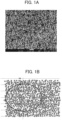
- the radial distribution function g(r) is represented by a radial distribution function graph in which a distance r is taken along an x-axis (distance axis) and in which the value of g(r) at r (the result of a calculation by formula (1) described above) is taken along a y-axis (vertical axis) or a radial distribution function graph (see Figs.
- the determination of ⁇ >, dn and da can be performed as follows. Firstly, by a means such as polishing of the surface of the cured product (A') obtained by curing the first polymerization curable composition (A), the plane (observation plane) on which the dispersed state of the inorganic spherical particles in the cured product (A') can be observed is exposed on the surface. Then, the observation plane is observed with a scanning electron microscope, and thus a microscope image of a region in which at least 500 or more inorganic spherical particles are contained within the plane is acquired. Thereafter, for the obtained scanning electron microscope image, with image analysis software (for example, "Simple Digitizer ver.
- coordinates of the inorganic spherical particles within the region are determined.
- the coordinates of any one of inorganic spherical particles are selected from obtained coordinate data, with the selected inorganic spherical particle being the center, a circle in which at least 200 or more inorganic spherical particles are included and in which a distance r is the radius is drawn, and the number of inorganic spherical particles included within the circle is counted, with the result that the average particle density ⁇ > (unit: pieces/cm 2 ) can be determined.
- dr having a length of a value of about r 0 /100 to r 0 /10 when the average particle diameter of the inorganic spherical particles is represented as r 0
- one inorganic spherical particle arbitrarily selected is assumed to be a central particle, the number of inorganic spherical particles included within a region between a circle in which a distance r from the center thereof is the radius and a circle which has the same center as the circle described above and which has a radius r+dr is counted, and thus dn can be determined.
- da which is the area of the region between the two circles, is determined as 2 ⁇ r ⁇ dr based on the length of dr, which is actually set.
- the closest particle-to-particle distance r 1 which is defined as r corresponding to the peak top of the peak closest to the origin among the peaks appearing in the radial distribution function graph needs to be the
- r 1 /r 0 is 1.0 to 2.0 and is preferably 1.0 to 1.5.
- the local minimum value described above is a value of 0.56 to 1.10 and is preferably a value of 0.56 to 1.00.
- condition (I) means that the inorganic spherical particles are dispersed while holding constant short-range order
- condition (II) means that the inorganic spherical particles are dispersed in a state where long-range order is random while short-range order is being maintained (which is not a completely random state where short-range order collapses and which is a state where fine domains having short-range order are randomly dispersed).
- the organic-inorganic composite fillers mentioned below are used as inorganic spherical particles are mixed while the particle diameter of the particles is controlled such that they are in a range of 5 ⁇ m to 50 ⁇ m, and particularly in a range of 5 ⁇ m to 30 ⁇ m, or coagulated particles of primary particles are mixed such that they are controlled such that a particle diameter is in a range from 5 ⁇ m to 200 ⁇ m and preferably a particle diameter in a range from 10 ⁇ m to 100 ⁇ m.
- air bubbles are mixed during the mixing, since not only it is difficult to satisfy the conditions described above, but also a defect in the cured product is caused.
- the short-range order structure described above can be obtained more simply and reliably, it is preferable that at least part of one or more identical particle diameter spherical particle groups include one type of identical particle diameter spherical particle group and a resin having a refractive index that is less than the refractive index of the inorganic spherical particles of the one type of identical particle diameter spherical particle group, and are blended as an organic-inorganic composite filler (that is, an organic-inorganic composite filler including only a single G-PID) which does not include an identical particle diameter spherical particle group other than the one type of the identical particle diameter spherical particle group.
- an organic-inorganic composite filler that is, an organic-inorganic composite filler including only a single G-PID
- the organic-inorganic composite filler means a filler made of a powder formed of a composite in which an inorganic filler is dispersed in an (organic) resin matrix or a coagulated material in which the primary particles of an inorganic filler are bonded together with an (organic) resin.
- G-IDP having different average primary particle diameters
- G-PID 1 , G-PID 2 and G-PID 3 all or part of at least one type thereof is mixed as the "organic-inorganic composite filler including only a single G-PID".
- G-PID 1 is blended as the organic-inorganic composite filler including only G-PID 1 (composite filler 1) in the first polymerization curable composition (A), within the composite filler 1, only G-PID 1 is included, and thus a short-range order structure for developing the structural color of G-PID 1 is realized, with the result that even in the cured product (A') obtained by curing the first polymerization curable composition (A), the structural color of G-PID 1 is reliably developed.
- G-PID 1 When G-PID 1 is blended without being formed into a composite filler, since G-PID 1 is kneaded with G-PID 2 and G-PID 3 which are blended simultaneously (without being formed into a composite), it is thought that the constituent particles of G-PID 1 and the constituent particles of G-PID 3 are somewhat substituted with each other, that thus the closest particles of the inorganic spherical particles of G-PID 1 are formed into the inorganic particles of G-PID 3 and that in a region where the inorganic spherical particles are the center, the short-range order structure is destroyed.
- G-PID 1 and/or G-PID 3 are blended as an organic-inorganic composite filler including only G-PID 2 (composite filler 2) and/or an organic-inorganic composite filler including only G-PID 3 (composite filler 3), and thus the structural colors thereof can be reliably developed.
- G-PID When G-PID is blended in a form other than the form of "organic-inorganic composite filler including only a single G-PID", G-PID is generally blended in the form of a powder (G-PID itself serving as the aggregate of the inorganic spherical particles), but G-PID can be blended as an organic-inorganic composite filler including a plurality of types of G-PID. A more detailed description of the organic-inorganic composite filler including this case will be given below.
- the organic-inorganic composite filler means a filler made of a powder including a complex in which inorganic fillers are dispersed in an (organic) resin matrix or a coagulated material in which the primary particles of an inorganic filler are bonded together with an (organic) resin.
- the inorganic spherical particles are used as the inorganic filler, and the resin having a refractive index that is less than that of the inorganic spherical particles is used as the resin forming the (organic) resin matrix.
- the resin described above is not particularly limited as long as the resin satisfies the condition as described above, but the resin is preferably a cured product of the first polymerizable monomer component used in producing the resin matrix of the cured product (A').
- the resin does not need to have exactly the same composition as that of the first polymerizable monomer component, the resin having a refractive index being substantially equal to the refractive index of the polymerizable monomer is preferably used.
- the refractive index of the resin described above is represented as n (R)
- the refractive index of the inorganic spherical particles is represented as n (F)
- the following relationship: n R ⁇ n F needs to hold true.
- the organic-inorganic composite filler includes inorganic spherical particles having a different refractive index
- the relationship described above needs to hold true for all the inorganic spherical particles.
- the content of inorganic spherical particles in the organic-inorganic composite filler is preferably 30% by mass to 95% by mass.
- the content to the organic-inorganic composite filler is 30% by mass or more, the colored light of the cured product (A') of the first polymerization curable composition (A) is satisfactorily developed, and mechanical strength can also be sufficiently enhanced. It is difficult to perform an operation of containing more than 95% by mass of the inorganic spherical particles in the organic-inorganic composite filler, and it is difficult to obtain a homogeneous mixture.
- the more suitable amount of the inorganic spherical particles mixed in the organic-inorganic composite filler is 40% by mass to 90% by mass.
- the organic-inorganic composite filler can be produced according to a general production method in which predetermined amounts of individual components of the inorganic spherical particles, the polymerizable monomer, and the polymerization initiator are mixed together, and in which the mixture is polymerized by a method such as heating or light application, followed by pulverization. With such a method, it is possible to obtain the irregularly shaped organic-inorganic composite filler formed of a composite in which the inorganic spherical particles are dispersed in the resin matrix.
- the organic-inorganic composite filler can also be produced by a method disclosed in PCT International Publication Nos. WO2011/115007 and WO2013/039169 , that is, a method of immersing coagulated particles formed of a coagulated material of inorganic spherical particles in a liquid composition including a polymerizable monomer, a polymerization initiator and an organic solvent, removing the organic solvent, and polymerizing and curing the polymerizable monomer by a method such as heating or light application.
- the average particle diameter of the organic-inorganic composite filler is preferably 2 ⁇ m to 100 ⁇ m, more preferably 5 ⁇ m to 50 ⁇ m, and further preferably 5 ⁇ m to 30 ⁇ m from the viewpoint that the conditions (I) and (II) are easily satisfied and further the mechanical strength of a curable body and the operability of the curable paste are improved.
- a pigment, a polymerization inhibitor, a fluorescent brightening agent, and the like, can be added to the organic-inorganic composite filler as long as the effects thereof are not inhibited (in general, 0.0001 parts by mass to 5 parts by mass thereof with respect to 100 parts by mass of the organic-inorganic composite filler is added).
- the organic-inorganic composite filler may be surface-treated with a silane coupling agent or the like.
- the amount of organic-inorganic composite filler is preferably determined, with consideration given to the amount of identical particle diameter spherical particle group not being formed into the organic-inorganic composite filler blended in the first polymerization curable composition (A), by conversion from the amount of inorganic spherical particles included in the organic-inorganic composite filler such that the total amount of G-PID (i.e., the total amount of inorganic spherical particles) falls into the range described above.
- additives such as a polymerization inhibitor and a UV absorber can be blended in the first polymerization curable composition (A) as long as the effects thereof are not inhibited.
- the cured product (A') obtained from the first polymerization curable composition (A) develops, as described above, a structural color without use of a colorant component (coloring substance) such as a pigment and a dye substance.
- a colorant component coloring substance
- a colorant component which is likely to discolor as time passes does not need to be mixed in the first curable composition (A).
- the blending of a colorant component itself is not completely denied, and a colorant may be blended as long as the colorant does not prevent colored light caused by interference of a spherical filler.
- about 0.0005 to 0.5 parts by mass, and preferably, about 0.001 to 0.3 parts by mass of a colorant component with respect to 100 parts by mass of the first polymerizable monomer component may be mixed.
- a second polymerization curable composition (B) is a polymerization curable composition for forming a foundation layer serving as a foundation of a surface exposed layer including the cured product (A') of the first polymerization curable composition (A).
- the second polymerization curable composition (B) since the cured product (B') has predetermined value, the presence of the cured product (B') as a foundation of the surface exposed layer reduces the amount of light passing through the surface-exposed layer to an appropriate extent similar to dentin existing deep in the cavities, so that good color tone compatibility can be exhibited even when the cured body (B') is used for the restoration of cavities of class III and class IV.
- a second polymerization curable composition (B) contains a second polymerizable monomer component, a colorant component, and a second polymerization initiator component (condition (b1)).
- the colorant component is blended such that the value (V) of the colorimetric value measured by the Munsell color system of the colored light when measured under a black background using a color difference meter on a 1 mm-thick sample including the cured product (B') of the second polymerization curable composition (B) is 5 or more (condition (b2)).
- a (meta)acrylic polymerizable monomer is preferably used as the second polymerizable monomer component, and preferably, 50 parts by mass to 1500 parts by mass of filling materials, and an effective amount of polymerization initiator are included with respect to 100 parts by mass of the (meta)acrylic polymerizable monomer.
- the colorant component also referred to as a coloring substance or coloring material
- a pigment and/or a dye substance is used.
- an inorganic pigment is suitably used.
- inorganic pigments to be suitably used include titanium oxide, zinc oxide, zirconium oxide, zinc sulfide, aluminum silicate, calcium silicate, carbon black, iron oxide, copper chromite black, chromium oxide green, chromium green, violet, chromium yellow, lead chromate, lead molybdate, cadmium titanate, nickel titanium yellow, ultramarine blue, cobalt blue, bismuth vanadate, cadmium yellow, cadmium red, and the like.
- the inorganic pigment also corresponds to an inorganic filler material.
- organic pigments such as monoazo pigments, diazo pigments, diazo condensation pigments, perylene pigments, anthraquinone pigments, and the like, can also be used.
- the colorant component is a dye substance
- reddish dye substance such as KAYASET RED G, KAYASET RED B (both are manufactured by Nippon Kayaku Co., Ltd.); yellowish dye substance such as KAYASET Yellow 2G, KAYASET Yellow GN (both are manufactured by Nippon Kayaku Co., Ltd.); bluish dye substance such as KAYASET Blue N, KAYASET Blue G, KAYASET Blue B (all are manufactured by Nippon Kayaku Co., Ltd.); and the like, can be used.
- water-insoluble pigment is more preferably used than water-soluble dye substance.
- a colorant component is mixed in order to match the color tone of teeth, gingiva, and crown material.
- the cured product (B') needs predetermined value.
- the desired value means that the value (V) of the colorimetric value of the colored light measured by the Munsell color system when measured with a color difference meter under a black background for a 1 mm-thick sample made of the cured product (B') of the second polymerization-curable composition (B) is 5 or more.
- the above-mentioned value (V) can be obtained by measuring a spectral reflectivity in a black background using the color-difference meter (for example, "TC-1800MKII” manufactured by Tokyo Denshoku Co., Ltd., and the like), under black background (foundation having value of 1 by the Munsell color system).
- the value (V) When the value (V) is less than 5, a restored product tends to be dark and less aesthetic.
- the value (V) is preferably 5.5 or more, and more preferably 6 or more. Furthermore, when the value is too high, the reflection of light becomes large, and the visibility of the structural color developed by the surface restored product is lowered, and the harmony between the restored portion and the periphery of the teeth to be restored may be lost. Therefore, the value is preferably 9 or less, more preferably 8.5 or less, further preferably 8 or less, and particularly preferably 7.5 or less.
- the dental filling restorative material kit may include only the first polymerization curable composition (A) and the second polymerization curable composition (B), but may further include a polymerization curable composition having a special color tone for forming an intermediate layer in order to better match the color tone of the human tooth to be restored with the restorative material.
- composition may further include a polymerization-curable composition of a white color having high value (value greater than 7) suitable for opaque white teeth after bleaching treatment, a polymerization-curable composition of a transparent color having value of less than 4 suitable for teeth with high transparence, and the like.
- the polymerization curable composition having such a color tone is adopted from general dental filling restorative material, and a composite resin containing a polymerizable monomer, a polymerization initiator, a filling material, and a coloring material is used.
- a dental filling restorative material kit according to the present embodiment can be suitably used for restoring a cavity in which no dentin is present in the deep portion, i.e., a cavity of class III which is adjacent to the anterior tooth and which does not include incisal angle, and a cavity of class IV which is a cavity adjacent to the anterior tooth and which includes the incisal angle.
- the second polymerization-curable composition (B) is disposed in a deep portion of the cavity (lost portion) or behind the cavity to form a foundation layer by adjusting the thickness (usually, 0.1 mm to 2 mm) and a shape thereof, and after curing as necessary, the first polymerization-curable composition (A) is disposed on the uncured foundation layer or cured foundation layer to adjust the shape thereof (together with the foundation layer if the foundation layer is uncured), and after curing, a polishing process is performed.
- a first polymerization curable composition (A) (structural color development curable composition) gives a cured product developing the desired structural color, in other words, that the cured product (A') develops the desired structural color when conditions (a1), (a2), and (a3) are satisfied, based on the following Reference Examples and Reference Comparative Examples (corresponding to Examples and Comparative Examples of Patent Document 5).
- the viscosities of M1 and M2 were measured with an E-type viscometer ("VISCONIC ELD” manufactured by Tokyo Keiki Co., Ltd.) in a constant temperature chamber of 25°C.
- the refractive index before curing (M1 or M2) and the refractive index after curing (cured product) were measured using an Abbe refractometer (manufactured by Atago Co., Ltd.) in the constant temperature chamber of 25°C.
- the cured product sample was produced as follows: 0.2% by mass of camphorquinone (CQ), 0.3% by mass of ethyl p-N,N-dimethylaminobenzoate (DMBE), and 0.15% by mass of hydroquinone monomethyl ether (HQME) were added to 100 parts by mass each of M1 or M2 as the polymerization initiator, and were uniformly mixed, the resulting mixture was put into a mold having a through-hole of 7 mm ⁇ ⁇ 0.5 mm, polyester films were pressed on both sides, followed by curing thereof by light application for 30 seconds with a halogen-type dental light irradiator ("Demetron LC" manufactured by Sybron Dental Specialties Inc.) having a light intensity of 500 mW/cm 2 , and thereafter the cured product was taken out of the mold.
- CQ camphorquinone
- DMBE ethyl p-N,N-dimethylaminobenzoate
- HQME hydroquinone
- G-PID G-PID1 to G-PID11 shown in Table 2 were used. These identical particle diameter spherical particle groups were prepared according to a method (so-called sol-gel method) disclosed in Japanese Unexamined Patent Application Publications Nos. 58-110414 and 58-156524 and the like.
- a mixture solution which included a hydrolyzable organosilicon compound (such as tetraethyl silicate) and a hydrolyzable organic titanium group metal compound (such as tetrabutylzirconate or tetrabutyltitanate) such that compositions shown in the composition column of Table 2 were provided was added into an ammonia alcohol solution (for example, methanol, ethanol, isopropyl alcohol or isobutyl alcohol) into which ammonia water was introduced and hydrolysis was performed to precipitate a reaction product. Then, the resulting precipitate was separated, thereafter dried, and calcined after being pulverized as necessary to obtain the calcined product.
- an ammonia alcohol solution for example, methanol, ethanol, isopropyl alcohol or isobutyl alcohol
- a photograph of a powder was shot with a scanning electron microscope ("XL-30S", manufactured by Philips N.V.) at a magnification of 5000 to 100000 times, the shot image was processed with image analysis software ("IP-1000PC” manufactured by Asahi Kasei Engineering Corp.), the number (30 or more particles) and the primary particle diameter (maximum diameter) of particles observed within a unit field of view of the photograph were measured and the number average primary particle diameter was calculated by a formula below based on the measured values.
- Rate of particles within range of ⁇ 5% [(number of particles within particle diameter range of plus or minus 5% of average primary particle diameter within unit field of view of scanning electron microscope photograph)/(number of all particles within unit field of view of scanning electron microscope photograph)] ⁇ 100
- Measurement was performed by a liquid immersion method using the Abbe refractometer (manufactured by Atago Co., Ltd.). Specifically, in the constant temperature chamber of 25°C, within a sample bottle of 100 mL, the identical particle diameter spherical particle group (G-PID) was dispersed in 50 mL of anhydrous toluene. While this dispersion liquid was being stirred with a stirrer, 1-bromotoluene was dropped little by little, the refractive index of the dispersion liquid when the dispersion liquid was the most transparent was measured, and the obtained value was used as the refractive index of the identical particle diameter spherical particle group (G-PID).
- the rotation speed of the disc was 10000 rpm, and the temperature of air in a dry atmosphere was 200°C. Thereafter, a powder obtained by being granulated by spray drying was dried in a vacuum at 60°C for 18 hours, and 73 g of a substantially spherical coagulated material was obtained.
- a polymerizable monomer solution (containing 36 parts by mass of the polymerizable monomer component with respect to 100 parts by mass of an organic solvent) obtained by mixing 10 g of the polymerizable monomer component M1, 0.025 g of azobisisobutyronitrile (AIBN) serving as a thermal polymerization initiator and furthermore 5.0 g of methanol serving as the organic solvent.
- AIBN azobisisobutyronitrile
- the mixture described above was transferred into a rotary evaporator.
- the mixture was dried for one hour under conditions in which the degree of pressure reduction was 10 hPa and in which a heating condition was 40°C (a warm water bath was used), with the result that the organic solvent was removed.
- a powder having high fluidity was obtained.
- the powder was heated for one hour under conditions in which the degree of pressure reduction was 10 hPa and in which a heating condition was 100°C (an oil bath was used), and thus the polymerizable monomer in the powder was polymerized and cured.
- Irregularly shaped inorganic particles F1 shown in Table 2 were used.
- the irregularly shaped inorganic particles F1 were prepared according to a method disclosed in Japanese Unexamined Patent Application Publications Nos. 2-132102 and 3-197311 and the like as follows: an alkoxysilane compound was dissolved in an organic solvent, water was added thereto so as to perform partial hydrolysis, thereafter an alkoxide of another metal and an alkali metal compound which were formed into a composite were further added so as to perform hydrolysis and to thereby generate a gel-like material and then the gel-like material was dried, was thereafter pulverized as necessary, and was calcined.
- the average primary particle diameter (which means, for the irregularly shaped particles, the average particle diameter of pulverized particles), the rate of particles within the range of plus or minus 5% and the refractive index were measured as in G-PID.
- a polymerization curable composition ⁇ first polymerization curable composition (A) ⁇ was prepared.
- the visual evaluation of colored light (2) the measurement of the wavelength of the colored light, (3) the evaluation of color tone compatibility with a colorimeter, (4) the visual evaluation of color tone compatibility, and (5) the evaluation of the radial distribution function of inorganic spherical particles were performed.
- the composition (in a matrix column, a polymerizable monomer component providing a resin for forming a matrix is described) of the polymerization curable composition and the results of the evaluations are shown in Tables 3 to 5.
- the polymerization curable composition (paste) was put into a mold having a through-hole of 7 mm ⁇ ⁇ 1 mm, and polyester films were pressed on both sides. Curing was performed by light application for 30 seconds on both sides with the visible light irradiator (Power Light, manufactured by Tokuyama Corporation), and thereafter an evaluation sample was produced by being taken out of the mold. The obtained evaluation sample was placed on the adhesive surface of an about 10 mm square black tape (carbon tape), and the color tone of colored light was visually checked.
- the simulated restoration was performed in the same manner as in (3), and color tone compatibility after the restoration was visually checked. The criteria are shown below.
- the polymerization curable composition (paste) was put into a mold having a through-hole of 5 mm ⁇ ⁇ 10 mm, and polyester films were pressed on both sides. Curing was performed by light application for 30 seconds on both sides with the visible light irradiator (Power Light, manufactured by Tokuyama Corporation), and thereafter the cured product of the polymerization curable composition (paste) was obtained by being taken out of the mold. Specifically, on the cured product, cross section milling of the cured product was performed using an ion milling device ("IM4000" manufactured by Hitachi, Ltd.) under conditions of 2kV and 20 minutes, and thus an observation plane was formed.
- IM4000 manufactured by Hitachi, Ltd.
- dr was a value of about r 0 /100 to r 0 /10 (r 0 indicating the average particle diameter of the spherical particles), and the number dn of particles included within a region between a circle of a distance r from the spherical particle in the center and a circle of a distance r+dr and the area da of the region were determined.
- Cured products were obtained in the same manner as in Reference Example 1 except that the compositions of the polymerization curable composition were changed as shown in Table 3.
- the visual evaluation of colored light (2) the measurement of the wavelength of the colored light, (3) the evaluation of color tone compatibility with a colorimeter, (4) the visual evaluation of color tone compatibility and (5) the evaluation of the radial distribution function of inorganic spherical particles were performed.
- the results of the evaluations are shown in Tables 3 to 5.
- Radial distribution function graphs for the cured products of Reference Examples 2 to 4 are shown in Figs. 3 to 5 .
- uniform compositions providing cured products satisfying the conditions I and II of the radial distribution function were obtained at a ratio of 10 out of 10 tests with high reducibility.
- Cured products were obtained in the same manner as in Reference Example 1 except that the compositions of the cured products were changed as shown in Table 3.
- the visual evaluation of colored light (2) the measurement of the wavelength of the colored light, (3) the evaluation of color tone compatibility with a colorimeter and (4) the visual evaluation of color tone compatibility were performed.
- the results of the evaluations are shown in Tables 3 to 5.
- the paste was defoamed under reduced pressure to remove air bubbles, thereby producing polymerization curable compositions for forming foundation layer: B-1 to B-6.
- the value of the cured product of the obtained polymerization curable composition in a black background was evaluated as follows. In other words, paste of the prepared polymerization curable composition was put into a mold having a through-hole of 7 mm ⁇ ⁇ 1 mm, and polyester films were pressed on both sides.
- Comparative Example 1 in which a polymerization curable composition for forming a foundation layer: B-1 having the value of the cured product of 4.2 was used, although the first polymerization curable composition (A) was used as the polymerization curable composition for forming surface exposed layer, the color tone compatibility was low. Furthermore, in Comparative Examples 2 to 6 in which polymerization curable composition for forming surface exposed layers: A-6 to A-10 not corresponding to the first polymerization curable composition (A) were used, although the second polymerization curable composition (B): B-5 having value of the cured product as the polymerization curable composition for forming a foundation layer of 7.3 was used, the color tone compatibility was low.
Landscapes
- Health & Medical Sciences (AREA)
- Oral & Maxillofacial Surgery (AREA)
- Epidemiology (AREA)
- Life Sciences & Earth Sciences (AREA)
- Animal Behavior & Ethology (AREA)
- General Health & Medical Sciences (AREA)
- Public Health (AREA)
- Veterinary Medicine (AREA)
- Plastic & Reconstructive Surgery (AREA)
- Chemical & Material Sciences (AREA)
- Inorganic Chemistry (AREA)
- Dental Preparations (AREA)
- Dental Tools And Instruments Or Auxiliary Dental Instruments (AREA)
Claims (4)
- Set aus einem zahnärztlichen Füll- und Sanierungsmaterial zur Sanierung eines Zahns, der eine Kavität der Klasse III und/oder eine Kavität der Klasse IV hat, wobei das Set aufweist:eine erste durch Polymerisation härtbare Zusammensetzung (A) zur Bildung einer exponierten Oberflächenschicht, die nach Sanierung zu einer Oberfläche hin freiliegen soll, und eine zweite durch Polymerisation härtbare Zusammensetzung (B) zur Bildung einer Grundschicht, die als Fundament der exponierten Oberflächenschicht dient,wobei die erste durch Polymerisation härtbare Zusammensetzung (A) die folgenden Bedingungen (a1) bis (a3) erfüllt:(a1) die erste durch Polymerisation härtbare Zusammensetzung (A) weist eine erste polymerisationsfähige Monomerkomponente, anorganische Partikel und eine erste Polymerisations-Initiatorkomponente auf;wobei der Brechungsindex der ersten polymerisationsfähigen Monomerkomponente bei 25 °C in Bezug auf Licht mit einer Wellenlänge von 589 nm 1,38 bis 1,55 beträgt;(a2) die anorganischen Partikel erfüllen sämtliche der folgenden Bedingungen (i) bis (iii):(i) die anorganischen Partikel weisen eine Gruppe (G-PID) aus sphärischen Partikeln mit identischem Partikeldurchmesser auf, die aus einer Ansammlung anorganischer sphärischer Partikel mit einem vorbestimmten mittleren primären Partikeldurchmesser in einem Bereich von 100 nm bis 1000 nm gebildet ist und bei denen in einer zahlenbasierten Partikelgrößenverteilung der Ansammlung 90 % oder mehr aller Partikel in einem Bereich von plus oder minus 5 % des vorbestimmten mittleren primären Partikeldurchmessers liegen, und die Anzahl der Gruppen aus sphärischen Partikeln mit identischem Partikeldurchmesser, die in den anorganischen Partikeln enthalten sind, eins oder mehr beträgt, und wobei es sich bei den anorganischen sphärischen Partikeln um Verbundoxidpartikel auf der Basis eines Siliziumdioxid-Titan-Gruppenelement-Oxids mit einem Brechungsindex von 1,45 bis 1,58 bei 25 °C in Bezug auf eine Licht einer Wellenlänge von 589 nm handelt;(ii) wenn die Anzahl der Gruppen aus sphärischen Partikeln mit identischem Partikeldurchmesser, die in den anorganischen Partikeln enthalten sind, durch a dargestellt wird, und jede der Gruppen aus sphärischen Partikeln mit identischem Partikeldurchmesser durch G-PIDm dargestellt wird (wenn a gleich 1 ist, ist m gleich 1, und wenn a größer oder gleich 2 ist, ist m eine natürliche Anzahl von 1 bis a), in aufsteigender Reihenfolge der mittleren primären Partikeldurchmesser von diesen, unterscheiden sich die mittleren primären Partikeldurchmesser von jeder G-PIDm um 25 nm oder mehr voneinander, und wobei der Gesamtanteil der Gruppe aus sphärischen Partikeln mit identischem Partikeldurchmesser 10 bis 1500 Massenteile in Bezug auf 100 Massenteile der ersten polymerisationsfähigen Monomerkomponente beträgt; und(iii) wenn ein Brechungsindex eines ausgehärteten Produkts der ersten polymerisationsfähigen Monomerkomponente bei 25°C in Bezug auf Licht einer Wellenlänge von 589 nm durch n(MX) dargestellt wird und ein Brechungsindex der anorganischen sphärischen Partikel, die eine jeweilige G-PIDm bilden, bei 25°C in Bezug auf Licht einer Wellenlänge von 589 nm durch n(G-PIDm) dargestellt wird, ist für jeden Index n(G-PIDm) die Beziehung n(MX) < n(G-PIDm) erfüllt; und(a3) in einem ausgehärteten Produkt (A'), das erhalten wird, indem die erste durch Polymerisation härtbare Zusammensetzung (A) ausgehärtet wird,wenn eine Radialverteilungsfunktion, die eine Wahrscheinlichkeit angibt, dass ein anorganisches sphärisches Partikel unter einem Abstand r von der Mitte eines bestimmten anorganischen sphärischen Partikels entfernt ist, durch folgende Formel (1) definiert ist,
 wobei <ρ> eine mittlere Partikeldichte der anorganischen sphärischen Partikel in einer Beobachtungsebene darstellt,dn die Anzahl der anorganischen sphärischen Partikel darstellt, die in einem Bereich zwischen einem Kreis mit einem Abstand r und r + dr von einem bestimmten anorganischen sphärischen Partikel innerhalb der Beobachtungsebene vorhanden sind,da eine Fläche des Bereichs darstellt (da = 2nr · dr) und <ρ>, dn und da beruhend auf einer Rasterelektronenmikroskop-Aufnahme bestimmt werden, in der eine Ebene in dem ausgehärteten Produkt (A') die Beobachtungsebene ist, undein Radialverteilungsfunktions-Diagramm, das eine Beziehung zwischen r/r0 und g(r) entsprechend r zu diesem Zeitpunkt darstellt, geschaffen wird, indem man r/r0 auf der x-Achse und g(r) auf der y-Achse aufträgt, wobei r/r0 eine dimensionslose Zahl ist, die standardisiert wird, indem ein Abstand r von der Mitte eines bestimmten anorganischen sphärischen Partikels, das in dem ausgehärteten Produkt (A') verteilt ist, durch einen mittleren Partikeldurchmesser r0 aller anorganischen sphärischen Partikel, die in dem ausgehärteten Produkt (A') verteilt sind, dividiert wird,die anorganischen sphärischen Partikel in der ersten durch Polymerisation härtbaren Zusammensetzung (A) so verteilt sind, dass das ausgehärtete Produkt (A') eine Nahbereichs-Ordnungsstruktur hat, die die folgenden Bedingungen (I) und (II) erfüllt:(I) ein engster Partikel-zu-Partikel-Abstand r1, der als r entsprechend einem Spitzenwert eines Peaks definiert ist, der unter den in dem Radialverteilungsfunktions-Diagramm erscheinenden Peaks dem Ursprung am nächsten ist, ist ein Wert, der dem 1- bis 2-fachen des mittleren Partikeldurchmessers r0 aller anorganischen sphärischen Partikel entspricht, die in dem ausgehärteten Produkt verteilt sind; und(II) wenn r entsprechend einem Spitzenwert eines Peaks, der unter den in dem Radialverteilungsfunktions-Diagramm erscheinenden Peaks dem Ursprung am zweitnächsten ist, als zweitengster Partikel-zu-Partikel-Abstand r2 angenommen wird, ist ein lokaler Mindestwert der Radialverteilungsfunktion g(r) zwischen dem engsten Partikel-zu-Partikel-Abstand r1 und dem zweitengsten Partikel-zu-Partikel-Abstand r2 ein Wert von 0,56 bis 1,10, undwobei die zweite durch Polymerisation härtbare Zusammensetzung (B) die folgenden Bedingungen (b1) und (b2) erfüllt:(b1) die zweite durch Polymerisation härtbare Zusammensetzung (B) weist eine zweite polymerisationsfähige Monomerkomponente, ein Farbstoffkomponente und eine zweite Polymerisations-Initiatorkomponente auf, und(b2) die Farbstoffkomponente ist so beigemischt, dass ein Wert (V) eines kolorimetrischen Werts nach einem Munsell-Farbsystem aus farbigem Licht, der mithilfe einer Farbdifferenz-Messvorrichtung vor schwarzem Hintergrund gemessen wird, gleich 5 oder mehr in Bezug auf eine Probe hat, die das ausgehärtete Produkt (B') der zweiten durch Polymerisation härtbaren Zusammensetzung (B) aufweist und eine Dicke von 1 mm hat.
 - Set aus einem zahnärztlichen Füll- und Sanierungsmaterial nach Anspruch 1, wobei die erste durch Polymerisation härtbare Zusammensetzung (A) darüber hinaus eine Gruppe (G-SFP) aus superfeinen Partikeln aufweist, die einen mittleren primären Partikeldurchmesser von unter 100 nm hat, und einen mittleren primären Partikeldurchmesser hat, der um 25 nm oder mehr kleiner ist als der mittlere primäre Partikeldurchmesser von G-PID1, als die anorganischen Partikel.
- Set aus einem zahnärztlichen Füll- und Sanierungsmaterial nach Anspruch 2, wobei die erste durch Polymerisation härtbare Zusammensetzung (A) im Wesentlichen keine andere Farbstoffkomponente als die erste polymerisationsfähige Monomerkomponente, die erste Polymerisations-Initiatorkomponente, die Gruppe aus sphärischen Partikeln mit identischem Partikeldurchmesser und die Gruppe aus superfeinen Partikeln aufweist.
- Set aus einem zahnärztlichen Füll- und Sanierungsmaterial nach einem der Ansprüche 1 bis 3, wobei die erste durch Polymerisation härtbare Zusammensetzung (A) nur eine Art einer Gruppe aus sphärischen Partikeln mit identischem Partikeldurchmesser mit einem mittleren primären Partikeldurchmesser der anorganischen sphärischen Partikel in einem Bereich von 230 nm bis 350 nm aufweist, als die Gruppe G-PID aus sphärischen Partikeln mit identischem Partikeldurchmesser.
Applications Claiming Priority (2)
| Application Number | Priority Date | Filing Date | Title |
|---|---|---|---|
| JP2019231724 | 2019-12-23 | ||
| PCT/JP2020/044221 WO2021131490A1 (ja) | 2019-12-23 | 2020-11-27 | 歯科用充填修復材料キット |
Publications (4)
| Publication Number | Publication Date |
|---|---|
| EP4082516A1 EP4082516A1 (de) | 2022-11-02 |
| EP4082516A4 EP4082516A4 (de) | 2024-02-07 |
| EP4082516C0 EP4082516C0 (de) | 2025-04-09 |
| EP4082516B1 true EP4082516B1 (de) | 2025-04-09 |
Family
ID=76574311
Family Applications (1)
| Application Number | Title | Priority Date | Filing Date |
|---|---|---|---|
| EP20908121.5A Active EP4082516B1 (de) | 2019-12-23 | 2020-11-27 | Zahnfüllung und reparaturmaterialkit |
Country Status (9)
| Country | Link |
|---|---|
| US (1) | US20230045524A1 (de) |
| EP (1) | EP4082516B1 (de) |
| JP (1) | JP7570699B2 (de) |
| KR (1) | KR20220120635A (de) |
| CN (1) | CN114845684B (de) |
| AU (1) | AU2020414589A1 (de) |
| BR (1) | BR112022011615A2 (de) |
| CA (1) | CA3164349A1 (de) |
| WO (1) | WO2021131490A1 (de) |
Families Citing this family (4)
| Publication number | Priority date | Publication date | Assignee | Title |
|---|---|---|---|---|
| EP4427723A4 (de) * | 2021-11-01 | 2025-10-29 | Tokuyama Dental Corp | Hybrider harzbasierter rohling zum zahnschneiden und verfahren zur herstellung einer krone |
| JP2023140213A (ja) * | 2022-03-22 | 2023-10-04 | 株式会社リコー | 硬化型組成物、収容容器、及び立体造形物の製造方法 |
| CN120417871A (zh) * | 2023-02-28 | 2025-08-01 | 德山齿科株式会社 | 牙科用硬化性组合物 |
| WO2025022795A1 (ja) * | 2023-07-26 | 2025-01-30 | 株式会社トクヤマデンタル | X線不透過性充填材の製造方法及び歯科用硬化性組成物の製造方法 |
Family Cites Families (22)
| Publication number | Priority date | Publication date | Assignee | Title |
|---|---|---|---|---|
| JPS5133834A (en) | 1974-09-18 | 1976-03-23 | Matsushita Electric Industrial Co Ltd | Judensochi |
| US4476680A (en) | 1979-08-14 | 1984-10-16 | Sundstrand Corporation | Pressure override control |
| JPS5783313A (en) | 1980-11-12 | 1982-05-25 | Diesel Kiki Co Ltd | Gun drill |
| JPS58110414A (ja) | 1981-12-23 | 1983-07-01 | Tokuyama Soda Co Ltd | 無機酸化物及びその製造方法 |
| JPS58156524A (ja) | 1982-03-06 | 1983-09-17 | Tokuyama Soda Co Ltd | 無機酸化物及びその製造方法 |
| JPS61114900A (ja) | 1984-11-09 | 1986-06-02 | 中島 礼子 | 乾燥まりもの製造法 |
| JPS6234214A (ja) | 1985-08-07 | 1987-02-14 | Hino Motors Ltd | ギア・チエンジ・レバ−・ユニツト |
| JPH0651735B2 (ja) | 1988-07-04 | 1994-07-06 | 徳山曹達株式会社 | 硬化性組成物 |
| JPH0699138B2 (ja) | 1989-12-25 | 1994-12-07 | 株式会社トクヤマ | 金属酸化物粒子の製造方法 |
| JP3523410B2 (ja) * | 1996-03-25 | 2004-04-26 | 株式会社クラレ | 歯科用複合材料 |
| JP5094188B2 (ja) * | 2007-04-12 | 2012-12-12 | 株式会社トクヤマデンタル | 歯科用硬化性組成物 |
| JP5274164B2 (ja) | 2008-09-05 | 2013-08-28 | 株式会社豊田中央研究所 | 微粒子分散体 |
| WO2011115007A1 (ja) | 2010-03-19 | 2011-09-22 | 株式会社トクヤマデンタル | 有機無機複合フィラー、及びその製造方法 |
| JP5769429B2 (ja) * | 2011-01-26 | 2015-08-26 | 株式会社トクヤマデンタル | 歯科用複合修復材料 |
| EP2757112B1 (de) | 2011-09-15 | 2017-02-22 | Tokuyama Dental Corporation | Organisch-anorganischer verbundfüllstoff und herstellungsverfahren dafür |
| EP2902007B1 (de) * | 2012-09-27 | 2019-01-09 | Tokuyama Dental Corporation | Reparaturmaterial für zahnfüllungen |
| US9687421B2 (en) * | 2013-03-19 | 2017-06-27 | Tokuyama Dental Corporation | Dental filing and restorative material kit |
| EP3108868B1 (de) * | 2014-02-20 | 2018-10-31 | Kuraray Noritake Dental Inc. | Zusammensetzung zur zahnwiederherstellung |
| EP3366269A4 (de) * | 2015-10-21 | 2019-07-03 | Tokuyama Dental Corporation | Härtbare zusammensetzung und zahnfüllendes aufbaumaterial |
| RU2726375C1 (ru) * | 2016-12-01 | 2020-07-13 | Токуяма Дентал Корпорейшн | Отверждаемая композиция |
| JP6732257B2 (ja) | 2018-09-05 | 2020-07-29 | 株式会社トクヤマデンタル | 複合材料 |
| JP6732259B2 (ja) | 2018-12-04 | 2020-07-29 | 株式会社トクヤマデンタル | 重合硬化性組成物の製造方法 |
-
2020
- 2020-11-27 EP EP20908121.5A patent/EP4082516B1/de active Active
- 2020-11-27 KR KR1020227025521A patent/KR20220120635A/ko active Pending
- 2020-11-27 AU AU2020414589A patent/AU2020414589A1/en active Pending
- 2020-11-27 CN CN202080087809.6A patent/CN114845684B/zh active Active
- 2020-11-27 CA CA3164349A patent/CA3164349A1/en active Pending
- 2020-11-27 JP JP2021567094A patent/JP7570699B2/ja active Active
- 2020-11-27 US US17/787,823 patent/US20230045524A1/en active Pending
- 2020-11-27 BR BR112022011615A patent/BR112022011615A2/pt unknown
- 2020-11-27 WO PCT/JP2020/044221 patent/WO2021131490A1/ja not_active Ceased
Also Published As
| Publication number | Publication date |
|---|---|
| EP4082516C0 (de) | 2025-04-09 |
| BR112022011615A2 (pt) | 2022-08-23 |
| WO2021131490A1 (ja) | 2021-07-01 |
| KR20220120635A (ko) | 2022-08-30 |
| JPWO2021131490A1 (de) | 2021-07-01 |
| AU2020414589A1 (en) | 2022-06-30 |
| EP4082516A1 (de) | 2022-11-02 |
| CN114845684B (zh) | 2024-04-26 |
| EP4082516A4 (de) | 2024-02-07 |
| US20230045524A1 (en) | 2023-02-09 |
| CN114845684A (zh) | 2022-08-02 |
| JP7570699B2 (ja) | 2024-10-22 |
| CA3164349A1 (en) | 2021-07-01 |
Similar Documents
| Publication | Publication Date | Title |
|---|---|---|
| EP4082516B1 (de) | Zahnfüllung und reparaturmaterialkit | |
| EP2724706B1 (de) | Zahnärztliches restaurationsmaterial | |
| EP3848418B1 (de) | Härtbare zahnärztliche zusammensetzung und verfahren zur herstellung einer härtbaren zahnärztlichen zusammensetzung | |
| RU2759435C2 (ru) | Отверждаемая композиция | |
| EP3536302B1 (de) | Härtbare zusammensetzung | |
| EP3613402B1 (de) | Härtbare zusammensetzung zur zahnmedizinischen verwendung und verfahren zur herstellung davon | |
| CN111902119B (zh) | 牙科切削加工用树脂系块体 | |
| JP6732257B2 (ja) | 複合材料 | |
| EP3973942B1 (de) | Rohling für dentales schneiden und verfahren zu seiner herstellung | |
| RU2821271C1 (ru) | Набор пломбировочных реставрационных материалов | |
| JP7422994B2 (ja) | 歯科用硬化性組成物 | |
| RU2793849C2 (ru) | Композиционный материал, отверждаемая композиция и способ получения отверждаемой композиции | |
| JP7321456B2 (ja) | 歯科保存修復用キット | |
| Melo et al. | Effect of Bleaching Agents on Composite Resins With and Without BIS-GMA. | |
| WO2024180894A1 (ja) | 歯科用硬化性組成物 |
Legal Events
| Date | Code | Title | Description |
|---|---|---|---|
| STAA | Information on the status of an ep patent application or granted ep patent |
Free format text: STATUS: THE INTERNATIONAL PUBLICATION HAS BEEN MADE |
|
| PUAI | Public reference made under article 153(3) epc to a published international application that has entered the european phase |
Free format text: ORIGINAL CODE: 0009012 |
|
| STAA | Information on the status of an ep patent application or granted ep patent |
Free format text: STATUS: REQUEST FOR EXAMINATION WAS MADE |
|
| 17P | Request for examination filed |
Effective date: 20220608 |
|
| AK | Designated contracting states |
Kind code of ref document: A1 Designated state(s): AL AT BE BG CH CY CZ DE DK EE ES FI FR GB GR HR HU IE IS IT LI LT LU LV MC MK MT NL NO PL PT RO RS SE SI SK SM TR |
|
| DAV | Request for validation of the european patent (deleted) | ||
| DAX | Request for extension of the european patent (deleted) | ||
| A4 | Supplementary search report drawn up and despatched |
Effective date: 20240108 |
|
| RIC1 | Information provided on ipc code assigned before grant |
Ipc: A61K 6/16 20200101ALI20240102BHEP Ipc: A61K 6/71 20200101ALI20240102BHEP Ipc: A61K 6/17 20200101ALI20240102BHEP Ipc: A61K 6/84 20200101ALI20240102BHEP Ipc: A61K 6/887 20200101AFI20240102BHEP |
|
| GRAP | Despatch of communication of intention to grant a patent |
Free format text: ORIGINAL CODE: EPIDOSNIGR1 |
|
| STAA | Information on the status of an ep patent application or granted ep patent |
Free format text: STATUS: GRANT OF PATENT IS INTENDED |
|
| INTG | Intention to grant announced |
Effective date: 20240807 |
|
| GRAS | Grant fee paid |
Free format text: ORIGINAL CODE: EPIDOSNIGR3 |
|
| GRAJ | Information related to disapproval of communication of intention to grant by the applicant or resumption of examination proceedings by the epo deleted |
Free format text: ORIGINAL CODE: EPIDOSDIGR1 |
|
| GRAL | Information related to payment of fee for publishing/printing deleted |
Free format text: ORIGINAL CODE: EPIDOSDIGR3 |
|
| STAA | Information on the status of an ep patent application or granted ep patent |
Free format text: STATUS: REQUEST FOR EXAMINATION WAS MADE |
|
| GRAP | Despatch of communication of intention to grant a patent |
Free format text: ORIGINAL CODE: EPIDOSNIGR1 |
|
| STAA | Information on the status of an ep patent application or granted ep patent |
Free format text: STATUS: GRANT OF PATENT IS INTENDED |
|
| INTC | Intention to grant announced (deleted) | ||
| INTG | Intention to grant announced |
Effective date: 20241216 |
|
| GRAA | (expected) grant |
Free format text: ORIGINAL CODE: 0009210 |
|
| STAA | Information on the status of an ep patent application or granted ep patent |
Free format text: STATUS: THE PATENT HAS BEEN GRANTED |
|
| AK | Designated contracting states |
Kind code of ref document: B1 Designated state(s): AL AT BE BG CH CY CZ DE DK EE ES FI FR GB GR HR HU IE IS IT LI LT LU LV MC MK MT NL NO PL PT RO RS SE SI SK SM TR |
|
| REG | Reference to a national code |
Ref country code: GB Ref legal event code: FG4D |
|
| REG | Reference to a national code |
Ref country code: CH Ref legal event code: EP |
|
| REG | Reference to a national code |
Ref country code: DE Ref legal event code: R096 Ref document number: 602020049335 Country of ref document: DE |
|
| REG | Reference to a national code |
Ref country code: IE Ref legal event code: FG4D |
|
| U01 | Request for unitary effect filed |
Effective date: 20250507 |
|
| U07 | Unitary effect registered |
Designated state(s): AT BE BG DE DK EE FI FR IT LT LU LV MT NL PT RO SE SI Effective date: 20250513 |
|
| PG25 | Lapsed in a contracting state [announced via postgrant information from national office to epo] |
Ref country code: ES Free format text: LAPSE BECAUSE OF FAILURE TO SUBMIT A TRANSLATION OF THE DESCRIPTION OR TO PAY THE FEE WITHIN THE PRESCRIBED TIME-LIMIT Effective date: 20250409 |
|
| PG25 | Lapsed in a contracting state [announced via postgrant information from national office to epo] |
Ref country code: GR Free format text: LAPSE BECAUSE OF FAILURE TO SUBMIT A TRANSLATION OF THE DESCRIPTION OR TO PAY THE FEE WITHIN THE PRESCRIBED TIME-LIMIT Effective date: 20250710 Ref country code: NO Free format text: LAPSE BECAUSE OF FAILURE TO SUBMIT A TRANSLATION OF THE DESCRIPTION OR TO PAY THE FEE WITHIN THE PRESCRIBED TIME-LIMIT Effective date: 20250709 |
|
| PG25 | Lapsed in a contracting state [announced via postgrant information from national office to epo] |
Ref country code: PL Free format text: LAPSE BECAUSE OF FAILURE TO SUBMIT A TRANSLATION OF THE DESCRIPTION OR TO PAY THE FEE WITHIN THE PRESCRIBED TIME-LIMIT Effective date: 20250409 |
|
| PG25 | Lapsed in a contracting state [announced via postgrant information from national office to epo] |
Ref country code: HR Free format text: LAPSE BECAUSE OF FAILURE TO SUBMIT A TRANSLATION OF THE DESCRIPTION OR TO PAY THE FEE WITHIN THE PRESCRIBED TIME-LIMIT Effective date: 20250409 |
|
| PG25 | Lapsed in a contracting state [announced via postgrant information from national office to epo] |
Ref country code: RS Free format text: LAPSE BECAUSE OF FAILURE TO SUBMIT A TRANSLATION OF THE DESCRIPTION OR TO PAY THE FEE WITHIN THE PRESCRIBED TIME-LIMIT Effective date: 20250709 |
|
| PG25 | Lapsed in a contracting state [announced via postgrant information from national office to epo] |
Ref country code: IS Free format text: LAPSE BECAUSE OF FAILURE TO SUBMIT A TRANSLATION OF THE DESCRIPTION OR TO PAY THE FEE WITHIN THE PRESCRIBED TIME-LIMIT Effective date: 20250809 |