EP4082066B1 - Coke powder as a discharging agent for waste battery recycling and method thereof - Google Patents
Coke powder as a discharging agent for waste battery recycling and method thereof Download PDFInfo
- Publication number
- EP4082066B1 EP4082066B1 EP20910714.3A EP20910714A EP4082066B1 EP 4082066 B1 EP4082066 B1 EP 4082066B1 EP 20910714 A EP20910714 A EP 20910714A EP 4082066 B1 EP4082066 B1 EP 4082066B1
- Authority
- EP
- European Patent Office
- Prior art keywords
- waste batteries
- temperature
- discharging
- coke powder
- discharging method
- Prior art date
- Legal status (The legal status is an assumption and is not a legal conclusion. Google has not performed a legal analysis and makes no representation as to the accuracy of the status listed.)
- Active
Links
Images
Classifications
-
- C—CHEMISTRY; METALLURGY
- C01—INORGANIC CHEMISTRY
- C01B—NON-METALLIC ELEMENTS; COMPOUNDS THEREOF; METALLOIDS OR COMPOUNDS THEREOF NOT COVERED BY SUBCLASS C01C
- C01B32/00—Carbon; Compounds thereof
-
- C—CHEMISTRY; METALLURGY
- C01—INORGANIC CHEMISTRY
- C01B—NON-METALLIC ELEMENTS; COMPOUNDS THEREOF; METALLOIDS OR COMPOUNDS THEREOF NOT COVERED BY SUBCLASS C01C
- C01B32/00—Carbon; Compounds thereof
- C01B32/05—Preparation or purification of carbon not covered by groups C01B32/15, C01B32/20, C01B32/25, C01B32/30
-
- C—CHEMISTRY; METALLURGY
- C01—INORGANIC CHEMISTRY
- C01B—NON-METALLIC ELEMENTS; COMPOUNDS THEREOF; METALLOIDS OR COMPOUNDS THEREOF NOT COVERED BY SUBCLASS C01C
- C01B32/00—Carbon; Compounds thereof
- C01B32/20—Graphite
- C01B32/21—After-treatment
- C01B32/215—Purification; Recovery or purification of graphite formed in iron making, e.g. kish graphite
-
- H—ELECTRICITY
- H01—ELECTRIC ELEMENTS
- H01M—PROCESSES OR MEANS, e.g. BATTERIES, FOR THE DIRECT CONVERSION OF CHEMICAL ENERGY INTO ELECTRICAL ENERGY
- H01M10/00—Secondary cells; Manufacture thereof
- H01M10/05—Accumulators with non-aqueous electrolyte
- H01M10/052—Li-accumulators
- H01M10/0525—Rocking-chair batteries, i.e. batteries with lithium insertion or intercalation in both electrodes; Lithium-ion batteries
-
- H—ELECTRICITY
- H01—ELECTRIC ELEMENTS
- H01M—PROCESSES OR MEANS, e.g. BATTERIES, FOR THE DIRECT CONVERSION OF CHEMICAL ENERGY INTO ELECTRICAL ENERGY
- H01M10/00—Secondary cells; Manufacture thereof
- H01M10/42—Methods or arrangements for servicing or maintenance of secondary cells or secondary half-cells
- H01M10/44—Methods for charging or discharging
- H01M10/443—Methods for charging or discharging in response to temperature
-
- H—ELECTRICITY
- H01—ELECTRIC ELEMENTS
- H01M—PROCESSES OR MEANS, e.g. BATTERIES, FOR THE DIRECT CONVERSION OF CHEMICAL ENERGY INTO ELECTRICAL ENERGY
- H01M10/00—Secondary cells; Manufacture thereof
- H01M10/42—Methods or arrangements for servicing or maintenance of secondary cells or secondary half-cells
- H01M10/44—Methods for charging or discharging
- H01M10/448—End of discharge regulating measures
-
- H—ELECTRICITY
- H01—ELECTRIC ELEMENTS
- H01M—PROCESSES OR MEANS, e.g. BATTERIES, FOR THE DIRECT CONVERSION OF CHEMICAL ENERGY INTO ELECTRICAL ENERGY
- H01M10/00—Secondary cells; Manufacture thereof
- H01M10/42—Methods or arrangements for servicing or maintenance of secondary cells or secondary half-cells
- H01M10/48—Accumulators combined with arrangements for measuring, testing or indicating the condition of cells, e.g. the level or density of the electrolyte
-
- H—ELECTRICITY
- H01—ELECTRIC ELEMENTS
- H01M—PROCESSES OR MEANS, e.g. BATTERIES, FOR THE DIRECT CONVERSION OF CHEMICAL ENERGY INTO ELECTRICAL ENERGY
- H01M10/00—Secondary cells; Manufacture thereof
- H01M10/54—Reclaiming serviceable parts of waste accumulators
-
- H—ELECTRICITY
- H01—ELECTRIC ELEMENTS
- H01M—PROCESSES OR MEANS, e.g. BATTERIES, FOR THE DIRECT CONVERSION OF CHEMICAL ENERGY INTO ELECTRICAL ENERGY
- H01M50/00—Constructional details or processes of manufacture of the non-active parts of electrochemical cells other than fuel cells, e.g. hybrid cells
- H01M50/50—Current conducting connections for cells or batteries
- H01M50/569—Constructional details of current conducting connections for detecting conditions inside cells or batteries, e.g. details of voltage sensing terminals
-
- H—ELECTRICITY
- H01—ELECTRIC ELEMENTS
- H01M—PROCESSES OR MEANS, e.g. BATTERIES, FOR THE DIRECT CONVERSION OF CHEMICAL ENERGY INTO ELECTRICAL ENERGY
- H01M6/00—Primary cells; Manufacture thereof
- H01M6/52—Reclaiming serviceable parts of waste cells or batteries, e.g. recycling
-
- H—ELECTRICITY
- H02—GENERATION; CONVERSION OR DISTRIBUTION OF ELECTRIC POWER
- H02J—ELECTRIC POWER NETWORKS; CIRCUIT ARRANGEMENTS OR SYSTEMS FOR SUPPLYING OR DISTRIBUTING ELECTRIC POWER; SYSTEMS FOR STORING ELECTRIC ENERGY
- H02J7/00—Circuit arrangements for charging or discharging batteries or for supplying loads from batteries
- H02J7/90—Regulation of charging or discharging current or voltage
- H02J7/971—Regulation of charging or discharging current or voltage the charge cycle being controlled or terminated in response to non-electric parameters
- H02J7/975—Regulation of charging or discharging current or voltage the charge cycle being controlled or terminated in response to non-electric parameters in response to temperature
-
- C—CHEMISTRY; METALLURGY
- C01—INORGANIC CHEMISTRY
- C01P—INDEXING SCHEME RELATING TO STRUCTURAL AND PHYSICAL ASPECTS OF SOLID INORGANIC COMPOUNDS
- C01P2004/00—Particle morphology
- C01P2004/60—Particles characterised by their size
-
- C—CHEMISTRY; METALLURGY
- C01—INORGANIC CHEMISTRY
- C01P—INDEXING SCHEME RELATING TO STRUCTURAL AND PHYSICAL ASPECTS OF SOLID INORGANIC COMPOUNDS
- C01P2004/00—Particle morphology
- C01P2004/60—Particles characterised by their size
- C01P2004/61—Micrometer sized, i.e. from 1-100 micrometer
-
- C—CHEMISTRY; METALLURGY
- C01—INORGANIC CHEMISTRY
- C01P—INDEXING SCHEME RELATING TO STRUCTURAL AND PHYSICAL ASPECTS OF SOLID INORGANIC COMPOUNDS
- C01P2006/00—Physical properties of inorganic compounds
- C01P2006/32—Thermal properties
-
- C—CHEMISTRY; METALLURGY
- C01—INORGANIC CHEMISTRY
- C01P—INDEXING SCHEME RELATING TO STRUCTURAL AND PHYSICAL ASPECTS OF SOLID INORGANIC COMPOUNDS
- C01P2006/00—Physical properties of inorganic compounds
- C01P2006/40—Electric properties
-
- Y—GENERAL TAGGING OF NEW TECHNOLOGICAL DEVELOPMENTS; GENERAL TAGGING OF CROSS-SECTIONAL TECHNOLOGIES SPANNING OVER SEVERAL SECTIONS OF THE IPC; TECHNICAL SUBJECTS COVERED BY FORMER USPC CROSS-REFERENCE ART COLLECTIONS [XRACs] AND DIGESTS
- Y02—TECHNOLOGIES OR APPLICATIONS FOR MITIGATION OR ADAPTATION AGAINST CLIMATE CHANGE
- Y02W—CLIMATE CHANGE MITIGATION TECHNOLOGIES RELATED TO WASTEWATER TREATMENT OR WASTE MANAGEMENT
- Y02W30/00—Technologies for solid waste management
- Y02W30/50—Reuse, recycling or recovery technologies
- Y02W30/84—Recycling of batteries or fuel cells
Definitions
- the present invention relates to a discharging agent and method of recycling waste batteries, and especially relates to applying the coke powder as the discharging agent of recycling the waste batteries.
- a waste battery is connected to a device and forms a discharging circuit to take the chemical energy off the battery. It needs to customize the discharging circuit for each type of battery, so it is very cost inefficient and hard to meet the requirements of industrial scale.
- the waste batteries are immersed in alkali or acid solution to absorb the battery energy.
- the place near the cathode generates a lot of hydrogen and the brine solution contaminates the environment if it leaks, so it incurs the risk of environment safety.
- JP 2004 355954 A discloses a discharging method for recycling waste batteries using coke.
- This paper proposes a discharging method and material for recycling the waste batteries to solve the issues of scale application, discharging efficient, workplace safety and environment safety.
- the coke powder used as the discharging agent of the waste battery recycling, is a kind of material with rich carbon composition.
- the coke powder comprises carbon composition 65 to 99 wt%, ash composition 0.5 to 18%, volatile composition 0.5 to 3%, and water 0.5 to 13%.
- the coke powder with an uncertain crystal structure, resistivity about 0.08 - 0.35 ⁇ .cm, specific heat capacity about 0.78- 1.5 kj / (kg • K), thermal conductivity 2.09 - 2.91 kj/(m • h • K) and grounded to have particle size from 0.1 to 0.6 mm, is used as the discharging agent in recycling waste batteries.
- the discharging method for waste battery recycling by using the coke powder comprises:
- the method can also apply for the half-equipment discharging of the waste batteries by replacing the batteries by the half-equipment with batteries.
- the coke powder generally comprises carbon composition 65 to 99 wt%, ash composition 0.5 to 18%, volatile composition 0.5 to 3%, water 0.5 to 13%, and has an uncertain crystal structure. Such coke powder is grounded and the size ranges 0.1 to 0.6 mm.
- the coke powder has a resistivity 0.08 - 0.35 ⁇ .cm, a specific heat capacity 0.78- 1.5 kj / (kg • K), and a thermal conductivity 2.09 - 2.91 kj/(m • h • K).
- the coke powder is used as the discharging agent for recycling the waste batteries in this invention.
- the carbon composition is the source of conductivity, and to adjust the ration of carbon composition can adjust the conductivity.
- the inventor found that the conductivity can be controlled by adjust the pressure on the coke powder. The inventor uses the controllability to control the discharging performance in recycling waste batteries.
- the coke powder with resistivity about 0.08 to 0.35 ⁇ .cm, the thermal conductivity about 2.64kj / (m ⁇ h ⁇ k), is used.
- the resistivity of the coke powder is about 0.1 to 0.2 ⁇ .cm, and the carbon composition about 80 to 90%.
- Table 1 below shows the compositions of the coke powder (% by weight) of one embodiment: Table 1 Carbon: 86 ⁇ 91 Water : 3 ⁇ 13 Quartz: 0.01 ⁇ 1 Sulphur: 0.6 ⁇ 0.8 Sodium monoxide: 0.01 ⁇ 0.7 Calcium oxide: 0.01 ⁇ 0.3 Magnesium oxide: 0.01 ⁇ 0.3 Potassium oxide: 0.01 ⁇ 0.2 Titanium Dioxide: 0.01 ⁇ 0.2 Alumina: 0.2 ⁇ 3 Iron oxide: 0.01 ⁇ 2 Manganese oxide: 0.01 ⁇ 0.02
- the particle size of the coke is larger, and the resistivity is smaller, but the contact quality is worse, because the contact area of waste batteries and the coke powder is smaller.
- the resistivity (conductivity) and the contact quality are the main factors of discharging performance.
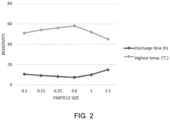
- Fig. 2 shows that the resistivity varies with different particle size, which ranges from 0.1 to 1.5 mm. The table shows that it has better discharging performance at particle size 0.1-0.6 mm.
- the conductivity increases when the particle size is getting larger. If the particle diameter is larger than about 1.0 mm, the effective contact area between the coke particles and the waste batteries reduces, as a result to have worse discharging performance.
- Experimental data shows that the coke powder with particle size within 1.5 mm achieves a good discharge effect, and the particle with size 0.25 -0.6 mm is preferred.
- the temperature during discharging can be lower than 60°C, which is a critical temperature for safety of discharging. It is better to have a high discharging rate under the safety temperature, which depends on the kinds and types of the waste battery.
- the discharging method is to wrap (immerse) the waste batteries in coke powder with a specific thickness, 5 - 10 cm proposed here, to form the discharging circuit, and watch the temperature variation or the voltage of the wastes batteries to know the discharging status to adjust the pressure on coke powder. It speeds up the discharging rate by increasing the pressure and slows down by decreasing the pressure on the coke powder.
- the discharging rate can be sensed by a temperature change trend of discharging. Fast discharging rate has a larger temperature change trend and slow discharging rate has a smaller temperature change trend. Therefore, the discharging rate can be controlled by adjusting the pressure on the coke powder according to the temperature change trend.
- Another method is to watch the voltage variation of the waste batteries during discharging and then to adjust the pressure according to the voltage variation.
- the (rise/drop) threshold of temperature change trend are set at ⁇ 2°C. It slows down the discharging rate if the temperature change trend is higher than 2°C, or it speeds up the discharging rate if the temperature change trend is lower than -2°C.
- the rise/drop threshold of the temperature change trend control the discharging rate of recycling the waste batteries during the discharge process.
- the stop condition of discharging includes abnormal condition and discharge-completed condition. If the temperature change trend rises and reaches a critical temperature, 60 °C in general, the discharging process stops and removes the pressure from the coke powder. The waste batteries discharge too fast to explode and to incur the risk of workplace safety. In general, the waste batteries will incur a risk of explosion if the discharging temperature is higher than 60 °C.
- the waste batteries discharge completely, and the pressure on coke powder can be removed and the waste batteries can be removed from the container.
- the coke powder can be reused as the discharging agent for recycling another batch of the waste batteries.
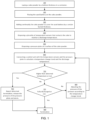
- FIG. 1 shows an embodiment, which is a schematic diagram of the discharge process, described below:
- the pressure adjustment can range between 0 and 2000N and the adjustment value in the embodiment is 500 Newtons (N) each time is listed in Table 2 below: Table 2 Temperature change ( ⁇ Ts) ⁇ Ts ⁇ 2°C ⁇ Ts ⁇ -2°C -2 ⁇ Ts ⁇ 2 pressure adjustment Decrease 500N Increase 500N No action
- the method can also apply for the semi-device discharging, and the maximum temperature and time to complete the discharging process are listed in Table 4 below: Table 4 Type of battery capacity (mAh) initial voltage (mV) discharging time (within 0.5V) (h) Maximum temperature (°C) Semi-device 2600 3910 24 45
- the device for discharging by the coke powder according to the present invention comprises a container, a temperature sensor and/or a voltage sensor, a pressure plate, and a control unit.
- the container used as carrying the coke powder and the waste battery used as carrying the coke powder and the waste battery.
- the temperature sensor(s) may be connected to the waste batteries, buried in coke powder near the waste batteries, inner wall of the container, or attached on the surface of one waste battery.
- the voltage sensor pair are attached on cathode and anode of the waste battery in a way, such through magnets.
- the pressure plate is disposed on the top of the container to apply a pressure on the coke powder to adjust the contact quality between the coke powder and the waste battery.
- the control unit connects to the temperature sensor(s) and/or the voltage sensor(s), and the pressure plate, and then the control unit is able to calculate a temperature change trend to adjust the pressure plate to adjust the pressure on the surface of the coke powder.
- the waste batteries comprise Li-ion, Ni-Cd, Zinc, Ni-MH... batteries, disposal (primary) or rechargeable (secondary) batteries, or single-cell or module batteries.
Landscapes
- Chemical & Material Sciences (AREA)
- Engineering & Computer Science (AREA)
- Chemical Kinetics & Catalysis (AREA)
- Electrochemistry (AREA)
- General Chemical & Material Sciences (AREA)
- Manufacturing & Machinery (AREA)
- Organic Chemistry (AREA)
- Life Sciences & Earth Sciences (AREA)
- Inorganic Chemistry (AREA)
- Sustainable Development (AREA)
- General Life Sciences & Earth Sciences (AREA)
- Geology (AREA)
- Materials Engineering (AREA)
- Environmental & Geological Engineering (AREA)
- Power Engineering (AREA)
- Secondary Cells (AREA)
- Processing Of Solid Wastes (AREA)
- Primary Cells (AREA)
- Manufacture And Refinement Of Metals (AREA)
Description
- The present invention relates to a discharging agent and method of recycling waste batteries, and especially relates to applying the coke powder as the discharging agent of recycling the waste batteries.
- A lot of lithium-ion batteries will generally be retired as power batteries for each year in the future 4-5 years. Before recycling the waste lithium-ion batteries, it is necessary to release the residual electric power of these batteries to meet the requirements of job safety and environment safety. There were known discharging methods, such as equipment discharging, brine discharging and graphite discharging.
- For equipment discharging, a waste battery is connected to a device and forms a discharging circuit to take the chemical energy off the battery. It needs to customize the discharging circuit for each type of battery, so it is very cost inefficient and hard to meet the requirements of industrial scale.
- For brine discharging, the waste batteries are immersed in alkali or acid solution to absorb the battery energy. The place near the cathode generates a lot of hydrogen and the brine solution contaminates the environment if it leaks, so it incurs the risk of environment safety.
- For graphite discharging, a kind of dry discharging, the graphite powder covers the batteries to be as the discharging agent. The waste batteries discharge fast because of the high conductivity of the graphite, and that incurs easily the risk of the public safety and environmental safety.
JP 2004 355954 A - For liquid nitrogen discharging, the waste batteries become inactive in the liquid nitrogen, in extra-low temperature, and then can be destroyed safely. The cost is very high due to the consumption of liquid nitrogen, so the industrial scale is limited.
- This paper proposes a discharging method and material for recycling the waste batteries to solve the issues of scale application, discharging efficient, workplace safety and environment safety.
- The coke powder, used as the discharging agent of the waste battery recycling, is a kind of material with rich carbon composition. In generally, the coke powder comprises carbon composition 65 to 99 wt%, ash composition 0.5 to 18%, volatile composition 0.5 to 3%, and water 0.5 to 13%. The coke powder, with an uncertain crystal structure, resistivity about 0.08 - 0.35 Ω.cm, specific heat capacity about 0.78- 1.5 kj / (kg • K), thermal conductivity 2.09 - 2.91 kj/(m • h • K) and grounded to have particle size from 0.1 to 0.6 mm, is used as the discharging agent in recycling waste batteries.
- The discharging method for waste battery recycling by using the coke powder comprises:
- (1) wrapping waste batteries in coke powder with thickness 5-10 cm in a container;
- (2) monitoring a temperature and/or a temperature trend during discharging;
- (3) adjusting a pressure on the coke powder, wherein the pressure adjustment is according to the temperature and/or the temperature trend by the way below:
- (a) to reduce the pressure if the temperature change trend is higher than a temperature rise threshold;
- (b) to increase the pressure if the temperature change trend is lower than a temperature drop threshold; and
- (c) to stop the pressure if a cutoff condition is reached.
- The method can also apply for the half-equipment discharging of the waste batteries by replacing the batteries by the half-equipment with batteries.
- Various embodiments are depicted in the accompanying drawings for illustrative purposes and should be not interpreted to limit the scope of the invention. Moreover, the scope of the patent should be defined according to the claims. Various features of different disclosed embodiments can be combined or de-combined to form additional embodiments, which are part of this disclosure.
-
Fig. 1 is a schematic diagram of the discharging process before recycling the waste batteries. -
Fig. 2 is a graph showing resistivity relative to particle size of the coke. - The coke powder generally comprises carbon composition 65 to 99 wt%, ash composition 0.5 to 18%, volatile composition 0.5 to 3%, water 0.5 to 13%, and has an uncertain crystal structure. Such coke powder is grounded and the size ranges 0.1 to 0.6 mm. The coke powder has a resistivity 0.08 - 0.35 Ω.cm, a specific heat capacity 0.78- 1.5 kj / (kg • K), and a thermal conductivity 2.09 - 2.91 kj/(m • h • K). The coke powder is used as the discharging agent for recycling the waste batteries in this invention. The carbon composition is the source of conductivity, and to adjust the ration of carbon composition can adjust the conductivity. Moreover, the inventor found that the conductivity can be controlled by adjust the pressure on the coke powder. The inventor uses the controllability to control the discharging performance in recycling waste batteries.
- In one embodiment of this invention, the coke powder, with resistivity about 0.08 to 0.35 Ω.cm, the thermal conductivity about 2.64kj / (m · h · k), is used. In a preferred embodiment, the resistivity of the coke powder is about 0.1 to 0.2 Ω.cm, and the carbon composition about 80 to 90%. Table 1 below shows the compositions of the coke powder (% by weight) of one embodiment:
Table 1 Carbon: 86∼91 Water : 3∼13 Quartz: 0.01∼1 Sulphur: 0.6∼0.8 Sodium monoxide: 0.01∼0.7 Calcium oxide: 0.01∼0.3 Magnesium oxide: 0.01∼0.3 Potassium oxide: 0.01∼0.2 Titanium Dioxide: 0.01∼0.2 Alumina: 0.2∼3 Iron oxide: 0.01∼2 Manganese oxide: 0.01∼0.02 - In general, the particle size of the coke is larger, and the resistivity is smaller, but the contact quality is worse, because the contact area of waste batteries and the coke powder is smaller. The resistivity (conductivity) and the contact quality are the main factors of discharging performance.
Fig. 2 shows that the resistivity varies with different particle size, which ranges from 0.1 to 1.5 mm. The table shows that it has better discharging performance at particle size 0.1-0.6 mm. - The conductivity increases when the particle size is getting larger. If the particle diameter is larger than about 1.0 mm, the effective contact area between the coke particles and the waste batteries reduces, as a result to have worse discharging performance. Experimental data shows that the coke powder with particle size within 1.5 mm achieves a good discharge effect, and the particle with size 0.25 -0.6 mm is preferred. Especially, the temperature during discharging can be lower than 60°C, which is a critical temperature for safety of discharging. It is better to have a high discharging rate under the safety temperature, which depends on the kinds and types of the waste battery.
- The discharging method is to wrap (immerse) the waste batteries in coke powder with a specific thickness, 5 - 10 cm proposed here, to form the discharging circuit, and watch the temperature variation or the voltage of the wastes batteries to know the discharging status to adjust the pressure on coke powder. It speeds up the discharging rate by increasing the pressure and slows down by decreasing the pressure on the coke powder. The discharging rate can be sensed by a temperature change trend of discharging. Fast discharging rate has a larger temperature change trend and slow discharging rate has a smaller temperature change trend. Therefore, the discharging rate can be controlled by adjusting the pressure on the coke powder according to the temperature change trend. Another method is to watch the voltage variation of the waste batteries during discharging and then to adjust the pressure according to the voltage variation.
- In some embodiments, the (rise/drop) threshold of temperature change trend are set at ±2°C. It slows down the discharging rate if the temperature change trend is higher than 2°C, or it speeds up the discharging rate if the temperature change trend is lower than -2°C. The rise/drop threshold of the temperature change trend control the discharging rate of recycling the waste batteries during the discharge process.
- The stop condition of discharging includes abnormal condition and discharge-completed condition. If the temperature change trend rises and reaches a critical temperature, 60 °C in general, the discharging process stops and removes the pressure from the coke powder. The waste batteries discharge too fast to explode and to incur the risk of workplace safety. In general, the waste batteries will incur a risk of explosion if the discharging temperature is higher than 60 °C.
- If the temperature approaches to the temperature of environment and/or the voltage of the waste batteries is lower 1 volt, the waste batteries discharge completely, and the pressure on coke powder can be removed and the waste batteries can be removed from the container. The coke powder can be reused as the discharging agent for recycling another batch of the waste batteries.
-
FIG. 1 shows an embodiment, which is a schematic diagram of the discharge process, described below: - step 100: laying coke powder by a bottom thickness, for example 5 -10cm, in a container;
- step 200: placing the waste batteries on the coke powder;
- step 300: laying continually the coke powder on the waste batteries by a certain buried thickness, for example 5 -10cm;
- step 400: monitoring discharging a temperature and/or a residual voltage of the waste batteries by temperature sensor(s) and/or voltage sensor(s);
- step 500: disposing a pressure plate on the coke powder;
- step 600: calculating a temperature change trend;
- step 710: determining the status of discharging is abnormal,
- step 720: determining the status of discharge-completed, or
- step 800: adjusting the pressure on the coke powder according to the temperature change trend;
- step 910: releasing the pressure on coke powder if abnormal or discharge-completed; and
- step 900: terminating the discharging.
- In one embodiment, the pressure adjustment can range between 0 and 2000N and the adjustment value in the embodiment is 500 Newtons (N) each time is listed in Table 2 below:
Table 2 Temperature change (ΔTs) ΔTs ≥ 2°C ΔTs≤ -2°C -2<ΔTs<2 pressure adjustment Decrease 500N Increase 500N No action - There are several ways to determine the completion of discharged batteries:
- (1) The first is the temperature determination: when the battery discharging temperature gradually drops to the vicinity of the environment temperature. For example, difference between battery temperature and ambient temperature ≤ 3 ° C.
- (2) The second method is voltage determination: when voltage of the waste batteries drops into below 1 volt. In this embodiment, the critical voltage is set at 0.5V.
- The maximum temperature and the time to complete the discharging process for different batteries are listed in the Table 3 below:
Table 3 Type of battery capacity (mAh) initial voltage (mV) discharging time (within 0.5V) (h) Maximum temperature(°C) MnNiCo ternary battery 18650 2600 4100 9 50 MnNiCo ternary battery 18650 3400 4050 7.5 56 Lithium iron battery 32700 6000 3300 11.5 46 - The method can also apply for the semi-device discharging, and the maximum temperature and time to complete the discharging process are listed in Table 4 below:
Table 4 Type of battery capacity (mAh) initial voltage (mV) discharging time (within 0.5V) (h) Maximum temperature (°C) Semi-device 2600 3910 24 45 - To complete discharging process for the waste battery (3400mAh 18650), the discharging time and the maximum temperature for different particle of the coke powder are shown in Table 5:
Table 5 Particle diameter (mm) 0.1 0.15 0.25 0.6 1 1.5 Discharge time (h) 10.5 9.2 8.3 7.5 10 15 Maximum temperature (°C) 51 54 56 58 52 45 - The device for discharging by the coke powder according to the present invention comprises a container, a temperature sensor and/or a voltage sensor, a pressure plate, and a control unit.
- The container used as carrying the coke powder and the waste battery.
- The temperature sensor(s) may be connected to the waste batteries, buried in coke powder near the waste batteries, inner wall of the container, or attached on the surface of one waste battery. The voltage sensor pair are attached on cathode and anode of the waste battery in a way, such through magnets.
- The pressure plate is disposed on the top of the container to apply a pressure on the coke powder to adjust the contact quality between the coke powder and the waste battery.
- The control unit connects to the temperature sensor(s) and/or the voltage sensor(s), and the pressure plate, and then the control unit is able to calculate a temperature change trend to adjust the pressure plate to adjust the pressure on the surface of the coke powder.
- The waste batteries comprise Li-ion, Ni-Cd, Zinc, Ni-MH... batteries, disposal (primary) or rechargeable (secondary) batteries, or single-cell or module batteries.
- The embodiments described above are merely illustrative of the technical spirit and features of the present disclosure and are intended to enable those skilled in the art to understand the present disclosure and exploit the present disclosure.
Claims (16)
- A discharging method for recycling waste batteries, comprising:wrapping waste batteries in coke powder with a wrap thickness in a container to form a discharging circuit between cathode and anode of the waste batteries, wherein the coke powder comprises a carbon composition 65 - 99 wt%, an ash composition 0.5 - 18%, a volatile composition 0.5 - 3%, a water composition 0.5 - 13%, and the coke powder has a resistivity 0.08 - 0.35 Ω.cm, a specific heat capacity 0.78- 1.5 kj / (kg • K), a thermal conductivity 2.09 - 2.91 kj/(m • h • K), and a particle size 0.1 - 0.6 mm;monitoring a temperature and a temperature trend during discharging;adjusting a pressure on the coke powder to adjust the discharging rate according to the temperature or the temperature trend in the way:to reduce the pressure if the temperature change trend is higher than a temperature rise threshold;to increase the pressure if the temperature change trend is lower than a temperature drop threshold;to keep the pressure if the temperature change trend is between the temperature drop threshold and the temperature rise threshold; andto stop the pressure if a cutoff condition is reached.
- The discharging method for recycling waste batteries according to claim 1, wherein the wrap thickness is 5 - 10 cm.
- The discharging method for recycling waste batteries according to claim 1, wherein the step of adjusting the pressure is to adjust a pressure plate on a surface of the coke powder.
- The discharging method for recycling waste batteries according to claim 1, wherein the rise threshold is 2°C.
- The discharging method for recycling waste batteries according to claim 1, wherein the drop threshold is -2°C.
- The discharging method for recycling waste batteries according to claim 1, wherein the cutoff condition is an abnormal condition, that the discharging temperature has reached a specific temperature and the temperature change trend continues to rise.
- The discharging method for recycling waste batteries according to claim 6, wherein the specific temperature is 60°C.
- The discharging method for recycling waste batteries according to claim 1, wherein the cutoff condition is a discharge-completed condition, that the discharging temperature has dropped into a specific vicinity of an environment temperature.
- The discharging method for recycling waste batteries according to claim 8, wherein the specific vicinity is 3°C.
- The discharging method for recycling waste batteries according to claim 1, wherein the cutoff condition is a discharge-completed condition, that a maximum voltage of the waste batteries has been lower than a critical voltage.
- The discharging method for recycling waste batteries according to claim 10, wherein the critical voltage is 0.5 - 1 volt.
- The discharging method for recycling waste batteries according to claim 1, wherein the waste batteries are disposable (primary batteries) or rechargeable (secondary batteries).
- The discharging method for recycling waste batteries according to claim 1, wherein the waste batteries comprise lithium-ion batteries.
- The discharging method for recycling waste batteries according to claim 1, wherein the waste batteries are single-cell batteries.
- The discharging method for recycling waste batteries according to claim 1, wherein the step of wrapping the waste batteries comprises:laying a coke powder by a bottom thickness in a container;placing at least a waste battery on the coke powder; andplacing continually the coke powder to the waste batteries by a buried thickness, wherein the bottom thickness and the buried thickness are 5-10 cm.
- The discharging method for recycling waste batteries according to claim 1, wherein the carbon composition of the coke powder is 80 - 90 wt%.
Applications Claiming Priority (2)
| Application Number | Priority Date | Filing Date | Title |
|---|---|---|---|
| US16/731,843 US11121418B2 (en) | 2019-12-31 | 2019-12-31 | Coke powder as a discharging agent for waste battery recycling and method thereof |
| PCT/US2020/018373 WO2021137880A1 (en) | 2019-12-31 | 2020-02-14 | Coke powder as a discharging agent for waste battery recycling and method thereof |
Related Child Applications (1)
| Application Number | Title | Priority Date | Filing Date |
|---|---|---|---|
| EP24185612.9 Division-Into | 2024-07-01 |
Publications (4)
| Publication Number | Publication Date |
|---|---|
| EP4082066A1 EP4082066A1 (en) | 2022-11-02 |
| EP4082066A4 EP4082066A4 (en) | 2023-09-13 |
| EP4082066C0 EP4082066C0 (en) | 2024-08-07 |
| EP4082066B1 true EP4082066B1 (en) | 2024-08-07 |
Family
ID=76545687
Family Applications (1)
| Application Number | Title | Priority Date | Filing Date |
|---|---|---|---|
| EP20910714.3A Active EP4082066B1 (en) | 2019-12-31 | 2020-02-14 | Coke powder as a discharging agent for waste battery recycling and method thereof |
Country Status (7)
| Country | Link |
|---|---|
| US (1) | US11121418B2 (en) |
| EP (1) | EP4082066B1 (en) |
| JP (1) | JP7295596B2 (en) |
| KR (1) | KR102510249B1 (en) |
| GB (1) | GB2606108B (en) |
| TW (1) | TWI753719B (en) |
| WO (1) | WO2021137880A1 (en) |
Cited By (1)
| Publication number | Priority date | Publication date | Assignee | Title |
|---|---|---|---|---|
| EP4276972A4 (en) * | 2021-01-13 | 2025-01-08 | Meimei Chen | SAFE DISCHARGE PROCESS FOR USED LITHIUM-ION BATTERY |
Families Citing this family (15)
| Publication number | Priority date | Publication date | Assignee | Title |
|---|---|---|---|---|
| CN115084700B (en) * | 2022-06-27 | 2024-06-04 | 中南大学 | A kind of heat-sensitive discharge particle and safe discharge method of waste lithium-ion battery |
| ES2976336B2 (en) | 2022-07-21 | 2025-10-06 | Guangdong Brunp Recycling Technology Co Ltd | Device for efficiently pretreating and recycling a waste battery |
| CN115415283B (en) * | 2022-07-21 | 2023-05-09 | 广东邦普循环科技有限公司 | Efficient pretreatment recovery equipment for waste batteries |
| CN115189056A (en) * | 2022-07-25 | 2022-10-14 | 广州工业智能研究院 | Control method, device and system for safe discharge of retired battery |
| CN115365269A (en) * | 2022-08-26 | 2022-11-22 | 甘肃东兴铝业有限公司 | Method for treating electrolytic aluminum waste material |
| FR3144416A1 (en) * | 2022-12-21 | 2024-06-28 | Commissariat A L'energie Atomique Et Aux Energies Alternatives | Inerting process for electrochemical accumulator |
| KR20240098443A (en) * | 2022-12-21 | 2024-06-28 | 주식회사 포스코 | Method of disposal waste battery |
| CN116683074A (en) * | 2023-03-29 | 2023-09-01 | 江苏正力新能电池技术有限公司 | Method and device for recovering pole piece powder |
| KR102732272B1 (en) * | 2023-08-07 | 2024-11-19 | 에스케이에코플랜트(주) | Waste battery discharge method |
| CN116759687B (en) * | 2023-08-17 | 2023-12-15 | 深圳市杰成镍钴新能源科技有限公司 | Discharging device of retired battery based on discharging particles |
| CN116885329B (en) * | 2023-09-07 | 2023-12-29 | 深圳市杰成镍钴新能源科技有限公司 | Battery discharging device and battery discharging control method |
| CN116914292B (en) * | 2023-09-11 | 2023-12-08 | 深圳市杰成镍钴新能源科技有限公司 | Optimization method and device for discharge state of retired battery based on conductive particles |
| CN116914294B (en) * | 2023-09-14 | 2023-12-29 | 深圳市杰成镍钴新能源科技有限公司 | Conductive particle-based rapid discharge method, device and related equipment for decommissioned batteries |
| KR20250101048A (en) | 2023-12-27 | 2025-07-04 | (주)포스코이앤씨 | Apparatus and method for discharging used battery |
| CN117878455B (en) * | 2024-03-13 | 2024-05-14 | 深圳市杰成镍钴新能源科技有限公司 | A method for optimizing the discharge state of retired batteries and related devices |
Family Cites Families (14)
| Publication number | Priority date | Publication date | Assignee | Title |
|---|---|---|---|---|
| JPH08306394A (en) * | 1995-04-28 | 1996-11-22 | Ricoh Co Ltd | How to dispose of used batteries |
| WO2004093222A1 (en) * | 2003-04-07 | 2004-10-28 | University Of Hawaii | Carbonized charcoal electrode |
| JP2004355954A (en) * | 2003-05-29 | 2004-12-16 | Sumitomo Metal Mining Co Ltd | Waste battery treatment method |
| JP2005347162A (en) * | 2004-06-04 | 2005-12-15 | Nec Tokin Tochigi Ltd | Discharge method of discarded battery |
| DE102008053690A1 (en) * | 2008-10-29 | 2010-06-24 | 3V Consulting Gmbh | Method and device for recycling an electrochemical energy store |
| JP5352325B2 (en) * | 2009-04-09 | 2013-11-27 | トヨタ自動車株式会社 | Power storage device and method for discharging power storage device |
| JP2012033344A (en) * | 2010-07-29 | 2012-02-16 | Sumitomo Metal Mining Co Ltd | Processing method of battery pack |
| CA2752844A1 (en) * | 2011-09-19 | 2013-03-19 | Hydro-Quebec | Method for preparing a particulate of si or siox-based anode material, and material thus obtained |
| KR101833972B1 (en) * | 2015-12-24 | 2018-03-02 | 주식회사 포스코 | Manufacturing method of graphite material for rechargeable battery |
| CN106816663B (en) * | 2017-02-24 | 2020-09-08 | 中南大学 | A method for efficient and safe discharge of waste lithium-ion batteries |
| JP6847716B2 (en) * | 2017-03-09 | 2021-03-24 | 太平洋セメント株式会社 | Discharging method and processing method of waste lithium-ion batteries |
| CN108134154B (en) * | 2018-01-12 | 2019-12-17 | 深圳市比克电池有限公司 | Safe disassembly method for waste lithium ion battery |
| CN109103534B (en) * | 2018-08-08 | 2020-05-29 | 广东佳纳能源科技有限公司 | Recovery method of waste cobalt-containing lithium ion battery |
| JP2020184487A (en) * | 2019-05-09 | 2020-11-12 | パナソニックIpマネジメント株式会社 | Recovering method for positive electrode material for lithium-ion battery |
-
2019
- 2019-12-31 US US16/731,843 patent/US11121418B2/en active Active
-
2020
- 2020-02-14 GB GB2210139.8A patent/GB2606108B/en active Active
- 2020-02-14 KR KR1020227023714A patent/KR102510249B1/en active Active
- 2020-02-14 EP EP20910714.3A patent/EP4082066B1/en active Active
- 2020-02-14 JP JP2022540946A patent/JP7295596B2/en active Active
- 2020-02-14 WO PCT/US2020/018373 patent/WO2021137880A1/en not_active Ceased
- 2020-12-24 TW TW109145932A patent/TWI753719B/en active
Cited By (1)
| Publication number | Priority date | Publication date | Assignee | Title |
|---|---|---|---|---|
| EP4276972A4 (en) * | 2021-01-13 | 2025-01-08 | Meimei Chen | SAFE DISCHARGE PROCESS FOR USED LITHIUM-ION BATTERY |
Also Published As
| Publication number | Publication date |
|---|---|
| GB202210139D0 (en) | 2022-08-24 |
| US20210203017A1 (en) | 2021-07-01 |
| EP4082066C0 (en) | 2024-08-07 |
| TW202133485A (en) | 2021-09-01 |
| JP2023502147A (en) | 2023-01-20 |
| TWI753719B (en) | 2022-01-21 |
| WO2021137880A1 (en) | 2021-07-08 |
| KR102510249B1 (en) | 2023-03-14 |
| GB2606108A (en) | 2022-10-26 |
| KR20220103815A (en) | 2022-07-22 |
| GB2606108B (en) | 2023-06-07 |
| EP4082066A1 (en) | 2022-11-02 |
| JP7295596B2 (en) | 2023-06-21 |
| US11121418B2 (en) | 2021-09-14 |
| EP4082066A4 (en) | 2023-09-13 |
Similar Documents
| Publication | Publication Date | Title |
|---|---|---|
| EP4082066B1 (en) | Coke powder as a discharging agent for waste battery recycling and method thereof | |
| US9531001B2 (en) | Battery cell with flexible wireless temperature sensor | |
| EP4276972A1 (en) | Safe discharging method for waste lithium-ion battery | |
| EP1020944A3 (en) | Lithium secondary battery, and process for producing the same | |
| US20180248160A1 (en) | Battery pack comprising fire extinguishing device, and control method using same | |
| KR20170050926A (en) | A secondary battery, secondary battery charging system and secondary battery production method to prevent battery cell swelling by detecting a displacement of gas venting unit | |
| TW200707821A (en) | Method and apparatus of controlling for charging/discharging voltage of battery | |
| WO2014147973A1 (en) | Secondary battery charging system and method, and battery pack | |
| CN207834423U (en) | A lithium battery explosion-proof case | |
| US20110115440A1 (en) | Secondary battery charge method and battery charger | |
| CN204720522U (en) | A kind of lithium polymer battery | |
| JP2010205479A (en) | All-solid battery employing power compact | |
| KR20180010349A (en) | Battery with internal phase change materials | |
| CN103197248A (en) | Method and device for detecting electric quantity of robot storage battery | |
| JP2004355954A (en) | Waste battery treatment method | |
| EP4152475A1 (en) | Secondary battery safety management device and method | |
| US20230275256A1 (en) | Electrochemical cell clamps and related methods | |
| KR20140085764A (en) | Sodium-sulfur rechargeable battery and module using the same | |
| JP2017531300A (en) | Storage and / or transport of sodium ion cells | |
| KR101539788B1 (en) | Battery case and Pouch type secondary battery | |
| JP5303827B2 (en) | Portable device | |
| JP4900454B2 (en) | Battery device | |
| US20150311528A1 (en) | Battery Cell and Method of Operating the Same | |
| KR20130134947A (en) | Pouch for secondary battery and secondary battery using the same | |
| JP2018120758A (en) | Lithium ion battery and lithium ion battery system |
Legal Events
| Date | Code | Title | Description |
|---|---|---|---|
| STAA | Information on the status of an ep patent application or granted ep patent |
Free format text: STATUS: THE INTERNATIONAL PUBLICATION HAS BEEN MADE |
|
| PUAI | Public reference made under article 153(3) epc to a published international application that has entered the european phase |
Free format text: ORIGINAL CODE: 0009012 |
|
| STAA | Information on the status of an ep patent application or granted ep patent |
Free format text: STATUS: REQUEST FOR EXAMINATION WAS MADE |
|
| 17P | Request for examination filed |
Effective date: 20220727 |
|
| AK | Designated contracting states |
Kind code of ref document: A1 Designated state(s): AL AT BE BG CH CY CZ DE DK EE ES FI FR GB GR HR HU IE IS IT LI LT LU LV MC MK MT NL NO PL PT RO RS SE SI SK SM TR |
|
| DAV | Request for validation of the european patent (deleted) | ||
| DAX | Request for extension of the european patent (deleted) | ||
| RIC1 | Information provided on ipc code assigned before grant |
Ipc: H01M 10/0525 20100101ALN20230503BHEP Ipc: C01B 32/00 20170101ALI20230503BHEP Ipc: H01M 6/52 20060101ALI20230503BHEP Ipc: H01M 50/569 20210101ALI20230503BHEP Ipc: H01M 10/54 20060101ALI20230503BHEP Ipc: H01M 10/48 20060101ALI20230503BHEP Ipc: H01M 10/44 20060101AFI20230503BHEP |
|
| STAA | Information on the status of an ep patent application or granted ep patent |
Free format text: STATUS: EXAMINATION IS IN PROGRESS |
|
| A4 | Supplementary search report drawn up and despatched |
Effective date: 20230816 |
|
| RIC1 | Information provided on ipc code assigned before grant |
Ipc: H01M 10/0525 20100101ALN20230809BHEP Ipc: C01B 32/00 20170101ALI20230809BHEP Ipc: H01M 6/52 20060101ALI20230809BHEP Ipc: H01M 50/569 20210101ALI20230809BHEP Ipc: H01M 10/54 20060101ALI20230809BHEP Ipc: H01M 10/48 20060101ALI20230809BHEP Ipc: H01M 10/44 20060101AFI20230809BHEP |
|
| 17Q | First examination report despatched |
Effective date: 20230828 |
|
| GRAP | Despatch of communication of intention to grant a patent |
Free format text: ORIGINAL CODE: EPIDOSNIGR1 |
|
| STAA | Information on the status of an ep patent application or granted ep patent |
Free format text: STATUS: GRANT OF PATENT IS INTENDED |
|
| RIC1 | Information provided on ipc code assigned before grant |
Ipc: H01M 10/0525 20100101ALN20240228BHEP Ipc: C01B 32/00 20170101ALI20240228BHEP Ipc: H01M 6/52 20060101ALI20240228BHEP Ipc: H01M 50/569 20210101ALI20240228BHEP Ipc: H01M 10/54 20060101ALI20240228BHEP Ipc: H01M 10/48 20060101ALI20240228BHEP Ipc: H01M 10/44 20060101AFI20240228BHEP |
|
| INTG | Intention to grant announced |
Effective date: 20240314 |
|
| GRAS | Grant fee paid |
Free format text: ORIGINAL CODE: EPIDOSNIGR3 |
|
| GRAA | (expected) grant |
Free format text: ORIGINAL CODE: 0009210 |
|
| STAA | Information on the status of an ep patent application or granted ep patent |
Free format text: STATUS: THE PATENT HAS BEEN GRANTED |
|
| AK | Designated contracting states |
Kind code of ref document: B1 Designated state(s): AL AT BE BG CH CY CZ DE DK EE ES FI FR GB GR HR HU IE IS IT LI LT LU LV MC MK MT NL NO PL PT RO RS SE SI SK SM TR |
|
| REG | Reference to a national code |
Ref country code: GB Ref legal event code: FG4D |
|
| REG | Reference to a national code |
Ref country code: CH Ref legal event code: EP |
|
| REG | Reference to a national code |
Ref country code: DE Ref legal event code: R096 Ref document number: 602020035553 Country of ref document: DE |
|
| REG | Reference to a national code |
Ref country code: IE Ref legal event code: FG4D |
|
| U01 | Request for unitary effect filed |
Effective date: 20240905 |
|
| U07 | Unitary effect registered |
Designated state(s): AT BE BG DE DK EE FI FR IT LT LU LV MT NL PT RO SE SI Effective date: 20241025 |
|
| U20 | Renewal fee for the european patent with unitary effect paid |
Year of fee payment: 6 Effective date: 20241202 |
|
| PG25 | Lapsed in a contracting state [announced via postgrant information from national office to epo] |
Ref country code: NO Free format text: LAPSE BECAUSE OF FAILURE TO SUBMIT A TRANSLATION OF THE DESCRIPTION OR TO PAY THE FEE WITHIN THE PRESCRIBED TIME-LIMIT Effective date: 20241107 |
|
| PG25 | Lapsed in a contracting state [announced via postgrant information from national office to epo] |
Ref country code: PL Free format text: LAPSE BECAUSE OF FAILURE TO SUBMIT A TRANSLATION OF THE DESCRIPTION OR TO PAY THE FEE WITHIN THE PRESCRIBED TIME-LIMIT Effective date: 20240807 Ref country code: GR Free format text: LAPSE BECAUSE OF FAILURE TO SUBMIT A TRANSLATION OF THE DESCRIPTION OR TO PAY THE FEE WITHIN THE PRESCRIBED TIME-LIMIT Effective date: 20241108 |
|
| PG25 | Lapsed in a contracting state [announced via postgrant information from national office to epo] |
Ref country code: IS Free format text: LAPSE BECAUSE OF FAILURE TO SUBMIT A TRANSLATION OF THE DESCRIPTION OR TO PAY THE FEE WITHIN THE PRESCRIBED TIME-LIMIT Effective date: 20241207 |
|
| PG25 | Lapsed in a contracting state [announced via postgrant information from national office to epo] |
Ref country code: HR Free format text: LAPSE BECAUSE OF FAILURE TO SUBMIT A TRANSLATION OF THE DESCRIPTION OR TO PAY THE FEE WITHIN THE PRESCRIBED TIME-LIMIT Effective date: 20240807 |
|
| PG25 | Lapsed in a contracting state [announced via postgrant information from national office to epo] |
Ref country code: ES Free format text: LAPSE BECAUSE OF FAILURE TO SUBMIT A TRANSLATION OF THE DESCRIPTION OR TO PAY THE FEE WITHIN THE PRESCRIBED TIME-LIMIT Effective date: 20240807 Ref country code: RS Free format text: LAPSE BECAUSE OF FAILURE TO SUBMIT A TRANSLATION OF THE DESCRIPTION OR TO PAY THE FEE WITHIN THE PRESCRIBED TIME-LIMIT Effective date: 20241107 |
|
| PG25 | Lapsed in a contracting state [announced via postgrant information from national office to epo] |
Ref country code: RS Free format text: LAPSE BECAUSE OF FAILURE TO SUBMIT A TRANSLATION OF THE DESCRIPTION OR TO PAY THE FEE WITHIN THE PRESCRIBED TIME-LIMIT Effective date: 20241107 Ref country code: PL Free format text: LAPSE BECAUSE OF FAILURE TO SUBMIT A TRANSLATION OF THE DESCRIPTION OR TO PAY THE FEE WITHIN THE PRESCRIBED TIME-LIMIT Effective date: 20240807 Ref country code: NO Free format text: LAPSE BECAUSE OF FAILURE TO SUBMIT A TRANSLATION OF THE DESCRIPTION OR TO PAY THE FEE WITHIN THE PRESCRIBED TIME-LIMIT Effective date: 20241107 Ref country code: IS Free format text: LAPSE BECAUSE OF FAILURE TO SUBMIT A TRANSLATION OF THE DESCRIPTION OR TO PAY THE FEE WITHIN THE PRESCRIBED TIME-LIMIT Effective date: 20241207 Ref country code: HR Free format text: LAPSE BECAUSE OF FAILURE TO SUBMIT A TRANSLATION OF THE DESCRIPTION OR TO PAY THE FEE WITHIN THE PRESCRIBED TIME-LIMIT Effective date: 20240807 Ref country code: GR Free format text: LAPSE BECAUSE OF FAILURE TO SUBMIT A TRANSLATION OF THE DESCRIPTION OR TO PAY THE FEE WITHIN THE PRESCRIBED TIME-LIMIT Effective date: 20241108 Ref country code: ES Free format text: LAPSE BECAUSE OF FAILURE TO SUBMIT A TRANSLATION OF THE DESCRIPTION OR TO PAY THE FEE WITHIN THE PRESCRIBED TIME-LIMIT Effective date: 20240807 |
|
| PG25 | Lapsed in a contracting state [announced via postgrant information from national office to epo] |
Ref country code: SM Free format text: LAPSE BECAUSE OF FAILURE TO SUBMIT A TRANSLATION OF THE DESCRIPTION OR TO PAY THE FEE WITHIN THE PRESCRIBED TIME-LIMIT Effective date: 20240807 |
|
| PG25 | Lapsed in a contracting state [announced via postgrant information from national office to epo] |
Ref country code: CZ Free format text: LAPSE BECAUSE OF FAILURE TO SUBMIT A TRANSLATION OF THE DESCRIPTION OR TO PAY THE FEE WITHIN THE PRESCRIBED TIME-LIMIT Effective date: 20240807 |
|
| PG25 | Lapsed in a contracting state [announced via postgrant information from national office to epo] |
Ref country code: SK Free format text: LAPSE BECAUSE OF FAILURE TO SUBMIT A TRANSLATION OF THE DESCRIPTION OR TO PAY THE FEE WITHIN THE PRESCRIBED TIME-LIMIT Effective date: 20240807 |
|
| PLBE | No opposition filed within time limit |
Free format text: ORIGINAL CODE: 0009261 |
|
| STAA | Information on the status of an ep patent application or granted ep patent |
Free format text: STATUS: NO OPPOSITION FILED WITHIN TIME LIMIT |
|
| 26N | No opposition filed |
Effective date: 20250508 |
|
| PG25 | Lapsed in a contracting state [announced via postgrant information from national office to epo] |
Ref country code: MC Free format text: LAPSE BECAUSE OF FAILURE TO SUBMIT A TRANSLATION OF THE DESCRIPTION OR TO PAY THE FEE WITHIN THE PRESCRIBED TIME-LIMIT Effective date: 20240807 |
|
| REG | Reference to a national code |
Ref country code: CH Ref legal event code: PL |
|
| PG25 | Lapsed in a contracting state [announced via postgrant information from national office to epo] |
Ref country code: CH Free format text: LAPSE BECAUSE OF NON-PAYMENT OF DUE FEES Effective date: 20250228 |
|
| GBPC | Gb: european patent ceased through non-payment of renewal fee |
Effective date: 20250214 |
|
| PG25 | Lapsed in a contracting state [announced via postgrant information from national office to epo] |
Ref country code: GB Free format text: LAPSE BECAUSE OF NON-PAYMENT OF DUE FEES Effective date: 20250214 |
|
| PG25 | Lapsed in a contracting state [announced via postgrant information from national office to epo] |
Ref country code: IE Free format text: LAPSE BECAUSE OF NON-PAYMENT OF DUE FEES Effective date: 20250214 |
|
| U20 | Renewal fee for the european patent with unitary effect paid |
Year of fee payment: 7 Effective date: 20251229 |