EP4080487A1 - Gerät zum trainieren und direkten üben von techniken zur selbstpalpation der brust - Google Patents
Gerät zum trainieren und direkten üben von techniken zur selbstpalpation der brust Download PDFInfo
- Publication number
- EP4080487A1 EP4080487A1 EP20901878.7A EP20901878A EP4080487A1 EP 4080487 A1 EP4080487 A1 EP 4080487A1 EP 20901878 A EP20901878 A EP 20901878A EP 4080487 A1 EP4080487 A1 EP 4080487A1
- Authority
- EP
- European Patent Office
- Prior art keywords
- flexible body
- platform
- self
- training
- breast
- Prior art date
- Legal status (The legal status is an assumption and is not a legal conclusion. Google has not performed a legal analysis and makes no representation as to the accuracy of the status listed.)
- Granted
Links
Images







Classifications
-
- G—PHYSICS
- G09—EDUCATION; CRYPTOGRAPHY; DISPLAY; ADVERTISING; SEALS
- G09B—EDUCATIONAL OR DEMONSTRATION APPLIANCES; APPLIANCES FOR TEACHING, OR COMMUNICATING WITH, THE BLIND, DEAF OR MUTE; MODELS; PLANETARIA; GLOBES; MAPS; DIAGRAMS
- G09B23/00—Models for scientific, medical, or mathematical purposes, e.g. full-sized devices for demonstration purposes
- G09B23/28—Models for scientific, medical, or mathematical purposes, e.g. full-sized devices for demonstration purposes for medicine
- G09B23/30—Anatomical models
-
- G—PHYSICS
- G09—EDUCATION; CRYPTOGRAPHY; DISPLAY; ADVERTISING; SEALS
- G09B—EDUCATIONAL OR DEMONSTRATION APPLIANCES; APPLIANCES FOR TEACHING, OR COMMUNICATING WITH, THE BLIND, DEAF OR MUTE; MODELS; PLANETARIA; GLOBES; MAPS; DIAGRAMS
- G09B23/00—Models for scientific, medical, or mathematical purposes, e.g. full-sized devices for demonstration purposes
- G09B23/28—Models for scientific, medical, or mathematical purposes, e.g. full-sized devices for demonstration purposes for medicine
- G09B23/30—Anatomical models
- G09B23/303—Anatomical models specially adapted to simulate circulation of bodily fluids
-
- G—PHYSICS
- G09—EDUCATION; CRYPTOGRAPHY; DISPLAY; ADVERTISING; SEALS
- G09B—EDUCATIONAL OR DEMONSTRATION APPLIANCES; APPLIANCES FOR TEACHING, OR COMMUNICATING WITH, THE BLIND, DEAF OR MUTE; MODELS; PLANETARIA; GLOBES; MAPS; DIAGRAMS
- G09B23/00—Models for scientific, medical, or mathematical purposes, e.g. full-sized devices for demonstration purposes
- G09B23/28—Models for scientific, medical, or mathematical purposes, e.g. full-sized devices for demonstration purposes for medicine
- G09B23/30—Anatomical models
- G09B23/32—Anatomical models with moving parts
-
- G—PHYSICS
- G09—EDUCATION; CRYPTOGRAPHY; DISPLAY; ADVERTISING; SEALS
- G09B—EDUCATIONAL OR DEMONSTRATION APPLIANCES; APPLIANCES FOR TEACHING, OR COMMUNICATING WITH, THE BLIND, DEAF OR MUTE; MODELS; PLANETARIA; GLOBES; MAPS; DIAGRAMS
- G09B23/00—Models for scientific, medical, or mathematical purposes, e.g. full-sized devices for demonstration purposes
- G09B23/28—Models for scientific, medical, or mathematical purposes, e.g. full-sized devices for demonstration purposes for medicine
- G09B23/30—Anatomical models
- G09B23/34—Anatomical models with removable parts
Definitions
- the invention that is the subject matter of this Patent of Invention application is applicable in the technical field of health and also in public health. More specifically, it is a device for training and direct practice of breast self-palpation techniques for early detection of breast cancer, which allows learning to distinguish abnormal tissue, allows its use at home, provides means to perform the self-examination itself in a real way and facilitates the formation of a habit of self-examination.
- breast cancer is the most common cancer in women worldwide in both developed and developing countries, accounting for 16% of all female cancers.
- mammography is the only screening method that has been found to be effective. Being a complex technique that requires a lot of resources to be executed, its application in low- and middle-income countries is restricted.
- the World Health Organization indicates that regardless of the early detection method used, two essential aspects for success are having a well-organized and sustainable program that focuses on the appropriate population group and guarantees coordination, continuity and quality of interventions throughout the care continuum.
- Patent US4001951 by Wolfgang G. Fasse, 1977 which provides a training device comprised of a body of elastomeric material that has the shape of a breast, including an element similar to the nipple, which has internal elements that resemble one or more tumors made of plastic and filled with a flexible material, also comprising means that allow the internal volume to be modified to adjust or simulate different densities or firmness of the tissue.
- This device has the virtue of being made of low cost materials in order to be widely used, but it has the disadvantage of not being an element of daily use, since its exclusive function of training and self-training requires that its use be taught by a doctor and that finally is transformed into an object that requires a space and a time of use not ensuring its frequent use.
- the Patent US4134218 of MAMMATHETICS Corporation of 1979 shows a model that is composed of a silicone rubber membrane that simulates the skin, an elastomeric filling medium such as silicone, which exhibits irregularities in order to simulate connective tissue and adiposities with other membranes containing simulated tumors made of other materials but that are connected to conductive elements that, when pressed, carry an electrical signal proportional to a computer system, which allows feedback during training.
- Having computational support makes it uneconomical and difficult to massify it, although it can be used to train health professionals in the palpation method to examine patients and can be particularly useful for training women in self-palpation at some specific center, it does not solve the problem of carrying out frequent and daily self-examination.
- Patent Application US2004180314 of VERITE Inc shows an element that simulates a female breast in shape and appearance including a nipple and areola, made of some flexible material such as silicone and filled with a rubber sponge in which small pieces of materials such as plastic or metal simulating nodules are placed having a resistant and rigid body base larger than the diameter of the simulated breast in order to use part of the space to place an element such as a label with instructions of use and also leave an area available for use with a clamping mechanism at the top, particularly one that allows the assembly by means of suction to adhere it to the walls of a shower or in the bedroom.
- a nipple and areola made of some flexible material such as silicone and filled with a rubber sponge in which small pieces of materials such as plastic or metal simulating nodules are placed having a resistant and rigid body base larger than the diameter of the simulated breast in order to use part of the space to place an element such as a label with instructions of use and also leave an area available for use with a clamping mechanism
- cancerous tumors are tissues fixed in one position and with a special hardness greater than the rest of the breast tissue, where their shape and hardness remain relatively the same despite the pressure that can be exerted during breast palpation.
- Benign lumps tend to be soft, not normally fixed and despite having a limited shape they are fluid sacs, so they feel softer, deformable, and change position during palpation just like cysts.
- the present invention relates to a training device for learning breast self-palpation techniques for detecting early-stage breast cancer, which allows learning to distinguish abnormal tissue, allows its use at home, provides means to perform the self-examination itself in a real way and facilitates the formation of a habit of self-examination.
- One of the main objectives of the invention is to provide a device for domestic use as an accessory to carry out a routine activity such as taking a shower with simple technology without requiring a learning process supervised by professionals or specialized personnel.
- Another objective is to provide a device that resembles real organs as much as possible, in this case, female breasts, so that the user can be identified with the product.
- Still another objective is to provide a device that allows learning to identify abnormal tissue during palpation training, so that when the user performs it in a real way on herself she can recognize the presence of a tumor or nodule and can differentiate it from other non-malignant tissues, such as breast cysts.
- Another important objective for the present invention is to provide a device capable of allowing not only training in self-palpation but also participating as a direct practice accessory to perform a real self-examination on a daily basis.
- the present invention proposes a training device for learning breast self-palpation techniques for early detection of breast cancer, comprising a container flexible bodyin the shape of a breast fillable with a viscous fluid, a support and transfer platform connected to the flexible body to define an interior chamber, means to simulate at least one type of abnormal tissue detectable within the flexible container body; a fluid distributor element directly on the user's skin coming from the chamber and transfer means arranged on the platform that allow the transfer of said fluid from the chamber to the distributor element.
- the container body has the shape and size of a breast normally semi-spherical in shape, it comprises a lower edge with an inner perimeter projection in the shape of a flat ring. It is made of silicone elastomer with characteristics of high elasticity and resistance, which allows the body to be repeatedly filled and subjected to manipulations during its use in training, without suffering permanent deformations; when filled with the viscous fluid, a different density can be achieved depending on the amount of fluid that is placed.
- the container body has an upper circular opening for access to fill the inner chamber with the viscous fluid and which comprises an anti-leak closure element that simulates the shape of a nipple.
- Said anti-leak closure is made of a harder material than the flexible container but is equally elastomeric and comprises a central area of the stem with a diameter greater than the circular access opening, so that the opening is adjusted around the stem in the sealing position, it comprises a rounded lower projection with a diameter even larger than the stem that prevents the closure element from coming out easily, and an upper projection with a diameter greater than the diameter of the lower projection.
- the upper projection of the anti-leak closure element is slightly curved downwards describing a curved truncated cone shape while the lower projection also describes a convex curvature, at least on its upper face. These curvatures show a better performance in the adaptation of the closure element to the convex curvature of the flexible body.
- the aforementioned support and transfer platform comprises a solid body with means to retain the flexible body around its perimeter edge, it comprises an upper surface that remains inside the flexible body and is the support for the means to simulate at least one abnormal tissue while also comprising a lower support surface for the distributor element.
- the solid body is preferably flat cylindrical in shape with the upper surface and the lower surface substantially parallel to one another, with a straight outer mantle; where this body being solid and rather hard, acts as a casing and at the same time is the part where users take the device safely.
- Said means for retaining the flexible body comprise a perimeter groove made around the entire perimeter of the mantle, it has a depth that matches the width and thickness of the perimeter projection of the lower edge of the container flexible body where said perimeter projection is inserted into the groove and fixed with a suitable silicone adhesive. This joint is then covered by an outer piece in the form of a perimeter seal ring.
- Said perimeter seal ring has a stepped inner face that joins the outside of the outer mantle of the solid body and retains the lower edge of the flexible body with the projection inserted in the groove achieving a sealed joint that prevents the flexible body from coming out from the platform or that there is fluid leakage through said joints.
- the means to simulate a type of abnormal tissue comprise at least one smaller body with a shape and size similar to a tumor, made of a material that is harder and stronger than the material of the flexible container body, so that the user can distinguish and feel it through the flexible body and the viscous fluid.
- the tumor or tumors are fixedly located on the upper surface of the platform and preferably when there are more than one they are arranged in different parts of the upper surface of the platform.
- the means to simulate a type of abnormal tissue may also include simulations of benign formations, such as cysts of different sizes which are a smaller body of defined shape usually spheroid and ovoid made of a material similar to that of the container flexible bodyfor they must appear soft and not be fixed within the chamber of the flexible container body.
- benign formations such as cysts of different sizes which are a smaller body of defined shape usually spheroid and ovoid made of a material similar to that of the container flexible bodyfor they must appear soft and not be fixed within the chamber of the flexible container body.
- the viscous fluid distributing element that spreads directly on the user's skin comprises a body of absorbent and spongy material, preferably cylindrical in shape and not very high with a flat exterior face with a rounded edge and a flat interior face with a straight edge which is joined by its inner flat face to the lower surface of the platform, so that the distributor element has a diameter matching with the diameter of the platform.
- this distributor element is a soft sponge, which allows the viscous fluid to be spread over the skin of the breast and generate a slight foam.
- the container flexible bodyof the viscous fluid on one side of the platform there is the container flexible bodyof the viscous fluid and on the opposite side there is the distributor element of said fluid on the skin of the breast; where the fluid arrives from the container flexible bodyto the distributor element through the transfer means comprising at least one through opening that communicates the upper surface of the platform with the inner face of the distributor element.
- This or these through openings can be of a small diameter, such as 1.5 millimeters which ensure a slow passage of the fluid.
- the through openings can have a temporary closure means that stops the flow of fluid towards the distributor element.
- the device is filled with the viscous fluid, such as liquid soap, filling the inner chamber of the flexible container to achieve a breast-like density; the fluid is integrated through the upper opening of the flexible body which must then be closed by the anti-leak closure element that ensures a sealed condition of the inner chamber; the user ideally performs the operation during the shower and considering that she is informed about how to palpate the simulation breast she begins to explore it with the fingers of one hand, while with the other hand she can serve as a support for the device to ensure its position.
- the viscous fluid such as liquid soap
- the user can spread an adequate amount of fluid on her skin, to allow her fingers to slide following the same technique learned with the simulation breast.
- the amount of fluid (liquid soap) that is spread on the breast must be a discreet amount, since an excess of material generates rather a film of separation between the skin and the fingers preventing a necessary level of sensitivity; on the other hand, a very small amount of fluid prevents the continuous sliding of the fingers on the skin and can even generate disruptions in the progress.
- the invention also includes a training kit to teach and learn breast self-examination techniques for early detection of breast cancer which includes the just described device and a package containing the device inside which shows information with instructions for use, filling of the flexible body, palpation training with the device and instructions on how to perform the self-palpation exam on the user's own breasts using the same device.
- This packaging which is part of the kit includes an inner face where the information is arranged; it allows the kit to be opened and unfolded safely without breaking its faces, so the vertical edges of the package are of the type folded in bellows and the means in which it closes is only with snap-in flaps without the use of adhesives.
- This packaging can be made of laminated cardboard with a waterproof film that protects it against moisture.
- this liquid soap-type viscous fluid distributor element directly on the user's skin allows this device turn from being a mere simulator device to learn palpation into a device that also facilitates self-examination in a real way and in an adequate, intimate and routine context, since the same fluid that is used to fill the flexible body chamber in the shape of a breast to simulate its shape and density, is the one that is used as a viscous medium spread on the skin through the sponge to perform a self-examination during the shower.
- this package can also include graphic information in the form of a fillable table or a calendar where the user can mark the date on which the breast palpation self-examination has been carried out or also to incorporate the dates of her menstrual period, so that these data may be useful to establish some relationship with the changes that the user detects in her breasts depending on the part of the menstrual period in which she is.
- the device can be used routinely in the shower, and not only be used as a device to train or learn self-palpation. And by constituting this device as part of a kit with a package that brings pertinent information, it can be distributed as a mass prevention measure and as a prevention strategy in public health, facilitating the formation of a self-examination habit that can be carried out at household level and include it as part of a routine, such as in the shower.
- the invention relates to a device for training and direct practice of breast self-examination techniques for early detection of breast cancer which allows its use at home, provides means to perform self-examination in a real way and facilitates the formation of a self-examination habit.
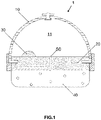
- the device (1) comprises a container flexible body (10) refillable with a viscous fluid; a support and transfer platform (20) connected to the flexible body (10) to define an inner chamber (11) where the viscous fluid is contained; means for simulating (30) at least one type of detectable abnormal tissue within the container flexible body (10); a distributor element (40) of the fluid directly on the user's skin coming from the chamber (11); and transfer means (50) arranged on the platform (20) that allow the transfer of said fluid from the chamber (11) to the distributor element (40).
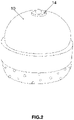
- the container flexible body (10) has the shape and size of a breast with an anti-leak closure element (14) that simulates the shape of a nipple.
- the flexible body (10) is formed by a semi-spherical membrane (12), with an upper circular access opening (13) for filling the inner chamber (11) with viscous fluid. It comprises a lower edge (15) with an interior perimeter projection (16) in a flat ring shape.
- This container flexible body (10) is made of silicone elastomer with characteristics of high elasticity and resistance.
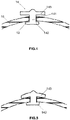
- the anti-leak closure element (14) comprises a central stem area (141) with a diameter greater than the circular opening (13) for access to the flexible body (10), a rounded lower projection (142) with a diameter even larger than the stem (141), and an upper projection (143) in a rounded disk shape with a diameter greater than the diameter of the lower projection (142). It is made of harder material than the flexible container (10) but is equally elastomeric.
- the upper projection (143) of the anti-leak closure element (14) is slightly curved downwards, describing a curved truncated cone shape while the lower projection (142) also describes a convex curvature at least on its upper face (144).
- the aforementioned support and transfer platform (20) comprises a solid body formed by an upper surface (21) parallel to a lower surface (22) and an outer mantle (23) with means to retain the flexible body.
- said means for retaining the flexible body comprise a perimeter groove (24) made around the entire perimeter of the mantle (23).
- the perimeter groove (24) of the platform (20) comprises a depth which matches the width and thickness of the inner perimeter projection (16) of the container flexible body (10) where said projection (16) is inserted into the groove (24).
- the means for retaining the flexible body also include an outer perimeter seal ring (25) which has a stepped inner face (26) that abuts outside the mantle (23) of the platform (20) and retains the lower edge (15) of the flexible body (10) with the inner projection (16) inserted into the groove (24).
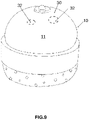
- the aforementioned means to simulate (30) a type of abnormal tissue comprise at least one smaller body with a shape and size similar to a tumor (31) made of a harder and firmer material than the material of the container flexible body (10); it has a preferably semi-spheroidal shape with an irregular surface and is fixedly located on the upper surface (21) of the platform (20).
- the means to simulate (30) a type of abnormal tissue may also comprise at least one smaller body with a shape and size similar to a cyst (32) or benign tumor made of a material similar to that of the flexible container body, preferably spheroidal in shape with soft walls and is found loosely inside the chamber (11) of the container flexible body (10).
- viscous fluid distributor element (40) comprises a body of absorbent and spongy material, preferably cylindrical in shape and not very high with a flat outer face (41) of rounded edge (42) and an inner flat face (43) with a straight edge (44). It is joined by its inner flat face (43) to the lower surface (22) of the platform (20) and has a diameter that matches the diameter of the platform (20).
- this distributor element (40) preferably a soft sponge.
- the transfer means (50) that allow the transfer of the viscous fluid from the chamber (11) to the distributor element (40) comprise at least one through opening (51) that extends from the upper surface (21) to the lower surface (22) of the platform (20) to arrive at the inner flat face (43) of the distributor element (40).
- the viscous fluid is preferably liquid soap.
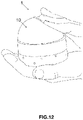
- the user can hold the device (1) in one of her hands, as illustrated in FIG. 12 , while with the other hand she performs the palpation training on said flexible body (10) pressing with his fingers until she can distinguish the presence of a tumor inside it.
- the same pressure of the fingers on the flexible body (10) generates that a discreet amount of fluid (soap) has been transferred to the distributor element (40), so that once the session of training is finished, the user can spread the fluid on her own breast, as illustrated in FIG. 13 , where the same flexible body (10) can be used as a support element that is comfortably adapted to the concavity of the hand while that the platform (20) gives the necessary rigidity to handle the device (1) and press it slightly to generate foam in the distributor element (40).
- the invention also includes a training kit (60) to teach and learn breast self-examination techniques for early detection of breast cancer, which allows its use at home, provides means to perform self-examination itself in a real way, facilitates the formation of a self-examination habit.
- a training kit 60 to teach and learn breast self-examination techniques for early detection of breast cancer, which allows its use at home, provides means to perform self-examination itself in a real way, facilitates the formation of a self-examination habit.
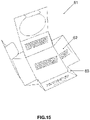
- the training device (1') described above which is formed by a container flexible body that can be filled with a viscous fluid, a support and transfer platform connected to the flexible body to define an interior chamber, means to simulate at least one type of abnormal tissue detectable inside the container flexible body; a fluid distributor element directly on the user's skin coming from the chamber and transfer means arranged on the platform that allow the transfer of said fluid from the chamber to the distributor element; and also includes a package (61) containing the device (1') that includes information with instructions for use, information on how to fill the flexible body (10') on palpation training with the device (1') and instructions on how to perform the self-palpation exam on the user's own breasts.
- the packaging (61) comprises an inner face (62) where the information is placed; it allows to be opened and unfolded safely without breaking its faces thanks to the fact that the vertical edges (63) of the packaging are of the type folded in bellows.
- the packaging 61 may also comprise graphic information in the form of a fillable table or calendar and is preferably made of cardboard laminated with a waterproof film.
Landscapes
- Engineering & Computer Science (AREA)
- Physics & Mathematics (AREA)
- General Physics & Mathematics (AREA)
- Computational Mathematics (AREA)
- Mathematical Analysis (AREA)
- Medicinal Chemistry (AREA)
- General Health & Medical Sciences (AREA)
- Algebra (AREA)
- Health & Medical Sciences (AREA)
- Chemical & Material Sciences (AREA)
- Medical Informatics (AREA)
- Mathematical Optimization (AREA)
- Mathematical Physics (AREA)
- Pure & Applied Mathematics (AREA)
- Business, Economics & Management (AREA)
- Educational Administration (AREA)
- Educational Technology (AREA)
- Theoretical Computer Science (AREA)
- Instructional Devices (AREA)
Applications Claiming Priority (2)
| Application Number | Priority Date | Filing Date | Title |
|---|---|---|---|
| CL2019003721A CL2019003721A1 (es) | 2019-12-18 | 2019-12-18 | Dispositivo para entrenamiento y práctica directa de técnicas de autopalpación de mamas |
| PCT/CL2020/050103 WO2021119861A1 (es) | 2019-12-18 | 2020-09-11 | Dispositivo para entrenamiento y práctica directa de técnicas de autopalpación de mamas |
Publications (3)
| Publication Number | Publication Date |
|---|---|
| EP4080487A1 true EP4080487A1 (de) | 2022-10-26 |
| EP4080487A4 EP4080487A4 (de) | 2023-12-06 |
| EP4080487B1 EP4080487B1 (de) | 2026-04-22 |
Family
ID=76476756
Family Applications (1)
| Application Number | Title | Priority Date | Filing Date |
|---|---|---|---|
| EP20901878.7A Active EP4080487B1 (de) | 2019-12-18 | 2020-09-11 | Gerät zum trainieren und direkten üben von techniken zur selbstpalpation der brust |
Country Status (7)
| Country | Link |
|---|---|
| US (1) | US12424123B2 (de) |
| EP (1) | EP4080487B1 (de) |
| CN (1) | CN114868174B (de) |
| BR (1) | BR112022011710A2 (de) |
| CL (1) | CL2019003721A1 (de) |
| MX (1) | MX2022007528A (de) |
| WO (1) | WO2021119861A1 (de) |
Family Cites Families (23)
| Publication number | Priority date | Publication date | Assignee | Title |
|---|---|---|---|---|
| US4001951A (en) | 1975-03-25 | 1977-01-11 | Fasse Wolfgang G | Breast cancer detection training device |
| US4134218A (en) | 1977-10-11 | 1979-01-16 | Adams Calvin K | Breast cancer detection training system |
| US4815977A (en) * | 1988-02-01 | 1989-03-28 | Peters Sheila N | Breast-feeding trainer |
| US4867686A (en) * | 1989-02-09 | 1989-09-19 | Goldstein Mark K | Breast cancer detection model and method for using same |
| US5207582A (en) * | 1992-02-03 | 1993-05-04 | B.S.E.-1.2.3., Inc. | Breast self-examination facilitator |
| GB9309021D0 (en) | 1993-04-30 | 1993-06-16 | Limbs & Things Ltd | Medical training apparatus |
| US5913686A (en) * | 1998-03-12 | 1999-06-22 | Vanwinkle; Tresa A. | Breast-mapping |
| US6669483B1 (en) * | 1998-09-24 | 2003-12-30 | West Virginia University | Instrumented breast model |
| GB0110847D0 (en) * | 2001-05-03 | 2001-06-27 | Haque Paulin | Breast cancer detection |
| US20020172214A1 (en) * | 2001-05-16 | 2002-11-21 | Grantham Raymond Doyle | Double breast model in shape of football and method of using same |
| US20030073061A1 (en) * | 2001-10-17 | 2003-04-17 | Toomey Timothy Daniel | Breast lump detection training model with feedback |
| US6945783B2 (en) * | 2002-05-21 | 2005-09-20 | The University Of Iowa Research Foundation | Interactive breast examination training model |
| US6854976B1 (en) * | 2002-11-02 | 2005-02-15 | John S. Suhr | Breast model teaching aid and method |
| US6817865B2 (en) * | 2003-03-11 | 2004-11-16 | Promotions Unlimited, Inc. | Training device for breast examination |
| US20060286525A1 (en) * | 2005-05-25 | 2006-12-21 | Haines Lindsay K | Wearable breast examination training apparatus |
| US7419376B2 (en) * | 2006-08-14 | 2008-09-02 | Artahn Laboratories, Inc. | Human tissue phantoms and methods for manufacturing thereof |
| US20080289079A1 (en) * | 2007-05-22 | 2008-11-27 | Lewis Linda P | Garment for use in a breast self-examination |
| US20110081636A1 (en) * | 2009-10-07 | 2011-04-07 | Lyle Ashley Wilkes | Dual gender cancer teaching kit |
| WO2011103489A2 (en) * | 2010-02-19 | 2011-08-25 | Gaumard Scientific Company, Inc. | Ultrasound phantom models, materials, and methods |
| CN202473055U (zh) * | 2012-01-19 | 2012-10-03 | 中国人民解放军第四军医大学 | 一种用于乳腺触诊的模拟训练器 |
| JP7098284B2 (ja) | 2017-07-06 | 2022-07-11 | 株式会社ディスコ | レーザー加工装置およびレーザー加工方法 |
| JP2019132953A (ja) * | 2018-01-30 | 2019-08-08 | 株式会社▲吉▼田生物研究所 | 触診用モデル |
| CN109272843A (zh) * | 2018-11-23 | 2019-01-25 | 神农架林区人民医院 | 用于乳腺触诊的模拟训练装置 |
-
2019
- 2019-12-18 CL CL2019003721A patent/CL2019003721A1/es unknown
-
2020
- 2020-09-11 BR BR112022011710A patent/BR112022011710A2/pt not_active Application Discontinuation
- 2020-09-11 CN CN202080088638.9A patent/CN114868174B/zh active Active
- 2020-09-11 MX MX2022007528A patent/MX2022007528A/es unknown
- 2020-09-11 WO PCT/CL2020/050103 patent/WO2021119861A1/es not_active Ceased
- 2020-09-11 EP EP20901878.7A patent/EP4080487B1/de active Active
- 2020-09-11 US US17/787,562 patent/US12424123B2/en active Active
Also Published As
| Publication number | Publication date |
|---|---|
| MX2022007528A (es) | 2022-07-19 |
| CN114868174B (zh) | 2024-09-03 |
| EP4080487B1 (de) | 2026-04-22 |
| CN114868174A (zh) | 2022-08-05 |
| US20220406223A1 (en) | 2022-12-22 |
| US12424123B2 (en) | 2025-09-23 |
| BR112022011710A2 (pt) | 2022-09-06 |
| EP4080487A4 (de) | 2023-12-06 |
| WO2021119861A1 (es) | 2021-06-24 |
| CL2019003721A1 (es) | 2021-09-20 |
Similar Documents
| Publication | Publication Date | Title |
|---|---|---|
| McDonald et al. | Performance and reporting of clinical breast examination: a review of the literature | |
| Basdogan et al. | Force interactions in laparoscopic simulations: Haptic rendering of soft tissues | |
| US7306465B2 (en) | Phlebotomy training device | |
| US4793354A (en) | Touch enhancement | |
| JPS6042473B2 (ja) | 乳癌発見訓練用乳房模型 | |
| EP0199549A2 (de) | Kissen zur Erhöhung der Tastempfindung | |
| Adams et al. | Lump detection in simulated human breasts | |
| US6945783B2 (en) | Interactive breast examination training model | |
| US20220270514A1 (en) | Providing training and assessment of physiatrics and cosmetics processes on a physical model having tactile sensors, using a virtual reality device | |
| EP4080487B1 (de) | Gerät zum trainieren und direkten üben von techniken zur selbstpalpation der brust | |
| CA2445775A1 (en) | Breast cancer detection | |
| HK40078842A (en) | Device for training and direct practice of breast self-palpation techniques | |
| HK40078842B (zh) | 用於训练和直接实践乳房自我触诊技术的设备 | |
| CN202473055U (zh) | 一种用于乳腺触诊的模拟训练器 | |
| CN209000344U (zh) | 眼部及头部睑板腺模型 | |
| US20110081636A1 (en) | Dual gender cancer teaching kit | |
| JP3134145U (ja) | 乳癌啓発用模型 | |
| Zhang et al. | A survey of simulators for palpation training. | |
| Stromborg | Screening for early detection | |
| CN217932988U (zh) | 乳腺疾病模拟检查教具 | |
| GB2241815A (en) | Breast palpation teaching aid | |
| JP2020201485A (ja) | 穿刺手技訓練用人体モデル及び、それを用いたおよび穿刺手技訓練方法 | |
| JP4491658B2 (ja) | 分娩期診断実習モデル | |
| CN211264774U (zh) | 一种乳房体格检查模型 | |
| CN211928879U (zh) | 产后乳房评估与产后乳房康复技能训练模型 |
Legal Events
| Date | Code | Title | Description |
|---|---|---|---|
| STAA | Information on the status of an ep patent application or granted ep patent |
Free format text: STATUS: THE INTERNATIONAL PUBLICATION HAS BEEN MADE |
|
| PUAI | Public reference made under article 153(3) epc to a published international application that has entered the european phase |
Free format text: ORIGINAL CODE: 0009012 |
|
| STAA | Information on the status of an ep patent application or granted ep patent |
Free format text: STATUS: REQUEST FOR EXAMINATION WAS MADE |
|
| 17P | Request for examination filed |
Effective date: 20220718 |
|
| AK | Designated contracting states |
Kind code of ref document: A1 Designated state(s): AL AT BE BG CH CY CZ DE DK EE ES FI FR GB GR HR HU IE IS IT LI LT LU LV MC MK MT NL NO PL PT RO RS SE SI SK SM TR |
|
| DAV | Request for validation of the european patent (deleted) | ||
| DAX | Request for extension of the european patent (deleted) | ||
| A4 | Supplementary search report drawn up and despatched |
Effective date: 20231106 |
|
| RIC1 | Information provided on ipc code assigned before grant |
Ipc: G09B 23/34 20060101ALI20231030BHEP Ipc: G09B 23/30 20060101ALI20231030BHEP Ipc: G09B 23/28 20060101AFI20231030BHEP |
|
| GRAP | Despatch of communication of intention to grant a patent |
Free format text: ORIGINAL CODE: EPIDOSNIGR1 |
|
| STAA | Information on the status of an ep patent application or granted ep patent |
Free format text: STATUS: GRANT OF PATENT IS INTENDED |
|
| INTG | Intention to grant announced |
Effective date: 20260105 |
|
| GRAS | Grant fee paid |
Free format text: ORIGINAL CODE: EPIDOSNIGR3 |
|
| GRAA | (expected) grant |
Free format text: ORIGINAL CODE: 0009210 |
|
| STAA | Information on the status of an ep patent application or granted ep patent |
Free format text: STATUS: THE PATENT HAS BEEN GRANTED |
|
| AK | Designated contracting states |
Kind code of ref document: B1 Designated state(s): AL AT BE BG CH CY CZ DE DK EE ES FI FR GB GR HR HU IE IS IT LI LT LU LV MC MK MT NL NO PL PT RO RS SE SI SK SM TR |
|
| REG | Reference to a national code |
Ref country code: CH Ref legal event code: F10 Free format text: ST27 STATUS EVENT CODE: U-0-0-F10-F00 (AS PROVIDED BY THE NATIONAL OFFICE) Effective date: 20260422 |