EP4080293B1 - Procédé de fabrication d'un composant horloger en matériau composite - Google Patents
Procédé de fabrication d'un composant horloger en matériau composite Download PDFInfo
- Publication number
- EP4080293B1 EP4080293B1 EP22166835.3A EP22166835A EP4080293B1 EP 4080293 B1 EP4080293 B1 EP 4080293B1 EP 22166835 A EP22166835 A EP 22166835A EP 4080293 B1 EP4080293 B1 EP 4080293B1
- Authority
- EP
- European Patent Office
- Prior art keywords
- layers
- process according
- fibres
- watch
- component
- Prior art date
- Legal status (The legal status is an assumption and is not a legal conclusion. Google has not performed a legal analysis and makes no representation as to the accuracy of the status listed.)
- Active
Links
Images

Classifications
-
- B—PERFORMING OPERATIONS; TRANSPORTING
- B28—WORKING CEMENT, CLAY, OR STONE
- B28B—SHAPING CLAY OR OTHER CERAMIC COMPOSITIONS; SHAPING SLAG; SHAPING MIXTURES CONTAINING CEMENTITIOUS MATERIAL, e.g. PLASTER
- B28B1/00—Producing shaped prefabricated articles from the material
- B28B1/52—Producing shaped prefabricated articles from the material specially adapted for producing articles from mixtures containing fibres, e.g. asbestos cement
- B28B1/522—Producing shaped prefabricated articles from the material specially adapted for producing articles from mixtures containing fibres, e.g. asbestos cement for producing multi-layered articles
-
- G—PHYSICS
- G04—HOROLOGY
- G04B—MECHANICALLY-DRIVEN CLOCKS OR WATCHES; MECHANICAL PARTS OF CLOCKS OR WATCHES IN GENERAL; TIME PIECES USING THE POSITION OF THE SUN, MOON OR STARS
- G04B29/00—Frameworks
- G04B29/04—Connecting or supporting parts
-
- B—PERFORMING OPERATIONS; TRANSPORTING
- B28—WORKING CEMENT, CLAY, OR STONE
- B28B—SHAPING CLAY OR OTHER CERAMIC COMPOSITIONS; SHAPING SLAG; SHAPING MIXTURES CONTAINING CEMENTITIOUS MATERIAL, e.g. PLASTER
- B28B11/00—Apparatus or processes for treating or working the shaped or preshaped articles
- B28B11/24—Apparatus or processes for treating or working the shaped or preshaped articles for curing, setting or hardening
-
- B—PERFORMING OPERATIONS; TRANSPORTING
- B28—WORKING CEMENT, CLAY, OR STONE
- B28B—SHAPING CLAY OR OTHER CERAMIC COMPOSITIONS; SHAPING SLAG; SHAPING MIXTURES CONTAINING CEMENTITIOUS MATERIAL, e.g. PLASTER
- B28B3/00—Producing shaped articles from the material by using presses; Presses specially adapted therefor
- B28B3/02—Producing shaped articles from the material by using presses; Presses specially adapted therefor wherein a ram exerts pressure on the material in a moulding space; Ram heads of special form
- B28B3/025—Hot pressing, e.g. of ceramic materials
-
- B—PERFORMING OPERATIONS; TRANSPORTING
- B32—LAYERED PRODUCTS
- B32B—LAYERED PRODUCTS, i.e. PRODUCTS BUILT-UP OF STRATA OF FLAT OR NON-FLAT, e.g. CELLULAR OR HONEYCOMB, FORM
- B32B18/00—Layered products essentially comprising ceramics, e.g. refractory products
-
- C—CHEMISTRY; METALLURGY
- C04—CEMENTS; CONCRETE; ARTIFICIAL STONE; CERAMICS; REFRACTORIES
- C04B—LIME, MAGNESIA; SLAG; CEMENTS; COMPOSITIONS THEREOF, e.g. MORTARS, CONCRETE OR LIKE BUILDING MATERIALS; ARTIFICIAL STONE; CERAMICS; REFRACTORIES; TREATMENT OF NATURAL STONE
- C04B35/00—Shaped ceramic products characterised by their composition; Ceramics compositions; Processing powders of inorganic compounds preparatory to the manufacturing of ceramic products
- C04B35/01—Shaped ceramic products characterised by their composition; Ceramics compositions; Processing powders of inorganic compounds preparatory to the manufacturing of ceramic products based on oxide ceramics
- C04B35/10—Shaped ceramic products characterised by their composition; Ceramics compositions; Processing powders of inorganic compounds preparatory to the manufacturing of ceramic products based on oxide ceramics based on aluminium oxide
-
- C—CHEMISTRY; METALLURGY
- C04—CEMENTS; CONCRETE; ARTIFICIAL STONE; CERAMICS; REFRACTORIES
- C04B—LIME, MAGNESIA; SLAG; CEMENTS; COMPOSITIONS THEREOF, e.g. MORTARS, CONCRETE OR LIKE BUILDING MATERIALS; ARTIFICIAL STONE; CERAMICS; REFRACTORIES; TREATMENT OF NATURAL STONE
- C04B35/00—Shaped ceramic products characterised by their composition; Ceramics compositions; Processing powders of inorganic compounds preparatory to the manufacturing of ceramic products
- C04B35/01—Shaped ceramic products characterised by their composition; Ceramics compositions; Processing powders of inorganic compounds preparatory to the manufacturing of ceramic products based on oxide ceramics
- C04B35/48—Shaped ceramic products characterised by their composition; Ceramics compositions; Processing powders of inorganic compounds preparatory to the manufacturing of ceramic products based on oxide ceramics based on zirconium or hafnium oxides, zirconates, zircon or hafnates
-
- C—CHEMISTRY; METALLURGY
- C04—CEMENTS; CONCRETE; ARTIFICIAL STONE; CERAMICS; REFRACTORIES
- C04B—LIME, MAGNESIA; SLAG; CEMENTS; COMPOSITIONS THEREOF, e.g. MORTARS, CONCRETE OR LIKE BUILDING MATERIALS; ARTIFICIAL STONE; CERAMICS; REFRACTORIES; TREATMENT OF NATURAL STONE
- C04B35/00—Shaped ceramic products characterised by their composition; Ceramics compositions; Processing powders of inorganic compounds preparatory to the manufacturing of ceramic products
- C04B35/622—Forming processes; Processing powders of inorganic compounds preparatory to the manufacturing of ceramic products
- C04B35/64—Burning or sintering processes
- C04B35/645—Pressure sintering
-
- C—CHEMISTRY; METALLURGY
- C04—CEMENTS; CONCRETE; ARTIFICIAL STONE; CERAMICS; REFRACTORIES
- C04B—LIME, MAGNESIA; SLAG; CEMENTS; COMPOSITIONS THEREOF, e.g. MORTARS, CONCRETE OR LIKE BUILDING MATERIALS; ARTIFICIAL STONE; CERAMICS; REFRACTORIES; TREATMENT OF NATURAL STONE
- C04B35/00—Shaped ceramic products characterised by their composition; Ceramics compositions; Processing powders of inorganic compounds preparatory to the manufacturing of ceramic products
- C04B35/71—Ceramic products containing macroscopic reinforcing agents
- C04B35/78—Ceramic products containing macroscopic reinforcing agents containing non-metallic materials
- C04B35/80—Fibres, filaments, whiskers, platelets, or the like
- C04B35/82—Asbestos; Glass; Fused silica
-
- G—PHYSICS
- G04—HOROLOGY
- G04B—MECHANICALLY-DRIVEN CLOCKS OR WATCHES; MECHANICAL PARTS OF CLOCKS OR WATCHES IN GENERAL; TIME PIECES USING THE POSITION OF THE SUN, MOON OR STARS
- G04B15/00—Escapements
- G04B15/14—Component parts or constructional details, e.g. construction of the lever or the escape wheel
-
- G—PHYSICS
- G04—HOROLOGY
- G04B—MECHANICALLY-DRIVEN CLOCKS OR WATCHES; MECHANICAL PARTS OF CLOCKS OR WATCHES IN GENERAL; TIME PIECES USING THE POSITION OF THE SUN, MOON OR STARS
- G04B29/00—Frameworks
- G04B29/02—Plates; Bridges; Cocks
- G04B29/027—Materials and manufacturing
-
- G—PHYSICS
- G04—HOROLOGY
- G04B—MECHANICALLY-DRIVEN CLOCKS OR WATCHES; MECHANICAL PARTS OF CLOCKS OR WATCHES IN GENERAL; TIME PIECES USING THE POSITION OF THE SUN, MOON OR STARS
- G04B37/00—Cases
-
- G—PHYSICS
- G04—HOROLOGY
- G04B—MECHANICALLY-DRIVEN CLOCKS OR WATCHES; MECHANICAL PARTS OF CLOCKS OR WATCHES IN GENERAL; TIME PIECES USING THE POSITION OF THE SUN, MOON OR STARS
- G04B37/00—Cases
- G04B37/22—Materials or processes of manufacturing pocket watch or wrist watch cases
-
- G—PHYSICS
- G04—HOROLOGY
- G04B—MECHANICALLY-DRIVEN CLOCKS OR WATCHES; MECHANICAL PARTS OF CLOCKS OR WATCHES IN GENERAL; TIME PIECES USING THE POSITION OF THE SUN, MOON OR STARS
- G04B37/00—Cases
- G04B37/22—Materials or processes of manufacturing pocket watch or wrist watch cases
- G04B37/225—Non-metallic cases
-
- C—CHEMISTRY; METALLURGY
- C04—CEMENTS; CONCRETE; ARTIFICIAL STONE; CERAMICS; REFRACTORIES
- C04B—LIME, MAGNESIA; SLAG; CEMENTS; COMPOSITIONS THEREOF, e.g. MORTARS, CONCRETE OR LIKE BUILDING MATERIALS; ARTIFICIAL STONE; CERAMICS; REFRACTORIES; TREATMENT OF NATURAL STONE
- C04B2235/00—Aspects relating to ceramic starting mixtures or sintered ceramic products
- C04B2235/02—Composition of constituents of the starting material or of secondary phases of the final product
- C04B2235/30—Constituents and secondary phases not being of a fibrous nature
- C04B2235/32—Metal oxides, mixed metal oxides, or oxide-forming salts thereof, e.g. carbonates, nitrates, (oxy)hydroxides, chlorides
- C04B2235/3217—Aluminum oxide or oxide forming salts thereof, e.g. bauxite, alpha-alumina
-
- C—CHEMISTRY; METALLURGY
- C04—CEMENTS; CONCRETE; ARTIFICIAL STONE; CERAMICS; REFRACTORIES
- C04B—LIME, MAGNESIA; SLAG; CEMENTS; COMPOSITIONS THEREOF, e.g. MORTARS, CONCRETE OR LIKE BUILDING MATERIALS; ARTIFICIAL STONE; CERAMICS; REFRACTORIES; TREATMENT OF NATURAL STONE
- C04B2235/00—Aspects relating to ceramic starting mixtures or sintered ceramic products
- C04B2235/02—Composition of constituents of the starting material or of secondary phases of the final product
- C04B2235/30—Constituents and secondary phases not being of a fibrous nature
- C04B2235/32—Metal oxides, mixed metal oxides, or oxide-forming salts thereof, e.g. carbonates, nitrates, (oxy)hydroxides, chlorides
- C04B2235/3224—Rare earth oxide or oxide forming salts thereof, e.g. scandium oxide
- C04B2235/3225—Yttrium oxide or oxide-forming salts thereof
-
- C—CHEMISTRY; METALLURGY
- C04—CEMENTS; CONCRETE; ARTIFICIAL STONE; CERAMICS; REFRACTORIES
- C04B—LIME, MAGNESIA; SLAG; CEMENTS; COMPOSITIONS THEREOF, e.g. MORTARS, CONCRETE OR LIKE BUILDING MATERIALS; ARTIFICIAL STONE; CERAMICS; REFRACTORIES; TREATMENT OF NATURAL STONE
- C04B2235/00—Aspects relating to ceramic starting mixtures or sintered ceramic products
- C04B2235/02—Composition of constituents of the starting material or of secondary phases of the final product
- C04B2235/30—Constituents and secondary phases not being of a fibrous nature
- C04B2235/32—Metal oxides, mixed metal oxides, or oxide-forming salts thereof, e.g. carbonates, nitrates, (oxy)hydroxides, chlorides
- C04B2235/3231—Refractory metal oxides, their mixed metal oxides, or oxide-forming salts thereof
- C04B2235/3244—Zirconium oxides, zirconates, hafnium oxides, hafnates, or oxide-forming salts thereof
- C04B2235/3246—Stabilised zirconias, e.g. YSZ or cerium stabilised zirconia
-
- C—CHEMISTRY; METALLURGY
- C04—CEMENTS; CONCRETE; ARTIFICIAL STONE; CERAMICS; REFRACTORIES
- C04B—LIME, MAGNESIA; SLAG; CEMENTS; COMPOSITIONS THEREOF, e.g. MORTARS, CONCRETE OR LIKE BUILDING MATERIALS; ARTIFICIAL STONE; CERAMICS; REFRACTORIES; TREATMENT OF NATURAL STONE
- C04B2235/00—Aspects relating to ceramic starting mixtures or sintered ceramic products
- C04B2235/02—Composition of constituents of the starting material or of secondary phases of the final product
- C04B2235/50—Constituents or additives of the starting mixture chosen for their shape or used because of their shape or their physical appearance
- C04B2235/52—Constituents or additives characterised by their shapes
- C04B2235/5208—Fibers
- C04B2235/5212—Organic
-
- C—CHEMISTRY; METALLURGY
- C04—CEMENTS; CONCRETE; ARTIFICIAL STONE; CERAMICS; REFRACTORIES
- C04B—LIME, MAGNESIA; SLAG; CEMENTS; COMPOSITIONS THEREOF, e.g. MORTARS, CONCRETE OR LIKE BUILDING MATERIALS; ARTIFICIAL STONE; CERAMICS; REFRACTORIES; TREATMENT OF NATURAL STONE
- C04B2235/00—Aspects relating to ceramic starting mixtures or sintered ceramic products
- C04B2235/02—Composition of constituents of the starting material or of secondary phases of the final product
- C04B2235/50—Constituents or additives of the starting mixture chosen for their shape or used because of their shape or their physical appearance
- C04B2235/52—Constituents or additives characterised by their shapes
- C04B2235/5208—Fibers
- C04B2235/5216—Inorganic
- C04B2235/522—Oxidic
- C04B2235/5228—Silica and alumina, including aluminosilicates, e.g. mullite
-
- C—CHEMISTRY; METALLURGY
- C04—CEMENTS; CONCRETE; ARTIFICIAL STONE; CERAMICS; REFRACTORIES
- C04B—LIME, MAGNESIA; SLAG; CEMENTS; COMPOSITIONS THEREOF, e.g. MORTARS, CONCRETE OR LIKE BUILDING MATERIALS; ARTIFICIAL STONE; CERAMICS; REFRACTORIES; TREATMENT OF NATURAL STONE
- C04B2235/00—Aspects relating to ceramic starting mixtures or sintered ceramic products
- C04B2235/02—Composition of constituents of the starting material or of secondary phases of the final product
- C04B2235/50—Constituents or additives of the starting mixture chosen for their shape or used because of their shape or their physical appearance
- C04B2235/52—Constituents or additives characterised by their shapes
- C04B2235/5208—Fibers
- C04B2235/5216—Inorganic
- C04B2235/524—Non-oxidic, e.g. borides, carbides, silicides or nitrides
- C04B2235/5248—Carbon, e.g. graphite
-
- C—CHEMISTRY; METALLURGY
- C04—CEMENTS; CONCRETE; ARTIFICIAL STONE; CERAMICS; REFRACTORIES
- C04B—LIME, MAGNESIA; SLAG; CEMENTS; COMPOSITIONS THEREOF, e.g. MORTARS, CONCRETE OR LIKE BUILDING MATERIALS; ARTIFICIAL STONE; CERAMICS; REFRACTORIES; TREATMENT OF NATURAL STONE
- C04B2235/00—Aspects relating to ceramic starting mixtures or sintered ceramic products
- C04B2235/02—Composition of constituents of the starting material or of secondary phases of the final product
- C04B2235/50—Constituents or additives of the starting mixture chosen for their shape or used because of their shape or their physical appearance
- C04B2235/52—Constituents or additives characterised by their shapes
- C04B2235/5208—Fibers
- C04B2235/526—Fibers characterised by the length of the fibers
-
- C—CHEMISTRY; METALLURGY
- C04—CEMENTS; CONCRETE; ARTIFICIAL STONE; CERAMICS; REFRACTORIES
- C04B—LIME, MAGNESIA; SLAG; CEMENTS; COMPOSITIONS THEREOF, e.g. MORTARS, CONCRETE OR LIKE BUILDING MATERIALS; ARTIFICIAL STONE; CERAMICS; REFRACTORIES; TREATMENT OF NATURAL STONE
- C04B2235/00—Aspects relating to ceramic starting mixtures or sintered ceramic products
- C04B2235/65—Aspects relating to heat treatments of ceramic bodies such as green ceramics or pre-sintered ceramics, e.g. burning, sintering or melting processes
- C04B2235/656—Aspects relating to heat treatments of ceramic bodies such as green ceramics or pre-sintered ceramics, e.g. burning, sintering or melting processes characterised by specific heating conditions during heat treatment
- C04B2235/6567—Treatment time
-
- C—CHEMISTRY; METALLURGY
- C04—CEMENTS; CONCRETE; ARTIFICIAL STONE; CERAMICS; REFRACTORIES
- C04B—LIME, MAGNESIA; SLAG; CEMENTS; COMPOSITIONS THEREOF, e.g. MORTARS, CONCRETE OR LIKE BUILDING MATERIALS; ARTIFICIAL STONE; CERAMICS; REFRACTORIES; TREATMENT OF NATURAL STONE
- C04B2235/00—Aspects relating to ceramic starting mixtures or sintered ceramic products
- C04B2235/65—Aspects relating to heat treatments of ceramic bodies such as green ceramics or pre-sintered ceramics, e.g. burning, sintering or melting processes
- C04B2235/66—Specific sintering techniques, e.g. centrifugal sintering
- C04B2235/666—Applying a current during sintering, e.g. plasma sintering [SPS], electrical resistance heating or pulse electric current sintering [PECS]
-
- C—CHEMISTRY; METALLURGY
- C04—CEMENTS; CONCRETE; ARTIFICIAL STONE; CERAMICS; REFRACTORIES
- C04B—LIME, MAGNESIA; SLAG; CEMENTS; COMPOSITIONS THEREOF, e.g. MORTARS, CONCRETE OR LIKE BUILDING MATERIALS; ARTIFICIAL STONE; CERAMICS; REFRACTORIES; TREATMENT OF NATURAL STONE
- C04B2237/00—Aspects relating to ceramic laminates or to joining of ceramic articles with other articles by heating
- C04B2237/30—Composition of layers of ceramic laminates or of ceramic or metallic articles to be joined by heating, e.g. Si substrates
- C04B2237/32—Ceramic
- C04B2237/34—Oxidic
- C04B2237/343—Alumina or aluminates
-
- C—CHEMISTRY; METALLURGY
- C04—CEMENTS; CONCRETE; ARTIFICIAL STONE; CERAMICS; REFRACTORIES
- C04B—LIME, MAGNESIA; SLAG; CEMENTS; COMPOSITIONS THEREOF, e.g. MORTARS, CONCRETE OR LIKE BUILDING MATERIALS; ARTIFICIAL STONE; CERAMICS; REFRACTORIES; TREATMENT OF NATURAL STONE
- C04B2237/00—Aspects relating to ceramic laminates or to joining of ceramic articles with other articles by heating
- C04B2237/30—Composition of layers of ceramic laminates or of ceramic or metallic articles to be joined by heating, e.g. Si substrates
- C04B2237/32—Ceramic
- C04B2237/34—Oxidic
- C04B2237/345—Refractory metal oxides
- C04B2237/348—Zirconia, hafnia, zirconates or hafnates
-
- C—CHEMISTRY; METALLURGY
- C04—CEMENTS; CONCRETE; ARTIFICIAL STONE; CERAMICS; REFRACTORIES
- C04B—LIME, MAGNESIA; SLAG; CEMENTS; COMPOSITIONS THEREOF, e.g. MORTARS, CONCRETE OR LIKE BUILDING MATERIALS; ARTIFICIAL STONE; CERAMICS; REFRACTORIES; TREATMENT OF NATURAL STONE
- C04B2237/00—Aspects relating to ceramic laminates or to joining of ceramic articles with other articles by heating
- C04B2237/30—Composition of layers of ceramic laminates or of ceramic or metallic articles to be joined by heating, e.g. Si substrates
- C04B2237/32—Ceramic
- C04B2237/38—Fiber or whisker reinforced
-
- G—PHYSICS
- G06—COMPUTING OR CALCULATING; COUNTING
- G06V—IMAGE OR VIDEO RECOGNITION OR UNDERSTANDING
- G06V10/00—Arrangements for image or video recognition or understanding
- G06V10/70—Arrangements for image or video recognition or understanding using pattern recognition or machine learning
- G06V10/74—Image or video pattern matching; Proximity measures in feature spaces
- G06V10/75—Organisation of the matching processes, e.g. simultaneous or sequential comparisons of image or video features; Coarse-fine approaches, e.g. multi-scale approaches; using context analysis; Selection of dictionaries
Definitions
- the present invention relates to a method for manufacturing a watch component made of ceramic matrix composite material.
- the invention also relates to a method for authenticating or identifying a watch part.
- Forged composite materials which have a polymer matrix and fibers, have good mechanical strength but low hardness and therefore average resistance to abrasion and scratch resistance.
- Forged composite materials on the other hand, have an inhomogeneous and random aesthetic allowing the production of unique parts.
- Forged composite materials such as carbon, aramid (kevlar ® ) or glass fibers, sometimes combined and structured using a polymer resin, do not have very good scratch resistance and low hardness ( ⁇ 100HV).
- Ceramics such as zirconia or alumina, have a high resistance to abrasion and can be considered scratch-resistant. Ceramics are materials with a uniform and identical visual appearance from one piece to another, which has a negative impact on the diversity of the visual appearance of ceramic parts. In addition, ceramics have the disadvantage of being fragile due to their structure.
- US8906498 discloses a method of manufacturing an impact resistant material sandwich.
- the method comprises a process of SPS (Spark Plasma Sintering) of a ceramic powder to form a tile and coupling a ductile support layer to the tile.
- the ductile support layer may comprise a layer of polyethylene fibers.
- CN108299000A describes a method for the low-temperature preparation of a SiC composite material.
- the method includes, in particular, cutting carbon fibers into a length of 1 to 3 mm and various steps to obtain a uniformly mixed powder.
- EP3795341 discloses a watch component made of a composite material composed of a polymer-based matrix and a reinforcement made of at least two different types of cut fibers, one of which is a polyazole.
- EP3674816 discloses a decorative article, in particular a watch component made from a material comprising by weight: 60 to 90% of a metallic or ceramic material having a density greater than or equal to 5 g/cm3; 10 to 32% of a plastic material comprising a thermoplastic resin and a coupling agent; 0 to 8% of a reinforcement and 0 to 3% of a pigment.
- One aim of the invention is to propose an alternative manufacturing method for a ceramic matrix composite material making it possible to produce watch components with a unique and random visual appearance from one piece to another.
- Another aim of the invention is to propose a method of manufacturing a ceramic matrix composite material which has the advantage of being light and which has high scratch resistance as well as high mechanical strength.
- At least two layers of the succession of layers comprise fibers.
- the at least two layers are separated by another layer of the succession of layers.
- the other layer does not comprise fibers.
- the at least two layers are adjacent.
- the composition of one of the two adjacent layers is different from the composition of the other of the two adjacent layers.
- all layers of the succession of layers comprise fibers.
- the composition of one of the layers is different from the composition of any of the other layers.
- Sintering time is typically between 1 minute and 90 minutes.
- Sintering temperatures are preferably between 800°C and 2000°C.
- the ceramic powder is a composite selected from one of the following three composites: Alumina matrix zirconia (ZTA), Zirconia matrix alumina (ATZ) and Zirconia stabilized at least partially with Yttrium (Y-TZP).
- ZTA Alumina matrix zirconia
- ATZ Zirconia matrix alumina
- Y-TZP Zirconia stabilized at least partially with Yttrium
- the mass proportion of the fibers of said at least one layer comprising fibers is between 1.5% and 55%, preferably between 1.5% and 25%.
- the fibers have a length between 2mm and 70mm, preferably between 3mm and 50mm.
- the watch component is a component of a watch case, in particular a case middle, a case back, a bezel or a crown.
- the watch component is a component of a watch movement, in particular a plate or a bridge.
- the image database is created from a multitude of images captured for each watch component manufactured by the method according to the invention.
- the distinctive element is selected from a serial number, the production date and the caliber of the timepiece.
- the composite material watch component is obtained by a manufacturing process comprising in particular a flash sintering operation, or " Field Assisted Sintering Technique / Spark Plasma Sintering (FAST / SPS) " in English, which is a sintering process related to hot isostatic pressing but using the Joule effect to heat a pre-compacted powder in a mold between two graphite electrodes under an inert atmosphere or under vacuum, the assembly being subjected to a pressure of several megapascals under the action of a hydraulic press. A direct or alternating current of several kiloamperes, pulsed or not, is applied between the electrodes with a voltage of a few volts.
- FAST / SPS Field Assisted Sintering Technique / Spark Plasma Sintering
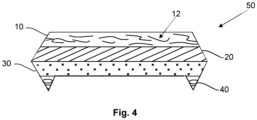
- the manufacturing process of a watch component for example a watch case 50 according to the figure 4 , in ceramic matrix composite material consists of depositing several successive layers 10, 20, 30, 40 in a mold (not shown).
- each of the successive layers 10, 20, 30, 40 of the composite material comprises a pre-compacted ceramic powder 12.
- the last layer 10 further comprises fibers 14 mixed with the ceramic powder.
- the fibers 14 are mixed with the ceramic powder 12 before the application of the last layer in the mold in order to obtain a last layer 10 where the fibers are arranged randomly.
- the pre-compacted ceramic powder 12 of each layer forms a ceramic matrix.
- the powder 12 constituting the ceramic matrix may, for example, be a composite selected from one of the following three composites: Alumina matrix zirconia (ZTA), Zirconia matrix alumina (ATZ) and Zirconia stabilized at least partially with Yttrium (Y-TZP).
- ZTA Alumina matrix zirconia
- ATZ Zirconia matrix alumina
- Y-TZP Zirconia stabilized at least partially with Yttrium
- the ceramic matrix 12 may comprise a mixture of the three aforementioned composites.
- the fibers 14 arranged randomly in the ceramic matrix 12 of the layer 10 are, for example, fibers selected from carbon fibers, basalt fibers, glass fibers and aramid fibers.
- the ceramic matrix may also incorporate a mixture of these different types of fibers.
- the mass proportion of the fibers in the layer 10 is generally between 1.5% and 55%, preferably between 1.5% to 25%, or even between 1.5% and 10%.
- the length of these fibers is between 2 mm and 70 mm, preferably between 3 mm and 50 mm, or even between 3 mm and 6 mm.
- the other layers 20, 30, 40 of the composite material of the figure 1 are made up of a ceramic matrix which may each include pigments 16, 17, 18 of different types in order to give these layers different colors so that the watch component, obtained by a FAST/SPS sintering process and rectified by machining in order to obtain the final dimensions of the component, has a visual appearance where the demarcation between the different layers is visible on the surface of the watch component.
- the composite material according to the figure 1 then undergoes a FAST/SPS sintering operation. After the compression and sintering operation, the dimensions of the composite material are significantly reduced in one dimension as can be seen in figure 2 .
- the sintering time and temperature depend on the composition of the different layers 10, 20, 30, 40, but also on the size and shape of the part to be sintered.
- the temperature range is between 800 and 2000°C, preferably between 900 and 1500°C while the sintering time (plateau time) is between 1 and 90 minutes, preferably between 2 and 45 minutes when each of the layers comprises a ceramic matrix.
- the sintering temperature is approximately 1050°C and the sintering time is approximately 12 minutes.
- the composite material is cooled and demolded.
- the sintered composite material is then machined to the final dimensions of the watch component in order to obtain, for example, a watch case illustrated in figure 4 Alternatively, the part is not machined but finished, for example polished or decorated.
- the successive layers of the composite material 10, 20, 30, 40 with a ceramic matrix comprise a first and second layer 10, 30 each comprising fibers 14 arranged randomly.
- the arrangement of the fibers 14 of the first layer 10 is different from the arrangement of the fibers of the second layer 30.
- the first and second layers 10, 30 are separated by a third layer 20 which may comprise a certain type of pigments 16 in order to give this layer a particular visual appearance, in particular in terms of its color, which is different from the visual appearance of the first and second layers 10, 30.
- At least two adjacent layers of the succession of layers forming the composite material comprise fibers.
- the composition of one of the two adjacent layers is different from the composition of the other of the two layers.
- all of the layers of succession of layers forming the composite material comprise fibers.
- the composition of one of the layers is different from the composition of any of the other layers.
- the watch component obtained by the FAST/SPS sintering manufacturing process according to the invention for example the caseband 50 illustrated in figure 4 , has the advantage of being light, having high scratch resistance as well as a unique and random visual appearance, that is to say that the visual appearance of the watch components obtained by this manufacturing process differs from one component to another.
- a watch component with a unique visual appearance is obtained, such as a watch case.
- the authentication or identification of the watch part can be carried out by comparing the visual appearance of the photographed part, or characteristics of this appearance, with reference photographs or databases of characteristics of reference parts.
- the method first comprises capturing an image of the watch component of the timepiece having randomly distributed fibers on the surface, for example a portion of the caseband.
- the captured image is then compared to a database of images stored on a server.
- the database comprises a series of images of randomly distributed fibers created from a multitude of images captured for each watch component manufactured by the method according to the invention.
- Authentication or identification of the watch part is then carried out by matching the captured image to one of the images in the database.
Landscapes
- Engineering & Computer Science (AREA)
- Chemical & Material Sciences (AREA)
- Ceramic Engineering (AREA)
- Manufacturing & Machinery (AREA)
- General Physics & Mathematics (AREA)
- Physics & Mathematics (AREA)
- Structural Engineering (AREA)
- Materials Engineering (AREA)
- Organic Chemistry (AREA)
- Mechanical Engineering (AREA)
- Chemical Kinetics & Catalysis (AREA)
- Metallurgy (AREA)
- Inorganic Chemistry (AREA)
- Composite Materials (AREA)
- Compositions Of Oxide Ceramics (AREA)
- Laminated Bodies (AREA)
Description
- La présente invention concerne un procédé de fabrication d'un composant horloger en matériau composite à matrice céramique. L'invention concerne également une méthode d'authentification ou d'identification d'une pièce horlogère.
- Les matériaux composites classiques, qui possèdent une matrice en polymère et des fibres, présentent de bonnes résistances mécaniques mais une dureté faible et donc une résistance moyenne à l'abrasion et à la résistance aux rayures. Les matériaux composites forgés, quant à eux, présentent une esthétique inhomogène et aléatoire permettant la réalisation de pièces uniques. Les matériaux composites forgés tels que les fibres de carbone, d'aramide (kevlar®) ou de verre, parfois combinées et mis en structure à l'aide d'une résine polymère ne présentent pas une très bonne résistance aux rayures et une faible dureté (<100HV).
- Les céramiques, par exemple de type zircone ou alumine présentent une haute résistance à l'abrasion et peuvent être considérées comme inrayables. Les céramiques sont des matériaux présentant un aspect visuel homogène et identique d'une pièce à l'autre ce qui a un impact négatif sur la diversité de l'aspect visuel des pièces en céramique. Par ailleurs, les céramiques ont l'inconvénient d'être fragiles de part de leur structure.
- Il est connu de l'état de la technique l'utilisation d'un procédé de frittage FAST/SPS (Spark Plasma Sintering) afin d'augmenter la résistance mécanique de matériau en céramique.
- A titre d'exemple,
US8906498 divulgue un procédé de fabrication d'un sandwich de matériau résistant aux chocs. Le procédé comporte un processus de frittage SPS (Spark Plasma Sintering) d'une poudre en céramique pour former une tuile et l'accouplement d'une couche de support ductile à la tuile. La couche de support ductile peut comprendre une couche de fibres de polyéthylène. - Un autre exemple est divulgué dans
CN108299000A qui décrit une méthode de préparation à basse température d'un matériau composite de type SiC. La méthode comprend notamment le découpage de fibres de carbone en une longueur de 1 à 3 mm et différentes étapes pour obtenir une poudre uniformément mélangée. Une opération de frittage SPS de la poudre, placée dans une matrice en graphite, est ensuite réalisée. - Ces procédés ont un impact négatif sur la diversité de l'aspect visuel des pièces en céramique obtenues qui sont essentiellement homogènes.
-
EP3795341 divulgue un composant horloger en un matériau composite composé d'une matrice à base de polymère et d'un renfort constitué d'au moins deux natures de fibres coupées différentes dont l'une est un polyazole. -
EP3674816 divulgue un article décoratif, notamment en composant horloger réalisé dans un matériau comprenant en poids:60 à 90% d'une matière métallique ou céramique ayant une densité supérieure ou égale à 5 g/cm3 ; 10 à 32% d'une matière plastique comprenant une résine thermoplastique et un agent de couplage; 0 à 8% d'un renfort et 0 à 3% d'un pigment. - Un but de l'invention est de proposer un procédé de fabrication alternatif d'un matériau composite à matrice céramique permettant de produire des composants horlogers d'aspect visuel unique et aléatoire d'une pièce à l'autre.
- Un autre but de l'invention est de proposer un procédé de fabrication d'un matériau composite à matrice céramique qui a l'avantage d'être léger et qui possède une haute résistance aux rayures ainsi qu'une haute résistance mécanique.
- Selon l'invention, ces buts sont atteints notamment par un procédé de fabrication d'un composant horloger en matériau composite à matrice céramique. Le procédé de fabrication comporte les étapes suivantes :
- déposer dans un moule une succession de couches comprenant chacune une poudre céramique, au moins une couche de la succession de couches comportant en outre des fibres mélangées à la poudre céramique, les fibres étant disposées de manière aléatoire ;
- effectuer une opération de frittage FAST/SPS ;
- démouler le composant horloger fritté comportant la succession de couches, et
- usiner ou terminer le composant fritté aux dimensions finales du composant horloger de telle manière que les fibres soient en partie visibles en surface du composant horloger.
- Selon une forme de réalisation, au moins deux couches de la succession de couches comportent des fibres.
- Selon une forme de réalisation, les aux moins deux couches sont séparées par une autre couche de la succession de couches. L'autre couche ne comporte pas de fibres.
- Selon une forme de réalisation, les aux moins deux couches sont adjacentes. La composition de l'une des deux couches adjacentes est différente de la composition de l'autre des deux couches adjacentes.
- Selon une forme de réalisation, toutes les couches de la succession de couches comportent des fibres. La composition de l'une des couches est différente de la composition de l'une quelconque des autres couches.
- Le temps de frittage est compris typiquement entre 1 minute et 90 minutes.
- Les températures de frittage sont comprises de préférence entre 800°C et 2000°C.
- Selon une forme de réalisation, la poudre céramique est un composite sélectionné parmi un des trois composites suivants : Zircone à matrice d'alumine (ZTA), Alumine à matrice Zircone (ATZ) et Zircone stabilisée au moins partiellement à l'Yttrium (Y-TZP).
- La proportion en masse des fibres de ladite au moins une couche comportant des fibres est comprise entre 1.5% et 55%, préférablement entre 1.5% à 25%.
- Les fibres ont une longueur comprise entre 2mm et 70mm, préférablement entre 3mm et 50mm.
- Selon une forme de réalisation, le composant horloger est un composant d'un boitier de montre, notamment une carrure, un fond du boitier, une lunette ou une couronne.
- Selon une forme de réalisation, le composant horloger est un composant d'un mouvement de montre, notamment une platine ou un pont.
- Un composant horloger fabriqué par le procédé selon l'invention présente l'avantage de pouvoir être identifié au authentifié de manière fiable, par exemple à l'aide d'une méthode comportant les étapes suivantes :
- capturer une image du composant horloger de la pièce horlogère présentant à la surface des fibres réparties de manière aléatoire ;
- comparer cette image à une base de données d'images stockée sur une serveur, la base de données comportant une série d'images de fibres réparties de manière aléatoire, chaque image de ladite base de données étant associée à un autre élément distinctif de la pièce horlogère, et
- authentification ou identification de la pièce d'horlogère par la correspondance de l'image capturée à une des images de la base de données.
- La base de données d'images est créée à partir d'une multitude d'images capturées pour chaque composant horloger fabriqué par le procédé selon l'invention.
- Dans une forme de réalisation, l'élément distinctif est sélectionné parmi un numéro de série, la date de production et le calibre de la pièce horlogère.
- Des exemples de mise en oeuvre de l'invention sont indiqués dans la description illustrée par les figures annexées dans lesquelles :
- la
figure 1 est une vue schématique d'une section d'un matériau composite composé de plusieurs couches de différentes natures selon une forme de réalisation de l'invention avant l'opération de frittage ; - la
figure 2 est une vue schématique d'une section du matériau composite selon lafigure 1 après l'opération de frittage ; - la
figure 3 est une vue schématique d'une section d'un matériau composite composé de plusieurs couches de différentes natures selon une autre forme de réalisation de l'invention, et - la
figure 4 illustre une vue schématique d'une section d'une carrure de montre, selon une forme de réalisation de l'invention, obtenue par usinage du matériau composite de lafigure 2 aux dimensions finales de la carrure de montre. - Le composant horloger en matériau composite, tel que décrit ultérieurement, est obtenu par un procédé de fabrication comportant notamment une opération de frittage flash, ou «Field Assisted Sintering Technique/Spark Plasma Sintering (FAST/SPS) » en anglais, qui est un procédé de frittage apparentée au pressage isostatique à chaud mais utilisant l'effet joule pour chauffer un poudre pré-compactée dans un moule entre deux électrodes en graphite sous atmosphère inerte ou sous vide, l'ensemble étant soumis à une pression de plusieurs mégapascals sous l'action d'une presse hydraulique. Un courant continu ou alternatif de plusieurs kiloampères, pulsé ou non, est appliqué entre les électrodes avec une tension de quelques volts.
- Le procédé de fabrication d'un composant horloger, par exemple une carrure de montre 50 selon la
figure 4 , en matériau composite à matrice céramique consiste à déposer plusieurs couches successives 10, 20, 30,40 dans un moule (non représenté). - En référence à la
figure 1 , chacune des couches successives 10, 20, 30, 40 du matériau composite comporte une poudre céramique 12 pré-compactée. La dernière couche 10 comporte en outre des fibres 14 mélangées à la poudre céramique. Les fibres 14 sont mélangées à la poudre céramique 12 avant l'application de la dernière couche dans le moule afin d'obtenir une dernière couche 10 où les fibres sont disposées de manière aléatoire. - La poudre céramique 12 pré-compactée de chaque couche forme une matrice céramique.
- La poudre 12 constituant la matrice céramique peut, par exemple, être un composite sélectionné parmi un des trois composites suivants : Zircone à matrice d'alumine (ZTA), Alumine à matrice Zircone (ATZ) et Zircone stabilisée au moins partiellement à l'Yttrium (Y-TZP).
- Selon une autre forme de réalisation, la matrice céramique 12 peut comporter un mélange des trois composites susmentionnés
- Les fibres 14 disposées de manière aléatoire dans la matrice céramique 12 de la couche 10 sont par exemple des fibres choisies parmi des fibres de carbone, des fibres de basalte, des fibres de verre et des fibres d'aramide. La matrice céramique peut également incorporer un mélange de ces différents types de fibres. La proportion en masse des fibres dans la couche 10 est généralement comprise entre 1.5% et 55%, préférablement entre 1.5% à 25%, voire entre 1.5% et 10%. Par ailleurs, la longueur de ces fibres sont comprises entre 2mm et 70mm, préférablement entre 3mm et 50mm, voire entre 3mm et 6mm.
- Les autres couches 20, 30, 40 du matériau composite de la
figure 1 sont constituées par une matrice céramique pouvant comporter chacune des pigments 16, 17, 18 de différentes natures afin de conférer à ces couches différentes couleurs de sorte que le composant horloger, obtenu par un procédé de frittage FAST/SPS et rectifié par usinage afin d'obtenir les dimensions finales du composant, présente un aspect visuel où la démarcation entre les différentes couches soit visible à la surface du composant horloger. - Le matériau composite selon la
figure 1 subit ensuite une opération de frittage FAST/SPS. Après l'opération de compression et frittage, les dimensions du matériau composite se trouvent notablement réduites dans une dimension comme on peut le voir à lafigure 2 . - Le temps et la température de frittage dépendent de la composition des différentes couches 10, 20, 30, 40, mais également de la taille et de la forme de pièce à fritter. La plage de température est comprise entre 800 et 2000°C, préférentiellement entre 900 et 1500°C alors que le temps de frittage (temps de plateau) est compris entre 1 et 90 minutes, préférentiellement entre 2 et 45 minutes lorsque chacune des couches comporte une matrice céramique. Par exemple pour une carrure de montre constituée d'une première couche de Zircone stabilisée à l'Yttrium d'une épaisseur de 1mm, de couleur verte et comprenant 5% en masse de fibres de carbone, d'une deuxième couche de Zircone stabilisée à l'Yttrium d'une épaisseur de 2mm et de couleur bleue, d'une troisième couche de Zircone stabilisée à l'Yttrium d'une épaisseur de 2mm et de couleur verte, et d'une quatrième couche de Zircone stabilisée à l'Yttrium d'une épaisseur de 1 mm, de couleur brune et comprenant 10% en masse de fibres de carbone, la température de frittage est d'environ 1050°C et le temps de frittage est d'environ 12 minutes.
- Une fois l'opération de frittage FAST/SPS effectuée, le matériau composite est refroidi et démoulé. Le matériau composite fritté est ensuite usiné aux dimensions finales du composant horloger afin d'obtenir par exemple une carrure de montre illustrée à la
figure 4 . Selon une alternative, la pièce n'est pas usinée mais terminée, par exemple polie ou décorée. - Selon une forme de réalisation illustrée par la
figure 3 , les couches successives du matériau composite 10, 20, 30, 40 à matrice céramique comporte une première et seconde couches 10, 30 comportant chacune des fibres 14 disposées de manière aléatoire. La disposition des fibres 14 de la première couche 10 est différente de la disposition des fibres de la seconde couche 30. Les première et seconde couches 10, 30 sont séparées par une troisième couche 20 qui peut comporter un certain type de pigments 16 afin de conférer à cette couche un aspect visuel particulier, notamment au niveau de sa couleur, qui est différent de l'aspect visuel des première et seconde couches 10, 30. - Selon une autre forme de réalisation non-illustrée, au moins deux couches adjacentes de la succession de couches formant le matériau composite comportent des fibres. La composition de l'une des deux couches adjacentes est différente de la composition de l'autre des deux couches.
- Selon une forme de réalisation additionnelle non-illustrée, toutes les couches de succession de couches formant le matériau composite comportent des fibres. La composition de l'une des couches est différente de la composition de l'une quelconque des autres couches.
- Le composant horloger obtenu par le procédé de fabrication par frittage FAST/SPS selon l'invention, par exemple la carrure 50 illustrée à la
figure 4 , a pour avantage d'être léger, de posséder une haute résistance aux rayures ainsi qu'un aspect visuel unique et aléatoire, c'est-à-dire que l'aspect visuel des composants horlogers obtenus par ce procédé de fabrication diffère d'un composant à l'autre. - Grâce à l'aspect visuel unique des fibres, on obtient un composant horloger d'aspect visuel unique, telle qu'une carrure de montre, Cela permet d'authentifier ou identifier une pièce horlogère comportant par exemple la carrure de montre fabriquée selon le procédé décrit précédemment. L'authentification ou l'identification de la pièce horlogère peut être effectuée par comparaison de l'aspect visuel de la pièce photographiée, ou de caractéristiques de cet aspect, avec des photographies de référence ou des bases de données de caractéristiques de pièces de référence.
- Par exemple, la méthode comporte dans un premier temps la capture d'une image du composant horloger de la pièce horlogère présentant à la surface des fibres réparties de manière aléatoire, par exemple une portion de la carrure. L'image capturée est ensuite comparée à une base de données d'images stockée sur un serveur. La base de données comporte une série d'images de fibres réparties de manière aléatoire créée à partir d'une multitude d'images capturées pour chaque composant horloger fabriqué par le procédé selon l'invention.
- L'authentification ou l'identification de la pièce d'horlogère est ensuite effectuée par la correspondance de l'image capturée à une des images de la base de données.
Claims (14)
- Procédé de fabrication d'un composant horloger (50) en matériau composite à matrice céramique comportant les étapes suivantes :- déposer dans un moule une succession de couches (10, 20, 30, 40) comprenant chacune une poudre céramique (12), au moins une couche (10 ; 10, 30 ; 10, 20, 30, 40) de ladite succession de couches comportant en outre des fibres (14) mélangées à la poudre céramique (12), les fibres (14) étant disposées de manière aléatoire ;- effectuer une opération de frittage FAST/SPS ;- démouler le composant horloger fritté comportant la succession de couches (10, 20, 30, 40), et- usiner ou terminer le composant fritté aux dimensions finales du composant horloger (50) de telle manière que lesdites fibres (14) soient visibles en surface du composant horloger (50).
- Procédé selon la revendication 1, dans lequel au moins deux couches (10, 30) de ladite succession de couches (10, 20, 30, 40) comportent des fibres (14).
- Procédé selon la revendication précédente, dans lequel lesdites aux moins deux couches (10, 30) sont séparées par une autre couche (20) de ladite succession de couches (10, 20, 30, 40), ladite autre couche (20) ne comportant pas de fibres (14).
- Procédé selon la revendication 2, dans lequel lesdites aux moins deux couches (10, 30) sont adjacentes, la composition de l'une des deux couches (10, 30) étant différente de la composition de l'autre des deux couches.
- Procédé selon la revendication 1, dans lequel toutes les couches de ladite succession de couches (10, 20, 30, 40) comportent des fibres (14), la composition de l'une des couches (10, 20, 30, 40) étant différente de la composition de l'une quelconque des autres couches.
- Procédé selon l'un des revendication 1 à 5, dans lequel le temps de frittage est compris entre 1 minute et 90 minutes, préférentiellement entre 2 et 45 minutes.
- Procédé selon l'une des revendications précédentes, dans lequel les températures de frittage sont comprises entre 800°C et 2000°C, préférentiellement entre 900 et 1500°C
- Procédé selon l'une des revendications précédentes, dans lequel ladite poudre céramique (12) est un composite sélectionné parmi un des trois composites suivants : Zircone à matrice d'alumine (ZTA), Alumine à matrice Zircone (ATZ) et Zircone stabilisée au moins partiellement à l'Yttrium (Y-TZP).
- Procédé selon l'une des revendications 1 à 7, dans lequel ladite poudre céramique (12) est composée d'un mélange de Zircone à matrice d'alumine (ZTA), d'Alumine à matrice Zircone (ATZ), et de Zircone stabilisée au moins partiellement à l'Yttrium (Y-TZP).
- Procédé selon l'une des revendications précédentes, dans lequel les fibres (14) sont choisies parmi les fibres de carbone, les fibres de basalte, les fibres de verre et les fibres d'aramide.
- Procédé selon l'une des revendications précédentes, dans lequel la proportion en masse des fibres (14) dans ladite au moins une couche (10 ; 10, 30 ; 10, 20, 30, 40) comportant des fibres est comprise entre 1.5% et 55%, préférablement entre 1.5% à 25%.
- Procédé selon l'une des revendications précédentes, dans lequel les fibres (14) ont une longueur comprise entre 2mm et 70mm, préférablement entre 3mm et 50mm.
- Procédé selon l'une des revendications précédentes, dans lequel le composant horloger est un composant d'un boitier de montre, notamment une carrure (50), un fond du boitier, une lunette ou une couronne.
- Procédé selon l'une des revendications 1 à 12, dans lequel le composant horloger est un composant d'un mouvement de montre, notamment une platine ou un pont.
Applications Claiming Priority (1)
| Application Number | Priority Date | Filing Date | Title |
|---|---|---|---|
| CH00410/21A CH718548A1 (fr) | 2021-04-19 | 2021-04-19 | Procédé de fabrication d'un composant horloger en matériau composite. |
Publications (2)
| Publication Number | Publication Date |
|---|---|
| EP4080293A1 EP4080293A1 (fr) | 2022-10-26 |
| EP4080293B1 true EP4080293B1 (fr) | 2024-10-16 |
Family
ID=75728535
Family Applications (1)
| Application Number | Title | Priority Date | Filing Date |
|---|---|---|---|
| EP22166835.3A Active EP4080293B1 (fr) | 2021-04-19 | 2022-04-05 | Procédé de fabrication d'un composant horloger en matériau composite |
Country Status (5)
| Country | Link |
|---|---|
| US (1) | US11890779B2 (fr) |
| EP (1) | EP4080293B1 (fr) |
| JP (1) | JP7343648B2 (fr) |
| CN (1) | CN115215671B (fr) |
| CH (1) | CH718548A1 (fr) |
Families Citing this family (2)
| Publication number | Priority date | Publication date | Assignee | Title |
|---|---|---|---|---|
| WO2026093833A1 (fr) | 2024-11-01 | 2026-05-07 | Manufacture D'horlogerie Audemars Piguet Sa | Procédé pour la fabrication d'une pièce en céramique technique |
| EP4737427A1 (fr) | 2024-11-01 | 2026-05-06 | Manufacture d'Horlogerie Audemars Piguet SA | Procédé pour la fabrication d'une pièce en céramique technique |
Family Cites Families (21)
| Publication number | Priority date | Publication date | Assignee | Title |
|---|---|---|---|---|
| WO2003027355A1 (fr) * | 2001-09-19 | 2003-04-03 | Citizen Watch Co., Ltd. | Metal mou et procede pour sa preparation, et piece exterieure de montre et procede pour sa realisation |
| JP4668484B2 (ja) | 2001-09-21 | 2011-04-13 | シチズンホールディングス株式会社 | 電波時計用外装部品 |
| JP2005114495A (ja) | 2003-10-07 | 2005-04-28 | Minami Kimura | 時計用外装部品及びその型,それらの製造方法 |
| US9119309B1 (en) * | 2009-12-15 | 2015-08-25 | SDCmaterials, Inc. | In situ oxide removal, dispersal and drying |
| FR2966455B1 (fr) * | 2010-10-25 | 2013-05-17 | Commissariat Energie Atomique | Procede pour revetir une piece d'un revetement de protection contre l'oxydation |
| EP2529694B1 (fr) * | 2011-05-31 | 2017-11-15 | Ivoclar Vivadent AG | Procédé de génération de formes en céramique par jet d'impression 3D |
| JP5991050B2 (ja) * | 2012-07-04 | 2016-09-14 | 東ソー株式会社 | セラミックス接合体の製造方法および装飾部材 |
| JP2016147780A (ja) | 2015-02-12 | 2016-08-18 | 学校法人同志社 | 導電性高強度高硬度コンポジットセラミックス及びその作製法 |
| US10464849B2 (en) * | 2015-12-08 | 2019-11-05 | Edward J. A. Pope | Fast-densified ceramic matrix composite and fabrication method |
| EP3339978A1 (fr) * | 2016-12-20 | 2018-06-27 | The Swatch Group Research and Development Ltd | Composant horloger en materiau composite |
| WO2018200548A1 (fr) * | 2017-04-24 | 2018-11-01 | Desktop Metal, Inc. | Fabrication additive au moyen de structures pouvant être infiltrées |
| US10151362B1 (en) * | 2017-05-16 | 2018-12-11 | Goodrich Corporation | Rapid ceramic matrix composite fabrication of aircraft brakes via field assisted sintering |
| JP7088653B2 (ja) | 2017-10-16 | 2022-06-21 | イビデン株式会社 | 繊維強化AlN複合材、放熱基板、繊維強化AlN複合材の製造方法 |
| US11198276B2 (en) * | 2018-02-16 | 2021-12-14 | Rolls-Royce Corporation | Method of forming a ceramic matrix composite (CMC) component having an engineered surface |
| CN108299000A (zh) * | 2018-03-30 | 2018-07-20 | 安徽工程大学 | 一种低温制备高致密ZrB2-ZrSi2-Cf超高温陶瓷复合材料的方法 |
| CN110962407B (zh) * | 2018-09-30 | 2022-06-03 | 北京小米移动软件有限公司 | 终端壳体及其制备方法 |
| CN109278382B (zh) * | 2018-11-26 | 2021-05-28 | Oppo广东移动通信有限公司 | 壳体及制备方法、电子设备 |
| EP3674816B1 (fr) * | 2018-12-24 | 2022-04-27 | The Swatch Group Research and Development Ltd | Composant d'habillage d'horlogerie ou de bijouterie realise dans un materiau composite lourd |
| US12054435B2 (en) * | 2019-09-20 | 2024-08-06 | Aselsan Elektronik Sanayi Ve Ticaret Anonim Sirketi | Fabrication method of multilayer ceramic structures by continuous filaments of identical composition |
| CH716627A1 (fr) | 2019-09-23 | 2021-03-31 | Mft Dhorlogerie Audemars Piguet Sa | Matériau composite forgé. |
| CN110815971B (zh) * | 2019-11-08 | 2022-04-15 | 南京赛诺特斯材料科技有限公司 | 一种氧化锆陶瓷背板及其加工方法 |
-
2021
- 2021-04-19 CH CH00410/21A patent/CH718548A1/fr unknown
-
2022
- 2022-04-01 US US17/711,653 patent/US11890779B2/en active Active
- 2022-04-05 EP EP22166835.3A patent/EP4080293B1/fr active Active
- 2022-04-08 JP JP2022064362A patent/JP7343648B2/ja active Active
- 2022-04-18 CN CN202210407297.8A patent/CN115215671B/zh active Active
Also Published As
| Publication number | Publication date |
|---|---|
| US11890779B2 (en) | 2024-02-06 |
| JP2022165400A (ja) | 2022-10-31 |
| CN115215671B (zh) | 2024-04-26 |
| JP7343648B2 (ja) | 2023-09-12 |
| US20220332009A1 (en) | 2022-10-20 |
| CH718548A1 (fr) | 2022-10-31 |
| EP4080293A1 (fr) | 2022-10-26 |
| CN115215671A (zh) | 2022-10-21 |
Similar Documents
| Publication | Publication Date | Title |
|---|---|---|
| EP2340238B1 (fr) | Procede de fabrication de pieces en materiau composite thermostructural. | |
| EP3795341B1 (fr) | Composant horloger en composite forgé | |
| EP2791406B1 (fr) | Structure fibreuse avec fils a titre variable | |
| FR2645852A1 (fr) | Element fritte et procede et preforme pour sa fabrication | |
| EP4080293A1 (fr) | Procédé de fabrication d'un composant horloger en matériau composite | |
| CH713262B1 (fr) | Composant horloger en matériau composite. | |
| FR3086567A1 (fr) | Procede de realisation de contreforme et procede de fabrication de piece de forme complexe utilisant une telle contre-forme | |
| FR3063725A1 (fr) | Procede de realisation d'une preforme fibreuse consolidee | |
| EP3711934B1 (fr) | Materiau composite et procede de realisation d'un tel materiau composite | |
| FR3108919A1 (fr) | Pièce en un matériau multicouche à gradient de composition et son procédé de fabrication | |
| BE1024438B1 (fr) | Dispositif multicouche avec peau metallique de moule, et procede de fabrication d'un tel dispositif multicouche | |
| FR3039839A1 (fr) | Procede de fabrication d'une piece en materiau composite | |
| HK40074998A (en) | Manufacturing process for a watch component in composite material | |
| WO2018234686A1 (fr) | Procédé de réalisation d'une pièce de forme tronconique ou cylindrique en matériau composite et outillage d'imprégnation d'une préforme fibreuse de forme tronconique ou cylindrique | |
| WO2023274843A1 (fr) | Composant horloger en carbone forge colore et procede de fabrication d'un tel composant horloger | |
| FR3139026A1 (fr) | Procédé de fabrication d’une plaque composite | |
| HK40074998B (en) | Manufacturing process for a watch component in composite material | |
| FR3102948A1 (fr) | Pièce à résistance à l’usure par frottement améliorée | |
| FR3148159A1 (fr) | Procédé de fabrication d’un assemblage de deux pièces en matériau composite à matrice organique co-densifiées | |
| FR3053274A1 (fr) | Procede de fabrication d'une garniture de friction | |
| WO2024002928A1 (fr) | Assemblage d'une pièce métallique et d'une pièce en matériau composite | |
| FR3102083A1 (fr) | Procede de fabrication d'une piece finie | |
| CH710405A1 (fr) | Procédé de fabrication de pièces en matière composite. | |
| EP3332950A1 (fr) | Bâche à vide pour un procédé d'infusion de matériaux composite comprenant un fluoroélastomère | |
| BE466218A (fr) |
Legal Events
| Date | Code | Title | Description |
|---|---|---|---|
| PUAI | Public reference made under article 153(3) epc to a published international application that has entered the european phase |
Free format text: ORIGINAL CODE: 0009012 |
|
| STAA | Information on the status of an ep patent application or granted ep patent |
Free format text: STATUS: THE APPLICATION HAS BEEN PUBLISHED |
|
| AK | Designated contracting states |
Kind code of ref document: A1 Designated state(s): AL AT BE BG CH CY CZ DE DK EE ES FI FR GB GR HR HU IE IS IT LI LT LU LV MC MK MT NL NO PL PT RO RS SE SI SK SM TR |
|
| STAA | Information on the status of an ep patent application or granted ep patent |
Free format text: STATUS: REQUEST FOR EXAMINATION WAS MADE |
|
| 17P | Request for examination filed |
Effective date: 20221031 |
|
| RBV | Designated contracting states (corrected) |
Designated state(s): AL AT BE BG CH CY CZ DE DK EE ES FI FR GB GR HR HU IE IS IT LI LT LU LV MC MK MT NL NO PL PT RO RS SE SI SK SM TR |
|
| P01 | Opt-out of the competence of the unified patent court (upc) registered |
Effective date: 20230530 |
|
| GRAP | Despatch of communication of intention to grant a patent |
Free format text: ORIGINAL CODE: EPIDOSNIGR1 |
|
| STAA | Information on the status of an ep patent application or granted ep patent |
Free format text: STATUS: GRANT OF PATENT IS INTENDED |
|
| RIC1 | Information provided on ipc code assigned before grant |
Ipc: B32B 18/00 20060101ALI20240527BHEP Ipc: C04B 35/82 20060101ALI20240527BHEP Ipc: C04B 35/64 20060101ALI20240527BHEP Ipc: G04B 37/22 20060101ALI20240527BHEP Ipc: G04B 29/04 20060101AFI20240527BHEP |
|
| INTG | Intention to grant announced |
Effective date: 20240701 |
|
| GRAS | Grant fee paid |
Free format text: ORIGINAL CODE: EPIDOSNIGR3 |
|
| GRAA | (expected) grant |
Free format text: ORIGINAL CODE: 0009210 |
|
| STAA | Information on the status of an ep patent application or granted ep patent |
Free format text: STATUS: THE PATENT HAS BEEN GRANTED |
|
| AK | Designated contracting states |
Kind code of ref document: B1 Designated state(s): AL AT BE BG CH CY CZ DE DK EE ES FI FR GB GR HR HU IE IS IT LI LT LU LV MC MK MT NL NO PL PT RO RS SE SI SK SM TR |
|
| REG | Reference to a national code |
Ref country code: GB Ref legal event code: FG4D Free format text: NOT ENGLISH |
|
| REG | Reference to a national code |
Ref country code: CH Ref legal event code: EP Ref country code: DE Ref legal event code: R096 Ref document number: 602022006776 Country of ref document: DE |
|
| REG | Reference to a national code |
Ref country code: IE Ref legal event code: FG4D Free format text: LANGUAGE OF EP DOCUMENT: FRENCH |
|
| REG | Reference to a national code |
Ref country code: LT Ref legal event code: MG9D |
|
| REG | Reference to a national code |
Ref country code: NL Ref legal event code: MP Effective date: 20241016 |
|
| REG | Reference to a national code |
Ref country code: AT Ref legal event code: MK05 Ref document number: 1733412 Country of ref document: AT Kind code of ref document: T Effective date: 20241016 |
|
| PG25 | Lapsed in a contracting state [announced via postgrant information from national office to epo] |
Ref country code: NL Free format text: LAPSE BECAUSE OF FAILURE TO SUBMIT A TRANSLATION OF THE DESCRIPTION OR TO PAY THE FEE WITHIN THE PRESCRIBED TIME-LIMIT Effective date: 20241016 |
|
| PG25 | Lapsed in a contracting state [announced via postgrant information from national office to epo] |
Ref country code: NL Free format text: LAPSE BECAUSE OF FAILURE TO SUBMIT A TRANSLATION OF THE DESCRIPTION OR TO PAY THE FEE WITHIN THE PRESCRIBED TIME-LIMIT Effective date: 20241016 |
|
| PG25 | Lapsed in a contracting state [announced via postgrant information from national office to epo] |
Ref country code: IS Free format text: LAPSE BECAUSE OF FAILURE TO SUBMIT A TRANSLATION OF THE DESCRIPTION OR TO PAY THE FEE WITHIN THE PRESCRIBED TIME-LIMIT Effective date: 20250216 Ref country code: HR Free format text: LAPSE BECAUSE OF FAILURE TO SUBMIT A TRANSLATION OF THE DESCRIPTION OR TO PAY THE FEE WITHIN THE PRESCRIBED TIME-LIMIT Effective date: 20241016 Ref country code: PT Free format text: LAPSE BECAUSE OF FAILURE TO SUBMIT A TRANSLATION OF THE DESCRIPTION OR TO PAY THE FEE WITHIN THE PRESCRIBED TIME-LIMIT Effective date: 20250217 |
|
| PG25 | Lapsed in a contracting state [announced via postgrant information from national office to epo] |
Ref country code: FI Free format text: LAPSE BECAUSE OF FAILURE TO SUBMIT A TRANSLATION OF THE DESCRIPTION OR TO PAY THE FEE WITHIN THE PRESCRIBED TIME-LIMIT Effective date: 20241016 |
|
| PG25 | Lapsed in a contracting state [announced via postgrant information from national office to epo] |
Ref country code: BG Free format text: LAPSE BECAUSE OF FAILURE TO SUBMIT A TRANSLATION OF THE DESCRIPTION OR TO PAY THE FEE WITHIN THE PRESCRIBED TIME-LIMIT Effective date: 20241016 |
|
| PG25 | Lapsed in a contracting state [announced via postgrant information from national office to epo] |
Ref country code: ES Free format text: LAPSE BECAUSE OF FAILURE TO SUBMIT A TRANSLATION OF THE DESCRIPTION OR TO PAY THE FEE WITHIN THE PRESCRIBED TIME-LIMIT Effective date: 20241016 |
|
| PG25 | Lapsed in a contracting state [announced via postgrant information from national office to epo] |
Ref country code: NO Free format text: LAPSE BECAUSE OF FAILURE TO SUBMIT A TRANSLATION OF THE DESCRIPTION OR TO PAY THE FEE WITHIN THE PRESCRIBED TIME-LIMIT Effective date: 20250116 |
|
| PG25 | Lapsed in a contracting state [announced via postgrant information from national office to epo] |
Ref country code: LV Free format text: LAPSE BECAUSE OF FAILURE TO SUBMIT A TRANSLATION OF THE DESCRIPTION OR TO PAY THE FEE WITHIN THE PRESCRIBED TIME-LIMIT Effective date: 20241016 Ref country code: GR Free format text: LAPSE BECAUSE OF FAILURE TO SUBMIT A TRANSLATION OF THE DESCRIPTION OR TO PAY THE FEE WITHIN THE PRESCRIBED TIME-LIMIT Effective date: 20250117 Ref country code: AT Free format text: LAPSE BECAUSE OF FAILURE TO SUBMIT A TRANSLATION OF THE DESCRIPTION OR TO PAY THE FEE WITHIN THE PRESCRIBED TIME-LIMIT Effective date: 20241016 |
|
| PG25 | Lapsed in a contracting state [announced via postgrant information from national office to epo] |
Ref country code: PL Free format text: LAPSE BECAUSE OF FAILURE TO SUBMIT A TRANSLATION OF THE DESCRIPTION OR TO PAY THE FEE WITHIN THE PRESCRIBED TIME-LIMIT Effective date: 20241016 |
|
| PG25 | Lapsed in a contracting state [announced via postgrant information from national office to epo] |
Ref country code: RS Free format text: LAPSE BECAUSE OF FAILURE TO SUBMIT A TRANSLATION OF THE DESCRIPTION OR TO PAY THE FEE WITHIN THE PRESCRIBED TIME-LIMIT Effective date: 20250116 |
|
| PG25 | Lapsed in a contracting state [announced via postgrant information from national office to epo] |
Ref country code: SM Free format text: LAPSE BECAUSE OF FAILURE TO SUBMIT A TRANSLATION OF THE DESCRIPTION OR TO PAY THE FEE WITHIN THE PRESCRIBED TIME-LIMIT Effective date: 20241016 |
|
| PG25 | Lapsed in a contracting state [announced via postgrant information from national office to epo] |
Ref country code: DK Free format text: LAPSE BECAUSE OF FAILURE TO SUBMIT A TRANSLATION OF THE DESCRIPTION OR TO PAY THE FEE WITHIN THE PRESCRIBED TIME-LIMIT Effective date: 20241016 |
|
| REG | Reference to a national code |
Ref country code: DE Ref legal event code: R097 Ref document number: 602022006776 Country of ref document: DE |
|
| PG25 | Lapsed in a contracting state [announced via postgrant information from national office to epo] |
Ref country code: EE Free format text: LAPSE BECAUSE OF FAILURE TO SUBMIT A TRANSLATION OF THE DESCRIPTION OR TO PAY THE FEE WITHIN THE PRESCRIBED TIME-LIMIT Effective date: 20241016 |
|
| PG25 | Lapsed in a contracting state [announced via postgrant information from national office to epo] |
Ref country code: RO Free format text: LAPSE BECAUSE OF FAILURE TO SUBMIT A TRANSLATION OF THE DESCRIPTION OR TO PAY THE FEE WITHIN THE PRESCRIBED TIME-LIMIT Effective date: 20241016 |
|
| PG25 | Lapsed in a contracting state [announced via postgrant information from national office to epo] |
Ref country code: SK Free format text: LAPSE BECAUSE OF FAILURE TO SUBMIT A TRANSLATION OF THE DESCRIPTION OR TO PAY THE FEE WITHIN THE PRESCRIBED TIME-LIMIT Effective date: 20241016 |
|
| PG25 | Lapsed in a contracting state [announced via postgrant information from national office to epo] |
Ref country code: CZ Free format text: LAPSE BECAUSE OF FAILURE TO SUBMIT A TRANSLATION OF THE DESCRIPTION OR TO PAY THE FEE WITHIN THE PRESCRIBED TIME-LIMIT Effective date: 20241016 |
|
| PLBE | No opposition filed within time limit |
Free format text: ORIGINAL CODE: 0009261 |
|
| STAA | Information on the status of an ep patent application or granted ep patent |
Free format text: STATUS: NO OPPOSITION FILED WITHIN TIME LIMIT |
|
| PG25 | Lapsed in a contracting state [announced via postgrant information from national office to epo] |
Ref country code: SE Free format text: LAPSE BECAUSE OF FAILURE TO SUBMIT A TRANSLATION OF THE DESCRIPTION OR TO PAY THE FEE WITHIN THE PRESCRIBED TIME-LIMIT Effective date: 20241016 |
|
| 26N | No opposition filed |
Effective date: 20250717 |
|
| PG25 | Lapsed in a contracting state [announced via postgrant information from national office to epo] |
Ref country code: LU Free format text: LAPSE BECAUSE OF NON-PAYMENT OF DUE FEES Effective date: 20250405 |
|
| PG25 | Lapsed in a contracting state [announced via postgrant information from national office to epo] |
Ref country code: MC Free format text: LAPSE BECAUSE OF FAILURE TO SUBMIT A TRANSLATION OF THE DESCRIPTION OR TO PAY THE FEE WITHIN THE PRESCRIBED TIME-LIMIT Effective date: 20241016 |
|
| REG | Reference to a national code |
Ref country code: BE Ref legal event code: MM Effective date: 20250430 |
|
| PG25 | Lapsed in a contracting state [announced via postgrant information from national office to epo] |
Ref country code: BE Free format text: LAPSE BECAUSE OF NON-PAYMENT OF DUE FEES Effective date: 20250430 |
|
| PG25 | Lapsed in a contracting state [announced via postgrant information from national office to epo] |
Ref country code: IE Free format text: LAPSE BECAUSE OF NON-PAYMENT OF DUE FEES Effective date: 20250405 |
|
| REG | Reference to a national code |
Ref country code: CH Ref legal event code: U11 Free format text: ST27 STATUS EVENT CODE: U-0-0-U10-U11 (AS PROVIDED BY THE NATIONAL OFFICE) Effective date: 20260501 |
|
| PG25 | Lapsed in a contracting state [announced via postgrant information from national office to epo] |
Ref country code: CY Free format text: LAPSE BECAUSE OF FAILURE TO SUBMIT A TRANSLATION OF THE DESCRIPTION OR TO PAY THE FEE WITHIN THE PRESCRIBED TIME-LIMIT Effective date: 20241016 |
|
| PG25 | Lapsed in a contracting state [announced via postgrant information from national office to epo] |
Ref country code: LT Free format text: LAPSE BECAUSE OF FAILURE TO SUBMIT A TRANSLATION OF THE DESCRIPTION OR TO PAY THE FEE WITHIN THE PRESCRIBED TIME-LIMIT Effective date: 20241016 |
|
| PGFP | Annual fee paid to national office [announced via postgrant information from national office to epo] |
Ref country code: GB Payment date: 20260424 Year of fee payment: 5 |
|
| PGFP | Annual fee paid to national office [announced via postgrant information from national office to epo] |
Ref country code: IT Payment date: 20260427 Year of fee payment: 5 |
|
| PGFP | Annual fee paid to national office [announced via postgrant information from national office to epo] |
Ref country code: DE Payment date: 20260422 Year of fee payment: 5 |
|
| PGFP | Annual fee paid to national office [announced via postgrant information from national office to epo] |
Ref country code: CH Payment date: 20260501 Year of fee payment: 5 |
|
| PGFP | Annual fee paid to national office [announced via postgrant information from national office to epo] |
Ref country code: FR Payment date: 20260420 Year of fee payment: 5 |