EP4079683A2 - Verfahren zur steuerung der teilchengrössen von lithiumperoxid und verfahren zur herstellung von teilchengrössengesteuertem lithiumoxid - Google Patents
Verfahren zur steuerung der teilchengrössen von lithiumperoxid und verfahren zur herstellung von teilchengrössengesteuertem lithiumoxid Download PDFInfo
- Publication number
- EP4079683A2 EP4079683A2 EP20903497.4A EP20903497A EP4079683A2 EP 4079683 A2 EP4079683 A2 EP 4079683A2 EP 20903497 A EP20903497 A EP 20903497A EP 4079683 A2 EP4079683 A2 EP 4079683A2
- Authority
- EP
- European Patent Office
- Prior art keywords
- lithium
- particle size
- reaction
- peroxide
- tip
- Prior art date
- Legal status (The legal status is an assumption and is not a legal conclusion. Google has not performed a legal analysis and makes no representation as to the accuracy of the status listed.)
- Pending
Links
- FUJCRWPEOMXPAD-UHFFFAOYSA-N lithium oxide Chemical compound [Li+].[Li+].[O-2] FUJCRWPEOMXPAD-UHFFFAOYSA-N 0.000 title claims abstract description 98
- 229910001947 lithium oxide Inorganic materials 0.000 title claims abstract description 98
- 239000002245 particle Substances 0.000 title claims abstract description 75
- 238000000034 method Methods 0.000 title claims abstract description 66
- HPGPEWYJWRWDTP-UHFFFAOYSA-N lithium peroxide Chemical compound [Li+].[Li+].[O-][O-] HPGPEWYJWRWDTP-UHFFFAOYSA-N 0.000 title claims description 82
- 230000008569 process Effects 0.000 claims abstract description 24
- 238000006243 chemical reaction Methods 0.000 claims description 101
- MHAJPDPJQMAIIY-UHFFFAOYSA-N Hydrogen peroxide Chemical compound OO MHAJPDPJQMAIIY-UHFFFAOYSA-N 0.000 claims description 26
- GLXDVVHUTZTUQK-UHFFFAOYSA-M lithium;hydroxide;hydrate Chemical compound [Li+].O.[OH-] GLXDVVHUTZTUQK-UHFFFAOYSA-M 0.000 claims description 16
- 239000012298 atmosphere Substances 0.000 claims description 15
- 230000035484 reaction time Effects 0.000 claims description 8
- WMFOQBRAJBCJND-UHFFFAOYSA-M Lithium hydroxide Chemical compound [Li+].[OH-] WMFOQBRAJBCJND-UHFFFAOYSA-M 0.000 description 62
- 239000000843 powder Substances 0.000 description 45
- 239000000463 material Substances 0.000 description 21
- 239000002994 raw material Substances 0.000 description 14
- 238000003786 synthesis reaction Methods 0.000 description 14
- 239000012299 nitrogen atmosphere Substances 0.000 description 11
- 239000000047 product Substances 0.000 description 11
- 229910008722 Li2NiO2 Inorganic materials 0.000 description 10
- PNEYBMLMFCGWSK-UHFFFAOYSA-N aluminium oxide Inorganic materials [O-2].[O-2].[O-2].[Al+3].[Al+3] PNEYBMLMFCGWSK-UHFFFAOYSA-N 0.000 description 10
- WHXSMMKQMYFTQS-UHFFFAOYSA-N Lithium Chemical compound [Li] WHXSMMKQMYFTQS-UHFFFAOYSA-N 0.000 description 9
- 230000000052 comparative effect Effects 0.000 description 9
- 229910052744 lithium Inorganic materials 0.000 description 9
- 238000004458 analytical method Methods 0.000 description 8
- XGZVUEUWXADBQD-UHFFFAOYSA-L lithium carbonate Chemical compound [Li+].[Li+].[O-]C([O-])=O XGZVUEUWXADBQD-UHFFFAOYSA-L 0.000 description 8
- 229910052808 lithium carbonate Inorganic materials 0.000 description 8
- 239000000243 solution Substances 0.000 description 8
- 239000007864 aqueous solution Substances 0.000 description 7
- IJGRMHOSHXDMSA-UHFFFAOYSA-N Atomic nitrogen Chemical compound N#N IJGRMHOSHXDMSA-UHFFFAOYSA-N 0.000 description 6
- 230000015572 biosynthetic process Effects 0.000 description 6
- 238000000354 decomposition reaction Methods 0.000 description 6
- QOSATHPSBFQAML-UHFFFAOYSA-N hydrogen peroxide;hydrate Chemical compound O.OO QOSATHPSBFQAML-UHFFFAOYSA-N 0.000 description 6
- 239000007788 liquid Substances 0.000 description 6
- 239000002002 slurry Substances 0.000 description 6
- 239000007787 solid Substances 0.000 description 6
- 229910013596 LiOH—H2O Inorganic materials 0.000 description 5
- 230000008901 benefit Effects 0.000 description 5
- 230000000694 effects Effects 0.000 description 5
- PQVSTLUFSYVLTO-UHFFFAOYSA-N ethyl n-ethoxycarbonylcarbamate Chemical compound CCOC(=O)NC(=O)OCC PQVSTLUFSYVLTO-UHFFFAOYSA-N 0.000 description 5
- 230000002427 irreversible effect Effects 0.000 description 5
- 229940040692 lithium hydroxide monohydrate Drugs 0.000 description 5
- 239000003153 chemical reaction reagent Substances 0.000 description 4
- 239000011247 coating layer Substances 0.000 description 4
- 239000013067 intermediate product Substances 0.000 description 4
- IIPYXGDZVMZOAP-UHFFFAOYSA-N lithium nitrate Chemical compound [Li+].[O-][N+]([O-])=O IIPYXGDZVMZOAP-UHFFFAOYSA-N 0.000 description 4
- 238000002156 mixing Methods 0.000 description 4
- 229910000314 transition metal oxide Inorganic materials 0.000 description 4
- OKKJLVBELUTLKV-UHFFFAOYSA-N Methanol Chemical compound OC OKKJLVBELUTLKV-UHFFFAOYSA-N 0.000 description 3
- QVGXLLKOCUKJST-UHFFFAOYSA-N atomic oxygen Chemical compound [O] QVGXLLKOCUKJST-UHFFFAOYSA-N 0.000 description 3
- 230000007423 decrease Effects 0.000 description 3
- 230000003247 decreasing effect Effects 0.000 description 3
- 230000009977 dual effect Effects 0.000 description 3
- 238000010438 heat treatment Methods 0.000 description 3
- 229910052751 metal Inorganic materials 0.000 description 3
- 239000002184 metal Substances 0.000 description 3
- 229910044991 metal oxide Inorganic materials 0.000 description 3
- 150000004706 metal oxides Chemical class 0.000 description 3
- 239000011812 mixed powder Substances 0.000 description 3
- 239000000203 mixture Substances 0.000 description 3
- 229910052757 nitrogen Inorganic materials 0.000 description 3
- 239000001301 oxygen Substances 0.000 description 3
- 229910052760 oxygen Inorganic materials 0.000 description 3
- 238000010298 pulverizing process Methods 0.000 description 3
- 230000002441 reversible effect Effects 0.000 description 3
- 238000001291 vacuum drying Methods 0.000 description 3
- 229910009112 xH2O Inorganic materials 0.000 description 3
- 229910001290 LiPF6 Inorganic materials 0.000 description 2
- HBBGRARXTFLTSG-UHFFFAOYSA-N Lithium ion Chemical compound [Li+] HBBGRARXTFLTSG-UHFFFAOYSA-N 0.000 description 2
- 229910052782 aluminium Inorganic materials 0.000 description 2
- XAGFODPZIPBFFR-UHFFFAOYSA-N aluminium Chemical compound [Al] XAGFODPZIPBFFR-UHFFFAOYSA-N 0.000 description 2
- 238000004925 denaturation Methods 0.000 description 2
- 230000036425 denaturation Effects 0.000 description 2
- XUCJHNOBJLKZNU-UHFFFAOYSA-M dilithium;hydroxide Chemical compound [Li+].[Li+].[OH-] XUCJHNOBJLKZNU-UHFFFAOYSA-M 0.000 description 2
- 239000011267 electrode slurry Substances 0.000 description 2
- 239000008151 electrolyte solution Substances 0.000 description 2
- 239000012535 impurity Substances 0.000 description 2
- -1 lithium hydroxide anhydride Chemical class 0.000 description 2
- 229910001416 lithium ion Inorganic materials 0.000 description 2
- 238000004519 manufacturing process Methods 0.000 description 2
- 238000003921 particle size analysis Methods 0.000 description 2
- 229920002981 polyvinylidene fluoride Polymers 0.000 description 2
- 239000002244 precipitate Substances 0.000 description 2
- 238000001556 precipitation Methods 0.000 description 2
- 239000000376 reactant Substances 0.000 description 2
- 150000003839 salts Chemical class 0.000 description 2
- 239000002904 solvent Substances 0.000 description 2
- 238000003756 stirring Methods 0.000 description 2
- 238000003860 storage Methods 0.000 description 2
- 238000001308 synthesis method Methods 0.000 description 2
- 230000002194 synthesizing effect Effects 0.000 description 2
- NIPNSKYNPDTRPC-UHFFFAOYSA-N N-[2-oxo-2-(2,4,6,7-tetrahydrotriazolo[4,5-c]pyridin-5-yl)ethyl]-2-[[3-(trifluoromethoxy)phenyl]methylamino]pyrimidine-5-carboxamide Chemical compound O=C(CNC(=O)C=1C=NC(=NC=1)NCC1=CC(=CC=C1)OC(F)(F)F)N1CC2=C(CC1)NN=N2 NIPNSKYNPDTRPC-UHFFFAOYSA-N 0.000 description 1
- 230000004913 activation Effects 0.000 description 1
- 239000000654 additive Substances 0.000 description 1
- 230000000996 additive effect Effects 0.000 description 1
- 238000005119 centrifugation Methods 0.000 description 1
- 238000011109 contamination Methods 0.000 description 1
- 238000007405 data analysis Methods 0.000 description 1
- 230000007547 defect Effects 0.000 description 1
- 238000009826 distribution Methods 0.000 description 1
- 238000001035 drying Methods 0.000 description 1
- 238000011156 evaluation Methods 0.000 description 1
- 238000002474 experimental method Methods 0.000 description 1
- 230000006872 improvement Effects 0.000 description 1
- 239000003112 inhibitor Substances 0.000 description 1
- 238000006138 lithiation reaction Methods 0.000 description 1
- 150000002642 lithium compounds Chemical class 0.000 description 1
- 238000005259 measurement Methods 0.000 description 1
- 238000002844 melting Methods 0.000 description 1
- 230000008018 melting Effects 0.000 description 1
- 238000012986 modification Methods 0.000 description 1
- 230000004048 modification Effects 0.000 description 1
- 239000004570 mortar (masonry) Substances 0.000 description 1
- 239000007773 negative electrode material Substances 0.000 description 1
- 238000006386 neutralization reaction Methods 0.000 description 1
- 230000001590 oxidative effect Effects 0.000 description 1
- 238000004806 packaging method and process Methods 0.000 description 1
- 238000001953 recrystallisation Methods 0.000 description 1
- 238000001878 scanning electron micrograph Methods 0.000 description 1
- 238000005245 sintering Methods 0.000 description 1
- 238000012360 testing method Methods 0.000 description 1
- 238000004448 titration Methods 0.000 description 1
- 238000007039 two-step reaction Methods 0.000 description 1
- XLYOFNOQVPJJNP-UHFFFAOYSA-N water Substances O XLYOFNOQVPJJNP-UHFFFAOYSA-N 0.000 description 1
Images









Classifications
-
- C—CHEMISTRY; METALLURGY
- C01—INORGANIC CHEMISTRY
- C01D—COMPOUNDS OF ALKALI METALS, i.e. LITHIUM, SODIUM, POTASSIUM, RUBIDIUM, CAESIUM, OR FRANCIUM
- C01D15/00—Lithium compounds
- C01D15/02—Oxides; Hydroxides
-
- C—CHEMISTRY; METALLURGY
- C01—INORGANIC CHEMISTRY
- C01B—NON-METALLIC ELEMENTS; COMPOUNDS THEREOF; METALLOIDS OR COMPOUNDS THEREOF NOT COVERED BY SUBCLASS C01C
- C01B15/00—Peroxides; Peroxyhydrates; Peroxyacids or salts thereof; Superoxides; Ozonides
- C01B15/04—Metal peroxides or peroxyhydrates thereof; Metal superoxides; Metal ozonides; Peroxyhydrates thereof
- C01B15/043—Metal peroxides or peroxyhydrates thereof; Metal superoxides; Metal ozonides; Peroxyhydrates thereof of alkali metals, alkaline earth metals or magnesium or beryllium or aluminium
- C01B15/0435—Metal peroxides or peroxyhydrates thereof; Metal superoxides; Metal ozonides; Peroxyhydrates thereof of alkali metals, alkaline earth metals or magnesium or beryllium or aluminium of alkali metals
-
- C—CHEMISTRY; METALLURGY
- C01—INORGANIC CHEMISTRY
- C01G—COMPOUNDS CONTAINING METALS NOT COVERED BY SUBCLASSES C01D OR C01F
- C01G53/00—Compounds of nickel
- C01G53/40—Complex oxides containing nickel and at least one other metal element
- C01G53/42—Complex oxides containing nickel and at least one other metal element containing alkali metals, e.g. LiNiO2
-
- C—CHEMISTRY; METALLURGY
- C01—INORGANIC CHEMISTRY
- C01P—INDEXING SCHEME RELATING TO STRUCTURAL AND PHYSICAL ASPECTS OF SOLID INORGANIC COMPOUNDS
- C01P2002/00—Crystal-structural characteristics
- C01P2002/70—Crystal-structural characteristics defined by measured X-ray, neutron or electron diffraction data
- C01P2002/72—Crystal-structural characteristics defined by measured X-ray, neutron or electron diffraction data by d-values or two theta-values, e.g. as X-ray diagram
-
- C—CHEMISTRY; METALLURGY
- C01—INORGANIC CHEMISTRY
- C01P—INDEXING SCHEME RELATING TO STRUCTURAL AND PHYSICAL ASPECTS OF SOLID INORGANIC COMPOUNDS
- C01P2004/00—Particle morphology
- C01P2004/01—Particle morphology depicted by an image
- C01P2004/03—Particle morphology depicted by an image obtained by SEM
-
- C—CHEMISTRY; METALLURGY
- C01—INORGANIC CHEMISTRY
- C01P—INDEXING SCHEME RELATING TO STRUCTURAL AND PHYSICAL ASPECTS OF SOLID INORGANIC COMPOUNDS
- C01P2004/00—Particle morphology
- C01P2004/30—Particle morphology extending in three dimensions
- C01P2004/32—Spheres
-
- C—CHEMISTRY; METALLURGY
- C01—INORGANIC CHEMISTRY
- C01P—INDEXING SCHEME RELATING TO STRUCTURAL AND PHYSICAL ASPECTS OF SOLID INORGANIC COMPOUNDS
- C01P2004/00—Particle morphology
- C01P2004/60—Particles characterised by their size
- C01P2004/61—Micrometer sized, i.e. from 1-100 micrometer
-
- C—CHEMISTRY; METALLURGY
- C01—INORGANIC CHEMISTRY
- C01P—INDEXING SCHEME RELATING TO STRUCTURAL AND PHYSICAL ASPECTS OF SOLID INORGANIC COMPOUNDS
- C01P2006/00—Physical properties of inorganic compounds
- C01P2006/80—Compositional purity
-
- Y—GENERAL TAGGING OF NEW TECHNOLOGICAL DEVELOPMENTS; GENERAL TAGGING OF CROSS-SECTIONAL TECHNOLOGIES SPANNING OVER SEVERAL SECTIONS OF THE IPC; TECHNICAL SUBJECTS COVERED BY FORMER USPC CROSS-REFERENCE ART COLLECTIONS [XRACs] AND DIGESTS
- Y02—TECHNOLOGIES OR APPLICATIONS FOR MITIGATION OR ADAPTATION AGAINST CLIMATE CHANGE
- Y02E—REDUCTION OF GREENHOUSE GAS [GHG] EMISSIONS, RELATED TO ENERGY GENERATION, TRANSMISSION OR DISTRIBUTION
- Y02E60/00—Enabling technologies; Technologies with a potential or indirect contribution to GHG emissions mitigation
- Y02E60/10—Energy storage using batteries
Definitions
- the present invention relates to a novel method for preparing lithium oxide.
- the particle size of lithium oxide may be controlled during the preparing method.
- the present invention relates to lithium oxide having a controlled particle size prepared by such a preparing method.
- Over-lithiated transition metal oxide is used as a positive electrode additive (or an over-discharge inhibitor) for improving an irreversible capacity of a lithium ion battery or as a highly reactive lithium raw material in a lithiation treatment for a negative electrode material.
- Overlithium metal oxide is synthesized by mixing the metal oxide and lithium oxide and then heat treatment in an inert atmosphere.
- lithium oxide has been prepared by oxidizing metallic lithium by adjusting H 2 O and CO 2 at a temperature of greater than or equal to 250 °C in a dry atmosphere.
- This method has the advantage that the reaction is fast, but there is a disadvantage that liquid Li is adsorbed to a reaction crucible, and a process of controlling H 2 O and CO 2 in the reaction is required.
- lithium hydroxide is decomposed according to the following reaction scheme at a temperature of greater than or equal to 700 °C under vacuum or at a temperature of 200 °C to 300 °C under vacuum to obtain liquid lithium hydroxide, which is then decomposed again to obtain lithium oxide.
- lithium peroxide has been obtained according to the following reaction scheme at room temperature, and then decomposed again to obtain lithium oxide.
- This method has the advantage that a low reaction temperature is required, but there is a disadvantage that reagents such as H 2 O 2 and MeOH are required.
- the reaction proceeds at a temperature of greater than or equal to 900 °C in a low PCO 2 atmosphere according to the reaction scheme Li 2 CO 3 (s) -> Li 2 O(s) + CO 2 (g).
- the raw material cost is low but there is a disadvantage that the reaction rate is slow and a high temperature of greater than or equal to 1200 °C is required for practical use.
- the reaction proceeds at a temperature of greater than or equal to 900 °C according to the reaction scheme 2LiNO 3 (s) -> Li 2 O(s) + 2NO 2 (g) + 1/2O 2 (g).
- the reaction rate is fast but there is a disadvantage in that raw materials are expensive and a NOx removal process is involved.
- lithium oxide is synthesized in a form of a large lump regardless of the particle size of the raw material powders. Therefore, in order to be used as raw materials for the synthesis of over-lithiated transition metal oxide, a process of pulverizing/classifying the produced lithium oxide lump as a subsequent process is required. In addition, loss of powder occurs in the pulverizing/classifying process for controlling the particle size, and there is a difficulty in shielding the atmosphere. Furthermore, it is very difficult to control the final particle size of the powder produced in this way.
- the present inventors found that it is desirable that the lithium oxide has a spherical shape and a uniform particle size distribution, and that it is very important to control a ratio of average diameters of lithium oxide to metal oxide.
- a method of preparing lithium oxide capable of controlling a particle size of the lithium oxide produced has been developed.
- a two-step lithium hydroxide wet conversion method is used to prepare lithium oxide.
- lithium hydroxide is reacted with hydrogen peroxide water to synthesize Li 2 O 2 as an intermediate material
- the synthesized Li 2 O 2 is decomposed at a high temperature in an inert atmosphere to convert it into lithium oxide (Li 2 O).
- the diameter of Li 2 O 2 decreases by about 10% to 40%, but Li 2 O having the same shape as the intermediate product is synthesized. Therefore, the size of the target diameter of the spherical Li 2 O may be obtained by controlling the particle size of the Li 2 O 2 intermediate material.
- lithium oxide is produced by a two-step lithium hydroxide wet conversion method.
- the lithium oxide of the present invention is produced by producing lithium peroxide in the first step and decomposing it with oxygen in the second step.
- the shapes of the resulting lithium oxide particles are the same as the shapes of the intermediate product, lithium peroxide particles, but the particle sizes thereof may be decreased to about 50% to 80%, desirably about 60% to 75%, and more desirably about 65% to 70%. Accordingly, by controlling the shapes, sizes, particle sizes, or diameters of the particles of lithium peroxide, desired shapes, sizes, particle sizes, or diameters of lithium oxide may be obtained.
- lithium hydroxide is dissociated in an aqueous solution to generate lithium ions, which react with hydrogen peroxide to synthesize lithium peroxide (Li 2 O 2 ) and then precipitate it.
- lithium peroxide Li 2 O 2
- the collision energy between particles varies depending on an internal shape of the reactor, a flow phenomenon of the reactants, and a moving speed of the solution, and as a leading variable, a tip velocity of the stirrer may be defined and controlled as follows.
- V_tip 2pi ⁇ R_impellor * (RPM)/60
- the lithium oxide preparing process of the present invention includes a two-step reaction of the following lithium hydroxide raw material wet reaction and an inert atmosphere high-temperature decomposition reaction.
- FIG. 1 A flow chart of the two-step process of the present invention is shown in FIG. 1 .
- a lithium raw material including lithium hydroxide monohydrate or lithium hydroxide and hydrogen peroxide water are mixed.
- a theoretical reaction ratio of lithium hydroxide and hydrogen peroxide water may be an equivalent ratio of lithium : hydrogen peroxide of 2:1, but the ratio may be controlled to improve a reaction yield.
- a desirable reaction equivalent ratio may be a ratio of lithium hydroxide to hydrogen peroxide of 4:1 to 1:1.
- lithium hydroxide monohydrate LiOH-H 2 O
- lithium hydroxide anhydride LiOH
- lithium hydroxide polyhydrate LiOH-xH 2 O
- Hydrogen peroxide may be used as an aqueous solution (H 2 O 2 -zH 2 O, z is an integer greater than or equal to 0). In order to improve a reaction yield, it is desirable to use pure hydrogen peroxide, but it is desirable to use an aqueous solution of 35% concentration in terms of storage and safety.
- the particle size of the produced Li 2 O 2 intermediate material may be controlled.
- the average size of the particles decreases and the shape is formed into particles that are close to a spherical shape.
- the average particle size becomes larger, and the shape changes from spherical to amorphous.
- the lower the reactor temperature the smaller the average particle size, and the shape changes from amorphous to a spherical shape.
- the reaction time is 1 minute or more, desirably 30 minutes to 90 minutes after the raw materials are added. Although it is not necessary to adjust the temperature of the reactor, it is desirable to adjust it within the range of 30 °C to 60 °C in order to control the reaction rate.
- a tip velocity of the stirrer When synthesizing lithium peroxide, it is possible to control the particle sizes of the generated lithium peroxide particles by controlling a collision rate and collision energy between the generated particles.
- the collision energy between particles varies depending on an internal shape of the reactor, a flow phenomenon of the reactants, and a moving speed of the solution, and as a leading variable, a tip velocity of the stirrer may be defined and controlled as follows.
- V_tip 2pi ⁇ R_impellor * (RPM)/60
- pi means a circumference (3.141592%)
- R_impellor means a radius of the stirrer blade
- RPM means the number of revolutions per minute of the stirrer blade.
- R_impellor is limited by the shape of the reactor and an operation range of the motor, and a person of ordinary skill in the art may determine the value in consideration of the motor specification according to the target tip velocity.
- the tip velocity of the stirrer is 0.2 m/sec. to 20 m/sec., desirably 1 m/sec. to 10 m/sec.
- the tip velocity is inversely proportional to the size of the generated particles, which means that the faster the tip velocity, the smaller the size of the particles.
- An intermediate material slurry is prepared by stirring the impeller in the reactor.
- the prepared slurry may be separated into a solution and a solid by a method such as precipitation, passing through a filter, or centrifugation.
- the recovered solution is a lithium hydroxide aqueous solution in which an excess of lithium is dissolved, and may be used to prepare a lithium compound.
- the recovered Li 2 O 2 solids may be dried by vacuum to dry the surface adsorbed water.
- the Li 2 O 2 particles prepared in the above step are close to or nearly spherical, or spherical.
- the particle size of the lithium peroxide produced is in the range of 1 ⁇ m to 130 ⁇ m, desirably in the range of 5 ⁇ m to 50 ⁇ m.
- the solid prepared in step 1) is Li 2 O 2 , which can be converted into Li 2 O in an inert atmosphere or at a high temperature in a vacuum atmosphere.
- a conversion temperature is greater than or equal to 300 °C, desirably 350 °C to 650 °C.
- a conversion time (reaction time) depends on the conversion temperature (reaction temperature), and the conversion time and conversion temperature are inversely proportional. The inverse proportion between the conversion time and the conversion temperature means that the longer the conversion time in the same reaction, the lower the conversion temperature is.
- the conversion time is greater than or equal to 10 minutes, desirably greater than or equal to 30 minutes, more desirably greater than or equal to 1 hour, even more specifically 30 minutes to 3 hours, or 1 hour to 2 hours.
- the conversion temperature is 420 °C
- the conversion time is desirably greater than or equal to 30 minutes.
- the particle shape of the produced lithium oxide is the same as the shape of the lithium peroxide particle, which is an intermediate product in step 1), but the particle size (particle size, diameter) is decreased into about 50% to 80%, desirably about 60% to 75%, and more desirably about 65% to 70%.
- the particle size of the lithium oxide produced in this step may be determined by the following equation:
- a is a parameter for explaining an effect of tip velocity on the particle size from an energy point of view, and increases as the number of collisions and energy increase at the same tip velocity.
- the a value may be a parameter of the number of baffles and the cross-sectional area of baffle which have an effect on the particle size, and the detailed value thereof may vary depending on various factors such as viscosity of the solution, particle size, and temperature. A person of ordinary skill in the art may determine the value of a within the above range in consideration of such process conditions.
- the b value is a parameter that explains an influence of tip velocity on particle size in terms of particle pulverization and regrowth activation energy, and varies depending on particle defect energy and recrystallization energy relative to the same tip velocity.
- the detailed value may vary depending on various factors such as concentration of the solution, temperature, type of material, and content of impurities. A person of ordinary skill in the art may determine the b value within the above range in consideration of these process conditions.
- the converted Li 2 O may be filled with nitrogen and vacuum-packed to prevent denaturation in the atmosphere.
- Li 2 O comes into contact with moisture and CO 2 in the atmosphere at the same time, it may be denatured into lithium hydroxide and lithium carbonate, so care is required for storage.
- the Li 2 O particles prepared in the above step are close to or nearly spherical, or spherical.
- the particle size of lithium oxide is in the range of 1 ⁇ m to 100 ⁇ m, and desirably in the range of 5 ⁇ m to 50 ⁇ m.
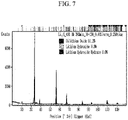
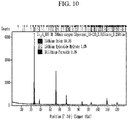
- Li 2 O 2 powders After storing the wet Li 2 O 2 powders in a vacuum drying oven at 130 °C for 3 hours, 1.2 kg of the dried Li 2 O 2 powders were recovered. As a result of XRD phase analysis, it was analyzed as 98.5% of Li 2 O 2 , 1.3% of Li 2 CO 3 , and 0.2% of LiOH-H 2 O. Li 2 CO 3 is estimated to be produced by CO 2 in the atmosphere during transport and XRD measurements.
- the average particle size D50 was measured to be about 50 ⁇ 20 ⁇ m at 150 rpm, about 30 ⁇ 15 ⁇ m at 500 rpm, and about 20 ⁇ 10 ⁇ m at 750 rpm.
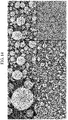
- FIG. 6 shows SEM images of the obtained Li 2 O.
- the shape, as shown in FIG. 6 is spherical.
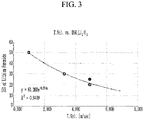
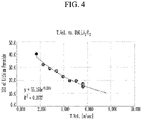
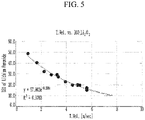
- the relationship between the diameter of Li 2 O and the linear velocity of the reactor during the synthesis reaction is shown as FIGS. 11 to 13 .
- the tip velocity may be adjusted to control the diameter of the lithium oxide.
- a and b are engineering constants and may be obtained as experimental values according to equipment.
- the mixture had a spherical shape, as shown in FIG. 14 .
- pulverized Li 2 O particulates were uniformly distributed on the surface of spherical NIO.
- the synthesized Li 2 NiO 2 had a shape as shown in FIG. 15 . As shown in FIG. 15 , spherical Li 2 NiO 2 was formed, but non-reacted NiO and Li 2 O were not found.
- the prepared Li 2 NiO 2 was used to manufacture a CR2032 coin cell, and electrochemical characteristics thereof were evaluated.
- An electrode was coated on a 14 mm-thick aluminum thin plate, and the coating layer had a thickness of 50 ⁇ m to 80 ⁇ m.
- a manufactured coin cell was charged and discharged in a range of 4.25 V to 3.0 V at a 0.1 C-rate in a CC/CV mode under 1% condition. Charge and discharge curves of three coin cells are shown in FIG. 16 .
- the cells were three times tested with respect to charge/discharge, and each test showed the same result.
- a particle size analysis result of the prepared powder is as follows: the developed product showed an increased diameter by 4.1 ⁇ m with a reference to D50, and Dmin and Dmax thereof were all increased. The reason is that the developed product promoted sintering effects during the LNO synthesis process. (Table 5) Particle size analysis result Dmin [ ⁇ m] D50 [ ⁇ m] Dmax [ ⁇ m] Comparative material 4.47 13.23 39.23 Developed product 5.12 17.33 77.33 Increment (Developed Product-Comparative Material) 0.65 4.1 0.65 Increment rate (Increment/Comparative Material) 14.5% 31.0% 97.1%
- the recovered powders were used as a raw material to manufacture a CR2032 coin cell, and electrochemical characteristics of the coin cells were evaluated.
- the prepared Li 2 NiO 2 was pulverized with a mortar and then, passed through a mesh #325 to remove impurities and large particles.
- An electrode was coated on a 14 mm-thick aluminum thin plate. The coating layer had a thickness of 50 ⁇ m to 80 ⁇ m.
- the manufactured coin cells were charged and discharged in a range of 4.25 V to 3.0 V at a 0.1C-rate in a CC/CV mode under a 1% condition.
Landscapes
- Chemical & Material Sciences (AREA)
- Organic Chemistry (AREA)
- Inorganic Chemistry (AREA)
- Engineering & Computer Science (AREA)
- Materials Engineering (AREA)
- Life Sciences & Earth Sciences (AREA)
- General Life Sciences & Earth Sciences (AREA)
- Geology (AREA)
- Inorganic Compounds Of Heavy Metals (AREA)
- Battery Electrode And Active Subsutance (AREA)
- Oxygen, Ozone, And Oxides In General (AREA)
Applications Claiming Priority (2)
| Application Number | Priority Date | Filing Date | Title |
|---|---|---|---|
| KR1020190172033A KR102314019B1 (ko) | 2019-12-20 | 2019-12-20 | 과산화리튬의 입도 조절 방법 및 입도가 조절된 리튬산화물의 제조방법 |
| PCT/KR2020/017783 WO2021125655A2 (ko) | 2019-12-20 | 2020-12-07 | 과산화리튬의 입도 조절 방법 및 입도가 조절된 리튬산화물의 제조방법 |
Publications (2)
| Publication Number | Publication Date |
|---|---|
| EP4079683A2 true EP4079683A2 (de) | 2022-10-26 |
| EP4079683A4 EP4079683A4 (de) | 2023-08-09 |
Family
ID=76478473
Family Applications (1)
| Application Number | Title | Priority Date | Filing Date |
|---|---|---|---|
| EP20903497.4A Pending EP4079683A4 (de) | 2019-12-20 | 2020-12-07 | Verfahren zur steuerung der teilchengrössen von lithiumperoxid und verfahren zur herstellung von teilchengrössengesteuertem lithiumoxid |
Country Status (10)
| Country | Link |
|---|---|
| US (1) | US20230025008A1 (de) |
| EP (1) | EP4079683A4 (de) |
| JP (2) | JP2023507812A (de) |
| KR (1) | KR102314019B1 (de) |
| CN (1) | CN114829296A (de) |
| AR (1) | AR120789A1 (de) |
| AU (1) | AU2020405885B2 (de) |
| CA (1) | CA3165335A1 (de) |
| CL (1) | CL2022001647A1 (de) |
| WO (1) | WO2021125655A2 (de) |
Families Citing this family (6)
| Publication number | Priority date | Publication date | Assignee | Title |
|---|---|---|---|---|
| CA3180426A1 (en) | 2020-06-25 | 2021-12-30 | Richard K. Holman | Microcomposite alloy structure |
| AU2022206483A1 (en) | 2021-01-11 | 2023-08-31 | 6K Inc. | Methods and systems for reclamation of li-ion cathode materials using microwave plasma processing |
| DE102022100361A1 (de) | 2022-01-10 | 2023-07-13 | Albemarle Germany Gmbh | Pulverförmiges Lithiumoxid, Verfahren zu dessen Herstellung und dessen Verwendung |
| WO2023229928A1 (en) | 2022-05-23 | 2023-11-30 | 6K Inc. | Microwave plasma apparatus and methods for processing materials using an interior liner |
| US12195338B2 (en) | 2022-12-15 | 2025-01-14 | 6K Inc. | Systems, methods, and device for pyrolysis of methane in a microwave plasma for hydrogen and structured carbon powder production |
| JP2026507121A (ja) * | 2023-02-27 | 2026-02-27 | シックスケー インコーポレイテッド | 酸化リチウム材料及び酸化リチウム材料を生成する方法 |
Family Cites Families (12)
| Publication number | Priority date | Publication date | Assignee | Title |
|---|---|---|---|---|
| US3321277A (en) * | 1964-01-15 | 1967-05-23 | Lithium Corp | Lithium oxide having active absorption capacity for carbon dioxide and method of preparing same |
| JPH02245769A (ja) * | 1989-03-20 | 1990-10-01 | Tomoegawa Paper Co Ltd | 重合トナーの製造方法 |
| CA2227534A1 (en) * | 1995-08-02 | 1997-02-13 | Jack Wolstenholme | Synthesis of lithiated transition metal oxides |
| JP2006265086A (ja) * | 2005-02-24 | 2006-10-05 | Toyota Motor Corp | 水酸化ニッケル粒子の製造方法及び製造装置 |
| JP5119663B2 (ja) * | 2006-02-16 | 2013-01-16 | 三菱化学株式会社 | Afi型鉄アルミノフォスフェート及びその製造方法 |
| US8663565B2 (en) * | 2011-02-11 | 2014-03-04 | Xerox Corporation | Continuous emulsification—aggregation process for the production of particles |
| KR101092337B1 (ko) * | 2011-07-20 | 2011-12-09 | (주) 라미나 | 리튬이차전지의 양극 활물질 제조용 올인원 타입 연속식 반응기 및 이를 포함하는 결정분리장치 |
| KR101393493B1 (ko) * | 2012-08-29 | 2014-05-13 | 서강대학교산학협력단 | 구형의 탄소 입자, 및 이의 제조 방법 |
| KR101887171B1 (ko) * | 2016-12-23 | 2018-08-09 | 주식회사 포스코 | 산화리튬의 제조방법 및 리튬니켈산화물의 제조방법 |
| KR20180112482A (ko) * | 2017-04-04 | 2018-10-12 | 주식회사 라미나 | 이차전지용 양극활물질 전구체의 제조방법 |
| KR102002006B1 (ko) * | 2017-12-29 | 2019-07-22 | (주)실루엣미디어그룹아시아 | 하이브리드 에어하키 게임 장치 및 그 제어 방법 |
| JP2021044093A (ja) * | 2019-09-09 | 2021-03-18 | 日亜化学工業株式会社 | 非水電解質二次電池用正極活物質の製造方法 |
-
2019
- 2019-12-20 KR KR1020190172033A patent/KR102314019B1/ko active Active
-
2020
- 2020-12-07 JP JP2022538272A patent/JP2023507812A/ja active Pending
- 2020-12-07 US US17/787,010 patent/US20230025008A1/en active Pending
- 2020-12-07 CN CN202080088032.5A patent/CN114829296A/zh active Pending
- 2020-12-07 EP EP20903497.4A patent/EP4079683A4/de active Pending
- 2020-12-07 WO PCT/KR2020/017783 patent/WO2021125655A2/ko not_active Ceased
- 2020-12-07 CA CA3165335A patent/CA3165335A1/en active Pending
- 2020-12-07 AU AU2020405885A patent/AU2020405885B2/en active Active
- 2020-12-17 AR ARP200103518A patent/AR120789A1/es active IP Right Grant
-
2022
- 2022-06-16 CL CL2022001647A patent/CL2022001647A1/es unknown
-
2024
- 2024-05-09 JP JP2024076570A patent/JP2024099846A/ja active Pending
Also Published As
| Publication number | Publication date |
|---|---|
| JP2023507812A (ja) | 2023-02-27 |
| CL2022001647A1 (es) | 2023-01-06 |
| KR20210079844A (ko) | 2021-06-30 |
| EP4079683A4 (de) | 2023-08-09 |
| CA3165335A1 (en) | 2021-06-24 |
| KR102314019B1 (ko) | 2021-10-15 |
| WO2021125655A3 (ko) | 2021-08-12 |
| AU2020405885A1 (en) | 2022-08-04 |
| WO2021125655A2 (ko) | 2021-06-24 |
| CN114829296A (zh) | 2022-07-29 |
| AR120789A1 (es) | 2022-03-16 |
| AU2020405885B2 (en) | 2024-08-01 |
| JP2024099846A (ja) | 2024-07-25 |
| US20230025008A1 (en) | 2023-01-26 |
Similar Documents
| Publication | Publication Date | Title |
|---|---|---|
| EP4079683A2 (de) | Verfahren zur steuerung der teilchengrössen von lithiumperoxid und verfahren zur herstellung von teilchengrössengesteuertem lithiumoxid | |
| EP3774661B1 (de) | Verfahren zur herstellung von positivelektrodenmaterial für wiederaufladbare lithium-ionen-batterien | |
| US6136476A (en) | Methods for making lithium vanadium oxide electrode materials | |
| US10818921B2 (en) | Nickel complex hydroxide particles and nonaqueous electrolyte secondary battery | |
| EP2911224B1 (de) | Li-ni-verbundoxidteilchenpulver und verfahren zur herstellung davon und sekundärzelle mit wasserfreiem elektrolyt | |
| EP2128915B1 (de) | Li-ni-komplexoxid-teilchenpulver für eine sekundärbatterie mit wasserfreiem elektrolyt, herstellungsverfahren dafür und sekundärbatterie mit wasserfreiem elektrolyt | |
| US20250112235A1 (en) | Lithium compound with small primary particle size, method for preparing the same, nickel-based cathode active material prepared from the same, and secondary battery using same | |
| EP3859841A1 (de) | Aktivmaterial, positivelektrodenmischung und festkörperbatterie mit diesem aktivmaterial | |
| EP2833445A1 (de) | Partikelpulver für ein positivelektroden-aktivmaterial, verfahren zur herstellung davon und sekundärbatterie mit wasserfreiem elektrolyt | |
| EP4220771B1 (de) | Positivelektrodenaktivmaterial für lithium-ionen-sekundärbatterien, verfahren zur herstellung davon und lithium-ionen-sekundärbatterie | |
| EP3006403A1 (de) | Lithiumtitanat, herstellungsverfahren dafür und elektrische speicherzellenvorrichtung damit | |
| EP3951948A1 (de) | Positivelektrodenaktivmaterial für lithium-ionen-sekundärbatterien, verfahren zur herstellung davon und lithium-ionen-sekundärbatterie | |
| JP6511761B2 (ja) | 非水系電解質二次電池用正極活物質用の被覆複合酸化物粒子の製造方法及び当該製造方法によって製造される被覆複合酸化物粒子を用いた非水系電解質二次電池 | |
| EP4405303B1 (de) | Verfahren zur herstellung von vorläufern von kathodenaktivmaterialien für lithium-ionen-batterien | |
| KR20210016600A (ko) | 리튬 화합물, 니켈계 양극 활물질, 산화 리튬의 제조 방법, 니켈계 양극 활물질의 제조 방법, 및 이를 이용한 이차 전지 | |
| JPH11185755A (ja) | リチウム電池用正極活物質とそれを正極に用いる電池 | |
| EP4628451A1 (de) | Lithiummetallverbundoxid, positivelektrodenaktivmaterial für lithiumsekundärbatterie, positivelektrode für lithiumsekundärbatterie und lithiumsekundärbatterie | |
| JP2025074995A (ja) | 二次電池用正極活物質前駆体及び正極活物質 | |
| WO2024219129A1 (ja) | リチウム金属複合酸化物、リチウム二次電池用正極活物質、リチウム二次電池用正極及びリチウム二次電池 | |
| TW202506562A (zh) | 鋰鈷系複合氧化物粒子的製造方法 | |
| CN116601117A (zh) | 用于可再充电锂离子电池的正电极活性材料 | |
| JP2018181736A (ja) | リチウムイオン二次電池用正極活物質の前駆体とその製造方法、リチウムイオン二次電池用正極活物質とその製造、及びリチウムイオン二次電池 |
Legal Events
| Date | Code | Title | Description |
|---|---|---|---|
| STAA | Information on the status of an ep patent application or granted ep patent |
Free format text: STATUS: THE INTERNATIONAL PUBLICATION HAS BEEN MADE |
|
| PUAI | Public reference made under article 153(3) epc to a published international application that has entered the european phase |
Free format text: ORIGINAL CODE: 0009012 |
|
| STAA | Information on the status of an ep patent application or granted ep patent |
Free format text: STATUS: REQUEST FOR EXAMINATION WAS MADE |
|
| 17P | Request for examination filed |
Effective date: 20220701 |
|
| AK | Designated contracting states |
Kind code of ref document: A2 Designated state(s): AL AT BE BG CH CY CZ DE DK EE ES FI FR GB GR HR HU IE IS IT LI LT LU LV MC MK MT NL NO PL PT RO RS SE SI SK SM TR |
|
| DAV | Request for validation of the european patent (deleted) | ||
| DAX | Request for extension of the european patent (deleted) | ||
| A4 | Supplementary search report drawn up and despatched |
Effective date: 20230711 |
|
| RIC1 | Information provided on ipc code assigned before grant |
Ipc: C01G 53/00 20060101ALI20230705BHEP Ipc: C01D 15/02 20060101ALI20230705BHEP Ipc: C01B 15/043 20060101AFI20230705BHEP |