EP4078583B1 - Temperaturregelung eines speicheruntersystems - Google Patents
Temperaturregelung eines speicheruntersystems Download PDFInfo
- Publication number
- EP4078583B1 EP4078583B1 EP20902191.4A EP20902191A EP4078583B1 EP 4078583 B1 EP4078583 B1 EP 4078583B1 EP 20902191 A EP20902191 A EP 20902191A EP 4078583 B1 EP4078583 B1 EP 4078583B1
- Authority
- EP
- European Patent Office
- Prior art keywords
- temperature value
- data
- memory
- memory device
- temperature
- Prior art date
- Legal status (The legal status is an assumption and is not a legal conclusion. Google has not performed a legal analysis and makes no representation as to the accuracy of the status listed.)
- Active
Links
Images




Classifications
-
- G—PHYSICS
- G06—COMPUTING OR CALCULATING; COUNTING
- G06F—ELECTRIC DIGITAL DATA PROCESSING
- G06F3/00—Input arrangements for transferring data to be processed into a form capable of being handled by the computer; Output arrangements for transferring data from processing unit to output unit, e.g. interface arrangements
- G06F3/06—Digital input from, or digital output to, record carriers, e.g. RAID, emulated record carriers or networked record carriers
- G06F3/0601—Interfaces specially adapted for storage systems
- G06F3/0628—Interfaces specially adapted for storage systems making use of a particular technique
- G06F3/0629—Configuration or reconfiguration of storage systems
- G06F3/0634—Configuration or reconfiguration of storage systems by changing the state or mode of one or more devices
-
- G—PHYSICS
- G06—COMPUTING OR CALCULATING; COUNTING
- G06F—ELECTRIC DIGITAL DATA PROCESSING
- G06F1/00—Details not covered by groups G06F3/00 - G06F13/00 and G06F21/00
- G06F1/16—Constructional details or arrangements
- G06F1/20—Cooling means
-
- G—PHYSICS
- G06—COMPUTING OR CALCULATING; COUNTING
- G06F—ELECTRIC DIGITAL DATA PROCESSING
- G06F1/00—Details not covered by groups G06F3/00 - G06F13/00 and G06F21/00
- G06F1/16—Constructional details or arrangements
- G06F1/20—Cooling means
- G06F1/206—Cooling means comprising thermal management
-
- G—PHYSICS
- G06—COMPUTING OR CALCULATING; COUNTING
- G06F—ELECTRIC DIGITAL DATA PROCESSING
- G06F3/00—Input arrangements for transferring data to be processed into a form capable of being handled by the computer; Output arrangements for transferring data from processing unit to output unit, e.g. interface arrangements
- G06F3/06—Digital input from, or digital output to, record carriers, e.g. RAID, emulated record carriers or networked record carriers
- G06F3/0601—Interfaces specially adapted for storage systems
- G06F3/0602—Interfaces specially adapted for storage systems specifically adapted to achieve a particular effect
- G06F3/0614—Improving the reliability of storage systems
- G06F3/0617—Improving the reliability of storage systems in relation to availability
-
- G—PHYSICS
- G06—COMPUTING OR CALCULATING; COUNTING
- G06F—ELECTRIC DIGITAL DATA PROCESSING
- G06F3/00—Input arrangements for transferring data to be processed into a form capable of being handled by the computer; Output arrangements for transferring data from processing unit to output unit, e.g. interface arrangements
- G06F3/06—Digital input from, or digital output to, record carriers, e.g. RAID, emulated record carriers or networked record carriers
- G06F3/0601—Interfaces specially adapted for storage systems
- G06F3/0668—Interfaces specially adapted for storage systems adopting a particular infrastructure
- G06F3/0671—In-line storage system
- G06F3/0673—Single storage device
- G06F3/0679—Non-volatile semiconductor memory device, e.g. flash memory, one time programmable memory [OTP]
Definitions
- the present disclosure relates generally to memory sub-systems, and more specifically, relate to memory sub-system temperature regulation.
- a memory sub-system can include one or more memory devices that store data.
- the memory devices can be, for example, non-volatile memory components and volatile memory devices.
- a host system can utilize a memory sub-system to store data at the memory devices and to retrieve data from the memory devices.
- US2009/190427 A1 describes a data processing system to enable a memory hub device to manage thermal conditions at a memory device level transparent to a memory controller.
- US2019/012263 A1 describes information handling systems and the transfer of data from a volatile memory of a memory module to a non-volatile memory of the memory module.
- a memory sub-system can be a storage device, a memory module, or a hybrid of a storage device and memory module.
- An example of a memory sub-system is a storage system, such as a non-volatile dual in-line memory module (NVDIMM). Examples of storage devices and memory modules are described below in conjunction with FIG. 1 .
- NVDIMM non-volatile dual in-line memory module
- Examples of storage devices and memory modules are described below in conjunction with FIG. 1 .
- a host system can utilize a memory sub-system that includes one or more components, such as "memory devices" that store data. The host system can provide data to be stored at the memory sub-system and can request data to be retrieved from the memory sub-system.
- a non-volatile dual in-line memory module is a type of random-access memory that has volatile memory for normal operation and non-volatile memory in which to store the contents of the volatile memory if the power fails, using an on-board backup power source.
- a host with respect to a memory unit, can be structured as one or more processors that control data in and out of the memory unit in response to instructions (e.g., an application, program, etc.) being executed by the host.
- the NVDIMM can copy all the data from its volatile memory (e.g., DRAM or set of DRAMS) to its persistent flash storage and can copy all the data back to the volatile memory when power is restored.
- the transfer of the state of all the DRAM data into persistent data on the persistent flash storage can be performed on a power cycle. While example described above refers to a persistent flash storage, embodiments are not so limited. As an example, some examples can include persistent storage that is a non-flash persistent storage.
- the NVDIMM has its own battery backup power source or access to a dedicated power source to allow the NVDIMM to complete the save.
- NVDIMMs can include a variety of different types (N, P, X, F).
- NVDIMM-N is a dual in-line memory module (DIMM) typically with flash storage and traditional dynamic random-access memory (DRAM) on the same module.
- DRAM dynamic random-access memory
- a host processing unit can access the traditional DRAM directly.
- NVDIMM-P can include main memory that is persistent and can share a DDR4 or DDR5 DIMM interconnect with DRAM DIMMs.
- NVDIMM-X can include a DDR4 DIMM with NAND flash storage and volatile DRAM on a same module.
- NVDIMM-F can include an NVDIMM with flash storage.
- a set of control registers in a NVDIMM can be implemented to provide for a partial save of memory in the NVDIMM to non-volatile memory, where "memory" refers to the main memory of the NVDIMM.
- the main memory is the volatile memory, such as a DRAM, which stores user data.
- the set of control registers can provide a mechanism to conduct a partial save by containing a starting offset of a portion of the volatile memory to identify a location in the volatile memory where a save operation starts and by containing an amount of content of the volatile memory to be saved.
- a host can populate the set of control registers in the NVDIMM with an identification of a start of a save operation and an amount of content for the save operation.
- This set of control registers can also control the inverse operation that restores the partial save back to the volatile memory of the NVDIMM.
- This structure for maintaining data stored on a NVDIMM provides a host with added flexibility to handle user data with respect to applications for which the host is processing. The host is provided access to perform a full content or a partial content save at any offset. This can provide the host with the ability to have better control, and more control over what is saved and restored.
- Whether a partial save/restore or a full save/restore is performed can have an affect on the temperature of a controller of the NVDIMM and/or the non-volatile memory of the NVDIMM.
- the temperature of a system e.g., a controller, a non-volatile memory, etc.
- the temperature of a system can be important due to cooling costs, system use or placement, applications of the DIMM, damage of the DIMM due to increasing temperature or temperature that exceeds a maximum value, and use of NVDIMM in non-power failure events (e.g., when time of operation is less critical).
- the temperature of the controller and/or the non-volatile memory can be monitored and a maximum or threshold temperature of each of the controller and the non-volatile memory can determined or predetermined.
- operations to regulate temperature can be performed in order to bring the temperature value below the threshold temperature value.
- examples herein can allow for control of system temperature using temperature components associated with an NVDIMM device.
- temperature values of memory devices e.g., volatile memory and/or non-volatile memory
- examples herein can allow for control of system temperature using temperature components associated with an NVDIMM device.
- temperature values of memory devices e.g., volatile memory and/or non-volatile memory
- volatile memory and/or non-volatile memory associated with the NVDIMM can be sensed or monitored to maintain a temperature value below a threshold temperature value or within a range of temperature values using operations to regulate temperature described herein.
- the operations to regulate temperature can be carried out using a temperature component that is resident on the NVDIMM.
- the temperature component can be resident on a controller (e.g., a memory sub-system controller) associated with the NVDIMM or can be resident on a non-volatile memory device such as a flash memory device, cross-point memory device, etc.
- a controller e.g., a memory sub-system controller
- non-volatile memory device such as a flash memory device, cross-point memory device, etc.
- the term “resident on” refers to something that is physically located on a particular component.
- the temperature component being “resident on” the controller refers to a condition in which the temperature component is physically located on the controller.
- the term “resident on” can be used interchangeably with other terms such as “deployed on” or "located on,” herein.
- a save operation performed on data stored in a volatile memory device can include saving an entire portion of data to a non-volatile memory device and may not be able to dynamically adjust a size of the data saved in order to prevent a temperature value from exceeding a threshold temperature value.
- a transfer speed of the data may not be dynamically adjustable in order to maintain a temperature value of the system within a particular range or below a particular threshold.
- a full save or restore of the data can cause a temperature of the controller and/or non-volatile memory to increase beyond user or server system limitations.
- An advantage of the present disclosure includes dynamically controlling the temperature of the controller and/or the memory-sub-system controller by adjusting characteristics of the data transfer (such as data size or data transfer speed). Examples described herein include a temperature component resident on the memory sub-system or the memory sub-system controller, to make it possible to perform operations (such as data size and/or data transfer speed adjustments) to adjust a temperature of a controller and/or a temperature of a non-volatile memory device.
- a temperature component can be provided resident on the memory sub-system and/or the memory sub-system controller
- examples described herein can allow for the temperature component to monitor a temperature of a controller and adjust a data size (e.g., for saving the data into the non-volatile memory) in order to lower the temperature of the controller.
- examples described herein can allow for the temperature component to monitor a temperature of a controller and adjust a data transfer speed in order to lower the temperature of the controller.
- temperature measurements of both non-volatile memory and system e.g., field programmable gate array (FPGA)
- FPGA field programmable gate array
- FIG. 1 illustrates an example computing system 100 that includes a memory sub-system 110 in accordance with the present disclosure.
- the memory sub-system 110 can include media, such as one or more volatile memory devices (e.g., memory device 140), one or more non-volatile memory devices (e.g., memory device 130), or a combination of such.
- a memory sub-system 110 can be a storage device, a memory module, or a hybrid of a storage device and memory module.
- memory modules include a dual in-line memory module (DIMM), a small outline DIMM (SO-DIMM), and various types of non-volatile dual in-line memory modules (NVDIMM).
- Examples of a storage device include a solid-state drive (SSD), a flash drive, a universal serial bus (USB) flash drive, an embedded Multi-Media Controller (eMMC) drive, a Universal Flash Storage (UFS) drive, a secure digital (SD) card, and a hard disk drive (HDD).
- SSD solid-state drive
- eMMC embedded Multi-Media Controller
- UFS Universal Flash Storage
- SD secure digital
- HDD hard disk drive
- the computing system 100 can be a computing device such as a desktop computer, laptop computer, network server, mobile device, a vehicle (e.g., airplane, drone, train, automobile, or other conveyance), Internet of Things (IoT) enabled device, embedded computer (e.g., one included in a vehicle, industrial equipment, or a networked commercial device), or such computing device that includes memory and a processing device.
- a computing device such as a desktop computer, laptop computer, network server, mobile device, a vehicle (e.g., airplane, drone, train, automobile, or other conveyance), Internet of Things (IoT) enabled device, embedded computer (e.g., one included in a vehicle, industrial equipment, or a networked commercial device), or such computing device that includes memory and a processing device.
- vehicle e.g., airplane, drone, train, automobile, or other conveyance
- IoT Internet of Things
- embedded computer e.g., one included in a vehicle, industrial equipment, or a networked commercial device
- the computing system 100 can include a host system 120 that is coupled to one or more memory sub-systems 110.
- the host system 120 is coupled to different types of memory sub-system 110.
- FIG. 1 illustrates one example of a host system 120 coupled to one memory sub-system 110.
- “coupled to” or “coupled with” generally refers to a connection between components, which can be an indirect communicative connection or direct communicative connection (e.g., without intervening components), whether wired or wireless, including connections such as electrical, optical, magnetic, etc.
- the host system 120 can include a processor chipset and a software stack executed by the processor chipset.
- the processor chipset can include one or more cores, one or more caches, a memory controller (e.g., NVDIMM controller), and a storage protocol controller (e.g., PCIe controller, SATA controller).
- the host system 120 uses the memory sub-system 110, for example, to write data to the memory sub-system 110 and read data from the memory sub-system 110.
- the host system 120 can be coupled to the memory sub-system 110 via a physical host interface.
- a physical host interface include, but are not limited to, a serial advanced technology attachment (SATA) interface, a peripheral component interconnect express (PCIe) interface, universal serial bus (USB) interface, Fibre Channel, Serial Attached SCSI (SAS), a double data rate (DDR) memory bus, Small Computer System Interface (SCSI), a dual in-line memory module (DIMM) interface (e.g., DIMM socket interface that supports Double Data Rate (DDR)), etc.
- SATA serial advanced technology attachment
- PCIe peripheral component interconnect express
- USB universal serial bus
- SAS Serial Attached SCSI
- DDR double data rate
- SCSI Small Computer System Interface
- DIMM dual in-line memory module
- DIMM DIMM socket interface that supports Double Data Rate (DDR)
- the host system 120 can further utilize an NVM Express (NVMe) interface to access components (e.g., memory devices 130) when the memory sub-system 110 is coupled with the host system 120 by the PCIe interface.
- NVMe NVM Express
- the physical host interface can provide an interface for passing control, address, data, and other signals between the memory sub-system 110 and the host system 120.
- FIG. 1 illustrates a memory sub-system 110 as an example.
- the host system 120 can access multiple memory sub-systems via a same communication connection, multiple separate communication connections, and/or a combination of communication connections.
- the memory devices 130, 140 can include various combinations of the different types of non-volatile memory devices and/or volatile memory devices.
- the volatile memory devices e.g., memory device 140
- RAM random access memory
- DRAM dynamic random access memory
- SDRAM synchronous dynamic random access memory
- non-volatile memory devices includes negative-and (NAND) type flash memory and write-in-place memory, such as a three-dimensional cross-point (“3D cross-point”) memory device, which is a cross-point array of non-volatile memory cells.
- NAND negative-and
- 3D cross-point three-dimensional cross-point
- a cross-point array of non-volatile memory can perform bit storage based on a change of bulk resistance, in conjunction with a stackable cross-gridded data access array.
- cross-point non-volatile memory can perform a write in-place operation, where a non-volatile memory cell can be programmed without the non-volatile memory cell being previously erased.
- NAND type flash memory includes, for example, two-dimensional NAND (2D NAND) and three-dimensional NAND (3D NAND).
- Each of the memory devices 130 can include one or more arrays of memory cells.
- One type of memory cell for example, single level cells (SLC) can store one bit per cell.
- Other types of memory cells such as multi-level cells (MLCs), triple level cells (TLCs), and quad-level cells (QLCs), can store multiple bits per cell.
- Each of the memory devices 130 can include one or more arrays of memory cells such as SLCs, MLCs, TLCs, QLCs, or any combination of such.
- a particular memory device can include an SLC portion, and an MLC portion, a TLC portion, or a QLC portion of memory cells.
- the memory cells of the memory devices 130 can be grouped as pages that can refer to a logical unit of the memory device used to store data. With some types of memory (e.g., NAND), pages can be grouped to form blocks.
- non-volatile memory components such as 3D cross-point array of non-volatile memory cells and NAND type memory (e.g., 2D NAND, 3D NAND)
- the memory device 130 can be based on any other type of non-volatile memory or storage device, such as read-only memory (ROM), phase change memory (PCM), self-selecting memory, other chalcogenide based memories, ferroelectric transitor random-access memory (FeTRAM), ferroelectric random access memory (FeRAM), magneto random access memory (MRAM), Spin Transfer Torque (STT)-MRAM, conductive bridging RAM (CBRAM), resistive random access memory (RRAM), oxide based RRAM (OxRAM), negative-or (NOR) flash memory, and electrically erasable programmable read-only memory (EEPROM).
- ROM read-only memory
- PCM phase change memory
- FeTRAM ferroelectric transitor random-access memory
- FeRAM ferroelectric random access memory
- MRAM magneto random
- a memory sub-system controller 115 (or controller 115 for simplicity) can communicate with the memory devices 130 to perform operations such as reading data, writing data, or erasing data at the memory devices 130 and other such operations.
- the memory sub-system controller 115 can include hardware such as one or more integrated circuits and/or discrete components, a buffer memory, or a combination thereof.
- the hardware can include digital circuitry with dedicated (i.e., hard-coded) logic to perform the operations described herein.
- the memory sub-system controller 115 can be a microcontroller, special purpose logic circuitry (e.g., a field programmable gate array (FPGA), an application specific integrated circuit (ASIC), etc.), or other suitable processor.
- FPGA field programmable gate array
- ASIC application specific integrated circuit
- the memory sub-system controller 115 can include a processor 117 (processing device) configured to execute instructions stored in a local memory 119.
- the local memory 119 of the memory sub-system controller 115 includes an embedded memory configured to store instructions for performing various processes, operations, logic flows, and routines that control operation of the memory sub-system 110, including handling communications between the memory sub-system 110 and the host system 120.
- the local memory 119 can include memory registers storing memory pointers, fetched data, etc.
- the local memory 119 can also include read-only memory (ROM) for storing micro-code. While the example memory sub-system 110 in FIG. 1 has been illustrated as including the memory sub-system controller 115, in another example of the present disclosure, a memory sub-system 110 does not include a memory sub-system controller 115, and can instead rely upon external control (e.g., provided by an external host, or by a processor or controller separate from the memory sub-system).
- the memory sub-system controller 115 can receive commands or operations from the host system 120 and can convert the commands or operations into instructions or appropriate commands to achieve the desired access to the memory device 130 and/or the memory device 140.
- the memory sub-system controller 115 can be responsible for other operations such as wear leveling operations, garbage collection operations, error detection and error-correcting code (ECC) operations, encryption operations, caching operations, and address translations between a logical address (e.g., logical block address (LBA), namespace) and a physical address (e.g., physical block address) that are associated with the memory devices 130.
- the memory sub-system controller 115 can further include host interface circuitry to communicate with the host system 120 via the physical host interface.
- the host interface circuitry can convert the commands received from the host system into command instructions to access the memory device 130 and/or the memory device 140 as well as convert responses associated with the memory device 130 and/or the memory device 140 into information for the host system 120.
- the memory sub-system 110 can also include additional circuitry or components that are not illustrated.
- the memory sub-system 110 can include a cache or buffer (e.g., DRAM) and address circuitry (e.g., a row decoder and a column decoder) that can receive an address from the memory sub-system controller 115 and decode the address to access the memory device 130 and/or the memory device 140.
- a cache or buffer e.g., DRAM
- address circuitry e.g., a row decoder and a column decoder
- the memory device 130 includes local media controllers 135 that operate in conjunction with memory sub-system controller 115 to execute operations on one or more memory cells of the memory devices 130.
- An external controller e.g., memory sub-system controller 115
- a memory device 130 is a managed memory device, which is a raw memory device combined with a local controller (e.g., local controller 135) for media management within the same memory device package.
- An example of a managed memory device is a managed NAND (MNAND) device.
- MNAND managed NAND
- the memory sub-system 110 includes a temperature component 113 that can be configured to orchestrate and/or perform operations to regulate temperature and communicate temperature data on various components, data paths, and/or interfaces of the memory sub-system 110.
- the temperature component 113 can include various circuitry to facilitate grading and allocation of the sets of memory cells.
- the temperature component 113 can include a special purpose circuitry in the form of an ASIC, FPGA, state machine, and/or other logic circuitry that can allow the temperature component 113 to orchestrate and/or perform temperature operations and communicate results to various components, data paths, and/or interfaces of the memory sub-system 110.
- the memory sub-system controller 115 includes a temperature component 113 that can be configured to orchestrate and/or perform operations to regulate temperature on various components, data components, and/or interfaces of the memory sub-system 110.
- the temperature component 113 can sense and/or monitor a temperature value indicating a temperature of the memory sub-system controller 115.
- the temperature component 113 can include various circuitry to facilitate grading and allocation of the sets of memory cells.
- the temperature component 113 can include a special purpose circuitry in the form of an ASIC, FPGA, state machine, and/or other logic circuitry that can allow the temperature component 113 to orchestrate and/or perform operations to regulate temperature on various components, data elements, and/or interfaces of the memory sub-system 110 and transfer the temperature value to other various components of the memory sub-system 110.
- the temperature component 113 can sense and/or monitor multiple temperature values over a period of time or at different time intervals and feed back the temperature values as a feedback loop to dynamically monitor and adjust the temperature values.
- the temperature component 113 can be communicatively coupled to the memory devices 130 and can access the memory device 130, the memory device 140, internal data paths of the memory sub-system 110, and/or interfaces of the memory sub-system 110 to perform the operations described herein and/or to transfer the temperature value data to additional elements of the memory sub-system 110.
- the operations performed by the temperature component 113 can be performed during an initialization or pre-initialization stage of data transfer within the memory sub-system 110 and/or the memory sub-system controller 115. Accordingly the temperature component 113 can perform the operations described herein prior to data transfer in order to determine a size of data to transfer or a data transfer speed to initially perform. During the initial data transfer, additional temperature values can be obtained and the size of the data transferred or the data transfer speed can be adjusted in order to adjust the temperature values.
- the memory device 130 includes a temperature component 131 that can be configured to orchestrate and/or perform operations to regulate temperature on the memory device 130.
- the temperature component 131 can sense and/or monitor a temperature value indicating a temperature of the memory device 130.
- the temperature component 131 can include various circuitry to facilitate grading and allocation of the sets of memory cells.
- the temperature component 131 can include a special purpose circuitry in the form of an ASIC, FPGA, state machine, and/or other logic circuitry that can allow the temperature component 131 to orchestrate and/or perform operations to regulate temperature on various components, data elements, and/or interfaces of the memory device 130 and transfer the temperature value to other various components of the memory sub-system 110.
- the temperature component 131 can sense and/or monitor multiple temperature values over a period of time or at different time intervals and feed back the temperature values as a feedback loop to dynamically monitor and adjust the temperature values of the memory device 130.
- the temperature component 131 can be communicatively coupled to the memory sub-system controller 115 and can access the memory sub-system controller 115, the memory device 140, internal data paths of the memory sub-system 110, and/or interfaces of the memory sub-system 110 to perform the operations described herein and/or to transfer the temperature value data to additional elements of the memory sub-system 110.
- the operations performed by the temperature component 131 can be performed during an initialization or pre-initialization stage of data transfer from or to the memory device 130 and/or within the memory sub-system 110. Accordingly, the temperature component 131 can perform the operations described herein prior to data transfer in order to determine a size of data to transfer or a data transfer speed to initially perform. During the initial data transfer, additional temperature values can be obtained and the size of the data transferred or the data transfer speed can be adjusted in order to adjust the temperature values.
- the data generated by the temperature components 113 or 131 can be injected into a data path between the memory sub-system controller 115 and the memory device 140 or the memory device 130.
- the data can be a quantity of bits that corresponds to a specific bit pattern.
- the data can be an Altera PHY Interface (AFI) bit pattern, a user control bit pattern, a bi-directional (DQ) pin control data pattern, or other suitable bit pattern that can be written to, and read from, a first memory device (or a memory device different than the first memory device).
- the data can include a specific recurring set of alphanumeric characters such as a string of alternating ones and zeros or a quantity of ones (or zeros) followed by a quantity of zeros (or ones). It will be appreciated that embodiments are not limited to these enumerated examples and the data can include any pattern of bits and/or data that can be written to, and read from, one of the memory devices, etc.
- the temperature component 113 can be configured to cause data to be injected into the data path such that the data is written to the second memory device using a particular size of data or a particular data transfer speed based on a temperature value determined by the temperature component 113.
- the temperature component 131 can be configured to cause the data to be injected into the data path using a particular data size or a particular data transfer speed based on a temperature value determined by the temperature component 131.
- the data can be written to the second memory device as part of an operation to save the data to the second memory device or as part of an operation to perform a partial save operation using the second memory device.
- the temperature component 113 can generate a first indication in response to a determination that the temperature value of the memory sub-system controller 115 is approaching a temperature value threshold.
- the first indication can indicate to reduce a size of the data being transferred or decrease a data transfer speed in order to maintain a temperature value or reduce a temperature value. The reduction can be based on how close the temperature value is to the threshold temperature value or a margin of temperature value between the determined temperature value and the threshold temperature value.
- a second indication can be generated indicating to maintain a data size or a data transfer speed.
- a third indication can be generated indicating to increase a data size or a data transfer speed. The third indication can be generated in response to the temperature value being below the threshold temperature value by a particular margin amount. In this instance, the temperature value can be increased by increasing the data size or increasing the data transfer speed in order to increase the data transfer efficiency, decrease an amount of time it takes to transfer the data, etc.
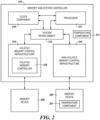
- FIG. 2 illustrates an example of a memory sub-system controller 215 and temperature component 213 in accordance with the present disclosure.
- the memory sub-system controller 215 can be analogous to the memory sub-system controller 115 illustrated in FIG. 1 and the temperature component 213 can be analogous to the temperature component 113 illustrated in FIG. 1 .
- the processor 217 can be analogous to the processor 117 illustrated in FIG. 1
- the memory device 230 can be analogous to the memory device 130 illustrated in FIG. 1
- the memory device 240 can be analogous to the memory device 140 illustrated in FIG. 1 .
- the memory sub-system controller 215 can further include a clock component 218, a system interconnect 212, volatile memory control infrastructure 214, which can include a volatile memory controller 219, and non-volatile memory control infrastructure 216.
- the clock component 218 can provide timing signals to the memory sub-system controller 215 to facilitate performance of memory operations orchestrated by the memory sub-system controller 215.
- the clock component 218 can be a register clock driver that can be configured to buffer and/or re-drive commands and/or addresses to the memory device 230 and/or the memory device 240 during operation of the memory sub-system controller 215.
- the system interconnect 212 can be a communication sub-system that can allow commands, signals, instructions, and the like to be passed between the processor 217, clock component 218, volatile memory control infrastructure 214, and the non-volatile memory control infrastructure 216.
- the system interconnect 212 can be a crossbar ("XBAR"), a network on a chip, or other communication subsystem that allows for interconnection and interoperability between the processor 217, clock component 218, volatile memory control infrastructure 214, and the non-volatile memory control infrastructure 216.
- XBAR crossbar
- the system interconnect 212 can facilitate visibility between the processor 217, clock component 218, volatile memory control infrastructure 214, and the non-volatile memory control infrastructure 216 to facilitate communication therebetween.
- Communication between the processor 217, clock component 218, volatile memory control infrastructure 214, and the non-volatile memory control infrastructure 216 via the system interconnect 212 can be provided via respective data paths (shown by the arrows connecting the system interconnect 212 to the other components of the memory sub-system controller 215). These data paths can be used to share commands indicating to increase or decrease a data transfer size or a data transfer speed in response to changing temperature values obtained by the temperature component 213 and corresponding to the temperature of the memory sub-system controller 215 or obtained by the temperature component 231 of the memory device 230 (which indicates a temperature value of the memory device 230).
- the volatile memory control infrastructure 214 can include circuitry to control data transfers between the memory device 230 and a host, such as the host system 120 illustrated in FIG. 1 .
- the volatile memory control infrastructure 214 can include various interfaces, direct media access components, registers, and/or buffers.
- the temperature component 213 is resident on the memory sub-system controller 215 and the temperature component 231 is resident on the memory device 230.
- the temperature components 213, 231 can be configured to facilitate performance of operations of the memory sub-system controller 215 and/or a memory subsystem (e.g., the memory sub-system 110 illustrated in FIG. 1 ) in which the memory sub-system controller 215 is deployed.
- the temperature components 213, 231 can be configured to adjust a data size to be transferred or a data transfer speed corresponding to a particular transfer of data (e.g., for performing a full or partial restore or save).
- the temperature components 213, 231 can be further configured to affect timing information from the clock component 218 (e.g., generating an indication to increase or decrease a clock cycle signal associated with a frequency of data transfer), perform an operation to compare a frequency of a timing signal generated by the clock component to an expected timing signal, and determine, based on the comparison, whether the frequency of the timing signal and the expected timing signal are substantially equivalent.
- the term “substantially” intends that the characteristic need not be absolute, but is close enough so as to achieve the advantages of the characteristic.
- “substantially equivalent” is not limited to absolute equivalence, and can include slight variations in equivalence that can be due to manufacturing limitations and/or operational characteristics of the memory sub-system controller 215.
- the non-volatile memory control infrastructure 216 can include circuitry to control data transfers between the memory device 240 and a host, such as the host system 120 illustrated in FIG. 1 .
- the volatile memory control infrastructure 214 can include various interfaces, direct media access components, registers, and/or buffers.
- FIG. 3 illustrates another example of a memory sub-system controller 315 and temperature component 313 in accordance with the present disclosure.
- the memory sub-system controller 315 can be analogous to the memory sub-system controller 215 illustrated in FIG. 2 and the temperature component 313 can be analogous to the temperature component 213 illustrated in FIG. 2 .
- the processor 317, the system interconnect 312, volatile memory control infrastructure 314, the volatile memory controller 319, and non-volatile memory control infrastructure 316 can be analogous to the processor 217, the system interconnect 212, volatile memory control infrastructure 214, the volatile memory controller 219, and non-volatile memory control infrastructure 216 illustrated in FIG. 2 .
- the memory sub-system controller can further include a memory sub-system core 342, which can include the processor 317 and a data and/or instruction cache 344.
- the volatile memory control infrastructure 314 can include a volatile memory interface 447 and the volatile memory controller 319, which can include the temperature component 313.
- the non-volatile memory control infrastructure 316 can include a non-volatile memory direct memory access (DMA) component 348 and a non-volatile memory controller 349.
- DMA non-volatile memory direct memory access
- the memory sub-system core 342 can be coupled to the system interconnect 312 via a data path 336, which can allow for commands, signals, data, and other information to be transferred between the memory sub-system core 342, the volatile memory control infrastructure 314, and the non-volatile memory control infrastructure 316.
- the memory sub-system core 342 can be a reduced instruction set computing (RISC) device such as a RISC-V device.
- RISC reduced instruction set computing
- the memory sub-system core 342 can be a XILINX ® MicroBlaze soft processor core, or other suitable processing core.
- the volatile memory control infrastructure 314 can include a volatile memory controller 319, which can include the temperature component 313, and/or a volatile memory interface 347.
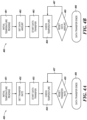
- FIGS. 4A-5 each illustrate a flow diagram corresponding to a method 450, 460, 570 for performing memory sub-system operations to regulate temperature in accordance with the present disclosure.
- Each respective method 450, 460, 570 can be performed by processing logic that can include hardware (e.g., processing device, circuitry, dedicated logic, programmable logic, microcode, hardware of a device, integrated circuit, etc.), software (e.g., instructions run or executed on a processing device), or a combination thereof.
- Each method 450, 460, 570 is performed by the temperature component 113 or temperature component 131 of FIG. 1 , the temperature component 213 or temperature component 231 of FIG. 2 , and/or the temperature component 313 of FIG. 3 .
- FIG. 4A illustrates a flow diagram 450 corresponding to memory sub-system operations to regulate temperature in accordance with the present disclosure.
- the temperature component e.g., temperature component 113, 131, 213, 231, 313, 331
- the initial temperature reading can indicate a temperature of the controller (e.g., memory sub-system controller 115, 215, 315) obtained by a first temperature component (e.g., temperature component 113) or can indicate a temperature of the non-volatile memory device (e.g., memory device 130, 230) obtained by a second temperature component (e.g., temperature component 131).
- a data transfer rate can be set. The data transfer rate can be set based on the initial temperature reading of the controller and/or the non-volatile memory device. The data transfer rate can be set based on a pre-determined initial data transfer rate.
- the data transfer can be started.
- data can be transferred from a volatile memory device (e.g., memory device 140, 240) to a non-volatile memory device (e.g., memory device 130, 230).
- the data transfer can be a save operation, a partial save operation.
- the data transfer can include a restore operation to restore data from the non-volatile memory device to the volatile memory device.
- the temperature value of the controller and/or the non-volatile memory device can be checked by their corresponding temperature components and a subsequent temperature value can be obtained.
- the data transfer rate can be reset based on the checked temperature value.
- starting the data transfer can cause the temperature value of the controller to increase and be closer to a threshold temperature value.
- the data transfer rate can be decreased in order to decrease the temperature value of the controller.
- a temperature value of the non-volatile memory device can increase and the data transfer rate can be decreased in order to lower a temperature value corresponding to the non-volatile memory device.
- the data transfer rate can be reset and a subsequent temperature value checked for the controller or the non-volatile memory device in an iterative process or repetitively using a feedback loop or mechanism to dynamically adjust the transfer rate as the data is transferred until the data transfer is complete.
- the temperature value can be maintained below a threshold temperature value or within a range of temperature values.
- the data transfer can end or be completed. The temperature value sensing or monitoring by the temperature component can be suspended until a subsequent data transfer is requested.
- the temperature values of both the controller and the non-volatile memory device can be used as a feedback mechanism to throttle a save/restore operation of the data by having a dynamic data transfer rate from the volatile memory device to the controller and then to the non-volatile memory device.
- the data transfer rate can be dynamically adjusted by adding a delay between smaller data units (e.g., a page, block, bank, DRAM, etc.) or by decreasing a speed of communication between the controller and the volatile memory device or the controller and the non-volatile memory device.
- performing a save/restore of the full data set to the non-volatile memory can allow the host to be unaware of any changes to the speed of the data transfer and without consideration to the memory space. Due to the varying time of operation that this may create, time of operation may be of less concern when performing a non-power failure operation.
- FIG. 4B illustrates a flow diagram 460 corresponding to memory sub-system operations to regulate temperature in accordance with the present disclosure.
- the temperature component e.g., temperature component 113, 131, 213, 231, 313, 331
- the initial temperature reading can indicate a temperature of the controller (e.g., memory sub-system controller 115, 215, 315) obtained by a first temperature component (e.g., temperature component 113) or can indicate a temperature of the non-volatile memory device (e.g., memory device 130, 230) obtained by a second temperature component (e.g., temperature component 131).
- a data amount to be transferred can be set.
- the data amount or data size can be set based on the initial temperature reading of the controller and/or the non-volatile memory device.
- the data amount can be set based on a pre-determined initial data transfer amount.
- the data transfer can be started.
- data can be transferred from a volatile memory device (e.g., memory device 140, 240) to a non-volatile memory device (e.g., memory device 130, 230).
- the data transfer can be a save operation or a partial save operation.
- the data transfer can include a restore operation to restore data from the non-volatile memory device to the volatile memory device.
- the temperature value of the controller and/or the non-volatile memory device can be checked by their corresponding temperature components and a subsequent temperature value can be obtained.
- the data transfer amount can be reset based on the checked temperature value. As an example, starting the data transfer can cause the temperature value of the controller to increase and be closer to a threshold temperature value. In response to this increase, the data transfer amount can be decreased in order to decrease the temperature value of the controller. Likewise, a temperature value of the non-volatile memory device can increase and the data transfer amount can be decreased in order to lower a temperature value corresponding to the non-volatile memory device.
- the data transfer rate can be reset and a subsequent temperature value checked for the controller or the non-volatile memory device in an iterative process or repetitively using a feedback loop or mechanism to dynamically adjust the data transfer amount as the data is transferred until the data transfer is complete.
- the temperature value can be maintained below a threshold temperature value or within a range of temperature values.
- the data transfer can end or be completed. The temperature value sensing or monitoring by the temperature component can be suspended until a subsequent data transfer is requested.
- the temperature values of both the controller and the non-volatile memory device can be used as a feedback mechanism to throttle a save/restore operation of the data by having a dynamic data transfer rate from the volatile memory device to the controller and then to the non-volatile memory device.
- the data transfer amount can include having a dynamic memory capacity for a save/restore operation on the data.
- the amount of data can be dynamic and determined by the current temperature value of the controller, current temperature value of the non-volatile memory device, and/or user inputs such as a minimum, maximum, start of memory space to save, or end of memory space to save. In this way, a predictable and user-determined maximum time of operation can be used. This method may be used when the host is interested in only doing a partial save/restore operation and a minimum capacity is set or the host implements a priority memory space.
- a combination of both adjusting data transfer rates and data transfer amounts can be used in order to dynamically affect the temperatures of both the controller and the non-volatile memory device.
- the data transfer rate can be decreased while also decreasing an amount of data to be transferred in order to decrease a temperature value of at least one of the controller and the non-volatile memory, and vice versa.
- FIG. 5 is a flow diagram corresponding to a method 570 for performing memory sub-system operations to regulate temperature in accordance with the present disclosure.
- the method 570 can be performed by processing logic that can include hardware (e.g., processing device, circuitry, dedicated logic, programmable logic, microcode, hardware of a device, integrated circuit, etc.), software (e.g., instructions run or executed on a processing device), or a combination thereof.
- the method 570 can include determining, by a first component of a memory sub-system controller, a first temperature value of the memory sub-system controller.
- the component can be analogous to the temperature component 113 of FIG. 1 , the temperature component 213 of FIG. 2 , and/or the temperature component 313 of FIG.
- the memory sub-system controller can be analogous to the memory sub-system controller 115 of FIG. 1 , the memory sub-system controller 215 of FIG. 2 , and/or the memory sub-system controller 315 of FIG. 3 .
- the temperature values can be sensed and/or monitored by the component and allow the component to adjust a data parameter.
- the method 570 can include determining, by a second component of a non-volatile memory device, a second temperature value of the non-volatile memory device coupled to the memory sub-system controller.
- the memory device can be analogous to the memory device 130 and/or the memory device 140 of FIG. 1 , and/or the memory device 230 and/or the memory device 240 of FIG. 2 .
- the method 570 can include modifying a data parameter in response to at least one of the first temperature value and the second temperature value exceeding a threshold temperature value.
- the data parameter can include a data size to be transferred, a data transfer speed, etc.
- the data can be written to the memory device as part of a save operation or as part of a partial save operation performed by a memory sub-system, such as the memory sub-system 110 illustrated in FIG. 1 .
- a data path between the memory elements can be reserved for transferring of data between a host coupleable to the memory sub-system controller and the non-volatile memory device prior to the data transfer occurring or dynamically while the data is being transferred, as described above.
- the memory device can be a volatile memory device and the memory device different than the memory device can be a non-volatile memory device (or vice versa).
- the memory device can be a system memory device, such as a DRAM (e.g., a dual-ported RAM) memory device, and the memory device different than the memory device can be a storage device, such as a NAND memory device, a three-dimensional cross-point memory device, or other non-volatile memory device.
- the method 570 can further include modifying a transfer speed of data associated with transferring the data from a volatile memory device to the memory sub-system controller and from the controller to the non-volatile memory device.
- the volatile memory device can be coupled to the memory sub-system controller.
- the method 570 can further include adding a delay between sent portions of the data.
- the transferred data can be a full set of the data or can be a partial set of the data.
- a data parameter can be modified by limiting a quantity of data transferred to the non-volatile memory device.
- the quantity of the data can be limited based on one of the first temperature value and the second temperature value.
- the quantity of the data can be limited based on one of a number of user inputs.
- the number of user inputs can include a minimum, a maximum, a start of memory space to be saved, and an end of the memory space to be saved.
- the method 570 can further include determining the second temperature value of a NAND memory device.
- the method can further include
- FIG. 6 illustrates an example machine of a computer system 600 within which a set of instructions, for causing the machine to perform any one or more of the methodologies discussed herein, can be executed.
- the computer system 600 can correspond to a host system (e.g., the host system 120 of FIG. 1 ) that includes, is coupled to, or utilizes a memory sub-system (e.g., the memory sub-system 110 of FIG. 1 ) or can be used to perform the operations of a controller (e.g., to execute an operating system to perform operations corresponding to the temperature component 113 of FIG. 1 ).
- the machine can be connected (e.g., networked) to other machines in a LAN, an intranet, an extranet, and/or the Internet.
- the machine can operate in the capacity of a server or a client machine in client-server network environment, as a peer machine in a peer-to-peer (or distributed) network environment, or as a server or a client machine in a cloud computing infrastructure or environment.
- the machine can be a personal computer (PC), a tablet PC, a set-top box (STB), a Personal Digital Assistant (PDA), a cellular telephone, a web appliance, a server, a network router, a switch or bridge, or any machine capable of executing a set of instructions (sequential or otherwise) that specify actions to be taken by that machine.
- PC personal computer
- PDA Personal Digital Assistant
- STB set-top box
- STB set-top box
- a Personal Digital Assistant PDA
- a cellular telephone a web appliance
- server a server
- network router a network router
- switch or bridge any machine capable of executing a set of instructions (sequential or otherwise) that specify actions to be taken by that machine.
- machine shall also be taken to include any collection of machines that individually or jointly execute a set (or multiple sets) of instructions to perform any one or more of the methodologies discussed herein.
- the example computer system 600 includes a processing device 602, a main memory 604 (e.g., read-only memory (ROM), flash memory, dynamic random access memory (DRAM) such as synchronous DRAM (SDRAM) or Rambus DRAM (RDRAM), etc.), a static memory 606 (e.g., flash memory, static random access memory (SRAM), etc.), and a data storage system 618, which communicate with each other via a bus 630.
- main memory 604 e.g., read-only memory (ROM), flash memory, dynamic random access memory (DRAM) such as synchronous DRAM (SDRAM) or Rambus DRAM (RDRAM), etc.
- DRAM dynamic random access memory
- SDRAM synchronous DRAM
- RDRAM Rambus DRAM
- static memory 606 e.g., flash memory, static random access memory (SRAM), etc.
- SRAM static random access memory
- the processing device 602 represents one or more general-purpose processing devices such as a microprocessor, a central processing unit, or the like. More particularly, the processing device can be a complex instruction set computing (CISC) microprocessor, reduced instruction set computing (RISC) microprocessor, very long instruction word (VLIW) microprocessor, or a processor implementing other instruction sets, or processors implementing a combination of instruction sets.
- the processing device 602 can also be one or more special-purpose processing devices such as an application specific integrated circuit (ASIC), a field programmable gate array (FPGA), a digital signal processor (DSP), network processor, or the like.
- the processing device 602 is configured to execute instructions 626 for performing the operations and steps discussed herein.
- the computer system 600 can further include a network interface device 608 to communicate over the network 620.
- the main memory 604 or system 618 can be an NVDIMM such as is described in association with Figures 2-3 .
- the data storage system 618 can include a machine-readable storage medium 624 (also known as a computer-readable medium) on which is stored one or more sets of instructions 626 or software embodying any one or more of the methodologies or functions described herein.
- the instructions 626 can also reside, completely or at least partially, within the main memory 604 and/or within the processing device 602 during execution thereof by the computer system 600, the main memory 604 and the processing device 602 also constituting machine-readable storage media.
- the machine-readable storage medium 624, data storage system 618, and/or main memory 604 can correspond to the memory sub-system 110 of FIG. 1 .
- the instructions 626 include instructions to implement functionality corresponding to a memory block grading and allocation component (e.g., the temperature component 113 of FIG. 1 ). While the machine-readable storage medium 624 is shown in an example to be a single medium, the term “machine-readable storage medium” should be taken to include a single medium or multiple media that store the one or more sets of instructions. The term “machine-readable storage medium” shall also be taken to include any medium that is capable of storing or encoding a set of instructions for execution by the machine and that cause the machine to perform any one or more of the methodologies of the present disclosure. The term “machine-readable storage medium” shall accordingly be taken to include, but not be limited to, solid-state memories, optical media, and magnetic media.
- the present disclosure also relates to an apparatus for performing the operations herein.
- This apparatus can be specially constructed for the intended purposes, or it can include a general purpose computer selectively activated or reconfigured by a computer program stored in the computer.
- a computer program can be stored in a computer readable storage medium, such as, but not limited to, any type of disk including floppy disks, optical disks, CD-ROMs, and magnetic-optical disks, read-only memories (ROMs), random access memories (RAMs), EPROMs, EEPROMs, magnetic or optical cards, or any type of media suitable for storing electronic instructions, each coupled to a computer system bus.
- the present disclosure can be provided as a computer program product, or software, that can include a machine-readable medium having stored thereon instructions, which can be used to program a computer system (or other electronic devices) to perform a process according to the present disclosure.
- a machine-readable medium includes any mechanism for storing information in a form readable by a machine (e.g., a computer).
- a machine-readable (e.g., computer-readable) medium includes a machine (e.g., a computer) readable storage medium such as a read only memory (“ROM”), random access memory (“RAM”), magnetic disk storage media, optical storage media, flash memory devices, etc.
Landscapes
- Engineering & Computer Science (AREA)
- Theoretical Computer Science (AREA)
- Human Computer Interaction (AREA)
- Physics & Mathematics (AREA)
- General Engineering & Computer Science (AREA)
- General Physics & Mathematics (AREA)
- Techniques For Improving Reliability Of Storages (AREA)
- Memory System (AREA)
- Dram (AREA)
Claims (15)
- Verfahren, umfassend:Bestimmen eines ersten Temperaturwerts des Speicheruntersystem-Controllers (115, 215, 315) durch eine erste Komponente (113, 213, 313) eines Speicheruntersystem-Controllers;Bestimmen eines zweiten Temperaturwerts des nichtflüchtigen Speicherbauelements, das an den Speicheruntersystem-Controller gekoppelt ist, durch eine zweite Komponente (131, 231) eines nichtflüchtigen Speicherbauelements (130, 230);Durchführen, seitens des Speicheruntersystem-Controllers, eines vollständigen Speichervorgangs als Reaktion darauf, dass: der erste Temperaturwert unterhalb eines ersten Schwellentemperaturwerts liegt; oder der zweite Temperaturwert unterhalb eines zweiten Schwellentemperaturwerts liegt, wobei die Durchführung des vollständigen Speichervorgangs das Speichern eines vollständigen Datensatzes umfasst;Durchführen, seitens des Speicheruntersystem-Controllers, eines teilweisen Speichervorgangs als Reaktion darauf, dass der erste Temperaturwert den ersten Schwellentemperaturwert überschreitet oder der zweite Temperaturwert den zweiten Schwellentemperaturwert überschreitet,wobei die Durchführung des teilweisen Speichervorgangs das Speichern eines Teils des vollen Datensatzes und das Nichtspeichern anderer Teile des vollen Datensatzes umfasst; undModifizieren eines Datenparameters als Reaktion darauf, dass:oderDer erste Temperaturwert den ersten Schwellentemperaturwert überschreitet;oder der zweite Temperaturwert den zweiten Schwellentemperaturwertüberschreitet,
beides. - Verfahren nach Anspruch 1, wobei das Modifizieren des Datenparameters das Modifizieren einer Übertragungsgeschwindigkeit von Daten umfasst, die mit dem Übertragen der Daten von einem flüchtigen Speicherbauelement (140, 240) zum Speicheruntersystem-Controller und vom Controller zum, nichtflüchtigen Speicherbauelement verbunden ist.
- Verfahren nach Anspruch 2, wobei das Modifizieren der Übertragungsgeschwindigkeit der Daten das Hinzufügen einer Verzögerung zwischen gesendeten Teilen der Daten umfasst.
- Verfahren nach Anspruch 2, wobei die übertragenen Daten ein kompletter mit einem speziellen Schreibvorgang verbundener Datensatz sind.
- Verfahren nach irgendeinem der Ansprüche 1-4, wobei das Modifizieren des Datenparameters die Begrenzung einer an das nichtflüchtige Speicherbauelement Datenmenge umfasst.
- Verfahren nach Anspruch 5, wobei die Datenmenge basierend auf mindestens des ersten Temperaturwerts und/oder des zweiten Temperaturwerts begrenzt wird.
- Verfahren nach Anspruch 5, wobei die Datenmenge basierend auf einer Anzahl von Benutzereingaben begrenzt wird.
- Verfahren nach Anspruch 7, wobei die Anzahl von Benutzereingaben eine minimale Betriebszeit, eine maximale Betriebszeit, eine Stelle Ort im Speicher wo der vollständige Speichervorgang beginnt und eine Stelle im nichtflüchtigen Speicherbauelement umfasst, wo der vollständige Speichervorgang endet.
- Verfahren nach irgendeinem der Ansprüche 1-4, wobei der Datenparameter eine Datenmenge ist, die übertragen werden soll und die Datenmenge verringert wird, bis der mindestens erste Temperaturwert bzw. der zweite Temperaturwert unter dem ersten Schwellentemperaturwert bzw. dem zweiten Schwellentemperaturwert oder beiden liegt.
- System, umfassend:Ein erstes Speicherbauelement (130, 140, 230, 240), das eine erste Temperaturkomponente (131, 231) umfasst;ein zweites Speicherbauelement (130, 140, 230, 240); undeinen Speicheruntersystem-Controller (115, 215, 315), der an das erste Speicherbauelement und das zweite Speicherbauelement gekoppelt ist und eine zweite Temperaturkomponente (113, 213) umfasst, wobei der Speicheruntersystem-Controller Vorgänge durchführen soll, die umfassen:Bestimmen, seitens der ersten Temperaturkomponente, eines ersten Temperaturwerts des ersten Speicherbauelements;Bestimmen, seitens der zweiten Temperaturkomponente, eines zweiten Temperaturwerts des Speicheruntersystem-Controllers;Durchführen eines teilweisen Speichervorgangs als Reaktion darauf, dass:Der erste Temperaturwert einen ersten Schwellentemperaturwert überschreitet; oderder zweite Temperaturwert einen zweiten Schwellentemperaturwert überschreitet;wobei:Die Durchführung des teilweisen Speichervorgangs das Speichern eines Teils des vollen Datensatzes und das Nichtspeichern anderer Teile des vollen Datensatzes umfasst; unddie Durchführung eines vollständigen Speichervorgangs als Reaktion darauf, dass der erste Temperaturwert unterhalb eines ersten Schwellentemperaturwerts liegt oder der zweite Temperaturwert unterhalb eines zweiten Schwellentemperaturwerts liegt, wobei die Durchführung des vollständigen Speichervorgangs das Speichern des vollständigen Datensatzes umfasst; undModifizieren einer Datenübertragungsrate als Reaktion darauf, dass:Der erste Temperaturwert den ersten Schwellentemperaturwert überschreitet; oderder zweite Temperaturwert den zweiten Schwellentemperaturwert überschreitet; oder beides.
- System nach Anspruch 10, wobei der Speicheruntersystem-Controller Vorgänge durchführen soll, die das Verringern der Datenübertragungsrate umfassen.
- System nach Anspruch 11, wobei der Speicheruntersystem-Controller Vorgänge durchführen soll, die umfassen:Bestimmen eines nachfolgenden ersten Temperaturwerts des ersten Speicherbauelements und eines nachfolgenden zweiten Temperaturwerts des Speicheruntersystem-Controllers; undVerringern der Datenübertragungsrate, bis mindestens einer des nachfolgenden ersten Temperaturwerts und/oder des nachfolgenden zweiten Temperaturwerts unter einem dritten Schwellentemperaturwert bzw. einem vierten Schwellentemperaturwert oder beiden liegt.
- System nach irgendeinem der Ansprüche 10-12, wobei der Speicheruntersystem-Controller Vorgänge durchführen soll, die das Hinzufügen einer Zeitverzögerung zwischen Teilen von Daten umfassen, die zwischen dem ersten Speicherbauelement und dem Speicheruntersystem-Controller übertragen wurden.
- System nach Anspruch 13, wobei der Speicheruntersystem-Controller Vorgänge durchführen soll, die umfassen:Bestimmen eines nachfolgenden ersten Temperaturwerts des ersten Speicherbauelements und eines nachfolgenden zweiten Temperaturwerts des zweiten Speicherbauelements; undErhöhen der Zeitverzögerung zwischen den Teilen von Daten, die übertragen wurden, bis mindestens einer des nachfolgenden ersten Temperaturwerts oder des nachfolgenden zweiten Temperaturwerts unter dem dritten Schwellentemperaturwert bzw. einem vierten Schwellentemperaturwert oder beiden liegt.
- System nach irgendeinem der Ansprüche 10-12, wobei eins des ersten Speicherbauelements oder des zweiten Speicherbauelements ein flüchtiges Speicherbauelement (140, 240) umfasst, und wobei das andere des ersten Speicherbauelements oder des zweiten Speicherbauelements ein nichtflüchtiges Speicherbauelement (130, 230) umfasst.
Applications Claiming Priority (2)
| Application Number | Priority Date | Filing Date | Title |
|---|---|---|---|
| US16/717,460 US11036413B1 (en) | 2019-12-17 | 2019-12-17 | Memory sub-system temperature regulation |
| PCT/US2020/062119 WO2021126498A1 (en) | 2019-12-17 | 2020-11-25 | Memory sub-system temperature regulation |
Publications (3)
| Publication Number | Publication Date |
|---|---|
| EP4078583A1 EP4078583A1 (de) | 2022-10-26 |
| EP4078583A4 EP4078583A4 (de) | 2024-01-17 |
| EP4078583B1 true EP4078583B1 (de) | 2025-01-29 |
Family
ID=76316864
Family Applications (1)
| Application Number | Title | Priority Date | Filing Date |
|---|---|---|---|
| EP20902191.4A Active EP4078583B1 (de) | 2019-12-17 | 2020-11-25 | Temperaturregelung eines speicheruntersystems |
Country Status (4)
| Country | Link |
|---|---|
| US (2) | US11036413B1 (de) |
| EP (1) | EP4078583B1 (de) |
| CN (1) | CN114830235A (de) |
| WO (1) | WO2021126498A1 (de) |
Families Citing this family (9)
| Publication number | Priority date | Publication date | Assignee | Title |
|---|---|---|---|---|
| US10831393B2 (en) * | 2018-02-08 | 2020-11-10 | Micron Technology, Inc. | Partial save of memory |
| GB2592598B8 (en) * | 2020-03-02 | 2024-06-12 | Zahnradfabrik Friedrichshafen | Electric power steering system |
| US12260895B2 (en) * | 2021-09-01 | 2025-03-25 | Micron Technology, Inc. | Apparatus with power-based data protection mechanism and methods for operating the same |
| US12159667B2 (en) * | 2022-06-02 | 2024-12-03 | Micron Technology, Inc. | Internal reference resistor for non-volatile memory |
| US12363820B2 (en) | 2022-11-21 | 2025-07-15 | Micron Technology, Inc. | Data throughput using a fin stack |
| US20240172398A1 (en) * | 2022-11-22 | 2024-05-23 | Micron Technology, Inc. | Data throughput using a metal bracket |
| TWI866106B (zh) * | 2023-03-08 | 2024-12-11 | 點序科技股份有限公司 | 靜態隨機存取記憶體的自動控制電路及其控制方法 |
| US20250028448A1 (en) * | 2023-07-19 | 2025-01-23 | Micron Technology, Inc. | Data throughput using tcm |
| CN119718171A (zh) * | 2023-09-27 | 2025-03-28 | 长江存储科技有限责任公司 | 存储器系统及其操作方法、计算机可读存储介质 |
Family Cites Families (24)
| Publication number | Priority date | Publication date | Assignee | Title |
|---|---|---|---|---|
| JP2003022309A (ja) | 2001-07-06 | 2003-01-24 | Hitachi Ltd | 動線情報を基にした施設管理装置 |
| US6904504B2 (en) * | 2001-11-14 | 2005-06-07 | Intel Corporation | Method and apparatus for software selection of protected register settings |
| US7080217B2 (en) * | 2003-03-31 | 2006-07-18 | Intel Corporation | Cycle type based throttling |
| US6871119B2 (en) * | 2003-04-22 | 2005-03-22 | Intel Corporation | Filter based throttling |
| US7191088B1 (en) * | 2004-10-25 | 2007-03-13 | Nvidia Corporation | Method and system for memory temperature detection and thermal load management |
| JP2006209525A (ja) | 2005-01-28 | 2006-08-10 | Matsushita Electric Ind Co Ltd | メモリシステム |
| US7413342B2 (en) * | 2005-02-22 | 2008-08-19 | Micron Technology, Inc. | DRAM temperature measurement system |
| US7499043B2 (en) * | 2006-05-30 | 2009-03-03 | Intel Corporation | Switching of display refresh rates |
| US7861113B2 (en) * | 2007-03-16 | 2010-12-28 | Dot Hill Systems Corporation | Method and apparatus for operating storage controller system in elevated temperature environment |
| US7870337B2 (en) * | 2007-11-28 | 2011-01-11 | International Business Machines Corporation | Power-aware line intervention for a multiprocessor snoop coherency protocol |
| US20090138220A1 (en) * | 2007-11-28 | 2009-05-28 | Bell Jr Robert H | Power-aware line intervention for a multiprocessor directory-based coherency protocol |
| US7930470B2 (en) | 2008-01-24 | 2011-04-19 | International Business Machines Corporation | System to enable a memory hub device to manage thermal conditions at a memory device level transparent to a memory controller |
| US8472274B2 (en) * | 2011-03-02 | 2013-06-25 | Apple Inc. | Using temperature sensors with a memory device |
| US9887008B2 (en) * | 2014-03-10 | 2018-02-06 | Futurewei Technologies, Inc. | DDR4-SSD dual-port DIMM device |
| CN103868200A (zh) * | 2014-03-17 | 2014-06-18 | 广东美的制冷设备有限公司 | 一种用于模拟温度变化的电平电压输出装置 |
| KR102211126B1 (ko) * | 2014-04-17 | 2021-02-02 | 삼성전자주식회사 | 동작 성능을 조절하는 메모리 시스템 및 메모리 시스템의 동작방법 |
| KR102347179B1 (ko) | 2015-05-22 | 2022-01-04 | 삼성전자주식회사 | 비휘발성 저장 장치의 온도 제어 방법 |
| US10088880B2 (en) | 2015-08-27 | 2018-10-02 | Intel Corporation | Thermal monitoring of memory resources |
| US10031677B1 (en) | 2015-10-14 | 2018-07-24 | Rambus Inc. | High-throughput low-latency hybrid memory module |
| WO2017078698A1 (en) * | 2015-11-04 | 2017-05-11 | Hewlett-Packard Development Company, L.P. | Throttling components of a storage device |
| KR20180130872A (ko) * | 2017-05-30 | 2018-12-10 | 에스케이하이닉스 주식회사 | 저장 장치 및 그 동작 방법 |
| US10198353B2 (en) * | 2017-07-07 | 2019-02-05 | Dell Products, Lp | Device and method for implementing save operation of persistent memory |
| KR20190016191A (ko) | 2017-08-08 | 2019-02-18 | 에스케이하이닉스 주식회사 | 메모리 시스템 및 메모리 시스템의 동작방법 |
| JP2019046321A (ja) * | 2017-09-05 | 2019-03-22 | 東芝メモリ株式会社 | メモリシステム |
-
2019
- 2019-12-17 US US16/717,460 patent/US11036413B1/en active Active
-
2020
- 2020-11-25 WO PCT/US2020/062119 patent/WO2021126498A1/en not_active Ceased
- 2020-11-25 EP EP20902191.4A patent/EP4078583B1/de active Active
- 2020-11-25 CN CN202080088417.1A patent/CN114830235A/zh not_active Withdrawn
-
2021
- 2021-06-11 US US17/345,785 patent/US11809721B2/en active Active
Also Published As
| Publication number | Publication date |
|---|---|
| EP4078583A4 (de) | 2024-01-17 |
| US20210318822A1 (en) | 2021-10-14 |
| WO2021126498A1 (en) | 2021-06-24 |
| US11036413B1 (en) | 2021-06-15 |
| US20210181961A1 (en) | 2021-06-17 |
| US11809721B2 (en) | 2023-11-07 |
| CN114830235A (zh) | 2022-07-29 |
| EP4078583A1 (de) | 2022-10-26 |
Similar Documents
| Publication | Publication Date | Title |
|---|---|---|
| EP4078583B1 (de) | Temperaturregelung eines speicheruntersystems | |
| US11669451B2 (en) | Multi-plane switching of non-volatile memory | |
| US11971772B2 (en) | Unified sequencer concurrency controller for a memory sub-system | |
| US11693736B2 (en) | Modifying conditions for memory device error corrections operations | |
| US20250285682A1 (en) | Adaptive pre-read management in multi-pass programming | |
| US20240379153A1 (en) | Dynamic buffer limit for at-risk data | |
| US20240370201A1 (en) | Enabling memory access transactions for persistent memory | |
| US12056518B2 (en) | Notifying memory system of host events via modulated reset signals | |
| US11977480B2 (en) | Scaling factors for media management operations at a memory device | |
| US12366979B2 (en) | Managing a memory sub-system based on composite temperature | |
| WO2023069650A1 (en) | Managing thermal throttling in a memory sub-system | |
| US12339792B2 (en) | Controlling aggregation for HRAM | |
| US12561069B2 (en) | Safe area for critical control data | |
| US20250355565A1 (en) | Modulating peak operating temperature in a memory sub-system | |
| US11693597B2 (en) | Managing package switching based on switching parameters | |
| US11636904B2 (en) | Almost ready memory management | |
| US20240296117A1 (en) | Voltage-triggered performance throttling | |
| US20230064822A1 (en) | Temperature controlled media management operations at a memory sub-system |
Legal Events
| Date | Code | Title | Description |
|---|---|---|---|
| STAA | Information on the status of an ep patent application or granted ep patent |
Free format text: STATUS: THE INTERNATIONAL PUBLICATION HAS BEEN MADE |
|
| PUAI | Public reference made under article 153(3) epc to a published international application that has entered the european phase |
Free format text: ORIGINAL CODE: 0009012 |
|
| STAA | Information on the status of an ep patent application or granted ep patent |
Free format text: STATUS: REQUEST FOR EXAMINATION WAS MADE |
|
| 17P | Request for examination filed |
Effective date: 20220609 |
|
| AK | Designated contracting states |
Kind code of ref document: A1 Designated state(s): AL AT BE BG CH CY CZ DE DK EE ES FI FR GB GR HR HU IE IS IT LI LT LU LV MC MK MT NL NO PL PT RO RS SE SI SK SM TR |
|
| DAV | Request for validation of the european patent (deleted) | ||
| DAX | Request for extension of the european patent (deleted) | ||
| A4 | Supplementary search report drawn up and despatched |
Effective date: 20231219 |
|
| RIC1 | Information provided on ipc code assigned before grant |
Ipc: G06F 1/20 20060101ALI20231213BHEP Ipc: G06F 3/06 20060101ALI20231213BHEP Ipc: G11C 7/22 20060101ALI20231213BHEP Ipc: G11C 7/10 20060101ALI20231213BHEP Ipc: G11C 7/04 20060101AFI20231213BHEP |
|
| GRAP | Despatch of communication of intention to grant a patent |
Free format text: ORIGINAL CODE: EPIDOSNIGR1 |
|
| STAA | Information on the status of an ep patent application or granted ep patent |
Free format text: STATUS: GRANT OF PATENT IS INTENDED |
|
| RIC1 | Information provided on ipc code assigned before grant |
Ipc: G06F 1/20 20060101ALI20240807BHEP Ipc: G06F 3/06 20060101ALI20240807BHEP Ipc: G11C 7/22 20060101ALI20240807BHEP Ipc: G11C 7/10 20060101ALI20240807BHEP Ipc: G11C 7/04 20060101AFI20240807BHEP |
|
| INTG | Intention to grant announced |
Effective date: 20240827 |
|
| GRAS | Grant fee paid |
Free format text: ORIGINAL CODE: EPIDOSNIGR3 |
|
| GRAA | (expected) grant |
Free format text: ORIGINAL CODE: 0009210 |
|
| STAA | Information on the status of an ep patent application or granted ep patent |
Free format text: STATUS: THE PATENT HAS BEEN GRANTED |
|
| AK | Designated contracting states |
Kind code of ref document: B1 Designated state(s): AL AT BE BG CH CY CZ DE DK EE ES FI FR GB GR HR HU IE IS IT LI LT LU LV MC MK MT NL NO PL PT RO RS SE SI SK SM TR |
|
| P01 | Opt-out of the competence of the unified patent court (upc) registered |
Free format text: CASE NUMBER: APP_67598/2024 Effective date: 20241220 |
|
| REG | Reference to a national code |
Ref country code: GB Ref legal event code: FG4D |
|
| REG | Reference to a national code |
Ref country code: CH Ref legal event code: EP |
|
| REG | Reference to a national code |
Ref country code: DE Ref legal event code: R096 Ref document number: 602020045659 Country of ref document: DE |
|
| REG | Reference to a national code |
Ref country code: IE Ref legal event code: FG4D |
|
| REG | Reference to a national code |
Ref country code: NL Ref legal event code: MP Effective date: 20250129 |
|
| PG25 | Lapsed in a contracting state [announced via postgrant information from national office to epo] |
Ref country code: NL Free format text: LAPSE BECAUSE OF FAILURE TO SUBMIT A TRANSLATION OF THE DESCRIPTION OR TO PAY THE FEE WITHIN THE PRESCRIBED TIME-LIMIT Effective date: 20250129 |
|
| PG25 | Lapsed in a contracting state [announced via postgrant information from national office to epo] |
Ref country code: RS Free format text: LAPSE BECAUSE OF FAILURE TO SUBMIT A TRANSLATION OF THE DESCRIPTION OR TO PAY THE FEE WITHIN THE PRESCRIBED TIME-LIMIT Effective date: 20250429 |
|
| PG25 | Lapsed in a contracting state [announced via postgrant information from national office to epo] |
Ref country code: FI Free format text: LAPSE BECAUSE OF FAILURE TO SUBMIT A TRANSLATION OF THE DESCRIPTION OR TO PAY THE FEE WITHIN THE PRESCRIBED TIME-LIMIT Effective date: 20250129 |
|
| PG25 | Lapsed in a contracting state [announced via postgrant information from national office to epo] |
Ref country code: PL Free format text: LAPSE BECAUSE OF FAILURE TO SUBMIT A TRANSLATION OF THE DESCRIPTION OR TO PAY THE FEE WITHIN THE PRESCRIBED TIME-LIMIT Effective date: 20250129 |
|
| PG25 | Lapsed in a contracting state [announced via postgrant information from national office to epo] |
Ref country code: ES Free format text: LAPSE BECAUSE OF FAILURE TO SUBMIT A TRANSLATION OF THE DESCRIPTION OR TO PAY THE FEE WITHIN THE PRESCRIBED TIME-LIMIT Effective date: 20250129 |
|
| REG | Reference to a national code |
Ref country code: LT Ref legal event code: MG9D |
|
| PG25 | Lapsed in a contracting state [announced via postgrant information from national office to epo] |
Ref country code: NO Free format text: LAPSE BECAUSE OF FAILURE TO SUBMIT A TRANSLATION OF THE DESCRIPTION OR TO PAY THE FEE WITHIN THE PRESCRIBED TIME-LIMIT Effective date: 20250429 Ref country code: IS Free format text: LAPSE BECAUSE OF FAILURE TO SUBMIT A TRANSLATION OF THE DESCRIPTION OR TO PAY THE FEE WITHIN THE PRESCRIBED TIME-LIMIT Effective date: 20250529 |
|
| REG | Reference to a national code |
Ref country code: AT Ref legal event code: MK05 Ref document number: 1764288 Country of ref document: AT Kind code of ref document: T Effective date: 20250129 |
|
| PG25 | Lapsed in a contracting state [announced via postgrant information from national office to epo] |
Ref country code: HR Free format text: LAPSE BECAUSE OF FAILURE TO SUBMIT A TRANSLATION OF THE DESCRIPTION OR TO PAY THE FEE WITHIN THE PRESCRIBED TIME-LIMIT Effective date: 20250129 |
|
| PG25 | Lapsed in a contracting state [announced via postgrant information from national office to epo] |
Ref country code: LV Free format text: LAPSE BECAUSE OF FAILURE TO SUBMIT A TRANSLATION OF THE DESCRIPTION OR TO PAY THE FEE WITHIN THE PRESCRIBED TIME-LIMIT Effective date: 20250129 Ref country code: PT Free format text: LAPSE BECAUSE OF FAILURE TO SUBMIT A TRANSLATION OF THE DESCRIPTION OR TO PAY THE FEE WITHIN THE PRESCRIBED TIME-LIMIT Effective date: 20250529 |
|
| PG25 | Lapsed in a contracting state [announced via postgrant information from national office to epo] |
Ref country code: GR Free format text: LAPSE BECAUSE OF FAILURE TO SUBMIT A TRANSLATION OF THE DESCRIPTION OR TO PAY THE FEE WITHIN THE PRESCRIBED TIME-LIMIT Effective date: 20250430 Ref country code: BG Free format text: LAPSE BECAUSE OF FAILURE TO SUBMIT A TRANSLATION OF THE DESCRIPTION OR TO PAY THE FEE WITHIN THE PRESCRIBED TIME-LIMIT Effective date: 20250129 |
|
| PG25 | Lapsed in a contracting state [announced via postgrant information from national office to epo] |
Ref country code: AT Free format text: LAPSE BECAUSE OF FAILURE TO SUBMIT A TRANSLATION OF THE DESCRIPTION OR TO PAY THE FEE WITHIN THE PRESCRIBED TIME-LIMIT Effective date: 20250129 |
|
| PG25 | Lapsed in a contracting state [announced via postgrant information from national office to epo] |
Ref country code: SE Free format text: LAPSE BECAUSE OF FAILURE TO SUBMIT A TRANSLATION OF THE DESCRIPTION OR TO PAY THE FEE WITHIN THE PRESCRIBED TIME-LIMIT Effective date: 20250129 |
|
| PG25 | Lapsed in a contracting state [announced via postgrant information from national office to epo] |
Ref country code: SM Free format text: LAPSE BECAUSE OF FAILURE TO SUBMIT A TRANSLATION OF THE DESCRIPTION OR TO PAY THE FEE WITHIN THE PRESCRIBED TIME-LIMIT Effective date: 20250129 |
|
| PG25 | Lapsed in a contracting state [announced via postgrant information from national office to epo] |
Ref country code: DK Free format text: LAPSE BECAUSE OF FAILURE TO SUBMIT A TRANSLATION OF THE DESCRIPTION OR TO PAY THE FEE WITHIN THE PRESCRIBED TIME-LIMIT Effective date: 20250129 |
|
| PG25 | Lapsed in a contracting state [announced via postgrant information from national office to epo] |
Ref country code: IT Free format text: LAPSE BECAUSE OF FAILURE TO SUBMIT A TRANSLATION OF THE DESCRIPTION OR TO PAY THE FEE WITHIN THE PRESCRIBED TIME-LIMIT Effective date: 20250129 |
|
| PG25 | Lapsed in a contracting state [announced via postgrant information from national office to epo] |
Ref country code: CZ Free format text: LAPSE BECAUSE OF FAILURE TO SUBMIT A TRANSLATION OF THE DESCRIPTION OR TO PAY THE FEE WITHIN THE PRESCRIBED TIME-LIMIT Effective date: 20250129 Ref country code: EE Free format text: LAPSE BECAUSE OF FAILURE TO SUBMIT A TRANSLATION OF THE DESCRIPTION OR TO PAY THE FEE WITHIN THE PRESCRIBED TIME-LIMIT Effective date: 20250129 |
|
| PG25 | Lapsed in a contracting state [announced via postgrant information from national office to epo] |
Ref country code: RO Free format text: LAPSE BECAUSE OF FAILURE TO SUBMIT A TRANSLATION OF THE DESCRIPTION OR TO PAY THE FEE WITHIN THE PRESCRIBED TIME-LIMIT Effective date: 20250129 |
|
| PG25 | Lapsed in a contracting state [announced via postgrant information from national office to epo] |
Ref country code: SK Free format text: LAPSE BECAUSE OF FAILURE TO SUBMIT A TRANSLATION OF THE DESCRIPTION OR TO PAY THE FEE WITHIN THE PRESCRIBED TIME-LIMIT Effective date: 20250129 |
|
| REG | Reference to a national code |
Ref country code: DE Ref legal event code: R097 Ref document number: 602020045659 Country of ref document: DE |
|
| PLBE | No opposition filed within time limit |
Free format text: ORIGINAL CODE: 0009261 |
|
| STAA | Information on the status of an ep patent application or granted ep patent |
Free format text: STATUS: NO OPPOSITION FILED WITHIN TIME LIMIT |
|
| 26N | No opposition filed |
Effective date: 20251030 |
|
| PGFP | Annual fee paid to national office [announced via postgrant information from national office to epo] |
Ref country code: DE Payment date: 20251126 Year of fee payment: 6 |
|
| PGFP | Annual fee paid to national office [announced via postgrant information from national office to epo] |
Ref country code: FR Payment date: 20251125 Year of fee payment: 6 |