EP4076990B1 - Nappe renforcée conformable - Google Patents
Nappe renforcée conformable Download PDFInfo
- Publication number
- EP4076990B1 EP4076990B1 EP20845580.8A EP20845580A EP4076990B1 EP 4076990 B1 EP4076990 B1 EP 4076990B1 EP 20845580 A EP20845580 A EP 20845580A EP 4076990 B1 EP4076990 B1 EP 4076990B1
- Authority
- EP
- European Patent Office
- Prior art keywords
- equal
- elongation
- less
- reinforcing element
- reinforced ply
- Prior art date
- Legal status (The legal status is an assumption and is not a legal conclusion. Google has not performed a legal analysis and makes no representation as to the accuracy of the status listed.)
- Active
Links
Images

Classifications
-
- B—PERFORMING OPERATIONS; TRANSPORTING
- B60—VEHICLES IN GENERAL
- B60C—VEHICLE TYRES; TYRE INFLATION; TYRE CHANGING; CONNECTING VALVES TO INFLATABLE ELASTIC BODIES IN GENERAL; DEVICES OR ARRANGEMENTS RELATED TO TYRES
- B60C9/00—Reinforcements or ply arrangement of pneumatic tyres
- B60C9/0064—Reinforcements comprising monofilaments
-
- B—PERFORMING OPERATIONS; TRANSPORTING
- B60—VEHICLES IN GENERAL
- B60C—VEHICLE TYRES; TYRE INFLATION; TYRE CHANGING; CONNECTING VALVES TO INFLATABLE ELASTIC BODIES IN GENERAL; DEVICES OR ARRANGEMENTS RELATED TO TYRES
- B60C9/00—Reinforcements or ply arrangement of pneumatic tyres
- B60C9/0042—Reinforcements made of synthetic materials
-
- B—PERFORMING OPERATIONS; TRANSPORTING
- B60—VEHICLES IN GENERAL
- B60C—VEHICLE TYRES; TYRE INFLATION; TYRE CHANGING; CONNECTING VALVES TO INFLATABLE ELASTIC BODIES IN GENERAL; DEVICES OR ARRANGEMENTS RELATED TO TYRES
- B60C9/00—Reinforcements or ply arrangement of pneumatic tyres
- B60C9/02—Carcasses
- B60C9/04—Carcasses the reinforcing cords of each carcass ply arranged in a substantially parallel relationship
- B60C2009/0416—Physical properties or dimensions of the carcass cords
-
- B—PERFORMING OPERATIONS; TRANSPORTING
- B60—VEHICLES IN GENERAL
- B60C—VEHICLE TYRES; TYRE INFLATION; TYRE CHANGING; CONNECTING VALVES TO INFLATABLE ELASTIC BODIES IN GENERAL; DEVICES OR ARRANGEMENTS RELATED TO TYRES
- B60C9/00—Reinforcements or ply arrangement of pneumatic tyres
- B60C9/02—Carcasses
- B60C9/04—Carcasses the reinforcing cords of each carcass ply arranged in a substantially parallel relationship
- B60C2009/0475—Particular materials of the carcass cords
-
- B—PERFORMING OPERATIONS; TRANSPORTING
- B60—VEHICLES IN GENERAL
- B60C—VEHICLE TYRES; TYRE INFLATION; TYRE CHANGING; CONNECTING VALVES TO INFLATABLE ELASTIC BODIES IN GENERAL; DEVICES OR ARRANGEMENTS RELATED TO TYRES
- B60C9/00—Reinforcements or ply arrangement of pneumatic tyres
- B60C9/02—Carcasses
- B60C9/04—Carcasses the reinforcing cords of each carcass ply arranged in a substantially parallel relationship
- B60C2009/0483—Different cords in the same layer
Definitions
- the present invention relates to the field of reinforced plies, in particular reinforced plies intended for a vehicle tire, as well as to the field of vehicle tires comprising such plies.
- Reinforced sheets are generally made up of a plurality of reinforcing elements embedded in a matrix, for example elastomeric, these reinforcing elements being able to be a fabric, an assembly of non-woven fibers (“non-woven” fabric), or a plurality of threads or cables, textile or metallic, arranged side by side parallel to each other.
- Reinforcing plies must have sufficient strength characteristics to ensure their reinforcing role when incorporated into an object, for example a pneumatic tire, while offering the least possible resistance during the manufacture of said object, for example during the shaping of a pneumatic tire, in order to facilitate its manufacture. These conflicting requirements can lead to complex sizing of reinforcing plies.
- the applicant discovered a reinforced ply which has both a significant capacity to conform under very low force, while providing the necessary reinforcement once conformed.
- This ply is particularly suitable, without this being limiting, for use as a carcass ply in a pneumatic tire.
- it makes it possible to greatly simplify the manufacturing processes for pneumatic tires comprising stiffening structures in the inner toric cavity as described, for example, in the document WO 2019/115917 .
- the invention relates to a reinforced ply according to claim 1, a rubber article according to claim 13, a pneumatic or non-pneumatic tire according to claim 14 and a method of manufacturing a pneumatic tire according to claim 15.
- circumferential XX', axial YY' and radial ZZ' directions respectively designate a direction tangent to the tread surface of the tyre in the direction of rotation of the tyre, a direction parallel to the axis of rotation of the tyre and a direction perpendicular to the axis of rotation of the tyre.
- radially inner respectively “radially outer” is meant “closer to the axis of rotation of the tyre", respectively “further from the axis of rotation of the tyre”.
- axially inner is meant “closer to the equatorial plane of the tyre", respectively “further from the equatorial plane of the tyre", the equatorial plane XZ of the tyre being the plane passing through the middle of the tread surface of the tyre and perpendicular to the axis of rotation of the tyre.
- substantially parallel or “extending substantially along” is meant that the angle formed by the two directions in question is less than 10°, preferably less than 5°, more preferably less than 2° and very preferably less than or equal to the error of measurement of the angle by a suitable method.
- general direction of an object is meant the general direction in which the object extends along its greatest length.
- the general direction of the fabric is parallel to the longitudinal edges of the fabric.
- a fabric wound on a bobbin of revolution about an axis has a general direction substantially parallel to the direction of unwinding of the fabric (i.e. the circumferential direction) which is perpendicular to the axial and radial directions of the bobbin.
- Any interval of values designated by the expression "between a and b" represents the domain of values from greater than a to less than b (i.e., excluding the limits a and b) while any interval of values designated by the expression “from a to b” signifies the domain of values from the limit "a” to the limit "b", i.e., including the strict limits "a” and "b".
- element based on means an element comprising the mixture and/or the in situ reaction product of the different constituents or materials used, some of these constituents or materials being able to react and/or being intended to react with each other, at least partially, during the different phases of manufacture of the element.
- the carbon-containing compounds mentioned in the description may be of fossil or bio-sourced origin. In the latter case, they may be, partially or totally, derived from biomass or obtained from renewable raw materials derived from biomass. This includes in particular polymers, plasticizers, fillers, etc.
- the reinforced sheet according to the invention comprises a plurality of reinforcing elements arranged side by side parallel to each other in a main direction (A) and embedded in a polymer composition
- each reinforcing element comprises first and second filamentary members, the first filamentary member having at rest an excess length of A1% relative to the resting length of the second filamentary member, with 0% ⁇ A1 ⁇ AR, AR representing as a percentage the elongation at break of the second filamentary member, for any elongation of the sheet in the main direction (A) less than or equal to A1%
- the second filamentary member deforms plastically, for each reinforcing element M1/M2 ⁇ 1, M1 being the modulus of the reinforcing element for any elongation of the sheet less than or equal to K1 ⁇ A1%, M2 being the modulus of the reinforcing element for any elongation of the sheet greater than or equal to K2 ⁇ A1%, with K1 ranging from 0.8 to 0.95, and K2 ranging from 1.05 to
- the reinforced sheet according to the invention thus has a moderate resistance to elongation for any elongation of the sheet in the main direction (A) less than A1%, during which the reinforcing elements have a modulus M1 then, due to a modulus M2 greater than M1, a greater resistance for any elongation of the sheet in the main direction (A) greater than A1%. It is thus easy to adjust the dimensioning of the sheet according to the desired conformation when this sheet is integrated into an object, by aligning the main direction (A) substantially with the direction of deformation of the object integrating the sheet.
- M1/M2 is less than or equal to 0.5, preferably less than or equal to 0.1, and very preferably less than or equal to 0.05.
- This ratio reflects the difference in behavior of the sheet in terms of resistance to elongation in the main direction (A). The lower this ratio, the higher the resistance to elongation for an elongation greater than A1% will be relative to the resistance to elongation for an elongation less than A1%.
- modules M1 and M2 the number of reinforcements and their laying density, expressed in number of threads per dm measured in the plane of the sheet in a direction perpendicular to the main direction (A) are adjusted by the person skilled in the art according to the specificities required for the sheet, in particular by an appropriate choice of the materials constituting the reinforcement elements.
- each reinforcing element has a modulus less than or equal to 10/A1 N, preferably less than or equal to 8/A1 N, preferably less than or equal to 7/A1 N.
- each reinforcing element has a modulus less than or equal to 10/20 N, preferably less than or equal to 8/20 N, preferably less than or equal to 7/20 N.
- each reinforcing element has a modulus greater than or equal to 10 N, preferably greater than or equal to 15 N.
- the sheet has a much higher resistance to elongation for any elongation greater than K2 ⁇ A1%.
- each reinforcing element has a modulus less than or equal to 25 N, preferably less than or equal to 20 N.
- K1 and K2 represent a transition zone during which the modulus of the reinforcing element is between M1 and M2.
- Each reinforcing element of the reinforced sheet according to the invention comprises first and second wire members, the first wire member having at rest an excess length of A1% relative to the length at rest of the second wire member, with 0% ⁇ A1 ⁇ AR, AR representing as a percentage the elongation at break of the second wire member, AR being measured according to the ASTM D885-03 standard.
- excess length of A1% it is meant that the first wire member has at rest a length equal to (100+A1)% of the length at rest of the second wire member.
- the first wire member comprises at least one multifilament strand comprising several monofilaments each consisting of a material chosen from a polyester, a polyamide, a polyketone, a polyurethane, a natural fiber and an assembly of these materials, preferably chosen from a polyester, a polyamide, a polyketone, a polyurethane and an assembly of these materials, more preferably chosen from polyesters and polyester assemblies.
- Polyesters are advantageous because of their high tenacity, their low cost, their thermal resistance compatible in particular with use in pneumatic tires and standard thermal contraction can be selected.
- the first wire member has at rest an excess length of A1% relative to the length at rest of the second wire member.
- A1 is in the range from 15 to 50%, preferably from 15 to 45%, very preferably from 15 to 25%.
- the second wire member deforms plastically while the first wire member deploys, due to its excess length.
- the first wire member is fully deployed, contributing more fully to the resistance to elongation of the sheet in the main direction (A).
- the resting length of the first wire member is measured along the main direction of the first wire member. This length corresponds to the total length of the first wire member when it is not incorporated in a reinforcing element, and when it is at rest, that is to say when it is neither in extension nor in compression along the general direction of the first wire member, and therefore has zero elongation.
- the tenacity of the first wire member is preferably greater than or equal to 30 cN/tex, preferably less than 40 cN/tex, more preferably less than 60 cN/tex.
- the tenacity of the first wire member is determined according to ASTM D885-03.
- the second wire member of each reinforcing element of the reinforced sheet according to the invention is such that for any elongation of the sheet in the main direction (A) less than or equal to A1%, the second wire member deforms plastically.
- each first and second wire member is unbroken.
- the elongation at break of the second wire member is sufficient.
- the second wire member has an elongation before break AR greater than or equal to 30%, preferably greater than or equal to 50%, preferably greater than or equal to 60%, more preferably greater than or equal to 80% and very preferably greater than or equal to 100%, greater than or equal to 150%, very preferably greater than or equal to 200%.
- the elongation at break of the second wire members is measured within the reinforcing element (i.e. assembled in a reinforcing element) according to ASTM D885-03.
- the toughness of the second wire member is preferably less than or equal to 20 cN/tex, preferably less than or equal to 15 cN/tex, more preferably less than or equal to 10 cN/tex.
- the toughness of the second wire member is determined according to the ASTM D885-03 standard. This low toughness, associated with the plastic nature of the second wire member, allows it to deform plastically very easily without breaking, under low stress, and consequently gives the reinforced sheet according to the invention a capacity to elongate in the general direction (A) in a uniform, homogeneous and smooth manner during the shaping step imposed during the manufacture of an object incorporating this sheet, for example a tire, without elastic return, which considerably reduces the risk of obtaining an irregular object before curing.
- the second wire member is substantially rectilinear and the first wire member is wound substantially in a helix around the second wire member.
- the reinforcing element is deformed in its main direction (A)
- the second wire member elongates by deforming plastically while the first wire member unfolds.
- the reinforcing element is thus of the covered type.
- a second wire member particularly suited to the needs of the invention is, for example, a nylon wire with a count of between 20 and 30 tex and having a breaking strength of between 200 and 250 cN, such as, for example, the “Webflex HEN” wires from the company Coats.
- Loop yarn reinforcing elements are well known to those skilled in the art. They differ from gimp yarn elements in that the first wire member, commonly called a “cover yarn” or “effect yarn”, is overfed during the manufacture of the element. Loop yarn reinforcing elements can be produced by conventional processes such as ring looms, which make it possible to use second wire members of lower tenacity than with the brittle core machine-type processes with which gimp yarn elements are produced.
- loop-type reinforcing elements it is possible to implement in the sheet according to the invention second wire members which deform plastically under low stress, which allows easier, uniform and homogeneous deformation of the sheet according to the invention during the shaping operation.
- the second wire member comprises at least one monofilament, preferably two monofilaments. In another preferred arrangement, the second wire member comprises at least one multifilament strand comprising several monofilaments.
- the reinforcing element may further comprise, preferably, a means for securing the first and second wire members, this securing means being for example a connecting wire, wound substantially in a helix around the first and second wire members, securing the first and second wire members.
- This securing means for example this connecting wire, is preferably made of a material chosen from a polyester, a polyamide, a polyketone and an assembly of these materials, preferably chosen from a polyester, a polyamide, a polyketone and an assembly of these materials, more preferably made of polyamide and very preferably chosen from aliphatic polyamides such as nylons, in particular nylons PA4.6, PA6, PA6.6 or PA6.10.
- the reinforced sheet according to the invention comprises a plurality of reinforcing elements embedded in a polymeric composition.
- each reinforcing element is surrounded by the polymer composition.
- the diene elastomer of the rubber composition is selected from the group consisting of polybutadienes (BR), synthetic polyisoprenes (IR), natural rubber (NR), butadiene copolymers, isoprene copolymers and blends of these elastomers.
- Such copolymers are more preferably selected from the group consisting of butadiene-styrene copolymers (SBR), isoprene-butadiene copolymers (BIR), isoprene-styrene copolymers (SIR), isoprene-butadiene-styrene copolymers (SBIR) and blends of such copolymers.
- Each polymer composition may contain a single diene elastomer or a mixture of several diene elastomers, the diene elastomer(s) being able to be used in association with any type of synthetic elastomer other than diene, or even with polymers other than elastomers, for example thermoplastic polymers.
- each polymeric composition comprises, in addition to the elastomer, preferably diene, a reinforcing filler, for example carbon black, silica, or their mixture, a crosslinking system, for example a vulcanization system and various additives.
- a reinforcing filler for example carbon black, silica, or their mixture
- a crosslinking system for example a vulcanization system and various additives.
- each polymeric composition comprises at least one thermoplastic polymer.
- a thermoplastic polymer is by definition hot meltable. Examples of such thermoplastic polymers are aliphatic polyamides, e.g. nylon, polyesters, e.g. PET or PEN, and thermoplastic elastomers.
- thermoplastic elastomers are elastomers in the form of block copolymers based on thermoplastic blocks. With an intermediate structure between thermoplastic polymers and elastomers, they are constituted in a known manner of rigid thermoplastic blocks, in particular polystyrene, linked by flexible elastomer blocks, for example polybutadiene or polyisoprene for unsaturated TPEs or poly(ethylene/butylene) for saturated TPEs.
- the above TPE block copolymers are generally characterized by the presence of two glass transition peaks, the first peak (lower temperature, generally negative) being related to the elastomer block of the TPE copolymer, the second peak (higher temperature, positive, typically greater than 80°C for preferred elastomers of the TPS type) being related to the thermoplastic part (for example styrene blocks) of the TPE copolymer.
- These TPE elastomers are often triblock elastomers with two rigid segments connected by a flexible segment. The rigid and flexible segments can be arranged linearly, in a star or branched.
- TPE elastomers can also be diblock elastomers with a single rigid segment connected to a flexible segment.
- each of these segments or blocks contains at least more than 5, generally more than 10 basic units (for example styrene units and isoprene units for a styrene/isoprene/styrene block copolymer).
- the thermoplastic elastomer is unsaturated.
- an unsaturated TPE elastomer is meant a TPE elastomer which is provided with ethylenic unsaturations, i.e. which comprises carbon-carbon double bonds (conjugated or not); conversely, a so-called saturated TPE elastomer is of course a TPE elastomer which is devoid of such double bonds.
- the reinforced ply according to the invention is particularly suitable for use in a pneumatic or non-pneumatic tire.
- a reinforced ply intended for a vehicle tire i.e. suitable for use in a vehicle tire, has a laying pitch p of the reinforcing elements in the direction (X), perpendicular to the direction (A), which ranges from 0.5 to 1.5 mm, preferably from 0.7 to 1.5 mm, the direction (A) being substantially parallel to the axial direction (YY') of the tire.
- This laying pitch allows sufficient reinforcement to withstand the stresses undergone by the tire.
- the ratio D/(p-D) ranges from 0.6 to 4.5, preferably from 0.8 to 4.2, with D representing the diameter of the reinforcing element.
- D represents the diameter of the reinforcing element.
- the size of the rubber bridges i.e. the rubber arranged between two consecutive reinforcing elements, is particularly well suited for use in a pneumatic tire.
- a reinforced ply suitable for use in a pneumatic tire has an average thickness of less than or equal to 3 mm, preferably less than or equal to 2 mm, preferably less than or equal to 1.5 mm in order to limit the overall thickness of the tire and thus limit, among other things, the rolling resistance of the tire.
- the invention also relates to a finished or semi-finished rubber article comprising a reinforced ply according to the invention.
- the finished or semi-finished article may be any article comprising a reinforced ply. Examples that may be mentioned, but are not limited to, conveyor belts, pneumatic or non-pneumatic tires.
- a pneumatic tire for a vehicle intended to be mounted on a rim, has an axial width S and a radial height H in the mounted inflated state and comprises a crown having a radially outer rolling surface, intended to come into contact with a ground, and two axial ends, each extended radially inwards, by a sidewall then by a bead intended to come into contact with the rim.
- the crown, the sidewalls and the beads delimit an internal toric cavity.
- the pneumatic tire comprises at least one carcass reinforcement extending from the beads through the sidewalls to the crown, said reinforcement being anchored in the two beads.
- the pneumatic tire according to the invention is characterized in that the carcass reinforcement is a ply according to the invention.
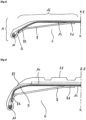
- a pneumatic tire (1) according to the invention intended to be mounted on a rim (5) comprises a crown (2) having a radially outer rolling surface (21), intended to come into contact with a ground, and two axial ends (22) each extended radially inwards, by a sidewall (3) then by a bead (4) intended to come into contact with the rim (5).
- the crown, the sidewalls and the beads delimit an internal toric cavity (6).
- the pneumatic tire (1) comprises at least one carcass ply consisting of a reinforced ply according to the invention and comprises a stiffening structure (7) comprising two stiffening elements (8), each extending continuously in the inner toric cavity (6), from a crown interface (81), connected to a radially inner face of the crown (23), to a bead interface (82), connected to an axially inner face of the bead (41), the stiffening structure (7) being distributed circumferentially over the entire circumference of the tire, the crown interface (81) being positioned, relative to the equatorial plane (XZ) passing through the middle of its rolling surface (21) and perpendicular to an axis of rotation (YY'), at an axial distance A at most equal to 0.45 times the axial width S, the bead interface (82) being positioned, relative to a point (I) the most radially inner of the axially inner face of bead (41), at a radial distance B at least equal to 0.10 times the
- the principle of the pneumatic tire according to this variant of the invention is to implant, in a conventional tire, a stiffening structure intended to increase the overall rigidity of the tire, the latter having a structural component, called structural rigidity and provided by the reinforcement structure of the tire, and a pneumatic component, called pneumatic rigidity and provided by the pressure of the inflation gas.
- the stiffening structure contributes to the pneumatic rigidity.
- Raw tires are generally manufactured from drums by following known steps of flat making on a first drum, shaping on a second drum and then finishing.
- a final curing step allows the raw plastic material to become elastic, in particular by vulcanization.
- the inner annular space of the tire is generally formed by inflating the rough tire assembled on the drum, or by deforming this rough using a membrane or a deformable wall.
- the equatorial plane (XZ) is the plane perpendicular to an axis of rotation of the tire or the blank and passing through the middle of its rolling surface.
- a blank is understood to mean a pneumatic tire in the raw state, that is to say before crosslinking of the compositions which constitute it.
- the inner annular space (6) is deployed by pressurizing the inner annular space with an inflation gas.
- the blank comprises a stiffening structure (7) comprising two stiffening elements (8), connected on the one hand by a crown interface (81) to a radially inner face of the crown, and on the other hand connected by a bead interface (82) axially inner to the bead, the stiffening structure being distributed circumferentially over the entire circumference of the pneumatic tire (1).
- a stiffening structure (7) comprising two stiffening elements (8), connected on the one hand by a crown interface (81) to a radially inner face of the crown, and on the other hand connected by a bead interface (82) axially inner to the bead, the stiffening structure being distributed circumferentially over the entire circumference of the pneumatic tire (1).
- each of the two elements (8) of the stiffening structure (7) extends continuously in the inner toric cavity, from a crown interface to a bead interface.
- the reinforced ply according to the invention is particularly suitable for the manufacture of pneumatic tires comprising a structure in the inner toric space. Indeed, the length L1 of this structure between its attachment points on the inner surface of the tire being less than the length L2 between the attachment points measured along said inner surface, it would be impossible to manufacture such a tire by implementing a flat manufacture as usually practiced. Due to the extensibility of the reinforced ply according to the invention used as a carcass ply, the different elements of the blank can be laid flat, the reinforced ply being dimensioned so that A1 is substantially equal to (L2/L1-1)x100.
- the modulus and elongation at break values of the reinforcing elements are measured according to ASTM D885-03.
Landscapes
- Engineering & Computer Science (AREA)
- Mechanical Engineering (AREA)
- Tires In General (AREA)
- Reinforced Plastic Materials (AREA)
- Laminated Bodies (AREA)
Applications Claiming Priority (2)
| Application Number | Priority Date | Filing Date | Title |
|---|---|---|---|
| FR1915063A FR3105099B1 (fr) | 2019-12-20 | 2019-12-20 | Nappe renforcée conformable |
| PCT/FR2020/052425 WO2021123588A1 (fr) | 2019-12-20 | 2020-12-14 | Nappe renforcée conformable |
Publications (2)
| Publication Number | Publication Date |
|---|---|
| EP4076990A1 EP4076990A1 (fr) | 2022-10-26 |
| EP4076990B1 true EP4076990B1 (fr) | 2024-08-14 |
Family
ID=70613968
Family Applications (1)
| Application Number | Title | Priority Date | Filing Date |
|---|---|---|---|
| EP20845580.8A Active EP4076990B1 (fr) | 2019-12-20 | 2020-12-14 | Nappe renforcée conformable |
Country Status (6)
| Country | Link |
|---|---|
| EP (1) | EP4076990B1 (https=) |
| JP (1) | JP2023507009A (https=) |
| CN (1) | CN114845888B (https=) |
| CA (1) | CA3160411A1 (https=) |
| FR (1) | FR3105099B1 (https=) |
| WO (1) | WO2021123588A1 (https=) |
Family Cites Families (10)
| Publication number | Priority date | Publication date | Assignee | Title |
|---|---|---|---|---|
| US4343343A (en) * | 1981-01-29 | 1982-08-10 | The Goodyear Tire & Rubber Company | Elongatable reinforcement cord for an elastomeric article |
| IT1204980B (it) * | 1987-04-28 | 1989-03-10 | Pirelli | Miglioramenti alle armature di rinforzo dei pneumatici per ruote di veicoli |
| JPH0524410A (ja) * | 1991-07-25 | 1993-02-02 | Sumitomo Rubber Ind Ltd | ライトトラツク用ラジアルタイヤ |
| FR2847203A1 (fr) * | 2002-11-18 | 2004-05-21 | Michelin Soc Tech | Pneumatique a mobilite etendue avec zone d'ancrage a sensiblement bas module |
| JP4616261B2 (ja) * | 2003-09-18 | 2011-01-19 | ソシエテ ド テクノロジー ミシュラン | 非対称に配置されたビード付きの延長移動性タイヤ |
| FR2887807A1 (fr) * | 2005-06-30 | 2007-01-05 | Michelin Soc Tech | Pneumatique pour vehicules lourds |
| US9889706B2 (en) * | 2012-02-22 | 2018-02-13 | Sumitomo Rubber Industries, Ltd. | Pneumatic tire with rectangle-sheet-shaped carcass ply pieces |
| FR3014363B1 (fr) * | 2013-12-09 | 2015-11-27 | Michelin & Cie | Pneumatique presentant une pression nominale reduite et une fleche relative sous charge nominale augmentee |
| FR3064212A1 (fr) * | 2017-03-22 | 2018-09-28 | Compagnie Generale Des Etablissements Michelin | Armature de sommet de pneumatique constituee d'une couche de sommet de travail et d'une couche d'elements circonferentiels |
| EP3724004B1 (fr) | 2017-12-11 | 2022-07-20 | Compagnie Generale Des Etablissements Michelin | Pneumatique pour vehicule avec structure de rigidification dans la cavite torique interieure |
-
2019
- 2019-12-20 FR FR1915063A patent/FR3105099B1/fr active Active
-
2020
- 2020-12-14 JP JP2022537627A patent/JP2023507009A/ja active Pending
- 2020-12-14 CN CN202080087811.3A patent/CN114845888B/zh active Active
- 2020-12-14 EP EP20845580.8A patent/EP4076990B1/fr active Active
- 2020-12-14 WO PCT/FR2020/052425 patent/WO2021123588A1/fr not_active Ceased
- 2020-12-14 CA CA3160411A patent/CA3160411A1/fr active Pending
Also Published As
| Publication number | Publication date |
|---|---|
| EP4076990A1 (fr) | 2022-10-26 |
| JP2023507009A (ja) | 2023-02-20 |
| CN114845888A (zh) | 2022-08-02 |
| FR3105099B1 (fr) | 2021-12-31 |
| WO2021123588A1 (fr) | 2021-06-24 |
| CN114845888B (zh) | 2023-10-24 |
| FR3105099A1 (fr) | 2021-06-25 |
| CA3160411A1 (fr) | 2021-06-24 |
Similar Documents
| Publication | Publication Date | Title |
|---|---|---|
| EP3568290B1 (fr) | Assemblage comprenant un tissu partiellement rompable et une structure porteuse | |
| EP3568289B1 (fr) | Assemblage comprenant une structure élastique et une structure porteuse | |
| EP3568291B1 (fr) | Assemblage pour pneumatique comprenant une structure rompable et une structure porteuse, pneumatique et procédé de fabrication dudit pneu | |
| EP1115587B1 (fr) | Armature de sommet pour pneumatique radial | |
| WO2003060212A1 (fr) | Cables hybrides, un procede pour leur obtention et tissus composites les incorporant | |
| EP4065355B1 (fr) | Assemblage comprenant une structure porteuse adaptable | |
| EP4076990B1 (fr) | Nappe renforcée conformable | |
| EP3697630B1 (fr) | Pneumatique comprenant des éléments de renfort sous forme de bandelettes stratifiées | |
| EP3996903B1 (fr) | Assemblage comprenant un tissu déformable plastiquement et une structure porteuse | |
| EP1554133B1 (fr) | Pneumatique a mobilite etendue avec bourrelet a repartition d'effort symetrique | |
| EP4045298B1 (fr) | Assemblage comprenant un tissu à âme fusible et une structure porteuse | |
| WO2015096951A1 (fr) | Pneumatique comprenant un assemblage d'un ou de plusieurs tricots | |
| EP4065357B1 (fr) | Assemblage comprenant une structure porteuse adaptable | |
| EP3996904B1 (fr) | Assemblage comprenant un tissu partiellement rompable et une structure porteuse | |
| EP3877165B1 (fr) | Procede de fabrication anti-relaxation d'un pneumatique | |
| EP1663672B1 (fr) | Pneumatique a mobilite etendue avec bourrelets agences de facon asymetrique | |
| WO2019058075A1 (fr) | Pneumatique allege | |
| WO2019058076A1 (fr) | Pneumatique allege |
Legal Events
| Date | Code | Title | Description |
|---|---|---|---|
| STAA | Information on the status of an ep patent application or granted ep patent |
Free format text: STATUS: UNKNOWN |
|
| STAA | Information on the status of an ep patent application or granted ep patent |
Free format text: STATUS: THE INTERNATIONAL PUBLICATION HAS BEEN MADE |
|
| PUAI | Public reference made under article 153(3) epc to a published international application that has entered the european phase |
Free format text: ORIGINAL CODE: 0009012 |
|
| STAA | Information on the status of an ep patent application or granted ep patent |
Free format text: STATUS: REQUEST FOR EXAMINATION WAS MADE |
|
| 17P | Request for examination filed |
Effective date: 20220720 |
|
| AK | Designated contracting states |
Kind code of ref document: A1 Designated state(s): AL AT BE BG CH CY CZ DE DK EE ES FI FR GB GR HR HU IE IS IT LI LT LU LV MC MK MT NL NO PL PT RO RS SE SI SK SM TR |
|
| DAV | Request for validation of the european patent (deleted) | ||
| DAX | Request for extension of the european patent (deleted) | ||
| GRAP | Despatch of communication of intention to grant a patent |
Free format text: ORIGINAL CODE: EPIDOSNIGR1 |
|
| STAA | Information on the status of an ep patent application or granted ep patent |
Free format text: STATUS: GRANT OF PATENT IS INTENDED |
|
| INTG | Intention to grant announced |
Effective date: 20240318 |
|
| RAP3 | Party data changed (applicant data changed or rights of an application transferred) |
Owner name: COMPAGNIE GENERALE DES ETABLISSEMENTS MICHELIN |
|
| GRAS | Grant fee paid |
Free format text: ORIGINAL CODE: EPIDOSNIGR3 |
|
| GRAA | (expected) grant |
Free format text: ORIGINAL CODE: 0009210 |
|
| STAA | Information on the status of an ep patent application or granted ep patent |
Free format text: STATUS: THE PATENT HAS BEEN GRANTED |
|
| AK | Designated contracting states |
Kind code of ref document: B1 Designated state(s): AL AT BE BG CH CY CZ DE DK EE ES FI FR GB GR HR HU IE IS IT LI LT LU LV MC MK MT NL NO PL PT RO RS SE SI SK SM TR |
|
| REG | Reference to a national code |
Ref country code: GB Ref legal event code: FG4D Free format text: NOT ENGLISH |
|
| REG | Reference to a national code |
Ref country code: CH Ref legal event code: EP |
|
| REG | Reference to a national code |
Ref country code: DE Ref legal event code: R096 Ref document number: 602020035931 Country of ref document: DE |
|
| REG | Reference to a national code |
Ref country code: IE Ref legal event code: FG4D Free format text: LANGUAGE OF EP DOCUMENT: FRENCH |
|
| REG | Reference to a national code |
Ref country code: LT Ref legal event code: MG9D |
|
| REG | Reference to a national code |
Ref country code: NL Ref legal event code: MP Effective date: 20240814 |
|
| PG25 | Lapsed in a contracting state [announced via postgrant information from national office to epo] |
Ref country code: NO Free format text: LAPSE BECAUSE OF FAILURE TO SUBMIT A TRANSLATION OF THE DESCRIPTION OR TO PAY THE FEE WITHIN THE PRESCRIBED TIME-LIMIT Effective date: 20241114 |
|
| REG | Reference to a national code |
Ref country code: AT Ref legal event code: MK05 Ref document number: 1712968 Country of ref document: AT Kind code of ref document: T Effective date: 20240814 |
|
| PG25 | Lapsed in a contracting state [announced via postgrant information from national office to epo] |
Ref country code: FI Free format text: LAPSE BECAUSE OF FAILURE TO SUBMIT A TRANSLATION OF THE DESCRIPTION OR TO PAY THE FEE WITHIN THE PRESCRIBED TIME-LIMIT Effective date: 20240814 Ref country code: NL Free format text: LAPSE BECAUSE OF FAILURE TO SUBMIT A TRANSLATION OF THE DESCRIPTION OR TO PAY THE FEE WITHIN THE PRESCRIBED TIME-LIMIT Effective date: 20240814 Ref country code: PL Free format text: LAPSE BECAUSE OF FAILURE TO SUBMIT A TRANSLATION OF THE DESCRIPTION OR TO PAY THE FEE WITHIN THE PRESCRIBED TIME-LIMIT Effective date: 20240814 Ref country code: GR Free format text: LAPSE BECAUSE OF FAILURE TO SUBMIT A TRANSLATION OF THE DESCRIPTION OR TO PAY THE FEE WITHIN THE PRESCRIBED TIME-LIMIT Effective date: 20241115 Ref country code: PT Free format text: LAPSE BECAUSE OF FAILURE TO SUBMIT A TRANSLATION OF THE DESCRIPTION OR TO PAY THE FEE WITHIN THE PRESCRIBED TIME-LIMIT Effective date: 20241216 |
|
| PG25 | Lapsed in a contracting state [announced via postgrant information from national office to epo] |
Ref country code: BG Free format text: LAPSE BECAUSE OF FAILURE TO SUBMIT A TRANSLATION OF THE DESCRIPTION OR TO PAY THE FEE WITHIN THE PRESCRIBED TIME-LIMIT Effective date: 20240814 |
|
| PG25 | Lapsed in a contracting state [announced via postgrant information from national office to epo] |
Ref country code: LV Free format text: LAPSE BECAUSE OF FAILURE TO SUBMIT A TRANSLATION OF THE DESCRIPTION OR TO PAY THE FEE WITHIN THE PRESCRIBED TIME-LIMIT Effective date: 20240814 |
|
| PG25 | Lapsed in a contracting state [announced via postgrant information from national office to epo] |
Ref country code: IS Free format text: LAPSE BECAUSE OF FAILURE TO SUBMIT A TRANSLATION OF THE DESCRIPTION OR TO PAY THE FEE WITHIN THE PRESCRIBED TIME-LIMIT Effective date: 20241214 Ref country code: AT Free format text: LAPSE BECAUSE OF FAILURE TO SUBMIT A TRANSLATION OF THE DESCRIPTION OR TO PAY THE FEE WITHIN THE PRESCRIBED TIME-LIMIT Effective date: 20240814 |
|
| PG25 | Lapsed in a contracting state [announced via postgrant information from national office to epo] |
Ref country code: HR Free format text: LAPSE BECAUSE OF FAILURE TO SUBMIT A TRANSLATION OF THE DESCRIPTION OR TO PAY THE FEE WITHIN THE PRESCRIBED TIME-LIMIT Effective date: 20240814 |
|
| PG25 | Lapsed in a contracting state [announced via postgrant information from national office to epo] |
Ref country code: RS Free format text: LAPSE BECAUSE OF FAILURE TO SUBMIT A TRANSLATION OF THE DESCRIPTION OR TO PAY THE FEE WITHIN THE PRESCRIBED TIME-LIMIT Effective date: 20241114 Ref country code: ES Free format text: LAPSE BECAUSE OF FAILURE TO SUBMIT A TRANSLATION OF THE DESCRIPTION OR TO PAY THE FEE WITHIN THE PRESCRIBED TIME-LIMIT Effective date: 20240814 |
|
| PG25 | Lapsed in a contracting state [announced via postgrant information from national office to epo] |
Ref country code: RS Free format text: LAPSE BECAUSE OF FAILURE TO SUBMIT A TRANSLATION OF THE DESCRIPTION OR TO PAY THE FEE WITHIN THE PRESCRIBED TIME-LIMIT Effective date: 20241114 Ref country code: PT Free format text: LAPSE BECAUSE OF FAILURE TO SUBMIT A TRANSLATION OF THE DESCRIPTION OR TO PAY THE FEE WITHIN THE PRESCRIBED TIME-LIMIT Effective date: 20241216 Ref country code: PL Free format text: LAPSE BECAUSE OF FAILURE TO SUBMIT A TRANSLATION OF THE DESCRIPTION OR TO PAY THE FEE WITHIN THE PRESCRIBED TIME-LIMIT Effective date: 20240814 Ref country code: NO Free format text: LAPSE BECAUSE OF FAILURE TO SUBMIT A TRANSLATION OF THE DESCRIPTION OR TO PAY THE FEE WITHIN THE PRESCRIBED TIME-LIMIT Effective date: 20241114 Ref country code: NL Free format text: LAPSE BECAUSE OF FAILURE TO SUBMIT A TRANSLATION OF THE DESCRIPTION OR TO PAY THE FEE WITHIN THE PRESCRIBED TIME-LIMIT Effective date: 20240814 Ref country code: LV Free format text: LAPSE BECAUSE OF FAILURE TO SUBMIT A TRANSLATION OF THE DESCRIPTION OR TO PAY THE FEE WITHIN THE PRESCRIBED TIME-LIMIT Effective date: 20240814 Ref country code: IS Free format text: LAPSE BECAUSE OF FAILURE TO SUBMIT A TRANSLATION OF THE DESCRIPTION OR TO PAY THE FEE WITHIN THE PRESCRIBED TIME-LIMIT Effective date: 20241214 Ref country code: HR Free format text: LAPSE BECAUSE OF FAILURE TO SUBMIT A TRANSLATION OF THE DESCRIPTION OR TO PAY THE FEE WITHIN THE PRESCRIBED TIME-LIMIT Effective date: 20240814 Ref country code: GR Free format text: LAPSE BECAUSE OF FAILURE TO SUBMIT A TRANSLATION OF THE DESCRIPTION OR TO PAY THE FEE WITHIN THE PRESCRIBED TIME-LIMIT Effective date: 20241115 Ref country code: FI Free format text: LAPSE BECAUSE OF FAILURE TO SUBMIT A TRANSLATION OF THE DESCRIPTION OR TO PAY THE FEE WITHIN THE PRESCRIBED TIME-LIMIT Effective date: 20240814 Ref country code: ES Free format text: LAPSE BECAUSE OF FAILURE TO SUBMIT A TRANSLATION OF THE DESCRIPTION OR TO PAY THE FEE WITHIN THE PRESCRIBED TIME-LIMIT Effective date: 20240814 Ref country code: BG Free format text: LAPSE BECAUSE OF FAILURE TO SUBMIT A TRANSLATION OF THE DESCRIPTION OR TO PAY THE FEE WITHIN THE PRESCRIBED TIME-LIMIT Effective date: 20240814 Ref country code: AT Free format text: LAPSE BECAUSE OF FAILURE TO SUBMIT A TRANSLATION OF THE DESCRIPTION OR TO PAY THE FEE WITHIN THE PRESCRIBED TIME-LIMIT Effective date: 20240814 |
|
| PG25 | Lapsed in a contracting state [announced via postgrant information from national office to epo] |
Ref country code: DK Free format text: LAPSE BECAUSE OF FAILURE TO SUBMIT A TRANSLATION OF THE DESCRIPTION OR TO PAY THE FEE WITHIN THE PRESCRIBED TIME-LIMIT Effective date: 20240814 Ref country code: RO Free format text: LAPSE BECAUSE OF FAILURE TO SUBMIT A TRANSLATION OF THE DESCRIPTION OR TO PAY THE FEE WITHIN THE PRESCRIBED TIME-LIMIT Effective date: 20240814 Ref country code: SM Free format text: LAPSE BECAUSE OF FAILURE TO SUBMIT A TRANSLATION OF THE DESCRIPTION OR TO PAY THE FEE WITHIN THE PRESCRIBED TIME-LIMIT Effective date: 20240814 |
|
| PG25 | Lapsed in a contracting state [announced via postgrant information from national office to epo] |
Ref country code: EE Free format text: LAPSE BECAUSE OF FAILURE TO SUBMIT A TRANSLATION OF THE DESCRIPTION OR TO PAY THE FEE WITHIN THE PRESCRIBED TIME-LIMIT Effective date: 20240814 |
|
| PG25 | Lapsed in a contracting state [announced via postgrant information from national office to epo] |
Ref country code: CZ Free format text: LAPSE BECAUSE OF FAILURE TO SUBMIT A TRANSLATION OF THE DESCRIPTION OR TO PAY THE FEE WITHIN THE PRESCRIBED TIME-LIMIT Effective date: 20240814 |
|
| PG25 | Lapsed in a contracting state [announced via postgrant information from national office to epo] |
Ref country code: SK Free format text: LAPSE BECAUSE OF FAILURE TO SUBMIT A TRANSLATION OF THE DESCRIPTION OR TO PAY THE FEE WITHIN THE PRESCRIBED TIME-LIMIT Effective date: 20240814 Ref country code: IT Free format text: LAPSE BECAUSE OF FAILURE TO SUBMIT A TRANSLATION OF THE DESCRIPTION OR TO PAY THE FEE WITHIN THE PRESCRIBED TIME-LIMIT Effective date: 20240814 |
|
| REG | Reference to a national code |
Ref country code: DE Ref legal event code: R097 Ref document number: 602020035931 Country of ref document: DE |
|
| PLBE | No opposition filed within time limit |
Free format text: ORIGINAL CODE: 0009261 |
|
| STAA | Information on the status of an ep patent application or granted ep patent |
Free format text: STATUS: NO OPPOSITION FILED WITHIN TIME LIMIT |
|
| PG25 | Lapsed in a contracting state [announced via postgrant information from national office to epo] |
Ref country code: MC Free format text: LAPSE BECAUSE OF FAILURE TO SUBMIT A TRANSLATION OF THE DESCRIPTION OR TO PAY THE FEE WITHIN THE PRESCRIBED TIME-LIMIT Effective date: 20240814 |
|
| 26N | No opposition filed |
Effective date: 20250515 |
|
| REG | Reference to a national code |
Ref country code: CH Ref legal event code: PL |
|
| PG25 | Lapsed in a contracting state [announced via postgrant information from national office to epo] |
Ref country code: LU Free format text: LAPSE BECAUSE OF NON-PAYMENT OF DUE FEES Effective date: 20241214 |
|
| GBPC | Gb: european patent ceased through non-payment of renewal fee |
Effective date: 20241214 |
|
| PG25 | Lapsed in a contracting state [announced via postgrant information from national office to epo] |
Ref country code: SE Free format text: LAPSE BECAUSE OF FAILURE TO SUBMIT A TRANSLATION OF THE DESCRIPTION OR TO PAY THE FEE WITHIN THE PRESCRIBED TIME-LIMIT Effective date: 20240814 |
|
| REG | Reference to a national code |
Ref country code: BE Ref legal event code: MM Effective date: 20241231 |
|
| PG25 | Lapsed in a contracting state [announced via postgrant information from national office to epo] |
Ref country code: BE Free format text: LAPSE BECAUSE OF NON-PAYMENT OF DUE FEES Effective date: 20241231 Ref country code: GB Free format text: LAPSE BECAUSE OF NON-PAYMENT OF DUE FEES Effective date: 20241214 |
|
| PG25 | Lapsed in a contracting state [announced via postgrant information from national office to epo] |
Ref country code: CH Free format text: LAPSE BECAUSE OF NON-PAYMENT OF DUE FEES Effective date: 20241231 |
|
| PG25 | Lapsed in a contracting state [announced via postgrant information from national office to epo] |
Ref country code: IE Free format text: LAPSE BECAUSE OF NON-PAYMENT OF DUE FEES Effective date: 20241214 |
|
| PGFP | Annual fee paid to national office [announced via postgrant information from national office to epo] |
Ref country code: DE Payment date: 20251211 Year of fee payment: 6 |
|
| PGFP | Annual fee paid to national office [announced via postgrant information from national office to epo] |
Ref country code: FR Payment date: 20251229 Year of fee payment: 6 |