EP4076260B1 - Systeme und verfahren zur verminderung der kollision eines robotersystems - Google Patents
Systeme und verfahren zur verminderung der kollision eines robotersystems Download PDFInfo
- Publication number
- EP4076260B1 EP4076260B1 EP20824380.8A EP20824380A EP4076260B1 EP 4076260 B1 EP4076260 B1 EP 4076260B1 EP 20824380 A EP20824380 A EP 20824380A EP 4076260 B1 EP4076260 B1 EP 4076260B1
- Authority
- EP
- European Patent Office
- Prior art keywords
- robotic
- human
- tool
- held tool
- person
- Prior art date
- Legal status (The legal status is an assumption and is not a legal conclusion. Google has not performed a legal analysis and makes no representation as to the accuracy of the status listed.)
- Active
Links
Images


Classifications
-
- G—PHYSICS
- G06—COMPUTING OR CALCULATING; COUNTING
- G06T—IMAGE DATA PROCESSING OR GENERATION, IN GENERAL
- G06T7/00—Image analysis
- G06T7/70—Determining position or orientation of objects or cameras
-
- A—HUMAN NECESSITIES
- A61—MEDICAL OR VETERINARY SCIENCE; HYGIENE
- A61B—DIAGNOSIS; SURGERY; IDENTIFICATION
- A61B1/00—Instruments for performing medical examinations of the interior of cavities or tubes of the body by visual or photographical inspection, e.g. endoscopes; Illuminating arrangements therefor
- A61B1/00163—Optical arrangements
- A61B1/00193—Optical arrangements adapted for stereoscopic vision
-
- A—HUMAN NECESSITIES
- A61—MEDICAL OR VETERINARY SCIENCE; HYGIENE
- A61B—DIAGNOSIS; SURGERY; IDENTIFICATION
- A61B34/00—Computer-aided surgery; Manipulators or robots specially adapted for use in surgery
- A61B34/20—Surgical navigation systems; Devices for tracking or guiding surgical instruments, e.g. for frameless stereotaxis
-
- A—HUMAN NECESSITIES
- A61—MEDICAL OR VETERINARY SCIENCE; HYGIENE
- A61B—DIAGNOSIS; SURGERY; IDENTIFICATION
- A61B34/00—Computer-aided surgery; Manipulators or robots specially adapted for use in surgery
- A61B34/30—Surgical robots
-
- G—PHYSICS
- G06—COMPUTING OR CALCULATING; COUNTING
- G06V—IMAGE OR VIDEO RECOGNITION OR UNDERSTANDING
- G06V20/00—Scenes; Scene-specific elements
- G06V20/50—Context or environment of the image
-
- A—HUMAN NECESSITIES
- A61—MEDICAL OR VETERINARY SCIENCE; HYGIENE
- A61B—DIAGNOSIS; SURGERY; IDENTIFICATION
- A61B17/00—Surgical instruments, devices or methods
- A61B2017/00017—Electrical control of surgical instruments
- A61B2017/00115—Electrical control of surgical instruments with audible or visual output
- A61B2017/00119—Electrical control of surgical instruments with audible or visual output alarm; indicating an abnormal situation
-
- A—HUMAN NECESSITIES
- A61—MEDICAL OR VETERINARY SCIENCE; HYGIENE
- A61B—DIAGNOSIS; SURGERY; IDENTIFICATION
- A61B34/00—Computer-aided surgery; Manipulators or robots specially adapted for use in surgery
- A61B34/20—Surgical navigation systems; Devices for tracking or guiding surgical instruments, e.g. for frameless stereotaxis
- A61B2034/2046—Tracking techniques
- A61B2034/2059—Mechanical position encoders
-
- A—HUMAN NECESSITIES
- A61—MEDICAL OR VETERINARY SCIENCE; HYGIENE
- A61B—DIAGNOSIS; SURGERY; IDENTIFICATION
- A61B34/00—Computer-aided surgery; Manipulators or robots specially adapted for use in surgery
- A61B34/20—Surgical navigation systems; Devices for tracking or guiding surgical instruments, e.g. for frameless stereotaxis
- A61B2034/2046—Tracking techniques
- A61B2034/2065—Tracking using image or pattern recognition
-
- A—HUMAN NECESSITIES
- A61—MEDICAL OR VETERINARY SCIENCE; HYGIENE
- A61B—DIAGNOSIS; SURGERY; IDENTIFICATION
- A61B34/00—Computer-aided surgery; Manipulators or robots specially adapted for use in surgery
- A61B34/30—Surgical robots
- A61B2034/301—Surgical robots for introducing or steering flexible instruments inserted into the body, e.g. catheters or endoscopes
-
- A—HUMAN NECESSITIES
- A61—MEDICAL OR VETERINARY SCIENCE; HYGIENE
- A61B—DIAGNOSIS; SURGERY; IDENTIFICATION
- A61B90/00—Instruments, implements or accessories specially adapted for surgery or diagnosis and not covered by any of the groups A61B1/00 - A61B50/00, e.g. for luxation treatment or for protecting wound edges
- A61B90/06—Measuring instruments not otherwise provided for
- A61B2090/067—Measuring instruments not otherwise provided for for measuring angles
-
- G—PHYSICS
- G06—COMPUTING OR CALCULATING; COUNTING
- G06T—IMAGE DATA PROCESSING OR GENERATION, IN GENERAL
- G06T2207/00—Indexing scheme for image analysis or image enhancement
- G06T2207/10—Image acquisition modality
- G06T2207/10004—Still image; Photographic image
- G06T2207/10012—Stereo images
-
- G—PHYSICS
- G06—COMPUTING OR CALCULATING; COUNTING
- G06T—IMAGE DATA PROCESSING OR GENERATION, IN GENERAL
- G06T2207/00—Indexing scheme for image analysis or image enhancement
- G06T2207/10—Image acquisition modality
- G06T2207/10068—Endoscopic image
-
- G—PHYSICS
- G06—COMPUTING OR CALCULATING; COUNTING
- G06T—IMAGE DATA PROCESSING OR GENERATION, IN GENERAL
- G06T2207/00—Indexing scheme for image analysis or image enhancement
- G06T2207/20—Special algorithmic details
- G06T2207/20081—Training; Learning
-
- G—PHYSICS
- G06—COMPUTING OR CALCULATING; COUNTING
- G06T—IMAGE DATA PROCESSING OR GENERATION, IN GENERAL
- G06T2207/00—Indexing scheme for image analysis or image enhancement
- G06T2207/30—Subject of image; Context of image processing
- G06T2207/30004—Biomedical image processing
-
- G—PHYSICS
- G06—COMPUTING OR CALCULATING; COUNTING
- G06V—IMAGE OR VIDEO RECOGNITION OR UNDERSTANDING
- G06V2201/00—Indexing scheme relating to image or video recognition or understanding
- G06V2201/03—Recognition of patterns in medical or anatomical images
- G06V2201/034—Recognition of patterns in medical or anatomical images of medical instruments
Definitions
- the present technology generally relates to robotic surgical systems, and in particular, relates to systems and methods for mitigating collision of a robotic surgical system.
- endoscopes have been used to visualize a surgical site.
- stereoscopic image sensors have been used to allow a surgeon to visualize a surgical site.
- a surgeon operating a robotic surgical system engages in a relatively small portion of organs inside of a patient and has a limited scope of view through a display, so the surgeon may not see the placement of persons assisting with the surgery.
- a person is in close proximity to the robot arms, it is possible for the person to be contacted by or collide with an arm of the robotic system. Such collision can cause safety concerns. Therefore, there is continuing interest in developing and improving safety of robotic surgical systems.
- US2009192524A1 discloses a robotic system for collision detection and prevention.
- the techniques of this disclosure generally relate to mitigating or reducing potential collisions between a person and a robotic surgical system.
- the type of a human-held tool and/or the pose/orientation of the human-held tool is the starting point for inferring the position of the person holding the human-held tool.
- the techniques disclosed herein for determining the position of a person holding a non-robotic tool is not based on an image of the person.
- the inferred position of the person is compared to the swept volume of the robotic surgical system to identify potential collisions.
- a robotic surgical system includes a robotic linkage including a plurality of joints, an endoscope coupled to a distal portion of the robotic linkage and configured to capture stereoscopic images, and a controller in operable communication with the endoscope.
- the controller is configured to execute instructions to cause the controller to analyze the stereoscopic images from the endoscope to identify a human-held tool in the stereoscopic images and to estimate a type and/or pose of the human-held tool, infer a position of a person holding the human-held tool based on the type and/or pose of the human-held tool, determine a spatial relationship between the person and the robotic linkage based on the inferred position of the person, and generate a warning of a potential collision between the person and the robotic linkage based on the determined spatial relationship.
- the robotic linkage includes sensors configured to provide measurements of an angle and a velocity of each joint of the plurality of joints.
- the robotic surgical system includes a robotic tool coupled to a distal portion of the robotic linkage.
- the controller is configured to execute the instructions to cause the controller to analyze the stereoscopic images from the endoscope to identify the robotic tool in the stereoscopic images and to estimate a pose of the robotic tool, and determine a swept volume of the robotic linkage based on the estimated pose of the robotic tool and based on the angle and the velocity of each joint of the plurality of joints, where the swept volume is determined without using any real-time image of the robotic linkage.
- the instructions in analyzing the stereoscopic images, implement an artificial-intelligence learning machine to determine the pose of the robotic tool.
- the instructions in analyzing the stereoscopic images, implement an artificial-intelligence learning machine configured to determine the type and/or pose of the human-held tool.
- the controller in inferring the position of the person holding the human-held tool, executes the instructions to cause the controller to access information relating to how the human-held tool is typically held during a particular phase of a surgical procedure, and infer the position of the person holding the human-held tool based further on the information relating to how the human-held tool is typically held during the particular phase of the surgical procedure.
- the controller in inferring the position of the person holding the human-held tool, executes the instructions to cause the controller to access physical attribute information for the person holding the human-held tool, and infer the position of the person holding the human-held tool based further on the physical attribute information for the person holding the human-held tool, where the position of the person holding the human-held tool is inferred without using any real-time image of the person holding the human-held tool.
- a method for warning of a potential collision between a person holding a human-held tool and a robotic surgical system having a robotic linkage including a plurality of joints.
- the method includes accessing stereoscopic images obtained by an endoscope coupled to a distal portion of the robotic linkage, analyzing the stereoscopic images from the endoscope to identify the human-held tool in the stereoscopic images and to estimate a type and/or pose of the human-held tool, inferring a position of the person holding the human-held tool based on the type and/or pose of the human-held tool, determining a spatial relationship between the person and the robotic linkage based on the inferred position of the person, and generating a warning of a potential collision between the person and the robotic linkage based on the determined spatial relationship.
- the robotic linkage includes sensors configured to provide measurements of an angle and a velocity of each joint of the plurality of joints.
- the robotic surgical system includes a robotic tool coupled to a distal portion of the robotic linkage
- the method includes analyzing the stereoscopic images from the endoscope to identify the robotic tool in the stereoscopic images and to estimate a pose of the robotic tool, and determining a swept volume of the robotic linkage based on the estimated pose of the robotic tool and based on the angle and the velocity of each joint of the plurality of joints, where the swept volume is determined without using any real-time image of the robotic linkage.
- analyzing the stereoscopic images includes using an artificial-intelligence learning machine to determine the pose of the robotic tool.
- the swept volume is a physical space that the robotic linkage could move through in a particular time period based on the velocity of each j oint of the plurality of joints.
- the type of the human-held tool and/or the pose/orientation of the human-held tool is the starting point for determining the position of the person holding the human-held tool.
- the techniques disclosed herein for determining the position of a person holding a non-robotic tool is not based on an image of the person.
- the non-robotic/human-held tool 170 may be held by a person who occupies a space in the surgery room next to the robotic surgical system 100. Thus, there is a possibility that the person and the robotic surgical system 100 might collide or interfere with each other. Such collisions may lead to unexpected movements of the robotic and non-robotic tools, resulting in potential injury to the patient or the person holding the non-robotic tool.
- the processor 140 may determine a possibility of potential collision between the person and the robotic linkages 120.
- the processor 140 may further display a popup window on a display device 156 of the user console 150 to provide a warning of the potential collision.
- the warning may include an audible sound or haptic vibrations to an input handle 152.
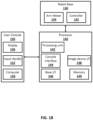
- the processor 140 may be a stand-alone computing device similar to the computing device 200 of FIG. 2 , or integrated into one or more of the various components of the robotic surgical system 100 (e.g., in the robot bases 130 or the user console 150).
- the processor 140 may also be distributed to multiple components of the robotic surgical system 100 (e.g., in multiple robot bases 130).
- the processor 140 of the robotic surgical system 100 generally includes a processing unit 142, a memory 149, the robot base interface 146, a console interface 144, and an image device interface 148.
- the robot base interface 146, the console interface 144, and the image device interface 148 communicate with the robot bases 130, the user console 150, the imaging devices 124 via either wireless configurations, e.g., Wi-Fi, Bluetooth, LTE, and/or wired configurations.
- wireless configurations e.g., Wi-Fi, Bluetooth, LTE, and/or wired configurations.
- the console interface 144, the robot base interface 146, and the image device interface 148 may be a single component in other embodiments.
- the user console 150 also includes input handles 152 which are supported on control arms 154 which allow a clinician to manipulate the surgical robot 110 (e.g., move the robotic linkages 120, the ends 122 of the robotic linkages 120, and/or the tools 126).
- Each of the input handles 152 is in communication with the processor 140 to transmit control signals thereto and to receive feedback signals therefrom. Additionally or alternatively, each of the input handles 152 may include input devices (not explicitly shown) which allow the surgeon to manipulate (e.g., clamp, grasp, fire, open, close, rotate, thrust, slice, etc.) the tools 126 supported at the ends 122 of the robotic linkages 120.
- Each of the input handles 152 is moveable through a predefined workspace to move the ends 122 of the robotic linkages 120, e.g., tools 126, within the surgical site "S".
- the three-dimensional images on the display device 156 are orientated such that the movement of the input handles 152 moves the ends 122 of the robotic linkages 120 as viewed on the display device 156.
- the three-dimensional images remain stationary while movement of the input handles 152 is scaled to movement of the ends 122 of the robotic linkages 120 within the three-dimensional images.
- kinematic mapping of the input handles 152 is based on a camera orientation relative to an orientation of the ends 122 of the robotic linkages 120.
- the orientation of the three-dimensional images on the display device 156 may be mirrored or rotated relative to the view captured by the imaging devices 124.
- the size of the three-dimensional images on the display device 156 may be scaled to be larger or smaller than the actual structures of the surgical site "S" permitting the clinician to have a better view of internal structures within the surgical site "S”.
- the tools 126 are moved within the surgical site "S” as detailed below. Movement of the tools 126 may also include movement of the ends 122 of the robotic linkages 120 which support the tools 126.
- the computer 158 may process and transmit the signals to the processor 140, which in turn transmits control signals to the robot bases 130, and the devices of the robot bases 130, to effect motion based at least in part on the signals transmitted from the computer 158.
- the input handles 152 may be handles, pedals, or computer accessories (e.g., a keyboard, joystick, mouse, button, touch screen, switch, trackball, and the like).
- the user console 150 includes the display device 156 configured to display two-dimensional and/or three-dimensional images of the surgical site "S", which may include data captured by the imaging devices 124 positioned on the ends 122 of the robotic linkages 120.
- the imaging devices 124 may capture visual images, infra-red images, ultrasound images, X-ray images, thermal images, and/or any other known real-time images of the surgical site "S".
- the imaging devices 124 transmit captured imaging data to the processor 140 which creates three-dimensional images of the surgical site "S" in real-time from the imaging data and transmits the three-dimensional images to the display device 156 for displaying such.
- the display device 156 may be connected to an endoscope installed on the end 122 of the robotic linkages 120 so that live view images from the endoscope may be displayed on the display device 156. Further, as described above, a potential warning may be displayed in an overlapping manner over the live view images.
- the endoscope may capture images of the non-robotic/human-held tool 170. Such captured images of the non-robotic/human-held tool 170 are transmitted to and processed by the processor 140 so that a pose and/or a type of the non-robotic/human-held tool 170 may be determined. Such information may be used to determine a volume occupied by the person or a position of the person who holds the non-robotic/human-held tool 170. The person's volume/position and the swept volume may be compared to determine a potential collision between the robotic surgical system 100 and the person.
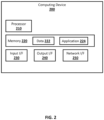
- FIG. 2 a block diagram of an exemplary computing device is shown and is designated generally as a computing device 200.
- the computing device 200 may represent one or more components (e.g., the processor 140 or the computer 158) of the robotic surgical system 100.
- the computing device 200 may include one or more processors 210, one or more memories 220, input interface 230, output interface 240, network interface 250, or any desired subset of components thereof.
- the memory 220 includes non-transitory computer-readable storage media for storing data and/or software which include instructions that may be executed by the one or more processors 210. When executed, the instructions may cause the processor 210 to control operation of the computing device 200 such as, without limitation, reception, analysis, and transmission of sensor signals received in response to movement and/or actuation of the one or more input handles 152.
- the memory 220 may include one or more solid-state storage devices such as flash memory chips. Additionally, or alternatively, the memory 220 may include one or more mass storage devices in communication with the processor 210 through a mass storage controller and a communications bus (not shown).
- Examples of computer-readable storage media include RAM, ROM, EPROM, EEPROM, flash memory, or other known solid state memory technology, CD-ROM, DVD, Blu-Ray, or other such optical storage, magnetic cassettes, magnetic tape, magnetic disk storage or other magnetic storage devices, or any other medium which may be used to store information and which can be accessed by the computing device 200.
- the memory 220 stores data 222 and/or one or more applications 224.
- the data 222 can include information about various robotic tools and various human-held tools, such as dimensions of such tools. Use of such data 222 will be described in more detail in connection with FIG. 3 .
- the applications 224 may include instructions which are executed on the one or more processors 210 of the computing device 200.
- the applications 224 may include instructions which cause an input interface 230 and/or an output interface 240 to receive and transmit sensor signals, respectively, to and from the various components of the robotic surgical system 100. Additionally or alternatively, the computing device 200 may transmit the signals for analysis and/or display via the output interface 240.
- the memory 220 may include instructions which, when executed, generate a depth map or point cloud of the objects within the surgical environment based on the real-time image data received from the image devices of the robotic surgical system 100.
- the depth map or point cloud may be stored in the memory 220 across multiple iterations for a later cumulative analysis of the depth maps or point clouds.
- the computing device 200 can include data 222 and applications 224 which implement a trained learning machine, such as a convolutional neural network.
- the trained learning machine can process images of a surgical site to identify surgical tools and determine the pose/orientation of the tools, as discussed in more detail in connection with FIG. 3 .
- the memory 220 may include instructions that, when executed by the processor 210, identify potential collisions between a person and the robotic surgical system 100. Techniques for identifying a potential collision will be described later herein.
- the output interface 240 may transmit the sensor signals to a display device such as the display device 156 of the user console 150, or a remote display located in the surgical environment and in communication with the computing device 200, to display an indication that a collision may occur.
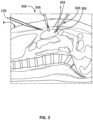
- FIG. 3 there is shown a diagram of an exemplary surgical procedure 310 using the robotic surgical system 100 of FIG. 1A , including an endoscope 320 which is inserted through a body cavity of the patient "P" and is configured to provide optical views or images of the surgical site “S” and to transmit the optical images to the display device 156.
- the endoscope 320 includes a camera 322 to capture images of the surgical site "S” during a procedure as detailed below.
- the surgical procedure 310 also includes a robotic tool 326 of the robotic surgical system and a human-held non-robotic/human-held tool 170.
- the camera 322 may be a stereoscopic camera such that the captured images provide depth information that can be used to determine positions/orientations of organs, the robotic tool 326, and/or the non-robotic/human-held tool 170. Further, the stereoscopic images having depth information may be used to identify a pose and/or a type of the non-robotic/human-held tool 170 captured therein.
- the endoscope 320 is inserted through an opening, either a natural opening or an incision, to position the camera 322 within the body cavity adjacent the surgical site "S" to allow the camera 322 to capture images of the surgical site "S".
- the camera 322 transmits the captured images to the processor 140.
- the processor 140 receives the images or data of the surgical site "S” from the camera 322 and displays the received images on the display device 156 such that a clinician can visualize the surgical site "S".
- the endoscope 320 and/or camera 322 includes a sensor 325 that indicates the pose of the camera 322 as the images of the surgical site "S" are captured.
- the sensor 325 is in communication with the processor 140 such that the processor 140 receives the pose of the camera 322 from the sensor 325 and associates the pose of the camera 322 with the images captured by the camera 322.
- the sensor 325 may sense six degrees of freedom, including X, Y, and Z axes, as well as pitch, roll, and yaw.
Landscapes
- Health & Medical Sciences (AREA)
- Engineering & Computer Science (AREA)
- Life Sciences & Earth Sciences (AREA)
- Surgery (AREA)
- Veterinary Medicine (AREA)
- General Health & Medical Sciences (AREA)
- Public Health (AREA)
- Nuclear Medicine, Radiotherapy & Molecular Imaging (AREA)
- Biomedical Technology (AREA)
- Heart & Thoracic Surgery (AREA)
- Medical Informatics (AREA)
- Molecular Biology (AREA)
- Animal Behavior & Ethology (AREA)
- Physics & Mathematics (AREA)
- Robotics (AREA)
- General Physics & Mathematics (AREA)
- Theoretical Computer Science (AREA)
- Radiology & Medical Imaging (AREA)
- Pathology (AREA)
- Optics & Photonics (AREA)
- Multimedia (AREA)
- Biophysics (AREA)
- Computer Vision & Pattern Recognition (AREA)
- Endoscopes (AREA)
- Manipulator (AREA)
Claims (15)
- Chirurgisches Robotersystem, umfassend:eine Roboterverbindung einschließlich einer Vielzahl von Gelenken;ein Endoskop, das mit einem distalen Abschnitt der Roboterverbindung gekoppelt und konfiguriert ist, um stereoskopische Bilder zu erfassen; undeine Steuervorrichtung in betriebsfähiger Kommunikation mit dem Endoskop, dadurch gekennzeichnet, dass die Steuervorrichtung konfiguriert ist, um Anweisungen auszuführen, die die Steuervorrichtung veranlassen zum:Analysieren der stereoskopischen Bilder von dem Endoskop, um ein von Menschen gehaltenes Werkzeug in den stereoskopischen Bildern zu identifizieren und mindestens eine von einer Art oder einer Stellung des von Menschen gehaltenen Werkzeugs zu schätzen,Ableiten einer Position einer Person, die das von Menschen gehaltene Werkzeug hält, basierend auf der mindestens einen von der Art oder der Stellung des von Menschen gehaltenen Werkzeugs,Bestimmen einer räumlichen Beziehung zwischen der Person und der Roboterverbindung basierend auf der abgeleiteten Position der Person, undErzeugen einer Warnung vor einer möglichen Kollision zwischen der Person und der Roboterverbindung basierend auf der bestimmten räumlichen Beziehung.
- Chirurgisches Robotersystem nach Anspruch 1, wobei die Roboterverbindung ferner Sensoren, die konfiguriert sind, um Messungen eines Winkels und einer Geschwindigkeit jedes Gelenks der Vielzahl von Gelenken bereitzustellen, einschließt.
- Chirurgisches Robotersystem nach Anspruch 2, ferner umfassend ein Roboterwerkzeug, das mit einem distalen Abschnitt der Roboterverbindung gekoppelt ist,
wobei Steuervorrichtung konfiguriert ist, um die Anweisungen auszuführen, um die Steuervorrichtung ferner zu veranlassen zum:Analysieren der stereoskopischen Bilder von dem Endoskop, um das Roboterwerkzeug in den stereoskopischen Bildern zu identifizieren und eine Stellung des Roboterwerkzeugs zu schätzen, undBestimmen eines überstrichenen Volumens der Roboterverbindung basierend auf der geschätzten Stellung des Roboterwerkzeugs und basierend auf dem Winkel und der Geschwindigkeit jedes Gelenks der Vielzahl von Gelenken,wobei das überstrichene Volumen ohne Verwendung eines Echtzeitbildes der Roboterverbindung bestimmt wird. - Chirurgisches Robotersystem nach Anspruch 3, wobei die Anweisungen bei dem Analysieren der stereoskopischen Bilder eine auf künstlicher Intelligenz basierende Lernmaschine implementieren, um die Stellung des Roboterwerkzeugs zu bestimmen; und/oder wobei das überstrichene Volumen ein physischer Raum ist, durch den sich die Roboterverbindung in einem spezifischen Zeitraum basierend auf der Geschwindigkeit jedes Gelenks der Vielzahl von Gelenken bewegen könnte; und/oder wobei die Anweisungen bei dem Erzeugen der Warnung vor einer möglichen Kollision, wenn sie ausgeführt werden, die Steuervorrichtung veranlassen, die mögliche Kollision basierend auf einer Überlappung zwischen der abgeleiteten Position der Person und dem überstrichenen Volumen der Roboterverbindung zu bestimmen.
- Chirurgisches Robotersystem nach einem der vorstehenden Ansprüche, wobei die Anweisungen bei dem Analysieren der stereoskopischen Bilder eine auf künstlicher Intelligenz basierende Lernmaschine implementieren, die konfiguriert ist, um die mindestens eine von der Art oder der Stellung des von Menschen gehaltenen Werkzeugs zu bestimmen.
- Chirurgisches Robotersystem nach einem der vorstehenden Ansprüche, wobei die Steuervorrichtung bei dem Ableiten der Position der Person, die das von Menschen gehaltene Werkzeug hält, die Anweisungen ausführt, um die Steuervorrichtung zu veranlassen zum:Zugreifen auf Informationen bezogen darauf, wie das vom Menschen gehaltene Werkzeug während einer spezifischen Phase eines chirurgischen Eingriffs üblicherweise gehalten wird; undAbleiten der Position der Person, die das von Menschen gehaltene Werkzeug hält, basierend ferner auf den Informationen bezogen darauf, wie das von Menschen gehaltene Werkzeug während der spezifischen Phase des chirurgischen Eingriffs üblicherweise gehalten wird.
- Chirurgisches Robotersystem nach Anspruch 6, wobei die Steuervorrichtung bei dem Ableiten der Position der Person, die das von Menschen gehaltene Werkzeug hält, die Anweisungen ausführt, um die Steuervorrichtung zu veranlassen zum:Zugreifen auf physische Attributinformationen für die Person, die das von Menschen gehaltene Werkzeug hält; und Ableiten der Position der Person, die das von Menschen gehaltene Werkzeug hält, basierend ferner auf den physischen Attributinformationen für die Person, die das von Menschen gehaltene Werkzeug hält,wobei die Position der Person, die das von Menschen gehaltene Werkzeug hält, ohne Verwendung eines Echtzeitbildes der Person, die das von Menschen gehaltene Werkzeug hält, abgeleitet wird.
- Verfahren zum Warnen vor einer möglichen Kollision zwischen einer Person, die ein von Menschen gehaltenes Werkzeug hält, und einem chirurgischen Robotersystem, das eine Roboterverbindung einschließlich einer Vielzahl von Gelenken aufweist, das Verfahren umfassend:Zugreifen auf stereoskopische Bilder, die durch ein Endoskop, das mit einen distalen Abschnitt der Roboterverbindung gekoppelt ist, erhalten werden;Analysieren der stereoskopischen Bilder von dem Endoskop, um das von Menschen gehaltene Werkzeug in den stereoskopischen Bildern zu identifizieren und mindestens eine von einer Art oder einer Stellung des von Menschen gehaltenen Werkzeugs zu schätzen;Ableiten einer Position der Person, die das von Menschen gehaltene Werkzeug hält, basierend auf der mindestens einen von der Art oder der Stellung des von Menschen gehaltenen Werkzeugs;Bestimmen einer räumlichen Beziehung zwischen der Person und der Roboterverbindung basierend auf der abgeleiteten Position der Person; undErzeugen einer Warnung vor einer möglichen Kollision zwischen der Person und der Roboterverbindung basierend auf der bestimmten räumlichen Beziehung.
- Verfahren nach Anspruch 8, wobei die Roboterverbindung ferner Sensoren, die konfiguriert sind, um Messungen eines Winkels und einer Geschwindigkeit jedes Gelenks der Vielzahl von Gelenken bereitzustellen, einschließt, und/oder wobei das chirurgische Robotersystem ferner ein Roboterwerkzeug, das mit einem distalen Abschnitt der Roboterverbindung gekoppelt ist, einschließt, das Verfahren ferner umfassend:Analysieren der stereoskopischen Bilder von dem Endoskop, um das Roboterwerkzeug in den stereoskopischen Bildern zu identifizieren und eine Stellung des Roboterwerkzeugs zu schätzen; undBestimmen eines überstrichenen Volumens der Roboterverbindung basierend auf der geschätzten Stellung des Roboterwerkzeugs und basierend auf dem Winkel und der Geschwindigkeit jedes Gelenks der Vielzahl von Gelenken, wobei das überstrichene Volumen ohne Verwendung eines Echtzeitbildes der Roboterverbindung bestimmt wird.
- Verfahren nach einem der Ansprüche 8 oder 9, wobei das Analysieren der stereoskopischen Bilder das Verwenden einer auf künstlicher Intelligenz basierenden Lernmaschine einschließt, um die Stellung des Roboterwerkzeugs zu bestimmen.
- Verfahren nach einem der Ansprüche 8 bis 10, wobei das überstrichene Volumen ein physischer Raum ist, durch den sich die Roboterverbindung in einem spezifischen Zeitraum basierend auf der Geschwindigkeit jedes Gelenks der Vielzahl von Gelenken bewegen könnte.
- Verfahren nach einem der Ansprüche 8 bis 11, wobei das Erzeugen der Warnung vor einer möglichen Kollision das Bestimmen der möglichen Kollision basierend auf einer Überlappung zwischen der abgeleiteten Position der Person und dem überstrichenen Volumen der Roboterverbindung einschließt.
- Verfahren nach einem der Ansprüche 8 bis 12, wobei das Analysieren der stereoskopischen Bilder das Verwenden einer auf künstlicher Intelligenz basierenden Lernmaschine einschließt, die konfiguriert ist, um die mindestens eine von der Art oder der Stellung des von Menschen gehaltenen Werkzeugs zu bestimmen.
- Verfahren nach einem der Ansprüche 8 bis 13, wobei das Ableiten der Position der Person, die das von Menschen gehaltene Werkzeug hält, einschließt:Zugreifen auf Informationen bezogen darauf, wie das vom Menschen gehaltene Werkzeug während einer spezifischen Phase eines chirurgischen Eingriffs üblicherweise gehalten wird; undAbleiten der Position der Person, die das von Menschen gehaltene Werkzeug hält, basierend ferner auf den Informationen bezogen darauf, wie das von Menschen gehaltene Werkzeug während der spezifischen Phase des chirurgischen Eingriffs üblicherweise gehalten wird; vorzugsweise wobei das Ableiten der Position der Person, die das von Menschen gehaltene Werkzeug hält, einschließt:Zugreifen auf physische Attributinformationen für die Person, die das von Menschen gehaltene Werkzeug hält; undAbleiten der Position der Person, die das von Menschen gehaltene Werkzeug hält, basierend ferner auf den physischen Attributinformationen für die Person, die das von Menschen gehaltene Werkzeug hält,wobei die Position der Person, die das von Menschen gehaltene Werkzeug hält, ohne Verwendung eines Echtzeitbildes der Person, die das von Menschen gehaltene Werkzeug hält, abgeleitet wird.
- Nicht flüchtiges computerlesbares Medium einschließlich computerausführbarer Anweisungen, die, wenn sie durch eine Steuervorrichtung des Systems nach Anspruch 1 ausgeführt werden, die Steuervorrichtung veranlassen, ein Verfahren zum Warmen vor einer möglichen Kollision zwischen einer Person, die ein von Menschen gehaltenes Werkzeug hält, und einem chirurgischen Robotersystem, das eine Roboterverbindung einschließlich einer Vielzahl von Gelenken aufweist, durchzuführen, das Verfahren umfassend:Zugreifen auf stereoskopische Bilder, die durch das Endoskop, das mit einen distalen Abschnitt der Roboterverbindung gekoppelt ist, erhalten werden;Analysieren der stereoskopischen Bilder von dem Endoskop, um das von Menschen gehaltene Werkzeug in den stereoskopischen Bildern zu identifizieren und mindestens eine von einer Art oder einer Stellung des von Menschen gehaltenen Werkzeugs zu schätzen;Ableiten einer Position der Person, die das von Menschen gehaltene Werkzeug hält, basierend auf der mindestens einen von der Art oder der Stellung des von Menschen gehaltenen Werkzeugs;Bestimmen einer räumlichen Beziehung zwischen der Person und der Roboterverbindung basierend auf der abgeleiteten Position der Person; undErzeugen einer Warnung vor einer möglichen Kollision zwischen der Person und der Roboterverbindung basierend auf der bestimmten räumlichen Beziehung; vorzugsweise wobei die computerausführbaren Anweisungen, wenn sie durch die Steuervorrichtung ausgeführt werden, die Steuervorrichtung veranlassen, das Verfahren zum Warnen vor einer möglichen Kollision weiter durchzuführen, das Verfahren ferner umfassend:Analysieren der stereoskopischen Bilder von dem Endoskop, um ein Roboterwerkzeug in den stereoskopischen Bildern zu identifizieren und eine Stellung des Roboterwerkzeugs zu schätzen, wobei das Roboterwerkzeug mit einem distalen Abschnitt der Roboterverbindung gekoppelt ist; undBestimmen eines überstrichenen Volumens der Roboterverbindung basierend auf der geschätzten Stellung des Roboterwerkzeugs und basierend auf einem Winkel und einer Geschwindigkeit jedes Gelenks der Vielzahl von Gelenken,wobei das Erzeugen der Warnung vor einer möglichen Kollision das Bestimmen der möglichen Kollision basierend auf einer Überlappung zwischen der abgeleiteten Position der Person und dem überstrichenen Volumen der Roboterverbindung einschließt.
Applications Claiming Priority (2)
| Application Number | Priority Date | Filing Date | Title |
|---|---|---|---|
| US201962950372P | 2019-12-19 | 2019-12-19 | |
| PCT/US2020/060987 WO2021126447A1 (en) | 2019-12-19 | 2020-11-18 | Systems and methods for mitigating collision of a robotic system |
Publications (2)
| Publication Number | Publication Date |
|---|---|
| EP4076260A1 EP4076260A1 (de) | 2022-10-26 |
| EP4076260B1 true EP4076260B1 (de) | 2025-07-09 |
Family
ID=73834597
Family Applications (1)
| Application Number | Title | Priority Date | Filing Date |
|---|---|---|---|
| EP20824380.8A Active EP4076260B1 (de) | 2019-12-19 | 2020-11-18 | Systeme und verfahren zur verminderung der kollision eines robotersystems |
Country Status (4)
| Country | Link |
|---|---|
| US (2) | US12106508B2 (de) |
| EP (1) | EP4076260B1 (de) |
| CN (1) | CN114786611A (de) |
| WO (1) | WO2021126447A1 (de) |
Families Citing this family (5)
| Publication number | Priority date | Publication date | Assignee | Title |
|---|---|---|---|---|
| EP4171428A4 (de) * | 2020-06-30 | 2024-10-30 | Auris Health, Inc. | Robotisches medizinisches system mit kollisionsnäherungsindikatoren |
| EP4131139B1 (de) * | 2021-08-03 | 2025-11-26 | Sick Ag | Sensoranordnung und verfahren zum absichern eines überwachungsbereichs |
| US12186913B2 (en) * | 2021-12-29 | 2025-01-07 | Shanghai United Imaging Intelligence Co., Ltd. | Automated collision avoidance in medical environments |
| WO2025027463A1 (en) * | 2023-08-01 | 2025-02-06 | Covidien Lp | System and method for processing combined data streams of surgical robots |
| US12387365B1 (en) * | 2024-07-29 | 2025-08-12 | Anumana, Inc. | Apparatus and method for object pose estimation in a medical image |
Family Cites Families (14)
| Publication number | Priority date | Publication date | Assignee | Title |
|---|---|---|---|---|
| US9789608B2 (en) * | 2006-06-29 | 2017-10-17 | Intuitive Surgical Operations, Inc. | Synthetic representation of a surgical robot |
| US8814779B2 (en) * | 2006-12-21 | 2014-08-26 | Intuitive Surgical Operations, Inc. | Stereoscopic endoscope |
| US8245594B2 (en) * | 2008-12-23 | 2012-08-21 | Intuitive Surgical Operations, Inc. | Roll joint and method for a surgical apparatus |
| CN104519823B (zh) * | 2012-08-02 | 2018-02-16 | 皇家飞利浦有限公司 | 机器人远程运动中心的控制器限定 |
| EP3682837B1 (de) | 2014-03-17 | 2023-09-27 | Intuitive Surgical Operations, Inc. | System und verfahren zur lösbaren kupplung in einem gelenkarm |
| JP6714085B2 (ja) * | 2015-12-29 | 2020-06-24 | コーニンクレッカ フィリップス エヌ ヴェKoninklijke Philips N.V. | ロボット手術のために仮想現実デバイスを使用するシステム、コントローラ、及び方法 |
| US11622672B2 (en) * | 2016-07-01 | 2023-04-11 | Intuitive Surgical Operations, Inc. | Method for positioning an endoscope with flexible shaft |
| US11490782B2 (en) * | 2017-03-31 | 2022-11-08 | Auris Health, Inc. | Robotic systems for navigation of luminal networks that compensate for physiological noise |
| WO2018188466A1 (en) * | 2017-04-12 | 2018-10-18 | Bio-Medical Engineering (HK) Limited | Automated steering systems and methods for a robotic endoscope |
| AU2018265018B2 (en) * | 2017-05-12 | 2024-03-07 | Auris Health, Inc. | Biopsy apparatus and system |
| US10022192B1 (en) * | 2017-06-23 | 2018-07-17 | Auris Health, Inc. | Automatically-initialized robotic systems for navigation of luminal networks |
| US11011077B2 (en) * | 2017-06-29 | 2021-05-18 | Verb Surgical Inc. | Virtual reality training, simulation, and collaboration in a robotic surgical system |
| WO2020261208A2 (en) * | 2019-06-28 | 2020-12-30 | Auris Health, Inc. | Patient introducer for a robotic system |
| US11529734B2 (en) * | 2019-10-31 | 2022-12-20 | Verb Surgical Inc. | Systems and methods for visual sensing of and docking with a trocar |
-
2020
- 2020-11-18 EP EP20824380.8A patent/EP4076260B1/de active Active
- 2020-11-18 WO PCT/US2020/060987 patent/WO2021126447A1/en not_active Ceased
- 2020-11-18 CN CN202080086038.9A patent/CN114786611A/zh active Pending
- 2020-11-18 US US17/767,079 patent/US12106508B2/en active Active
-
2024
- 2024-09-25 US US18/896,000 patent/US20250022160A1/en active Pending
Also Published As
| Publication number | Publication date |
|---|---|
| EP4076260A1 (de) | 2022-10-26 |
| WO2021126447A1 (en) | 2021-06-24 |
| US20220366594A1 (en) | 2022-11-17 |
| US20250022160A1 (en) | 2025-01-16 |
| US12106508B2 (en) | 2024-10-01 |
| CN114786611A (zh) | 2022-07-22 |
Similar Documents
| Publication | Publication Date | Title |
|---|---|---|
| EP4076260B1 (de) | Systeme und verfahren zur verminderung der kollision eines robotersystems | |
| CN113613852B (zh) | 机器人手术碰撞检测系统 | |
| US11258964B2 (en) | Synthesizing spatially-aware transitions between multiple camera viewpoints during minimally invasive surgery | |
| JP6058111B2 (ja) | 手術ロボットの合成表現 | |
| US20150320514A1 (en) | Surgical robots and control methods thereof | |
| JP2020022806A (ja) | 撮像装置及び入力コントロールを再芯出しするためのシステム及び方法 | |
| WO2022126997A1 (zh) | 手术机器人及其控制方法、控制装置 | |
| CN105188590A (zh) | 图像采集装置和可操纵装置活动臂受控运动过程中的碰撞避免 | |
| CN115089302A (zh) | 手术机器人系统及方法 | |
| US12256890B2 (en) | Systems and methods for guiding surgical procedures | |
| KR20110036453A (ko) | 수술용 영상 처리 장치 및 그 방법 | |
| CN112043396B (zh) | 手术机器人及其图形化控制装置、图形化显示方法 | |
| JP2022519307A (ja) | ロボット手術システム用のハンドアイ協働システム | |
| CN115429432B (zh) | 可读存储介质、手术机器人系统和调整系统 | |
| CN112472298B (zh) | 手术机器人及其控制装置、控制方法 | |
| KR101114231B1 (ko) | 수술용 영상 처리 장치 및 그 방법 | |
| CN120476366A (zh) | 用于基于操作者相关参数显示扩展现实内容的技术 |
Legal Events
| Date | Code | Title | Description |
|---|---|---|---|
| STAA | Information on the status of an ep patent application or granted ep patent |
Free format text: STATUS: UNKNOWN |
|
| STAA | Information on the status of an ep patent application or granted ep patent |
Free format text: STATUS: THE INTERNATIONAL PUBLICATION HAS BEEN MADE |
|
| PUAI | Public reference made under article 153(3) epc to a published international application that has entered the european phase |
Free format text: ORIGINAL CODE: 0009012 |
|
| STAA | Information on the status of an ep patent application or granted ep patent |
Free format text: STATUS: REQUEST FOR EXAMINATION WAS MADE |
|
| 17P | Request for examination filed |
Effective date: 20220701 |
|
| AK | Designated contracting states |
Kind code of ref document: A1 Designated state(s): AL AT BE BG CH CY CZ DE DK EE ES FI FR GB GR HR HU IE IS IT LI LT LU LV MC MK MT NL NO PL PT RO RS SE SI SK SM TR |
|
| DAV | Request for validation of the european patent (deleted) | ||
| DAX | Request for extension of the european patent (deleted) | ||
| GRAP | Despatch of communication of intention to grant a patent |
Free format text: ORIGINAL CODE: EPIDOSNIGR1 |
|
| STAA | Information on the status of an ep patent application or granted ep patent |
Free format text: STATUS: GRANT OF PATENT IS INTENDED |
|
| INTG | Intention to grant announced |
Effective date: 20250211 |
|
| GRAS | Grant fee paid |
Free format text: ORIGINAL CODE: EPIDOSNIGR3 |
|
| GRAA | (expected) grant |
Free format text: ORIGINAL CODE: 0009210 |
|
| STAA | Information on the status of an ep patent application or granted ep patent |
Free format text: STATUS: THE PATENT HAS BEEN GRANTED |
|
| AK | Designated contracting states |
Kind code of ref document: B1 Designated state(s): AL AT BE BG CH CY CZ DE DK EE ES FI FR GB GR HR HU IE IS IT LI LT LU LV MC MK MT NL NO PL PT RO RS SE SI SK SM TR |
|
| REG | Reference to a national code |
Ref country code: GB Ref legal event code: FG4D |
|
| REG | Reference to a national code |
Ref country code: CH Ref legal event code: EP |
|
| REG | Reference to a national code |
Ref country code: IE Ref legal event code: FG4D |
|
| REG | Reference to a national code |
Ref country code: DE Ref legal event code: R096 Ref document number: 602020054305 Country of ref document: DE |
|
| REG | Reference to a national code |
Ref country code: NL Ref legal event code: MP Effective date: 20250709 |