EP4075417B1 - Vorrichtung und verfahren zur dauerhaften markierung eines objekts - Google Patents
Vorrichtung und verfahren zur dauerhaften markierung eines objekts Download PDFInfo
- Publication number
- EP4075417B1 EP4075417B1 EP22166108.5A EP22166108A EP4075417B1 EP 4075417 B1 EP4075417 B1 EP 4075417B1 EP 22166108 A EP22166108 A EP 22166108A EP 4075417 B1 EP4075417 B1 EP 4075417B1
- Authority
- EP
- European Patent Office
- Prior art keywords
- label
- identification device
- frame
- receiving support
- marking
- Prior art date
- Legal status (The legal status is an assumption and is not a legal conclusion. Google has not performed a legal analysis and makes no representation as to the accuracy of the status listed.)
- Active
Links
Images



Classifications
-
- G—PHYSICS
- G09—EDUCATION; CRYPTOGRAPHY; DISPLAY; ADVERTISING; SEALS
- G09F—DISPLAYING; ADVERTISING; SIGNS; LABELS OR NAME-PLATES; SEALS
- G09F21/00—Mobile visual advertising
- G09F21/04—Mobile visual advertising by land vehicles
-
- G—PHYSICS
- G09—EDUCATION; CRYPTOGRAPHY; DISPLAY; ADVERTISING; SEALS
- G09F—DISPLAYING; ADVERTISING; SIGNS; LABELS OR NAME-PLATES; SEALS
- G09F3/00—Labels, tag tickets, or similar identification or indication means; Seals; Postage or like stamps
- G09F3/08—Fastening or securing by means not forming part of the material of the label itself
- G09F3/10—Fastening or securing by means not forming part of the material of the label itself by an adhesive layer
-
- G—PHYSICS
- G09—EDUCATION; CRYPTOGRAPHY; DISPLAY; ADVERTISING; SEALS
- G09F—DISPLAYING; ADVERTISING; SIGNS; LABELS OR NAME-PLATES; SEALS
- G09F3/00—Labels, tag tickets, or similar identification or indication means; Seals; Postage or like stamps
- G09F3/08—Fastening or securing by means not forming part of the material of the label itself
- G09F3/18—Casings, frames or enclosures for labels
-
- G—PHYSICS
- G09—EDUCATION; CRYPTOGRAPHY; DISPLAY; ADVERTISING; SEALS
- G09F—DISPLAYING; ADVERTISING; SIGNS; LABELS OR NAME-PLATES; SEALS
- G09F7/00—Signs, name or number plates, letters, numerals, or symbols; Panels or boards
- G09F7/02—Signs, plates, panels or boards using readily-detachable elements bearing or forming symbols
- G09F7/12—Signs, plates, panels or boards using readily-detachable elements bearing or forming symbols the elements being secured or adapted to be secured by self-adhesion, moisture, suction, slow-drying adhesive or the like
-
- G—PHYSICS
- G09—EDUCATION; CRYPTOGRAPHY; DISPLAY; ADVERTISING; SEALS
- G09F—DISPLAYING; ADVERTISING; SIGNS; LABELS OR NAME-PLATES; SEALS
- G09F7/00—Signs, name or number plates, letters, numerals, or symbols; Panels or boards
- G09F7/16—Letters, numerals, or other symbols adapted for permanent fixing to a support
-
- G—PHYSICS
- G09—EDUCATION; CRYPTOGRAPHY; DISPLAY; ADVERTISING; SEALS
- G09F—DISPLAYING; ADVERTISING; SIGNS; LABELS OR NAME-PLATES; SEALS
- G09F7/00—Signs, name or number plates, letters, numerals, or symbols; Panels or boards
- G09F7/18—Means for attaching signs, plates, panels, or boards to a supporting structure
- G09F2007/1856—Means for attaching signs, plates, panels, or boards to a supporting structure characterised by the supporting structure
- G09F2007/1865—Means for attaching signs, plates, panels, or boards to a supporting structure characterised by the supporting structure on vehicles
Definitions
- the present invention is particularly suitable for marking individual vehicles such as bicycles, scooters, mopeds or motorcycles. It will be described more particularly in its application to the marking of bicycles, by way of non-limiting example.
- WO 2012/101369 A1 a more sophisticated and complex method of marking an object such as a bicycle, using a translucent marking part attached and fixed to the bicycle frame.
- This marking part has a wall which delimits a chamber located between the wall and the surface of the bicycle frame. In this chamber is inserted an identification label.
- the marking part has two openings giving access to the chamber for the injection and circulation of a translucent glue in order to drown the identification label in the volume of injected glue.
- This method represents progress in terms of marking security, since the label is protected behind a wall of the marking part and part of the glue is injected.
- this marking method is much more complex and expensive than previous solutions. It requires the use of consumables such as tubes for injecting glue, which are lost with each use, as well as the excess glue that remains there.
- the marking device also includes several additional parts, in addition to the marking part itself, such as ribs acting as spacers to position the identification label in the chamber, and baffles arranged inside the chamber to ensure the guidance and proper distribution of the injected glue. Due to the complex structure of the parts used, the marking process using this device is relatively long and therefore expensive.
- the general aim of the present invention is in particular to propose an improved marking device and method, intended in particular but not exclusively for the identification of bicycles, and capable of eliminating the drawbacks of known marking systems.
- the invention aims in particular to provide better resistance of the identifier to tearing. It also aims, in the event of tearing after a significant resistance time, for the marking to leave traces of tearing that are very difficult to remove, regardless of the more or less granular or more or less smooth nature of the support. It should be noted that in several countries, the marking of a bicycle can only be legally carried out by professionals, who will hesitate or even give up on reselling a bicycle whose identifier has clearly been torn off.
- Another object of the invention is to propose a device and a method for installing an identifier which is significantly simpler, faster, more reliable and less expensive than known systems. Furthermore, the installation must require very little handling and without requiring any special skills.
- Another aim of the invention is to propose a device having a very simple structure, with a very small number of parts, having a long service life, and using little glue and few or no additional consumables.
- the invention consists in proposing a marking device according to claim 1 consisting of a flexible plastic label previously marked with an identifier, in particular using a laser beam, the label being provided with a frame delimiting a cavity that is filled before fixing the device on its host support, with a resin that can be hardened by polymerization under a UV lamp.
- This hardenable resin is a two-component resin comprising a mixture of a hardenable resin and a hardening agent, leading to an extremely strong bond between the label and the host support.
- the lower face of the frame intended to be fixed on a support to be marked comprises on its rear face a thin protective film (also called a "liner" in English terminology) comprising a cutout corresponding to the surface of the cavity.
- FIG 1 schematically represents a cross-sectional view of an identification device 1 according to the invention. It essentially comprises a label 2 whose lower face has a frame 3 which extends over the periphery of the label so as to delimit a volume or cavity 5 which is intended to be filled by a layer 4 of glue or resin to ensure a very strong bond with a receiving support 10 (visible in figure 3 ), consisting for example of a portion of a bicycle frame.
- the function of the label 2 is to carry a unique identifier that allows the bicycle or object to be tracked.
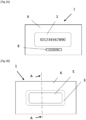
- This may include a unique alphanumeric identifier ( ID1234567890 in the example shown), which is also entered into a database for tracking purposes in the event of theft of the marked bicycle or object.
- This identifier may be produced in various ways, depending on the material used for the label, and whether it is opaque or translucent.
- the label 2 is made of polycarbonate (PC), polyethylene (PET), or polyvinyl chloride (PVC).
- PC polycarbonate
- PET polyethylene
- PVC polyvinyl chloride
- polycarbonate is a plastic material having excellent mechanical properties and thermal resistance allowing use between -100°C and 120°C.
- it can be treated to resist ultraviolet radiation so as not to weaken the device when the docking support 10 is left outdoors as in the case of bicycles.
- the identifier can be produced on its upper surface, by printing, or preferably by laser engraving which will reveal the identifier in black.
- the upper face of the label 2 (the front ), shown in Figure 2A , either covered with a protective varnish (not shown).
- the identifier can be produced by printing or laser engraving on the lower face of the label, shown in Figure 2B (the back ), or by laser engraving inside the body of the label, during its manufacture in the factory, therefore before installation on a support to be identified. In both cases no protective varnish will be necessary, the marking of the identifier not being exposed to the effects of the environment after the installation of the label.
- the rear face of the label 2 namely the one opposite the visible front face and accessible after installation, comprises a frame 3 which extends along the periphery of the rear face of the label 2. Its role is to define a volume or a cavity 5 which will be filled with an extremely strong glue which will ensure a very solid connection between the label 2 and a reception support 10, for example a portion of a bicycle frame.
- Cavity 5 of the label is filled with glue or polymerizable resin directly during its manufacture in the factory, and polymerized just after the device is placed on the host support.
- the device it is preferable for the device to have a protective layer opaque to UV rays in order to prevent the glue from polymerizing before the device is placed.
- the frame 3 can be formed by a double-sided adhesive tape, one front face of which will be fixed to the back face of the label 2 and the other face of which will be fixed when the device 1 is placed on the receiving support 10.
- the adhesion of the back face of the frame 3 to the receiving support 10 will make it possible to hold the identification device 1 in place while waiting for the glue or resin 4 to harden.
- the frame 3 can be formed as an integral part of the label 2, for example by molding or 3D printing the plastic material of the label 2.
- the label 2 will for example have a rectangular shape of approximately 60 mm x 20 mm and a thickness of approximately 200 to 300 microns.
- the frame 3 will have a width of 4 to 5 mm and a thickness of 1 to 1.2 mm. It should be noted that the dimensions in the figures are not to scale, the thicknesses being exaggerated for clarity. Of course, the dimensions of the various components can easily be adapted for the production of identification devices intended for objects other than bicycles or equivalent.
- the identification device 1 will further comprise on the rear face of the frame 3 a thin protective film 6, in particular made of Teflon, also called a "liner" in English terminology, fixed using a light adhesive that will allow the protective film 6 to be easily peeled off by hand just before installing the device.
- this protective film 6 will have a thickness of the order of 0.08 to 0.1 mm and will simply protect the adhesive rear face of the frame 3 when filling and smoothing the glue 4 in the cavity 5.
- the protective film 6 will however comprise a cutout corresponding to the entire surface of the cavity 5 so as not to hinder the filling of the cavity 5 with the glue 4.
- the latter may further comprise a smaller self-adhesive secondary label 8, as shown in figures 1 , 2A , 3 And 5 , bearing the same identification number as the main label 2, and intended to be placed under the latter directly on the reception support 10.
- the main label 2 is then preferably transparent or translucent and reveals the small secondary label 8 and its identifier at through the main label 2, which allows for additional verification of the authenticity of the main label 2. Furthermore, the secondary label 8 and its identifier will remain visible even after an attempt to tear off or damage the main label 2.
- identification devices 1 can be aligned and fixed on a board 7 (as shown in figure 4 ), which consists of a sheet of protective film 6, for example in A4 format, on which 10 identification devices 1 have been placed, including 10 labels 2 each with its unique identifier. It will then be sufficient to take the labels 2 individually as needed.
- the two labels 2 and 8 of the same identification device 1 may be located side by side on a board 7, as shown in figure 5 . This arrangement will facilitate the laser inscription of the same identification number on a main label 2 and a neighboring secondary label 8, during the manufacture of the devices.
- the self-adhesive secondary label 8 When installing such an identification device 1, the self-adhesive secondary label 8 will first be removed from the board 7 and placed on the support 10. Then the corresponding main label 2, provided with its glue 4, will be removed and placed over the secondary label 8. The secondary label 8 will therefore be under the main label 2 and its hardened glue 4, which has the advantage of having two identification markings at two different levels.
- the main label 2 is larger and very strong, and it makes it very easy to see its identification number, while protecting the secondary label 8 and its identification number.
- the two identification numbers (which can be chosen to be identical or not) will be seen simultaneously, and if the main label 2 is opaque, the identification number of the secondary label 8 will only be seen after the main label 2 has been torn off or destroyed.
- the glue 4 a two-component hardenable resin of a resin based on methyl methacrylate marketed under the reference KEOL-MA 41 M10, and a hardening agent marketed under the reference KEOL-MA 41 M10 HARDENER.
- the identification device 1 After filling the cavity 5 with this two-component mixture of glue 4 using a suitable gun (typically a mixing gun) and smoothing the glue using a spatula or equivalent, the identification device 1 can be placed against the support 10 and a slight pressure applied to the edges of the identification device 1 at the frame 3 to ensure sufficient adhesion. Then the glue 4 will be dried and polymerized, in particular using an ultraviolet lamp. With the glue indicated, drying will take less than 10 minutes, and the glue will be completely hardened at the latest after 24 hours, ensuring the maximum cohesion sought.
- a suitable gun typically a mixing gun
- the invention achieves the set goals. It makes it possible to propose individualized identification devices obtained at low cost and which can be taken on demand from a board comprising a plurality of labels protected by a protective film, and each label and its frame can then be used in connection with a two-component polymerizable resin using a simple UV lamp.
- the identification device once installed, is very resistant thanks to the choice of two-component hardening resin which becomes very hard and protects the marking itself from external aggression.
- the main label cannot be removed from the surface to be marked without leaving traces, which helps to deter the theft of bicycles thus marked, and also their concealment or resale, particularly by professionals.
- the identification device according to the invention is particularly simple to install using a very small installation kit that does not require excess glue or additional consumables such as injection tubes or spacers.
- the installation process is very simple and very quick (less than 2 minutes), it requires only a few manipulations, in particular no glue injection phase into a chamber, and the preparation steps such as dispensing resin into the cavity can be done on a table or workbench, and not on the bicycle itself.
Landscapes
- Physics & Mathematics (AREA)
- General Physics & Mathematics (AREA)
- Engineering & Computer Science (AREA)
- Theoretical Computer Science (AREA)
- Business, Economics & Management (AREA)
- Accounting & Taxation (AREA)
- Marketing (AREA)
- Labeling Devices (AREA)
- Lining Or Joining Of Plastics Or The Like (AREA)
- Injection Moulding Of Plastics Or The Like (AREA)
- Vehicle Waterproofing, Decoration, And Sanitation Devices (AREA)
Claims (10)
- Identifikationsvorrichtung (1), die dazu bestimmt ist, an einem Gegenstand befestigt zu werden, der einen Aufnahmeträger (10) aufweist, umfassend ein Etikett (2) aus Kunststoff, das mit einer oberen Fläche, die eine sichtbare Kennung aufweist, und einer unteren Fläche versehen ist, die dazu bestimmt ist, an dem Aufnahmeträger befestigt zu werden, wobei die untere Fläche der Identifikationsvorrichtung (1) einen Rahmen (3) umfasst, der zu einem integralen Teil der unteren Fläche des Etiketts (2) gehört und aus dem gleichen Material wie das Etikett (2) hergestellt ist und auf seiner unteren Fläche eine Klebeschicht umfasst, die sein Aufkleben auf den Aufnahmeträger (10) ermöglicht, und wobei der Rahmen (3) an den Umfang des Etiketts (2) anliegt, um einen Hohlraum (5) zu begrenzen, dadurch gekennzeichnet, dass der Hohlraum (5) vor dem Befestigen der Identifikationsvorrichtung (1) auf dem Aufnahmeträger mit einem durch Polymerisation unter einer UV-Lampe aushärtbaren Harz gefüllt wird, das aus einem Zweikomponentenharz besteht, das eine Mischung aus einem aushärtbaren Harz und einem Härtungsmittel umfasst, und dass der Rahmen (3) auf seiner hinteren Fläche eine dünne Schutzfolie (6) umfasst, die eine der Oberfläche des Hohlraums (5) entsprechende Aussparung umfasst.
- Identifikationsvorrichtung (1) nach Anspruch 1, dadurch gekennzeichnet, dass der Rahmen (3) ein angebrachtes Bauteil aus Kunststoff oder Klebefolie ist, das einerseits auf die untere Fläche des Etiketts (2) und andererseits auf den Aufnahmeträger (10) aufgeklebt ist.
- Identifikationsvorrichtung (1) nach einem der vorhergehenden Ansprüche, dadurch gekennzeichnet, dass das Etikett (2) aus Polycarbonat oder PET ist.
- Identifikationsvorrichtung (1) nach einem der vorhergehenden Ansprüche, dadurch gekennzeichnet, dass das Etikett (2) opak ist und dass die Kennung eine Markierung ist, die durch Laser oder Druck auf der oberen Oberfläche des Etiketts (2) hergestellt ist.
- Identifikationsvorrichtung (1) nach einem der Ansprüche 1 bis 4, dadurch gekennzeichnet, dass das Etikett (2) durchsichtig ist und dass die Kennung eine Markierung ist, die durch Laser in der Dicke des Körpers des Etiketts (2) oder auf seiner unteren Fläche hergestellt ist.
- Identifikationsvorrichtung (1) nach einem der vorhergehenden Ansprüche, die für die Identifikation von mobilen Gegenständen wie Fahrrädern ausgelegt ist, dadurch gekennzeichnet, dass das Etikett (2) eine im Wesentlichen rechteckige Form von etwa 20 mm x 60 mm und eine Dicke von etwa 250 Mikrometern hat, und der Rahmen (3) die Form eines Streifens hat, der eine Breite von etwa 4 bis 6 mm und eine Dicke von 1 bis 1,2 mm aufweist.
- Identifikationsvorrichtung (1) nach einem der vorhergehenden Ansprüche, dadurch gekennzeichnet, dass sie ein Hauptetikett (2) und ein Zweitetikett (8) umfasst, das dazu bestimmt ist, zwischen dem Aufnahmeträger (10) und dem Hauptetikett (2) angeordnet zu werden.
- Identifikationsvorrichtung (1) nach Anspruch 7, dadurch gekennzeichnet, dass der Liner (6) die Form einer Platte (7) hat, die eine Vielzahl von Identifikationsvorrichtungen (1) trägt und mit einer Aussparung gegenüber dem Hohlraum (5) jeder Identifikationsvorrichtung (1) versehen ist.
- Verfahren zum Markieren eines Gegenstands unter Verwendung einer Identifikationsvorrichtung (1) nach den Ansprüchen 1 bis 6, dadurch gekennzeichnet, dass es folgende Schritte umfasst:- Markieren eines Etiketts (2) mit einer Kennung auf einer Fläche oder im Material des Etiketts (2);- Reinigen der Oberfläche des Aufnahmeträgers (10) des Gegenstands, der dazu bestimmt ist, die Identifikationsvorrichtung (1) aufzunehmen;- Füllen des durch den Rahmen (3) begrenzten Volumens des Hohlraums (5) des Etiketts (2) mit einer Mischung aus polymerisierbarem Zweikomponentenharz;- Abziehen des Etiketts (2) und seines mit Harz gefüllten Rahmens (3) von der Schutzfolie (6);- Aufbringen des Etiketts (2) und des mit Harz gefüllten Rahmens (3) auf den Aufnahmeträger (10) des zu markierenden Gegenstands;- Polymerisieren des Zweikomponentenharzes unter Verwendung einer UV-Lampe, um es auszuhärten und so das Etikett (2) und den Aufnahmeträger (10) fest zu verbinden.
- Verfahren zum Markieren eines Gegenstands unter Verwendung einer Identifikationsvorrichtung (1) nach Anspruch 7, dadurch gekennzeichnet, dass es folgende Schritte umfasst:- Markieren eines Hauptetiketts (2) und eines Zweitetiketts (8) mit einer Kennung auf einer Fläche oder im Material der Etiketten (2; 8);- Reinigen der Oberfläche des Aufnahmeträgers (10) des Gegenstands, der dazu bestimmt ist, die Identifikationsvorrichtung (1) aufzunehmen;- Abziehen des Zweitetiketts (8) von der Schutzfolie (6) und Aufkleben dieses auf den Aufnahmeträger (10);- Füllen des durch den Rahmen (3) begrenzten Volumens des Hohlraums (5) des Hauptetiketts (2) mit einer Mischung aus polymerisierbarem Zweikomponentenharz;- Abziehen des Hauptetiketts (2) von der Schutzfolie (6);- Aufbringen des Hauptetiketts (2) mit seinem mit Harz gefüllten Rahmen (3) auf den Aufnahmeträger (10) des zu markierenden Gegenstands über dem Zweitetikett (8);- Polymerisieren des Zweikomponentenharzes unter Verwendung einer UV-Lampe, um es auszuhärten und so das Hauptetikett (2) und den Aufnahmeträger (10) fest zu verbinden.
Applications Claiming Priority (1)
| Application Number | Priority Date | Filing Date | Title |
|---|---|---|---|
| FR2103937A FR3122021B1 (fr) | 2021-04-16 | 2021-04-16 | Dispositif et procédé de marquage pérenne d’un objet |
Publications (2)
| Publication Number | Publication Date |
|---|---|
| EP4075417A1 EP4075417A1 (de) | 2022-10-19 |
| EP4075417B1 true EP4075417B1 (de) | 2025-01-29 |
Family
ID=76283960
Family Applications (1)
| Application Number | Title | Priority Date | Filing Date |
|---|---|---|---|
| EP22166108.5A Active EP4075417B1 (de) | 2021-04-16 | 2022-03-31 | Vorrichtung und verfahren zur dauerhaften markierung eines objekts |
Country Status (2)
| Country | Link |
|---|---|
| EP (1) | EP4075417B1 (de) |
| FR (1) | FR3122021B1 (de) |
Family Cites Families (2)
| Publication number | Priority date | Publication date | Assignee | Title |
|---|---|---|---|---|
| US20050230960A1 (en) * | 2004-03-29 | 2005-10-20 | Bilodeau Wayne L | Security label, secured article and method for making the label and article |
| FR2970804B1 (fr) | 2011-01-24 | 2013-02-22 | Alexandre Francois | Procede de marquage d'un objet |
-
2021
- 2021-04-16 FR FR2103937A patent/FR3122021B1/fr active Active
-
2022
- 2022-03-31 EP EP22166108.5A patent/EP4075417B1/de active Active
Also Published As
| Publication number | Publication date |
|---|---|
| FR3122021B1 (fr) | 2023-12-29 |
| FR3122021A1 (fr) | 2022-10-21 |
| EP4075417A1 (de) | 2022-10-19 |
Similar Documents
| Publication | Publication Date | Title |
|---|---|---|
| JP4827846B2 (ja) | 転写フィルムおよび加飾射出成形品並びにその製造方法 | |
| CN102202906B (zh) | 涂覆的塑料基板的部件标记 | |
| FR2662267A1 (fr) | Element en feuille reflechissant colore et son procede de fabrication. | |
| FR2955327A1 (fr) | Film en matiere plastique mono-oriente pour la fabrication d'un manchon thermoretractable dechirable, et manchon realise a partir d'un tel film | |
| CA2819428C (fr) | Procede de fabrication d'un article permettant l'apposition d'un film decoratif sur un support definitif | |
| EP4075417A1 (de) | Vorrichtung und verfahren zur dauerhaften markierung eines objekts | |
| EP1165328A1 (de) | Radausgleichsvorrichtung und damit ausgeglichenes, geklebtes rad | |
| EP2668647B1 (de) | Verfahren zur kennzeichnung eines gegenstandes | |
| EP3287195B1 (de) | Maskierkit mit optimierter positionierung, und entsprechendes verfahren | |
| FR2716559A1 (fr) | Plaquette pour des opérations de marquage, de certification et/ou de contrôle. | |
| FR2789656A1 (fr) | Caisse a claire voie sur laquelle est collee une etiquette imprimee pelliculable | |
| JP2004230571A (ja) | ホログラムラベル及びその製造方法 | |
| JP2003177672A (ja) | シュリンクラベル及びその製造方法 | |
| EP2230480B1 (de) | Markierungsvorrichtung mit Skala und/oder Druckmuster | |
| EP0841709A1 (de) | Schutz und Schmucketickette, insbesondere für eletrische Batterie | |
| WO2008012353A1 (fr) | Rubans souples de transfert d'energie a aimantation, et procede pour leur fabrication | |
| EP1240021B1 (de) | Druckhülse mit befestigungsmitteln für druckplatten und verfahren zu ihrer herstellung | |
| FR2706664A1 (fr) | Procédé de réalisation de panneaux signalétiques & enseignes publicitaires. | |
| JP4463575B2 (ja) | 複写防止媒体及び複写防止媒体用ラベル | |
| FR2834484A1 (fr) | Procede de realisation d'un dispositif de protection a film de securite transferable et transparent aux ultraviolets courts | |
| FR2876110A1 (fr) | Ruban transparent pour plaques photopolymeres | |
| FR2680903A1 (fr) | Dispositif de dissuasion de vol pour marquer de maniere indelebile et identifier un materiel. | |
| FR3111843A1 (fr) | Procédés de fabrication de composants optiques de sécurité, composants optiques de sécurité et objets sécurisés équipés de tels composants | |
| FR2598538A1 (fr) | Procede d'identification antivol d'un objet et etiquettes antivol a apposer sur un objet | |
| FR2776236A1 (fr) | Transfert a sec a froid, procede de fabrication et procede d'application |
Legal Events
| Date | Code | Title | Description |
|---|---|---|---|
| PUAI | Public reference made under article 153(3) epc to a published international application that has entered the european phase |
Free format text: ORIGINAL CODE: 0009012 |
|
| STAA | Information on the status of an ep patent application or granted ep patent |
Free format text: STATUS: THE APPLICATION HAS BEEN PUBLISHED |
|
| STAA | Information on the status of an ep patent application or granted ep patent |
Free format text: STATUS: REQUEST FOR EXAMINATION WAS MADE |
|
| AK | Designated contracting states |
Kind code of ref document: A1 Designated state(s): AL AT BE BG CH CY CZ DE DK EE ES FI FR GB GR HR HU IE IS IT LI LT LU LV MC MK MT NL NO PL PT RO RS SE SI SK SM TR |
|
| 17P | Request for examination filed |
Effective date: 20220930 |
|
| RBV | Designated contracting states (corrected) |
Designated state(s): AL AT BE BG CH CY CZ DE DK EE ES FI FR GB GR HR HU IE IS IT LI LT LU LV MC MK MT NL NO PL PT RO RS SE SI SK SM TR |
|
| STAA | Information on the status of an ep patent application or granted ep patent |
Free format text: STATUS: EXAMINATION IS IN PROGRESS |
|
| 17Q | First examination report despatched |
Effective date: 20230629 |
|
| GRAP | Despatch of communication of intention to grant a patent |
Free format text: ORIGINAL CODE: EPIDOSNIGR1 |
|
| STAA | Information on the status of an ep patent application or granted ep patent |
Free format text: STATUS: GRANT OF PATENT IS INTENDED |
|
| RIC1 | Information provided on ipc code assigned before grant |
Ipc: G09F 7/18 20060101ALN20240829BHEP Ipc: G09F 7/12 20060101ALI20240829BHEP Ipc: G09F 7/16 20060101ALI20240829BHEP Ipc: G09F 3/10 20060101ALI20240829BHEP Ipc: G09F 3/18 20060101ALI20240829BHEP Ipc: G09F 21/04 20060101AFI20240829BHEP |
|
| RIC1 | Information provided on ipc code assigned before grant |
Ipc: G09F 7/18 20060101ALN20240902BHEP Ipc: G09F 7/12 20060101ALI20240902BHEP Ipc: G09F 7/16 20060101ALI20240902BHEP Ipc: G09F 3/10 20060101ALI20240902BHEP Ipc: G09F 3/18 20060101ALI20240902BHEP Ipc: G09F 21/04 20060101AFI20240902BHEP |
|
| RIC1 | Information provided on ipc code assigned before grant |
Ipc: G09F 7/18 20060101ALN20240910BHEP Ipc: G09F 7/12 20060101ALI20240910BHEP Ipc: G09F 7/16 20060101ALI20240910BHEP Ipc: G09F 3/10 20060101ALI20240910BHEP Ipc: G09F 3/18 20060101ALI20240910BHEP Ipc: G09F 21/04 20060101AFI20240910BHEP |
|
| INTG | Intention to grant announced |
Effective date: 20240919 |
|
| GRAJ | Information related to disapproval of communication of intention to grant by the applicant or resumption of examination proceedings by the epo deleted |
Free format text: ORIGINAL CODE: EPIDOSDIGR1 |
|
| GRAP | Despatch of communication of intention to grant a patent |
Free format text: ORIGINAL CODE: EPIDOSNIGR1 |
|
| GRAS | Grant fee paid |
Free format text: ORIGINAL CODE: EPIDOSNIGR3 |
|
| INTG | Intention to grant announced |
Effective date: 20241120 |
|
| GRAA | (expected) grant |
Free format text: ORIGINAL CODE: 0009210 |
|
| STAA | Information on the status of an ep patent application or granted ep patent |
Free format text: STATUS: THE PATENT HAS BEEN GRANTED |
|
| AK | Designated contracting states |
Kind code of ref document: B1 Designated state(s): AL AT BE BG CH CY CZ DE DK EE ES FI FR GB GR HR HU IE IS IT LI LT LU LV MC MK MT NL NO PL PT RO RS SE SI SK SM TR |
|
| REG | Reference to a national code |
Ref country code: GB Ref legal event code: FG4D Free format text: NOT ENGLISH |
|
| REG | Reference to a national code |
Ref country code: CH Ref legal event code: EP |
|
| REG | Reference to a national code |
Ref country code: DE Ref legal event code: R096 Ref document number: 602022009938 Country of ref document: DE |
|
| REG | Reference to a national code |
Ref country code: IE Ref legal event code: FG4D Free format text: LANGUAGE OF EP DOCUMENT: FRENCH |
|
| REG | Reference to a national code |
Ref country code: NL Ref legal event code: MP Effective date: 20250129 |
|
| PG25 | Lapsed in a contracting state [announced via postgrant information from national office to epo] |
Ref country code: NL Free format text: LAPSE BECAUSE OF FAILURE TO SUBMIT A TRANSLATION OF THE DESCRIPTION OR TO PAY THE FEE WITHIN THE PRESCRIBED TIME-LIMIT Effective date: 20250129 |
|
| PG25 | Lapsed in a contracting state [announced via postgrant information from national office to epo] |
Ref country code: RS Free format text: LAPSE BECAUSE OF FAILURE TO SUBMIT A TRANSLATION OF THE DESCRIPTION OR TO PAY THE FEE WITHIN THE PRESCRIBED TIME-LIMIT Effective date: 20250429 |
|
| PG25 | Lapsed in a contracting state [announced via postgrant information from national office to epo] |
Ref country code: FI Free format text: LAPSE BECAUSE OF FAILURE TO SUBMIT A TRANSLATION OF THE DESCRIPTION OR TO PAY THE FEE WITHIN THE PRESCRIBED TIME-LIMIT Effective date: 20250129 |
|
| PG25 | Lapsed in a contracting state [announced via postgrant information from national office to epo] |
Ref country code: PL Free format text: LAPSE BECAUSE OF FAILURE TO SUBMIT A TRANSLATION OF THE DESCRIPTION OR TO PAY THE FEE WITHIN THE PRESCRIBED TIME-LIMIT Effective date: 20250129 |
|
| PG25 | Lapsed in a contracting state [announced via postgrant information from national office to epo] |
Ref country code: ES Free format text: LAPSE BECAUSE OF FAILURE TO SUBMIT A TRANSLATION OF THE DESCRIPTION OR TO PAY THE FEE WITHIN THE PRESCRIBED TIME-LIMIT Effective date: 20250129 |
|
| REG | Reference to a national code |
Ref country code: LT Ref legal event code: MG9D |
|
| PG25 | Lapsed in a contracting state [announced via postgrant information from national office to epo] |
Ref country code: NO Free format text: LAPSE BECAUSE OF FAILURE TO SUBMIT A TRANSLATION OF THE DESCRIPTION OR TO PAY THE FEE WITHIN THE PRESCRIBED TIME-LIMIT Effective date: 20250429 Ref country code: IS Free format text: LAPSE BECAUSE OF FAILURE TO SUBMIT A TRANSLATION OF THE DESCRIPTION OR TO PAY THE FEE WITHIN THE PRESCRIBED TIME-LIMIT Effective date: 20250529 |
|
| REG | Reference to a national code |
Ref country code: AT Ref legal event code: MK05 Ref document number: 1764263 Country of ref document: AT Kind code of ref document: T Effective date: 20250129 |
|
| PG25 | Lapsed in a contracting state [announced via postgrant information from national office to epo] |
Ref country code: HR Free format text: LAPSE BECAUSE OF FAILURE TO SUBMIT A TRANSLATION OF THE DESCRIPTION OR TO PAY THE FEE WITHIN THE PRESCRIBED TIME-LIMIT Effective date: 20250129 |
|
| PG25 | Lapsed in a contracting state [announced via postgrant information from national office to epo] |
Ref country code: LV Free format text: LAPSE BECAUSE OF FAILURE TO SUBMIT A TRANSLATION OF THE DESCRIPTION OR TO PAY THE FEE WITHIN THE PRESCRIBED TIME-LIMIT Effective date: 20250129 Ref country code: PT Free format text: LAPSE BECAUSE OF FAILURE TO SUBMIT A TRANSLATION OF THE DESCRIPTION OR TO PAY THE FEE WITHIN THE PRESCRIBED TIME-LIMIT Effective date: 20250529 |
|
| PG25 | Lapsed in a contracting state [announced via postgrant information from national office to epo] |
Ref country code: GR Free format text: LAPSE BECAUSE OF FAILURE TO SUBMIT A TRANSLATION OF THE DESCRIPTION OR TO PAY THE FEE WITHIN THE PRESCRIBED TIME-LIMIT Effective date: 20250430 Ref country code: BG Free format text: LAPSE BECAUSE OF FAILURE TO SUBMIT A TRANSLATION OF THE DESCRIPTION OR TO PAY THE FEE WITHIN THE PRESCRIBED TIME-LIMIT Effective date: 20250129 |
|
| PG25 | Lapsed in a contracting state [announced via postgrant information from national office to epo] |
Ref country code: AT Free format text: LAPSE BECAUSE OF FAILURE TO SUBMIT A TRANSLATION OF THE DESCRIPTION OR TO PAY THE FEE WITHIN THE PRESCRIBED TIME-LIMIT Effective date: 20250129 |
|
| PG25 | Lapsed in a contracting state [announced via postgrant information from national office to epo] |
Ref country code: SE Free format text: LAPSE BECAUSE OF FAILURE TO SUBMIT A TRANSLATION OF THE DESCRIPTION OR TO PAY THE FEE WITHIN THE PRESCRIBED TIME-LIMIT Effective date: 20250129 |
|
| PG25 | Lapsed in a contracting state [announced via postgrant information from national office to epo] |
Ref country code: SM Free format text: LAPSE BECAUSE OF FAILURE TO SUBMIT A TRANSLATION OF THE DESCRIPTION OR TO PAY THE FEE WITHIN THE PRESCRIBED TIME-LIMIT Effective date: 20250129 |
|
| PG25 | Lapsed in a contracting state [announced via postgrant information from national office to epo] |
Ref country code: DK Free format text: LAPSE BECAUSE OF FAILURE TO SUBMIT A TRANSLATION OF THE DESCRIPTION OR TO PAY THE FEE WITHIN THE PRESCRIBED TIME-LIMIT Effective date: 20250129 |
|
| PG25 | Lapsed in a contracting state [announced via postgrant information from national office to epo] |
Ref country code: MC Free format text: LAPSE BECAUSE OF FAILURE TO SUBMIT A TRANSLATION OF THE DESCRIPTION OR TO PAY THE FEE WITHIN THE PRESCRIBED TIME-LIMIT Effective date: 20250129 |
|
| PG25 | Lapsed in a contracting state [announced via postgrant information from national office to epo] |
Ref country code: IT Free format text: LAPSE BECAUSE OF FAILURE TO SUBMIT A TRANSLATION OF THE DESCRIPTION OR TO PAY THE FEE WITHIN THE PRESCRIBED TIME-LIMIT Effective date: 20250129 |
|
| PG25 | Lapsed in a contracting state [announced via postgrant information from national office to epo] |
Ref country code: CZ Free format text: LAPSE BECAUSE OF FAILURE TO SUBMIT A TRANSLATION OF THE DESCRIPTION OR TO PAY THE FEE WITHIN THE PRESCRIBED TIME-LIMIT Effective date: 20250129 Ref country code: EE Free format text: LAPSE BECAUSE OF FAILURE TO SUBMIT A TRANSLATION OF THE DESCRIPTION OR TO PAY THE FEE WITHIN THE PRESCRIBED TIME-LIMIT Effective date: 20250129 |
|
| REG | Reference to a national code |
Ref country code: CH Ref legal event code: H13 Free format text: ST27 STATUS EVENT CODE: U-0-0-H10-H13 (AS PROVIDED BY THE NATIONAL OFFICE) Effective date: 20251023 |
|
| PG25 | Lapsed in a contracting state [announced via postgrant information from national office to epo] |
Ref country code: RO Free format text: LAPSE BECAUSE OF FAILURE TO SUBMIT A TRANSLATION OF THE DESCRIPTION OR TO PAY THE FEE WITHIN THE PRESCRIBED TIME-LIMIT Effective date: 20250129 |
|
| PG25 | Lapsed in a contracting state [announced via postgrant information from national office to epo] |
Ref country code: SK Free format text: LAPSE BECAUSE OF FAILURE TO SUBMIT A TRANSLATION OF THE DESCRIPTION OR TO PAY THE FEE WITHIN THE PRESCRIBED TIME-LIMIT Effective date: 20250129 |
|
| REG | Reference to a national code |
Ref country code: DE Ref legal event code: R097 Ref document number: 602022009938 Country of ref document: DE |
|
| PG25 | Lapsed in a contracting state [announced via postgrant information from national office to epo] |
Ref country code: LU Free format text: LAPSE BECAUSE OF NON-PAYMENT OF DUE FEES Effective date: 20250331 |
|
| PLBE | No opposition filed within time limit |
Free format text: ORIGINAL CODE: 0009261 |
|
| STAA | Information on the status of an ep patent application or granted ep patent |
Free format text: STATUS: NO OPPOSITION FILED WITHIN TIME LIMIT |
|
| REG | Reference to a national code |
Ref country code: BE Ref legal event code: MM Effective date: 20250331 |
|
| 26N | No opposition filed |
Effective date: 20251030 |
|
| PG25 | Lapsed in a contracting state [announced via postgrant information from national office to epo] |
Ref country code: BE Free format text: LAPSE BECAUSE OF NON-PAYMENT OF DUE FEES Effective date: 20250331 |
|
| PG25 | Lapsed in a contracting state [announced via postgrant information from national office to epo] |
Ref country code: CH Free format text: LAPSE BECAUSE OF NON-PAYMENT OF DUE FEES Effective date: 20250331 |
|
| PG25 | Lapsed in a contracting state [announced via postgrant information from national office to epo] |
Ref country code: IE Free format text: LAPSE BECAUSE OF NON-PAYMENT OF DUE FEES Effective date: 20250331 |
|
| PGFP | Annual fee paid to national office [announced via postgrant information from national office to epo] |
Ref country code: GB Payment date: 20260324 Year of fee payment: 5 |
|
| PGFP | Annual fee paid to national office [announced via postgrant information from national office to epo] |
Ref country code: DE Payment date: 20260319 Year of fee payment: 5 |
|
| PGFP | Annual fee paid to national office [announced via postgrant information from national office to epo] |
Ref country code: FR Payment date: 20260323 Year of fee payment: 5 |