EP4074455B1 - Marking device, and method of performing marking on a non-planar portion of a medium - Google Patents
Marking device, and method of performing marking on a non-planar portion of a medium Download PDFInfo
- Publication number
- EP4074455B1 EP4074455B1 EP22156212.7A EP22156212A EP4074455B1 EP 4074455 B1 EP4074455 B1 EP 4074455B1 EP 22156212 A EP22156212 A EP 22156212A EP 4074455 B1 EP4074455 B1 EP 4074455B1
- Authority
- EP
- European Patent Office
- Prior art keywords
- area
- marker
- marking
- optical system
- marking device
- Prior art date
- Legal status (The legal status is an assumption and is not a legal conclusion. Google has not performed a legal analysis and makes no representation as to the accuracy of the status listed.)
- Revoked
Links
Images



Classifications
-
- B—PERFORMING OPERATIONS; TRANSPORTING
- B23—MACHINE TOOLS; METAL-WORKING NOT OTHERWISE PROVIDED FOR
- B23K—SOLDERING OR UNSOLDERING; WELDING; CLADDING OR PLATING BY SOLDERING OR WELDING; CUTTING BY APPLYING HEAT LOCALLY, e.g. FLAME CUTTING; WORKING BY LASER BEAM
- B23K26/00—Working by laser beam, e.g. welding, cutting or boring
- B23K26/36—Removing material
- B23K26/362—Laser etching
-
- B—PERFORMING OPERATIONS; TRANSPORTING
- B23—MACHINE TOOLS; METAL-WORKING NOT OTHERWISE PROVIDED FOR
- B23K—SOLDERING OR UNSOLDERING; WELDING; CLADDING OR PLATING BY SOLDERING OR WELDING; CUTTING BY APPLYING HEAT LOCALLY, e.g. FLAME CUTTING; WORKING BY LASER BEAM
- B23K26/00—Working by laser beam, e.g. welding, cutting or boring
- B23K26/02—Positioning or observing the workpiece, e.g. with respect to the point of impact; Aligning, aiming or focusing the laser beam
- B23K26/06—Shaping the laser beam, e.g. by masks or multi-focusing
- B23K26/0604—Shaping the laser beam, e.g. by masks or multi-focusing by a combination of beams
-
- B—PERFORMING OPERATIONS; TRANSPORTING
- B23—MACHINE TOOLS; METAL-WORKING NOT OTHERWISE PROVIDED FOR
- B23K—SOLDERING OR UNSOLDERING; WELDING; CLADDING OR PLATING BY SOLDERING OR WELDING; CUTTING BY APPLYING HEAT LOCALLY, e.g. FLAME CUTTING; WORKING BY LASER BEAM
- B23K26/00—Working by laser beam, e.g. welding, cutting or boring
- B23K26/02—Positioning or observing the workpiece, e.g. with respect to the point of impact; Aligning, aiming or focusing the laser beam
- B23K26/06—Shaping the laser beam, e.g. by masks or multi-focusing
- B23K26/062—Shaping the laser beam, e.g. by masks or multi-focusing by direct control of the laser beam
- B23K26/0622—Shaping the laser beam, e.g. by masks or multi-focusing by direct control of the laser beam by shaping pulses
-
- B—PERFORMING OPERATIONS; TRANSPORTING
- B23—MACHINE TOOLS; METAL-WORKING NOT OTHERWISE PROVIDED FOR
- B23K—SOLDERING OR UNSOLDERING; WELDING; CLADDING OR PLATING BY SOLDERING OR WELDING; CUTTING BY APPLYING HEAT LOCALLY, e.g. FLAME CUTTING; WORKING BY LASER BEAM
- B23K26/00—Working by laser beam, e.g. welding, cutting or boring
- B23K26/02—Positioning or observing the workpiece, e.g. with respect to the point of impact; Aligning, aiming or focusing the laser beam
- B23K26/06—Shaping the laser beam, e.g. by masks or multi-focusing
- B23K26/062—Shaping the laser beam, e.g. by masks or multi-focusing by direct control of the laser beam
- B23K26/0622—Shaping the laser beam, e.g. by masks or multi-focusing by direct control of the laser beam by shaping pulses
- B23K26/0624—Shaping the laser beam, e.g. by masks or multi-focusing by direct control of the laser beam by shaping pulses using ultrashort pulses, i.e. pulses of 1 ns or less
-
- B—PERFORMING OPERATIONS; TRANSPORTING
- B23—MACHINE TOOLS; METAL-WORKING NOT OTHERWISE PROVIDED FOR
- B23K—SOLDERING OR UNSOLDERING; WELDING; CLADDING OR PLATING BY SOLDERING OR WELDING; CUTTING BY APPLYING HEAT LOCALLY, e.g. FLAME CUTTING; WORKING BY LASER BEAM
- B23K26/00—Working by laser beam, e.g. welding, cutting or boring
- B23K26/08—Devices involving relative movement between laser beam and workpiece
- B23K26/082—Scanning systems, i.e. devices involving movement of the laser beam relative to the laser head
-
- B—PERFORMING OPERATIONS; TRANSPORTING
- B23—MACHINE TOOLS; METAL-WORKING NOT OTHERWISE PROVIDED FOR
- B23K—SOLDERING OR UNSOLDERING; WELDING; CLADDING OR PLATING BY SOLDERING OR WELDING; CUTTING BY APPLYING HEAT LOCALLY, e.g. FLAME CUTTING; WORKING BY LASER BEAM
- B23K26/00—Working by laser beam, e.g. welding, cutting or boring
- B23K26/08—Devices involving relative movement between laser beam and workpiece
- B23K26/0823—Devices involving rotation of the workpiece
-
- B—PERFORMING OPERATIONS; TRANSPORTING
- B23—MACHINE TOOLS; METAL-WORKING NOT OTHERWISE PROVIDED FOR
- B23K—SOLDERING OR UNSOLDERING; WELDING; CLADDING OR PLATING BY SOLDERING OR WELDING; CUTTING BY APPLYING HEAT LOCALLY, e.g. FLAME CUTTING; WORKING BY LASER BEAM
- B23K26/00—Working by laser beam, e.g. welding, cutting or boring
- B23K26/08—Devices involving relative movement between laser beam and workpiece
- B23K26/083—Devices involving movement of the workpiece in at least one axial direction
- B23K26/0838—Devices involving movement of the workpiece in at least one axial direction by using an endless conveyor belt
-
- B—PERFORMING OPERATIONS; TRANSPORTING
- B23—MACHINE TOOLS; METAL-WORKING NOT OTHERWISE PROVIDED FOR
- B23K—SOLDERING OR UNSOLDERING; WELDING; CLADDING OR PLATING BY SOLDERING OR WELDING; CUTTING BY APPLYING HEAT LOCALLY, e.g. FLAME CUTTING; WORKING BY LASER BEAM
- B23K26/00—Working by laser beam, e.g. welding, cutting or boring
- B23K26/36—Removing material
- B23K26/40—Removing material taking account of the properties of the material involved
- B23K26/402—Removing material taking account of the properties of the material involved involving non-metallic material, e.g. isolators
-
- B—PERFORMING OPERATIONS; TRANSPORTING
- B41—PRINTING; LINING MACHINES; TYPEWRITERS; STAMPS
- B41J—TYPEWRITERS; SELECTIVE PRINTING MECHANISMS, i.e. MECHANISMS PRINTING OTHERWISE THAN FROM A FORME; CORRECTION OF TYPOGRAPHICAL ERRORS
- B41J2/00—Typewriters or selective printing mechanisms characterised by the printing or marking process for which they are designed
- B41J2/435—Typewriters or selective printing mechanisms characterised by the printing or marking process for which they are designed characterised by selective application of radiation to a printing material or impression-transfer material
- B41J2/475—Typewriters or selective printing mechanisms characterised by the printing or marking process for which they are designed characterised by selective application of radiation to a printing material or impression-transfer material for heating selectively by radiation or ultrasonic waves
- B41J2/4753—Typewriters or selective printing mechanisms characterised by the printing or marking process for which they are designed characterised by selective application of radiation to a printing material or impression-transfer material for heating selectively by radiation or ultrasonic waves using thermosensitive substrates, e.g. paper
-
- B—PERFORMING OPERATIONS; TRANSPORTING
- B41—PRINTING; LINING MACHINES; TYPEWRITERS; STAMPS
- B41J—TYPEWRITERS; SELECTIVE PRINTING MECHANISMS, i.e. MECHANISMS PRINTING OTHERWISE THAN FROM A FORME; CORRECTION OF TYPOGRAPHICAL ERRORS
- B41J3/00—Typewriters or selective printing or marking mechanisms characterised by the purpose for which they are constructed
- B41J3/407—Typewriters or selective printing or marking mechanisms characterised by the purpose for which they are constructed for marking on special material
- B41J3/4073—Printing on three-dimensional objects not being in sheet or web form, e.g. spherical or cubic objects
- B41J3/40733—Printing on cylindrical or rotationally symmetrical objects, e. g. on bottles
-
- G—PHYSICS
- G02—OPTICS
- G02B—OPTICAL ELEMENTS, SYSTEMS OR APPARATUS
- G02B19/00—Condensers, e.g. light collectors or similar non-imaging optics
- G02B19/0033—Condensers, e.g. light collectors or similar non-imaging optics characterised by the use
- G02B19/0047—Condensers, e.g. light collectors or similar non-imaging optics characterised by the use for use with a light source
- G02B19/0052—Condensers, e.g. light collectors or similar non-imaging optics characterised by the use for use with a light source the light source comprising a laser diode
-
- B—PERFORMING OPERATIONS; TRANSPORTING
- B23—MACHINE TOOLS; METAL-WORKING NOT OTHERWISE PROVIDED FOR
- B23K—SOLDERING OR UNSOLDERING; WELDING; CLADDING OR PLATING BY SOLDERING OR WELDING; CUTTING BY APPLYING HEAT LOCALLY, e.g. FLAME CUTTING; WORKING BY LASER BEAM
- B23K2101/00—Articles made by soldering, welding or cutting
- B23K2101/04—Tubular or hollow articles
- B23K2101/12—Vessels
-
- B—PERFORMING OPERATIONS; TRANSPORTING
- B23—MACHINE TOOLS; METAL-WORKING NOT OTHERWISE PROVIDED FOR
- B23K—SOLDERING OR UNSOLDERING; WELDING; CLADDING OR PLATING BY SOLDERING OR WELDING; CUTTING BY APPLYING HEAT LOCALLY, e.g. FLAME CUTTING; WORKING BY LASER BEAM
- B23K2103/00—Materials to be soldered, welded or cut
- B23K2103/30—Organic materials
- B23K2103/42—Plastics other than composite materials
-
- B—PERFORMING OPERATIONS; TRANSPORTING
- B23—MACHINE TOOLS; METAL-WORKING NOT OTHERWISE PROVIDED FOR
- B23K—SOLDERING OR UNSOLDERING; WELDING; CLADDING OR PLATING BY SOLDERING OR WELDING; CUTTING BY APPLYING HEAT LOCALLY, e.g. FLAME CUTTING; WORKING BY LASER BEAM
- B23K2103/00—Materials to be soldered, welded or cut
- B23K2103/50—Inorganic materials other than metals or composite materials
- B23K2103/54—Glass
-
- G—PHYSICS
- G02—OPTICS
- G02B—OPTICAL ELEMENTS, SYSTEMS OR APPARATUS
- G02B26/00—Optical devices or arrangements for the control of light using movable or deformable optical elements
- G02B26/08—Optical devices or arrangements for the control of light using movable or deformable optical elements for controlling the direction of light
- G02B26/10—Scanning systems
- G02B26/101—Scanning systems with both horizontal and vertical deflecting means, e.g. raster or XY scanners
-
- G—PHYSICS
- G02—OPTICS
- G02B—OPTICAL ELEMENTS, SYSTEMS OR APPARATUS
- G02B26/00—Optical devices or arrangements for the control of light using movable or deformable optical elements
- G02B26/08—Optical devices or arrangements for the control of light using movable or deformable optical elements for controlling the direction of light
- G02B26/10—Scanning systems
- G02B26/105—Scanning systems with one or more pivoting mirrors or galvano-mirrors
Definitions
- the present invention relates to a marking device, and a method of performing marking on a non-planar portion of a medium, see claims 1 and 10.
- Marking devices that draw a predetermined drawing pattern in a marking area set on an object to be processed are known in the art (see, for example, Japanese Unexamined Patent Application Publication No. 2015-160235 ).Such marking devices are provided with a first marker that performs marking on an object to be processed with a first dot diameter, and a second marker that performs marking on an object to be processed with a second dot diameter narrower than the first dot diameter. The marking devices perform marking upon dividing a drawing pattern in the same area into a first drawing pattern to be drawn by the first marker and a second drawing pattern to be drawn by the second marker.
- US 2014/0253661 A1 discloses a marking device for marking an object with marking light.
- the marking device comprises a plurality of marking modules for emitting marking light, and a base unit to which the plurality of marking modules is connected wherein the base unit comprises a control unit for controlling the plurality of marking modules.
- the plurality of marking modules comprises at least a first marking module (10a) and a second marking module which employ different marking technologies.
- US 2017/0225487 A1 discloses an image recording apparatus including a laser irradiation device including a plurality of laser output sections arranged side by side in a certain direction and configured to irradiate positions different from one another in the certain direction with laser light output from the plurality of laser output sections, the image recording apparatus being configured to irradiate a recording target moving relatively to the laser irradiation device in a relative movement direction different from the certain direction, with laser light to heat the recording target, and record a visible image on the recording target; and an image correction unit configured to adjust an irradiation condition of the laser light output from the plurality of laser output sections and correct distortion of an image recorded on a recording surface of the recording target based on a shape of the recording surface.
- terms such as “processing” or “computing” or “calculating” or “determining” or “displaying” or the like refer to the action and processes of a computer system, or similar electronic computing device, that manipulates and transforms data represented as physical, electronic quantities within the computer system's registers and memories into other data similarly represented as physical quantities within the computer system memories or registers or other such information storage, transmission or display devices.
- the container may include, for example, a cap and a lid in addition to the main unit that contains a to-be-contained object.
- characters indicating, for example, the to-be-contained object and the manufacturer, or a figure such as a brand logo and a recycle mark may be formed on the base material.
- marking refers to forming a design onto a medium.
- a design includes, for example, an identification code, characters, symbols, and marks.
- an identification code includes, for example, a one-dimensional code such as a bar code or a two-dimensional code such as a quick response (QR) code.
- What is indicated by marking may be a symbol, a figure, or a character that indicates a container to which an identification code is added, the name or identification number of an object such as a to-be-contained object contained in the container, or the object information such as the manufacturer and the date and time of manufacture.
- the first area and second area that the non-planar portion includes are at different positions in the direction parallel to the central axis of the first optical system. For this reason, when the second focal point of the second optical system is equal to the first focal point of the first optical system in the direction parallel to the central axis of the first optical system, the second light spreads on the second area. Since the first area and second area are not parallel to each other, when the central axis of the second optical system is approximately parallel to the central axis of the first optical system, the central axis of the second optical system is inclined with respect to the second area, so that the second light spreads on the second area.
- the focal point refers to a position where light is concentrated by an optical system.
- the beam-waist position when a laser beam is concentrated, the beam-waist position according to the present embodiment serves as the focal point.
- the focal point is not limited to the beam-waist position, and may be a so-called defocus position shifted from the beam-waist position.
- the first optical system can concentrate the first light such that the central axis thereof will be orthogonal to the plane of the first area
- the second optical system can concentrate the second light such that the central axis thereof will be orthogonal to the plane of the second area.
- marking can be performed on both the first area and second area at high quality.
- non-parallel may be used to indicate that an object is not parallel to something. When it is described that an object is orthogonal to something, it does not require strict orthogonality, and allows deviation from strict orthogonality to such an extent that is recognized as an error in the related art. This is applicable to the following description in which the term orthogonal is used.
- the medium is conveyed in a predetermined conveyance direction, and the second marker performs marking on the second area after the first marker performs marking on the first area and changes the orientation of the non-planar portion.
- the first optical system can concentrate the first light such that the central axis thereof will be orthogonal to the plane of the first area
- the second optical system can concentrate the second light such that the central axis thereof will be orthogonal to the plane of the second area.
- marking can be performed on both the first area and second area at high quality.
- the PET bottle 100 is a cylindrical member, and serves as a medium.
- the PET bottle 100 has a side on which a pattern 200 is marked.
- the Y-axis in FIG. 1 indicates the direction parallel to the cylindrical axis of the PET bottle 100, and the X-axis indicates the direction approximately orthogonal to the Y-axis.
- the Z-axis in FIG. 1 indicates the direction approximately orthogonal to both the X-axis and the Y-axis.
- the directions that the X-axis, the Y-axis, and the Z-axis indicate are applicable to the drawings referred to in the following description.
- the side of the PET bottle 100 is curved and has curvature around the cylindrical axis.
- the PET bottle 100 has a curved plane 110 on the side.
- the curved plane 110 according to the present embodiment serves as a non-planar portion, and includes the first area 101, the second area 102, and the third area 103.
- FIG. 2 illustrates the PET bottle 100 and the marking device 1 viewed in the +Y-direction.
- the marking device 1 is illustrated in perspective view such that the inner structure or configuration can be seen through.
- the second marker 20 includes a second laser beam source 21, a second condenser lens 22, and a second galvano mirror 23.
- the second marker 20 according to the present embodiment uses the second galvano mirror 23 to perform raster scanning on the second laser beam L2 emitted from the second laser beam source 21 in the direction parallel to the Y-axis, and concentrates the scanned second laser beam L2 onto the second area 102 by the second condenser lens 22. By so doing, the second area 102 is marked.
- the second condenser lens 22 according to the present embodiment serves as a second optical system
- the second laser beam L2 according to the present embodiment serves as a second light.
- the marking control unit 43 turns on or turns off the light emission of each of the first laser beam source 11, the second laser beam source 21, and the third laser beam source 31, or controls the degree of intensity of light. Further, the marking control unit 43 starts or stops driving the first galvano mirror 13, the second galvano mirror 23, and the third galvano mirror 33.
- the PET bottle 100 is conveyed in the conveyance direction 400 by the conveyor 300 and is temporarily stopped at a position facing the second manipulator 142.
- the first manipulator 142 changes the orientation of the curved plane 110 such that the central axis 52 of the second condenser lens 22 is orthogonal to the surface of the second area 102 approximately in the center of the second area 102 in the circumferential direction of the PET bottle 100.
- FIG. 9 is a diagram illustrating a configuration of the marking device 1c according to the fourth embodiment of the present disclosure, not covered by the present invention.
- Embodiments of the present disclosure includes a marking method, see claim 10.
- the marking method is implemented by a marking device that performs marking on a non-planar portion of a medium, and the non-planar portion has a plurality of areas including a first area and a second area.
- the marking method includes a step of concentrating a first light onto a first area of the non-planar portion of the medium to perform the marking on the first area, and a step of concentrating a second light onto the second area with a second optical system having a second focal point, to perform the marking on the second area.
- the second focal point of the second optical system is different from the first focal point of the first optical system in a direction parallel to a central axis of the first optical system.
Landscapes
- Physics & Mathematics (AREA)
- Optics & Photonics (AREA)
- Engineering & Computer Science (AREA)
- Plasma & Fusion (AREA)
- Mechanical Engineering (AREA)
- General Physics & Mathematics (AREA)
- Manufacturing & Machinery (AREA)
- Health & Medical Sciences (AREA)
- General Health & Medical Sciences (AREA)
- Toxicology (AREA)
- Laser Beam Processing (AREA)
Description
- The present invention relates to a marking device, and a method of performing marking on a non-planar portion of a medium, see
claims - In the related art, a medium on which an identification code such as a bar code and a quick response (QR) code (registered trademark), or a design such as a character, a symbol, and a mark are marked is known.
- Marking devices that draw a predetermined drawing pattern in a marking area set on an object to be processed are known in the art (see, for example,
Japanese Unexamined Patent Application Publication No. 2015-160235 - However, in the configuration of
Japanese Unexamined Patent Application Publication No. 2015-160235 -
US 2014/0253661 A1 discloses a marking device for marking an object with marking light. The marking device comprises a plurality of marking modules for emitting marking light, and a base unit to which the plurality of marking modules is connected wherein the base unit comprises a control unit for controlling the plurality of marking modules. The plurality of marking modules comprises at least a first marking module (10a) and a second marking module which employ different marking technologies. -
US 2017/0225487 A1 discloses an image recording apparatus including a laser irradiation device including a plurality of laser output sections arranged side by side in a certain direction and configured to irradiate positions different from one another in the certain direction with laser light output from the plurality of laser output sections, the image recording apparatus being configured to irradiate a recording target moving relatively to the laser irradiation device in a relative movement direction different from the certain direction, with laser light to heat the recording target, and record a visible image on the recording target; and an image correction unit configured to adjust an irradiation condition of the laser light output from the plurality of laser output sections and correct distortion of an image recorded on a recording surface of the recording target based on a shape of the recording surface. -
DE 10 2017 218 814 A1 (describing all the features and steps of the preamble ofclaims 1 and 10) discloses a labelling device for workpieces with which a workpiece with a curved outer surface can be labelled quickly and precisely. - The invention is defined by the
independent claims - The dependent claims relate to preferred embodiments of the invention.
- According to the present invention, the non-planar portion of a medium can be marked at high quality.
- A more complete appreciation of embodiments and the many attendant advantages thereof will be readily obtained as the same becomes better understood by reference to the following detailed description when considered in connection with the accompanying drawings.
-
FIG. 1 is a diagram illustrating how a polyethylene terephthalate (PET) bottle is marked, according to an embodiment of the present disclosure. -
FIG. 2 is a diagram illustrating a configuration of a marking device according to a first embodiment of the present disclosure. -
FIG. 3 is a block diagram of a functional configuration of a controller according to the first embodiment of the present disclosure. -
FIG. 4 is a diagram illustrating how a PET bottle is marked, according to an alternative embodiment of the present disclosure. -
FIG. 5 is a diagram illustrating a difference in width of a plurality of areas in the circumferential direction of a PET bottle, according to an embodiment of the present disclosure. -
FIG. 6 is a diagram illustrating a configuration of a marking device according to a second embodiment of the present disclosure, and not covered by the present invention. -
FIG. 7 is a diagram illustrating a configuration of a marking device according to a third embodiment of the present disclosure, and not covered by the present invention. -
FIG. 8A and FIG. 8B are diagrams each illustrating how a PET bottle is marked by a marking device, according to the third embodiment of the present disclosure, and not covered by the present invention. -
FIG. 8A is a diagram illustrating how a first area is marked by a marking device, according to the third embodiment of the present disclosure, and not covered by the present invention. -
FIG. 8B is a diagram illustrating how a second area is marked by a marking device, according to the third embodiment of the present disclosure, and not covered by the present invention. -
FIG. 9 is a diagram illustrating a configuration of a marking device according to a fourth embodiment of the present disclosure, and not covered by the present invention. -
FIG. 10 is a diagram illustrating an alternative configuration of a marking device according to the fourth embodiment of the present disclosure, and not covered by the present invention. -
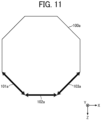
FIG. 11 is a diagram illustrating how a polygonally tubular PET bottle is marked. -
FIG. 12 is a diagram illustrating a container not covered by the present invention. - The accompanying drawings are intended to depict embodiments of the present disclosure and should not be interpreted to limit the scope thereof. The accompanying drawings are not to be considered as drawn to scale unless explicitly noted.
- The terminology used herein is for the purpose of describing particular embodiments only and is not intended to be limiting of the present disclosure. As used herein, the singular forms "a", "an" and "the" are intended to include the plural forms as well, unless the context clearly indicates otherwise. It will be further understood that the terms "includes" and/or "including", when used in this specification, specify the presence of stated features, integers, steps, operations, elements, and/or components, but do not preclude the presence or addition of one or more other features, integers, steps, operations, elements, components, and/or groups thereof.
- In describing example embodiments illustrated in the drawings, specific terminology is employed for the sake of clarity. However, the present disclosure is not intended to be limited to the specific terminology so selected and it is to be understood that each specific element includes all technical equivalents that have the same structure, operate in a similar manner, and achieve a similar result.
- In the following description, illustrative embodiments will be described with reference to acts and symbolic representations of operations (e.g., in the form of flowcharts) that may be implemented as program modules or functional processes including routines, programs, objects, components, data structures, etc., that perform particular tasks or implement particular abstract data types and may be implemented using existing hardware at existing network elements or control nodes. Such existing hardware may include one or more central processing units (CPUs), digital signal processors (DSPs), application-specific integrated circuits (ASICs), field-programmable gate arrays (FPGAs), computers or the like. These terms may be collectively referred to as processors.
- Unless specifically stated otherwise, or as is apparent from the discussion, terms such as "processing" or "computing" or "calculating" or "determining" or "displaying" or the like, refer to the action and processes of a computer system, or similar electronic computing device, that manipulates and transforms data represented as physical, electronic quantities within the computer system's registers and memories into other data similarly represented as physical quantities within the computer system memories or registers or other such information storage, transmission or display devices.
- Embodiments of the present disclosure are described below with reference to the accompanying drawings. In the drawings, like reference signs denote like elements, and overlapping description may be omitted where appropriate.
- An marking device according to embodiments of the present disclosure is described below to implement the technical ideas, and no limitation is indicated to the embodiments of the present disclosure given below. For example, the size, material, and shape of components and the relative positions of the arranged components are given by way of example in the following description, and the scope of the present disclosure is not limited thereto unless particularly specified. For example, the size of these elements and the relative positions of these elements may be exaggerated for purposes of illustration in the drawings.
- The marking device according to the present embodiment performs marking on a non-planar portion of a medium. The medium according to the present embodiment may be, for example, a container. The container refers to a member capable of containing a substance such as a solid, liquid, and gas therein. The container according to the present embodiment may be, for example, a polyethylene terephthalate (PET) bottle. The substance that makes up the container may be referred to as a base material in the following description. The base material may include a transparent material such as resin and glass.
- Such a transparent material refers to a material having optical transparency to at least visible light. Visible light refers to light that can be visually recognized by human, where the lower bound of wavelength ranges from approximately 360 nanometers (nm) to approximately 400 nm and the upper bound of wavelength ranges from approximately 760 nm to approximately 830 nm.
- The materials of resins that are used for the base material may include, for example, polyethylene terephthalate (PET), polyvinyl alcohol (PVA), polybutylene adipate terephtalate (PBAT), polyethylene terephtalate succinate, polyethylene (PE), polypropylene (PP), polyethylene terephthalate (PET), polyvinyl chloride (PVC), polystyrene (PS), polyurethane, epoxy, bio polybutylene succinate (PBS), polylactic acid blend (PBAT), starch-blended polyester resins, polybutylene terephthalate succinate, polylactic acid (PLA), polyhydroxy butyrate / hydroxy hexanoate (PHBH), polyhydroxy alkanoic acids (PHA), Bio PET30, Bio polyamide (PA) 610, 410, and 510, Bio PA1012, 10T, Bio PA11T and MXD10, bio polycarbonate, bio polyurethane, Bio PE, Bio PET100, Bio PA11, and Bio PA1010.
- The container may include, for example, a cap and a lid in addition to the main unit that contains a to-be-contained object. In addition to the identification code, characters indicating, for example, the to-be-contained object and the manufacturer, or a figure such as a brand logo and a recycle mark may be formed on the base material.
- The container contains a to-be-contained object such as beverages.
- The term marking refers to forming a design onto a medium. Such a design includes, for example, an identification code, characters, symbols, and marks. Such an identification code includes, for example, a one-dimensional code such as a bar code or a two-dimensional code such as a quick response (QR) code. What is indicated by marking may be a symbol, a figure, or a character that indicates a container to which an identification code is added, the name or identification number of an object such as a to-be-contained object contained in the container, or the object information such as the manufacturer and the date and time of manufacture.
- The term non-planar portion refers to a portion that is not planar. For example, the non-planar portion corresponds to a non-planar portion included in a three-dimensional structure such as a PET bottle formed in, for example, a cylindrical shape or a polygonal angularly cylindrical shape. More specifically, the non-planar portion corresponds to, for example, a side of the PET bottle or an uneven portion formed on the side of the PET bottle.
- The non-planar portion has a plurality of areas including a first area and a second area, and the marking device has a first marker used to perform marking by concentrating the first light onto the first area through a first optical system, and a second marker used to perform marking by concentrating the second light onto the second area through a second optical system.
- The first area and second area that the non-planar portion includes are at different positions in the direction parallel to the central axis of the first optical system. For this reason, when the second focal point of the second optical system is equal to the first focal point of the first optical system in the direction parallel to the central axis of the first optical system, the second light spreads on the second area. Since the first area and second area are not parallel to each other, when the central axis of the second optical system is approximately parallel to the central axis of the first optical system, the central axis of the second optical system is inclined with respect to the second area, so that the second light spreads on the second area.
- As a result, the quality of marking on the second area may deteriorate. The focal point refers to a position where light is concentrated by an optical system. For example, when a laser beam is concentrated, the beam-waist position according to the present embodiment serves as the focal point. However, the focal point is not limited to the beam-waist position, and may be a so-called defocus position shifted from the beam-waist position.
- According to the present invention, in the direction parallel to the central axis of the first optical system, the second focal point by the second optical system is different from the first focal point by the first optical system. Due to such a configuration, the first marker can concentrate the first light onto the first area, and the second marker can concentrate the second light onto the second area. As a result, marking can be performed on both the first area and second area at high quality.
- In an alternative embodiment of the present disclosure and not covered by the present invention, the central axis of the first optical system is perpendicular to a plane intersecting with the first area, and the central axis of the second optical system is perpendicular to a plane tangent to the second area and is not parallel to the central axis of the first optical system.
- Accordingly, the first optical system can concentrate the first light such that the central axis thereof will be orthogonal to the plane of the first area, and the second optical system can concentrate the second light such that the central axis thereof will be orthogonal to the plane of the second area. As a result, marking can be performed on both the first area and second area at high quality. The term non-parallel may be used to indicate that an object is not parallel to something. When it is described that an object is orthogonal to something, it does not require strict orthogonality, and allows deviation from strict orthogonality to such an extent that is recognized as an error in the related art. This is applicable to the following description in which the term orthogonal is used.
- In an alternative embodiment of the present disclosure, not covered by the present invention, the medium is conveyed in a predetermined conveyance direction, and the second marker performs marking on the second area after the first marker performs marking on the first area and changes the orientation of the non-planar portion. Accordingly, the first optical system can concentrate the first light such that the central axis thereof will be orthogonal to the plane of the first area, and the second optical system can concentrate the second light such that the central axis thereof will be orthogonal to the plane of the second area. As a result, marking can be performed on both the first area and second area at high quality.
- Some embodiments of the present disclosure are described below in detail with reference to the accompanying drawings.
- In the drawings referred to in the following description, the directions may be indicated by an X-axis, a Y-axis, and a Z-axis. The direction that is indicated by an arrow in the X-direction is referred to as a +X-direction, and the direction opposite to the +X-direction is referred to as a -X-direction. Moreover, the direction that is indicated by an arrow in the Y-direction is referred to as a +Y-direction, and the direction opposite to the +Y-direction is referred to as a -Y-direction. Further, the direction that is indicated by an arrow in the Z-direction is referred to as a +Z-direction, and the direction opposite to the +Z-direction is referred to as a -Z-direction. However, no limitation is indicated to the orientation of the marking device in use, and the orientation of the marking device may be in any desired direction.
-
FIG. 1 is a diagram illustrating how thePET bottle 100 is marked. - As illustrated in
FIG. 1 , thePET bottle 100 is a cylindrical member, and serves as a medium. ThePET bottle 100 has a side on which apattern 200 is marked. - The Y-axis in
FIG. 1 indicates the direction parallel to the cylindrical axis of thePET bottle 100, and the X-axis indicates the direction approximately orthogonal to the Y-axis. The Z-axis inFIG. 1 indicates the direction approximately orthogonal to both the X-axis and the Y-axis. The directions that the X-axis, the Y-axis, and the Z-axis indicate are applicable to the drawings referred to in the following description. - The side of the
PET bottle 100 is curved and has curvature around the cylindrical axis. ThePET bottle 100 has acurved plane 110 on the side. Thecurved plane 110 according to the present embodiment serves as a non-planar portion, and includes thefirst area 101, thesecond area 102, and thethird area 103. - The
first area 101, thesecond area 102, and thethird area 103 are examples of a plurality of areas arranged around the cylindrical axis on the side surface portion of thePET bottle 100, and the multiple areas do not overlap each other. In other words, thefirst area 101 includes a non-overlapping area that does not overlap with thesecond area 102. However, no limitation is indicated thereby, and at least some of the multiple areas may overlap with each other. - The
pattern 200 serves as a design. InFIG. 1 , thepattern 200 is a pattern indicating petals. Thepattern 200 is marked as the base material of thePET bottle 100 is modified by, for example, evaporation, melting, crystallization, and foaming due to the optical energy of the laser beam concentrated onto each of thefirst area 101, thesecond area 102, and thethird area 103. The marking device according to the present embodiment performs such marking. -
FIG. 2 is a diagram illustrating a configuration of the markingdevice 1 according to the first embodiment. -
FIG. 2 illustrates thePET bottle 100 and the markingdevice 1 viewed in the +Y-direction. The markingdevice 1 is illustrated in perspective view such that the inner structure or configuration can be seen through. - As illustrated in
FIG. 2 , the markingdevice 1 includes afirst marker 10, asecond marker 20, athird marker 30, and acontroller 40. The markingdevice 1 according to the present embodiment uses thefirst marker 10, thesecond marker 20, andthird marker 30 to perform marking on thefirst area 101, thesecond area 102, and thethird area 103, respectively, based on the received image data. - The
first marker 10 includes a firstlaser beam source 11, afirst condenser lens 12, and afirst galvano mirror 13. Thefirst marker 10 according to the present embodiment uses thefirst galvano mirror 13 to perform raster scanning on the first laser beam L1 emitted from the firstlaser beam source 11 in the direction parallel to the Y-axis, and concentrates the scanned first laser beam L1 onto thefirst area 101 by thefirst condenser lens 12. By so doing, thefirst area 101 is marked. Thefirst condenser lens 12 according to the present embodiment serves as a first optical system, and the first laser beam L1 according to the present embodiment serves as a first light. - The
second marker 20 according to the present embodiment includes a secondlaser beam source 21, asecond condenser lens 22, and asecond galvano mirror 23. Thesecond marker 20 according to the present embodiment uses thesecond galvano mirror 23 to perform raster scanning on the second laser beam L2 emitted from the secondlaser beam source 21 in the direction parallel to the Y-axis, and concentrates the scanned second laser beam L2 onto thesecond area 102 by thesecond condenser lens 22. By so doing, thesecond area 102 is marked. Thesecond condenser lens 22 according to the present embodiment serves as a second optical system, and the second laser beam L2 according to the present embodiment serves as a second light. - The
third marker 30 according to the present embodiment includes a thirdlaser beam source 31, athird condenser lens 32, and athird galvano mirror 33. Thethird marker 30 according to the present embodiment uses thethird galvano mirror 33 to perform raster scanning on the third laser beam L3 emitted from the thirdlaser beam source 31 in the direction parallel to the Y-axis, and concentrates the scanned third laser beam L3 onto thethird area 103 by thethird condenser lens 32. By so doing, thethird area 103 is marked. - The
first marker 10, thesecond marker 20, and thethird marker 30 perform marking thecurved plane 110 in parallel. - As the
PET bottle 100 is conveyed in theconveyance direction 400 along the X-axis, the relative positions of thePET bottle 100 and the focal point of the laser beams emitted from each marker along the X-axis change. Accordingly, marking can be performed on the entirety of each one of thefirst area 101, thesecond area 102, and thethird area 103. - All of the first
laser beam source 11, the secondlaser beam source 21, and the thirdlaser beam source 31 is a fiber laser, and emits a short-pulse laser beam such as a picosecond or nanosecond laser beam. The fiber laser is a laser beam source that uses an optical fiber doped with a rare-earth element as a laser medium. - However, the multiple laser beam sources are not limited to fiber lasers, and various kinds of laser beam sources may be used. The laser beams that are emitted from the multiple laser beam sources may be pulsed light or continuous wave (CW). However, from the viewpoint of, for example, peak energy, a laser beam that can oscillate a pulse in picosecond to nanosecond is preferable.
- The solid-state laser may be, for example, a yttrium aluminum garnet (YAG) laser and a titanium sapphire laser. The gas laser may be, for example, an argon laser, a helium-neon laser, and a carbon dioxide laser. Preferably, the size of a semiconductor laser is small. The fiber laser is a more preferable light source than the other kinds of laser beam sources in view of its high peak energy and a high potential of miniaturization.
- Different types of laser beam source may be used for each of the first
laser beam source 11, the secondlaser beam source 21, and the thirdlaser beam source 31. - All of the
first condenser lens 12, thesecond condenser lens 22, and thethird condenser lens 32 is a refractive single lens having the same shape, and is a fθ lens with the same focal length. The fθ lens has a function to concentrate a laser beam while performing equal-speed scanning. The fθ lens may be made of a material such as glass or resin. However, in the present embodiment, glass is more preferable because the optical energy of laser beam is large. - The
first condenser lens 12, thesecond condenser lens 22, and thethird condenser lens 32 are not limited to those described above as long as an optical system that can concentrate light is adopted. For example, a diffractive lens and a mirror that has a function to concentrate light may be adopted, and a plurality of types of lenses or mirrors can be combined. The condenser lenses may have different shapes or different optical characteristics such as focal lengths. - All of the
first galvano mirror 13, thesecond galvano mirror 23, and thethird galvano mirror 33 changes the angle of the mirror to scan the laser beam in the direction parallel to the Y-axis. The scanning direction is not limited to the Y-axis direction, and scanning may be performed in the X-axis direction or in two axial directions of the X-axis and the Y-axis. Preferably, scanning is performed in a direction parallel to the longer-side direction of thefirst area 101, thesecond area 102, and thethird area 103 from the viewpoint of efficient marking. In addition to the galvano mirror, for example, a polygon mirror, an acoustooptic element, and a micro-electromechanical system (MEMS) mirror may also be used. - The
controller 40 according to the present embodiment controls each of thefirst marker 10, thesecond marker 20, and thethird marker 30. - In
FIG. 2 , each of thefirst area 101, thesecond area 102, and thethird area 103 is indicated by a bold arrow. As illustrated inFIG. 2 , the positions of the multiple areas in the Z-axis direction vary depending on the curvature of thePET bottle 100 around the cylindrical axis. Compared with thefirst area 101 and thethird area 103, thesecond area 102 is located closer to the markingdevice 1 in the Z-axis direction. - Accordingly, when each of the
first marker 10, thesecond marker 20, and thethird marker 30 concentrates the laser beam onto the same position in the Z-axis direction, the laser beam may spread on each area. - For example, the
second marker 20 concentrate the second laser beam L2 at the same position as the focal point of the first laser beam L1 by thefirst marker 10 in the Z-axis direction. In such cases, thesecond area 102 is located ahead of the beam-waist position of the concentrated laser beam. Accordingly, thesecond area 102 is irradiated with the second laser beam L2 that is spread out. As a result, the degree of resolution of the pattern marked in thesecond area 102 decreases, and the quality of the marking deteriorates. - For this reason, in the present embodiment, the
second condenser lens 22 is disposed to be shifted by the distance d in the + Z-direction, compared with thefirst condenser lens 12 and thethird condenser lens 32. The distance d can be determined in advance based on the curvature of thecurved plane 110. - Accordingly, the
second marking plane 112 that is formed by thesecond condenser lens 22 is shifted in the +Z-direction by the distance d with respect to thefirst marking plane 111 that is formed by thefirst condenser lens 12 and thethird marking plane 113 that is formed by thethird condenser lens 32. As a result, the second laser beam L2 can be concentrated so as to become a beam waist on thesecond area 102. - In the present embodiment, the term marking plane refers to a plane on which a marker performs marking by changing the focal point of the laser beam. The focal point of the laser beam is changed as the laser beam is scanned or as the PET bottle is conveyed. The positions of the marking planes in the direction parallel to the Z-axis are equal to the focal points of the laser beams by the markers. Accordingly, the
first marking plane 111 according to the present embodiment serves as the first focal point by thefirst condenser lens 12, and thesecond marking plane 112 according to the present embodiment serves as the second focal point by thesecond condenser lens 22. InFIG. 2 , the multiple markingplanes - The
central axis 51 of thefirst condenser lens 12 is along the Z-axis. For this reason, in other words, thesecond marking plane 112 is different from thefirst marking plane 111 in the direction parallel to thecentral axis 51. Thecentral axis 51 is, for example, the optical axis of thefirst condenser lens 12. - In the present embodiment, each of the
first area 101, thesecond area 102, and thethird area 103 is a curved surface, and there is a difference in height or a difference in position in the direction parallel to thecentral axis 51 in each of the areas. Accordingly, thefirst area 101, thesecond area 102, and thethird area 103 do not match the markingplanes central axis 51 and each marking plane. - In the present embodiment, the position of each marker with respect to the
PET bottle 100 in the direction parallel to thecentral axis 51 is determined such that the marking plane is disposed in the center of the height difference in each area. As a result, the spread of laser beam according to the height difference between each area and the corresponding marking plane in the direction parallel to thecentral axis 51 can be controlled. - As illustrated in
FIG. 2 , since the surfaces of thefirst area 101 and thethird area 103 are inclined, the height difference in each area is relatively large. Thefirst marking plane 111 and thesecond marking plane 112 are arranged in the center of the height difference in thefirst area 101 and thethird area 103. -
FIG. 3 is a block diagram illustrating a functional configuration of thecontroller 40 included in themarking device 1, according to the present embodiment. - As illustrated in
FIG. 3 , thecontroller 40 according to the present embodiment includes a receivingunit 41, acorrection unit 42, and a markingcontrol unit 43. Such functional units of thecontroller 40 may be implemented by an electric circuit, or some of or all of the functional units of thecontroller 40 may be implemented by software or a central processing unit (CPU). Alternatively, the multiple functional units of thecontroller 40 may be implemented by a plurality of electric circuits or a plurality of software components. - The
controller 40 receives image data from an external device such as a personal computer (PC) through the receivingunit 41, and causes the markingcontrol unit 43 to control each marker to perform marking based on the image data corrected as desired by thecorrection unit 42. - In the present embodiment, the marking plane is disposed in the center of the height difference in the area. As a result, the spread of the laser beam can be minimized. However, in a region such as the
first area 101 and thethird area 103 where the degree of inclination of the surface is relatively large, the quality of the marking may deteriorate as the spread of the laser beam increases or the image to be marked is deformed and marked. - The
correction unit 42 corrects the image data according to the shape of thecurved plane 110 such as the inclination of the surface in thefirst area 101 and thethird area 103. When an image is projected on an inclined surface, keystone distortion occurs depending on the degree of inclination. For this reason, for example, thecorrection unit 42 may correct the image data by applying reversed keystone distortion of the keystone distortion of the projected image to the image data so as to cancel the keystone distortion. - In the processes of applying keystone distortion to the image data, the line width in the image data is widened or shortened on a line-by-line basis. Accordingly, the processes of applying keystone distortion to the image data according to the present embodiment serves as correcting processes in which the size an image indicated by the image data is increased or reduced.
- It is more preferable from the viewpoint of improving the quality of marking that the
correction unit 42 corrects the image data so that the level of gradation of the joint between thefirst area 101 and thesecond area 102 does not change or changes gradually. - The marking
control unit 43 according to the present embodiment turns on or turns off the light emission of each of the firstlaser beam source 11, the secondlaser beam source 21, and the thirdlaser beam source 31, or controls the degree of intensity of light. Further, the markingcontrol unit 43 starts or stops driving thefirst galvano mirror 13, thesecond galvano mirror 23, and thethird galvano mirror 33. - As described above, the marking
device 1 according to the present embodiment performs marking on thecurved plane 110 of thePET bottle 100, which corresponds to the non-planar portion of a medium. Thecurved plane 110 includes a plurality of areas including thefirst area 101 and thesecond area 102. The markingdevice 1 includes afirst marker 10 that performs marking by concentrating a first laser beam L1 or first light on thefirst area 101 by afirst condenser lens 12 that serves as a first optical system, and asecond marker 20 that performs marking by concentrating a second laser beam L2 or second light on thesecond area 102 by asecond condenser lens 22 that serves as a second optical system. - In the direction parallel to the
central axis 51 of thefirst condenser lens 12, the second marking plane or the second focal point by thesecond condenser lens 22 is different from the first marking plane or the first focal point by thefirst condenser lens 12. - Accordingly, even when the positions of the
first area 101 and thesecond area 102 in the direction parallel to thecentral axis 51 of thefirst condenser lens 12 are different from each other, thefirst marker 10 can concentrate the first laser beam L1 onto thefirst area 101 and thesecond marker 20 can concentrate the second laser beam L2 onto thesecond area 102. As a result, the markingdevice 1 can perform marking on both thefirst area 101 and thesecond area 102 at high quality. - For example, in the related art (see
Japanese Unexamined Patent Application Publication No. 2015-160235 - In the present embodiment, the
first area 101 includes a non-overlapping area that does not overlap with thesecond area 102, and thefirst marker 10 performs marking in parallel with thesecond marker 20. When marking is performed on an area where a plurality of markers overlap with each other, the productivity of marking may decrease. As thefirst area 101 includes the non-overlapping area, thefirst marker 10 and thesecond marker 20 can perform marking on thefirst area 101 and thesecond area 102, respectively, in parallel. Accordingly, the productivity of marking can be improved. - However, no limitation is intended thereby, and the
first area 101 may overlap with thesecond area 102. Due to such overlapping, for example, thefirst marker 10 and thesecond marker 20 can perform marking on the same region under different conditions. - In the present embodiment, the
controller 40 controls each of thefirst marker 10 and thesecond marker 20 based on image data. Thecontroller 40 includes thecorrection unit 42 that corrects image data according to the shape of thecurved plane 110. For example, thecorrection unit 42 corrects the image data by increasing or reducing the size of the image indicated by the image data. - As the
curved plane 110 is curved, thecurved plane 110 does not match the marking plane. For this reason, the quality of the marking may deteriorate as the laser beam spreads according to the height difference of the curved surface in the direction parallel to thecentral axis 51 of thefirst condenser lens 12 or as the image to be marked is deformed and marked. - As the
correction unit 42 corrects the image data in accordance with the shape of thecurved plane 110, for example, the keystone distortion of the image to be marked can be corrected, and the quality of the marking can be prevented from deteriorating. - In the present embodiment, the
first marker 10 raster-scans the first laser beam L1 in the longer-side direction in thefirst area 101, and thesecond marker 20 raster-scans the second laser beam L2 in the longer-side direction in thesecond area 102. As a result, marking can be performed at high speed in the longer-side direction of each area, and marking productivity can be further improved. - However, each of the multiple markers is not limited to a unit that performs raster scanning with a laser beam.
-
FIG. 4 is a diagram illustrating a configuration of a marker 10' as an alternative configuration of, for example, themarker 10, according to an alternative embodiment of the first embodiment of the present disclosure. - The marker 10' according to the present alternative embodiment of the first embodiment of the present disclosure is one of a plurality of markers provided for the marking
device 1. As illustrated inFIG. 4 , the marker 10' includes a laser array 11' and a condenser lens 12'. - The laser array 11' includes a plurality of laser beam sources arranged along the Y-axis, and emits a plurality of laser beams toward the
PET bottle 100 in parallel from each one of the multiple laser beam sources. The condenser lens 12' according to the present alternative embodiment of the first embodiment of the present disclosure serves as the first optical system or the second optical system that concentrate each of the multiple laser beams emitted from the laser array 11' on thefirst area 101. - Even in such a configuration where each marker is provided with such a laser array 11', advantageous effects similar to the configuration in which raster scanning is performed with laser beams can be achieved.
- In the present embodiment, the
first condenser lens 12, thesecond condenser lens 22, and thethird condenser lens 32 have the same focal length, and the position of thesecond condenser lens 22 is shifted from thefirst condenser lens 12 in the direction parallel to thecentral axis 51 of thefirst condenser lens 12. However, a unit or means for making thefirst marking plane 111 and thesecond marking plane 112 different from each other in the direction parallel to thecentral axis 51 is not limited thereto. For example, thesecond marking plane 112 may be different from thefirst marking plane 111 by shortening the focal length of thesecond condenser lens 22. Alternatively, thesecond marker 20 itself may be disposed so as to be shifted in the direction parallel to thecentral axis 51, to achieve advantageous effects similar to those in the above. - In the present embodiment, only the position of the
second marking plane 112 is different from the other marking planes in the direction parallel to thecentral axis 51 of thefirst condenser lens 12. However, no limitation is indicated thereby. Depending on the arrangement of each one of thefirst area 101, thesecond area 102, and thethird area 103, the positions of thefirst marking plane 111, thesecond marking plane 112, and thethird marking plane 113 may be different from each other in the direction parallel to thecentral axis 51. - In the present embodiment, the marking
device 1 is provided with three markers, and performs marking on the three areas included in thecurved plane 110. However, no limitation is indicated thereby. The markingdevice 1 may be provided with more markers than three, and may perform marking on more areas included in the non-planar portion such as thecurved plane 110. - In other words, the marking
device 1 may include a plurality of markers including thefirst marker 10 and thesecond marker 20, and the focal points of the laser beams emitted from the multiple markers may be different from each other in the direction parallel to thecentral axis 51 of the first condenser lens. - The
curved plane 110 according to the present embodiment serves as a non-planar portion. However, no limitation is intended thereby. Thenon-planar portion 110 may have bumps and dips or steps thereon, and each of thefirst area 101, thesecond area 102, and thethird area 103 may also have bumps and dips or steps thereon. Even with such a configuration, similar advantageous effects can be achieved with the markingdevice 1 according to the above embodiments of the present disclosure. - In the first embodiment of the present disclosure described with reference to
FIG. 2 , the widths of thefirst area 101, thesecond area 102, and thethird area 103 in the circumferential direction of thePET bottle 100 are approximately equal to each other. However, when the height difference in the direction parallel to thecentral axis 51 of thefirst condenser lens 12 increases due to, for example, an increase in the degree of inclination in each area, the spread of the laser beam may increase depending on the height difference. - In order to handle such a situation, the widths of the
first area 101, thesecond area 102, and thethird area 103 in the circumferential direction can be made different from each other depending on the maximum height difference in each one of thefirst area 101, thesecond area 102, and thethird area 103 in the direction parallel to thecentral axis 51 of thefirst condenser lens 12. -
FIG. 5 is a diagram illustrating a difference in width between thefirst area 101 and thesecond area 102 in the circumferential direction of thePET bottle 100, according to an embodiment of the present disclosure. - A
circumferential direction 120 of thePET bottle 100 according to the present embodiment, as illustrated inFIG. 5 , serves as a curvature direction of the non-planar portion. - As illustrated in
FIG. 5 , the maximum height difference hi in thefirst area 101 is greater than the maximum height difference h2 in thesecond area 102 in the direction parallel to thecentral axis 51 of thefirst condenser lens 12. A width Wi of thefirst area 101 in thecircumferential direction 120 is smaller than a width W2 of thesecond area 102 in thecircumferential direction 120. - The maximum height difference hi becomes smaller as the width Wi becomes smaller. Accordingly, the spread of the first
laser beam L 1 according to the height difference can be controlled, and the quality of marking on thefirst area 101 can be increased. - Only the
first area 101 and thesecond area 102 are illustrated inFIG. 5 . However, no limitation is indicated thereby. When the non-planar portion includes a plurality of areas including thefirst area 101 and thesecond area 102, the width of each area in the curvature direction can be made smaller as the maximum height difference in each one of the multiple areas is greater in the direction parallel to thecentral axis 51 of thefirst condenser lens 12. With such a configuration, advantageous effects similar to those in the embodiment described with reference toFIG. 5 can be achieved. - A marking
device 1a according to a second embodiment of the present disclosure, not covered by the present invention, is described below. In view of the first embodiment of the present disclosure as described above, like reference signs denote like elements, and redundant description may be omitted where appropriate. The same applies to the embodiments of the present disclosure and the modifications thereof as will be described below. -
FIG. 6 is a diagram illustrating a configuration of the markingdevice 1a according to the second embodiment of the present disclosure, not covered by the present invention. - As illustrated in
FIG. 6 , the markingdevice 1a includes afirst marker group 10a, asecond marker group 20a, and athird marker group 30a. - The
first marker 10a is provided with afirst condenser lens 12a, and thesecond marker 20a is provided with asecond condenser lens 22a. Thecentral axis 51 of thefirst condenser lens 12 is perpendicular to the plane of thefirst region 101. Thecentral axis 52 of the second condenser lens is perpendicular to the plane of thesecond area 102, and is not parallel to thecentral axis 51 of thefirst condenser lens 12. - Orthogonality is not limited to being strictly vertical, and angular differences of ±5 degrees or less are allowed. This is applicable to the following description in which the term orthogonal is used.
- With the configuration or structure of the marking
device 1a described with reference toFIG. 6 , thefirst condenser lens 12 can concentrate the first laser beam L1 such that thecentral axis 51a will be orthogonal to the plane of thefirst area 101, and thesecond condenser lens 22 can concentrate the second laser beam L2 such that thecentral axis 52 will be orthogonal to the plane of thesecond area 102. As a result, both thefirst area 101 and thesecond area 102 can be marked at high quality. The other aspects of the present embodiment are similar to those of the first embodiment of the present disclosure as described above. - Preferably, the
first condenser lens 12 concentrates the first laser beams L1 such that thecentral axis 51 of thefirst condenser lens 12 is orthogonal to the surface of thefirst area 101 approximately in the center of thefirst area 101 in the circumferential direction of thePET bottle 100. - Preferably, the
second condenser lens 22 concentrates the second laser beams L2 such that thecentral axis 52 of thesecond condenser lens 22 is orthogonal to the surface of thesecond area 102 approximately in the center of thesecond area 102 in the circumferential direction of thePET bottle 100. - A marking
device 1b according to a third embodiment of the present disclosure, not covered by the present invention, is described below. -
FIG. 7 is a diagram illustrating a configuration of the markingdevice 1b according to the third embodiment of the present disclosure, not covered by the present invention. - In
FIG. 7 , thePET bottle 100 is placed on theconveyor 300, and is conveyed in theconveyance direction 400. - As illustrated in
FIG. 7 , the markingdevice 1b is provided with amanipulator 14. All of the five PET bottles that are illustrated inFIG. 7 represent thesame PET bottle 100. In other words, a plurality of PET bottles are illustrated inFIG. 7 , and each of these PET bottles are at different positions in theconveyance direction 400 depending on the time as thePET bottle 100 is conveyed. - The
manipulator 14 includes afirst manipulator 141 and asecond manipulator 142. Thefirst manipulator 141 is provided between thefirst marker 10 and thesecond marker 20 along theconveyance direction 400, and changes the orientation of the non-planar portion included in thePET bottle 100. - The
second manipulator 142 is provided between thesecond marker 20 and thethird marker 30 along theconveyance direction 400, and changes the orientation of the non-planar portion included in thePET bottle 100. Each of thefirst manipulator 141 and thesecond manipulator 142 according to the present embodiment serves as an adjuster (14, 141, 142). However, the adjuster (14, 141, 142) is not limited to themanipulator 14, and may be any means as long as the functionality of the adjuster (14, 141, 142) can be implemented. - The
PET bottle 100 is conveyed in theconveyance direction 400 by theconveyor 300 and is temporarily stopped at a position where thefirst area 101 faces thefirst marker 10 along thecentral axis 51 of thefirst condenser lens 12. After that, thefirst marker 10 performs marking on thefirst area 101. - Subsequently, the
PET bottle 100 is conveyed in theconveyance direction 400 by theconveyor 300 and is temporarily stopped at a position facing thefirst manipulator 141. - The
first manipulator 141 grips and lifts the temporarily stoppedPET bottle 100, and rotates thePET bottle 100 around the cylindrical axis thereof. In so doing, thefirst manipulator 141 changes the orientation of thecurved plane 110 so that the plane of thesecond area 102 will be orthogonal to thecentral axis 52 of thesecond condenser lens 22. The amount of change in orientation can be determined in advance. - After the orientation of the
curved plane 110 is changed, thefirst manipulator 141 places thePET bottle 100 on theconveyor 300. - Subsequently, the
PET bottle 100 is conveyed in theconveyance direction 400 by theconveyor 300 and is temporarily stopped at a position where thesecond area 102 faces thesecond marker 20 along thecentral axis 52 of thesecond condenser lens 22. After that, thesecond marker 20 performs marking on thesecond area 102. - Subsequently, the
PET bottle 100 is conveyed in theconveyance direction 400 by theconveyor 300 and is temporarily stopped at a position facing thesecond manipulator 142. - The
second manipulator 142 grips and lifts the temporarily stoppedPET bottle 100, and rotates thePET bottle 100 around the cylindrical axis thereof. In so doing, thesecond manipulator 142 changes the orientation of thecurved plane 110 so that the plane of thethird area 103 is orthogonal to thecentral axis 53 of thesecond condenser lens 22. After the orientation of thecurved surface portion 110 is changed, thesecond manipulator 142 places thePET bottle 100 on theconveyor 300. - Subsequently, the
PET bottle 100 is conveyed in theconveyance direction 400 by theconveyor 300 and is temporarily stopped at a position where thethird area 103 faces thethird marker 30 along thecentral axis 53 of thethird condenser lens 32. After that, thethird marker 30 performs marking on thethird area 103. -
FIG. 8A and FIG. 8B are diagrams each illustrating how thePET bottle 100 is marked by a markingdevice 1b, according to the third embodiment of the present disclosure. - In
FIG. 8A , thePET bottle 100 is conveyed in theconveyance direction 400 by theconveyor 300 and is temporarily stopped at a position where thefirst area 101 faces thefirst marker 10 along thecentral axis 51 of thefirst condenser lens 12. - As illustrated in
FIG. 8A , thecentral axis 51 of thefirst condenser lens 12 is orthogonal to the plane of thefirst area 101. In this state, thefirst marker 10 performs marking on thefirst area 101. - Preferably, the
first manipulator 141 changes the orientation of thecurved plane 110 such that thecentral axis 51 of thefirst condenser lens 12 is orthogonal to the surface of thefirst area 101 approximately in the center of thefirst area 101 in the circumferential direction of thePET bottle 100. - In
FIG. 8B , thePET bottle 100 is conveyed in theconveyance direction 400 by theconveyor 300 and is temporarily stopped at a position where thesecond area 102 faces thesecond marker 20 along thecentral axis 52 of thesecond condenser lens 22. - As illustrated in
FIG. 8B , thecentral axis 52 of thesecond condenser lens 22 is orthogonal to the plane of thesecond area 102. In this state, thesecond marker 20 performs marking on thesecond area 102. - Preferably, the
first manipulator 142 changes the orientation of thecurved plane 110 such that thecentral axis 52 of thesecond condenser lens 22 is orthogonal to the surface of thesecond area 102 approximately in the center of thesecond area 102 in the circumferential direction of thePET bottle 100. - As described above, in the present embodiment, after the
first marker 10 has performed marking on thefirst area 101 and themanipulator 14 that serves as a plurality of adjusters (141, 142) has changed the direction of thecurved plane 110 that serves as a non-planar portion, thesecond marker 20 performs marking on thesecond area 102. - Accordingly, the
first condenser lens 12 can concentrate the first laser beam L1 such that thecentral axis 51 will be orthogonal to the plane of thefirst area 101, and thesecond condenser lens 22 can concentrate the second laser beam L2 such that thecentral axis 52 will be orthogonal to the plane of thesecond area 102. As a result, both thefirst area 101 and thesecond area 102 can be marked at high quality. The other aspects of the present embodiment are similar to those of the first embodiment of the present disclosure as described above. - A marking
device 1c according to a fourth embodiment of the present disclosure, not covered by the present invention, is described below. -
FIG. 9 is a diagram illustrating a configuration of the markingdevice 1c according to the fourth embodiment of the present disclosure, not covered by the present invention. - As illustrated in
FIG. 9 , the markingdevice 1c includes afirst marker group 10c, asecond marker group 20c, and athird marker group 30c. - The
first marker group 10c includes threefirst markers 10 stacked in the stacking direction parallel to the Y-axis. Thesecond marker group 20c includes threesecond markers 20 stacked in the stacking direction. Thethird marker group 30c includes threethird markers 30 stacked in the stacking direction. - As described above, a plurality of markers are stacked on top of each other in the stacking direction parallel to the cylindrical axis of the
PET bottle 100. As a result, marking can be performed in parallel in a wide range in the stacking direction of thePET bottle 100. Accordingly, the productivity of marking can further be improved. - The number of stacked markers can be changed for each of the marker groups.
-
FIG. 10 is a diagram illustrating a configuration of a markingdevice 1c' as an alternative configuration of, for example, the markingdevice 1c, according to an alternative embodiment of the fourth embodiment of the present disclosure, not covered by the present invention. - As illustrated in
FIG. 10 , the markingdevice 1c' includes afirst marker group 10c', asecond marker group 20c', and athird marker group 30c'. - The
first marker group 10c' includes threefirst markers 10 stacked in the direction parallel to the Y-axis. Thesecond marker group 20c' includes onesecond marker 20. Thethird marker group 30c' includes twothird markers 30 stacked in the direction parallel to the Y-axis. - The number of stacked markers may be limited due to, for example, the restrictions on the installation location of the marking
device 1c'. However, it is possible to handle, for example, the restrictions on the installation location of the markingdevice 1c' by changing the number of stacked markers for each of the multiple marker groups. The other aspects of the present embodiment not covered by the present invention are similar to those of the first embodiment of the present disclosure as described above. The configuration, structure, or functions of the fourth embodiment of the present disclosure can be combined with those of any one of the first to third embodiments of the present disclosure, covered or not by the present invention. - In each configurations described above, the
PET bottle 100 that is in cylindrical shape is illustrated. However, the medium on which marking is performed by the marking device is not limited to a cylindrical medium. For example, the marking device can perform marking on a cylindrical or tubular member such as a PET bottle whose cross section is in a polygonal shape. -
FIG. 11 is a diagram illustrating how aPET bottle 100a whose cross section is in a polygonal shape is marked, according to an alternative embodiment of the present disclosure. - In
FIG. 11 , thePET bottle 100a whose cross section is in a polygonal shape is illustrated in the axial direction of the cylinder. As illustrated inFIG. 11 , some of the sides of polygonal cross section of thePET bottle 100a may be referred to as afirst area 101a, asecond area 102a, and athird area 103a. -
FIG. 12 is a diagram illustrating a container not covered by the present invention. - As illustrated in
FIG. 12 , the container 7 includes thePET bottle 100, the to-be-contained object 9 contained inside thePET bottle 100, and acap 8. On at least one side of thePET bottle 100, apattern 201 that includes characters "labelless" is marked. Note that thecap 8 is not an essential element of the container 7. - Embodiments of the present disclosure includes a marking method, see
claim 10. - The marking method is implemented by a marking device that performs marking on a non-planar portion of a medium, and the non-planar portion has a plurality of areas including a first area and a second area. The marking method includes a step of concentrating a first light onto a first area of the non-planar portion of the medium to perform the marking on the first area, and a step of concentrating a second light onto the second area with a second optical system having a second focal point, to perform the marking on the second area. The second focal point of the second optical system is different from the first focal point of the first optical system in a direction parallel to a central axis of the first optical system. With to such a marking method, advantageous effects similar to those obtained by the marking device according to the above embodiments of the present disclosure can be achieved.
Claims (10)
- A marking device (1) comprising:a first marker (10) including a first optical system (12) having a first focal point (111), the first marker (10) being configured to concentrate a first light (L1) onto a first area (101) of a non-planar portion (110) of a medium (100) to perform marking on the first area (101), the non-planar portion (110) including a plurality of areas (101, 102) including the first area (101) and a second area (102);the marking device (1) being characterised by:a second marker (20) including a second optical system (22) having a second focal point (112), the second marker (20) being configured to concentrate a second light (L2) onto the second area (102) of the non-planar portion (110) of the medium (100) to perform the marking on the second area (102), the second focal point (112) of the second optical system (22) being different from the first focal point (111) of the first optical system (12) in a direction parallel to a central axis (51) of the first optical system (12),and further characterized in thatthe first marker (10) and the second marker (20) are arranged in such a way that the first area (101) does not overlap with the second area (102) and in thatthe marking device (1) comprises a controller (40) configured to control the first marker (10) and the second marker (20) such that the first marker (10) performs the marking in parallel with the second marker (20).
- The marking device (1) according to claim 1,wherein the non-planar portion (110) has a curvature in a curvature direction (120), andwherein as a maximum height difference in each one of the plurality of areas (101, 102) is larger in the direction parallel to a central axis (51) of the first optical system (12), a width of each one of the plurality of areas (101, 102) in the curvature direction (120) is smaller.
- The marking device (1) according to claim 1 or 2, further comprising
a plurality of markers including the first marker (10) and the second marker (20), wherein focal points (111, 112) of laser beams emitted from the plurality of markers (10, 20, 30) are different from each other in the direction parallel to the central axis (51) of the first optical system (12). - The marking device (1) according to any one of claims 1 to 3,
wherein the first area (101) overlaps with the second area (102). - The marking device (1) according to any one of claims 1 to 4, further comprisinga controller (40) configured to control each of the first marker (10) and the second marker (20) based on image data,wherein the controller (40) is configured to correct the image data according to a shape of the non-planar portion (110).
- The marking device (1) according to claim 5,
wherein the controller (40) is configured to correct the image data so that a level of gradation of a joint (00) between the first area (101) and the second area (102) does not change or gradually changes. - The marking device (1) according to any one of claims 1 to 6,wherein the first marker (10) is configured to perform raster scanning with the first light (L1) in a longer-side direction of the first area (101), andwherein the second marker (20) is configured to perform raster scanning with the second light (L2) in a longer-side direction of the second area (102).
- The marking device (1) according to any one of claims 1 to 7,wherein at least one of the first marker (10) or the second marker (20) includes a plurality of laser beam sources (11'), andwherein the at least one of the first marker (10) or the second marker (20) is configured to concentrate a laser beam emitted from each of the plurality of laser beam sources (11') to perform the marking.
- The marking device (1) according to any one of claims 1 to 8, further comprising:a plurality of first markers (10) including the first marker (10);a first marker group (10c) in which the plurality of first markers (10) are stacked on top of each other in a prescribed stacking direction (0); anda plurality of second markers (20) including the second marker (20); anda second marker group (20c) in which the plurality of second markers (20) are stacked on top of each other in the prescribed stacking direction (0).
- A method of performing marking on a non-planar portion (110) of a medium (100), the method comprising:concentrating a first light (L1) onto a first area (101) of the non-planar portion (110) of the medium (100) with a first optical system (12) having a first focal point (111), to perform the marking on the first area (101), the non-planar portion (110) including a plurality of areas (101, 102) including the first area (101) and a second area (102);the method being characterised by:concentrating a second light (L2) onto the second area (102) with a second optical system (22) having a second focal point (112), to perform the marking on the second area (102) of the non-planar portion (110) of the medium (100),the second focal point (112) of the second optical system (22) being different from the first focal point (111) of the first optical system (12) in a direction parallel to a central axis (51) of the first optical system (12),and further characterized in thatthe first marker (10) and the second marker (20) are arranged in such a way that the first area (101) does not overlap with the second area (102) and in thatthe first marker (10) performs the marking in parallel with the second marker (20).
Applications Claiming Priority (1)
| Application Number | Priority Date | Filing Date | Title |
|---|---|---|---|
| JP2021028665A JP7596849B2 (en) | 2021-02-25 | 2021-02-25 | Marking device and marking method |
Publications (3)
| Publication Number | Publication Date |
|---|---|
| EP4074455A2 EP4074455A2 (en) | 2022-10-19 |
| EP4074455A3 EP4074455A3 (en) | 2023-01-11 |
| EP4074455B1 true EP4074455B1 (en) | 2024-07-10 |
Family
ID=80446936
Family Applications (1)
| Application Number | Title | Priority Date | Filing Date |
|---|---|---|---|
| EP22156212.7A Revoked EP4074455B1 (en) | 2021-02-25 | 2022-02-10 | Marking device, and method of performing marking on a non-planar portion of a medium |
Country Status (3)
| Country | Link |
|---|---|
| US (1) | US11738408B2 (en) |
| EP (1) | EP4074455B1 (en) |
| JP (1) | JP7596849B2 (en) |
Families Citing this family (11)
| Publication number | Priority date | Publication date | Assignee | Title |
|---|---|---|---|---|
| JP7788085B2 (en) | 2021-12-23 | 2025-12-18 | 株式会社リコー | Laser processing method |
| JP7809990B2 (en) | 2022-01-25 | 2026-02-03 | 株式会社リコー | Laser Processing System |
| EP4242905B1 (en) | 2022-03-08 | 2025-04-02 | Ricoh Company, Ltd. | Container and container product |
| US12502820B2 (en) | 2022-04-11 | 2025-12-23 | Ricoh Company, Ltd. | Resin container manufacturing method and resin container manufacturing apparatus |
| JP7509304B2 (en) * | 2022-11-25 | 2024-07-02 | 株式会社リコー | Laser processing method and laser processing device |
| KR102864113B1 (en) * | 2023-05-26 | 2025-09-24 | 주식회사 인디고 | Agricultural Products Laser Labeling System |
| DE102023114685A1 (en) * | 2023-06-05 | 2024-12-05 | Krones Aktiengesellschaft | Method and device for laser marking of containers |
| DE102023114686A1 (en) * | 2023-06-05 | 2024-12-05 | Krones Aktiengesellschaft | Device and method for laser marking containers |
| WO2025026559A1 (en) * | 2023-08-03 | 2025-02-06 | Sidel Participations | Decoration machine for decorating containers with groups of fixed laser devices |
| CN116967618B (en) * | 2023-09-22 | 2023-12-12 | 上海宇田机电设备有限公司 | Automatic production equipment for label-free packaging bottles and marking method thereof |
| DE102024128858A1 (en) * | 2024-10-07 | 2026-04-09 | Krones Aktiengesellschaft | Method and device for laser marking of objects with a curved surface |
Citations (20)
| Publication number | Priority date | Publication date | Assignee | Title |
|---|---|---|---|---|
| JPS5274197A (en) | 1975-12-17 | 1977-06-21 | Hitachi Ltd | Laser working machine |
| DE19633510A1 (en) | 1995-09-07 | 1997-03-13 | Alexander Paul Sator | Device for labeling objects |
| EP0950973A2 (en) | 1998-03-17 | 1999-10-20 | Macsa ID, S.A. | Laser Marking System |
| JP2000005887A (en) | 1998-06-25 | 2000-01-11 | Matsushita Electric Works Ltd | Laser printing device |
| JP2007030035A (en) | 2005-07-29 | 2007-02-08 | Sunx Ltd | Laser marking apparatus |
| EP1278611B1 (en) | 2000-04-25 | 2008-07-02 | Tecpharma Licensing AG | Device for inscribing objects using laser beams |
| US20090243155A1 (en) | 2008-03-28 | 2009-10-01 | Commissariat A L'energie Atomique | Method of storing images and corresponding storage medium |
| EP1886826B1 (en) | 2006-08-11 | 2010-08-18 | Kba-Metronic Ag | Method and device for marking individual objects |
| EP2471669A1 (en) | 2010-12-30 | 2012-07-04 | ALLTEC Angewandte Laserlicht Technologie Gesellschaft mit beschränkter Haftung | Marking apparatus |
| EP2471665A1 (en) | 2010-12-30 | 2012-07-04 | ALLTEC Angewandte Laserlicht Technologie Gesellschaft mit beschränkter Haftung | Marking and/or scanning head, apparatus and method |
| WO2013070317A1 (en) | 2011-11-08 | 2013-05-16 | Pratt & Whitney Rocketdyne, Inc. | Laser configuration for additive manufacturing |
| US20140253661A1 (en) | 2011-09-05 | 2014-09-11 | Alltec Angewandte Laserlicht Technologie Gmbh | Marking device for marking an object with marking light |
| US9073349B2 (en) | 2011-09-05 | 2015-07-07 | Alltec Angewandte Laserlicht Technologie Gmbh | Marking apparatus |
| JP2015160235A (en) | 2014-02-27 | 2015-09-07 | 東レエンジニアリング株式会社 | Marking device and pattern generation device |
| DE102015102111A1 (en) | 2015-02-13 | 2016-08-18 | Scanlab Ag | Multi-head laser system with sensor unit |
| US9573223B2 (en) | 2011-09-05 | 2017-02-21 | Alltec Angewandte Laserlicht Technologie Gmbh | Marking apparatus with a plurality of gas lasers with resonator tubes and individually adjustable deflection means |
| US20170225487A1 (en) | 2016-02-05 | 2017-08-10 | Ricoh Company, Ltd. | Image recording apparatus and image recording method |
| DE102017218814A1 (en) * | 2017-10-20 | 2019-04-25 | Hinterkopf Gmbh | Labeling device and method for labeling a workpiece |
| WO2019211579A1 (en) | 2018-05-01 | 2019-11-07 | Datalase Limited | Systems for and method of laser marking with reduced maximum operational output power |
| WO2021219850A1 (en) | 2020-04-30 | 2021-11-04 | Airnov, Inc. | Marking method and marked receptacle |
Family Cites Families (29)
| Publication number | Priority date | Publication date | Assignee | Title |
|---|---|---|---|---|
| DE4126626C2 (en) * | 1990-08-15 | 1994-08-04 | United Distillers Plc | Marked material body and method for its production |
| ES2102455T3 (en) * | 1991-01-17 | 1997-08-01 | United Distillers Plc | DYNAMIC MARKING WITH LASER. |
| FI92112C (en) * | 1992-11-09 | 1994-09-26 | Partek Cargotec Oy | Method of designing on a glossy metal surface differs from darker from its background and a thus colored areas exhibiting metal surface |
| US5932119A (en) * | 1996-01-05 | 1999-08-03 | Lazare Kaplan International, Inc. | Laser marking system |
| US5961858A (en) * | 1996-06-06 | 1999-10-05 | Engauge Inc. | Laser welding apparatus employing a tilting mechanism |
| US6057871A (en) * | 1998-07-10 | 2000-05-02 | Litton Systems, Inc. | Laser marking system and associated microlaser apparatus |
| US6469729B1 (en) * | 1999-10-15 | 2002-10-22 | Videojet Technologies Inc. | Laser marking device and method for marking arcuate surfaces |
| JP4573943B2 (en) * | 2000-04-20 | 2010-11-04 | キヤノン株式会社 | Optical scanning optical device and image forming apparatus using the same |
| US7206014B2 (en) * | 2001-07-24 | 2007-04-17 | Ricoh Company, Ltd. | Multi-beam pitch adjusting apparatus and image forming apparatus |
| JP3821712B2 (en) * | 2001-12-28 | 2006-09-13 | 株式会社トプコン | Line laser equipment |
| DK1513779T3 (en) * | 2002-06-19 | 2009-05-25 | Frewitt Printing Sa | Method and apparatus for applying a wiping-resistant and anti-abrasion-resistant marking to transparent glass |
| TWI231886B (en) * | 2003-01-08 | 2005-05-01 | Silicon Optix Inc | Image projection system and method |
| FR2872808B1 (en) * | 2004-07-12 | 2007-09-07 | Pechiney Capsules Soc Par Acti | ANTI-FRAUD CAPSULATING PROCESS OF CLOSED CONTAINERS BY A CLOSURE MEANS COMPRISING A CAPSULE |
| US20070222556A1 (en) * | 2005-05-17 | 2007-09-27 | Robbins Gene A | Tracking system for distributable objects which are marked in single laser shot events with dynamically variable images |
| JP5132900B2 (en) * | 2006-06-28 | 2013-01-30 | 株式会社キーエンス | Laser processing condition setting device, laser processing device, laser processing condition setting method, laser processing condition setting program |
| US20080124433A1 (en) * | 2006-11-27 | 2008-05-29 | Synrad, Inc. | Food processing using laser radiation |
| EP2061122B1 (en) * | 2007-11-16 | 2014-07-02 | Fraunhofer USA, Inc. | A high power laser diode array comprising at least one high power diode laser, laser light source comprising the same and method for production thereof |
| ES2336987B1 (en) * | 2007-12-31 | 2011-03-22 | ON-LASER SYSTEMS & APPLICATIONS, S.L. | ROTATING MARKING PROCEDURE AND DEVICE. |
| JP4650526B2 (en) * | 2008-06-25 | 2011-03-16 | 富士ゼロックス株式会社 | Optical scanning device |
| DE102008062064A1 (en) * | 2008-12-12 | 2010-06-17 | Krones Ag | Method for controlling a machine for treating containers |
| BRPI1016139A2 (en) * | 2009-04-27 | 2016-04-19 | Echelon Laser Systems Lp | stepped laser engraved line graphing system, method and article of manufacture |
| US9358091B2 (en) * | 2011-04-18 | 2016-06-07 | Inguran, Llc | Two-dimensional bar codes in assisted reproductive technologies |
| JP2014101090A (en) * | 2012-11-22 | 2014-06-05 | Trinity Industrial Co Ltd | Method for manufacturing vehicle decorative component and laser decorating device of vehicle decorative component |
| US20140255618A1 (en) * | 2013-03-05 | 2014-09-11 | Robert Gutierrez | Method and apparatus for marking consumer products |
| CA2986514C (en) * | 2015-05-27 | 2023-01-03 | Landa Labs (2012) Ltd. | Imaging device |
| DE102015216026A1 (en) * | 2015-08-21 | 2017-02-23 | Krones Ag | Direct printing machine and method for printing on containers with direct printing |
| JP2017140829A (en) * | 2016-02-05 | 2017-08-17 | 株式会社リコー | Image recording device and image recording method |
| US10700780B2 (en) * | 2018-05-30 | 2020-06-30 | Apple Inc. | Systems and methods for adjusting movable lenses in directional free-space optical communication systems for portable electronic devices |
| WO2021117899A1 (en) | 2019-12-13 | 2021-06-17 | Ricoh Company, Ltd. | Substrate, container, product, production method, and production apparatus |
-
2021
- 2021-02-25 JP JP2021028665A patent/JP7596849B2/en active Active
- 2021-12-23 US US17/645,847 patent/US11738408B2/en active Active
-
2022
- 2022-02-10 EP EP22156212.7A patent/EP4074455B1/en not_active Revoked
Patent Citations (20)
| Publication number | Priority date | Publication date | Assignee | Title |
|---|---|---|---|---|
| JPS5274197A (en) | 1975-12-17 | 1977-06-21 | Hitachi Ltd | Laser working machine |
| DE19633510A1 (en) | 1995-09-07 | 1997-03-13 | Alexander Paul Sator | Device for labeling objects |
| EP0950973A2 (en) | 1998-03-17 | 1999-10-20 | Macsa ID, S.A. | Laser Marking System |
| JP2000005887A (en) | 1998-06-25 | 2000-01-11 | Matsushita Electric Works Ltd | Laser printing device |
| EP1278611B1 (en) | 2000-04-25 | 2008-07-02 | Tecpharma Licensing AG | Device for inscribing objects using laser beams |
| JP2007030035A (en) | 2005-07-29 | 2007-02-08 | Sunx Ltd | Laser marking apparatus |
| EP1886826B1 (en) | 2006-08-11 | 2010-08-18 | Kba-Metronic Ag | Method and device for marking individual objects |
| US20090243155A1 (en) | 2008-03-28 | 2009-10-01 | Commissariat A L'energie Atomique | Method of storing images and corresponding storage medium |
| EP2471669A1 (en) | 2010-12-30 | 2012-07-04 | ALLTEC Angewandte Laserlicht Technologie Gesellschaft mit beschränkter Haftung | Marking apparatus |
| EP2471665A1 (en) | 2010-12-30 | 2012-07-04 | ALLTEC Angewandte Laserlicht Technologie Gesellschaft mit beschränkter Haftung | Marking and/or scanning head, apparatus and method |
| US9573223B2 (en) | 2011-09-05 | 2017-02-21 | Alltec Angewandte Laserlicht Technologie Gmbh | Marking apparatus with a plurality of gas lasers with resonator tubes and individually adjustable deflection means |
| US20140253661A1 (en) | 2011-09-05 | 2014-09-11 | Alltec Angewandte Laserlicht Technologie Gmbh | Marking device for marking an object with marking light |
| US9073349B2 (en) | 2011-09-05 | 2015-07-07 | Alltec Angewandte Laserlicht Technologie Gmbh | Marking apparatus |
| WO2013070317A1 (en) | 2011-11-08 | 2013-05-16 | Pratt & Whitney Rocketdyne, Inc. | Laser configuration for additive manufacturing |
| JP2015160235A (en) | 2014-02-27 | 2015-09-07 | 東レエンジニアリング株式会社 | Marking device and pattern generation device |
| DE102015102111A1 (en) | 2015-02-13 | 2016-08-18 | Scanlab Ag | Multi-head laser system with sensor unit |
| US20170225487A1 (en) | 2016-02-05 | 2017-08-10 | Ricoh Company, Ltd. | Image recording apparatus and image recording method |
| DE102017218814A1 (en) * | 2017-10-20 | 2019-04-25 | Hinterkopf Gmbh | Labeling device and method for labeling a workpiece |
| WO2019211579A1 (en) | 2018-05-01 | 2019-11-07 | Datalase Limited | Systems for and method of laser marking with reduced maximum operational output power |
| WO2021219850A1 (en) | 2020-04-30 | 2021-11-04 | Airnov, Inc. | Marking method and marked receptacle |
Also Published As
| Publication number | Publication date |
|---|---|
| EP4074455A2 (en) | 2022-10-19 |
| US20220266392A1 (en) | 2022-08-25 |
| JP2022129829A (en) | 2022-09-06 |
| US11738408B2 (en) | 2023-08-29 |
| EP4074455A3 (en) | 2023-01-11 |
| JP7596849B2 (en) | 2024-12-10 |
Similar Documents
| Publication | Publication Date | Title |
|---|---|---|
| EP4074455A2 (en) | Marking device, medium, container, and marking method | |
| EP3995249B1 (en) | Pattern formation apparatus for base material and pattern formation method | |
| US20220305812A1 (en) | Medium, container, object-holding container, marking device, and method of manufacturing container | |
| CN100391679C (en) | Laser processing method and processing device | |
| US20110080476A1 (en) | High Performance Vision System for Part Registration | |
| JP7806397B2 (en) | Pattern Forming Device | |
| CN115138870B (en) | Multi-vibrating mirror spliced printing system and multi-vibrating mirror spliced printing method | |
| KR101420565B1 (en) | Laser processing apparatus and laser processing method | |
| KR20130096840A (en) | Apparatus for laser marking with function of automatic regulation of focus | |
| WO2022039242A2 (en) | Pattern forming apparatus and laser processing apparatus | |
| US12459055B2 (en) | Laser irradiation apparatus and laser irradiation method | |
| US20230321891A1 (en) | Resin container manufacturing method and resin container manufacturing apparatus | |
| JP2003088966A (en) | Laser marking device | |
| KR102754737B1 (en) | Laser machinines and laser machuning method for manufacturing display device | |
| WO2016147977A1 (en) | Image-rendering device | |
| JP7830894B2 (en) | Laser processing apparatus and laser processing method | |
| KR20160107992A (en) | Laser Marking Apparatus | |
| JP7647433B2 (en) | Laser marking equipment | |
| WO2016117224A1 (en) | Marking device and method, pattern generation device, and workpiece | |
| KR20150126810A (en) | Apparatus for Laser Marking with Function of Automatic Regulation of Focus | |
| US12502820B2 (en) | Resin container manufacturing method and resin container manufacturing apparatus | |
| JP2000021696A (en) | Laser marking device and laser marking method using the same | |
| US20260097450A1 (en) | Method and apparatus for laser-marking objects with a curved face | |
| JP3106973B2 (en) | Laser marking device | |
| JP2009128499A (en) | Laser direct drawing method and laser direct drawing device |
Legal Events
| Date | Code | Title | Description |
|---|---|---|---|
| PUAI | Public reference made under article 153(3) epc to a published international application that has entered the european phase |
Free format text: ORIGINAL CODE: 0009012 |
|
| STAA | Information on the status of an ep patent application or granted ep patent |
Free format text: STATUS: REQUEST FOR EXAMINATION WAS MADE |
|
| 17P | Request for examination filed |
Effective date: 20220210 |
|
| AK | Designated contracting states |
Kind code of ref document: A2 Designated state(s): AL AT BE BG CH CY CZ DE DK EE ES FI FR GB GR HR HU IE IS IT LI LT LU LV MC MK MT NL NO PL PT RO RS SE SI SK SM TR |
|
| PUAL | Search report despatched |
Free format text: ORIGINAL CODE: 0009013 |
|
| AK | Designated contracting states |
Kind code of ref document: A3 Designated state(s): AL AT BE BG CH CY CZ DE DK EE ES FI FR GB GR HR HU IE IS IT LI LT LU LV MC MK MT NL NO PL PT RO RS SE SI SK SM TR |
|
| RIC1 | Information provided on ipc code assigned before grant |
Ipc: B23K 103/00 20060101ALN20221205BHEP Ipc: B23K 101/12 20060101ALN20221205BHEP Ipc: B41M 5/24 20060101ALI20221205BHEP Ipc: B23K 26/402 20140101ALI20221205BHEP Ipc: B23K 26/362 20140101ALI20221205BHEP Ipc: B23K 26/08 20140101ALI20221205BHEP Ipc: B23K 26/082 20140101ALI20221205BHEP Ipc: B23K 26/0622 20140101ALI20221205BHEP Ipc: B23K 26/06 20140101AFI20221205BHEP |
|
| STAA | Information on the status of an ep patent application or granted ep patent |
Free format text: STATUS: EXAMINATION IS IN PROGRESS |
|
| 17Q | First examination report despatched |
Effective date: 20230728 |
|
| GRAP | Despatch of communication of intention to grant a patent |
Free format text: ORIGINAL CODE: EPIDOSNIGR1 |
|
| STAA | Information on the status of an ep patent application or granted ep patent |
Free format text: STATUS: GRANT OF PATENT IS INTENDED |
|
| RIC1 | Information provided on ipc code assigned before grant |
Ipc: B23K 103/00 20060101ALN20240117BHEP Ipc: B23K 101/12 20060101ALN20240117BHEP Ipc: B41M 5/24 20060101ALI20240117BHEP Ipc: B23K 26/402 20140101ALI20240117BHEP Ipc: B23K 26/362 20140101ALI20240117BHEP Ipc: B23K 26/08 20140101ALI20240117BHEP Ipc: B23K 26/082 20140101ALI20240117BHEP Ipc: B23K 26/0622 20140101ALI20240117BHEP Ipc: B23K 26/06 20140101AFI20240117BHEP |
|
| INTG | Intention to grant announced |
Effective date: 20240208 |
|
| P01 | Opt-out of the competence of the unified patent court (upc) registered |
Effective date: 20240418 |
|
| GRAS | Grant fee paid |
Free format text: ORIGINAL CODE: EPIDOSNIGR3 |
|
| GRAA | (expected) grant |
Free format text: ORIGINAL CODE: 0009210 |
|
| STAA | Information on the status of an ep patent application or granted ep patent |
Free format text: STATUS: THE PATENT HAS BEEN GRANTED |
|
| AK | Designated contracting states |
Kind code of ref document: B1 Designated state(s): AL AT BE BG CH CY CZ DE DK EE ES FI FR GB GR HR HU IE IS IT LI LT LU LV MC MK MT NL NO PL PT RO RS SE SI SK SM TR |
|
| REG | Reference to a national code |
Ref country code: CH Ref legal event code: EP |
|
| REG | Reference to a national code |
Ref country code: DE Ref legal event code: R096 Ref document number: 602022004386 Country of ref document: DE |
|
| REG | Reference to a national code |
Ref country code: LT Ref legal event code: MG9D |
|
| REG | Reference to a national code |
Ref country code: NL Ref legal event code: MP Effective date: 20240710 |
|
| PG25 | Lapsed in a contracting state [announced via postgrant information from national office to epo] |
Ref country code: PT Free format text: LAPSE BECAUSE OF FAILURE TO SUBMIT A TRANSLATION OF THE DESCRIPTION OR TO PAY THE FEE WITHIN THE PRESCRIBED TIME-LIMIT Effective date: 20241111 |
|
| REG | Reference to a national code |
Ref country code: AT Ref legal event code: MK05 Ref document number: 1701634 Country of ref document: AT Kind code of ref document: T Effective date: 20240710 |
|
| PG25 | Lapsed in a contracting state [announced via postgrant information from national office to epo] |
Ref country code: NL Free format text: LAPSE BECAUSE OF FAILURE TO SUBMIT A TRANSLATION OF THE DESCRIPTION OR TO PAY THE FEE WITHIN THE PRESCRIBED TIME-LIMIT Effective date: 20240710 |
|
| PG25 | Lapsed in a contracting state [announced via postgrant information from national office to epo] |
Ref country code: PT Free format text: LAPSE BECAUSE OF FAILURE TO SUBMIT A TRANSLATION OF THE DESCRIPTION OR TO PAY THE FEE WITHIN THE PRESCRIBED TIME-LIMIT Effective date: 20241111 Ref country code: NL Free format text: LAPSE BECAUSE OF FAILURE TO SUBMIT A TRANSLATION OF THE DESCRIPTION OR TO PAY THE FEE WITHIN THE PRESCRIBED TIME-LIMIT Effective date: 20240710 |
|
| PG25 | Lapsed in a contracting state [announced via postgrant information from national office to epo] |
Ref country code: NO Free format text: LAPSE BECAUSE OF FAILURE TO SUBMIT A TRANSLATION OF THE DESCRIPTION OR TO PAY THE FEE WITHIN THE PRESCRIBED TIME-LIMIT Effective date: 20241010 |
|
| PG25 | Lapsed in a contracting state [announced via postgrant information from national office to epo] |
Ref country code: PL Free format text: LAPSE BECAUSE OF FAILURE TO SUBMIT A TRANSLATION OF THE DESCRIPTION OR TO PAY THE FEE WITHIN THE PRESCRIBED TIME-LIMIT Effective date: 20240710 Ref country code: GR Free format text: LAPSE BECAUSE OF FAILURE TO SUBMIT A TRANSLATION OF THE DESCRIPTION OR TO PAY THE FEE WITHIN THE PRESCRIBED TIME-LIMIT Effective date: 20241011 Ref country code: FI Free format text: LAPSE BECAUSE OF FAILURE TO SUBMIT A TRANSLATION OF THE DESCRIPTION OR TO PAY THE FEE WITHIN THE PRESCRIBED TIME-LIMIT Effective date: 20240710 |
|
| PG25 | Lapsed in a contracting state [announced via postgrant information from national office to epo] |
Ref country code: BG Free format text: LAPSE BECAUSE OF FAILURE TO SUBMIT A TRANSLATION OF THE DESCRIPTION OR TO PAY THE FEE WITHIN THE PRESCRIBED TIME-LIMIT Effective date: 20240710 |
|
| PG25 | Lapsed in a contracting state [announced via postgrant information from national office to epo] |
Ref country code: LV Free format text: LAPSE BECAUSE OF FAILURE TO SUBMIT A TRANSLATION OF THE DESCRIPTION OR TO PAY THE FEE WITHIN THE PRESCRIBED TIME-LIMIT Effective date: 20240710 |
|
| PG25 | Lapsed in a contracting state [announced via postgrant information from national office to epo] |
Ref country code: IS Free format text: LAPSE BECAUSE OF FAILURE TO SUBMIT A TRANSLATION OF THE DESCRIPTION OR TO PAY THE FEE WITHIN THE PRESCRIBED TIME-LIMIT Effective date: 20241110 Ref country code: AT Free format text: LAPSE BECAUSE OF FAILURE TO SUBMIT A TRANSLATION OF THE DESCRIPTION OR TO PAY THE FEE WITHIN THE PRESCRIBED TIME-LIMIT Effective date: 20240710 |
|
| PG25 | Lapsed in a contracting state [announced via postgrant information from national office to epo] |
Ref country code: HR Free format text: LAPSE BECAUSE OF FAILURE TO SUBMIT A TRANSLATION OF THE DESCRIPTION OR TO PAY THE FEE WITHIN THE PRESCRIBED TIME-LIMIT Effective date: 20240710 |
|
| PG25 | Lapsed in a contracting state [announced via postgrant information from national office to epo] |
Ref country code: RS Free format text: LAPSE BECAUSE OF FAILURE TO SUBMIT A TRANSLATION OF THE DESCRIPTION OR TO PAY THE FEE WITHIN THE PRESCRIBED TIME-LIMIT Effective date: 20241010 Ref country code: ES Free format text: LAPSE BECAUSE OF FAILURE TO SUBMIT A TRANSLATION OF THE DESCRIPTION OR TO PAY THE FEE WITHIN THE PRESCRIBED TIME-LIMIT Effective date: 20240710 |
|
| PG25 | Lapsed in a contracting state [announced via postgrant information from national office to epo] |
Ref country code: RS Free format text: LAPSE BECAUSE OF FAILURE TO SUBMIT A TRANSLATION OF THE DESCRIPTION OR TO PAY THE FEE WITHIN THE PRESCRIBED TIME-LIMIT Effective date: 20241010 Ref country code: PL Free format text: LAPSE BECAUSE OF FAILURE TO SUBMIT A TRANSLATION OF THE DESCRIPTION OR TO PAY THE FEE WITHIN THE PRESCRIBED TIME-LIMIT Effective date: 20240710 Ref country code: NO Free format text: LAPSE BECAUSE OF FAILURE TO SUBMIT A TRANSLATION OF THE DESCRIPTION OR TO PAY THE FEE WITHIN THE PRESCRIBED TIME-LIMIT Effective date: 20241010 Ref country code: LV Free format text: LAPSE BECAUSE OF FAILURE TO SUBMIT A TRANSLATION OF THE DESCRIPTION OR TO PAY THE FEE WITHIN THE PRESCRIBED TIME-LIMIT Effective date: 20240710 Ref country code: IS Free format text: LAPSE BECAUSE OF FAILURE TO SUBMIT A TRANSLATION OF THE DESCRIPTION OR TO PAY THE FEE WITHIN THE PRESCRIBED TIME-LIMIT Effective date: 20241110 Ref country code: HR Free format text: LAPSE BECAUSE OF FAILURE TO SUBMIT A TRANSLATION OF THE DESCRIPTION OR TO PAY THE FEE WITHIN THE PRESCRIBED TIME-LIMIT Effective date: 20240710 Ref country code: GR Free format text: LAPSE BECAUSE OF FAILURE TO SUBMIT A TRANSLATION OF THE DESCRIPTION OR TO PAY THE FEE WITHIN THE PRESCRIBED TIME-LIMIT Effective date: 20241011 Ref country code: FI Free format text: LAPSE BECAUSE OF FAILURE TO SUBMIT A TRANSLATION OF THE DESCRIPTION OR TO PAY THE FEE WITHIN THE PRESCRIBED TIME-LIMIT Effective date: 20240710 Ref country code: ES Free format text: LAPSE BECAUSE OF FAILURE TO SUBMIT A TRANSLATION OF THE DESCRIPTION OR TO PAY THE FEE WITHIN THE PRESCRIBED TIME-LIMIT Effective date: 20240710 Ref country code: BG Free format text: LAPSE BECAUSE OF FAILURE TO SUBMIT A TRANSLATION OF THE DESCRIPTION OR TO PAY THE FEE WITHIN THE PRESCRIBED TIME-LIMIT Effective date: 20240710 Ref country code: AT Free format text: LAPSE BECAUSE OF FAILURE TO SUBMIT A TRANSLATION OF THE DESCRIPTION OR TO PAY THE FEE WITHIN THE PRESCRIBED TIME-LIMIT Effective date: 20240710 |
|
| REG | Reference to a national code |
Ref country code: DE Ref legal event code: R026 Ref document number: 602022004386 Country of ref document: DE |
|
| PGFP | Annual fee paid to national office [announced via postgrant information from national office to epo] |
Ref country code: DE Payment date: 20250218 Year of fee payment: 4 |
|
| PLBI | Opposition filed |
Free format text: ORIGINAL CODE: 0009260 |
|
| PG25 | Lapsed in a contracting state [announced via postgrant information from national office to epo] |
Ref country code: DK Free format text: LAPSE BECAUSE OF FAILURE TO SUBMIT A TRANSLATION OF THE DESCRIPTION OR TO PAY THE FEE WITHIN THE PRESCRIBED TIME-LIMIT Effective date: 20240710 Ref country code: RO Free format text: LAPSE BECAUSE OF FAILURE TO SUBMIT A TRANSLATION OF THE DESCRIPTION OR TO PAY THE FEE WITHIN THE PRESCRIBED TIME-LIMIT Effective date: 20240710 Ref country code: SM Free format text: LAPSE BECAUSE OF FAILURE TO SUBMIT A TRANSLATION OF THE DESCRIPTION OR TO PAY THE FEE WITHIN THE PRESCRIBED TIME-LIMIT Effective date: 20240710 |
|
| PLAB | Opposition data, opponent's data or that of the opponent's representative modified |
Free format text: ORIGINAL CODE: 0009299OPPO |
|
| PG25 | Lapsed in a contracting state [announced via postgrant information from national office to epo] |
Ref country code: EE Free format text: LAPSE BECAUSE OF FAILURE TO SUBMIT A TRANSLATION OF THE DESCRIPTION OR TO PAY THE FEE WITHIN THE PRESCRIBED TIME-LIMIT Effective date: 20240710 |
|
| PG25 | Lapsed in a contracting state [announced via postgrant information from national office to epo] |
Ref country code: CZ Free format text: LAPSE BECAUSE OF FAILURE TO SUBMIT A TRANSLATION OF THE DESCRIPTION OR TO PAY THE FEE WITHIN THE PRESCRIBED TIME-LIMIT Effective date: 20240710 |
|
| PLAX | Notice of opposition and request to file observation + time limit sent |
Free format text: ORIGINAL CODE: EPIDOSNOBS2 |
|
| PG25 | Lapsed in a contracting state [announced via postgrant information from national office to epo] |
Ref country code: SK Free format text: LAPSE BECAUSE OF FAILURE TO SUBMIT A TRANSLATION OF THE DESCRIPTION OR TO PAY THE FEE WITHIN THE PRESCRIBED TIME-LIMIT Effective date: 20240710 Ref country code: IT Free format text: LAPSE BECAUSE OF FAILURE TO SUBMIT A TRANSLATION OF THE DESCRIPTION OR TO PAY THE FEE WITHIN THE PRESCRIBED TIME-LIMIT Effective date: 20240710 |
|
| 26 | Opposition filed |
Opponent name: KRONES AG Effective date: 20250409 |
|
| R26 | Opposition filed (corrected) |
Opponent name: KRONES AG Effective date: 20250409 |
|
| PG25 | Lapsed in a contracting state [announced via postgrant information from national office to epo] |
Ref country code: SE Free format text: LAPSE BECAUSE OF FAILURE TO SUBMIT A TRANSLATION OF THE DESCRIPTION OR TO PAY THE FEE WITHIN THE PRESCRIBED TIME-LIMIT Effective date: 20240710 |
|
| PG25 | Lapsed in a contracting state [announced via postgrant information from national office to epo] |
Ref country code: MC Free format text: LAPSE BECAUSE OF FAILURE TO SUBMIT A TRANSLATION OF THE DESCRIPTION OR TO PAY THE FEE WITHIN THE PRESCRIBED TIME-LIMIT Effective date: 20240710 |
|
| REG | Reference to a national code |
Ref country code: CH Ref legal event code: PL |
|
| PG25 | Lapsed in a contracting state [announced via postgrant information from national office to epo] |
Ref country code: LU Free format text: LAPSE BECAUSE OF NON-PAYMENT OF DUE FEES Effective date: 20250210 |
|
| PG25 | Lapsed in a contracting state [announced via postgrant information from national office to epo] |
Ref country code: CH Free format text: LAPSE BECAUSE OF NON-PAYMENT OF DUE FEES Effective date: 20250228 |
|
| REG | Reference to a national code |
Ref country code: BE Ref legal event code: MM Effective date: 20250228 |
|
| RDAF | Communication despatched that patent is revoked |
Free format text: ORIGINAL CODE: EPIDOSNREV1 |
|
| REG | Reference to a national code |
Ref country code: DE Ref legal event code: R064 Ref document number: 602022004386 Country of ref document: DE Ref country code: DE Ref legal event code: R103 Ref document number: 602022004386 Country of ref document: DE |
|
| PG25 | Lapsed in a contracting state [announced via postgrant information from national office to epo] |
Ref country code: BE Free format text: LAPSE BECAUSE OF NON-PAYMENT OF DUE FEES Effective date: 20250228 |
|
| PG25 | Lapsed in a contracting state [announced via postgrant information from national office to epo] |
Ref country code: IE Free format text: LAPSE BECAUSE OF NON-PAYMENT OF DUE FEES Effective date: 20250210 |
|
| RDAG | Patent revoked |
Free format text: ORIGINAL CODE: 0009271 |
|
| STAA | Information on the status of an ep patent application or granted ep patent |
Free format text: STATUS: PATENT REVOKED |
|
| REG | Reference to a national code |
Ref country code: CH Ref legal event code: N12 Free format text: ST27 STATUS EVENT CODE: U-0-0-N10-N12 (AS PROVIDED BY THE NATIONAL OFFICE) Effective date: 20260325 |
|
| PGFP | Annual fee paid to national office [announced via postgrant information from national office to epo] |
Ref country code: GB Payment date: 20260220 Year of fee payment: 5 |
|
| PGFP | Annual fee paid to national office [announced via postgrant information from national office to epo] |
Ref country code: FR Payment date: 20260219 Year of fee payment: 5 |
|
| 27W | Patent revoked |
Effective date: 20251211 |
|
| GBPR | Gb: patent revoked under art. 102 of the ep convention designating the uk as contracting state |
Effective date: 20251211 |