EP4069807B1 - Method for determining authenticity and adulteration of marked petroleum hydrocarbons - Google Patents
Method for determining authenticity and adulteration of marked petroleum hydrocarbons Download PDFInfo
- Publication number
- EP4069807B1 EP4069807B1 EP20811625.1A EP20811625A EP4069807B1 EP 4069807 B1 EP4069807 B1 EP 4069807B1 EP 20811625 A EP20811625 A EP 20811625A EP 4069807 B1 EP4069807 B1 EP 4069807B1
- Authority
- EP
- European Patent Office
- Prior art keywords
- chemical marker
- marked
- alkyl
- residues
- residue
- Prior art date
- Legal status (The legal status is an assumption and is not a legal conclusion. Google has not performed a legal analysis and makes no representation as to the accuracy of the status listed.)
- Active
Links
Images












Classifications
-
- C—CHEMISTRY; METALLURGY
- C10—PETROLEUM, GAS OR COKE INDUSTRIES; TECHNICAL GASES CONTAINING CARBON MONOXIDE; FUELS; LUBRICANTS; PEAT
- C10L—FUELS NOT OTHERWISE PROVIDED FOR; NATURAL GAS; SYNTHETIC NATURAL GAS OBTAINED BY PROCESSES NOT COVERED BY SUBCLASSES C10G OR C10K; LIQUIFIED PETROLEUM GAS; USE OF ADDITIVES TO FUELS OR FIRES; FIRE-LIGHTERS
- C10L1/00—Liquid carbonaceous fuels
- C10L1/003—Marking, e.g. coloration by addition of pigments
-
- G—PHYSICS
- G01—MEASURING; TESTING
- G01N—INVESTIGATING OR ANALYSING MATERIALS BY DETERMINING THEIR CHEMICAL OR PHYSICAL PROPERTIES
- G01N33/00—Investigating or analysing materials by specific methods not covered by groups G01N1/00 - G01N31/00
- G01N33/26—Oils; Viscous liquids; Paints; Inks
- G01N33/28—Oils, i.e. hydrocarbon liquids
- G01N33/2835—Specific substances contained in the oils or fuels
- G01N33/2882—Markers
-
- C—CHEMISTRY; METALLURGY
- C10—PETROLEUM, GAS OR COKE INDUSTRIES; TECHNICAL GASES CONTAINING CARBON MONOXIDE; FUELS; LUBRICANTS; PEAT
- C10B—DESTRUCTIVE DISTILLATION OF CARBONACEOUS MATERIALS FOR PRODUCTION OF GAS, COKE, TAR, OR SIMILAR MATERIALS
- C10B45/00—Other details
-
- C—CHEMISTRY; METALLURGY
- C10—PETROLEUM, GAS OR COKE INDUSTRIES; TECHNICAL GASES CONTAINING CARBON MONOXIDE; FUELS; LUBRICANTS; PEAT
- C10B—DESTRUCTIVE DISTILLATION OF CARBONACEOUS MATERIALS FOR PRODUCTION OF GAS, COKE, TAR, OR SIMILAR MATERIALS
- C10B57/00—Other carbonising or coking processes; Features of destructive distillation processes in general
- C10B57/04—Other carbonising or coking processes; Features of destructive distillation processes in general using charges of special composition
- C10B57/06—Other carbonising or coking processes; Features of destructive distillation processes in general using charges of special composition containing additives
-
- C—CHEMISTRY; METALLURGY
- C10—PETROLEUM, GAS OR COKE INDUSTRIES; TECHNICAL GASES CONTAINING CARBON MONOXIDE; FUELS; LUBRICANTS; PEAT
- C10L—FUELS NOT OTHERWISE PROVIDED FOR; NATURAL GAS; SYNTHETIC NATURAL GAS OBTAINED BY PROCESSES NOT COVERED BY SUBCLASSES C10G OR C10K; LIQUIFIED PETROLEUM GAS; USE OF ADDITIVES TO FUELS OR FIRES; FIRE-LIGHTERS
- C10L1/00—Liquid carbonaceous fuels
- C10L1/10—Liquid carbonaceous fuels containing additives
- C10L1/14—Organic compounds
-
- C—CHEMISTRY; METALLURGY
- C10—PETROLEUM, GAS OR COKE INDUSTRIES; TECHNICAL GASES CONTAINING CARBON MONOXIDE; FUELS; LUBRICANTS; PEAT
- C10M—LUBRICATING COMPOSITIONS; USE OF CHEMICAL SUBSTANCES EITHER ALONE OR AS LUBRICATING INGREDIENTS IN A LUBRICATING COMPOSITION
- C10M127/00—Lubricating compositions characterised by the additive being a non- macromolecular hydrocarbon
- C10M127/06—Alkylated aromatic hydrocarbons
-
- C—CHEMISTRY; METALLURGY
- C10—PETROLEUM, GAS OR COKE INDUSTRIES; TECHNICAL GASES CONTAINING CARBON MONOXIDE; FUELS; LUBRICANTS; PEAT
- C10M—LUBRICATING COMPOSITIONS; USE OF CHEMICAL SUBSTANCES EITHER ALONE OR AS LUBRICATING INGREDIENTS IN A LUBRICATING COMPOSITION
- C10M171/00—Lubricating compositions characterised by purely physical criteria, e.g. containing as base-material, thickener or additive, ingredients which are characterised exclusively by their numerically specified physical properties, i.e. containing ingredients which are physically well-defined but for which the chemical nature is either unspecified or only very vaguely indicated
- C10M171/007—Coloured or dyes-containing lubricant compositions
-
- C—CHEMISTRY; METALLURGY
- C10—PETROLEUM, GAS OR COKE INDUSTRIES; TECHNICAL GASES CONTAINING CARBON MONOXIDE; FUELS; LUBRICANTS; PEAT
- C10L—FUELS NOT OTHERWISE PROVIDED FOR; NATURAL GAS; SYNTHETIC NATURAL GAS OBTAINED BY PROCESSES NOT COVERED BY SUBCLASSES C10G OR C10K; LIQUIFIED PETROLEUM GAS; USE OF ADDITIVES TO FUELS OR FIRES; FIRE-LIGHTERS
- C10L1/00—Liquid carbonaceous fuels
- C10L1/10—Liquid carbonaceous fuels containing additives
- C10L1/14—Organic compounds
- C10L1/16—Hydrocarbons
- C10L1/1608—Well defined compounds, e.g. hexane, benzene
-
- C—CHEMISTRY; METALLURGY
- C10—PETROLEUM, GAS OR COKE INDUSTRIES; TECHNICAL GASES CONTAINING CARBON MONOXIDE; FUELS; LUBRICANTS; PEAT
- C10L—FUELS NOT OTHERWISE PROVIDED FOR; NATURAL GAS; SYNTHETIC NATURAL GAS OBTAINED BY PROCESSES NOT COVERED BY SUBCLASSES C10G OR C10K; LIQUIFIED PETROLEUM GAS; USE OF ADDITIVES TO FUELS OR FIRES; FIRE-LIGHTERS
- C10L1/00—Liquid carbonaceous fuels
- C10L1/10—Liquid carbonaceous fuels containing additives
- C10L1/14—Organic compounds
- C10L1/22—Organic compounds containing nitrogen
- C10L1/222—Organic compounds containing nitrogen containing at least one carbon-to-nitrogen single bond
- C10L1/223—Organic compounds containing nitrogen containing at least one carbon-to-nitrogen single bond having at least one amino group bound to an aromatic carbon atom
-
- C—CHEMISTRY; METALLURGY
- C10—PETROLEUM, GAS OR COKE INDUSTRIES; TECHNICAL GASES CONTAINING CARBON MONOXIDE; FUELS; LUBRICANTS; PEAT
- C10L—FUELS NOT OTHERWISE PROVIDED FOR; NATURAL GAS; SYNTHETIC NATURAL GAS OBTAINED BY PROCESSES NOT COVERED BY SUBCLASSES C10G OR C10K; LIQUIFIED PETROLEUM GAS; USE OF ADDITIVES TO FUELS OR FIRES; FIRE-LIGHTERS
- C10L2230/00—Function and purpose of a components of a fuel or the composition as a whole
- C10L2230/16—Tracers which serve to track or identify the fuel component or fuel composition
-
- C—CHEMISTRY; METALLURGY
- C10—PETROLEUM, GAS OR COKE INDUSTRIES; TECHNICAL GASES CONTAINING CARBON MONOXIDE; FUELS; LUBRICANTS; PEAT
- C10M—LUBRICATING COMPOSITIONS; USE OF CHEMICAL SUBSTANCES EITHER ALONE OR AS LUBRICATING INGREDIENTS IN A LUBRICATING COMPOSITION
- C10M2203/00—Organic non-macromolecular hydrocarbon compounds and hydrocarbon fractions as ingredients in lubricant compositions
- C10M2203/06—Well-defined aromatic compounds
-
- C—CHEMISTRY; METALLURGY
- C10—PETROLEUM, GAS OR COKE INDUSTRIES; TECHNICAL GASES CONTAINING CARBON MONOXIDE; FUELS; LUBRICANTS; PEAT
- C10M—LUBRICATING COMPOSITIONS; USE OF CHEMICAL SUBSTANCES EITHER ALONE OR AS LUBRICATING INGREDIENTS IN A LUBRICATING COMPOSITION
- C10M2207/00—Organic non-macromolecular hydrocarbon compounds containing hydrogen, carbon and oxygen as ingredients in lubricant compositions
- C10M2207/04—Ethers; Acetals; Ortho-esters; Ortho-carbonates
-
- C—CHEMISTRY; METALLURGY
- C10—PETROLEUM, GAS OR COKE INDUSTRIES; TECHNICAL GASES CONTAINING CARBON MONOXIDE; FUELS; LUBRICANTS; PEAT
- C10M—LUBRICATING COMPOSITIONS; USE OF CHEMICAL SUBSTANCES EITHER ALONE OR AS LUBRICATING INGREDIENTS IN A LUBRICATING COMPOSITION
- C10M2215/00—Organic non-macromolecular compounds containing nitrogen as ingredients in lubricant Compositions
- C10M2215/02—Amines, e.g. polyalkylene polyamines; Quaternary amines
- C10M2215/06—Amines, e.g. polyalkylene polyamines; Quaternary amines having amino groups bound to carbon atoms of six-membered aromatic rings
- C10M2215/068—Amines, e.g. polyalkylene polyamines; Quaternary amines having amino groups bound to carbon atoms of six-membered aromatic rings having amino groups bound to polycyclic aromatic ring systems, i.e. systems with three or more condensed rings
-
- C—CHEMISTRY; METALLURGY
- C10—PETROLEUM, GAS OR COKE INDUSTRIES; TECHNICAL GASES CONTAINING CARBON MONOXIDE; FUELS; LUBRICANTS; PEAT
- C10N—INDEXING SCHEME ASSOCIATED WITH SUBCLASS C10M RELATING TO LUBRICATING COMPOSITIONS
- C10N2040/00—Specified use or application for which the lubricating composition is intended
- C10N2040/42—Flashing oils or marking oils
Definitions
- the present invention relates to the technical field of methods for determining authenticity of an allegedly marked petroleum hydrocarbon and methods for determining adulteration of a marked petroleum hydrocarbon.
- marking of petroleum hydrocarbons with the scope of auditing the custody transfer of such products, to prevent and/or prove theft and/or counterfeiting is of great importance for the petroleum industry.
- marking of petroleum hydrocarbons may be also used to control whether a distributor has sold a low-priced petroleum hydrocarbon as a more expensive petroleum hydrocarbon or has used a low-priced petroleum hydrocarbon to dilute a more expensive petroleum hydrocarbon.
- national governments are interested in technical solutions that allow to determine whether applicable taxes have been paid on petroleum hydrocarbons, whether tax exempt petroleum hydrocarbons are being sold as tax paid petroleum hydrocarbons or if they are being used to dilute tax paid petroleum hydrocarbons, and whether a petroleum hydrocarbon, which meets environmentally mandated specifications has been diluted with a product that does not meet such specifications.
- international patent application publication number WO2013003573A1 teaches the use of gas chromatography coupled with flame ionization for detecting bis(alkyloxy)-1,1'-biphenyl based chemical markers in a marked petroleum hydrocarbon and the international patent application publication number WO2014081556A1 teaches the use of two-dimensional gas chromatography coupled with mass spectrometry for detecting alkyl aryl ethers and alkenyl aryl ethers in a petroleum hydrocarbon. Herod et.al (Journal of Chromatography A, vol.
- US 2013/0082173 A1 describes a process for detecting oil or lubricant contamination in a manufactured product with the use of fluorescent taggants.
- US 2008/0118982 A1 describes tagged products and methods of detecting the same, wherein the taggant is violanthrone.
- JP H1074479 A describes a measuring device and method for high sensitivity detection in a laser multiple photon ionization mass spectrometer.
- TW 201017162 A describes a device comprising a pipeline system for transporting a fluid such as mineral oil product, two metering system for metering of two marker materials into the fluid and two optical detectors for detecting the marker materials in the fluid.
- the main disadvantage associated with the use of the gas chromatography (GC) for detecting or quantifying a chemical marker in a marked petroleum hydrocarbon is that the GC column used in the separation of the marked petroleum hydrocarbon components has to be frequently replaced as a result of the contaminations caused by the high amount of petroleum hydrocarbon components injected on the column.
- the detection and quantification methods based on gas chromatography coupled with mass spectrometry (GC-MS) additionally require the frequent cleaning and/or replacement of the ionization source of the mass spectrometer.
- Multi-dimensional methods such as of two-dimensional gas chromatography coupled with mass spectrometry, represent an improvement as compared with single dimensional gas chromatography coupled with mass spectrometry, as only a fraction of the analyzed marked petroleum hydrocarbon sample is passed through the gas chromatography - mass spectrometer, the majority of fuel being diverted to waste, after separation on the first GC-column of the system. Nevertheless, back-flushing of the second GC-column between two samples is still very much time consuming.
- two-dimensional gas chromatography - mass spectrometry measurement requires the use of a deans switch to direct the sample onto the first or onto the second GC-column, which in turn causes a decrease in injection to injection reproducibility.
- the term “and/or” means that either all or only one of the elements of said group may be present.
- a and/or B means “only A, or only B, or both A and B”.
- only A the term also covers the possibility that B is absent, i.e. "only A, but not B”.
- Coupling of the above-mentioned selective or exclusive ionization with mass spectrometry or ion mobility spectrometry enables easy detection of the presence and quantification of the specific chemical marker described at items i), ii), iii) and iv) herein in an expedient manner and thereby, determining authenticity and adulteration of the marked petroleum hydrocarbon.
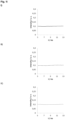
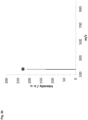
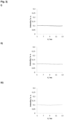
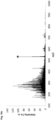
- Illumination of a gaseous sample of the herein described marked petroleum hydrocarbon with pulsed laser light of a predetermined wavelength higher than 370 nm (for e.g. 406 nm) does not contain sufficient energy to ionize the chemical marker as shown for example by Fig. 1i , Fig. 3j , Fig. 6g and Fig 8i .
- Detection of the peak corresponding to the ion (M + ) of the at least one chemical marker in the mass spectrum or the ion mobility spectrum at step d-1) of the method according to the present invention is indicative of the authenticity of said petroleum hydrocarbon.
- detection of the presence of the at least one chemical marker in the allegedly authentic petroleum hydrocarbon is typically considered a sufficient condition for acknowledging the authenticity of said petroleum hydrocarbon.
- detection of the presence of a chemical marker used for marking low tax petroleum hydrocarbon in an alleged high tax petroleum hydrocarbon i.e. a petroleum hydrocarbon that is not supposed to contain said chemical marker
- the presence of a specific chemical marker as described at items i), ii), iii) and iv) herein in a petroleum hydrocarbon can be detected by illuminating a gaseous sample of said petroleum hydrocarbon with a pulsed laser light of a predetermined wavelength of between about 300 nm and about 370 nm, such as 308 nm, 337 nm, and 355 nm, and analysis of the resulting gaseous ions by ion mobility spectrometry, or mass spectrometry.
- a further aspect of the present invention is directed to a method for determining adulteration of a marked petroleum hydrocarbon, wherein the marked petroleum hydrocarbon comprises a petroleum hydrocarbon and at least one chemical marker selected from:
- marked petroleum hydrocarbon refers to a petroleum hydrocarbon that has been uniformly mixed with a certain amount of the at least one chemical marker described herein so that the concentration of the at least one chemical marker in the marked petroleum hydrocarbon is substantially constant.
- the wording "petroleum hydrocarbon allegedly comprising at least one chemical marker” refers to a petroleum hydrocarbon, which based on the information related to its production, distribution chain and/or selling point is supposed to contain at least one chemical marker as defined herein uniformly mixed therein.
- C 1 -C 6 -alkyl group refers to a saturated linear or branched-chain monovalent hydrocarbon radical of one to six carbon atoms (C 1 -C 6 ).
- Examples of C 1 -C 6 -alkyl groups include methyl (Me, -CH 3 ), ethyl (Et, -CH 2 CH 3 ), 1-propyl ( n -Pr, n -propyl, -CH 2 CH 2 CH 3 ), 2-propyl ( i -Pr, iso- propyl, -CH(CH 3 ) 2 ), 1-butyl ( n -Bu, n -butyl, -CH 2 CH 2 CH 2 CH 3 ), 2-methyl-1-propyl ( i -Bu, i -butyl, -CH 2 CH(CH 3 ) 2 ), 2-butyl ( s -Bu, s -butyl, -CH(CH 3 )CH 2 CH
- C 1 -C 4 -alkyloxy means a C 1 -C 4 -alkyl group, wherein the C 1 -C 4 -alkyl is as defined herein, that is linked to the rest of a molecule or to another group through an oxygen atom.
- Illustrative examples of C 1 -C 4 -alkyloxy include methoxy, ethoxy, n -propoxy, iso -propoxy, n -butoxy, iso -butoxy, sec -butoxy and tert -butoxy.
- the sample of allegedly marked petroleum hydrocarbon acquired at step a-1) of the method for determining authenticity claimed herein or the sample of marked petroleum hydrocarbon acquired at step a-2) of the method for determining adulteration claimed herein may be further diluted.
- an embodiment according to the present invention pertains to a method for determining authenticity as claimed herein or a method for determining adulteration as claimed herein, further comprising step f) conducted between step a-1) and step b-1) or between step a-2) and step b-2): f) diluting the sample with an organic solvent.
- the organic solvent used at step f) of the methods claimed herein must be miscible with the sample of the allegedly marked petroleum hydrocarbon or of the marked petroleum hydrocarbon i.e. the organic solvent and the sample must form a homogenous mixture when mixed together.
- the organic solvent used at step f) may also serve as a vehicle for internal standard addition by containing a defined amount of the at least one chemical marker expected to be present in the petroleum hydrocarbon allegedly comprising the at least one chemical marker or in the marked petroleum hydrocarbon.
- the organic solvent used at step f) is not per se ionizable upon illumination with pulsed laser light of a predetermined wavelength of between about 300 nm and about 370 nm.
- organic solvents examples include, but are not limited to: pentane, hexane, heptane, octane, toluene, ethanol, methanol, isopropanol, acetone, dimethylformamide, and mixtures thereof.
- the organic solvent is hexane.
- the ratio between the volume of the sample acquired at step a-1) or a-2) and the volume of the organic solvent is of between about 1 : 10 and about 1 : 1000, preferably of about 1 : 100.
- An optimal dilution ratio can be determined by a person skilled in the art of analytical chemistry by routine work.
- the sample of petroleum hydrocarbon and the sample of marked petroleum hydrocarbon, respectively is subjected to vaporization to provide a gaseous sample.
- vaporizing said sample refers to the process of converting said sample from liquid state to gaseous state.
- the step of vaporizing the sample to provide a gaseous sample is preferably achieved by one of the following methods: thermal desorption, laser desorption or evaporation in an injector of a gas chromatograph, and more preferably by thermal desorption or evaporation in an injector of a gas chromatograph.
- thermal desorption refers to a vaporization method wherein the liquid sample is heated gradually or at constant temperature with a flow of inert gas. Prior to the heating step, the liquid sample may be adsorbed onto a solid material.
- laser desorption is a vaporization method relying upon the interaction between the molecules of the sample to be vaporized and the pulsed laser light. Upon adsorption of the incident laser radiation, the molecules of the sample are vaporized.
- evaporation in an injector of a gas chromatograph is a vaporization method relying upon injection of a minute amount (few ⁇ L) of the liquid sample in the heated injector port of the gas chromatograph.
- the methods claimed herein include illumination of the gaseous sample obtained at step b-1) or b-2) with pulsed laser light of a predetermined wavelength of between about 300 nm and about 370 nm, preferably of about 308 nm, 337 nm or 355 nm, which results in ionization of the gaseous sample, and surprisingly in the selective or exclusive ionization of the at least one chemical marker.
- An indicator of the selective ionization of a specific chemical marker as described herein in presence of a specific petroleum hydrocarbon is the ratio between the intensity of the peak corresponding to the chemical marker and the peak originating from the petroleum hydrocarbon exhibiting the highest intensity in the mass spectrum or the ion mobility spectrum.
- This ratio can be optimized for a specific chemical marker and a specific petroleum hydrocarbon via routine work by varying the pulsed laser wavelength from about 300 nm to about 370 nm and/or varying the pulse energy density for a specific wavelength.
- the predetermined wavelength of the pulsed laser light is of about 308 nm, about 337 nm or about 355 nm, and more preferably is of about 355 nm.
- the gaseous ions obtained at step c-1) or c-2) are analyzed by ion mobility spectrometry or mass spectrometry.
- ion mobility spectrometry is an analytical technique, which separates gaseous ions in an electric field in the presence of an inert gas on the basis of their mobilities.
- the ion mobility is a measure of the size-to-charge ratio of an ion.
- Mass spectrometry is an analytical technique that separates gaseous ions according to their specific mass-to-charge ratio ( m / z ), and then records the relative abundance of each ion type.
- Detection of the peak corresponding to the ion (M + ) of the at least one chemical marker in the mass spectrum or the ion mobility spectrum at step d-1) of the method according to the present invention is indicative of the authenticity of said petroleum hydrocarbon.
- the concentration of the at least one chemical marker determined at step d-2) is compared with a concentration of the at least one chemical marker in an unadulterated sample of the marked petroleum hydrocarbon and it is decided whether the marked petroleum hydrocarbon has been adulterated or not.
- the concentration of the at least one chemical marker in the unadulterated sample of the marked petroleum hydrocarbon is/was determined by subjecting the unadulterated sample of petroleum hydrocarbon to steps a-2), b-2), c-2) and d-2) described herein.
- a difference in concentration of the at least one chemical marker of at least 10-wt%, preferably of at least 7.5-wt%, and more preferably of at least 5-wt% between the sample of the marked petroleum hydrocarbon acquired at step a-2) and the unadulterated sample of marked petroleum hydrocarbon indicates that said marked petroleum hydrocarbon has been adulterated.
- Such a chemical marker is particularly useful for marking subsidized petroleum hydrocarbons, such as subsidized kerosene and subsidized diesel, because it renders economically not viable the removal of the chemical marker from the subsidized petroleum via distillation that is known as one the most used techniques for eliminating the chemical markers from the subsidized petroleum hydrocarbons.
- such a chemical marker is also useful for marking high tax petroleum hydrocarbons, such as high tax kerosene and high tax diesel, because due to its boiling point that is within or close to the boiling range of the petroleum hydrocarbon, it renders difficult its isolation from the petroleum hydrocarbon matrix and its identification by criminals involved in dilution or substitution of high taxed petroleum hydrocarbon with lower grade petroleum hydrocarbon, and thereby aids in minimizing the lost revenue caused by theses illegal activities, the risk of brand degradation, as well as the environmental damage.
- high tax petroleum hydrocarbons such as high tax kerosene and high tax diesel
- the method for determining authenticity claimed and described herein and the method for determining adulteration claimed and described herein may be implemented on-site for rapid testing, or in a laboratory.
- a preferred embodiment according to the present invention pertains to a method for determining authenticity as claimed and described herein and a method for determining adulteration as claimed and described herein, wherein the at least one chemical marker is of general formula (I-a), wherein the residues R 2 - R 12 , R a - R e , R a' - R e' , R a" - R e" and R a′′′ - R e′′′ have the meanings defined herein.
- a more preferred embodiment according to the present invention is directed to a method for determining authenticity as claimed and described herein and a method for determining adulteration as claimed and described herein, wherein the at least one chemical marker is a compound of general formula (I), wherein
- the residues R a - R e , R a' - R e' , R a" - R e" and R a′′′ - R e′′′ represent hydrogen and/or the residues R 1 - R 12 other than represent hydrogen.
- the residues R a - R e , R a' - R e' , R a" - R e" and R a′′′ - R e′′′ represent hydrogen and the residues R 1 - R 12 other than represent hydrogen.
- the integer m may be equal to the integer n.
- the integer n is comprised between 2 and 4 and more preferably, the integer n is 3. It is further preferred that in general formulae (II) and (II-a) the residues R 13 and R 14 represent hydrogen and/or the residues R 15 - R 24 represent hydrogen.
- the at least one chemical marker may be an aromatic compound substituted by one or more N , N -disubstituted amino groups, wherein the substituents of the one or more N , N -disubstituted amino groups are independently of each other selected from C 1 -C 6 -alkyl or the two substituents of a N , N- disubstituted amino group taken together form a residue -(CH 2 ) p - with p being an integer comprised between 2 and 6 i.e. selected from 2, 3, 4, 5 and 6.
- N , N- dimethylbenzenamine CAS no.: 121-69-7; provider: ASW MedChem
- N 1 ,N 1 ,N 4 ,N 4 -tetramethyl-1,4-benzenediamine CAS no.: 100-22-1 ; provider: ASW MedChem
- N 1 , N 1 -diethyl- N 4 , N 4 -dimethyl-1,4-benzenediamine CAS no.: 5775-53-1 ; provider: Chemieliva Pharmaceutical
- N 1 , N 1 , N 4 , N 4 -tetraethyl-1,4-benzenediamine CAS no.: 18996-77-5 ; provider: Chemieliva Pharmaceutical
- N 1 , N 1 , N 4 , N 4 ,2,5-hexamethyl-1,4-benzenediamine CAS no.: 121-69-7
- ASW MedChem N 1 ,N 1 ,N 4 ,N 4 -tetramethyl-1,
- the at least one chemical marker may be an aromatic compound substituted by at least one group selected from C 1 -C 4 -alkoxy.
- the concentration of the aromatic compound substituted by at least one group selected from C 1 -C 4 -alkoxy in the sample acquired at step a-1) or at step a-2) is of at least about 1 ⁇ M (micromolar).
- mass spectrometry or ion mobility spectrometry higher concentration of the at least one chemical marker of general formula (I) in the composition of petroleum hydrocarbon may be required. Owing to the high solubility of the chemical marker of general formula (I) in a variety of petroleum hydrocarbons, even high marking concentration of about 1 mM (millimolar) may be considered.
- a preferred embodiment according to the present invention is directed to a method for determining authenticity as claimed and described herein and a method for determining adulteration as claimed and described herein, wherein the at least one chemical marker is a compound of general formula (IV) wherein
- a more preferred embodiment according to the present invention pertains to methods as claimed and described herein, wherein the at least one chemical marker is a compound of general formula (IV-a) wherein
- Examples of commercially available aromatic compounds substituted by at least one group selected from C 1 -C 4 -alkoxy include, but are not limited to: methoxybenzene ( CAS no.:100-66-3 ; provider: abcr GmbH); 1,4-dimethoxybenzene ( CAS no.: 150-78-7 ; provider: abcr GmbH); 1,4-diethoxybenzene ( CAS no.: 122-95-2; provider: abcr GmbH); 1,4-bis(1-methylethoxy)benzene ( CAS no.: 7495-78-5 ; provider: Chemieliva Pharmaceutical); 1,4-dimethoxy-2-methylbenzene ( CAS no.: 24599-58-4; provider: Alchem Pharmtech); 1,4-dimethoxy-2,5-dimethyl-benzene ( CAS no.: 2674-32-0 ; provider: Chemieliva Pharmaceutical Co.); 1,4-dimethoxy-2,3-dimethylbenzene ( CAS no.: 39021-83-5
- the set-up contains a thermal desorption unit (Thermo desorber TC-13.006 from PAS Technology), an optical parametric oscillator (OPO) pumped by a Nd:YAG laser (NT342ASH, Ekspla), and a commercial mass spectrometer (LTQ XL TM , Thermo Fisher Scientific) equipped with a self-made ion source ( J. Mass Spectrom. (2016), 51, 566-577 ) having two quartz windows transparent to a laser beam.
- the thermal desorption unit is connected via a metal capillary (stainless steel tubing 1/8" outer diameter x 2.0 mm inner diameter, about 60 mm long from Ziemer Chromatographie) to the ion source of the mass spectrometer.
- compositions of petroleum hydrocarbon were analyzed by the following method: 2 ⁇ L of the liquid sample were introduced using a syringe (Hamilton, 10 ⁇ L) into the thermal desorption unit heated to 250 °C. Following vaporization, the gaseous sample was transferred via the metal capillary heated to 200 °C (about 60 mm long) using a N 2 flow (600 mL/min) in the ionization chamber heated to 120 °C (about 18 mm long, inner diameter of 20 mm) of the ion source, where the gaseous sample was subjected to laser ionization. The ionized sample was then transferred into the MS spectrometer (N 2 flow: 1000 mL/min; V: 50 Volts) and the MS spectrum was measured in relative intensities as a function of mass - to - charge ratio (m/z).
- MS spectrometer N 2 flow: 1000 mL/min; V: 50 Volts
- the set-up used contains an injector of a commercial gas chromatograph (HP 5890 SII, Hewlett Packard, now: Agilent) used only for sample vaporization, a self-made ion mobility spectrometer ( Anal. Bional. Chem. 405, 7019) having quartz windows transparent to a laser beam and an optical parametric oscillator (OPO) pumped by a Nd:YAG laser (NT342A-SH, Ekspla).
- the injector of the gas chromatograph is connected via a capillary (deactivated fused silica capillary, 0.18 mm inner diameter, 400 mm long from Perkin Elmer) to the ion source of the ion mobility spectrometer.
- the drift tube of the ion mobility spectrometer is 100 mm long and has an inner diameter of 25 mm.
- the ion currents on the Faraday plate are amplified (1 GV/A amplifier, ISAS Dortmund) and recorded on a USB oscilloscope (Handyscope HS3, 5 MHz, Tiepie Engineering).
- the ionized sample entered the heated drift tube (150 °C) of the ion mobility spectrometer. Nitrogen (flow: 200 mL/min; drift tube voltage: 4.5 kV or 6.5 kV) or helium (flow: 200 mL/min; drift tube voltage: 2.5 kV) was used as drift gas.
- the ion currents on the Faraday plate were amplified (1 GV/A amplifier, ISAS Dortmund) and recorded on a USB oscilloscope (Handyscope HS3, 5 MHz, Tiepie Engineering).
- the atmospheric pressure chemical ionization (APCI) by soft X-radiation is a method of unselective ionization that for regulatory reasons (such as safety and disposal concerns) is currently used as alternative to ionization by radioactive beta emitters, such as 63 Ni.
- APCI-IMS atmospheric pressure chemical ionization coupled with ion mobility spectrometry
- APCI-MS atmospheric pressure chemical ionization coupled with mass spectrometry
- the set-up used contains an injector of a commercial gas chromatograph (HP 5890 SII, Hewlett Packard, now: Agilent) used only for sample vaporization, and a commercially available hand-held ion mobility spectrometer (RoadRunner, Bruker Daltonik).
- the ion mobility spectrometer contains a soft X-radiation source (miniature X-ray tube, 40 mm length, rhodium target on a beryllium window), with an energy of 2.7/2.8 keV (L ⁇ /L ⁇ -transitions of Rh) by Bruker Daltonik ( US Patent 6,740,874 B2, May 25, 2004 , Bruker Saxonia Analytik GmbH).
- the injector of the gas chromatograph is connected via a capillary (deactivated fused silica capillary, 0.18 mm inner diameter, 400 mm long from Perkin Elmer) to the ion source of the ion mobility spectrometer.
- the inlet system and the internal flow system of the ion mobility spectrometer were modified to enable its connection through the capillary to the injector of the gas chromatograph.
- compositions of petroleum hydrocarbon were analyzed by the following method: 2 ⁇ L of the liquid sample were introduced using a syringe (Hamilton, 10 ⁇ L) into an injector (inlet gas: N 2 ; flow inlet gas: 200 mL/min; split ratio 1 :12) heated to 250 °C of the commercial gas chromatograph. Following vaporization, the gaseous sample was transferred using a N 2 flow of 400 mL/min via the uncoated metal capillary heated to 200 °C (400 mm long) in the ionization chamber heated to 180 °C of the ion mobility spectrometer, where the gaseous sample was subjected to APCI ionization. The ionized sample entered the heated drift tube (150 °C) of the ion mobility spectrometer. Nitrogen (flow: 118 mL/min or 200 mL/min; standard drift tube voltage) was used as drift gas.
- Example 1 Detection and quantification of the chemical marker N 1 ,N 1 ,N 4 ,N 4 - tetramethyl benzene-1,4-diamine in a petroleum hydrocarbon.
- N 1 ,N 1 ,N 4 ,N 4 -tetramethyl benzene-1,4-diamine in hexane was prepared to a concentration of 10 mmol/L and added to diesel (SOCAR diesel), gasoline (SP98 AVIA gasoline), mineral oil or hexane to yield marked diesel samples, marked gasoline samples and marked hexane samples.
- Samples of marked diesel, marked gasoline and marked hexane were analyzed by laser ionization at a wavelength of 355 nm (pulsed laser density: 0.63 mJ/mm 2 ) coupled with mass spectrometry using the protocol described at item I.a conducted on the instrument described at item I.a (see Fig. 2b and Fig. 2c ).
- Samples of marked diesel, marked gasoline, marked hexane, and marked mineral oil were analyzed by laser ionization at a wavelength of 337 nm (pulsed laser density: 0.05 mJ/mm 2 ), or 355 nm (pulsed laser density: 0.63 mJ/mm 2 ) coupled with ion mobility spectrometry (drift gas: nitrogen; flow: 200 mL/min; drift tube voltage: 4.5 kV or 6.5 kV) using the protocol described at item I.b conducted on the instrument described at item I.b (see Fig. 1c, Fig. 1d , Fig. 1f - Fig. 1h ).
- the chemical marker N 1 ,N 1 ,N 4 ,N 4 - tetramethyl benzene-1,4-diamine is characterized by a drift time of about 7.6 ms.
- Comparison of the ion mobility spectrum of the diesel marked with the chemical marker N 1 ,N 1 ,N 4 ,N 4 -tetramethyl benzene-1,4-diamine and the ion mobility spectrum of the composition of hexane containing the same chemical marker shows that the peak of the chemical marker N 1 ,N 1 , N 4 ,N 4 -tetramethyl benzene-1,4-diamine is masked by the peaks originating from the diesel.
- such method is not suitable for authentication of a petroleum hydrocarbon allegedly marked with the chemical marker N 1 ,N 1 ,N 4 ,N 4 -tetramethyl benzene-1,4-diamine and/or for determining adulteration of a marked petroleum hydrocarbon containing the chemical marker N 1 ,N 1 , N 4 ,N 4 -tetramethyl benzene-1,4-diamine.
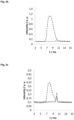
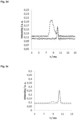
- Fig. 1f illustrates the superimposed spectra of a marked SP98 AVIA gasoline containing the chemical marker N 1 ,N 1 , N 4 ,N 4 -tetramethyl benzene-1,4-diamine at a concentration of 5 ⁇ M (continuous line) and of a composition of hexane containing the chemical marker N 1 ,N 1 ,N 4 ,N 4 -tetramethyl benzene-1,4-diamine at a concentration of 5 ⁇ M (dotted line) obtained by laser ionization at 355 nm (pulse energy density: 0.63 mJ/mm 2 ) coupled with ion mobility spectrometry (LI-IMS; drift gas: nitrogen; flow: 200 mL/min; drift tube voltage: 6.5 kV).
- LI-IMS ion mobility spectrometry
- the chemical marker N 1 ,N 1 , N 4 ,N 4 -tetramethyl benzene-1,4-diamine is characterized by a drift time of about 7.6 ms.
- illumination of the marked gasoline containing the chemical marker N 1 ,N 1 , N 4 ,N 4 -tetramethyl benzene-1,4-diamine with pulsed laser light of a wavelength of 355 nm (pulse energy density: 0.63 mJ/mm 2 ) results in selective ionization of the chemical marker N 1 ,N 1 ,N 4 ,N 4 - tetramethyl benzene-1,4-diamine, thereby enabling when coupled with ion mobility spectrometry the detection of the presence of the chemical marker N 1 ,N 1 ,N 4 ,N 4 - tetramethyl benzene-1,4-diamine and the authentication of the gasoline marked with said chemical marker.
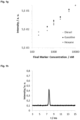
- Fig. 1g illustrates the variation of the intensity of the drift time peak of the chemical marker N 1 ,N 1 ,N 4 ,N 4 -tetramethyl benzene-1,4-diamine with the concentration of said marker in a marked SOCAR diesel, a marked SP98 AVIA gasoline and a composition of hexane containing said chemical marker.
- compositions containing the marker N 1 ,N 1 ,N 4 ,N 4 - tetramethyl benzene-1,4-diamine were analyzed by laser ionization at 355 nm (pulse energy density: 0.63 mJ/mm 2 ) coupled to ion mobility spectrometry (drift gas: nitrogen; flow: 200 mL/min; drift tube voltage: 4.5 kV). Each measurement was repeated 3 times.
- the small error bars which include manual injection error of the 5 repetitions, demonstrate the high precision of the method and its capacity to detect small variations of chemical marker concentration.
- Fig. 1h illustrates the superimposed spectra of a marked mineral oil containing the chemical marker N 1 ,N 1 ,N 4 ,N 4 -tetramethyl benzene-1,4-diamine at a concentration of 100 ⁇ M (continuous line) and of a composition of hexane containing the chemical marker N 1 ,N 1 ,N 4 ,N 4 -tetramethyl benzene-1,4-diamine at a concentration of 100 ⁇ M (dotted line) obtained by laser ionization at 355 nm coupled with ion mobility spectrometry (LI-IMS; drift gas: nitrogen; flow: 200 mL/min; drift tube voltage: 6.5 kV).
- LI-IMS ion mobility spectrometry
- the marked diesel was diluted in hexane (1 : 10, v / v) prior to the analysis.
- the chemical marker N 1 ,N 1 , N 4 ,N 4 -tetramethyl benzene-1,4-diamine is characterized by a drift time of about 7.6 ms. As demonstrated by Fig.
- illumination of the marked mineral oil containing the chemical marker N 1 ,N 1 , N 4 ,N 4 -tetramethyl benzene-1,4-diamine with pulsed laser light of a wavelength of 355 nm (pulse energy density: 0.63 mJ/mm 2 ) results in selective ionization of the chemical marker N 1 ,N 1 ,N 4 ,N 4 - tetramethyl benzene-1,4-diamine, thereby enabling when coupled with ion mobility spectrometry the detection of the presence of the chemical marker N 1 ,N 1 ,N 4 ,N 4 - tetramethyl benzene-1,4-diamine and the authentication of the mineral oil marked with said chemical marker.
- Fig. 2a illustrates for comparison purposes the mass spectrum of a marked SOCAR diesel containing the marker N 1 ,N 1 ,N 4 ,N 4 -tetramethyl benzene-1,4-diamine obtained by atmospheric pressure chemical ionization coupled with mass spectrometry (APCI - MS).
- APCI - MS atmospheric pressure chemical ionization coupled with mass spectrometry
- the marked diesel was diluted in hexane (1 : 100, v / v) prior to the analysis. Following dilution, the concentration of the chemical marker was of 100 nM.
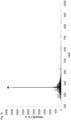
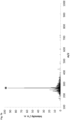
- Fig. 2b illustrates the mass spectrum of a marked SOCAR diesel containing the marker N 1 ,N 1 ,N 4 ,N 4 -tetramethyl benzene-1,4-diamine obtained by laser ionization at 355 nm (pulse energy density: 0.63 mJ/mm 2 ) coupled with mass spectrometry.
- the marked diesel was diluted in hexane (1 : 100, v/v) prior to the analysis. Following dilution, the concentration of the chemical marker was of 100 nM.
- the compositions were diluted in hexane (1 : 100, v / v) prior to the analysis.
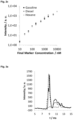
- the excellent linearity and the overlapping of the three calibration curves prove that the methods according to the present invention relying on illumination of the marked petroleum hydrocarbon with pulse laser light of a wavelength of 355 nm coupled with mass spectrometry enable the detection and quantification of the marker N 1 ,N 1 ,N 4 ,N 4 - tetramethyl benzene-1,4-diamine in a variety of petroleum hydrocarbons, including diesel and gasoline, and consequently, the determination of the adulteration of a petroleum hydrocarbon marked with N 1 ,N 1 , N 4 ,N 4 -tetramethyl benzene-1,4-diamine.
- Example 2 Detection and quantification of the chemical marker N 1 ,N 1 ,N 5 ,N 5 -tetraethyl-naphthalene-1,5-diamine in a petroleum hydrocarbon.
- 1,5-diaminonaphtalene (1 equiv., 10 mmol, 1.59 g) ( CAS no.: 2243-62-1 , Sigma Aldrich, 97%) and ethyl bromide (8 equiv., 80 mmol, 8.72 g, 5.92 mL) (CAS no. 74-96-4, Sigma Aldrich, 98%) were dissolved in acetonitrile (75 mL) under argon atmosphere.
- the unmarked diesel was diluted in hexane (1 : 100, v / v) prior to the analysis.
- the ion mobility spectrum of the diesel marked with the chemical marker N 1 ,N 1 ,N 5 ,N 5 -tetraethyl-naphthalene-1,5-diamine is substantially identical with the ion mobility spectrum of the unmarked diesel.
- such method is not suitable for authenticating a petroleum hydrocarbon allegedly marked with the chemical marker N 1 ,N 1 ,N 5 ,N 5 -tetraethyl-naphthalene-1,5-diamine and/or for determining adulteration of a marked petroleum hydrocarbon containing the chemical marker N 1 ,N 1 ,N 5 ,N 5 -tetraethyl-naphthalene-1,5-diamine.
- Fig. 3c illustrates the superimposed spectra of a marked SOCAR diesel containing the chemical marker N 1 ,N 1 ,N 5 ,N 5 -tetraethyl-naphthalene-1,5-diamine at a concentration of 2 ⁇ M (dashed line) and of a composition of hexane containing the chemical marker N 1 ,N 1 ,N 5 ,N 5 -tetraethyl-naphthalene-1,5-diamine at a concentration of 2 ⁇ M (dotted line) obtained by laser ionization at 308 nm (pulse energy density: 0.10 mJ/mm 2 ) coupled with ion mobility spectrometry (LI-IMS; drift gas: nitrogen; flow: 200 mL/min; drift tube voltage: 6.5 kV).
- LI-IMS ion mobility spectrometry
- the chemical marker N 1 ,N 1 ,N 5 ,N 5 -tetraethyl-naphthalene-1,5-diamine is characterized by a drift time of about 10.2 ms.
- illumination of the marked diesel containing the chemical marker N 1 ,N 1 ,N 5 ,N 5 -tetraethyl-naphthalene-1,5-diamine with pulsed laser light of a wavelength of 337 nm (pulse energy density: 0.05 mJ/mm 2 ) results in selective ionization of the chemical marker N 1 ,N 1 ,N 5 ,N 5 - tetraethyl-naphthalene-1,5-diamine, thereby enabling when coupled with ion mobility spectrometry the detection of the presence of the chemical marker N 1 ,N 1 ,N 5 ,N 5 - tetraethyl-naphthalene-1,5-diamine in the
- the chemical marker N 1 ,N 1 ,N 5 ,N 5 -tetraethyl-naphthalene-1,5-diamine is characterized by a drift time of about 10.2 ms.
- Comparison of the ion mobility spectrum of the gasoline marked with the chemical marker N 1 ,N 1 ,N 5 ,N 5 -tetraethyl-naphthalene-1,5-diamine and the ion mobility spectrum of the composition of hexane containing the same chemical marker shows that the peak of the chemical marker N 1 ,N 1 ,N 5 ,N 5 -tetraethyl-naphthalene-1,5-diamine is masked by the peaks originating from the gasoline.
- such method is not suitable for authentication of a petroleum hydrocarbon allegedly marked with the chemical marker N 1 ,N 1 ,N 5 ,N 5 -tetraethyl-naphthalene-1,5-diamine and/or for determining adulteration of a marked petroleum hydrocarbon containing the chemical marker N 1 ,N 1 ,N 5 ,N 5 -tetraethyl-naphthalene-1,5-diamine.
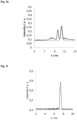
- Fig. 3h illustrates the superimposed spectra of a marked SP98 AVIA gasoline containing the chemical marker N 1 ,N 1 ,N 5 ,N 5 -tetraethyl-naphthalene-1,5-diamine at a concentration of 5 ⁇ M (continuous line) and of a composition of hexane containing the chemical marker N 1 ,N 1 ,N 5 ,N 5 -tetraethyl-naphthalene-1,5-diamine at a concentration of 5 ⁇ M (dotted line) obtained by laser ionization at 355 nm (pulse energy density: 0.63 mJ/mm 2 ) coupled with ion mobility spectrometry (LI-IMS; drift gas: nitrogen; flow: 200 mL/min; drift tube voltage: 6.5 kV).
- LI-IMS ion mobility spectrometry
- the chemical marker N 1 ,N 1 ,N 5 ,N 5 -tetraethyl-naphthalene-1,5-diamine is characterized by a drift time of about 10.2 ms.
- illumination of the marked gasoline containing the chemical marker N 1 ,N 1 ,N 5 ,N 5 -tetraethyl-naphthalene-1,5-diamine with pulsed laser light of a wavelength of 355 nm (pulse energy density: 0.63 mJ/mm 2 ) results in selective ionization of the chemical marker N 1 ,N 1 ,N 5 ,N 5 -tetraethyl-naphthalene-1,5-diamine, thereby enabling when coupled with ion mobility spectrometry the detection of the presence of the chemical marker N 1 ,N 1 ,N 5 ,N 5 -tetraethyl-naphthalene-1,5-diamine in the marked gasoline
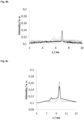
- Fig. 3i illustrates the superimposed ion mobility spectra of an unmarked SP98 AVIA gasoline (grey colored spectrum) and of a composition of hexane containing the chemical marker N 1 , N 1 , N 5 , N 5 -tetraethyl-naphthalene-1,5-diamine at a concentration of 2 ⁇ M (black colored spectrum) obtained by laser ionization at 355 nm (pulse energy density: 0.63 mJ/mm 2 ) coupled with ion mobility spectrometry (drift gas: helium; flow: 200 mL/min; drift tube voltage: 2.5 kV).
- the unmarked gasoline was diluted in hexane (1 : 100, v/v) prior to the analysis.
- the chemical marker N 1 , N 1 , N 5 , N 5 -tetraethyl-naphthalene-1,5-diamine is characterized by a drift time of about 7.4 ms. As attested by Fig.
- illumination of a gasoline containing the marker N 1 ,N 1 ,N 5 ,N 5 -tetraethyl-naphthalene-1,5-diamine with pulsed laser light of a wavelength of 355 nm (pulse energy density: 0.63 mJ/mm 2 ) coupled with ion mobility spectrometry (drift gas: helium; flow: 200 mL/min; drift tube voltage: 2.5 kV) is suitable for determining the authenticity of said gasoline.
- compositions containing the chemical marker N 1 ,N 1 ,N 5 ,N 5 -tetraethyl-naphthalene-1,5-diamine were analyzed by laser ionization at 355 nm (pulse energy density: 0.63 mJ/mm 2 ) coupled to ion mobility spectrometry (drift gas: helium; flow: 200 mL/min; drift tube voltage: 2.5 kV). Prior to the analysis, the compositions were diluted in hexane to 1 : 100.
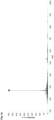
- the peak corresponding to the ion (M + ) of the chemical marker ( m / z of 270) is indicated by a "*".
- illumination of the marked gasoline containing the marker N 1 ,N 1 ,N 5 ,N 5 -tetraethyl-naphthalene-1,5-diamine with pulsed laser light of a wavelength of 355 nm results in the selective ionization of the chemical marker N 1 ,N 1 ,N 5 ,N 5 -tetraethyl-naphthalene-1,5-diamine, thereby enabling the easy detection of the presence of the chemical marker N 1 ,N 1 ,N 5 ,N 5 -tetraethyl-naphthalene-1,5-diamine at low concentration in a marked gasoline and the authentication of the gasoline containing said chemical marker.
- Fig. 4c illustrates the variation of the intensity of the peak corresponding to the ion (M + ) of the marker N 1 ,N 1 ,N 5 ,N 5 -tetraethyl-naphthalene-1,5-diamine with the concentration of the marker N 1 ,N 1 ,N 5 ,N 5 -tetraethyl-naphthalene-1,5-diamine in a marked SOCAR diesel and a composition of hexane.
- the different compositions were analyzed by laser ionization at 355 nm coupled with mass spectrometry.
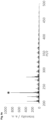
- Fig. 5b illustrates the mass spectrum of a marked SP98 AVIA gasoline containing the chemical marker N,N-dimethylnaphthalen-1-amine obtained by laser ionization at 308 nm (pulse energy density: 0.10 mJ/mm 2 ) coupled with mass spectrometry.
- the marked gasoline was diluted in hexane (1 : 100, v / v) prior to the analysis. Following dilution, the concentration of the chemical marker was of 10 ⁇ M. The peak corresponding to the ion (M + ) of the chemical marker (m / z of 171) is indicated by a "*".
- Fig. 5b illustrates the mass spectrum of a marked SP98 AVIA gasoline containing the chemical marker N,N-dimethylnaphthalen-1-amine obtained by laser ionization at 308 nm (pulse energy density: 0.10 mJ/mm 2 ) coupled with mass spectrometry.
- the marked gasoline was diluted in hexan
- a concentrate of 2-ethyl-9,10-dimethoxyanthracene in hexane was prepared to a concentration of 5 mmol/L and added to diesel (SOCAR diesel), gasoline (SP98 AVIA gasoline) or hexane to yield marked diesel samples, marked gasoline samples and marked hexane samples.
- Samples of marked diesel, marked gasoline and marked hexane were analyzed by laser ionization at a wavelength of 355 nm (pulsed laser density: 0.63 mJ/mm 2 ) coupled with mass spectrometry using the protocol described at item I.a conducted on the instrument described at item I.a (see Fig.
- a sample of marked diesel was analyzed by laser ionization at different wavelengths (308 nm - pulsed energy density: 0.10 mJ/mm 2 ; 337 nm - pulsed energy density: 0.05 mJ/mm 2 ; 355 nm - pulsed energy density: 0.63 mJ/mm 2 ) coupled with mass spectrometry using the protocol described at item I.a conducted on the instrument described at item I.a (see Fig. 7a - Fig. 7c ).
- illumination of the marked gasoline containing the marker 2-ethyl-9,10-dimethoxy-anthracene with pulsed laser light of a wavelength of 355 nm (pulse energy density: 0.63 mJ/mm 2 ) results in selective ionization of the marker 2-ethyl-9,10-dimethoxy-anthracene, thereby enabling when coupled with ion mobility spectrometry the detection of the presence of the marker 2-ethyl-9,10-dimethoxy-anthracene in the marked gasoline and the authentication of the gasoline containing said marker.
- the chemical marker 2-ethyl-9,10-dimethoxyanthracene is characterized by a drift time of about 9.6 ms. Comparison of the ion mobility spectrum of the diesel marked with the chemical marker 2-ethyl-9,10-dimethoxyanthracene and the ion mobility spectrum of the composition of hexane containing the same chemical marker shows that the peak of the chemical marker 2-ethyl-9,10-dimethoxyanthracene is masked by the peaks originating from the diesel.
- the chemical marker 2-ethyl-9,10-dimethoxyanthracene is characterized by a drift time of about 9.6 ms.
- illumination of the marked diesel containing the chemical marker 2-ethyl-9,10-dimethoxyanthracene with pulsed laser light of a wavelength of 355 nm results in selective ionization of the chemical marker 2-ethyl-9,10-dimethoxyanthracene, thereby enabling when coupled with ion mobility spectrometry the detection of the presence of the chemical marker 2-ethyl-9,10-dimethoxyanthracene in the marked diesel and the authentication of the diesel marked with said chemical marker.
- Fig. 6g illustrates for comparative purposes the ion mobility spectra of a marked SP98 AVIA gasoline containing the chemical marker 2-ethyl-9,10-dimethoxyanthracene at a concentration of 100 ⁇ M ( Fig. 6g i ) - continuous line), a marked SOCAR diesel containing the chemical marker 2-ethyl-9,10-dimethoxyanthracene at a concentration of 100 ⁇ M ( Fig. 6g ii ) - dashed line) and of a composition of hexane containing the chemical marker 2-ethyl-9,10-dimethoxyanthracene at a concentration of 100 ⁇ M ( Fig.
- Fig. 7a illustrates the mass spectrum of a marked SOCAR diesel containing the chemical marker 2-ethyl-9,10-dimethoxy-anthracene obtained by laser ionization at 308 nm (pulse energy density of 0.10 mJ/mm 2 ) coupled with mass spectrometry.
- the marked diesel was diluted in hexane (1 : 100, v / v) prior to the analysis. Following dilution, the concentration of the chemical marker in the sample was of 250 nM.
- Fig. 7b illustrates the mass spectrum of a marked SOCAR diesel containing the chemical marker 2-ethyl-9,10-dimethoxy-anthracene obtained by laser ionization at 337 nm (pulse energy density: 0.05 mJ/mm 2 ) coupled with mass spectrometry.
- the marked diesel was diluted in hexane (1 : 100, v / v) prior to the analysis. Following dilution, the concentration of the chemical marker in the sample was of 250 nM.
- a concentrate of 1,6-diphenyl-1,3,5-hexatriene in tetrahydrofuran was prepared to a concentration of 10 mmol/L and added to SP98 AVIA gasoline or hexane to yield a marked gasoline sample (concentration 1,6-diphenyl-1,3,5-hexatriene: 50 ⁇ M) and a marked hexane sample (concentration 1,6-diphenyl-1,3,5-hexatriene: 10 ⁇ M).
- the marked gasoline sample was analysed by laser ionization at different wavelengths (308 nm - pulsed energy density: 0.10 mJ/mm 2 ; 337 nm - pulsed energy density: 0.05 mJ/mm 2 ) coupled with mass spectrometry using the protocol described at item La conducted on the instrument described at item I.a (see Fig. 9a and Fig. 9b ).
- the marked hexane was analyzed by laser ionization at 355 nm (pulsed laser density: 0.63 mJ/mm 2 ) coupled with ion mobility spectrometry (drift gas: helium; flow: 200 mL/min; drift tube voltage: 2.5 kV) using the protocol described at item I.b conducted on the instrument described at item I.b (see Fig. 8b and 8h ).
- the marked diesel sample was analyzed by laser ionization at 308 nm (pulsed laser density: 0.10 mJ/mm 2 ), or 355 nm (pulsed laser density: 0.63 mJ/mm 2 ) coupled with ion mobility spectrometry (drift gas: nitrogen; flow: 200 mL/min; drift tube voltage: 6.5 kV) using the protocol described at item I.b conducted on the instrument described at item I.b (see Fig. 8f and Fig. 8g ).
- Fig. 8 a illustrates for comparative purposes the superimposed ion mobility spectra of an unmarked SP98 AVIA gasoline (black continuous line), of the corresponding gasoline marked with the chemical marker 1,6-diphenyl-1,3,5-hexatriene at a concentration of 10 ⁇ M (dashed black line) and of a composition of hexane containing the chemical marker 1,6-diphenyl-1,3,5-hexatriene at a concentration of 10 ⁇ M (dotted black line) obtained by atmospheric pressure chemical ionization coupled with ion mobility spectrometry (APCI - IMS; drift gas: nitrogen; flow: 200 mL/min; standard drift tube voltage).
- APCI - IMS atmospheric pressure chemical ionization coupled with ion mobility spectrometry
- the unmarked gasoline was diluted in hexane (1 : 100, v / v) prior to the analysis.
- the ion mobility spectrum of the gasoline marked with the chemical marker 1,6-diphenyl-1,3,5-hexatriene is substantially identical with the ion mobility spectrum of the unmarked gasoline.
- Comparison of the ion mobility spectrum of the gasoline marked with the chemical marker 1,6-diphenyl-1,3,5-hexatriene and the ion mobility spectrum of the composition of hexane containing the same chemical marker shows that the peak of the chemical 1,6-diphenyl-1,3,5-hexatriene is masked by the peaks originating from the gasoline.
- Fig. 8b illustrates the superimposed ion mobility spectra of an unmarked SP98 AVIA gasoline (grey colored spectrum) and of a composition of hexane containing the chemical marker 1,6-diphenyl-1,3,5-hexatriene at a concentration of 10 ⁇ M (black colored spectrum) obtained by laser ionization at 355 nm (pulse energy density: 0.63 mJ/mm 2 ) coupled with ion mobility spectrometry (drift gas: helium; flow: 200 mL/min; drift tube voltage: 2.5 kV). To minimize the contamination of the spectrometer, the unmarked gasoline was diluted in hexane (1 : 100, v / v) prior to the analysis.
- the chemical marker 1,6-diphenyl-1,3,5-hexatriene is characterized by a drift time of about 7.0 ms.
- Fig. 8b as gasoline generates a negligible noise when subjected to laser ionization at 355 nm (pulse energy density of 0.63 mJ/mm 2 ) coupled with ion mobility spectrometry that does not mask the peak corresponding to the chemical marker 1,6-diphenyl-1,3,5-hexatriene, the presence of said chemical marker can be easily detected in a marked gasoline thereof.
- illumination of a gasoline containing the marker 1,6-diphenyl-1,3,5-hexatriene with pulsed laser light of a wavelength of 355 nm (pulse energy density: 0.63 mJ/mm 2 ) coupled with ion mobility spectrometry is suitable for determining the authenticity of said gasoline.
- Fig. 8c illustrates the superimposed spectra of a marked SP98 AVIA gasoline containing the chemical marker 1,6-diphenyl-1,3,5-hexatriene at a concentration of 100 ⁇ M (continuous line) and of a composition of hexane containing the chemical marker 1,6-diphenyl-1,3,5-hexatriene at a concentration of 100 ⁇ M (dotted line) obtained by laser ionization at 355 nm (pulse energy density: 0.63 mJ/mm 2 ) coupled with ion mobility spectrometry (LI-IMS; drift gas: nitrogen; flow: 200 mL/min; drift tube voltage: 6.5 kV).
- LI-IMS ion mobility spectrometry
- the chemical marker 1,6-diphenyl-1,3,5-hexatriene is characterized by a drift time of about 9.5 ms.
- illumination of the marked gasoline containing the chemical marker 1,6-diphenyl-1,3,5-hexatriene with pulsed laser light of a wavelength of 355 nm results in selective ionization of the chemical marker 1,6-diphenyl-1,3,5-hexatriene, thereby enabling when coupled with ion mobility spectrometry the detection of the presence of the chemical marker 1,6-diphenyl-1,3,5-hexatriene in the marked gasoline and the authentication of the gasoline marked with said chemical marker.
- the chemical marker 1,6-diphenyl-1,3,5-hexatriene is characterized by a drift time of about 9.5 ms.
- illumination of the marked gasoline containing the chemical marker 1,6-diphenyl-1,3,5-hexatriene with pulsed laser light of a wavelength of 337 nm results in selective ionization of the chemical marker 1,6-diphenyl-1,3,5-hexatriene, thereby enabling when coupled with ion mobility spectrometry the detection of the presence of the chemical marker 1,6-diphenyl-1,3,5-hexatriene in the marked gasoline and the authentication of the gasoline marked with said chemical marker
- the chemical marker 1,6-diphenyl-1,3,5-hexatriene is characterized by a drift time of about 9.5 ms. Comparison of the ion mobility spectrum of the diesel marked with the chemical marker 1,6-diphenyl-1,3,5-hexatriene and the ion mobility spectrum of the composition of hexane containing the same chemical marker shows that the peak of the chemical marker 1,6-diphenyl-1,3,5-hexatriene is masked by the peaks originating from the diesel.
- such method is not suitable for authenticating a petroleum hydrocarbon allegedly marked with the chemical marker 1,6-diphenyl-1,3,5-hexatriene and/or for determining adulteration of a marked petroleum hydrocarbon containing the chemical marker 1,6-diphenyl-1,3,5-hexatriene.
- the chemical marker 1,6-diphenyl-1,3,5-hexatriene is characterized by a drift time of about 9.5 ms.
- illumination of the marked diesel containing the chemical marker 1,6-diphenyl-1,3,5-hexatriene with pulsed laser light of a wavelength of 308 nm (pulse energy density: 0.10 mJ/mm 2 ) results in selective ionization of the chemical marker 1,6-diphenyl-1,3,5-hexatriene, thereby enabling when coupled with ion mobility spectrometry the detection of the presence of the chemical marker 1,6-diphenyl-1,3,5-hexatriene in the marked diesel and the authentication of the diesel marked with said chemical marker.
- Fig. 8g illustrates the superimposed spectra of a marked SOCAR diesel containing the chemical marker 1,6-diphenyl-1,3,5-hexatriene at a concentration of 100 ⁇ M (dashed line) and of a composition of hexane containing the chemical marker 1,6-diphenyl-1,3,5-hexatriene at a concentration of 100 ⁇ M (dotted line) obtained by laser ionization at 355 nm (pulse energy density: 0.63 mJ/mm 2 ) coupled with ion mobility spectrometry (LI-IMS; drift gas: nitrogen; flow: 200 mL/min; drift tube voltage: 6.5 kV).
- LI-IMS ion mobility spectrometry
- Fig. 8h illustrates the superimposed ion mobility spectra of an unmarked SOCAR diesel (grey colored spectrum) and of a composition of hexane containing the chemical marker 1,6-diphenyl-1,3,5-hexatriene at a concentration of 10 ⁇ M (black colored spectrum) obtained by laser ionization at 355 nm (pulse energy density: 0.63 mJ/mm 2 ) coupled with ion mobility spectrometry (drift gas: helium; flow: 200 mL/min; drift tube voltage: 2.5 kV). To minimize the contamination of the spectrometer, the unmarked diesel was diluted in hexane (1 : 100, v / v) prior to the analysis.
- illumination of a diesel containing the marker 1,6-diphenyl-1,3,5-hexatriene with pulsed laser light of a wavelength of 355 nm (pulse energy density: 0.63 mJ/mm 2 ) coupled with ion mobility spectrometry is suitable for determining the authenticity of said diesel.
- Fig. 8i illustrates for comparative purposes the ion mobility spectra of a marked SP98 AVIA gasoline containing the chemical marker 1,6-diphenyl-1,3,5-hexatriene at a concentration of 100 ⁇ M ( Fig. 8i i ) - continuous line), a marked SOCAR diesel containing the chemical marker 1,6-diphenyl-1,3,5-hexatriene at a concentration of 100 ⁇ M ( Fig. 8i ii ) - dashed line) and of a composition of hexane containing the chemical marker 1,6-diphenyl-1,3,5-hexatriene at a concentration of 100 ⁇ M (Fig.
Landscapes
- Chemical & Material Sciences (AREA)
- Oil, Petroleum & Natural Gas (AREA)
- Engineering & Computer Science (AREA)
- Organic Chemistry (AREA)
- Chemical Kinetics & Catalysis (AREA)
- General Chemical & Material Sciences (AREA)
- Life Sciences & Earth Sciences (AREA)
- Health & Medical Sciences (AREA)
- Materials Engineering (AREA)
- Food Science & Technology (AREA)
- Medicinal Chemistry (AREA)
- Physics & Mathematics (AREA)
- Analytical Chemistry (AREA)
- Biochemistry (AREA)
- General Health & Medical Sciences (AREA)
- General Physics & Mathematics (AREA)
- Immunology (AREA)
- Pathology (AREA)
- Other Investigation Or Analysis Of Materials By Electrical Means (AREA)
Priority Applications (1)
| Application Number | Priority Date | Filing Date | Title |
|---|---|---|---|
| RS20231209A RS65023B1 (sr) | 2019-12-03 | 2020-11-26 | Metod za utvrđivanje autentičnosti i krivotvorenja obeleženih naftnih ugljovodonika |
Applications Claiming Priority (2)
| Application Number | Priority Date | Filing Date | Title |
|---|---|---|---|
| EP19213124 | 2019-12-03 | ||
| PCT/EP2020/083470 WO2021110525A1 (en) | 2019-12-03 | 2020-11-26 | Method for determining authenticity and adulteration of marked petroleum hydrocarbons |
Publications (2)
| Publication Number | Publication Date |
|---|---|
| EP4069807A1 EP4069807A1 (en) | 2022-10-12 |
| EP4069807B1 true EP4069807B1 (en) | 2023-10-04 |
Family
ID=68766586
Family Applications (1)
| Application Number | Title | Priority Date | Filing Date |
|---|---|---|---|
| EP20811625.1A Active EP4069807B1 (en) | 2019-12-03 | 2020-11-26 | Method for determining authenticity and adulteration of marked petroleum hydrocarbons |
Country Status (18)
| Country | Link |
|---|---|
| US (1) | US20230103579A1 (pl) |
| EP (1) | EP4069807B1 (pl) |
| AU (1) | AU2020397410A1 (pl) |
| BR (1) | BR112022010452A2 (pl) |
| CO (1) | CO2022008791A2 (pl) |
| CR (1) | CR20220246A (pl) |
| DO (1) | DOP2022000113A (pl) |
| ES (1) | ES2968166T3 (pl) |
| GE (1) | GEP20247597B (pl) |
| HU (1) | HUE065102T2 (pl) |
| MA (1) | MA57801B1 (pl) |
| PE (1) | PE20221570A1 (pl) |
| PH (1) | PH12022551317A1 (pl) |
| PL (1) | PL4069807T3 (pl) |
| PT (1) | PT4069807T (pl) |
| RS (1) | RS65023B1 (pl) |
| WO (1) | WO2021110525A1 (pl) |
| ZA (1) | ZA202207336B (pl) |
Family Cites Families (21)
| Publication number | Priority date | Publication date | Assignee | Title |
|---|---|---|---|---|
| US4141692A (en) | 1977-01-19 | 1979-02-27 | Union Oil Company Of California | Tagged fuel compositions |
| US4520109A (en) | 1983-03-14 | 1985-05-28 | Sun Tech, Inc. | Fluorocarbon tracers and tracing method |
| JP3247113B2 (ja) * | 1992-01-29 | 2002-01-15 | キング ザ セカンド アンダーソン,デビッド | 非放射性同位体を用いて化学品を識別する方法 |
| JPH1074479A (ja) * | 1996-08-30 | 1998-03-17 | Nkk Corp | レーザーイオン化質量分析装置及び質量分析方法 |
| DE10120335C2 (de) | 2001-04-26 | 2003-08-07 | Bruker Daltonik Gmbh | Ionenmobilitätsspektrometer mit nicht-radioaktiver Ionenquelle |
| US7208451B2 (en) | 2003-01-29 | 2007-04-24 | Authentic Inc. | IMS detection of chemical markers in petroleum products |
| CN101395107A (zh) * | 2006-02-28 | 2009-03-25 | 出光兴产株式会社 | 并四苯衍生物以及应用该衍生物的有机电致发光元件 |
| US8129190B2 (en) * | 2006-11-17 | 2012-03-06 | Applied Nanotech Holdings, Inc. | Tagged petroleum products and methods of detecting same |
| WO2010029004A1 (de) * | 2008-09-10 | 2010-03-18 | Basf Se | Vorrichtung zur herstellung eines fälschungssicheren mineralölprodukts |
| TWI437089B (zh) | 2010-05-27 | 2014-05-11 | Angus Chemical | 標記液體碳氫化合物及其他燃料與油之方法 |
| EP2441745B1 (en) | 2010-10-14 | 2015-08-26 | Dow Global Technologies LLC | Biphenyl benzyl ether marker compounds for liquid hydrocarbons and other fuels and oils |
| JP5851593B2 (ja) | 2011-05-09 | 2016-02-03 | ダウ グローバル テクノロジーズ エルエルシー | 炭化水素並びに他の燃料および油の標識としてのオルト−フェニルフェノール化合物 |
| GB201107870D0 (en) | 2011-05-11 | 2011-06-22 | Johnson Matthey Plc | Tracers and method of marking hydrocarbon liquids |
| US9244017B2 (en) * | 2011-05-26 | 2016-01-26 | Altria Client Services Llc | Oil detection process and apparatus |
| WO2012177632A1 (en) | 2011-06-21 | 2012-12-27 | Rohm And Haas Company | Bisphenol a compounds useful as markers for liquid hydrocarbons and other fuels and oils |
| JP5913589B2 (ja) | 2011-06-30 | 2016-04-27 | ダウ グローバル テクノロジーズ エルエルシー | 液体炭化水素およびその他の燃料および油のための標識としてのビフェノールエーテル化合物 |
| CN202932261U (zh) | 2012-07-03 | 2013-05-15 | 赖家宏 | 行李箱的透明壳体结构 |
| TWI516468B (zh) | 2012-07-06 | 2016-01-11 | 羅門哈斯公司 | 三苯甲基化之烷基芳基醚 |
| TWI494424B (zh) | 2012-11-20 | 2015-08-01 | Dow Global Technologies Llc | 可蒸餾燃料標記物 |
| TWI591339B (zh) * | 2013-05-02 | 2017-07-11 | 羅門哈斯公司 | 偵測燃料標記物之分析方法 |
| US9732296B2 (en) | 2015-03-20 | 2017-08-15 | Authentix, Inc. | Fuel markers and methods of producing and using same |
-
2020
- 2020-11-26 PH PH1/2022/551317A patent/PH12022551317A1/en unknown
- 2020-11-26 BR BR112022010452A patent/BR112022010452A2/pt unknown
- 2020-11-26 GE GEAP202015987A patent/GEP20247597B/en unknown
- 2020-11-26 MA MA57801A patent/MA57801B1/fr unknown
- 2020-11-26 US US17/782,463 patent/US20230103579A1/en active Pending
- 2020-11-26 ES ES20811625T patent/ES2968166T3/es active Active
- 2020-11-26 PL PL20811625.1T patent/PL4069807T3/pl unknown
- 2020-11-26 RS RS20231209A patent/RS65023B1/sr unknown
- 2020-11-26 EP EP20811625.1A patent/EP4069807B1/en active Active
- 2020-11-26 WO PCT/EP2020/083470 patent/WO2021110525A1/en not_active Ceased
- 2020-11-26 AU AU2020397410A patent/AU2020397410A1/en active Pending
- 2020-11-26 PE PE2022000995A patent/PE20221570A1/es unknown
- 2020-11-26 PT PT208116251T patent/PT4069807T/pt unknown
- 2020-11-26 CR CR20220246A patent/CR20220246A/es unknown
- 2020-11-26 HU HUE20811625A patent/HUE065102T2/hu unknown
-
2022
- 2022-05-31 DO DO2022000113A patent/DOP2022000113A/es unknown
- 2022-06-24 CO CONC2022/0008791A patent/CO2022008791A2/es unknown
- 2022-07-01 ZA ZA2022/07336A patent/ZA202207336B/en unknown
Also Published As
| Publication number | Publication date |
|---|---|
| US20230103579A1 (en) | 2023-04-06 |
| PT4069807T (pt) | 2024-01-02 |
| PE20221570A1 (es) | 2022-10-06 |
| PH12022551317A1 (en) | 2023-11-20 |
| ES2968166T3 (es) | 2024-05-08 |
| WO2021110525A1 (en) | 2021-06-10 |
| AU2020397410A1 (en) | 2022-07-14 |
| DOP2022000113A (es) | 2022-09-30 |
| HUE065102T2 (hu) | 2024-05-28 |
| ZA202207336B (en) | 2025-03-26 |
| RS65023B1 (sr) | 2024-01-31 |
| GEP20247597B (en) | 2024-02-26 |
| BR112022010452A2 (pt) | 2022-09-06 |
| PL4069807T3 (pl) | 2024-03-18 |
| CR20220246A (es) | 2022-08-19 |
| CO2022008791A2 (es) | 2022-06-30 |
| MA57801B1 (fr) | 2024-01-31 |
| EP4069807A1 (en) | 2022-10-12 |
Similar Documents
| Publication | Publication Date | Title |
|---|---|---|
| Sieg et al. | Analysis of benzene, toluene, ethylbenzene, xylenes and n-aldehydes in melted snow water via solid-phase dynamic extraction combined with gas chromatography/mass spectrometry | |
| Albinet et al. | A simple QuEChERS-like extraction approach for molecular chemical characterization of organic aerosols: application to nitrated and oxygenated PAH derivatives (NPAH and OPAH) quantified by GC–NICIMS | |
| Boronat Ena et al. | Ambient ionization mass spectrometry applied to new psychoactive substance analysis | |
| Badjagbo et al. | Mass spectrometry for trace analysis of explosives in water | |
| Zhao et al. | Determination of aliphatic amines using N-succinimidyl benzoate as a new derivatization reagent in gas chromatography combined with solid-phase microextraction | |
| Westphal et al. | Differentiation of regioisomeric ring-substituted fluorophenethylamines with product ion spectrometry | |
| US20160272907A1 (en) | Fuel Markers and Methods of Producing and Using Same | |
| Abiedalla et al. | GC–MS, GC–MS/MS and GC-IR differentiation of carbonyl modified analogues of MDPV | |
| Da Costa et al. | The quantitative surface analysis of an antioxidant additive in a lubricant oil matrix by desorption electrospray ionization mass spectrometry | |
| Javelle et al. | Identify low mass volatile organic compounds from cometary ice analogs using gas chromatography coupled to an Orbitrap mass spectrometer associated to electron and chemical ionizations | |
| Liu et al. | Photochemical conversion of toluene in simulated atmospheric matrix and characterization of large molecular weight products by+ APPI FT-ICR MS | |
| EP4069807B1 (en) | Method for determining authenticity and adulteration of marked petroleum hydrocarbons | |
| Tsujikawa et al. | Profiling of seized methamphetamine putatively synthesized by reductive amination of 1-phenyl-2-propanone | |
| Ciesielski et al. | Characterization of fentanyl HCl powder prior to and after systematic degradation | |
| EP4223856A2 (en) | Fuel markers | |
| EP4069806B1 (en) | Method of marking a petroleum hydrocarbon | |
| OA20815A (en) | Method for determining authenticity and adulteration of marked petroleum hydrocarbons | |
| EA046774B1 (ru) | Способ определения подлинности и фальсификации маркированных нефтяных углеводородов | |
| Son et al. | The influence of different types of reactant ions on the ionization behavior of polycyclic aromatic hydrocarbons in corona discharge ion mobility spectrometry | |
| Farahani et al. | Microfunnel magnetic stirring-assisted dispersive liquid–liquid microextraction-derivatization technique, for the determination of 3-chloro-4-(dichloromethyl)-5-hydroxy-2 (5H)-furanone (Mutagen X) in aqueous samples by GC-ECD | |
| Sauret-Szczepanski et al. | Smog chamber study of acenaphthene: gas/particle partition measurements of the products formed by reaction with the OH radical | |
| OA19998A (en) | Compounds for chemically marking a petroleum hydrocarbon | |
| EA047192B1 (ru) | Способ маркировки нефтяного углеводорода | |
| OA20751A (en) | Method of marking a petroleum hydrocarbon. | |
| OA20000A (en) | Method for marking a petroleum hydrocarbon. |
Legal Events
| Date | Code | Title | Description |
|---|---|---|---|
| STAA | Information on the status of an ep patent application or granted ep patent |
Free format text: STATUS: UNKNOWN |
|
| STAA | Information on the status of an ep patent application or granted ep patent |
Free format text: STATUS: THE INTERNATIONAL PUBLICATION HAS BEEN MADE |
|
| PUAI | Public reference made under article 153(3) epc to a published international application that has entered the european phase |
Free format text: ORIGINAL CODE: 0009012 |
|
| STAA | Information on the status of an ep patent application or granted ep patent |
Free format text: STATUS: REQUEST FOR EXAMINATION WAS MADE |
|
| 17P | Request for examination filed |
Effective date: 20220630 |
|
| AK | Designated contracting states |
Kind code of ref document: A1 Designated state(s): AL AT BE BG CH CY CZ DE DK EE ES FI FR GB GR HR HU IE IS IT LI LT LU LV MC MK MT NL NO PL PT RO RS SE SI SK SM TR |
|
| DAX | Request for extension of the european patent (deleted) | ||
| RAV | Requested validation state of the european patent: fee paid |
Extension state: TN Effective date: 20220630 Extension state: MA Effective date: 20220630 Extension state: KH Effective date: 20220630 |
|
| P01 | Opt-out of the competence of the unified patent court (upc) registered |
Effective date: 20230523 |
|
| GRAP | Despatch of communication of intention to grant a patent |
Free format text: ORIGINAL CODE: EPIDOSNIGR1 |
|
| STAA | Information on the status of an ep patent application or granted ep patent |
Free format text: STATUS: GRANT OF PATENT IS INTENDED |
|
| INTG | Intention to grant announced |
Effective date: 20230712 |
|
| GRAS | Grant fee paid |
Free format text: ORIGINAL CODE: EPIDOSNIGR3 |
|
| GRAA | (expected) grant |
Free format text: ORIGINAL CODE: 0009210 |
|
| STAA | Information on the status of an ep patent application or granted ep patent |
Free format text: STATUS: THE PATENT HAS BEEN GRANTED |
|
| RAP3 | Party data changed (applicant data changed or rights of an application transferred) |
Owner name: SICPA HOLDING SA |
|
| AK | Designated contracting states |
Kind code of ref document: B1 Designated state(s): AL AT BE BG CH CY CZ DE DK EE ES FI FR GB GR HR HU IE IS IT LI LT LU LV MC MK MT NL NO PL PT RO RS SE SI SK SM TR |
|
| REG | Reference to a national code |
Ref country code: GB Ref legal event code: FG4D Ref country code: TN Ref legal event code: VAGR Ref document number: TN/P/2023/000337 Country of ref document: TN |
|
| REG | Reference to a national code |
Ref country code: CH Ref legal event code: EP |
|
| REG | Reference to a national code |
Ref country code: IE Ref legal event code: FG4D |
|
| REG | Reference to a national code |
Ref country code: DE Ref legal event code: R096 Ref document number: 602020018779 Country of ref document: DE |
|
| REG | Reference to a national code |
Ref country code: PT Ref legal event code: SC4A Ref document number: 4069807 Country of ref document: PT Date of ref document: 20240102 Kind code of ref document: T Free format text: AVAILABILITY OF NATIONAL TRANSLATION Effective date: 20231221 Ref country code: NO Ref legal event code: T2 Effective date: 20231004 |
|
| REG | Reference to a national code |
Ref country code: LT Ref legal event code: MG9D |
|
| REG | Reference to a national code |
Ref country code: MA Ref legal event code: VAGR Ref document number: 57801 Country of ref document: MA Kind code of ref document: B1 |
|
| REG | Reference to a national code |
Ref country code: NL Ref legal event code: MP Effective date: 20231004 |
|
| REG | Reference to a national code |
Ref country code: GR Ref legal event code: EP Ref document number: 20230402612 Country of ref document: GR Effective date: 20240209 |
|
| REG | Reference to a national code |
Ref country code: AT Ref legal event code: MK05 Ref document number: 1617772 Country of ref document: AT Kind code of ref document: T Effective date: 20231004 |
|
| PG25 | Lapsed in a contracting state [announced via postgrant information from national office to epo] |
Ref country code: NL Free format text: LAPSE BECAUSE OF FAILURE TO SUBMIT A TRANSLATION OF THE DESCRIPTION OR TO PAY THE FEE WITHIN THE PRESCRIBED TIME-LIMIT Effective date: 20231004 |
|
| PG25 | Lapsed in a contracting state [announced via postgrant information from national office to epo] |
Ref country code: IS Free format text: LAPSE BECAUSE OF FAILURE TO SUBMIT A TRANSLATION OF THE DESCRIPTION OR TO PAY THE FEE WITHIN THE PRESCRIBED TIME-LIMIT Effective date: 20240204 |
|
| PG25 | Lapsed in a contracting state [announced via postgrant information from national office to epo] |
Ref country code: LT Free format text: LAPSE BECAUSE OF FAILURE TO SUBMIT A TRANSLATION OF THE DESCRIPTION OR TO PAY THE FEE WITHIN THE PRESCRIBED TIME-LIMIT Effective date: 20231004 |
|
| PG25 | Lapsed in a contracting state [announced via postgrant information from national office to epo] |
Ref country code: AT Free format text: LAPSE BECAUSE OF FAILURE TO SUBMIT A TRANSLATION OF THE DESCRIPTION OR TO PAY THE FEE WITHIN THE PRESCRIBED TIME-LIMIT Effective date: 20231004 |
|
| PG25 | Lapsed in a contracting state [announced via postgrant information from national office to epo] |
Ref country code: LT Free format text: LAPSE BECAUSE OF FAILURE TO SUBMIT A TRANSLATION OF THE DESCRIPTION OR TO PAY THE FEE WITHIN THE PRESCRIBED TIME-LIMIT Effective date: 20231004 Ref country code: IT Free format text: LAPSE BECAUSE OF NON-PAYMENT OF DUE FEES Effective date: 20231126 Ref country code: IS Free format text: LAPSE BECAUSE OF FAILURE TO SUBMIT A TRANSLATION OF THE DESCRIPTION OR TO PAY THE FEE WITHIN THE PRESCRIBED TIME-LIMIT Effective date: 20240204 Ref country code: AT Free format text: LAPSE BECAUSE OF FAILURE TO SUBMIT A TRANSLATION OF THE DESCRIPTION OR TO PAY THE FEE WITHIN THE PRESCRIBED TIME-LIMIT Effective date: 20231004 |
|
| REG | Reference to a national code |
Ref country code: ES Ref legal event code: FG2A Ref document number: 2968166 Country of ref document: ES Kind code of ref document: T3 Effective date: 20240508 |
|
| REG | Reference to a national code |
Ref country code: HU Ref legal event code: AG4A Ref document number: E065102 Country of ref document: HU |
|
| PG25 | Lapsed in a contracting state [announced via postgrant information from national office to epo] |
Ref country code: SE Free format text: LAPSE BECAUSE OF FAILURE TO SUBMIT A TRANSLATION OF THE DESCRIPTION OR TO PAY THE FEE WITHIN THE PRESCRIBED TIME-LIMIT Effective date: 20231004 Ref country code: LV Free format text: LAPSE BECAUSE OF FAILURE TO SUBMIT A TRANSLATION OF THE DESCRIPTION OR TO PAY THE FEE WITHIN THE PRESCRIBED TIME-LIMIT Effective date: 20231004 Ref country code: HR Free format text: LAPSE BECAUSE OF FAILURE TO SUBMIT A TRANSLATION OF THE DESCRIPTION OR TO PAY THE FEE WITHIN THE PRESCRIBED TIME-LIMIT Effective date: 20231004 |
|
| REG | Reference to a national code |
Ref country code: DE Ref legal event code: R097 Ref document number: 602020018779 Country of ref document: DE |
|
| PG25 | Lapsed in a contracting state [announced via postgrant information from national office to epo] |
Ref country code: DK Free format text: LAPSE BECAUSE OF FAILURE TO SUBMIT A TRANSLATION OF THE DESCRIPTION OR TO PAY THE FEE WITHIN THE PRESCRIBED TIME-LIMIT Effective date: 20231004 |
|
| PG25 | Lapsed in a contracting state [announced via postgrant information from national office to epo] |
Ref country code: LU Free format text: LAPSE BECAUSE OF NON-PAYMENT OF DUE FEES Effective date: 20231126 |
|
| PG25 | Lapsed in a contracting state [announced via postgrant information from national office to epo] |
Ref country code: SK Free format text: LAPSE BECAUSE OF FAILURE TO SUBMIT A TRANSLATION OF THE DESCRIPTION OR TO PAY THE FEE WITHIN THE PRESCRIBED TIME-LIMIT Effective date: 20231004 |
|
| PG25 | Lapsed in a contracting state [announced via postgrant information from national office to epo] |
Ref country code: SM Free format text: LAPSE BECAUSE OF FAILURE TO SUBMIT A TRANSLATION OF THE DESCRIPTION OR TO PAY THE FEE WITHIN THE PRESCRIBED TIME-LIMIT Effective date: 20231004 Ref country code: SK Free format text: LAPSE BECAUSE OF FAILURE TO SUBMIT A TRANSLATION OF THE DESCRIPTION OR TO PAY THE FEE WITHIN THE PRESCRIBED TIME-LIMIT Effective date: 20231004 Ref country code: EE Free format text: LAPSE BECAUSE OF FAILURE TO SUBMIT A TRANSLATION OF THE DESCRIPTION OR TO PAY THE FEE WITHIN THE PRESCRIBED TIME-LIMIT Effective date: 20231004 Ref country code: DK Free format text: LAPSE BECAUSE OF FAILURE TO SUBMIT A TRANSLATION OF THE DESCRIPTION OR TO PAY THE FEE WITHIN THE PRESCRIBED TIME-LIMIT Effective date: 20231004 Ref country code: LU Free format text: LAPSE BECAUSE OF NON-PAYMENT OF DUE FEES Effective date: 20231126 |
|
| REG | Reference to a national code |
Ref country code: BE Ref legal event code: MM Effective date: 20231130 |
|
| PLBE | No opposition filed within time limit |
Free format text: ORIGINAL CODE: 0009261 |
|
| STAA | Information on the status of an ep patent application or granted ep patent |
Free format text: STATUS: NO OPPOSITION FILED WITHIN TIME LIMIT |
|
| PG25 | Lapsed in a contracting state [announced via postgrant information from national office to epo] |
Ref country code: MC Free format text: LAPSE BECAUSE OF FAILURE TO SUBMIT A TRANSLATION OF THE DESCRIPTION OR TO PAY THE FEE WITHIN THE PRESCRIBED TIME-LIMIT Effective date: 20231004 |
|
| PG25 | Lapsed in a contracting state [announced via postgrant information from national office to epo] |
Ref country code: MC Free format text: LAPSE BECAUSE OF FAILURE TO SUBMIT A TRANSLATION OF THE DESCRIPTION OR TO PAY THE FEE WITHIN THE PRESCRIBED TIME-LIMIT Effective date: 20231004 |
|
| 26N | No opposition filed |
Effective date: 20240705 |
|
| PG25 | Lapsed in a contracting state [announced via postgrant information from national office to epo] |
Ref country code: BE Free format text: LAPSE BECAUSE OF NON-PAYMENT OF DUE FEES Effective date: 20231130 |
|
| PG25 | Lapsed in a contracting state [announced via postgrant information from national office to epo] |
Ref country code: SI Free format text: LAPSE BECAUSE OF FAILURE TO SUBMIT A TRANSLATION OF THE DESCRIPTION OR TO PAY THE FEE WITHIN THE PRESCRIBED TIME-LIMIT Effective date: 20231004 |
|
| PG25 | Lapsed in a contracting state [announced via postgrant information from national office to epo] |
Ref country code: SI Free format text: LAPSE BECAUSE OF FAILURE TO SUBMIT A TRANSLATION OF THE DESCRIPTION OR TO PAY THE FEE WITHIN THE PRESCRIBED TIME-LIMIT Effective date: 20231004 Ref country code: BE Free format text: LAPSE BECAUSE OF NON-PAYMENT OF DUE FEES Effective date: 20231130 |
|
| PGFP | Annual fee paid to national office [announced via postgrant information from national office to epo] |
Ref country code: DE Payment date: 20241022 Year of fee payment: 5 |
|
| PGFP | Annual fee paid to national office [announced via postgrant information from national office to epo] |
Ref country code: NO Payment date: 20241023 Year of fee payment: 5 |
|
| PGFP | Annual fee paid to national office [announced via postgrant information from national office to epo] |
Ref country code: PL Payment date: 20241028 Year of fee payment: 5 Ref country code: GR Payment date: 20241023 Year of fee payment: 5 |
|
| PGFP | Annual fee paid to national office [announced via postgrant information from national office to epo] |
Ref country code: GB Payment date: 20241023 Year of fee payment: 5 |
|
| PGFP | Annual fee paid to national office [announced via postgrant information from national office to epo] |
Ref country code: BG Payment date: 20241024 Year of fee payment: 5 |
|
| PGFP | Annual fee paid to national office [announced via postgrant information from national office to epo] |
Ref country code: FR Payment date: 20241022 Year of fee payment: 5 |
|
| PGFP | Annual fee paid to national office [announced via postgrant information from national office to epo] |
Ref country code: CZ Payment date: 20241029 Year of fee payment: 5 Ref country code: IE Payment date: 20241023 Year of fee payment: 5 |
|
| PGFP | Annual fee paid to national office [announced via postgrant information from national office to epo] |
Ref country code: RO Payment date: 20241105 Year of fee payment: 5 |
|
| PG25 | Lapsed in a contracting state [announced via postgrant information from national office to epo] |
Ref country code: IT Free format text: LAPSE BECAUSE OF NON-PAYMENT OF DUE FEES Effective date: 20231126 |
|
| PGFP | Annual fee paid to national office [announced via postgrant information from national office to epo] |
Ref country code: ES Payment date: 20241202 Year of fee payment: 5 Ref country code: IT Payment date: 20241022 Year of fee payment: 5 Ref country code: RS Payment date: 20241115 Year of fee payment: 5 |
|
| PGRI | Patent reinstated in contracting state [announced from national office to epo] |
Ref country code: IT Effective date: 20231130 |
|
| PG25 | Lapsed in a contracting state [announced via postgrant information from national office to epo] |
Ref country code: IT Free format text: LAPSE BECAUSE OF NON-PAYMENT OF DUE FEES Effective date: 20231126 |
|
| PGFP | Annual fee paid to national office [announced via postgrant information from national office to epo] |
Ref country code: CH Payment date: 20241201 Year of fee payment: 5 |
|
| PGRI | Patent reinstated in contracting state [announced from national office to epo] |
Ref country code: IT Effective date: 20231130 |
|
| PGFP | Annual fee paid to national office [announced via postgrant information from national office to epo] |
Ref country code: TR Payment date: 20241031 Year of fee payment: 5 |
|
| PGFP | Annual fee paid to national office [announced via postgrant information from national office to epo] |
Ref country code: AL Payment date: 20241126 Year of fee payment: 5 |
|
| PG25 | Lapsed in a contracting state [announced via postgrant information from national office to epo] |
Ref country code: FI Free format text: LAPSE BECAUSE OF FAILURE TO SUBMIT A TRANSLATION OF THE DESCRIPTION OR TO PAY THE FEE WITHIN THE PRESCRIBED TIME-LIMIT Effective date: 20231004 |
|
| PG25 | Lapsed in a contracting state [announced via postgrant information from national office to epo] |
Ref country code: CY Free format text: LAPSE BECAUSE OF FAILURE TO SUBMIT A TRANSLATION OF THE DESCRIPTION OR TO PAY THE FEE WITHIN THE PRESCRIBED TIME-LIMIT; INVALID AB INITIO Effective date: 20201126 |
|
| VSFP | Annual fee paid to validation state [announced via postgrant information from national office to epo] |
Ref country code: MA Payment date: 20231122 Year of fee payment: 4 |
|
| PGFP | Annual fee paid to national office [announced via postgrant information from national office to epo] |
Ref country code: MK Payment date: 20241025 Year of fee payment: 5 |
|
| VSFP | Annual fee paid to validation state [announced via postgrant information from national office to epo] |
Ref country code: MA Payment date: 20241115 Year of fee payment: 5 |
|
| REG | Reference to a national code |
Ref country code: CH Ref legal event code: U11 Free format text: ST27 STATUS EVENT CODE: U-0-0-U10-U11 (AS PROVIDED BY THE NATIONAL OFFICE) Effective date: 20251201 |
|
| PGFP | Annual fee paid to national office [announced via postgrant information from national office to epo] |
Ref country code: PT Payment date: 20251024 Year of fee payment: 6 |
|
| PGFP | Annual fee paid to national office [announced via postgrant information from national office to epo] |
Ref country code: HU Payment date: 20251117 Year of fee payment: 6 |