EP4068483A1 - Heat dissipation device for energy storage system, and heat dissipation method for energy storage system - Google Patents
Heat dissipation device for energy storage system, and heat dissipation method for energy storage system Download PDFInfo
- Publication number
- EP4068483A1 EP4068483A1 EP21830311.3A EP21830311A EP4068483A1 EP 4068483 A1 EP4068483 A1 EP 4068483A1 EP 21830311 A EP21830311 A EP 21830311A EP 4068483 A1 EP4068483 A1 EP 4068483A1
- Authority
- EP
- European Patent Office
- Prior art keywords
- air
- heat dissipation
- plate
- dissipation device
- frame
- Prior art date
- Legal status (The legal status is an assumption and is not a legal conclusion. Google has not performed a legal analysis and makes no representation as to the accuracy of the status listed.)
- Pending
Links
- 238000004146 energy storage Methods 0.000 title claims abstract description 95
- 230000017525 heat dissipation Effects 0.000 title claims abstract description 82
- 238000000034 method Methods 0.000 title claims abstract description 21
- 238000005192 partition Methods 0.000 claims description 40
- 238000009423 ventilation Methods 0.000 claims description 19
- 230000005540 biological transmission Effects 0.000 claims description 15
- 238000009826 distribution Methods 0.000 claims description 11
- 238000005057 refrigeration Methods 0.000 claims description 6
- 239000011159 matrix material Substances 0.000 claims description 3
- 230000000149 penetrating effect Effects 0.000 claims description 3
- 238000007664 blowing Methods 0.000 claims 1
- 238000001816 cooling Methods 0.000 description 14
- 238000004891 communication Methods 0.000 description 5
- 239000007788 liquid Substances 0.000 description 5
- 238000003860 storage Methods 0.000 description 3
- 239000000110 cooling liquid Substances 0.000 description 2
- 230000000694 effects Effects 0.000 description 2
- 230000033228 biological regulation Effects 0.000 description 1
- 238000006243 chemical reaction Methods 0.000 description 1
- 238000010276 construction Methods 0.000 description 1
- 238000007599 discharging Methods 0.000 description 1
- 238000005516 engineering process Methods 0.000 description 1
- 238000009434 installation Methods 0.000 description 1
- 238000004519 manufacturing process Methods 0.000 description 1
- 230000006855 networking Effects 0.000 description 1
- 238000010248 power generation Methods 0.000 description 1
- 239000013589 supplement Substances 0.000 description 1
- XLYOFNOQVPJJNP-UHFFFAOYSA-N water Substances O XLYOFNOQVPJJNP-UHFFFAOYSA-N 0.000 description 1
Images

Classifications
-
- H—ELECTRICITY
- H01—ELECTRIC ELEMENTS
- H01M—PROCESSES OR MEANS, e.g. BATTERIES, FOR THE DIRECT CONVERSION OF CHEMICAL ENERGY INTO ELECTRICAL ENERGY
- H01M50/00—Constructional details or processes of manufacture of the non-active parts of electrochemical cells other than fuel cells, e.g. hybrid cells
- H01M50/20—Mountings; Secondary casings or frames; Racks, modules or packs; Suspension devices; Shock absorbers; Transport or carrying devices; Holders
- H01M50/204—Racks, modules or packs for multiple batteries or multiple cells
-
- H—ELECTRICITY
- H01—ELECTRIC ELEMENTS
- H01M—PROCESSES OR MEANS, e.g. BATTERIES, FOR THE DIRECT CONVERSION OF CHEMICAL ENERGY INTO ELECTRICAL ENERGY
- H01M10/00—Secondary cells; Manufacture thereof
- H01M10/60—Heating or cooling; Temperature control
- H01M10/61—Types of temperature control
- H01M10/613—Cooling or keeping cold
-
- H—ELECTRICITY
- H01—ELECTRIC ELEMENTS
- H01M—PROCESSES OR MEANS, e.g. BATTERIES, FOR THE DIRECT CONVERSION OF CHEMICAL ENERGY INTO ELECTRICAL ENERGY
- H01M10/00—Secondary cells; Manufacture thereof
- H01M10/60—Heating or cooling; Temperature control
- H01M10/63—Control systems
-
- H—ELECTRICITY
- H01—ELECTRIC ELEMENTS
- H01M—PROCESSES OR MEANS, e.g. BATTERIES, FOR THE DIRECT CONVERSION OF CHEMICAL ENERGY INTO ELECTRICAL ENERGY
- H01M10/00—Secondary cells; Manufacture thereof
- H01M10/60—Heating or cooling; Temperature control
- H01M10/63—Control systems
- H01M10/635—Control systems based on ambient temperature
-
- H—ELECTRICITY
- H01—ELECTRIC ELEMENTS
- H01M—PROCESSES OR MEANS, e.g. BATTERIES, FOR THE DIRECT CONVERSION OF CHEMICAL ENERGY INTO ELECTRICAL ENERGY
- H01M10/00—Secondary cells; Manufacture thereof
- H01M10/60—Heating or cooling; Temperature control
- H01M10/65—Means for temperature control structurally associated with the cells
- H01M10/655—Solid structures for heat exchange or heat conduction
- H01M10/6551—Surfaces specially adapted for heat dissipation or radiation, e.g. fins or coatings
-
- H—ELECTRICITY
- H01—ELECTRIC ELEMENTS
- H01M—PROCESSES OR MEANS, e.g. BATTERIES, FOR THE DIRECT CONVERSION OF CHEMICAL ENERGY INTO ELECTRICAL ENERGY
- H01M10/00—Secondary cells; Manufacture thereof
- H01M10/60—Heating or cooling; Temperature control
- H01M10/65—Means for temperature control structurally associated with the cells
- H01M10/656—Means for temperature control structurally associated with the cells characterised by the type of heat-exchange fluid
- H01M10/6561—Gases
- H01M10/6563—Gases with forced flow, e.g. by blowers
-
- H—ELECTRICITY
- H01—ELECTRIC ELEMENTS
- H01M—PROCESSES OR MEANS, e.g. BATTERIES, FOR THE DIRECT CONVERSION OF CHEMICAL ENERGY INTO ELECTRICAL ENERGY
- H01M10/00—Secondary cells; Manufacture thereof
- H01M10/60—Heating or cooling; Temperature control
- H01M10/65—Means for temperature control structurally associated with the cells
- H01M10/656—Means for temperature control structurally associated with the cells characterised by the type of heat-exchange fluid
- H01M10/6561—Gases
- H01M10/6563—Gases with forced flow, e.g. by blowers
- H01M10/6564—Gases with forced flow, e.g. by blowers using compressed gas
-
- H—ELECTRICITY
- H01—ELECTRIC ELEMENTS
- H01M—PROCESSES OR MEANS, e.g. BATTERIES, FOR THE DIRECT CONVERSION OF CHEMICAL ENERGY INTO ELECTRICAL ENERGY
- H01M10/00—Secondary cells; Manufacture thereof
- H01M10/60—Heating or cooling; Temperature control
- H01M10/65—Means for temperature control structurally associated with the cells
- H01M10/656—Means for temperature control structurally associated with the cells characterised by the type of heat-exchange fluid
- H01M10/6561—Gases
- H01M10/6566—Means within the gas flow to guide the flow around one or more cells, e.g. manifolds, baffles or other barriers
-
- H—ELECTRICITY
- H01—ELECTRIC ELEMENTS
- H01M—PROCESSES OR MEANS, e.g. BATTERIES, FOR THE DIRECT CONVERSION OF CHEMICAL ENERGY INTO ELECTRICAL ENERGY
- H01M10/00—Secondary cells; Manufacture thereof
- H01M10/60—Heating or cooling; Temperature control
- H01M10/66—Heat-exchange relationships between the cells and other systems, e.g. central heating systems or fuel cells
- H01M10/663—Heat-exchange relationships between the cells and other systems, e.g. central heating systems or fuel cells the system being an air-conditioner or an engine
-
- H—ELECTRICITY
- H01—ELECTRIC ELEMENTS
- H01M—PROCESSES OR MEANS, e.g. BATTERIES, FOR THE DIRECT CONVERSION OF CHEMICAL ENERGY INTO ELECTRICAL ENERGY
- H01M2220/00—Batteries for particular applications
- H01M2220/10—Batteries in stationary systems, e.g. emergency power source in plant
-
- Y—GENERAL TAGGING OF NEW TECHNOLOGICAL DEVELOPMENTS; GENERAL TAGGING OF CROSS-SECTIONAL TECHNOLOGIES SPANNING OVER SEVERAL SECTIONS OF THE IPC; TECHNICAL SUBJECTS COVERED BY FORMER USPC CROSS-REFERENCE ART COLLECTIONS [XRACs] AND DIGESTS
- Y02—TECHNOLOGIES OR APPLICATIONS FOR MITIGATION OR ADAPTATION AGAINST CLIMATE CHANGE
- Y02E—REDUCTION OF GREENHOUSE GAS [GHG] EMISSIONS, RELATED TO ENERGY GENERATION, TRANSMISSION OR DISTRIBUTION
- Y02E60/00—Enabling technologies; Technologies with a potential or indirect contribution to GHG emissions mitigation
- Y02E60/10—Energy storage using batteries
Definitions
- the present disclosure belongs to the field of energy storage technologies, for example, relates to a heat dissipation device of an energy storage system and a heat dissipation method for an energy storage system.
- the container energy storage system mainly consists of a container type machine room, a battery pack, a battery management system (BMS), a power conversion system (PCS), an auxiliary control system, etc., wherein the auxiliary control system is mostly a temperature control system, a fire fighting system and the like.
- the container energy storage system has the advantages such as a small occupied area, convenient installation and transportation, short construction period, strong environment adaptability, and high intelligent degree.
- the container energy storage system can be used for scenes such as networking type microgrid, independent type microgrid, distributed power generation, and smart grid, and provides powerful support for realizing large-scale application of renewable energy sources such as wind and light. Meanwhile, the container energy storage system also can be used as a mobile emergency power supply.
- CN109638379A discloses a reverse-flow-type double-air-channel cooling system for an energy storage module, wherein the system includes a box body, an air suction device, an energy storage module, and a heat dissipation device, the air suction device, the energy storage module, and the heat dissipation device are provided in the box body, and the energy storage module is provided on the heat dissipation device;
- the box body is provided with an air inlet and an air outlet
- the energy storage module includes a plurality of single battery cells, a gap is formed between every two single battery cells, a first air channel for air to flow is formed in the gap, and the first air channel is in communication with the air inlet of the box body and the air outlet of the box body;
- a second air channel with the air flowing in the direction opposite to that in the first air channel, is provided in the heat dissipation device, and the second air channel is in communication with the air inlet of the box body and the air outlet of the box body, and the reverse
- CN109037542A discloses a mobile energy storage battery cabinet with good heat dissipation, wherein the battery cabinet includes a cabinet body, a base, and a liquid storage tank; the cabinet body is provided above the base, and a heat insulating plate is provided at a joint of the cabinet body and the base; the liquid storage tank is fixed to a lower part of the base; the cabinet body and a right side of the base are in communication with each other through a liquid inlet pipe, and the cabinet body and a left side of the base are in communication with each other through a liquid outlet pipe.
- a cooling liquid in the liquid storage tank is extracted by a pump body and sent into a plurality of cooling pipelines inside the cabinet body, heat inside the cabinet body is quickly absorbed by the aluminum-made cooling pipelines, and the heat is transferred to the cooling liquid flowing through the inside of the cooling pipelines, thereby realizing the quick cooling of the cabinet body, with high heat dissipation efficiency.
- the problem of poor battery temperature uniformity still exists in this battery cabinet.
- CN111029496A discloses an energy storage battery heat dissipation support capable of efficiently dissipating heat, wherein the heat dissipation support includes a support body, a forced ventilation module, a water-cooling heat dissipation chassis module, and a flow field control device module, the forced ventilation module includes at least one ventilation pipeline, an air inlet, and an air outlet, and one flow field control device module is connected in each ventilation pipeline; and the water-cooling heat dissipation chassis module is arranged at the bottom of the support body.
- the heat dissipation devices have the problems of complex structure, poor adaptability, poor battery temperature uniformity and so on, therefore, how to ensure that the temperature uniformity and adaptability of the batteries in the energy storage module are strong in the situation that the heat dissipation devices have a simple structure becomes a problem to be solved urgently.
- the present disclosure provides a heat dissipation device of an energy storage system and a heat dissipation method for an energy storage system, wherein by combining a curved-surface guide plate and a spreader plate (splitter plate), the distribution of cold air of an air conditioner is effectively adjusted, and the temperature uniformity of an energy storage module is ensured.
- the heat dissipation device of an energy storage system has the characteristics of a simple structure, strong adaptability, high heat dissipation efficiency and so on.
- the present disclosure provides a heat dissipation device of an energy storage system, wherein the heat dissipation device includes: a housing, wherein at least one frame is provided in the housing, the energy storage system is placed in the at least one frame, a curved-surface guide plate is provided on the top of the at least one frame, at least one air conditioner is hung outside the housing, a cold air outlet of each air conditioner is connected to the curved-surface guide plate; a guide cavity is formed between a concave surface of the curved-surface guide plate and the at least one frame, a spreader plate is provided in the guide cavity, and the spreader plate is configured to adjust a flow direction of gas in the guide cavity.
- the energy storage system includes at least one battery module.
- each frame is provided with at least one battery compartment penetrating through the each frame, and the battery module is placed in the battery compartment.
- the at least one battery compartment provided on each frame is arranged in a matrix on the each frame.
- the curved-surface guide plate is provided along a long side of the at least one frame.
- the curved-surface guide plate has a section in a fan shape.
- a central angle of the fan shape ranges 60 ° ⁇ 100 °, for example, a central angle is 60 °, 65 °, 70 °, 75 °, 80 °, 85 °, 90 °, 95 °, or 100 °.
- the central angle of the fan shape is 90 °.
- a ventilation baffle is provided between the curved-surface guide plate and the cold air outlet of the at least one air conditioner, and the ventilation baffle protrudes from an edge of the at least one frame; and the ventilation baffle is provided with at least one cold air port and at least one air vent, and the cold air outlet of each air conditioner is connected to one cold air port.
- the at least one cold air port and the at least one air vent are provided alternately.
- an air vent sliding plate is movably provided at each air vent, and an opening degree of each air vent is adjusted through sliding of the air vent sliding plate.
- a distance between the frame and a side wall of the housing ranges 100 mm ⁇ 200 mm, for example, the distance is 100 mm, 110 mm, 120 mm, 130 mm, 140 mm, 150 mm, 160 mm, 170 mm, 180 mm, 190 mm or 200 mm.
- a first end and a second end of the at least one frame are each provided with an air partition plate, and a hot air passage is formed between the housing, the air partition plate, and the ventilation baffle.
- the air partition plate is provided with an air partition opening.
- the air partition opening is provided close to a side of the top of the at least one frame.
- an air partition opening sliding plate is movably provided at the air partition opening, and an opening degree of the air partition opening is adjusted through sliding of the air partition opening sliding plate.
- the air vent sliding plate and the air partition opening sliding plate are each provided with a transmission member, the transmission member of the air vent sliding plate is configured to drive the sliding of the air vent sliding plate, and the transmission member of the air partition opening sliding plate is configured to drive the sliding of the air partition opening sliding plate.
- at least one hot air outlet is provided on a side wall of the housing located at the hot air passage.
- a return air fan of the air conditioner is provided at each hot air outlet.
- the at least one frame includes two sets of symmetrically provided frames, a cold air passage is formed between the two sets of frames, two curved-surface guide plates are provided, one curved-surface guide plate is provided on the top of each set of frame, a guide cavity is formed between a concave surface of the one curved-surface guide plate and each set of the frames, and opening sides of the two guide cavities are provided opposite to each other.
- each guide cavity is provided therein with a spreader plate, and the spreader plate is obliquely provided in the each guide cavity.
- a plane where each spreader plate is located is perpendicular to a top surface of the two sets of frames.
- a guide rail is provided on a side of the concave surface of each curved-surface guide plate, the guide rail is arranged along a length direction of the each curved-surface guide plate, and the spreader plate in the guide cavity formed by the each curved-surface guide plate is slidably provided on the guide rail.
- a drive member is provided on each spreader plate, and the drive member is provided to drive the each spreader plate to slide along the guide rail where the each spreader plate is located.
- At least one temperature sensor is uniformly arranged on the at least one frame, and the at least one temperature sensor is configured to detect a temperature of the energy storage system;
- the heat dissipation device further includes a controller, the controller is independently electrically connected to each temperature sensor, the drive member, the transmission member, and each air conditioner, the controller is configured to receive a feedback signal sent by the at least one temperature sensor, and control rotation of the drive member, a refrigeration parameter of each air conditioner, and stretching of the transmission member according to the feedback signal, the refrigeration parameter of each air conditioner is used to adjust an air volume of cold air of and a temperature of the cold air of the each air conditioner, and a rotation speed of the return air fan of the each air conditioner is adjusted by the air volume of the cold air of the each air conditioner.
- the present disclosure provides a heat dissipation method for an energy storage system, using the above heat dissipation device of an energy storage system.
- the heat dissipation method includes a following step: cold air in at least one air conditioner, through the curved-surface guide plate, being blown into the housing, and the spreader plate adjusting a flow direction of the cold air to cool and dissipate heat for the energy storage system.
- the step of cold air in at least one air conditioner, through the curved-surface guide plate, being blown into the housing, and the spreader plate adjusting a flow direction of the cold air to cool and dissipate heat for the energy storage system includes: cold air generated by at least one air conditioner, after being guided through the curved-surface guide plate and the spreader plate, being blown into the cold air passage to cool and dissipate heat for the energy storage system on the at least one frame, and the cold air, after exchanging heat with the energy storage system, entering the hot air passage and being discharged by the at least one return air fan; in a situation that at least one temperature sensor detects that the temperature of the energy storage system is higher than a first temperature threshold, the controller adjusting at least one air conditioner, to increase the air volume of cold air of the at least one air conditioner, lower the temperature of the cold air, and increase the rotation speed of the at least one return air fan; and in a situation that at least one temperature sensor detects that the temperature of the energy storage system is uneven, the controller controlling
- the first temperature threshold ranges 55 °C ⁇ 65 °C, for example, the first temperature threshold is 55 °C, 56 °C, 57 °C, 58 °C, 59 °C, 60 °C, 61 °C, 62 °C, 63 °C, 64 °C or 65 °C.
- the air volume of cold air of each air conditioner ranges 1000 m 3 /h ⁇ 2000 m 3 /h, for example, the air volume of cold air is 1000 m 3 /h, 1100 m 3 /h, 1200 m 3 /h, 1300 m 3 /h, 1400 m 3 /h, 1500 m 3 /h, 1600 m 3 /h, 1700 m 3 /h, 1800 m 3 /h, 1900 m 3 /h or 2000 m 3 /h.
- the temperature of the cold air of each air conditioner ranges 15 °C ⁇ 20 °C, for example, the temperature is 15 °C, 16 °C, 17 °C, 18 °C, 19 °C or 20 °C.
- the system refers to an apparatus system, a device system, or a production device.
- orientation or positional relations indicated by terms “center”, “longitudinal”, “horizontal”, “upper”, “lower”, “front”, “back”, “left”, “right”, “vertical”, “horizontal”, “top”, “bottom”, “inner”, “outer” and so on are based on orientation or positional relations as shown in the accompanying drawings, merely for facilitating the description of the present disclosure and simplifying the description, rather than indicating or implying that related devices or elements have to be in the specific orientation or configured and operated in a specific orientation, therefore, they should not be construed as limiting the present disclosure.
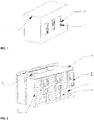
- the present disclosure provides a heat dissipation device of an energy storage system, as shown in FIG. 1 and FIG. 2 , the heat dissipation device includes a housing 1, at least one frame 4 is provided in the housing 1, the energy storage system is placed in the frame 4, a curved-surface guide plate 5 is provided on the top of the frame 4, at least one air conditioner 2 is hung outside the housing 1, a cold air outlet of each air conditioner 2 is connected to the curved-surface guide plate 5; a guide cavity is formed between a concave surface of the curved-surface guide plate 5 and the frame 4, a spreader plate 6 is provided in the guide cavity, and the spreader plate 6 is configured to adjust a flow direction of gas in the guide cavity.
- the heat dissipation device of an energy storage system has the characteristics such as a simple structure, strong adaptability, high heat dissipation efficiency, and good temperature uniformity of the energy storage module.
- the energy storage system includes at least one battery module, at least one battery compartment 7 penetrating through the frame 4 is provided in the frame 4, and the battery module is placed in the battery compartment 7.
- the battery compartments 7 are arranged in a matrix on the frame 4.
- the curved-surface guide plate 5 is provided along a long side of the frame 4, and the curved-surface guide plate 5 has a section in a fan shape.
- a central angle of the fan shape ranges 60 ° ⁇ 100 °.
- the central angle of the fan shape is 90 °.
- a ventilation baffle 9 is provided between the curved-surface guide plate 5 and the cold air outlet of the air conditioner 2, and the ventilation baffle 9 protrudes from an edge of the frame 4.
- the ventilation baffle 9 is provided with at least one cold air port 10 and at least one air vent 11, and the cold air outlet of the air conditioner 2 is connected to the cold air port 10.
- the cold air port 10 and the air vent 11 are provided alternately, an air vent sliding plate is movably provided at the air vent 11, and an opening degree of the air vent 11 is adjusted through sliding of the air vent sliding plate.
- the opening degree of the air vent 11 is controlled by providing the air vent sliding plate, so that the air volume of hot air entering the air vent 11 is adjusted.
- a distance between the frame 4 and a side wall of the housing 1 ranges 100 mm ⁇ 200 mm.
- a first end and a second end of the frame 4 are each provided with an air partition plate 8, and a hot air passage is formed between the housing 1, the air partition plate 8, and the ventilation baffle 9.
- the air partition plate 8 is provided with an air partition opening, and the air partition opening is provided close to a side of the top of the frame 4.
- An air partition opening sliding plate is movably provided at the air partition opening, and an opening degree of the air partition opening is adjusted through sliding of the air partition opening sliding plate.
- the air vent sliding plate and the air partition opening sliding plate are each provided with a transmission member, the transmission member of the air vent sliding plate is configured to drive the sliding of the air vent sliding plate, and the transmission member of the air partition opening sliding plate is configured to drive the sliding of the air partition opening sliding plate.
- the cold air is heated into hot air and enters the hot air passage, so that the hot air and the cold air form an "air partition" structure through the air partition plate 8, thereby reducing the backflow of the hot air, and discharging most of the hot air through the return air of the air conditioner 2.
- the air partition opening sliding plate By providing the air partition opening sliding plate, a proportion of backflow of the hot air is adjusted.
- a hot air outlet is provided on a side wall of the housing 1 located at the hot air passage.
- a return air fan 3 of the air conditioner is provided at each hot air outlet.
- the housing 1 includes two sets of symmetrically provided frames 4 therein, a cold air passage is formed between the two sets of frames 4, and opening sides of the two guide cavities are provided opposite to each other.
- a cold air passage is formed between the two sets of frames 4, and opening sides of the two guide cavities are provided opposite to each other.
- cold air in the guide cavities on the two sets of frames 4 is blown into the cold air passage between the two sets of frames 4, thus improving the distribution and convection of cold air, and improving a space utilization ratio and heat dissipation efficiency.
- the spreader plate 6 is obliquely provided in the guide cavity, and a plane where the spreader plate 6 is located is perpendicular to a top surface of the frame.
- a guide rail is provided on a side of the concave surface of the curved-surface guide plate 5, the guide rail is arranged along a length direction of the curved-surface guide plate 5, and the spreader plate 6 is slidably provided on the guide rail.
- a drive member is provided on the spreader plate 6, and the drive member is provided to drive the spreader plate 6 to slide along the guide rail.
- the spreader plate 6 is provided on the guide rail, the distribution of cold air is controlled by sliding and adjusting the spreader plate 6, and for a part with a higher temperature, the spreader plate 6 is used to increase the flow rate of the cold air in this part, thus improving the temperature uniformity of the energy storage module.
- At least one temperature sensor is uniformly provided on the frame 4, and the temperature sensor is configured to detect the temperature of the energy storage system.
- the heat dissipation device further includes a controller, and the controller is independently electrically connected to the temperature sensor, the drive member, the transmission member, and the air conditioner 2.
- the controller is configured to receive a feedback signal sent by the temperature sensor, and control rotation of the drive member, a refrigeration parameter of the air conditioner 2, and stretching of the transmission member according to the feedback signal.
- the refrigeration parameter of each air conditioner is used to adjust the air volume of the cold air and the temperature of the cold air of each air conditioner.
- the rotation speed of the return air fan of each air conditioner is adjusted by the air volume of the cold air of each air conditioner.
- the present disclosure provides a method for dissipating heat of an energy storage system by using the above heat dissipation device of an energy storage system, wherein the method includes the following steps.
- the air volume of cold air of each air conditioner ranges 1000 m 3 /h ⁇ 2000 m 3 /h, and the temperature of the cold air ranges 15 °C ⁇ 20 °C.
- the present embodiment provides a heat dissipation device of an energy storage system.
- a housing 1 includes two sets of symmetrically provided frames 4 therein, a cold air passage is formed between the two sets of frames 4, and opening sides of the two guide cavities are provided opposite to each other.
- Six air conditioners 2 are hung outside the housing 1, and one set of frame 4 corresponds to three air conditioners 2; the curved-surface guide plate has a section in a fan shape, and a central angle of the fan shape is 90 °; and a distance between the frame 4 and a side wall of the housing 1 is 150 mm.
- the present embodiment further provides a method for dissipating heat of an energy storage system by using the above heat dissipation device of an energy storage system, wherein the method includes the following steps.
- the air volume of cold air of each air conditioner is 1500 m 3 /h, and the temperature of the cold air is 18 °C.
- the present embodiment provides a heat dissipation device of an energy storage system. Based on the heat dissipation device of an energy storage system described in Embodiment 1, eight air conditioners 2 are hung outside the housing 1, and one set of frame 4 corresponds to four air conditioners 2; the curved-surface guide plate has a section in a fan shape, and a central angle of the fan shape is 60 °; and a distance between the frame 4 and a side wall of the housing 1 is 100 mm.
- the present embodiment further provides a method for dissipating heat of an energy storage system by using the above heat dissipation device of an energy storage system, wherein the method includes the following steps.
- the air volume of cold air of each air conditioner is 2000 m 3 /h, and the temperature of the cold air is 20 °C.
- the present embodiment provides a heat dissipation device of an energy storage system. Based on the heat dissipation device of an energy storage system described in Embodiment 1, four air conditioners 2 are hung outside the housing 1, and one set of frame 4 corresponds to two air conditioners 2; the curved-surface guide plate has a section in a fan shape, and a central angle of the fan shape is 100 °; and a distance between the frame 4 and a side wall of the housing 1 is 200 mm.
- the present embodiment further provides a method for dissipating heat of an energy storage system by using the above heat dissipation device of an energy storage system, wherein the method includes the following steps.
- the air volume of cold air of each air conditioner is 1000 m 3 /h, and the temperature of the cold air is 15 °C.
- the curved-surface guide plate 5 and the spreader plate 6 on the top of the frame 4, cold air of the air conditioner 2 enters from the top of the frame 4, and is reasonably distributed, then more cold air is distributed to places with a higher temperature, so that the temperature distribution of the energy storage system is uniform, then a good working environment is provided for the battery, and the service life of the energy storage system is extended.
- the heat dissipation device of an energy storage system has the characteristics such as simple structure, strong adaptability, high heat dissipation efficiency, and good temperature uniformity of the energy storage module.
Landscapes
- Engineering & Computer Science (AREA)
- Chemical & Material Sciences (AREA)
- Chemical Kinetics & Catalysis (AREA)
- Electrochemistry (AREA)
- General Chemical & Material Sciences (AREA)
- Manufacturing & Machinery (AREA)
- Automation & Control Theory (AREA)
- Cooling Or The Like Of Electrical Apparatus (AREA)
- Secondary Cells (AREA)
- Battery Mounting, Suspending (AREA)
Abstract
Description
- The present disclosure claims the priority to the
Chinese patent application with the filing No. 202110145288.1, filed on February 2, 2021 - The present disclosure belongs to the field of energy storage technologies, for example, relates to a heat dissipation device of an energy storage system and a heat dissipation method for an energy storage system.
- The container energy storage system mainly consists of a container type machine room, a battery pack, a battery management system (BMS), a power conversion system (PCS), an auxiliary control system, etc., wherein the auxiliary control system is mostly a temperature control system, a fire fighting system and the like. The container energy storage system has the advantages such as a small occupied area, convenient installation and transportation, short construction period, strong environment adaptability, and high intelligent degree. The container energy storage system can be used for scenes such as networking type microgrid, independent type microgrid, distributed power generation, and smart grid, and provides powerful support for realizing large-scale application of renewable energy sources such as wind and light. Meanwhile, the container energy storage system also can be used as a mobile emergency power supply.
- Due to complexity and uncertainty of actual working conditions, a plurality of single batteries in a working state inevitably have difference, so that it is quite hard to ensure consistency of working temperatures of the batteries. If the temperature difference between a plurality of batteries is increased, the performance and service life of battery module will be affected, and even potential safety hazards are caused.
-
CN109638379A discloses a reverse-flow-type double-air-channel cooling system for an energy storage module, wherein the system includes a box body, an air suction device, an energy storage module, and a heat dissipation device, the air suction device, the energy storage module, and the heat dissipation device are provided in the box body, and the energy storage module is provided on the heat dissipation device; the box body is provided with an air inlet and an air outlet, the energy storage module includes a plurality of single battery cells, a gap is formed between every two single battery cells, a first air channel for air to flow is formed in the gap, and the first air channel is in communication with the air inlet of the box body and the air outlet of the box body; a second air channel, with the air flowing in the direction opposite to that in the first air channel, is provided in the heat dissipation device, and the second air channel is in communication with the air inlet of the box body and the air outlet of the box body, and the reverse-flow-type double-air-channel cooling system is formed by the first air channel and the second air channel. This application has the characteristic of good temperature equalization effect by cooling the energy storage module by the reverse-flow-type double air channels, however, this cooling system cannot guarantee to carry out the temperature uniformity regulation and control to the battery cells in different operating conditions.CN109037542A discloses a mobile energy storage battery cabinet with good heat dissipation, wherein the battery cabinet includes a cabinet body, a base, and a liquid storage tank; the cabinet body is provided above the base, and a heat insulating plate is provided at a joint of the cabinet body and the base; the liquid storage tank is fixed to a lower part of the base; the cabinet body and a right side of the base are in communication with each other through a liquid inlet pipe, and the cabinet body and a left side of the base are in communication with each other through a liquid outlet pipe. In this application, a cooling liquid in the liquid storage tank is extracted by a pump body and sent into a plurality of cooling pipelines inside the cabinet body, heat inside the cabinet body is quickly absorbed by the aluminum-made cooling pipelines, and the heat is transferred to the cooling liquid flowing through the inside of the cooling pipelines, thereby realizing the quick cooling of the cabinet body, with high heat dissipation efficiency. The problem of poor battery temperature uniformity still exists in this battery cabinet. -
CN111029496A discloses an energy storage battery heat dissipation support capable of efficiently dissipating heat, wherein the heat dissipation support includes a support body, a forced ventilation module, a water-cooling heat dissipation chassis module, and a flow field control device module, the forced ventilation module includes at least one ventilation pipeline, an air inlet, and an air outlet, and one flow field control device module is connected in each ventilation pipeline; and the water-cooling heat dissipation chassis module is arranged at the bottom of the support body. Two cooling modes of air cooling and water cooling are integrated on the heat dissipation support, then the cooling effect is improved, the ventilation pipeline and the support body are integrated, an air channel does not need to be additionally arranged, but the structure of this heat dissipation support is complex. - The heat dissipation devices have the problems of complex structure, poor adaptability, poor battery temperature uniformity and so on, therefore, how to ensure that the temperature uniformity and adaptability of the batteries in the energy storage module are strong in the situation that the heat dissipation devices have a simple structure becomes a problem to be solved urgently.
- The present disclosure provides a heat dissipation device of an energy storage system and a heat dissipation method for an energy storage system, wherein by combining a curved-surface guide plate and a spreader plate (splitter plate), the distribution of cold air of an air conditioner is effectively adjusted, and the temperature uniformity of an energy storage module is ensured. The heat dissipation device of an energy storage system has the characteristics of a simple structure, strong adaptability, high heat dissipation efficiency and so on. The present disclosure provides a heat dissipation device of an energy storage system, wherein the heat dissipation device includes: a housing, wherein at least one frame is provided in the housing, the energy storage system is placed in the at least one frame, a curved-surface guide plate is provided on the top of the at least one frame, at least one air conditioner is hung outside the housing, a cold air outlet of each air conditioner is connected to the curved-surface guide plate; a guide cavity is formed between a concave surface of the curved-surface guide plate and the at least one frame, a spreader plate is provided in the guide cavity, and the spreader plate is configured to adjust a flow direction of gas in the guide cavity.
- Optionally, the energy storage system includes at least one battery module.
- Optionally, each frame is provided with at least one battery compartment penetrating through the each frame, and the battery module is placed in the battery compartment.
- Optionally, the at least one battery compartment provided on each frame is arranged in a matrix on the each frame.
- Optionally, the curved-surface guide plate is provided along a long side of the at least one frame.
- Optionally, the curved-surface guide plate has a section in a fan shape. Optionally, a central angle of the fan shape ranges 60 °∼100 °, for example, a central angle is 60 °, 65 °, 70 °, 75 °, 80 °, 85 °, 90 °, 95 °, or 100 °.
- Optionally, the central angle of the fan shape is 90 °.
- Optionally, a ventilation baffle is provided between the curved-surface guide plate and the cold air outlet of the at least one air conditioner, and the ventilation baffle protrudes from an edge of the at least one frame; and the ventilation baffle is provided with at least one cold air port and at least one air vent, and the cold air outlet of each air conditioner is connected to one cold air port.
- Optionally, the at least one cold air port and the at least one air vent are provided alternately.
- Optionally, an air vent sliding plate is movably provided at each air vent, and an opening degree of each air vent is adjusted through sliding of the air vent sliding plate.
- Optionally, a distance between the frame and a side wall of the housing ranges 100 mm∼200 mm, for example, the distance is 100 mm, 110 mm, 120 mm, 130 mm, 140 mm, 150 mm, 160 mm, 170 mm, 180 mm, 190 mm or 200 mm. Optionally, a first end and a second end of the at least one frame are each provided with an air partition plate, and a hot air passage is formed between the housing, the air partition plate, and the ventilation baffle.
- Optionally, the air partition plate is provided with an air partition opening. Optionally, the air partition opening is provided close to a side of the top of the at least one frame.
- Optionally, an air partition opening sliding plate is movably provided at the air partition opening, and an opening degree of the air partition opening is adjusted through sliding of the air partition opening sliding plate.
- Optionally, the air vent sliding plate and the air partition opening sliding plate are each provided with a transmission member, the transmission member of the air vent sliding plate is configured to drive the sliding of the air vent sliding plate, and the transmission member of the air partition opening sliding plate is configured to drive the sliding of the air partition opening sliding plate. Optionally, at least one hot air outlet is provided on a side wall of the housing located at the hot air passage.
- Optionally, a return air fan of the air conditioner is provided at each hot air outlet.
- Optionally, the at least one frame includes two sets of symmetrically provided frames, a cold air passage is formed between the two sets of frames, two curved-surface guide plates are provided, one curved-surface guide plate is provided on the top of each set of frame, a guide cavity is formed between a concave surface of the one curved-surface guide plate and each set of the frames, and opening sides of the two guide cavities are provided opposite to each other.
- Optionally, two spreader plates are provided, each guide cavity is provided therein with a spreader plate, and the spreader plate is obliquely provided in the each guide cavity.
- Optionally, a plane where each spreader plate is located is perpendicular to a top surface of the two sets of frames.
- Optionally, a guide rail is provided on a side of the concave surface of each curved-surface guide plate, the guide rail is arranged along a length direction of the each curved-surface guide plate, and the spreader plate in the guide cavity formed by the each curved-surface guide plate is slidably provided on the guide rail.
- Optionally, a drive member is provided on each spreader plate, and the drive member is provided to drive the each spreader plate to slide along the guide rail where the each spreader plate is located.
- Optionally, at least one temperature sensor is uniformly arranged on the at least one frame, and the at least one temperature sensor is configured to detect a temperature of the energy storage system; the heat dissipation device further includes a controller, the controller is independently electrically connected to each temperature sensor, the drive member, the transmission member, and each air conditioner, the controller is configured to receive a feedback signal sent by the at least one temperature sensor, and control rotation of the drive member, a refrigeration parameter of each air conditioner, and stretching of the transmission member according to the feedback signal, the refrigeration parameter of each air conditioner is used to adjust an air volume of cold air of and a temperature of the cold air of the each air conditioner, and a rotation speed of the return air fan of the each air conditioner is adjusted by the air volume of the cold air of the each air conditioner.
- The present disclosure provides a heat dissipation method for an energy storage system, using the above heat dissipation device of an energy storage system. The heat dissipation method includes a following step: cold air in at least one air conditioner, through the curved-surface guide plate, being blown into the housing, and the spreader plate adjusting a flow direction of the cold air to cool and dissipate heat for the energy storage system.
- Optionally, the step of cold air in at least one air conditioner, through the curved-surface guide plate, being blown into the housing, and the spreader plate adjusting a flow direction of the cold air to cool and dissipate heat for the energy storage system includes: cold air generated by at least one air conditioner, after being guided through the curved-surface guide plate and the spreader plate, being blown into the cold air passage to cool and dissipate heat for the energy storage system on the at least one frame, and the cold air, after exchanging heat with the energy storage system, entering the hot air passage and being discharged by the at least one return air fan; in a situation that at least one temperature sensor detects that the temperature of the energy storage system is higher than a first temperature threshold, the controller adjusting at least one air conditioner, to increase the air volume of cold air of the at least one air conditioner, lower the temperature of the cold air, and increase the rotation speed of the at least one return air fan; and in a situation that at least one temperature sensor detects that the temperature of the energy storage system is uneven, the controller controlling the drive member to drive the spreader plate to slide along the guide rail so as to adjust distribution of cold air.
- Optionally, the first temperature threshold ranges 55 °C∼65 °C, for example, the first temperature threshold is 55 °C, 56 °C, 57 °C, 58 °C, 59 °C, 60 °C, 61 °C, 62 °C, 63 °C, 64 °C or 65 °C.
- Optionally, the air volume of cold air of each air conditioner ranges 1000 m3/h∼2000 m3/h, for example, the air volume of cold air is 1000 m3/h, 1100 m3/h, 1200 m3/h, 1300 m3/h, 1400 m3/h, 1500 m3/h, 1600 m3/h, 1700 m3/h, 1800 m3/h, 1900 m3/h or 2000 m3/h.
- Optionally, the temperature of the cold air of each air conditioner ranges 15 °C∼20 °C, for example, the temperature is 15 °C, 16 °C, 17 °C, 18 °C, 19 °C or 20 °C.
- Optionally, the system refers to an apparatus system, a device system, or a production device.
- The numerical ranges described in the present disclosure not only include the above-exemplified point values, but also include any point values that are not exemplified between the above-mentioned numerical ranges, and due to the limitation of space and for the sake of brevity, the present disclosure will not exhaustively list the point values included in the stated ranges.
-
-
FIG. 1 is an appearance schematic view of a heat dissipation device of an energy storage system provided in a specific embodiment of the present disclosure; -
FIG. 2 is a structural schematic view inside a housing of the heat dissipation device of an energy storage system provided in a specific embodiment of the present disclosure; and -
FIG. 3 is a structural schematic view of a ventilation baffle provided in a specific embodiment of the present disclosure. - In the drawings, 1-housing; 2-air conditioner; 3-return air fan; 4-frame; 5-curved-surface guide plate; 6-spreader plate; 7-battery compartment; 8-air partition plate; 9-ventilation baffle; 10-cold air port; 11-air vent.
- In the description of the present disclosure, orientation or positional relations indicated by terms "center", "longitudinal", "horizontal", "upper", "lower", "front", "back", "left", "right", "vertical", "horizontal", "top", "bottom", "inner", "outer" and so on are based on orientation or positional relations as shown in the accompanying drawings, merely for facilitating the description of the present disclosure and simplifying the description, rather than indicating or implying that related devices or elements have to be in the specific orientation or configured and operated in a specific orientation, therefore, they should not be construed as limiting the present disclosure.
- In the description of the present disclosure, unless otherwise specified and defined explicitly, terms "provide", "join", and "connect" should be construed in a broad sense, for example, it may be a fixed connection, a detachable connection, or an integral connection; it may be a mechanical connection, and also may be an electrical connection; it may be a direct connection, an indirect connection through an intermediary, or inner communication between two elements. For those ordinarily skilled in the art, meanings of the above-mentioned terms in the present disclosure could be understood according to circumstances. The technical solutions of the present disclosure are described below through specific embodiments.
- In a specific embodiment, the present disclosure provides a heat dissipation device of an energy storage system, as shown in
FIG. 1 and FIG. 2 , the heat dissipation device includes ahousing 1, at least oneframe 4 is provided in thehousing 1, the energy storage system is placed in theframe 4, a curved-surface guide plate 5 is provided on the top of theframe 4, at least oneair conditioner 2 is hung outside thehousing 1, a cold air outlet of eachair conditioner 2 is connected to the curved-surface guide plate 5; a guide cavity is formed between a concave surface of the curved-surface guide plate 5 and theframe 4, aspreader plate 6 is provided in the guide cavity, and thespreader plate 6 is configured to adjust a flow direction of gas in the guide cavity. - In the present disclosure, by providing the curved-
surface guide plate 5 and thespreader plate 6 on the top of theframe 4, cold air of theair conditioner 2 enters from the top of theframe 4, and is reasonably distributed, then more cold air is distributed to places with a higher temperature, so that the temperature distribution of the whole energy storage system is uniform, then a good working environment is provided for the battery, and the service life of the energy storage system is extended. The heat dissipation device of an energy storage system has the characteristics such as a simple structure, strong adaptability, high heat dissipation efficiency, and good temperature uniformity of the energy storage module. - The energy storage system includes at least one battery module, at least one
battery compartment 7 penetrating through theframe 4 is provided in theframe 4, and the battery module is placed in thebattery compartment 7. The battery compartments 7 are arranged in a matrix on theframe 4. - The curved-
surface guide plate 5 is provided along a long side of theframe 4, and the curved-surface guide plate 5 has a section in a fan shape. A central angle of the fan shape ranges 60 °~100 °. Optionally, the central angle of the fan shape is 90 °. - A ventilation baffle 9 is provided between the curved-
surface guide plate 5 and the cold air outlet of theair conditioner 2, and the ventilation baffle 9 protrudes from an edge of theframe 4. - As shown in
FIG. 3 , the ventilation baffle 9 is provided with at least one cold air port 10 and at least oneair vent 11, and the cold air outlet of theair conditioner 2 is connected to the cold air port 10. The cold air port 10 and theair vent 11 are provided alternately, an air vent sliding plate is movably provided at theair vent 11, and an opening degree of theair vent 11 is adjusted through sliding of the air vent sliding plate. In the present disclosure, by providing theair vent 11, when the flow rate of cold air in theair conditioner 2 is insufficient, part of the hot air is mixed with cold air through theair vent 11, to supplement the air volume. The opening degree of theair vent 11 is controlled by providing the air vent sliding plate, so that the air volume of hot air entering theair vent 11 is adjusted. - A distance between the
frame 4 and a side wall of thehousing 1 ranges 100 mm∼200 mm. A first end and a second end of theframe 4 are each provided with an air partition plate 8, and a hot air passage is formed between thehousing 1, the air partition plate 8, and the ventilation baffle 9. The air partition plate 8 is provided with an air partition opening, and the air partition opening is provided close to a side of the top of theframe 4. An air partition opening sliding plate is movably provided at the air partition opening, and an opening degree of the air partition opening is adjusted through sliding of the air partition opening sliding plate. The air vent sliding plate and the air partition opening sliding plate are each provided with a transmission member, the transmission member of the air vent sliding plate is configured to drive the sliding of the air vent sliding plate, and the transmission member of the air partition opening sliding plate is configured to drive the sliding of the air partition opening sliding plate. - In the present disclosure, after the cold air conducts convective heat exchange for the energy storage system, the cold air is heated into hot air and enters the hot air passage, so that the hot air and the cold air form an "air partition" structure through the air partition plate 8, thereby reducing the backflow of the hot air, and discharging most of the hot air through the return air of the
air conditioner 2. By providing the air partition opening sliding plate, a proportion of backflow of the hot air is adjusted. - A hot air outlet is provided on a side wall of the
housing 1 located at the hot air passage. Areturn air fan 3 of the air conditioner is provided at each hot air outlet. - The
housing 1 includes two sets of symmetrically providedframes 4 therein, a cold air passage is formed between the two sets offrames 4, and opening sides of the two guide cavities are provided opposite to each other. In the present disclosure, by symmetrically providing the two sets offrames 4, and providing the opening sides of the two guide cavities opposite to each other, cold air in the guide cavities on the two sets offrames 4 is blown into the cold air passage between the two sets offrames 4, thus improving the distribution and convection of cold air, and improving a space utilization ratio and heat dissipation efficiency. - The
spreader plate 6 is obliquely provided in the guide cavity, and a plane where thespreader plate 6 is located is perpendicular to a top surface of the frame. A guide rail is provided on a side of the concave surface of the curved-surface guide plate 5, the guide rail is arranged along a length direction of the curved-surface guide plate 5, and thespreader plate 6 is slidably provided on the guide rail. A drive member is provided on thespreader plate 6, and the drive member is provided to drive thespreader plate 6 to slide along the guide rail. - In the present disclosure, the
spreader plate 6 is provided on the guide rail, the distribution of cold air is controlled by sliding and adjusting thespreader plate 6, and for a part with a higher temperature, thespreader plate 6 is used to increase the flow rate of the cold air in this part, thus improving the temperature uniformity of the energy storage module. - At least one temperature sensor is uniformly provided on the
frame 4, and the temperature sensor is configured to detect the temperature of the energy storage system. The heat dissipation device further includes a controller, and the controller is independently electrically connected to the temperature sensor, the drive member, the transmission member, and theair conditioner 2. The controller is configured to receive a feedback signal sent by the temperature sensor, and control rotation of the drive member, a refrigeration parameter of theair conditioner 2, and stretching of the transmission member according to the feedback signal. The refrigeration parameter of each air conditioner is used to adjust the air volume of the cold air and the temperature of the cold air of each air conditioner. The rotation speed of the return air fan of each air conditioner is adjusted by the air volume of the cold air of each air conditioner. In another specific embodiment, the present disclosure provides a method for dissipating heat of an energy storage system by using the above heat dissipation device of an energy storage system, wherein the method includes the following steps. - (I) Cold air generated by the
air conditioner 2, after being guided by the curved-surface guide plate 5 and thespreader plate 6, is blown into a cold air passage to cool and dissipate heat for the energy storage system on theframe 4, and the cold air, after exchanging heat with the energy storage system, enters the hot air passage and is discharged by thereturn air fan 3. - (II) When the temperature sensor detects that the temperature of the energy storage system is higher than a first temperature threshold, the controller adjusts the
air conditioner 2, to increase the air volume of cold air of theair conditioner 2, lower the temperature of the cold air, and increase the rotation speed of thereturn air fan 3; when the temperature sensor detects that the temperature of the energy storage system is uneven, the drive member is controlled by the controller to drive thespreader plate 6 to slide along the guide rail so as to adjust the distribution of cold air. The first temperature threshold ranges 55 °C∼65 °C. - The air volume of cold air of each air conditioner ranges 1000 m3/h∼2000 m3/h, and the temperature of the cold air ranges 15 °C∼20 °C.
- The present embodiment provides a heat dissipation device of an energy storage system. Based on the heat dissipation device of an energy storage system described in a specific embodiment, a
housing 1 includes two sets of symmetrically providedframes 4 therein, a cold air passage is formed between the two sets offrames 4, and opening sides of the two guide cavities are provided opposite to each other. Sixair conditioners 2 are hung outside thehousing 1, and one set offrame 4 corresponds to threeair conditioners 2; the curved-surface guide plate has a section in a fan shape, and a central angle of the fan shape is 90 °; and a distance between theframe 4 and a side wall of thehousing 1 is 150 mm. - The present embodiment further provides a method for dissipating heat of an energy storage system by using the above heat dissipation device of an energy storage system, wherein the method includes the following steps.
- (I) Cold air generated by the
air conditioner 2, after being guided by the curved-surface guide plate 5 and thespreader plate 6, is blown into a cold air passage to cool and dissipate heat for the energy storage system on theframe 4, and the cold air, after exchanging heat with the energy storage system, enters the hot air passage and is discharged by thereturn air fan 3. - (II) When the temperature sensor detects that the temperature of the energy storage system is higher than a first temperature threshold, the controller adjusts the
air conditioner 2, to increase the air volume of cold air of theair conditioner 2, lower the temperature of the cold air, and increase the rotation speed of thereturn air fan 3; when the temperature sensor detects that the temperature of the energy storage system is uneven, the drive member is controlled by the controller to drive thespreader plate 6 to slide along the guide rail so as to adjust the distribution of cold air. The first temperature threshold is 60 °C. - The air volume of cold air of each air conditioner is 1500 m3/h, and the temperature of the cold air is 18 °C.
- The present embodiment provides a heat dissipation device of an energy storage system. Based on the heat dissipation device of an energy storage system described in
Embodiment 1, eightair conditioners 2 are hung outside thehousing 1, and one set offrame 4 corresponds to fourair conditioners 2; the curved-surface guide plate has a section in a fan shape, and a central angle of the fan shape is 60 °; and a distance between theframe 4 and a side wall of thehousing 1 is 100 mm. - The present embodiment further provides a method for dissipating heat of an energy storage system by using the above heat dissipation device of an energy storage system, wherein the method includes the following steps.
- (I) Cold air generated by the
air conditioner 2, after being guided by the curved-surface guide plate 5 and thespreader plate 6, is blown into a cold air passage to cool and dissipate heat for the energy storage system on theframe 4, and the cold air, after exchanging heat with the energy storage system, enters the hot air passage and is discharged by thereturn air fan 3. - (II) When the temperature sensor detects that the temperature of the energy storage system is higher than a first temperature threshold, the controller adjusts the
air conditioner 2, to increase the air volume of cold air of theair conditioner 2, lower the temperature of the cold air, and increase the rotation speed of thereturn air fan 3; when the temperature sensor detects that the temperature of the energy storage system is uneven, the drive member is controlled by the controller to drive thespreader plate 6 to slide along the guide rail so as to adjust the distribution of cold air. The first temperature threshold is 65 °C. - The air volume of cold air of each air conditioner is 2000 m3/h, and the temperature of the cold air is 20 °C.
- The present embodiment provides a heat dissipation device of an energy storage system. Based on the heat dissipation device of an energy storage system described in
Embodiment 1, fourair conditioners 2 are hung outside thehousing 1, and one set offrame 4 corresponds to twoair conditioners 2; the curved-surface guide plate has a section in a fan shape, and a central angle of the fan shape is 100 °; and a distance between theframe 4 and a side wall of thehousing 1 is 200 mm. - The present embodiment further provides a method for dissipating heat of an energy storage system by using the above heat dissipation device of an energy storage system, wherein the method includes the following steps.
- (I) Cold air generated by the
air conditioner 2, after being guided by the curved-surface guide plate 5 and thespreader plate 6, is blown into a cold air passage to cool and dissipate heat for the energy storage system on theframe 4, and the cold air, after exchanging heat with the energy storage system, enters the hot air passage and is discharged by thereturn air fan 3. - (II) When the temperature sensor detects that the temperature of the energy storage system is higher than a first temperature threshold, the controller adjusts the
air conditioner 2, to increase the air volume of cold air of theair conditioner 2, lower the temperature of the cold air, and increase the rotation speed of thereturn air fan 3; when the temperature sensor detects that the temperature of the energy storage system is uneven, the drive member is controlled by the controller to drive thespreader plate 6 to slide along the guide rail so as to adjust the distribution of cold air. The first temperature threshold is 55 °C. - The air volume of cold air of each air conditioner is 1000 m3/h, and the temperature of the cold air is 15 °C.
- In the present disclosure, by providing the curved-
surface guide plate 5 and thespreader plate 6 on the top of theframe 4, cold air of theair conditioner 2 enters from the top of theframe 4, and is reasonably distributed, then more cold air is distributed to places with a higher temperature, so that the temperature distribution of the energy storage system is uniform, then a good working environment is provided for the battery, and the service life of the energy storage system is extended. The heat dissipation device of an energy storage system has the characteristics such as simple structure, strong adaptability, high heat dissipation efficiency, and good temperature uniformity of the energy storage module.
Claims (32)
- A heat dissipation device of an energy storage system, characterized by comprising: a housing, wherein at least one frame is provided in the housing, the energy storage system is placed in the at least one frame, a curved-surface guide plate is provided on a top of the at least one frame, at least one air conditioner is hung outside the housing, a cold air outlet of each air conditioner is connected to the curved-surface guide plate; and
a guide cavity is formed between a concave surface of the curved-surface guide plate and the at least one frame, a spreader plate is provided in the guide cavity, and the spreader plate is configured to adjust a flow direction of gas in the guide cavity. - The heat dissipation device according to claim 1, wherein the energy storage system comprises at least one battery module.
- The heat dissipation device according to claim 2, wherein each frame is provided with at least one battery compartment penetrating through the each frame, and the at least one battery compartment is provided to accommodate the at least one battery module.
- The heat dissipation device according to claim 3, wherein the at least one battery compartment provided on each frame is arranged in a matrix on the each frame.
- The heat dissipation device according to claim 2, wherein the curved-surface guide plate is provided along a long side of the at least one frame.
- The heat dissipation device according to claim 5, wherein the curved-surface guide plate has a section in a fan shape.
- The heat dissipation device according to claim 6, wherein a central angle of the fan shape ranges 60 °∼100 °.
- The heat dissipation device according to claim 6, wherein a central angle of the fan shape is 90 °.
- The heat dissipation device according to any one of claims 1-8, wherein a ventilation baffle is provided between the curved-surface guide plate and the cold air outlet of the at least one air conditioner, wherein the ventilation baffle protrudes from an edge of the at least one frame; and
the ventilation baffle is provided with at least one cold air port and at least one air vent, and the cold air outlet of each air conditioner is connected to one cold air port. - The heat dissipation device according to claim 9, wherein the at least one cold air port and the at least one air vent are provided alternately.
- The heat dissipation device according to claim 9, wherein an air vent sliding plate is movably provided at each air vent, and an opening degree of the each air vent is adjusted through sliding of the air vent sliding plate.
- The heat dissipation device according to claim 11, wherein a distance between each frame and a side wall of the housing ranges 100 mm∼200 mm.
- The heat dissipation device according to claim 12, wherein a first end and a second end of the at least one frame are each provided with an air partition plate, and a hot air passage is formed between the housing, the air partition plate, and the ventilation baffle.
- The heat dissipation device according to claim 13, wherein the air partition plate is provided with an air partition opening.
- The heat dissipation device according to claim 14, wherein the air partition opening is provided close to a side of the top of the at least one frame.
- The heat dissipation device according to claim 14, wherein an air partition opening sliding plate is movably provided at the air partition opening, and an opening degree of the air partition opening is adjusted through sliding of the air partition opening sliding plate.
- The heat dissipation device according to claim 16, wherein the air vent sliding plate and the air partition opening sliding plate are each provided with a transmission member, the transmission member of the air vent sliding plate is configured to drive the sliding of the air vent sliding plate, and the transmission member of the air partition opening sliding plate is configured to drive the sliding of the air partition opening sliding plate.
- The heat dissipation device according to any one of claims 12-17, wherein at least one hot air outlet is provided on a side wall of the housing located at the hot air passage.
- The heat dissipation device according to claim 18, wherein a return air fan of the air conditioner is provided at each hot air outlet.
- The heat dissipation device according to any one of claims 1-19, wherein the at least one frame comprises two sets of frames symmetrically provided, a cold air passage is formed between the two sets of frames, two curved-surface guide plates are provided, one curved-surface guide plate is provided on a top of each set of frame, a guide cavity is formed between a concave surface of the one curved-surface guide plate and the each set of frame, and opening sides of two guide cavities are provided opposite to each other.
- The heat dissipation device according to claim 20, wherein two spreader plates are provided, each guide cavity is provided therein with one spreader plate, and the one spreader plate is obliquely provided in the each guide cavity.
- The heat dissipation device according to claim 21, wherein a plane where each spreader plate is located is perpendicular to a top surface of the two sets of frames.
- The heat dissipation device according to claim 21, wherein a guide rail is provided on a side of the concave surface of each curved-surface guide plate, wherein the guide rail is arranged along a length direction of the each curved-surface guide plate, and the spreader plate in the guide cavity formed by the each curved-surface guide plate is slidably provided on the guide rail.
- The heat dissipation device according to claim 23, wherein a drive member is provided on each spreader plate, and the drive member is provided to drive the each spreader plate to slide along the guide rail where the each spreader plate is located.
- The heat dissipation device according to claim 17, wherein at least one hot air outlet is provided on a side wall of the housing located at the hot air passage; one return air fan of the air conditioner is provided at each hot air outlet;the at least one frame comprises two sets of frames symmetrically provided, a cold air passage is formed between the two sets of frames, two curved-surface guide plates are provided, one curved-surface guide plate is provided on a top of each set of frame, a guide cavity is formed between a concave surface of the one curved-surface guide plate and the each set of frame, and opening sides of two guide cavities are provided opposite to each other; two spreader plates are provided, each guide cavity is provided therein with one spreader plate, and the one spreader plate is obliquely provided in the each guide cavity; a guide rail is provided on a side of the concave surface of each curved-surface guide plate, the guide rail is arranged along a length direction of the each curved-surface guide plate, and the spreader plate in the guide cavity formed by the each curved-surface guide plate is slidably provided on the guide rail; a drive member is provided on each spreader plate, and the drive member is provided to drive the each spreader plate to slide along the guide rail where the each spreader plate is located;at least one temperature sensor is uniformly arranged on the at least one frame, and the at least one temperature sensor is configured to detect a temperature of the energy storage system; andthe heat dissipation device further comprises a controller, the controller is independently electrically connected to each temperature sensor, the drive member, the transmission member, and each air conditioner, the controller is configured to receive a feedback signal sent by the at least one temperature sensor, and control rotation of the drive member, a refrigeration parameter of each air conditioner, and stretching of the transmission member according to the feedback signal, wherein the refrigeration parameter of each air conditioner is used to adjust an air volume of cold air and a temperature of the cold air of the each air conditioner, and a rotation speed of the return air fan of the each air conditioner is adjusted by the air volume of the cold air of the each air conditioner.
- A heat dissipation method for an energy storage system, characterized by using the heat dissipation device of an energy storage system according to any one of claims 1-25, comprising a following step:
cold air in the at least one air conditioner, through the curved-surface guide plate, being blown into the housing, and the spreader plate adjusting a flow direction of the cold air to cool and dissipate heat for the energy storage system. - The heat dissipation method according to claim 26, wherein the step of cold air in the at least one air conditioner, through the curved-surface guide plate, being blown into the housing, and the spreader plate adjusting a flow direction of the cold air to cool and dissipate heat for the energy storage system comprises:blowing, the cold air generated by the at least one air conditioner, after being guided by the curved-surface guide plate and the spreader plate, into the cold air passage to cool and dissipate heat for the energy storage system on the at least one frame, and making the cold air, after exchanging heat with the energy storage system, enter the hot air passage and discharged by at least one return air fan; andthe controller adjusting at least one air conditioner, to increase the air volume of the cold air of the at least one air conditioner, lower a temperature of the cold air, and increase a rotation speed of the at least one return air fan, in a situation that the at least one temperature sensor detects that a temperature of the energy storage system is higher than a first temperature threshold; and the controller controlling the drive member to drive the spreader plate to slide along the guide rail so as to adjust distribution of the cold air, in a situation that the at least one temperature sensor detects that a temperature of the energy storage system is uneven.
- The heat dissipation method according to claim 27, wherein the first temperature threshold ranges 55 °C∼65 °C.
- The heat dissipation method according to claim 27, wherein the first temperature threshold ranges 45 °C∼55 °C.
- The method according to claim 28, wherein an air volume of cold air of each air conditioner ranges 1000 m3/h∼2000 m3/h.
- The method according to claim 28, wherein an air volume of cold air of each air conditioner ranges 500 m3/h∼7000 m3/h.
- The method according to claim 28, wherein a temperature of cold air of each air conditioner ranges 15 °C∼20 °C.
Applications Claiming Priority (2)
| Application Number | Priority Date | Filing Date | Title |
|---|---|---|---|
| CN202110145288.1A CN112968245B (en) | 2021-02-02 | 2021-02-02 | Energy storage system heat dissipation device and heat dissipation method thereof |
| PCT/CN2021/108549 WO2022166130A1 (en) | 2021-02-02 | 2021-07-27 | Heat dissipation device for energy storage system, and heat dissipation method for energy storage system |
Publications (2)
| Publication Number | Publication Date |
|---|---|
| EP4068483A1 true EP4068483A1 (en) | 2022-10-05 |
| EP4068483A4 EP4068483A4 (en) | 2023-10-18 |
Family
ID=76272411
Family Applications (1)
| Application Number | Title | Priority Date | Filing Date |
|---|---|---|---|
| EP21830311.3A Pending EP4068483A4 (en) | 2021-02-02 | 2021-07-27 | HEAT DISSIPATION DEVICE FOR ENERGY STORAGE AND METHOD FOR HEAT DISSIPATION FOR ENERGY STORAGE |
Country Status (6)
| Country | Link |
|---|---|
| US (1) | US12218333B2 (en) |
| EP (1) | EP4068483A4 (en) |
| JP (1) | JP7402901B2 (en) |
| CN (1) | CN112968245B (en) |
| AU (1) | AU2021310843B2 (en) |
| WO (1) | WO2022166130A1 (en) |
Families Citing this family (14)
| Publication number | Priority date | Publication date | Assignee | Title |
|---|---|---|---|---|
| KR102765089B1 (en) * | 2020-01-03 | 2025-02-06 | 주식회사 엘지에너지솔루션 | Energy Storage Apparatus and Energy Storage System |
| CN111712114B (en) * | 2020-07-09 | 2025-07-01 | 上海工程技术大学 | A cyclone heat dissipation device for container energy storage system |
| CN112968245B (en) * | 2021-02-02 | 2023-02-03 | 上海派能能源科技股份有限公司 | Energy storage system heat dissipation device and heat dissipation method thereof |
| CN113506938A (en) * | 2021-07-02 | 2021-10-15 | 华氢能源动力科技(江苏)有限公司 | Smart microgrid robust control method and device with distributed cloud energy storage system |
| CN115692912A (en) * | 2021-07-30 | 2023-02-03 | 华为数字能源技术有限公司 | energy storage device |
| CN114039124A (en) * | 2021-11-09 | 2022-02-11 | 镇江市高等专科学校 | Power battery multistage heat dissipation system based on magnetic refrigeration effect and control method |
| CN114592134A (en) * | 2022-03-09 | 2022-06-07 | 河南龙佰智能装备制造有限公司 | Air cooling device for large cover of titanium sponge I-type reactor |
| CN114639898B (en) * | 2022-03-25 | 2022-12-23 | 南通国轩新能源科技有限公司 | Lithium ion battery energy storage cabin distributed intelligent temperature control system |
| CN116826249B (en) * | 2023-08-28 | 2023-10-31 | 江苏果下科技有限公司 | Air-cooled battery outdoor cabinet and application method thereof |
| CN117239300B (en) * | 2023-11-16 | 2024-01-26 | 山东省环能设计院股份有限公司 | High-efficient energy memory of quick radiating |
| CN117293471B (en) * | 2023-11-23 | 2024-02-20 | 珠海科创储能科技有限公司 | Movable energy storage container heat abstractor |
| CN117742409B (en) * | 2023-12-21 | 2024-12-27 | 河南金数智能科技股份有限公司 | Data processing method and system based on industrial Internet |
| CN117497909B (en) * | 2023-12-31 | 2024-03-29 | 常州博瑞电力自动化设备有限公司 | Air-cooled energy storage equipment |
| CN118367684B (en) * | 2024-03-20 | 2025-02-11 | 清安储能技术(重庆)有限公司 | An electrical cabin and a liquid-cooled energy storage cabinet |
Family Cites Families (28)
| Publication number | Priority date | Publication date | Assignee | Title |
|---|---|---|---|---|
| JP3830243B2 (en) * | 1997-10-06 | 2006-10-04 | トヨタ自動車株式会社 | Battery power supply |
| JP3973147B2 (en) * | 2002-07-09 | 2007-09-12 | 本田技研工業株式会社 | Cooling device layout |
| WO2011040130A1 (en) * | 2009-09-30 | 2011-04-07 | 株式会社 日立製作所 | Electrical storage module |
| WO2011130227A2 (en) * | 2010-04-16 | 2011-10-20 | Coda Automotive, Inc. | Battery temperature control |
| TWI459893B (en) * | 2012-01-20 | 2014-11-01 | Delta Electronics Inc | Cabinet system and air-exhausting equipment thereof |
| CN202997004U (en) * | 2012-11-27 | 2013-06-12 | 比亚迪股份有限公司 | Heat dissipation system of movable energy storage power station |
| JP6168908B2 (en) * | 2013-08-12 | 2017-07-26 | 株式会社東芝 | Heating element storage device |
| JP6121856B2 (en) * | 2013-09-20 | 2017-04-26 | 三菱重工業株式会社 | Power storage device |
| JP6260625B2 (en) * | 2013-12-11 | 2018-01-17 | 日立化成株式会社 | Power storage device |
| CN204651716U (en) * | 2015-02-28 | 2015-09-16 | 中兴通讯股份有限公司 | A kind of outdoor power cabinet and outdoor power system system |
| US20180062230A1 (en) * | 2016-08-31 | 2018-03-01 | General Electric Company | Airflow cooling for an energy storage system |
| CN206976530U (en) * | 2017-06-27 | 2018-02-06 | 深圳拓邦新能源技术有限公司 | A kind of battery energy storage container |
| CN109148999A (en) * | 2017-12-25 | 2019-01-04 | 北京海博思创科技有限公司 | Battery thermal management system and energy storage container |
| JP7068053B2 (en) * | 2018-06-04 | 2022-05-16 | 株式会社東芝 | Cooling system |
| KR102115484B1 (en) * | 2018-07-19 | 2020-05-26 | (주)에코파워텍 | An ESS Housing Being Capable of Cooling Effectively and Module Type Air Conditioning System Having the Same |
| CN109037542A (en) | 2018-09-29 | 2018-12-18 | 山东天瀚新能源科技有限公司 | A kind of mobile energy-storage battery cabinet of excellent heat radiation performance |
| CN109638379B (en) | 2018-11-19 | 2023-12-08 | 浙江南都电源动力股份有限公司 | Counter-flow type double-air-duct cooling system for energy storage module |
| CN109742482B (en) * | 2019-01-08 | 2024-02-02 | 西南交通大学 | A tram energy storage thermal management system and method |
| JP6936923B2 (en) * | 2019-03-14 | 2021-09-22 | 日本碍子株式会社 | Battery container |
| CN111029496B (en) | 2019-11-20 | 2022-04-22 | 江苏科技大学 | Energy storage battery heat dissipation support capable of efficiently dissipating heat |
| TWM592865U (en) * | 2019-11-29 | 2020-04-01 | 台達電子工業股份有限公司 | Container energy storage system |
| CN211350908U (en) * | 2020-03-04 | 2020-08-25 | 湘投云储科技有限公司 | Air duct structure for energy storage container and energy storage container |
| CN211605363U (en) * | 2020-03-05 | 2020-09-29 | 北京海博思创科技股份有限公司 | Air supply and energy storage containers |
| CN211980696U (en) * | 2020-05-06 | 2020-11-20 | 湖北亿纬动力有限公司 | A battery storage container |
| CN211789385U (en) * | 2020-05-13 | 2020-10-27 | 中国电建集团福建省电力勘测设计院有限公司 | Novel automatic uniform heat dissipation control device for battery cabinet |
| CN212366085U (en) * | 2020-06-02 | 2021-01-15 | 桑顿新能源科技有限公司 | Heat dissipation air duct and energy storage container heat dissipation system |
| CN111697287A (en) * | 2020-06-10 | 2020-09-22 | 广州智光电气技术有限公司 | Container type energy storage system |
| CN112968245B (en) * | 2021-02-02 | 2023-02-03 | 上海派能能源科技股份有限公司 | Energy storage system heat dissipation device and heat dissipation method thereof |
-
2021
- 2021-02-02 CN CN202110145288.1A patent/CN112968245B/en active Active
- 2021-07-27 WO PCT/CN2021/108549 patent/WO2022166130A1/en not_active Ceased
- 2021-07-27 JP JP2021578228A patent/JP7402901B2/en active Active
- 2021-07-27 US US17/625,773 patent/US12218333B2/en active Active
- 2021-07-27 EP EP21830311.3A patent/EP4068483A4/en active Pending
- 2021-07-27 AU AU2021310843A patent/AU2021310843B2/en active Active
Also Published As
| Publication number | Publication date |
|---|---|
| US20230352772A1 (en) | 2023-11-02 |
| US12218333B2 (en) | 2025-02-04 |
| JP7402901B2 (en) | 2023-12-21 |
| JP2023516518A (en) | 2023-04-20 |
| WO2022166130A1 (en) | 2022-08-11 |
| CN112968245A (en) | 2021-06-15 |
| EP4068483A4 (en) | 2023-10-18 |
| CN112968245B (en) | 2023-02-03 |
| AU2021310843B2 (en) | 2023-06-15 |
| AU2021310843A1 (en) | 2022-08-18 |
Similar Documents
| Publication | Publication Date | Title |
|---|---|---|
| US12218333B2 (en) | Heat dissipation device of energy storage system and heat dissipation method for energy storage system | |
| CN210778888U (en) | Hybrid heat dissipation battery module | |
| WO2019001062A1 (en) | Battery energy storage container | |
| CN212161902U (en) | Small-size energy storage battery cabinet | |
| CN110621146B (en) | Cabinet is concentrated to outdoor BBU | |
| CN209947998U (en) | Energy storage container with better heat dissipation effect | |
| CN112616294A (en) | Machine cabinet | |
| CN113161659B (en) | Portable movable energy storage box | |
| CN217691343U (en) | Air duct for energy storage container and energy storage container | |
| CN217239575U (en) | Energy storage container | |
| CN114069090B (en) | Mobile energy storage container heat dissipation device and mobile energy storage container | |
| CN215647929U (en) | Cooling device and cluster router | |
| CN213694638U (en) | A cabinet cooling system and machine room | |
| CN215377536U (en) | Energy storage battery system | |
| CN114513941A (en) | Container machine room air return system and method | |
| CN219959154U (en) | Battery rack and air-cooled battery system | |
| CN220021274U (en) | Energy storage container easy to radiate | |
| CN217349191U (en) | Energy storage container | |
| CN216123416U (en) | Split-flow heat dissipation machine cabinet | |
| CN211607219U (en) | Outdoor integrated intelligent computer room for 5G base station | |
| CN212910519U (en) | 5G base station control by temperature change cabinet-type air conditioner integrated device | |
| CN217848080U (en) | Distributed overhead air conditioner heat dissipation structure for container energy storage system | |
| CN218241983U (en) | A battery pack and battery energy storage system | |
| CN220914378U (en) | Cold and hot integrated temperature control partition wall | |
| CN223206347U (en) | Constant temperature energy storage prefabricated cabin |
Legal Events
| Date | Code | Title | Description |
|---|---|---|---|
| STAA | Information on the status of an ep patent application or granted ep patent |
Free format text: STATUS: UNKNOWN |
|
| STAA | Information on the status of an ep patent application or granted ep patent |
Free format text: STATUS: THE INTERNATIONAL PUBLICATION HAS BEEN MADE |
|
| PUAI | Public reference made under article 153(3) epc to a published international application that has entered the european phase |
Free format text: ORIGINAL CODE: 0009012 |
|
| STAA | Information on the status of an ep patent application or granted ep patent |
Free format text: STATUS: REQUEST FOR EXAMINATION WAS MADE |
|
| 17P | Request for examination filed |
Effective date: 20220103 |
|
| AK | Designated contracting states |
Kind code of ref document: A1 Designated state(s): AL AT BE BG CH CY CZ DE DK EE ES FI FR GB GR HR HU IE IS IT LI LT LU LV MC MK MT NL NO PL PT RO RS SE SI SK SM TR |
|
| STAA | Information on the status of an ep patent application or granted ep patent |
Free format text: STATUS: EXAMINATION IS IN PROGRESS |
|
| A4 | Supplementary search report drawn up and despatched |
Effective date: 20230914 |
|
| RIC1 | Information provided on ipc code assigned before grant |
Ipc: H01M 50/204 20210101ALI20230908BHEP Ipc: H01M 10/663 20140101ALI20230908BHEP Ipc: H01M 10/6566 20140101ALI20230908BHEP Ipc: H01M 10/613 20140101ALI20230908BHEP Ipc: H01M 10/6563 20140101ALI20230908BHEP Ipc: H01M 10/63 20140101ALI20230908BHEP Ipc: H01M 50/244 20210101AFI20230908BHEP |
|
| 17Q | First examination report despatched |
Effective date: 20230926 |
|
| DAV | Request for validation of the european patent (deleted) | ||
| DAX | Request for extension of the european patent (deleted) |