EP4067406A1 - Cyclic olefin polymer, method for producing same, and optical element - Google Patents
Cyclic olefin polymer, method for producing same, and optical element Download PDFInfo
- Publication number
- EP4067406A1 EP4067406A1 EP20893285.5A EP20893285A EP4067406A1 EP 4067406 A1 EP4067406 A1 EP 4067406A1 EP 20893285 A EP20893285 A EP 20893285A EP 4067406 A1 EP4067406 A1 EP 4067406A1
- Authority
- EP
- European Patent Office
- Prior art keywords
- group
- polymer
- atom
- compound
- norbornene
- Prior art date
- Legal status (The legal status is an assumption and is not a legal conclusion. Google has not performed a legal analysis and makes no representation as to the accuracy of the status listed.)
- Pending
Links
- 229920000089 Cyclic olefin copolymer Polymers 0.000 title claims abstract description 96
- 230000003287 optical effect Effects 0.000 title claims abstract description 23
- 238000004519 manufacturing process Methods 0.000 title claims description 19
- 229920000642 polymer Polymers 0.000 claims abstract description 86
- 125000001624 naphthyl group Chemical group 0.000 claims abstract description 51
- 150000001334 alicyclic compounds Chemical class 0.000 claims abstract description 37
- 238000000034 method Methods 0.000 claims abstract description 19
- 239000000178 monomer Substances 0.000 claims description 152
- JFNLZVQOOSMTJK-KNVOCYPGSA-N norbornene Chemical compound C1[C@@H]2CC[C@H]1C=C2 JFNLZVQOOSMTJK-KNVOCYPGSA-N 0.000 claims description 98
- 150000001875 compounds Chemical class 0.000 claims description 67
- 238000006116 polymerization reaction Methods 0.000 claims description 63
- -1 transition metal imide Chemical class 0.000 claims description 42
- 125000001424 substituent group Chemical group 0.000 claims description 29
- OKTJSMMVPCPJKN-UHFFFAOYSA-N Carbon Chemical compound [C] OKTJSMMVPCPJKN-UHFFFAOYSA-N 0.000 claims description 23
- 229910052799 carbon Inorganic materials 0.000 claims description 23
- 125000000217 alkyl group Chemical group 0.000 claims description 22
- 229910052723 transition metal Inorganic materials 0.000 claims description 20
- 125000005843 halogen group Chemical group 0.000 claims description 18
- 125000003118 aryl group Chemical group 0.000 claims description 17
- 229910052757 nitrogen Inorganic materials 0.000 claims description 17
- 125000004435 hydrogen atom Chemical group [H]* 0.000 claims description 16
- 125000004433 nitrogen atom Chemical group N* 0.000 claims description 16
- 125000004430 oxygen atom Chemical group O* 0.000 claims description 16
- 125000001997 phenyl group Chemical group [H]C1=C([H])C([H])=C(*)C([H])=C1[H] 0.000 claims description 16
- XUIMIQQOPSSXEZ-UHFFFAOYSA-N Silicon Chemical group [Si] XUIMIQQOPSSXEZ-UHFFFAOYSA-N 0.000 claims description 12
- 229910052710 silicon Inorganic materials 0.000 claims description 12
- 229910052751 metal Inorganic materials 0.000 claims description 11
- 239000002184 metal Substances 0.000 claims description 11
- 239000002685 polymerization catalyst Substances 0.000 claims description 9
- 125000005647 linker group Chemical group 0.000 claims description 7
- 238000005649 metathesis reaction Methods 0.000 claims description 7
- 125000003342 alkenyl group Chemical group 0.000 claims description 5
- 230000000737 periodic effect Effects 0.000 claims description 5
- 229910052717 sulfur Inorganic materials 0.000 claims description 5
- 125000004434 sulfur atom Chemical group 0.000 claims description 5
- 125000005103 alkyl silyl group Chemical group 0.000 claims description 4
- 125000003710 aryl alkyl group Chemical group 0.000 claims description 4
- 125000004429 atom Chemical group 0.000 claims description 4
- 239000003446 ligand Substances 0.000 claims description 4
- 230000007935 neutral effect Effects 0.000 claims description 4
- 125000000962 organic group Chemical group 0.000 claims description 4
- 150000003624 transition metals Chemical group 0.000 claims description 4
- 125000001183 hydrocarbyl group Chemical group 0.000 claims 7
- 238000005984 hydrogenation reaction Methods 0.000 description 30
- 239000000047 product Substances 0.000 description 27
- 238000007151 ring opening polymerisation reaction Methods 0.000 description 27
- 238000006243 chemical reaction Methods 0.000 description 26
- 239000000203 mixture Substances 0.000 description 22
- WYURNTSHIVDZCO-UHFFFAOYSA-N Tetrahydrofuran Chemical compound C1CCOC1 WYURNTSHIVDZCO-UHFFFAOYSA-N 0.000 description 18
- 239000000126 substance Substances 0.000 description 17
- 150000002430 hydrocarbons Chemical group 0.000 description 15
- 238000005259 measurement Methods 0.000 description 15
- XBFJAVXCNXDMBH-UHFFFAOYSA-N tetracyclo[6.2.1.1(3,6).0(2,7)]dodec-4-ene Chemical compound C1C(C23)C=CC1C3C1CC2CC1 XBFJAVXCNXDMBH-UHFFFAOYSA-N 0.000 description 15
- KDLHZDBZIXYQEI-UHFFFAOYSA-N Palladium Chemical compound [Pd] KDLHZDBZIXYQEI-UHFFFAOYSA-N 0.000 description 14
- 238000012644 addition polymerization Methods 0.000 description 14
- 239000003054 catalyst Substances 0.000 description 14
- 239000012986 chain transfer agent Substances 0.000 description 14
- RTZKZFJDLAIYFH-UHFFFAOYSA-N ether Substances CCOCC RTZKZFJDLAIYFH-UHFFFAOYSA-N 0.000 description 14
- 239000003960 organic solvent Substances 0.000 description 13
- 239000000243 solution Substances 0.000 description 13
- 239000002904 solvent Substances 0.000 description 13
- 230000009477 glass transition Effects 0.000 description 11
- 239000000463 material Substances 0.000 description 10
- XEKOWRVHYACXOJ-UHFFFAOYSA-N Ethyl acetate Chemical compound CCOC(C)=O XEKOWRVHYACXOJ-UHFFFAOYSA-N 0.000 description 9
- ZMXDDKWLCZADIW-UHFFFAOYSA-N N,N-Dimethylformamide Chemical compound CN(C)C=O ZMXDDKWLCZADIW-UHFFFAOYSA-N 0.000 description 9
- 239000012190 activator Substances 0.000 description 9
- 229920001577 copolymer Polymers 0.000 description 9
- 239000007788 liquid Substances 0.000 description 9
- VLKZOEOYAKHREP-UHFFFAOYSA-N n-Hexane Chemical compound CCCCCC VLKZOEOYAKHREP-UHFFFAOYSA-N 0.000 description 9
- YLQBMQCUIZJEEH-UHFFFAOYSA-N tetrahydrofuran Natural products C=1C=COC=1 YLQBMQCUIZJEEH-UHFFFAOYSA-N 0.000 description 9
- LIKMAJRDDDTEIG-UHFFFAOYSA-N 1-hexene Chemical compound CCCCC=C LIKMAJRDDDTEIG-UHFFFAOYSA-N 0.000 description 8
- 125000003518 norbornenyl group Chemical group C12(C=CC(CC1)C2)* 0.000 description 8
- RIOQSEWOXXDEQQ-UHFFFAOYSA-N triphenylphosphine Chemical compound C1=CC=CC=C1P(C=1C=CC=CC=1)C1=CC=CC=C1 RIOQSEWOXXDEQQ-UHFFFAOYSA-N 0.000 description 8
- 125000001622 2-naphthyl group Chemical group [H]C1=C([H])C([H])=C2C([H])=C(*)C([H])=C([H])C2=C1[H] 0.000 description 7
- KFZMGEQAYNKOFK-UHFFFAOYSA-N Isopropanol Chemical compound CC(C)O KFZMGEQAYNKOFK-UHFFFAOYSA-N 0.000 description 7
- 239000002879 Lewis base Substances 0.000 description 7
- 239000011203 carbon fibre reinforced carbon Substances 0.000 description 7
- 238000011156 evaluation Methods 0.000 description 7
- 150000007527 lewis bases Chemical class 0.000 description 7
- 150000002848 norbornenes Chemical class 0.000 description 7
- WEVYAHXRMPXWCK-UHFFFAOYSA-N Acetonitrile Chemical compound CC#N WEVYAHXRMPXWCK-UHFFFAOYSA-N 0.000 description 6
- JUJWROOIHBZHMG-UHFFFAOYSA-N Pyridine Chemical compound C1=CC=NC=C1 JUJWROOIHBZHMG-UHFFFAOYSA-N 0.000 description 6
- PPBRXRYQALVLMV-UHFFFAOYSA-N Styrene Chemical compound C=CC1=CC=CC=C1 PPBRXRYQALVLMV-UHFFFAOYSA-N 0.000 description 6
- YXFVVABEGXRONW-UHFFFAOYSA-N Toluene Chemical compound CC1=CC=CC=C1 YXFVVABEGXRONW-UHFFFAOYSA-N 0.000 description 6
- ZMANZCXQSJIPKH-UHFFFAOYSA-N Triethylamine Chemical compound CCN(CC)CC ZMANZCXQSJIPKH-UHFFFAOYSA-N 0.000 description 6
- 150000001336 alkenes Chemical class 0.000 description 6
- 125000003545 alkoxy group Chemical group 0.000 description 6
- 229910052763 palladium Inorganic materials 0.000 description 6
- 229910052721 tungsten Inorganic materials 0.000 description 6
- 125000001637 1-naphthyl group Chemical group [H]C1=C([H])C([H])=C2C(*)=C([H])C([H])=C([H])C2=C1[H] 0.000 description 5
- 230000000694 effects Effects 0.000 description 5
- 125000001495 ethyl group Chemical group [H]C([H])([H])C([H])([H])* 0.000 description 5
- 238000005227 gel permeation chromatography Methods 0.000 description 5
- 125000002496 methyl group Chemical group [H]C([H])([H])* 0.000 description 5
- 238000002156 mixing Methods 0.000 description 5
- 230000000704 physical effect Effects 0.000 description 5
- 238000003756 stirring Methods 0.000 description 5
- 125000000547 substituted alkyl group Chemical group 0.000 description 5
- 125000003107 substituted aryl group Chemical group 0.000 description 5
- 239000010937 tungsten Substances 0.000 description 5
- AFFLGGQVNFXPEV-UHFFFAOYSA-N 1-decene Chemical compound CCCCCCCCC=C AFFLGGQVNFXPEV-UHFFFAOYSA-N 0.000 description 4
- OISVCGZHLKNMSJ-UHFFFAOYSA-N 2,6-dimethylpyridine Chemical compound CC1=CC=CC(C)=N1 OISVCGZHLKNMSJ-UHFFFAOYSA-N 0.000 description 4
- 125000000590 4-methylphenyl group Chemical group [H]C1=C([H])C(=C([H])C([H])=C1*)C([H])([H])[H] 0.000 description 4
- WKBOTKDWSSQWDR-UHFFFAOYSA-N Bromine atom Chemical group [Br] WKBOTKDWSSQWDR-UHFFFAOYSA-N 0.000 description 4
- XDTMQSROBMDMFD-UHFFFAOYSA-N Cyclohexane Chemical compound C1CCCCC1 XDTMQSROBMDMFD-UHFFFAOYSA-N 0.000 description 4
- CSNNHWWHGAXBCP-UHFFFAOYSA-L Magnesium sulfate Chemical compound [Mg+2].[O-][S+2]([O-])([O-])[O-] CSNNHWWHGAXBCP-UHFFFAOYSA-L 0.000 description 4
- XYFCBTPGUUZFHI-UHFFFAOYSA-N Phosphine Chemical compound P XYFCBTPGUUZFHI-UHFFFAOYSA-N 0.000 description 4
- NQRYJNQNLNOLGT-UHFFFAOYSA-N Piperidine Chemical compound C1CCNCC1 NQRYJNQNLNOLGT-UHFFFAOYSA-N 0.000 description 4
- 239000000654 additive Substances 0.000 description 4
- 238000000071 blow moulding Methods 0.000 description 4
- 239000012295 chemical reaction liquid Substances 0.000 description 4
- 229910052801 chlorine Inorganic materials 0.000 description 4
- 150000001925 cycloalkenes Chemical class 0.000 description 4
- ZSWFCLXCOIISFI-UHFFFAOYSA-N cyclopentadiene Chemical compound C1C=CC=C1 ZSWFCLXCOIISFI-UHFFFAOYSA-N 0.000 description 4
- 239000003480 eluent Substances 0.000 description 4
- 150000002170 ethers Chemical class 0.000 description 4
- 238000001704 evaporation Methods 0.000 description 4
- 230000008020 evaporation Effects 0.000 description 4
- 239000001257 hydrogen Substances 0.000 description 4
- 229910052739 hydrogen Inorganic materials 0.000 description 4
- BDAGIHXWWSANSR-UHFFFAOYSA-N methanoic acid Natural products OC=O BDAGIHXWWSANSR-UHFFFAOYSA-N 0.000 description 4
- 239000012044 organic layer Substances 0.000 description 4
- XKJCHHZQLQNZHY-UHFFFAOYSA-N phthalimide Chemical group C1=CC=C2C(=O)NC(=O)C2=C1 XKJCHHZQLQNZHY-UHFFFAOYSA-N 0.000 description 4
- WFKWXMTUELFFGS-UHFFFAOYSA-N tungsten Chemical compound [W] WFKWXMTUELFFGS-UHFFFAOYSA-N 0.000 description 4
- XLYOFNOQVPJJNP-UHFFFAOYSA-N water Substances O XLYOFNOQVPJJNP-UHFFFAOYSA-N 0.000 description 4
- HECLRDQVFMWTQS-RGOKHQFPSA-N 1755-01-7 Chemical compound C1[C@H]2[C@@H]3CC=C[C@@H]3[C@@H]1C=C2 HECLRDQVFMWTQS-RGOKHQFPSA-N 0.000 description 3
- XUFPYLQWLKKGDQ-UHFFFAOYSA-N 4,4a,9,9a-tetrahydro-1,4-methano-1h-fluorene Chemical compound C12CC3=CC=CC=C3C1C1C=CC2C1 XUFPYLQWLKKGDQ-UHFFFAOYSA-N 0.000 description 3
- UHOVQNZJYSORNB-UHFFFAOYSA-N Benzene Chemical compound C1=CC=CC=C1 UHOVQNZJYSORNB-UHFFFAOYSA-N 0.000 description 3
- YMWUJEATGCHHMB-UHFFFAOYSA-N Dichloromethane Chemical compound ClCCl YMWUJEATGCHHMB-UHFFFAOYSA-N 0.000 description 3
- UFHFLCQGNIYNRP-UHFFFAOYSA-N Hydrogen Chemical compound [H][H] UFHFLCQGNIYNRP-UHFFFAOYSA-N 0.000 description 3
- OKKJLVBELUTLKV-UHFFFAOYSA-N Methanol Chemical compound OC OKKJLVBELUTLKV-UHFFFAOYSA-N 0.000 description 3
- KJTLSVCANCCWHF-UHFFFAOYSA-N Ruthenium Chemical compound [Ru] KJTLSVCANCCWHF-UHFFFAOYSA-N 0.000 description 3
- 150000001338 aliphatic hydrocarbons Chemical class 0.000 description 3
- 150000004945 aromatic hydrocarbons Chemical class 0.000 description 3
- JFDZBHWFFUWGJE-UHFFFAOYSA-N benzonitrile Chemical compound N#CC1=CC=CC=C1 JFDZBHWFFUWGJE-UHFFFAOYSA-N 0.000 description 3
- 230000015572 biosynthetic process Effects 0.000 description 3
- 239000003795 chemical substances by application Substances 0.000 description 3
- 125000001309 chloro group Chemical group Cl* 0.000 description 3
- 239000000539 dimer Substances 0.000 description 3
- 125000001301 ethoxy group Chemical group [H]C([H])([H])C([H])([H])O* 0.000 description 3
- 229910052731 fluorine Inorganic materials 0.000 description 3
- 229930195733 hydrocarbon Natural products 0.000 description 3
- 238000000691 measurement method Methods 0.000 description 3
- 125000000956 methoxy group Chemical group [H]C([H])([H])O* 0.000 description 3
- UMCSHTKHXAMMQM-UHFFFAOYSA-N methyl 4-methyltetracyclo[6.2.1.13,6.02,7]dodec-9-ene-4-carboxylate Chemical compound C1C(C23)C=CC1C3C1CC2CC1(C)C(=O)OC UMCSHTKHXAMMQM-UHFFFAOYSA-N 0.000 description 3
- SJYNFBVQFBRSIB-UHFFFAOYSA-N norbornadiene Chemical compound C1=CC2C=CC1C2 SJYNFBVQFBRSIB-UHFFFAOYSA-N 0.000 description 3
- JRZJOMJEPLMPRA-UHFFFAOYSA-N olefin Natural products CCCCCCCC=C JRZJOMJEPLMPRA-UHFFFAOYSA-N 0.000 description 3
- RGSFGYAAUTVSQA-UHFFFAOYSA-N pentamethylene Natural products C1CCCC1 RGSFGYAAUTVSQA-UHFFFAOYSA-N 0.000 description 3
- 125000003367 polycyclic group Chemical group 0.000 description 3
- 125000001436 propyl group Chemical group [H]C([*])([H])C([H])([H])C([H])([H])[H] 0.000 description 3
- UMJSCPRVCHMLSP-UHFFFAOYSA-N pyridine Natural products COC1=CC=CN=C1 UMJSCPRVCHMLSP-UHFFFAOYSA-N 0.000 description 3
- 239000011347 resin Substances 0.000 description 3
- 229920005989 resin Polymers 0.000 description 3
- 238000007142 ring opening reaction Methods 0.000 description 3
- 229910052707 ruthenium Inorganic materials 0.000 description 3
- 238000003786 synthesis reaction Methods 0.000 description 3
- YOUIDGQAIILFBW-UHFFFAOYSA-J tetrachlorotungsten Chemical compound Cl[W](Cl)(Cl)Cl YOUIDGQAIILFBW-UHFFFAOYSA-J 0.000 description 3
- 229920002554 vinyl polymer Polymers 0.000 description 3
- MEBONNVPKOBPEA-UHFFFAOYSA-N 1,1,2-trimethylcyclohexane Chemical compound CC1CCCCC1(C)C MEBONNVPKOBPEA-UHFFFAOYSA-N 0.000 description 2
- QEGNUYASOUJEHD-UHFFFAOYSA-N 1,1-dimethylcyclohexane Chemical compound CC1(C)CCCCC1 QEGNUYASOUJEHD-UHFFFAOYSA-N 0.000 description 2
- XWJBRBSPAODJER-UHFFFAOYSA-N 1,7-octadiene Chemical compound C=CCCCCC=C XWJBRBSPAODJER-UHFFFAOYSA-N 0.000 description 2
- DLKQHBOKULLWDQ-UHFFFAOYSA-N 1-bromonaphthalene Chemical compound C1=CC=C2C(Br)=CC=CC2=C1 DLKQHBOKULLWDQ-UHFFFAOYSA-N 0.000 description 2
- CRSBERNSMYQZNG-UHFFFAOYSA-N 1-dodecene Chemical compound CCCCCCCCCCC=C CRSBERNSMYQZNG-UHFFFAOYSA-N 0.000 description 2
- GQEZCXVZFLOKMC-UHFFFAOYSA-N 1-hexadecene Chemical compound CCCCCCCCCCCCCCC=C GQEZCXVZFLOKMC-UHFFFAOYSA-N 0.000 description 2
- KWKAKUADMBZCLK-UHFFFAOYSA-N 1-octene Chemical compound CCCCCCC=C KWKAKUADMBZCLK-UHFFFAOYSA-N 0.000 description 2
- HFDVRLIODXPAHB-UHFFFAOYSA-N 1-tetradecene Chemical compound CCCCCCCCCCCCC=C HFDVRLIODXPAHB-UHFFFAOYSA-N 0.000 description 2
- OSWFIVFLDKOXQC-UHFFFAOYSA-N 4-(3-methoxyphenyl)aniline Chemical compound COC1=CC=CC(C=2C=CC(N)=CC=2)=C1 OSWFIVFLDKOXQC-UHFFFAOYSA-N 0.000 description 2
- WSSSPWUEQFSQQG-UHFFFAOYSA-N 4-methyl-1-pentene Chemical compound CC(C)CC=C WSSSPWUEQFSQQG-UHFFFAOYSA-N 0.000 description 2
- ZCYVEMRRCGMTRW-UHFFFAOYSA-N 7553-56-2 Chemical group [I] ZCYVEMRRCGMTRW-UHFFFAOYSA-N 0.000 description 2
- CSCPPACGZOOCGX-UHFFFAOYSA-N Acetone Chemical compound CC(C)=O CSCPPACGZOOCGX-UHFFFAOYSA-N 0.000 description 2
- IJGRMHOSHXDMSA-UHFFFAOYSA-N Atomic nitrogen Chemical compound N#N IJGRMHOSHXDMSA-UHFFFAOYSA-N 0.000 description 2
- HEDRZPFGACZZDS-UHFFFAOYSA-N Chloroform Chemical compound ClC(Cl)Cl HEDRZPFGACZZDS-UHFFFAOYSA-N 0.000 description 2
- 238000005698 Diels-Alder reaction Methods 0.000 description 2
- XTHFKEDIFFGKHM-UHFFFAOYSA-N Dimethoxyethane Chemical compound COCCOC XTHFKEDIFFGKHM-UHFFFAOYSA-N 0.000 description 2
- IAZDPXIOMUYVGZ-UHFFFAOYSA-N Dimethylsulphoxide Chemical compound CS(C)=O IAZDPXIOMUYVGZ-UHFFFAOYSA-N 0.000 description 2
- ZOKXTWBITQBERF-UHFFFAOYSA-N Molybdenum Chemical compound [Mo] ZOKXTWBITQBERF-UHFFFAOYSA-N 0.000 description 2
- MZRVEZGGRBJDDB-UHFFFAOYSA-N N-Butyllithium Chemical compound [Li]CCCC MZRVEZGGRBJDDB-UHFFFAOYSA-N 0.000 description 2
- IMNFDUFMRHMDMM-UHFFFAOYSA-N N-Heptane Chemical compound CCCCCCC IMNFDUFMRHMDMM-UHFFFAOYSA-N 0.000 description 2
- PXHVJJICTQNCMI-UHFFFAOYSA-N Nickel Chemical compound [Ni] PXHVJJICTQNCMI-UHFFFAOYSA-N 0.000 description 2
- OFBQJSOFQDEBGM-UHFFFAOYSA-N Pentane Chemical compound CCCCC OFBQJSOFQDEBGM-UHFFFAOYSA-N 0.000 description 2
- 239000004793 Polystyrene Substances 0.000 description 2
- DHXVGJBLRPWPCS-UHFFFAOYSA-N Tetrahydropyran Chemical compound C1CCOCC1 DHXVGJBLRPWPCS-UHFFFAOYSA-N 0.000 description 2
- 239000011954 Ziegler–Natta catalyst Substances 0.000 description 2
- 125000002947 alkylene group Chemical group 0.000 description 2
- 150000001412 amines Chemical class 0.000 description 2
- 239000012752 auxiliary agent Substances 0.000 description 2
- IAQRGUVFOMOMEM-UHFFFAOYSA-N but-2-ene Chemical compound CC=CC IAQRGUVFOMOMEM-UHFFFAOYSA-N 0.000 description 2
- 125000000484 butyl group Chemical group [H]C([*])([H])C([H])([H])C([H])([H])C([H])([H])[H] 0.000 description 2
- MVPPADPHJFYWMZ-UHFFFAOYSA-N chlorobenzene Chemical compound ClC1=CC=CC=C1 MVPPADPHJFYWMZ-UHFFFAOYSA-N 0.000 description 2
- 238000004040 coloring Methods 0.000 description 2
- 238000004440 column chromatography Methods 0.000 description 2
- 230000000052 comparative effect Effects 0.000 description 2
- JHIVVAPYMSGYDF-UHFFFAOYSA-N cyclohexanone Chemical compound O=C1CCCCC1 JHIVVAPYMSGYDF-UHFFFAOYSA-N 0.000 description 2
- HGCIXCUEYOPUTN-UHFFFAOYSA-N cyclohexene Chemical compound C1CCC=CC1 HGCIXCUEYOPUTN-UHFFFAOYSA-N 0.000 description 2
- LPIQUOYDBNQMRZ-UHFFFAOYSA-N cyclopentene Chemical compound C1CC=CC1 LPIQUOYDBNQMRZ-UHFFFAOYSA-N 0.000 description 2
- NNBZCPXTIHJBJL-UHFFFAOYSA-N decalin Chemical compound C1CCCC2CCCCC21 NNBZCPXTIHJBJL-UHFFFAOYSA-N 0.000 description 2
- 238000013461 design Methods 0.000 description 2
- YNHIGQDRGKUECZ-UHFFFAOYSA-N dichloropalladium;triphenylphosphanium Chemical compound Cl[Pd]Cl.C1=CC=CC=C1[PH+](C=1C=CC=CC=1)C1=CC=CC=C1.C1=CC=CC=C1[PH+](C=1C=CC=CC=1)C1=CC=CC=C1 YNHIGQDRGKUECZ-UHFFFAOYSA-N 0.000 description 2
- GGSUCNLOZRCGPQ-UHFFFAOYSA-N diethylaniline Chemical compound CCN(CC)C1=CC=CC=C1 GGSUCNLOZRCGPQ-UHFFFAOYSA-N 0.000 description 2
- HPYNZHMRTTWQTB-UHFFFAOYSA-N dimethylpyridine Natural products CC1=CC=CN=C1C HPYNZHMRTTWQTB-UHFFFAOYSA-N 0.000 description 2
- 239000006185 dispersion Substances 0.000 description 2
- 238000004821 distillation Methods 0.000 description 2
- GCPCLEKQVMKXJM-UHFFFAOYSA-N ethoxy(diethyl)alumane Chemical compound CCO[Al](CC)CC GCPCLEKQVMKXJM-UHFFFAOYSA-N 0.000 description 2
- IIEWJVIFRVWJOD-UHFFFAOYSA-N ethylcyclohexane Chemical compound CCC1CCCCC1 IIEWJVIFRVWJOD-UHFFFAOYSA-N 0.000 description 2
- 238000001914 filtration Methods 0.000 description 2
- 125000001153 fluoro group Chemical group F* 0.000 description 2
- 235000019253 formic acid Nutrition 0.000 description 2
- 238000004817 gas chromatography Methods 0.000 description 2
- 238000010438 heat treatment Methods 0.000 description 2
- 230000006872 improvement Effects 0.000 description 2
- 229910052740 iodine Inorganic materials 0.000 description 2
- 125000000959 isobutyl group Chemical group [H]C([H])([H])C([H])(C([H])([H])[H])C([H])([H])* 0.000 description 2
- 125000001449 isopropyl group Chemical group [H]C([H])([H])C([H])(*)C([H])([H])[H] 0.000 description 2
- 229910052943 magnesium sulfate Inorganic materials 0.000 description 2
- 235000019341 magnesium sulphate Nutrition 0.000 description 2
- 239000012968 metallocene catalyst Substances 0.000 description 2
- UAEPNZWRGJTJPN-UHFFFAOYSA-N methylcyclohexane Chemical compound CC1CCCCC1 UAEPNZWRGJTJPN-UHFFFAOYSA-N 0.000 description 2
- 125000000325 methylidene group Chemical group [H]C([H])=* 0.000 description 2
- 229910052750 molybdenum Inorganic materials 0.000 description 2
- 239000011733 molybdenum Substances 0.000 description 2
- VAMFXQBUQXONLZ-UHFFFAOYSA-N n-alpha-eicosene Natural products CCCCCCCCCCCCCCCCCCC=C VAMFXQBUQXONLZ-UHFFFAOYSA-N 0.000 description 2
- 150000002825 nitriles Chemical class 0.000 description 2
- LQNUZADURLCDLV-UHFFFAOYSA-N nitrobenzene Chemical compound [O-][N+](=O)C1=CC=CC=C1 LQNUZADURLCDLV-UHFFFAOYSA-N 0.000 description 2
- CCCMONHAUSKTEQ-UHFFFAOYSA-N octadec-1-ene Chemical compound CCCCCCCCCCCCCCCCC=C CCCMONHAUSKTEQ-UHFFFAOYSA-N 0.000 description 2
- 239000003921 oil Substances 0.000 description 2
- 125000001979 organolithium group Chemical group 0.000 description 2
- 125000002734 organomagnesium group Chemical group 0.000 description 2
- YWAKXRMUMFPDSH-UHFFFAOYSA-N pentene Chemical compound CCCC=C YWAKXRMUMFPDSH-UHFFFAOYSA-N 0.000 description 2
- 125000001147 pentyl group Chemical group C(CCCC)* 0.000 description 2
- 229910000073 phosphorus hydride Inorganic materials 0.000 description 2
- 229920001195 polyisoprene Polymers 0.000 description 2
- 230000037048 polymerization activity Effects 0.000 description 2
- 229920002223 polystyrene Polymers 0.000 description 2
- 238000001556 precipitation Methods 0.000 description 2
- 238000007152 ring opening metathesis polymerisation reaction Methods 0.000 description 2
- 238000007493 shaping process Methods 0.000 description 2
- 239000003381 stabilizer Substances 0.000 description 2
- 125000000472 sulfonyl group Chemical group *S(*)(=O)=O 0.000 description 2
- 125000000999 tert-butyl group Chemical group [H]C([H])([H])C(*)(C([H])([H])[H])C([H])([H])[H] 0.000 description 2
- 238000012546 transfer Methods 0.000 description 2
- GETQZCLCWQTVFV-UHFFFAOYSA-N trimethylamine Chemical compound CN(C)C GETQZCLCWQTVFV-UHFFFAOYSA-N 0.000 description 2
- YWWDBCBWQNCYNR-UHFFFAOYSA-N trimethylphosphine Chemical compound CP(C)C YWWDBCBWQNCYNR-UHFFFAOYSA-N 0.000 description 2
- 125000000391 vinyl group Chemical group [H]C([*])=C([H])[H] 0.000 description 2
- 239000004711 α-olefin Substances 0.000 description 2
- NAWXUBYGYWOOIX-SFHVURJKSA-N (2s)-2-[[4-[2-(2,4-diaminoquinazolin-6-yl)ethyl]benzoyl]amino]-4-methylidenepentanedioic acid Chemical compound C1=CC2=NC(N)=NC(N)=C2C=C1CCC1=CC=C(C(=O)N[C@@H](CC(=C)C(O)=O)C(O)=O)C=C1 NAWXUBYGYWOOIX-SFHVURJKSA-N 0.000 description 1
- JBVMSEMQJGGOFR-FNORWQNLSA-N (4e)-4-methylhexa-1,4-diene Chemical compound C\C=C(/C)CC=C JBVMSEMQJGGOFR-FNORWQNLSA-N 0.000 description 1
- PRBHEGAFLDMLAL-GQCTYLIASA-N (4e)-hexa-1,4-diene Chemical compound C\C=C\CC=C PRBHEGAFLDMLAL-GQCTYLIASA-N 0.000 description 1
- GCYUJISWSVALJD-UHFFFAOYSA-N 1,1-diethylcyclohexane Chemical compound CCC1(CC)CCCCC1 GCYUJISWSVALJD-UHFFFAOYSA-N 0.000 description 1
- FMZITCJWMYHQFG-UHFFFAOYSA-N 1,2,3,4,4a,5,8,8a-octahydro-2-methyl-1,4:5,8-dimethanonaphthalene Chemical compound C1C(C23)C=CC1C3C1CC2CC1C FMZITCJWMYHQFG-UHFFFAOYSA-N 0.000 description 1
- WSLDOOZREJYCGB-UHFFFAOYSA-N 1,2-Dichloroethane Chemical compound ClCCCl WSLDOOZREJYCGB-UHFFFAOYSA-N 0.000 description 1
- OCJBOOLMMGQPQU-UHFFFAOYSA-N 1,4-dichlorobenzene Chemical compound ClC1=CC=C(Cl)C=C1 OCJBOOLMMGQPQU-UHFFFAOYSA-N 0.000 description 1
- YZFOQJOYMTZTRH-UHFFFAOYSA-N 1-(2-methylbutyl)cyclohexene Chemical compound CCC(C)CC1=CCCCC1 YZFOQJOYMTZTRH-UHFFFAOYSA-N 0.000 description 1
- DURPTKYDGMDSBL-UHFFFAOYSA-N 1-butoxybutane Chemical compound CCCCOCCCC DURPTKYDGMDSBL-UHFFFAOYSA-N 0.000 description 1
- 229940106006 1-eicosene Drugs 0.000 description 1
- FIKTURVKRGQNQD-UHFFFAOYSA-N 1-eicosene Natural products CCCCCCCCCCCCCCCCCC=CC(O)=O FIKTURVKRGQNQD-UHFFFAOYSA-N 0.000 description 1
- OUSXYCTXXLYBGJ-UHFFFAOYSA-N 1-ethenyl-2,4-di(propan-2-yl)benzene Chemical compound CC(C)C1=CC=C(C=C)C(C(C)C)=C1 OUSXYCTXXLYBGJ-UHFFFAOYSA-N 0.000 description 1
- OEVVKKAVYQFQNV-UHFFFAOYSA-N 1-ethenyl-2,4-dimethylbenzene Chemical compound CC1=CC=C(C=C)C(C)=C1 OEVVKKAVYQFQNV-UHFFFAOYSA-N 0.000 description 1
- NVZWEEGUWXZOKI-UHFFFAOYSA-N 1-ethenyl-2-methylbenzene Chemical compound CC1=CC=CC=C1C=C NVZWEEGUWXZOKI-UHFFFAOYSA-N 0.000 description 1
- JZHGRUMIRATHIU-UHFFFAOYSA-N 1-ethenyl-3-methylbenzene Chemical compound CC1=CC=CC(C=C)=C1 JZHGRUMIRATHIU-UHFFFAOYSA-N 0.000 description 1
- QEDJMOONZLUIMC-UHFFFAOYSA-N 1-tert-butyl-4-ethenylbenzene Chemical compound CC(C)(C)C1=CC=C(C=C)C=C1 QEDJMOONZLUIMC-UHFFFAOYSA-N 0.000 description 1
- IGGDKDTUCAWDAN-UHFFFAOYSA-N 1-vinylnaphthalene Chemical compound C1=CC=C2C(C=C)=CC=CC2=C1 IGGDKDTUCAWDAN-UHFFFAOYSA-N 0.000 description 1
- RNFJDJUURJAICM-UHFFFAOYSA-N 2,2,4,4,6,6-hexaphenoxy-1,3,5-triaza-2$l^{5},4$l^{5},6$l^{5}-triphosphacyclohexa-1,3,5-triene Chemical compound N=1P(OC=2C=CC=CC=2)(OC=2C=CC=CC=2)=NP(OC=2C=CC=CC=2)(OC=2C=CC=CC=2)=NP=1(OC=1C=CC=CC=1)OC1=CC=CC=C1 RNFJDJUURJAICM-UHFFFAOYSA-N 0.000 description 1
- AOIYTIDHFMNVOO-UHFFFAOYSA-N 2,3,3a,4,5,6-hexahydro-1h-indene Chemical compound C1CCC=C2CCCC21 AOIYTIDHFMNVOO-UHFFFAOYSA-N 0.000 description 1
- APSMUYYLXZULMS-UHFFFAOYSA-N 2-bromonaphthalene Chemical compound C1=CC=CC2=CC(Br)=CC=C21 APSMUYYLXZULMS-UHFFFAOYSA-N 0.000 description 1
- CMAOLVNGLTWICC-UHFFFAOYSA-N 2-fluoro-5-methylbenzonitrile Chemical compound CC1=CC=C(F)C(C#N)=C1 CMAOLVNGLTWICC-UHFFFAOYSA-N 0.000 description 1
- 125000003903 2-propenyl group Chemical group [H]C([*])([H])C([H])=C([H])[H] 0.000 description 1
- 125000004362 3,4,5-trichlorophenyl group Chemical group [H]C1=C(Cl)C(Cl)=C(Cl)C([H])=C1* 0.000 description 1
- JOVGLRSLWFSVNB-UHFFFAOYSA-N 3,4-dimethylcyclopentene Chemical compound CC1CC=CC1C JOVGLRSLWFSVNB-UHFFFAOYSA-N 0.000 description 1
- OLGHJTHQWQKJQQ-UHFFFAOYSA-N 3-ethylhex-1-ene Chemical compound CCCC(CC)C=C OLGHJTHQWQKJQQ-UHFFFAOYSA-N 0.000 description 1
- YPVPQMCSLFDIKA-UHFFFAOYSA-N 3-ethylpent-1-ene Chemical compound CCC(CC)C=C YPVPQMCSLFDIKA-UHFFFAOYSA-N 0.000 description 1
- ZQDPJFUHLCOCRG-UHFFFAOYSA-N 3-hexene Chemical compound CCC=CCC ZQDPJFUHLCOCRG-UHFFFAOYSA-N 0.000 description 1
- JYZKYCYHXBQTCY-UHFFFAOYSA-N 3-methoxycarbonylbicyclo[2.2.1]hept-5-ene-2-carboxylic acid Chemical compound C1C2C=CC1C(C(=O)OC)C2C(O)=O JYZKYCYHXBQTCY-UHFFFAOYSA-N 0.000 description 1
- 125000004207 3-methoxyphenyl group Chemical group [H]C1=C([H])C(*)=C([H])C(OC([H])([H])[H])=C1[H] 0.000 description 1
- YHQXBTXEYZIYOV-UHFFFAOYSA-N 3-methylbut-1-ene Chemical compound CC(C)C=C YHQXBTXEYZIYOV-UHFFFAOYSA-N 0.000 description 1
- UZPWKTCMUADILM-UHFFFAOYSA-N 3-methylcyclohexene Chemical compound CC1CCCC=C1 UZPWKTCMUADILM-UHFFFAOYSA-N 0.000 description 1
- LDTAOIUHUHHCMU-UHFFFAOYSA-N 3-methylpent-1-ene Chemical compound CCC(C)C=C LDTAOIUHUHHCMU-UHFFFAOYSA-N 0.000 description 1
- SUJVAMIXNUAJEY-UHFFFAOYSA-N 4,4-dimethylhex-1-ene Chemical compound CCC(C)(C)CC=C SUJVAMIXNUAJEY-UHFFFAOYSA-N 0.000 description 1
- KLCNJIQZXOQYTE-UHFFFAOYSA-N 4,4-dimethylpent-1-ene Chemical compound CC(C)(C)CC=C KLCNJIQZXOQYTE-UHFFFAOYSA-N 0.000 description 1
- JLBJTVDPSNHSKJ-UHFFFAOYSA-N 4-Methylstyrene Chemical compound CC1=CC=C(C=C)C=C1 JLBJTVDPSNHSKJ-UHFFFAOYSA-N 0.000 description 1
- OPMUAJRVOWSBTP-UHFFFAOYSA-N 4-ethyl-1-hexene Chemical compound CCC(CC)CC=C OPMUAJRVOWSBTP-UHFFFAOYSA-N 0.000 description 1
- 125000004172 4-methoxyphenyl group Chemical group [H]C1=C([H])C(OC([H])([H])[H])=C([H])C([H])=C1* 0.000 description 1
- SUWJESCICIOQHO-UHFFFAOYSA-N 4-methylhex-1-ene Chemical compound CCC(C)CC=C SUWJESCICIOQHO-UHFFFAOYSA-N 0.000 description 1
- KSEUIMCJKBBLJV-UHFFFAOYSA-N 4-propylbicyclo[2.2.1]hept-5-en-2-ol Chemical compound C1C(O)C2C=CC1(CCC)C2 KSEUIMCJKBBLJV-UHFFFAOYSA-N 0.000 description 1
- JGLIHSMBVDZMSA-UHFFFAOYSA-N 5-(cyclohexen-1-yl)bicyclo[2.2.1]hept-2-ene Chemical compound C1=CC2CC1CC2C1=CCCCC1 JGLIHSMBVDZMSA-UHFFFAOYSA-N 0.000 description 1
- POSPFJFAPNOQDO-UHFFFAOYSA-N 5-(cyclopenten-1-yl)bicyclo[2.2.1]hept-2-ene Chemical compound C1CCC=C1C1C(C=C2)CC2C1 POSPFJFAPNOQDO-UHFFFAOYSA-N 0.000 description 1
- LUMNWCHHXDUKFI-UHFFFAOYSA-N 5-bicyclo[2.2.1]hept-2-enylmethanol Chemical compound C1C2C(CO)CC1C=C2 LUMNWCHHXDUKFI-UHFFFAOYSA-N 0.000 description 1
- YSWATWCBYRBYBO-UHFFFAOYSA-N 5-butylbicyclo[2.2.1]hept-2-ene Chemical compound C1C2C(CCCC)CC1C=C2 YSWATWCBYRBYBO-UHFFFAOYSA-N 0.000 description 1
- LVXDMUDXBUNBQY-UHFFFAOYSA-N 5-cyclohexylbicyclo[2.2.1]hept-2-ene Chemical compound C1=CC2CC1CC2C1CCCCC1 LVXDMUDXBUNBQY-UHFFFAOYSA-N 0.000 description 1
- DGBJYYFKBCUCNY-UHFFFAOYSA-N 5-cyclopentylbicyclo[2.2.1]hept-2-ene Chemical compound C1CCCC1C1C(C=C2)CC2C1 DGBJYYFKBCUCNY-UHFFFAOYSA-N 0.000 description 1
- VTWPBVSOSWNXAX-UHFFFAOYSA-N 5-decylbicyclo[2.2.1]hept-2-ene Chemical compound C1C2C(CCCCCCCCCC)CC1C=C2 VTWPBVSOSWNXAX-UHFFFAOYSA-N 0.000 description 1
- INYHZQLKOKTDAI-UHFFFAOYSA-N 5-ethenylbicyclo[2.2.1]hept-2-ene Chemical compound C1C2C(C=C)CC1C=C2 INYHZQLKOKTDAI-UHFFFAOYSA-N 0.000 description 1
- QHJIJNGGGLNBNJ-UHFFFAOYSA-N 5-ethylbicyclo[2.2.1]hept-2-ene Chemical compound C1C2C(CC)CC1C=C2 QHJIJNGGGLNBNJ-UHFFFAOYSA-N 0.000 description 1
- WMWDGZLDLRCDRG-UHFFFAOYSA-N 5-hexylbicyclo[2.2.1]hept-2-ene Chemical compound C1C2C(CCCCCC)CC1C=C2 WMWDGZLDLRCDRG-UHFFFAOYSA-N 0.000 description 1
- PCBPVYHMZBWMAZ-UHFFFAOYSA-N 5-methylbicyclo[2.2.1]hept-2-ene Chemical compound C1C2C(C)CC1C=C2 PCBPVYHMZBWMAZ-UHFFFAOYSA-N 0.000 description 1
- VSQLAQKFRFTMNS-UHFFFAOYSA-N 5-methylhexa-1,4-diene Chemical compound CC(C)=CCC=C VSQLAQKFRFTMNS-UHFFFAOYSA-N 0.000 description 1
- PGNNHYNYFLXKDZ-UHFFFAOYSA-N 5-phenylbicyclo[2.2.1]hept-2-ene Chemical compound C1=CC2CC1CC2C1=CC=CC=C1 PGNNHYNYFLXKDZ-UHFFFAOYSA-N 0.000 description 1
- CJQNJRMLJAAXOS-UHFFFAOYSA-N 5-prop-1-enylbicyclo[2.2.1]hept-2-ene Chemical compound C1C2C(C=CC)CC1C=C2 CJQNJRMLJAAXOS-UHFFFAOYSA-N 0.000 description 1
- CSRQAJIMYJHHHQ-UHFFFAOYSA-N 9-ethylidenetetracyclo[6.2.1.13,6.02,7]dodec-4-ene Chemical compound C1C(C23)C=CC1C3C1CC2CC1=CC CSRQAJIMYJHHHQ-UHFFFAOYSA-N 0.000 description 1
- FBZNZJCZXOHDHW-UHFFFAOYSA-N C12CC3=CC=CC=C3CC2C2CC1C=C2 Chemical compound C12CC3=CC=CC=C3CC2C2CC1C=C2 FBZNZJCZXOHDHW-UHFFFAOYSA-N 0.000 description 1
- 239000004215 Carbon black (E152) Substances 0.000 description 1
- ZAMOUSCENKQFHK-UHFFFAOYSA-N Chlorine atom Chemical compound [Cl] ZAMOUSCENKQFHK-UHFFFAOYSA-N 0.000 description 1
- VYZAMTAEIAYCRO-UHFFFAOYSA-N Chromium Chemical compound [Cr] VYZAMTAEIAYCRO-UHFFFAOYSA-N 0.000 description 1
- LFQSCWFLJHTTHZ-UHFFFAOYSA-N Ethanol Chemical compound CCO LFQSCWFLJHTTHZ-UHFFFAOYSA-N 0.000 description 1
- PXGOKWXKJXAPGV-UHFFFAOYSA-N Fluorine Chemical compound FF PXGOKWXKJXAPGV-UHFFFAOYSA-N 0.000 description 1
- CTQNGGLPUBDAKN-UHFFFAOYSA-N O-Xylene Chemical compound CC1=CC=CC=C1C CTQNGGLPUBDAKN-UHFFFAOYSA-N 0.000 description 1
- IGHHPVIMEQGKNE-UHFFFAOYSA-N [3-(hydroxymethyl)-2-bicyclo[2.2.1]hept-5-enyl]methanol Chemical compound C1C2C=CC1C(CO)C2CO IGHHPVIMEQGKNE-UHFFFAOYSA-N 0.000 description 1
- DSHXMENPUICESR-UHFFFAOYSA-N [5-(hydroxymethyl)-5-bicyclo[2.2.1]hept-2-enyl]methanol Chemical compound C1C2C(CO)(CO)CC1C=C2 DSHXMENPUICESR-UHFFFAOYSA-N 0.000 description 1
- 238000007259 addition reaction Methods 0.000 description 1
- 150000004703 alkoxides Chemical class 0.000 description 1
- 125000001118 alkylidene group Chemical group 0.000 description 1
- XYLMUPLGERFSHI-UHFFFAOYSA-N alpha-Methylstyrene Chemical compound CC(=C)C1=CC=CC=C1 XYLMUPLGERFSHI-UHFFFAOYSA-N 0.000 description 1
- 230000004075 alteration Effects 0.000 description 1
- 150000001408 amides Chemical class 0.000 description 1
- 239000002216 antistatic agent Substances 0.000 description 1
- 239000012298 atmosphere Substances 0.000 description 1
- 125000001797 benzyl group Chemical group [H]C1=C([H])C([H])=C(C([H])=C1[H])C([H])([H])* 0.000 description 1
- BMAXQTDMWYDIJX-UHFFFAOYSA-N bicyclo[2.2.1]hept-2-ene-5-carbonitrile Chemical compound C1C2C(C#N)CC1C=C2 BMAXQTDMWYDIJX-UHFFFAOYSA-N 0.000 description 1
- NIDNOXCRFUCAKQ-UHFFFAOYSA-N bicyclo[2.2.1]hept-5-ene-2,3-dicarboxylic acid Chemical compound C1C2C=CC1C(C(=O)O)C2C(O)=O NIDNOXCRFUCAKQ-UHFFFAOYSA-N 0.000 description 1
- UWZMEXHSCJBWCM-UHFFFAOYSA-N bis(2-methylpropoxy)-(2-methylpropyl)alumane Chemical compound CC(C)C[O-].CC(C)C[O-].CC(C)C[Al+2] UWZMEXHSCJBWCM-UHFFFAOYSA-N 0.000 description 1
- ICEQTWAHBIDMIH-UHFFFAOYSA-N bis(2-methylpropyl)alumanylium;2-methylpropan-1-olate Chemical compound CC(C)C[O-].CC(C)C[Al+]CC(C)C ICEQTWAHBIDMIH-UHFFFAOYSA-N 0.000 description 1
- 229920001400 block copolymer Polymers 0.000 description 1
- 239000002981 blocking agent Substances 0.000 description 1
- GDTBXPJZTBHREO-UHFFFAOYSA-N bromine Substances BrBr GDTBXPJZTBHREO-UHFFFAOYSA-N 0.000 description 1
- 229910052794 bromium Inorganic materials 0.000 description 1
- 238000003490 calendering Methods 0.000 description 1
- 125000002915 carbonyl group Chemical group [*:2]C([*:1])=O 0.000 description 1
- 125000005708 carbonyloxy group Chemical group [*:2]OC([*:1])=O 0.000 description 1
- 238000005266 casting Methods 0.000 description 1
- 230000015556 catabolic process Effects 0.000 description 1
- 230000003197 catalytic effect Effects 0.000 description 1
- 239000003153 chemical reaction reagent Substances 0.000 description 1
- 239000000460 chlorine Substances 0.000 description 1
- 229910052804 chromium Inorganic materials 0.000 description 1
- 239000011651 chromium Substances 0.000 description 1
- 230000008878 coupling Effects 0.000 description 1
- 238000010168 coupling process Methods 0.000 description 1
- 238000005859 coupling reaction Methods 0.000 description 1
- 238000002425 crystallisation Methods 0.000 description 1
- 230000008025 crystallization Effects 0.000 description 1
- 125000004093 cyano group Chemical group *C#N 0.000 description 1
- 125000000753 cycloalkyl group Chemical group 0.000 description 1
- CFBGXYDUODCMNS-UHFFFAOYSA-N cyclobutene Chemical compound C1CC=C1 CFBGXYDUODCMNS-UHFFFAOYSA-N 0.000 description 1
- ARUKYTASOALXFG-UHFFFAOYSA-N cycloheptylcycloheptane Chemical compound C1CCCCCC1C1CCCCCC1 ARUKYTASOALXFG-UHFFFAOYSA-N 0.000 description 1
- 125000000113 cyclohexyl group Chemical group [H]C1([H])C([H])([H])C([H])([H])C([H])(*)C([H])([H])C1([H])[H] 0.000 description 1
- WJTCGQSWYFHTAC-UHFFFAOYSA-N cyclooctane Chemical compound C1CCCCCCC1 WJTCGQSWYFHTAC-UHFFFAOYSA-N 0.000 description 1
- 239000004914 cyclooctane Substances 0.000 description 1
- URYYVOIYTNXXBN-UPHRSURJSA-N cyclooctene Chemical compound C1CCC\C=C/CC1 URYYVOIYTNXXBN-UPHRSURJSA-N 0.000 description 1
- 239000004913 cyclooctene Substances 0.000 description 1
- 125000001511 cyclopentyl group Chemical group [H]C1([H])C([H])([H])C([H])([H])C([H])(*)C1([H])[H] 0.000 description 1
- 125000002704 decyl group Chemical group [H]C([H])([H])C([H])([H])C([H])([H])C([H])([H])C([H])([H])C([H])([H])C([H])([H])C([H])([H])C([H])([H])C([H])([H])* 0.000 description 1
- 238000006731 degradation reaction Methods 0.000 description 1
- 229940117389 dichlorobenzene Drugs 0.000 description 1
- 150000001993 dienes Chemical class 0.000 description 1
- DLRHRQTUCJTIIV-UHFFFAOYSA-N diethoxy(ethyl)alumane Chemical compound CC[O-].CC[O-].CC[Al+2] DLRHRQTUCJTIIV-UHFFFAOYSA-N 0.000 description 1
- YNLAOSYQHBDIKW-UHFFFAOYSA-M diethylaluminium chloride Chemical compound CC[Al](Cl)CC YNLAOSYQHBDIKW-UHFFFAOYSA-M 0.000 description 1
- HQWPLXHWEZZGKY-UHFFFAOYSA-N diethylzinc Chemical compound CC[Zn]CC HQWPLXHWEZZGKY-UHFFFAOYSA-N 0.000 description 1
- HANKSFAYJLDDKP-UHFFFAOYSA-N dihydrodicyclopentadiene Chemical compound C12CC=CC2C2CCC1C2 HANKSFAYJLDDKP-UHFFFAOYSA-N 0.000 description 1
- XNMQEEKYCVKGBD-UHFFFAOYSA-N dimethylacetylene Natural products CC#CC XNMQEEKYCVKGBD-UHFFFAOYSA-N 0.000 description 1
- AXAZMDOAUQTMOW-UHFFFAOYSA-N dimethylzinc Chemical compound C[Zn]C AXAZMDOAUQTMOW-UHFFFAOYSA-N 0.000 description 1
- MKRVHLWAVKJBFN-UHFFFAOYSA-N diphenylzinc Chemical compound C=1C=CC=CC=1[Zn]C1=CC=CC=C1 MKRVHLWAVKJBFN-UHFFFAOYSA-N 0.000 description 1
- 238000009826 distribution Methods 0.000 description 1
- 229940069096 dodecene Drugs 0.000 description 1
- KSCFJBIXMNOVSH-UHFFFAOYSA-N dyphylline Chemical group O=C1N(C)C(=O)N(C)C2=C1N(CC(O)CO)C=N2 KSCFJBIXMNOVSH-UHFFFAOYSA-N 0.000 description 1
- 238000010894 electron beam technology Methods 0.000 description 1
- 125000004185 ester group Chemical group 0.000 description 1
- 150000002148 esters Chemical class 0.000 description 1
- GNGHYFMQCBTLSA-UHFFFAOYSA-N ethyl 5-methylbicyclo[2.2.1]hept-2-ene-5-carboxylate Chemical compound C1C2C(C(=O)OCC)(C)CC1C=C2 GNGHYFMQCBTLSA-UHFFFAOYSA-N 0.000 description 1
- FCCGTJAGEHZPBF-UHFFFAOYSA-N ethyl bicyclo[2.2.1]hept-2-ene-5-carboxylate Chemical compound C1C2C(C(=O)OCC)CC1C=C2 FCCGTJAGEHZPBF-UHFFFAOYSA-N 0.000 description 1
- UAIZDWNSWGTKFZ-UHFFFAOYSA-L ethylaluminum(2+);dichloride Chemical compound CC[Al](Cl)Cl UAIZDWNSWGTKFZ-UHFFFAOYSA-L 0.000 description 1
- 125000000219 ethylidene group Chemical group [H]C(=[*])C([H])([H])[H] 0.000 description 1
- 238000001125 extrusion Methods 0.000 description 1
- 238000010101 extrusion blow moulding Methods 0.000 description 1
- 239000000945 filler Substances 0.000 description 1
- 239000003063 flame retardant Substances 0.000 description 1
- 239000011737 fluorine Substances 0.000 description 1
- 230000005251 gamma ray Effects 0.000 description 1
- 239000011521 glass Substances 0.000 description 1
- DMEGYFMYUHOHGS-UHFFFAOYSA-N heptamethylene Natural products C1CCCCCC1 DMEGYFMYUHOHGS-UHFFFAOYSA-N 0.000 description 1
- 125000004051 hexyl group Chemical group [H]C([H])([H])C([H])([H])C([H])([H])C([H])([H])C([H])([H])C([H])([H])* 0.000 description 1
- 229920001519 homopolymer Polymers 0.000 description 1
- 125000001841 imino group Chemical group [H]N=* 0.000 description 1
- 238000010102 injection blow moulding Methods 0.000 description 1
- 238000001746 injection moulding Methods 0.000 description 1
- 238000011835 investigation Methods 0.000 description 1
- 125000003253 isopropoxy group Chemical group [H]C([H])([H])C([H])(O*)C([H])([H])[H] 0.000 description 1
- 150000002576 ketones Chemical class 0.000 description 1
- 239000004973 liquid crystal related substance Substances 0.000 description 1
- 238000011068 loading method Methods 0.000 description 1
- 239000000314 lubricant Substances 0.000 description 1
- QUXHCILOWRXCEO-UHFFFAOYSA-M magnesium;butane;chloride Chemical compound [Mg+2].[Cl-].CCC[CH2-] QUXHCILOWRXCEO-UHFFFAOYSA-M 0.000 description 1
- YHNWUQFTJNJVNU-UHFFFAOYSA-N magnesium;butane;ethane Chemical compound [Mg+2].[CH2-]C.CCC[CH2-] YHNWUQFTJNJVNU-UHFFFAOYSA-N 0.000 description 1
- KXDANLFHGCWFRQ-UHFFFAOYSA-N magnesium;butane;octane Chemical compound [Mg+2].CCC[CH2-].CCCCCCC[CH2-] KXDANLFHGCWFRQ-UHFFFAOYSA-N 0.000 description 1
- YCCXQARVHOPWFJ-UHFFFAOYSA-M magnesium;ethane;chloride Chemical compound [Mg+2].[Cl-].[CH2-]C YCCXQARVHOPWFJ-UHFFFAOYSA-M 0.000 description 1
- RVOYYLUVELMWJF-UHFFFAOYSA-N magnesium;hexane Chemical compound [Mg+2].CCCCC[CH2-].CCCCC[CH2-] RVOYYLUVELMWJF-UHFFFAOYSA-N 0.000 description 1
- DQEUYIQDSMINEY-UHFFFAOYSA-M magnesium;prop-1-ene;bromide Chemical compound [Mg+2].[Br-].[CH2-]C=C DQEUYIQDSMINEY-UHFFFAOYSA-M 0.000 description 1
- AEBDJCUTXUYLDC-UHFFFAOYSA-N methyl 5-methylbicyclo[2.2.1]hept-2-ene-5-carboxylate Chemical compound C1C2C(C(=O)OC)(C)CC1C=C2 AEBDJCUTXUYLDC-UHFFFAOYSA-N 0.000 description 1
- RMAZRAQKPTXZNL-UHFFFAOYSA-N methyl bicyclo[2.2.1]hept-2-ene-5-carboxylate Chemical compound C1C2C(C(=O)OC)CC1C=C2 RMAZRAQKPTXZNL-UHFFFAOYSA-N 0.000 description 1
- GYNNXHKOJHMOHS-UHFFFAOYSA-N methyl-cycloheptane Natural products CC1CCCCCC1 GYNNXHKOJHMOHS-UHFFFAOYSA-N 0.000 description 1
- DVSDBMFJEQPWNO-UHFFFAOYSA-N methyllithium Chemical compound C[Li] DVSDBMFJEQPWNO-UHFFFAOYSA-N 0.000 description 1
- TVMXDCGIABBOFY-UHFFFAOYSA-N n-Octanol Natural products CCCCCCCC TVMXDCGIABBOFY-UHFFFAOYSA-N 0.000 description 1
- 125000001971 neopentyl group Chemical group [H]C([*])([H])C(C([H])([H])[H])(C([H])([H])[H])C([H])([H])[H] 0.000 description 1
- LYGJENNIWJXYER-UHFFFAOYSA-N nitromethane Chemical compound C[N+]([O-])=O LYGJENNIWJXYER-UHFFFAOYSA-N 0.000 description 1
- 125000002347 octyl group Chemical group [H]C([*])([H])C([H])([H])C([H])([H])C([H])([H])C([H])([H])C([H])([H])C([H])([H])C([H])([H])[H] 0.000 description 1
- AUONHKJOIZSQGR-UHFFFAOYSA-N oxophosphane Chemical compound P=O AUONHKJOIZSQGR-UHFFFAOYSA-N 0.000 description 1
- 125000003854 p-chlorophenyl group Chemical group [H]C1=C([H])C(*)=C([H])C([H])=C1Cl 0.000 description 1
- DGTNSSLYPYDJGL-UHFFFAOYSA-N phenyl isocyanate Chemical compound O=C=NC1=CC=CC=C1 DGTNSSLYPYDJGL-UHFFFAOYSA-N 0.000 description 1
- NHKJPPKXDNZFBJ-UHFFFAOYSA-N phenyllithium Chemical compound [Li]C1=CC=CC=C1 NHKJPPKXDNZFBJ-UHFFFAOYSA-N 0.000 description 1
- 125000003170 phenylsulfonyl group Chemical group C1(=CC=CC=C1)S(=O)(=O)* 0.000 description 1
- 239000000049 pigment Substances 0.000 description 1
- 229920006254 polymer film Polymers 0.000 description 1
- 239000002244 precipitate Substances 0.000 description 1
- 238000000746 purification Methods 0.000 description 1
- 150000003222 pyridines Chemical class 0.000 description 1
- 229920005604 random copolymer Polymers 0.000 description 1
- 230000009257 reactivity Effects 0.000 description 1
- 230000009467 reduction Effects 0.000 description 1
- 238000001175 rotational moulding Methods 0.000 description 1
- 229920006395 saturated elastomer Polymers 0.000 description 1
- 238000007086 side reaction Methods 0.000 description 1
- 239000012748 slip agent Substances 0.000 description 1
- 150000003462 sulfoxides Chemical class 0.000 description 1
- 238000001308 synthesis method Methods 0.000 description 1
- AFCAKJKUYFLYFK-UHFFFAOYSA-N tetrabutyltin Chemical compound CCCC[Sn](CCCC)(CCCC)CCCC AFCAKJKUYFLYFK-UHFFFAOYSA-N 0.000 description 1
- VXKWYPOMXBVZSJ-UHFFFAOYSA-N tetramethyltin Chemical compound C[Sn](C)(C)C VXKWYPOMXBVZSJ-UHFFFAOYSA-N 0.000 description 1
- CRHIAMBJMSSNNM-UHFFFAOYSA-N tetraphenylstannane Chemical compound C1=CC=CC=C1[Sn](C=1C=CC=CC=1)(C=1C=CC=CC=1)C1=CC=CC=C1 CRHIAMBJMSSNNM-UHFFFAOYSA-N 0.000 description 1
- 150000003613 toluenes Chemical class 0.000 description 1
- WHNYVDJJCTVMGO-UHFFFAOYSA-N tricyclo[5.2.1.02,6]dec-8-ene Chemical compound C1=CC2CC1C1C2CCC1 WHNYVDJJCTVMGO-UHFFFAOYSA-N 0.000 description 1
- WLPUWLXVBWGYMZ-UHFFFAOYSA-N tricyclohexylphosphine Chemical compound C1CCCCC1P(C1CCCCC1)C1CCCCC1 WLPUWLXVBWGYMZ-UHFFFAOYSA-N 0.000 description 1
- VOITXYVAKOUIBA-UHFFFAOYSA-N triethylaluminium Chemical compound CC[Al](CC)CC VOITXYVAKOUIBA-UHFFFAOYSA-N 0.000 description 1
- MCULRUJILOGHCJ-UHFFFAOYSA-N triisobutylaluminium Chemical compound CC(C)C[Al](CC(C)C)CC(C)C MCULRUJILOGHCJ-UHFFFAOYSA-N 0.000 description 1
- IGNTWNVBGLNYDV-UHFFFAOYSA-N triisopropylphosphine Chemical compound CC(C)P(C(C)C)C(C)C IGNTWNVBGLNYDV-UHFFFAOYSA-N 0.000 description 1
- JLTRXTDYQLMHGR-UHFFFAOYSA-N trimethylaluminium Chemical compound C[Al](C)C JLTRXTDYQLMHGR-UHFFFAOYSA-N 0.000 description 1
- 125000000026 trimethylsilyl group Chemical group [H]C([H])([H])[Si]([*])(C([H])([H])[H])C([H])([H])[H] 0.000 description 1
- FIQMHBFVRAXMOP-UHFFFAOYSA-N triphenylphosphane oxide Chemical compound C=1C=CC=CC=1P(C=1C=CC=CC=1)(=O)C1=CC=CC=C1 FIQMHBFVRAXMOP-UHFFFAOYSA-N 0.000 description 1
- 238000007666 vacuum forming Methods 0.000 description 1
- 238000004260 weight control Methods 0.000 description 1
- 239000008096 xylene Substances 0.000 description 1
Classifications
-
- C—CHEMISTRY; METALLURGY
- C08—ORGANIC MACROMOLECULAR COMPOUNDS; THEIR PREPARATION OR CHEMICAL WORKING-UP; COMPOSITIONS BASED THEREON
- C08G—MACROMOLECULAR COMPOUNDS OBTAINED OTHERWISE THAN BY REACTIONS ONLY INVOLVING UNSATURATED CARBON-TO-CARBON BONDS
- C08G61/00—Macromolecular compounds obtained by reactions forming a carbon-to-carbon link in the main chain of the macromolecule
- C08G61/02—Macromolecular compounds containing only carbon atoms in the main chain of the macromolecule, e.g. polyxylylenes
- C08G61/04—Macromolecular compounds containing only carbon atoms in the main chain of the macromolecule, e.g. polyxylylenes only aliphatic carbon atoms
- C08G61/06—Macromolecular compounds containing only carbon atoms in the main chain of the macromolecule, e.g. polyxylylenes only aliphatic carbon atoms prepared by ring-opening of carbocyclic compounds
- C08G61/08—Macromolecular compounds containing only carbon atoms in the main chain of the macromolecule, e.g. polyxylylenes only aliphatic carbon atoms prepared by ring-opening of carbocyclic compounds of carbocyclic compounds containing one or more carbon-to-carbon double bonds in the ring
-
- C—CHEMISTRY; METALLURGY
- C08—ORGANIC MACROMOLECULAR COMPOUNDS; THEIR PREPARATION OR CHEMICAL WORKING-UP; COMPOSITIONS BASED THEREON
- C08L—COMPOSITIONS OF MACROMOLECULAR COMPOUNDS
- C08L65/00—Compositions of macromolecular compounds obtained by reactions forming a carbon-to-carbon link in the main chain; Compositions of derivatives of such polymers
-
- C—CHEMISTRY; METALLURGY
- C09—DYES; PAINTS; POLISHES; NATURAL RESINS; ADHESIVES; COMPOSITIONS NOT OTHERWISE PROVIDED FOR; APPLICATIONS OF MATERIALS NOT OTHERWISE PROVIDED FOR
- C09D—COATING COMPOSITIONS, e.g. PAINTS, VARNISHES OR LACQUERS; FILLING PASTES; CHEMICAL PAINT OR INK REMOVERS; INKS; CORRECTING FLUIDS; WOODSTAINS; PASTES OR SOLIDS FOR COLOURING OR PRINTING; USE OF MATERIALS THEREFOR
- C09D165/00—Coating compositions based on macromolecular compounds obtained by reactions forming a carbon-to-carbon link in the main chain; Coating compositions based on derivatives of such polymers
-
- G—PHYSICS
- G02—OPTICS
- G02B—OPTICAL ELEMENTS, SYSTEMS OR APPARATUS
- G02B1/00—Optical elements characterised by the material of which they are made; Optical coatings for optical elements
- G02B1/04—Optical elements characterised by the material of which they are made; Optical coatings for optical elements made of organic materials, e.g. plastics
-
- C—CHEMISTRY; METALLURGY
- C08—ORGANIC MACROMOLECULAR COMPOUNDS; THEIR PREPARATION OR CHEMICAL WORKING-UP; COMPOSITIONS BASED THEREON
- C08G—MACROMOLECULAR COMPOUNDS OBTAINED OTHERWISE THAN BY REACTIONS ONLY INVOLVING UNSATURATED CARBON-TO-CARBON BONDS
- C08G2261/00—Macromolecular compounds obtained by reactions forming a carbon-to-carbon link in the main chain of the macromolecule
- C08G2261/30—Monomer units or repeat units incorporating structural elements in the main chain
- C08G2261/33—Monomer units or repeat units incorporating structural elements in the main chain incorporating non-aromatic structural elements in the main chain
- C08G2261/332—Monomer units or repeat units incorporating structural elements in the main chain incorporating non-aromatic structural elements in the main chain containing only carbon atoms
- C08G2261/3324—Monomer units or repeat units incorporating structural elements in the main chain incorporating non-aromatic structural elements in the main chain containing only carbon atoms derived from norbornene
-
- C—CHEMISTRY; METALLURGY
- C08—ORGANIC MACROMOLECULAR COMPOUNDS; THEIR PREPARATION OR CHEMICAL WORKING-UP; COMPOSITIONS BASED THEREON
- C08G—MACROMOLECULAR COMPOUNDS OBTAINED OTHERWISE THAN BY REACTIONS ONLY INVOLVING UNSATURATED CARBON-TO-CARBON BONDS
- C08G2261/00—Macromolecular compounds obtained by reactions forming a carbon-to-carbon link in the main chain of the macromolecule
- C08G2261/40—Polymerisation processes
- C08G2261/41—Organometallic coupling reactions
- C08G2261/418—Ring opening metathesis polymerisation [ROMP]
Definitions
- the present disclosure relates to a cycloolefin polymer and method of producing the cycloolefin polymer, and also relates to an optical element in which the cycloolefin polymer is used.
- Patent Literature (PTL) 1 discloses a norbornene-based ring-opened (co)polymer that has excellent transparency and heat resistance, high solubility in organic solvents, and specific birefringence and wavelength dependence properties.
- PTL 2 discloses a cycloolefin copolymer and a film formed of the copolymer that effectively cause the display of reverse wavelength dispersion of birefringence.
- PTL 3 discloses a cycloolefin-based copolymer that has a high refractive index while also having an Abbe number that can be adjusted to a low level and also discloses a medical container having excellent transparency and little coloring caused by electron beam or gamma ray irradiation.
- PTL 4 discloses a norbornene-based polymer film that can increase the degree of wavelength dispersion so as to improve the color of a liquid-crystal display.
- an object of the present disclosure is to provide a cycloolefin polymer (polymer obtained by ring-opening polymerization or addition polymerization) that simultaneously has a high refractive index, a low Abbe number, and low birefringence and also to provide a method of producing this cycloolefin polymer and an optical element in which this cycloolefin polymer is used.
- the inventor completed the present disclosure based on the new finding set forth above.
- a presently disclosed cycloolefin polymer is a polymer or a hydrogenated product thereof, said polymer comprising a structural unit derived from a naphthyl group-containing alicyclic compound (A) represented by following formula (1): where any one of R 2a to R 5a is a naphthyl group and remaining groups among R 2a to R 5a and R 1a are each independently:
- the proportion constituted by the structural unit derived from the compound (A) among all structural units is preferably not less than 20 mol% and not more than 90 mol%. Moreover, the remaining groups among R 2a to Rsa, other than the naphthyl group, and R 1a are preferably each a hydrogen atom.
- the presently disclosed cycloolefin polymer is preferably a polymer, or hydrogenated product thereof, comprising:
- the norbornene-based monomer (B) is preferably:
- the weight-average molecular weight of the cycloolefin polymer is preferably 20,000 or more, and is preferably 40,000 or less.
- the refractive index (nd) of the cycloolefin polymer is preferably 1.545 or more, and is preferably 1.640 or less.
- the Abbe number (vd) of the presently disclosed cycloolefin polymer is preferably 20 or more, and is preferably 50 or less.
- the stress birefringence (C R ) of the presently disclosed cycloolefin polymer is preferably -500 ⁇ 10 -12 Pa -1 or more, and is preferably 1,400 ⁇ 10 -12 Pa -1 or less.
- the presently disclosed cycloolefin polymer is a polymer, or hydrogenated product thereof, that includes structural units derived from the naphthyl group-containing alicyclic compound (A) and optionally other monomers
- the presently disclosed cycloolefin polymer can easily be produced using a production method that comprises a step of performing polymerization (for example, ring-opening polymerization or addition polymerization) of a mixed monomer that, in specific proportions, includes: the naphthyl group-containing alicyclic compound (A) as a monomer or a polymer including a structural unit derived from the compound (A) and optionally structural units derived from other monomers; and optionally other monomers.
- polymerization for example, ring-opening polymerization or addition polymerization
- the presently disclosed cycloolefin polymer is a polymer, or hydrogenated product thereof, that includes structural units derived from the naphthyl group-containing alicyclic compound (A) and at least one norbornene-based monomer (B) differing from the compound (A) and that optionally includes structural units derived from other monomers
- the presently disclosed cycloolefin polymer can easily be produced by a production method that comprises a step of performing polymerization (for example, ring-opening polymerization or addition polymerization) of a mixed monomer that, in specific proportions, includes: the naphthyl group-containing alicyclic compound (A) as a monomer or a polymer including a structural unit derived from the compound (A) and optionally structural units derived from other monomers; at least one norbornene-based monomer (B) differing from the naphthyl group-containing alicyclic compound (A) or a polymer including a structural
- the ring-opening polymerization may be performed in the presence of a metathesis polymerization catalyst, for example.
- the addition polymerization may be performed in the presence of a Ziegler-Natta catalyst, a metallocene catalyst, a nickel catalyst, or a palladium catalyst, for example.
- the production method of the cycloolefin polymer may further comprise a step of hydrogenating a polymer.
- a presently disclosed optical element comprises the cycloolefin polymer set forth above.
- the inclusion of the cycloolefin polymer set forth above enables advantageous use as a material of an optical element or the like.
- a cycloolefin polymer simultaneously having a high refractive index, a low Abbe number, and low birefringence (for example, stress birefringence), and also to provide a method of producing this cycloolefin polymer and an optical element in which this cycloolefin polymer is used.
- the presently disclosed cycloolefin polymer is a polymer (for example, a polymer obtained by ring-opening polymerization or addition polymerization) of a mixed monomer that includes a naphthyl group-containing alicyclic compound (A) and optionally includes other monomers, or is a hydrogenated product of this polymer.
- the proportion constituted by the naphthyl group-containing alicyclic compound (A) in the mixed monomer is not less than 20 mol% and not more than 100 mol%.
- the presently disclosed cycloolefin polymer has excellent characteristics in terms of any of high refractive index, low Abbe number, low birefringence (for example, stress birefringence), and high glass-transition temperature.
- polymer as used in the present specification may refer to a polymer formed from a single type of structural unit (for example, a homopolymer) or may refer to a copolymer.
- the presently disclosed cycloolefin polymer may preferably be a polymer (for example, a polymer obtained by ring-opening polymerization or addition polymerization) of a mixed monomer that includes a naphthyl group-containing alicyclic compound (A) and at least one norbornene-based monomer (B) differing from the naphthyl group-containing alicyclic compound (A) and that optionally includes other monomers, or may preferably be a hydrogenated product of this polymer.
- the proportion constituted by the naphthyl group-containing alicyclic compound (A) in the mixed monomer is not less than 20 mol% and not more than 100 mol%.
- the presently disclosed cycloolefin polymer may, for example, be a random copolymer or a block copolymer.
- the presently disclosed cycloolefin polymer is a copolymer including a structural unit derived from the compound (A), a structural unit derived from the norbornene-based monomer (B), and optionally structural units derived from other monomers, this is preferable because the copolymer has even better characteristics in terms of any of even higher refractive index, even lower Abbe number, even lower birefringence (for example, stress birefringence), and even higher glass-transition temperature as compared to a polymer that is obtained through polymerization of the naphthyl group-containing alicyclic compound (A) as a single monomer.
- the naphthyl group-containing alicyclic compound (A) is a compound represented by the following formula (1).
- R 2a to R 5a is a naphthyl group and remaining groups among R 2a to R 5a and R 1a are each, independently of one another:
- the naphthyl group-containing alicyclic compound (A) may be a compound having a 1-naphthyl group or a 2-naphthyl group bonded as the naphthyl group or may be a mixture of such compounds.
- the format of bonding of a naphthyl group with a norbornene ring may, in terms of stereoisomerism, be exo bonding (bonding in the same direction as the bridgehead methylene) or endo bonding (bonding in the opposite direction to the bridgehead methylene).
- the naphthyl group-containing alicyclic compound (A) may be a compound in which the naphthyl group is exo or endo bonded to the norbornene ring (i.e., may be an exo isomer or an endo isomer) or may be a mixture of such compounds. Accordingly, the naphthyl group-containing alicyclic compound (A) may be a 1-naphthyl group-exo-bonded compound, a 2-naphthyl group-exo-bonded compound, a 1-naphthyl group-endo-bonded compound, a 2-naphthyl group-endo-bonded compound, or any mixture of these compounds.
- the halogen atom may be a fluorine atom, a chlorine atom, a bromine atom, or an iodine atom.
- the hydrocarbon group having a carbon number of 1 to 30 may be an alkyl group such as a methyl group, an ethyl group, or a propyl group; a cycloalkyl group such as a cyclopentyl group or a cyclohexyl group; an alkenyl group such as a vinyl group or an allyl group; an alkylidene group such as an ethylidene group or a propylidene group; or the like, for example.
- These hydrocarbon groups are optionally substituted, and examples of possible substituents include halogen atoms such as fluorine, chlorine, and bromine, a phenylsulfonyl group, a cyano group, and the like.
- the linking group may, for example, be a divalent hydrocarbon group having a carbon number of 1 to 10 (for example, an alkylene group represented by -(CH 2 ) q - (q is an integer of 1 to 10)); a linking group including an oxygen atom, a nitrogen atom, a sulfur atom, or a silicon atom (for example, a carbonyl group (-CO-), a carbonyloxy group (-COO-), a sulfonyl group (-SO 2 -), a sulfonyl ester group (-SO 2 -O-), an ether bond (-O-), a thioether bond (-S-), an imino group (-NH-), an amide bond (-NHCO-), or a siloxane bond (-Si(R 2 )O-) (R is
- R 2a to Rsa are preferably all hydrogen atoms.
- the norbornene-based monomer (B) is a compound having a norbornene structure represented by formula (2).
- the norbornene-based monomer (B) may be a norbornene-based monomer that does not have a ring condensed with a norbornene ring in a molecule thereof, a polycyclic norbornene-based monomer having three or more rings, or the like.
- norbornene-based monomers that do not have a ring condensed with a norbornene ring in a molecule thereof include unsubstituted and alkyl group-containing norbornenes such as norbornene, 5-methylnorbornene, 5-ethylnorbornene, 5-butylnorbornene, 5-hexylnorbornene, 5-decylnorbornene, 5-cyclohexylnorbornene, and 5-cyclopentylnorbornene;
- the polycyclic norbornene-based monomer having three or more rings is a norbornene-based monomer that includes a norbornene ring and one or more rings condensed with the norbornene ring in a molecule thereof.
- Specific examples of such monomers include monomers indicated by formula (3) and formula (4), shown below.
- Examples of monomers indicated by formula (3) include norbornene-based monomers that do not include an aromatic ring structure such as dicyclopentadiene, methyldicyclopentadiene, and tricyclo[5.2.1.0 2,6 ]dec-8-ene.
- norbornene derivatives that do include an aromatic ring such as tetracyclo[9.2.1.0 2,10 .0 3,8 ]tetradeca-3,5,7,12-tetraene (also referred to as 1,4-methano-1,4,4a,9a-tetrahydro-9H-fluorene) and tetracyclo[10.2.1.0 2,11 .0 4,9 ]pentadeca-4,6,8,13-tetraene (also referred to as 1,4-methano-1,4,4a,9,9a,10-hexahydroanthracene).
- an aromatic ring such as tetracyclo[9.2.1.0 2,10 .0 3,8 ]tetradeca-3,5,7,12-tetraene (also referred to as 1,4-methano-1,4,4a,9a-tetrahydro-9H-fluorene) and tetracyclo[10.2.1.0 2,11 .0 4,9 ]p
- Examples of monomers indicated by formula (4) include tetracyclododecenes for which m is 1 and hexacycloheptadecenes for which m is 2.
- tetracyclododecenes include unsubstituted and alkyl group-containing tetracyclododecenes such as tetracyclododecene, 8-methyltetracyclododecene, 8-ethyltetracyclododecene, 8-cyclohexyltetracyclododecene, 8-cyclopentyltetracyclododecene, and 8-methoxycarbonyl-8-methyltetracyclo[4.4.0.12,5.17,10]-3-dodecene;
- the hexacycloheptadecene can be any Diels-Alder adduct of a tetracyclododecene such as described above and cyclopentadiene.
- the norbornene-based monomer (B) is, from among the norbornene-based monomers described above, preferably a non-polar norbornene-based monomer from a viewpoint of obtaining a better refractive index, Abbe number, birefringence (for example, stress birefringence), or glass-transition temperature, and is more preferably an unsubstituted or alkyl group-containing norbornene (for example, norbornene (NB) or 8-ethyltetracyclododecene), an alkenyl group-containing norbornene (for example, ethylidenetetracyclododecene (8-ethylidenetetracyclododecene, ETD)), dicyclopentadiene (DCPD), an aromatic ring-containing norbornene derivative (for example, tetracyclo[9.2.1.0 2,10 .0 3,8 ]tetradeca-3, 5, 7, 12-tetraene (
- One norbornene-based monomer may be used individually, or two or more norbornene-based monomers may be used in combination. Note that the polycyclic norbornene-based monomer having three or more rings is inclusive of both endo and exo isomers and that either of these isomers may be used, or a mixture of these isomers may be used.
- copolymerizable monomers can also be used so long as the effects disclosed herein are not lost.
- copolymerizable monomers preferably constitute 50 mol% or less when all monomers are taken to be 100 mol%.
- Examples of other copolymerizable monomers include cycloolefins such as cyclobutene, cyclopentene, cyclohexene, 3,4-dimethylcyclopentene, 3-methylcyclohexene, 2-(2-methylbutyl)-1-cyclohexene, cyclooctene, and 3a,5,6,7a-tetrahydro-4,7-methano-1H-indene; and non-conjugated dienes such as 1,4-hexadiene, 4-methyl-1,4-hexadiene, 5-methyl-1,4-hexadiene, and 1,7-octadiene.
- One of these copolymerizable monomers may be used individually, or two or more of these copolymerizable monomers may be used in combination.
- the proportion constituted by the naphthalene ring-containing alicyclic compound (A) in the mixed monomer is 20 mol% or more, and may preferably be 25 mol% or more, and more preferably 30 mol% or more. Moreover, the proportion constituted by the naphthalene ring-containing alicyclic compound (A) in the mixed monomer may be 100 mol% or less, 95 mol% or less, or 90 mol% or less, for example, and may preferably be 87 mol% or less, and more preferably 85 mol% or less.
- the mixed monomer includes the naphthyl group-containing alicyclic compound (A) and the norbornene-based monomer (B) and that the total proportional content of the naphthyl group-containing alicyclic compound (A) and the norbornene-based monomer (B) included in the mixed monomer is 100 mol%.
- monomer serving as a feedstock of the presently disclosed cycloolefin polymer consists of only the compound (A) and the monomer (B) and that the presently disclosed cycloolefin polymer only includes structural units derived from the compound (A) and the monomer (B).
- the presently disclosed cycloolefin polymer is preferably a hydrogenated product and is more preferably sufficiently hydrogenated in order to improve stability and inhibit coloring and degradation caused by heat.
- the percentage hydrogenation of the presently disclosed cycloolefin polymer is preferably 90 mol% or more, more preferably 95 mol% or more, and even more preferably 99 mol% or more. When the value of the percentage hydrogenation is not less than any of the lower limits set forth above, heat resistance of the cycloolefin polymer can be increased. Note that the percentage hydrogenation of the polymer is the percentage hydrogenation of carbon-carbon double bonds in a main chain.
- the naphthyl in a structure derived from the naphthyl group-containing alicyclic compound (A) is normally not hydrogenated.
- the presently disclosed cycloolefin polymer is a polymer formed through polymerization of the above-described naphthyl group-containing alicyclic compound (A) and optionally other monomers.
- the presently disclosed cycloolefin polymer may preferably be a polymer formed through polymerization of the above-described naphthyl group-containing alicyclic compound (A), at least one norbornene-based monomer (B), and optionally other monomers.
- the polymerization may be ring-opening polymerization or addition polymerization, and, in a single cycloolefin polymer, both ring-opening polymerization and addition polymerization may be included.
- the polymerization is preferably ring-opening polymerization.
- the presently disclosed cycloolefin polymer can be expressed as a polymer that includes a structural unit derived from the compound (A) and optionally includes structural units derived from other monomers.
- the presently disclosed cycloolefin polymer may preferably be expressed as a polymer that includes a structural unit derived from the compound (A) and a structural unit derived from the norbornene-based monomer (B) and that optionally includes structural units derived from other monomers.
- the proportion constituted by the structural unit derived from the compound (A) among all structural units is 20 mol% or more, and may preferably be 25 mol% or more, and more preferably 30 mol% or more.
- the proportion constituted by the structural unit derived from the compound (A) among all structural units may be 100 mol% or less, 95 mol% or less, or 90 mol% or less, for example, and may preferably be 87 mol% or less, and more preferably 85 mol% or less. It is preferable that the total proportional content of the structural unit derived from the compound (A) and the structural unit derived from the norbornene-based monomer (B) among all structural units is 100%.
- the presently disclosed cycloolefin polymer preferably only includes structural units derived from the compound (A) and the monomer (B).
- the presently disclosed cycloolefin polymer can, for example, be expressed as a polymer that includes a structural unit (a) derived from the compound (A) and that optionally includes structural units derived from other monomers.
- the presently disclosed cycloolefin polymer may, for example, preferably be expressed as a polymer that includes a structural unit (a) derived from the compound (A) and a structural unit (b) derived from the norbornene-based monomer (B) and that optionally includes structural units derived from other monomers.
- a structural unit represented by formula (5) is produced through a ring-opening reaction of the compound (A) (compound represented by formula (1)).
- a hydrogenation reaction a carbon-carbon double bond in a main chain of the structural unit represented by formula (5) is hydrogenated to thereby produce a structural unit represented by formula (6).
- the structural unit (a) derived from the compound (A) can be expressed as the structural unit represented by formula (5) in a situation in which a hydrogenation reaction is not performed and can be expressed as the structural unit represented by formula (6) or as a mixture (mixing ratio variable depending on degree of hydrogenation) of the structural unit represented by formula (5) and the structural unit represented by formula (6) in a situation in which a hydrogenation reaction is performed.
- R 1a to R 5a are as previously described.
- a structural unit having a main structure represented by formula (7) is produced through a ring-opening reaction of the norbornene-based monomer (B) (compound having main structure represented by formula (2)).
- B compound having main structure represented by formula (2)
- a hydrogenation reaction a carbon-carbon double bond in a main chain of the structural unit having a main structure represented by formula (7) is hydrogenated to thereby produce a structural unit having a main structure represented by formula (8).
- the structural unit (b) derived from the norbornene-based monomer (B) can be expressed as the structural unit having a main structure represented by formula (7) in a situation in which a hydrogenation reaction is not performed and can be expressed as the structural unit having a main structure represented by formula (8) or as a mixture (mixing ratio variable depending on degree of hydrogenation) of the structural unit having a main structure represented by formula (7) and the structural unit having a main structure represented by formula (8) in a situation in which a hydrogenation reaction is performed.
- the norbornene-based monomer (B) includes a substituent and/or has a condensed ring formed with another ring
- a substituent is included and/or a condensed ring is formed at a corresponding position in the structural unit (b). Examples of the substituent and condensed ring are as previously described.
- the structural unit (b) derived from the norbornene-based monomer (B) can, in the case of ring-opening polymerization, be expressed as a structural unit represented by formula (9), a structural unit represented by formula (10), or a mixture thereof depending on whether or not hydrogenation is performed and on the degree of hydrogenation.
- R 1b to R 3b are as previously described.
- the norbornene-based monomer (B) is a monomer indicated by the previously described formula (3) or (4)
- the structural unit (b) derived from the norbornene-based monomer (B) is, in the case of ring-opening polymerization, indicated by the following formula (9) or (10).
- R 1b to R 7b and m are as previously described.
- the structural unit (b) derived from the norbornene-based monomer (B) can, in the case of ring-opening polymerization, be expressed as a structural unit represented by formula (11), a structural unit represented by formula (12), or a mixture thereof depending on whether or not hydrogenation is performed and on the degree of hydrogenation.
- R 4b to R 7b and m are as previously described.
- the cycloolefin polymer may include other structural units so long as the effects disclosed herein are not lost.
- Examples of such other structural units include structural units derived from the other copolymerizable monomers that were previously described.
- One type of other structural unit may be included, or two or more types of other structural units may be included.
- the number of other structural units is preferably 50% or less when the number of all structural units is taken to be 100%.
- the average molecular weight of the presently disclosed cycloolefin polymer can be expressed as a polystyrene-equivalent weight-average molecular weight (Mw) that is measured by gel permeation chromatography (GPC) using tetrahydrofuran (THF) as a solvent.
- the weight-average molecular weight (Mw) is normally 18,000 or more, and may preferably be 19,000 or more, and more preferably 20,000 or more.
- the weight-average molecular weight (Mw) is normally 100,000 or less, and may preferably be 50,000 or less, and more preferably 40,000 or less.
- a ratio (Mw/Mn) of the weight-average molecular weight (Mw) and the number-average molecular weight (Mn) is normally 4.0 or less, and may preferably be 3.7 or less, and more preferably 3.5 or less.
- the ratio (Mw/Mn) is 1.0 or more, and may be 1.0.
- Monomer serving as a feedstock of the presently disclosed cycloolefin polymer can be produced by a commonly known synthesis method, for example.
- the naphthyl group-containing alicyclic compound (A) may be produced by palladium coupling (for example, a reaction of norbornadiene and bromonaphthalene) or a Diels-Alder reaction (for example, a reaction of cyclopentadiene and vinylnaphthalene).
- the production method of the naphthyl group-containing alicyclic compound (A) may, more specifically, be a method described in the EXAMPLES section.
- the naphthyl group-containing alicyclic compound (A) may be selectively obtained as an exo isomer or as an endo isomer, or may be obtained as a mixture of an exo isomer and an endo isomer.
- the presently disclosed cycloolefin polymer is a polymer, or hydrogenated product thereof, that includes structural units derived from the naphthyl group-containing alicyclic compound (A) and optionally other monomers
- the presently disclosed cycloolefin polymer can be produced by a method including a step (polymerization step) of obtaining a polymer by performing polymerization (for example, ring-opening polymerization or addition polymerization) of: a polymerization feedstock containing the naphthyl group-containing alicyclic compound (A) or a polymer including a structural unit derived from the compound (A), and optionally including other monomers or polymers including structural units derived from such monomers.
- polymerization step of obtaining a polymer by performing polymerization (for example, ring-opening polymerization or addition polymerization) of: a polymerization feedstock containing the naphthyl group-containing alicyclic compound (A) or a polymer including
- the presently disclosed cycloolefin polymer is a polymer, or hydrogenated product thereof, that includes structural units derived from the naphthyl group-containing alicyclic compound (A) and at least one norbornene-based monomer (B) differing from the compound (A) and that optionally includes structural units derived from other monomers
- the presently disclosed cycloolefin polymer can be produced by a method including a step (polymerization step) of performing polymerization (for example, ring-opening polymerization or addition polymerization) of:
- a proportion of the total number of moles of the compound (A) and the structural unit derived from the compound (A) relative to the total number of moles of all monomers and structural units in the polymerization feedstock is adjusted in accordance with the proportion constituted by the structural unit derived from the compound (A) among all structural units of the target cycloolefin polymer.
- a proportion of the total number of moles of the compound (A) and the structural unit derived from the compound (A) relative to the total number of moles of all monomers and structural units in the polymerization feedstock can be set as 20 mol% or more, and preferably as not less than 20 mol% and not more than 90 mol%.
- the production method of the presently disclosed cycloolefin polymer may further include a step (hydrogenation step) of hydrogenating the polymer to obtain a hydrogenated product of the polymer.
- a step hydrogenation step
- hydrogenation enhances characteristics such as heat resistance, weatherability, light resistance, solvent resistance, chemical resistance, and water resistance of the cycloolefin polymer.
- the production method of the presently disclosed cycloolefin polymer may also further include a step (collection step) of collecting the polymer.
- a polymerization unit compound that is contained in the polymerization feedstock may be either of a monomer or a polymer (inclusive of a copolymer).
- a polymer serving as a polymerization unit compound may be produced by the same polymerization reaction as in the polymerization step.
- the polymerization reaction used in the polymerization step and in production of a polymer serving as a polymerization unit compound may be ring-opening polymerization or addition polymerization, for example.
- Ring-opening polymerization can be performed through ring-opening metathesis polymerization of the polymerization feedstock in the presence of a metathesis polymerization catalyst.
- the ring-opening metathesis polymerization may be performed in a reaction system in which the polymerization feedstock and the metathesis polymerization catalyst are mixed in a solvent (for example, an organic solvent).
- An activator, chain transfer agent, or other auxiliary agent for example, a Lewis base
- a transition metal imide complex represented by formula (1) is used as the metathesis polymerization catalyst.
- formula (1)
- M in formula (1) is a transition metal atom of group 6 of the periodic table and can be selected from chromium, molybdenum, and tungsten. Of these metal atoms, molybdenum and tungsten are preferable, and tungsten is more preferable.
- R a is a substituent on a nitrogen atom that forms the metal imide bond.
- R a in formula (1) is a phenyl group that is optionally substituted at one or more of the 3, 4, and 5 positions or a group represented by -CH 2 R c .
- Examples of possible substituents of the phenyl group of R a that is optionally substituted at one or more of the 3, 4, and 5 positions include:
- the phenyl group that is optionally substituted at one or more of the 3, 4, and 5 positions may be a phenyl group
- the carbon number of the optionally substituted alkyl group of R c is not specifically limited but is normally 1 to 20, preferably 1 to 10, and more preferably 1 to 4.
- This alkyl group may be linear or branched.
- substituents include, but are not specifically limited to, a phenyl group, an optionally substituted phenyl group (for example, a 4-methylphenyl group), and an alkoxy group (for example, an alkoxy group having a carbon number of 1 to 4 such as a methoxy group or an ethoxy group).
- the optionally substituted aryl group of R c may be a phenyl group, a 1-naphthyl group, a 2-naphthyl group, or the like.
- substituents include, but are not specifically limited to, a phenyl group, an optionally substituted phenyl group (for example, a 4-methylphenyl group), and an alkoxy group (for example, an alkoxy group having a carbon number of 1 to 4 such as a methoxy group or an ethoxy group).
- R c is preferably an alkyl group having a carbon number of 1 to 20 such as a methyl group, an ethyl group, a propyl group, an isopropyl group, a butyl group, an isobutyl group, a t-butyl group, a pentyl group, a hexyl group, an octyl group, or a decyl group.
- X is a halogen atom, an alkyl group, an aryl group, an aralkyl group, or an alkylsilyl group. Each X may be the same or different.
- the halogen atom may be a chlorine atom, a bromine atom, or an iodine atom.
- the alkyl group may be a methyl group, an ethyl group, a propyl group, an isopropyl group, a butyl group, an isobutyl group, a t-butyl group, a pentyl group, a neopentyl group, or the like.
- the aryl group may be a phenyl group, a 4-methylphenyl group, a 2,6-dimethylphenyl group, a 1-naphthyl group, a 2-naphthyl group, or the like.
- the aralkyl group may be a benzyl group, a neophyl group, or the like.
- the alkylsilyl group may be a trimethylsilyl group, a triethylsilyl group, a t-butyldimethylsilyl group, or the like.
- p in formula (1) is 0 or 1, and thus one metal alkoxide bond or one metal aryloxide bond (OR b ) may be present in formula (1).
- R b is a substituent on an oxygen atom that forms the metal alkoxide bond or metal aryloxide bond.
- R b is an optionally substituted alkyl group or an optionally substituted aryl group, and the examples and preferred examples of the optionally substituted alkyl group and the optionally substituted aryl group of R c described above are applicable thereto.
- q in formula (1) is an integer of 0 to 2, and thus one or two electron donating neutral ligands (L) may be present in formula (1).
- L may be an electron donating compound that includes an atom from group 14 or 15 of the periodic table and may be:
- ethers are preferable.
- the transition metal imide complex of formula (1) is preferably a tungsten imide complex that includes a phenyl imide group (tungsten imide complex for which M is a tungsten atom and R a is a phenyl group in formula (1)), and is more preferably tetrachlorotungsten phenylimide (tetrahydrofuran) or tetrachlorotungsten phenylimide (tetrahydropyran).
- One transition metal imide complex of formula (1) may be used individually, or two or more transition metal imide complexes of formula (1) may be used in combination.
- the transition metal imide complex of formula (1) can be synthesized, for example, by a method in which an oxyhalide of a group 6 transition metal and a phenyl isocyanate that is optionally substituted at one or more of the 3, 4, and 5 positions or a monosubstituted methyl isocyanate are mixed with, as necessary, an electron donating neutral ligand (L), an alcohol, a metal alkoxide, and a metal aryloxide (for example, a method described in JP-H5-345817A ).
- the synthesized transition metal imide complex may be purified or isolated by crystallization or the like and then be used in the ring-opening polymerization reaction, or the obtained mixture may be used in that form as a catalyst liquid without purification.
- the amount of the transition metal imide complex of formula (1) that is used relative to 100 mol% of norbornene-based monomer can be set as not less than 0.00005 mol% and not more than 1 mol%, and is preferably not less than 0.0001 mol% and not more than 0.2 mol%, and more preferably not less than 0.0002 mol% and not more than 0.1 mol%. When the amount is within any of the ranges set forth above, it is possible to sufficiently avoid complication of catalyst removal and to obtain sufficient polymerization activity.
- transition metal imide complex of formula (1) displays catalytic activity by itself
- the transition metal imide complex may be combined with an activator so as to obtain a polymerization catalyst having higher activity.
- the activator may be a compound of any of groups 1, 2, 12, 13, and 14 of the periodic table that includes a hydrocarbon group having a carbon number of 1 to 20 (for example, an alkyl group).
- a hydrocarbon group having a carbon number of 1 to 20 for example, an alkyl group.
- the organolithium may be methyllithium, n-butyllithium, phenyllithium, or the like.
- the organomagnesium may be butylethylmagnesium, butyloctylmagnesium, dihexylmagnesium, ethylmagnesium chloride, n-butylmagnesium chloride, allylmagnesium bromide, or the like.
- the organozinc may be dimethylzinc, diethylzinc, diphenylzinc, or the like.
- the organoaluminum may be trimethylaluminum, triethylaluminum, triisobutylaluminum, diethylaluminum chloride, ethylaluminum sesquichloride, ethylaluminum dichloride, diethylaluminum ethoxide, diisobutylaluminum isobutoxide, ethylaluminum diethoxide, isobutylaluminum diisobutoxide, or the like.
- the organotin may be tetramethyltin, tetra(n-butyl)tin, tetraphenyltin, or the like.
- One activator may be used individually, or two or more activators may be used in combination.
- the used amount thereof relative to the transition metal imide complex of formula (1) can be set as not less than 0.1 molar equivalents and not more than 100 molar equivalents, and is preferably not less than 0.2 molar equivalents and not more than 50 molar equivalents, and more preferably not less than 0.5 molar equivalents and not more than 20 molar equivalents.
- the amount is within any of the ranges set forth above, it is possible to sufficiently obtain improvement of polymerization activity through use of the activator and to sufficiently avoid the occurrence of side reactions.
- a Lewis base may be further added in order to control the polymerization rate or the molecular weight distribution of the obtained polymer.
- the Lewis base may be an ether such as diethyl ether or tetrahydrofuran; a ketone such as acetone or cyclohexanone; a nitrile such as acetonitrile or benzonitrile; an amine such as triethylamine or N,N-diethylaniline; a pyridine such as pyridine or lutidine; a phosphine such as triphenylphosphine; an amide such as dimethylformamide; a sulfoxide such as dimethyl sulfoxide; a phosphine oxide such as triphenylphosphine oxide; an ester such as ethyl acetate; or the like.
- ethers, pyridines, and nitriles are preferable.
- One Lewis base may be used individually, or two or more Lewis bases may be used in combination.
- the used amount thereof relative to the transition metal imide complex of formula (1) can be set as not less than 0.1 molar equivalents and not more than 1,000 molar equivalents, and is preferably not less than 0.2 molar equivalents and not more than 500 molar equivalents, and more preferably not less than 0.5 molar equivalents and not more than 200 molar equivalents.
- a chain transfer agent can be used in the polymerization reaction. By using a chain transfer agent, it is possible to adjust the molecular weight of the obtained ring-opened polymer and to effectively reduce the content ratio of dimers and the like.
- the chain transfer agent may be an ⁇ -olefin, an internal olefin, an aromatic vinyl compound, or the like.
- An internal olefin is a compound that includes a double bond in an inner section of an olefin chain, rather than at the end of the olefin chain.
- aromatic vinyl compound is inclusive of compounds having a substituent (for example, an alkyl group) on a vinyl group.
- the ⁇ -olefin may be an alkene that has a carbon number of 2 to 20 and that includes a double bond at the ⁇ position, examples of which include ethylene, propylene, 1-butene, 1-pentene, 1-hexene, 3-methyl-1-butene, 3-methyl-1-pentene, 3-ethyl-1-pentene, 4-methyl-1-pentene, 4-methyl-1-hexene, 4,4-dimethyl-1-hexene, 4,4-dimethyl-1-pentene, 4-ethyl-1-hexene, 3-ethyl-1-hexene, 1-octene, 1-decene, 1-dodecene, 1-tetradecene, 1-hexadecene, 1-octadecene, and 1-eicosene.
- the internal olefin may be 2-butene, 3-hexene, or the like.
- the aromatic vinyl compound may be styrene, ⁇ -methylstyrene, 2-methylstyrene, 3-methylstyrene, 4-methylstyrene, 2,4-diisopropylstyrene, 2,4-dimethylstyrene, 4-t-butylstyrene, or the like.
- 1-hexene, styrene, and 1-decene are preferable in terms of reactivity and molecular weight control, with 1-hexene and styrene being more preferable.
- One chain transfer agent may be used individually, or two or more chain transfer agents may be used in combination.
- the amount of the chain transfer agent that is used can be set as not less than 0.1 mol% and less than 15 mol% relative to 100 mol% of norbornene-based monomer.
- the chain transfer agent is preferably not less than 0.3 mol% and less than 10 mol%, more preferably not less than 0.5 mol% and not more than 9 mol%, and even more preferably not less than 1 mol% and not more than 6 mol%.
- the polymerization reaction is normally carried out in an organic solvent.
- the organic solvent is not specifically limited so long as it is inert in the reaction and so long as a norbornene-based monomer and a target norbornene-based polymer can be dissolved or dispersed therein, and examples thereof include:
- aromatic hydrocarbons aromatic hydrocarbons, aliphatic hydrocarbons, alicyclic hydrocarbons, and ethers are preferable.
- One organic solvent may be used individually, or two or more organic solvents may be used in combination.
- the organic solvent may be used in an amount such that the concentration of norbornene-based monomer is not less than 1 mass% and not more than 50 mass%, preferably not less than 2 mass% and not more than 45 mass%, and more preferably not less than 3 mass% and not more than 40 mass%.
- An amount that is within any of the ranges set forth above allows sufficient productivity and is also convenient in terms of handleability.
- the polymerization reaction can be performed by stirring a norbornene-based monomer, the transition metal imide complex of formula (1), and the optional activator and chain transfer agent, normally in an organic solvent, a feature herein is that at least some of the norbornene-based monomer is added continuously in the polymerization reaction.
- Components other than the norbornene-based monomer that is continuously added may be loaded into and stirred in a reactor in advance. Stirring of the reaction liquid inside the reactor can be continued during continuous addition of the norbornene-based monomer so as to cause the polymerization reaction to progress.
- the norbornene-based monomer that is continuously added may be all or some of the norbornene-based monomer. In terms of reaction selectivity and reaction stability, it is preferable that some of the norbornene-based monomer is continuously added and that the remainder of the norbornene-based monomer is loaded into the reactor in advance.
- the amount of the norbornene-based monomer that is loaded into the reactor in advance, when the total amount of the norbornene-based monomer is taken to be 100 mass%, can be set as not less than 0.1 mass% and not more than 70 mass%, and is preferably not less than 0.5 mass% and not more than 50 mass%, and more preferably not less than 1 mass% and not more than 35 mass%. An amount that is within any of the ranges set forth above facilitates control of the weight-average molecular weight of the obtained polymer.
- the continuous addition of the norbornene-based monomer can be performed through continuous dropwise addition of a liquid having the norbornene-based monomer dissolved or dispersed in the previously described organic solvent.
- concentration of the norbornene-based monomer in this liquid can be set as not less than 1 mass% and not more than 50 mass%, and is preferably not less than 2 mass% and not more than 45 mass%, and more preferably not less than 3 mass% and not more than 40 mass%. An amount that is within any of these ranges allows sufficient productivity and is also convenient in terms of handleability.
- the duration of the continuous addition can be set as not less than 20 minutes and not more than 200 minutes. In terms of control of stereochemistry, the duration is preferably not less than 40 minutes and not more than 180 minutes, and more preferably not less than 60 minutes and not more than 160 minutes.
- the polymerization temperature can be set as not lower than 20°C and not higher than 60°C. In terms of control of stereochemistry, the polymerization temperature is preferably not lower than 25°C and not higher than 55°C, and more preferably not lower than 30°C and not higher than 50°C.
- the temperature of the continuously added norbornene-based monomer can be set as not lower than 20°C and not higher than 60°C. In terms of control of stereochemistry, this temperature is preferably not lower than 22.5°C and not higher than 50°C, and more preferably not lower than 25°C and not higher than 45°C.
- the continuous addition of the norbornene-based monomer is performed such that the polymerization conversion rate of norbornene-based monomer in the polymerization reaction system at the time at which continuous addition ends is 40% or more.
- the polymerization conversion rate is more preferably 60% or more.
- the polymerization conversion rate can be controlled by adjusting conditions of the addition such as the rate of addition of the norbornene-based monomer and by adjusting conditions of the polymerization reaction such as the polymerization temperature. When conditions other than the rate during addition are the same, the polymerization conversion rate tends to increase with a higher rate and tends to decrease with a lower rate. Moreover, the polymerization conversion rate tends to increase with a higher temperature and tends to decrease with a lower temperature. Although no specific limitations are placed on the upper limit, the conversion rate is normally 99% or less.
- the duration of stirred mixing after the end of addition can be set as not less than 15 minutes and not more than 300 minutes. In terms of polymerization conversion rate and productivity, the duration is preferably not less than 20 minutes and not more than 270 minutes, and more preferably not less than 30 minutes and not more than 240 minutes.
- the transition metal imide complex may also be continuously added. This is expected to provide reaction selectivity.
- the continuous addition of the transition metal imide complex can be performed through continuous dropwise addition of a liquid having the transition metal imide complex dissolved or dispersed in the previously described organic solvent.
- the concentration of the transition metal imide complex in this liquid can be set as not less than 0.01 mass% and not more than 20 mass%. In terms of solution stability of the complex, the concentration is preferably not less than 0.1 mass% and not more than 15 mass%, and more preferably not less than 0.5 mass% and not more than 10 mass%.
- the timing of this continuous addition may be the same as the timing of continuous addition of the norbornene-based monomer or may be a different timing.
- the amount thereof can be set as an amount such that the amount of continuous addition of the norbornene-based polymer is 0.060 mol/min or more and preferably 0.080 mol/min or more per 1 mol of the chain transfer agent, and can be set as an amount such that the amount of continuous addition of the norbornene-based polymer is 2.000 mol/min or less and preferably 1.000 mol/min or less per 1 mol of the chain transfer agent from a viewpoint of control of stereochemistry and reduction of the content ratio of dimers and the like.
- the addition polymerization can be performed in the presence of a Ziegler-Natta catalyst, a metallocene catalyst, a nickel catalyst, or a palladium catalyst, for example. Moreover, the addition polymerization may be performed under reaction conditions that are modified as appropriate from commonly known reaction conditions.
- the norbornene-based polymer that is obtained through the polymerization step includes carbon-carbon double bonds in a main chain thereof. Moreover, depending on the types of monomers used in polymerization, a carbon-carbon double bond may also be present in a substituent bonded to the main chain or a 5-membered ring or in a condensed ring with a 5-membered ring (hereinafter, these are referred to as side chains). Hydrogenation of the norbornene-based polymer yields a hydrogenated product in which these carbon-carbon double bonds have been hydrogenated to form saturated bonds. There are instances in which conversion to a hydrogenated product enhances characteristics such as heat resistance, weatherability, light resistance, solvent resistance, chemical resistance, and water resistance.
- the hydrogenation can be performed by supplying hydrogen to a solution of the norbornene-based polymer and performing an addition reaction in the presence of a hydrogenation catalyst.
- the hydrogenation catalyst is preferably a catalyst that hydrogenates carbon-carbon double bonds in a main chain and that does not hydrogenate a naphthalene ring of a naphthyl group.
- Examples of such hydrogenation catalysts include ruthenium catalysts (chlorohydridocarbonyltris(triphenylphosphine)ruthenium) and palladium catalysts.
- Supply of hydrogen may be performed by adding hydrogen at high pressure (for example, 1 MPa or higher) and performing stirring at high temperature (for example, 120°C or higher).
- a norbornene-based polymer that is obtained through the polymerization step or a hydrogenated product that is obtained through the hydrogenation step can be collected as the cycloolefin polymer.
- the reaction solution can be mixed with a precipitant (for example, a poor solvent such as isopropanol or methanol) to cause precipitation of the cycloolefin polymer, and then the cycloolefin polymer can be collected as a precipitate.
- the collected cycloolefin polymer may then be dried (for example, vacuum dried).
- the refractive index can vary depending on wavelength and temperature. Although the refractive index may be measured under any wavelength and temperature conditions, the refractive index (nd) for light having a wavelength of 587.6 nm at 25°C is used as the refractive index in the present specification.
- the refractive index (nd) of the presently disclosed cycloolefin polymer is preferably 1.545 or more, and more preferably 1.550 or more in order to cause the display of an optical function of an optical element.
- the refractive index (nd) of the presently disclosed cycloolefin polymer is preferably 1.640 or less, and more preferably 1.635 or less in order to display a function of an optical element.
- nd, nc, and n F respectively represent the refractive indices for wavelengths of 587.6 nm, 656.3 nm, and 486.1 nm at 25°C.
- the Abbe number (vd) of the presently disclosed cycloolefin polymer is preferably 20 or more, and more preferably 21 or more. Moreover, the Abbe number (vd) of the presently disclosed cycloolefin polymer is preferably 50 or less, and more preferably 49 or less in order to reduce chromatic aberration of an optical element.
- the stress birefringence (C R ) can be determined by applying stress (F) to a measurement sample, subsequently measuring the in-plane retardation (Re(b) [nm]) at a specific wavelength (for example, a wavelength of 543 nm) and thickness (T(b) [mm]) of a central section of the measurement sample, and then calculating a ⁇ n value by equations (X1) and (X2), shown below.
- ⁇ n Re b ⁇ 1 / T b ⁇ 10 ⁇ 6
- C R ⁇ n / F
- the stress birefringence (C R ) of the presently disclosed cycloolefin polymer is preferably -500 ⁇ 10 -12 Pa -1 or more, and more preferably -400 ⁇ 10 -12 Pa -1 or more.
- the stress birefringence (C R ) of the presently disclosed cycloolefin polymer is preferably 1,400 ⁇ 10 -12 Pa -1 or less, and more preferably 900 ⁇ 10 -12 Pa -1 or less in order to suppress variation of optical element quality.
- the glass-transition temperature of the presently disclosed cycloolefin polymer can, for example, be not lower than 40°C and not higher than 200°C. Note that the glass-transition temperature can be controlled based on adjustment of the chemical composition of a monomer composition used in synthesis of the presently disclosed cycloolefin polymer, for example.
- the presently disclosed cycloolefin polymer can be used in the form of a composition.
- the composition contains the presently disclosed cycloolefin polymer and optionally further contains a solvent and additives such as a weathering stabilizer, a heat resistance stabilizer, an antistatic agent, a flame retardant, a slip agent, an anti-blocking agent, an antifogging agent, a lubricant, a dye, a pigment, a natural oil, a synthetic oil, a wax, and/or a filler.
- a solvent and additives such as a weathering stabilizer, a heat resistance stabilizer, an antistatic agent, a flame retardant, a slip agent, an anti-blocking agent, an antifogging agent, a lubricant, a dye, a pigment, a natural oil, a synthetic oil, a wax, and/or a filler.
- cycloolefin polymer can be mixed with the additives and/or solvent by a known mixing method.
- the additives may, more specifically, be any of the additives given as examples in JP2005-330465A , for example.
- the solvent may be a known solvent such as any of the previously described organic solvents.
- the presently disclosed cycloolefin polymer or the composition containing the presently disclosed cycloolefin polymer can be advantageously used as a material of an optical element or the like.
- the presently disclosed cycloolefin polymer can be used in the form of a shaped product.
- the shaped product is obtained through shaping of the presently disclosed cycloolefin polymer or the composition that contains the presently disclosed cycloolefin polymer.
- the shaped product obtained from the presently disclosed cycloolefin polymer can advantageously be used as an optical element or the like.
- Examples of methods by which the shaped product may be shaped include injection molding, extrusion blow molding, injection blow molding, two-stage blow molding, multilayer blow molding, connection blow molding, stretch blow molding, rotational molding, vacuum forming, extrusion molding, calendering, solution casting, hot press forming, and inflation.
- Weight-average molecular weight Mw was determined as a standard polyisoprene-equivalent value through measurement by gel permeation chromatography (GPC) using cyclohexane as an eluent.
- the standard polyisoprene was standard polyisoprene produced by Tosoh Corporation.
- the weight-average molecular weight Mw was determined as a standard polystyrene-equivalent value through measurement by GPC using tetrahydrofuran (THF) as an eluent.
- THF tetrahydrofuran
- the standard polystyrene was standard polystyrene produced by Tosoh Corporation.
- Glass-transition temperature (Tg) was measured based on JIS K 6911 with a heating rate of 10°C/min using a differential scanning calorimeter (produced by Nanotechnology; product name: DSC6220SII).
- a polymer was shaped into a sheet form of 35 mm (length) ⁇ 10 mm (width) ⁇ 1 mm (thickness) so as to obtain a sample sheet. Both ends of the sample sheet were secured with clips, and then a 55 g weight was secured to one of the clips. Next, the sample sheet was suspended with the clip to which the weight was not secured as an origin inside an oven set to a temperature equal to "polymer glass-transition temperature (Tg) + 15°C" for 1 hour so as to perform stretching treatment. Thereafter, the sample sheet was slowly cooled and restored to room temperature to obtain a measurement sample.
- Tg polymer glass-transition temperature
- the in-plane retardation (Re(b) [nm]) of a central section of the measurement sample was measured at a measurement wavelength of 543 nm using a birefringence meter (WPA-100 produced by Photonic Lattice, Inc.).
- the thickness (T(b) [mm]) of the central section of the measurement sample was measured.
- a ⁇ n value of closer to 0 indicates less birefringence. Moreover, a positive value is exhibited in a case in which the slow axis is the stretching direction, whereas a negative value is exhibited in a case in which the slow axis is orthogonal to the stretching direction.
- a measurement sample was obtained by shaping a sheet of 5 mm in thickness and then leaving this sheet in an atmosphere having a temperature of (glass-transition temperature (Tg) - 15)°C for 20 hours.
- the refractive index (nd, nc, and n F ) of the obtained measurement sample was measured at 25°C using a precision refractometer (produced by Shimadzu Corporation; product name: KPR-200; light source: He lamp (wavelength: 587.6 nm) and H2 lamp (wavelength: 656.3 nm and 486.1 nm)).
- the table shows the refractive index for light having a wavelength of 587.6 nm.
- nd, nc, and n F respectively represent the refractive indices for wavelengths of 587.6 nm, 656.3 nm, and 486.1 nm.
- reaction liquid was extracted with ethyl acetate/water, and the organic layer was dried using magnesium sulfate. The dried organic layer was then subjected to filtration and evaporation. Column chromatography (eluent solvent: hexane) of remaining material was then performed so as to remove palladium residue. The resultant solution was subjected to evaporation, and then the remaining liquid was subjected to distillation under reduced pressure (1.2 mm Hg/135°C to 152°C). This yielded 269 g of exo-1-naphthylnorbornene (exo-1-NaphNB) represented by the following formula as a colorless transparent liquid. When the peak purity of the product was measured in gas chromatography, the purity was 95.0%.
- reaction liquid was extracted with ethyl acetate/water, and the organic layer was dried using magnesium sulfate. The dried organic layer was then subjected to filtration and evaporation. Column chromatography (eluent solvent: hexane) of remaining material was then performed so as to remove palladium residue. The resultant solution was subjected to evaporation, and then the remaining liquid was subjected to distillation under reduced pressure (1.2 mm Hg/135°C to 152°C). This yielded 269 g of exo-2-naphthylnorbornene (exo-2-NaphNB) represented by the following formula as a colorless transparent liquid. When the peak purity of the product was measured in gas chromatography, the purity was 95.0%.
- exo-2-NaphNB exo-2-naphthylnorbornene
- step (1-1) 155 g of cyclohexane was added to 95 g of the reaction solution containing the ring-opened polymer obtained in step (1-1), 0.05 weight% of chlorohydridocarbonyltris(triphenylphosphine)ruthenium was further added as a hydrogenation catalyst, the pressure was raised to 4.5 MPa with hydrogen, heating was performed to a temperature of 160°C under stirring, and then a reaction was carried out for 8 hours to yield a reaction solution containing a hydrogenated exo-2-naphthylnorbornene/TCD ring-opened copolymer.
- the obtained solution was poured into a large amount of isopropanol to cause precipitation of a norbornene-based polymer as a hydrogenated product of a ring-opened polymer.
- the norbornene-based polymer that had precipitated was filtered off and was then dried in a vacuum dryer (200°C, 1 Torr) for 10 hours to yield 5 g of the norbornene-based polymer.
- the weight-average molecular weight of the norbornene-based polymer was 3.04 ⁇ 10 4 .
- Tg glass-transition temperature
- C R stress birefringence
- nd refractive index
- vd Abbe number
- a cycloolefin polymer simultaneously having a high refractive index, a low Abbe number, and low birefringence.
- composition that can advantageously be used as a material of an optical element or the like and a shaped product that can advantageously be used as an optical element or the like.
Landscapes
- Chemical & Material Sciences (AREA)
- Physics & Mathematics (AREA)
- Organic Chemistry (AREA)
- Chemical Kinetics & Catalysis (AREA)
- Medicinal Chemistry (AREA)
- Health & Medical Sciences (AREA)
- Polymers & Plastics (AREA)
- Optics & Photonics (AREA)
- General Physics & Mathematics (AREA)
- Life Sciences & Earth Sciences (AREA)
- Engineering & Computer Science (AREA)
- Materials Engineering (AREA)
- Wood Science & Technology (AREA)
- Polyoxymethylene Polymers And Polymers With Carbon-To-Carbon Bonds (AREA)
- Addition Polymer Or Copolymer, Post-Treatments, Or Chemical Modifications (AREA)
Abstract
Description
- The present disclosure relates to a cycloolefin polymer and method of producing the cycloolefin polymer, and also relates to an optical element in which the cycloolefin polymer is used.
- In recent years, polymers obtained through ring-opening or addition polymerization of cycloolefins have been attracting attention as materials for optical elements and medical containers.
- As one example, Patent Literature (PTL) 1 discloses a norbornene-based ring-opened (co)polymer that has excellent transparency and heat resistance, high solubility in organic solvents, and specific birefringence and wavelength dependence properties. As another example, PTL 2 discloses a cycloolefin copolymer and a film formed of the copolymer that effectively cause the display of reverse wavelength dispersion of birefringence. As another example, PTL 3 discloses a cycloolefin-based copolymer that has a high refractive index while also having an Abbe number that can be adjusted to a low level and also discloses a medical container having excellent transparency and little coloring caused by electron beam or gamma ray irradiation. As another example, PTL 4 discloses a norbornene-based polymer film that can increase the degree of wavelength dispersion so as to improve the color of a liquid-crystal display.
-
- PTL 1:
JP2009-46615A - PTL 2:
JP2009-46614A - PTL 3:
WO2019/107363A1 - PTL 4:
JP2008-31319A - In order to enable a greater degree of freedom in the design of optical elements such as optical lenses, there is demand for a resin that has a high refractive index, a lower Abbe number than a conventional cycloolefin resin, and low birefringence when used in an optical element.
- However, it has not been possible to simultaneously achieve a high refractive index, a low Abbe number, and low birefringence (for example, stress birefringence) with the conventional ring-opened and addition polymers described above.
- Accordingly, an object of the present disclosure is to provide a cycloolefin polymer (polymer obtained by ring-opening polymerization or addition polymerization) that simultaneously has a high refractive index, a low Abbe number, and low birefringence and also to provide a method of producing this cycloolefin polymer and an optical element in which this cycloolefin polymer is used.
- The inventor conducted diligent investigation with the aim of solving the problem set forth above. Moreover, the inventor made a new discovery that a high refractive index, a low Abbe number, and low birefringence (low stress optic coefficient) are simultaneously obtained in the case of a polymer, or hydrogenated product thereof, that includes a structural unit derived from a naphthyl group-containing alicyclic compound (A) as a structural unit in a specific proportion.
- The inventor completed the present disclosure based on the new finding set forth above.
- Specifically, the present disclosure aims to advantageously solve the problem set forth above, and a presently disclosed cycloolefin polymer is a polymer or a hydrogenated product thereof, said polymer comprising a structural unit derived from a naphthyl group-containing alicyclic compound (A) represented by following formula (1):

- (i) a hydrogen atom;
- (ii) a halogen atom; or
- (iii) a substituted or unsubstituted hydrocarbon group having a carbon number of 1 to 30 and optionally having a linking group comprising an oxygen atom, a nitrogen atom, a sulfur atom, or a silicon atom, except for the hydrocarbon group comprising an aromatic ring,
- and optionally comprising structural units derived from other monomers,
- wherein the proportion of the structural unit derived from said compound (A) among all structural units is not less than 20 mol% and not more than 100 mol%.
- The proportion constituted by the structural unit derived from the compound (A) among all structural units is preferably not less than 20 mol% and not more than 90 mol%. Moreover, the remaining groups among R2a to Rsa, other than the naphthyl group, and R1a are preferably each a hydrogen atom.
- The presently disclosed cycloolefin polymer is preferably a polymer, or hydrogenated product thereof, comprising:
- the structural unit derived from the compound (A);
- a structural unit derived from at least one norbornene-based monomer (B) different from the compound (A); and
- optionally structural units derived from other monomers.
- The norbornene-based monomer (B) is preferably:
- (i) a norbornene that is unsubstituted or has an alkyl group, an alkenyl group, an aromatic ring group, an oxygen atom-containing polar group, or a nitrogen atom-containing polar group as a substituent;
- (ii) a monomer indicated by following formula (3):

- R1b and R2b each independently represent a hydrogen atom; a halogen atom; a hydrocarbon group having a carbon number of 1 to 20 and optionally having a substitutent; or an organic group comprising a silicon atom, an oxygen atom, or a nitrogen atom,
- R1b and R2b are optionally bonded to each other to form a ring, and
- R3b is a divalent hydrocarbon group having a carbon number of 1 to 20 and optionally having a substituent; or
- (iii) a monomer indicated by following formula (4):

- R4b to R7b each independently represent a hydrogen atom, a halogen atom;, a hydrocarbon group having a carbon number of 1 to 20 and optionally having a substituent; or an organic group comprising a silicon atom, an oxygen atom, or a nitrogen atom,
- R4b and R6b are optionally bonded to each other to form a ring, and
- m is 1 or 2.
- The weight-average molecular weight of the cycloolefin polymer is preferably 20,000 or more, and is preferably 40,000 or less.
- The refractive index (nd) of the cycloolefin polymer is preferably 1.545 or more, and is preferably 1.640 or less. The Abbe number (vd) of the presently disclosed cycloolefin polymer is preferably 20 or more, and is preferably 50 or less. Moreover, the stress birefringence (CR) of the presently disclosed cycloolefin polymer is preferably -500 × 10-12 Pa-1 or more, and is preferably 1,400 × 10-12 Pa-1 or less. When the refractive index, Abbe number, and stress birefringence are within the ranges set forth above, this enables a higher degree of freedom in optical design when the cycloolefin polymer is used as a material of an optical element.
- Note that the refractive index, Abbe number, and stress birefringence referred to in the present disclosure can be measured according to methods described in the EXAMPLES section of the present specification.
- In a case in which the presently disclosed cycloolefin polymer is a polymer, or hydrogenated product thereof, that includes structural units derived from the naphthyl group-containing alicyclic compound (A) and optionally other monomers, the presently disclosed cycloolefin polymer can easily be produced using a production method that comprises a step of performing polymerization (for example, ring-opening polymerization or addition polymerization) of a mixed monomer that, in specific proportions, includes: the naphthyl group-containing alicyclic compound (A) as a monomer or a polymer including a structural unit derived from the compound (A) and optionally structural units derived from other monomers; and optionally other monomers. Moreover, in a case in which the presently disclosed cycloolefin polymer is a polymer, or hydrogenated product thereof, that includes structural units derived from the naphthyl group-containing alicyclic compound (A) and at least one norbornene-based monomer (B) differing from the compound (A) and that optionally includes structural units derived from other monomers, the presently disclosed cycloolefin polymer can easily be produced by a production method that comprises a step of performing polymerization (for example, ring-opening polymerization or addition polymerization) of a mixed monomer that, in specific proportions, includes: the naphthyl group-containing alicyclic compound (A) as a monomer or a polymer including a structural unit derived from the compound (A) and optionally structural units derived from other monomers; at least one norbornene-based monomer (B) differing from the naphthyl group-containing alicyclic compound (A) or a polymer including a structural unit derived from the norbornene-based monomer (B) and optionally structural units derived from other monomers; and optionally other monomers or polymers. The ring-opening polymerization may be performed in the presence of a metathesis polymerization catalyst, for example. The addition polymerization may be performed in the presence of a Ziegler-Natta catalyst, a metallocene catalyst, a nickel catalyst, or a palladium catalyst, for example. The production method of the cycloolefin polymer may further comprise a step of hydrogenating a polymer.
- Moreover, the present disclosure aims to advantageously solve the problem set forth above, and a presently disclosed optical element comprises the cycloolefin polymer set forth above. The inclusion of the cycloolefin polymer set forth above enables advantageous use as a material of an optical element or the like.
- According to the present disclosure, it is possible to provide a cycloolefin polymer simultaneously having a high refractive index, a low Abbe number, and low birefringence (for example, stress birefringence), and also to provide a method of producing this cycloolefin polymer and an optical element in which this cycloolefin polymer is used.
- The following provides a detailed description of embodiments of the present disclosure.
- The presently disclosed cycloolefin polymer is a polymer (for example, a polymer obtained by ring-opening polymerization or addition polymerization) of a mixed monomer that includes a naphthyl group-containing alicyclic compound (A) and optionally includes other monomers, or is a hydrogenated product of this polymer. The proportion constituted by the naphthyl group-containing alicyclic compound (A) in the mixed monomer is not less than 20 mol% and not more than 100 mol%. The presently disclosed cycloolefin polymer has excellent characteristics in terms of any of high refractive index, low Abbe number, low birefringence (for example, stress birefringence), and high glass-transition temperature. Note that the term "polymer" as used in the present specification may refer to a polymer formed from a single type of structural unit (for example, a homopolymer) or may refer to a copolymer.
- Moreover, the presently disclosed cycloolefin polymer may preferably be a polymer (for example, a polymer obtained by ring-opening polymerization or addition polymerization) of a mixed monomer that includes a naphthyl group-containing alicyclic compound (A) and at least one norbornene-based monomer (B) differing from the naphthyl group-containing alicyclic compound (A) and that optionally includes other monomers, or may preferably be a hydrogenated product of this polymer. The proportion constituted by the naphthyl group-containing alicyclic compound (A) in the mixed monomer is not less than 20 mol% and not more than 100 mol%. The presently disclosed cycloolefin polymer may, for example, be a random copolymer or a block copolymer. When the presently disclosed cycloolefin polymer is a copolymer including a structural unit derived from the compound (A), a structural unit derived from the norbornene-based monomer (B), and optionally structural units derived from other monomers, this is preferable because the copolymer has even better characteristics in terms of any of even higher refractive index, even lower Abbe number, even lower birefringence (for example, stress birefringence), and even higher glass-transition temperature as compared to a polymer that is obtained through polymerization of the naphthyl group-containing alicyclic compound (A) as a single monomer.
- The naphthyl group-containing alicyclic compound (A) is a compound represented by the following formula (1).

- In formula (1), one of R2a to R5a is a naphthyl group and remaining groups among R2a to R5a and R1a are each, independently of one another:
- (i) a hydrogen atom;
- (ii) a halogen atom; or
- (iii) a substituted or unsubstituted hydrocarbon group, other than an aromatic ring-containing hydrocarbon group, that has a carbon number of 1 to 30 and optionally includes a linking group including an oxygen atom, a nitrogen atom, a sulfur atom, or a silicon atom.
- The naphthyl group-containing alicyclic compound (A) may be a compound having a 1-naphthyl group or a 2-naphthyl group bonded as the naphthyl group or may be a mixture of such compounds. The format of bonding of a naphthyl group with a norbornene ring may, in terms of stereoisomerism, be exo bonding (bonding in the same direction as the bridgehead methylene) or endo bonding (bonding in the opposite direction to the bridgehead methylene). The naphthyl group-containing alicyclic compound (A) may be a compound in which the naphthyl group is exo or endo bonded to the norbornene ring (i.e., may be an exo isomer or an endo isomer) or may be a mixture of such compounds. Accordingly, the naphthyl group-containing alicyclic compound (A) may be a 1-naphthyl group-exo-bonded compound, a 2-naphthyl group-exo-bonded compound, a 1-naphthyl group-endo-bonded compound, a 2-naphthyl group-endo-bonded compound, or any mixture of these compounds.
- The halogen atom may be a fluorine atom, a chlorine atom, a bromine atom, or an iodine atom.
- The hydrocarbon group having a carbon number of 1 to 30 may be an alkyl group such as a methyl group, an ethyl group, or a propyl group; a cycloalkyl group such as a cyclopentyl group or a cyclohexyl group; an alkenyl group such as a vinyl group or an allyl group; an alkylidene group such as an ethylidene group or a propylidene group; or the like, for example. These hydrocarbon groups are optionally substituted, and examples of possible substituents include halogen atoms such as fluorine, chlorine, and bromine, a phenylsulfonyl group, a cyano group, and the like.
- Moreover, the substituted or unsubstituted hydrocarbon group described above may be directly bonded to the ring structure or may be bonded via a linking group. The linking group may, for example, be a divalent hydrocarbon group having a carbon number of 1 to 10 (for example, an alkylene group represented by -(CH2)q- (q is an integer of 1 to 10)); a linking group including an oxygen atom, a nitrogen atom, a sulfur atom, or a silicon atom (for example, a carbonyl group (-CO-), a carbonyloxy group (-COO-), a sulfonyl group (-SO2-), a sulfonyl ester group (-SO2-O-), an ether bond (-O-), a thioether bond (-S-), an imino group (-NH-), an amide bond (-NHCO-), or a siloxane bond (-Si(R2)O-) (R is an alkyl group such as a methyl or ethyl)); or a group in which two or more of these groups are combined and linked.
- The remaining groups among R2a to Rsa, other than the naphthyl group, and R1a are preferably all hydrogen atoms.
- The norbornene-based monomer (B) is a compound having a norbornene structure represented by formula (2).

- The norbornene-based monomer (B) may be a norbornene-based monomer that does not have a ring condensed with a norbornene ring in a molecule thereof, a polycyclic norbornene-based monomer having three or more rings, or the like.
- Examples of norbornene-based monomers that do not have a ring condensed with a norbornene ring in a molecule thereof include unsubstituted and alkyl group-containing norbornenes such as norbornene, 5-methylnorbornene, 5-ethylnorbornene, 5-butylnorbornene, 5-hexylnorbornene, 5-decylnorbornene, 5-cyclohexylnorbornene, and 5-cyclopentylnorbornene;
- alkenyl group-containing norbornenes such as 5-ethylidene norbornene, 5-vinylnorbornene, 5-propenylnorbornene, 5-cyclohexenylnorbornene, and 5-cyclopentenylnorbornene;
- aromatic ring-containing norbornenes such as 5-phenylnorbornene;
- norbornenes including an oxygen atom-containing polar group such as 5-methoxycarbonylnorbornene, 5-ethoxycarbonylnorbornene, 5-methyl-5-methoxycarbonylnorbornene, 5-methyl-5-ethoxycarbonylnorbornene, norbornenyl-2-methylpropionate, norbornenyl-2-methyloctanate, 5-hydroxymethylnorbornene, 5,6-di(hydroxymethyl)norbornene, 5,5-di(hydroxymethyl)norbornene, 5-hydroxy-i-propylnorbornene, 5,6-dicarboxynorbornene, and 5-methoxycarbonyl-6-carboxynorbornene; and
- norbornenes including a nitrogen atom-containing polar group such as 5-cyanonorbornene.
- The polycyclic norbornene-based monomer having three or more rings is a norbornene-based monomer that includes a norbornene ring and one or more rings condensed with the norbornene ring in a molecule thereof. Specific examples of such monomers include monomers indicated by formula (3) and formula (4), shown below.

- (In formula (3),
- R1b and R2b each represent, independently of each other, a hydrogen atom, a halogen atom, an optionally substituted hydrocarbon group having a carbon number of 1 to 20 (for example, an alkyl group), or a substituent including a silicon atom, an oxygen atom, or a nitrogen atom, and may be bonded to each other to form a ring, and
- R3b is an optionally substituted divalent hydrocarbon group having a carbon number of 1 to 20 (for example, an alkylene group).)
- In formula (4),
- R4b to R7b each represent, independently of one another, a hydrogen atom, a halogen atom, an optionally substituted hydrocarbon group having a carbon number of 1 to 20 (for example, an alkyl group), or a substituent including a silicon atom, an oxygen atom, or a nitrogen atom, and R4b and R6b may be bonded to each other to form a ring, and
- m is 1 or 2.
- Examples of monomers indicated by formula (3) include norbornene-based monomers that do not include an aromatic ring structure such as dicyclopentadiene, methyldicyclopentadiene, and tricyclo[5.2.1.02,6]dec-8-ene. Other examples include norbornene derivatives that do include an aromatic ring such as tetracyclo[9.2.1.02,10.03,8]tetradeca-3,5,7,12-tetraene (also referred to as 1,4-methano-1,4,4a,9a-tetrahydro-9H-fluorene) and tetracyclo[10.2.1.02,11.04,9]pentadeca-4,6,8,13-tetraene (also referred to as 1,4-methano-1,4,4a,9,9a,10-hexahydroanthracene).
- Examples of monomers indicated by formula (4) include tetracyclododecenes for which m is 1 and hexacycloheptadecenes for which m is 2.
- Examples of tetracyclododecenes include unsubstituted and alkyl group-containing tetracyclododecenes such as tetracyclododecene, 8-methyltetracyclododecene, 8-ethyltetracyclododecene, 8-cyclohexyltetracyclododecene, 8-cyclopentyltetracyclododecene, and 8-methoxycarbonyl-8-methyltetracyclo[4.4.0.12,5.17,10]-3-dodecene;
- tetracyclododecenes including a double bond outside of a ring such as 8-methylidenetetracyclododecene, 8-ethylidenetetracyclododecene, 8-vinyltetracyclododecene, 8-propenyltetracyclododecene, 8-cyclohexenyltetracyclododecene, and 8-cyclopentenyltetracyclododecene;
- aromatic ring-containing tetracyclododecenes such as 8-phenyltetracyclododecene;
- tetracyclododecenes including an oxygen atom-containing substituent such as 8-methoxycarbonyltetracyclododecene, 8-methyl-8-methoxycarbonyltetracyclododecene, 8-hydroxymethyltetracyclododecene, 8-carboxytetracyclododecene, tetracyclododecene-8,9-dicarboxylic acid, and tetracyclododecene-8,9-dicarboxylic acid anhydride;
- tetracyclododecenes including a nitrogen atom-containing substituent such as 8-cyanotetracyclododecene and tetracyclododecene-8,9-dicarboxylic acid imide;
- tetracyclododecenes including a halogen atom-containing substituent such as 8-chlorotetracyclododecene; and
- tetracyclododecenes including a silicon atom-containing substituent such as 8-trimethoxysilyltetracyclododecene.
- The hexacycloheptadecene can be any Diels-Alder adduct of a tetracyclododecene such as described above and cyclopentadiene.
- The norbornene-based monomer (B) is, from among the norbornene-based monomers described above, preferably a non-polar norbornene-based monomer from a viewpoint of obtaining a better refractive index, Abbe number, birefringence (for example, stress birefringence), or glass-transition temperature, and is more preferably an unsubstituted or alkyl group-containing norbornene (for example, norbornene (NB) or 8-ethyltetracyclododecene), an alkenyl group-containing norbornene (for example, ethylidenetetracyclododecene (8-ethylidenetetracyclododecene, ETD)), dicyclopentadiene (DCPD), an aromatic ring-containing norbornene derivative (for example, tetracyclo[9.2.1.02,10.03,8]tetradeca-3, 5, 7, 12-tetraene (also referred to as 1,4-methano-1,4,4a,9a-tetrahydro-9H-fluorene (MTF))), or an unsubstituted or alkyl group-containing tetracyclododecene (for example, tetracyclododecene (TCD) or 8-methoxycarbonyl-8-methyltetracyclo[4.4.0.12,5.17,10]-3-dodecene (MTCD)).
- One norbornene-based monomer may be used individually, or two or more norbornene-based monomers may be used in combination. Note that the polycyclic norbornene-based monomer having three or more rings is inclusive of both endo and exo isomers and that either of these isomers may be used, or a mixture of these isomers may be used.
- Other copolymerizable monomers can also be used so long as the effects disclosed herein are not lost. Other copolymerizable monomers preferably constitute 50 mol% or less when all monomers are taken to be 100 mol%.
- Examples of other copolymerizable monomers include cycloolefins such as cyclobutene, cyclopentene, cyclohexene, 3,4-dimethylcyclopentene, 3-methylcyclohexene, 2-(2-methylbutyl)-1-cyclohexene, cyclooctene, and 3a,5,6,7a-tetrahydro-4,7-methano-1H-indene; and non-conjugated dienes such as 1,4-hexadiene, 4-methyl-1,4-hexadiene, 5-methyl-1,4-hexadiene, and 1,7-octadiene. One of these copolymerizable monomers may be used individually, or two or more of these copolymerizable monomers may be used in combination.
- The proportion constituted by the naphthalene ring-containing alicyclic compound (A) in the mixed monomer is 20 mol% or more, and may preferably be 25 mol% or more, and more preferably 30 mol% or more. Moreover, the proportion constituted by the naphthalene ring-containing alicyclic compound (A) in the mixed monomer may be 100 mol% or less, 95 mol% or less, or 90 mol% or less, for example, and may preferably be 87 mol% or less, and more preferably 85 mol% or less. However, from a viewpoint of further improvement in terms of high refractive index, it is preferable that the mixed monomer includes the naphthyl group-containing alicyclic compound (A) and the norbornene-based monomer (B) and that the total proportional content of the naphthyl group-containing alicyclic compound (A) and the norbornene-based monomer (B) included in the mixed monomer is 100 mol%. In other words, it is preferable that monomer serving as a feedstock of the presently disclosed cycloolefin polymer consists of only the compound (A) and the monomer (B) and that the presently disclosed cycloolefin polymer only includes structural units derived from the compound (A) and the monomer (B).
- The presently disclosed cycloolefin polymer is preferably a hydrogenated product and is more preferably sufficiently hydrogenated in order to improve stability and inhibit coloring and degradation caused by heat. The percentage hydrogenation of the presently disclosed cycloolefin polymer is preferably 90 mol% or more, more preferably 95 mol% or more, and even more preferably 99 mol% or more. When the value of the percentage hydrogenation is not less than any of the lower limits set forth above, heat resistance of the cycloolefin polymer can be increased. Note that the percentage hydrogenation of the polymer is the percentage hydrogenation of carbon-carbon double bonds in a main chain. Moreover, the naphthyl in a structure derived from the naphthyl group-containing alicyclic compound (A) is normally not hydrogenated.
- The presently disclosed cycloolefin polymer is a polymer formed through polymerization of the above-described naphthyl group-containing alicyclic compound (A) and optionally other monomers. Moreover, the presently disclosed cycloolefin polymer may preferably be a polymer formed through polymerization of the above-described naphthyl group-containing alicyclic compound (A), at least one norbornene-based monomer (B), and optionally other monomers. The polymerization may be ring-opening polymerization or addition polymerization, and, in a single cycloolefin polymer, both ring-opening polymerization and addition polymerization may be included. The polymerization is preferably ring-opening polymerization. The presently disclosed cycloolefin polymer can be expressed as a polymer that includes a structural unit derived from the compound (A) and optionally includes structural units derived from other monomers. Moreover, the presently disclosed cycloolefin polymer may preferably be expressed as a polymer that includes a structural unit derived from the compound (A) and a structural unit derived from the norbornene-based monomer (B) and that optionally includes structural units derived from other monomers. The proportion constituted by the structural unit derived from the compound (A) among all structural units is 20 mol% or more, and may preferably be 25 mol% or more, and more preferably 30 mol% or more. Moreover, the proportion constituted by the structural unit derived from the compound (A) among all structural units may be 100 mol% or less, 95 mol% or less, or 90 mol% or less, for example, and may preferably be 87 mol% or less, and more preferably 85 mol% or less. It is preferable that the total proportional content of the structural unit derived from the compound (A) and the structural unit derived from the norbornene-based monomer (B) among all structural units is 100%. In other words, the presently disclosed cycloolefin polymer preferably only includes structural units derived from the compound (A) and the monomer (B).
- In a case in which the polymerization is ring-opening polymerization, the presently disclosed cycloolefin polymer can, for example, be expressed as a polymer that includes a structural unit (a) derived from the compound (A) and that optionally includes structural units derived from other monomers. Moreover, in a case in which the polymerization is ring-opening polymerization, the presently disclosed cycloolefin polymer may, for example, preferably be expressed as a polymer that includes a structural unit (a) derived from the compound (A) and a structural unit (b) derived from the norbornene-based monomer (B) and that optionally includes structural units derived from other monomers.
- In the case of ring-opening polymerization, a structural unit represented by formula (5) is produced through a ring-opening reaction of the compound (A) (compound represented by formula (1)). By then further performing a hydrogenation reaction, a carbon-carbon double bond in a main chain of the structural unit represented by formula (5) is hydrogenated to thereby produce a structural unit represented by formula (6). Accordingly, in the case of ring-opening polymerization, the structural unit (a) derived from the compound (A) can be expressed as the structural unit represented by formula (5) in a situation in which a hydrogenation reaction is not performed and can be expressed as the structural unit represented by formula (6) or as a mixture (mixing ratio variable depending on degree of hydrogenation) of the structural unit represented by formula (5) and the structural unit represented by formula (6) in a situation in which a hydrogenation reaction is performed.

- In the formulae, R1a to R5a are as previously described.
- In the case of ring-opening polymerization, a structural unit having a main structure represented by formula (7) is produced through a ring-opening reaction of the norbornene-based monomer (B) (compound having main structure represented by formula (2)). By then further performing a hydrogenation reaction, a carbon-carbon double bond in a main chain of the structural unit having a main structure represented by formula (7) is hydrogenated to thereby produce a structural unit having a main structure represented by formula (8). Accordingly, in the case of ring-opening polymerization, the structural unit (b) derived from the norbornene-based monomer (B) can be expressed as the structural unit having a main structure represented by formula (7) in a situation in which a hydrogenation reaction is not performed and can be expressed as the structural unit having a main structure represented by formula (8) or as a mixture (mixing ratio variable depending on degree of hydrogenation) of the structural unit having a main structure represented by formula (7) and the structural unit having a main structure represented by formula (8) in a situation in which a hydrogenation reaction is performed. In a case in which the norbornene-based monomer (B) includes a substituent and/or has a condensed ring formed with another ring, a substituent is included and/or a condensed ring is formed at a corresponding position in the structural unit (b). Examples of the substituent and condensed ring are as previously described.

- For example, when the norbornene-based monomer (B) is a monomer indicated by the previously described formula (3), the structural unit (b) derived from the norbornene-based monomer (B) can, in the case of ring-opening polymerization, be expressed as a structural unit represented by formula (9), a structural unit represented by formula (10), or a mixture thereof depending on whether or not hydrogenation is performed and on the degree of hydrogenation. In the formulae, R1b to R3b are as previously described.
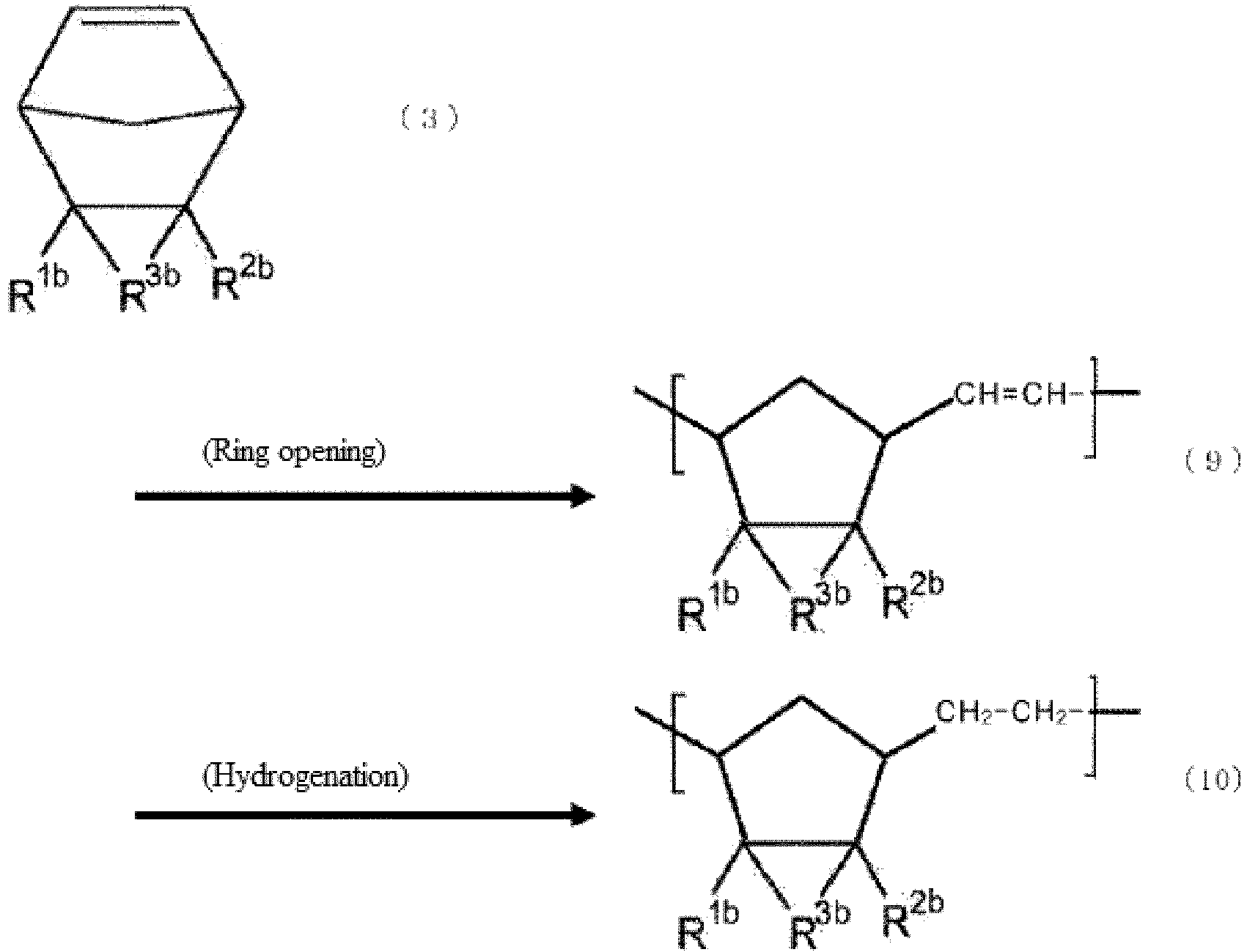
- Moreover, when the norbornene-based monomer (B) is a monomer indicated by the previously described formula (3) or (4), for example, the structural unit (b) derived from the norbornene-based monomer (B) is, in the case of ring-opening polymerization, indicated by the following formula (9) or (10). In the formulae, R1b to R7b and m are as previously described.
- Furthermore, when the norbornene-based monomer (B) is a monomer indicated by the previously described formula (4), for example, the structural unit (b) derived from the norbornene-based monomer (B) can, in the case of ring-opening polymerization, be expressed as a structural unit represented by formula (11), a structural unit represented by formula (12), or a mixture thereof depending on whether or not hydrogenation is performed and on the degree of hydrogenation. In the formulae, R4b to R7b and m are as previously described.

- Specific examples of the structural unit (b) derived from the norbornene-based monomer (B) in the case of ring-opening polymerization correspond to structural units produced through ring opening and optional hydrogenation of the compounds listed as specific examples of the norbornene-based monomer (B).
- The cycloolefin polymer may include other structural units so long as the effects disclosed herein are not lost. Examples of such other structural units include structural units derived from the other copolymerizable monomers that were previously described. One type of other structural unit may be included, or two or more types of other structural units may be included. The number of other structural units is preferably 50% or less when the number of all structural units is taken to be 100%.
- The average molecular weight of the presently disclosed cycloolefin polymer can be expressed as a polystyrene-equivalent weight-average molecular weight (Mw) that is measured by gel permeation chromatography (GPC) using tetrahydrofuran (THF) as a solvent. The weight-average molecular weight (Mw) is normally 18,000 or more, and may preferably be 19,000 or more, and more preferably 20,000 or more. Moreover, the weight-average molecular weight (Mw) is normally 100,000 or less, and may preferably be 50,000 or less, and more preferably 40,000 or less.
- A ratio (Mw/Mn) of the weight-average molecular weight (Mw) and the number-average molecular weight (Mn) is normally 4.0 or less, and may preferably be 3.7 or less, and more preferably 3.5 or less. The ratio (Mw/Mn) is 1.0 or more, and may be 1.0.
- Monomer serving as a feedstock of the presently disclosed cycloolefin polymer can be produced by a commonly known synthesis method, for example. For example, the naphthyl group-containing alicyclic compound (A) may be produced by palladium coupling (for example, a reaction of norbornadiene and bromonaphthalene) or a Diels-Alder reaction (for example, a reaction of cyclopentadiene and vinylnaphthalene). The production method of the naphthyl group-containing alicyclic compound (A) may, more specifically, be a method described in the EXAMPLES section. The naphthyl group-containing alicyclic compound (A) may be selectively obtained as an exo isomer or as an endo isomer, or may be obtained as a mixture of an exo isomer and an endo isomer.
- In a case in which the presently disclosed cycloolefin polymer is a polymer, or hydrogenated product thereof, that includes structural units derived from the naphthyl group-containing alicyclic compound (A) and optionally other monomers, the presently disclosed cycloolefin polymer can be produced by a method including a step (polymerization step) of obtaining a polymer by performing polymerization (for example, ring-opening polymerization or addition polymerization) of:
a polymerization feedstock containing the naphthyl group-containing alicyclic compound (A) or a polymer including a structural unit derived from the compound (A), and optionally including other monomers or polymers including structural units derived from such monomers. - Moreover, in a case in which the presently disclosed cycloolefin polymer is a polymer, or hydrogenated product thereof, that includes structural units derived from the naphthyl group-containing alicyclic compound (A) and at least one norbornene-based monomer (B) differing from the compound (A) and that optionally includes structural units derived from other monomers, the presently disclosed cycloolefin polymer can be produced by a method including a step (polymerization step) of performing polymerization (for example, ring-opening polymerization or addition polymerization) of:
- a polymerization feedstock containing the naphthyl group-containing alicyclic compound (A) or a polymer including a structural unit derived from the compound (A), containing at least one norbornene-based monomer (B) differing from the compound (A) or a polymer including a structural unit derived from the norbornene-based monomer (B), and optionally containing other monomers or polymers including structural units derived from such monomers; or
- a polymerization feedstock containing a polymer including a structural unit derived from the compound (A), a structural unit derived from the norbornene-based monomer (B), and optionally structural units derived from other monomers.
- A proportion of the total number of moles of the compound (A) and the structural unit derived from the compound (A) relative to the total number of moles of all monomers and structural units in the polymerization feedstock is adjusted in accordance with the proportion constituted by the structural unit derived from the compound (A) among all structural units of the target cycloolefin polymer. For example, in order to produce a cycloolefin polymer in which the proportion constituted by the structural unit derived from the compound (A) among all structural units is not less than 20 mol% and not more than 100 mol%, and preferably not less than 20 mol% and not more than 90 mol%, a proportion of the total number of moles of the compound (A) and the structural unit derived from the compound (A) relative to the total number of moles of all monomers and structural units in the polymerization feedstock can be set as 20 mol% or more, and preferably as not less than 20 mol% and not more than 90 mol%.
- The production method of the presently disclosed cycloolefin polymer may further include a step (hydrogenation step) of hydrogenating the polymer to obtain a hydrogenated product of the polymer. There are instances in which hydrogenation enhances characteristics such as heat resistance, weatherability, light resistance, solvent resistance, chemical resistance, and water resistance of the cycloolefin polymer.
- The production method of the presently disclosed cycloolefin polymer may also further include a step (collection step) of collecting the polymer.
- A polymerization unit compound that is contained in the polymerization feedstock may be either of a monomer or a polymer (inclusive of a copolymer). A polymer serving as a polymerization unit compound may be produced by the same polymerization reaction as in the polymerization step.
- The polymerization reaction used in the polymerization step and in production of a polymer serving as a polymerization unit compound may be ring-opening polymerization or addition polymerization, for example. The following describes the polymerization reaction for the case of the polymerization step.
- Ring-opening polymerization can be performed through ring-opening metathesis polymerization of the polymerization feedstock in the presence of a metathesis polymerization catalyst. The ring-opening metathesis polymerization may be performed in a reaction system in which the polymerization feedstock and the metathesis polymerization catalyst are mixed in a solvent (for example, an organic solvent). An activator, chain transfer agent, or other auxiliary agent (for example, a Lewis base) may be further provided in the reaction system in order to improve polymerization efficiency. The following describes reagents such as the catalyst used in ring-opening polymerization and various conditions of the reaction.
- A transition metal imide complex represented by formula (1) is used as the metathesis polymerization catalyst.
M(NRa)X4-p(ORb)p·Lq (1)
In formula (1), - M is a metal atom selected from transition metal atoms of group 6 of the periodic table,
- Ra is a phenyl group that is optionally substituted at one or more of the 3, 4, and 5 positions or a group represented by -CH2Rc, where Rc is a hydrogen atom, an optionally substituted alkyl group, or an optionally substituted aryl group,
- Rb is an optionally substituted alkyl group or an optionally substituted aryl group,
- X is a halogen atom, an alkyl group, an aryl group, an aralkyl group, or an alkylsilyl group,
- L is an electron donating neutral ligand,
- p is 0 or 1,
- q is an integer of 0 to 2,
- each X may be the same or different in a case in which more than one X is present, and
- each L may be the same or different in a case in which more than one L is present.
- M in formula (1) is a transition metal atom of group 6 of the periodic table and can be selected from chromium, molybdenum, and tungsten. Of these metal atoms, molybdenum and tungsten are preferable, and tungsten is more preferable.
- The transition metal imide complex of formula (1) includes a metal imide bond (N=Ra). Ra is a substituent on a nitrogen atom that forms the metal imide bond.
- Ra in formula (1) is a phenyl group that is optionally substituted at one or more of the 3, 4, and 5 positions or a group represented by -CH2Rc.
- Examples of possible substituents of the phenyl group of Ra that is optionally substituted at one or more of the 3, 4, and 5 positions include:
- an alkyl group (for example, an alkyl group having a carbon number of 1 to 4 such as a methyl group or an ethyl group);
- a halogen atom (for example, a fluorine atom, a chlorine atom, or a bromine atom); and
- an alkoxy group (for example, an alkoxy group having a carbon number of 1 to 4 such as a methoxy group, an ethoxy group, or an isopropoxy group).
- Note that substituents present at two or more of the 3, 4, and 5 positions may be bonded to each other.
- The phenyl group that is optionally substituted at one or more of the 3, 4, and 5 positions may be a phenyl group;
- a monosubstituted phenyl group such as a 4-methylphenyl group, a 4-chlorophenyl group, a 3-methoxyphenyl group, a 4-cyclohexylphenyl group, or a 4-methoxyphenyl group;
- a disubstituted phenyl group such as a 3,5-dimethylphenyl group, a 3,5-dichlorophenyl group, a 3,4-dimethylphenyl group, or a 3,5-dimethoxyphenyl group;
- a trisubstituted phenyl group such as a 3,4,5-trimethylphenyl group or a 3,4,5-trichlorophenyl group; or
- an optionally substituted 2-naphthyl group such as a 2-naphthyl group, a 3-methyl-2-naphthyl group, or a 4-methyl-2-naphthyl group.
- In the group represented by -CH2Rc of Ra, the carbon number of the optionally substituted alkyl group of Rc is not specifically limited but is normally 1 to 20, preferably 1 to 10, and more preferably 1 to 4. This alkyl group may be linear or branched. Examples of possible substituents include, but are not specifically limited to, a phenyl group, an optionally substituted phenyl group (for example, a 4-methylphenyl group), and an alkoxy group (for example, an alkoxy group having a carbon number of 1 to 4 such as a methoxy group or an ethoxy group).
- The optionally substituted aryl group of Rc may be a phenyl group, a 1-naphthyl group, a 2-naphthyl group, or the like. Examples of possible substituents include, but are not specifically limited to, a phenyl group, an optionally substituted phenyl group (for example, a 4-methylphenyl group), and an alkoxy group (for example, an alkoxy group having a carbon number of 1 to 4 such as a methoxy group or an ethoxy group).
- Rc is preferably an alkyl group having a carbon number of 1 to 20 such as a methyl group, an ethyl group, a propyl group, an isopropyl group, a butyl group, an isobutyl group, a t-butyl group, a pentyl group, a hexyl group, an octyl group, or a decyl group.
- Note that "4 - p" in formula (1) is 4 or 3, and thus four or three X groups are present in formula (1). X is a halogen atom, an alkyl group, an aryl group, an aralkyl group, or an alkylsilyl group. Each X may be the same or different.
- In the case of X, the halogen atom may be a chlorine atom, a bromine atom, or an iodine atom. The alkyl group may be a methyl group, an ethyl group, a propyl group, an isopropyl group, a butyl group, an isobutyl group, a t-butyl group, a pentyl group, a neopentyl group, or the like.
- The aryl group may be a phenyl group, a 4-methylphenyl group, a 2,6-dimethylphenyl group, a 1-naphthyl group, a 2-naphthyl group, or the like.
- The aralkyl group may be a benzyl group, a neophyl group, or the like.
- The alkylsilyl group may be a trimethylsilyl group, a triethylsilyl group, a t-butyldimethylsilyl group, or the like.
- Note that p in formula (1) is 0 or 1, and thus one metal alkoxide bond or one metal aryloxide bond (ORb) may be present in formula (1). Rb is a substituent on an oxygen atom that forms the metal alkoxide bond or metal aryloxide bond.
- Rb is an optionally substituted alkyl group or an optionally substituted aryl group, and the examples and preferred examples of the optionally substituted alkyl group and the optionally substituted aryl group of Rc described above are applicable thereto.
- Note that q in formula (1) is an integer of 0 to 2, and thus one or two electron donating neutral ligands (L) may be present in formula (1).
- L may be an electron donating compound that includes an atom from group 14 or 15 of the periodic table and may be:
- a phosphine such as trimethylphosphine, triisopropylphosphine, tricyclohexylphosphine, or triphenylphosphine;
- an ether such as diethyl ether, dibutyl ether, 1,2-dimethoxyethane, tetrahydrofuran, or tetrahydropyran; or
- an amine such as trimethylamine, triethylamine, pyridine, or lutidine.
- Of these examples, ethers are preferable.
- The transition metal imide complex of formula (1) is preferably a tungsten imide complex that includes a phenyl imide group (tungsten imide complex for which M is a tungsten atom and Ra is a phenyl group in formula (1)), and is more preferably tetrachlorotungsten phenylimide (tetrahydrofuran) or tetrachlorotungsten phenylimide (tetrahydropyran).
- One transition metal imide complex of formula (1) may be used individually, or two or more transition metal imide complexes of formula (1) may be used in combination.
- The transition metal imide complex of formula (1) can be synthesized, for example, by a method in which an oxyhalide of a group 6 transition metal and a phenyl isocyanate that is optionally substituted at one or more of the 3, 4, and 5 positions or a monosubstituted methyl isocyanate are mixed with, as necessary, an electron donating neutral ligand (L), an alcohol, a metal alkoxide, and a metal aryloxide (for example, a method described in
JP-H5-345817A - The amount of the transition metal imide complex of formula (1) that is used relative to 100 mol% of norbornene-based monomer can be set as not less than 0.00005 mol% and not more than 1 mol%, and is preferably not less than 0.0001 mol% and not more than 0.2 mol%, and more preferably not less than 0.0002 mol% and not more than 0.1 mol%. When the amount is within any of the ranges set forth above, it is possible to sufficiently avoid complication of catalyst removal and to obtain sufficient polymerization activity.
- Although the transition metal imide complex of formula (1) displays catalytic activity by itself, the transition metal imide complex may be combined with an activator so as to obtain a polymerization catalyst having higher activity.
- The activator may be a compound of any of groups 1, 2, 12, 13, and 14 of the periodic table that includes a hydrocarbon group having a carbon number of 1 to 20 (for example, an alkyl group). Of such compounds, it is preferable to use an organolithium, organomagnesium, organozinc, organoaluminum, or organotin, and particularly preferable to use an organoaluminum or organotin.
- The organolithium may be methyllithium, n-butyllithium, phenyllithium, or the like.
- The organomagnesium may be butylethylmagnesium, butyloctylmagnesium, dihexylmagnesium, ethylmagnesium chloride, n-butylmagnesium chloride, allylmagnesium bromide, or the like.
- The organozinc may be dimethylzinc, diethylzinc, diphenylzinc, or the like.
- The organoaluminum may be trimethylaluminum, triethylaluminum, triisobutylaluminum, diethylaluminum chloride, ethylaluminum sesquichloride, ethylaluminum dichloride, diethylaluminum ethoxide, diisobutylaluminum isobutoxide, ethylaluminum diethoxide, isobutylaluminum diisobutoxide, or the like.
- The organotin may be tetramethyltin, tetra(n-butyl)tin, tetraphenyltin, or the like.
- One activator may be used individually, or two or more activators may be used in combination.
- In a situation in which an activator is used, the used amount thereof relative to the transition metal imide complex of formula (1) can be set as not less than 0.1 molar equivalents and not more than 100 molar equivalents, and is preferably not less than 0.2 molar equivalents and not more than 50 molar equivalents, and more preferably not less than 0.5 molar equivalents and not more than 20 molar equivalents. When the amount is within any of the ranges set forth above, it is possible to sufficiently obtain improvement of polymerization activity through use of the activator and to sufficiently avoid the occurrence of side reactions.
- A Lewis base may be further added in order to control the polymerization rate or the molecular weight distribution of the obtained polymer.
- The Lewis base may be an ether such as diethyl ether or tetrahydrofuran; a ketone such as acetone or cyclohexanone; a nitrile such as acetonitrile or benzonitrile; an amine such as triethylamine or N,N-diethylaniline; a pyridine such as pyridine or lutidine; a phosphine such as triphenylphosphine; an amide such as dimethylformamide; a sulfoxide such as dimethyl sulfoxide; a phosphine oxide such as triphenylphosphine oxide; an ester such as ethyl acetate; or the like. Of these Lewis bases, ethers, pyridines, and nitriles are preferable. One Lewis base may be used individually, or two or more Lewis bases may be used in combination.
- In a situation in which a Lewis base is used, the used amount thereof relative to the transition metal imide complex of formula (1) can be set as not less than 0.1 molar equivalents and not more than 1,000 molar equivalents, and is preferably not less than 0.2 molar equivalents and not more than 500 molar equivalents, and more preferably not less than 0.5 molar equivalents and not more than 200 molar equivalents.
- A chain transfer agent can be used in the polymerization reaction. By using a chain transfer agent, it is possible to adjust the molecular weight of the obtained ring-opened polymer and to effectively reduce the content ratio of dimers and the like.
- The chain transfer agent may be an α-olefin, an internal olefin, an aromatic vinyl compound, or the like. An internal olefin is a compound that includes a double bond in an inner section of an olefin chain, rather than at the end of the olefin chain. The term "aromatic vinyl compound" is inclusive of compounds having a substituent (for example, an alkyl group) on a vinyl group.
- The α-olefin may be an alkene that has a carbon number of 2 to 20 and that includes a double bond at the α position, examples of which include ethylene, propylene, 1-butene, 1-pentene, 1-hexene, 3-methyl-1-butene, 3-methyl-1-pentene, 3-ethyl-1-pentene, 4-methyl-1-pentene, 4-methyl-1-hexene, 4,4-dimethyl-1-hexene, 4,4-dimethyl-1-pentene, 4-ethyl-1-hexene, 3-ethyl-1-hexene, 1-octene, 1-decene, 1-dodecene, 1-tetradecene, 1-hexadecene, 1-octadecene, and 1-eicosene.
- The internal olefin may be 2-butene, 3-hexene, or the like.
- The aromatic vinyl compound may be styrene, α-methylstyrene, 2-methylstyrene, 3-methylstyrene, 4-methylstyrene, 2,4-diisopropylstyrene, 2,4-dimethylstyrene, 4-t-butylstyrene, or the like.
- Of these chain transfer agents, 1-hexene, styrene, and 1-decene are preferable in terms of reactivity and molecular weight control, with 1-hexene and styrene being more preferable.
- One chain transfer agent may be used individually, or two or more chain transfer agents may be used in combination.
- In a situation in which a chain transfer agent is used, the amount of the chain transfer agent that is used can be set as not less than 0.1 mol% and less than 15 mol% relative to 100 mol% of norbornene-based monomer. When the amount is within the range set forth above, effects caused by use of the chain transfer agent are sufficiently obtained. From a viewpoint of reducing the content ratio of dimers and the like, the chain transfer agent is preferably not less than 0.3 mol% and less than 10 mol%, more preferably not less than 0.5 mol% and not more than 9 mol%, and even more preferably not less than 1 mol% and not more than 6 mol%.
- The polymerization reaction is normally carried out in an organic solvent.
- The organic solvent is not specifically limited so long as it is inert in the reaction and so long as a norbornene-based monomer and a target norbornene-based polymer can be dissolved or dispersed therein, and examples thereof include:
- aliphatic hydrocarbons such as pentane, hexane, and heptane;
- alicyclic hydrocarbons such as cyclopentane, cyclohexane, methylcyclohexane, dimethylcyclohexane, trimethylcyclohexane, ethylcyclohexane, diethylcyclohexane, decahydronaphthalene, bicycloheptane, tricyclodecane, hexahydroindene, and cyclooctane;
- aromatic hydrocarbons such as benzene, toluene, and xylene;
- halogenated aliphatic hydrocarbons such as dichloromethane, chloroform, and 1,2-dichloroethane;
- halogenated aromatic hydrocarbons such as chlorobenzene and dichlorobenzene;
- nitrogen-containing hydrocarbon solvents such as nitromethane, nitrobenzene, and acetonitrile;
- ethers such as diethyl ether and tetrahydrofuran; and
- mixtures of any of the preceding organic solvents.
- Of these solvents, aromatic hydrocarbons, aliphatic hydrocarbons, alicyclic hydrocarbons, and ethers are preferable.
- One organic solvent may be used individually, or two or more organic solvents may be used in combination.
- The organic solvent may be used in an amount such that the concentration of norbornene-based monomer is not less than 1 mass% and not more than 50 mass%, preferably not less than 2 mass% and not more than 45 mass%, and more preferably not less than 3 mass% and not more than 40 mass%. An amount that is within any of the ranges set forth above allows sufficient productivity and is also convenient in terms of handleability.
- Although the polymerization reaction can be performed by stirring a norbornene-based monomer, the transition metal imide complex of formula (1), and the optional activator and chain transfer agent, normally in an organic solvent, a feature herein is that at least some of the norbornene-based monomer is added continuously in the polymerization reaction.
- Components other than the norbornene-based monomer that is continuously added may be loaded into and stirred in a reactor in advance. Stirring of the reaction liquid inside the reactor can be continued during continuous addition of the norbornene-based monomer so as to cause the polymerization reaction to progress.
- The norbornene-based monomer that is continuously added may be all or some of the norbornene-based monomer. In terms of reaction selectivity and reaction stability, it is preferable that some of the norbornene-based monomer is continuously added and that the remainder of the norbornene-based monomer is loaded into the reactor in advance. The amount of the norbornene-based monomer that is loaded into the reactor in advance, when the total amount of the norbornene-based monomer is taken to be 100 mass%, can be set as not less than 0.1 mass% and not more than 70 mass%, and is preferably not less than 0.5 mass% and not more than 50 mass%, and more preferably not less than 1 mass% and not more than 35 mass%. An amount that is within any of the ranges set forth above facilitates control of the weight-average molecular weight of the obtained polymer.
- The continuous addition of the norbornene-based monomer can be performed through continuous dropwise addition of a liquid having the norbornene-based monomer dissolved or dispersed in the previously described organic solvent. The concentration of the norbornene-based monomer in this liquid can be set as not less than 1 mass% and not more than 50 mass%, and is preferably not less than 2 mass% and not more than 45 mass%, and more preferably not less than 3 mass% and not more than 40 mass%. An amount that is within any of these ranges allows sufficient productivity and is also convenient in terms of handleability.
- The duration of the continuous addition can be set as not less than 20 minutes and not more than 200 minutes. In terms of control of stereochemistry, the duration is preferably not less than 40 minutes and not more than 180 minutes, and more preferably not less than 60 minutes and not more than 160 minutes.
- The polymerization temperature can be set as not lower than 20°C and not higher than 60°C. In terms of control of stereochemistry, the polymerization temperature is preferably not lower than 25°C and not higher than 55°C, and more preferably not lower than 30°C and not higher than 50°C.
- The temperature of the continuously added norbornene-based monomer can be set as not lower than 20°C and not higher than 60°C. In terms of control of stereochemistry, this temperature is preferably not lower than 22.5°C and not higher than 50°C, and more preferably not lower than 25°C and not higher than 45°C.
- In terms of control of molecular weight, it is preferable that the continuous addition of the norbornene-based monomer is performed such that the polymerization conversion rate of norbornene-based monomer in the polymerization reaction system at the time at which continuous addition ends is 40% or more. The polymerization conversion rate is more preferably 60% or more. The polymerization conversion rate can be controlled by adjusting conditions of the addition such as the rate of addition of the norbornene-based monomer and by adjusting conditions of the polymerization reaction such as the polymerization temperature. When conditions other than the rate during addition are the same, the polymerization conversion rate tends to increase with a higher rate and tends to decrease with a lower rate. Moreover, the polymerization conversion rate tends to increase with a higher temperature and tends to decrease with a lower temperature. Although no specific limitations are placed on the upper limit, the conversion rate is normally 99% or less.
- Once the continuous addition ends, stirring of the reaction liquid is continued, and the polymerization reaction is then ended. The duration of stirred mixing after the end of addition can be set as not less than 15 minutes and not more than 300 minutes. In terms of polymerization conversion rate and productivity, the duration is preferably not less than 20 minutes and not more than 270 minutes, and more preferably not less than 30 minutes and not more than 240 minutes.
- At least some of the transition metal imide complex may also be continuously added. This is expected to provide reaction selectivity. The continuous addition of the transition metal imide complex can be performed through continuous dropwise addition of a liquid having the transition metal imide complex dissolved or dispersed in the previously described organic solvent. The concentration of the transition metal imide complex in this liquid can be set as not less than 0.01 mass% and not more than 20 mass%. In terms of solution stability of the complex, the concentration is preferably not less than 0.1 mass% and not more than 15 mass%, and more preferably not less than 0.5 mass% and not more than 10 mass%. The timing of this continuous addition may be the same as the timing of continuous addition of the norbornene-based monomer or may be a different timing.
- In a situation in which a chain transfer agent is used, the amount thereof can be set as an amount such that the amount of continuous addition of the norbornene-based polymer is 0.060 mol/min or more and preferably 0.080 mol/min or more per 1 mol of the chain transfer agent, and can be set as an amount such that the amount of continuous addition of the norbornene-based polymer is 2.000 mol/min or less and preferably 1.000 mol/min or less per 1 mol of the chain transfer agent from a viewpoint of control of stereochemistry and reduction of the content ratio of dimers and the like.
- The addition polymerization can be performed in the presence of a Ziegler-Natta catalyst, a metallocene catalyst, a nickel catalyst, or a palladium catalyst, for example. Moreover, the addition polymerization may be performed under reaction conditions that are modified as appropriate from commonly known reaction conditions.
- The norbornene-based polymer that is obtained through the polymerization step includes carbon-carbon double bonds in a main chain thereof. Moreover, depending on the types of monomers used in polymerization, a carbon-carbon double bond may also be present in a substituent bonded to the main chain or a 5-membered ring or in a condensed ring with a 5-membered ring (hereinafter, these are referred to as side chains). Hydrogenation of the norbornene-based polymer yields a hydrogenated product in which these carbon-carbon double bonds have been hydrogenated to form saturated bonds. There are instances in which conversion to a hydrogenated product enhances characteristics such as heat resistance, weatherability, light resistance, solvent resistance, chemical resistance, and water resistance. A commonly known method can be adopted as the method of hydrogenation. For example, the hydrogenation can be performed by supplying hydrogen to a solution of the norbornene-based polymer and performing an addition reaction in the presence of a hydrogenation catalyst. The hydrogenation catalyst is preferably a catalyst that hydrogenates carbon-carbon double bonds in a main chain and that does not hydrogenate a naphthalene ring of a naphthyl group. Examples of such hydrogenation catalysts include ruthenium catalysts (chlorohydridocarbonyltris(triphenylphosphine)ruthenium) and palladium catalysts. Supply of hydrogen may be performed by adding hydrogen at high pressure (for example, 1 MPa or higher) and performing stirring at high temperature (for example, 120°C or higher).
- A norbornene-based polymer that is obtained through the polymerization step or a hydrogenated product that is obtained through the hydrogenation step can be collected as the cycloolefin polymer. For example, the reaction solution can be mixed with a precipitant (for example, a poor solvent such as isopropanol or methanol) to cause precipitation of the cycloolefin polymer, and then the cycloolefin polymer can be collected as a precipitate. The collected cycloolefin polymer may then be dried (for example, vacuum dried).
- The refractive index can vary depending on wavelength and temperature. Although the refractive index may be measured under any wavelength and temperature conditions, the refractive index (nd) for light having a wavelength of 587.6 nm at 25°C is used as the refractive index in the present specification. The refractive index (nd) of the presently disclosed cycloolefin polymer is preferably 1.545 or more, and more preferably 1.550 or more in order to cause the display of an optical function of an optical element. Moreover, the refractive index (nd) of the presently disclosed cycloolefin polymer is preferably 1.640 or less, and more preferably 1.635 or less in order to display a function of an optical element.
- The Abbe number is a value that is calculated based on the refractive indices for three wavelengths. Although there are various definitions of the Abbe number depending on the combination of wavelengths, the Abbe number (vd) defined by equation (1), shown below, is used as the Abbe number in the present specification.

- In equation (1), nd, nc, and nF respectively represent the refractive indices for wavelengths of 587.6 nm, 656.3 nm, and 486.1 nm at 25°C.
- The Abbe number (vd) of the presently disclosed cycloolefin polymer is preferably 20 or more, and more preferably 21 or more. Moreover, the Abbe number (vd) of the presently disclosed cycloolefin polymer is preferably 50 or less, and more preferably 49 or less in order to reduce chromatic aberration of an optical element.
- The stress birefringence (CR) can be determined by applying stress (F) to a measurement sample, subsequently measuring the in-plane retardation (Re(b) [nm]) at a specific wavelength (for example, a wavelength of 543 nm) and thickness (T(b) [mm]) of a central section of the measurement sample, and then calculating a δn value by equations (X1) and (X2), shown below.


- A δn value of closer to 0 indicates less birefringence. Moreover, a positive value is exhibited in a case in which the slow axis is the stretching direction, whereas a negative value is exhibited in a case in which the slow axis is orthogonal to the stretching direction. The stress birefringence (CR) of the presently disclosed cycloolefin polymer is preferably -500 × 10-12 Pa-1 or more, and more preferably -400 × 10-12 Pa-1 or more. Moreover, the stress birefringence (CR) of the presently disclosed cycloolefin polymer is preferably 1,400 × 10-12 Pa-1 or less, and more preferably 900 × 10-12 Pa-1 or less in order to suppress variation of optical element quality.
- The glass-transition temperature of the presently disclosed cycloolefin polymer can, for example, be not lower than 40°C and not higher than 200°C. Note that the glass-transition temperature can be controlled based on adjustment of the chemical composition of a monomer composition used in synthesis of the presently disclosed cycloolefin polymer, for example.
- The presently disclosed cycloolefin polymer can be used in the form of a composition. The composition contains the presently disclosed cycloolefin polymer and optionally further contains a solvent and additives such as a weathering stabilizer, a heat resistance stabilizer, an antistatic agent, a flame retardant, a slip agent, an anti-blocking agent, an antifogging agent, a lubricant, a dye, a pigment, a natural oil, a synthetic oil, a wax, and/or a filler.
- Note that the presently disclosed cycloolefin polymer can be mixed with the additives and/or solvent by a known mixing method.
- The additives may, more specifically, be any of the additives given as examples in
JP2005-330465A - The presently disclosed cycloolefin polymer or the composition containing the presently disclosed cycloolefin polymer can be advantageously used as a material of an optical element or the like.
- The presently disclosed cycloolefin polymer can be used in the form of a shaped product. The shaped product is obtained through shaping of the presently disclosed cycloolefin polymer or the composition that contains the presently disclosed cycloolefin polymer. Moreover, the shaped product obtained from the presently disclosed cycloolefin polymer can advantageously be used as an optical element or the like.
- Examples of methods by which the shaped product may be shaped include injection molding, extrusion blow molding, injection blow molding, two-stage blow molding, multilayer blow molding, connection blow molding, stretch blow molding, rotational molding, vacuum forming, extrusion molding, calendering, solution casting, hot press forming, and inflation.
- The following provides a more specific description of the present disclosure based on examples. However, the present disclosure is not limited to the following examples.
- Measurements of various physical properties were performed according to the following methods.
- Weight-average molecular weight Mw was determined as a standard polyisoprene-equivalent value through measurement by gel permeation chromatography (GPC) using cyclohexane as an eluent. The standard polyisoprene was standard polyisoprene produced by Tosoh Corporation. In a case in which the sample did not dissolve in cyclohexane, the weight-average molecular weight Mw was determined as a standard polystyrene-equivalent value through measurement by GPC using tetrahydrofuran (THF) as an eluent. The standard polystyrene was standard polystyrene produced by Tosoh Corporation.
- Glass-transition temperature (Tg) was measured based on JIS K 6911 with a heating rate of 10°C/min using a differential scanning calorimeter (produced by Nanotechnology; product name: DSC6220SII).
- A polymer was shaped into a sheet form of 35 mm (length) × 10 mm (width) × 1 mm (thickness) so as to obtain a sample sheet. Both ends of the sample sheet were secured with clips, and then a 55 g weight was secured to one of the clips. Next, the sample sheet was suspended with the clip to which the weight was not secured as an origin inside an oven set to a temperature equal to "polymer glass-transition temperature (Tg) + 15°C" for 1 hour so as to perform stretching treatment. Thereafter, the sample sheet was slowly cooled and restored to room temperature to obtain a measurement sample.
- The in-plane retardation (Re(b) [nm]) of a central section of the measurement sample was measured at a measurement wavelength of 543 nm using a birefringence meter (WPA-100 produced by Photonic Lattice, Inc.). In addition, the thickness (T(b) [mm]) of the central section of the measurement sample was measured. These measurement values Re(b) and T(b) were used to calculate a δn value by equation (X1), shown below.

- This δn value and the stress (F) applied to the sample were then used to calculate the stress birefringence (CR) by equation (X2), show below.

- A δn value of closer to 0 indicates less birefringence. Moreover, a positive value is exhibited in a case in which the slow axis is the stretching direction, whereas a negative value is exhibited in a case in which the slow axis is orthogonal to the stretching direction.
- A measurement sample was obtained by shaping a sheet of 5 mm in thickness and then leaving this sheet in an atmosphere having a temperature of (glass-transition temperature (Tg) - 15)°C for 20 hours.
- The refractive index (nd, nc, and nF) of the obtained measurement sample was measured at 25°C using a precision refractometer (produced by Shimadzu Corporation; product name: KPR-200; light source: He lamp (wavelength: 587.6 nm) and H2 lamp (wavelength: 656.3 nm and 486.1 nm)). The table shows the refractive index for light having a wavelength of 587.6 nm.
- Refractive indices (nd, nc, and nF) at 25°C that were determined through refractive index measurement were used to calculate the Abbe number (vd) according to equation (1), shown below.

- In equation (1), nd, nc, and nF respectively represent the refractive indices for wavelengths of 587.6 nm, 656.3 nm, and 486.1 nm.
- After charging 458 g of 1-bromonaphthalene (produced by Wako Pure Chemical Industries, Ltd.), 500 mL of dimethylformamide (produced by Wako Pure Chemical Industries, Ltd.), 455 mL of norbornadiene (produced by Tokyo Chemical Industry Co., Ltd.), 656 mL of piperidine (produced by Wako Pure Chemical Industries, Ltd.), 220 mL of formic acid (99%; produced by Wako Pure Chemical Industries, Ltd.), and 2.75 g of a palladium catalyst (bis(triphenylphosphine)palladium dichloride; produced by Tokyo Chemical Industry Co., Ltd.; product code: B1667), these materials were stirred at 90°C for 6.5 hours. The reaction liquid was extracted with ethyl acetate/water, and the organic layer was dried using magnesium sulfate. The dried organic layer was then subjected to filtration and evaporation. Column chromatography (eluent solvent: hexane) of remaining material was then performed so as to remove palladium residue. The resultant solution was subjected to evaporation, and then the remaining liquid was subjected to distillation under reduced pressure (1.2 mm Hg/135°C to 152°C). This yielded 269 g of exo-1-naphthylnorbornene (exo-1-NaphNB) represented by the following formula as a colorless transparent liquid. When the peak purity of the product was measured in gas chromatography, the purity was 95.0%.

- After charging 458 g of 2-bromonaphthalene (produced by Wako Pure Chemical Industries, Ltd.), 500 mL of dimethylformamide (produced by Wako Pure Chemical Industries, Ltd.), 455 mL of norbornadiene (produced by Tokyo Chemical Industry Co., Ltd.), 656 mL of piperidine (produced by Wako Pure Chemical Industries, Ltd.), 220 mL of formic acid (99%; produced by Wako Pure Chemical Industries, Ltd.), and 2.75 g of a palladium catalyst (bis(triphenylphosphine)palladium dichloride; produced by Tokyo Chemical Industry Co., Ltd.; product code: B1667), these materials were stirred at 90°C for 6.5 hours. The reaction liquid was extracted with ethyl acetate/water, and the organic layer was dried using magnesium sulfate. The dried organic layer was then subjected to filtration and evaporation. Column chromatography (eluent solvent: hexane) of remaining material was then performed so as to remove palladium residue. The resultant solution was subjected to evaporation, and then the remaining liquid was subjected to distillation under reduced pressure (1.2 mm Hg/135°C to 152°C). This yielded 269 g of exo-2-naphthylnorbornene (exo-2-NaphNB) represented by the following formula as a colorless transparent liquid. When the peak purity of the product was measured in gas chromatography, the purity was 95.0%.

- After loading 96 g of dehydrated toluene, 2 mol% of 1-hexene, and 1.2 mol% of diethylaluminum ethoxide (Et2Al(OEt)) into a glass reactor that had been internally purged with nitrogen and then mixing these materials at room temperature, all of 0.4 mol% of a 2.0 weight% toluene solution of tetrachlorotungsten phenylimide (tetrahydrofuran) (complex 1) was loaded into the reactor while maintaining a temperature of 50°C, and then a mixed monomer of exo-2-naphthylnorbornene and tetracyclododecene (TCD) (molar ratio = 56:44; 0.03 mol in total) was continuously added over 2 hours to perform ring-opening polymerization. Next, 48 mol% of isopropyl alcohol was added to the polymerization solution so as to deactivate the polymerization catalyst and terminate the polymerization reaction. The total amount of the reaction solution was 121 g. The weight-average molecular weight Mw of the obtained ring-opened polymer was 2.5 × 10⁴. Moreover, the conversion rate of monomer to polymer was 100%. Note that "mol%" in the preceding description indicates a percentage value based on the number of moles of the mixed monomer.
- Next, 155 g of cyclohexane was added to 95 g of the reaction solution containing the ring-opened polymer obtained in step (1-1), 0.05 weight% of chlorohydridocarbonyltris(triphenylphosphine)ruthenium was further added as a hydrogenation catalyst, the pressure was raised to 4.5 MPa with hydrogen, heating was performed to a temperature of 160°C under stirring, and then a reaction was carried out for 8 hours to yield a reaction solution containing a hydrogenated exo-2-naphthylnorbornene/TCD ring-opened copolymer. The obtained solution was poured into a large amount of isopropanol to cause precipitation of a norbornene-based polymer as a hydrogenated product of a ring-opened polymer. The norbornene-based polymer that had precipitated was filtered off and was then dried in a vacuum dryer (200°C, 1 Torr) for 10 hours to yield 5 g of the norbornene-based polymer. The weight-average molecular weight of the norbornene-based polymer was 3.04 × 10⁴.
- The glass-transition temperature (Tg), stress birefringence (CR), refractive index (nd), and Abbe number (vd) of the obtained norbornene-based polymer were measured by the previously described methods. The results are shown in Table 1.
- Production and evaluation of a norbornene-based polymer were performed in the same way as in Example 1 with the exception that the types and composition ratio of monomer compounds in the mixed monomer were set as indicated in Table 1 or that a monomer compound indicated in Table 1 was used instead of the mixed monomer. The evaluation results are shown in Table 1.
Table 1: Monomer chemical composition and various physical property values of norbornene-based polymers Example 1 Example 2 Example 3 Example 4 Example 5 Example 6 Example 7 Comparative Example 1 Used resin (norbornene -based polymer) Monomer: chemical composition exo-2-NaphNB/ TCD exo-2-NaphNB/ TCD exo-2-NaphNB/ TCD exo-1-NaphNB/ TCD exo-1- NaphNB/ MTCD exo-1-NaphNB/ TCD/MTF exo-2-NaphNB exo-1-NaphNB/ MTCD Monomer: molar ratio 56/44 83/17 20/80 47/53 47/53 83/13/4 100/0 19/81 Monomer: weight ratio 64/36 87/13 26/74 55/45 46/54 1987/10/3 100/0 18/82 Physical property values Glass-transifion temperature (Tg) [°C] 124.9 105.8 151.3 138.3 138.4 128 93 149 Weight-average molecular weight (Mw) 30400 21300 33100 32300 35500 31300 22700 182200 Evaluation results Birefringence expression (CR value) 260 -70 821 398 950 10 -259 1650 Refractive index (nd) 1.569 1.618 1.56 1.591 1.577 1.62 1.63 1.541 Abbe number (vd) 42 23 46 34 39 23 28 53 - Abbreviations of compound names used in Table 1 are as follows.
- exo-2-NaphNB: exo-2-naphthylnorbornene
- exo-1-NaphNB: exo-1-naphthylnorbornene
- TCD: tetracyclododecene
- MTCD: 8-methoxycarbonyl-8-methyltetracyclo[4.4.0.12,5.17,10]-3-dodecene
- MTF: 1,4-methano-1,4,4a,9a-tetrahydro-9H-fluorene
- According to the present disclosure, it is possible to provide a cycloolefin polymer simultaneously having a high refractive index, a low Abbe number, and low birefringence.
- Moreover, according to the present disclosure, it is possible to provide a composition that can advantageously be used as a material of an optical element or the like and a shaped product that can advantageously be used as an optical element or the like.

Claims (12)
- A cycloolefin polymer that is a polymer or a hydrogenated product thereof, said polymer comprising a structural unit derived from a naphthyl group-containing alicyclic compound (A) represented by following formula (1):
 (i) a hydrogen atom;(ii) a halogen atom; or(iii) a substituted or unsubstituted hydrocarbon group having a carbon number of 1 to 30 and optionally having a linking group comprising an oxygen atom, a nitrogen atom, a sulfur atom or a silicon atom, except for the hydrocarbon group comprising an aromatic ring,wherein the proportion of the structural unit derived from said compound (A) among all structural units is not less than 20 mol% and not more than 100 mol%.
 - The cycloolefin polymer according to claim 1, wherein the proportion of the structural unit derived from the compound (A) among all structural units is not less than 20 mol% and not more than 90 mol%.
- The cycloolefin polymer according to claim 1 or 2, wherein the remaining groups among R2a to Rsa, which are other than the naphthyl group, and Ria are each a hydrogen atom.
- The cycloolefin polymer according to any one of claims 1 to 3, wherein the cycloolefin polymer is a polymer, or hydrogenated product thereof, comprising:the structural unit derived from the compound (A); anda structural unit derived from at least one norbornene-based monomer (B) different from the compound (A).
- The cycloolefin polymer according to claim 4,
wherein the norbornene-based monomer (B) is:(i) a norbornene that is unsubstituted or has an alkyl group, an alkenyl group, an aromatic ring group, an oxygen atom-containing polar group, or a nitrogen atom-containing polar group as a substituent;(ii) a monomer indicated by following formula (3): R1b and R2b each independently represent a hydrogen atom; a halogen atom; a hydrocarbon group having a carbon number of 1 to 20 and optionally having a substitutent; or an organic group comprising a silicon atom, an oxygen atom or a nitrogen atom,R1b and R2b are optionally bonded to each other to form a ring, andR3b is a divalent hydrocarbon group having a carbon number of 1 to 20 and optionally having a substituent; or(iii) a monomer indicated by following formula (4):
 R4b to R7b each independently represent a hydrogen atom; a halogen atom; a hydrocarbon group having a carbon number of 1 to 20 and optionally having a substituent; or an organic group comprising a silicon atom, an oxygen atom or a nitrogen atom,R4b and R6b are optionally bonded to each other to form a ring, andm is 1 or 2.
 - The cycloolefin polymer according to any one of claims 1 to 5, having a weight-average molecular weight of not less than 20,000 and not more than 40,000.
- The cycloolefin polymer according to any one of claims 1 to 6, having a refractive index of not less than 1.545.
- A method for producing a cycloolefin polymer, comprising performing a polymerization of a naphthyl group-containing alicyclic compound (A) represented by following formula (1) or a polymer comprising a structural unit derived from the compound (A):
 (i) a hydrogen atom;(ii) a halogen atom; or(iii) a substituted or unsubstituted hydrocarbon group having a carbon number of 1 to 30 and optionally having a linking group comprising an oxygen atom, a nitrogen atom, a sulfur atom or a silicon atom, except for the hydrocarbon group comprising an aromatic ring,wherein a proportion of a total number of moles of the compound (A) and the structural unit derived from the compound (A) relative to a total number of moles of all monomers and structural units in a feedstock for polymerization is not less than 20 mol% and not more than 100 mol%.
 - The method according to claim 8, comprising performing a polymerization of:a feedstock for polymerization comprising:the compound (A) or a polymer comprising a structural unit derived from the compound (A); andat least one norbornene-based monomer (B) different from the naphthyl group-containing alicyclic compound (A) or a polymer comprising a structural unit derived from the norbornene-based monomer (B); ora feedstock for polymerization comprising a polymer comprising a structural unit derived from the compound (A) and a structural unit derived from the norbornene-based monomer (B).
- The method according to claim 8 or 9, whereinthe polymerization is performed in the presence of a metathesis polymerization catalyst, andthe metathesis polymerization catalyst is a transition metal imide complex represented by formula (1):
M(NRa)X4-p(ORb)p·Lq (1)
whereM is a metal atom selected from transition metal atoms of group 6 of the periodic table,Ra is a phenyl group optionally having a substituent at at least one position of positions 3, 4 and 5 or a group represented by -CH2Rc, where Rc is a hydrogen atom, an alkyl group optionally having a substituent, or an aryl group optionally having a substituent,Rb is an alkyl group optionally having a substituent or an aryl group optionally having a substituent,X is a halogen atom, an alkyl group, an aryl group, an aralkyl group or an alkylsilyl group,L is an electron donating neutral ligand,p is 0 or 1,q is an integer of 0 to 2,each X's may be the same or different if a plurarity of X's are present, andeach L's may be the same or different if a plurarity of L's are present. - The method according to any one of claims 8 to 10, further comprising hydrogenating a polymer obtained by the polymerization.
- An optical element comprising the cycloolefin polymer according to any one of claims 1 to 7.
Applications Claiming Priority (2)
| Application Number | Priority Date | Filing Date | Title |
|---|---|---|---|
| JP2019217426 | 2019-11-29 | ||
| PCT/JP2020/044086 WO2021107041A1 (en) | 2019-11-29 | 2020-11-26 | Cyclic olefin polymer, method for producing same, and optical element |
Publications (2)
| Publication Number | Publication Date |
|---|---|
| EP4067406A1 true EP4067406A1 (en) | 2022-10-05 |
| EP4067406A4 EP4067406A4 (en) | 2023-11-15 |
Family
ID=76130559
Family Applications (1)
| Application Number | Title | Priority Date | Filing Date |
|---|---|---|---|
| EP20893285.5A Pending EP4067406A4 (en) | 2019-11-29 | 2020-11-26 | Cyclic olefin polymer, method for producing same, and optical element |
Country Status (7)
| Country | Link |
|---|---|
| US (1) | US12319783B2 (en) |
| EP (1) | EP4067406A4 (en) |
| JP (1) | JP7605128B2 (en) |
| KR (1) | KR102929201B1 (en) |
| CN (1) | CN114651026B (en) |
| TW (1) | TWI887309B (en) |
| WO (1) | WO2021107041A1 (en) |
Cited By (1)
| Publication number | Priority date | Publication date | Assignee | Title |
|---|---|---|---|---|
| GB2620382A (en) * | 2022-06-30 | 2024-01-10 | Merxin Ltd | Container |
Families Citing this family (4)
| Publication number | Priority date | Publication date | Assignee | Title |
|---|---|---|---|---|
| EP4299646A4 (en) * | 2021-02-26 | 2025-01-22 | Zeon Corporation | CYCLIC OLEFIN COPOLYMER AND HYDROGENATED PRODUCT THEREOF AND OPTICAL ELEMENT |
| WO2025169955A1 (en) * | 2024-02-09 | 2025-08-14 | 三井化学株式会社 | Lens unit, imaging unit, and electronic device |
| CN119285907A (en) * | 2024-08-08 | 2025-01-10 | 万华化学集团股份有限公司 | A low birefringence, high heat resistance cycloolefin polymer and preparation method thereof |
| CN119019649B (en) * | 2024-10-29 | 2025-06-03 | 中石油(上海)新材料研究院有限公司 | A cycloolefin polymer and preparation method thereof |
Family Cites Families (14)
| Publication number | Priority date | Publication date | Assignee | Title |
|---|---|---|---|---|
| US5194534A (en) | 1991-09-24 | 1993-03-16 | Hercules Incorporated | Tungsten-imido catalysts for ring-opening metathesis polymerization of cycloolefins |
| JP2005263995A (en) * | 2004-03-18 | 2005-09-29 | Jsr Corp | Norbornene ring-opening polymer |
| JP2005330465A (en) | 2004-04-21 | 2005-12-02 | Mitsui Chemicals Inc | Ethylene-cyclic olefin copolymer and its optical component |
| JP5104089B2 (en) * | 2006-07-19 | 2012-12-19 | Jsr株式会社 | Method for producing cyclic olefin-based ring-opening polymer hydrogenated product and cyclic olefin-based ring-opened polymer hydrogenated product obtained by the production method |
| KR101414347B1 (en) * | 2006-07-28 | 2014-07-02 | 후지필름 가부시키가이샤 | A norbornene polymer, a film, a polarizing plate, and a liquid crystal display |
| JP2008031319A (en) | 2006-07-28 | 2008-02-14 | Fujifilm Corp | Norbornene polymer, film, polarizing plate and liquid crystal display device |
| JP4925759B2 (en) * | 2006-07-28 | 2012-05-09 | 富士フイルム株式会社 | Norbornene polymer, film, polarizing plate and liquid crystal display device using norbornene polymer |
| JP2009046614A (en) | 2007-08-21 | 2009-03-05 | Fujifilm Corp | Cycloolefin copolymers and films |
| JP2009046615A (en) * | 2007-08-21 | 2009-03-05 | Fujifilm Corp | Norbornene-based ring-opening (co) polymer, film, production method thereof, and polarizing plate |
| JP2009179749A (en) * | 2008-01-31 | 2009-08-13 | Fujifilm Corp | Norbornene polymer, film containing the same, polarizing plate, liquid crystal display device |
| WO2011105133A1 (en) | 2010-02-24 | 2011-09-01 | コニカミノルタオプト株式会社 | Surface-modified resin film, process for producing same, polarizer formed using same, and liquid-crystal display device |
| JP2017134305A (en) * | 2016-01-29 | 2017-08-03 | 日本ゼオン株式会社 | Stretched film, production method, polarizing plate and display device |
| JP6840844B2 (en) * | 2017-05-31 | 2021-03-10 | 三井化学株式会社 | Material for forming an underlayer film, resist underlayer film, method for producing resist underlayer film, and laminate |
| WO2019107363A1 (en) | 2017-11-29 | 2019-06-06 | 三井化学株式会社 | Cyclic-olefin-based copolymer, cyclic-olefin-based copolymer composition, molded body, and medical container |
-
2020
- 2020-11-26 US US17/755,727 patent/US12319783B2/en active Active
- 2020-11-26 EP EP20893285.5A patent/EP4067406A4/en active Pending
- 2020-11-26 WO PCT/JP2020/044086 patent/WO2021107041A1/en not_active Ceased
- 2020-11-26 CN CN202080077875.5A patent/CN114651026B/en active Active
- 2020-11-26 JP JP2021561510A patent/JP7605128B2/en active Active
- 2020-11-26 KR KR1020227016973A patent/KR102929201B1/en active Active
- 2020-11-27 TW TW109141855A patent/TWI887309B/en active
Cited By (1)
| Publication number | Priority date | Publication date | Assignee | Title |
|---|---|---|---|---|
| GB2620382A (en) * | 2022-06-30 | 2024-01-10 | Merxin Ltd | Container |
Also Published As
| Publication number | Publication date |
|---|---|
| US20230002544A1 (en) | 2023-01-05 |
| KR20220110189A (en) | 2022-08-05 |
| TWI887309B (en) | 2025-06-21 |
| CN114651026A (en) | 2022-06-21 |
| KR102929201B1 (en) | 2026-02-20 |
| JPWO2021107041A1 (en) | 2021-06-03 |
| US12319783B2 (en) | 2025-06-03 |
| EP4067406A4 (en) | 2023-11-15 |
| JP7605128B2 (en) | 2024-12-24 |
| WO2021107041A1 (en) | 2021-06-03 |
| CN114651026B (en) | 2024-12-27 |
| TW202124507A (en) | 2021-07-01 |
Similar Documents
| Publication | Publication Date | Title |
|---|---|---|
| US12319783B2 (en) | Cycloolefin polymer, method for producing same, and optical element | |
| TWI599591B (en) | Cyclic olefin-based ring-opening copolymer | |
| JPWO2015137434A1 (en) | Tetracyclododecene ring-opening polymer hydride and process for producing the same | |
| US7608671B2 (en) | Norbornene ring-opened polymer hydrogenated product and process for producing same | |
| JP5545078B2 (en) | Cyclic olefin ring-opening copolymer | |
| CN101035859B (en) | Thermoplastic resin composition, optical film and retardation film | |
| US12612487B2 (en) | Cycloolefin copolymer and hydrogenated product thereof, and optical element | |
| JP5262328B2 (en) | Optical film and manufacturing method thereof | |
| JP2010254980A (en) | Method for producing cyclic olefin ring-opening polymer | |
| KR102895655B1 (en) | Cyclic olefin polymers, cyclic olefin polymer monomers and optical products | |
| CN116867832B (en) | Cyclic olefin copolymer, hydrogenated product thereof, and optical element | |
| JP5304244B2 (en) | Cyclic olefin ring-opening copolymer and use thereof | |
| JP2008231318A (en) | Resin composition, optical film, retardation film, and liquid crystal display device | |
| JP2005290048A (en) | Optical resin material and optical molded body | |
| JP2010132600A (en) | Fluorine-containing cyclic olefin compound, method of producing the same, ring opening polymer of fluorine-containing cyclic olefin, and hydrogenated ring opening polymer of fluorine-containing cyclic olefin | |
| JP7408935B2 (en) | Method for producing norbornene-based ring-opening polymer | |
| EP3778695A1 (en) | Norbornene ring-opening polymer hydride and method for producing same | |
| JP4356532B2 (en) | Method for producing norbornene-based ring-opening polymer and method for adjusting wavelength dispersion of retardation of molded product thereof | |
| JP2024118431A (en) | Polymer | |
| JP2005314597A (en) | Norbornene ring-opening polymer | |
| JP2012177127A (en) | Cyclic olefin-based copolymer and use of the same | |
| JP2009173725A (en) | Norbornene compound ring-opening polymer and process for producing the same |
Legal Events
| Date | Code | Title | Description |
|---|---|---|---|
| STAA | Information on the status of an ep patent application or granted ep patent |
Free format text: STATUS: THE INTERNATIONAL PUBLICATION HAS BEEN MADE |
|
| PUAI | Public reference made under article 153(3) epc to a published international application that has entered the european phase |
Free format text: ORIGINAL CODE: 0009012 |
|
| STAA | Information on the status of an ep patent application or granted ep patent |
Free format text: STATUS: REQUEST FOR EXAMINATION WAS MADE |
|
| 17P | Request for examination filed |
Effective date: 20220429 |
|
| AK | Designated contracting states |
Kind code of ref document: A1 Designated state(s): AL AT BE BG CH CY CZ DE DK EE ES FI FR GB GR HR HU IE IS IT LI LT LU LV MC MK MT NL NO PL PT RO RS SE SI SK SM TR |
|
| DAV | Request for validation of the european patent (deleted) | ||
| DAX | Request for extension of the european patent (deleted) | ||
| A4 | Supplementary search report drawn up and despatched |
Effective date: 20231012 |
|
| RIC1 | Information provided on ipc code assigned before grant |
Ipc: C09D 165/00 20060101ALI20231006BHEP Ipc: C08L 65/00 20060101ALI20231006BHEP Ipc: G02B 1/04 20060101ALI20231006BHEP Ipc: C08G 61/08 20060101AFI20231006BHEP |