EP4067390B1 - Polyolefinharz und herstellungsverfahren dafür - Google Patents
Polyolefinharz und herstellungsverfahren dafür Download PDFInfo
- Publication number
- EP4067390B1 EP4067390B1 EP22164890.0A EP22164890A EP4067390B1 EP 4067390 B1 EP4067390 B1 EP 4067390B1 EP 22164890 A EP22164890 A EP 22164890A EP 4067390 B1 EP4067390 B1 EP 4067390B1
- Authority
- EP
- European Patent Office
- Prior art keywords
- bis
- zirconium
- ethylene
- weight
- ranges
- Prior art date
- Legal status (The legal status is an assumption and is not a legal conclusion. Google has not performed a legal analysis and makes no representation as to the accuracy of the status listed.)
- Active
Links
Images


Classifications
-
- C—CHEMISTRY; METALLURGY
- C08—ORGANIC MACROMOLECULAR COMPOUNDS; THEIR PREPARATION OR CHEMICAL WORKING-UP; COMPOSITIONS BASED THEREON
- C08L—COMPOSITIONS OF MACROMOLECULAR COMPOUNDS
- C08L23/00—Compositions of homopolymers or copolymers of unsaturated aliphatic hydrocarbons having only one carbon-to-carbon double bond; Compositions of derivatives of such polymers
- C08L23/02—Compositions of homopolymers or copolymers of unsaturated aliphatic hydrocarbons having only one carbon-to-carbon double bond; Compositions of derivatives of such polymers not modified by chemical after-treatment
- C08L23/04—Homopolymers or copolymers of ethene
- C08L23/08—Copolymers of ethene
- C08L23/0807—Copolymers of ethene with unsaturated hydrocarbons only containing four or more carbon atoms
- C08L23/0815—Copolymers of ethene with unsaturated hydrocarbons only containing four or more carbon atoms with aliphatic 1-olefins containing one carbon-to-carbon double bond
-
- C—CHEMISTRY; METALLURGY
- C08—ORGANIC MACROMOLECULAR COMPOUNDS; THEIR PREPARATION OR CHEMICAL WORKING-UP; COMPOSITIONS BASED THEREON
- C08F—MACROMOLECULAR COMPOUNDS OBTAINED BY REACTIONS ONLY INVOLVING CARBON-TO-CARBON UNSATURATED BONDS
- C08F210/00—Copolymers of unsaturated aliphatic hydrocarbons having only one carbon-to-carbon double bond
- C08F210/02—Ethene
-
- C—CHEMISTRY; METALLURGY
- C08—ORGANIC MACROMOLECULAR COMPOUNDS; THEIR PREPARATION OR CHEMICAL WORKING-UP; COMPOSITIONS BASED THEREON
- C08F—MACROMOLECULAR COMPOUNDS OBTAINED BY REACTIONS ONLY INVOLVING CARBON-TO-CARBON UNSATURATED BONDS
- C08F2/00—Processes of polymerisation
- C08F2/01—Processes of polymerisation characterised by special features of the polymerisation apparatus used
-
- C—CHEMISTRY; METALLURGY
- C08—ORGANIC MACROMOLECULAR COMPOUNDS; THEIR PREPARATION OR CHEMICAL WORKING-UP; COMPOSITIONS BASED THEREON
- C08F—MACROMOLECULAR COMPOUNDS OBTAINED BY REACTIONS ONLY INVOLVING CARBON-TO-CARBON UNSATURATED BONDS
- C08F2/00—Processes of polymerisation
- C08F2/34—Polymerisation in gaseous state
-
- C—CHEMISTRY; METALLURGY
- C08—ORGANIC MACROMOLECULAR COMPOUNDS; THEIR PREPARATION OR CHEMICAL WORKING-UP; COMPOSITIONS BASED THEREON
- C08F—MACROMOLECULAR COMPOUNDS OBTAINED BY REACTIONS ONLY INVOLVING CARBON-TO-CARBON UNSATURATED BONDS
- C08F210/00—Copolymers of unsaturated aliphatic hydrocarbons having only one carbon-to-carbon double bond
- C08F210/16—Copolymers of ethene with alpha-alkenes, e.g. EP rubbers
-
- C—CHEMISTRY; METALLURGY
- C08—ORGANIC MACROMOLECULAR COMPOUNDS; THEIR PREPARATION OR CHEMICAL WORKING-UP; COMPOSITIONS BASED THEREON
- C08F—MACROMOLECULAR COMPOUNDS OBTAINED BY REACTIONS ONLY INVOLVING CARBON-TO-CARBON UNSATURATED BONDS
- C08F4/00—Polymerisation catalysts
- C08F4/02—Carriers therefor
- C08F4/025—Metal oxides
-
- C—CHEMISTRY; METALLURGY
- C08—ORGANIC MACROMOLECULAR COMPOUNDS; THEIR PREPARATION OR CHEMICAL WORKING-UP; COMPOSITIONS BASED THEREON
- C08F—MACROMOLECULAR COMPOUNDS OBTAINED BY REACTIONS ONLY INVOLVING CARBON-TO-CARBON UNSATURATED BONDS
- C08F4/00—Polymerisation catalysts
- C08F4/42—Metals; Metal hydrides; Metallo-organic compounds; Use thereof as catalyst precursors
- C08F4/44—Metals; Metal hydrides; Metallo-organic compounds; Use thereof as catalyst precursors selected from light metals, zinc, cadmium, mercury, copper, silver, gold, boron, gallium, indium, thallium, rare earths or actinides
- C08F4/60—Metals; Metal hydrides; Metallo-organic compounds; Use thereof as catalyst precursors selected from light metals, zinc, cadmium, mercury, copper, silver, gold, boron, gallium, indium, thallium, rare earths or actinides together with refractory metals, iron group metals, platinum group metals, manganese, rhenium technetium or compounds thereof
- C08F4/62—Refractory metals or compounds thereof
- C08F4/64—Titanium, zirconium, hafnium or compounds thereof
- C08F4/659—Component covered by group C08F4/64 containing a transition metal-carbon bond
- C08F4/65912—Component covered by group C08F4/64 containing a transition metal-carbon bond in combination with an organoaluminium compound
-
- C—CHEMISTRY; METALLURGY
- C08—ORGANIC MACROMOLECULAR COMPOUNDS; THEIR PREPARATION OR CHEMICAL WORKING-UP; COMPOSITIONS BASED THEREON
- C08F—MACROMOLECULAR COMPOUNDS OBTAINED BY REACTIONS ONLY INVOLVING CARBON-TO-CARBON UNSATURATED BONDS
- C08F4/00—Polymerisation catalysts
- C08F4/42—Metals; Metal hydrides; Metallo-organic compounds; Use thereof as catalyst precursors
- C08F4/44—Metals; Metal hydrides; Metallo-organic compounds; Use thereof as catalyst precursors selected from light metals, zinc, cadmium, mercury, copper, silver, gold, boron, gallium, indium, thallium, rare earths or actinides
- C08F4/60—Metals; Metal hydrides; Metallo-organic compounds; Use thereof as catalyst precursors selected from light metals, zinc, cadmium, mercury, copper, silver, gold, boron, gallium, indium, thallium, rare earths or actinides together with refractory metals, iron group metals, platinum group metals, manganese, rhenium technetium or compounds thereof
- C08F4/62—Refractory metals or compounds thereof
- C08F4/64—Titanium, zirconium, hafnium or compounds thereof
- C08F4/659—Component covered by group C08F4/64 containing a transition metal-carbon bond
- C08F4/65916—Component covered by group C08F4/64 containing a transition metal-carbon bond supported on a carrier, e.g. silica, MgCl2, polymer
-
- C—CHEMISTRY; METALLURGY
- C08—ORGANIC MACROMOLECULAR COMPOUNDS; THEIR PREPARATION OR CHEMICAL WORKING-UP; COMPOSITIONS BASED THEREON
- C08F—MACROMOLECULAR COMPOUNDS OBTAINED BY REACTIONS ONLY INVOLVING CARBON-TO-CARBON UNSATURATED BONDS
- C08F4/00—Polymerisation catalysts
- C08F4/42—Metals; Metal hydrides; Metallo-organic compounds; Use thereof as catalyst precursors
- C08F4/44—Metals; Metal hydrides; Metallo-organic compounds; Use thereof as catalyst precursors selected from light metals, zinc, cadmium, mercury, copper, silver, gold, boron, gallium, indium, thallium, rare earths or actinides
- C08F4/60—Metals; Metal hydrides; Metallo-organic compounds; Use thereof as catalyst precursors selected from light metals, zinc, cadmium, mercury, copper, silver, gold, boron, gallium, indium, thallium, rare earths or actinides together with refractory metals, iron group metals, platinum group metals, manganese, rhenium technetium or compounds thereof
- C08F4/62—Refractory metals or compounds thereof
- C08F4/64—Titanium, zirconium, hafnium or compounds thereof
- C08F4/659—Component covered by group C08F4/64 containing a transition metal-carbon bond
- C08F4/6592—Component covered by group C08F4/64 containing a transition metal-carbon bond containing at least one cyclopentadienyl ring, condensed or not, e.g. an indenyl or a fluorenyl ring
-
- C—CHEMISTRY; METALLURGY
- C08—ORGANIC MACROMOLECULAR COMPOUNDS; THEIR PREPARATION OR CHEMICAL WORKING-UP; COMPOSITIONS BASED THEREON
- C08F—MACROMOLECULAR COMPOUNDS OBTAINED BY REACTIONS ONLY INVOLVING CARBON-TO-CARBON UNSATURATED BONDS
- C08F4/00—Polymerisation catalysts
- C08F4/42—Metals; Metal hydrides; Metallo-organic compounds; Use thereof as catalyst precursors
- C08F4/44—Metals; Metal hydrides; Metallo-organic compounds; Use thereof as catalyst precursors selected from light metals, zinc, cadmium, mercury, copper, silver, gold, boron, gallium, indium, thallium, rare earths or actinides
- C08F4/60—Metals; Metal hydrides; Metallo-organic compounds; Use thereof as catalyst precursors selected from light metals, zinc, cadmium, mercury, copper, silver, gold, boron, gallium, indium, thallium, rare earths or actinides together with refractory metals, iron group metals, platinum group metals, manganese, rhenium technetium or compounds thereof
- C08F4/62—Refractory metals or compounds thereof
- C08F4/64—Titanium, zirconium, hafnium or compounds thereof
- C08F4/659—Component covered by group C08F4/64 containing a transition metal-carbon bond
- C08F4/6592—Component covered by group C08F4/64 containing a transition metal-carbon bond containing at least one cyclopentadienyl ring, condensed or not, e.g. an indenyl or a fluorenyl ring
- C08F4/65922—Component covered by group C08F4/64 containing a transition metal-carbon bond containing at least one cyclopentadienyl ring, condensed or not, e.g. an indenyl or a fluorenyl ring containing at least two cyclopentadienyl rings, fused or not
- C08F4/65927—Component covered by group C08F4/64 containing a transition metal-carbon bond containing at least one cyclopentadienyl ring, condensed or not, e.g. an indenyl or a fluorenyl ring containing at least two cyclopentadienyl rings, fused or not two cyclopentadienyl rings being mutually bridged
-
- C—CHEMISTRY; METALLURGY
- C08—ORGANIC MACROMOLECULAR COMPOUNDS; THEIR PREPARATION OR CHEMICAL WORKING-UP; COMPOSITIONS BASED THEREON
- C08J—WORKING-UP; GENERAL PROCESSES OF COMPOUNDING; AFTER-TREATMENT NOT COVERED BY SUBCLASSES C08B, C08C, C08F, C08G or C08H
- C08J3/00—Processes of treating or compounding macromolecular substances
- C08J3/12—Powdering or granulating
-
- C—CHEMISTRY; METALLURGY
- C08—ORGANIC MACROMOLECULAR COMPOUNDS; THEIR PREPARATION OR CHEMICAL WORKING-UP; COMPOSITIONS BASED THEREON
- C08J—WORKING-UP; GENERAL PROCESSES OF COMPOUNDING; AFTER-TREATMENT NOT COVERED BY SUBCLASSES C08B, C08C, C08F, C08G or C08H
- C08J5/00—Manufacture of articles or shaped materials containing macromolecular substances
- C08J5/18—Manufacture of films or sheets
-
- C—CHEMISTRY; METALLURGY
- C08—ORGANIC MACROMOLECULAR COMPOUNDS; THEIR PREPARATION OR CHEMICAL WORKING-UP; COMPOSITIONS BASED THEREON
- C08F—MACROMOLECULAR COMPOUNDS OBTAINED BY REACTIONS ONLY INVOLVING CARBON-TO-CARBON UNSATURATED BONDS
- C08F2500/00—Characteristics or properties of obtained polyolefins; Use thereof
- C08F2500/12—Melt flow index or melt flow ratio
-
- C—CHEMISTRY; METALLURGY
- C08—ORGANIC MACROMOLECULAR COMPOUNDS; THEIR PREPARATION OR CHEMICAL WORKING-UP; COMPOSITIONS BASED THEREON
- C08F—MACROMOLECULAR COMPOUNDS OBTAINED BY REACTIONS ONLY INVOLVING CARBON-TO-CARBON UNSATURATED BONDS
- C08F2500/00—Characteristics or properties of obtained polyolefins; Use thereof
- C08F2500/18—Bulk density
-
- C—CHEMISTRY; METALLURGY
- C08—ORGANIC MACROMOLECULAR COMPOUNDS; THEIR PREPARATION OR CHEMICAL WORKING-UP; COMPOSITIONS BASED THEREON
- C08F—MACROMOLECULAR COMPOUNDS OBTAINED BY REACTIONS ONLY INVOLVING CARBON-TO-CARBON UNSATURATED BONDS
- C08F2500/00—Characteristics or properties of obtained polyolefins; Use thereof
- C08F2500/26—Use as polymer for film forming
-
- C—CHEMISTRY; METALLURGY
- C08—ORGANIC MACROMOLECULAR COMPOUNDS; THEIR PREPARATION OR CHEMICAL WORKING-UP; COMPOSITIONS BASED THEREON
- C08J—WORKING-UP; GENERAL PROCESSES OF COMPOUNDING; AFTER-TREATMENT NOT COVERED BY SUBCLASSES C08B, C08C, C08F, C08G or C08H
- C08J2323/00—Characterised by the use of homopolymers or copolymers of unsaturated aliphatic hydrocarbons having only one carbon-to-carbon double bond; Derivatives of such polymers
- C08J2323/02—Characterised by the use of homopolymers or copolymers of unsaturated aliphatic hydrocarbons having only one carbon-to-carbon double bond; Derivatives of such polymers not modified by chemical after treatment
- C08J2323/04—Homopolymers or copolymers of ethene
- C08J2323/08—Copolymers of ethene
Definitions
- the present disclosure relates to a polyolefin resin and a method of preparing the same. More particularly, the present disclosure relates to a linear low-density polyethylene copolymer having good processability and toughness, and a method of preparing the same.
- Linear low-density polyethylene is a resin with a narrow molecular weight distribution and few long-chain branches (LCB), commonly prepared by copolymerization of ethylene and alpha-olefin (commercially, 1-butene, 1-hexene, and 1-octene are mainly used) at low pressure under the presence of a polymerization catalyst.
- LCB long-chain branches
- LLDPE is similar in density to low-density polyethylene (LDPE) prepared by the conventional high-pressure method but better in physical properties such as breaking strength, elongation (strain%), tear strength, and depart falling impact strength.
- LLDPE is increasingly used in applications such as stretching films and overlapping films to which it is difficult to apply existing low-density polyethylene or high-density polyethylene (HDPE).
- HDPE high-density polyethylene
- the film is required to have excellent processability, breaking strength, tear strength, depart falling impact strength, haze, and the like.
- ZN-LLDPE prepared using the existing Ziegler-Natta catalyst is excellent in processability due to a broad molecular weight distribution but have deteriorated physical properties, whereas mLLDPE prepared using a metallocene catalyst having a single active site have good physical properties but exhibits poor processibility due to a narrow molecular weight distribution.
- One of the methods is a post-reactor technique or a melt blending method in which two or more polyolefins having different molecular weights are blended together before or during processing.
- U.S. Patent No. 4,461,873 discloses a method of physically blending polymers of two different physical properties to produce a bimodal polymeric blend.
- Another method is to use a multistage reactor.
- the method uses two or more reactors.
- a first polymer having one of two different molecular weight distributions is prepared under predetermined conditions, the first polymer is delivered to a second reactor, and in a second reactor, a second polymer having a different molecular weight distribution from the first polymer is prepared under conditions different from the reaction conditions in the first reactor.
- LLDPE containing long-chain branches has been studied in order to achieve good bubble stability and low load during blown film processing.
- LLDPE with such long-chain branches is advantageous for processing because the side chains are entangled with each other in a form similar to LDPE.
- LLDPE containing too many long chain branches has a problem in that the toughness is low. Further examples may be found in WO 2019/092525 A1 , EP 3 292 158 B1 and EP 1 112 293 B1 .
- Patent Document 1 U. S. Patent No. 4,461,873 (July 24, 1984 )
- an objective of the present disclosure is to provide a polyolefin resin having good processability and toughness so as to be useful for molding into a shrinkage film, an agricultural film, etc., and a method of preparing the same.
- a first aspect of the present disclosure for achieving the above objective relates to a polyolefin preparation method including the steps of: a) synthesizing a pre-polymer by pre-polymerizing a pre-polymer composition including an ethylene monomer, an alpha olefin monomer having 3 or more carbon atoms, and a catalyst composition in a slurry polymerization reactor; and b) supplying a main polymerization composition including the pre-polymer, an ethylene monomer, and a 1-hexene comonomer to a gas phase reactor and polymerizing the main polymerization composition into a polyolefin polymer, wherein the polyolefin polymer satisfies Requirements (i) to (vii) below:
- a second aspect of the present disclosure relates to a polyolefin resin prepared by the method of claim 1.
- the pre-polymerization composition may include 80% to 99.9% by weight of the ethylene monomer and 0.1% to 20% by weight of the alpha olefin monomer having 3 or more carbon atoms, with respect to the total amount of the monomers.
- the catalyst composition includes one or more organometallic compounds represented by Formula 1 below. (In Chemical Formula 1,
- the catalyst composition includes one or more aluminoxanes represented by Formulas 2 to 4 below. (In Chemical Formulas 2, 3, and 4,
- the catalyst composition may include 1 to 100,000 moles of aluminoxane with respect to 1 mole of the organometallic compound.
- the catalyst composition may be in a form in which an organometallic compound and aluminoxane are supported on a carrier, and the carrier may be any one selected from the group consisting of silica, alumina, silica-alumina, clay, modified clay, and mixtures thereof.
- the catalyst composition includes, with respect to 100 parts by weight of the carrier, 5 to 30 parts by weight of aluminum derived from the aluminoxane compound and 0.01 to 1 parts by weight of zirconium derived from the organometallic compound.
- the aluminum derived from the aluminoxane compound may be contained in an amount of 10 to 20 parts by weight
- the zirconium derived from the organometallic compound may be contained in an amount of 0.1 to 0.7 parts by weight.
- the polyolefin resin according to the present disclosure may have excellent mechanical properties such as processability and toughness because the polyolefin resin satisfies Requirements (i) to (vii), and thus may be used in applications such as a shrinkage film and an agricultural film.
- a polyolefin resin according to one aspect of the present disclosure satisfies Requirements (i) to (vii) below:
- the polyolefin resin according to the present disclosure may have excellent mechanical properties such as processability and toughness because the polyolefin resin satisfies Requirements (i) to (vii), and thus may be used in applications such as a shrinkage film and an agricultural film.
- the polyolefin resin according to one example of the present disclosure may satisfy the conditions: (a) the density (D) measured by a density gradient pipe method according to ASTM D1505 ranges from 0.910 to 0.935 g/cm 3 ; (ii) the melt flow index (MIE) measured according to ASTM D1238 (190°C, 2.16 kg) ranges from 0.2 to 1.5 g/10 minutes; (iii) the high load melt flow index (MIF) measured according to ASTM D1238 (190°C, 21.6 kg) ranges from 17 to 50 g/10 minutes; and (iv) the melt flow rate ratio (SR, MIF/MIE) ranges from 38 to 50.
- D density measured by a density gradient pipe method according to ASTM D1505 ranges from 0.910 to 0.935 g/cm 3
- MIE melt flow index
- MIF high load melt flow index
- SR, MIF/MIE melt flow rate ratio
- the polyolefin resin prepared according to the present disclosure satisfies the conditions: (a) the density (D) measured by a density gradient pipe method according to ASTM D1505 ranges from 0.915 to 0.933 g/cm 3 ; (ii) the melt flow index (MIE) measured according to ASTM D1238 (190°C, 2.16 kg) ranges from 0.3 to 1 g/10 minutes; (iii) the high load melt flow index (MIF) measured according to ASTM D1238 (190°C, 21.6 kg) ranges from 17 to 35 g/10 minutes; and (iv) the melt flow rate ratio (SR, MIF/MIE) ranges from 40 to 50.
- the polyolefin resin may satisfy the conditions: (v) the ratio (Mw/Mn) of the weight average molecular weight (Mw) to the number average molecular weight (Mn) measured by gel permeation chromatography ranges from 3.2 to 4.5; and (vi) the ratio (Mz/Mw) of Z-average molecular weight (Mz) to weight average molecular weight (Mw) measured by gel permeation chromatography ranges from 2.3 to 3.0.
- the polyolefin resin that satisfies these conditions has low melt elasticity, so the relaxation time of the polyolefin resin can be shortened in a polymer melting step. Due to the short relaxation time, the polyolefin resin can have random orientation in the polymer melting step. When the polyolefin resin has the random orientation, the chains are oriented in various directions aside from the machine direction, the crack path in the machine direction is blocked. Thus, the tear strength (MD) in the machine direction increases, resulting in improvement in toughness.
- MD tear strength
- the polyolefin since the polyolefin has high transparency despite having a high melt flow ratio (SR), the polyolefin can be very useful for agricultural and shrinkage film applications.
- the melt flow index (MIE) or the melt flow index ratio (SR) is smaller than the lower limit of the corresponding range described above, processability is reduced.
- LDPE low-density polyethylene
- the polyolefin resin according to one embodiment of the present disclosure may be a homopolymer obtained by polymerization of ethylene which is an olefinic monomer, or a copolymer obtained by copolymerization of ethylene and alpha olefin.
- the alpha olefin monomer serving as a comonomer may be an alpha olefin having 3 or more carbon atoms.
- the alpha olefin having 3 or more carbon atoms may be one or more selected from the group consisting of propylene, 1-butene, 1-pentene, 4-methyl-1-pentene, 1-hexene, 1-heptene, 1-octene, 1-decene, 1-undecene, 1-dodecene, 1-tetradecene, 1-hexadecene, 1-octadecene, and 1-eicosene.
- the use of an alpha olefin having 3 to 8 carbon atoms as a comonomer is preferable for polymerization to produce the polyolefin resins satisfying the above requirements.
- a polyolefin film according to another aspect of the present disclosure relates to a polyolefin film prepared by blow-processing of the above-described polyolefin resin.
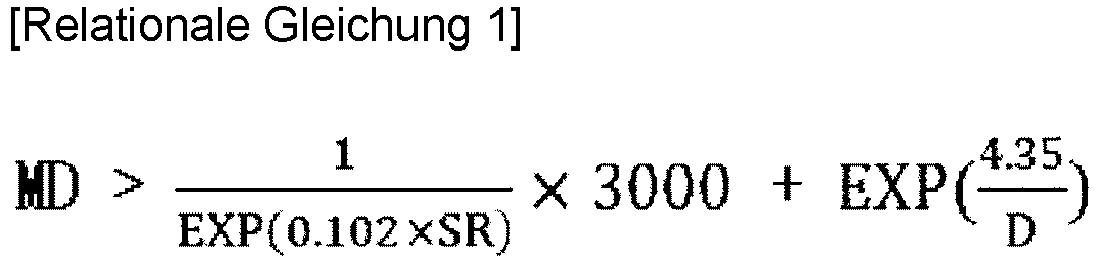
- the polyolefin film may be characterized in that it satisfies the following Relational Equation 1.
- MD is the tear strength (g) in the machine direction of a polyolefin film blown to a thickness of 30 ⁇ m under the condition of an expansion ratio (BUR) of 2.5
- D is the density measured by the density gradient pipe method according to ASTM D1505 (g/cm 3 )
- SR is the melt flow rate ratio (SR, MIF/MIE).
- Relational Equation 1 is an equation representing a correlation between the melt flow rate ratio (SR), the density (D), and the tear strength (MD) .
- the olefin resins satisfying Relational Equation 1 exhibit higher tear strength (MD) and better processability than polyolefin resins having the same melt flow rate ratio (SR) and density (D) but not satisfying Relational Equation 1.
- the polyolefin resin according to the present disclosure has a shorter relaxation time in a polymer melt step due to lower melt elasticity thereof. Due to the shorter relaxation time, can be shortened in a polymer melting step. As the relaxation time is shortened, the polyolefin resin can have random orientation in the polymer melting step. When the polyolefin resin has the random orientation, the chains are oriented in various directions aside from the machine direction, the crack path in the machine direction is blocked. Thus, the tear strength (MD) in the machine direction increases, resulting in improvement in toughness.
- MD tear strength
- the polyolefin resin and the polyolefin film may satisfy Requirements (i) to (vii) described above. To avoid redundancy, the same descriptions will be omitted.
- a further aspect of the present disclosure relates to a polyolefin preparation method including the steps of: a) synthesizing a pre-polymer by pre-polymerizing a pre-polymer composition including an ethylene monomer, an alpha olefin monomer having 3 or more carbon atoms, and a catalyst composition in a slurry polymerization reactor; and b) supplying a main polymerization composition including the pre-polymer, an ethylene monomer, and a 1-hexene comonomer to a gas phase reactor and polymerizing the main polymerization composition into a polyolefin polymer, in which the polyolefin polymer satisfies Requirements (i) to (vii).
- the polyolefin resin is prepared by first synthesizing the pre-polymer in the slurry polymerization reactor and then performing the main polymerization in the gas phase reactor. Therefore, a polymer having higher density and lower molecular weight and a polymer having lower density and higher molecular weight are prepared in the respective reaction steps, resulting in a polymer having three or more molecular weight (Mw/Mn) distributions and many long-chain branches. That is, the polymer having good processability can be produced.
- a pre-polymerization step is performed in a slurry polymerization reactor.
- a pre-polymer composition composed of an ethylene monomer, an alpha olefin monomer having 3 or more carbon atoms, and a catalyst composition is polymerized into a pre-polymer.
- the pre-polymer composition may include 80% to 99.9 wt% of an ethylene monomer and 0.1% to 20 wt% of an alpha olefin monomer having 3 or more carbon atoms, preferably 82% to 99.5 wt% of an ethylene monomer and 0.5% to 18% by weight of an alpha olefin monomer having 3 or more carbon atoms, and more preferably, 85% to 97% by weight of an ethylene monomer and 3% to 15% by weight of an alpha olefin monomer having 3 or more carbon atoms.
- the alpha olefin monomer as a comonomer the alpha olefin having 3 or more carbon atoms may be used.
- alpha olefin monomer having 3 or more carbon atoms may be one or more selected from the group consisting of propylene, 1-butene, 1-pentene, 4-methyl-1-pentene, 1-hexene, 1-heptene, 1-octene, 1-decene, 1-undecene, 1-dodecene, 1-tetradecene, 1-hexadecene, 1-octadecene, and 1-eicosene.
- the use of the alpha olefin having 3 to 8 carbon atoms as the comonomer is preferable for polymerization to produce the polyolefin resins satisfying Requirements (i) to (vii).
- any catalyst composition can be used without particular limitation if the catalyst composition contains a catalyst component commonly used for polymerization of an ethylene polymer.
- the catalyst composition include an organometallic compound and aluminoxane.
- the catalyst composition may be used in the form in which the catalyst is supported on a porous carrier if necessary.
- the organometallic compound may include a metallocene catalyst component.
- LCB long chain branches
- Chemical Formula 1 In Chemical Formula 1,
- hydrocarbyl is a hydrocarbon group consisting of hydrogen and carbon and may refer to linear or branched alkyl, cycloalkyl, aryl, alkyl aryl, arylalkyl, or a combination thereof.
- the hydrocarbyl may be methyl, ethyl, propyl, butyl, amyl, isoamyl, hexyl, isobutyl, heptyl, octyl, nonyl, decyl, cetyl, 2-ethylhexyl, or phenyl.
- halogen may refer to F, Cl, Br, or I
- alkoxy' may refer to methoxy, ethoxy, propoxy, butoxy, or amyloxy.
- the expression that the substituents are independently connected to L 1 and L 2 to form a fused ring structure means, for instance, that hydrocarbon groups substituting for cyclopentadienyl groups are connected to each other to form a ring form such as tetrahydro indenyl.
- the organometallic compound may be any one or a combination of at least two selected from the group consisting of dimethylsilyl-bis(cyclopentadienyl) zirconium dichloride, dimethylsilyl-bis(methylcyclopentadienyl) zirconium dichloride, dimethylsilyl-bis(dimethylcyclopentadienyl) zirconium dichloride, dimethylsilyl-bis(trimethylcyclopentadienyl) zirconium dichloride, dimethylsilyl-bis(tetramethylcyclopentadienyl) zirconium dichloride, dimethylsilyl-bis(methyl,ethylcyclopentadienyl) zirconium dichloride, dimethylsilyl-bis(diethylcyclopentadienyl) zirconium dichloride, dimethylsilyl-bis(diethylcyclopentadienyl) zirconium dichloride, dimethylsilyl
- the amount of the organometallic compound is not particularly limited, but it is preferable that the central metal concentration of the organometallic compound in the reaction system used for the polymerization ranges from 10 -8 to 10 mol/L., more preferably ranges from 10 -7 to 10 -2 mol/L.
- the aluminoxane acts as an activator or a co-catalyst and is known to be suitable for olefin polymerization.
- MAO methyl aluminoxane
- MMAO modified MAO
- the catalyst composition may include one or more aluminoxanes represented by Chemical Formulas 2 to 4 below.
- R 1 to R 4 are each independently a linear or branched alkyl group having 1 to 10 carbon atoms
- X and y are each independently an integer in the range of 1 to 50
- z is an integer in the range of 3 to 50.
- R 1 to R 4 for example, 30 to 100 mol% of R 1 to R 4 is preferably a methyl group, and more preferably, all of R 1 to R 4 may be a methyl group.
- x, y and z may each independently be an integer in the range of 4 to 30.
- the aluminoxane a commercially available alkyl aluminoxane may be used.
- a non-limiting example of the alkyl aluminoxane may be any one or a combination of two or more selected from the group consisting of unlimitedly, methyl aluminoxane, ethyl aluminoxane, butyl aluminoxane, isobutyl aluminoxane, hexyl aluminoxane, octyl aluminoxane, and decyl aluminoxane.
- the aluminoxane is marketed in the form of various hydrocarbon solutions. Among them, it is preferable to use an aromatic hydrocarbon solution aluminoxane, and it is more preferable to use an aluminoxane solution dissolved in toluene.
- the catalyst composition according to the present disclosure may be in the form in which an organometallic compound and aluminoxane are supported on a conventional organic or inorganic carrier. Accordingly, the catalyst composition in the present disclosure may exist in the form of a solid powder or a homogeneous solution. Alternatively, the catalyst composition in the present disclosure may be in the form of supported on an organic or inorganic porous carrier or in the form of insoluble particles of the carrier.
- porous particles having a stable structure such as inorganic oxides or inorganic salts
- inorganic oxides or inorganic salts may be used without limitation.
- Practically useful carriers are inorganic oxides of elements belonging to Groups 2, 3, 4, 5, 13, or 14 of the periodic table, and examples of the carrier include silica, alumina, silica-alumina, and mixtures thereof and also include clay, modified clay, and mixtures thereof. It is more preferable to use silica in the form of spherical particles.
- the inorganic oxide carrier must undergo removal of water or hydroxyl groups before the use thereof.
- the removal of water or hydroxyl groups may be achieved by heat treatment.
- the heat treatment of the carrier is performed by heating the carrier to a temperature of 150°C to 800°C while fluidizing the carrier in a vacuum or nitrogen atmosphere.
- the carrier may be used in the form of a dried powder.
- the average particle size is in the range of 1 to 250 pm, and preferably 10 to 150 um
- the surface area is in the range of 5 to 1200 m 2 /g and preferably 50 to 500 m 2 /g.
- the pore volume of the carrier ranges from 0.1 to 5 cm 3 /g and preferably from 0.1 to 3.5 cm 3 /g, and the pore size ranges from 5 to 50 nm and preferably 7.5 to 35 nm. It is preferred that 0 to 3 mmol of hydroxyl groups per 1 g of silica are present on the surface of the carrier and more preferably 0.5 to 2.5 mmol of hydroxyl groups are present. The amount of such hydroxyl groups depends on the dehydration or calcination temperature of the carrier.
- aluminum in the form of the aluminoxane may be included in an amount of 1 to 100,000 moles, preferably 1 to 5,000 moles, and more preferably 1 to 2,500 moles per 1 mole of the organometallic compound.
- the amount of the carrier used may be appropriately adjusted according to the required characteristics of the catalyst. In general, with respect to 100 parts by weight of the carrier, the loading amount of aluminum (Al) derived from aluminoxane is 5 to 30 parts by weight and preferably 7 to 20 parts by weight, and the loading amount of zirconium derived from the organometallic compound is 0.01 to 2 parts by weight and preferably 0.05 to 1.5 parts by weight.
- the catalyst composition may be added in an amount of 0.01 to 5 parts by weight per 100 parts by weight of the total monomers (ethylene + alpha olefin copolymer), more preferably 0.03 to 3 parts by weight, even more preferably 0.05 to 1 part by weight.
- Step a) may be performed in a slurry polymerization reactor.
- a solvent or olefin itself may be used as a medium.
- the solvent may be a solution of any one or a solution of a mixture of two or more selected from the group consisting of propane, butane, isobutane, pentane, hexane, octane, decane, dodecane, cyclopentane, methylcyclopentane, cyclohexane, benzene, toluene, xylene, dichloromethane, chloroethane, 1,2-dichloroethane and chlorobenzene.
- an impurity scavenger may be optionally added in addition to the catalyst composition to increase the productivity of the polyolefin according to the present disclosure.
- an impurity scavenger triethyl aluminum may be used.
- the molecular weight and molecular weight distribution of the final polymer prepared according to the method of the present disclosure can be controlled by changing the polymerization temperature or by changing the hydrogen concentration in the reactor.
- the polymerization temperature is not particularly limited because it may change depending on reactants, reaction conditions, etc., but, for example, the polymerization temperature in step a) may range from 0°C to 120°C and preferably from 20°C to 80°C.
- the polymerization pressure may range from the atmospheric pressure to 500 kgf/cm 2 , preferably from atmospheric pressure to 60 kgf/cm 2 , and more preferably from 10 to 60 kgf/cm 2 .
- the polymerization may be carried out in a batch mode, a semi-continuous mode, or a continuous mode.
- the polymerization may involve two or more steps having different reaction conditions.
- the hydrogen concentration supplied to the slurry polymerization reactor may vary depending on the target molecular weight and molecular weight distribution of the polyolefin.
- the hydrogen may be added in an amount of 0.001 to 1 part by weight, more preferably 0.01 to 0.5 parts by weight, and even more preferably 0.03 to 0.1 parts by weight, per 100 parts by weight of the total monomers (ethylene + alpha olefin copolymer).
- step b) a main polymerization composition composed of the pre-polymer, the ethylene monomer, and the alpha olefin monomer having 3 or more carbon atoms is supplied to a gas phase reactor and is polymerized into a polyolefin polymer.
- the main polymerization is carried out in the gas phase reactor after the pre-polymerization is carried in the slurry polymerization reactor, a polyolefin resin having a wide molecular weight distribution can be obtained.
- the polyolefin resin may satisfy Requirements (i) to (vii) described above. To avoid redundancy, the same description will be omitted.
- the main polymerization composition may include the pre-polymer, the ethylene monomer, and the alpha olefin monomer having 3 or more carbon atoms.
- the amount of each component may be diversely changed depending on the required physical properties of the alpha olefin polymer to be finally obtained.
- the finally obtained polyolefin may contain 1% to 5% by weight of units derived from the pre-polymer, 80% to 99% by weight of units derived from the ethylene monomers, and 0% to 15% by weight of units derived from the alpha olefin monomers having 3 or more carbon atoms, with respect to the total weight of the polyolefin polymer.
- the obtained polyolefin may contain 2% to 5% by weight of units derived from the pre-polymer, 83% to 97% by weight of units derived from the ethylene monomers, and 1% to 12% by weight of units derived from the alpha olefin monomers having 3 or more carbon atoms.
- the molecular weight and molecular weight distribution of the obtained polymer prepared according to the method of the present disclosure can be controlled by changing the polymerization temperature or by changing the hydrogen concentration in the reactor.
- the polymerization temperature is not particularly limited because it may change depending on reactants, reaction conditions, etc., but, for example, the polymerization temperature in step b) may range from 0°C to 120°C and preferably from 20°C to 110°C.
- the polymerization pressure may range from the atmospheric pressure to 500 kgf/cm 2 , preferably from atmospheric pressure to 60 kgf/cm 2 , and more preferably from 10 to 60 kgf/cm 2 .
- the polymerization may be carried out in a batch mode, a semi-continuous mode, or a continuous mode.
- the polymerization may involve two or more steps having different reaction conditions.
- the hydrogen concentration supplied to the gas phase reactor may vary depending on the target molecular weight and molecular weight distribution of the polyolefin to be obtained.
- the concentration of the hydrogen may range from 10 to 1000 ppm, more preferably from 30 to 500 ppm, and even more preferably from 50 to 300 ppm.
- silica SiO 2 , PD18048, PQ Co.
- MAO methyl aluminoxane
- reaction solution A racemic-dimethylsilyl-bis (tetrahydroindenyl) zirconium dichloride (Lanxess AG) and MAO (Albemarle Corp., 20 wt% toluene solution) were added as an organometallic compound to a 50-mL flask, and stirred at room temperature for 1 hour to prepare a reaction solution B.
- Luxess AG racemic-dimethylsilyl-bis (tetrahydroindenyl) zirconium dichloride
- MAO Albemarle Corp., 20 wt% toluene solution
- reaction solution B was added to the reaction solution A, ultrasonic waves were applied to the mixture for 2 hours, and the supernatant was removed.
- the remaining solid particles were washed twice with hexane and then vacuum dried to prepare a supported catalyst of freely flowing solid powder.
- the supported catalyst had an aluminum content of 14.6 wt% and a zirconium content of 0.28 wt%.
- a large amount of catalyst composition was prepared for use in a commercial process by using a large production reactor.
- a catalyst composition was prepared in the same manner as in Preparation Example 1 as described in Table 1 below, except that a 300-L reactor with a stirrer and a separate filter dryer were used.
- the supported catalyst had an aluminum content of 14.8 wt% and a zirconium content of 0.28 wt%.
- [Table 1] Classification Reaction solution Supported catalyst (wt%) Organometallic compound MAO Silica Al Zr Preparation Example 1 47.2 mg 7.6 g 2 g 14.6 0.28 Preparation Example 2 749 g 76.5 kg 25 kg 14.8 0.28
- the injection concentrations of the ethylene, the hydrogen, and the 1-hexene were controlled to maintain the composition shown in Table 2, and the flow rate of the hydrogen was controlled to maintain a constant molar ratio of the hydrogen and the ethylene.
- the pre-polymer was supplied to be 2% to 5% by weight of the total weight of the main polymerization composition (pre-polymer + ethylene + 1-hexene).
- the mol% of the remainder except for the ethylene, the hydrogen, and the 1-hexene is propane serving as a diluent.
- the concentrations of all gases were determined by online gas chromatography of the gases in the recycle gas stream.
- the pre-polymerization reactor and the gas phase reactor used propane as a diluent, and the copolymer of ethylene and 1-hexene, produced by the catalytic reaction, was continuously discharged to maintain a constant level of the fluidized bed in the gas phase reactor.
- the heat generated by the polymerization reaction was controlled by using a heat exchanger.
- the temperature of the circulating gas was controlled.
- An LLDPE resin was prepared in a slurry polymerization reactor, using the catalyst composition prepared in Preparation Example 1.
- a 2 L-stainless steel autoclave reactor equipped with a jacket capable of supplying external cooling water was purged 10 times with nitrogen at room temperature, and the temperature was raised to 78°C. Next, nitrogen purging was performed 10 times again. Finally, the feed line and the reactor were purged using 400 ml of isobutane and 10 bar of ethylene.
- Ethylene partial pressure the amount (wt%) of 1-hexene (i.e., the input amount of 1-hexene with respect to the input amount of ethylene), and the amount (mg) of hydrogen (mg/kgC2, the input amount of hydrogen per 1 kg of ethylene 1 kg) are shown.
- the polymerization was carried out at predetermined temperatures while maintaining the total pressure of the reactor.
- the partial pressure of the ethylene was maintained constant during the polymerization, and the 1-hexene and the hydrogen were continuously introduced in conjunction with ethylene.
- unreacted 1-hexene and isobutane were discharged, and the reactor was opened to recover a free-flowing copolymer.
- Comparative Examples 4 and 5 are copolymers prepared in the UNIPOL process used by Exxon Mobile Corp. and prepared using a gas phase reactor without a slurry reactor.
- Comparative Example 6 is a copolymer prepared using the same process as in Examples 1 to 3.
- Table 4 below shows the physical properties of the ethylene/hexene copolymers (trade names: XP6026ML, XP6056ML, XP9200EN) of Comparative Examples 4 to 6.
- the polyolefin copolymer pellets of Examples 1 to 3 and Comparative Examples 1 to 6 were put into a blown film extruder (model name: LLD Blown Film M/C 40, manufacturer: Duk young Tech Co., Ltd.) and processed into a film having a thickness of 30 ⁇ m.
- the processing was performed under a temperature of 180°C, a screw diameter of 40 mm, a screw rotation speed of 90 rpm, a blow-up ratio (BUR) of 2.5/39.3 cm, and a die lip diameter of 100 mm.
- LLDPE films of Examples 1 to 3 were prepared using the LLDPE resins satisfying the conditions in which the density (D) ranges from 0.900 to 0.936 g/cm 3 , the melt flow index (MIE) ranges from 0.1 to 2.0 g/10 min, the high load melt flow index (MIF) ranges from 17 to 100 g/10 min, the melt flow index ratio (SR) ranges from 35 to 55, the ratio (Mw/Mn) of the weight average molecular weight (Mw) to the number average molecular weight (Mn) ranges from 3.0 to 5.0, and the ratio (Mz/Mw) of the Z-average molecular weight (Mz) to the weight average molecular weight (Mw) ranges from 2.0 to 3.5.
- the measured tear strength values in the machine direction (MD) were greater than the values calculated by 1 EXP 0.102 ⁇ SR ⁇ 3000 + EXP 4.35 D .
- Blend films was prepared by mixing 70 wt% of the polyolefin copolymer pellets of each of Examples 1 and 2 and Comparative Examples 4 and 5 and 30 wt% of a low-density polyethylene product (LD2420d) produced by PTT Chemical. The mixture was put into a blown film extruder controlled to have the same conditions as in the simple film preparation method. Thus, blend films were obtained. The characterization results are shown in Table 7 below.
Landscapes
- Chemical & Material Sciences (AREA)
- Health & Medical Sciences (AREA)
- Chemical Kinetics & Catalysis (AREA)
- Medicinal Chemistry (AREA)
- Polymers & Plastics (AREA)
- Organic Chemistry (AREA)
- Engineering & Computer Science (AREA)
- Materials Engineering (AREA)
- Crystallography & Structural Chemistry (AREA)
- Manufacturing & Machinery (AREA)
- Transition And Organic Metals Composition Catalysts For Addition Polymerization (AREA)
- Addition Polymer Or Copolymer, Post-Treatments, Or Chemical Modifications (AREA)
Claims (7)
- Verfahren zur Herstellung eines Polyolefinharzes, wobei das Verfahren umfasst:a) Synthetisieren eines Vorpolymers in einem Suspensionspolymerisationsreaktor durch Vorpolymerisation einer Vorpolymerisationszusammensetzung, umfassend ein Ethylen-Monomer, ein α-Olefin-Monomer mit 3 oder mehr Kohlenstoffatomen und eine Katalysatorzusammensetzung; undb) Synthetisieren eines Polyolefinpolymers durch Polymerisieren zugeführt eine Hauptpolymerisationzusammensetzung, umfassend das Vorpolymer, ein Ethylen-Monomer und ein 1-Hexen-Comonomer, einem Gasphasenreaktor,wobei das Polyolefinpolymer die folgenden Anforderungen (i) bis (vii) erfüllt:(i) eine Dichte D, gemessen mit einem Dichtegradienten-Rohr-Verfahren gemäß ASTM D 1505, reicht von 0,915 bis 0,933 g/cm3;(ii) ein Schmelzindex MIE, gemessen gemäß ASTM D 1238 bei 190 °C und einer Belastung von 2,16 kg, reicht von 0,3 bis 1,0 g/10 Minuten;(iii) ein Schmelzindex bei hoher Belastung MIF, gemessen gemäß ASTM D 1238 bei 190 °C und einer Belastung von 21,6 kg, reicht von 17 bis 35 g/10 Minuten;(iv) ein Schmelzflussratenverhältnis SR, gemäß SR = MIF/MIE, reicht von 40 bis 50;(v) ein Verhältnis Mw/Mn von einem Gewichtsmittel des Molekulargewichts Mw zu einem Zahlenmittel des Molekulargewichts Mn, gemessen mit Gelpermeationschromatographie, reicht von 3,0 bis 5,0;(vi) ein Verhältnis Mz/Mw von einem Z-Mittel des Molekulargewichts Mz zu einem Gewichtsmittel des Molekulargewichts Mw, gemessen mit Gelpermeationschromatographie, reicht von 2,0 bis 3,5; und(vii) eine Reißfestigkeit MD, gemessen nach ASTM D 1922 in einer Maschinenrichtung einer Folie, hergestellt durch Blasen des Polyolefinharzes zu einer Dicke von 30 µm bei einem Dehnungsverhältnis BUR von 2,5, genügt dem nachstehenden Vergleichsausdruck 1:

die Katalysatorzusammensetzung eine oder mehrere metallorganische Verbindungen, dargestellt durch die nachstehende chemische Formel 1, umfasst:[Chemische Formel 1] ist M Zirconium,sind L1 und L2 jeweils unabhängig voneinander Cyclopentadienyl, Indenyl, Tetrahydroindenyl oder Fluorenyl,ist T Al, Si, Sn oder ein Kohlenwasserstoffrest mit 1 bis 4 Kohlenstoffatomen,sind X1 und X2 jeweils unabhängig voneinander ein Halogen oder ein Kohlenwasserstoffrest mit 1 bis 10 Kohlenstoffatomen, undsind L1, L2 und T jeweils unabhängig voneinander unsubstituiert oder weiterhin substituiert mit Wasserstoff, Halogen, Hydrocarbyl mit 1 bis 20 Kohlenstoffatomen, Alkoxy mit 1 bis 20 Kohlenstoffatomen, oder einer Kombination davon, wobei zueinander benachbarte Substituenten jeweils unabhängig voneinander mit L1 und L2 verbunden sind, wodurch eine kondensierte Ringstruktur gebildet wird, unddie Katalysatorzusammensetzung ein oder mehrere Aluminoxane, dargestellt durch die nachstehenden chemischen Formeln 2 bis 4, umfasst:

 sind R1 bis R4 jeweils unabhängig voneinander ein linearer oder verzweigter Alkylrest mit 1 bis 10 Kohlenstoffatomen,sind x und y jeweils unabhängig voneinander ganze Zahlen im Bereich von 1 bis 50, undist z eine ganze Zahl im Bereich von 3 bis 50.
 - Verfahren nach Anspruch 1, wobei die Vorpolymerisationszusammensetzung 80 bis 99,9 Gew.-% des Ethylen-Monomers und 0,1 bis 20 Gew.-% des 1-Hexen-Comonomers, in Bezug auf die Gesamtmenge der Monomere, umfasst.
- Verfahren nach Anspruch 1, wobei die Katalysatorzusammensetzung 1 bis 100 000 mol des Aluminoxans pro 1 Mol der metallorganischen Verbindung umfasst.
- Verfahren nach Anspruch 1, wobei die Katalysatorzusammensetzung in einer Form vorliegt, in der die metallorganische Verbindung und das Aluminoxan auf einem Träger getragen werden, und der Träger aus einem Material, ausgewählt aus der Gruppe bestehend aus Siliciumdioxid, Aluminiumoxid, Siliciumdioxid-Aluminiumoxid, Ton, modifiziertem Ton, und Gemischen davon, hergestellt ist.
- Verfahren nach Anspruch 4, wobei die Katalysatorzusammensetzung 5 bis 30 Gewichtsteile Aluminium, abgeleitet von der Aluminoxanverbindung, und 0,01 bis 1 Gewichtsteile Zirconium, abgeleitet von der metallorganischen Verbindung, pro 100 Gewichtsteile des Trägers umfasst.
- Verfahren nach Anspruch 5, wobei die Katalysatorzusammensetzung 10 bis 20 Gewichtsteile Aluminium, abgeleitet von der Aluminoxanverbindung, und 0,1 bis 0,7 Gewichtsteile Zirconium, abgeleitet von der metallorganischen Verbindung, pro 100 Gewichtsteile des Trägers umfasst.
- Polyolefinharz, hergestellt nach Anspruch 1, wobei das Polyolefinharz die folgenden Anforderungen (i) bis (vii) erfüllt:(i) eine Dichte D, gemessen mit einem Dichtegradienten-Rohr-Verfahren gemäß ASTM D 1505, reicht von 0,915 bis 0,933 g/cm3;(ii) ein Schmelzindex MIE, gemessen gemäß ASTM D 1238, 190 °C, 2,16 kg, reicht von 0,3 bis 1,0 g/10 Minuten;(iii) ein Schmelzindex bei hoher Belastung MIF, gemessen gemäß ASTM D 1238, 190 °C, 21,6 kg, reicht von 17 bis 35 g/10 Minuten;(iv) ein Verhältnis der Schmelzflussraten SR, gemäß SR = MIF/MIE, reicht von 40 bis 50;(v) ein Verhältnis Mw/Mn von einem Gewichtsmittel des Molekulargewichts Mw zu einem Zahlenmittel des Molekulargewichts Mn, gemessen mit Gelpermeationschromatographie, reicht von 3,0 bis 5,0;(vi) ein Verhältnis Mz/Mw von einem Z-Mittel des Molekulargewichts Mz zu einem Gewichtsmittel des Molekulargewichts Mw, gemessen mit Gelpermeationschromatographie, reicht von 2,0 bis 3,5; und(vii) eine Reißfestigkeit MD, gemessen nach ASTM D 1922 in einer Maschinenrichtung einer Folie, hergestellt durch Blasen des Polyolefinharzes zu einer Dicke von 30 µm bei einem Dehnungsverhältnis BUR von 2,5, genügt dem nachstehenden Vergleichsausdruck 1:und wobei das Polyolefinharz ein Ethylen/1-Hexen-Copolymer ist.
Applications Claiming Priority (1)
| Application Number | Priority Date | Filing Date | Title |
|---|---|---|---|
| KR1020210040511A KR102533626B1 (ko) | 2021-03-29 | 2021-03-29 | 폴리올레핀 수지 및 이의 제조 방법 |
Publications (3)
| Publication Number | Publication Date |
|---|---|
| EP4067390A1 EP4067390A1 (de) | 2022-10-05 |
| EP4067390B1 true EP4067390B1 (de) | 2025-01-01 |
| EP4067390C0 EP4067390C0 (de) | 2025-01-01 |
Family
ID=81585315
Family Applications (1)
| Application Number | Title | Priority Date | Filing Date |
|---|---|---|---|
| EP22164890.0A Active EP4067390B1 (de) | 2021-03-29 | 2022-03-29 | Polyolefinharz und herstellungsverfahren dafür |
Country Status (6)
| Country | Link |
|---|---|
| US (1) | US11840588B2 (de) |
| EP (1) | EP4067390B1 (de) |
| KR (1) | KR102533626B1 (de) |
| CN (1) | CN115141298B (de) |
| ES (1) | ES3010159T3 (de) |
| UA (1) | UA130255C2 (de) |
Families Citing this family (1)
| Publication number | Priority date | Publication date | Assignee | Title |
|---|---|---|---|---|
| CN119613598A (zh) * | 2023-09-14 | 2025-03-14 | Dl化学株式会社 | 聚烯烃聚合物,聚烯烃的聚合系统和聚合方法 |
Family Cites Families (15)
| Publication number | Priority date | Publication date | Assignee | Title |
|---|---|---|---|---|
| US4461873A (en) | 1982-06-22 | 1984-07-24 | Phillips Petroleum Company | Ethylene polymer blends |
| JPH03281646A (ja) | 1990-03-30 | 1991-12-12 | Mitsui Petrochem Ind Ltd | ポリオレフィン樹脂組成物およびその製法 |
| JP4020540B2 (ja) | 1998-07-24 | 2007-12-12 | 三菱化学株式会社 | オレフィン重合体の製造方法 |
| US6632901B2 (en) | 1998-08-21 | 2003-10-14 | Univation Technologies, Llc | Polymerization process using an improved bulky ligand metallocene-type catalyst system |
| EP1366089A2 (de) * | 2000-11-17 | 2003-12-03 | Univation Technologies LLC | Verfahren zur herstellung einer katalysatorzusammensetzung, deren verwendung in einem polymerisationsverfahren |
| US6936675B2 (en) * | 2001-07-19 | 2005-08-30 | Univation Technologies, Llc | High tear films from hafnocene catalyzed polyethylenes |
| BR0214577A (pt) * | 2001-11-30 | 2004-11-03 | Exxonmobil Chem Patents Inc | Copolìmero de etileno/alfa-olefina feito com uma combinação de um catalisador de sìtio-único/sìtio-não-único, sua preparação e uso |
| KR100533887B1 (ko) * | 2002-12-31 | 2005-12-06 | 대림산업 주식회사 | 폴리올레핀의 중합방법 |
| US20120172548A1 (en) | 2007-05-02 | 2012-07-05 | Lg Chem, Ltd. | Polyolefin and preparation method thereof |
| RU2509782C2 (ru) | 2008-09-25 | 2014-03-20 | Базелль Полиолефине Гмбх | Ударопрочная композиция лпэнп и полученные из нее пленки |
| BR112015023599B1 (pt) * | 2013-03-15 | 2021-08-10 | Univation Technologies, Llc | Método para fabricar uma película de polietileno |
| CA2890606C (en) | 2015-05-07 | 2022-07-19 | Nova Chemicals Corporation | Process for polymerization using dense and spherical ziegler-natta type catalyst |
| US20190135960A1 (en) * | 2017-11-07 | 2019-05-09 | Nova Chemicals (International) S.A. | Process to manufacture ethylene interpolymer products |
| CN112469748B (zh) | 2018-06-13 | 2023-04-04 | 尤尼威蒂恩技术有限责任公司 | 双峰聚乙烯共聚物和其薄膜 |
| KR102116476B1 (ko) * | 2019-01-18 | 2020-05-28 | 대림산업 주식회사 | 폴리올레핀 중합 촉매 조성물, 폴리올레핀의 제조 방법 및 폴리올레핀 수지 |
-
2021
- 2021-03-29 KR KR1020210040511A patent/KR102533626B1/ko active Active
-
2022
- 2022-03-24 CN CN202210294862.4A patent/CN115141298B/zh active Active
- 2022-03-24 UA UAA202201016A patent/UA130255C2/uk unknown
- 2022-03-28 US US17/706,016 patent/US11840588B2/en active Active
- 2022-03-29 ES ES22164890T patent/ES3010159T3/es active Active
- 2022-03-29 EP EP22164890.0A patent/EP4067390B1/de active Active
Also Published As
| Publication number | Publication date |
|---|---|
| EP4067390A1 (de) | 2022-10-05 |
| US20220315679A1 (en) | 2022-10-06 |
| KR20220135037A (ko) | 2022-10-06 |
| US11840588B2 (en) | 2023-12-12 |
| KR102533626B1 (ko) | 2023-05-16 |
| CN115141298B (zh) | 2024-07-26 |
| ES3010159T3 (en) | 2025-04-01 |
| CN115141298A (zh) | 2022-10-04 |
| UA130255C2 (uk) | 2025-12-31 |
| EP4067390C0 (de) | 2025-01-01 |
Similar Documents
| Publication | Publication Date | Title |
|---|---|---|
| US11332553B2 (en) | Catalyst composition for polymerizing polyolefin, method for producing polyolefin, and polyolefin resin | |
| US11680160B2 (en) | Polyolefin resin composition and production method of same | |
| CN1315919C (zh) | 具有改进物理性能的聚乙烯薄膜 | |
| KR102135812B1 (ko) | 폴리에틸렌 블렌드 조성물 및 필름 | |
| US8445619B2 (en) | Polyolefin powder | |
| KR20180030525A (ko) | 폴리에틸렌 생성물 제조 방법 | |
| EP0770629A2 (de) | Verfahren zur Herstellung von 'in situ' Polyethylenmischungen | |
| EP2681249B1 (de) | Verfahren zur herstellung von polyethylenmischung mit chrom-katalysator und metallocenkatalysatoren hergestelltes polyethylen | |
| EP4067390A1 (de) | Polyolefinharz und herstellungsverfahren dafür | |
| CN110461882B (zh) | 制备聚乙烯聚合物的方法 | |
| EP4345115A2 (de) | Mittels heterogenem katalysator hergestelltes polyolefinharz und verfahren zu seiner herstellung | |
| RU2794940C1 (ru) | Полиолефиновая смола и способ ее изготовления | |
| RU2843680C2 (ru) | Полиолефиновая смола, изготовленная с использованием гетерогенного катализатора, и способ ее изготовления | |
| KR20260061105A (ko) | 이종 촉매를 사용하여 제조된 폴리올레핀 수지 및 그 제조 방법 | |
| KR20190143016A (ko) | 폴리올레핀 수지 제조를 위한 촉매 조성물 및 이를 이용한 폴리올레핀 수지중합 방법 |
Legal Events
| Date | Code | Title | Description |
|---|---|---|---|
| PUAI | Public reference made under article 153(3) epc to a published international application that has entered the european phase |
Free format text: ORIGINAL CODE: 0009012 |
|
| STAA | Information on the status of an ep patent application or granted ep patent |
Free format text: STATUS: REQUEST FOR EXAMINATION WAS MADE |
|
| 17P | Request for examination filed |
Effective date: 20220329 |
|
| AK | Designated contracting states |
Kind code of ref document: A1 Designated state(s): AL AT BE BG CH CY CZ DE DK EE ES FI FR GB GR HR HU IE IS IT LI LT LU LV MC MK MT NL NO PL PT RO RS SE SI SK SM TR |
|
| STAA | Information on the status of an ep patent application or granted ep patent |
Free format text: STATUS: EXAMINATION IS IN PROGRESS |
|
| 17Q | First examination report despatched |
Effective date: 20231117 |
|
| GRAP | Despatch of communication of intention to grant a patent |
Free format text: ORIGINAL CODE: EPIDOSNIGR1 |
|
| STAA | Information on the status of an ep patent application or granted ep patent |
Free format text: STATUS: GRANT OF PATENT IS INTENDED |
|
| INTG | Intention to grant announced |
Effective date: 20240731 |
|
| GRAS | Grant fee paid |
Free format text: ORIGINAL CODE: EPIDOSNIGR3 |
|
| GRAA | (expected) grant |
Free format text: ORIGINAL CODE: 0009210 |
|
| STAA | Information on the status of an ep patent application or granted ep patent |
Free format text: STATUS: THE PATENT HAS BEEN GRANTED |
|
| AK | Designated contracting states |
Kind code of ref document: B1 Designated state(s): AL AT BE BG CH CY CZ DE DK EE ES FI FR GB GR HR HU IE IS IT LI LT LU LV MC MK MT NL NO PL PT RO RS SE SI SK SM TR |
|
| REG | Reference to a national code |
Ref country code: GB Ref legal event code: FG4D |
|
| REG | Reference to a national code |
Ref country code: CH Ref legal event code: EP |
|
| REG | Reference to a national code |
Ref country code: DE Ref legal event code: R096 Ref document number: 602022009224 Country of ref document: DE |
|
| REG | Reference to a national code |
Ref country code: IE Ref legal event code: FG4D |
|
| U01 | Request for unitary effect filed |
Effective date: 20250128 |
|
| U07 | Unitary effect registered |
Designated state(s): AT BE BG DE DK EE FI FR IT LT LU LV MT NL PT RO SE SI Effective date: 20250203 |
|
| REG | Reference to a national code |
Ref country code: ES Ref legal event code: FG2A Ref document number: 3010159 Country of ref document: ES Kind code of ref document: T3 Effective date: 20250401 |
|
| U20 | Renewal fee for the european patent with unitary effect paid |
Year of fee payment: 4 Effective date: 20250228 |
|
| PG25 | Lapsed in a contracting state [announced via postgrant information from national office to epo] |
Ref country code: PL Free format text: LAPSE BECAUSE OF FAILURE TO SUBMIT A TRANSLATION OF THE DESCRIPTION OR TO PAY THE FEE WITHIN THE PRESCRIBED TIME-LIMIT Effective date: 20250101 |
|
| PGFP | Annual fee paid to national office [announced via postgrant information from national office to epo] |
Ref country code: ES Payment date: 20250402 Year of fee payment: 4 |
|
| PG25 | Lapsed in a contracting state [announced via postgrant information from national office to epo] |
Ref country code: NO Free format text: LAPSE BECAUSE OF FAILURE TO SUBMIT A TRANSLATION OF THE DESCRIPTION OR TO PAY THE FEE WITHIN THE PRESCRIBED TIME-LIMIT Effective date: 20250401 Ref country code: IS Free format text: LAPSE BECAUSE OF FAILURE TO SUBMIT A TRANSLATION OF THE DESCRIPTION OR TO PAY THE FEE WITHIN THE PRESCRIBED TIME-LIMIT Effective date: 20250501 |
|
| PG25 | Lapsed in a contracting state [announced via postgrant information from national office to epo] |
Ref country code: HR Free format text: LAPSE BECAUSE OF FAILURE TO SUBMIT A TRANSLATION OF THE DESCRIPTION OR TO PAY THE FEE WITHIN THE PRESCRIBED TIME-LIMIT Effective date: 20250101 |
|
| PG25 | Lapsed in a contracting state [announced via postgrant information from national office to epo] |
Ref country code: GR Free format text: LAPSE BECAUSE OF FAILURE TO SUBMIT A TRANSLATION OF THE DESCRIPTION OR TO PAY THE FEE WITHIN THE PRESCRIBED TIME-LIMIT Effective date: 20250402 |
|
| PG25 | Lapsed in a contracting state [announced via postgrant information from national office to epo] |
Ref country code: CZ Free format text: LAPSE BECAUSE OF FAILURE TO SUBMIT A TRANSLATION OF THE DESCRIPTION OR TO PAY THE FEE WITHIN THE PRESCRIBED TIME-LIMIT Effective date: 20250101 |
|
| PG25 | Lapsed in a contracting state [announced via postgrant information from national office to epo] |
Ref country code: SM Free format text: LAPSE BECAUSE OF FAILURE TO SUBMIT A TRANSLATION OF THE DESCRIPTION OR TO PAY THE FEE WITHIN THE PRESCRIBED TIME-LIMIT Effective date: 20250101 |
|
| PG25 | Lapsed in a contracting state [announced via postgrant information from national office to epo] |
Ref country code: MC Free format text: LAPSE BECAUSE OF FAILURE TO SUBMIT A TRANSLATION OF THE DESCRIPTION OR TO PAY THE FEE WITHIN THE PRESCRIBED TIME-LIMIT Effective date: 20250101 |
|
| REG | Reference to a national code |
Ref country code: CH Ref legal event code: H13 Free format text: ST27 STATUS EVENT CODE: U-0-0-H10-H13 (AS PROVIDED BY THE NATIONAL OFFICE) Effective date: 20251023 |
|
| PG25 | Lapsed in a contracting state [announced via postgrant information from national office to epo] |
Ref country code: SK Free format text: LAPSE BECAUSE OF FAILURE TO SUBMIT A TRANSLATION OF THE DESCRIPTION OR TO PAY THE FEE WITHIN THE PRESCRIBED TIME-LIMIT Effective date: 20250101 |
|
| PLBE | No opposition filed within time limit |
Free format text: ORIGINAL CODE: 0009261 |
|
| STAA | Information on the status of an ep patent application or granted ep patent |
Free format text: STATUS: NO OPPOSITION FILED WITHIN TIME LIMIT |
|
| 26N | No opposition filed |
Effective date: 20251002 |
|
| PG25 | Lapsed in a contracting state [announced via postgrant information from national office to epo] |
Ref country code: CH Free format text: LAPSE BECAUSE OF NON-PAYMENT OF DUE FEES Effective date: 20250331 |
|
| PG25 | Lapsed in a contracting state [announced via postgrant information from national office to epo] |
Ref country code: IE Free format text: LAPSE BECAUSE OF NON-PAYMENT OF DUE FEES Effective date: 20250329 |
|
| PGFP | Annual fee paid to national office [announced via postgrant information from national office to epo] |
Ref country code: GB Payment date: 20260108 Year of fee payment: 5 |
|
| U20 | Renewal fee for the european patent with unitary effect paid |
Year of fee payment: 5 Effective date: 20260323 |