EP4067161B1 - Control method, apparatus, power system and electric vehicle - Google Patents
Control method, apparatus, power system and electric vehicle Download PDFInfo
- Publication number
- EP4067161B1 EP4067161B1 EP21908069.4A EP21908069A EP4067161B1 EP 4067161 B1 EP4067161 B1 EP 4067161B1 EP 21908069 A EP21908069 A EP 21908069A EP 4067161 B1 EP4067161 B1 EP 4067161B1
- Authority
- EP
- European Patent Office
- Prior art keywords
- power battery
- motor
- reference value
- control signal
- inverter
- Prior art date
- Legal status (The legal status is an assumption and is not a legal conclusion. Google has not performed a legal analysis and makes no representation as to the accuracy of the status listed.)
- Active
Links
Images


Classifications
-
- H—ELECTRICITY
- H02—GENERATION; CONVERSION OR DISTRIBUTION OF ELECTRIC POWER
- H02P—CONTROL OR REGULATION OF ELECTRIC MOTORS, ELECTRIC GENERATORS OR DYNAMO-ELECTRIC CONVERTERS; CONTROLLING TRANSFORMERS, REACTORS OR CHOKE COILS
- H02P29/00—Arrangements for regulating or controlling electric motors, appropriate for both AC and DC motors
- H02P29/60—Controlling or determining the temperature of the motor or of the drive
- H02P29/68—Controlling or determining the temperature of the motor or of the drive based on the temperature of a drive component or a semiconductor component
-
- B—PERFORMING OPERATIONS; TRANSPORTING
- B60—VEHICLES IN GENERAL
- B60L—PROPULSION OF ELECTRICALLY-PROPELLED VEHICLES; SUPPLYING ELECTRIC POWER FOR AUXILIARY EQUIPMENT OF ELECTRICALLY-PROPELLED VEHICLES; ELECTRODYNAMIC BRAKE SYSTEMS FOR VEHICLES IN GENERAL; MAGNETIC SUSPENSION OR LEVITATION FOR VEHICLES; MONITORING OPERATING VARIABLES OF ELECTRICALLY-PROPELLED VEHICLES; ELECTRIC SAFETY DEVICES FOR ELECTRICALLY-PROPELLED VEHICLES
- B60L15/00—Methods, circuits, or devices for controlling the traction-motor speed of electrically-propelled vehicles
- B60L15/20—Methods, circuits, or devices for controlling the traction-motor speed of electrically-propelled vehicles for control of the vehicle or its driving motor to achieve a desired performance, e.g. speed, torque, programmed variation of speed
-
- B—PERFORMING OPERATIONS; TRANSPORTING
- B60—VEHICLES IN GENERAL
- B60L—PROPULSION OF ELECTRICALLY-PROPELLED VEHICLES; SUPPLYING ELECTRIC POWER FOR AUXILIARY EQUIPMENT OF ELECTRICALLY-PROPELLED VEHICLES; ELECTRODYNAMIC BRAKE SYSTEMS FOR VEHICLES IN GENERAL; MAGNETIC SUSPENSION OR LEVITATION FOR VEHICLES; MONITORING OPERATING VARIABLES OF ELECTRICALLY-PROPELLED VEHICLES; ELECTRIC SAFETY DEVICES FOR ELECTRICALLY-PROPELLED VEHICLES
- B60L1/00—Supplying electric power to auxiliary equipment of vehicles
- B60L1/02—Supplying electric power to auxiliary equipment of vehicles to electric heating circuits
-
- B—PERFORMING OPERATIONS; TRANSPORTING
- B60—VEHICLES IN GENERAL
- B60L—PROPULSION OF ELECTRICALLY-PROPELLED VEHICLES; SUPPLYING ELECTRIC POWER FOR AUXILIARY EQUIPMENT OF ELECTRICALLY-PROPELLED VEHICLES; ELECTRODYNAMIC BRAKE SYSTEMS FOR VEHICLES IN GENERAL; MAGNETIC SUSPENSION OR LEVITATION FOR VEHICLES; MONITORING OPERATING VARIABLES OF ELECTRICALLY-PROPELLED VEHICLES; ELECTRIC SAFETY DEVICES FOR ELECTRICALLY-PROPELLED VEHICLES
- B60L15/00—Methods, circuits, or devices for controlling the traction-motor speed of electrically-propelled vehicles
- B60L15/02—Methods, circuits, or devices for controlling the traction-motor speed of electrically-propelled vehicles characterised by the form of the current used in the control circuit
- B60L15/025—Methods, circuits, or devices for controlling the traction-motor speed of electrically-propelled vehicles characterised by the form of the current used in the control circuit using field orientation; Vector control; Direct Torque Control [DTC]
-
- B—PERFORMING OPERATIONS; TRANSPORTING
- B60—VEHICLES IN GENERAL
- B60L—PROPULSION OF ELECTRICALLY-PROPELLED VEHICLES; SUPPLYING ELECTRIC POWER FOR AUXILIARY EQUIPMENT OF ELECTRICALLY-PROPELLED VEHICLES; ELECTRODYNAMIC BRAKE SYSTEMS FOR VEHICLES IN GENERAL; MAGNETIC SUSPENSION OR LEVITATION FOR VEHICLES; MONITORING OPERATING VARIABLES OF ELECTRICALLY-PROPELLED VEHICLES; ELECTRIC SAFETY DEVICES FOR ELECTRICALLY-PROPELLED VEHICLES
- B60L53/00—Methods of charging batteries, specially adapted for electric vehicles; Charging stations or on-board charging equipment therefor; Exchange of energy storage elements in electric vehicles
- B60L53/20—Methods of charging batteries, specially adapted for electric vehicles; Charging stations or on-board charging equipment therefor; Exchange of energy storage elements in electric vehicles characterised by converters located in the vehicle
-
- B—PERFORMING OPERATIONS; TRANSPORTING
- B60—VEHICLES IN GENERAL
- B60L—PROPULSION OF ELECTRICALLY-PROPELLED VEHICLES; SUPPLYING ELECTRIC POWER FOR AUXILIARY EQUIPMENT OF ELECTRICALLY-PROPELLED VEHICLES; ELECTRODYNAMIC BRAKE SYSTEMS FOR VEHICLES IN GENERAL; MAGNETIC SUSPENSION OR LEVITATION FOR VEHICLES; MONITORING OPERATING VARIABLES OF ELECTRICALLY-PROPELLED VEHICLES; ELECTRIC SAFETY DEVICES FOR ELECTRICALLY-PROPELLED VEHICLES
- B60L58/00—Methods or circuit arrangements for monitoring or controlling batteries or fuel cells, specially adapted for electric vehicles
- B60L58/10—Methods or circuit arrangements for monitoring or controlling batteries or fuel cells, specially adapted for electric vehicles for monitoring or controlling batteries
- B60L58/24—Methods or circuit arrangements for monitoring or controlling batteries or fuel cells, specially adapted for electric vehicles for monitoring or controlling batteries for controlling the temperature of batteries
- B60L58/27—Methods or circuit arrangements for monitoring or controlling batteries or fuel cells, specially adapted for electric vehicles for monitoring or controlling batteries for controlling the temperature of batteries by heating
-
- H—ELECTRICITY
- H02—GENERATION; CONVERSION OR DISTRIBUTION OF ELECTRIC POWER
- H02M—APPARATUS FOR CONVERSION BETWEEN AC AND AC, BETWEEN AC AND DC, OR BETWEEN DC AND DC, AND FOR USE WITH MAINS OR SIMILAR POWER SUPPLY SYSTEMS; CONVERSION OF DC OR AC INPUT POWER INTO SURGE OUTPUT POWER; CONTROL OR REGULATION THEREOF
- H02M7/00—Conversion of AC power input into DC power output; Conversion of DC power input into AC power output
- H02M7/42—Conversion of DC power input into AC power output without possibility of reversal
- H02M7/44—Conversion of DC power input into AC power output without possibility of reversal by static converters
- H02M7/48—Conversion of DC power input into AC power output without possibility of reversal by static converters using discharge tubes with control electrode or semiconductor devices with control electrode
- H02M7/53—Conversion of DC power input into AC power output without possibility of reversal by static converters using discharge tubes with control electrode or semiconductor devices with control electrode using devices of a triode or transistor type requiring continuous application of a control signal
- H02M7/537—Conversion of DC power input into AC power output without possibility of reversal by static converters using discharge tubes with control electrode or semiconductor devices with control electrode using devices of a triode or transistor type requiring continuous application of a control signal using semiconductor devices only, e.g. single switched pulse inverters
- H02M7/5387—Conversion of DC power input into AC power output without possibility of reversal by static converters using discharge tubes with control electrode or semiconductor devices with control electrode using devices of a triode or transistor type requiring continuous application of a control signal using semiconductor devices only, e.g. single switched pulse inverters in a bridge configuration
-
- H—ELECTRICITY
- H02—GENERATION; CONVERSION OR DISTRIBUTION OF ELECTRIC POWER
- H02M—APPARATUS FOR CONVERSION BETWEEN AC AND AC, BETWEEN AC AND DC, OR BETWEEN DC AND DC, AND FOR USE WITH MAINS OR SIMILAR POWER SUPPLY SYSTEMS; CONVERSION OF DC OR AC INPUT POWER INTO SURGE OUTPUT POWER; CONTROL OR REGULATION THEREOF
- H02M7/00—Conversion of AC power input into DC power output; Conversion of DC power input into AC power output
- H02M7/42—Conversion of DC power input into AC power output without possibility of reversal
- H02M7/44—Conversion of DC power input into AC power output without possibility of reversal by static converters
- H02M7/48—Conversion of DC power input into AC power output without possibility of reversal by static converters using discharge tubes with control electrode or semiconductor devices with control electrode
- H02M7/53—Conversion of DC power input into AC power output without possibility of reversal by static converters using discharge tubes with control electrode or semiconductor devices with control electrode using devices of a triode or transistor type requiring continuous application of a control signal
- H02M7/537—Conversion of DC power input into AC power output without possibility of reversal by static converters using discharge tubes with control electrode or semiconductor devices with control electrode using devices of a triode or transistor type requiring continuous application of a control signal using semiconductor devices only, e.g. single switched pulse inverters
- H02M7/5387—Conversion of DC power input into AC power output without possibility of reversal by static converters using discharge tubes with control electrode or semiconductor devices with control electrode using devices of a triode or transistor type requiring continuous application of a control signal using semiconductor devices only, e.g. single switched pulse inverters in a bridge configuration
- H02M7/53871—Conversion of DC power input into AC power output without possibility of reversal by static converters using discharge tubes with control electrode or semiconductor devices with control electrode using devices of a triode or transistor type requiring continuous application of a control signal using semiconductor devices only, e.g. single switched pulse inverters in a bridge configuration with automatic control of output voltage or current
-
- H—ELECTRICITY
- H02—GENERATION; CONVERSION OR DISTRIBUTION OF ELECTRIC POWER
- H02M—APPARATUS FOR CONVERSION BETWEEN AC AND AC, BETWEEN AC AND DC, OR BETWEEN DC AND DC, AND FOR USE WITH MAINS OR SIMILAR POWER SUPPLY SYSTEMS; CONVERSION OF DC OR AC INPUT POWER INTO SURGE OUTPUT POWER; CONTROL OR REGULATION THEREOF
- H02M7/00—Conversion of AC power input into DC power output; Conversion of DC power input into AC power output
- H02M7/42—Conversion of DC power input into AC power output without possibility of reversal
- H02M7/44—Conversion of DC power input into AC power output without possibility of reversal by static converters
- H02M7/48—Conversion of DC power input into AC power output without possibility of reversal by static converters using discharge tubes with control electrode or semiconductor devices with control electrode
- H02M7/53—Conversion of DC power input into AC power output without possibility of reversal by static converters using discharge tubes with control electrode or semiconductor devices with control electrode using devices of a triode or transistor type requiring continuous application of a control signal
- H02M7/537—Conversion of DC power input into AC power output without possibility of reversal by static converters using discharge tubes with control electrode or semiconductor devices with control electrode using devices of a triode or transistor type requiring continuous application of a control signal using semiconductor devices only, e.g. single switched pulse inverters
- H02M7/5387—Conversion of DC power input into AC power output without possibility of reversal by static converters using discharge tubes with control electrode or semiconductor devices with control electrode using devices of a triode or transistor type requiring continuous application of a control signal using semiconductor devices only, e.g. single switched pulse inverters in a bridge configuration
- H02M7/53871—Conversion of DC power input into AC power output without possibility of reversal by static converters using discharge tubes with control electrode or semiconductor devices with control electrode using devices of a triode or transistor type requiring continuous application of a control signal using semiconductor devices only, e.g. single switched pulse inverters in a bridge configuration with automatic control of output voltage or current
- H02M7/53875—Conversion of DC power input into AC power output without possibility of reversal by static converters using discharge tubes with control electrode or semiconductor devices with control electrode using devices of a triode or transistor type requiring continuous application of a control signal using semiconductor devices only, e.g. single switched pulse inverters in a bridge configuration with automatic control of output voltage or current with analogue control of three-phase output
- H02M7/53876—Conversion of DC power input into AC power output without possibility of reversal by static converters using discharge tubes with control electrode or semiconductor devices with control electrode using devices of a triode or transistor type requiring continuous application of a control signal using semiconductor devices only, e.g. single switched pulse inverters in a bridge configuration with automatic control of output voltage or current with analogue control of three-phase output based on synthesising a desired voltage vector via the selection of appropriate fundamental voltage vectors, and corresponding dwelling times
-
- H—ELECTRICITY
- H02—GENERATION; CONVERSION OR DISTRIBUTION OF ELECTRIC POWER
- H02P—CONTROL OR REGULATION OF ELECTRIC MOTORS, ELECTRIC GENERATORS OR DYNAMO-ELECTRIC CONVERTERS; CONTROLLING TRANSFORMERS, REACTORS OR CHOKE COILS
- H02P21/00—Arrangements or methods for the control of electric machines by vector control, e.g. by control of field orientation
- H02P21/14—Estimation or adaptation of machine parameters, e.g. flux, current or voltage
-
- H—ELECTRICITY
- H02—GENERATION; CONVERSION OR DISTRIBUTION OF ELECTRIC POWER
- H02P—CONTROL OR REGULATION OF ELECTRIC MOTORS, ELECTRIC GENERATORS OR DYNAMO-ELECTRIC CONVERTERS; CONTROLLING TRANSFORMERS, REACTORS OR CHOKE COILS
- H02P21/00—Arrangements or methods for the control of electric machines by vector control, e.g. by control of field orientation
- H02P21/22—Current control, e.g. using a current control loop
-
- H—ELECTRICITY
- H02—GENERATION; CONVERSION OR DISTRIBUTION OF ELECTRIC POWER
- H02P—CONTROL OR REGULATION OF ELECTRIC MOTORS, ELECTRIC GENERATORS OR DYNAMO-ELECTRIC CONVERTERS; CONTROLLING TRANSFORMERS, REACTORS OR CHOKE COILS
- H02P27/00—Arrangements or methods for the control of AC motors characterised by the kind of supply voltage
- H02P27/04—Arrangements or methods for the control of AC motors characterised by the kind of supply voltage using variable-frequency supply voltage, e.g. inverter or converter supply voltage
- H02P27/06—Arrangements or methods for the control of AC motors characterised by the kind of supply voltage using variable-frequency supply voltage, e.g. inverter or converter supply voltage using DC to AC converters or inverters
-
- H—ELECTRICITY
- H02—GENERATION; CONVERSION OR DISTRIBUTION OF ELECTRIC POWER
- H02P—CONTROL OR REGULATION OF ELECTRIC MOTORS, ELECTRIC GENERATORS OR DYNAMO-ELECTRIC CONVERTERS; CONTROLLING TRANSFORMERS, REACTORS OR CHOKE COILS
- H02P27/00—Arrangements or methods for the control of AC motors characterised by the kind of supply voltage
- H02P27/04—Arrangements or methods for the control of AC motors characterised by the kind of supply voltage using variable-frequency supply voltage, e.g. inverter or converter supply voltage
- H02P27/06—Arrangements or methods for the control of AC motors characterised by the kind of supply voltage using variable-frequency supply voltage, e.g. inverter or converter supply voltage using DC to AC converters or inverters
- H02P27/08—Arrangements or methods for the control of AC motors characterised by the kind of supply voltage using variable-frequency supply voltage, e.g. inverter or converter supply voltage using DC to AC converters or inverters with pulse width modulation
- H02P27/085—Arrangements or methods for the control of AC motors characterised by the kind of supply voltage using variable-frequency supply voltage, e.g. inverter or converter supply voltage using DC to AC converters or inverters with pulse width modulation wherein the PWM mode is adapted on the running conditions of the motor, e.g. the switching frequency
-
- H—ELECTRICITY
- H02—GENERATION; CONVERSION OR DISTRIBUTION OF ELECTRIC POWER
- H02P—CONTROL OR REGULATION OF ELECTRIC MOTORS, ELECTRIC GENERATORS OR DYNAMO-ELECTRIC CONVERTERS; CONTROLLING TRANSFORMERS, REACTORS OR CHOKE COILS
- H02P29/00—Arrangements for regulating or controlling electric motors, appropriate for both AC and DC motors
- H02P29/60—Controlling or determining the temperature of the motor or of the drive
- H02P29/62—Controlling or determining the temperature of the motor or of the drive for raising the temperature of the motor
-
- B—PERFORMING OPERATIONS; TRANSPORTING
- B60—VEHICLES IN GENERAL
- B60L—PROPULSION OF ELECTRICALLY-PROPELLED VEHICLES; SUPPLYING ELECTRIC POWER FOR AUXILIARY EQUIPMENT OF ELECTRICALLY-PROPELLED VEHICLES; ELECTRODYNAMIC BRAKE SYSTEMS FOR VEHICLES IN GENERAL; MAGNETIC SUSPENSION OR LEVITATION FOR VEHICLES; MONITORING OPERATING VARIABLES OF ELECTRICALLY-PROPELLED VEHICLES; ELECTRIC SAFETY DEVICES FOR ELECTRICALLY-PROPELLED VEHICLES
- B60L2210/00—Converter types
- B60L2210/40—DC to AC converters
- B60L2210/44—Current source inverters
-
- B—PERFORMING OPERATIONS; TRANSPORTING
- B60—VEHICLES IN GENERAL
- B60L—PROPULSION OF ELECTRICALLY-PROPELLED VEHICLES; SUPPLYING ELECTRIC POWER FOR AUXILIARY EQUIPMENT OF ELECTRICALLY-PROPELLED VEHICLES; ELECTRODYNAMIC BRAKE SYSTEMS FOR VEHICLES IN GENERAL; MAGNETIC SUSPENSION OR LEVITATION FOR VEHICLES; MONITORING OPERATING VARIABLES OF ELECTRICALLY-PROPELLED VEHICLES; ELECTRIC SAFETY DEVICES FOR ELECTRICALLY-PROPELLED VEHICLES
- B60L2220/00—Electrical machine types; Structures or applications thereof
- B60L2220/10—Electrical machine types
-
- B—PERFORMING OPERATIONS; TRANSPORTING
- B60—VEHICLES IN GENERAL
- B60L—PROPULSION OF ELECTRICALLY-PROPELLED VEHICLES; SUPPLYING ELECTRIC POWER FOR AUXILIARY EQUIPMENT OF ELECTRICALLY-PROPELLED VEHICLES; ELECTRODYNAMIC BRAKE SYSTEMS FOR VEHICLES IN GENERAL; MAGNETIC SUSPENSION OR LEVITATION FOR VEHICLES; MONITORING OPERATING VARIABLES OF ELECTRICALLY-PROPELLED VEHICLES; ELECTRIC SAFETY DEVICES FOR ELECTRICALLY-PROPELLED VEHICLES
- B60L2240/00—Control parameters of input or output; Target parameters
- B60L2240/40—Drive Train control parameters
- B60L2240/42—Drive Train control parameters related to electric machines
- B60L2240/429—Current
-
- B—PERFORMING OPERATIONS; TRANSPORTING
- B60—VEHICLES IN GENERAL
- B60L—PROPULSION OF ELECTRICALLY-PROPELLED VEHICLES; SUPPLYING ELECTRIC POWER FOR AUXILIARY EQUIPMENT OF ELECTRICALLY-PROPELLED VEHICLES; ELECTRODYNAMIC BRAKE SYSTEMS FOR VEHICLES IN GENERAL; MAGNETIC SUSPENSION OR LEVITATION FOR VEHICLES; MONITORING OPERATING VARIABLES OF ELECTRICALLY-PROPELLED VEHICLES; ELECTRIC SAFETY DEVICES FOR ELECTRICALLY-PROPELLED VEHICLES
- B60L2240/00—Control parameters of input or output; Target parameters
- B60L2240/40—Drive Train control parameters
- B60L2240/52—Drive Train control parameters related to converters
- B60L2240/526—Operating parameters
-
- B—PERFORMING OPERATIONS; TRANSPORTING
- B60—VEHICLES IN GENERAL
- B60L—PROPULSION OF ELECTRICALLY-PROPELLED VEHICLES; SUPPLYING ELECTRIC POWER FOR AUXILIARY EQUIPMENT OF ELECTRICALLY-PROPELLED VEHICLES; ELECTRODYNAMIC BRAKE SYSTEMS FOR VEHICLES IN GENERAL; MAGNETIC SUSPENSION OR LEVITATION FOR VEHICLES; MONITORING OPERATING VARIABLES OF ELECTRICALLY-PROPELLED VEHICLES; ELECTRIC SAFETY DEVICES FOR ELECTRICALLY-PROPELLED VEHICLES
- B60L2240/00—Control parameters of input or output; Target parameters
- B60L2240/40—Drive Train control parameters
- B60L2240/52—Drive Train control parameters related to converters
- B60L2240/529—Current
-
- B—PERFORMING OPERATIONS; TRANSPORTING
- B60—VEHICLES IN GENERAL
- B60L—PROPULSION OF ELECTRICALLY-PROPELLED VEHICLES; SUPPLYING ELECTRIC POWER FOR AUXILIARY EQUIPMENT OF ELECTRICALLY-PROPELLED VEHICLES; ELECTRODYNAMIC BRAKE SYSTEMS FOR VEHICLES IN GENERAL; MAGNETIC SUSPENSION OR LEVITATION FOR VEHICLES; MONITORING OPERATING VARIABLES OF ELECTRICALLY-PROPELLED VEHICLES; ELECTRIC SAFETY DEVICES FOR ELECTRICALLY-PROPELLED VEHICLES
- B60L2240/00—Control parameters of input or output; Target parameters
- B60L2240/40—Drive Train control parameters
- B60L2240/54—Drive Train control parameters related to batteries
- B60L2240/545—Temperature
-
- B—PERFORMING OPERATIONS; TRANSPORTING
- B60—VEHICLES IN GENERAL
- B60L—PROPULSION OF ELECTRICALLY-PROPELLED VEHICLES; SUPPLYING ELECTRIC POWER FOR AUXILIARY EQUIPMENT OF ELECTRICALLY-PROPELLED VEHICLES; ELECTRODYNAMIC BRAKE SYSTEMS FOR VEHICLES IN GENERAL; MAGNETIC SUSPENSION OR LEVITATION FOR VEHICLES; MONITORING OPERATING VARIABLES OF ELECTRICALLY-PROPELLED VEHICLES; ELECTRIC SAFETY DEVICES FOR ELECTRICALLY-PROPELLED VEHICLES
- B60L2240/00—Control parameters of input or output; Target parameters
- B60L2240/40—Drive Train control parameters
- B60L2240/54—Drive Train control parameters related to batteries
- B60L2240/549—Current
-
- B—PERFORMING OPERATIONS; TRANSPORTING
- B60—VEHICLES IN GENERAL
- B60L—PROPULSION OF ELECTRICALLY-PROPELLED VEHICLES; SUPPLYING ELECTRIC POWER FOR AUXILIARY EQUIPMENT OF ELECTRICALLY-PROPELLED VEHICLES; ELECTRODYNAMIC BRAKE SYSTEMS FOR VEHICLES IN GENERAL; MAGNETIC SUSPENSION OR LEVITATION FOR VEHICLES; MONITORING OPERATING VARIABLES OF ELECTRICALLY-PROPELLED VEHICLES; ELECTRIC SAFETY DEVICES FOR ELECTRICALLY-PROPELLED VEHICLES
- B60L2270/00—Problem solutions or means not otherwise provided for
- B60L2270/10—Emission reduction
- B60L2270/14—Emission reduction of noise
-
- B—PERFORMING OPERATIONS; TRANSPORTING
- B60—VEHICLES IN GENERAL
- B60L—PROPULSION OF ELECTRICALLY-PROPELLED VEHICLES; SUPPLYING ELECTRIC POWER FOR AUXILIARY EQUIPMENT OF ELECTRICALLY-PROPELLED VEHICLES; ELECTRODYNAMIC BRAKE SYSTEMS FOR VEHICLES IN GENERAL; MAGNETIC SUSPENSION OR LEVITATION FOR VEHICLES; MONITORING OPERATING VARIABLES OF ELECTRICALLY-PROPELLED VEHICLES; ELECTRIC SAFETY DEVICES FOR ELECTRICALLY-PROPELLED VEHICLES
- B60L2270/00—Problem solutions or means not otherwise provided for
- B60L2270/10—Emission reduction
- B60L2270/14—Emission reduction of noise
- B60L2270/147—Emission reduction of noise electro magnetic [EMI]
-
- B—PERFORMING OPERATIONS; TRANSPORTING
- B60—VEHICLES IN GENERAL
- B60L—PROPULSION OF ELECTRICALLY-PROPELLED VEHICLES; SUPPLYING ELECTRIC POWER FOR AUXILIARY EQUIPMENT OF ELECTRICALLY-PROPELLED VEHICLES; ELECTRODYNAMIC BRAKE SYSTEMS FOR VEHICLES IN GENERAL; MAGNETIC SUSPENSION OR LEVITATION FOR VEHICLES; MONITORING OPERATING VARIABLES OF ELECTRICALLY-PROPELLED VEHICLES; ELECTRIC SAFETY DEVICES FOR ELECTRICALLY-PROPELLED VEHICLES
- B60L58/00—Methods or circuit arrangements for monitoring or controlling batteries or fuel cells, specially adapted for electric vehicles
- B60L58/10—Methods or circuit arrangements for monitoring or controlling batteries or fuel cells, specially adapted for electric vehicles for monitoring or controlling batteries
-
- B—PERFORMING OPERATIONS; TRANSPORTING
- B60—VEHICLES IN GENERAL
- B60Y—INDEXING SCHEME RELATING TO ASPECTS CROSS-CUTTING VEHICLE TECHNOLOGY
- B60Y2200/00—Type of vehicle
- B60Y2200/90—Vehicles comprising electric prime movers
- B60Y2200/91—Electric vehicles
-
- B—PERFORMING OPERATIONS; TRANSPORTING
- B60—VEHICLES IN GENERAL
- B60Y—INDEXING SCHEME RELATING TO ASPECTS CROSS-CUTTING VEHICLE TECHNOLOGY
- B60Y2306/00—Other features of vehicle sub-units
- B60Y2306/09—Reducing noise
-
- Y—GENERAL TAGGING OF NEW TECHNOLOGICAL DEVELOPMENTS; GENERAL TAGGING OF CROSS-SECTIONAL TECHNOLOGIES SPANNING OVER SEVERAL SECTIONS OF THE IPC; TECHNICAL SUBJECTS COVERED BY FORMER USPC CROSS-REFERENCE ART COLLECTIONS [XRACs] AND DIGESTS
- Y02—TECHNOLOGIES OR APPLICATIONS FOR MITIGATION OR ADAPTATION AGAINST CLIMATE CHANGE
- Y02T—CLIMATE CHANGE MITIGATION TECHNOLOGIES RELATED TO TRANSPORTATION
- Y02T10/00—Road transport of goods or passengers
- Y02T10/60—Other road transportation technologies with climate change mitigation effect
- Y02T10/70—Energy storage systems for electromobility, e.g. batteries
Definitions
- the present disclosure relates to the field of battery technology, in particular to a control method, a device, a power system and an electric vehicle.
- a power battery may only exert the best performance stably under a rated ambient temperature. Therefore, the power battery needs to be heated to the rated ambient temperature when the electric vehicle is used in an area with a low ambient temperature.
- the power battery is directly heated through a motor.
- a closed loop is formed between the power battery and a stator winding of the motor, and electrical energy is stored on the stator winding of the motor.
- the stator winding of the motor applies an alternating current excitation to the power battery, so that the power battery is heated by its own internal resistance. Since the internal resistance of the power battery is usually large in an environment with low temperature, the power battery may be quickly heated to the rated ambient temperature.
- the present invention provides a control method, applied to a motor controller of a power system, according to claim 1.
- the power system further includes a power battery, a motor, and an inverter.
- the method includes: sending a first control signal to the inverter when a cell temperature of the power battery satisfies a preset heating condition for the power battery; where the first control signal is configured to control the inverter to convert an electricity provided by the power battery into an alternating current with a frequency changing randomly, and the alternating current with the frequency changing randomly is configured to supply power to the motor.
- the method further includes: randomly generating a plurality of set frequencies, and determining a duration of each of the plurality of set frequencies according to each of the plurality of set frequencies; determining a reference value sequence of a d-axis component according to the plurality of set frequencies and the duration of each of the plurality of set frequencies, and setting a reference signal sequence of a q-axis component as a null sequence; and generating the first control signal according to the reference value sequence of the d-axis component, the reference value sequence of the q-axis component, and motor parameters of the motor.
- the plurality of set frequencies are randomly generated, the duration of each of the plurality of set frequencies is determined according to each of the plurality of set frequencies, and the first control signal is generated according to the plurality of set frequencies and the durations of the plurality of set frequencies, in order to control the inverter to convert a current of the power battery into the alternating current with the frequency changing randomly.
- the determining the duration of each set frequency according to each of the plurality of set frequencies includes: determining an entire cycle duration corresponding to a set frequency as a duration of the set frequency; or, determining a half cycle duration corresponding to a set frequency as a duration of the set frequency.
- the duration of a set frequency is set to be the half cycle duration or the entire cycle duration corresponding to the set frequency, so as to facilitate a detection of the alternating current used to drive the motor and adjustment of the control signal in real time. In this way, effect of a noise suppression is ensured.
- the method further includes: sending a second control signal to the inverter when the cell temperature of the power battery satisfies the preset heating condition for the power battery; where the second control signal is configured to control the inverter to convert the electricity provided by the power battery into alternating current with an amplitude changing periodically, and the alternating current with the amplitude changing periodically is configured to supply power to the motor.
- the first control signal and the second control signal are sent to the inverter, and the inverter is controlled to convert the current of the power battery into the alternating current with the frequency changing randomly and the amplitude changing periodically, such that new frequency components are introduced. In this way, the vibration noise during the heating process for the power battery is further reduced.
- the method before the sending the second control signal, further includes: determining a plurality of set amplitudes and a duration of each of the plurality of set amplitudes according to heating parameters of the power battery and a maximum noise threshold value; determining a reference value sequence of a d-axis component according to the plurality of set amplitudes and the duration of each of the plurality of set amplitudes, and setting a reference value sequence of a q-axis component as a null sequence; and generating the second control signal according to the reference value sequence of the d-axis component, the reference value sequence of the q-axis component, and motor parameters of the motor.
- the plurality of set amplitudes and the duration of each of the plurality of set amplitude are determined according to the heating parameters of the power battery and the maximum noise threshold value, so as to generate the second control signal according to the plurality of set amplitudes and the durations.
- the inverter converts the current provided by the power battery into the alternating current with the frequency changing randomly and the amplitude changing periodically.
- the heating parameters include a heating rate and a heating duration.
- an amplitude reference value in the reference value sequence of the d-axis component is periodically increased or periodically decreased.
- the sending the first control signal to the inverter when the cell temperature of the power battery satisfies the preset heating condition for the power battery includes: sending the first control signal to the inverter when the cell temperature of the power battery is lower than a minimum operating temperature of the power battery, and the motor is in a non-driving operation state.
- the motor controller can send the first control signal to the inverter. In this way, influence to normal operation of the motor can be avoided, thereby the operation safety of the motor can be effectively improved.
- the present disclosure provides a control device according to claim 9, configured to send a first control signal to an inverter when a cell temperature of a power battery satisfies a preset heating condition for the power battery; where, the first control signal is configured to control the inverter to convert an electricity provided by the power battery into an alternating current with a frequency changing randomly, the alternating current with the frequency changing randomly is configured to supply power to the motor.
- the present invention provides a power system, including: a power battery, an inverter, a motor, and a control device.
- the control device is configured to perform the control method involved in the first aspect and alternative solutions.
- the present invention provides an electric vehicle, including a power system.
- the power system includes a power battery, an inverter, a motor, and a motor controller.
- the motor controller is respectively configured to perform the control method involved in the first aspect and alternative solutions.
- the embodiments of the present disclosure provide a control method, a device, a power system, and an electric vehicle.
- the first control signal is sent to the inverter.
- the first control signal is configured to control the inverter to convert the current of the power battery into the alternating current with the frequency changing randomly.
- the alternating current with the frequency changing randomly is configured to supply power to the motor.
- the first control signal and the second control signal are sent to the inverter, and the inverter is controlled to convert the current of the power battery into the alternating current with the frequency changing randomly and the amplitude changing periodically, thereby the new frequency components are introduced, and the vibration noise during the heating process for the power battery is further reduced.
- An electric vehicle refers to a vehicle powered by a power battery.
- a power system 100 of the electric vehicle includes a power battery 10, an inverter 20, a motor 30, and a motor controller unit (MCU) 40.
- the motor 30 may be a permanent magnet motor.
- a positive electrode and a negative electrode of the power battery 10 are connected to a direct current side of the inverter 20, and an alternating current side of the inverter 20 is connected to a stator winding of the motor 30.
- the power battery 10 supplies power to the motor through the inverter 20.
- the MCU 40 is provided with a plurality of input terminals for receiving operating status data of the motor and sending a motor control signal.
- the MCU 40 generates a pulse width modulation (PWM) signal according to the motor control signal, the operating status data of the motor, and operating status data of the power battery, and controls the current and voltage provided to the motor 30 by the inverter 20, so as to control a rotating speed of the motor 30 and realize a speed control of the vehicle.
- PWM pulse width modulation
- the power battery 10 includes a battery module 101, a battery management system (BMS) 102, and an auxiliary structure 103.
- the battery module 101 is formed by a plurality of power cells in series and/or parallel, and the cells are a core component of the power battery and a source of the electrical energy provided by the power battery.
- Main functions of the battery management system 102 are to perform a charge and discharge management, a high voltage control, a battery status evaluation, a battery data collection, a battery protection, and a battery thermal management.
- the auxiliary structure 103 generally includes an external frame, an electrical connection device, an insulating component, and the like.
- the external frame plays a role of protecting and supporting the battery module
- the electrical connection device plays a role of connecting other electrical equipment, such as connecting with the inverter
- the insulating component plays a role of insulation protection.
- the thermal management function of the battery management system 102 is used to ensure that the power battery works within a suitable temperature range.
- the thermal management function is mainly to achieve an accurate measurement and monitoring of a battery temperature, so as to perform an effective heat dissipation when the temperature of the battery module is too high, a rapid heating under a low temperature condition, and ensure a uniform distribution of a temperature field of the battery module.
- the rapid heating under the low temperature condition refers to: when being used in an area where a temperature of the cells is low, the power battery needs to be heated to a rated cell temperature so that the power battery may stably exert the best performance.
- Existing heating methods for power battery may include an indirect heating method and a direct heating method.
- the indirect heating method refers to arranging a heat source outside the power battery for heating.
- the indirect heating method may include an air heating, a liquid heating, and a heating film heating, and the like.
- a heating rate of the battery varies depending on different heating sources. Since a heat loss may occur on a heat transfer medium when the battery is heated by an external heat source, an efficiency of the indirect heating method is low.
- the direct heating method refers to heating the power battery inside.
- the common direct heating method is heating through internal resistance.
- a motor rotor is fixed, and the PWM signal is input to a control terminal of the inverter, the power battery and the stator winding form a closed loop circuit, and the stator winding stores electric energy. Due to an inductance characteristic of the stator winding, the stator winding provides the alternating current to the battery, and the power battery is heated by the alternating current flowing through its internal resistance. Since the internal resistance of the power battery is relatively large in a low temperature environment, a heating efficiency of the power battery is high.
- NVH the abbreviation of noise, vibration and harshness, is an important indicator of the comfort of a vehicle.
- the embodiments of the present disclosure provide a control method, a device, a power system, and an electric vehicle.
- the inventive concept of the present disclosure is to control a q-axis current or a q-axis voltage to 0, and apply the voltage or current to a d-axis, so that an output torque of the motor is 0, and use an inductance of the motor for energy storage, to realize a self-heating function of the battery.
- additional current harmonic components may be introduced by making a frequency of the d-axis voltage or d-axis current to change randomly.
- a radial electromagnetic force of the motor can be evenly distributed on the stator under a self-heating condition of the battery, thereby the noise of the motor under the self-heating condition can be reduced.
- a radial electromagnetic force of the motor can be evenly distributed on the stator under a self-heating condition of the battery, thereby the noise of the motor under the self-heating condition can be reduced.
- more current harmonic components can be introduced. In this way, the radial electromagnetic force can be evenly distributed throughout the stator, and the vibration and noise during the heating process of the power battery can be greatly reduce.
- An embodiment of the present disclosure provides a control method, the control method is applied to a motor controller unit MCU of a power system shown in FIG. 1 .
- the control method includes: sending, by the MCU, a first control signal to an inverter when a cell temperature of a power battery satisfies a preset heating condition for the power battery.
- the first control signal is configured to control the inverter to convert an electricity provided by the power battery into an alternating current with a frequency changing randomly, and the alternating current with the frequency changing randomly is configured to supply power to the motor.
- an embodiment of the present disclosure provides a control method, the control method is applied to the power system shown in FIG. 1 , and the control method includes the following steps.
- a BMS obtains a cell temperature of the power battery.
- a temperature sensor is deployed inside the power battery to monitor the cell temperature of the power battery in real time, and the temperature sensor may transmit a detected cell temperature to the BMS.
- VCU vehicle control unit
- the heating condition for the power battery includes that the cell temperature of the power battery is lower than a minimum operating temperature. If the cell temperature of the power battery is lower than the minimum operating temperature, it means that the cell temperature of the power battery satisfies the heating condition for the power battery. If the cell temperature of the power battery is higher than or equal to the minimum operating temperature, it means that the cell temperature of the power battery does not satisfy the heating condition for the power battery.
- the VCU may send the heating instruction to the MCU.
- the VCU may send the heating instruction to the MCU.
- the first control signal is configured to control the inverter to convert the current provided by the power battery into the alternating current with the frequency changing randomly, and the alternating current with the frequency changing randomly is configured to supply power to a permanent magnet motor, so that a self-heating may be obtained by the power battery by using its own resistance.
- the first control signal is generated so that the inverter may convert the current provided by the power battery into the alternating current with the frequency changing randomly.
- Another embodiment of the present disclosure provides a control method, the control method is applied to a power system shown in FIG. 1 , and the control method includes the following steps.
- a BMS obtains a cell temperature of a power battery.
- a temperature sensor is deployed inside the power battery to monitor the cell temperature of the power battery in real time, and the temperature sensor may transmit a detected cell temperature to the BMS.
- the VCU may send a heating instruction to a MCU, in response of receiving the heating instruction, the MCU may randomly generate a plurality of set frequencies, and determine a duration of each of the plurality of set frequency according to each of the plurality of set frequency.
- the plurality of set frequencies are randomly generated.
- the plurality of set frequencies are frequencies of the current passing through a motor, that is, an alternating current with the plurality of set frequencies is used to supply power to the motor.
- an entire cycle duration corresponding to a set frequency is determined as the duration of the set frequency.
- the entire cycle duration corresponding to the set frequency is 1/f, that is to say, each of the plurality of set frequencies lasts for one cycle duration.
- a half-cycle duration corresponding to a set frequency is determined as the duration of the set frequency.
- the half-cycle duration corresponding to the set frequency is 1/2f, that is to say, each of the plurality of set frequencies lasts for the half-cycle duration.
- the MCU determines a reference value sequence of a d-axis component according to the plurality of set frequencies and the duration of each of the plurality of set frequencies, and sets a reference signal sequence of a q-axis component as a null sequence.
- the duration corresponding to the set frequency f1 is t11
- the duration corresponding to the set frequency f2 is t12
- the duration corresponding to the set frequency fn is t1n.
- the reference value sequence of the d-axis component includes a plurality of reference values, and each of the plurality of reference values includes an amplitude reference value component, a frequency reference value component, and a duration reference value component.
- the amplitude reference value component may also be any value I1
- the frequency reference value component is a set frequency
- the duration reference value component is the duration corresponding to the set frequency. That is, the reference value sequence of the d-axis component is ⁇ (I1, f1, t11), (I1, f2, t12), ..., (I1, fn t1n) ⁇ .
- the reference value sequence of the q-axis component includes a plurality of reference values, and each of the plurality of reference values includes an amplitude reference value component, a frequency reference value component, and a duration reference value component.
- the amplitude reference value component, the frequency reference value component, and the duration reference value component are all null. That is, the reference value sequence of the q-axis component is ⁇ 0, 0, 0), (0, 0, 0), ..., (0, 0, 0) ⁇ .
- the MCU In S304, the MCU generates a first control signal according to the reference value sequence of the d-axis component, the reference value sequence of the q-axis component, and motor parameters of a permanent magnet motor.
- the motor parameters of the permanent magnet motor include an acceleration, a rotation speed, a position, and a stator current of the permanent magnet motor.
- the MCU performs a coordinate conversion on the stator current according to the speed and position of the motor to obtain a d-axis real-time component of the stator current and a q-axis real-time component of the stator current of the permanent magnet motor.
- the MCU then generates an input value of a first proportional integral controller according to the d-axis real-time component of the stator current, the acceleration of the permanent magnet motor, and the reference value of the d-axis component of the stator current. And the d-axis reference value of a stator voltage is output by the first proportional integral controller.
- the MCU then generates an input value of a second proportional integral controller according to the q-axis real-time component of the stator current and the reference value of the q-axis component. And the q-axis reference value of the stator voltage is output by the second proportional integral controller.
- the MCU then performs the coordinate conversion on the d-axis reference value of the stator voltage, the q-axis reference value of the stator voltage, the rotation speed and position of the motor to obtain the reference value of the stator voltage, and generates the first control signal according to the reference value of the stator voltage.
- the first control signal is a space vector pulse width modulation (SVPWM) signal.
- the VCU may send the heating instruction to the MCU, so that the MCU may send the first control signal to the inverter in response of receiving the heating instruction.
- the first control signal is configured to control the inverter to convert a current provided by the power battery into an alternating current with a frequency changing random.
- the frequency of the alternating current may be f1, f2, ..., fn
- the duration corresponding to the frequency f1 is t11
- the duration corresponding to frequency f2 is t12
- the duration corresponding to the frequency fn is t1n
- the amplitude of the alternating current is I1.
- the alternating current with the frequency changing random is configured to supply power to the permanent magnet motor, so that a self-heating may be obtained by the power battery by using its own resistance.
- the process of controlling the inverter to heat the power battery is described below.
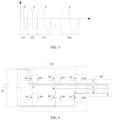
- the first control signal controls the inverter, and the MCU drives and closes a power switch element Sa on a A-phase bridge arm, a power switch element Sb' on a B-phase bridge arm, and a power switch element Sc' on a C-phase bridge arm to form two discharge circuits.
- One of the discharge circuits is: power battery ⁇ Sa ⁇ stator winding U ⁇ stator winding V ⁇ Sb' ⁇ power battery
- the other discharge circuit is: power battery ⁇ Sa ⁇ stator winding U ⁇ stator winding W ⁇ Sc' ⁇ power battery.
- the power battery discharges and converts electrical energy into an electromagnetic energy on the three-phase stator winding, and an electronic rotor remains stationary, the stator winding stores energy, and a bus bar alternating current is obtained at both ends of a bus bar of the power battery to heat the battery.
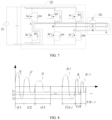
- the power switch element Sa on the A-phase bridge arm, the power switch element Sb' on the B-phase bridge arm, and the power switch element Sc' on the C-phase bridge arm are simultaneously switched off. Due to a characteristic that the current in the stator winding cannot change suddenly, the return current loops are shown in FIG. 7 .
- the two return current loops are: power battery-diode D2 ⁇ stator winding U - stator winding V ⁇ diode D3 ⁇ power battery, and power battery ⁇ diode D2 ⁇ stator winding U ⁇ stator winding W ⁇ diode D5 ⁇ power battery.
- a magnitude of a heating current in the discharge loop is determined by the closing timing of the power switch, that is, determined by a frequency f and a duty cycle D of the control signal configured to control the power switch element.
- the plurality of set frequencies are randomly generated, and the duration corresponding to each of the plurality of set frequencies is determined according to the plurality of set frequencies.
- the first control signal is generated according to the plurality of set frequencies and durations, so that the inverter may convert the current provided by the power battery into the alternating current with the plurality of set frequencies.
- Another embodiment of the present disclosure provides a control method, the control method is applied to a power system shown in FIG. 1 , and the control method includes the following steps.
- a BMS obtains a cell temperature of a power battery.
- a temperature sensor is deployed inside the power battery to monitor the cell temperature of the power battery in real time, and the temperature sensor may transmit a detected cell temperature to the BMS.
- the VCU may send a heating instruction to the MCU, so that the MCU may send a first control signal to an inverter in response of receiving the heating instruction.
- the first control signal is sent to the inverter.
- the first control signal is configured to control the inverter to convert a current provided by the power battery into an alternating current with a frequency changing randomly, and the alternating current with the frequency changing randomly is configured to supply power to a permanent magnet motor.
- the second control signal is also sent to the inverter.
- the second control signal is configured to control the inverter to convert the current provided by the power battery into an alternating current with an amplitude changing periodically, and the alternating current with the amplitude changing periodically is configured to supply power to the permanent magnet motor.
- the inverter converts the current provided by the power battery into the alternating current with the amplitude changing periodically and the frequency changing randomly, so that a self-heating can be obtained by the power battery by using its own resistance.
- the first control signal and the second control signal are generated so that the inverter converts the current provided by the power battery into the alternating current with the amplitude changing periodically and the frequency changing randomly.
- Another embodiment of the present disclosure provides a control method, the control method is applied to a power system shown in FIG. 1 , and the control method includes the following steps.
- a BMS obtains a cell temperature of a power battery.
- the VCU may send a heating instruction to a MCU, so that the MCU generates a plurality of set frequencies randomly in response of receiving the heating instruction, and determines a duration of each of the plurality of set frequencies according to each of the plurality of set frequencies.
- the MCU determines a reference value sequence of a d-axis component according to the plurality of set frequencies and the duration of each of the plurality of set frequencies, and sets a reference signal sequence of a q-axis component as a null sequence.
- the MCU In S504, the MCU generates a first control signal according to the reference value sequence of the d-axis component, the reference value sequence of the q-axis component, and motor parameters of a permanent magnet motor.
- the MCU sends the first control signal to an inverter.
- the MCU determines a plurality of set amplitudes and a duration of each of the plurality of set amplitudes according to heating parameters of the power battery and a maximum noise threshold value.
- the heating parameters include a heating rate and a heating duration
- the maximum noise threshold value refers to a vibration noise threshold value of the motor. The greater a set amplitude, the longer a duration, the greater the heating rate, and the shorter the heating duration.
- a current amplitude Id0 corresponding to a required heating rate under an operating condition with a constant amplitude and a constant frequency may be obtained, and the Id0 may be used as an average value of variable amplitudes to generate the plurality of set amplitudes.
- a number of the set amplitudes is not limited.
- the MCU determines a reference value sequence of a d-axis component according to the plurality of set amplitudes and the duration of each of the plurality of set amplitude, and sets the reference value sequence of the q-axis component as the null sequence.
- the duration corresponding to the set amplitude I1 is t21
- the duration corresponding to the set amplitude I2 is t22...
- the duration corresponding to the set amplitude In is t2n.
- the reference value sequence of the d-axis component includes a plurality of reference values, and each of the plurality of reference values includes an amplitude reference value component, a frequency reference value component, and a duration reference value component.
- the frequency reference value component may also be any value f1
- the amplitude reference value component is a set amplitude
- the duration reference value component is a duration corresponding to the set amplitude. That is, the reference value sequence of the d-axis component is ⁇ (I1, f1, t21), (I2, f1, t22), ..., (In, f1, t2n), (I1, f1, t21), (I2, f1, t22), ..., (In, f1, t2n), ... ⁇ .
- the reference value sequence of the q-axis component includes a plurality of reference values, and each of the plurality of reference values includes the amplitude reference value component, the frequency reference value component, and the duration reference value component.
- the amplitude reference value component, frequency reference value component, and duration reference value component are all null. That is, the reference value sequence of the q-axis component is ⁇ 0, 0, 0), (0, 0, 0), ..., (0, 0, 0) ⁇ .
- the amplitude reference value in the reference value sequence of the d-axis component increases or decreases sequentially, that is, I1 ⁇ 12 ... ⁇ In, or I1 ⁇ I2 ... ⁇ In.
- the MCU In S508, the MCU generates a second control signal according to the reference value sequence of the d-axis component, the reference value sequence of the q-axis component, and the motor parameters of the permanent magnet motor.
- the motor parameters of the permanent magnet motor include a position, a speed, an acceleration, and a stator current of the motor, and the manner of generating the second control signal is the same as that described in FIG. 4 , and will not be repeated here.
- the MCU may send the second control signal to the inverter.
- the second control signal is also sent to the inverter.
- the second control signal is configured to control the inverter to convert a current provided by the power battery into an alternating current with an amplitude changing periodically, and the alternating current with the amplitude changing periodically is configured to supply power to the permanent magnet motor.
- the plurality of set frequencies are randomly generated, and the duration corresponding to each of the plurality of set frequencies is determined according to the plurality of set frequencies, so as to generate the first control signal according to the plurality of set frequencies and the durations.
- the plurality of set amplitudes and the duration of each of the plurality of set amplitudes are determined according to the heating parameters of the power battery and the maximum noise threshold value, so that the second control signal is generated according to the plurality of set amplitudes and the durations.
- the inverter converts the current provided by the power battery into the alternating current with the frequency changing random and the amplitude changing periodically.
- the originally concentrated radial electromagnetic force can be evenly distributed on the entire stator, in this way, the vibration noise during the heating process of the power battery can be greatly reduce.
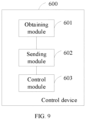
- the present disclosure provides a control device 600, the control device 600 is configured to send a first control signal to an inverter when a cell temperature of a power battery satisfies a preset heating condition for the power battery.
- the first control signal is configured to control the inverter to convert an electricity provided by the power battery into an alternating current with a frequency changing randomly, and the alternating current with frequency changing randomly is configured to supply power to a motor.
- control device 600 includes:
- control module 603 is further configured to: randomly generate a plurality of set frequencies, and determine a duration of each of the plurality of set frequencies according to each of the plurality of set frequencies; determine a reference value sequence of a d-axis component according to the plurality of set frequencies and the duration of each of the plurality of set frequencies, and set a reference signal sequence of a q-axis component as a null sequence; and generate the first control signal according to the reference value sequence of the d-axis component, the reference value sequence of the q-axis component, and motor parameters of the permanent magnet motor.
- control module 603 is specifically configured to: determine an entire cycle duration corresponding to a set frequency as a duration of the set frequency; or, determine a half cycle duration corresponding to a set frequency as a duration of the set frequency.
- the sending module 602 is also configured to: send a second control signal to the inverter when the cell temperature of the power battery satisfies the preset heating condition for the power battery, where the second control signal is configured to control the inverter to convert the electricity provided by the power battery into an alternating current with an amplitude changing periodically, and the alternating current with the amplitude changing periodically is configured to supply power to the permanent magnet motor.
- control module 603 is further configured to: determine a plurality of set amplitudes and a duration of each of the plurality of set amplitudes according to heating parameters of the power battery and a maximum noise threshold value; determine a reference value sequence of a d-axis component according to the plurality of set amplitudes and the duration of each of the plurality of set amplitudes, and set a reference value sequence of a q-axis component as a null sequence; and generate the second control signal according to the reference value sequence of the d-axis component, the reference value sequence of the q-axis component, and motor parameter of the motor.
- the heating parameters include a heating rate and a heating duration.
- an amplitude reference value in the reference value sequence of the d-axis component is periodically increased or periodically decreased.
- control module 603 is also configured to determine whether the cell temperature is less than a minimum operating temperature of the power battery.
- An embodiment of the present disclosure provides a power system, including: a power battery, an inverter, a motor, and a motor controller.
- the motor controller is respectively configured to perform the steps in the control methods described in the above embodiments.
- a changing in frequency may induce a large amount of eddy current loss in the stator, a rotor core and a permanent magnet of the motor, which causes the motor to generate a large amount of heat.
- a heat sink may be added to the motor to avoid the motor from burnt out.
- An embodiment of the present disclosure provides an electric vehicle, including a power system.
- the power system includes a power battery, an inverter, a motor, and a motor controller.
- the motor controller is respectively configured to perform the steps in the control methods described in the above embodiments.
Landscapes
- Engineering & Computer Science (AREA)
- Power Engineering (AREA)
- Transportation (AREA)
- Mechanical Engineering (AREA)
- Life Sciences & Earth Sciences (AREA)
- Sustainable Development (AREA)
- Sustainable Energy (AREA)
- Electric Propulsion And Braking For Vehicles (AREA)
- Control Of Ac Motors In General (AREA)
- Secondary Cells (AREA)
Description
- The present disclosure relates to the field of battery technology, in particular to a control method, a device, a power system and an electric vehicle.
- Due to a limitation of the material, a power battery may only exert the best performance stably under a rated ambient temperature. Therefore, the power battery needs to be heated to the rated ambient temperature when the electric vehicle is used in an area with a low ambient temperature.
- In related art, the power battery is directly heated through a motor. Specifically, a closed loop is formed between the power battery and a stator winding of the motor, and electrical energy is stored on the stator winding of the motor. The stator winding of the motor applies an alternating current excitation to the power battery, so that the power battery is heated by its own internal resistance. Since the internal resistance of the power battery is usually large in an environment with low temperature, the power battery may be quickly heated to the rated ambient temperature.
- However, in a process of heating the power battery by using the motor, noise is often excessive.
- Examples of prior art control methods for a motor controller of a power system of an electric vehicle are disclosed in
CN 111 439 132 A andEP 2 579 452 A1 . - The present invention provides a control method, applied to a motor controller of a power system, according to
claim 1. The power system further includes a power battery, a motor, and an inverter. The method includes: sending a first control signal to the inverter when a cell temperature of the power battery satisfies a preset heating condition for the power battery; where the first control signal is configured to control the inverter to convert an electricity provided by the power battery into an alternating current with a frequency changing randomly, and the alternating current with the frequency changing randomly is configured to supply power to the motor. - Before the sending the first control signal, the method further includes: randomly generating a plurality of set frequencies, and determining a duration of each of the plurality of set frequencies according to each of the plurality of set frequencies; determining a reference value sequence of a d-axis component according to the plurality of set frequencies and the duration of each of the plurality of set frequencies, and setting a reference signal sequence of a q-axis component as a null sequence; and generating the first control signal according to the reference value sequence of the d-axis component, the reference value sequence of the q-axis component, and motor parameters of the motor.
- Hence, the plurality of set frequencies are randomly generated, the duration of each of the plurality of set frequencies is determined according to each of the plurality of set frequencies, and the first control signal is generated according to the plurality of set frequencies and the durations of the plurality of set frequencies, in order to control the inverter to convert a current of the power battery into the alternating current with the frequency changing randomly. By introducing new frequency components, an originally concentrated radial electromagnetic force can be evenly distributed to an entire stator, in this way, vibration noise during a heating process of the power battery can be reduced.
- In some embodiments, the determining the duration of each set frequency according to each of the plurality of set frequencies includes: determining an entire cycle duration corresponding to a set frequency as a duration of the set frequency; or, determining a half cycle duration corresponding to a set frequency as a duration of the set frequency.
- In the above embodiments, the duration of a set frequency is set to be the half cycle duration or the entire cycle duration corresponding to the set frequency, so as to facilitate a detection of the alternating current used to drive the motor and adjustment of the control signal in real time. In this way, effect of a noise suppression is ensured.
- In some embodiments, the method further includes: sending a second control signal to the inverter when the cell temperature of the power battery satisfies the preset heating condition for the power battery; where the second control signal is configured to control the inverter to convert the electricity provided by the power battery into alternating current with an amplitude changing periodically, and the alternating current with the amplitude changing periodically is configured to supply power to the motor.
- In the above embodiments, when the cell temperature of the power battery satisfies the heating condition for the power battery, the first control signal and the second control signal are sent to the inverter, and the inverter is controlled to convert the current of the power battery into the alternating current with the frequency changing randomly and the amplitude changing periodically, such that new frequency components are introduced. In this way, the vibration noise during the heating process for the power battery is further reduced.
- In some embodiments, before the sending the second control signal, the method further includes: determining a plurality of set amplitudes and a duration of each of the plurality of set amplitudes according to heating parameters of the power battery and a maximum noise threshold value; determining a reference value sequence of a d-axis component according to the plurality of set amplitudes and the duration of each of the plurality of set amplitudes, and setting a reference value sequence of a q-axis component as a null sequence; and generating the second control signal according to the reference value sequence of the d-axis component, the reference value sequence of the q-axis component, and motor parameters of the motor.
- In the above embodiments, when the cell temperature of the power battery satisfies a self-heating condition for the battery, the plurality of set amplitudes and the duration of each of the plurality of set amplitude are determined according to the heating parameters of the power battery and the maximum noise threshold value, so as to generate the second control signal according to the plurality of set amplitudes and the durations. Under the control of the first control signal and the second control signal, the inverter converts the current provided by the power battery into the alternating current with the frequency changing randomly and the amplitude changing periodically. By introducing more frequency components, the originally concentrated radial electromagnetic force can be evenly distributed to the entire stator, in this way, the vibration noise during the heating process of the power battery can be greatly reduced.
- In some embodiments, the heating parameters include a heating rate and a heating duration.
- In some embodiments, an amplitude reference value in the reference value sequence of the d-axis component is periodically increased or periodically decreased.
- In some embodiments, the sending the first control signal to the inverter when the cell temperature of the power battery satisfies the preset heating condition for the power battery includes: sending the first control signal to the inverter when the cell temperature of the power battery is lower than a minimum operating temperature of the power battery, and the motor is in a non-driving operation state.
- In the above embodiments, specifically, when the cell temperature of the power battery is less than the minimum operating temperature of the power battery, and an output torque of the motor is controlled to be approximately 0, that is, when the power battery needs to be heated to work properly and the motor is not rotating, the motor controller can send the first control signal to the inverter. In this way, influence to normal operation of the motor can be avoided, thereby the operation safety of the motor can be effectively improved.
- In a second aspect, the present disclosure provides a control device according to claim 9, configured to send a first control signal to an inverter when a cell temperature of a power battery satisfies a preset heating condition for the power battery; where, the first control signal is configured to control the inverter to convert an electricity provided by the power battery into an alternating current with a frequency changing randomly, the alternating current with the frequency changing randomly is configured to supply power to the motor.
- Additionally, the present invention provides a power system, including: a power battery, an inverter, a motor, and a control device. The control device is configured to perform the control method involved in the first aspect and alternative solutions.
- Yet further, the present invention provides an electric vehicle, including a power system. The power system includes a power battery, an inverter, a motor, and a motor controller. The motor controller is respectively configured to perform the control method involved in the first aspect and alternative solutions.
- The embodiments of the present disclosure provide a control method, a device, a power system, and an electric vehicle. When the cell temperature of the power battery satisfies the heating condition for the power battery, the first control signal is sent to the inverter. The first control signal is configured to control the inverter to convert the current of the power battery into the alternating current with the frequency changing randomly. The alternating current with the frequency changing randomly is configured to supply power to the motor. By introducing the new frequency components, the originally concentrated radial electromagnetic force can be evenly distributed to the entire stator. In this way, the vibration noise during the heating process of the power battery can be reduced. In addition, the first control signal and the second control signal are sent to the inverter, and the inverter is controlled to convert the current of the power battery into the alternating current with the frequency changing randomly and the amplitude changing periodically, thereby the new frequency components are introduced, and the vibration noise during the heating process for the power battery is further reduced.
- In order to illustrate the technical solutions in the embodiments of the present disclosure more clearly, the drawings used in the description of the embodiments will be briefly described below.
-
FIG. 1 is a schematic structural diagram of a power system provided by an embodiment of the present disclosure; -
FIG. 2 is a schematic structural diagram of a power battery provided by an embodiment of the present disclosure; -
FIG. 3 is a flow chart of a control method provided by an embodiment of the present disclosure; -
FIG. 4 is a flow chart of a vector control on a permanent magnet motor provided by an example of the present disclosure; -
FIG. 5 is a schematic diagram of an alternating current for driving a motor provided by an embodiment of the present disclosure; -
FIG. 6 is a schematic diagram of one of the operating states of the power system provided by an embodiment of the present disclosure; -
FIG. 7 is a schematic diagram of another operating state of the power system provided by an embodiment of the present disclosure; -
FIG. 8 is a schematic diagram of an alternating current for driving a motor provided by an embodiment of the present disclosure; -
FIG. 9 is a schematic structural diagram of a control device provided by an embodiment of the present disclosure. - In the drawings, the drawings are not drawn to actual scale.
- An electric vehicle refers to a vehicle powered by a power battery. As shown in
FIG. 1 , apower system 100 of the electric vehicle includes apower battery 10, aninverter 20, amotor 30, and a motor controller unit (MCU) 40. Themotor 30 may be a permanent magnet motor. A positive electrode and a negative electrode of thepower battery 10 are connected to a direct current side of theinverter 20, and an alternating current side of theinverter 20 is connected to a stator winding of themotor 30. Thepower battery 10 supplies power to the motor through theinverter 20. TheMCU 40 is provided with a plurality of input terminals for receiving operating status data of the motor and sending a motor control signal. TheMCU 40 generates a pulse width modulation (PWM) signal according to the motor control signal, the operating status data of the motor, and operating status data of the power battery, and controls the current and voltage provided to themotor 30 by theinverter 20, so as to control a rotating speed of themotor 30 and realize a speed control of the vehicle. - As shown in
FIG. 2 , thepower battery 10 includes abattery module 101, a battery management system (BMS) 102, and anauxiliary structure 103. Herein, thebattery module 101 is formed by a plurality of power cells in series and/or parallel, and the cells are a core component of the power battery and a source of the electrical energy provided by the power battery. Main functions of thebattery management system 102 are to perform a charge and discharge management, a high voltage control, a battery status evaluation, a battery data collection, a battery protection, and a battery thermal management. Theauxiliary structure 103 generally includes an external frame, an electrical connection device, an insulating component, and the like. The external frame plays a role of protecting and supporting the battery module, the electrical connection device plays a role of connecting other electrical equipment, such as connecting with the inverter, and the insulating component plays a role of insulation protection. - Herein, the thermal management function of the
battery management system 102 is used to ensure that the power battery works within a suitable temperature range. The thermal management function is mainly to achieve an accurate measurement and monitoring of a battery temperature, so as to perform an effective heat dissipation when the temperature of the battery module is too high, a rapid heating under a low temperature condition, and ensure a uniform distribution of a temperature field of the battery module. Herein, the rapid heating under the low temperature condition refers to: when being used in an area where a temperature of the cells is low, the power battery needs to be heated to a rated cell temperature so that the power battery may stably exert the best performance. - Existing heating methods for power battery may include an indirect heating method and a direct heating method. The indirect heating method refers to arranging a heat source outside the power battery for heating. The indirect heating method may include an air heating, a liquid heating, and a heating film heating, and the like. A heating rate of the battery varies depending on different heating sources. Since a heat loss may occur on a heat transfer medium when the battery is heated by an external heat source, an efficiency of the indirect heating method is low.
- The direct heating method refers to heating the power battery inside. Herein, the common direct heating method is heating through internal resistance. Specifically, a motor rotor is fixed, and the PWM signal is input to a control terminal of the inverter, the power battery and the stator winding form a closed loop circuit, and the stator winding stores electric energy. Due to an inductance characteristic of the stator winding, the stator winding provides the alternating current to the battery, and the power battery is heated by the alternating current flowing through its internal resistance. Since the internal resistance of the power battery is relatively large in a low temperature environment, a heating efficiency of the power battery is high.
- However, for the existing heating method by using the internal resistance of the power battery, when the motor provides a heating current to the power battery, the stator winding is used as an energy storage element to realize an alternating current on a bus bar. The above method changes a magnetic field distribution of the motor under a normal operation condition and brings an unbalanced force inside the motor, which is liable to cause vibration and noise on the motor, as a result, a NVH three-phase indicator of the electric vehicle cannot up to a standard. Herein, NVH, the abbreviation of noise, vibration and harshness, is an important indicator of the comfort of a vehicle.
- To solve the above technical problems, the embodiments of the present disclosure provide a control method, a device, a power system, and an electric vehicle. The inventive concept of the present disclosure is to control a q-axis current or a q-axis voltage to 0, and apply the voltage or current to a d-axis, so that an output torque of the motor is 0, and use an inductance of the motor for energy storage, to realize a self-heating function of the battery. On the basis of controlling a d-axis voltage or a d-axis current of the motor to be a sine wave, additional current harmonic components may be introduced by making a frequency of the d-axis voltage or d-axis current to change randomly. In this way, a radial electromagnetic force of the motor can be evenly distributed on the stator under a self-heating condition of the battery, thereby the noise of the motor under the self-heating condition can be reduced. In addition, by randomly changing the frequency of the d-axis voltage or d-axis current, and periodically changing an amplitude of the d-axis voltage or d-axis current, more current harmonic components can be introduced. In this way, the radial electromagnetic force can be evenly distributed throughout the stator, and the vibration and noise during the heating process of the power battery can be greatly reduce.
- An embodiment of the present disclosure provides a control method, the control method is applied to a motor controller unit MCU of a power system shown in
FIG. 1 . The control method includes: sending, by the MCU, a first control signal to an inverter when a cell temperature of a power battery satisfies a preset heating condition for the power battery. Herein, the first control signal is configured to control the inverter to convert an electricity provided by the power battery into an alternating current with a frequency changing randomly, and the alternating current with the frequency changing randomly is configured to supply power to the motor. - As shown in
FIG. 3 , an embodiment of the present disclosure provides a control method, the control method is applied to the power system shown inFIG. 1 , and the control method includes the following steps. - In S201, a BMS obtains a cell temperature of the power battery.
- Herein, a temperature sensor is deployed inside the power battery to monitor the cell temperature of the power battery in real time, and the temperature sensor may transmit a detected cell temperature to the BMS.
- In S202, when a vehicle control unit (VCU) determines that the cell temperature satisfies the heating condition for the power battery, the VCU may send a heating instruction to the MCU, and the MCU may send the first control signal to the inverter in response of receiving the heating instruction.
- Herein, the heating condition for the power battery includes that the cell temperature of the power battery is lower than a minimum operating temperature. If the cell temperature of the power battery is lower than the minimum operating temperature, it means that the cell temperature of the power battery satisfies the heating condition for the power battery. If the cell temperature of the power battery is higher than or equal to the minimum operating temperature, it means that the cell temperature of the power battery does not satisfy the heating condition for the power battery.
- In some embodiments, when the VCU determines that the cell temperature satisfies the heating condition for the power battery and the motor is in a non-driving operation state, the VCU may send the heating instruction to the MCU. Alternatively, when the VCU determines that the cell temperature is lower than the minimum operating temperature and the motor is in the non-driving state, the VCU may send the heating instruction to the MCU.
- The first control signal is configured to control the inverter to convert the current provided by the power battery into the alternating current with the frequency changing randomly, and the alternating current with the frequency changing randomly is configured to supply power to a permanent magnet motor, so that a self-heating may be obtained by the power battery by using its own resistance.
- In the control method provided in this embodiment of the present disclosure, when the cell temperature of the power battery satisfies a self-heating condition for the battery, the first control signal is generated so that the inverter may convert the current provided by the power battery into the alternating current with the frequency changing randomly. By introducing new frequency components, an originally concentrated radial electromagnetic force can be evenly distributed on an entire stator, in this way, vibration and noise during a heating process of the power battery can be reduced.
- Another embodiment of the present disclosure provides a control method, the control method is applied to a power system shown in
FIG. 1 , and the control method includes the following steps. - In S301, a BMS obtains a cell temperature of a power battery.
- Herein, a temperature sensor is deployed inside the power battery to monitor the cell temperature of the power battery in real time, and the temperature sensor may transmit a detected cell temperature to the BMS.
- In S302, when a VCU determines that the cell temperature satisfies a heating condition for the power battery, the VCU may send a heating instruction to a MCU, in response of receiving the heating instruction, the MCU may randomly generate a plurality of set frequencies, and determine a duration of each of the plurality of set frequency according to each of the plurality of set frequency.
- Herein, when the cell temperature is less than a minimum operating temperature of the power battery, the plurality of set frequencies are randomly generated. The plurality of set frequencies are frequencies of the current passing through a motor, that is, an alternating current with the plurality of set frequencies is used to supply power to the motor.
- As one of the specific ways to determine the duration of each of the plurality of set frequencies, an entire cycle duration corresponding to a set frequency is determined as the duration of the set frequency. When a set frequency is f, the entire cycle duration corresponding to the set frequency is 1/f, that is to say, each of the plurality of set frequencies lasts for one cycle duration.
- As another specific way to determine the duration of each of the plurality of set frequencies, a half-cycle duration corresponding to a set frequency is determined as the duration of the set frequency. When a set frequency is f, the half-cycle duration corresponding to the set frequency is 1/2f, that is to say, each of the plurality of set frequencies lasts for the half-cycle duration.
- In S303, the MCU determines a reference value sequence of a d-axis component according to the plurality of set frequencies and the duration of each of the plurality of set frequencies, and sets a reference signal sequence of a q-axis component as a null sequence.
- Herein, when the randomly generated plurality of set frequencies are f1, f2, ..., fn, the duration corresponding to the set frequency f1 is t11, the duration corresponding to the set frequency f2 is t12, ..., and the duration corresponding to the set frequency fn is t1n.
- The reference value sequence of the d-axis component includes a plurality of reference values, and each of the plurality of reference values includes an amplitude reference value component, a frequency reference value component, and a duration reference value component. The amplitude reference value component may also be any value I1, the frequency reference value component is a set frequency, and the duration reference value component is the duration corresponding to the set frequency. That is, the reference value sequence of the d-axis component is {(I1, f1, t11), (I1, f2, t12), ..., (I1, fn t1n)}.
- The reference value sequence of the q-axis component includes a plurality of reference values, and each of the plurality of reference values includes an amplitude reference value component, a frequency reference value component, and a duration reference value component. The amplitude reference value component, the frequency reference value component, and the duration reference value component are all null. That is, the reference value sequence of the q-axis component is {0, 0, 0), (0, 0, 0), ..., (0, 0, 0)}.
- In S304, the MCU generates a first control signal according to the reference value sequence of the d-axis component, the reference value sequence of the q-axis component, and motor parameters of a permanent magnet motor.
- Herein, as shown in
FIG. 4 , the motor parameters of the permanent magnet motor include an acceleration, a rotation speed, a position, and a stator current of the permanent magnet motor. - The MCU performs a coordinate conversion on the stator current according to the speed and position of the motor to obtain a d-axis real-time component of the stator current and a q-axis real-time component of the stator current of the permanent magnet motor.
- The MCU then generates an input value of a first proportional integral controller according to the d-axis real-time component of the stator current, the acceleration of the permanent magnet motor, and the reference value of the d-axis component of the stator current. And the d-axis reference value of a stator voltage is output by the first proportional integral controller.
- The MCU then generates an input value of a second proportional integral controller according to the q-axis real-time component of the stator current and the reference value of the q-axis component. And the q-axis reference value of the stator voltage is output by the second proportional integral controller.
- The MCU then performs the coordinate conversion on the d-axis reference value of the stator voltage, the q-axis reference value of the stator voltage, the rotation speed and position of the motor to obtain the reference value of the stator voltage, and generates the first control signal according to the reference value of the stator voltage. The first control signal is a space vector pulse width modulation (SVPWM) signal.
- In S305, when the VCU determines that the cell temperature satisfies the heating condition for the power battery, the VCU may send the heating instruction to the MCU, so that the MCU may send the first control signal to the inverter in response of receiving the heating instruction.
- Herein, the first control signal is configured to control the inverter to convert a current provided by the power battery into an alternating current with a frequency changing random. As shown in
FIG. 5 , the frequency of the alternating current may be f1, f2, ..., fn, the duration corresponding to the frequency f1 is t11, the duration corresponding to frequency f2 is t12, ..., and the duration corresponding to the frequency fn is t1n, and the amplitude of the alternating current is I1. - The alternating current with the frequency changing random is configured to supply power to the permanent magnet motor, so that a self-heating may be obtained by the power battery by using its own resistance. The process of controlling the inverter to heat the power battery is described below.
- As shown in
FIG. 6 , the first control signal controls the inverter, and the MCU drives and closes a power switch element Sa on a A-phase bridge arm, a power switch element Sb' on a B-phase bridge arm, and a power switch element Sc' on a C-phase bridge arm to form two discharge circuits. One of the discharge circuits is: power battery→ Sa→ stator winding U→ stator winding V→Sb'→power battery, and the other discharge circuit is: power battery→Sa→stator winding U→stator winding W→Sc'→power battery. The power battery discharges and converts electrical energy into an electromagnetic energy on the three-phase stator winding, and an electronic rotor remains stationary, the stator winding stores energy, and a bus bar alternating current is obtained at both ends of a bus bar of the power battery to heat the battery. - At a next moment, the power switch element Sa on the A-phase bridge arm, the power switch element Sb' on the B-phase bridge arm, and the power switch element Sc' on the C-phase bridge arm are simultaneously switched off. Due to a characteristic that the current in the stator winding cannot change suddenly, the return current loops are shown in
FIG. 7 . The two return current loops are: power battery-diode D2→stator winding U - stator winding V→ diode D3→power battery, and power battery→diode D2→stator winding U→stator winding W→diode D5→power battery. During a discharging and charging process of the stator winding in the motor, current flows through the power battery, thereby a battery pack can be heated. - A magnitude of a heating current in the discharge loop is determined by the closing timing of the power switch, that is, determined by a frequency f and a duty cycle D of the control signal configured to control the power switch element.
- In the control method provided in this embodiment of the present disclosure, when the cell temperature of the power battery satisfies a self-heating condition for the battery, the plurality of set frequencies are randomly generated, and the duration corresponding to each of the plurality of set frequencies is determined according to the plurality of set frequencies. The first control signal is generated according to the plurality of set frequencies and durations, so that the inverter may convert the current provided by the power battery into the alternating current with the plurality of set frequencies. By introducing new frequency components, an originally concentrated radial electromagnetic force can be evenly distributed on the entire stator, in this way, vibration and noise during a heating process of the power battery can be reduce.
- Another embodiment of the present disclosure provides a control method, the control method is applied to a power system shown in
FIG. 1 , and the control method includes the following steps. - In S401, a BMS obtains a cell temperature of a power battery.
- Herein, a temperature sensor is deployed inside the power battery to monitor the cell temperature of the power battery in real time, and the temperature sensor may transmit a detected cell temperature to the BMS.
- In S402, when a VCU determines that the cell temperature satisfies a heating condition for the power battery, the VCU may send a heating instruction to the MCU, so that the MCU may send a first control signal to an inverter in response of receiving the heating instruction.
- Herein, when the cell temperature is lower than a minimum operating temperature, the first control signal is sent to the inverter. The first control signal is configured to control the inverter to convert a current provided by the power battery into an alternating current with a frequency changing randomly, and the alternating current with the frequency changing randomly is configured to supply power to a permanent magnet motor.
- In S403, when an ambient temperature satisfies a preset heating condition for the power battery, the MCU sends a second control signal to the inverter.
- Herein, when the cell temperature is lower than the minimum operating temperature, the second control signal is also sent to the inverter. The second control signal is configured to control the inverter to convert the current provided by the power battery into an alternating current with an amplitude changing periodically, and the alternating current with the amplitude changing periodically is configured to supply power to the permanent magnet motor.
- As shown in
FIG. 8 , under the controls of the first control signal and the second control signal, the inverter converts the current provided by the power battery into the alternating current with the amplitude changing periodically and the frequency changing randomly, so that a self-heating can be obtained by the power battery by using its own resistance. - In the control method provided in this embodiment of the present disclosure, when the cell temperature of the power battery satisfies a self-heating condition for the battery, the first control signal and the second control signal are generated so that the inverter converts the current provided by the power battery into the alternating current with the amplitude changing periodically and the frequency changing randomly. By introducing more frequency components, an originally concentrated radial electromagnetic force can be evenly distributed on entire stator, in this way, vibration noise during a heating process of the power battery can be greatly reduced.
- Another embodiment of the present disclosure provides a control method, the control method is applied to a power system shown in
FIG. 1 , and the control method includes the following steps. - In S501, a BMS obtains a cell temperature of a power battery.
- In S502, when a VCU determines that the cell temperature satisfies a heating condition for the power battery, the VCU may send a heating instruction to a MCU, so that the MCU generates a plurality of set frequencies randomly in response of receiving the heating instruction, and determines a duration of each of the plurality of set frequencies according to each of the plurality of set frequencies.
- In S503, the MCU determines a reference value sequence of a d-axis component according to the plurality of set frequencies and the duration of each of the plurality of set frequencies, and sets a reference signal sequence of a q-axis component as a null sequence.
- In S504, the MCU generates a first control signal according to the reference value sequence of the d-axis component, the reference value sequence of the q-axis component, and motor parameters of a permanent magnet motor.
- In S505, the MCU sends the first control signal to an inverter.
- Herein, S501 to S505 have been described in detail in the foregoing embodiments, and will not be repeated.
- In S506, the MCU determines a plurality of set amplitudes and a duration of each of the plurality of set amplitudes according to heating parameters of the power battery and a maximum noise threshold value.
- The heating parameters include a heating rate and a heating duration, and the maximum noise threshold value refers to a vibration noise threshold value of the motor. The greater a set amplitude, the longer a duration, the greater the heating rate, and the shorter the heating duration.
- When the plurality of set amplitudes are determined, a current amplitude Id0 corresponding to a required heating rate under an operating condition with a constant amplitude and a constant frequency may be obtained, and the Id0 may be used as an average value of variable amplitudes to generate the plurality of set amplitudes. A number of the set amplitudes is not limited.
- In S507, the MCU determines a reference value sequence of a d-axis component according to the plurality of set amplitudes and the duration of each of the plurality of set amplitude, and sets the reference value sequence of the q-axis component as the null sequence.
- Herein, when the plurality of set amplitudes are I1, I2, ..., In, the duration corresponding to the set amplitude I1 is t21, the duration corresponding to the set amplitude I2 is t22..., and the duration corresponding to the set amplitude In is t2n.
- The reference value sequence of the d-axis component includes a plurality of reference values, and each of the plurality of reference values includes an amplitude reference value component, a frequency reference value component, and a duration reference value component. The frequency reference value component may also be any value f1, the amplitude reference value component is a set amplitude, and the duration reference value component is a duration corresponding to the set amplitude. That is, the reference value sequence of the d-axis component is {(I1, f1, t21), (I2, f1, t22), ..., (In, f1, t2n), (I1, f1, t21), (I2, f1, t22), ..., (In, f1, t2n), ...}.
- The reference value sequence of the q-axis component includes a plurality of reference values, and each of the plurality of reference values includes the amplitude reference value component, the frequency reference value component, and the duration reference value component. The amplitude reference value component, frequency reference value component, and duration reference value component are all null. That is, the reference value sequence of the q-axis component is {0, 0, 0), (0, 0, 0), ..., (0, 0, 0)}.
- In one embodiment, the amplitude reference value in the reference value sequence of the d-axis component increases or decreases sequentially, that is, I1 ≤12 ... ≤ In, or I1 ≥ I2 ... ≥In. By using an alternating current with a periodically increasing amplitude or a periodically decreasing amplitude to supply power to the motor, more frequency components can be introduced, and an originally concentrated radial electromagnetic force can be evenly distributed on entire stator, in this way, the vibration and noise during a heating process of the power battery can be greatly reduced.
- In S508, the MCU generates a second control signal according to the reference value sequence of the d-axis component, the reference value sequence of the q-axis component, and the motor parameters of the permanent magnet motor.
- Herein, the motor parameters of the permanent magnet motor include a position, a speed, an acceleration, and a stator current of the motor, and the manner of generating the second control signal is the same as that described in
FIG. 4 , and will not be repeated here. - In S509, when an ambient temperature satisfies a preset heating condition for the power battery, the MCU may send the second control signal to the inverter.
- Herein, when the cell temperature is lower than a minimum operating temperature, the second control signal is also sent to the inverter. The second control signal is configured to control the inverter to convert a current provided by the power battery into an alternating current with an amplitude changing periodically, and the alternating current with the amplitude changing periodically is configured to supply power to the permanent magnet motor.
- An amplitude changing cycle of the alternating current is:

- In the control method provided in this embodiment of the present disclosure, when the cell temperature of the power battery satisfies a self-heating condition for the battery, the plurality of set frequencies are randomly generated, and the duration corresponding to each of the plurality of set frequencies is determined according to the plurality of set frequencies, so as to generate the first control signal according to the plurality of set frequencies and the durations. The plurality of set amplitudes and the duration of each of the plurality of set amplitudes are determined according to the heating parameters of the power battery and the maximum noise threshold value, so that the second control signal is generated according to the plurality of set amplitudes and the durations. Under the controls of the first control signal and the second control signal, the inverter converts the current provided by the power battery into the alternating current with the frequency changing random and the amplitude changing periodically. By introducing more frequency components, the originally concentrated radial electromagnetic force can be evenly distributed on the entire stator, in this way, the vibration noise during the heating process of the power battery can be greatly reduce.
- As shown in
FIG. 9 , the present disclosure provides acontrol device 600, thecontrol device 600 is configured to send a first control signal to an inverter when a cell temperature of a power battery satisfies a preset heating condition for the power battery. Herein, the first control signal is configured to control the inverter to convert an electricity provided by the power battery into an alternating current with a frequency changing randomly, and the alternating current with frequency changing randomly is configured to supply power to a motor. - In one embodiment, the
control device 600 includes: - an obtaining
module 601, configured to obtain the cell temperature of the power battery. - a sending
module 602, configured to send a heating instruction to acontrol module 603 when the cell temperature satisfies the preset heating condition for the power battery. - the
control module 603, configured to send the first control signal to the inverter in response of receiving the heating instruction, where the first control signal is configured to control the inverter to convert the current provided by the power battery into the alternating current with the frequency changing randomly, and the alternating current with the frequency changing randomly is configured to supply power to a permanent magnet motor. - In some embodiments, the
control module 603 is further configured to: randomly generate a plurality of set frequencies, and determine a duration of each of the plurality of set frequencies according to each of the plurality of set frequencies; determine a reference value sequence of a d-axis component according to the plurality of set frequencies and the duration of each of the plurality of set frequencies, and set a reference signal sequence of a q-axis component as a null sequence; and generate the first control signal according to the reference value sequence of the d-axis component, the reference value sequence of the q-axis component, and motor parameters of the permanent magnet motor. - In some embodiments, the
control module 603 is specifically configured to: determine an entire cycle duration corresponding to a set frequency as a duration of the set frequency; or, determine a half cycle duration corresponding to a set frequency as a duration of the set frequency. - In some embodiments, the sending
module 602 is also configured to: send a second control signal to the inverter when the cell temperature of the power battery satisfies the preset heating condition for the power battery, where the second control signal is configured to control the inverter to convert the electricity provided by the power battery into an alternating current with an amplitude changing periodically, and the alternating current with the amplitude changing periodically is configured to supply power to the permanent magnet motor. - In some embodiments, the
control module 603 is further configured to: determine a plurality of set amplitudes and a duration of each of the plurality of set amplitudes according to heating parameters of the power battery and a maximum noise threshold value; determine a reference value sequence of a d-axis component according to the plurality of set amplitudes and the duration of each of the plurality of set amplitudes, and set a reference value sequence of a q-axis component as a null sequence; and generate the second control signal according to the reference value sequence of the d-axis component, the reference value sequence of the q-axis component, and motor parameter of the motor. - In some embodiments, the heating parameters include a heating rate and a heating duration.
- In some embodiments, an amplitude reference value in the reference value sequence of the d-axis component is periodically increased or periodically decreased.
- In some embodiments, the
control module 603 is also configured to determine whether the cell temperature is less than a minimum operating temperature of the power battery. - An embodiment of the present disclosure provides a power system, including: a power battery, an inverter, a motor, and a motor controller. The motor controller is respectively configured to perform the steps in the control methods described in the above embodiments. However, a changing in frequency may induce a large amount of eddy current loss in the stator, a rotor core and a permanent magnet of the motor, which causes the motor to generate a large amount of heat. A heat sink may be added to the motor to avoid the motor from burnt out.
- An embodiment of the present disclosure provides an electric vehicle, including a power system. The power system includes a power battery, an inverter, a motor, and a motor controller. The motor controller is respectively configured to perform the steps in the control methods described in the above embodiments.
Claims (10)
- A control method, applied to a motor controller of a power system, wherein the power system (100) further comprises a power battery (10) comprising a battery module (101) with power cells, a motor (30), a vehicle control unit (VCU), and an inverter (20), wherein the method comprises:randomly generating a plurality of set frequencies (f1,f2,f3,..fn), and determining a duration (t11,t12,t13,..t1n) of each of the plurality of set frequencies according to each of the plurality of set frequencies;determining a reference value sequence of a d-axis voltage or current component of the motor according to the plurality of set frequencies and the duration of each of the plurality of set frequencies, and setting a reference value sequence of a q-axis voltage or current component of the motor as a null sequence; andgenerating a first control signal according to the reference value sequence of the d-axis component, the reference value sequence of the q-axis component, and motor parameters of the motor (30); andsending the first control signal to the inverter (20) when the vehicle control unit (VCU) detects that a cell temperature of the power battery (10) satisfies a preset heating condition for the power battery (10);wherein the first control signal is configured to control the inverter (20) to convert a current provided by the power battery (10) into an alternating current with a frequency changing randomly, and the alternating current with the frequency changing randomly is configured to supply power to the motor (30).
- The method according to claim 1, wherein the determining the duration of each of the plurality of set frequencies according to each of the plurality of set frequencies comprises:determining an entire cycle duration corresponding to a set frequency as a duration of the set frequency; ordetermining a half cycle duration corresponding to a set frequency as a duration of the set frequency.
- The method according to claim 1, wherein the method further comprises:sending a second control signal to the inverter (20) when the vehicle control unit (VCU) detects that the cell temperature of the power battery (10) satisfies the preset heating condition for the power battery (10);wherein the second control signal is configured to control the inverter (20) to convert the current provided by the power battery (10) into an alternating current with an amplitude changing periodically, and the alternating current with the amplitude changing periodically is configured to supply power to the motor (30).
- The method according to claim 3, wherein, before the sending the second control signal, the method further comprises:determining a plurality of set amplitudes (I1,I2,I3,..In) and a duration (t21,t22,t23,..t2n) of each of the plurality of set amplitudes according to heating parameters of the power battery (10) and a maximum vibration noise threshold value of the motor;determining a reference value sequence of a d-axis voltage or current component of the motor according to the plurality of set amplitudes and the duration of each of the plurality of set amplitudes, and setting a reference value sequence of a q-axis voltage or current component of the motor as a null sequence; andgenerating the second control signal according to the reference value sequence of the d-axis component, the reference value sequence of the q-axis component, and motor parameters of the motor (30).
- The method according to claim 4, wherein the heating parameters comprise a heating rate and a heating duration.
- The method according to claim 4, wherein an amplitude reference value in the reference value sequence of the d-axis component is periodically increased or periodically decreased.
- The method according to any one of claims 1 to 6, wherein the sending the first control signal to the inverter (20) when the cell temperature of the power battery (10) satisfies the preset heating condition for the power battery (10) comprises:
sending the first control signal to the inverter (20) when the cell temperature of the power battery (10) is lower than a minimum operating temperature of the power battery (10) and the motor (30) is in a non-driving operation state. - A control device (600), configured to perform the control method according to any one of claims 1 to 7.
- A power system (100), comprising: a power battery (10), an inverter (20), a motor (30), and a control device (600) according to claim 8.
- An electric vehicle, comprising a power system (100) according to claim 9.
Applications Claiming Priority (2)
| Application Number | Priority Date | Filing Date | Title |
|---|---|---|---|
| CN202011554389.6A CN114670656B (en) | 2020-12-24 | 2020-12-24 | Control method, device, power system and electric vehicle |
| PCT/CN2021/114980 WO2022134640A1 (en) | 2020-12-24 | 2021-08-27 | Control method, apparatus, power system and electric vehicle |
Publications (4)
| Publication Number | Publication Date |
|---|---|
| EP4067161A1 EP4067161A1 (en) | 2022-10-05 |
| EP4067161A4 EP4067161A4 (en) | 2023-07-19 |
| EP4067161C0 EP4067161C0 (en) | 2024-10-02 |
| EP4067161B1 true EP4067161B1 (en) | 2024-10-02 |
Family
ID=78536146
Family Applications (1)
| Application Number | Title | Priority Date | Filing Date |
|---|---|---|---|
| EP21908069.4A Active EP4067161B1 (en) | 2020-12-24 | 2021-08-27 | Control method, apparatus, power system and electric vehicle |
Country Status (6)
| Country | Link |
|---|---|
| US (1) | US12249945B2 (en) |
| EP (1) | EP4067161B1 (en) |
| JP (1) | JP7611161B2 (en) |
| KR (1) | KR102865086B1 (en) |
| CN (2) | CN114670656B (en) |
| WO (2) | WO2022134266A1 (en) |
Families Citing this family (4)
| Publication number | Priority date | Publication date | Assignee | Title |
|---|---|---|---|---|
| CN116331067A (en) * | 2023-01-17 | 2023-06-27 | 浙江吉利控股集团有限公司 | A power battery self-heating control method, device, medium and vehicle |
| CN116707102B (en) * | 2023-08-09 | 2024-01-19 | 广汽埃安新能源汽车股份有限公司 | Electric drive and charging integrated systems, control methods, vehicles and electronic devices |
| SE547536C2 (en) * | 2023-09-27 | 2025-10-14 | Scania Cv Ab | Method for heating a powertrain and/or subsystem of a vehicle and control arrangement configured to perform the method |
| US20250239944A1 (en) * | 2024-01-22 | 2025-07-24 | Ford Global Technologies, Llc | Power module gate oxide self-healing method |
Citations (1)
| Publication number | Priority date | Publication date | Assignee | Title |
|---|---|---|---|---|
| EP2579452A1 (en) * | 2010-06-07 | 2013-04-10 | Toyota Jidosha Kabushiki Kaisha | Control method and control device for an electric power regulator |
Family Cites Families (35)
| Publication number | Priority date | Publication date | Assignee | Title |
|---|---|---|---|---|
| US5936378A (en) * | 1997-03-27 | 1999-08-10 | Matsushita Electric Industrial Co., Ltd. | Motor controller |
| JP2000184731A (en) * | 1998-12-18 | 2000-06-30 | Meidensha Corp | Power converter |
| US7447252B2 (en) | 2000-05-01 | 2008-11-04 | Andrzej Partyka | Overhead reduction in frequency hopping system for intermittent transmission |
| US6407531B1 (en) * | 2001-01-09 | 2002-06-18 | Delphi Technologies, Inc. | Method and system for controlling a synchronous machine over full operating range |
| US7382102B2 (en) * | 2005-06-13 | 2008-06-03 | Chrysler Llc | Heating of batteries using reactive power |
| JP4720653B2 (en) * | 2006-07-07 | 2011-07-13 | トヨタ自動車株式会社 | Electric motor control device and vehicle equipped with the same |
| JP4840481B2 (en) * | 2009-07-08 | 2011-12-21 | トヨタ自動車株式会社 | Secondary battery temperature increase control device, vehicle equipped with the same, and secondary battery temperature increase control method |
| US8373372B2 (en) * | 2009-09-25 | 2013-02-12 | Ut-Battelle, Llc | Electrical motor/generator drive apparatus and method |
| CN102781711B (en) * | 2010-03-01 | 2014-12-10 | 丰田自动车株式会社 | Electric vehicle and control method thereof |
| JP2013187939A (en) * | 2012-03-06 | 2013-09-19 | Nissan Motor Co Ltd | Motor control device for vehicle and control method |
| JP2014050170A (en) * | 2012-08-30 | 2014-03-17 | Toyota Motor Corp | Drive unit |
| JP5849917B2 (en) * | 2012-09-28 | 2016-02-03 | 株式会社豊田自動織機 | Battery temperature rise control device for electric vehicle |
| CN103560304B (en) * | 2013-11-19 | 2016-05-04 | 东风汽车公司 | A kind of electric automobile power battery group method for heating and controlling |
| JP6015707B2 (en) * | 2014-05-08 | 2016-10-26 | トヨタ自動車株式会社 | Power control system for hybrid vehicle |
| US10084343B2 (en) * | 2014-06-13 | 2018-09-25 | Empire Technology Development Llc | Frequency changing encoded resonant power transfer |
| JP6471463B2 (en) * | 2014-11-06 | 2019-02-20 | 日立化成株式会社 | Storage battery state monitoring system, storage battery state monitoring method, and storage battery state monitoring program |
| JP6168092B2 (en) | 2015-04-10 | 2017-07-26 | トヨタ自動車株式会社 | In-vehicle secondary battery cooling system |
| JP6380304B2 (en) | 2015-09-03 | 2018-08-29 | トヨタ自動車株式会社 | Hybrid car |
| CN106330011A (en) * | 2016-09-05 | 2017-01-11 | 北京新能源汽车股份有限公司 | Electromagnetic interference suppression method and device for motor, motor controller and electric vehicle |
| JP6741904B2 (en) | 2016-12-09 | 2020-08-19 | 株式会社デンソー | Drive and car |
| WO2019244680A1 (en) * | 2018-06-18 | 2019-12-26 | 田中 正一 | Electric vehicle power system |
| CN111216600B (en) * | 2018-11-27 | 2024-04-16 | 中信国安盟固利动力科技有限公司 | A battery system with adjustable heating speed and control method thereof |
| CN111347938A (en) * | 2018-12-21 | 2020-06-30 | 比亚迪股份有限公司 | A vehicle and its power battery heating device and method |
| CN111347935B (en) * | 2018-12-21 | 2021-10-22 | 比亚迪股份有限公司 | A vehicle and its power battery heating device and method |
| CN111354999B (en) * | 2018-12-21 | 2021-07-09 | 比亚迪股份有限公司 | A vehicle and its power battery heating device and method |
| CN110962631B (en) | 2018-12-29 | 2020-11-17 | 宁德时代新能源科技股份有限公司 | Battery heating system and control method thereof |
| CN110048192A (en) * | 2019-03-20 | 2019-07-23 | 石不凡 | A kind of power battery preheating method |
| KR102768452B1 (en) | 2019-04-05 | 2025-02-13 | 주식회사 엘지에너지솔루션 | Apparatus and method for managing battery |
| KR102712337B1 (en) | 2019-04-24 | 2024-10-02 | 현대자동차주식회사 | Apparatus and method for controlling inverter driving motor |
| JP7323329B2 (en) * | 2019-05-13 | 2023-08-08 | 日立Astemo株式会社 | Motor control device, electric power steering system, electric brake system, electric vehicle system |
| CN110932585A (en) * | 2019-12-10 | 2020-03-27 | 国网河南省电力公司电力科学研究院 | Modulation method and device for reducing ultrahigh harmonic amplitude at converter switching frequency |
| US11290045B2 (en) | 2020-05-05 | 2022-03-29 | Nio Usa, Inc. | Devices, systems, and methods for self-heating batteries |
| CN111439132B (en) * | 2020-06-15 | 2020-11-17 | 江苏时代新能源科技有限公司 | Control method and device of permanent magnet motor, power system and electric automobile |
| CN112103595A (en) * | 2020-08-31 | 2020-12-18 | 上海交通大学 | Vehicle power battery preheating device and control method thereof |
| CN112078433A (en) * | 2020-08-31 | 2020-12-15 | 上海交通大学 | Low temperature preheating device for vehicle power battery and control method thereof |
-
2020
- 2020-12-24 CN CN202011554389.6A patent/CN114670656B/en active Active
-
2021
- 2021-01-27 WO PCT/CN2021/073996 patent/WO2022134266A1/en not_active Ceased
- 2021-08-27 EP EP21908069.4A patent/EP4067161B1/en active Active
- 2021-08-27 KR KR1020217041278A patent/KR102865086B1/en active Active
- 2021-08-27 JP JP2021557737A patent/JP7611161B2/en active Active
- 2021-08-27 WO PCT/CN2021/114980 patent/WO2022134640A1/en not_active Ceased
- 2021-08-27 CN CN202180064679.9A patent/CN116250114B/en active Active
-
2022
- 2022-12-20 US US18/085,490 patent/US12249945B2/en active Active
Patent Citations (1)
| Publication number | Priority date | Publication date | Assignee | Title |
|---|---|---|---|---|
| EP2579452A1 (en) * | 2010-06-07 | 2013-04-10 | Toyota Jidosha Kabushiki Kaisha | Control method and control device for an electric power regulator |
Also Published As
| Publication number | Publication date |
|---|---|
| JP7611161B2 (en) | 2025-01-09 |
| CN116250114A (en) | 2023-06-09 |
| EP4067161A4 (en) | 2023-07-19 |
| KR20220093044A (en) | 2022-07-05 |
| US12249945B2 (en) | 2025-03-11 |
| CN114670656B (en) | 2024-10-18 |
| CN116250114B (en) | 2025-10-31 |
| US20230130303A1 (en) | 2023-04-27 |
| WO2022134266A1 (en) | 2022-06-30 |
| CN114670656A (en) | 2022-06-28 |
| EP4067161C0 (en) | 2024-10-02 |
| EP4067161A1 (en) | 2022-10-05 |
| KR102865086B1 (en) | 2025-09-25 |
| WO2022134640A1 (en) | 2022-06-30 |
| JP2023512362A (en) | 2023-03-27 |
Similar Documents
| Publication | Publication Date | Title |
|---|---|---|
| EP4067161B1 (en) | Control method, apparatus, power system and electric vehicle | |
| EP4046862B1 (en) | Control method and apparatus, power system and electric vehicle | |
| US12397681B2 (en) | Method for heating a battery pack, battery heating system and electric apparatus | |
| US11876197B2 (en) | Vehicle and power battery heating apparatus and method thereof | |
| EP3758132B1 (en) | Switch control device and method, motor controller, and battery pack heating control system | |
| EP4525141A1 (en) | Heating system for heating power battery, and electric vehicle | |
| EP3957512B1 (en) | Method and device for controlling permanent magnet motor, power system, and electric vehicle | |
| CN112977173A (en) | Electric automobile and power battery pulse heating system and heating method thereof | |
| EP4181358B1 (en) | Electric motor, electric motor controller, heat exchange system, and control method | |
| CN103238273B (en) | For the method and apparatus making the motor of automotive transmission run | |
| CN203275603U (en) | Motor endurance test system | |
| US11606058B2 (en) | Motor, control method, power system, and electric vehicle | |
| EP4043275A1 (en) | Electric motor, power system, control method, and electric vehicle | |
| CN111344942A (en) | Method and device for operating a motor to output a predetermined torque and a predetermined rotational speed | |
| CN109164384B (en) | Motor stator insulation aging test device and test method | |
| JP2023047855A (en) | motor controller | |
| CN117734527A (en) | Battery heating parameter determining method, controller, system, vehicle and medium | |
| CN110740897A (en) | hybrid vehicle | |
| CN117325719A (en) | Voltage feedback battery preheating method of integrated electric drive system | |
| CN117021979A (en) | A mobile charging system and its control method | |
| Huang et al. | Performance test and analysis of key components of pure electric vehicles | |
| CN118700899A (en) | Battery heating circuit, control method and controller, power system, and electrical equipment |
Legal Events
| Date | Code | Title | Description |
|---|---|---|---|
| STAA | Information on the status of an ep patent application or granted ep patent |
Free format text: STATUS: UNKNOWN |
|
| STAA | Information on the status of an ep patent application or granted ep patent |
Free format text: STATUS: THE INTERNATIONAL PUBLICATION HAS BEEN MADE |
|
| PUAI | Public reference made under article 153(3) epc to a published international application that has entered the european phase |
Free format text: ORIGINAL CODE: 0009012 |
|
| STAA | Information on the status of an ep patent application or granted ep patent |
Free format text: STATUS: REQUEST FOR EXAMINATION WAS MADE |
|
| 17P | Request for examination filed |
Effective date: 20220627 |
|
| AK | Designated contracting states |
Kind code of ref document: A1 Designated state(s): AL AT BE BG CH CY CZ DE DK EE ES FI FR GB GR HR HU IE IS IT LI LT LU LV MC MK MT NL NO PL PT RO RS SE SI SK SM TR |
|
| A4 | Supplementary search report drawn up and despatched |
Effective date: 20230616 |
|
| RIC1 | Information provided on ipc code assigned before grant |
Ipc: H02P 21/00 20160101ALI20230612BHEP Ipc: H02M 7/00 20060101ALI20230612BHEP Ipc: B60L 15/02 20060101ALI20230612BHEP Ipc: B60L 58/24 20190101ALI20230612BHEP Ipc: B60L 1/02 20060101ALI20230612BHEP Ipc: H01M 10/615 20140101ALI20230612BHEP Ipc: B60L 58/27 20190101AFI20230612BHEP |
|
| STAA | Information on the status of an ep patent application or granted ep patent |
Free format text: STATUS: EXAMINATION IS IN PROGRESS |
|
| 17Q | First examination report despatched |
Effective date: 20240301 |
|
| DAV | Request for validation of the european patent (deleted) | ||
| DAX | Request for extension of the european patent (deleted) | ||
| GRAP | Despatch of communication of intention to grant a patent |
Free format text: ORIGINAL CODE: EPIDOSNIGR1 |
|
| STAA | Information on the status of an ep patent application or granted ep patent |
Free format text: STATUS: GRANT OF PATENT IS INTENDED |
|
| RIC1 | Information provided on ipc code assigned before grant |
Ipc: H02P 29/62 20160101ALI20240624BHEP Ipc: H02P 27/08 20060101ALI20240624BHEP Ipc: H02P 21/00 20160101ALI20240624BHEP Ipc: H02M 7/00 20060101ALI20240624BHEP Ipc: B60L 15/02 20060101ALI20240624BHEP Ipc: B60L 58/24 20190101ALI20240624BHEP Ipc: H02M 7/5387 20070101ALI20240624BHEP Ipc: B60L 1/02 20060101ALI20240624BHEP Ipc: H01M 10/615 20140101ALI20240624BHEP Ipc: B60L 58/27 20190101AFI20240624BHEP |
|
| INTG | Intention to grant announced |
Effective date: 20240717 |
|
| RIN1 | Information on inventor provided before grant (corrected) |
Inventor name: ZUO, XIYANG Inventor name: PAN, XIANXI Inventor name: DAN, ZHIMIN Inventor name: HUANG, XIAOJIAN |
|
| GRAS | Grant fee paid |
Free format text: ORIGINAL CODE: EPIDOSNIGR3 |
|
| GRAA | (expected) grant |
Free format text: ORIGINAL CODE: 0009210 |
|
| STAA | Information on the status of an ep patent application or granted ep patent |
Free format text: STATUS: THE PATENT HAS BEEN GRANTED |
|
| AK | Designated contracting states |
Kind code of ref document: B1 Designated state(s): AL AT BE BG CH CY CZ DE DK EE ES FI FR GB GR HR HU IE IS IT LI LT LU LV MC MK MT NL NO PL PT RO RS SE SI SK SM TR |
|
| RAP1 | Party data changed (applicant data changed or rights of an application transferred) |
Owner name: CONTEMPORARY AMPEREX TECHNOLOGY(HONG KONG) LIMITED |
|
| REG | Reference to a national code |
Ref country code: GB Ref legal event code: FG4D |
|
| REG | Reference to a national code |
Ref country code: CH Ref legal event code: EP |
|
| REG | Reference to a national code |
Ref country code: IE Ref legal event code: FG4D |
|
| REG | Reference to a national code |
Ref country code: DE Ref legal event code: R096 Ref document number: 602021019735 Country of ref document: DE |
|
| U01 | Request for unitary effect filed |
Effective date: 20241028 |
|
| U07 | Unitary effect registered |
Designated state(s): AT BE BG DE DK EE FI FR IT LT LU LV MT NL PT RO SE SI Effective date: 20241107 |
|
| PG25 | Lapsed in a contracting state [announced via postgrant information from national office to epo] |
Ref country code: HR Free format text: LAPSE BECAUSE OF FAILURE TO SUBMIT A TRANSLATION OF THE DESCRIPTION OR TO PAY THE FEE WITHIN THE PRESCRIBED TIME-LIMIT Effective date: 20241002 Ref country code: IS Free format text: LAPSE BECAUSE OF FAILURE TO SUBMIT A TRANSLATION OF THE DESCRIPTION OR TO PAY THE FEE WITHIN THE PRESCRIBED TIME-LIMIT Effective date: 20250202 |
|
| PG25 | Lapsed in a contracting state [announced via postgrant information from national office to epo] |
Ref country code: ES Free format text: LAPSE BECAUSE OF FAILURE TO SUBMIT A TRANSLATION OF THE DESCRIPTION OR TO PAY THE FEE WITHIN THE PRESCRIBED TIME-LIMIT Effective date: 20241002 |
|
| PG25 | Lapsed in a contracting state [announced via postgrant information from national office to epo] |
Ref country code: NO Free format text: LAPSE BECAUSE OF FAILURE TO SUBMIT A TRANSLATION OF THE DESCRIPTION OR TO PAY THE FEE WITHIN THE PRESCRIBED TIME-LIMIT Effective date: 20250102 |
|
| PG25 | Lapsed in a contracting state [announced via postgrant information from national office to epo] |
Ref country code: GR Free format text: LAPSE BECAUSE OF FAILURE TO SUBMIT A TRANSLATION OF THE DESCRIPTION OR TO PAY THE FEE WITHIN THE PRESCRIBED TIME-LIMIT Effective date: 20250103 |
|
| PG25 | Lapsed in a contracting state [announced via postgrant information from national office to epo] |
Ref country code: CZ Free format text: LAPSE BECAUSE OF FAILURE TO SUBMIT A TRANSLATION OF THE DESCRIPTION OR TO PAY THE FEE WITHIN THE PRESCRIBED TIME-LIMIT Effective date: 20241002 Ref country code: PL Free format text: LAPSE BECAUSE OF FAILURE TO SUBMIT A TRANSLATION OF THE DESCRIPTION OR TO PAY THE FEE WITHIN THE PRESCRIBED TIME-LIMIT Effective date: 20241002 |
|
| PG25 | Lapsed in a contracting state [announced via postgrant information from national office to epo] |
Ref country code: RS Free format text: LAPSE BECAUSE OF FAILURE TO SUBMIT A TRANSLATION OF THE DESCRIPTION OR TO PAY THE FEE WITHIN THE PRESCRIBED TIME-LIMIT Effective date: 20250102 |
|
| PG25 | Lapsed in a contracting state [announced via postgrant information from national office to epo] |
Ref country code: SM Free format text: LAPSE BECAUSE OF FAILURE TO SUBMIT A TRANSLATION OF THE DESCRIPTION OR TO PAY THE FEE WITHIN THE PRESCRIBED TIME-LIMIT Effective date: 20241002 |
|
| PG25 | Lapsed in a contracting state [announced via postgrant information from national office to epo] |
Ref country code: SK Free format text: LAPSE BECAUSE OF FAILURE TO SUBMIT A TRANSLATION OF THE DESCRIPTION OR TO PAY THE FEE WITHIN THE PRESCRIBED TIME-LIMIT Effective date: 20241002 |
|
| PLBE | No opposition filed within time limit |
Free format text: ORIGINAL CODE: 0009261 |
|
| STAA | Information on the status of an ep patent application or granted ep patent |
Free format text: STATUS: NO OPPOSITION FILED WITHIN TIME LIMIT |
|
| 26N | No opposition filed |
Effective date: 20250703 |
|
| U20 | Renewal fee for the european patent with unitary effect paid |
Year of fee payment: 5 Effective date: 20250828 |
|
| REG | Reference to a national code |
Ref country code: CH Ref legal event code: H13 Free format text: ST27 STATUS EVENT CODE: U-0-0-H10-H13 (AS PROVIDED BY THE NATIONAL OFFICE) Effective date: 20260324 |
|
| PG25 | Lapsed in a contracting state [announced via postgrant information from national office to epo] |
Ref country code: MC Free format text: LAPSE BECAUSE OF FAILURE TO SUBMIT A TRANSLATION OF THE DESCRIPTION OR TO PAY THE FEE WITHIN THE PRESCRIBED TIME-LIMIT Effective date: 20241002 |
|
| PG25 | Lapsed in a contracting state [announced via postgrant information from national office to epo] |
Ref country code: CH Free format text: LAPSE BECAUSE OF NON-PAYMENT OF DUE FEES Effective date: 20250831 |