EP4065348B1 - Befestigung eines zweiten objekts an einem ersten objekt - Google Patents
Befestigung eines zweiten objekts an einem ersten objekt Download PDFInfo
- Publication number
- EP4065348B1 EP4065348B1 EP20811659.0A EP20811659A EP4065348B1 EP 4065348 B1 EP4065348 B1 EP 4065348B1 EP 20811659 A EP20811659 A EP 20811659A EP 4065348 B1 EP4065348 B1 EP 4065348B1
- Authority
- EP
- European Patent Office
- Prior art keywords
- indentation
- layer
- building
- building layer
- sidewall
- Prior art date
- Legal status (The legal status is an assumption and is not a legal conclusion. Google has not performed a legal analysis and makes no representation as to the accuracy of the status listed.)
- Active
Links
Images


Classifications
-
- B—PERFORMING OPERATIONS; TRANSPORTING
- B29—WORKING OF PLASTICS; WORKING OF SUBSTANCES IN A PLASTIC STATE IN GENERAL
- B29B—PREPARATION OR PRETREATMENT OF THE MATERIAL TO BE SHAPED; MAKING GRANULES OR PREFORMS; RECOVERY OF PLASTICS OR OTHER CONSTITUENTS OF WASTE MATERIAL CONTAINING PLASTICS
- B29B9/00—Making granules
- B29B9/10—Making granules by moulding the material, i.e. treating it in the molten state
-
- B—PERFORMING OPERATIONS; TRANSPORTING
- B29—WORKING OF PLASTICS; WORKING OF SUBSTANCES IN A PLASTIC STATE IN GENERAL
- B29C—SHAPING OR JOINING OF PLASTICS; SHAPING OF MATERIAL IN A PLASTIC STATE, NOT OTHERWISE PROVIDED FOR; AFTER-TREATMENT OF THE SHAPED PRODUCTS, e.g. REPAIRING
- B29C65/00—Joining or sealing of preformed parts, e.g. welding of plastics materials; Apparatus therefor
- B29C65/02—Joining or sealing of preformed parts, e.g. welding of plastics materials; Apparatus therefor by heating, with or without pressure
- B29C65/06—Joining or sealing of preformed parts, e.g. welding of plastics materials; Apparatus therefor by heating, with or without pressure using friction, e.g. spin welding
-
- B—PERFORMING OPERATIONS; TRANSPORTING
- B29—WORKING OF PLASTICS; WORKING OF SUBSTANCES IN A PLASTIC STATE IN GENERAL
- B29C—SHAPING OR JOINING OF PLASTICS; SHAPING OF MATERIAL IN A PLASTIC STATE, NOT OTHERWISE PROVIDED FOR; AFTER-TREATMENT OF THE SHAPED PRODUCTS, e.g. REPAIRING
- B29C65/00—Joining or sealing of preformed parts, e.g. welding of plastics materials; Apparatus therefor
- B29C65/02—Joining or sealing of preformed parts, e.g. welding of plastics materials; Apparatus therefor by heating, with or without pressure
- B29C65/06—Joining or sealing of preformed parts, e.g. welding of plastics materials; Apparatus therefor by heating, with or without pressure using friction, e.g. spin welding
- B29C65/0672—Spin welding
-
- B—PERFORMING OPERATIONS; TRANSPORTING
- B29—WORKING OF PLASTICS; WORKING OF SUBSTANCES IN A PLASTIC STATE IN GENERAL
- B29C—SHAPING OR JOINING OF PLASTICS; SHAPING OF MATERIAL IN A PLASTIC STATE, NOT OTHERWISE PROVIDED FOR; AFTER-TREATMENT OF THE SHAPED PRODUCTS, e.g. REPAIRING
- B29C65/00—Joining or sealing of preformed parts, e.g. welding of plastics materials; Apparatus therefor
- B29C65/02—Joining or sealing of preformed parts, e.g. welding of plastics materials; Apparatus therefor by heating, with or without pressure
- B29C65/08—Joining or sealing of preformed parts, e.g. welding of plastics materials; Apparatus therefor by heating, with or without pressure using ultrasonic vibrations
-
- B—PERFORMING OPERATIONS; TRANSPORTING
- B29—WORKING OF PLASTICS; WORKING OF SUBSTANCES IN A PLASTIC STATE IN GENERAL
- B29C—SHAPING OR JOINING OF PLASTICS; SHAPING OF MATERIAL IN A PLASTIC STATE, NOT OTHERWISE PROVIDED FOR; AFTER-TREATMENT OF THE SHAPED PRODUCTS, e.g. REPAIRING
- B29C65/00—Joining or sealing of preformed parts, e.g. welding of plastics materials; Apparatus therefor
- B29C65/56—Joining or sealing of preformed parts, e.g. welding of plastics materials; Apparatus therefor using mechanical means or mechanical connections, e.g. form-fits
- B29C65/562—Joining or sealing of preformed parts, e.g. welding of plastics materials; Apparatus therefor using mechanical means or mechanical connections, e.g. form-fits using extra joining elements, i.e. which are not integral with the parts to be joined
-
- B—PERFORMING OPERATIONS; TRANSPORTING
- B29—WORKING OF PLASTICS; WORKING OF SUBSTANCES IN A PLASTIC STATE IN GENERAL
- B29C—SHAPING OR JOINING OF PLASTICS; SHAPING OF MATERIAL IN A PLASTIC STATE, NOT OTHERWISE PROVIDED FOR; AFTER-TREATMENT OF THE SHAPED PRODUCTS, e.g. REPAIRING
- B29C65/00—Joining or sealing of preformed parts, e.g. welding of plastics materials; Apparatus therefor
- B29C65/56—Joining or sealing of preformed parts, e.g. welding of plastics materials; Apparatus therefor using mechanical means or mechanical connections, e.g. form-fits
- B29C65/565—Joining or sealing of preformed parts, e.g. welding of plastics materials; Apparatus therefor using mechanical means or mechanical connections, e.g. form-fits involving interference fits, e.g. force-fits or press-fits
-
- B—PERFORMING OPERATIONS; TRANSPORTING
- B29—WORKING OF PLASTICS; WORKING OF SUBSTANCES IN A PLASTIC STATE IN GENERAL
- B29C—SHAPING OR JOINING OF PLASTICS; SHAPING OF MATERIAL IN A PLASTIC STATE, NOT OTHERWISE PROVIDED FOR; AFTER-TREATMENT OF THE SHAPED PRODUCTS, e.g. REPAIRING
- B29C66/00—General aspects of processes or apparatus for joining preformed parts
- B29C66/01—General aspects dealing with the joint area or with the area to be joined
- B29C66/02—Preparation of the material, in the area to be joined, prior to joining or welding
- B29C66/022—Mechanical pre-treatments, e.g. reshaping
- B29C66/0222—Mechanical pre-treatments, e.g. reshaping without removal of material, e.g. cleaning by air blowing or using brushes
-
- B—PERFORMING OPERATIONS; TRANSPORTING
- B29—WORKING OF PLASTICS; WORKING OF SUBSTANCES IN A PLASTIC STATE IN GENERAL
- B29C—SHAPING OR JOINING OF PLASTICS; SHAPING OF MATERIAL IN A PLASTIC STATE, NOT OTHERWISE PROVIDED FOR; AFTER-TREATMENT OF THE SHAPED PRODUCTS, e.g. REPAIRING
- B29C66/00—General aspects of processes or apparatus for joining preformed parts
- B29C66/01—General aspects dealing with the joint area or with the area to be joined
- B29C66/05—Particular design of joint configurations
- B29C66/302—Particular design of joint configurations the area to be joined comprising melt initiators
- B29C66/3022—Particular design of joint configurations the area to be joined comprising melt initiators said melt initiators being integral with at least one of the parts to be joined
- B29C66/30223—Particular design of joint configurations the area to be joined comprising melt initiators said melt initiators being integral with at least one of the parts to be joined said melt initiators being rib-like
-
- B—PERFORMING OPERATIONS; TRANSPORTING
- B29—WORKING OF PLASTICS; WORKING OF SUBSTANCES IN A PLASTIC STATE IN GENERAL
- B29C—SHAPING OR JOINING OF PLASTICS; SHAPING OF MATERIAL IN A PLASTIC STATE, NOT OTHERWISE PROVIDED FOR; AFTER-TREATMENT OF THE SHAPED PRODUCTS, e.g. REPAIRING
- B29C66/00—General aspects of processes or apparatus for joining preformed parts
- B29C66/40—General aspects of joining substantially flat articles, e.g. plates, sheets or web-like materials; Making flat seams in tubular or hollow articles; Joining single elements to substantially flat surfaces
- B29C66/47—Joining single elements to sheets, plates or other substantially flat surfaces
- B29C66/474—Joining single elements to sheets, plates or other substantially flat surfaces said single elements being substantially non-flat
-
- B—PERFORMING OPERATIONS; TRANSPORTING
- B29—WORKING OF PLASTICS; WORKING OF SUBSTANCES IN A PLASTIC STATE IN GENERAL
- B29C—SHAPING OR JOINING OF PLASTICS; SHAPING OF MATERIAL IN A PLASTIC STATE, NOT OTHERWISE PROVIDED FOR; AFTER-TREATMENT OF THE SHAPED PRODUCTS, e.g. REPAIRING
- B29C66/00—General aspects of processes or apparatus for joining preformed parts
- B29C66/70—General aspects of processes or apparatus for joining preformed parts characterised by the composition, physical properties or the structure of the material of the parts to be joined; Joining with non-plastics material
- B29C66/71—General aspects of processes or apparatus for joining preformed parts characterised by the composition, physical properties or the structure of the material of the parts to be joined; Joining with non-plastics material characterised by the composition of the plastics material of the parts to be joined
-
- B—PERFORMING OPERATIONS; TRANSPORTING
- B29—WORKING OF PLASTICS; WORKING OF SUBSTANCES IN A PLASTIC STATE IN GENERAL
- B29C—SHAPING OR JOINING OF PLASTICS; SHAPING OF MATERIAL IN A PLASTIC STATE, NOT OTHERWISE PROVIDED FOR; AFTER-TREATMENT OF THE SHAPED PRODUCTS, e.g. REPAIRING
- B29C66/00—General aspects of processes or apparatus for joining preformed parts
- B29C66/70—General aspects of processes or apparatus for joining preformed parts characterised by the composition, physical properties or the structure of the material of the parts to be joined; Joining with non-plastics material
- B29C66/72—General aspects of processes or apparatus for joining preformed parts characterised by the composition, physical properties or the structure of the material of the parts to be joined; Joining with non-plastics material characterised by the structure of the material of the parts to be joined
- B29C66/721—Fibre-reinforced materials
-
- B—PERFORMING OPERATIONS; TRANSPORTING
- B29—WORKING OF PLASTICS; WORKING OF SUBSTANCES IN A PLASTIC STATE IN GENERAL
- B29C—SHAPING OR JOINING OF PLASTICS; SHAPING OF MATERIAL IN A PLASTIC STATE, NOT OTHERWISE PROVIDED FOR; AFTER-TREATMENT OF THE SHAPED PRODUCTS, e.g. REPAIRING
- B29C66/00—General aspects of processes or apparatus for joining preformed parts
- B29C66/70—General aspects of processes or apparatus for joining preformed parts characterised by the composition, physical properties or the structure of the material of the parts to be joined; Joining with non-plastics material
- B29C66/72—General aspects of processes or apparatus for joining preformed parts characterised by the composition, physical properties or the structure of the material of the parts to be joined; Joining with non-plastics material characterised by the structure of the material of the parts to be joined
- B29C66/723—General aspects of processes or apparatus for joining preformed parts characterised by the composition, physical properties or the structure of the material of the parts to be joined; Joining with non-plastics material characterised by the structure of the material of the parts to be joined being multi-layered
- B29C66/7232—General aspects of processes or apparatus for joining preformed parts characterised by the composition, physical properties or the structure of the material of the parts to be joined; Joining with non-plastics material characterised by the structure of the material of the parts to be joined being multi-layered comprising a non-plastics layer
- B29C66/72327—General aspects of processes or apparatus for joining preformed parts characterised by the composition, physical properties or the structure of the material of the parts to be joined; Joining with non-plastics material characterised by the structure of the material of the parts to be joined being multi-layered comprising a non-plastics layer consisting of natural products or their composites, not provided for in B29C66/72321 - B29C66/72324
- B29C66/72328—Paper
-
- B—PERFORMING OPERATIONS; TRANSPORTING
- B29—WORKING OF PLASTICS; WORKING OF SUBSTANCES IN A PLASTIC STATE IN GENERAL
- B29C—SHAPING OR JOINING OF PLASTICS; SHAPING OF MATERIAL IN A PLASTIC STATE, NOT OTHERWISE PROVIDED FOR; AFTER-TREATMENT OF THE SHAPED PRODUCTS, e.g. REPAIRING
- B29C66/00—General aspects of processes or apparatus for joining preformed parts
- B29C66/70—General aspects of processes or apparatus for joining preformed parts characterised by the composition, physical properties or the structure of the material of the parts to be joined; Joining with non-plastics material
- B29C66/72—General aspects of processes or apparatus for joining preformed parts characterised by the composition, physical properties or the structure of the material of the parts to be joined; Joining with non-plastics material characterised by the structure of the material of the parts to be joined
- B29C66/725—General aspects of processes or apparatus for joining preformed parts characterised by the composition, physical properties or the structure of the material of the parts to be joined; Joining with non-plastics material characterised by the structure of the material of the parts to be joined being hollow-walled or honeycombs
- B29C66/7252—General aspects of processes or apparatus for joining preformed parts characterised by the composition, physical properties or the structure of the material of the parts to be joined; Joining with non-plastics material characterised by the structure of the material of the parts to be joined being hollow-walled or honeycombs hollow-walled
- B29C66/72525—General aspects of processes or apparatus for joining preformed parts characterised by the composition, physical properties or the structure of the material of the parts to be joined; Joining with non-plastics material characterised by the structure of the material of the parts to be joined being hollow-walled or honeycombs hollow-walled comprising honeycomb cores
-
- B—PERFORMING OPERATIONS; TRANSPORTING
- B29—WORKING OF PLASTICS; WORKING OF SUBSTANCES IN A PLASTIC STATE IN GENERAL
- B29C—SHAPING OR JOINING OF PLASTICS; SHAPING OF MATERIAL IN A PLASTIC STATE, NOT OTHERWISE PROVIDED FOR; AFTER-TREATMENT OF THE SHAPED PRODUCTS, e.g. REPAIRING
- B29C66/00—General aspects of processes or apparatus for joining preformed parts
- B29C66/70—General aspects of processes or apparatus for joining preformed parts characterised by the composition, physical properties or the structure of the material of the parts to be joined; Joining with non-plastics material
- B29C66/72—General aspects of processes or apparatus for joining preformed parts characterised by the composition, physical properties or the structure of the material of the parts to be joined; Joining with non-plastics material characterised by the structure of the material of the parts to be joined
- B29C66/725—General aspects of processes or apparatus for joining preformed parts characterised by the composition, physical properties or the structure of the material of the parts to be joined; Joining with non-plastics material characterised by the structure of the material of the parts to be joined being hollow-walled or honeycombs
- B29C66/7254—General aspects of processes or apparatus for joining preformed parts characterised by the composition, physical properties or the structure of the material of the parts to be joined; Joining with non-plastics material characterised by the structure of the material of the parts to be joined being hollow-walled or honeycombs honeycomb structures
-
- B—PERFORMING OPERATIONS; TRANSPORTING
- B29—WORKING OF PLASTICS; WORKING OF SUBSTANCES IN A PLASTIC STATE IN GENERAL
- B29C—SHAPING OR JOINING OF PLASTICS; SHAPING OF MATERIAL IN A PLASTIC STATE, NOT OTHERWISE PROVIDED FOR; AFTER-TREATMENT OF THE SHAPED PRODUCTS, e.g. REPAIRING
- B29C66/00—General aspects of processes or apparatus for joining preformed parts
- B29C66/70—General aspects of processes or apparatus for joining preformed parts characterised by the composition, physical properties or the structure of the material of the parts to be joined; Joining with non-plastics material
- B29C66/72—General aspects of processes or apparatus for joining preformed parts characterised by the composition, physical properties or the structure of the material of the parts to be joined; Joining with non-plastics material characterised by the structure of the material of the parts to be joined
- B29C66/727—General aspects of processes or apparatus for joining preformed parts characterised by the composition, physical properties or the structure of the material of the parts to be joined; Joining with non-plastics material characterised by the structure of the material of the parts to be joined being porous, e.g. foam
-
- B—PERFORMING OPERATIONS; TRANSPORTING
- B29—WORKING OF PLASTICS; WORKING OF SUBSTANCES IN A PLASTIC STATE IN GENERAL
- B29C—SHAPING OR JOINING OF PLASTICS; SHAPING OF MATERIAL IN A PLASTIC STATE, NOT OTHERWISE PROVIDED FOR; AFTER-TREATMENT OF THE SHAPED PRODUCTS, e.g. REPAIRING
- B29C66/00—General aspects of processes or apparatus for joining preformed parts
- B29C66/70—General aspects of processes or apparatus for joining preformed parts characterised by the composition, physical properties or the structure of the material of the parts to be joined; Joining with non-plastics material
- B29C66/73—General aspects of processes or apparatus for joining preformed parts characterised by the composition, physical properties or the structure of the material of the parts to be joined; Joining with non-plastics material characterised by the intensive physical properties of the material of the parts to be joined, by the optical properties of the material of the parts to be joined, by the extensive physical properties of the parts to be joined, by the state of the material of the parts to be joined or by the material of the parts to be joined being a thermoplastic or a thermoset
- B29C66/739—General aspects of processes or apparatus for joining preformed parts characterised by the composition, physical properties or the structure of the material of the parts to be joined; Joining with non-plastics material characterised by the intensive physical properties of the material of the parts to be joined, by the optical properties of the material of the parts to be joined, by the extensive physical properties of the parts to be joined, by the state of the material of the parts to be joined or by the material of the parts to be joined being a thermoplastic or a thermoset characterised by the material of the parts to be joined being a thermoplastic or a thermoset
- B29C66/7392—General aspects of processes or apparatus for joining preformed parts characterised by the composition, physical properties or the structure of the material of the parts to be joined; Joining with non-plastics material characterised by the intensive physical properties of the material of the parts to be joined, by the optical properties of the material of the parts to be joined, by the extensive physical properties of the parts to be joined, by the state of the material of the parts to be joined or by the material of the parts to be joined being a thermoplastic or a thermoset characterised by the material of the parts to be joined being a thermoplastic or a thermoset characterised by the material of at least one of the parts being a thermoplastic
-
- B—PERFORMING OPERATIONS; TRANSPORTING
- B29—WORKING OF PLASTICS; WORKING OF SUBSTANCES IN A PLASTIC STATE IN GENERAL
- B29C—SHAPING OR JOINING OF PLASTICS; SHAPING OF MATERIAL IN A PLASTIC STATE, NOT OTHERWISE PROVIDED FOR; AFTER-TREATMENT OF THE SHAPED PRODUCTS, e.g. REPAIRING
- B29C66/00—General aspects of processes or apparatus for joining preformed parts
- B29C66/80—General aspects of machine operations or constructions and parts thereof
- B29C66/83—General aspects of machine operations or constructions and parts thereof characterised by the movement of the joining or pressing tools
- B29C66/832—Reciprocating joining or pressing tools
- B29C66/8322—Joining or pressing tools reciprocating along one axis
-
- B—PERFORMING OPERATIONS; TRANSPORTING
- B29—WORKING OF PLASTICS; WORKING OF SUBSTANCES IN A PLASTIC STATE IN GENERAL
- B29C—SHAPING OR JOINING OF PLASTICS; SHAPING OF MATERIAL IN A PLASTIC STATE, NOT OTHERWISE PROVIDED FOR; AFTER-TREATMENT OF THE SHAPED PRODUCTS, e.g. REPAIRING
- B29C67/00—Shaping techniques not covered by groups B29C39/00 - B29C65/00, B29C70/00 or B29C73/00
- B29C67/0048—Local deformation of formed objects
-
- B—PERFORMING OPERATIONS; TRANSPORTING
- B32—LAYERED PRODUCTS
- B32B—LAYERED PRODUCTS, i.e. PRODUCTS BUILT-UP OF STRATA OF FLAT OR NON-FLAT, e.g. CELLULAR OR HONEYCOMB, FORM
- B32B27/00—Layered products comprising a layer of synthetic resin
- B32B27/06—Layered products comprising a layer of synthetic resin as the main or only constituent of a layer, which is next to another layer of the same or of a different material
- B32B27/065—Layered products comprising a layer of synthetic resin as the main or only constituent of a layer, which is next to another layer of the same or of a different material of foam
-
- B—PERFORMING OPERATIONS; TRANSPORTING
- B32—LAYERED PRODUCTS
- B32B—LAYERED PRODUCTS, i.e. PRODUCTS BUILT-UP OF STRATA OF FLAT OR NON-FLAT, e.g. CELLULAR OR HONEYCOMB, FORM
- B32B27/00—Layered products comprising a layer of synthetic resin
- B32B27/18—Layered products comprising a layer of synthetic resin characterised by the use of special additives
- B32B27/20—Layered products comprising a layer of synthetic resin characterised by the use of special additives using fillers, pigments, thixotroping agents
-
- B—PERFORMING OPERATIONS; TRANSPORTING
- B32—LAYERED PRODUCTS
- B32B—LAYERED PRODUCTS, i.e. PRODUCTS BUILT-UP OF STRATA OF FLAT OR NON-FLAT, e.g. CELLULAR OR HONEYCOMB, FORM
- B32B3/00—Layered products comprising a layer with external or internal discontinuities or unevennesses, or a layer of non-planar shape; Layered products comprising a layer having particular features of form
- B32B3/10—Layered products comprising a layer with external or internal discontinuities or unevennesses, or a layer of non-planar shape; Layered products comprising a layer having particular features of form characterised by a discontinuous layer, i.e. formed of separate pieces of material
- B32B3/12—Layered products comprising a layer with external or internal discontinuities or unevennesses, or a layer of non-planar shape; Layered products comprising a layer having particular features of form characterised by a discontinuous layer, i.e. formed of separate pieces of material characterised by a layer of regularly- arranged cells, e.g. a honeycomb structure
-
- B—PERFORMING OPERATIONS; TRANSPORTING
- B32—LAYERED PRODUCTS
- B32B—LAYERED PRODUCTS, i.e. PRODUCTS BUILT-UP OF STRATA OF FLAT OR NON-FLAT, e.g. CELLULAR OR HONEYCOMB, FORM
- B32B3/00—Layered products comprising a layer with external or internal discontinuities or unevennesses, or a layer of non-planar shape; Layered products comprising a layer having particular features of form
- B32B3/26—Layered products comprising a layer with external or internal discontinuities or unevennesses, or a layer of non-planar shape; Layered products comprising a layer having particular features of form characterised by a particular shape of the outline of the cross-section of a continuous layer; characterised by a layer with cavities or internal voids ; characterised by an apertured layer
- B32B3/263—Layered products comprising a layer with external or internal discontinuities or unevennesses, or a layer of non-planar shape; Layered products comprising a layer having particular features of form characterised by a particular shape of the outline of the cross-section of a continuous layer; characterised by a layer with cavities or internal voids ; characterised by an apertured layer characterised by a layer having non-uniform thickness
-
- B—PERFORMING OPERATIONS; TRANSPORTING
- B29—WORKING OF PLASTICS; WORKING OF SUBSTANCES IN A PLASTIC STATE IN GENERAL
- B29L—INDEXING SCHEME ASSOCIATED WITH SUBCLASS B29C, RELATING TO PARTICULAR ARTICLES
- B29L2031/00—Other particular articles
- B29L2031/30—Vehicles, e.g. ships or aircraft, or body parts thereof
- B29L2031/3076—Aircrafts
-
- B—PERFORMING OPERATIONS; TRANSPORTING
- B32—LAYERED PRODUCTS
- B32B—LAYERED PRODUCTS, i.e. PRODUCTS BUILT-UP OF STRATA OF FLAT OR NON-FLAT, e.g. CELLULAR OR HONEYCOMB, FORM
- B32B2605/00—Vehicles
- B32B2605/18—Aircraft
Definitions
- An example of new building material elements are lightweight building elements that comprise two outer, comparably thin building layers, for example of a fiber composite, such as a glass fiber composite or carbon fiber composite, a sheet metal or also, depending on the industry, of a fiberboard, and a middle layer (interlining) arranged between the building layers, for example a honeycomb structure of cardboard or other material, or a lightweight metallic foam or a polymer foam or ceramic foam, etc., or a structure of discrete distance holders.
- Lightweight building elements of this kind may be referred to as “sandwich boards” and are sometimes called “hollow core boards (HCB)". They are mechanically stable, may look pleasant and have a comparably low weight.
- Sandwich boards or similar lightweight elements may be used in the car, aerospace, or other industry and may form or be part of a compartment cover, an (instrumental, roof, interior) panel, car upholstery, load floors, etc.
- Lightweight building elements offer relatively little anchoring strength if a conventional fastener, such as a screw pin or rivet, is fastened thereto. They therefore cause new challenges when being bonded to each other or to other elements.
- Other relatively lightweight materials that may constitute challenges when bonding objects thereto include fibrous materials or different foams, including foams of metals, or polymers. Still further materials comprise composites, for example composites of fibers and polymers.
- WO 2017/162693 discloses an approach according to which a connector is anchored in a lightweight building element by bringing a distal end face of the connector in contact with the first outer building layer and punching out a portion of the first outer building layer by the connector, for example using the effect of mechanical vibration coupled into the connector while it is pressed against the first outer building layer. After being pushed through the first outer building layer, the connector is anchored in the interlining layer by liquefied thermoplastic material of the connector interpenetrating structures of the interlining layer.
- WO 2018/015527 discloses a method of anchoring a connector in a first object which is for example a lightweight building element.
- the method comprises anchoring the connector in the interlining layer by deforming the interlining layer and causing liquefied thermoplastic material of the connector to interpenetrate structures of the deformed interlining layer
- WO 2016/198547 discloses anchoring a connector in for example a lightweight building element, wherein the connector pierces the first building layer of the lightweight building element, advances through the interlining layer and is caused to be pressed against an inner surface of the second building layer, so that it becomes flowable at an interface to the second building layer and interpenetrates structure of an interface region between the interlining layer and the second building layer.
- the first outer building layer has to be removed (in some embodiments of WO 2018/015527 ) or penetrated ( WO 2017/162693 , WO 2016/198547 , other embodiments of WO 2018/015527 ).
- the former requires an additional processing step, and the latter increases the required process energy.
- US 2017/334147 A1 provides a technology in which liquefied thermoplastic material of a first object flows in/around grooves and ribs (i.e. as undercut structures) of a second object.
- This special problem may according to a first option be addressed by a servo control of the unit that applies the mechanical energy and pushes the connector forward (for example vibration generating unit).
- a brake mechanism is used.
- a resistance of for example between 150 kPa and 500 kPa (the units being in force per interface area defined by the distal end of the connector), is defined and applied by the brake during the forward movement.
- the brake mechanism may for example be implemented by a hydraulic brake. It reduces the processing velocity and thereby ensures that there is no incident of the connector temporarily, for example after having broken through the first outer building layer, encounters almost no mechanical resistance and consequently dashes through the interlining layer and possibly even the second building layer.
- a first object for example a lightweight building element
- a second object secured thereto as claimed in claim 1
- the method further comprises providing the second object, wherein the second object comprises an outer surface portion.
- the outer surface portion and/or the sidewall comprises a thermoplastic material, wherein the outer surface portion is a lateral outer surface portion with respect to an axis.
- the second object is brought in contact with the first object so that the lateral outer surface is in physical contact with the sidewall.
- Mechanical energy especially mechanical vibration energy or rotation energy, is coupled into at least one of the objects, for example into the second object, so as to cause energy absorption due to friction between the lateral outer surface and the lateral wall, until a flow portion of the thermoplastic material becomes flowable (liquefied) and flows relative to the respective other object.
- the flow portion secures the second object to the first object. This is due to interpenetration of structures of the first object, especially of the lateral wall, by the flow portion so that after re-solidification a positive fit results.
- the first outer building material may comprise thermoplastic material capable of being welded to the thermoplastic material of the second object, whereby a weld results between material portions of the first and second objects.
- the sidewall and if applicable the bottom is not caused to be disrupted by the process. I.e., in these embodiments the indentation remains lined by building layer material, and the anchoring portion of the second object is fully anchored in the indentation and thus in building layer material.
- the building layer material lining the opening is disrupted during the process, whereby some liquefied thermoplastic material may flow through a disruption into the interlining. This may cause an additional anchoring effect by a blind-rivet like effect.
- the disruption of the building layer material may be due to a piercing effect leading to a point-like disruption.
- the first object that comprises the indentation is manufactured by a primary shaping process, especially a molding process.
- the first building layer or both building layers is/are hardened after the indentation has been formed.
- the building layer material at least partially lining the indentation is thus deformed to have the indentation in a liquid or plastically deformable state and is hardened by curing or cooling thereafter.
- the lightweight building element with the first outer building layer, the interlining layer and, if applicable, the second outer building layer is premanufactured without the indentation. Then, the first outer building layer is deformed in a deep-drawing like process (or embossing process).
- the manufacturing of the lightweight building element comprises that fiber mats (for example glass fiber mats) are positioned on the interlining layer, and then the fiber mats are sprayed by a matrix material (for example polyurethane). Subsequently, for the deformation process, the resulting premanufactured assembly is positioned in a press comprising the indentation shaping feature. In this press, also the consolidation of the matrix material takes place.
- a matrix material for example polyurethane
- the indentation is present when the second object is brought in contact with the first object, and the second object is not used for forming the indentation.
- the approach of providing the indentation in a primary shaping process provides the significant advantage that the shape of the indentation may be precisely defined and is independent of - often somewhat inhomogeneous - properties of the interlining layer. Since the approach makes possible that the shape of the indentation is freely choosable and precisely definable, the anchoring properties can be tailor-made according to the specific application dependent needs. This also applies if the first object is not a lightweight building element according to the terminology used in this text.
- the indentation is at least partly cylindrical or at least partly conical.
- the indentation may also have a stepped shape, with a step between cylindrical or conical portions.
- the anchoring portion forms a hollow space.
- Such hollow space may have a mouth at the distal end of the anchoring portion. At least at the distal end, the anchoring portion may then be essentially tube-shaped.
- the hollow space may optionally (if the application permits) extend axially through the entire second object whereby it forms a second object through opening.
- the lateral outer surface portion has a structure of indentations and ridges.
- the ridges may form axially running lamellae.
- the lateral outer surface portion may also comprise circumferentially running ridges or other shapes. Such structures of the lateral outer surface portion may have energy directing properties and thereby help to reduce the required energy consumption.
- the second object may comprise addition to the anchoring portion, a functional structure.
- a functional structure may be a connecting structure defining a connecting location, especially a connecting location defined with respect to all dimensions (x,y.z).
- the functional structure (the connecting location if the functional structure is a connecting structure) may be off-center with respect to an insertion axis (comprising to an axis of the indentation) so that the orientation of the connector about the insertion axis/indentation axis (generally the proximodistal axis that may be central with respect to the anchoring portion) determines the position and orientation of the connecting location.
- the functional structure is for example different from a fastening hole (with our without a thread) coaxial with the indentation axis, from a coaxial peg or threaded bar protruding towards proximally, from a head, etc. or any other conventional fastening structure of a known fastener. It may, however, comprise a fastening hole, peg, etc. that is off-center with respect to the named indentation axis.
- the functional structure may comprise a functional element itself, for example a sensor or actuator.
- the method may comprise providing an initially separate functional element.
- the functional element may have a functional element through opening through which the second object - serving as a fastener - extends during the anchoring process.
- the functional element through opening may comprise a step and/or taper, so that it narrows towards distally. This may serve for securing the functional element to the first object by the second object, in addition or as an alternative to the second object having a head the distally-facing surface of which is pressed against a proximally facing surface portion of the functional element around the functional element through opening.
- the method may comprise a self-centering/pre-positioning step.
- the shape of the second object (or anchoring portion thereof) and the indentation are such that the second object/anchoring portion can be manually or automatically pre-inserted in the step of bringing the second object in contact with the first object, before the energy is coupled into the second object.
- This prepositioning may optionally be done with a press fit as explained hereinbefore.
- a vacuum system may be provided that cooperates with the tool and holds the second object relative to the tool.
- the sonotrode may optionally be flat at the distal end, with no feature that demands a precise relative x-y-position (position in directions perpendicular to the proximodistal axis). Thus, in such embodiments it may especially be the indentation that defines the second object's position, and not the sonotrode.
- the functional element may be thermoplastic at least in parts and may be caused to be welded to the second object during the process.
- the functional element comprises a structure having pores or other undercuts or being capable of developing pores, these structures being interpenetrated by liquefied thermoplastic material of the second object during the anchoring process, whereby after re-solidification a positive fit connection between the (anchored) second object and the functional element results.
- the first building layer (and if applicable optionally both, the first and second building layers) comprises a fiber reinforcement, i.e., is of a fiber composite material.
- the first building layer (or both building layers) may comprise a glass fiber reinforcement and/or a carbon fiber reinforcement.
- the manufacturing process may comprise a process step - such as the mentioned deep drawing/embossing step - that includes re-orienting the fibers.
- the fiber mat used may optionally have a structure especially suitable for draping.
- Such textile structures may for example include woven fabrics (especially elastic wovens, such as 1-4 wovens or even 1-8 wovens), knits, etc.
- the first object is not a lightweight building element but has another portion of a fiber composite material or consists of the fiber composite material. Also then, the manufacturing process that includes re-orienting the fibers.
- a fiber reinforcement that lines the indentation has special advantages in combination with the approach according to the invention.
- the fiber reinforcement assist the anchoring process. Firstly, the fibers enhance friction and thereby energy absorption. Secondly, after onset of the mechanical energy input, the surface tends to become roughened even more, and possibly fibers tend to become exposed. This even further accelerates the energy absorption process and additionally provides structures for the thermoplastic material of the second object to flow into so as to ensure, after re-solidification, an especially strong anchoring., especially in embodiments in which the matrix material of the first outer building layer does not weld to the flow portion (for example if it is not even thermoplastic.
- the matrix material may be of any kind known for composite materials, including dense thermosets like epoxides, foaming thermosets like polyurethane, thermoplastics like polypropylene or polystyrene, etc..
- the building layer(s) may be of a primarily compacted fiber material, stabilized by a thermoplastic or thermosetting binder.
- anchoring will primarily be due to residual porosity interpenetrated by the thermoplastic material of the second object that will result, after re-solidification, in a positive fit connection.
- the proximally facing surface of the first object and the sidewall may be of any other suitable material including not fiber reinforced polymer, a metal, etc.
- the interlining layer may for example comprise a macroscopic, dedicated structure with a large portion of hollow spaces, whereby the density of the interlining layer is comparably small.
- the interlining layer may comprise vertically extending walls (walls extending parallel to the axis) between the first and second outer building layers. In embodiments, such walls form a honeycomb structure.
- Such structures include cardboard structures, for example cardboard honeycomb structures, with or without impregnation.
- lightweight building elements that are suitable as first objects for the present invention and that have an interlining layer comprising a structure of thermoplastic walls, such as a thermoplastic, for example Polypropylene-honeycomb structure.
- the present invention also concerns assemblies substantially as manufactured by any method described or claimed in this text.
- thermoplastic material being capable of being made flowable e.g. by mechanical vibration
- liquefiable thermoplastic material or “liquefiable material” or “thermoplastic”
- thermoplastic is used for describing a material comprising at least one thermoplastic component, which material becomes liquid (flowable) when heated, in particular when heated through friction i.e. when arranged at one of a pair of surfaces being in contact with each other and vibrationally moved relative to each other, wherein the frequency of the vibration has the properties discussed hereinbefore.
- the material has an elasticity coefficient of more than 0.5 GPa. In other embodiments, the elasticity coefficient may be below this value.
- a non-liquefiable material is a material that does not liquefy at temperatures reached during the process, thus especially at temperatures at which the thermoplastic material of the connector is liquefied. This does not exclude the possibility that the non-liquefiable material would be capable of liquefying at temperatures that are not reached during the process, generally far (for example by at least 80°C) above a liquefaction temperature of the thermoplastic material or thermoplastic materials liquefied during the process.
- the liquefaction temperature is the melting temperature for crystalline polymers.
- the liquefaction temperature (also called “melting temperature in this text") is a temperature above the glass transition temperature at which the becomes sufficiently flowable, sometimes referred to as the 'flow temperature' (sometimes defined as the lowest temperature at which extrusion is possible), for example the temperature at which the viscosity drops to below 10 4 Pa*s (in embodiments, especially with polymers substantially without fiber reinforcement, to below 10 3 Pa*s), of the thermoplastic material.
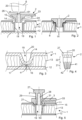
- the indentation may be rotationally symmetrical about an axis 20.
- the sonotrode 6 is used to press the anchoring portion into the indentation while mechanical vibrations are coupled into the anchoring portion.
- the anchoring portion has an opening 25 open towards proximally so that a guiding protrusion 61 of the sonotrode 6 may engage.
- the opening 25 is an axially running through opening.
- the anchoring portion 21 thereby is tube-like.
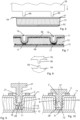
- Figure 7 shows the resulting first object, illustrated to have two indentations 19 being blind holes.
- the deformation process will lead to a re-orientation of the fibers, a local compaction of the interlining layer (dense zone 17), and possibly also to a matrix material (foam) enrichment and/or compaction yielding porosity for the anchoring process, in addition or as an alternative to a residual porosity between the fibers of the first building layer material.
- the shaping protrusion(s) 56 can be longer so that they extend to the first mold part 54, or the first mold part may have first mold part shaping protrusions 59 at corresponding positions, as shown in Figure 8 . In either case, after forming of the first and second building layers, a thin residual layer of building layer material may remain and may have to be removed in a separate step.
- Figure 10 illustrates the situation after anchoring, i.e. after the thermoplastic material has re-solidified.
- the flow portion 8 of the thermoplastic material comprises both, portions that have flown into structures of the sidewall, for example structures formed by exposed fibers, and portions that have interpenetrated the interlining.
- a punched-out piece 73 of the first building layer is displaced towards distally.
- the hollow space 28 may comprise debris of interlining material and/or first building layer material.
- a bottom 16 of the indentation may be removed prior to the anchoring process, for example by drilling.
- Figure 11 illustrates the possibility that the mechanical energy input in addition or as an alternative to comprising mechanical vibration may comprise (oscillatory or continuous) rotation of the second object 2 relative to the first object.
- the first object may be mounted in a fixed orientation, and the second object may be pressed against the first object by a rotation tool 81 rotating around the axis 20.
- the second object 2 may have a not rotationally symmetrical ("rotationally symmetrical" here implying rotational symmetry with respect to rotation about any angle, i.e.
- the coupling structure may optionally have a discrete symmetry, such as by being hexagonal or quadratic or star-shaped in cross section or slit-shaped) coupling structure, such as a coupling indentation, cooperating with a mating rotation tool coupling structure, such as a coupling protrusion 82.
- the indentation was assumed to be approximately round in cross section, i.e. rotationally symmetrical (with respect to rotation about any angle) about the axis 20. With the partial exception of the configuration of Fig. 11 that concerns the input of rotational energy, this need not be the case. Rather, as an alternative to being round ( Figure 12 ) in cross section, the indentation 19 may have any other shape, such as oblong ( Figure 13 ), oblong-curved ( Figure 14 ), etc. Figs. 12-14 all schematically show cross sections through a plane perpendicular to the axis.
- the anchoring portion of the second object may have an approximately adapted cross section, which however may deviate from the cross section of the indentation, for example by comprising a structure of the above-described kind with lamellae or similar.
- the outer cross section of the anchoring portion has an overall shape that differs from the cross section of the indentation, for example in that the anchoring portion is generally round (with the exception of the energy directing structures) whereas the indentation is for example oblong. Then, the resulting anchoring of the anchoring portion will be anisotropic, with a dominant anchoring at the side face portions where the indentation is narrower. This may be used for intentional anisotropies in the bending strength/flexibility, or also for some tolerance compensation.
- Figure 15 illustrates the principle that it is possible to make another object than a sandwich board by the primary shaping process.
- the first object 1 may for example comprise a structure of soaked fibers placed in a mould 55 having a salient feature that forms the indentation.
- Figure 16 shows the set-up for anchoring, including a second object 2 and a sonotrode.
- Another feature illustrated in Fig. 16 which is independent on the nature of the first object 1, is that the anchoring portion shaped to be inserted into the indentation and the indentation are adapted to each other for a press-fit, in that the anchoring portion is slightly oversized compared to the dimensions of the indentation (see the dashed lines).
- the anchoring method may especially comprise inserting the second object into the indentation so that a press-fit results (i.e. the second object is provisionally fixed to the first object) prior to the mechanical vibration energy input.
- the first outer building layer of the lightweight building element that forms the surface both, of the sidewall and of the proximally facing surface portion around the mouth of the indentation.
- the embodiment of Figs. 15 and 16 there is a smooth, continuous transition between the proximally facing surface portion 18 around the mouth and the sidewall 14. Also, both have a same texture.
- Object 1 as shown in all figures, but especially as shown in Fig. 16 may be a homogeneous body, such as a block of foam with an indentation. As can be seen in Fig. 16 , the surface portion 18 and sidewall 14 have the same texture.
- Figures 17-19 yet show different second objects 2.
- the embodiment of Fig. 17 has axially running ridges between which grooves of approximately triangular cross sections are established, wherein the grooves are, given the conical shape of the second object 2, deepen towards proximally.
- the grooves are not triangular but rectangular in cross section.
- the overall second object is not conical but cylindrical, and the axial length of the grooves/ridges may be chosen differently, with an example being shown in Fig. 4 .
- Fig. 19 shows an example with ridges that do not run into axial directions but circumferentially.
- the second object's anchoring portion in embodiments may have a conical shape up to approx. 30 degrees cone angle or be cylindrical.
- the external wall of the anchoring portion may contain features that act as energy directors, particularly vertical ridges or groove (with respect to the proximodistal direction) that are parallel to each other.
- the maximum number of grooves on the perimeter is a function of the insert portion's diameter, cone angle and the groove geometry.
- the grooves can have a triangular cross-section with an angle at the bottom of the groove ranging from 10 to 90 degrees or more, or a rectangular cross-section with or without rounded edges at the bottom of the grooves. Some other groove shapes could be imagined.
- the number of grooves can be chosen so that they don't overlap, as to retain the conical or cylindrical body (outer profile) between the grooves.
- the cross-section of the grooves changes along the height of the pin (insertion direction) when the anchoring portion is conical, being deeper at the top (bigger diameter of the cone) and shallower at the bottom of the cone.
Landscapes
- Engineering & Computer Science (AREA)
- Mechanical Engineering (AREA)
- Chemical & Material Sciences (AREA)
- Composite Materials (AREA)
- Lining Or Joining Of Plastics Or The Like (AREA)
Claims (15)
- Verfahren zum Herstellen einer Anordnung, umfassend die Schritte:- Bereitstellen eines ersten Objekts (1),∘ wobei das erste Objekt (1) einen in proximale Richtung gewandten Oberflächenanteil (18) aufweist,∘ wobei das erste Objekt (1) eine Vertiefung (19) aufweist, die eine Mündung in der in proximale Richtung gewandten Oberfläche (18) aufweist, wobei die Vertiefung (19) durch Vorformen hergestellt wird, wobei die Vertiefung (19) eine Seitenwand (14) aufweist;- Bereitstellen eines zweiten Objekts (2), das einen seitlichen Außenoberflächenanteil (24) aufweist,- wobei der seitliche Außenoberflächenanteil (24) ein thermoplastisches Material umfasst;- Inkontaktbringen des zweiten Objekts (2) mit dem ersten Objekt (1), sodass der seitliche Außenoberflächenanteil (24) in physischem Kontakt mit der Seitenwand (14) ist;- Einkoppeln von mechanischer Energie in mindestens eines des ersten und des zweiten Objekts (1; 2), um eine Energieabsorption aufgrund von Reibung zwischen dem seitlichen Außenoberflächenanteil (24) und der Seitenwand (14) zu bewirken, bis ein Strömungsanteil des thermoplastischen Materials verflüssigt wird; und- Wiedererstarrenlassen des Strömungsanteils, wodurch der Strömungsanteil das zweite Objekt (2) an dem ersten Objekt (1) befestigt, wobei der Strömungsanteil Strukturen des ersten Objekts (1), insbesondere die Seitenwand, durchdringt, sodass nach dem Wiedererstarren ein Formschluss resultiert.
- Verfahren nach Anspruch 1, wobei die Seitenwand (14) in einem Bereich um die Mündung herum dieselbe Textur wie die in proximale Richtung gewandte Oberfläche (18) aufweist, wobei vorzugsweise sich die Vertiefung (19) glatt von dem in proximale Richtung gewandten Oberflächenanteil (18) erstreckt, ohne eine scharfe Kante auszubilden, wobei vorzugsweise der Schritt des Bereitstellens des ersten Objekts (1) das Herstellen des ersten Objekts (1) durch einen Urformprozess umfasst, wobei die Vertiefung (19) durch den Urformprozess geformt wird, wobei vorzugsweise die Vertiefung (19) während des Herstellens des ersten Objekts geformt wird, wobei vorzugsweise der Urformprozess ein Formprozess ist, wobei vorzugsweise die Vertiefung (19) und mindestens ein weiterer Teil des ersten Objekts (1), vorzugsweise das vollständige erste Objekt, in einer gleichen Form geformt werden.
- Verfahren nach einem der Ansprüche 1 bis 2, wobei der Urformprozess ein einstufiger Prozess ist.
- Verfahren nach einem der Ansprüche 1 bis 3, wobei das erste Objekt (1) ein Polymermaterial umfasst und wobei bewirkt wird, dass das Polymermaterial während des Urformprozesses ausgehärtet wird.
- Verfahren nach einem der vorhergehenden Ansprüche, wobei das zweite Objekt (2) einen Verankerungsanteil aufweist, der einer Außenkontur aufweist, die an die Vertiefung (19) angepasst ist, wobei vorzugsweise ein Außendurchmesser des Verankerungsanteils (21) an die Vertiefung angepasst ist, um eine Presspassung zu erzielen, wobei vorzugsweise eine Abmessung des Verankerungsanteils (21) zwischen 2 % und 20 % größer als eine entsprechende Abmessung der Vertiefung (19) ist, wobei vorzugsweise die Vertiefung (19) eine Sacköffnung in dem ersten Objekt (1) ausbildet, wobei die Sacköffnung einen Boden mit der gleichen Textur wie die in proximale Richtung gewandte Oberfläche (18) in einem Bereich um die Mündung herum aufweist oder wobei die Vertiefung (19) eine Durchgangsöffnung ausbildet und wobei sich die Seitenwand (14) aus der in proximale Richtung gewandten Oberfläche (18) des ersten Objekts (1) mit unveränderter Textur angrenzend erstreckt.
- Verfahren nach einem der vorhergehenden Ansprüche, wobei, während des Einkoppelns von mechanischer Energie in das zweite Objekt (2), Strukturen, die durch thermoplastisches Material des zweiten Objekts (2) gegenseitig durchdrungen sind, in dem ersten Objekt erzeugt werden, wobei vorzugsweise das erste Objekt (1) einen Schaum aufweist, wobei vorzugsweise das erste Objekt (1) ein Leichtbauelement ist, das eine erste äußere Bauschicht (11) und einer Einlageschicht (13) aufweist, wobei die erste äußere Bauschicht (11) dünner und dichter als die Einlageschicht (13) ist, wobei die erste äußere Bauschicht geformt ist, um die Seitenwand (14) der Vertiefung (19) zu bilden, wobei vorzugsweise das erste Objekt (1) eine Heckblechablage oder ein Blech für einen Automotor ist.
- Verfahren zum Herstellen einer Leichtbauelementanordnung, umfassend die Schritte:- Bereitstellen eines ersten Objekts (1), wobei das erste Objekt ein Leichtbauelement ist, das eine erste Außenbauschicht (11) und eine Einlageschicht (13) aufweist,∘ wobei die erste äußere Bauschicht (11) ein Bauschichtmaterial mit einer Faserverstärkung umfasst und dünner und dichter als die Einlageschicht (13) ist,∘ und wobei das erste Objekt (1) eine Vertiefung (19) aufweist, die durch die erste äußere Bauschicht (11) ausgebildet ist, wobei die Vertiefung (19) eine Seitenwand (14) des Bauschichtmaterials aufweist;- Bereitstellen eines zweiten Objekts (2), das einen seitlichen Außenoberflächenanteil (24) eines thermoplastischen Materials aufweist;- Inkontaktbringen des zweiten Objekts (2) mit dem ersten Objekt (1), sodass der seitliche Außenoberflächenanteil (24) in physischem Kontakt mit der Seitenwand ist;- Einkoppeln von mechanischer Energie in das zweite Objekt (2), um eine Energieabsorption aufgrund von Reibung zwischen dem seitlichen Außenoberflächenanteil (24) und der Seitenwand (14) zu bewirken, bis ein Strömungsanteil des thermoplastischen Materials verflüssigt wird und relativ zu der Seitenwand (14) strömt; und- Wiederverfestigenlassen des Strömungsanteils, wodurch der Strömungsanteil das zweite Objekt (2) an dem ersten Objekt (1) befestigt.
- Verfahren nach Anspruch 7, wobei die Vertiefung (19) eine Mündung in einer ersten äußeren Bauschichtebene aufweist, wobei die erste äußere Bauschicht (11) einen ebenen Anteil um die Vertiefung (19) herum aufweist, wobei der Seitenwandanteil (14) an der Mündung der Vertiefung (19) auf den ebenen Anteil trifft und an den ebenen Anteil angrenzt, wobei vorzugsweise die Vertiefung (19) eine Sacköffnung in dem ersten Objekt (1) ausbildet und einen Boden (16) des Bauschichtmaterials aufweist, wobei vorzugsweise die Vertiefung (19) eine Durchgangsöffnung in dem ersten Objekt (1) ausbildet, wobei vorzugsweise das erste Objekt (1) zusätzlich zu der ersten äußeren Bauschicht (11) eine zweite äußere Bauschicht (12) aufweist, wobei die erste und die zweite Bauschicht die Einlageschicht (13) dazwischen einschließen, wobei vorzugsweise die Vertiefung (19) eine Durchgangsöffnung ausbildet und wobei sich die Seitenwand (14) aus der ersten Bauschicht (11) entlang der Öffnung zu der zweiten Bauschicht (12) angrenzend erstreckt, wobei vorzugsweise das Bauschichtmaterial die Vertiefung (19) vollständig auskleidet, wodurch eine Oberfläche, speziell eine gesamte Oberfläche, des ersten Objekts (1) in und um die Vertiefung (19) herum durch das Bauschichtmaterial ausgebildet wird.
- Verfahren nach Anspruch 8, wobei während des Schritts des Einkoppelns von mechanischer Energie in das zweite Objekt (2) das Bauschichtmaterial angrenzend bleibt, wodurch die Einlageschicht (13) bis zu dem Schritt des Wiederverfestigenlassens des Strömungsanteils von dem zweiten Objekt (2) abgeschirmt bleibt.
- Verfahren nach Anspruch 8, wobei ferner bewirkt wird, dass das Baumaterial, das die Vertiefung (19) auskleidet, durch eine Durchstoß- oder Schlagwirkung des zweiten Objekts (2) zerbrochen wird, und wobei der Strömungsanteil einen Anteil umfasst, der veranlasst wird, in Strukturen der Einlageschicht (13) hinein zu strömen.
- Verfahren nach einem der Ansprüche 7 bis 10, wobei der Schritt des Bereitstellens des ersten Objekts (1) das Herstellen des ersten Objekts (1) durch einen Urformprozess umfasst, wobei die Vertiefung (19) durch den Urformprozess geformt wird, wobei das Bauschichtmaterial ein Polymermaterial umfasst und wobei bewirkt wird, dass das Polymermaterial des Bauschichtmaterials während des Urformprozesses ausgehärtet wird, wobei vorzugsweise die Einlageschicht (13) eine Zellstruktur, wie eine Wabenstruktur, und/oder eine Schaumstruktur umfasst, wobei vorzugsweise die mechanische Energie mechanische Schwingungsenergie umfasst, und wobei das Einkoppeln der mechanischen Energie in das zweite Objekt (2) ein Drücken des zweiten Objekts (2) gegen das erste Objekt (1) durch eine schwingende Sonotrode umfasst, wobei vorzugsweise die mechanische Energie mechanische Rotationsenergie umfasst, und wobei das Einkoppeln der mechanischen Energie in das zweite Objekt (2) das Drücken des zweiten Objekts (2) gegen das erste Objekt (1) durch ein Werkzeug (81) umfasst, das der Rotation unterzogen wird, wobei vorzugsweise der seitliche Außenoberflächenanteil (24) eine Struktur aus Vertiefungen und Graten aufweist, wobei die Grate axial verlaufende Lamellen ausbilden.
- Verfahren nach einem der vorhergehenden Ansprüche, wobei das zweite Objekt (2) einen Verankerungsanteil (21) aufweist, der den seitlichen Außenoberflächenanteil (24) ausbildet, wobei während des Schritts des Inkontaktbringens des zweiten Objekts (2) mit dem ersten Objekt (1) bewirkt wird, dass der Verankerungsanteil (21) in die Vertiefung (19) eingeführt wird, und wobei der seitliche Außenoberflächenanteil (24) mindestens teilweise zylindrisch und/oder konisch ist, wobei vorzugsweise der Verankerungsanteil (21) einen Hohlraum ausbildet, wodurch mindestens ein distaler Teil des zweiten Objekts (2) im Wesentlichen röhrenförmig ist, wobei vorzugsweise der Verankerungsanteil (21) abgestuft ist, wobei vorzugsweise das zweite Objekt (2) einen Verankerungsanteil (21) und einen Funktionsanteil (23) einstückig mit dem Verankerungsanteil (21) aufweist, wobei der Funktionsanteil (23) in Bezug auf die Rotation um einen beliebigen Winkel um eine Achse der Vertiefung (19) herum nicht rotationssymmetrisch ist, vorzugsweise ferner umfassend den Schritt des Bereitstellens eines Funktionselements (3), wobei das Funktionselement (3) eine Funktionselementdurchgangsöffnung (31) aufweist, und wobei während des Schritts des Inkontaktbringens des zweiten Objekts (2) mit dem ersten Objekt (1) bewirkt wird, dass sich ein Anteil des zweiten Objekts (2) durch die Funktionselementdurchgangsöffnung (31) erstreckt, wobei vorzugsweise die Funktionselementdurchgangsöffnung (31) eine Stufe und/oder eine Verjüngung aufweist, wodurch sich eine Breite der Funktionselementdurchgangsöffnung (31) nach distal verengt, und wobei während des Schritts des Einkoppelns der mechanischen Energie in das zweite Objekt bewirkt wird, dass das zweite Objekt (2) gegen die Stufe und/oder Verjüngung gedrückt wird.
- Verfahren nach Anspruch 12, wobei das zweite Objekt (2) einen Kopfanteil (27) aufweist und wobei während des Schritts des Einkoppelns der mechanischen Energie in das zweite Objekt (2) der Kopfanteil (27) gegen einen in proximale Richtung gewandten Oberflächenanteil des Funktionselements (3) gedrückt wird, wobei vorzugsweise das Funktionselement (3) mindestens teilweise thermoplastisch ist und bewirkt wird, dass es während des Schritts des Einkoppelns der mechanischen Energie in das zweite Objekt (2) mit dem zweiten Objekt verschweißt wird.
- Anordnung, die durch das Verfahren nach einem der vorhergehenden Ansprüche hergestellt wird, wobei die Anordnung das erste Objekt (1) umfasst und ferner das zweite Objekt (2) umfasst, das an dem ersten Objekt (1) befestigt ist.
- Anordnung nach Anspruch 14, umfassend ein Leichtbauelement als das erste Objekt (1), das Leichtbauelement umfassend eine erste äußere Bauschicht (11), die eine Vertiefung (19) ausbildet, und eine Einlageschicht (13), wobei vorzugsweise das Leichtbauelement ferner eine zweite äußere Bauschicht (12) aufweist, wobei die erste und die zweite äußere Bauschicht die Einlageschicht (13) dazwischen einschließen, wobei sich das Material der ersten äußeren Bauschicht (11) entlang der Vertiefung (19) zu der zweiten Bauschicht (12) angrenzend erstreckt, wodurch die Vertiefung (19) eine Durchgangsöffnung ausbildet, und wodurch die Einlageschicht (13) in einem Bereich der Vertiefung (19) mindestens teilweise von einer Außenseite abgeschirmt ist.
Applications Claiming Priority (2)
| Application Number | Priority Date | Filing Date | Title |
|---|---|---|---|
| CH15172019 | 2019-11-29 | ||
| PCT/EP2020/083773 WO2021105454A1 (en) | 2019-11-29 | 2020-11-27 | Securing a second object to a first object |
Publications (3)
| Publication Number | Publication Date |
|---|---|
| EP4065348A1 EP4065348A1 (de) | 2022-10-05 |
| EP4065348B1 true EP4065348B1 (de) | 2025-04-16 |
| EP4065348C0 EP4065348C0 (de) | 2025-04-16 |
Family
ID=69500519
Family Applications (1)
| Application Number | Title | Priority Date | Filing Date |
|---|---|---|---|
| EP20811659.0A Active EP4065348B1 (de) | 2019-11-29 | 2020-11-27 | Befestigung eines zweiten objekts an einem ersten objekt |
Country Status (4)
| Country | Link |
|---|---|
| US (1) | US12384117B2 (de) |
| EP (1) | EP4065348B1 (de) |
| CN (1) | CN114761209B (de) |
| WO (1) | WO2021105454A1 (de) |
Families Citing this family (3)
| Publication number | Priority date | Publication date | Assignee | Title |
|---|---|---|---|---|
| US20240217183A1 (en) * | 2023-01-03 | 2024-07-04 | Rohr, Inc. | Thermoplastic composite component with vibration welded non-parallel surfaces and method for producing the same |
| CN120813467A (zh) * | 2023-02-28 | 2025-10-17 | 麦克赛尔株式会社 | 树脂接合体 |
| EP4600505A1 (de) * | 2024-02-09 | 2025-08-13 | Schmitz Cargobull AG | Verfahren zur herstellung eines paneels mit einer kernlage sowie paneel mit kernlage und nutzfahrzeug mit paneel |
Citations (1)
| Publication number | Priority date | Publication date | Assignee | Title |
|---|---|---|---|---|
| US20170334147A1 (en) * | 2014-11-04 | 2017-11-23 | Woodwelding Ag | Bonding objects together |
Family Cites Families (9)
| Publication number | Priority date | Publication date | Assignee | Title |
|---|---|---|---|---|
| CH694058A5 (de) * | 1999-06-18 | 2004-06-30 | Woodwelding Ag | Stoffschlüssiges Verbinden. |
| BRPI0922427B1 (pt) | 2008-12-23 | 2019-07-30 | Woodwelding Ag | Método de ancoragem de um conector e conector |
| PL3307519T3 (pl) * | 2015-06-11 | 2021-06-14 | Woodwelding Ag | Kotwienie w lekkim elemencie budowlanym |
| JP6814165B2 (ja) * | 2015-06-11 | 2021-01-13 | ウッドウェルディング・アクチェンゲゼルシャフト | 第1の物体に第2の物体を固定する方法 |
| GB201516237D0 (en) * | 2015-09-14 | 2015-10-28 | Ellis Patents Holdings Ltd | A clamp |
| EP4283142A3 (de) * | 2016-03-21 | 2024-02-21 | Multimaterial-Welding AG | Befestigung eines zweiten objekts an einem ersten objekt |
| KR20190043133A (ko) * | 2016-07-21 | 2019-04-25 | 멀티머티리얼-웰딩 아게 | 제 2 대상물의 제 1 대상물에의 고정 |
| JP2020535038A (ja) * | 2017-09-27 | 2020-12-03 | ウッドウェルディング・アクチェンゲゼルシャフト | 第1の物体への第2の物体の固定 |
| JP6920981B2 (ja) * | 2017-12-25 | 2021-08-18 | 株式会社クラレ | シート成形体の製造方法 |
-
2020
- 2020-11-27 WO PCT/EP2020/083773 patent/WO2021105454A1/en not_active Ceased
- 2020-11-27 EP EP20811659.0A patent/EP4065348B1/de active Active
- 2020-11-27 US US17/780,179 patent/US12384117B2/en active Active
- 2020-11-27 CN CN202080082771.3A patent/CN114761209B/zh active Active
Patent Citations (1)
| Publication number | Priority date | Publication date | Assignee | Title |
|---|---|---|---|---|
| US20170334147A1 (en) * | 2014-11-04 | 2017-11-23 | Woodwelding Ag | Bonding objects together |
Also Published As
| Publication number | Publication date |
|---|---|
| US12384117B2 (en) | 2025-08-12 |
| US20220410496A1 (en) | 2022-12-29 |
| WO2021105454A1 (en) | 2021-06-03 |
| CN114761209A (zh) | 2022-07-15 |
| EP4065348C0 (de) | 2025-04-16 |
| EP4065348A1 (de) | 2022-10-05 |
| CN114761209B (zh) | 2024-11-12 |
Similar Documents
| Publication | Publication Date | Title |
|---|---|---|
| US11345096B2 (en) | Anchoring in a lightweight building element | |
| EP3307521B1 (de) | Befestigung eines zweiten objekts an einem ersten objekt | |
| EP4065348B1 (de) | Befestigung eines zweiten objekts an einem ersten objekt | |
| CN107107476B (zh) | 将物体结合在一起 | |
| JP7134996B2 (ja) | 物体の接合方法および被接合部材に接合される物体 | |
| US11084226B2 (en) | Securing a second object to a first object | |
| US20210146635A1 (en) | Securing a second object to a first object |
Legal Events
| Date | Code | Title | Description |
|---|---|---|---|
| STAA | Information on the status of an ep patent application or granted ep patent |
Free format text: STATUS: UNKNOWN |
|
| STAA | Information on the status of an ep patent application or granted ep patent |
Free format text: STATUS: THE INTERNATIONAL PUBLICATION HAS BEEN MADE |
|
| PUAI | Public reference made under article 153(3) epc to a published international application that has entered the european phase |
Free format text: ORIGINAL CODE: 0009012 |
|
| STAA | Information on the status of an ep patent application or granted ep patent |
Free format text: STATUS: REQUEST FOR EXAMINATION WAS MADE |
|
| 17P | Request for examination filed |
Effective date: 20220628 |
|
| AK | Designated contracting states |
Kind code of ref document: A1 Designated state(s): AL AT BE BG CH CY CZ DE DK EE ES FI FR GB GR HR HU IE IS IT LI LT LU LV MC MK MT NL NO PL PT RO RS SE SI SK SM TR |
|
| DAV | Request for validation of the european patent (deleted) | ||
| DAX | Request for extension of the european patent (deleted) | ||
| STAA | Information on the status of an ep patent application or granted ep patent |
Free format text: STATUS: EXAMINATION IS IN PROGRESS |
|
| 17Q | First examination report despatched |
Effective date: 20240613 |
|
| GRAP | Despatch of communication of intention to grant a patent |
Free format text: ORIGINAL CODE: EPIDOSNIGR1 |
|
| STAA | Information on the status of an ep patent application or granted ep patent |
Free format text: STATUS: GRANT OF PATENT IS INTENDED |
|
| INTG | Intention to grant announced |
Effective date: 20250122 |
|
| GRAS | Grant fee paid |
Free format text: ORIGINAL CODE: EPIDOSNIGR3 |
|
| GRAA | (expected) grant |
Free format text: ORIGINAL CODE: 0009210 |
|
| STAA | Information on the status of an ep patent application or granted ep patent |
Free format text: STATUS: THE PATENT HAS BEEN GRANTED |
|
| AK | Designated contracting states |
Kind code of ref document: B1 Designated state(s): AL AT BE BG CH CY CZ DE DK EE ES FI FR GB GR HR HU IE IS IT LI LT LU LV MC MK MT NL NO PL PT RO RS SE SI SK SM TR |
|
| REG | Reference to a national code |
Ref country code: GB Ref legal event code: FG4D |
|
| REG | Reference to a national code |
Ref country code: CH Ref legal event code: EP |
|
| REG | Reference to a national code |
Ref country code: IE Ref legal event code: FG4D |
|
| REG | Reference to a national code |
Ref country code: DE Ref legal event code: R096 Ref document number: 602020049633 Country of ref document: DE |
|
| U01 | Request for unitary effect filed |
Effective date: 20250514 |
|
| U07 | Unitary effect registered |
Designated state(s): AT BE BG DE DK EE FI FR IT LT LU LV MT NL PT RO SE SI Effective date: 20250521 |
|
| PG25 | Lapsed in a contracting state [announced via postgrant information from national office to epo] |
Ref country code: ES Free format text: LAPSE BECAUSE OF FAILURE TO SUBMIT A TRANSLATION OF THE DESCRIPTION OR TO PAY THE FEE WITHIN THE PRESCRIBED TIME-LIMIT Effective date: 20250416 |
|
| PG25 | Lapsed in a contracting state [announced via postgrant information from national office to epo] |
Ref country code: NO Free format text: LAPSE BECAUSE OF FAILURE TO SUBMIT A TRANSLATION OF THE DESCRIPTION OR TO PAY THE FEE WITHIN THE PRESCRIBED TIME-LIMIT Effective date: 20250716 Ref country code: GR Free format text: LAPSE BECAUSE OF FAILURE TO SUBMIT A TRANSLATION OF THE DESCRIPTION OR TO PAY THE FEE WITHIN THE PRESCRIBED TIME-LIMIT Effective date: 20250717 |
|
| PG25 | Lapsed in a contracting state [announced via postgrant information from national office to epo] |
Ref country code: PL Free format text: LAPSE BECAUSE OF FAILURE TO SUBMIT A TRANSLATION OF THE DESCRIPTION OR TO PAY THE FEE WITHIN THE PRESCRIBED TIME-LIMIT Effective date: 20250416 |
|
| PG25 | Lapsed in a contracting state [announced via postgrant information from national office to epo] |
Ref country code: HR Free format text: LAPSE BECAUSE OF FAILURE TO SUBMIT A TRANSLATION OF THE DESCRIPTION OR TO PAY THE FEE WITHIN THE PRESCRIBED TIME-LIMIT Effective date: 20250416 |
|
| PG25 | Lapsed in a contracting state [announced via postgrant information from national office to epo] |
Ref country code: RS Free format text: LAPSE BECAUSE OF FAILURE TO SUBMIT A TRANSLATION OF THE DESCRIPTION OR TO PAY THE FEE WITHIN THE PRESCRIBED TIME-LIMIT Effective date: 20250716 |
|
| PG25 | Lapsed in a contracting state [announced via postgrant information from national office to epo] |
Ref country code: IS Free format text: LAPSE BECAUSE OF FAILURE TO SUBMIT A TRANSLATION OF THE DESCRIPTION OR TO PAY THE FEE WITHIN THE PRESCRIBED TIME-LIMIT Effective date: 20250816 |