EP4064400A1 - Battery cell activation method and battery cell manufacturing method comprising same - Google Patents
Battery cell activation method and battery cell manufacturing method comprising same Download PDFInfo
- Publication number
- EP4064400A1 EP4064400A1 EP21892244.1A EP21892244A EP4064400A1 EP 4064400 A1 EP4064400 A1 EP 4064400A1 EP 21892244 A EP21892244 A EP 21892244A EP 4064400 A1 EP4064400 A1 EP 4064400A1
- Authority
- EP
- European Patent Office
- Prior art keywords
- battery cell
- pressing
- gas
- during
- pressure
- Prior art date
- Legal status (The legal status is an assumption and is not a legal conclusion. Google has not performed a legal analysis and makes no representation as to the accuracy of the status listed.)
- Granted
Links
Images




Classifications
-
- H—ELECTRICITY
- H01—ELECTRIC ELEMENTS
- H01M—PROCESSES OR MEANS, e.g. BATTERIES, FOR THE DIRECT CONVERSION OF CHEMICAL ENERGY INTO ELECTRICAL ENERGY
- H01M50/00—Constructional details or processes of manufacture of the non-active parts of electrochemical cells other than fuel cells, e.g. hybrid cells
- H01M50/10—Primary casings; Jackets or wrappings
- H01M50/102—Primary casings; Jackets or wrappings characterised by their shape or physical structure
- H01M50/105—Pouches or flexible bags
-
- H—ELECTRICITY
- H01—ELECTRIC ELEMENTS
- H01M—PROCESSES OR MEANS, e.g. BATTERIES, FOR THE DIRECT CONVERSION OF CHEMICAL ENERGY INTO ELECTRICAL ENERGY
- H01M10/00—Secondary cells; Manufacture thereof
- H01M10/04—Construction or manufacture in general
-
- H—ELECTRICITY
- H01—ELECTRIC ELEMENTS
- H01M—PROCESSES OR MEANS, e.g. BATTERIES, FOR THE DIRECT CONVERSION OF CHEMICAL ENERGY INTO ELECTRICAL ENERGY
- H01M10/00—Secondary cells; Manufacture thereof
- H01M10/04—Construction or manufacture in general
- H01M10/0481—Compression means other than compression means for stacks of electrodes and separators
-
- H—ELECTRICITY
- H01—ELECTRIC ELEMENTS
- H01M—PROCESSES OR MEANS, e.g. BATTERIES, FOR THE DIRECT CONVERSION OF CHEMICAL ENERGY INTO ELECTRICAL ENERGY
- H01M10/00—Secondary cells; Manufacture thereof
- H01M10/04—Construction or manufacture in general
- H01M10/049—Processes for forming or storing electrodes in the battery container
-
- H—ELECTRICITY
- H01—ELECTRIC ELEMENTS
- H01M—PROCESSES OR MEANS, e.g. BATTERIES, FOR THE DIRECT CONVERSION OF CHEMICAL ENERGY INTO ELECTRICAL ENERGY
- H01M10/00—Secondary cells; Manufacture thereof
- H01M10/05—Accumulators with non-aqueous electrolyte
- H01M10/058—Construction or manufacture
-
- H—ELECTRICITY
- H01—ELECTRIC ELEMENTS
- H01M—PROCESSES OR MEANS, e.g. BATTERIES, FOR THE DIRECT CONVERSION OF CHEMICAL ENERGY INTO ELECTRICAL ENERGY
- H01M50/00—Constructional details or processes of manufacture of the non-active parts of electrochemical cells other than fuel cells, e.g. hybrid cells
- H01M50/10—Primary casings; Jackets or wrappings
- H01M50/116—Primary casings; Jackets or wrappings characterised by the material
-
- H—ELECTRICITY
- H01—ELECTRIC ELEMENTS
- H01M—PROCESSES OR MEANS, e.g. BATTERIES, FOR THE DIRECT CONVERSION OF CHEMICAL ENERGY INTO ELECTRICAL ENERGY
- H01M50/00—Constructional details or processes of manufacture of the non-active parts of electrochemical cells other than fuel cells, e.g. hybrid cells
- H01M50/30—Arrangements for facilitating escape of gases
-
- H—ELECTRICITY
- H01—ELECTRIC ELEMENTS
- H01M—PROCESSES OR MEANS, e.g. BATTERIES, FOR THE DIRECT CONVERSION OF CHEMICAL ENERGY INTO ELECTRICAL ENERGY
- H01M50/00—Constructional details or processes of manufacture of the non-active parts of electrochemical cells other than fuel cells, e.g. hybrid cells
- H01M50/30—Arrangements for facilitating escape of gases
- H01M50/394—Gas-pervious parts or elements
-
- Y—GENERAL TAGGING OF NEW TECHNOLOGICAL DEVELOPMENTS; GENERAL TAGGING OF CROSS-SECTIONAL TECHNOLOGIES SPANNING OVER SEVERAL SECTIONS OF THE IPC; TECHNICAL SUBJECTS COVERED BY FORMER USPC CROSS-REFERENCE ART COLLECTIONS [XRACs] AND DIGESTS
- Y02—TECHNOLOGIES OR APPLICATIONS FOR MITIGATION OR ADAPTATION AGAINST CLIMATE CHANGE
- Y02E—REDUCTION OF GREENHOUSE GAS [GHG] EMISSIONS, RELATED TO ENERGY GENERATION, TRANSMISSION OR DISTRIBUTION
- Y02E60/00—Enabling technologies; Technologies with a potential or indirect contribution to GHG emissions mitigation
- Y02E60/10—Energy storage using batteries
-
- Y—GENERAL TAGGING OF NEW TECHNOLOGICAL DEVELOPMENTS; GENERAL TAGGING OF CROSS-SECTIONAL TECHNOLOGIES SPANNING OVER SEVERAL SECTIONS OF THE IPC; TECHNICAL SUBJECTS COVERED BY FORMER USPC CROSS-REFERENCE ART COLLECTIONS [XRACs] AND DIGESTS
- Y02—TECHNOLOGIES OR APPLICATIONS FOR MITIGATION OR ADAPTATION AGAINST CLIMATE CHANGE
- Y02P—CLIMATE CHANGE MITIGATION TECHNOLOGIES IN THE PRODUCTION OR PROCESSING OF GOODS
- Y02P70/00—Climate change mitigation technologies in the production process for final industrial or consumer products
- Y02P70/50—Manufacturing or production processes characterised by the final manufactured product
Definitions
- the present invention relates a method of activating a battery cell and a method of manufacturing a battery cell including the same, and more particularly, to a method of activating a pouch-type battery cell, and a method of manufacturing a battery cell including the same.
- the method of manufacturing a pouch-type secondary battery includes injecting an electrolyte solution through an electrolyte solution injection unit positioned at one side of a prepared pouch-type edge region, performing charge and discharge after first-sealing the electrolyte solution injection unit along a first sealing line, performing cutting along a cutting line positioned inside the first sealing line, performing degassing, second-sealing the electrolyte solution injection unit, and cutting part of the electrolyte solution injection unit along the cutting line positioned outside the second-sealing line.
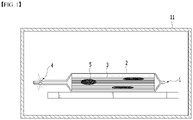
- FIG. 1 is a cross-sectional view schematically showing a degassing process performed by a conventional method of manufacturing a battery cell
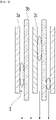
- FIG. 2 is a cross-sectional view specifically showing a state in which activated gas is trapped between an electrode and a separator in FIG. 1 .
- gas is collected in a gas pocket unit 2a by pressing a cell including a pouch case 2 and an electrode assembly 3 inside the chamber 11, and a degassing hole 4 is then formed by piercing the gas pocket unit 2a. Thereafter, by making the inside of the chamber 11 become vacuum, the activation gas inside the pouch case 2 is removed by discharging the activation gas to the outside through the degassing hole 4.
- the discharge of gas inside the battery cell 1 may be maximized during the process of pressing the battery cell 1, but the discharge amount of the electrolyte solution existing in the cell also increases. On the other hand, it takes a long time until the electrolyte solution discharged by the pressure is absorbed into the electrode and the separator, and if the electrolyte solution is not sufficiently absorbed in the electrode and the separator, the quality of the battery cell is deteriorated.
- an aspect of the present invention provides a battery cell activation method capable of easily discharging gas trapped between a separator and an electrode inside an electrode assembly of a battery cell, and preventing discharge of a large amount of electrolyte solution during a gas discharging process, and a method of manufacturing a battery cell including the same.
- a method of activating a battery cell includes: first-pressing a battery cell to initial-charge and discharge the battery cell under a pressurization condition for the battery cell; exposing the battery cell to a vacuum condition; second-pressing the battery cell; aging the battery cell; and degassing the battery cell by removing internal gas of the battery cell.
- a pressure P2 applied to the battery cell during the second-pressing of the battery cell is lower than a pressure P1 applied to the battery cell during the first-pressing of the battery cell.
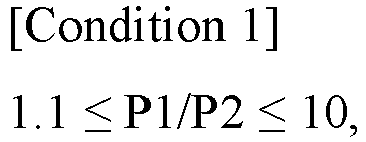
- the pressure P1 applied to the battery cell during the first-pressing of the battery cell and the pressure P2 applied to the battery cell during the second-pressing of the battery cell satisfy a following condition 1: 0.5 ⁇ P 1 / P 2 ⁇ 10
- P1 denotes an average pressure (kgf/cm 2 ) which is applied to press the battery cell during the first-pressing of the battery cell
- P2 denotes an average pressure (kgf/cm 2 ) which is applied to press the battery cell during the second-pressing of the battery cell.
- the pressure P2 applied to the battery cell during the second-pressing of the battery cell is in a range of 0.5 to 3 kgf/cm 2 on average.
- the second-pressing of the battery cell includes: pressing a region opposite to a side of the battery cell where a gas pocket has been formed; and pressing a region of a side of the battery cell where the gas pocket has been formed.
- the second-pressing of the battery cell includes discharging internal gas of the battery cell by sequentially pressing the battery cell from one side to the other side. At this time, the second-pressing of the battery cell is performed by sequentially pressing the battery cell from one side to the other side using a pressing roller.
- the first-pressing of the battery cell is performed by pressing two surfaces of the battery cell using pressing plates.
- the exposing of the battery cell to the vacuum condition is performed by depressurizing an inner side of a chamber in a state that the battery cell is positioned inside the chamber.
- the exposing of the battery cell to the vacuum condition is performed by repeating a venting process of discharging gas inside the chamber n times in a state that the battery cell is positioned in the chamber.
- the n is an integer between 2 and 50.
- the exposing of the battery cell to the vacuum condition is performed by placing the battery cell inside the chamber, and a width of the vacuum chamber is greater than a width of the battery cell.
- the present invention provides method of manufacturing a battery cell including the above-described process of activating a battery cell.
- the method of manufacturing a battery cell according to the present invention includes activating the battery cell using the method of activating a battery cell.
- the battery cell is a pouch-type battery cell and has a gas pocket connected to an inside of the battery cell at one side.
- the method further includes sealing the battery cell and removing the gas pocket, after the activating of the battery cell.
- gas which is trapped between a separator and an electrode inside an electrode assembly of a battery cell, can be easily discharged. Further, in the activation method of the battery cell, it is possible to prevent discharge of a large amount of electrolyte solution during the pressing process of the battery cell by including first and second pressing steps.
- the present invention provides a method of activating a battery cell and a method of manufacturing a battery cell including the same.
- the present invention provides a method of activating a battery cell and a method of manufacturing a battery cell including the same.
- gas remaining in the battery cell may be easily discharged by including the first and second pressing steps.
- the pressure P2 applied to the battery cell during the second-pressing of the battery cell is set to be lower than the pressure P1 applied to the battery cell during the first-pressing of the battery cell in order to prevent discharge of a large amount of electrolyte solution during the degassing process.
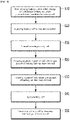
- FIG. 3 is a flowchart of a method of activating a battery cell according to one embodiment of the present invention.
- a method of activating a battery cell includes: first-pressing a battery cell to initial-charge and discharge the battery cell under a pressurization condition for the battery cell (S10); exposing the battery cell to a vacuum condition (S20); second-pressing the battery cell (S30); aging the battery cell (S40); and degassing the battery cell by removing internal gas of the battery cell (S50).
- a pressure P2 applied to the battery cell during the second-pressing of the battery cell is lower than a pressure P1 applied to the battery cell during the first-pressing of the battery cell.
- the battery cell may be a pouch-type unit cell.
- the battery cell may be a pouch-type battery cell having a structure that an electrode assembly having a positive electrode/ separator/ negative electrode structure is embedded in an exterior material of the laminate sheet in a state that is connected to electrode leads formed outside the exterior material.
- the positive electrode and the negative electrode are manufactured by coating a slurry such as an electrode active material, a binder resin, a conductive agent, and other additives on at least one surface of the current collector.
- a slurry such as an electrode active material, a binder resin, a conductive agent, and other additives on at least one surface of the current collector.
- a general positive electrode active material such as a lithium-containing transition metal oxide is used as the electrode active material
- a general negative electrode active material such as a lithium metal for intercalating and discharging lithium ions, a carbon material, and a metal compound, or a mixture thereof may be used as the electrode active material.
- the separator blocks a contact between the positive electrode and the negative electrode in order to prevent a short circuit therebetween, and a porous polymer film may be used to allow charge transfer during the charge and discharge.
- the pouch case is formed as a first case and a second case, which are obtained by processing a sheet material to have a predetermined shape, are coupled to each other at an upper side and a lower side, respectively.
- the sheet material constituting the pouch case is composed of a multi-layer structure obtained by lamination of an outer resin layer made of an insulating material such as polyethylene terephthalate (PET) or nylon at the outermost side, a metal layer made of an aluminum material which maintains mechanical strength and prevents permeation of moisture and oxygen, and an interior resin layer made of a polyolefin-based material which functions as a sealing material by having thermal adhesiveness.
- a pouch case before the completion of the degassing process to be described later is manufactured as a size greater than the volume of the electrode assembly and has a receiving portion for accommodating an electrode assembly, and a gas pocket unit which forms a space for collection of the activation gas which is generated during the charge and discharge process.
- a process of casing an electrode assembly in a pouch case, injecting an electrolyte solution into the pouch case, and impregnating the electrode assembly in the electrolyte solution is performed.
- the electrolyte solution is permeated into a space between the positive electrode, the negative electrode and the separator by capillary force.
- the opening is sealed in order to completely seal the electrode assembly.
- an activation process of charging and discharging the battery cell is performed. Since the battery cell in the initial period is a non-activated cell in a discharged state, it does not have a function as a battery.
- the activation process is a process of activating the cell in a discharged state by charging and discharging the cell a few times to be able to function as a battery.
- the method of activating a battery cell according to the present invention includes a first-pressing step (S10) of first-pressing a battery cell to initial-charge and discharge the battery cell under a pressurization condition for the battery cell. Further, since the initial charge and discharge process of the battery cell is performed by an electrochemical reaction, gas is generated as a side reaction during the charge and discharge process. At this time, since generated gas becomes the cause of the cell resistance increase, capacity and lifespan decrease, external appearance defect, it is necessary to remove gas after the charge and discharge process.
- FIG. 4 is a diagram schematically showing a first-pressing step in a battery cell activation method according to one embodiment of the present invention.
- the battery cell 100 may discharge generated gas, and the gas inside the battery cell 100 may be discharged to the outside by pressing the battery cell 100 with the pressing jig 130.
- the battery cell 100 includes a receiving portion 120b for accommodating an electrode assembly, and a gas pocket unit 120a which forms a space for collecting activation gas generated during the charge and discharge process.
- the pressing jig 130 includes plates which have the battery cell 100 between the plates and press the battery cell 100 from two sides. Further, the electric current may pass through the electrode lead of the battery cell at the time of charging the battery cell.
- the method of activating a battery cell according to the present invention includes a vacuum step (S20) of exposing the battery cell to a vacuum condition.
- the vacuum step (S20) of exposing of the battery cell to a vacuum condition is a process of inducing the interface interval between the electrode and the separator to be widened by expanding the battery cell by generating a pressure difference between the inside and the outside of the activated cell.
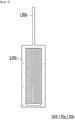
- FIGS. 5 and 6 are diagrams schematically showing a state before and after a vacuum step in a battery cell activation method according to one embodiment of the present invention.
- the vacuum step (S20) is performed in a state that places the battery cell in the vacuum chamber 110.
- the width of the vacuum chamber 110 may be greater than that of the battery cell.
- the vacuum step in the case of depressurizing the inside of the vacuum chamber 110, the battery cell may expand, and it is preferable that the width of the vacuum chamber 110 is sufficient for accommodating the expanded battery cell 110.
- the inside of the vacuum chamber 110 is depressurized in a state that places the battery cell 100 in the vacuum chamber 110.
- the pouch case is changed from a normal state to an expanded state by performing vacuum control for the inside of the vacuum chamber 110 for accommodating the activated cell, namely, making the inside of the vacuum chamber 110 become vacuum or setting the external pressure to be lower than the internal pressure of the pouch case by adjusting the vacuum degree.
- the receiving portion 120b and the gas pocket unit 120a of the pouch case are expanded to swell in a direction perpendicular to the flat surface, and at the same time, an interface interval between the electrodes 3a and 3c and the separator 3b constituting the electrode assembly 3 is widened, thereby increasing the absorption of the electrolyte solution. Further, it is possible to maximize the resorption of the electrolyte solution which is discharged as the interface interval between the electrodes 3a and 3c and the separator 3b constituting the electrode assembly 3 is widened. Further, gas, which has been trapped between the interfaces, may be smoothly moved.
- the vacuum step (S20) of exposing of the battery cell 100 to the vacuum condition includes repeating a venting process of discharging gas inside the chamber 110 n times in a state that the battery cell 100 is positioned in the chamber 110.
- the n is an integer between 2 and 50.
- repeating the venting process n times means repeating the process of making the inside of the chamber 110 become vacuum and the venting process of discharging gas n times.
- the process may be repeated 2 to 40 times, 2 to 30 times, 2 to 20 times or 2 to 10 times.
- the electrode assembly inside the battery cell 1 00 may maximize absorption of the electrolyte solution.
- the method of activating a battery cell according to the present invention includes a second-pressing step (S30) of second-pressing the battery cell.
- the second-pressing step (S30) is a process for additionally removing gas which has not been discharged during the first-pressing step.
- a pressure P2 applied to the battery cell during the second-pressing step of the battery cell is lower than a pressure P1 applied to the battery cell during the first-pressing of the battery cell.
- the pressure P1 to the battery cell during the first-pressing of the battery cell and the pressure P2 applied to the battery cell during the second-pressing of the battery cell satisfy a following condition 1: 1.1 ⁇ P 1 / P 2 ⁇ 10
- P1 denotes an average pressure (kgf/cm 2 ) which is applied to press the battery cell during the first-pressing of the battery cell
- P2 denotes an average pressure (kgf/cm 2 ) which is applied to press the battery cell during the second-pressing of the battery cell.
- the pressure P1 applied to the battery cell during the first-pressing of the battery cell and the pressure P2 applied to the battery cell during the second-pressing of the battery cell may have a relationship that 1.1 ⁇ P1/P2 ⁇ 10, 1.5 ⁇ P1/P2 ⁇ 8, or 2 ⁇ P1/P2 ⁇ 5.
- the pressure P2 applied to the battery cell during the second-pressing of the battery cell may be in a range of 0.5 to 1 kgf/cm 2 on average.
- the pressure P2 applied to the battery cell during the second-pressing of the battery cell is set to be lower than the pressure P1 applied to the battery cell during the first-pressing of the battery cell in order to prevent discharge of a large amount of electrolyte solution during the pressing process. Namely, in the method of activating a battery cell according to the present invention, as the first-pressing step and the second-pressing step satisfy the above condition 1, the discharge of gas inside the battery cell can be maximized, and the discharge of the electrolyte solution can be prevented.
- FIG. 7 is a flowchart of a method of activating a battery cell according to another embodiment of the present invention.
- the second-pressing step of the battery cell (S30) includes: a lower pressing step (S31) of pressing a region opposite to a side of the battery cell where a gas pocket unit has been formed; and an upper pressing step (S32) of pressing a region of a side of the battery cell where the gas pocket unit has been formed (S32).
- a lower pressing step S31
- an upper pressing step S32
- the second-pressing step will be described in detail with reference to FIG. 7 .
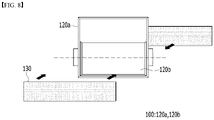
- FIGS. 8 and 9 schematically show a lower pressing step and an upper pressing step in a second-pressing step of a battery cell activation method according to another embodiment of the present invention.
- the lower pressing step (S31) includes pressing the lower region of the pouch-type battery cell with respect to the electrode lead of the pouch-type battery cell
- the upper pressing step (S32) includes pressing the upper region of the pouch-type battery cell with respect to the electrode lead of the pouch-type battery cell.
- the lower pressing step (S31) only the lower region of the battery cell is pressed so that gas, which is trapped in the lower portion of the battery cell, may be moved to the upper region.
- the upper pressing step (S31) only the upper region of the battery cell is pressed so that the gas, which is discharged from the lower region, may be moved to the gas pocket unit 120a. As such, gas inside the battery cell 100 may be easily discharged to the gas pocket unit 120a, and the gas discharge may be maximized.
- the second-pressing step (S30) of the battery cell includes discharging internal gas of the battery cell 100 by sequentially pressing the battery cell 100 from one side to the other side.
- one side means a region opposite to a region where the gas pocket unit 120a is formed in the receiving portion 120b, and the other side means a region where the gas pocket is formed.
- the second-pressing step (S30) of the battery cell includes sequentially pressing the battery cell 100 from one side to the other side using a pressing roller.
- activation gas may be induced to be moved in the direction of the gas pocket unit by applying certain pressure toward the region where the gas pocket of the pouch case has been formed using the roller.
- the method of activating a battery cell according to the present invention includes an aging step (S40) of aging the battery cell.
- the aging step may be a step of stabilizing the SEI film formed during the charging step.
- the method includes a degassing step (S50) of degassing the battery cell by removing internal gas of the battery cell. More specifically, the degassing step includes a process of forming a hole, which functions as a path, through which gas inside the pouch case may be discharged to the outside, by perforating at least part of the gas pocket. At this time, it is possible to form the degassing hole by punching the first and second cases all together in the gas pocket unit of the pouch case, but in this case, the possibility of the leakage of the electrolyte solution together with the gas through the degassing hole may increase. In the present example, the hole may be formed only on the gas pocket in order to reduce the possibility of leakage of electrolyte solution.
- the degassing step (S50) is a process of discharging the activation gas to the outside of the pouch case through the degassing hole by negative pressure by forming the vacuum state inside the chamber again.
- the activation gas which has been collected in the gas pocket unit, may be naturally discharged to the outside through the hole, but as shown in the present embodiment, if a vacuum state is formed in the chamber again, the gas discharge efficiency increases by the negative pressure, and the gas remaining in the electrode assembly may also be discharged.
- the present invention provides method of manufacturing a battery cell including the above-described process of activating a battery cell.
- the method of manufacturing a battery cell according to the present invention includes activating the battery cell using the above-described method of activating a battery cell.
- the battery cell is a pouch-type battery cell and has a gas pocket connected to an inside of the battery cell at one side.
- the method further includes sealing the battery cell and removing the gas pocket, after the activating of the battery cell.
- the gas pocket is a space for collecting activation gas, and when the degassing process is completed, it is a dead space in the cell, and accordingly, after trimmed, a new sealing line is formed by heat-fusing the corresponding portion of the first case and the second case. Likewise, after the secondary-sealing is completed, a wing folding process of closely attaching the sealing line of the pouch case on the side surface of the pouch case by folding the sealing line may be added.
- gas which is trapped between a separator and an electrode inside an electrode assembly of a battery cell, can be easily discharged. Further, in the activation method of the battery cell, it is possible to prevent discharge of a large amount of electrolyte solution during the pressing process of the battery cell by including first and second pressing steps.
Landscapes
- Chemical & Material Sciences (AREA)
- Chemical Kinetics & Catalysis (AREA)
- Electrochemistry (AREA)
- General Chemical & Material Sciences (AREA)
- Engineering & Computer Science (AREA)
- Manufacturing & Machinery (AREA)
- Secondary Cells (AREA)
Abstract
Description
- This application claims the benefit of priority based on
Korean Patent Application No. 10-2020-0152525, filed on November 16, 2020 - The present invention relates a method of activating a battery cell and a method of manufacturing a battery cell including the same, and more particularly, to a method of activating a pouch-type battery cell, and a method of manufacturing a battery cell including the same.
- Generally, the method of manufacturing a pouch-type secondary battery includes injecting an electrolyte solution through an electrolyte solution injection unit positioned at one side of a prepared pouch-type edge region, performing charge and discharge after first-sealing the electrolyte solution injection unit along a first sealing line, performing cutting along a cutting line positioned inside the first sealing line, performing degassing, second-sealing the electrolyte solution injection unit, and cutting part of the electrolyte solution injection unit along the cutting line positioned outside the second-sealing line.
-
FIG. 1 is a cross-sectional view schematically showing a degassing process performed by a conventional method of manufacturing a battery cell, andFIG. 2 is a cross-sectional view specifically showing a state in which activated gas is trapped between an electrode and a separator inFIG. 1 . - First, referring to
FIG. 1 , in the degassing process for removing gas generated during the activation process by charge and discharge, gas is collected in a gas pocket unit 2a by pressing a cell including apouch case 2 and anelectrode assembly 3 inside thechamber 11, and a degassing hole 4 is then formed by piercing the gas pocket unit 2a. Thereafter, by making the inside of thechamber 11 become vacuum, the activation gas inside thepouch case 2 is removed by discharging the activation gas to the outside through the degassing hole 4. - However, as illustrated in
FIG. 2 , there is a limit in enhancing the degassing efficiency because it is difficult forgas 5, which is trapped between theelectrodes separator 3b, to be easily discharged. - Further, the discharge of gas inside the battery cell 1 may be maximized during the process of pressing the battery cell 1, but the discharge amount of the electrolyte solution existing in the cell also increases. On the other hand, it takes a long time until the electrolyte solution discharged by the pressure is absorbed into the electrode and the separator, and if the electrolyte solution is not sufficiently absorbed in the electrode and the separator, the quality of the battery cell is deteriorated.
- Hence, there a need for a technology for easily discharging gas remaining in the battery cell during the degassing process and preventing discharge of a large amount of electrolyte solution during the degassing process.
- The present invention is believed to solve at least some of the above problems. For example, an aspect of the present invention provides a battery cell activation method capable of easily discharging gas trapped between a separator and an electrode inside an electrode assembly of a battery cell, and preventing discharge of a large amount of electrolyte solution during a gas discharging process, and a method of manufacturing a battery cell including the same.
- The present invention provides a method of activating a battery cell. In one example, a method of activating a battery cell according to the present invention includes: first-pressing a battery cell to initial-charge and discharge the battery cell under a pressurization condition for the battery cell; exposing the battery cell to a vacuum condition; second-pressing the battery cell; aging the battery cell; and degassing the battery cell by removing internal gas of the battery cell. At this time, a pressure P2 applied to the battery cell during the second-pressing of the battery cell is lower than a pressure P1 applied to the battery cell during the first-pressing of the battery cell.
- In one example, the pressure P1 applied to the battery cell during the first-pressing of the battery cell and the pressure P2 applied to the battery cell during the second-pressing of the battery cell satisfy a following condition 1:

- Herein, P1 denotes an average pressure (kgf/cm2) which is applied to press the battery cell during the first-pressing of the battery cell, and
P2 denotes an average pressure (kgf/cm2) which is applied to press the battery cell during the second-pressing of the battery cell. - In one example, the pressure P2 applied to the battery cell during the second-pressing of the battery cell is in a range of 0.5 to 3 kgf/cm2 on average.
- In a specific example, the second-pressing of the battery cell includes: pressing a region opposite to a side of the battery cell where a gas pocket has been formed; and pressing a region of a side of the battery cell where the gas pocket has been formed.
- Herein, the second-pressing of the battery cell includes discharging internal gas of the battery cell by sequentially pressing the battery cell from one side to the other side. At this time, the second-pressing of the battery cell is performed by sequentially pressing the battery cell from one side to the other side using a pressing roller.
- In one example, the first-pressing of the battery cell is performed by pressing two surfaces of the battery cell using pressing plates.
- Further, the exposing of the battery cell to the vacuum condition is performed by depressurizing an inner side of a chamber in a state that the battery cell is positioned inside the chamber. In a specific example, the exposing of the battery cell to the vacuum condition is performed by repeating a venting process of discharging gas inside the chamber n times in a state that the battery cell is positioned in the chamber. Herein, the n is an integer between 2 and 50.
- Further, the exposing of the battery cell to the vacuum condition is performed by placing the battery cell inside the chamber, and a width of the vacuum chamber is greater than a width of the battery cell.
- Further, the present invention provides method of manufacturing a battery cell including the above-described process of activating a battery cell. In one example, the method of manufacturing a battery cell according to the present invention includes activating the battery cell using the method of activating a battery cell. Further, the battery cell is a pouch-type battery cell and has a gas pocket connected to an inside of the battery cell at one side.
- In a specific example, the method further includes sealing the battery cell and removing the gas pocket, after the activating of the battery cell.
- Hence, according to a method of activating a battery cell and a method of manufacturing a battery cell including the same of the present invention, gas, which is trapped between a separator and an electrode inside an electrode assembly of a battery cell, can be easily discharged. Further, in the activation method of the battery cell, it is possible to prevent discharge of a large amount of electrolyte solution during the pressing process of the battery cell by including first and second pressing steps.
-
-
FIG. 1 is a cross-sectional view schematically showing a degassing process performed by a conventional method of manufacturing a battery cell. -
FIG. 2 is a cross-sectional view specifically showing a state in which activated gas is trapped between an electrode and a separator inFIG. 1 . -
FIG. 3 is a flowchart of a method of activating a battery cell according to one embodiment of the present invention. -
FIG. 4 is a diagram schematically showing a first-pressing step in a battery cell activation method according to one embodiment of the present invention. -
FIGS. 5 and6 are diagrams schematically showing a state before and after a vacuum step in a battery cell activation method according to one embodiment of the present invention. -
FIG. 7 is a flowchart of a method of activating a battery cell according to another embodiment of the present invention. -
FIGS. 8 and9 schematically show a lower pressing step and an upper pressing step in a second-pressing step of a battery cell activation method according to another embodiment of the present invention. - As the inventive concept allows for various changes and numerous embodiments, particular embodiments will be illustrated in the drawings and described in detail in the text. However, this is not intended to limit the present invention to the specific form disclosed, and it should be understood to include all changes, equivalents, and substitutes included in the spirit and scope of the present invention.
- In this application, it should be understood that terms such as "include" or "have" are intended to indicate that there is a feature, number, step, operation, component, part, or a combination thereof described on the specification, and they do not exclude in advance the possibility of the presence or addition of one or more other features or numbers, steps, operations, components, parts or combinations thereof. Also, when a portion such as a layer, a film, an area, a plate, etc. is referred to as being "on" another portion, this includes not only the case where the portion is "directly on" the another portion but also the case where further another portion is interposed therebetween. On the other hand, when a portion such as a layer, a film, an area, a plate, etc. is referred to as being "under" another portion, this includes not only the case where the portion is "directly under" the another portion but also the case where further another portion is interposed therebetween. In addition, to be disposed "on" in the present application may include the case disposed at the bottom as well as the top.
- The present invention provides a method of activating a battery cell and a method of manufacturing a battery cell including the same.
- Conventionally, in a method of manufacturing a pouch-type secondary battery, in the degassing process for removing gas generated during the activation process by charge and discharge, gas is collected in a gas pocket unit by pressing a cell including a pouch case and an electrode assembly inside the chamber, and a degassing hole is then formed by piercing the gas pocket unit. Thereafter, by making the inside of the chamber become vacuum, the activation gas inside the pouch case is removed by discharging the activation gas to the outside through the degassing hole. However, it was difficult for gas, which had been trapped between the electrode and the separator, to be smoothly discharged to the outside, and a large amount of electrolyte solution, which existed inside the cell, was discharged during the process of pressing the battery cell.
- As such, the present invention provides a method of activating a battery cell and a method of manufacturing a battery cell including the same. Specifically, in the battery cell activation method according to the present invention, gas remaining in the battery cell may be easily discharged by including the first and second pressing steps. Particularly, the pressure P2 applied to the battery cell during the second-pressing of the battery cell is set to be lower than the pressure P1 applied to the battery cell during the first-pressing of the battery cell in order to prevent discharge of a large amount of electrolyte solution during the degassing process.
- Hereinafter, a method of activating a battery cell and a method of manufacturing a battery cell including the same according to the present invention will be described.
-
FIG. 3 is a flowchart of a method of activating a battery cell according to one embodiment of the present invention. - Referring to
FIG. 3 , a method of activating a battery cell according to the present invention includes: first-pressing a battery cell to initial-charge and discharge the battery cell under a pressurization condition for the battery cell (S10); exposing the battery cell to a vacuum condition (S20); second-pressing the battery cell (S30); aging the battery cell (S40); and degassing the battery cell by removing internal gas of the battery cell (S50). At this time, a pressure P2 applied to the battery cell during the second-pressing of the battery cell is lower than a pressure P1 applied to the battery cell during the first-pressing of the battery cell. - First, the battery cell may be a pouch-type unit cell. Specifically, the battery cell may be a pouch-type battery cell having a structure that an electrode assembly having a positive electrode/ separator/ negative electrode structure is embedded in an exterior material of the laminate sheet in a state that is connected to electrode leads formed outside the exterior material.
- The positive electrode and the negative electrode are manufactured by coating a slurry such as an electrode active material, a binder resin, a conductive agent, and other additives on at least one surface of the current collector. In the case of a positive electrode, a general positive electrode active material such as a lithium-containing transition metal oxide is used as the electrode active material, and in the case of a negative electrode, a general negative electrode active material such as a lithium metal for intercalating and discharging lithium ions, a carbon material, and a metal compound, or a mixture thereof may be used as the electrode active material. The separator blocks a contact between the positive electrode and the negative electrode in order to prevent a short circuit therebetween, and a porous polymer film may be used to allow charge transfer during the charge and discharge.
- The pouch case is formed as a first case and a second case, which are obtained by processing a sheet material to have a predetermined shape, are coupled to each other at an upper side and a lower side, respectively. The sheet material constituting the pouch case is composed of a multi-layer structure obtained by lamination of an outer resin layer made of an insulating material such as polyethylene terephthalate (PET) or nylon at the outermost side, a metal layer made of an aluminum material which maintains mechanical strength and prevents permeation of moisture and oxygen, and an interior resin layer made of a polyolefin-based material which functions as a sealing material by having thermal adhesiveness. On the other hand, a pouch case before the completion of the degassing process to be described later is manufactured as a size greater than the volume of the electrode assembly and has a receiving portion for accommodating an electrode assembly, and a gas pocket unit which forms a space for collection of the activation gas which is generated during the charge and discharge process.
- Further, in the battery cell before the first-pressing step, a process of casing an electrode assembly in a pouch case, injecting an electrolyte solution into the pouch case, and impregnating the electrode assembly in the electrolyte solution is performed. In a specific example, the electrolyte solution is permeated into a space between the positive electrode, the negative electrode and the separator by capillary force. When the electrolyte solution injection is completed, the opening is sealed in order to completely seal the electrode assembly.
- Further, after the sealing of the opening of the pouch case is completed, an activation process of charging and discharging the battery cell is performed. Since the battery cell in the initial period is a non-activated cell in a discharged state, it does not have a function as a battery. The activation process is a process of activating the cell in a discharged state by charging and discharging the cell a few times to be able to function as a battery.
- In one example, the method of activating a battery cell according to the present invention includes a first-pressing step (S10) of first-pressing a battery cell to initial-charge and discharge the battery cell under a pressurization condition for the battery cell. Further, since the initial charge and discharge process of the battery cell is performed by an electrochemical reaction, gas is generated as a side reaction during the charge and discharge process. At this time, since generated gas becomes the cause of the cell resistance increase, capacity and lifespan decrease, external appearance defect, it is necessary to remove gas after the charge and discharge process.
-
FIG. 4 is a diagram schematically showing a first-pressing step in a battery cell activation method according to one embodiment of the present invention. - As illustrated in
FIG. 4 , during the first-pressing step (S10), thebattery cell 100, where a gas discharge path has been formed at one side or two sides, may discharge generated gas, and the gas inside thebattery cell 100 may be discharged to the outside by pressing thebattery cell 100 with thepressing jig 130. More specifically, thebattery cell 100 includes a receivingportion 120b for accommodating an electrode assembly, and agas pocket unit 120a which forms a space for collecting activation gas generated during the charge and discharge process. Further, thepressing jig 130 includes plates which have thebattery cell 100 between the plates and press thebattery cell 100 from two sides. Further, the electric current may pass through the electrode lead of the battery cell at the time of charging the battery cell. - In one example, the method of activating a battery cell according to the present invention includes a vacuum step (S20) of exposing the battery cell to a vacuum condition. The vacuum step (S20) of exposing of the battery cell to a vacuum condition is a process of inducing the interface interval between the electrode and the separator to be widened by expanding the battery cell by generating a pressure difference between the inside and the outside of the activated cell.
-
FIGS. 5 and6 are diagrams schematically showing a state before and after a vacuum step in a battery cell activation method according to one embodiment of the present invention. - Referring to
FIGS. 5 and6 , the vacuum step (S20) is performed in a state that places the battery cell in thevacuum chamber 110. At this time, the width of thevacuum chamber 110 may be greater than that of the battery cell. Specifically, in the vacuum step, in the case of depressurizing the inside of thevacuum chamber 110, the battery cell may expand, and it is preferable that the width of thevacuum chamber 110 is sufficient for accommodating the expandedbattery cell 110. - In a specific example, in the vacuum step (S20), the inside of the
vacuum chamber 110 is depressurized in a state that places thebattery cell 100 in thevacuum chamber 110. For example, in the above vacuum step, the pouch case is changed from a normal state to an expanded state by performing vacuum control for the inside of thevacuum chamber 110 for accommodating the activated cell, namely, making the inside of thevacuum chamber 110 become vacuum or setting the external pressure to be lower than the internal pressure of the pouch case by adjusting the vacuum degree. As such, the receivingportion 120b and thegas pocket unit 120a of the pouch case are expanded to swell in a direction perpendicular to the flat surface, and at the same time, an interface interval between theelectrodes separator 3b constituting theelectrode assembly 3 is widened, thereby increasing the absorption of the electrolyte solution. Further, it is possible to maximize the resorption of the electrolyte solution which is discharged as the interface interval between theelectrodes separator 3b constituting theelectrode assembly 3 is widened. Further, gas, which has been trapped between the interfaces, may be smoothly moved. - In another example, the vacuum step (S20) of exposing of the
battery cell 100 to the vacuum condition includes repeating a venting process of discharging gas inside the chamber 110 n times in a state that thebattery cell 100 is positioned in thechamber 110. Herein, the n is an integer between 2 and 50. In a specific example, repeating the venting process n times means repeating the process of making the inside of thechamber 110 become vacuum and the venting process of discharging gas n times. The process may be repeated 2 to 40 times, 2 to 30 times, 2 to 20 times or 2 to 10 times. By this process, the electrode assembly inside the battery cell 1 00 may maximize absorption of the electrolyte solution. - Next, the method of activating a battery cell according to the present invention includes a second-pressing step (S30) of second-pressing the battery cell. The second-pressing step (S30) is a process for additionally removing gas which has not been discharged during the first-pressing step.
- In one example, a pressure P2 applied to the battery cell during the second-pressing step of the battery cell is lower than a pressure P1 applied to the battery cell during the first-pressing of the battery cell. In a specific example, the pressure P1 to the battery cell during the first-pressing of the battery cell and the pressure P2 applied to the battery cell during the second-pressing of the battery cell satisfy a following condition 1:

- Herein, P1 denotes an average pressure (kgf/cm2) which is applied to press the battery cell during the first-pressing of the battery cell, and
P2 denotes an average pressure (kgf/cm2) which is applied to press the battery cell during the second-pressing of the battery cell. - In a specific example, the pressure P1 applied to the battery cell during the first-pressing of the battery cell and the pressure P2 applied to the battery cell during the second-pressing of the battery cell may have a relationship that 1.1 ≤ P1/P2 ≤ 10, 1.5 ≤ P1/P2 ≤ 8, or 2 ≤ P1/P2 ≤ 5.
- Further, the pressure P2 applied to the battery cell during the second-pressing of the battery cell may be in a range of 0.5 to 1 kgf/cm2 on average. The pressure P2 applied to the battery cell during the second-pressing of the battery cell is set to be lower than the pressure P1 applied to the battery cell during the first-pressing of the battery cell in order to prevent discharge of a large amount of electrolyte solution during the pressing process. Namely, in the method of activating a battery cell according to the present invention, as the first-pressing step and the second-pressing step satisfy the above condition 1, the discharge of gas inside the battery cell can be maximized, and the discharge of the electrolyte solution can be prevented.
-
FIG. 7 is a flowchart of a method of activating a battery cell according to another embodiment of the present invention. - Referring to
FIG. 7 , the second-pressing step of the battery cell (S30) includes: a lower pressing step (S31) of pressing a region opposite to a side of the battery cell where a gas pocket unit has been formed; and an upper pressing step (S32) of pressing a region of a side of the battery cell where the gas pocket unit has been formed (S32). Hereinafter, the second-pressing step will be described in detail with reference toFIG. 7 . -
FIGS. 8 and9 schematically show a lower pressing step and an upper pressing step in a second-pressing step of a battery cell activation method according to another embodiment of the present invention. - Referring to
FIGS. 8 and9 , the lower pressing step (S31) includes pressing the lower region of the pouch-type battery cell with respect to the electrode lead of the pouch-type battery cell, and the upper pressing step (S32) includes pressing the upper region of the pouch-type battery cell with respect to the electrode lead of the pouch-type battery cell. In a specific example, in the lower pressing step (S31), only the lower region of the battery cell is pressed so that gas, which is trapped in the lower portion of the battery cell, may be moved to the upper region. Next, in the upper pressing step (S31), only the upper region of the battery cell is pressed so that the gas, which is discharged from the lower region, may be moved to thegas pocket unit 120a. As such, gas inside thebattery cell 100 may be easily discharged to thegas pocket unit 120a, and the gas discharge may be maximized. - At this time, the second-pressing step (S30) of the battery cell includes discharging internal gas of the
battery cell 100 by sequentially pressing thebattery cell 100 from one side to the other side. Herein, one side means a region opposite to a region where thegas pocket unit 120a is formed in the receivingportion 120b, and the other side means a region where the gas pocket is formed. - In a specific example, the second-pressing step (S30) of the battery cell includes sequentially pressing the
battery cell 100 from one side to the other side using a pressing roller. Specifically, activation gas may be induced to be moved in the direction of the gas pocket unit by applying certain pressure toward the region where the gas pocket of the pouch case has been formed using the roller. - Next, the method of activating a battery cell according to the present invention includes an aging step (S40) of aging the battery cell. The aging step may be a step of stabilizing the SEI film formed during the charging step.
- In one example, the method includes a degassing step (S50) of degassing the battery cell by removing internal gas of the battery cell. More specifically, the degassing step includes a process of forming a hole, which functions as a path, through which gas inside the pouch case may be discharged to the outside, by perforating at least part of the gas pocket. At this time, it is possible to form the degassing hole by punching the first and second cases all together in the gas pocket unit of the pouch case, but in this case, the possibility of the leakage of the electrolyte solution together with the gas through the degassing hole may increase. In the present example, the hole may be formed only on the gas pocket in order to reduce the possibility of leakage of electrolyte solution.
- Further, the degassing step (S50) is a process of discharging the activation gas to the outside of the pouch case through the degassing hole by negative pressure by forming the vacuum state inside the chamber again.
- The activation gas, which has been collected in the gas pocket unit, may be naturally discharged to the outside through the hole, but as shown in the present embodiment, if a vacuum state is formed in the chamber again, the gas discharge efficiency increases by the negative pressure, and the gas remaining in the electrode assembly may also be discharged.
- Further, the present invention provides method of manufacturing a battery cell including the above-described process of activating a battery cell. In one example, the method of manufacturing a battery cell according to the present invention includes activating the battery cell using the above-described method of activating a battery cell. Further, the battery cell is a pouch-type battery cell and has a gas pocket connected to an inside of the battery cell at one side.
- In a specific example, the method further includes sealing the battery cell and removing the gas pocket, after the activating of the battery cell.
- The gas pocket is a space for collecting activation gas, and when the degassing process is completed, it is a dead space in the cell, and accordingly, after trimmed, a new sealing line is formed by heat-fusing the corresponding portion of the first case and the second case. Likewise, after the secondary-sealing is completed, a wing folding process of closely attaching the sealing line of the pouch case on the side surface of the pouch case by folding the sealing line may be added.
- Hence, according to a method of activating a battery cell and a method of manufacturing a battery cell including the same of the present invention, gas, which is trapped between a separator and an electrode inside an electrode assembly of a battery cell, can be easily discharged. Further, in the activation method of the battery cell, it is possible to prevent discharge of a large amount of electrolyte solution during the pressing process of the battery cell by including first and second pressing steps.
- While the present invention has been particularly shown and described with reference to exemplary embodiments thereof, it is to be understood that the present invention is not limited to the disclosed exemplary embodiments, and various changes and modifications may be made without departing from the technical idea of the present invention and the scope of the appended claims.
-
- 1: battery cell
- 2: pouch case
- 2a: gas pocket unit
- 2b: receiving portion
- 3: electrode assembly
- 3a, 3c: electrode
- 3b: separator
- 4: degassing hole
- 5: activation gas
- 11: chamber
- 100: battery cell
- 110: chamber
- 120a: gas pocket unit
- 120b: receiving portion
- 130: pressing jig
Claims (11)
- A method of activating a battery cell, the method comprising:first-pressing a battery cell to initial-charge and discharge the battery cell under a pressurization condition for the battery cell;exposing the battery cell to a vacuum condition;second-pressing the battery cell;aging the battery cell; anddegassing the battery cell by removing internal gas of the battery cell,wherein a pressure P2 applied to the battery cell during the second-pressing of the battery cell is lower than a pressure P1 applied to the battery cell during the first-pressing of the battery cell.
- The method of claim 1, wherein the pressure P1 applied to the battery cell during the first-pressing of the battery cell and the pressure P2 applied to the battery cell during the second-pressing of the battery cell satisfy a following condition 1:
 wherein P1 denotes an average pressure (kgf/cm2) which is applied to press the battery cell during the first-pressing of the battery cell, andwherein P2 denotes an average pressure (kgf/cm2) which is applied to press the battery cell during the second-pressing of the battery cell.
 - The method of claim 1, wherein the pressure P2 applied to the battery cell during the second-pressing of the battery cell is in a range of 0.5 to 3 kgf/cm2 on average.
- The method of claim 1, wherein the second-pressing of the battery cell includes:pressing a region opposite to a side of the battery cell where a gas pocket has been formed; andpressing a region of a side of the battery cell where the gas pocket has been formed.
- The method of claim 1, wherein the second-pressing of the battery cell includes discharging internal gas of the battery cell by sequentially pressing the battery cell from one side to the other side.
- The method of claim 5, wherein the second-pressing of the battery cell is performed by sequentially pressing the battery cell from one side to the other side using a pressing roller.
- The method of claim 1, wherein the exposing of the battery cell to the vacuum condition is performed by depressurizing an inner side of a chamber in a state that the battery cell is positioned inside the chamber.
- The method of claim 7, wherein the exposing of the battery cell to the vacuum condition is performed by repeating a venting process of discharging gas inside the chamber n times in a state that the battery cell is positioned in the chamber, and
wherein the n is an integer between 2 and 50. - The method of claim 7, wherein the exposing of the battery cell to the vacuum condition is performed by placing the battery cell inside the chamber, and
wherein a width of the vacuum chamber is greater than a width of the battery cell. - A method of manufacturing a battery cell, the method comprising:activating the battery cell using the method of activating a battery cell according to claim 1, andwherein the battery cell is a pouch-type battery cell and has a gas pocket connected to an inside of the battery cell at one side.
- The method of claim 10, further comprising: sealing the battery cell and removing the gas pocket, after the activating of the battery cell.
Applications Claiming Priority (2)
| Application Number | Priority Date | Filing Date | Title |
|---|---|---|---|
| KR1020200152525A KR102900629B1 (en) | 2020-11-16 | 2020-11-16 | Method for formationing battery cell and method for manufacturing battery cell including the same |
| PCT/KR2021/015938 WO2022103076A1 (en) | 2020-11-16 | 2021-11-04 | Battery cell activation method and battery cell manufacturing method comprising same |
Publications (3)
| Publication Number | Publication Date |
|---|---|
| EP4064400A1 true EP4064400A1 (en) | 2022-09-28 |
| EP4064400A4 EP4064400A4 (en) | 2023-11-29 |
| EP4064400B1 EP4064400B1 (en) | 2026-04-29 |
Family
ID=81601525
Family Applications (1)
| Application Number | Title | Priority Date | Filing Date |
|---|---|---|---|
| EP21892244.1A Active EP4064400B1 (en) | 2020-11-16 | 2021-11-04 | Battery cell activation method and battery cell manufacturing method comprising same |
Country Status (5)
| Country | Link |
|---|---|
| US (1) | US12456749B2 (en) |
| EP (1) | EP4064400B1 (en) |
| KR (1) | KR102900629B1 (en) |
| CN (1) | CN114930590A (en) |
| WO (1) | WO2022103076A1 (en) |
Cited By (1)
| Publication number | Priority date | Publication date | Assignee | Title |
|---|---|---|---|---|
| JP2025514448A (en) * | 2022-12-23 | 2025-05-02 | エルジー エナジー ソリューション リミテッド | Method for producing lithium secondary battery containing perlithium manganese oxide |
Families Citing this family (3)
| Publication number | Priority date | Publication date | Assignee | Title |
|---|---|---|---|---|
| US20230155163A1 (en) * | 2021-11-15 | 2023-05-18 | Sk On Co., Ltd. | Formation Method For Secondary Battery |
| KR20250055690A (en) | 2023-10-18 | 2025-04-25 | 주식회사 엘지에너지솔루션 | Battery Cell Manufacturing Device And Battery Cell Manufacturing Method Using The Same |
| CN121263895A (en) * | 2023-11-23 | 2026-01-02 | 株式会社Lg新能源 | Battery cell manufacturing method |
Family Cites Families (30)
| Publication number | Priority date | Publication date | Assignee | Title |
|---|---|---|---|---|
| CN1197190C (en) * | 2000-01-27 | 2005-04-13 | 索尼株式会社 | Manufacturing method of gel electrolyte battery |
| JP5145648B2 (en) | 2006-04-14 | 2013-02-20 | 日産自動車株式会社 | Lithium ion secondary battery |
| DE102010052397A1 (en) * | 2010-11-24 | 2012-05-24 | Li-Tec Battery Gmbh | Method and device for filling an electrochemical cell |
| JP6163739B2 (en) | 2011-12-05 | 2017-07-19 | 日産自動車株式会社 | Method and apparatus for manufacturing film-covered electrical device |
| KR20130134963A (en) * | 2012-05-31 | 2013-12-10 | 주식회사 엘지화학 | Pouch having a gas pocket portion for battery, and degassing process using the same |
| KR101602466B1 (en) | 2012-11-28 | 2016-03-10 | 주식회사 엘지화학 | Pouch type secondary battery and method for manufacturing the same |
| JP5966891B2 (en) | 2012-11-30 | 2016-08-10 | 株式会社村田製作所 | Method for manufacturing power storage device |
| CN105408755A (en) | 2013-07-24 | 2016-03-16 | 汽车能源供应公司 | How to check the secondary battery |
| JP6283487B2 (en) * | 2013-09-27 | 2018-02-21 | オートモーティブエナジーサプライ株式会社 | Method for producing non-aqueous electrolyte secondary battery |
| KR101669714B1 (en) * | 2013-11-29 | 2016-10-27 | 주식회사 엘지화학 | Method For Manufacturing Polymer Battery |
| CN105934846B (en) * | 2014-01-24 | 2019-06-28 | 日产自动车株式会社 | electrical device |
| KR102195734B1 (en) * | 2014-01-27 | 2020-12-28 | 삼성에스디아이 주식회사 | Method of fabricating pouch type battery cell |
| JP6682203B2 (en) * | 2015-06-03 | 2020-04-15 | 株式会社エンビジョンAescジャパン | Secondary battery manufacturing method |
| JP6488969B2 (en) * | 2015-09-30 | 2019-03-27 | 日産自動車株式会社 | Secondary battery manufacturing equipment |
| KR20170101582A (en) | 2016-02-29 | 2017-09-06 | 주식회사 엘지화학 | Peparing method for lithium secondary battery comprising process of controlling pressurization condition during formation process |
| KR20170111614A (en) * | 2016-03-29 | 2017-10-12 | 주식회사 엘지화학 | Method and apparatus for manufacturing secondary battery |
| WO2018002296A1 (en) | 2016-06-30 | 2018-01-04 | Robert Bosch Gmbh | Method of forming a secondary battery |
| KR102256599B1 (en) * | 2016-09-01 | 2021-05-26 | 주식회사 엘지에너지솔루션 | Pressing jig and method of fabricating secondary battery using the same |
| KR102282481B1 (en) * | 2016-09-01 | 2021-07-27 | 주식회사 엘지에너지솔루션 | Pressing jig and method of fabricating secondary battery using the same |
| KR102217443B1 (en) * | 2016-11-30 | 2021-02-22 | 주식회사 엘지화학 | Gas removal device and gas removal method for rechargeable battery |
| KR102067715B1 (en) * | 2016-12-01 | 2020-01-17 | 주식회사 엘지화학 | Battery cell degassing apparatus |
| CN106602161B (en) | 2016-12-29 | 2020-03-20 | 惠州亿纬创能电池有限公司 | Formation method of lithium ion battery and lithium ion battery |
| KR102200990B1 (en) * | 2017-01-11 | 2021-01-11 | 주식회사 엘지화학 | Preparation and Formation Method of Battery Cell |
| KR102381443B1 (en) | 2017-02-13 | 2022-03-31 | 주식회사 엘지에너지솔루션 | Method for manufacturing pouch type secondary battery |
| KR101793162B1 (en) | 2017-03-14 | 2017-11-03 | 주식회사 테크네트 | Apparatus for pressing cell for lithium battery formation chamber |
| KR102447619B1 (en) * | 2017-09-18 | 2022-09-27 | 주식회사 엘지에너지솔루션 | Method for manufacturing pouch-type battery cell including fixing process using jig |
| KR102320016B1 (en) * | 2017-12-15 | 2021-11-02 | 주식회사 엘지에너지솔루션 | Manufacturin method of rechargeable battery |
| KR102740245B1 (en) | 2018-11-05 | 2024-12-06 | 주식회사 엘지에너지솔루션 | Gas remover for manufacturing battery and battery manufacturing method using the same |
| CN210110979U (en) | 2019-07-31 | 2020-02-21 | 惠州市德合盛科技有限公司 | Lithium battery formation jig |
| KR20210068168A (en) * | 2019-11-29 | 2021-06-09 | 현대자동차주식회사 | System and method of manufacturing lithium ion seconday battery |
-
2020
- 2020-11-16 KR KR1020200152525A patent/KR102900629B1/en active Active
-
2021
- 2021-11-04 EP EP21892244.1A patent/EP4064400B1/en active Active
- 2021-11-04 CN CN202180008060.6A patent/CN114930590A/en active Pending
- 2021-11-04 WO PCT/KR2021/015938 patent/WO2022103076A1/en not_active Ceased
- 2021-11-04 US US17/789,596 patent/US12456749B2/en active Active
Cited By (2)
| Publication number | Priority date | Publication date | Assignee | Title |
|---|---|---|---|---|
| JP2025514448A (en) * | 2022-12-23 | 2025-05-02 | エルジー エナジー ソリューション リミテッド | Method for producing lithium secondary battery containing perlithium manganese oxide |
| US12609357B2 (en) | 2022-12-23 | 2026-04-21 | Lg Energy Solution, Ltd. | Method for manufacturing lithium secondary battery comprising lithium-rich manganese based oxide |
Also Published As
| Publication number | Publication date |
|---|---|
| EP4064400B1 (en) | 2026-04-29 |
| US20230049301A1 (en) | 2023-02-16 |
| CN114930590A (en) | 2022-08-19 |
| WO2022103076A1 (en) | 2022-05-19 |
| KR20220066470A (en) | 2022-05-24 |
| KR102900629B1 (en) | 2025-12-15 |
| EP4064400A4 (en) | 2023-11-29 |
| US12456749B2 (en) | 2025-10-28 |
Similar Documents
| Publication | Publication Date | Title |
|---|---|---|
| EP4064400B1 (en) | Battery cell activation method and battery cell manufacturing method comprising same | |
| KR102381443B1 (en) | Method for manufacturing pouch type secondary battery | |
| KR101650858B1 (en) | Method for Manufacturing Battery Cell and Device for Eliminating Gas from Battery Cell | |
| CN104380514B (en) | The manufacture method of secondary cell and manufacture device | |
| KR101165066B1 (en) | Pouch-type secondary battery comprising a portion of non-sealing residue | |
| KR101713068B1 (en) | Device for Eliminating Gas from Activated Battery Cell and Method for Manufacturing Battery Cell | |
| KR102649923B1 (en) | Method for manufacturing pouch type secondary battery | |
| KR101602466B1 (en) | Pouch type secondary battery and method for manufacturing the same | |
| EP4068444B1 (en) | Apparatus and method for manufacturing secondary battery | |
| KR20170033601A (en) | Method for Preparing Secondary Battery Having Improved Performance of Degassing Process | |
| KR101791535B1 (en) | Method for Manufacturing Battery Cell by Device for Eliminating Gas from Battery Cell | |
| US20240030483A1 (en) | Cell assembly and all solid-state battery comprising the same | |
| KR20180107859A (en) | Device for Eliminating Gas from Activated Battery Cell | |
| CN108140871A (en) | Method for manufacturing secondary battery and method for manufacturing electrode assembly | |
| JP4880811B2 (en) | Battery manufacturing method | |
| US20230223600A1 (en) | Lithium-ion battery formation process | |
| JP2003217671A (en) | Manufacturing method of sealed battery and method of evaluating sealing performance of sealed battery | |
| KR20240028022A (en) | Formation method of pouch-type battery cell and activation method comprising same | |
| KR20210033329A (en) | Sealing tool for a pouch type secondary battery and sealing method using the same | |
| EP4726833A1 (en) | Secondary battery pressing device and secondary battery pressing method using same | |
| KR102957144B1 (en) | The Secondary Battery And The Method For Manufacturing Thereof | |
| KR20260062608A (en) | Manufacturing Method of Battery Cell | |
| KR20260022072A (en) | Secondary battery manufacturing equipment and method of manufacturing secondary batteries using the same | |
| EP1643582A1 (en) | Method of fabricating rechargeable batteries | |
| KR20250168907A (en) | An apparatus for manufacturing an all solid state battery |
Legal Events
| Date | Code | Title | Description |
|---|---|---|---|
| STAA | Information on the status of an ep patent application or granted ep patent |
Free format text: STATUS: THE INTERNATIONAL PUBLICATION HAS BEEN MADE |
|
| PUAI | Public reference made under article 153(3) epc to a published international application that has entered the european phase |
Free format text: ORIGINAL CODE: 0009012 |
|
| STAA | Information on the status of an ep patent application or granted ep patent |
Free format text: STATUS: REQUEST FOR EXAMINATION WAS MADE |
|
| 17P | Request for examination filed |
Effective date: 20220621 |
|
| AK | Designated contracting states |
Kind code of ref document: A1 Designated state(s): AL AT BE BG CH CY CZ DE DK EE ES FI FR GB GR HR HU IE IS IT LI LT LU LV MC MK MT NL NO PL PT RO RS SE SI SK SM TR |
|
| A4 | Supplementary search report drawn up and despatched |
Effective date: 20231031 |
|
| RIC1 | Information provided on ipc code assigned before grant |
Ipc: H01M 10/058 20100101ALI20231025BHEP Ipc: H01M 50/116 20210101ALI20231025BHEP Ipc: H01M 50/30 20210101ALI20231025BHEP Ipc: H01M 10/04 20060101AFI20231025BHEP |
|
| DAV | Request for validation of the european patent (deleted) | ||
| DAX | Request for extension of the european patent (deleted) | ||
| GRAP | Despatch of communication of intention to grant a patent |
Free format text: ORIGINAL CODE: EPIDOSNIGR1 |
|
| STAA | Information on the status of an ep patent application or granted ep patent |
Free format text: STATUS: GRANT OF PATENT IS INTENDED |
|
| INTG | Intention to grant announced |
Effective date: 20251219 |
|
| P01 | Opt-out of the competence of the unified patent court (upc) registered |
Free format text: CASE NUMBER: UPC_APP_0005017_4064400/2026 Effective date: 20260211 |
|
| GRAS | Grant fee paid |
Free format text: ORIGINAL CODE: EPIDOSNIGR3 |
|
| GRAA | (expected) grant |
Free format text: ORIGINAL CODE: 0009210 |
|
| STAA | Information on the status of an ep patent application or granted ep patent |
Free format text: STATUS: THE PATENT HAS BEEN GRANTED |
|
| AK | Designated contracting states |
Kind code of ref document: B1 Designated state(s): AL AT BE BG CH CY CZ DE DK EE ES FI FR GB GR HR HU IE IS IT LI LT LU LV MC MK MT NL NO PL PT RO RS SE SI SK SM TR |
|
| REG | Reference to a national code |
Ref country code: CH Ref legal event code: F10 Free format text: ST27 STATUS EVENT CODE: U-0-0-F10-F00 (AS PROVIDED BY THE NATIONAL OFFICE) Effective date: 20260429 |