EP4061234B1 - Reduction of reverberation artifacts in ultrasound images and associated devices, systems, and methods - Google Patents
Reduction of reverberation artifacts in ultrasound images and associated devices, systems, and methods Download PDFInfo
- Publication number
- EP4061234B1 EP4061234B1 EP20808369.1A EP20808369A EP4061234B1 EP 4061234 B1 EP4061234 B1 EP 4061234B1 EP 20808369 A EP20808369 A EP 20808369A EP 4061234 B1 EP4061234 B1 EP 4061234B1
- Authority
- EP
- European Patent Office
- Prior art keywords
- ultrasound
- reverberation
- pulse repetition
- artifacts
- ultrasound images
- Prior art date
- Legal status (The legal status is an assumption and is not a legal conclusion. Google has not performed a legal analysis and makes no representation as to the accuracy of the status listed.)
- Active
Links
Images




Classifications
-
- A—HUMAN NECESSITIES
- A61—MEDICAL OR VETERINARY SCIENCE; HYGIENE
- A61B—DIAGNOSIS; SURGERY; IDENTIFICATION
- A61B8/00—Diagnosis using ultrasonic, sonic or infrasonic waves
- A61B8/52—Devices using data or image processing specially adapted for diagnosis using ultrasonic, sonic or infrasonic waves
- A61B8/5269—Devices using data or image processing specially adapted for diagnosis using ultrasonic, sonic or infrasonic waves involving detection or reduction of artifacts
-
- G—PHYSICS
- G01—MEASURING; TESTING
- G01S—RADIO DIRECTION-FINDING; RADIO NAVIGATION; DETERMINING DISTANCE OR VELOCITY BY USE OF RADIO WAVES; LOCATING OR PRESENCE-DETECTING BY USE OF THE REFLECTION OR RERADIATION OF RADIO WAVES; ANALOGOUS ARRANGEMENTS USING OTHER WAVES
- G01S15/00—Systems using the reflection or reradiation of acoustic waves, e.g. sonar systems
- G01S15/88—Sonar systems specially adapted for specific applications
- G01S15/89—Sonar systems specially adapted for specific applications for mapping or imaging
- G01S15/8906—Short-range imaging systems; Acoustic microscope systems using pulse-echo techniques
- G01S15/8909—Short-range imaging systems; Acoustic microscope systems using pulse-echo techniques using a static transducer configuration
- G01S15/8915—Short-range imaging systems; Acoustic microscope systems using pulse-echo techniques using a static transducer configuration using a transducer array
-
- G—PHYSICS
- G01—MEASURING; TESTING
- G01S—RADIO DIRECTION-FINDING; RADIO NAVIGATION; DETERMINING DISTANCE OR VELOCITY BY USE OF RADIO WAVES; LOCATING OR PRESENCE-DETECTING BY USE OF THE REFLECTION OR RERADIATION OF RADIO WAVES; ANALOGOUS ARRANGEMENTS USING OTHER WAVES
- G01S7/00—Details of systems according to groups G01S13/00, G01S15/00, G01S17/00
- G01S7/52—Details of systems according to groups G01S13/00, G01S15/00, G01S17/00 of systems according to group G01S15/00
- G01S7/52017—Details of systems according to groups G01S13/00, G01S15/00, G01S17/00 of systems according to group G01S15/00 particularly adapted to short-range imaging
- G01S7/52019—Details of transmitters
- G01S7/5202—Details of transmitters for pulse systems
-
- G—PHYSICS
- G01—MEASURING; TESTING
- G01S—RADIO DIRECTION-FINDING; RADIO NAVIGATION; DETERMINING DISTANCE OR VELOCITY BY USE OF RADIO WAVES; LOCATING OR PRESENCE-DETECTING BY USE OF THE REFLECTION OR RERADIATION OF RADIO WAVES; ANALOGOUS ARRANGEMENTS USING OTHER WAVES
- G01S7/00—Details of systems according to groups G01S13/00, G01S15/00, G01S17/00
- G01S7/52—Details of systems according to groups G01S13/00, G01S15/00, G01S17/00 of systems according to group G01S15/00
- G01S7/52017—Details of systems according to groups G01S13/00, G01S15/00, G01S17/00 of systems according to group G01S15/00 particularly adapted to short-range imaging
- G01S7/52023—Details of receivers
- G01S7/52025—Details of receivers for pulse systems
-
- G—PHYSICS
- G01—MEASURING; TESTING
- G01S—RADIO DIRECTION-FINDING; RADIO NAVIGATION; DETERMINING DISTANCE OR VELOCITY BY USE OF RADIO WAVES; LOCATING OR PRESENCE-DETECTING BY USE OF THE REFLECTION OR RERADIATION OF RADIO WAVES; ANALOGOUS ARRANGEMENTS USING OTHER WAVES
- G01S7/00—Details of systems according to groups G01S13/00, G01S15/00, G01S17/00
- G01S7/52—Details of systems according to groups G01S13/00, G01S15/00, G01S17/00 of systems according to group G01S15/00
- G01S7/52017—Details of systems according to groups G01S13/00, G01S15/00, G01S17/00 of systems according to group G01S15/00 particularly adapted to short-range imaging
- G01S7/52046—Techniques for image enhancement involving transmitter or receiver
-
- G—PHYSICS
- G01—MEASURING; TESTING
- G01S—RADIO DIRECTION-FINDING; RADIO NAVIGATION; DETERMINING DISTANCE OR VELOCITY BY USE OF RADIO WAVES; LOCATING OR PRESENCE-DETECTING BY USE OF THE REFLECTION OR RERADIATION OF RADIO WAVES; ANALOGOUS ARRANGEMENTS USING OTHER WAVES
- G01S7/00—Details of systems according to groups G01S13/00, G01S15/00, G01S17/00
- G01S7/52—Details of systems according to groups G01S13/00, G01S15/00, G01S17/00 of systems according to group G01S15/00
- G01S7/52017—Details of systems according to groups G01S13/00, G01S15/00, G01S17/00 of systems according to group G01S15/00 particularly adapted to short-range imaging
- G01S7/5205—Means for monitoring or calibrating
-
- G—PHYSICS
- G01—MEASURING; TESTING
- G01S—RADIO DIRECTION-FINDING; RADIO NAVIGATION; DETERMINING DISTANCE OR VELOCITY BY USE OF RADIO WAVES; LOCATING OR PRESENCE-DETECTING BY USE OF THE REFLECTION OR RERADIATION OF RADIO WAVES; ANALOGOUS ARRANGEMENTS USING OTHER WAVES
- G01S7/00—Details of systems according to groups G01S13/00, G01S15/00, G01S17/00
- G01S7/52—Details of systems according to groups G01S13/00, G01S15/00, G01S17/00 of systems according to group G01S15/00
- G01S7/52017—Details of systems according to groups G01S13/00, G01S15/00, G01S17/00 of systems according to group G01S15/00 particularly adapted to short-range imaging
- G01S7/52077—Details of systems according to groups G01S13/00, G01S15/00, G01S17/00 of systems according to group G01S15/00 particularly adapted to short-range imaging with means for elimination of unwanted signals, e.g. noise or interference
-
- G—PHYSICS
- G01—MEASURING; TESTING
- G01S—RADIO DIRECTION-FINDING; RADIO NAVIGATION; DETERMINING DISTANCE OR VELOCITY BY USE OF RADIO WAVES; LOCATING OR PRESENCE-DETECTING BY USE OF THE REFLECTION OR RERADIATION OF RADIO WAVES; ANALOGOUS ARRANGEMENTS USING OTHER WAVES
- G01S7/00—Details of systems according to groups G01S13/00, G01S15/00, G01S17/00
- G01S7/52—Details of systems according to groups G01S13/00, G01S15/00, G01S17/00 of systems according to group G01S15/00
- G01S7/52017—Details of systems according to groups G01S13/00, G01S15/00, G01S17/00 of systems according to group G01S15/00 particularly adapted to short-range imaging
- G01S7/52023—Details of receivers
- G01S7/52036—Details of receivers using analysis of echo signal for target characterisation
- G01S7/52038—Details of receivers using analysis of echo signal for target characterisation involving non-linear properties of the propagation medium or of the reflective target
-
- G—PHYSICS
- G01—MEASURING; TESTING
- G01S—RADIO DIRECTION-FINDING; RADIO NAVIGATION; DETERMINING DISTANCE OR VELOCITY BY USE OF RADIO WAVES; LOCATING OR PRESENCE-DETECTING BY USE OF THE REFLECTION OR RERADIATION OF RADIO WAVES; ANALOGOUS ARRANGEMENTS USING OTHER WAVES
- G01S7/00—Details of systems according to groups G01S13/00, G01S15/00, G01S17/00
- G01S7/52—Details of systems according to groups G01S13/00, G01S15/00, G01S17/00 of systems according to group G01S15/00
- G01S7/52017—Details of systems according to groups G01S13/00, G01S15/00, G01S17/00 of systems according to group G01S15/00 particularly adapted to short-range imaging
- G01S7/52023—Details of receivers
- G01S7/52036—Details of receivers using analysis of echo signal for target characterisation
- G01S7/52038—Details of receivers using analysis of echo signal for target characterisation involving non-linear properties of the propagation medium or of the reflective target
- G01S7/52039—Details of receivers using analysis of echo signal for target characterisation involving non-linear properties of the propagation medium or of the reflective target exploiting the non-linear response of a contrast enhancer, e.g. a contrast agent
Definitions
- the present disclosure relates generally to the acquisition and processing of ultrasound images and, in particular, to systems and methods for reducing reverberation artifacts in ultrasound images obtained by ultrasound imaging devices.
- Ultrasound imaging is frequently used to obtain images of internal anatomical structures of a patient.
- Ultrasound systems typically comprise an ultrasound transducer probe that includes a transducer array coupled to a probe housing.
- the transducer array is activated to vibrate at ultrasonic frequencies to transmit ultrasonic energy into the patient's anatomy, and then receive ultrasonic echoes reflected or backscattered by the patient's anatomy to create an image.
- Such transducer arrays may include various layers, including some with piezoelectric materials, which vibrate in response to an applied voltage to produce the desired pressure waves. These transducers may be used to successively transmit and receive several ultrasonic pressure waves through the various tissues of the body. The various ultrasonic responses may be further processed by an ultrasonic imaging system to display the various structures and tissues of the body.
- An ultrasound transducer probe may be used to obtain ultrasound images in a variety of imaging modes, including standard B-mode imaging, harmonic imaging, and contrast imaging.
- imaging modes including standard B-mode imaging, harmonic imaging, and contrast imaging.
- One challenge for clinicians in viewing and analyzing ultrasound images is distinguishing portions of the images that are representative of artifacts or image clutter from actual tissue structures.
- One type of artifact that can occur in ultrasound imaging is reverberation. Some reverberation artifacts arise when vibrations from structures in the imaging field induced by previous transmit events interfere with a later receive line because the period between the transmit events, referred to as the pulse repetition interval (PRI), is too short to allow for the internal vibrations induced by previous pulses to subside or dissipate.
- PRI pulse repetition interval
- AVDAL J ⁇ RGEN discloses an apparatus, and corresponding method, for reducing reverberation artifacts in an ultrasound image, comprising: a processor circuit in communication with an ultrasound transducer, wherein the processor circuit is configured to:
- US 2010/114533 A1 discloses a method of exploring by wave propagation, in which method an incident wave is emitted a plurality of times towards the same target zone in a diffusing medium, and then the backscattered signals generated by the waves are averaged.
- an apparatus includes a processor circuit in communication with an ultrasound probe and configured to obtain a plurality of ultrasound images obtained using a plurality of different PRIs.
- the processor circuit computes and compares the amounts of reverberation artifacts in each image to select a PRI that reduces reverberation artifacts while also attempting to maintain the frame rate at acceptable levels.
- Automatically determining and/or adjusting imaging parameters such as PRI for the user advantageously improves workflow and increases confidence in the physician's analysis of the obtained ultrasound images.
- an apparatus in another exemplary embodiment, includes a processor circuit in communication with an ultrasound probe and configured to compare ultrasound images obtained using at least two different ultrasound pulse sequences, at least one of which is configured to reduce reverberations.
- the processor circuit computes and compares the degree of reverberation between the current pulse sequence and the pulse sequence that is configured to reduce reverberation in order to select which sequence should be used to balance reverberation artifacts with loss in frame rate. Automatically determining and/or adjusting pulse sequence for the user advantageously improves workflow and increases confidence in the physician's analysis of the obtained ultrasound images.
- an apparatus for reducing reverberation artifacts in an ultrasound image includes: a processor circuit in communication with an ultrasound transducer, wherein the processor circuit is configured to: control the ultrasound transducer in communication with the processor circuit to obtain a plurality of ultrasound images using a respective plurality of pulse repetition intervals; calculate an amount of reverberation artifacts in each of the plurality of ultrasound images; select a pulse repetition interval based on the amounts of reverberation artifacts in each of the plurality of ultrasound images; in response to selecting the pulse repetition interval, control the ultrasound transducer to obtain a reduced-reverberation ultrasound image at the selected pulse repetition interval; and output the reduced-reverberation ultrasound image to a display in communication with the processor circuit.
- the processor circuit is configured to: identify a tissue portion and a non-tissue portion of each of the plurality of ultrasound images; calculate an intensity value for the non-tissue portion of each of the plurality of ultrasound images; and determine the amount of reverberation artifacts in each of the plurality of ultrasound images based on the calculated intensity values of the non-tissue portions of the plurality of ultrasound images.
- the processor circuit is configured to calculate the intensity value for the non-tissue portion of each of the plurality of ultrasound images using a weighting algorithm, such that a first region of a respective ultrasound image near a focal point of the respective ultrasound image is assigned a greater weight than a second region of the respective ultrasound image away from the focal point of the respective ultrasound image.
- the processor circuit is configured to: compare the amounts of reverberation artifacts in each of the plurality of ultrasound images to a threshold; and select the pulse repetition interval based on the comparison of the amounts of reverberation artifacts to the threshold.
- the processor circuit is configured to determine the threshold based on the amount of reverberation artifacts in an ultrasound image of the plurality of ultrasound images associated with a maximum pulse repetition interval of the plurality of pulse repetition intervals.
- the processor circuit is configured to select the pulse repetition interval based on: the comparison of the amounts of reverberations artifacts to the threshold; and a predetermined maximum pulse repetition interval
- the apparatus further includes the ultrasound transducer.
- the processor circuit is configured to: control the ultrasound transducer to obtain the plurality of images by performing a multi-pulse sequence to obtain a plurality of receive lines at a given location; sum the plurality of receive lines incoherently; and determine the amount of reverberation artifacts based on the incoherent summation of the plurality of receive lines.
- the plurality of receive lines comprises a first receive line and a second receive line
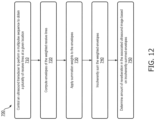
- the processor circuit is configured to sum the plurality of receive lines incoherently by: computing: a first envelope for the first receive line; and a second envelope for the second receive line; weighting: the first envelope with a first summation weight; and the second envelope with a second summation weight; and incoherently summing the first weighted envelope and the second weighted envelope.
- the first receive line corresponds to a first transmit pulse having a first amplitude
- the second receive line corresponds to a second transmit pulse having a second amplitude
- the first and second summation weights are selected based on a ratio of a first amplitude of a first transmit pulse and a second amplitude of a second transmit pulse.
- a method for reducing reverberation artifacts in an ultrasound image includes: controlling an ultrasound transducer to obtain a plurality of ultrasound images using a respective plurality of pulse repetition intervals; calculating an amount of reverberation artifacts in each of the plurality of ultrasound images; selecting a pulse repetition interval based on the calculated amounts of reverberation artifacts in each of the plurality of ultrasound images; in response to selecting the pulse repetition interval, controlling the ultrasound transducer to obtain a reduced-reverberation ultrasound image at the selected pulse repetition interval; and outputting the reduced-reverberation ultrasound image to a display.
- the method further includes: identifying a tissue portion and a non-tissue portion of each of the plurality of ultrasound images; calculating an intensity value for the non-tissue portion of each of the plurality of ultrasound images; and calculating the amount of reverberation artifacts in each of the plurality of ultrasound images based on the calculated intensity values of the non-tissue portions of the plurality of ultrasound images.
- calculating the intensity value for the non-tissue portion of each of the plurality of ultrasound images comprises calculating the intensity value for the non-tissue portion of each of the plurality of ultrasound images using a weighting algorithm, such that a first region of a respective ultrasound image near a focal point of the respective ultrasound image is assigned a greater weight than a second region of the respective ultrasound image away from the focal point of the respective ultrasound image.
- the method further includes: comparing the amounts of reverberation artifacts in each of the plurality of ultrasound images to a threshold; and selecting the pulse repetition interval comprises selecting the pulse repetition interval based on the comparison of the amounts of reverberation artifacts to the threshold.
- the method further includes determining the threshold based on the amount of reverberation artifacts in an ultrasound image of the plurality of ultrasound images associated with a maximum pulse repetition interval of the plurality of pulse repetition intervals.
- selecting the pulse repetition interval comprises selecting the pulse repetition interval based on: the comparison of the amounts of reverberations artifacts to the threshold; and a predetermined maximum pulse repetition interval.
- controlling the ultrasound transducer to obtain the plurality of ultrasound images comprises: performing a multi-pulse sequence to obtain a plurality of receive lines at a given location; summing the plurality of receive lines incoherently; and determining the amount of reverberation artifacts based on the incoherent summation of the plurality of receive lines.
- the plurality of receive lines comprises a first receive line and a second receive line
- summing the plurality of receive lines incoherently comprises: computing: a first envelope for the first receive line; and a second envelope for the second receive line; weighting: the first envelope with a first summation weight; and the second envelope with a second summation weight; and incoherently summing the first weighted envelope and the second weighted envelope.
- the first receive line corresponds to a first transmit pulse having a first amplitude
- the second receive line corresponds to a second transmit pulse having a second amplitude
- the first and second summation weights are selected based on a ratio of a first amplitude of a first transmit pulse and a second amplitude of a second transmit pulse.
- an apparatus for selecting a pulse sequence associated with reduced reverberation artifacts includes: a processor circuit in communication with an ultrasound transducer, wherein the processor circuit is configured to: control the ultrasound transducer in communication with the processor circuit to obtain a first ultrasound image using a first pulse sequence; control the ultrasound transducer to obtain a second ultrasound image using a second pulse sequence; calculate an amount of reverberation artifacts in each of the first ultrasound image and the second ultrasound image; compare the amounts of reverberation artifacts of the first ultrasound image and the second ultrasound image; select a pulse sequence based on the comparison of the amounts of reverberation artifacts; control the ultrasound transducer to obtain a reduced-reverberation ultrasound image using the selected pulse sequence; and output the reduced-reverberation ultrasound image to a display in communication with the processor circuit.
- FIG. 1 an ultrasound system 100 according to embodiments of the present disclosure is shown in block diagram form.
- An ultrasound probe 10 has a transducer array 12 comprising a plurality of ultrasound transducer elements or acoustic elements.
- the array 12 may include any number of acoustic elements.
- the array 12 can include between 1 acoustic element and 100000 acoustic elements, including values such as 2 acoustic elements, 4 acoustic elements, 36 acoustic elements, 64 acoustic elements, 128 acoustic elements, 300 acoustic elements, 812 acoustic elements, 3000 acoustic elements, 9000 acoustic elements, 30,000 acoustic elements, 65,000 acoustic elements, and/or other values both larger and smaller.
- the acoustic elements of the array 12 may be arranged in any suitable configuration, such as a linear array, a planar array, a curved array, a curvilinear array, a circumferential array, an annular array, a phased array, a matrix array, a one-dimensional (1D) array, a 1.X dimensional array (e.g., a 1.5D array), or a two-dimensional (2D) array.
- the array of acoustic elements e.g., one or more rows, one or more columns, and/or one or more orientations
- the array 12 can be configured to obtain one-dimensional, two-dimensional, and/or three-dimensional images of patient anatomy.
- aspects of the present disclosure can be implemented in any suitable ultrasound imaging probe or system, including external ultrasound probes and intraluminal ultrasound probes.
- aspects of the present disclosure can be implemented in ultrasound imaging systems using a mechanically-scanned external ultrasound imaging probe, an intracardiac (ICE) echocardiography catheter and/or a transesophageal echocardiography (TEE) probe, a rotational intravascular ultrasound (IVUS) imaging catheter, a phased-array IVUS imaging catheter, a transthoracic echocardiography (TTE) imaging device, or any other suitable type of ultrasound imaging device.
- ICE intracardiac
- TEE transesophageal echocardiography
- IVUS rotational intravascular ultrasound
- TTE transthoracic echocardiography
- the acoustic elements of the array 12 may comprise one or more piezoelectric/piezoresistive elements, lead zirconate titanate (PZT), piezoelectric micromachined ultrasound transducer (PMUT) elements, capacitive micromachined ultrasound transducer (CMUT) elements, and/or any other suitable type of acoustic elements.
- the one or more acoustic elements of the array 12 are in communication with (e.g., electrically coupled to) electronic circuitry 14.
- the electronic circuitry 14 can comprise a microbeamformer ( ⁇ BF).
- the electronic circuitry comprises a multiplexer circuit (MUX).
- the electronic circuitry 14 is located in the probe 10 and communicatively coupled to the transducer array 12. In some embodiments, one or more components of the electronic circuitry 14 can be positioned in the probe 10. In some embodiments, one or more components of the electronic circuitry 14, can be positioned in a computing device or processing system 28.
- the computing device 28 may be or include a processor, such as one or more processors in communication with a memory. As described further below, the computing device 28 may include a processor circuit as illustrated in Fig. 2 . In some aspects, some components of the electronic circuitry 14 are positioned in the probe 10 and other components of the electronic circuitry 14 are positioned in the computing device 28.
- the electronic circuitry 14 may comprise one or more electrical switches, transistors, programmable logic devices, or other electronic components configured to combine and/or continuously switch between a plurality of inputs to transmit signals from each of the plurality of inputs across one or more common communication channels.
- the electronic circuitry 14 may be coupled to elements of the array 12 by a plurality of communication channels.
- the electronic circuitry 14 is coupled to a cable 16, which transmits signals including ultrasound imaging data to the computing device 28.
- the signals are digitized and coupled to channels of a system beamformer 22, which appropriately delays each signal.
- the delayed signals are then combined to form a coherent steered and focused receive beam.
- System beamformers may comprise electronic hardware components, hardware controlled by software, or a microprocessor executing beamforming algorithms.
- the beamformer 22 may be referenced as electronic circuitry.
- the beamformer 22 can be a system beamformer, such as the system beamformer 22 of Fig. 1 , or it may be a beamformer implemented by circuitry within the ultrasound probe 10.
- the system beamformer 22 works in conjunction with a microbeamformer (e.g., electronic circuitry 14) disposed within the probe 10.
- the beamformer 22 can be an analog beamformer in some embodiments, or a digital beamformer in some embodiments.
- the system includes A/D converters which convert analog signals from the array 12 into sampled digital echo data.
- the beamformer 22 generally will include one or more microprocessors, shift registers, and or digital or analog memories to process the echo data into coherent echo signal data. Delays are effected by various means such as by the time of sampling of received signals, the write/read interval of data temporarily stored in memory, or by the length or clock rate of a shift register as described in U.S. Patent No. 4,173,007 to McKeighen et al. , the entirety of which is hereby incorporated by reference herein.
- the beamformer can apply appropriate weight to each of the signals generated by the array 12.
- the beamformed signals from the image field are processed by a signal and image processor 24 to produce 2D or 3D images for display on an image display 30.
- the signal and image processor 24 may comprise electronic hardware components, hardware controlled by software, or a microprocessor executing image processing algorithms. It generally will also include specialized hardware or software which processes received echo data into image data for images of a desired display format such as a scan converter.
- beamforming functions can be divided between different beamforming components.
- the system 100 can include a microbeamformer located within the probe 10 and in communication with the system beamformer 22. The microbeamformer may perform preliminary beamforming and/or signal processing that can reduce the number of communication channels required to transmit the receive signals to the computing device 28.
- Control of ultrasound system parameters such as scanning mode (e.g., B-mode, M-mode), probe selection, beam steering and focusing, and signal and image processing is done under control of a system controller 26 which is coupled to various modules of the system 100.
- the system controller 26 may be formed by application specific integrated circuits (ASICs) or microprocessor circuitry and software data storage devices such as RAMs, ROMs, or disk drives.
- ASICs application specific integrated circuits
- microprocessor circuitry software data storage devices
- RAMs random access memory
- ROMs read only memory
- disk drives disk drives.
- some of this control information may be provided to the electronic circuitry 14 from the computing device 28 over the cable 16, conditioning the electronic circuitry 14 for operation of the array as required for the particular scanning procedure.
- the user inputs these operating parameters by means of a user interface device 20.
- the image processor 24 is configured to generate images of different modes to be further analyzed or output to the display 30.
- the image processor can be configured to compile a B-mode image, such as a live B-mode image, of an anatomy of the patient.
- the image processor 24 is configured to generate or compile an M-mode image.
- An M-mode image can be described as an image showing temporal changes in the imaged anatomy along a single scan line.
- the computing device 28 may comprise hardware circuitry, such as a computer processor, application-specific integrated circuit (ASIC), field-programmable gate array (FPGA), capacitors, resistors, and/or other electronic devices, software, or a combination of hardware and software.
- ASIC application-specific integrated circuit
- FPGA field-programmable gate array
- the computing device 28 is a single computing device. In other embodiments, the computing device 28 comprises separate computer devices in communication with one another.
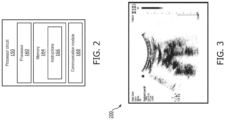
- Fig. 2 is a schematic diagram of a processor circuit 150, according to embodiments of the present disclosure.
- the processor circuit 150 may be implemented in the computing device 28, the signal and image processor 24, the controller 26, and/or the probe 10 of Fig. 1 .
- the processor circuit 150 may include a processor 160, a memory 164, and a communication module 168. These elements may be in direct or indirect communication with each other, for example via one or more buses.
- the processor 160 may include a central processing unit (CPU), a digital signal processor (DSP), an ASIC, a controller, an FPGA, another hardware device, a firmware device, or any combination thereof configured to perform the operations described herein.
- the processor 160 may also be implemented as a combination of computing devices, e.g., a combination of a DSP and a microprocessor, a plurality of microprocessors, one or more microprocessors in conjunction with a DSP core, or any other such configuration.
- the memory 164 may include a cache memory (e.g., a cache memory of the processor 160), random access memory (RAM), magnetoresistive RAM (MRAM), read-only memory (ROM), programmable read-only memory (PROM), erasable programmable read only memory (EPROM), electrically erasable programmable read only memory (EEPROM), flash memory, solid state memory device, hard disk drives, other forms of volatile and non-volatile memory, or a combination of different types of memory.
- the memory 164 includes a non-transitory computer-readable medium.
- the memory 164 may store instructions 166.
- the instructions 166 may include instructions that, when executed by the processor 160, cause the processor 160 to perform the operations described herein with reference to the processor 28 and/or the probe 10 ( Fig. 1 ). Instructions 166 may also be referred to as code.
- the terms "instructions” and “code” should be interpreted broadly to include any type of computer-readable statement(s). For example, the terms “instructions” and “code” may refer to one or more programs, routines, sub-routines, functions, procedures, etc. "Instructions" and “code” may include a single computer-readable statement or many computer-readable statements.
- the communication module 168 can include any electronic circuitry and/or logic circuitry to facilitate direct or indirect communication of data between the processor 28, the probe 10, and/or the display 30.
- the communication module 168 can be an input/output (I/O) device.
- the communication module 168 facilitates direct or indirect communication between various elements of the processor circuit 150 and/or the processing system 106 (Fig. 1A).
- ultrasound images can include a number of undesirable artifacts, including reverberation artifacts.
- Reverberation artifacts may be particularly undesirable in certain ultrasound imaging modalities, such as contrast imaging, in which a physician desires to visualize blood flow below the skin layer.
- it may be desirable to operate at the fastest frame-rate possible by minimizing the pulse repetition interval (PRI) and using as few pulses as possible in a multi-pulse sequence.
- PRI pulse repetition interval
- One factor that leads to the presence of some reverberation artifacts in an image is an insufficient PRI between the pulses used in obtaining ultrasound images, which allows echoes from deep structures beyond the imaging region to be received with a later receive line.
- Another method to reduce these artifacts may be to alter the multi-pulse sequence to better sample and eliminate reverberation, often by introducing additional transmit and/or receive events at the expense of frame-rate.
- Systems do not typically allow the user to change the pulse configuration in response to reverberation, and so the system designer may choose a preferred sequence to either allow reverb and maximize frame-rate or reduce reverb and accept a lower frame-rate as a result.
- the present disclosure provides devices, systems and methods for automatically adjusting imaging settings such as PRI and pulse sequence configuration to reduce reverberation artifacts in an ultrasound image.
- the amount of reverberation artifacts in an image may be associated with the PRI or the pulse configuration of the imaging sequence.
- the present application describes embodiments of systems and methods for automatically adjusting PRI and/or pulse configuration in a manner that specifically achieves a reduction in reverberation artifacts.
- the automatic adjustment may be performed to maintain the frame rate of the imaging sequence at or above a particular level acceptable to a user.
- Fig. 3 is an ultrasound image obtained by an external ultrasound imaging system.
- the image 200 is obtained of an anatomical region of a patient's body and shows a skin region 210 and reverberation region 220 at a deeper depth relative to the skin region.
- the skin region 210 may be associated with non-reverb signals, or true signals reflected from the skin and/or other tissue structures.
- some or all of the reverberation region 220 may be associated with acoustic reverberation, and therefore does not reflect the actual tissue structures in the anatomy.
- the artifacts and clutter in the reverberation region 220 may undesirably affect the ability of physicians to visualize anatomical structures and make diagnoses. Accordingly, confidence in diagnoses may be reduced.
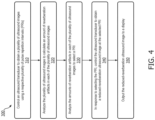
- Fig. 4 is a flow chart illustrating a method 300 for reducing reverberation artifacts in ultrasound images, according to an embodiment of the present disclosure. It will be understood that one or more steps of the method 300 may be performed by the ultrasound imaging system 100 shown in Fig. 1 , and/or the processor circuit 150 shown in Fig. 2 , for example.
- an ultrasound transducer is controlled to obtain a plurality of ultrasound images using a respective plurality of pulse repetition intervals (PRIs).
- the ultrasound transducer comprises an external ultrasound probe that includes an array of ultrasound transducer elements.
- the method 300 may be performed with other types of ultrasound transducers, including intravascular ultrasound (IVUS) devices, intracardiac echocardiography (ICE) catheters, transesophageal echocardiography (TEE) probes, transthoracic echocardiography (TTE) probes, or any other suitable ultrasound imaging device.
- the system may comprise a user input device, such as a mouse, keyboard, touch screen, and/or any other suitable user input device.
- the method 300 may be initiated by a user via the user input device. For example, in some embodiments, the method 300 is initiated by the user pressing or selecting a button or icon, such as an icon on a touch screen display. In some embodiments, once initiated, the method 300 proceeds to perform each step of the method 300 automatically.
- one or more steps of the method 300 are performed in the background such that the one or more steps of the method 300 are not shown on a display. In some embodiments, one or more steps of the method are shown on a display device such that a user or operator can monitor the progress of the method 300.
- each of the plurality of ultrasound images is obtained using a different PRI.
- the PRIs may comprise a set of PRIs that vary incrementally. Any suitable number of ultrasound images and corresponding PRIs may be used in step 310, including the standard two-way travel time (time of flight) for the acoustic wave in the imaging window plus 2, 3, 4, 5, 6, 8, 10, 12, 15, 20, 30, 50, or any other suitable number of microseconds, both larger and smaller.
- PRIs may be represented or measured in time (e.g., ⁇ s, ms), in depth or distance (e.g., mm), in pixels, or any other suitable unit of measurement. In some embodiments, the PRIs vary between a minimum PRI and a maximum PRI.
- the minimum PRI is 0, such that there is effectively no gap or rest time between pulses, beyond the standard two-way travel time for the acoustic wave. In some embodiments, the minimum PRI is based on the hardware capabilities of the ultrasound transducer to switch from receiving to transmitting. In some embodiments, the minimum PRI is predetermined by the manufacturer of the processor circuit and/or the ultrasound transducer to represent a minimum amount of time to allow vibrations in the tissue and/or the ultrasound transducer to dissipate before transmitting the next pulse.
- the maximum PRI is predetermined, selected, or otherwise configured in the processor circuit based on various imaging factors, including the particular scan sequence used (e.g., multi-pulse, pulse inversion, single pulse, etc.), the desired imaging depth or focal zone, and/or a minimum frame rate.
- the different PRIs used to obtain the plurality of ultrasound images vary in constant increments. In other embodiments, the different PRIs vary in a non-constant or non-linear fashion. In some embodiments, only one ultrasound image is obtained for each PRI in step 310. In other embodiments, multiple images are obtained for each PRI.
- the plurality of ultrasound images is analyzed to calculate an amount of reverberation artifacts in each of the plurality of ultrasound images.
- analyzing ultrasound images may refer to performing signal processing on the electrical signals output by the transducer array and/or image processing on the image data generated from the electrical signals output by the transducer array.
- the amount of reverberation artifacts in an image can be quantified or inferred by removing or suppressing tissue in the image, and summing the remaining signal or intensity in the image. The summed remaining signal may represent or correlate to the amount of reverberation artifacts present in the image, and may also represent other artifacts.
- the amount of intensity, or intensity value, for the non-tissue portion of each ultrasound image is calculated using a weighting algorithm.
- the weighting algorithm may be applied such that particular regions of the ultrasound images are given more weight compared to other regions. For example, in some embodiments, the non-tissue signal intensity in a region of an ultrasound image near a focal point of the ultrasound transducer is given greater weight than regions that are positioned away from the focal point.
- the plurality of ultrasound images is analyzed to distinguish between a tissue portion and a non-tissue portion in each of the plurality of ultrasound images.
- Each ultrasound image may then be analyzed to calculate the remaining overall intensity value.
- the amount of reverberation artifacts may be determined for each ultrasound image based on based on the calculated intensity value.
- reverberation detection algorithms can be used to distinguish between reverberation artifacts and other contributions to an image. Because the ultrasound images are obtained using different PRIs, it may be expected that the amount of reverberation artifacts changes based on the PRI associated with a particular image.
- the amounts of reverberation artifacts in each of the plurality of ultrasound images are analyzed to select a PRI.
- analyzing the amounts of reverberation artifacts comprises comparing the amounts of reverberation artifacts.
- the amounts of reverberation artifacts in each image may be compared to a threshold.
- the threshold may be determined based on a minimum intensity image and/or a maximum PRI image.
- the amounts of reverberation artifacts in each image are compared to the amounts of reverberation artifacts in the other images.
- step 340 in response to selecting the PRI, the ultrasound transducer is controlled to obtain a reduced-reverberation ultrasound image at the selected PRI.
- step 350 the reduced-reverberation ultrasound image is output to a display.
- the steps of the method 300 may be performed repetitiously to produce and display a live view or stream of reduced-reverberation ultrasound images. Further, in some embodiments, the method 300 may be halted by a user by selecting a user input on the user input device. For example, if the particular imaging application or modality is not likely to produce reverberation, the user may terminate the method 300 to return the PRI to a default or initial value.
- the processor circuit may receive a user input via a user input device that initiates a tissue suppression protocol.
- the tissue suppression protocol is automatically activated as part of a reverberation reduction protocol.
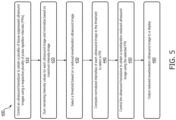
- the method 400 is initiated by a user input, and proceeds to perform each step of the method 400 automatically.
- one or more steps of the method 400 are performed in the background such that the one or more steps of the method 400 are not shown on a display.
- Fig. 7 is a graph 500 illustrating aspects of steps 420-440.
- the graph or plot 500 shows the summed and normalized intensity values 422a-422f of the tissue suppressed images 412a-412f relative to a threshold 432, with PRI as the x-axis.
- the additional PRI increment is represented by a representation in millimeters of depth.
- other units of measurement may be used for PRIs, including units of time, pixels, or any other suitable type of measurement.
- the PRIs which in Fig.
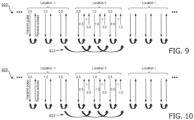
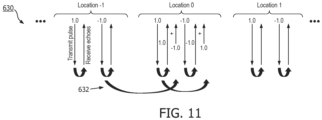
- a first summation weight of -1.0 is applied to a first envelope and a second summation weight of 1.0 is applied to a second envelope.
- the opposite signs and equal magnitudes of the summation weights can cause signal portions common to each envelope to cancel out, while signal portions that differ between the first envelope and the second envelope remain.
- Fig. 13 is a map or image 800 that is filtered to show only the reverberation artifacts in an ultrasound image using the method 700 and formula described above. It can be observed that the reverberation is stronger or more intense in the deeper portions of the image.
- the amount of reverberation quantified using the method 700 can be used in a method (e.g., 300, Fig. 4 ) for automatically controlling the PRI or selecting a pulse sequence or configuration of an ultrasound transducer to reduce the amount of reverberation artifacts in an image.
- the formula above may be applied using summation weights (0, -1, 2) respectively for the first, second, and third envelopes, such that only the second and third envelopes of the weighted receive lines are taken into account.
- summation weights (1, -1, 1) could also be used to achieve similar results.
- the formula above may be applied using summation weights (0, -1, 2), as in the amplitude modulation sequence 610.
- the formula above may be applied using summation weights (1, -1).
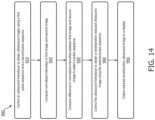
- Fig. 14 is a flow diagram of a method 900 for controlling an ultrasound transducer to reduce reverberation artifacts in ultrasound images by selecting between different ultrasound pulse sequences or configurations.
- a processor circuit controls an ultrasound transducer to obtain ultrasound images using a first pulse sequence, and to obtain ultrasound images using a second pulse sequence.
- the first and second pulse sequences are different, and may include one or more of a single pulse sequence, amplitude modulation, pulse inversion, AMPI, or any other suitable pulse sequence.
- step 910 may include obtaining a first ultrasound image with a single pulse or standard imaging sequence, and obtaining a second ultrasound image using a multi-pulse sequence configured to automatically reduce reverberation artifacts.
- the processor circuit analyzes the obtained ultrasound images using, for example, image processing and analysis techniques, to compute normalized intensity values of the first ultrasound image obtained using the first pulse sequence and the second ultrasound image obtained using the second pulse sequence.
- computing the normalized intensity values includes using tissue-suppression techniques as described above with respect to the method 400.
- the steps of the method 700 can be employed to calculate the amount of reverberation artifacts in each ultrasound image.
- the intensity values of the first and second images are compared to select a pulse sequence or configuration.
- the pulse sequence associated with the lowest amount of reverberation artifacts or normalized intensity is selected.
- comparing the intensity values includes comparing the intensity or reverberation artifact values to a threshold.
- a threshold is selected according to the steps of the method 400, for example, and a pulse sequence or configuration is selected based on the comparison to the threshold.
- the threshold may represent a degree of change in reverberation artifacts from the current pulse sequence, or first pulse sequence.
- the processor circuit controls the ultrasound transducer to obtain a reverberation-reduced ultrasound image using the selected pulse sequence or configuration.
- the processor circuit outputs the reverberation-reduced ultrasound image to a display.
- the processor circuit may perform the steps of the method 900 automatically, with little or no input from a user. For example, in some embodiments, a user initiates the method using a user input device (e.g., a keyboard, mouse, trackball, touch screen, etc.), and the processor circuit executes computer program code to carry out the steps of the method 900. In some embodiments, the performance of the individual steps of the method 900 may not be visible to the user (i.e.
- the processor circuit may generate one or more graphical representations indicating the individual steps of the method 900.
- additional pulse sequences are performed to obtain additional ultrasound images used to select a multi-pulse sequence. For example, two, three, four, five, ten, or more sequences of different types and/or having different configurations and parameters may be used to select a pulse sequence and/or configuration associated with a reduction in reverberation artifacts.
Landscapes
- Engineering & Computer Science (AREA)
- Physics & Mathematics (AREA)
- Remote Sensing (AREA)
- Radar, Positioning & Navigation (AREA)
- Computer Networks & Wireless Communication (AREA)
- General Physics & Mathematics (AREA)
- Health & Medical Sciences (AREA)
- Life Sciences & Earth Sciences (AREA)
- Nuclear Medicine, Radiotherapy & Molecular Imaging (AREA)
- General Health & Medical Sciences (AREA)
- Heart & Thoracic Surgery (AREA)
- Medical Informatics (AREA)
- Molecular Biology (AREA)
- Surgery (AREA)
- Animal Behavior & Ethology (AREA)
- Biomedical Technology (AREA)
- Public Health (AREA)
- Veterinary Medicine (AREA)
- Radiology & Medical Imaging (AREA)
- Pathology (AREA)
- Biophysics (AREA)
- Computer Vision & Pattern Recognition (AREA)
- Acoustics & Sound (AREA)
- Ultra Sonic Daignosis Equipment (AREA)
Applications Claiming Priority (2)
| Application Number | Priority Date | Filing Date | Title |
|---|---|---|---|
| US201962938637P | 2019-11-21 | 2019-11-21 | |
| PCT/EP2020/082413 WO2021099320A1 (en) | 2019-11-21 | 2020-11-17 | Reduction of reverberation artifacts in ultrasound images and associated devices, systems, and methods |
Publications (2)
| Publication Number | Publication Date |
|---|---|
| EP4061234A1 EP4061234A1 (en) | 2022-09-28 |
| EP4061234B1 true EP4061234B1 (en) | 2025-04-09 |
Family
ID=73476140
Family Applications (1)
| Application Number | Title | Priority Date | Filing Date |
|---|---|---|---|
| EP20808369.1A Active EP4061234B1 (en) | 2019-11-21 | 2020-11-17 | Reduction of reverberation artifacts in ultrasound images and associated devices, systems, and methods |
Country Status (5)
| Country | Link |
|---|---|
| US (1) | US11986356B2 (https=) |
| EP (1) | EP4061234B1 (https=) |
| JP (1) | JP7535109B2 (https=) |
| CN (1) | CN114727807A (https=) |
| WO (1) | WO2021099320A1 (https=) |
Families Citing this family (6)
| Publication number | Priority date | Publication date | Assignee | Title |
|---|---|---|---|---|
| JP7775141B2 (ja) * | 2022-05-16 | 2025-11-25 | 富士フイルム株式会社 | 超音波時系列データ処理装置及び超音波時系列データ処理プログラム |
| US20240265512A1 (en) * | 2023-02-02 | 2024-08-08 | yoR Labs, Inc. | Systems and methods for automatic suppression of comet tail artifacts in b-mode images of an intracardiac ablation catheter |
| CN116012452B (zh) * | 2023-03-28 | 2023-07-07 | 天津市第四中心医院 | 一种基于超声图像定位靶目标的穿刺导航系统及方法 |
| US12156761B1 (en) | 2024-03-05 | 2024-12-03 | yoR Labs, Inc. | Bayesian anatomically-driven, artificial-intelligence based intracardiac echocardiography object detection and prediction |
| USD1115033S1 (en) | 2024-09-11 | 2026-02-24 | yoR Labs, Inc. | Intracardiac echocardiography box |
| USD1118921S1 (en) | 2024-09-11 | 2026-03-17 | yoR Labs, Inc. | Catheter handle |
Citations (1)
| Publication number | Priority date | Publication date | Assignee | Title |
|---|---|---|---|---|
| US20180088220A1 (en) * | 2015-04-01 | 2018-03-29 | Verasonics, Inc. | Method and system for coded excitation imaging by impulse response estimation and retrospective acquisition |
Family Cites Families (24)
| Publication number | Priority date | Publication date | Assignee | Title |
|---|---|---|---|---|
| US4173007A (en) | 1977-07-01 | 1979-10-30 | G. D. Searle & Co. | Dynamically variable electronic delay lines for real time ultrasonic imaging systems |
| US4435984A (en) * | 1980-04-21 | 1984-03-13 | Southwest Research Institute | Ultrasonic multiple-beam technique for detecting cracks in bimetallic or coarse-grained materials |
| US6544177B1 (en) * | 1998-10-01 | 2003-04-08 | Atl Ultrasound, Inc. | Ultrasonic diagnostic imaging system and method with harmonic spatial compounding |
| US6210328B1 (en) * | 1998-10-01 | 2001-04-03 | Atl Ultrasound | Ultrasonic diagnostic imaging system with variable spatial compounding |
| JP4740436B2 (ja) | 1998-12-31 | 2011-08-03 | ゼネラル・エレクトリック・カンパニイ | ドップラー超音波スペクトル写真のための速度スケールおよびパルス繰返し数の自動調整 |
| US6436041B1 (en) * | 2000-12-22 | 2002-08-20 | Acuson Corporation | Medical ultrasonic imaging method with improved ultrasonic contrast agent specificity |
| US20030045797A1 (en) | 2001-08-28 | 2003-03-06 | Donald Christopher | Automatic optimization of doppler display parameters |
| US6663566B2 (en) | 2002-02-19 | 2003-12-16 | Ge Medical Systems Global Technology Company, Llc | Method and apparatus for automatic control of spectral doppler imaging |
| US6905465B2 (en) * | 2002-04-05 | 2005-06-14 | Angelsen Bjoern A. J. | Corrections for pulse reverberations and phasefront aberrations in ultrasound imaging |
| JP4458825B2 (ja) | 2003-11-27 | 2010-04-28 | 株式会社日立メディコ | 超音波診断装置 |
| US7004906B1 (en) * | 2004-07-26 | 2006-02-28 | Siemens Medical Solutions Usa, Inc. | Contrast agent imaging with agent specific ultrasound detection |
| JP4762010B2 (ja) | 2006-03-14 | 2011-08-31 | 株式会社東芝 | 超音波診断装置およびその画像処理方法、その画像処理プログラム |
| US8550998B2 (en) * | 2008-01-09 | 2013-10-08 | Bjørn A. J. Angelsen | Nonlinear elastic wave measurement and imaging with two-frequency elastic wave pulse complexes |
| US9939413B2 (en) * | 2008-01-09 | 2018-04-10 | Surf Technology As | Measurement and imaging of scatterers with memory of scatterer parameters using at least two-frequency elastic wave pulse complexes |
| US8019572B2 (en) * | 2008-10-31 | 2011-09-13 | Centre National De La Recherche Scientifique (C.N.R.S.) | Method and apparatus for exploring by wave propagation |
| JP5950271B2 (ja) | 2011-07-27 | 2016-07-13 | 株式会社日立製作所 | 超音波診断装置 |
| WO2013051943A1 (en) * | 2011-10-03 | 2013-04-11 | Surf Technology As | Nonlinear imaging with dual band pulse complexes |
| EP2810248A1 (en) * | 2012-02-02 | 2014-12-10 | University of Washington through its Center for Commercialization | Filtering systems and methods for suppression of non-stationary reverberation in ultrasound images |
| GB2502997B (en) * | 2012-06-13 | 2014-09-03 | Crystalview Medical Imaging Ltd | Suppression of reverberations and/or clutter in ultrasonic imaging systems |
| US10898076B2 (en) * | 2013-09-30 | 2021-01-26 | The Research Foundation For The State University Of New York | Transmission and medium access control techniques for ultrasonic communications in the body |
| JP6513230B2 (ja) * | 2016-01-22 | 2019-05-15 | オリンパス株式会社 | 超音波観測装置、超音波観測装置の作動方法、および超音波観測装置の作動プログラム |
| WO2018130704A1 (en) * | 2017-01-16 | 2018-07-19 | Koninklijke Philips N.V. | Systems and methods for ultrafast imaging |
| WO2020018901A1 (en) * | 2018-07-19 | 2020-01-23 | Mayo Foundation For Medical Education And Research | Systems and methods for removing noise-induced bias in ultrasound blood flow imaging |
| US12201473B2 (en) * | 2021-12-22 | 2025-01-21 | Philips Image Guided Therapy Corporation | Systems, devices, and methods for reducing reverberation signals in intravascular ultrasound imaging |
-
2020
- 2020-11-17 WO PCT/EP2020/082413 patent/WO2021099320A1/en not_active Ceased
- 2020-11-17 JP JP2022529492A patent/JP7535109B2/ja active Active
- 2020-11-17 US US17/775,664 patent/US11986356B2/en active Active
- 2020-11-17 CN CN202080081233.2A patent/CN114727807A/zh active Pending
- 2020-11-17 EP EP20808369.1A patent/EP4061234B1/en active Active
Patent Citations (1)
| Publication number | Priority date | Publication date | Assignee | Title |
|---|---|---|---|---|
| US20180088220A1 (en) * | 2015-04-01 | 2018-03-29 | Verasonics, Inc. | Method and system for coded excitation imaging by impulse response estimation and retrospective acquisition |
Also Published As
| Publication number | Publication date |
|---|---|
| WO2021099320A1 (en) | 2021-05-27 |
| JP7535109B2 (ja) | 2024-08-15 |
| US20220401081A1 (en) | 2022-12-22 |
| US11986356B2 (en) | 2024-05-21 |
| JP2023502450A (ja) | 2023-01-24 |
| EP4061234A1 (en) | 2022-09-28 |
| CN114727807A (zh) | 2022-07-08 |
Similar Documents
| Publication | Publication Date | Title |
|---|---|---|
| EP4061234B1 (en) | Reduction of reverberation artifacts in ultrasound images and associated devices, systems, and methods | |
| JP6932192B2 (ja) | 超音波画像クラッタをフィルタリングする方法及びシステム | |
| US6827686B2 (en) | System and method for improved harmonic imaging | |
| Jensen | Medical ultrasound imaging | |
| EP1501419B1 (en) | Contrast-agent enhanced color-flow imaging | |
| US8002704B2 (en) | Method and system for determining contact along a surface of an ultrasound probe | |
| CN101448460B (zh) | 用于超声成像的设备和方法 | |
| US9168027B2 (en) | Adaptive acoustic pressure estimation in medical ultrasound | |
| CN112218586B (zh) | 用于超声筛查的系统和方法 | |
| EP3638124B1 (en) | Methods and systems for processing an ultrasound image | |
| EP4408294B1 (en) | System and method for segmenting an anatomical structure | |
| CN113348378B (zh) | 具有置信度估计的声衰减系数的超声成像 | |
| US11129598B2 (en) | Calibration for ARFI imaging | |
| EP3905961B1 (en) | Contrast imaging | |
| KR20100119480A (ko) | 고유벡터를 설정하는 초음파 시스템 및 방법 | |
| EP4159139A1 (en) | System and method for segmenting an anatomical structure | |
| WO2023278445A9 (en) | System and method for non-invasive determination of pressure in a biological compartment |
Legal Events
| Date | Code | Title | Description |
|---|---|---|---|
| STAA | Information on the status of an ep patent application or granted ep patent |
Free format text: STATUS: UNKNOWN |
|
| STAA | Information on the status of an ep patent application or granted ep patent |
Free format text: STATUS: THE INTERNATIONAL PUBLICATION HAS BEEN MADE |
|
| PUAI | Public reference made under article 153(3) epc to a published international application that has entered the european phase |
Free format text: ORIGINAL CODE: 0009012 |
|
| STAA | Information on the status of an ep patent application or granted ep patent |
Free format text: STATUS: REQUEST FOR EXAMINATION WAS MADE |
|
| 17P | Request for examination filed |
Effective date: 20220621 |
|
| AK | Designated contracting states |
Kind code of ref document: A1 Designated state(s): AL AT BE BG CH CY CZ DE DK EE ES FI FR GB GR HR HU IE IS IT LI LT LU LV MC MK MT NL NO PL PT RO RS SE SI SK SM TR |
|
| DAV | Request for validation of the european patent (deleted) | ||
| DAX | Request for extension of the european patent (deleted) | ||
| STAA | Information on the status of an ep patent application or granted ep patent |
Free format text: STATUS: EXAMINATION IS IN PROGRESS |
|
| 17Q | First examination report despatched |
Effective date: 20231129 |
|
| GRAP | Despatch of communication of intention to grant a patent |
Free format text: ORIGINAL CODE: EPIDOSNIGR1 |
|
| STAA | Information on the status of an ep patent application or granted ep patent |
Free format text: STATUS: GRANT OF PATENT IS INTENDED |
|
| INTG | Intention to grant announced |
Effective date: 20241114 |
|
| RIN1 | Information on inventor provided before grant (corrected) |
Inventor name: DANIELS, ALLISON ARDEN Inventor name: LOUPAS, THANASIS Inventor name: TREMBLAY-DARVEAU, CHARLES Inventor name: SHEERAN, PAUL |
|
| GRAS | Grant fee paid |
Free format text: ORIGINAL CODE: EPIDOSNIGR3 |
|
| GRAA | (expected) grant |
Free format text: ORIGINAL CODE: 0009210 |
|
| STAA | Information on the status of an ep patent application or granted ep patent |
Free format text: STATUS: THE PATENT HAS BEEN GRANTED |
|
| AK | Designated contracting states |
Kind code of ref document: B1 Designated state(s): AL AT BE BG CH CY CZ DE DK EE ES FI FR GB GR HR HU IE IS IT LI LT LU LV MC MK MT NL NO PL PT RO RS SE SI SK SM TR |
|
| REG | Reference to a national code |
Ref country code: GB Ref legal event code: FG4D |
|
| REG | Reference to a national code |
Ref country code: CH Ref legal event code: EP |
|
| REG | Reference to a national code |
Ref country code: DE Ref legal event code: R096 Ref document number: 602020049203 Country of ref document: DE |
|
| REG | Reference to a national code |
Ref country code: IE Ref legal event code: FG4D |
|
| REG | Reference to a national code |
Ref country code: DE Ref legal event code: R084 Ref document number: 602020049203 Country of ref document: DE |
|
| REG | Reference to a national code |
Ref country code: GB Ref legal event code: 746 Effective date: 20250624 |
|
| REG | Reference to a national code |
Ref country code: NL Ref legal event code: MP Effective date: 20250409 |
|
| PG25 | Lapsed in a contracting state [announced via postgrant information from national office to epo] |
Ref country code: NL Free format text: LAPSE BECAUSE OF FAILURE TO SUBMIT A TRANSLATION OF THE DESCRIPTION OR TO PAY THE FEE WITHIN THE PRESCRIBED TIME-LIMIT Effective date: 20250409 |
|
| REG | Reference to a national code |
Ref country code: AT Ref legal event code: MK05 Ref document number: 1782792 Country of ref document: AT Kind code of ref document: T Effective date: 20250409 |
|
| PG25 | Lapsed in a contracting state [announced via postgrant information from national office to epo] |
Ref country code: FI Free format text: LAPSE BECAUSE OF FAILURE TO SUBMIT A TRANSLATION OF THE DESCRIPTION OR TO PAY THE FEE WITHIN THE PRESCRIBED TIME-LIMIT Effective date: 20250409 Ref country code: ES Free format text: LAPSE BECAUSE OF FAILURE TO SUBMIT A TRANSLATION OF THE DESCRIPTION OR TO PAY THE FEE WITHIN THE PRESCRIBED TIME-LIMIT Effective date: 20250409 Ref country code: PT Free format text: LAPSE BECAUSE OF FAILURE TO SUBMIT A TRANSLATION OF THE DESCRIPTION OR TO PAY THE FEE WITHIN THE PRESCRIBED TIME-LIMIT Effective date: 20250811 |
|
| REG | Reference to a national code |
Ref country code: LT Ref legal event code: MG9D |
|
| PG25 | Lapsed in a contracting state [announced via postgrant information from national office to epo] |
Ref country code: NO Free format text: LAPSE BECAUSE OF FAILURE TO SUBMIT A TRANSLATION OF THE DESCRIPTION OR TO PAY THE FEE WITHIN THE PRESCRIBED TIME-LIMIT Effective date: 20250709 Ref country code: GR Free format text: LAPSE BECAUSE OF FAILURE TO SUBMIT A TRANSLATION OF THE DESCRIPTION OR TO PAY THE FEE WITHIN THE PRESCRIBED TIME-LIMIT Effective date: 20250710 |
|
| PG25 | Lapsed in a contracting state [announced via postgrant information from national office to epo] |
Ref country code: PL Free format text: LAPSE BECAUSE OF FAILURE TO SUBMIT A TRANSLATION OF THE DESCRIPTION OR TO PAY THE FEE WITHIN THE PRESCRIBED TIME-LIMIT Effective date: 20250409 |
|
| PG25 | Lapsed in a contracting state [announced via postgrant information from national office to epo] |
Ref country code: BG Free format text: LAPSE BECAUSE OF FAILURE TO SUBMIT A TRANSLATION OF THE DESCRIPTION OR TO PAY THE FEE WITHIN THE PRESCRIBED TIME-LIMIT Effective date: 20250409 |
|
| PG25 | Lapsed in a contracting state [announced via postgrant information from national office to epo] |
Ref country code: HR Free format text: LAPSE BECAUSE OF FAILURE TO SUBMIT A TRANSLATION OF THE DESCRIPTION OR TO PAY THE FEE WITHIN THE PRESCRIBED TIME-LIMIT Effective date: 20250409 |
|
| PG25 | Lapsed in a contracting state [announced via postgrant information from national office to epo] |
Ref country code: AT Free format text: LAPSE BECAUSE OF FAILURE TO SUBMIT A TRANSLATION OF THE DESCRIPTION OR TO PAY THE FEE WITHIN THE PRESCRIBED TIME-LIMIT Effective date: 20250409 |
|
| PG25 | Lapsed in a contracting state [announced via postgrant information from national office to epo] |
Ref country code: RS Free format text: LAPSE BECAUSE OF FAILURE TO SUBMIT A TRANSLATION OF THE DESCRIPTION OR TO PAY THE FEE WITHIN THE PRESCRIBED TIME-LIMIT Effective date: 20250709 |
|
| PG25 | Lapsed in a contracting state [announced via postgrant information from national office to epo] |
Ref country code: IS Free format text: LAPSE BECAUSE OF FAILURE TO SUBMIT A TRANSLATION OF THE DESCRIPTION OR TO PAY THE FEE WITHIN THE PRESCRIBED TIME-LIMIT Effective date: 20250809 |
|
| PG25 | Lapsed in a contracting state [announced via postgrant information from national office to epo] |
Ref country code: LV Free format text: LAPSE BECAUSE OF FAILURE TO SUBMIT A TRANSLATION OF THE DESCRIPTION OR TO PAY THE FEE WITHIN THE PRESCRIBED TIME-LIMIT Effective date: 20250409 |
|
| PGFP | Annual fee paid to national office [announced via postgrant information from national office to epo] |
Ref country code: DE Payment date: 20251126 Year of fee payment: 6 |
|
| PGFP | Annual fee paid to national office [announced via postgrant information from national office to epo] |
Ref country code: GB Payment date: 20251125 Year of fee payment: 6 |
|
| REG | Reference to a national code |
Ref country code: DE Ref legal event code: R097 Ref document number: 602020049203 Country of ref document: DE |
|
| PG25 | Lapsed in a contracting state [announced via postgrant information from national office to epo] |
Ref country code: SM Free format text: LAPSE BECAUSE OF FAILURE TO SUBMIT A TRANSLATION OF THE DESCRIPTION OR TO PAY THE FEE WITHIN THE PRESCRIBED TIME-LIMIT Effective date: 20250409 Ref country code: DK Free format text: LAPSE BECAUSE OF FAILURE TO SUBMIT A TRANSLATION OF THE DESCRIPTION OR TO PAY THE FEE WITHIN THE PRESCRIBED TIME-LIMIT Effective date: 20250409 |
|
| PG25 | Lapsed in a contracting state [announced via postgrant information from national office to epo] |
Ref country code: CZ Free format text: LAPSE BECAUSE OF FAILURE TO SUBMIT A TRANSLATION OF THE DESCRIPTION OR TO PAY THE FEE WITHIN THE PRESCRIBED TIME-LIMIT Effective date: 20250409 |
|
| PG25 | Lapsed in a contracting state [announced via postgrant information from national office to epo] |
Ref country code: EE Free format text: LAPSE BECAUSE OF FAILURE TO SUBMIT A TRANSLATION OF THE DESCRIPTION OR TO PAY THE FEE WITHIN THE PRESCRIBED TIME-LIMIT Effective date: 20250409 |
|
| PG25 | Lapsed in a contracting state [announced via postgrant information from national office to epo] |
Ref country code: SK Free format text: LAPSE BECAUSE OF FAILURE TO SUBMIT A TRANSLATION OF THE DESCRIPTION OR TO PAY THE FEE WITHIN THE PRESCRIBED TIME-LIMIT Effective date: 20250409 |
|
| PG25 | Lapsed in a contracting state [announced via postgrant information from national office to epo] |
Ref country code: IT Free format text: LAPSE BECAUSE OF FAILURE TO SUBMIT A TRANSLATION OF THE DESCRIPTION OR TO PAY THE FEE WITHIN THE PRESCRIBED TIME-LIMIT Effective date: 20250409 |
|
| PG25 | Lapsed in a contracting state [announced via postgrant information from national office to epo] |
Ref country code: RO Free format text: LAPSE BECAUSE OF FAILURE TO SUBMIT A TRANSLATION OF THE DESCRIPTION OR TO PAY THE FEE WITHIN THE PRESCRIBED TIME-LIMIT Effective date: 20250409 |
|
| PLBE | No opposition filed within time limit |
Free format text: ORIGINAL CODE: 0009261 |
|
| STAA | Information on the status of an ep patent application or granted ep patent |
Free format text: STATUS: NO OPPOSITION FILED WITHIN TIME LIMIT |
|
| REG | Reference to a national code |
Ref country code: CH Ref legal event code: L10 Free format text: ST27 STATUS EVENT CODE: U-0-0-L10-L00 (AS PROVIDED BY THE NATIONAL OFFICE) Effective date: 20260218 |
|
| 26N | No opposition filed |
Effective date: 20260112 |