EP4061168B1 - Vêtement de compression et/ou de contention pour le traitement du lymphoedème - Google Patents
Vêtement de compression et/ou de contention pour le traitement du lymphoedème Download PDFInfo
- Publication number
- EP4061168B1 EP4061168B1 EP20804557.5A EP20804557A EP4061168B1 EP 4061168 B1 EP4061168 B1 EP 4061168B1 EP 20804557 A EP20804557 A EP 20804557A EP 4061168 B1 EP4061168 B1 EP 4061168B1
- Authority
- EP
- European Patent Office
- Prior art keywords
- garment
- textile
- compression
- main body
- user
- Prior art date
- Legal status (The legal status is an assumption and is not a legal conclusion. Google has not performed a legal analysis and makes no representation as to the accuracy of the status listed.)
- Active
Links
Images

Classifications
-
- A—HUMAN NECESSITIES
- A41—WEARING APPAREL
- A41B—SHIRTS; UNDERWEAR; BABY LINEN; HANDKERCHIEFS
- A41B11/00—Hosiery; Panti-hose
- A41B11/02—Reinforcements
-
- A—HUMAN NECESSITIES
- A41—WEARING APPAREL
- A41B—SHIRTS; UNDERWEAR; BABY LINEN; HANDKERCHIEFS
- A41B9/00—Undergarments
- A41B9/004—Undergarments characterized by the crotch
-
- A—HUMAN NECESSITIES
- A41—WEARING APPAREL
- A41B—SHIRTS; UNDERWEAR; BABY LINEN; HANDKERCHIEFS
- A41B9/00—Undergarments
- A41B9/04—Knickers for ladies, with or without inserted crotch or seat parts
-
- A—HUMAN NECESSITIES
- A41—WEARING APPAREL
- A41D—OUTERWEAR; PROTECTIVE GARMENTS; ACCESSORIES
- A41D1/00—Garments
- A41D1/06—Trousers
- A41D1/08—Trousers specially adapted for sporting purposes
- A41D1/088—Trousers specially adapted for sporting purposes with crotch reinforcement
-
- A—HUMAN NECESSITIES
- A41—WEARING APPAREL
- A41D—OUTERWEAR; PROTECTIVE GARMENTS; ACCESSORIES
- A41D13/00—Professional, industrial or sporting protective garments, e.g. surgeons' gowns or garments protecting against blows or punches
- A41D13/12—Surgeons' or patients' gowns or dresses
- A41D13/1236—Patients' garments
- A41D13/1254—Patients' garments for the lower part of the body
-
- A—HUMAN NECESSITIES
- A41—WEARING APPAREL
- A41D—OUTERWEAR; PROTECTIVE GARMENTS; ACCESSORIES
- A41D31/00—Materials specially adapted for outerwear
- A41D31/0005—Materials specially adapted for outerwear made from a plurality of interconnected elements
-
- A—HUMAN NECESSITIES
- A41—WEARING APPAREL
- A41D—OUTERWEAR; PROTECTIVE GARMENTS; ACCESSORIES
- A41D31/00—Materials specially adapted for outerwear
- A41D31/04—Materials specially adapted for outerwear characterised by special function or use
- A41D31/18—Elastic
-
- A—HUMAN NECESSITIES
- A61—MEDICAL OR VETERINARY SCIENCE; HYGIENE
- A61F—FILTERS IMPLANTABLE INTO BLOOD VESSELS; PROSTHESES; DEVICES PROVIDING PATENCY TO, OR PREVENTING COLLAPSING OF, TUBULAR STRUCTURES OF THE BODY, e.g. STENTS; ORTHOPAEDIC, NURSING OR CONTRACEPTIVE DEVICES; FOMENTATION; TREATMENT OR PROTECTION OF EYES OR EARS; BANDAGES, DRESSINGS OR ABSORBENT PADS; FIRST-AID KITS
- A61F5/00—Orthopaedic methods or devices for non-surgical treatment of bones or joints; Nursing devices ; Anti-rape devices
- A61F5/01—Orthopaedic devices, e.g. long-term immobilising or pressure directing devices for treating broken or deformed bones such as splints, casts or braces
- A61F5/30—Pressure pads
-
- A—HUMAN NECESSITIES
- A41—WEARING APPAREL
- A41B—SHIRTS; UNDERWEAR; BABY LINEN; HANDKERCHIEFS
- A41B2400/00—Functions or special features of shirts, underwear, baby linen or handkerchiefs not provided for in other groups of this subclass
- A41B2400/32—Therapeutic use
-
- A—HUMAN NECESSITIES
- A41—WEARING APPAREL
- A41D—OUTERWEAR; PROTECTIVE GARMENTS; ACCESSORIES
- A41D13/00—Professional, industrial or sporting protective garments, e.g. surgeons' gowns or garments protecting against blows or punches
- A41D13/0015—Sports garments other than provided for in groups A41D13/0007 - A41D13/088
-
- A—HUMAN NECESSITIES
- A41—WEARING APPAREL
- A41D—OUTERWEAR; PROTECTIVE GARMENTS; ACCESSORIES
- A41D2400/00—Functions or special features of garments
- A41D2400/32—Therapeutic use
-
- A—HUMAN NECESSITIES
- A61—MEDICAL OR VETERINARY SCIENCE; HYGIENE
- A61F—FILTERS IMPLANTABLE INTO BLOOD VESSELS; PROSTHESES; DEVICES PROVIDING PATENCY TO, OR PREVENTING COLLAPSING OF, TUBULAR STRUCTURES OF THE BODY, e.g. STENTS; ORTHOPAEDIC, NURSING OR CONTRACEPTIVE DEVICES; FOMENTATION; TREATMENT OR PROTECTION OF EYES OR EARS; BANDAGES, DRESSINGS OR ABSORBENT PADS; FIRST-AID KITS
- A61F13/00—Bandages or dressings; Absorbent pads
- A61F13/06—Bandages or dressings; Absorbent pads specially adapted for feet or legs; Corn-pads; Corn-rings
- A61F13/08—Elastic stockings; for contracting aneurisms
-
- D—TEXTILES; PAPER
- D04—BRAIDING; LACE-MAKING; KNITTING; TRIMMINGS; NON-WOVEN FABRICS
- D04B—KNITTING
- D04B1/00—Weft knitting processes for the production of fabrics or articles not dependent on the use of particular machines; Fabrics or articles defined by such processes
- D04B1/14—Other fabrics or articles characterised primarily by the use of particular thread materials
- D04B1/18—Other fabrics or articles characterised primarily by the use of particular thread materials elastic threads
-
- D—TEXTILES; PAPER
- D04—BRAIDING; LACE-MAKING; KNITTING; TRIMMINGS; NON-WOVEN FABRICS
- D04B—KNITTING
- D04B1/00—Weft knitting processes for the production of fabrics or articles not dependent on the use of particular machines; Fabrics or articles defined by such processes
- D04B1/22—Weft knitting processes for the production of fabrics or articles not dependent on the use of particular machines; Fabrics or articles defined by such processes specially adapted for knitting goods of particular configuration
- D04B1/24—Weft knitting processes for the production of fabrics or articles not dependent on the use of particular machines; Fabrics or articles defined by such processes specially adapted for knitting goods of particular configuration wearing apparel
- D04B1/243—Weft knitting processes for the production of fabrics or articles not dependent on the use of particular machines; Fabrics or articles defined by such processes specially adapted for knitting goods of particular configuration wearing apparel upper parts of panties; pants
-
- D—TEXTILES; PAPER
- D04—BRAIDING; LACE-MAKING; KNITTING; TRIMMINGS; NON-WOVEN FABRICS
- D04B—KNITTING
- D04B21/00—Warp knitting processes for the production of fabrics or articles not dependent on the use of particular machines; Fabrics or articles defined by such processes
- D04B21/14—Fabrics characterised by the incorporation by knitting, in one or more thread, fleece, or fabric layers, of reinforcing, binding, or decorative threads; Fabrics incorporating small auxiliary elements, e.g. for decorative purposes
- D04B21/18—Fabrics characterised by the incorporation by knitting, in one or more thread, fleece, or fabric layers, of reinforcing, binding, or decorative threads; Fabrics incorporating small auxiliary elements, e.g. for decorative purposes incorporating elastic threads
-
- D—TEXTILES; PAPER
- D04—BRAIDING; LACE-MAKING; KNITTING; TRIMMINGS; NON-WOVEN FABRICS
- D04B—KNITTING
- D04B21/00—Warp knitting processes for the production of fabrics or articles not dependent on the use of particular machines; Fabrics or articles defined by such processes
- D04B21/20—Warp knitting processes for the production of fabrics or articles not dependent on the use of particular machines; Fabrics or articles defined by such processes specially adapted for knitting articles of particular configuration
- D04B21/207—Wearing apparel or garment blanks
-
- D—TEXTILES; PAPER
- D10—INDEXING SCHEME ASSOCIATED WITH SUBLASSES OF SECTION D, RELATING TO TEXTILES
- D10B—INDEXING SCHEME ASSOCIATED WITH SUBLASSES OF SECTION D, RELATING TO TEXTILES
- D10B2331/00—Fibres made from polymers obtained otherwise than by reactions only involving carbon-to-carbon unsaturated bonds, e.g. polycondensation products
- D10B2331/02—Fibres made from polymers obtained otherwise than by reactions only involving carbon-to-carbon unsaturated bonds, e.g. polycondensation products polyamides
-
- D—TEXTILES; PAPER
- D10—INDEXING SCHEME ASSOCIATED WITH SUBLASSES OF SECTION D, RELATING TO TEXTILES
- D10B—INDEXING SCHEME ASSOCIATED WITH SUBLASSES OF SECTION D, RELATING TO TEXTILES
- D10B2331/00—Fibres made from polymers obtained otherwise than by reactions only involving carbon-to-carbon unsaturated bonds, e.g. polycondensation products
- D10B2331/10—Fibres made from polymers obtained otherwise than by reactions only involving carbon-to-carbon unsaturated bonds, e.g. polycondensation products polyurethanes
-
- D—TEXTILES; PAPER
- D10—INDEXING SCHEME ASSOCIATED WITH SUBLASSES OF SECTION D, RELATING TO TEXTILES
- D10B—INDEXING SCHEME ASSOCIATED WITH SUBLASSES OF SECTION D, RELATING TO TEXTILES
- D10B2331/00—Fibres made from polymers obtained otherwise than by reactions only involving carbon-to-carbon unsaturated bonds, e.g. polycondensation products
- D10B2331/12—Fibres made from polymers obtained otherwise than by reactions only involving carbon-to-carbon unsaturated bonds, e.g. polycondensation products polyureas
-
- D—TEXTILES; PAPER
- D10—INDEXING SCHEME ASSOCIATED WITH SUBLASSES OF SECTION D, RELATING TO TEXTILES
- D10B—INDEXING SCHEME ASSOCIATED WITH SUBLASSES OF SECTION D, RELATING TO TEXTILES
- D10B2401/00—Physical properties
- D10B2401/06—Load-responsive characteristics
- D10B2401/061—Load-responsive characteristics elastic
-
- D—TEXTILES; PAPER
- D10—INDEXING SCHEME ASSOCIATED WITH SUBLASSES OF SECTION D, RELATING TO TEXTILES
- D10B—INDEXING SCHEME ASSOCIATED WITH SUBLASSES OF SECTION D, RELATING TO TEXTILES
- D10B2501/00—Wearing apparel
- D10B2501/02—Underwear
-
- D—TEXTILES; PAPER
- D10—INDEXING SCHEME ASSOCIATED WITH SUBLASSES OF SECTION D, RELATING TO TEXTILES
- D10B—INDEXING SCHEME ASSOCIATED WITH SUBLASSES OF SECTION D, RELATING TO TEXTILES
- D10B2509/00—Medical; Hygiene
- D10B2509/02—Bandages, dressings or absorbent pads
- D10B2509/028—Elastic support stockings or elastic bandages
Definitions
- the present invention relates to a compression and/or support garment for the treatment of lymphedema, the garment comprising a main body, the main body being made of a compression textile.
- Compression garments for the treatment of lymphedema are already known.
- the SIGVARIS ® Compreshorts ® compression shorts model is particularly suitable for the treatment of genital lymphedema and, according to the supplier, has a compression class of between 10 and 15 mmHg.
- the document US 2018/303179 A1 describes a compression garment formed of a stretchable fabric with uniform elasticity.
- a circumferential portion of the garment surrounds a limb of the wearer and is characterized by varying degrees of stretch, but identical circumferential compressive forces, when worn by the wearer along an axial direction.
- One aim of the invention is therefore to propose a compression and/or support garment which is effective in the treatment of lymphedema.
- the invention relates to a compression and/or support garment for the treatment of lymphedema according to claim 1.
- the first and second targeted zones allow for applying forces differently to help drain the edematous limb by containing it and being able to adapt to the morphology of the area to be treated and/or to apply pressure at specific locations where it must be significant to effectively drain the limb.
- the first targeted zone in particular provides more support through greater rigidity than outside the targeted zones.
- the second targeted zone allows for applying significant force as soon as the volume of the limb increases by a minimum value, for example, in the event of lymphedema swelling.
- the compression and/or support garment may furthermore have one or more characteristics of claims 2 to 10, considered individually or in all technically possible combinations.
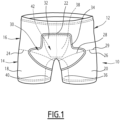
- FIG. 1 And 2 An embodiment of a compression and/or support garment 10 for the treatment of lymphedema according to the invention is shown in the figures 1 And 2 .
- the garment 10 is here intended to treat genital and/or pelvic lymphedema.
- the garment 10 is, in the example shown, a panty, that is to say a pair of high-waisted panties reaching down to the thighs.
- a circumferential direction is defined, intended to correspond to a circumferential direction of a transverse plane of a user wearing the garment.
- the garment 10 is adapted to the morphology of a user.
- the garment 10 is developed in different sizes, the garment size adapted to a user being chosen according to the user's hip circumference.
- the garment 10 comprises a main body 12.
- the main body 12 extends over the entire surface of the garment 10.
- the main body 12 has an inner face intended to extend at least partially against the user and an outer face opposite the inner face.
- the main body 12 is made of a compression textile.
- the main body 12 here has a single layer or thickness of compression textile.
- the compression textile here is a bi-elastic fabric, that is to say elastic in two directions of extension of the non-parallel fabric, here the direction of extensibility and the direction perpendicular to the direction of extensibility.
- compression textile is a fabric that is elastic in a single direction.
- the compression textile is a bi-elastic knit.
- the compression textile has an elasticity strictly greater than 70% in at least one direction of extensibility.
- the direction of extensibility of the compression textile corresponds over the entire main body 12 to the circumferential direction.
- the compression textile has a modulus according to the direction of extensibility.
- the modulus is measured according to the NF EN 14704-1 standard dating from June 2005 on the determination of the elasticity of fabrics.
- the strip extends between two ends in a direction of interest in which the modulus is to be measured, here the direction of extensibility.
- the strip has a given width measured perpendicular to the direction of interest.
- the strip is stretched at least a given number of stretching cycles, the given number is equal to 5.
- the strip is stretched in the direction of interest by a force gradually increasing to a predetermined force, for example equal to 6N per centimeter of strip width.
- a predetermined force for example equal to 6N per centimeter of strip width.
- the strip has a width of 5 centimeters and is therefore stretched by a force gradually increasing to 30N.
- the strip is, for example, stretched using a dynamometer, each end of the strip being held by a respective clamp, for example one fixed while the second performs the traction/relaxation cycles by moving back and forth along an axis.
- the elongation of the strip as a function of the applied force is measured.
- the stretching of the strip is reduced by a gradual return to the initial position, more particularly of the clamp moving towards its initial position. A new stretching cycle is then likely to be started.
- the modulus here is the force corresponding to a 40% elongation during the fifth cycle during the phase of progressive increase in force.
- the compression textile has a modulus in the direction of extensibility greater than or equal to 3.5 N for a 5 centimeter wide strip.
- the compression textile is such that, apart from the first stretching cycle, the curves representing the elongation as a function of the force applied during the different cycles overlap to within 5%, at least between the cycles between the second and the fifth cycles inclusive.
- the compression textile requires a stretching force in the direction of extensibility greater than or equal to 7N to obtain a 40% elongation of a 5 centimeter wide strip.
- the garment advantageously has dimensions close to those of the user wearing the garment, making it easier to put on.
- the compression textile comprises, for example, more particularly is made of polyamide and elastane.
- the compression textile here consists of 40% to 50%, more particularly 48%, of elastane and 50% to 60%, more particularly 52%, of polyamide.
- the main body 12 comprises, more particularly is constituted of, a first part 14 and a second part 16.
- the first part 14 corresponds to a lower part
- the second part 16 corresponds to an upper part
- the lower part 14 is here formed of two portions 18, 20 intended to extend around the thighs of a user.
- the upper part 16 is intended to extend around the pelvis of a user and to connect the two portions 18, 20 of the lower part 14.
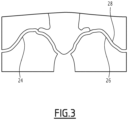
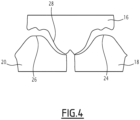
- the lower part 14 and the upper part 16 are each capable of being cut from a flat pattern visible on the figures 3 And 4 .
- each portion 18, 20 of the lower part 14 is made from a flat textile piece, two edges of the flat piece capable of being connected, for example sewn, together so as to form a generally tubular shape.
- the upper part 16 is made from a flat textile piece, two edges 22 of the piece capable of being connected, for example sewn, together, more particularly at the front of the garment 10.
- the lower part 14 and the upper part 16 each comprise a connecting edge.
- each portion 18, 20 of the lower part 14 has a connection edge 24, 26, said connection edges 24, 26 together forming the connection edge of the lower part 14.
- the connecting edge 24, 26 of the lower part 14 is connected to the connecting edge 28 of the upper part 16.
- connecting edge 24, 26 of the lower part 14 and the connecting edge 28 of the upper part 16 are sewn to each other at seams 29.
- the connecting edge 24, 26 of the lower part 14 and the connecting edge 28 of the upper part 16 are not complementary to each other.
- connection between the lower part 14 and the upper part 16 at the connecting edges 24, 26, 28 then forms a garment clip.
- the clamp is intended to extend at least against the groin and/or gluteal fold of a user, more particularly against the groin and gluteal fold of a user.
- the respective pattern of the lower and upper portions is provided so that the connecting edges 24, 26, 28 extend at the groin and gluteal crease of a user.
- main body 12 Any other embodiment of the main body 12 allowing it to be adapted to the morphology of a user is possible.
- the clamps are, for example, located in a different location on the main body.
- the pattern is cut in one piece so that the main body 12 is fitted to the user.
- a shell pattern intended to encompass the genitals is provided.
- the garment 10 has at least one first targeted zone 30, more particularly a single first targeted zone.
- the garment comprises at least one layer of reinforcing textile 32.
- the main body 12 is coated with a layer of reinforcing textile 32.
- the reinforcing textile 32 is configured not to extend directly against a user.
- the reinforcing textile 32 does not extend over the entire first targeted zone 30, but only over a portion of the first targeted zone.
- the reinforcing textile 32 is elastic and has a maximum elongation greater than 50%, that is, it is capable of being elongated by at least 50% without suffering damage.
- the maximum elongation of a material is measured here by stretching a strip of a given width, here 5 centimeters, for a given number of cycles. of stretching, here equal to 5, in a direction of interest perpendicular to the width measurement. For each cycle, the strip is stretched by a force gradually increasing up to a predetermined force, for example equal to 6N per centimeter of width of the strip, here therefore up to 30N.
- the maximum elongation is the elongation at the predetermined force during the last stretching cycle, or here the elongation at 30N in the fifth stretching cycle.
- the maximum elongation of the reinforcing textile is strictly greater than the elongation of the first targeted zone 30 when the garment is worn by a user.
- the garment has a modulus greater than the modulus of the compression textile in the first targeted zone 30.
- the reinforcing textile 32 has a modulus greater than that of the compression textile.
- the modulus of the reinforcing textile is less than or equal to the modulus of the compression textile.
- the reinforcing textile 32 is provided to extend at least against the groin and/or buttock of a user.
- the first targeted zone 30 extends over parts of the garment intended to extend at least opposite the entire buttocks, the buttock fold, the pubic area and the hollows of the groin.
- the first targeted area 30 extends only across the entire buttocks, the gluteal fold, the pubic area and the hollows of the groin.
- the first targeted area 30 further extends across the inner thighs.
- the first targeted zone 30 is here formed of a single continuous zone.
- the reinforcing textile 32 is sewn onto the or to the main body 12, for example with cover seams 34 extending over the entire periphery of the first targeted area.
- the seams 34 are such that they do not limit the stretching of the main body 12 and the first targeted area 30, over the intended range of use of the garment.
- the reinforcing textile 32 comprises, for example, more particularly is made of polyamide and elastane.
- the reinforcing textile 32 is here made of from 40% to 50%, more particularly 48%, of elastane and from 50% to 60%, more particularly 52%, of polyamide.
- the reinforcing textile 32 is here a bi-elastic fabric, that is to say elastic in two directions of extension of the non-parallel fabric, here the direction of extensibility and the direction perpendicular to the direction of extensibility.
- the reinforcing textile 32 is identical to the compression textile.
- the garment 10 has at least one second targeted area.
- the garment 10 has two second targeted zones 36, 38.
- the garment comprises a layer of support textile 40.
- the main body 12, more particularly its internal face, is covered with a layer of support textile 40.
- the support textile is able to stiffen the area it covers so as to contain the swelling of the edema.
- the support textile has a rigidity along at least one direction of interest over its stretch range of use of the garment.
- the at least one direction of interest is here the circumferential direction.
- the elongations A1 and A2 are chosen here so as to be located in the recommended area of use of the garment.
- the support textile has, for example, a rigidity in the direction of interest greater than or equal to 30 N/(m*mm), more particularly between 30 and 75 N/(m*mm), over the range corresponding to normal use of the garment.
- the stiffness of the support textile in the direction perpendicular to the direction of interest is strictly less than the stiffness of the support textile in the direction of interest, over the range corresponding to normal use of the garment. This allows in particular an increase in the comfort of the user wearing the garment.
- the stiffness of the support textile in the direction of interest is strictly greater than the stiffness of the main body in the direction of interest, more particularly by at least 100%, over the range corresponding to normal use of the garment.
- the stiffness of the support textile in the direction of interest is strictly greater than the stiffness of the garment in the first targeted zone in the direction of interest, more particularly by at least 100%, over the range corresponding to normal use of the garment.
- the support textile has a rigidity in the direction of interest that is strictly greater than the rigidity of the rest of the garment, over the range corresponding to normal use of the garment.
- the or one of the second targeted areas is provided to extend against the inside of the thighs.
- the second lower targeted area 36 here extends only against the inside of the thighs and at the crotch.
- the support textile of the second lower targeted zone 36 is here secured to the main body 12, for example by sewing, at least over the entire periphery of the second lower targeted zone 36.
- the other of the second targeted areas referred to as the second upper targeted area 38, is provided to extend against a user's pubic area.
- the second upper targeted area 38 extends only against the pubic area.
- the second upper targeted area 38 extends only against the pubic area and inguinal areas.
- the second upper targeted area 38 is here included in the first targeted area 30, so that in the second upper targeted area 38, the garment comprises a layer of reinforcing textile and a layer of containment textile.
- the support textile of the second upper targeted zone 38 is here secured to the main body 12, for example by sewing, on only a portion of the periphery of the second lower targeted zone 38, the support textile forming with the main body 12 a pocket 42.
- a padding element is here inserted into the pocket 42.
- the padding element is removable from the pocket 42.
- the pocket advantageously provides support due to the nature of the textile and its rigidity when worn, as well as support via the padding element, improving the comfort of a user when wearing the garment.
- the padding element is capable of evacuating lymph flows from the skin, for example by capturing liquid, in particular by capillary effect.
- the upholstery element is, for example, made of polyamide. This allows, among other things, rapid drying of the upholstery element.
- the padding element is, for example, a strip of Mobiderm ⁇ from Thuasne ⁇ with small studs covered on both sides with a polyamide textile.
- the pocket allows the padding device to remain correctly positioned during the user's use of the product, improving the user's quality of life during use.
- the design of the garment allows in particular to apply efforts differently to help drain the edematous limb by containing it and being able to adapt to the morphology of the area to be treated and/or to apply pressure to specific places where it must be greater to effectively drain the limb.
- the first targeted zone provides more support through greater rigidity than outside the targeted zones.
- the second targeted zone allows significant force to be applied as soon as the volume of the limb increases by a minimum value, for example, in the event of lymphedema swelling, so as to effectively drain lymphedema forming swelling.
- the main body 12 extends over the entire surface of the garment 10 with the exception of at least one open area, more particularly with the exception of only the second targeted area(s). Only the differences with the previously described embodiment are described next.
- the support textile of the or each of the second targeted zones 36, 38 is here connected to the main body 12, for example by sewing, on the periphery of the corresponding second targeted zone 36, 38.
- the support textile of the second lower targeted zone 36 is connected to the main body 12 over the entire periphery of the second lower targeted zone 36 in contact with the main body 12.
- the support textile of the second upper targeted zone 38 is here secured to the main body 12, for example by sewing, on only a portion of the periphery of the second lower targeted zone 38.
- the reinforcing textile In the part of the first target area facing the second target area, the reinforcing textile then does not cover the main body.
- the reinforcing textile extends directly against the containment textile.
- the support textile extends over the inner face of the reinforcement textile in the portion of the first targeted area facing the second targeted area.
- the support textile forms with the reinforcement textile a pocket similar to that described previously between the support textile and the main body.
- the reinforcing textile is configured not to extend directly against a user, over their entire surface.
- the garment is, for example, designed with a men's model and a women's model so as to adapt to the specific morphology and different sizes for each model.
- a sizing chart for the men's and women's models is defined according to the circumference of the pelvis so that the garment is adapted to the user's morphology: Size 1 2 3 4 5 6 Pelvic circumference (cm) 88-94 95-101 102-108 109-115 116-122 123-129 Average pelvic circumference (cm) 91 98 105 112 119 126
- the force required to stretch the garment to the average circumference of the pelvis is calculated using Laplace's law of compression pressure which states that the force to be applied in N per centimeter of width, the width being measured perpendicular to the direction circumferential, is equal to the pressure applied in hectopascals multiplied by the radius on which the force is applied divided by 100.
- a strip is stretched by applying a progressively increasing force, as described above, for example up to a stretching force value equal to 6 N per centimeter of width of the strip, over at least five cycles.
- the patterns for the main body, the reinforcement textile and the support textile are then designed so that each material is stretched by this percentage when the garment is worn by a person with a pelvic circumference equal to the average pelvic circumference, in this example equal to the average circumference in size 4.
- a user with a pelvic circumference equal to the average circumference, here in the example size 4, and wearing a garment according to the prescribed size has a force of 15 mmHg applied to it.
- the garment is designed as described in the first example.
- the garment elongation required to reach the ends of each range corresponding to a hip circumference is calculated by knowing the pattern of the unstretched garment.
- the garments apply average pressures between 12 mmHg and 18 mmHg on the user, which corresponds to a classic range of values in the treatment of lymphedema so that the garment has an action but the pressure is tolerated by a user.
- a garment was put on by users corresponding to their gender and their pelvic circumference measurement, with pressure sensors marketed under the name PicoPress ® from MICROLAB being placed between the garment and the user in different areas: pubis, groin, side of each leg and buttocks.
- the garments apply pressures at different locations between 7 mmHg and 21 mmHg on the user, which corresponds to a classic range of values in the treatment of lymphedema so that the garment has an action but the pressure is tolerated by a user.
- the garment elongation required to reach the ends of each range corresponding to a hip circumference is calculated by knowing the pattern of the unstretched garment.
- the garments apply average pressures between 12 mmHg and 18 mmHg on the user, which corresponds to a classic range of values in the treatment of lymphedema so that the garment has an action but the pressure is tolerated by a user.
- a garment was put on by users corresponding to their gender and their pelvic circumference measurement, with pressure sensors marketed under the name PicoPress ® from MICROLAB being placed between the garment and the user in different areas: pubis, groin, side of each leg and buttocks.
- the garments apply pressures at different locations between 7 mmHg and 21 mmHg on the user, which corresponds to a classic range of values in the treatment of lymphedema so that the garment has an action but the pressure is tolerated by a user.
Landscapes
- Engineering & Computer Science (AREA)
- Textile Engineering (AREA)
- Health & Medical Sciences (AREA)
- General Health & Medical Sciences (AREA)
- Public Health (AREA)
- Life Sciences & Earth Sciences (AREA)
- Animal Behavior & Ethology (AREA)
- Vascular Medicine (AREA)
- Heart & Thoracic Surgery (AREA)
- Veterinary Medicine (AREA)
- Biomedical Technology (AREA)
- Physical Education & Sports Medicine (AREA)
- Nursing (AREA)
- Orthopedic Medicine & Surgery (AREA)
- Professional, Industrial, Or Sporting Protective Garments (AREA)
- Corsets Or Brassieres (AREA)
- Undergarments, Swaddling Clothes, Handkerchiefs Or Underwear Materials (AREA)
Description
- La présente invention concerne un vêtement de compression et/ou de contention pour le traitement du lymphoedème, le vêtement comprenant un corps principal, le corps principal étant réalisé dans un textile de compression.
- Des vêtements de compression pour le traitement d'un lymphoedème sont déjà connus.
- Par exemple, le modèle de short de compression Compreshorts ® de SIGVARIS ® est notamment indiqué pour le traitement d'un lymphoedème génital et présente, d'après le fournisseur, une classe de compression comprise entre 10 à 15 mmHg.
- Cependant, des professionnels de santé et des patients reproche un manque d'efficacité des produits disponible sur le marché en raison d'un manque de force et de maintien sur les zones principales de localisation de l'oedème, comme les parties génitales, le pubis et/ou les zones inguinales.
- Le document
US 2018/303179 A1 décrit un vêtement de compression formé d'un tissu étirable avec une élasticité uniforme. Une portion circonférentielle du vêtement entoure un membre de l'utilisateur et est caractérisée par différent degré d'étirement, mais des forces de compression circonférentielles identiques, lorsqu'elle est portée par l'utilisateur, e long d'une direction axiale. - D'autres vêtements de compression sont connus de
EP 2 449 901 A2 ,US 2015/173428 A1 ,WO 2011/124849 A1 etFR 3 027 195 A1 - Un but de l'invention est donc de proposer un vêtement de compression et/ou de contention efficace dans le traitement du lymphoedème.
- A cet effet, l'invention a pour objet un vêtement de compression et/ou de contention pour le traitement du lymphoedème selon la revendication 1.
- La première et la deuxième zone ciblée permettent d'appliquer des efforts différemment pour aider à drainer le membre oedématié en le contenant et en étant apte à s'adapter à la morphologie de la zone à traiter et/ou à appliquer une pression à des endroits précis où celle-ci doit être importante pour drainer efficacement le membre. La première zone ciblée permet notamment d'apporter plus de maintien par une rigidité plus importante qu'en dehors des zones ciblées. La deuxième zone ciblée permet d'appliquer une force importante dès que le volume du membre augmente d'une valeur minimale, par exemple, en cas de gonflement du lymphoedème.
- Le vêtement de compression et/ou de contention peut en outre présenter une ou plusieurs caractéristiques des revendications 2 à 10, considérée(s) individuellement ou selon toutes les combinaisons techniquement possibles.
- D'autres caractéristiques et avantages de l'invention apparaîtront à la lecture de la description qui suit de modes de réalisation de l'invention, donnée à titre d'exemple uniquement et en référence aux dessins dans lesquels :
- la
figure 1 est une vue schématique de face d'un vêtement selon un mode de réalisation de l'invention, - la
figure 2 est une vue schématique de dos du vêtement de lafigure 1 , et - les
figures 3 et4 sont des vues schématiques de face et de dos respectivement d'un exemple de patronage du vêtement desfigures 1 et2 . - Un mode de réalisation d'un vêtement 10 de compression et/ou contention pour le traitement du lymphoedème selon l'invention est représenté sur les
figures 1 et2 . - Le vêtement 10 est ici destiné à traiter le lymphoedème génital et/ou pelvien.
- Le vêtement 10 est, dans l'exemple représenté, un panty, c'est-à-dire une culotte à taille haute et descendant sur les cuisses.
- En chaque point du vêtement, on définit une direction circonférentielle, prévue pour correspondre à une direction circonférentielle d'un plan transversal d'un utilisateur portant le vêtement.
- Le vêtement 10 est adapté à la morphologie d'un utilisateur. Par exemple, le vêtement 10 est développé en différentes tailles, la taille de vêtement adaptée à un utilisateur étant choisie en fonction du tour de bassin de l'utilisateur.
- Le vêtement 10 comprend un corps principal 12.
- Dans un mode de réalisation, le corps principal 12 s'étend sur toute la surface du vêtement 10.
- Le corps principal 12 présente une face interne prévue pour s'étendre au moins partiellement contre l'utilisateur et une face externe opposée à la face interne.
- Le corps principal 12 est réalisé dans un textile de compression.
- Le corps principal 12 présente ici une unique couche ou épaisseur de textile de compression.
- Le textile de compression est ici un tissu bi-élastique, c'est-à-dire élastique selon deux directions d'extension du tissu non parallèle, ici la direction d'extensibilité et la direction perpendiculaire à la direction d'extensibilité.
- Alternativement, le textile de compression est un tissu élastique selon une unique direction.
- Alternativement, le textile de compression est un tricot bi-élastique.
- Le textile de compression présente une élasticité strictement supérieure à 70% dans au moins une direction d'extensibilité.
- La direction d'extensibilité du textile de compression correspond sur l'ensemble du corps principal 12 à la direction circonférentielle.
- Le textile de compression présente un module selon la direction d'extensibilité.
- Le module est mesuré selon la norme NF EN 14704-1 datant de juin 2005 sur la détermination de l'élasticité des étoffes.
- Plus particulièrement, une bande du matériau est découpée.
- La bande s'étend entre deux extrémités selon une direction d'intérêt dans laquelle le module est à mesurer, ici la direction d'extensibilité.
- La bande présente une largeur donnée mesurée perpendiculairement à la direction d'intérêt.
- La bande est étirée au moins un nombre donné de cycles d'étirage, le nombre donné est égal à 5.
- Pour chaque cycle, la bande est étirée selon la direction d'intérêt par une force augmentant progressivement jusqu'à une force prédéterminée, par exemple égale à 6N par centimètre de largeur de la bande. Par exemple, la bande présente une largeur de 5 centimètres et est donc étirée par une force augmentant progressivement jusqu'à 30N.
- La bande est, par exemple, étirée à l'aide d'un dynamomètre, chaque extrémité de la bande étant maintenue par une pince respective, par exemple l'une fixe alors que la seconde réalise les cycles de traction/relaxation par des allers-retours suivant un axe.
- L'allongement de la bande en fonction de la force appliquée est mesuré.
- Puis, l'étirage de la bande est diminué par un retour progressif à la position initiale, plus particulièrement de la pince en mouvement vers sa position initiale. Un nouveau cycle d'étirage est alors susceptible d'être commencé.
- Le module est ici la force correspondant à un allongement de 40% au cours du cinquième cycle pendant la phase d'augmentation progressive de la force.
- Le textile de compression présente un module selon la direction d'extensibilité supérieure ou égale à 3,5 N pour une bande de 5 centimètres de large.
- En outre, le textile de compression est tel que, en dehors du premier cycle d'étirage, les courbes représentant l'allongement en fonction de la force appliquée au cours des différents cycles se superposent à 5% près, au moins entre les cycles compris entre le deuxième et le cinquième cycles inclus.
- Cela permet de réaliser un produit stable dans le temps.
- Par ailleurs, lors du premier cycle d'étirage, le textile de compression requiert une force d'étirage selon la direction d'extensibilité supérieure ou égale à 7N pour obtenir un allongement de 40% d'une bande de 5 centimètres de large.
- Cela permet notamment d'atteindre une force souhaitée avec un étirage peu important. Ainsi, le vêtement présente avantageusement des dimensions proches de celles de l'utilisateur portant le vêtement, l'enfilage étant alors facilité.
- Le textile de compression comprend, par exemple, plus particulièrement est constitué, de polyamide et d'élasthanne. Le textile de compression est ici constitué de 40% à 50%, plus particulièrement 48%, d'élasthanne et de 50% à 60%, plus particulièrement 52%, de polyamide.
- Dans le mode de réalisation représenté, le corps principal 12 comprend, plus particulièrement est constitué, d'une première partie 14 et une deuxième partie 16.
- La première partie 14 correspond à une partie inférieure, et la deuxième partie 16 correspond à une partie supérieure.
- La partie inférieure 14 est ici formée de deux portions 18, 20 prévues pour s'étendre autour des cuisses d'un utilisateur. La partie supérieure 16 est prévue pour s'étendre autour du bassin d'un utilisateur et de relier les deux portions 18, 20 de la partie inférieure 14.
- La partie inférieure 14 et la partie supérieure 16 sont chacune apte à être découpée dans un patron plat visible sur les
figures 3 et4 . - Plus particulièrement, chaque portion 18, 20 de la partie inférieure 14 est réalisée à partir d'une pièce textile plate, deux bords de la pièce plate susceptible d'être reliés, par exemple cousus, ensemble de manière à former une forme globalement tubulaire.
- La partie supérieure 16 est réalisée à partir d'une pièce textile plate, deux bords 22 de la pièce susceptible d'être reliés, par exemple cousus, ensemble, plus particulièrement à l'avant du vêtement 10.
- La partie inférieure 14 et la partie supérieure 16 comprennent chacun un bord de connexion.
- Plus particulièrement, chaque portion 18, 20 de la partie inférieure 14 présente un bord de connexion 24, 26, lesdits bords de connexion 24, 26 formant ensemble le bord de connexion de la partie inférieure 14.
- Le bord de connexion 24, 26 de la partie inférieure 14 est relié au bord de connexion 28 de la partie supérieure 16.
- Plus particulièrement, le bord de connexion 24, 26 de la partie inférieure 14 et le bord de connexion 28 de la partie supérieure 16 sont cousus l'un à l'autre au niveau de coutures 29.
- Le bord de connexion 24, 26 de la partie inférieure 14 et le bord de connexion 28 de la partie supérieure 16 ne sont pas complémentaires l'un de l'autre.
- Le lien entre la partie inférieure 14 et la partie supérieure 16 au niveau des bords de connexion 24, 26, 28 forme alors une pince du vêtement.
- Cela permet notamment de suivre la morphologie du corps.
- La pince est prévue pour s'étendre au moins contre l'aine et/ou le pli fessier d'un utilisateur, plus particulièrement contre l'aine et le pli fessier d'un utilisateur.
- Le patron respectif des parties inférieure et supérieure est prévu pour que les bords de connexion 24, 26, 28 s'étendent au niveau de l'aine et du pli fessier d'un utilisateur.
- Tout autre mode de réalisation du corps principal 12 permettant d'être adapté à la morphologie d'un utilisateur est envisageable.
- Les pinces sont, par exemple, situées à un autre emplacement du corps principal.
- Alternativement, le patron est découpé d'une pièce de sorte que le corps principal 12 soit ajusté sur l'utilisateur. Par exemple, pour un modèle homme, un patron de coque prévu pour englober les parties génitales est prévu.
- Le vêtement 10 présente au moins une première zone ciblée 30, plus particulièrement une unique première zone ciblée.
- Dans l'exemple représenté, sur l'ensemble de la première zone ciblée 30, le vêtement comprend au moins une couche de textile de renforcement 32.
- Plus particulièrement, ici, le corps principal 12, plus particulièrement sa face externe, est revêtu d'une couche de textile de renforcement 32.
- Le textile de renforcement 32 est configuré pour ne pas s'étendre directement contre un utilisateur.
- Dans un mode de réalisation non représenté, le textile de renforcement 32 ne s'étend pas sur l'ensemble de la première zone ciblée 30, mais uniquement sur une portion de la première zone ciblée.
- Le textile de renforcement 32 est élastique et possède un allongement maximal supérieur à 50%, c'est-à-dire qu'il est susceptible d'être allongé d'au moins 50% sans subir de dommages.
- L'allongement maximal d'un matériau est ici mesuré par étirement d'une bande présentant une largeur donnée, ici 5 centimètres, un nombre donné de cycles d'étirage, ici égal à 5, selon une direction d'intérêt perpendiculaire à la mesure de la largeur. Pour chaque cycle, la bande est étirée par une force augmentant progressivement jusqu'à une force prédéterminée, par exemple égale à 6N par centimètre de largeur de la bande, ici donc jusqu'à 30N. L'allongement maximal est ici l'allongement à la force prédéterminée lors du dernier cycle d'étirage, soit ici l'allongement à 30N au cinquième cycle d'étirage.
- L'allongement maximal du textile de renforcement est strictement supérieur à l'allongement de la première zone ciblée 30 lorsque le vêtement est porté par un utilisateur.
- Plus le module du textile de renforcement 32 est important, plus son action de renfort compressif est importante.
- Le vêtement présente un module supérieur au module du textile de compression dans la première zone ciblée 30.
- Le textile de renforcement 32 présente selon un mode de réalisation un module supérieur à celui du textile de compression.
- Selon un autre mode de réalisation de l'invention, le module du textile de renfort est inférieur ou égal au module du textile de compression.
- Le textile de renforcement 32 est prévu pour s'étendre au moins contre l'aine et/ou le fessier d'un utilisateur.
- Plus particulièrement, la première zone ciblée 30 s'étend sur des parties du vêtement destinées à s'étendre au moins en regard de l'ensemble du fessier, du pli fessier, de la zone pubienne et des creux de l'aine.
- Dans l'exemple représenté, la première zone ciblée 30 s'étend uniquement en regard de l'ensemble du fessier, du pli fessier, de la zone pubienne et des creux de l'aine.
- Dans un mode de réalisation alternatif, la première zone ciblée 30 s'étend en outre sur l'intérieur des cuisses.
- La première zone ciblée 30 est ici formée d'une unique zone continue.
- Le textile de renforcement 32 est cousu sur le ou au corps principal 12, par exemple avec des coutures de recouvrement 34 s'étendant sur l'ensemble de la périphérie de la première zone ciblée.
- Les coutures 34 sont telles qu'elles ne limitent pas l'étirage du corps principal 12 et de la première zone ciblée 30, sur la plage d'utilisation prévue du vêtement.
- Le textile de renforcement 32 comprend, par exemple, plus particulièrement est constitué, de polyamide et d'élasthanne. Le textile de renforcement 32 est ici constitué de 40% à 50%, plus particulièrement 48%, d'élasthanne et de 50% à 60%, plus particulièrement 52%, de polyamide.
- Le textile de renforcement 32 est ici un tissu bi-élastique, c'est-à-dire élastique selon deux directions d'extension du tissu non parallèle, ici la direction d'extensibilité et la direction perpendiculaire à la direction d'extensibilité.
- Alternativement, le textile de renforcement 32 est identique au textile de compression.
- Le vêtement 10 présente au moins une deuxième zone ciblée.
- Dans l'exemple représenté, le vêtement 10 présente deux deuxièmes zones ciblées 36, 38.
- Dans, plus particulièrement sur l'ensemble de, la ou chaque deuxième zone ciblée 36, 38, le vêtement comprend une couche de textile de contention 40.
- Dans l'exemple représenté, le corps principal 12, plus particulièrement sa face interne, est revêtu d'une couche de textile de contention 40.
- Le textile de contention est apte à rigidifier la zone qu'il couvre de manière à contenir le gonflement de l'oedème.
- Le textile de contention présente une rigidité le long d'au moins une direction d'intérêt sur sa plage d'étirage d'utilisation du vêtement. L'au moins une direction d'intérêt est ici la direction circonférentielle.
- D'après la norme « NF S 97-115 Décembre 2011 - Bandes textiles de compression et de contention médicales », la rigidité R est la « caractéristique d'une variation de pression obtenue par la relation de proportionnalité entre la force F appliquée en un point et la modification d'allongement résultante en ce point », et se calcule de la manière suivante :

- A1 et A2 sont des allongements de la matière dont la rigidité est définie, exprimé en millimètres (mm), et
- F1 et F2 sont les forces de traction pour étirer la matière respectivement aux allongements A1 et A2 exprimées en Newtons par mètre (N/m), correspondant respectivement aux allongements A1 et A2.
- Les allongements A1 et A2 sont ici choisis de sorte à être situés dans la zone d'utilisation préconisée du vêtement.
- Le textile de contention a par exemple une rigidité selon la direction d'intérêt supérieure ou égale à 30 N/(m*mm), plus particulièrement est comprise entre 30 et 75 N/(m*mm), sur la plage correspondant à une utilisation normale du vêtement.
- La rigidité du textile de contention dans la direction perpendiculaire à la direction d'intérêt est strictement inférieure à la rigidité du textile de contention selon la direction d'intérêt, sur la plage correspondant à une utilisation normale du vêtement. Cela permet notamment une augmentation du confort de l'utilisateur portant le vêtement.
- La rigidité du textile de contention selon la direction d'intérêt est strictement supérieure à la rigidité du corps principal selon la direction d'intérêt, plus particulièrement d'au moins 100%, sur la plage correspondant à une utilisation normale du vêtement.
- La rigidité du textile de contention selon la direction d'intérêt est strictement supérieure à la rigidité du vêtement dans la première zone ciblée selon la direction d'intérêt, plus particulièrement d'au moins 100%, sur la plage correspondant à une utilisation normale du vêtement.
- Le textile de contention a par exemple une rigidité selon la direction d'intérêt strictement supérieure à la rigidité du reste du vêtement, sur la plage correspondant à une utilisation normale du vêtement.
- La ou l'une des deuxièmes zones ciblées, dite deuxième zone ciblée inférieure 36, est prévue pour s'étendre contre l'intérieur des cuisses. La deuxième zone ciblée inférieure 36 s'étend ici uniquement contre l'intérieur des cuisses et au niveau de l'entrejambe.
- Le textile de contention de la deuxième zone ciblée inférieure 36 est ici solidaire du corps principal 12, par exemple par couture, au moins sur l'ensemble de la périphérie de la deuxième zone ciblée inférieure 36.
- L'autre des deuxièmes zones ciblées, dite deuxième zone ciblée supérieure 38, est prévue pour s'étendre contre la zone pubienne d'un utilisateur.
- Dans un mode de réalisation, la deuxième zone ciblée supérieure 38 s'étend uniquement contre la zone pubienne.
- Alternativement, la deuxième zone ciblée supérieure 38 s'étend uniquement contre la zone pubienne et les zones inguinales.
- La deuxième zone ciblée supérieure 38 est ici incluse dans la première zone ciblée 30, de sorte que dans la deuxième zone ciblée supérieure 38, le vêtement comprend une couche de textile de renforcement et une couche de textile de contention.
- Le textile de contention de la deuxième zone ciblée supérieure 38 est ici solidaire du corps principal 12, par exemple par couture, sur une portion uniquement de la périphérie de la deuxième zone ciblée inférieure 38, le textile de contention formant avec le corps principal 12 une poche 42.
- Un élément de capitonnage est ici inséré dans la poche 42. L'élément de capitonnage est amovible de la poche 42.
- La poche apporte avantageusement de la contention de part la nature du textile et sa rigidité au port, ainsi que du maintien via l'élément de capitonnage, améliorant le confort de vie d'un utilisateur lors du port du vêtement.
- L'élément de capitonnage est apte à évacuer des écoulements de lymphe depuis la peau, par exemple par captation de liquide, notamment par effet de capillarité.
- L'élément de capitonnage est, par exemple, réalisée en polyamide. Cela permet notamment un séchage rapide de l'élément de capitonnage.
- L'élément de capitonnage est, par exemple, une bande de Mobiderm © de Thuasne © à petits plots recouverte sur ses deux faces par un textile en polyamide.
- La poche permet au dispositif de capitonnage de rester correctement positionné au cours de l'utilisation du produit par l'utilisateur, améliorant la qualité de vie de l'utilisateur lors de son usage.
- La conception du vêtement permet notamment d'appliquer des efforts différemment pour aider à drainer le membre oedématié en le contenant et en étant apte à s'adapter à la morphologie de la zone à traiter et/ou à appliquer une pression à des endroits précis où celle-ci doit être plus importante pour drainer efficacement le membre.
- La première zone ciblée permet notamment d'apporter plus de maintien par une rigidité plus importante qu'en dehors des zones ciblées.
- La deuxième zone ciblée permet d'appliquer une force importante dès que le volume du membre augmente d'une valeur minimale, par exemple, en cas de gonflement du lymphoedème, de manière à drainer efficacement un lymphoedème formant un gonflement.
- Dans un mode de réalisation alternatif, le corps principal 12 s'étend sur l'ensemble de la surface du vêtement 10 à l'exception d'au moins une zone ouverte, plus particulièrement à l'exception uniquement de la ou des deuxièmes zones ciblées. Seules les différences avec le mode de réalisation décrit précédemment sont décrites ensuite.
- Le textile de contention de la ou de chacune des deuxièmes zones ciblées 36, 38 est ici connecté au corps principal 12, par exemple par couture, sur la périphérie de la deuxième zone ciblée correspondante 36, 38.
- Plus particulièrement, le textile de contention de la deuxième zone ciblée inférieure 36 est connecté au corps principal 12 sur l'ensemble de la périphérie de la deuxième zone ciblée inférieure 36 en contact avec le corps principal 12.
- Le textile de contention de la deuxième zone ciblée supérieure 38 est ici solidaire du corps principal 12, par exemple par couture, sur une portion uniquement de la périphérie de la deuxième zone ciblée inférieure 38.
- Dans la partie de la première zone ciblée faisant face à la deuxième zone ciblée, le textile de renforcement ne revêt alors pas le corps principal. Le textile de renforcement s'étend directement contre le textile de contention.
- Le textile de contention s'étend sur la face interne du textile de renforcement dans la partie de la première zone ciblée faisant face à la deuxième zone ciblée.
- Le textile de contention forme avec le textile de renforcement une poche similaire à celle décrite précédemment entre le textile de contention et le corps principal.
- Le textile de renforcement est configuré pour ne pas s'étendre directement contre un utilisateur, sur l'ensemble de sa surface.
- Le vêtement est, par exemple, conçu avec un modèle homme et un modèle femme de manière à s'adapter à la morphologie spécifique et différentes tailles pour chaque modèle.
- Un tableau de taillage pour le modèle homme et le modèle femme est défini selon la circonférence du bassin de manière à ce que le vêtement soit adapté à la morphologie de l'utilisateur :
Taille 1 2 3 4 5 6 Circonférence du bassin (cm) 88-94 95-101 102-108 109-115 116-122 123-129 Circonférence moyenne du bassin (cm) 91 98 105 112 119 126 - Pour chaque modèle et chaque taille, la force nécessaire pour étirer le vêtement à la circonférence moyenne du bassin est calculée grâce à la loi de Laplace relative à la pression de compression qui stipule que la force à appliquer en N par centimètre de largeur, la largeur étant mesurée perpendiculairement à la direction circonférentielle, est égale à la pression appliquée en hectopascal multipliée par le rayon sur lequel est appliquée la force divisé par 100.
- Pour une circonférence moyenne du bassin égale à 112 cm et une pression visée de 15mmHg, on obtient le calcul suivant :

- Pour chaque matière parmi le textile de compression, le textile de renforcement et le textile de contention, une bande est étirée en appliquant une force augmentant progressivement, tel que décrit précédemment, par exemple jusqu'à une valeur de force d'étirage égale à 6 N par centimètres de largeur de la bande, sur au moins cinq cycles.
- Pour chaque matière, on relève sur la courbe correspondant à l'étirage de la matière par augmentation de la force au premier cycle, le pourcentage de la matière pour avoir cette force.
- Ici pour une bande de cinq centimètres de largeur, on relève pour chaque matière, l'étirage de la matière correspondant à une force de 17,83 N.
- Les patrons pour le corps principal, le textile de renforcement et le textile de contention sont alors conçus de manière à ce que chaque matière soit étirée de ce pourcentage lorsque le vêtement est porté par une personne présentant une circonférence de bassin égale à la circonférence moyenne de bassin, dans cet exemple égale à la circonférence moyenne en taille 4.
- Ainsi, un utilisateur présentant une circonférence de bassin égale à la circonférence moyenne, ici dans l'exemple de taille 4, et portant un vêtement selon la taille prescrite se voit appliquer une force de 15 mmHg.
- Le vêtement est conçu tel que décrit dans le premier exemple.
- L'allongement du vêtement nécessaire pour atteindre les extrémités de chaque gamme correspondant à une circonférence de bassin est calculé en connaissant le patron du vêtement non étiré.
- La force nécessaire par centimètre de largeur pour atteindre un tel allongement est alors déduite des courbes correspondant à l'étirage de chaque matière par augmentation de la force au premier cycle, telles que décrites précédemment.
- La loi de Laplace permet alors de calculer la pression appliquée par le vêtement pour chaque extrémité de chaque gamme correspondant à une circonférence de bassin.

- Ainsi, les vêtements appliquent des pressions moyennes comprises entre 12 mmHg et 18 mmHg sur l'utilisateur ce qui correspond à une gamme de valeurs classique dans le traitement du lymphoedème pour que le vêtement ait une action mais que la pression soit tolérée par un utilisateur.
- Un vêtement a été enfilé par des utilisateurs correspondant à leur sexe et à leur mesure de circonférence de bassin, des capteurs de pression commercialisés sous l'appellation PicoPress ® de MICROLAB étant disposés entre le vêtement et l'utilisateur en différentes zones : pubis, aine, côté de chaque jambe et fessier.
- Les vêtements appliquent des pressions en différents emplacements comprises entre 7 mmHg et 21 mmHg sur l'utilisateur ce qui correspond à une gamme de valeurs classique dans le traitement du lymphoedème pour que le vêtement ait une action mais que la pression soit tolérée par un utilisateur.
- L'allongement du vêtement nécessaire pour atteindre les extrémités de chaque gamme correspondant à une circonférence de bassin est calculé en connaissant le patron du vêtement non étiré.
- La force nécessaire par centimètre de largeur pour atteindre un tel allongement est alors déduite des courbes correspondant à l'étirage de chaque matière par augmentation de la force au premier cycle, telles que décrites précédemment.
- La loi de Laplace permet alors de calculer la pression appliquée par le vêtement pour chaque extrémité de chaque gamme correspondant à une circonférence de bassin.

- Ainsi, les vêtements appliquent des pressions moyennes comprises entre 12 mmHg et 18 mmHg sur l'utilisateur ce qui correspond à une gamme de valeurs classique dans le traitement du lymphoedème pour que le vêtement ait une action mais que la pression soit tolérée par un utilisateur.
- Un vêtement a été enfilé par des utilisateurs correspondant à leur sexe et à leur mesure de circonférence de bassin, des capteurs de pression commercialisés sous l'appellation PicoPress ® de MICROLAB étant disposés entre le vêtement et l'utilisateur en différentes zones : pubis, aine, côté de chaque jambe et fessier.
- Les vêtements appliquent des pressions en différents emplacements comprises entre 7 mmHg et 21 mmHg sur l'utilisateur ce qui correspond à une gamme de valeurs classique dans le traitement du lymphoedème pour que le vêtement ait une action mais que la pression soit tolérée par un utilisateur.
Claims (10)
- Vêtement (10) de compression et/ou de contention pour le traitement du lymphoedème, le vêtement (10) comprenant un corps principal (12), le corps principal (12) étant réalisé dans un textile de compression, le textile de compression présentant une élasticité strictement supérieure à 70% dans au moins une direction d'extensibilité, le textile de compression présentant un module selon la norme ISO NF EN 14704-1 de juin 2005 sur la détermination de l'élasticité des étoffes supérieure ou égale à 3,5 N à un allongement de 40% sur la cinquième courbe de charge selon la direction d'extensibilité,le vêtement (10) présentant au moins une première zone ciblée (30), dans laquelle le vêtement comprend au moins une couche de textile de renforcement (32) dans la première zone ciblée (30), le vêtement (10) présentant dans la première zone ciblée (30) un module supérieur au module du textile de compression,le vêtement (10) présentant au moins une deuxième zone ciblée (36, 38) dans laquelle le vêtement (10) comprend au moins une couche de textile de contention (40), le textile de contention (40) présentant une rigidité le long d'au moins une direction d'intérêt supérieure ou égale à 30 N/(m*mm) sur toute plage d'utilisation normale du vêtement (10),la rigidité du textile de contention (40) selon la direction d'intérêt étant strictement supérieure à la rigidité du corps principal (12) selon la direction d'intérêt sur une plage d'utilisation normale du vêtement (10),la rigidité du textile de contention (40) selon la direction d'intérêt étant strictement supérieure à la rigidité du vêtement (10) dans la première zone ciblée (30) selon la direction d'intérêt, plus particulièrement d'au moins 100%.
- Vêtement de compression selon la revendication 1, dans lequel la direction d'extensibilité du textile de compression et/ou la direction d'intérêt correspondent à une direction circonférentielle du vêtement (10).
- Vêtement de compression selon la revendication 1 ou 2, dans lequel le textile de compression est prévu pour que le textile de compression requiert une force d'étirage selon la direction d'extensibilité supérieure ou égale à 7N pour obtenir un allongement de 40% lors d'un premier cycle d'étirage.
- Vêtement de compression selon l'une quelconque des revendications 1 à 3, dans lequel le textile de contention (40) est prévu pour s'étendre au moins contre la zone pubienne d'un utilisateur et/ou l'intérieur des cuisses d'un utilisateur.
- Vêtement de compression selon l'une quelconque des revendications 1 à 4, dans lequel le textile de renforcement (32) est prévu pour s'étendre au moins contre l'aine, le pli fessier, la zone pubienne et/ou le fessier d'un utilisateur.
- Vêtement de compression selon l'une quelconque des revendications 1 à 5, dans lequel le corps principal (12) s'étend sur l'ensemble du vêtement (10) à l'exception de la ou de chacune des ou d'au moins une des deuxièmes zones ciblées (36, 38).
- Vêtement de compression selon l'une quelconque des revendications 1 à 6, dans lequel le corps principal (12) comprend au moins une première partie (14) et une deuxième partie (16), la première partie (14) et la deuxième partie (16) étant chacune apte à être découpée dans un patron plat, la première partie (14) et la deuxième partie (16) comprenant chacune un bord de connexion (24, 26), le bord de connexion (24) de la première partie (14) et le bord de connexion (26) de la deuxième partie (16) n'étant pas complémentaire l'un de l'autre, le bord de connexion (24) de la première partie (14) étant relié au bord de connexion (26) de la deuxième partie (16) par une pince.
- Vêtement de compression selon la revendication 6 ou 7, dans lequel la pince est prévue pour s'étendre au moins contre l'aine et/ou le pli fessier d'un utilisateur.
- Vêtement de compression selon l'une quelconque des revendications 1 à 8, dans lequel le textile de compression et/ou le textile de renforcement (32) comprend, plus particulièrement est constitué, de polyamide et d'élasthanne.
- Vêtement de compression selon l'une quelconque des revendications 1 à 9, présentant au moins une poche (42) apte à recevoir de manière amovible au moins un élément de capitonnage.
Applications Claiming Priority (2)
| Application Number | Priority Date | Filing Date | Title |
|---|---|---|---|
| FR1912843A FR3103103A1 (fr) | 2019-11-18 | 2019-11-18 | Vetement de compression et/ou de contention pour le traitement du lymphoedeme |
| PCT/EP2020/082222 WO2021099251A1 (fr) | 2019-11-18 | 2020-11-16 | Vêtement de compression et/ou de contention pour le traitement du lymphoedème |
Publications (2)
| Publication Number | Publication Date |
|---|---|
| EP4061168A1 EP4061168A1 (fr) | 2022-09-28 |
| EP4061168B1 true EP4061168B1 (fr) | 2025-01-22 |
Family
ID=70456825
Family Applications (1)
| Application Number | Title | Priority Date | Filing Date |
|---|---|---|---|
| EP20804557.5A Active EP4061168B1 (fr) | 2019-11-18 | 2020-11-16 | Vêtement de compression et/ou de contention pour le traitement du lymphoedème |
Country Status (8)
| Country | Link |
|---|---|
| US (1) | US12514758B2 (fr) |
| EP (1) | EP4061168B1 (fr) |
| JP (1) | JP7628543B2 (fr) |
| KR (1) | KR102813230B1 (fr) |
| CN (1) | CN114727673B (fr) |
| ES (1) | ES3015276T3 (fr) |
| FR (1) | FR3103103A1 (fr) |
| WO (1) | WO2021099251A1 (fr) |
Families Citing this family (7)
| Publication number | Priority date | Publication date | Assignee | Title |
|---|---|---|---|---|
| USD1007813S1 (en) * | 2021-05-21 | 2023-12-19 | Hbi Branded Apparel Enterprises, Llc | Support element for underwear |
| US12185767B2 (en) * | 2021-11-05 | 2025-01-07 | Trillium Medical Products, LLC | Infused undergarment |
| KR102809118B1 (ko) * | 2022-04-19 | 2025-05-19 | (주)에스원바이오 | 림프부종 진단 데이터를 이용한 맞춤형 치료 가이드 제공 방법, 컴퓨터 프로그램 및 시스템 |
| KR20240130471A (ko) | 2023-02-22 | 2024-08-29 | (주)에스원바이오 | 압박의류 제작용 도면 생성방법 및 생성장치 |
| DE102024115127A1 (de) * | 2024-05-29 | 2025-12-04 | Julius Zorn Gmbh | Kompressionshose |
| NL2038520B1 (en) * | 2024-08-29 | 2026-03-13 | Shapewear Intellectual Property B V | A man’s garment, in particular a man’s trousers |
| USD1093811S1 (en) * | 2025-03-15 | 2025-09-23 | Jason S. Hayes | Men's underwear |
Citations (1)
| Publication number | Priority date | Publication date | Assignee | Title |
|---|---|---|---|---|
| EP2449901B1 (fr) * | 2010-06-14 | 2014-12-03 | Salomon S.A.S. | Vétement de sport ajusté |
Family Cites Families (21)
| Publication number | Priority date | Publication date | Assignee | Title |
|---|---|---|---|---|
| US7329232B2 (en) * | 2004-02-27 | 2008-02-12 | Circaid Medical Products, Inc. | Limb encircling therapeutic compression device |
| FR2879900B1 (fr) * | 2004-12-24 | 2007-10-12 | Promiles Sa | Collant a effet localise de contention pour la pratique d'un sport |
| JP3113423U (ja) | 2005-06-06 | 2005-09-08 | 株式会社Kea工房 | リンパ浮腫治療用パンツ及びリンパ浮腫治療用腹部パット |
| JP4649374B2 (ja) * | 2006-06-22 | 2011-03-09 | ヤーマン株式会社 | 痩身衣類 |
| US7934267B2 (en) | 2007-05-31 | 2011-05-03 | Nike, Inc. | Articles of apparel providing enhanced body position feedback |
| EP2254429B1 (fr) | 2008-03-17 | 2018-10-31 | Gilheany & O'Donovan Holdings Pty Ltd | Vêtement de compression |
| FR2958504B1 (fr) * | 2010-04-07 | 2012-06-01 | Decathlon Sa | Article d'habillement ajuste pour le bas du corps incluant au moins le haut des jambes pour la pratique d'un sport |
| CN202277401U (zh) | 2011-09-29 | 2012-06-20 | 中国人民解放军第三军医大学第一附属医院 | 医用弹力裤 |
| US20130095730A1 (en) * | 2011-10-14 | 2013-04-18 | Shanna Marie JENSEN | Compression clothing |
| DE102012216180B4 (de) * | 2012-09-12 | 2026-05-07 | Falke Kgaa | Beinbekleidungsstück |
| FR2995525B1 (fr) | 2012-09-19 | 2014-10-10 | Thuasne | Procede de fabrication d'un article tubulaire de compression et article ainsi obtenu. |
| GB201301116D0 (en) | 2013-01-22 | 2013-03-06 | Ame Health Ltd | Targeted compression clothing |
| US10285461B2 (en) * | 2013-04-30 | 2019-05-14 | Spanx, Inc. | Reversible compression garments and methods of assembling and using same |
| FR3027195B1 (fr) * | 2014-10-17 | 2017-07-28 | Dbapparel Operations | Sous-vetement de sport comprenant un tissu elastique apportant des niveaux de compression adaptes aux tissus musculaire |
| CN107847358B (zh) * | 2015-05-22 | 2021-04-23 | 耐克创新有限合伙公司 | 具有预配置压缩区段和一体式结构图案的恢复紧身衣 |
| CN205251770U (zh) | 2015-11-20 | 2016-05-25 | 张连香 | 多功能固定医用内裤 |
| US20170290374A1 (en) | 2016-04-06 | 2017-10-12 | Nike, Inc. | Lower Torso Garment |
| JP6408547B2 (ja) | 2016-12-28 | 2018-10-17 | 恵美子 瀧沢 | リンパ浮腫ケア用パッド及びショーツ |
| US10631580B2 (en) * | 2017-01-17 | 2020-04-28 | Nike, Inc. | Waistband with support panel |
| PT3287107T (pt) * | 2017-04-21 | 2020-10-29 | Sanko Tekstil Isletmeleri San Ve Tic As | Peça de vestuário de compressão com múltiplas forças de compressão e método para a formação da mesma |
| CN107373804A (zh) * | 2017-07-15 | 2017-11-24 | 浙江中医药大学 | 用于治疗会阴部淋巴水肿的弹力裤 |
-
2019
- 2019-11-18 FR FR1912843A patent/FR3103103A1/fr not_active Ceased
-
2020
- 2020-11-16 EP EP20804557.5A patent/EP4061168B1/fr active Active
- 2020-11-16 CN CN202080080133.8A patent/CN114727673B/zh active Active
- 2020-11-16 JP JP2022528297A patent/JP7628543B2/ja active Active
- 2020-11-16 KR KR1020227015809A patent/KR102813230B1/ko active Active
- 2020-11-16 US US17/776,139 patent/US12514758B2/en active Active
- 2020-11-16 ES ES20804557T patent/ES3015276T3/es active Active
- 2020-11-16 WO PCT/EP2020/082222 patent/WO2021099251A1/fr not_active Ceased
Patent Citations (1)
| Publication number | Priority date | Publication date | Assignee | Title |
|---|---|---|---|---|
| EP2449901B1 (fr) * | 2010-06-14 | 2014-12-03 | Salomon S.A.S. | Vétement de sport ajusté |
Also Published As
| Publication number | Publication date |
|---|---|
| KR20220093129A (ko) | 2022-07-05 |
| US20220378624A1 (en) | 2022-12-01 |
| CN114727673A (zh) | 2022-07-08 |
| CN114727673B (zh) | 2024-04-30 |
| KR102813230B1 (ko) | 2025-05-28 |
| ES3015276T3 (en) | 2025-04-30 |
| JP2023502963A (ja) | 2023-01-26 |
| FR3103103A1 (fr) | 2021-05-21 |
| EP4061168A1 (fr) | 2022-09-28 |
| WO2021099251A1 (fr) | 2021-05-27 |
| JP7628543B2 (ja) | 2025-02-10 |
| US12514758B2 (en) | 2026-01-06 |
Similar Documents
| Publication | Publication Date | Title |
|---|---|---|
| EP4061168A1 (fr) | Vêtement de compression et/ou de contention pour le traitement du lymphoedème | |
| EP0119143B1 (fr) | Dispositif pour le recueil d'urines d'incontinents masculins | |
| CN108348377B (zh) | 吸收性物品 | |
| TW201249411A (en) | Disposable diaper | |
| WO2004000183A1 (fr) | Dispositif pour appliquer une compression controlee et modulable sur un membre | |
| KR20170099972A (ko) | 흡수성 물품 | |
| KR101935224B1 (ko) | 흡수성 물품 | |
| CN108289765A (zh) | 吸收性物品 | |
| KR101578429B1 (ko) | 남성용 기능성 팬티 | |
| JP4177989B2 (ja) | 使い捨ておむつ | |
| FR3001125A1 (fr) | Vetement comportant une gaine en materiau elastique qui comprend un reseau de billes | |
| FR3004639A1 (fr) | Ceinture lombaire a bandes de rappel | |
| FR2996731A1 (fr) | Article vestimentaire avec fonction de sollicitation musculaire | |
| EP2981236A1 (fr) | Nouveau bandeau de compression | |
| FR2991869A1 (fr) | Culotte d'abduction pour enfant | |
| WO2022084823A1 (fr) | Poche de jambe pour les systèmes d'évacuation des fluides corporels | |
| CA2899855C (fr) | Dispositif de coque protectrice ergonomique de type orthese perineale | |
| FR2973651A3 (fr) | Culotte fonctionnelle pour les menstruations | |
| CH716932A2 (fr) | Dispositif de collecte de liquide urinaire pour une femme en position allongée ou assise. | |
| CN204951356U (zh) | 生理用短裤型一次性吸收用物品 | |
| BE1026275B1 (fr) | Dispositif pour therapie compressive d'un membre | |
| WO2025132986A1 (fr) | Article d'habillement comprenant une partie tubulaire principale, et un membre tubulaire de soutien d'au moins une zone du pied | |
| FR3066104A1 (fr) | Article absorbant avec quatre canneaux | |
| JP2024070800A (ja) | 吸収性物品 | |
| FR2801196A3 (fr) | Article absorbant destine a etre utilise dans un vetement de type string et muni de moyens de fixation |
Legal Events
| Date | Code | Title | Description |
|---|---|---|---|
| STAA | Information on the status of an ep patent application or granted ep patent |
Free format text: STATUS: UNKNOWN |
|
| STAA | Information on the status of an ep patent application or granted ep patent |
Free format text: STATUS: THE INTERNATIONAL PUBLICATION HAS BEEN MADE |
|
| PUAI | Public reference made under article 153(3) epc to a published international application that has entered the european phase |
Free format text: ORIGINAL CODE: 0009012 |
|
| STAA | Information on the status of an ep patent application or granted ep patent |
Free format text: STATUS: REQUEST FOR EXAMINATION WAS MADE |
|
| 17P | Request for examination filed |
Effective date: 20220517 |
|
| AK | Designated contracting states |
Kind code of ref document: A1 Designated state(s): AL AT BE BG CH CY CZ DE DK EE ES FI FR GB GR HR HU IE IS IT LI LT LU LV MC MK MT NL NO PL PT RO RS SE SI SK SM TR |
|
| DAV | Request for validation of the european patent (deleted) | ||
| DAX | Request for extension of the european patent (deleted) | ||
| P01 | Opt-out of the competence of the unified patent court (upc) registered |
Effective date: 20230523 |
|
| GRAP | Despatch of communication of intention to grant a patent |
Free format text: ORIGINAL CODE: EPIDOSNIGR1 |
|
| STAA | Information on the status of an ep patent application or granted ep patent |
Free format text: STATUS: GRANT OF PATENT IS INTENDED |
|
| INTG | Intention to grant announced |
Effective date: 20240912 |
|
| GRAS | Grant fee paid |
Free format text: ORIGINAL CODE: EPIDOSNIGR3 |
|
| GRAA | (expected) grant |
Free format text: ORIGINAL CODE: 0009210 |
|
| STAA | Information on the status of an ep patent application or granted ep patent |
Free format text: STATUS: THE PATENT HAS BEEN GRANTED |
|
| AK | Designated contracting states |
Kind code of ref document: B1 Designated state(s): AL AT BE BG CH CY CZ DE DK EE ES FI FR GB GR HR HU IE IS IT LI LT LU LV MC MK MT NL NO PL PT RO RS SE SI SK SM TR |
|
| REG | Reference to a national code |
Ref country code: GB Ref legal event code: FG4D Free format text: NOT ENGLISH |
|
| REG | Reference to a national code |
Ref country code: CH Ref legal event code: EP |
|
| REG | Reference to a national code |
Ref country code: IE Ref legal event code: FG4D Free format text: LANGUAGE OF EP DOCUMENT: FRENCH |
|
| REG | Reference to a national code |
Ref country code: DE Ref legal event code: R096 Ref document number: 602020045231 Country of ref document: DE |
|
| REG | Reference to a national code |
Ref country code: NL Ref legal event code: FP |
|
| REG | Reference to a national code |
Ref country code: SE Ref legal event code: TRGR |
|
| REG | Reference to a national code |
Ref country code: ES Ref legal event code: FG2A Ref document number: 3015276 Country of ref document: ES Kind code of ref document: T3 Effective date: 20250430 |
|
| REG | Reference to a national code |
Ref country code: SK Ref legal event code: T3 Ref document number: E 46172 Country of ref document: SK |
|
| PG25 | Lapsed in a contracting state [announced via postgrant information from national office to epo] |
Ref country code: RS Free format text: LAPSE BECAUSE OF FAILURE TO SUBMIT A TRANSLATION OF THE DESCRIPTION OR TO PAY THE FEE WITHIN THE PRESCRIBED TIME-LIMIT Effective date: 20250422 |
|
| PG25 | Lapsed in a contracting state [announced via postgrant information from national office to epo] |
Ref country code: FI Free format text: LAPSE BECAUSE OF FAILURE TO SUBMIT A TRANSLATION OF THE DESCRIPTION OR TO PAY THE FEE WITHIN THE PRESCRIBED TIME-LIMIT Effective date: 20250122 |
|
| PG25 | Lapsed in a contracting state [announced via postgrant information from national office to epo] |
Ref country code: PL Free format text: LAPSE BECAUSE OF FAILURE TO SUBMIT A TRANSLATION OF THE DESCRIPTION OR TO PAY THE FEE WITHIN THE PRESCRIBED TIME-LIMIT Effective date: 20250122 |
|
| REG | Reference to a national code |
Ref country code: LT Ref legal event code: MG9D |
|
| PG25 | Lapsed in a contracting state [announced via postgrant information from national office to epo] |
Ref country code: NO Free format text: LAPSE BECAUSE OF FAILURE TO SUBMIT A TRANSLATION OF THE DESCRIPTION OR TO PAY THE FEE WITHIN THE PRESCRIBED TIME-LIMIT Effective date: 20250422 Ref country code: IS Free format text: LAPSE BECAUSE OF FAILURE TO SUBMIT A TRANSLATION OF THE DESCRIPTION OR TO PAY THE FEE WITHIN THE PRESCRIBED TIME-LIMIT Effective date: 20250522 |
|
| REG | Reference to a national code |
Ref country code: AT Ref legal event code: MK05 Ref document number: 1760744 Country of ref document: AT Kind code of ref document: T Effective date: 20250122 |
|
| PG25 | Lapsed in a contracting state [announced via postgrant information from national office to epo] |
Ref country code: HR Free format text: LAPSE BECAUSE OF FAILURE TO SUBMIT A TRANSLATION OF THE DESCRIPTION OR TO PAY THE FEE WITHIN THE PRESCRIBED TIME-LIMIT Effective date: 20250122 |
|
| PG25 | Lapsed in a contracting state [announced via postgrant information from national office to epo] |
Ref country code: LV Free format text: LAPSE BECAUSE OF FAILURE TO SUBMIT A TRANSLATION OF THE DESCRIPTION OR TO PAY THE FEE WITHIN THE PRESCRIBED TIME-LIMIT Effective date: 20250122 Ref country code: PT Free format text: LAPSE BECAUSE OF FAILURE TO SUBMIT A TRANSLATION OF THE DESCRIPTION OR TO PAY THE FEE WITHIN THE PRESCRIBED TIME-LIMIT Effective date: 20250522 |
|
| PG25 | Lapsed in a contracting state [announced via postgrant information from national office to epo] |
Ref country code: BG Free format text: LAPSE BECAUSE OF FAILURE TO SUBMIT A TRANSLATION OF THE DESCRIPTION OR TO PAY THE FEE WITHIN THE PRESCRIBED TIME-LIMIT Effective date: 20250122 Ref country code: GR Free format text: LAPSE BECAUSE OF FAILURE TO SUBMIT A TRANSLATION OF THE DESCRIPTION OR TO PAY THE FEE WITHIN THE PRESCRIBED TIME-LIMIT Effective date: 20250423 |
|
| PG25 | Lapsed in a contracting state [announced via postgrant information from national office to epo] |
Ref country code: AT Free format text: LAPSE BECAUSE OF FAILURE TO SUBMIT A TRANSLATION OF THE DESCRIPTION OR TO PAY THE FEE WITHIN THE PRESCRIBED TIME-LIMIT Effective date: 20250122 |
|
| PG25 | Lapsed in a contracting state [announced via postgrant information from national office to epo] |
Ref country code: SM Free format text: LAPSE BECAUSE OF FAILURE TO SUBMIT A TRANSLATION OF THE DESCRIPTION OR TO PAY THE FEE WITHIN THE PRESCRIBED TIME-LIMIT Effective date: 20250122 |
|
| PG25 | Lapsed in a contracting state [announced via postgrant information from national office to epo] |
Ref country code: DK Free format text: LAPSE BECAUSE OF FAILURE TO SUBMIT A TRANSLATION OF THE DESCRIPTION OR TO PAY THE FEE WITHIN THE PRESCRIBED TIME-LIMIT Effective date: 20250122 |
|
| PG25 | Lapsed in a contracting state [announced via postgrant information from national office to epo] |
Ref country code: EE Free format text: LAPSE BECAUSE OF FAILURE TO SUBMIT A TRANSLATION OF THE DESCRIPTION OR TO PAY THE FEE WITHIN THE PRESCRIBED TIME-LIMIT Effective date: 20250122 |
|
| REG | Reference to a national code |
Ref country code: DE Ref legal event code: R097 Ref document number: 602020045231 Country of ref document: DE |
|
| PG25 | Lapsed in a contracting state [announced via postgrant information from national office to epo] |
Ref country code: RO Free format text: LAPSE BECAUSE OF FAILURE TO SUBMIT A TRANSLATION OF THE DESCRIPTION OR TO PAY THE FEE WITHIN THE PRESCRIBED TIME-LIMIT Effective date: 20250122 |
|
| PGFP | Annual fee paid to national office [announced via postgrant information from national office to epo] |
Ref country code: NL Payment date: 20251028 Year of fee payment: 6 |
|
| PLBE | No opposition filed within time limit |
Free format text: ORIGINAL CODE: 0009261 |
|
| STAA | Information on the status of an ep patent application or granted ep patent |
Free format text: STATUS: NO OPPOSITION FILED WITHIN TIME LIMIT |
|
| REG | Reference to a national code |
Ref country code: CH Ref legal event code: L10 Free format text: ST27 STATUS EVENT CODE: U-0-0-L10-L00 (AS PROVIDED BY THE NATIONAL OFFICE) Effective date: 20251203 |
|
| 26N | No opposition filed |
Effective date: 20251023 |
|
| PGFP | Annual fee paid to national office [announced via postgrant information from national office to epo] |
Ref country code: DE Payment date: 20251117 Year of fee payment: 6 |
|
| PGFP | Annual fee paid to national office [announced via postgrant information from national office to epo] |
Ref country code: GB Payment date: 20251126 Year of fee payment: 6 |
|
| PGFP | Annual fee paid to national office [announced via postgrant information from national office to epo] |
Ref country code: IT Payment date: 20251107 Year of fee payment: 6 |
|
| PGFP | Annual fee paid to national office [announced via postgrant information from national office to epo] |
Ref country code: FR Payment date: 20251010 Year of fee payment: 6 |
|
| PGFP | Annual fee paid to national office [announced via postgrant information from national office to epo] |
Ref country code: TR Payment date: 20251030 Year of fee payment: 6 Ref country code: BE Payment date: 20251120 Year of fee payment: 6 |
|
| PGFP | Annual fee paid to national office [announced via postgrant information from national office to epo] |
Ref country code: SE Payment date: 20251121 Year of fee payment: 6 |
|
| PGFP | Annual fee paid to national office [announced via postgrant information from national office to epo] |
Ref country code: CZ Payment date: 20251114 Year of fee payment: 6 |
|
| PGFP | Annual fee paid to national office [announced via postgrant information from national office to epo] |
Ref country code: SK Payment date: 20251020 Year of fee payment: 6 |
|
| PGFP | Annual fee paid to national office [announced via postgrant information from national office to epo] |
Ref country code: ES Payment date: 20251210 Year of fee payment: 6 |
|
| REG | Reference to a national code |
Ref country code: CH Ref legal event code: H13 Free format text: ST27 STATUS EVENT CODE: U-0-0-H10-H13 (AS PROVIDED BY THE NATIONAL OFFICE) Effective date: 20260623 |
|
| PG25 | Lapsed in a contracting state [announced via postgrant information from national office to epo] |
Ref country code: LT Free format text: LAPSE BECAUSE OF FAILURE TO SUBMIT A TRANSLATION OF THE DESCRIPTION OR TO PAY THE FEE WITHIN THE PRESCRIBED TIME-LIMIT Effective date: 20250122 |
|
| PG25 | Lapsed in a contracting state [announced via postgrant information from national office to epo] |
Ref country code: MC Free format text: LAPSE BECAUSE OF FAILURE TO SUBMIT A TRANSLATION OF THE DESCRIPTION OR TO PAY THE FEE WITHIN THE PRESCRIBED TIME-LIMIT Effective date: 20250122 |
|
| PG25 | Lapsed in a contracting state [announced via postgrant information from national office to epo] |
Ref country code: CH Free format text: LAPSE BECAUSE OF NON-PAYMENT OF DUE FEES Effective date: 20251130 Ref country code: LU Free format text: LAPSE BECAUSE OF NON-PAYMENT OF DUE FEES Effective date: 20251116 |