EP4060992B1 - Systems and methods for generalized multi-hypothesis prediction for video coding - Google Patents
Systems and methods for generalized multi-hypothesis prediction for video coding Download PDFInfo
- Publication number
- EP4060992B1 EP4060992B1 EP22166000.4A EP22166000A EP4060992B1 EP 4060992 B1 EP4060992 B1 EP 4060992B1 EP 22166000 A EP22166000 A EP 22166000A EP 4060992 B1 EP4060992 B1 EP 4060992B1
- Authority
- EP
- European Patent Office
- Prior art keywords
- weight
- block
- prediction
- prediction unit
- current prediction
- Prior art date
- Legal status (The legal status is an assumption and is not a legal conclusion. Google has not performed a legal analysis and makes no representation as to the accuracy of the status listed.)
- Active
Links
Images





Classifications
-
- H—ELECTRICITY
- H04—ELECTRIC COMMUNICATION TECHNIQUE
- H04N—PICTORIAL COMMUNICATION, e.g. TELEVISION
- H04N19/00—Methods or arrangements for coding, decoding, compressing or decompressing digital video signals
- H04N19/10—Methods or arrangements for coding, decoding, compressing or decompressing digital video signals using adaptive coding
- H04N19/102—Methods or arrangements for coding, decoding, compressing or decompressing digital video signals using adaptive coding characterised by the element, parameter or selection affected or controlled by the adaptive coding
- H04N19/13—Adaptive entropy coding, e.g. adaptive variable length coding [AVLC] or context adaptive binary arithmetic coding [CABAC]
-
- H—ELECTRICITY
- H04—ELECTRIC COMMUNICATION TECHNIQUE
- H04N—PICTORIAL COMMUNICATION, e.g. TELEVISION
- H04N19/00—Methods or arrangements for coding, decoding, compressing or decompressing digital video signals
- H04N19/10—Methods or arrangements for coding, decoding, compressing or decompressing digital video signals using adaptive coding
- H04N19/102—Methods or arrangements for coding, decoding, compressing or decompressing digital video signals using adaptive coding characterised by the element, parameter or selection affected or controlled by the adaptive coding
- H04N19/103—Selection of coding mode or of prediction mode
- H04N19/105—Selection of the reference unit for prediction within a chosen coding or prediction mode, e.g. adaptive choice of position and number of pixels used for prediction
-
- H—ELECTRICITY
- H04—ELECTRIC COMMUNICATION TECHNIQUE
- H04N—PICTORIAL COMMUNICATION, e.g. TELEVISION
- H04N19/00—Methods or arrangements for coding, decoding, compressing or decompressing digital video signals
- H04N19/10—Methods or arrangements for coding, decoding, compressing or decompressing digital video signals using adaptive coding
- H04N19/134—Methods or arrangements for coding, decoding, compressing or decompressing digital video signals using adaptive coding characterised by the element, parameter or criterion affecting or controlling the adaptive coding
- H04N19/136—Incoming video signal characteristics or properties
- H04N19/137—Motion inside a coding unit, e.g. average field, frame or block difference
- H04N19/139—Analysis of motion vectors, e.g. their magnitude, direction, variance or reliability
-
- H—ELECTRICITY
- H04—ELECTRIC COMMUNICATION TECHNIQUE
- H04N—PICTORIAL COMMUNICATION, e.g. TELEVISION
- H04N19/00—Methods or arrangements for coding, decoding, compressing or decompressing digital video signals
- H04N19/10—Methods or arrangements for coding, decoding, compressing or decompressing digital video signals using adaptive coding
- H04N19/169—Methods or arrangements for coding, decoding, compressing or decompressing digital video signals using adaptive coding characterised by the coding unit, i.e. the structural portion or semantic portion of the video signal being the object or the subject of the adaptive coding
- H04N19/17—Methods or arrangements for coding, decoding, compressing or decompressing digital video signals using adaptive coding characterised by the coding unit, i.e. the structural portion or semantic portion of the video signal being the object or the subject of the adaptive coding the unit being an image region, e.g. an object
- H04N19/176—Methods or arrangements for coding, decoding, compressing or decompressing digital video signals using adaptive coding characterised by the coding unit, i.e. the structural portion or semantic portion of the video signal being the object or the subject of the adaptive coding the unit being an image region, e.g. an object the region being a block, e.g. a macroblock
-
- H—ELECTRICITY
- H04—ELECTRIC COMMUNICATION TECHNIQUE
- H04N—PICTORIAL COMMUNICATION, e.g. TELEVISION
- H04N19/00—Methods or arrangements for coding, decoding, compressing or decompressing digital video signals
- H04N19/46—Embedding additional information in the video signal during the compression process
- H04N19/463—Embedding additional information in the video signal during the compression process by compressing encoding parameters before transmission
-
- H—ELECTRICITY
- H04—ELECTRIC COMMUNICATION TECHNIQUE
- H04N—PICTORIAL COMMUNICATION, e.g. TELEVISION
- H04N19/00—Methods or arrangements for coding, decoding, compressing or decompressing digital video signals
- H04N19/50—Methods or arrangements for coding, decoding, compressing or decompressing digital video signals using predictive coding
- H04N19/503—Methods or arrangements for coding, decoding, compressing or decompressing digital video signals using predictive coding involving temporal prediction
- H04N19/51—Motion estimation or motion compensation
- H04N19/527—Global motion vector estimation
-
- H—ELECTRICITY
- H04—ELECTRIC COMMUNICATION TECHNIQUE
- H04N—PICTORIAL COMMUNICATION, e.g. TELEVISION
- H04N19/00—Methods or arrangements for coding, decoding, compressing or decompressing digital video signals
- H04N19/50—Methods or arrangements for coding, decoding, compressing or decompressing digital video signals using predictive coding
- H04N19/503—Methods or arrangements for coding, decoding, compressing or decompressing digital video signals using predictive coding involving temporal prediction
- H04N19/51—Motion estimation or motion compensation
- H04N19/573—Motion compensation with multiple frame prediction using two or more reference frames in a given prediction direction
-
- H—ELECTRICITY
- H04—ELECTRIC COMMUNICATION TECHNIQUE
- H04N—PICTORIAL COMMUNICATION, e.g. TELEVISION
- H04N19/00—Methods or arrangements for coding, decoding, compressing or decompressing digital video signals
- H04N19/90—Methods or arrangements for coding, decoding, compressing or decompressing digital video signals using coding techniques not provided for in groups H04N19/10-H04N19/85, e.g. fractals
- H04N19/96—Tree coding, e.g. quad-tree coding
-
- H—ELECTRICITY
- H04—ELECTRIC COMMUNICATION TECHNIQUE
- H04N—PICTORIAL COMMUNICATION, e.g. TELEVISION
- H04N19/00—Methods or arrangements for coding, decoding, compressing or decompressing digital video signals
- H04N19/50—Methods or arrangements for coding, decoding, compressing or decompressing digital video signals using predictive coding
- H04N19/503—Methods or arrangements for coding, decoding, compressing or decompressing digital video signals using predictive coding involving temporal prediction
- H04N19/51—Motion estimation or motion compensation
- H04N19/577—Motion compensation with bidirectional frame interpolation, i.e. using B-pictures
-
- H—ELECTRICITY
- H04—ELECTRIC COMMUNICATION TECHNIQUE
- H04N—PICTORIAL COMMUNICATION, e.g. TELEVISION
- H04N19/00—Methods or arrangements for coding, decoding, compressing or decompressing digital video signals
- H04N19/70—Methods or arrangements for coding, decoding, compressing or decompressing digital video signals characterised by syntax aspects related to video coding, e.g. related to compression standards
Definitions
- Video coding systems are widely used to compress digital video signals to reduce the storage need and/or transmission bandwidth of such signals.
- block-based hybrid video coding systems are the most widely used and deployed.
- block-based video coding systems include international video coding standards such as the MPEG-1/2/4 part 2, H.264/MPEG-4 part 10 AVC, VC-1, and the latest video coding standard called High Efficiency Video Coding (HEVC), which was developed by JCT-VC (Joint Collaborative Team on Video Coding) of ITU-T/SG16/Q.6/VCEG and ISO/IEC/MPEG.
- HEVC High Efficiency Video Coding
- Video encoded using block-based coding accounts for a substantial proportion of data transmitted electronically, e.g. over the internet. It is desirable to increase the efficiency of video compression so that high-quality video content can be stored and transmitted using fewer bits.
- US2006/0268166 discloses a method for encoding and/or decoding, where the encoding method comprises generating weighting parameters for multi-hypothesis partitions, transforming the weighting parameters and coding transformed weighting parameters.
- WO2004/008761 discloses a video decoder, encoder, and corresponding methods for processing video signal data for an image block and a particular reference picture index to predict the image block are disclosed that utilize adaptive weighting of reference pictures to enhance video compression, where a decoder includes a reference picture weighting factor unit for determining a weighting factor corresponding to the particular reference picture index, and an encoder includes a reference picture weighting factor assignor for assigning a weighting factor corresponding to the particular reference picture index.
- JCT-VC document JCTVC-K0035 discloses scalable video coding extension for HEVC.
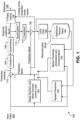
- FIG. 1 is a block diagram of a generic block-based hybrid video encoding system 100.
- the input video signal 102 is processed block by block.
- extended block sizes called a "coding unit” or CU
- a CU can be up to 64x64 pixels.
- a CU can be further partitioned into prediction units or PU, for which separate prediction methods are applied.
- Spatial prediction uses pixels from the already coded neighboring blocks in the same video picture/slice to predict the current video block. Spatial prediction reduces spatial redundancy inherent in the video signal.
- Temporal prediction (also referred to as “inter prediction” or “motion compensated prediction”) uses pixels from the already coded video pictures to predict the current video block. Temporal prediction reduces temporal redundancy inherent in the video signal.
- a temporal prediction signal for a given video block may be signaled by one or more motion vectors which indicate the amount and the direction of motion between the current block and its reference block.
- a reference index of the reference picture may also be sent. The reference index is used to identify from which reference picture in the reference picture store (164) the temporal prediction signal comes.
- the mode decision block (180) in the encoder chooses the best prediction mode, for example based on the rate-distortion optimization method.
- the prediction block is then subtracted from the current video block (116); and the prediction residual is de-correlated using transform (104) and quantized (106) to achieve the target bit-rate.
- the quantized residual coefficients are inverse quantized (110) and inverse transformed (112) to form the reconstructed residual, which is then added back to the prediction block (126) to form the reconstructed video block.
- Further in-loop filtering such as de-blocking filter and Adaptive Loop Filters may be applied (166) on the reconstructed video block before it is put in the reference picture store (164) and used to code future video blocks.
- coding mode inter or intra
- prediction mode information, motion information, and quantized residual coefficients are all sent to the entropy coding unit (108) to be further compressed and packed to form the bit-stream.
- FIG. 2 gives a general block diagram of a block-based video decoder 200.
- the video bit-stream 202 is unpacked and entropy decoded at entropy decoding unit 208.
- the coding mode and prediction information are sent to either the spatial prediction unit 260 (if intra coded) or the temporal prediction unit 262 (if inter coded) to form the prediction block.
- the residual transform coefficients are sent to inverse quantization unit 210 and inverse transform unit 212 to reconstruct the residual block.
- the prediction block and the residual block are then added together at 226.
- the reconstructed block may further go through in-loop filtering before it is stored in reference picture store 264.
- the reconstructed video in reference picture store is then sent out to drive a display device, as well as used to predict future video blocks.
- bi-directional motion compensated prediction In modern video codecs, bi-directional motion compensated prediction (MCP) is known for its high efficiency in removing temporal redundancy by exploiting temporal correlations between pictures, and has been widely adopted in most of the state-of-the-art video codecs.
- the bi-prediction signal is formed simply by combining two uni-prediction signals using a weight value equal to 0.5. This is not necessarily optimal to combine the uni-prediction signals, especially in some condition that illuminance changes rapidly in from one reference picture to another.
- prediction techniques have been developed aiming at compensating the illuminance variation over time by applying some global or local weights and offset values to each of the sample values in reference pictures.
- Weighted bi-prediction is a coding tool used primarily for compensating illuminance changes over time, such as fading transitions, when performing motion compensation. For each slice, two sets of multiplicative weight values and additive offset values are indicated explicitly and are applied separately to the motion compensated prediction, one at a time for each reference list. This technique is most effective when illuminance changes linearly and equally from picture to picture.
- parameters two pairs of multiplicative weight values and additive offset values
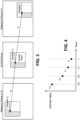
- this technique resorts to adapting the optimal parameters to the illuminance change between the reconstruction signals of the template ( T C ) and the prediction signals ( T 0 and T 1 ) of the template (see FIG. 3 ).
- the resulting parameters are optimized by minimizing the illuminance difference separately between T C and T 0 (for the first pair of weight and offset values) and between T C and T 1 (for the second pair of weight and offset values). Then, the same motion compensation process as for weighted bi-prediction is performed with the derived parameters.
- a change in illuminance over space and time could impact severely on the performance of motion-compensated prediction.
- motion-compensated prediction does not provide good performance.
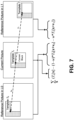
- a sample of an object travels over a period of time from t -3 to t , and the intensity value of this sample changes from v t -3 to v t along its motion trajectory. Supposing this sample is to be predicted at the t -th picture, its prediction value is bounded within v t -3 and v t-1 and thus a poor motion-compensated prediction may result.
- the aforementioned techniques of weighted bi-prediction and local illuminance compensation may not fully solve this problem.
- Weighted bi-prediction may fail because illuminance may fluctuate intensively within a picture. Local illuminance compensation would sometimes produce poor estimation of weights and offset values due to the low illuminance correlation between a block and its associated template block. These examples show that the global description and template-based local description are not sufficient for representing the illuminance variation over space and time.
- Exemplary embodiments described herein may improve the prediction efficiency for weighted motion-compensated prediction.
- systems and methods are proposed for generalized multi-hypothesis prediction using motion compensated prediction and block-level weight values for combining multi-hypothesis prediction signals linearly.
- a generalized bi-prediction framework is described using a weight value.
- a finite set of weights is used at the sequence, picture or slice level, and a construction process for the set of weights is described.
- the weight value is determined based on the given weight set and optimized considering the signals of a current block and its reference blocks.
- Exemplary coding methods are described for signaling weight values.
- Exemplary encoder search criteria are described for the motion estimation process for the proposed prediction, and proposed prediction processes in combination with a disclosed temporal prediction technique are described.
- systems and methods are described for temporal prediction using generalized multi-hypothesis prediction.
- Exemplary encoders and decoders using generalized bi-prediction are described with respect to FIG. 5 and FIG. 9 .
- Systems and methods disclosed herein are organized in sections as follows.
- the section “Generalized Multi-Hypothesis Prediction” describes exemplary embodiments using generalized multi-hypothesis prediction.
- the section “Generalized Bi-Prediction” discloses exemplary framework and prediction processes of the generalized bi-prediction.
- the sections "Construction of Weight Set” and “Weight Index Coding” describe exemplary construction processes for the weight set and describe exemplary techniques for signaling the choice of weights in this set, respectively.
- Extensions to Advanced Temporal Prediction Techniques systems and methods are described for combining exemplary proposed prediction method with advanced inter prediction techniques, including local illuminance compensation and weighted bi-prediction, merge mode, overlapped block motion compensation, affine prediction, bi-directional optical flow, and a decoder-side motion vector derivation technique referred to as frame-rate up conversion bi-prediction.
- exemplary encoder-only methods are described for enhancing the efficiency of exemplary prediction methods.
- Generalized multi-hypothesis prediction may be described as a generalized form of multi-hypothesis prediction to provide an estimate of a pixel's intensity value based on linearly combining multiple motion-compensated prediction signals.
- Generalized multi-hypothesis prediction may exploit benefits of multiple predictions with different qualities by combining them together.
- motion-compensated prediction signals may be processed (e.g. gamma correction, local illuminance correction, dynamic range conversion) through a predefined function f ( ⁇ ) and may then be combined linearly.
- f predefined function
- P [ x ] denotes the resulting prediction signal of a sample x located at a picture position x
- w i represents a weight value applied to the i -th motion hypothesis from the i -th reference picture
- P i [ x + v i ] is the motion-compensated prediction signal of x using the motion vector (MV) v i
- n is the total number of motion hypotheses.
- the proposed video encoder is capable of switching adaptively among a different number, n, of motion hypotheses, and an n value that provides optimal rate-distortion performance is found for each respective PU.
- Equation f ( ⁇ ) is treated as an identity function and thus is not set forth explicitly.
- Application of the systems and methods disclosed herein to cases in which f ( ⁇ ) is not an identity function will be apparent to those skilled in the art in view of the present disclosure.
- GBi generalized bi-prediction
- n 2
- ( w 0 , w 1 ) (1, 0) for uni-prediction with reference list L0, (0, 1) for uni-prediction with reference list L1, and (0.5, 0.5) for bi-prediction with two reference lists.
- (1, 0) and (0, 1) only one set of motion information is signaled since the other set associated with a weight value equal zero does not take any effect on the prediction signal P [ x ].
- the weight value may be signaled at the CU level instead of the PU level.
- frequently-used weight values may be arranged in a set (referred hereafter to as W L1 ), so each weight value can be indicated by an index value, that is the weight idx pointing to which entry it occupies in W L1 , within a limited range.
- generalized bi-prediction does not introduce an additional decoding burden to support producing the weighted average of two reference blocks. Since most of the modern video standards (e.g. AVC, HEVC) support weighted bi-prediction, the same prediction module can be adapted for use in GBi prediction.
- generalized bi-prediction may be applied not only to conventional uni-prediction and bi-prediction but also to other advanced temporal prediction techniques, such as affine prediction, advanced temporal motion vector derivation and bi-directional optical flow. These techniques aim to derive the motion field representation at a finer unit (e.g. 4x4) with a very low motion overhead.
- Affine prediction is a model-based motion field coding method, in which the motion of each unit within one PU can be derived based on the model parameters.
- Advanced temporal motion vector derivation involves deriving the motion of each unit from the motion field of temporal reference picture.
- Bi-directional optical flow involves deriving the motion refinement for each pixel using the optical flow model. No matter what the size of the unit is, once the weight value is specified at the block level, the proposed video codec can perform the generalized bi-prediction unit by unit using these derived motions and the given weight value.
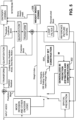
- FIG. 5 is a block diagram of an exemplary video encoder adapted to perform generalized bi-prediction.
- spatial prediction and temporal prediction are the two basic pixel-domain prediction modules in the exemplary video encoder.
- the spatial prediction module may be the same as the one illustrated in FIG. 1 .
- the temporal prediction module labeled "motion prediction" in FIG. 1 may be replaced by a generalized bi-prediction (GBi) module 502.
- the generalized bi-prediction (GBi) module may be operative to combine two separate motion compensated prediction (MCP) signals in a weighted-averaging manner.
- MCP motion compensated prediction
- the GBi module may implement a process to generate a final inter prediction signal as follows.
- the GBi module may perform motion estimation in reference picture(s) for searching two optimal motion vectors (MVs) pointing to two reference blocks that minimize the weighted bi-prediction error between the current video block and bi-prediction prediction.
- the GBi module may fetch these two prediction blocks through motion compensation with those two optimal MVs.
- the GBi module may subsequently compute a prediction signal of the generalized bi-prediction as a weighted average of the two prediction blocks.
- all the available weighting values are specified in a single set.
- the weighting values may cost a large number of bits if they are signaled for both reference lists at the PU level, which means it signals two separate weighting values per bi-prediction PU, the unit-gain constraint (the sum of weight values being equal to 1) may be applied. Under this constraint, only one single weight value per PU is signaled while the other one can be derived from subtracting the signaled weight value from one.
- W L1 the set of weight values
- the weight value is coded by an index value, weight idx, pointing to the entry position in W L1 .
- index value weight idx
- both conventional uni-prediction with weights equal to 0 for one reference list and 1 for the other list
- conventional bi-prediction with a weight value equal to 0.5 for both reference lists
- W L1 ⁇ 0, 0.5, 1 ⁇
- the GBi module can achieve the same functionality of motion prediction module as depicted in FIG. 1 .
- extra weight values for W L1 may be specified at the slice, picture or sequence level with a non-negative integer number, extra_number_of_weights, indicating the number of them, so there are extra_number_of_weights +3 separate weights in the framework of GBi.
- extra_number_of_weights when extra_number_of_weights is greater than zero, one of these extra weight values can be derived on a block-by-block basis, depending on the control of a flag, implicit_weight_flag, present at the slice, picture, or sequence level. When this flag is set equal to 1, this particular weight value is not signaled but may be derived as shown in FIG.
- W L1 by finding the one that can minimize the difference between the generalized bi-prediction signals of the immediate inverse-L-shape neighborhood (referred to as template) and the reconstruction signals of the template.
- the aforementioned process related to the construction of W L1 may be performed by a Weight Set Construction module 504.
- the Weight Set Construction module can scale the values of extra weights for GBi prediction. After inter prediction (that is GBi prediction in the proposed video encoder) and intra prediction, the original signal may be subtracted from this final prediction signal and the resulting prediction residual signal for coding is thus produced.
- the block motion (motion vectors and reference picture indices) and weight value index are the only block-level information to be indicated for each inter coded PU.
- a Weight Index Coding module 506 is used in an exemplary video encoder to binarize the weight idx of each PU.
- the output of the Weight Index Coding module may be a unique binary representation, binary_weight_idx, of weight idx.
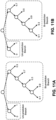
- the tree structure of an exemplary binarization scheme is illustrated in FIG. 8 .
- the first bit of binary_weight_idx may differentiate uni-prediction (weight indices associated with weight values equal to 0 or 1) and bi-prediction (weight indices associated with weight values other than 0 and 1 in W L1 ) for each inter PU.
- the exemplary video encoder may either switch adaptively between several predefined assignment manners or assign each weight to a unique leaf node dynamically on a PU-by-PU basis based on the usage of weight values from previously coded blocks.
- weight indices are assigned to leaf nodes close to the root in the bi-prediction branch, while others are assigned on the contrary to deeper leaf nodes far from the root.
- every weight idx can be converted into a unique binary_weight_idx for entropy coding.
- FIG. 9 is a block diagram of a video decoder in some embodiments.
- the decoder of FIG. 9 may be operative to decode a bit-stream produced by the video encoder illustrated in FIG. 5 .
- the coding mode and prediction information may be used to derive the prediction signal using either spatial prediction or generalized bi-prediction. For the generalized bi-prediction, the block motion information and weight value are received and decoded.
- a Weight Index Decoding module 902 decodes the weight index coded by the Weight Index Coding module 506 in the proposed video encoder.
- the Weight Index Decoding module 902 reconstructs the same tree structure as the one specified in FIG. 8 , and each leaf node on the tree is assigned with a unique weight idx in the same way as for the proposed video encoder. In this way, this tree is synchronized across the proposed video encoder and decoder. Through traversing this tree, every received binary_weight_idx may find its associated weight idx at a certain leaf node on the tree.
- An exemplary video decoder like the video encoder of FIG. 5 , includes a Weight Set Construction module 904 to construct the weight set, W L1 .
- One of the extra weight values in W L1 may be derived instead of being signaled explicitly when implicit_weight_flag is equal to 1, and all the extra weight values in W L1 may further be scaled using the scaling factor indicated by gbi_scaling_factors. Then, the reconstruction of weight value may be done by fetching the one pointed to by the weight idx from W L1 .
- the decoder may receive one or two sets of motion information depending on the choice of weight value at each block.
- the reconstructed weight value is neither 0 nor 1, two sets of motion information can be received; otherwise (when it is 0 or 1), only one set of motion information that is associated with the nonzero weight is received. For example, if the weight value is equal to 0, then only the motion information for reference list L0 will be signaled; otherwise if the weight value is equal to 1, only the motion information for reference list L1 will be signaled.
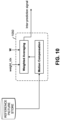
- the Generalized Bi-prediction module 1050 illustrated in FIG. 10 may operate to compute the prediction signal of generalized bi-prediction as a weighted average of the two motion compensated prediction blocks.
- Explicit weight values may be signaled and managed hierarchically at each of the sequence, picture and slice levels. Weights specified at lower levels may replace those at higher levels. Supposing the number of explicit weights at a higher level is p and that at a relatively lower level is q , the following rules for replacement may be applied when constructing the weight value list at the lower level.
- the available weight values at sequence, picture and slice levels are ⁇ w A , w B ⁇ , ⁇ w A , w C ⁇ and ⁇ 0, 0.5, 1 ⁇ w D , w E , w F ⁇ , respectively.
- the W L1 mentioned in the section "Generalized bi-prediction" is the slice-level weight set.
- a weight value in the slice-level weight set, W L1 is derived through template matching at both the encoder and decoder without signaling.
- this implicit weight value may be derived by minimizing the difference between the prediction signals ( T 0 and T 1 ) of the template with the motion information of current block and the reconstruction signals (i.e. T c ) of the template.
- a flag, implicit_weight_flag may be signaled at the slice, picture, or sequence level when extra_number_of_weights ⁇ 1 to determine whether the implicit weight is used. Once this is set equal to 1, the last slice-level weight value in W L1 is derived and thus need not be signaled. For example, the w F aforementioned in the section "Explicit weight values" above does not need to be signaled, and the weight for the block may be implicitly derived when implicit_weight_flag is equal to 1.
- the explicit weight values may be further scaled by using gbi_scaling_factors , two scaling factors indicated at the picture level. Due to possible high dynamics of illuminance change in pictures over time, the dynamic range of these weight values may not be sufficient to cover all these cases. Although weighted bi-prediction can compensate the illuminance difference between pictures, it is not always guaranteed to be enabled in the underlying video codec. As such, these scaling factors may be used to regulate the illuminance difference over multiple reference pictures, when weighted bi-prediction is not used.
- a first scaling factor may enlarge each explicit weight value in W L1 .
- the first equation in Eq. (6) can be expressed in the same form as Eq. (3). The only difference is the weight values that are applied to Eqs. (6) and (3).
- a second scaling factor may be used to reduce the illuminance-wise difference between the associated reference pictures of P 0 and P 1 .
- one optimal assignment to the variable s may be the mean value of samples in the current picture. Therefore, the mean values of the reference pictures may be expected to be similar after the second scaling factor is applied.
- the construction process of the weight set can be expressed as a function of explicit weights, implicit weight, scaling factors and reference pictures.
- the aforementioned slice-level weight set W L1 becomes ⁇ 0,0.5,1 ⁇ ( s / s 1 )* w D ', ( s / s 1 )* w E ', ( s / s 1 )* w F ' ⁇ and the weight set for L0 becomes ⁇ 1,0.5,1 ⁇ ( s / s 0 )*(1- w D '), ( s / s 0 )*(1- w E '), ( s / s 0 )*(1- w F ') ⁇ , where s 1 is the mean sample value of the reference picture in list L1 for current block, and s 0 is the mean sample value of the reference picture in list L0 for current block.
- each leaf node corresponds to one codeword.
- various adaptive codeword assignment methods may be used to map each leaf node in the bi-prediction branch to a unique weight index.
- Exemplary methods include pre-determined codeword assignment, block-adaptive codeword assignment, temporal-layer based codeword assignment, and time-delay CTU-adaptive codeword assignment. These exemplary methods update the codeword assignment in the bi-prediction branch based on the occurrence of weight values used in previously coded blocks. Frequently-used weights may be assigned to codewords with shorter length (that is, shallower leaf nodes in the bi-prediction branch), while others may be assigned to codewords with relatively longer length.
- the weight value of GBi is derived for blocks coded with FRUC bi-prediction and thus need not be signaled.
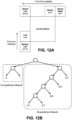
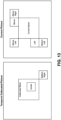
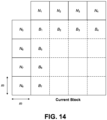
- Each weight value in W L1 is evaluated independently for each of the 4x4 sub-blocks in a PU with the MV derivation process of FRUC bi-prediction.
- the weight value that leads the minimal bilateral matching error (that is the sum of the absolute differences between the two uni-directional motion-compensated predictors associated with two reference lists) for a 4x4 block is selected.
- the optimization process can be formulated as argmin v 0 ⁇ x ⁇ PU 1 ⁇ 0.5 ⁇ P 0 x + v 0 ⁇ 0.5 ⁇ P 1 x + v 0 ⁇ t 1 ⁇ t c t 0 ⁇ t c .
- the search process in Eq.
- (16) is re-formulated with a weight value w in W L1 ; that is argmin v 0 ⁇ x ⁇ PU 1 ⁇ w ⁇ P 0 x + v 0 ⁇ w ⁇ P 1 x + v 0 ⁇ t 1 ⁇ t c t 0 ⁇ t c .
- This PU-level v 0 may be further refined independently using the same bilateral matching in Eq. (17) for each 4x4 sub-blocks within a PU, as shown in Eq. (18).
- each 4x4 sub-block in a PU has its own bi-prediction MVs and a weight value for performing the generalized bi-prediction.
- the complexity of such an exhaustive search method may be high, as the weights and the motion vectors are searched in a joint manner.
- the target is to minimize the difference between two weighted predictors associated respectively with the two reference lists. Negative weights may not be proper for this purpose.
- the FRUC-based GBi mode will only evaluate weight values greater than zero.
- the calculation of the sum of absolute differences may be performed using partial samples within each sub-block. For example, the sum of absolute differences may be calculated using only samples locating at even-numbered rows and columns (or, alternatively odd-numbered rows and columns).
- Eqs. (3), (8), (13) and (14) can be applied to substitute for P [ x ] in Eq. (19).
- a first such procedure may proceed as follows:
- a second exemplary iterative procedure may proceed as follows:
Landscapes
- Engineering & Computer Science (AREA)
- Multimedia (AREA)
- Signal Processing (AREA)
- Compression Or Coding Systems Of Tv Signals (AREA)
Priority Applications (1)
| Application Number | Priority Date | Filing Date | Title |
|---|---|---|---|
| EP25170296.5A EP4561077A3 (en) | 2016-05-13 | 2017-05-11 | Systems and methods for generalized multi-hypothesis prediction for video coding |
Applications Claiming Priority (6)
| Application Number | Priority Date | Filing Date | Title |
|---|---|---|---|
| US201662336227P | 2016-05-13 | 2016-05-13 | |
| US201662342772P | 2016-05-27 | 2016-05-27 | |
| US201662399234P | 2016-09-23 | 2016-09-23 | |
| US201662415187P | 2016-10-31 | 2016-10-31 | |
| PCT/US2017/032208 WO2017197146A1 (en) | 2016-05-13 | 2017-05-11 | Systems and methods for generalized multi-hypothesis prediction for video coding |
| EP17725080.0A EP3456049B1 (en) | 2016-05-13 | 2017-05-11 | Systems and methods for generalized multi-hypothesis prediction for video coding |
Related Parent Applications (2)
| Application Number | Title | Priority Date | Filing Date |
|---|---|---|---|
| EP17725080.0A Division EP3456049B1 (en) | 2016-05-13 | 2017-05-11 | Systems and methods for generalized multi-hypothesis prediction for video coding |
| EP17725080.0A Division-Into EP3456049B1 (en) | 2016-05-13 | 2017-05-11 | Systems and methods for generalized multi-hypothesis prediction for video coding |
Related Child Applications (2)
| Application Number | Title | Priority Date | Filing Date |
|---|---|---|---|
| EP25170296.5A Division EP4561077A3 (en) | 2016-05-13 | 2017-05-11 | Systems and methods for generalized multi-hypothesis prediction for video coding |
| EP25170296.5A Division-Into EP4561077A3 (en) | 2016-05-13 | 2017-05-11 | Systems and methods for generalized multi-hypothesis prediction for video coding |
Publications (2)
| Publication Number | Publication Date |
|---|---|
| EP4060992A1 EP4060992A1 (en) | 2022-09-21 |
| EP4060992B1 true EP4060992B1 (en) | 2025-07-02 |
Family
ID=58745461
Family Applications (3)
| Application Number | Title | Priority Date | Filing Date |
|---|---|---|---|
| EP22166000.4A Active EP4060992B1 (en) | 2016-05-13 | 2017-05-11 | Systems and methods for generalized multi-hypothesis prediction for video coding |
| EP17725080.0A Active EP3456049B1 (en) | 2016-05-13 | 2017-05-11 | Systems and methods for generalized multi-hypothesis prediction for video coding |
| EP25170296.5A Pending EP4561077A3 (en) | 2016-05-13 | 2017-05-11 | Systems and methods for generalized multi-hypothesis prediction for video coding |
Family Applications After (2)
| Application Number | Title | Priority Date | Filing Date |
|---|---|---|---|
| EP17725080.0A Active EP3456049B1 (en) | 2016-05-13 | 2017-05-11 | Systems and methods for generalized multi-hypothesis prediction for video coding |
| EP25170296.5A Pending EP4561077A3 (en) | 2016-05-13 | 2017-05-11 | Systems and methods for generalized multi-hypothesis prediction for video coding |
Country Status (7)
| Country | Link |
|---|---|
| US (2) | US11363253B2 (enExample) |
| EP (3) | EP4060992B1 (enExample) |
| JP (4) | JP2019519148A (enExample) |
| KR (2) | KR102480191B1 (enExample) |
| CN (4) | CN120676141A (enExample) |
| FI (1) | FI4060992T3 (enExample) |
| WO (1) | WO2017197146A1 (enExample) |
Families Citing this family (125)
| Publication number | Priority date | Publication date | Assignee | Title |
|---|---|---|---|---|
| FI4060992T3 (fi) | 2016-05-13 | 2025-08-14 | Interdigital Vc Holdings Inc | Järjestelmiä ja menetelmiä videokoodauksen yleistettyä monen hypoteesin ennustusta varten |
| CN109196864B (zh) * | 2016-05-24 | 2023-07-11 | 韩国电子通信研究院 | 图像编码/解码方法和用于所述方法的记录介质 |
| CN114401402B (zh) * | 2016-07-05 | 2024-06-14 | 株式会社Kt | 用于处理视频信号的方法和装置 |
| WO2018021585A1 (ko) * | 2016-07-26 | 2018-02-01 | 엘지전자 주식회사 | 영상 코딩 시스템에서 인트라 예측 방법 및 장치 |
| CN116567219A (zh) * | 2016-08-11 | 2023-08-08 | Lx 半导体科技有限公司 | 图像编码/解码方法和图像数据的发送方法 |
| US10880552B2 (en) * | 2016-09-28 | 2020-12-29 | Lg Electronics Inc. | Method and apparatus for performing optimal prediction based on weight index |
| US10880570B2 (en) | 2016-10-05 | 2020-12-29 | Qualcomm Incorporated | Systems and methods of adaptively determining template size for illumination compensation |
| US10750203B2 (en) | 2016-12-22 | 2020-08-18 | Mediatek Inc. | Method and apparatus of adaptive bi-prediction for video coding |
| EP3556096B1 (en) * | 2016-12-22 | 2024-05-22 | HFI Innovation Inc. | Method and apparatus of motion refinement for video coding |
| US10931969B2 (en) * | 2017-01-04 | 2021-02-23 | Qualcomm Incorporated | Motion vector reconstructions for bi-directional optical flow (BIO) |
| US10701366B2 (en) * | 2017-02-21 | 2020-06-30 | Qualcomm Incorporated | Deriving motion vector information at a video decoder |
| EP3468198A1 (en) | 2017-10-05 | 2019-04-10 | Thomson Licensing | Method and apparatus for video encoding and decoding based on illumination compensation |
| WO2019087878A1 (ja) * | 2017-10-30 | 2019-05-09 | パナソニック インテレクチュアル プロパティ コーポレーション オブ アメリカ | 符号化装置、復号装置、符号化方法及び復号方法 |
| CN109963155B (zh) | 2017-12-23 | 2023-06-06 | 华为技术有限公司 | 图像块的运动信息的预测方法、装置及编解码器 |
| WO2019140083A1 (en) * | 2018-01-12 | 2019-07-18 | Futurewei Technologies, Inc. | Adaptive multi-hypothesis context-adaptive binary arithmetic coding (mcabac) |
| JP7125486B2 (ja) | 2018-01-16 | 2022-08-24 | ヴィド スケール インコーポレイテッド | 局所照明補償に基づいた動き補償双予測 |
| CN111801946B (zh) * | 2018-01-24 | 2024-07-19 | Vid拓展公司 | 用于具有降低的译码复杂性的视频译码的广义双预测 |
| EP3518543A1 (en) | 2018-01-26 | 2019-07-31 | Thomson Licensing | Illumination compensation flag in frame rate up-conversion with template matching |
| CN119211542A (zh) * | 2018-01-30 | 2024-12-27 | 松下电器(美国)知识产权公司 | 编码装置、解码装置和非暂时性的计算机可读介质 |
| CN112236995B (zh) * | 2018-02-02 | 2024-08-06 | 苹果公司 | 基于多假设运动补偿技术的视频编码、解码方法及编码器、解码器 |
| US11924440B2 (en) | 2018-02-05 | 2024-03-05 | Apple Inc. | Techniques of multi-hypothesis motion compensation |
| KR102851281B1 (ko) * | 2018-03-29 | 2025-08-26 | 닛폰 호소 교카이 | 화상 부호화 장치, 화상 복호 장치 및 프로그램 |
| US11317085B2 (en) * | 2018-03-30 | 2022-04-26 | Vid Scale, Inc. | Template-based inter prediction techniques based on encoding and decoding latency reduction |
| EP3554080A1 (en) * | 2018-04-13 | 2019-10-16 | InterDigital VC Holdings, Inc. | Methods and devices for picture encoding and decoding |
| CN116800981A (zh) | 2018-05-23 | 2023-09-22 | 寰发股份有限公司 | 使用双向编码单元加权的视频编码方法和装置 |
| WO2019229683A1 (en) * | 2018-05-31 | 2019-12-05 | Beijing Bytedance Network Technology Co., Ltd. | Concept of interweaved prediction |
| CN118138778A (zh) * | 2018-06-01 | 2024-06-04 | 夏普株式会社 | 图像解码装置以及图像编码装置 |
| WO2019234598A1 (en) | 2018-06-05 | 2019-12-12 | Beijing Bytedance Network Technology Co., Ltd. | Interaction between ibc and stmvp |
| WO2019234676A1 (en) * | 2018-06-07 | 2019-12-12 | Beijing Bytedance Network Technology Co., Ltd. | Mv precision refine |
| US11477474B2 (en) * | 2018-06-08 | 2022-10-18 | Mediatek Inc. | Methods and apparatus for multi-hypothesis mode reference and constraints |
| EP3804324A4 (en) | 2018-06-11 | 2022-08-03 | HFI Innovation Inc. | BIDIRECTIONAL OPTICAL FLOW METHOD AND APPARATUS FOR VIDEO CODING |
| WO2019244118A1 (en) | 2018-06-21 | 2019-12-26 | Beijing Bytedance Network Technology Co., Ltd. | Component-dependent sub-block dividing |
| CN110636298B (zh) | 2018-06-21 | 2022-09-13 | 北京字节跳动网络技术有限公司 | 对于Merge仿射模式和非Merge仿射模式的统一约束 |
| TWI719519B (zh) | 2018-07-02 | 2021-02-21 | 大陸商北京字節跳動網絡技術有限公司 | 對於dmvr的塊尺寸限制 |
| KR20250002827A (ko) * | 2018-07-06 | 2025-01-07 | 미쓰비시덴키 가부시키가이샤 | 동화상 복호 방법, 동화상 복호 장치, 동화상 부호화 방법 및 동화상 부호화 장치 |
| WO2020011775A1 (en) * | 2018-07-10 | 2020-01-16 | Fraunhofer-Gesellschaft zur Förderung der angewandten Forschung e.V. | Multi-hypothesis prediction |
| US11140418B2 (en) | 2018-07-17 | 2021-10-05 | Qualcomm Incorporated | Block-based adaptive loop filter design and signaling |
| BR112021002857A8 (pt) * | 2018-08-17 | 2023-02-07 | Mediatek Inc | Métodos e aparelhos de processamento de vídeo com predição bidirecional em sistemas de codificação de vídeo |
| WO2020060843A1 (en) * | 2018-09-19 | 2020-03-26 | Interdigital Vc Holdings, Inc. | Generalized bi-prediction index coding |
| EP3668097A1 (en) * | 2018-12-13 | 2020-06-17 | InterDigital VC Holdings, Inc. | Generalized bi-prediction index coding |
| CN118200534A (zh) * | 2018-09-21 | 2024-06-14 | 夏普株式会社 | 图像解码装置 |
| CN117768651A (zh) | 2018-09-24 | 2024-03-26 | 北京字节跳动网络技术有限公司 | 处理视频数据的方法、装置、介质、以及比特流存储方法 |
| TW202533573A (zh) * | 2018-09-26 | 2025-08-16 | 美商內數位Vc控股公司 | 視訊編碼雙預測 |
| WO2020072414A1 (en) * | 2018-10-02 | 2020-04-09 | Interdigital Vc Holdings, Inc. | Generalized bi-prediction and weighted prediction |
| CN111083484B (zh) | 2018-10-22 | 2024-06-28 | 北京字节跳动网络技术有限公司 | 基于子块的预测 |
| WO2020084461A1 (en) * | 2018-10-22 | 2020-04-30 | Beijing Bytedance Network Technology Co., Ltd. | Restrictions on decoder side motion vector derivation based on coding information |
| WO2020084474A1 (en) | 2018-10-22 | 2020-04-30 | Beijing Bytedance Network Technology Co., Ltd. | Gradient computation in bi-directional optical flow |
| CN112913241B (zh) | 2018-10-22 | 2024-03-26 | 北京字节跳动网络技术有限公司 | 解码器侧运动矢量推导的限制 |
| CN113287317B (zh) * | 2018-10-23 | 2023-04-28 | 北京字节跳动网络技术有限公司 | 并置的局部照明补偿和修改的帧间编解码工具 |
| WO2020084507A1 (en) | 2018-10-23 | 2020-04-30 | Beijing Bytedance Network Technology Co., Ltd. | Harmonized local illumination compensation and modified inter prediction coding |
| MX2021004738A (es) * | 2018-10-27 | 2021-06-04 | Huawei Tech Co Ltd | Lista de fusion separada para candidatos de fusion de subbloque y armonizacion de tecnicas intra-inter para codificacion de video. |
| CN117692636A (zh) * | 2018-10-27 | 2024-03-12 | 华为技术有限公司 | 图像预测方法及装置 |
| CN111107373B (zh) * | 2018-10-29 | 2023-11-03 | 华为技术有限公司 | 基于仿射预测模式的帧间预测的方法及相关装置 |
| KR20230158645A (ko) | 2018-11-05 | 2023-11-20 | 베이징 바이트댄스 네트워크 테크놀로지 컴퍼니, 리미티드 | 리파인먼트를 이용한 인터 예측을 위한 보간 |
| WO2020094051A1 (en) | 2018-11-06 | 2020-05-14 | Beijing Bytedance Network Technology Co., Ltd. | Signaling of side information for inter prediction with geometric partitioning |
| WO2020094150A1 (en) | 2018-11-10 | 2020-05-14 | Beijing Bytedance Network Technology Co., Ltd. | Rounding in current picture referencing |
| EP3878172A4 (en) | 2018-11-12 | 2022-08-24 | HFI Innovation Inc. | METHOD AND DEVICE FOR MULTIPLE HYPOTHESIS IN VIDEO CODING |
| WO2020098648A1 (en) | 2018-11-12 | 2020-05-22 | Beijing Bytedance Network Technology Co., Ltd. | Using combined inter intra prediction in video processing |
| CN113039790B (zh) * | 2018-11-17 | 2023-04-14 | 北京字节跳动网络技术有限公司 | 视频处理的方法、装置和非暂时性计算机可读介质 |
| CN113170093B (zh) | 2018-11-20 | 2023-05-02 | 北京字节跳动网络技术有限公司 | 视频处理中的细化帧间预测 |
| KR20210091161A (ko) | 2018-11-20 | 2021-07-21 | 베이징 바이트댄스 네트워크 테크놀로지 컴퍼니, 리미티드 | 부분적 위치에 기반한 차분 계산 |
| US11146810B2 (en) * | 2018-11-27 | 2021-10-12 | Qualcomm Incorporated | Decoder-side motion vector refinement |
| WO2020114405A1 (en) | 2018-12-03 | 2020-06-11 | Beijing Bytedance Network Technology Co., Ltd. | Indication method of maximum number of candidates |
| US11394989B2 (en) * | 2018-12-10 | 2022-07-19 | Tencent America LLC | Method and apparatus for video coding |
| US10855992B2 (en) * | 2018-12-20 | 2020-12-01 | Alibaba Group Holding Limited | On block level bi-prediction with weighted averaging |
| CN113196747B (zh) | 2018-12-21 | 2023-04-14 | 北京字节跳动网络技术有限公司 | 当前图片参考模式下的信息信令通知 |
| WO2020140862A1 (en) | 2018-12-30 | 2020-07-09 | Beijing Bytedance Network Technology Co., Ltd. | Conditional application of inter prediction with geometric partitioning in video processing |
| WO2020140951A1 (en) | 2019-01-02 | 2020-07-09 | Beijing Bytedance Network Technology Co., Ltd. | Motion vector derivation between color components |
| MX2021008468A (es) * | 2019-01-14 | 2021-08-19 | Interdigital Vc Holdings Inc | Metodo y aparato para codificacion y decodificacion de video con flujo optico bi-direccional adaptado a prediccion ponderada. |
| WO2020147747A1 (en) * | 2019-01-15 | 2020-07-23 | Beijing Bytedance Network Technology Co., Ltd. | Weighted prediction in video coding |
| WO2020147804A1 (en) * | 2019-01-17 | 2020-07-23 | Beijing Bytedance Network Technology Co., Ltd. | Use of virtual candidate prediction and weighted prediction in video processing |
| CN113383548A (zh) | 2019-02-03 | 2021-09-10 | 北京字节跳动网络技术有限公司 | Mv精度和mv差编解码之间的相互作用 |
| CN111837395B (zh) | 2019-02-14 | 2025-08-22 | 北京字节跳动网络技术有限公司 | 基于处理参数的解码器侧运动推导 |
| US11134262B2 (en) | 2019-02-28 | 2021-09-28 | Tencent America LLC | Method and apparatus for video coding |
| US11190797B2 (en) * | 2019-03-01 | 2021-11-30 | Qualcomm Incorporated | Constraints on decoder-side motion vector refinement based on weights for bi-predicted prediction |
| WO2020180704A1 (en) * | 2019-03-05 | 2020-09-10 | Vid Scale, Inc. | Affine motion model derivation method |
| WO2020177755A1 (en) | 2019-03-06 | 2020-09-10 | Beijing Bytedance Network Technology Co., Ltd. | Usage of converted uni-prediction candidate |
| KR20210129721A (ko) | 2019-03-11 | 2021-10-28 | 알리바바 그룹 홀딩 리미티드 | 병합 모드를 위한 예측 가중치를 결정하는 방법, 디바이스, 및 시스템 |
| EP3928521A4 (en) * | 2019-04-02 | 2022-08-17 | Beijing Bytedance Network Technology Co., Ltd. | BIDIRECTIONAL OPTICAL FLOW BASED VIDEO ENCODING AND DECODING |
| JP7319386B2 (ja) | 2019-04-19 | 2023-08-01 | 北京字節跳動網絡技術有限公司 | 異なる動きベクトル微調整における勾配計算 |
| CN113711609B (zh) | 2019-04-19 | 2023-12-01 | 北京字节跳动网络技术有限公司 | 利用光流的预测细化过程中的增量运动矢量 |
| WO2020211866A1 (en) * | 2019-04-19 | 2020-10-22 | Beijing Bytedance Network Technology Co., Ltd. | Applicability of prediction refinement with optical flow process |
| JP7269371B2 (ja) * | 2019-04-25 | 2023-05-08 | ベイジン・ダジア・インターネット・インフォメーション・テクノロジー・カンパニー,リミテッド | オプティカルフローを用いる予測改善のための方法および装置 |
| SG11202112279WA (en) | 2019-05-11 | 2021-12-30 | Beijing Bytedance Network Technology Co Ltd | Selective use of coding tools in video processing |
| KR102627821B1 (ko) * | 2019-06-04 | 2024-01-23 | 베이징 바이트댄스 네트워크 테크놀로지 컴퍼니, 리미티드 | 이웃 블록 정보를 사용한 모션 후보 리스트 구성 |
| CN119729005A (zh) | 2019-06-14 | 2025-03-28 | Lg电子株式会社 | 解码和编码设备及发送用于图像的数据的设备 |
| WO2020251257A1 (ko) | 2019-06-14 | 2020-12-17 | 엘지전자 주식회사 | 예측 샘플을 생성하기 위한 가중치 인덱스 정보를 도출하는 영상 디코딩 방법 및 그 장치 |
| KR20240128148A (ko) * | 2019-06-14 | 2024-08-23 | 엘지전자 주식회사 | 쌍 예측(bi-prediction)을 위한 가중치 인덱스 정보를 도출하는 영상 디코딩 방법 및 그 장치 |
| KR20250111406A (ko) | 2019-06-24 | 2025-07-22 | 엘지전자 주식회사 | 쌍 예측을 적용하는 영상 디코딩 방법 및 그 장치 |
| CN114375573B (zh) * | 2019-06-24 | 2024-08-16 | Lg电子株式会社 | 使用合并候选推导预测样本的图像解码方法及其装置 |
| CN114342405B (zh) | 2019-06-24 | 2025-01-14 | Lg电子株式会社 | 图像解码方法和用于该图像解码方法的装置 |
| WO2020263027A1 (ko) * | 2019-06-28 | 2020-12-30 | 에스케이텔레콤 주식회사 | 양방향 예측 가중치 인덱스를 유도하는 방법 및 영상 복호화 장치 |
| KR102824280B1 (ko) | 2019-07-05 | 2025-06-23 | 엘지전자 주식회사 | 머지 후보의 양방향 예측을 위한 가중치 인덱스를 유도하는 영상 부호화/복호화 방법, 장치 및 비트스트림을 전송하는 방법 |
| MX2022000155A (es) * | 2019-07-05 | 2022-02-21 | Lg Electronics Inc | Metodo de codificacion/decodificacion de imagen y dispositivo para derivar el indice de peso de la prediccion bidireccional, y metodo para transmitir un flujo de bits. |
| WO2021006576A1 (ko) * | 2019-07-05 | 2021-01-14 | 엘지전자 주식회사 | 양방향 예측을 수행하는 영상 부호화/복호화 방법, 장치 및 비트스트림을 전송하는 방법 |
| WO2021008511A1 (en) | 2019-07-14 | 2021-01-21 | Beijing Bytedance Network Technology Co., Ltd. | Geometric partition mode candidate list construction in video coding |
| EP4011082B1 (en) | 2019-08-08 | 2025-10-22 | Sharp Kabushiki Kaisha | Device and method for coding video data |
| CN120281914A (zh) * | 2019-08-22 | 2025-07-08 | Lg电子株式会社 | 图像解码方法、图像编码方法和比特流发送方法 |
| CN114402591B (zh) | 2019-09-13 | 2024-08-02 | 北京字节跳动网络技术有限公司 | 并置运动矢量的推导 |
| WO2021058498A1 (en) * | 2019-09-26 | 2021-04-01 | Interdigital Vc Holdings France, Sas | Extended motion information comparison |
| CN114450959B (zh) | 2019-09-28 | 2024-08-02 | 北京字节跳动网络技术有限公司 | 视频编解码中的几何分割模式 |
| EP4026321B1 (en) * | 2019-10-06 | 2025-12-10 | Huawei Technologies Co., Ltd. | Harmonizing weighted prediction with affine model based motion compensation |
| JP7281602B2 (ja) * | 2019-10-09 | 2023-05-25 | ベイジン、ターチア、インターネット、インフォメーション、テクノロジー、カンパニー、リミテッド | オプティカルフローによる予測洗練化、双方向オプティカルフローおよびデコーダ側の動きベクトル洗練化のための方法および装置 |
| KR20220143023A (ko) | 2020-02-19 | 2022-10-24 | 바이트댄스 아이엔씨 | 비트스트림에서의 비디오 성분들에 대한 가중치 값들의 추론 |
| CN115315944B (zh) | 2020-03-07 | 2025-06-13 | 抖音视界有限公司 | 视频编解码中的隐式多变换集信令通知 |
| CN111629207B (zh) * | 2020-04-30 | 2022-09-16 | 中山大学 | 一种模板匹配帧内子划分方法 |
| US12445634B2 (en) | 2020-12-23 | 2025-10-14 | Qualcomm Incorporated | Multiple hypothesis prediction for video coding |
| JP2024501154A (ja) * | 2020-12-23 | 2024-01-11 | クゥアルコム・インコーポレイテッド | ビデオコーディングのための複数仮説予測 |
| US11863774B2 (en) | 2021-01-15 | 2024-01-02 | Tencent America LLC | Method and apparatus for video coding |
| FR3120174A1 (fr) * | 2021-02-19 | 2022-08-26 | Orange | Prédiction pondérée d’image, codage et décodage d’image utilisant une telle prédiction pondérée |
| US12081736B2 (en) | 2021-04-26 | 2024-09-03 | Tencent America LLC | Bi-prediction without signaling cu-level weights |
| CN117203959A (zh) * | 2021-04-27 | 2023-12-08 | 抖音视界有限公司 | 用于视频处理的方法、设备和介质 |
| US12132885B2 (en) * | 2021-09-16 | 2024-10-29 | Qualcomm Incorporated | Multiple inter predictors with decoder side motion vector derivation for video coding |
| US12200219B2 (en) * | 2021-09-17 | 2025-01-14 | Qualcomm Incorporated | Adaptive bilateral matching for decoder side motion vector refinement for video coding |
| US12108076B2 (en) | 2021-11-01 | 2024-10-01 | Tencent America LLC | Index reordering of bi-prediction with CU-level weight (BCW) by using template-matching |
| US12425597B2 (en) * | 2021-12-29 | 2025-09-23 | Mediatek Inc. | Method and apparatus for multiple hypothesis prediction in video coding system |
| EP4494342A1 (en) * | 2022-03-15 | 2025-01-22 | Beijing Dajia Internet Information Technology Co., Ltd. | Methods and devices on probability calculation for context-based adaptive binary arithmetic coding |
| US11936903B2 (en) | 2022-04-19 | 2024-03-19 | Tencent America LLC | Bilateral matching based scaling factor derivation for JMVD |
| US12219146B2 (en) | 2022-05-16 | 2025-02-04 | Tencent America LLC | Flexible scaling factors for joint MVD coding |
| US12489886B2 (en) * | 2022-07-04 | 2025-12-02 | Alibaba (China) Co., Ltd. | Deriving bi-prediction with coding unit-level weight indices for merge candidates |
| US12200192B2 (en) * | 2022-07-08 | 2025-01-14 | Tencent America LLC | Method and apparatus for bi-prediction with sample adaptive weights |
| US20240195978A1 (en) * | 2022-12-13 | 2024-06-13 | Apple Inc. | Joint motion vector coding |
| WO2024225675A1 (ko) * | 2023-04-23 | 2024-10-31 | 주식회사 윌러스표준기술연구소 | 참조 블록과 현재 블록 사이의 관계식을 이용하여 현재 블록을 예측하는 비디오 신호 처리 장치 및 방법 |
| WO2024253465A1 (ko) * | 2023-06-08 | 2024-12-12 | 현대자동차주식회사 | 영상 부호화/복호화 방법, 장치 및 비트스트림을 저장한 기록 매체 |
| US20250106407A1 (en) * | 2023-09-22 | 2025-03-27 | Tencent America LLC | Block level adaptive weighted prediction with multiple scaling factors |
Family Cites Families (38)
| Publication number | Priority date | Publication date | Assignee | Title |
|---|---|---|---|---|
| JP3374989B2 (ja) * | 1993-03-26 | 2003-02-10 | ソニー株式会社 | 画像信号符号化方法および画像信号符号化装置、ならびに画像信号復号化方法および画像信号復号化装置 |
| JP4015934B2 (ja) * | 2002-04-18 | 2007-11-28 | 株式会社東芝 | 動画像符号化方法及び装置 |
| JP2004007379A (ja) | 2002-04-10 | 2004-01-08 | Toshiba Corp | 動画像符号化方法及び動画像復号化方法 |
| JP4090862B2 (ja) | 2002-04-26 | 2008-05-28 | 松下電器産業株式会社 | 可変長符号化方法および可変長復号化方法 |
| US8406301B2 (en) | 2002-07-15 | 2013-03-26 | Thomson Licensing | Adaptive weighting of reference pictures in video encoding |
| US7376186B2 (en) | 2002-07-15 | 2008-05-20 | Thomson Licensing | Motion estimation with weighting prediction |
| US7801217B2 (en) | 2002-10-01 | 2010-09-21 | Thomson Licensing | Implicit weighting of reference pictures in a video encoder |
| EP2190192B1 (en) * | 2004-06-02 | 2014-08-06 | Panasonic Corporation | Picture coding apparatus and picture decoding apparatus |
| US8457203B2 (en) | 2005-05-26 | 2013-06-04 | Ntt Docomo, Inc. | Method and apparatus for coding motion and prediction weighting parameters |
| KR101408698B1 (ko) * | 2007-07-31 | 2014-06-18 | 삼성전자주식회사 | 가중치 예측을 이용한 영상 부호화, 복호화 방법 및 장치 |
| CN101855910B (zh) | 2007-09-28 | 2014-10-29 | 杜比实验室特许公司 | 视频压缩和传送技术 |
| CN101836457B (zh) | 2007-10-25 | 2012-07-11 | 日本电信电话株式会社 | 活动图像可分级编码方法及解码方法及其装置 |
| CN102308586B (zh) | 2009-02-06 | 2015-03-25 | 汤姆森特许公司 | 用于视频编码器和解码器隐式和半隐式帧内模式信令的方法和装置 |
| US8995526B2 (en) * | 2009-07-09 | 2015-03-31 | Qualcomm Incorporated | Different weights for uni-directional prediction and bi-directional prediction in video coding |
| US9049444B2 (en) | 2010-12-22 | 2015-06-02 | Qualcomm Incorporated | Mode dependent scanning of coefficients of a block of video data |
| US10499059B2 (en) | 2011-03-08 | 2019-12-03 | Velos Media, Llc | Coding of transform coefficients for video coding |
| EP3879834B1 (en) * | 2011-05-31 | 2024-05-01 | JVCKENWOOD Corporation | Moving image encoding device, moving image encoding method and moving image encoding program, as well as moving image decoding device, moving image decoding method and moving image decoding program |
| US10298939B2 (en) | 2011-06-22 | 2019-05-21 | Qualcomm Incorporated | Quantization in video coding |
| US9756360B2 (en) | 2011-07-19 | 2017-09-05 | Qualcomm Incorporated | Coefficient scanning in video coding |
| IN2014CN02456A (enExample) | 2011-09-29 | 2015-06-19 | Sharp Kk | |
| WO2013059470A1 (en) | 2011-10-21 | 2013-04-25 | Dolby Laboratories Licensing Corporation | Weighted predictions based on motion information |
| US9503720B2 (en) * | 2012-03-16 | 2016-11-22 | Qualcomm Incorporated | Motion vector coding and bi-prediction in HEVC and its extensions |
| JP6012014B2 (ja) | 2012-03-30 | 2016-10-25 | サン パテント トラスト | 画像符号化方法および画像復号方法 |
| US9906786B2 (en) | 2012-09-07 | 2018-02-27 | Qualcomm Incorporated | Weighted prediction mode for scalable video coding |
| US9648318B2 (en) * | 2012-09-30 | 2017-05-09 | Qualcomm Incorporated | Performing residual prediction in video coding |
| US10097825B2 (en) | 2012-11-21 | 2018-10-09 | Qualcomm Incorporated | Restricting inter-layer prediction based on a maximum number of motion-compensated layers in high efficiency video coding (HEVC) extensions |
| US10334259B2 (en) * | 2012-12-07 | 2019-06-25 | Qualcomm Incorporated | Advanced residual prediction in scalable and multi-view video coding |
| US20140198846A1 (en) | 2013-01-16 | 2014-07-17 | Qualcomm Incorporated | Device and method for scalable coding of video information |
| BR112015015575A2 (pt) * | 2013-01-30 | 2020-02-04 | Intel Corp | particionamento adaptativo ao conteúdo para a previsão e codificação para vídeo da próxima geração |
| US9426473B2 (en) | 2013-02-01 | 2016-08-23 | Qualcomm Incorporated | Mode decision simplification for intra prediction |
| US9800857B2 (en) | 2013-03-08 | 2017-10-24 | Qualcomm Incorporated | Inter-view residual prediction in multi-view or 3-dimensional video coding |
| PL2984837T3 (pl) * | 2013-04-08 | 2018-07-31 | Ge Video Compression, Llc | Predykcja międzykomponentowa |
| US9654794B2 (en) | 2014-01-03 | 2017-05-16 | Qualcomm Incorporated | Methods for coding an inter-layer reference picture set (RPS) and coding end of bitstream (EOB) network access layer (NAL) units in multi-layer coding |
| US20170264904A1 (en) | 2014-09-23 | 2017-09-14 | Intel Corporation | Intra-prediction complexity reduction using limited angular modes and refinement |
| EP3222044A1 (en) | 2014-11-21 | 2017-09-27 | VID SCALE, Inc. | One-dimensional transform modes and coefficient scan order |
| KR20250064689A (ko) * | 2015-08-24 | 2025-05-09 | 엘지전자 주식회사 | 인터 예측 모드 기반 영상 처리 방법 및 이를 위한 장치 |
| FI4060992T3 (fi) * | 2016-05-13 | 2025-08-14 | Interdigital Vc Holdings Inc | Järjestelmiä ja menetelmiä videokoodauksen yleistettyä monen hypoteesin ennustusta varten |
| US10805631B2 (en) | 2016-09-23 | 2020-10-13 | Lg Electronics Inc. | Method and apparatus for performing prediction using template-based weight |
-
2017
- 2017-05-11 FI FIEP22166000.4T patent/FI4060992T3/fi active
- 2017-05-11 EP EP22166000.4A patent/EP4060992B1/en active Active
- 2017-05-11 WO PCT/US2017/032208 patent/WO2017197146A1/en not_active Ceased
- 2017-05-11 JP JP2018559392A patent/JP2019519148A/ja not_active Ceased
- 2017-05-11 CN CN202510806913.0A patent/CN120676141A/zh active Pending
- 2017-05-11 CN CN202210588059.1A patent/CN115118970B/zh active Active
- 2017-05-11 EP EP17725080.0A patent/EP3456049B1/en active Active
- 2017-05-11 CN CN202210588340.5A patent/CN115118971B/zh active Active
- 2017-05-11 EP EP25170296.5A patent/EP4561077A3/en active Pending
- 2017-05-11 CN CN201780042257.5A patent/CN109496430B/zh active Active
- 2017-05-11 KR KR1020227009791A patent/KR102480191B1/ko active Active
- 2017-05-11 US US16/099,392 patent/US11363253B2/en active Active
- 2017-05-11 KR KR1020187032916A patent/KR102379874B1/ko active Active
-
2022
- 2022-06-13 US US17/838,729 patent/US12335460B2/en active Active
- 2022-11-17 JP JP2022184106A patent/JP7469439B2/ja active Active
-
2024
- 2024-04-04 JP JP2024060827A patent/JP7698096B2/ja active Active
-
2025
- 2025-06-12 JP JP2025098459A patent/JP2025128318A/ja active Pending
Also Published As
| Publication number | Publication date |
|---|---|
| JP7698096B2 (ja) | 2025-06-24 |
| CN109496430B (zh) | 2022-06-14 |
| US20220312001A1 (en) | 2022-09-29 |
| EP4561077A3 (en) | 2025-07-23 |
| US11363253B2 (en) | 2022-06-14 |
| KR102379874B1 (ko) | 2022-03-30 |
| CN115118970B (zh) | 2025-09-23 |
| JP7469439B2 (ja) | 2024-04-16 |
| EP3456049A1 (en) | 2019-03-20 |
| KR102480191B1 (ko) | 2022-12-21 |
| EP4561077A2 (en) | 2025-05-28 |
| JP2024074929A (ja) | 2024-05-31 |
| FI4060992T3 (fi) | 2025-08-14 |
| WO2017197146A1 (en) | 2017-11-16 |
| JP2019519148A (ja) | 2019-07-04 |
| CN115118970A (zh) | 2022-09-27 |
| US12335460B2 (en) | 2025-06-17 |
| CN115118971B (zh) | 2025-06-17 |
| CN115118971A (zh) | 2022-09-27 |
| CN120676141A (zh) | 2025-09-19 |
| JP2025128318A (ja) | 2025-09-02 |
| EP4060992A1 (en) | 2022-09-21 |
| KR20190018624A (ko) | 2019-02-25 |
| CN109496430A (zh) | 2019-03-19 |
| JP2023009262A (ja) | 2023-01-19 |
| US20190230350A1 (en) | 2019-07-25 |
| KR20220043240A (ko) | 2022-04-05 |
| EP3456049B1 (en) | 2022-05-04 |
Similar Documents
| Publication | Publication Date | Title |
|---|---|---|
| US12335460B2 (en) | Systems and methods for generalized multi-hypothesis prediction for video coding | |
| US20240251109A1 (en) | Mmvd and smvd combination with motion and prediction models | |
| US20240380892A1 (en) | Adaptive motion vector precision for affine motion model based video coding | |
| EP3815374B1 (en) | Methods and apparatus for reducing the coding latency of decoder-side motion refinement | |
| CN111801946B (zh) | 用于具有降低的译码复杂性的视频译码的广义双预测 | |
| JP2017532885A (ja) | 時間ブロックベクトル予測を用いたイントラブロックコピー符号化 | |
| US11470344B2 (en) | Frame-rate up conversion with low complexity |
Legal Events
| Date | Code | Title | Description |
|---|---|---|---|
| PUAI | Public reference made under article 153(3) epc to a published international application that has entered the european phase |
Free format text: ORIGINAL CODE: 0009012 |
|
| STAA | Information on the status of an ep patent application or granted ep patent |
Free format text: STATUS: REQUEST FOR EXAMINATION WAS MADE |
|
| 17P | Request for examination filed |
Effective date: 20220331 |
|
| AC | Divisional application: reference to earlier application |
Ref document number: 3456049 Country of ref document: EP Kind code of ref document: P |
|
| AK | Designated contracting states |
Kind code of ref document: A1 Designated state(s): AL AT BE BG CH CY CZ DE DK EE ES FI FR GB GR HR HU IE IS IT LI LT LU LV MC MK MT NL NO PL PT RO RS SE SI SK SM TR |
|
| RAP1 | Party data changed (applicant data changed or rights of an application transferred) |
Owner name: INTERDIGITAL VC HOLDINGS, INC. |
|
| GRAP | Despatch of communication of intention to grant a patent |
Free format text: ORIGINAL CODE: EPIDOSNIGR1 |
|
| STAA | Information on the status of an ep patent application or granted ep patent |
Free format text: STATUS: GRANT OF PATENT IS INTENDED |
|
| RIC1 | Information provided on ipc code assigned before grant |
Ipc: H04N 19/70 20140101ALN20241128BHEP Ipc: H04N 19/577 20140101ALN20241128BHEP Ipc: H04N 19/96 20140101ALI20241128BHEP Ipc: H04N 19/463 20140101AFI20241128BHEP |
|
| INTG | Intention to grant announced |
Effective date: 20241213 |
|
| GRAS | Grant fee paid |
Free format text: ORIGINAL CODE: EPIDOSNIGR3 |
|
| P01 | Opt-out of the competence of the unified patent court (upc) registered |
Free format text: CASE NUMBER: APP_17277/2025 Effective date: 20250409 |
|
| GRAA | (expected) grant |
Free format text: ORIGINAL CODE: 0009210 |
|
| STAA | Information on the status of an ep patent application or granted ep patent |
Free format text: STATUS: THE PATENT HAS BEEN GRANTED |
|
| AC | Divisional application: reference to earlier application |
Ref document number: 3456049 Country of ref document: EP Kind code of ref document: P |
|
| AK | Designated contracting states |
Kind code of ref document: B1 Designated state(s): AL AT BE BG CH CY CZ DE DK EE ES FI FR GB GR HR HU IE IS IT LI LT LU LV MC MK MT NL NO PL PT RO RS SE SI SK SM TR |
|
| REG | Reference to a national code |
Ref country code: GB Ref legal event code: FG4D |
|
| REG | Reference to a national code |
Ref country code: CH Ref legal event code: EP |
|
| REG | Reference to a national code |
Ref country code: DE Ref legal event code: R096 Ref document number: 602017090396 Country of ref document: DE |
|
| REG | Reference to a national code |
Ref country code: IE Ref legal event code: FG4D |
|
| REG | Reference to a national code |
Ref country code: FI Ref legal event code: FGE |
|
| REG | Reference to a national code |
Ref country code: NL Ref legal event code: FP |
|
| PG25 | Lapsed in a contracting state [announced via postgrant information from national office to epo] |
Ref country code: PT Free format text: LAPSE BECAUSE OF FAILURE TO SUBMIT A TRANSLATION OF THE DESCRIPTION OR TO PAY THE FEE WITHIN THE PRESCRIBED TIME-LIMIT Effective date: 20251103 |
|
| REG | Reference to a national code |
Ref country code: AT Ref legal event code: MK05 Ref document number: 1810636 Country of ref document: AT Kind code of ref document: T Effective date: 20250702 |