EP4055309B1 - Verbinder und verbinderanordnung für mehrkammerprofile und/oder -leitungen - Google Patents
Verbinder und verbinderanordnung für mehrkammerprofile und/oder -leitungen Download PDFInfo
- Publication number
- EP4055309B1 EP4055309B1 EP20808304.8A EP20808304A EP4055309B1 EP 4055309 B1 EP4055309 B1 EP 4055309B1 EP 20808304 A EP20808304 A EP 20808304A EP 4055309 B1 EP4055309 B1 EP 4055309B1
- Authority
- EP
- European Patent Office
- Prior art keywords
- connector
- housing
- locking element
- fluid line
- section
- Prior art date
- Legal status (The legal status is an assumption and is not a legal conclusion. Google has not performed a legal analysis and makes no representation as to the accuracy of the status listed.)
- Active
Links
Images




Classifications
-
- F—MECHANICAL ENGINEERING; LIGHTING; HEATING; WEAPONS; BLASTING
- F16—ENGINEERING ELEMENTS AND UNITS; GENERAL MEASURES FOR PRODUCING AND MAINTAINING EFFECTIVE FUNCTIONING OF MACHINES OR INSTALLATIONS; THERMAL INSULATION IN GENERAL
- F16L—PIPES; JOINTS OR FITTINGS FOR PIPES; SUPPORTS FOR PIPES, CABLES OR PROTECTIVE TUBING; MEANS FOR THERMAL INSULATION IN GENERAL
- F16L21/00—Joints with sleeve or socket
- F16L21/02—Joints with sleeve or socket with elastic sealing rings between pipe and sleeve or between pipe and socket, e.g. with rolling or other prefabricated profiled rings
-
- F—MECHANICAL ENGINEERING; LIGHTING; HEATING; WEAPONS; BLASTING
- F16—ENGINEERING ELEMENTS AND UNITS; GENERAL MEASURES FOR PRODUCING AND MAINTAINING EFFECTIVE FUNCTIONING OF MACHINES OR INSTALLATIONS; THERMAL INSULATION IN GENERAL
- F16L—PIPES; JOINTS OR FITTINGS FOR PIPES; SUPPORTS FOR PIPES, CABLES OR PROTECTIVE TUBING; MEANS FOR THERMAL INSULATION IN GENERAL
- F16L21/00—Joints with sleeve or socket
- F16L21/02—Joints with sleeve or socket with elastic sealing rings between pipe and sleeve or between pipe and socket, e.g. with rolling or other prefabricated profiled rings
- F16L21/022—Joints with sleeve or socket with elastic sealing rings between pipe and sleeve or between pipe and socket, e.g. with rolling or other prefabricated profiled rings used with sleeves or nipples for pipes of the same diameter, or with reduction pieces
-
- F—MECHANICAL ENGINEERING; LIGHTING; HEATING; WEAPONS; BLASTING
- F16—ENGINEERING ELEMENTS AND UNITS; GENERAL MEASURES FOR PRODUCING AND MAINTAINING EFFECTIVE FUNCTIONING OF MACHINES OR INSTALLATIONS; THERMAL INSULATION IN GENERAL
- F16L—PIPES; JOINTS OR FITTINGS FOR PIPES; SUPPORTS FOR PIPES, CABLES OR PROTECTIVE TUBING; MEANS FOR THERMAL INSULATION IN GENERAL
- F16L25/00—Construction or details of pipe joints not provided for in, or of interest apart from, groups F16L13/00 - F16L23/00
- F16L25/14—Joints for pipes of different diameters or cross-section
-
- F—MECHANICAL ENGINEERING; LIGHTING; HEATING; WEAPONS; BLASTING
- F16—ENGINEERING ELEMENTS AND UNITS; GENERAL MEASURES FOR PRODUCING AND MAINTAINING EFFECTIVE FUNCTIONING OF MACHINES OR INSTALLATIONS; THERMAL INSULATION IN GENERAL
- F16L—PIPES; JOINTS OR FITTINGS FOR PIPES; SUPPORTS FOR PIPES, CABLES OR PROTECTIVE TUBING; MEANS FOR THERMAL INSULATION IN GENERAL
- F16L39/00—Joints or fittings for double-walled or multi-channel pipes or pipe assemblies
-
- H—ELECTRICITY
- H01—ELECTRIC ELEMENTS
- H01M—PROCESSES OR MEANS, e.g. BATTERIES, FOR THE DIRECT CONVERSION OF CHEMICAL ENERGY INTO ELECTRICAL ENERGY
- H01M10/00—Secondary cells; Manufacture thereof
- H01M10/60—Heating or cooling; Temperature control
- H01M10/62—Heating or cooling; Temperature control specially adapted for specific applications
- H01M10/625—Vehicles
-
- H—ELECTRICITY
- H01—ELECTRIC ELEMENTS
- H01M—PROCESSES OR MEANS, e.g. BATTERIES, FOR THE DIRECT CONVERSION OF CHEMICAL ENERGY INTO ELECTRICAL ENERGY
- H01M10/00—Secondary cells; Manufacture thereof
- H01M10/60—Heating or cooling; Temperature control
- H01M10/65—Means for temperature control structurally associated with the cells
- H01M10/655—Solid structures for heat exchange or heat conduction
- H01M10/6556—Solid parts with flow channel passages or pipes for heat exchange
-
- H—ELECTRICITY
- H01—ELECTRIC ELEMENTS
- H01M—PROCESSES OR MEANS, e.g. BATTERIES, FOR THE DIRECT CONVERSION OF CHEMICAL ENERGY INTO ELECTRICAL ENERGY
- H01M2220/00—Batteries for particular applications
- H01M2220/20—Batteries in motive systems, e.g. vehicle, ship, plane
-
- Y—GENERAL TAGGING OF NEW TECHNOLOGICAL DEVELOPMENTS; GENERAL TAGGING OF CROSS-SECTIONAL TECHNOLOGIES SPANNING OVER SEVERAL SECTIONS OF THE IPC; TECHNICAL SUBJECTS COVERED BY FORMER USPC CROSS-REFERENCE ART COLLECTIONS [XRACs] AND DIGESTS
- Y02—TECHNOLOGIES OR APPLICATIONS FOR MITIGATION OR ADAPTATION AGAINST CLIMATE CHANGE
- Y02E—REDUCTION OF GREENHOUSE GAS [GHG] EMISSIONS, RELATED TO ENERGY GENERATION, TRANSMISSION OR DISTRIBUTION
- Y02E60/00—Enabling technologies; Technologies with a potential or indirect contribution to GHG emissions mitigation
- Y02E60/10—Energy storage using batteries
Definitions
- the invention relates to a connector according to the preamble of claim 1 and a connector arrangement according to claim 10.
- connectors for connecting differently dimensioned fluid lines are known from the prior art.
- the energy storage devices can be accumulators or batteries, for example.
- the present invention relates to such a connector, which can be used in the field of a temperature control device.
- Connectors and connector arrangements according to the invention can of course also be used in areas other than vehicle construction or electric vehicle construction. In principle, use is possible in all areas or applications in which differently dimensioned fluid lines are connected to one another and there is an increased need for cooling with limited installation space. Use is conceivable in plant construction, particularly in the chemical industry, in the food industry or in the pharmaceutical industry.
- the invention can be used particularly where production facilities need to be cooled and where space is limited or where the available installation space is limited. It can also be used in commercial vehicles with conventional drives, for example in excavators, forestry machines and rail vehicles.
- Generic connectors are used to connect conventional pipes with a circular cross-section to flat profiles or to pipes that have a flat, elongated cross-section and in which a plurality of separate, usually parallel pipe channels form a corresponding flat profile.
- the US2017343144 A1 shows a fluid connection assembly comprising a connector body having an intermediate portion extending between opposite end portions and having a first bore.
- the connector body has an elongated wall extending outwardly from the intermediate portion and surrounding a second bore opening into the first bore.
- a flat tube made of a second material different from the first material and having at least one fluid passage is in fluid communication with the second bore of the connector body.
- the safety standards common in the automotive industry must be observed. For example, it must be ensured that any leaks within the energy storage unit are prevented.
- the connectors must be designed to withstand the pressure conditions in commonly used fluids such as water-glycol mixtures.
- a basic problem with such connectors is that they have to securely connect lines of two completely different geometries, one of which is a completely unusual geometry with a narrow, almost linear cross-section.
- This narrow cross-section complicates the necessary sealing of the connection.
- the narrow cross-section with its corresponding straight planes makes it difficult to fix the flat tubular line to the connector in the axial direction. This is because the flat profile cannot be secured using a thread, for example.
- the object of the invention is to provide an improved connector by means of which fluid lines of significantly different geometries can be tightly and firmly coupled to one another.
- the connector should also be as simple to manufacture as possible and enable a corresponding connection to be made easily, as tool-free and/or automatically as possible.
- the connector can be used in the field of automotive energy storage and generally used in any area where different Fluid lines must be coupled together.
- the connector offers particular advantages in areas with limited installation space and in applications with increased cooling requirements. Main features of the invention are specified in claims 1 and 10. Embodiments are the subject of claims 2 to 9.
- the invention relates to a connector for two fluid lines or for multi-chamber profiles and/or lines of different geometries.
- the connector is designed to connect these two fluid lines to one another.
- the connector comprises a housing with a first and a second connection section and with a fluidically connecting fluid channel.
- the connection sections are designed to be coupled to the fluid lines.
- the connector further comprises a locking element that can be coupled to the housing and a seal that can be arranged between the housing and the locking element.
- the locking element and the housing can be arranged relative to one another in such a way that a receiving section for receiving the seal is formed between the housing and the locking element.
- the seal and/or one of the two fluid lines can be secured to the connector, in particular clamped.
- the housing and the locking element can, for example, be brought into positive engagement with one another in such a way that the seal is enclosed between the two housing parts, i.e. between the housing and the locking element, secured and/or subjected to tension for sealing and is deformed in the process.
- one fluid line can be secured at least in one radial direction.
- the radial direction is understood to mean a direction that is perpendicular to the longitudinal direction or the main flow direction of the fluid line.
- first connection section is designed for connecting a first fluid line with an elongated cross-section and the second connection section is designed for connecting a second fluid line with a further, in particular round, cross-section.
- a locking section is provided on the locking element, which is designed to lock the first fluid line, and that the locking section comprises at least one recess for inserting a locking element, wherein the locking element is designed to lock the first fluid line in a form-fitting manner on the connector.
- two fluid lines of different geometries can be connected to each other easily and cost-effectively without leakage.
- the housing and/or the locking element is manufactured in one piece, in particular injection-molded or die-cast or additively manufactured
- the housing parts can be made of metal and/or plastic. By using casting processes to produce housing parts, this can be done particularly cost-effectively and is suitable for mass production. Additive manufacturing processes include in particular all common 3D printing processes.
- the housing and the locking element can be locked together.
- Such a locking mechanism represents a particularly favorable and simple form of connection of the two components.
- snap connections and corresponding recesses can be provided on the housing part and the locking element, which engage with each other when the two parts are positioned in or on each other.
- a locking section is provided on the housing, which is designed to lock the first fluid line.
- the locking section can be designed to lock the first fluid line in an axial direction. This can advantageously ensure that the fluid line does not inadvertently change from a state coupled to the connector to a state decoupled from the connector, and that a fluid flowing through the connector does not inadvertently flow out of it.
- the locking section comprises at least one snap connection, wherein the locking element and the snap connection are designed to positively lock the first fluid line to the connector.
- the fluid line can comprise a recess or passage into which the locking element or the snap connection can be at least partially inserted.
- the snap connection can be designed as one piece with the corresponding housing part. The snap connection can be designed in such a way that when the first fluid line is inserted into the connector, the snap connection snaps into the recess or passage of the fluid line. The fluid line is thereby secured in the axial direction.
- the connector consists of exactly the three components housing, locking element and seal or that the connector consists of the three components housing, locking element, seal and at least one locking element.
- the two fluid lines can be in direct contact with all of the components mentioned when connected to one another.
- the locking element can be a component separate from the other three components, such as a locking pin, a Sheet metal insert, which can be made in particular of spring steel, or another locking device.
- the external dimensions of the housing and the locking element are identical in their cross sections. This ensures a uniform exterior of the connector in a state in which the housing and the locking element are coupled to one another.
- the two housing parts can thus have different longitudinal extensions, but neither of the two housing parts extends significantly further in a radial direction than the other housing part.
- the fluid channel is designed at least in sections as a flat and level recess within the housing.
- a flat recess is one that extends significantly further in two spatial directions that are at right angles to one another than in the third spatial direction.
- the first fluid line can be at least partially introduced into the fluid channel and/or that the housing comprises stiffening ribs on the outside. Due to the planar or flat design of the fluid channel, the likewise flat or flat-tube-shaped first fluid line can be at least partially introduced into the fluid channel, thus ensuring the best possible connection of the first fluid line to the connector.
- the invention is further directed to a connector arrangement with a connector, wherein the connector is coupled to a fluid line designed as a flat channel.
- the connector arrangement can be pre-assembled if necessary and can thus be used more easily in further assembly steps when assembling an energy storage device.
- Figure 1A shows a connector arrangement with a connector 1 for two fluid lines, wherein a first fluid line 11 is shown on the right at the first connection section 21 and a second fluid line (not shown but can be coupled to the connector 1 on the left at the second connection section 22).
- the second fluid line can be connected via any standard connection, such as an SAE connection.
- the first connection section 21 can be an area inside a housing 2 of the connector 1.
- the first fluid line 11 can be designed as a very flat flat tube or flat profile, while the second fluid line can be a fluid line with a conventional circular cross-section.
- the two fluid lines 11 can therefore have significantly different geometries.
- the first fluid line 11 can have a width of up to 120mm and a height of, for example, only 3mm. It can be made, for example, from aluminum or an aluminum alloy, another metal alloy or a suitable plastic.
- a fluid channel 23 is provided which fluidically connects both connection sections 21, 22 and which in the following Figure 1B is shown.
- a locking element 3 is coupled to the housing 2.
- the locking element 3 can also be referred to as a clamping piece.
- the housing 2 has stiffening ribs 24, which can be arranged in particular in an area that is adjacent to the second connection section 22 and further away from the first connection section 21.
- Both the housing 2 and the locking element 3 can be manufactured in one piece, in particular injection-molded or die-cast. As in Figure 1A As indicated, the housing 2 and the locking element 3 can be locked together. For this purpose, five elongated recesses 31 arranged one above the other are shown, into which the snap connection 32 shown in the following figures engage.
- Two holes are shown on the locking element 3 as a locking section 6.
- a locking element (not shown in more detail) can be inserted into these holes or recesses, which also extends through a corresponding recess or hole in the first fluid line 11. In this way, the fluid line 11 can be locked in relation to the connector 1.
- At least one snap connection 32 can be provided as the locking section 6, which is also designed to positively lock the first fluid line 11 to the connector 1.
- This snap connection 32 can be arranged on an inner side of the housing 2 and/or the locking element 3 and can be aligned in the direction of the first fluid line 11 that can be arranged therein. When the first fluid line 11 is inserted into the housing 2 or into the locking element 3, this snap connection 32 can snap into a corresponding recess or bore in the first fluid line 11 and thus lock this fluid line 11 to the connector 2.
- Figure 1A further shows that the external dimensions of the housing 2 and the locking element 3 are identical in their cross sections. Both housing parts 2, 3 extend in Figure 1A in the vertical direction and in the direction of the plane of the drawing essentially the same distance. In contrast, the housing 2 extends in the axial direction or approximately in the horizontal direction of the Figure 1A significantly further, namely more than 2 or more than 3 times as far as the locking element 3.
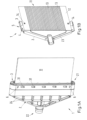
- Figure 1B is a longitudinal sectional view of the Figure 1A
- a seal 4 is shown here, which is arranged between the housing 2 and the locking element 3.
- the seal 4 can be designed as an O-ring that completely surrounds the first fluid line 11, so that no fluid can flow from the fluid lines to the outside of the connector 1.
- the housing 2 and the locking element 3 are designed and arranged in relation to one another in such a way that a receiving section 5 is formed for receiving the seal 4.
- the seal 4 is held in a chamber which forms the receiving section 5 and which is delimited radially outwards by the housing 2 and/or the locking element 3, radially inwards by the first fluid line 11 and in the two axial directions on the one hand by the housing 2 and on the other hand by the locking element 3.
- a fluid channel 23 is shown within the connector 1, which fluidically connects the two fluid lines to one another.
- the fluid channel 23 is flat. It can essentially have a triangular basic shape.
- the fluid channel 23 widens from the first connection section 21 to the second connection section 22, so that in the areas in which it communicates with the fluid lines, it essentially has the same width as the fluid lines. This enables the flow through the fluid channel 23 and thus the connector 1 to be as low in loss as possible.
- the first fluid line 11 comprises a plurality of line channels 13, for example, which run parallel, and that an edge region 12 without such line channels 13 is provided between the line channels 13 and the upper and lower edges of the fluid line 11.
- a passage 14 is shown at the bottom and top, into which locking elements or snap connections 32 can be inserted to lock the fluid line 11 to the connector 1.
- Figure 1B shows that the connector 1 can consist of exactly three components: housing 2, locking element 3 and seal 4. If no snap connection 32 is used as the locking element but, for example, a locking pin, the connector 1 can consist of exactly four different components, whereby more than one locking pin can of course also be used.
- Figures 2A and 2B show different views of the locking element 3.
- the locking element 3 has snap connections 32, while the housing 2 must have corresponding recesses 31 or passages into which the snap connections 32 can snap into place.
- the exemplary embodiment shows a total of ten snap connections 32, with five snap connections 32 arranged opposite one another.
- the locking element 3 comprises passages or holes as locking sections 6.
- corresponding snap connections 32 and/or locking sections 6 are provided on the housing 2. If the snap connections are additionally or alternatively provided on the housing 2, corresponding recesses 31 must of course be present on the locking element 3 in order to enable locking.
- Figure 2B shows ribs 33 arranged inside the locking element 3, which are designed to touch the first fluid line 11 and to secure it within the locking housing 3.
- one rib 33 and one snap connection 32 can be arranged alternately.
- the ribs 33 can be arranged along a long side and a wide side of the locking element 3.
- two ribs 33' can be arranged in a plane of symmetry of the locking element 3. These two ribs 33' can touch or lock the fluid line 11 laterally.
- Figures 3A and 3B show two sectional views of the connector arrangement, in which details of the position of the first fluid line 11 and the coupling of the housing 2 with the locking element 3 can be seen.
- the first fluid line 11 is partially introduced into the fluid channel 23, thereby achieving a better coupling of the fluid line 11 with the connector 1.
- two snap connections 32 of the locking element 3 are shown in a locked state.
- the snap connections 32 extend into corresponding recesses 31 of the housing 2 and thus secure the locking element 3 to the housing 2.
- the locking element 3 is further secured to the housing 2 by an edge section 34 of the locking element 3, which rests on a peripheral edge region of the housing 2 and forms a stop.
- the edge section 34 and the snap connections 32 together secure the locking element 3 to the housing 2 in both axial directions.
- both the housing 2 and the locking element 3 can be designed symmetrically with respect to the plane in which the first fluid line 11 extends. It can also be seen that the receiving section 5 extends approximately the same distance in the axial direction as the locking element 3. In particular, it is conceivable that the axial extent of the receiving section 5 corresponds to at least 50% of the axial extent of the locking element 3.
- Figure 4 finally shows a cross-sectional view of the first fluid line 11. It can be seen that a plurality of longitudinal partition walls are provided within the fluid line 11, which separate a corresponding plurality of line channels 13 from one another within the fluid line 11.
- the line channels 13 do not extend over the entire width of the fluid line 11, but there is an edge region 12 to the left and right of the line channels 13, in which no line channels 13 are provided.
- This edge region 12 can extend up to half the width of the fluid line 11.
- the width of the fluid line 11 is defined as its horizontal extension in Figure 4
- the axial direction is to be understood as the direction perpendicular to the plane of the drawing.
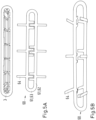
- Figure 5A shows a locking element 60 in a half-finished state and above it, for comparison, a locking element 3.
- the locking element 60 can be a metal clamping piece which is made from a circuit board or from a metal sheet.
- the locking element 60 can be cut out of a metal sheet, for example, using a laser cutter.
- the locking element can comprise a circumferential section 61, which consists of two parallel and/or straight longitudinal sections 62 and two curved sections 63 connecting the longitudinal sections 62.
- the sections mentioned form a continuous circumferential section 61 through which the first fluid line 11 can be passed in the completed state of the circumferential section 60.
- the completed state of the circumferential section 60 is shown in Figure 5B.
- the length of a longitudinal section 62 corresponds approximately to the width of the first fluid line 11.
- Bending sections 64 are provided along the longitudinal sections 62 of the circumferential section 61.
- a total of six bending sections 64 can be provided on the outer edge of the circumferential section 61, two of which are arranged opposite each other. Bending sections 64 can also be provided on the inner edge of the circumferential section 61.
- the inner bending sections 64 can each be arranged offset from each other.
- the inner bending sections 64 can be designed to be shorter than the outer bending sections 64.
- both the peripheral section and the bending sections 64 can be arranged in one plane.
- the bending sections 64 of the locking element 60 can be arranged along the longitudinal sections 62 such that the bending sections 64 are at least partially located between ribs of the locking element 3 in the assembled state of the connector 1.
- Figure 5B shows the locking element 60 in a finished state, in which all bending sections 64 are bent in one direction by approximately 80°-90°.
- the locking element 60 can be coupled to the other components of the connector 1, wherein the first fluid line 11 can be guided through the passage of the circumferential section 61 delimited by the circumferential section 61.
- Figure 6 shows an exploded view of a connector arrangement with a locking element 60, which is arranged between the housing 2 and the locking element 3.
- the first fluid line 11 is pushed into the locking element 60, which is located within the further structure of the connector, to assemble the connector arrangement.
- the bending sections 64 of the locking element 60 can be located at least partially within the housing 2 in the fully assembled state of the connector arrangement.
- the circumferential section 61 of the locking element 60 lies between contact surfaces of the housing 2 and the locking element 3 in the fully assembled state and is thereby secured.
- Figure 7 shows the functionality of the locking element 60.
- the housing 2 and the locking element 3 are not shown. Due to the one-sided shape of the The geometry or the bending sections 64 of the locking element 60 have a geometry that resembles barbs. These barbs prevent the aluminum profile or the first fluid line 11 from being accidentally pulled out in the opposite direction to the assembly direction (upper arrow). However, the assembly of the fluid line 11 is still possible by simply plugging it into the connector 1 (lower arrow).
Landscapes
- Engineering & Computer Science (AREA)
- General Engineering & Computer Science (AREA)
- Mechanical Engineering (AREA)
- Manufacturing & Machinery (AREA)
- Chemical & Material Sciences (AREA)
- Chemical Kinetics & Catalysis (AREA)
- Electrochemistry (AREA)
- General Chemical & Material Sciences (AREA)
- Quick-Acting Or Multi-Walled Pipe Joints (AREA)
- Joints With Sleeves (AREA)
- Flanged Joints, Insulating Joints, And Other Joints (AREA)
Description
- Die Erfindung betrifft einen Verbinder gemäß dem Oberbegriff von Anspruch 1 und eine Verbinderanordnung gemäß Anspruch 10.
- Aus dem Stand der Technik sind unterschiedliche Verbinder zum Verbinden unterschiedlich dimensionierter Fluidleitungen bekannt. Im Bereich von Elektrofahrzeugen werden beispielsweise Verbinder benötigt, mittels derer unterschiedliche Fluidleitungen einer Temperaturregelungseinrichtung von Energiespeichern miteinander koppelbar sind. Bei den Energiespeichern kann es sich beispielsweise um Akkumulatoren oder Batterien handeln. Die vorliegende Erfindung bezieht sich auf einen solchen Verbinder, der im Bereich einer Temperaturregelungseinrichtung Verwendung finden kann. Erfindungsgemäße Verbinder und Verbinderanordnungen können selbstverständlich auch in anderen Bereichen als im Fahrzeugbau bzw. Elektrofahrzeugbau eingesetzt werden. In Frage kommt der Einsatz prinzipiell in allen Bereichen bzw. Anwendungen, in welchen unterschiedlich dimensionierte Fluidleitungen miteinander verbunden werden und ein erhöhter Kühlbedarf bei begrenztem Bauraum besteht. Denkbar ist der Einsatz im Anlagenbau, insbesondere in der Chemieindustrie, im Bereich der Lebensmittelindustrie oder der Pharmaindustrie. Der Einsatz der Erfindung ist besonders dort denkbar, wo Produktionsanlagen gekühlt werden müssen und wo beschränkte Platzverhältnisse herrschen bzw. wo der vorhandene Bauraum begrenzt ist. Der Einsatz ist ferner in Nutzfahrzeugen mit herkömmlichen Antrieben denkbar, beispielsweise bei Baggern, Forstmaschinen und Schienenfahrzeugen.
- Gattungsgemäße Verbinder werden dazu genutzt, um übliche Rohrleitungen kreisförmigen Querschnitts mit Flachprofilen bzw. mit Leitungen zu verbinden, die einen flachen, länglichen Querschnitt aufweisen, und bei denen eine Mehrzahl voneinander getrennter, in der Regel parallel verlaufender Leitungskanälen ein entsprechendes Flachprofil bilden.
- Die
US2017343144 A1 zeigt eine Fluidverbindungsanordnung, die einen Verbindungskörper umfasst mit einem Zwischenabschnitt, der sich zwischen gegenüberliegenden Endabschnitten erstreckt und eine erste Bohrung aufweist. Der Verbinderkörper hat eine längliche Wand, die von dem Zwischenabschnitt nach außen ragt und eine zweite Bohrung umgibt, die sich in die erste Bohrung öffnet. Ein flaches Rohr, das aus einem zweiten Material besteht, das sich von dem ersten Material unterscheidet, und das mindestens einen Fluiddurchlass aufweist, steht in Fluidverbindung mit der zweiten Bohrung des Verbinderkörpers. - Hierbei bestehen hohe Anforderungen an die Betriebssicherheit der Energiespeicher, der entsprechenden Temperaturregelungseinrichtung und somit auch der darin verbauten Verbinder.
- Es müssen insbesondere die in der Autobranche üblichen Sicherheitsstandards eingehalten werden. Es ist zum Beispiel sicherzustellen, dass jegliche Leckagen innerhalb des Energiespeichers verhindert werden. Ferner müssen die Verbinder dazu ausgelegt sein, den Druckverhältnissen in üblicherweise eingesetzte Fluiden wie Wasser-Glykol-Gemischen zu widerstehen.
- Ein Grundproblem bei derartigen Verbindern ergibt sich daraus, dass sie Leitungen zweier völlig unterschiedlicher Geometrien miteinander sicher koppeln müssen, von denen eine gänzlich unübliche Geometrie mit einem schmalen, nahezu linienförmigen Querschnitt ist. Dieser schmale Querschnitt verkompliziert die notwendige Abdichtung der Verbindung. Außerdem erschwert es der schmale Querschnitt mit seinen entsprechenden geraden Ebenen die flachröhrenförmige Leitung in axialer Richtung am Verbinder zu fixieren. Denn das Flachprofil kann beispielsweise nicht mittels eines Gewindes gesichert werden.
- Durch die schnell fortschreitende Entwicklung im Bereich der Ladegeschwindigkeit von Energiespeichern und der Leistungsanforderungen entsprechender Elektrofahrzeuge steigert sich auch die Anforderung an die Temperaturregelungseinrichtung der Energiespeicher. Dies wiederum macht es erforderlich entsprechende Verbesserung auch im Bereich der Fluidleitungen und deren Verbindern umzusetzen.
- Vor diesem Hintergrund ist es Aufgabe der Erfindung, einen verbesserten Verbinder bereitzustellen, mittels dem Fluidleitungen deutlich unter-schiedlicher Geometrien dicht und fest miteinander gekoppelt werden können. Der Verbinder soll zudem möglichst einfach in der Herstellung sein und eine einfache möglichst werkzeuglose und/oder automatische Herstellung einer entsprechenden Verbindung ermöglichen. Der Verbinder kann im Bereich automobiler Energiespeicher und allgemein in jeglichen Bereichen Verwendung finden, in denen unterschiedlichen Fluidleitungen miteinander gekoppelt werden müssen. Der Verbinder bietet besondere Vorteile in Bereichen mit beschränktem Bauraum und in Anwendungen mit erhöhtem Kühlbedarf. Hauptmerkmale der Erfindung sind in den Ansprüchen 1 und 10 angegeben. Ausgestaltungen sind Gegenstand der Ansprüche 2 bis 9.
- Die Erfindung betrifft einen Verbinder für zwei Fluidleitungen bzw. für Mehrkammerprofile und/oder -leitungen unterschiedlicher Geometrien. Der Verbinder ist dazu eingerichtet, diese beiden Fluidleitungen miteinander zu verbinden. Der Verbinder umfasst ein Gehäuse, mit einem ersten und einem zweiten Anschlussabschnitt und mit einem fluidisch verbindenden Fluidkanal. Die Anschlussabschnitte sind dazu ausgebildet, mit den Fluidleitungen gekoppelt zu werden. Der Verbinder umfasst ferner ein Verriegelungselement, das mit dem Gehäuse koppelbar ist, und eine Dichtung, die zwischen dem Gehäuse und dem Verriegelungselement anordenbar ist. Das Verriegelungselement und das Gehäuse sind zueinander so anordenbar, dass zwischen dem Gehäuse und dem Verriegelungselement ein Aufnahmeabschnitt zur Aufnahme der Dichtung gebildet ist.
- Durch das Koppeln des Gehäuses mit dem Verriegelungselement kann die Dichtung und/oder eine der beiden Fluidleitungen an dem Verbinder festgestellt, insbesondere festgeklemmt werden. Das Gehäuse und das Verriegelungselement können beispielsweise formschlüssig so miteinander in Eingriff gebracht werden, dass die Dichtung zwischen den beiden Gehäuseteilen, also zwischen Gehäuse und Verriegelungselement, eingeschlossen, festgestellt und/oder zum Dichten unter Spannung gesetzt wird und dabei verformt wird. Die eine Fluidleitung kann im gekoppelten Zustand der beiden Gehäuseteile zumindest in eine radiale Richtung festgestellt sein. Als radiale Richtung ist vorliegend eine Richtung zu verstehen, die senkrecht zur Längsrichtung bzw. zur Hauptströmungsrichtung der Fluidleitung steht.
- Es ist ferner vorgesehen, dass der erste Anschlussabschnitt zum Anschließen einer ersten Fluidleitung mit einem länglichen Querschnitt ausgebildet ist und der zweite Anschlussabschnitt zum Anschließen einer zweiten Fluidleitung mit einem weiteren, insbesondere runden, Querschnitt ausgebildet ist.
- Weiterhin ist vorgesehen, dass am Verriegelungselement ein Feststellabschnitt vorgesehen ist, der zum Feststellen der ersten Fluidleitung ausgebildet ist und dass der Feststellabschnitt wenigstens eine Ausnehmung zum Einführen eines Feststellelements umfasst, wobei das Feststellelement dazu ausgebildet ist, die erste Fluidleitung formschlüssig am Verbinder festzustellen.
- Vorteilhafterweise können so zwei Fluidleitungen unterschiedlicher Geometrien einfach und kostengünstig leckagefrei miteinander verbunden werden.
- In einer bevorzugten Ausführungsform ist das Gehäuse und/oder das Verriegelungselement einstückig gefertigt, insbesondere spritzgegossen oder druckgegossen oder additiv hergestellt sind. Die Gehäuseteile können dabei entsprechend aus Metall und/oder Kunststoff gefertigt sein. Durch die Nutzung von Gussverfahren zur Gehäuseteilherstellung kann diese besonders kostengünstig und massenfertigungstauglich erfolgen. Unter additiven Herstellungsverfahren sind insbesondere alle gängigen 3D-Druckverfahren zu verstehen.
- In einer weiteren bevorzugten Ausführung ist denkbar, dass das Gehäuse und das Verriegelungselement miteinander verrastbar sind. Eine solche Verrastung stellt eine besonders günstige und einfach Form der Verbindung beider Komponenten dar. Hierzu können Schnappverbindungen und entsprechende Ausnehmungen an dem Gehäuseteil und dem Verriegelungselement vorgesehen sein, die miteinander in Eingriff stehen, wenn die beiden Teile in- bzw. aneinander positioniert werden
- In einer weiteren bevorzugten Ausführung ist denkbar, dass am Gehäuse ein Feststellabschnitt vorgesehen ist, der zum Feststellen der ersten Fluidleitung ausgebildet ist. Der Feststellabschnitt kann dazu ausgebildet sein, die erste Fluidleitung in einer axialen Richtung festzustellen. Hierdurch kann vorteilhafterweise sichergestellt werden, dass die Fluidleitung nicht ungewollt aus einem mit dem Verbinder gekoppelten Zustand in einem vom Verbinder entkoppelten Zustand wechselt und dadurch ein durch den Verbinder strömendes Fluid ungewollt aus diesem herausströmt.
- In einer besonders bevorzugten Ausführung kann dabei vorgesehen sein, dass der Feststellabschnitt wenigstens eine Schnappverbindung umfasst, wobei das Feststellelement und die Schnappverbindung dazu ausgebildet sind, die erste Fluidleitung formschlüssig am Verbinder festzustellen. Die Fluidleitung kann hierfür eine Ausnehmung oder Durchführung umfassen, in die das Feststellelement bzw. die Schnappverbindung wenigstens teilweise einführbar ist. In einer einfachen Ausführung kann die Schnappverbindung einstückig mit dem entsprechenden Gehäuseteil ausgeführt sein. Die Schnappverbindung kann so beschaffen sein, dass beim Einführen der ersten Fluidleitung in den Verbinder die Schnappverbindung in die Ausnehmung oder Durchführung der Fluidleitung einrastet. Die Fluidleitung ist dadurch in axialer Richtung festgestellt.
- In einer weiteren bevorzugten Ausführung ist denkbar, dass der Verbinder aus genau den drei Bauteilen Gehäuse, Verriegelungselement und Dichtung besteht oder dass der Verbinder aus den drei Bauteilen Gehäuse, Verriegelungselement, Dichtung und wenigstens einem Feststellelement besteht. Die beiden Fluidleitungen können in einem miteinander verbundenen Zustand mit allen genannten Bauteilen in unmittelbarem Kontakt sein. Bei dem Feststellelement kann es sich um ein von den anderen drei Bauteilen getrenntes Bauteil wie einen Sicherungsstift, eine Blecheinlage, welche insbesondere aus Federstahl gefertigt sein kann oder eine sonstige Arretierungsvorrichtung handeln.
- In einer weiteren bevorzugten Ausführung ist denkbar, dass die Außenmaße des Gehäuses und des Verriegelungselements in ihren Querschnitten einander gleichen. Hierdurch kann ein einheitliches Äußeres des Verbinders in einem Zustand sichergestellt werden, in welchem das Gehäuse und das Verriegelungselement miteinander gekoppelt sind. Die beiden Gehäuseteile können somit unterschiedliche Längserstreckungen aufweisen, aber keines der beiden Gehäuseteile erstreckt sich in einer radialen Richtung wesentlich weiter als das jeweils andere Gehäuseteil.
- In einer weiteren bevorzugten Ausführung ist denkbar, dass der Fluidkanal wenigstens abschnittsweise als flache und ebene Ausnehmung innerhalb des Gehäuses ausgebildet ist. Unter einer flachen Ausnehmung ist eine solche zu verstehen, die sich in zwei zueinander rechtwinklige Raumrichtungen deutlich weiter erstreck als in die dritte Raumrichtung. Ein solcher flächiger Fluidkanal als Verbindungskanal zwischen den zwei deutlich unterschiedlichen Fluidleitungen ermöglicht einen möglichst stetigen, ungehinderten Fluidstrom zwischen den beiden Fluidleitungen, welcher mit entsprechend niedrigem Durchflusswiderstand bzw. niedrigem Druckverlust aufrechterhalten werden kann.
- In einer weiteren bevorzugten Ausführung ist denkbar, dass die erste Fluidleitung wenigstens teilweise in den Fluidkanal einführbar ist, und/oder dass das Gehäuse außen Versteifungsrippen umfasst. Durch die planare bzw. flächige Ausführung des Fluidkanals kann die ebenfalls flächige bzw. flachrohrförmige erste Fluidleitung zumindest Teilweise in den Fluidkanal eingeführt werden und so eine möglichst gute Anbindung der ersten Fluidleitung an den Verbinder sichergestellt werden.
- Die Erfindung ist ferner auf eine Verbinderanordnung mit einem Verbinder gerichtet, wobei der Verbinder mit einer als Flachkanal ausgebildeten Fluidleitung gekoppelt ist. Vorteilhafterweise kann die Verbinderanordnung gegebenenfalls vormontiert werden und so einfacher in weitere Montageschritte bei der Montage eines Energiespeichers verwendet werden.
- Weitere Merkmale, Einzelheiten und Vorteile der Erfindung ergeben sich aus dem Wortlaut der Ansprüche sowie aus der folgenden Beschreibung von Ausführungsbeispielen anhand der Zeichnungen. Es zeigen:
- Fig. 1A:
- eine perspektivische Ansicht einer Verbinderanordnung;
- Fig. 1B:
- eine perspektivische Längsschnittansicht einer Verbinderanordnung;
- Fig. 2A:
- eine perspektivische Ansicht eines Verriegelungselements;
- Fig. 2B:
- eine weitere perspektivische Ansicht des Verriegelungselements;
- Fig. 3A:
- eine weitere perspektivische Längsschnittansicht der Verbinderanordnung;
- Fig. 3B:
- eine seitliche Längsschnittansicht der Verbinderanordnung;
- Fig. 4:
- eine Querschnittansicht der ersten Fluidleitung;
- Fig. 5A:
- eine Draufsicht eines Feststellelements in einem halbfertigen Zustand;
- Fig. 5B:
- eine perspektivische Ansicht eines Feststellelements im Fertigzustand;
- Fig 6:
- eine Explosionsansicht einer Verbinderanordnung mit Feststellelement; und.
- Fig 7:
- die Funktionsweise des Feststellelements.
-
Figur 1A zeigt eine Verbinderanordnung mit einem Verbinder 1 für zwei Fluidleitungen, wobei eine erste Fluidleitung 11 rechts am ersten Anschlussabschnitt 21 gezeigt ist und eine zweite Fluidleitung nicht gezeigt aber links am zweiten Anschlussabschnitt 22 mit dem Verbinder 1 koppelbar ist. Die Verbindung der zweiten Fluidleitung kann über beliebige Standardverbindungen wie beispielsweise über eine SAE-Verbindung erfolgen. Der erste Anschlussabschnitt 21 kann ein Bereich im Inneren eines Gehäuses 2 des Verbinders 1 sein. - Die erste Fluidleitung 11 kann als sehr flaches Flachrohr bzw. Flachprofil ausgebildet sein, während die zweite Fluidleitung eine Fluidleitung mit einem üblichen kreisförmigen Querschnitt sein kann. Die beiden Fluidleitungen 11, können somit deutlich unterschiedliche Geometrien aufweisen.
- Die erste Fluidleitung 11 kann eine Breite von bis zu 120mm aufweisen bei einer Höhe von beispielsweise lediglich 3mm. Sie kann beispielsweise aus Aluminium bzw. einer Aluminiumlegierung, einer anderen Metalllegierung oder einem geeigneten Kunststoff gefertigt sein.
- Im Gehäuse 2 mit dem ersten und dem zweiten Anschlussabschnitt 21, 22 ist ein beide Anschlussabschnitte 21, 22 fluidisch verbindender Fluidkanal 23 vorgesehen, der in der folgenden
Figur 1B gezeigt ist. Ein Verriegelungselement 3 ist mit dem Gehäuse 2 gekoppelt. Das Verriegelungselement 3 kann auch als Klemmstück bezeichnet werde. Das Gehäuse 2 weist Versteifungsrippen 24 auf, die insbesondere in einem Bereich angeordnet sein können, der dem zweiten Anschlussabschnitt 22 benachbart und von dem ersten Anschlussabschnitt 21 weiter entfernt ist. - Sowohl das Gehäuse 2 als auch das Verriegelungselement 3 können einstückig gefertigt, insbesondere spritzgegossen oder druckgegossen sein. Wie in
Figur 1A angedeutet ist, können das Gehäuse 2 und das Verriegelungselement 3 miteinander verrastet sein. Es sind hierfür fünf übereinander angeordnete längliche Ausnehmungen 31 gezeigt, in die die in den folgenden Figuren gezeigten Schnappverbindung 32 einrasten. - Am Verriegelungselement 3 sind zwei Bohrungen als Feststellabschnitt 6 gezeigt. In diese Bohrungen oder auch Ausnehmungen kann ein nicht weiter gezeigtes Feststellelement eingeführt werden, welches sich auch durch eine entsprechende Ausnehmung oder Bohrung der erste Fluidleitung 11 erstreckt. Auf diese Weise kann die Fluidleitung 11 bezogen auf den Verbinder 1 festgestellt werden.
- Alternativ oder zusätzlich kann als Feststellabschnitt 6 auch wenigstens eine Schnappverbindung 32 vorgesehen sein, die ebenfalls dazu ausgebildet ist, die erste Fluidleitung 11 formschlüssig am Verbinder 1 festzustellen. Diese Schnappverbindung 32 kann an einer Innenseite des Gehäuses 2 und/oder des Verriegelungselements 3 angeordnet und in Richtung auf die darin anordenbare ersten Fluidleitung 11 ausgerichtet sein. Beim Einführen der ersten Fluidleitung 11 in das Gehäuse 2 bzw. in das Verriegelungselement 3 kann diese Schnappverbindung 32 in eine entsprechende Ausnehmung oder Bohrung der ersten Fluidleitung 11 einrasten und so diese Fluidleitung 11 am Verbinder 2 feststellen.
-
Figur 1A zeigt ferner, dass die Außenmaße des Gehäuses 2 und des Verriegelungselements 3 in ihren Querschnitten einander gleichen. So erstrecken sich beide Gehäuseteile 2, 3 inFigur 1A in vertikaler Richtung und in Richtung der Zeichenebene im Wesentlichen gleich weit. Demgegenüber erstreckt sich das Gehäuse 2 in axialer Richtung beziehungsweise in etwa in der horizontalen Richtung derFigur 1A deutlich weiter, nämlich mehr als 2 oder mehr als 3 mal so weit, wie das Verriegelungselement 3. -
Figur 1B ist eine Längsschnittansicht der inFigur 1A gezeigten Verbinderanordnung. Zusätzlich zu den inFigur 1A erkennbaren Komponenten ist hier eine Dichtung 4 gezeigt, die zwischen dem Gehäuse 2 und dem Verriegelungselement 3 angeordnet ist. Die Dichtung 4 kann als O-Ring ausgebildet sein, der die erste Fluidleitung 11 vollumfänglich umgreift, so dass kein Fluid aus den Fluidleitungen nach außerhalb des Verbinders 1 strömen kann. - Das Gehäuse 2 und das Verriegelungselement 3 sind so ausgebildet und so zueinander angeordnet, dass ein Aufnahmeabschnitt 5 zur Aufnahme der Dichtung 4 gebildet ist. Die Dichtung 4 wird dabei in einer Kammer gehalten, die den Aufnahmeabschnitt 5 bildet, und die nach radial außen von dem Gehäuse 2 und/oder dem Verriegelungselement 3, nach radial innen von der ersten Fluidleitung 11 und in den beiden axialen Richtungen zum einen von dem Gehäuse 2 und zum anderen von dem Verriegelungselement 3 begrenzt ist.
- Innerhalb des Verbinders 1 ist ein Fluidkanal 23 gezeigt, der die beiden Fluidleitungen miteinander fluidisch verbindet. Der Fluidkanal 23 ist flächig ausgebildet. Er kann im Wesentlichen eine dreieckige Grundform haben. Der Fluidkanal 23 verbreitert sich vom ersten Anschlussabschnitt 21 zum zweiten Anschlussabschnitt 22, so dass er in den Bereichen, in denen er mit den Fluidleitungen kommuniziert im Wesentlichen deren Breitenerstreckung aufweist. Hierdurch kann eine möglichst verlustarme Durchströmung des Fluidkanals 23 und damit des Verbinders 1 ermöglicht werden.
- Es ist ferner zu erkennen, dass die erste Fluidleitung 11 eine Mehrzahl beispielsweise parallel verlaufender Leitungskanäle 13 umfasst und zwischen den Leitungskanälen 13 und dem oberen und unteren Rand der Fluidleitung 11 je ein Randbereich 12 ohne derartige Leitungskanäle 13 vorgesehen ist. In diesem Randbereich 12 sind unten und oben je eine Durchführung 14 gezeigt, in die Feststellelemente bzw. Schnappverbindung 32 zum Feststellen der Fluidleitung 11 an dem Verbinder 1 eingeführt sein können.
-
Figur 1B zeigt, dass der Verbinder 1 aus den genau drei Bauteilen Gehäuse 2, Verriegelungselement 3 und Dichtung 4 bestehen kann. Falls als Feststellelement keine Schnappverbindung 32 sondern beispielsweise ein Sicherungsstift genutzt wird, so kann der Verbinder 1 aus genau vier verschiedenen Bauteilen bestehen, wobei selbstverständlich auch mehr als ein einzelner Sicherungsstift verwendet werden kann. -
Figuren 2A und 2B zeigen unterschiedliche Ansichten des Verriegelungselements 3. In dieser Ausführungsform weist das Verriegelungselement 3 Schnappverbindungen 32 auf, während das Gehäuse 2 entsprechende Ausnehmungen 31 oder Durchführungen aufweisen muss, in die die Schnappverbindungen 32 einrasten können. Das Ausführungsbeispiel zeigt insgesamt zehn Schnappverbindungen 32, wobei je fünf Schnappverbindungen 32 einander gegenüber angeordnet sind. Ferner ist zu erkennen, dass das Verriegelungselement 3 Durchführungen bzw. Bohrungen als Feststellabschnitte 6 umfasst. Denkbar ist jedoch auch eine Ausführung, bei der alternativ oder zusätzlich entsprechende Schnappverbindungen 32 und/oder Feststellabschnitte 6 an dem Gehäuse 2 vorgesehen sind. Falls die Schnappverbindungen zusätzlich oder alternativ am Gehäuse 2 vorgesehen sind, so müssen entsprechende Ausnehmungen 31 selbstverständlich am Verriegelungselement 3 vorhanden sein, um eine Verrastung zu ermöglichen. -
Figur 2B zeigt im Inneren des Verriegelungselements 3 angeordnete Rippen 33, welche dazu eingerichtet sind, die erste Fluidleitung 11 zu berühren und diese innerhalb des Verriegelungsgehäuses 3 festzustellen. Hierbei können je eine Rippe 33 und eine Schnappverbindung 32 abwechselnd angeordnet sein. Die Rippen 33 können entlang einer Längsseite und einer Breitseite des Verriegelungselements 3 angeordnet sein. Insbesondere können zwei Rippen 33' in einer Symmetrieebene des Verriegelungselements 3 angeordnet sein. Diese zwei Rippen 33' können die Fluidleitung 11 seitlich berühren bzw. feststellen. -
Figuren 3A und 3B zeigen zwei Schnittansichten der Verbinderanordnung, bei denen Details zur Lage der ersten Fluidleitung 11 und zur Kopplung des Gehäuses 2 mit dem Verriegelungselement 3 erkennbar sind. So ist die erste Fluidleitung 11 teilweise in den Fluidkanal 23 eingeführt und hierdurch eine bessere Kopplung der Fluidleitung 11 mit dem Verbinder 1 erreicht. - Es sind des Weiteren zwei Schnappverbindungen 32 des Verriegelungselements 3 in einem eingerasteten Zustand gezeigt. Hierbei erstrecken sich die Schnappverbindungen 32 in entsprechende Ausnehmungen 31 des Gehäuses 2 und stellen somit das Verriegelungselement 3 am Gehäuse 2 fest. Eine weitere Feststellung des Verriegelungselements 3 am Gehäuse 2 erfolgt durch einen Randabschnitt 34 des Verriegelungselements 3, welcher an einem umlaufenden Randbereich des Gehäuses 2 aufliegt und einen Anschlag bildet. Der Randabschnitt 34 und die Schnappverbindungen 32 stellen zusammen das Verriegelungselement 3 in beide axialen Richtungen am Gehäuse 2 fest.
- Wie weiter aus den
Figuren 3A und 3B hervorgeht, können sowohl das Gehäuse 2 als auch das Verriegelungselement 3 symmetrisch bezüglich der Ebene ausgebildet sein, in welcher sich die erste Fluidleitung 11 erstreckt. Ferner ist zu erkennen, dass sich der Aufnahmeabschnitt 5 in etwa gleich weit in axialer Richtung erstreckt, wie das Verriegelungselement 3. Insbesondere ist denkbar, dass die axiale Erstreckung des Aufnahmeabschnitts 5 mindestens 50% der axialen Erstreckung des Verriegelungselements 3 entspricht. -
Figur 4 zeigt schließlich eine Querschnittansicht der ersten Fluidleitung 11. Hierbei ist zu erkennen, dass innerhalb der Fluidleitung 11 eine Vielzahl von längsverlaufenden Trenn-wänden vorgesehen ist, die innerhalb der Fluidleitung 11 eine entsprechende Vielzahl von Leitungskanälen 13 voneinander abtrennen. Die Leitungskanäle 13 erstrecken sich dabei nicht über die gesamte Breite der Fluidleitung 11, sondern es besteht ein Randbereich 12 links und rechts von den Leitungskanälen 13, in welchem keine Leitungskanäle 13 vorgesehen sind. Dieser Randbereich 12 kann sich insgesamt auf bis zu der Hälfte der Breite der Fluidleitung 11 erstrecken. Die Breite der Fluidleitung 11 ist als deren horizontale Erstreckung inFigur 4 zu verstehen, die axiale Richtung als die auf die Zeichenebene senkrecht stehende Richtung. -
Figur 5A zeigt ein Feststellelement 60 in einem halbfertigen Zustand und darüber zum Vergleich ein Verriegelungselement 3. Das Feststellelement 60 kann ein Metall-Klemmstück sein, welches aus einer Platine bzw. aus einem Metallblech hergestellt ist. Das Feststellelement 60 kann beispielsweise mittels eines Laserschneiders aus einem Metallblech herausgeschnitten sein. - Das Feststellelement kann einen Umlaufabschnitt 61 umfassen, welcher aus zwei parallelen und/oder geraden Längsabschnitten 62 und zwei die Längsabschnitte 62 verbindenden Bogenabschnitten 63 bestehen. Die genannten Abschnitte bilden einen zusammenhängenden Umlaufabschnitt 61, durch welchen die erste Fluidleitung 11 im fertiggestellten Zustand des Umlaufabschnitts 60 durchführbar ist. Der fertiggestellte Zustand des Umlaufabschnitts 60 ist in Figur 5B gezeigt. Die Länge eines Längsabschnittes 62 entspricht in etwa der Breite der ersten Fluidleitung 11.
- Entlang der Längsabschnitte 62 des Umlaufabschnitts 61 sind Biegeabschnitte 64 vorgesehen. Es können insgesamt sechs am äußeren Rand des Umlaufabschnitts 61 angeordnete Biegeabschnitte 64 vorgesehen sein, von denen jeweils zwei einander gegenüber angeordnet sind. Am inneren Rand des Umlaufabschnitts 61 können ebenfalls Biegeabschnitte 64 vorgesehen sein. Die innen liegenden Biegeabschnitte 64 können jeweils versetzt zueinander angeordnet sein. Die innen liegenden Biegeabschnitte 64 können kürzer als die außen liegenden Biegeabschnitte 64 ausgebildet sein. In dem in
Figur 5A gezeigten halbfertigen Zustand des Feststellelements 60 können sowohl der Umlaufabschnitt als auch die Biegeabschnitte 64 in einer Ebene angeordnet sein. Die Biegeabschnitte 64 des Feststellelements 60 können so entlang der Längsabschnitte 62 angeordnet sein, dass die Biegeabschnitte 64 im montierten Zustand des Verbinders 1 wenigstens teilweise zwischen Rippen des Verriegelungselements 3 vorliegen. -
Figur 5B zeigt das Feststellelement 60 in einem fertiggestellten Zustand, bei dem alle Biegeabschnitte 64 in eine Richtung um ca. 80°-90° gebogen sind. In diesem Zustand kann das Feststellelement 60 mit den weiteren Komponenten des Verbinders 1 gekoppelt werden, wobei die erst Fluidleitung 11 durch die vom Umlaufabschnitt 61 umgrenzte Durchführung des Umlaufabschnitts 61 hindurchgeführt sein kann. -
Figur 6 zeigt eine Explosionsansicht einer Verbinderanordnung mit einem Feststellelement 60, welches zwischen dem Gehäuse 2 und der Verriegelungselement 3 angeordnet ist. Die erste Fluidleitung 11 wird zur Montage der Verbinderanordnung in das Feststellelement 60 geschoben, welches sich innerhalb des Weiteren Gefüges des Verbinders befindet. Die Biegeabschnitte 64 des Feststellelements 60 können im fertigmontierten Zustand der Verbinderanordnung wenigstens teilweise innerhalb des Gehäuses 2 verortet sein. Der Umlaufabschnitt 61 des Feststellelements 60 liegt im fertigmontierten Zustand, zwischen Anlageflächen des Gehäuses 2 und des Verriegelungselements 3 und wird dadurch festgestellt. -
Figur 7 zeigt die Funktionsweise des Feststellelements 60. Zur Verdeutlichung sind das Gehäuse 2 und das Verriegelungselement 3 nicht gezeigt. Durch die einseitige Ausformung der Geometrie bzw. der Biegeabschnitte 64 des Feststellelements 60 liegt eine Geometrie vor, welche Wiederhaken ähnelt. Diese Wiederhaken verhindern ein ungewolltes herausziehen des Alu-Profils bzw. der ersten Fluidleitung 11 in entgegengesetzter Richtung zur Montagerichtung (oberer Pfeil). Die Montage der Fluidleitung 11 hingegen ist durch einfaches einstecken in den Verbinder 1 weiterhin möglich (unterer Pfeil). -
- 1
- Verbinder
- 2
- Gehäuse
- 3
- Verriegelungselement
- 4
- Dichtung
- 5
- Aufnahmeabschnitt
- 6
- Feststellabschnitt
- 11
- erste Fluidleitung
- 12
- Randbereich
- 13
- Leitungskanal
- 14
- Durchführung
- 21
- erster Anschlussabschnitt
- 22
- zweiter Anschlussabschnitt
- 23
- Fluidkanal
- 24
- Versteifungsrippe
- 31
- Ausnehmung
- 32
- Schnappverbindung
- 33, 33'
- Rippe
- 34
- Randabschnitt
- 60
- Feststellelement
- 61
- Umlaufabschnitt
- 62
- Längsabschnitt
- 63
- Bogenabschnitt
- 64
- Biegeabschnitt
Claims (10)
- Verbinder (1) für zwei Fluidleitungen unterschiedlicher Geometrien, mit einem Gehäuse (2), das einen ersten und einen zweiten Anschlussabschnitt (21, 22) und einen beide Anschlussabschnitte (21, 22) fluidisch verbindenden Fluidkanal (23) umfasst,einem Verriegelungselement (3), das mit dem Gehäuse (2) koppelbar ist, undeiner Dichtung (4), die zwischen dem Gehäuse (2) und dem Verriegelungselement (3) anordenbar ist,wobei das Verriegelungselement (3) und das Gehäuse (2) bezüglich des Fluidkanals (23) so zueinander anordenbar sind, dass zwischen dem Gehäuse (2) und dem Verriegelungselement (3) ein Aufnahmeabschnitt (5) zur Aufnahme der Dichtung (4) gebildet ist,dadurch gekennzeichnet, dassder erste Anschlussabschnitt (21) zum Anschließen einer ersten Fluidleitung (11) mit einem länglichen Querschnitt ausgebildet ist und der zweite Anschlussabschnitt (22) zum Anschließen genau einer zweiten Fluidleitung mit einem weiteren, insbesondere runden, Querschnitt ausgebildet ist,wobei ein Feststellelement (60) und am Verriegelungselement (3) ein Feststellabschnitt (6) vorgesehen sind, die zum Feststellen der ersten Fluidleitung (11) ausgebildet sind, wobei das Feststellelement (60) in wenigstens eine Ausnehmung des Feststellabschnitts (6) und eine Ausnehmung oder Durchführung der ersten Fluidleitung (11) einführbar ist, undwobei das Feststellelement (60) dazu ausgebildet ist, die erste Fluidleitung (11) formschlüssig am Verbinder (1) festzustellen.
- Verbinder (1) nach Anspruch 1, dadurch gekennzeichnet, dass das Gehäuse (2) und/oder das Verriegelungselement (3) einstückig gefertigt, insbesondere spritzgegossen oder druckgegossen oder additiv hergestellt sind.
- Verbinder (1) nach Anspruch 1 oder 2, dadurch gekennzeichnet, dass das Gehäuse (2) und das Verriegelungselement (3) miteinander verrastbar sind.
- Verbinder (1) nach einem der vorhergehenden Ansprüche, dadurch gekennzeichnet, dass am Gehäuse (2) ein Feststellabschnitt (6) vorgesehen ist, der zum Feststellen der ersten Fluidleitung (11) ausgebildet ist.
- Verbinder (1) nach Anspruch 4, dadurch gekennzeichnet, dass der Feststellabschnitt (6) wenigstens eine Schnappverbindung umfasst, wobei die Schnappverbindung dazu ausgebildet ist, die erste Fluidleitung (11) formschlüssig am Verbinder (1) festzustellen.
- Verbinder (1) nach einem der vorhergehenden Ansprüche, dadurch gekennzeichnet, dass der Verbinder (1) aus den genau drei Bauteilen Gehäuse (2), Verriegelungselement (3) und Dichtung (4) besteht oder dass der Verbinder aus den drei Bauteilen Gehäuse (2), Verriegelungselement (3), Dichtung (4) und wenigstens einem Feststellelement (60) besteht.
- Verbinder (1) nach einem der vorhergehenden Ansprüche, dadurch gekennzeichnet, dass die Außenmaße des Gehäuses (2) und des Verriegelungselements (3) in ihren Querschnitten einander gleichen.
- Verbinder (1) nach einem der vorhergehenden Ansprüche, dadurch gekennzeichnet, dass der Fluidkanal (23) wenigstens abschnittsweise als flache und ebene Ausnehmung innerhalb des Gehäuses (2) ausgebildet ist.
- Verbinder (1) nach dem vorhergehenden Anspruch, dadurch gekennzeichnet, dass die erste Fluidleitung (11) wenigstens teilweise in den Fluidkanal (23) einführbar ist, und/oder dass das Gehäuse (2) außen Versteifungsrippen (24) umfasst.
- Verbinderanordnung mit einem Verbinder (1) nach einem der Ansprüche 1 bis 9, dadurch gekennzeichnet, dass der Verbinder (1) mit einer als Flachkanal ausgebildeten ersten Fluidleitung (11) gekoppelt ist.
Applications Claiming Priority (2)
| Application Number | Priority Date | Filing Date | Title |
|---|---|---|---|
| DE102019129828.8A DE102019129828A1 (de) | 2019-11-05 | 2019-11-05 | Verbinder und Verbinderanordnung für Mehrkammerprofile und/oder -leitungen |
| PCT/EP2020/080639 WO2021089459A1 (de) | 2019-11-05 | 2020-11-02 | Verbinder und verbinderanordnung für mehrkammerprofile und/oder -leitungen |
Publications (2)
| Publication Number | Publication Date |
|---|---|
| EP4055309A1 EP4055309A1 (de) | 2022-09-14 |
| EP4055309B1 true EP4055309B1 (de) | 2025-02-19 |
Family
ID=73476085
Family Applications (1)
| Application Number | Title | Priority Date | Filing Date |
|---|---|---|---|
| EP20808304.8A Active EP4055309B1 (de) | 2019-11-05 | 2020-11-02 | Verbinder und verbinderanordnung für mehrkammerprofile und/oder -leitungen |
Country Status (7)
| Country | Link |
|---|---|
| US (1) | US12305781B2 (de) |
| EP (1) | EP4055309B1 (de) |
| JP (1) | JP7488335B2 (de) |
| KR (1) | KR102812959B1 (de) |
| CN (1) | CN114423984B (de) |
| DE (1) | DE102019129828A1 (de) |
| WO (1) | WO2021089459A1 (de) |
Families Citing this family (1)
| Publication number | Priority date | Publication date | Assignee | Title |
|---|---|---|---|---|
| KR102631092B1 (ko) | 2023-12-08 | 2024-01-29 | 형남인 | 블라인드 설치용 버튼브라켓 |
Family Cites Families (22)
| Publication number | Priority date | Publication date | Assignee | Title |
|---|---|---|---|---|
| JPS58106693U (ja) * | 1982-01-14 | 1983-07-20 | 澤田 俊一 | ホ−スの継手 |
| JPS602087U (ja) * | 1983-06-18 | 1985-01-09 | 日本軽金属株式会社 | 管継手 |
| DE3615476A1 (de) * | 1985-05-10 | 1986-11-13 | Friedrich 82054 Sauerlach Bürcher | Uebergangsstueck fuer eine lueftungskanalinstallation |
| US5257904A (en) * | 1991-01-18 | 1993-11-02 | Sullivan John T | Volute housing for a centrifugal fan, blower or the like |
| US5062476A (en) * | 1991-02-28 | 1991-11-05 | General Motors Corporation | Heat exchanger with an extruded tank |
| DE9204442U1 (de) * | 1992-04-01 | 1992-07-16 | Daum, Ulrich, 3501 Ahnatal | Anstauvorrichtung für die Anzucht von Pflanzen oder Aussaaten und Wanne zu deren Herstellung |
| US5219461A (en) * | 1992-04-28 | 1993-06-15 | Baker Hughes Incorporated | Reinforced elastomer lining for pump casing and associated method of manufacture |
| JP2001178666A (ja) | 1999-12-27 | 2001-07-03 | Toshiba Tec Corp | 接続管およびこの接続管を用いた循環式電気掃除機 |
| US20030131981A1 (en) * | 2002-01-15 | 2003-07-17 | Kohler Gregory T. | Tank and cap assembly for use with microchannel tubing in a heat exchanger |
| DE202006006756U1 (de) | 2006-04-26 | 2006-07-06 | Bürcher, Friedrich | Kanalelemente für einen Kanal zum Führen von Strömungsmedien, Kabeln u.dgl. |
| DE202007000761U1 (de) * | 2007-01-12 | 2008-05-15 | Meister Plast Gmbh | Schlaucharmatur für einen Schlauch mit mehreren Schlauchkammern und Mehrkammerschlauch zum Anchluss an eine solche Armatur |
| US8689837B1 (en) * | 2009-12-10 | 2014-04-08 | Jeffrey E. Smith | Low profile downspout extension and landscape drainage assembly |
| SG182525A1 (en) * | 2010-01-15 | 2012-08-30 | Skyventure Internat Ltd | Wind tunnel turning vane heat exchanger |
| DE202010014349U1 (de) * | 2010-08-05 | 2012-01-02 | Hans Berg Gmbh & Co. Kg | Gehäuse für eine Stell- oder Ventileinrichtung |
| JP5997433B2 (ja) * | 2011-11-28 | 2016-09-28 | マルヤス工業株式会社 | Uターン型熱交換器 |
| FR3003332B1 (fr) | 2013-03-14 | 2015-04-10 | Staubli Sa Ets | Element femelle et raccord destines a realiser la jonction amovible de deux canalisations de fluide |
| US10765043B2 (en) * | 2016-01-04 | 2020-09-01 | Lisa Draexlmaier Gmbh | Heat exchanger for an electrical component in a motor vehicle and production method |
| US10208879B2 (en) * | 2016-05-31 | 2019-02-19 | A. Raymond Et Cie | Fluid connector assembly |
| CN108539319B (zh) | 2018-03-15 | 2024-03-08 | 华霆(合肥)动力技术有限公司 | 扁管接头及热量管控装置 |
| FR3080166B1 (fr) | 2018-04-16 | 2021-01-15 | Coutier Moulage Gen Ind | Rampe distributrice-collectrice de fluide |
| DE102018219171A1 (de) * | 2018-06-29 | 2020-01-02 | Hanon Systems | Batteriekühler |
| NO345706B1 (en) * | 2019-03-15 | 2021-06-21 | Hydro Extruded Solutions As | Multi Port Extrusion (MPE) connection to a header |
-
2019
- 2019-11-05 DE DE102019129828.8A patent/DE102019129828A1/de active Pending
-
2020
- 2020-11-02 WO PCT/EP2020/080639 patent/WO2021089459A1/de not_active Ceased
- 2020-11-02 US US17/774,580 patent/US12305781B2/en active Active
- 2020-11-02 EP EP20808304.8A patent/EP4055309B1/de active Active
- 2020-11-02 CN CN202080065619.4A patent/CN114423984B/zh active Active
- 2020-11-02 KR KR1020227012758A patent/KR102812959B1/ko active Active
- 2020-11-02 JP JP2022526245A patent/JP7488335B2/ja active Active
Also Published As
| Publication number | Publication date |
|---|---|
| CN114423984B (zh) | 2025-02-11 |
| KR20220062113A (ko) | 2022-05-13 |
| JP2023501414A (ja) | 2023-01-18 |
| US12305781B2 (en) | 2025-05-20 |
| DE102019129828A1 (de) | 2021-05-06 |
| CN114423984A (zh) | 2022-04-29 |
| EP4055309A1 (de) | 2022-09-14 |
| US20220399594A1 (en) | 2022-12-15 |
| KR102812959B1 (ko) | 2025-05-26 |
| WO2021089459A1 (de) | 2021-05-14 |
| JP7488335B2 (ja) | 2024-05-21 |
Similar Documents
| Publication | Publication Date | Title |
|---|---|---|
| EP2607118B1 (de) | Gehäuse insbesondere für eine Kraftfahrzeugklimaanlage | |
| EP0714008A2 (de) | Wärmetauscher mit einem Sammelrohr | |
| EP4127543B1 (de) | Steckverbinder mit vormontagesicherung | |
| WO2015180875A1 (de) | Steckverbinder für fluidleitungen mit innenliegender adapterhülse | |
| EP4406051A1 (de) | Kühlkörper | |
| EP4004413B1 (de) | Drehschieberventil für einen kühlkreislauf | |
| WO2015055340A1 (de) | Schieberventil, insbesondere für ein automatikgetriebe eines kraftfahrzeugs | |
| DE102017216423A1 (de) | Führungsschiene, Unterbau zum Befestigen einer Führungsschiene und Anordnung mit einer Führungsschiene und einem Unterbau | |
| EP2489534B1 (de) | Wärmetauscheranordnung, insbesondere für ein brennstoffbetriebenes Fahrzeugheizgerät | |
| EP4467860A2 (de) | Verwendung eines schlauchs zur fluidischen verbindung eines auslaufstücks mit einem ventil an einer sanitärarmatur, fluidische anordnung und korrespondierende sanitärarmatur | |
| DE102004028655A1 (de) | Wärmeübertrager, insbesondere gelöteter Heizkörper | |
| EP4055309B1 (de) | Verbinder und verbinderanordnung für mehrkammerprofile und/oder -leitungen | |
| DE102009036463A1 (de) | Kopplungsbaugruppe für eine Fahrzeug-Klimaanlage | |
| EP4405606B1 (de) | Steckverbinder mit vormontagesicherung | |
| EP3659222B1 (de) | Anordnung mit zwei über einen anreihverbinder miteinander verbundenen schaltschrankrahmengestellen | |
| EP1759159A1 (de) | Wärmetauscher | |
| DE102014108907B3 (de) | Verbindungsanordnung | |
| EP3591268B1 (de) | Fluidleitungsverbinder mit fixiertem einsatzteil zur drosslung | |
| DE102017109065B4 (de) | Verbindungssystem zur gas- und fluiddichten Verbindung eines Verflüssigers einer Wärmepumpe mit einem Verdampfer der Wärmepumpe | |
| DE102022211532A1 (de) | Kühler und Verfahren zur Herstellung eines Kühlers | |
| DE102007063641B4 (de) | Verbindungsanordnung für den Installationsbereich | |
| DE102017202595B4 (de) | Dachmodulrahmen mit Dichtungsanordnung | |
| EP3804000B1 (de) | Temperiervorrichtung für einzelne, zu einem modul zusammengesetzte batteriezellen | |
| EP3966055B1 (de) | Luftkanaleinrichtung und kraftfahrzeug | |
| DE102021127568A1 (de) | Verbindungsvorrichtung für einen dichten Austausch von Fluid zwischen zwei Bauteilen, Verbindungssystem und Bremssystem |
Legal Events
| Date | Code | Title | Description |
|---|---|---|---|
| STAA | Information on the status of an ep patent application or granted ep patent |
Free format text: STATUS: UNKNOWN |
|
| STAA | Information on the status of an ep patent application or granted ep patent |
Free format text: STATUS: THE INTERNATIONAL PUBLICATION HAS BEEN MADE |
|
| PUAI | Public reference made under article 153(3) epc to a published international application that has entered the european phase |
Free format text: ORIGINAL CODE: 0009012 |
|
| STAA | Information on the status of an ep patent application or granted ep patent |
Free format text: STATUS: REQUEST FOR EXAMINATION WAS MADE |
|
| 17P | Request for examination filed |
Effective date: 20220509 |
|
| AK | Designated contracting states |
Kind code of ref document: A1 Designated state(s): AL AT BE BG CH CY CZ DE DK EE ES FI FR GB GR HR HU IE IS IT LI LT LU LV MC MK MT NL NO PL PT RO RS SE SI SK SM TR |
|
| DAV | Request for validation of the european patent (deleted) | ||
| DAX | Request for extension of the european patent (deleted) | ||
| STAA | Information on the status of an ep patent application or granted ep patent |
Free format text: STATUS: EXAMINATION IS IN PROGRESS |
|
| 17Q | First examination report despatched |
Effective date: 20231208 |
|
| GRAP | Despatch of communication of intention to grant a patent |
Free format text: ORIGINAL CODE: EPIDOSNIGR1 |
|
| STAA | Information on the status of an ep patent application or granted ep patent |
Free format text: STATUS: GRANT OF PATENT IS INTENDED |
|
| GRAS | Grant fee paid |
Free format text: ORIGINAL CODE: EPIDOSNIGR3 |
|
| INTG | Intention to grant announced |
Effective date: 20241217 |
|
| GRAA | (expected) grant |
Free format text: ORIGINAL CODE: 0009210 |
|
| STAA | Information on the status of an ep patent application or granted ep patent |
Free format text: STATUS: THE PATENT HAS BEEN GRANTED |
|
| AK | Designated contracting states |
Kind code of ref document: B1 Designated state(s): AL AT BE BG CH CY CZ DE DK EE ES FI FR GB GR HR HU IE IS IT LI LT LU LV MC MK MT NL NO PL PT RO RS SE SI SK SM TR |
|
| REG | Reference to a national code |
Ref country code: GB Ref legal event code: FG4D Free format text: NOT ENGLISH |
|
| REG | Reference to a national code |
Ref country code: CH Ref legal event code: EP |
|
| REG | Reference to a national code |
Ref country code: DE Ref legal event code: R096 Ref document number: 502020010453 Country of ref document: DE |
|
| REG | Reference to a national code |
Ref country code: IE Ref legal event code: FG4D Free format text: LANGUAGE OF EP DOCUMENT: GERMAN |
|
| REG | Reference to a national code |
Ref country code: NL Ref legal event code: MP Effective date: 20250219 |
|
| PG25 | Lapsed in a contracting state [announced via postgrant information from national office to epo] |
Ref country code: RS Free format text: LAPSE BECAUSE OF FAILURE TO SUBMIT A TRANSLATION OF THE DESCRIPTION OR TO PAY THE FEE WITHIN THE PRESCRIBED TIME-LIMIT Effective date: 20250519 |
|
| PG25 | Lapsed in a contracting state [announced via postgrant information from national office to epo] |
Ref country code: FI Free format text: LAPSE BECAUSE OF FAILURE TO SUBMIT A TRANSLATION OF THE DESCRIPTION OR TO PAY THE FEE WITHIN THE PRESCRIBED TIME-LIMIT Effective date: 20250219 |
|
| PG25 | Lapsed in a contracting state [announced via postgrant information from national office to epo] |
Ref country code: PL Free format text: LAPSE BECAUSE OF FAILURE TO SUBMIT A TRANSLATION OF THE DESCRIPTION OR TO PAY THE FEE WITHIN THE PRESCRIBED TIME-LIMIT Effective date: 20250219 |
|
| PG25 | Lapsed in a contracting state [announced via postgrant information from national office to epo] |
Ref country code: ES Free format text: LAPSE BECAUSE OF FAILURE TO SUBMIT A TRANSLATION OF THE DESCRIPTION OR TO PAY THE FEE WITHIN THE PRESCRIBED TIME-LIMIT Effective date: 20250219 |
|
| REG | Reference to a national code |
Ref country code: LT Ref legal event code: MG9D |
|
| PG25 | Lapsed in a contracting state [announced via postgrant information from national office to epo] |
Ref country code: NO Free format text: LAPSE BECAUSE OF FAILURE TO SUBMIT A TRANSLATION OF THE DESCRIPTION OR TO PAY THE FEE WITHIN THE PRESCRIBED TIME-LIMIT Effective date: 20250519 Ref country code: IS Free format text: LAPSE BECAUSE OF FAILURE TO SUBMIT A TRANSLATION OF THE DESCRIPTION OR TO PAY THE FEE WITHIN THE PRESCRIBED TIME-LIMIT Effective date: 20250619 |
|
| PG25 | Lapsed in a contracting state [announced via postgrant information from national office to epo] |
Ref country code: NL Free format text: LAPSE BECAUSE OF FAILURE TO SUBMIT A TRANSLATION OF THE DESCRIPTION OR TO PAY THE FEE WITHIN THE PRESCRIBED TIME-LIMIT Effective date: 20250219 |
|
| PG25 | Lapsed in a contracting state [announced via postgrant information from national office to epo] |
Ref country code: HR Free format text: LAPSE BECAUSE OF FAILURE TO SUBMIT A TRANSLATION OF THE DESCRIPTION OR TO PAY THE FEE WITHIN THE PRESCRIBED TIME-LIMIT Effective date: 20250219 |
|
| PG25 | Lapsed in a contracting state [announced via postgrant information from national office to epo] |
Ref country code: LV Free format text: LAPSE BECAUSE OF FAILURE TO SUBMIT A TRANSLATION OF THE DESCRIPTION OR TO PAY THE FEE WITHIN THE PRESCRIBED TIME-LIMIT Effective date: 20250219 Ref country code: PT Free format text: LAPSE BECAUSE OF FAILURE TO SUBMIT A TRANSLATION OF THE DESCRIPTION OR TO PAY THE FEE WITHIN THE PRESCRIBED TIME-LIMIT Effective date: 20250620 |
|
| PG25 | Lapsed in a contracting state [announced via postgrant information from national office to epo] |
Ref country code: GR Free format text: LAPSE BECAUSE OF FAILURE TO SUBMIT A TRANSLATION OF THE DESCRIPTION OR TO PAY THE FEE WITHIN THE PRESCRIBED TIME-LIMIT Effective date: 20250520 Ref country code: BG Free format text: LAPSE BECAUSE OF FAILURE TO SUBMIT A TRANSLATION OF THE DESCRIPTION OR TO PAY THE FEE WITHIN THE PRESCRIBED TIME-LIMIT Effective date: 20250219 |
|
| PG25 | Lapsed in a contracting state [announced via postgrant information from national office to epo] |
Ref country code: SE Free format text: LAPSE BECAUSE OF FAILURE TO SUBMIT A TRANSLATION OF THE DESCRIPTION OR TO PAY THE FEE WITHIN THE PRESCRIBED TIME-LIMIT Effective date: 20250219 |
|
| PG25 | Lapsed in a contracting state [announced via postgrant information from national office to epo] |
Ref country code: SM Free format text: LAPSE BECAUSE OF FAILURE TO SUBMIT A TRANSLATION OF THE DESCRIPTION OR TO PAY THE FEE WITHIN THE PRESCRIBED TIME-LIMIT Effective date: 20250219 |
|
| PG25 | Lapsed in a contracting state [announced via postgrant information from national office to epo] |
Ref country code: DK Free format text: LAPSE BECAUSE OF FAILURE TO SUBMIT A TRANSLATION OF THE DESCRIPTION OR TO PAY THE FEE WITHIN THE PRESCRIBED TIME-LIMIT Effective date: 20250219 |
|
| PG25 | Lapsed in a contracting state [announced via postgrant information from national office to epo] |
Ref country code: IT Free format text: LAPSE BECAUSE OF FAILURE TO SUBMIT A TRANSLATION OF THE DESCRIPTION OR TO PAY THE FEE WITHIN THE PRESCRIBED TIME-LIMIT Effective date: 20250219 |
|
| PG25 | Lapsed in a contracting state [announced via postgrant information from national office to epo] |
Ref country code: EE Free format text: LAPSE BECAUSE OF FAILURE TO SUBMIT A TRANSLATION OF THE DESCRIPTION OR TO PAY THE FEE WITHIN THE PRESCRIBED TIME-LIMIT Effective date: 20250219 Ref country code: CZ Free format text: LAPSE BECAUSE OF FAILURE TO SUBMIT A TRANSLATION OF THE DESCRIPTION OR TO PAY THE FEE WITHIN THE PRESCRIBED TIME-LIMIT Effective date: 20250219 |
|
| PG25 | Lapsed in a contracting state [announced via postgrant information from national office to epo] |
Ref country code: RO Free format text: LAPSE BECAUSE OF FAILURE TO SUBMIT A TRANSLATION OF THE DESCRIPTION OR TO PAY THE FEE WITHIN THE PRESCRIBED TIME-LIMIT Effective date: 20250219 |
|
| PG25 | Lapsed in a contracting state [announced via postgrant information from national office to epo] |
Ref country code: SK Free format text: LAPSE BECAUSE OF FAILURE TO SUBMIT A TRANSLATION OF THE DESCRIPTION OR TO PAY THE FEE WITHIN THE PRESCRIBED TIME-LIMIT Effective date: 20250219 |
|
| REG | Reference to a national code |
Ref country code: DE Ref legal event code: R097 Ref document number: 502020010453 Country of ref document: DE |
|
| PLBE | No opposition filed within time limit |
Free format text: ORIGINAL CODE: 0009261 |
|
| STAA | Information on the status of an ep patent application or granted ep patent |
Free format text: STATUS: NO OPPOSITION FILED WITHIN TIME LIMIT |
|
| PGFP | Annual fee paid to national office [announced via postgrant information from national office to epo] |
Ref country code: DE Payment date: 20251128 Year of fee payment: 6 |
|
| PGFP | Annual fee paid to national office [announced via postgrant information from national office to epo] |
Ref country code: GB Payment date: 20251127 Year of fee payment: 6 |
|
| PGFP | Annual fee paid to national office [announced via postgrant information from national office to epo] |
Ref country code: FR Payment date: 20251125 Year of fee payment: 6 |
|
| 26N | No opposition filed |
Effective date: 20251120 |