EP4054083B1 - Verfahren zum senden/empfangen eines uplink-steuerkanals und vorrichtung dafür - Google Patents
Verfahren zum senden/empfangen eines uplink-steuerkanals und vorrichtung dafür Download PDFInfo
- Publication number
- EP4054083B1 EP4054083B1 EP22714101.7A EP22714101A EP4054083B1 EP 4054083 B1 EP4054083 B1 EP 4054083B1 EP 22714101 A EP22714101 A EP 22714101A EP 4054083 B1 EP4054083 B1 EP 4054083B1
- Authority
- EP
- European Patent Office
- Prior art keywords
- pucch
- pucch resource
- rbs
- resource set
- offset
- Prior art date
- Legal status (The legal status is an assumption and is not a legal conclusion. Google has not performed a legal analysis and makes no representation as to the accuracy of the status listed.)
- Active
Links
Images





Classifications
-
- H—ELECTRICITY
- H04—ELECTRIC COMMUNICATION TECHNIQUE
- H04L—TRANSMISSION OF DIGITAL INFORMATION, e.g. TELEGRAPHIC COMMUNICATION
- H04L5/00—Arrangements affording multiple use of the transmission path
- H04L5/0001—Arrangements for dividing the transmission path
- H04L5/0003—Two-dimensional division
- H04L5/0005—Time-frequency
- H04L5/0007—Time-frequency the frequencies being orthogonal, e.g. OFDM(A) or DMT
-
- H—ELECTRICITY
- H04—ELECTRIC COMMUNICATION TECHNIQUE
- H04L—TRANSMISSION OF DIGITAL INFORMATION, e.g. TELEGRAPHIC COMMUNICATION
- H04L5/00—Arrangements affording multiple use of the transmission path
- H04L5/003—Arrangements for allocating sub-channels of the transmission path
- H04L5/0037—Inter-user or inter-terminal allocation
- H04L5/0041—Frequency-non-contiguous
-
- H—ELECTRICITY
- H04—ELECTRIC COMMUNICATION TECHNIQUE
- H04L—TRANSMISSION OF DIGITAL INFORMATION, e.g. TELEGRAPHIC COMMUNICATION
- H04L5/00—Arrangements affording multiple use of the transmission path
- H04L5/003—Arrangements for allocating sub-channels of the transmission path
- H04L5/0053—Allocation of signalling, i.e. of overhead other than pilot signals
-
- H—ELECTRICITY
- H04—ELECTRIC COMMUNICATION TECHNIQUE
- H04L—TRANSMISSION OF DIGITAL INFORMATION, e.g. TELEGRAPHIC COMMUNICATION
- H04L5/00—Arrangements affording multiple use of the transmission path
- H04L5/003—Arrangements for allocating sub-channels of the transmission path
- H04L5/0058—Allocation criteria
- H04L5/0064—Rate requirement of the data, e.g. scalable bandwidth, data priority
-
- H—ELECTRICITY
- H04—ELECTRIC COMMUNICATION TECHNIQUE
- H04L—TRANSMISSION OF DIGITAL INFORMATION, e.g. TELEGRAPHIC COMMUNICATION
- H04L5/00—Arrangements affording multiple use of the transmission path
- H04L5/0091—Signalling for the administration of the divided path, e.g. signalling of configuration information
- H04L5/0094—Indication of how sub-channels of the path are allocated
-
- H—ELECTRICITY
- H04—ELECTRIC COMMUNICATION TECHNIQUE
- H04W—WIRELESS COMMUNICATION NETWORKS
- H04W72/00—Local resource management
- H04W72/04—Wireless resource allocation
- H04W72/044—Wireless resource allocation based on the type of the allocated resource
- H04W72/0453—Resources in frequency domain, e.g. a carrier in FDMA
-
- H—ELECTRICITY
- H04—ELECTRIC COMMUNICATION TECHNIQUE
- H04W—WIRELESS COMMUNICATION NETWORKS
- H04W72/00—Local resource management
- H04W72/20—Control channels or signalling for resource management
- H04W72/21—Control channels or signalling for resource management in the uplink direction of a wireless link, i.e. towards the network
-
- H—ELECTRICITY
- H04—ELECTRIC COMMUNICATION TECHNIQUE
- H04W—WIRELESS COMMUNICATION NETWORKS
- H04W72/00—Local resource management
- H04W72/50—Allocation or scheduling criteria for wireless resources
- H04W72/53—Allocation or scheduling criteria for wireless resources based on regulatory allocation policies
Definitions
- the present disclosure relates to a method of transmitting and receiving an uplink control channel and an apparatus therefor. More specifically, the present disclosure relates to a method of determining a physical uplink control channel (PUCCH) resource according to an initial PUCCH resource set in a high-frequency unlicensed band above 52.6 GHz, and an apparatus therefor.
- PUCCH physical uplink control channel
- a future-generation 5th generation (5G) system is required to provide an enhanced wireless broadband communication, compared to the legacy LTE system.
- 5G future-generation 5th generation
- communication scenarios are divided into enhanced mobile broadband (eMBB), ultra-reliability and low-latency communication (URLLC), massive machine-type communication (mMTC), and so on.
- eMBB enhanced mobile broadband
- URLLC ultra-reliability and low-latency communication
- mMTC massive machine-type communication
- eMBB is a future-generation mobile communication scenario characterized by high spectral efficiency, high user experienced data rate, and high peak data rate
- URLLC is a future-generation mobile communication scenario characterized by ultra-high reliability, ultra-low latency, and ultra-high availability (e.g., vehicle to everything (V2X), emergency service, and remote control)
- mMTC is a future-generation mobile communication scenario characterized by low cost, low energy, short packet, and massive connectivity (e.g., Internet of things (IoT)).
- IoT Internet of things
- U.S. Patent Application Publication No. US 2019/297618 A1 discusses a method and apparatus for transmitting/receiving wireless signal in wireless communication system.
- U.S. Patent Application Publication No. US 2020/186311 A1 discusses an information transmission method and apparatus.
- An object of the present disclosure is to provide a method of transmitting and receiving an uplink control channel and an apparatus therefor.
- a method of transmitting a physical uplink control channel (PUCCH) by a user equipment (UE) in a wireless communication system as set forth in the appended claims.
- PUCCH physical uplink control channel
- UE user equipment
- a method of receiving a physical uplink control channel (PUCCH) by a base station (BS) in a wireless communication system as set forth in the appended claims.
- PUCCH physical uplink control channel
- BS base station
- PUCCH transmission with efficient and appropriate coverage may be performed by improving a resource allocation scheme of legacy PUCCH formats based on regulatory requirements such as a maximum output power limit and power spectral density (PSD) in order to support a new radio (NR) system in a high frequency band above 52.6 GHz.
- PSD power spectral density
- CDMA code division multiple access
- FDMA frequency division multiple access
- TDMA time division multiple access
- OFDMA orthogonal frequency division multiple access
- SC-FDMA single carrier frequency division multiple access
- CDMA may be implemented as a radio technology such as universal terrestrial radio access (UTRA) or CDMA2000.
- TDMA may be implemented as a radio technology such as global system for mobile communications (GSM)/general packet radio service (GPRS)/enhanced data rates for GSM evolution (EDGE).
- GSM global system for mobile communications
- GPRS general packet radio service
- EDGE enhanced data rates for GSM evolution
- OFDMA may be implemented as a radio technology such as institute of electrical and electronics engineers (IEEE) 802.11 (wireless fidelity (Wi-Fi)), IEEE 802.16 (worldwide interoperability for microwave access (WiMAX)), IEEE 802.20, evolved UTRA (E-UTRA), and so on.
- IEEE institute of electrical and electronics engineers
- Wi-Fi wireless fidelity
- WiMAX worldwide interoperability for microwave access
- WiMAX wireless fidelity
- E-UTRA evolved UTRA
- UTRA is a part of universal mobile telecommunications system
- 3rd generation partnership project (3GPP) long term evolution (LTE) is a part of evolved UMTS (E-UMTS) using E-UTRA
- LTE-advanced (LTE-A) is an evolution of 3GPP LTE.
- 3GPP new radio or new radio access technology (NR) is an evolved version of 3GPP LTE/LTE-A.
- 3GPP communication system e.g., NR
- 3GPP communication system e.g., NR
- the present disclosure is not limited to the 3GPP communication system.
- terms, and abbreviations used in the present disclosure refer to the technical specifications published before the present disclosure (e.g., 38.211, 38.212, 38.213, 38.214, 38.300, 38.331, and so on).
- NR new radio access technology
- enhanced mobile broadband eMBB
- massive machine type communication mMTC
- ultra-reliable and low latency communications URLLC
- KPI key performance indicator
- eMBB goes far beyond basic mobile Internet access and covers rich interactive work, media and entertainment applications in the cloud or augmented reality (AR).
- Data is one of the key drivers for 5G and in the 5G era, we may for the first time see no dedicated voice service.
- voice is expected to be handled as an application program, simply using data connectivity provided by a communication system.
- the main drivers for an increased traffic volume are the increase in the size of content and the number of applications requiring high data rates.
- Streaming services (audio and video), interactive video, and mobile Internet connectivity will continue to be used more broadly as more devices connect to the Internet. Many of these applications require always-on connectivity to push real time information and notifications to users.
- Cloud storage and applications are rapidly increasing for mobile communication platforms. This is applicable for both work and entertainment.
- Cloud storage is one particular use case driving the growth of uplink data rates.
- 5G will also be used for remote work in the cloud which, when done with tactile interfaces, requires much lower end-to-end latencies in order to maintain a good user experience.
- Entertainment for example, cloud gaming and video streaming, is another key driver for the increasing need for mobile broadband capacity. Entertainment will be very essential on smart phones and tablets everywhere, including high mobility environments such as trains, cars and airplanes.
- Another use case is AR for entertainment and information search, which requires very low latencies and significant instant data volumes.
- 5G is one of areas that play key roles in enabling smart city, asset tracking, smart utility, agriculture, and security infrastructure.
- URLLC includes services which will transform industries with ultra-reliable/available, low latency links such as remote control of critical infrastructure and self-driving vehicles.
- the level of reliability and latency are vital to smart-grid control, industrial automation, robotics, drone control and coordination, and so on.
- 5G may complement fiber-to-the home (FTTH) and cable-based broadband (or data-over-cable service interface specifications (DOCSIS)) as a means of providing streams at data rates of hundreds of megabits per second to giga bits per second.
- FTTH fiber-to-the home
- DOCSIS data-over-cable service interface specifications
- VR and AR applications mostly include immersive sport games.
- a special network configuration may be required for a specific application program.
- game companies may have to integrate a core server with an edge network server of a network operator in order to minimize latency.
- the automotive sector is expected to be a very important new driver for 5G, with many use cases for mobile communications for vehicles. For example, entertainment for passengers requires simultaneous high capacity and high mobility mobile broadband, because future users will expect to continue their good quality connection independent of their location and speed.
- Other use cases for the automotive sector are AR dashboards. These display overlay information on top of what a driver is seeing through the front window, identifying objects in the dark and telling the driver about the distances and movements of the objects.
- wireless modules will enable communication between vehicles themselves, information exchange between vehicles and supporting infrastructure and between vehicles and other connected devices (e.g., those carried by pedestrians).
- Safety systems may guide drivers on alternative courses of action to allow them to drive more safely and lower the risks of accidents.
- the next stage will be remote-controlled or self-driving vehicles.
- Smart cities and smart homes often referred to as smart society, will be embedded with dense wireless sensor networks.
- Distributed networks of intelligent sensors will identify conditions for cost- and energy-efficient maintenance of the city or home.
- a similar setup may be done for each home, where temperature sensors, window and heating controllers, burglar alarms, and home appliances are all connected wirelessly.
- Many of these sensors are typically characterized by low data rate, low power, and low cost, but for example, real time high definition (HD) video may be required in some types of devices for surveillance.
- HD high definition
- a smart grid interconnects such sensors, using digital information and communications technology to gather and act on information. This information may include information about the behaviors of suppliers and consumers, allowing the smart grid to improve the efficiency, reliability, economics and sustainability of the production and distribution of fuels such as electricity in an automated fashion.
- a smart grid may be seen as another sensor network with low delays.
- the health sector has many applications that may benefit from mobile communications.
- Communications systems enable telemedicine, which provides clinical health care at a distance. It helps eliminate distance barriers and may improve access to medical services that would often not be consistently available in distant rural communities. It is also used to save lives in critical care and emergency situations.
- Wireless sensor networks based on mobile communication may provide remote monitoring and sensors for parameters such as heart rate and blood pressure.
- Wireless and mobile communications are becoming increasingly important for industrial applications. Wires are expensive to install and maintain, and the possibility of replacing cables with reconfigurable wireless links is a plausible opportunity for many industries. However, achieving this requires that the wireless connection works with a similar delay, reliability and capacity as cables and that its management is simplified. Low delays and very low error probabilities are new requirements that need to be addressed with 5G.
- logistics and freight tracking are important use cases for mobile communications that enable the tracking of inventory and packages wherever they are by using location-based information systems.
- the logistics and freight tracking use cases typically require lower data rates but need wide coverage and reliable location information.
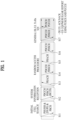
- FIG. 1 illustrates physical channels and a general signal transmission method using the physical channels in a 3GPP system.
- the UE When a UE is powered on or enters a new cell, the UE performs initial cell search (S11).
- the initial cell search involves acquisition of synchronization to a BS.
- the UE receives a synchronization signal block (SSB) from the BS.
- the SSB includes a primary synchronization signal (PSS), a secondary synchronization signal (SSS), and a physical broadcast channel (PBCH).
- PSS primary synchronization signal
- SSS secondary synchronization signal
- PBCH physical broadcast channel
- the UE synchronizes its timing to the BS and acquires information such as a cell identifier (ID) based on the PSS/SSS. Further, the UE may acquire information broadcast in the cell by receiving the PBCH from the BS.
- the UE may also monitor a DL channel state by receiving a downlink reference signal (DL RS).
- DL RS downlink reference signal
- the UE may acquire more detailed system information by receiving a physical downlink control channel (PDCCH) and a physical downlink shared channel (PDSCH) corresponding to the PDCCH (S12).
- PDCCH physical downlink control channel
- PDSCH physical downlink shared channel
- the UE may perform a random access procedure with the BS (S13 to S16). Specifically, the UE may transmit a preamble on a physical random access channel (PRACH) (S13) and may receive a PDCCH and a random access response (RAR) for the preamble on a PDSCH corresponding to the PDCCH (S14). The UE may then transmit a physical uplink shared channel (PUSCH) by using scheduling information in the RAR (S15), and perform a contention resolution procedure including reception of a PDCCH and a PDSCH signal corresponding to the PDCCH (S16).
- PRACH physical random access channel
- RAR random access response
- steps S13 and S15 may be performed as one step (in which Message A is transmitted by the UE), and steps S14 and S16 may be performed as one step (in which Message B is transmitted by the BS).
- the UE may receive a PDCCH and/or a PDSCH from the BS (S17) and transmit a physical uplink shared channel (PUSCH) and/or a physical uplink control channel (PUCCH) to the BS (S18), in a general UL/DL signal transmission procedure.
- Control information that the UE transmits to the BS is generically called uplink control information (UCI).
- the UCI includes a hybrid automatic repeat and request acknowledgement/negative acknowledgement (HARQ-ACK/NACK), a scheduling request (SR), channel state information (CSI), and so on.
- the CSI includes a channel quality indicator (CQI), a precoding matrix index (PMI), a rank indication (RI), and so on.
- UCI is transmitted on a PUCCH.
- control information and data may be transmitted on a PUSCH.
- the UE may transmit the UCI aperiodically on the PUSCH, upon receipt of a request/command from a network.
- FIG. 2 illustrates a radio frame structure
- Each radio frame has a length of 10 ms and is divided into two 5-ms half-frames. Each half-frame is divided into five 1-ms subframes. A subframe is divided into one or more slots, and the number of slots in a subframe depends on a subcarrier spacing (SCS).
- SCS subcarrier spacing
- Each slot includes 12 or 14 OFDM(A) symbols according to a cyclic prefix (CP). When a normal CP is used, each slot includes 14 OFDM symbols. When an extended CP is used, each slot includes 12 OFDM symbols.
- a symbol may include an OFDM symbol (or a CP-OFDM symbol) and an SC-FDMA symbol (or a discrete Fourier transform-spread-OFDM (DFT-s-OFDM) symbol).
- Table 1 exemplarily illustrates that the number of symbols per slot, the number of slots per frame, and the number of slots per subframe vary according to SCSs in a normal CP case.
- the frame structure is merely an example, and the number of subframes, the number of slots, and the number of symbols in a frame may be changed in various manners.
- different OFDM(A) numerologies e.g., SCSs, CP lengths, and so on
- SCSs CP lengths
- CP lengths CP lengths, and so on
- the (absolute time) duration of a time resource e.g., a subframe, a slot, or a transmission time interval (TTI)
- TTI transmission time interval
- TU time unit
- various numerologies may be supported to support various 5th generation (5G) services.
- 5G 5th generation
- SCS 5th generation
- a wide area in traditional cellular bands may be supported, while with an SCS of 30 kHz or 60 kHz, a dense urban area, a lower latency, and a wide carrier bandwidth may be supported.
- an SCS of 60 kHz or higher a bandwidth larger than 24.25 kHz may be supported to overcome phase noise.
- An NR frequency band may be defined by two types of frequency ranges, FR1 and FR2.
- FR1 and FR2 may be configured as described in Table 3 below.
- FR2 may be millimeter wave (mmW).
- mmW millimeter wave
- FIG. 3 illustrates a resource grid during the duration of one slot.
- a slot includes a plurality of symbols in the time domain. For example, one slot includes 14 symbols in a normal CP case and 12 symbols in an extended CP case.
- a carrier includes a plurality of subcarriers in the frequency domain.
- a resource block (RB) may be defined by a plurality of (e.g., 12) consecutive subcarriers in the frequency domain.
- a bandwidth part (BWP) may be defined by a plurality of consecutive (physical) RBs ((P)RBs) in the frequency domain and correspond to one numerology (e.g., SCS, CP length, and so on).
- a carrier may include up to N (e.g., 5) BWPs. Data communication may be conducted in an active BWP, and only one BWP may be activated for one UE.
- Each element in a resource grid may be referred to as a resource element (RE), to which one complex symbol may be mapped.
- HARQ-ACK information may not be used to adjust a contention window (CW) size in a UL LBT procedure.
- a UL grant is received in the n-th subframe
- the first subframe of the most recent UL transmission burst prior to the (n-3)-th subframe has been configured as a reference subframe
- the CW size has been adjusted based on a new data indicator (NDI) for a HARQ process ID corresponding to the reference subframe.
- NDI new data indicator
- a method has been introduced of increasing the CW size to the next largest CW size of a currently applied CW size in a set for pre-agreed CW sizes under the assumption that transmission of a PUSCH has failed in the reference subframe due to collision with other signals or initializing the CW size to a minimum value (e.g., CWmin) under the assumption that the PUSCH in the reference subframe has been successfully transmitted without any collision with other signals.
- a minimum value e.g., CWmin
- FIG. 4 illustrates an exemplary wireless communication system supporting an unlicensed band applicable to the present disclosure.
- a cell operating in a licensed band is defined as an L-cell, and a carrier of the L-cell is defined as a (DL/UL) LCC.
- a cell operating in an unlicensed band is defined as a U-cell, and a carrier of the U-cell is defined as a (DL/UL) UCC.
- the carrier/carrier-frequency of a cell may refer to the operating frequency (e.g., center frequency) of the cell.
- a cell/carrier (e.g., CC) is commonly called a cell.
- the LCC and the UCC may be configured as a primary CC (PCC) and a secondary CC (SCC), respectively.
- the BS and the UE may transmit and receive signals on one UCC or on a plurality of carrier-aggregated UCCs as illustrated in FIG. 4(b) .
- the BS and UE may transmit and receive signals only on UCC(s) without using any LCC.
- PRACH, PUCCH, PUSCH, and SRS transmissions may be supported on a UCell.
- Signal transmission and reception operations in an unlicensed band as described in the present disclosure may be applied to the afore-mentioned deployment scenarios (unless specified otherwise).
- the COT may be shared for transmission between the BS and corresponding UE(s).
- sharing a UE-initiated COT with the BS may mean an operation in which the UE assigns a part of occupied channels to the BS through random backoff-based LBT (e.g., Category 3 (Cat-3) LBT or Category 4 (Cat-4) LBT) and the BS performs DL transmission using a remaining COT of the UE, when it is confirmed that a channel is idle by success of LBT after performing LBT without random backoff (e.g., Category 1 (Cat-1) LBT or Category 2 (Cat-2) LBT) using a timing gap occurring before DL transmission start from a UL transmission end timing of the UE.
- random backoff-based LBT e.g., Category 3 (Cat-3) LBT or Category 4 (Cat-4) LBT
- the BS performs DL transmission using a remaining COT of the UE, when it is confirmed that a channel is idle by success of LBT after performing LBT without random backoff (e.g., Category 1 (Cat-1) LBT or Category 2
- sharing a gNB-initiated COT with the UE may mean an operation in which the BS assigns a part of occupied channels to the UE through random backoff-based LBT (e.g., Cat-3 LBT or Cat-4 LBT) and the UE performs UL transmission using a remaining COT of the BS, when it is confirmed that a channel is idle by success of LBT after performing LBT without random backoff (e.g., Cat-1 LBT or Cat-2 LBT) using a timing gap occurring before UL transmission start from a DL transmission end timing of the BS.
- random backoff-based LBT e.g., Cat-3 LBT or Cat-4 LBT
- LBT e.g., Cat-1 LBT or Cat-2 LBT
- FIG. 5 illustrates an exemplary method of occupying resources in an unlicensed band.
- a communication node e.g., a BS or a UE operating in an unlicensed band should determine whether other communication node(s) is using a channel, before signal transmission.
- the communication node may perform a CAP to access channel(s) on which transmission(s) is to be performed in the unlicensed band.
- the CAP may be performed based on sensing.
- the communication node may determine whether other communication node(s) is transmitting a signal on the channel(s) by carrier sensing (CS) before signal transmission. Determining that other communication node(s) is not transmitting a signal is defined as confirmation of clear channel assessment (CCA).
- CCA confirmation of clear channel assessment
- the communication node may determine that the channel is busy, when detecting energy higher than the CCA threshold in the channel. Otherwise, the communication node may determine that the channel is idle. When determining that the channel is idle, the communication node may start to transmit a signal in the unlicensed band. CAP may be replaced with LBT.
- CCA threshold e.g., Xthresh
- RRC higher-layer
- one cell (or carrier (e.g., CC)) or BWP configured for a UE may be a wideband having a larger bandwidth (BW) than in legacy LTE.
- BW bandwidth
- a BW requiring CCA based on an independent LBT operation may be limited according to regulations.
- a subband (SB) in which LBT is individually performed be defined as an LBT-SB.
- LBT-SB subband
- a plurality of LBT-SBs may be included in one wideband cell/BWP.
- a set of RBs included in an LBT-SB may be configured by higher-layer (e.g., RRC) signaling.
- one or more LBT-SBs may be included in one cell/BWP based on (i) the BW of the cell/BWP and (ii) RB set allocation information.
- a plurality of LBT-SBs may be included in the BWP of a cell (or carrier).
- An LBT-SB may be, for example, a 20-MHz band.
- the LBT-SB may include a plurality of contiguous (P)RBs in the frequency domain, and thus may be referred to as a (P)RB set.
- a UE performs a Type 1 or Type 2 CAP for a UL signal transmission in an unlicensed band.
- the UE may perform a CAP (e.g., Type 1 or Type 2) configured by a BS, for a UL signal transmission.
- CAP type indication information may be included in a UL grant (e.g., DCI format 0_0 or DCI format 0_1) that schedules a PUSCH transmission.
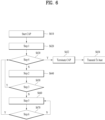
- FIG. 6 illustrates a Type 1 CAP among CAPs of the UE for UL signal transmission in an unlicensed band applicable to the present disclosure.
- the UE may sense whether a channel is idle for a sensing slot duration in a defer duration Td. After a counter N is decremented to 0, the UE may perform a transmission (S634). The counter N is adjusted by sensing the channel for additional slot duration(s) according to the following procedure.
- Step 3) Sense the channel for an additional slot duration, and if the additional slot duration is idle (Y), go to step 4. Else (N), go to step 5 (S650).
- Step 5 Sense the channel until a busy sensing slot is detected within the additional defer duration Td or all slots of the additional defer duration Td are sensed as idle (S660).
- Step 6 If the channel is sensed as idle for all slot durations of the additional defer duration Td (Y), go to step 4. Else (N), go to step 5 (S670).
- Table 5 illustrates that mp, a minimum CW, a maximum CW, a maximum channel occupancy time (MCOT), and an allowed CW size applied to a CAP vary according to channel access priority classes.
- Channel Access Priority Class (p) mp CWmin ,p CWma x,p Tulmcot,p allowed CWp sizes 1 2 3 7 2 ms ⁇ 3,7 ⁇ 2 2 7 15 4 ms ⁇ 7,15 ⁇ 3 3 15 1023 6 or 10 ms ⁇ 15,31,63,127,255,5 11,1023 ⁇ 4 7 15 1023 6 or 10 ms ⁇ 15,31,63,127,255,5 11,1023 ⁇ 4 7 15 1023 6 or 10 ms ⁇ 15,31,63,127,255,5 11,1023 ⁇ 4 7 15 1023 6 or 10 ms ⁇ 15,31,63,127,255,5 11,1023 ⁇
- the defer duration Td includes a duration Tf (16 us) immediately followed by mp consecutive slot durations where each slot duration Tsl is 9 us, and Tf includes a sensing slot duration Tsl at the start of the 16-us duration.
- CWp is set to CWmin,p, and may be updated before Step 1 based on an explicit/implicit reception response to a previous UL burst (e.g., PUSCH) (CW size update). For example, CWp may be initialized to CWmin,p based on an explicit/implicit reception response to the previous UL burst, may be increased to the next higher allowed value, or may be maintained to be an existing value.
- Type 2 UL CAP the length of a time period spanned by sensing slots sensed as idle before transmission(s) is deterministic.
- Type 2 UL CAPs are classified into Type 2A UL CAP, Type 2B UL CAP, and Type 2C UL CAP.
- Tf includes a sensing slot at the start of the duration.
- Tf includes a sensing slot within the last 9 us of the duration.
- the UE does not sense a channel before a transmission.
- the BS should succeed in an LBT operation to transmit a UL grant in the unlicensed band, and the UE should also succeed in an LBT operation to transmit the UL data. That is, only when both of the BS and the UE succeed in their LBT operations, the UE may attempt the UL data transmission. Further, because a delay of at least 4 msec is involved between a UL grant and scheduled UL data in the LTE system, earlier access from another transmission node coexisting in the unlicensed band during the time period may defer the scheduled UL data transmission of the UE. In this context, a method of increasing the efficiency of UL data transmission in an unlicensed band is under discussion.
- NR also supports configured grant type 1 and configured grant type 2 in which the BS preconfigures time, frequency, and code resources for the UE by higher-layer signaling (e.g., RRC signaling) or both of higher-layer signaling and L1 signaling (e.g., DCI). Without receiving a UL grant from the BS, the UE may perform a UL transmission in resources configured with type 1 or type 2.
- higher-layer signaling e.g., RRC signaling
- L1 signaling e.g., DCI
- Type 2 is a scheme of configuring the periodicity of a configured grant and a power control parameter by higher-layer signaling such as RRC signaling and indicating information about the remaining resources (e.g., the offset of an initial transmission timing, time/frequency resource allocation, a DMRS parameter, and an MCS/TBS) by activation DCI as L1 signaling.
- Autonomous uplink (AUL) of LTE LAA and a configured grant of NR show a big difference in terms of a method of transmitting HARQ-ACK feedback for a PUSCH that the UE has transmitted without receiving the UL grant and in terms of the presence or absence of UCI transmitted along with the PUSCH. While a HARQ process is determined by an equation of a symbol index, a symbol periodicity, and the number of HARQ processes in the configured grant of NR, explicit HARQ-ACK feedback information is transmitted in AUL downlink feedback information (AUL-DFI) in LTE LAA.
- AUL-DFI AUL downlink feedback information
- UCI including information such as a HARQ ID, an NDI, and an RV is also transmitted in AUL UCI whenever AUL PUSCH transmission is performed.
- the BS identifies the UE by time/frequency resources and DMRS resources used by the UE for PUSCH transmission, whereas in the case of LTE LAA, the BS identifies the UE by a UE ID explicitly included in the AUL UCI transmitted together with the PUSCH as well as the DMRS resources.
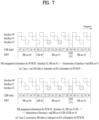
- FIG. 7 illustrates resource assignment for UL transmission in a shared spectrum.
- RBs belonging to interlace #1 in RB set #1 may be determined as a PUSCH resource based on resource assignment information for a PUSCH indicating ⁇ interlace #1, RB set #1 ⁇ . That is, RBs corresponding to the intersection of ⁇ interlace #1, RB set #1 ⁇ may be determined as the PUSCH resource.
- RBs belonging to interlace #2 in RB sets #1 and #2 may be determined as the PUSCH resource based on the resource assignment information for the PUSCH indicating ⁇ interlace #2, RB sets #1 and #2 ⁇ .
- a guide band (GB) (i.e., GB #1) between RB set #1 and RB set #2 may also be used as the PUSCH transmission resource. That is, RBs corresponding to the intersection of ⁇ interlace #1, RB sets #1 and #2, GB #1 ⁇ may be determined as the PUSCH resource. In this case, a GB (i.e., GB #0) which is not between RB set #1 and RB set #2 is not used as the PUSCH transmission resource even if the GB is adjacent to RB sets #1 and #2.
- FIG. 8 illustrates exemplary mapping of physical channels in a slot.
- a DL control channel, DL or UL data, and a UL control channel may all be included in one slot.
- the first N symbols (hereinafter, referred to as a DL control region) in a slot may be used to transmit a DL control channel
- the last M symbols (hereinafter, referred to as a UL control region) in the slot may be used to transmit a UL control channel.
- N and M are integers equal to or greater than 0.
- a resource region (hereinafter, referred to as a data region) between the DL control region and the UL control region may be used for DL data transmission or UL data transmission.
- a time gap for DL-to-UL or UL-to-DL switching may be defined between a control region and the data region.
- a PDCCH may be transmitted in the DL control region
- a PDSCH may be transmitted in the DL data region.
- a UE transmits a related signal to the BS on a UL channel, which will be described later, and the BS receives the related signal from the UE through the UL channel to be described later.
- PUCCH Physical Uplink Control Channel
- the PUCCH carries UCI, HARQ-ACK and/or scheduling request (SR), and is divided into a short PUCCH and a long PUCCH according to the PUCCH transmission length.
- SR scheduling request
- the UCI includes the following information.
- Table 6 illustrates exemplary PUCCH formats.
- PUCCH formats may be divided into short PUCCHs (Formats 0 and 2) and long PUCCHs (Formats 1, 3, and 4) based on PUCCH transmission durations.
- PUCCH format 0 conveys UCI of up to 2 bits and is mapped in a sequence-based manner, for transmission. Specifically, the UE transmits specific UCI to the BS by transmitting one of a plurality of sequences on a PUCCH of PUCCH format 0. Only when the UE transmits a positive SR, the UE transmits the PUCCH of PUCCH format 0 in PUCCH resources for a corresponding SR configuration.
- PUCCH format 1 conveys UCI of up to 2 bits and modulation symbols of the UCI are spread with an orthogonal cover code (OCC) (which is configured differently whether frequency hopping is performed) in the time domain.
- OCC orthogonal cover code
- the DMRS is transmitted in a symbol in which a modulation symbol is not transmitted (i.e., transmitted in time division multiplexing (TDM)).
- PUCCH format 2 conveys UCI of more than 2 bits and modulation symbols of the DCI are transmitted in frequency division multiplexing (FDM) with the DMRS.
- the DMRS is located in symbols #1, #4, #7, and #10 of a given RB with a density of 1/3.
- a pseudo noise (PN) sequence is used for a DMRS sequence.
- frequency hopping may be activated.
- PUCCH format 3 does not support UE multiplexing in the same PRBs, and conveys UCI of more than 2 bits. In other words, PUCCH resources of PUCCH format 3 do not include an OCC. Modulation symbols are transmitted in TDM with the DMRS.
- PUCCH format 4 supports multiplexing of up to 4 UEs in the same PRBs, and conveys UCI of more than 2 bits.
- PUCCH resources of PUCCH format 3 include an OCC. Modulation symbols are transmitted in TDM with the DMRS.
- the PUSCH carries UL data (e.g., UL-shared channel transport block (UL-SCH TB)) and/or UL control information (UCI), and is transmitted based a Cyclic Prefix-Orthogonal Frequency Division Multiplexing (CP-OFDM) waveform or a Discrete Fourier Transform-spread-Orthogonal Frequency Division Multiplexing (DFT-s-OFDM) waveform.
- CP-OFDM Cyclic Prefix-Orthogonal Frequency Division Multiplexing
- DFT-s-OFDM Discrete Fourier Transform-spread-Orthogonal Frequency Division Multiplexing
- the UE transmits the PUSCH by applying transform precoding.
- FIG. 9 is a diagram for explaining a HARQ transmission timing, and a PUSCH transmission timing and assignment method.
- HARQ-ACK is information indicating whether the UE has successfully received a physical DL channel. Upon successfully receiving the physical DL channel, the UE feeds back ACK to the BS and, otherwise, the UE feeds back NACK to the BS.
- HARQ supports 1-bit HARQ-ACK feedback per transport block.
- FIG. 9 illustrates an example of a HARQ-ACK timing K1.
- K0 represents the number of slots from a slot with a PDCCH carrying DL assignment (i.e., DL grant) to a slot with corresponding PDSCH transmission
- K1 represents the number of slots from a slot with a PDSCH to a slot with corresponding HARQ-ACK transmission
- K2 represents the number of slots from a slot with a PDCCH carrying a UL grant to a slot with corresponding PUSCH transmission. That is, K0, K1, and K2 may be briefly summarized as listed Table 7 below.
- Table 7 A B K0 DL scheduling DCI Corresponding DL data transmission K1 DL data reception Corresponding HARQ-ACK K2 UL scheduling DCI Corresponding UL data transmission
- the BS may provide a HARQ-ACK feedback timing to the UE dynamically by DCI or semi-statically by RRC signaling.
- the NR system supports different minimum HARQ processing times for UEs.
- a HARQ processing time includes delay between a DL data reception timing and a corresponding HARQ-ACK transmission timing and delay between a UL grant reception timing and a corresponding UL data transmission timing.
- the UE transmits information about the capability of a minimum HARQ processing time thereof to the BS. From the viewpoint of the UE, HARQ ACK/NACK feedback for a plurality of DL transmissions in the time domain may be transmitted in one UL data/control region. A timing between DL data reception and corresponding ACK is indicated by the DCI.
- the NR system supports code block group (CBG)-based transmission of single-bit/multi-bit HARQ-ACK feedback.
- a TB may be mapped to one or more code blocks (CBs) according to the size of the TB. For example, in a channel coding procedure, a cyclic redundancy check (CRC) code is attached to the TB. If a CRC-attached TB is not larger than a certain size, the CRC-attached TB corresponds to one CB.
- CRC cyclic redundancy check
- the CRC-attached TB is segmented into a plurality of CBs.
- the UE may be configured to receive CBG-based transmissions, and retransmission may be scheduled to carry a subset of all CBs of the TB.
- the UE may detect a PDCCH in slot #n.
- the PDCCH includes DL scheduling information (e.g., DCI format 1_0 and/or DCI format 1_1).
- the PDCCH indicates a DL assignment-to-PDSCH offset K0 and a PDSCH-to-HARQ-ACK reporting offset K1.
- DCI format 1_0 and DCI format 1_1 may include the following information.
- the UE may receive a PDSCH in slot #(n+K0) according to scheduling information of slot #n and then transmit UCI on a PUCCH in slot #(n+K1).
- the UCI includes a HARQ-ACK response to the PDSCH.
- the HARQ-ACK response may be configured in one bit.
- the HARQ-ACK response may be configured as two bits if spatial bundling is not configured and as one bit if spatial bundling is configured.
- slot #(n+K1) is designated as a HARQ-ACK transmission timing for a plurality of PDSCHs
- UCI transmitted in slot #(n+K1) includes HARQ-ACK responses to the plurality of PDSCHs.
- the UE may detect a PDCCH in slot #n.
- the PDCCH includes UL scheduling information (e.g., DCI format 0_0 and/or DCI format 0_1).
- DCI format 0_0 and DCI format 0_1 may include the following information.
- the UE may transmit the PUSCH in slot #(n+k2) according to the scheduling information of slot #n.
- the PUSCH includes a UL-SCH TB.
- the UE may receive a dedicated PUCCH resource configuration.
- This dedicated PUCCH resource configuration may include information about a PUCCH resource set.
- the information about the PUCCH resource set may include, for example, N PUCCH resources, a PUCCH format for each of the N PUCCH resources, a starting symbol, a PUCCH resource duration, a physical resource block (PRB) offset, and a cyclic shift (CS) set.
- PRB physical resource block
- CS cyclic shift
- the first PUCCH resource set of the dedicated PUCCH resource configuration may include a maximum of 32 PUCCH resources and the remaining PUCCH resource set of the dedicated PUCCH resource configuration may include a maximum of 8 PUCCH resources.
- the UE may transmit a PUCCH using frequency hopping. If the interlace is not indicated to be used, the UE may transmit the PUCCH without frequency hopping.
- the UE may determine any one of 16 PUCCH resources included in the PUCCH resource set to transmit HARQ-ACK through the determined PUCCH resource. For example, the UE determines an index of a PUCCH resource, based on the number of control channel elements (CCEs) in a control resource set (CORESET) of a PDCCH including the DCI scheduling the PDSCH, an index of the first CCE of the PDCCH, and a value of a PUCCH resource indicator field included in the DCI scheduling the PDSCH. Then, the UE may transmit HARQ-ACK through a PUCCH resource corresponding to the determined index.
- CCEs control channel elements
- CORESET control resource set
- the UE may acquire an index corresponding to any one of indexes in rows of [Table 8] below from pucch-ResourceCommon.
- the UE may determine an index of a PRB for PUCCH transmission, based on a PRB offset of the PUCCH resource set corresponding to the acquired index of the PUCCH resource set, the index of the PUCCH resource set, the number of initial CS indexes included in a set of initial CS indexes, and a BWP size.
- the UE may transmit the PUCCH through a PUCCH resource according to a PUCCH format, a starting symbol, and a symbol duration which correspond to the determined index of the PRB and the index of the PUCCH resource set.
- a new PUCCH resource allocation method based on an interlaced RB allocation method in the Rel-15 PUCCH formats is used to satisfy regulatory requirements of an unlicensed band such as occupied channel bandwidth (OCB) and power spectral density (PSD).
- OCB occupied channel bandwidth
- PSD power spectral density
- Rel-17 in order to support NR in a high-frequency band above 52.6 GHz, it is necessary to improve a specific signal and channel design of legacy Rel-15/16.
- the present disclosure proposes a method for enhancing a resource allocation method of legacy PUCCH formats in consideration of regulatory requirements such as a maximum output power limit and a PSD limit in a high-frequency unlicensed band above 52.6 GHz.
- NR supports a plurality of numerologies (e.g., subcarrier spacings (SCSs)) to support various 5G services. For example, when an SCS is 15 kHz, a wide area in traditional cellular bands is supported. When the SCS is 30 kHz or 60 kHz, a dense-urban, lower latency, and wider carrier BW are supported. When the SCS is above 60 kHz, BW greater than 24.25 GHz is supported to overcome phase noise.
- SCSs subcarrier spacings
- FR1 and FR2 may be configured as shown in [Table 3] above.
- FR2 may represent millimeter wave (mmW).
- a band (e.g., band of 52.6 GHz to 114.25 GHz, particularly, 71 GHz) higher than the above-mentioned frequency bands is referred to as FR4.
- An area of FR4 may be used as an unlicensed band.
- a specific region/country may include restrictions on PSD and maximum output power in regulations regarding the unlicensed band when a specific node transmits signals.
- a partial band e.g., band 75, c1
- a partial band of the FR4 area imposes restrictions on transmission that should satisfy a maximum output power of 40 dBm and a PSD of 23 dBm and 1 MHz.
- [Table 9] lists the total number of PRBs according to an SCS and BW defined in the FR2 area. [Table 9] SCS (kHz) 50 MHz 100 MHz 200 MHz 400 MHz N RB N RB N RB N RB 60 66 132 264 N.A 120 32 66 132 264
- the present disclosure proposes an enhanced PUCCH format and an enhanced initial PUCCH resource set for FR4. Meanwhile, an actual number of PRBs according to the SCS and BW may be different from the number of PRBs of [Table 10]. However, the following proposed methods may be easily extended and applied based on a finally determined number of PRBs.
- power with which one node is capable of maximally transmitting signals is limitedly regulated together with PSD regulation.
- one node may use power of a maximum of 40 dBm. Therefore, maximum power that may be transmitted in one PRB according to each SCS may be determined in consideration of the PSD regulation and maximum power limit.
- a maximum number of PRBs in which power is maximally allocated according to each SCS without exceeding the maximum power limit may be calculated as listed in [Table 11], [Table 12], and [Table 13]. [Table 11] shows the case in which the PSD regulation is 23 dBm/1 MHz and [Table 12] shows the case in which the PSD regulation is 13 dBm/1 MHz.
- the number of PRBs (# of PRBs) is equally obtained in [Table 11] and [Table 13].
- the examples of [Table 11] and [Table 13] are based on ETSI regulatory requirements of Europe. If the number of PRBs is obtained differently from those of [Table 11] and [Table 13] through regulatory requirements of other regions, the number of PRBs obtained based on the regulatory requirements of other regions may be applied to the proposed methods of the present disclosure.
- a minimum number of PRBs per SCS may be calculated in consideration of the PSD requirement and maximum power limit.
- the BS In order for the BS to cause the UE to transmit the PUCCH based on maximum power, the BS needs to allocate resources in which the number of PRBs is equal to or greater than those calculated in [Table 11] to [Table 13].
- a proposed number of PRBs basically represents the number of contiguous PRBs for PUCCH format 0/1/2/3/4 transmission but may be extended to an interlaced PRB type.
- the present disclosure will propose an enhanced resource allocation method for each PUCCH format, a resource allocation method of PUCCH resources constituting an initial PUCCH resource set, and a PRB offset configuration method.
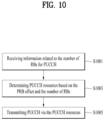
- FIG. 10 illustrates the overall operation process of the UE according to the proposed methods of the present disclosure.
- the UE may receive information related to the number of RBs for a PUCCH (S1001). Details on the type of the information and/or content included in the information may be based on at least one of [Proposed Method #1] to [Proposed Method #4], or [Proposed Method #6].
- the UE may determine a PUCCH resource based on the number of RBs and a PRB offset (S1003).
- a detailed method of determining the PUCCH resource by the UE may be based on at least one of [Proposed Method #2] or [Proposed Method #5].
- the UE may transmit the PUCCH through the determined PUCCH resource (S1005).
- FIG. 11 illustrates the overall operation process of the BS according to the proposed methods of the present disclosure.
- the BS may transmit information related to the number of RBs for a PUCCH to the UE (S1101). Details on the type of the information and/or content included in the information may be based on at least one of [Proposed Method #1] to [Proposed Method #4], or [Proposed Method #6].
- the BS may receive the PUCCH through a PUCCH resource (S1103).
- the PUCCH resource is determined based on the number of RBs and a PRB offset.
- a detailed method of determining the PUCCH resource may be based on at least one of [Proposed Method #2] or [Proposed Method #5].
- FIG. 12 illustrates the overall operation process of a network according to the proposed methods of the present disclosure.
- the BS may transmit information related to the number of RBs for a PUCCH to the UE (S1201). Details on the type of the information and/or content included in the information may be based on at least one of [Proposed Method #1] to [Proposed Method #4], or [Proposed Method #6].
- the UE may determine a PUCCH resource based on the number of RBs and a PRB offset (S1203).
- a detailed method of determining the PUCCH resource by the UE may be based on at least one of [Proposed Method #2] or [Proposed Method #5].
- the UE may transmit the PUCCH to the BS through the determined PUCCH resource (S1205).
- N RB which is the number of RBs to be used for PUCCH format 0/1 transmission of an initial PUCCH resource
- N RB which is the number of RBs to be used for PUCCH format 0/1 transmission of an initial PUCCH resource
- N RB may be configured/calculated in consideration of PUCCH resource multiplexing with other adjacent cells based on the PRB offset, such that the number of FDM resources per PUCCH resource set may not be insufficient, based on the number of available RBs according to an SCS configured for an initial BWP and a BW size of the BWP.
- the PSD limit or the maximum output power limit may be different according to regulatory requirements of each region/country for a specific band.
- Proposed Method #1 provides a method of configuring/indicating the number of RBs to be used for PUCCH format 0/1 transmission in consideration of the above-described regulatory requirements, the number of available RBs per SCS and BW size supported in a band above 52.6 GHz, the number of resources constituting an initial PUCCH resource set, and UE multiplexing.
- PUCCH format 0/1 has been transmitted using only one RB, if a transmission method of PUCCH format 0/1 of Rel-15 is equally applied even in the band of 52.6 GHz, output power may not be sufficient and thus coverage may be insufficient.
- a minimum number of PRBs calculated in consideration of a PSD requirement and a maximum power limit for each SCS may be listed as in [Table 14].
- the minimum number of PRBs of Table 14 has been calculated based on band 75 (cl) requirements of Europe.
- SCS (kHz) Minimum # of PRBs 120 35 240 18 480 9 960 5
- a method may be considered of configuring a sequence used for PUCCH format 0/1 as a long sequence having a length corresponding to a minimum number of PRBs calculated in consideration of the PSD requirement and the maximum output power limit.
- a sequence length usable for PUCCH format 0/1 may be proposed as in [Table 15].
- the sequence length proposed in [Table 15] is the largest prime number among numbers smaller than the total number of REs.
- sequence length is 36 or less, a sequence based on a computer generated sequence (CGS) is used. If the sequence length is 36 or more, a Zadoff-Chu (ZC) sequence is also used. Therefore, in [Table 15], since all sequence lengths according to SCSs are above 36, the ZC sequence may be used. [Table 15] SCS (kHz) Minimum # of PRBs # of REs Sequence length (ZC) 120 35 420 419 240 18 216 211 480 9 108 107 960 5 60 59
- Set of initial CS indexes includes 3 elements (e.g., indexes 1 and 2), a total of 6 PRBs is needed.
- Set of initial CS indexes includes 4 elements (e.g., indexes 4, 5, 6, 8, 9, 10, 12, 13, 14, and 15), a total of 4 PRBs is needed.
- the minimum PRB value may be defined as listed in [Table 14] in consideration of the PSD requirement and the maximum power limit as described above.
- the number of PRBs corresponding to one FDM resource may be configured as the minimum number of PRBs as listed in [Table 14].
- "Set of initial CS indexes" of [Table 8] includes two elements (e.g., indexes 0, 3, 7, and 11), a total of 8 FDM resources is needed. Whether the 8 FDM resources are configurable may be represented according to each SCS value and/or nominal BW (carrier/BWP BW) size as listed in [Table 16].
- [Table 16] is based on the minimum number of PRBs of [Table 14].
- “Set of initial CS indexes" of [Table 8] includes 3 elements (e.g., indexes 1 and 2), a total of 6 FDM resources is needed. Whether the 6 FDM resources are configurable may be represented according to each SCS value and/or nominal BW (carrier/BWP BW) size as listed in [Table 17]. [Table 17] may be based on the minimum number of PRBs of [Table 14].
- FR4 if the initial PUCCH resource set of legacy NR is applied without change, FDM resources may not secured as described above. To solve this problem, the following methods may be applied in FR4 when the initial PUCCH resource set is used.
- N RB for PUCCH transmission may be set to 33 if only a single cell is considered based on the number 264 of available RBs in the BWP.
- 33 RBs which is smaller than 35 RBs, are used to match the BW size of the initial BWP and the number of available FDM resources to 8.
- N RB 17 should be derived by substituting the above-described example into [Equation 1] and/or [Equation 2].
- a maximum value of 2 n among values which are smaller than or equal to N RB calculated based on (1) of Embodiment #1-1 or (2) of Embodiment #1-1 may be determined as 2 n RBs used for PUCCH transmission.
- N RB value is 33 or 22
- 32 or 16 which is a maximum value of 2 n smaller than 33 or 22, may be used as the number of RBs for PUCCH transmission in consideration of multiplexing with other channels.
- N RB calculated based on (1) of Embodiment #1-1 or (2) of Embodiment #1-1 may be calculated for all indexes regardless of the initial PUCCH resource set index indicated by the RMSI, and a minimum N RB value among the calculated N RB values may be used as the number of RBs for PUCCH transmission.
- the UE may calculate N RB which makes FDM resources sufficient based on the set of initial CS indexes of the initial PUCCH resource set.
- signaling complexity or overhead may not be increased because there is no need to devise additional signaling for indicating N RB in the contents of the existing specification or to consider addition of bits for indicating N RB .
- a PRB offset to be used in a band above 52.6 GHz may be determined by scaling an existing PRB offset by N RB , based on N RB which is calculated based on [Proposed Method #1] or N RB configured/indicated by the BS through a higher layer signal (e.g., RRC signaling) such as a system information block (SIB).
- a higher layer signal e.g., RRC signaling
- SIB system information block
- the PRB offset to be used in a band above 52.6 GHz may be determined by scaling the existing PRB offset by k* N RB , based on N RB which is calculated based on [Proposed Method #1] or N RB configured/indicated by the BS through a higher layer signal (e.g., RRC signaling) such as an SIB.
- a higher layer signal e.g., RRC signaling
- k may be a value predefined in the specification or may be configured/indicated by the BS, and 0 ⁇ k ⁇ 1.
- Indexes 1 and 2 of [Table 8] consider FDM between two cells and indexes 4, 5, 6, 8, 9, 10, 12, 13, and 14 consider FDM between three cells.
- indexes 0, 3, 7, and 11 consider an extreme channel delay situation such as a cell-edge UE and index 15 considers a special cell deployment situation.
- [Table 8] has been designed by targeting full FDM between two or three cells when PUCCH format 0/1 of legacy Rel-15 is transmitted through one PRB, if the number of RBs to be used for PUCCH transmission in a band of 52.6 GHz is increased, it is necessary to scale up a current PRB offset of an interval of 2/3/4 by N RB as in Embodiment #2-1.
- N RB is a value calculated such that 16 available resources per initial PUCCH resource set are allocated from the perspective of one cell in consideration of the BW size of the initial BWP, if each of all cells uses PRBs corresponding to N RB , FDM may not be properly performed by overlap between intercells.
- the PRB offset may be configured to support coexistence between intercells in the form of partial FDM rather than full FDM.
- the PRB offset may preferentially use only non-overlapped resources although there are some overlapped resources are present between intercells.
- the BS may add a starting symbol or further consider an OCC index, thereby securing resources. In this case, invalid resources may be present due to overlapped resources between intercells.
- the PRB offset scaled according to [Proposed Method #2] may be used to determine a PRB having the lowest index (or a PRB having the highest index) among one or more PRBs.
- the PRB of the lowest index may be determined based on a PRB offset scaled according to N RB and as many continuous (or discontinuous) PRBs as N RB from the corresponding PRB may be allocated for PUCCH format 0/1.
- PUCCH format 0/1/4 of Rel-15 is PUCCH formats transmitted through one RB.
- transmission of PUCCH format 0/1/4 (hereinafter, enhanced PUCCH format 0/1/4) using one or multiple RBs may be considered within the maximum PSD limit and the maximum output power limit allowed in regulation.
- the number of RBs required to achieve maximum allowed output power with maximum PSD in the regulation may be different according to each SCS. In some cases, even if the maximum allowed output power is not completely used, it may be necessary to transmit the PUCCH using fewer RBs when considering the total number of available RBs in the BWP and multiplexing and scheduling with other signals/channels. Therefore, hereinbelow, methods of configuring a maximum N RB value and an allowed N RB value for each SCS in proportion to the SCS will be proposed.
- maximum N RB values of the other SCSs may be configured as a proportional or multiple relationship.
- Allowed N RB values between minimum N RB and maximum N RB values defined for respective SCSs may also be configured as a proportional or multiple relationship with the SCSs.
- the minimum N RB value may mean a positive integer greater than or equal to 1.
- ETSI EN 302 567 is a regulation document for a band of 60 GHz in Europe
- a maximum PSD for SCSs that may be supported in the B52 band i.e., a band above 52.6 GHz
- a minimum number of PRBs to achieve the maximum output power e.g., 40 dBm
- the minimum number of PRBs of [Table 18] is calculated based on the band 75 (c1) requirements of Europe.
- the BS may configure/indicate the number of RBs for each SCS of [Table 18] as N RB .
- N RB the number of available RBs in the BWP may be limited, only the number of RBs that may be transmitted with power lower than the maximum output power may be configured/indicated as N RB .
- a maximum N RB value for achieving the maximum output power (e.g., 40 dBm) for each SCS may not have a correlation with the SCS.
- N RB values having positive integers allowed between minimum N RB values defined for respective SCSs may not have a correlation with the SCSs.
- a maximum N RB value and an allowed N RB value for each SCS may be configured/indicated to have a specific relation.
- the maximum N RB value based on the maximum output power in an SCS of 960 kHz is 5
- the BS may configure only the maximum N RB value of a reference SCS, and the N RB values of the remaining SCSs may be calculated using a proportional or multiple relationship.
- the allowed N RB values between the minimum and maximum N RB values in an SCS of 960 kHz are configured/indicated as ⁇ 1, a, b, ... , z ⁇
- the allowed N RB values of an SCS of 120 kHz may be configured/indicated as ⁇ 1, 8a, 8b, ... , 8z ⁇
- allowed N RB values in an SCS of 480 kHz may be configured/indicated as ⁇ 1, 2a, 2b, ... , 2z ⁇ .
- the allowed values between the minimum N RB value and the maximum N RB value for each SCS may also be configured/indicated as a proportional or multiple relationship with the SCS.
- the BS since the BS only needs to configure the minimum and maximum N RB values for one SCS for the UE without separately configuring the minimum and maximum N RB values for respective SCSs, the same configuration number may always be maintained regardless of the number of supported SCSs. In other words, since the BS only needs to indicate/configure one information about the minimum and maximum N RB values to/for the UE, signaling overhead may not be increased. For example, when there are four SCSs that may be used in a communication environment supported by the BS and two SCSs are actually used in a communication environment of the UE, the BS only needs to indicate/configure the minimum and maximum N RB values for one SCS without configuring information about the minimum and maximum N RB values for four SCSs. Accordingly, an unnecessary configuration may be reduced. In addition, since the UE only needs to directly calculate as many SCSs as the number of SCSs that the UE may actually use, complexity may not increase significantly.
- N RB for initial PUCCH resource (e.g., PUCCH format 0/1) transmission according to a PUCCH resource set index indicted in consideration of an initial BWP size (e.g., the number of available RBs in a BW of a BWP) and a PRB offset for intercell FDM, when there is no N RB value configured by the BS for the UE.
- N RB , SCS min N RB , SCS Max , M O ⁇ F ⁇ 2 , where N RB , SCS Max may denote a maximum N RB value defined for each SCS of [Proposed Method #3] as the number of RBs satisfying the PSD and maximum output power requirements for each SCS.
- M may denote the number of available RBs in the BWP
- O may denote the number of FDM resources (e.g., the size of a PRB offset between intercells multiplexed by FDM) required per PUCCH resource hop in a cell, calculated by the number of indexes in the set of initial CS indexes.
- a PRB offset for each PUCCH resource set index may be defined as a multiple of N RB calculated according to [Equation 3], and N RB calculated based on a specific PUCCH resource set index may be applied to other PUCCH resource sets so that the same N RB value may be configured to be used.
- N RB value for the initial PUCCH resource calculated and configured through [Equation 3] may be applied only to an unlicensed band.
- Whether a corresponding cell is a cell operating in the licensed band or a cell operating in the unlicensed band may be indicated through SIB1 or a PBCH.
- the UE may recognize whether the corresponding cell is a cell operating in the licensed band or a cell operating in the unlicensed band according to a 1-bit flag included in SIB1 or the PBCH.
- the BS may indicate/configure N RB of PUCCH Format 0/1 (PF0/1) transmitted through the initial PUCCH resource to/for the UE through a higher layer signal such as an RACH configuration parameter in SIB1 (or RMSI). Otherwise, the UE may calculate/configure N RB of the initial PUCCH resource using [Equation 3] based on the PUCCH resource index indicated through SIB 1 (or RMSI), and the BW size and the SCS of an initial BWP.
- N RB of PUCCH resource set indexes 0/3/7/11 calculated according to the above-described method may differ from N RB of other PUCCH resource set indexes 1/2/4/5/6, and a frequency diversity effect of a PUCCH close to the center of the BWP (i.e., a PUCCH mapped to the inside of the BWP) may be reduced. Therefore, the N RB value calculated based on indexes 1/2/4/5/6 may be equally applied even to the N RB value of indexes 0/3/7/11.
- N RB supporting full FDM between 2 or 3 cells i.e., 16 PUCCH resources for each PUCCH resource set are mapped without overlap
- N RB value is smaller than the number of RBs when the UE performs transmission with maximum output power for each SCS, there may be a problem in terms of coverage or reliability of the PUCCH. Therefore, a specific minimum N RB value may be configured, and an actual N RB value may use a value obtained by multiplying a specific multiple by the minimum N RB value. Then, the PUCCH may be transmitted using higher power even when partial or full overlap occurs between PUCCH resources.
- N RB determined in consideration of full FDM may be determined as the minimum N RB value and the actual N RB value may be configured as one or two times the minimum N RB value.
- an actual PRB offset may be determined as ⁇ K x N RB ⁇ or ⁇ K x minimum N RB ⁇ . Then, power consumption of the UE may be reduced while supporting full FDM in which all resources do not overlap between cells.
- the actual PRB offset may be determined as ⁇ K/2 x N RB ⁇ or ⁇ K x minimum N RB ⁇ .
- PUCCH resources supporting partial FDM in which some resources overlap each other between cells may be configured.
- the power consumption of the UE may slightly increase.
- the above-described two FDM structures are methods applied to FDM between three cells.
- PUCCH resource set indexes 1 and 2 in which a total of 6 resources is distributed to 2 cells by 3 resources with the minimum N RB value
- the number of FDM resources in the BWP may be 3 and may be configured to fully overlap.
- the BS configures an initial PUCCH resource to be used in an initial access procedure of the UE
- a method of configuring a plurality of PUCCH resources having different numbers of RBs as one set and a method of selecting the initial PUCCH resource to be used for PUCCH transmission in consideration of characteristics of the UE will now be described.
- the UE or the BS may select/indicate a PUCCH resource having a relatively large number of RBs in a PUCCH resource set including a plurality of PUCCH resources having different numbers of RBs for/to the UE having a power class allowing high power/effective isotropic radiated power (EIRP).
- EIRP isotropic radiated power
- the UE or BS may select/indicate RBs to transmit the PUCCH using only K (N>K) RBs, which is a part of N RBs in each PUCCH resource.
- Embodiment #5-2 may be applied only when the BS may discern the power class of the UE.
- the K value may be separately configured/indicated or defined in the specification.
- the ratio (e.g., 0.5) of K to N may be defined/configured.
- the BS may independently configure the PUCCH resource set according to the maximum power (for each maximum transmit power) with which the UE may perform transmission.
- Information for configuring the PUCCH resource set may include the number of RBs, RB positions, a PUCCH format, and a PUCCH duration.
- the UE or the BS may select/indicate a PUCCH resources having a relatively large number of RBs for/to the UE located at a cell edge as compared with the UE located at a cell center by estimating the location of the UE on a cell.
- N RB for each initial PUCCH resource may be determined by applying [Proposed Method #4] above.
- a PUCCH resource to be used may be indicated to the UE in consideration of the characteristics of the UE or the UE may directly select the initial PUCCH resource.
- the power class of the UE may be considered.
- Another method is to select/indicate a PUCCH resource according to a relative location of the UE on a cell. For example, since the UE located at a cell edge is relatively far from the BS, it is advantageous in terms of reliability and coverage to transmit the PUCCH using a PUCCH resource to which more RBs are allocated among the configured PUCCH resources.
- the location of the UE on the cell may be estimated by the UE through the DL reception strength of the UE.
- the BS may estimate the location of the UE through the reception strength of a UL signal/channel such as PRACH or msgA transmitted by the UE during the RACH procedure.
- the BS may indicate with which N RB value a PUCCH resource will be used through the DCI or each message for scheduling msgB/msg2 or msg4.
- the UE having a power class in which high power/EIRP is allowed may transmit the PUCCH by selecting PR2 having more RBs among the two PUCCH resources.
- the UE or the BS may select/indicate RBs such that the UE having a power class allowing high power/EIRP may use all of the N RBs.
- the UE or the BS may select/indicate RBs such that the UE having a power class allowing little power transmission may transmit the PUCCH using only K (N>K) RBs which are a part of the N RBs in each PUCCH resource.
- the UE may select K contiguous RBs in a high frequency direction from the lowest frequency RB among the N configured RBs.
- the UE may select K contiguous RBs in a low frequency direction from the highest frequency RB.
- the positions of the K RBs in the N RBs may be configured/indicated by matching the center RB of the N RBs with the center RB of the K RBs.
- the BS indicates an offset from a specific RB (lowest/highest/center RB)
- the UE may determine an RB corresponding to the offset as a starting RB.
- the UE may use K RBs in a high frequency direction or a low frequency direction from the determined starting RB.
- the UE may be indicated to use K RBs in a high frequency direction or a low frequency direction from the determined starting RB.
- Embodiment #5-2 may be applied only when the BS is capable of discerning the power class of the UE.
- the K value may be separately configured/indicated or defined in the specification.
- the ratio (e.g., 0.5) of K to N may be defined/configured.
- the PUCCH resource set may be independently configured according to maximum power with which the UE may perform transmission (for each maximum transmission power).
- Information for configuring the PUCCH resource set may include the number of RBs, positions of the RBs, a PUCCH format, and a PUCCH duration.
- one of PUCCH resources in the configured PUCCH resource set may be selected/indicated as follows.
- the UE may select one PUCCH resource in a PUCCH resource set preconfigured for the UE according to DL reception sensitivity. For example, since UE A is located at a relatively close distance from the BS, it is highly likely that the DL reception strength is greater than a specific value and, since UE B is located at a relatively far distance from the BS, it is highly likely that the DL reception strength is lower than the specific value.
- UE A may select PR1 and UE B may select PR2 to transmit the PUCCH.
- a specific threshold for determining whether the DL reception strength is high or low may be a value previously configured/indicated by the BS or defined in the specification.
- the BS may indicate to the UE one PUCCH resource within the preconfigured PUCCH resource set according to the reception sensitivity of a UL signal/channel (e.g., PRACH or msgA) of the UE received by the BS in the RACH procedure.
- a UL signal/channel e.g., PRACH or msgA
- a PUCCH resource having an appropriate number of RBs that may guarantee the coverage and reliability of the PUCCH according to the power class of the UE and/or the location of the UE may be selected/indicated.
- a method of configuring/indicating initial PUCCH resource sets used before a dedicated PUCCH resource is configured for the UE and the number N RB of RBs constituting PUCCH resources in a PUCCH resource set will be described.
- N RB may be differently configured according to the total number of indexes in the set of initial CS indexes (hereinafter N CS ) for each initial PUCCH resource set and whether RB offset X is configured.
- Types of the number of RBs (hereinafter, 'N RB ') used to transmit one PUCCH for each PUCCH resource set may be equally fixed to K, and 16 PUCCH resources in each PUCCH resource set may be equally divided into K as much as possible.
- K and N RB determined by K may be defined in the specification as values or equations or may be configured/indicated by the BS.
- the N RB value for each PUCCH resource may be configured as follows based on the ⁇ value according to an FDM resource required for each PUCCH resource set.
- the BS may configure/indicate the step size ⁇ together with N RB or the step size for each PUCCH resource set may be predefined in the specification.
- the total number of RBs necessary for each PUCCH resource set may be calculated based on the sum of the numbers of RBs constituting respective PUCCH resources included in the PUCCH resource set and may be applied as the PRB offset value.
- the BS may configure a PUCCH resource having an appropriate number of RBs for each UE when configuring dedicated PUCCH resources.
- RRC radio resource control
- the BS may not discern the capabilities of the UE such as the power class of the UE or the location of the UE on a cell.
- the number of RBs of PUCCH resources included in the initial PUCCH resource set is differently configured and if the situation of the UE (e.g., the power class of the UE and/or the location of the UE on a cell) is capable of being inferred even before RRC connection, coverage and PUCCH transmission success rate may be increased by configuring/indicating a PUCCH resource having an appropriate number of RBs based on the inferred situation.
- a situation of the UE such as the power class and/or the location of the UE may be inferred based on direct information included in msg1/msg3 (in the case of a 4-step RACH) or msgA (in the case of a 2-step RACH) exchanged during the initial access procedure between the UE and the BS or based on the reception sensitivity of a signal/channel received by the BS from the UE.
- direct information included in msg1/msg3 in the case of a 4-step RACH
- msgA in the case of a 2-step RACH
- the BS may indicate a PUCCH resource having a specific number of RBs in the initial PUCCH resource set through a UL grant scheduling msg4.
- the total number of PRBs of the PUCCH resources to be subjected to FDM is kept the same as N RB configured by the BS, and PUCCH resource groups in the PUCCH resource set may be configured to have different numbers of PRBs.
- respective PUCCH resource groups according to PUCCH resource indexes have different numbers of RBs as K+2*X/K+X/K-X/K-2*X, but the total number of RBs included in the PUCCH resource set requires K*8 which are the same as RBs when PRB offset X is not configured.
- a PUCCH resource is configured to have the largest number of RBs when the PUCCH resource index r PUCCH is 0/1 or 8/9. In contrast, this case may be mirrored such that the PUCCH resource is configured to have the largest number of RBs when the r PUCCH value is 6/7 or 14/15.
- (2) of Embodiment #6-1 has the advantage that, when only K and X are configured/indicated, each PUCCH resource included in the initial PUCCH resource set may be configured to have a different number of RBs. Further, the BS may configure appropriate K and X in consideration of the size of an initial BWP and the number of available RBs.
- the second method is to divide 16 PUCCH resources included in the PUCCH resource set into K equal parts and to configure resources to have the same number of PRBs in each divided group. That is, K may be a number of cases of the types of N RB included in a PUCCH resource in the PUCCH resource set.
- K only values that are multiples of N CS of each PUCCH resource set among positive integers that are factors of 16 may be allowed.
- K and the N RB values determined by K may be defined in the specification as values or equations or may be configured/indicated by the BS.
- the third method is to configure each PUCCH resource in the PUCCH resource set to have a different number of RBs using N RB and the step size ⁇ for each PUCCH resource set.
- the step size ⁇ may be calculated based on the equation represented in Embodiment #6-3 or may be previously configured/indicated by the BS. Alternatively, the step size may be defined in the specification with respect to each PUCCH resource set.
- the number of RBs of the PUCCH resource for each hop may be configured by sequentially decreasing or increasing the number of RBs by ⁇ based on the configured N RB value.
- the maximum number of RBs in each hop has N RB and the number of RBs for each PUCCH resource may be configured by decreasing or increasing N RB by the ⁇ value according to r PUCCH .
- the PUCCH resource having a maximum N RB value may be located at the lowest frequency or at the highest frequency in each hop.
- the number of RBs of a PUCCH resource per hop may be configured such that half of the number of resources required for FDM in each PUCCH resource set is configured as resources in which the number of RBs is sequentially decreased by the step size based on N RB and the other half is configured as resources in which the number of RBs is sequentially increased by the step size based on N RB .
- the PUCCH resource having the maximum N RB value may be located at the lowest frequency or at the highest frequency in each hop.
- the total number of RBs necessary for each PUCCH resource set may be calculated based on the sum of the numbers of RBs included in respective PUCCH resources in the PUCCH resource set and may be applied as the PRB offset.
- the BS may infer the situation of the UE such as the location of the UE based on the reception sensitivity of a UL signal received from the UE so that the number of RBs for the PUCCH resource according to the situation of the UE may be appropriately configured.
- FIG. 13 illustrates a communication system 1 applied to the present disclosure.
- the communication system 1 applied to the present disclosure includes wireless devices, BSs, and a network.
- a wireless device is a device performing communication using radio access technology (RAT) (e.g., 5G NR (or New RAT) or LTE), also referred to as a communication/radio/5G device.
- RAT radio access technology
- the wireless devices may include, not limited to, a robot 100a, vehicles 100b-1 and 100b-2, an extended reality (XR) device 100c, a hand-held device 100d, a home appliance 100e, an IoT device 100f, and an artificial intelligence (AI) device/server 400.
- RAT radio access technology
- XR extended reality
- AI artificial intelligence
- the vehicles may include a vehicle having a wireless communication function, an autonomous driving vehicle, and a vehicle capable of vehicle-to-vehicle (V2V) communication.
- the vehicles may include an unmanned aerial vehicle (UAV) (e.g., a drone).
- UAV unmanned aerial vehicle
- the XR device may include an augmented reality (AR)/virtual reality (VR)/mixed reality (MR) device and may be implemented in the form of a head-mounted device (HMD), a head-up display (HUD) mounted in a vehicle, a television (TV), a smartphone, a computer, a wearable device, a home appliance, a digital signage, a vehicle, a robot, and so on.
- AR augmented reality
- VR virtual reality
- MR mixeded reality
- the hand-held device may include a smartphone, a smartpad, a wearable device (e.g., a smartwatch or smartglasses), and a computer (e.g., a laptop).
- the home appliance may include a TV, a refrigerator, a washing machine, and so on.
- the IoT device may include a sensor, a smartmeter, and so on.
- the BSs and the network may be implemented as wireless devices, and a specific wireless device 200a may operate as a BS/network node for other wireless devices.
- the wireless devices 100a to 100f may be connected to the network 300 via the BSs 200.
- An AI technology may be applied to the wireless devices 100a to 100f, and the wireless devices 100a to 100f may be connected to the AI server 400 via the network 300.
- the network 300 may be configured using a 3G network, a 4G (e.g., LTE) network, or a 5G (e.g., NR) network.
- the wireless devices 100a to 100f may communicate with each other through the BSs 200/network 300, the wireless devices 100a to 100f may perform direct communication (e.g., sidelink communication) with each other without intervention of the BSs/network.
- the vehicles 100b-1 and 100b-2 may perform direct communication (e.g.
- V2V/vehicle-to-everything (V2X) communication may perform direct communication with other IoT devices (e.g., sensors) or other wireless devices 100a to 100f.
- Wireless communication/connections 150a, 150b, and 150c may be established between the wireless devices 100a to 100f/BS 200 and between the BSs 200.
- the wireless communication/connections may be established through various RATs (e.g., 5G NR) such as UL/DL communication 150a, sidelink communication 150b (or, D2D communication), or inter-BS communication (e.g. relay or integrated access backhaul(IAB)).
- RATs e.g., 5G NR
- Wireless signals may be transmitted and received between the wireless devices, between the wireless devices and the BSs, and between the BSs through the wireless communication/connections 150a, 150b, and 150c.
- signals may be transmitted and receive don various physical channels through the wireless communication/connections 150a, 150b and 150c.
- various configuration information configuring processes various signal processing processes (e.g., channel encoding/decoding, modulation/demodulation, and resource mapping/demapping), and resource allocation processes, for transmitting/receiving wireless signals, may be performed based on the various proposals of the present disclosure.
- various signal processing processes e.g., channel encoding/decoding, modulation/demodulation, and resource mapping/demapping
- resource allocation processes for transmitting/receiving wireless signals
- FIG. 14 illustrates wireless devices applicable to the present disclosure.
- a first wireless device 100 and a second wireless device 200 may transmit wireless signals through a variety of RATs (e.g., LTE and NR).
- RATs e.g., LTE and NR
- the first wireless device 100 and the second wireless device 200 ⁇ may correspond to ⁇ the wireless device 100x and the BS 200 ⁇ and/or ⁇ the wireless device 100x and the wireless device 100x ⁇ of FIG. 13 .
- the first wireless device 100 may include one or more processors 102 and one or more memories 104, and further include one or more transceivers 106 and/or one or more antennas 108.
- the processor(s) 102 may control the memory(s) 104 and/or the transceiver(s) 106 and may be configured to implement the descriptions, functions, procedures, proposals, methods, and/or operation flowcharts disclosed in this document.
- the processor(s) 102 may process information in the memory(s) 104 to generate first information/signals and then transmit wireless signals including the first information/signals through the transceiver(s) 106.
- the processor(s) 102 may receive wireless signals including second information/signals through the transceiver(s) 106 and then store information obtained by processing the second information/signals in the memory(s) 104.
- the memory(s) 104 may be connected to the processor(s) 102 and may store various pieces of information related to operations of the processor(s) 102.
- the memory(s) 104 may store software code including instructions for performing all or a part of processes controlled by the processor(s) 102 or for performing the descriptions, functions, procedures, proposals, methods, and/or operation flowcharts disclosed in this document.
- the processor(s) 102 and the memory(s) 104 may be a part of a communication modem/circuit/chip designed to implement RAT (e.g., LTE or NR).
- the transceiver(s) 106 may be connected to the processor(s) 102 and transmit and/or receive wireless signals through the one or more antennas 108.
- Each of the transceiver(s) 106 may include a transmitter and/or a receiver.
- the transceiver(s) 106 may be interchangeably used with radio frequency (RF) unit(s).
- the wireless device may be a communication modem/circuit/chip.
- the at least one memory 104 may store instructions or programs as a computer-readable storage medium.
- the instructions or the programs may cause, when executed, at least one processor operably connected to the at least one memory to perform operations according to embodiments or implementations of the present disclosure, related to the following operations.
- the processor 102 may control the transceiver 106 to receive information related to the number of RBs for a PUCCH. Details on the type of the information and/or content included in the information may be based on at least one of [Proposed Method #1] to [Proposed Method #4], or [Proposed Method #6].
- the processor 102 may determine a PUCCH resource based on the number of RBs and a PRB offset.
- a detailed method of determining the PUCCH resource by the processor 102 may be based on at least one of [Proposed Method #2] or [Proposed Method #5].
- the processor 102 may control the transceiver 106 to transmit the PUCCH through the determined PUCCH resource.
- the second wireless device 200 may include one or more processors 202 and one or more memories 204, and further include one or more transceivers 206 and/or one or more antennas 208.
- the processor(s) 202 may control the memory(s) 204 and/or the transceiver(s) 206 and may be configured to implement the descriptions, functions, procedures, proposals, methods, and/or operation flowcharts disclosed in this document.
- the processor(s) 202 may process information in the memory(s) 204 to generate third information/signals and then transmit wireless signals including the third information/signals through the transceiver(s) 206.
- the processor(s) 202 may receive wireless signals including fourth information/signals through the transceiver(s) 106 and then store information obtained by processing the fourth information/signals in the memory(s) 204.
- the memory(s) 204 may be connected to the processor(s) 202 and store various pieces of information related to operations of the processor(s) 202.
- the memory(s) 204 may store software code including instructions for performing all or a part of processes controlled by the processor(s) 202 or for performing the descriptions, functions, procedures, proposals, methods, and/or operation flowcharts disclosed in this document.
- the processor(s) 202 and the memory(s) 204 may be a part of a communication modem/circuit/chip designed to implement RAT (e.g., LTE or NR).
- the transceiver(s) 206 may be connected to the processor(s) 202 and transmit and/or receive wireless signals through the one or more antennas 208.
- Each of the transceiver(s) 206 may include a transmitter and/or a receiver.
- the transceiver(s) 206 may be interchangeably used with RF unit(s).
- the wireless device may be a communication modem/circuit/chip.
- the at least one memory 204 may store instructions or programs as a computer-readable storage medium.
- the instructions or the programs may cause, when executed, at least one processor operably connected to the at least one memory to perform operations according to embodiments or implementations of the present disclosure, related to the following operations.
- the processor 202 may control the transceiver 206 to transmit information related to the number of RBs for a PUCCH. Details on the type of the information and/or content included in the information may be based on at least one of [Proposed Method #1] to [Proposed Method #4], or [Proposed Method #6].
- the processor 202 may control the transceiver 206 to receive a PUCCH through a PUCCH resource.
- a detailed method of determining the PUCCH resource may be based on at least one of [Proposed Method #2] or [Proposed Method #5].
- One or more protocol layers may be implemented by, not limited to, one or more processors 102 and 202.
- the one or more processors 102 and 202 may implement one or more layers (e.g., functional layers such as physical (PHY), medium access control (MAC), radio link control (RLC), packet data convergence protocol (PDCP), RRC, and service data adaptation protocol (SDAP)).
- the one or more processors 102 and 202 may generate one or more protocol data units (PDUs) and/or one or more service data Units (SDUs) according to the descriptions, functions, procedures, proposals, methods, and/or operation flowcharts disclosed in this document.
- PDUs protocol data units
- SDUs service data Units
- the one or more processors 102 and 202 may generate messages, control information, data, or information according to the descriptions, functions, procedures, proposals, methods, and/or operation flowcharts disclosed in this document and provide the messages, control information, data, or information to one or more transceivers 106 and 206.
- the one or more processors 102 and 202 may generate signals (e.g., baseband signals) including PDUs, SDUs, messages, control information, data, or information according to the descriptions, functions, procedures, proposals, methods, and/or operation flowcharts disclosed in this document and provide the generated signals to the one or more transceivers 106 and 206.
- the one or more processors 102 and 202 may receive the signals (e.g., baseband signals) from the one or more transceivers 106 and 206 and acquire the PDUs, SDUs, messages, control information, data, or information according to the descriptions, functions, procedures, proposals, methods, and/or operation flowcharts disclosed in this document.
- signals e.g., baseband signals
- the one or more processors 102 and 202 may be referred to as controllers, microcontrollers, microprocessors, or microcomputers.
- the one or more processors 102 and 202 may be implemented by hardware, firmware, software, or a combination thereof.
- ASICs application specific integrated circuits
- DSPs digital signal processors
- DSPDs digital signal processing devices
- PLDs programmable logic devices
- FPGAs field programmable gate arrays
- the descriptions, functions, procedures, proposals, methods, and/or operation flowcharts disclosed in this document may be implemented using firmware or software, and the firmware or software may be configured to include the modules, procedures, or functions.
- Firmware or software configured to perform the descriptions, functions, procedures, proposals, methods, and/or operation flowcharts disclosed in this document may be included in the one or more processors 102 and 202 or may be stored in the one or more memories 104 and 204 and executed by the one or more processors 102 and 202.
- the descriptions, functions, procedures, proposals, methods, and/or operation flowcharts disclosed in this document may be implemented using firmware or software in the form of code, an instruction, and/or a set of instructions.
- the one or more memories 104 and 204 may be connected to the one or more processors 102 and 202 and store various types of data, signals, messages, information, programs, code, instructions, and/or commands.
- the one or more memories 104 and 204 may be configured to include read-only memories (ROMs), random access memories (RAMs), electrically erasable programmable read-only memories (EPROMs), flash memories, hard drives, registers, cash memories, computer-readable storage media, and/or combinations thereof.
- the one or more memories 104 and 204 may be located at the interior and/or exterior of the one or more processors 102 and 202.
- the one or more memories 104 and 204 may be connected to the one or more processors 102 and 202 through various technologies such as wired or wireless connection.
- the one or more transceivers 106 and 206 may transmit user data, control information, and/or wireless signals/channels, mentioned in the methods and/or operation flowcharts of this document, to one or more other devices.
- the one or more transceivers 106 and 206 may receive user data, control information, and/or wireless signals/channels, mentioned in the descriptions, functions, procedures, proposals, methods, and/or operation flowcharts disclosed in this document, from one or more other devices.
- the one or more transceivers 106 and 206 may be connected to the one or more processors 102 and 202 and transmit and receive wireless signals.
- the one or more processors 102 and 202 may perform control so that the one or more transceivers 106 and 206 may transmit user data, control information, or wireless signals to one or more other devices.
- the one or more processors 102 and 202 may perform control so that the one or more transceivers 106 and 206 may receive user data, control information, or wireless signals from one or more other devices.
- the one or more transceivers 106 and 206 may be connected to the one or more antennas 108 and 208 and the one or more transceivers 106 and 206 may be configured to transmit and receive user data, control information, and/or wireless signals/channels, mentioned in the descriptions, functions, procedures, proposals, methods, and/or operation flowcharts disclosed in this document, through the one or more antennas 108 and 208.
- the one or more antennas may be a plurality of physical antennas or a plurality of logical antennas (e.g., antenna ports).
- the one or more transceivers 106 and 206 may convert received wireless signals/channels from RF band signals into baseband signals in order to process received user data, control information, and wireless signals/channels using the one or more processors 102 and 202.
- the one or more transceivers 106 and 206 may convert the user data, control information, and wireless signals/channels processed using the one or more processors 102 and 202 from the baseband signals into the RF band signals.
- the one or more transceivers 106 and 206 may include (analog) oscillators and/or filters.
- FIG. 15 illustrates a vehicle or an autonomous driving vehicle applied to the present disclosure.
- the vehicle or autonomous driving vehicle may be implemented as a mobile robot, a car, a train, a manned/unmanned aerial vehicle (AV), a ship, or the like.
- AV manned/unmanned aerial vehicle
- a vehicle or autonomous driving vehicle 100 may include an antenna unit 108, a communication unit 110, a control unit 120, a driving unit 140a, a power supply unit 140b, a sensor unit 140c, and an autonomous driving unit 140d.
- the antenna unit 108 may be configured as a part of the communication unit 110.
- the communication unit 110 may transmit and receive signals (e.g., data and control signals) to and from external devices such as other vehicles, BSs (e.g., gNBs and road side units), and servers.
- the control unit 120 may perform various operations by controlling elements of the vehicle or the autonomous driving vehicle 100.
- the control unit 120 may include an ECU.
- the driving unit 140a may enable the vehicle or the autonomous driving vehicle 100 to drive on a road.
- the driving unit 140a may include an engine, a motor, a powertrain, a wheel, a brake, a steering device, and so on.
- the power supply unit 140b may supply power to the vehicle or the autonomous driving vehicle 100 and include a wired/wireless charging circuit, a battery, and so on.
- the sensor unit 140c may acquire information about a vehicle state, ambient environment information, user information, and so on.
- the sensor unit 140c may include an inertial measurement unit (IMU) sensor, a collision sensor, a wheel sensor, a speed sensor, a slope sensor, a weight sensor, a heading sensor, a position module, a vehicle forward/backward sensor, a battery sensor, a fuel sensor, a tire sensor, a steering sensor, a temperature sensor, a humidity sensor, an ultrasonic sensor, an illumination sensor, a pedal position sensor, and so on.
- IMU inertial measurement unit
- the autonomous driving unit 140d may implement technology for maintaining a lane on which the vehicle is driving, technology for automatically adjusting speed, such as adaptive cruise control, technology for autonomously driving along a determined path, technology for driving by automatically setting a route if a destination is set, and the like.
- the communication unit 110 may receive map data, traffic information data, and so on from an external server.
- the autonomous driving unit 140d may generate an autonomous driving route and a driving plan from the obtained data.
- the control unit 120 may control the driving unit 140a such that the vehicle or autonomous driving vehicle 100 may move along the autonomous driving route according to the driving plan (e.g., speed/direction control).
- the communication unit 110 may aperiodically/periodically acquire recent traffic information data from the external server and acquire surrounding traffic information data from neighboring vehicles.
- the sensor unit 140c may obtain information about a vehicle state and/or surrounding environment information.
- the autonomous driving unit 140d may update the autonomous driving route and the driving plan based on the newly obtained data/information.
- the communication unit 110 may transfer information about a vehicle position, the autonomous driving route, and/or the driving plan to the external server.
- the external server may predict traffic information data using AI technology based on the information collected from vehicles or autonomous driving vehicles and provide the predicted traffic information data to the vehicles or the autonomous driving vehicles.
- a specific operation described as performed by the BS may be performed by an upper node of the BS in some cases. Namely, it is apparent that, in a network comprised of a plurality of network nodes including a BS, various operations performed for communication with an MS may be performed by the BS, or network nodes other than the BS.
- the term 'BS' may be replaced with the term 'fixed station', 'Node B', 'enhanced Node B (eNode B or eNB)', 'access point', etc.
Landscapes
- Engineering & Computer Science (AREA)
- Signal Processing (AREA)
- Computer Networks & Wireless Communication (AREA)
- Mobile Radio Communication Systems (AREA)
Claims (15)
- Verfahren zum Senden eines physischen Uplink-Steuerkanals, PUCCH, wobei das Verfahren von einem Benutzergerät, UE (100), in einem drahtlosen Kommunikationssystem durchgeführt wird, wobei das Verfahren Folgendes umfasst:Empfangen von Informationen in Bezug auf einen Index eines PUCCH-Ressourcensatzes für den PUCCH und auf eine Anzahl von Ressourcenblöcken, RB, einer PUCCH-Ressource, die für eine Übertragung des PUCCH verwendet wird; und Übertragen des PUCCH durch mindestens einen RB entsprechend der Anzahl der RB der PUCCH-Ressource basierend auf einem ersten RB-Offset,wobei ein zweiter RB-Offset des PUCCH-Ressourcensatzes basierend auf dem Index des PUCCH-Ressourcensatzes erhalten wird, undwobei der erste RB-Offset durch Multiplikation der Anzahl der RB mit dem zweiten RB-Offset erhalten wird.
- Verfahren nach Anspruch 1, wobei der PUCCH auf dem PUCCH-Format 0 oder dem PUCCH-Format 1 basiert.
- Verfahren nach Anspruch 1, wobei die Informationen über einen Systeminformationsblock, SIB, empfangen werden.
- Verfahren nach Anspruch 1, wobei der PUCCH-Ressourcensatz ein zellspezifischer PUCCH-Ressourcensatz ist, der verwendet wird, bevor ein UE-spezifischer PUCCH-Ressourcensatz für das UE (100) konfiguriert wird.
- Verfahren nach Anspruch 1, wobei der PUCCH in einem Frequenzband oberhalb von 52,6 GHz übertragen wird.
- Verfahren nach Anspruch 1, wobei der PUCCH durch eine Vielzahl von RB übertragen wird.
- Benutzergerät, UE (100), das zum Übertragen eines physischen Uplink-Steuerkanals, PUCCH, in einem drahtlosen Kommunikationssystem konfiguriert ist, wobei das UE (100) Folgendes umfasst:mindestens einen Transceiver (106);mindestens einen Prozessor (102); undmindestens einen Speicher (104), der betriebsbereit mit dem mindestens einen Prozessor (102) verbunden und so konfiguriert ist, dass er Anweisungen speichert, die bei Ausführung den mindestens einen Prozessor (102) dazu veranlassen, Operationen auszuführen, die Folgendes umfassen:Empfangen von Informationen in Bezug auf einen Index eines PUCCH-Ressourcensatzes für den PUCCH und auf eine Anzahl von Ressourcenblöcken, RB, einer PUCCH-Ressource, die für eine Übertragung des PUCCH verwendet wird, über mindestens einen Transceiver (106), undÜbertragen des PUCCH durch mindestens einen RB entsprechend der Anzahl der RB der PUCCH-Ressource basierend auf einem ersten RB-Offset durch mindestens einen Transceiver (106),wobei ein zweiter RB-Offset des PUCCH-Ressourcensatzes basierend auf dem Index des PUCCH-Ressourcensatzes erhalten wird, undwobei der erste RB-Offset durch Multiplikation der Anzahl der RB mit dem zweiten RB-Offset erhalten wird.
- UE (100) nach Anspruch 7, wobei der PUCCH auf dem PUCCH-Format 0 oder dem PUCCH-Format 1 basiert.
- UE (100) nach Anspruch 7, wobei die Informationen über einen Systeminformationsblock, SIB, empfangen werden.
- UE (100) nach Anspruch 7, wobei der PUCCH-Ressourcensatz ein zellspezifischer PUCCH-Ressourcensatz ist, der verwendet wird, bevor ein UE-spezifischer PUCCH-Ressourcensatz für das UE (100) konfiguriert wird.
- UE (100) nach Anspruch 7, wobei der PUCCH in einem Frequenzband oberhalb von 52,6 GHz übertragen wird.
- UE (100) nach Anspruch 7, wobei der PUCCH durch eine Vielzahl von RB übertragen wird.
- Computerlesbares Speichermedium, das mindestens ein Computerprogramm enthält, das mindestens einen Prozessor dazu veranlasst, Operationen auszuführen, die Folgendes umfassen:Empfangen von Informationen in Bezug auf einen Index eines PUCCH-Ressourcensatzes für den PUCCH und auf eine Anzahl von Ressourcenblöcken, RB, einer PUCCH-Ressource, die für eine Übertragung des PUCCH verwendet wird; und Übertragen des PUCCH durch mindestens einen RB entsprechend der Anzahl der RB der PUCCH-Ressource basierend auf einem ersten RB-Offset,wobei ein zweiter RB-Offset des PUCCH-Ressourcensatzes basierend auf dem Index des PUCCH-Ressourcensatzes erhalten wird, undwobei der erste RB-Offset durch Multiplikation der Anzahl der RB mit dem zweiten RB-Offset erhalten wird.
- Verfahren zum Empfangen eines physischen Uplink-Steuerkanals, PUCCH, wobei das Verfahren von einer Basisstation, BS (200), in einem drahtlosen Kommunikationssystem durchgeführt wird, wobei das Verfahren Folgendes umfasst:Übertragen von Informationen in Bezug auf einen Index eines PUCCH-Ressourcensatzes für die PUCCH und auf eine Anzahl von Ressourcenblöcken, RB, einer PUCCH-Ressource, die für eine Übertragung des PUCCH verwendet wird; und Empfangen des PUCCH durch mindestens einen RB entsprechend der Anzahl der RB der PUCCH-Ressource basierend auf einem ersten RB-Offset,wobei der Index des PUCCH-Ressourcensatzes zum Informieren eines zweiten RB-Offsets des PUCCH-Ressourcensatzes verwendet wird, undwobei der erste RB-Offset durch Multiplikation der Anzahl der RB mit dem zweiten RB-Offset erhalten wird.
- Basisstation, BS (200), die zum Empfangen eines physischen Uplink-Steuerkanals, PUCCH, in einem drahtlosen Kommunikationssystem konfiguriert ist, wobei die BS (200) Folgendes umfasst:mindestens einen Transceiver (206);mindestens einen Prozessor (202); undmindestens einen Speicher (204), der betriebsbereit mit dem mindestens einen Prozessor (202) verbunden und so konfiguriert ist, dass er Anweisungen speichert, die bei Ausführung den mindestens einen Prozessor (202) dazu veranlassen, Operationen auszuführen, die Folgendes umfassen:Übertragen von Informationen in Bezug auf einen Index eines PUCCH-Ressourcensatzes für den PUCCH und auf eine Anzahl von Ressourcenblöcken, RB, einer PUCCH-Ressource, die für eine Übertragung des PUCCH verwendet wird, über den mindestens einen Transceiver (206); undEmpfangen des PUCCH durch mindestens einen RB entsprechend der Anzahl der RB der PUCCH-Ressource basierend auf einem ersten RB-Offset durch den mindestens einen Transceiver (206),wobei der Index des PUCCH-Ressourcensatzes zum Informieren eines zweiten RB-Offsets des PUCCH-Ressourcensatzes verwendet wird, undwobei der erste RB-Offset durch Multiplikation der Anzahl der RB mit dem zweiten RB-Offset erhalten wird.
Applications Claiming Priority (5)
| Application Number | Priority Date | Filing Date | Title |
|---|---|---|---|
| KR20210005776 | 2021-01-15 | ||
| KR20210043824 | 2021-04-05 | ||
| KR20210060140 | 2021-05-10 | ||
| KR20210108242 | 2021-08-17 | ||
| PCT/KR2022/000722 WO2022154568A1 (ko) | 2021-01-15 | 2022-01-14 | 상향링크 제어 채널을 송수신하는 방법 및 이를 위한 장치 |
Publications (3)
| Publication Number | Publication Date |
|---|---|
| EP4054083A1 EP4054083A1 (de) | 2022-09-07 |
| EP4054083A4 EP4054083A4 (de) | 2023-03-22 |
| EP4054083B1 true EP4054083B1 (de) | 2025-03-19 |
Family
ID=82448534
Family Applications (1)
| Application Number | Title | Priority Date | Filing Date |
|---|---|---|---|
| EP22714101.7A Active EP4054083B1 (de) | 2021-01-15 | 2022-01-14 | Verfahren zum senden/empfangen eines uplink-steuerkanals und vorrichtung dafür |
Country Status (6)
| Country | Link |
|---|---|
| US (2) | US12074823B2 (de) |
| EP (1) | EP4054083B1 (de) |
| JP (1) | JP7437504B2 (de) |
| KR (1) | KR102531480B1 (de) |
| CN (1) | CN115088357B (de) |
| WO (1) | WO2022154568A1 (de) |
Families Citing this family (12)
| Publication number | Priority date | Publication date | Assignee | Title |
|---|---|---|---|---|
| WO2018043960A1 (ko) * | 2016-09-01 | 2018-03-08 | 주식회사 케이티 | 차세대 무선 액세스 망에서 데이터를 송수신하는 방법 및 장치 |
| EP4009568B1 (de) * | 2018-02-14 | 2023-11-29 | LG Electronics Inc. | Verfahren und vorrichtung zum senden und empfangen eines drahtlossignals in einem drahtloskommunikationssystem |
| WO2020034220A1 (zh) * | 2018-08-17 | 2020-02-20 | Oppo广东移动通信有限公司 | 无线通信方法和通信设备 |
| US11736466B2 (en) * | 2019-09-18 | 2023-08-22 | Bioconnect Inc. | Access control system |
| EP4104297A1 (de) * | 2020-02-14 | 2022-12-21 | Telefonaktiebolaget LM Ericsson (publ) | Erweiterte leistungsklasse für uplink-mimo-kommunikation |
| KR102781826B1 (ko) * | 2020-10-08 | 2025-03-18 | 엘지전자 주식회사 | 무선 통신 시스템에서 신호를 송수신하는 방법 및 장치 |
| WO2022153073A1 (en) * | 2021-01-15 | 2022-07-21 | Orope France Sarl | Apparatus and method of wireless communication |
| CN117242856A (zh) * | 2021-05-10 | 2023-12-15 | 株式会社Ntt都科摩 | 终端以及通信方法 |
| US20220386299A1 (en) * | 2021-05-24 | 2022-12-01 | Qualcomm Incorporated | Physical uplink control channel (pucch) resource set for multiple resource block pucch transmission |
| US20240163870A1 (en) * | 2022-11-16 | 2024-05-16 | Qualcomm Incorporated | Resource blocks in uplink band of subband full duplex symbol |
| WO2025121972A1 (ko) * | 2023-12-08 | 2025-06-12 | 엘지전자 주식회사 | 무선 통신 시스템에서 백스캐터링 기반 통신을 수행하는 방법 및 장치 |
| WO2026010201A1 (ko) * | 2024-07-03 | 2026-01-08 | 엘지전자 주식회사 | 무선 통신 시스템에서 상향링크 제어 채널을 송수신하는 방법 및 장치 |
Family Cites Families (13)
| Publication number | Priority date | Publication date | Assignee | Title |
|---|---|---|---|---|
| CN106658732B (zh) * | 2011-08-15 | 2020-04-14 | 华为技术有限公司 | 控制信道资源的分配方法及装置 |
| US10389488B2 (en) * | 2012-12-18 | 2019-08-20 | Lg Electronics Inc. | Method and apparatus for transmitting ACK/NACK in wireless communication system |
| US9730240B2 (en) * | 2013-05-11 | 2017-08-08 | Lg Electronics Inc. | Communication method considering carrier type and apparatus for same |
| CN109391448B (zh) * | 2017-08-11 | 2021-10-01 | 华为技术有限公司 | 一种信息传输方法及装置 |
| EP3537818A4 (de) * | 2018-01-12 | 2019-12-18 | LG Electronics Inc. | Verfahren zur durchführung einer übertragung eines physikalischen uplink-steuerkanals in einem drahtloskommunikationssystem und endgerät mit verwendung des verfahrens |
| EP4009568B1 (de) * | 2018-02-14 | 2023-11-29 | LG Electronics Inc. | Verfahren und vorrichtung zum senden und empfangen eines drahtlossignals in einem drahtloskommunikationssystem |
| US11283482B2 (en) * | 2018-04-05 | 2022-03-22 | Ntt Docomo, Inc. | Terminal and base station |
| WO2020010618A1 (en) * | 2018-07-13 | 2020-01-16 | Zte Corporation | Method and apparatus for resource indication |
| WO2020108333A1 (en) * | 2018-11-27 | 2020-06-04 | Mediatek Inc. | Multiple physical uplink control channel (pucch) resources for an uplink control information (uci) report |
| CN119402156A (zh) | 2019-02-13 | 2025-02-07 | 交互数字专利控股公司 | 用于无线通信的设备和方法 |
| WO2020215228A1 (zh) * | 2019-04-23 | 2020-10-29 | Oppo广东移动通信有限公司 | 一种上行控制信道传输方法、用户设备及网络设备 |
| US11601245B2 (en) | 2020-12-23 | 2023-03-07 | Qualcomm Incorporated | Techniques for improving angle-based positioning procedures in ultra-wide bandwidth systems |
| US11849455B2 (en) | 2021-06-17 | 2023-12-19 | Qualcomm Incorporated | Configurations of common physical uplink control channel resource sets |
-
2022
- 2022-01-14 WO PCT/KR2022/000722 patent/WO2022154568A1/ko not_active Ceased
- 2022-01-14 KR KR1020227015186A patent/KR102531480B1/ko active Active
- 2022-01-14 CN CN202280001229.XA patent/CN115088357B/zh active Active
- 2022-01-14 JP JP2022537150A patent/JP7437504B2/ja active Active
- 2022-01-14 EP EP22714101.7A patent/EP4054083B1/de active Active
- 2022-01-14 US US17/771,700 patent/US12074823B2/en active Active
- 2022-11-08 US US17/983,067 patent/US11799609B2/en active Active
Also Published As
| Publication number | Publication date |
|---|---|
| JP7437504B2 (ja) | 2024-02-22 |
| US12074823B2 (en) | 2024-08-27 |
| CN115088357B (zh) | 2025-03-14 |
| CN115088357A (zh) | 2022-09-20 |
| US11799609B2 (en) | 2023-10-24 |
| WO2022154568A1 (ko) | 2022-07-21 |
| EP4054083A1 (de) | 2022-09-07 |
| JP2023513662A (ja) | 2023-04-03 |
| US20230142830A1 (en) | 2023-05-11 |
| US20230319827A1 (en) | 2023-10-05 |
| EP4054083A4 (de) | 2023-03-22 |
| KR102531480B1 (ko) | 2023-05-12 |
| KR20220103936A (ko) | 2022-07-25 |
Similar Documents
| Publication | Publication Date | Title |
|---|---|---|
| EP4054083B1 (de) | Verfahren zum senden/empfangen eines uplink-steuerkanals und vorrichtung dafür | |
| US11778662B2 (en) | Method of performing channel access procedure and apparatus therefor | |
| US12538353B2 (en) | Method for performing channel access procedure and apparatus therefor | |
| US12016018B2 (en) | Method for transmitting or receiving channel state information-reference signal in unlicensed band, and device therefor | |
| US11979348B2 (en) | Method for reporting channel state information in unlicensed band and device for same | |
| US20230143581A1 (en) | Method of transmitting/receiving downlink control information and apparatus for same | |
| US20230300881A1 (en) | Method for performing channel access procedure and apparatus therefor | |
| JP7490776B2 (ja) | チャネル接続手順を行う方法及びそのための装置 | |
| US20230156786A1 (en) | Method for performing channel access procedure and device therefor | |
| EP4210419A1 (de) | Verfahren zum senden und empfangen eines signals in einem unlizenzierten band und vorrichtung dafür | |
| EP4228371A1 (de) | Verfahren zum senden und empfangen eines signals in einem unlizenzierten band und vorrichtung dafür | |
| US11979758B2 (en) | Method for measuring channel state information in unlicensed band, and apparatus therefor | |
| US12452867B2 (en) | Method of transmitting and receiving uplink control channel and apparatus therefor | |
| US20250294583A1 (en) | Method of transmitting or receiving sidelink signal and device therefor | |
| US20240064750A1 (en) | Method for transmitting and receiving uplink control channel and device for same | |
| EP4152880A1 (de) | Verfahren zum senden und empfangen von signalen in einem unlizenzierten spektrum und vorrichtung dafür | |
| CN115088367B (zh) | 发送和接收下行链路控制信道的方法及其装置 | |
| US20220304040A1 (en) | Method for transmitting and receiving sounding reference signal, and device therefor | |
| US12532355B2 (en) | Method for determining whether to perform channel access procedure, and device therefor | |
| US12495444B2 (en) | Method for performing channel access procedure and apparatus therefor | |
| EP4231760A1 (de) | Verfahren zur durchführung eines kanalzugangsverfahrens und vorrichtung dafür |
Legal Events
| Date | Code | Title | Description |
|---|---|---|---|
| STAA | Information on the status of an ep patent application or granted ep patent |
Free format text: STATUS: UNKNOWN |
|
| STAA | Information on the status of an ep patent application or granted ep patent |
Free format text: STATUS: THE INTERNATIONAL PUBLICATION HAS BEEN MADE |
|
| PUAI | Public reference made under article 153(3) epc to a published international application that has entered the european phase |
Free format text: ORIGINAL CODE: 0009012 |
|
| STAA | Information on the status of an ep patent application or granted ep patent |
Free format text: STATUS: REQUEST FOR EXAMINATION WAS MADE |
|
| 17P | Request for examination filed |
Effective date: 20220411 |
|
| AK | Designated contracting states |
Kind code of ref document: A1 Designated state(s): AL AT BE BG CH CY CZ DE DK EE ES FI FR GB GR HR HU IE IS IT LI LT LU LV MC MK MT NL NO PL PT RO RS SE SI SK SM TR |
|
| A4 | Supplementary search report drawn up and despatched |
Effective date: 20230216 |
|
| RIC1 | Information provided on ipc code assigned before grant |
Ipc: H04L 5/00 20060101ALI20230210BHEP Ipc: H04B 1/44 20060101AFI20230210BHEP |
|
| DAV | Request for validation of the european patent (deleted) | ||
| DAX | Request for extension of the european patent (deleted) | ||
| GRAP | Despatch of communication of intention to grant a patent |
Free format text: ORIGINAL CODE: EPIDOSNIGR1 |
|
| STAA | Information on the status of an ep patent application or granted ep patent |
Free format text: STATUS: GRANT OF PATENT IS INTENDED |
|
| INTG | Intention to grant announced |
Effective date: 20241115 |
|
| GRAS | Grant fee paid |
Free format text: ORIGINAL CODE: EPIDOSNIGR3 |
|
| GRAA | (expected) grant |
Free format text: ORIGINAL CODE: 0009210 |
|
| STAA | Information on the status of an ep patent application or granted ep patent |
Free format text: STATUS: THE PATENT HAS BEEN GRANTED |
|
| AK | Designated contracting states |
Kind code of ref document: B1 Designated state(s): AL AT BE BG CH CY CZ DE DK EE ES FI FR GB GR HR HU IE IS IT LI LT LU LV MC MK MT NL NO PL PT RO RS SE SI SK SM TR |
|
| REG | Reference to a national code |
Ref country code: GB Ref legal event code: FG4D |
|
| REG | Reference to a national code |
Ref country code: CH Ref legal event code: EP |
|
| REG | Reference to a national code |
Ref country code: DE Ref legal event code: R096 Ref document number: 602022011983 Country of ref document: DE |
|
| REG | Reference to a national code |
Ref country code: IE Ref legal event code: FG4D |
|
| PG25 | Lapsed in a contracting state [announced via postgrant information from national office to epo] |
Ref country code: RS Free format text: LAPSE BECAUSE OF FAILURE TO SUBMIT A TRANSLATION OF THE DESCRIPTION OR TO PAY THE FEE WITHIN THE PRESCRIBED TIME-LIMIT Effective date: 20250619 |
|
| PG25 | Lapsed in a contracting state [announced via postgrant information from national office to epo] |
Ref country code: FI Free format text: LAPSE BECAUSE OF FAILURE TO SUBMIT A TRANSLATION OF THE DESCRIPTION OR TO PAY THE FEE WITHIN THE PRESCRIBED TIME-LIMIT Effective date: 20250319 |
|
| REG | Reference to a national code |
Ref country code: LT Ref legal event code: MG9D |
|
| PG25 | Lapsed in a contracting state [announced via postgrant information from national office to epo] |
Ref country code: NO Free format text: LAPSE BECAUSE OF FAILURE TO SUBMIT A TRANSLATION OF THE DESCRIPTION OR TO PAY THE FEE WITHIN THE PRESCRIBED TIME-LIMIT Effective date: 20250619 |
|
| PG25 | Lapsed in a contracting state [announced via postgrant information from national office to epo] |
Ref country code: HR Free format text: LAPSE BECAUSE OF FAILURE TO SUBMIT A TRANSLATION OF THE DESCRIPTION OR TO PAY THE FEE WITHIN THE PRESCRIBED TIME-LIMIT Effective date: 20250319 |
|
| PG25 | Lapsed in a contracting state [announced via postgrant information from national office to epo] |
Ref country code: LV Free format text: LAPSE BECAUSE OF FAILURE TO SUBMIT A TRANSLATION OF THE DESCRIPTION OR TO PAY THE FEE WITHIN THE PRESCRIBED TIME-LIMIT Effective date: 20250319 |
|
| PG25 | Lapsed in a contracting state [announced via postgrant information from national office to epo] |
Ref country code: GR Free format text: LAPSE BECAUSE OF FAILURE TO SUBMIT A TRANSLATION OF THE DESCRIPTION OR TO PAY THE FEE WITHIN THE PRESCRIBED TIME-LIMIT Effective date: 20250620 Ref country code: BG Free format text: LAPSE BECAUSE OF FAILURE TO SUBMIT A TRANSLATION OF THE DESCRIPTION OR TO PAY THE FEE WITHIN THE PRESCRIBED TIME-LIMIT Effective date: 20250319 |
|
| REG | Reference to a national code |
Ref country code: NL Ref legal event code: MP Effective date: 20250319 |
|
| REG | Reference to a national code |
Ref country code: AT Ref legal event code: MK05 Ref document number: 1777821 Country of ref document: AT Kind code of ref document: T Effective date: 20250319 |
|
| PG25 | Lapsed in a contracting state [announced via postgrant information from national office to epo] |
Ref country code: NL Free format text: LAPSE BECAUSE OF FAILURE TO SUBMIT A TRANSLATION OF THE DESCRIPTION OR TO PAY THE FEE WITHIN THE PRESCRIBED TIME-LIMIT Effective date: 20250319 |
|
| PG25 | Lapsed in a contracting state [announced via postgrant information from national office to epo] |
Ref country code: SE Free format text: LAPSE BECAUSE OF FAILURE TO SUBMIT A TRANSLATION OF THE DESCRIPTION OR TO PAY THE FEE WITHIN THE PRESCRIBED TIME-LIMIT Effective date: 20250319 |
|
| PG25 | Lapsed in a contracting state [announced via postgrant information from national office to epo] |
Ref country code: SM Free format text: LAPSE BECAUSE OF FAILURE TO SUBMIT A TRANSLATION OF THE DESCRIPTION OR TO PAY THE FEE WITHIN THE PRESCRIBED TIME-LIMIT Effective date: 20250319 |
|
| PG25 | Lapsed in a contracting state [announced via postgrant information from national office to epo] |
Ref country code: ES Free format text: LAPSE BECAUSE OF FAILURE TO SUBMIT A TRANSLATION OF THE DESCRIPTION OR TO PAY THE FEE WITHIN THE PRESCRIBED TIME-LIMIT Effective date: 20250319 Ref country code: PT Free format text: LAPSE BECAUSE OF FAILURE TO SUBMIT A TRANSLATION OF THE DESCRIPTION OR TO PAY THE FEE WITHIN THE PRESCRIBED TIME-LIMIT Effective date: 20250721 |
|
| PG25 | Lapsed in a contracting state [announced via postgrant information from national office to epo] |
Ref country code: PL Free format text: LAPSE BECAUSE OF FAILURE TO SUBMIT A TRANSLATION OF THE DESCRIPTION OR TO PAY THE FEE WITHIN THE PRESCRIBED TIME-LIMIT Effective date: 20250319 Ref country code: IT Free format text: LAPSE BECAUSE OF FAILURE TO SUBMIT A TRANSLATION OF THE DESCRIPTION OR TO PAY THE FEE WITHIN THE PRESCRIBED TIME-LIMIT Effective date: 20250319 |
|
| PG25 | Lapsed in a contracting state [announced via postgrant information from national office to epo] |
Ref country code: AT Free format text: LAPSE BECAUSE OF FAILURE TO SUBMIT A TRANSLATION OF THE DESCRIPTION OR TO PAY THE FEE WITHIN THE PRESCRIBED TIME-LIMIT Effective date: 20250319 |
|
| PG25 | Lapsed in a contracting state [announced via postgrant information from national office to epo] |
Ref country code: CZ Free format text: LAPSE BECAUSE OF FAILURE TO SUBMIT A TRANSLATION OF THE DESCRIPTION OR TO PAY THE FEE WITHIN THE PRESCRIBED TIME-LIMIT Effective date: 20250319 Ref country code: EE Free format text: LAPSE BECAUSE OF FAILURE TO SUBMIT A TRANSLATION OF THE DESCRIPTION OR TO PAY THE FEE WITHIN THE PRESCRIBED TIME-LIMIT Effective date: 20250319 |
|
| PG25 | Lapsed in a contracting state [announced via postgrant information from national office to epo] |
Ref country code: RO Free format text: LAPSE BECAUSE OF FAILURE TO SUBMIT A TRANSLATION OF THE DESCRIPTION OR TO PAY THE FEE WITHIN THE PRESCRIBED TIME-LIMIT Effective date: 20250319 |
|
| PG25 | Lapsed in a contracting state [announced via postgrant information from national office to epo] |
Ref country code: SK Free format text: LAPSE BECAUSE OF FAILURE TO SUBMIT A TRANSLATION OF THE DESCRIPTION OR TO PAY THE FEE WITHIN THE PRESCRIBED TIME-LIMIT Effective date: 20250319 |
|
| PG25 | Lapsed in a contracting state [announced via postgrant information from national office to epo] |
Ref country code: IS Free format text: LAPSE BECAUSE OF FAILURE TO SUBMIT A TRANSLATION OF THE DESCRIPTION OR TO PAY THE FEE WITHIN THE PRESCRIBED TIME-LIMIT Effective date: 20250719 |
|
| REG | Reference to a national code |
Ref country code: DE Ref legal event code: R097 Ref document number: 602022011983 Country of ref document: DE |
|
| PGFP | Annual fee paid to national office [announced via postgrant information from national office to epo] |
Ref country code: GB Payment date: 20251208 Year of fee payment: 5 |
|
| PG25 | Lapsed in a contracting state [announced via postgrant information from national office to epo] |
Ref country code: DK Free format text: LAPSE BECAUSE OF FAILURE TO SUBMIT A TRANSLATION OF THE DESCRIPTION OR TO PAY THE FEE WITHIN THE PRESCRIBED TIME-LIMIT Effective date: 20250319 |
|
| PGFP | Annual fee paid to national office [announced via postgrant information from national office to epo] |
Ref country code: FR Payment date: 20251209 Year of fee payment: 5 |
|
| PLBE | No opposition filed within time limit |
Free format text: ORIGINAL CODE: 0009261 |
|
| STAA | Information on the status of an ep patent application or granted ep patent |
Free format text: STATUS: NO OPPOSITION FILED WITHIN TIME LIMIT |
|
| REG | Reference to a national code |
Ref country code: CH Ref legal event code: L10 Free format text: ST27 STATUS EVENT CODE: U-0-0-L10-L00 (AS PROVIDED BY THE NATIONAL OFFICE) Effective date: 20260128 |
|
| 26N | No opposition filed |
Effective date: 20251222 |
|
| PGFP | Annual fee paid to national office [announced via postgrant information from national office to epo] |
Ref country code: DE Payment date: 20251208 Year of fee payment: 5 |