EP4052313B1 - Elektrochemische synthese von zementartigen verbindungen - Google Patents
Elektrochemische synthese von zementartigen verbindungen Download PDFInfo
- Publication number
- EP4052313B1 EP4052313B1 EP20880930.1A EP20880930A EP4052313B1 EP 4052313 B1 EP4052313 B1 EP 4052313B1 EP 20880930 A EP20880930 A EP 20880930A EP 4052313 B1 EP4052313 B1 EP 4052313B1
- Authority
- EP
- European Patent Office
- Prior art keywords
- calcium
- sio
- based electrode
- electrochemical cell
- produced
- Prior art date
- Legal status (The legal status is an assumption and is not a legal conclusion. Google has not performed a legal analysis and makes no representation as to the accuracy of the status listed.)
- Active
Links
Images
Classifications
-
- C—CHEMISTRY; METALLURGY
- C04—CEMENTS; CONCRETE; ARTIFICIAL STONE; CERAMICS; REFRACTORIES
- C04B—LIME, MAGNESIA; SLAG; CEMENTS; COMPOSITIONS THEREOF, e.g. MORTARS, CONCRETE OR LIKE BUILDING MATERIALS; ARTIFICIAL STONE; CERAMICS; REFRACTORIES; TREATMENT OF NATURAL STONE
- C04B12/00—Cements not provided for in groups C04B7/00 - C04B11/00
- C04B12/007—Non-hydraulic cements containing low lime calcium silicate phases, e.g. wollastonite, pseudowollastonite, rankinite or cements curable in the presence of CO2
-
- C—CHEMISTRY; METALLURGY
- C25—ELECTROLYTIC OR ELECTROPHORETIC PROCESSES; APPARATUS THEREFOR
- C25B—ELECTROLYTIC OR ELECTROPHORETIC PROCESSES FOR THE PRODUCTION OF COMPOUNDS OR NON-METALS; APPARATUS THEREFOR
- C25B1/00—Electrolytic production of inorganic compounds or non-metals
- C25B1/01—Products
- C25B1/18—Alkaline earth metal compounds or magnesium compounds
-
- C—CHEMISTRY; METALLURGY
- C01—INORGANIC CHEMISTRY
- C01B—NON-METALLIC ELEMENTS; COMPOUNDS THEREOF; METALLOIDS OR COMPOUNDS THEREOF NOT COVERED BY SUBCLASS C01C
- C01B33/00—Silicon; Compounds thereof
- C01B33/20—Silicates
- C01B33/24—Alkaline-earth metal silicates
-
- C—CHEMISTRY; METALLURGY
- C04—CEMENTS; CONCRETE; ARTIFICIAL STONE; CERAMICS; REFRACTORIES
- C04B—LIME, MAGNESIA; SLAG; CEMENTS; COMPOSITIONS THEREOF, e.g. MORTARS, CONCRETE OR LIKE BUILDING MATERIALS; ARTIFICIAL STONE; CERAMICS; REFRACTORIES; TREATMENT OF NATURAL STONE
- C04B28/00—Compositions of mortars, concrete or artificial stone, containing inorganic binders or the reaction product of an inorganic and an organic binder, e.g. polycarboxylate cements
- C04B28/18—Compositions of mortars, concrete or artificial stone, containing inorganic binders or the reaction product of an inorganic and an organic binder, e.g. polycarboxylate cements containing mixtures of the silica-lime type
-
- C—CHEMISTRY; METALLURGY
- C04—CEMENTS; CONCRETE; ARTIFICIAL STONE; CERAMICS; REFRACTORIES
- C04B—LIME, MAGNESIA; SLAG; CEMENTS; COMPOSITIONS THEREOF, e.g. MORTARS, CONCRETE OR LIKE BUILDING MATERIALS; ARTIFICIAL STONE; CERAMICS; REFRACTORIES; TREATMENT OF NATURAL STONE
- C04B7/00—Hydraulic cements
- C04B7/02—Portland cement
-
- C—CHEMISTRY; METALLURGY
- C04—CEMENTS; CONCRETE; ARTIFICIAL STONE; CERAMICS; REFRACTORIES
- C04B—LIME, MAGNESIA; SLAG; CEMENTS; COMPOSITIONS THEREOF, e.g. MORTARS, CONCRETE OR LIKE BUILDING MATERIALS; ARTIFICIAL STONE; CERAMICS; REFRACTORIES; TREATMENT OF NATURAL STONE
- C04B7/00—Hydraulic cements
- C04B7/345—Hydraulic cements not provided for in one of the groups C04B7/02 - C04B7/34
- C04B7/3453—Belite cements, e.g. self-disintegrating cements based on dicalciumsilicate
-
- C—CHEMISTRY; METALLURGY
- C04—CEMENTS; CONCRETE; ARTIFICIAL STONE; CERAMICS; REFRACTORIES
- C04B—LIME, MAGNESIA; SLAG; CEMENTS; COMPOSITIONS THEREOF, e.g. MORTARS, CONCRETE OR LIKE BUILDING MATERIALS; ARTIFICIAL STONE; CERAMICS; REFRACTORIES; TREATMENT OF NATURAL STONE
- C04B7/00—Hydraulic cements
- C04B7/345—Hydraulic cements not provided for in one of the groups C04B7/02 - C04B7/34
- C04B7/3456—Alinite cements, e.g. "Nudelman"-type cements, bromo-alinite cements, fluoro-alinite cements
-
- C—CHEMISTRY; METALLURGY
- C25—ELECTROLYTIC OR ELECTROPHORETIC PROCESSES; APPARATUS THEREFOR
- C25B—ELECTROLYTIC OR ELECTROPHORETIC PROCESSES FOR THE PRODUCTION OF COMPOUNDS OR NON-METALS; APPARATUS THEREFOR
- C25B1/00—Electrolytic production of inorganic compounds or non-metals
- C25B1/01—Products
-
- C—CHEMISTRY; METALLURGY
- C25—ELECTROLYTIC OR ELECTROPHORETIC PROCESSES; APPARATUS THEREFOR
- C25B—ELECTROLYTIC OR ELECTROPHORETIC PROCESSES FOR THE PRODUCTION OF COMPOUNDS OR NON-METALS; APPARATUS THEREFOR
- C25B1/00—Electrolytic production of inorganic compounds or non-metals
- C25B1/50—Processes
-
- C—CHEMISTRY; METALLURGY
- C25—ELECTROLYTIC OR ELECTROPHORETIC PROCESSES; APPARATUS THEREFOR
- C25B—ELECTROLYTIC OR ELECTROPHORETIC PROCESSES FOR THE PRODUCTION OF COMPOUNDS OR NON-METALS; APPARATUS THEREFOR
- C25B11/00—Electrodes; Manufacture thereof not otherwise provided for
- C25B11/04—Electrodes; Manufacture thereof not otherwise provided for characterised by the material
- C25B11/042—Electrodes formed of a single material
-
- C—CHEMISTRY; METALLURGY
- C25—ELECTROLYTIC OR ELECTROPHORETIC PROCESSES; APPARATUS THEREFOR
- C25B—ELECTROLYTIC OR ELECTROPHORETIC PROCESSES FOR THE PRODUCTION OF COMPOUNDS OR NON-METALS; APPARATUS THEREFOR
- C25B11/00—Electrodes; Manufacture thereof not otherwise provided for
- C25B11/04—Electrodes; Manufacture thereof not otherwise provided for characterised by the material
- C25B11/042—Electrodes formed of a single material
- C25B11/047—Ceramics
-
- C—CHEMISTRY; METALLURGY
- C25—ELECTROLYTIC OR ELECTROPHORETIC PROCESSES; APPARATUS THEREFOR
- C25B—ELECTROLYTIC OR ELECTROPHORETIC PROCESSES FOR THE PRODUCTION OF COMPOUNDS OR NON-METALS; APPARATUS THEREFOR
- C25B5/00—Electrogenerative processes, i.e. processes for producing compounds in which electricity is generated simultaneously
-
- C—CHEMISTRY; METALLURGY
- C25—ELECTROLYTIC OR ELECTROPHORETIC PROCESSES; APPARATUS THEREFOR
- C25B—ELECTROLYTIC OR ELECTROPHORETIC PROCESSES FOR THE PRODUCTION OF COMPOUNDS OR NON-METALS; APPARATUS THEREFOR
- C25B9/00—Cells or assemblies of cells; Constructional parts of cells; Assemblies of constructional parts, e.g. electrode-diaphragm assemblies; Process-related cell features
- C25B9/17—Cells comprising dimensionally-stable non-movable electrodes; Assemblies of constructional parts thereof
- C25B9/19—Cells comprising dimensionally-stable non-movable electrodes; Assemblies of constructional parts thereof with diaphragms
-
- Y—GENERAL TAGGING OF NEW TECHNOLOGICAL DEVELOPMENTS; GENERAL TAGGING OF CROSS-SECTIONAL TECHNOLOGIES SPANNING OVER SEVERAL SECTIONS OF THE IPC; TECHNICAL SUBJECTS COVERED BY FORMER USPC CROSS-REFERENCE ART COLLECTIONS [XRACs] AND DIGESTS
- Y02—TECHNOLOGIES OR APPLICATIONS FOR MITIGATION OR ADAPTATION AGAINST CLIMATE CHANGE
- Y02P—CLIMATE CHANGE MITIGATION TECHNOLOGIES IN THE PRODUCTION OR PROCESSING OF GOODS
- Y02P40/00—Technologies relating to the processing of minerals
- Y02P40/10—Production of cement, e.g. improving or optimising the production methods; Cement grinding
- Y02P40/18—Carbon capture and storage [CCS]
Definitions
- the present disclosure is directed to a direct electrochemical process that can be performed at a range of temperatures, including at near room temperature, starting from the same or similar raw materials to produce the same calcium silicate (Ca-Si-oxide) compounds present in cement mixtures commercially available today.
- a prior art arrangement is known from WO 2022/036006A1 which relates to an electrochemical method for producing calcium hydroxide.
- a second prior art arrangement is known from LICHT STUART ET AL: "STEP cement: Solar Thermal Electrochemical Production of CaO without CO2 emission", CHEMICAL COMMUNICATIONS, vol. 48, no. 48, 5 April 2012 (2012-04-05), pages 6019-6021, XP093058203, UK - which relates to calcium oxide production without any carbon dioxide emission.
- a third prior art arrangement is known from ZHENHUI LIU ET AL: Silicon oxides: a promising family of anode materials for lithium-ion batteries", CHEMICAL SOCIETY REVIEWS, vol. 48, no. 1, 20 November 2018 (2018-11-20), pages 285-309, XP055656434, UK - which relates to advances in the synthesis and lithium storage properties of silicon oxide-based anode materials.
- the present disclosure pertains to methods for the electrochemical production of calcium silicate compounds in an electrochemical cell that comprises (a) a Ca-based electrode that comprises calcium metal or an inorganic calcium material, (b) an SiO x -based electrode that comprises a SiO x material, where x ranges from 1 to 2, and (c) a liquid electrolyte disposed between the Ca-based electrode and the SiO x -based electrode.
- the electrochemical cell is operated under conditions such that calcium cations are produced at the Ca-based electrode and one or more calcium silicate (Ca-Si-oxide) compounds are produced at the SiO x -based electrode.
- the one or more calcium silicate compounds that are produced comprise one or more of Wollastonite (CaSiO 3 ), Rankanite (Ca 2 Si 3 O 7 ), Belite (Ca 2 SiO 4 ) and Alite (Ca 2 SiO 4 ).
- the Ca-based electrode comprises calcium metal and operation of the electrochemical cell produces a usable electrical potential.
- the inorganic calcium material comprises calcium oxide
- oxygen gas is produced at the Ca-based electrode in addition to the calcium cations
- a source of electrical potential is supplied to drive the electrochemical cell.
- the inorganic calcium material comprises calcium carbonate
- oxygen and carbon dioxide gases are produced at the Ca-based electrode in addition to the calcium cations, and a source of electrical potential is supplied to drive the electrochemical cell.
- the inorganic calcium material comprises calcium sulfate, oxygen and sulfur dioxide gas is produced at the Ca-based electrode in addition to the calcium cations, and a source of electrical potential is supplied to drive the electrochemical cell.
- oxygen is introduced at the SiO x -based electrode to reduce or prevent the formation of silicon at the SiO x -based electrode.
- the electrolyte comprises a solution of one or more calcium salts in an organic solvent, in an aqueous solution, or in a solid electrolyte melt.
- the present disclosure pertains to systems for the electrochemical production of calcium silicate compounds, wherein the systems comprise an electrochemical cell that comprises (a) a Ca-based electrode that comprises calcium metal or an inorganic calcium material, (b) an SiO x -based electrode that comprises a SiO x material, where x ranges from 1 to 2, and (c) a liquid electrolyte disposed between the Ca-based electrode and the SiO x -based electrode, and wherein the system is configured to operate the electrochemical cell under conditions such that calcium cations are produced at the Ca-based electrode and one or more calcium silicate compounds are produced at the SiO x -based electrode.
- the Ca-based electrode, the SiO x -based electrode, and the electrolyte are placed inside a closed cell.
- the Ca-based electrode and the SiO x -based electrodes are dipped into the liquid electrolyte.
- the Ca-based electrode comprises an inorganic calcium material selected from calcium oxide, calcium carbonate, and calcium sulfate dihydrate.
- the Ca-based electrode comprises calcium metal.
- the Ca-based electrode comprises a current collector in contact with a material comprising a mixture of the inorganic calcium material, a conductive material, and a binder.
- the SiO x -based electrode comprises a current collector in contact with an SiO x -containing material comprising a mixture of the SiO x material, a conductive material, and a binder.
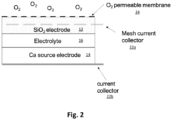
- the SiO x -based electrode comprises a mesh current collector disposed between and in contact with first and second layers of the SiO x -containing material, an oxygen-gas-permeable membrane is disposed on an outer surface of the first layer, the oxygen-gas-permeable membrane is configured to be exposed to O 2 gas during operation of the electrochemical cell, and an outer surface of the second layer is placed in contact with the liquid electrolyte.
- the systems further comprise an ionically conductive separator positioned between the Ca-based electrode and the SiO x -based electrode.
- the electrolyte comprises a solution of one or more calcium salts in an organic solvent, in an aqueous solution or in a solid electrolyte melt.
- system further comprises a voltage source for supplying energy to operate the electrochemical cell.
- CaCO 3 calcium carbonate
- CaO calcium oxide
- the lime is then combined with silicon dioxide (SiO 2 ) and other minerals and heated to 1450°C until the desired Ca-Si-oxide materials are formed.
- the target materials include Wollastonite (CaSiO 3 ), Rankanite, (Ca 3 Si 2 O 7 ), Belite (Ca 2 SiO 4 ) and Alite (Ca 3 SiO 5 ), with the latter two being the predominate components of Portland cement. Additionally, the extra materials added along with the silicon dioxide do not contribute to the final desired products but rather aid in the formation of the target calcium silicate materials.
- the present disclosure pertains to methods for the electrochemical production of calcium silicate compounds (also referred to as Ca-Si-oxide compounds) in an electrochemical cell that comprises (a) Ca-based electrode that comprises calcium metal or an inorganic calcium material, for example, a calcium mineral, (b) an SiO x -based electrode that comprises SiO x , where x ranges from 1 to 2, and (c) a liquid electrolyte disposed between the Ca-based electrode and SiO x -based electrode.
- the electrochemical cell is operated under conditions such that calcium cations are produced at the Ca-based electrode and one or more calcium silicate compounds is produced at the SiO x -based electrode.
- Examples of calcium silicate compounds that may be produced include, for example, one or more of Wollastonite (CaSiO 3 ), Rankanite (Ca 2 Si 3 O 7 ), Belite (Ca 2 SiO 4 ), Alite (Ca 2 SiO 4 ), or amorphous calcium silicates.
- inorganic calcium materials for use at the Ca-based electrode include calcium metal and calcium minerals such as lime (calcium oxide), limestone (calcium carbonate), gypsum (a dihydrate of calcium sulfate), anhydrite (an anhydrous calcium sulfate), apatite (a calcium phosphate halide or calcium phosphate hydroxide), and fluorite (calcium fluoride), among others.
- lime calcium oxide
- limestone calcium carbonate
- gypsum a dihydrate of calcium sulfate
- anhydrite an anhydrous calcium sulfate
- apatite a calcium phosphate halide or calcium phosphate hydroxide
- fluorite calcium fluoride
- SiO x materials for use at the SiO x -based electrode include silicon monoxide (SiO) and silicon dioxide (SiO 2 ) in crystalline or amorphous form.
- Belite (Ca 2 SiO 4 ): Ca 2+ + 2e - + 2 Ca 3 Si 2 O 7 ⁇ 7/2 Ca 2 SiO 4 + 1/2 Si
- CaCO 3 Ca 2+ + 2e - + CO 2 + 1/2 O 2
- a suitable calcium-ion-conducting electrolyte Positioned between the Ca-based electrode and the SiO x -based electrode is a suitable calcium-ion-conducting electrolyte which may be a liquid ion-conducting electrolyte or a solid ion-conducting electrolyte at room temperature.
- liquid calcium-ion-conducting electrolytes include non-aqueous electrolytes that comprise organic solvent such as acetonitrile (C 2 H 3 N), dimethyl sulfoxide (DMSO, C 2 H 6 SO), or other organic solvents that have been shown to work in electrochemical calcium systems, as well as a suitable calcium salt having good solubility in the organic solvent (e.g., having a concentration ranging from approximately 0.05M to 1M or more) such as calcium perchlorate (Ca(ClO 4 ) 2 ), calcium chlorate (Ca(ClO 3 ) 2 , calcium bromate (Ca(BrO 3 ) 2 , calcium chloride (CaCl 2 ), calcium bromide (CaBr 2 ), calcium nitrate (Ca(NO 3 ) 2 ), calcium permanganate (Ca(MnO 4 ) 2 ), or calcium borohydride (Ca(BH 4 ) 2 ), calcium tetrafluoroborate (Ca(CH
- an aqueous liquid electrolyte may be employed where salt concentrations are sufficiently high that water is not split into hydrogen and water at operating potentials (e.g., ranging from 6-10 molar, among other possible concentrations).
- a melt of a solid electrolyte such as a ceramic-based solid electrolyte, a ceramic-oxide-based solid electrolyte, or a sulfide-based solid electrolyte may be employed.
- a suitable separator may be employed, examples of which include nonwoven fiber-based separators (e.g., glass, nylon, polyester, cotton, etc.), polymer-film-based separators (polyethylene, polypropylene, poly(tetrafluoroethylene), polyvinyl chloride, etc.), and ceramic-based separators, or any other separator commonly used in battery cells.
- nonwoven fiber-based separators e.g., glass, nylon, polyester, cotton, etc.
- polymer-film-based separators polyethylene, polypropylene, poly(tetrafluoroethylene), polyvinyl chloride, etc.
- ceramic-based separators or any other separator commonly used in battery cells.
- a borosilicate glass fiber sheet may be used.
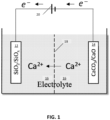
- FIG. 1 A schematic of a proposed electrochemical cell is shown in Fig. 1 .
- the electrode labelled " SiO 2 /SiO x " 12 may comprise any suitable form of SiO x including SiO 2 and SiO.
- the electrode labelled "CaCO 3 /CaO” 14 may comprise Ca metal in which case a potential would be produced, or may comprise any suitable inorganic calcium material such as lime/CaO, limestone/CaCO 3 , gypsum/CaSO 4 ⁇ 2H 2 O, anhydrite/ CaSO 4 , apatite/Ca 5 (PO 4 ) 3 (F,Cl,OH), or fluorite CaFl 2 , among others, in which case a potential is supplied.
- a calcium-oxide-based electrode, a calcium carbonate-based electrode, or a calcium sulfate-based electrode can be electrochemically decomposed to produce calcium ions in the electrolyte as well as O 2 gas in the case of calcium oxide, CO 2 and O 2 gas in the case of calcium carbonate, or SO 2 and O 2 gas in the case of calcium sulfate.
- the calcium ions can then diffuse/migrate to the SiO x -based electrode where the calcium ions intercalate into the SiO x -based electrode to produce various calcium silicate products.
- a calcium-salt-containing electrolyte 16 and a separator 18 represented by a dashed line).
- SiO x -based electrode examples include SiO and SiO 2 .
- SiO has been previously used in many Li-ion battery cells, and SiO 2 is the conventional raw material source of silicon in cement production.
- SiO electrodes may be prepared and processed in ways that are seen in Li-ion battery research. This includes heating SiO 2 and Si at elevated temperatures to produce gaseous SiO that is then condensed. See, e.g., H. N. Potter. Trans. Am. Electrochem. Soc., 12, 191 (1907 ).
- SiO 2 electrodes can be prepared through reactive radio frequency sputtering. See, e.g., Qian Sun, et al., "Lithium electrochemistry of SiO2 thin film electrode for lithium-ion batteries". Applied Surface Science, 254(13): 3774-3779, 2008 .
- electrodes can be formed on top of current collectors then incorporated into a suitable electrochemical cell format.
- a suitable electrochemical cell format For example, such electrodes may be placed inside a closed cell form factor such as closed coin cell (also known as a button cell), pouch cell, or other suitable design.
- the SiO x -based electrode may be formed by preparing a slurry that comprise some form of SiO x (e.g., SiO and/or SiO 2 ) which is then applied to a suitable current collector material (e.g., aluminum, copper, or nickel, among others).
- the slurry may comprise, in addition to silicon oxide as the active material, a conductive agent such as carbon black or carbon nanotubes, among others, and a binding agent, for example, a polymer based binding agent such as cellulose carboxymethyl cellulose(CMC), polyvinylidene fluoride (PVDF) or polytetrafluoroethylene (PTFE), among others.
- the silicon oxide, the binder, and the conductive agent materials may be combined in any suitable relative amount, including for example, from about 50 to about 70 wt% silicon oxide, beneficially about 60 wt%, from about 5 to about 15 wt% conductive agent, beneficially about 10 wt%, and from about 20 to about 40 wt%, beneficially about 30 wt%, among other possible relative amounts.
- a suitable solvent such as water and/or an organic solvent may be used.
- water may be used in the case of CMC binder, or N-Methyl-2-pyrrolidone(NMP) may be used in the case of PVDF binder.
- NMP N-Methyl-2-pyrrolidone
- the calcium metal may be used directly as the Ca-based electrode (e.g., in the form of a calcium metal foil or wire), in which case the calcium metal can act both as the Ca-source and the current collector.
- an inorganic calcium material e.g., calcium mineral source such as limestone, lime or gypsum
- preparation of the electrode can be analogous to the procedure described above.
- a slurry that comprises some form of inorganic calcium material may be applied to a suitable current collector material (e.g., aluminum among others).
- the slurry may comprise, in addition to the inorganic calcium material as the active material, a conductive agent and a binding agent.
- the inorganic calcium material, conductive agent and binder materials may be combined in any suitable relative amount, including, for example, from about 50 to about 70 wt% calcium mineral, beneficially about 60 wt%, from about 5 to about 15 wt% conductive agent, beneficially about 10 wt%, and from about 20 to about 40 wt%, beneficially about 30 wt%, among other possible relative amounts.
- a suitable solvent such as water and/or an organic solvent may be used.
- the slurry is then applied to the current collector and dried under suitable conditions, thereby forming the Ca-based electrode.
- Electrode format is a dip electrode.
- the electrodes may be produced in a manner analogous to the above except that the slurry is rolled onto a both sides of a current collector mesh material.
- a polymeric binding material may be used that is much stronger than those described above (e.g., polymethyl-methacrylate (PMMA), etc.).
- PMMA polymethyl-methacrylate
- the final electrodes can then be dipped into the electrolyte solution within any suitable container (e.g., a beaker, tank, etc.) without the use of a closed cell, enabling much faster reuse of the electrolyte solution.
- Belite (Ca 2 SiO 4 ): Ca 2+ + 2e - + Ca 3 Si 2 O 7 + 1/2 O 2 ⁇ 2Ca 2 SiO 4
- Alite (Ca 2 SiO 4 ): Ca 2+ + 2e - + Ca 2 SiO 4 + 1/2 O 2 ⁇ Ca 3 SiO 5
- an electrochemical cell may be made such that the SiO x -based electrode is permeable to O 2 gas.
- This can be accomplished by creating a hybrid electrode analogous to those previously used in lithium ion battery systems ( see Xiao, J., Xu, W., Wang, D., & Zhang, J. G. (2010). "Hybrid air-electrode for Li/air Batteries.” Journal of the Electrochemical Society, 157(3), A294 ). Electrode preparation can proceed along the lines discussed above, where silicon oxide active material is combined with a conductive material and a binder material and then laminated onto a mesh current collector.
- This may be done, for example, by combining the active material, conductive material, and binder (e.g., in a weight ratio like that described above), and forming a slurry by the addition of enough solvent such that the slurry is malleable but can hold its shape.
- the slurry is then rolled out and laminated on each side of a current collector, for example, a copper mesh.
- a current collector for example, a copper mesh.
- a thin porous membrane such a porous Teflon membrane, among others.
- the prepared electrode is then preferably dried (e.g., for about 12h at 120°C).
- FIG. 2 A schematic of a proposed electrochemical cell in which such an electrode is employed is shown in Fig. 2 , which illustrates a silicon-dioxide-based electrode 12 having a mesh current collector 22a and a porous membrane 24 as described above. Also shown is a Ca-based electrode 14 with an associated current collector 22b. Between the silicon-dioxide-based electrode 12 and the Ca-based electrode 14 is an is a calcium-salt-containing electrolyte 16 and a separator (not shown) as discussed above. As seen from Fig.
- the silicon-dioxide-based electrode 12 is placed in the electrochemical cell such that one side of the silicon-dioxide-based electrode 12 is exposed to the electrolyte 16 and the opposite side of the silicon-dioxide-based electrode 12 is exposed to O 2 gas through the porous membrane 24 during operation.
Landscapes
- Chemical & Material Sciences (AREA)
- Engineering & Computer Science (AREA)
- Organic Chemistry (AREA)
- Materials Engineering (AREA)
- Chemical Kinetics & Catalysis (AREA)
- Ceramic Engineering (AREA)
- Electrochemistry (AREA)
- Metallurgy (AREA)
- Inorganic Chemistry (AREA)
- Structural Engineering (AREA)
- Life Sciences & Earth Sciences (AREA)
- General Life Sciences & Earth Sciences (AREA)
- Geology (AREA)
- Battery Electrode And Active Subsutance (AREA)
- Silicon Compounds (AREA)
- Electrodes For Compound Or Non-Metal Manufacture (AREA)
- Silicates, Zeolites, And Molecular Sieves (AREA)
Claims (15)
- Verfahren zur elektrochemischen Produktion von Calciumsilicatverbindungen in einer elektrochemischen Zelle, die Folgendes umfasst: (a) eine Ca-basierte Elektrode (14), die Calciummetall oder ein anorganisches Calciummaterial umfasst, (b) eine SiOx-basierte Elektrode (12), die ein SiOx-Material umfasst, wobei x im Bereich von 1 bis 2 liegt, und (c) einen flüssigen Elektrolyten (16), der zwischen der Ca-basierten Elektrode (14) und der SiOx-basierten Elektrode (12) angeordnet ist, wobei die elektrochemische Zelle unter derartigen Bedingungen betrieben wird, dass an der Ca-basierten Elektrode (14) Calciumkationen produziert werden und an der SiOx-basierten Elektrode (12) eine oder mehrere Calciumsilicatverbindungen (Ca-Si-Oxid-Verbindungen) produziert werden.
- Verfahren nach Anspruch 1, wobei die produzierte(n) eine oder mehreren Calciumsilicatverbindungen eines oder mehrere von Wollastonit (CaSiO3), Rankanit (Ca2Si3O7), Belit (Ca2SiO4) und Alit (Ca2SiO4) umfassen.
- Verfahren nach Anspruch 1, wobei die Ca-basierte Elektrode (14) Calciummetall umfasst und wobei der Betrieb der elektrochemischen Zelle ein nutzbares elektrisches Potential produziert.
- Verfahren nach Anspruch 1, wobei das anorganische Calciummaterial Calciumoxid umfasst, wobei an der Ca-basierten Elektrode (14) zusätzlich zu den Calciumkationen Sauerstoffgas produziert wird und wobei eine Quelle des elektrischen Potentials (20) bereitgestellt wird, um die elektrochemische Zelle anzutreiben, oderwobei das anorganische Calciummaterial Calciumcarbonat umfasst, wobei an der Ca-basierten Elektrode (14) zusätzlich zu den Calciumkationen Sauerstoff- und Kohlenstoffdioxidgase produziert werden und wobei eine Quelle des elektrischen Potentials (20) bereitgestellt wird, um die elektrochemische Zelle anzutreiben, oderwobei das anorganische Calciummaterial Calciumsulfat umfasst, wobei an der Ca-basierten Elektrode (14) zusätzlich zu den Calciumkationen Sauerstoff- und Schwefeldioxidgas produziert wird und wobei eine Quelle des elektrischen Potentials (20) bereitgestellt wird, um die elektrochemische Zelle anzutreiben.
- Verfahren nach Anspruch 1, wobei an der SiOx-basierten Elektrode (12) Sauerstoff eingeführt wird, um die Bildung von Silizium an der SiOx-basierten Elektrode (12) zu reduzieren oder zu verhindern, oder
wobei der Elektrolyt (16) eine Lösung aus einem oder mehreren Calciumsalzen in einem organischen Lösemittel, in einer wässrigen Lösung oder in einer Elektrolyt-Feststoffschmelze umfasst. - System zur elektrochemischen Produktion von Calciumsilicatverbindungen, wobei das System eine elektrochemische Zelle umfasst, die Folgendes umfasst: (a) eine Ca-basierte Elektrode (14), die Calciummetall oder ein anorganisches Calciummaterial umfasst, (b) eine SiOx-basierte Elektrode (12), die ein SiOx-Material umfasst, wobei x im Bereich von 1 bis 2 liegt, und (c) einen flüssigen Elektrolyten (16), der zwischen der Ca-basierten Elektrode (14) und der SiOx-basierten Elektrode (12) angeordnet ist, wobei das System dafür gestaltet ist, die elektrochemische Zelle unter derartigen Bedingungen zu betreiben, dass an der Ca-basierten Elektrode (14) Calciumkationen produziert werden und an der SiOx-basierten Elektrode (12) eine oder mehrere Calciumsilicatverbindungen (Ca-Si-Oxid-Verbindungen) produziert werden.
- System nach Anspruch 6, wobei die Ca-basierte Elektrode (14), die SiOx-basierte Elektrode (12) und der Elektrolyt (16) in einer geschlossenen Zelle platziert sind.
- System nach Anspruch 6, wobei die Ca-basierte Elektrode (14) und die SiOx-basierte Elektrode (12) in den flüssigen Elektrolyten (16) eingetaucht sind.
- System nach einem der Ansprüche 6 bis 8, wobei die Ca-basierte Elektrode (14) ein anorganisches Calciummaterial umfasst, das aus Calciumoxid, Calciumcarbonat und Calciumsulfatdihydrat ausgewählt ist.
- System nach einem der Ansprüche 6 bis 8, wobei die Ca-basierte Elektrode (14) Calciummetall umfasst.
- System nach einem der Ansprüche 6 bis 9, wobei die Ca-basierte Elektrode (14) einen Stromkollektor (22b) in Kontakt mit einem Material umfasst, das eine Mischung aus dem anorganischen Calciummaterial, einem leitenden Material und einem Bindemittel umfasst.
- System nach einem der Ansprüche 6 bis 11, wobei die SiOx-basierte Elektrode (12) einen Stromkollektor in Kontakt mit einem SiOx-haltigen Material umfasst, das eine Mischung aus SiOx-Material, einem leitenden Material und einem Bindemittel umfasst, optional
wobei die SiOx-basierte Elektrode (12) einen Gitterstromkollektor (22a) umfasst, der zwischen einer ersten und einer zweiten Schicht des SiOx-haltigen Materials und in Kontakt mit diesen angeordnet ist, und eine für Sauerstoffgas durchlässige Membran (24), die an einer Außenfläche der ersten Schicht angeordnet ist, wobei die für Sauerstoffgas durchlässige Membran dafür gestaltet ist, während des Betriebes der elektrochemischen Zelle O2-Gas ausgesetzt zu sein, und wobei eine Außenfläche der zweiten Schicht in Kontakt mit dem flüssigen Elektrolyten (16) platziert ist. - System nach einem der Ansprüche 6 bis 12, ferner ein ionisch leitendes Trennstück umfassend, das zwischen der Ca-basierten Elektrode (14) und der SiOx-basierten Elektrode (12) positioniert ist.
- System nach einem der Ansprüche 6 bis 13, wobei der Elektrolyt (16) eine Lösung aus einem oder mehreren Calciumsalzen in einem organischen Lösemittel, in einer wässrigen Lösung oder in einer Elektrolyt-Feststoffschmelze umfasst.
- System nach einem der Ansprüche 6 bis 8 und 10 bis 14, ferner eine Spannungsquelle (20) umfassend, um Energie für den Betrieb der elektrochemischen Zelle bereitzustellen.
Applications Claiming Priority (3)
| Application Number | Priority Date | Filing Date | Title |
|---|---|---|---|
| US201962973849P | 2019-10-29 | 2019-10-29 | |
| US202063086117P | 2020-10-01 | 2020-10-01 | |
| PCT/US2020/057715 WO2021086949A1 (en) | 2019-10-29 | 2020-10-28 | Electrochemical synthesis of cementitious compounds |
Publications (4)
| Publication Number | Publication Date |
|---|---|
| EP4052313A1 EP4052313A1 (de) | 2022-09-07 |
| EP4052313A4 EP4052313A4 (de) | 2023-08-02 |
| EP4052313B1 true EP4052313B1 (de) | 2024-04-03 |
| EP4052313C0 EP4052313C0 (de) | 2024-04-03 |
Family
ID=75714564
Family Applications (1)
| Application Number | Title | Priority Date | Filing Date |
|---|---|---|---|
| EP20880930.1A Active EP4052313B1 (de) | 2019-10-29 | 2020-10-28 | Elektrochemische synthese von zementartigen verbindungen |
Country Status (6)
| Country | Link |
|---|---|
| US (1) | US12428738B2 (de) |
| EP (1) | EP4052313B1 (de) |
| CN (1) | CN114728801A (de) |
| CA (1) | CA3157969A1 (de) |
| MX (1) | MX2022005087A (de) |
| WO (1) | WO2021086949A1 (de) |
Families Citing this family (1)
| Publication number | Priority date | Publication date | Assignee | Title |
|---|---|---|---|---|
| WO2024186976A2 (en) * | 2023-03-07 | 2024-09-12 | University Of Virginia Patent Foundation | Making treated cementitious material, treated cementitious material, and concrete including treated cementitious material |
Family Cites Families (10)
| Publication number | Priority date | Publication date | Assignee | Title |
|---|---|---|---|---|
| DE10030093C1 (de) * | 2000-06-19 | 2002-02-21 | Starck H C Gmbh | Verfahren und Vorrichtung zur Herstellung von Metallhydroxiden oder basischen Metallcarbonaten |
| US7048900B2 (en) * | 2001-01-31 | 2006-05-23 | G.R. International, Inc. | Method and apparatus for production of precipitated calcium carbonate and silicate compounds in common process equipment |
| NO317073B1 (no) * | 2001-06-05 | 2004-08-02 | Sintef | Elektrolytt samt fremgangsmate ved fremstilling eller raffinering av silisium |
| US10113407B2 (en) * | 2007-08-09 | 2018-10-30 | Lawrence Livermore National Security, Llc | Electrochemical production of metal hydroxide using metal silicates |
| US7749476B2 (en) | 2007-12-28 | 2010-07-06 | Calera Corporation | Production of carbonate-containing compositions from material comprising metal silicates |
| CN101545111B (zh) | 2008-03-26 | 2011-01-26 | 比亚迪股份有限公司 | 一种单质硅的制备方法 |
| JP2013187109A (ja) | 2012-03-09 | 2013-09-19 | Yoshiaki Nagaura | シリカ電極の二次電池モジュール、及び製造方法 |
| WO2013166255A1 (en) | 2012-05-03 | 2013-11-07 | Tangent Company Llc | Hardness reduction apparatus and method |
| US20180291513A1 (en) | 2017-04-11 | 2018-10-11 | Wisconsin Alumni Research Foundation | Low temperature electrochemical production of silicon |
| WO2022036006A1 (en) * | 2020-08-11 | 2022-02-17 | The Regents Of The University Of California | Chemical calcium hydroxide manufacturing for cement production using electrochemical separation devices |
-
2020
- 2020-10-28 CN CN202080074070.5A patent/CN114728801A/zh active Pending
- 2020-10-28 MX MX2022005087A patent/MX2022005087A/es unknown
- 2020-10-28 US US17/771,197 patent/US12428738B2/en active Active
- 2020-10-28 CA CA3157969A patent/CA3157969A1/en active Pending
- 2020-10-28 WO PCT/US2020/057715 patent/WO2021086949A1/en not_active Ceased
- 2020-10-28 EP EP20880930.1A patent/EP4052313B1/de active Active
Also Published As
| Publication number | Publication date |
|---|---|
| CN114728801A (zh) | 2022-07-08 |
| EP4052313A1 (de) | 2022-09-07 |
| MX2022005087A (es) | 2022-07-04 |
| CA3157969A1 (en) | 2021-05-06 |
| WO2021086949A1 (en) | 2021-05-06 |
| EP4052313A4 (de) | 2023-08-02 |
| US12428738B2 (en) | 2025-09-30 |
| US20220380909A1 (en) | 2022-12-01 |
| EP4052313C0 (de) | 2024-04-03 |
Similar Documents
| Publication | Publication Date | Title |
|---|---|---|
| AU2010358633B2 (en) | Sulfide solid electrolyte glass, lithium solid-state battery, and method for producing sulfide solid electrolyte glass | |
| Kumar et al. | Room temperature sodium-sulfur batteries as emerging energy source | |
| Kitaura et al. | Electrochemical performance and reaction mechanism of all-solid-state lithium–air batteries composed of lithium, Li 1+ x Al y Ge 2− y (PO 4) 3 solid electrolyte and carbon nanotube air electrode | |
| Yu et al. | NaCrO 2 cathode for high-rate sodium-ion batteries | |
| Song et al. | A Na 3 V 2 (PO 4) 3 cathode material for use in hybrid lithium ion batteries | |
| Tachikawa et al. | Reversibility of electrochemical reactions of sulfur supported on inverse opal carbon in glyme–Li salt molten complex electrolytes | |
| AU2010342201B2 (en) | Liquid hydrophobic phase transition substance, and battery comprising same | |
| EP4047676A1 (de) | Elektrode für energiespeichervorrichtung mit wasserfreiem elektrolyt, energiespeichervorrichtung mit wasserfreiem elektrolyt und herstellungsverfahren | |
| CN114503321A (zh) | 锂硫电池 | |
| US20230299263A1 (en) | A method for preparing nanometer-sized surface fluorinated battery materials | |
| CN111834673B (zh) | 一种碱土金属六氟磷酸盐电解质及电解液制备方法 | |
| KR20160048078A (ko) | 고체 금속 카보네이트를 포함하는 캐소드를 갖는 금속-공기 배터리 | |
| Liu et al. | Solid-state transformations of active materials in the pores of sulfurized-polyacrylonitrile fiber membranes via nucleophilic reactions for high-loading and free-standing lithium–sulfur battery cathodes | |
| Zhang et al. | W 18 O 49 nanowire composites as novel barrier layers for Li–S batteries based on high loading of commercial micro-sized sulfur | |
| Sun et al. | Surface coating engineering of prelithiation cathode additives for lithium-ion batteries | |
| EP4052313B1 (de) | Elektrochemische synthese von zementartigen verbindungen | |
| Jin et al. | Copper ions-intercalated manganese dioxide self-supporting mesoporous carbon electrode for aqueous zinc-ion batteries | |
| CN117776258A (zh) | 复合材料及其制备方法和全固态锂电池 | |
| CN114267878A (zh) | 钙盐电解液和电解质及其制备方法和应用 | |
| KR20230169928A (ko) | 리튬-셀레늄 셀 | |
| JP2014093227A (ja) | 空気電池用空気極、及び当該空気極を備える空気電池 | |
| CN103597656A (zh) | 空气电池 | |
| US12362386B2 (en) | Solid electrolyte, preparation method thereof, lithium air battery including the solid electrolyte, and electrochemical device including the solid electrolyte | |
| Fey et al. | Calcium doping effects on the electrochemical properties of LiFePO4/C cathode materials for lithium-ion batteries | |
| US11283124B2 (en) | Lithium air battery |
Legal Events
| Date | Code | Title | Description |
|---|---|---|---|
| STAA | Information on the status of an ep patent application or granted ep patent |
Free format text: STATUS: THE INTERNATIONAL PUBLICATION HAS BEEN MADE |
|
| PUAI | Public reference made under article 153(3) epc to a published international application that has entered the european phase |
Free format text: ORIGINAL CODE: 0009012 |
|
| STAA | Information on the status of an ep patent application or granted ep patent |
Free format text: STATUS: REQUEST FOR EXAMINATION WAS MADE |
|
| 17P | Request for examination filed |
Effective date: 20220331 |
|
| AK | Designated contracting states |
Kind code of ref document: A1 Designated state(s): AL AT BE BG CH CY CZ DE DK EE ES FI FR GB GR HR HU IE IS IT LI LT LU LV MC MK MT NL NO PL PT RO RS SE SI SK SM TR |
|
| DAV | Request for validation of the european patent (deleted) | ||
| DAX | Request for extension of the european patent (deleted) | ||
| REG | Reference to a national code |
Ref country code: DE Free format text: PREVIOUS MAIN CLASS: H01M0004400000 Ipc: C25B0001010000 Ref country code: DE Ref legal event code: R079 Ref document number: 602020028548 Country of ref document: DE Free format text: PREVIOUS MAIN CLASS: H01M0004400000 Ipc: C25B0001010000 |
|
| A4 | Supplementary search report drawn up and despatched |
Effective date: 20230705 |
|
| RIC1 | Information provided on ipc code assigned before grant |
Ipc: C01B 33/24 20060101ALI20230629BHEP Ipc: C04B 28/18 20060101ALI20230629BHEP Ipc: C04B 12/00 20060101ALI20230629BHEP Ipc: C04B 7/345 20060101ALI20230629BHEP Ipc: C04B 7/02 20060101ALI20230629BHEP Ipc: C25B 11/047 20210101ALI20230629BHEP Ipc: C25B 11/042 20210101ALI20230629BHEP Ipc: C25B 9/19 20210101ALI20230629BHEP Ipc: C25B 5/00 20060101ALI20230629BHEP Ipc: C25B 1/50 20210101ALI20230629BHEP Ipc: C25B 1/01 20210101AFI20230629BHEP |
|
| GRAP | Despatch of communication of intention to grant a patent |
Free format text: ORIGINAL CODE: EPIDOSNIGR1 |
|
| STAA | Information on the status of an ep patent application or granted ep patent |
Free format text: STATUS: GRANT OF PATENT IS INTENDED |
|
| RIC1 | Information provided on ipc code assigned before grant |
Ipc: C01B 33/24 20060101ALI20231009BHEP Ipc: C04B 28/18 20060101ALI20231009BHEP Ipc: C04B 12/00 20060101ALI20231009BHEP Ipc: C04B 7/345 20060101ALI20231009BHEP Ipc: C04B 7/02 20060101ALI20231009BHEP Ipc: C25B 11/047 20210101ALI20231009BHEP Ipc: C25B 11/042 20210101ALI20231009BHEP Ipc: C25B 9/19 20210101ALI20231009BHEP Ipc: C25B 5/00 20060101ALI20231009BHEP Ipc: C25B 1/50 20210101ALI20231009BHEP Ipc: C25B 1/01 20210101AFI20231009BHEP |
|
| INTG | Intention to grant announced |
Effective date: 20231024 |
|
| GRAS | Grant fee paid |
Free format text: ORIGINAL CODE: EPIDOSNIGR3 |
|
| GRAA | (expected) grant |
Free format text: ORIGINAL CODE: 0009210 |
|
| STAA | Information on the status of an ep patent application or granted ep patent |
Free format text: STATUS: THE PATENT HAS BEEN GRANTED |
|
| AK | Designated contracting states |
Kind code of ref document: B1 Designated state(s): AL AT BE BG CH CY CZ DE DK EE ES FI FR GB GR HR HU IE IS IT LI LT LU LV MC MK MT NL NO PL PT RO RS SE SI SK SM TR |
|
| REG | Reference to a national code |
Ref country code: CH Ref legal event code: EP |
|
| REG | Reference to a national code |
Ref country code: DE Ref legal event code: R096 Ref document number: 602020028548 Country of ref document: DE |
|
| REG | Reference to a national code |
Ref country code: IE Ref legal event code: FG4D |
|
| U01 | Request for unitary effect filed |
Effective date: 20240410 |
|
| U07 | Unitary effect registered |
Designated state(s): AT BE BG DE DK EE FI FR IT LT LU LV MT NL PT SE SI Effective date: 20240422 |
|
| PG25 | Lapsed in a contracting state [announced via postgrant information from national office to epo] |
Ref country code: IS Free format text: LAPSE BECAUSE OF FAILURE TO SUBMIT A TRANSLATION OF THE DESCRIPTION OR TO PAY THE FEE WITHIN THE PRESCRIBED TIME-LIMIT Effective date: 20240803 |
|
| PG25 | Lapsed in a contracting state [announced via postgrant information from national office to epo] |
Ref country code: HR Free format text: LAPSE BECAUSE OF FAILURE TO SUBMIT A TRANSLATION OF THE DESCRIPTION OR TO PAY THE FEE WITHIN THE PRESCRIBED TIME-LIMIT Effective date: 20240403 |
|
| PG25 | Lapsed in a contracting state [announced via postgrant information from national office to epo] |
Ref country code: GR Free format text: LAPSE BECAUSE OF FAILURE TO SUBMIT A TRANSLATION OF THE DESCRIPTION OR TO PAY THE FEE WITHIN THE PRESCRIBED TIME-LIMIT Effective date: 20240704 |
|
| PG25 | Lapsed in a contracting state [announced via postgrant information from national office to epo] |
Ref country code: ES Free format text: LAPSE BECAUSE OF FAILURE TO SUBMIT A TRANSLATION OF THE DESCRIPTION OR TO PAY THE FEE WITHIN THE PRESCRIBED TIME-LIMIT Effective date: 20240403 |
|
| PG25 | Lapsed in a contracting state [announced via postgrant information from national office to epo] |
Ref country code: CZ Free format text: LAPSE BECAUSE OF FAILURE TO SUBMIT A TRANSLATION OF THE DESCRIPTION OR TO PAY THE FEE WITHIN THE PRESCRIBED TIME-LIMIT Effective date: 20240403 |
|
| PG25 | Lapsed in a contracting state [announced via postgrant information from national office to epo] |
Ref country code: PL Free format text: LAPSE BECAUSE OF FAILURE TO SUBMIT A TRANSLATION OF THE DESCRIPTION OR TO PAY THE FEE WITHIN THE PRESCRIBED TIME-LIMIT Effective date: 20240403 |
|
| PG25 | Lapsed in a contracting state [announced via postgrant information from national office to epo] |
Ref country code: PL Free format text: LAPSE BECAUSE OF FAILURE TO SUBMIT A TRANSLATION OF THE DESCRIPTION OR TO PAY THE FEE WITHIN THE PRESCRIBED TIME-LIMIT Effective date: 20240403 Ref country code: NO Free format text: LAPSE BECAUSE OF FAILURE TO SUBMIT A TRANSLATION OF THE DESCRIPTION OR TO PAY THE FEE WITHIN THE PRESCRIBED TIME-LIMIT Effective date: 20240703 Ref country code: IS Free format text: LAPSE BECAUSE OF FAILURE TO SUBMIT A TRANSLATION OF THE DESCRIPTION OR TO PAY THE FEE WITHIN THE PRESCRIBED TIME-LIMIT Effective date: 20240803 Ref country code: HR Free format text: LAPSE BECAUSE OF FAILURE TO SUBMIT A TRANSLATION OF THE DESCRIPTION OR TO PAY THE FEE WITHIN THE PRESCRIBED TIME-LIMIT Effective date: 20240403 Ref country code: GR Free format text: LAPSE BECAUSE OF FAILURE TO SUBMIT A TRANSLATION OF THE DESCRIPTION OR TO PAY THE FEE WITHIN THE PRESCRIBED TIME-LIMIT Effective date: 20240704 Ref country code: ES Free format text: LAPSE BECAUSE OF FAILURE TO SUBMIT A TRANSLATION OF THE DESCRIPTION OR TO PAY THE FEE WITHIN THE PRESCRIBED TIME-LIMIT Effective date: 20240403 Ref country code: CZ Free format text: LAPSE BECAUSE OF FAILURE TO SUBMIT A TRANSLATION OF THE DESCRIPTION OR TO PAY THE FEE WITHIN THE PRESCRIBED TIME-LIMIT Effective date: 20240403 Ref country code: RS Free format text: LAPSE BECAUSE OF FAILURE TO SUBMIT A TRANSLATION OF THE DESCRIPTION OR TO PAY THE FEE WITHIN THE PRESCRIBED TIME-LIMIT Effective date: 20240703 |
|
| REG | Reference to a national code |
Ref country code: DE Ref legal event code: R097 Ref document number: 602020028548 Country of ref document: DE |
|
| PG25 | Lapsed in a contracting state [announced via postgrant information from national office to epo] |
Ref country code: SK Free format text: LAPSE BECAUSE OF FAILURE TO SUBMIT A TRANSLATION OF THE DESCRIPTION OR TO PAY THE FEE WITHIN THE PRESCRIBED TIME-LIMIT Effective date: 20240403 Ref country code: RO Free format text: LAPSE BECAUSE OF FAILURE TO SUBMIT A TRANSLATION OF THE DESCRIPTION OR TO PAY THE FEE WITHIN THE PRESCRIBED TIME-LIMIT Effective date: 20240403 |
|
| PG25 | Lapsed in a contracting state [announced via postgrant information from national office to epo] |
Ref country code: SM Free format text: LAPSE BECAUSE OF FAILURE TO SUBMIT A TRANSLATION OF THE DESCRIPTION OR TO PAY THE FEE WITHIN THE PRESCRIBED TIME-LIMIT Effective date: 20240403 |
|
| PG25 | Lapsed in a contracting state [announced via postgrant information from national office to epo] |
Ref country code: SM Free format text: LAPSE BECAUSE OF FAILURE TO SUBMIT A TRANSLATION OF THE DESCRIPTION OR TO PAY THE FEE WITHIN THE PRESCRIBED TIME-LIMIT Effective date: 20240403 Ref country code: SK Free format text: LAPSE BECAUSE OF FAILURE TO SUBMIT A TRANSLATION OF THE DESCRIPTION OR TO PAY THE FEE WITHIN THE PRESCRIBED TIME-LIMIT Effective date: 20240403 Ref country code: RO Free format text: LAPSE BECAUSE OF FAILURE TO SUBMIT A TRANSLATION OF THE DESCRIPTION OR TO PAY THE FEE WITHIN THE PRESCRIBED TIME-LIMIT Effective date: 20240403 |
|
| PLBE | No opposition filed within time limit |
Free format text: ORIGINAL CODE: 0009261 |
|
| STAA | Information on the status of an ep patent application or granted ep patent |
Free format text: STATUS: NO OPPOSITION FILED WITHIN TIME LIMIT |
|
| 26N | No opposition filed |
Effective date: 20250106 |
|
| U21 | Renewal fee for the european patent with unitary effect paid with additional fee |
Year of fee payment: 5 Effective date: 20250404 |
|
| REG | Reference to a national code |
Ref country code: CH Ref legal event code: PL |
|
| GBPC | Gb: european patent ceased through non-payment of renewal fee |
Effective date: 20241028 |
|
| PG25 | Lapsed in a contracting state [announced via postgrant information from national office to epo] |
Ref country code: MC Free format text: LAPSE BECAUSE OF FAILURE TO SUBMIT A TRANSLATION OF THE DESCRIPTION OR TO PAY THE FEE WITHIN THE PRESCRIBED TIME-LIMIT Effective date: 20240403 |
|
| PG25 | Lapsed in a contracting state [announced via postgrant information from national office to epo] |
Ref country code: GB Free format text: LAPSE BECAUSE OF NON-PAYMENT OF DUE FEES Effective date: 20241028 |
|
| PG25 | Lapsed in a contracting state [announced via postgrant information from national office to epo] |
Ref country code: CH Free format text: LAPSE BECAUSE OF NON-PAYMENT OF DUE FEES Effective date: 20241031 |
|
| U20 | Renewal fee for the european patent with unitary effect paid |
Year of fee payment: 6 Effective date: 20250909 |
|
| PG25 | Lapsed in a contracting state [announced via postgrant information from national office to epo] |
Ref country code: IE Free format text: LAPSE BECAUSE OF NON-PAYMENT OF DUE FEES Effective date: 20241028 |
|
| PG25 | Lapsed in a contracting state [announced via postgrant information from national office to epo] |
Ref country code: HU Free format text: LAPSE BECAUSE OF FAILURE TO SUBMIT A TRANSLATION OF THE DESCRIPTION OR TO PAY THE FEE WITHIN THE PRESCRIBED TIME-LIMIT; INVALID AB INITIO Effective date: 20201028 |