EP4051520B1 - Türflügel mit leuchtprofil für ein fahrzeug - Google Patents
Türflügel mit leuchtprofil für ein fahrzeug Download PDFInfo
- Publication number
- EP4051520B1 EP4051520B1 EP20789882.6A EP20789882A EP4051520B1 EP 4051520 B1 EP4051520 B1 EP 4051520B1 EP 20789882 A EP20789882 A EP 20789882A EP 4051520 B1 EP4051520 B1 EP 4051520B1
- Authority
- EP
- European Patent Office
- Prior art keywords
- door leaf
- light
- groove
- profile
- light profile
- Prior art date
- Legal status (The legal status is an assumption and is not a legal conclusion. Google has not performed a legal analysis and makes no representation as to the accuracy of the status listed.)
- Active
Links
Images
Classifications
-
- B—PERFORMING OPERATIONS; TRANSPORTING
- B60—VEHICLES IN GENERAL
- B60Q—ARRANGEMENT OF SIGNALLING OR LIGHTING DEVICES, THE MOUNTING OR SUPPORTING THEREOF OR CIRCUITS THEREFOR, FOR VEHICLES IN GENERAL
- B60Q3/00—Arrangement of lighting devices for vehicle interiors; Lighting devices specially adapted for vehicle interiors
- B60Q3/20—Arrangement of lighting devices for vehicle interiors; Lighting devices specially adapted for vehicle interiors for lighting specific fittings of passenger or driving compartments; mounted on specific fittings of passenger or driving compartments
- B60Q3/217—Doors, e.g. door sills; Steps
-
- B—PERFORMING OPERATIONS; TRANSPORTING
- B60—VEHICLES IN GENERAL
- B60J—WINDOWS, WINDSCREENS, NON-FIXED ROOFS, DOORS, OR SIMILAR DEVICES FOR VEHICLES; REMOVABLE EXTERNAL PROTECTIVE COVERINGS SPECIALLY ADAPTED FOR VEHICLES
- B60J5/00—Doors
- B60J5/04—Doors arranged at the vehicle sides
- B60J5/0493—Appurtenances
- B60J5/0495—Finger guards
-
- B—PERFORMING OPERATIONS; TRANSPORTING
- B60—VEHICLES IN GENERAL
- B60Q—ARRANGEMENT OF SIGNALLING OR LIGHTING DEVICES, THE MOUNTING OR SUPPORTING THEREOF OR CIRCUITS THEREFOR, FOR VEHICLES IN GENERAL
- B60Q1/00—Arrangement of optical signalling or lighting devices, the mounting or supporting thereof or circuits therefor
- B60Q1/26—Arrangement of optical signalling or lighting devices, the mounting or supporting thereof or circuits therefor the devices being primarily intended to indicate the vehicle, or parts thereof, or to give signals, to other traffic
- B60Q1/32—Arrangement of optical signalling or lighting devices, the mounting or supporting thereof or circuits therefor the devices being primarily intended to indicate the vehicle, or parts thereof, or to give signals, to other traffic for indicating vehicle sides, e.g. clearance lights
- B60Q1/323—Arrangement of optical signalling or lighting devices, the mounting or supporting thereof or circuits therefor the devices being primarily intended to indicate the vehicle, or parts thereof, or to give signals, to other traffic for indicating vehicle sides, e.g. clearance lights on or for doors
- B60Q1/324—Arrangement of optical signalling or lighting devices, the mounting or supporting thereof or circuits therefor the devices being primarily intended to indicate the vehicle, or parts thereof, or to give signals, to other traffic for indicating vehicle sides, e.g. clearance lights on or for doors for signalling that a door is open or intended to be opened
-
- B—PERFORMING OPERATIONS; TRANSPORTING
- B60—VEHICLES IN GENERAL
- B60Q—ARRANGEMENT OF SIGNALLING OR LIGHTING DEVICES, THE MOUNTING OR SUPPORTING THEREOF OR CIRCUITS THEREFOR, FOR VEHICLES IN GENERAL
- B60Q3/00—Arrangement of lighting devices for vehicle interiors; Lighting devices specially adapted for vehicle interiors
- B60Q3/40—Arrangement of lighting devices for vehicle interiors; Lighting devices specially adapted for vehicle interiors specially adapted for specific vehicle types
- B60Q3/41—Arrangement of lighting devices for vehicle interiors; Lighting devices specially adapted for vehicle interiors specially adapted for specific vehicle types for mass transit vehicles, e.g. buses
-
- B—PERFORMING OPERATIONS; TRANSPORTING
- B60—VEHICLES IN GENERAL
- B60Q—ARRANGEMENT OF SIGNALLING OR LIGHTING DEVICES, THE MOUNTING OR SUPPORTING THEREOF OR CIRCUITS THEREFOR, FOR VEHICLES IN GENERAL
- B60Q3/00—Arrangement of lighting devices for vehicle interiors; Lighting devices specially adapted for vehicle interiors
- B60Q3/50—Mounting arrangements
- B60Q3/51—Mounting arrangements for mounting lighting devices onto vehicle interior, e.g. onto ceiling or floor
-
- B—PERFORMING OPERATIONS; TRANSPORTING
- B60—VEHICLES IN GENERAL
- B60Q—ARRANGEMENT OF SIGNALLING OR LIGHTING DEVICES, THE MOUNTING OR SUPPORTING THEREOF OR CIRCUITS THEREFOR, FOR VEHICLES IN GENERAL
- B60Q3/00—Arrangement of lighting devices for vehicle interiors; Lighting devices specially adapted for vehicle interiors
- B60Q3/50—Mounting arrangements
- B60Q3/51—Mounting arrangements for mounting lighting devices onto vehicle interior, e.g. onto ceiling or floor
- B60Q3/53—Modular mounting systems, e.g. using tracks, rails or multiple plugs
-
- B—PERFORMING OPERATIONS; TRANSPORTING
- B60—VEHICLES IN GENERAL
- B60Q—ARRANGEMENT OF SIGNALLING OR LIGHTING DEVICES, THE MOUNTING OR SUPPORTING THEREOF OR CIRCUITS THEREFOR, FOR VEHICLES IN GENERAL
- B60Q3/00—Arrangement of lighting devices for vehicle interiors; Lighting devices specially adapted for vehicle interiors
- B60Q3/60—Arrangement of lighting devices for vehicle interiors; Lighting devices specially adapted for vehicle interiors characterised by optical aspects
- B60Q3/62—Arrangement of lighting devices for vehicle interiors; Lighting devices specially adapted for vehicle interiors characterised by optical aspects using light guides
-
- B—PERFORMING OPERATIONS; TRANSPORTING
- B60—VEHICLES IN GENERAL
- B60Q—ARRANGEMENT OF SIGNALLING OR LIGHTING DEVICES, THE MOUNTING OR SUPPORTING THEREOF OR CIRCUITS THEREFOR, FOR VEHICLES IN GENERAL
- B60Q3/00—Arrangement of lighting devices for vehicle interiors; Lighting devices specially adapted for vehicle interiors
- B60Q3/60—Arrangement of lighting devices for vehicle interiors; Lighting devices specially adapted for vehicle interiors characterised by optical aspects
- B60Q3/62—Arrangement of lighting devices for vehicle interiors; Lighting devices specially adapted for vehicle interiors characterised by optical aspects using light guides
- B60Q3/64—Arrangement of lighting devices for vehicle interiors; Lighting devices specially adapted for vehicle interiors characterised by optical aspects using light guides for a single lighting device
-
- B—PERFORMING OPERATIONS; TRANSPORTING
- B60—VEHICLES IN GENERAL
- B60Q—ARRANGEMENT OF SIGNALLING OR LIGHTING DEVICES, THE MOUNTING OR SUPPORTING THEREOF OR CIRCUITS THEREFOR, FOR VEHICLES IN GENERAL
- B60Q3/00—Arrangement of lighting devices for vehicle interiors; Lighting devices specially adapted for vehicle interiors
- B60Q3/70—Arrangement of lighting devices for vehicle interiors; Lighting devices specially adapted for vehicle interiors characterised by the purpose
- B60Q3/78—Arrangement of lighting devices for vehicle interiors; Lighting devices specially adapted for vehicle interiors characterised by the purpose for generating luminous strips, e.g. for marking trim component edges
-
- B—PERFORMING OPERATIONS; TRANSPORTING
- B61—RAILWAYS
- B61D—BODY DETAILS OR KINDS OF RAILWAY VEHICLES
- B61D29/00—Lighting
-
- B—PERFORMING OPERATIONS; TRANSPORTING
- B60—VEHICLES IN GENERAL
- B60J—WINDOWS, WINDSCREENS, NON-FIXED ROOFS, DOORS, OR SIMILAR DEVICES FOR VEHICLES; REMOVABLE EXTERNAL PROTECTIVE COVERINGS SPECIALLY ADAPTED FOR VEHICLES
- B60J10/00—Sealing arrangements
- B60J10/40—Sealing arrangements characterised by contact between two or more cooperating sealing arrangements
-
- B—PERFORMING OPERATIONS; TRANSPORTING
- B60—VEHICLES IN GENERAL
- B60J—WINDOWS, WINDSCREENS, NON-FIXED ROOFS, DOORS, OR SIMILAR DEVICES FOR VEHICLES; REMOVABLE EXTERNAL PROTECTIVE COVERINGS SPECIALLY ADAPTED FOR VEHICLES
- B60J10/00—Sealing arrangements
- B60J10/80—Sealing arrangements specially adapted for opening panels, e.g. doors
- B60J10/86—Sealing arrangements specially adapted for opening panels, e.g. doors arranged on the opening panel
Definitions
- the present invention relates to a door leaf for motor vehicles and rail vehicles, having the features of the preamble of patent claim 1.
- Entry systems for motor vehicles and rail vehicles comprise one or two door leaves that can close an entry area of a bus or train via a sliding, pivoting or pivoting-sliding movement.
- the door leaves can, for example, be all-glass door leaves or have a sandwich construction with an aluminum cover sheet.
- the door leaves have a main closing edge that extends over the entire height of the door leaf and is arranged parallel to the y-axis.
- the front edge of the door leaf in the closing direction is therefore the main closing edge.
- the side opposite the main closing edge is called the secondary closing edge.
- the width of the door leaf is defined in the direction of the x-axis in an orthogonal coordinate system.
- the height of the door leaf extends in the direction of the y-axis and the thickness of the door leaf in the direction of the z-axis.
- a finger protection rubber is usually provided along the main closing edge. This is made of an elastic material that gives way if, for example, a hand gets caught in the door, thus preventing injuries.
- safety technology can be provided in the finger protection rubber, such as pressure sensors that can register an increase in pressure. If an increase in pressure is registered, the entry area is immediately reopened or the closing movement is interrupted.
- An example of the operating state of the entry area is the closing movement of the door wings.
- This operating state can be indicated to the passenger by means of a visual and/or acoustic display.
- an indication tone usually sounds, which can be accompanied by a flashing or continuously lit light source.
- the light source can be located above the door on the inside and/or outside of the bus or train. The disadvantage of this position of the light source is that it is not easily seen by a passenger standing directly in front of the door. The light source is therefore often integrated into the surface of the door leaf, but this requires significant changes to its design.
- the finger protection rubber to be made of uncolored silicone.
- a light source is arranged on the front side of the door leaf along the y-axis in the area of the main closing edge.
- the finger protection rubber directs and scatters the light emission to the viewer. Since the finger protection rubber is arranged in the entry area, it can become contaminated, for example if bags hit the finger protection rubber or passengers lean on it. A rough surface of the silicone can intensify this effect.
- contamination of the silicone can reduce the visibility of the light emission.
- all-glass door leaves With all-glass door leaves, the door is formed by a metal frame with glass panes. Due to the large glass front, electrical cables can only be accommodated in the area of the metal frame. Since all-glass door leaves, unlike sandwich door leaves, do not have cover plates, the integration of additional modules, such as light sources or sensors, is difficult and is also usually limited to the area of the metal frame.
- the publication US 2019/0255923 A1 discloses a door leaf for motor vehicles and rail vehicles with a luminous profile, wherein the door leaf has a light source on its main closing edge.
- the object to be achieved by the present invention is to make the integration of a light source into a door leaf less complex and more cost-effective. Furthermore, the display should be clearly visible to the passenger.
- a modular door leaf according to the invention in particular for motor vehicles and rail vehicles, has a main closing edge, with a light source being arranged on the main closing edge.
- the door leaf is characterized by a light profile which is arranged on the main closing edge and which is designed to guide and scatter the light emission of the light source.
- the door leaf closes the entrance area of a bus or train using a sliding, pivoting or pivoting-sliding movement.
- the door leaf is usually rectangular, with the main closing edge located on one long side.
- a translucent light profile and a light source, preferably an RGB(W) light-emitting diode, are arranged on the front side of the door leaf in the area of the main closing edge.
- Light-emitting diode (LED) lamps or LED light strips have a long service life and low maintenance requirements, while also requiring little power. At the same time, due to their flexible structure, they can be mounted on more complex geometric shapes, such as on door leaves with a camber.
- the light source is mounted on the door leaf and shines in the x-direction into the light profile.
- the light profile serves as a light guide and diffuser, whereby the light emission is redirected evenly in all directions. An individual light source can therefore no longer be recognized separately.
- the passenger can see the light emission directed outwards and recognize the operating status of the boarding area.
- the light source can flash or shine continuously depending on the operating status.
- the light emission can be seen by both the passenger inside the vehicle and the passenger outside the bus or train. Alternatively, the light emission can only shine into the interior of the vehicle or outwards.
- the illumination of the light profile can show the passenger on the platform which carriages are heavily occupied and which are not, so that the passenger can orient themselves accordingly on the platform to the less occupied carriages while the train is still pulling into the station.
- Another alternative possibility is that two light sources are arranged in the light profile, which are separated from each other by a separating layer. This means that, for example, one light source can only shine into the vehicle interior, with the other light sources can only shine outwards from the vehicle, meaning that they can only be seen by passengers outside the vehicle.
- This solution has the advantage that the flow of passengers into and out of the vehicle can be controlled by, for example, two-coloured illumination of the light sources, for example green and red.
- the geometric shape of the lighting profile can be adapted to individual customer requirements, independent of the door leaf, and can be made wider or narrower, for example.
- To integrate the lighting profile on the door leaf only the front side of the door leaf in the area of the main closing edge needs to be structurally adapted.
- the door leaf according to the invention is therefore also suitable for door leaves with cambering.
- a finger protection rubber is arranged on the lighting profile on the side of the lighting profile opposite the door leaf in the second lighting profile groove.
- the finger protection rubber is made of an elastic material, preferably silicone.
- the lighting profile extends over the entire height of the main closing edge, whereby the light emission is easily visible to the passenger.
- an illuminated lighting profile can also be arranged on the secondary closing edge by reducing the construction of the door leaf at the secondary closing edge by the width of the lighting profile.
- the lighting profile is arranged on the door leaf in the same way as on the main closing edge and can extend over the entire height of the secondary closing edge.
- the door leaf preferably has a door leaf groove.
- the door leaf groove is arranged on the front side of the door leaf in the area of the main closing edge.
- the lighting profile is attached to the door leaf groove and is locked in place by door leaf cranks that are aligned with each other in the z-direction and narrow the groove at the end in the x-direction.
- the lighting profile is pushed into the door leaf groove and only needs to be additionally locked in the y-direction. This reduces installation times and costs.
- the lighting profile can be glued or screwed or similarly attached to the door leaf.
- the light source is arranged at the bottom of the door leaf groove.
- the light source is easily accessible for maintenance work and can be removed after the light profile has been removed from the door leaf groove.
- the light source can be attached to the groove base by gluing, using a screw connection or a similar connection, for example.
- Removable connections have the advantage that the light source can be easily replaced if it breaks.
- the light source is protected in the door leaf groove from external influences such as moisture or mechanical stress such as impacts.
- the lighting profile forms a first lighting profile groove and a second lighting profile groove, the shape of the first lighting profile groove being matched to the shape of the light source. This enables a compact design of the lighting profile.
- walls of the first light profile groove form first light profile offsets directed towards each other at the ends, so that the light source is held at a distance from the groove base in the first light profile groove.
- the light source is thus locked in the x-direction and does not need to be additionally screwed or glued on. Only locking in the y-direction is necessary. This significantly reduces the assembly and maintenance effort.
- the door leaf can advantageously be designed in such a way that the walls of the second light profile groove have second light profile offsets facing each other at the ends, which are intended to lock the finger protection rubber in the x-direction.
- This locking can be a detachable connection, which can be made, for example, on the lower edge of the door leaf, which also results in low assembly and maintenance costs.
- the light source, the light profile and the finger protection rubber are held in grooves, these components can also be removed from the door leaf as an assembly, which also reduces maintenance effort.
- an opaque layer is arranged within the second light profile groove between the light profile and the finger protection rubber.
- the opaque layer prevents the finger protection rubber from being visible through the light profile.
- the opaque layer preferably has a reflective surface on its side facing the light profile, which reflects the light emission from the light source and redirects it to the viewer.
- the door leaf can also be characterized by the fact that the lighting profile is made of a plastic.
- the door leaf, the lighting profile and the finger protection rubber have a uniform thickness in the z-direction and are aligned with each other.
- the figures show an orthogonal coordinate system with an x-axis, a y-axis and a z-axis.
- the x-axis extends along a width of a door leaf 20, the y-axis along a long side (height) of the door leaf 20 and the z-axis along the depth of the door leaf.
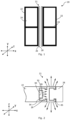
- the Figure 1 shows a schematic representation of door leaves 20 in an all-glass construction.
- the door leaves 20 are designed to close an entry area of, for example, a bus or a train.
- a door leaf 20 has a rectangular frame 22, into which, in the embodiment shown, two large glass panes 24 are inserted.
- the frame 22 can be made, for example, from a metallic material such as aluminum or from a fiber composite material.
- the front edge of the door leaf 20 in the closing direction is referred to as the main closing edge 21.
- the main closing edge 21 thus extends along the y-axis and over the entire height of the door leaf 20.
- a light profile 26 is arranged on the main closing edge 21.
- the light profile 26 is preferably made of a diffuse plastic material.
- a light source 30 (see Figures 2 to 4 ) are arranged, the light emission of which shines into the light profile 26.
- the light emission can be directed in the z-direction inwards into the vehicle interior and outwards. This means that a viewer who is inside the vehicle can perceive the light emission, as can a viewer who is outside the vehicle. Alternatively, it is also possible for the light emission to be directed only into the vehicle interior or only outwards.
- the light source 30 is, for example, an RGB(W) LED.
- the LED can light up continuously or flash, possibly in different colors. It is also possible for the light source to flash at different frequencies or for the light emission to have a frequency change while flashing.
- the light source 30 is particularly intended to visually represent an operating state of the entry area. For example, a light source 30 that lights up or flashes red can signal that the entry area is closing or remaining closed or locked. A light source 30 that lights up or flashes green can, on the other hand, signal that the entry area is opening or remaining open.
- a finger protection rubber 28 which is made of silicone, for example, is attached to the light profile 26 on the side facing away from the door leaf 20. Furthermore, an electrical switching strip, which is not shown in the figures, can be integrated into the finger protection rubber 28.
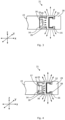
- FIG. 2 to 4 three different preferred embodiments for a design of the cross-sectional profile of the door leaf 20 in the region of the main closing edge 21 are shown.
- the door leaf 20 has a door leaf groove 33 on the front side in the area of the main closing edge 21.
- the door leaf groove 33 has two door leaf cranks 36 on the ends of the walls extending along the x-axis, which are arranged along the z-axis and directed towards each other.
- the light source 30 is arranged in this door leaf groove 33 and in the embodiment according to the Figures 2 and 3 arranged on the door leaf 20, i.e. at the groove base 39.
- the lighting profile 26 is also held in the door leaf groove 33, which is locked in the x-direction due to the door leaf cranks 36.
- the lighting profile 26 forms a first lighting profile groove 34 and a second lighting profile groove 35.
- the first lighting profile groove 34 is arranged within the door leaf groove 33, the shape of the first lighting profile groove 34 corresponding to the shape of the light source 30.
- the second lighting profile groove 35 is arranged opposite the first lighting profile groove 34 and has second lighting profile offsets 38 facing one another.
- the finger protection rubber 28 is arranged in the second lighting profile groove 35 and protrudes from it.
- the second lighting profile offsets 38 lock the finger protection rubber 28 in the x-direction.
- the door leaf 20, the lighting profile 26 and the finger protection rubber 28 have a uniform thickness (in the z-direction), whereby these components are aligned with one another in the x-direction.
- Fig.3 shows a second preferred embodiment, which has all the features of the first embodiment. It also has an opaque layer 32 within the second light profile groove between the light profile 26 and the finger protection rubber 28. Due to the opaque layer 32, the finger protection rubber 28 is not visible to the observer through the light profile 26. Furthermore, the opaque layer 32 can have a reflective surface that reflects the light emission of the light source 30 and/or redirects it towards the observer.
- Fig.4 shows a further preferred embodiment, which has almost all the features of the second embodiment.
- the light source 30 is not arranged on the groove base 39 of the door leaf groove 33, but is held in the first light profile groove 34 and is thus arranged at a distance from the groove base 39.
- the first light profile groove 34 has first light profile cranks 37 facing one another, which hold the light source 30 in the first light profile groove 34 and lock it along the x-axis.
- the individual components 26, 28, 30 can be pushed along the y-axis into the corresponding grooves 33, 34, 35.
- the locking of the door leaf 20, the light source 30, the light profile 26 and the finger protection rubber 28 in the y-direction can be done, for example, by screwing or gluing the individual components.
Landscapes
- Engineering & Computer Science (AREA)
- Mechanical Engineering (AREA)
- Arrangements Of Lighting Devices For Vehicle Interiors, Mounting And Supporting Thereof, Circuits Therefore (AREA)
Description
- Die vorliegende Erfindung betrifft einen Türflügel für Kraftfahrzeuge und Schienenfahrzeuge, mit den Merkmale des Oberbegriffs des Patentanspruchs 1.
- Einstiegssysteme von Kraftfahrzeugen und Schienenfahrzeugen umfassen ein oder zwei Türflügel, die über eine Schiebe-, Schwenk- oder Schwenkschiebebewegung einen Einstiegsbereich eines Busses oder einer Bahn verschließen können.
- Die Türflügel können beispielsweise Ganzglastürflügel sein oder eine Sandwichbauweise mit Aluminiumdeckblech aufweisen. Darüber hinaus weisen die Türflügel eine Hauptschließkante auf, die sich über die gesamte Höhe des Türflügels erstreckt und parallel zur y-Achse angeordnet ist. Wenn die Türflügel den Einstiegsbereich verschließen, berühren sich ihren Hauptschließkanten. Die in Schließrichtung vordere Kante des Türflügels ist somit die Hauptschließkante. Dies gilt auch bei Einstiegsbereichen, die durch einen Türflügel verschlossen werden. Die jeweils der Hauptschließkante gegenüberliegenden Seite wird als Nebenschließkante bezeichnet. Zum besseren Verständnis wird in einem orthogonalen Koordinatensystem die Breite des Türflügels in Richtung der x-Achse definiert. Die Höhe des Türflügels erstreckt sich in Richtung der y-Achse und die Dicke des Türflügels in Richtung der z-Achse.
- Entlang der Hauptschließkante ist in der Regel ein Fingerschutzgummi vorgesehen, das aus einem elastischen Material gefertigt ist, welches nachgibt, wenn beispielsweise eine Hand in der Tür eingeklemmt wird, wodurch Verletzungen vermieden werden. Zusätzlich kann in dem Fingerschutzgummi Sicherheitstechnik vorgesehen sein, wie beispielsweise Drucksensoren, die einen Druckanstieg registrieren können. Wenn ein Druckanstieg registriert wird, wird der Einstiegsbereich umgehend wieder geöffnet oder die Schließbewegung wird unterbrochen.
- Ein beispielhafter Betriebszustand des Einstiegsbereichs ist die Schließbewegung der Türflügel. Dieser Betriebszustand kann dem Fahrgast durch eine optische und/oder akustische Anzeige angezeigt werden. Vor und während des Schließens des Einstiegsbereichs durch die Türflügel ertönt in der Regel ein Hinweiston, welcher durch eine blinkende oder durchgehend leuchtende Lichtquelle begleitet sein kann. Die Lichtquelle kann oberhalb der Tür an einer Innen- und/oder Außenseite des Busses oder der Bahn vorgesehen sein. Nachteilig an dieser Position der Lichtquelle ist jedoch, dass sie durch einen Fahrgast, der direkt vor der Tür steht, nicht ohne weiteres wahrgenommen wird. Deshalb ist die Lichtquelle häufig in die Fläche des Türflügels eingebracht, jedoch muss hierfür dessen Konstruktion deutlich verändert werden.
- Eine weitere Lösung sieht vor, dass das Fingerschutzgummi aus einem nicht eingefärbten Silikon gefertigt ist. Eine Lichtquelle ist an der entlang der y-Achse angeordneten Stirnseite des Türflügels im Bereich der Hauptschließkante angeordnet. Das Fingerschutzgummi leitet und streut die Lichtemission zum Betrachter. Da das Fingerschutzgummi im Einstiegsbereich angeordnet ist, kann es verunreinigt werden, indem beispielsweise Taschen gegen das Fingerschutzgummi stoßen oder Fahrgäste sich an ihm abstützen. Eine raue Oberfläche des Silikons kann diesen Effekt verstärken. Nachteilig an dieser Lösung ist daher, dass Verschmutzungen des Silikons die Sichtbarkeit der Lichtemission vermindern können.
- Bei Ganzglastürflügeln wird die Tür durch einen metallischen Rahmen mit Glasscheiben gebildet. Durch die große Glasfront können elektrische Leitungen nur im Bereich des metallischen Rahmens untergebracht werden. Da Ganzglastürflügel somit anders als Sandwichtürflügel keine Deckbleche aufweisen, ist die Integration von zusätzlichen Modulen, wie Lichtquellen oder Sensoren, erschwert und wird ebenfalls meistens auf den Bereich des metallischen Rahmens beschränkt.
- Die Druckschrift
US 2019/0255923 A1 offenbart einen Türflügel für Kraftfahrzeuge und Schienenfahrzeuge mit einem in Leuchtprofil, wobei der Türflügel an seiner Hauptschließkante eine Lichtquelle aufweist. - Die zu lösende Aufgabe der vorliegenden Erfindung besteht darin, die Integration einer Lichtquelle in einen Türflügel weniger aufwendig und kostengünstiger zu gestalten. Weiter soll die Anzeige für den Fahrgast gut sichtbar sein.
- Die genannte Aufgabe wird durch einen modularen Türflügel mit den Merkmalen des Patentanspruchs 1 gelöst. Vorteilhafte Weiterbildungen sind Gegenstand der abhängigen Patentansprüche.
- Ein erfindungsgemäßer modularer Türflügel, insbesondere für Kraftfahrzeuge und Schienenfahrzeuge, weist eine Hauptschließkante auf, wobei an der Hauptschließkante eine Lichtquelle angeordnet ist. Der Türflügel kennzeichnet sich durch ein Leuchtprofil, das an der Hauptschließkante angeordnet ist und, das dazu eingerichtet ist, die Lichtemission der Lichtquelle zu leiten und zu streuen.
- Der Türflügel verschließt über eine Schiebe-, Schwenk- oder Schwenkschiebebewegung den Einstiegsbereich eines Busses oder einer Bahn. In der Regel ist der Türflügel rechteckig, wobei die Hauptschließkante an einer Längsseite angeordnet ist. An der Stirnseite des Türflügels sind im Bereich der Hauptschließkante ein lichtdurchlässiges Leuchtprofil und eine Lichtquelle, bevorzugt eine RGB(W)-Leuchtdiode, angeordnet. Leuchtdioden (LED)-Leuchtmittel bzw. LED-Leuchtstreifen weisen bei langer Lebensdauer und geringem Wartungsaufwand einen geringen Strombedarf auf. Gleichzeitig können sie aufgrund ihrer flexiblen Struktur an komplexeren geometrischen Formen montiert werden, wie beispielsweise an Türflügel mit Bombierung.
- Die Lichtquelle ist am Türflügel montiert und strahlt in x-Richtung in das Leuchtprofil. Das Leuchtprofil dient als Lichtleiter und Streukörper, wodurch die Lichtemission gleichmäßig in alle Richtungen umgeleitet wird. Eine einzelne Lichtquelle ist dadurch nicht mehr separat erkennbar.
- Der Fahrgast kann die nach außen geleitete Lichtemission wahrnehmen und einen Betriebszustand des Einstiegsbereichs erkennen. Die Lichtquelle kann je nach Betriebszustand blinken oder durchgehend leuchten. Die Lichtemission kann sowohl der Fahrgast sehen, der sich im Fahrzeug befindet, als auch der Fahrgast, der sich außerhalb des Busses bzw. Bahn befindet. Alternativ ist es auch möglich, dass die Lichtemission nur in das Fahrzeuginnere oder nach außen strahlt. So ist es beispielsweise möglich, dass die Illumination des Leuchtprofils dem Fahrgast auf dem Bahnsteig anzeigt, welche Waggons stark belegt sind und welche nicht, sodass der Fahrgast noch auf dem Bahnsteig sich entsprechend zu den weniger belegten Waggons orientieren kann, noch währen der Zug in den Bahnhof einfährt.
- Eine weitere alternative Möglichkeit ist, dass in dem Leuchtprofil zwei Lichtquellen angeordnet sind, die durch eine Trennschicht voneinander getrennt sind. Dadurch kann beispielsweise eine Lichtquelle nur in das Fahrzeuginnere strahlen, wobei die andere Lichtquelle nur nach außen vom Fahrzeug strahlen kann, wodurch sie nur von den Fahrgästen außerhalb des Fahrzeugs wahrgenommen werden kann. Diese Lösung hat den Vorteil, dass beispielsweise durch eine zweifarbige Illuminierung der Lichtquellen mit beispielsweise den Farben grün und rot die Fahrgastströme aus dem Fahrzeug und in das Fahrzeug gesteuert werden können.
- Das Leuchtprofil kann unabhängig vom Türflügel in seiner geometrischen Form den individuellen Kundenwünschen angepasst werden und beispielsweise breiter oder schmaler gestaltet werden. Für die Integration des Leuchtprofils am Türflügel muss lediglich die Stirnseite des Türflügels im Bereich der Hauptschließkante konstruktiv angepasst werden. Somit eignet sich der erfindungsgemäße Türflügel auch für Türflügel mit Bombierung.
- Erfindungsgemäß ist ein Fingerschutzgummi am Leuchtprofil an der dem Türflügel gegenüberliegenden Seite des Leuchtprofils in der zweiten Leuchtprofilnut angeordnet.
- Das Fingerschutzgummi ist aus einem elastischen Material, bevorzugt aus Silikon, gefertigt.
- Vorteilhafterweise erstreckt sich das Leuchtprofil über die gesamte Höhe der Hauptschließkante, wodurch die Lichtemission für den Fahrgast problemlos sichtbar ist. Darüber hinaus kann auch an der Nebenschließkante ein illuminiertes Leuchtprofil angeordnet sein, indem die Konstruktion des Türflügels an der Nebenschließkante um die Breite des Leuchtprofils reduziert wird. Das Leuchtprofil ist am Türflügel in der gleichen Art und Weise wie an der Hauptschließkante angeordnet und kann sich über die gesamte Höhe der Nebenschließkante erstrecken.
- Bevorzugt weist der Türflügel eine Türflügelnut auf. Die Türflügelnut ist dabei an der Stirnseite des Türflügels im Bereich der Hauptschließkante angeordnet. In der Türflügelnut ist das Leuchtprofil befestigt und wird durch Türflügelkröpfungen arretiert, die in z-Richtung zu einander ausgerichtet sind und die Nut endseitig in x-Richtung verengen. Bei der Montage des Türflügels wird das Leuchtprofil in die Türflügelnut geschoben und muss nur in y-Richtung zusätzlich arretiert werden. Dadurch werden Montagezeiten und -kosten reduziert. Ergänzend kann das Leuchtprofil an den Türflügel angeklebt oder geschraubt oder vergleichbar befestigt werden.
- Besonders vorteilhaft ist es, wenn die Lichtquelle an einem Nutgrund der Türflügelnut angeordnet ist. Die Lichtquelle ist für Wartungsarbeiten ohne großen Aufwand zugänglich und abnehmbar, nachdem das Leuchtprofil aus der Türflügelnut entfernt wurde. Die Lichtquelle kann beispielsweise durch Kleben, über eine Schraubverbindung oder über eine vergleichbare Verbindung am Nutgrund befestigt sein. Lösbare Verbindungen haben den Vorteil, dass die Lichtquelle bei einem Defekt problemlos ausgetauscht werden kann. Die Lichtquelle ist in der Türflügelnut durch äußere Einflüsse geschützt, wie beispielsweise Feuchtigkeit oder mechanische Beanspruchungen wie beispielsweise Stöße.
- Erfindungsgemäß bildet das Leuchtprofil eine erste Leuchtprofilnut und eine zweite Leuchtprofilnut aus, wobei die Form der ersten Leuchtprofilnut auf die Form der Lichtquelle abgestimmt ist. Dadurch ist eine kompakte Bauweise des Leuchtprofils möglich.
- Bei einer weiteren bevorzugten Ausgestaltung des Türflügels bilden Wandungen der ersten Leuchtprofilnut endseitig zueinander gerichtete erste Leuchtprofilkröpfungen aus, sodass die Lichtquelle beabstandet zum Nutgrund in der ersten Leuchtprofilnut gehalten ist. Somit ist die Lichtquelle in x-Richtung arretiert und muss nicht zusätzlich angeschraubt oder angeklebt werden. Es lediglich eine Arretierung in y-Richtung notwendig. Der Montage- als auch der Wartungsaufwand werden dadurch deutlich verringert.
- Der Türflügel kann vorteilhafterweise so ausgebildet sein, dass Wandungen der zweiten Leuchtprofilnut endseitig zueinander gerichtete zweite Leuchtprofilkröpfungen aufweisen, die dazu vorgesehen sind, das Fingerschutzgummi in x-Richtung zu arretieren. Auch hier ist lediglich eine Arretierung des Fingerschutzgummis in y-Richtung notwendig. Diese Arretierung kann eine lösbare Verbindung sein, die beispielsweise an der unteren Türflügelkante erfolgen kann, wodurch ebenfalls ein geringer Montage- und Wartungsaufwand erreicht wird.
- Dadurch, dass die Lichtquelle, das Leuchtprofil und das Fingerschutzgummi in Nuten gehalten sind, können diese Bauteile auch als Baugruppe vom Türflügel entfernt werden, wodurch ebenfalls der Wartungsaufwand reduziert wird.
- Nach einer weiteren vorteilhaften Ausgestaltung des Türflügels ist eine intransparente Schicht innerhalb der zweiten Leuchtprofilnut zwischen dem Leuchtprofil und dem Fingerschutzgummi angeordnet. Die intransparente Schicht verhindert, dass das Fingerschutzgummi durch das Leuchtprofil hindurch sichtbar ist. Die intransparente Schicht weist vorzugsweise eine reflektierende Oberfläche auf ihrer dem Leuchtprofil zugewandten Seite auf, die die Lichtemission der Lichtquelle reflektiert und zum Betrachter umleitet.
- Der Türflügel kann auch dadurch gekennzeichnet sein, dass das Leuchtprofil aus einem Kunststoff gefertigt ist.
- Vorteilhafterweise weisen der Türflügel, das Leuchtprofil und das Fingerschutzgummi eine einheitliche Stärke in z-Richtung auf und fluchten zueinander.
- Weitere vorteilhafte Ausgestaltungen der vorliegenden Erfindung ergeben sich aus der nachfolgenden Beschreibung unter Bezugnahme auf die Figuren. Die Figuren zeigen lediglich Ausführungsbeispiele und sollen nicht einschränkend zu verstehen sein. In den Figuren zeigen
- Fig. 1
- eine schematische Darstellung von zwei Ganzglastürflügeln,
- Fig. 2
- eine schematische Darstellung eines Teilbereichs eines Querschnitts einer Hauptschließkante eines ersten Ausführungsbeispiels,
- Fig. 3
- eine schematische Darstellung eines Teilbereichs des Querschnitts einer Hauptschließkante eines zweiten Ausführungsbeispiels und
- Fig. 4
- eine schematische Darstellung eines Teilbereichs des Querschnitts einer Hauptschließkante eines dritten Ausführungsbeispiels.
- In den Figuren ist zum besseren Verständnis ein orthogonales Koordinatensystem mit einer x-Achse, einer y-Achse und einer z-Achse dargestellt. Dabei erstreckt sich die x-Achse entlang einer Breite eines Türflügels 20, die y-Achse entlang einer Längsseite (Höhe) des Türflügels 20 und die z-Achse entlang der Türflügeltiefe.
- Die
Figur 1 zeigt eine schematische Darstellung von Türflügeln 20 in einer Ganzglasbauweise. Die Türflügel 20 sind dazu eingerichtet, einen Einstiegsbereich von beispielsweise einem Bus oder einer Bahn zu verschließen. Ein Türflügel 20 weist einen rechteckigen Rahmen 22 auf, in welchen im gezeigten Ausführungsbeispiel zwei großflächige Glasscheiben 24 eingebracht sind. Der Rahmen 22 kann zum Beispiel aus einem metallischen Werkstoff wie Aluminium oder auch aus einem Faserverbundwerkstoff gefertigt sein. - Die in Schließrichtung vordere Kante des Türflügels 20 wird als Hauptschließkante 21 bezeichnet. Die Hauptschließkante 21 erstreckt sich somit entlang der y-Achse und über die gesamte Höhe des Türflügels 20. An der Hauptschließkante 21 ist ein Leuchtprofil 26 angeordnet. Das Leuchtprofil 26 ist vorzugsweise aus einem diffusen Kunststoffmaterial gefertigt. Ferner ist an der Hauptschließkante 21 eine Lichtquelle 30 (siehe
Figuren 2 bis 4 ) angeordnet, deren Lichtemission in das Leuchtprofil 26 einstrahlt. Die Lichtemission kann in z-Richtung nach innen ins Fahrzeuginnere und nach außen geleitet werden. Somit kann ein Betrachter, der sich im Fahrzeuginneren befindet die Leuchtemission wahrnehmen und auch ein Betrachter, der sich außerhalb des Fahrzeugs befindet. Alternativ ist es auch möglich, dass die Lichtemission nur in das Fahrzeuginnere oder nur nach außen geleitet wird. - Die Lichtquelle 30 ist beispielsweise eine RGB(W)-LED. Die LED kann durchgängig leuchten oder blinken, ggf. auch in unterschiedlichen Farben. Auch ist es möglich, dass die Lichtquelle in unterschiedlichen Frequenzen blinkt oder die Lichtemission eine Frequenzänderung während des Blinkens aufweist. Die Lichtquelle 30 ist insbesondere dazu vorgesehen, einen Betriebszustand des Einstiegsbereichs optisch darzustellen. So kann beispielsweise eine rot leuchtende oder blinkende Lichtquelle 30 ein Schließen oder ein Geschlossenbleiben bzw. eine Verriegelung des Einstiegsbereichs signalisieren. Eine grün leuchtende oder blinkende Lichtquelle 30 dagegen kann ein Öffnen oder ein Geöffnetbleiben des Einstiegsbereichs signalisieren.
- An dem Leuchtprofil 26 ist im gezeigten Ausführungsbeispiel auf der dem Türflügel 20 abgewandten Seite ein Fingerschutzgummi 28 befestigt, das beispielsweise aus Silikon gefertigt ist. Weiter kann in dem Fingerschutzgummi 28 eine elektrische Schaltleiste integriert sein, die nicht in den Figuren dargestellt ist.
- In den
Fig. 2 bis 4 sind drei verschiedene bevorzugte Ausführungsbeispiele für eine Gestaltung des Querschnittsprofils des Türflügels 20 im Bereich der Hauptschließkante 21 gezeigt. - Der Türflügel 20 weist an der Stirnseite im Bereich der Hauptschließkante 21 eine Türflügelnut 33 auf. Die Türflügelnut 33 weist an den sich entlang der x-Achse erstreckenden Wandungen endseitig jeweils zwei Türflügelkröpfungen 36 auf, die entlang der z-Achse angeordnet zueinander gerichtet sind. Die Lichtquelle 30 ist in dieser Türflügelnut 33 angeordnet und bei der Ausführung gemäß der
Figuren 2 und3 am Türflügel 20 angeordnet, also am Nutgrund 39. In der Türflügelnut 33 ist auch das Leuchtprofil 26 gehalten, welches aufgrund der Türflügelkröpfungen 36 in x-Richtung arretiert ist. - Das Leuchtprofil 26 bildet im Querschnitt eine erste Leuchtprofilnut 34 und eine zweite Leuchtprofilnut 35 aus. Die erste Leuchtprofilnut 34 ist innerhalb der Türflügelnut 33 angeordnet, wobei die Form der ersten Leuchtprofilnut 34 mit der Form der Lichtquelle 30 korrespondiert. Die zweite Leuchtprofilnut 35 ist der ersten Leuchtprofilnut 34 gegenüberliegend angeordnet und weist aufeinander zuweisende zweite Leuchtprofilkröpfungen 38 auf. Das Fingerschutzgummi 28 ist in der zweiten Leuchtprofilnut 35 angeordnet und ragt aus dieser heraus. Die zweiten Leuchtprofilkröpfungen 38 arretierende das Fingerschutzgummi 28 in x-Richtung. Der Türflügel 20, das Leuchtprofil 26 und das Fingerschutzgummi 28 weisen eine einheitliche Stärke (in z-Richtung) auf, wodurch diese Bauteile in x-Richtung zueinander fluchten.
-
Fig. 3 zeigt ein zweites bevorzugtes Ausführungsbeispiel, welches sämtliche Merkmale des ersten Ausführungsbeispiels aufweist. Es weist darüber hinaus innerhalb der zweiten Leuchtprofilnut zwischen dem Leuchtprofil 26 und dem Fingerschutzgummi 28 eine intransparente Schicht 32 auf. Aufgrund der intransparenten Schicht 32 ist das Fingerschutzgummi 28 durch das Leuchtprofil 26 hindurch für den Betrachter nicht sichtbar. Weiter kann die intransparente Schicht 32 eine reflektierende Oberfläche aufweisen, die die Lichtemission der Lichtquelle 30 reflektiert und/oder in Richtung des Betrachters umleitet. -
Fig. 4 zeigt ein weiteres bevorzugtes Ausführungsbeispiel, welches nahezu sämtliche Merkmale des zweiten Ausführungsbeispiels aufweist. Anders ist jedoch, dass die Lichtquelle 30 nicht am Nutgrund 39 der Türflügelnut 33 angeordnet, sondern in der ersten Leuchtprofilnut 34 gehalten und somit beabstandet zum Nutgrund 39 angeordnet ist. Hierfür weist die erste Leuchtprofilnut 34 aufeinander zuweisende erste Leuchtprofilkröpfungen 37 auf, die die Lichtquelle 30 in der ersten Leuchtprofilnut 34 halten und entlang der x-Achse arretieren. - Für die Montage des Türflügels 20 können die einzelnen Bauteile 26, 28, 30 entlang der y-Achse in die jeweiligen korrespondieren Nuten 33, 34, 35 geschoben werden. Die Arretierung des Türflügels 20, der Lichtquelle 30, des Leuchtprofils 26 und des Fingerschutzgummis 28 in y-Richtung kann beispielsweise durch Verschrauben oder Verkleben der einzelnen Bauteile erfolgen.
-
- 20
- Türflügel
- 21
- Hauptschließkante
- 22
- Rahmen
- 24
- Glasscheibe
- 26
- Leuchtprofil
- 28
- Fingerschutzgummi
- 30
- Lichtquelle
- 32
- Intransparente Schicht
- 33
- Türflügelnut
- 34
- erste Leuchtprofilnut
- 35
- zweite Leuchtprofilnut
- 36
- Türflügelkröpfung
- 37
- erste Leuchtprofilkröpfung
- 38
- zweite Leuchtprofilkröpfung
- 39
- Nutgrund
Claims (10)
- Türflügel (20) für Kraftfahrzeuge und Schienenfahrzeuge, aufweisend eine Hauptschließkante (21), wobei- an der Hauptschließkante (21) eine Lichtquelle (30) angeordnet ist,- ein Leuchtprofil (26) an der Hauptschließkante (21) angeordnet und dazu eingerichtet ist, eine Lichtemission der Lichtquelle (30) zu leiten und zu streuen, wobei das Leuchtprofil (26) eine erste Leuchtprofilnut (34) und eine zweite Leuchtprofilnut (35) ausbildet, und wobei die Form der ersten Leuchtprofilnut (34) derart an die Form der Lichtquelle (30) angepasst ist, dass die Lichtquelle (30) in dieser angeordnet ist,- dadurch gekennzeichnet, dass ein Fingerschutzgummi (28) am Leuchtprofil (26) an der dem Türflügel (20) gegenüberliegenden Seite des Leuchtprofils (26) in der zweiten Leuchtprofilnut (35) angeordnet ist.
- Türflügel (20) nach Anspruch 1, dadurch gekennzeichnet, dass sich das Leuchtprofil (26) über die gesamte Höhe der Hauptschließkante (21) erstreckt.
- Türflügel (20) nach einem der vorangehenden Ansprüche, dadurch gekennzeichnet, dass in die Hauptschließkante (21) eine Türflügelnut (33) eingelassen ist, die zueinander gerichtete Türflügelkröpfungen (36) aufweist, die dazu vorgesehen sind, das Leuchtprofil (26) in Richtung der Türflügelbreite (x-Richtung) zu arretieren.
- Türflügel (20) nach Anspruch 3, dadurch gekennzeichnet, dass die Lichtquelle (30) an einem Nutgrund (39) in der Türflügelnut (33) angeordnet ist.
- Türflügel (20) nach Anspruch 4, dadurch gekennzeichnet, dass Wandungen der ersten Leuchtprofilnut (34) endseitig zueinander gerichtete erste Leuchtprofilkröpfungen (37) ausbilden, sodass die Lichtquelle (30) beabstandet zum Nutgrund (39) von der ersten Leuchtprofilnut (34) gehalten ist.
- Türflügel (20) nach dem Anspruch 5, dadurch gekennzeichnet, dass Wandungen der zweiten Leuchtprofilnut (35) endseitig zueinander gerichtete zweite Leuchtprofilkröpfungen (38) aufweisen, die dazu vorgesehen sind, das Fingerschutzgummi (28) in Richtung der Türflügelbreite (x-Richtung) zu arretieren.
- Türflügel (20) nach einem der Ansprüche 1 bis 6, dadurch gekennzeichnet, dass zwischen dem Leuchtprofil (26) und dem Fingerschutzgummi (28) eine intransparente Schicht (32) angeordnet ist, die verhindert, dass das Fingerschutzgummi (28) durch das Leuchtprofil (26) hindurch sichtbar ist.
- Türflügel (20) nach Anspruch 7, dadurch gekennzeichnet, dass die intransparente Schicht (32) eine reflektierende Oberfläche aufweist, die die Lichtemission der Lichtquelle (30) reflektiert und zum Betrachter umleitet.
- Türflügel (20) nach einem der vorangehenden Ansprüche, dadurch gekennzeichnet, dass das Leuchtprofil (26) aus einem diffusen Kunststoff gefertigt ist.
- Türflügel (20) nach einem der Ansprüche 1 bis 9, dadurch gekennzeichnet, dass der Türflügel (20), das Leuchtprofil (26) und das Fingerschutzgummi (28) eine einheitliche Stärke in Richtung der Türflügeldicke (z-Richtung) aufweisen und zueinander fluchten.
Applications Claiming Priority (2)
| Application Number | Priority Date | Filing Date | Title |
|---|---|---|---|
| DE202019106056.5U DE202019106056U1 (de) | 2019-10-31 | 2019-10-31 | Türflügel mit Leuchtprofil |
| PCT/EP2020/077689 WO2021083611A1 (de) | 2019-10-31 | 2020-10-02 | Türflügel mit leuchtprofil für ein fahrzeug |
Publications (3)
| Publication Number | Publication Date |
|---|---|
| EP4051520A1 EP4051520A1 (de) | 2022-09-07 |
| EP4051520C0 EP4051520C0 (de) | 2024-08-14 |
| EP4051520B1 true EP4051520B1 (de) | 2024-08-14 |
Family
ID=72840496
Family Applications (1)
| Application Number | Title | Priority Date | Filing Date |
|---|---|---|---|
| EP20789882.6A Active EP4051520B1 (de) | 2019-10-31 | 2020-10-02 | Türflügel mit leuchtprofil für ein fahrzeug |
Country Status (4)
| Country | Link |
|---|---|
| US (1) | US12090922B2 (de) |
| EP (1) | EP4051520B1 (de) |
| DE (1) | DE202019106056U1 (de) |
| WO (1) | WO2021083611A1 (de) |
Families Citing this family (1)
| Publication number | Priority date | Publication date | Assignee | Title |
|---|---|---|---|---|
| EP4509362B1 (de) * | 2023-08-14 | 2026-03-04 | ALSTOM Holdings | Längliche beleuchtungsvorrichtung für ein fahrzeug |
Family Cites Families (8)
| Publication number | Priority date | Publication date | Assignee | Title |
|---|---|---|---|---|
| DE102006011108A1 (de) * | 2006-03-08 | 2007-09-13 | Sidler Gmbh & Co. Kg | Fahrzeugbeleuchtung mit biegsamem Lichtleiter |
| DE102014116758B4 (de) * | 2014-11-17 | 2021-02-04 | Lisa Dräxlmaier GmbH | Beleuchtungsvorrichtung für die Beleuchtung eines Fahrzeuginnenraums |
| DE102015112041B4 (de) * | 2015-07-23 | 2020-02-13 | Novoferm Gmbh | Tor, insbesondere Garagentor |
| CN205805392U (zh) * | 2016-06-08 | 2016-12-14 | 青岛威奥轨道装饰材料制造有限公司 | 一种轨道车辆用双开自动门系统 |
| FR3055348B1 (fr) * | 2016-09-01 | 2019-05-03 | Etablissements L.Rustin | Dispositif de signaletique du fonctionnement d'une porte a ventaux |
| DE102016219904B4 (de) * | 2016-10-13 | 2023-11-02 | Vosla Gmbh | Dichtungsprofil, verschließbare Öffnung |
| EP3409557B1 (de) * | 2017-06-01 | 2021-05-12 | JC Disseny Ingenieria i Aplicacions S.L. | Dichtungsstreifen für fahrzeugtüren |
| FR3078034B1 (fr) * | 2018-02-22 | 2020-02-14 | Faiveley Transport Tours | Ensemble de signalisation pour vantail, porte et vehicule de transport correspondants |
-
2019
- 2019-10-31 DE DE202019106056.5U patent/DE202019106056U1/de active Active
-
2020
- 2020-10-02 US US17/769,121 patent/US12090922B2/en active Active
- 2020-10-02 EP EP20789882.6A patent/EP4051520B1/de active Active
- 2020-10-02 WO PCT/EP2020/077689 patent/WO2021083611A1/de not_active Ceased
Also Published As
| Publication number | Publication date |
|---|---|
| US20240109476A1 (en) | 2024-04-04 |
| EP4051520A1 (de) | 2022-09-07 |
| US12090922B2 (en) | 2024-09-17 |
| WO2021083611A1 (de) | 2021-05-06 |
| EP4051520C0 (de) | 2024-08-14 |
| DE202019106056U1 (de) | 2021-02-03 |
Similar Documents
| Publication | Publication Date | Title |
|---|---|---|
| DE69634309T2 (de) | Vorrichtung zum Schliessen einer Fahrzeugöffnung, mit Schiebefenster | |
| WO2011138292A1 (de) | Leuchtfähige fingerschutzvorrichtung für eine tür eines fahrzeugs und herstellungsverfahren für eine schutzleiste für eine leuchtfähige fingerschutzvorrichtung | |
| EP3126205B1 (de) | Beleuchtung von fahrzeugtüren | |
| DE29920487U1 (de) | Fahrzeuginnenraumbeleuchtung | |
| DE2706121A1 (de) | Stossleiste | |
| DE102009042112A1 (de) | Zierleiste für ein Kraftfahrzeug | |
| DE102013103720B4 (de) | Kraftfahrzeugleuchte sowie eine solche aufweisendes Kraftfahrzeug | |
| EP4051520B1 (de) | Türflügel mit leuchtprofil für ein fahrzeug | |
| DE19634389C5 (de) | Ortsveränderbare Schiebewand | |
| EP2132078B1 (de) | Türführung und türbefestigungssystem für passagier-schienenfahrzeuge | |
| DE102016124921A1 (de) | Abdeckung für ein Fenster in einem Luftfahrzeug | |
| CH697355B1 (de) | Türdichtung. | |
| DE10018800B4 (de) | Griffvorrichtung für eine Heckklappe eines Kraftfahrzeugs | |
| EP0884265A1 (de) | Anzeigevorrichtung für Aufzüge | |
| EP3408156B1 (de) | Deckenbaueinheit für ein fahrzeug | |
| DE102007042504A1 (de) | Warnbalken für Einsatzfahrzeuge mit Dachreling | |
| EP0256563A2 (de) | Abstandhalterrahmen für Mehrscheibenisolierglas | |
| EP3484756B1 (de) | Deckeneinheit für ein fahrzeug | |
| DE102010004116A1 (de) | Durchgang für ein Fahrzeug, eine Kabine oder dergleichen | |
| DE102014017775A1 (de) | Beleuchtungsvorrichtung für eine Fahrzeugkarosserie | |
| DE102016214363B4 (de) | Fensterschachtleiste | |
| DE1405925C (de) | Kraftfahrzeugdach mit einem in sich starren, mittleren Dachteil | |
| EP0311757A1 (de) | Führungsprofil für Schiebetür, Verfahren zu dessen Herstellung und Anwendung des Verfahrens | |
| EP1721771A2 (de) | Dach für ein Kraftfahrzeug | |
| DE102020004412A1 (de) | Lichtleisteneinrichtung für einen Türflügel eines Einstiegssystems eines Schienenfahrzeugs |
Legal Events
| Date | Code | Title | Description |
|---|---|---|---|
| STAA | Information on the status of an ep patent application or granted ep patent |
Free format text: STATUS: UNKNOWN |
|
| STAA | Information on the status of an ep patent application or granted ep patent |
Free format text: STATUS: THE INTERNATIONAL PUBLICATION HAS BEEN MADE |
|
| PUAI | Public reference made under article 153(3) epc to a published international application that has entered the european phase |
Free format text: ORIGINAL CODE: 0009012 |
|
| STAA | Information on the status of an ep patent application or granted ep patent |
Free format text: STATUS: REQUEST FOR EXAMINATION WAS MADE |
|
| 17P | Request for examination filed |
Effective date: 20220429 |
|
| AK | Designated contracting states |
Kind code of ref document: A1 Designated state(s): AL AT BE BG CH CY CZ DE DK EE ES FI FR GB GR HR HU IE IS IT LI LT LU LV MC MK MT NL NO PL PT RO RS SE SI SK SM TR |
|
| DAV | Request for validation of the european patent (deleted) | ||
| DAX | Request for extension of the european patent (deleted) | ||
| STAA | Information on the status of an ep patent application or granted ep patent |
Free format text: STATUS: EXAMINATION IS IN PROGRESS |
|
| 17Q | First examination report despatched |
Effective date: 20230620 |
|
| GRAP | Despatch of communication of intention to grant a patent |
Free format text: ORIGINAL CODE: EPIDOSNIGR1 |
|
| STAA | Information on the status of an ep patent application or granted ep patent |
Free format text: STATUS: GRANT OF PATENT IS INTENDED |
|
| INTG | Intention to grant announced |
Effective date: 20240328 |
|
| GRAS | Grant fee paid |
Free format text: ORIGINAL CODE: EPIDOSNIGR3 |
|
| GRAA | (expected) grant |
Free format text: ORIGINAL CODE: 0009210 |
|
| STAA | Information on the status of an ep patent application or granted ep patent |
Free format text: STATUS: THE PATENT HAS BEEN GRANTED |
|
| AK | Designated contracting states |
Kind code of ref document: B1 Designated state(s): AL AT BE BG CH CY CZ DE DK EE ES FI FR GB GR HR HU IE IS IT LI LT LU LV MC MK MT NL NO PL PT RO RS SE SI SK SM TR |
|
| REG | Reference to a national code |
Ref country code: GB Ref legal event code: FG4D Free format text: NOT ENGLISH |
|
| REG | Reference to a national code |
Ref country code: CH Ref legal event code: EP |
|
| REG | Reference to a national code |
Ref country code: DE Ref legal event code: R096 Ref document number: 502020008891 Country of ref document: DE |
|
| REG | Reference to a national code |
Ref country code: IE Ref legal event code: FG4D Free format text: LANGUAGE OF EP DOCUMENT: GERMAN |
|
| U01 | Request for unitary effect filed |
Effective date: 20240815 |
|
| U07 | Unitary effect registered |
Designated state(s): AT BE BG DE DK EE FI FR IT LT LU LV MT NL PT SE SI Effective date: 20240828 |
|
| U20 | Renewal fee for the european patent with unitary effect paid |
Year of fee payment: 5 Effective date: 20241108 |
|
| PG25 | Lapsed in a contracting state [announced via postgrant information from national office to epo] |
Ref country code: NO Free format text: LAPSE BECAUSE OF FAILURE TO SUBMIT A TRANSLATION OF THE DESCRIPTION OR TO PAY THE FEE WITHIN THE PRESCRIBED TIME-LIMIT Effective date: 20241114 |
|
| PG25 | Lapsed in a contracting state [announced via postgrant information from national office to epo] |
Ref country code: PL Free format text: LAPSE BECAUSE OF FAILURE TO SUBMIT A TRANSLATION OF THE DESCRIPTION OR TO PAY THE FEE WITHIN THE PRESCRIBED TIME-LIMIT Effective date: 20240814 Ref country code: GR Free format text: LAPSE BECAUSE OF FAILURE TO SUBMIT A TRANSLATION OF THE DESCRIPTION OR TO PAY THE FEE WITHIN THE PRESCRIBED TIME-LIMIT Effective date: 20241115 |
|
| PG25 | Lapsed in a contracting state [announced via postgrant information from national office to epo] |
Ref country code: IS Free format text: LAPSE BECAUSE OF FAILURE TO SUBMIT A TRANSLATION OF THE DESCRIPTION OR TO PAY THE FEE WITHIN THE PRESCRIBED TIME-LIMIT Effective date: 20241214 |
|
| PG25 | Lapsed in a contracting state [announced via postgrant information from national office to epo] |
Ref country code: HR Free format text: LAPSE BECAUSE OF FAILURE TO SUBMIT A TRANSLATION OF THE DESCRIPTION OR TO PAY THE FEE WITHIN THE PRESCRIBED TIME-LIMIT Effective date: 20240814 |
|
| PG25 | Lapsed in a contracting state [announced via postgrant information from national office to epo] |
Ref country code: RS Free format text: LAPSE BECAUSE OF FAILURE TO SUBMIT A TRANSLATION OF THE DESCRIPTION OR TO PAY THE FEE WITHIN THE PRESCRIBED TIME-LIMIT Effective date: 20241114 Ref country code: ES Free format text: LAPSE BECAUSE OF FAILURE TO SUBMIT A TRANSLATION OF THE DESCRIPTION OR TO PAY THE FEE WITHIN THE PRESCRIBED TIME-LIMIT Effective date: 20240814 |
|
| PG25 | Lapsed in a contracting state [announced via postgrant information from national office to epo] |
Ref country code: RS Free format text: LAPSE BECAUSE OF FAILURE TO SUBMIT A TRANSLATION OF THE DESCRIPTION OR TO PAY THE FEE WITHIN THE PRESCRIBED TIME-LIMIT Effective date: 20241114 Ref country code: PL Free format text: LAPSE BECAUSE OF FAILURE TO SUBMIT A TRANSLATION OF THE DESCRIPTION OR TO PAY THE FEE WITHIN THE PRESCRIBED TIME-LIMIT Effective date: 20240814 Ref country code: NO Free format text: LAPSE BECAUSE OF FAILURE TO SUBMIT A TRANSLATION OF THE DESCRIPTION OR TO PAY THE FEE WITHIN THE PRESCRIBED TIME-LIMIT Effective date: 20241114 Ref country code: IS Free format text: LAPSE BECAUSE OF FAILURE TO SUBMIT A TRANSLATION OF THE DESCRIPTION OR TO PAY THE FEE WITHIN THE PRESCRIBED TIME-LIMIT Effective date: 20241214 Ref country code: HR Free format text: LAPSE BECAUSE OF FAILURE TO SUBMIT A TRANSLATION OF THE DESCRIPTION OR TO PAY THE FEE WITHIN THE PRESCRIBED TIME-LIMIT Effective date: 20240814 Ref country code: GR Free format text: LAPSE BECAUSE OF FAILURE TO SUBMIT A TRANSLATION OF THE DESCRIPTION OR TO PAY THE FEE WITHIN THE PRESCRIBED TIME-LIMIT Effective date: 20241115 Ref country code: ES Free format text: LAPSE BECAUSE OF FAILURE TO SUBMIT A TRANSLATION OF THE DESCRIPTION OR TO PAY THE FEE WITHIN THE PRESCRIBED TIME-LIMIT Effective date: 20240814 |
|
| PG25 | Lapsed in a contracting state [announced via postgrant information from national office to epo] |
Ref country code: SM Free format text: LAPSE BECAUSE OF FAILURE TO SUBMIT A TRANSLATION OF THE DESCRIPTION OR TO PAY THE FEE WITHIN THE PRESCRIBED TIME-LIMIT Effective date: 20240814 |
|
| PG25 | Lapsed in a contracting state [announced via postgrant information from national office to epo] |
Ref country code: CZ Free format text: LAPSE BECAUSE OF FAILURE TO SUBMIT A TRANSLATION OF THE DESCRIPTION OR TO PAY THE FEE WITHIN THE PRESCRIBED TIME-LIMIT Effective date: 20240814 |
|
| PG25 | Lapsed in a contracting state [announced via postgrant information from national office to epo] |
Ref country code: SK Free format text: LAPSE BECAUSE OF FAILURE TO SUBMIT A TRANSLATION OF THE DESCRIPTION OR TO PAY THE FEE WITHIN THE PRESCRIBED TIME-LIMIT Effective date: 20240814 |
|
| REG | Reference to a national code |
Ref country code: CH Ref legal event code: PL |
|
| PLBE | No opposition filed within time limit |
Free format text: ORIGINAL CODE: 0009261 |
|
| STAA | Information on the status of an ep patent application or granted ep patent |
Free format text: STATUS: NO OPPOSITION FILED WITHIN TIME LIMIT |
|
| PG25 | Lapsed in a contracting state [announced via postgrant information from national office to epo] |
Ref country code: MC Free format text: LAPSE BECAUSE OF FAILURE TO SUBMIT A TRANSLATION OF THE DESCRIPTION OR TO PAY THE FEE WITHIN THE PRESCRIBED TIME-LIMIT Effective date: 20240814 |
|
| 26N | No opposition filed |
Effective date: 20250515 |
|
| GBPC | Gb: european patent ceased through non-payment of renewal fee |
Effective date: 20241114 |
|
| PG25 | Lapsed in a contracting state [announced via postgrant information from national office to epo] |
Ref country code: CH Free format text: LAPSE BECAUSE OF NON-PAYMENT OF DUE FEES Effective date: 20241031 |
|
| PG25 | Lapsed in a contracting state [announced via postgrant information from national office to epo] |
Ref country code: GB Free format text: LAPSE BECAUSE OF NON-PAYMENT OF DUE FEES Effective date: 20241114 |
|
| PG25 | Lapsed in a contracting state [announced via postgrant information from national office to epo] |
Ref country code: IE Free format text: LAPSE BECAUSE OF NON-PAYMENT OF DUE FEES Effective date: 20241002 |
|
| PG25 | Lapsed in a contracting state [announced via postgrant information from national office to epo] |
Ref country code: RO Free format text: LAPSE BECAUSE OF FAILURE TO SUBMIT A TRANSLATION OF THE DESCRIPTION OR TO PAY THE FEE WITHIN THE PRESCRIBED TIME-LIMIT Effective date: 20240814 |
|
| U20 | Renewal fee for the european patent with unitary effect paid |
Year of fee payment: 6 Effective date: 20251027 |
|
| PG25 | Lapsed in a contracting state [announced via postgrant information from national office to epo] |
Ref country code: CY Free format text: LAPSE BECAUSE OF FAILURE TO SUBMIT A TRANSLATION OF THE DESCRIPTION OR TO PAY THE FEE WITHIN THE PRESCRIBED TIME-LIMIT; INVALID AB INITIO Effective date: 20201002 |
|
| PG25 | Lapsed in a contracting state [announced via postgrant information from national office to epo] |
Ref country code: HU Free format text: LAPSE BECAUSE OF FAILURE TO SUBMIT A TRANSLATION OF THE DESCRIPTION OR TO PAY THE FEE WITHIN THE PRESCRIBED TIME-LIMIT; INVALID AB INITIO Effective date: 20201002 |