EP4050957B1 - Method and apparatus for avoiding paging collisions in a multi-sim user equipment - Google Patents
Method and apparatus for avoiding paging collisions in a multi-sim user equipment Download PDFInfo
- Publication number
- EP4050957B1 EP4050957B1 EP20892258.3A EP20892258A EP4050957B1 EP 4050957 B1 EP4050957 B1 EP 4050957B1 EP 20892258 A EP20892258 A EP 20892258A EP 4050957 B1 EP4050957 B1 EP 4050957B1
- Authority
- EP
- European Patent Office
- Prior art keywords
- mobile network
- paging
- sim
- user equipment
- gnb
- Prior art date
- Legal status (The legal status is an assumption and is not a legal conclusion. Google has not performed a legal analysis and makes no representation as to the accuracy of the status listed.)
- Active
Links
Images





Classifications
-
- H—ELECTRICITY
- H04—ELECTRIC COMMUNICATION TECHNIQUE
- H04W—WIRELESS COMMUNICATION NETWORKS
- H04W68/00—User notification, e.g. alerting and paging, for incoming communication, change of service or the like
- H04W68/02—Arrangements for increasing efficiency of notification or paging channel
-
- H—ELECTRICITY
- H04—ELECTRIC COMMUNICATION TECHNIQUE
- H04W—WIRELESS COMMUNICATION NETWORKS
- H04W8/00—Network data management
- H04W8/22—Processing or transfer of terminal data, e.g. status or physical capabilities
-
- H—ELECTRICITY
- H04—ELECTRIC COMMUNICATION TECHNIQUE
- H04W—WIRELESS COMMUNICATION NETWORKS
- H04W60/00—Affiliation to network, e.g. registration; Terminating affiliation with the network, e.g. de-registration
- H04W60/005—Multiple registrations, e.g. multihoming
-
- H—ELECTRICITY
- H04—ELECTRIC COMMUNICATION TECHNIQUE
- H04W—WIRELESS COMMUNICATION NETWORKS
- H04W8/00—Network data management
- H04W8/26—Network addressing or numbering for mobility support
-
- H—ELECTRICITY
- H04—ELECTRIC COMMUNICATION TECHNIQUE
- H04W—WIRELESS COMMUNICATION NETWORKS
- H04W88/00—Devices specially adapted for wireless communication networks, e.g. terminals, base stations or access point devices
- H04W88/02—Terminal devices
- H04W88/06—Terminal devices adapted for operation in multiple networks or having at least two operational modes, e.g. multi-mode terminals
Definitions
- the present disclosure relates to a communication control method, an apparatus for controlling a user equipment, and a user equipment.
- a user equipment needs to be equipped with a Subscriber Identity Module (SIM) in order to utilize a mobile communication service (voice call service, data communication service, or the like) provided by a communication operator (operator or communication carrier) via a mobile network.
- SIM Subscriber Identity Module
- the user equipment can utilize the mobile communication service from the mobile network of the registration destination.
- a user equipment equipped with two SIMs may utilize a mobile communication service from a first mobile network, which is a mobile network of the registration destination of the first SIM, and may utilize a mobile communication service from a second mobile network, which is a mobile network of the registration destination of the second SIM.
- the discussion of a use case in which both mobile communication services are utilized has been initialized in the Third Generation Partnership Project (3GPP) (e.g., Non-Patent Literature 1).
- 3GPP Third Generation Partnership Project
- Non-Patent Literature 1 3GPP Technical Report TR 22.834 "TR 22.834 V17.1.0" September 2019, Internet ⁇ URL: http://www.3gpp.org/ftp/Specs/archive/22_series/22.834/22834-h10.zip>
- the invention provides a communication control method according to claim 1, an apparatus for controlling a user equipment according to claim 2, and a user equipment according to claim 3.
- a user equipment includes only a single radio receiver
- the first mobile network and the second mobile network belong to different communication operators, it is difficult to avoid such problems by collaboration between the mobile networks.
- An object of the present disclosure is to enable a user equipment that can be equipped with a plurality of SIMs to avoid a collision of downlink transmissions from a plurality of mobile networks.
- a configuration of a mobile communication system according to an embodiment will be described.
- the mobile communication system according to an embodiment is a 5G system of the 3GPP
- LTE may be at least partially applied to the mobile communication system.
- FIG. 1 is a diagram illustrating a configuration of the mobile communication system according to an embodiment.
- the mobile communication system includes a first mobile network 40-1 operated by a first communication operator, a second mobile network 40-2 operated by a second communication operator different from the first communication operator, and a User Equipment (UE) 100.
- the UE 100 can register with the first mobile network 40-1 using a first SIM 140-1 described below, and can register with the second mobile network 40-2 using a second SIM 140-2 described below.
- the first and the second mobile networks 40-1 and 40-2 are simply referred to as a mobile network 40.
- Each mobile network 40 includes a 5G radio access network (Next Generation Radio Access Network (NG-RAN)) 10, and a 5G core network (5GC) 20.
- 5G radio access network Next Generation Radio Access Network (NG-RAN)
- 5GC 5G core network
- the UE 100 is a mobile apparatus.
- the UE 100 may be any apparatus as long as the UE is used by a user.
- Examples of the UE 100 include a mobile phone terminal (including a smartphone), a tablet terminal, a notebook PC, a communication module (including a communication card or a chipset), a sensor or an apparatus provided on a sensor, a vehicle or an apparatus provided on a vehicle (Vehicle UE), and/or a flying object or an apparatus provided on a flying object (Aerial UE).
- the NG-RAN 10 includes base stations (referred to as "gNBs" in the 5G system) 200.
- the gNBs 200 may also be referred to as NG-RAN nodes.
- the gNBs 200 are connected to each other via an Xn interface (not illustrated) corresponding to an inter-base station interface.
- Each gNB 200 manages one or a plurality of cells.
- the gNB 200 performs wireless communication with the UE 100 that has established a connection with its own cell.
- the gNB 200 has a radio resource management (RRM) function, a function of routing user data (hereinafter simply referred to as "data"), and/or a measurement control function for mobility control and scheduling.
- RRM radio resource management
- a "cell” is used as a term to indicate a minimum unit of a wireless communication area.
- a "cell” is also used as a term to indicate a function or a resource for performing wireless communication with the UE 100.
- One cell belongs to one carrier frequency.
- the gNB may be connected to an evolved packet core (EPC) which is a core network of LTE, or a base station of LTE may be connected to the 5GC. Moreover, the base station of LTE and the gNB may be connected via the inter-base station interface.
- EPC evolved packet core
- the 5GC 20 includes an access and mobility management function (AMF) and a user plane function (UPF) 300.
- the AMF performs various kinds of mobility control and the like for the UE 100.
- the AMF 300 manages information of the area in which the UE 100 exists by communicating with the UE 100 by using Non-Access Stratum (NAS) signaling.
- NAS Non-Access Stratum
- the UPF controls data transfer.
- the AMF and UPF are connected to the gNB 200 via an NG interface which is an interface between a base station and the core network.
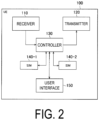
- FIG. 2 is a diagram illustrating a configuration of the UE 100 (user equipment).
- the UE 100 includes a receiver 110, a transmitter 120, a controller 130, a SIM 140-1 (first SIM), a SIM 140-2 (second SIM), and a user interface 150.
- the UE 100 may include three or more SIMs 140.
- the receiver 110 performs various kinds of receptions under control of the controller 130.
- the receiver 110 includes an antenna and a reception device.
- the reception device converts a radio signal received through the antenna into a baseband signal (reception signal) and outputs the resulting signal to the controller 130.
- the transmitter 120 performs various kinds of transmissions under control of the controller 130.
- the transmitter 120 includes an antenna and a transmission device.
- the transmission device converts a baseband signal output by the controller 130 (a transmission signal) into a radio signal and transmits the resulting signal through the antenna.
- the controller 130 performs various kinds of controls for the UE 100.
- the controller 130 includes at least one processor and at least one memory electrically connected to the processor.
- the memory stores programs to be executed by the processor and information to be used for processes by the processor.
- the processor may include a baseband processor and a central processing unit (CPU).
- the baseband processor performs modulation and demodulation, and coding and decoding of a baseband signal, and the like.
- the CPU executes the programs stored in the memory to perform various types of processes.
- the SIM 140 records information identifying a subscriber to receive a mobile communication service provided from the mobile network.
- information may be recorded that includes, in addition to information identifying a subscriber, operator identification information for identifying a communication operator, and information related to available services that a subscriber subscribes to.
- the SIM 140 may be an IC card referred to as a removable SIM card (or a USIM card), i.e., an information card.
- the SIM 140 may be an Embedded SIM (eSIM) which is of an embedded type.
- SIM 140-1 Information recorded in the SIM 140-1 (first SIM) identifies a first International Mobile Subscriber Identity (IMSI) corresponding to an identification number assigned to a user of the UE 100 from a first communication operator operating the first mobile network 40-1.
- SIM 140-2 Information recorded in the SIM 140-2 (second SIM) identifies a second IMSI corresponding to an identification number assigned to the user of the UE 100 from a second communication operator operating the second mobile network 40-2.
- the SIM 140-1 and the SIM 140-2 may be separate information cards, or may be integrated into an identical information card.
- the SIM 140-1 and the SIM 140-2 may be included in an Embedded SIM (eSIM).
- eSIM Embedded SIM
- the SIM 140-1 is managed by the first communication operator.
- the SIM 140-2 is managed by the second communication operator. Note that the SIM 140-1 and the SIM 140-2 may be managed by the identical communication operator.
- the UE 100 can utilize the mobile communication service provided by the first communication operator via the first mobile network 40-1. Additionally, in a case of using the SIM 140-2 to register with the second mobile network 40-2, the UE 100 can utilize the mobile communication service provided by the second communication operator via the second mobile network 40-2.
- the user of the UE 100 may configure the priorities of SIM 140-1 and SIM 140-2 via the user interface 150.
- the user may configure the priorities such that the SIM 140-1 is prioritized over the SIM 140-2 or that the SIM 140-2 is prioritized over the SIM 140-1.
- FIG. 3 is a diagram illustrating a configuration of the gNB 200 (a base station).
- the gNB 200 includes a transmitter 210, a receiver 220, a controller 230, and a backhaul communicator 240.
- the transmitter 210 performs various kinds of transmissions under control of the controller 230.
- the transmitter 210 includes an antenna and a transmission device.
- the transmission device converts a baseband signal output by the controller 230 (a transmission signal) into a radio signal and transmits the resulting signal through the antenna.
- the receiver 220 performs various kinds of receptions under control of the controller 230.
- the receiver 220 includes an antenna and a reception device.
- the reception device converts a radio signal received through the antenna into a baseband signal (a reception signal) and outputs the resulting signal to the controller 230.
- the controller 230 performs various types of control for the gNB 200.
- the controller 230 includes at least one processor and at least one memory electrically connected to the processor.
- the memory stores programs to be executed by the processor and information to be used for processes by the processor.
- the processor may include a baseband processor and a CPU.
- the baseband processor performs modulation and demodulation, and coding and decoding of a baseband signal, and the like.
- the CPU executes the programs stored in the memory to perform various types of processes.
- the backhaul communicator 240 is connected to a neighboring base station via the inter-base station interface.
- the backhaul communicator 240 is connected to the AMF/UPF 300 via the interface between a base station and the core network.
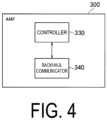
- FIG. 4 is a diagram illustrating a configuration of an AMF 300 (core network apparatus).
- the AMF 300 includes a controller 330 and a backhaul communicator 340.
- the controller 330 performs various types of control in the AMF 300.
- the controller 330 includes at least one processor and at least one memory electrically connected to the processor.
- the memory stores programs to be executed by the processor and information to be used for processes by the processor.
- the processor may include a baseband processor and a CPU.
- the baseband processor performs modulation and demodulation, and coding and decoding of a baseband signal, and the like.
- the CPU executes the programs stored in the memory to perform various types of processes.
- the backhaul communicator 340 is connected to the gNB 200 via the interface between the base station and the core network.
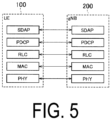
- FIG. 5 is a diagram illustrating a configuration of a protocol stack of a radio interface in a user plane handling data.
- the radio interface protocol of the user plane includes a physical (PHY) layer, a Medium Access Control (MAC) layer, a Radio Link Control (RLC) layer, a Packet Data Convergence Protocol (PDCP) layer, and a Service Data Adaptation Protocol (SDAP) layer.
- PHY physical
- MAC Medium Access Control
- RLC Radio Link Control
- PDCP Packet Data Convergence Protocol
- SDAP Service Data Adaptation Protocol
- the PHY layer performs coding and decoding, modulation and demodulation, mapping and demapping of antennas, and mapping and demapping of resources.
- Data and control information are transmitted between the PHY layer of the UE 100 and the PHY layer of the gNB 200 via a physical channel.
- a frame structure is used that includes radio frames, subframes, slots, and symbols.
- the radio frame includes 10 subframes on the time axis. Each subframe has a length of 1 ms. Each subframe includes a plurality of slots. Each slot includes a plurality of symbols.
- Each subframe includes a plurality of resource blocks (RBs) on a frequency axis. Each resource block includes a plurality of subcarriers on the frequency axis.
- frequency resources can be identified by resource blocks and time resources can be identified by subframes (or slots or symbols).
- a section of several leading symbols of each subframe is a region used as a Physical Downlink Control CHannel (PDCCH) for mainly transmitting downlink control information.
- the remaining portion of each subframe is a region that can be used as a Physical Downlink Shared CHannel (PDSCH) for mainly transmitting downlink data.
- PDCH Physical Downlink Control CHannel
- PDSCH Physical Downlink Shared CHannel
- the MAC layer performs priority control of data, a retransmission process through a hybrid ARQ (HARQ), a random access procedure, and the like.
- Data and control information are transmitted between the MAC layer of the UE 100 and the MAC layer of the gNB 200 via a transport channel.
- the MAC layer of the gNB 200 includes a scheduler.
- the scheduler determines a transport format (a transport block size, a modulation and coding scheme (MCS)) of uplink and downlink, and an allocation resource block for the UE 100.
- MCS modulation and coding scheme
- the RLC layer transmits data to the RLC layer on the reception side by using the functions of the MAC layer and the PHY layer. Data and control information are transmitted between the RLC layer of the UE 100 and the RLC layer of the gNB 200 via a logical channel.
- the PDCP layer performs header compression and decompression, and encryption and decryption.
- the SDAP layer performs mapping between an IP flow which is a unit of QoS control by the core network and a radio bearer which is a unit of QoS control by an access stratum (AS). Note that, when the RAN is connected to the EPC, the SDAP may not be provided.
- FIG. 6 is a diagram illustrating a configuration of a protocol stack of a radio interface in a control plane handling signaling (control signals).
- the protocol stack of the radio interface in the control plane includes a Radio Resource Control (RRC) layer and a Non-Access Stratum (NAS) layer instead of the SDAP layer illustrated in FIG. 4 .
- RRC Radio Resource Control
- NAS Non-Access Stratum
- RRC signaling for various configurations is transmitted between the RRC layer of the UE 100 and the RRC layer of the gNB 200.
- the RRC layer controls the logical channel, the transport channel, and the physical channel in response to establishment, re-establishment, and release of the radio bearer.
- a connection RRC connection
- the UE 100 is in an RRC connected state.
- RRC connection no connection between the RRC of the UE 100 and the RRC of the gNB 200
- the UE 100 is in an RRC idle state.
- the RRC connection is interrupted (suspended), the UE 100 is in an RRC inactive state.
- the NAS layer higher than the RRC layer performs session management, mobility management, and the like.
- NAS signaling is transmitted between the NAS layer of the UE 100 and the NAS layer of the AMF 300.
- the UE 100 has an application layer and the like other than the protocol of the radio interface.
- a first embodiment will be described based on the assumption of the system configuration as described above.
- the UE 100 includes only a single radio receiver (receiver 110).
- the downlink transmission from one mobile network 40 out of the first mobile network 40-1 and the second mobile network 40-2 may fail to be received.
- the first mobile network 40-1 and the second mobile network 40-2 belong to different communication operators, it is difficult to avoid such problems by collaboration between the mobile networks 40. A first embodiment for avoiding such problems will be described below.
- the UE 100 according to the first embodiment is registered with the first mobile network 40-1 by using the first SIM (SIM 140-1) and registered with the second mobile network 40-2 by using the second SIM (SIM 140-2).
- the UE 100 receives, from the first mobile network 40-1, configuration information for configuring either a non-execution timing for not executing downlink transmission from the first mobile network 40-1 to the UE 100 or an execution timing for executing the downlink transmission.
- the UE 100 transmits, to the second mobile network 40-2, identification information for identifying the timing configured by using the configuration information.
- the UE 100 for which the non-execution timing is configured is exempted from monitoring of the PDCCH at the non-execution timing.
- the second mobile network 40-2 can determine the timing for downlink transmission to the UE 100 such that the timing matches the non-execution timing configured for the UE 100 from the first mobile network 40-1.
- the second mobile network 40-2 can determine the timing for downlink transmission to the UE 100 to avoid the execution timing configured for the UE 100 from the first mobile network 40-1.
- the UE 100 can avoid the collision of downlink transmissions from the first mobile network 40-1 and the second mobile network 40-2.
- An example of the non-execution timing is a measurement timing when the UE 100 in the RRC connected state in the first mobile network 40-1 suspends communication with the first mobile network 40-1 to measure a carrier frequency different from the carrier frequency of the first mobile network 40-1.
- Such measurement timing may be referred to as a measurement gap.
- the measurement gap is configured for the UE 100 from the gNB 200 by using a dedicated RRC message including a gap configuration information for configuring a measurement gap.
- the gap configuration information includes information indicating the period of measurement, the start timing for measurement, the duration of one operation of measurement, and/or the like.
- the period of measurement may be referred to as a Measurement Gap Repetition Period (MGRP).
- the duration of one operation of measurement may be referred to as a Measurement Gap Length (MGL).
- the combination of the period of measurement and the duration of one operation of measurement may be referred to as a measurement gap pattern.
- the execution timing is a downlink communication period to which downlink resources are periodically allocated (hereinafter, simply referred to as the "downlink communication period").
- the downlink communication period is identified by the downlink Semi-Persistent Scheduling (SPS) configured for the UE 100 in the RRC connected state in the first mobile network 40-1.
- SPS downlink Semi-Persistent Scheduling
- the period is configured for the UE 100 by using a dedicated RRC message, and allocation resource blocks are specified for the UE 100 by using the PDCCH.
- the UE 100 uses, in a period configured by RRC, the resources specified by using the PDCCH.
- execution timing include a candidate timing when the UE 100 in the RRC idle state or the RRC inactive state receives a paging message from the mobile network (first mobile network 40-1 or second mobile network). Such a timing is referred to as a paging reception occasion.
- the UE 100 can perform a Discontinuous Reception (DRX) operation to reduce power consumption.
- the UE 100 in the RRC idle state or the RRC inactive state, performing the DRX operation, intermittently monitors the PDCCH to receive paging for notifying information such as an incoming call which is addressed to the UE 100.
- the UE 100 decodes the PDCCH by using a group identifier for paging (P-RNTI) to acquire allocation information for a paging channel.
- P-RNTI group identifier for paging
- the UE 100 acquires a paging message based on the allocation information.
- the PDCCH monitoring timing for paging in the DRX operation in the RRC idle state or the RRC inactive state is referred to as a paging occasion (PO).
- the PO is associated with a Paging Frame (PF) corresponding to a radio frame.
- the PO associated with one PF may start within the PF or start after the PF.
- the PO may be in units of subframes and may be configured by using one or a plurality of subframes.
- the PO may be in units of symbols and may be configured by using a plurality of symbols.
- One PF is associated with one or a plurality of POs. Parameters defining the correspondence relationship between the PF and the PO are included in paging-related information included in System Information Blocks (SIBs) broadcast by the gNB 200.
- SIBs System Information Blocks
- the gNB 200 and the UE 100 calculates the PF and PO corresponding to the paging reception occasion for the UE 100 as described below.
- the system frame number (SFN) of the PF corresponding to the paging reception occasion for the UE 100 is determined from Equation (1) below.
- SFN + PF _ offset mod T T div N ⁇ UE _ ID mod N
- the PO corresponding to the paging reception occasion for the UE 100 is determined by index i_s obtained from Equation (2) below.
- i_s floor UE _ ID / N mod Ns
- T is the DRX cycle of the UE 100 for monitoring paging.
- the DRX cycle may be referred to as a paging cycle.
- the DRX cycle is represented by the number of radio frames.
- T is a smaller value of a default DRX value broadcast by the gNB 200 by using the System Information Block (SIB) and a UE-specific DRX value configured for the UE 100.
- the UE-specific DRX value is configured for the UE by using the RRC message or the NAS message. Note that in a case that the UE-specific DRX value is not configured, the UE 100 applies the default DRX value.
- N is the number of PFs in T. Ns are the number of POs associated with one PF.
- UE_ID is a value obtained by "5G-S-TMSI mod 1024.”
- PF_offset is a value used to determine the PF.
- N, Ns, and PF_offset are included in the paging-related information included in the SIB.
- the Temporary Mobile Subscriber Identity is a temporary subscriber identity allocated to the UE 100 by the AMF 300 when the UE 100 registers with the mobile network 40.
- the UE 100 monitors paging (specifically, the PDCCH).
- the gNB 200 In a case that the gNB 200 is required to transmit paging for the UE 100, the gNB 200 transmits paging destined for the UE 100 at the PF and PO corresponding to the paging reception occasion for the UE 100.
- FIG. 7 is a diagram illustrating operations according to Operation Example 1 of the first embodiment. Now, operations according to Operation Example 1 the first embodiment will be described in brief.
- the UE 100 is registered with the first mobile network 40-1 and the second mobile network 40-2.
- the UE 100 is in the RRC connected state in the first mobile network 40-1.
- the UE 100 is in the RRC idle state or the RRC inactive state in the second mobile network 40-2.
- the UE 100 receives the gap configuration information from the gNB 200-1 belonging to the first mobile network 40-1.
- the UE 100 identifies a measurement gap configured for the UE 100 based on the gap configuration information.
- step S102 the UE 100 transmits, to an AMF 300-2 belonging to the second mobile network 40-2, identification information for identifying the measurement gap configured for the UE 100.
- step S103 the AMF 300-2 determines the paging reception occasion for the UE 100 based on the measurement gap identified by the identification information.
- the AMF 300-2 transmits, to the UE 100, information for configuring the paging reception occasion for the UE 100 determined (hereinafter referred to as "paging configuration information").
- the paging configuration information includes information indicating the 5G-S-TMSI, the UE-specific DRX value, and the like described above.
- the UE 100 when transmitting the identification information, transmits the identification information to the AMF 300-2 via the gNB 200-2.
- the UE 100 may transmit the identification information together with a request to configure or modify the paging reception occasion.
- the UE 100 When transmitting the identification information, the UE 100 performs a Random Access Channel (RACH) procedure for the gNB 200-2.
- the UE 100 may transmit the identification information after establishing an RRC connection for the gNB 200-2.
- the UE 100 may transmit the identification information together with an MSG3 message in the RACH procedure before establishing an RRC connection for the gNB 200-2.
- RACH Random Access Channel
- the UE 100 transmits the identification information after establishing the RRC connection
- the UE 100 receives paging configuration information from the AMF 300-2 via the gNB 200-2 in the RRC connected state (step S104).
- the UE 100 may receive paging configuration information from the AMF 300-2 via the gNB 200-2 in a state where no RRC connection is established for the gNB 200-2 (the RRC inactive state or the RRC idle state) (step S104).
- the gNB 200-2 transfers the identification information to the AMF 300-2 with no message to establish the RRC connection transmitted to the UE 100. Then, the gNB 200-2 transmits, to the UE 100, the paging configuration information received from the AMF 300-2.
- the UE 100 may transmit the identification information during the measurement gap configured from the first mobile network 40-1 to avoid adversely affecting the communication with the first mobile network 40-1.
- the UE 100 may request the gNB 200-1 to suspend the RRC connection, and after transitioning to a state where the RRC connection is suspended (the RRC inactive state), may transmit the identification information.
- the AMF 300-2 determines the paging reception occasion for the UE 100 to receive a paging message from the second mobile network 40-2 such that the paging reception occasion is within the measurement gap. For example, based on the identification information, the AMF 300-2 first identifies a plurality of subframes corresponding to the measurement gap of the UE 100. Then, the AMF 300-2 determines some of the plurality of subframes identified as the PO corresponding to the paging reception occasion for the UE 100. As needed, the AMF 300-2 may acquire, from the gNB 200-2, paging-related information included in the SIB broadcast by the gNB 200-2 and determine the PO with reference to the paging-related information.
- step S104 the AMF 300-2 transmits the paging configuration information to the UE 100 via the gNB 200-2.
- the MSG3 described above may be a message (RRCResumeRequest message) for requesting recovery of the RRC connection in the RRC inactive state, or may be a message (RRCSetupRequest message) for requesting establishment of an RRC connection in the RRC idle state.
- the UE 100 may transmit the identification information in a case that a predetermined trigger condition is satisfied.
- the trigger condition for transmitting the identification information will be described below.
- the predetermined trigger condition includes at least one of a first condition to a third condition described below.
- the first condition is that the paging reception occasion for the UE 100 to receive the paging message from the second mobile network 40-2 does not overlap with the measurement gap configured for the UE 100 from the first mobile network 40-1.
- the UE 100 can receive paging at the overlap timing, and thus does not need to transmit the identification information.
- the UE 100 After the UE 100 receives the gap configuration information from the gNB 200-1 (after step S101) and before step S102, the UE 100 identifies the paging reception occasion based on the information included in the SIB transmitted by the gNB 200-2 and the temporary subscriber identity (5G-S-TMSI) allocated from the AMF 300-2 when the UE 100 registers with the second mobile network 40-2. In a case that the UE 100 determines whether the identified paging reception occasion overlaps with the measurement gap and determines that identified paging reception occasion does not overlap with the measurement gap, the UE 100 transmits the identification information in step S102.
- the UE 100 determines whether the identified paging reception occasion overlaps with the measurement gap and determines that identified paging reception occasion does not overlap with the measurement gap.
- the second condition is that the radio bearer (bearer for transmission and/or reception of user data) established by the UE 100 with the first mobile network 40-1 has a priority equal to or higher than a threshold value.
- the priority of the radio bearer is determined by the type of traffic of the user data mapped to the radio bearer. For example, in a case that the type of the traffic is a voice call, the priority is determined to be high, and in a case that the type of the traffic is a mail, a chat, and/or web browsing, the priority is determined to be low.
- the UE 100 transmits the configuration information because the reception of the downlink user data on the radio bearer does not collide with the paging reception occasion corresponding to the second mobile network 40-2.
- the priority of the radio bearer is high, the priority is equal to or higher than the threshold value, the UE 100 transmits the configuration information because the reception of the downlink user data on the radio bearer does not collide with the paging reception occasion corresponding to the second mobile network 40-2.
- the priority of the radio bearer is low, in a case that the reception of the downlink user data on the radio bearer collides with the paging reception occasion corresponding to the second mobile network 40-2, the reception of paging may be prioritized over the reception of the user data, and thus the UE 100 does not need to transmit the identification information.
- the third condition is that the user possessing the UE 100 configures the SIM 140-1 corresponding to the first mobile network 40-1 and the SIM 140-2 corresponding to the second mobile network 40-2 such that the SIM 140-1 is prioritized over the SIM 140-2.
- the configuration information may configure an inactive period of the DRX operation in the RRC connected state as a non-execution timing.
- the identification information may identify the inactive period as the non-execution timing.
- the identification information may identify the timing when the UE 100 can receive the paging message.
- the AMF 300-2 may determine the paging reception occasion such that the paging reception occasion is within the timing.
- the UE 100 may determine such timing when reception is enabled based on the non-execution timing configured from the first mobile network 40-1.
- FIG. 8 is a diagram illustrating operations according to Operation Example 2 of the first embodiment.
- the UE 100 is registered with the first mobile network 40-1 and the second mobile network 40-2.
- the UE 100 is in the RRC idle state or the RRC inactive state in the first mobile network 40-1.
- the UE 100 is in the RRC connected state in the second mobile network.
- the UE 100 receives, from the gNB 200-1 belonging to the first mobile network 40-1, configuration information for configuring a paging reception occasion for the UE 100 to receive a paging message from the first mobile network 40-1.
- the configuration information includes parameters for calculating the PF and PO corresponding to the paging reception occasion included in the SIB broadcast by the gNB 200-1.
- parameters include the default DRX values, PF_offset, N, Ns, and the like described above.
- the UE 100 identifies the PF and PO corresponding to the paging reception occasion based on the parameters included in the configuration information and the 5G-S-TMSI and the UE-specific DRX value.
- the UE 100 transmits, to the gNB 200-2 belonging to the second mobile network 40-2, the identification information for identifying the paging reception occasion.
- the identification information may be information indicating the PF and PO corresponding to the paging reception occasion identified by the UE 100.
- the identification information may be information for identifying the PF and PO (5G-S-TMSI, default DRX value, UE-specific DRX value, T, N, Ns, PF_offset, etc.).
- the gNB 200-2 determines a timing for not transmitting downlink user data to the UE 100, based on the paging reception occasion (PF and PO) identified by the identification information. For example, the gNB 200-2 determines the subframe belonging to the PO corresponding to the paging reception occasion as a timing for not transmitting downlink user data to the UE 100.
- Step S114 the gNB 200-2 transmits, to the UE 100, information for configuring the timing determined.
- the UE 100 may transmit the identification information in a case that the predetermined trigger condition is satisfied.
- the predetermined trigger condition may include the third condition described above.
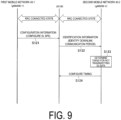
- FIG. 9 is a diagram illustrating operations according to Operation Example 3 of the first embodiment.
- the UE 100 is registered with the first mobile network 40-1 and the second mobile network 40-2.
- the UE 100 is in the RRC connected state in the first mobile network 40-1.
- the UE 100 is in the RRC connected state in the second mobile network 40-2.
- step S121 the UE 100 receives, from the gNB 200-1 belonging to the first mobile network 40-1, configuration information (information for configuring downlink SPS) for configuring a downlink communication period.
- the UE 100 identifies the downlink communication period based on the configuration information.
- step S122 the UE 100 transmits, to the gNB 200-2 belonging to the second mobile network 40-2, the identification information for identifying the downlink communication period configured by the gNB 200-1.
- the identification information may be information indicating the downlink communication period.
- the identification information may be information for configuring the downlink SPS.
- step S123 the gNB 200-2 determines a timing for not transmitting downlink user data to the UE 100, based on the downlink communication period identified by the identification information. For example, the gNB 200-2 determines the subframe belonging to the downlink communication period as a timing for not transmitting downlink user data to the UE 100.
- Step S124 the gNB 200-2 transmits, to the UE 100, information for configuring the timing determined.
- the trigger condition for the UE 100 to transmit the identification information is not mentioned.
- the UE 100 transmits the identification information in a case that the predetermined trigger condition is satisfied.
- the predetermined trigger condition includes at least one of the above-described second condition, third condition, and fourth condition described below.
- the fourth condition is that the radio bearer established by the UE 100 with the first mobile network 40-1 has a higher priority than the radio bearer established by the UE 100 with the second mobile network 40-2.
- a second embodiment will be described focusing on differences from the first embodiment.
- the UE 100 transmits, to the second mobile network 40-2, the identification information for identifying the execution timing or non-execution timing configured for the UE 100 by the first mobile network 40-1, thus enabling avoidance of collision of downlink transmissions.
- the second embodiment such a problem is solved mainly by the autonomous operation of the UE 100.
- the UE 100 according to the second embodiment is registered with the first mobile network 40-1 by using the first SIM (SIM 140-1) and registered with the second mobile network 40-2 by using the second SIM (SIM 140-2).
- the UE 100 identifies a first paging reception occasion when a paging message is received from the first mobile network 40-1.
- the UE 100 identifies a second paging reception occasion when the paging message is received from the second mobile network.
- the UE 100 identifies a priority mobile network out of the first mobile network 40-1 and the second mobile network.
- the UE 100 determines whether an overlap timing when the first paging reception occasion overlaps with the second paging reception occasion is present. In a case of determining that the overlap timing is present, the UE 100 performs first control or second control.
- the first control not covered by the claimed invention, is control that receives only the paging message from the priority mobile network at the overlap timing.
- the second control is control for transmitting a request to modify the paging reception occasion for a non-priority mobile network out of the first mobile network 40-1 and the second mobile network, which is not the priority mobile network.
- the transmission of the paging message from the first mobile network 40-1 collides with the transmission of the paging message from the second mobile network 40-2 at the UE 100, the reception of the paging message corresponding to the priority network can be ensured.
- the second control can avoid a collision of the transmission of the paging message from the first mobile network 40-1 and the transmission of the paging message from the second mobile network 40-2 at the UE 100.
- FIG. 10 is a diagram illustrating operation according to the second embodiment.
- the UE 100 In the initial state of the second embodiment, the UE 100 is registered with the first mobile network 40-1 and the second mobile network 40-2. The UE 100 is in the RRC idle state or the RRC inactive state in the first mobile network 40-1. The UE 100 is in the RRC idle state or the RRC inactive state in the second mobile network 40-2.
- the UE 100 identifies the first paging reception occasion (PF and PO) for receiving the paging message from the first mobile network 40-1.
- the paging reception occasion is identified by the default DRX value, the UE-specific DRX value, PF_offset, N, Ns, 5G-S-TMSI, and the like described above.
- step S202 the UE 100 identifies the second paging reception occasion (PF and PO) for receiving the paging message from the second mobile network 40-2.
- the paging reception occasion is identified by the 5G-S-TMSI.
- step S203 the UE 100 identifies one of the second mobile network 40-2 and the first mobile network 40-1 as the priority mobile network 40.
- the UE 100 identifies the priority mobile network 40 in a first or second method described below:
- the first method is a method for identifying the mobile network 40 with a longer paging cycle (i.e., the value of T in Equation (1) above) as the priority mobile network 40.
- the number of POs corresponding to the paging reception occasion for the UE 100 in the mobile network 40 with a shorter paging cycle is greater than the number of POs corresponding to the paging reception occasion for the UE 100 in the mobile network 40 with a longer paging cycle.
- the UE 100 can perform the reception at another PO corresponding to the paging reception occasion instead of performing the reception at the overlap timing.
- the second method is a method for identifying, as the priority mobile network 40, the mobile network 40 corresponding to either SIM of the SIMs 140-1 or 140-2, that is configured by the user to be prioritized.
- the description below assumes that the UE 100 identifies the first mobile network 40-1 as a priority mobile network and identifies the second mobile network 40-2 as a non-priority mobile network.
- step S204 the UE 100 determines whether an overlap timing when the first paging reception occasion (PF and PO) identified in step S201 overlaps with the second paging reception occasion (PF and PO) identified in step S202 is present.
- step S205 not covered by the claimed invention, the UE 100 receives only the paging message from the first mobile network 40-1 at the overlap timing (first control). According to the claimed invention, in step S205, the UE 100 transmits a request to modify the paging reception occasion for the second mobile network 40-2 (second control).
- the AMF 300-2 belonging to the second mobile network 40-2 receives the request via the gNB 200-2.
- the AMF 300-2 modifies the temporary subscriber identity (5G-S-TMSI) allocated to the UE 100.
- the AMF 300-2 transmits information to the UE 100 identifying the modified temporary subscriber identity.
- modifying the temporary subscriber identity is, not covered by the claimed invention, to newly generate a temporary subscriber identity or, according to the claimed invention, provide an offset for the temporary subscriber identity already allocated to the UE 100.
- the information identifying the modified temporary subscriber identity may be, not covered by the claimed invention, information indicating a new temporary subscriber identity, or, according to the claimed invention, is information indicating an offset provided for the temporary subscriber identity.
- the request to modify the paging reception occasion, the request being transmitted from the UE 100 to the second mobile network 40-2, is a modification request (modification is left to the discretion of the AMF 300-2) or, not covered by the claimed invention, a request to modify, to a particular temporary subscriber identity, the temporary subscriber identity (5G-S-TMSI) allocated to the UE 100.
- the UE 100 specifies a new candidate for 5G-S-TMSI and includes the candidate in the request for transmission.
- the UE 100 may notify 5G-S-TMSI allocated from the mobile network 40-1 or a part of the 5G-S-TMSI (e. g., "UE_ID" described above).
- the AMF 300-2 when the UE 100 is paged, the AMF 300-2 includes information indicating the offset in the paging message addressed to the UE 100 and transmits the paging message to the gNB 200-2.
- the UE 100 receives, from the first mobile network 40-1, the configuration information for configuring the execution timing for executing downlink transmission, and transmits, to the second mobile network 40-2, the identification information for identifying the execution timing for executing the downlink transmission configured by using the configuration information.
- the UE 100 may receive, from the first mobile network 40-1, the configuration information for configuring the execution timing for executing uplink transmission, and transmit, to the second mobile network 40-2, the identification information for identifying the uplink timing configured by using the configuration information.
- An example of the execution timing for executing the uplink transmission is a downlink communication period in which uplink resources are periodically allocated (hereinafter, simply referred to as the "downlink communication period").
- the downlink communication period is identified by the uplink SPS configured for the UE 100 in the RRC connected state in the first mobile network 40-1.
- the period is configured for the UE 100 in a dedicated RRC message, and allocation resource blocks are specified for the UE 100 by using the PDCCH.
- the UE 100 uses, in a period configured by RRC, the resources specified by using the PDCCH.
- the UE 100 may notify the mobile network 40 when using two SIMs 140 (SIM 140-1 and SIM 140-2) simultaneously.
- a gap configuration may be performed by the first mobile network 40-1 with which the UE 100 has already been registered, the gap configuration allowing the UE 100 to be registered and communicate with the second mobile network 40-2.
- the UE uses the gap configuration to access the second mobile network 40-2.
- the UE 100 may notify the mobile network 40 of the use.
- a gap configuration may be performed by one of the mobile networks 40 with which the UE 100 has already been registered, the gap configuration allowing the UE 100 to be registered and communicate with the remaining two mobile networks 40.
- a program may be provided that causes a computer to execute each process performed by the UE 100, the gNB 200, and the AMF 300.
- the program may be recorded in a computer-readable medium. Use of the computer readable medium enables the program to be installed on a computer.
- the computer readable medium on which the program is recorded may be a non-transitory recording medium.
- the non-transitory recording medium is not particularly limited, and may be, for example, a recording medium such as a CD-ROM, a DVD-ROM, or the like.
- a chipset including a memory that stores a program for executing each process performed by the UE 100 and the eNB 200 and a processor that executes the program stored in the memory may be provided.
Landscapes
- Engineering & Computer Science (AREA)
- Computer Networks & Wireless Communication (AREA)
- Signal Processing (AREA)
- Databases & Information Systems (AREA)
- Mobile Radio Communication Systems (AREA)
Applications Claiming Priority (2)
| Application Number | Priority Date | Filing Date | Title |
|---|---|---|---|
| JP2019214616 | 2019-11-27 | ||
| PCT/JP2020/044117 WO2021107057A1 (ja) | 2019-11-27 | 2020-11-26 | 通信制御方法及びユーザ装置 |
Publications (3)
| Publication Number | Publication Date |
|---|---|
| EP4050957A1 EP4050957A1 (en) | 2022-08-31 |
| EP4050957A4 EP4050957A4 (en) | 2023-01-04 |
| EP4050957B1 true EP4050957B1 (en) | 2024-03-06 |
Family
ID=76129538
Family Applications (1)
| Application Number | Title | Priority Date | Filing Date |
|---|---|---|---|
| EP20892258.3A Active EP4050957B1 (en) | 2019-11-27 | 2020-11-26 | Method and apparatus for avoiding paging collisions in a multi-sim user equipment |
Country Status (4)
| Country | Link |
|---|---|
| US (2) | US12457581B2 (https=) |
| EP (1) | EP4050957B1 (https=) |
| JP (2) | JP7227401B2 (https=) |
| WO (1) | WO2021107057A1 (https=) |
Families Citing this family (4)
| Publication number | Priority date | Publication date | Assignee | Title |
|---|---|---|---|---|
| JP7261761B2 (ja) * | 2020-03-10 | 2023-04-20 | Kddi株式会社 | 複数の加入者識別モジュールを有する端末装置への呼び出し制御を実行するための端末装置、コアネットワーク装置、制御方法、及びプログラム |
| US12294881B2 (en) * | 2020-07-10 | 2025-05-06 | Qualcomm Incorporated | User equipment (UE) measurement gap request and release for power savings and multiple subscriber identity module (MSIM) measurements |
| WO2022088073A1 (zh) * | 2020-10-30 | 2022-05-05 | 北京小米移动软件有限公司 | 寻呼配置方法和装置、寻呼方法和装置 |
| US20240064542A1 (en) * | 2022-08-19 | 2024-02-22 | Mediatek Inc. | Method and user equipment for performing cell measurement |
Family Cites Families (9)
| Publication number | Priority date | Publication date | Assignee | Title |
|---|---|---|---|---|
| US20110122809A1 (en) * | 2009-11-20 | 2011-05-26 | Samsung Electronics Co. Ltd. | Method and apparatus for interworking of 3gpp lte and 3gpp2 legacy wireless communication systems |
| BR112013025917A2 (pt) | 2011-04-08 | 2016-12-20 | Omeros Corp | uso de um anticorpo masp-2 ou fragmento do mesmo que inibe ativação de complemento dependente de masp-2 |
| EP2737762B1 (en) * | 2011-07-25 | 2018-05-30 | Telefonaktiebolaget LM Ericsson (publ) | Paging reception in wireless communication devices with dual sim |
| US11076440B2 (en) * | 2014-05-28 | 2021-07-27 | Qualcomm Incorporated | Methods and apparatus for reducing collisions between CDRX and paging operations |
| US11356975B2 (en) * | 2018-12-14 | 2022-06-07 | Qualcomm Incorporated | Resolution of paging collisions in multisim and C-RAT operation |
| CN113557773B (zh) | 2019-03-06 | 2026-01-02 | 诺基亚技术有限公司 | 用以针对无线网络调节ue的寻呼定时的第二ue标识的指配 |
| US11368937B2 (en) * | 2019-04-12 | 2022-06-21 | Ofinno, Llc | Paging time adjustment in a wireless network |
| CN111918330B (zh) * | 2019-05-09 | 2025-04-18 | 三星电子株式会社 | 多通用用户标识模块用户设备及其操作方法 |
| CN118785369A (zh) * | 2019-06-17 | 2024-10-15 | 交互数字专利控股公司 | 用于具有多个usim的wtru的寻呼方法 |
-
2020
- 2020-11-26 JP JP2021561521A patent/JP7227401B2/ja active Active
- 2020-11-26 WO PCT/JP2020/044117 patent/WO2021107057A1/ja not_active Ceased
- 2020-11-26 EP EP20892258.3A patent/EP4050957B1/en active Active
-
2022
- 2022-05-26 US US17/825,668 patent/US12457581B2/en active Active
-
2023
- 2023-02-09 JP JP2023018315A patent/JP7516589B2/ja active Active
-
2025
- 2025-10-03 US US19/349,488 patent/US20260032641A1/en active Pending
Also Published As
| Publication number | Publication date |
|---|---|
| US20220287004A1 (en) | 2022-09-08 |
| US12457581B2 (en) | 2025-10-28 |
| EP4050957A4 (en) | 2023-01-04 |
| WO2021107057A1 (ja) | 2021-06-03 |
| JP2023053106A (ja) | 2023-04-12 |
| JP7227401B2 (ja) | 2023-02-21 |
| JP7516589B2 (ja) | 2024-07-16 |
| EP4050957A1 (en) | 2022-08-31 |
| JPWO2021107057A1 (https=) | 2021-06-03 |
| US20260032641A1 (en) | 2026-01-29 |
Similar Documents
| Publication | Publication Date | Title |
|---|---|---|
| US11063657B2 (en) | Relay radio terminal and radio terminal | |
| US10757600B2 (en) | Communications terminal and method of communicating | |
| US9642172B2 (en) | Mobile communication system, base station, user terminal, and processor | |
| EP3668268B1 (en) | Mobile communication system, user terminal, and base station | |
| EP4050957B1 (en) | Method and apparatus for avoiding paging collisions in a multi-sim user equipment | |
| EP3016473A1 (en) | User terminal, processor, and base station | |
| EP2914054B1 (en) | Mobile communication system, base station, processor, and communication control method | |
| US20230403626A1 (en) | Method and apparatus for relay communication | |
| JPWO2018061760A1 (ja) | 無線端末及びネットワーク装置 | |
| WO2023035860A1 (en) | Method and apparatus for paging | |
| EP3051852A1 (en) | User terminal, network device, and processor | |
| EP3188545A1 (en) | Base station and wireless-lan terminating equipment | |
| CN117957902A (zh) | 用于载波聚合的方法和装置 | |
| US20230309155A1 (en) | Methods and apparatus for radio connection | |
| EP4192039B1 (en) | Communication control method | |
| WO2022209906A1 (ja) | ユーザ装置、基地局、及び通信制御方法 |
Legal Events
| Date | Code | Title | Description |
|---|---|---|---|
| STAA | Information on the status of an ep patent application or granted ep patent |
Free format text: STATUS: THE INTERNATIONAL PUBLICATION HAS BEEN MADE |
|
| PUAI | Public reference made under article 153(3) epc to a published international application that has entered the european phase |
Free format text: ORIGINAL CODE: 0009012 |
|
| STAA | Information on the status of an ep patent application or granted ep patent |
Free format text: STATUS: REQUEST FOR EXAMINATION WAS MADE |
|
| 17P | Request for examination filed |
Effective date: 20220527 |
|
| AK | Designated contracting states |
Kind code of ref document: A1 Designated state(s): AL AT BE BG CH CY CZ DE DK EE ES FI FR GB GR HR HU IE IS IT LI LT LU LV MC MK MT NL NO PL PT RO RS SE SI SK SM TR |
|
| REG | Reference to a national code |
Ref country code: DE Ref legal event code: R079 Free format text: PREVIOUS MAIN CLASS: H04W0072120000 Ipc: H04W0068020000 Ref country code: DE Ref legal event code: R079 Ref document number: 602020027009 Country of ref document: DE Free format text: PREVIOUS MAIN CLASS: H04W0072120000 Ipc: H04W0068020000 |
|
| A4 | Supplementary search report drawn up and despatched |
Effective date: 20221205 |
|
| RIC1 | Information provided on ipc code assigned before grant |
Ipc: H04W 88/06 20090101ALN20221129BHEP Ipc: H04W 72/12 20090101ALN20221129BHEP Ipc: H04W 28/16 20090101ALN20221129BHEP Ipc: H04W 8/00 20090101ALN20221129BHEP Ipc: H04W 68/02 20090101AFI20221129BHEP |
|
| DAV | Request for validation of the european patent (deleted) | ||
| DAX | Request for extension of the european patent (deleted) | ||
| P01 | Opt-out of the competence of the unified patent court (upc) registered |
Effective date: 20230505 |
|
| RIC1 | Information provided on ipc code assigned before grant |
Ipc: H04W 88/06 20090101ALN20230817BHEP Ipc: H04W 72/12 20090101ALN20230817BHEP Ipc: H04W 60/00 20090101ALN20230817BHEP Ipc: H04W 28/16 20090101ALN20230817BHEP Ipc: H04W 8/26 20090101ALN20230817BHEP Ipc: H04W 8/00 20090101ALN20230817BHEP Ipc: H04W 68/02 20090101AFI20230817BHEP |
|
| GRAP | Despatch of communication of intention to grant a patent |
Free format text: ORIGINAL CODE: EPIDOSNIGR1 |
|
| RIC1 | Information provided on ipc code assigned before grant |
Ipc: H04W 88/06 20090101ALN20230822BHEP Ipc: H04W 72/12 20090101ALN20230822BHEP Ipc: H04W 60/00 20090101ALN20230822BHEP Ipc: H04W 28/16 20090101ALN20230822BHEP Ipc: H04W 8/26 20090101ALN20230822BHEP Ipc: H04W 8/00 20090101ALN20230822BHEP Ipc: H04W 68/02 20090101AFI20230822BHEP |
|
| STAA | Information on the status of an ep patent application or granted ep patent |
Free format text: STATUS: GRANT OF PATENT IS INTENDED |
|
| RIC1 | Information provided on ipc code assigned before grant |
Ipc: H04W 88/06 20090101ALN20230912BHEP Ipc: H04W 72/12 20090101ALN20230912BHEP Ipc: H04W 60/00 20090101ALN20230912BHEP Ipc: H04W 28/16 20090101ALN20230912BHEP Ipc: H04W 8/26 20090101ALN20230912BHEP Ipc: H04W 8/00 20090101ALN20230912BHEP Ipc: H04W 68/02 20090101AFI20230912BHEP |
|
| INTG | Intention to grant announced |
Effective date: 20230928 |
|
| GRAS | Grant fee paid |
Free format text: ORIGINAL CODE: EPIDOSNIGR3 |
|
| GRAA | (expected) grant |
Free format text: ORIGINAL CODE: 0009210 |
|
| STAA | Information on the status of an ep patent application or granted ep patent |
Free format text: STATUS: THE PATENT HAS BEEN GRANTED |
|
| AK | Designated contracting states |
Kind code of ref document: B1 Designated state(s): AL AT BE BG CH CY CZ DE DK EE ES FI FR GB GR HR HU IE IS IT LI LT LU LV MC MK MT NL NO PL PT RO RS SE SI SK SM TR |
|
| REG | Reference to a national code |
Ref country code: CH Ref legal event code: EP |
|
| REG | Reference to a national code |
Ref country code: DE Ref legal event code: R096 Ref document number: 602020027009 Country of ref document: DE |
|
| REG | Reference to a national code |
Ref country code: IE Ref legal event code: FG4D |
|
| REG | Reference to a national code |
Ref country code: NL Ref legal event code: FP |
|
| REG | Reference to a national code |
Ref country code: LT Ref legal event code: MG9D |
|
| PG25 | Lapsed in a contracting state [announced via postgrant information from national office to epo] |
Ref country code: LT Free format text: LAPSE BECAUSE OF FAILURE TO SUBMIT A TRANSLATION OF THE DESCRIPTION OR TO PAY THE FEE WITHIN THE PRESCRIBED TIME-LIMIT Effective date: 20240306 |
|
| PG25 | Lapsed in a contracting state [announced via postgrant information from national office to epo] |
Ref country code: GR Free format text: LAPSE BECAUSE OF FAILURE TO SUBMIT A TRANSLATION OF THE DESCRIPTION OR TO PAY THE FEE WITHIN THE PRESCRIBED TIME-LIMIT Effective date: 20240607 |
|
| PG25 | Lapsed in a contracting state [announced via postgrant information from national office to epo] |
Ref country code: RS Free format text: LAPSE BECAUSE OF FAILURE TO SUBMIT A TRANSLATION OF THE DESCRIPTION OR TO PAY THE FEE WITHIN THE PRESCRIBED TIME-LIMIT Effective date: 20240606 Ref country code: HR Free format text: LAPSE BECAUSE OF FAILURE TO SUBMIT A TRANSLATION OF THE DESCRIPTION OR TO PAY THE FEE WITHIN THE PRESCRIBED TIME-LIMIT Effective date: 20240306 |
|
| PG25 | Lapsed in a contracting state [announced via postgrant information from national office to epo] |
Ref country code: ES Free format text: LAPSE BECAUSE OF FAILURE TO SUBMIT A TRANSLATION OF THE DESCRIPTION OR TO PAY THE FEE WITHIN THE PRESCRIBED TIME-LIMIT Effective date: 20240306 |
|
| PG25 | Lapsed in a contracting state [announced via postgrant information from national office to epo] |
Ref country code: RS Free format text: LAPSE BECAUSE OF FAILURE TO SUBMIT A TRANSLATION OF THE DESCRIPTION OR TO PAY THE FEE WITHIN THE PRESCRIBED TIME-LIMIT Effective date: 20240606 Ref country code: NO Free format text: LAPSE BECAUSE OF FAILURE TO SUBMIT A TRANSLATION OF THE DESCRIPTION OR TO PAY THE FEE WITHIN THE PRESCRIBED TIME-LIMIT Effective date: 20240606 Ref country code: LT Free format text: LAPSE BECAUSE OF FAILURE TO SUBMIT A TRANSLATION OF THE DESCRIPTION OR TO PAY THE FEE WITHIN THE PRESCRIBED TIME-LIMIT Effective date: 20240306 Ref country code: HR Free format text: LAPSE BECAUSE OF FAILURE TO SUBMIT A TRANSLATION OF THE DESCRIPTION OR TO PAY THE FEE WITHIN THE PRESCRIBED TIME-LIMIT Effective date: 20240306 Ref country code: GR Free format text: LAPSE BECAUSE OF FAILURE TO SUBMIT A TRANSLATION OF THE DESCRIPTION OR TO PAY THE FEE WITHIN THE PRESCRIBED TIME-LIMIT Effective date: 20240607 Ref country code: FI Free format text: LAPSE BECAUSE OF FAILURE TO SUBMIT A TRANSLATION OF THE DESCRIPTION OR TO PAY THE FEE WITHIN THE PRESCRIBED TIME-LIMIT Effective date: 20240306 Ref country code: ES Free format text: LAPSE BECAUSE OF FAILURE TO SUBMIT A TRANSLATION OF THE DESCRIPTION OR TO PAY THE FEE WITHIN THE PRESCRIBED TIME-LIMIT Effective date: 20240306 Ref country code: BG Free format text: LAPSE BECAUSE OF FAILURE TO SUBMIT A TRANSLATION OF THE DESCRIPTION OR TO PAY THE FEE WITHIN THE PRESCRIBED TIME-LIMIT Effective date: 20240306 |
|
| REG | Reference to a national code |
Ref country code: AT Ref legal event code: MK05 Ref document number: 1664754 Country of ref document: AT Kind code of ref document: T Effective date: 20240306 |
|
| PG25 | Lapsed in a contracting state [announced via postgrant information from national office to epo] |
Ref country code: SE Free format text: LAPSE BECAUSE OF FAILURE TO SUBMIT A TRANSLATION OF THE DESCRIPTION OR TO PAY THE FEE WITHIN THE PRESCRIBED TIME-LIMIT Effective date: 20240306 Ref country code: LV Free format text: LAPSE BECAUSE OF FAILURE TO SUBMIT A TRANSLATION OF THE DESCRIPTION OR TO PAY THE FEE WITHIN THE PRESCRIBED TIME-LIMIT Effective date: 20240306 |
|
| PG25 | Lapsed in a contracting state [announced via postgrant information from national office to epo] |
Ref country code: IS Free format text: LAPSE BECAUSE OF FAILURE TO SUBMIT A TRANSLATION OF THE DESCRIPTION OR TO PAY THE FEE WITHIN THE PRESCRIBED TIME-LIMIT Effective date: 20240706 |
|
| PG25 | Lapsed in a contracting state [announced via postgrant information from national office to epo] |
Ref country code: PT Free format text: LAPSE BECAUSE OF FAILURE TO SUBMIT A TRANSLATION OF THE DESCRIPTION OR TO PAY THE FEE WITHIN THE PRESCRIBED TIME-LIMIT Effective date: 20240708 Ref country code: SM Free format text: LAPSE BECAUSE OF FAILURE TO SUBMIT A TRANSLATION OF THE DESCRIPTION OR TO PAY THE FEE WITHIN THE PRESCRIBED TIME-LIMIT Effective date: 20240306 |
|
| PG25 | Lapsed in a contracting state [announced via postgrant information from national office to epo] |
Ref country code: CZ Free format text: LAPSE BECAUSE OF FAILURE TO SUBMIT A TRANSLATION OF THE DESCRIPTION OR TO PAY THE FEE WITHIN THE PRESCRIBED TIME-LIMIT Effective date: 20240306 Ref country code: EE Free format text: LAPSE BECAUSE OF FAILURE TO SUBMIT A TRANSLATION OF THE DESCRIPTION OR TO PAY THE FEE WITHIN THE PRESCRIBED TIME-LIMIT Effective date: 20240306 |
|
| PG25 | Lapsed in a contracting state [announced via postgrant information from national office to epo] |
Ref country code: AT Free format text: LAPSE BECAUSE OF FAILURE TO SUBMIT A TRANSLATION OF THE DESCRIPTION OR TO PAY THE FEE WITHIN THE PRESCRIBED TIME-LIMIT Effective date: 20240306 |
|
| PG25 | Lapsed in a contracting state [announced via postgrant information from national office to epo] |
Ref country code: PL Free format text: LAPSE BECAUSE OF FAILURE TO SUBMIT A TRANSLATION OF THE DESCRIPTION OR TO PAY THE FEE WITHIN THE PRESCRIBED TIME-LIMIT Effective date: 20240306 |
|
| PG25 | Lapsed in a contracting state [announced via postgrant information from national office to epo] |
Ref country code: SK Free format text: LAPSE BECAUSE OF FAILURE TO SUBMIT A TRANSLATION OF THE DESCRIPTION OR TO PAY THE FEE WITHIN THE PRESCRIBED TIME-LIMIT Effective date: 20240306 |
|
| PG25 | Lapsed in a contracting state [announced via postgrant information from national office to epo] |
Ref country code: SM Free format text: LAPSE BECAUSE OF FAILURE TO SUBMIT A TRANSLATION OF THE DESCRIPTION OR TO PAY THE FEE WITHIN THE PRESCRIBED TIME-LIMIT Effective date: 20240306 Ref country code: SK Free format text: LAPSE BECAUSE OF FAILURE TO SUBMIT A TRANSLATION OF THE DESCRIPTION OR TO PAY THE FEE WITHIN THE PRESCRIBED TIME-LIMIT Effective date: 20240306 Ref country code: RO Free format text: LAPSE BECAUSE OF FAILURE TO SUBMIT A TRANSLATION OF THE DESCRIPTION OR TO PAY THE FEE WITHIN THE PRESCRIBED TIME-LIMIT Effective date: 20240306 Ref country code: PT Free format text: LAPSE BECAUSE OF FAILURE TO SUBMIT A TRANSLATION OF THE DESCRIPTION OR TO PAY THE FEE WITHIN THE PRESCRIBED TIME-LIMIT Effective date: 20240708 Ref country code: PL Free format text: LAPSE BECAUSE OF FAILURE TO SUBMIT A TRANSLATION OF THE DESCRIPTION OR TO PAY THE FEE WITHIN THE PRESCRIBED TIME-LIMIT Effective date: 20240306 Ref country code: IS Free format text: LAPSE BECAUSE OF FAILURE TO SUBMIT A TRANSLATION OF THE DESCRIPTION OR TO PAY THE FEE WITHIN THE PRESCRIBED TIME-LIMIT Effective date: 20240706 Ref country code: EE Free format text: LAPSE BECAUSE OF FAILURE TO SUBMIT A TRANSLATION OF THE DESCRIPTION OR TO PAY THE FEE WITHIN THE PRESCRIBED TIME-LIMIT Effective date: 20240306 Ref country code: CZ Free format text: LAPSE BECAUSE OF FAILURE TO SUBMIT A TRANSLATION OF THE DESCRIPTION OR TO PAY THE FEE WITHIN THE PRESCRIBED TIME-LIMIT Effective date: 20240306 Ref country code: AT Free format text: LAPSE BECAUSE OF FAILURE TO SUBMIT A TRANSLATION OF THE DESCRIPTION OR TO PAY THE FEE WITHIN THE PRESCRIBED TIME-LIMIT Effective date: 20240306 |
|
| PG25 | Lapsed in a contracting state [announced via postgrant information from national office to epo] |
Ref country code: IT Free format text: LAPSE BECAUSE OF FAILURE TO SUBMIT A TRANSLATION OF THE DESCRIPTION OR TO PAY THE FEE WITHIN THE PRESCRIBED TIME-LIMIT Effective date: 20240306 |
|
| REG | Reference to a national code |
Ref country code: DE Ref legal event code: R097 Ref document number: 602020027009 Country of ref document: DE |
|
| PG25 | Lapsed in a contracting state [announced via postgrant information from national office to epo] |
Ref country code: IT Free format text: LAPSE BECAUSE OF FAILURE TO SUBMIT A TRANSLATION OF THE DESCRIPTION OR TO PAY THE FEE WITHIN THE PRESCRIBED TIME-LIMIT Effective date: 20240306 |
|
| PLBE | No opposition filed within time limit |
Free format text: ORIGINAL CODE: 0009261 |
|
| STAA | Information on the status of an ep patent application or granted ep patent |
Free format text: STATUS: NO OPPOSITION FILED WITHIN TIME LIMIT |
|
| PG25 | Lapsed in a contracting state [announced via postgrant information from national office to epo] |
Ref country code: DK Free format text: LAPSE BECAUSE OF FAILURE TO SUBMIT A TRANSLATION OF THE DESCRIPTION OR TO PAY THE FEE WITHIN THE PRESCRIBED TIME-LIMIT Effective date: 20240306 |
|
| PG25 | Lapsed in a contracting state [announced via postgrant information from national office to epo] |
Ref country code: DK Free format text: LAPSE BECAUSE OF FAILURE TO SUBMIT A TRANSLATION OF THE DESCRIPTION OR TO PAY THE FEE WITHIN THE PRESCRIBED TIME-LIMIT Effective date: 20240306 |
|
| 26N | No opposition filed |
Effective date: 20241209 |
|
| PG25 | Lapsed in a contracting state [announced via postgrant information from national office to epo] |
Ref country code: SI Free format text: LAPSE BECAUSE OF FAILURE TO SUBMIT A TRANSLATION OF THE DESCRIPTION OR TO PAY THE FEE WITHIN THE PRESCRIBED TIME-LIMIT Effective date: 20240306 |
|
| REG | Reference to a national code |
Ref country code: CH Ref legal event code: PL |
|
| PG25 | Lapsed in a contracting state [announced via postgrant information from national office to epo] |
Ref country code: MC Free format text: LAPSE BECAUSE OF FAILURE TO SUBMIT A TRANSLATION OF THE DESCRIPTION OR TO PAY THE FEE WITHIN THE PRESCRIBED TIME-LIMIT Effective date: 20240306 |
|
| PG25 | Lapsed in a contracting state [announced via postgrant information from national office to epo] |
Ref country code: LU Free format text: LAPSE BECAUSE OF NON-PAYMENT OF DUE FEES Effective date: 20241126 |
|
| REG | Reference to a national code |
Ref country code: CH Ref legal event code: PL |
|
| GBPC | Gb: european patent ceased through non-payment of renewal fee |
Effective date: 20241126 |
|
| PG25 | Lapsed in a contracting state [announced via postgrant information from national office to epo] |
Ref country code: CH Free format text: LAPSE BECAUSE OF NON-PAYMENT OF DUE FEES Effective date: 20241130 |
|
| REG | Reference to a national code |
Ref country code: BE Ref legal event code: MM Effective date: 20241130 |
|
| PG25 | Lapsed in a contracting state [announced via postgrant information from national office to epo] |
Ref country code: GB Free format text: LAPSE BECAUSE OF NON-PAYMENT OF DUE FEES Effective date: 20241126 Ref country code: BE Free format text: LAPSE BECAUSE OF NON-PAYMENT OF DUE FEES Effective date: 20241130 |
|
| PGFP | Annual fee paid to national office [announced via postgrant information from national office to epo] |
Ref country code: FR Payment date: 20250930 Year of fee payment: 6 |
|
| PG25 | Lapsed in a contracting state [announced via postgrant information from national office to epo] |
Ref country code: IE Free format text: LAPSE BECAUSE OF NON-PAYMENT OF DUE FEES Effective date: 20241126 |
|
| PGFP | Annual fee paid to national office [announced via postgrant information from national office to epo] |
Ref country code: NL Payment date: 20251003 Year of fee payment: 6 |
|
| PGFP | Annual fee paid to national office [announced via postgrant information from national office to epo] |
Ref country code: DE Payment date: 20250930 Year of fee payment: 6 |
|
| PG25 | Lapsed in a contracting state [announced via postgrant information from national office to epo] |
Ref country code: HU Free format text: LAPSE BECAUSE OF FAILURE TO SUBMIT A TRANSLATION OF THE DESCRIPTION OR TO PAY THE FEE WITHIN THE PRESCRIBED TIME-LIMIT; INVALID AB INITIO Effective date: 20201126 |
|
| PG25 | Lapsed in a contracting state [announced via postgrant information from national office to epo] |
Ref country code: CY Free format text: LAPSE BECAUSE OF FAILURE TO SUBMIT A TRANSLATION OF THE DESCRIPTION OR TO PAY THE FEE WITHIN THE PRESCRIBED TIME-LIMIT; INVALID AB INITIO Effective date: 20201126 |