EP4046845A1 - Drive train for a motor vehicle - Google Patents
Drive train for a motor vehicle Download PDFInfo
- Publication number
- EP4046845A1 EP4046845A1 EP22154705.2A EP22154705A EP4046845A1 EP 4046845 A1 EP4046845 A1 EP 4046845A1 EP 22154705 A EP22154705 A EP 22154705A EP 4046845 A1 EP4046845 A1 EP 4046845A1
- Authority
- EP
- European Patent Office
- Prior art keywords
- drive
- unit
- gear
- housing
- shaft
- Prior art date
- Legal status (The legal status is an assumption and is not a legal conclusion. Google has not performed a legal analysis and makes no representation as to the accuracy of the status listed.)
- Granted
Links
Images


Classifications
-
- B—PERFORMING OPERATIONS; TRANSPORTING
- B60—VEHICLES IN GENERAL
- B60K—ARRANGEMENT OR MOUNTING OF PROPULSION UNITS OR OF TRANSMISSIONS IN VEHICLES; ARRANGEMENT OR MOUNTING OF PLURAL DIVERSE PRIME-MOVERS IN VEHICLES; AUXILIARY DRIVES FOR VEHICLES; INSTRUMENTATION OR DASHBOARDS FOR VEHICLES; ARRANGEMENTS IN CONNECTION WITH COOLING, AIR INTAKE, GAS EXHAUST OR FUEL SUPPLY OF PROPULSION UNITS IN VEHICLES
- B60K17/00—Arrangement or mounting of transmissions in vehicles
- B60K17/04—Arrangement or mounting of transmissions in vehicles characterised by arrangement, location or kind of gearing
- B60K17/16—Arrangement or mounting of transmissions in vehicles characterised by arrangement, location or kind of gearing of differential gearing
- B60K17/165—Arrangement or mounting of transmissions in vehicles characterised by arrangement, location or kind of gearing of differential gearing provided between independent half axles
-
- B—PERFORMING OPERATIONS; TRANSPORTING
- B60—VEHICLES IN GENERAL
- B60K—ARRANGEMENT OR MOUNTING OF PROPULSION UNITS OR OF TRANSMISSIONS IN VEHICLES; ARRANGEMENT OR MOUNTING OF PLURAL DIVERSE PRIME-MOVERS IN VEHICLES; AUXILIARY DRIVES FOR VEHICLES; INSTRUMENTATION OR DASHBOARDS FOR VEHICLES; ARRANGEMENTS IN CONNECTION WITH COOLING, AIR INTAKE, GAS EXHAUST OR FUEL SUPPLY OF PROPULSION UNITS IN VEHICLES
- B60K17/00—Arrangement or mounting of transmissions in vehicles
- B60K17/30—Arrangement or mounting of transmissions in vehicles the ultimate propulsive elements, e.g. ground wheels, being steerable
-
- B—PERFORMING OPERATIONS; TRANSPORTING
- B60—VEHICLES IN GENERAL
- B60K—ARRANGEMENT OR MOUNTING OF PROPULSION UNITS OR OF TRANSMISSIONS IN VEHICLES; ARRANGEMENT OR MOUNTING OF PLURAL DIVERSE PRIME-MOVERS IN VEHICLES; AUXILIARY DRIVES FOR VEHICLES; INSTRUMENTATION OR DASHBOARDS FOR VEHICLES; ARRANGEMENTS IN CONNECTION WITH COOLING, AIR INTAKE, GAS EXHAUST OR FUEL SUPPLY OF PROPULSION UNITS IN VEHICLES
- B60K1/00—Arrangement or mounting of electrical propulsion units
-
- B—PERFORMING OPERATIONS; TRANSPORTING
- B60—VEHICLES IN GENERAL
- B60K—ARRANGEMENT OR MOUNTING OF PROPULSION UNITS OR OF TRANSMISSIONS IN VEHICLES; ARRANGEMENT OR MOUNTING OF PLURAL DIVERSE PRIME-MOVERS IN VEHICLES; AUXILIARY DRIVES FOR VEHICLES; INSTRUMENTATION OR DASHBOARDS FOR VEHICLES; ARRANGEMENTS IN CONNECTION WITH COOLING, AIR INTAKE, GAS EXHAUST OR FUEL SUPPLY OF PROPULSION UNITS IN VEHICLES
- B60K17/00—Arrangement or mounting of transmissions in vehicles
- B60K17/04—Arrangement or mounting of transmissions in vehicles characterised by arrangement, location or kind of gearing
-
- B—PERFORMING OPERATIONS; TRANSPORTING
- B60—VEHICLES IN GENERAL
- B60K—ARRANGEMENT OR MOUNTING OF PROPULSION UNITS OR OF TRANSMISSIONS IN VEHICLES; ARRANGEMENT OR MOUNTING OF PLURAL DIVERSE PRIME-MOVERS IN VEHICLES; AUXILIARY DRIVES FOR VEHICLES; INSTRUMENTATION OR DASHBOARDS FOR VEHICLES; ARRANGEMENTS IN CONNECTION WITH COOLING, AIR INTAKE, GAS EXHAUST OR FUEL SUPPLY OF PROPULSION UNITS IN VEHICLES
- B60K17/00—Arrangement or mounting of transmissions in vehicles
- B60K17/04—Arrangement or mounting of transmissions in vehicles characterised by arrangement, location or kind of gearing
- B60K17/06—Arrangement or mounting of transmissions in vehicles characterised by arrangement, location or kind of gearing of change-speed gearing
- B60K17/08—Arrangement or mounting of transmissions in vehicles characterised by arrangement, location or kind of gearing of change-speed gearing of mechanical type
-
- B—PERFORMING OPERATIONS; TRANSPORTING
- B60—VEHICLES IN GENERAL
- B60K—ARRANGEMENT OR MOUNTING OF PROPULSION UNITS OR OF TRANSMISSIONS IN VEHICLES; ARRANGEMENT OR MOUNTING OF PLURAL DIVERSE PRIME-MOVERS IN VEHICLES; AUXILIARY DRIVES FOR VEHICLES; INSTRUMENTATION OR DASHBOARDS FOR VEHICLES; ARRANGEMENTS IN CONNECTION WITH COOLING, AIR INTAKE, GAS EXHAUST OR FUEL SUPPLY OF PROPULSION UNITS IN VEHICLES
- B60K6/00—Arrangement or mounting of plural diverse prime-movers for mutual or common propulsion, e.g. hybrid propulsion systems comprising electric motors and internal combustion engines
- B60K6/20—Arrangement or mounting of plural diverse prime-movers for mutual or common propulsion, e.g. hybrid propulsion systems comprising electric motors and internal combustion engines the prime-movers consisting of electric motors and internal combustion engines, e.g. HEVs
- B60K6/22—Arrangement or mounting of plural diverse prime-movers for mutual or common propulsion, e.g. hybrid propulsion systems comprising electric motors and internal combustion engines the prime-movers consisting of electric motors and internal combustion engines, e.g. HEVs characterised by apparatus, components or means specially adapted for HEVs
- B60K6/40—Arrangement or mounting of plural diverse prime-movers for mutual or common propulsion, e.g. hybrid propulsion systems comprising electric motors and internal combustion engines the prime-movers consisting of electric motors and internal combustion engines, e.g. HEVs characterised by apparatus, components or means specially adapted for HEVs characterised by the assembly or relative disposition of components
- B60K6/405—Housings
-
- F—MECHANICAL ENGINEERING; LIGHTING; HEATING; WEAPONS; BLASTING
- F16—ENGINEERING ELEMENTS AND UNITS; GENERAL MEASURES FOR PRODUCING AND MAINTAINING EFFECTIVE FUNCTIONING OF MACHINES OR INSTALLATIONS; THERMAL INSULATION IN GENERAL
- F16H—GEARING
- F16H48/00—Differential gearings
- F16H48/06—Differential gearings with gears having orbital motion
- F16H48/10—Differential gearings with gears having orbital motion with orbital spur gears
-
- F—MECHANICAL ENGINEERING; LIGHTING; HEATING; WEAPONS; BLASTING
- F16—ENGINEERING ELEMENTS AND UNITS; GENERAL MEASURES FOR PRODUCING AND MAINTAINING EFFECTIVE FUNCTIONING OF MACHINES OR INSTALLATIONS; THERMAL INSULATION IN GENERAL
- F16H—GEARING
- F16H57/00—General details of gearing
- F16H57/04—Features relating to lubrication or cooling or heating
- F16H57/042—Guidance of lubricant
-
- F—MECHANICAL ENGINEERING; LIGHTING; HEATING; WEAPONS; BLASTING
- F16—ENGINEERING ELEMENTS AND UNITS; GENERAL MEASURES FOR PRODUCING AND MAINTAINING EFFECTIVE FUNCTIONING OF MACHINES OR INSTALLATIONS; THERMAL INSULATION IN GENERAL
- F16H—GEARING
- F16H57/00—General details of gearing
- F16H57/04—Features relating to lubrication or cooling or heating
- F16H57/045—Lubricant storage reservoirs, e.g. reservoirs in addition to a gear sump for collecting lubricant in the upper part of a gear case
- F16H57/0452—Oil pans
-
- F—MECHANICAL ENGINEERING; LIGHTING; HEATING; WEAPONS; BLASTING
- F16—ENGINEERING ELEMENTS AND UNITS; GENERAL MEASURES FOR PRODUCING AND MAINTAINING EFFECTIVE FUNCTIONING OF MACHINES OR INSTALLATIONS; THERMAL INSULATION IN GENERAL
- F16H—GEARING
- F16H57/00—General details of gearing
- F16H57/04—Features relating to lubrication or cooling or heating
- F16H57/048—Type of gearings to be lubricated, cooled or heated
- F16H57/0493—Gearings with spur or bevel gears
- F16H57/0495—Gearings with spur or bevel gears with fixed gear ratio
-
- B—PERFORMING OPERATIONS; TRANSPORTING
- B60—VEHICLES IN GENERAL
- B60K—ARRANGEMENT OR MOUNTING OF PROPULSION UNITS OR OF TRANSMISSIONS IN VEHICLES; ARRANGEMENT OR MOUNTING OF PLURAL DIVERSE PRIME-MOVERS IN VEHICLES; AUXILIARY DRIVES FOR VEHICLES; INSTRUMENTATION OR DASHBOARDS FOR VEHICLES; ARRANGEMENTS IN CONNECTION WITH COOLING, AIR INTAKE, GAS EXHAUST OR FUEL SUPPLY OF PROPULSION UNITS IN VEHICLES
- B60K1/00—Arrangement or mounting of electrical propulsion units
- B60K2001/001—Arrangement or mounting of electrical propulsion units one motor mounted on a propulsion axle for rotating right and left wheels of this axle
-
- B—PERFORMING OPERATIONS; TRANSPORTING
- B62—LAND VEHICLES FOR TRAVELLING OTHERWISE THAN ON RAILS
- B62D—MOTOR VEHICLES; TRAILERS
- B62D3/00—Steering gears
- B62D3/02—Steering gears mechanical
- B62D3/12—Steering gears mechanical of rack-and-pinion type
Definitions
- the invention relates to a drive train for a motor vehicle having the features of the preamble of patent claim 1.
- Drive trains for motor vehicles with a drive unit, a steering gear, a steering shaft, a first and a second cardan shaft are known in the prior art.
- the corresponding drive assembly has an electric machine, a transmission unit and a pulse-controlled inverter, the electric machine and the pulse-controlled inverter being arranged on two opposite sides of the transmission unit.
- a drive shaft of the electric machine and a transmission shaft of the transmission unit run essentially horizontally and essentially perpendicularly to a direction of travel of the motor vehicle.
- the steering gear is arranged in the direction of travel (forward travel direction) in front of the drive unit. This means that, viewed from the front to the rear of the motor vehicle, the steering gear is arranged first and then the drive unit is arranged behind it.
- the steering gear can be functionally and effectively connected to a steering wheel of the motor vehicle by means of the steering shaft.
- the steering shaft is located on the side next to the drive unit.
- the transmission unit also has a differential, the differential being able to be effectively connected to a first front wheel of the motor vehicle by means of the first cardan shaft. Furthermore, the differential can be effectively connected to a second front wheel of the motor vehicle by means of the second cardan shaft.
- a first electric machine is coupled to a differential via a first transmission.
- the first electric machine can be coupled to a second electric machine to form a double drive unit.
- the operation of the first electric machine is controlled by means of a first pulse-controlled inverter.
- the first pulse-controlled inverter is aligned with a first motor axis and is arranged on the side of the first transmission opposite the first electric machine.
- the operation of the second electric machine is controlled by means of a second pulse-controlled inverter.
- the second pulse-controlled inverter is aligned with a second motor axis and is arranged on the side of a second transmission assigned to the second electric machine, opposite the second electric machine.
- the gear unit thus has the first gear, the second transmission and possibly the differential.
- the first and the second electric machine are arranged on two opposite sides of the transmission unit. Coolant inlets and coolant outlets of the two electric machines can be connected to one another, in particular by means of coolant channels formed in the transmission unit.
- a drive train for a motor vehicle with a drive unit includes: a pulse-controlled inverter configured to convert externally provided direct current into alternating current; an electric machine configured to convert power from the pulse-controlled inverter into mechanical rotation of a drive shaft of the electric machine; and a gear unit.
- the electric machine, the transmission unit and the pulse-controlled inverter are each arranged in a separate sub-housing, namely an electric machine sub-housing, a transmission sub-housing and a pulse-controlled inverter sub-housing.
- the electric machine, the gear unit and the pulse-controlled inverter are detachable and connected to the gear unit in the axial direction along a gear shaft of the gear unit, the gear unit being positioned between the electric machine and the pulse-controlled inverter.
- a partition plate is provided in the gear case to divide the interior of the gear case into a gear cavity and a dry cavity.
- the dry cavity is used to introduce electrical connecting lines of the electric machine and the pulse-controlled inverter.
- the drying cavity has a number of contacts for docking the electrical connection lines of the electric machine and the pulse-controlled inverter.
- the US 9,692,277 B2 discloses another power train with a power unit.
- the drive unit has an electric machine, a pulse-controlled inverter and a gear unit.
- the drive unit has a multi-part drive unit housing.
- the drive unit is primarily used on the rear axle of a motor vehicle. Use on a front axle is also conceivable.
- the electric machine, the transmission unit and the pulse-controlled inverter are arranged next to one another in this order in the axial direction of a transmission shaft.
- the power plant is mounted to a subframe structure of a chassis with a pair of brackets at two points. An attachment point is formed with each of these brackets.
- Each bracket has a rubber bushing (or synthetic bushing) and is attachable to the subframe structure with one bolt each.
- a thermal management system is used to control the temperature of the electric machine, pulse-controlled inverter and gear unit.
- a coolant inlet for supplying and a coolant outlet for removing a cooling fluid are arranged on opposite end
- the known drive trains problems arise when integrating the drive unit into the motor vehicle.
- the installation space available in the motor vehicle is not optimally used, the latter in particular depending on whether the drive unit is arranged in a left-hand drive vehicle or in a right-hand drive vehicle.
- unused areas are created in the installation space.
- components of the drive train that are adjacent to the drive unit then have to be offset, which has a negative effect on the efficiency of the drive train and thus of the motor vehicle.
- the known drive trains can only be used in different vehicle variants (left-hand drive vehicle/right-hand drive vehicle) with appropriate structural adjustments, which increases the development effort, the manufacturing effort and the assembly effort of the drive trains.
- the invention is therefore based on the object of designing and developing the drive train for a motor vehicle in such a way that the development effort, the manufacturing effort and/or the assembly effort or the associated costs are reduced and/or that the available installation space, in particular also taking into account the arrangement of an electric machine and/or its power, can be utilized as optimally as possible.
- the differential is arranged essentially centrally on a longitudinal axis of the motor vehicle running centrally in the motor vehicle, with a length of the first cardan shaft essentially corresponding to a length of the second cardan shaft.
- the drive unit is also designed in such a way that the drive unit can be arranged both in a right-hand drive vehicle and in a left-hand drive vehicle, the arrangement of the drive unit in the right-hand drive vehicle being rotated by 180° relative to a vertical vertical axis in relation to the arrangement of the drive unit in the left-hand drive vehicle. If the drive unit is arranged in the right-hand drive vehicle, then the steering shaft is arranged to the right of the drive unit in relation to the direction of travel.
- the drive unit is in is arranged in the left-hand drive vehicle
- the steering shaft is arranged to the left of the drive unit in relation to the direction of travel.
- the vertical vertical axis runs, in particular, exactly in the middle of the motor vehicle and crosses the longitudinal axis of the motor vehicle, which in particular runs exactly in the middle.
- the essentially central arrangement of the differential enables the design of the cardan shafts, which are essentially of the same length.
- the term "substantially central” in relation to the differential means here that the differential is up to ⁇ 50mm off-center in relation to the midpoint of a transverse axis of the motor vehicle or up to ⁇ 50mm off-center in relation to a longitudinal axis of the vehicle that runs exactly in the middle Motor vehicle can be arranged.
- the expression “substantially” in relation to the cardan shafts means that the length of the first cardan shaft differs from the length of the second cardan shaft only by unavoidable manufacturing tolerances or that the length of the first cardan shaft differs from the length of the second cardan shaft by less than 52mm deviates.
- the cardan shafts, which are essentially of the same length also lead to increased efficiency or improved effectiveness of the drive train.
- the corresponding drive unit can be used both in right-hand drive vehicles and in left-hand drive vehicles, particularly large quantities of this drive unit can be implemented, specifically for both right-hand drive and left-hand drive vehicles. This leads to a reduction in costs both in the development and in the manufacture of the drive unit and in the procurement of the components of the drive unit.
- the use of the drive unit both in right-hand drive vehicles and in left-hand drive vehicles is made possible in particular by the property of the electric machine of being able to deliver equally good power in both directions of rotation of the drive shaft.
- the electric machine is preferably arranged on a side of the transmission unit facing away from the steering shaft both in the right-hand drive vehicle and in the left-hand drive vehicle.
- the electric machine In order to provide a high drive power, the electric machine has a relatively large extent in the axial direction of the drive shaft. Furthermore, the diameter of the electric machine is also relatively large. Relative here means in relation to the size of the pulse-controlled inverter. Due to the arrangement of the electric machine on a side of the transmission unit facing away from the steering shaft, the steering shaft can be guided past the drive unit particularly close to a longitudinal axis of the vehicle running in the middle of the vehicle without the drive unit being touched by the steering shaft.
- the steering shaft is like this in particular aligned to a center of a vehicle seat, namely in particular to a center of a left-hand vehicle seat in a left-hand drive vehicle and in particular to a center of a right-hand vehicle seat in a right-hand drive vehicle.
- the connection between the steering shaft and the steering gear can thus also be implemented particularly close to a longitudinal axis of the vehicle running centrally in the vehicle. This has a positive effect on possible versions of the steering gear and thus positively on the steering behavior of the vehicle.
- the drive assembly has a drive assembly housing, multiple A-side attachment points being formed on the drive assembly housing on a first, A-side of the drive assembly housing.
- a plurality of B-side attachment points are also formed on the power unit housing on a second B side of the power unit housing opposite the A side.
- the power unit case is attachable to a front, front unit console by at least two of the A-side attachment points and to a rear, rear unit console by at least two of the B-side attachment points.
- the power unit housing is attachable to the front, front unit console using at least two of the B-side attachment points and to the rear, rear unit console using at least two of the A-side attachment points.
- the front unit panel and the rear unit panel are formed on a body of the automobile.
- the A-side attachment points and the B-side attachment points enable a secure connection between the drive assembly and the body both in a right-hand drive vehicle and in a left-hand drive vehicle.
- Each of the attachment points has an internal thread, for example, so that the drive unit can be connected to the front unit console and the rear unit console by means of a screw.
- the internal threads of the attachment points preferably run in a horizontal direction.
- Other connection techniques between the drive unit and the two unit consoles are conceivable.
- each fastening point has a transmission surface, with a force and/or moment being able to be transmitted between the drive unit and the two unit consoles by means of these transmission surfaces.
- the front unit console is arranged in front of the drive unit in the direction of travel and the rear unit console is arranged behind the drive unit in the direction of travel.
- An arrangement of the A-side attachment points in relation to one another preferably corresponds to an arrangement of the B-side attachment points in relation to one another, with the arrangement in particular of the A-side attachment points is mirrored to the arrangement of the B-side attachment points on a vertical plane passing centrally in a transverse direction through the power-plant housing.
- one of the A-side fastening points and one of the B-side fastening points preferably lie in a line running in the longitudinal direction of the motor vehicle. Even if the front unit console and the rear unit console are designed differently, which makes sense because of the loads on the front unit console and the rear unit console, the power unit can be fixed using the A-side mounting points and the B-side mounting points both can be connected to the two respective unit consoles in the right-hand drive vehicle as well as in the left-hand drive vehicle.
- a coolant inlet and a coolant outlet are each arranged on the A side of the drive assembly housing. Furthermore, a coolant inlet and a coolant outlet are each arranged on the non-drive end of the drive assembly housing.
- a cooling fluid can be supplied to the drive unit housing by means of one of the coolant inlets, wherein a cooling fluid can be discharged from the drive unit housing by means of one of the coolant outlets. Either the coolant inlet and the coolant outlet on the A side, or the coolant inlet and the coolant outlet on the B side are each closed with a plug and are therefore disabled.
- the pipelines or hoses for supplying and removing the cooling fluid are arranged in front of the drive unit in the direction of travel.
- an arrangement of the pipelines or hoses for supplying and removing the cooling fluid in the direction of travel behind the drive unit is also conceivable. Due to the fact that there is a coolant inlet and a coolant outlet on both sides of the drive unit housing, pipelines or hoses are connected to the drive unit both in right-hand drive vehicles and in left-hand drive vehicles connectable.
- the two unused openings, namely the unused coolant inlet and the unused coolant outlet are sealed, for example by means of a screw plug. In this way, the flexibility of the possible uses of the drive unit is further increased.
- the cooling fluid circuit including any pipes and/or hoses, can be used in both right-hand drive vehicles and left-hand drive vehicles without any changes to the drive unit.
- the coolant inlet on the A side and the coolant inlet on the B side and/or the coolant outlet on the A side and the coolant outlet on the B side are preferably connected to one another by means of a through hole. This hole runs in the direction of travel.
- the two coolant outlets and/or the two coolant inlets can be produced particularly easily. This has a very positive effect on the manufacturing costs of the drive unit.
- an input gear and an output gear are arranged or formed on the transmission shaft.
- a drive gear wheel is formed or arranged on the drive shaft.
- the differential further includes a differential gear.
- the drive gear and the input gear mesh with each other.
- the output gear and the differential gear mesh with each other.
- the drive gear, the input gear, the output gear and/or the differential gear have helical gearing.
- the gears are designed as spur gears and arranged to form a spur gear.
- Such spur gears are robust and inexpensive to produce.
- a low noise development of the entire gear unit and a high load capacity of the individual gears can be achieved.
- At least one oil tank is advantageously arranged in the drive assembly housing.
- at least one oil sump area is formed in the drive unit housing, with the differential gear being arranged in a splashing manner in the oil sump area.
- a first and a second oil catcher are arranged adjacent to the oil tank, with a left-hand drive guide area being formed on the first oil catcher and a right-hand drive guide area being formed on the second oil catcher, with oil thrown up from the differential gear wheel out of the oil sump area by means of the left-hand drive guide area a first direction of rotation of the differential gear can be fed, and wherein oil thrown up by the differential gear from the oil sump area can be fed to the oil tank by means of the right-hand drive guide area in a second direction of rotation of the differential gear opposite to the first direction of rotation.
- the differential gear rotates in the opposite direction of rotation in a right-hand drive vehicle in contrast to a left-hand drive vehicle.
- oil is supplied to the oil tank from the oil sump area.
- the left-hand drive guide area is arranged in such a way that when the left-hand drive vehicle is driving forwards, oil thrown up by the differential gear from the oil sump area can be fed to the oil tank by means of the left-hand drive guide area.
- the right-hand drive guide area is arranged in such a way that when the right-hand drive vehicle drives forward, oil thrown up by the differential gear from the oil sump area can be fed to the oil tank by means of the right-hand drive guide area.
- An oil tank area is preferably formed in the oil tank, with the drive gear wheel being arranged in a splashing manner in the oil tank area.
- a plurality of contacts are arranged in the drive assembly housing, and electrical energy can be transmitted between the pulse-controlled inverter and the electric machine by means of the contacts. The contacts can be cooled by means of the oil thrown up from the oil tank area by the drive gear.
- the oil tank can also be used to lubricate bearings, resulting in synergy effects.
- the transmission shaft is mounted in the drive unit housing by means of at least two bearings, with the bearings of the transmission shaft being arranged and/or dimensioned in both directions of rotation of the transmission shaft such that the function of the two bearings for one in the design of the bearings ensures a predetermined service life for forward travel of the motor vehicle.
- the transmission unit can thus be used universally both in right-hand drive vehicles and in left-hand drive vehicles, without the transmission unit having to be serviced prematurely count is.
- the transmission shaft is preferably mounted on both sides with a bearing of the same design.
- the drive unit housing is preferably designed in several parts and has an electrical machine housing part, a transmission part housing and a pulse-controlled inverter part housing, the electric machine being arranged in the electrical machine part housing, the transmission unit in the transmission part housing and the pulse-controlled inverter in the pulse-controlled inverter part housing.
- a chamfer is formed on the pulse-controlled inverter part housing, with an axis of the steering shaft being arranged in a region adjacent to the chamfer, in particular essentially parallel to the chamfer.
- the chamfer is advantageously formed on an end face of the pulse-controlled inverter part housing which faces away from the transmission unit.
- the bevel preferably has an angle to a plane running perpendicularly to the gear shaft, the distance between the end face of the pulse-controlled inverter part housing facing away from the gear unit and the gear part housing being greater in an upper area of the end face of the pulse-controlled inverter part housing facing away from the gear unit than in the lower area of the end face facing away from the gear unit of the pulse-controlled inverter housing.
- first articulated shaft and the second articulated shaft are each arranged at an angle of deflection to a horizontal plane.
- the articulation angles of the first articulated shaft and the second articulated shaft have essentially the same values, the articulation angles of the first articulated shaft and the second articulated shaft being in particular less than 7.5°.
- substantially it is meant here that the diffraction angles only change due to unavoidable Manufacturing tolerances differ from one another, or that the diffraction angles only differ from one another by less than 2°. Such small deflection angles can minimize friction losses in the drive train, which leads to an increase in the efficiency of the drive train.
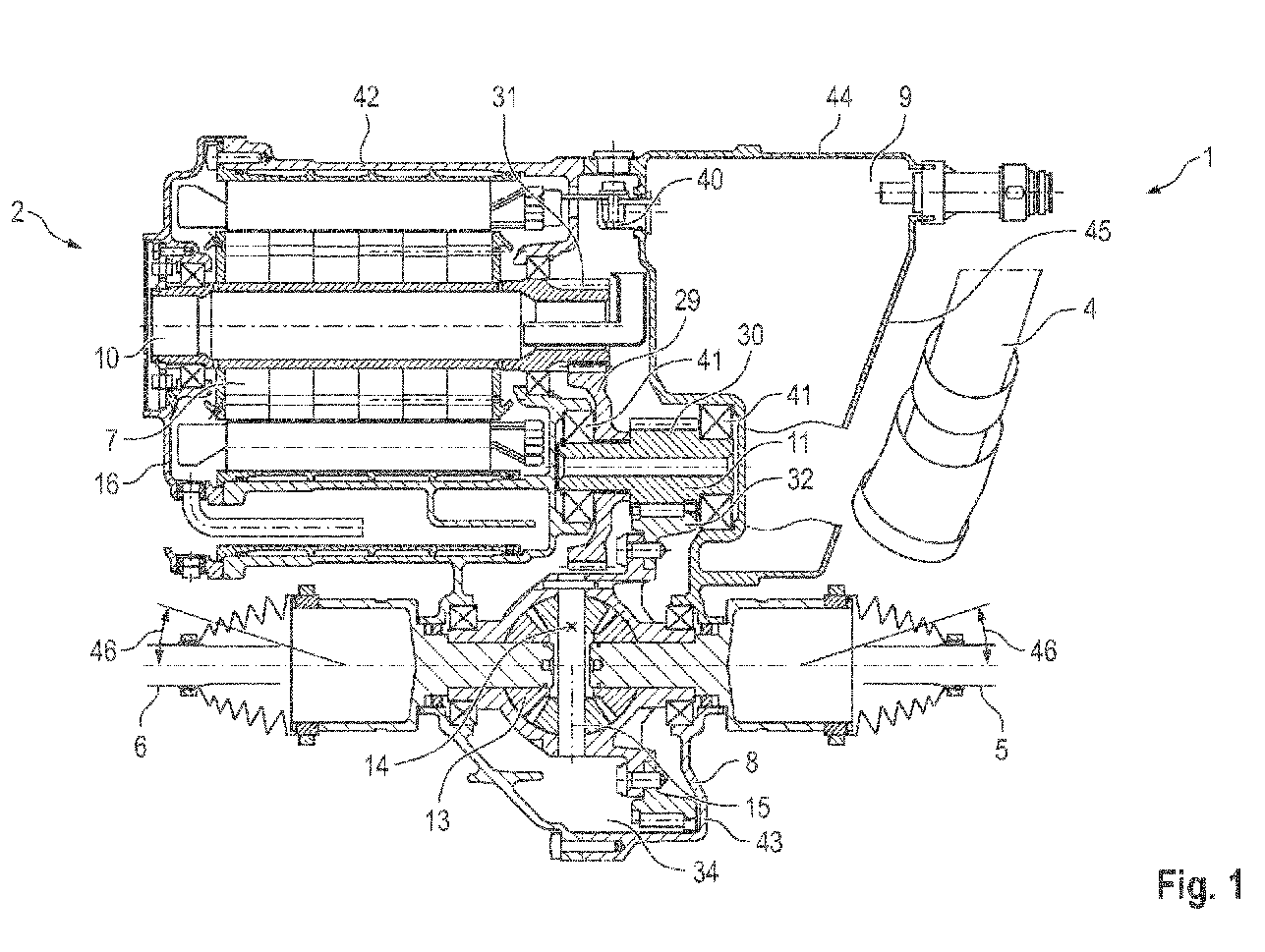
- FIG.1 and the 2 is shown in a schematic representation of an embodiment of a drive train 1 in a rear view in section.
- the drive train 1 is intended for use in a motor vehicle.
- the drive train 1 is shown in a schematic 3D representation in a front view.
- the drive train 1 has a drive assembly 2 , a steering gear 3 , a steering shaft 4 , a first articulated shaft 5 and a second articulated shaft 6 .
- the drive unit 2 has an electric machine 7 , a transmission unit 8 and a pulse-controlled inverter 9 .
- the electric machine 7 and the pulse-controlled inverter 9 are arranged on two opposite sides of the transmission unit 8 .
- the transmission unit 8 is thus arranged between the pulse-controlled inverter 9 and the electric machine 7 .
- the electric machine 7 has a drive shaft 10 and the transmission unit 8 has a transmission shaft 11 . It is conceivable that the gear unit 8 has additional gear shafts to form further gear stages.
- the drive shaft 10 and the transmission shaft 11 run essentially horizontally and essentially perpendicular to a direction of travel 12 of the motor vehicle.
- the drive shaft 10 and the transmission shaft 11 are thus arranged in a transverse direction of the motor vehicle.
- the expression “substantially” here means that the deviation from this transverse direction does not go beyond the manufacturing tolerances.
- the steering gear 3 is arranged in front of the drive assembly 2 in the direction of travel 12 (forward direction of travel of the vehicle). In this way, understeering driving behavior can also be achieved in a rear-heavy motor vehicle.
- a rear-heaviness is caused, for example, by a vehicle battery, which is designed to be correspondingly large and heavy to supply the electric machine 7 .
- the rear-heaviness can also be caused by a further electric machine arranged on a rear axle of the motor vehicle.
- the steering gear 3 can be effectively and functionally connected to a steering wheel of the motor vehicle by means of the steering shaft 4 .
- the motor vehicle can be cornered by means of the steering wheel, the steering shaft 4 and the steering gear 3 .
- the steering shaft 4 is partly arranged laterally next to the drive unit 2 .
- the steering shaft 4 is thus arranged laterally next to an end face of the drive unit 2 running parallel to the longitudinal direction of the motor vehicle.
- the transmission unit 8 also has a differential 13, wherein the differential 13 by means of first cardan shaft 5 can be connected to a first front wheel of the motor vehicle, and wherein the differential 13 can be effectively connected to a second front wheel of the motor vehicle by means of the second cardan shaft 6.
- the steering gear 3 is thus arranged in particular in the direction of travel 12 (forward direction of travel of the vehicle) in front of the first drive shaft 5 and in front of the second drive shaft 6, as can be seen from the figures, taking into account the arrow “12” for the forward drive direction.
- the differential 13 is arranged essentially centrally on a longitudinal axis 14 of the motor vehicle running centrally in the motor vehicle, with a length of the first drive shaft 5 essentially corresponding to a length of the second drive shaft 6 .
- the drive unit 2 is arranged and/or designed in such a way that the drive unit 2 can be arranged both in a right-hand drive vehicle and in a left-hand drive vehicle.
- FIG. 1 shows the drive unit 2 in the right-hand drive vehicle, figure 2 in the left-hand drive vehicle.
- the arrangement of the drive assembly 2 in the right-hand drive vehicle is rotated by 180° to a vertical vertical axis 15 or about a vertical vertical axis 15 compared to the arrangement of the drive assembly in the left-hand drive vehicle.
- the steering shaft 4 is arranged on the right next to the drive unit 2 in relation to the direction of travel 12 or seen in the direction of travel 12 .
- the steering shaft 4 is arranged to the left of the drive unit 2 in relation to the direction of travel 12 or seen in the direction of travel 12 .
- the electric machine 7 is arranged on a side of the transmission unit 8 facing away from the steering shaft 4 both in the right-hand drive vehicle and in the left-hand drive vehicle.
- the steering shaft 4 thus runs at a small distance next to the pulse-controlled inverter 9.
- the steering shaft 4 is made in one piece or in several pieces.
- the steering shaft 4 optionally has a cardan joint.
- FIG. 4 shows a schematic, light 3D representation of the drive unit 2 of the drive train 1 in a left-hand drive vehicle in a front view.
- figure 5 is shown in a schematic 3D representation of the drive train 1 in a left-hand drive vehicle in a front view.
- 6 shows, in contrast, a schematic 3D representation of the drive train 1 in a left-hand drive vehicle in a rear view.
- the same reference numbers are used as for the previous figures. From the Figures 4 to 6 In particular, the mechanical connection of the drive unit 2 can be seen.
- the drive unit 2 has a drive unit housing 16 .
- a plurality of A-side attachment points 18 are formed on the drive unit housing 16 on a first, A-side 17 of the drive unit housing 16 .
- a plurality of B-side attachment points 20 are formed on the drive assembly housing 16 on a second B side 19 of the drive assembly housing 16 opposite the A side 17 .
- the power-plant case 16 is fixed to a front, front unit bracket 21 by at least two of the A-side fixing points 18 and to a rear-rear unit bracket 22 by at least two of the B-side fixing points 20 . This situation is in the figure 5 and 6 shown.
- the power-plant case 16 is fixed to the front, front unit console 21 by at least two of the B-side fixing points 20 and to the rear-rear unit console 22 by at least two of the A-side fixing points 18 .
- the front unit panel 21 and the rear unit panel 22 are formed on the body 23 of the automobile or connected to the chassis.
- An arrangement of the A-side attachment points 18 to one another corresponds to an arrangement of the B-side attachment points 20 to one another, with the respective arrangement being mirrored on a vertical plane running centrally in a transverse direction through the drive assembly housing 16 .
- the A-side attachment points 18 and the B-side attachment points 20 thus have a similar "pattern". Because of this same "pattern", the front unit console 21 and the rear unit console 22 can be used universally both in right-hand drive vehicles and in left-hand drive vehicles, without the front unit console 21 and the rear unit console 22 having to be structurally modified.
- the front unit panel 21 and the rear unit panel 22 each have a vertically oriented panel. Bores are horizontally drilled in the front unit console 21 and the rear unit console 22 , by means of which the front unit console 21 and the rear unit console 22 are fastened to the power unit housing 16 . Appropriate screws or bolts are used for this purpose. Other types of attachment between the front unit console 21 and the rear unit console 22 and the power unit housing 16 are conceivable.
- A-side attachment points 18 and five B-side attachment points 20 there are five A-side attachment points 18 and five B-side attachment points 20 in total.
- the connection between the power unit housing 16 and the front unit panel 21 is made by means of all five attachment points of the A side 17 or the B side 19 implemented.
- the connection between the power unit housing 2 and the rear unit console 22 is implemented using three of the five attachment points of the A-side 17 or the B-side 19. This takes account of the different load situations on the front unit console 21 and the rear unit console 22 .
- the five attachment points are divided into three upper and two lower attachment points, with the rear unit console 22 being connected to the power pack housing 16 by means of the two lower attachment points and a middle upper attachment point.
- a coolant inlet 24 and a coolant outlet 25 are arranged on the A side 17 of the drive unit housing 2
- a coolant inlet 26 and a coolant outlet 27 are arranged on the B side 19 of the drive unit housing 2 .
- a cooling fluid can be supplied to the drive assembly housing 2 by means of one of the coolant inlets 24 or 26 .
- a cooling fluid can be discharged from the drive assembly housing 2 by means of one of the coolant outlets 25 or 27 . Either the coolant inlet 24 and the coolant outlet 25 on the A side 17, or the coolant inlet 26 and the coolant outlet 27 on the B side 19 are each closed by means of a plug and are therefore disabled.
- connection lines and/or connection hoses arranged in the motor vehicle can be used, by means of which the drive unit 2 can be integrated into a cooling fluid circuit.
- Such connection lines and/or connection hoses are connected to the coolant inlet 24 or 26 and the coolant outlet 25 or 27 in a sealing manner.
- FIG. 7 shows a schematic 3D representation of the drive unit 2 of the drive train 1 in a side view in section.
- the same reference numbers are used as for the previous figures.
- the coolant outlet 25 on the A side 17 and the coolant outlet 27 on the B side 19 are connected to one another by means of a continuous bore 28 , this bore 28 running in the direction of travel 12 . It is conceivable that the coolant inlet 24 on the A side 17 and the coolant inlet 26 on the B side 19 are also connected to one another with a comparable through hole.
- Fig.8 is shown in a schematic 3D representation of the transmission unit 8 of the drive train 1 in a side view. Parts of the power pack housing 16 have been omitted in order to make the components within the power pack housing 16 visible. For the same components, in 8 the same reference numbers are used as for the previous figures.
- An input gear 29 and an output gear 30 are arranged or formed on the transmission shaft 11 .
- a drive gear wheel 31 is formed or arranged on the drive shaft 10 .
- the differential 13 has a differential gear 32 .
- the drive gear 31 and the input gear 29 mesh with each other, and the output gear 30 and the differential gear 32 mesh with each other.
- the drive gear 31, the input gear 29, the output gear 30 and/or the differential gear 32 have, in particular, helical gearing. It would also be conceivable to use straight teeth for at least two gears that are in mesh with one another.
- the drive gear 31, the input gear 29, the output gear 30 and the differential gear 32 form a spur gear with two gear stages.
- At least one oil tank 33 is arranged in the drive assembly housing 16 .
- At least one oil sump area 34 is formed in the drive unit housing 16 , with the differential gear wheel 32 being arranged in a splashing manner in the oil sump area 34 .
- the transmission unit 8 is filled with oil, which at least partially collects in the oil sump area 34 due to gravity, or at least partially always flows back into the oil sump area 34 during the operation of the transmission unit 8 .
- a first oil catcher 35 and a second oil catcher 36 are arranged adjacent to the oil tank 33 , a left-hand drive guide area 37 being formed on the first oil catcher 35 and a right-hand drive guide area 38 being formed on the second oil catcher 36 .
- oil thrown up from the oil sump area 34 by the differential gear 32 can be fed to the oil tank 33 in a first direction of rotation of the differential gear 32.
- the first direction of rotation of the differential gear wheel 32 occurs when the motor vehicle designed as a left-hand drive vehicle is traveling forwards.
- the right-hand drive guide area 38 By means of the right-hand drive guide area 38, oil thrown up from the oil sump area 34 by the differential gear 32 can be fed to the oil tank 33 in a second direction of rotation of the differential gear 32, opposite the first direction of rotation.
- the second direction of rotation of the differential gear wheel 32 occurs when the motor vehicle designed as a right-hand drive vehicle is traveling forwards.
- the oil tank is thus filled with oil both when used in a left-hand drive vehicle and in a right-hand drive vehicle when the motor vehicle is driven.
- the left-hand drive area 37 and the right-hand drive area 38 each have a wiping edge from which the oil from the The left-hand drive guide area 37 or the right-hand drive guide area 38 drips or flows into the oil tank 33 arranged underneath.
- An oil tank portion 39 is formed in the oil tank 33 , and the drive gear 31 is disposed in the oil tank portion 39 in a splashing manner.
- a plurality of contacts 40 are arranged in the drive unit housing 16 , electrical energy being able to be transmitted between the pulse-controlled inverter 9 and the electric machine 7 by means of the contacts 40 .
- the electrical energy can be transmitted in both directions, so that the electric machine 7 can be used to provide energy for driving the motor vehicle, and the electric machine 7 can also be used to recuperate the kinetic energy of the motor vehicle and the pulse-controlled inverter 9 can be used, for example, to transmit it to a battery of the motor vehicle.
- the contacts 40 can be cooled by means of the oil thrown up from the oil tank area 39 by the drive gear wheel 31 .
- the oil tank area 39 is adapted to the shape and size of the drive gear 31 so that it is ensured that the drive gear 31 always dips far enough into the oil collecting in the oil tank area 39 during operation of the motor vehicle.
- the transmission shaft 11 is mounted in the drive assembly housing 16 by means of at least two bearings 41 .
- the bearings 41 of the transmission shaft 11 have such an arrangement and/or dimensioning in both directions of rotation of the transmission shaft 11 that the function of the two bearings 41 is ensured for a service life predetermined in the design of the bearings 41 for forward travel of the motor vehicle.
- the direction of rotation of the transmission shaft 11 has an opposite direction in the left-hand drive vehicle when the motor vehicle is in forward travel. Because of the desired flexibility, it is therefore not sufficient to design one of the two bearings 41 only for reversing the motor vehicle. The resulting additional costs due to bearings 41 that are sometimes "too large" are compensated for by the choice of uniform components and the associated reduction in procurement costs.
- all other components of the transmission unit 8, such as the teeth are designed for a service life predetermined in the design of these components for forward travel of the motor vehicle for both directions of rotation of the transmission shaft 11.
- the drive unit housing 16 is designed in several parts and has an electric machine part housing 42, a transmission part housing 43 and a Pulse inverter part housing 44 on.
- the electric machine 7 is arranged in the electric machine part housing 42 , the transmission unit 8 in the transmission part housing 43 and the pulse-controlled inverter 9 in the pulse-controlled inverter part housing 44 .
- the differential 13 is arranged in the transmission part housing 43 .
- a chamfer 45 is formed on the pulse-controlled inverter part housing 44 , with an axis of the steering shaft 4 being arranged essentially parallel to the chamfer 45 in a region adjacent to the chamfer 45 . Slight differences in parallelism are tolerable.
- the bevel 45 is formed on an end face of the pulse-controlled inverter part housing 44 which faces away from the transmission unit 8 .
- Bevel 45 is at an angle to a plane running perpendicularly to gear shaft 11, the distance between the end face of pulse-controlled inverter part housing 44 facing away from gear unit 8 and gear part housing 43 being greater in an upper area of the face side of pulse-controlled inverter part housing 44 facing away from gear unit 8 than in the lower area of the end face of the pulse-controlled inverter part housing 44 facing away from the transmission unit 8.
- the first articulated shaft 5 and the second articulated shaft 6 are each arranged at a deflection angle 46 to a horizontal plane.
- the deflection angles 46 of the first articulated shaft 5 and the second articulated shaft 6 have the same values.
- the deflection angles 46 of the first articulated shaft 5 and the second articulated shaft 6 are in particular less than 7.5°. Because of this small angle of deflection 46, the drive train 1 has a high level of efficiency and leads to good driving dynamics of the motor vehicle.
- the drive train 1 can be used in a purely electrically driven motor vehicle, with only the described electric machine 7 and no other drive being present, with only the first cardan shaft 5 and the second cardan shaft 6 and thus a front axle of the motor vehicle being able to be driven.
- the drive train 1 could also be used in a four-wheel drive vehicle.
- at least one clutch would be arranged in the drive train, with the at least one clutch being able to decouple the first articulated shaft 5 and the second articulated shaft 6 individually or jointly from the electric machine 7 .
Landscapes
- Engineering & Computer Science (AREA)
- Mechanical Engineering (AREA)
- General Engineering & Computer Science (AREA)
- Chemical & Material Sciences (AREA)
- Combustion & Propulsion (AREA)
- Transportation (AREA)
- Arrangement Or Mounting Of Propulsion Units For Vehicles (AREA)
- Hybrid Electric Vehicles (AREA)
Abstract
Die Erfindung betrifft einen Antriebsstrang (1) für ein Kraftfahrzeug, mit mindestens einem Antriebsaggregat (2), einem Lenkgetriebe (3), mindestens einer Lenkwelle (4), mindestens einer ersten und einer zweiten Gelenkwelle (5, 6), wobei das Antriebsaggregat (2) eine Elektromaschine (7), eine Getriebeeinheit (8) und einen Pulswechselrichter (9) aufweist, wobei das Lenkgetriebe (3) in Fahrtrichtung (12) vor dem Antriebsaggregat (2) angeordnet ist, wobei die Lenkwelle (4) seitlich neben dem Antriebsaggregat (2) angeordnet ist.The invention relates to a drive train (1) for a motor vehicle, having at least one drive unit (2), a steering gear (3), at least one steering shaft (4), at least one first and one second articulated shaft (5, 6), the drive unit ( 2) has an electric machine (7), a transmission unit (8) and a pulse-controlled inverter (9), with the steering gear (3) being arranged in front of the drive unit (2) in the direction of travel (12), with the steering shaft (4) being positioned laterally next to the Drive unit (2) is arranged.
Es wird ein besonders flexibler und effektiver Antriebsstrang (1) bereitgestellt, wobei das Antriebsaggregat (2) so ausgebildet ist, dass das Antriebsaggregat (2) sowohl in einem Rechtslenkerfahrzeug wie auch in einem Linkslenkerfahrzeug anordnenbar ist, wobei die Anordnung des Antriebsaggregats (2) im Rechtslenkerfahrzeug gegenüber der Anordnung des Antriebsaggregats (2) im Linkslenkerfahrzeug um 180° zu einer vertikalen Hochachse (15) gedreht ausgeführt ist, wobei wenn das Antriebsaggregat (2) in dem Rechtslenkerfahrzeug angeordnet ist, die Lenkwelle (4) dann in Bezug zur Fahrtrichtung (12) rechts neben dem Antriebsaggregat (2) angeordnet ist, und wobei wenn das Antriebsaggregat (2) in dem Linkslenkerfahrzeug angeordnet ist, die Lenkwelle (4) dann in Bezug zur Fahrtrichtung (12) links neben dem Antriebsaggregat (2) angeordnet ist.
Description
Die Erfindung betrifft einen Antriebsstrang für ein Kraftfahrzeug mit den Merkmalen des Oberbegriffes des Patentanspruches 1.The invention relates to a drive train for a motor vehicle having the features of the preamble of patent claim 1.
Im Stand der Technik sind Antriebsstränge für Kraftfahrzeuge mit einem Antriebsaggregat, einem Lenkgetriebe, einer Lenkwelle, einer ersten und einer zweiten Gelenkwelle bekannt. Das entsprechende Antriebsaggregat weist eine Elektromaschine, eine Getriebeeinheit und einen Pulswechselrichter auf, wobei die Elektromaschine und der Pulswechselrichter auf zwei gegenüberliegenden Seiten der Getriebeeinheit angeordnet sind. Eine Antriebswelle der Elektromaschine und eine Getriebewelle der Getriebeeinheit verlaufen im Wesentlichen horizontal und im Wesentlichen senkrecht zu einer Fahrtrichtung des Kraftfahrzeugs. Aus Gründen der Fahrdynamik ist das Lenkgetriebe in Fahrtrichtung (Vorwärts-Fahrtrichtung) vor dem Antriebsaggregat angeordnet. Damit ist gemeint, dass vom Kraftfahrzeug von vorne nach hinten aus gesehen zuerst das Lenkgetriebe und dahinter dann das Antriebsaggregat angeordnet ist. Mittels der Lenkwelle ist das Lenkgetriebe mit einem Lenkrad des Kraftfahrzeugs funktional wirksam verbindbar. Deswegen ist die Lenkwelle seitlich neben dem Antriebsaggregat angeordnet. Die Getriebeeinheit weist weiterhin ein Differential auf, wobei das Differential mittels der ersten Gelenkwelle mit einem ersten Vorderrad des Kraftfahrzeuges wirksam verbindbar ist. Das Differential ist des Weiteren mittels der zweiten Gelenkwelle mit einem zweiten Vorderrad des Kraftfahrzeuges wirksam verbindbar.Drive trains for motor vehicles with a drive unit, a steering gear, a steering shaft, a first and a second cardan shaft are known in the prior art. The corresponding drive assembly has an electric machine, a transmission unit and a pulse-controlled inverter, the electric machine and the pulse-controlled inverter being arranged on two opposite sides of the transmission unit. A drive shaft of the electric machine and a transmission shaft of the transmission unit run essentially horizontally and essentially perpendicularly to a direction of travel of the motor vehicle. For reasons of driving dynamics, the steering gear is arranged in the direction of travel (forward travel direction) in front of the drive unit. This means that, viewed from the front to the rear of the motor vehicle, the steering gear is arranged first and then the drive unit is arranged behind it. The steering gear can be functionally and effectively connected to a steering wheel of the motor vehicle by means of the steering shaft. For this reason, the steering shaft is located on the side next to the drive unit. The transmission unit also has a differential, the differential being able to be effectively connected to a first front wheel of the motor vehicle by means of the first cardan shaft. Furthermore, the differential can be effectively connected to a second front wheel of the motor vehicle by means of the second cardan shaft.
Die
In der
Die
Bei den bekannten Antriebssträngen ergeben sich Probleme bei der Integration des Antriebsaggregates in das Kraftfahrzeug. Der zur Verfügung stehende Bauraum im Kraftfahrzeug wird nämlich nicht optimal genutzt, letzteres insbesondere in Abhängigkeit davon, ob das Antriebsaggregat in einem Linkslenkerfahrzeug oder in einem Rechtslenkerfahrzeug angeordnet wird. So entstehen bei Einsatz der bekannten Antriebsstränge jeweils ungenutzte Bereiche im Bauraum. Teilweise müssen sogar an das Antriebsaggregat angrenzende Bauteile des Antriebsstranges dann versetzt angeordnet werden, was sich negativ auf die Effizienz bzw. den Wirkungsgrad des Antriebsstranges und somit des Kraftfahrzeugs auswirkt. Weiterhin sind die bekannten Antriebsstränge nur mit entsprechenden konstruktiven Anpassungen in unterschiedlichen Fahrzeugvarianten (Linkslenkerfahrzeug / Rechtslenkerfahrzeug) einsetzbar, was den Entwicklungsaufwand, den Herstellungsaufwand und den Montageaufwand der Antriebsstränge erhöht.With the known drive trains, problems arise when integrating the drive unit into the motor vehicle. The installation space available in the motor vehicle is not optimally used, the latter in particular depending on whether the drive unit is arranged in a left-hand drive vehicle or in a right-hand drive vehicle. When using the known drive trains, unused areas are created in the installation space. In some cases, components of the drive train that are adjacent to the drive unit then have to be offset, which has a negative effect on the efficiency of the drive train and thus of the motor vehicle. Furthermore, the known drive trains can only be used in different vehicle variants (left-hand drive vehicle/right-hand drive vehicle) with appropriate structural adjustments, which increases the development effort, the manufacturing effort and the assembly effort of the drive trains.
Der Erfindung liegt daher die Aufgabe zugrunde, den Antriebsstrang für ein Kraftfahrzeug nun derart auszugestalten und weiterzubilden, dass der Entwicklungsaufwand, der Herstellungsaufwand und/oder der Montageaufwand bzw. die damit verbundenen Kosten verringert sind und/oder dass der zur Verfügung stehende Bauraum, insbesondere auch unter Berücksichtigung der Anordnung einer Elektromaschine und/oder deren Leistung, möglichst optimal ausnutzbar ist.The invention is therefore based on the object of designing and developing the drive train for a motor vehicle in such a way that the development effort, the manufacturing effort and/or the assembly effort or the associated costs are reduced and/or that the available installation space, in particular also taking into account the arrangement of an electric machine and/or its power, can be utilized as optimally as possible.
Diese der Erfindung zugrundeliegende Aufgabe wird nun zunächst durch einen Antriebsstrang für ein Kraftfahrzeug mit den Merkmalen des Patentanspruchs 1 gelöst.This object on which the invention is based is now initially achieved by a drive train for a motor vehicle having the features of patent claim 1 .
Das Grundprinzip der Erfindung liegt zunächst im Wesentlichen nun darin, dass das Differential im Wesentlichen mittig auf einer im Kraftfahrzeug mittig verlaufenden Längsachse des Kraftfahrzeugs angeordnet ist, wobei eine Länge der ersten Gelenkwelle einer Länge der zweiten Gelenkwelle im Wesentlichen entspricht. Hierbei ist das Antriebsaggregat weiterhin so ausgebildet, dass das Antriebsaggregat sowohl in einem Rechtslenkerfahrzeug wie auch in einem Linkslenkerfahrzeug anordnenbar ist, wobei die Anordnung des Antriebsaggregats im Rechtslenkerfahrzeug gegenüber der Anordnung des Antriebsaggregats im Linkslenkerfahrzeug um 180° zu einer vertikalen Hochachse gedreht ausgeführt ist. Wenn das Antriebsaggregat in dem Rechtslenkerfahrzeug angeordnet ist, dann ist die Lenkwelle in Bezug zur Fahrtrichtung rechts neben dem Antriebsaggregat angeordnet. Wenn das Antriebsaggregat demgegenüber in dem Linkslenkerfahrzeug angeordnet ist, dann ist die Lenkwelle in Bezug zur Fahrtrichtung links neben dem Antriebsaggregat angeordnet. Die vertikale Hochachse verläuft hierbei insbesondere genau mittig im Kraftfahrzeug und kreuzt die insbesondere genau mittig verlaufende Längsachse des Kraftfahrzeuges.The basic principle of the invention is now essentially that the differential is arranged essentially centrally on a longitudinal axis of the motor vehicle running centrally in the motor vehicle, with a length of the first cardan shaft essentially corresponding to a length of the second cardan shaft. In this case, the drive unit is also designed in such a way that the drive unit can be arranged both in a right-hand drive vehicle and in a left-hand drive vehicle, the arrangement of the drive unit in the right-hand drive vehicle being rotated by 180° relative to a vertical vertical axis in relation to the arrangement of the drive unit in the left-hand drive vehicle. If the drive unit is arranged in the right-hand drive vehicle, then the steering shaft is arranged to the right of the drive unit in relation to the direction of travel. If, on the other hand, the drive unit is in is arranged in the left-hand drive vehicle, then the steering shaft is arranged to the left of the drive unit in relation to the direction of travel. In this case, the vertical vertical axis runs, in particular, exactly in the middle of the motor vehicle and crosses the longitudinal axis of the motor vehicle, which in particular runs exactly in the middle.
Die im Wesentlichen mittige Anordnung des Differentials ermöglicht die Ausbildung der im Wesentlichen gleichlangen Gelenkwellen. Mit dem Ausdruck "im Wesentlichen mittig" in Bezug zum Differential ist hier nun gemeint, dass das Differrential bis zu ± 50mm außermittig in Bezug zu dem Mittelpunkt einer Querachse des Kraftfahrzeugs bzw. bis zu ± 50mm außermittig in Bezug zu einer genau mittig verlaufenden Längsachse des Kraftfahrzeuges anordnenbar ist. Mit dem Ausdruck "im Wesentlichen" in Bezug zu den Gelenkwellen ist hier gemeint, dass die Länge der ersten Gelenkwelle von der Länge der zweiten Gelenkwelle nur um unvermeidliche Fertigungstoleranzen abweicht oder dass die Länge der ersten Gelenkwelle von der Länge der zweiten Gelenkwelle um weniger als 52mm abweicht. Die im Wesentlichen gleichlangen Gelenkwellen führen auch zu einer erhöhten Effizienz bzw. zu einem verbesserten Wirkungsgrad des Antriebsstranges.The essentially central arrangement of the differential enables the design of the cardan shafts, which are essentially of the same length. The term "substantially central" in relation to the differential means here that the differential is up to ± 50mm off-center in relation to the midpoint of a transverse axis of the motor vehicle or up to ± 50mm off-center in relation to a longitudinal axis of the vehicle that runs exactly in the middle Motor vehicle can be arranged. The expression "substantially" in relation to the cardan shafts means that the length of the first cardan shaft differs from the length of the second cardan shaft only by unavoidable manufacturing tolerances or that the length of the first cardan shaft differs from the length of the second cardan shaft by less than 52mm deviates. The cardan shafts, which are essentially of the same length, also lead to increased efficiency or improved effectiveness of the drive train.
Dadurch, dass das entsprechende Antriebsaggregat sowohl im Rechtslenkerfahrzeug wie auch im Linkslenkerfahrzeug einsetzbar ist, können besonders hohe Stückzahlen dieses Antriebsaggrates, nämlich eben sowohl für Rechtslenker- wie auch für Linkslenkerfahrzeuge realisiert werden. Das führt zu einer Kostenreduktion sowohl bei der Entwicklung wie auch bei der Herstellung des Antriebsaggregats bzw. bei der Beschaffung der Bauteile des Antriebsaggregates. Der Einsatz des Antriebsaggregats sowohl im Rechtslenkerfahrzeug wie auch im Linkslenkerfahrzeug wird insbesondere durch die Eigenschaft der Elektromaschine ermöglicht, in beiden Drehrichtungen der Antriebswelle gleich gute Leistung abgeben zu können.Due to the fact that the corresponding drive unit can be used both in right-hand drive vehicles and in left-hand drive vehicles, particularly large quantities of this drive unit can be implemented, specifically for both right-hand drive and left-hand drive vehicles. This leads to a reduction in costs both in the development and in the manufacture of the drive unit and in the procurement of the components of the drive unit. The use of the drive unit both in right-hand drive vehicles and in left-hand drive vehicles is made possible in particular by the property of the electric machine of being able to deliver equally good power in both directions of rotation of the drive shaft.
Die Elektromaschine ist vorzugsweise sowohl im Rechtslenkerfahrzeug wie auch im Linkslenkerfahrzeug auf einer der Lenkwelle abgewandten Seite der Getriebeeinheit angeordnet.The electric machine is preferably arranged on a side of the transmission unit facing away from the steering shaft both in the right-hand drive vehicle and in the left-hand drive vehicle.
Die Elektromaschine weist zur Bereitstellung einer hohen Antriebsleistung eine relativ große Ausdehnung in axialer Richtung der Antriebswelle auf. Weiterhin ist auch der Durchmesser der Elektromaschine relativ groß. Relativ ist hier in Bezug zur Größe des Pulswechselrichters gemeint. Aufgrund der Anordnung der Elektromaschine auf einer der Lenkwelle abgewandten Seite der Getriebeeinheit ist die Lenkwelle so besonders nah zu einer mittig im Fahrzeug verlaufenden Längsachse des Fahrzeuges an dem Antriebsaggregat vorbeiführbar, ohne dass das Antriebsaggregat dabei durch die Lenkwelle touchiert wird. Die Lenkwelle ist so insbesondere auf eine Mitte eines Fahrzeugsitzes ausrichtbar, nämlich insbesondere auf eine Mitte eines linken Fahrzeugsitzes im Linkslenkerfahrzeug und insbesondere auf eine Mitte eines rechten Fahrzeugsitzes im Rechtslenkerfahrzeug. Auch die Verbindung zwischen Lenkwelle und Lenkgetriebe ist somit besonders nah einer mittig im Fahrzeug verlaufenden Längsachse des Fahrzeuges ausführbar. Das wirkt sich positiv auf mögliche Ausführungen des Lenkgetriebes und somit positiv auf das Lenkverhalten des Fahrzeuges aus.In order to provide a high drive power, the electric machine has a relatively large extent in the axial direction of the drive shaft. Furthermore, the diameter of the electric machine is also relatively large. Relative here means in relation to the size of the pulse-controlled inverter. Due to the arrangement of the electric machine on a side of the transmission unit facing away from the steering shaft, the steering shaft can be guided past the drive unit particularly close to a longitudinal axis of the vehicle running in the middle of the vehicle without the drive unit being touched by the steering shaft. The steering shaft is like this in particular aligned to a center of a vehicle seat, namely in particular to a center of a left-hand vehicle seat in a left-hand drive vehicle and in particular to a center of a right-hand vehicle seat in a right-hand drive vehicle. The connection between the steering shaft and the steering gear can thus also be implemented particularly close to a longitudinal axis of the vehicle running centrally in the vehicle. This has a positive effect on possible versions of the steering gear and thus positively on the steering behavior of the vehicle.
In einer bevorzugten Ausführungsform des Antriebsstranges weist das Antriebsaggregat ein Antriebsaggregat-Gehäuse auf, wobei an dem Antriebsaggregat-Gehäuse auf einer ersten, A-Seite des Antriebsaggregat-Gehäuses mehrere A-Seiten-Befestigungspunkte ausgebildet sind. An dem Antriebsaggregat-Gehäuse sind weiterhin auf einer zweiten, der A-Seite gegenüberliegenden B-Seite des Antriebsaggregat-Gehäuses mehrere B-Seiten-Befestigungspunkte ausgebildet. Das Antriebsaggregat-Gehäuse ist mittels zumindest zwei der A-Seiten-Befestigungspunkte an einer vorderen, Front-Einheitskonsole und mittels zumindest zwei der B-Seiten-Befestigungspunkte an einer hinteren Heck-Einheitskonsole befestigbar. Alternativ ist das Antriebsaggregat-Gehäuse mittels zumindest zwei der B-Seiten-Befestigungspunkte an der vorderen, Front-Einheitskonsole und mittels zumindest zwei der A-Seiten-Befestigungspunkte an der hinteren Heck-Einheitskonsole befestigbar. Die Front-Einheitskonsole und die Heck-Einheitskonsole sind an einer Karosserie des Kraftfahrzeuges ausgebildet.In a preferred embodiment of the drive train, the drive assembly has a drive assembly housing, multiple A-side attachment points being formed on the drive assembly housing on a first, A-side of the drive assembly housing. A plurality of B-side attachment points are also formed on the power unit housing on a second B side of the power unit housing opposite the A side. The power unit case is attachable to a front, front unit console by at least two of the A-side attachment points and to a rear, rear unit console by at least two of the B-side attachment points. Alternatively, the power unit housing is attachable to the front, front unit console using at least two of the B-side attachment points and to the rear, rear unit console using at least two of the A-side attachment points. The front unit panel and the rear unit panel are formed on a body of the automobile.
Mittels der A-Seiten-Befestigungspunkte und der B-Seiten-Befestigungspunkte ist eine sichere Verbindung zwischen dem Antriebsaggregat und der Karosserie sowohl in einem Rechtslenkerfahrzeug wie auch in einem Linkslenkerfahrzeug ermöglicht. Ein jeder der Befestigungspunkte weist zum Beispiel ein Innengewinde auf, so dass das Antriebsaggregat mittels einer Schraube mit der Front-Einheitskonsole und der Heck-Einheitskonsole verbindbar ist. Die Innengewinde der Befestigungspunkte verlaufen dabei vorzugsweise in einer waagerechten Richtung. Andere Verbindungstechniken zwischen dem Antriebsaggregat und den beiden Einheitskonsolen sind denkbar. Weiterhin weist ein jeder Befestigungspunkt jeweils eine Übertragungsfläche auf, wobei mittels dieser Übertragungsflächen jeweils eine Kraft und / oder ein Moment zwischen dem Antriebsaggregat und den beiden Einheitskonsolen übertragbar ist. Die Front-Einheitskonsole ist in Fahrtrichtung vor dem Antriebsaggregat und die Heck-Einheitskonsole ist in Fahrtrichtung hinter dem Antriebsaggregat angeordnet.The A-side attachment points and the B-side attachment points enable a secure connection between the drive assembly and the body both in a right-hand drive vehicle and in a left-hand drive vehicle. Each of the attachment points has an internal thread, for example, so that the drive unit can be connected to the front unit console and the rear unit console by means of a screw. The internal threads of the attachment points preferably run in a horizontal direction. Other connection techniques between the drive unit and the two unit consoles are conceivable. Furthermore, each fastening point has a transmission surface, with a force and/or moment being able to be transmitted between the drive unit and the two unit consoles by means of these transmission surfaces. The front unit console is arranged in front of the drive unit in the direction of travel and the rear unit console is arranged behind the drive unit in the direction of travel.
Bevorzugterweise entspricht eine Anordnung der A-Seiten-Befestigungspunkte zueinander einer Anordnung der B-Seiten-Befestigungspunkte zueinander, wobei insbesondere die Anordnung der A-Seiten-Befestigungspunkte zu der Anordnung der B-Seiten-Befestigungspunkte an einer vertikalen, mittig in einer Querrichtung durch das Antriebsaggregat-Gehäuse laufenden Ebene gespiegelt ist.An arrangement of the A-side attachment points in relation to one another preferably corresponds to an arrangement of the B-side attachment points in relation to one another, with the arrangement in particular of the A-side attachment points is mirrored to the arrangement of the B-side attachment points on a vertical plane passing centrally in a transverse direction through the power-plant housing.
Jeweils einer der A-Seiten-Befestigungspunkte und einer der B-Seiten-Befestigungspunkte liegen dabei bevorzugterweise in einer in Längsrichtung des Kraftfahrzeuges verlaufenden Linie. Auch wenn die Front-Einheitskonsole und die Heck-Einheitskonsole unterschiedlich ausgeführt sind, was aufgrund der Belastungen der Front-Einheitskonsole und der Heck-Einheitskonsole durchaus sinnvoll ist, ist das Antriebsaggregat mittels der A-Seiten-Befestigungspunkte und der B-Seiten-Befestigungspunkte sowohl in dem Rechtslenkerfahrzeug wie auch dem Linkslenkerfahrzeug mit den beiden jeweiligen Einheitskonsolen verbindbar.In each case one of the A-side fastening points and one of the B-side fastening points preferably lie in a line running in the longitudinal direction of the motor vehicle. Even if the front unit console and the rear unit console are designed differently, which makes sense because of the loads on the front unit console and the rear unit console, the power unit can be fixed using the A-side mounting points and the B-side mounting points both can be connected to the two respective unit consoles in the right-hand drive vehicle as well as in the left-hand drive vehicle.
In einer weiteren Ausführungsform des Antriebsstranges sind fünf A-Seiten-Befestigungspunkte und fünf B-Seiten-Befestigungspunkte vorhanden bzw. ausgebildet.In another embodiment of the drive train, there are five A-side attachment points and five B-side attachment points.
So können die Kräfte und / oder Momente, welche zwischen dem Antriebsaggregat und den beiden Einheitskonsolen wirken, besonders gut und trotzdem mit einem vertretbaren konstruktiven Aufwand auf die verschiedenen Befestigungspunkte verteilt werden. Insbesondere zur Aufnahme der Momente sind voneinander beabstandet angeordnete Verbindungen zwischen den beiden Einheitskonsolen und dem Antriebsaggregat sinnvoll.In this way, the forces and/or moments that act between the drive assembly and the two unit brackets can be distributed particularly well to the various attachment points and yet with a reasonable design effort. Connections between the two unit brackets and the drive assembly that are arranged at a distance from one another are particularly useful for absorbing the moments.
In einer bevorzugten Ausführungsform des Antriebsstranges sind jeweils ein Kühlmittelzulauf und ein Kühlmittelablauf auf derA-Seite des Antriebsaggregat-Gehäuses angeordnet. Weiterhin sind jeweils ein Kühlmittelzulauf und ein Kühlmittelablauf auf der B-Seite des Antriebsaggregat-Gehäuses angeordnet. Mittels eines der Kühlmittelzuläufe ist dem Antriebsaggregat-Gehäuse ein Kühlfluid zuführbar, wobei mittels eines der Kühlmittelabläufe ein Kühlfluid aus dem Antriebsaggregat-Gehäuse abführbar ist. Entweder der Kühlmittelzulauf und der Kühlmittelablauf derA-Seite, oder der Kühlmittelzulauf und der Kühlmittelablauf der B-Seite sind mittels jeweils eines Stopfens verschlossen und somit außer Funktion gesetzt.In a preferred embodiment of the drive train, a coolant inlet and a coolant outlet are each arranged on the A side of the drive assembly housing. Furthermore, a coolant inlet and a coolant outlet are each arranged on the non-drive end of the drive assembly housing. A cooling fluid can be supplied to the drive unit housing by means of one of the coolant inlets, wherein a cooling fluid can be discharged from the drive unit housing by means of one of the coolant outlets. Either the coolant inlet and the coolant outlet on the A side, or the coolant inlet and the coolant outlet on the B side are each closed with a plug and are therefore disabled.
Die Rohrleitungen oder Schläuche zur Zu- und zur Abfuhr des Kühlfluids sind in Fahrtrichtung vor dem Antriebsaggregat angeordnet. Denkbar ist alternativ auch eine Anordnung der Rohrleitungen oder Schläuche zur Zu- und zur Abfuhr des Kühlfluids in Fahrtrichtung hinter dem Antriebsaggregat. Dadurch, dass auf beiden Seiten des Antriebsaggregat-Gehäuses jeweils ein Kühlmittelzulauf und ein Kühlmittelablauf vorhanden sind, sind Rohrleitungen oder Schläuche sowohl im Rechtslenkerfahrzeug wie auch im Linkslenkerfahrzeug an das Antriebsaggregat anschließbar. Die beiden nicht genutzten Öffnungen, nämlich der nicht genutzte Kühlmittelzulauf und der nicht genutzte Kühlmittelablauf werden z.B. mittels jeweils eines Schraubstopfens dichtend verschlossen. Auf diese Weise wird die Flexibilität der Einsatzmöglichkeiten des Antriebsaggregats weiter erhöht. Der Kühlfluidkreislauf inklusive etwaiger Rohrleitungen und / oder Schläuche kann ohne Änderungen bezüglich des Antriebsaggregates sowohl im Rechtslenkerfahrzeug wie auch im Linkslenkerfahrzeug eingesetzt werden.The pipelines or hoses for supplying and removing the cooling fluid are arranged in front of the drive unit in the direction of travel. Alternatively, an arrangement of the pipelines or hoses for supplying and removing the cooling fluid in the direction of travel behind the drive unit is also conceivable. Due to the fact that there is a coolant inlet and a coolant outlet on both sides of the drive unit housing, pipelines or hoses are connected to the drive unit both in right-hand drive vehicles and in left-hand drive vehicles connectable. The two unused openings, namely the unused coolant inlet and the unused coolant outlet are sealed, for example by means of a screw plug. In this way, the flexibility of the possible uses of the drive unit is further increased. The cooling fluid circuit, including any pipes and/or hoses, can be used in both right-hand drive vehicles and left-hand drive vehicles without any changes to the drive unit.
Bevorzugterweise sind der Kühlmittelzulauf der A-Seite und der Kühlmittelzulauf der B-Seite und / oder der Kühlmittelablauf der A-Seite und der Kühlmittelablauf der B-Seite mittels einer durchgehenden Bohrung miteinander verbunden. Diese Bohrung verläuft in Fahrtrichtung.The coolant inlet on the A side and the coolant inlet on the B side and/or the coolant outlet on the A side and the coolant outlet on the B side are preferably connected to one another by means of a through hole. This hole runs in the direction of travel.
Auf diese Weise sind die beiden Kühlmittelabläufe und / oder die beiden Kühlmittelzuläufe besonders einfach herstellbar. Das wirkt sich sehr positiv auf die Herstellkosten des Antriebsaggregates aus.In this way, the two coolant outlets and/or the two coolant inlets can be produced particularly easily. This has a very positive effect on the manufacturing costs of the drive unit.
In einer weiteren Ausführungsform des Antriebsstranges sind ein Eingangszahnrad und ein Ausgangszahnrad an der Getriebewelle angeordnet oder ausgebildet. An der Antriebswelle ist ein Antriebszahnrad ausgebildet oder angeordnet. Das Differential weist weiterhin ein Differentialzahnrad auf. Das Antriebszahnrad und das Eingangszahnrad stehen in Eingriff miteinander. Ebenso stehen das Ausgangszahnrad und das Differentialzahnrad in Eingriff miteinander. Insbesondere weisen das Antriebszahnrad, das Eingangszahnrad, das Ausgangszahnrad und / oder das Differentialzahnrad eine Schrägverzahnung auf.In a further embodiment of the drive train, an input gear and an output gear are arranged or formed on the transmission shaft. A drive gear wheel is formed or arranged on the drive shaft. The differential further includes a differential gear. The drive gear and the input gear mesh with each other. Likewise, the output gear and the differential gear mesh with each other. In particular, the drive gear, the input gear, the output gear and/or the differential gear have helical gearing.
Die Zahnräder sind dabei als Stirnzahnräder ausgebildet und zu einem Stirnradgetriebe angeordnet. Solche Stirnradgetriebe sind robust und kostengünstig herstellbar. Mittels der Schrägverzahnung kann eine geringe Geräuschentwicklung der gesamten Getriebeeinheit und eine hohe Tragfähigkeit der einzelnen Zahnräder erreicht werden.The gears are designed as spur gears and arranged to form a spur gear. Such spur gears are robust and inexpensive to produce. By means of the helical gearing, a low noise development of the entire gear unit and a high load capacity of the individual gears can be achieved.
In dem Antriebsaggregat-Gehäuse ist vorteilhafterweise zumindest ein Öltank angeordnet. In dem Antriebsaggregat-Gehäuse ist zudem zumindest ein Ölsumpfbereich ausgebildet, wobei das Differentialzahnrad planschend im Ölsumpfbereich angeordnet ist. Angrenzend zum Öltank sind ein erster und ein zweiter Ölfänger angeordnet, wobei an dem ersten Ölfänger ein Linkslenker-Führungsbereich und dem zweiten Ölfänger ein Rechtslenker-Führungsbereich ausgebildet ist, wobei mittels des Linkslenker-Führungsbereichs von dem Differentialzahnrad aus dem Ölsumpfbereich empor geschleudertes Öl dem Öltank bei einer ersten Drehrichtung des Differentialzahnrads zuführbar ist, und wobei mittels des Rechtslenker-Führungsbereichs von dem Differentialzahnrad aus dem Ölsumpfbereich empor geschleudertes Öl dem Öltank bei einer zweiten, der ersten Drehrichtung entgegengesetzten Drehrichtung des Differentialzahnrads zuführbar ist.At least one oil tank is advantageously arranged in the drive assembly housing. In addition, at least one oil sump area is formed in the drive unit housing, with the differential gear being arranged in a splashing manner in the oil sump area. A first and a second oil catcher are arranged adjacent to the oil tank, with a left-hand drive guide area being formed on the first oil catcher and a right-hand drive guide area being formed on the second oil catcher, with oil thrown up from the differential gear wheel out of the oil sump area by means of the left-hand drive guide area a first direction of rotation of the differential gear can be fed, and wherein oil thrown up by the differential gear from the oil sump area can be fed to the oil tank by means of the right-hand drive guide area in a second direction of rotation of the differential gear opposite to the first direction of rotation.
Das Differentialzahnrad dreht sich bei einer Vorwärtsfahrt des Kraftfahrzeuges im Rechtslenkerfahrzeug im Gegensatz zum Linkslenkerfahrzeug in der entgegensetzten Drehrichtung. Wie oben beschrieben wird dem Öltank in beiden Fällen Öl aus dem Ölsumpfbereich zugeführt. Der Linkslenker-Führungsbereich ist derart angeordnet, dass bei einer Vorwärtsfahrt des Linkslenkerfahrzeugs dem Öltank von dem Differentialzahnrad aus dem Ölsumpfbereich empor geschleudertes Öl mittels des Linkslenker-Führungsbereichs zuführbar ist. Der Rechtslenker-Führungsbereich ist derart angeordnet, dass bei einer Vorwärtsfahrt des Rechtslenkerfahrzeugs dem Öltank von dem Differentialzahnrad aus dem Ölsumpfbereich empor geschleudertes Öl mittels des Rechtslenker-Führungsbereichs zuführbar ist.When the motor vehicle is driving forwards, the differential gear rotates in the opposite direction of rotation in a right-hand drive vehicle in contrast to a left-hand drive vehicle. In both cases, as described above, oil is supplied to the oil tank from the oil sump area. The left-hand drive guide area is arranged in such a way that when the left-hand drive vehicle is driving forwards, oil thrown up by the differential gear from the oil sump area can be fed to the oil tank by means of the left-hand drive guide area. The right-hand drive guide area is arranged in such a way that when the right-hand drive vehicle drives forward, oil thrown up by the differential gear from the oil sump area can be fed to the oil tank by means of the right-hand drive guide area.
Bevorzugterweise ist in dem Öltank ein Öltankbereich ausgebildet, wobei das Antriebszahnrad planschend in dem Öltankbereich angeordnet ist. In dem Antriebsaggregat-Gehäuse sind mehrere Kontakte angeordnet, wobei mittels der Kontakte elektrische Energie zwischen dem Pulswechselrichter und der Elektromaschine übertragbar ist. Die Kontakte sind mittels des von dem Antriebszahnrad aus dem Öltankbereich empor geschleuderten Öls kühlbar.An oil tank area is preferably formed in the oil tank, with the drive gear wheel being arranged in a splashing manner in the oil tank area. A plurality of contacts are arranged in the drive assembly housing, and electrical energy can be transmitted between the pulse-controlled inverter and the electric machine by means of the contacts. The contacts can be cooled by means of the oil thrown up from the oil tank area by the drive gear.
Aufgrund der hohen elektrischen Energie, welche mittels der Kontakte übertragen wird, entsteht Wärme in den Kontakten. Diese führt zu einer Temperaturerhöhung der Kontakte. Mittels des empor geschleuderten Öls erfolgt eine Abfuhr von Wärme von den Kontakten, so dass die Temperaturerhöhung der Kontakte in einem akzeptablen Bereich bleibt, in welchem die Funktion der Kontakte sichergestellt ist. Der Öltank kann weiterhin zur Schmierung von Lagern genutzt werden, so dass hier Synergieeffekte entstehen.Due to the high electrical energy that is transferred by means of the contacts, heat is generated in the contacts. This leads to an increase in the temperature of the contacts. Heat is dissipated from the contacts by means of the oil thrown up, so that the temperature increase of the contacts remains within an acceptable range in which the function of the contacts is ensured. The oil tank can also be used to lubricate bearings, resulting in synergy effects.
In einer weiteren Ausführungsform des Antriebsstranges, ist die Getriebewelle mittels zumindest zweier Lager in dem Antriebsaggregat-Gehäuse gelagert, wobei die Lager der Getriebewelle in beiden Drehrichtungen der Getriebewelle eine derartige Anordnung und/oder Dimensionierung aufweisen, so dass die Funktion der beiden Lager für eine in der Auslegung der Lager vorbestimmte Lebensdauer für eine Vorwärtsfahrt des Kraftfahrzeugs sichergestellt ist.In a further embodiment of the drive train, the transmission shaft is mounted in the drive unit housing by means of at least two bearings, with the bearings of the transmission shaft being arranged and/or dimensioned in both directions of rotation of the transmission shaft such that the function of the two bearings for one in the design of the bearings ensures a predetermined service life for forward travel of the motor vehicle.
Die Getriebeeinheit ist somit universell sowohl im Rechtslenkerfahrzeug wie auch im Linkslenkerfahrzeug einsetzbar, ohne dass mit einer verfrühten Wartung der Getriebeeinheit zu rechnen ist. Vorzugsweise wird die Getriebewelle auf beiden Seiten mit einem gleichartig ausgeführten Lager gelagert.The transmission unit can thus be used universally both in right-hand drive vehicles and in left-hand drive vehicles, without the transmission unit having to be serviced prematurely count is. The transmission shaft is preferably mounted on both sides with a bearing of the same design.
Das Antriebsaggregat-Gehäuse ist bevorzugterweise mehrteilig ausgeführt und weist ein Elektromaschinenteilgehäuse, ein Getriebeteilgehäuse und ein Pulswechselrichterteilgehäuse auf, wobei die Elektromaschine in dem Elektromaschinenteilgehäuse, die Getriebeeinheit in dem Getriebeteilgehäuse und der Pulswechselrichter in dem Pulswechselrichterteilgehäuse angeordnet ist. An dem Pulswechselrichterteilgehäuse ist eine Abschrägung ausgebildet, wobei eine Achse der Lenkwelle in einem Bereich angrenzend zur Abschrägung, insbesondere im Wesentlichen parallel zur Abschrägung angeordnet ist.The drive unit housing is preferably designed in several parts and has an electrical machine housing part, a transmission part housing and a pulse-controlled inverter part housing, the electric machine being arranged in the electrical machine part housing, the transmission unit in the transmission part housing and the pulse-controlled inverter in the pulse-controlled inverter part housing. A chamfer is formed on the pulse-controlled inverter part housing, with an axis of the steering shaft being arranged in a region adjacent to the chamfer, in particular essentially parallel to the chamfer.
Die Abschrägung ist vorteilhafterweise an einer der Getriebeeinheit abgewandten Stirnseite des Pulswechselrichterteilgehäuses ausgebildet.The chamfer is advantageously formed on an end face of the pulse-controlled inverter part housing which faces away from the transmission unit.
Bevorzugterweise weist die Abschrägung einen Winkel zu einer senkrecht zur Getriebewelle verlaufenden Ebene auf, wobei der Abstand der der Getriebeeinheit abgewandten Stirnseite des Pulswechselrichterteilgehäuses zum Getriebeteilgehäuse in einem oberen Bereich der der Getriebeeinheit abgewandten Stirnseite des Pulswechselrichterteilgehäuses größer ist als in dem unteren Bereich der der Getriebeeinheit abgewandten Stirnseite des Pulswechselrichterteilgehäuses.The bevel preferably has an angle to a plane running perpendicularly to the gear shaft, the distance between the end face of the pulse-controlled inverter part housing facing away from the gear unit and the gear part housing being greater in an upper area of the end face of the pulse-controlled inverter part housing facing away from the gear unit than in the lower area of the end face facing away from the gear unit of the pulse-controlled inverter housing.
So kann der im Fahrzeug zur Verfügung stehende Bauraum optimal genutzt werden. Zwischen der Lenkwelle und dem Pulswechselrichterteilgehäuse entsteht nur ein kleiner Spalt, mittels welchem sichergestellt wird, dass die Lenkwelle nicht das Pulswechselrichterteilgehäuse touchiert. Größere ungenutzte Bereiche entstehen nicht. Die Ausbildung eines solchen unsymmetrischen Pulswechselrichterteilgehäuses wird durch eine entsprechende Anordnung der Bauteile des Pulswechselrichters im Inneren des Pulswechselrichterteilgehäuses ermöglicht. Im Gegensatz zur Anordnung der Bauteile der Elektromaschine besteht bei der Anordnung der Bauteile des Pulswechselrichters eine gewisse Flexibilität.In this way, the installation space available in the vehicle can be optimally used. There is only a small gap between the steering shaft and the pulse-controlled inverter part housing, by means of which it is ensured that the steering shaft does not touch the pulse-controlled inverter part housing. Larger unused areas do not arise. The formation of such an asymmetrical pulse-controlled inverter part housing is made possible by a corresponding arrangement of the components of the pulse-controlled inverter inside the pulse-controlled inverter part housing. In contrast to the arrangement of the components of the electric machine, there is a certain flexibility in the arrangement of the components of the pulse-controlled inverter.
In einer weiteren Ausführungsform des Antriebsstranges sind die erste Gelenkwelle und die zweite Gelenkwelle jeweils in einem Beugungswinkel zu einer horizontalen Ebene angeordnet. Die Beugungswinkel der ersten Gelenkwelle und der zweiten Gelenkwelle weisen im Wesentlichen gleiche Werte auf, wobei die Beugungswinkel der ersten Gelenkwelle und der zweiten Gelenkwelle insbesondere kleiner als 7,5° sind. Mit dem Ausdruck "im Wesentlichen" ist hier gemeint, dass die Beugungswinkel sich lediglich aufgrund unvermeidlicher Fertigungstoleranzen voneinander unterscheiden, oder dass die Beugungswinkel sich lediglich um weniger als 2° voneinander unterscheiden. Durch solch kleine Beugungswinkel können Reibungsverluste im Antriebsstrang minimiert werden, was zu einer Steigerung der Effizienz des Antriebsstranges führt.In a further embodiment of the drive train, the first articulated shaft and the second articulated shaft are each arranged at an angle of deflection to a horizontal plane. The articulation angles of the first articulated shaft and the second articulated shaft have essentially the same values, the articulation angles of the first articulated shaft and the second articulated shaft being in particular less than 7.5°. By the term "substantially" it is meant here that the diffraction angles only change due to unavoidable Manufacturing tolerances differ from one another, or that the diffraction angles only differ from one another by less than 2°. Such small deflection angles can minimize friction losses in the drive train, which leads to an increase in the efficiency of the drive train.
Es gibt nun eine Vielzahl von Möglichkeiten, den erfindungsgemäßen Antriebsstrang für ein Kraftfahrzeug in vorteilhafter Art und Weise auszugestalten und weiterzubilden. Es darf hierzu zunächst auf die dem Patentanspruch 1 nachgeordneten Patentansprüche verwiesen werden. Im Folgenden wird nun eine bevorzugte Ausgestaltung des erfindungsgemäßen Antriebsstrangs für ein Kraftfahrzeug anhand der Zeichnung und der dazugehörigen Beschreibung näher erläutert bzw. beschrieben. In der Zeichnung zeigt:
- Fig.1
- in schematischer Darstellung ein Ausführungsbeispiel des Antriebsstranges in einem Rechtslenkerfahrzeug in einer Rückansicht (bzw. von hinten) im Schnitt,
- Fig.2
- in schematischer Darstellung das Ausführungsbeispiel des Antriebsstranges in einem Linkslenkerfahrzeug in einer Rückansicht (bzw. von hinten) im Schnitt,
- Fig.3
- in schematischer 3D-Darstellung das Ausführungsbeispiel des Antriebsstranges in einem Rechtslenkerfahrzeug in einer Vorderansicht (bzw. von vorne),
- Fig.4
- in schematischer 3D-Darstellung ein Antriebsaggregat des Antriebsstranges in einem Linkslenkerfahrzeug in einer Vorderansicht (bzw. von vorne), jedoch ohne Darstellung der Lenkwelle,
- Fig.5
- in schematischer 3D-Darstellung das Ausführungsbeispiel des Antriebsstranges in einem Linkslenkerfahrzeug in einer Vorderansicht (bzw. von vorne),
- Fig.6
- in schematischer 3D-Darstellung das Ausführungsbeispiel des Antriebsstranges in einem Linkslenkerfahrzeug in einer Rückansicht (bzw. von hinten),
- Fig.7
- in schematischer 3D-Darstellung das Antriebsaggregat des Antriebsstranges in einer Seitenansicht im Schnitt, und
- Fig.8
- in schematischer 3D-Darstellung eine Getriebeeinheit des Antriebsstranges in einer Seitenansicht, jedoch ohne ein Getriebeteilgehäuse.
- Fig.1
- in a schematic representation of an embodiment of the drive train in a right-hand drive vehicle in a rear view (or from behind) in section,
- Fig.2
- in a schematic representation of the embodiment of the drive train in a left-hand drive vehicle in a rear view (or from behind) in section,
- Fig.3
- in a schematic 3D representation of the embodiment of the drive train in a right-hand drive vehicle in a front view (or from the front),
- Fig.4
- in a schematic 3D representation of a drive unit of the drive train in a left-hand drive vehicle in a front view (or from the front), but without showing the steering shaft,
- Fig.5
- in a schematic 3D representation of the embodiment of the drive train in a left-hand drive vehicle in a front view (or from the front),
- Fig.6
- in a schematic 3D representation of the embodiment of the drive train in a left-hand drive vehicle in a rear view (or from behind),
- Fig.7
- in a schematic 3D representation of the drive unit of the drive train in a side view in section, and
- Fig.8
- a schematic 3D representation of a transmission unit of the drive train in a side view, but without a transmission part housing.
In der
In
In den
Der Antriebsstrang 1 weist ein Antriebsaggregat 2, ein Lenkgetriebe 3, eine Lenkwelle 4, eine erste Gelenkwelle 5 und eine zweite Gelenkwelle 6 auf. Das Antriebsaggregat 2 weist eine Elektromaschine 7, eine Getriebeeinheit 8 und einen Pulswechselrichter 9 auf. Die Elektromaschine 7 und der Pulswechselrichter 9 sind auf zwei gegenüberliegenden Seiten der Getriebeeinheit 8 angeordnet. Die Getriebeeinheit 8 ist somit zwischen dem Pulswechselrichter 9 und der Elektromaschine 7 angeordnet. Die Elektromaschine 7 weist eine Antriebswelle 10 und die Getriebeeinheit 8 weist eine Getriebewelle 11 auf. Es ist denkbar, dass die Getriebeeinheit 8 zur Ausbildung weiterer Getriebestufen zusätzliche Getriebewellen aufweist. Die Antriebswelle 10 und die Getriebewelle 11 verlaufen im Wesentlichen horizontal und im Wesentlichen senkrecht zu einer Fahrtrichtung 12 des Kraftfahrzeugs. Die Antriebswelle 10 und die Getriebewelle 11 sind somit in einer Querrichtung des Kraftfahrzeuges angeordnet. Mit dem Ausdruck "im Wesentlichen" ist hier gemeint, dass die Abweichung von dieser Querrichtung nicht über die Fertigungstoleranzen hinausgeht.The drive train 1 has a
Das Lenkgetriebe 3 ist in Fahrtrichtung 12 (Vorwärts-Fahrtrichtung des Fahrzeuges) vor dem Antriebsaggregat 2 angeordnet. So kann auch bei einem hecklastigen Kraftfahrzeug ein untersteuerndes Fahrverhalten erreicht werden. Eine solche Hecklastigkeit wird z.B. durch eine Fahrzeugbatterie, welche zur Versorgung der Elektromaschine 7 entsprechend groß und schwer ausgeführt ist, verursacht. Die Hecklastigkeit kann des Weiteren auch durch eine weitere, an einer Hinterachse des Kraftfahrzeuges angeordnete Elektromaschine verursacht werden. Das Lenkgetriebe 3 ist mittels der Lenkwelle 4 mit einem Lenkrad des Kraftfahrzeugs funktional wirksam verbindbar. Mittels des Lenkrades, der Lenkwelle 4 und des Lenkgetriebes 3 ist eine Kurvenfahrt des Kraftfahrzeuges durchführbar. Die Lenkwelle 4 ist teils seitlich neben dem Antriebsaggregat 2 angeordnet. Die Lenkwelle 4 ist somit seitlich neben einer parallel zur Längsrichtung des Kraftfahrzeugs verlaufenden Stirnseite des Antriebsaggregates 2 angeordnet. Die Getriebeeinheit 8 weist weiterhin ein Differential 13 auf, wobei das Differential 13 mittels der ersten Gelenkwelle 5 mit einem ersten Vorderrad des Kraftfahrzeuges verbindbar ist, und wobei das Differential 13 mittels der zweiten Gelenkwelle 6 mit einem zweiten Vorderrad des Kraftfahrzeuges wirksam verbindbar ist. Das Lenkgetriebe 3 ist somit insbesondere auch in Fahrtrichtung 12 (Vorwärts-Fahrtrichtung des Fahrzeuges) vor der ersten Gelenkwelle 5 und vor der zweiten Gelenkwelle 6 angeordnet, wie aus den Figuren unter Berücksichtigung des Pfeils "12" für die Vorwärts-Fahrtrichtung ersichtlich.The
Das Differential 13 ist im Wesentlichen mittig auf einer im Kraftfahrzeug mittig verlaufenden Längsachse 14 des Kraftfahrzeugs angeordnet, wobei eine Länge der ersten Gelenkwelle 5 einer Länge der zweiten Gelenkwelle 6 im Wesentlichen entspricht. Das Antriebsaggregat 2 ist so angeordnet und / oder ausgebildet, dass das Antriebsaggregat 2 sowohl in einem Rechtslenkerfahrzeug wie auch in einem Linkslenkerfahrzeug anordnenbar ist.The differential 13 is arranged essentially centrally on a
Die Elektromaschine 7 ist sowohl im Rechtslenkerfahrzeug wie auch im Linkslenkerfahrzeug auf einer der Lenkwelle 4 abgewandten Seite der Getriebeeinheit 8 angeordnet. Die Lenkwelle 4 verläuft somit mit einem kleinen Abstand neben dem Pulswechselrichter 9. Die Lenkwelle 4 ist einteilig oder mehrteilig ausgeführt. Die Lenkwelle 4 weist optional ein Kardangelenk auf.The
Das Antriebsaggregat 2 weist ein Antriebsaggregat-Gehäuse 16 auf. An dem Antriebsaggregat-Gehäuse 16 sind auf einer ersten, A-Seite 17 des Antriebsaggregat-Gehäuses 16 mehrere A-Seiten-Befestigungspunkte 18 ausgebildet. An dem Antriebsaggregat-Gehäuse 16 sind auf einer zweiten, der A-Seite 17 gegenüberliegenden B-Seite 19 des Antriebsaggregat-Gehäuses 16 mehrere B-Seiten-Befestigungspunkte 20 ausgebildet. Das Antriebsaggregat-Gehäuse 16 ist mittels zumindest zwei der A-Seiten-Befestigungspunkte 18 an einer vorderen, Front-Einheitskonsole 21 und mittels zumindest zwei der B-Seiten-Befestigungspunkte 20 an einer hinteren Heck-Einheitskonsole 22 befestigt. Diese Situation ist in den
In dem Rechtslenkerfahrzeug ist das Antriebsaggregat-Gehäuse 16 mittels zumindest zwei der B-Seiten-Befestigungspunkte 20 an der vorderen, Front-Einheitskonsole 21 und mittels zumindest zwei der A-Seiten-Befestigungspunkte 18 an der hinteren Heck-Einheitskonsole 22 befestigt. Die Front-Einheitskonsole 21 und die Heck-Einheitskonsole 22 sind an der Karosserie 23 des Kraftfahrzeuges ausgebildet oder mit dem Fahrgestell verbunden.In the right-hand drive vehicle, the power-
Eine Anordnung der A-Seiten-Befestigungspunkte 18 zueinander entspricht einer Anordnung der B-Seiten-Befestigungspunkte 20 zueinander, wobei die jeweilige Anordnung gespiegelt ist an einer vertikalen, mittig in einer Querrichtung durch das Antriebsaggregat-Gehäuse 16 laufenden Ebene. Die A-Seiten-Befestigungspunkte 18 und die B-Seiten-Befestigungspunkte 20 weisen somit ein gleiches "Muster" auf. Die Front-Einheitskonsole 21 und die Heck-Einheitskonsole 22 sind aufgrund dieses gleichen "Musters" universell sowohl im Rechtlenkerfahrzeug wie auch im Linkslenkerfahrzeug einsetzbar, ohne dass dazu die Front-Einheitskonsole 21 und die Heck-Einheitskonsole 22 konstruktiv geändert werden müssten.An arrangement of the A-side attachment points 18 to one another corresponds to an arrangement of the B-side attachment points 20 to one another, with the respective arrangement being mirrored on a vertical plane running centrally in a transverse direction through the
Die Front-Einheitskonsole 21 und die Heck-Einheitskonsole 22 weisen jeweils eine vertikal ausgerichtete Platte auf. In die Front-Einheitskonsole 21 und die Heck-Einheitskonsole 22 sind horizontal Bohrungen eingebracht, mittels welcher die Front-Einheitskonsole 21 und die Heck-Einheitskonsole 22 an dem Antriebsaggregat-Gehäuse 16 befestigt sind. Dazu werden entsprechende Schrauben oder Bolzen verwendet. Andere Befestigungsarten zwischen der Front-Einheitskonsole 21 und der Heck-Einheitskonsole 22 und dem Antriebsaggregat-Gehäuse 16 sind denkbar.The
Es sind insgesamt fünf A-Seiten-Befestigungspunkte 18 und fünf B-Seiten-Befestigungspunkte 20 vorhanden. Dabei wird die Verbindung zwischen dem Antriebsaggregat-Gehäuse 16 und der Front-Einheitskonsole 21 mittels allen fünf Befestigungspunkten der A-Seite 17 oder der B-Seite 19 umgesetzt. Die Verbindung zwischen dem Antriebsaggregat-Gehäuse 2 und der Heck-Einheitskonsole 22 wird mittels drei der fünf Befestigungspunkte der A-Seite 17 oder der B-Seite 19 umgesetzt. Damit wird der unterschiedlichen Belastungssituation an der Front-Einheitskonsole 21 und der Heck-Einheitskonsole 22 Rechnung getragen. Die fünf Befestigungspunkte sind in drei obere und zwei untere Befestigungspunkte aufgeteilt, wobei die Heck-Einheitskonsole 22 mittels der beiden unteren Befestigungspunkte und eines mittleren oberen Befestigungspunktes mit dem Antriebsaggregat-Gehäuse 16 verbunden ist.There are five A-side attachment points 18 and five B-side attachment points 20 in total. The connection between the
Auf der A-Seite 17 des Antriebsaggregat-Gehäuses 2 sind ein Kühlmittelzulauf 24 und ein Kühlmittelablauf 25 und auf der B-Seite 19 des Antriebsaggregat-Gehäuses 2 sind ein Kühlmittelzulauf 26 und ein Kühlmittelablauf 27 angeordnet. Mittels eines der Kühlmittelzuläufe 24 oder 26 ist dem Antriebsaggregat-Gehäuse 2 ein Kühlfluid zuführbar. Mittels eines der Kühlmittelabläufe 25 oder 27 ist ein Kühlfluid aus dem Antriebsaggregat-Gehäuse 2 abführbar. Entweder der Kühlmittelzulauf 24 und der Kühlmittelablauf 25 derA-Seite 17, oder der Kühlmittelzulauf 26 und der Kühlmittelablauf 27 der B-Seite 19 sind mittels jeweils eines Stopfens verschlossen und somit außer Funktion gesetzt. So können gleiche, im Kraftfahrzeug angeordnete Anschlussleitungen und / oder Anschlussschläuche genutzt werden, mittels welcher das Antriebsaggregat 2 in einen Kühlfuidkreislauf integrierbar ist. Solche Anschlussleitungen und / oder Anschlussschläuche sind dabei an dem Kühlmittelzulauf 24 oder 26 und dem Kühlmittelablauf 25 oder 27 abdichtend angeschlossen.A
Der Kühlmittelablauf 25 der A-Seite 17 und der Kühlmittelablauf 27 der B-Seite 19 sind mittels einer durchgehenden Bohrung 28 miteinander verbunden, wobei diese Bohrung 28 in Fahrtrichtung 12 verläuft. Es ist denkbar, dass ebenso der Kühlmittelzulauf 24 der A-Seite 17 und der Kühlmittelzulauf 26 der B-Seite 19 mit einer vergleichbaren durchgehenden Bohrung miteinander verbunden sind.The
In
Ein Eingangszahnrad 29 und ein Ausgangszahnrad 30 sind an der Getriebewelle 11 angeordnet oder ausgebildet. An der Antriebswelle 10 ist ein Antriebszahnrad 31 ausgebildet oder angeordnet. Das Differential 13 weist ein Differentialzahnrad 32 auf. Das Antriebszahnrad 31 und das Eingangszahnrad 29 stehen in Eingriff miteinander und das Ausgangszahnrad 30 und das Differentialzahnrad 32 stehen in Eingriff miteinander. Das Antriebszahnrad 31, das Eingangszahnrad 29, das Ausgangszahnrad 30 und / oder das Differentialzahnrad 32 weisen insbesondere eine Schrägverzahnung auf. Denkbar wäre es auch eine gerade Verzahnung zumindest für zwei im Eingriff miteinander stehende Zahnräder zu verwenden. Das Antriebszahnrad 31, das Eingangszahnrad 29, das Ausgangszahnrad 30 und das Differentialzahnrad 32 bilden ein Stirnradgetriebe mit zwei Getriebestufen. Mittels des Differentials 13 ist ein Drehmoment zwischen dem Differentialzahnrad 32 und beiden Gelenkwellen, nämlich der ersten Gelenkwelle 5 und der zweiten Gelenkwelle 6 übertragbar.An
In dem Antriebsaggregat-Gehäuse 16 ist zumindest in Öltank 33 angeordnet. In dem Antriebsaggregat-Gehäuse 16 ist zumindest ein Ölsumpfbereich 34 ausgebildet, wobei das Differentialzahnrad 32 planschend im Ölsumpfbereich 34 angeordnet ist. Die Getriebeeinheit 8 ist mit einem Öl gefüllt, welches sich aufgrund der Schwerkraft zumindest teilweise im Ölsumpfbereich 34 sammelt, bzw. während des Betriebs der Getriebeeinheit 8 zumindest teilweise immer wieder in den Ölsumpfbereich 34 zurückfließt. Angrenzend zum Öltank 33 sind ein erster Ölfänger 35 und ein zweiter Ölfänger 36 angeordnet, wobei an dem ersten Ölfänger 35 ein Linkslenker-Führungsbereich 37 und dem zweiten Ölfänger 36 ein Rechtslenker-Führungsbereich 38 ausgebildet ist. Mittels des Linkslenker-Führungsbereichs 37 ist von dem Differentialzahnrad 32 aus dem Ölsumpfbereich 34 empor geschleudertes Öl dem Öltank 33 bei einer ersten Drehrichtung des Differentialzahnrads 32 zuführbar. Die erste Drehrichtung des Differentialzahnrads 32 tritt bei einer Vorwärtsfahrt des als Linkslenkerfahrzeug ausgebildeten Kraftfahrzeuges auf.At least one
Mittels des Rechtslenker-Führungsbereichs 38 ist von dem Differentialzahnrad 32 aus dem Ölsumpfbereich 34 empor geschleudertes Öl dem Öltank 33 bei einer zweiten, der ersten Drehrichtung entgegengesetzten Drehrichtung des Differentialzahnrads 32 zuführbar. Die zweite Drehrichtung des Differentialzahnrads 32 tritt bei einer Vorwärtsfahrt des als Rechtslenkerfahrzeug ausgebildeten Kraftfahrzeuges auf. Der Öltank wird somit sowohl bei Einsatz im Linkslenkerfahrzeug wie auch im Rechtslenkerfahrzeug bei einer Fahrt des Kraftfahrzeugs mit Öl gefüllt. Der Linkslenker-Führungsbereich 37 und der Rechtslenker-Führungsbereich 38 weisen jeweils eine Abstreifkante auf, von welcher das Öl von dem Linkslenker-Führungsbereich 37 bzw. dem Rechtslenker-Führungsbereich 38 in den darunter angeordneten Öltank 33 hineintropft bzw. hineinfließt.By means of the right-hand drive guide area 38, oil thrown up from the
In dem Öltank 33 ist ein Öltankbereich 39 ausgebildet, wobei das Antriebszahnrad 31 planschend in dem Öltankbereich 39 angeordnet ist. Es sind mehrere Kontakte 40 in dem Antriebsaggregat-Gehäuse 16 angeordnet, wobei mittels der Kontakte 40 elektrische Energie zwischen dem Pulswechselrichter 9 und der Elektromaschine 7 übertragbar ist. Die elektrische Energie ist dabei in beiden Richtungen übertragbar, so dass mittels der Elektromaschine 7 Energie zum Antrieb des Kraftfahrzeugs bereitstellbar ist, wobei weiterhin mittels der Elektromaschine 7 kinetische Energie des Kraftfahrzeugs rekuperierbar ist und über den Pulswechselrichter 9 z.B. an eine Batterie des Kraftfahrzeugs weiterleitbar ist. Die Kontakte 40 sind mittels des von dem Antriebszahnrad 31, aus dem Öltankbereich 39 empor geschleuderten Öls kühlbar. Auf diese Weise ist sichergestellt, dass die Kontakte bei Betrieb des Kraftfahrzeuges eine maximal zulässige Temperatur nicht überschreiten. Der Öltankbereich 39 ist an die Form und Größe des Antriebszahnrades 31 angepasst, so dass sichergestellt ist, dass während des Betriebs des Kraftfahrzeugs das Antriebszahnrades 31 immer weit genug in das sich in dem Öltankbereich 39 ansammelnden Öl eintaucht.An
Die Getriebewelle 11 ist mittels zumindest zweier Lager 41 in dem Antriebsaggregat-Gehäuse 16 gelagert. Die Lager 41 der Getriebewelle 11 weisen in beiden Drehrichtungen der Getriebewelle 11 eine derartige Anordnung und/oder Dimensionierung auf, so dass die Funktion der beiden Lager 41 für eine in der Auslegung der Lager 41 vorbestimmte Lebensdauer für eine Vorwärtsfahrt des Kraftfahrzeugs sichergestellt ist. Die Drehrichtung der Getriebewelle 11 weist im Gegensatz zum Rechtslenkerfahrzeug im Linkslenkerfahrzeug eine entgegengesetzte Richtung auf, wenn sich das Kraftfahrzeug jeweils in einer Vorwärtsfahrt befindet. Es genügt also aufgrund der gewünschten Flexibilität nicht, eines der beiden Lager 41 lediglich für eine Rückwärtsfahrt des Kraftfahrzeugs auszulegen. Die dadurch entstehenden zusätzlichen Kosten durch teilweise "zu groß" dimensionierte Lager 41 werden durch die Wahl einheitlicher Komponenten und der damit verbundenen Verringerung der Beschaffungskosten wieder kompensiert. Neben der Lager 41 sind auch alle weiteren Komponenten der Getriebeeinheit 8, wie z.B. die Verzahnungen für eine in der Auslegung dieser Komponenten vorbestimmte Lebensdauer für eine Vorwärtsfahrt des Kraftfahrzeugs für beiden Drehrichtungen der Getriebewelle 11 ausgelegt.The
Das Antriebsaggregat-Gehäuse 16 ist mehrteilig ausgeführt und weist ein Elektromaschinenteilgehäuse 42, ein Getriebeteilgehäuse 43 und ein Pulswechselrichterteilgehäuse 44 auf. Die Elektromaschine 7 ist in dem Elektromaschinenteilgehäuse 42, die Getriebeeinheit 8 in dem Getriebeteilgehäuse 43 und der Pulswechselrichter 9 in dem Pulswechselrichterteilgehäuse 44 angeordnet. Ebenso ist das Differential 13 in dem Getriebeteilgehäuse 43 angeordnet. An dem Pulswechselrichterteilgehäuse 44 ist eine Abschrägung 45 ausgebildet, wobei eine Achse der Lenkwelle 4 in einem Bereich angrenzend zur Abschrägung 45 im Wesentlichen parallel zur Abschrägung 45 angeordnet ist. Geringe Unterschiede in der Parallelität sind tolerierbar. Wichtig ist dabei, dass das Pulswechselrichterteilgehäuse 44 und die Lenkwelle 4 einander nicht touchieren und dass des Weiteren möglichst wenig Bauraum sowohl im Pulswechselrichterteilgehäuse 44 wie auch im gesamten Kraftfahrzeug verloren geht. Die Abschrägung 45 ist an einer der Getriebeeinheit 8 abgewandten Stirnseite des Pulswechselrichterteilgehäuses 44 ausgebildet.The
Die Abschrägung 45 weist einen Winkel zu einer senkrecht zur Getriebewelle 11 verlaufenden Ebene auf, wobei der Abstand der der Getriebeeinheit 8 abgewandten Stirnseite des Pulswechselrichterteilgehäuses 44 zum Getriebeteilgehäuse 43 in einem oberen Bereich der der Getriebeeinheit 8 abgewandten Stirnseite des Pulswechselrichterteilgehäuses 44 größer ist, als in dem unteren Bereich der der Getriebeeinheit 8 abgewandten Stirnseite des Pulswechselrichterteilgehäuses 44. So wird der Tatsache Rechnung getragen, dass die Lenkwelle 4 von einem oberhalb des Lenkgetriebe 3 angeordneten Lenkrades schräg nach unten zu einer Fahrzeugmitte hin verläuft.
Die erste Gelenkwelle 5 und die zweite Gelenkwelle 6 sind jeweils in einem Beugungswinkel 46 zu einer horizontalen Ebene angeordnet. Die Beugungswinkel 46 der ersten Gelenkwelle 5 und der zweiten Gelenkwelle 6 weisen gleiche Werte auf. Die Beugungswinkel 46 der ersten Gelenkwelle 5 und der zweiten Gelenkwelle 6 sind insbesondere kleiner als 7,5°. Aufgrund dieser geringen Beugungswinkel 46 weist der Antriebsstrang 1 eine hohe Effizienz auf und führt zu einer guten Fahrdynamik des Kraftfahrzeugs.The first articulated
Der Antriebsstrang 1 ist in einem rein elektrisch angetriebenen Kraftfahrzeug einsetzbar, wobei ausschließlich die beschriebene Elektromaschine 7 und kein weiterer Antrieb vorhanden ist, wobei ausschließlich die erste Gelenkwelle 5 und die zweite Gelenkwelle 6 und somit eine Vorderachse des Kraftfahrzeugs antreibbar ist.The drive train 1 can be used in a purely electrically driven motor vehicle, with only the described
Weiterhin ist der Einsatz zusätzlicher Elektromaschinen oder Verbrennungskraftmaschinen zur Ausbildung eines Hybridfahrzeugs denkbar.Furthermore, the use of additional electric machines or internal combustion engines to form a hybrid vehicle is conceivable.
Der Antriebsstrang 1 könnte auch in einem Allradfahrzeug zum Einsatz kommen. In diesem Falle wäre zumindest eine Kupplung im Antriebsstrang angeordnet, wobei mit der zumindest einen Kupplung die erste Gelenkwelle 5 und die zweite Gelenkwelle 6 einzeln oder gemeinsam von der Elektromaschine 7 entkoppelbar sind.The drive train 1 could also be used in a four-wheel drive vehicle. In this case, at least one clutch would be arranged in the drive train, with the at least one clutch being able to decouple the first articulated
- 11
- Antriebsstrangpowertrain
- 22
- Antriebsaggregatdrive unit
- 33
- Lenkgetriebesteering gear
- 44
- Lenkwellesteering shaft
- 55
- erste Gelenkwellefirst PTO shaft
- 66
- zweite Gelenkwellesecond PTO shaft
- 77
- Elektromaschineelectric machine
- 88th
- Getriebeeinheitgear unit
- 99
- Pulswechselrichterpulse inverter
- 1010
- Antriebswelledrive shaft
- 1111
- Getriebewellegear shaft
- 1212
- Fahrtrichtungdriving direction
- 1313
- Differentialdifferential
- 1414
- Längsachselongitudinal axis
- 1515
- vertikale Hochachsevertical axis
- 1616
- Antriebsaggregat-Gehäusepower pack housing
- 1717
- A-SeiteA side
- 1818
- A-Seiten-BefestigungspunkteA-side attachment points
- 1919
- B-SeiteB side
- 2020
- B-Seiten-BefestigungspunkteB-side attachment points
- 2121
- Front-EinheitskonsoleFront unit console
- 2222
- Heck-EinheitskonsoleRear unit console
- 2323
- Karosseriebody
- 2424
- Kühlmittelzulauf der A-SeiteA-side coolant inlet
- 2525
- Kühlmittelablauf der A-SeiteA-side coolant drain
- 2626
- Kühlmittelzulauf der B-SeiteB-side coolant inlet
- 2727
- Kühlmittelablauf der B-SeiteB-side coolant drain
- 2828
- durchgehenden Bohrungthrough hole
- 2929
- Eingangszahnradinput gear
- 3030
- Ausgangszahnradoutput gear
- 3131
- Antriebszahnraddrive gear
- 3232
- Differentialzahnraddifferential gear
- 3333
- Öltankoil tank
- 3434
- Ölsumpfbereichoil sump area
- 3535
- erster Ölfängerfirst oil catcher
- 3636
- zweiter Ölfängersecond oil catcher
- 3737
- Linkslenker-FührungsbereichLeft Hand Drive Guidance Area
- 3838
- Rechtslenker-FührungsbereichRight Hand Drive Guidance Area
- 3939
- Öltankbereichoil tank area
- 4040
- Kontaktecontacts
- 4141
- Lagerwarehouse
- 4242
- Elektromaschinenteilgehäuseelectrical machine parts housing
- 4343
- GetriebeteilgehäuseTransmission part housing
- 4444
- PulswechselrichterteilgehäusePulse inverter part housing
- 4545
- Abschrägungbevel
- 4646
- Beugungswinkeldiffraction angle
Claims (15)
Applications Claiming Priority (1)
| Application Number | Priority Date | Filing Date | Title |
|---|---|---|---|
| DE102021201547.6A DE102021201547A1 (en) | 2021-02-18 | 2021-02-18 | Drive train for a motor vehicle |
Publications (2)
| Publication Number | Publication Date |
|---|---|
| EP4046845A1 true EP4046845A1 (en) | 2022-08-24 |
| EP4046845B1 EP4046845B1 (en) | 2025-05-14 |
Family
ID=80225968
Family Applications (1)
| Application Number | Title | Priority Date | Filing Date |
|---|---|---|---|
| EP22154705.2A Active EP4046845B1 (en) | 2021-02-18 | 2022-02-02 | Drive train for a motor vehicle |
Country Status (3)
| Country | Link |
|---|---|
| EP (1) | EP4046845B1 (en) |
| CN (1) | CN115009008B (en) |
| DE (1) | DE102021201547A1 (en) |
Cited By (1)
| Publication number | Priority date | Publication date | Assignee | Title |
|---|---|---|---|---|
| WO2024061450A1 (en) * | 2022-09-20 | 2024-03-28 | Gkn Automotive Limited | Housing assembly and electric drive with such a housing assembly |
Families Citing this family (2)
| Publication number | Priority date | Publication date | Assignee | Title |
|---|---|---|---|---|
| JP2026103260A (en) * | 2024-12-12 | 2026-06-24 | トヨタ自動車株式会社 | Electric vehicles |
| JP2026103261A (en) * | 2024-12-12 | 2026-06-24 | トヨタ自動車株式会社 | Electric vehicles |
Citations (5)
| Publication number | Priority date | Publication date | Assignee | Title |
|---|---|---|---|---|
| WO2016184607A1 (en) * | 2015-05-18 | 2016-11-24 | Bayerische Motoren Werke Aktiengesellschaft | Motor vehicle having an axle bracket |
| US9692277B2 (en) | 2010-12-17 | 2017-06-27 | Tesla, Inc. | Integrated electric motor assembly |
| EP3357727A1 (en) | 2015-09-28 | 2018-08-08 | NIO Nextev Limited | Electric drive system for motor vehicle and motor vehicle using same |
| WO2019062864A1 (en) * | 2017-09-30 | 2019-04-04 | 比亚迪股份有限公司 | Integrated steering drive axle assembly and vehicle |
| US20190222095A1 (en) | 2017-12-15 | 2019-07-18 | Rivian Ip Holdings, Llc | Electric vehicle drive units |
Family Cites Families (9)
| Publication number | Priority date | Publication date | Assignee | Title |
|---|---|---|---|---|
| KR101302262B1 (en) * | 2011-03-30 | 2013-09-02 | 가부시끼 가이샤 구보다 | Working car |
| DE102012100865B4 (en) * | 2012-02-02 | 2016-10-27 | Gkn Driveline International Gmbh | Drive arrangement with electric machine and motor vehicle with such a drive arrangement |
| US8585859B2 (en) * | 2012-02-14 | 2013-11-19 | GM Global Technology Operations LLC | Attachment member with integral adhesive channel and method |
| DE102012025371B4 (en) * | 2012-12-28 | 2016-09-01 | Volkswagen Aktiengesellschaft | motor vehicle |
| DE102013204784B4 (en) | 2013-03-19 | 2018-01-11 | Robert Bosch Gmbh | Electric vehicle axle device |
| DE102016212818A1 (en) * | 2016-07-13 | 2018-01-18 | Volkswagen Aktiengesellschaft | Steering for vehicles with high gear ratios, especially for commercial vehicles |
| US10352345B2 (en) * | 2016-12-05 | 2019-07-16 | The Boeing Company | Adhesive-bonded attachment device |
| DE102017201299A1 (en) | 2017-01-27 | 2018-08-02 | Bayerische Motoren Werke Aktiengesellschaft | fuel cell vehicle |
| JP6760513B2 (en) * | 2017-10-24 | 2020-09-23 | 日産自動車株式会社 | Power transmission device for four-wheel drive vehicles |
-
2021
- 2021-02-18 DE DE102021201547.6A patent/DE102021201547A1/en active Pending
-
2022
- 2022-02-02 EP EP22154705.2A patent/EP4046845B1/en active Active
- 2022-02-18 CN CN202210149863.XA patent/CN115009008B/en active Active
Patent Citations (5)
| Publication number | Priority date | Publication date | Assignee | Title |
|---|---|---|---|---|
| US9692277B2 (en) | 2010-12-17 | 2017-06-27 | Tesla, Inc. | Integrated electric motor assembly |
| WO2016184607A1 (en) * | 2015-05-18 | 2016-11-24 | Bayerische Motoren Werke Aktiengesellschaft | Motor vehicle having an axle bracket |
| EP3357727A1 (en) | 2015-09-28 | 2018-08-08 | NIO Nextev Limited | Electric drive system for motor vehicle and motor vehicle using same |
| WO2019062864A1 (en) * | 2017-09-30 | 2019-04-04 | 比亚迪股份有限公司 | Integrated steering drive axle assembly and vehicle |
| US20190222095A1 (en) | 2017-12-15 | 2019-07-18 | Rivian Ip Holdings, Llc | Electric vehicle drive units |
Cited By (1)
| Publication number | Priority date | Publication date | Assignee | Title |
|---|---|---|---|---|
| WO2024061450A1 (en) * | 2022-09-20 | 2024-03-28 | Gkn Automotive Limited | Housing assembly and electric drive with such a housing assembly |
Also Published As
| Publication number | Publication date |
|---|---|
| CN115009008B (en) | 2025-08-15 |
| CN115009008A (en) | 2022-09-06 |
| DE102021201547A1 (en) | 2022-08-18 |
| EP4046845B1 (en) | 2025-05-14 |
Similar Documents
| Publication | Publication Date | Title |
|---|---|---|
| EP4046845B1 (en) | Drive train for a motor vehicle | |
| DE102004058025B4 (en) | Hybrid drive unit and vehicle equipped therewith | |
| DE102017205721B4 (en) | Transmission unit for a motor vehicle | |
| DE19812677B4 (en) | Transfer case for a four-wheel drive motor vehicle | |
| DE102022213923B4 (en) | Transmission for a vehicle and drive train with such a transmission | |
| EP1717090B1 (en) | All-wheel-drive motor vehicle | |
| DE10162337B4 (en) | Longitudinal drive train | |
| DE202019103781U1 (en) | Twin gearbox with a double input shaft | |
| WO2022156944A1 (en) | Powertrain for a motor vehicle | |
| WO2018073378A1 (en) | Drive assembly comprising an electrical machine for a motor vehicle | |
| EP4493424B1 (en) | Drive device for a vehicle axle | |
| EP0884210B1 (en) | Arrangement for driving a water pump and a fan of a combustion engine | |
| DE102020113192A1 (en) | Gearboxes for single wheel drives with axial force compensation, drive train, motor vehicle | |
| EP3246188A1 (en) | Commercial vehicle with a parallel hybrid drive train | |
| EP4251450B1 (en) | Hybrid gearbox for a vehicle | |
| DE112013004022T5 (en) | Arrangement for lubricating a differential gear for tandem operation | |
| DE102021132153B3 (en) | Drive system and drive arrangement | |
| DE202023104965U1 (en) | Modular axle housing systems | |
| EP3434550B1 (en) | Drive assembly | |
| DE202017102027U1 (en) | Transmission unit for a motor vehicle | |
| DE102021200280A1 (en) | Driving device for an electrically driven vehicle | |
| DE102024200485B3 (en) | Gearbox arrangement and drive train with such a gearbox arrangement | |
| DE102009051124A1 (en) | Drive system for electrical wheel vehicle, has engines with driveshaft, where driveshaft is oriented parallel to longitudinal direction of electrical wheel vehicle | |
| DE10318742B4 (en) | Drive unit for motor vehicles | |
| DE102022213159B3 (en) | Marine transmission with a power take-off |
Legal Events
| Date | Code | Title | Description |
|---|---|---|---|
| PUAI | Public reference made under article 153(3) epc to a published international application that has entered the european phase |
Free format text: ORIGINAL CODE: 0009012 |
|
| STAA | Information on the status of an ep patent application or granted ep patent |
Free format text: STATUS: THE APPLICATION HAS BEEN PUBLISHED |
|
| AK | Designated contracting states |
Kind code of ref document: A1 Designated state(s): AL AT BE BG CH CY CZ DE DK EE ES FI FR GB GR HR HU IE IS IT LI LT LU LV MC MK MT NL NO PL PT RO RS SE SI SK SM TR |
|
| STAA | Information on the status of an ep patent application or granted ep patent |
Free format text: STATUS: REQUEST FOR EXAMINATION WAS MADE |
|
| 17P | Request for examination filed |
Effective date: 20230224 |
|
| RBV | Designated contracting states (corrected) |
Designated state(s): AL AT BE BG CH CY CZ DE DK EE ES FI FR GB GR HR HU IE IS IT LI LT LU LV MC MK MT NL NO PL PT RO RS SE SI SK SM TR |
|
| GRAP | Despatch of communication of intention to grant a patent |
Free format text: ORIGINAL CODE: EPIDOSNIGR1 |
|
| STAA | Information on the status of an ep patent application or granted ep patent |
Free format text: STATUS: GRANT OF PATENT IS INTENDED |
|
| RIC1 | Information provided on ipc code assigned before grant |
Ipc: B62D 7/00 20060101ALI20250213BHEP Ipc: B60K 1/00 20060101ALI20250213BHEP Ipc: B60K 17/30 20060101ALI20250213BHEP Ipc: B60K 17/16 20060101AFI20250213BHEP |
|
| INTG | Intention to grant announced |
Effective date: 20250304 |
|
| GRAS | Grant fee paid |
Free format text: ORIGINAL CODE: EPIDOSNIGR3 |
|
| GRAA | (expected) grant |
Free format text: ORIGINAL CODE: 0009210 |
|
| STAA | Information on the status of an ep patent application or granted ep patent |
Free format text: STATUS: THE PATENT HAS BEEN GRANTED |
|
| P01 | Opt-out of the competence of the unified patent court (upc) registered |
Free format text: CASE NUMBER: APP_10991/2025 Effective date: 20250306 |
|
| AK | Designated contracting states |
Kind code of ref document: B1 Designated state(s): AL AT BE BG CH CY CZ DE DK EE ES FI FR GB GR HR HU IE IS IT LI LT LU LV MC MK MT NL NO PL PT RO RS SE SI SK SM TR |
|
| REG | Reference to a national code |
Ref country code: GB Ref legal event code: FG4D Free format text: NOT ENGLISH |
|
| REG | Reference to a national code |
Ref country code: CH Ref legal event code: EP |
|
| REG | Reference to a national code |
Ref country code: DE Ref legal event code: R096 Ref document number: 502022003918 Country of ref document: DE |
|
| REG | Reference to a national code |
Ref country code: IE Ref legal event code: FG4D Free format text: LANGUAGE OF EP DOCUMENT: GERMAN |
|
| REG | Reference to a national code |
Ref country code: NL Ref legal event code: MP Effective date: 20250514 |
|
| PG25 | Lapsed in a contracting state [announced via postgrant information from national office to epo] |
Ref country code: PT Free format text: LAPSE BECAUSE OF FAILURE TO SUBMIT A TRANSLATION OF THE DESCRIPTION OR TO PAY THE FEE WITHIN THE PRESCRIBED TIME-LIMIT Effective date: 20250915 Ref country code: ES Free format text: LAPSE BECAUSE OF FAILURE TO SUBMIT A TRANSLATION OF THE DESCRIPTION OR TO PAY THE FEE WITHIN THE PRESCRIBED TIME-LIMIT Effective date: 20250514 Ref country code: FI Free format text: LAPSE BECAUSE OF FAILURE TO SUBMIT A TRANSLATION OF THE DESCRIPTION OR TO PAY THE FEE WITHIN THE PRESCRIBED TIME-LIMIT Effective date: 20250514 |
|
| REG | Reference to a national code |
Ref country code: LT Ref legal event code: MG9D |
|
| PG25 | Lapsed in a contracting state [announced via postgrant information from national office to epo] |
Ref country code: GR Free format text: LAPSE BECAUSE OF FAILURE TO SUBMIT A TRANSLATION OF THE DESCRIPTION OR TO PAY THE FEE WITHIN THE PRESCRIBED TIME-LIMIT Effective date: 20250815 Ref country code: NO Free format text: LAPSE BECAUSE OF FAILURE TO SUBMIT A TRANSLATION OF THE DESCRIPTION OR TO PAY THE FEE WITHIN THE PRESCRIBED TIME-LIMIT Effective date: 20250814 |
|
| PG25 | Lapsed in a contracting state [announced via postgrant information from national office to epo] |
Ref country code: PL Free format text: LAPSE BECAUSE OF FAILURE TO SUBMIT A TRANSLATION OF THE DESCRIPTION OR TO PAY THE FEE WITHIN THE PRESCRIBED TIME-LIMIT Effective date: 20250514 Ref country code: NL Free format text: LAPSE BECAUSE OF FAILURE TO SUBMIT A TRANSLATION OF THE DESCRIPTION OR TO PAY THE FEE WITHIN THE PRESCRIBED TIME-LIMIT Effective date: 20250514 |
|
| PG25 | Lapsed in a contracting state [announced via postgrant information from national office to epo] |
Ref country code: BG Free format text: LAPSE BECAUSE OF FAILURE TO SUBMIT A TRANSLATION OF THE DESCRIPTION OR TO PAY THE FEE WITHIN THE PRESCRIBED TIME-LIMIT Effective date: 20250514 |
|
| PG25 | Lapsed in a contracting state [announced via postgrant information from national office to epo] |
Ref country code: HR Free format text: LAPSE BECAUSE OF FAILURE TO SUBMIT A TRANSLATION OF THE DESCRIPTION OR TO PAY THE FEE WITHIN THE PRESCRIBED TIME-LIMIT Effective date: 20250514 |
|
| PG25 | Lapsed in a contracting state [announced via postgrant information from national office to epo] |
Ref country code: RS Free format text: LAPSE BECAUSE OF FAILURE TO SUBMIT A TRANSLATION OF THE DESCRIPTION OR TO PAY THE FEE WITHIN THE PRESCRIBED TIME-LIMIT Effective date: 20250814 |
|
| PG25 | Lapsed in a contracting state [announced via postgrant information from national office to epo] |
Ref country code: IS Free format text: LAPSE BECAUSE OF FAILURE TO SUBMIT A TRANSLATION OF THE DESCRIPTION OR TO PAY THE FEE WITHIN THE PRESCRIBED TIME-LIMIT Effective date: 20250914 |
|
| PG25 | Lapsed in a contracting state [announced via postgrant information from national office to epo] |
Ref country code: LV Free format text: LAPSE BECAUSE OF FAILURE TO SUBMIT A TRANSLATION OF THE DESCRIPTION OR TO PAY THE FEE WITHIN THE PRESCRIBED TIME-LIMIT Effective date: 20250514 |
|
| PG25 | Lapsed in a contracting state [announced via postgrant information from national office to epo] |
Ref country code: DK Free format text: LAPSE BECAUSE OF FAILURE TO SUBMIT A TRANSLATION OF THE DESCRIPTION OR TO PAY THE FEE WITHIN THE PRESCRIBED TIME-LIMIT Effective date: 20250514 Ref country code: SM Free format text: LAPSE BECAUSE OF FAILURE TO SUBMIT A TRANSLATION OF THE DESCRIPTION OR TO PAY THE FEE WITHIN THE PRESCRIBED TIME-LIMIT Effective date: 20250514 |
|
| PG25 | Lapsed in a contracting state [announced via postgrant information from national office to epo] |
Ref country code: CZ Free format text: LAPSE BECAUSE OF FAILURE TO SUBMIT A TRANSLATION OF THE DESCRIPTION OR TO PAY THE FEE WITHIN THE PRESCRIBED TIME-LIMIT Effective date: 20250514 |
|
| PG25 | Lapsed in a contracting state [announced via postgrant information from national office to epo] |
Ref country code: EE Free format text: LAPSE BECAUSE OF FAILURE TO SUBMIT A TRANSLATION OF THE DESCRIPTION OR TO PAY THE FEE WITHIN THE PRESCRIBED TIME-LIMIT Effective date: 20250514 |
|
| PG25 | Lapsed in a contracting state [announced via postgrant information from national office to epo] |
Ref country code: SK Free format text: LAPSE BECAUSE OF FAILURE TO SUBMIT A TRANSLATION OF THE DESCRIPTION OR TO PAY THE FEE WITHIN THE PRESCRIBED TIME-LIMIT Effective date: 20250514 |
|
| PG25 | Lapsed in a contracting state [announced via postgrant information from national office to epo] |
Ref country code: IT Free format text: LAPSE BECAUSE OF FAILURE TO SUBMIT A TRANSLATION OF THE DESCRIPTION OR TO PAY THE FEE WITHIN THE PRESCRIBED TIME-LIMIT Effective date: 20250514 |
|
| REG | Reference to a national code |
Ref country code: DE Ref legal event code: R097 Ref document number: 502022003918 Country of ref document: DE |
|
| PLBE | No opposition filed within time limit |
Free format text: ORIGINAL CODE: 0009261 |
|
| STAA | Information on the status of an ep patent application or granted ep patent |
Free format text: STATUS: NO OPPOSITION FILED WITHIN TIME LIMIT |
|
| REG | Reference to a national code |
Ref country code: CH Ref legal event code: L10 Free format text: ST27 STATUS EVENT CODE: U-0-0-L10-L00 (AS PROVIDED BY THE NATIONAL OFFICE) Effective date: 20260325 |
|
| PGFP | Annual fee paid to national office [announced via postgrant information from national office to epo] |
Ref country code: GB Payment date: 20260223 Year of fee payment: 5 |
|
| PGFP | Annual fee paid to national office [announced via postgrant information from national office to epo] |
Ref country code: DE Payment date: 20260228 Year of fee payment: 5 |
|
| PGFP | Annual fee paid to national office [announced via postgrant information from national office to epo] |
Ref country code: AT Payment date: 20260301 Year of fee payment: 5 |
|
| PGFP | Annual fee paid to national office [announced via postgrant information from national office to epo] |
Ref country code: FR Payment date: 20260227 Year of fee payment: 5 |
|
| 26N | No opposition filed |
Effective date: 20260217 |
|
| PG25 | Lapsed in a contracting state [announced via postgrant information from national office to epo] |
Ref country code: LT Free format text: LAPSE BECAUSE OF FAILURE TO SUBMIT A TRANSLATION OF THE DESCRIPTION OR TO PAY THE FEE WITHIN THE PRESCRIBED TIME-LIMIT Effective date: 20250514 |
|
| PG25 | Lapsed in a contracting state [announced via postgrant information from national office to epo] |
Ref country code: SE Free format text: LAPSE BECAUSE OF FAILURE TO SUBMIT A TRANSLATION OF THE DESCRIPTION OR TO PAY THE FEE WITHIN THE PRESCRIBED TIME-LIMIT Effective date: 20250514 |