EP4046512B1 - Büstenhalter - Google Patents
Büstenhalter Download PDFInfo
- Publication number
- EP4046512B1 EP4046512B1 EP22155390.2A EP22155390A EP4046512B1 EP 4046512 B1 EP4046512 B1 EP 4046512B1 EP 22155390 A EP22155390 A EP 22155390A EP 4046512 B1 EP4046512 B1 EP 4046512B1
- Authority
- EP
- European Patent Office
- Prior art keywords
- brassiere
- chest band
- foam
- breast cup
- layer
- Prior art date
- Legal status (The legal status is an assumption and is not a legal conclusion. Google has not performed a legal analysis and makes no representation as to the accuracy of the status listed.)
- Active
Links
Images



Classifications
-
- A—HUMAN NECESSITIES
- A41—WEARING APPAREL
- A41C—CORSETS; BRASSIERES
- A41C3/00—Brassieres
-
- A—HUMAN NECESSITIES
- A41—WEARING APPAREL
- A41C—CORSETS; BRASSIERES
- A41C3/00—Brassieres
- A41C3/0021—Brassieres with suspension construction for the breasts
-
- A—HUMAN NECESSITIES
- A41—WEARING APPAREL
- A41C—CORSETS; BRASSIERES
- A41C3/00—Brassieres
- A41C3/0014—Brassieres made from one piece with one or several layers
-
- A—HUMAN NECESSITIES
- A41—WEARING APPAREL
- A41C—CORSETS; BRASSIERES
- A41C3/00—Brassieres
- A41C3/0007—Brassieres with stay means
-
- A—HUMAN NECESSITIES
- A41—WEARING APPAREL
- A41C—CORSETS; BRASSIERES
- A41C3/00—Brassieres
- A41C3/10—Brassieres with stiffening or bust-forming inserts
-
- A—HUMAN NECESSITIES
- A41—WEARING APPAREL
- A41C—CORSETS; BRASSIERES
- A41C3/00—Brassieres
- A41C3/12—Component parts
-
- A—HUMAN NECESSITIES
- A41—WEARING APPAREL
- A41C—CORSETS; BRASSIERES
- A41C3/00—Brassieres
- A41C3/12—Component parts
- A41C3/14—Stiffening or bust-forming inserts
-
- A—HUMAN NECESSITIES
- A41—WEARING APPAREL
- A41C—CORSETS; BRASSIERES
- A41C3/00—Brassieres
- A41C3/12—Component parts
- A41C3/14—Stiffening or bust-forming inserts
- A41C3/144—Pads
Definitions
- the present application relates to brassieres and garments incorporating brassieres or brassiere-like garments.
- U.S. Patent No. 7,427,226 discloses a women's breast support garment, e.g., bra, configured to promote wearer comfort by allowing a breast cup to move multi-directionally, or float, relative to a torso member.
- the bra construction is characterized by a limp intermediate strip at the junction between the lower edge of each breast cup and the upper edge of a torso member.
- U.S. Patent No. 9,480,287 discloses a bra having a front portion, a back portion, a torso band and a pair of shoulder straps. Areas of the front portion are selectively provided with an inner ply, an outer ply, and an intermediate fabric ply.
- the intermediate fabric ply is formed of a relatively supportive material and is configured to be positioned along the top and lateral sides of a wearer's breasts.
- the article of clothing includes a first fabric layer and a second fabric layer.
- the article of clothing further includes an elastic mesh.
- the elastic mesh is sandwiched between the first fabric layer and the second fabric layer.
- the elastic mesh has higher elasticity along a first direction as compared to a second direction thereof.
- the elastic mesh is heat sealed to at least one of the first fabric layer or the second fabric layer.
- US 2019/297956 A1 shows a brassiere according to the preamble of claim 1.
- the present disclosure is of a brassiere comprising a chest band configured to encircle and lay against a wearer's ribcage.
- a portion of the chest band includes a pair of concavities, and each concavity in the pair of concavities is configured to be located below one of a wearer's breasts when the brassiere is worn.
- a pair of curved support members is attached to the chest band along the pair of concavities, respectively.
- the brassiere includes a pair of breast cups, each breast cup being situated within a respective concavity in the pair of concavities.
- Each breast cup comprises an inner liner, an outer liner, and a foam pad sandwiched between the inner and outer liners.
- At least one of the inner and outer liners of each breast cup is attached to the chest band along the respective concavity.
- the foam pad of each breast cup is not attached to the chest band, other than by way of the at least one of the inner and outer liners.
- the chest band comprises an inner layer configured to touch a wearer's skin, an outer layer configured to face outwardly from the wearer, and an intermediate layer sandwiched between the inner and outer layers.
- a lower region of the inner liner of each breast cup extends past a lower edge of the foam pad and a lower edge of the outer liner of each breast cup, and a lower portion of the lower region of the inner liner of each breast cup is overlapped with the chest band.
- An upper portion of the lower region of the inner liner of each breast cup that extends past the lower edges of the foam pad and the outer liner is not overlapped with the chest band. Between the lower portion of the lower region of the inner liner and the lower edge of the foam pad, only the upper portion of the lower region of the inner liner connects the breast cups to the chest band on an inner face of the brassiere.
- the inner liner is made of a fabric that has a lower elastic modulus than that of the foam pad.
- an upper edge of the intermediate layer of the chest band is overlapped with the lower portion of the lower region of the inner liner of each breast cup.
- the intermediate layer of the chest band is a mesh panel.
- the mesh panel is formed from an extruded polymer.
- the chest band comprises a foam frame at least in part defining the pair of concavities and configured to extend at least partially under a wearer's arms.
- the foam frame comprises an inner layer of foam and an outer layer of foam, and the pair of curved support members are embedded between the inner and outer layers of foam.
- the foam frame is also sandwiched between the inner and outer layers of the chest band.
- a lower edge of the foam pad of each breast cup is thinner than a portion of the foam pad immediately above the lower edge.
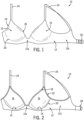
- FIGURES 1 and 2 illustrate a brassiere 10 according to the present disclosure.
- FIGURE 1 shows an outer face of the brassiere 10 (i.e., what would be seen when the brassiere 10 is worn by a wearer), while FIGURE 2 shows an inner face of the brassiere 10 (i.e., the portions that would touch the wearer's skin).
- the brassiere 10 includes a chest band 12 configured to encircle and lay against a wearer's ribcage.
- the chest band 12 is comprised of an underbust portion 12a ("cradle") and a wing portion 12b.
- a portion of the chest band 12 includes a pair of concavities 14, each concavity in the pair of concavities 14 configured to be located below one of a wearer's breasts when the brassiere 10 is worn.
- the brassiere 10 further includes a pair of breast cups 16, each breast cup being situated within a respective concavity in the pair of concavities 14. Each breast cup 16 has an upper edge 18, a lower edge 20, and an underarm edge 22.
- the brassiere 10 also includes straps 24, an eye closure part 26, and a hook closure part 28. As is known, the hook closure part 28 can be connected to the eye closure part 26 to secure the chest band 12 around the wearer's ribcage.
- the brassiere 10 is strapless and/or has stretchy wings 12b, 12c that allow a wearer to put on and take off the brassiere 10 by pulling it over her head.
- the brassiere 10 is a front-close brassiere, with one back band extending from the outer edge of one breast cup 16 to the outer edge of the other breast cup 16.
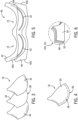
- each breast cup 16 comprises an inner liner 30, an outer liner 32, and a foam pad 34 sandwiched between the inner and outer liners 30, 32.
- the inner and outer liners 30, 32 can be knitted of fabric such as polyester, spandex, nylon, and/or blends thereof, and can have a lower modulus of elasticity that that of the foam pad 34.
- the foam pad 34 may nonetheless be somewhat stretchy compared to foam pads generally used in brassiere pads.
- the layers 30, 32, 34 shown in FIGURE 3 can be laminated and/or molded together using adhesive and a heat treating/molding process to form the breast cup 16a of FIGURE 4 .
- breast cups 16 are mirror images of one another, and thus only one will be described further herein.
- a lower region 36 of the inner liner 30 of each breast cup 16a extends past a lower edge of the foam pad 34 and a lower edge of the outer liner 32 of each breast cup 16.
- the lower edges of the foam pad 34 and outer liner 32 may coincide with one another and may be located along the dashed line 38 shown in FIGURE 4 (it being understood that the foam pad 34 and the outer liner 32 are behind the inner liner 30 in this view).
- the purpose of such a construction, in which the lower edge 38 of the foam pad 34 does not extend as far as the lower edge of at least one of the inner and outer liners 30, 32 will be described further herein below.
- the chest band 12 comprises a foam frame 40 at least in part defining the pair of concavities 14.
- the brassiere 10 also includes a pair of curved support members 42.
- the foam frame 40 comprises an inner layer of foam 44 (which is closer to the wearer's body when worn) and an outer layer of foam 46 (which is further from the wearer's body), and the pair of curved support members 42 are embedded between the inner and outer layers of foam 44, 46.
- the curved support members 42 can be made of a flexible plastic or other type of polymer, and in one example are made of thermoplastic polyurethane. In another example, the curved support members 42 are made of foam, such as lengths of relatively more dense foam than the foam of the inner and outer layers of foam 44, 46.
- the curved support members 42 When molded between the inner and outer layers of foam 44, 46, the curved support members 42 can be fused thereto by application of heat and pressure. This adds strength to the molded composite chest band 12, as well as prevents poke-through of the support members.
- the curved support members 42 and inner and outer layers of foam 44, 46 can be attached together using adhesive. In this manner, the pair of curved support members 42 are attached to the chest band 12 along the pair of concavities 14, respectively.
- the pair of curved support members 42 can be located such that their upper edges are a few millimeters below the upper edges of the layers of foam 44, 46 or can be located such that their upper edges coincide with the upper edges of the layers of foam 44, 46.
- the outer side edges 40a, 40b of the foam frame 40 can be configured to extend at least partially circumferentially around a wearer's torso under the wearer's arms, in order to provide support to her breasts and to smooth any underarm bulge.
- the outer side edges 40a, 40b can extend to locations under a wearer's arms that are halfway between her front side and her back side.
- these outer side edges 40a, 40b are compressed, for example by molding, to increase their density and provide more support than the remainder of the chest band 12.
- the foam frame 40 is located mostly in the underbust area 12a of the chest band 12.
- the underbust area 12a of the chest band 12 could be formed other than as described herein above.
- the curved support members 42 are made of metal, like traditional underwires, and optionally may be coated with a gel-like material or surrounded by an underwire casing and/or foam. In some examples, no curved support members are provided.
- the entire underbust area 12a of the brassiere 10 could include a sheet or film of thermoplastic material, such as thermoplastic polyurethane, secured between inner and outer layers of fabric and/or foam.
- the underbust area 12a has no added support between the inner and outer layers of foam 44, 46, such as for a maternity, lounge, or sleep brassiere.
- the wings 12b, 12c of the chest band 12 are comprised of an inner layer 48 configured to touch a wearer's skin, an outer layer 50 configured to face outwardly from the wearer, and an intermediate layer 52 sandwiched between the inner and outer layers 48, 50.
- the inner and outer layers 48, 50 are fabric similar to the fabric of the breast cup liners 30, 32, although one or both layers 48, 50 could be a mesh to provide a cooling effect to the wearer.
- the inner layer 48 can be made of a fabric that inherently grips the wearer's skin, such as 100% spandex.
- the inner layer 48 may be brushed or otherwise treated to provide softness against the wearer's skin.
- the intermediate layer 52 may be a panel of mesh or netting.
- the mesh can be a non-woven material.
- the mesh may be formed from a gravure printed or extruded polymer, such as polystyrene. More particularly, the mesh panel may be made of 100% polystyrene.
- Other appropriate materials for the mesh are polyolefin or shape memory polymers. Some appropriate materials of this type are available from Meiwa Gravure Co., Ltd. of Higashi-Osaka City, Japan. Otherwise, the mesh may be formed of a polymer that is screen printed or 3-D printed onto a release sheet and then removed once set for incorporation into the wings 12b, 12c.
- the polymer could be directly applied onto the inner or outer layer 48, 50 of fabric in a mesh pattern.
- the intermediate layer 52 is made of netting
- the netting may be a woven fabric netting.
- the netting may comprise polyethylene and thermoplastic elastomer threads.
- CONWED TM from Schweitzer-Mauduit International, Inc. of Alpharetta, Georgia.
- the mesh or netting may have any shape of apertures, such as square, diamond, circular, ovular, parallelogram, or rectangular. The size of the apertures will generally be on the order of 1 to 3 millimeters or less.
- the size of the apertures is on the order is 0.5 to 1.5 millimeters, preferably 0.8 to 1.1 millimeters.
- the thickness of the mesh or netting may be 100 to 160 microns, and preferably 130 microns.
- the porosity (fraction of open area to total area) of the mesh or netting may be 30 to 50%, or more particularly 35 to 40%.
- the mesh or netting may have a weight of 30 to 70gsm, or more particularly 50gsm.
- a 100% polystyrene mesh that is 130 microns thick and has a weight of 50gsm, with apertures measuring 0.9 to 1.1 millimeters in one direction and 0.8 to 0.95 millimeters in a direction transverse thereto, and an average porosity of 40%, has an elongation of about 120% from 0.1kg to 1kg and a recovery of about 88%.
- the elongation and recovery do not change significantly with temperature, such as when the mesh is on-body as part of the brassiere 10.
- incorporating the mesh into the brassiere 10 can provide high stretch and fast recovery to the fabric laminate. Note that the overall stretch and recovery will depend on the fabrics with which the mesh is laminated, and in one example, the inner and outer layers 48, 50 on either side of the intermediate layer are nylon-spandex.
- the layered construction of the wings 12b, 12c provides enhanced elasticity to the wings, smoothing back and underarm bulge while still being tight enough around her ribcage to hold the brassiere 10 in place and support her breasts.
- the intermediate layer 52 may have more stretch and recovery capabilities than the inner and outer layers 48, 50.
- use of the mesh/netting between the inner and outer layers 48, 50 of fabric stabilizes the inner and outer layers 48, 50 of fabric at their edges and provides overall stretch and elasticity to the wings 12b, 12c. This allows the upper and lower edges of the wings 12b, 12c potentially to be raw cut and bonded to each other and to the intermediate layer 52 by adhesive, such as through lamination and/or molding (i.e., no stitching is required).
- the intermediate layer 52 provides stretch and recovery over the entire height and length of the wings 12b, 12c, and even in the underbust area 12a, no separate elastic band is required along the top and/or bottom edges of the wings 12b, 12c, as in typical brassieres. This eliminates digging in of the wings 12b, 12c and provides the look of a smooth underarm and back area under her clothing, while still providing a fit that is tight enough to her body to support her breasts.
- the intermediate layer 52 may be provided only near the top and/or bottom edges of the wings 12b, 12c, and optionally an elastic band could be provided where the intermediate layer 52 is not present.
- elastic bands (which can be knit or woven or made of a thermoplastic tape/film) can be provided at the top and/or bottom edges of the wings 12b, 12c, even with the intermediate layer 52 extending the full height and length thereof, to provide increased support, but the elastic bands need not be as tight as they might otherwise have been required to be were the intermediate layer 52 not provided.
- FIGURE 7 shows the layers of the brassiere 10 exploded to describe how they are molded together.
- FIGURE 7 shows the outer layers toward the top of the figure, progressing to the inner layers toward the bottom of the figure.
- the layers are placed in a female part of a mold in order from top (outside of the garment) to bottom (inside of the garment).
- the outermost layer which is the outer layer 50 described with respect to the wings 12b, 12c in FIGURE 6 , is first placed in the female part of the mold.
- the outer layer 50 extends not only across both wings 12b, 12c, but also across the entire front of the brassiere 10, including the breast cups 16 and the underbust area 12a.
- a strip of adhesive 58 (such as silicone adhesive) is placed at the lower edge of the outer layer 50 in order to bond the outer layer 50 to the foam frame 40 and the intermediate layer 52, which are placed on top of the outer layer 50.
- the outer layer 50 is bag-out sewn to the inner layer 48 of each wing 12b, 12c and to the inner layer of fabric in the underbust area 12a.
- Additional adhesive such as spray glue, printed glue, or glue dots can also be applied to the outer layer 50 in select locations, for example to adhere the outer layer 50 to the intermediate layer 52 along the entire height and length of the wings 12b, 12c and/or to adhere the outer layer 50 to the foam frame 40 in the underbust area 12a.
- these layers 50, 48, 52 are connected only along their outer edges.
- the outer layer 50 may be loose (non-adhered) where it covers the breast cups 16, but adhered to the remainder of the layers of the brassiere 10 in the chest band 12.
- the outer layer 50 may be loose (non-adhered) where it covers the breast cups 16 and the underbust area 12a, but may be adhered where it covers the wings 12b, 12c.
- the intermediate layer 52 that is used in the wings 12b, 12c is self-bonding by application of heat and pressure, little or no adhesive may be required to bond the outer layer 50 to the intermediate layer 52 in the wings 12b, 12c.
- a 100% polystyrene mesh as noted above can be self-bonded to nylon-spandex fabric upon application of 3-5 bar of pressure at 150-180 degrees C for 10-20 seconds. Self-bonding of the mesh to the fabric allows the garment to be breathable and have a soft hand-feel, which might not otherwise be the case if additional adhesive was required.
- the foam frame 40 may be pre-assembled before being placed in the mold, such as by lamination and/or molding to a shape configured to curve around her ribcage.
- the foam frame 40 complete with embedded curved support members 42, is placed on top of the outer layer 50, with the concavities in the foam frame 40 aligned with the edges of the concavities in the female part of the mold.
- the layers of foam 44, 46 and curved support members 42 are placed into the garment mold separate from one another, without being preassembled, but with adhesive placed therebetween.
- the inner layer of foam 44 may be coated with adhesive to bond it with the intermediate layer 52, or the intermediate layer 52 may self-bond to the inner layer of foam 44 upon application of heat and pressure.
- the intermediate layer 52 which is the same as the intermediate layer 52 described with respect to FIGURE 6 , is then placed on top of the foam frame 40 and the outer layer 50. Again, the concavities in each layer are aligned during such placement. Note that the intermediate layer 52 extends not only across the wings 12b, 12c, but also across the underbust area 12a. In other examples, however, the intermediate layer 52 is located only along the wings 12b, 12c or only in the underbust area 12a.
- the intermediate layer 52 may be coated with more adhesive, or the adhesive that was applied to the outer layer 50 may be able to extend through the holes in the mesh of the intermediate layer 52 and bond to the inner layer 48 of the brassiere 10.
- the intermediate layer 52 can be adhered to the inner and outer layers 48, 50 of fabric in strips extending only a few centimeters inward from the edges of the wings 12b, 12c, with the middle vertical extent of the wings 12b, 12c being left unadhered.
- the intermediate layer 52 is self-bonding by application of heat and pressure, heat and pressure can be applied only along the upper and lower edges of the wings 12b, 12c, if desired.
- the breast cups 16 are then placed into the concavities in the female part of the mold, with their lower edges 38 aligned with the concavities 14 defined by the foam frame 40 and the intermediate layer 52.
- the breast cups 16 can be pre-assembled and even molded to a cup shape prior to insertion in the garment mold.
- the breast cups 16 are laminated but not molded before being placed in the garment mold with the other layers of the brassiere 10.
- each of the three layers of the breast cups 16 is loose before being placed into the garment mold, and adhesive is applied between each layer, which layers are then bonded together in the garment mold.
- the breast cups 16 are situated in the garment mold in a manner such that the foam pads 34 in the breast cups 16 do not touch or overlap with the components of the chest band 12, specifically, the foam frame 40 and the intermediate layer 52, as will now be described.
- a lower portion 36a of the lower region 36 of the inner liner 30 of each breast cup 16a, 16b is overlapped with an upper edge 56 of the intermediate layer 52 (and the corresponding upper edge of the foam frame 40 behind the intermediate layer 52) in the concavities 14.
- an upper portion 36b of the lower region 36 of the inner liner 30 of each breast cup 16 that extends past the lower edges 38 of the foam pad 34 and the outer liner 32 is not overlapped with the intermediate layer 52, and indeed does not overlap with any layer of the chest band 12 but the outer layer 50.
- only the lower portions 36a of the lower regions 36 of the inner liner 30, but not the upper portions 36b thereof, are overlapped with the upper edge of the foam frame 40.
- adhesive strips 54 which may be made of silicone, are then placed on the breast cups 16 below the lower edges 38 of the foam pads 34. More specifically, the adhesive strips 54 are placed on top of the lower portions 36a of the lower regions 36 of the inner liner 30.
- the innermost layer of the chest band 12, which is the inner layer 48 described with respect to FIGURE 6 is then placed into the mold. It can be seen that the inner layer 48 extends not only along the wings 12b (and 12c, although not shown herein), but also across the underbust area 12a of the chest band 12. In the present example, the inner layer 48 is formed of a single piece of fabric, to provide a seamless surface touching her skin.
- two or more pieces of fabric could be sewn or bonded together to form the inner layer 48.
- the inner layer 48 is aligned such that the upper edges of the concavities therein are situated on top of the adhesive strips 54, specifically such that no non-adhered portion of the inner layer 48 is located above the adhesive strips 54.
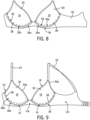
- the upper edges 50a of the outer layer 50 are then folded over the inner liner 30 of the breast cups 16 and bonded thereto using elastic adhesive strips at the upper edges 18 and underarm edges 22 to form smooth upper edges. See FIGURES 2 and 9 .
- the edges of the wings 12b, 12c can be raw cut if the layers 48, 52, 50 are laminated together.
- the edges of the wings 12b, 12c can alternatively be finished by sewing (e.g., bag-out) and/or bonding.
- FIGURES 8 and 9 provide further detail related to the connection of the breast cups 16 to the foam frame 40, intermediate layer 52, and inner layer 48.
- the inner and/or outer liner 30, 32 of each breast cup 16 extends past the lower edge 38 of the foam pad 34.
- at least one of the inner and outer liners 30, 32 of each breast cup 16 is attached to the chest band 12 along a respective concavity 14 therein.
- the inner liner 30 is the one connected to the chest band 12, such as by the adhesive strips 54 connecting the lower portion 36a of the lower region 36 of the inner liner 30 to the inner layer 48 and the intermediate layer 52 being overlapped with and adhered to the lower portion 36a of the lower region 36 of the inner liner 30.
- the foam pad 34 of each breast cup 16 (the lower edge of which is shown at 38) is not attached to the chest band 12, other than by way of the at least one of the inner and outer liners 30, 32 (here, by way of the inner liner 30). Because the lower portion 36a of the lower region 36 of the inner liner 30 of each breast cup 16 is overlapped with the chest band 12, and this overlap is sealed with adhesive strips 54, the wearer is not able to feel the "seam" created here. By leaving a gap between the lower edge 38 of the foam pad 34 and the chest band 12, especially between the lower edge 38 of the foam pad 34 and the curved support members 42 in the chest band 12, the brassiere 10 is provided with increased flexibility and comfort.
- the lower edge 38 of the foam pad 34 of each breast cup 16 is thinner than a portion of the foam pad 34 immediately above the lower edge 38.
- the lower edge 38 can be shaved down to almost nothing in order to prevent a noticeable ridge where the foam pad 34 stops and the breast cup 16a, 16b comprises just the inner liner 30. If extra support is needed in this area, the lower edge 38 of the foam pad 34 can instead be compressed to provide a more dense, supportive area that is still thinner than the remainder of the foam pad 34 above it.
- the inner liner 30 extends 1/4" to 5/8" beyond the lower edge 38 of the foam pad 34. In a more specific example, the inner liner 30 extends 3/8" to 1/2" beyond the lower edge 38 of the foam pad 34. In a still more specific example, the inner liner 30 extends 7/16" beyond the lower edge 38 of the foam pad 34. In one example, 1/8" to 3/8" of the lower region 36 of the inner liner 30 overlaps with the chest band 12. In a more specific example, 3/16" to 5/16" of the lower region 36 of the inner liner 30 overlaps with the chest band 12. In a still more specific example, 1/4" of the lower region 36 of the inner liner 30 overlaps with the chest band 12.
- between 1/16" and 5/16" of the inner liner 30 is left not overlapped with either the foam pad 34 or the chest band 12 and can flex with the wearer's movement and changing breast size.
- 1/8" to 1/4" of the liner layer 30 is not overlapped with any other layer of the brassiere 10 but the outer layer 50.
- 3/16" of the liner layer 30 is not overlapped with any other layer of the brassiere 10 but the outer layer 50.
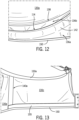
- FIGURES 10-13 Another example of a brassiere 110 according to the present disclosure is shown in FIGURES 10-13 .
- the breast cup 116 corresponds to the breast cup 16 of the first example of FIGURES 1-9
- the chest band 112 corresponds to the chest band 12 of the first example, and so on.
- the components provide the same function and are manufactured in the same (or similar) manner as in the first example, those components will not be described further herein below, it being understood that the above description of those components applies equally to the second example of the brassiere in FIGURES 10-13 .
- FIGURE 10 shows an unassembled brassiere 110 comprising a chest band 112 configured to encircle and lay against a wearer's ribcage, a portion of the chest band 112 including a pair of concavities 114, each concavity in the pair of concavities 114 configured to be located below one of a wearer's breasts when the brassiere 110 is worn.
- the layers of the brassiere 110 are shown with the outer layers toward the top of the figure, progressing to the inner layers toward the bottom of the figure.
- a pair of curved support members 142 is attached to the chest band 112 along the pair of concavities 114, respectively.
- a pair of breast cups 116 is also provided.
- Each breast cup 116 is situated within a respective concavity in the pair of concavities 114, and each breast cup 116 comprises an inner liner 130, an outer liner (on reverse side of breast cups 116, not shown), and a foam pad 134 sandwiched between the inner and outer liners, as described with respect to FIGURE 3 .
- At least one of the inner and outer liners of each breast cup 116 is attached to the chest band 112 along the respective concavity 114.
- the foam pad 134 of each breast cup 116 is not attached to the chest band 112, other than by way of the at least one of the inner and outer liners.
- only the inner liner 130 connects the foam pads 134 of the breast cups 116 to the chest band 112, as will be described herein below.
- the chest band 112 comprises an inner layer configured to touch a wearer's skin, an outer layer 150 configured to face outwardly from the wearer, and an intermediate layer 152 sandwiched between the inner and outer layers.
- the intermediate layer 152 of the chest band 112 may be a mesh or netting, as described hereinabove.
- the inner layer of the chest band 112 is the same as the inner liner 130 of the breast cups 116.
- the inner liner 130 of the breast cups 116 extends as one continuous piece of fabric downwardly from the breast cups 116, spans the gaps between the lower edges 138 of the foam pads 134 in the breast cups 116 and the upper edges of the concavities 114, and extends to the lower edge of the chest band 112, where the inner liner 130 is bag-out sewn to the outer layer 150 of the brassiere 110.
- the chest band 112 also comprises the foam frame 140 at least in part defining the pair of concavities 114 and configured to extend at least partially under a wearer's arms.
- the lateral-most extent of the foam frame 140 is shown at 140a in FIGURE 13 .
- the foam frame 140 of the chest band 112 comprises an inner layer of foam 144 and an outer layer of foam (on reverse), and the pair of curved support members 142 are embedded between the inner and outer layers of foam.
- the lower region 136 of the inner liner 130 of each breast cup 116 extends past the lower edge 138 of each foam pad 134 and past a lower edge of the outer liner (on reverse side of breast cups 116) of each breast cup 116. Further, referring to FIGURES 11 and 12 , a lower portion 136a of the lower region 136 of the inner liner 130 of each breast cup 116 is overlapped with the chest band 112. An upper portion 136b of the lower region 136 of the inner liner 130 of each breast cup 116 that extends past the lower edges 138 of the foam pad 134 and the outer liner (on reverse) is not overlapped with the chest band 112.
- the inner liner 130 is made of a fabric that has a lower elastic modulus than that of the foam pads 134, thereby providing stretch in this "gap" between the lower edges 138 of the foam pads 134 and the upper edges of the concavities 114 in the chest band 112. Also as with the first example, an upper edge of the intermediate layer 152 of the chest band 112 (which upper edge also comprises the concavities 114) may be overlapped with the lower portion 136a of the lower region 136 of the inner liner 130 of each breast cup 116.
- the breast cups 116, the inner liner 130, the intermediate layer 152, and the foam frame 140 can first be molded together.
- the breast cups 116 and the foam frame 140 can first be placed in the female portion of the mold, with the lower edges 138 of the foam pads 134 of the breast cups 116 being spaced from the upper edges of the concavities 114 in the foam frame 140.
- the breast cups 116 may in this instance comprise only the foam pad 134 and the outer liner (on reverse), and adhesive can be applied to the inner face of the foam pads 134 for future bonding with the inner liner 130.
- the intermediate layer 152 can next be placed in the mold, overlapping the foam frame 140, but not the foam pads 134.
- the inner liner 130 can then be placed in the mold, and heat and pressure are applied to mold the inner liner 130 to the inner face of the foam pads 134 and to the intermediate layer 152.
- the inner liner 130 and the intermediate layer 152 in this example may be pieces of fabric only as wide as the underbust area 112a of the chest band 112 (see 130a and 152a, FIGURE 10 ).
- the molded front panel subassembly of the breast cups 116, foam frame 140, intermediate layer 152a, and inner liner 130a is formed.
- the wings 112b, 112c of the brassiere 110 can then be formed by adhering and/or molding wing-shaped intermediate layers 152b, 152c and wing-shaped inner liners 130b, 130c to the outer lateral edges of the front panel subassembly.
- the outer layer 150 can then be sewn to the bottom edges of the front panel subassembly and the laminated wings 112b, 112c, and bagged out to fold the outer layer 150 over the front of the brassiere 110.
- a strip of elastic 155 is provided at the bottom of each wing 112b, 112c, either between the inner liners 130b, 130c and the intermediate layers 152b, 152c or between the intermediate layers 152b, 152c and the outer layer 150.
- the strips of elastic 155 can be knit or woven or made of a thermoplastic tape/film.
- the upper edge 150a of the outer layer 150 can be folded over the top edges of the front panel subassembly and the wings 112c, 112c and bonded or sewn thereto. By application of heat and pressure, the outer layer 150 can be bonded to the outer face of the intermediate layer 152, due to the self-bonding nature of the intermediate layer 152.
- the outer layer 150 may be loose (non-bonded) where it covers the breast cups 116 and the underbust area 112a, but may be bonded where it covers the wings 112b, 112c. Trims, such as the hook and eye closure parts, can then be attached to the ends of the wings 112b, 112c.
- the intermediate layer 52, 152 is not provided in the underbust area 12a, 112a, but only in the wings 12b, 12c and 112b, 112c.
- adhesive is applied to bond the inner layer 48 portion or the inner liner 130 to the foam frame 40, 140, as the self-bonding intermediate layer 52, 152 is not present.
- the present concepts can be applied to other types of brassieres and to brassiere-like garments.
- the brassiere can be a sport brassiere, a long-line brassiere, or a nursing brassiere.
- the brassiere can be incorporated inside a covering garment, such as a camisole or a t-shirt.
- the structure shown and described herein can instead be part of a slip, dress, or swimsuit. Those having ordinary skill in the art will understand to what other types of garments the present concepts can be applied.
Landscapes
- Engineering & Computer Science (AREA)
- Textile Engineering (AREA)
- Corsets Or Brassieres (AREA)
Claims (9)
- Büstenhalter (10, 110), der Folgendes umfasst:ein Brustband (12, 112), das so konfiguriert ist, dass es den Brustkorb einer Trägerin umgibt und an diesem anliegt, wobei ein Teil des Brustbandes (12, 112) ein Paar von Konkavitäten (14, 114) einschließt, wobei jede Konkavität aus dem Paar von Konkavitäten so konfiguriert ist, dass sie sich unterhalb einer der Brüste einer Trägerin befindet, wenn der Büstenhalter (10, 110) getragen wird;ein Paar gebogener Stützelemente (42, 142), die an dem Brustband (12, 112) entlang des Paares von Konkavitäten (14, 114) befestigt sind; undein Paar von Brustschalen (16, 116), wobei jede Brustschale innerhalb einer entsprechenden Konkavität (14, 114) in dem Paar von Konkavitäten angeordnet ist und jede Brustschale (16, 116) eine innere Einlage (30, 130), eine äußere Einlage (32) und ein Schaumstoffpolster (34, 134) umfasst, das zwischen der inneren und der äußeren Einlage eingeschoben ist;wobei mindestens eine der inneren und äußeren Einlagen (30, 130, 32) jeder Brustschale an dem Brustband (12, 112) entlang der jeweiligen Konkavität (14, 114) befestigt ist;wobei das Schaumstoffpolster (34, 134) jeder Brustschale (16, 116) nicht mit dem Brustband (12, 112) verbunden ist, außer über mindestens eine der inneren und äußeren Einlagen (30, 130, 32); undwobei das Brustband (12, 112) eine innere Schicht (48, 130), die so konfiguriert ist, dass sie die Haut einer Trägerin berührt, eine äußere Schicht (50, 150), die so konfiguriert ist, dass sie von der Trägerin nach außen weist, und eine Zwischenschicht (52, 152), die zwischen der inneren und der äußeren Schicht (48, 130, 50, 150) eingeschoben ist, umfasst;dadurch gekennzeichnet, dassein unterer Bereich (36, 136) der inneren Einlage (30, 130) jeder Brustschale (16, 116) sich über eine untere Kante (38, 138) des Schaumstoffpolsters (34, 134) und eine untere Kante (38, 138) der äußeren Einlage (32) jeder Brustschale (16, 116) hinaus erstreckt, und ein unterer Abschnitt (36a, 136a) des unteren Bereichs (36, 136) der inneren Einlage (30, 130) jeder Brustschale (16, 116) mit dem Brustband (12, 112) überlappt ist;ein oberer Abschnitt (36b, 136b) des unteren Bereichs (36, 136) der inneren Einlage (30, 130) jeder Brustschale (16, 116), der sich über die unteren Kanten (38, 138) des Schaumstoffpolsters (34, 134) und der äußeren Einlage (32) hinaus erstreckt, nicht mit dem Brustband (12, 112) überlappt ist; undzwischen dem unteren Abschnitt (36a, 136a) des unteren Bereichs (36, 136) der inneren Einlage (30, 130) und dem unteren Rand (38, 138) des Schaumstoffpolsters (34, 134) nur der obere Abschnitt (36b, 136b) des unteren Bereichs (36, 136) des der inneren Einlage (30, 130) die Brustschalen (16, 116) mit dem Brustband (12, 112) auf einer inneren Seite des Büstenhalters (10, 110) verbindet.
- Büstenhalter nach Anspruch 1, wobei die innere Einlage (30, 130) aus einem Gewebe hergestellt ist, das einen geringeren Elastizitätsmodul als das Schaumstoffpolster (34, 134) aufweist.
- Büstenhalter nach Anspruch 1 oder 2, wobei eine obere Kante (56) der Zwischenschicht (52, 152) des Brustbandes (12, 112) mit dem unteren Abschnitt (36a, 136a) des unteren Bereichs (36, 136) der inneren Einlage (30, 130) jeder Brustschale (16, 116) überlappt ist.
- Büstenhalter nach einem der Ansprüche 1 bis 3, wobei die Zwischenschicht (52, 152) des Brustbandes (12, 112) ein Netzeinsatz ist.
- Büstenhalter nach Anspruch 4, wobei der Netzeinsatz aus einem extrudierten Polymer gebildet ist.
- Büstenhalter nach einem der Ansprüche 1 bis 5, wobei das Brustband (12, 112) einen Schaumstoffrahmen (40, 140) umfasst, der zumindest teilweise das Paar von Konkavitäten (14, 114) definiert und so konfiguriert ist, dass er sich zumindest teilweise unter den Armen einer Trägerin erstreckt.
- Büstenhalter nach Anspruch 6, wobei der Schaumstoffrahmen (40, 140) eine innere Schaumstoffschicht (44, 144) und eine äußere Schaumstoffschicht (46) umfasst, und wobei das Paar gebogener Stützelemente (42, 142) zwischen der inneren und der äußeren Schaumstoffschicht (44, 144, 46) eingebettet ist.
- Büstenhalter nach Anspruch 6 oder 7, wobei der Schaumstoffrahmen (40, 140) auch zwischen der inneren und der äußeren Schicht (48, 130, 50, 150) des Brustbandes (12, 112) eingeschoben ist.
- Büstenhalter nach einem der Ansprüche 1 bis 8, wobei eine untere Kante (38, 138) des Schaumstoffpolsters (34, 134) jeder Brustschale (16, 116) dünner ist als ein Abschnitt des Schaumstoffpolsters (34, 134) unmittelbar oberhalb der unteren Kante (38, 138).
Applications Claiming Priority (2)
| Application Number | Priority Date | Filing Date | Title |
|---|---|---|---|
| US202163147462P | 2021-02-09 | 2021-02-09 | |
| US17/588,387 US12575616B2 (en) | 2021-02-09 | 2022-01-31 | Brassiere |
Publications (2)
| Publication Number | Publication Date |
|---|---|
| EP4046512A1 EP4046512A1 (de) | 2022-08-24 |
| EP4046512B1 true EP4046512B1 (de) | 2025-03-26 |
Family
ID=80222255
Family Applications (1)
| Application Number | Title | Priority Date | Filing Date |
|---|---|---|---|
| EP22155390.2A Active EP4046512B1 (de) | 2021-02-09 | 2022-02-07 | Büstenhalter |
Country Status (4)
| Country | Link |
|---|---|
| US (2) | US12575616B2 (de) |
| EP (1) | EP4046512B1 (de) |
| CN (1) | CN114903227B (de) |
| CA (1) | CA3148041C (de) |
Families Citing this family (11)
| Publication number | Priority date | Publication date | Assignee | Title |
|---|---|---|---|---|
| US20250151824A1 (en) * | 2019-01-25 | 2025-05-15 | Call To Action Clothing, LLC | Garments with concealers, concealers and related methods |
| KR102387021B1 (ko) * | 2019-12-19 | 2022-04-15 | 김동현 | 퓨징 브래지어 |
| US20220183400A1 (en) * | 2020-12-15 | 2022-06-16 | Shefit, Inc. | Brassiere assembly |
| US12127607B2 (en) * | 2021-02-12 | 2024-10-29 | Chico's Brands Investments, Inc. | Bra pad and method for manufacturing same |
| CN217958806U (zh) * | 2021-11-29 | 2022-12-06 | 建盈实业有限公司 | 文胸 |
| US20230218026A1 (en) * | 2022-01-07 | 2023-07-13 | Mast Industries (Far East) Limited | Lower body garment for maternity |
| USD1024490S1 (en) * | 2023-08-08 | 2024-04-30 | Yongguang Cai | Bra |
| USD1017187S1 (en) * | 2023-08-08 | 2024-03-12 | Yongguang Cai | Bra |
| USD1017959S1 (en) * | 2023-08-08 | 2024-03-19 | Yongguang Cai | Bra |
| USD1017960S1 (en) * | 2023-08-08 | 2024-03-19 | Yongguang Cai | Bra |
| US20250107578A1 (en) * | 2023-09-28 | 2025-04-03 | Nike, Inc. | Garments with moisture wicking and moisture concealing properties |
Family Cites Families (37)
| Publication number | Priority date | Publication date | Assignee | Title |
|---|---|---|---|---|
| US2332141A (en) * | 1941-05-23 | 1943-10-19 | Greene Mary Clair | Girdle |
| US2440466A (en) * | 1946-06-24 | 1948-04-27 | Freedman Ruth | Brassiere |
| US2620484A (en) * | 1946-07-23 | 1952-12-09 | Everett D Gerry | Shoulder pad |
| US4617934A (en) | 1985-07-25 | 1986-10-21 | International Playtex, Inc. | Brassiere frame |
| US5189738A (en) * | 1991-08-06 | 1993-03-02 | Jenna Mitchell | Garment shoulder pad with pocket |
| US5447462A (en) | 1993-04-13 | 1995-09-05 | Playtex Apparel, Inc. | Fabric laminate and garments incorporating same |
| EP0649608B1 (de) | 1993-10-22 | 1999-06-30 | LOVABLE ITALIANA S.p.A. | Bustier |
| US6090234A (en) | 1996-07-15 | 2000-07-18 | The Procter & Gamble Company | Elastic laminates and methods for making the same |
| KR100228537B1 (ko) * | 1997-05-06 | 1999-11-01 | 주병진 | 남성용 상의 |
| US6406351B1 (en) * | 2000-06-09 | 2002-06-18 | Shian Shun Enterprise Co, Ltd. | Cup structure for bra |
| JP3507011B2 (ja) | 2000-06-30 | 2004-03-15 | トリンプ・インターナショナル・ジャパン株式会社 | ブラジャー |
| US6811464B2 (en) * | 2002-09-24 | 2004-11-02 | Regina Miracle International Limited | Brassiere |
| US6918812B2 (en) | 2003-10-09 | 2005-07-19 | Sharon Giese | Brassiere for improved breast support and enhancement |
| US7442110B2 (en) * | 2004-05-17 | 2008-10-28 | Saucony Inc. | Brassiere, brassiere components, and materials for use thereof |
| US8128457B2 (en) | 2005-04-22 | 2012-03-06 | Nike, Inc. | Athletic bra |
| US20070026767A1 (en) | 2005-08-01 | 2007-02-01 | Maidenform, Inc. | Brassiere having stretchable support |
| US20080090491A1 (en) | 2006-10-13 | 2008-04-17 | Zhen Qiang Liu | Uplift brassiere |
| US20080153387A1 (en) | 2006-12-21 | 2008-06-26 | Zhen Qiang Liu | Partial core pad incorporating brassiere |
| US7427226B1 (en) | 2007-08-20 | 2008-09-23 | Ce Soir Lingerie Co., Inc. | Floating cup breast support garment |
| JP5991797B2 (ja) | 2011-02-09 | 2016-09-14 | トリンプ・インターナショナル・ジャパン株式会社 | ブラジャー |
| US9084443B2 (en) * | 2012-10-08 | 2015-07-21 | Under Armour, Inc. | Article of apparel with integrated support structure |
| US9254009B2 (en) | 2013-03-01 | 2016-02-09 | Hbi Branded Apparel Enterprises, Llc | Upper and lower torso garments having an improved band |
| US9480287B2 (en) | 2013-08-21 | 2016-11-01 | Hbi Branded Apparel Enterprises, Llc | Athletic bra |
| US10368590B2 (en) * | 2015-11-03 | 2019-08-06 | Nike, Inc. | Flat-knit support garment for upper torso |
| US10660377B2 (en) * | 2016-05-16 | 2020-05-26 | Mast Industries (Far East) Limited | Brassiere and front panel for brassiere |
| CN207692981U (zh) | 2017-10-27 | 2018-08-07 | 维珍妮国际(集团)有限公司 | 胸罩和包括胸罩的衣物 |
| WO2019169575A1 (en) | 2018-03-07 | 2019-09-12 | Regina Miracle International (Group) Limited | Article of clothing and manufacturing method thereof |
| CN112888558A (zh) | 2018-10-08 | 2021-06-01 | 维珍妮国际(集团)有限公司 | 服装制品及其制造方法 |
| US10477902B1 (en) | 2019-03-12 | 2019-11-19 | lululemon athletica canada, inc. | Breast support garment |
| DE202019102472U1 (de) | 2019-05-02 | 2019-05-20 | Triumph Intertrade Ag | Grössenadaptiver Büstenhalter |
| US20240090596A1 (en) | 2019-10-11 | 2024-03-21 | Unison Mystique Co., Limited | Breast support garment and breast support panel |
| WO2021081893A1 (en) | 2019-10-31 | 2021-05-06 | Regina Miracle International (Group) Limited | Article of clothing and manufacturing method thereof |
| WO2022007922A1 (en) | 2020-07-10 | 2022-01-13 | Clover Mystique Co. Limited | Breast support structure |
| US12193525B2 (en) | 2020-07-13 | 2025-01-14 | Retail Royalty Company | Folded-wing brassiere and method of construction |
| EP4002318B1 (de) * | 2020-11-16 | 2025-02-19 | ABB Schweiz AG | Verfahren zur überwachung einer ersten maschine und einer zweiten maschine, sensorsatz und verwendung eines sensorsatzes zur überwachung einer ersten maschine und einer zweiten maschine |
| WO2022155761A1 (zh) | 2021-01-19 | 2022-07-28 | 维珍妮国际(集团)有限公司 | 罩杯改良结构、其制造方法及包含其的内衣 |
| US12232546B2 (en) | 2021-02-12 | 2025-02-25 | Chico's Brands Investments, Inc. | Bra with intermediary flexible layer and method for manufacturing same |
-
2022
- 2022-01-31 US US17/588,387 patent/US12575616B2/en active Active
- 2022-02-07 EP EP22155390.2A patent/EP4046512B1/de active Active
- 2022-02-07 CA CA3148041A patent/CA3148041C/en active Active
- 2022-02-08 CN CN202210118986.7A patent/CN114903227B/zh active Active
-
2024
- 2024-12-10 US US18/975,838 patent/US20250098794A1/en active Pending
Also Published As
| Publication number | Publication date |
|---|---|
| CA3148041A1 (en) | 2022-08-09 |
| CA3148041C (en) | 2024-07-02 |
| CN114903227A (zh) | 2022-08-16 |
| US20250098794A1 (en) | 2025-03-27 |
| US12575616B2 (en) | 2026-03-17 |
| CN114903227B (zh) | 2025-08-01 |
| US20220248775A1 (en) | 2022-08-11 |
| EP4046512A1 (de) | 2022-08-24 |
Similar Documents
| Publication | Publication Date | Title |
|---|---|---|
| CA3148041C (en) | FLEXIBLE ADJUSTABLE CUP BRA | |
| US11172711B2 (en) | Brassiere and front panel for brassiere | |
| CN201135143Y (zh) | 胸罩 | |
| US7604526B2 (en) | Brassiere with under breast support | |
| US7407427B2 (en) | Brassiere | |
| EP3987966B1 (de) | Haken- und ösenverschluss mit alternierendem abstand | |
| CN104244753A (zh) | 包括具有改进支撑件的杯体的胸罩,具体为蕾丝胸罩 | |
| US20230413926A1 (en) | Upper-torso support garment | |
| US20080153387A1 (en) | Partial core pad incorporating brassiere | |
| US7887389B1 (en) | Support pad for an undergarment | |
| JP3133255U (ja) | ブラジャー | |
| US20250386881A1 (en) | Front panel for a brassiere | |
| JP3087417U (ja) | ブラジャー用カップ | |
| EP4543247A1 (de) | Oberkörperstützkleidungsstück | |
| JP3124719U6 (ja) | ブラジャー | |
| HK1124219A (zh) | 胸罩 | |
| HK1124220B (en) | Brassiere | |
| HK1124220A1 (en) | Brassiere | |
| HK1083729A1 (zh) | 具有成形支承物的胸罩 |
Legal Events
| Date | Code | Title | Description |
|---|---|---|---|
| PUAI | Public reference made under article 153(3) epc to a published international application that has entered the european phase |
Free format text: ORIGINAL CODE: 0009012 |
|
| STAA | Information on the status of an ep patent application or granted ep patent |
Free format text: STATUS: THE APPLICATION HAS BEEN PUBLISHED |
|
| AK | Designated contracting states |
Kind code of ref document: A1 Designated state(s): AL AT BE BG CH CY CZ DE DK EE ES FI FR GB GR HR HU IE IS IT LI LT LU LV MC MK MT NL NO PL PT RO RS SE SI SK SM TR |
|
| STAA | Information on the status of an ep patent application or granted ep patent |
Free format text: STATUS: REQUEST FOR EXAMINATION WAS MADE |
|
| 17P | Request for examination filed |
Effective date: 20230210 |
|
| RBV | Designated contracting states (corrected) |
Designated state(s): AL AT BE BG CH CY CZ DE DK EE ES FI FR GB GR HR HU IE IS IT LI LT LU LV MC MK MT NL NO PL PT RO RS SE SI SK SM TR |
|
| P01 | Opt-out of the competence of the unified patent court (upc) registered |
Effective date: 20230516 |
|
| GRAP | Despatch of communication of intention to grant a patent |
Free format text: ORIGINAL CODE: EPIDOSNIGR1 |
|
| RIC1 | Information provided on ipc code assigned before grant |
Ipc: A41C 3/14 20060101ALI20240919BHEP Ipc: A41C 3/00 20060101AFI20240919BHEP |
|
| STAA | Information on the status of an ep patent application or granted ep patent |
Free format text: STATUS: GRANT OF PATENT IS INTENDED |
|
| INTG | Intention to grant announced |
Effective date: 20241024 |
|
| GRAS | Grant fee paid |
Free format text: ORIGINAL CODE: EPIDOSNIGR3 |
|
| GRAA | (expected) grant |
Free format text: ORIGINAL CODE: 0009210 |
|
| STAA | Information on the status of an ep patent application or granted ep patent |
Free format text: STATUS: THE PATENT HAS BEEN GRANTED |
|
| AK | Designated contracting states |
Kind code of ref document: B1 Designated state(s): AL AT BE BG CH CY CZ DE DK EE ES FI FR GB GR HR HU IE IS IT LI LT LU LV MC MK MT NL NO PL PT RO RS SE SI SK SM TR |
|
| REG | Reference to a national code |
Ref country code: GB Ref legal event code: FG4D |
|
| REG | Reference to a national code |
Ref country code: CH Ref legal event code: EP |
|
| REG | Reference to a national code |
Ref country code: DE Ref legal event code: R096 Ref document number: 602022012099 Country of ref document: DE |
|
| REG | Reference to a national code |
Ref country code: IE Ref legal event code: FG4D |
|
| REG | Reference to a national code |
Ref country code: NL Ref legal event code: FP |
|
| PG25 | Lapsed in a contracting state [announced via postgrant information from national office to epo] |
Ref country code: RS Free format text: LAPSE BECAUSE OF FAILURE TO SUBMIT A TRANSLATION OF THE DESCRIPTION OR TO PAY THE FEE WITHIN THE PRESCRIBED TIME-LIMIT Effective date: 20250626 |
|
| PG25 | Lapsed in a contracting state [announced via postgrant information from national office to epo] |
Ref country code: FI Free format text: LAPSE BECAUSE OF FAILURE TO SUBMIT A TRANSLATION OF THE DESCRIPTION OR TO PAY THE FEE WITHIN THE PRESCRIBED TIME-LIMIT Effective date: 20250326 |
|
| REG | Reference to a national code |
Ref country code: LT Ref legal event code: MG9D |
|
| PG25 | Lapsed in a contracting state [announced via postgrant information from national office to epo] |
Ref country code: NO Free format text: LAPSE BECAUSE OF FAILURE TO SUBMIT A TRANSLATION OF THE DESCRIPTION OR TO PAY THE FEE WITHIN THE PRESCRIBED TIME-LIMIT Effective date: 20250626 |
|
| PG25 | Lapsed in a contracting state [announced via postgrant information from national office to epo] |
Ref country code: HR Free format text: LAPSE BECAUSE OF FAILURE TO SUBMIT A TRANSLATION OF THE DESCRIPTION OR TO PAY THE FEE WITHIN THE PRESCRIBED TIME-LIMIT Effective date: 20250326 |
|
| PG25 | Lapsed in a contracting state [announced via postgrant information from national office to epo] |
Ref country code: LV Free format text: LAPSE BECAUSE OF FAILURE TO SUBMIT A TRANSLATION OF THE DESCRIPTION OR TO PAY THE FEE WITHIN THE PRESCRIBED TIME-LIMIT Effective date: 20250326 |
|
| PG25 | Lapsed in a contracting state [announced via postgrant information from national office to epo] |
Ref country code: GR Free format text: LAPSE BECAUSE OF FAILURE TO SUBMIT A TRANSLATION OF THE DESCRIPTION OR TO PAY THE FEE WITHIN THE PRESCRIBED TIME-LIMIT Effective date: 20250627 Ref country code: BG Free format text: LAPSE BECAUSE OF FAILURE TO SUBMIT A TRANSLATION OF THE DESCRIPTION OR TO PAY THE FEE WITHIN THE PRESCRIBED TIME-LIMIT Effective date: 20250326 |
|
| PG25 | Lapsed in a contracting state [announced via postgrant information from national office to epo] |
Ref country code: SE Free format text: LAPSE BECAUSE OF FAILURE TO SUBMIT A TRANSLATION OF THE DESCRIPTION OR TO PAY THE FEE WITHIN THE PRESCRIBED TIME-LIMIT Effective date: 20250326 |
|
| REG | Reference to a national code |
Ref country code: AT Ref legal event code: MK05 Ref document number: 1778140 Country of ref document: AT Kind code of ref document: T Effective date: 20250326 |
|
| PG25 | Lapsed in a contracting state [announced via postgrant information from national office to epo] |
Ref country code: SM Free format text: LAPSE BECAUSE OF FAILURE TO SUBMIT A TRANSLATION OF THE DESCRIPTION OR TO PAY THE FEE WITHIN THE PRESCRIBED TIME-LIMIT Effective date: 20250326 |
|
| PG25 | Lapsed in a contracting state [announced via postgrant information from national office to epo] |
Ref country code: ES Free format text: LAPSE BECAUSE OF FAILURE TO SUBMIT A TRANSLATION OF THE DESCRIPTION OR TO PAY THE FEE WITHIN THE PRESCRIBED TIME-LIMIT Effective date: 20250326 Ref country code: PT Free format text: LAPSE BECAUSE OF FAILURE TO SUBMIT A TRANSLATION OF THE DESCRIPTION OR TO PAY THE FEE WITHIN THE PRESCRIBED TIME-LIMIT Effective date: 20250728 |
|
| PG25 | Lapsed in a contracting state [announced via postgrant information from national office to epo] |
Ref country code: PL Free format text: LAPSE BECAUSE OF FAILURE TO SUBMIT A TRANSLATION OF THE DESCRIPTION OR TO PAY THE FEE WITHIN THE PRESCRIBED TIME-LIMIT Effective date: 20250326 Ref country code: IT Free format text: LAPSE BECAUSE OF FAILURE TO SUBMIT A TRANSLATION OF THE DESCRIPTION OR TO PAY THE FEE WITHIN THE PRESCRIBED TIME-LIMIT Effective date: 20250326 |
|
| PG25 | Lapsed in a contracting state [announced via postgrant information from national office to epo] |
Ref country code: AT Free format text: LAPSE BECAUSE OF FAILURE TO SUBMIT A TRANSLATION OF THE DESCRIPTION OR TO PAY THE FEE WITHIN THE PRESCRIBED TIME-LIMIT Effective date: 20250326 |
|
| PG25 | Lapsed in a contracting state [announced via postgrant information from national office to epo] |
Ref country code: EE Free format text: LAPSE BECAUSE OF FAILURE TO SUBMIT A TRANSLATION OF THE DESCRIPTION OR TO PAY THE FEE WITHIN THE PRESCRIBED TIME-LIMIT Effective date: 20250326 |
|
| PG25 | Lapsed in a contracting state [announced via postgrant information from national office to epo] |
Ref country code: RO Free format text: LAPSE BECAUSE OF FAILURE TO SUBMIT A TRANSLATION OF THE DESCRIPTION OR TO PAY THE FEE WITHIN THE PRESCRIBED TIME-LIMIT Effective date: 20250326 |
|
| PG25 | Lapsed in a contracting state [announced via postgrant information from national office to epo] |
Ref country code: SK Free format text: LAPSE BECAUSE OF FAILURE TO SUBMIT A TRANSLATION OF THE DESCRIPTION OR TO PAY THE FEE WITHIN THE PRESCRIBED TIME-LIMIT Effective date: 20250326 |
|
| PG25 | Lapsed in a contracting state [announced via postgrant information from national office to epo] |
Ref country code: IS Free format text: LAPSE BECAUSE OF FAILURE TO SUBMIT A TRANSLATION OF THE DESCRIPTION OR TO PAY THE FEE WITHIN THE PRESCRIBED TIME-LIMIT Effective date: 20250726 |
|
| REG | Reference to a national code |
Ref country code: DE Ref legal event code: R097 Ref document number: 602022012099 Country of ref document: DE |
|
| PGFP | Annual fee paid to national office [announced via postgrant information from national office to epo] |
Ref country code: GB Payment date: 20251218 Year of fee payment: 5 |
|
| PG25 | Lapsed in a contracting state [announced via postgrant information from national office to epo] |
Ref country code: DK Free format text: LAPSE BECAUSE OF FAILURE TO SUBMIT A TRANSLATION OF THE DESCRIPTION OR TO PAY THE FEE WITHIN THE PRESCRIBED TIME-LIMIT Effective date: 20250326 |
|
| PGFP | Annual fee paid to national office [announced via postgrant information from national office to epo] |
Ref country code: NL Payment date: 20251215 Year of fee payment: 5 Ref country code: FR Payment date: 20251208 Year of fee payment: 5 |
|
| PG25 | Lapsed in a contracting state [announced via postgrant information from national office to epo] |
Ref country code: CZ Free format text: LAPSE BECAUSE OF FAILURE TO SUBMIT A TRANSLATION OF THE DESCRIPTION OR TO PAY THE FEE WITHIN THE PRESCRIBED TIME-LIMIT Effective date: 20250326 |
|
| PLBE | No opposition filed within time limit |
Free format text: ORIGINAL CODE: 0009261 |
|
| STAA | Information on the status of an ep patent application or granted ep patent |
Free format text: STATUS: NO OPPOSITION FILED WITHIN TIME LIMIT |
|
| REG | Reference to a national code |
Ref country code: CH Ref legal event code: L10 Free format text: ST27 STATUS EVENT CODE: U-0-0-L10-L00 (AS PROVIDED BY THE NATIONAL OFFICE) Effective date: 20260211 |
|
| 26N | No opposition filed |
Effective date: 20260105 |
|
| PGFP | Annual fee paid to national office [announced via postgrant information from national office to epo] |
Ref country code: DE Payment date: 20251216 Year of fee payment: 5 |
|
| PGFP | Annual fee paid to national office [announced via postgrant information from national office to epo] |
Ref country code: BE Payment date: 20260105 Year of fee payment: 5 |