EP4043836B1 - Verfahren zur kalibrierung von mindestens einem sensor unter verwendung von mindestens einem kalibrierungssensor - Google Patents
Verfahren zur kalibrierung von mindestens einem sensor unter verwendung von mindestens einem kalibrierungssensor Download PDFInfo
- Publication number
- EP4043836B1 EP4043836B1 EP21156156.8A EP21156156A EP4043836B1 EP 4043836 B1 EP4043836 B1 EP 4043836B1 EP 21156156 A EP21156156 A EP 21156156A EP 4043836 B1 EP4043836 B1 EP 4043836B1
- Authority
- EP
- European Patent Office
- Prior art keywords
- sensor
- calibration
- time period
- vehicle
- vessel
- Prior art date
- Legal status (The legal status is an assumption and is not a legal conclusion. Google has not performed a legal analysis and makes no representation as to the accuracy of the status listed.)
- Active
Links
Images

Classifications
-
- G—PHYSICS
- G01—MEASURING; TESTING
- G01N—INVESTIGATING OR ANALYSING MATERIALS BY DETERMINING THEIR CHEMICAL OR PHYSICAL PROPERTIES
- G01N33/00—Investigating or analysing materials by specific methods not covered by groups G01N1/00 - G01N31/00
- G01N33/0004—Gaseous mixtures, e.g. polluted air
- G01N33/0006—Calibrating gas analysers
-
- G—PHYSICS
- G01—MEASURING; TESTING
- G01D—MEASURING NOT SPECIALLY ADAPTED FOR A SPECIFIC VARIABLE; ARRANGEMENTS FOR MEASURING TWO OR MORE VARIABLES NOT COVERED IN A SINGLE OTHER SUBCLASS; TARIFF METERING APPARATUS; MEASURING OR TESTING NOT OTHERWISE PROVIDED FOR
- G01D18/00—Testing or calibrating apparatus or arrangements provided for in groups G01D1/00 - G01D15/00
- G01D18/002—Automatic recalibration
-
- G—PHYSICS
- G01—MEASURING; TESTING
- G01D—MEASURING NOT SPECIALLY ADAPTED FOR A SPECIFIC VARIABLE; ARRANGEMENTS FOR MEASURING TWO OR MORE VARIABLES NOT COVERED IN A SINGLE OTHER SUBCLASS; TARIFF METERING APPARATUS; MEASURING OR TESTING NOT OTHERWISE PROVIDED FOR
- G01D18/00—Testing or calibrating apparatus or arrangements provided for in groups G01D1/00 - G01D15/00
-
- B—PERFORMING OPERATIONS; TRANSPORTING
- B60—VEHICLES IN GENERAL
- B60W—CONJOINT CONTROL OF VEHICLE SUB-UNITS OF DIFFERENT TYPE OR DIFFERENT FUNCTION; CONTROL SYSTEMS SPECIALLY ADAPTED FOR HYBRID VEHICLES; ROAD VEHICLE DRIVE CONTROL SYSTEMS FOR PURPOSES NOT RELATED TO THE CONTROL OF A PARTICULAR SUB-UNIT
- B60W50/00—Details of control systems for road vehicle drive control not related to the control of a particular sub-unit, e.g. process diagnostic or vehicle driver interfaces
- B60W50/06—Improving the dynamic response of the control system, e.g. improving the speed of regulation or avoiding hunting or overshoot
-
- G—PHYSICS
- G01—MEASURING; TESTING
- G01D—MEASURING NOT SPECIALLY ADAPTED FOR A SPECIFIC VARIABLE; ARRANGEMENTS FOR MEASURING TWO OR MORE VARIABLES NOT COVERED IN A SINGLE OTHER SUBCLASS; TARIFF METERING APPARATUS; MEASURING OR TESTING NOT OTHERWISE PROVIDED FOR
- G01D21/00—Measuring or testing not otherwise provided for
-
- G—PHYSICS
- G01—MEASURING; TESTING
- G01K—MEASURING TEMPERATURE; MEASURING QUANTITY OF HEAT; THERMALLY-SENSITIVE ELEMENTS NOT OTHERWISE PROVIDED FOR
- G01K15/00—Testing or calibrating of thermometers
- G01K15/005—Calibration
-
- G—PHYSICS
- G01—MEASURING; TESTING
- G01S—RADIO DIRECTION-FINDING; RADIO NAVIGATION; DETERMINING DISTANCE OR VELOCITY BY USE OF RADIO WAVES; LOCATING OR PRESENCE-DETECTING BY USE OF THE REFLECTION OR RERADIATION OF RADIO WAVES; ANALOGOUS ARRANGEMENTS USING OTHER WAVES
- G01S19/00—Satellite radio beacon positioning systems; Determining position, velocity or attitude using signals transmitted by such systems
- G01S19/01—Satellite radio beacon positioning systems transmitting time-stamped messages, e.g. GPS [Global Positioning System], GLONASS [Global Orbiting Navigation Satellite System] or GALILEO
-
- H—ELECTRICITY
- H04—ELECTRIC COMMUNICATION TECHNIQUE
- H04W—WIRELESS COMMUNICATION NETWORKS
- H04W4/00—Services specially adapted for wireless communication networks; Facilities therefor
- H04W4/30—Services specially adapted for particular environments, situations or purposes
- H04W4/40—Services specially adapted for particular environments, situations or purposes for vehicles, e.g. vehicle-to-pedestrians [V2P]
Definitions
- the disclosure relates to a method for calibrating at least one sensor by use of at least one calibration sensor.
- the disclosure also relates to a system and to a first and/or second vehicle.
- the invention can be applied in heavy-duty vehicles, such as trucks, buses and construction equipment. Although the invention will be described with respect to a bus, the invention is not restricted to this particular vehicle, but may also be used in other vehicles such as passenger cars, trucks, construction equipment, such as wheel loaders, excavators etc., marine vessels and aircraft, such as drones etc.
- Vehicles may be equipped with sensors for measuring different ambient conditions. For example, it is well-known to measure the ambient temperature during driving. In addition, it is also known to measure other environmentally related properties, such as properties relating to the ambient air quality. Such sensors may for example measure the level of NO x (Nitrogen oxides), CO 2 (carbon dioxide) and particle levels in the ambient air.
- NO x Nirogen oxides
- CO 2 carbon dioxide
- the above-mentioned sensors are thus adapted to move during use, i.e. the sensors are moved with the vehicle while the vehicle is moving.
- the present invention relates to such moving sensors and to any other types of moving sensors.
- the present invention relates to sensors which are movable and which also would benefit from being calibrated during use.
- WO 2017/189361 A1 relates to systems and methods for detecting miscalibration or other error in vehicular sensors and discloses to calibrate at least one sensor by use of at least one calibration sensor, wherein the at least one sensor and the at least one calibration sensor are moving relative each other during calibration.
- an object of the invention is to provide an improved method for calibrating at least one sensor.
- an object of the invention is to provide an improved vehicle.
- the object is achieved by a method according to claim 1.
- a method for calibrating at least one sensor by use of at least one calibration sensor is provided, wherein the at least one sensor and the at least one calibration sensor are moving relative each other during calibration.
- the method comprises:
- the present invention is based on a realization that it may be important to consider the refractory time period for the calibration.
- the refractory time period which also may be denoted a recovery time period, is the time period after a sensor reading when the sensor cannot initiate another sensor reading, or at least when it cannot reliably perform another sensor reading.
- the refractory time period may therefore be a time period when a sensor is not functioning at all or when it is not functioning with a sufficient reliability.
- the calibration can be improved by delaying a sensor reading with respect to the refractory time period such that the at least one sensor and the at least one calibration sensor are spatially and temporally aligned for the calibration.
- the calibration may not be properly performed.
- an opportunity to calibrate the at least one sensor may be missed. It has namely also been realized that the time period which is sufficient for calibration may be very short for moving sensors, and therefore it may be of utmost importance that that sensors involved in the calibration are available and able to take at least one sensor reading during the short time period when the sensors are close enough to each other.
- a “predefined proximity zone” as used herein may refer to an area or space which is defined by a maximum allowed distance between the at least one sensor and the at least one calibration sensor.
- the area or space may e.g. be defined based on map data, coordinates or the like, and/or by evaluating a distance between the at least one sensor and the at least one calibration sensor. The distance therebetween may for example be obtained by use of GNSS (global navigation satellite system) technology.
- GNSS global navigation satellite system
- a “sensor reading” as used herein means a reading of a sensor when the sensor is collecting information relating to the property the sensor is measuring, wherein the sensor reading is performed during a sensor reading time period.
- Calibration of a sensor as used herein means to calibrate the sensor by e.g. adjusting its output values with respect to a reference, wherein the reference is at least based on one or more measured values of the at least one calibration sensor.
- obtaining information about the refractory time period may comprise obtaining information about a refractory time period for the at least one sensor and a refractory time period for the at least one calibration sensor, and wherein the refractory time periods for the at least one sensor and the at least one calibration sensor are considered by delaying their sensor readings such that it is ensured that the sensor readings of the at least one sensor and the at least one calibration sensor are spatially and temporally aligned for the calibration.
- the refractory time periods may be similar, but they may also be different. If the refractory time periods are different it may be required to delay the sensor readings differently such that it is ensured that the sensor readings of the at least one sensor and the at least one calibration sensor are spatially and temporally aligned for the calibration.
- the sensor reading/s may cease for at least the refractory time period/s prior to the arrival of the sensors in the predefined proximity zone.
- a further improved method may be achieved since it may be assured that the sensor readings can be initiated directly when the at least one sensor and the at least one calibration sensor are in the proximity zone. A risk of missing an opportunity to calibrate the at least one sensor may thereby be mitigated.
- the method may further comprise:
- At least one of the at least one sensor and the at least one calibration sensor may be mounted on a vehicle or vessel.
- Calibration of sensors as disclosed herein has been found the be especially advantageous for sensors which are mounted on vehicles or vessels, i.e. objects which are moving in an area or space. Such sensors may advantageously be calibrated in order to function properly, especially the type of sensors disclosed herein.
- the method may further comprise:
- a reliable determination of the proximity time period when the at least one sensor and the at least one calibration sensor are and/or will be in the predefined proximity zone can be achieved.
- a time table such as a bus time table
- Such information may also advantageously be combined with other means for determining the proximity time period, thereby further improving the determination.
- the method may further comprise:
- the need for calibration can be identified in an improved manner.
- the machine learning may for example be based on previous sensor readings and/or known sensor data from other sources, and therefrom patterns, deviations etc. may be identified.
- identifying a need for calibrating the at least one sensor it can be assured that the sensor needing calibration is actually calibrated when an opportunity to calibrate the sensor is given.
- identifying a need for calibration may also prevent any unnecessary calibration. Preventing unnecessary calibration may for example increase the sensors' service life, reduce energy consumption etc.
- the need for calibrating the at least one sensor may be identified based on an analysis of previous sensor readings of the at least one sensor, wherein the analysis comprises identifying a statistically significant increase in a number of outlying data points of the sensor readings.
- the analysis may in an embodiment be included in the above-mentioned machine learning algorithm.
- the at least one calibration sensor may be any one of:
- the at least one calibration sensor may be any type of sensor which is suitable for the calibration. It has been realized that the at least one calibration sensor does not necessarily need to be of the same type, and may even not be configured to measure the same property. Thereby, an opportunity for calibration may appear more often, implying increased versatility.
- the method may further comprise:
- the at least one sensor and/or the at least one calibration sensor may be one of the following:
- the at least one sensor and/or the at least one calibration sensor may be configured to measure NO x levels, O 2 levels, CO x levels and/or particle levels.
- the at least one sensor and/or the at least one calibration sensor may be an air quality sensor.
- the at least one sensor may be part of an array of sensors located proximate each other, which array of sensors is calibrated according to the method disclosed herein.
- the at least one calibration sensor may be part of an array of calibration sensors located proximate each other, which array of calibration sensors is used to calibrate the at least one sensor according to the method disclosed herein.
- a system for calibrating at least one sensor by use of at least one calibration sensor comprises the at least one sensor and the at least one calibration sensor, wherein the at least one sensor and the at least one calibration sensor are adapted to be moved relative each other during calibration, and wherein the system is configured to perform the steps of the method according to any one of the embodiments of the first aspect of the invention.
- Advantages and effects of the second aspect of the disclosure are largely analogous to the advantages and effects of the first aspect of the disclosure. It shall also be noted that all embodiments of the first aspect of the disclosure are applicable to and combinable with all embodiments of the second aspect of the disclosure, and vice versa.
- the system may comprise at least one control unit for performing the steps of the method as disclosed herein.
- the control unit is preferably an electronic control unit comprising processing circuitry for performing the method.
- a computer program comprising program code means for causing the at least one control unit to perform the steps of any one of the embodiments of the method as disclosed herein.
- a computer readable medium is disclosed, wherein the computer readable medium is carrying a computer program comprising program code means to cause the at least one control unit to perform the steps of any one of the embodiments of the method as disclosed herein.
- a first vehicle or vessel comprising at least one sensor which is configured to be calibrated by at least one calibration sensor which is remote from the first vehicle or vessel, wherein the first vehicle or vessel is configured to perform the method according to any one of the embodiments of the first aspect of the disclosure.
- Advantages and effects of the third aspect of the disclosure are largely analogous to the advantages and effects of the first and second aspects of the disclosure. It shall also be noted that all embodiments of the first and second aspects of the disclosure are applicable to and combinable with all embodiments of the third aspect of the disclosure, and vice versa.
- the first vehicle or vessel may comprise at least one control unit as disclosed herein, and/or a computer program, computer readable medium as disclosed herein.
- the first vehicle or vessel may be part of the system according to any one of the embodiments of the second aspect of the disclosure.
- a second vehicle or vessel comprising at least one calibration sensor for calibrating at least one sensor of another vehicle
- the second vehicle or vessel is part of the system according to any one of the embodiments of the second aspect of the disclosure.
- Advantages and effects of the fourth aspect of the disclosure are largely analogous to the advantages and effects of the first, second and third aspects of the disclosure. It shall also be noted that all embodiments of the first, second and third aspects of the disclosure are applicable to and combinable with all embodiments of the fourth aspect of the disclosure, and vice versa.
- the system according to the second aspect, the first vehicle or vessel according to the third aspect and/or the second vehicle or vessel according to the fourth aspect may further comprise means for wireless communication for communicating with another vehicle or vessel and/or with an offboard control system for vehicles or vessels.
- Such means may for example be based on telecommunication technology, such as 3G, 4G, 5G, wireless transfer via WiFi, Bluetooth etc.
- the first vehicle or vessel may communicate wirelessly with the second vehicle or vessel in order to coordinate the sensor readings of the at least one sensor and the at least calibration sensor as disclosed herein.
- the communication may be a one-way communication or a two-way communication.
- a one-way communication or a two-way communication may be established between an offboard control system and at least one of the first vehicle or vessel and the second vehicle or vessel.
- the offboard control system may for example be a cloud-based system and/or a remote central for coordinating the calibration.
- the first vehicle or vessel and/or the second vehicle or vessel may be any type of vehicle, such as a truck, a bus, construction equipment, a marine vessel, a drone and a passenger car.
- the first and/or second vehicle or vessel may be propelled by any type of propulsion unit, such as a combustion engine, an electric motor or a combination of a combustion engine and an electric motor.
- first vehicle 10 and a second vehicle 20 are schematically illustrated from above.
- the first and second vehicles 10, 20 are here road vehicles comprising wheels. It shall however be noted, as already mentioned in the above, that the vehicles could be of any kind. It may even be a vessel for marine use or an aircraft, such as a drone, a helicopter or an airplane.
- the first vehicle 10 comprises at least one sensor 1 and the second vehicle 20 comprises at least one calibration sensor 2.
- the sensors 1, 2 are air quality sensors for measuring NO x levels, such as for measuring NO x levels in an urban area. Such sensors may require to be calibrated during use in order to provide accurate output values. Calibration may accordingly be performed one or more times during use of the at least one sensor 1.
- the at least one calibration sensor 2 may also need be calibrated. Therefore, the at least one calibration sensor 2 may be calibrated in a similar manner as the at least one sensor 1.
- the at least one sensor 1 and the at least one calibration sensor 2 are calibrated at the same time, by use of one another.
- Fig. 2 depicts a perspective view of a bus 10, 20. Accordingly, each vehicle 10, 20 in fig. 1 may e.g. be a bus as shown in fig. 2 .
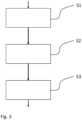
- FIG. 3 shows an example flowchart of the method.
- the method is a method for calibrating e.g. the at least one sensor 1 by use of the at least one calibration sensor 2, wherein the at least one sensor 1 and the at least one calibration sensor 2 are moving relative each other during calibration.
- the at least one sensor 1 and the at least one calibration sensor are moving since the vehicles 10 and 20 are moving.
- the vehicles 10, 20 are here moving along respective trajectories, T1, T2.
- the trajectories T1, T2 define travelling paths for the vehicles 10, 20.
- the method comprises: S1: obtaining information indicative of a proximity time period pt when the at least one sensor 1 and the at least one calibration sensor 2 are and/or will be in a predefined proximity zone PZ of each other for a time period which is sufficient for calibration.
- the predefined proximity zone PZ is here indicated by dashed lines in fig. 1 .
- the predefined proximity zone PZ may e.g. be defined by a maximum allowed distance between the at least one sensor 1 and the at least one calibration sensor 2.
- the maximum allowed distance may be 100 metres (m) from each other.
- the maximum allowed distance is highly dependent on the specific situation, type of sensor etc.
- this example is merely one example of many.
- a time period which is sufficient for calibration may be determined in e.g. minutes or seconds (s), such as 5, 10, 15 or 20 s. Of course, this time period is also highly dependent on the specific situation, type of sensor etc.
- the method further comprises:
- the sensor reading/s may cease for at least the refractory time period/s rs, rc prior to the arrival of the sensors 1, 2 in the predefined proximity zone PZ.
- Obtaining information about the refractory time period rs, rc may comprise obtaining information about a refractory time period rs for the at least one sensor 1 and a refractory time period rc for the at least one calibration sensor 2, and wherein the refractory time periods rs, rc for the at least one sensor 1 and the at least one calibration sensor 2 are considered by delaying their sensor readings such that it is ensured that the sensor readings of the at least one sensor 1 and the at least one calibration sensor 2 are spatially and temporally aligned for the calibration.
- the method may further comprise:
- the method may further comprise:
- the data in this example may be data relating to the trajectories T1, T2.
- the time table may for example be a time table for the bus 10, 20 as shown in fig. 2 .
- the method may further comprise:
- the need for calibrating the at least one sensor 1 may be identified based on an analysis of previous sensor readings of the at least one sensor 1, wherein the analysis comprises identifying a statistically significant increase in a number of outlying data points of the sensor readings.
- the at least one calibration sensor 2 may be any one of:
- the at least one calibration sensor 2 is a temperature sensor, and that the at least one sensor 1 is an air quality sensor measuring NO x levels.
- the at least one sensor 1 may be calibrated by use of the temperature information measured by the at least one calibration sensor 2 when being in the predefined proximity zone PZ while also the at least one sensor 1 is in the predefined proximity zone PZ.
- the method may further comprise:
- the at least one sensor 1 and the at least one calibration sensor 2 may form part of a system 100, wherein the at least one sensor 1 and the at least one calibration sensor 2 are adapted to be moved relative each other during calibration.
- the system 100 may be configured to perform the steps of the method according to any one of the embodiments of the first aspect of the disclosure.
- the vehicle 10 and/or the vehicle 20 may comprise at least one control unit (not shown), wherein the at least one control unit comprises hardware and/or software for performing the method as disclosed herein.
- the first vehicle 10 may be configured to perform the method as disclosed herein, e.g. by use of the aforementioned control unit.
- the first vehicle 10 and/or the second vehicle 20 preferably comprises means for wireless communication for communicating with the other vehicle and/or with an offboard control system (not shown) for vehicles.
Landscapes
- Engineering & Computer Science (AREA)
- General Physics & Mathematics (AREA)
- Physics & Mathematics (AREA)
- Chemical & Material Sciences (AREA)
- Life Sciences & Earth Sciences (AREA)
- Health & Medical Sciences (AREA)
- Radar, Positioning & Navigation (AREA)
- Remote Sensing (AREA)
- Automation & Control Theory (AREA)
- Medicinal Chemistry (AREA)
- Combustion & Propulsion (AREA)
- Food Science & Technology (AREA)
- Analytical Chemistry (AREA)
- Biochemistry (AREA)
- General Health & Medical Sciences (AREA)
- Immunology (AREA)
- Pathology (AREA)
- Mechanical Engineering (AREA)
- Transportation (AREA)
- Human Computer Interaction (AREA)
- Computer Networks & Wireless Communication (AREA)
- Testing Or Calibration Of Command Recording Devices (AREA)
Claims (13)
- Verfahren zum Kalibrieren mindestens eines Sensors (1) unter Verwendung mindestens eines Kalibrierungssensors (2), wobei sich der mindestens eine Sensor (1) und der mindestens eine Kalibrierungssensor (2) während der Kalibrierung relativ zueinander bewegen, das Verfahren umfassend:- Erhalten (S1) von Informationen, die einen Näherungszeitraum (pt) angeben, wenn der mindestens eine Sensor (1) und der mindestens eine Kalibrierungssensor (2) in einer vordefinierten Näherungszone (PZ), für einen Zeitraum, der für die Kalibrierung ausreichend ist, sind und/oder sein werden;- Erhalten (2) von Informationen über einen Refraktärzeitraum (rs, rc) für mindestens einen des mindestens einen Sensors und des mindestens einen Kalibrierungssensor, wobei der Refraktärzeitraum einen Zeitraum zwischen zwei aufeinanderfolgenden Sensorablesungen definiert, in denen der Sensor nicht in der Lage ist, eine Sensorablesungen vorzunehmen;- Kalibrieren (S3) des mindestens einen Sensors durch eine Sensorablesung des mindestens einen Sensors und einer Sensorablesung des mindestens einen Kalibrierungssensors, wobei die Sensorablesungen vorgenommen werden, wenn sie in der vordefinierten Näherungszone (PZ) sind, wobei der Refraktärzeitraum (rs, rc) für den mindestens einen von dem mindestens einen Sensor und dem mindestens einen Kalibrierungssensor berücksichtigt wird, durch Verzögern seiner Sensorablesung, derart, dass sichergestellt wird, dass die Sensorablesungen des mindestens einen Sensors (1) und des mindestens einen Kalibrierungssensors (2) räumlich und zeitlich für die Kalibrierung ausgerichtet sind.
- Verfahren nach Anspruch 1, wobei das Erhalten von Informationen über den Refraktärzeitraum das Erhalten von Informationen über einen Refraktärzeitraum (rs) für den mindestens einen Sensor (1) und einen Refraktärzeitraum (rc) für den mindestens einen Kalibrierungssensor (2) umfasst, und wobei die Refraktärzeiträume (rs, rc) für den mindestens einen Sensor (1) und den mindestens eine Kalibrierungssensor (2) berücksichtigt werden, durch Verzögern ihrer Sensorablesungen, derart, dass sichergestellt wird, dass die Sensorablesungen des mindestens einen Sensors (1) und des mindestens einen Kalibrierungssensors (2) räumlich und zeitlich für die Kalibrierung ausgerichtet sind.
- Verfahren nach einem der vorstehenden Ansprüche, wobei die Sensorablesung(en) für mindestens den Refraktärzeitraum/die Refraktärzeiträume (rs, rc) vor dem Eintreffen der Sensoren in der vordefinierten Näherungszone (PZ) endet/n.
- Verfahren nach einem der vorstehenden Ansprüche, ferner umfassend:- Bestimmen des Näherungszeitraums (pt), wenn der mindestens eine Sensor (1) und der mindestens eine Kalibrierungssensor (2) in der vordefinierten Näherungszone (PZ) sind/oder sein werden, unter Verwendung von Informationen über eine beliebige oder eine Kombination aus relativer Geschwindigkeit, Bewegungsrichtung und Geolokation des mindestens einen Sensors (1) und des mindestens einen Kalibrierungssensors (2).
- Verfahren nach einem der vorstehenden Ansprüche, wobei mindestens einer des mindestens einen Sensors (1) und des mindestens einen Kalibrierungssensors (2) an einem Fahrzeug (10, 20) oder Wasserfahrzeug montiert ist.
- Verfahren nach Anspruch 5, ferner umfassend:- Bestimmen des Näherungszeitraums (pt), wenn der mindestens eine Sensor (1) und der mindestens eine Kalibrierungssensor (2) in der vordefinierten Näherungszone (PZ) sind/oder sein werden, unter Verwendung einer beliebigen oder einer Kombination von Folgendem:- Informationen über eine Zeittabelle, die dem Fahrzeug (10, 20) oder dem Wasserfahrzeug zugeordnet ist;- Daten, die ein Bewegungsmuster des Fahrzeugs (10, 20) oder des Wasserfahrzeugs angeben.
- Verfahren nach einem der vorstehenden Ansprüche, ferner umfassend:- Identifizieren eines Bedarfs zum Kalibrieren des mindestens einen Sensors (1) basierend auf mindestens einem des Folgenden:- einen Kalibrierungsplan;- eine Analyse vorheriger Sensorablesungen des mindestens einen Sensors (1);- eine Bestimmung, dass ein vorbestimmter Schwellenwert bis zu einer nächsten möglichen Gelegenheit überschritten wird, um den mindestens einen Sensor (1) zu kalibrieren, wobei der vorbestimmte Schwellenwert eine verstrichene Zeit und/oder eine Anzahl von Sensorablesungen angibt, nach denen der mindestens eine Sensor (1) kalibriert werden muss;- einen Vergleich mit einem bekannten Sensordatenmuster, das angibt, dass die Kalibrierung notwendig ist; und- einen Maschinenlernalgorithmus.
- Verfahren nach Anspruch 7, wobei der Bedarf für das Kalibrieren basierend auf einer Analyse vorheriger Sensorablesungen des mindestens einen Sensors (1) identifiziert wird, wobei die Analyse das Identifizieren einer statistisch signifikanten Erhöhung einer Anzahl von entlegenen Datenpunkten der Sensorablesungen umfasst.
- Verfahren nach einem der vorstehenden Ansprüche, wobei der mindestens eine Kalibrierungssensor (2) ein beliebiger ist von:- der gleichen Art wie der mindestens eine Sensor;- einem Referenzsensor, der die gleiche Eigenschaft wie der mindestens eine Sensor mißt; und- einen Sensor zum Messen einer anderen Eigenschaft als der mindestens eine Sensor, wobei die andere Eigenschaft verwendet werden kann, um den mindestens einen Sensor zu kalibrieren.
- Verfahren nach einem der vorstehenden Ansprüche, ferner umfassend:- Bestimmen, wann eine Vielzahl von Sensoren, die eine Kalibrierung erfordern, in der vordefinierten Näherungszone (PZ) sein werden; und- Vornehmen der Sensorablesungen der Vielzahl von Sensoren und/oder des mindestens einen Kalibrierungssensors, derart, dass sichergestellt wird, dass eine maximale Anzahl der Vielzahl von Sensoren kalibriert wird.
- Verfahren nach einem der vorstehenden Ansprüche, wobei der mindestens eine Sensor (1) und/oder der mindestens eine Kalibrierungssensor (2) eines der Folgenden ist:- eine Sensormesscharakteristik von abgetasteten Gasen, Flüssigkeiten oder Partikeln, wie eine Gesamtzusammensetzung oder eine Konzentration oder eine direkte Messung physikalischer Charakteristika wie Größe, radiative oder optische Eigenschaften, usw.;- ein Sensor, der elektromagnetische Parameter mißt;- ein Temperatursensor;- ein Drucksensor;- ein Feuchtigkeitssensor.
- Erstes Fahrzeug (10) oder Wasserfahrzeug, umfassend mindestens einen Sensor (1), der konfiguriert ist, um durch mindestens einen Kalibrierungssensor (2) kalibriert zu werden, der vom ersten Fahrzeug oder Wasserfahrzeug entfernt ist, wobei das erste Fahrzeug (10) oder das Wasserfahrzeug konfiguriert ist, um das Verfahren nach einem der Ansprüche 1 bis 11 durchzuführen.
- Erstes Fahrzeug (10) oder Wasserfahrzeug nach Anspruch 12, ferner umfassend Mittel für eine drahtlose Kommunikation zum Kommunizieren mit einem anderen Fahrzeug oder Wasserfahrzeug und/oder mit einem Offboard-Steuersystem für Fahrzeuge oder Wasserfahrzeuge.
Priority Applications (3)
| Application Number | Priority Date | Filing Date | Title |
|---|---|---|---|
| EP21156156.8A EP4043836B1 (de) | 2021-02-10 | 2021-02-10 | Verfahren zur kalibrierung von mindestens einem sensor unter verwendung von mindestens einem kalibrierungssensor |
| CN202111532729.XA CN114910109A (zh) | 2021-02-10 | 2021-12-15 | 通过使用至少一个校准传感器校准至少一个传感器的方法 |
| US17/647,538 US11946918B2 (en) | 2021-02-10 | 2022-01-10 | Method for calibrating at least one sensor by use of at least one calibration sensor |
Applications Claiming Priority (1)
| Application Number | Priority Date | Filing Date | Title |
|---|---|---|---|
| EP21156156.8A EP4043836B1 (de) | 2021-02-10 | 2021-02-10 | Verfahren zur kalibrierung von mindestens einem sensor unter verwendung von mindestens einem kalibrierungssensor |
Publications (2)
| Publication Number | Publication Date |
|---|---|
| EP4043836A1 EP4043836A1 (de) | 2022-08-17 |
| EP4043836B1 true EP4043836B1 (de) | 2023-09-20 |
Family
ID=74586820
Family Applications (1)
| Application Number | Title | Priority Date | Filing Date |
|---|---|---|---|
| EP21156156.8A Active EP4043836B1 (de) | 2021-02-10 | 2021-02-10 | Verfahren zur kalibrierung von mindestens einem sensor unter verwendung von mindestens einem kalibrierungssensor |
Country Status (3)
| Country | Link |
|---|---|
| US (1) | US11946918B2 (de) |
| EP (1) | EP4043836B1 (de) |
| CN (1) | CN114910109A (de) |
Families Citing this family (2)
| Publication number | Priority date | Publication date | Assignee | Title |
|---|---|---|---|---|
| FR3144865A1 (fr) * | 2023-01-06 | 2024-07-12 | Psa Automobiles Sa | Procédé et dispositif d’étalonnage d’un capteur d’un véhicule configuré pour mesurer la qualité de l’air d’un environnement du véhicule à partir d’un autre véhicule. |
| CN118518833B (zh) * | 2024-07-23 | 2024-10-29 | 中山大学 | 基于车路云协同的移动空气质量监测系统动态校准方法 |
Family Cites Families (13)
| Publication number | Priority date | Publication date | Assignee | Title |
|---|---|---|---|---|
| US20090172035A1 (en) * | 2007-12-31 | 2009-07-02 | Pieter Lessing | System and method for capturing and storing casino information in a relational database system |
| US8325061B2 (en) * | 2010-01-07 | 2012-12-04 | Emilcott Associates, Inc. | System and method for mobile environmental measurements and displays |
| WO2017189361A1 (en) * | 2016-04-29 | 2017-11-02 | Pcms Holdings, Inc. | System and method for calibration of vehicle sensors assisted by inter-vehicle communication |
| WO2017193100A1 (en) * | 2016-05-06 | 2017-11-09 | Qelzal Corporation | Event-based aircraft sense and avoid system |
| CN106707873B (zh) * | 2017-01-16 | 2019-02-26 | 上海兆芯集成电路有限公司 | 传感集线器及应用处理器间的数据同步方法及其装置 |
| US10553044B2 (en) * | 2018-01-31 | 2020-02-04 | Mentor Graphics Development (Deutschland) Gmbh | Self-diagnosis of faults with a secondary system in an autonomous driving system |
| US11262339B2 (en) * | 2018-10-09 | 2022-03-01 | Airlib Inc. | Remote sensor calibration system |
| US10969470B2 (en) * | 2019-02-15 | 2021-04-06 | May Mobility, Inc. | Systems and methods for intelligently calibrating infrastructure devices using onboard sensors of an autonomous agent |
| US11703882B2 (en) * | 2019-05-21 | 2023-07-18 | U.S. Government as represented by the Secretary of the Air Force | Bio-hybrid odor-guided autonomous palm-sized air vehicle |
| US20210063165A1 (en) * | 2019-08-30 | 2021-03-04 | Mentor Graphics Deutschland (Germany) GmbH | Adaptive map-matching-based vehicle localization |
| US11798191B2 (en) * | 2020-03-27 | 2023-10-24 | Intel Corporation | Sensor calibration and sensor calibration detection |
| EP4172573B1 (de) * | 2020-06-24 | 2024-06-05 | Volvo Truck Corporation | Lokale messungen mit mehreren beweglichen sensoren |
| US20230266079A1 (en) * | 2020-08-05 | 2023-08-24 | Active Energy Systems | Heat exchange system for freezing, transferring, storing, and utilizing phase change material and application of that system to a thermal energy storage system |
-
2021
- 2021-02-10 EP EP21156156.8A patent/EP4043836B1/de active Active
- 2021-12-15 CN CN202111532729.XA patent/CN114910109A/zh active Pending
-
2022
- 2022-01-10 US US17/647,538 patent/US11946918B2/en active Active
Also Published As
| Publication number | Publication date |
|---|---|
| CN114910109A (zh) | 2022-08-16 |
| US11946918B2 (en) | 2024-04-02 |
| US20220252563A1 (en) | 2022-08-11 |
| EP4043836A1 (de) | 2022-08-17 |
Similar Documents
| Publication | Publication Date | Title |
|---|---|---|
| KR102635379B1 (ko) | 차량 기동 계획 및 메시징을 위한 방법 및 장치 | |
| CN105799617B (zh) | 用于确定物体传感器的未对准的方法 | |
| CN110972066B (zh) | 列车及其安全定位系统 | |
| US9043072B1 (en) | Methods and systems for correcting an estimated heading using a map | |
| CN110103852B (zh) | 用于自主车辆中的碰撞检测的系统和方法 | |
| US11435439B2 (en) | Multibounce target mitigation | |
| CN111857123A (zh) | 紧急路线规划系统 | |
| CN107850444B (zh) | 行驶控制方法及行驶控制装置 | |
| CN103096247A (zh) | 利用移动基站控制车辆间的相对位置的方法和系统 | |
| US11435434B2 (en) | Multibounce target additional data | |
| CN102887150A (zh) | 列车控制系统 | |
| CN107091647B (zh) | 港口集装箱水平搬运无人车导航方法 | |
| US11946918B2 (en) | Method for calibrating at least one sensor by use of at least one calibration sensor | |
| JP7603689B2 (ja) | 交差点軌道決定およびメッセージング | |
| KR20240152305A (ko) | 차량 발신 무선 안전 경고 | |
| CN114846350B (zh) | 基于变化的雷达参数动态加载雷达单元配置数据 | |
| JP4548604B2 (ja) | 車車間通信システム | |
| US11292307B2 (en) | Suspension fault diagnostics and prognostics using pitch and roll model | |
| EP4564049A1 (de) | Verfahren und systeme zur validierung des radarpitchs eines kraftfahrzeugs unter verwendung von höhenseitenkeulenmessungen | |
| KR102637830B1 (ko) | 위치 결정을 위한 방법, 전자 제어 장치 및 시스템 | |
| JP2022103546A (ja) | 車両制御装置、車両制御方法、及びプログラム | |
| CN112223974A (zh) | 用于在车辆中稳健地、自动地调节空调设备的系统和方法 | |
| WO2020211934A1 (en) | A method for guiding a vehicle into a desired spatial configuration | |
| EP4332614B1 (de) | Verfahren und systeme zur verwendung von interferenzen zur erkennung von sensorbeeinträchtigungen | |
| US12358515B2 (en) | Method for assessing lateral acceleration using telemetry data |
Legal Events
| Date | Code | Title | Description |
|---|---|---|---|
| PUAI | Public reference made under article 153(3) epc to a published international application that has entered the european phase |
Free format text: ORIGINAL CODE: 0009012 |
|
| STAA | Information on the status of an ep patent application or granted ep patent |
Free format text: STATUS: THE APPLICATION HAS BEEN PUBLISHED |
|
| AK | Designated contracting states |
Kind code of ref document: A1 Designated state(s): AL AT BE BG CH CY CZ DE DK EE ES FI FR GB GR HR HU IE IS IT LI LT LU LV MC MK MT NL NO PL PT RO RS SE SI SK SM TR |
|
| STAA | Information on the status of an ep patent application or granted ep patent |
Free format text: STATUS: REQUEST FOR EXAMINATION WAS MADE |
|
| 17P | Request for examination filed |
Effective date: 20230126 |
|
| RBV | Designated contracting states (corrected) |
Designated state(s): AL AT BE BG CH CY CZ DE DK EE ES FI FR GB GR HR HU IE IS IT LI LT LU LV MC MK MT NL NO PL PT RO RS SE SI SK SM TR |
|
| GRAP | Despatch of communication of intention to grant a patent |
Free format text: ORIGINAL CODE: EPIDOSNIGR1 |
|
| STAA | Information on the status of an ep patent application or granted ep patent |
Free format text: STATUS: GRANT OF PATENT IS INTENDED |
|
| INTG | Intention to grant announced |
Effective date: 20230515 |
|
| GRAS | Grant fee paid |
Free format text: ORIGINAL CODE: EPIDOSNIGR3 |
|
| GRAA | (expected) grant |
Free format text: ORIGINAL CODE: 0009210 |
|
| STAA | Information on the status of an ep patent application or granted ep patent |
Free format text: STATUS: THE PATENT HAS BEEN GRANTED |
|
| AK | Designated contracting states |
Kind code of ref document: B1 Designated state(s): AL AT BE BG CH CY CZ DE DK EE ES FI FR GB GR HR HU IE IS IT LI LT LU LV MC MK MT NL NO PL PT RO RS SE SI SK SM TR |
|
| REG | Reference to a national code |
Ref country code: GB Ref legal event code: FG4D |
|
| REG | Reference to a national code |
Ref country code: CH Ref legal event code: EP |
|
| REG | Reference to a national code |
Ref country code: IE Ref legal event code: FG4D |
|
| REG | Reference to a national code |
Ref country code: DE Ref legal event code: R096 Ref document number: 602021005191 Country of ref document: DE |
|
| REG | Reference to a national code |
Ref country code: LT Ref legal event code: MG9D |
|
| PG25 | Lapsed in a contracting state [announced via postgrant information from national office to epo] |
Ref country code: GR Free format text: LAPSE BECAUSE OF FAILURE TO SUBMIT A TRANSLATION OF THE DESCRIPTION OR TO PAY THE FEE WITHIN THE PRESCRIBED TIME-LIMIT Effective date: 20231221 |
|
| REG | Reference to a national code |
Ref country code: NL Ref legal event code: MP Effective date: 20230920 |
|
| PG25 | Lapsed in a contracting state [announced via postgrant information from national office to epo] |
Ref country code: SE Free format text: LAPSE BECAUSE OF FAILURE TO SUBMIT A TRANSLATION OF THE DESCRIPTION OR TO PAY THE FEE WITHIN THE PRESCRIBED TIME-LIMIT Effective date: 20230920 Ref country code: RS Free format text: LAPSE BECAUSE OF FAILURE TO SUBMIT A TRANSLATION OF THE DESCRIPTION OR TO PAY THE FEE WITHIN THE PRESCRIBED TIME-LIMIT Effective date: 20230920 Ref country code: NO Free format text: LAPSE BECAUSE OF FAILURE TO SUBMIT A TRANSLATION OF THE DESCRIPTION OR TO PAY THE FEE WITHIN THE PRESCRIBED TIME-LIMIT Effective date: 20231220 Ref country code: LV Free format text: LAPSE BECAUSE OF FAILURE TO SUBMIT A TRANSLATION OF THE DESCRIPTION OR TO PAY THE FEE WITHIN THE PRESCRIBED TIME-LIMIT Effective date: 20230920 Ref country code: LT Free format text: LAPSE BECAUSE OF FAILURE TO SUBMIT A TRANSLATION OF THE DESCRIPTION OR TO PAY THE FEE WITHIN THE PRESCRIBED TIME-LIMIT Effective date: 20230920 Ref country code: HR Free format text: LAPSE BECAUSE OF FAILURE TO SUBMIT A TRANSLATION OF THE DESCRIPTION OR TO PAY THE FEE WITHIN THE PRESCRIBED TIME-LIMIT Effective date: 20230920 Ref country code: GR Free format text: LAPSE BECAUSE OF FAILURE TO SUBMIT A TRANSLATION OF THE DESCRIPTION OR TO PAY THE FEE WITHIN THE PRESCRIBED TIME-LIMIT Effective date: 20231221 Ref country code: FI Free format text: LAPSE BECAUSE OF FAILURE TO SUBMIT A TRANSLATION OF THE DESCRIPTION OR TO PAY THE FEE WITHIN THE PRESCRIBED TIME-LIMIT Effective date: 20230920 |
|
| REG | Reference to a national code |
Ref country code: AT Ref legal event code: MK05 Ref document number: 1613713 Country of ref document: AT Kind code of ref document: T Effective date: 20230920 |
|
| PG25 | Lapsed in a contracting state [announced via postgrant information from national office to epo] |
Ref country code: NL Free format text: LAPSE BECAUSE OF FAILURE TO SUBMIT A TRANSLATION OF THE DESCRIPTION OR TO PAY THE FEE WITHIN THE PRESCRIBED TIME-LIMIT Effective date: 20230920 |
|
| PG25 | Lapsed in a contracting state [announced via postgrant information from national office to epo] |
Ref country code: IS Free format text: LAPSE BECAUSE OF FAILURE TO SUBMIT A TRANSLATION OF THE DESCRIPTION OR TO PAY THE FEE WITHIN THE PRESCRIBED TIME-LIMIT Effective date: 20240120 |
|
| PG25 | Lapsed in a contracting state [announced via postgrant information from national office to epo] |
Ref country code: AT Free format text: LAPSE BECAUSE OF FAILURE TO SUBMIT A TRANSLATION OF THE DESCRIPTION OR TO PAY THE FEE WITHIN THE PRESCRIBED TIME-LIMIT Effective date: 20230920 |
|
| PG25 | Lapsed in a contracting state [announced via postgrant information from national office to epo] |
Ref country code: ES Free format text: LAPSE BECAUSE OF FAILURE TO SUBMIT A TRANSLATION OF THE DESCRIPTION OR TO PAY THE FEE WITHIN THE PRESCRIBED TIME-LIMIT Effective date: 20230920 |
|
| PG25 | Lapsed in a contracting state [announced via postgrant information from national office to epo] |
Ref country code: SM Free format text: LAPSE BECAUSE OF FAILURE TO SUBMIT A TRANSLATION OF THE DESCRIPTION OR TO PAY THE FEE WITHIN THE PRESCRIBED TIME-LIMIT Effective date: 20230920 Ref country code: RO Free format text: LAPSE BECAUSE OF FAILURE TO SUBMIT A TRANSLATION OF THE DESCRIPTION OR TO PAY THE FEE WITHIN THE PRESCRIBED TIME-LIMIT Effective date: 20230920 Ref country code: IS Free format text: LAPSE BECAUSE OF FAILURE TO SUBMIT A TRANSLATION OF THE DESCRIPTION OR TO PAY THE FEE WITHIN THE PRESCRIBED TIME-LIMIT Effective date: 20240120 Ref country code: ES Free format text: LAPSE BECAUSE OF FAILURE TO SUBMIT A TRANSLATION OF THE DESCRIPTION OR TO PAY THE FEE WITHIN THE PRESCRIBED TIME-LIMIT Effective date: 20230920 Ref country code: EE Free format text: LAPSE BECAUSE OF FAILURE TO SUBMIT A TRANSLATION OF THE DESCRIPTION OR TO PAY THE FEE WITHIN THE PRESCRIBED TIME-LIMIT Effective date: 20230920 Ref country code: CZ Free format text: LAPSE BECAUSE OF FAILURE TO SUBMIT A TRANSLATION OF THE DESCRIPTION OR TO PAY THE FEE WITHIN THE PRESCRIBED TIME-LIMIT Effective date: 20230920 Ref country code: AT Free format text: LAPSE BECAUSE OF FAILURE TO SUBMIT A TRANSLATION OF THE DESCRIPTION OR TO PAY THE FEE WITHIN THE PRESCRIBED TIME-LIMIT Effective date: 20230920 Ref country code: PT Free format text: LAPSE BECAUSE OF FAILURE TO SUBMIT A TRANSLATION OF THE DESCRIPTION OR TO PAY THE FEE WITHIN THE PRESCRIBED TIME-LIMIT Effective date: 20240122 Ref country code: SK Free format text: LAPSE BECAUSE OF FAILURE TO SUBMIT A TRANSLATION OF THE DESCRIPTION OR TO PAY THE FEE WITHIN THE PRESCRIBED TIME-LIMIT Effective date: 20230920 |
|
| PG25 | Lapsed in a contracting state [announced via postgrant information from national office to epo] |
Ref country code: PL Free format text: LAPSE BECAUSE OF FAILURE TO SUBMIT A TRANSLATION OF THE DESCRIPTION OR TO PAY THE FEE WITHIN THE PRESCRIBED TIME-LIMIT Effective date: 20230920 Ref country code: IT Free format text: LAPSE BECAUSE OF FAILURE TO SUBMIT A TRANSLATION OF THE DESCRIPTION OR TO PAY THE FEE WITHIN THE PRESCRIBED TIME-LIMIT Effective date: 20230920 |
|
| PGFP | Annual fee paid to national office [announced via postgrant information from national office to epo] |
Ref country code: FR Payment date: 20240226 Year of fee payment: 4 |
|
| REG | Reference to a national code |
Ref country code: DE Ref legal event code: R097 Ref document number: 602021005191 Country of ref document: DE |
|
| PG25 | Lapsed in a contracting state [announced via postgrant information from national office to epo] |
Ref country code: DK Free format text: LAPSE BECAUSE OF FAILURE TO SUBMIT A TRANSLATION OF THE DESCRIPTION OR TO PAY THE FEE WITHIN THE PRESCRIBED TIME-LIMIT Effective date: 20230920 |
|
| PLBE | No opposition filed within time limit |
Free format text: ORIGINAL CODE: 0009261 |
|
| STAA | Information on the status of an ep patent application or granted ep patent |
Free format text: STATUS: NO OPPOSITION FILED WITHIN TIME LIMIT |
|
| PG25 | Lapsed in a contracting state [announced via postgrant information from national office to epo] |
Ref country code: DK Free format text: LAPSE BECAUSE OF FAILURE TO SUBMIT A TRANSLATION OF THE DESCRIPTION OR TO PAY THE FEE WITHIN THE PRESCRIBED TIME-LIMIT Effective date: 20230920 |
|
| 26N | No opposition filed |
Effective date: 20240621 |
|
| PG25 | Lapsed in a contracting state [announced via postgrant information from national office to epo] |
Ref country code: MC Free format text: LAPSE BECAUSE OF FAILURE TO SUBMIT A TRANSLATION OF THE DESCRIPTION OR TO PAY THE FEE WITHIN THE PRESCRIBED TIME-LIMIT Effective date: 20230920 |
|
| REG | Reference to a national code |
Ref country code: CH Ref legal event code: PL |
|
| PG25 | Lapsed in a contracting state [announced via postgrant information from national office to epo] |
Ref country code: LU Free format text: LAPSE BECAUSE OF NON-PAYMENT OF DUE FEES Effective date: 20240210 |
|
| PG25 | Lapsed in a contracting state [announced via postgrant information from national office to epo] |
Ref country code: CH Free format text: LAPSE BECAUSE OF NON-PAYMENT OF DUE FEES Effective date: 20240229 |
|
| PG25 | Lapsed in a contracting state [announced via postgrant information from national office to epo] |
Ref country code: SI Free format text: LAPSE BECAUSE OF FAILURE TO SUBMIT A TRANSLATION OF THE DESCRIPTION OR TO PAY THE FEE WITHIN THE PRESCRIBED TIME-LIMIT Effective date: 20230920 |
|
| PG25 | Lapsed in a contracting state [announced via postgrant information from national office to epo] |
Ref country code: SI Free format text: LAPSE BECAUSE OF FAILURE TO SUBMIT A TRANSLATION OF THE DESCRIPTION OR TO PAY THE FEE WITHIN THE PRESCRIBED TIME-LIMIT Effective date: 20230920 Ref country code: LU Free format text: LAPSE BECAUSE OF NON-PAYMENT OF DUE FEES Effective date: 20240210 Ref country code: CH Free format text: LAPSE BECAUSE OF NON-PAYMENT OF DUE FEES Effective date: 20240229 |
|
| PG25 | Lapsed in a contracting state [announced via postgrant information from national office to epo] |
Ref country code: BG Free format text: LAPSE BECAUSE OF FAILURE TO SUBMIT A TRANSLATION OF THE DESCRIPTION OR TO PAY THE FEE WITHIN THE PRESCRIBED TIME-LIMIT Effective date: 20230920 |
|
| PG25 | Lapsed in a contracting state [announced via postgrant information from national office to epo] |
Ref country code: BG Free format text: LAPSE BECAUSE OF FAILURE TO SUBMIT A TRANSLATION OF THE DESCRIPTION OR TO PAY THE FEE WITHIN THE PRESCRIBED TIME-LIMIT Effective date: 20230920 |
|
| REG | Reference to a national code |
Ref country code: BE Ref legal event code: MM Effective date: 20240229 |
|
| PG25 | Lapsed in a contracting state [announced via postgrant information from national office to epo] |
Ref country code: BE Free format text: LAPSE BECAUSE OF NON-PAYMENT OF DUE FEES Effective date: 20240229 |
|
| PG25 | Lapsed in a contracting state [announced via postgrant information from national office to epo] |
Ref country code: IE Free format text: LAPSE BECAUSE OF NON-PAYMENT OF DUE FEES Effective date: 20240210 |
|
| PG25 | Lapsed in a contracting state [announced via postgrant information from national office to epo] |
Ref country code: IE Free format text: LAPSE BECAUSE OF NON-PAYMENT OF DUE FEES Effective date: 20240210 Ref country code: BE Free format text: LAPSE BECAUSE OF NON-PAYMENT OF DUE FEES Effective date: 20240229 |
|
| PGFP | Annual fee paid to national office [announced via postgrant information from national office to epo] |
Ref country code: DE Payment date: 20250226 Year of fee payment: 5 |
|
| PG25 | Lapsed in a contracting state [announced via postgrant information from national office to epo] |
Ref country code: CY Free format text: LAPSE BECAUSE OF FAILURE TO SUBMIT A TRANSLATION OF THE DESCRIPTION OR TO PAY THE FEE WITHIN THE PRESCRIBED TIME-LIMIT; INVALID AB INITIO Effective date: 20210210 |
|
| PG25 | Lapsed in a contracting state [announced via postgrant information from national office to epo] |
Ref country code: HU Free format text: LAPSE BECAUSE OF FAILURE TO SUBMIT A TRANSLATION OF THE DESCRIPTION OR TO PAY THE FEE WITHIN THE PRESCRIBED TIME-LIMIT; INVALID AB INITIO Effective date: 20210210 |
|
| GBPC | Gb: european patent ceased through non-payment of renewal fee |
Effective date: 20250210 |
|
| PG25 | Lapsed in a contracting state [announced via postgrant information from national office to epo] |
Ref country code: TR Free format text: LAPSE BECAUSE OF FAILURE TO SUBMIT A TRANSLATION OF THE DESCRIPTION OR TO PAY THE FEE WITHIN THE PRESCRIBED TIME-LIMIT Effective date: 20230920 |
|
| PG25 | Lapsed in a contracting state [announced via postgrant information from national office to epo] |
Ref country code: GB Free format text: LAPSE BECAUSE OF NON-PAYMENT OF DUE FEES Effective date: 20250210 |
|
| PG25 | Lapsed in a contracting state [announced via postgrant information from national office to epo] |
Ref country code: FR Free format text: LAPSE BECAUSE OF NON-PAYMENT OF DUE FEES Effective date: 20250228 |