EP4043059B1 - Rohrförmiges element zur medizinischen anwendung - Google Patents
Rohrförmiges element zur medizinischen anwendung Download PDFInfo
- Publication number
- EP4043059B1 EP4043059B1 EP21211009.2A EP21211009A EP4043059B1 EP 4043059 B1 EP4043059 B1 EP 4043059B1 EP 21211009 A EP21211009 A EP 21211009A EP 4043059 B1 EP4043059 B1 EP 4043059B1
- Authority
- EP
- European Patent Office
- Prior art keywords
- operating angle
- marker
- main body
- tubular element
- tubular
- Prior art date
- Legal status (The legal status is an assumption and is not a legal conclusion. Google has not performed a legal analysis and makes no representation as to the accuracy of the status listed.)
- Active
Links
Images

Classifications
-
- A—HUMAN NECESSITIES
- A61—MEDICAL OR VETERINARY SCIENCE; HYGIENE
- A61M—DEVICES FOR INTRODUCING MEDIA INTO, OR ONTO, THE BODY; DEVICES FOR TRANSDUCING BODY MEDIA OR FOR TAKING MEDIA FROM THE BODY; DEVICES FOR PRODUCING OR ENDING SLEEP OR STUPOR
- A61M25/00—Catheters; Hollow probes
- A61M25/01—Introducing, guiding, advancing, emplacing or holding catheters
- A61M25/0105—Steering means as part of the catheter or advancing means; Markers for positioning
- A61M25/0108—Steering means as part of the catheter or advancing means; Markers for positioning using radio-opaque or ultrasound markers
-
- A—HUMAN NECESSITIES
- A61—MEDICAL OR VETERINARY SCIENCE; HYGIENE
- A61B—DIAGNOSIS; SURGERY; IDENTIFICATION
- A61B17/00—Surgical instruments, devices or methods
- A61B17/34—Trocars; Puncturing needles
- A61B17/3417—Details of tips or shafts, e.g. grooves, expandable, bendable; Multiple coaxial sliding cannulas, e.g. for dilating
-
- A—HUMAN NECESSITIES
- A61—MEDICAL OR VETERINARY SCIENCE; HYGIENE
- A61B—DIAGNOSIS; SURGERY; IDENTIFICATION
- A61B17/00—Surgical instruments, devices or methods
- A61B17/34—Trocars; Puncturing needles
- A61B17/3468—Trocars; Puncturing needles for implanting or removing devices, e.g. prostheses, implants, seeds, wires
-
- A—HUMAN NECESSITIES
- A61—MEDICAL OR VETERINARY SCIENCE; HYGIENE
- A61B—DIAGNOSIS; SURGERY; IDENTIFICATION
- A61B5/00—Measuring for diagnostic purposes; Identification of persons
- A61B5/15—Devices for taking samples of blood
-
- A—HUMAN NECESSITIES
- A61—MEDICAL OR VETERINARY SCIENCE; HYGIENE
- A61M—DEVICES FOR INTRODUCING MEDIA INTO, OR ONTO, THE BODY; DEVICES FOR TRANSDUCING BODY MEDIA OR FOR TAKING MEDIA FROM THE BODY; DEVICES FOR PRODUCING OR ENDING SLEEP OR STUPOR
- A61M25/00—Catheters; Hollow probes
- A61M25/0043—Catheters; Hollow probes characterised by structural features
- A61M25/0045—Catheters; Hollow probes characterised by structural features multi-layered, e.g. coated
-
- A—HUMAN NECESSITIES
- A61—MEDICAL OR VETERINARY SCIENCE; HYGIENE
- A61M—DEVICES FOR INTRODUCING MEDIA INTO, OR ONTO, THE BODY; DEVICES FOR TRANSDUCING BODY MEDIA OR FOR TAKING MEDIA FROM THE BODY; DEVICES FOR PRODUCING OR ENDING SLEEP OR STUPOR
- A61M5/00—Devices for bringing media into the body in a subcutaneous, intra-vascular or intramuscular way; Accessories therefor, e.g. filling or cleaning devices, arm-rests
- A61M5/178—Syringes
- A61M5/31—Details
- A61M5/32—Needles; Details of needles pertaining to their connection with syringe or hub; Accessories for bringing the needle into, or holding the needle on, the body; Devices for protection of needles
- A61M5/3286—Needle tip design, e.g. for improved penetration
-
- A—HUMAN NECESSITIES
- A61—MEDICAL OR VETERINARY SCIENCE; HYGIENE
- A61B—DIAGNOSIS; SURGERY; IDENTIFICATION
- A61B17/00—Surgical instruments, devices or methods
- A61B17/00234—Surgical instruments, devices or methods for minimally invasive surgery
- A61B2017/00238—Type of minimally invasive operation
- A61B2017/00243—Type of minimally invasive operation cardiac
-
- A—HUMAN NECESSITIES
- A61—MEDICAL OR VETERINARY SCIENCE; HYGIENE
- A61B—DIAGNOSIS; SURGERY; IDENTIFICATION
- A61B17/00—Surgical instruments, devices or methods
- A61B17/34—Trocars; Puncturing needles
- A61B17/3417—Details of tips or shafts, e.g. grooves, expandable, bendable; Multiple coaxial sliding cannulas, e.g. for dilating
- A61B2017/3454—Details of tips
-
- A—HUMAN NECESSITIES
- A61—MEDICAL OR VETERINARY SCIENCE; HYGIENE
- A61B—DIAGNOSIS; SURGERY; IDENTIFICATION
- A61B90/00—Instruments, implements or accessories specially adapted for surgery or diagnosis and not covered by any of the groups A61B1/00 - A61B50/00, e.g. for luxation treatment or for protecting wound edges
- A61B90/39—Markers, e.g. radio-opaque or breast lesions markers
- A61B2090/3937—Visible markers
-
- A—HUMAN NECESSITIES
- A61—MEDICAL OR VETERINARY SCIENCE; HYGIENE
- A61B—DIAGNOSIS; SURGERY; IDENTIFICATION
- A61B90/00—Instruments, implements or accessories specially adapted for surgery or diagnosis and not covered by any of the groups A61B1/00 - A61B50/00, e.g. for luxation treatment or for protecting wound edges
- A61B90/39—Markers, e.g. radio-opaque or breast lesions markers
- A61B2090/3937—Visible markers
- A61B2090/3941—Photoluminescent markers
-
- A—HUMAN NECESSITIES
- A61—MEDICAL OR VETERINARY SCIENCE; HYGIENE
- A61B—DIAGNOSIS; SURGERY; IDENTIFICATION
- A61B90/00—Instruments, implements or accessories specially adapted for surgery or diagnosis and not covered by any of the groups A61B1/00 - A61B50/00, e.g. for luxation treatment or for protecting wound edges
- A61B90/39—Markers, e.g. radio-opaque or breast lesions markers
- A61B2090/3966—Radiopaque markers visible in an X-ray image
-
- A—HUMAN NECESSITIES
- A61—MEDICAL OR VETERINARY SCIENCE; HYGIENE
- A61M—DEVICES FOR INTRODUCING MEDIA INTO, OR ONTO, THE BODY; DEVICES FOR TRANSDUCING BODY MEDIA OR FOR TAKING MEDIA FROM THE BODY; DEVICES FOR PRODUCING OR ENDING SLEEP OR STUPOR
- A61M25/00—Catheters; Hollow probes
- A61M25/01—Introducing, guiding, advancing, emplacing or holding catheters
- A61M25/06—Body-piercing guide needles or the like
- A61M25/065—Guide needles
Definitions
- This invention relates to the technical sector of devices for medical use.
- the invention relates to a tubular element which can be used in surgical and out-patient operations which involve the insertion and use of probes, catheters or cannulas in a predetermined anatomical part of the body, for example blood vessels and heart cavities.
- tubular elements designed to be inserted in a patient's body are delicate medical devices and designed for an equally delicate medical treatment and care purpose and therefore require particular attention in their design.
- one of the aims is to optimise the visibility in fluoroscopy without imparting additional rigidity to the tip so as not to adversely affect the safety of use.
- the technical purpose could be providing a tubular element for medical use which overcomes at least some of the above-mentioned drawbacks of the prior art.
- the aim would be to provide a tubular element for medical use which is able to guarantee at any time the correct and complete observation of the various parts of the element, following its insertion in the body of a patient.
- the invention describes a tubular element for medical use having a main body and a pointed end and optionaly comprising a marker applied at least at an angular portion of the wall of the tubular element which extends from the pointed end to at least a portion of the main body.
- the tubular element described may comprise a significantly radio-opaque marker which is not applied solely on its distal end, but also on at least part of the main body, allowing it to be viewed once inserted inside the body of the patient.
- the invention also relates to a percutaneous extrusion cannula configured for the complete or partial extraction of medical devices, both subcutaneous (for example of the neurological type) and from a cardiac chamber.
- the cannula comprises a tubular element according to the invention as defined in claim 1.
- the numeral 1 denotes in general a tubular element for medical use according to the invention, hereinafter referred to as element 1.
- tubular element for medical use will be used to refer, for example, to probes, catheters and cannulas which can be used during medical operations.
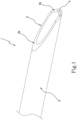
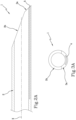
- the element 1 comprises a main body 2, a pointed end 3 and a marker 4.
- the main body 2 has a main axis of extension "X" and defines a gripping portion, preferably at a proximal end of the element 1, by which a user can handle the element 1, in particular for inserting it into or extracting it from the body of a patient.
- the pointed end 3 is in a distal position and is configured to allow and promote insertion and movement of the subcutaneous element 1, preferably inside a cardiovascular conduit.
- distal and proximal terms are used with reference to a configuration of use of the element wherein the pointed end 3 is the end designed to be inserted into the body of the patient, whilst the proximal end is the end designed to remain outside the body of the patient and preferably allow the retaining and the manipulating of the element 1 by the user.
- the element 1 also comprises a marker 4, that is to say, a substance different from the materials which make the rest of the element 1 and which can be detected by suitable detection systems.
- the marker may comprise a radio-opaque agent.
- the marker may further or alternatively comprise at least one between: colouring agent, opaque agent, magnetising agent, fluorescent agent, luminescent agent etc.
- the marker 4 is applied at least at an angular portion of the side wall of the tubular element 1 which extends from the pointed end 3 to at least a portion of the main body 2.
- the marker 4 is in the form of a continuous strip of radio-opaque material which occupies only an angular portion of the side wall of the element 1 which extends from the pointed end 3 to at least a portion of the main body 2.
- the marker 4 is applied in such a way as to extend at least partly along the main body 2 as well as on the part of the element 1 which defines the pointed end 3.
- the marker 4 is applied at a corner portion of the side wall of the element 1 which extends on the entire main body 2.
- the entire element 1, therefore the entire main body 2 and the pointed end 3, has the marker 4 applied along its entire length, in such a way as to make its entire profile detectable, irrespective of the length for which it is inserted inside the body of the patient.
- the marker 4 is at least partly incorporated in the side wall, that is to say, the marker 4 is applied inside the side wall of the element 1.
- the element 1 comprises a first marker 4 applied at the pointed end 3 and a second marker 4 at the applied at the main body 2.
- markers 5 may have different detecting characteristics, that is to say, they are susceptible to generate different measuring signals which allow them to be distinguished in a clear manner.
- the invention achieves the preset aims overcoming the drawbacks of the prior art by providing the user with a tubular element 1 for medical use wherein the presence of the marker applied not only on the tip of the element 1, but at least partly also on its main body 2 makes it possible to obtain, during use of the element 1, an overall and immediate view of the arrangement of the various elements introduced inside the patient's body.
- the high radio-opaqueness of the marker makes the tip clearly visibility in fluoroscopy, which must be manoeuvred very carefully, despite its reduced surface area compared with that of the main body.
- the pointed end 3 comprises a distal end 3a and an intermediate portion 3b.
- the distal end 3a has a front edge inclined relative to the main axis of extension "X", in such a way as to form with it a first operating angle ⁇ .
- the operating angle defines the angular amplitude adopted by the element 1 at the distal end 3a.
- the first operating angle ⁇ is between 40° and 50°, and 45° as defined in the present invention. 45°.
- the distal end 3a has a pointed shape, that is to say, it defines a tip with which it is possible to effectively engage the calcified tissue concretions which immobilise the devices to be explanted.
- the tip allows detachment of the sheath (constituting the outer covering of the electro-catheters) and/or the metallic parts (electrodes) from the tissues in which they are inserted and in which they could have been positioned following adherence and/or calcification processes, operating in fact like a chisel.
- the distal end 3a has an axial length of between 0.5 mm and 5 mm.
- the intermediate portion 3b performs, on the other hand, a function of connecting between the distal end 3a and the main body 2.
- the intermediate portion 3b also has a front edge inclined relative to the main axis of extension "X", in such a way as to form a second operating angle ⁇ , which is different to the first operating angle ⁇ .
- the second operating angle ⁇ is between 10° and 30°, and 20° as defined in the present invention.
- the intermediate portion 3b has an axial length of between 1.5 mm and 25 mm.
- the part of the element designed to promote the insertion into the body of a patient has two different angles ⁇ , ⁇ .
- markers 4 of different types on the distal end 3a and on the intermediate portion 3b, in such a way that they can be detected separately.
- synergic effect provided by the simultaneous presence of two different operating angles ⁇ , ⁇ makes it possible to better use the advantages provided by both without the relative drawbacks.
- the first operating angle ⁇ which is preferably greater in size, provides the distal end 3 with sufficient strength to allow the element 1 to operate correctly without being damaged, whilst the second operating angle ⁇ , which is preferably smaller in size, guarantees ease of insertion, improving manoeuvrability.
- the element 1 may also comprise an inner tubular layer 5 and an outer tubular layer 6.
- the inner tubular layer 5 defines an inner lateral surface of the element 1.
- the outer tubular layer 6 is fitted around the inner tubular layer 5 and defines an outer side surface of the element 1.
- the element 1 has a segmented side wall, that is, made by radially superposing several tubular layers 5, 6.
- the inner tubular layer 5 and the outer tubular layer 6 are made using different materials.
- the materials which can be used can be biocompatible plastic materials suitably selected in particular according to their elastic properties (flexibility and twisting).
- the tubular layers 5, 6 may be made of Polycarbonate (PC), Polypropylene (PP), Polyethylene (PET), Polyacetal resin (POM), Polyamide (PA), Polyether ether ketone (PEEK), Polytetrafluoroethylene (PTFE).
- PC Polycarbonate
- PP Polypropylene
- PET Polyethylene
- POM Polyacetal resin
- PA Polyamide
- PA Polyether ether ketone
- PTFE Polytetrafluoroethylene
- the element 1 it is therefore possible to make the element 1 using materials which have different elastic characteristics, flexibility/twisting in particular, in such a way as to modulate in a precise and accurate manner the mechanical properties in particular, as a function of the particular operating context in which the element 1 must be used.
- the inner tubular layer 5 has a different thickness to a radial thickness of the outer tubular layer 6.
- the difference in thickness also allows the overall rigidity of the element 1 to be modulated.
- the inner tubular layer 5 has a radial thickness of between 0.10 mm and 0.25 mm
- the outer tubular layer 6 has a radial thickness of between 0.10 mm and 0.25 mm.
- the element may have tubular layers 5, 6 made of different materials and/or with different radial thicknesses.
- the inner tubular layer 5 and/or the outer tubular layer 6 have a radial thickness which may vary and be suitably modulated along the main axis of extension "X" of the tubular element 1.
- the element 1 has axial portions wherein the inner tubular layer 5 and the outer tubular layer 6 have radial thicknesses which vary, giving the element overall mechanical properties which vary as a function of the radial thicknesses.
- the material with which the inner tubular layer 5 and/or the outer tubular layer 6 are made may also be modified along at least some portions of the total length of the element 1.
- the element 1 may also comprise at least one intermediate tubular layer, not illustrated in the accompanying drawings, interposed between the inner tubular layer 5 and the outer tubular layer 6.
- the marker 4 is preferably interposed between the inner tubular layer 5 and the outer tubular layer 6.
- the marker 4 is completely enclosed between the inner tubular layer 5 and the outer tubular layer 6, being incorporated inside the side wall of the element.
- This aspect advantageously facilitates the process for making the element, since it is possible to make both the two tubular layers 5, 6 and the marker 4 simultaneously and prepare the inner tubular layer 5, apply the marker 4 and then make the outer tubular layer 6 to cover both.
- the presence of several concentric tubular layers made of different materials and/or thicknesses allows the mechanical properties of the element to be modified in a precise and accurate manner, thus allowing elements 1 to be made specially designed to operate in specific situations.
- one of these concentric layers may be identified in a suitable coating (hydrophilic, fluoropolymeric, etc.) with biomedical grade materials designed to minimise the possible friction which the element 1 may encounter inside the blood vessel, that is, of another similar cannula.
- a suitable coating hydrophilic, fluoropolymeric, etc.
- the invention also relates to a percutaneous extrusion cannula configured for the complete or partial extraction of medical devices, both subcutaneous (for example of the neurological type) and from a cardiac chamber.
- the cannula comprises a tubular element as described, that is to say, which incorporates one or more of the technical features indicated above.
Landscapes
- Health & Medical Sciences (AREA)
- Life Sciences & Earth Sciences (AREA)
- Veterinary Medicine (AREA)
- Public Health (AREA)
- Engineering & Computer Science (AREA)
- Biomedical Technology (AREA)
- Heart & Thoracic Surgery (AREA)
- General Health & Medical Sciences (AREA)
- Animal Behavior & Ethology (AREA)
- Surgery (AREA)
- Hematology (AREA)
- Pathology (AREA)
- Molecular Biology (AREA)
- Medical Informatics (AREA)
- Biophysics (AREA)
- Anesthesiology (AREA)
- Nuclear Medicine, Radiotherapy & Molecular Imaging (AREA)
- Pulmonology (AREA)
- Physics & Mathematics (AREA)
- Vascular Medicine (AREA)
- Media Introduction/Drainage Providing Device (AREA)
Claims (5)
- Rohrförmiges Element (1) zum Einführen einer Sonde, eines Katheters oder einer Kanüle in eine Herz-Kreislauf-Leitung, umfassend ein spitzes Ende (3), bestehend aus:- einem distalen Ende (3a) mit einer Vorderkante, die relativ zur Haupterstreckungsachse (X) derart geneigt ist, dass sie einen ersten Arbeitswinkel (α) bildet;- einem Zwischenabschnitt (3b), der ausgelegt ist, um das distale Ende (3a) mit dem Hauptkörper (2) zu verbinden, und eine Vorderkante aufweist, die in Bezug auf die Haupterstreckungsachse (X) derart geneigt ist, dass sie einen zweiten Arbeitswinkel (β) bildet, der sich von dem ersten Arbeitswinkel (α) unterscheidet;der erste Arbeitswinkel (α) zwischen 40° und 50° beträgt, undder zweite Arbeitswinkel (β) zwischen 10° und 30° beträgt;dadurch gekennzeichnet, dassder erste Arbeitswinkel (α) gleich 45° und der zweite Arbeitswinkel (β) gleich 20° ist.
- Element (1) nach Anspruch 1, wobei das distale Ende (3a) eine axiale Länge zwischen 0,5 mm und 5 mm aufweist und wobei der Zwischenabschnitt (3b) eine axiale Länge zwischen 2,5 mm und 25 mm aufweist.
- Element (1) nach Anspruch 1 oder 2, wobei das spitze Ende (3) so angeordnet ist, dass es einerseits die äußerste Grenze einer Markierung (4) ist, die mindestens an einem Winkelabschnitt der Seitenwand des rohrförmigen Elements (1) angewendet wird;
wobei sich die Markierung (4) von dem spitzen Ende (3) zu mindestens einem Abschnitt des Hauptkörpers (2) des rohrförmigen Elements (1) erstreckt. - Element nach einem der Ansprüche 1-3, wobei die Markierung (4) an einem Winkelabschnitt der Seitenwand des rohrförmigen Elements des gesamten Hauptkörpers (2) angewandt ist.
- Perkutane Extraktionskanüle, die für die vollständige oder teilweise Extraktion von medizinischen Vorrichtungen ausgelegt ist, die unter der Haut oder in organischen Hohlräumen, beispielsweise in Herzkammern, implantiert sind, umfassend ein rohrförmiges Element (1) nach einem der vorhergehenden Ansprüche 1-4.
Priority Applications (1)
| Application Number | Priority Date | Filing Date | Title |
|---|---|---|---|
| EP21211009.2A EP4043059B1 (de) | 2020-11-11 | 2020-11-11 | Rohrförmiges element zur medizinischen anwendung |
Applications Claiming Priority (2)
| Application Number | Priority Date | Filing Date | Title |
|---|---|---|---|
| EP21211009.2A EP4043059B1 (de) | 2020-11-11 | 2020-11-11 | Rohrförmiges element zur medizinischen anwendung |
| EP20206866.4A EP4000676A1 (de) | 2020-11-11 | 2020-11-11 | Röhrenförmiges element zur medizinischen verwendung |
Related Parent Applications (2)
| Application Number | Title | Priority Date | Filing Date |
|---|---|---|---|
| EP20206866.4A Division-Into EP4000676A1 (de) | 2020-11-11 | 2020-11-11 | Röhrenförmiges element zur medizinischen verwendung |
| EP20206866.4A Division EP4000676A1 (de) | 2020-11-11 | 2020-11-11 | Röhrenförmiges element zur medizinischen verwendung |
Publications (3)
| Publication Number | Publication Date |
|---|---|
| EP4043059A1 EP4043059A1 (de) | 2022-08-17 |
| EP4043059C0 EP4043059C0 (de) | 2025-03-05 |
| EP4043059B1 true EP4043059B1 (de) | 2025-03-05 |
Family
ID=74175552
Family Applications (3)
| Application Number | Title | Priority Date | Filing Date |
|---|---|---|---|
| EP21211085.2A Pending EP4043060A1 (de) | 2020-11-11 | 2020-11-11 | Rohrförmiges element zur medizinischen anwendung |
| EP21211009.2A Active EP4043059B1 (de) | 2020-11-11 | 2020-11-11 | Rohrförmiges element zur medizinischen anwendung |
| EP20206866.4A Pending EP4000676A1 (de) | 2020-11-11 | 2020-11-11 | Röhrenförmiges element zur medizinischen verwendung |
Family Applications Before (1)
| Application Number | Title | Priority Date | Filing Date |
|---|---|---|---|
| EP21211085.2A Pending EP4043060A1 (de) | 2020-11-11 | 2020-11-11 | Rohrförmiges element zur medizinischen anwendung |
Family Applications After (1)
| Application Number | Title | Priority Date | Filing Date |
|---|---|---|---|
| EP20206866.4A Pending EP4000676A1 (de) | 2020-11-11 | 2020-11-11 | Röhrenförmiges element zur medizinischen verwendung |
Country Status (1)
| Country | Link |
|---|---|
| EP (3) | EP4043060A1 (de) |
Family Cites Families (11)
| Publication number | Priority date | Publication date | Assignee | Title |
|---|---|---|---|---|
| US4588399A (en) * | 1980-05-14 | 1986-05-13 | Shiley Incorporated | Cannula with radiopaque tip |
| US5203777A (en) * | 1992-03-19 | 1993-04-20 | Lee Peter Y | Radiopaque marker system for a tubular device |
| US6796976B1 (en) * | 1998-03-06 | 2004-09-28 | Scimed Life Systems, Inc. | Establishing access to the body |
| AU4579001A (en) * | 2000-03-21 | 2001-10-03 | Cook Inc | Introducer sheath |
| US8535293B2 (en) * | 2004-04-13 | 2013-09-17 | Gyrus Acmi, Inc. | Atraumatic ureteral access sheath |
| KR102378168B1 (ko) * | 2014-02-18 | 2022-03-23 | 메사추세츠 인스티튜트 오브 테크놀로지 | 조직 수거 바늘 |
| EP3248634B1 (de) * | 2015-01-20 | 2021-10-27 | Terumo Kabushiki Kaisha | Injektionsnadelanordnung und injektor damit zur injektion einer wirkstofflösung in die obere hautschicht |
| JP6807918B2 (ja) * | 2015-09-24 | 2021-01-06 | ベクトン・ディキンソン・アンド・カンパニーBecton, Dickinson And Company | 採血装置の5斜角のニードル |
| EP3263167B1 (de) * | 2016-06-30 | 2023-06-28 | Wellspect AB | Harnkatheter mit variierenden eigenschaften |
| JP2021522885A (ja) * | 2018-05-01 | 2021-09-02 | インセプト・リミテッド・ライアビリティ・カンパニーIncept,Llc | 血管内部位から閉塞性物質を除去する装置および方法 |
| DE102018122616A1 (de) * | 2018-09-17 | 2020-03-19 | Universität des Saarlandes | Modulare Kanülenvorrichtung |
-
2020
- 2020-11-11 EP EP21211085.2A patent/EP4043060A1/de active Pending
- 2020-11-11 EP EP21211009.2A patent/EP4043059B1/de active Active
- 2020-11-11 EP EP20206866.4A patent/EP4000676A1/de active Pending
Also Published As
| Publication number | Publication date |
|---|---|
| EP4043059C0 (de) | 2025-03-05 |
| EP4000676A1 (de) | 2022-05-25 |
| EP4043060A1 (de) | 2022-08-17 |
| EP4043059A1 (de) | 2022-08-17 |
Similar Documents
| Publication | Publication Date | Title |
|---|---|---|
| US20070005019A1 (en) | Catheter assembly | |
| EP2512576B1 (de) | Intravaskulärer katheter mit positionierungsmarkierungen | |
| EP2002857B1 (de) | Haltemuffe mit Manschette zur Einführung in subkutane Regionen | |
| EP2473224B1 (de) | Koaxialer transseptaler führungsdraht und nadelanordnung dafür | |
| US9675371B2 (en) | Dilator sheath set | |
| JP2012513286A (ja) | 超音波視覚化内視鏡用アクセス装置 | |
| CN112789079B (zh) | 导丝支承导管 | |
| CA2052999A1 (en) | Guide for localizing a nonpalpable breast lesion | |
| US20230201543A1 (en) | Method and system for abscess drainage | |
| CN111655321A (zh) | 穿刺系统 | |
| CN114466672A (zh) | 用于可操纵导管的导管管件以及用于通过可操纵导管植入可植入医疗装置的方法 | |
| EP3370803B1 (de) | Injektionsvorrichtungen | |
| US20220142668A1 (en) | Tubular element for medical use | |
| EP4043059B1 (de) | Rohrförmiges element zur medizinischen anwendung | |
| EP3760144B1 (de) | Röhrenförmiges element zur medizinischen verwendung | |
| WO2020194907A1 (ja) | カテーテル、および治療方法 | |
| JP2026043056A (ja) | カテーテル及びカテーテルシステム | |
| CN219804126U (zh) | 球囊导管 | |
| IT201900010884A1 (it) | Elemento tubolare ad uso medicale | |
| CN213252366U (zh) | 前端开口式显影picc导管 | |
| US20180098756A1 (en) | Biopsy system and method of use | |
| IT201900010887A1 (it) | Elemento tubolare ad uso medicale | |
| WO2024080003A1 (ja) | カテーテル及びカテーテルシステム | |
| WO2024150814A1 (ja) | 穿刺針 | |
| US20190255287A1 (en) | Adjustable catheter straightener |
Legal Events
| Date | Code | Title | Description |
|---|---|---|---|
| PUAI | Public reference made under article 153(3) epc to a published international application that has entered the european phase |
Free format text: ORIGINAL CODE: 0009012 |
|
| STAA | Information on the status of an ep patent application or granted ep patent |
Free format text: STATUS: THE APPLICATION HAS BEEN PUBLISHED |
|
| AC | Divisional application: reference to earlier application |
Ref document number: 4000676 Country of ref document: EP Kind code of ref document: P |
|
| AK | Designated contracting states |
Kind code of ref document: A1 Designated state(s): AL AT BE BG CH CY CZ DE DK EE ES FI FR GB GR HR HU IE IS IT LI LT LU LV MC MK MT NL NO PL PT RO RS SE SI SK SM TR |
|
| STAA | Information on the status of an ep patent application or granted ep patent |
Free format text: STATUS: REQUEST FOR EXAMINATION WAS MADE |
|
| 17P | Request for examination filed |
Effective date: 20220927 |
|
| RBV | Designated contracting states (corrected) |
Designated state(s): AL AT BE BG CH CY CZ DE DK EE ES FI FR GB GR HR HU IE IS IT LI LT LU LV MC MK MT NL NO PL PT RO RS SE SI SK SM TR |
|
| P01 | Opt-out of the competence of the unified patent court (upc) registered |
Effective date: 20231123 |
|
| GRAP | Despatch of communication of intention to grant a patent |
Free format text: ORIGINAL CODE: EPIDOSNIGR1 |
|
| STAA | Information on the status of an ep patent application or granted ep patent |
Free format text: STATUS: GRANT OF PATENT IS INTENDED |
|
| INTG | Intention to grant announced |
Effective date: 20241014 |
|
| GRAS | Grant fee paid |
Free format text: ORIGINAL CODE: EPIDOSNIGR3 |
|
| GRAA | (expected) grant |
Free format text: ORIGINAL CODE: 0009210 |
|
| STAA | Information on the status of an ep patent application or granted ep patent |
Free format text: STATUS: THE PATENT HAS BEEN GRANTED |
|
| AC | Divisional application: reference to earlier application |
Ref document number: 4000676 Country of ref document: EP Kind code of ref document: P |
|
| AK | Designated contracting states |
Kind code of ref document: B1 Designated state(s): AL AT BE BG CH CY CZ DE DK EE ES FI FR GB GR HR HU IE IS IT LI LT LU LV MC MK MT NL NO PL PT RO RS SE SI SK SM TR |
|
| REG | Reference to a national code |
Ref country code: GB Ref legal event code: FG4D |
|
| REG | Reference to a national code |
Ref country code: CH Ref legal event code: EP |
|
| REG | Reference to a national code |
Ref country code: IE Ref legal event code: FG4D |
|
| REG | Reference to a national code |
Ref country code: DE Ref legal event code: R096 Ref document number: 602020047470 Country of ref document: DE |
|
| P04 | Withdrawal of opt-out of the competence of the unified patent court (upc) registered |
Free format text: CASE NUMBER: APP_13438/2025 Effective date: 20250318 |
|
| U01 | Request for unitary effect filed |
Effective date: 20250313 |
|
| U07 | Unitary effect registered |
Designated state(s): AT BE BG DE DK EE FI FR IT LT LU LV MT NL PT RO SE SI Effective date: 20250321 |
|
| PG25 | Lapsed in a contracting state [announced via postgrant information from national office to epo] |
Ref country code: RS Free format text: LAPSE BECAUSE OF FAILURE TO SUBMIT A TRANSLATION OF THE DESCRIPTION OR TO PAY THE FEE WITHIN THE PRESCRIBED TIME-LIMIT Effective date: 20250605 |
|
| PG25 | Lapsed in a contracting state [announced via postgrant information from national office to epo] |
Ref country code: ES Free format text: LAPSE BECAUSE OF FAILURE TO SUBMIT A TRANSLATION OF THE DESCRIPTION OR TO PAY THE FEE WITHIN THE PRESCRIBED TIME-LIMIT Effective date: 20250305 |
|
| PG25 | Lapsed in a contracting state [announced via postgrant information from national office to epo] |
Ref country code: NO Free format text: LAPSE BECAUSE OF FAILURE TO SUBMIT A TRANSLATION OF THE DESCRIPTION OR TO PAY THE FEE WITHIN THE PRESCRIBED TIME-LIMIT Effective date: 20250605 |
|
| PG25 | Lapsed in a contracting state [announced via postgrant information from national office to epo] |
Ref country code: HR Free format text: LAPSE BECAUSE OF FAILURE TO SUBMIT A TRANSLATION OF THE DESCRIPTION OR TO PAY THE FEE WITHIN THE PRESCRIBED TIME-LIMIT Effective date: 20250305 |
|
| PG25 | Lapsed in a contracting state [announced via postgrant information from national office to epo] |
Ref country code: GR Free format text: LAPSE BECAUSE OF FAILURE TO SUBMIT A TRANSLATION OF THE DESCRIPTION OR TO PAY THE FEE WITHIN THE PRESCRIBED TIME-LIMIT Effective date: 20250606 |
|
| PG25 | Lapsed in a contracting state [announced via postgrant information from national office to epo] |
Ref country code: SM Free format text: LAPSE BECAUSE OF FAILURE TO SUBMIT A TRANSLATION OF THE DESCRIPTION OR TO PAY THE FEE WITHIN THE PRESCRIBED TIME-LIMIT Effective date: 20250305 |
|
| PG25 | Lapsed in a contracting state [announced via postgrant information from national office to epo] |
Ref country code: PL Free format text: LAPSE BECAUSE OF FAILURE TO SUBMIT A TRANSLATION OF THE DESCRIPTION OR TO PAY THE FEE WITHIN THE PRESCRIBED TIME-LIMIT Effective date: 20250305 |
|
| PG25 | Lapsed in a contracting state [announced via postgrant information from national office to epo] |
Ref country code: CZ Free format text: LAPSE BECAUSE OF FAILURE TO SUBMIT A TRANSLATION OF THE DESCRIPTION OR TO PAY THE FEE WITHIN THE PRESCRIBED TIME-LIMIT Effective date: 20250305 |
|
| PG25 | Lapsed in a contracting state [announced via postgrant information from national office to epo] |
Ref country code: SK Free format text: LAPSE BECAUSE OF FAILURE TO SUBMIT A TRANSLATION OF THE DESCRIPTION OR TO PAY THE FEE WITHIN THE PRESCRIBED TIME-LIMIT Effective date: 20250305 |
|
| PG25 | Lapsed in a contracting state [announced via postgrant information from national office to epo] |
Ref country code: IS Free format text: LAPSE BECAUSE OF FAILURE TO SUBMIT A TRANSLATION OF THE DESCRIPTION OR TO PAY THE FEE WITHIN THE PRESCRIBED TIME-LIMIT Effective date: 20250705 |
|
| U20 | Renewal fee for the european patent with unitary effect paid |
Year of fee payment: 6 Effective date: 20251127 |
|
| PLBE | No opposition filed within time limit |
Free format text: ORIGINAL CODE: 0009261 |
|
| STAA | Information on the status of an ep patent application or granted ep patent |
Free format text: STATUS: NO OPPOSITION FILED WITHIN TIME LIMIT |
|
| REG | Reference to a national code |
Ref country code: CH Ref legal event code: L10 Free format text: ST27 STATUS EVENT CODE: U-0-0-L10-L00 (AS PROVIDED BY THE NATIONAL OFFICE) Effective date: 20260114 |
|
| 26N | No opposition filed |
Effective date: 20251208 |