EP4042893A1 - Surface skin, molded product, and vehicle seat - Google Patents
Surface skin, molded product, and vehicle seat Download PDFInfo
- Publication number
- EP4042893A1 EP4042893A1 EP22154753.2A EP22154753A EP4042893A1 EP 4042893 A1 EP4042893 A1 EP 4042893A1 EP 22154753 A EP22154753 A EP 22154753A EP 4042893 A1 EP4042893 A1 EP 4042893A1
- Authority
- EP
- European Patent Office
- Prior art keywords
- thread
- surface skin
- pieces
- braiding
- thicker
- Prior art date
- Legal status (The legal status is an assumption and is not a legal conclusion. Google has not performed a legal analysis and makes no representation as to the accuracy of the status listed.)
- Pending
Links
Images

Classifications
-
- B—PERFORMING OPERATIONS; TRANSPORTING
- B60—VEHICLES IN GENERAL
- B60N—SEATS SPECIALLY ADAPTED FOR VEHICLES; VEHICLE PASSENGER ACCOMMODATION NOT OTHERWISE PROVIDED FOR
- B60N2/00—Seats specially adapted for vehicles; Arrangement or mounting of seats in vehicles
- B60N2/58—Seat coverings
-
- B—PERFORMING OPERATIONS; TRANSPORTING
- B60—VEHICLES IN GENERAL
- B60N—SEATS SPECIALLY ADAPTED FOR VEHICLES; VEHICLE PASSENGER ACCOMMODATION NOT OTHERWISE PROVIDED FOR
- B60N2/00—Seats specially adapted for vehicles; Arrangement or mounting of seats in vehicles
- B60N2/58—Seat coverings
- B60N2/5816—Seat coverings attachments thereof
- B60N2/5883—Seat coverings attachments thereof by sewing, stitching or threading
-
- B—PERFORMING OPERATIONS; TRANSPORTING
- B29—WORKING OF PLASTICS; WORKING OF SUBSTANCES IN A PLASTIC STATE IN GENERAL
- B29C—SHAPING OR JOINING OF PLASTICS; SHAPING OF MATERIAL IN A PLASTIC STATE, NOT OTHERWISE PROVIDED FOR; AFTER-TREATMENT OF THE SHAPED PRODUCTS, e.g. REPAIRING
- B29C44/00—Shaping by internal pressure generated in the material, e.g. swelling or foaming ; Producing porous or cellular expanded plastics articles
- B29C44/02—Shaping by internal pressure generated in the material, e.g. swelling or foaming ; Producing porous or cellular expanded plastics articles for articles of definite length, i.e. discrete articles
- B29C44/12—Incorporating or moulding on preformed parts, e.g. inserts or reinforcements
- B29C44/1261—Avoiding impregnation of a preformed part
-
- B—PERFORMING OPERATIONS; TRANSPORTING
- B29—WORKING OF PLASTICS; WORKING OF SUBSTANCES IN A PLASTIC STATE IN GENERAL
- B29C—SHAPING OR JOINING OF PLASTICS; SHAPING OF MATERIAL IN A PLASTIC STATE, NOT OTHERWISE PROVIDED FOR; AFTER-TREATMENT OF THE SHAPED PRODUCTS, e.g. REPAIRING
- B29C44/00—Shaping by internal pressure generated in the material, e.g. swelling or foaming ; Producing porous or cellular expanded plastics articles
- B29C44/02—Shaping by internal pressure generated in the material, e.g. swelling or foaming ; Producing porous or cellular expanded plastics articles for articles of definite length, i.e. discrete articles
- B29C44/12—Incorporating or moulding on preformed parts, e.g. inserts or reinforcements
- B29C44/14—Incorporating or moulding on preformed parts, e.g. inserts or reinforcements the preformed part being a lining
-
- B—PERFORMING OPERATIONS; TRANSPORTING
- B60—VEHICLES IN GENERAL
- B60N—SEATS SPECIALLY ADAPTED FOR VEHICLES; VEHICLE PASSENGER ACCOMMODATION NOT OTHERWISE PROVIDED FOR
- B60N2/00—Seats specially adapted for vehicles; Arrangement or mounting of seats in vehicles
- B60N2/58—Seat coverings
- B60N2/5891—Seat coverings characterised by the manufacturing process; manufacturing seat coverings not otherwise provided for
-
- B—PERFORMING OPERATIONS; TRANSPORTING
- B60—VEHICLES IN GENERAL
- B60N—SEATS SPECIALLY ADAPTED FOR VEHICLES; VEHICLE PASSENGER ACCOMMODATION NOT OTHERWISE PROVIDED FOR
- B60N2/00—Seats specially adapted for vehicles; Arrangement or mounting of seats in vehicles
- B60N2/70—Upholstery springs ; Upholstery
-
- B—PERFORMING OPERATIONS; TRANSPORTING
- B60—VEHICLES IN GENERAL
- B60N—SEATS SPECIALLY ADAPTED FOR VEHICLES; VEHICLE PASSENGER ACCOMMODATION NOT OTHERWISE PROVIDED FOR
- B60N2/00—Seats specially adapted for vehicles; Arrangement or mounting of seats in vehicles
- B60N2/70—Upholstery springs ; Upholstery
- B60N2/7017—Upholstery springs ; Upholstery characterised by the manufacturing process; manufacturing upholstery or upholstery springs not otherwise provided for
-
- B—PERFORMING OPERATIONS; TRANSPORTING
- B60—VEHICLES IN GENERAL
- B60N—SEATS SPECIALLY ADAPTED FOR VEHICLES; VEHICLE PASSENGER ACCOMMODATION NOT OTHERWISE PROVIDED FOR
- B60N2/00—Seats specially adapted for vehicles; Arrangement or mounting of seats in vehicles
- B60N2/80—Head-rests
-
- D—TEXTILES; PAPER
- D02—YARNS; MECHANICAL FINISHING OF YARNS OR ROPES; WARPING OR BEAMING
- D02G—CRIMPING OR CURLING FIBRES, FILAMENTS, THREADS, OR YARNS; YARNS OR THREADS
- D02G3/00—Yarns or threads, e.g. fancy yarns; Processes or apparatus for the production thereof, not otherwise provided for
- D02G3/02—Yarns or threads characterised by the material or by the materials from which they are made
-
- D—TEXTILES; PAPER
- D02—YARNS; MECHANICAL FINISHING OF YARNS OR ROPES; WARPING OR BEAMING
- D02G—CRIMPING OR CURLING FIBRES, FILAMENTS, THREADS, OR YARNS; YARNS OR THREADS
- D02G3/00—Yarns or threads, e.g. fancy yarns; Processes or apparatus for the production thereof, not otherwise provided for
- D02G3/44—Yarns or threads characterised by the purpose for which they are designed
- D02G3/446—Yarns or threads for use in automotive applications
-
- D—TEXTILES; PAPER
- D02—YARNS; MECHANICAL FINISHING OF YARNS OR ROPES; WARPING OR BEAMING
- D02G—CRIMPING OR CURLING FIBRES, FILAMENTS, THREADS, OR YARNS; YARNS OR THREADS
- D02G3/00—Yarns or threads, e.g. fancy yarns; Processes or apparatus for the production thereof, not otherwise provided for
- D02G3/44—Yarns or threads characterised by the purpose for which they are designed
- D02G3/46—Sewing-cottons or the like
-
- D—TEXTILES; PAPER
- D04—BRAIDING; LACE-MAKING; KNITTING; TRIMMINGS; NON-WOVEN FABRICS
- D04B—KNITTING
- D04B21/00—Warp knitting processes for the production of fabrics or articles not dependent on the use of particular machines; Fabrics or articles defined by such processes
-
- D—TEXTILES; PAPER
- D04—BRAIDING; LACE-MAKING; KNITTING; TRIMMINGS; NON-WOVEN FABRICS
- D04C—BRAIDING OR MANUFACTURE OF LACE, INCLUDING BOBBIN-NET OR CARBONISED LACE; BRAIDING MACHINES; BRAID; LACE
- D04C1/00—Braid or lace, e.g. pillow-lace; Processes for the manufacture thereof
- D04C1/06—Braid or lace serving particular purposes
- D04C1/12—Cords, lines, or tows
-
- D—TEXTILES; PAPER
- D05—SEWING; EMBROIDERING; TUFTING
- D05B—SEWING
- D05B93/00—Stitches; Stitch seams
-
- B—PERFORMING OPERATIONS; TRANSPORTING
- B29—WORKING OF PLASTICS; WORKING OF SUBSTANCES IN A PLASTIC STATE IN GENERAL
- B29C—SHAPING OR JOINING OF PLASTICS; SHAPING OF MATERIAL IN A PLASTIC STATE, NOT OTHERWISE PROVIDED FOR; AFTER-TREATMENT OF THE SHAPED PRODUCTS, e.g. REPAIRING
- B29C44/00—Shaping by internal pressure generated in the material, e.g. swelling or foaming ; Producing porous or cellular expanded plastics articles
- B29C44/02—Shaping by internal pressure generated in the material, e.g. swelling or foaming ; Producing porous or cellular expanded plastics articles for articles of definite length, i.e. discrete articles
- B29C44/12—Incorporating or moulding on preformed parts, e.g. inserts or reinforcements
- B29C44/14—Incorporating or moulding on preformed parts, e.g. inserts or reinforcements the preformed part being a lining
- B29C44/141—Hiding joints in the lining
-
- B—PERFORMING OPERATIONS; TRANSPORTING
- B29—WORKING OF PLASTICS; WORKING OF SUBSTANCES IN A PLASTIC STATE IN GENERAL
- B29K—INDEXING SCHEME ASSOCIATED WITH SUBCLASSES B29B, B29C OR B29D, RELATING TO MOULDING MATERIALS OR TO MATERIALS FOR MOULDS, REINFORCEMENTS, FILLERS OR PREFORMED PARTS, e.g. INSERTS
- B29K2075/00—Use of PU, i.e. polyureas or polyurethanes or derivatives thereof, as moulding material
-
- B—PERFORMING OPERATIONS; TRANSPORTING
- B29—WORKING OF PLASTICS; WORKING OF SUBSTANCES IN A PLASTIC STATE IN GENERAL
- B29K—INDEXING SCHEME ASSOCIATED WITH SUBCLASSES B29B, B29C OR B29D, RELATING TO MOULDING MATERIALS OR TO MATERIALS FOR MOULDS, REINFORCEMENTS, FILLERS OR PREFORMED PARTS, e.g. INSERTS
- B29K2667/00—Use of polyesters or derivatives thereof for preformed parts, e.g. for inserts
-
- B—PERFORMING OPERATIONS; TRANSPORTING
- B29—WORKING OF PLASTICS; WORKING OF SUBSTANCES IN A PLASTIC STATE IN GENERAL
- B29L—INDEXING SCHEME ASSOCIATED WITH SUBCLASS B29C, RELATING TO PARTICULAR ARTICLES
- B29L2031/00—Other particular articles
- B29L2031/58—Upholstery or cushions, e.g. vehicle upholstery or interior padding
-
- B—PERFORMING OPERATIONS; TRANSPORTING
- B29—WORKING OF PLASTICS; WORKING OF SUBSTANCES IN A PLASTIC STATE IN GENERAL
- B29L—INDEXING SCHEME ASSOCIATED WITH SUBCLASS B29C, RELATING TO PARTICULAR ARTICLES
- B29L2031/00—Other particular articles
- B29L2031/771—Seats
-
- D—TEXTILES; PAPER
- D10—INDEXING SCHEME ASSOCIATED WITH SUBLASSES OF SECTION D, RELATING TO TEXTILES
- D10B—INDEXING SCHEME ASSOCIATED WITH SUBLASSES OF SECTION D, RELATING TO TEXTILES
- D10B2331/00—Fibres made from polymers obtained otherwise than by reactions only involving carbon-to-carbon unsaturated bonds, e.g. polycondensation products
- D10B2331/02—Fibres made from polymers obtained otherwise than by reactions only involving carbon-to-carbon unsaturated bonds, e.g. polycondensation products polyamides
-
- D—TEXTILES; PAPER
- D10—INDEXING SCHEME ASSOCIATED WITH SUBLASSES OF SECTION D, RELATING TO TEXTILES
- D10B—INDEXING SCHEME ASSOCIATED WITH SUBLASSES OF SECTION D, RELATING TO TEXTILES
- D10B2331/00—Fibres made from polymers obtained otherwise than by reactions only involving carbon-to-carbon unsaturated bonds, e.g. polycondensation products
- D10B2331/04—Fibres made from polymers obtained otherwise than by reactions only involving carbon-to-carbon unsaturated bonds, e.g. polycondensation products polyesters, e.g. polyethylene terephthalate [PET]
-
- D—TEXTILES; PAPER
- D10—INDEXING SCHEME ASSOCIATED WITH SUBLASSES OF SECTION D, RELATING TO TEXTILES
- D10B—INDEXING SCHEME ASSOCIATED WITH SUBLASSES OF SECTION D, RELATING TO TEXTILES
- D10B2505/00—Industrial
- D10B2505/12—Vehicles
Definitions
- the disclosure of the present invention relates to a surface skin.
- the present invention is applicable to a vehicle seat including a skin integrated foam-molded product.
- the skin integrated foam molding technique may sometimes encounter the following problem. Some of the foaming liquid injected inside the skin bag may leak through a gap between a needle hole made by a needle sewing the surface skin members together and a thread and become hardened on the outside of the surface skin.
- An object of the disclosure of the present invention is to provide a technique for preventing the leakage of the foaming liquid through the needle holes.
- the surface skin covering a foamed body made by foam molding the foaming material includes: a surface skin member; a first thread passing through at least a part of a needle hole extended through the surface skin members so as to sew the surface skin members together; and/or a second thread sewing the surface skin members together by interlacing with the first thread.
- the first thread is threaded through an eye of a needle.
- the second thread is a thread formed by warp weaving or braiding a polyester or nylon fiber and having stretchability to fill in the needle hole.
- the leakage of the foaming liquid through the needle holes can be prevented.
- FIG. 1 is an outline view showing a vehicle seat according to the embodiment.
- a vertical direction is defined as upward/downward directions (UP, DW) on the assumption that a vehicle equipped with the vehicle seat is placed on a horizontal plane.
- forward/backward directions are so defined as to coincide with the longitudinal direction of the vehicle while right/left directions are so defined as to coincide with a width direction of the vehicle.
- FR means a forward direction of the vehicle while "RR” means a backward direction of the vehicle.
- RH righthand side
- LH left-hand side
- the vehicle seat 1 includes a seat cushion 2, a seat back 3, a head rest 4, and side supports 5.
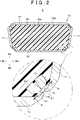
- Fig. 2 is a sectional view of the head rest of Fig. 1 taken on the line A-A in Fig. 1 .
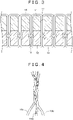
- Fig. 3 is a sectional view of a surface skin of Fig. 2 taken on the line B-B in Fig. 2
- the head rest 4 includes a foamed body 20 formed of a foamed synthetic resin such as soft polyurethane foam, and a surface skin 10 covering the foamed body 20.
- the head rest 4 is a skin integrated foam-molded product where the foamed body 20 made by foaming and hardening a foaming liquid is integrated with the surface skin 10.
- the foamed body is integrated with the surface skin 10 by integrally foaming the foaming liquid by injecting the foaming liquid under a back side 10b (inner side) of the surface skin 10 set in a cavity of a foaming mold (not shown).
- the surface skin 10 is a member for covering the foamed body 20.
- a surface 10a of the surface skin 10 defines an exterior surface of the head rest 4.
- the surface skin 10 includes a plurality of surface skin members 11, 12, and a first thread 15 and a second thread 16 for sewing together hem parts 13, 14 of the surface skin members 11, 12. While the surface skin 10 of this embodiment is substantially formed in a bag shape and covers the whole body of the foamed body 20, the surface skin 10 may also be formed in any other shape that covers a part of the foamed body 20.
- the surface skin members 11, 12 are constituted of two or more layers where a fabric-like foamed synthetic resin is integrally molded to a back side of fabric, synthetic leather, leather, or the like. However, it is also possible to omit the fabric-like foamed synthetic resin. In order to prevent the foaming liquid from immersing into the fabric or the fabric-like foamed synthetic resin, the surface skin members 11, 12 may also be arranged to attach a film to an inner side of the fabric or a fabric-like foamed synthetic resin, or to form a coating by thermally melting the inner side of the fabric-like foamed synthetic resin.
- the surface skin 10 is formed by laying the hem parts 13, 14 of the two surface skin members 11, 12 on top of each other to bring the surfaces 10a thereof into contact, followed by sewing together the hem parts 13, 14 by means of the sewing machine stitching the whole length of the hem parts. Therefore, the first thread 15 and the second thread 16 are threaded through needle holes 17, 18 formed through the surface skin members 11, 12 by the sewing needle during the sewing operation, and lace each other to sew up the two surface skin members 11, 12. It is noted here that the first thread 15 is a needle thread thread threaded through an eye formed in a sewing needle not shown.
- the second thread 16 is a bobbin thread set in a bobbin.
- interlace means that one thread intersects with a loop of the other thread or passes through a loop of the other thread.
- a thread lacing portion between the first thread 15 and the second thread 16 is located at place shifted into the surface skin member 12 (at a lower part of the drawing surface of Fig. 3 ) from a boundary between the two surface skin members 11, 12. Therefore, the first thread 15 is partially passed into the needle hole 18 in the surface skin member 12 (lower part of the drawing surface of Fig. 3 ) while passed through the needle hole 17 in the surface skin member 11. On the other hand, the second thread 16 is partially passed into the needle hole 18 in the surface skin member 12 but is not passed into the needle hole 17 in the surface skin member 11.
- the first thread 15 is a normal machine-sewing thread made of a strong synthetic resin such as polyester spun yarn, nylon filament, polyester filament, or bond processed yarn.
- the polyester spun yarn is a synthetic fiber to which a texture of a natural material such as cotton is attached.
- the nylon filament and the polyester filament are synthetic fibers to which a texture of a natural material such as silk is attached.
- the bond processed fiber means a thread made by coating a nylon filament or polyester filament with a bond resin.
- the first thread 15, for example, is a count 8 thread.
- the sewing needle for example, is a DP ⁇ 17LE needle count 18 SPD.
- the second thread 16 has a finely weaved structure and is composed of, for example, a polyester bulky yarn or nylon bulky yarn having stretchability.
- the second thread 16 has sufficient stretchability for filling in a hole made by the needle during the sewing operation and is formed by warp weaving or braiding (tightly braided or loosely braided).
- a piece of second thread 16 has a finely braided structure and hence, is physically flexible. This ensures that even if the foaming liquid should fail to uniformly permeate the thread, the thread still has flexibility by virtue of the weaved texture. Accordingly, the bulky fibers can fit in the needle hole, thus physically preventing the liquid leakage. That is, the thread can obviate the liquid leakage.
- the expansion of the thread with the foaming liquid is increased by loosely twisting the yarns or not twisting the yarns. Loosely twisted, however, the thread lacks in flexibility so that the liquid leakage results if the foaming liquid fails to permeate the thread uniformly.
- the thread having stretchability is used for filling in the hole made by the needle so as to prevent the liquid leakage.
- the untwisted thread per se is expanded with the liquid.
- the embodiment is adapted to make the thick thread by braiding fibers.
- the second thread 16 is made of one type of material and has an advantage of a piece of thread having a fine structure.
- the second thread 16 is thinned under tension just before subjected to sewing but becomes as thick as after the thread is sewn. That is, the second thread 16 has the same thickness as a normal count 8 spun yarn at the sewing moment. After sewn on the surface skin members, however, the thread recovers its original thickness and fills in the needle hole, so as to prevent the liquid leakage during the foaming process.
- the second thread 16 as the bobbin thread is a stretchable thread. It is also considered all right to use the stretchable thread as the first thread 15 which is the needle thread. However, the first thread 15 is too thick to be threaded through the eye of the sewing needle. Therefore, the embodiment applies the stretchable thread only to the bobbin thread. In a case where the stretchable thread is used as the first thread 15, the thread is thinned to 100d or less and braided up. According to the embodiment, the description is made on a case where the stretchable thread is applied only to the bobbin thread.
- a sealing material such as a woolly spin tape is overlapped on the surface skin members 11, 12 and sewn together.
- the foaming liquid is more positively prevented from leaking through the needle holes 17, 18 during the foam molding of the foamed body 20.
- the sealing member is not sewn together with the surface skin members. Therefore, a step of sewing the sealing member to a correct position can be dispensed with, resulting in an enhanced sewing operation efficiency.
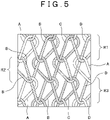
- Fig. 4 is a schematic diagram showing the second thread according to the first embodiment.
- a thread having a thickness of 200d is formed by twisting two pieces of fiber each having a fineness of 100d. Subsequently, two pieces of the thread each having the fineness of 200d are twisted to form a thread having a thickness of 400d.
- "denier" [d] which is a unit of fineness indicating the thickness of thread represents a mass of 9,000 meter of thread in grams.
- the three pieces of thread 16a, 16b, 16c each having a fineness of 400d are braided together, as shown in Fig. 4 .
- the second thread 16 is not made by twisting three pieces of thread but by braiding three pieces of thread. Therefore, the three pieces of thread do not untwine spontaneously.
- 1-inch-long thread can be made by braiding fiber pieces 10 times (gear 26 tight braiding type) or 1-inch-long thread can be made by braiding fiber pieces 7 times (gear 36 loose braiding type).
- the tight braiding type is not limited to repeating 10 braiding steps to make 1-inch-long thread but the braiding step can be repeated 9 times or repeated 11 times to make 1-inch-long thread.
- the loose braiding type is not limited to repeating 7 braiding steps to make 1-inch-long thread but the braiding step can be repeated 8 times to make 1-inch-long thread or repeated 6 times to make 1-inch-long thread.
- Fig. 5 is a schematic diagram of the second thread according to the second embodiment.
- the braid is classified into weft braid and warp braid.
- the second thread 16 is formed by warp braiding.
- two pieces of fiber each having a fineness of 100d are twisted to form a thread having a thickness of 200d.
- pieces of thread A, B, C, D shown in Fig. 5 are obtained.
- the second thread 16 is a four-thread warp braided cord formed of four pieces of thread A, B, D, D which are complicatedly braided and vertically extended while individually forming loops.
- a row R1 for example, the thread A, the thread B, the thread C, and the thread D form respective loops in the order named from the left side of the drawing.
- the thread B, the thread C, the thread D, and the thread A form respective loops in the order named from the left side of the drawing.
- the thread A, the thread B, the thread C, and the thread D form respective loops in the order named from the left side of the drawing.
- the second thread 16 has a fineness of 800d (100d ⁇ 2 ⁇ 4).
Landscapes
- Engineering & Computer Science (AREA)
- Mechanical Engineering (AREA)
- Textile Engineering (AREA)
- Aviation & Aerospace Engineering (AREA)
- Transportation (AREA)
- Manufacturing & Machinery (AREA)
- Casting Or Compression Moulding Of Plastics Or The Like (AREA)
- Woven Fabrics (AREA)
- Laminated Bodies (AREA)
- Knitting Of Fabric (AREA)
Abstract
A surface skin (10) with which a foamed body (20) is integrally foam-moulded and which covers the foamed body includes: a surface skin member (11,12), a first thread (15) passing through at least a part of a needle hole extended through the surface skin members so as to sew the surface skin members together and a second thread (16) inter-looping or interlacing with the first thread so as to sew the surface skin members together in cooperation with the first thread. The second thread (16) is formed by braiding polyester or nylon fibre pieces and is stretchable enough to fill in the needle hole.
Description
- The disclosure of the present invention relates to a surface skin. For example, the present invention is applicable to a vehicle seat including a skin integrated foam-molded product.
- There are known some head rests, arm rests and the like integrated with the vehicle seat (skin integrated foam-molded products) which are produced by the steps of: cutting a plurality of surface skin members into predetermined shapes; sewing the cut surface skin members into a bag shape by means of a sewing machine; and injecting a foaming liquid as a pad molding raw material into the skin bag for integrally foam molding the pad with the surface skin (
Japanese Unexamined Patent Application Publication No. 2020-65841 - The skin integrated foam molding technique may sometimes encounter the following problem. Some of the foaming liquid injected inside the skin bag may leak through a gap between a needle hole made by a needle sewing the surface skin members together and a thread and become hardened on the outside of the surface skin.
- An object of the disclosure of the present invention is to provide a technique for preventing the leakage of the foaming liquid through the needle holes.
- Typical aspects of the present invention can be summarized as follows.
- That is, the surface skin covering a foamed body made by foam molding the foaming material includes: a surface skin member; a first thread passing through at least a part of a needle hole extended through the surface skin members so as to sew the surface skin members together; and/or a second thread sewing the surface skin members together by interlacing with the first thread. The first thread is threaded through an eye of a needle. The second thread is a thread formed by warp weaving or braiding a polyester or nylon fiber and having stretchability to fill in the needle hole.
- According to the present invention, the leakage of the foaming liquid through the needle holes can be prevented.
-
-
Fig. 1 is an outline view showing a seat for vehicle according to an embodiment hereof; -
Fig. 2 is a sectional view of a head rest ofFig. 1 taken on the line A-A inFig. 1 ; -
Fig. 3 is a sectional view of a surface skin ofFig. 2 taken on the line B-B inFig. 2 ; -
Fig. 4 is a schematic diagram showing a second thread according to a first embodiment hereof; and -
Fig. 5 is a schematic diagram showing a second thread according to a second embodiment hereof. - The embodiments of the present invention will hereinbelow be described with reference to the accompanying drawings. In the following description, however, the same or similar reference numerals are used to refer to the same or similar components which are explained only once in some cases to avoid repetitions. For greater clarity, there are cases where the drawings provide more schematic illustrations of some parts than those in practical modes in terms of width, thickness, shape and the like thereof. It is noted that the disclosure is meant only for an example. The drawings are not meant to limit the interpretation of the present invention.
- A vehicle seat according to an embodiment of the present invention is described with reference to
Fig. 1. Fig. 1 is an outline view showing a vehicle seat according to the embodiment. - In the following description, a vertical direction is defined as upward/downward directions (UP, DW) on the assumption that a vehicle equipped with the vehicle seat is placed on a horizontal plane. Further, forward/backward directions (FR, RR) are so defined as to coincide with the longitudinal direction of the vehicle while right/left directions are so defined as to coincide with a width direction of the vehicle. "FR" means a forward direction of the vehicle while "RR" means a backward direction of the vehicle. In the description of a
vehicle seat 1, a righthand side (RH) and a left-hand side (LH) are defined to mean the right side and the left side of the vehicle as seen from the rear side thereof. - The
vehicle seat 1 includes aseat cushion 2, aseat back 3, ahead rest 4, and side supports 5. - The description is made on the
head rest 4 with reference toFig. 2 andFig. 3 .Fig. 2 is a sectional view of the head rest ofFig. 1 taken on the line A-A inFig. 1 .Fig. 3 is a sectional view of a surface skin ofFig. 2 taken on the line B-B inFig. 2 - As shown in
Fig. 2 , thehead rest 4 includes afoamed body 20 formed of a foamed synthetic resin such as soft polyurethane foam, and asurface skin 10 covering thefoamed body 20. Thehead rest 4 is a skin integrated foam-molded product where thefoamed body 20 made by foaming and hardening a foaming liquid is integrated with thesurface skin 10. The foamed body is integrated with thesurface skin 10 by integrally foaming the foaming liquid by injecting the foaming liquid under aback side 10b (inner side) of thesurface skin 10 set in a cavity of a foaming mold (not shown). - As shown in
Fig. 2 andFig. 3 , thesurface skin 10 is a member for covering thefoamed body 20. Asurface 10a of thesurface skin 10 defines an exterior surface of thehead rest 4. Thesurface skin 10 includes a plurality ofsurface skin members first thread 15 and asecond thread 16 for sewing together hemparts surface skin members surface skin 10 of this embodiment is substantially formed in a bag shape and covers the whole body of thefoamed body 20, thesurface skin 10 may also be formed in any other shape that covers a part of thefoamed body 20. - From the viewpoint of comfortable seating, good tactile effect, stretchability, and the like, the
surface skin members surface skin members - The
surface skin 10 is formed by laying thehem parts surface skin members surfaces 10a thereof into contact, followed by sewing together thehem parts first thread 15 and thesecond thread 16 are threaded throughneedle holes surface skin members surface skin members first thread 15 is a needle thread threaded through an eye formed in a sewing needle not shown. Thesecond thread 16 is a bobbin thread set in a bobbin. The term "interlace" means that one thread intersects with a loop of the other thread or passes through a loop of the other thread. - According to the embodiment, a thread lacing portion between the
first thread 15 and thesecond thread 16 is located at place shifted into the surface skin member 12 (at a lower part of the drawing surface ofFig. 3 ) from a boundary between the twosurface skin members first thread 15 is partially passed into theneedle hole 18 in the surface skin member 12 (lower part of the drawing surface ofFig. 3 ) while passed through theneedle hole 17 in thesurface skin member 11. On the other hand, thesecond thread 16 is partially passed into theneedle hole 18 in thesurface skin member 12 but is not passed into theneedle hole 17 in thesurface skin member 11. - The
first thread 15 is a normal machine-sewing thread made of a strong synthetic resin such as polyester spun yarn, nylon filament, polyester filament, or bond processed yarn. It is noted here that the polyester spun yarn is a synthetic fiber to which a texture of a natural material such as cotton is attached. The nylon filament and the polyester filament are synthetic fibers to which a texture of a natural material such as silk is attached. The bond processed fiber means a thread made by coating a nylon filament or polyester filament with a bond resin. Thefirst thread 15, for example, is a count 8 thread. The sewing needle, for example, is a DP×17LE needle count 18 SPD. - The
second thread 16 has a finely weaved structure and is composed of, for example, a polyester bulky yarn or nylon bulky yarn having stretchability. Thesecond thread 16 has sufficient stretchability for filling in a hole made by the needle during the sewing operation and is formed by warp weaving or braiding (tightly braided or loosely braided). A piece ofsecond thread 16 has a finely braided structure and hence, is physically flexible. This ensures that even if the foaming liquid should fail to uniformly permeate the thread, the thread still has flexibility by virtue of the weaved texture. Accordingly, the bulky fibers can fit in the needle hole, thus physically preventing the liquid leakage. That is, the thread can obviate the liquid leakage. - In a case where the
second thread 16 is composed of a bulky spun yarn or textured yarn alone, as set forth inJapanese Unexamined Patent Application Publication No. 2020-65841 - According to the embodiment, the thread having stretchability is used for filling in the hole made by the needle so as to prevent the liquid leakage. According to
Japanese Unexamined Patent Application Publication No. 2020-65841 second thread 16 is made of one type of material and has an advantage of a piece of thread having a fine structure. - According to the embodiment, the
second thread 16 is thinned under tension just before subjected to sewing but becomes as thick as after the thread is sewn. That is, thesecond thread 16 has the same thickness as a normal count 8 spun yarn at the sewing moment. After sewn on the surface skin members, however, the thread recovers its original thickness and fills in the needle hole, so as to prevent the liquid leakage during the foaming process. - The
second thread 16 as the bobbin thread is a stretchable thread. It is also considered all right to use the stretchable thread as thefirst thread 15 which is the needle thread. However, thefirst thread 15 is too thick to be threaded through the eye of the sewing needle. Therefore, the embodiment applies the stretchable thread only to the bobbin thread. In a case where the stretchable thread is used as thefirst thread 15, the thread is thinned to 100d or less and braided up. According to the embodiment, the description is made on a case where the stretchable thread is applied only to the bobbin thread. - When the
surface skin members first thread 15 and thesecond thread 16, a sealing material such as a woolly spin tape is overlapped on thesurface skin members body 20. According to the embodiment, however, the sealing member is not sewn together with the surface skin members. Therefore, a step of sewing the sealing member to a correct position can be dispensed with, resulting in an enhanced sewing operation efficiency. - How to braid fibers of the
second thread 16 according to a first embodiment hereof is described with reference toFig. 4. Fig. 4 is a schematic diagram showing the second thread according to the first embodiment. - First, a thread having a thickness of 200d is formed by twisting two pieces of fiber each having a fineness of 100d. Subsequently, two pieces of the thread each having the fineness of 200d are twisted to form a thread having a thickness of 400d. Thus, pieces of
thread Fig. 4 . That is, the pieces ofthread - The three pieces of
thread Fig. 4 . Thus, a single thread having a fineness of 1200d (3×400d (4 pieces)= 1200d (12 pieces)) is formed of three pieces of thread, each having the fineness of 400d. This constitutes thesecond thread 16. Thesecond thread 16 is not made by twisting three pieces of thread but by braiding three pieces of thread. Therefore, the three pieces of thread do not untwine spontaneously. - As for a braiding method, 1-inch-long thread can be made by braiding
fiber pieces 10 times (gear 26 tight braiding type) or 1-inch-long thread can be made by braiding fiber pieces 7 times (gear 36 loose braiding type). The tight braiding type is not limited to repeating 10 braiding steps to make 1-inch-long thread but the braiding step can be repeated 9 times or repeated 11 times to make 1-inch-long thread. Further, the loose braiding type is not limited to repeating 7 braiding steps to make 1-inch-long thread but the braiding step can be repeated 8 times to make 1-inch-long thread or repeated 6 times to make 1-inch-long thread. - The description is made on a method of braiding the
second thread 16 according to a second embodiment hereof.Fig. 5 is a schematic diagram of the second thread according to the second embodiment. - The braid is classified into weft braid and warp braid. According to the second embodiment, the
second thread 16 is formed by warp braiding. First, two pieces of fiber each having a fineness of 100d are twisted to form a thread having a thickness of 200d. Thus, pieces of thread A, B, C, D shown inFig. 5 are obtained. Namely, the pieces of thread A, B, C, D each have a fineness of 200d and is formed of two pieces of fiber each having a fineness of 100d (100d×2= 200d (2 pieces)). As shown inFig. 5 , thesecond thread 16 is a four-thread warp braided cord formed of four pieces of thread A, B, D, D which are complicatedly braided and vertically extended while individually forming loops. In a row R1, for example, the thread A, the thread B, the thread C, and the thread D form respective loops in the order named from the left side of the drawing. In a row R2, the thread B, the thread C, the thread D, and the thread A form respective loops in the order named from the left side of the drawing. In a row R3, the thread A, the thread B, the thread C, and the thread D form respective loops in the order named from the left side of the drawing. Thesecond thread 16 has a fineness of 800d (100d×2×4). - While the disclosure of the present invention made by the present inventors has been specifically described with reference to the embodiments and examples thereof, it goes without saying that the present invention is not limited to the foregoing embodiments and examples, and a variety of changes and modifications can be made thereto.
- While the embodiments have been described by way of example of the head rest for vehicle seat, the embodiments are also applicable to other skin integrated foam-molded products such as arm rest, and console box.
Claims (7)
- A surface skin with which a foamed body (20) is integrally foam-molded and which covers the foamed body (20), comprising:a surface skin member (11, 12);a first thread (15) passing through at least a part of a needle hole extended through the surface skin members (11, 12) so as to sew the surface skin members (11, 12) together; anda second thread (16) sewing the surface skin members (11, 12) together by interlacing with the first thread (15),wherein the first thread (15) is a thread threaded through an eye of a needle; andthe second thread (16) is a thread formed by warp weaving or braiding a polyester or nylon fiber and having stretchability to fill in the needle hole.
- The surface skin according to Claim 1, wherein the second thread (16) is a thread which is formed by twisting two pieces of fiber to form a twofold thicker thread, followed by twisting two pieces of the twofold thicker thread to form a four-fold thicker thread, followed by braiding three pieces of the four-fold thicker thread to form a twelve-fold thicker thread.
- The surface skin according to Claim 2, wherein the second thread (16) is tightly braided.
- The surface skin according to Claim 2, wherein the second thread (16) is loosely braided.
- The surface skin according to Claim 1, wherein the second thread (16) is a thread which is formed by twisting two pieces of fiber to form a twofold thicker thread, followed by warp braiding four pieces of the twofold thicker thread.
- A molded product comprising:the surface skin according to any one of Claims 1 to 5; anda foamed body (20) integrally foam-molded with the surface skin and covered by the surface skin.
- A vehicle seat comprising:the molded product according to Claim 6;a seat cushion (2); anda seat back (3),wherein the molded product is a head rest (4).
Applications Claiming Priority (1)
| Application Number | Priority Date | Filing Date | Title |
|---|---|---|---|
| JP2021017975A JP7576479B2 (en) | 2021-02-08 | 2021-02-08 | Skins, moldings and vehicle seats |
Publications (1)
| Publication Number | Publication Date |
|---|---|
| EP4042893A1 true EP4042893A1 (en) | 2022-08-17 |
Family
ID=80119238
Family Applications (1)
| Application Number | Title | Priority Date | Filing Date |
|---|---|---|---|
| EP22154753.2A Pending EP4042893A1 (en) | 2021-02-08 | 2022-02-02 | Surface skin, molded product, and vehicle seat |
Country Status (4)
| Country | Link |
|---|---|
| US (1) | US11760240B2 (en) |
| EP (1) | EP4042893A1 (en) |
| JP (1) | JP7576479B2 (en) |
| CN (1) | CN114906025A (en) |
Families Citing this family (1)
| Publication number | Priority date | Publication date | Assignee | Title |
|---|---|---|---|---|
| JP7576479B2 (en) * | 2021-02-08 | 2024-10-31 | 株式会社タチエス | Skins, moldings and vehicle seats |
Citations (2)
| Publication number | Priority date | Publication date | Assignee | Title |
|---|---|---|---|---|
| WO2006001067A1 (en) * | 2004-06-29 | 2006-01-05 | Inoac Corporation | Sewing thread for foam molding, foam molding and process for producing foam molding |
| JP2020065841A (en) | 2018-10-26 | 2020-04-30 | 株式会社タチエス | Skin and molded product |
Family Cites Families (18)
| Publication number | Priority date | Publication date | Assignee | Title |
|---|---|---|---|---|
| US3468275A (en) * | 1963-02-01 | 1969-09-23 | United Shoe Machinery Corp | Ornamental moccasin type seams |
| JP2001246186A (en) | 2000-03-02 | 2001-09-11 | Tachi S Co Ltd | Skin material for skin integral foam and skin integral foam product |
| FR2809942B1 (en) * | 2000-06-09 | 2002-09-27 | Faure Bertrand Equipements Sa | DEVICE COMPRISING A COVER OF COVER FIXED ON A SUPPORT BY MEANS OF SELF-GRIPPING ELEMENTS |
| JP2003103076A (en) | 2001-09-28 | 2003-04-08 | Inoac Corp | Upholstery for headrest |
| US6969827B2 (en) * | 2002-09-04 | 2005-11-29 | Matsushita Electric Industrial Co., Ltd. | Heated seat assembly and method of manufacturing the same |
| JP2004174118A (en) * | 2002-11-29 | 2004-06-24 | Tachi S Co Ltd | Sewing method of skin material for foam integrated with skin |
| US8524622B2 (en) * | 2009-04-10 | 2013-09-03 | Toyota Boshoku Kabushiki Kaisha | Skin material of vehicle interior equipment and manufacturing method for the same |
| US9340912B2 (en) * | 2011-07-08 | 2016-05-17 | Inteva Products, Llc | Method for stitching vehicle interior components and components formed from the method |
| JP6526413B2 (en) * | 2011-07-08 | 2019-06-05 | インテヴァ プロダクツ, エルエルシーInteva Products, Llc | A combination of a device for stitching vehicle interior trim members with a vehicle interior trim member |
| WO2016029223A1 (en) * | 2014-08-22 | 2016-02-25 | Inteva Products, Llc | Method and apparatus for blind stitching a formed component and components formed from the method |
| JP6278566B2 (en) * | 2014-09-29 | 2018-02-14 | 株式会社タチエス | Skin structure of sheet with wadding material and method for manufacturing skin of sheet with wadding material |
| JP2016120841A (en) * | 2014-12-25 | 2016-07-07 | 株式会社タチエス | Vehicle seat |
| JP6391514B2 (en) * | 2015-03-26 | 2018-09-19 | 株式会社タチエス | Foam molded body for vehicle seat, headrest for vehicle seat, and armrest for vehicle seat |
| JP6634324B2 (en) * | 2016-03-29 | 2020-01-22 | 株式会社タチエス | Trim cover and vehicle seat |
| JP6877461B2 (en) * | 2016-04-05 | 2021-05-26 | テイジン・アラミド・ビー.ブイ.Teijin Aramid B.V. | Tactile assembly |
| DE102019205714A1 (en) * | 2019-04-18 | 2020-10-22 | Mahle International Gmbh | Thermoelectric flexible mat |
| JP7396812B2 (en) * | 2019-06-04 | 2023-12-12 | 本田技研工業株式会社 | synthetic resin leather |
| JP7576479B2 (en) * | 2021-02-08 | 2024-10-31 | 株式会社タチエス | Skins, moldings and vehicle seats |
-
2021
- 2021-02-08 JP JP2021017975A patent/JP7576479B2/en active Active
- 2021-12-20 US US17/556,829 patent/US11760240B2/en active Active
-
2022
- 2022-01-17 CN CN202210048967.1A patent/CN114906025A/en active Pending
- 2022-02-02 EP EP22154753.2A patent/EP4042893A1/en active Pending
Patent Citations (2)
| Publication number | Priority date | Publication date | Assignee | Title |
|---|---|---|---|---|
| WO2006001067A1 (en) * | 2004-06-29 | 2006-01-05 | Inoac Corporation | Sewing thread for foam molding, foam molding and process for producing foam molding |
| JP2020065841A (en) | 2018-10-26 | 2020-04-30 | 株式会社タチエス | Skin and molded product |
Also Published As
| Publication number | Publication date |
|---|---|
| JP7576479B2 (en) | 2024-10-31 |
| JP2022120918A (en) | 2022-08-19 |
| CN114906025A (en) | 2022-08-16 |
| US20220250517A1 (en) | 2022-08-11 |
| US11760240B2 (en) | 2023-09-19 |
Similar Documents
| Publication | Publication Date | Title |
|---|---|---|
| JP5234684B2 (en) | Fastening member | |
| EP3246440A1 (en) | Knitted lace | |
| US20090081409A1 (en) | Two-dimensional textile material, especially textile fabric, having shrink properties and products manufactured therefrom | |
| EP4042893A1 (en) | Surface skin, molded product, and vehicle seat | |
| US6845725B2 (en) | Method for sewing together covering elements adapted to undergo foaming process | |
| US20210254277A1 (en) | Synthetic leather | |
| JP2003159141A (en) | Panel type cushion body | |
| JP3696419B2 (en) | Cushion body | |
| JP3482698B2 (en) | Stretch elastic warp knitted fabric | |
| JP2005530051A (en) | Manufacturing method of woven belt strap | |
| KR102024134B1 (en) | The manufacturing method of stretch tube fabric and stretch tube fabric produced by the method | |
| JP7340916B2 (en) | Skin and molded products | |
| CN1977073B (en) | Foamed molded article and method for producing foamed molded article | |
| JP2018047735A (en) | Interior component and method for producing the same | |
| JP7562102B2 (en) | Knitted lace | |
| EP4350061B1 (en) | Seat including upholstery material | |
| CN215270652U (en) | A cloth-covered webbing and bra having the same | |
| KR102916957B1 (en) | In particular, a knitted device having a loop for forming a female portion of a self-adhesive fastener for attaching a motor vehicle seat cover. | |
| JP2003103076A (en) | Upholstery for headrest | |
| JP2010265920A (en) | Toothed belt | |
| GB2304738A (en) | A knitted air bag | |
| JP2019044312A (en) | Hen lace | |
| KR100467294B1 (en) | Sewn cover assembly and product foamed therewith | |
| JPH11244090A (en) | Facing for head rest | |
| JP2017087777A (en) | Foam molding and vehicle sheet |
Legal Events
| Date | Code | Title | Description |
|---|---|---|---|
| PUAI | Public reference made under article 153(3) epc to a published international application that has entered the european phase |
Free format text: ORIGINAL CODE: 0009012 |
|
| STAA | Information on the status of an ep patent application or granted ep patent |
Free format text: STATUS: REQUEST FOR EXAMINATION WAS MADE |
|
| 17P | Request for examination filed |
Effective date: 20220318 |
|
| AK | Designated contracting states |
Kind code of ref document: A1 Designated state(s): AL AT BE BG CH CY CZ DE DK EE ES FI FR GB GR HR HU IE IS IT LI LT LU LV MC MK MT NL NO PL PT RO RS SE SI SK SM TR |
|
| STAA | Information on the status of an ep patent application or granted ep patent |
Free format text: STATUS: EXAMINATION IS IN PROGRESS |
|
| 17Q | First examination report despatched |
Effective date: 20240725 |