EP4041763B1 - Pd1 and vegfr2 dual-binding agents - Google Patents
Pd1 and vegfr2 dual-binding agents Download PDFInfo
- Publication number
- EP4041763B1 EP4041763B1 EP20789105.2A EP20789105A EP4041763B1 EP 4041763 B1 EP4041763 B1 EP 4041763B1 EP 20789105 A EP20789105 A EP 20789105A EP 4041763 B1 EP4041763 B1 EP 4041763B1
- Authority
- EP
- European Patent Office
- Prior art keywords
- seq
- amino acid
- acid sequence
- antibody
- region
- Prior art date
- Legal status (The legal status is an assumption and is not a legal conclusion. Google has not performed a legal analysis and makes no representation as to the accuracy of the status listed.)
- Active
Links
Images















Classifications
-
- A—HUMAN NECESSITIES
- A61—MEDICAL OR VETERINARY SCIENCE; HYGIENE
- A61P—SPECIFIC THERAPEUTIC ACTIVITY OF CHEMICAL COMPOUNDS OR MEDICINAL PREPARATIONS
- A61P35/00—Antineoplastic agents
-
- C—CHEMISTRY; METALLURGY
- C07—ORGANIC CHEMISTRY
- C07K—PEPTIDES
- C07K16/00—Immunoglobulins [IG], e.g. monoclonal or polyclonal antibodies
- C07K16/18—Immunoglobulins [IG], e.g. monoclonal or polyclonal antibodies against material from animals or humans
- C07K16/28—Immunoglobulins [IG], e.g. monoclonal or polyclonal antibodies against material from animals or humans against receptors, cell surface antigens or cell surface determinants
-
- C—CHEMISTRY; METALLURGY
- C07—ORGANIC CHEMISTRY
- C07K—PEPTIDES
- C07K16/00—Immunoglobulins [IG], e.g. monoclonal or polyclonal antibodies
- C07K16/18—Immunoglobulins [IG], e.g. monoclonal or polyclonal antibodies against material from animals or humans
- C07K16/28—Immunoglobulins [IG], e.g. monoclonal or polyclonal antibodies against material from animals or humans against receptors, cell surface antigens or cell surface determinants
- C07K16/2803—Immunoglobulins [IG], e.g. monoclonal or polyclonal antibodies against material from animals or humans against receptors, cell surface antigens or cell surface determinants against the immunoglobulin superfamily
- C07K16/2818—Immunoglobulins [IG], e.g. monoclonal or polyclonal antibodies against material from animals or humans against receptors, cell surface antigens or cell surface determinants against the immunoglobulin superfamily against CD28 or CD152
-
- C—CHEMISTRY; METALLURGY
- C07—ORGANIC CHEMISTRY
- C07K—PEPTIDES
- C07K16/00—Immunoglobulins [IG], e.g. monoclonal or polyclonal antibodies
- C07K16/18—Immunoglobulins [IG], e.g. monoclonal or polyclonal antibodies against material from animals or humans
- C07K16/28—Immunoglobulins [IG], e.g. monoclonal or polyclonal antibodies against material from animals or humans against receptors, cell surface antigens or cell surface determinants
- C07K16/2863—Immunoglobulins [IG], e.g. monoclonal or polyclonal antibodies against material from animals or humans against receptors, cell surface antigens or cell surface determinants against receptors for growth factors, growth regulators
-
- A—HUMAN NECESSITIES
- A61—MEDICAL OR VETERINARY SCIENCE; HYGIENE
- A61K—PREPARATIONS FOR MEDICAL, DENTAL OR TOILETRY PURPOSES
- A61K39/00—Medicinal preparations containing antigens or antibodies
- A61K2039/505—Medicinal preparations containing antigens or antibodies comprising antibodies
-
- C—CHEMISTRY; METALLURGY
- C07—ORGANIC CHEMISTRY
- C07K—PEPTIDES
- C07K2317/00—Immunoglobulins specific features
- C07K2317/30—Immunoglobulins specific features characterized by aspects of specificity or valency
- C07K2317/31—Immunoglobulins specific features characterized by aspects of specificity or valency multispecific
-
- C—CHEMISTRY; METALLURGY
- C07—ORGANIC CHEMISTRY
- C07K—PEPTIDES
- C07K2317/00—Immunoglobulins specific features
- C07K2317/30—Immunoglobulins specific features characterized by aspects of specificity or valency
- C07K2317/33—Crossreactivity, e.g. for species or epitope, or lack of said crossreactivity
-
- C—CHEMISTRY; METALLURGY
- C07—ORGANIC CHEMISTRY
- C07K—PEPTIDES
- C07K2317/00—Immunoglobulins specific features
- C07K2317/50—Immunoglobulins specific features characterized by immunoglobulin fragments
- C07K2317/52—Constant or Fc region; Isotype
- C07K2317/528—CH4 domain
-
- C—CHEMISTRY; METALLURGY
- C07—ORGANIC CHEMISTRY
- C07K—PEPTIDES
- C07K2317/00—Immunoglobulins specific features
- C07K2317/50—Immunoglobulins specific features characterized by immunoglobulin fragments
- C07K2317/55—Fab or Fab'
-
- C—CHEMISTRY; METALLURGY
- C07—ORGANIC CHEMISTRY
- C07K—PEPTIDES
- C07K2317/00—Immunoglobulins specific features
- C07K2317/50—Immunoglobulins specific features characterized by immunoglobulin fragments
- C07K2317/56—Immunoglobulins specific features characterized by immunoglobulin fragments variable (Fv) region, i.e. VH and/or VL
- C07K2317/565—Complementarity determining region [CDR]
-
- C—CHEMISTRY; METALLURGY
- C07—ORGANIC CHEMISTRY
- C07K—PEPTIDES
- C07K2317/00—Immunoglobulins specific features
- C07K2317/70—Immunoglobulins specific features characterized by effect upon binding to a cell or to an antigen
- C07K2317/71—Decreased effector function due to an Fc-modification
-
- C—CHEMISTRY; METALLURGY
- C07—ORGANIC CHEMISTRY
- C07K—PEPTIDES
- C07K2317/00—Immunoglobulins specific features
- C07K2317/70—Immunoglobulins specific features characterized by effect upon binding to a cell or to an antigen
- C07K2317/76—Antagonist effect on antigen, e.g. neutralization or inhibition of binding
Definitions
- the invention relates to antibody molecules binding specifically to both PD1 (also known as Programmed cell death 1, PDCD1, CD279, PD-1, SLEB2, PD-I, SLE1) and VEGFR2 (also known as KDR, CD309, FLK1, Kinase insert domain receptor) and medical uses thereof.
- PD1 also known as Programmed cell death 1, PDCD1, CD279, PD-1, SLEB2, PD-I, SLE1
- VEGFR2 also known as KDR, CD309, FLK1, Kinase insert domain receptor
- PD1 is a cell surface receptor which has been shown to be an immune "checkpoint" mediator.
- PD1 checkpoint activity minimises autoimmunity risk by promoting apoptosis (programmed cell death) in lymph node-resident T cells that are reactive to self-antigens and by promoting the survival of regulatory (anti-inflammatory) T cells.
- the antagonism of PD1 activity by human or humanized monoclonal antibodies has proven to be a successful therapeutic approach to the treatment of multiple forms of cancer, as it can lead to the re-activation of T cells in the tumour. This clinical success has led to the proliferation of anti-PD1 antibody molecules being examined in clinical trials, but the majority of patients still do not mount a durable anti-cancer response when treated with anti-PD1 agents alone.
- a possible strategy to improve clinical response rates to anti-PD1 antibodies is to combine them with previously-proven cancer therapies such as anti-angiogenic agents.
- One such class of agents is antibodies that block the VEGF signalling pathway, such as anti-VEGFR2 or anti-VEGF antibodies.
- combination therapies require the use of two separate, costly agents that each have their own toxicity risks. There remains a need for a single agent that provides the benefits of combination therapy without the disadvantages of combining two separate agents.
- WO2015/085847A1 describes an antagonistic murine anti-PD1 IgG molecule termed "MAb005", and also the preparation of humanized forms of MAb005. For reasons discussed herein, such humanized forms of MAb005 described in WO2015/085847A1 are not ideal.
- Lu et al. (Cancer Res (2016) 76 (14_Supplement): 572 ) describes a bispecific anti-PDL1 x anti-VEGFR2 antibody wherein a high affinity single chain antibody to PDL1 was genetically fused to the C-terminus of the heavy chain of a conventional IgG antibody against VEGFR2.
- the present invention provides a number of anti-PD1 and anti-VEGFR2 dual-antagonistic antibodies, which are defined in the claims and medical uses thereof.
- the invention provides an antibody that binds specifically to both PD1 and VEGFR2 or an antigen-binding portion of the antibody, wherein the antibody comprises a heavy chain variable (VH) region and a light chain variable (VL) region, wherein
- VH heavy chain variable
- VL light chain variable
- an antibody that binds specifically to both PD1 and VEGFR2 or an antigen-binding portion of the antibody, wherein the antibody comprises a heavy chain variable (VH) region and a light chain variable (VL) region, wherein
- VH heavy chain variable
- VL light chain variable
- an immunoconjugate comprising the antibody molecule or antigen-binding portion thereof of the invention, fused or conjugated to a therapeutic agent.
- the invention provides a nucleic acid molecule encoding the antibody molecule or antigen-binding portion thereof of the invention.
- Also provided is a host cell comprising the nucleic acid molecule or the vector of the invention as defined herein.
- a method of producing an anti-PD1/VEGFR2 antibody and/or an antigen-binding portion thereof comprising culturing the host cell of the invention under conditions that result in expression and/or production of the antibody and/or the antigen-binding portion thereof, and isolating the antibody and/or the antigen-binding portion thereof from the host cell or culture.
- composition comprising the antibody molecule or antigen-binding portion thereof of the invention as defined herein, or the nucleic acid molecule of the invention as defined herein, or the vector of the invention as defined herein.
- a method for enhancing an immune response in a subject comprising administering an effective amount of the antibody molecule or antigen-binding portion thereof of the invention as defined herein, or the immunoconjugate of the invention as defined herein, or the nucleic acid molecule of the invention as defined herein, or the vector of the invention as defined herein, or the pharmaceutical composition of the invention as defined herein.
- a method for treating or preventing cancer in a subject comprising administering an effective amount of the antibody molecule or antigen-binding portion thereof of the invention as defined herein, or the immunoconjugate of the invention as defined herein, or the nucleic acid molecule of the invention as defined herein, or the vector of the invention as defined herein, or the pharmaceutical composition of the invention as defined herein.
- the invention also provides an antibody molecule or antigen-binding portion thereof of the invention as defined herein, or the immunoconjugate of the invention as defined herein, or the nucleic acid molecule of the invention as defined herein, or the vector of the invention as defined herein, or the pharmaceutical composition of the invention as defined herein, for use in the treatment of cancer.
- the invention provides the antibody molecule, or antigen-binding portion thereof, or the immunoconjugate, or the nucleic acid molecule, or the vector for use in the methods of treatment as defined herein, for separate, sequential or simultaneous use in a combination combined with a second therapeutic agent, for example an anti-cancer agent.
- a second therapeutic agent for example an anti-cancer agent.
- the invention also provides an antibody molecule or antigen-binding portion thereof of the invention, or the immunoconjugate of the invention, or the nucleic acid molecule of the invention, or the vector of the invention, or the pharmaceutical composition of the invention, for use in the treatment of an infectious disease.
- the invention is based on the discovery of antibodies that unexpectedly antagonize both the PD1 and the VEGF pathways. Inhibition of the VEGF signalling pathway can provide an effective combination with inhibition of the PD1 pathway.
- VEGF-VEGFR2 signalling not only drives neovascularisation, but also has been shown to augment immunosuppression in the tumour microenvironment, with VEGFR2 being expressed on multiple immune cell types.
- Generating a dual-inhibitor antibody is a complex and unpredictable task, however, as it involves the generation of a single antibody with potent modulation of two target proteins, e.g. PD1 and VEGFR2, which are highly dissimilar in amino acid sequence and structure. This sequence and structural dissimilarity between the two targets is an impediment to success in generating such an antibody.
- an antibody derived from hMAb005 that specifically binds to PD1 and antagonises VEGF-VEGFR2 signalling.
- an antibody may be generated by introducing mutations into one or more CDR sequences of antibody hMAb005.
- the mutations are introduced into the LCDR1 and/or LCDR2 and/or HCDR2 sequences of antibody hMAb005.
- an anti-PD1 and anti-VEGFR2 antibody or antigen-binding portion provided herein specifically binds to a PD1 protein comprising or consisting of SEQ ID NO:32 or SEQ ID NO:33.
- an anti-PD1 and anti-VEGFR2 antibody or antigen-binding portion provided herein specifically binds to a PD1 protein having an amino acid sequence that is at least about 90%, at least about 91%, at least about 92%, at least about 93%, at least about 94%, at least about 95%, at least about 96%, at least about 97%, at least about 98% or at least about 99% identical to SEQ ID NO:32 or SEQ ID NO:33.
- an anti-PD1 and anti-VEGFR2 antibody or antigen-binding portion provided herein specifically binds to a VEGFR2 protein comprising or consisting of SEQ ID NO:34 or SEQ ID NO:35.
- an anti-PD1 and anti-VEGFR2 antibody or antigen-binding portion provided herein specifically binds to a VEGFR2 protein having an amino acid sequence that is at least about 90%, at least about 91%, at least about 92%, at least about 93%, at least about 94%, at least about 95%, at least about 96%, at least about 97%, at least about 98% or at least about 99% identical to SEQ ID NO:34 or SEQ ID NO:35.
- terminal insertions include an antibody molecule with an N-terminal methionyl residue or the antibody molecule fused to an epitope tag.
- Other insertional variants of the antibody molecule include the fusion to the N- or C-terminus of the antibody of an enzyme or a polypeptide which increases the half-life of the antibody in the blood circulation.
- the antibody molecule or antigen-binding portion of the invention may include glycosylated and non-glycosylated polypeptides, as well as polypeptides with other post-translational modifications, such as, for example, glycosylation with different sugars, acetylation, and phosphorylation.
- the antibody molecule or antigen-binding portion of the invention may be mutated to alter such post-translational modifications, for example by adding, removing or replacing one or more amino acid residues to form or remove a glycosylation site.
- the antibody molecule or antigen-binding portion of the invention may be modified for example by amino acid substitution to remove potential proteolytic sites in the antibody.
- an antibody that binds specifically to both PD1 and VEGFR2 or an antigen-binding portion of the antibody, wherein the antibody comprises a heavy chain variable (VH) region and a light chain variable (VL) region, wherein
- VH heavy chain variable
- VL light chain variable
- an anti-PD1 and anti-VEGFR2 antibody or an antigen-binding portion thereof wherein the antibody comprises a heavy chain variable (VH) region and a light chain variable (VL) region, wherein the VH region amino acid sequence comprises or consists of
- anti-PD1 and anti-VEGFR2 antibody or an antigen-binding portion thereof wherein the antibody comprises a heavy chain variable (VH) region and a light chain variable (VL) region, wherein the VH region comprises or consists of SEQ ID NO:13 and the VL region comprises or consists of any one of the VL region amino acid sequences in Table 5 or Table 8.
- VH heavy chain variable
- VL light chain variable
- an antibody that binds specifically to both PD1 and VEGFR2 or an antigen-binding portion of the antibody, wherein the antibody comprises a heavy chain variable (VH) region and a light chain variable (VL) region, wherein
- VH heavy chain variable
- VL light chain variable
- the antibody molecule or antigen-binding portion as defined herein may cross-compete for binding to PD1 and VEGFR2 with an antibody or antigen-binding portion thereof comprising the sets of CDRs disclosed herein.
- an anti-PD1 and anti-VEGFR2 antibody or an antigen-binding portion thereof wherein the antibody or antigen-binding portion cross-competes for binding to PD1 and VEGFR2 with the antibody or antigen-binding portion comprising the sets of CDRs disclosed herein; and (a) comprises fully germline human framework amino acid sequences; (b) binds specifically to human PD1, cynomolgus PD1, human VEGFR2 and rhesus VEGFR2; and (c) antagonizes binding of human PD1 to human PD-L1 and antagonizes signaling of human VEGFR2 in response to human VEGF.
- an anti-PD1 and anti-VEGFR2 antibody or antigen-binding portion has minimal immunogenicity.
- an antibody or antigen-binding portion exhibits reduced immunogenicity compared to an anti-PD1 antibody comprising HCDR1 of SEQ ID NO: 1, HCDR2 of SEQ ID NO: 2, HCDR3 of SEQ ID NO: 3, LCDR1 of SEQ ID NO: 9, LCDR2 of SEQ ID NO: 5, and LCDR3 of SEQ ID NO: 6.
- immunogenicity risk of an antibody or antigen-binding portion may be determined in silico by identifying the location of T cell epitopes in the antibody or portion (e.g., in the variable regions of the antibody or portion).
- T cell epitopes in an antibody or antigen-binding portion may be identified by using iTope TM .
- iTope TM can used to analyse VL and VH region sequences for peptides with promiscuous high affinity binding to human MHC class II. Promiscuous high affinity MHC class II binding peptides are thought to correlate with the presence of T cell epitopes that are high risk indicators for clinical immunogenicity of drug proteins.
- the iTope TM software predicts favourable interactions between amino acid side chains of a peptide and specific binding pockets (in particular pocket positions; p1, p4, p6, p7 and p9) within the open-ended binding grooves of 34 human MHC class II alleles.
- alleles represent the most common HLA-DR alleles found world-wide with no weighting attributed to those found most prevalently in any particular ethnic population. Twenty of the alleles contain the 'open' p1 configuration and 14 contain the 'closed' configuration where glycine at position 83 is replaced by a valine. The location of key binding residues is achieved by the in silico generation of 9mer peptides that overlap by eight amino acids spanning the test protein sequence. This process successfully discriminates with high accuracy between peptides that either bind or do not bind MHC class II molecules.
- T cell epitopes in an antibody or antigen-binding portion may be identified by analysing VL and VH region sequences using TCED TM (T Cell Epitope Database TM ) to search for matches to T cell epitopes previously identified by in vitro human T cell epitope mapping analyses of other protein sequences.
- TCED TM T Cell Epitope Database TM
- the TCED TM is used to search any test sequence against a large (>10,000 peptides) database of peptides derived from unrelated protein and antibody sequences.
- an anti-PD1 and anti-VEGFR2 antibody or antigen-binding portion may exhibit a low immunogenicity because the antibody or portion has a low number of one or more of the following peptides in its sequences: High Affinity Foreign ('HAF' - high immunogenicity risk), Low Affinity Foreign ('LAF' - lower immunogenicity risk), and/or TCED+ (previously identified epitope in TCED TM database).
- an anti-PD1 and anti-VEGFR2 antibody or antigen-binding portion may have high Germline Epitope (GE) content in its sequence.
- an anti-PD1 antibody or antigen-binding portion has 3, 4, 5, 6, 7, 8, 9, 10, 11, 12, 13, 14, 15, 16, 17, 18, 19 or 20 (or greater than 20) germline epitopes in its sequence (e.g., in the VL and/or VH region sequence).
- Germline Epitope may be defined as a human germline peptide sequence with high MHC Class II binding affinity. Germline Epitope 9mer peptides are unlikely to have immunogenic potential due to T cell tolerance, as validated by previous studies with a wide range of germline peptides.
- germline v-domain epitopes (aided further by similar sequences in the human antibody constant regions) also compete for MHC Class II occupancy at the membrane of antigen presenting cells, reducing the risk of foreign peptide presentation being sufficient to achieve the 'activation threshold' required for T cell stimulation.
- High GE content is therefore a beneficial quality in clinical development of an antibody therapeutic and can provide low immunogenicity.
- an anti-PD1 and anti-VEGFR2 antibody or antigen-binding portion may have a reduced number of HAF, LAF and/or TCED+ epitopes found in the frameworks of both the heavy and light chain variable regions compared to an anti-PD1 antibody comprising the variable domain sequences of antibody Mab005 (Tables 1 and 2).
- HAF, LAF and/or TCED+ epitopes are not present in the VL and/or VH region sequences of an anti-PD1 antibody or antigen-binding portion.
- cross-compete means the ability of an antibody or portion thereof to interfere with the binding directly or indirectly through allosteric modulation of the anti-PD1 and anti-VEGFR2 antibodies of the invention to the targets PD1 and VEGFR2 (e.g., human PD1, human VEGFR2).
- targets PD1 and VEGFR2 e.g., human PD1, human VEGFR2.
- the extent to which an antibody or portion thereof is able to interfere with the binding of another to the target, and therefore whether it can be said to cross-block or cross-compete can be determined using competition binding assays.
- a binding competition assay is Homogeneous Time Resolved Fluorescence (HTRF).
- One particularly suitable quantitative cross-competition assay uses a FACS- or an AlphaScreen-based approach to measure competition between the labelled (e.g. His tagged, biotinylated or radioactive labelled) antibody or portion thereof and the other antibody or portion thereof in terms of their binding to the target.
- a cross-competing antibody or portion thereof is, for example, one which will bind to the target in the cross-competition assay such that, during the assay and in the presence of a second antibody or portion thereof, the recorded displacement of the immunoglobulin single variable domain or polypeptide according to the invention is up to 100% (e.g. in a FACS based competition assay) of the maximum theoretical displacement (e.g. displacement by cold (e.g.
- cross-competing antibodies or portions thereof have a recorded displacement that is between 10% and 100%, or between 50% and 100%.
- PTM More than 350 types of PTM are known. Key forms of PTM include phosphorylation, glycosylation ( N - and O -linked), sumoylation, palmitoylation, acetylation, sulfation, myristoylation, prenylation and methylation (of K and R residues).
- Statistical methods to identify putative amino acid sites responsible for specific PTMs are well known in the art (see Zhou et al., 2016, Nature Protocols 1: 1318-1321 ). Removal of such a site for example by substitution, deletion and/or insertion and then optionally testing (experimentally and/or theoretically) for (a) binding activity and/or (b) loss of the PTM is contemplated.
- the antibody molecule or antigen-binding portion thereof may be human, humanized or chimeric.
- the antibody molecule or antigen-binding portion thereof may comprise an IGHV3-7 human germline scaffold into which the corresponding HCDR sequences have been inserted.
- the antibody molecule or antigen-binding portion thereof may comprise a VH region that comprises an IGHV3-7 human germline scaffold amino acid sequence into which a set of corresponding HCDR1, HCDR2 and HCDR3 amino acid sequences have been inserted.
- the antibody molecule or antigen-binding portion thereof may comprise an IGKV1-39 human germline scaffold into which the corresponding LCDR sequences have been inserted.
- the antibody molecule or antigen-binding portion thereof may comprise a VL region that comprises an IGKV1-39 human germline scaffold amino acid sequence into which a set of corresponding LCDR1, LCDR2 and LCDR3 amino acid sequences have been inserted.
- the antibody molecule or antigen-binding portion thereof may comprise an IGHV3-7 human germline scaffold into which the corresponding HCDR sequences have been inserted and an IGKV1-39 human germline scaffold into which the corresponding LCDR sequences have been inserted.
- the antibody molecule or antigen-binding portion thereof may comprise a VH region that comprises an IGHV3-7 human germline scaffold amino acid sequence into which a set of corresponding HCDR1, HCDR2 and HCDR3 amino acid sequences have been inserted and a VL region that comprises an IGKV1-39 human germline scaffold amino acid sequence into which a set of corresponding LCDR1, LCDR2 and LCDR3 amino acid sequences have been inserted.
- the HCDR1, HCDR2, HCDR3, LCDR1, LCDR2 and LCDR3 amino acid sequences may be the HCDR1, HCDR2, HCDR3, LCDR1, LCDR2 and LCDR3 amino acid sequences of any one of the following clones (MAB02A03, MAB02B03, MAB02D08, MAB05G03, MAB05E08, MAB01, MAB02, MAB03, MAB04, MAB05, MAB06, MAB06.1, MAB06.2, MAB06.3, MAB06.4, MAB06.5, MAB06.6, MAB06.7, MAB06.8, MAB06.8.1, MAB06.8.2, MAB06.8.3, MAB06.8.4, MAB06.8.5, MAB06.8.6, MAB06.8.7, MAB06.8.8, or MAB06.8.9) (with all six CDR sequences being from the same clone).
- an anti-PD1 and anti-VEGFR2 antibody or antigen-binding portion thereof may comprise an immunoglobulin constant region comprising a wild-type human IgG1 constant region, a human IgG1 constant region comprising the amino acid substitutions L234A, L235A and G237A or a human IgG1 constant region comprising the amino acid substitutions L234A, L235A, G237A and P331S.
- an anti-PD1 and anti-VEGFR2 antibody or antigen-binding portion thereof may comprise an immunoglobulin constant region comprising a wild-type human IgG2 constant region or a wild-type human IgG4 constant region.
- an anti-PD1 and anti-VEGFR2 antibody may comprise an immunoglobulin constant region comprising any one of the amino acid sequences in Table 6.
- the Fc region sequences in Table 6 begin at the CH1 domain.
- an anti-PD1 and anti-VEGFR2 antibody may comprise an immunoglobulin constant region comprising an amino acid sequence of an Fc region of human IgG4, human IgG4(S228P), human IgG2, human IgG1, human IgG1-3M or human IgG1-4M.
- the human IgG4(S228P) Fc region comprises the following substitution compared to the wild-type human IgG4 Fc region: S228P.
- an immunoglobulin constant region may comprise an RDELT (SEQ ID NO: 36) motif or an REEM (SEQ ID NO: 37) motif (underlined in Table 6).
- the REEM (SEQ ID NO: 37) allotype is found in a smaller human population than the RDELT (SEQ ID NO: 36) allotype.
- an anti-PD1 and anti-VEGFR2 antibody may comprise an immunoglobulin constant region comprising any one of SEQ ID NOS:25-31.
- an anti-PD1 and anti-VEGFR2 antibody may comprise the six CDR amino acid sequences of any one of the following clones (MAB02A03, MAB02B03, MAB02D08, MAB05G03, MAB05E08, MAB01, MAB02, MAB03, MAB04, MAB05, MAB06, MAB06.1, MAB06.2, MAB06.3, MAB06.4, MAB06.5, MAB06.6, MAB06.7, MAB06.8, MAB06.8.1, MAB06.8.2, MAB06.8.3, MAB06.8.4, MAB06.8.5, MAB06.8.6, MAB06.8.7, MAB06.8.8, or MAB06.8.9) (with all six CDR sequences being from the same clone) and any one of the Fc region amino acid sequences in Table 6.
- an anti-PD1 and anti-VEGFR2 antibody may comprise an immunoglobulin heavy chain constant region comprising any one of the Fc region amino acid sequences in Table 6 and an immunoglobulin light chain constant region that is a kappa light chain constant region or a lambda light chain constant region.
- an anti-PD1 and anti-VEGFR2 antibody or an antigen-binding portion thereof wherein the antibody comprises a heavy chain variable (VH) region, a light chain variable (VL) region and a heavy chain constant region, wherein
- VH heavy chain variable
- VL light chain variable
- an anti-PD1 and anti-VEGFR2 antibody or an antigen-binding portion thereof wherein the antibody comprises a heavy chain variable (VH) region, a light chain variable (VL) region and a heavy chain constant region, wherein
- VH heavy chain variable
- VL light chain variable
- an anti-PD1 and anti-VEGFR2 antibody or an antigen-binding portion thereof wherein the antibody comprises a heavy chain variable (VH) region, a light chain variable (VL) region and a heavy chain constant region, wherein
- VH heavy chain variable
- VL light chain variable
- an anti-PD1 and anti-VEGFR2 antibody may be immune effector null. In some aspects, an anti-PD1 and anti-VEGFR2 antibody or an antigen-binding portion thereof does not induce immune effector function and, optionally, suppresses immune effector function. In some aspects, an anti-PD1 and anti-VEGFR2 antibody may lack measurable binding to human FcyRI, FcyRlla, Fc ⁇ RIIIa and Fc ⁇ RIIIb receptors but maintain binding to human FcyRllb receptor and optionally maintain binding to human FcRn receptor. FcyRI, FcyRlla, Fc ⁇ RIIIa and Fc ⁇ RIIIb are examples of activating receptors.
- Fc ⁇ RIIb is an example of an inhibitory receptor.
- FcRn is an example of a recycling receptor.
- binding affinity of an anti-PD1 and anti-VEGFR2 antibody or an antigen-binding portion thereof for human Fc receptors may be measured by BIACORE ® analysis.
- Homogeneous Time Resolved Fluorescence (HTRF) can be used to study binding of an anti-PD1 and anti-VEGFR2 antibody to human Fc receptors.
- human IgG1 wild type
- antibodies with engineered Fc fragments are used in titration competition.
- PD1-positive and/or VEGFR2-positive cells may be mixed with human white blood cells and anti-PD1 and anti-VEGFR2 antibodies, and cell killing by CDC, ADCC and/or ADCP may be measured.
- an anti-PD1 and anti-VEGFR2 antibody comprising an amino acid sequence of an Fc region of human IgG1-3M (see Table 6) is effector null.
- an anti-PD1 and anti-VEGFR2 antibody comprising an amino acid sequence of an Fc region of human IgG1-3M (see Table 6) is not effector null.
- the antibody molecule or antigen-binding portion thereof may be a Fab fragment, a F(ab) 2 fragment, an Fv fragment, a tetrameric antibody, a tetravalent antibody, a multispecific antibody (for example, a bivalent antibody), a domain-specific antibody, a single domain antibody, a monoclonal antibody or a fusion protein.
- an antibody may be a multispecific antibody that comprises two or more antigen-binding domains.
- the first antigen-binding domain binds specifically to PD1 and VEGFR2
- the second antigen-binding domain binds specifically to an antigen that is neither PD1 nor VEGFR2.
- Antibody molecules and methods for their construction and use are described, in for example Holliger & Hudson (2005, Nature Biotechnol. 23(9): 1126-1136 ).
- an immunoconjugate comprising the antibody molecule or antigen-binding portion thereof of the invention as defined herein linked a therapeutic agent.
- Suitable therapeutic agents include cytotoxins, radioisotopes, chemotherapeutic agents, immunomodulatory agents, anti-angiogenic agents, antiproliferative agents, pro-apoptotic agents, and cytostatic and cytolytic enzymes (for example RNAses).
- Further therapeutic agents include a therapeutic nucleic acid, such as a gene encoding an immunomodulatory agent, an anti-angiogenic agent, an anti-proliferative agent, or a pro-apoptotic agent.
- Suitable therapeutic agents for use in immunoconjugates include the taxanes, maytansines, CC-1065 and the duocarmycins, the calicheamicins and other enediynes, and the auristatins. Other examples include the anti-folates, vinca alkaloids, and the anthracyclines. Plant toxins, other bioactive proteins, enzymes (i.e., ADEPT), radioisotopes, photosensitizers may also be used in immunoconjugates. In addition, conjugates can be made using secondary carriers as the cytotoxic agent, such as liposomes or polymers, Suitable cytotoxins include an agent that inhibits or prevents the function of cells and/or results in destruction of cells.
- Representative cytotoxins include antibiotics, inhibitors of tubulin polymerization, alkylating agents that bind to and disrupt DNA, and agents that disrupt protein synthesis or the function of essential cellular proteins such as protein kinases, phosphatases, topoisomerases, enzymes, and cyclins.
- the vector may be an expression vector.
- a host cell comprising the nucleic acid molecule or the vector of the invention as defined herein.
- the host cell may be a recombinant host cell.
- a host cell may comprise a vector comprising a nucleic acid molecule that encodes both the VH region amino acid sequence and the VL region amino acid sequence of an anti-PD1 and anti-VEGFR2 antibody or an antigen-binding portion thereof described herein.
- a method for enhancing an immune response in a subject comprising administering to the subject an effective amount of the antibody molecule or antigen-binding portion thereof of the invention as defined herein, or the immunoconjugate of the invention as defined herein, or the nucleic acid molecule of the invention as defined herein, or the vector of the invention as defined herein, or the pharmaceutical composition of the invention as defined herein.
- a method for treating or preventing cancer in a subject comprising administering to the subject an effective amount of the antibody molecule or antigen-binding portion thereof of the invention as defined herein, or the immunoconjugate of the invention as defined herein, or the nucleic acid molecule of the invention as defined herein, or the vector of the invention as defined herein, or the pharmaceutical composition of the invention as defined herein.
- the cancer is associated with expression or overexpression of PD1 and/or VEGFR2.
- the invention provides an anti-PD1 and anti-VEGFR2 antibody or an antigen-binding portion thereof comprising the amino acid sequences disclosed herein for use in therapy.
- a pharmaceutical composition comprising an anti-PD1 and anti-VEGFR2 antibody molecule may be administered alone or in combination with other treatments, either simultaneously or sequentially dependent upon the condition to be treated.
- Treatment may be periodic, and the period between administrations may be about two weeks or more, e.g. about three weeks or more, about four weeks or more, about once a month or more, about five weeks or more, or about six weeks or more. For example, treatment may be every two to four weeks or every four to eight weeks. Treatment may be given before, and/or after surgery, and/or may be administered or applied directly at the anatomical site of surgical treatment or invasive procedure. Suitable formulations and routes of administration are described above.
- anti-PD1 and anti-VEGF antibody molecules as described herein may be administered as sub-cutaneous injections.
- Sub-cutaneous injections may be administered using an auto-injector, for example for long term prophylaxis/treatment.
- the therapeutic effect of the anti-PD1 and anti-VEGF antibody molecule may persist for several half-lives, depending on the dose.
- the therapeutic effect of a single dose of the anti-PD1 and anti-VEGF antibody molecule may persist in an individual for 1 month or more, 2 months or more, 3 months or more, 4 months or more, 5 months or more, or 6 months or more.
- the method may comprise a further step of producing additional clones based on the clones selected in step (4), for example based on further exploratory mutagenesis at specific positions in the CDRs of the clones selected in step (4), to enhance humanization and/or minimise human T cell epitope content and/or improve manufacturing properties in the antibody molecule or antigen-binding portion thereof produced in step (5).
- PD1 refers to Programmed Cell Death Protein 1 and variants thereof that retain at least part of the biological activity of PD1.
- PD1 may include all species of native sequence PD1, including human, rat, mouse and chicken.
- the term “PD1” may be used to include variants, isoforms and species homologs of human PD1.
- "PD1” refers to the wild-type human form of PD1.
- Antibodies of the invention may cross-react with PD1 from species other than human, in particular PD1 from cynomolgus monkey ( Macaca fascicularis ). Examples of human and cynomolgus PD1 amino acid sequences are provided in Table 7.
- the antibodies may be completely specific for human PD1 and may not exhibit non-human cross-reactivity.
- An anti-PD1 and anti-VEGFR2 antagonist antibody encompasses antibodies that can block, antagonize, suppress or reduce (including significantly) PD1 and VEGFR2 biological activity, including downstream pathways mediated by PD1 and/or VEGFR2 signalling, such as receptor binding and/or elicitation of a cellular response to PD1 and VEGFR2.
- anti-PD1 and anti-VEGFR2 antagonist antibody encompass all the terms, titles, and functional states and characteristics whereby PD1 and VEGFR2 themselves, and PD1 and VEGFR2 biological activity (including but not limited to its ability to suppress the activation of anti-tumour cell activity of T cells), or the consequences of the activity or biological activity, are substantially nullified, decreased, or neutralized in any meaningful degree.
- the antibody specifically binds" "specifically interacts”, “preferentially binds”, “binds” or “interacts” with PD1 or VEGFR2 if it binds with greater affinity, avidity, more readily and/or with greater duration than it binds to other receptors.
- an “antibody molecule” is an immunoglobulin molecule capable of specific binding to a target, such as a carbohydrate, polynucleotide, lipid, polypeptide, etc., through at least one antigen recognition site, located in the variable region of the immunoglobulin molecule.
- antibody molecule encompasses not only intact polyclonal or monoclonal antibodies, but also any antigen binding fragment (for example, an "antigen-binding portion") or single chain thereof, fusion proteins comprising an antibody, and any other modified configuration of the immunoglobulin molecule that comprises an antigen recognition site including, for example without limitation, scFv, single domain antibodies (for example, shark and camelid antibodies), maxibodies, minibodies, intrabodies, diabodies, triabodies, tetrabodies, v-NAR and bis-scFv.
- an “antibody molecule” encompasses an antibody of any class, such as IgG, IgA, or IgM (or sub-class thereof), and the antibody need not be of any particular class.
- immunoglobulins can be assigned to different classes. There are five major classes of immunoglobulins: IgA, IgD, IgE, IgG, and IgM, and several of these may be further divided into subclasses (isotypes), for example IgG1, IgG2, IgG3, IgG4, IgA1 and IgA2.
- the heavy-chain constant regions that correspond to the different classes of immunoglobulins are called alpha, delta, epsilon, gamma, and mu, respectively.
- the subunit structures and three-dimensional configurations of different classes of immunoglobulins are well known.
- antigen binding portion of an antibody molecule refers to one or more fragments of an intact antibody that retain the ability to specifically bind to PD1. Antigen binding functions of an antibody molecule can be performed by fragments of an intact antibody. Examples of binding fragments encompassed within the term "antigen binding portion" of an antibody molecule include Fab; Fab'; F(ab')2; an Fd fragment consisting of the VH and CH1 domains; an Fv fragment consisting of the VL and VH domains of a single arm of an antibody; a single domain antibody (dAb) fragment, and an isolated complementarity determining region (CDR).
- Fc region is used to define a C-terminal region of an immunoglobulin heavy chain.
- the "Fc region” may be a native sequence Fc region or a variant Fc region.
- the human IgG heavy chain Fc region is usually defined to stretch from an amino acid residue at position Cys226, or from Pro230, to the carboxyl-terminus thereof.
- the numbering of the residues in the Fc region is that of the EU index as in Kabat.
- the Fc region of an immunoglobulin generally comprises two constant domains, CH2 and CH3. As is known in the art, an Fc region can be present in dimer or monomeric form.
- variable region of an antibody refers to the variable region of the antibody light chain or the variable region of the antibody heavy chain, either alone or in combination.
- variable regions of the heavy and light chain each consist of four framework regions (FRs) connected by three complementarity determining regions (CDRs) also known as hypervariable regions, contribute to the formation of the antigen binding site of antibodies.
- FRs framework regions
- CDRs complementarity determining regions
- FRs from antibodies which contain CDR sequences in the same canonical class are preferred.
- the CDR definitions used in the present application combine the domains used in the many disparate, often conflicting schemes that have been created in the field, which are based on the combination of immunoglobulin repertoire analyses and structural analyses of antibodies in isolation and in their co-crystals with antigens (see review by Swindells et al., 2016, abYsis: Integrated Antibody Sequence and Structure-Management, Analysis, and Prediction. J Mol Biol. [PMID: 27561707; Epub 22 August 2016]).
- the CDR definition used herein incorporates the lessons of all such prior insights and includes all appropriate loop positions required to sample the full residue landscape that potentially mediates target-binding complementarity.
- Table 1 shows the amino acid sequences of the VL domain of MAb005 humanized anti-PD1 antibody with CDRs as defined herein.
- Table 2 shows the amino acid sequences of the VH domain of MAb005 humanized anti-PD1 antibody with CDRs as defined herein.
- the term "conservative substitution” refers to replacement of an amino acid with another amino acid which does not significantly deleteriously change the functional activity.
- a preferred example of a “conservative substitution” is the replacement of one amino acid with another amino acid which has a value ⁇ 0 in the following BLOSUM 62 substitution matrix (see Henikoff & Henikoff, 1992, PNAS 89: 10915-10919): A R N D C Q E G H I L K M F P S T W Y V A 4 -1 -2 0 -1 -1 0 -2 -1 -1 -1 -1 -2 -1 1 0 -3 - -2 0 R -1 5 0 -2 -3 1 0 -2 0 -3 -2 2 -1 -3 -2 -1 - -1 -3 - -2 -3 N -2 0 6 1 -3 0 0 0 1 -3 0 -2 -3 -2 1 0 -4 - -2 -3 D -2 -2 1 6
- the term “monoclonal antibody” refers to an antibody, or antigen-binding portion thereof, that is derived from a single copy or clone, including for example any eukaryotic, prokaryotic, or phage clone, and not the method by which it is produced.
- a monoclonal antibody of the invention exists in a homogeneous or substantially homogeneous population.
- a “humanized” antibody molecule refers to a form of non-human (for example, murine) antibody molecules, or antigen-binding portion thereof, that are chimeric immunoglobulins, immunoglobulin chains, or fragments thereof (such as Fv, Fab, Fab', F(ab')2 or other antigen-binding subsequences of antibodies) that contain minimal sequence derived from non-human immunoglobulin.
- Humanized antibodies may be human immunoglobulins (recipient antibody) in which residues from a CDR of the recipient are replaced by residues from a CDR of a non-human species (donor antibody) such as mouse, rat, or rabbit having the desired specificity, affinity, and capacity.
- Human antibody or fully human antibody refers to an antibody molecule, or antigen-binding portion thereof, derived from transgenic mice carrying human antibody genes or from human cells.
- chimeric antibody is intended to refer to an antibody molecule, or antigen-binding portion thereof, in which the variable region sequences are derived from one species and the constant region sequences are derived from another species, such as an antibody molecule in which the variable region sequences are derived from a mouse antibody and the constant region sequences are derived from a human antibody.
- Antibody-drug conjugate and “immunoconjugate” refer to an antibody molecule, or antigen-binding portion thereof, including antibody derivatives that binds to PD1 and VEGFR2 and is conjugated to cytotoxic, cytostatic and/or therapeutic agents.
- Antibody molecules of the invention can be produced using techniques well known in the art, for example recombinant technologies, phage display technologies, synthetic technologies or combinations of such technologies or other technologies readily known in the art.
- isolated molecule (where the molecule is, for example, a polypeptide, a polynucleotide, or an antibody) is a molecule that by virtue of its origin or source of derivation (1) is not associated with naturally associated components that accompany it in its native state, (2) is substantially free of other molecules from the same species (3) is expressed by a cell from a different species, or (4) does not occur in nature.
- a molecule that is chemically synthesized, or expressed in a cellular system different from the cell from which it naturally originates will be “isolated” from its naturally associated components.
- a molecule also may be rendered substantially free of naturally associated components by isolation, using purification techniques well known in the art.
- Molecule purity or homogeneity may be assayed by a number of means well known in the art.
- the purity of a polypeptide sample may be assayed using polyacrylamide gel electrophoresis and staining of the gel to visualize the polypeptide using techniques well known in the art.
- higher resolution may be provided by using HPLC or other means well known in the art for purification.
- binding affinity refers to the dissociation rate of a particular antigen-antibody interaction.
- the KD is the ratio of the rate of dissociation, also called the “off-rate (k off )", to the association rate, or "on-rate (k on )”.
- K D equals k off / k on and is expressed as a molar concentration (M). It follows that the smaller the K D , the stronger the affinity of binding. Therefore, a K D of 1 ⁇ M indicates weak binding affinity compared to a K D of 1 nM.
- KD values for antibodies can be determined using methods well established in the art. One method for determining the KD of an antibody is by using surface plasmon resonance (SPR), typically using a biosensor system such as a Biacore ® system.
- SPR surface plasmon resonance
- inhibitor or “neutralize” as used herein with respect to bioactivity of an antibody molecule of the invention means the ability of the antibody to substantially antagonize, prohibit, prevent, restrain, slow, disrupt, eliminate, stop, reduce or reverse for example progression or severity of that which is being inhibited including, but not limited to, a biological activity or binding interaction of the antibody molecule to PD1 or VEGFR2.
- Binding and cross-reactivity of the lead panel to the recombinant proteins was initially assessed by binding ELISA.
- the human PD1 human Fc tagged recombinant protein and the cynomolgus monkey PD1 human Fc tagged recombinant protein were coated to the surface of MaxiSorp TM flat-bottom 96 well plate at 1 ⁇ g/ml.
- the purified Fab or IgG samples were titrated in two fold serial dilutions starting from 500 nM to 0.98 nM and allowed to bind to the coated antigens.
- the Fabs were detected using mouse anti-c-myc antibody followed by donkey anti-mouse IgG conjugated to horseradish peroxidase.
- the IgGs were detected using the mouse anti-human IgG conjugated to horseradish peroxidase. Binding signals were visualized with 3,3',5,5'-Tetramethylbenzidine Substrate Solution (TMB) and the absorbance measured at 450 nm.
- TMB 3,3',5,5'-Tetramethylbenzidine Substrate Solution
- the AlphaScreen assay (Perkin Elmer) was performed in a 25 ⁇ l final volume in 384-well white microtiter plates (Greiner).
- the reaction buffer contained 1xPBS pH 7.3 (Oxoid, Cat. nr. BR0014G ) and 0.05 % (v/v) Tween ® 20 (Sigma, Cat. nr. P9416).
- Periprep samples diluted in reaction buffer were incubated with biotinylated human PD1-His/AviTag at 0.6 nM final concentration for 20 minutes at room temperature.
- the PD1/PD-L1 blockade cell-based bioassay (Promega), was used to measure the potency of antibodies in blocking the PD1/PD-L1 interaction.
- PD-L1 aAPC/CHO-K1 cells were thawed and transferred into cell recovery medium (90% Ham's F12/10% FBS).
- the cell suspension was dispensed to each of the inner 60 wells of two 96-well, white, flat-bottom assay plates, at 100 ⁇ l per well. Cell recovery medium was added to each of the outside wells and the assay plates and incubated overnight at 37 °C/5% CO2.
- CD14+ monocytes were isolated from PBMCs from three donors and cultured in vitro in the presence of GM-CSF and IL-4 to produce immature monocyte-derived dendritic cells (mo-DCs). The mo-DCs were further matured in culture by the addition of TNF ⁇ .
- Pan-T cells were isolated from allogeneic PBMC donors.
- One-way MLRs were set up by co-culturing the mature DCs with the freshly isolated pan T cells at a 10:1 T cell:DC ratio for ⁇ 5 days in the presence of titrated test articles. Activity was measured by quantifying IFN- ⁇ production on day 5 of MLR via ELISA.
- variable domains of an antagonistic anti-PD1 IgG hMAb005 were cloned into a phage display vector in human IgG1-kappa Fab format. Oligonucleotide mutagenesis using NNK randomisation was applied in stretches of 5-6 residues per sub-library, leading to the generation of 5 VL sub-libraries (Table 1) and 6 VH (Table 2). These libraries were transformed into E. coli, rescued, and the phage populations from each library were subjected to 4 rounds of selection on human and cyno PD1 and human and rhesus monkey VEGFR2 proteins.
- VEGFR2 reporter assay was used to examine induction of luciferase expression under control of the natural VEGF response element NFAT (Promega, performed according to manufacturer's instructions).
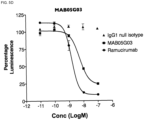
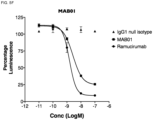
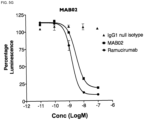
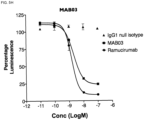
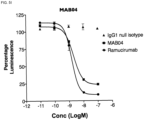
- soluble VEGF-165 protein was added to the VEGFR2 reporter cells and all IgG1 proteins were examined for their ability to antagonise the signal induced by VEGF-165 ( Fig. 4 ).
- the IgG1 hMAb005 and Isotype IgG1 both demonstrated no antagonism of VEGFR2 signal.
- the combined analyses outlined herein demonstrated that, surprisingly, deep sampling of amino acid diversity in the CDRs of these antibodies allowed the simultaneous optimisation of PD1 and VEGFR2 target binding specificity, resulting in the reversal of the VEGFR2 agonistic phenotype of the progenitor antibody hMAb005 in multiple lead molecules.
- the resulting lead antibodies have the beneficial characteristic of dual-antagonism of the clinically-relevant PD1 and VEGFR2 signalling pathways.
- MAB06 Eight variants of clone MAB06 (MAB06.1-MAB06.8) were generated to experimentally interrogate multiple CDR residues for their ability to be mutated to human germline sequence, to reduce immunogenicity risk. These clones contained germlining mutations in the LCDR1 and 2 (Table 8), and in the HCDR2 (Table 9). All eight clones were expressed and purified in IgG1 null format. All clones were readily expressed and purified via Protein A affinity column, and the resulting proteins exhibited % monomer IgG of >94% (as measured by SEC).
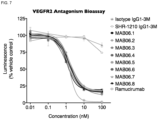
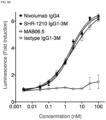
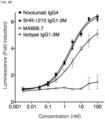
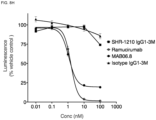
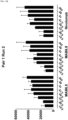
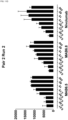
- MAB06.1-MAB06.8 IgGs were tested for ability to antagonise both PD1 and VEGFR2 signalling. All 8 clones retained the ability to antagonise PD1 signalling in a PD1/PD-L1 cell signalling bioassay, with potencies similar to both SHR-1210 IgG1-3M and Nivolumab ( Fig. 6 ). Similarly, all 8 clones retained the concentration-dependent ability to antagonise VEGFR2 signalling in a VEGF/VEGFR2 cell signalling bioassay, with potencies similar to Ramucirumab ( Fig. 7 ). Comparative analysis of PD1 and VEGFR2 antagonism for clones MAB06.5 ( Fig.
- Antibodies that bind to signalling receptors with high affinity are at risk of becoming potent agonists of receptor activity when the receptor ligand is not present.
- the VEGFR2 bioassay was repeated in the absence of VEGF.
- the high-affinity anti-VEGFR2 IgG1 control antibody Ramucirumab, isotype control human IgG1, MAB06.5, MAB06.8 and VEGF-165 protein were all titrated in this assay, with the antibody proteins starting from 1000 nM concentration ( Fig. 10 ).
- WO2019170885A1 discloses a number of mutations which may be made in the VH domain of hMab005 that have the potential to enhance the affinity of the molecule for PD1.
- nine variants of clone MAB06.8 were generated to experimentally interrogate multiple VH CDR residues for their ability to be mutated to potentially further improve binding to PD1 and/or VEGFR2.
- These clones all contained the MAB06.8 VL sequence (SEQ ID NO: 47, Table 8), expressed with 9 unique VH sequences (Table 10). All eight clones were expressed and purified in IgG1 null format.
- HFR1 HCDR1 HFR2 HCDR2 HFR3 HCDR3 HFR4 EVQLVESGGGLV QPGGSLRLSCAAS (SEQ ID NO:54) G FTFSSY MMS (SEQ ID NO: 1) WVRQAPGKGLEW (SEQ ID NO:55) VATISGGGANTYYPD SVKG (SEQ ID NO:56) RFTISRDNAKNSLYLQMN SLRAEDTAVYYCAR (SEQ ID NO:57) QLYYFDY (SEQ ID NO:3) WGQGTTVTVSS (SEQ ID NO:58) EVQLVESGGGLV QPGGSLRLSCAAS (SEQ ID NO:54) GFTF SSYMMS (SEQ ID NO: 1) WVRQAPGKGLEW (SEQ ID NO:55) VATISGGGANTYYPD SVKG (SEQ ID NO:56) RFTISRDNAKNSLYLQMN SLRAEDTAVYYCAR (SEQ ID NO:57)
- LASQX 1 X 2 X 3 X 4 WLX 5 is a variant sequence wherein X 1 is T, E, G, K, P or S, X 2 is I, A, L, S or V, X 3 is G, R or S, X 4 is T, G, I, L or P and X 5 is T or S (SEQ ID NO:59).
- Table 4 Position-specific mutations found in LCDR3 of clones exhibiting improved binding to VEGFR2.
- the original LCDR3 sequence QQVYSIPWT (SEQ ID NO:6) is shown as the top row.
- QQVX 1 X 2 X 3 PX 4 X 5 is a variant sequence wherein X 1 is Y, A, F, N or S, X 2 is S, A, E, M, N, Q or V, X 3 is I, L, T or V, X 4 is W or F and X 5 is T, A, G, N, R or S (SEQ ID NO:60).
- Table 5 Light chain variable region sequences of IgGs exhibiting improved binding to VEGFR2.
- membrane protein amino acid sequences Human PD1 sequence Cynomolgus monkey PD1 sequence Human KDR (VEGFR2) sequence Rhesus KDR (VEGFR2) sequence Table 8. Light chain variable region amino acid sequences of IgGs exhibiting improved binding to VEGFR2.
Landscapes
- Health & Medical Sciences (AREA)
- Chemical & Material Sciences (AREA)
- Immunology (AREA)
- Organic Chemistry (AREA)
- Life Sciences & Earth Sciences (AREA)
- General Health & Medical Sciences (AREA)
- Medicinal Chemistry (AREA)
- Biochemistry (AREA)
- Biophysics (AREA)
- Genetics & Genomics (AREA)
- Molecular Biology (AREA)
- Proteomics, Peptides & Aminoacids (AREA)
- Chemical Kinetics & Catalysis (AREA)
- General Chemical & Material Sciences (AREA)
- Nuclear Medicine, Radiotherapy & Molecular Imaging (AREA)
- Pharmacology & Pharmacy (AREA)
- Animal Behavior & Ethology (AREA)
- Public Health (AREA)
- Veterinary Medicine (AREA)
- Peptides Or Proteins (AREA)
- Medicines Containing Antibodies Or Antigens For Use As Internal Diagnostic Agents (AREA)
- Medicines That Contain Protein Lipid Enzymes And Other Medicines (AREA)
- Micro-Organisms Or Cultivation Processes Thereof (AREA)
- Preparation Of Compounds By Using Micro-Organisms (AREA)
- Medicinal Preparation (AREA)
- Enzymes And Modification Thereof (AREA)
Priority Applications (5)
| Application Number | Priority Date | Filing Date | Title |
|---|---|---|---|
| RS20250448A RS66837B1 (sr) | 2019-10-11 | 2020-10-09 | Agensi sa dvostrukim vezivanjem za pd1 i vegfr2 |
| EP25159487.5A EP4570824A3 (en) | 2019-10-11 | 2020-10-09 | Pd1 and vegfr2 dual-binding agents |
| EP25212556.2A EP4671279A2 (en) | 2019-10-11 | 2020-10-09 | DUAL LIAISON OFFICERS PD1 AND VEGFR2 |
| HRP20250523TT HRP20250523T1 (hr) | 2019-10-11 | 2020-10-09 | Pd1 i vegfr2 sredstva za dvostruko vezivanje |
| SI202030611T SI4041763T1 (sl) | 2019-10-11 | 2020-10-09 | Dvojna veziva PD1 in VEGFR2 |
Applications Claiming Priority (3)
| Application Number | Priority Date | Filing Date | Title |
|---|---|---|---|
| GB201914747A GB201914747D0 (en) | 2019-10-11 | 2019-10-11 | PD1 and vegfr2 dual-binding agents |
| GBGB2013180.1A GB202013180D0 (en) | 2019-10-11 | 2020-08-24 | Pd1 and vegfr2 dual-binding agents |
| PCT/EP2020/078427 WO2021069670A1 (en) | 2019-10-11 | 2020-10-09 | Pd1 and vegfr2 dual-binding agents |
Related Child Applications (2)
| Application Number | Title | Priority Date | Filing Date |
|---|---|---|---|
| EP25212556.2A Division EP4671279A2 (en) | 2019-10-11 | 2020-10-09 | DUAL LIAISON OFFICERS PD1 AND VEGFR2 |
| EP25159487.5A Division EP4570824A3 (en) | 2019-10-11 | 2020-10-09 | Pd1 and vegfr2 dual-binding agents |
Publications (2)
| Publication Number | Publication Date |
|---|---|
| EP4041763A1 EP4041763A1 (en) | 2022-08-17 |
| EP4041763B1 true EP4041763B1 (en) | 2025-02-26 |
Family
ID=68619556
Family Applications (3)
| Application Number | Title | Priority Date | Filing Date |
|---|---|---|---|
| EP20789105.2A Active EP4041763B1 (en) | 2019-10-11 | 2020-10-09 | Pd1 and vegfr2 dual-binding agents |
| EP25159487.5A Pending EP4570824A3 (en) | 2019-10-11 | 2020-10-09 | Pd1 and vegfr2 dual-binding agents |
| EP25212556.2A Pending EP4671279A2 (en) | 2019-10-11 | 2020-10-09 | DUAL LIAISON OFFICERS PD1 AND VEGFR2 |
Family Applications After (2)
| Application Number | Title | Priority Date | Filing Date |
|---|---|---|---|
| EP25159487.5A Pending EP4570824A3 (en) | 2019-10-11 | 2020-10-09 | Pd1 and vegfr2 dual-binding agents |
| EP25212556.2A Pending EP4671279A2 (en) | 2019-10-11 | 2020-10-09 | DUAL LIAISON OFFICERS PD1 AND VEGFR2 |
Country Status (20)
| Country | Link |
|---|---|
| US (2) | US20240101674A1 (https=) |
| EP (3) | EP4041763B1 (https=) |
| JP (2) | JP7689116B2 (https=) |
| KR (1) | KR20220091490A (https=) |
| CN (2) | CN114981301B (https=) |
| AU (1) | AU2020365021A1 (https=) |
| CA (2) | CA3289307A1 (https=) |
| DK (1) | DK4041763T3 (https=) |
| ES (1) | ES3027238T3 (https=) |
| FI (1) | FI4041763T3 (https=) |
| GB (2) | GB201914747D0 (https=) |
| HR (1) | HRP20250523T1 (https=) |
| HU (1) | HUE071341T2 (https=) |
| IL (1) | IL292158A (https=) |
| LT (1) | LT4041763T (https=) |
| PL (1) | PL4041763T3 (https=) |
| PT (1) | PT4041763T (https=) |
| RS (1) | RS66837B1 (https=) |
| SI (1) | SI4041763T1 (https=) |
| WO (1) | WO2021069670A1 (https=) |
Families Citing this family (5)
| Publication number | Priority date | Publication date | Assignee | Title |
|---|---|---|---|---|
| CN109053895B (zh) | 2018-08-30 | 2020-06-09 | 中山康方生物医药有限公司 | 抗pd-1-抗vegfa的双功能抗体、其药物组合物及其用途 |
| GB201914747D0 (en) | 2019-10-11 | 2019-11-27 | Ultrahuman Eight Ltd | PD1 and vegfr2 dual-binding agents |
| CN116143935A (zh) * | 2021-11-22 | 2023-05-23 | 杭州翰思生物医药有限公司 | 重组抗体及其应用 |
| WO2024032662A1 (zh) * | 2022-08-09 | 2024-02-15 | 上海济煜医药科技有限公司 | 一种靶向pd-1和vegf的抗体及其应用 |
| CN118620082A (zh) * | 2023-03-10 | 2024-09-10 | 南京维立志博生物科技有限公司 | 靶向vegf途径和pd-1的双特异性抗原结合蛋白、其组合物和用途 |
Family Cites Families (12)
| Publication number | Priority date | Publication date | Assignee | Title |
|---|---|---|---|---|
| DK2439273T3 (da) | 2005-05-09 | 2019-06-03 | Ono Pharmaceutical Co | Humane monoklonale antistoffer til programmeret død-1(pd-1) og fremgangsmåder til behandling af cancer ved anvendelse af anti-pd-1- antistoffer alene eller i kombination med andre immunterapeutika |
| BR122017025062B8 (pt) | 2007-06-18 | 2021-07-27 | Merck Sharp & Dohme | anticorpo monoclonal ou fragmento de anticorpo para o receptor de morte programada humano pd-1, polinucleotídeo e composição compreendendo o referido anticorpo ou fragmento |
| RU2689760C2 (ru) * | 2012-05-31 | 2019-05-30 | Дженентек, Инк. | Способы лечения рака с применением антагонистов аксиального связывания pd-1 и vegf антагонистов |
| CN112552401B (zh) | 2013-09-13 | 2023-08-25 | 广州百济神州生物制药有限公司 | 抗pd1抗体及其作为治疗剂与诊断剂的用途 |
| SG10201804945WA (en) * | 2013-12-12 | 2018-07-30 | Shanghai hengrui pharmaceutical co ltd | Pd-1 antibody, antigen-binding fragment thereof, and medical application thereof |
| WO2017055404A1 (en) | 2015-10-02 | 2017-04-06 | F. Hoffmann-La Roche Ag | Bispecific antibodies specific for pd1 and tim3 |
| CN109893654B (zh) * | 2017-12-11 | 2021-07-27 | 江苏恒瑞医药股份有限公司 | Vegfr抑制剂治疗肿瘤的方法 |
| GB201803746D0 (en) | 2018-03-08 | 2018-04-25 | Ultrahuman Eight Ltd | PD1 binding agents |
| GB201803745D0 (en) | 2018-03-08 | 2018-04-25 | Ultrahuman Eight Ltd | PD1 binding agents |
| CN109053895B (zh) * | 2018-08-30 | 2020-06-09 | 中山康方生物医药有限公司 | 抗pd-1-抗vegfa的双功能抗体、其药物组合物及其用途 |
| TWI822897B (zh) | 2018-11-06 | 2023-11-21 | 大陸商江蘇恆瑞醫藥股份有限公司 | 一種抗pd-1抗體和法米替尼聯合在製備治療腫瘤的藥物中的用途 |
| GB201914747D0 (en) | 2019-10-11 | 2019-11-27 | Ultrahuman Eight Ltd | PD1 and vegfr2 dual-binding agents |
-
2019
- 2019-10-11 GB GB201914747A patent/GB201914747D0/en not_active Ceased
-
2020
- 2020-08-24 GB GBGB2013180.1A patent/GB202013180D0/en not_active Ceased
- 2020-10-09 LT LTEPPCT/EP2020/078427T patent/LT4041763T/lt unknown
- 2020-10-09 DK DK20789105.2T patent/DK4041763T3/da active
- 2020-10-09 SI SI202030611T patent/SI4041763T1/sl unknown
- 2020-10-09 HR HRP20250523TT patent/HRP20250523T1/hr unknown
- 2020-10-09 CN CN202080075802.2A patent/CN114981301B/zh active Active
- 2020-10-09 CN CN202511932691.3A patent/CN121758618A/zh active Pending
- 2020-10-09 AU AU2020365021A patent/AU2020365021A1/en active Pending
- 2020-10-09 US US17/768,013 patent/US20240101674A1/en active Pending
- 2020-10-09 CA CA3289307A patent/CA3289307A1/en active Pending
- 2020-10-09 PL PL20789105.2T patent/PL4041763T3/pl unknown
- 2020-10-09 HU HUE20789105A patent/HUE071341T2/hu unknown
- 2020-10-09 EP EP20789105.2A patent/EP4041763B1/en active Active
- 2020-10-09 WO PCT/EP2020/078427 patent/WO2021069670A1/en not_active Ceased
- 2020-10-09 JP JP2022521074A patent/JP7689116B2/ja active Active
- 2020-10-09 EP EP25159487.5A patent/EP4570824A3/en active Pending
- 2020-10-09 ES ES20789105T patent/ES3027238T3/es active Active
- 2020-10-09 KR KR1020227014433A patent/KR20220091490A/ko active Pending
- 2020-10-09 PT PT207891052T patent/PT4041763T/pt unknown
- 2020-10-09 CA CA3156096A patent/CA3156096C/en active Active
- 2020-10-09 FI FIEP20789105.2T patent/FI4041763T3/fi active
- 2020-10-09 RS RS20250448A patent/RS66837B1/sr unknown
- 2020-10-09 EP EP25212556.2A patent/EP4671279A2/en active Pending
-
2022
- 2022-04-11 IL IL292158A patent/IL292158A/en unknown
-
2025
- 2025-02-18 US US19/056,312 patent/US12479920B2/en active Active
- 2025-05-26 JP JP2025087525A patent/JP2025134713A/ja active Pending
Also Published As
| Publication number | Publication date |
|---|---|
| PT4041763T (pt) | 2025-05-16 |
| EP4570824A2 (en) | 2025-06-18 |
| EP4671279A2 (en) | 2025-12-31 |
| EP4570824A3 (en) | 2025-06-25 |
| CN121758618A (zh) | 2026-03-31 |
| DK4041763T3 (da) | 2025-05-19 |
| RS66837B1 (sr) | 2025-06-30 |
| US20250243276A1 (en) | 2025-07-31 |
| AU2020365021A1 (en) | 2022-05-26 |
| JP7689116B2 (ja) | 2025-06-05 |
| US12479920B2 (en) | 2025-11-25 |
| SI4041763T1 (sl) | 2025-08-29 |
| WO2021069670A1 (en) | 2021-04-15 |
| KR20220091490A (ko) | 2022-06-30 |
| CN114981301A (zh) | 2022-08-30 |
| CA3289307A1 (en) | 2026-03-02 |
| HUE071341T2 (hu) | 2025-08-28 |
| JP2025134713A (ja) | 2025-09-17 |
| HRP20250523T1 (hr) | 2025-07-04 |
| EP4041763A1 (en) | 2022-08-17 |
| GB201914747D0 (en) | 2019-11-27 |
| ES3027238T3 (en) | 2025-06-13 |
| GB202013180D0 (en) | 2020-10-07 |
| LT4041763T (lt) | 2025-06-10 |
| CA3156096A1 (en) | 2021-04-15 |
| IL292158A (en) | 2022-06-01 |
| FI4041763T3 (fi) | 2025-05-15 |
| US20240101674A1 (en) | 2024-03-28 |
| PL4041763T3 (pl) | 2025-07-07 |
| JP2022553908A (ja) | 2022-12-27 |
| CN114981301B (zh) | 2026-04-14 |
| CA3156096C (en) | 2026-03-17 |
Similar Documents
| Publication | Publication Date | Title |
|---|---|---|
| IL275657B1 (en) | c-kit antibodies | |
| US10858435B2 (en) | PD1 binding agents | |
| US12479920B2 (en) | PD1 and VEGFR2 dual-binding agents | |
| US12415861B2 (en) | Anti C-MET antibodies | |
| WO2022221409A1 (en) | Anti-cd122 antibodies and uses thereof | |
| US10975165B2 (en) | De-immunised anti-ERBB3 antibodies | |
| US11655300B2 (en) | Colony stimulating factor 1 receptor (CSF1R) antibodies and immunoconjugates thereof | |
| HK40075900B (en) | Pd1 and vegfr2 dual-binding agents | |
| HK40075900A (en) | Pd1 and vegfr2 dual-binding agents |
Legal Events
| Date | Code | Title | Description |
|---|---|---|---|
| REG | Reference to a national code |
Ref country code: HR Ref legal event code: TUEP Ref document number: P20250523T Country of ref document: HR |
|
| STAA | Information on the status of an ep patent application or granted ep patent |
Free format text: STATUS: UNKNOWN |
|
| STAA | Information on the status of an ep patent application or granted ep patent |
Free format text: STATUS: THE INTERNATIONAL PUBLICATION HAS BEEN MADE |
|
| PUAI | Public reference made under article 153(3) epc to a published international application that has entered the european phase |
Free format text: ORIGINAL CODE: 0009012 |
|
| STAA | Information on the status of an ep patent application or granted ep patent |
Free format text: STATUS: REQUEST FOR EXAMINATION WAS MADE |
|
| 17P | Request for examination filed |
Effective date: 20220504 |
|
| AK | Designated contracting states |
Kind code of ref document: A1 Designated state(s): AL AT BE BG CH CY CZ DE DK EE ES FI FR GB GR HR HU IE IS IT LI LT LU LV MC MK MT NL NO PL PT RO RS SE SI SK SM TR |
|
| DAV | Request for validation of the european patent (deleted) | ||
| DAX | Request for extension of the european patent (deleted) | ||
| REG | Reference to a national code |
Ref country code: HK Ref legal event code: DE Ref document number: 40075900 Country of ref document: HK |
|
| P01 | Opt-out of the competence of the unified patent court (upc) registered |
Effective date: 20230405 |
|
| STAA | Information on the status of an ep patent application or granted ep patent |
Free format text: STATUS: EXAMINATION IS IN PROGRESS |
|
| 17Q | First examination report despatched |
Effective date: 20230809 |
|
| GRAP | Despatch of communication of intention to grant a patent |
Free format text: ORIGINAL CODE: EPIDOSNIGR1 |
|
| STAA | Information on the status of an ep patent application or granted ep patent |
Free format text: STATUS: GRANT OF PATENT IS INTENDED |
|
| INTG | Intention to grant announced |
Effective date: 20240418 |
|
| GRAJ | Information related to disapproval of communication of intention to grant by the applicant or resumption of examination proceedings by the epo deleted |
Free format text: ORIGINAL CODE: EPIDOSDIGR1 |
|
| STAA | Information on the status of an ep patent application or granted ep patent |
Free format text: STATUS: EXAMINATION IS IN PROGRESS |
|
| GRAP | Despatch of communication of intention to grant a patent |
Free format text: ORIGINAL CODE: EPIDOSNIGR1 |
|
| STAA | Information on the status of an ep patent application or granted ep patent |
Free format text: STATUS: GRANT OF PATENT IS INTENDED |
|
| GRAJ | Information related to disapproval of communication of intention to grant by the applicant or resumption of examination proceedings by the epo deleted |
Free format text: ORIGINAL CODE: EPIDOSDIGR1 |
|
| STAA | Information on the status of an ep patent application or granted ep patent |
Free format text: STATUS: EXAMINATION IS IN PROGRESS |
|
| GRAP | Despatch of communication of intention to grant a patent |
Free format text: ORIGINAL CODE: EPIDOSNIGR1 |
|
| STAA | Information on the status of an ep patent application or granted ep patent |
Free format text: STATUS: GRANT OF PATENT IS INTENDED |
|
| GRAJ | Information related to disapproval of communication of intention to grant by the applicant or resumption of examination proceedings by the epo deleted |
Free format text: ORIGINAL CODE: EPIDOSDIGR1 |
|
| STAA | Information on the status of an ep patent application or granted ep patent |
Free format text: STATUS: EXAMINATION IS IN PROGRESS |
|
| GRAP | Despatch of communication of intention to grant a patent |
Free format text: ORIGINAL CODE: EPIDOSNIGR1 |
|
| INTC | Intention to grant announced (deleted) | ||
| STAA | Information on the status of an ep patent application or granted ep patent |
Free format text: STATUS: GRANT OF PATENT IS INTENDED |
|
| INTG | Intention to grant announced |
Effective date: 20240902 |
|
| INTC | Intention to grant announced (deleted) | ||
| INTG | Intention to grant announced |
Effective date: 20240919 |
|
| RAP3 | Party data changed (applicant data changed or rights of an application transferred) |
Owner name: OTTIMO PHARMA LIMITED |
|
| GRAS | Grant fee paid |
Free format text: ORIGINAL CODE: EPIDOSNIGR3 |
|
| GRAA | (expected) grant |
Free format text: ORIGINAL CODE: 0009210 |
|
| STAA | Information on the status of an ep patent application or granted ep patent |
Free format text: STATUS: THE PATENT HAS BEEN GRANTED |
|
| AK | Designated contracting states |
Kind code of ref document: B1 Designated state(s): AL AT BE BG CH CY CZ DE DK EE ES FI FR GB GR HR HU IE IS IT LI LT LU LV MC MK MT NL NO PL PT RO RS SE SI SK SM TR |
|
| REG | Reference to a national code |
Ref country code: GB Ref legal event code: FG4D |
|
| REG | Reference to a national code |
Ref country code: CH Ref legal event code: EP |
|
| REG | Reference to a national code |
Ref country code: DE Ref legal event code: R096 Ref document number: 602020046831 Country of ref document: DE |
|
| REG | Reference to a national code |
Ref country code: IE Ref legal event code: FG4D |
|
| REG | Reference to a national code |
Ref country code: NL Ref legal event code: FP |
|
| REG | Reference to a national code |
Ref country code: FI Ref legal event code: FGE |
|
| REG | Reference to a national code |
Ref country code: PT Ref legal event code: SC4A Ref document number: 4041763 Country of ref document: PT Date of ref document: 20250516 Kind code of ref document: T Free format text: AVAILABILITY OF NATIONAL TRANSLATION Effective date: 20250512 |
|
| REG | Reference to a national code |
Ref country code: DK Ref legal event code: T3 Effective date: 20250514 |
|
| REG | Reference to a national code |
Ref country code: SE Ref legal event code: TRGR |
|
| REG | Reference to a national code |
Ref country code: ES Ref legal event code: FG2A Ref document number: 3027238 Country of ref document: ES Kind code of ref document: T3 Effective date: 20250613 |
|
| REG | Reference to a national code |
Ref country code: HR Ref legal event code: T1PR Ref document number: P20250523 Country of ref document: HR |
|
| REG | Reference to a national code |
Ref country code: SK Ref legal event code: T3 Ref document number: E 46557 Country of ref document: SK |
|
| REG | Reference to a national code |
Ref country code: GR Ref legal event code: EP Ref document number: 20250401072 Country of ref document: GR Effective date: 20250613 |
|
| REG | Reference to a national code |
Ref country code: HU Ref legal event code: AG4A Ref document number: E071341 Country of ref document: HU |
|
| PGFP | Annual fee paid to national office [announced via postgrant information from national office to epo] |
Ref country code: NL Payment date: 20250826 Year of fee payment: 6 |
|
| REG | Reference to a national code |
Ref country code: EE Ref legal event code: FG4A Ref document number: E025096 Country of ref document: EE Effective date: 20250512 |
|
| PGFP | Annual fee paid to national office [announced via postgrant information from national office to epo] |
Ref country code: LT Payment date: 20250828 Year of fee payment: 6 |
|
| REG | Reference to a national code |
Ref country code: HR Ref legal event code: ODRP Ref document number: P20250523 Country of ref document: HR Payment date: 20250901 Year of fee payment: 6 |
|
| PGFP | Annual fee paid to national office [announced via postgrant information from national office to epo] |
Ref country code: GR Payment date: 20250911 Year of fee payment: 6 |
|
| PGFP | Annual fee paid to national office [announced via postgrant information from national office to epo] |
Ref country code: TR Payment date: 20250929 Year of fee payment: 6 Ref country code: IT Payment date: 20250922 Year of fee payment: 6 Ref country code: LU Payment date: 20250929 Year of fee payment: 6 Ref country code: PL Payment date: 20250827 Year of fee payment: 6 |
|
| PGFP | Annual fee paid to national office [announced via postgrant information from national office to epo] |
Ref country code: BG Payment date: 20250903 Year of fee payment: 6 Ref country code: BE Payment date: 20250917 Year of fee payment: 6 Ref country code: GB Payment date: 20250821 Year of fee payment: 6 |
|
| PGFP | Annual fee paid to national office [announced via postgrant information from national office to epo] |
Ref country code: HR Payment date: 20250924 Year of fee payment: 7 |
|
| PGFP | Annual fee paid to national office [announced via postgrant information from national office to epo] |
Ref country code: FR Payment date: 20250821 Year of fee payment: 6 |
|
| PGFP | Annual fee paid to national office [announced via postgrant information from national office to epo] |
Ref country code: SE Payment date: 20250827 Year of fee payment: 6 |
|
| PGFP | Annual fee paid to national office [announced via postgrant information from national office to epo] |
Ref country code: CZ Payment date: 20250923 Year of fee payment: 6 Ref country code: EE Payment date: 20250828 Year of fee payment: 6 Ref country code: IE Payment date: 20250827 Year of fee payment: 6 Ref country code: RS Payment date: 20250917 Year of fee payment: 6 |
|
| PGFP | Annual fee paid to national office [announced via postgrant information from national office to epo] |
Ref country code: RO Payment date: 20250905 Year of fee payment: 6 |
|
| PGFP | Annual fee paid to national office [announced via postgrant information from national office to epo] |
Ref country code: SK Payment date: 20250827 Year of fee payment: 6 |
|
| PGFP | Annual fee paid to national office [announced via postgrant information from national office to epo] |
Ref country code: LV Payment date: 20250819 Year of fee payment: 6 |
|
| PGFP | Annual fee paid to national office [announced via postgrant information from national office to epo] |
Ref country code: SI Payment date: 20250827 Year of fee payment: 6 |
|
| REG | Reference to a national code |
Ref country code: CH Ref legal event code: U11 Free format text: ST27 STATUS EVENT CODE: U-0-0-U10-U11 (AS PROVIDED BY THE NATIONAL OFFICE) Effective date: 20251101 |
|
| PGFP | Annual fee paid to national office [announced via postgrant information from national office to epo] |
Ref country code: MK Payment date: 20250821 Year of fee payment: 6 |
|
| PGFP | Annual fee paid to national office [announced via postgrant information from national office to epo] |
Ref country code: HU Payment date: 20250915 Year of fee payment: 6 |
|
| REG | Reference to a national code |
Ref country code: DE Ref legal event code: R097 Ref document number: 602020046831 Country of ref document: DE |
|
| PGFP | Annual fee paid to national office [announced via postgrant information from national office to epo] |
Ref country code: PT Payment date: 20251002 Year of fee payment: 6 |
|
| PLBE | No opposition filed within time limit |
Free format text: ORIGINAL CODE: 0009261 |
|
| STAA | Information on the status of an ep patent application or granted ep patent |
Free format text: STATUS: NO OPPOSITION FILED WITHIN TIME LIMIT |
|
| PGFP | Annual fee paid to national office [announced via postgrant information from national office to epo] |
Ref country code: IS Payment date: 20251002 Year of fee payment: 6 Ref country code: DE Payment date: 20250819 Year of fee payment: 6 |
|
| PGFP | Annual fee paid to national office [announced via postgrant information from national office to epo] |
Ref country code: NO Payment date: 20251009 Year of fee payment: 6 Ref country code: MC Payment date: 20251002 Year of fee payment: 6 |
|
| PGFP | Annual fee paid to national office [announced via postgrant information from national office to epo] |
Ref country code: SM Payment date: 20251002 Year of fee payment: 6 Ref country code: AT Payment date: 20250925 Year of fee payment: 6 |
|
| PGFP | Annual fee paid to national office [announced via postgrant information from national office to epo] |
Ref country code: FI Payment date: 20251014 Year of fee payment: 6 Ref country code: DK Payment date: 20251014 Year of fee payment: 6 |
|
| PGFP | Annual fee paid to national office [announced via postgrant information from national office to epo] |
Ref country code: AL Payment date: 20251006 Year of fee payment: 6 |
|
| PGFP | Annual fee paid to national office [announced via postgrant information from national office to epo] |
Ref country code: CH Payment date: 20251101 Year of fee payment: 6 |
|
| PGFP | Annual fee paid to national office [announced via postgrant information from national office to epo] |
Ref country code: CY Payment date: 20250925 Year of fee payment: 6 |
|
| PGFP | Annual fee paid to national office [announced via postgrant information from national office to epo] |
Ref country code: MT Payment date: 20251017 Year of fee payment: 6 |
|
| PGFP | Annual fee paid to national office [announced via postgrant information from national office to epo] |
Ref country code: ES Payment date: 20251105 Year of fee payment: 6 |
|
| 26N | No opposition filed |
Effective date: 20251127 |