EP4040737B1 - Verfahren und vorrichtung zur steuerung einer wäschereiausrüstung und speichermedium - Google Patents
Verfahren und vorrichtung zur steuerung einer wäschereiausrüstung und speichermedium Download PDFInfo
- Publication number
- EP4040737B1 EP4040737B1 EP21188114.9A EP21188114A EP4040737B1 EP 4040737 B1 EP4040737 B1 EP 4040737B1 EP 21188114 A EP21188114 A EP 21188114A EP 4040737 B1 EP4040737 B1 EP 4040737B1
- Authority
- EP
- European Patent Office
- Prior art keywords
- washing
- mode
- target
- laundry equipment
- shared
- Prior art date
- Legal status (The legal status is an assumption and is not a legal conclusion. Google has not performed a legal analysis and makes no representation as to the accuracy of the status listed.)
- Active
Links
Images



Classifications
-
- H—ELECTRICITY
- H04—ELECTRIC COMMUNICATION TECHNIQUE
- H04L—TRANSMISSION OF DIGITAL INFORMATION, e.g. TELEGRAPHIC COMMUNICATION
- H04L12/00—Data switching networks
- H04L12/28—Data switching networks characterised by path configuration, e.g. LAN [Local Area Networks] or WAN [Wide Area Networks]
- H04L12/2803—Home automation networks
- H04L12/2823—Reporting information sensed by appliance or service execution status of appliance services in a home automation network
- H04L12/2825—Reporting to a device located outside the home and the home network
-
- D—TEXTILES; PAPER
- D06—TREATMENT OF TEXTILES OR THE LIKE; LAUNDERING; FLEXIBLE MATERIALS NOT OTHERWISE PROVIDED FOR
- D06F—LAUNDERING, DRYING, IRONING, PRESSING OR FOLDING TEXTILE ARTICLES
- D06F34/00—Details of control systems for washing machines, washer-dryers or laundry dryers
- D06F34/04—Signal transfer or data transmission arrangements
- D06F34/05—Signal transfer or data transmission arrangements for wireless communication between components, e.g. for remote monitoring or control
-
- D—TEXTILES; PAPER
- D06—TREATMENT OF TEXTILES OR THE LIKE; LAUNDERING; FLEXIBLE MATERIALS NOT OTHERWISE PROVIDED FOR
- D06F—LAUNDERING, DRYING, IRONING, PRESSING OR FOLDING TEXTILE ARTICLES
- D06F33/00—Control of operations performed in washing machines or washer-dryers
- D06F33/30—Control of washing machines characterised by the purpose or target of the control
- D06F33/32—Control of operational steps, e.g. optimisation or improvement of operational steps depending on the condition of the laundry
- D06F33/36—Control of operational steps, e.g. optimisation or improvement of operational steps depending on the condition of the laundry of washing
-
- D—TEXTILES; PAPER
- D06—TREATMENT OF TEXTILES OR THE LIKE; LAUNDERING; FLEXIBLE MATERIALS NOT OTHERWISE PROVIDED FOR
- D06F—LAUNDERING, DRYING, IRONING, PRESSING OR FOLDING TEXTILE ARTICLES
- D06F34/00—Details of control systems for washing machines, washer-dryers or laundry dryers
- D06F34/28—Arrangements for program selection, e.g. control panels therefor; Arrangements for indicating program parameters, e.g. the selected program or its progress
- D06F34/32—Arrangements for program selection, e.g. control panels therefor; Arrangements for indicating program parameters, e.g. the selected program or its progress characterised by graphical features, e.g. touchscreens
-
- D—TEXTILES; PAPER
- D06—TREATMENT OF TEXTILES OR THE LIKE; LAUNDERING; FLEXIBLE MATERIALS NOT OTHERWISE PROVIDED FOR
- D06F—LAUNDERING, DRYING, IRONING, PRESSING OR FOLDING TEXTILE ARTICLES
- D06F2101/00—User input for the control of domestic laundry washing machines, washer-dryers or laundry dryers
- D06F2101/20—Operation modes, e.g. delicate laundry washing programs, service modes or refreshment cycles
-
- D—TEXTILES; PAPER
- D06—TREATMENT OF TEXTILES OR THE LIKE; LAUNDERING; FLEXIBLE MATERIALS NOT OTHERWISE PROVIDED FOR
- D06F—LAUNDERING, DRYING, IRONING, PRESSING OR FOLDING TEXTILE ARTICLES
- D06F2103/00—Parameters monitored or detected for the control of domestic laundry washing machines, washer-dryers or laundry dryers
- D06F2103/68—Operation mode; Program phase
-
- D—TEXTILES; PAPER
- D06—TREATMENT OF TEXTILES OR THE LIKE; LAUNDERING; FLEXIBLE MATERIALS NOT OTHERWISE PROVIDED FOR
- D06F—LAUNDERING, DRYING, IRONING, PRESSING OR FOLDING TEXTILE ARTICLES
- D06F2105/00—Systems or parameters controlled or affected by the control systems of washing machines, washer-dryers or laundry dryers
- D06F2105/54—Changing between normal operation mode and special operation modes, e.g. service mode, component cleaning mode or stand-by mode
-
- H—ELECTRICITY
- H04—ELECTRIC COMMUNICATION TECHNIQUE
- H04L—TRANSMISSION OF DIGITAL INFORMATION, e.g. TELEGRAPHIC COMMUNICATION
- H04L12/00—Data switching networks
- H04L12/28—Data switching networks characterised by path configuration, e.g. LAN [Local Area Networks] or WAN [Wide Area Networks]
- H04L12/2803—Home automation networks
- H04L2012/2847—Home automation networks characterised by the type of home appliance used
- H04L2012/285—Generic home appliances, e.g. refrigerators
Definitions
- the present disclosure relates to the field of household appliances, and more particularly, to a method and device for controlling a laundry equipment, and a storage medium.
- the Internet of Things applies to various infrastructure fields, such as industry, agriculture, environment, transportation, logistics, security, etc., effectively promoting intelligent development of these aspects, allowing more reasonable use and distribution of limited resources, thereby improving the industry efficiency and benefit.
- a laundry treating apparatus includes a recommendation request unit configured to receive input that enables a recommendation of a laundry treating course from among a plurality of courses or a recommendation of a laundry treating option from among a plurality of options, a controller configured to, based on reception of the input from the recommendation request unit, determine a recommended course or a recommended option according to evaluation of one or more recommendation rules that are accessible by the controller and that have been stored in the controller, and a display unit configured to display the recommended course or the recommended option that has been determined by the controller.
- the present disclosure provides a method and device for controlling a laundry equipment, and a storage medium.
- a method for controlling laundry equipment implemented at a washing mode sharing platform.
- the method includes:
- a washing mode sharing platform may generate a historical data set based on a to-be-shared washing parameter and a to-be-shared washing mode acquired from first laundry equipment, and send a target washing mode and a target washing parameter determined from the historical data set to second laundry equipment, allowing the second laundry equipment to wash a to-be-washed object according to the target washing mode and the target washing parameter.
- a target washing mode and a target washing parameter corresponding to the target washing mode can be acquired from the washing mode sharing platform.
- the washing mode sharing platform stores an empirical parameter that has been verified and reviewed.
- a target washing parameter corresponding to a target washing mode can be acquired directly from the washing mode sharing platform, and laundry equipment can be controlled to wash a to-be-washed object according to the target washing parameter, without having to modify and adjust respective parameters one by one, decreasing difficulty and complexity in washing.
- each washing parameter of the washing mode sharing platform is a viewed and verified empirical parameter ready for a user to download and use without having to make multiple attempts, reducing possibility of a poor washing effect or damage to a to-be-washed object during the user attempts.
- the method further includes:
- determining the target washing mode from the historical data set according to the comparison result includes: in response to the comparison result indicating a to-be-shared washing mode in the historical data set with a mode identifier same as the target mode identifier, determining, as the target washing mode, the to-be-shared washing mode with the mode identifier same as the target mode identifier.
- a method for controlling laundry equipment, implemented at second laundry equipment includes:
- the method further includes:
- acquiring the to-be-shared washing parameter based on the target washing parameter includes: editing the target washing parameter based on an editing instruction detected, acquiring the to-be-shared washing parameter.
- the method further includes:
- the second laundry equipment has a touch display.
- the second laundry equipment may be communicatively connected to terminal equipment. Acquiring a washing request corresponding to the target washing mode may include:
- the method further includes: displaying a mode icon of a candidate washing mode in a set order on a touch display of the second laundry equipment, or on a display interface of terminal equipment.
- the mode icon may be configured to identify the candidate washing mode corresponding to the mode icon.
- a device for controlling laundry equipment implemented at a washing mode sharing platform.
- the device includes a first acquiring module, a generating module, a determining module, and a sending module.
- the first acquiring module is configured to acquire a to-be-shared washing parameter of at least one first laundry equipment, and a to-be-shared washing mode corresponding to the to-be-shared washing parameter.
- the generating module is configured to generate a historical data set based on the to-be-shared washing parameter and the to-be-shared washing mode.
- the determining module is configured to determine a target washing mode and a target washing parameter corresponding to the target washing mode from the historical data set.
- the sending module is configured to send the target washing mode and the target washing parameter to second laundry equipment.
- the device further includes a second acquiring module.
- the second acquiring module may be configured to acquire a washing request from the second laundry equipment or terminal equipment communicatively connected to the second laundry equipment.
- the determining module may be further configured to: determine the target washing mode and the target washing parameter corresponding to the target washing mode from the historical data set according to the washing request.
- the washing request includes a target mode identifier.
- the determining module may be further configured to: compare the target mode identifier to a mode identifier of each of the to-be-shared washing mode in the historical data set, and determine the target washing mode from the historical data set according to a comparison result.
- the determining module may be further configured to: in response to the comparison result indicating a to-be-shared washing mode in the historical data set with a mode identifier same as the target mode identifier, determine, as the target washing mode, the to-be-shared washing mode with the mode identifier same as the target mode identifier.
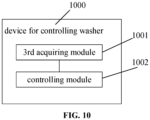
- the third acquiring module is configured to acquire, from a washing mode sharing platform, a target washing mode and a target washing parameter corresponding to the target washing mode.
- the controlling module is configured to control washing a to-be-washed object by the second laundry equipment according to the target washing mode according to the target washing parameter.
- the device further includes a fourth acquiring module and an uploading module.
- the fourth acquiring module may be configured to, after the second laundry equipment has washed the to-be-washed object, acquire a to-be-shared washing parameter based on the target washing parameter.
- the uploading module may be configured to upload the to-be-shared washing parameter to the washing mode sharing platform based on an uploading instruction detected.
- the fourth acquiring module is further configured to: edit the target washing parameter based on an editing instruction detected, acquiring the to-be-shared washing parameter.
- the device further includes a fifth acquiring module.
- the fifth acquiring module may be configured to acquire a washing request corresponding to the target washing mode.
- the washing request includes a target mode identifier.
- the third acquiring module may be further configured to: acquire, from the washing mode sharing platform based on the target mode identifier, the target washing mode and the target washing parameter corresponding to the target washing mode.
- the second laundry equipment has a touch display.
- the second laundry equipment may be communicatively connected to terminal equipment.
- the third acquiring module may be further configured to:
- the device further includes a displaying module.
- the displaying module may be configured to display a mode icon of a candidate washing mode in a set order on a touch display of the second laundry equipment, or on a display interface of terminal equipment.
- the mode icon may be configured to identify the candidate washing mode corresponding to the mode icon.
- a device for controlling laundry equipment including:
- the processor is configured to implement any method of the first aspect, or may be configured to implement any method of the second aspect.
- a computer-readable storage medium having stored therein instructions which, when executed by a processor of a device for controlling laundry equipment, allow the device for controlling laundry equipment to implement any method of the first aspect, or may be configured to implement any method of the second aspect.
- first, second, third may be adopted in an embodiment herein to describe various kinds of information, such information should not be limited to such a term. Such a term is merely for distinguishing information of the same type.
- first information may also be referred to as the second information.
- second information may also be referred to as the first information.
- a "if” as used herein may be interpreted as "when” or “while” or "in response to determining that”.
- a block diagram shown in the accompanying drawings may be a functional entity which may not necessarily correspond to a physically or logically independent entity.
- Such a functional entity may be implemented in form of software, in one or more hardware modules or integrated circuits, or in different networks and /or processor devices and /or microcontroller devices.
- a terminal may sometimes be referred to as a smart terminal.
- the terminal may be a mobile terminal.
- the terminal may also be referred to as User Equipment (UE), a Mobile Station (MS), etc.
- UE User Equipment
- MS Mobile Station
- a terminal may be equipment or a chip provided that provides a user with a voice and / or data connection, such as handheld equipment, onboard equipment, etc., with a wireless connection function.
- Examples of a terminal may include a mobile phone, a tablet computer, a notebook computer, a palm computer, a Mobile Internet Device (MID), wearable equipment, Virtual Reality (VR) equipment, Augmented Reality (AR) equipment, a wireless terminal in industrial control, a wireless terminal in unmanned drive, a wireless terminal in remote surgery, a wireless terminal in a smart grid, a wireless terminal in transportation safety, a wireless terminal in smart city, a wireless terminal in smart home, etc.
- MID Mobile Internet Device
- VR Virtual Reality
- AR Augmented Reality
- a wireless terminal in industrial control a wireless terminal in unmanned drive, a wireless terminal in remote surgery, a wireless terminal in a smart grid, a wireless terminal in transportation safety, a wireless terminal in smart city, a wireless terminal in smart home, etc.
- the Internet of Things applies to various infrastructure fields, such as industry, agriculture, environment, transportation, logistics, security, etc., effectively promoting intelligent development of these aspects, allowing more reasonable use and distribution of limited resources, thereby improving the industry efficiency and benefit.
- laundry equipment control may be implemented through terminal equipment.
- the laundry can only be washed through a program preset by a manufacturer, and a user can only manually modify some parameters.
- the program set by the manufacturer does not meet the need of the user, the user has to modify and adjust the parameters one by one, which increases difficulty and complexity in washing.
- the user has to try a number of times before she or he can find a right washing parameter corresponding to the laundry, and in this process, the laundry may be damaged or not washed well due to inaccurate parameter selection.
- the Internet of Things applies to various infrastructure fields, such as industry, agriculture, environment, transportation, logistics, security, etc., effectively promoting intelligent development of these aspects, allowing more reasonable use and distribution of limited resources, thereby improving the industry efficiency and benefit.
- laundry equipment control may be implemented through terminal equipment.
- the laundry can only be washed through a program preset by a manufacturer, and a user can only manually modify some parameters.
- the program set by the manufacturer does not meet the need of the user, the user has to modify and adjust the parameters one by one, which increases difficulty and complexity in washing.
- the user has to try a number of times before she or he can find a right washing parameter corresponding to the laundry, and in this process, the laundry may be damaged or not washed well due to inaccurate parameter selection.
- FIG. 1 is a flowchart of a method for controlling laundry equipment according to an illustrative embodiment. As shown in FIG. 1 , the method may be implemented at a washing mode sharing platform. The method mainly includes steps as follows.
- a to-be-shared washing parameter of at least one first laundry equipment, and a to-be-shared washing mode corresponding to the to-be-shared washing parameter, are acquired.
- a historical data set is generated based on the to-be-shared washing parameter and the to-be-shared washing mode.
- a target washing mode and a target washing parameter corresponding to the target washing mode are determined from the historical data set.
- the target washing mode and the target washing parameter are sent to second laundry equipment.
- the first laundry equipment and the second laundry equipment may include drum laundry equipment, pulsator laundry equipment, a washing and drying machine, etc.
- the washing mode sharing platform may include electronic equipment capable of processing data independently, such as a server.
- the washing mode sharing platform may acquire a to-be-shared washing parameter from at least one first laundry equipment and a to-be-shared washing mode corresponding to the to-be-shared washing parameter.
- a to-be-shared washing parameter and a to-be-shared washing mode may be acquired actively by the washing mode sharing platform from first laundry equipment, or may be uploaded triggered by a user using first laundry equipment, which is not specifically limited herein. In some embodiments, there may be multiple pieces of first laundry equipment.
- a historical data set may be formed based on the to-be-shared washing parameter and the to-be-shared washing mode acquired, and a mapping relation between a to-be-shared washing parameter and a to-be-shared washing mode.
- the washing mode sharing platform may determine a target washing mode and a target washing parameter corresponding to the target washing mode from the historical data set, and send the target washing mode and the target washing parameter to the second laundry equipment, to control washing a to-be-washed object by the second laundry equipment using the target washing parameter according to the target washing mode.
- a to-be-shared washing parameter includes at least a water temperature, an amount of water, an amount of laundry detergent used, a number of rinses, a spin speed, and a drying time, which are not specifically limited herein.
- a target washing mode and a target washing parameter corresponding to the target washing mode can be acquired from the washing mode sharing platform.
- the washing mode sharing platform stores an empirical parameter that has been verified and reviewed.
- a target washing parameter corresponding to a target washing mode can be acquired directly from the washing mode sharing platform, and laundry equipment can be controlled to wash a to-be-washed object according to the target washing parameter, without having to modify and adjust respective parameters one by one, decreasing difficulty and complexity in washing.
- each washing parameter of the washing mode sharing platform is a viewed and verified empirical parameter ready for a user to download and use without having to make multiple attempts, reducing possibility of a poor washing effect or damage to a to-be-washed object during the user attempts.
- the method further includes a step as follows.
- a washing request is acquired from the second laundry equipment or a terminal equipment communicatively connected to the second laundry equipment.
- the target washing mode and the target washing parameter corresponding to the target washing mode may be determined from the historical data set as follows.
- the target washing mode and the target washing parameter corresponding to the target washing mode are determined from the historical data set according to the washing request.
- a touch display may be provided on the second laundry equipment.
- the touch display may have both a display function and a touch function.
- both a touch area having a touch function and a display area having a display function may be provided on a door cover of the second laundry equipment.
- the touch area and the display area may both be provided on other locations on the second laundry equipment, such as on the body of the second laundry equipment.
- the touch area and the display area of the touch display may be provided separately.
- the touch area is provided on the body of the second laundry equipment, and the display area is provided on the door cover of the second laundry equipment, which may be provided as needed, and is not specifically limited herein.
- a touch display may be provided for the first laundry equipment, in a way same as the second laundry equipment, which is not specifically limited herein.
- a touch display is provided on the body of the second laundry equipment.
- the touch display on the body of the second laundry equipment and the display of the terminal equipment may perform synchronous display.
- the second laundry equipment may be controlled through the touch display on the body to perform a corresponding function.
- the second laundry equipment may be controlled through the display of the terminal equipment to perform a corresponding function.
- a user may input a touch operation through the display of the terminal equipment. After detecting the touch operation, the terminal equipment can acquire a washing request based on the touch operation, and send the washing request to a washing mode sharing platform.
- a washing request may be triggered based on a click operation applied to the display of the terminal equipment. For example, a washing request may be triggered based on a click operation, a double-click operation, a long-press operation, etc.
- the user may select a washing mode as needed, and input a corresponding touch operation through the mode icon corresponding to the washing mode selected by the user, thereby generating a washing request corresponding to the washing mode.
- the washing request may be sent to the washing mode sharing platform.
- the washing mode sharing platform determines a target washing mode and a target washing parameter corresponding to the target washing mode from the historical data set according to the washing request.
- the washing mode sharing platform may acquire the washing request from the second laundry equipment directly, or acquire the washing request through the terminal equipment, thereby improving flexibility in acquiring the washing request.
- the washing request includes a target mode identifier.
- the target washing mode is determined from the historical data set according to the washing request as follows.
- the target mode identifier is compared to a mode identifier of each of the to-be-shared washing mode in the historical data set.
- the target washing mode is determined from the historical data set according to a comparison result.
- the mode identifier of the washing mode required by the user may be included in the washing request.
- each to-be-shared washing mode has a corresponding mode identifier.
- the target mode identifier is compared to the mode identifier of each to-be-shared washing mode, and the target washing mode is determined according to the comparison result.
- a mode identifier may include a number, a letter, etc.
- the target washing mode is determined from the historical data set according to the comparison result as follows.
- the to-be-shared washing mode with the mode identifier same as the target mode identifier is determined as the target washing mode.
- the to-be-shared washing mode with the mode identifier same as the target mode identifier is determined as the target washing mode, improving accuracy of a determined target washing mode.
- to-be-shared washing modes of a plurality of laundry equipment, and a to-be-shared washing parameter corresponding to each to-be-shared washing mode may be stored to the washing mode sharing platform in form of a historical data set, so that a user may determine, from the historical data set, a target washing mode and a target washing parameter directly corresponding to the target mode identifier.
- a target washing mode and a target washing parameter corresponding to the target washing mode can be acquired directly from the washing mode sharing platform, and laundry equipment can be controlled to wash a to-be-washed object according to the target washing parameter, without having to modify and adjust respective parameters one by one, decreasing difficulty and complexity in washing.
- a massive number of users keep uploading and sharing historical washing modes and historical washing parameters. Better washing modes keep being filtered out.
- a user is allowed to acquire a laundry equipment operating program suitable for various clothes or with a better washing effect for same clothes.
- Program methods suitable for a variety of laundry equipment are created using a massive number of Internet users combining Internet of Things (IoT) technology, improving user experience in using laundry equipment.
- IoT Internet of Things
- FIG. 2 is a flowchart of a method for controlling laundry equipment according to an illustrative embodiment. As shown in FIG. 2 , the method may be implemented at second laundry equipment. The method mainly includes steps as follows.
- a target washing mode and a target washing parameter corresponding to the target washing mode are acquired from a washing mode sharing platform.
- S202 it is controlled to wash a to-be-washed object by the second laundry equipment according to the target washing mode according to the target washing parameter.
- the second laundry equipment may include drum laundry equipment, pulsator laundry equipment, a washing and drying machine, etc.
- the washing mode sharing platform may include electronic equipment capable of processing data independently, such as a server.
- a touch display may be provided on the second laundry equipment.
- the touch display may have both a display function and a touch function.
- both a touch area having a touch function and a display area having a display function may be provided on a door cover of the second laundry equipment.
- the touch area and the display area may both be provided on other locations on the second laundry equipment, such as on the body of the second laundry equipment.
- the touch area and the display area of the touch display may be provided separately.
- the touch area is provided on the body of the second laundry equipment
- the display area is provided on the door cover of the second laundry equipment, which may be provided as needed, and is not specifically limited herein.
- a touch display is provided on the body of the second laundry equipment.
- the second laundry equipment may be controlled through the touch display on the body to perform a corresponding function.
- a target washing mode may be a mode selected by the user for the to-be-washed object.
- a washing mode may be identified based on a mode icon on the second laundry equipment. For example, a mode icon for identifying a washing mode may be displayed on the touch display of the second laundry equipment. In use, a user may input a washing request through a mode icon displayed on the touch display of the second laundry equipment.
- a target washing mode and a target washing parameter corresponding to the target washing mode can be acquired from the washing mode sharing platform.
- the washing mode sharing platform stores an empirical parameter that has been verified and reviewed.
- a target washing parameter corresponding to a target washing mode can be acquired directly from the washing mode sharing platform, and laundry equipment can be controlled to wash a to-be-washed object according to the target washing parameter, without having to modify and adjust respective parameters one by one, decreasing difficulty and complexity in washing.
- each washing parameter of the washing mode sharing platform is a viewed and verified empirical parameter ready for a user to download and use without having to make multiple attempts, reducing possibility of a poor washing effect or damage to a to-be-washed object during the user attempts.
- the method further include a step as follows.
- a to-be-shared washing parameter is acquired based on the target washing parameter.
- the to-be-shared washing parameter is uploaded to the washing mode sharing platform based on an uploading instruction detected.
- the second laundry equipment may acquire a to-be-shared washing parameter based on the target washing parameter, and upload the washing parameter of the to-be-washed object to the washing mode sharing platform based on an uploading instruction.
- a to-be-washed object is washed based on a target washing parameter
- the user rates, edits, etc., the target washing parameter, acquiring a washing parameter more suitable for the to-be-washed object, i.e., a to-be-shared washing parameter.
- an uploading instruction for the second laundry equipment or the terminal equipment may be detected, and after detecting the uploading instruction, the to-be-shared washing parameter is uploaded to the washing mode sharing platform to share the washing parameter more suitable for the to-be-washed object with other users.
- the second laundry equipment can acquire a to-be-shared washing parameter based on a target washing parameter, and upload the to-be-shared washing data to the washing mode sharing platform for being shared by other users, thereby implementing washing parameter sharing by making full use of a feature of big data, which is more convenient and relevant than to find a washing mode and a washing parameter suitable for a to-be-washed object by manually attempting different washing modes and washing parameters.
- a to-be-shared washing parameter is acquired based on the initial washing parameter.
- the initial washing parameter may be a washing parameter preset by a manufacturer or a user-defined washing parameter.
- a to-be-shared washing parameter is acquired based on the initial washing parameter. The user rates, edits, etc., the initial washing parameter, acquiring a washing parameter more suitable for the to-be-washed object, i.e., the to-be-shared washing parameter.
- the to-be-shared washing parameter may be acquired based on the target washing parameter as follows.
- the target washing parameter may be edited based on an editing instruction detected, acquiring the to-be-shared washing parameter.
- an optimal washing effect may not be achieved after washing the to-be-washed object based on the target washing parameter. If the target washing parameter is uploaded directly to the washing mode sharing platform, other users may be misled.
- the user after washing the to-be-washed object, the user inputs an editing instruction to edit the target washing parameter, and to input user experience, acquiring a to-be-shared washing parameter.
- the target washing parameter is not uploaded directly to the washing mode sharing platform. Instead, the target washing parameter may be edited, acquiring a to-be-shared washing parameter.
- the to-be-shared washing parameter is uploaded to the washing mode sharing platform, allowing a washing parameter downloaded by another user to be more suitable for a target to be washed, improving washing effect.
- the method further includes a step as follows.
- An editing interface may be entered after detecting a sharing instruction for a sharing control.
- the target washing parameter may be edited based on the editing instruction detected, acquiring the to-be-shared washing parameter, as follows.
- the target washing parameter may be edited, acquiring the to-be-shared washing parameter.
- FIG. 3 is an illustrative diagram 1 of a display interface of terminal equipment according to an illustrative embodiment.
- a sharing control 301 may be displayed on the display interface of the terminal equipment in a floating manner.
- the sharing control may be displayed on the display interface of the terminal equipment in another mode, or the sharing control may be displayed on a touch display of laundry equipment.
- FIG. 4 is an illustrative diagram 2 of a display interface of terminal equipment according to an illustrative embodiment.
- a plurality of edit boxes 401 may be displayed on the editing interface, and an editing instruction for an edit box may be detected.
- Content in an edit box may be edited based on a detected editing instruction.
- an uploading instruction input based on the submit control is detected, an edited to-be-shared washing parameter is uploaded to the washing mode sharing platform.
- FIG. 5 is an illustrative diagram 3 of a display interface of terminal equipment according to an illustrative embodiment.
- prompt information may be output based on the display interface of the terminal equipment. For example, prompt information of successful uploading, or prompt information of an uploading failure, may be output.
- the to-be-shared washing parameter is to be audited before being presented to other users.
- an uploaded to-be-shared washing parameter may be audited manually, or through a trained mathematical model.
- an uploaded to-be-shared washing parameter may be audited based on a trained neural network model, which is not specifically limited herein.
- FIG. 6 is an illustrative diagram 4 of a display interface of terminal equipment according to an illustrative embodiment.
- a user may enter a "my sharing" interface to browse shared information.
- the shared information may include a washing mode shared by the user, a washing mode collected by the user, a washing mode recently browsed by the user, etc.
- the method further includes a step as follows.
- a washing request corresponding to the target washing mode is acquired.
- the washing request includes a target mode identifier.
- the target washing mode and the target washing parameter corresponding to the target washing mode may be acquired from the washing mode sharing platform as follows.
- the target washing mode and the target washing parameter corresponding to the target washing mode are acquired from the washing mode sharing platform based on the target mode identifier.
- the mode identifier of the washing mode required by the user may be included in the washing request.
- each to-be-shared washing mode has a corresponding mode identifier.
- the target mode identifier is compared to the mode identifier of each to-be-shared washing mode, and the target washing mode is determined according to the comparison result.
- a mode identifier may include a number, a letter, etc.
- the to-be-shared washing mode with the mode identifier same as the target mode identifier is determined as the target washing mode.
- a to-be-shared washing mode with a mode identifier same as a target mode identifier is determined as a target washing mode, improving accuracy of a determined target washing mode.
- the second laundry equipment has a touch display.
- the second laundry equipment may be communicatively connected to terminal equipment.
- a washing request corresponding to the target washing mode may be acquired as follows.
- the washing request including a target mode identifier may be acquired based on a touch operation applied to a mode icon displayed on the touch display.
- the touch area and the display area of the touch display may be provided separately.
- the touch area is provided on the body of the second laundry equipment, and the display area is provided on the door cover of the second laundry equipment, which may be provided as needed, and is not specifically limited herein.
- a touch display may be provided for the first laundry equipment, in a way same as the second laundry equipment, which is not specifically limited herein.
- a communication connection between second laundry equipment and terminal equipment may be established.
- the touch display of the second laundry equipment may perform synchronous display with the terminal equipment.
- a touch display is provided on the body of the second laundry equipment.
- the touch display on the body of the second laundry equipment and the display of the terminal equipment may perform synchronous display.
- the second laundry equipment may be controlled through the touch display on the body to perform a corresponding function.
- the second laundry equipment may be controlled through the display of the terminal equipment to perform a corresponding function.
- a user may input a touch operation through a touch display of second laundry equipment. After detecting the touch operation, the laundry equipment can acquire a washing request based on the touch operation.
- a washing request may be triggered based on a click operation applied to the touch display of the second laundry equipment. For example, a washing request may be triggered based on a click operation, a double-click operation, a long-press operation, etc.
- mode icons of multiple washing modes are displayed on the touch display of the second laundry equipment
- the user may select a washing mode as needed, and input a corresponding touch operation through a mode icon corresponding to the washing mode selected by the user. Then, the washing request corresponding to the washing mode may be generated.
- a mode icon may be displayed on the touch display of the second laundry equipment in in graphic or text form.
- a user may input a touch operation through the display of the terminal equipment. After detecting the touch operation, the terminal equipment can acquire a washing request based on the touch operation, and send the washing request to a washing mode sharing platform.
- a washing request may be triggered based on a click operation applied to the display of the terminal equipment. For example, a washing request may be triggered based on a click operation, a double-click operation, a long-press operation, etc.
- the user may select a washing mode as needed, and input a corresponding touch operation through the mode icon corresponding to the washing mode selected by the user, thereby generating a washing request corresponding to the washing mode.
- a filter control may also be displayed on the display of the terminal equipment.
- the filter control may be displayed above the multiple mode icons.
- the filter control may also be displayed at another location on the display of the terminal equipment, which is not specifically limited herein.
- FIG. 7 is an illustrative diagram 5 of a display interface of terminal equipment according to an illustrative embodiment.
- mode icons of a plurality of washing modes may be displayed on a display interface of terminal equipment.
- mode identifiers of a quick underwear mode, a large item super clean mode, a sneaker only mode, etc. may be displayed on the display interface in form of text.
- a user may trigger a washing request through a mode icon.
- a corresponding washing request may be triggered by clicking on text such as "quick underwear", “large item super clean”, “sneaker only”, etc.
- a filter control may be displayed above the mode icons.
- the filter control may include a fabric filter control, a type filter control, a temperature filter control, etc.
- a washing duration and a washing temperature required to perform a washing mode corresponding to a mode icon can also be displayed on the display interface in displaying the mode icon. For example, to perform the quick underwear mode, a washing time of 32 minutes and a washing temperature greater than 35°C are needed. To perform the large item super clean mode, a washing time of 285 minutes and a washing temperature greater than 95°C are needed.
- a washing parameter in a washing mode corresponding to the washing request may be displayed on a browsing interface of the touch display of laundry equipment, or on a browsing interface of the display of the terminal equipment.
- FIG. 8 is an illustrative diagram 6 of a display interface of terminal equipment according to an illustrative embodiment. As shown in FIG. 8 , washing parameters of a quick underwear mode may be displayed on the browsing interface of the display of the terminal equipment. The washing parameters may include a number of users using the quick underwear mode, a number of uses, and a number of users approving the quick underwear mode. In addition, evaluation of using the quick underwear mode by the user may also be displayed on the browsing interface.
- content displayed on the display interface of the terminal equipment may be displayed synchronously on the touch display of the second laundry equipment.
- a user can select a control mode as needed.
- a touch operation may be input directly through the touch display of second laundry equipment to control the laundry equipment.
- laundry equipment may be controlled through terminal equipment, improving flexibility in controlling the laundry equipment.
- the method further includes a step as follows.
- a mode icon of a candidate washing mode may be displayed in a set order on a touch display of the second laundry equipment, or on a display interface of terminal equipment.
- the mode icon may be configured to identify the candidate washing mode corresponding to the mode icon.
- a target washing mode may be a mode selected by the user for the to-be-washed obj ect.
- a washing mode may be identified based on a mode icon.
- a mode icon for identifying a washing mode may be displayed on the touch display of the second laundry equipment, or on the display interface of the terminal equipment.
- a user may input a washing request through a mode icon displayed on the touch display of the second laundry equipment, or through a mode icon displayed on the display interface of the terminal equipment.
- a user may input a washing request through the touch display of the second laundry equipment, for example. After detecting the washing request triggered through the touch display, the second laundry equipment may send the washing request to the washing mode sharing platform. In other embodiments, after acquiring the washing request, the second laundry equipment may also send the washing request to the washing mode sharing platform through the terminal equipment.
- the user may input a washing request through the terminal equipment.
- the terminal equipment may generate a washing request based on the trigger operation, and send the washing request to the washing mode sharing platform.
- the washing mode sharing platform can determine a target washing mode and a target washing parameter corresponding to the target washing mode based on the washing request, and send the target washing mode and the target washing parameter to the second laundry equipment.
- a user may upload a washing parameter used in washing a to-be-washed object using the laundry equipment to a target washing mode device, so as to be shared by users.
- a washing parameter in a target washing mode a user can input a washing request based on the touch display of the laundry equipment or the display of the terminal equipment, and acquire any target washing parameter corresponding to the target washing mode selected by the user from the target washing mode based on a washing request generated by the washing request.
- a target washing mode and a target washing parameter corresponding to the target washing mode can be acquired from the washing mode sharing platform.
- the washing mode sharing platform stores an empirical parameter that has been verified and reviewed.
- a target washing parameter corresponding to a target washing mode can be acquired directly from the washing mode sharing platform, and laundry equipment can be controlled to wash a to-be-washed object according to the target washing parameter, without having to modify and adjust respective parameters one by one, decreasing difficulty and complexity in washing.
- each washing parameter of the washing mode sharing platform is a viewed and verified empirical parameter ready for a user to download and use without having to make multiple attempts, reducing possibility of a poor washing effect or damage to a to-be-washed object during the user attempts.
- a set order may be determined according to a frequency of using a washing mode or a user rating.
- the set order may also be determined according to the washing duration required to perform a washing mode. As shown in FIG. 7 , in case the user triggers the washing time control, washing modes may be sorted according to the washing duration.
- washing modes can be sorted according to a set order, so that during use, a user can sort the washing modes as needed, thereby quickly locating a washing mode to be selected by the user.
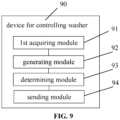
- FIG. 9 is a block diagram 1 of a device for controlling laundry equipment according to an illustrative embodiment. As shown in FIG. 9 , the device 90 includes a first acquiring module, a generating module, a determining module, and a sending module.
- the first acquiring module 91 is configured to acquire a to-be-shared washing parameter of at least one first laundry equipment, and a to-be-shared washing mode corresponding to the to-be-shared washing parameter.
- the generating module 92 is configured to generate a historical data set based on the to-be-shared washing parameter and the to-be-shared washing mode.
- the determining module 93 is configured to determine a target washing mode and a target washing parameter corresponding to the target washing mode from the historical data set.
- the fourth acquiring module is further configured to: edit the target washing parameter based on an editing instruction detected, acquiring the to-be-shared washing parameter.
- the device 1000 further includes a displaying module.
Landscapes
- Engineering & Computer Science (AREA)
- Textile Engineering (AREA)
- Computer Networks & Wireless Communication (AREA)
- Automation & Control Theory (AREA)
- Signal Processing (AREA)
- Control Of Washing Machine And Dryer (AREA)
Claims (9)
- Ein Verfahren zum Steuern einer Wäscheausrüstung, implementiert auf einer Waschmodus-Sharing-Plattform, wobei das Verfahren umfasst:Erfassen (101) eines zu teilenden Waschparameters der mindestens einen ersten Wäscheausrüstung und eines zu teilenden Waschmodus, der dem zu teilenden Waschparameter der mindestens einen ersten Wäscheausrüstung entspricht,dadurch gekennzeichnet, dassder zu teilende Waschparameter erfasst wird durch Empfangen von der mindestens einen ersten Wäscheausrüstung einer Benutzerbewertung und einer Benutzerversion eines Waschparameters, auf dessen Grundlage die mindestens eine erste Wäscheausrüstung einen Gegenstand gewaschen hat, wobei die Benutzerversion eine Benutzererfahrungseingabe umfasst;Erzeugen (102) eines historischen Datensatzes basierend auf dem zu teilenden Waschparameter und dem zu teilenden Waschmodus;Erfassen einer Waschanforderung von einer zweiten Wäscheausrüstung oder einer terminalen Ausrüstung, die mit der zweiten Wäscheausrüstung in Kommunikationsverbindung steht, wobei die Waschanforderung eine Zielmodus-Kennung umfasst;Bestimmen (103) eines Zielwaschmodus und eines Zielwaschparameters, der dem Zielwaschmodus entspricht, aus dem historischen Datensatz gemäß der Waschanforderung, durch:Vergleichen der Zielmodus-Kennung mit einer Modus-Kennung jedes zu teilenden Waschmodus im historischen Datensatz;falls ein Vergleichsergebnis anzeigt, dass es im historischen Datensatz einen zu teilenden Waschmodus mit einer Modus-Kennung gibt, die mit der Zielmodus-Kennung übereinstimmt, Bestimmen dieses zu teilenden Waschmodus als den Zielwaschmodus; undfalls das Vergleichsergebnis anzeigt, dass es im historischen Datensatz keinen zu teilenden Waschmodus mit einer Modus-Kennung gibt, die mit der Zielmodus-Kennung übereinstimmt, Bestimmen einer Ähnlichkeit zwischen der Zielmodus-Kennung und der Modus-Kennung des zu teilenden Waschmodus im historischen Datensatz und Bestimmen eines zu teilenden Waschmodus als den Zielwaschmodus, der einer Modus-Kennung mit einer Ähnlichkeit zu der Zielmodus-Kennung entspricht, die größer als ein festgelegter Ähnlichkeitsschwellenwert ist;
undSenden (104) des Zielwaschmodus und des Zielwaschparameters an die zweite Wäscheausrüstung. - Ein Verfahren zum Steuern einer Wäscheausrüstung, implementiert auf einer zweiten Wäscheausrüstung, wobei das Verfahren umfasst:Erfassen einer Waschanforderung, die eine Zielmodus-Kennung umfasst; Erfassen (201), von einer Waschmodus-Sharing-Plattform basierend auf der Zielmodus-Kennung, eines Zielwaschmodus und eines Zielwaschparameters, der dem Zielwaschmodus entspricht;Steuern (202) des Waschens eines zu waschenden Gegenstands durch die zweite Wäscheausrüstung gemäß dem Zielwaschmodus nach dem Zielwaschparameter;nachdem die zweite Wäscheausrüstung den zu waschenden Gegenstand gewaschen hat, Erfassen eines zu teilenden Waschparameters basierend auf dem Zielwaschparameter,dadurch gekennzeichnet, dassder zu teilende Waschparameter erfasst wird durch Empfangen einer Benutzerbewertung und einer Benutzerversion des Zielwaschparameters, wobei die Benutzerversion eine Benutzererfahrungseingabe umfasst; undHochladen des zu teilenden Waschparameters an die Waschmodus-Sharing-Plattform basierend auf einer erkannten Hochladeanweisung.
- Das Verfahren nach Anspruch 2, wobei die zweite Wäscheausrüstung ein Touch-Display aufweist, wobei die zweite Wäscheausrüstung in Kommunikationsverbindung mit einer terminalen Ausrüstung steht, wobei das Erfassen der Waschanforderung umfasst:Erfassen der Waschanforderung, die die Zielmodus-Kennung umfasst, basierend auf einer Touch-Bedienung an einem auf dem Touch-Display angezeigten Modussymbol; oderErfassen der Waschanforderung von der terminalen Ausrüstung.
- Das Verfahren nach Anspruch 3, ferner umfassend:Anzeigen eines Modussymbols eines Kandidatenwaschmodus in einer festgelegten Reihenfolge auf dem Touch-Display der zweiten Wäscheausrüstung oder auf einer Anzeigeoberfläche der terminalen Ausrüstung,wobei das Modussymbol dazu konfiguriert ist, den Kandidatenwaschmodus zu identifizieren, der dem Modussymbol entspricht.
- Eine Vorrichtung (90) zum Steuern einer Wäscheausrüstung, implementiert auf einer Waschmodus-Sharing-Plattform, wobei die Vorrichtung ein erstes Erfassungsmodul (91), ein zweites Erfassungsmodul, ein Erzeugungsmodul (92), ein Bestimmungsmodul (93) und ein Sendemodul (94) umfasst,wobei das erste Erfassungsmodul (91) dazu konfiguriert ist, einen zu teilenden Waschparameter der mindestens einen ersten Wäscheausrüstung und einen zu teilenden Waschmodus zu erfassen, der dem zu teilenden Waschparameter der mindestens einen ersten Wäscheausrüstung entspricht,dadurch gekennzeichnet, dassder zu teilende Waschparameter erfasst wird durch Empfangen von der mindestens einen ersten Wäscheausrüstung einer Benutzerbewertung und einer Benutzerversion eines Waschparameters, auf dessen Grundlage die mindestens eine erste Wäscheausrüstung einen Gegenstand gewaschen hat, wobei die Benutzerversion eine Benutzererfahrungseingabe umfasst,wobei das Erzeugungsmodul (92) dazu konfiguriert ist, basierend auf dem zu teilenden Waschparameter und dem zu teilenden Waschmodus einen historischen Datensatz zu erzeugen,wobei das zweite Erfassungsmodul dazu konfiguriert ist, eine Waschanforderung von einer zweiten Wäscheausrüstung oder einer terminalen Ausrüstung, die mit der zweiten Wäscheausrüstung in Kommunikationsverbindung steht, zu erfassen, wobei die Waschanforderung eine Zielmodus-Kennung umfasst,wobei das Bestimmungsmodul (93) dazu konfiguriert ist, einen Zielwaschmodus und einen Zielwaschparameter, der dem Zielwaschmodus entspricht, aus dem historischen Datensatz gemäß der Waschanforderung zu bestimmen, durch:Vergleichen der Zielmodus-Kennung mit einer Modus-Kennung jedes zu teilenden Waschmodus im historischen Datensatz;falls ein Vergleichsergebnis anzeigt, dass es im historischen Datensatz einen zu teilenden Waschmodus mit einer Modus-Kennung gibt, die mit der Zielmodus-Kennung übereinstimmt, wird dieser zu teilende Waschmodus als der Zielwaschmodus bestimmt; undfalls das Vergleichsergebnis anzeigt, dass es im historischen Datensatz keinen zu teilenden Waschmodus mit einer Modus-Kennung gibt, die mit der Zielmodus-Kennung übereinstimmt, wird eine Ähnlichkeit zwischen der Zielmodus-Kennung und der Modus-Kennung des zu teilenden Waschmodus im historischen Datensatz bestimmt und ein zu teilender Waschmodus als der Zielwaschmodus bestimmt, der einer Modus-Kennung mit einer Ähnlichkeit zu der Zielmodus-Kennung entspricht, die größer als ein festgelegter Ähnlichkeitsschwellenwert ist,wobei das Sendemodul (94) dazu konfiguriert ist, den Zielwaschmodus und den Zielwaschparameter an die zweite Wäscheausrüstung zu senden.
- Eine Vorrichtung (1000) zum Steuern einer Wäscheausrüstung, implementiert auf einer zweiten Wäscheausrüstung, wobei die Vorrichtung ein drittes Erfassungsmodul (1001), ein viertes Erfassungsmodul, ein fünftes Erfassungsmodul, ein Hochlademodul und ein Steuerungsmodul (1002) umfasst,wobei das fünfte Erfassungsmodul dazu konfiguriert ist, eine Waschanforderung zu erfassen, die eine Zielmodus-Kennung umfasst,wobei das dritte Erfassungsmodul (1001) dazu konfiguriert ist, von einer Waschmodus-Sharing-Plattform basierend auf der Zielmodus-Kennung einen Zielwaschmodus und einen Zielwaschparameter zu erfassen, der dem Zielwaschmodus entspricht,wobei das Steuerungsmodul (1002) dazu konfiguriert ist, das Waschen eines zu waschenden Gegenstands durch die zweite Wäscheausrüstung gemäß dem Zielwaschmodus nach dem Zielwaschparameter zu steuern,wobei das vierte Erfassungsmodul dazu konfiguriert ist, nachdem die zweite Wäscheausrüstung den zu waschenden Gegenstand gewaschen hat, einen zu teilenden Waschparameter basierend auf dem Zielwaschparameter zu erfassen,dadurch gekennzeichnet, dassder zu teilende Waschparameter erfasst wird durch Empfangen einer Benutzerbewertung und einer Benutzerversion des Zielwaschparameters, wobei die Benutzerversion eine Benutzererfahrungseingabe umfasst,wobei das Hochlademodul dazu konfiguriert ist, den zu teilenden Waschparameter basierend auf einer erkannten Hochladeanweisung an die Waschmodus-Sharing-Plattform hochzuladen.
- Eine Vorrichtung (900) zum Steuern einer Wäscheausrüstung, umfassend:eine Netzwerkschnittstelle (950);einen Prozessor (922); undeinen Speicher (932), der Prozessor-exekutierbare Anweisungen speichert, wobei der Prozessor (922) dazu konfiguriert ist, das Verfahren nach Anspruch 1 zu implementieren.
- Eine Vorrichtung (800) zum Steuern einer Wäscheausrüstung, umfassend:eine Kommunikationskomponente (816);einen Prozessor (820); undeinen Speicher (804), der Prozessor-exekutierbare Anweisungen speichert, wobei der Prozessor (820) dazu konfiguriert ist, das Verfahren nach einem der Ansprüche 2 bis 4 zu implementieren.
- Ein computerlesbares Speichermedium, in dem Anweisungen gespeichert sind, die, wenn sie von einem Prozessor einer Vorrichtung zum Steuern einer Wäscheausrüstung ausgeführt werden, die Vorrichtung zum Steuern einer Wäscheausrüstung in die Lage versetzen, das Verfahren nach einem der Ansprüche 1 bis 4 zu implementieren.
Applications Claiming Priority (1)
| Application Number | Priority Date | Filing Date | Title |
|---|---|---|---|
| CN202110152123.7A CN112981851A (zh) | 2021-02-03 | 2021-02-03 | 一种洗衣设备的控制方法、装置及存储介质 |
Publications (2)
| Publication Number | Publication Date |
|---|---|
| EP4040737A1 EP4040737A1 (de) | 2022-08-10 |
| EP4040737B1 true EP4040737B1 (de) | 2025-04-30 |
Family
ID=76346576
Family Applications (1)
| Application Number | Title | Priority Date | Filing Date |
|---|---|---|---|
| EP21188114.9A Active EP4040737B1 (de) | 2021-02-03 | 2021-07-28 | Verfahren und vorrichtung zur steuerung einer wäschereiausrüstung und speichermedium |
Country Status (3)
| Country | Link |
|---|---|
| US (1) | US11859329B2 (de) |
| EP (1) | EP4040737B1 (de) |
| CN (1) | CN112981851A (de) |
Families Citing this family (1)
| Publication number | Priority date | Publication date | Assignee | Title |
|---|---|---|---|---|
| US12344984B2 (en) * | 2022-07-20 | 2025-07-01 | Haier Us Appliance Solutions, Inc. | Laundry appliances with customized features |
Family Cites Families (11)
| Publication number | Priority date | Publication date | Assignee | Title |
|---|---|---|---|---|
| KR20090039182A (ko) * | 2007-10-17 | 2009-04-22 | 엘지전자 주식회사 | 세탁장치의 업데이트 시스템 |
| CN103966797B (zh) * | 2013-01-29 | 2018-02-23 | 青岛海尔洗衣机有限公司 | 一种用户可自编程的物联网洗衣机控制方法及控制装置 |
| KR102114860B1 (ko) | 2013-09-04 | 2020-05-25 | 엘지전자 주식회사 | 가전기기, 가전기기 시스템 및 그 제어 방법 |
| US9767332B1 (en) * | 2015-08-18 | 2017-09-19 | Joan Volmut | System and method for marking, tracking, and locating stains on a fabric item for application of a stain treatment prior to laundering |
| CN108070978B (zh) * | 2016-11-18 | 2020-12-29 | 上海小吉互联网科技有限公司 | 一种智能化的物联网洗衣机及其控制方法 |
| WO2018199543A1 (ko) | 2017-04-25 | 2018-11-01 | 엘지전자 주식회사 | 의류처리장치와 의류처리장치의 제어방법 및 상기 의류처리장치를 포함하는 온라인 시스템 |
| CN109385805B (zh) * | 2017-08-09 | 2022-07-01 | 青岛海尔洗衣机有限公司 | 一种衣物处理装置互联系统 |
| US10676855B2 (en) * | 2017-11-17 | 2020-06-09 | Whirlpool Corporation | Laundry treating appliance having a user interface and methods of operating same |
| CN108411565B (zh) * | 2018-06-11 | 2020-06-16 | 珠海格力电器股份有限公司 | 洗衣机控制方法及装置 |
| KR20210067605A (ko) * | 2019-11-29 | 2021-06-08 | 엘지전자 주식회사 | 인공 지능을 이용한 상업용 세탁기의 제어 방법 및 그 시스템 |
| CN111796736B (zh) * | 2020-06-30 | 2021-12-24 | 维沃移动通信(杭州)有限公司 | 应用程序的分享方法、装置和电子设备 |
-
2021
- 2021-02-03 CN CN202110152123.7A patent/CN112981851A/zh active Pending
- 2021-07-27 US US17/386,241 patent/US11859329B2/en active Active
- 2021-07-28 EP EP21188114.9A patent/EP4040737B1/de active Active
Also Published As
| Publication number | Publication date |
|---|---|
| US11859329B2 (en) | 2024-01-02 |
| CN112981851A (zh) | 2021-06-18 |
| EP4040737A1 (de) | 2022-08-10 |
| US20220243375A1 (en) | 2022-08-04 |
Similar Documents
| Publication | Publication Date | Title |
|---|---|---|
| CN104159255B (zh) | 终端间共享网络的方法及装置 | |
| CN109729414A (zh) | 一种评论消息的发送、显示方法、装置、服务器及终端 | |
| RU2643461C2 (ru) | Способ и устройство для взаимодействия с приложением | |
| CN104846588A (zh) | 智能洗涤方法和装置 | |
| CN104239094A (zh) | 后台应用程序的控制方法、装置及终端设备 | |
| CN105099840A (zh) | 智能家居场景的设置方法及装置 | |
| CN104486451B (zh) | 应用程序推荐方法及装置 | |
| CN104050035A (zh) | 应用程序的处理方法及装置 | |
| CN111050076A (zh) | 拍摄处理方法及电子设备 | |
| CN108024223A (zh) | 数据分享方法及装置 | |
| CN106292991A (zh) | 一种降低终端设备功耗的方法及装置 | |
| CN105182783A (zh) | 用于控制智能设备的方法、装置及终端 | |
| CN104035979A (zh) | 对象推荐的方法及相关装置 | |
| CN107346115B (zh) | 一种智能设备的控制方法、控制终端和智能设备 | |
| CN105487805A (zh) | 对象操作方法及装置 | |
| CN105487798B (zh) | 在触摸屏终端上对通讯应用程序进行操作的方法及装置 | |
| EP4125273A1 (de) | Verfahren und vorrichtung zur anzeigesteuerung für virtuelle artikel sowie anzeigeverfahren und vorrichtung für virtuelle artikel | |
| CN112486387A (zh) | 应用程序的控制方法及装置 | |
| CN105101354A (zh) | 无线网络连接方法及装置 | |
| US11859329B2 (en) | Method and device for controlling laundry equipment, and storage medium | |
| CN107558099A (zh) | 洗衣模式的确定方法、装置及智能设备 | |
| CN104035764A (zh) | 对象控制方法及相关装置 | |
| CN110472098A (zh) | 视频内容主题的确定方法、装置、电子设备及存储介质 | |
| CN116931777A (zh) | 基于拖拽的预测模型生成方法、数据集预测方法和装置 | |
| US11075811B2 (en) | Method and apparatus for device identification |
Legal Events
| Date | Code | Title | Description |
|---|---|---|---|
| PUAI | Public reference made under article 153(3) epc to a published international application that has entered the european phase |
Free format text: ORIGINAL CODE: 0009012 |
|
| STAA | Information on the status of an ep patent application or granted ep patent |
Free format text: STATUS: THE APPLICATION HAS BEEN PUBLISHED |
|
| AK | Designated contracting states |
Kind code of ref document: A1 Designated state(s): AL AT BE BG CH CY CZ DE DK EE ES FI FR GB GR HR HU IE IS IT LI LT LU LV MC MK MT NL NO PL PT RO RS SE SI SK SM TR |
|
| STAA | Information on the status of an ep patent application or granted ep patent |
Free format text: STATUS: REQUEST FOR EXAMINATION WAS MADE |
|
| 17P | Request for examination filed |
Effective date: 20230201 |
|
| RBV | Designated contracting states (corrected) |
Designated state(s): AL AT BE BG CH CY CZ DE DK EE ES FI FR GB GR HR HU IE IS IT LI LT LU LV MC MK MT NL NO PL PT RO RS SE SI SK SM TR |
|
| GRAP | Despatch of communication of intention to grant a patent |
Free format text: ORIGINAL CODE: EPIDOSNIGR1 |
|
| STAA | Information on the status of an ep patent application or granted ep patent |
Free format text: STATUS: GRANT OF PATENT IS INTENDED |
|
| INTG | Intention to grant announced |
Effective date: 20241202 |
|
| P01 | Opt-out of the competence of the unified patent court (upc) registered |
Free format text: CASE NUMBER: APP_64263/2024 Effective date: 20241204 |
|
| GRAS | Grant fee paid |
Free format text: ORIGINAL CODE: EPIDOSNIGR3 |
|
| GRAA | (expected) grant |
Free format text: ORIGINAL CODE: 0009210 |
|
| STAA | Information on the status of an ep patent application or granted ep patent |
Free format text: STATUS: THE PATENT HAS BEEN GRANTED |
|
| AK | Designated contracting states |
Kind code of ref document: B1 Designated state(s): AL AT BE BG CH CY CZ DE DK EE ES FI FR GB GR HR HU IE IS IT LI LT LU LV MC MK MT NL NO PL PT RO RS SE SI SK SM TR |
|
| REG | Reference to a national code |
Ref country code: CH Ref legal event code: EP Ref country code: GB Ref legal event code: FG4D |
|
| REG | Reference to a national code |
Ref country code: IE Ref legal event code: FG4D |
|
| REG | Reference to a national code |
Ref country code: DE Ref legal event code: R096 Ref document number: 602021029894 Country of ref document: DE |
|
| REG | Reference to a national code |
Ref country code: NL Ref legal event code: MP Effective date: 20250430 |
|
| REG | Reference to a national code |
Ref country code: AT Ref legal event code: MK05 Ref document number: 1791123 Country of ref document: AT Kind code of ref document: T Effective date: 20250430 |
|
| PG25 | Lapsed in a contracting state [announced via postgrant information from national office to epo] |
Ref country code: PT Free format text: LAPSE BECAUSE OF FAILURE TO SUBMIT A TRANSLATION OF THE DESCRIPTION OR TO PAY THE FEE WITHIN THE PRESCRIBED TIME-LIMIT Effective date: 20250901 Ref country code: ES Free format text: LAPSE BECAUSE OF FAILURE TO SUBMIT A TRANSLATION OF THE DESCRIPTION OR TO PAY THE FEE WITHIN THE PRESCRIBED TIME-LIMIT Effective date: 20250430 Ref country code: FI Free format text: LAPSE BECAUSE OF FAILURE TO SUBMIT A TRANSLATION OF THE DESCRIPTION OR TO PAY THE FEE WITHIN THE PRESCRIBED TIME-LIMIT Effective date: 20250430 |
|
| PGFP | Annual fee paid to national office [announced via postgrant information from national office to epo] |
Ref country code: DE Payment date: 20250722 Year of fee payment: 5 |
|
| REG | Reference to a national code |
Ref country code: LT Ref legal event code: MG9D |
|
| PG25 | Lapsed in a contracting state [announced via postgrant information from national office to epo] |
Ref country code: GR Free format text: LAPSE BECAUSE OF FAILURE TO SUBMIT A TRANSLATION OF THE DESCRIPTION OR TO PAY THE FEE WITHIN THE PRESCRIBED TIME-LIMIT Effective date: 20250731 Ref country code: NO Free format text: LAPSE BECAUSE OF FAILURE TO SUBMIT A TRANSLATION OF THE DESCRIPTION OR TO PAY THE FEE WITHIN THE PRESCRIBED TIME-LIMIT Effective date: 20250730 |
|
| PG25 | Lapsed in a contracting state [announced via postgrant information from national office to epo] |
Ref country code: NL Free format text: LAPSE BECAUSE OF FAILURE TO SUBMIT A TRANSLATION OF THE DESCRIPTION OR TO PAY THE FEE WITHIN THE PRESCRIBED TIME-LIMIT Effective date: 20250430 Ref country code: PL Free format text: LAPSE BECAUSE OF FAILURE TO SUBMIT A TRANSLATION OF THE DESCRIPTION OR TO PAY THE FEE WITHIN THE PRESCRIBED TIME-LIMIT Effective date: 20250430 |
|
| PG25 | Lapsed in a contracting state [announced via postgrant information from national office to epo] |
Ref country code: BG Free format text: LAPSE BECAUSE OF FAILURE TO SUBMIT A TRANSLATION OF THE DESCRIPTION OR TO PAY THE FEE WITHIN THE PRESCRIBED TIME-LIMIT Effective date: 20250430 |
|
| PGFP | Annual fee paid to national office [announced via postgrant information from national office to epo] |
Ref country code: GB Payment date: 20250724 Year of fee payment: 5 |
|
| PG25 | Lapsed in a contracting state [announced via postgrant information from national office to epo] |
Ref country code: HR Free format text: LAPSE BECAUSE OF FAILURE TO SUBMIT A TRANSLATION OF THE DESCRIPTION OR TO PAY THE FEE WITHIN THE PRESCRIBED TIME-LIMIT Effective date: 20250430 |
|
| PG25 | Lapsed in a contracting state [announced via postgrant information from national office to epo] |
Ref country code: AT Free format text: LAPSE BECAUSE OF FAILURE TO SUBMIT A TRANSLATION OF THE DESCRIPTION OR TO PAY THE FEE WITHIN THE PRESCRIBED TIME-LIMIT Effective date: 20250430 |
|
| PG25 | Lapsed in a contracting state [announced via postgrant information from national office to epo] |
Ref country code: RS Free format text: LAPSE BECAUSE OF FAILURE TO SUBMIT A TRANSLATION OF THE DESCRIPTION OR TO PAY THE FEE WITHIN THE PRESCRIBED TIME-LIMIT Effective date: 20250731 |
|
| PG25 | Lapsed in a contracting state [announced via postgrant information from national office to epo] |
Ref country code: IS Free format text: LAPSE BECAUSE OF FAILURE TO SUBMIT A TRANSLATION OF THE DESCRIPTION OR TO PAY THE FEE WITHIN THE PRESCRIBED TIME-LIMIT Effective date: 20250830 |
|
| PG25 | Lapsed in a contracting state [announced via postgrant information from national office to epo] |
Ref country code: LV Free format text: LAPSE BECAUSE OF FAILURE TO SUBMIT A TRANSLATION OF THE DESCRIPTION OR TO PAY THE FEE WITHIN THE PRESCRIBED TIME-LIMIT Effective date: 20250430 |
|
| PG25 | Lapsed in a contracting state [announced via postgrant information from national office to epo] |
Ref country code: SM Free format text: LAPSE BECAUSE OF FAILURE TO SUBMIT A TRANSLATION OF THE DESCRIPTION OR TO PAY THE FEE WITHIN THE PRESCRIBED TIME-LIMIT Effective date: 20250430 Ref country code: DK Free format text: LAPSE BECAUSE OF FAILURE TO SUBMIT A TRANSLATION OF THE DESCRIPTION OR TO PAY THE FEE WITHIN THE PRESCRIBED TIME-LIMIT Effective date: 20250430 |
|
| PG25 | Lapsed in a contracting state [announced via postgrant information from national office to epo] |
Ref country code: CZ Free format text: LAPSE BECAUSE OF FAILURE TO SUBMIT A TRANSLATION OF THE DESCRIPTION OR TO PAY THE FEE WITHIN THE PRESCRIBED TIME-LIMIT Effective date: 20250430 |
|
| PG25 | Lapsed in a contracting state [announced via postgrant information from national office to epo] |
Ref country code: EE Free format text: LAPSE BECAUSE OF FAILURE TO SUBMIT A TRANSLATION OF THE DESCRIPTION OR TO PAY THE FEE WITHIN THE PRESCRIBED TIME-LIMIT Effective date: 20250430 |
|
| PG25 | Lapsed in a contracting state [announced via postgrant information from national office to epo] |
Ref country code: SK Free format text: LAPSE BECAUSE OF FAILURE TO SUBMIT A TRANSLATION OF THE DESCRIPTION OR TO PAY THE FEE WITHIN THE PRESCRIBED TIME-LIMIT Effective date: 20250430 |
|
| PG25 | Lapsed in a contracting state [announced via postgrant information from national office to epo] |
Ref country code: IT Free format text: LAPSE BECAUSE OF FAILURE TO SUBMIT A TRANSLATION OF THE DESCRIPTION OR TO PAY THE FEE WITHIN THE PRESCRIBED TIME-LIMIT Effective date: 20250430 |
|
| REG | Reference to a national code |
Ref country code: DE Ref legal event code: R097 Ref document number: 602021029894 Country of ref document: DE |
|
| PG25 | Lapsed in a contracting state [announced via postgrant information from national office to epo] |
Ref country code: RO Free format text: LAPSE BECAUSE OF FAILURE TO SUBMIT A TRANSLATION OF THE DESCRIPTION OR TO PAY THE FEE WITHIN THE PRESCRIBED TIME-LIMIT Effective date: 20250430 |
|
| REG | Reference to a national code |
Ref country code: CH Ref legal event code: H13 Free format text: ST27 STATUS EVENT CODE: U-0-0-H10-H13 (AS PROVIDED BY THE NATIONAL OFFICE) Effective date: 20260224 |
|
| PLBE | No opposition filed within time limit |
Free format text: ORIGINAL CODE: 0009261 |
|
| STAA | Information on the status of an ep patent application or granted ep patent |
Free format text: STATUS: NO OPPOSITION FILED WITHIN TIME LIMIT |
|
| REG | Reference to a national code |
Ref country code: CH Ref legal event code: L10 Free format text: ST27 STATUS EVENT CODE: U-0-0-L10-L00 (AS PROVIDED BY THE NATIONAL OFFICE) Effective date: 20260311 |
|
| PG25 | Lapsed in a contracting state [announced via postgrant information from national office to epo] |
Ref country code: LU Free format text: LAPSE BECAUSE OF NON-PAYMENT OF DUE FEES Effective date: 20250728 |
|
| REG | Reference to a national code |
Ref country code: BE Ref legal event code: MM Effective date: 20250731 |
|
| 26N | No opposition filed |
Effective date: 20260202 |
|
| PG25 | Lapsed in a contracting state [announced via postgrant information from national office to epo] |
Ref country code: BE Free format text: LAPSE BECAUSE OF NON-PAYMENT OF DUE FEES Effective date: 20250731 |
|
| PG25 | Lapsed in a contracting state [announced via postgrant information from national office to epo] |
Ref country code: FR Free format text: LAPSE BECAUSE OF NON-PAYMENT OF DUE FEES Effective date: 20250731 |
|
| PG25 | Lapsed in a contracting state [announced via postgrant information from national office to epo] |
Ref country code: CH Free format text: LAPSE BECAUSE OF NON-PAYMENT OF DUE FEES Effective date: 20250731 |